EP2168367B1 - Établissement d'appel séparé entre deux réseaux - Google Patents
Établissement d'appel séparé entre deux réseaux Download PDFInfo
- Publication number
- EP2168367B1 EP2168367B1 EP08759178.0A EP08759178A EP2168367B1 EP 2168367 B1 EP2168367 B1 EP 2168367B1 EP 08759178 A EP08759178 A EP 08759178A EP 2168367 B1 EP2168367 B1 EP 2168367B1
- Authority
- EP
- European Patent Office
- Prior art keywords
- network
- module
- information
- call
- connection
- Prior art date
- Legal status (The legal status is an assumption and is not a legal conclusion. Google has not performed a legal analysis and makes no representation as to the accuracy of the status listed.)
- Not-in-force
Links
- 238000000034 method Methods 0.000 claims description 37
- 230000004044 response Effects 0.000 claims description 34
- 238000010168 coupling process Methods 0.000 description 88
- 238000005859 coupling reaction Methods 0.000 description 88
- 230000008878 coupling Effects 0.000 description 87
- 238000004891 communication Methods 0.000 description 23
- 102100026009 NF-kappa-B inhibitor zeta Human genes 0.000 description 10
- 101710115530 NF-kappa-B inhibitor zeta Proteins 0.000 description 10
- 230000011664 signaling Effects 0.000 description 8
- 238000004458 analytical method Methods 0.000 description 7
- 238000006243 chemical reaction Methods 0.000 description 7
- 238000001514 detection method Methods 0.000 description 7
- 230000008901 benefit Effects 0.000 description 5
- 239000003999 initiator Substances 0.000 description 5
- 238000010586 diagram Methods 0.000 description 4
- 230000001105 regulatory effect Effects 0.000 description 4
- 239000003795 chemical substances by application Substances 0.000 description 3
- 230000000977 initiatory effect Effects 0.000 description 3
- 238000013475 authorization Methods 0.000 description 2
- 230000009286 beneficial effect Effects 0.000 description 2
- 230000009977 dual effect Effects 0.000 description 2
- 238000003860 storage Methods 0.000 description 2
- 238000004590 computer program Methods 0.000 description 1
- 230000001419 dependent effect Effects 0.000 description 1
- 238000005516 engineering process Methods 0.000 description 1
- JEIPFZHSYJVQDO-UHFFFAOYSA-N ferric oxide Chemical compound O=[Fe]O[Fe]=O JEIPFZHSYJVQDO-UHFFFAOYSA-N 0.000 description 1
- 230000003993 interaction Effects 0.000 description 1
- 230000014759 maintenance of location Effects 0.000 description 1
- 230000003287 optical effect Effects 0.000 description 1
- 230000008569 process Effects 0.000 description 1
Images



Classifications
-
- H—ELECTRICITY
- H04—ELECTRIC COMMUNICATION TECHNIQUE
- H04M—TELEPHONIC COMMUNICATION
- H04M15/00—Arrangements for metering, time-control or time indication ; Metering, charging or billing arrangements for voice wireline or wireless communications, e.g. VoIP
-
- H—ELECTRICITY
- H04—ELECTRIC COMMUNICATION TECHNIQUE
- H04M—TELEPHONIC COMMUNICATION
- H04M15/00—Arrangements for metering, time-control or time indication ; Metering, charging or billing arrangements for voice wireline or wireless communications, e.g. VoIP
- H04M15/08—Metering calls to called party, i.e. B-party charged for the communication
-
- H—ELECTRICITY
- H04—ELECTRIC COMMUNICATION TECHNIQUE
- H04M—TELEPHONIC COMMUNICATION
- H04M15/00—Arrangements for metering, time-control or time indication ; Metering, charging or billing arrangements for voice wireline or wireless communications, e.g. VoIP
- H04M15/90—Arrangements for metering, time-control or time indication ; Metering, charging or billing arrangements for voice wireline or wireless communications, e.g. VoIP using Intelligent Networks [IN] or Advanced Intelligent Networks [AIN]
-
- H—ELECTRICITY
- H04—ELECTRIC COMMUNICATION TECHNIQUE
- H04Q—SELECTING
- H04Q3/00—Selecting arrangements
- H04Q3/0016—Arrangements providing connection between exchanges
- H04Q3/0025—Provisions for signalling
-
- H—ELECTRICITY
- H04—ELECTRIC COMMUNICATION TECHNIQUE
- H04M—TELEPHONIC COMMUNICATION
- H04M2215/00—Metering arrangements; Time controlling arrangements; Time indicating arrangements
- H04M2215/01—Details of billing arrangements
- H04M2215/016—Billing using Intelligent Networks [IN] or Advanced Intelligent Networks [AIN]
-
- H—ELECTRICITY
- H04—ELECTRIC COMMUNICATION TECHNIQUE
- H04M—TELEPHONIC COMMUNICATION
- H04M2215/00—Metering arrangements; Time controlling arrangements; Time indicating arrangements
- H04M2215/62—Called party billing, e.g. reverse billing, freephone, collect call, 0800 or 0900
Definitions
- the invention relates to a method for setting up a connection via an interconnection between different networks, and also relates to a first module for a first network, to a first sub-method for a first network, to a second module for a second network, to a second sub-method for a second network, to a third module for a third network, to a third sub-method for a third network, and to an arrangement comprising a module.
- Examples of such different networks are first networks such as public fixed networks and other kinds of public or private networks, second networks such as public mobile networks and other kinds of public or private networks, and third networks such as private fixed networks and other kinds of public or private networks.
- Examples of such arrangements are networks and parts thereof such as switching centres, servers, switches, routers, forwarders, multiplexers, and other network units.
- a prior art method is known in general. To set up a "normal" call from a first subscriber in a first network to a second subscriber in a second network, the first subscriber dials a telephone number of the second subscriber, and in response the first network sets up a part of the "normal” call from the first subscriber to a border between the first and second networks and the second network sets up another part of the "normal” call from the border between the first and second networks to the second subscriber. As soon as the second subscriber has accepted the "normal" call, the first and second subscribers can start a communication with each other. The first subscriber is charged for this call.
- a "call back" call is to be set up.
- the second subscriber does not accept the "normal” call from the first subscriber, but the "normal” call is only used to inform the second subscriber that the first subscriber would like to communicate.
- the second subscriber waits until the first subscriber has ceased the "normal” call and then dials a telephone number of the first subscriber, and in response the second network sets up a part of the "call back" call from the second subscriber to a border between the first and second networks and the first network sets up another part of the "call back” call from the border between the first and second networks to the first subscriber.
- the first and second subscribers can start a communication with each other. The second subscriber is charged for this call.
- the prior art method is disadvantageous, inter alia, in that the first subscriber must start the "normal” call and then cease the "normal” call before the first subscriber can accept the "call back" call from the second subscriber.
- WO 03/077516 A1 provides a system and device for automatically reversing a call set-up.
- a receiver is communicating with an initiator of a call via a communication network, whereby the initiator sets up a first call setup message.
- the receiver terminates said first call set-up message before a connection is made and transmits a second call set-up message towards the initiator.
- the receiver becomes the initiator of the call and will automatically be listed as the initiator and receive the bill.
- GB 2 369 270 A discloses a scenario in which first and second callers to which a reverse charge request relates, belong to different home networks.
- Each network comprises a Cost Control Node, CCN, implementing a Cost Control Function, CCF.
- CCN Cost Control Node
- CCF Cost Control Function
- a method as defined in claim 1 is provided.
- a method for setting up a connection via an interconnection between different networks (1, 2) comprising - a first step of, via a first network unit (11) located in a first network (1), setting up a first part of the connection from a first subscriber station to at least the first network unit (11),
- the first part of the connection can terminate at the first network unit (11) or at a further unit, such as the first module (12). In the latter case, the first part of the connection will be set up via the first network unit (11).
- the sending of second information to the second module (22) can be done in the process of performing an ordinary, temporary call attempt, in which a temporary call leg is set up.
- This temporary call attempt is initiated by the first module and treated by the first network unit no different from a normal call attempt.
- a temporary call leg from the first network (1) to the second network (2) is set up (the temporary call attempt).
- the second information comprises a second identification of a second subscriber station, this second identification being different from the second identification of the second subscriber station comprised in the first information, the first module (12) determining said second identification comprised in the second information, based on the first information received.
- the second information also comprises a correlation ID, determined by module (12) in response to the receipt of the first information
- a method as defined in claim 6 is provided.
- a first network such as for example a public fixed network (first step)
- first information is received, which first information defines at least a first part of the connection within the first network.
- the first information arrives for example at a first network unit and originates for example from a first subscriber station possibly via a further first network unit and comprises for example at least a part of a first identification of the first subscriber station via which the connection has been initiated and at least a part of a second identification of the second subscriber station that is to be called.
- the second identification of the second subscriber station is such that this second identification further defines that the charging control of at least the interconnection is not to be performed by the first network but that it is to be performed by another network.
- a possible way to realize this is by giving the second subscriber station two telephone numbers, one for being called via "normal” connections and one other for being called via "call back" connections, without having excluded other options.
- the second identification of the second subscriber station is a "normal” identification, whereby in or near the first network a conversion is to be made for converting the "normal" identification into a "call back" identification.
- a possible way to realize this is by introducing a database in or near the first network that for example in dependence of a user setting (such as a user preference etc.) or another parameter (such as a time, a date etc.) makes the conversion, without having excluded other options.
- the first part of the connection is for example a first leg between the first subscriber station and the first network unit or between the further first network unit and the first network unit.
- the first part of the connection is for example set up and is for example kept open, without having excluded other options.
- second information is sent to a second network such as for example a public mobile network, which second information defines the charging control of at least the interconnection to be performed outside the first network and defines at least a second part of the connection.
- the second information originates for example from the first network unit when comprising a first module or originates for example from the first module when being coupled to the first network unit and may be identical to the first information or may be partly or entirely different from the first information.
- the second information comprises for example at least a part of the first identification of the first subscriber station or comprises for example a link to this first identification of the first subscriber station or comprises for example a link to the first information and comprises at least a part of the second identification of the second subscriber station (which second identification may further be used as one or more of the links mentioned before).
- the second identification of the second subscriber station may be or may not be such that this second identification further defines that the charging control of at least the interconnection is not to be performed by the first network but that it is to be performed by another network.
- the second part of the connection in response to a reception of the second information, is set up within the second network.
- the second information arrives for example at a second network unit when comprising a second module or arrives for example at the second module when being coupled to the second network unit.
- the second part of the connection is for example a second leg between the second network unit and the second subscriber station or between the second network unit and a further second network unit via which the second subscriber station can communicate.
- the connection comprises the first part, the interconnection and the second part.
- the interconnection is for example an interconnecting leg between the second network unit and the first network unit and forms a coupling between the second part and the first part such that the first and second subscriber stations can communicate.
- the setting up of the first part, the interconnection and the second part may be performed in this particular order or according to another sequence.
- the charging control of at least the interconnection is performed by/inside the second network and/or a connection control of at least the interconnection is performed by/inside the second network.
- a third network may be involved, such as a private fixed network.
- third information is sent to a third network.
- the third information arrives for example at a third network unit and originates for example from the first network unit and comprises for example at least a part of the first identification of the first subscriber station via which the connection has been initiated or comprises for example a pointer to this first identification of the first subscriber station or comprises for example a pointer to the first information and comprises for example either at least a part of the second identification of the second subscriber station that is to be called or at least a part of a third identification of a third subscriber station that is to be called.
- the second identification of the second subscriber station may be or may not be such that this second identification further defines that the charging control of at least the interconnection is not to be performed by the first network but that it is to be performed by another network.
- the second information is sent to the second network.
- the second information originates for example from the third network unit when comprising a third module or originates for example from the third module when being coupled to the third network unit and may be identical to the third information or may be partly or entirely different from the third information.
- the third network has forwarded the call to the second network.
- the second and third network will perform "parallel ringing", as follows, and without having excluded further possibilities.
- a third part of the connection in response to a reception of the third information, may be set up within the third network.
- the third part of the connection is for example a third leg between the third network unit and the third subscriber station and may be for example set up to realize "parallel ringing" at the second and third subscriber stations to for example allow the second subscriber to choose between answering the call via the second or the third subscriber station.
- the connection may further comprise a further interconnection between the first and third networks and the third part.
- the further interconnection is for example a further interconnecting leg between the third network unit and the first network unit.
- the interconnection may be present between the second and third network units, such as an interconnecting leg between these second and third network units.
- the first network is only used for coupling the first subscriber station to the third network
- the third network contacts the second network and the interconnection is present between the second and third networks whereby the second network gets the charging control of at least this interconnection between the second and the third network etc.
- a "call back" call can be set up without a "normal” call needing to precede this "call back" call, and the second subscriber has the option of using the second subscriber station for realizing a communication via a "call back” call or the third subscriber station for realizing a communication via a "normal” call.
- a first module as defined in claim 9 for a first network is provided.
- a first sub-method as defined in claim 10 for a first network is provided.
- a second module as defined in claim 11 for a second network is provided.
- a second sub-method as defined in claim 12 for a second network is provided.
- a third module as defined in claim 13 for a third network is provided.
- a third sub-method as defined in claim 14 for a third network is provided.
- an arrangement as defined in claim 15 comprising a module is provided.
- Embodiments of the modules according to the invention and of the sub-methods according to the invention and of the arrangement according to the invention correspond with the embodiments of the method according to the invention.
- An insight may be that a prior art call back procedure based on separate "normal” and "call back” calls is relatively user unfriendly.
- a basic idea may be that a call back procedure should be based on one integrated connection comprising a "normal” part and a "call back" part.
- An aspect of the invention that can be understood from the above is that, when the invention is applied to a first network connected to a second network by an interconnection, the first network unit will essentially perform the same operations, as that it would perform during normal call set-ups. Hence an operator of the first network, that does not also operate the first module 12, does, from a technical point of view, not have to be consciously aware of the appliance of the invention.
- a further consequence of the invention is that, when it is applied, the user of the first subscriber station when initiating a new call, will, if not informed previously, not notice that the invention is applied.
- the reason for this being that the number used during the above call set up, would typically not be distinct from an ordinary number, and not be recognisable as a number specifically used for the carrying out of the invention.
- a further advantage may be that an introduction of a new service has become possible.
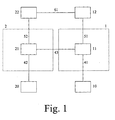
- a first network 1 is shown such as a public fixed network or another public or private network.
- the first network 1 comprises a first network unit 11 coupled to a first subscriber station 10 via a coupling 41 and coupled to a first module 12 via a coupling 51.
- a second network 2 is shown such as a public mobile network or another public or private network.
- the second network 2 comprises a second network unit 21 coupled to a second subscriber station 20 via a coupling 42 and coupled to a second module 22 via a coupling 52.
- the first and second network units 11 and 21 are coupled to each other via a coupling 43.
- the first and second modules 12 and 22 are coupled to each other via a coupling 61.
- the network units 11 and 21 for example each comprise a switch, a router, a forwarder, a multiplexer, a server etc.
- a first subscriber who wants to communicate with a second subscriber via a "normal" connection takes the first subscriber station 10 and dials a "real" number of the second subscriber station 20.
- a "normal" connection is set up from the first subscriber station 10 via the coupling 41 and the network unit 11 and the coupling 43 and the network unit 21 and the coupling 42 to the second subscriber station 20.
- the first subscriber is charged for this "normal" connection.
- a first subscriber who wants to communicate with a second subscriber via a "call back" connection takes the first subscriber station 10 and dials for example a "virtual" number of the second subscriber station 20. This "virtual" number is different from the "real" number of the second subscriber station 20.
- the first network unit 11 collects first information.
- the first information comprises at least a part of a first identification of the first subscriber station 10 via which the connection has been initiated, such as for example a telephone number of the first subscriber station 10. This way, at least a first part of the connection is defined. This first part for example corresponds with the coupling 41.
- the first information further comprises at least a part of a second identification of the second subscriber station 20 that is to be called, such as for example the "virtual" number of the second subscriber station 20.
- a charging control of at least an interconnection between the first and second networks 1 and 2 is to be performed outside the first network 1, such as for example inside the second network 2.
- the first part of the connection is for example set up and is for example kept open, without having excluded other options.
- the first network unit 11 sends the first information to the first module 12 via the coupling 51.
- the first module 12 sends second information to the second module 22, for example via the coupling 61, such as a data connection, or via the couplings 51, 43 and 52.
- the second information may be identical to the first information or may be partly or entirely different from the first information.
- the first module 12 may take care of a conversion.
- the second information comprises for example at least a part of the first identification of the first subscriber station 10 via which the connection has been initiated, such as for example the telephone number of the first subscriber station 10, or comprises for example a link to this first identification of the first subscriber station 10 or comprises for example a link to the first information.
- the second information further comprises at least a part of the second identification of the second subscriber station 20 that is to be called, such as for example the "real" number of the second subscriber station 20, whereby for example the first module 12 has converted the "virtual" number of the second subscriber station 20 into the "real" number of this second subscriber station 20 (which second identification may further be used as one or more of the links mentioned before).
- the charging control of at least the interconnection is to be performed outside the first network 1, such as for example inside the second network 2.
- the (parts of the) first (if available) and second identifications of the first and second subscriber stations 10 and 20 further define a second part of the connection, such as for example the coupling 42.
- the second module 22 receives the second information and in response sends a set up instruction to the second network unit 21.
- the second network unit 21 in response sets up the second part of the connection within the second network.
- This second part of the connection for example corresponds with the coupling 42.
- the connection comprises the first part, the interconnection and the second part.
- the interconnection for example corresponds with the coupling 43 and forms a coupling between the second part and the first part such that the first and second subscriber stations 10 and 20 can communicate.
- the setting up of the first part, the interconnection and the second part may be performed in this particular order or according to another sequence. As a result, a "call back" call has been set up without a "normal" call needing to precede this "call back" call.
- a first subscriber who wants to communicate with a second subscriber via a connection takes the first subscriber station 10 and dials for example a "real" number of the second subscriber station 20.
- the first network unit 11 collects first information.
- the first information comprises at least a part of a first identification of the first subscriber station 10 via which the connection has been initiated, such as for example a telephone number of the first subscriber station 10. This way, at least a first part of the connection is defined. This first part for example corresponds with the coupling 41.
- the first information further comprises at least a part of a second identification of the second subscriber station 20 that is to be called, such as for example the "real" number of the second subscriber station 20.
- a conversion is to be made for converting the "real" number or another "dialed” number into a "virtual" number.
- a possible way to realize this is by introducing a database or an application in or near the first network 1 that for example in dependence of a user setting (such as a user preference etc.) or another parameter (such as a time, a date etc.) makes the conversion, without having excluded other options.
- This database may partly or entirely form part of the first network unit 11, or not.
- Via the "virtual" number it is defined that a charging control of at least an interconnection between the first and second networks 1 and 2 is to be performed outside the first network 1, such as for example inside the second network 2.
- the first network unit 11 sends the converted first information to the first module 12 via the coupling 51 or, in case of the database or the application partly or entirely forming part of the first module 12, the first network unit 11 sends the first information to the first module 12 for being converted.
- the first module 12 sends second information to the second module 22, for example via the coupling 61, such as a data connection, or via the couplings 51, 43 and 52.
- the second information may be identical to the first information or may be partly or entirely different from the first information.
- the first module 12 may take care of a conversion.
- the second information comprises at least a part of the first identification of the first subscriber station 10 (if available) via which the connection has been initiated, such as for example the telephone number of the first subscriber station 10, or comprises for example a link to this first identification of the first subscriber station 10 or comprises for example a link to the first information.
- the second information further comprises at least a part of the second identification of the second subscriber station 20 that is to be called, such as for example the "real" number of the second subscriber station 20, whereby for example the database or the application has converted the "dialed" number into the "virtual” number and whereby the first module 12 has converted the "virtual" number of the second subscriber station 20 into the "real" number of this second subscriber station 20.
- the second information may comprise for example the "virtual" number of the second subscriber station 20, whereby for example the second module 22 will take care of a conversion of this "virtual" number into the "real" number of the second subscriber station 20 (which second identification may further be used as one or more of the links mentioned before).
- the charging control of at least the interconnection is to be performed outside the first network 1, such as for example inside the second network 2.
- the (parts of the) first (if available) and second identifications of the first and second subscriber stations 10 and 20 further define a second part of the connection, such as for example the coupling 42.
- the second module 22 receives the second information etc. as described above for the first option.
- the invention provides features for an automatic and user hidden call back procedure based on a network centric solution. It is a converged network solution because the features may need to be supported by both networks at a functional and an administration layer. Due to the network centric character of the solution additional features do not need to be implemented in the telephone equipment and a specific manual handling necessary from the users point of view is not required.
- the invention may be beneficial for
- the network or service operator is in a position to offer specific and high sophisticated telecommunication services.
- the first and second modules 12 and 22 can be applications on top of an SCP (Service Control Point) following an IN (Intelligent Network) recommendation, on top of the CSE (CAMEL Service Environment) following a CAMEL (Customized Application for Mobile Enhanced Logic) recommendation, on top of a SN (Service Node) connected via e.g. ISUP (ISDN User Part) protocol, on top of an OSA Application Server or can be applications integrated in the network units 11 and 21.
- SCP Service Control Point
- IN Intelligent Network
- CSE CAMEL Service Environment
- CAMEL Customerized Application for Mobile Enhanced Logic
- SN Service Node
- ISUP ISDN User Part
- OSA Application Server can be applications integrated in the network units 11 and 21.
- SIP Session Initiated Protocol
- VoIP equipment and IP equipment and further equipment are not to be excluded either.
- the second subscriber of the second network 2 uses the second subscriber station 20 and has a dedicated mobile number (a "real" number) e.g. +49 177 448 788 which addresses the second subscriber station 20 and a "virtual fix net number" (a "virtual" number) e.g. +49 211 232323 which for example belongs to the number range of the network operator of the first network 1. This virtual fix net number has no physical termination in the first network 1. Calls to this number will be routed to the second network 2 and terminate to a mobile number.
- a dedicated mobile number e.g. +49 177 448 788 which addresses the second subscriber station 20
- a "virtual fix net number" e.g. +49 211 232323 which for example belongs to the number range of the network operator of the first network 1.
- This virtual fix net number has no physical termination in the first network 1. Calls to this number will be routed to the second network 2 and terminate to a mobile number.
- virtual fix net number the second subscriber communicates a “virtual fix net number” but receives the calls to this number at the second subscriber station 20 and the invention takes care that the operator of the second network 2 controls the calls and the charging for the call leg between the second network 2 and the first network 1.
- an exemplary high level architecture for an applicable scenario might be as follows, without excluding alternatives:
- the first module 12 may communicate with the second module 22 directly via a data connection (coupling 61 e.g. Internet, GPRS ....) using an appropriate IT protocol.
- the parameter needed for the "call back" call e.g. the correlation ID and the numbers of the first and second subscribers have to be transferred from the first module 12 to the second module 22.
- the correlation ID is an exemplary embodiment only and may be replaced by other numbers, indications, definitions etc.
- a first network 1 is shown such as a public fixed network or another public or private network.
- the first network 1 comprises a first network unit 11 coupled to a first subscriber station 10 via a coupling 41.
- a second network 2 is shown such as a public mobile network or another public or private network.
- the second network 2 comprises a second network unit 21 coupled to a second subscriber station 20 via a coupling 42 and coupled to a second module 22 via a coupling 52.
- the first and second network units 11 and 21 are coupled to each other via a coupling 43.
- a third network 3 is shown such as a private fixed network or another public or private network.
- the third network 3 comprises a third network unit 31 coupled to a third subscriber station 30 via a coupling 44 and coupled to a third module 32 via a coupling 53.
- the first and third network units 11 and 31 are coupled to each other via a coupling 45.
- the second and third network units 21 and 31 are coupled to each other via a coupling 46.
- the second and third modules 22 and 32 are coupled to each other via a coupling 62.
- the network units 11, 21 and 31 for example each comprise a switch, a router, a forwarder, a multiplexer, a server etc.
- the second module 22 can be an application on top of an SCP (Service Control Point) following the IN (Intelligent Network) recommendation, on top of the CSE (CAMEL Service Environment) following the CAMEL (Customized Application for Mobile Enhanced Logic) recommendation, on top of a SN (Service Node) connected via e.g. ISUP (ISDN User Part), on top of an OSA Application Server protocol or can be an application integrated in the second network unit 21 of the second network 2.
- the third module 32 can be an application on top of a separate system connected to the third network unit 31 or the third module 32 can be fully or partly integrated in the third network unit 31. Further, SIP (Session Initiated Protocol) equipment, VoIP equipment and IP equipment and further equipment are not to be excluded either.
- the second subscriber uses two subscriber stations 20 and 30 in the second network 2 and in the third network 3.
- the third subscriber station 30 can be a fix net telephone set or a IP telephone set served by the third network unit 31.
- the idea of this combination is that the second subscriber is reachable under one number (typically the number of the third subscriber station 30). In case of an incoming call this combination ensures that the second and third subscriber stations 20 and 30 are ringing in parallel and the second subscriber has the choice to receive the call at one of them.
- the invention takes care that the operator of the second network 2 controls the calls and the charging for the call legs between the second network 2 and the first network 1, in case the second subscriber is receiving the call via the second subscriber station 20.
- an exemplary high level architecture for an applicable scenario might be as follows, without excluding alternatives:
- the third module 32 may communicate with the second module 22 directly via a data connection (coupling 62 e.g. Internet, GPRS ....) using an appropriate IT protocol.
- the parameter needed for the "call back" call e.g. the correlation ID, the number of the called party (the second subscriber) and the number of the caller (the first subscriber) have to be transferred from the third module 32 to the second module 22.
- the correlation ID is an exemplary embodiment only and may be replaced by other numbers, indications, definitions etc.
- the interconnection is realized via a more direct connection between the second and third network units 21 and 31 (coupling 46), whereby the first network 1 is only used to couple the first subscriber station 10 to the third network unit 31 etc.
- the third and second networks 3 and 2 may be used for realizing "call forwarding" from the third network 3 to the second network 2, without any "parallel ringing" taking place and without the third subscriber station 30 being involved.
- the second subscriber station 20 belongs to the same company that pays for calls via the unit 31 (typically a PBX) and a price "y per minute" for calling from the second network 2 to the first network is lower than the price "x per minute” for calling from the first network 1 to the second network 2, the company will safe money for the communications.
- the unit 31 typically a PBX
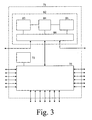
- an arrangement 71 according to the invention comprising a module 82 according to the invention.
- the arrangement 71 for example corresponds with a network or with a part thereof such as a network unit 11, 21 or 31 such as switches, routers, forwarders, multiplexers, servers etc.
- the module 82 for example corresponds with one of the first, second and third modules 12, 22 and 32.
- the arrangement 71 comprises for example a switch 72 coupled to a controller 73 and to an interface 86 of the module 82.
- the module 82 further comprises for example a receiver 83, a controller 84 and a sender 85 all coupled to the interface 86.
- the controller 84 is further coupled to the receiver 83 and the sender 85.
- the module 82 may be located outside the arrangement 71.
- the controllers 73 and 84 may comprise storages and may comprise detectors for detecting incoming signals and generators for generating outgoing signals and converters for converting signals etc. all not shown.
- the term "signal" may be "information", "instruction” etc.
- a charging control of (the interconnection between the different networks 1,2 or 2,3 of) the call may be performed inside the second network 2 and/or a call control of (the interconnection between the different networks 1,2 or 2,3 of) the call may be performed inside the second network 2.
- the first subscriber is also billed for the "call back" call, such as billing this first subscriber for a fixed amount per call or such as billing the first subscriber for a smaller part of the bill whereby the second subscriber is billed for a larger part of this bill.
- the first and second subscribers are in the Fig. 1 and 2 coupled directly to the first and second and third networks 1, 2 and 3. It is however not to be excluded that a subscriber is coupled indirectly to a network, for example via a further network such as a Voice over Internet Protocol or VoIP network.
- the blocks 10, 20 and/or 30 may represent gateways such as VoIP gateways etc.
- Each network may comprise two or more sub-networks, each coupling may be a wired or wireless coupling and may comprise two or more sub-couplings and/or one or more network units, without departing from the scope of this invention.
- the second and third subscriber stations 20 and 30 might form part of one physical subscriber station comprising different transceivers, and each subscriber station 10, 20, 30 may be of any kind.
- Each piece of the invention may be divided into two or more smaller pieces, and two or more pieces of the invention may be combined into a larger piece, without departing from the scope of this invention.
- first networks 1 e.g. public fixed networks
- second information is sent to second networks 2 e.g. public mobile networks defining the charging control of at least the interconnections to be performed outside the first networks 1 and defining at least second parts of the connections.
- third step the second parts of the connections are set up within the second networks 2.
- the connections comprise the first parts, the interconnections and the second parts.
- a customer has a subscription with a mobile network operator for his mobile device and a subscription with a fixed net operator for his fixed line.
- forwarding of calls from his fixed line to his mobile line are relatively more expensive, then calling to a fixed number, due to the higher termination fee to terminate a call in a mobile network relative to terminating a call in a fixed network.
- a calling party would rather prefer to call a fixed line than a mobile number for the same reason.
- the invention deals with the above mentioned issues, and thus can be beneficial for several (different) parties.
- One of the possible benefits of this invention is, that a user could cancel his contract for the fixed line (which could save money for him), and still be reachable under his original fixed net number, because he can have the number 'ported' to for example another (virtual) fixed network operator, partnered to the mobile network operator.
- Applying the invention the user can be reached on his mobile without paying the high termination fee for terminating in a mobile network, because instead of forwarding the call, the call direction of the interconnection is reversed, hence avoiding the termination fee for terminating in a mobile network. Instead the call is terminated in the fixed network and the termination fee for terminating in a fixed network is in most cases lower.
- the calling party will profit from this invention, because he is able to reach the mobile subscriber by dialing the original fixed net number, which is much cheaper for him to call.
- the mobile network operator is able to retrieve more incoming traffic, because calls to a fixed numer, which would previously only make use of the fixed network are now also using his mobile network.
- the mobile network operator gets the call and charging control of the interconnection between the mobile and the fixed network and can charge the mobile subscriber a fee.
- the call flow applicable when the invention is for example used in setting is further detailed below, with reference to figure 4 (diagram of an exemplary call flow) and fig 5 . (high level archictecture).
- the user who initiates the communication, uses the terminal 10 (the first subscriber station) connected to the network 1 (the first network).
- network 1 and the partner network shown in fig 5 . are both fixed networks supporting the SS7 protocol
- the first network unit I is a Fixed Switching Center (FSC)
- the terminal 10 is a fixed telephone set
- the module 12 is a Service Node (SN) within the partner network.
- the virtual fixed net number of terminal 20 belongs to the number range of the partner network.
- the network 2 (the second network) is a mobile network following the GSM or UMTS standard and is interconnected with network 1 (the first network), which is a fixed network.
- the second network unit 21 is a Gateway Mobile Switching Center (GMSC), which is coupled by the coupling 52 with the module 22, which is a Service Control Point (SCP).
- the module 23 is a Home Location Register (HLR) which is coupled by the coupling 48 with the SCP and is coupled by the coupling 49 with GMSC.
- the module 24 is the Visited Mobile Switching Center (VMSC), which is coupled by the coupling 47 with the GSM mobile (second subscriber station 20), and is coupled by the coupling 50 with the GMSC.
- GMSC Gateway Mobile Switching Center
- HLR Home Location Register
- VMSC Visited Mobile Switching Center
- the first subscriber station (10) starts calling the second subscriber station (20) by dialing the virtual fixed network number +495555555555, and the call setup 150 is received by the Fixed Switching Center (FSC) of the fixed network (first network 1).
- the FSC analyses the dialed number and routes the call without any special number handling in a normal way to the partner network by sending an ISUP_InitialAddressMessage (IAM) 151 (first information) to the SN .
- the SN responds with an ISUP_AddressCompleteMessage (ACM) 152 to the FSC to establish and to hold the call leg to the first subscriber station (10) (first part of the connection).
- ACM ISUP_AddressCompleteMessage
- the call leg to the first subscriber station (10) will be released by the SN and an ISUP_Release message will be sent to the FSC (not shown in the figure).
- the SN initiates a new call by sending an ISUP_IAM message 153 (second information) to the FSC.
- the GMSC (second network unit 21) responds with an ISUP_ACM message 155 and sends it to the FSC.
- the FSC forwards the ISUP_ACM message 156 to the SN.
- the GMSC has configured a service triggering based on received called party numbers, which is a common functionality of a switch.
- the HLR 23 responds with a MAP_SRIres message 159, which includes the MSRN of the MSISDN (second subscriber station 20).
- the SCP (second module 22) sends a CAMEL_RequestReportBCSM (RRB) operation 160 to the GMSC to arm at least the different Detection Points (DP) for oCalledPartyBusy, oAnswer and oTermSeized. Also, the SCP (second module 22) sends a CAMEL_Continue operation 160 to the GMSC.
- the GMSC responds with a CAMEL_ICAack operation 161 to the SCP (second module 22) and maps the parameters of the CAMEL_ICA operation 160 to an ISUP_IAM message 162 and sends it to the Visited Mobile Switching Center (VMSC) 24 of the second subscriber station (20).
- VMSC Visited Mobile Switching Center
- ERP CAMEL_EventReportBCSM
- the FSC forwards the ISUP_Release message to the SN 167, which analyses the cause value and confirms to release the call leg to the GSM network (second network 2), by sending an ISUP_ReleaseComplete message 168 to the FSC .
- the SN uses the cause value as identifier to start an internal expiry timer for the later call back call, which will be set up within the GSM network (second network 2), and to keep the call leg to the first subscriber station (10) (first part of the connection) by sending an ISUP_CPG message 169 to the FSC .
- This cause value will be sent via the FSC to the SN , which will confirm to release the call leg to the GSM network (second network 2) and the SN will also release the call leg to the first subscriber station (10) (first part of the connection) by sending another corresponding ISUP_Release operation to the FSC (not shown in the figure).
- the second subscriber station (20) accepts the incoming virtual fixed network call, which was indicated on his display by using the number prefix '999', the second subscriber station (20) answers the call and the VMSC 24 sends an ISUP_Answer (ANM) message 170 to the GMSC , which maps this message to an CAMEL_ERB(oAnswer) operation 171 and sends it to the SCP (second module 22).
- NAM ISUP_Answer
- a CAMEL_RequestReportBCSM (RRB) operation 172 to the GMSC to arm at least the answer Detection Point (DP) oAnswer and also sends a CAMEL_Continue operation 172 to the
- the GMSC responds with a CAMEL_ICAack 173 to the SCP (second module 22) and maps the parameters of the CAMEL_ICA operation 172 to an ISUP_IAM message 174 and sends it to the FSC of the fixed network (first network 1).
- the SN checks the incoming CGP, which is identical to the originally generated correlationID, and queries the internal table to retrieve the corresponding call data of the call leg to the first subscriber station (10) (first part of the connection). If, the correlationID does exist within the table, the SN will stop the expiry timer and sends an ISUP_ANM message 176 to the FSC for the interconnecting leg and a second ISUP_ANM message 177 to the FSC for the call leg of the first subscriber station (10) (first part of the connection). Next, the interconnecting leg (the interconnection) and the call leg of the first subscriber station (10) (first part of the connection) are bridged together by the SN .
- the FSC forwards the ISUP_ANM message 178 to the GMSC , which maps this message to a CAMEL_ERB(oAnswer) operation 179 to the SCP (second module 22).
- the SCP (second module 22) response with a CAMEL_MoveLeg and a CAMEL_ContinueWithArgument operation 180 to the GMSC , which instructs the GMSC to bridge the call leg to the second subscriber station (20) (second part of the connection) and the interconnecting leg.
- the GMSC bridges the call leg of the second subscriber station (20) (second part of the connection) and the interconnecting leg.
- the GMSC sends a MoveLegAck operation 181 to the SCP (second module 22), which starts with the charging of the second subscriber station (20) for the call leg of the second subscriber station (20) (second part of the connection) and the interconnecting leg based on the corresponding tariff to which he has subscribed.
- the GSM operator of the second network (2) is responsible for charging the second subscriber station (20) and has the control over the interconnection leg.
- the first subscriber station (10) will be charged by the fixed network operator (first network 1) for the call leg of the first subscriber station (10) (first part of the connection) based on the dialed virtual fixed network number.
- the above mentioned example of a Call Flow as applied in a virtual fixed network number setting can also be applied in a setting where the second subscriber station is coupled to a prepaid subscription.
- the SN could use in step 153 in the ISUP_IAM message (second information) the normal prepaid GSM subscriber number (second subscriber station 20) as new CDP instead of generating another correlationID.
- the message 154 will be received by the GMSC , which handles the incoming call like a normal Mobile Terminating Call and starts querying the HLR (module 23) to get the trigger criteria. After that, the GMSC triggers to the corresponding SCP (step 157), which handles the prepaid service and the virtual fixed network service in parallel.
- FIG. 6 it is illustrated how the invention might be applied in a (business) community setting.
- the basic idea of this embodiment is the concept of a (business) community, for example in the sense that users of terminals at a private telecommunication system and some specific Mobile Stations (MS) in the mobile network form a FMC Community (Fixed-mobile Convergence) with special tariffs or features for the communications between members of this group.
- This FMC could for example consist of employees (users) all belonging to the same company.
- the user who initiates the communication, uses the terminal 10 (first subscriber station) connected to the network 1.
- network 1 is an IP network supporting the SIP protocol
- the module 11 is a VoIP system
- the terminal 10 is a VoIP telephone set
- the module 12 is a B2BUA(Back to Back User Agent).
- the terminals 10 and the MS 20 are both part of the community.
- the network 2 (the second network) is a mobile network following the GSM or UMTS standard and is connected via coupling 43.1 with a fixed network, which in this case serves as a transit network, There could be a direct interconnection between the network 2 (mobile network) and the network 1 (VoIP network), but in this example the connection between both networks has to be supported by the fixed network as a transit network.
- the transit network and VoIP network are coupled by the couplings 43.2 and 43.3 via module 91, which contains a MG (Media Gateway) and a SG (Signalling Gateway) controlled by a MGC (Media Gateway Controller).
- module 91 which contains a MG (Media Gateway) and a SG (Signalling Gateway) controlled by a MGC (Media Gateway Controller).
- the application In a first step the user, who initiates the communication at the terminal 10, will be authenticated by the application comprised in the module 12. This authentication is for example performed based on the IP address of the (VoIP) terminal (10).
- the application verifies, which service features are activated for the user, for example depending on the time, day, communication status, specific rights given by the administrator etc. ). The authorisation is performed by checking the specific service data for the authenticated user.
- the specific service data can consist of global type parameters determined by the specific mobile subscription, service type parameters determined by the administrator of the VoIP system or user individual data, configured by the administrator on behalf of the user, on behalf of a third party or by the user himself.
- at least the following global type data have been stored in this specific database: the IP addresses and the VoIP addresses of all VoIP telephone sets and the addresses (MSISDN) of all mobile stations belonging to the FMC community with the identification "xyz".
- MSISDN addresses and all VoIP addresses of the FMC community "xyz" and the network address of the module 12 have been stored in a database accessible for the module 22.
- the user of the VoIP telephone set (10) with the number "0211 448 4788" of the company Eplus wants to communicate with the mobile station (20) with the MSISDN "0177 1234567". Both numbers belong to the same FMC community "xyz”.
- the user of the VoIP telephone set (10) dials the number "0177 1234567” and the VoIP telephone set forms a SIP message with the dialed number in the "TO:field” and the SIP:02114484788@eplus.de in the "FROM:field" of the header of the SIP message INVITE.
- the VoIP system (first network unit 11) is configured in a way that communications from the address SIP:02114484788@eplus.de will be routed to the module 12 by means of sending an INVITE message.
- the module 12 receives the INVITE message and fetches the dialed number "0177 1234567" from the "TO:field", the number of the VoIP telephone set (10) "0211 448 4788" from the "FROM:field” and the IP address of the VoIP telephone set from the "VIA:field” in the header of this INVITE message.
- the module 12 queries its data base and checks the authentication of the user based on the IP address of the VoIP telephone set 10.
- the module 12 checks whether the VoIP telephone set 10 with the number "02114484788" and the mobile station 20 (the second subscriber station) with the number "0177 1234567" belong to the FMC community "xyz" and if so, which specific rights they have to use the features of the FMC community "xyz". After the check is done successfully, the module 12 hold this connection (the first part of the connection) from the VoIP telephone set 10 to the module 12 and initiates a new session (a temporary connection) starting with an INVITE message with the address of the VoIP telephone set 10 in the "FROM:field” and the MSISDN "0177 1234567" in the "TO:field” of the header of this SIP message.
- the gateway 91 receives this INVITE message and terminates the VoIP session. Based on the parameters in the received INVITE message the gateway 91 sends out an IAM (Initial Address Message) to the FSC (Fixed line Switching Centre - module 77 of the transit network) following the ISUP (ISDN User Part) specification of the SS7 protocol, whereby the gateway 91 translates the content of the "TO: field" of the SIP message header, the number "0177 1234567" of the mobile station 20, in the CDP (Called Party Number) of the ISUP_IAM message and the content of the "FROM:field", the address of the VoIP telephone set (10) "02114484788", in the CGP (Calling Party Number) of the ISUP_IAM message.
- IAM Initial Address Message
- FSC Fixed line Switching Centre - module 77 of the transit network
- ISUP ISDN User Part
- the transit network routes the ISUP_IAM message to the network 2 without any changes of the addresses in the ISUP_IAM message.
- the GMSC Global Mobile Switching Center - second network unit 21 of the mobile network (network 2) receives the ISUP_IAM message and responds with the ISUP_ACM (Address Complete Message) to the transit network, which routes this message to the gateway 91.
- the gateway 91 translates this information in a SIP message and sends a SIP message "180 Ringing" to the module 12.
- the GMSC triggers at the detection point Detection Point "DP Terminating_attempt_authorised" of the terminating BCSM (Basic Call State Model) following the CAMEL (Customised Application Mobile network Enhanced Logic) standard and the GMSC transfers the call parameter to the module 22 (in this example the module 22 is a SCP (Service Control Point)), using the CAP (CAMEL Application Part) operation IDP (Initial Detection Point) including the CDP number "0177 1234567" (MSISDN of the mobile station 20) and the CGP number 02114484788 (number of the VoIP telephone 10).
- the module 22 queries its data base and recognises the FMC community call by verifying both addresses as members of the FMC community "xyz".
- the SCP (module 22) initiates a new connection (the second part of the connection) instructing the GMSC by using the CAP_ICA (Initiate Call Attempt) operation, which includes the CDP number "0177 1234567" (MSISDN of the mobile station 20) and the CGP number "02114484788" (number of the VoIP telephone 10). If the user of the mobile station 20 (second subscriber station) takes the call, the GMSC receives an ISUP_ANM (Answer) message. The GMSC maps this message and sends to the SCP a CAP_ERB_oAnswer operation.
- CAP_ICA Initiate Call Attempt
- the SCP instructs the GMSC to release the temporary connection by sending a CAP_Release operation to the GMSC.
- the GMSC maps this operation and sends an ISUP_Release message via the transit network to the gateway 91, which maps the ISUP_Release message and sends a SIP_BYE message via the VOIP system (first network unit 11) to the module 12.
- the temporary connection is released without any charging actions in the networks because no ISUP_ANM was formed for the temporary connection.
- the SCP instructs the GMSC to establish an interconnecting leg (the interconnection), by sending the CAP_ICA (Initiate Call Attempt) operation with CGP number "0177 1234567” (MSISDN of the mobile station 20) and the CDP number ("02114484788" (number of the VoIP telephone set 10).
- the GMSC maps this operation and sends out the ISUP_IAM to the transit network.
- the CGP number "0177 1234567" MSISDN of the mobile station 20
- the CDP number (“02114484788” (number of the VoIP telephone set 10) is used.
- the FSC in the transit network receives this message and routes the call to the gateway 91, which translates the CGP and CDP number in the "FROM:field” respectively in the "TO:field” of the header of the SIP operation INVITE.
- the module 12 receives this INVITE message and recognises through the Correlation_ID (in this case the number "02114484788" (number of the VoIP telephone set 10) is used) the correct relation between the first part of the connection, and the interconnection.
- the module 12 bridges the first part of the connection and the interconnection and sends out in response to the INVITE message for the interconnection a SIP message "200 OK" to the gateway 91.
- the gateway 91 translates this information in an ISUP_ANM message, which will be received finally by the GMSC (second network unit 21) of the mobile network (the second network 2).
- the GMSC maps this message and sends to the SCP a CAP_ERB_O_Answer (Event Report BCSM) operation.
- the SCP sends a CAP_MoveLeg and a CAP_ContinueWithArguments operations, which instructs the GMSC 21 to bridge the second part of the connection (GMSC to mobile station 20) with the interconnection (GMSC to the module 12 via the FSC (module 77) and the gateway 91). Now a complete end-to-end connection between the VoIP telephone set 10 and the mobile station 20 is established.
- the GMSC When the GMSC receives the ISUP_ANM (Answer) message for the interconnection, the GMSC starts the charging for the interconnection (the "call back connection" along the coupling 43.1) between the mobile network (network 2) and the transit network. Based on this charging record, the service provider, who offered this FMC community service, can bill the subscriber e. g. a company, who has subscribed to this FMC community service, not depending on a (regulated) termination fee for calls from the fixed network to the mobile network.
- Fig. 7 shows another use case, in which it is illustrated how the invention might be applied using a Dual-Mode handset as the second subscriber station.
- the network 2 (the second network) is a mobile network following the GSM or UMTS standard and is expanded with the module 22 (the second module) to provide the specific application to support the invention.
- the network 1 (the first network) is a fixed network and contains no specific functionality for the support of the invention.
- This VoIP network contains the module 12 (the first module), which interacts via the coupling 61 with the module 22 in the mobile network.
- the subscriber uses a so-called dual-mode handset (the second subscriber station 20), which supports the access to the GSM/UMTS network as well as to a WLAN (Wireless Local Area Network) provided by module 92, connected via the internet or VPN (75).
- the mobile network (2) is connected via coupling 43 to the fixed network (1) for the support of public communication services such as speech and data services.
- the fixed network (1) which functions as a transit network. Only for the dedicated data transfer between the module 12 and the module 22 the coupling 61 is introduced.
- the connection between the fixed network (1) and the VoIP network requires a specific gateway (module 91), which consists of a MG (Media Gateway) and a SG (Signalling Gateway) controlled by a MGC (Media Gateway Controller), which translates the parameters of the communications from the telecommunication area in the IP area and vice versa.
- MG Media Gateway
- SG Synignalling Gateway
- MGC Media Gateway Controller
- the user (subscriber) of the Dual-Mode handset only needs one phone for the access to services offered by two different networks based on different technologies with different tariffs for communication services.
- This subscriber communicates just one number (called the One Number, typically a fixed net number) to his communication partners.
- the One Number typically a fixed net number
- Both the VoIP operator and the mobile operator can also benefit from the invention applied in a One Number service.
- the advantage for the VoIP operator is more obvious, because he serves the customer with a higher priority and attracts traffic.
- the mobile network operator could loose traffic because the customer is using the VoIP part of the Dual-Mode handset as much as possible.
- the mobile network operator could be advantageous also for the mobile network operator to implement the invention. For example if the mobile operator has a weak position in the market segment "business customers", but the VoIP operator has a very strong position in this area. Then the mobile network operator will gain new business customers easily from the customer base of the VoIP provider for low acquisition cost. The mobile network operator can offer an attractive price for this service to the newly gained mobile customers without cannibalisation of existing traffic.
- the IP part of the dual-mode handset (20) acts as a UA (User Agent) and has an access over the WLAN of a hot spot (coupling 76) provided for example by an 802.11b access point depicted as module 92 connected over the internet or a VPN (75) to the VoIP system (33).
- a hot spot provided for example by an 802.11b access point depicted as module 92 connected over the internet or a VPN (75) to the VoIP system (33).
- the IP part of the dual-mode handset can register, establish sessions and terminate sessions following the IETF (Internet Engineering Task Force) standards for SIP (Session Initiation Protocol) in interaction with the VoIP system 33.
- the IP part of the dual-mode handset is able to transfer the actual address to the registrar server as a part of the VoIP system (33).
- the VoIP system (33) has always the information, whether the IP part of the dual-mode handset (20) is registered or not. If the user of the telephone set 10 (first subscriber station) with the telephone number "0211 448 4788" wants to communicate with the user of the dual mode handset (20), he initiates the communication by dialling for example the One Number "0211 9988777" belonging to the number range of fixed numbers of the VoIP operator of the VoIP network.
- the 'One Number service' number "0211 9988777" as the CDP (Called Party Number) and the number “0211 448 4788" of the telephone set 10 as the CGP (Calling Party Number) are transferred by a SET UP message as standardised in the DSS1 (Digital Subscriber Signalling Protocol number 1) protocol to the FSC (Fixed line Switching Centre) depicted as first network unit 11 in Fig. 7 .
- the FSC recognises by analysing the CDP number that the destination is located in the VoIP network and establishes a connection to the gateway 91 over the coupling 51.1 using the IAM (Initial Address Message) of the ISUP (ISDN User Part) protocol of the SS7 (Signalling System Number 7) standard.
- This ISUP_IAM message uses the CDP number and the CGP number as given by the DSS1_Set Up message.
- the gateway (91) translates this information in an INVITE message of SIP (Session Initiation Protocol) standard, whereby the CDP number (the One Number "0211 9988777") is inserted in the "TO:field” and the CGP number ("0211 448 4788" the number of the telephone set 10) is inserted in the "FROM:field” of the INVITE message.
- the gateway 91 sends the INVITE message to the VoIP system (module 33) via coupling 51.2.
- the VoIP system (33) has always the information, whether the IP part of the dual-mode handset is registered or not.
- the session will be forwarded to the IP part of the dual-mode handset over the couplings 75 and 76.
- the VoIP system (33) redirects the session to the module 12 via coupling 51.3.
- This module (12) acts as a B2BUA (Back-to-Back User Agent) and terminates the INVITE message and the RTP (Real Time Protocol) stream, which contains the pay load of the session.
- the module (12) recognises the One Number service by the content of the "TO:field” (the One Number “0211 9988777") of the INVITE message, responds with the SIP message "180 Ringing" and holds this session as the first part of the connection.
- the SIP message "180 Ringing” will be received by the gateway 91, which translates the "180 Ringing" message in an ISUP_ACM (Address Complete Message) to inform the FSC (11).
- ISUP_ACM Address Complete Message
- the module 12 initiates a dedicated data transfer to the module 22 via the coupling 61 using any data protocol with the parameter "A: 0211 448 4788" for the number of the caller, the parameter "B: 0177 1234567” for the address of the GSM part of the dual mode handset and the parameter "C: 0211 9988777" for the One Number.
- the module 22 is a SCP (Service Control Point) as specified in the CAMEL (Customised Application Mobile network Enhanced Logic) standard and is connected via the coupling 52 to the MSC (Mobile Switching Centre) (second network unit 21) of the mobile network (network 2).
- SCP Service Control Point
- MSC Mobile Switching Centre
- the SCP (module 22) receives and checks this data and send the CAP_ICA (CAMEL Application Part, Initiate Call Attempt) operation via the coupling 52 to the MSC, which contains the DRA (Destination Routing Address), the number "0177 1234567” (MSISDN of the GSM part of the dual-mode handset) and the CGP number, the number "0211 448 4788" (address of the telephone set 10, the number of the caller).
- DRA Disination Routing Address
- MSISDN MSISDN of the GSM part of the dual-mode handset
- CGP number the number "0211 448 4788"
- the MSC (second network unit 21) receives this CAP_ICA operation and establishes a new connection (the second part of the connection) between the MSC and the GSM part of the dual-mode handset (20) via the coupling 42 using the ISUP_IAM with the number "0177 1234567" as the CDP (Called Party Number) and the number "0211 448 4788" as the CGP (Calling Party Number). If the user of the GSM part of the dual-mode handset (20) takes the call, the MSC will receive an ISUP_ANM (Answer) message. The MSC triggers at the detection point (DP) "O_Answer" and informs the SCP by means of a CAP_ERB_answer operation.
- DP detection point
- the SCP instructs the MSC (21) to establish the interconnection between the MSC (21) and the module 12 via the FSC (module 11), the gateway 91 and the VoIP system 33, by sending a CAP_ICA (Initiate Call Attempt) operation to the MSC (21) with CGP number "0177 1234567” and DestinationRoutingAddress number "0211 9988777" (One Number number).
- the MSC (21) maps this received operation and sends out the ISUP_IAM with the CGP number "0177 1234567” (MSISDN of the GSM part of the dual-mode handset 20) and the CDP number "0211 9988777" (One Number number) to the FSC (module 11).
- the FSC (module 11) receives this message and routes the call to the gateway 91, which translates the CGP and CDP number into the "FROM:field” respectively into the "TO:field” of the header of a SIP message INVITE.
- the module 12 receives this INVITE message and recognises by the Correlation_ID (in this case the number "0211 9988777", the One Number number) the correct relation between the first part of the connection and the interconnection.
- the module 12 bridges the first part of the connection and the interconnection and responds to the INVITE message with the SIP message "200 OK" to the gateway 91.
- the gateway 91 then translates this information in an ISUP_ANM (Answer) message, which will be received finally by the MSC (21) of the mobile network (the second network).
- the MSC triggers at the detection point DP O_Answer and informs the SCP by sending a CAP_ERB_O_Answer (Event Report BCSM) operation.
- the SCP sends a CAP_MoveLeg and a CAP_ContinueWithArguments operation, which instructs the MSC to bridge the second part of the connection (MSC to the GSM part of the dual-mode handset 20) with the interconnection (MSC to the module 12 via the FSC (module 11), the gateway 91 and the VolP system 33).
- a complete end-to-end connection between the telephone set (10) and the GSM part of the dual-mode handset (20) is established.
- the MSC When the MSC receives the ISUP_ANM (Answer) message for the interconnection, the MSC starts writing charging records for the interconnection (coupling 43) between the mobile network (the second network 2) and the fixed network (the first network 1). Based on these charging records the service provider, who offered this "One Number" service, can bill the subscriber, who has subscribed to this service, not depending on a (regulated) termination fee for calls from the fixed network to the mobile network.
- the service provider who offered this "One Number" service
- a computer program product may be stored / distributed on a suitable medium, such as an optical storage medium or a solid-state medium supplied together with or as part of other hardware, but may also be distributed in other forms, such as via the Internet or other wired or wireless telecommunication systems. Any reference signs in the claims should not be considered to limit the scope.
Landscapes
- Engineering & Computer Science (AREA)
- Computer Networks & Wireless Communication (AREA)
- Signal Processing (AREA)
- Telephonic Communication Services (AREA)
- Mobile Radio Communication Systems (AREA)
- Data Exchanges In Wide-Area Networks (AREA)
- Meter Arrangements (AREA)
Claims (7)
- Procédé d'établissement d'une connexion par l'intermédiaire d'une interconnexion entre différents réseaux (1, 2), le procédé comprenant - une première étape consistant à, par l'intermédiaire d'une première unité de réseau (11) située dans un premier réseau (1), établir une première partie de la connexion depuis une première station d'abonné jusqu'au moins la première unité de réseau (11),- la réception de premières informations par un premier module, situé dans le premier réseau ou connecté à celui-ci,- les premières informations comprenant au moins une partie d'une première identification de la première station d'abonné, et au moins une partie d'une seconde identification de la seconde station d'abonné qui doit être appelée et qui amènent l'établissement de la première partie de la connexion jusqu'au moins la première unité de réseau (11),- une deuxième étape consistant à, en réponse aux premières informations reçues par le premier module (12), l'envoi de secondes informations depuis le premier module (12) à un second module (22) dans un second réseau (2) ou connecté à celui-ci, les secondes informations comprenant des instructions pour l'interconnexion à établir depuis le second réseau jusqu'au premier réseau, faisant ainsi que la commande de facturation d'au moins l'interconnexion se déroule en dehors du premier réseau,- une troisième étape consistant à, en réponse aux secondes informations reçues par le second module (22), établir l'interconnexion, l'interconnexion étant établie depuis le second réseau (2) jusqu'au premier réseau (1) par l'intermédiaire de la première unité de réseau, l'interconnexion étant connectée à la première partie de la connexion- et, dans le second réseau (2), l'établissement d'une seconde partie de la connexion jusqu'à la seconde station d'abonné- une quatrième étape consistant à connecter la seconde partie de la connexion à l'interconnexion.
- Procédé selon la revendication 1 comprenant- dans la deuxième étape, en réponse à la réception des premières informations reçues par le premier module (12), l'établissement d'un tronçon d'appel temporaire du premier réseau (1) au second réseau (2),- dans la troisième étape, la libération du tronçon d'appel temporaire dans le second réseau (2).
- Procédé selon la revendication 2- dans lequel les secondes informations sont envoyées au second module (22) durant l'établissement du tronçon d'appel temporaire.
- Procédé selon l'une des revendications précédentes ou toutes- dans lequel les secondes informations comprennent une seconde identification d'une seconde station d'abonné, cette seconde identification étant différente de la seconde identification de la seconde station d'abonné comprise dans les premières informations,le premier module (12) déterminant ladite seconde identification comprise dans les secondes informations en fonction des premières informations reçues.
- Procédé selon l'une des revendications précédentes ou toutes- dans lequel les secondes informations comprennent une ID de corrélation, déterminée par le module (12) en réponse à la réception des premières informations- l'ID de corrélation pouvant être éventuellement utilisée par le second réseau pour router les secondes informations vers le second module (22)- l'ID de corrélation étant renvoyée par le second réseau au premier réseau durant l'établissement de l'interconnexion- l'ID de corrélation renvoyée étant analysée, résultant en la connexion de l'interconnexion à la première partie de la connexion.
- Premier module (12) d'un premier réseau (1) pour établir une connexion par l'intermédiaire d'une interconnexion entre différents réseaux (1, 2), le premier module (12) comprenant- un premier récepteur pour recevoir des premières informations, lesquelles premières informations définissent au moins une première partie de la connexion dans le premier réseau (1), et- un premier expéditeur pour, en réponse à une réception des premières informations, envoyer des secondes informations à un second module (22) au niveau d'un second module (2), lesquelles secondes informations définissant la commande de facturation d'au moins l'interconnexion à exécuter en dehors du premier réseau (1) et définissent au moins une seconde partie de la connexion, la seconde partie de la connexion étant située dans le second réseau (2), la connexion comprenant la première partie, l'interconnexion et la seconde partie.
- Second module (22) d'un second réseau (2) pour établir une connexion par l'intermédiaire d'une interconnexion entre différents réseaux (1, 2) (2, 3), le second module (22) comprenant- un second récepteur pour recevoir des secondes informations depuis un premier module (12) au niveau d'un premier réseau (1) ou depuis un troisième module (32) au niveau d'un troisième réseau (3), lesquelles secondes informations définissent une commande de facturation d'au moins l'interconnexion à exécuter en dehors du premier réseau (1) et définissant au moins une seconde partie de la connexion, et- un second expéditeur pour, en réponse à une réception des secondes informations, envoyer une instruction d'établissement pour établir la seconde partie de la connexion dans le second réseau (2), la connexion comprenant une première partie, l'interconnexion et la seconde partie, la première partie de la connexion étant située dans le premier réseau (1).
Priority Applications (1)
| Application Number | Priority Date | Filing Date | Title |
|---|---|---|---|
| EP08759178.0A EP2168367B1 (fr) | 2007-06-11 | 2008-06-11 | Établissement d'appel séparé entre deux réseaux |
Applications Claiming Priority (3)
| Application Number | Priority Date | Filing Date | Title |
|---|---|---|---|
| EP07011417A EP2003868A1 (fr) | 2007-06-11 | 2007-06-11 | Réglage d'une connexion via une interconnexion entre plusieurs réseaux |
| EP08759178.0A EP2168367B1 (fr) | 2007-06-11 | 2008-06-11 | Établissement d'appel séparé entre deux réseaux |
| PCT/EP2008/004668 WO2008151786A1 (fr) | 2007-06-11 | 2008-06-11 | Établissement d'une connexion en retour par interconnexion entre différents réseaux |
Publications (2)
| Publication Number | Publication Date |
|---|---|
| EP2168367A1 EP2168367A1 (fr) | 2010-03-31 |
| EP2168367B1 true EP2168367B1 (fr) | 2013-05-22 |
Family
ID=38670496
Family Applications (2)
| Application Number | Title | Priority Date | Filing Date |
|---|---|---|---|
| EP07011417A Withdrawn EP2003868A1 (fr) | 2007-06-11 | 2007-06-11 | Réglage d'une connexion via une interconnexion entre plusieurs réseaux |
| EP08759178.0A Not-in-force EP2168367B1 (fr) | 2007-06-11 | 2008-06-11 | Établissement d'appel séparé entre deux réseaux |
Family Applications Before (1)
| Application Number | Title | Priority Date | Filing Date |
|---|---|---|---|
| EP07011417A Withdrawn EP2003868A1 (fr) | 2007-06-11 | 2007-06-11 | Réglage d'une connexion via une interconnexion entre plusieurs réseaux |
Country Status (6)
| Country | Link |
|---|---|
| US (1) | US8730947B2 (fr) |
| EP (2) | EP2003868A1 (fr) |
| JP (1) | JP5611037B2 (fr) |
| CN (1) | CN101682679B (fr) |
| AU (1) | AU2008261230B2 (fr) |
| WO (1) | WO2008151786A1 (fr) |
Families Citing this family (13)
| Publication number | Priority date | Publication date | Assignee | Title |
|---|---|---|---|---|
| US9332425B2 (en) * | 2012-05-07 | 2016-05-03 | Movius Interactive Corporation | System and method for provision of a second line service to a telecommunications device using mixed protocols |
| US9332408B2 (en) * | 2012-05-07 | 2016-05-03 | Movius Interactive Corporation | System and method for provision of a second line service to a telecommunications device |
| US20150271774A1 (en) * | 2008-06-05 | 2015-09-24 | George Backhaus | System and method for provision of a local second line service to a roaming telecommunications device using mixed protocols |
| US9332128B2 (en) * | 2008-06-05 | 2016-05-03 | Movius Interactive Corporation | System and method for provision of a second line service to a telecommunications device using mixed relationship numbers |
| US8484704B2 (en) * | 2009-09-16 | 2013-07-09 | Avaya Inc. | Next generation integration between different domains, such as, enterprise and service provider using sequencing applications and IMS peering |
| CN102215540B (zh) * | 2011-05-31 | 2014-01-22 | 电子科技大学 | 无线异构网络的反向呼叫建立方法以及无线异构网络系统 |
| US9215169B2 (en) * | 2013-05-15 | 2015-12-15 | Verizon Patent And Licensing Inc. | Delivering correct number information in a private SIP network |
| US9667770B2 (en) | 2013-07-17 | 2017-05-30 | Flypsi, Inc. | Telephone network system and method |
| CN104717372B (zh) * | 2013-12-13 | 2018-01-30 | 中国移动通信集团公司 | 一种呼叫业务处理方法和设备 |
| US9621735B2 (en) * | 2014-06-25 | 2017-04-11 | Textnow, Inc. | Mobile electronic communications combining voice-over-IP and mobile network services |
| US9338305B2 (en) * | 2014-08-26 | 2016-05-10 | Verizon Patent And Licensing Inc. | Calling back a device that made a call |
| US10750028B2 (en) | 2017-06-29 | 2020-08-18 | Textnow, Inc. | Mobile communications with quality of service |
| CN113992457B (zh) * | 2021-09-09 | 2024-04-26 | 北京思特奇信息技术股份有限公司 | 一种电信行业融合业务模型的配置方法及系统 |
Family Cites Families (15)
| Publication number | Priority date | Publication date | Assignee | Title |
|---|---|---|---|---|
| JPH07221881A (ja) | 1994-02-04 | 1995-08-18 | Mitsubishi Electric Corp | 課金制御方式 |
| US5625884A (en) * | 1994-06-08 | 1997-04-29 | Lucent Technologies Inc. | Global paging with reverse virtual call setup in wireless personal communications |
| JPH1013550A (ja) * | 1996-06-26 | 1998-01-16 | Nakayo Telecommun Inc | 折り返し呼接続通信方式および該通信方式に用いるルータ |
| AU4078097A (en) * | 1996-08-30 | 1998-03-19 | Tollfree Cellular | Wireless call processing |
| JPH11122355A (ja) * | 1997-10-09 | 1999-04-30 | Fujitsu Ltd | コールバック制御型交換機および交換機におけるコールバック制御方法 |
| US6636504B1 (en) * | 1999-03-18 | 2003-10-21 | Verizon Services Corp. | Reverse billing of internet telephone calls |
| KR20000072944A (ko) * | 1999-05-03 | 2000-12-05 | 윤종용 | 이동통신 기지국에서의 역방향 호 제한 방법 |
| CN1119885C (zh) * | 2000-03-03 | 2003-08-27 | 清华大学 | 一种信元传输方法 |
| GB2369270B (en) * | 2001-05-31 | 2003-08-06 | Ericsson Telefon Ab L M | Cross-charging in a mobile-telecommunication network |
| US6792261B2 (en) * | 2002-02-27 | 2004-09-14 | Cellcom Israel Limited | Mobile collect call system and method |
| WO2003077516A1 (fr) | 2002-03-14 | 2003-09-18 | Telefonaktiebolaget L M Ericsson | Systeme et procede d'etablissement de communication inverse |
| JP2004260331A (ja) | 2003-02-24 | 2004-09-16 | Nippon Telegr & Teleph Corp <Ntt> | Ip電話端末発信呼に対するinサービス提供方法及びシステム |
| JP4109635B2 (ja) * | 2004-01-26 | 2008-07-02 | 株式会社日立コミュニケーションテクノロジー | 着信課金システム、着信課金サービス制御装置、コールエージェント及び着信課金方法 |
| US7885394B2 (en) * | 2006-10-31 | 2011-02-08 | Motorola Mobility, Inc. | Method and system for call reverse |
| WO2008140783A1 (fr) * | 2007-05-09 | 2008-11-20 | Eyal Shlomot | Système de communication téléphonique conjointe |
-
2007
- 2007-06-11 EP EP07011417A patent/EP2003868A1/fr not_active Withdrawn
-
2008
- 2008-06-11 JP JP2010511533A patent/JP5611037B2/ja not_active Expired - Fee Related
- 2008-06-11 EP EP08759178.0A patent/EP2168367B1/fr not_active Not-in-force
- 2008-06-11 WO PCT/EP2008/004668 patent/WO2008151786A1/fr not_active Ceased
- 2008-06-11 AU AU2008261230A patent/AU2008261230B2/en not_active Ceased
- 2008-06-11 CN CN200880019764.8A patent/CN101682679B/zh not_active Expired - Fee Related
- 2008-06-11 US US12/663,449 patent/US8730947B2/en not_active Expired - Fee Related
Also Published As
| Publication number | Publication date |
|---|---|
| CN101682679A (zh) | 2010-03-24 |
| AU2008261230B2 (en) | 2011-12-22 |
| CN101682679B (zh) | 2014-12-10 |
| US8730947B2 (en) | 2014-05-20 |
| EP2168367A1 (fr) | 2010-03-31 |
| JP5611037B2 (ja) | 2014-10-22 |
| EP2003868A1 (fr) | 2008-12-17 |
| AU2008261230A1 (en) | 2008-12-18 |
| US20100177662A1 (en) | 2010-07-15 |
| WO2008151786A1 (fr) | 2008-12-18 |
| JP2010532938A (ja) | 2010-10-14 |
Similar Documents
| Publication | Publication Date | Title |
|---|---|---|
| EP2168367B1 (fr) | Établissement d'appel séparé entre deux réseaux | |
| US12212435B2 (en) | Mobile application gateway for connecting devices on a cellular network with individual enterprise and data networks | |
| US12075327B2 (en) | System and method for executing originating services in a terminating network for IMS and non-IMS applications | |
| US11638126B2 (en) | System and method for enabling call originations using SMS and hotline capabilities | |
| US10034220B2 (en) | System and method for enabling VPN-less session setup for connecting mobile data devices to an enterprise data network | |
| US7206582B2 (en) | Method, system and apparatus for call path reconfiguration | |
| US20110263220A1 (en) | Regional Zone Based Mobile Charging | |
| TWI386026B (zh) | 有條件的路由一固定電話號碼呼叫之方法 |
Legal Events
| Date | Code | Title | Description |
|---|---|---|---|
| PUAI | Public reference made under article 153(3) epc to a published international application that has entered the european phase |
Free format text: ORIGINAL CODE: 0009012 |
|
| 17P | Request for examination filed |
Effective date: 20100111 |
|
| AK | Designated contracting states |
Kind code of ref document: A1 Designated state(s): AT BE BG CH CY CZ DE DK EE ES FI FR GB GR HR HU IE IS IT LI LT LU LV MC MT NL NO PL PT RO SE SI SK TR |
|
| AX | Request for extension of the european patent |
Extension state: AL BA MK RS |
|
| 17Q | First examination report despatched |
Effective date: 20100414 |
|
| DAX | Request for extension of the european patent (deleted) | ||
| GRAP | Despatch of communication of intention to grant a patent |
Free format text: ORIGINAL CODE: EPIDOSNIGR1 |
|
| RIC1 | Information provided on ipc code assigned before grant |
Ipc: H04M 15/00 20060101AFI20130107BHEP Ipc: H04Q 3/00 20060101ALI20130107BHEP Ipc: H04M 15/08 20060101ALI20130107BHEP |
|
| GRAS | Grant fee paid |
Free format text: ORIGINAL CODE: EPIDOSNIGR3 |
|
| GRAA | (expected) grant |
Free format text: ORIGINAL CODE: 0009210 |
|
| AK | Designated contracting states |
Kind code of ref document: B1 Designated state(s): AT BE BG CH CY CZ DE DK EE ES FI FR GB GR HR HU IE IS IT LI LT LU LV MC MT NL NO PL PT RO SE SI SK TR |
|
| REG | Reference to a national code |
Ref country code: GB Ref legal event code: FG4D |
|
| REG | Reference to a national code |
Ref country code: CH Ref legal event code: EP |
|
| REG | Reference to a national code |
Ref country code: AT Ref legal event code: REF Ref document number: 613727 Country of ref document: AT Kind code of ref document: T Effective date: 20130615 |
|
| REG | Reference to a national code |
Ref country code: IE Ref legal event code: FG4D |
|
| REG | Reference to a national code |
Ref country code: DE Ref legal event code: R096 Ref document number: 602008024805 Country of ref document: DE Effective date: 20130718 |
|
| REG | Reference to a national code |
Ref country code: SE Ref legal event code: TRGR |
|
| REG | Reference to a national code |
Ref country code: NL Ref legal event code: T3 |
|
| REG | Reference to a national code |
Ref country code: AT Ref legal event code: MK05 Ref document number: 613727 Country of ref document: AT Kind code of ref document: T Effective date: 20130522 |
|
| REG | Reference to a national code |
Ref country code: LT Ref legal event code: MG4D |
|
| PG25 | Lapsed in a contracting state [announced via postgrant information from national office to epo] |
Ref country code: GR Free format text: LAPSE BECAUSE OF FAILURE TO SUBMIT A TRANSLATION OF THE DESCRIPTION OR TO PAY THE FEE WITHIN THE PRESCRIBED TIME-LIMIT Effective date: 20130823 Ref country code: LT Free format text: LAPSE BECAUSE OF FAILURE TO SUBMIT A TRANSLATION OF THE DESCRIPTION OR TO PAY THE FEE WITHIN THE PRESCRIBED TIME-LIMIT Effective date: 20130522 Ref country code: PT Free format text: LAPSE BECAUSE OF FAILURE TO SUBMIT A TRANSLATION OF THE DESCRIPTION OR TO PAY THE FEE WITHIN THE PRESCRIBED TIME-LIMIT Effective date: 20130923 Ref country code: IS Free format text: LAPSE BECAUSE OF FAILURE TO SUBMIT A TRANSLATION OF THE DESCRIPTION OR TO PAY THE FEE WITHIN THE PRESCRIBED TIME-LIMIT Effective date: 20130922 Ref country code: NO Free format text: LAPSE BECAUSE OF FAILURE TO SUBMIT A TRANSLATION OF THE DESCRIPTION OR TO PAY THE FEE WITHIN THE PRESCRIBED TIME-LIMIT Effective date: 20130822 Ref country code: SI Free format text: LAPSE BECAUSE OF FAILURE TO SUBMIT A TRANSLATION OF THE DESCRIPTION OR TO PAY THE FEE WITHIN THE PRESCRIBED TIME-LIMIT Effective date: 20130522 Ref country code: ES Free format text: LAPSE BECAUSE OF FAILURE TO SUBMIT A TRANSLATION OF THE DESCRIPTION OR TO PAY THE FEE WITHIN THE PRESCRIBED TIME-LIMIT Effective date: 20130902 Ref country code: AT Free format text: LAPSE BECAUSE OF FAILURE TO SUBMIT A TRANSLATION OF THE DESCRIPTION OR TO PAY THE FEE WITHIN THE PRESCRIBED TIME-LIMIT Effective date: 20130522 |
|
| PG25 | Lapsed in a contracting state [announced via postgrant information from national office to epo] |
Ref country code: PL Free format text: LAPSE BECAUSE OF FAILURE TO SUBMIT A TRANSLATION OF THE DESCRIPTION OR TO PAY THE FEE WITHIN THE PRESCRIBED TIME-LIMIT Effective date: 20130522 Ref country code: HR Free format text: LAPSE BECAUSE OF FAILURE TO SUBMIT A TRANSLATION OF THE DESCRIPTION OR TO PAY THE FEE WITHIN THE PRESCRIBED TIME-LIMIT Effective date: 20130522 Ref country code: BG Free format text: LAPSE BECAUSE OF FAILURE TO SUBMIT A TRANSLATION OF THE DESCRIPTION OR TO PAY THE FEE WITHIN THE PRESCRIBED TIME-LIMIT Effective date: 20130822 |
|
| PG25 | Lapsed in a contracting state [announced via postgrant information from national office to epo] |
Ref country code: LV Free format text: LAPSE BECAUSE OF FAILURE TO SUBMIT A TRANSLATION OF THE DESCRIPTION OR TO PAY THE FEE WITHIN THE PRESCRIBED TIME-LIMIT Effective date: 20130522 |
|
| PG25 | Lapsed in a contracting state [announced via postgrant information from national office to epo] |
Ref country code: SK Free format text: LAPSE BECAUSE OF FAILURE TO SUBMIT A TRANSLATION OF THE DESCRIPTION OR TO PAY THE FEE WITHIN THE PRESCRIBED TIME-LIMIT Effective date: 20130522 Ref country code: DK Free format text: LAPSE BECAUSE OF FAILURE TO SUBMIT A TRANSLATION OF THE DESCRIPTION OR TO PAY THE FEE WITHIN THE PRESCRIBED TIME-LIMIT Effective date: 20130522 Ref country code: CZ Free format text: LAPSE BECAUSE OF FAILURE TO SUBMIT A TRANSLATION OF THE DESCRIPTION OR TO PAY THE FEE WITHIN THE PRESCRIBED TIME-LIMIT Effective date: 20130522 Ref country code: EE Free format text: LAPSE BECAUSE OF FAILURE TO SUBMIT A TRANSLATION OF THE DESCRIPTION OR TO PAY THE FEE WITHIN THE PRESCRIBED TIME-LIMIT Effective date: 20130522 |
|
| REG | Reference to a national code |
Ref country code: CH Ref legal event code: PL |
|
| PG25 | Lapsed in a contracting state [announced via postgrant information from national office to epo] |
Ref country code: MC Free format text: LAPSE BECAUSE OF FAILURE TO SUBMIT A TRANSLATION OF THE DESCRIPTION OR TO PAY THE FEE WITHIN THE PRESCRIBED TIME-LIMIT Effective date: 20130522 Ref country code: RO Free format text: LAPSE BECAUSE OF FAILURE TO SUBMIT A TRANSLATION OF THE DESCRIPTION OR TO PAY THE FEE WITHIN THE PRESCRIBED TIME-LIMIT Effective date: 20130522 |
|
| REG | Reference to a national code |
Ref country code: IE Ref legal event code: MM4A |
|
| PLBE | No opposition filed within time limit |
Free format text: ORIGINAL CODE: 0009261 |
|
| STAA | Information on the status of an ep patent application or granted ep patent |
Free format text: STATUS: NO OPPOSITION FILED WITHIN TIME LIMIT |
|
| 26N | No opposition filed |
Effective date: 20140225 |
|
| PG25 | Lapsed in a contracting state [announced via postgrant information from national office to epo] |
Ref country code: CH Free format text: LAPSE BECAUSE OF NON-PAYMENT OF DUE FEES Effective date: 20130630 Ref country code: LI Free format text: LAPSE BECAUSE OF NON-PAYMENT OF DUE FEES Effective date: 20130630 Ref country code: IE Free format text: LAPSE BECAUSE OF NON-PAYMENT OF DUE FEES Effective date: 20130611 |
|
| REG | Reference to a national code |
Ref country code: DE Ref legal event code: R097 Ref document number: 602008024805 Country of ref document: DE Effective date: 20140225 |
|
| PG25 | Lapsed in a contracting state [announced via postgrant information from national office to epo] |
Ref country code: MT Free format text: LAPSE BECAUSE OF FAILURE TO SUBMIT A TRANSLATION OF THE DESCRIPTION OR TO PAY THE FEE WITHIN THE PRESCRIBED TIME-LIMIT Effective date: 20130522 |
|
| REG | Reference to a national code |
Ref country code: DE Ref legal event code: R081 Ref document number: 602008024805 Country of ref document: DE Owner name: E-PLUS MOBILFUNK GMBH & CO. KG, DE Free format text: FORMER OWNER: KONINKLIJKE KPN N.V., THE HAGUE, NL Effective date: 20150311 |
|
| PG25 | Lapsed in a contracting state [announced via postgrant information from national office to epo] |
Ref country code: CY Free format text: LAPSE BECAUSE OF FAILURE TO SUBMIT A TRANSLATION OF THE DESCRIPTION OR TO PAY THE FEE WITHIN THE PRESCRIBED TIME-LIMIT Effective date: 20130522 Ref country code: TR Free format text: LAPSE BECAUSE OF FAILURE TO SUBMIT A TRANSLATION OF THE DESCRIPTION OR TO PAY THE FEE WITHIN THE PRESCRIBED TIME-LIMIT Effective date: 20130522 |
|
| PG25 | Lapsed in a contracting state [announced via postgrant information from national office to epo] |
Ref country code: HU Free format text: LAPSE BECAUSE OF FAILURE TO SUBMIT A TRANSLATION OF THE DESCRIPTION OR TO PAY THE FEE WITHIN THE PRESCRIBED TIME-LIMIT; INVALID AB INITIO Effective date: 20080611 Ref country code: LU Free format text: LAPSE BECAUSE OF NON-PAYMENT OF DUE FEES Effective date: 20130611 |
|
| PGFP | Annual fee paid to national office [announced via postgrant information from national office to epo] |
Ref country code: FI Payment date: 20150611 Year of fee payment: 8 Ref country code: SE Payment date: 20150618 Year of fee payment: 8 |
|
| PGFP | Annual fee paid to national office [announced via postgrant information from national office to epo] |
Ref country code: IT Payment date: 20150622 Year of fee payment: 8 |
|
| REG | Reference to a national code |
Ref country code: FR Ref legal event code: PLFP Year of fee payment: 9 |
|
| PG25 | Lapsed in a contracting state [announced via postgrant information from national office to epo] |
Ref country code: FI Free format text: LAPSE BECAUSE OF NON-PAYMENT OF DUE FEES Effective date: 20160611 |
|
| REG | Reference to a national code |
Ref country code: SE Ref legal event code: EUG |
|
| PG25 | Lapsed in a contracting state [announced via postgrant information from national office to epo] |
Ref country code: SE Free format text: LAPSE BECAUSE OF NON-PAYMENT OF DUE FEES Effective date: 20160612 |
|
| REG | Reference to a national code |
Ref country code: FR Ref legal event code: PLFP Year of fee payment: 10 |
|
| PG25 | Lapsed in a contracting state [announced via postgrant information from national office to epo] |
Ref country code: IT Free format text: LAPSE BECAUSE OF NON-PAYMENT OF DUE FEES Effective date: 20160611 |
|
| REG | Reference to a national code |
Ref country code: FR Ref legal event code: PLFP Year of fee payment: 11 |
|
| PGFP | Annual fee paid to national office [announced via postgrant information from national office to epo] |
Ref country code: NL Payment date: 20210708 Year of fee payment: 14 |
|
| PGFP | Annual fee paid to national office [announced via postgrant information from national office to epo] |
Ref country code: FR Payment date: 20210721 Year of fee payment: 14 |
|
| PGFP | Annual fee paid to national office [announced via postgrant information from national office to epo] |
Ref country code: BE Payment date: 20210721 Year of fee payment: 14 Ref country code: DE Payment date: 20210721 Year of fee payment: 14 Ref country code: GB Payment date: 20210722 Year of fee payment: 14 |
|
| REG | Reference to a national code |
Ref country code: DE Ref legal event code: R119 Ref document number: 602008024805 Country of ref document: DE |
|
| REG | Reference to a national code |
Ref country code: NL Ref legal event code: MM Effective date: 20220701 |
|
| REG | Reference to a national code |
Ref country code: BE Ref legal event code: MM Effective date: 20220630 |
|
| GBPC | Gb: european patent ceased through non-payment of renewal fee |
Effective date: 20220611 |
|
| PG25 | Lapsed in a contracting state [announced via postgrant information from national office to epo] |
Ref country code: NL Free format text: LAPSE BECAUSE OF NON-PAYMENT OF DUE FEES Effective date: 20220701 |
|
| PG25 | Lapsed in a contracting state [announced via postgrant information from national office to epo] |
Ref country code: FR Free format text: LAPSE BECAUSE OF NON-PAYMENT OF DUE FEES Effective date: 20220630 |
|
| PG25 | Lapsed in a contracting state [announced via postgrant information from national office to epo] |
Ref country code: GB Free format text: LAPSE BECAUSE OF NON-PAYMENT OF DUE FEES Effective date: 20220611 Ref country code: DE Free format text: LAPSE BECAUSE OF NON-PAYMENT OF DUE FEES Effective date: 20230103 Ref country code: BE Free format text: LAPSE BECAUSE OF NON-PAYMENT OF DUE FEES Effective date: 20220630 |