EP2169997A1 - Steuerung des Weiterreichens in Funkkommunikationsnetzen basierend auf Vorrausschätzungen von Empfangssignalstärkenanzeigern (RSSI) - Google Patents
Steuerung des Weiterreichens in Funkkommunikationsnetzen basierend auf Vorrausschätzungen von Empfangssignalstärkenanzeigern (RSSI) Download PDFInfo
- Publication number
- EP2169997A1 EP2169997A1 EP08253178A EP08253178A EP2169997A1 EP 2169997 A1 EP2169997 A1 EP 2169997A1 EP 08253178 A EP08253178 A EP 08253178A EP 08253178 A EP08253178 A EP 08253178A EP 2169997 A1 EP2169997 A1 EP 2169997A1
- Authority
- EP
- European Patent Office
- Prior art keywords
- handover
- rssi
- access points
- access point
- mobile
- Prior art date
- Legal status (The legal status is an assumption and is not a legal conclusion. Google has not performed a legal analysis and makes no representation as to the accuracy of the status listed.)
- Ceased
Links
Images





Classifications
-
- H—ELECTRICITY
- H04—ELECTRIC COMMUNICATION TECHNIQUE
- H04W—WIRELESS COMMUNICATION NETWORKS
- H04W24/00—Supervisory, monitoring or testing arrangements
-
- H—ELECTRICITY
- H04—ELECTRIC COMMUNICATION TECHNIQUE
- H04W—WIRELESS COMMUNICATION NETWORKS
- H04W36/00—Hand-off or reselection arrangements
- H04W36/08—Reselecting an access point
-
- H—ELECTRICITY
- H04—ELECTRIC COMMUNICATION TECHNIQUE
- H04W—WIRELESS COMMUNICATION NETWORKS
- H04W28/00—Network traffic management; Network resource management
- H04W28/16—Central resource management; Negotiation of resources or communication parameters, e.g. negotiating bandwidth or QoS [Quality of Service]
- H04W28/18—Negotiating wireless communication parameters
-
- H—ELECTRICITY
- H04—ELECTRIC COMMUNICATION TECHNIQUE
- H04W—WIRELESS COMMUNICATION NETWORKS
- H04W36/00—Hand-off or reselection arrangements
- H04W36/14—Reselecting a network or an air interface
- H04W36/144—Reselecting a network or an air interface over a different radio air interface technology
- H04W36/1446—Reselecting a network or an air interface over a different radio air interface technology wherein at least one of the networks is unlicensed
-
- H—ELECTRICITY
- H04—ELECTRIC COMMUNICATION TECHNIQUE
- H04W—WIRELESS COMMUNICATION NETWORKS
- H04W36/00—Hand-off or reselection arrangements
- H04W36/16—Performing reselection for specific purposes
- H04W36/18—Performing reselection for specific purposes for allowing seamless reselection, e.g. soft reselection
-
- H—ELECTRICITY
- H04—ELECTRIC COMMUNICATION TECHNIQUE
- H04W—WIRELESS COMMUNICATION NETWORKS
- H04W48/00—Access restriction; Network selection; Access point selection
- H04W48/20—Selecting an access point
-
- H—ELECTRICITY
- H04—ELECTRIC COMMUNICATION TECHNIQUE
- H04W—WIRELESS COMMUNICATION NETWORKS
- H04W84/00—Network topologies
- H04W84/02—Hierarchically pre-organised networks, e.g. paging networks, cellular networks, WLAN [Wireless Local Area Network] or WLL [Wireless Local Loop]
- H04W84/04—Large scale networks; Deep hierarchical networks
-
- H—ELECTRICITY
- H04—ELECTRIC COMMUNICATION TECHNIQUE
- H04W—WIRELESS COMMUNICATION NETWORKS
- H04W84/00—Network topologies
- H04W84/02—Hierarchically pre-organised networks, e.g. paging networks, cellular networks, WLAN [Wireless Local Area Network] or WLL [Wireless Local Loop]
- H04W84/10—Small scale networks; Flat hierarchical networks
- H04W84/12—WLAN [Wireless Local Area Networks]
Definitions
- the present invention relates to a method of controlling handovers in mobile communication networks, and in particular to a method of controlling handovers between wireless local area networks (WLANs) and wireless metropolitan area networks (WMANs).
- WLANs wireless local area networks
- WMANs wireless metropolitan area networks
- handover is related to access, radio and network resources, and has a direct impact on system capacity and performance.
- Presently most of the handover techniques (Iraqi and Boutaba (2000), Periyalwal et al. (2003)), attempt to anticipate handovers by using measurements of signal strengths and prior knowledge of mobility patterns.
- the network radio system is of the same type, for example cellular communication system
- a vertical handover there are a number of different types of networks, for example overlapping WLAN (wireless local area network, eg. WiFi) and WMAN (wireless metropolitan area network, eg. WiMAX) environments.
- WLAN wireless local area network
- WMAN wireless metropolitan area network
- RSSI received signal strength index
- the paper by Pollini (2006) provides a good review of the conventional soft handover algorithms based on RSSI.
- vertical handover differs from horizontal handover in many aspects, such as the size of the overlap coverage area of different access technologies, absence of comparable signal strengths to initiate a handover, and also the criteria for "best" network, etc (see Lott et al. (2004) and McNair and Zhu (2004). More importantly much work on vertical handover has been focused on mobility management and IP layer and above (McNair and Zhu (2004)) and there are few considering link layer and below. In the paper by Stemm and Katz (1998), the authors consider the link layer for a vertical handover mechanism where the handover is divided into upward vertical handoff and downward vertical handoff, and specify the differences between the considerations for these two categories.
- the authors also propose the presence or absence of packets to trigger vertical handover, and the primary objective of handover is to minimize handover latency while keeping bandwidth and power overhead low. Furthermore Zhang et al. (2003) carry on the basic concepts of upward and downward vertical handover, where for downward handover, the authors propose physical layer sensing and MAC layer sensing for trigger purpose; while for upward handover, the authors suggest RSSI and adaptive threshold to trigger the handover. However no details on a handover decision algorithm were provided.
- a link layer handover for heterogeneous wireless networks via smart triggering is considered here, i.e. handover from network of type A to network of type B.
- APs access points
- Smart triggers are link-level triggers, e.g. as defined in IEEE 802.21, to provide state and predictive information about the link.
- a method of operating a mobile communications terminal comprising the steps of': a) forecasting a radio signal parameter for the a predetermined time period for each of the plurality of access points; b) comparing the forecast radio signal parameter for each of the plurality of access points with a threshold value associated with each of the plurality of access points; and c) making a decision as to whether to connect from the first access point to a second access point of the plurality of access points.
- the method may comprise the steps of forecasting RSSI values, and preferably comprises the steps of forecasting smoothed RSSI values.
- the method may comprise a determination of whether the forecast radio signal parameter for an access point in communication with the mobile terminal exceeds a threshold value associated with that access point.
- the method may comprise a determination of whether the forecast radio signal parameter for other access points exceeds a threshold value associated with the access point.
- a mobile communications terminal adapted to execute a method as described above.
- a computer programme product comprising computer executable code for performing a method as described above.
- FIG. 7 shows a schematic depiction of a plurality of mobile terminals 10.
- the mobile terminals 10 are able to communicate with WLAN access points 20 and WMAN access points 30.
- the coverage 22 of each WLAN access point 20 is shown, along with the coverage 32 of each of the WMAN access points 30. It will be seen that there are overlaps of the coverage provided by the WLAN access points and of the coverage provided by the WMAN access points.
- a mobile terminal may be able to access one or more WLAN access points 20 and one or more WMAN access points 30 from its position at a given point in time. It will be understood that the WMAN & WLAN access points are connected in turn to other core networks such that the mobile terminals are able to access other terminals, whether mobile or fixed, or network based services and/or applications.
- the transmission power from both an AP and mobile terminals is fixed.
- the RSSI measurements could be taken from both beacons and traffic packets.
- WMANS for example WiMAX
- the transmission power could be dynamically adjusted by the base station and mobile terminals have no knowledge of the current transmission power.
- the RSSI measurements should be taken from common packets only, which could be preamble, DL-MAP, and other broadcast messages.
- For uplink it remains open on the choice of wireless card manufacturers which packets to measure RSSI.
- the MAC delay is defined to be the interval between the time when a packet becomes the head of the MAC layer queue and the time when the packet is successfully transmitted. Ideally, if the packet loss probability due to the physical link is zero, the MAC delay captures how long the transmitter has to wait to be able to use the physical link and transmit its packets. However in reality, the packet loss probability due to physical link cannot be zero. Hence it is necessary to combine RSSI and the MAC delay to capture when the physical link is available for a particular user, where RSSI could give an estimate on the packet loss probability due to the physical link.
- WMAN networks such as WiMAX provide QoS (such as power control, scheduling of packets of data) to mobile clients it is sufficient to use the RSSI as a metric for triggering purposes.
- QoS such as power control, scheduling of packets of data
- a saturated network can be considered where mobile clients are contending for a WLAN channel and analyse the DCF (Distributed Coordination Function) performance.
- DCF Distributed Coordination Function
- the DCF methodology adopts an exponential backoff scheme. At each packet transmission, the backoff time is uniformly chosen in the range (0, W -1) where w is the contention window and depends on the number of transmissions failed for the packet.
- T ⁇ T s + ⁇ s ⁇ 1 - P tr P s ⁇ P tr + T c ⁇ 1 P s - 1
- the collision probability P c it is necessary to obtain the collision probability P c through measurements at the mobile client or subscriber station side.
- the client can observe and measure the channel status in terms of idle, successful transmissions and collisions.
- P s P tr n ⁇ ⁇ 1 - ⁇ n - 1 .
- n 1 1 - P tr 1 / n - 1 - 1 ⁇ P s ⁇ P tr 1 - P tr from which we can find the expected number of saturated stations n contending for a channel.
- the mobile client will switch to use RSSI as the next metric to contend for other AP channels.
- a time series is a sequence of observations taken sequentially in time, and an intrinsic feature of time series is that, typically, adjacent observations of a given data are dependent.
- time series analysis is concerned with building statistical models to analyze such dependent properties, and to use them in other areas of application. Chiefly amongst those is forecasting future values of a series of data from current and past values.
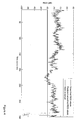
- Figure 1 shows the time series of RSSI values (measured in decibels) of a mobile device roaming a WiFi network.
- the RSSI threshold value is set at -80 dB (to maintain good channel quality, RSSI values must be above this threshold value) and if the mobile device fails to receive any signal strength from the AP, the RSSI value is set to -98 dB.
- RSSI values do exhibit mean-reverting behaviour (converging towards a long term mean), it is natural for us to look at models with this property. To the best of our knowledge there is no literature in the public domain which has explored using stochastic calculus to model RSSI values for smart triggering mechanism.
- Figures 4 and 5 show a close relationship between the smoothed RSSI values and the predicted smoothed RSSI values. Hence the OU process which is less expensive to compute can be utilised to estimate future RSSI values.
- Figure 6 shows the normal probability plot of residuals. From the plot, there is a high proportion of residuals being on the straight line which shows the residuals is well behaved and can be approximately normal distributed.
- the client uses knowledge on all the APs operating on the current as well as overlapping channels, here the client would only issue triggers when its present AP forecasted RSSI value falls below its threshold value, and the forecasted RSSI value of a future AP exceeds its threshold value.
- the expression (27) denotes that the smart trigger method would only choose the "best" neighbouring AP for a handover from its current default AP. On the other hand, if there are no better APs operating on the same channel or overlapping channels, then the algorithmic scheme will not trigger a handover event. But in the event, if the current AP experienced a link deterioration, then a trigger is invoked via a scan-based handover (choosing the "best" AP with the highest signal strength).
- wireless card manufacturers like Intel would introduce a protection margin (or hysteresis factor) ⁇ x ⁇ 0.
- the purpose of having this protection margin is to augment it to the RSSI threshold value, X ⁇ so that the client has an enhanced threshold value, X + ⁇ x to ensure a better QoS. If the forecasted RSSI value is greater than the enhanced threshold value, then the system would not trigger a handover to another AP. Otherwise the client would trigger a handover mechanism from its current AP and if the RSSI of a neighbouring AP is high enough then the client would switch to a new AP to be connected with.
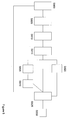
- FIG 8 shows a schematic depiction of a flowchart that describes a handover process that uses only RSSI as a metric for determing whether a handover should be made.
- a process is used when a mobile terminal is moving from a WLAN to a WMAN or within WMANs.
- the process begins at step S800 when the size of the window for smoothing RSSI values is selected.
- the Ormstein-Uhlenbeck SDE parameters are determined for each of the access points that are available.
- these parameters are used to forecast smoothed RSSI values for a specified lead time for each of the available action points.
- the mobile terminal determines whether a handover should be triggered (based on equation 29) and whether one of the other available access points is able to acccept the mobile terminal (based on equation 31).
- step S820 a handover is triggered.
- step S825 the latest RSSI values are updated and the process either terminates at step S830 or returns to S800. If the result of S815 is that a handover should not be triggered because the forecast RSSI value for the acces point in use is greater than the enenhanced threshold then the process proceeds to step S825 for the updating of the latest RSSI values. The process will then either terminate at step S830 or return to S800.
- step S840 the mobile terminal will trigger a conventional scan-based handover and will select the 'best' available access point. The process will then either terminate at step S830 or return to S800.
- FIG. 9 shows a schematic depiction of a flowchart that describes a handover proceedingsing both WLAN MAC collision and RSSI prediction technique when a mobile client moves from a WMAN to a WLAN network (or between WLANs).
- the process begins at step S950 and the mobile terminal determines the collision probability parameters for each of the available access points. If the condirional collision probability is greater than the threshold value then the mobile terminal will trigger a handover to a WLAN access point at step S920. Otherwise, the process will perform step S900 and select the size of the window for smoothing RSSI values.
- the Ormstein-Uhlenbeck SDE parameters are determined for each of the access points that are available.
- these parameters are used to forecast smoothed RSSI values for a specified lead time for each of the available action points. Then, at step S915 the mobile terminal determines whether a handover should be triggered (based on equation 29) and whether one of the other available access points is able to acccept the mobile terminal (based on equation 31).
- step S920 a handover is triggered.
- step S925 the latest RSSI values are updated and the process either terminates at step S930 or returns to S950. If the result of S915 is that a handover should not be triggered because the forecast RSSI value for the acces point in use is greater than the enenhanced threshold then the process proceeds to step S925 for the updating of the latest RSSI values. The process will then either terminate at step S930 or return to S950.
- step S940 the mobile terminal will trigger a conventional scan-based handover and will select the 'best' available access point. The process will then either terminate at step S930 or return to S950.
- the present invention can be implemented as a program or software component that will be executed by a computer.
- Software implementing a method according to the present invention may be supplied on physical media (such as a USB drive, CD-ROM, DVD, etc) or supplied or made available for transfer or download via a communications network.
- a mobile terminal which can perform a method according to the present application may comprise any mobile device which has the appropriate network interfaces: it may comprise a laptop, PDA, smartphone, mobile telephone, handheld games console, etc.
Landscapes
- Engineering & Computer Science (AREA)
- Computer Networks & Wireless Communication (AREA)
- Signal Processing (AREA)
- Mobile Radio Communication Systems (AREA)
Priority Applications (1)
| Application Number | Priority Date | Filing Date | Title |
|---|---|---|---|
| EP08253178A EP2169997A1 (de) | 2008-09-30 | 2008-09-30 | Steuerung des Weiterreichens in Funkkommunikationsnetzen basierend auf Vorrausschätzungen von Empfangssignalstärkenanzeigern (RSSI) |
Applications Claiming Priority (1)
| Application Number | Priority Date | Filing Date | Title |
|---|---|---|---|
| EP08253178A EP2169997A1 (de) | 2008-09-30 | 2008-09-30 | Steuerung des Weiterreichens in Funkkommunikationsnetzen basierend auf Vorrausschätzungen von Empfangssignalstärkenanzeigern (RSSI) |
Publications (1)
| Publication Number | Publication Date |
|---|---|
| EP2169997A1 true EP2169997A1 (de) | 2010-03-31 |
Family
ID=40445725
Family Applications (1)
| Application Number | Title | Priority Date | Filing Date |
|---|---|---|---|
| EP08253178A Ceased EP2169997A1 (de) | 2008-09-30 | 2008-09-30 | Steuerung des Weiterreichens in Funkkommunikationsnetzen basierend auf Vorrausschätzungen von Empfangssignalstärkenanzeigern (RSSI) |
Country Status (1)
| Country | Link |
|---|---|
| EP (1) | EP2169997A1 (de) |
Cited By (8)
| Publication number | Priority date | Publication date | Assignee | Title |
|---|---|---|---|---|
| US8095175B2 (en) | 2006-10-26 | 2012-01-10 | Mcmaster University | WLAN-to-WWAN handover methods and apparatus using a WLAN support node having a WWAN interface |
| EP2448328A1 (de) * | 2010-10-26 | 2012-05-02 | Research In Motion Limited | Verfahren und Vorrichtung zur Verwendung bei der Verbesserung der Netzwerkreichweite für Sprach- oder Datenanrufe |
| CN110691391A (zh) * | 2019-08-27 | 2020-01-14 | 华为技术有限公司 | 接入节点切换、发送信号参数信息的方法、装置及系统 |
| CN113784412A (zh) * | 2021-11-10 | 2021-12-10 | 国网江苏省电力有限公司营销服务中心 | 一种面向复杂台区环境的通信网络垂直切换方法及装置 |
| CN115802498A (zh) * | 2021-09-09 | 2023-03-14 | 华为技术有限公司 | 频段切换方法、ap设备及电子设备 |
| CN117896791A (zh) * | 2024-03-12 | 2024-04-16 | 武汉智慧地铁科技有限公司 | 基于惯性导航的隧道车载辅助无缝漫游方法及系统 |
| WO2025113064A1 (zh) * | 2023-11-30 | 2025-06-05 | 华为技术有限公司 | 通信的方法和装置 |
| CN121334829A (zh) * | 2025-12-16 | 2026-01-13 | 深圳市泰科通信科技有限公司 | 一种5g智能路由器功率调节方法、系统及电子设备 |
Citations (1)
| Publication number | Priority date | Publication date | Assignee | Title |
|---|---|---|---|---|
| US20050047370A1 (en) * | 2003-08-25 | 2005-03-03 | Kotzin Michael D. | Communication controller and method for managing the traffic flow of a communication connection during a cell reselection |
-
2008
- 2008-09-30 EP EP08253178A patent/EP2169997A1/de not_active Ceased
Patent Citations (1)
| Publication number | Priority date | Publication date | Assignee | Title |
|---|---|---|---|---|
| US20050047370A1 (en) * | 2003-08-25 | 2005-03-03 | Kotzin Michael D. | Communication controller and method for managing the traffic flow of a communication connection during a cell reselection |
Non-Patent Citations (24)
| Title |
|---|
| A. MISHRA; M.H. SHIN; W. ALBAUGH: "An empirical analysis of the IEEE 802.11 Mac layer handoff process", ACM SIGCOMM COMPUTER COMMUNICATION REVIEW, vol. 3, April 2003 (2003-04-01), pages 93 - 102, XP001224635, DOI: doi:10.1145/956981.956990 |
| C.C. TSENG ET AL.: "Location-based Fast Handoff for 802.11 Networks", IEEE COMMUNICATIONS LETTERS, vol. 9, April 2005 (2005-04-01), pages 304 - 306 |
| CHING-HUNG LEE ET AL: "An intelligent handoff algorithm for wireless communication systems using grey prediction and fuzzy decision system", NETWORKING, SENSING AND CONTROL, 2004 IEEE INTERNATIONAL CONFERENCE ON TAIPEI, TAIWAN MARCH 21-23, 2004, PISCATAWAY, NJ, USA,IEEE, vol. 1, 21 March 2004 (2004-03-21), pages 541 - 546, XP010705817, ISBN: 978-0-7803-8193-3 * |
| G. BIANCHI: "Performance analysis of the IEEE 802.11 distributed coordination function", IEEE J. SELECT. AREAS COMMUN., vol. 18, no. 3, 2000, pages 535 - 547, XP011449989, DOI: doi:10.1109/49.840210 |
| G. P. POLLINI: "Trends in Handover Design", IEEE COMMUNICATIONS MAGAZINE, March 1996 (1996-03-01) |
| G. SCHWARZ: "Estimating the dimension of a model", ANNAL OF STATISTICS, vol. 6, 1978, pages 461 - 464, XP008104155 |
| H. AKAIKE: "A new look at the statistical model identification", IEEE TRANSACTIONS ON AUTOMATIC CONTROL, vol. 19, no. 6, 1974, pages 716 - 723, XP000675871, DOI: doi:10.1109/TAC.1974.1100705 |
| H. VELAYOS; G. KARLSSON: "Techniques to reduce IEEE 802.11 b Mac layer handover time", TECHNICAL REPORT TRITA-IMIT-LCN R 03, 2 April 2003 (2003-04-02) |
| HUAIYU LIU ET AL: "A smart triggering scheme to reduce service interruption during heterogeneous handovers", DEPENDABLE SYSTEMS AND NETWORKS WITH FTCS AND DCC, 2008. DSN 2008. IEEE INTERNATIONAL CONFERENCE ON, IEEE, PISCATAWAY, NJ, USA, 24 June 2008 (2008-06-24), pages 430 - 439, XP031324516, ISBN: 978-1-4244-2397-2 * |
| J. MCNAIR; F. ZHU: "Vertical handoffs in fourth-generation multinetwork environments", IEEE WIRELESS COMMUNICATIONS, vol. 11, June 2004 (2004-06-01), pages 8 - 15, XP001217412, DOI: doi:10.1109/MWC.2004.1308935 |
| K. ITO: "On stochastic differential equations", AMERICAN MATHEMATICAL SOCIETY, vol. 4, 1951, pages 1 - 51 |
| K.D. WONG; D.C. COX: "A pattern recognition system for handoff algorithms", IEEE JOURNAL ON SELECTED AREAS IN COMMUNICATIONS, vol. 18, no. 7, July 2000 (2000-07-01), XP000950214, DOI: doi:10.1109/49.857930 |
| LUCENT TECHNOLOGIES: "Roaming with Orinoco/IEEE 802.11", TECHNICAL REPORT, December 1998 (1998-12-01) |
| M. AKAR; U. MITRA: "Variations on Optimal and Suboptimal Handoff Control for Wireless Communication Systems", IEEE JOURNAL ON SELECTED AREAS IN COMMUNICATIONS, vol. 19, June 2001 (2001-06-01), pages 1173 - 1185, XP001103036, DOI: doi:10.1109/49.926373 |
| M. LOTT ET AL.: "Interworking of WLAN and 3G systems", IEE PROCEEDINGS ON COMMUNICATIONS, vol. 151, October 2004 (2004-10-01), pages 507 - 513, XP006022617, DOI: doi:10.1049/ip-com:20040600 |
| M. STEMM; R. H. KATZ: "Vertical handoffs in wireless overlay networks", MOBILE NETWORKS AND APPLICATIONS, vol. 3, 1998, pages 335 - 350 |
| Q. ZHANG ET AL.: "Efficient mobility management for vertical handoff between WMAN and WLAN", IEEE COMMUNICATIONS MAGAZINE, vol. 41, November 2003 (2003-11-01), pages 102 - 108 |
| R. H. JONES.: "Maximum likelihood fitting of ARMA models to time series with missing observations", TECHNOMETRICS, vol. 22, 1980, pages 389 - 395 |
| S. PERIYALWAL ET AL.: "Future mobile broadband wireless networks: a radio resource management perspective", WIRELESS COMMUNICATIONS AND MOBILE COMPUTING, vol. 3, 2003, pages 1 - 13 |
| SHIANN-TSONG SHEU ET AL: "Using grey prediction theory to reduce handoff overhead in cellular communication systems", PERSONAL, INDOOR AND MOBILE RADIO COMMUNICATIONS, 2000. PIMRC 2000. TH E 11TH IEEE INTERNATIONAL SYMPOSIUM ON SEPT. 18-21, 2000, PISCATAWAY, NJ, USA,IEEE, vol. 2, 18 September 2000 (2000-09-18), pages 782 - 786, XP010520742, ISBN: 978-0-7803-6463-9 * |
| V. MHATRE; K. PAPAGIANNAKI: "Using smart triggers for improved user performance in 802.11 wireless networks", MOBISYS, 6 June 2006 (2006-06-06) |
| Y. IRAQI; R. BOUTABA: "Resource management issues in future wireless multimedia networks", SPECIAL ISSUE ON THE MANAGEMENT OF MULTIMEDIA NETWORKING, vol. 9, no. 3, 2000, pages 231 - 260 |
| YONG-HOON CHOI ET AL: "Cross-Layer Handover Optimization Using Linear Regression Model", INFORMATION NETWORKING, 2008. ICOIN 2008. INTERNATIONAL CONFERENCE ON, IEEE, PISCATAWAY, NJ, USA, 23 January 2008 (2008-01-23), pages 1 - 4, XP031238864, ISBN: 978-89-960761-1-7 * |
| Z. YANG; X. WANG: "Joint Mobility Tracking and Handoff in Cellular Networks via Sequential Monte Carlo Filtering", INFOCOMM, vol. 2, 2002, pages 968 - 975, XP010593660, DOI: doi:10.1109/INFCOM.2002.1019344 |
Cited By (10)
| Publication number | Priority date | Publication date | Assignee | Title |
|---|---|---|---|---|
| US8095175B2 (en) | 2006-10-26 | 2012-01-10 | Mcmaster University | WLAN-to-WWAN handover methods and apparatus using a WLAN support node having a WWAN interface |
| EP2448328A1 (de) * | 2010-10-26 | 2012-05-02 | Research In Motion Limited | Verfahren und Vorrichtung zur Verwendung bei der Verbesserung der Netzwerkreichweite für Sprach- oder Datenanrufe |
| US8699456B2 (en) | 2010-10-26 | 2014-04-15 | Blackberry Limited | Methods and apparatus for use in improving network coverage for voice or data calls |
| CN110691391A (zh) * | 2019-08-27 | 2020-01-14 | 华为技术有限公司 | 接入节点切换、发送信号参数信息的方法、装置及系统 |
| CN115802498A (zh) * | 2021-09-09 | 2023-03-14 | 华为技术有限公司 | 频段切换方法、ap设备及电子设备 |
| CN113784412A (zh) * | 2021-11-10 | 2021-12-10 | 国网江苏省电力有限公司营销服务中心 | 一种面向复杂台区环境的通信网络垂直切换方法及装置 |
| WO2025113064A1 (zh) * | 2023-11-30 | 2025-06-05 | 华为技术有限公司 | 通信的方法和装置 |
| CN117896791A (zh) * | 2024-03-12 | 2024-04-16 | 武汉智慧地铁科技有限公司 | 基于惯性导航的隧道车载辅助无缝漫游方法及系统 |
| CN117896791B (zh) * | 2024-03-12 | 2024-05-28 | 武汉智慧地铁科技有限公司 | 基于惯性导航的隧道车载辅助无缝漫游方法及系统 |
| CN121334829A (zh) * | 2025-12-16 | 2026-01-13 | 深圳市泰科通信科技有限公司 | 一种5g智能路由器功率调节方法、系统及电子设备 |
Similar Documents
| Publication | Publication Date | Title |
|---|---|---|
| EP2169997A1 (de) | Steuerung des Weiterreichens in Funkkommunikationsnetzen basierend auf Vorrausschätzungen von Empfangssignalstärkenanzeigern (RSSI) | |
| US9326209B2 (en) | Cell selection or handover in wireless networks | |
| EP2140705B1 (de) | Handover-technik für zu drahtloser kommunikation befähigte einrichtungen | |
| US7430420B2 (en) | Cell selection and inter-frequency handover | |
| EP2785136B1 (de) | Minderung von Überlastungen in WLAN-Netzwerken | |
| KR101069328B1 (ko) | 컴퓨터로 구현되는 방법, 컴퓨터화 시스템, 컴퓨터 판독가능 기록 매체, 및 컴퓨팅 장치 | |
| Mhatre et al. | Using smart triggers for improved user performance in 802.11 wireless networks | |
| US7099672B2 (en) | Methods and systems for improving utilization of traffic channels in a mobile communications network | |
| US9622252B2 (en) | Systems and methods for dynamic wideband channel selection | |
| EP4096138B1 (de) | Datenübertragungsverfahren | |
| US8411585B2 (en) | Network interference evaluating method, dynamic channel assignment method and apparatus used in wireless networks | |
| US20090154426A1 (en) | Handover based on a quality of service metric obtained from a mac layer of a received signal | |
| EP2538713B1 (de) | Durchführung von Messungen in einem digitalen, zellularen, drahtlosen Telekommunikationsnetzwerk | |
| US8520639B2 (en) | Apparatus and method for performing handover in advanced mobile communication system | |
| JP2014523159A5 (de) | ||
| KR20120037088A (ko) | 무선통신 시스템에서 송신 용량 증대를 위한 셀 선택 방법 및 장치 | |
| López-Raventós et al. | Concurrent decentralized channel allocation and access point selection using multi-armed bandits in multi BSS WLANs | |
| CN110572812B (zh) | 一种漫游方法及装置 | |
| CN106792779B (zh) | 一种在许可和免许可频段工作的蜂窝网络接入控制方法 | |
| Montavont et al. | Handover triggering in IEEE 802.11 networks | |
| CN103686895B (zh) | 切换控制方法、无线网络控制器和接入节点 | |
| CN105530671B (zh) | 抑制乒乓切换的方法和移动性管理实体 | |
| CN113891406A (zh) | 多频网络中的小区切换方法及装置 | |
| CN116567753A (zh) | 一种无线漫游的方法、系统、计算机设备和存储介质 | |
| EP2731378B1 (de) | Erzeugung einer Nachbarzellenliste in einem heterogenen Netzwerk |
Legal Events
| Date | Code | Title | Description |
|---|---|---|---|
| PUAI | Public reference made under article 153(3) epc to a published international application that has entered the european phase |
Free format text: ORIGINAL CODE: 0009012 |
|
| AK | Designated contracting states |
Kind code of ref document: A1 Designated state(s): AT BE BG CH CY CZ DE DK EE ES FI FR GB GR HR HU IE IS IT LI LT LU LV MC MT NL NO PL PT RO SE SI SK TR |
|
| AX | Request for extension of the european patent |
Extension state: AL BA MK RS |
|
| STAA | Information on the status of an ep patent application or granted ep patent |
Free format text: STATUS: THE APPLICATION HAS BEEN REFUSED |
|
| 18R | Application refused |
Effective date: 20100420 |