EP2170157B1 - Quantité de mesure d'oxyde nitrique lié et combiné dans le sang - Google Patents
Quantité de mesure d'oxyde nitrique lié et combiné dans le sang Download PDFInfo
- Publication number
- EP2170157B1 EP2170157B1 EP08794495.5A EP08794495A EP2170157B1 EP 2170157 B1 EP2170157 B1 EP 2170157B1 EP 08794495 A EP08794495 A EP 08794495A EP 2170157 B1 EP2170157 B1 EP 2170157B1
- Authority
- EP
- European Patent Office
- Prior art keywords
- nitric oxide
- electromagnetic radiation
- sample
- oxide gas
- solvent
- Prior art date
- Legal status (The legal status is an assumption and is not a legal conclusion. Google has not performed a legal analysis and makes no representation as to the accuracy of the status listed.)
- Not-in-force
Links
- MWUXSHHQAYIFBG-UHFFFAOYSA-N Nitric oxide Chemical compound O=[N] MWUXSHHQAYIFBG-UHFFFAOYSA-N 0.000 title claims description 265
- 210000004369 blood Anatomy 0.000 title claims description 45
- 239000008280 blood Substances 0.000 title claims description 45
- XEEYBQQBJWHFJM-UHFFFAOYSA-N Iron Chemical compound [Fe] XEEYBQQBJWHFJM-UHFFFAOYSA-N 0.000 claims description 62
- 239000002904 solvent Substances 0.000 claims description 51
- 230000005670 electromagnetic radiation Effects 0.000 claims description 45
- 229910052742 iron Inorganic materials 0.000 claims description 31
- 238000000034 method Methods 0.000 claims description 27
- 230000005855 radiation Effects 0.000 claims description 25
- 239000003795 chemical substances by application Substances 0.000 claims description 15
- 102000004169 proteins and genes Human genes 0.000 claims description 12
- 108090000623 proteins and genes Proteins 0.000 claims description 12
- OKKJLVBELUTLKV-UHFFFAOYSA-N Methanol Chemical compound OC OKKJLVBELUTLKV-UHFFFAOYSA-N 0.000 claims description 9
- 230000000593 degrading effect Effects 0.000 claims description 9
- ICRHORQIUXBEPA-UHFFFAOYSA-N thionitrous acid Chemical compound SN=O ICRHORQIUXBEPA-UHFFFAOYSA-N 0.000 claims description 8
- IOVCWXUNBOPUCH-UHFFFAOYSA-N Nitrous acid Chemical compound ON=O IOVCWXUNBOPUCH-UHFFFAOYSA-N 0.000 claims description 6
- 238000000354 decomposition reaction Methods 0.000 claims description 2
- 238000004090 dissolution Methods 0.000 claims description 2
- 239000000523 sample Substances 0.000 description 77
- 239000007789 gas Substances 0.000 description 33
- 239000011521 glass Substances 0.000 description 7
- 238000003745 diagnosis Methods 0.000 description 4
- 238000003780 insertion Methods 0.000 description 4
- 230000037431 insertion Effects 0.000 description 4
- 238000005259 measurement Methods 0.000 description 4
- 238000006303 photolysis reaction Methods 0.000 description 4
- 230000015843 photosynthesis, light reaction Effects 0.000 description 4
- -1 Ag+ ion Chemical class 0.000 description 3
- 230000009471 action Effects 0.000 description 3
- 238000001514 detection method Methods 0.000 description 3
- 238000000835 electrochemical detection Methods 0.000 description 3
- 230000012953 feeding on blood of other organism Effects 0.000 description 3
- 239000000463 material Substances 0.000 description 3
- QSHDDOUJBYECFT-UHFFFAOYSA-N mercury Chemical compound [Hg] QSHDDOUJBYECFT-UHFFFAOYSA-N 0.000 description 3
- 102000001554 Hemoglobins Human genes 0.000 description 2
- 108010054147 Hemoglobins Proteins 0.000 description 2
- 238000010521 absorption reaction Methods 0.000 description 2
- 210000004027 cell Anatomy 0.000 description 2
- 238000013532 laser treatment Methods 0.000 description 2
- LWJROJCJINYWOX-UHFFFAOYSA-L mercury dichloride Chemical compound Cl[Hg]Cl LWJROJCJINYWOX-UHFFFAOYSA-L 0.000 description 2
- 229920001343 polytetrafluoroethylene Polymers 0.000 description 2
- 239000004810 polytetrafluoroethylene Substances 0.000 description 2
- 239000011148 porous material Substances 0.000 description 2
- 230000029663 wound healing Effects 0.000 description 2
- 229910019901 yttrium aluminum garnet Inorganic materials 0.000 description 2
- RZVAJINKPMORJF-UHFFFAOYSA-N Acetaminophen Chemical compound CC(=O)NC1=CC=C(O)C=C1 RZVAJINKPMORJF-UHFFFAOYSA-N 0.000 description 1
- JJWSNOOGIUMOEE-UHFFFAOYSA-N Monomethylmercury Chemical compound [Hg]C JJWSNOOGIUMOEE-UHFFFAOYSA-N 0.000 description 1
- CBENFWSGALASAD-UHFFFAOYSA-N Ozone Chemical compound [O-][O+]=O CBENFWSGALASAD-UHFFFAOYSA-N 0.000 description 1
- HYHSBSXUHZOYLX-WDSKDSINSA-N S-nitrosoglutathione Chemical compound OC(=O)[C@@H](N)CCC(=O)N[C@@H](CSN=O)C(=O)NCC(O)=O HYHSBSXUHZOYLX-WDSKDSINSA-N 0.000 description 1
- 206010040047 Sepsis Diseases 0.000 description 1
- 238000002835 absorbance Methods 0.000 description 1
- 230000004913 activation Effects 0.000 description 1
- RNQKDQAVIXDKAG-UHFFFAOYSA-N aluminum gallium Chemical compound [Al].[Ga] RNQKDQAVIXDKAG-UHFFFAOYSA-N 0.000 description 1
- JNDMLEXHDPKVFC-UHFFFAOYSA-N aluminum;oxygen(2-);yttrium(3+) Chemical compound [O-2].[O-2].[O-2].[Al+3].[Y+3] JNDMLEXHDPKVFC-UHFFFAOYSA-N 0.000 description 1
- YLFIGGHWWPSIEG-UHFFFAOYSA-N aminoxyl Chemical compound [O]N YLFIGGHWWPSIEG-UHFFFAOYSA-N 0.000 description 1
- NWAIGJYBQQYSPW-UHFFFAOYSA-N azanylidyneindigane Chemical compound [In]#N NWAIGJYBQQYSPW-UHFFFAOYSA-N 0.000 description 1
- 239000012472 biological sample Substances 0.000 description 1
- 230000005540 biological transmission Effects 0.000 description 1
- 230000017531 blood circulation Effects 0.000 description 1
- 239000012159 carrier gas Substances 0.000 description 1
- RCTYPNKXASFOBE-UHFFFAOYSA-M chloromercury Chemical compound [Hg]Cl RCTYPNKXASFOBE-UHFFFAOYSA-M 0.000 description 1
- 238000004140 cleaning Methods 0.000 description 1
- 238000012790 confirmation Methods 0.000 description 1
- 238000010276 construction Methods 0.000 description 1
- 239000013078 crystal Substances 0.000 description 1
- 230000000994 depressogenic effect Effects 0.000 description 1
- XEYBHCRIKKKOSS-UHFFFAOYSA-N disodium;azanylidyneoxidanium;iron(2+);pentacyanide Chemical compound [Na+].[Na+].[Fe+2].N#[C-].N#[C-].N#[C-].N#[C-].N#[C-].[O+]#N XEYBHCRIKKKOSS-UHFFFAOYSA-N 0.000 description 1
- 210000003743 erythrocyte Anatomy 0.000 description 1
- 239000000835 fiber Substances 0.000 description 1
- 150000003278 haem Chemical group 0.000 description 1
- 239000001307 helium Substances 0.000 description 1
- 229910052734 helium Inorganic materials 0.000 description 1
- SWQJXJOGLNCZEY-UHFFFAOYSA-N helium atom Chemical compound [He] SWQJXJOGLNCZEY-UHFFFAOYSA-N 0.000 description 1
- 150000002500 ions Chemical class 0.000 description 1
- 230000001678 irradiating effect Effects 0.000 description 1
- 238000002647 laser therapy Methods 0.000 description 1
- 239000007788 liquid Substances 0.000 description 1
- 229910052753 mercury Inorganic materials 0.000 description 1
- BQPIGGFYSBELGY-UHFFFAOYSA-N mercury(2+) Chemical compound [Hg+2] BQPIGGFYSBELGY-UHFFFAOYSA-N 0.000 description 1
- 229910021645 metal ion Inorganic materials 0.000 description 1
- 238000012986 modification Methods 0.000 description 1
- 230000004048 modification Effects 0.000 description 1
- 238000005192 partition Methods 0.000 description 1
- 230000000886 photobiology Effects 0.000 description 1
- 238000001126 phototherapy Methods 0.000 description 1
- 230000008569 process Effects 0.000 description 1
- 208000002815 pulmonary hypertension Diseases 0.000 description 1
- 239000005297 pyrex Substances 0.000 description 1
- 239000010453 quartz Substances 0.000 description 1
- 238000011160 research Methods 0.000 description 1
- 230000004044 response Effects 0.000 description 1
- 230000035945 sensitivity Effects 0.000 description 1
- 208000007056 sickle cell anemia Diseases 0.000 description 1
- VYPSYNLAJGMNEJ-UHFFFAOYSA-N silicon dioxide Inorganic materials O=[Si]=O VYPSYNLAJGMNEJ-UHFFFAOYSA-N 0.000 description 1
- 229940083618 sodium nitroprusside Drugs 0.000 description 1
- 239000007787 solid Substances 0.000 description 1
- 238000002560 therapeutic procedure Methods 0.000 description 1
- 239000012780 transparent material Substances 0.000 description 1
- 238000011282 treatment Methods 0.000 description 1
Images


Classifications
-
- G—PHYSICS
- G01—MEASURING; TESTING
- G01N—INVESTIGATING OR ANALYSING MATERIALS BY DETERMINING THEIR CHEMICAL OR PHYSICAL PROPERTIES
- G01N33/00—Investigating or analysing materials by specific methods not covered by groups G01N1/00 - G01N31/00
- G01N33/48—Biological material, e.g. blood, urine; Haemocytometers
- G01N33/50—Chemical analysis of biological material, e.g. blood, urine; Testing involving biospecific ligand binding methods; Immunological testing
- G01N33/84—Chemical analysis of biological material, e.g. blood, urine; Testing involving biospecific ligand binding methods; Immunological testing involving inorganic compounds or pH
-
- A—HUMAN NECESSITIES
- A61—MEDICAL OR VETERINARY SCIENCE; HYGIENE
- A61B—DIAGNOSIS; SURGERY; IDENTIFICATION
- A61B5/00—Measuring for diagnostic purposes; Identification of persons
- A61B5/0059—Measuring for diagnostic purposes; Identification of persons using light, e.g. diagnosis by transillumination, diascopy, fluorescence
-
- A—HUMAN NECESSITIES
- A61—MEDICAL OR VETERINARY SCIENCE; HYGIENE
- A61B—DIAGNOSIS; SURGERY; IDENTIFICATION
- A61B5/00—Measuring for diagnostic purposes; Identification of persons
- A61B5/145—Measuring characteristics of blood in vivo, e.g. gas concentration or pH-value ; Measuring characteristics of body fluids or tissues, e.g. interstitial fluid or cerebral tissue
- A61B5/14546—Measuring characteristics of blood in vivo, e.g. gas concentration or pH-value ; Measuring characteristics of body fluids or tissues, e.g. interstitial fluid or cerebral tissue for measuring analytes not otherwise provided for, e.g. ions, cytochromes
-
- A—HUMAN NECESSITIES
- A61—MEDICAL OR VETERINARY SCIENCE; HYGIENE
- A61B—DIAGNOSIS; SURGERY; IDENTIFICATION
- A61B5/00—Measuring for diagnostic purposes; Identification of persons
- A61B5/15—Devices for taking samples of blood
- A61B5/150007—Details
- A61B5/150015—Source of blood
- A61B5/150022—Source of blood for capillary blood or interstitial fluid
-
- A—HUMAN NECESSITIES
- A61—MEDICAL OR VETERINARY SCIENCE; HYGIENE
- A61B—DIAGNOSIS; SURGERY; IDENTIFICATION
- A61B5/00—Measuring for diagnostic purposes; Identification of persons
- A61B5/15—Devices for taking samples of blood
- A61B5/150007—Details
- A61B5/150206—Construction or design features not otherwise provided for; manufacturing or production; packages; sterilisation of piercing element, piercing device or sampling device
- A61B5/150251—Collection chamber divided into at least two compartments, e.g. for division of samples
-
- A—HUMAN NECESSITIES
- A61—MEDICAL OR VETERINARY SCIENCE; HYGIENE
- A61B—DIAGNOSIS; SURGERY; IDENTIFICATION
- A61B5/00—Measuring for diagnostic purposes; Identification of persons
- A61B5/15—Devices for taking samples of blood
- A61B5/150007—Details
- A61B5/150343—Collection vessels for collecting blood samples from the skin surface, e.g. test tubes, cuvettes
-
- A—HUMAN NECESSITIES
- A61—MEDICAL OR VETERINARY SCIENCE; HYGIENE
- A61B—DIAGNOSIS; SURGERY; IDENTIFICATION
- A61B5/00—Measuring for diagnostic purposes; Identification of persons
- A61B5/41—Detecting, measuring or recording for evaluating the immune or lymphatic systems
- A61B5/412—Detecting or monitoring sepsis
-
- G—PHYSICS
- G01—MEASURING; TESTING
- G01N—INVESTIGATING OR ANALYSING MATERIALS BY DETERMINING THEIR CHEMICAL OR PHYSICAL PROPERTIES
- G01N27/00—Investigating or analysing materials by the use of electric, electrochemical, or magnetic means
- G01N27/26—Investigating or analysing materials by the use of electric, electrochemical, or magnetic means by investigating electrochemical variables; by using electrolysis or electrophoresis
- G01N27/416—Systems
-
- A—HUMAN NECESSITIES
- A61—MEDICAL OR VETERINARY SCIENCE; HYGIENE
- A61B—DIAGNOSIS; SURGERY; IDENTIFICATION
- A61B5/00—Measuring for diagnostic purposes; Identification of persons
- A61B5/14—Devices for taking samples of blood ; Measuring characteristics of blood in vivo, e.g. gas concentration within the blood, pH-value of blood
- A61B5/1405—Devices for taking blood samples
-
- Y—GENERAL TAGGING OF NEW TECHNOLOGICAL DEVELOPMENTS; GENERAL TAGGING OF CROSS-SECTIONAL TECHNOLOGIES SPANNING OVER SEVERAL SECTIONS OF THE IPC; TECHNICAL SUBJECTS COVERED BY FORMER USPC CROSS-REFERENCE ART COLLECTIONS [XRACs] AND DIGESTS
- Y10—TECHNICAL SUBJECTS COVERED BY FORMER USPC
- Y10T—TECHNICAL SUBJECTS COVERED BY FORMER US CLASSIFICATION
- Y10T436/00—Chemistry: analytical and immunological testing
- Y10T436/17—Nitrogen containing
- Y10T436/177692—Oxides of nitrogen
Definitions
- This invention is directed to determining amount of combined nitric oxide in blood. There is a need for this determination in a clinical setting.
- blood nitric oxide is depressed in patients with sickle cell disease and patients with pulmonary hypertension and determination of this is useful to confirm diagnosis.
- blood nitric oxide is elevated in those with sepsis; see Liu, L., et al., Cell 116, 617-628 (2004 ); and determination of this is useful to confirm diagnosis.
- a 150 W mercury vapor lamp is used as a high intensity, broad spectrum UV source that irradiates liquid blood-containing samples as they flow through a Pyrex® glass coil.
- the use of a 150 W mercury vapor lamp requires a large surface area sample. A flow-through process is necessary to provide the large surface area.
- a flow-through stream is aerated with a helium carrier gas stream, allowing free nitric oxide gas to be transported to a separate unit that houses a nitric oxide detector where the freed nitric oxide is reacted with ozone to generate light (chemiluminescence) which is detected by a photomultiplier tube.
- This method is described in Stamler et al. U.S. Patent No. 5,459,076 and in Stamler U.S. Patent No. 5,891,735 .
- This method while useful in a research setting is too cumbersome for a clinical setting.
- the glass coil needs to be reused, requiring cleaning between runs.
- Lucht et al. U.S. Patent No. 6,982,426 teaches a nitric oxide sensor and method comprising passing a signal beam from a laser in a crystal through a sample into a photomultiplier tube and detection of output ultraviolet radiation which indicates level of nitric oxide by comparison with control based on nitric oxide absorption of ultraviolet radiation. Measurements are made by photomultiplier tubes. The apparatus and method are not useful for biological samples and lack sensitivity.
- YURY VLADIMIROV ET AL "NO-hemoglobin may be a light-sensitive source of nitric oxide both in solution and in red blood cells" JOURNAL OF PHOTOCHEMISTRY AND PHOTOBIOLOGY B: BIOLOGY, vol. 59, no. 1-3, 1 December 2000, pages 115-122 discloses EPR detection of free nitric oxide produced as a result of photolysis of the nitrosyl complex of haemoglobin by means of a spin trap, nitronyl nitroxyl radical.
- low power means less than 100 milliwatts, e.g. 30 to 60 milliwatts, e.g. 50 milliwatts.
- a first embodiment herein is directed at a method for liberating nitric oxide gas from nitric oxide present as iron nitrosyls and as nitrosothiols in a blood sample, comprising the steps of:
- the blood sample is untreated.
- a second embodiment herein is directed at a method for liberating nitric oxide gas from nitric oxide present as iron nitrosyls in a blood sample which has been treated with a nitrosothiol degrading agent to degrade nitrosothiols in the sample to nitrous acid, comprising the steps of:
- the method is for determining the amount of nitric oxide present as nitrosothiols and also the amount of nitric oxide present as iron nitrosyls and the method comprises:
- a low power radiation emitter is used in all embodiments herein because it has been found that such a radiation emitter can be used to deliver a large dose of radiation to a stationary small sample of blood to liberate nitric oxide gas therefrom.
- the dose of energy delivered by the emitter is proportional to the power of the emitter and inversely proportional to the diameter of the emitter beam.
- the low power electromagnetic radiation can preferably be ultraviolet radiation having a wavelength ranging from 300 to 400 nm, very preferably from 325 to 355 nm.
- This can be provided by a low power ultraviolet laser especially a neodymium-doped yttrium aluminum garnet laser, i.e. a Nd:Y 3 Al 5 O 12 laser, which emits ultraviolet radiation or by a tunable laser tuned, e.g. to provide 325 to 355 nm radiation, commercially available from Opotek, Inc. (California) in the specified range.
- This low power ultraviolet radiation can also be provided by an ultraviolet light-emitting diode which is commercially available to emit ultraviolet radiation in these wavelengths.
- the low power electromagnetic radiation can also be ultraviolet radiation having a wavelength ranging from 210 to 220 nm, e.g. 220 nm.
- Light-emitting diodes emitting ultraviolet radiation down to 210 nm wavelength are available, e.g. aluminum gallium indium nitride light emitting diodes emitting down to 210 nm wavelength are available.
- the low power electromagnetic radiation can also be low power visible electromagnetic radiation having a wavelength ranging from 500 to 600 nm. This can be provided by a low power green LED lamp which is commercially available.
- the low power electromagnetic radiation can also be low power near infrared radiation (700-1400 nm wavelength). This can be provided by a near-infrared light-emitting diode which is commercially available.
- the 210-220 nm, 300-400, 500-600 nm and near-infrared wavelength emissions referred to above degrade nitrosothiols to gaseous nitric oxide and to provide adequate absorbance into iron nitrosyls (characteristic moiety for nitric oxide bound to heme) to liberate gaseous nitric oxide therefrom.
- the blood sample has a small surface area and small volume.
- it can have a diameter ranging, for example, from 2 to 6 mm with a transverse dimension of, for example, 0.5 to 1 mm.
- the blood sample is readily obtained by pricking a finger with a sharp and may be loaded into a sample holder by capillary action.
- the blood sample is treated with metal ion (e.g., mercury (II) ion or Ag + ion), e.g. mercury chloride, or organic mercury (e.g., methyl mercury) to degrade nitrosothiols in the sample to nitrous acid (which does not liberate nitric oxide on receiving electromagnetic radiation energy).
- metal ion e.g., mercury (II) ion or Ag + ion
- organic mercury e.g., methyl mercury
- the radiation emitter is directed at the blood sample which has been treated to degrade nitrosothiol and the term "blood sample” includes untreated blood sample as well as nitrosothiols degraded treated (treated with nitrosothiols degrading agent) blood sample.
- a laser or light-emitting diode is positioned, e.g., up to a foot (0.3 m), for example, 6 to 10 inches (15 to 25 cm) from the sample. This distance can be reduced if fiber optic transmission of emitter beam is utilized.
- An electromagnetic radiation beam is directed at the sample and preferably on reaching the sample, has a cross-sectional area the same as and coextensive with the cross-sectional area of the sample.
- the electromagnetic radiation treatment causes photolysis of nitrosothiols and iron nitrosyls in a blood sample or a treated blood sample to release gaseous nitric oxide and is continued until nitric oxide gas emission is no longer noted.
- the front side (wall) of the sample containing zone is electromagnetic radiation transparent so the front wall of the sample containing zone does not cause attenuation of radiation energy emitting to the front side of the samples, i.e. transmits at least approximately 95% of the radiation energy directed thereat.
- the front side of the sample holding zone can be, for example, Vycor® glass (Corning Glass Works), or quartz.
- the rear side of the sample containing zone is preferably of a material of construction which is porous to the extent of permitting passage of nitric oxide gas but not to the extent of permitting passage of protein, e.g., 40 micron pores, so as to separate liberated nitric oxide gas from protein so liberated nitric oxide gas cannot recombine with protein.
- the rear side of the sample containing zone is preferably of Vycor®glass.
- the solvent containing zone except adjacent the rear side gas passage permitting portion of the sample holding zone is constructed of an inert material, e.g. polytetrafluoroethylene and is preferably painted black except adjacent where nitric oxide gas is passing from the sample container (as explained later).
- an inert material e.g. polytetrafluoroethylene and is preferably painted black except adjacent where nitric oxide gas is passing from the sample container (as explained later).
- the solvent in the solvent containing zone is one that has a higher solubility for nitric oxide gas than the sample and is preferably methanol.
- nitric oxide selective electrode which is an ion selective electrode that generates a small voltage (e.g., in the picovolt range) which is quantitatively proportional to this concentration of nitric oxide dissolved in solvent when immersed in the solvent with nitric oxide dissolved therein.
- Nitrosoglutathione can be used to calibrate for photolysis of amount of nitric oxide from nitrosothiols and sodium nitroprusside can be used to calibrate for photolysis of amount of nitric oxide from iron nitrosyls and both cover the range of amounts of nitric oxide from the combined nitric oxide.
- Nitric oxide selective electrodes are commercially available.
- the blood sample is loaded into the sample containing zone with and/or without nitrosothiol degrading agent therein, e.g. by pricking a finger with a lancet or other sharp and loading the sample into the sample containing zone, for example, by capillary action, solvent is introduced into a solvent containing zone, the rear side of the sample containing zone is positioned adjacent the solvent containing zone, followed by positioning a low power electromagnetic radiation emitter (low power laser or low power light-emitting diode) up to 12 inches (0.3 m) away from the sample containing zone and irradiating sample in the sample containing zone with the electromagnetic radiation emitter emitting a beam of cross-sectional area corresponding to the cross-sectional area of the sample.
- a low power electromagnetic radiation emitter low power laser or low power light-emitting diode
- the electrode is lowered into the solvent containing zone and detects a generated voltage corresponding to the amount of nitric oxide in the solvent containing zone. Electromagnetic radiation beam is directed at the sample for as long as nitric oxide gas increase is detected, whereupon the electromagnetic radiation source is turned off and the electrode is raised out of contact with the solvent whereupon apparatus providing the sample containing zone may be discarded.
- the generated voltage detected by the electrode is in the picovolt range and is amplified using a DC amplifier for measurement, e.g., using a voltmeter.
- a signal integrator can be present in the system to quantify the area under any peak. Signal from the amplifier and/or signal integrator may feed into an analog to digital converter which passes a signal to a computer or volt meter or other digital interface to provide digital or graphical readout indicating amount of combined nitric oxide, that is total nitric oxide present as nitrosothiols and iron nitrosyls (no nitrosothiol destroying agent used), or amount of nitric oxide present as iron nitrosyls (nitrosothiol destroying agent used).
- the front side of the sample containing zone is transparent to whichever electromagnetic radiation is emitted in the direction of the sample containing zone to allow passing of the electromagnetic radiation into the sample containing zone and cause liberation of nitric oxide from the sample.
- FIG. 1-5 A preferred system for carrying out the method for determining the amount of nitric oxide present as nitrosothiols and also the amount of nitric oxide present as iron nitrosyls is depicted in Figures 1-5 .
- FIG. 1 there is schematically depicted a disposable phlebotomy cassette 10 which contains blood sample containing chambers 12 and 14 which both constitute sample containing zones.
- a front wall 16 of cassette 10 is of Vycor® glass or other electromagnetic radiation transparent material (i.e. to whichever kind of electromagnetic radiation is used) and a rear wall 18 of the cassette is constituted, for example, of Vycor® glass (40 micron pores) and reliance is placed on the rear wall's property of being porous to nitric oxide gas but preventing passage therethrough of protein.
- the blood sample containing chamber 12 is impregnated with mercury (II) chloride or other nitrosothiols destroying agent so as not to interfere with absorption of electromagnetic radiation by blood sample.
- Blood sample containing chambers 12 and 14 are, for example, 4 mm diameter and 5 mm transverse dimension.
- the chamber 12 contains nitrosothiols destroying agent, e.g. mercury (II) chloride, in large excess, compared to nitrosothiols that are present; the chamber 14 does not contain nitrosothiols destroying agent.
- nitrosothiols destroying agent e.g. mercury (II) chloride
- Communicating with chamber 12 is a capillary blood sample containing chamber/zone inlet 20.
- Communicating with chamber 14 is a capillary blood sample containing chamber/zone inlet 22.
- a reusable solvent reservoir/electrode introduction compartment or housing 24 which provides a solvent containing zone and which is constructed of inert material (i.e., inert to solvent and nitric oxide gas), e.g. polytetrafluoroethylene.
- the element 24 contains two solvent reservoir compartments 26 and 28 separated by a partition 30.
- the element 24 contains a solid back wall and a front wall with circular openings 32 and 34, respectively, into each of the compartments 26 and 28.
- the opening 32 is bounded by a ring shaped upstanding protruding wall 36
- the opening 34 is bounded by ring shaped upstanding protruding wall 38.
- An upper wall of element 24 is provided with an opening 40 for introduction of an electrode into compartment 26 and an opening 42 for introduction of electrode into compartment 28.
- Each of the upstanding walls 36 and 38 is colored black or otherwise provided with electromagnetic radiation shielding to minimize and guard against electromagnetic radiation scattering to inserted electrode (described later) since electromagnetic radiation affects the voltage detected by an electrode.
- the disposable cassette 10 and solvent reservoir/electrode introduction compartment 24 are assembled, for example, by clamping cassette 10 to solvent reservoir/electrode introduction compartment 24 so the rear side of cassette 10 adjacent chambers 12 and 14 is contiguous with openings 32 and 34 ( Figure 2 ).
- cassette 10 can be attached to element 24 by providing retaining brackets on the front side of element 24 or by providing structure on the front of element 24 providing an insertion slot for assembling cassette 10 and element 24.
- the assembly provided is schematically depicted in Figure 3 which is denoted 58.
- Figure 4 depicts an exploded view of the assembly of Figure 3 , and indicates the cassette 10 positioned in front of a front wall 44 of element 24.
- the front wall 44 is forward of rear wall 46 of element 24.
- Element 44 contains a left side wall 48, a right side wall 50, an interior vertical wall 52 dividing element 24 into compartments 26 and 28 (depicted in Figure 2 ), a bottom wall 54 and a top wall 56 containing electrode insertion openings 40 and 42 (also depicted in Figure 2 ).
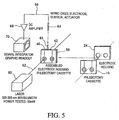
- Figure 5 depicts phlebotomy cassette 10 (see also Figure 1 ), solvent reservoir/electrode introduction compartment 24 (see also Figure 2 ), assembly 58 (see also Figure 3 ) as well as an electromagnetic radiation source depicted as a laser source 60 which directs a laser beam 62 of 325 - 355 nm frequency and 50 milliwatts power, e.g. a Nd:Y 3 A 15 O 12 laser, at one of the sample containing compartments 12 and 14, from a distance, for example, of 6 to 10 inches (15 to 25 cm), providing a laser beam of cross-sectional area at assembly 58 coextensive with the inlet opening of a sample containing compartment (12 or 14) to which it is directed.
- a laser source 60 which directs a laser beam 62 of 325 - 355 nm frequency and 50 milliwatts power, e.g. a Nd:Y 3 A 15 O 12 laser, at one of the sample containing compartments 12 and 14, from a distance, for example,
- a nitric oxide selective electrode 64 provided with a vertical actuator (not shown) which can be operated by a computer to raise or lower the electrode 64 into the appropriate electrode insertion opening (40 or 42).
- the electrode 64 is shown inserted into compartment 26 ( Figure 2 ) at 65 ( Figure 5 ).
- the electrode 64 is a nitric oxide selective electrode detecting voltage generated by presence of nitric oxide gas in solvent in 24 and providing a signal 66 in picovolts to a DC amplifier 68 which in turn provides an amplified signal to a signal integrator and to a graphic readout device 70 which provides readout of amount of nitric oxide dissolved in solvent corresponding to amount of nitric oxide present as combined nitric oxide.
- finger of patient for whom blood nitric oxide data is desired is pricked with a lancet, e.g. at bedside, to provide blood flow by capillary action through channels 20 and 22 respectively into chambers 12 and 14 ( Figure 1 ).
- element 24 ( Figure 2 ) laid flat with rings 36 and 38 facing up, is filled through openings 32 and 34 with solvent that is of higher solubility for nitric oxide gas than the blood sample, preferably methanol. 1.
- the cassette 10 is then assembled with element 24 so compartments 12 and 14 are opposite openings 32 and 34 respectively, e.g. by clamping cassette 10 to element 24 so that windows for compartments 12 and 14 are in front of the cassette 10.
- Electrode 64 ( Figure 5 ) is lowered into solvent reservoir 26 after the laser beam of laser 60 is directed at sample compartment 12 and raised from compartment 12 after electrochemical detection of released nitric oxide, and lowered into solvent reservoir 28 after the laser beam of laser 60 is directed at sample compartment 14 and raised from compartment 14 after electrochemical detection of released nitric oxide.
- the raising and lowering of electrode 64 into compartments 26 and 28 is preferably by computer activation of driving motor (not shown). Separate measurements are obtained in succession in either order.
- the nitrosothiol destroying agent in compartment 12 degrades (selectively cleaves) the nitrosothiols therein to nitrous acid from which nitric oxide is not liberated by electromagnetic radiation.
- electrode 64 is lowered through opening 40 into solvent compartment 26.
- the laser treatment liberates gaseous nitric oxide from iron nitrosyls in the sample in compartment 12 which passes from compartment 12 to diffuse through the porous back wall of cassette 10 into compartment 26 where the liberated nitric oxide is dissolved in the solvent in chamber 26.
- Laser irradiation is continued for as long as reading on readout at 70 increases. The readout indicates the amount of nitric oxide present as iron nitrosyls in the sample.
- electrode 64 is lowered through opening 42 into solvent compartment 28.
- the laser treatment liberates nitric oxide from iron nitrosyls and also from nitrosothiols.
- the liberated nitric oxide passes through the porous back wall of cassette 10 into solvent reservoir 28 whereby amount of dissolved nitric oxide is detected to provide readout at 70 of total nitric oxide present as combined nitric oxide.
- the porous back wall of cassette 10 allows passage of nitric oxide gas into solvent containing zones but no protein so irradiation causes continuous release of nitric oxide without any rebinding to protein.
- the determination of total nitric oxide present as combined nitric oxide and of nitric oxide present as iron nitrosyls allows computation of ratio of nitric oxide present as iron nitrosyls to total nitric oxide, i.e. present as combined nitric oxide, and by difference determination of amount of nitrosothiols in a sample thereby providing data allowing diagnosis and/or confirmation of diagnosis.
- the laser 60 can be replaced by a light-emitting diode that emits 210-220 nm wavelength ultraviolet radiation or 300-400 nm wavelength ultraviolet radiation or 500-600 nm wavelength visible radiation or 700-1400 nm wavelength near-infrared radiation with excellently comparable results.
Landscapes
- Health & Medical Sciences (AREA)
- Life Sciences & Earth Sciences (AREA)
- Engineering & Computer Science (AREA)
- Physics & Mathematics (AREA)
- Molecular Biology (AREA)
- General Health & Medical Sciences (AREA)
- Pathology (AREA)
- Biomedical Technology (AREA)
- Heart & Thoracic Surgery (AREA)
- Medical Informatics (AREA)
- Surgery (AREA)
- Animal Behavior & Ethology (AREA)
- Biophysics (AREA)
- Public Health (AREA)
- Veterinary Medicine (AREA)
- Hematology (AREA)
- Chemical & Material Sciences (AREA)
- Immunology (AREA)
- Biochemistry (AREA)
- Urology & Nephrology (AREA)
- General Physics & Mathematics (AREA)
- Analytical Chemistry (AREA)
- Optics & Photonics (AREA)
- Vascular Medicine (AREA)
- Manufacturing & Machinery (AREA)
- Dermatology (AREA)
- Inorganic Chemistry (AREA)
- Biotechnology (AREA)
- Cell Biology (AREA)
- Microbiology (AREA)
- Medicinal Chemistry (AREA)
- Food Science & Technology (AREA)
- Chemical Kinetics & Catalysis (AREA)
- Electrochemistry (AREA)
- Investigating Or Analysing Biological Materials (AREA)
- Investigating, Analyzing Materials By Fluorescence Or Luminescence (AREA)
- Investigating Or Analysing Materials By The Use Of Chemical Reactions (AREA)
Claims (14)
- Méthode de libération de gaz d'oxyde nitrique d'oxyde nitrique présent sous forme de complexe fer-nitrosyles et de nitrosothiols dans un échantillon de sang, comprenant les étapes consistant à :(a) introduire l'échantillon de sang dans une zone de contenance (12) d'échantillon comportant un côté avant (16) qui est transparent à un rayonnement électromagnétique et un côté arrière (18) qui est poreux dans la mesure permettant à du gaz d'oxyde nitrique de le traverser tout en empêchant le passage d'une protéine à travers ce dernier ;(b) diriger un rayonnement électromagnétique de moins de 100 milliwatts au niveau dudit côté avant (16) de façon à provoquer une libération de gaz d'oxyde nitrique de complexe fer-nitrosyles et de nitrosothiols et un passage du gaz d'oxyde nitrique libéré à partir dudit côté arrière (18) ;(c) établir une zone de contenance (24) de solvant servant à dissoudre le gaz d'oxyde nitrique libéré qui a traversé ledit côté arrière (18), dans laquelle le solvant est du type qui dissout le gaz d'oxyde nitrique ;(d) détecter par réaction électrochimique la quantité de gaz d'oxyde nitrique dissout dans le solvant qui correspond à la quantité totale d'oxyde nitrique présent sous forme de complexe fer-nitrosyles et de nitrosothiols dans l'échantillon.
- Méthode selon la revendication 1, dans laquelle l'échantillon de sang n'est pas traité.
- Méthode de libération de gaz d'oxyde nitrique d'oxyde nitrique présent sous forme de complexe fer-nitrosyles dans un échantillon de sang qui a été traité avec un agent de dégradation de nitrosothiols de façon à dégrader les nitrosothiols de l'échantillon en acide nitreux, comprenant les étapes consistant à :(a) introduire l'échantillon de sang dans une zone de contenance (12) d'échantillon comportant un côté avant (16) qui est transparent à un rayonnement électromagnétique et un côté arrière (18) qui est poreux dans la mesure permettant à du gaz d'oxyde nitrique de le traverser tout en empêchant le passage d'une protéine à travers ce dernier ;(b) diriger un rayonnement électromagnétique de moins de 100 milliwatts au niveau dudit côté avant (16) de façon à provoquer une libération de gaz d'oxyde nitrique de complexe fer-nitrosyles et un passage du gaz d'oxyde nitrique libéré à partir dudit côté arrière (18) ;(c) établir une zone de contenance (24) de solvant servant à dissoudre le gaz d'oxyde nitrique libéré qui a traversé ledit côté arrière (18), dans laquelle le solvant est du type qui dissout le gaz d'oxyde nitrique ;(d) détecter par réaction électrochimique la quantité de gaz d'oxyde nitrique dissout dans le solvant qui correspond à la quantité totale d'oxyde nitrique présent sous forme de complexe fer-nitrosyles dans l'échantillon.
- Méthode selon la revendication 1, permettant de déterminer la quantité d'oxyde nitrique présent sous forme de nitrosothiols et également la quantité d'oxyde nitrique présent sous forme de complexe fer-nitrosyles, consistant à :(i) obtenir deux échantillons de sang de la même source ;(ii) traiter le premier échantillon avec un agent de dégradation de nitrosothiols de façon à provoquer une décomposition de nitrosothiols en acide nitreux et à laisser le complexe fer-nitrosyles dans l'échantillon et laisser l'autre échantillon non traité avec un agent de dégradation de nitrosothiols ;(iii) soumettre séparément les deux échantillons traité et non traité à une analyse selon les étapes (a) à (d) de la revendication 1.
- Méthode selon la revendication 1 ou la revendication 4, dans laquelle le solvant de l'étape (c) est du méthanol.
- Méthode selon l'une quelconque des revendications précédentes, dans laquelle le rayonnement électromagnétique est un rayonnement ultraviolet.
- Méthode selon l'une quelconque des revendications 1 à 5, dans laquelle le rayonnement électromagnétique de faible puissance est un rayonnement électromagnétique visible ayant une longueur d'onde allant de 500 à 600 nm.
- Méthode selon l'une quelconque des revendications 1 à 5, dans laquelle le rayonnement électromagnétique est un rayonnement dans le proche infrarouge.
- Méthode selon l'une quelconque des revendications 1 à 5, dans laquelle le rayonnement électromagnétique est issu d'un laser (60).
- Méthode selon l'une quelconque des revendications 1 à 5, dans laquelle le rayonnement électromagnétique est issu d'une diode électroluminescente.
- Méthode selon la revendication 6, dans laquelle le rayonnement ultraviolet a une longueur d'onde allant de 300 à 400 nm.
- Méthode selon la revendication 6, dans laquelle le rayonnement ultraviolet a une longueur d'onde allant de 210 à 220 nm.
- Appareil de mise en oeuvre d'une méthode selon la revendication 1, comprenant :une zone de contenance (12) d'échantillon de sang comportant un côté avant (16) qui est transparent à un rayonnement électromagnétique et un côté arrière (18) qui est poreux dansla mesure permettant à du gaz d'oxyde nitrique de le traverser tout en empêchant le passage d'une protéine à travers ce dernier ;un émetteur de rayonnement électromagnétique (60) servant à diriger un rayonnement électromagnétique de moins de 100 milliwatts au niveau dudit côté avant ;une zone de contenance (24) de solvant servant à recevoir, à des fins de dissolution dans le solvant, le gaz d'oxyde nitrique libéré qui traverse ledit côté arrière ; etune électrode (64) d'oxyde nitrique servant à détecter une tension générée par la présence d'oxyde nitrique dans le solvant.
- Appareil selon la revendication 13, dans lequel on trouve deux zones de contenance (12 et 14) de sang comportant chacune une zone de contenance respective (26 et 28) de solvant.
Applications Claiming Priority (2)
| Application Number | Priority Date | Filing Date | Title |
|---|---|---|---|
| US93512107P | 2007-07-26 | 2007-07-26 | |
| PCT/US2008/008630 WO2009014616A1 (fr) | 2007-07-26 | 2008-07-15 | Quantité de mesure d'oxyde nitrique lié et combiné dans le sang |
Publications (3)
| Publication Number | Publication Date |
|---|---|
| EP2170157A1 EP2170157A1 (fr) | 2010-04-07 |
| EP2170157A4 EP2170157A4 (fr) | 2013-03-27 |
| EP2170157B1 true EP2170157B1 (fr) | 2016-09-07 |
Family
ID=40281641
Family Applications (1)
| Application Number | Title | Priority Date | Filing Date |
|---|---|---|---|
| EP08794495.5A Not-in-force EP2170157B1 (fr) | 2007-07-26 | 2008-07-15 | Quantité de mesure d'oxyde nitrique lié et combiné dans le sang |
Country Status (7)
| Country | Link |
|---|---|
| US (2) | US9063160B2 (fr) |
| EP (1) | EP2170157B1 (fr) |
| JP (1) | JP2010534832A (fr) |
| AU (1) | AU2008279755B2 (fr) |
| CA (1) | CA2694018C (fr) |
| DK (1) | DK2170157T3 (fr) |
| WO (1) | WO2009014616A1 (fr) |
Families Citing this family (28)
| Publication number | Priority date | Publication date | Assignee | Title |
|---|---|---|---|---|
| US6697658B2 (en) | 2001-07-02 | 2004-02-24 | Masimo Corporation | Low power pulse oximeter |
| JP5328159B2 (ja) | 2005-03-01 | 2013-10-30 | セルカコア・ラボラトリーズ・インコーポレーテッド | 多波長センサ発光体 |
| EP1888510A4 (fr) | 2005-05-27 | 2013-01-16 | Univ North Carolina | Particules liberant de l'oxyde nitrique pour therapie a base d'oxyde nitrique et applications biomedicales |
| US8642093B2 (en) * | 2007-10-30 | 2014-02-04 | The Invention Science Fund I, Llc | Methods and systems for use of photolyzable nitric oxide donors |
| US20110190604A1 (en) * | 2006-12-22 | 2011-08-04 | Hyde Roderick A | Nitric oxide sensors and systems |
| US7975699B2 (en) * | 2007-10-30 | 2011-07-12 | The Invention Science Fund I, Llc | Condoms configured to facilitate release of nitric oxide |
| AU2008279755B2 (en) | 2007-07-26 | 2014-01-09 | Duke University | Measuring amount of bound and combined nitric oxide in blood |
| US8349262B2 (en) * | 2007-10-30 | 2013-01-08 | The Invention Science Fund I, Llc | Nitric oxide permeable housings |
| US20090112193A1 (en) * | 2007-10-30 | 2009-04-30 | Searete Llc, A Limited Liability Corporation Of The State Of Delaware | Systems and devices that utilize photolyzable nitric oxide donors |
| US20110182970A1 (en) * | 2007-10-30 | 2011-07-28 | Hyde Roderick A | Nitric oxide sensors and systems |
| US20090112055A1 (en) * | 2007-10-30 | 2009-04-30 | Searete Llc, A Limited Liability Corporation Of The State Of Delaware | Sleeves configured to facilitate release of nitric oxide |
| US10080823B2 (en) * | 2007-10-30 | 2018-09-25 | Gearbox Llc | Substrates for nitric oxide releasing devices |
| US8877508B2 (en) * | 2007-10-30 | 2014-11-04 | The Invention Science Fund I, Llc | Devices and systems that deliver nitric oxide |
| US8980332B2 (en) | 2007-10-30 | 2015-03-17 | The Invention Science Fund I, Llc | Methods and systems for use of photolyzable nitric oxide donors |
| US20100004518A1 (en) | 2008-07-03 | 2010-01-07 | Masimo Laboratories, Inc. | Heat sink for noninvasive medical sensor |
| US8630691B2 (en) | 2008-08-04 | 2014-01-14 | Cercacor Laboratories, Inc. | Multi-stream sensor front ends for noninvasive measurement of blood constituents |
| WO2010044875A2 (fr) * | 2008-10-16 | 2010-04-22 | Novan, Inc. | Particules libérant du monoxyde d'azote utilisables en hygiène bucco-dentaire |
| BR112012003804B1 (pt) | 2009-08-21 | 2019-02-19 | Novan, Inc. | Curativo para ferimentos, método para formar um curativo para ferimentos, e, kit de curativo para ferimento |
| WO2011022652A1 (fr) | 2009-08-21 | 2011-02-24 | Novan, Inc. | Gels topiques |
| WO2011047013A1 (fr) * | 2009-10-13 | 2011-04-21 | Novan, Inc. | Revêtements libérant de l'oxyde nitrique |
| US9140712B2 (en) * | 2010-04-27 | 2015-09-22 | Samir Sofer | Immune and oxygen system measuring and drug screening method and apparatus |
| US8591876B2 (en) | 2010-12-15 | 2013-11-26 | Novan, Inc. | Methods of decreasing sebum production in the skin |
| ES2695173T3 (es) | 2011-02-28 | 2019-01-02 | Novan Inc | Partículas de sílice modificadas con S-nitrosotiol que liberan óxido nítrico y procedimientos de fabricación de las mismas |
| US9651530B2 (en) * | 2013-01-14 | 2017-05-16 | Lifehealth, Llc | Methods and apparatus for measuring nitric oxide in fluid |
| US9753019B2 (en) * | 2013-01-14 | 2017-09-05 | Lifehealth, Llc | Measuring nitric oxide in fluid |
| US9788767B1 (en) | 2015-09-25 | 2017-10-17 | Sanmina Corporation | System and method for monitoring nitric oxide levels using a non-invasive, multi-band biosensor |
| KR20220129033A (ko) | 2020-01-13 | 2022-09-22 | 마시모 코오퍼레이션 | 생리학적 파라미터 모니터링 기능이 있는 웨어러블 디바이스 |
| EP4370022A1 (fr) | 2021-07-13 | 2024-05-22 | Masimo Corporation | Dispositif portatif avec surveillance de paramètre physiologique |
Family Cites Families (32)
| Publication number | Priority date | Publication date | Assignee | Title |
|---|---|---|---|---|
| US4849058A (en) * | 1983-08-26 | 1989-07-18 | Hnu Systems, Inc. | Method of detecting nitrogen oxides in gaseous or liquid samples |
| NL8702370A (nl) * | 1987-10-05 | 1989-05-01 | Groningen Science Park | Werkwijze en stelsel voor glucosebepaling en daarvoor bruikbaar meetcelsamenstel. |
| DK163194C (da) | 1988-12-22 | 1992-06-22 | Radiometer As | Fremgangsmaade ved fotometrisk in vitro bestemmelse af en blodgasparameter i en blodproeve |
| US5094815A (en) * | 1988-05-18 | 1992-03-10 | Cornell Research Foundation, Inc. | Photolytic interface for HPLC-chemiluminescence detection of non volatile N-nitroso compounds |
| US4892383A (en) * | 1989-02-17 | 1990-01-09 | Fiberchem Inc. | Reservoir fiber optic chemical sensors |
| US5059790A (en) * | 1990-03-30 | 1991-10-22 | Fiberchem, Inc. | Reservoir fiber optic chemical sensors |
| US5459076A (en) * | 1992-04-22 | 1995-10-17 | Brigham And Women's Hospital | Method for detecting nitric oxide, nitrosonium equivalents, S-nitrosothiols and S-nitroso-proteins in biological systems |
| US5374710A (en) * | 1993-05-26 | 1994-12-20 | Regents Of The University Of California | Compounds which release nitric oxide upon illumination |
| JP2780152B2 (ja) | 1995-02-10 | 1998-07-30 | 工業技術院長 | 酸素センサーおよび酸化窒素センサーと、これらセンサーによる酸素および酸化窒素の検出方法 |
| US5891735A (en) * | 1995-09-15 | 1999-04-06 | Duke University Medical Center | Method for measuring nitric oxide in nitrosyl (FeII)-hemoglobin and S-nitrosohemoglobin |
| EP0988521A1 (fr) * | 1998-04-14 | 2000-03-29 | Instrumentarium Corporation | Ensemble de detection et procede de mesure du dioxyde d'azote |
| JP4467022B2 (ja) | 2000-03-31 | 2010-05-26 | フィガロ技研株式会社 | ガスセンサ |
| US6366903B1 (en) * | 2000-04-20 | 2002-04-02 | Microsoft Corporation | Index and materialized view selection for a given workload |
| US7769420B2 (en) * | 2000-05-15 | 2010-08-03 | Silver James H | Sensors for detecting substances indicative of stroke, ischemia, or myocardial infarction |
| US7181261B2 (en) * | 2000-05-15 | 2007-02-20 | Silver James H | Implantable, retrievable, thrombus minimizing sensors |
| US20060074282A1 (en) * | 2000-07-13 | 2006-04-06 | Ward Kevin R | Nitric-oxide detection using Raman spectroscopy |
| WO2002026194A2 (fr) * | 2000-09-28 | 2002-04-04 | Non-Invasive Monitoring Systems, Inc. | Addition extérieure d'impulsions à des canaux anatomiques de fluide pour libérer ou supprimer des médiateurs endothéliaux et pour déterminer l'effectivité d'une telle intervention |
| US7335383B2 (en) * | 2001-01-16 | 2008-02-26 | The Regents Of The University Of Michigan | Generation of nitric oxide in vivo from nitrite, nitrate or nitrosothiols endogenous in blood |
| EP1395241B9 (fr) * | 2001-05-25 | 2005-06-15 | Medtronic, Inc. | Dispositif medical implantable equipe d'un systeme de liberation controlee d'agents gazeux |
| US20050054908A1 (en) * | 2003-03-07 | 2005-03-10 | Blank Thomas B. | Photostimulation method and apparatus in combination with glucose determination |
| US20070149868A1 (en) * | 2002-03-08 | 2007-06-28 | Blank Thomas B | Method and Apparatus for Photostimulation Enhanced Analyte Property Estimation |
| US7238328B2 (en) * | 2002-12-06 | 2007-07-03 | Sonoma Technology, Inc. | Solid-state light source photolytic nitrogen dioxide converter |
| JP4573514B2 (ja) | 2003-10-24 | 2010-11-04 | 東亜ディーケーケー株式会社 | 定電位電解式ガス測定方法 |
| JP2005257647A (ja) * | 2004-03-15 | 2005-09-22 | Showa Seiki Kk | 血液中の一酸化窒素等の物質測定装置 |
| WO2006007403A2 (fr) * | 2004-06-16 | 2006-01-19 | University Of Virginia Patent Foundation | Methodes d'identification et de mesure de liaisons s-nitrosothiol dans des cellules et des molecules contenant des hemes |
| US7507585B2 (en) * | 2005-01-10 | 2009-03-24 | Whalen Erin J | Methods and systems for indentifying and monitoring S-nitrosothiols in biological samples |
| KR100695137B1 (ko) * | 2005-01-20 | 2007-03-14 | 삼성전자주식회사 | 광분해 반응을 이용한 분석 방법 |
| JP2009518069A (ja) * | 2005-12-02 | 2009-05-07 | ザ・リージェンツ・オブ・ザ・ユニバーシティ・オブ・ミシガン | 組成物、コーティング及びデバイス、並びにそれらの製造方法及び使用方法 |
| US8642093B2 (en) * | 2007-10-30 | 2014-02-04 | The Invention Science Fund I, Llc | Methods and systems for use of photolyzable nitric oxide donors |
| US7975699B2 (en) * | 2007-10-30 | 2011-07-12 | The Invention Science Fund I, Llc | Condoms configured to facilitate release of nitric oxide |
| AU2008279755B2 (en) | 2007-07-26 | 2014-01-09 | Duke University | Measuring amount of bound and combined nitric oxide in blood |
| US8349262B2 (en) * | 2007-10-30 | 2013-01-08 | The Invention Science Fund I, Llc | Nitric oxide permeable housings |
-
2008
- 2008-07-15 AU AU2008279755A patent/AU2008279755B2/en not_active Ceased
- 2008-07-15 WO PCT/US2008/008630 patent/WO2009014616A1/fr not_active Ceased
- 2008-07-15 US US12/668,211 patent/US9063160B2/en active Active
- 2008-07-15 EP EP08794495.5A patent/EP2170157B1/fr not_active Not-in-force
- 2008-07-15 DK DK08794495.5T patent/DK2170157T3/en active
- 2008-07-15 JP JP2010518179A patent/JP2010534832A/ja active Pending
- 2008-07-15 CA CA2694018A patent/CA2694018C/fr not_active Expired - Fee Related
-
2014
- 2014-05-22 US US14/285,106 patent/US9562913B2/en not_active Expired - Fee Related
Also Published As
| Publication number | Publication date |
|---|---|
| US20110008815A1 (en) | 2011-01-13 |
| EP2170157A1 (fr) | 2010-04-07 |
| CA2694018A1 (fr) | 2009-01-29 |
| US9063160B2 (en) | 2015-06-23 |
| AU2008279755B2 (en) | 2014-01-09 |
| CA2694018C (fr) | 2016-09-27 |
| US20140332416A1 (en) | 2014-11-13 |
| JP2010534832A (ja) | 2010-11-11 |
| DK2170157T3 (en) | 2016-12-12 |
| WO2009014616A1 (fr) | 2009-01-29 |
| AU2008279755A1 (en) | 2009-01-29 |
| EP2170157A4 (fr) | 2013-03-27 |
| US9562913B2 (en) | 2017-02-07 |
Similar Documents
| Publication | Publication Date | Title |
|---|---|---|
| EP2170157B1 (fr) | Quantité de mesure d'oxyde nitrique lié et combiné dans le sang | |
| CA1219464A (fr) | Analyse de liquides fluorescents | |
| EP3409203B1 (fr) | Dispositif médical implantable comprenant un capteur chimique | |
| US10750985B2 (en) | Continuous analyte sensor | |
| US6514277B1 (en) | Fiber optic multitasking probe | |
| JP2006520216A5 (fr) | ||
| US20090198114A1 (en) | Apparatus and method for elucidating reaction dynamics of photoreactive compounds from optical signals affected by an external magnetic field | |
| WO2002061405A2 (fr) | Procédé et dispositif portable de détection de fluorescence | |
| Lee et al. | Pulsed diode laser-based singlet oxygen monitor for photodynamic therapy: in vivo studies of tumor-laden rats | |
| EP2150176B1 (fr) | Détecteur de concentration implantable et dispositif | |
| Lee et al. | Pulsed diode laser-based monitor for singlet molecular oxygen | |
| CA2048858A1 (fr) | Systeme et methode de mesure de l'oxygene en presence d'halothane | |
| EP2417437B1 (fr) | Procédé et appareil pour détecter des substances pharmaceutiques dans un échantillon | |
| JPH0713597B2 (ja) | 酸素濃度測定用具 | |
| McIlroy et al. | The effects of oxygenation and photosensitizer substrate binding on the use of fluorescence photobleaching as a dose metric for photodynamic therapy | |
| JP3356517B2 (ja) | 一重項酸素測定装置 | |
| Gewehr | Development of an optical oxygen sensor for medical use: Based upon phosphorescence lifetime quenching and employing a polymer immobilized metalloporphyrin probe. | |
| Profio et al. | Measurements of singlet oxygen in photodynamic therapy | |
| Hutchinson | Fluorescent lifetime spectroscopy in random media | |
| Class et al. | Patent application title: CONTINUOUS ANALYTE SENSOR | |
| Douplik et al. | Spectra changes of whole blood with sulphonated aluminum phtalocyanine photosensitizer during photodynamic therapy in vitro | |
| Gupta et al. | Fluorescence photobleaching and recovery of human breast tissues and tissue phantoms | |
| Yamada et al. | Development of an ultra-high sensitive fluorescence measurement system for cancer research | |
| Tromberg | Laser-based optical fiber fluoroprobes in clinical analysis |
Legal Events
| Date | Code | Title | Description |
|---|---|---|---|
| PUAI | Public reference made under article 153(3) epc to a published international application that has entered the european phase |
Free format text: ORIGINAL CODE: 0009012 |
|
| 17P | Request for examination filed |
Effective date: 20100128 |
|
| AK | Designated contracting states |
Kind code of ref document: A1 Designated state(s): AT BE BG CH CY CZ DE DK EE ES FI FR GB GR HR HU IE IS IT LI LT LU LV MC MT NL NO PL PT RO SE SI SK TR |
|
| AX | Request for extension of the european patent |
Extension state: AL BA MK RS |
|
| DAX | Request for extension of the european patent (deleted) | ||
| A4 | Supplementary search report drawn up and despatched |
Effective date: 20130222 |
|
| RIC1 | Information provided on ipc code assigned before grant |
Ipc: A61B 5/00 20060101AFI20130218BHEP |
|
| 17Q | First examination report despatched |
Effective date: 20131210 |
|
| GRAP | Despatch of communication of intention to grant a patent |
Free format text: ORIGINAL CODE: EPIDOSNIGR1 |
|
| INTG | Intention to grant announced |
Effective date: 20160316 |
|
| GRAS | Grant fee paid |
Free format text: ORIGINAL CODE: EPIDOSNIGR3 |
|
| GRAA | (expected) grant |
Free format text: ORIGINAL CODE: 0009210 |
|
| AK | Designated contracting states |
Kind code of ref document: B1 Designated state(s): AT BE BG CH CY CZ DE DK EE ES FI FR GB GR HR HU IE IS IT LI LT LU LV MC MT NL NO PL PT RO SE SI SK TR |
|
| REG | Reference to a national code |
Ref country code: GB Ref legal event code: FG4D |
|
| REG | Reference to a national code |
Ref country code: CH Ref legal event code: EP |
|
| REG | Reference to a national code |
Ref country code: IE Ref legal event code: FG4D |
|
| REG | Reference to a national code |
Ref country code: DE Ref legal event code: R096 Ref document number: 602008046185 Country of ref document: DE |
|
| REG | Reference to a national code |
Ref country code: AT Ref legal event code: REF Ref document number: 826077 Country of ref document: AT Kind code of ref document: T Effective date: 20161015 |
|
| REG | Reference to a national code |
Ref country code: DK Ref legal event code: T3 Effective date: 20161209 |
|
| REG | Reference to a national code |
Ref country code: LT Ref legal event code: MG4D |
|
| REG | Reference to a national code |
Ref country code: NL Ref legal event code: MP Effective date: 20160907 |
|
| PG25 | Lapsed in a contracting state [announced via postgrant information from national office to epo] |
Ref country code: LT Free format text: LAPSE BECAUSE OF FAILURE TO SUBMIT A TRANSLATION OF THE DESCRIPTION OR TO PAY THE FEE WITHIN THE PRESCRIBED TIME-LIMIT Effective date: 20160907 Ref country code: NO Free format text: LAPSE BECAUSE OF FAILURE TO SUBMIT A TRANSLATION OF THE DESCRIPTION OR TO PAY THE FEE WITHIN THE PRESCRIBED TIME-LIMIT Effective date: 20161207 Ref country code: HR Free format text: LAPSE BECAUSE OF FAILURE TO SUBMIT A TRANSLATION OF THE DESCRIPTION OR TO PAY THE FEE WITHIN THE PRESCRIBED TIME-LIMIT Effective date: 20160907 Ref country code: FI Free format text: LAPSE BECAUSE OF FAILURE TO SUBMIT A TRANSLATION OF THE DESCRIPTION OR TO PAY THE FEE WITHIN THE PRESCRIBED TIME-LIMIT Effective date: 20160907 |
|
| REG | Reference to a national code |
Ref country code: AT Ref legal event code: MK05 Ref document number: 826077 Country of ref document: AT Kind code of ref document: T Effective date: 20160907 |
|
| PG25 | Lapsed in a contracting state [announced via postgrant information from national office to epo] |
Ref country code: ES Free format text: LAPSE BECAUSE OF FAILURE TO SUBMIT A TRANSLATION OF THE DESCRIPTION OR TO PAY THE FEE WITHIN THE PRESCRIBED TIME-LIMIT Effective date: 20160907 Ref country code: GR Free format text: LAPSE BECAUSE OF FAILURE TO SUBMIT A TRANSLATION OF THE DESCRIPTION OR TO PAY THE FEE WITHIN THE PRESCRIBED TIME-LIMIT Effective date: 20161208 Ref country code: SE Free format text: LAPSE BECAUSE OF FAILURE TO SUBMIT A TRANSLATION OF THE DESCRIPTION OR TO PAY THE FEE WITHIN THE PRESCRIBED TIME-LIMIT Effective date: 20160907 Ref country code: NL Free format text: LAPSE BECAUSE OF FAILURE TO SUBMIT A TRANSLATION OF THE DESCRIPTION OR TO PAY THE FEE WITHIN THE PRESCRIBED TIME-LIMIT Effective date: 20160907 Ref country code: LV Free format text: LAPSE BECAUSE OF FAILURE TO SUBMIT A TRANSLATION OF THE DESCRIPTION OR TO PAY THE FEE WITHIN THE PRESCRIBED TIME-LIMIT Effective date: 20160907 |
|
| PG25 | Lapsed in a contracting state [announced via postgrant information from national office to epo] |
Ref country code: EE Free format text: LAPSE BECAUSE OF FAILURE TO SUBMIT A TRANSLATION OF THE DESCRIPTION OR TO PAY THE FEE WITHIN THE PRESCRIBED TIME-LIMIT Effective date: 20160907 Ref country code: RO Free format text: LAPSE BECAUSE OF FAILURE TO SUBMIT A TRANSLATION OF THE DESCRIPTION OR TO PAY THE FEE WITHIN THE PRESCRIBED TIME-LIMIT Effective date: 20160907 |
|
| PG25 | Lapsed in a contracting state [announced via postgrant information from national office to epo] |
Ref country code: AT Free format text: LAPSE BECAUSE OF FAILURE TO SUBMIT A TRANSLATION OF THE DESCRIPTION OR TO PAY THE FEE WITHIN THE PRESCRIBED TIME-LIMIT Effective date: 20160907 Ref country code: BE Free format text: LAPSE BECAUSE OF FAILURE TO SUBMIT A TRANSLATION OF THE DESCRIPTION OR TO PAY THE FEE WITHIN THE PRESCRIBED TIME-LIMIT Effective date: 20160907 Ref country code: CZ Free format text: LAPSE BECAUSE OF FAILURE TO SUBMIT A TRANSLATION OF THE DESCRIPTION OR TO PAY THE FEE WITHIN THE PRESCRIBED TIME-LIMIT Effective date: 20160907 Ref country code: IS Free format text: LAPSE BECAUSE OF FAILURE TO SUBMIT A TRANSLATION OF THE DESCRIPTION OR TO PAY THE FEE WITHIN THE PRESCRIBED TIME-LIMIT Effective date: 20170107 Ref country code: PT Free format text: LAPSE BECAUSE OF FAILURE TO SUBMIT A TRANSLATION OF THE DESCRIPTION OR TO PAY THE FEE WITHIN THE PRESCRIBED TIME-LIMIT Effective date: 20170109 Ref country code: PL Free format text: LAPSE BECAUSE OF FAILURE TO SUBMIT A TRANSLATION OF THE DESCRIPTION OR TO PAY THE FEE WITHIN THE PRESCRIBED TIME-LIMIT Effective date: 20160907 Ref country code: BG Free format text: LAPSE BECAUSE OF FAILURE TO SUBMIT A TRANSLATION OF THE DESCRIPTION OR TO PAY THE FEE WITHIN THE PRESCRIBED TIME-LIMIT Effective date: 20161207 Ref country code: SK Free format text: LAPSE BECAUSE OF FAILURE TO SUBMIT A TRANSLATION OF THE DESCRIPTION OR TO PAY THE FEE WITHIN THE PRESCRIBED TIME-LIMIT Effective date: 20160907 |
|
| REG | Reference to a national code |
Ref country code: DE Ref legal event code: R097 Ref document number: 602008046185 Country of ref document: DE |
|
| PG25 | Lapsed in a contracting state [announced via postgrant information from national office to epo] |
Ref country code: IT Free format text: LAPSE BECAUSE OF FAILURE TO SUBMIT A TRANSLATION OF THE DESCRIPTION OR TO PAY THE FEE WITHIN THE PRESCRIBED TIME-LIMIT Effective date: 20160907 |
|
| PLBE | No opposition filed within time limit |
Free format text: ORIGINAL CODE: 0009261 |
|
| STAA | Information on the status of an ep patent application or granted ep patent |
Free format text: STATUS: NO OPPOSITION FILED WITHIN TIME LIMIT |
|
| REG | Reference to a national code |
Ref country code: FR Ref legal event code: PLFP Year of fee payment: 10 |
|
| 26N | No opposition filed |
Effective date: 20170608 |
|
| PG25 | Lapsed in a contracting state [announced via postgrant information from national office to epo] |
Ref country code: SI Free format text: LAPSE BECAUSE OF FAILURE TO SUBMIT A TRANSLATION OF THE DESCRIPTION OR TO PAY THE FEE WITHIN THE PRESCRIBED TIME-LIMIT Effective date: 20160907 |
|
| REG | Reference to a national code |
Ref country code: DE Ref legal event code: R119 Ref document number: 602008046185 Country of ref document: DE |
|
| REG | Reference to a national code |
Ref country code: CH Ref legal event code: PL |
|
| REG | Reference to a national code |
Ref country code: IE Ref legal event code: MM4A |
|
| PG25 | Lapsed in a contracting state [announced via postgrant information from national office to epo] |
Ref country code: CH Free format text: LAPSE BECAUSE OF NON-PAYMENT OF DUE FEES Effective date: 20170731 Ref country code: IE Free format text: LAPSE BECAUSE OF NON-PAYMENT OF DUE FEES Effective date: 20170715 Ref country code: LI Free format text: LAPSE BECAUSE OF NON-PAYMENT OF DUE FEES Effective date: 20170731 Ref country code: DE Free format text: LAPSE BECAUSE OF NON-PAYMENT OF DUE FEES Effective date: 20180201 |
|
| PG25 | Lapsed in a contracting state [announced via postgrant information from national office to epo] |
Ref country code: LU Free format text: LAPSE BECAUSE OF NON-PAYMENT OF DUE FEES Effective date: 20170715 |
|
| REG | Reference to a national code |
Ref country code: FR Ref legal event code: PLFP Year of fee payment: 11 |
|
| PG25 | Lapsed in a contracting state [announced via postgrant information from national office to epo] |
Ref country code: MT Free format text: LAPSE BECAUSE OF NON-PAYMENT OF DUE FEES Effective date: 20170715 |
|
| PG25 | Lapsed in a contracting state [announced via postgrant information from national office to epo] |
Ref country code: HU Free format text: LAPSE BECAUSE OF FAILURE TO SUBMIT A TRANSLATION OF THE DESCRIPTION OR TO PAY THE FEE WITHIN THE PRESCRIBED TIME-LIMIT; INVALID AB INITIO Effective date: 20080715 Ref country code: MC Free format text: LAPSE BECAUSE OF FAILURE TO SUBMIT A TRANSLATION OF THE DESCRIPTION OR TO PAY THE FEE WITHIN THE PRESCRIBED TIME-LIMIT Effective date: 20160907 |
|
| PG25 | Lapsed in a contracting state [announced via postgrant information from national office to epo] |
Ref country code: CY Free format text: LAPSE BECAUSE OF NON-PAYMENT OF DUE FEES Effective date: 20160907 |
|
| PGFP | Annual fee paid to national office [announced via postgrant information from national office to epo] |
Ref country code: DK Payment date: 20190729 Year of fee payment: 12 Ref country code: FR Payment date: 20190725 Year of fee payment: 12 |
|
| PGFP | Annual fee paid to national office [announced via postgrant information from national office to epo] |
Ref country code: GB Payment date: 20190729 Year of fee payment: 12 |
|
| PG25 | Lapsed in a contracting state [announced via postgrant information from national office to epo] |
Ref country code: TR Free format text: LAPSE BECAUSE OF FAILURE TO SUBMIT A TRANSLATION OF THE DESCRIPTION OR TO PAY THE FEE WITHIN THE PRESCRIBED TIME-LIMIT Effective date: 20160907 |
|
| REG | Reference to a national code |
Ref country code: DK Ref legal event code: EBP Effective date: 20200731 |
|
| GBPC | Gb: european patent ceased through non-payment of renewal fee |
Effective date: 20200715 |
|
| PG25 | Lapsed in a contracting state [announced via postgrant information from national office to epo] |
Ref country code: GB Free format text: LAPSE BECAUSE OF NON-PAYMENT OF DUE FEES Effective date: 20200715 Ref country code: FR Free format text: LAPSE BECAUSE OF NON-PAYMENT OF DUE FEES Effective date: 20200731 |
|
| PG25 | Lapsed in a contracting state [announced via postgrant information from national office to epo] |
Ref country code: DK Free format text: LAPSE BECAUSE OF NON-PAYMENT OF DUE FEES Effective date: 20200731 |