EP2172228A1 - Elément de filtre résistant à l'ozone - Google Patents
Elément de filtre résistant à l'ozone Download PDFInfo
- Publication number
- EP2172228A1 EP2172228A1 EP09011581A EP09011581A EP2172228A1 EP 2172228 A1 EP2172228 A1 EP 2172228A1 EP 09011581 A EP09011581 A EP 09011581A EP 09011581 A EP09011581 A EP 09011581A EP 2172228 A1 EP2172228 A1 EP 2172228A1
- Authority
- EP
- European Patent Office
- Prior art keywords
- fibers
- filter element
- ozone
- use according
- filter
- Prior art date
- Legal status (The legal status is an assumption and is not a legal conclusion. Google has not performed a legal analysis and makes no representation as to the accuracy of the status listed.)
- Withdrawn
Links
Images



Classifications
-
- A—HUMAN NECESSITIES
- A61—MEDICAL OR VETERINARY SCIENCE; HYGIENE
- A61L—METHODS OR APPARATUS FOR STERILISING MATERIALS OR OBJECTS IN GENERAL; DISINFECTION, STERILISATION OR DEODORISATION OF AIR; CHEMICAL ASPECTS OF BANDAGES, DRESSINGS, ABSORBENT PADS OR SURGICAL ARTICLES; MATERIALS FOR BANDAGES, DRESSINGS, ABSORBENT PADS OR SURGICAL ARTICLES
- A61L9/00—Disinfection, sterilisation or deodorisation of air
- A61L9/16—Disinfection, sterilisation or deodorisation of air using physical phenomena
-
- A—HUMAN NECESSITIES
- A61—MEDICAL OR VETERINARY SCIENCE; HYGIENE
- A61L—METHODS OR APPARATUS FOR STERILISING MATERIALS OR OBJECTS IN GENERAL; DISINFECTION, STERILISATION OR DEODORISATION OF AIR; CHEMICAL ASPECTS OF BANDAGES, DRESSINGS, ABSORBENT PADS OR SURGICAL ARTICLES; MATERIALS FOR BANDAGES, DRESSINGS, ABSORBENT PADS OR SURGICAL ARTICLES
- A61L9/00—Disinfection, sterilisation or deodorisation of air
-
- A—HUMAN NECESSITIES
- A61—MEDICAL OR VETERINARY SCIENCE; HYGIENE
- A61L—METHODS OR APPARATUS FOR STERILISING MATERIALS OR OBJECTS IN GENERAL; DISINFECTION, STERILISATION OR DEODORISATION OF AIR; CHEMICAL ASPECTS OF BANDAGES, DRESSINGS, ABSORBENT PADS OR SURGICAL ARTICLES; MATERIALS FOR BANDAGES, DRESSINGS, ABSORBENT PADS OR SURGICAL ARTICLES
- A61L9/00—Disinfection, sterilisation or deodorisation of air
- A61L9/015—Disinfection, sterilisation or deodorisation of air using gaseous or vaporous substances, e.g. ozone
-
- B—PERFORMING OPERATIONS; TRANSPORTING
- B01—PHYSICAL OR CHEMICAL PROCESSES OR APPARATUS IN GENERAL
- B01D—SEPARATION
- B01D39/00—Filtering material for liquid or gaseous fluids
- B01D39/14—Other self-supporting filtering material ; Other filtering material
- B01D39/16—Other self-supporting filtering material ; Other filtering material of organic material, e.g. synthetic fibres
- B01D39/1607—Other self-supporting filtering material ; Other filtering material of organic material, e.g. synthetic fibres the material being fibrous
- B01D39/1623—Other self-supporting filtering material ; Other filtering material of organic material, e.g. synthetic fibres the material being fibrous of synthetic origin
-
- B—PERFORMING OPERATIONS; TRANSPORTING
- B03—SEPARATION OF SOLID MATERIALS USING LIQUIDS OR USING PNEUMATIC TABLES OR JIGS; MAGNETIC OR ELECTROSTATIC SEPARATION OF SOLID MATERIALS FROM SOLID MATERIALS OR FLUIDS; SEPARATION BY HIGH-VOLTAGE ELECTRIC FIELDS
- B03C—MAGNETIC OR ELECTROSTATIC SEPARATION OF SOLID MATERIALS FROM SOLID MATERIALS OR FLUIDS; SEPARATION BY HIGH-VOLTAGE ELECTRIC FIELDS
- B03C3/00—Separating dispersed particles from gases or vapour, e.g. air, by electrostatic effect
- B03C3/017—Combinations of electrostatic separation with other processes, not otherwise provided for
-
- B—PERFORMING OPERATIONS; TRANSPORTING
- B03—SEPARATION OF SOLID MATERIALS USING LIQUIDS OR USING PNEUMATIC TABLES OR JIGS; MAGNETIC OR ELECTROSTATIC SEPARATION OF SOLID MATERIALS FROM SOLID MATERIALS OR FLUIDS; SEPARATION BY HIGH-VOLTAGE ELECTRIC FIELDS
- B03C—MAGNETIC OR ELECTROSTATIC SEPARATION OF SOLID MATERIALS FROM SOLID MATERIALS OR FLUIDS; SEPARATION BY HIGH-VOLTAGE ELECTRIC FIELDS
- B03C3/00—Separating dispersed particles from gases or vapour, e.g. air, by electrostatic effect
- B03C3/28—Plant or installations without electricity supply, e.g. using electrets
-
- B—PERFORMING OPERATIONS; TRANSPORTING
- B03—SEPARATION OF SOLID MATERIALS USING LIQUIDS OR USING PNEUMATIC TABLES OR JIGS; MAGNETIC OR ELECTROSTATIC SEPARATION OF SOLID MATERIALS FROM SOLID MATERIALS OR FLUIDS; SEPARATION BY HIGH-VOLTAGE ELECTRIC FIELDS
- B03C—MAGNETIC OR ELECTROSTATIC SEPARATION OF SOLID MATERIALS FROM SOLID MATERIALS OR FLUIDS; SEPARATION BY HIGH-VOLTAGE ELECTRIC FIELDS
- B03C3/00—Separating dispersed particles from gases or vapour, e.g. air, by electrostatic effect
- B03C3/34—Constructional details or accessories or operation thereof
- B03C3/40—Electrode constructions
- B03C3/60—Use of special materials other than liquids
- B03C3/64—Use of special materials other than liquids synthetic resins
-
- B—PERFORMING OPERATIONS; TRANSPORTING
- B60—VEHICLES IN GENERAL
- B60H—ARRANGEMENTS OF HEATING, COOLING, VENTILATING OR OTHER AIR-TREATING DEVICES SPECIALLY ADAPTED FOR PASSENGER OR GOODS SPACES OF VEHICLES
- B60H3/00—Other air-treating devices
- B60H3/06—Filtering
- B60H3/0658—Filter elements specially adapted for their arrangement in vehicles
-
- B—PERFORMING OPERATIONS; TRANSPORTING
- B01—PHYSICAL OR CHEMICAL PROCESSES OR APPARATUS IN GENERAL
- B01D—SEPARATION
- B01D2239/00—Aspects relating to filtering material for liquid or gaseous fluids
- B01D2239/04—Additives and treatments of the filtering material
- B01D2239/0407—Additives and treatments of the filtering material comprising particulate additives, e.g. adsorbents
-
- B—PERFORMING OPERATIONS; TRANSPORTING
- B01—PHYSICAL OR CHEMICAL PROCESSES OR APPARATUS IN GENERAL
- B01D—SEPARATION
- B01D2239/00—Aspects relating to filtering material for liquid or gaseous fluids
- B01D2239/04—Additives and treatments of the filtering material
- B01D2239/0435—Electret
-
- B—PERFORMING OPERATIONS; TRANSPORTING
- B01—PHYSICAL OR CHEMICAL PROCESSES OR APPARATUS IN GENERAL
- B01D—SEPARATION
- B01D2239/00—Aspects relating to filtering material for liquid or gaseous fluids
- B01D2239/06—Filter cloth, e.g. knitted, woven non-woven; self-supported material
- B01D2239/065—More than one layer present in the filtering material
Definitions
- the invention relates to the use of a filter element in an ozone-containing atmosphere having an ozone concentration of at least 1 ppm.
- air conditioners which have an ozone generator.
- the ozone generator is used to generate ozone gas, which is supposed to kill bacteria.
- air conditioning is for example in the DE 10 2004 030 998 A1 described.
- the filter elements in air conditioners are often in direct flow communication with an evaporator near which the ozone generator is positioned.
- the ozone generator is an ozone-containing Atmosphere generated, however, which significantly damages the well-known from the prior art high-efficiency filter elements.
- the filter elements known from the prior art show dissolution phenomena in an ozone-containing atmosphere with an ozone concentration of at least 1 ppm. Both the fibers of the filter medium and any binder used are attacked by the ozone. In this case, the degree of polymerization of the polymers used could be lowered. When using so-called combination filters, there is also a destruction of the activated carbon composite by the dissolution of the binder.
- the invention is therefore based on the object to provide a filter element which shows in a ozone-containing atmosphere a permanent operation.
- a filter element is used in an ozone-containing atmosphere having an ozone concentration of at least 1 ppm comprising a filter medium having fibers, the fibers being polyester and / or polycarbonate.
- the ozone can dissolve the fibers and any binders that may be used, thereby irreparably damaging the filter elements known from the prior art.
- a second step it has then been recognized by a happy handle that fibers of polyester and fibers of polycarbonate in surprisingly sufficiently stable in an ozone-containing atmosphere.
- a filter medium comprising polyester and / or polycarbonate fibers can withstand an ozone concentration of at least 1 ppm for a very long time such that almost no damage to the filter element occurs in its entirety. It is particularly surprising that the fibers remain stable despite the small diameter and their large surface area for the ozone and ensure a permanently operable filter efficiency of the filter element.
- the filter element could be made of two layers of nonwoven fabric, with a first layer of polyester fibers and a second layer of polycarbonate fibers.
- a polyester and polycarbonate filter media has been found to be particularly stable in an ozone-containing atmosphere.
- the second layer of polycarbonate fibers could be sandwiched between two layers of polyester fibers.
- the polycarbonate fibers are permanently supported by the polyester fibers.
- a settling behavior of the polycarbonate fibers is largely prevented in the three-layer filter medium.
- At least one of the layers could be electrostatically charged.
- fine dust particles can be deposited, which are smaller than 0.5 microns.
- the mechanical filter effect of the filter medium is supported by an electrical filter effect.
- the polyester fibers could have an average diameter in the range 10 to 50 microns. Fibers with such average diameter have been found to be particularly stable to form a support layer for polycarbonate fibers.
- the polycarbonate fibers could have an average diameter of at most 10 ⁇ m.
- the use of so-called microfibers and / or nanofibers made of polycarbonate allows a reliable mechanical separation of fine dust particles.
- the filter medium could be connected to a layer of activated carbon or other adsorbents.
- the filter element can be configured as a so-called combination filter.
- the adsorbents, especially activated carbon particles or activated carbon fibers, could be bound by a binder and laminated to the filter medium.
- the layer of activated carbon preferably faces the evaporator and demozongenerator. A positioning of the layer of activated carbon facing away from the evaporator and the ozone generator is likewise conceivable.
- the activated carbon layer may be sandwiched between a three-ply filter medium and a polyester carrier layer.
- the filter element could comprise a polyurethane-based binder.
- the polyurethane-based binder can reliably bind the activated carbon particles or activated carbon fibers reliably even in an ozone-containing atmosphere. Surprisingly, it has been found that polyurethane remains chemically and mechanically stable in an ozone-containing atmosphere.
- the filter element could have a fractional separation efficiency according to DIN 71460 Part 1 of at least 60% for particle diameters of 0.2 to 1 ⁇ m after a residence time of 240 hours in an atmosphere with a Ozone concentration of 100 ppm show.
- a filter element with such a fractional separation efficiency shows a high filter efficiency with respect to particulate matter even after a longer period of operation.
- the filter element could show a fractional separation efficiency according to DIN 71460 Part 1 of at least 70% for particle diameters of 1 to 3 ⁇ m after a residence time of 240 hours in an atmosphere with an ozone concentration of 100 ppm.
- Such a filter element has a reliable filter efficiency for average particle diameter even after a longer period of operation.
- the filter element could show a fractional separation efficiency according to DIN 71460 Part 1 of at least 80% for particle diameters of 3 to 10 ⁇ m after a residence time of 240 hours in an atmosphere with an ozone concentration of 100 ppm. Such a filter element shows a high filter efficiency even after prolonged service life of an ozone-containing atmosphere for coarse particles.
- the filter element could be used in an ozone-producing air conditioning system of a motor vehicle.
- the filter element described here in the air conditioning system of a motor vehicle, the motor vehicle interior can be permanently supplied with an almost germ-free air that has been cleaned of fine dust particles. This is a particular combinatorial effect that results from the actual use.
- the filter element for use in an ozone-containing atmosphere having an ozone concentration of at least 1 ppm comprises a folded filter medium of the type AF909 from Freudenberg Nonwovens KG, 69469 Weinheim, DE.
- This filter medium is a three-layered filter medium comprising two layers of polyester fibers and one layer of polycarbonate fibers.
- the basis weights of the layers with polyester fibers are 30 and 130 g / m 2 .
- the polyester fibers have a mean diameter of 10 to 50 microns.
- the layer of fibers made of polycarbonate is electrostatically charged and has a basis weight of 2 g / m 2 .
- the fibers of polycarbonate have an average diameter of at most 10 microns.
- the layer of polycarbonate fibers is sandwiched by the layers of polyester fibers.
- Such a filter element was compared with regard to its fractional separation efficiency and flow behavior in an ozone-containing atmosphere with a filter element having a filter medium with polyolefin-based fibers.
- the polyolefin-based fibers were polypropylene fibers.
- the filter medium was a filter medium of the type AF 935 from Freudenberg Nonwovens KG, 69469 Weinheim, DE. This filter medium is constructed in one layer from polypropylene fibers. The fibers have a diameter of about 25 to 30 microns.
- the filter medium has a basis weight of 70 g / m 2 .
- Fig. 1 the fractional efficiency according to DIN 71460 Part 1 is shown depending on the diameter of the particles to be filtered.
- the fractional separation efficiency was measured with a test dust A4 at a load of 6 kg / min. measured.
- the closed symbols represent the values measured on filter elements when new.
- the Open symbols represent the readings after a retention period of 240 hours for the filter elements in an ozone-containing atmosphere with an ozone concentration of 100 ppm.
- the triangle symbols represent a filter element with polyolefin-based fibers.
- the square symbols represent the filter element according to the invention with fibers of polyester (PET) and polycarbonate (PC).
- the diagram in Fig. 1 shows that the filter element according to the invention has a disproportionateensabscheidegrad according to DIN 71460 Part 1 of at least 60% for particle diameter of 0.2 to 1 .mu.m after a residence time of 240 hours in an atmosphere with an ozone concentration of 100 ppm.
- the filter element furthermore has a fractional separation efficiency according to DIN 71460 Part 1 of at least 70% for particle diameters of 1 to 3 ⁇ m after a residence time of 240 hours in an atmosphere having an ozone concentration of 100 ppm.
- the filter element has a disproportionatesabscheidegrad according to DIN 71460 Part 1 of at least 80% for particle diameter of 3 to 10 microns after a residence time of 240 hours in an atmosphere with an ozone concentration of 100 ppm
- Fig. 1 It can clearly be seen that the fractional separation efficiency of the filter element with polyolefin-based fibers is significantly lower after the dwell time than that of the filter element according to the invention.
- the filter element according to the invention which uses a three-layer filter medium of the AF90X type, a fractional separation efficiency of 75% for particle diameters between 0.3 and 0.5 ⁇ m is achieved.
- Fig. 2 shows a diagram in which the pressure loss of two filter elements is compared at different flow rates.
- the same filter elements are compared as in Fig. 1 .
- the closed symbols represent those measured on filter elements when new Values.
- the open symbols represent the readings after a retention time of the filter elements of 240 hours in an ozone-containing atmosphere with an ozone concentration of 100 ppm.
- the triangle symbols represent a filter element with polyolefin-based fibers.
- the square symbols represent the filter element according to the invention with fibers of polyester (PET) and polycarbonate (PC).
- the diagram according to Fig. 2 shows that the filter element according to the invention shows a pressure drop between upstream and downstream of at least 200 PA at a flow rate of 600 m 3 / h after a residence time of 240 hours in an atmosphere with an ozone concentration of 100 ppm. Furthermore, the filter element according to the invention shows a pressure drop between inflow side and outflow side of at least 125 PA at a volumetric flow of 450 m 3 / h after a residence time of 240 hours in an atmosphere with an ozone concentration of 100 ppm.
- the filter element is characterized by a durable stable fiber structure and permanently stable porosity of the filter medium.
- Fig. 2 It can clearly be seen that the filter element with polyolefin-based fibers has significantly lower pressure losses after the residence time in an ozone-containing atmosphere than the filter element according to the invention. This indicates that polypropylene fibers are attacked and destroyed by the ozone. The pressure losses of the filter element according to the invention before and after the dwell time in an ozone-containing atmosphere are approximately constant. This proves the mechanical and chemical stability of the polyester and polycarbonate fibers to ozone.
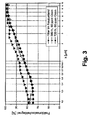
- Fig. 3 shows the influence of the residence time of the filter element according to the invention in an ozone-containing atmosphere on its fractional separation.
- the fractional separation efficiency was analogous to Fig. 1 according to DIN 71460 part 1 with test dust A4 and an admission of 6 kg / min. measured.
- the closed triangular symbols represent measured values that were measured on a filter element when new.
- the open triangular symbols represent measurements taken after a residence time of 360 hours in an ozone-containing atmosphere with an ozone concentration of 50 ppm.
- the closed circle symbols represent measurements measured after a residence time of 720 hours in an ozone-containing atmosphere with an ozone concentration of 50 ppm.
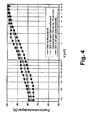
- Fig. 4 shows the influence of an alternating (oscillating) ozone concentration on the filter element according to the invention.
- the measurements were carried out in accordance with DIN 71460 Part 1.
- the closed triangular symbols represent measurements measured on a filter element when new
- the open triangular symbols represent measured values which were measured after 720 hours dwell time in an ozone-containing atmosphere with an ozone concentration of 50 ppm with alternating ozone loading.
- the ozone generator was in each case 10 min. operated and in each case 10 min. switched off.
- the closed Circle symbols represent measured values which were carried out on a filter element which was constantly exposed to ozone for 720 hours in an ozone-containing atmosphere with an ozone concentration of 50 ppm.
- Fig. 5 shows a diagram in which the fractional efficiency is shown as a function of the residence time of two inventive filter elements in an ozone-containing atmosphere.
- the fractional separation efficiency (degree of separation A4) specifically refers to particles with a particle diameter X between 0.3 and 0.5 ⁇ m.
- the open squares represent measured values that were measured on a filter element according to the invention with alternating ozone stress.
- the filled squares represent readings measured at constant ozone stress.
Landscapes
- Health & Medical Sciences (AREA)
- Epidemiology (AREA)
- Life Sciences & Earth Sciences (AREA)
- Animal Behavior & Ethology (AREA)
- General Health & Medical Sciences (AREA)
- Public Health (AREA)
- Veterinary Medicine (AREA)
- Engineering & Computer Science (AREA)
- Mechanical Engineering (AREA)
- Chemical & Material Sciences (AREA)
- Chemical Kinetics & Catalysis (AREA)
- Filtering Materials (AREA)
Applications Claiming Priority (1)
| Application Number | Priority Date | Filing Date | Title |
|---|---|---|---|
| DE200810049927 DE102008049927A1 (de) | 2008-10-02 | 2008-10-02 | Ozonresistentes Filterelement |
Publications (1)
| Publication Number | Publication Date |
|---|---|
| EP2172228A1 true EP2172228A1 (fr) | 2010-04-07 |
Family
ID=41226880
Family Applications (1)
| Application Number | Title | Priority Date | Filing Date |
|---|---|---|---|
| EP09011581A Withdrawn EP2172228A1 (fr) | 2008-10-02 | 2009-09-10 | Elément de filtre résistant à l'ozone |
Country Status (2)
| Country | Link |
|---|---|
| EP (1) | EP2172228A1 (fr) |
| DE (1) | DE102008049927A1 (fr) |
Families Citing this family (1)
| Publication number | Priority date | Publication date | Assignee | Title |
|---|---|---|---|---|
| CN109675417A (zh) * | 2019-02-14 | 2019-04-26 | 南京珀斯佩特电子科技有限公司 | 一种系统型低温等离子气体处理串联装置 |
Citations (5)
| Publication number | Priority date | Publication date | Assignee | Title |
|---|---|---|---|---|
| JPS5411572A (en) * | 1977-06-28 | 1979-01-27 | Matsushita Electric Ind Co Ltd | Electric dust collector |
| WO2003092867A1 (fr) * | 2002-05-03 | 2003-11-13 | Carl Freudenberg Kg | Materiau de filtration d'ozone |
| DE102004030998A1 (de) | 2004-05-25 | 2005-12-22 | Bayerische Motoren Werke Ag | Vorrichtung zur Desinfektion der Bauteile, insbesondere des Verdampfers, einer Klimaanlage in Kraftfahrzeugen |
| US20070207722A1 (en) * | 2006-03-03 | 2007-09-06 | Mcleod Steven | Fresh Air Intake System |
| US20080170971A1 (en) * | 2006-08-09 | 2008-07-17 | Airinspace B.V. | Air purification devices |
Family Cites Families (9)
| Publication number | Priority date | Publication date | Assignee | Title |
|---|---|---|---|---|
| DE3337031A1 (de) * | 1983-10-12 | 1985-09-05 | Fa. Carl Freudenberg, 6940 Weinheim | Chirurgische gesichtsmaske |
| DE3904623A1 (de) * | 1989-02-16 | 1990-08-23 | Sandler Helmut Helsa Werke | Filter, insbes. fuer ein fahrzeug |
| DE4134222C2 (de) * | 1991-10-16 | 2002-09-19 | Mhb Filtration Gmbh & Co Kg | Filter für Fahrgastzellen |
| DE4443158A1 (de) * | 1994-12-05 | 1996-06-13 | Gessner & Co Gmbh | Abreinigbares Filtermedium |
| US6102039A (en) * | 1997-12-01 | 2000-08-15 | 3M Innovative Properties Company | Molded respirator containing sorbent particles |
| US20050138910A1 (en) * | 2000-10-16 | 2005-06-30 | Peter Rohdewald | Air filter with scavenging effect on free radicals in gaseous phase and its method of preparation |
| DE10305307A1 (de) * | 2003-02-10 | 2004-08-26 | Helsa-Werke Helmut Sandler Gmbh & Co. Kg | Sorptiver Filter und Verfahren zu seiner Herstellung |
| DE102004035967A1 (de) * | 2004-07-23 | 2006-03-16 | Carl Freudenberg Kg | Filteranordnung |
| DE202005012047U1 (de) * | 2005-08-01 | 2006-01-19 | Gore Enterprise Holdings, Inc., Newark | Verbundfiltermedium |
-
2008
- 2008-10-02 DE DE200810049927 patent/DE102008049927A1/de not_active Ceased
-
2009
- 2009-09-10 EP EP09011581A patent/EP2172228A1/fr not_active Withdrawn
Patent Citations (5)
| Publication number | Priority date | Publication date | Assignee | Title |
|---|---|---|---|---|
| JPS5411572A (en) * | 1977-06-28 | 1979-01-27 | Matsushita Electric Ind Co Ltd | Electric dust collector |
| WO2003092867A1 (fr) * | 2002-05-03 | 2003-11-13 | Carl Freudenberg Kg | Materiau de filtration d'ozone |
| DE102004030998A1 (de) | 2004-05-25 | 2005-12-22 | Bayerische Motoren Werke Ag | Vorrichtung zur Desinfektion der Bauteile, insbesondere des Verdampfers, einer Klimaanlage in Kraftfahrzeugen |
| US20070207722A1 (en) * | 2006-03-03 | 2007-09-06 | Mcleod Steven | Fresh Air Intake System |
| US20080170971A1 (en) * | 2006-08-09 | 2008-07-17 | Airinspace B.V. | Air purification devices |
Also Published As
| Publication number | Publication date |
|---|---|
| DE102008049927A1 (de) | 2010-04-08 |
Similar Documents
| Publication | Publication Date | Title |
|---|---|---|
| DE112014003579B4 (de) | Ein Verbundmaterial-Filtermedium und ein Verfahren zur Herstellung desselben | |
| EP2340098B1 (fr) | Milieu filtrant pour une filtration de particules | |
| DE19920983C5 (de) | Zwei- oder mehrlagiges Filtermedium für die Luftfiltration und daraus hergestelltes Filterelement | |
| EP1366791B1 (fr) | Matériau filtrant | |
| DE102007011365B4 (de) | Lage zur Verwendung in einem HEPA-Filterelement sowie Filterelement | |
| DE102015002672A1 (de) | Filtermedium und Filterelement mit einem Filtermedium | |
| DE102012010307B4 (de) | Mehrlagiges Filtermaterial zur Flüssigkeitsfiltration sowie daraus hergestelltes Filterelement | |
| EP3903906A1 (fr) | Filtre à air pour l'air intérieur de cabines de véhicules, de machines agricoles, de machines de construction et de machines de travail | |
| DE102013021071A1 (de) | Filtermedium, Filterelement und Filteranordnung | |
| DE102007023806A1 (de) | Lagenverbund zur Verwendung in einem Luftfilter | |
| DE102018102822B4 (de) | Filtermedium mit einer Vlieslage und einer Meltblownlage sowie Filterelement | |
| EP0564799A2 (fr) | Matériau filtrant multicouche | |
| EP0910454B1 (fr) | Filtre antiparticules sous la forme d'une couche de non-tisse plisse | |
| EP1790406B1 (fr) | Élément de filtration et procédé de fabrication | |
| DE102015015777A1 (de) | Filtermedium und Filterelement mit einem Filtermedium | |
| EP3423169A1 (fr) | Matériau filtrant pour un élément filtrant d'un filtre à carburant, élément filtrant et filtre à carburant | |
| EP2172228A1 (fr) | Elément de filtre résistant à l'ozone | |
| DE102009057760A1 (de) | Hybridnadelfilz | |
| DE102008050264A1 (de) | Filterelement mit abscheidungsstabilisierender Beschichtung | |
| DE102015012643A1 (de) | Filtermedium und Verwendung des Filtermediums | |
| DE202008000380U1 (de) | Feinstaubfilterelement zur Verwendung in einem Kraftfahrzeug | |
| DE102012005380A1 (de) | Filtermedium | |
| DE202010010639U1 (de) | Nadelfilz | |
| EP4620555A1 (fr) | Matériau filtrant à membrane et élément filtrant constitué d'un tel matériau filtrant | |
| EP4442348A1 (fr) | Matériau filtrant comprenant une couche de nanofibres et élément filtrant constitué d'un tel matériau filtrant |
Legal Events
| Date | Code | Title | Description |
|---|---|---|---|
| PUAI | Public reference made under article 153(3) epc to a published international application that has entered the european phase |
Free format text: ORIGINAL CODE: 0009012 |
|
| AK | Designated contracting states |
Kind code of ref document: A1 Designated state(s): AT BE BG CH CY CZ DE DK EE ES FI FR GB GR HR HU IE IS IT LI LT LU LV MC MK MT NL NO PL PT RO SE SI SK SM TR |
|
| AX | Request for extension of the european patent |
Extension state: AL BA RS |
|
| STAA | Information on the status of an ep patent application or granted ep patent |
Free format text: STATUS: THE APPLICATION IS DEEMED TO BE WITHDRAWN |
|
| 18D | Application deemed to be withdrawn |
Effective date: 20101008 |