EP2172883A1 - Verfahren zur Verwaltung und Steuerung von Herstellungsverfahren, die von einer Unternehmensressourcenplanung geplant und von einer Maschinenhalle hergestellt werden - Google Patents
Verfahren zur Verwaltung und Steuerung von Herstellungsverfahren, die von einer Unternehmensressourcenplanung geplant und von einer Maschinenhalle hergestellt werden Download PDFInfo
- Publication number
- EP2172883A1 EP2172883A1 EP08170438A EP08170438A EP2172883A1 EP 2172883 A1 EP2172883 A1 EP 2172883A1 EP 08170438 A EP08170438 A EP 08170438A EP 08170438 A EP08170438 A EP 08170438A EP 2172883 A1 EP2172883 A1 EP 2172883A1
- Authority
- EP
- European Patent Office
- Prior art keywords
- state
- actions
- sequential process
- fact
- executing
- Prior art date
- Legal status (The legal status is an assumption and is not a legal conclusion. Google has not performed a legal analysis and makes no representation as to the accuracy of the status listed.)
- Ceased
Links
Images


Classifications
-
- G—PHYSICS
- G06—COMPUTING OR CALCULATING; COUNTING
- G06Q—INFORMATION AND COMMUNICATION TECHNOLOGY [ICT] SPECIALLY ADAPTED FOR ADMINISTRATIVE, COMMERCIAL, FINANCIAL, MANAGERIAL OR SUPERVISORY PURPOSES; SYSTEMS OR METHODS SPECIALLY ADAPTED FOR ADMINISTRATIVE, COMMERCIAL, FINANCIAL, MANAGERIAL OR SUPERVISORY PURPOSES, NOT OTHERWISE PROVIDED FOR
- G06Q10/00—Administration; Management
Definitions
- the present invention relates to a method for managing and controlling manufacturing processes planned by an Enterprise Resource Planning (ERP) and produced by a plant floor, wherein a Manufacturing Executing System (MES) implements the planned manufacturing process and controls the corresponding production at plant floor.
- ERP Enterprise Resource Planning
- MES Manufacturing Executing System
- the present invention relates to a method of the type described above and comprising a definition of sequential process segments, wherein each sequential process segment comprises a plurality of actions to be performed at a plant floor level, and an execution of a software tool including the steps of activating a sequential process segment and sequentially executing the corresponding plurality of actions.
- the present invention further relates to a system for managing and controlling manufacturing processes planned by an Enterprise Resource Planning (ERP) and produced by a plant floor, wherein a Manufacturing Executing System (MES) implements the planned manufacturing process and controls the corresponding production at plant floor.
- ERP Enterprise Resource Planning
- MES Manufacturing Executing System
- a method for managing and controlling manufacturing processes planned by an Enterprise Resource Planning (ERP) and produced by a plant floor provides a Manufacturing Executing System (MES) for implementing the planned manufacturing processes and controlling the corresponding production steps at plant floor.
- ERP Enterprise Resource Planning
- MES Manufacturing Executing System
- the Enterprise Resource Planning is a system including hardware devices and corresponding software applications for planning the business resources of an enterprise, i.e. material provisions, human resource managements, purchasing, orders, profits, finance, inventory controls, customer managements, etceteras, while the term "plant floor” has been used to indicate a system supporting the control of single machines involved in the manufacturing processes, for example by measuring the number of pieces produced per hour by each machine or the functioning parameters thereof, the quality of the pieces produced and so on.
- MES is an intermediate layer providing computing machines and software tools 1-n between the ERP upper layer and the plant floor lower layer, including a software tool for production order management 1, which receives requests of production from the ERP, and a software tool for production modeling 2, which supports the phases of selecting and managing the resources to be involved in the manufacturing processes, i.e. employees, machines and materials, in order to realize a planned manufacturing process within required time constrains.
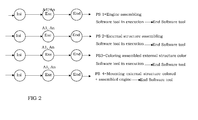
- MES is based on the ISA (International Standard Association) standard S95 which defines how software tools 1-n may implement the production at plant floor level and how communicating with it. More particularly, as represented in figure 2 , S95 is substantially based on a manufacturing process represented by a plurality of sequential process segments PS1, PS2, PS3, PS4 wherein each sequential process segment comprises a plurality of actions A1, An to be performed sequentially at plant floor level.
- ISA International Standard Association
- An execution of the MES software tool described above includes the management of the manufacturing process by activating a sequential process segment PS1 and sequentially executing the corresponding plurality of actions A1, An.
- the software tool for production order management 1 substantially repeats the steps of activating and waiting the end of a plurality of sequential process segments, for a plurality of process segments.
- a plurality of software tools, corresponding to respective sequential process segments are executed, for the duration of the corresponding sequential process segment.
- MES supports very well the manufacturing processes including sequential process segments which may be executed synchronously and continuously, for example in industrial production processes or batch industries which are implemented by well described algorithms or sequential steps, as it is for instance, in a food producing process of the type involving the following steps "fill mixer with material 1", “fill mixer with material 2", “mix material for 10 minutes”, and “discharge”, wherein the material 1, material 2 as well as the mixer are available.
- MES does not support as well manufacturing processes including some processes which may be stopped for long periods, for example due to the lack of a resource, machine, material or personnel required to perform it. This occurs especially in discrete manufacturing processes, for example in automotive factories, as schematically represented in figure 2 .
- the manufacturing process of assembling a car engine with the external structure of the car is schematically represented with a sequence of four sequential process segments wherein the first segment PS1 provides the engine assembling, the second segment PS2 the external structure assembling, the third segment PS3 the coloring of the external structure already assembled and the last segment PS4 the mounting of the assembled engine with the external structure already colored.
- Each sequential process segment PS1-P4 comprises a plurality of actions A1, A2, A3, A4, A5, An which are executed sequentially, i.e. action An cannot be executed until all the previous actions are terminated.
- a first software tool for production order managing 1 is executed for activating the first action of segment PS1 and it remains in execution until the last action An of the process segment PS1 is ended, even if one action A3 is suspended for a long period. For example, even if some pieces of the engine are not available, because not already ordered or delivered to the plant floor, the software tool corresponding to the first segment PS1 is executed. A second software tool is executed for activating the first action A1 of process segment PS2 and it remains in execution until the last action An of the process segment PS2 is ended. In the same way, a third and a fourth software tools are executed for activating the first actions A1 of the corresponding sequential process segments PS3 and PS4 and waiting the end of their execution.
- the second, third and fourth software tools are executed when some actions of the corresponding sequential process segments PS2, PS3, PS4 are suspended, for example because a door to be assembled in process segment PS2 is not already available and a color to be used in process segment PS3 has been used up.
- a lot of "wait for events" should be inserted in each sequential process segment, to control if a following action may be executed or the production must be suspended until an event occurs.
- a plurality of receiving points should be defined, which stay waiting for notifications from other actions regarding the next step to be executed in the sequential process segment.
- a problem in supporting discrete manufacturing processes with sequential process segments is that the execution of the software tool in MES is activated when the corresponding sequential process segment starts and is continued until the last action of the process segment is ended, even if one action is stopped for several days, so that the computing machines executing the corresponding software tool are unnecessarily kept busy even when there is no need for management and control.
- the solution idea at the base of the present invention is that of providing a method for managing and controlling manufacturing processes planned by an Enterprise Resource Planning (ERP) and produced by a plant floor which provides executions of asynchronous production processes, wherein the asynchronous production processes are implemented by a plurality of states and actions to be performed at plant floor level, each action corresponding to a state transition, the method further providing a software tool ST which is activated only for executing the actions, so that an execution time of the software tool ST is decoupled by an execution time of the overall asynchronous production process.
- the software tool is not executed while the asynchronous production process is suspended in a predetermined state, for example waiting for the material to execute the following actions.
- the problem at the base of the present invention is solved by a method for managing and controlling manufacturing processes planned by an Enterprise Resource Planning (ERP) and produced by a plant floor, comprising a definition of state machines implementing corresponding asynchronous production processes, wherein each state machine comprises a plurality of states and a plurality of state transitions corresponding to actions to be executed at plant floor, the method further comprising executing a state manager tool including the definition of said state machines and a software tool, activated by said state manager tool, for executing said state transitions.
- ERP Enterprise Resource Planning
- the method further comprises a step for selecting sequential process segments which introduce latency in the planned manufacturing process and a step for replacing the selected sequential process segments with asynchronous production processes including states transitions corresponding to a plurality of actions which substitute the plurality of actions of the replaced sequential process segments.
- a target state of the state machine is reached starting from different source states depending on the state machine defined and the state transitions executed by said software tool.
- a system for managing and controlling manufacturing processes planned by an Enterprise Resource Planning and produced by a plant floor wherein a Manufacturing Executing System implements the planned manufacturing processes and controls the corresponding production at plant floor
- the system including a computing engine further comprising state machines implementing asynchronous production processes, wherein each state machine comprises a plurality of states and a plurality of state transitions corresponding to actions to be performed by resources at the plant floor
- the system further comprising a state manager tool, including the definition of said state machines, and a software tool, for executing said state transition, said software tool being activated by said state manager tool only for executing a state transition.
- ERP Enterprise Resource Planning
- the method provides a Manufacturing Executing System (MES) for implementing a planned manufacturing process and controlling the corresponding production at the plant floor and includes the steps of:
- MES Manufacturing Executing System
- a plurality of software tools ST are provided for executing the steps of activating a corresponding sequential process segment and sequentially executing the respective actions A1, An.
- the Manufacturing Executing System further comprises a definition of state machines 3 implementing asynchronous production processes OES1, OES2, OES3, OES4, OES5, wherein each state machine comprises a plurality of states A, B, C, D, E and a plurality of state transitions A1-A5 corresponding to actions to be performed at plant floor. More particularly, the method further comprises the step of executing a state manager tool whereby said state machines 3 are defined. Both the state manager tool and the software tool ST are stored in computing machines, hereafter also referred as computing resources, including interfaces for controlling producing machines at plant floor.
- computing machines hereafter also referred as computing resources, including interfaces for controlling producing machines at plant floor.
- the software tool ST is activated by the state manager tool and is executed only for the time necessary to execute the state transitions A1-A5, i.e. the corresponding action to be performed at plant floor.
- a state transition cannot be executed, as instance because the asynchronous process segment is suspended for waiting a material or a mechanical piece not available, the software tool ST is not executed and the corresponding computing resources is not loaded.
- one software tool ST may be activated to execute a state transition for another asynchronous process segment.
- the execution time of the software tool ST is decoupled by the execution time of the asynchronous process segment because it is activated only for the state transition, i.e. it does not matter how much time the asynchronous process segment is suspended in a predetermined state.
- Figure 3 schematically represents a state machine 3 for implementing an asynchronous process segment, including states A, B, C, D, E and state transitions A1-A5, wherein A1 is the transition from state A to state C, A2 is the transition from state A to state E, A3 is the transition from state D to state E, A4 is the transition from state B to state D and A5 is the transition from state C to state D.
- An end state E is defined for the state machine 3, corresponding to an end of the asynchronous process segment implemented by the state machine 3.
- the end state E may be reached from more than one state, i.e. from state A, via the transition A2, and from state D, via transition A3. Accordingly, the execution of all the actions A1-A5 is not required to terminate the asynchronous process segment but only the execution of a transition state A2, A3 which terminates in the end state E of the state machine 3.
- the end state E corresponding to the completion of the asynchronous production process, does not depend on a plurality of actions to be sequentially executed before the end state E.
- a target state D of the state machine 3 may be reached starting from different source states B, C depending on the state machine as defined and the state transitions executed by the software tool ST.
- One or more asynchronous production processes OES1, OES2 may be also advantageously executed together by corresponding software tools ST executed in a same or separate computing resources.
- a discrete manufacturing process already implemented by sequential process segments may be modified in order to replace some or all of the sequential process segments with asynchronous production processes.
- the method according to the invention further comprises a step for selecting the sequential process segments PS1, PS2, PS3, PS4 which introduce latency in the planned manufacturing process and a step for replacing the selected sequential process segments PS1, PS2, PS3, PS4 with asynchronous production processes OES1, OES2, OES3, OES4, OES5 including states transitions corresponding to actions A1, An which substantially substitute the plurality of actions A1, An of the replaced sequential process segments PS1, PS2, PS3, PS4.
- steps of selecting and replacing are performed by the software tool ST.
- the computing machine wherein the software tool ST runs is activated only for executing state transitions in the state machine 3 while it is not active when the asynchronous production process remains in a predetermined state.
- the state manager tool further provides the execution of a production order manager application 1 receiving in input the planned manufacturing process and producing in output the states of the state machine 3 and a further software module STM executing the step of defining the sequential process segments PS1, PS2, PS3, PS4 which may be used to perform strictly sequential and not concurring applications.
- the production order manager application 1 and the software module STM are as defined in the SIMATIC IT specification of the same applicant and correspond to the modules respectively indicated as POM and PM therein.
- the software module STM provides the step of defining the asynchronous production processes OES1, OES2, OES3, OES4, OES5 and the state transitions between the plurality of states of the state machines associated thereto.
- the state transitions are activated by recalling the software module ST from the state manager tool with parameters including the source and target states, an identifier of resources performing the asynchronous production processes OES1, OES2, OES3, OES4, OES5 at plant floor, process parameters for the resources and a transition name of each state transition.
- asynchronous production processes at plant floor are also indicated in the following description as "on event segments", in order to strengthen that the corresponding transition states are asynchronously activated by the software tool ST when an event occurs and to underline their difference with the sequential process segments, which are executed synchronously and continuously monitored by the software tool ST.
- the software tool ST is executed only when it is activated by the state manager tool because an event occurs, for activating a state transition, , i.e. it is substantially decoupled by the execution of the asynchronous production process.
- the software tool ST is not limited to the activation of a predetermined sequential actions, but it may activate any transition according to the state machine 3 or wait for another event without activating another transition, for example an event associated to an action of the operator.
- the step of defining states machines 3 described above is realized by instantiating objects from a new class "OnEventSegment" defined in software module STM, which is saved in a standard database and by an association of the instantiated objects to states defined in production order manager application 1. More particularly, such association may be executed by a user of the software module STM.
- the method further provides a "RefuseTransition" command which is executed to roll back a transition into a source state, after a state transition to a target state has been required from the software tool ST.
- the RefuseTransition command is included as an "if" instruction inside the asynchronous production process and is associated to a failure of the process, so that the state machine 3 is rolled back into the source state when the "if" instruction is executed, or proceeds in the target state otherwise.
- the present invention further relates to a system for managing and controlling manufacturing processes planned by an Enterprise Resource Planning (ERP) and produced by a plant floor, wherein a Manufacturing Executing System (MES) implements the planned manufacturing process and controls the corresponding production at plant floor.
- ERP Enterprise Resource Planning
- MES Manufacturing Executing System
- the Manufacturing Executing System comprises a computing engine including a definition of sequential process segments PS1, PS2, PS3, PS4, wherein each sequential process segment PS1, PS2, PS3, PS4 comprises a plurality of actions A1, An to be performed by resources at a plant floor level, and a controller including an output connected to an input of said resources and an input connected to the resources output, for sending an activation signal to a predetermined resource and sequentially executing the corresponding actions A1, An, until a last action An is completed.
- MES Manufacturing Executing System
- the computing engine further comprises states machine 3 implementing asynchronous production processes OES1, OES2, OES3, OES4, OES5, including a plurality of states A, B, C, D, E and state transitions A1-A5, corresponding to actions A1, An to be performed by the resources.
- the software tool ST is active only for executing state transitions in the state machine 3.
- the system according to the present invention comprises a computing engine storing a state manager tool whereby said state machines 3 are defined and one or more computing machines, also referred as computing resources, including interfaces for controlling producing machines at plant floor and a software tool ST for executing the state transitions A1-A5 of the state machine 3.
- the software tool ST is activated by the state manager tool and is executed only for the time necessary to execute the state transition, i.e. the corresponding action to be performed at plant floor.
- the computer engine further comprises selection means of sequential process segments PS1, PS2, PS3, PS4 which introduce latency in said planned manufacturing process and means for replacing the selected sequential process segments PS1, PS2, PS3, PS4 with asynchronous production processes OES1, OES2, OES3, OES4, OES5 including state transitions corresponding to actions A1, An substantially substituting the plurality of actions A1, An of replaced sequential process segments PS1, PS2, PS3, PS4.
- the state machine 3 comprises a target state D connected to one or more source states B, C by corresponding state transitions A4, A5 so that a target state D may be reached after the execution of different actions.
- the state machine 3 further comprises a predetermined end state E corresponding to an end of the asynchronous production process.
- the state manager tool further comprises a production order manager application 1 receiving in input the planned manufacturing process and producing in output the states of the state machine 3 and a further software module STM for defining the sequential process segments PS1, PS2, PS3, PS4 which may be used to perform strictly sequential and not concurring applications.
- the production order manager application 1 and the software module STM are as defined in the SIMATIC IT specification of the same applicant and correspond to the modules respectively indicated as POM and PM therein.
- the software module STM further comprises the definition of the asynchronous production processes OES1, OES2, OES3, OES4, OES5 and the state transitions between the plurality of states of the state machines associated thereto.
- the state manager tool comprises a procedure call for recalling the software tool ST in order to execute the state transitions of asynchronous production processes OES1, OES2, OES3, OES4, OES5, the procedure call including parameters which comprise the source and target states, an identifier of resources performing the asynchronous production process OES1, OES2, OES3, OES4, OES5 at plant floor, process parameters for the resources and a transition name of the state transition.
- the software tool ST comprises a command for refusing a state transition and to roll it back into a source state, after a state transition to the target state has been required from the state manager tool and the actions associated thereto cannot be executed.
- the method and the system according to the present invention provide to support manufacturing processes with asynchronous production processes managed and controlled by a software tool in MES which is executed only for activating transition states, when an event occurs, and avoiding to keep busy computing machine running such software tool during the execution of the asynchronous production processes or their suspension, i.e. when there is no need for management and control, the method and the system further and advantageously providing the activation of transitions state in any order provided by the state machine which implements the asynchronous production processes and which keep busy the computing machine running the software tool only for activating a transition, when an event occurs.
- the computing machine executing the software tool which activates the state transitions is not unduly burdened in monitoring a predetermined sequence of sequential process segments, potentially paused or stopped, because it implements the manufacturing process by asynchronously activating transitions state.
- the computing machine executing the software tool which activates the state transitions is not unduly burdened in monitoring a predetermined sequence of sequential process segments, potentially paused or stopped, because it implements the manufacturing process by asynchronously activating transitions state.
Landscapes
- Business, Economics & Management (AREA)
- Engineering & Computer Science (AREA)
- Economics (AREA)
- Entrepreneurship & Innovation (AREA)
- Human Resources & Organizations (AREA)
- Marketing (AREA)
- Operations Research (AREA)
- Quality & Reliability (AREA)
- Strategic Management (AREA)
- Tourism & Hospitality (AREA)
- Physics & Mathematics (AREA)
- General Business, Economics & Management (AREA)
- General Physics & Mathematics (AREA)
- Theoretical Computer Science (AREA)
- Management, Administration, Business Operations System, And Electronic Commerce (AREA)
- General Factory Administration (AREA)
Priority Applications (3)
| Application Number | Priority Date | Filing Date | Title |
|---|---|---|---|
| EP08170438A EP2172883A1 (de) | 2008-09-30 | 2008-12-02 | Verfahren zur Verwaltung und Steuerung von Herstellungsverfahren, die von einer Unternehmensressourcenplanung geplant und von einer Maschinenhalle hergestellt werden |
| CN200910204488A CN101714233A (zh) | 2008-09-30 | 2009-09-29 | 用于管理和控制制造过程的方法和系统 |
| US12/570,672 US8509934B2 (en) | 2008-09-30 | 2009-09-30 | Method for managing and controlling manufacturing processes planned by an enterprise resource planning and produced by a plant floor |
Applications Claiming Priority (2)
| Application Number | Priority Date | Filing Date | Title |
|---|---|---|---|
| EP08017167 | 2008-09-30 | ||
| EP08170438A EP2172883A1 (de) | 2008-09-30 | 2008-12-02 | Verfahren zur Verwaltung und Steuerung von Herstellungsverfahren, die von einer Unternehmensressourcenplanung geplant und von einer Maschinenhalle hergestellt werden |
Publications (1)
| Publication Number | Publication Date |
|---|---|
| EP2172883A1 true EP2172883A1 (de) | 2010-04-07 |
Family
ID=40510624
Family Applications (1)
| Application Number | Title | Priority Date | Filing Date |
|---|---|---|---|
| EP08170438A Ceased EP2172883A1 (de) | 2008-09-30 | 2008-12-02 | Verfahren zur Verwaltung und Steuerung von Herstellungsverfahren, die von einer Unternehmensressourcenplanung geplant und von einer Maschinenhalle hergestellt werden |
Country Status (3)
| Country | Link |
|---|---|
| US (1) | US8509934B2 (de) |
| EP (1) | EP2172883A1 (de) |
| CN (1) | CN101714233A (de) |
Families Citing this family (15)
| Publication number | Priority date | Publication date | Assignee | Title |
|---|---|---|---|---|
| TWI420407B (zh) * | 2011-04-11 | 2013-12-21 | Lane Best Technology Co Ltd | 結合虛擬情境的生產線管理系統及其方法 |
| CN102750596A (zh) * | 2011-04-19 | 2012-10-24 | 联比禔科技有限公司 | 结合虚拟情境的生产线管理系统及其方法 |
| EP2639753A1 (de) * | 2012-03-13 | 2013-09-18 | Siemens Aktiengesellschaft | Steuerung eines Herstellungsverfahrens |
| US9379954B2 (en) * | 2013-03-15 | 2016-06-28 | Chef Software Inc. | Configuration management for a resource with prerequisites |
| US9086688B2 (en) * | 2013-07-09 | 2015-07-21 | Fisher-Rosemount Systems, Inc. | State machine function block with user-definable actions on a transition between states |
| CN107850879B (zh) * | 2015-08-20 | 2021-02-23 | 西门子公司 | 用于生成工业设施中的切换序列的方法和设备 |
| DE102016204392A1 (de) * | 2016-03-16 | 2017-09-21 | Trumpf Werkzeugmaschinen Gmbh + Co. Kg | System und Verfahren zur Produktionsplanung |
| CN109283911A (zh) * | 2017-07-20 | 2019-01-29 | 南通杰夫电气有限公司 | 一种电动车控制器程序运行状态机 |
| CN107729632B (zh) * | 2017-09-28 | 2021-05-28 | 广州明珞汽车装备有限公司 | 自动设置工装设备仿真机构的动作和颜色的方法及系统 |
| CN108197883A (zh) * | 2018-03-21 | 2018-06-22 | 合肥长安汽车有限公司 | 一种汽车制造工厂在线滞留车管理系统 |
| CN110363458B (zh) * | 2018-04-11 | 2024-02-09 | 北京京东尚科信息技术有限公司 | 一种采购订单处理方法和装置 |
| CN110390408B (zh) * | 2018-04-16 | 2024-03-05 | 北京京东尚科信息技术有限公司 | 交易对象预测方法和装置 |
| CN109697658B (zh) * | 2018-12-29 | 2021-03-23 | 拉扎斯网络科技(上海)有限公司 | 订单管理方法、装置、电子设备及计算机可读存储介质 |
| CN110501987B (zh) * | 2019-09-10 | 2021-02-09 | 浙江中控技术股份有限公司 | 一种数据交互方法及装置 |
| EP4002236A1 (de) * | 2020-11-11 | 2022-05-25 | ABB Schweiz AG | Reverse engineering eines moduls für eine modulare industrieanlage |
Citations (2)
| Publication number | Priority date | Publication date | Assignee | Title |
|---|---|---|---|---|
| WO1992007331A1 (en) * | 1990-10-16 | 1992-04-30 | Consilium, Inc. | Object-oriented architecture for factory floor management |
| US20040225402A1 (en) * | 2003-05-06 | 2004-11-11 | Da-Yi Chang | Machine control system |
Family Cites Families (10)
| Publication number | Priority date | Publication date | Assignee | Title |
|---|---|---|---|---|
| JP2621172B2 (ja) * | 1987-04-22 | 1997-06-18 | トヨタ自動車株式会社 | 生産管理システム |
| US5923363A (en) * | 1997-03-06 | 1999-07-13 | Elbex Video Ltd. | Apparatus for powering a television interphone monitor via a signal transmission line |
| US5950006A (en) * | 1997-11-05 | 1999-09-07 | Control Technology Corporation | Object-oriented programmable controller |
| US7472396B2 (en) * | 2001-05-18 | 2008-12-30 | Qualcomm Incorporated | Extensible event notification mechanism |
| US6603842B2 (en) * | 2001-07-24 | 2003-08-05 | Elbex Video Ltd. | Method and apparatus for connecting a television interphone monitor system to a concierge station over the internet |
| DE10161065A1 (de) * | 2001-12-12 | 2003-07-03 | Siemens Ag | System und Verfahren zum Testen und/oder Debuggen von Laufzeitsystemen zur Lösung von MES-Aufgaben |
| US7043316B2 (en) * | 2003-02-14 | 2006-05-09 | Rockwell Automation Technologies Inc. | Location based programming and data management in an automated environment |
| US7461012B2 (en) * | 2004-06-08 | 2008-12-02 | Elbex Video Ltd. | Method and apparatus for simplified e-commerce shopping via home shopping terminals |
| US7716014B2 (en) * | 2004-09-30 | 2010-05-11 | Rockwell Automation Technologies, Inc. | Reuse of manufacturing process design models as part of a diagnostic system |
| US7639907B2 (en) * | 2007-11-14 | 2009-12-29 | Elbex Video Ltd. | Method and apparatus for operating AC powered appliances via video interphones, two way IR drivers and remote control devices |
-
2008
- 2008-12-02 EP EP08170438A patent/EP2172883A1/de not_active Ceased
-
2009
- 2009-09-29 CN CN200910204488A patent/CN101714233A/zh active Pending
- 2009-09-30 US US12/570,672 patent/US8509934B2/en not_active Expired - Fee Related
Patent Citations (2)
| Publication number | Priority date | Publication date | Assignee | Title |
|---|---|---|---|---|
| WO1992007331A1 (en) * | 1990-10-16 | 1992-04-30 | Consilium, Inc. | Object-oriented architecture for factory floor management |
| US20040225402A1 (en) * | 2003-05-06 | 2004-11-11 | Da-Yi Chang | Machine control system |
Non-Patent Citations (1)
| Title |
|---|
| The technical aspects identified in the present application (Art. 92 EPC) are considered part of common general knowledge. Due to their notoriety no documentary evidence is found to be required. For further details see the accompanying Opinion and the reference below. * |
Also Published As
| Publication number | Publication date |
|---|---|
| US20100082141A1 (en) | 2010-04-01 |
| CN101714233A (zh) | 2010-05-26 |
| US8509934B2 (en) | 2013-08-13 |
Similar Documents
| Publication | Publication Date | Title |
|---|---|---|
| EP2172883A1 (de) | Verfahren zur Verwaltung und Steuerung von Herstellungsverfahren, die von einer Unternehmensressourcenplanung geplant und von einer Maschinenhalle hergestellt werden | |
| CN105160439B (zh) | 一种生产排程方法及自动排程系统 | |
| US9031681B2 (en) | System and method for controlling the operations of a manufacturing facility | |
| EP2996073A1 (de) | Verfahren zur Erhöhung der Arbeitsleistung eines Produktionsleitsystems (MES) und eines Unternehmensressourcenplanungssystems (ERP) | |
| EP2256679A1 (de) | Benutzerdefinierbares Planungswerkzeug, Herstellung des Ausführungssystems mit dem Werkzeug und Verfahren zur Verwendung des Werkzeugs | |
| EP3859619A1 (de) | Verfahren zur erzeugung eines produktionsplans für den betrieb einer anzahl von ressourcen | |
| US20120204144A1 (en) | Method for keeping a web session alive in a web application | |
| EP4275098B1 (de) | System und verfahren zur bereitstellung von kurzfristigen dispatchentscheidungen zum betreiben mehrerer an produktionsprozessen beteiligter ressourcen unter berücksichtigung langfristiger ziele | |
| US20060271420A1 (en) | System and method for performing capacity checks and resource scheduling within a supply chain management system | |
| US8170703B2 (en) | Method for controlling a plurality of production processes | |
| CN104635660A (zh) | 使用制造执行系统生产药品的方法 | |
| US20120203587A1 (en) | Integrated engineering and workflow system for engineering and executing workflows of mechatronic objects | |
| JPS59214964A (ja) | 対話型スケジユ−リング方式 | |
| CN116489017A (zh) | 一种运维管理方法和装置 | |
| US6917843B2 (en) | System and method for scheduling production of molds | |
| EP1659521A1 (de) | Produktionsplanungsmethode und -system, Anverwandtes Computerprogrammprodukt | |
| EP2169489B1 (de) | Verfahren zur Implementierung von Herstellungsprozessen | |
| CN113689060A (zh) | 一种生产排产管理系统及印染布生产排产管理系统 | |
| JP2000317779A (ja) | 離散事象のシミュレーションシステム | |
| EP2320361A1 (de) | Reverse-Engineering einer Herstellungsanforderung in einer MES-Umgebung | |
| KR102832961B1 (ko) | 다중 구속조건 그리디 작업 스케줄링 시스템 및 방법 | |
| Pesenti et al. | Scheduling in a realistic environment using autonomous agents: a simulation study | |
| JP6752385B1 (ja) | 作業支援システム | |
| EP2879083A1 (de) | Asynchrone Erzeugung einer Herstellungsanfrage zur Herstellung eines Produkts gemäß einer Kundenanfrage | |
| JP2006072746A (ja) | 製造投入計画作成装置、製造投入計画作成方法、製造投入計画作成プログラム及び製造投入計画作成プログラムを記録した記録媒体 |
Legal Events
| Date | Code | Title | Description |
|---|---|---|---|
| PUAI | Public reference made under article 153(3) epc to a published international application that has entered the european phase |
Free format text: ORIGINAL CODE: 0009012 |
|
| AK | Designated contracting states |
Kind code of ref document: A1 Designated state(s): AT BE BG CH CY CZ DE DK EE ES FI FR GB GR HR HU IE IS IT LI LT LU LV MC MT NL NO PL PT RO SE SI SK TR |
|
| AX | Request for extension of the european patent |
Extension state: AL BA MK RS |
|
| 17P | Request for examination filed |
Effective date: 20100906 |
|
| 17Q | First examination report despatched |
Effective date: 20100929 |
|
| AKX | Designation fees paid |
Designated state(s): AT BE BG CH CY CZ DE DK EE ES FI FR GB GR HR HU IE IS IT LI LT LU LV MC MT NL NO PL PT RO SE SI SK TR |
|
| RAP1 | Party data changed (applicant data changed or rights of an application transferred) |
Owner name: SIEMENS AKTIENGESELLSCHAFT |
|
| STAA | Information on the status of an ep patent application or granted ep patent |
Free format text: STATUS: EXAMINATION IS IN PROGRESS |
|
| STAA | Information on the status of an ep patent application or granted ep patent |
Free format text: STATUS: THE APPLICATION HAS BEEN REFUSED |
|
| 18R | Application refused |
Effective date: 20170309 |