EP2173041A1 - Procédé de commande d'alimentation et station de base correspondante - Google Patents
Procédé de commande d'alimentation et station de base correspondante Download PDFInfo
- Publication number
- EP2173041A1 EP2173041A1 EP07785157A EP07785157A EP2173041A1 EP 2173041 A1 EP2173041 A1 EP 2173041A1 EP 07785157 A EP07785157 A EP 07785157A EP 07785157 A EP07785157 A EP 07785157A EP 2173041 A1 EP2173041 A1 EP 2173041A1
- Authority
- EP
- European Patent Office
- Prior art keywords
- user terminal
- threshold value
- transmission power
- base station
- arrival
- Prior art date
- Legal status (The legal status is an assumption and is not a legal conclusion. Google has not performed a legal analysis and makes no representation as to the accuracy of the status listed.)
- Granted
Links
Images

Classifications
-
- H—ELECTRICITY
- H04—ELECTRIC COMMUNICATION TECHNIQUE
- H04W—WIRELESS COMMUNICATION NETWORKS
- H04W52/00—Power management, e.g. Transmission Power Control [TPC] or power classes
- H04W52/04—Transmission power control [TPC]
- H04W52/38—TPC being performed in particular situations
- H04W52/42—TPC being performed in particular situations in systems with time, space, frequency or polarisation diversity
-
- H—ELECTRICITY
- H04—ELECTRIC COMMUNICATION TECHNIQUE
- H04B—TRANSMISSION
- H04B7/00—Radio transmission systems, i.e. using radiation field
- H04B7/02—Diversity systems; Multi-antenna system, i.e. transmission or reception using multiple antennas
- H04B7/04—Diversity systems; Multi-antenna system, i.e. transmission or reception using multiple antennas using two or more spaced independent antennas
- H04B7/0413—MIMO systems
- H04B7/0452—Multi-user MIMO systems
-
- H—ELECTRICITY
- H04—ELECTRIC COMMUNICATION TECHNIQUE
- H04W—WIRELESS COMMUNICATION NETWORKS
- H04W52/00—Power management, e.g. Transmission Power Control [TPC] or power classes
- H04W52/04—Transmission power control [TPC]
- H04W52/06—TPC algorithms
- H04W52/14—Separate analysis of uplink or downlink
- H04W52/146—Uplink power control
Definitions
- the present invention relates to the field of wireless telecommunication, and particularly, to a power controlling method and a corresponding base station.
- Virtual MIMO is a simple method to realize multiple-input-multiple-output (MIMO) transmission in uplink direction (the direction from the user terminal to the base station), where each user terminal does not need at least two transmitting antennas and can only have one transmitting antenna. That is to say, virtual MIMO has the potential to increase the system capacity without any change (e.g., increase of the number of antennas) in the mobile user terminal side. It has already been defined as an option of uplink MIMO schemes in many future broadband wireless standards, such as WIMAX and 3GPP LTE etc.
- the basic principle of virtual MIMO is that different user terminals (two or more) in the same cell transmit signals to the base station simultaneously using the same frequency and time resources.
- the signals from different user terminals are treated in the same way as coming from different antennas of one user terminal.
- virtual MIMO doesn't lead to any change to mobile user terminals.
- SM spatial multiplexing
- One major factor that restricts the performance of virtual MIMO is the unbalanced arrival power or arrival signal-to-noise ratios (SNRs) of different user terminals due to the different path losses related to the locations of the different user terminals (specifically, users carrying user terminals).
- SNRs signal-to-noise ratios
- conventional detection techniques such as maximum likelihood detection (MLD), minimum-mean-square-error (MMSE), and the QR decomposition and M-algorithm based MLD, unbalanced arrival power or arrival SNRs will seriously deteriorate the performance of virtual MIMO.
- a traditional method to solve the above problem, namely, unbalanced arrival power or arrival signal-to-noise ratios (SNRs) of different user terminals is to increase the transmission power of user terminals with larger path loss through power control, so that the arrival power or arrival SNRs are the same for paired user terminals at base station side.
- SNRs arrival signal-to-noise ratios
- Another way to avoid this problem is to carefully pair user terminals in virtual MIMO through scheduling so as to achieve balance of the arrival power or arrival SNRS at the base station side.
- Another way to avoid this problem is to carefully pair user terminals in virtual MIMO through scheduling so as to achieve balance of the arrival power or arrival SNRS at the base station side.
- such an approach will limit the number of user terminals who can work in virtual MIMO and consequently limit the system capacity.
- An object of the present invention is to provide a power control solution to overcome the above problems.
- a power controlling method for controlling the transmission power of each user terminal paired into virtual MIMO transmission, the method comprising the steps of: determining the transmission power of each user terminal that makes the sum of the transmission power of each user terminal minimum under the case that the specific index for each user terminal meets a required threshold value; feedbacking the determined transmission power of each user terminal to each user terminal.
- the specific index and the threshold value is bit error rate or error code rate.
- the specific index is arrival signal-to-noise ratio (SNR) and the threshold value is signal-to-noise ratio.
- the threshold value depends on the modulating and encoding mode used by each user terminal and the bit error rate or error code rate required for each user terminal.
- the threshold value is obtained offline using the Monte Carlo simulation.
- the step of determining the transmission power of each user terminal that makes the sum of the transmission power of each user terminal minimum comprises: determining the arrival power of each user terminals that makes the sum of the arrival power of each user terminal minimum under the case that the specific index for each user terminal meets a required threshold value; and determining the transmission power of each user terminal according to the above-determined arrival power of each user terminal and the path loss experienced by each user terminal.
- successive interference cancellation (SIC) technique is employed to detect each user terminal, and user terminals with higher arrival SNRs can be detected first.
- the threshold value is signal-to-noise ratio
- the specific index is an average output SNR of the detector at each level.
- interference of signals from other user terminals is considered as an additive white Gaussian noise.
- interference suppression technique such as minimum-mean-square-error MMSE, is used to deal with the interference of the signals from other user terminals.
- a base station for controlling the transmission power of each user terminal paired in virtual MIMO transmission, the base station comprising: first determining means for determining the transmission power of each user terminal that makes the sum of the transmission power of each user terminal minimum under the case that the specific index for each user terminal meets a required threshold value; and feedbacking means for feeding the above-determined transmission power of each user terminal back to each user terminal.
- the present invention can achieve a better power effectiveness.
- the present invention provides a new power control scheme, wherein the transmission power of each user terminal paired in virtual MIMO transmission is controlled according to the following restrictions: under the case that the specific index for each user terminal meets a required threshold value, the sum of the transmission power of each user terminal is minimized.
- the specific index and the threshold value is a bit error rate or error code rate; or the specific index is arrival signal-to-noise ratio (SNR) and the threshold value is signal-to-noise ratio.
- SNR arrival signal-to-noise ratio
- the bit error rate or error code rate index and threshold value can be converted into the SNR index and threshold value. Under the circumstances that the threshold value is SNR, it can depend on the modulating and encoding mode used by each user terminals and the required bit error rate or error code rate for each user terminal.
- a basic idea of the present invention is to make use of unbalanced arrival power or arrival SNR of each user terminal, rather than avoid it as the existing approach does.
- the successive interference cancellation (SIC) technique is employed, so that user terminals with higher arrival SNRs can be detected first, and their interference can be cancelled from the received signal, which facilitates the detection of user terminals with lower arrival SNRs.
- SIC successive interference cancellation
- the present invention can also employ other currently known or to-be-developed detection technologies using unbalanced arrival power of each user terminal to detect each user terminal.
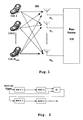
- Fig.1 shows an exemplary environment in which the present invention can be implemented.
- the environment 100 comprises N user user terminals (such as mobile phones) 110-1, 110-2, ..., 110-N user , and a base station 120, wherein the base station 120 comprises N R antennas.
- N user user terminals such as mobile phones
- the base station 120 comprises N R antennas.
- all the user terminals 110-1, 110-2, ..., 110-N user are in the same cell (which is controlled by the base station 120), and operate in the virtual MIMO mode, that is to say, the user terminals 110-1, 110-2, ..., 110-N user transmit signals to the base station 120 with the same frequency and time resource, and with different, or partially identical and partially different, or identical modulating and encoding schemes.
- the N R antennas of the base station 120 can all receive signals from user terminals 110-1, 110-2, ..., 110-N user .
- N user 2
- the number of user terminals paired into the virtual MIMO transmission is two.
- N R is greater than or equal to N user .
- X k, t denotes the signal from user terminal k at time t
- t m denotes the channel coefficient between user terminal k and the mth receive antenna of the base station 120 at time t and can be obtained by channel measurement at the base station side.
- the signal transmitted by the user terminal is normalized to have a unit average power, i.e., E(
- 2 ) 1 for ⁇ k and t.
- H t h k , t m
- X t [X 1,t X 2,t ] T
- h k,t is the kth column of H t
- p k is the transmission power of user terminal k upon transmitting signal
- n t is a N R ⁇ 1 vector with element samples of the complex additive white Gaussian noise (AWGN) process with zero-mean and variance ⁇ 2.
- AWGN complex additive white Gaussian noise
- h k,t is a vector of independent identically distributed (i.i.d.) complexity Gaussian random variables with zero mean and variance ⁇ k 2 . 1 / ⁇ k 2 can be regarded as the path loss experienced by user terminal k, which varies with k due to the different locations of N user user terminals.
- the successive interference cancellation (SIC) technique is employed to detect the user terminals.
- Fig. 2 shows the structure of the SIC receiver, where DET-k and DEC-k denote the detector and channel decoder for user terminal k, and IC denotes the interference cancellation module.
- DET-k and DEC-k denote the detector and channel decoder for user terminal k
- IC denotes the interference cancellation module.
- Fig.2 only shows two DETs and DECs of two user terminals, i.e., DET-1, DET-2 and DEC-1, DEC-2.
- the successive interference cancellation (SIC) technique detects in a successive manner, starting from the user terminal with the highest arrival SNR, and performs interference cancellation after the detection of each user terminal.
- Step 1) we can either treat the interference of the signal from user terminal 2 as AWGN, or use interference suppression techniques, such as zero-forcing or MMSE, to deal with the interference of the signal from the user terminal 2.
- interference suppression techniques such as zero-forcing or MMSE
- two methods are used to treat the interference of signal from the user terminal 2.
- the interference of the signal from user terminal 2 is treated as AWGN.
- H denotes the transpose conjugate
- ⁇ t q 2 ⁇ h ⁇ 1 , t H ⁇ h ⁇ 2 , t 2 + ⁇ 2 ⁇ h ⁇ 1 , t 2
- (.) * denotes the conjugate.
- z t can be characterized by the following conditional probability density function p z t
- the optimum successive decoding (OSD) procedure can be employed to treat the interference of the signal from user terminal 2.
- This method will lead to better performance than Method I, but have higher detection complexity.
- a weighting factor f t ( q 2 ⁇ h ⁇ 2 , t ⁇ h ⁇ 2 , t H + ⁇ 2 ⁇ I N R ) - 1 h ⁇ 1 , t .
- the following detection procedure is the same as in Method I, i.e., calculating the conditional probability density function of z t , and carrying out the maximum likelihood detection of x 1,t based on it.
- the maximum likelihood detection can also be employed to detect x 2,t from the signal output from IC .
- the aim of power control is to determine a transmission power of each user terminal that makes the sum of the transmission power of each user terminal minimum under the case that the specific index for each user terminal meets a required threshold value.
- the power control operation can be implemented by three steps:
- Step 2 the base station needs to know the path loss 1 / ⁇ 1 2 and 1 / ⁇ 2 2 , which can be obtained as follows.
- all user terminals transmit signals using a pre-determined transmission power.
- the base station measures the arrival SNR of each user terminal, and normalizes it by the pre-determined transmission power to evaluate the path loss. Then the base station indicates each user terminal to increase or decrease its transmission power according to the arrival SNR and required BER or error code rate.
- the base station controls the transmission power of all user terminals in this way, so it can always track the transmission power and arrival SNR of each user terminal, and consequently, the path loss of each user terminal.
- the BER or error code rate index and threshold value can be converted into the SNR index and threshold value.
- the index is the average output SNR of each DET
- the threshold value is denoted by snr required .
- the value of snr required depends on the required BER threshold value and the modulating and encoding mode used by each user terminal. snr required for each user terminal can be obtained offline using the Monte Carlo simulation. Since different user terminals may use different modulating and encoding modes and have different BER threshold values, the value of snr required may vary with respect to different user terminals.
- snr required is the same for all user terminals.
- snr1 DET and snr2 DET are used to denote the average output SNR of DET-1 and DET-2, respectively.
- snr1 DET and snr2 DET are both functions of ⁇ h ⁇ k,t ⁇ and q1, q2.
- E(.) is the expectation over t in a frame.
- Step 1 it is expected that the sum of the arrival power (respectively denoted by q 1min and q 2min ) of the paired user terminals is minimum, and snr1 DET and snr2 DET satisfy: snr ⁇ 1 DET ⁇ snr required and snr ⁇ 2 DET ⁇ snr required
- the base station can predict the channel coefficients in the next frame with relatively good accuracy, so the minimums of q 1 and q 2 q min1 and q min2 can be calculated directly from the equation (8) or (9) and the inequation (10).
- q min1 and q min2 can be derived according to the following procedure. First, all possible arrival power pairs (q 1 , q 2 ) of the user terminal 1 and user terminal 2 are searched over. For each arrival power pair, the average values of snr1 DET and snr2 DET over all possible channel coefficients are evaluated, and if the inequation (10) can be met is checked. Second, among all the arrival power pairs that satisfy the inequation (10), the arrival power pair with the minimum total arrival power is selected. The operation only requires the base station aware of the statistical characteristic of the channel coefficients, rather than instant channel implementations, so it can be performed offline and will not cause additional complexity at the transmitter (user terminal) and receiver (base station).
- a rate 1/3 (11, 13) 8 turbo code with information length 200 is used for both user terminals.
- Fig. 3 shows a detrimental effect of unbalanced arrival SNRs on the performance of such virtual MIMO system.
- the x-axis denotes (p1+p2) /2 ⁇ 2 (with dB as the unit), and the y-axis denotes the average BER of the two paired user terminals.
- the two user terminals employ the same transmission power.
- the QRM-MLD technique is employed, which can achieve similar performance as MLD with much reduced complexity.
- the performance of the virtual MIMO system degrades seriously with the increase of the difference between ⁇ 1 2 and ⁇ 2 2 .
- Fig.4 shows, in such a virtual MIMO system, a comparison between the proposed power control scheme and the existing one that guarantees equal arrival SNRs for user terminals by increasing the transmission power of the user terminal experiencing larger path loss.
- the x-axis denotes (p 1 +p 2 )/2 ⁇ 2 (with dB as the unit), and the y-axis denotes the average BER of the two paired user terminals.
- the curve on the left of each pair of curves is obtained when the proposed power control scheme is employed, whereas the curve on the right is obtained when the existing scheme is employed.
- the proposed scheme in the present invention has better performance than the existing one, and the performance gain increases with the increase of the difference between ⁇ 1 2 and ⁇ 2 2 .
- This advantage comes from the fact that the proposed scheme requires unbalanced arrival power for two user terminals, due to the employment of the SIC receiver, and matches the lower/higher arrival power of the user terminal with poorer/better channel conditions, which leads to less total transmission power. This can be better understood by a simple example.
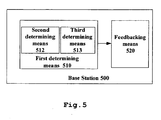
- Fig.5 is a block diagram of a base station according to one embodiment of the present invention.
- a base station 500 for controlling the transmission power of each user terminal paired in virtual MIMO transmission comprises: first determining means 510 for determining the transmission power of each user terminal that makes the sum of the transmission power of each user terminal minimum under the case that the specific index for each user terminal meets a required threshold value; and feedbacking means 520 for feeding the above-determined transmission power of each user terminal back to each user terminal.
- the specific index and the threshold value is bit error rate or error code rate; or the specific index is arrival signal-to-noise ratio (SNR) and the threshold value is signal-to-noise ratio.
- SNR arrival signal-to-noise ratio
- the bit error rate or error code rate index and threshold value can be converted into the SNR index and threshold value.
- the threshold value is SNR, it can depend on a modulating and encoding mode used by each user terminal and the bit error rate or error code rate required for each user terminal.
- the first determining means 510 comprises: second determining means 512 for determining the arrival power of each user terminal that makes the sum of the arrival power of each user terminal minimum under the case that the specific index for each user terminal meets a required threshold value; and third determining means 513 for determining the transmission power of each user terminal according to the above-determined arrival power of each user terminal and the path loss experienced by each user terminal.
- the successive interference cancellation (SIC) technique is employed to detect each user terminal and user terminals with higher arrival SNRs can be detected first, and the threshold value is signal-to-noise ratio, and the specific index is an average output SNR of the detector at each level.
Landscapes
- Engineering & Computer Science (AREA)
- Computer Networks & Wireless Communication (AREA)
- Signal Processing (AREA)
- Mobile Radio Communication Systems (AREA)
- Radio Transmission System (AREA)
Applications Claiming Priority (1)
| Application Number | Priority Date | Filing Date | Title |
|---|---|---|---|
| PCT/CN2007/002232 WO2009012615A1 (fr) | 2007-07-23 | 2007-07-23 | Procédé de commande d'alimentation et station de base correspondante |
Publications (3)
| Publication Number | Publication Date |
|---|---|
| EP2173041A1 true EP2173041A1 (fr) | 2010-04-07 |
| EP2173041A4 EP2173041A4 (fr) | 2013-01-23 |
| EP2173041B1 EP2173041B1 (fr) | 2017-03-01 |
Family
ID=40280973
Family Applications (1)
| Application Number | Title | Priority Date | Filing Date |
|---|---|---|---|
| EP07785157.4A Not-in-force EP2173041B1 (fr) | 2007-07-23 | 2007-07-23 | Procédé de commande d'alimentation et station de base correspondante |
Country Status (5)
| Country | Link |
|---|---|
| US (1) | US8396502B2 (fr) |
| EP (1) | EP2173041B1 (fr) |
| KR (1) | KR101374580B1 (fr) |
| CN (1) | CN103548285B (fr) |
| WO (1) | WO2009012615A1 (fr) |
Cited By (1)
| Publication number | Priority date | Publication date | Assignee | Title |
|---|---|---|---|---|
| WO2014007712A1 (fr) * | 2012-07-06 | 2014-01-09 | Telefonaktiebolaget L M Ericsson (Publ) | Procédés et nœuds pour planification mimo multiutilisateur et commande de puissance |
Families Citing this family (7)
| Publication number | Priority date | Publication date | Assignee | Title |
|---|---|---|---|---|
| US8116404B2 (en) * | 2007-10-10 | 2012-02-14 | Intel Corporation | Diversity receiver and method for controlling power thereof |
| CN101867965B (zh) | 2009-04-15 | 2014-01-01 | 中兴通讯股份有限公司 | 一种多用户多输入多输出中的用户终端配对方法及装置 |
| CN101989874B (zh) * | 2009-07-31 | 2014-07-16 | 中兴通讯股份有限公司 | 一种多用户多输入多输出的配对方法及装置 |
| KR20130104369A (ko) | 2012-03-13 | 2013-09-25 | 삼성전자주식회사 | 협력 전송 기반의 다중 안테나 시스템에서의 전송 파워 결정 방법 |
| WO2014107888A1 (fr) * | 2013-01-11 | 2014-07-17 | 华为技术有限公司 | Procédé de transmission et station de base pour des entrées multiples sorties multiples en liaison descendante |
| CN107302385B (zh) * | 2016-04-12 | 2021-04-16 | 中兴通讯股份有限公司 | 虚拟多输入多输出通信方法、装置及系统 |
| KR102177427B1 (ko) * | 2018-12-28 | 2020-11-11 | 연세대학교 산학협력단 | 비직교 다중 접속 시스템의 전송 전력 제어 장치 및 방법 |
Family Cites Families (17)
| Publication number | Priority date | Publication date | Assignee | Title |
|---|---|---|---|---|
| US6393005B1 (en) * | 1997-06-27 | 2002-05-21 | Nec Corporation | Method of controlling transmitting power of a base station in a CDMA mobile communication system |
| JP4385489B2 (ja) * | 2000-03-03 | 2009-12-16 | ソニー株式会社 | 通信システム、通信方法及び通信装置 |
| US7096034B2 (en) * | 2001-10-01 | 2006-08-22 | Microsoft Corporation | System and method for reducing power consumption for wireless communications by mobile devices |
| US7020482B2 (en) * | 2002-01-23 | 2006-03-28 | Qualcomm Incorporated | Reallocation of excess power for full channel-state information (CSI) multiple-input, multiple-output (MIMO) systems |
| US7391779B2 (en) * | 2002-06-26 | 2008-06-24 | Nortel Networks Limited | Scheduling method and apparatus for combined code division multiplexing and time division multiplexing |
| US8194770B2 (en) * | 2002-08-27 | 2012-06-05 | Qualcomm Incorporated | Coded MIMO systems with selective channel inversion applied per eigenmode |
| WO2005004429A1 (fr) * | 2003-06-24 | 2005-01-13 | Globespanvirata Incorporated | Technique qui permet d'ameliorer les transmissions a plusieurs voies et a plusieurs tonalites |
| US7302009B2 (en) * | 2003-12-17 | 2007-11-27 | Qualcomm Incorporated | Broadcast transmission with spatial spreading in a multi-antenna communication system |
| FR2865864B1 (fr) * | 2004-01-30 | 2006-05-19 | Messier Bugatti | Installation de gestion de puissance dans un avion. |
| US8045638B2 (en) * | 2004-03-05 | 2011-10-25 | Telefonaktiebolaget Lm Ericsson (Publ) | Method and apparatus for impairment correlation estimation in a wireless communication receiver |
| JP4612474B2 (ja) * | 2004-05-28 | 2011-01-12 | パナソニック株式会社 | 無線通信装置 |
| KR100648472B1 (ko) | 2004-10-19 | 2006-11-28 | 삼성전자주식회사 | 다중 송신 다중 수신 안테나 통신 시스템에서 적응 변조및 부호 성능을 최적화하기 위한 송·수신 장치 및 방법 |
| US20060104379A1 (en) | 2004-11-15 | 2006-05-18 | Qinghua Li | Technique to increase a code rate in a MIMO system using virtual channels |
| CN100336329C (zh) | 2005-11-17 | 2007-09-05 | 上海交通大学 | 基于服务质量需求的最小发射功率自适应调制方法 |
| JP4762033B2 (ja) * | 2006-04-07 | 2011-08-31 | 株式会社エヌ・ティ・ティ・ドコモ | 測定装置及びエリア品質測定方法 |
| US7860335B2 (en) * | 2006-12-04 | 2010-12-28 | The Boeing Company | Method and apparatus for smart signal averaging |
| US8027301B2 (en) * | 2007-01-24 | 2011-09-27 | The Board Of Trustees Of The Leland Stanford Junior University | Cooperative OFDMA and distributed MIMO relaying over dense wireless networks |
-
2007
- 2007-07-23 CN CN200780102426.6A patent/CN103548285B/zh active Active
- 2007-07-23 KR KR1020107003243A patent/KR101374580B1/ko not_active Expired - Fee Related
- 2007-07-23 WO PCT/CN2007/002232 patent/WO2009012615A1/fr not_active Ceased
- 2007-07-23 EP EP07785157.4A patent/EP2173041B1/fr not_active Not-in-force
- 2007-07-23 US US12/670,183 patent/US8396502B2/en not_active Expired - Fee Related
Cited By (2)
| Publication number | Priority date | Publication date | Assignee | Title |
|---|---|---|---|---|
| WO2014007712A1 (fr) * | 2012-07-06 | 2014-01-09 | Telefonaktiebolaget L M Ericsson (Publ) | Procédés et nœuds pour planification mimo multiutilisateur et commande de puissance |
| US9491711B2 (en) | 2012-07-06 | 2016-11-08 | Telefonaktiebolaget L M Ericsson | Methods and nodes for multiple user MIMO scheduling and power control |
Also Published As
| Publication number | Publication date |
|---|---|
| US20100190521A1 (en) | 2010-07-29 |
| EP2173041B1 (fr) | 2017-03-01 |
| EP2173041A4 (fr) | 2013-01-23 |
| CN103548285A (zh) | 2014-01-29 |
| CN103548285B (zh) | 2016-03-23 |
| WO2009012615A1 (fr) | 2009-01-29 |
| KR20100063007A (ko) | 2010-06-10 |
| US8396502B2 (en) | 2013-03-12 |
| KR101374580B1 (ko) | 2014-03-17 |
Similar Documents
| Publication | Publication Date | Title |
|---|---|---|
| US10484055B2 (en) | Rate-adaptive multiple input/multiple output (MIMO) systems | |
| EP2173041B1 (fr) | Procédé de commande d'alimentation et station de base correspondante | |
| Shi et al. | MMSE transmit optimization for multi-user multi-antenna systems | |
| US11711155B2 (en) | Self-adaptive MIMO detection method and system | |
| WO2007000742A2 (fr) | Modulation adaptative destinee a des systemes codes cooperatifs | |
| JP4381901B2 (ja) | 通信路推定及びデータ検出方法 | |
| Dai et al. | Cell-free symbiotic radio: Channel estimation method and achievable rate analysis | |
| US20090080558A1 (en) | Space-time mimo wireless system based on feedback optimum weight design | |
| US20100081424A1 (en) | Method and appratus for controlling signal transmission | |
| Alemzadeh et al. | A new antenna selection scheme for MIMO-NOMA systems with multiple-antenna users | |
| US8750399B2 (en) | Radio terminal and demodulation method | |
| Prakash et al. | Effects of channel prediction for transmit antenna selection with maximal-ratio combining in Rayleigh fading | |
| Choi et al. | Joint ML & MMSE-SIC detection for multi cell network environment | |
| Liu et al. | On the performance of nth best relay selection scheme for noma-based cooperative relaying networks with swipt | |
| Chen et al. | V-BLAST receiver for MIMO relay networks with imperfect CSI | |
| Kang et al. | Outage analysis of multi-antenna rate adaptive systems with outdated feedback | |
| Karthick et al. | Performance Evaluation of Deep Fade Analysis for Diversity and Beamforming Technique Under 5G Network | |
| HARA | Time slot assignment algorithms for SDMA/TDMA system based on estimated SINR | |
| Kim et al. | Joint ZF and partial ML detection for uplink cellular base station cooperation | |
| Subhashini et al. | Exploring the Performance of NOMA Systems with Intelligent Surface Assistance | |
| Shirvani Moghaddam et al. | Sum-rate maximization based on power constraints for cooperative AF relay networks | |
| Sashiganth et al. | Constructive Interference based Co-operative NOMA Full Duplex Downlink System | |
| Zanella et al. | Analytical evaluation of MIMO systems with unequal power transmission in a Rayleigh fading environment | |
| Tolli et al. | Suppression of non-reciprocal interference in adaptive MIMO-OFDM cellular systems | |
| Abou Saleh et al. | Single-cell vs. multicell MIMO downlink signalling strategies with imperfect CSI |
Legal Events
| Date | Code | Title | Description |
|---|---|---|---|
| PUAI | Public reference made under article 153(3) epc to a published international application that has entered the european phase |
Free format text: ORIGINAL CODE: 0009012 |
|
| 17P | Request for examination filed |
Effective date: 20100130 |
|
| AK | Designated contracting states |
Kind code of ref document: A1 Designated state(s): AT BE BG CH CY CZ DE DK EE ES FI FR GB GR HU IE IS IT LI LT LU LV MC MT NL PL PT RO SE SI SK TR |
|
| AX | Request for extension of the european patent |
Extension state: AL BA HR MK RS |
|
| DAX | Request for extension of the european patent (deleted) | ||
| RAP1 | Party data changed (applicant data changed or rights of an application transferred) |
Owner name: ALCATEL LUCENT |
|
| A4 | Supplementary search report drawn up and despatched |
Effective date: 20121220 |
|
| RIC1 | Information provided on ipc code assigned before grant |
Ipc: H04B 7/26 20060101AFI20121214BHEP Ipc: H04W 52/42 20090101ALI20121214BHEP |
|
| 111Z | Information provided on other rights and legal means of execution |
Free format text: AT BE BG CH CY CZ DE DK EE ES FI FR GB GR HU IE IS IT LI LT LU LV MC MT NL PL PT RO SE SI SK TR Effective date: 20130410 |
|
| RAP1 | Party data changed (applicant data changed or rights of an application transferred) |
Owner name: ALCATEL LUCENT |
|
| D11X | Information provided on other rights and legal means of execution (deleted) | ||
| 17Q | First examination report despatched |
Effective date: 20151202 |
|
| GRAP | Despatch of communication of intention to grant a patent |
Free format text: ORIGINAL CODE: EPIDOSNIGR1 |
|
| RIC1 | Information provided on ipc code assigned before grant |
Ipc: H04B 7/26 20060101AFI20160908BHEP Ipc: H04W 52/14 20090101ALI20160908BHEP Ipc: H04B 7/04 20060101ALI20160908BHEP Ipc: H04W 52/42 20090101ALI20160908BHEP |
|
| INTG | Intention to grant announced |
Effective date: 20160929 |
|
| INTG | Intention to grant announced |
Effective date: 20161006 |
|
| GRAS | Grant fee paid |
Free format text: ORIGINAL CODE: EPIDOSNIGR3 |
|
| GRAA | (expected) grant |
Free format text: ORIGINAL CODE: 0009210 |
|
| AK | Designated contracting states |
Kind code of ref document: B1 Designated state(s): AT BE BG CH CY CZ DE DK EE ES FI FR GB GR HU IE IS IT LI LT LU LV MC MT NL PL PT RO SE SI SK TR |
|
| REG | Reference to a national code |
Ref country code: GB Ref legal event code: FG4D |
|
| REG | Reference to a national code |
Ref country code: CH Ref legal event code: EP Ref country code: AT Ref legal event code: REF Ref document number: 872431 Country of ref document: AT Kind code of ref document: T Effective date: 20170315 |
|
| REG | Reference to a national code |
Ref country code: IE Ref legal event code: FG4D |
|
| REG | Reference to a national code |
Ref country code: DE Ref legal event code: R096 Ref document number: 602007049972 Country of ref document: DE |
|
| REG | Reference to a national code |
Ref country code: NL Ref legal event code: MP Effective date: 20170301 |
|
| REG | Reference to a national code |
Ref country code: LT Ref legal event code: MG4D |
|
| REG | Reference to a national code |
Ref country code: AT Ref legal event code: MK05 Ref document number: 872431 Country of ref document: AT Kind code of ref document: T Effective date: 20170301 |
|
| REG | Reference to a national code |
Ref country code: FR Ref legal event code: PLFP Year of fee payment: 11 |
|
| PG25 | Lapsed in a contracting state [announced via postgrant information from national office to epo] |
Ref country code: GR Free format text: LAPSE BECAUSE OF FAILURE TO SUBMIT A TRANSLATION OF THE DESCRIPTION OR TO PAY THE FEE WITHIN THE PRESCRIBED TIME-LIMIT Effective date: 20170602 Ref country code: LT Free format text: LAPSE BECAUSE OF FAILURE TO SUBMIT A TRANSLATION OF THE DESCRIPTION OR TO PAY THE FEE WITHIN THE PRESCRIBED TIME-LIMIT Effective date: 20170301 Ref country code: FI Free format text: LAPSE BECAUSE OF FAILURE TO SUBMIT A TRANSLATION OF THE DESCRIPTION OR TO PAY THE FEE WITHIN THE PRESCRIBED TIME-LIMIT Effective date: 20170301 |
|
| PG25 | Lapsed in a contracting state [announced via postgrant information from national office to epo] |
Ref country code: BG Free format text: LAPSE BECAUSE OF FAILURE TO SUBMIT A TRANSLATION OF THE DESCRIPTION OR TO PAY THE FEE WITHIN THE PRESCRIBED TIME-LIMIT Effective date: 20170601 Ref country code: SE Free format text: LAPSE BECAUSE OF FAILURE TO SUBMIT A TRANSLATION OF THE DESCRIPTION OR TO PAY THE FEE WITHIN THE PRESCRIBED TIME-LIMIT Effective date: 20170301 Ref country code: AT Free format text: LAPSE BECAUSE OF FAILURE TO SUBMIT A TRANSLATION OF THE DESCRIPTION OR TO PAY THE FEE WITHIN THE PRESCRIBED TIME-LIMIT Effective date: 20170301 Ref country code: ES Free format text: LAPSE BECAUSE OF FAILURE TO SUBMIT A TRANSLATION OF THE DESCRIPTION OR TO PAY THE FEE WITHIN THE PRESCRIBED TIME-LIMIT Effective date: 20170301 Ref country code: LV Free format text: LAPSE BECAUSE OF FAILURE TO SUBMIT A TRANSLATION OF THE DESCRIPTION OR TO PAY THE FEE WITHIN THE PRESCRIBED TIME-LIMIT Effective date: 20170301 |
|
| PG25 | Lapsed in a contracting state [announced via postgrant information from national office to epo] |
Ref country code: NL Free format text: LAPSE BECAUSE OF FAILURE TO SUBMIT A TRANSLATION OF THE DESCRIPTION OR TO PAY THE FEE WITHIN THE PRESCRIBED TIME-LIMIT Effective date: 20170301 |
|
| PG25 | Lapsed in a contracting state [announced via postgrant information from national office to epo] |
Ref country code: CZ Free format text: LAPSE BECAUSE OF FAILURE TO SUBMIT A TRANSLATION OF THE DESCRIPTION OR TO PAY THE FEE WITHIN THE PRESCRIBED TIME-LIMIT Effective date: 20170301 Ref country code: SK Free format text: LAPSE BECAUSE OF FAILURE TO SUBMIT A TRANSLATION OF THE DESCRIPTION OR TO PAY THE FEE WITHIN THE PRESCRIBED TIME-LIMIT Effective date: 20170301 Ref country code: IT Free format text: LAPSE BECAUSE OF FAILURE TO SUBMIT A TRANSLATION OF THE DESCRIPTION OR TO PAY THE FEE WITHIN THE PRESCRIBED TIME-LIMIT Effective date: 20170301 Ref country code: EE Free format text: LAPSE BECAUSE OF FAILURE TO SUBMIT A TRANSLATION OF THE DESCRIPTION OR TO PAY THE FEE WITHIN THE PRESCRIBED TIME-LIMIT Effective date: 20170301 Ref country code: RO Free format text: LAPSE BECAUSE OF FAILURE TO SUBMIT A TRANSLATION OF THE DESCRIPTION OR TO PAY THE FEE WITHIN THE PRESCRIBED TIME-LIMIT Effective date: 20170301 |
|
| PG25 | Lapsed in a contracting state [announced via postgrant information from national office to epo] |
Ref country code: IS Free format text: LAPSE BECAUSE OF FAILURE TO SUBMIT A TRANSLATION OF THE DESCRIPTION OR TO PAY THE FEE WITHIN THE PRESCRIBED TIME-LIMIT Effective date: 20170701 Ref country code: PT Free format text: LAPSE BECAUSE OF FAILURE TO SUBMIT A TRANSLATION OF THE DESCRIPTION OR TO PAY THE FEE WITHIN THE PRESCRIBED TIME-LIMIT Effective date: 20170703 Ref country code: PL Free format text: LAPSE BECAUSE OF FAILURE TO SUBMIT A TRANSLATION OF THE DESCRIPTION OR TO PAY THE FEE WITHIN THE PRESCRIBED TIME-LIMIT Effective date: 20170301 |
|
| REG | Reference to a national code |
Ref country code: DE Ref legal event code: R097 Ref document number: 602007049972 Country of ref document: DE |
|
| PLBE | No opposition filed within time limit |
Free format text: ORIGINAL CODE: 0009261 |
|
| STAA | Information on the status of an ep patent application or granted ep patent |
Free format text: STATUS: NO OPPOSITION FILED WITHIN TIME LIMIT |
|
| PG25 | Lapsed in a contracting state [announced via postgrant information from national office to epo] |
Ref country code: DK Free format text: LAPSE BECAUSE OF FAILURE TO SUBMIT A TRANSLATION OF THE DESCRIPTION OR TO PAY THE FEE WITHIN THE PRESCRIBED TIME-LIMIT Effective date: 20170301 |
|
| 26N | No opposition filed |
Effective date: 20171204 |
|
| PG25 | Lapsed in a contracting state [announced via postgrant information from national office to epo] |
Ref country code: SI Free format text: LAPSE BECAUSE OF FAILURE TO SUBMIT A TRANSLATION OF THE DESCRIPTION OR TO PAY THE FEE WITHIN THE PRESCRIBED TIME-LIMIT Effective date: 20170301 |
|
| REG | Reference to a national code |
Ref country code: CH Ref legal event code: PL |
|
| REG | Reference to a national code |
Ref country code: IE Ref legal event code: MM4A |
|
| PG25 | Lapsed in a contracting state [announced via postgrant information from national office to epo] |
Ref country code: LI Free format text: LAPSE BECAUSE OF NON-PAYMENT OF DUE FEES Effective date: 20170731 Ref country code: CH Free format text: LAPSE BECAUSE OF NON-PAYMENT OF DUE FEES Effective date: 20170731 Ref country code: IE Free format text: LAPSE BECAUSE OF NON-PAYMENT OF DUE FEES Effective date: 20170723 |
|
| REG | Reference to a national code |
Ref country code: BE Ref legal event code: MM Effective date: 20170731 |
|
| PG25 | Lapsed in a contracting state [announced via postgrant information from national office to epo] |
Ref country code: LU Free format text: LAPSE BECAUSE OF NON-PAYMENT OF DUE FEES Effective date: 20170723 |
|
| REG | Reference to a national code |
Ref country code: FR Ref legal event code: PLFP Year of fee payment: 12 |
|
| PG25 | Lapsed in a contracting state [announced via postgrant information from national office to epo] |
Ref country code: BE Free format text: LAPSE BECAUSE OF NON-PAYMENT OF DUE FEES Effective date: 20170731 |
|
| PG25 | Lapsed in a contracting state [announced via postgrant information from national office to epo] |
Ref country code: MT Free format text: LAPSE BECAUSE OF NON-PAYMENT OF DUE FEES Effective date: 20170723 |
|
| PG25 | Lapsed in a contracting state [announced via postgrant information from national office to epo] |
Ref country code: HU Free format text: LAPSE BECAUSE OF FAILURE TO SUBMIT A TRANSLATION OF THE DESCRIPTION OR TO PAY THE FEE WITHIN THE PRESCRIBED TIME-LIMIT; INVALID AB INITIO Effective date: 20070723 Ref country code: MC Free format text: LAPSE BECAUSE OF FAILURE TO SUBMIT A TRANSLATION OF THE DESCRIPTION OR TO PAY THE FEE WITHIN THE PRESCRIBED TIME-LIMIT Effective date: 20170301 |
|
| PG25 | Lapsed in a contracting state [announced via postgrant information from national office to epo] |
Ref country code: CY Free format text: LAPSE BECAUSE OF NON-PAYMENT OF DUE FEES Effective date: 20170301 |
|
| PG25 | Lapsed in a contracting state [announced via postgrant information from national office to epo] |
Ref country code: TR Free format text: LAPSE BECAUSE OF FAILURE TO SUBMIT A TRANSLATION OF THE DESCRIPTION OR TO PAY THE FEE WITHIN THE PRESCRIBED TIME-LIMIT Effective date: 20170301 |
|
| PGFP | Annual fee paid to national office [announced via postgrant information from national office to epo] |
Ref country code: GB Payment date: 20240530 Year of fee payment: 18 |
|
| PGFP | Annual fee paid to national office [announced via postgrant information from national office to epo] |
Ref country code: FR Payment date: 20240611 Year of fee payment: 18 |
|
| PGFP | Annual fee paid to national office [announced via postgrant information from national office to epo] |
Ref country code: DE Payment date: 20240604 Year of fee payment: 18 |
|
| REG | Reference to a national code |
Ref country code: DE Ref legal event code: R119 Ref document number: 602007049972 Country of ref document: DE |
|
| GBPC | Gb: european patent ceased through non-payment of renewal fee |
Effective date: 20250723 |
|
| PG25 | Lapsed in a contracting state [announced via postgrant information from national office to epo] |
Ref country code: GB Free format text: LAPSE BECAUSE OF NON-PAYMENT OF DUE FEES Effective date: 20250723 |
|
| PG25 | Lapsed in a contracting state [announced via postgrant information from national office to epo] |
Ref country code: DE Free format text: LAPSE BECAUSE OF NON-PAYMENT OF DUE FEES Effective date: 20260203 |
|
| PG25 | Lapsed in a contracting state [announced via postgrant information from national office to epo] |
Ref country code: FR Free format text: LAPSE BECAUSE OF NON-PAYMENT OF DUE FEES Effective date: 20250731 |