EP2174135B1 - Appareil et procede de detection d'analyte electrochimique - Google Patents
Appareil et procede de detection d'analyte electrochimique Download PDFInfo
- Publication number
- EP2174135B1 EP2174135B1 EP08782340A EP08782340A EP2174135B1 EP 2174135 B1 EP2174135 B1 EP 2174135B1 EP 08782340 A EP08782340 A EP 08782340A EP 08782340 A EP08782340 A EP 08782340A EP 2174135 B1 EP2174135 B1 EP 2174135B1
- Authority
- EP
- European Patent Office
- Prior art keywords
- analyte
- electrodes
- sample
- enzyme
- test reagent
- Prior art date
- Legal status (The legal status is an assumption and is not a legal conclusion. Google has not performed a legal analysis and makes no representation as to the accuracy of the status listed.)
- Active
Links
Images




Classifications
-
- C—CHEMISTRY; METALLURGY
- C12—BIOCHEMISTRY; BEER; SPIRITS; WINE; VINEGAR; MICROBIOLOGY; ENZYMOLOGY; MUTATION OR GENETIC ENGINEERING
- C12Q—MEASURING OR TESTING PROCESSES INVOLVING ENZYMES, NUCLEIC ACIDS OR MICROORGANISMS; COMPOSITIONS OR TEST PAPERS THEREFOR; PROCESSES OF PREPARING SUCH COMPOSITIONS; CONDITION-RESPONSIVE CONTROL IN MICROBIOLOGICAL OR ENZYMOLOGICAL PROCESSES
- C12Q1/00—Measuring or testing processes involving enzymes, nucleic acids or microorganisms; Compositions therefor; Processes of preparing such compositions
- C12Q1/001—Enzyme electrodes
-
- G—PHYSICS
- G01—MEASURING; TESTING
- G01N—INVESTIGATING OR ANALYSING MATERIALS BY DETERMINING THEIR CHEMICAL OR PHYSICAL PROPERTIES
- G01N33/00—Investigating or analysing materials by specific methods not covered by groups G01N1/00 - G01N31/00
- G01N33/48—Biological material, e.g. blood, urine; Haemocytometers
- G01N33/50—Chemical analysis of biological material, e.g. blood, urine; Testing involving biospecific ligand binding methods; Immunological testing
- G01N33/53—Immunoassay; Biospecific binding assay; Materials therefor
- G01N33/573—Immunoassay; Biospecific binding assay; Materials therefor for enzymes or isoenzymes
-
- G—PHYSICS
- G01—MEASURING; TESTING
- G01N—INVESTIGATING OR ANALYSING MATERIALS BY DETERMINING THEIR CHEMICAL OR PHYSICAL PROPERTIES
- G01N33/00—Investigating or analysing materials by specific methods not covered by groups G01N1/00 - G01N31/00
- G01N33/48—Biological material, e.g. blood, urine; Haemocytometers
- G01N33/50—Chemical analysis of biological material, e.g. blood, urine; Testing involving biospecific ligand binding methods; Immunological testing
- G01N33/53—Immunoassay; Biospecific binding assay; Materials therefor
- G01N33/5308—Immunoassay; Biospecific binding assay; Materials therefor for analytes not provided for elsewhere, e.g. nucleic acids, uric acid, worms, mites
-
- C—CHEMISTRY; METALLURGY
- C12—BIOCHEMISTRY; BEER; SPIRITS; WINE; VINEGAR; MICROBIOLOGY; ENZYMOLOGY; MUTATION OR GENETIC ENGINEERING
- C12Q—MEASURING OR TESTING PROCESSES INVOLVING ENZYMES, NUCLEIC ACIDS OR MICROORGANISMS; COMPOSITIONS OR TEST PAPERS THEREFOR; PROCESSES OF PREPARING SUCH COMPOSITIONS; CONDITION-RESPONSIVE CONTROL IN MICROBIOLOGICAL OR ENZYMOLOGICAL PROCESSES
- C12Q1/00—Measuring or testing processes involving enzymes, nucleic acids or microorganisms; Compositions therefor; Processes of preparing such compositions
- C12Q1/02—Measuring or testing processes involving enzymes, nucleic acids or microorganisms; Compositions therefor; Processes of preparing such compositions involving viable microorganisms
- C12Q1/04—Determining presence or kind of microorganism; Use of selective media for testing antibiotics or bacteriocides; Compositions containing a chemical indicator therefor
-
- G—PHYSICS
- G01—MEASURING; TESTING
- G01N—INVESTIGATING OR ANALYSING MATERIALS BY DETERMINING THEIR CHEMICAL OR PHYSICAL PROPERTIES
- G01N27/00—Investigating or analysing materials by the use of electric, electrochemical, or magnetic means
- G01N27/26—Investigating or analysing materials by the use of electric, electrochemical, or magnetic means by investigating electrochemical variables; by using electrolysis or electrophoresis
- G01N27/416—Systems
- G01N27/4166—Systems measuring a particular property of an electrolyte
-
- G—PHYSICS
- G01—MEASURING; TESTING
- G01N—INVESTIGATING OR ANALYSING MATERIALS BY DETERMINING THEIR CHEMICAL OR PHYSICAL PROPERTIES
- G01N33/00—Investigating or analysing materials by specific methods not covered by groups G01N1/00 - G01N31/00
- G01N33/48—Biological material, e.g. blood, urine; Haemocytometers
- G01N33/50—Chemical analysis of biological material, e.g. blood, urine; Testing involving biospecific ligand binding methods; Immunological testing
- G01N33/53—Immunoassay; Biospecific binding assay; Materials therefor
- G01N33/543—Immunoassay; Biospecific binding assay; Materials therefor with an insoluble carrier for immobilising immunochemicals
- G01N33/54366—Apparatus specially adapted for solid-phase testing
- G01N33/54373—Apparatus specially adapted for solid-phase testing involving physiochemical end-point determination, e.g. wave-guides, FETS, gratings
- G01N33/5438—Electrodes
-
- G—PHYSICS
- G01—MEASURING; TESTING
- G01N—INVESTIGATING OR ANALYSING MATERIALS BY DETERMINING THEIR CHEMICAL OR PHYSICAL PROPERTIES
- G01N2333/00—Assays involving biological materials from specific organisms or of a specific nature
- G01N2333/90—Enzymes; Proenzymes
-
- G—PHYSICS
- G01—MEASURING; TESTING
- G01N—INVESTIGATING OR ANALYSING MATERIALS BY DETERMINING THEIR CHEMICAL OR PHYSICAL PROPERTIES
- G01N2333/00—Assays involving biological materials from specific organisms or of a specific nature
- G01N2333/90—Enzymes; Proenzymes
- G01N2333/902—Oxidoreductases (1.)
Definitions
- This application relates to an apparatus and method for electrochemical detection of an analyte in a sample.
- the invention utilizes a specific binding relationship between the analyte and at least one reagent provided in the apparatus as a means for detecting the analyte.
- the present invention provides a new method and apparatus for electrochemical detection of analyte in a sample that makes use of a binding interaction.
- the invention relies on the discovery that asymmetric distribution of a redox enzyme between two electrodes that occurs when a redox enzyme-containing reagent is immobilized at the surface of one electrode can be detected as a chemical potential gradient arising from an asymmetry in the distribution of oxidized or reduced redox substrate.
- This chemical potential gradient can be detected potentiometrically by observing the potential difference between the electrodes in an open circuit, or amperometrically by observing the current flow between the electrodes when the circuit is closed. In both cases, the observation of asymmetry can be done without the application of an external potential or current to the electrodes.
- a sandwich type assay is utilized.
- a sample to be tested for analyte is introduced to a test cell in the presence of a mobile test reagent.
- the test cell comprises a first and a second electrode.
- the first electrode has immobilized on the surface thereof an immobilized test reagent.
- the mobile test reagent comprises an analyte-binding portion and a redox enzyme portion, and the immobilized test reagent comprises an analyte binding portion.
- analyte is present in the sample in the test cell, at least a portion of the mobile test reagent becomes immobilized on the first electrode thereby creating an asymmetry in redox enzyme concentration between the first and second electrodes when analyte is present.
- a redox substrate for the redox enzyme in the test cell is also supplied. The redox substrate is acted upon (oxidized or reduced) by the redox enzyme. If there is an asymmetry in redox enzyme concentration between the first and second electrodes (i.e. when analyte is present in the sample), this results in a chemical potential gradient between the first and second electrodes. This chemical potential gradient is detected to determine analyte in the sample. In this embodiment, the greater the asymmetry and the resulting potential gradient, the greater the amount of analyte in the sample.
- a competition or displacement type of assay is utilized.
- the redox enzyme is coupled to analyte or an analog of the analyte that can bind to a common immobilized test reagent.
- the redox enzyme is provided already bound to the electrode via the immobilized test reagent.
- Oxidized mediator for example ferricyanide
- Oxidized mediator reacts with the reduced enzyme to regenerate the oxidized form of the enzyme, and produce reduced mediator. This process continues until either glucose or oxidized mediator is exhausted. If the enzyme is distributed asymmetrically within the sample cell, then the production of reduced mediator is also asymmetric, and the resulting asymmetry in the distribution of reduced mediator persists for a period of time (determined by diffusion parameters) even after exhaustion of the limiting reagent.
- E RT F ⁇ X log med red electrode ⁇ 1 med ox electrode ⁇ 1 ⁇ X ⁇ med ox electrode ⁇ 2 med red electrode ⁇ 2
- E the potential difference between electrodes 1 and 2
- R the gas constant
- T the absolute temperature
- F the Faraday constant
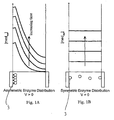
- Figs. 1A and B show schematic representations of reduced mediator distribution between two electrodes (1, 2) when redox enzyme distribution is asymmetric ( Fig. 1 A) or symmetric ( Fig. 1B ).
- the equations above can be used to quantitate the ratio of concentrations of enzyme at two electrodes 1 and 2 using potentiometry. The two electrodes are connected in open circuit, and the potential difference between them is measured. If enzyme 3 is more active or concentrated at one electrode than the other (i.e., it has an asymmetric distribution as shown in Fig. 1A ), the concentration of reduced mediator will be higher at that electrode than the other, giving rise to a electrical potential difference between the electrodes.
- the asymmetric distribution of enzyme activity will result in an asymmetric distribution of reduced mediator, that can be observed by following current when the potential difference between the electrodes is forced to zero by closing the circuit between them. If reduced mediator is generated by enzyme activity and diffuses to an electrode, current will flow and sufficient mediator will be reoxidized, such that the reduced mediator concentration is equal at both electrodes. The current flow will be proportional to the difference in flux of reduced mediator to the two electrodes.
- Figs. 2A and B illustrate the use of these principles to quantify the ratio of concentrations of enzyme at two electrodes, using amperometry.
- the two electrodes are connected in short circuit, and the current flowing between them is measured.
- mediator will be reduced or oxidized at the electrodes when necessary to maintain an equal chemical potential at each electrode.
- reduced mediator is oxidized at one electrode, current will flow and an equivalent quantity of oxidized mediator will be reduced at the other electrode. If the enzyme activity at each electrode is equal, no electron transfer will be necessary to keep the chemical potentials balanced, so no current will flow. If more enzyme activity is present at one electrode than the other, reduced mediator will be consumed at that electrode and produced at the other electrode to maintain a balanced chemical potential, and current will flow.
- the theory of the present invention is applicable to the practical application of determining analytes in a sample. This can be done in various binding formats.
- two analyte-specific chemical components are utilized, and these are selected in to correspond to the analyte to be determined.
- Table 1 Various non-limiting combinations are set forth in Table 1.
- Analyte Analyte receptor binding component of Analyte-specific enzyme disease-specific antibody for example an antibody to influenza, disease causing organism disease associated-antigen, such as peptide epitope found on an influenza of interest, aptamers antibody that recognizes human antibodies, aptamers amplified nucleic acid sequence including a suspected target and a known primer nucleic acid complementary to the suspected target nucleic acid sequence complementary to the known primer hormone hormone receptor, apatamer or antibody hormone receptor, apatamer or antibody drug drug receptor, aptamer or antibody hormone receptor, apatamer or antibody pesticides pesticide binding proteins, aptamers, antibodies to pesticides pesticide binding proteins, apatmers antibodies that recognize the antibodies to pesticides
- the "antibody” incorporated in the device can be a complete antibody such as an immunoglobulin, or it may be a engineered binding portion of an antibody such as a single-chain antibody (scFv) or Domain Antibodies (dAb) as described at www.domantis.com.
- Immunoassays for drugs are described in US Patents Nos. 7,220,842 , 5,677,132 and 5,618,926 .
- Immunoassays for pesticides and pesticide degradation products are described in US Patent No. 6,635,434 .
- Drug and hormone receptors may be native hormone receptors, or they may be engineered species with similar binding properties as are known in the art. (See US Patents Nos.
- US Patent Publication 20050130208 discloses a cocaine-specific aptamer that could be used as a binding portion of an analyte-specific enzyme component or as an immobilized test reagent.
- Other aptmers are listed on the database of the Ellington research group at http://aptamer.icmb.utexas.edu/. Enzyme-aptamer coupling has been described by Mir et al. "Different Strategies To Develop an Electrochemical Thrombin Aptasensor.” Electrochemical Communication 8 (2006): 505-511 .
- the components of the reaction are combined in such a way that they result in a difference in distribution symmetry of the redox enzyme that is dependent on the presence or absence of analyte in a sample.
- Various device formats can achieve this result.
- Electrode 31 has analyte-specific receptors 33 immobilized on the interior surface thereof.
- Analyze 34 associates with the analyte specific receptors 33.
- an analyte-specific enzyme reagent 35 which associates with analyte in such as way that the activity of the enzyme is maintained in the bound and the unbound state, and a redox substrate 36, 36' . Capture of the analyte-specific enzyme reagent 35 occurs at the surface of electrode 31 when analyte 34 is present because of the formation of receptor 33-analyte 34-analyte-specific enzyme species 35 sandwich.
- the activity of the enzyme results in an increased concentration of one form of the redox substrate (in the case of Fig. 3 , of form 36) near electrode 31, and hence a detectable chemical potential gradient whose magnitude is related to the amount of analyte develops.
- the sandwich does not form and thus no detectable chemical potential gradient is produced.
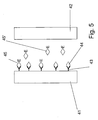
- Figs 4 and 5 show a competition format for an assay device in accordance with the invention.
- the sample cell is defined by two electrodes 41, 42.
- Electrode 41 has analyte-receptors 43 disposed thereon.
- the redox enzyme 45 comprises the enzyme coupled to an analyte or an analyte mimetic. In the absence of analyte, as shown in Fig. 4 , redox enzyme 45 is coupled to analyte receptor 43, resulting in an asymmetry in the distribution of the redox enzyme. Additional redox enzyme 45' may be present in the bulk of the sample depending on the amount of redox enzyme, analyte receptors and the affinity of the analyte receptors for the redox enzyme.
- analyte 44 when analyte 44 is present, it competes with redox enzyme 45 for the analyte receptor 43, resulting in the displacement of at least some of the redox enzyme 45 from the analyte receptors 43, creating a less asymmetric distribution of the redox enzyme and thus the ability to determine analyte in a sample.
- Figs. 6A-C show a sample cell for a device in accordance with the invention, constructed using facing electrodes.
- the device is formed from a top layer 61 and bottom layer 62 , each having a conductive surface (61', 62') facing the interior of the device, and an insulating spacer layer 63.
- Contacts 64 and 65 extend from the top layer 61 and bottom layer 62 to allow contact with the conductive surfaces for either potentiometric or amperometric measurements.
- the conductive layer 63 has an opening therein that together with the facing conductive surfaces 61' and 62' defines a sample cell. This sample cell is open to the exterior for introduction of sample, for example through an opening 66 at the end device as shown in Fig.
- one of the conductive surfaces (61' or 62') has the analyte receptor (immobilized test reagent) disposed thereon.
- the remainder of the reagents for determination of analyte may be disposed within the sample cell as a dried reagent layer 67, or may be added to the sample prior to introduction to the sample cell.
- the sample cell portion as shown in Figs 6A-C is generally constructed as a single use, disposable component.
- the first and electrodes may be disposed on the same surface within the sample cell.
- This configuration is referred to herein as side-by-side electrodes.
- Figs. 7A-C show non-limiting examples of configurations that can be used for side-by-side configurations, including parallel strips ( Fig. 7A ), interdigitated strips (7B) and concentric rings ( Fig. 7C ).
- asymmetry in redox enzyme distribution between one electrode 71 and the other electrode 72 results in a measurable chemical potential gradient between the two electrodes.
- sample cell portions as shown in Figs 7A-C are generally constructed as a single use, disposable component.
- the device of the invention has a means for communicating the observed potential or current to a user in a meaningful way indicative of the determination of analyte. This can range from a simple qualitative result (analyte present or not present), or to a specific numerical value for the amount of analyte. The sophistication of the communication means varies accordingly.
- the device may have at a visible location a spot of a material that changes color in response to the passage of current or the application of the potential difference created by an asymmetry above a threshold level.
- the device does not need a separate meter portion, and may be simply a disposable test strip with an indicator spot on the outside.
- the sample cell will be contained within a disposable test strip that is inserted into a reusable meter.
- the meter will contain the electronics for measuring the potential difference or current at a defined period of time after introduction of a sample or test strip, and for conversion of the measured value to a displayed value. This conversion may make use of a look-up table that converts specific value of current or potential to values of analyte depending on the calibration values for the specific device geometry and analyte.
- Fig. 8 shows an external view of a meter in accordance with the invention.
- the meter has a housing 81 having a display 82 and one or more control interfaces 83 (for example power buttons, or scroll wheels etc).
- the housing has a slot 84 for receiving a test device.
- circuitry Internal to the housing 81 is circuitry for applying a potential or current to the electrodes of the test device when a sample is applied. This may be done following an initialization signal from a user, or following an automated detection of test device insertion and sample application.
- Suitable circuits usable in the meter of the invention are known in the art, for example from US Patent Publication No. US 2005-0265094 Al .
- Fig. 9 an ideal voltmeter 942 is provided which can measure the potential across the electrodes 941,938.
- Switch 944 is provided which is opened when the potential is to be measured of closed for measurement of current When ope, the cell 939 is "floating" as to at least one of its electrodes, permitting a voltage measurement that is unaffected by signals at the amplifier 935.
- the switch 944 may be a mechanical switch (e.g. a relay) or an FET (field-effect transistor) switch, or a solid-state switch. In a simple case the switch opens to an open circuit; more generally it could open to a very high resistance.
- This circuit can be used to measure either a potential difference or a current difference.
- other circuits including much simpler and more complicated circuits can be used to achieve application of either or both of a potential difference or a current.
- the circuit of Fig. 9 can also be used to apply a potential difference to the test device of the invention. While, as discussed above, such application of potential is not required to perform the measurement of the invention, application of potential prior to the measurement (particularly in a test device with facing electrode construction) can result in a more rapid measurement time by effectively driving analyte and/or analyte-binding enzyme component towards the electrode with the immobilized reagent using what is in essence electrophoresis, provided that the analyte or analyte-binding enzyme component is charged under the conditions (particularly pH) found within the test device. A step function or a sine wave passing from negative to positive potential difference could also effect something similar to washing in situ within the test device.
- the present invention provides the ability to perform binding essays for the detection of analyte with electrochemical detection, without the need to apply an external potential or current, and without the need for washing steps commonly employed in sandwich immunoassay procedures. Because of this, the apparatus used to perform the assay can be much simpler, easy to use, and less expensive. In addition, the device components in an electrochemical assay are more robust than those used for example in optical measurements, facilitating the manufacture of the low cost reusable meter for use with disposable test devices.
- the present invention can make use of small samples of blood, tears, saliva, or sweat, with minimal invasiveness to the subject. (samples of less than 10 ul, preferably less than 1 ul are particularly desirable for blood tests). Further, the present invention can provide for very rapid test times. Common immunoassay procedures take up to an hour or more.
- the small volume of the test devices of the invention and the sensitivity of the test to small differences in the distribution of the enzyme means that shorter times (for example less the 30 minutes, more preferably less than 10 minutes, and most preferably less than 1 minute) are accessible depending on the concentration of analyte to be measured and the binding kinetics of the analyte with the binding elements of the mobile and immobilized reagents.
- endogenous glucose can be used as a component of the redox substrate in a glucose oxidase-based system when the sample is a blood sample.
- An electrochemical cell test strip comprising two gold electrodes separated by a double-sided adhesive layer was constructed using the method described in US Patent Publication No. US-2005-0258035-A1 .
- An total of 100 nL enzyme solution (27 mg/mL glucose oxidase in 100 mM sodium citrate buffer pH 4.1) was dispensed onto the two electrodes and allowed to dry.
- Test strips were made with different ratios of electrode enzyme activity by apportioning the 100 nL enzyme solution between the two electrodes, with the balance made up with water.
- Fig. 12 shows that peak potential difference attained correlated with the ratio of enzyme activity dispensed on each electrode.
- Fig. 13 shows that peak current attained correlated with the ratio of enzyme activity dispensed on each electrode.
- the amount of enzyme (E1) present at one electrode can be determined independent of the amount (E2) present at the other electrode.
- Test strips containing a range of 0.25 microgram to 1 microgram of glucose oxidase were made, with the enzymes distributed between the two electrodes such that R was between 1.5 and 19. These strips were made by dispensing a solution of 0.25 microgram to 1. microgram glucose oxidase in 100 nL of 100 mM sodium citrate buffer pH 4.1 onto electrode 1, and a solution of 0 to 0.4 microgram glucose oxidase in 100 nL of 100 mM sodium citrate buffer pH 4.1 onto electrode 2, then allowing the dispensed solutions to dry.
- Fig. 14 shows a schematic of known total enzyme E t on the x-axis and measured I 300 on the y-axis.
- Fig. 18 shows calculated values of E 1 versus actual values of E 1 , for strips with varying amounts of enzyme on the two electrodes.
- Fig. 18 indicates that our estimated values for the enzyme dispensed on one electrode correlated well with the actual amount that was dispensed, and were independent of the amount of enzyme dispensed on the other electrode.
Landscapes
- Health & Medical Sciences (AREA)
- Life Sciences & Earth Sciences (AREA)
- Chemical & Material Sciences (AREA)
- Immunology (AREA)
- Engineering & Computer Science (AREA)
- Molecular Biology (AREA)
- Organic Chemistry (AREA)
- Urology & Nephrology (AREA)
- Hematology (AREA)
- Analytical Chemistry (AREA)
- Physics & Mathematics (AREA)
- Biochemistry (AREA)
- Biomedical Technology (AREA)
- General Health & Medical Sciences (AREA)
- Biotechnology (AREA)
- Microbiology (AREA)
- Wood Science & Technology (AREA)
- Zoology (AREA)
- Proteomics, Peptides & Aminoacids (AREA)
- General Physics & Mathematics (AREA)
- Pathology (AREA)
- Food Science & Technology (AREA)
- Medicinal Chemistry (AREA)
- Cell Biology (AREA)
- General Engineering & Computer Science (AREA)
- Genetics & Genomics (AREA)
- Bioinformatics & Cheminformatics (AREA)
- Biophysics (AREA)
- Chemical Kinetics & Catalysis (AREA)
- Electrochemistry (AREA)
- Tropical Medicine & Parasitology (AREA)
- Toxicology (AREA)
- Apparatus Associated With Microorganisms And Enzymes (AREA)
- Measuring Or Testing Involving Enzymes Or Micro-Organisms (AREA)
- Investigating Or Analysing Biological Materials (AREA)
Claims (15)
- Procédé pour la mesure d'un analyte dans un échantillon, comprenant les étapes consistant à :(a) introduire l'échantillon dans une cellule d'essai comprenant(i) des première et seconde électrodes, un réactif d'essai immobilisé comprenant une partie de liaison à l'analyte étant disposé sur la surface de la première électrode ; et(ii) un réactif d'essai mobile comprenant une partie enzyme redox et une partie de liaison à l'analyte ;de façon à ce que le réactif d'essai mobile ait une première distribution par rapport aux électrodes lorsque l'analyte est présent dans l'échantillon et une seconde distribution par rapport aux électrodes lorsque l'analyte n'est pas présent dans l'échantillon, l'une desdites première et seconde distributions étant asymétrique entre les électrodes et l'autre des première et seconde distributions étant symétrique ou moins asymétrique entre les électrodes,(b) introduire un substrat redox pour l'enzyme redox dans la cellule d'essai, l'enzyme redox agissant sur ledit substrat redox pour produire un gradient de potentiel chimique entre les première et seconde électrodes, l'ampleur du gradient de potentiel chimique étant déterminée par la distribution du réactif d'essai mobile et donc la présence d'analyte et(c) détecter le gradient de potentiel chimique entre les première et seconde électrodes par observation de la différence de potentiel entre les électrodes ou par observation de la circulation de courant entre les électrodes pour mesurer l'analyte dans l'échantillon, dans lequel la formation et la détection du gradient de potentiel chimique sont effectuées sans avoir besoin d'appliquer un potentiel ou courant externe.
- Procédé selon la revendication 1, dans lequel
si l'analyte est présent dans l'échantillon présent dans la cellule d'essai, au moins une partie du réactif d'essai mobile devient immobilisé sur la première électrode ce qui crée de cette manière une distribution asymétrique de la concentration de l'enzyme redox entre les première et seconde électrodes et
dans lequel plus la quantité d'analyte dans l'échantillon est grande plus l'asymétrie est grande et plus le gradient de potentiel résultant est grand. - Procédé selon la revendication 1, dans lequel
l'enzyme redox est couplée à l'analyte ou un analogue de l'analyte, l'analyte et l'analogue de l'analyte étant tous deux susceptibles de se lier au réactif d'essai immobilisé, et, si un échantillon est introduit dans la cellule d'essai, tout analyte présent dans l'échantillon sera en compétition avec l'enzyme redox pour les sites de liaison fournis par le réactif d'essai immobilisé ce qui a pour résultat le déplacement d'au moins une partie de l'enzyme redox ce qui réduit de cette manière l'asymétrie de la concentration de l'enzyme redox et
dans lequel plus la quantité d'analyte dans l'échantillon est grande plus l'asymétrie est faible et plus le gradient de potentiel résultant est faible. - Procédé selon la revendication 1, dans lequel la partie de liaison à l'analyte du réactif d'essai immobilisé et l'analyte sont une paire anticorps-antigène ou une paire anticorps/haptène.
- Procédé selon la revendication 1, dans lequel la partie de liaison à l'analyte du réactif d'essai immobilisé est un récepteur de médicament.
- Procédé selon la revendication 1, dans lequel la partie de liaison à l'analyte du réactif d'essai immobilisé est un récepteur hormonal.
- Procédé selon l'une quelconque des revendications précédentes, dans lequel l'enzyme redox et le substrat redox comprennent du glucose et un composé médiateur.
- Appareil pour la mesure d'un analyte dans un échantillon comprenant(a) une bandelette d'essai comprenant(i) des première et seconde électrodes disposées pour être en contact avec une cellule d'essai pour la réception de l'échantillon, un réactif d'essai immobilisé étant disposé sur la surface de la première électrode, ledit réactif d'essai immobilisé comprenant une partie de liaison à l'analyte ;(ii) un réactif d'essai mobile comprenant une partie enzyme redox et une partie de liaison à l'analyte, de façon à ce que le réactif d'essai mobile ait une première distribution par rapport aux électrodes lorsque l'analyte est présent dans l'échantillon et une seconde distribution par rapport aux électrodes lorsque l'analyte n'est pas présent dans l'échantillon, l'une desdites première et seconde distributions étant asymétrique entre les électrodes et l'autre des première et seconde distributions étant symétrique ou moins asymétrique entre les électrodes, et(b) un circuit pour la détection de la distribution symétrique, moins asymétrique ou asymétrique du réactif d'essai mobile dans la cellule d'essai en l'absence d'un potentiel ou courant externe appliqué et(c) un moyen pour la communication de la distribution détectée à un utilisateur.
- Appareil selon la revendication 8, dans lequel le circuit détecte la différence de potentiel entre les première et seconde électrodes.
- Appareil selon la revendication 8, dans lequel le circuit détecte la circulation de courant dans un circuit comprenant les électrodes.
- Appareil selon l'une quelconque des revendications 8 à 10, dans lequel les première et seconde électrodes sont dans une configuration en regard l'une de l'autre.
- Appareil selon l'une quelconque des revendications 8 à 10, dans lequel les première et seconde électrodes sont dans une configuration côte à côte.
- Appareil selon la revendication 8, dans lequel la partie de liaison à l'analyte du réactif d'essai immobilisé et l'analyte sont une paire anticorps-antigène ou une paire anticorps/haptène.
- Appareil selon la revendication 8, dans lequel la partie de liaison à l'analyte du réactif d'essai immobilisé est un récepteur de médicament ou hormonal.
- Appareil selon l'une quelconque des revendications 8 à 14, dans lequel l'enzyme redox et le substrat redox comprennent du glucose et un composé médiateur.
Priority Applications (1)
| Application Number | Priority Date | Filing Date | Title |
|---|---|---|---|
| EP12199820.7A EP2584044B1 (fr) | 2007-07-26 | 2008-07-24 | Appareil de détection d'analyte électrochimique et procédé |
Applications Claiming Priority (2)
| Application Number | Priority Date | Filing Date | Title |
|---|---|---|---|
| US95209907P | 2007-07-26 | 2007-07-26 | |
| PCT/US2008/071073 WO2009015291A1 (fr) | 2007-07-26 | 2008-07-24 | Appareil et procédé de détection d'analyte électrochimique |
Related Child Applications (1)
| Application Number | Title | Priority Date | Filing Date |
|---|---|---|---|
| EP12199820.7A Division EP2584044B1 (fr) | 2007-07-26 | 2008-07-24 | Appareil de détection d'analyte électrochimique et procédé |
Publications (3)
| Publication Number | Publication Date |
|---|---|
| EP2174135A1 EP2174135A1 (fr) | 2010-04-14 |
| EP2174135A4 EP2174135A4 (fr) | 2010-08-25 |
| EP2174135B1 true EP2174135B1 (fr) | 2013-01-02 |
Family
ID=40281828
Family Applications (2)
| Application Number | Title | Priority Date | Filing Date |
|---|---|---|---|
| EP12199820.7A Active EP2584044B1 (fr) | 2007-07-26 | 2008-07-24 | Appareil de détection d'analyte électrochimique et procédé |
| EP08782340A Active EP2174135B1 (fr) | 2007-07-26 | 2008-07-24 | Appareil et procede de detection d'analyte electrochimique |
Family Applications Before (1)
| Application Number | Title | Priority Date | Filing Date |
|---|---|---|---|
| EP12199820.7A Active EP2584044B1 (fr) | 2007-07-26 | 2008-07-24 | Appareil de détection d'analyte électrochimique et procédé |
Country Status (7)
| Country | Link |
|---|---|
| US (3) | US20090026075A1 (fr) |
| EP (2) | EP2584044B1 (fr) |
| KR (1) | KR101532064B1 (fr) |
| CN (2) | CN106442961B (fr) |
| AU (1) | AU2008279042B2 (fr) |
| CA (1) | CA2694045C (fr) |
| WO (1) | WO2009015291A1 (fr) |
Families Citing this family (52)
| Publication number | Priority date | Publication date | Assignee | Title |
|---|---|---|---|---|
| US6391005B1 (en) | 1998-03-30 | 2002-05-21 | Agilent Technologies, Inc. | Apparatus and method for penetration with shaft having a sensor for sensing penetration depth |
| US8641644B2 (en) | 2000-11-21 | 2014-02-04 | Sanofi-Aventis Deutschland Gmbh | Blood testing apparatus having a rotatable cartridge with multiple lancing elements and testing means |
| AU2002315180A1 (en) | 2001-06-12 | 2002-12-23 | Pelikan Technologies, Inc. | Electric lancet actuator |
| US9427532B2 (en) | 2001-06-12 | 2016-08-30 | Sanofi-Aventis Deutschland Gmbh | Tissue penetration device |
| US7025774B2 (en) * | 2001-06-12 | 2006-04-11 | Pelikan Technologies, Inc. | Tissue penetration device |
| EP1404235A4 (fr) | 2001-06-12 | 2008-08-20 | Pelikan Technologies Inc | Procede et appareil pour un dispositif de lancement de lancette integre sur une cartouche de prelevement de sang |
| DE60234598D1 (de) | 2001-06-12 | 2010-01-14 | Pelikan Technologies Inc | Selbstoptimierende lanzettenvorrichtung mit adaptationsmittel für zeitliche schwankungen von hauteigenschaften |
| US8337419B2 (en) | 2002-04-19 | 2012-12-25 | Sanofi-Aventis Deutschland Gmbh | Tissue penetration device |
| US9795747B2 (en) | 2010-06-02 | 2017-10-24 | Sanofi-Aventis Deutschland Gmbh | Methods and apparatus for lancet actuation |
| US9226699B2 (en) | 2002-04-19 | 2016-01-05 | Sanofi-Aventis Deutschland Gmbh | Body fluid sampling module with a continuous compression tissue interface surface |
| US7981056B2 (en) | 2002-04-19 | 2011-07-19 | Pelikan Technologies, Inc. | Methods and apparatus for lancet actuation |
| US7232451B2 (en) | 2002-04-19 | 2007-06-19 | Pelikan Technologies, Inc. | Method and apparatus for penetrating tissue |
| US7198606B2 (en) | 2002-04-19 | 2007-04-03 | Pelikan Technologies, Inc. | Method and apparatus for a multi-use body fluid sampling device with analyte sensing |
| US7297122B2 (en) | 2002-04-19 | 2007-11-20 | Pelikan Technologies, Inc. | Method and apparatus for penetrating tissue |
| US8579831B2 (en) | 2002-04-19 | 2013-11-12 | Sanofi-Aventis Deutschland Gmbh | Method and apparatus for penetrating tissue |
| US7674232B2 (en) | 2002-04-19 | 2010-03-09 | Pelikan Technologies, Inc. | Method and apparatus for penetrating tissue |
| US7491178B2 (en) | 2002-04-19 | 2009-02-17 | Pelikan Technologies, Inc. | Method and apparatus for penetrating tissue |
| US8784335B2 (en) | 2002-04-19 | 2014-07-22 | Sanofi-Aventis Deutschland Gmbh | Body fluid sampling device with a capacitive sensor |
| US7901362B2 (en) | 2002-04-19 | 2011-03-08 | Pelikan Technologies, Inc. | Method and apparatus for penetrating tissue |
| US7909778B2 (en) | 2002-04-19 | 2011-03-22 | Pelikan Technologies, Inc. | Method and apparatus for penetrating tissue |
| US8221334B2 (en) | 2002-04-19 | 2012-07-17 | Sanofi-Aventis Deutschland Gmbh | Method and apparatus for penetrating tissue |
| US8702624B2 (en) | 2006-09-29 | 2014-04-22 | Sanofi-Aventis Deutschland Gmbh | Analyte measurement device with a single shot actuator |
| US9248267B2 (en) | 2002-04-19 | 2016-02-02 | Sanofi-Aventis Deustchland Gmbh | Tissue penetration device |
| US7892183B2 (en) | 2002-04-19 | 2011-02-22 | Pelikan Technologies, Inc. | Method and apparatus for body fluid sampling and analyte sensing |
| US7331931B2 (en) | 2002-04-19 | 2008-02-19 | Pelikan Technologies, Inc. | Method and apparatus for penetrating tissue |
| US7892185B2 (en) | 2002-04-19 | 2011-02-22 | Pelikan Technologies, Inc. | Method and apparatus for body fluid sampling and analyte sensing |
| US7175642B2 (en) | 2002-04-19 | 2007-02-13 | Pelikan Technologies, Inc. | Methods and apparatus for lancet actuation |
| US9795334B2 (en) | 2002-04-19 | 2017-10-24 | Sanofi-Aventis Deutschland Gmbh | Method and apparatus for penetrating tissue |
| US7976476B2 (en) | 2002-04-19 | 2011-07-12 | Pelikan Technologies, Inc. | Device and method for variable speed lancet |
| US7547287B2 (en) | 2002-04-19 | 2009-06-16 | Pelikan Technologies, Inc. | Method and apparatus for penetrating tissue |
| US7229458B2 (en) | 2002-04-19 | 2007-06-12 | Pelikan Technologies, Inc. | Method and apparatus for penetrating tissue |
| US8360992B2 (en) | 2002-04-19 | 2013-01-29 | Sanofi-Aventis Deutschland Gmbh | Method and apparatus for penetrating tissue |
| US9314194B2 (en) | 2002-04-19 | 2016-04-19 | Sanofi-Aventis Deutschland Gmbh | Tissue penetration device |
| US8267870B2 (en) | 2002-04-19 | 2012-09-18 | Sanofi-Aventis Deutschland Gmbh | Method and apparatus for body fluid sampling with hybrid actuation |
| US8574895B2 (en) | 2002-12-30 | 2013-11-05 | Sanofi-Aventis Deutschland Gmbh | Method and apparatus using optical techniques to measure analyte levels |
| DE602004028463D1 (de) | 2003-05-30 | 2010-09-16 | Pelikan Technologies Inc | Verfahren und vorrichtung zur injektion von flüssigkeit |
| WO2004107964A2 (fr) | 2003-06-06 | 2004-12-16 | Pelikan Technologies, Inc. | Procede et appareil d'echantillonnage de fluides anatomiques et d'examen de l'analysat |
| WO2006001797A1 (fr) | 2004-06-14 | 2006-01-05 | Pelikan Technologies, Inc. | Element penetrant peu douloureux |
| US8282576B2 (en) | 2003-09-29 | 2012-10-09 | Sanofi-Aventis Deutschland Gmbh | Method and apparatus for an improved sample capture device |
| EP1680014A4 (fr) | 2003-10-14 | 2009-01-21 | Pelikan Technologies Inc | Procede et appareil fournissant une interface-utilisateur variable |
| US7822454B1 (en) | 2005-01-03 | 2010-10-26 | Pelikan Technologies, Inc. | Fluid sampling device with improved analyte detecting member configuration |
| EP1706026B1 (fr) | 2003-12-31 | 2017-03-01 | Sanofi-Aventis Deutschland GmbH | Procédé et appareil permettant d'améliorer le flux fluidique et le prélèvement d'échantillons |
| WO2006011062A2 (fr) | 2004-05-20 | 2006-02-02 | Albatros Technologies Gmbh & Co. Kg | Hydrogel imprimable pour biocapteurs |
| WO2005120365A1 (fr) | 2004-06-03 | 2005-12-22 | Pelikan Technologies, Inc. | Procede et appareil pour la fabrication d'un dispositif d'echantillonnage de liquides |
| US9775553B2 (en) | 2004-06-03 | 2017-10-03 | Sanofi-Aventis Deutschland Gmbh | Method and apparatus for a fluid sampling device |
| US8652831B2 (en) | 2004-12-30 | 2014-02-18 | Sanofi-Aventis Deutschland Gmbh | Method and apparatus for analyte measurement test time |
| WO2009126900A1 (fr) | 2008-04-11 | 2009-10-15 | Pelikan Technologies, Inc. | Procédé et appareil pour dispositif de détection d’analyte |
| US9375169B2 (en) | 2009-01-30 | 2016-06-28 | Sanofi-Aventis Deutschland Gmbh | Cam drive for managing disposable penetrating member actions with a single motor and motor and control system |
| US8965476B2 (en) | 2010-04-16 | 2015-02-24 | Sanofi-Aventis Deutschland Gmbh | Tissue penetration device |
| CN102409359A (zh) * | 2011-11-22 | 2012-04-11 | 中国铝业股份有限公司 | 一种铝电解槽中氧化铝浓度的在线测定装置及方法 |
| EP2657347A1 (fr) | 2012-04-26 | 2013-10-30 | Université Paris Diderot - Paris 7 | Analyse compétitive électrochimique et son utilisation |
| CN110609139B (zh) * | 2018-06-14 | 2023-06-30 | 深圳市理邦精密仪器股份有限公司 | 抗原浓度过量检测方法、装置及存储介质 |
Family Cites Families (38)
| Publication number | Priority date | Publication date | Assignee | Title |
|---|---|---|---|---|
| US5622871A (en) | 1987-04-27 | 1997-04-22 | Unilever Patent Holdings B.V. | Capillary immunoassay and device therefor comprising mobilizable particulate labelled reagents |
| US3654090A (en) * | 1968-09-24 | 1972-04-04 | Organon | Method for the determination of antigens and antibodies |
| US5677132A (en) * | 1971-05-20 | 1997-10-14 | Strahilevitz; Meir | Immunological assay reagent package |
| US4642285A (en) | 1975-09-29 | 1987-02-10 | Diamedix Corporation | Sandwich EIA for antigen |
| NL7610608A (nl) | 1976-09-24 | 1978-03-29 | Akzo Nv | Werkwijze voor het stabiliseren van peroxidase- -bevattende composities. |
| GB8402058D0 (en) * | 1984-01-26 | 1984-02-29 | Serono Diagnostics Ltd | Methods of assay |
| US4746631A (en) * | 1985-05-09 | 1988-05-24 | Ultra Diagnostics Corporation | Immunoassay method, device, and test kit |
| JPS6319559A (ja) | 1986-07-11 | 1988-01-27 | Fuji Photo Film Co Ltd | 免疫分析方法 |
| US6794160B1 (en) * | 1986-10-24 | 2004-09-21 | Salk Inst For Biological Studi | Hormone receptor compositions and methods |
| US4943522A (en) * | 1987-06-01 | 1990-07-24 | Quidel | Lateral flow, non-bibulous membrane assay protocols |
| AU2684488A (en) * | 1988-06-27 | 1990-01-04 | Carter-Wallace, Inc. | Test device and method for colored particle immunoassay |
| US6306594B1 (en) * | 1988-11-14 | 2001-10-23 | I-Stat Corporation | Methods for microdispensing patterened layers |
| DK0386644T3 (da) | 1989-03-10 | 1997-10-13 | Hoffmann La Roche | Reagenser til bestemmelse af lægemidler |
| US5198367A (en) | 1989-06-09 | 1993-03-30 | Masuo Aizawa | Homogeneous amperometric immunoassay |
| DE4003194A1 (de) * | 1990-02-03 | 1991-08-08 | Boehringer Mannheim Gmbh | Verfahren und sensorelektrodensystem zur elektrochemischen bestimmung eines analyts oder einer oxidoreduktase sowie verwendung hierfuer geeigneter verbindungen |
| JP2868900B2 (ja) * | 1991-01-11 | 1999-03-10 | クイデル コーポレイション | ワンステップ側方流非吸収性アッセイ |
| US5413690A (en) * | 1993-07-23 | 1995-05-09 | Boehringer Mannheim Corporation | Potentiometric biosensor and the method of its use |
| US5427912A (en) * | 1993-08-27 | 1995-06-27 | Boehringer Mannheim Corporation | Electrochemical enzymatic complementation immunoassay |
| US5494831A (en) | 1993-08-30 | 1996-02-27 | Hughes Aircraft Company | Electrochemical immunosensor system and methods |
| IL108726A (en) * | 1994-02-22 | 1999-12-31 | Yissum Res Dev Co | Electrobiochemical method and system for the determination of an analyte which is a member of a recognition pair in a liquid medium and electrodes therefor |
| US5712172A (en) * | 1995-05-18 | 1998-01-27 | Wyntek Diagnostics, Inc. | One step immunochromatographic device and method of use |
| US5981298A (en) * | 1995-12-13 | 1999-11-09 | Surmodics, Inc. | Immunoassay device and method |
| US5708247A (en) * | 1996-02-14 | 1998-01-13 | Selfcare, Inc. | Disposable glucose test strips, and methods and compositions for making same |
| US6020209A (en) | 1997-04-28 | 2000-02-01 | The United States Of America As Represented By The Secretary Of The Navy | Microcapillary-based flow-through immunosensor and displacement immunoassay using the same |
| US6635434B1 (en) * | 1999-09-17 | 2003-10-21 | Exiqon A/S | Immunoassay for pesticides and their degradation products |
| KR100348351B1 (ko) * | 2000-05-24 | 2002-08-09 | 주식회사 바이오디지트 | 전기화학 멤브레인 스트립 바이오센서 |
| EP1308720B1 (fr) * | 2001-05-15 | 2005-08-24 | Matsushita Electric Industrial Co., Ltd. | Biocapteur |
| CN1227525C (zh) * | 2001-06-14 | 2005-11-16 | 松下电器产业株式会社 | 生物传感器 |
| IL145182A (en) * | 2001-08-29 | 2005-11-20 | Yissum Res Dev Co | Self-powered biosensor |
| AU2002367817B2 (en) * | 2001-11-09 | 2008-05-29 | Nanosphere, Inc. | Bioconjugate-nanoparticle probes |
| US20030175828A1 (en) | 2002-03-15 | 2003-09-18 | Lazar James G. | Signal amplification by Hybrid Capture |
| US20030198966A1 (en) * | 2002-04-19 | 2003-10-23 | Stojanovic Milan N. | Displacement assay for detection of small molecules |
| CN1447114A (zh) * | 2003-02-14 | 2003-10-08 | 李伟 | 氧化还原酶标记的电化学检测生物活性物质的方法及装置 |
| MXPA06001914A (es) * | 2003-08-21 | 2006-05-31 | Agamatrix Inc | Metodo y aparato para ensayo de propiedades electroquimicas. |
| US7220842B2 (en) * | 2004-04-05 | 2007-05-22 | Dade Behring Inc. | Immunoassays for buprenorphine and norbuprenorphine |
| AU2005246102B8 (en) | 2004-05-21 | 2010-09-30 | Agamatrix, Inc. | Electrochemical cell and method of making an electrochemical cell |
| US7964146B2 (en) | 2004-05-30 | 2011-06-21 | Agamatrix, Inc. | Measuring device and methods for use therewith |
| US20060160100A1 (en) * | 2005-01-19 | 2006-07-20 | Agency For Science, Technology And Research | Enzymatic electrochemical detection assay using protective monolayer and device therefor |
-
2008
- 2008-07-24 EP EP12199820.7A patent/EP2584044B1/fr active Active
- 2008-07-24 WO PCT/US2008/071073 patent/WO2009015291A1/fr not_active Ceased
- 2008-07-24 CN CN201610575436.2A patent/CN106442961B/zh active Active
- 2008-07-24 CN CN200880108191.6A patent/CN101802612B/zh active Active
- 2008-07-24 KR KR1020107004269A patent/KR101532064B1/ko not_active Expired - Fee Related
- 2008-07-24 AU AU2008279042A patent/AU2008279042B2/en not_active Ceased
- 2008-07-24 EP EP08782340A patent/EP2174135B1/fr active Active
- 2008-07-24 US US12/179,446 patent/US20090026075A1/en not_active Abandoned
- 2008-07-24 CA CA2694045A patent/CA2694045C/fr active Active
-
2016
- 2016-02-08 US US15/017,787 patent/US9939440B2/en active Active
-
2018
- 2018-04-03 US US15/944,148 patent/US20180231552A1/en not_active Abandoned
Also Published As
| Publication number | Publication date |
|---|---|
| CA2694045A1 (fr) | 2009-01-29 |
| EP2174135A1 (fr) | 2010-04-14 |
| CN106442961B (zh) | 2018-08-14 |
| US20180231552A1 (en) | 2018-08-16 |
| AU2008279042B2 (en) | 2014-03-13 |
| KR20100065298A (ko) | 2010-06-16 |
| EP2174135A4 (fr) | 2010-08-25 |
| US20160231321A1 (en) | 2016-08-11 |
| CN101802612B (zh) | 2016-08-10 |
| CN106442961A (zh) | 2017-02-22 |
| US20090026075A1 (en) | 2009-01-29 |
| EP2584044A3 (fr) | 2013-11-27 |
| KR101532064B1 (ko) | 2015-06-26 |
| CA2694045C (fr) | 2016-06-21 |
| CN101802612A (zh) | 2010-08-11 |
| EP2584044A2 (fr) | 2013-04-24 |
| EP2584044B1 (fr) | 2015-04-22 |
| WO2009015291A1 (fr) | 2009-01-29 |
| AU2008279042A1 (en) | 2009-01-29 |
| US9939440B2 (en) | 2018-04-10 |
| HK1184196A1 (en) | 2014-01-17 |
Similar Documents
| Publication | Publication Date | Title |
|---|---|---|
| EP2174135B1 (fr) | Appareil et procede de detection d'analyte electrochimique | |
| US9863942B2 (en) | Biosensor apparatus and methods of use | |
| Noiphung et al. | Electrochemical detection of glucose from whole blood using paper-based microfluidic devices | |
| JP5781603B2 (ja) | 結合反応の電気化学的検出方法 | |
| Kergaravat et al. | Electrochemical magneto immunosensor for the detection of anti-TG2 antibody in celiac disease | |
| CN102116753A (zh) | 基于初始填充速度测量全血细胞比容的系统、装置和方法 | |
| Moreno-Guzmán et al. | Disposable immunosensor for cortisol using functionalized magnetic particles | |
| JP2008209323A (ja) | 酵素センサ、該酵素センサを使用した分析方法及びキット | |
| Nian et al. | Electrochemical immunoassay of cotinine in serum based on nanoparticle probe and immunochromatographic strip | |
| US20150226735A1 (en) | Systems and methods for enzyme detection | |
| WO2013039455A1 (fr) | Capteur ampérométrique | |
| AU2013204779B2 (en) | Electrochemical analyte detection apparatus and method | |
| HK1184196B (en) | Electrochemical analyte detections apparatus and method | |
| HK1101765B (en) | Biosensor apparatus and methods of use | |
| HK1151589A (en) | Biosensor apparatus and methods of use |
Legal Events
| Date | Code | Title | Description |
|---|---|---|---|
| PUAI | Public reference made under article 153(3) epc to a published international application that has entered the european phase |
Free format text: ORIGINAL CODE: 0009012 |
|
| 17P | Request for examination filed |
Effective date: 20100121 |
|
| AK | Designated contracting states |
Kind code of ref document: A1 Designated state(s): AT BE BG CH CY CZ DE DK EE ES FI FR GB GR HR HU IE IS IT LI LT LU LV MC MT NL NO PL PT RO SE SI SK TR |
|
| AX | Request for extension of the european patent |
Extension state: AL BA MK RS |
|
| A4 | Supplementary search report drawn up and despatched |
Effective date: 20100726 |
|
| DAX | Request for extension of the european patent (deleted) | ||
| RAP1 | Party data changed (applicant data changed or rights of an application transferred) |
Owner name: AGAMATRIX, INC. |
|
| GRAP | Despatch of communication of intention to grant a patent |
Free format text: ORIGINAL CODE: EPIDOSNIGR1 |
|
| GRAS | Grant fee paid |
Free format text: ORIGINAL CODE: EPIDOSNIGR3 |
|
| GRAA | (expected) grant |
Free format text: ORIGINAL CODE: 0009210 |
|
| AK | Designated contracting states |
Kind code of ref document: B1 Designated state(s): AT BE BG CH CY CZ DE DK EE ES FI FR GB GR HR HU IE IS IT LI LT LU LV MC MT NL NO PL PT RO SE SI SK TR |
|
| REG | Reference to a national code |
Ref country code: GB Ref legal event code: FG4D |
|
| REG | Reference to a national code |
Ref country code: AT Ref legal event code: REF Ref document number: 591876 Country of ref document: AT Kind code of ref document: T Effective date: 20130115 Ref country code: CH Ref legal event code: EP |
|
| REG | Reference to a national code |
Ref country code: IE Ref legal event code: FG4D |
|
| REG | Reference to a national code |
Ref country code: DE Ref legal event code: R096 Ref document number: 602008021403 Country of ref document: DE Effective date: 20130228 |
|
| REG | Reference to a national code |
Ref country code: AT Ref legal event code: MK05 Ref document number: 591876 Country of ref document: AT Kind code of ref document: T Effective date: 20130102 |
|
| REG | Reference to a national code |
Ref country code: NL Ref legal event code: VDEP Effective date: 20130102 |
|
| PG25 | Lapsed in a contracting state [announced via postgrant information from national office to epo] |
Ref country code: SI Free format text: LAPSE BECAUSE OF FAILURE TO SUBMIT A TRANSLATION OF THE DESCRIPTION OR TO PAY THE FEE WITHIN THE PRESCRIBED TIME-LIMIT Effective date: 20130102 |
|
| REG | Reference to a national code |
Ref country code: LT Ref legal event code: MG4D |
|
| PG25 | Lapsed in a contracting state [announced via postgrant information from national office to epo] |
Ref country code: IS Free format text: LAPSE BECAUSE OF FAILURE TO SUBMIT A TRANSLATION OF THE DESCRIPTION OR TO PAY THE FEE WITHIN THE PRESCRIBED TIME-LIMIT Effective date: 20130502 Ref country code: CZ Free format text: LAPSE BECAUSE OF FAILURE TO SUBMIT A TRANSLATION OF THE DESCRIPTION OR TO PAY THE FEE WITHIN THE PRESCRIBED TIME-LIMIT Effective date: 20130102 Ref country code: AT Free format text: LAPSE BECAUSE OF FAILURE TO SUBMIT A TRANSLATION OF THE DESCRIPTION OR TO PAY THE FEE WITHIN THE PRESCRIBED TIME-LIMIT Effective date: 20130102 Ref country code: BG Free format text: LAPSE BECAUSE OF FAILURE TO SUBMIT A TRANSLATION OF THE DESCRIPTION OR TO PAY THE FEE WITHIN THE PRESCRIBED TIME-LIMIT Effective date: 20130402 Ref country code: NO Free format text: LAPSE BECAUSE OF FAILURE TO SUBMIT A TRANSLATION OF THE DESCRIPTION OR TO PAY THE FEE WITHIN THE PRESCRIBED TIME-LIMIT Effective date: 20130402 Ref country code: ES Free format text: LAPSE BECAUSE OF FAILURE TO SUBMIT A TRANSLATION OF THE DESCRIPTION OR TO PAY THE FEE WITHIN THE PRESCRIBED TIME-LIMIT Effective date: 20130413 Ref country code: LT Free format text: LAPSE BECAUSE OF FAILURE TO SUBMIT A TRANSLATION OF THE DESCRIPTION OR TO PAY THE FEE WITHIN THE PRESCRIBED TIME-LIMIT Effective date: 20130102 Ref country code: BE Free format text: LAPSE BECAUSE OF FAILURE TO SUBMIT A TRANSLATION OF THE DESCRIPTION OR TO PAY THE FEE WITHIN THE PRESCRIBED TIME-LIMIT Effective date: 20130102 Ref country code: SE Free format text: LAPSE BECAUSE OF FAILURE TO SUBMIT A TRANSLATION OF THE DESCRIPTION OR TO PAY THE FEE WITHIN THE PRESCRIBED TIME-LIMIT Effective date: 20130102 |
|
| PG25 | Lapsed in a contracting state [announced via postgrant information from national office to epo] |
Ref country code: PT Free format text: LAPSE BECAUSE OF FAILURE TO SUBMIT A TRANSLATION OF THE DESCRIPTION OR TO PAY THE FEE WITHIN THE PRESCRIBED TIME-LIMIT Effective date: 20130502 Ref country code: PL Free format text: LAPSE BECAUSE OF FAILURE TO SUBMIT A TRANSLATION OF THE DESCRIPTION OR TO PAY THE FEE WITHIN THE PRESCRIBED TIME-LIMIT Effective date: 20130102 Ref country code: GR Free format text: LAPSE BECAUSE OF FAILURE TO SUBMIT A TRANSLATION OF THE DESCRIPTION OR TO PAY THE FEE WITHIN THE PRESCRIBED TIME-LIMIT Effective date: 20130403 Ref country code: LV Free format text: LAPSE BECAUSE OF FAILURE TO SUBMIT A TRANSLATION OF THE DESCRIPTION OR TO PAY THE FEE WITHIN THE PRESCRIBED TIME-LIMIT Effective date: 20130102 Ref country code: FI Free format text: LAPSE BECAUSE OF FAILURE TO SUBMIT A TRANSLATION OF THE DESCRIPTION OR TO PAY THE FEE WITHIN THE PRESCRIBED TIME-LIMIT Effective date: 20130102 Ref country code: NL Free format text: LAPSE BECAUSE OF FAILURE TO SUBMIT A TRANSLATION OF THE DESCRIPTION OR TO PAY THE FEE WITHIN THE PRESCRIBED TIME-LIMIT Effective date: 20130102 |
|
| PG25 | Lapsed in a contracting state [announced via postgrant information from national office to epo] |
Ref country code: HR Free format text: LAPSE BECAUSE OF FAILURE TO SUBMIT A TRANSLATION OF THE DESCRIPTION OR TO PAY THE FEE WITHIN THE PRESCRIBED TIME-LIMIT Effective date: 20130102 |
|
| PG25 | Lapsed in a contracting state [announced via postgrant information from national office to epo] |
Ref country code: EE Free format text: LAPSE BECAUSE OF FAILURE TO SUBMIT A TRANSLATION OF THE DESCRIPTION OR TO PAY THE FEE WITHIN THE PRESCRIBED TIME-LIMIT Effective date: 20130102 Ref country code: RO Free format text: LAPSE BECAUSE OF FAILURE TO SUBMIT A TRANSLATION OF THE DESCRIPTION OR TO PAY THE FEE WITHIN THE PRESCRIBED TIME-LIMIT Effective date: 20130102 Ref country code: SK Free format text: LAPSE BECAUSE OF FAILURE TO SUBMIT A TRANSLATION OF THE DESCRIPTION OR TO PAY THE FEE WITHIN THE PRESCRIBED TIME-LIMIT Effective date: 20130102 Ref country code: DK Free format text: LAPSE BECAUSE OF FAILURE TO SUBMIT A TRANSLATION OF THE DESCRIPTION OR TO PAY THE FEE WITHIN THE PRESCRIBED TIME-LIMIT Effective date: 20130102 |
|
| PLBE | No opposition filed within time limit |
Free format text: ORIGINAL CODE: 0009261 |
|
| STAA | Information on the status of an ep patent application or granted ep patent |
Free format text: STATUS: NO OPPOSITION FILED WITHIN TIME LIMIT |
|
| PG25 | Lapsed in a contracting state [announced via postgrant information from national office to epo] |
Ref country code: CY Free format text: LAPSE BECAUSE OF FAILURE TO SUBMIT A TRANSLATION OF THE DESCRIPTION OR TO PAY THE FEE WITHIN THE PRESCRIBED TIME-LIMIT Effective date: 20130102 |
|
| 26N | No opposition filed |
Effective date: 20131003 |
|
| PG25 | Lapsed in a contracting state [announced via postgrant information from national office to epo] |
Ref country code: IT Free format text: LAPSE BECAUSE OF FAILURE TO SUBMIT A TRANSLATION OF THE DESCRIPTION OR TO PAY THE FEE WITHIN THE PRESCRIBED TIME-LIMIT Effective date: 20130102 |
|
| REG | Reference to a national code |
Ref country code: DE Ref legal event code: R097 Ref document number: 602008021403 Country of ref document: DE Effective date: 20131003 |
|
| PG25 | Lapsed in a contracting state [announced via postgrant information from national office to epo] |
Ref country code: MC Free format text: LAPSE BECAUSE OF FAILURE TO SUBMIT A TRANSLATION OF THE DESCRIPTION OR TO PAY THE FEE WITHIN THE PRESCRIBED TIME-LIMIT Effective date: 20130102 |
|
| REG | Reference to a national code |
Ref country code: CH Ref legal event code: PL |
|
| PG25 | Lapsed in a contracting state [announced via postgrant information from national office to epo] |
Ref country code: CH Free format text: LAPSE BECAUSE OF NON-PAYMENT OF DUE FEES Effective date: 20130731 Ref country code: LI Free format text: LAPSE BECAUSE OF NON-PAYMENT OF DUE FEES Effective date: 20130731 |
|
| REG | Reference to a national code |
Ref country code: DE Ref legal event code: R082 Ref document number: 602008021403 Country of ref document: DE Representative=s name: PATENTANWAELTE LIPPERT, STACHOW & PARTNER, DE Ref country code: DE Ref legal event code: R082 Ref document number: 602008021403 Country of ref document: DE Representative=s name: LIPPERT STACHOW PATENTANWAELTE RECHTSANWAELTE , DE |
|
| PG25 | Lapsed in a contracting state [announced via postgrant information from national office to epo] |
Ref country code: TR Free format text: LAPSE BECAUSE OF FAILURE TO SUBMIT A TRANSLATION OF THE DESCRIPTION OR TO PAY THE FEE WITHIN THE PRESCRIBED TIME-LIMIT Effective date: 20130102 Ref country code: MT Free format text: LAPSE BECAUSE OF FAILURE TO SUBMIT A TRANSLATION OF THE DESCRIPTION OR TO PAY THE FEE WITHIN THE PRESCRIBED TIME-LIMIT Effective date: 20130102 |
|
| PG25 | Lapsed in a contracting state [announced via postgrant information from national office to epo] |
Ref country code: LU Free format text: LAPSE BECAUSE OF NON-PAYMENT OF DUE FEES Effective date: 20130724 Ref country code: HU Free format text: LAPSE BECAUSE OF FAILURE TO SUBMIT A TRANSLATION OF THE DESCRIPTION OR TO PAY THE FEE WITHIN THE PRESCRIBED TIME-LIMIT; INVALID AB INITIO Effective date: 20080724 |
|
| REG | Reference to a national code |
Ref country code: FR Ref legal event code: PLFP Year of fee payment: 9 |
|
| REG | Reference to a national code |
Ref country code: FR Ref legal event code: PLFP Year of fee payment: 10 |
|
| REG | Reference to a national code |
Ref country code: FR Ref legal event code: PLFP Year of fee payment: 11 |
|
| PGFP | Annual fee paid to national office [announced via postgrant information from national office to epo] |
Ref country code: IE Payment date: 20240729 Year of fee payment: 17 Ref country code: DE Payment date: 20240729 Year of fee payment: 17 |
|
| PGFP | Annual fee paid to national office [announced via postgrant information from national office to epo] |
Ref country code: GB Payment date: 20240729 Year of fee payment: 17 |
|
| PGFP | Annual fee paid to national office [announced via postgrant information from national office to epo] |
Ref country code: FR Payment date: 20240725 Year of fee payment: 17 |
|
| REG | Reference to a national code |
Ref country code: DE Ref legal event code: R119 Ref document number: 602008021403 Country of ref document: DE |
|
| GBPC | Gb: european patent ceased through non-payment of renewal fee |
Effective date: 20250724 |
|
| PG25 | Lapsed in a contracting state [announced via postgrant information from national office to epo] |
Ref country code: GB Free format text: LAPSE BECAUSE OF NON-PAYMENT OF DUE FEES Effective date: 20250724 |
|
| PG25 | Lapsed in a contracting state [announced via postgrant information from national office to epo] |
Ref country code: DE Free format text: LAPSE BECAUSE OF NON-PAYMENT OF DUE FEES Effective date: 20260203 |
|
| PG25 | Lapsed in a contracting state [announced via postgrant information from national office to epo] |
Ref country code: FR Free format text: LAPSE BECAUSE OF NON-PAYMENT OF DUE FEES Effective date: 20250731 |