EP2174403B1 - Elektrische maschine, insbesondere drehstrom-asynchron-hydrogenerator - Google Patents
Elektrische maschine, insbesondere drehstrom-asynchron-hydrogenerator Download PDFInfo
- Publication number
- EP2174403B1 EP2174403B1 EP08774630A EP08774630A EP2174403B1 EP 2174403 B1 EP2174403 B1 EP 2174403B1 EP 08774630 A EP08774630 A EP 08774630A EP 08774630 A EP08774630 A EP 08774630A EP 2174403 B1 EP2174403 B1 EP 2174403B1
- Authority
- EP
- European Patent Office
- Prior art keywords
- winding
- bars
- electrical machine
- machine
- another
- Prior art date
- Legal status (The legal status is an assumption and is not a legal conclusion. Google has not performed a legal analysis and makes no representation as to the accuracy of the status listed.)
- Active
Links
Images


Classifications
-
- H—ELECTRICITY
- H02—GENERATION; CONVERSION OR DISTRIBUTION OF ELECTRIC POWER
- H02K—DYNAMO-ELECTRIC MACHINES
- H02K15/00—Processes or apparatus specially adapted for manufacturing, assembling, maintaining or repairing of dynamo-electric machines
- H02K15/30—Manufacture of winding connections
- H02K15/33—Connecting winding sections; Forming leads; Connecting leads to terminals
- H02K15/35—Form-wound windings
-
- H—ELECTRICITY
- H02—GENERATION; CONVERSION OR DISTRIBUTION OF ELECTRIC POWER
- H02K—DYNAMO-ELECTRIC MACHINES
- H02K3/00—Details of windings
- H02K3/04—Windings characterised by the conductor shape, form or construction, e.g. with bar conductors
- H02K3/12—Windings characterised by the conductor shape, form or construction, e.g. with bar conductors arranged in slots
-
- H—ELECTRICITY
- H02—GENERATION; CONVERSION OR DISTRIBUTION OF ELECTRIC POWER
- H02K—DYNAMO-ELECTRIC MACHINES
- H02K2205/00—Specific aspects not provided for in the other groups of this subclass relating to casings, enclosures, supports
- H02K2205/12—Machines characterised by means for reducing windage losses or windage noise
Definitions
- the present invention relates to the field of electric machines. It relates to a winding of an electrical machine, in particular a hydrogenerator, according to the preamble of claim 1.
- variable-speed drives for energy production Due to the changed market conditions on the open electricity markets and the improved technologies in the field of power electronics, the topic of variable-speed drives for energy production has gained in importance. For this purpose will be especially for outputs above 60 MVA, preferably double-fed asynchronous machines are used.
- the stator of this type of machine does not differ from the salient pole synchronous machines commonly used in this application.
- Machines of this type are characterized by the fact that they are equipped both on the stator and on the rotor with a three-phase winding.
- the winding heads of the rotor winding are arranged on a cylindrical surface ( DE-A1-195 13 457 ).
- FIG. 1 A corresponding (three-phase) winding scheme, for example for a rotor, is in Fig. 1
- the rotor 10 has a rotor yoke 11 in which winding slots 12 extending in the axial direction are provided.
- the winding grooves 12 receive the winding 13, which is formed from winding bars 17, 18.
- Each phase is shown in a different line style (dashed, long dashed, solid).
- Each two winding rods 17, 18 are accommodated in a winding groove superimposed.
- the winding bars 17, 18 come out of the winding grooves 12 and are electrically connected in pairs to one another according to a predetermined pattern within a winding head 13a or 13b at the ends (connections 16).
- the remaining winding rods are led out as terminals 14, 15 to the outside.
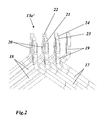
- an upper winding bar 18 of a first winding groove and a lower winding bar 17 of a second winding groove are bent toward each other at the end of the rotor yoke 11 so that the two ends are superimposed in the radial direction, as shown in FIG Fig. 2 in an enlarged detail for a winding head 13a 'is reproduced.
- the rod ends 19, 20 are aligned parallel to one another by a second bend.
- the exposed from the insulation ladder of Winding bars 17, 18 form in this area tabs 21, 22 with a rectangular cross-section, to each of which then an angle-shaped connecting part 23 and 24 is attached.
- the electrically conductive connection 16 ( Fig. 1 ) is finally effected by the connection of the two connecting parts 23, 24.
- the known design of the winding head 13a 'according to Fig. 2 has several disadvantages: First, a second bend on the rod ends 19, 20 is necessary, which requires additional effort. On the other hand, additional copper material is required for the parallel rod ends 19, 20, which not only increases the material costs, but also increases the axial length of the winding overhang and the winding resistance.
- the font US-A-3,675,058 discloses a prefabricated connecting element for an electrodynamic machine which is to be used advantageously in particular in aluminum-equipped engines for operation in corrosive environment.
- the substantially integrally formed as a block-shaped block connecting element (14, 16) has a number of rectangular apertures (30) or slots (38, 42), in the shape and dimension complementarily formed conductor bars (40, 44) are inserted.
- This connecting element (14, 16) also has the disadvantages already mentioned above.
- the ladder bars are to be bent in such a way that they are always parallel or end up perpendicular to each other. Its uses are considerably limited.
- the object is essentially solved in that the integral connecting element, and that the connecting element is designed as oriented in the radial direction round eye which has two crossing superposed in the radial direction abutment surfaces for abutment against the tabs to be joined together winding bars. Since the crossing angle in the winding head in most cases is the same for all compounds, only one type of round eyelet in two versions, which are mirror-inverted, needed. These can be prefabricated in a simple manner. Due to the one-piece construction, the connecting element only needs to be connected to the two bar ends. In particular, there is no danger that the connecting element will disintegrate into individual components under centrifugal force or vibration load. In addition, due to the one-piece advantages in the power line, because the contact resistance is minimized.
- the round eyelet on a cylindrical basic shape wherein the contact surfaces are arranged parallel to the cylinder axis and of the cylinder axis have a distance which corresponds to half the thickness of the tabs.
- the round eyelet has a central piece between the two contact surfaces.
- the length of the tabs is less than or equal to the outer diameter of the eyelet. This avoids that the tabs protrude in a disturbing way on the Rundiere.
- the winding is preferably the rotor winding of the machine. But it can also be the stator winding of the machine.
- FIG. 3 is in one too Fig. 2 comparable representation reproduced the connection of the ends of the winding bars in the winding head 13a of a winding according to a preferred embodiment of the invention.
- the winding rods 17, 18 emerging from the winding grooves and once bent at the end of the winding grooves are supplied to one another without a second bend at the rod ends so that they intersect one another with their (straight) ends in pairs.
- the intersecting ends are exposed by the insulation ladder, which protrude as tabs 21, 22 from the rod ends.
- Coaxial with the crossing axis of the intersecting tabs 21, 22 is arranged as a one-piece, electrically good conductive connecting element a round eyelet 27 which is fixedly connected to the two tabs 21, 22.
- Selected conductor bars whose ends are unconnected are bent a second time in the axial direction and serve with the resulting connection parts 25, 26 for connecting the winding.
- FIG. 4 has a cylindrical basic shape with a cylinder axis 31. Along the cylinder axis 31 are successively, separated by a central piece 30, two axis-parallel, intersecting contact surfaces 28 and 29 are formed.
- the crossing angle of the contact surfaces 28, 29 corresponds to the crossing angle of the intersecting tabs 21, 22.
- the distance A of the contact surfaces 28, 29 to the cylinder axis 31 corresponds to half the thickness D / 2 of the tabs 21, 22 (FIG. Fig. 3 ). In this way, the tabs 21, 22 go with the round eyelet 27 exactly centered through the cylinder of the eyelet 27.
- Fig. 3 the tabs 21, 22 go with the round eyelet 27 exactly centered through the cylinder of the eyelet 27.
- the length of the tabs 21, 22 is less than or equal to the outer diameter of the eyelet 27, so that the tabs 21, 22 do not protrude over the eyelet 27 disturbing.
- the middle piece 30 of the round eyelet the current transition between the rod ends is optimized.
- a material for the round eyelet copper a copper alloy or other electrically conductive material can be used.
- the invention results in a shortened winding head which saves copper, reduces the copper losses, can be supported more easily against centrifugal forces (if the winding is a rotor winding), is easier to manufacture and assemble and has a higher mechanical stability and safety.
- the winding according to the invention can be used both as a rotor winding and as a stator winding.
Landscapes
- Engineering & Computer Science (AREA)
- Power Engineering (AREA)
- Manufacturing & Machinery (AREA)
- Windings For Motors And Generators (AREA)
Abstract
Description
- Die vorliegende Erfindung bezieht sich auf das Gebiet der elektrischen Maschinen. Sie betrifft eine Wicklung einer elektrischen Maschine, insbesondere eines Hydrogenerators, gemäss dem Oberbegriff des Anspruchs 1.
- Durch die veränderten marktwirtschaftlichen Bedingungen an den geöffneten Strommärkten und den verbesserten Technologien im Bereich der Leistungselektronik hat das Thema drehzahlvariabler Antriebe zur Energieproduktion an Bedeutung gewonnen. Für diesen Zweck werden insbesondere bei Leistungen über 60 MVA bevorzugt doppelt gespeiste Asynchronmaschinen eingesetzt.
- Der Stator dieses Maschinentypus unterscheidet sich nicht von den für diese Anwendung gebräuchlichen Schenkelpolsynchronmaschinen. Maschinen dieses Typs zeichnen sich dadurch aus, dass sie sowohl auf dem Stator wie auch auf dem Rotor mit einer Dreiphasenwicklung ausgestattet sind. Üblicherweise sind dabei die Wickelköpfe der Rotorwicklung auf einer zylindrischen Oberfläche angeordnet (
DE-A1-195 13 457 ). - Ein entsprechendes (dreiphasiges) Wicklungsschema, zum Beispiel für einen Rotor, ist in
Fig. 1 wiedergegeben, wobei der Rotorumfang in der Zeichnungsebene abgerollt dargestellt ist: Der Rotor 10 hat ein Rotorjoch 11, in welchem in axialer Richtung verlaufende Wicklungsnuten 12 vorgesehen sind. Die Wicklungsnuten 12 nehmen die Wicklung 13 auf, die aus Wicklungsstäben 17, 18 gebildet wird. Jede Phase ist in einer anderen Strichart (kurz gestrichelt, lang gestrichelt, durchgezogen) dargestellt. Je zwei Wicklungsstäbe 17, 18 sind in einer Wicklungsnut übereinander liegend untergebracht. An den Stirnseiten des Rotors 10 treten die Wicklungsstäbe 17, 18 aus den Wicklungsnuten 12 heraus und werden nach einem vorgegebenen Schema innerhalb eines Wickelkopfes 13a bzw. 13b mehrheitlich an den Enden paarweise miteinander elektrisch verbunden (Verbindungen 16). Die übrigen Wicklungsstäbe werden als Anschlüsse 14, 15 nach aussen herausgeführt. - Zum paarweisen Verbinden werden im Stand der Technik jeweils ein oberer Wicklungsstab 18 einer ersten Wicklungsnut und ein unterer Wicklungsstab 17 einer zweiten Wicklungsnut am Ende des Rotorjochs 11 derartig aufeinander zugebogen, dass die beiden Enden in radialer Richtung übereinander liegen, wie dies in
Fig. 2 in einem vergrösserten Ausschnitt für einen Wickelkopf 13a' wiedergegeben ist. An den Enden der aufeinander zugebogenen Wicklungsstäbe 17, 18 werden durch eine zweite Biegung die Stabenden 19, 20 übereinander liegend parallel ausgerichtet. Die von der Isolierung freigelegten Leiter der Wicklungsstäbe 17, 18 bilden in diesem Bereich Laschen 21, 22 mit rechteckigem Querschnitt, an denen dann jeweils ein winkelförmiges Verbindungsteil 23 bzw. 24 angebracht wird. Die elektrisch leitende Verbindung 16 (Fig. 1 ) wird schliesslich durch das Verbinden der beiden Verbindungsteile 23, 24 bewirkt. - Die bekannte Ausbildung des Wickelkopfes 13a' gemäss
Fig. 2 hat verschiedene Nachteile: Zum einen ist eine zweite Biegung an den Stabenden 19, 20 notwendig, die zusätzlichen Aufwand erfordert. Zum anderen wird für die parallel laufenden Stabenden 19, 20 zusätzliches Kupfermaterial benötigt, wodurch sich nicht nur die Materialkosten erhöhen, sondern auch die axiale Länge des Wickelkopfes und der Wicklungswiderstand vergrössern. - Es ist daher in der
US-A-5,789,840 bereits vorgeschlagen worden, bei einer Statorwicklung die zweite Biegung im Wickelkopf wegzulassen, und die sich kreuzenden Enden der zu verbindenden Wicklungsstäbe mittels eines speziellen mehrteiligen Verbindungsteils zu verbinden. Nachteilig ist bei dieser Lösung jedoch der mehrteilige Aufbau des Verbindungsteils, das sich aus zwei U-förmigen Verbindungselementen (62, 64) und einem in der Mitte angeordneten Drehstift (66) zusammensetzt. Durch den mehrteiligen Aufbau kann das Verbindungselement zwar an unterschiedliche Kreuzungswinkel angepasst werden, ist jedoch in Herstellung und Montage aufwändig, wenn eine Vielzahl von Verbindungen hergestellt werden muss. - Die Schrift
US-A-3,675,058 offenbart ein vorgefertigtes Verbindungselement für eine elektrodynamische Maschine, das insbesondere in mit Aluminiumleitern ausgerüsteten Motoren zum Betrieb in korrosiver Umgebung vorteilhaft zur Anwendung gelangen soll. Das im Wesentlichen einteilig als quaderförmiger Block ausgebildete Verbindungselement (14, 16) weist eine Anzahl rechteckförmiger Durchbrüche (30) oder Schlitze (38, 42) auf, in die in Form und Dimension komplementär ausgebildete Leiterstäbe (40, 44) eingesteckt sind. Auch dieses Verbindungselement (14, 16) weist die bereits weiter oben genannten Nachteile auf. Die Leiterstäbe sind derart zurechtzubiegen, dass sie stets parallel oder senkrecht zueinander enden. Seine Einsatzmöglichkeiten sind erheblich beschränkt. - Es ist daher Aufgabe der Erfindung, eine elektrische Maschine der eingangs genannten Art so auszubilden, dass die Nachteile bekannter Maschinen vermieden werden und insbesondere unter Beibehaltung eines axial verkürzten Wickelkopfes eine vereinfachte Montage und gleichzeitig ein mechanisch stabilerer Aufbau ermöglicht werden.
- Die Aufgabe wird im Wesentlichen dadurch gelöst, dass das verbindungselement einstückig ist, und dass das Verbindungselement als in radialer Richtung orientierte Rundöse ausgebildet ist, welche zwei in radialer Richtung kreuzend übereinander liegende Anlageflächen zur Anlage an den Laschen der miteinander zu verbindenden Wicklungsstäbe aufweist. Da der Kreuzungswinkel im Wickelkopf in den meisten Fällen für alle Verbindungen gleich ist, wird nur eine Art von Rundöse in zwei Ausführungen, welche zueinander spiegelverkehrt sind, benötigt. Diese können auf einfache Weise vorgefertigt werden. Aufgrund der Einstückigkeit braucht das Verbindungselement nur mit den beiden Stabenden verbunden zu werden. Insbesondere besteht nicht die Gefahr, dass das Verbindungselement bei Fliehkraft- oder Vibrationsbelastung in einzelne Bestandteile zerfällt. Darüber hinaus ergeben sich aufgrund der Einstückigkeit Vorteile bei der Stromleitung, weil die Übergangswiderstände minimiert sind.
- Gemäss einer Ausgestaltung der Erfindung weist die Rundöse eine zylindrische Grundform auf, wobei die Anlageflächen parallel zur Zylinderachse angeordnet sind und von der Zylinderachse einen Abstand aufweisen, welcher der halben Dicke der Laschen entspricht.
- Weiterhin ist es für die elektrischen und mechanischen Eigenschaften von Vorteil, wenn die Rundöse zwischen den beiden Anlageflächen ein Mittelstück aufweist.
- Vorzugsweise ist die Länge der Laschen kleiner oder gleich dem Aussendurchmesser der Rundöse. Dadurch wird vermieden, dass die Laschen auf störende Weise über die Rundöse hinausragen.
- Die Wicklung ist vorzugsweise die Rotorwicklung der Maschine. Sie kann aber auch die Statorwicklung der Maschine sein.
- Die Erfindung soll nachfolgend anhand von Ausführungsbeispielen im Zusammenhang mit der Zeichnung näher erläutert werden. Es zeigen
- Fig. 1
- ein beispielhaftes Wicklungsschema einer dreiphasigen Rotorwicklung eines Drehstrom-Asynchron-Hydrogenerators;
- Fig. 2
- die Verbindung der Enden der Wicklungsstäbe im Wickelkopf einer Wicklung nach
Fig. 1 , wie sie aus dem Stand der Technik bekannt ist; - Fig. 3
- in einer zu
Fig. 2 vergleichbaren Darstellung die Verbindung der Enden der Wicklungsstäbe im Wickelkopf einer Wicklung gemäss einem bevorzugten Ausführungsbeispiel der Erfindung mittels Rundösen;und - Fig. 4
- in mehreren Teilfiguren 4(a) bis 4(c) unterschiedliche Ansichten einer Rundöse aus
Fig. 3 . - In
Fig. 3 ist in einer zuFig. 2 vergleichbaren Darstellung die Verbindung der Enden der Wicklungsstäbe im Wickelkopf 13a einer Wicklung gemäss einem bevorzugten Ausführungsbeispiel der Erfindung wiedergegeben. Die aus den Wicklungsnuten heraustretenden und am Ende der Wicklungsnuten einmal abgebogenen Wicklungsstäbe 17, 18 sind ohne eine zweite Biegung an den Stabenden so aufeinander zugeführt, dass sie sich mit ihren (geraden) Enden paarweise übereinander liegend kreuzen. Die sich kreuzenden Enden sind dabei die von der Isolierung freigelegten Leiter, die als Laschen 21, 22 aus den Stabenden herausstehen. Koaxial zur Kreuzungsachse der sich kreuzenden Laschen 21, 22 ist als einstückiges, elektrisch gut leitendes Verbindungselement eine Rundöse 27 angeordnet, welche fest mit den beiden Laschen 21, 22 verbunden ist. Ausgewählte Leiterstäbe, deren Enden unverbunden sind, sind ein zweites Mal in die axiale Richtung umgebogen und dienen mit den dadurch entstehenden Anschlussteilen 25, 26 zum Anschliessen der Wicklung. - Die eingesetzte Rundöse 27, die in Fig. 4 für sich genommen dargestellt ist, hat eine zylindrische Grundform mit einer Zylinderachse 31. Entlang der Zylinderachse 31 sind hintereinander, getrennt durch ein Mittelstück 30, zwei achsenparallele, sich kreuzende Anlageflächen 28 und 29 ausgebildet. Der Kreuzungswinkel der Anlageflächen 28, 29 entspricht dem Kreuzungswinkel der sich kreuzenden Laschen 21, 22. Der Abstand A der Anlageflächen 28, 29 zur Zylinderachse 31 entspricht der halben Dicke D/2 der Laschen 21, 22 (
Fig. 3 ). Auf diese Weise gehen die Laschen 21, 22 bei montierter Rundöse 27 genau mittig durch den Zylinder der Rundöse 27. Wie man inFig. 3 deutlich sehen kann, ist die Länge der Laschen 21, 22 kleiner oder gleich dem Aussendurchmesser der Rundöse 27, so dass die Laschen 21, 22 nicht über die Rundöse 27 störend hinausstehen. Durch das Mittelstück 30 der Rundöse wird der Stromübergang zwischen den Stabenden optimiert. Als Material für die Rundöse kann Kupfer, eine Kupferlegierung oder ein anderes elektrisch gut leitendes Material verwendet werden. - Insgesamt ergibt sich mit der Erfindung ein verkürzter Wickelkopf, der Kupfer einspart, die Kupferverluste verringert, sich leichter gegen Zentrifugalkräfte abstützen lässt (wenn die Wicklung eine Rotorwicklung ist), einfacher herzustellen und zu montieren ist und eine höhere mechanische Stabilität und Sicherheit zur Folge hat. Die erfindungsgemässe Wicklung kann sowohl als Rotor- als auch als Statorwicklung eingesetzt werden.
-
- 10
- Rotor
- 11
- Rotorjoch
- 12
- Wicklungsnut
- 13
- Wicklung
- 13a,b
- Wickelkopf
- 14,15
- Anschluss
- 16
- Verbindung
- 17,18
- Wicklungsstab
- 19,20
- Stabende (abgekröpft)
- 21,22
- Lasche
- 23,24
- Verbindungsteil
- 25,26
- Anschlussteil (abgekröpft)
- 27
- Rundöse
- 28,29
- Anlagefläche
- 30
- Mittelstück
- 31
- Zylinderachse
Claims (7)
- Elektrische Maschine, insbesondere Drehstrom-Asynchron-Hydrogenerator, mit einem Rotor (10) und einem Stator sowie einer Wicklung (13), welche eine Vielzahl von in axialer Richtung verlaufenden, in entsprechenden Wicklungsnuten (12) eines Joches (11) paarweise übereinander liegenden Wicklungsstäben (17, 18) umfasst, wobei die Wicklungsstäbe (17, 18) an den Stirnseiten der Maschine aus den Wicklungsnuten (12) heraustreten und mehrheitlich in einem Wickelkopf (13a,b) nach einem vorgegebenen Schema paarweise miteinander elektrisch verbunden sind, wobei jeweils ein oberer Wicklungsstab (18) einer ersten Wicklungsnut und ein unterer Wicklungsstab (17) einer zweiten Wicklungsnut derartig aufeinander zugebogen sind, dass ihre Enden (21, 22) in radialer Richtung sich kreuzend übereinanderliegen, und die Verbindung (16) der Wicklungsstäbe (17, 18) eines elektrisch verbundenen Wicklungsstabpaares mittels eines Verbindungselementes (27) erfolgt, wobei die Enden der miteinander elektrisch verbundenen Wicklungsstäbe (17, 18) als gerade Laschen (21, 22) mit rechteckigem Querschnitt ausgebildet sind, dadurch gekennzeichnet, dass das Verbindungselement (27) einstückig ist, und dass das Verbindungselement als in radialer Richtung orientierte Rundöse (27) ausgebildet ist, welche zwei in radialer Richtung kreuzend übereinander liegende Anlageflächen (28, 29) zur Anlage an den Laschen (21, 22) der miteinander zu verbindenden Wicklungsstäbe (17, 18) aufweist.
- Elektrische Maschine nach Anspruch 1, dadurch gekennzeichnet, dass die Kreuzungswinkel der sich kreuzenden Wicklungsstabenden (21, 22) und der sich kreuzenden Anlageflächen (28, 29) der Rundöse (27) gleich sind.
- Elektrische Maschine nach Anspruch 1 oder 2, dadurch gekennzeichnet, dass die Rundöse (27) eine zylindrische Grundform aufweist, und dass die Anlageflächen (28, 29) parallel zur Zylinderachse (31) angeordnet sind und von der Zylinderachse (31) einen Abstand (A) aufweisen, welcher der halben Dicke (D/2) der Laschen (21, 22) entspricht.
- Elektrische Maschine nach einem der Ansprüche 1 bis 3, dadurch gekennzeichnet, dass die Rundöse (27) zwischen den beiden Anlageflächen (28, 29) ein Mittelstück (30) aufweist.
- Elektrische Maschine nach Anspruch 3, dadurch gekennzeichnet, dass die Länge der Laschen (21, 22) kleiner oder gleich dem Aussendurchmesser der Rundöse (27) ist.
- Elektrische Maschine nach einem der Ansprüche 1 bis 5, dadurch gekennzeichnet, dass die Wicklung (13) die Rotorwicklung der Maschine ist.
- Elektrische Maschine nach einem der Ansprüche 1 bis 5, dadurch gekennzeichnet, dass die Wicklung die Statorwicklung der Maschine ist.
Applications Claiming Priority (3)
| Application Number | Priority Date | Filing Date | Title |
|---|---|---|---|
| DE102007036806 | 2007-08-03 | ||
| DE102007000661A DE102007000661A1 (de) | 2007-11-08 | 2007-11-08 | Elektrische Maschine, insbesondere Drehstrom-Asynchron-Hydrogenerator |
| PCT/EP2008/058494 WO2009019087A2 (de) | 2007-08-03 | 2008-07-02 | Elektrische maschine, insbesondere drehstrom-asynchron-hydrogenerator |
Publications (2)
| Publication Number | Publication Date |
|---|---|
| EP2174403A2 EP2174403A2 (de) | 2010-04-14 |
| EP2174403B1 true EP2174403B1 (de) | 2012-08-22 |
Family
ID=39949855
Family Applications (1)
| Application Number | Title | Priority Date | Filing Date |
|---|---|---|---|
| EP08774630A Active EP2174403B1 (de) | 2007-08-03 | 2008-07-02 | Elektrische maschine, insbesondere drehstrom-asynchron-hydrogenerator |
Country Status (8)
| Country | Link |
|---|---|
| US (1) | US8093778B2 (de) |
| EP (1) | EP2174403B1 (de) |
| KR (1) | KR101477487B1 (de) |
| CN (1) | CN101772877B (de) |
| BR (1) | BRPI0814770A2 (de) |
| CA (1) | CA2694137C (de) |
| RU (1) | RU2483413C2 (de) |
| WO (1) | WO2009019087A2 (de) |
Families Citing this family (9)
| Publication number | Priority date | Publication date | Assignee | Title |
|---|---|---|---|---|
| JP5586969B2 (ja) * | 2010-01-21 | 2014-09-10 | 株式会社デンソー | 回転電機の固定子 |
| JP5585819B2 (ja) * | 2010-03-31 | 2014-09-10 | 株式会社デンソー | 回転電機の固定子 |
| US8671559B2 (en) * | 2011-04-27 | 2014-03-18 | GM Global Technology Operations LLC | System for joining stator wires |
| DE102011106480A1 (de) * | 2011-06-14 | 2012-12-20 | Voith Patent Gmbh | Asynchronmaschine |
| KR101432595B1 (ko) * | 2011-07-01 | 2014-08-22 | 엘지전자 주식회사 | 전기기계의 고정자 |
| KR101365469B1 (ko) * | 2012-09-20 | 2014-02-25 | 현대모비스 주식회사 | 헤어핀 접속기구 및 이를 구비한 헤어핀 권선모터 |
| DE102016107929A1 (de) * | 2016-04-28 | 2017-11-02 | Wobben Properties Gmbh | Aluformspule und Wicklungsaufbau sowie Stator eines Generators einer Windenergieanlage und Verfahren zum Herstellen eines Stators |
| JP6811042B2 (ja) * | 2016-07-12 | 2021-01-13 | 日本電産コパル電子株式会社 | コアレスコイル及びこのコアレスコイルの製造方法 |
| JP6642494B2 (ja) | 2017-03-10 | 2020-02-05 | トヨタ自動車株式会社 | 回転電機のステータの製造装置 |
Family Cites Families (22)
| Publication number | Priority date | Publication date | Assignee | Title |
|---|---|---|---|---|
| US2407935A (en) * | 1944-05-25 | 1946-09-17 | Chrysler Corp | Electrical machine |
| DE1207999B (de) * | 1964-09-22 | 1965-12-30 | Licentia Gmbh | Loetverbindungszwischenstuecke fuer Laeufer-wicklungsstaebe elektrischer Maschinen |
| US3675058A (en) * | 1970-09-08 | 1972-07-04 | Gen Electric | Dynamoelectric machine utilizing pre-formed winding connectors and method of making |
| SU809447A1 (ru) * | 1976-12-07 | 1981-02-28 | Предприятие П/Я А-7676 | Стержнева обмотка статораэлЕКТРичЕСКОй МАшиНы |
| SU694941A1 (ru) * | 1977-11-09 | 1979-10-30 | Производственное предприятие "Ростовэнергоремонт" | Устройство дл креплени лобовых частей многослойной стержневой обмотки статора электрической машины |
| SU1390711A1 (ru) * | 1986-05-13 | 1988-04-23 | Ленинградское Электромашиностроительное Объединение "Электросила" Им.С.М.Кирова | Статор электрической машины |
| SU1617537A1 (ru) * | 1987-11-10 | 1990-12-30 | Ленинградское Производственное Электромашиностроительное Объединение "Электросила" Им.С.М.Кирова | Статор электрической машины |
| RU2123226C1 (ru) * | 1994-05-11 | 1998-12-10 | Виктор Алексеевич Бриц | Лобовая часть одновитковой катушки двухслойных обмоток электрических машин |
| RU2088025C1 (ru) * | 1994-09-26 | 1997-08-20 | Акционерное общество открытого типа "Электросила" | Статор электрической машины |
| DE19513457A1 (de) * | 1995-04-08 | 1996-10-10 | Abb Management Ag | Rotor einer elektrischen Maschine |
| US5789840A (en) * | 1996-02-29 | 1998-08-04 | Ge Canada Inc. | Endhead joint for stator bars |
| US5965965A (en) * | 1997-05-26 | 1999-10-12 | Denso Corporation | Stator winding arrangement of alternator for vehicle |
| EP0881747B2 (de) * | 1997-05-26 | 2008-08-20 | Denso Corporation | Wechselstromgenerator für Kraftfahrzeuge |
| JP3769990B2 (ja) * | 1999-08-06 | 2006-04-26 | 株式会社デンソー | 導体セグメント接合型の回転電機及びその製造方法 |
| US6181043B1 (en) * | 1997-12-10 | 2001-01-30 | Denso Corporation | Alternator for vehicle |
| FR2808935B1 (fr) | 2000-05-11 | 2002-06-28 | Valeo Equip Electr Moteur | Stator de machine electrique tournante et alternateur comportant un tel stator |
| US6894415B2 (en) * | 2000-11-06 | 2005-05-17 | Denso Corporation | Stator arrangement of rotary electric machine |
| JP3630141B2 (ja) * | 2002-02-28 | 2005-03-16 | 株式会社デンソー | 回転電機の固定子の製造方法 |
| JP3775317B2 (ja) * | 2002-03-20 | 2006-05-17 | 株式会社デンソー | 回転電機の巻線の製造方法 |
| CN100505477C (zh) * | 2003-01-22 | 2009-06-24 | 株式会社电装 | 旋转式电机的定子及其制造方法 |
| RU2310965C2 (ru) * | 2003-04-02 | 2007-11-20 | Виктор Владимирович Лыткин | Обмотка электрической машины с коротким вылетом лобовых частей |
| RU2275729C1 (ru) * | 2004-10-15 | 2006-04-27 | Павел Юрьевич Грачев | Обмотка электрической машины |
-
2008
- 2008-07-02 EP EP08774630A patent/EP2174403B1/de active Active
- 2008-07-02 WO PCT/EP2008/058494 patent/WO2009019087A2/de not_active Ceased
- 2008-07-02 CN CN2008801018541A patent/CN101772877B/zh not_active Expired - Fee Related
- 2008-07-02 CA CA2694137A patent/CA2694137C/en not_active Expired - Fee Related
- 2008-07-02 KR KR1020107002322A patent/KR101477487B1/ko not_active Expired - Fee Related
- 2008-07-02 BR BRPI0814770-1A2A patent/BRPI0814770A2/pt not_active IP Right Cessation
- 2008-07-02 RU RU2010107605/07A patent/RU2483413C2/ru not_active IP Right Cessation
-
2010
- 2010-02-02 US US12/698,341 patent/US8093778B2/en not_active Expired - Fee Related
Also Published As
| Publication number | Publication date |
|---|---|
| EP2174403A2 (de) | 2010-04-14 |
| RU2483413C2 (ru) | 2013-05-27 |
| CA2694137C (en) | 2016-01-19 |
| WO2009019087A3 (de) | 2009-06-11 |
| KR101477487B1 (ko) | 2014-12-31 |
| US8093778B2 (en) | 2012-01-10 |
| CN101772877B (zh) | 2012-07-25 |
| CA2694137A1 (en) | 2009-02-12 |
| WO2009019087A2 (de) | 2009-02-12 |
| KR20100047245A (ko) | 2010-05-07 |
| RU2010107605A (ru) | 2011-09-10 |
| US20100194229A1 (en) | 2010-08-05 |
| CN101772877A (zh) | 2010-07-07 |
| BRPI0814770A2 (pt) | 2015-03-03 |
Similar Documents
| Publication | Publication Date | Title |
|---|---|---|
| EP2174403B1 (de) | Elektrische maschine, insbesondere drehstrom-asynchron-hydrogenerator | |
| EP2082472B1 (de) | Elektromotor | |
| EP1810388B1 (de) | Elektromotor | |
| DE102018127558A1 (de) | Elektrische Maschine mit Statorwicklungen unterschiedlichen Querschnitts | |
| EP3695489B1 (de) | Stator für eine elektrische maschine | |
| DE102020129807A1 (de) | Stator für elektrische maschine mit leitern mit unterschiedlichen querschnittformen | |
| DE102021102645A1 (de) | Stator für elektrische maschine mit mehrteiliger leiterbaugruppe | |
| DE1937377A1 (de) | Stator fuer einen Einphasen-Induktionsmotor und Verfahren zur Herstellung des Stators | |
| DE102005019271A1 (de) | Statorspule mit konzentrierter Wicklung für eine rotierende elektrische Maschine | |
| DE102019103191A1 (de) | Stator für eine elektrische Maschine | |
| EP3171498B1 (de) | Zweipoliger bürstenkommutierter dc-elektromotor | |
| WO2019072471A1 (de) | Stator für eine elektrische maschine | |
| EP3352341B1 (de) | Statorpaket und verfahren zum herstellen eines statorpakets | |
| EP3357141B1 (de) | Im stecktechnikverfahren hergestellter stator oder rotor einer elektrischen maschine mit verkürzter blechlänge | |
| DE102023135264A1 (de) | Wickelkopfausgestaltung ohne leiterüberlappung für eine elektrische maschine | |
| DE102021132259A1 (de) | Statorwicklungsanordnung mit mehreren parallelen Pfaden | |
| DE102016221043A1 (de) | Modular aufgebauter Stator für einen Elektromotor oder Generator | |
| DE19846923C1 (de) | Mehrphasige Wicklung einer elektrischen Maschine und Verfahren zu ihrer Herstellung | |
| DE60320165T2 (de) | Drehende elektrische Maschine | |
| DE112015006250T5 (de) | Rotor für Bürstenmotor und Fahrzeugbürstenmotor | |
| WO2016071026A1 (de) | Rotor oder stator mit gestecktem flachem wickelkopf | |
| DE102022108615A1 (de) | Rautenspulen-stator mit parallelen pfaden und ausgeglichener wicklungsanordnung | |
| EP3724971A1 (de) | Statoranordnung mit wicklungsanordnung | |
| DE102021134636A1 (de) | Stator für elektrische maschine mit mehrteiliger leiterbaugruppe | |
| DE102007000661A1 (de) | Elektrische Maschine, insbesondere Drehstrom-Asynchron-Hydrogenerator |
Legal Events
| Date | Code | Title | Description |
|---|---|---|---|
| PUAI | Public reference made under article 153(3) epc to a published international application that has entered the european phase |
Free format text: ORIGINAL CODE: 0009012 |
|
| 17P | Request for examination filed |
Effective date: 20100108 |
|
| AK | Designated contracting states |
Kind code of ref document: A2 Designated state(s): AT BE BG CH CY CZ DE DK EE ES FI FR GB GR HR HU IE IS IT LI LT LU LV MC MT NL NO PL PT RO SE SI SK TR |
|
| AX | Request for extension of the european patent |
Extension state: AL BA MK RS |
|
| GRAP | Despatch of communication of intention to grant a patent |
Free format text: ORIGINAL CODE: EPIDOSNIGR1 |
|
| GRAS | Grant fee paid |
Free format text: ORIGINAL CODE: EPIDOSNIGR3 |
|
| GRAA | (expected) grant |
Free format text: ORIGINAL CODE: 0009210 |
|
| AK | Designated contracting states |
Kind code of ref document: B1 Designated state(s): AT BE BG CH CY CZ DE DK EE ES FI FR GB GR HR HU IE IS IT LI LT LU LV MC MT NL NO PL PT RO SE SI SK TR |
|
| AX | Request for extension of the european patent |
Extension state: AL BA MK RS |
|
| REG | Reference to a national code |
Ref country code: GB Ref legal event code: FG4D Free format text: NOT ENGLISH |
|
| REG | Reference to a national code |
Ref country code: CH Ref legal event code: EP |
|
| REG | Reference to a national code |
Ref country code: IE Ref legal event code: FG4D Free format text: LANGUAGE OF EP DOCUMENT: GERMAN |
|
| REG | Reference to a national code |
Ref country code: AT Ref legal event code: REF Ref document number: 572394 Country of ref document: AT Kind code of ref document: T Effective date: 20120915 |
|
| REG | Reference to a national code |
Ref country code: DE Ref legal event code: R096 Ref document number: 502008008017 Country of ref document: DE Effective date: 20121018 |
|
| REG | Reference to a national code |
Ref country code: SE Ref legal event code: TRGR |
|
| REG | Reference to a national code |
Ref country code: NL Ref legal event code: T3 |
|
| REG | Reference to a national code |
Ref country code: LT Ref legal event code: MG4D Effective date: 20120829 |
|
| PG25 | Lapsed in a contracting state [announced via postgrant information from national office to epo] |
Ref country code: LT Free format text: LAPSE BECAUSE OF FAILURE TO SUBMIT A TRANSLATION OF THE DESCRIPTION OR TO PAY THE FEE WITHIN THE PRESCRIBED TIME-LIMIT Effective date: 20120822 Ref country code: CY Free format text: LAPSE BECAUSE OF FAILURE TO SUBMIT A TRANSLATION OF THE DESCRIPTION OR TO PAY THE FEE WITHIN THE PRESCRIBED TIME-LIMIT Effective date: 20120822 Ref country code: FI Free format text: LAPSE BECAUSE OF FAILURE TO SUBMIT A TRANSLATION OF THE DESCRIPTION OR TO PAY THE FEE WITHIN THE PRESCRIBED TIME-LIMIT Effective date: 20120822 Ref country code: HR Free format text: LAPSE BECAUSE OF FAILURE TO SUBMIT A TRANSLATION OF THE DESCRIPTION OR TO PAY THE FEE WITHIN THE PRESCRIBED TIME-LIMIT Effective date: 20120822 Ref country code: IS Free format text: LAPSE BECAUSE OF FAILURE TO SUBMIT A TRANSLATION OF THE DESCRIPTION OR TO PAY THE FEE WITHIN THE PRESCRIBED TIME-LIMIT Effective date: 20121222 Ref country code: NO Free format text: LAPSE BECAUSE OF FAILURE TO SUBMIT A TRANSLATION OF THE DESCRIPTION OR TO PAY THE FEE WITHIN THE PRESCRIBED TIME-LIMIT Effective date: 20121122 |
|
| PG25 | Lapsed in a contracting state [announced via postgrant information from national office to epo] |
Ref country code: LV Free format text: LAPSE BECAUSE OF FAILURE TO SUBMIT A TRANSLATION OF THE DESCRIPTION OR TO PAY THE FEE WITHIN THE PRESCRIBED TIME-LIMIT Effective date: 20120822 Ref country code: GR Free format text: LAPSE BECAUSE OF FAILURE TO SUBMIT A TRANSLATION OF THE DESCRIPTION OR TO PAY THE FEE WITHIN THE PRESCRIBED TIME-LIMIT Effective date: 20121123 Ref country code: PT Free format text: LAPSE BECAUSE OF FAILURE TO SUBMIT A TRANSLATION OF THE DESCRIPTION OR TO PAY THE FEE WITHIN THE PRESCRIBED TIME-LIMIT Effective date: 20121224 Ref country code: SI Free format text: LAPSE BECAUSE OF FAILURE TO SUBMIT A TRANSLATION OF THE DESCRIPTION OR TO PAY THE FEE WITHIN THE PRESCRIBED TIME-LIMIT Effective date: 20120822 |
|
| PG25 | Lapsed in a contracting state [announced via postgrant information from national office to epo] |
Ref country code: EE Free format text: LAPSE BECAUSE OF FAILURE TO SUBMIT A TRANSLATION OF THE DESCRIPTION OR TO PAY THE FEE WITHIN THE PRESCRIBED TIME-LIMIT Effective date: 20120822 Ref country code: ES Free format text: LAPSE BECAUSE OF FAILURE TO SUBMIT A TRANSLATION OF THE DESCRIPTION OR TO PAY THE FEE WITHIN THE PRESCRIBED TIME-LIMIT Effective date: 20121203 Ref country code: DK Free format text: LAPSE BECAUSE OF FAILURE TO SUBMIT A TRANSLATION OF THE DESCRIPTION OR TO PAY THE FEE WITHIN THE PRESCRIBED TIME-LIMIT Effective date: 20120822 Ref country code: RO Free format text: LAPSE BECAUSE OF FAILURE TO SUBMIT A TRANSLATION OF THE DESCRIPTION OR TO PAY THE FEE WITHIN THE PRESCRIBED TIME-LIMIT Effective date: 20120822 Ref country code: CZ Free format text: LAPSE BECAUSE OF FAILURE TO SUBMIT A TRANSLATION OF THE DESCRIPTION OR TO PAY THE FEE WITHIN THE PRESCRIBED TIME-LIMIT Effective date: 20120822 |
|
| PG25 | Lapsed in a contracting state [announced via postgrant information from national office to epo] |
Ref country code: SK Free format text: LAPSE BECAUSE OF FAILURE TO SUBMIT A TRANSLATION OF THE DESCRIPTION OR TO PAY THE FEE WITHIN THE PRESCRIBED TIME-LIMIT Effective date: 20120822 Ref country code: PL Free format text: LAPSE BECAUSE OF FAILURE TO SUBMIT A TRANSLATION OF THE DESCRIPTION OR TO PAY THE FEE WITHIN THE PRESCRIBED TIME-LIMIT Effective date: 20120822 |
|
| REG | Reference to a national code |
Ref country code: CH Ref legal event code: PUE Owner name: ALSTOM HYDRO FRANCE, FR Free format text: FORMER OWNER: ALSTOM TECHNOLOGY LTD, CH |
|
| PLBE | No opposition filed within time limit |
Free format text: ORIGINAL CODE: 0009261 |
|
| STAA | Information on the status of an ep patent application or granted ep patent |
Free format text: STATUS: NO OPPOSITION FILED WITHIN TIME LIMIT |
|
| REG | Reference to a national code |
Ref country code: NL Ref legal event code: SD Effective date: 20130711 |
|
| REG | Reference to a national code |
Ref country code: FR Ref legal event code: TP Owner name: ALSTOM HYDRO FRANCE, FR Effective date: 20130625 |
|
| 26N | No opposition filed |
Effective date: 20130523 |
|
| PG25 | Lapsed in a contracting state [announced via postgrant information from national office to epo] |
Ref country code: BG Free format text: LAPSE BECAUSE OF FAILURE TO SUBMIT A TRANSLATION OF THE DESCRIPTION OR TO PAY THE FEE WITHIN THE PRESCRIBED TIME-LIMIT Effective date: 20121122 |
|
| REG | Reference to a national code |
Ref country code: CH Ref legal event code: NV Representative=s name: ALSTOM TECHNOLOGY LTD, CH Ref country code: CH Ref legal event code: PUE Owner name: ALSTOM RENEWABLE TECHNOLOGIES, FR Free format text: FORMER OWNER: ALSTOM HYDRO FRANCE, FR |
|
| REG | Reference to a national code |
Ref country code: NL Ref legal event code: SD Effective date: 20130812 |
|
| REG | Reference to a national code |
Ref country code: DE Ref legal event code: R097 Ref document number: 502008008017 Country of ref document: DE Effective date: 20130523 |
|
| REG | Reference to a national code |
Ref country code: GB Ref legal event code: 732E Free format text: REGISTERED BETWEEN 20130905 AND 20130911 |
|
| REG | Reference to a national code |
Ref country code: DE Ref legal event code: R081 Ref document number: 502008008017 Country of ref document: DE Owner name: ALSTOM RENEWABLE TECHNOLOGIES, FR Free format text: FORMER OWNER: ALSTOM TECHNOLOGY LTD., BADEN, CH Effective date: 20131016 |
|
| REG | Reference to a national code |
Ref country code: GB Ref legal event code: 732E Free format text: REGISTERED BETWEEN 20131128 AND 20131204 |
|
| REG | Reference to a national code |
Ref country code: FR Ref legal event code: TP Owner name: ALSTOM RENEWABLE TECHNOLOGIES, FR Effective date: 20131126 |
|
| BERE | Be: lapsed |
Owner name: ALSTOM TECHNOLOGY LTD Effective date: 20130731 |
|
| PG25 | Lapsed in a contracting state [announced via postgrant information from national office to epo] |
Ref country code: MC Free format text: LAPSE BECAUSE OF FAILURE TO SUBMIT A TRANSLATION OF THE DESCRIPTION OR TO PAY THE FEE WITHIN THE PRESCRIBED TIME-LIMIT Effective date: 20120822 |
|
| REG | Reference to a national code |
Ref country code: IE Ref legal event code: MM4A |
|
| PG25 | Lapsed in a contracting state [announced via postgrant information from national office to epo] |
Ref country code: BE Free format text: LAPSE BECAUSE OF NON-PAYMENT OF DUE FEES Effective date: 20130731 |
|
| PG25 | Lapsed in a contracting state [announced via postgrant information from national office to epo] |
Ref country code: IE Free format text: LAPSE BECAUSE OF NON-PAYMENT OF DUE FEES Effective date: 20130702 |
|
| REG | Reference to a national code |
Ref country code: AT Ref legal event code: MM01 Ref document number: 572394 Country of ref document: AT Kind code of ref document: T Effective date: 20130702 |
|
| PG25 | Lapsed in a contracting state [announced via postgrant information from national office to epo] |
Ref country code: AT Free format text: LAPSE BECAUSE OF NON-PAYMENT OF DUE FEES Effective date: 20130702 |
|
| REG | Reference to a national code |
Ref country code: FR Ref legal event code: PLFP Year of fee payment: 8 |
|
| PG25 | Lapsed in a contracting state [announced via postgrant information from national office to epo] |
Ref country code: TR Free format text: LAPSE BECAUSE OF FAILURE TO SUBMIT A TRANSLATION OF THE DESCRIPTION OR TO PAY THE FEE WITHIN THE PRESCRIBED TIME-LIMIT Effective date: 20120822 Ref country code: MT Free format text: LAPSE BECAUSE OF FAILURE TO SUBMIT A TRANSLATION OF THE DESCRIPTION OR TO PAY THE FEE WITHIN THE PRESCRIBED TIME-LIMIT Effective date: 20120822 |
|
| PG25 | Lapsed in a contracting state [announced via postgrant information from national office to epo] |
Ref country code: HU Free format text: LAPSE BECAUSE OF FAILURE TO SUBMIT A TRANSLATION OF THE DESCRIPTION OR TO PAY THE FEE WITHIN THE PRESCRIBED TIME-LIMIT; INVALID AB INITIO Effective date: 20080702 Ref country code: LU Free format text: LAPSE BECAUSE OF NON-PAYMENT OF DUE FEES Effective date: 20130702 |
|
| REG | Reference to a national code |
Ref country code: FR Ref legal event code: PLFP Year of fee payment: 9 |
|
| PGFP | Annual fee paid to national office [announced via postgrant information from national office to epo] |
Ref country code: NL Payment date: 20160726 Year of fee payment: 9 |
|
| PGFP | Annual fee paid to national office [announced via postgrant information from national office to epo] |
Ref country code: CH Payment date: 20160727 Year of fee payment: 9 Ref country code: DE Payment date: 20160726 Year of fee payment: 9 Ref country code: GB Payment date: 20160727 Year of fee payment: 9 Ref country code: IT Payment date: 20160722 Year of fee payment: 9 |
|
| PGFP | Annual fee paid to national office [announced via postgrant information from national office to epo] |
Ref country code: SE Payment date: 20160727 Year of fee payment: 9 Ref country code: FR Payment date: 20160726 Year of fee payment: 9 |
|
| REG | Reference to a national code |
Ref country code: DE Ref legal event code: R119 Ref document number: 502008008017 Country of ref document: DE |
|
| REG | Reference to a national code |
Ref country code: CH Ref legal event code: PL |
|
| REG | Reference to a national code |
Ref country code: NL Ref legal event code: MM Effective date: 20170801 |
|
| REG | Reference to a national code |
Ref country code: SE Ref legal event code: EUG |
|
| GBPC | Gb: european patent ceased through non-payment of renewal fee |
Effective date: 20170702 |
|
| REG | Reference to a national code |
Ref country code: FR Ref legal event code: ST Effective date: 20180330 |
|
| PG25 | Lapsed in a contracting state [announced via postgrant information from national office to epo] |
Ref country code: GB Free format text: LAPSE BECAUSE OF NON-PAYMENT OF DUE FEES Effective date: 20170702 Ref country code: NL Free format text: LAPSE BECAUSE OF NON-PAYMENT OF DUE FEES Effective date: 20170801 Ref country code: LI Free format text: LAPSE BECAUSE OF NON-PAYMENT OF DUE FEES Effective date: 20170731 Ref country code: CH Free format text: LAPSE BECAUSE OF NON-PAYMENT OF DUE FEES Effective date: 20170731 Ref country code: DE Free format text: LAPSE BECAUSE OF NON-PAYMENT OF DUE FEES Effective date: 20180201 Ref country code: SE Free format text: LAPSE BECAUSE OF NON-PAYMENT OF DUE FEES Effective date: 20170703 |
|
| PG25 | Lapsed in a contracting state [announced via postgrant information from national office to epo] |
Ref country code: FR Free format text: LAPSE BECAUSE OF NON-PAYMENT OF DUE FEES Effective date: 20170731 |
|
| PG25 | Lapsed in a contracting state [announced via postgrant information from national office to epo] |
Ref country code: IT Free format text: LAPSE BECAUSE OF NON-PAYMENT OF DUE FEES Effective date: 20170702 |