EP2175641A1 - Appareil et procédé pour interpolation d'angle faible - Google Patents
Appareil et procédé pour interpolation d'angle faible Download PDFInfo
- Publication number
- EP2175641A1 EP2175641A1 EP09004285A EP09004285A EP2175641A1 EP 2175641 A1 EP2175641 A1 EP 2175641A1 EP 09004285 A EP09004285 A EP 09004285A EP 09004285 A EP09004285 A EP 09004285A EP 2175641 A1 EP2175641 A1 EP 2175641A1
- Authority
- EP
- European Patent Office
- Prior art keywords
- angle
- scan line
- interpolation
- pixels
- pixel
- Prior art date
- Legal status (The legal status is an assumption and is not a legal conclusion. Google has not performed a legal analysis and makes no representation as to the accuracy of the status listed.)
- Granted
Links
Images








Classifications
-
- H—ELECTRICITY
- H04—ELECTRIC COMMUNICATION TECHNIQUE
- H04N—PICTORIAL COMMUNICATION, e.g. TELEVISION
- H04N7/00—Television systems
- H04N7/01—Conversion of standards, e.g. involving analogue television standards or digital television standards processed at pixel level
- H04N7/0117—Conversion of standards, e.g. involving analogue television standards or digital television standards processed at pixel level involving conversion of the spatial resolution of the incoming video signal
- H04N7/012—Conversion between an interlaced and a progressive signal
-
- H—ELECTRICITY
- H04—ELECTRIC COMMUNICATION TECHNIQUE
- H04N—PICTORIAL COMMUNICATION, e.g. TELEVISION
- H04N7/00—Television systems
- H04N7/01—Conversion of standards, e.g. involving analogue television standards or digital television standards processed at pixel level
- H04N7/0135—Conversion of standards, e.g. involving analogue television standards or digital television standards processed at pixel level involving interpolation processes
- H04N7/0142—Conversion of standards, e.g. involving analogue television standards or digital television standards processed at pixel level involving interpolation processes the interpolation being edge adaptive
Definitions
- the invention relates to imaging processing technology, particularly to an apparatus and method of low angle interpolation.
- deinterlacing The process of converting interlaced video signals into progressive video signals is called deinterlacing.
- deinterlacing techniques including intra-field deinterlacing, inter-field deinterlacing, motion adaptive deinterlacing, motion compensated deinterlacing and so forth.
- the low angle interpolation method one of intra-field deinterlacing methods, is utilized to detect edges, find edge directions or edge angles and thereby perform interpolation along the edge directions.
- one objective of the invention is to provide an apparatus of low angle interpolation to calculate the sum of absolute differences (SAD) according to triangle-like counterclockwise operating and clockwise operating matrixes to thereby correctly detect edges and effectively reduce jaggies.
- the apparatus of low angle interpolation is used to generate an interpolated scan line between a first scan line and a second line of a field.
- the apparatus comprises a low angle calculation circuit, a line buffer, a direction decision circuit, a post-processing circuit, and an interpolator.
- the low angle calculation circuit receives all luminance values of the first scan line and of the second scan line, calculates and compares sums of absolute differences (SADs) of all angles of each pixel in the interpolated scan line and generates a plurality of operating parameters of each pixel in the interpolated scan line based on a counterclockwise operating matrix and a clockwise operating matrix.
- SADs sums of absolute differences
- the line buffer stores final interpolation directions of all pixels of the preceding interpolated scan line.
- the direction decision circuit coupled to the line buffer and the low angle calculation circuit determines a temporary interpolation angle of each pixel in the interpolated scan line based on the operating parameters of each pixel in the interpolated scan line and the final interpolation directions of all the pixels of the preceding interpolated scan line.
- the post-processing circuit coupled to the line buffer and the direction decision circuit, performs calibration on the interpolation direction and determines a final interpolation angle and the final interpolation direction of each pixel in the interpolated scan line based on the temporary interpolation angles of all the pixels in the interpolated scan line and the final interpolation directions of all the pixels of the preceding interpolated scan line.
- the interpolator coupled to the post-processing circuit receives the final interpolation angle of each pixel of the interpolated scan line, both the luminance values and chrominance values of all pixels in the first scan line, and both the luminance values and the chrominance values of all pixels in the second scan line, and performs interpolation corresponding to either the final interpolation angle or 90 degrees depending on an absolute chrominance error of each pixel in the interpolated scan line so as to obtain the luminance value and the chrominance value of each pixel in the interpolated scan line; wherein, each of the final interpolation angle and the temporary final interpolation angle comprises the interpolation direction information.
- Another objective of the invention is to provide a method of low angle interpolation method for generating an interpolated scan line between the first scan line and the second line.
- the method comprises the following steps: calculating and comparing the sum of the absolute differences of all angles of each pixel in the interpolated scan line to generate a plurality of operating parameters for each pixel in the interpolated scan line based on all luminance values of the first scan line, all luminance values of the second scan line, a counterclockwise operating matrix, and a clockwise operating matrix; determining temporary interpolation angles of all the pixels in the interpolated scan line, based on the operating parameters of each pixel in the interpolated scan line and the final interpolation directions of all the pixels of the preceding interpolated scan line; performing calibration on interpolation directions based on the temporary interpolation angles of all the pixels in the interpolated scan line and the final interpolation direction of each pixel of the preceding interpolated scan line to determine the final interpolation angles and the final interpolation directions of all the pixels in
- FIG. 1 shows a schematic diagram illustrating the relationship between the original scan lines and missing scan lines during the deinterlacing process in a local area of a field.
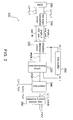
- FIG. 2 shows a schematic diagram illustrating a low angle interpolation apparatus according to one embodiment of the invention.
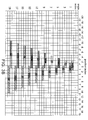
- FIG. 3A and FIG. 3B show the counterclockwise operating matrix and the clockwise operating matrix, respectively, according to one embodiment of the invention
- FIG. 4 shows a schematic diagram illustrating an exemplary portion of the scan lines L(i-1) and L(i+1) having mutually opposite luminance gradients.
- FIG. 5A shows a schematic diagram illustrating an ideal image after a broken-angle compensation.
- FIG. 5B shows a schematic diagram illustrating an interpolated image without the broken- angle compensation.
- FIG. 5C shows a schematic diagram illustrating the example of one edge and its two ends.
- FIG. 6 shows a schematic diagram illustrating the direction decision circuit according to one embodiment of the invention.
- FIG. 7A shows a schematic diagram illustrating that the clockwise effectiveness of the three consecutive pixels having GL can be extended to the following three consecutive pixels having WL.
- FIG. 7B shows a schematic diagram illustrating that three consecutive pixels having GL cannot be found and thus the interpolation directions for the pixels having WL or WR cannot be decided.
- FIG. 7C shows a schematic diagram illustrating that the clockwise effectiveness of the three consecutive pixels having SL can be extended to the following three consecutive pixels having WL.
- FIG. 7D shows a schematic diagram illustrating that the final interpolations dir_f of all the pixels of the preceding interpolated scan line L(i-2) stored in the line buffer 260 are used to determine the undecided interpolation directions of the pixels in the interpolated scan line L(i).
- FIG. 8 shows a schematic diagram illustrating the post-processing circuit according to one embodiment of the invention.
- FIG. 9 shows an example of a scene window having a pixel p(i,n) as the center and having a width of 21 points.
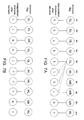
- FIG. 10A shows an example of a conflict window fitting an "LR" conflict pattern.
- FIG. 10B shows another example of the conflict window fitting an "LNR" conflict pattern.
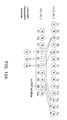
- FIG. 11A is an example illustrating that two groups of pixels having the interpolation direction R are isolated by a third group of pixels having the interpolation direction N.
- FIG. 11B is an example illustrating that two groups of pixels having the interpolation direction N are isolated by a third group of pixels having low angles.
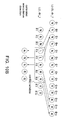
- FIG. 12 shows an example of the final interpolations dir_f of a portion of pixels in the interpolated scan line L(i).
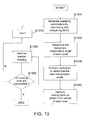
- FIG. 13 shows a flow chart of the low angle interpolation method according to the invention.
- the low angle interpolation apparatus may be hardware, software, or a combination of hardware and software (or firmware).
- An example of a pure solution would be a field programmable gate array (FPGA) design or an application specific integrated circuit (ASIC) design.
- An example of a hardware and software implementation would be a digital signal processor (DSP) and embedded firmware.
- FIG. 1 shows a schematic diagram illustrating the relationship between the original scan lines and missing scan lines during the deinterlacing process in a local area of a field.
- each circle represents a pixel and there are four rows of circles with solid lines showing the original scan lines (having Y, U, V components) while there are three rows of circles with dashed lines showing the missing scan lines to be interpolated in the field.
- FIG. 2 shows a schematic diagram illustrating a low angle interpolation apparatus according to one embodiment of the invention.
- the low angle interpolation apparatus 200 includes a low angle calculation circuit 210, a direction decision circuit 220, a post-processing circuit 230, an interpolator 240, an adaptive 5-point median filter 250 and a line buffer 260.
- the low angle interpolation apparatus 200 receives any two neighboring original scan lines (e.g., L(i-1) and L(i+1) in FIG.
- FIG. 3A and FIG. 3B show a counterclockwise operating matrix and a clockwise operating matrix, respectively, according to one embodiment of the invention.
- Each of horizontal axes in FIGS. 3A and 3B represents the pixel position index where a position index of 0 is aligned to a interpolation pixel (e.g., p(i,n) in FIG. 1 ) whose sum of absolute differences (SAD) with respect to each angle will be calculated in the interpolated scan line L(i).
- SAD sum of absolute differences
- FIGS. 3A and 3B there are 10 different angle index values on each of vertical axes. As the angle index value is getting less, the angle is closer to 90 degrees with respect to a horizontal line through the interpolation pixel p(i,n).
- the angle index value further includes the interpolation direction information.
- the angle index values in FIG. 3A are all even numbers, denoting the angle in a counterclockwise direction with respect to the horizontal line through the interpolation pixel (e.g., p(i,n) in FIG. 1 ).
- the angle index values in FIG. 3B are all odd numbers, denoting the angle in a clockwise direction with respect to a horizontal line through the interpolation pixel (e.g., p(i,n) in FIG. 1 ).
- the angle index value equals 0, the angle is 90 degrees.
- Each angle index value corresponds to an angle matrix and each angle matrix consists of a pair of upper and lower matrixes.
- a SAD of the interpolation pixel p(i,n) with respect to a specified angle is obtained by applying the corresponding pair of upper and lower matrixes to the upper scan line L(i-1) and the lower scan line L(i+1) respectively.
- the shapes of the counterclockwise operating matrix and the clockwise operating matrix look like triangles; besides, as the angle index value is larger, its corresponding upper matrix and lower matrix have wider widths and contain more reference pixels.
- each matrix has one dark point as the center.
- each matrix has two dark points as the center.
- FIGS. 3A and 3B are respectively divided into 10 different angles, but the invention is not limited to this specific arrangement.
- the shapes of the counterclockwise operating matrix and the clockwise operating matrix resemble triangles, the slopes and the angle index values of the counterclockwise operating matrix and the clockwise operating matrix may be modified and practiced without departing from the spirit of the invention.
- the low angle calculation circuit 210 receives luminance values (expressed by L(i-1)_Y and L(i+1)_Y in FIG. 2 ) of all pixels of the two original neighboring scan lines L(i-1) and L(i+1) of the field 280. According to the counterclockwise operating matrix in FIG. 3A and the clockwise operating matrix in FIG. 3B , for every pixel in the interpolated scan line L(i) (from left to right, a total of 720 pixels), the 90-degree SAD sad_n, the SADs of ten different angles in the counterclockwise direction and the SADs of ten different angles in the clockwise direction are calculated in the low angle calculation circuit 210.
- the minimum counterclockwise SAD min_sad_r and its corresponding angle angle_r the minimum clockwise SAD min_sad_l and its corresponding angle angle_l, and the 90-degree SAD sad_n are obtained.
- the angles angle_r, angle_l, anglet_lr, angle_t, and angle_f are expressed by the angle index value.
- the operation that low angle calculation circuit 210 generates the counterclockwise SAD sad r and the 90-degree SAD sad_n will be described in detail in connection with the counterclockwise operating matrix in FIG. 3A .
- the angle-6 matrix comprises a pair of upper and lower matrixes with a width of 4.
- the upper matrix is applied to the pixels p(i-1,n) ⁇ p(i-1,n+3) of the scan line L(i-1) while the lower matrix is applied to the pixels p(i+1,n-3) ⁇ p(i+1,n) of the scan line L(i+1).
- the parameters w0, w1, and w2 can be adjusted according to the image contents.
- the low angle calculation circuit 210 uses three compensation units to compensate for the ten counterclockwise SADs sad r(2) ⁇ sad r(20), the ten clockwise SADs sad_ / (1) ⁇ sad_ / (19), and the 90-degree SAD sad n and then compares the SAD values.
- the three compensation units (not shown) will be described below.
- the first one is a gradient compensation unit to be applied to the 90-degree SAD compensation.
- FIG. 4 shows a schematic diagram illustrating a exemplary portion of the scan lines L(i-1) and L(i+1) having mutually opposite luminance gradients.
- the scan lines L(i-1) and L(i+1) have mutually opposite luminance gradients (that is, the scan line L(i-1) have continuously decreasing luminance values and the scan line L(i+1) have continuously increasing luminance values from left to right) with similar luminance values around the pixel p(i,n).
- the sad_n value is usually small if the sad_n value is obtained according to the equation (1).
- the direction decision circuit 220 likely selects the 90-degree direction as the temporary interpolation direction dir_t. After interpolation, the interpolated luminance of the pixel p(i,n) will be close to white and the edge in the counterclockwise direction looks like broken and discontinuous.
- the parameters w3 and w4 can be adjusted according to the image contents.
- the gradient compensation value sad_nc is obtained by calculating the sum of absolute luminance differences between the pixel pair in the horizontal direction and the pixel pair in vertical direction within a gradient window having a width of 5.
- the gradient compensation value sad_nc is used to compensate the sad_n value.
- the sad_nc value tends to be small, which will not badly affect the possibility that the direction decision circuit 220 selects the 90-degree direction.
- the sad_nc value is compared with a threshold value and the sad_nc value will be replaced with the threshold value if the sad_nc value is greater than the threshold value in order to avoid over-compensation. It should be noted that the width of the gradient window is adjustable depending on applications.
- the second compensation unit is a broken-angle compensation unit to be applied to the counterclockwise SAD compensation and the clockwise SAD compensation.
- FIG. 5A shows a schematic diagram illustrating an ideal image after a broken-angle compensation while FIG. 5B shows a schematic diagram illustrating an interpolated image without the broken- angle compensation.
- the clockwise SADs sad_l are usually determined to be the minimum and then the pixels a, b, c, and d become white after interpolation, thereby forming a broken angle at the boundary of the L-shaped edge.
- FIG. 5A shows a schematic diagram illustrating an ideal image after a broken-angle compensation
- FIG. 5B shows a schematic diagram illustrating an interpolated image without the broken- angle compensation.
- 5C shows a schematic diagram illustrating the example of one edge and its two ends.
- the absolute luminance differences between three vertical pixels of three scan lines as represented in the dashed-line rectangles in FIG. 5C .
- the absolute luminance difference between pixels p(i-1, n+6) and p(i-3, n+6) and the absolute luminance difference between p(i-1, n+6) and p(i+1, n+6) are both smaller than a threshold value th1, i.e., abs(y(i-3,n+6)-y(i-1,n+6)) ⁇ th1 && abs(y(i-1,n+6)- y(i+1,n+6)) ⁇ th1.
- Ten counterclockwise sad_r values and ten clockwise sad_l values of each pixel in the interpolated scan line L(i) are calculated by using twenty sets of the upper matrix and the lower matrix with different widths.
- the more the windows of one set of the upper matrix and the lower matrix highly overlaps with either one end of the edge the higher the possibility of a broken angle.
- it is necessary to evaluate the degree that the windows of the upper and lower matrixes overlap with either one end of the edge for each angle that is, to accumulate the broken-angle flag values of all the pixels within the windows of the upper and lower matrixes for every angle to compensate the SAD of the corresponding angle.
- the clockwise SADs sad_ l with respect to the pixels a, b, c and d should be compensated to avoid the above-mentioned broken-angle problem.
- the angle-4 matrix comprises a pair of the upper matrix and the lower matrix having a width of 3.
- the broken-angle flag values of p(i-1,n), p(i-1, n+1), and p(i-1, n+2) within the window of the upper matrix and the broken-angle flag values of p(i+1,n-2), p(i+1, n-1), and p(i+1, n) within the window of the lower matrix are accumulated to compensate the sad_r(4) value of the pixel p(i,n).
- the threshold value break_th1 is a function of angle index, meaning that different angles correspond to different sum of broken-angle flag values.
- the compensated value sad_c will be added to sad_r on condition that it is greater than the threshold value break_th1. Since the compensation for other angles except 90 degrees is made in the same manner, the detail will not be further described.
- the third compensation unit is a slope compensation unit to be applied to the SAD compensation for all the angles.
- the slope compensation is optional and applied in some specific cases. For example, if the counterclockwise operating matrix of FIG. 3A and the clockwise operating matrix of FIG. 3B have pre-set steep slopes or highly slanted slopes and the slopes are implemented by hardware and hard to be altered, the slope compensation can be introduced. If the slopes of the counterclockwise and clockwise operating matrixes are highly slanted (i.e., the widths of the upper matrix and the lower matrix are too wide), the low-angle edge seems not easy to be selected.
- an effect of inversely adjusting the slopes of the counterclockwise and clockwise operating matrixes can be achieved by modifying the SADs of each angle.
- the compensation value i.e., (10-i) x step, where step is a pre-set value and adjustable
- step is a pre-set value and adjustable
- the slopes of the clockwise operating matrix and the counterclockwise operating matrix become steeper (that is, the bottom of the triangle becomes narrow). Accordingly, the low angle is easier to be selected.
- another set of equations can be designed to have the compensation value be larger if the angle index value is larger to thereby achieve the effect of inversely adjusting the slopes of the clockwise operating matrix and the counterclockwise operating matrix and have the low angle be selected less easily.
- the low angle calculation circuit 210 compares ten different counterclockwise SADs sad_r to obtain the minimum counterclockwise SAD min_sad_r and its corresponding angle angle_r and compares ten different clockwise SADs sad l to obtain the minimum counterclockwise SADs min sad l and its corresponding angle angle_l to thereby output min_sad_r, angle_r, min_sad_l, angle_l, and sad_n pixel by pixel to the direction decision circuit 220.
- the line buffer 260 is provided to store the final interpolation directions dir_f of all the pixels of the preceding interpolated scan line L(i-2).
- two bits are provided for each pixel to denote one of three final interpolation directions: the angle in the counterclockwise direction, the angle in the clockwise direction, and the 90-degree direction.
- the size of the line buffer 260 has to be larger than or equal to 720x2 bits.
- FIG. 6 shows a schematic diagram of the direction decision circuit according to one embodiment of the invention.
- the direction decision circuit 220 comprises a left-right decision circuit 610 and a direction selecting circuit 620.
- temporary interpolation angles angle_t of all the pixels in the interpolated scan line L(i) are determined pixel by pixel according to min_sad_r, min_sad_l, angle_r, angle_l, and sad_n of all the pixels in the interpolated scan line L(i) and the final interpolation directions dir_f of all the pixels in the preceding interpolated scan line L(i-2) stored in the line buffer 260.
- the parameter big_dif is larger than the parameter normal dif.
- the intensity order of the clockwise flags is SL>GL>WL and the intensity order of the counterclockwise flags is SR>GR>WR.
- the interpolation direction of a pixel can be directly determined to be clockwise if the intensity of its direction flag is beyond SL or GL; the interpolation direction of a pixel can be directly determined to be counterclockwise if the intensity of its direction flag is beyond SR or GR. If the intensity of the direction flag is WL or WR, the direction flag is relatively weak and thus the following three deciding units will be provided for determination.
- the interpolation directions of x consecutive pixels having GL affect the interpolation directions of the following y consecutive pixels having WL (or WR), where x and y are adjustable.
- the question mark (?) represents that the interpolation direction is undecided.
- FIG. 7B three consecutive pixels having GL cannot be found and thus the interpolation directions of the pixels having WL or WR cannot be determined.
- the interpolation direction of one pixel having SL affects the interpolation directions of the following z consecutive pixels having WL (or WR) where z is adjustable.
- a pixel (b5) having SL is found first and the interpolation direction of the pixel (b5) is directly decided to be clockwise (L). Then, the effectiveness of the clockwise direction of the pixel (b5) is extended to the following three consecutive pixels (b6 ⁇ b8) having WL.
- a preceding line auxiliary deciding unit 613 uses the final interpolation directions dir_f of all the pixels of the preceding interpolated scan line L(i-2) stored in the line buffer 260 to determine the interpolation direction of the pixel whose interpolation direction is still undecided.
- a pixel search is conducted along the angle (min_angle_l) in the clockwise direction, a pixel (c4) will be found and its interpolation direction is clockwise (L); besides, if a pixel search is conducted along the angle (min_angle_r0 in the counterclockwise direction, a pixel (c11) will be found and its interpolation direction is also clockwise.
- the interpolation direction of the pixel (d6) is clockwise.
- a pixel (c5) if a pixel search is conducted along the angle in the clockwise direction, a pixel (c5) will be found and its interpolation direction is the 90-degree direction (N); besides, if a pixel search is conducted along the angle in the counterclockwise direction, a pixel (c12) will be found and its interpolation direction is clockwise.
- the left hand side and the right hand side are both wrong.
- the interpolation direction of the pixel (d7) will be set to the 90-degree direction (N).
- the interpolation direction of the pixel (d8) will be set to the 90-degree direction (N).
- the left-right decision circuit 610 selects min_sad - lr and its angle angle_lr corresponding to the interpolation direction from the inputs min_sad_r, min_sad_l, angle_r, and angle_l to be delivered to the direction selecting circuit 620. Then, in the direction selecting circuit 620, min_sad_lr and sad_n are compared pixel by pixel to select the minimum value as sad_t and store its corresponding angle angle_t.
- the direction selecting circuit 620 determines whether sad_t is larger than a predetermined value max_sad(angle_t) or not and then sets the temporary interpolation angle angle_t to 90 degrees if sad_t is larger than max_sad(angle_t),.
- the predetermined value max_sad(angle_t) is a function of angles (angle_t), where the max_sad value depends on the angle_t value.
- the GL/GR auxiliary deciding unit 611, the SL/SR auxiliary deciding unit 612 and the preceding line auxiliary deciding unit 613 operate and are arranged in an ascending sequence of their reference numbers.
- the GL/GR auxiliary deciding unit 611 can be exchanged with and the SL/SR auxiliary deciding unit 612.
- the GUGR auxiliary deciding unit 611 and the SUSR auxiliary deciding unit 612 operate in parallel.
- FIG. 8 shows a schematic diagram of the post-processing circuit according to one embodiment of the invention.
- the post-processing circuit 230 comprises a complicate scene analyzing unit 810, a conflict direction calibration unit 820, an angle expanding circuit 830 and an angle excluding circuit 840.
- the post-processing circuit 230 performs calibration on the interpolation direction and determines the final interpolation angle angle_f and the final interpolation direction dir f for each pixel in the interpolated scan line L(i). As shown in FIG.
- the post-processing circuit 230 finally stores the final interpolation direction dir_f of each pixel of the interpolated scan line L(i) in the line buffer 260 and transmits the final interpolation angle angle_f of each pixel of the interpolated scan line L(i) to the interpolator 240.
- the complicate scene analyzing unit 810 receives the temporary interpolation angles angle_t of all the pixels in the interpolated scan line L(i) and the luminance values (Y) of all the pixels of the scan lines L(i-1) and L(i+1). According to the width of a scene window in FIG. 9 , by treating the pixel p(i,n) of the interpolated scan line L(i) as the center, the complicate scene analyzing unit 810 accumulates the absolute luminance differences of the scan lines L(i-1) and L(i+1) in the horizontal direction.
- the temporary interpolation angle angle_t of the pixel p(i,n) will be set to 90 degrees in the complicate scene analyzing unit 810.
- a YD value is obtained by calculating the sum of the absolute luminance differences between the pixel, its right neighbor and its left neighbor and then the minimum between the YD value and the threshold value th3 is selected for accumulation.
- the temporary interpolation angle angle_t of the pixel p(i,n) is set to 90 degrees.
- YO_sum is less than the threshold value th2
- a simple scene within the scene window is determined and thus the temporary interpolation angle angle_t of the pixel p(i,n) remains unchanged.
- the conflict direction calibration unit 820 receives the temporary interpolation angles angle_t of all the pixels in the interpolated scan line L(i) and the final interpolation directions dir_f of all the pixels in the preceding interpolated scan line L(i-2) to calibrate the pixels having the conflict interpolation directions in the interpolated scan line L(i).
- the interpolation directions of an interpolated scan line are hardly likely to be immediately changed from counterclockwise (R) to clockwise (L) (or from clockwise to counterclockwise), so the conflict interpolation directions includes six conflict patterns: LR, RL, LNR, RNL, LNNR, and RNNL.
- the interpolation directions of consecutive pixels fit one of the six conflict patterns, the interpolation directions need to be reconfirmed.
- the case in FIG. 10A describes the pixels fit an "LR" conflict pattern.
- the conflict direction calibration unit 820 After finding out the boundary between L and R along the interpolated scan line L(i), the conflict direction calibration unit 820 has the boundary as a center line, draws a symmetric conflict window, and thus confirms the interpolation directions of the pixels ( e4 ⁇ e9 ) within the conflict window.
- Two pixels f3 and f5 having direction flags of N are found if three pixel searches are conducted from the pixels e4 , e5 and e6 along their temporary interpolation directions (L, clockwise).
- the temporary interpolation directions of the pixels e4 and e5 are wrong and thus should be changed to the 90-degree direction (N).
- N the 90-degree direction
- three pixels f12 ⁇ f14, each having a direction flag of R, will be found.
- the temporary interpolation directions of the pixels e7-e9 are obviously correct and thus remain unchanged.
- the conflict direction calibration unit 820 After finding out the "LNR" conflict pattern along the interpolated scan line L(i), the conflict direction calibration unit 820 has the pixel h6 having a flag of N as a center, draws a symmetric conflict window, and thus confirms the interpolation directions of the pixels (h4 ⁇ h8) within the conflict window.
- a pixel g3 having a direction flag of N is found if two pixel searches are conducted from the pixels h4 and h5 along their temporary interpolation directions (L, clockwise). The temporary interpolation directions of the pixels h4 and h5 are wrong and thus should be changed to the 90-degree direction (N).
- the angle expanding unit 830 compares the temporary interpolation angles angle_t of all the pixels of the interpolated scan line L(i). If two groups of pixels having the same interpolation direction (clockwise or counterclockwise) are isolated by a third group of pixels having the interpolation direction N, the angle expanding unit 830 will set the interpolation direction of the third group of pixels to the same interpolation direction as those of the other two groups of pixels. However, it is required that the interpolation angle differences between the other two groups of pixels having the same interpolation direction (clockwise or counterclockwise) are not big and there is a smooth area located between the third group of pixels without an edge. As shown in FIG.
- a first group of three pixels p(i,n) ⁇ p(i,n+2) having the interpolation direction R and a second group of three pixels p(i,n+9) ⁇ p(i,n+11) having the same interpolation direction R are isolated by a third group of pixels p(i,n+3) ⁇ p(i,n+8) having the interpolation direction N.
- the angle expanding unit 830 will perform calibration on the interpolation directions of the pixels p(i,n+3) ⁇ p(i,n+8) and set the interpolation directions of the pixels p(i,n+3) ⁇ p(i,n+8) to the counterclockwise direction (R).
- the interpolation angles of the pixels p(i,n+3) ⁇ p(i,n+8) are set to the average of two interpolation angles of the two pixels p(i,n+2) and p(i,n+9).
- the interpolation angles angle t(i,n+3) ⁇ angle t(i,n+8) will be set to (floor((a+b) / 4) ⁇ 2+1), if they are in the clockwise directions, where the function floor(c) returns the largest integer that is not greater than the argument (c).
- the angle excluding circuit 840 is provided to calibrate some discrete pixels having low angles randomly that are distributed among other pixels having an interpolation angle of 90 degrees.
- a first group of pixels p(i,n) ⁇ p(i,n+4) having the interpolation direction N and a second group of the pixels p(i,n+8) ⁇ p(i,n+12) having the interpolation direction N are isolated by a third group of the three consecutive pixels p(i,n+5) ⁇ p(i,n+7) having the interpolation direction other than N.
- the angle excluding circuit 840 will perform calibration on the interpolation directions of the pixels p(i,n+5) ⁇ p(i,n+7) and set the interpolation directions of the pixels p(i,n+5) ⁇ p(i,n+7) to the 90-degree direction (N).
- the angle excluding circuit 840 stores the calibrated interpolation direction of each pixel of the interpolated scan line L(i) as the final interpolation direction dir_f in the line buffer 260 and transmits the final interpolation angle angle_f of each pixel of the interpolated scan line L(i) to the interpolator 240.
- the complicate scene analyzing unit 810, the conflict direction calibration unit 820, the angle expanding circuit 830 and the angle excluding circuit 840 operate and are arranged in an ascending sequence of their reference numbers.
- the complicate scene analyzing unit 810, the conflict direction calibration unit 820, and the angle expanding circuit 830 operate in parallel while the angle excluding circuit 840 is the final stage of the post-processing circuit 230.
- the interpolator 240 receives the final interpolation angle angle_f of each pixel of the interpolated scan line L(i) , both the luminance values (Y) and chrominance values (U, V) of all the pixels in the scan line L(i-1), and both the luminance values (Y) and chrominance values (U, V) of all the pixels in the scan line L(i+1) (expressed by L(i-1)_YUV and L(i+1)_YUV in FIG. 2 ).
- the interpolator 240 calculates the absolute chrominance error chroma_error for each pixel of the interpolated scan line L(i).
- the absolute chrominance error chroma_error of a pixel is obtained by calculating the sum of the absolute chrominance differences between the dark point (or the dark points) in the upper matrix and that (or those) in the lower matrix corresponding to its final interpolation angle angle_f Assuming that the upper matrix and the lower matrix shown in FIG.
- chroma_error abs ⁇ u ⁇ i - 1 , n + 1 + u ⁇ i - 1 , n + 2 - u ⁇ i + 1 , n - 1 - u ⁇ i + 1 , n - 2 + abs ⁇ v ⁇ i - 1 , n + 1 + v ⁇ i - 1 , n + 2 - v ⁇ i + 1 , n - 1 - v ⁇ i + 1 , n - 1 - v ⁇ i + 1 , n - 2 .
- the YUV interpolation is performed pixel by pixel according to the final interpolation angle angle_f in the interpolator 240.
- the interpolator 240 performs the 90-degree interpolation. Accordingly, the luminance, the chrominance, and the final interpolation direction (expressed by L(i)_YUVD in FIG. 2 ) of each pixel in the interpolated scan line L(i) are obtained.
- the adaptive 5-point median filter 250 performs a median filtering operation on the pixel having discontinuous interpolation direction dir_f in the interpolated scan line L(i).
- FIG. 12 shows an example of the final interpolation directions dir_f of a portion of pixels in the interpolated scan line L(i) where three dashed-line rectangles show the final interpolation directions dir_f are discontinuous. For the left dashed-line rectangle in FIG.
- the adaptive 5-point median filter 250 performs a median filtering operation on the pixels p(i,n-1), p(i,n), and p(i,n+1) of the scan line L(i), the pixel p(i-1,n) of the scan line L(i-1), and the pixel p(i+1,n) of the scan line L(i+1) and selects the Y, U, V values of one pixel having the luminance median as output from the above five pixels.
- the luminance value (Y) of the pixel p(i,n-1) is the median value of the five pixels and thus the Y, U, V values of the pixel p(i,n-1) is selected as the output of the pixel p(i,n).
- the adaptive 5-point median filter 250 performs a median filtering operation on the pixels p(i,n), p(i,n+1), and p(i,n+2) of the scan line L(i), the pixel p(i-1,n+1) of the scan line L(i-1), and the pixel p(i+1,n+1) of the scan line L(i+1).
- the Y, U, V values of the pixel having the luminance median is selected as the output of the pixel p(i,n+1) from the above five pixels. Therefore, for each dashed-line rectangle in FIG. 12 , the median filtering operation is performed twice to filter out noises so as to increase image quality.
- the low angle interpolation apparatus 200 completes all the interpolation operations and filtering operations related to the interpolated scan line L(i). Then, the low angle interpolation apparatus 200 immediately receives next two neighboring scan lines L(i+1) and L(i+3) of the field 280 to generate the next interpolated scan line L(i+2) and repeats the above steps until all the missing scan lines in the field 280 are interpolated.
- FIG. 13 shows a flow chart of the low angle interpolation method according to the invention.
- the low angle interpolation method according to the invention will be described in detail according to FIG. 2 , FIG. 3A , FIG. 3B and FIG. 13 .
- Step S1310 Calculate and compare the SADs of different angles related to each pixel in the interpolated scan line L(i) of the field 280 to generate a plurality of operating parameters for each pixel in the interpolated scan line L(i).
- the counterclockwise operating matrix in FIG. 3A and the clockwise operating matrix in FIG. 3B the 90-degree SAD sad_n, the ten different counterclockwise SADs and the ten different clockwise SADs of each pixel in the interpolated scan line L(i) are calculated.
- Step S1320 Determine the temporary interpolation angles angle_t of all the pixels in the interpolated scan line L(i), according to the operating parameters of each pixel in the interpolated scan line L(i) and the final interpolation directions dir_f of all the pixels of the preceding interpolated scan line L(i-2).
- the temporary interpolation angle angle_t of each pixel in the interpolated scan line L(i) are determined pixel by pixel.
- Step S1330 Perform calibration on the interpolation directions to determine the final interpolation angle angle_f and the final interpolation direction dir_f of each pixel in the interpolated scan line L(i) based on the temporary interpolation angles angle_t of all the pixels in the interpolated scan line L(i) and the final interpolation directions dir_f of all the pixels in the preceding interpolated scan line L(i-2),.
- Step S1340 Perform interpolation to obtain the luminance value (Y) and the chrominance value (U,V) of each pixel in the interpolated scan line L(i).
- the final interpolation angle angle_f of each pixel in the interpolated scan line L(i), the luminance values (Y) and the chrominance values (U,V) of all the pixels in the scan line L(i-1), and the luminance values (Y) and the chrominance values (U,V) of all the pixels in the scan line L(i+1) are provided.
- the absolute chrominance error chroma_error is calculated. If the absolute chrominance error chroma_error of one pixel is not greater than a predetermined value th4, the interpolation corresponding to its final interpolation angle_f is performed.
- the absolute chrominance error chroma_error of the pixel is too large, the 90-degree interpolation is performed.
- the luminance value (Y), the chrominance value (U,V), and the final interpolation direction dir_f are obtained pixel by pixel with respect to the interpolated scan line L(i).
- Step S1350 Perform median filtering operations on the pixels having discontinuous final interpolation directions along the interpolated scan line L(i). It should be noted that this step is optional according to the invention; however, this step achieves a positive effect of filtering out noises and enhancing the image quality.
- Step S1360 Determine whether all the missing scan lines are interpolated in this field 280 or not. If YES, the flow goes to the step S1370; otherwise, the flow is completed.
- FIG. 13 disclosed above is illustrative only, as each step can be modified or combined with other steps without departing from the spirit of the invention.
Landscapes
- Engineering & Computer Science (AREA)
- Computer Graphics (AREA)
- Multimedia (AREA)
- Signal Processing (AREA)
- Television Systems (AREA)
- Image Processing (AREA)
Applications Claiming Priority (1)
| Application Number | Priority Date | Filing Date | Title |
|---|---|---|---|
| TW097138645A TWI381732B (zh) | 2008-10-08 | 2008-10-08 | 低角度內插裝置及其方法 |
Publications (2)
| Publication Number | Publication Date |
|---|---|
| EP2175641A1 true EP2175641A1 (fr) | 2010-04-14 |
| EP2175641B1 EP2175641B1 (fr) | 2011-09-07 |
Family
ID=41020997
Family Applications (1)
| Application Number | Title | Priority Date | Filing Date |
|---|---|---|---|
| EP09004285A Not-in-force EP2175641B1 (fr) | 2008-10-08 | 2009-03-25 | Appareil et procédé pour interpolation d'angle faible |
Country Status (3)
| Country | Link |
|---|---|
| US (1) | US8072540B2 (fr) |
| EP (1) | EP2175641B1 (fr) |
| TW (1) | TWI381732B (fr) |
Families Citing this family (10)
| Publication number | Priority date | Publication date | Assignee | Title |
|---|---|---|---|---|
| GB0500805D0 (en) * | 2005-01-14 | 2005-02-23 | Snell & Wilcox Ltd | Image processing |
| US8165415B2 (en) * | 2009-04-24 | 2012-04-24 | Silicon Integrated Systems Corp. | Image processing system having scaling and sharpness device and method thereof |
| CN104253985A (zh) * | 2013-06-25 | 2014-12-31 | 恒景科技股份有限公司 | 解马赛克方法以及用于解马赛克的影像处理器 |
| US9338392B1 (en) | 2014-03-28 | 2016-05-10 | Altera Corporation | Hough transformation deinterlacing circuitry |
| JP6419945B2 (ja) * | 2015-03-23 | 2018-11-07 | 富士フイルム株式会社 | 音響波画像生成装置およびその制御方法 |
| US10762604B2 (en) | 2018-08-02 | 2020-09-01 | Apple Inc. | Chrominance and luminance enhancing systems and methods |
| US11321813B2 (en) * | 2018-08-02 | 2022-05-03 | Apple Inc. | Angular detection using sum of absolute difference statistics systems and methods |
| US11024012B2 (en) | 2018-08-02 | 2021-06-01 | Apple Inc. | Directional scaling systems and methods |
| US10719916B2 (en) | 2018-08-02 | 2020-07-21 | Apple Inc. | Statistical noise estimation systems and methods |
| TWI724705B (zh) * | 2019-12-20 | 2021-04-11 | 財團法人工業技術研究院 | 工作件之設計圖像的補償方法及處理系統 |
Citations (4)
| Publication number | Priority date | Publication date | Assignee | Title |
|---|---|---|---|---|
| EP0550231A1 (fr) | 1991-12-31 | 1993-07-07 | Salon Televisiotehdas Oy | Procédé pour l'interprétation d'une image de télévision adaptive aux bords |
| EP0687104A2 (fr) | 1994-06-10 | 1995-12-13 | NOKIA TECHNOLOGY GmbH | Procédé pour détecter la direction des flancs dans une image de télévision entrelacée |
| US20050163401A1 (en) | 2004-01-28 | 2005-07-28 | Techwell Inc. | Display image enhancement apparatus and method using adaptive interpolation with correlation |
| US20080074538A1 (en) | 2006-09-26 | 2008-03-27 | Himax Technologies Limited | De-interlacing method and apparatus |
Family Cites Families (2)
| Publication number | Priority date | Publication date | Assignee | Title |
|---|---|---|---|---|
| TWI248759B (en) * | 2004-11-22 | 2006-02-01 | Realtek Semiconductor Corp | Image processing method and related apparatus |
| US7973858B2 (en) * | 2006-10-23 | 2011-07-05 | Lsi Corporation | Reduced memory and bandwidth motion adaptive video deinterlacing |
-
2008
- 2008-10-08 TW TW097138645A patent/TWI381732B/zh not_active IP Right Cessation
-
2009
- 2009-03-25 US US12/411,155 patent/US8072540B2/en not_active Expired - Fee Related
- 2009-03-25 EP EP09004285A patent/EP2175641B1/fr not_active Not-in-force
Patent Citations (4)
| Publication number | Priority date | Publication date | Assignee | Title |
|---|---|---|---|---|
| EP0550231A1 (fr) | 1991-12-31 | 1993-07-07 | Salon Televisiotehdas Oy | Procédé pour l'interprétation d'une image de télévision adaptive aux bords |
| EP0687104A2 (fr) | 1994-06-10 | 1995-12-13 | NOKIA TECHNOLOGY GmbH | Procédé pour détecter la direction des flancs dans une image de télévision entrelacée |
| US20050163401A1 (en) | 2004-01-28 | 2005-07-28 | Techwell Inc. | Display image enhancement apparatus and method using adaptive interpolation with correlation |
| US20080074538A1 (en) | 2006-09-26 | 2008-03-27 | Himax Technologies Limited | De-interlacing method and apparatus |
Non-Patent Citations (4)
| Title |
|---|
| SALONEN J ET AL.: "Edge adaptive interpolation for scanning rate conversions", PROCEEDINGS OF THE INTERNATIONAL WORKSHOP ON HDTV, vol. 4, 1 January 1993 (1993-01-01), pages 757 - 764 |
| SALONEN J ET AL: "EDGE ADAPTIVE INTERPOLATION FOR SCANNING RATE CONVERSIONS", SIGNAL PROCESSING OF HDTV. PROCEEDINGS OF THE INTERNATIONALWORKSHOP ON HDTV, XX, XX, vol. 4, 1 January 1993 (1993-01-01), pages 757 - 764, XP000614509 * |
| YONG DING ET AL.: "A novel de-interlace based on spatio-temporal weight adaptive and edge-directed inperpolation", SIGNAL PROCESSING, THE 8TH INTERNATIONAL CONFERENCE ON, 1 January 2006 (2006-01-01) |
| YONG DING ET AL: "A NOVEL DE-INTERLACE BASED ON SPATIO-TEMPORAL WEIGHT ADAPTIVE AND EDGE-DIRECTED INTERPOLATION", SIGNAL PROCESSING, THE 8TH INTERNATIONAL CONFERENCE ON, IEEE, PI, 1 January 2006 (2006-01-01), XP031058554, ISBN: 9780780397361 * |
Also Published As
| Publication number | Publication date |
|---|---|
| US20100085476A1 (en) | 2010-04-08 |
| TW201016000A (en) | 2010-04-16 |
| EP2175641B1 (fr) | 2011-09-07 |
| TWI381732B (zh) | 2013-01-01 |
| US8072540B2 (en) | 2011-12-06 |
Similar Documents
| Publication | Publication Date | Title |
|---|---|---|
| EP2175641A1 (fr) | Appareil et procédé pour interpolation d'angle faible | |
| KR100335862B1 (ko) | 에지 상관을 사용하여 인터레이스 비디오를 프로그레시브비디오로 변환하는 시스템 | |
| CN1087892C (zh) | 采用定向边缘插入的对运动自适应的扫描速率转换 | |
| KR100505663B1 (ko) | 적응형 윤곽 상관 보간에 의한 디스플레이 장치의 순차주사 방법 | |
| EP1441510A2 (fr) | Méthode et dispositif de désentrelacement d'un signal vidéo | |
| US8305489B2 (en) | Video conversion apparatus and method, and program | |
| US8743281B2 (en) | Alias avoidance in image processing | |
| US7505083B2 (en) | Directional interpolative smoother | |
| US7548663B2 (en) | Intra-field interpolation method and apparatus | |
| US8576337B2 (en) | Video image processing apparatus and video image processing method | |
| JPH08163573A (ja) | 動きベクトル検出装置、およびこの装置を用いた順次走査変換装置 | |
| US8532177B2 (en) | Motion adaptive image processing | |
| WO2010090977A1 (fr) | Procédé et système de désentrelacement efficace | |
| AU2004200237B2 (en) | Image processing apparatus with frame-rate conversion and method thereof | |
| JP4380399B2 (ja) | 撮像装置、ノイズリダクション装置およびノイズリダクション方法並びにプログラム | |
| US8055094B2 (en) | Apparatus and method of motion adaptive image processing | |
| US8000534B2 (en) | Alias avoidance in image processing | |
| US8743280B2 (en) | Scan conversion image filtering | |
| US7636129B2 (en) | Method and device for detecting sawtooth artifact and/or field motion | |
| US9008463B2 (en) | Image expansion apparatus for performing interpolation processing on input image data, and image expansion method thereof | |
| KR101069712B1 (ko) | 에지 방향성의 가중치를 이용한 필드내 주사선 보간 방법 및 그 장치 | |
| CN101729882B (zh) | 低角度内插装置及其方法 | |
| US20050180652A1 (en) | Structure characterization of images | |
| US8243196B2 (en) | Motion adaptive image processing | |
| US8902360B2 (en) | Method for detecting image sequences having linewise repeated data |
Legal Events
| Date | Code | Title | Description |
|---|---|---|---|
| PUAI | Public reference made under article 153(3) epc to a published international application that has entered the european phase |
Free format text: ORIGINAL CODE: 0009012 |
|
| AK | Designated contracting states |
Kind code of ref document: A1 Designated state(s): AT BE BG CH CY CZ DE DK EE ES FI FR GB GR HR HU IE IS IT LI LT LU LV MC MK MT NL NO PL PT RO SE SI SK TR |
|
| AX | Request for extension of the european patent |
Extension state: AL BA RS |
|
| 17P | Request for examination filed |
Effective date: 20100927 |
|
| AKX | Designation fees paid |
Designated state(s): DE FR GB |
|
| GRAP | Despatch of communication of intention to grant a patent |
Free format text: ORIGINAL CODE: EPIDOSNIGR1 |
|
| RIC1 | Information provided on ipc code assigned before grant |
Ipc: H04N 5/44 20110101AFI20110224BHEP |
|
| GRAS | Grant fee paid |
Free format text: ORIGINAL CODE: EPIDOSNIGR3 |
|
| GRAA | (expected) grant |
Free format text: ORIGINAL CODE: 0009210 |
|
| REG | Reference to a national code |
Ref country code: GB Ref legal event code: FG4D |
|
| REG | Reference to a national code |
Ref country code: DE Ref legal event code: R096 Ref document number: 602009002480 Country of ref document: DE Effective date: 20111110 |
|
| PLBE | No opposition filed within time limit |
Free format text: ORIGINAL CODE: 0009261 |
|
| STAA | Information on the status of an ep patent application or granted ep patent |
Free format text: STATUS: NO OPPOSITION FILED WITHIN TIME LIMIT |
|
| 26N | No opposition filed |
Effective date: 20120611 |
|
| REG | Reference to a national code |
Ref country code: DE Ref legal event code: R097 Ref document number: 602009002480 Country of ref document: DE Effective date: 20120611 |
|
| REG | Reference to a national code |
Ref country code: FR Ref legal event code: PLFP Year of fee payment: 8 |
|
| PGFP | Annual fee paid to national office [announced via postgrant information from national office to epo] |
Ref country code: DE Payment date: 20160318 Year of fee payment: 8 |
|
| PGFP | Annual fee paid to national office [announced via postgrant information from national office to epo] |
Ref country code: GB Payment date: 20160322 Year of fee payment: 8 Ref country code: FR Payment date: 20160322 Year of fee payment: 8 |
|
| REG | Reference to a national code |
Ref country code: DE Ref legal event code: R119 Ref document number: 602009002480 Country of ref document: DE |
|
| GBPC | Gb: european patent ceased through non-payment of renewal fee |
Effective date: 20170325 |
|
| REG | Reference to a national code |
Ref country code: FR Ref legal event code: ST Effective date: 20171130 |
|
| PG25 | Lapsed in a contracting state [announced via postgrant information from national office to epo] |
Ref country code: FR Free format text: LAPSE BECAUSE OF NON-PAYMENT OF DUE FEES Effective date: 20170331 Ref country code: DE Free format text: LAPSE BECAUSE OF NON-PAYMENT OF DUE FEES Effective date: 20171003 |
|
| PG25 | Lapsed in a contracting state [announced via postgrant information from national office to epo] |
Ref country code: GB Free format text: LAPSE BECAUSE OF NON-PAYMENT OF DUE FEES Effective date: 20170325 |