EP2176702B1 - Torische kontaktlinse mit verbessertem rückflächendesign - Google Patents
Torische kontaktlinse mit verbessertem rückflächendesign Download PDFInfo
- Publication number
- EP2176702B1 EP2176702B1 EP08797189.1A EP08797189A EP2176702B1 EP 2176702 B1 EP2176702 B1 EP 2176702B1 EP 08797189 A EP08797189 A EP 08797189A EP 2176702 B1 EP2176702 B1 EP 2176702B1
- Authority
- EP
- European Patent Office
- Prior art keywords
- zone
- central
- peripheral
- meridian
- blending
- Prior art date
- Legal status (The legal status is an assumption and is not a legal conclusion. Google has not performed a legal analysis and makes no representation as to the accuracy of the status listed.)
- Active
Links
Images



Classifications
-
- G—PHYSICS
- G02—OPTICS
- G02C—SPECTACLES; SUNGLASSES OR GOGGLES INSOFAR AS THEY HAVE THE SAME FEATURES AS SPECTACLES; CONTACT LENSES
- G02C7/00—Optical parts
- G02C7/02—Lenses; Lens systems ; Methods of designing lenses
- G02C7/04—Contact lenses for the eyes
-
- G—PHYSICS
- G02—OPTICS
- G02C—SPECTACLES; SUNGLASSES OR GOGGLES INSOFAR AS THEY HAVE THE SAME FEATURES AS SPECTACLES; CONTACT LENSES
- G02C7/00—Optical parts
- G02C7/02—Lenses; Lens systems ; Methods of designing lenses
- G02C7/04—Contact lenses for the eyes
- G02C7/041—Contact lenses for the eyes bifocal; multifocal
- G02C7/044—Annular configuration, e.g. pupil tuned
Definitions
- the present invention relates generally to the field of ophthalmic lenses and, more particularly, to toric contact lenses for correcting for astigmatism.
- toric contact lenses are commonly provided.
- Conventional toric lenses have a central optical zone and a peripheral zone.
- the surface of the central optical zone is toric (more accurately "sphero-toric"), that is, cylindrical along a first axis and spherical along a second normal axis, with each meridian of the surface described by a spherical equation and having a single radius, with the radius being different at different meridians.
- the surface of the peripheral zone is spherical with a flatter slope than the central zone surface.
- FIGURES 1 and 2 show a conventional prior art toric contact lens 10 with a posterior surface 12 having a central sphero-toric optical zone 14 and a peripheral spherical zone 16. These two zones 14 and 16 meet at a junction 18 that forms an oval. At this junction, the slope of the posterior surface 12 changes.
- FIGURE 2 which shows all three meridians R0, R45, and R90 superimposed together, with R0 being the cylinder meridian, R90 being the sphere meridian, and R45 being the meridian halfway therebetween, and with the slopes being exaggerated for illustration purposes. As shown in this figure, the slope change is the greatest along the R0 meridian and smallest along the R90 meridian.
- the slope of the posterior surface 12 changes at the junction 18 from steep in the central zone 14 to flat in the peripheral zone 16.
- This steep-to-flat slope change results in a pronounced ridge at the junction 18 that bears against the cornea of the wearer.
- This ridge can apply pressure to the cornea, thereby causing irritation to the wearer.
- this pressure can result in corneal epithelial staining.
- Conventional toric contact lenses are disclosed for instance in WO 2007/075975 A , US 5861114 A and EP 0614105 A .
- the present invention provides ophthalmic lenses according to appended claim 1 for helping to correct astigmatism in the eyes of wearers.
- the lenses have a posterior surface with central optic zone, a peripheral zone, and a blending zone therebetween.
- the surface of the central zone may be asphero-toric so that it has a flatter slope farther away from the optic axis.
- the surface of the peripheral zone may be aspheric so that it has a flatter slope farther away from the optic axis.
- the blending zone gradually transitions the curvatures of the central and peripheral zones to further smoothen out the central-to-peripheral-zone transition.
- the surfaces of the central and peripheral zones are selected so that the continuation of the curve of the central zone along the meridian halfway between the cylindrical and spherical axes is generally matched to the continuation of the curve of the peripheral zone. This results in the slope changes along the cylindrical and spherical axes being opposite and about the same in magnitude.
- the surfaces of the central and peripheral zones are selected for generally matching up the curves of the zones along other meridians.
- the central zone is asphero-toric and circular
- the blending zone is a circular band with a constant width
- the peripheral zone is aspheric and a circular band with a constant width.
- the central zone is asphero-toric and oval
- the blending zone is an oval band with a constant width
- the peripheral zone is aspheric.
- the oval shape of the central zone is the same as is provided in conventional toric lenses.
- the central zone is asphero-toric and circular
- the blending zone is a circular band with a varied width
- the peripheral zone is aspheric.
- the blending zone is widest where the slope change is greatest (e.g., at the acylindrical R0 meridian and the aspherical R90 meridian), and is narrowest where the slope change is smallest (e.g., halfway between them at the R45 meridian).
- a computer implemented method of designing lenses for correcting astigmatism according to appended claim 5.
- the method can be used to design the lenses described herein and other embodiments of the invention.
- the design method includes the steps of defining a central zone of the lens surface, defining a peripheral zone of the lens surface, and defining a blending zone of the lens surface.
- the steps of defining the central and peripheral zones may include defining an asphero-toric surface and an aspheric surface.
- the step of defining the blending zone is done by blending the curves of the central and peripheral zones using for example a commercially available CAD software package with a spline function.
- the resulting lens has a smooth transition between the central and peripheral zones to significantly reduce pressure on the eye.
- Ranges may be expressed herein as from “about” or “approximately” one particular value and/or to “about” or “approximately” another particular value. When such a range is expressed, another embodiment includes from the one particular value and/or to the other particular value. Similarly, when values are expressed as approximations, by use of the antecedent "about,” it will be understood that the particular value forms another embodiment.
- the lenses of the present invention have an improved posterior surface design that significantly improves the fitting relationship of the lens to the cornea.
- the lenses are contact lens, however, the posterior surface design can be implemented in other ophthalmic lenses.
- the lenses can be made of any material conventionally used for ophthalmic lenses, including relatively stiff materials such as silicon-hydrogel, and can be made by conventional manufacturing techniques, including by using a single-point diamond cutting system, a one side molded / one side diamond-cut system, and/or a double sided molded system.
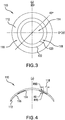
- FIGURES 3 and 4 show a toric contact lens 110 according to a first example embodiment.
- the lens 110 has a posterior surface 112 with a central optical zone 114 and a peripheral zone 116.
- the anterior surface may be provided with an optical correction selected for the particular eye that the lens 100 is to be worn on.
- the peripheral zone 116 of the posterior surface 112 is aspheric and the central zone 114 is "asphero-toric" (or “atoric").
- asphero-toric and “atoric” mean having a cylindrical axis along a first meridian (e.g., the R0 meridian), a spherical axis along a second normal meridian (e.g., the R90 meridian), and a between cylindrical and spherical axis along a third meridian between the first and second meridians (e.g., the R45 meridian), with each meridian of the surface described by a conic aspherical equation and the conic constant being, for example, between -1.0 and 0.0.
- the "spherical” and “cylindrical” axes refer to the correction of the refractive error of the eye, not to the shape of the meridians.
- the spherical axis determines the spherical power and the cylindrical axis, which is normal to the spherical axis, determines the cylinder power. So in clinical practice, those skilled in the art typically refer to these axes as spherical and cylindrical, regardless of whether the shape of the curve at the meridians has a singe radius or is a conic section, i.e. is aspheric.
- kx -0.16
- the aspheric surface is an ellipsoid in these embodiments.
- other kx values may be used to define other aspheric surfaces of the peripheral zone 116 that may be of benefit in some cases. It will be understood by those skilled in the art that the "apex radius" of an aspherical surface is the radius at the apex of the surface.
- z, x, and y are coordinates (z is the distance from the x-axis and y-axis, x is the distance from the y-axis and z-axis, y is the distance from the x-axis and z-axis)
- cx 1/apex radius x
- cy 1/apex radius y
- kx and ky are the conic constants relative to the x-axis and the y-axis, where for example -2.0 ⁇ kx ⁇ 0.0 and -2.0 ⁇ ky ⁇ 0.0.
- the conic constants may be selected with -1 ⁇ kx ⁇ 0 and with ky not within this range, or vice versa.
- the central zone 114 has a conventional sphero-toric surface and the peripheral zone 116 has an aspheric surface as defined herein.
- the central zone 114 has an asphero-toric surface as defined herein and the peripheral zone 116 has a conventional spheric surface.
- the posterior surface 112 includes a blending zone 118 between the central and peripheral zones.
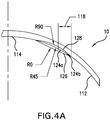
- the asphero-toric central zone 114 and the asperhic peripheral zone 116 are preferably selected (by choice of the conic constant) so that, along a meridian between the cylindrical and spherical axes (e.g., the R45 meridian) in the blending zone 118, a continuation 124a of the curve of the central zone surface generally matches (is an exact continuation or a close approximation of) a continuation 124b of the curve of the peripheral zone surface (see FIGURE 4A ).
- a continuation 124a of the curve of the central zone surface generally matches (is an exact continuation or a close approximation of) a continuation 124b of the curve of the peripheral zone surface (see FIGURE 4A ).
- the slope changes along the R0 and R90 meridians are opposite of each other and about the same in magnitude. So the amount of slope change to be blended is minimized and the width of the blending zone is minimized.
- a spline curve 128 of the blending zone 118 gradually changes from flat to steep from the central zone 114 to the peripheral zone 116.
- a spline curve 126 of the blending zone 118 gradually changes from steep to flat (and thus opposite the slope change along the R90 meridian) from the central zone 114 to the peripheral zone 116. So there is only a slight and smooth bulge resulting from the central-to-peripheral-zone transition, with the transition being much smoother than the sharp protruding ridge of conventional toric lenses.
- the asphero-toric central zone and the asperhic peripheral zone are configured so that, along the cylindrical axis (e.g., the R0 meridian) in the blending zone, a continuation of the curve of the central zone surface generally matches (is an exact continuation or a close approximation of) a continuation of the curve of the peripheral zone surface.
- a continuation of the curve of the central zone surface generally matches (is an exact continuation or a close approximation of) a continuation of the curve of the peripheral zone surface.
- the slope changes from flat to steep from the central zone to the peripheral zone, thereby forming recesses in the posterior surface of the blending zone.
- the lens may need to be thicker to avoid an unacceptably weak spot at the R90 meridian, where the recess is deepest.
- the blending zone 118 may need to be wider.
- the blending zone 118 is a circular band and may have a constant width of for example about 0.2 mm to about 1.0 mm.
- the central zone 114 is circular and, because it is the optical zone, it may have a diameter of for example no less than about 7 mm, which is about as large as a pupil of a typical adult human gets in low light.
- the inner boundary 120 of the blending zone 118 may have a diameter of for example no less than about 7 mm so that it does not interfere with the optics of the lens 110.
- the outer boundary 122 of the blending zone 118 may have a diameter of for example about 8.2 mm to about 9.0 mm.
- the peripheral zone 116 of the lens 110 is a circular band with a constant width (i.e., rotationally symmetric about the center line of the lens) so that it can be formed by rotating a basis curve mold without changing the thickness profile at the periphery of the lens. Another advantage of a circular band is ease-of-manufacturing. Moreover, a constant width and thickness peripheral zone 116 is generally preferred for a comfortable fit and for clinical performance. For these reasons, the lens 110 preferably includes the peripheral zone 116, instead of having the blending zone 116 extend outwardly all the way to the outer edge of the lens.
- the peripheral zone 116 may have constant width of for example about 1.0 mm to about 3.5 mm.
- FIGURES 5 and 6 show a toric contact lens 210 according to a second example embodiment.
- the lens 210 is similar to the lens 110 of the first embodiment, having a posterior surface 212 with a central asphero-toric optical zone 214, a peripheral aspheric zone 216, and a blending zone 218 therebetween.
- the central zone 214 is an oval (as in conventional toric lens) and the blending zone 218 is an oval band.
- FIGURE 6 shows the blending zone section 218a at the R45 meridian, the blending zone section 218b at the R0 meridian, and the blending zone section 218c at the R90 meridian.
- the diameter of the central zone 214 at the R0 meridian is usually determined by the cylinder power, i.e., a larger cylinder power will have a larger diameter.
- the minimum diameter of the central zone 214 may be for example about 7.0 mm at the R0 meridian and the maximum diameter may be for example about 12.5 mm at the R90 meridian.
- the blending zone 118 may have a constant width of for example about 0.2 mm to about 1.0 mm.
- the peripheral zone 216 may have a minimum width of for example about 1.0 mm at the R90 meridian and a maximum width of for example about 3.5 mm at the R0 meridian.
- FIGURES 7 and 8 show a toric contact lens 310 according to a third example embodiment.
- the lens 310 is similar to the lens 110 of the first embodiment, having a posterior surface 312 with a central asphero-toric optical zone 314, a peripheral aspheric zone 316, and a blending zone 318 therebetween.
- the blending zone 318 has a varied width.
- the blending zone 318 is widest where the slope change is greatest (e.g., at the cylindrical R0 meridian and the spherical R90 meridian) to allow enough distance for a smooth transition between the curves being blended.
- the blending zone 318 is narrowest where the slope change is smallest (e.g., halfway between the R0 and R90 meridians, at the R45 meridian) because a smooth transition can be made in a shorter distance.
- the blending zone 318 is provided with at least some width at the R45 meridian to facilitate the blending using conventional computer-aided design (CAD) software.
- the minimum width of the blending zone 318 may be for example about .02 mm at the R0 and R90 meridians and the maximum width may be for example about 1.0 mm at the R45 meridian.
- the central zone 314 may have a diameter of for example at least about 7.0 mm so as not to interfere with the optics of the lens.
- the variance in the blending zone width is the result of variations in the outer boundary 322. This embodiment tends to provide more uniform transitions of the curves being blended, however, due to the variation in the width of the blending zone 318, modeling this lens tends to be more difficult. It will be understood that a varied-width blending zone also can be implemented in a lens with an oval central zone.
- a computer implemented method of designing the lens of the example embodiments and other embodiments of the invention may be performed by using a commercially available CAD software package stored on a general-purpose personal computer such as a desktop, laptop or handheld computer.
- the CAD software package includes a feature for applying a spline function to generate spline curves to blend the curves of the central and peripheral zones.
- Commercially available programs that can be used in the method include those sold under the brand names "SOLIDWORKS” by SolidWorks Corporation (Concord, MA), "PRO/ENGINEER” by Parametric Technology Corporation (Needham, MA), and "AUTOCAD” by Autodesk, Inc. (San Rafael, CA).
- the design method includes the steps of defining the central zone of the posterior surface, defining the peripheral zone of the posterior surface, and blending the curves of the central and peripheral zones in the blending zone using the spline function.
- the central zone may be defined by the asphero-toric surface described herein and have a plan-view shape and dimensions such as those described herein.
- the peripheral zone may be defined by the aspheric surface described herein and have a plan-view shape and dimensions such as those described herein.
- the continuation of the curve of the central zone along one meridian is generally matched to the continuation of the curve of the peripheral zone.
- the curves of the central and peripheral zones along each meridian are blended together. For example, by generally matching the curves along the R45 meridian, then the slope changes along the R0 and R90 meridians will be opposite of each other and have about the same magnitude.
- the method may include generally matching the curves along another meridian between the R0 and R90 meridians, for example, any meridian between the R35 ad R55 meridians.
- the resultant posterior surface of the lens has a smooth transition between the central and peripheral zones, with only a slight and smooth bulge at portions of the transition, thereby greatly reducing lens pressure on the eye of the wearer.
Landscapes
- Health & Medical Sciences (AREA)
- Ophthalmology & Optometry (AREA)
- Physics & Mathematics (AREA)
- General Health & Medical Sciences (AREA)
- General Physics & Mathematics (AREA)
- Optics & Photonics (AREA)
- Eyeglasses (AREA)
Claims (5)
- Ophthalmische Linse (110, 210, 310), umfassend:eine hintere Oberfläche (112, 212, 312) mit einer zentralen optischen Zone (114, 214, 314), einer peripheren Zone (116, 216, 316), und einer Verbindungszone (118, 218, 318) dazwischen;wobei die zentrale Zone (114, 214, 314) torisch ist; undwobei die Verbindungszone (118, 218, 318) einen geglätteten Übergang zwischen der zentralen Zone (114, 214, 314) und der peripheren Zone (116, 216, 316) bildet, wobei die Verbindungszone (118, 218, 318) wenigstens teilweise durch Spline-Kurven beschrieben ist,dadurch gekennzeichnet, dass- die zentrale Zone (114, 214, 314) asphäro-torisch ist und durch die folgende Gleichung definiert ist:
 - die periphere Zone (116, 216, 316) asphärisch, rotationssymmetrisch um die z-Achse, und durch die folgende Gleichung definiert ist:
 - die Steigungsänderungen der Spline-Kurven in der Verbindungszone (118, 218, 318) entlang eines ersten, zylindrischen Meridians (R0) und eines zweiten, sphärischen Meridians (R90) ein entgegengesetztes Vorzeichen und etwa den gleichen Betrag aufweisen, und entlang eines dritten Meridians (R45) auf halbem Weg zwischen dem ersten, zylindrischen Meridian und dem zweiten, sphärischen Meridian in der Verbindungszone (118, 218, 318) eine Fortsetzung der zentralen Zone (114, 214, 314) allgemein mit einer Fortsetzung der peripheren Zone (116, 216, 316) übereinstimmt;- wobei sich die Spline-Kurve in der Verbindungszone von der zentralen Zone (114) zu der peripheren Zone (116) entlang des ersten, zylindrischen Meridians (R0) graduell von steil zu flach ändert,
und wobei sich die Spline-Kurve in der Verbindungszone von der zentralen Zone (114) zu der peripheren Zone (116) an dem zweiten, sphärischen Meridian (R90) graduell von flach zu steil ändert. - Linse nach Anspruch 1, wobei für die zentrale Zone (114, 214, 314) -1.0 < kx < 0.0 und -1.0 < ky < 0.0 gilt, und für die periphere Zone (116, 216, 316) -1.0 < kx < 0.0 gilt, oder
wobei für die zentrale Zone (114, 214, 314) -0.7 < kx < -0.1 und -0.7 < ky < -0.1 gilt und für die periphere Zone (116, 216, 316) -0.7 < kx < -0.1 gilt - Linse nach Anspruch 1, wobei für die zentrale Zone (114, 214, 314) kx = ky = -0.16 gilt und wobei für die periphere Zone (116, 216, 316) kx = -0.16 gilt.
- Linse nach Anspruch 1, wobei die Verbindungszone (118, 218, 318) ein kreisförmiges Band mit einem Innendurchmesser von nicht weniger als etwa 7.0 mm und einem Außendurchmesser von zwischen etwa 7.2 mm und etwa 9.0 mm ist.
- Computerimplementiertes Verfahren zum Gestalten der Linse nach Anspruch 1, umfassend:Definieren der asphäro-torischen zentralen Zone (114, 214, 314) der hinteren Oberfläche;Definieren der asphärischen peripheren Zone (116, 216, 316) der hinteren Linsenoberfläche; undDefinieren der Verbindungszone (118, 218, 318) der Linsenoberfläche durch Erzeugen der Spline-Kurven zum Glätten des Übergangs zwischen der asphäro-torischen zentralen Zone (114, 214, 314) und der asphärischen peripheren Zone (116, 216, 316).
Applications Claiming Priority (2)
| Application Number | Priority Date | Filing Date | Title |
|---|---|---|---|
| US95433907P | 2007-08-07 | 2007-08-07 | |
| PCT/US2008/072213 WO2009020963A1 (en) | 2007-08-07 | 2008-08-05 | Toric contact lens with improved posterior surface design |
Publications (2)
| Publication Number | Publication Date |
|---|---|
| EP2176702A1 EP2176702A1 (de) | 2010-04-21 |
| EP2176702B1 true EP2176702B1 (de) | 2020-07-08 |
Family
ID=39829027
Family Applications (1)
| Application Number | Title | Priority Date | Filing Date |
|---|---|---|---|
| EP08797189.1A Active EP2176702B1 (de) | 2007-08-07 | 2008-08-05 | Torische kontaktlinse mit verbessertem rückflächendesign |
Country Status (6)
| Country | Link |
|---|---|
| US (1) | US7625085B2 (de) |
| EP (1) | EP2176702B1 (de) |
| JP (1) | JP5831865B2 (de) |
| KR (1) | KR101547372B1 (de) |
| CA (1) | CA2695516C (de) |
| WO (1) | WO2009020963A1 (de) |
Cited By (1)
| Publication number | Priority date | Publication date | Assignee | Title |
|---|---|---|---|---|
| EP4530705A1 (de) * | 2023-09-28 | 2025-04-02 | Visco Vision Inc. | Kontaktlinse |
Families Citing this family (32)
| Publication number | Priority date | Publication date | Assignee | Title |
|---|---|---|---|---|
| JP4942762B2 (ja) * | 2005-12-22 | 2012-05-30 | ボシュ・アンド・ロム・インコーポレイテッド | トーリック・コンタクトレンズ |
| US9216080B2 (en) | 2007-08-27 | 2015-12-22 | Amo Groningen B.V. | Toric lens with decreased sensitivity to cylinder power and rotation and method of using the same |
| US8974526B2 (en) | 2007-08-27 | 2015-03-10 | Amo Groningen B.V. | Multizonal lens with extended depth of focus |
| ATE523810T1 (de) | 2008-02-15 | 2011-09-15 | Amo Regional Holdings | System, brillenglas und verfahren zur erweiterung der fokustiefe |
| US8439498B2 (en) | 2008-02-21 | 2013-05-14 | Abbott Medical Optics Inc. | Toric intraocular lens with modified power characteristics |
| US8862447B2 (en) | 2010-04-30 | 2014-10-14 | Amo Groningen B.V. | Apparatus, system and method for predictive modeling to design, evaluate and optimize ophthalmic lenses |
| US8113652B2 (en) | 2009-03-27 | 2012-02-14 | Crt Technology, Inc. | Contact lens with meridional sagittal variation and methods for making and using the same |
| CA2784782C (en) | 2009-12-18 | 2018-02-27 | Hendrik A. Weeber | Limited echelette lens, systems and methods |
| US8256896B2 (en) | 2010-02-25 | 2012-09-04 | Abbott Medical Optic Inc. | Toric optic for ophthalmic use |
| EP3330776A1 (de) | 2010-12-01 | 2018-06-06 | AMO Groningen B.V. | Multifokale linse mit optischer leistungsverstärkungsprogression sowie system und verfahren zur bereitstellung davon |
| EP2928413B1 (de) | 2012-12-04 | 2019-08-14 | AMO Groningen B.V. | Linsen, systeme und verfahren zur personalisierten binokularen presbyopiekorrektur |
| US9421721B2 (en) | 2013-09-20 | 2016-08-23 | Gregory Gemoules | System and method for designing scleral lenses |
| EP3413840A1 (de) | 2016-02-09 | 2018-12-19 | AMO Groningen B.V. | Gleitsichtintraokularlinse und verfahren zur verwendung und herstellung |
| AU2017238517B2 (en) | 2016-03-23 | 2021-11-11 | Johnson & Johnson Surgical Vision, Inc. | Ophthalmic apparatus with corrective meridians having extended tolerance band |
| US11123178B2 (en) | 2016-03-23 | 2021-09-21 | Johnson & Johnson Surgical Vision, Inc. | Power calculator for an ophthalmic apparatus with corrective meridians having extended tolerance or operation band |
| WO2018078439A2 (en) | 2016-10-25 | 2018-05-03 | Amo Groningen B.V. | Realistic eye models to design and evaluate intraocular lenses for a large field of view |
| WO2018112558A1 (en) * | 2016-12-23 | 2018-06-28 | Capricornia Contact Lens Pty Ltd | Contact lens |
| US10739227B2 (en) | 2017-03-23 | 2020-08-11 | Johnson & Johnson Surgical Vision, Inc. | Methods and systems for measuring image quality |
| US20190064543A1 (en) * | 2017-08-30 | 2019-02-28 | Johnson & Johnson Vision Care, Inc. | Atoric Surfaces to Minimize Secondary Astigmatism in Contact Lenses for the Correction of Astigmatism |
| KR20190052856A (ko) | 2017-11-09 | 2019-05-17 | (주)에이지광학 | 대구경의 축 비대칭 비구면 렌즈. |
| WO2019106067A1 (en) | 2017-11-30 | 2019-06-06 | Amo Groningen B.V. | Intraocular lenses that improve post-surgical spectacle independent and methods of manufacturing thereof |
| CN114667477B (zh) * | 2019-09-25 | 2025-01-10 | 恩视控股有限公司 | 用于近视管理的接触透镜解决方案 |
| US11886046B2 (en) | 2019-12-30 | 2024-01-30 | Amo Groningen B.V. | Multi-region refractive lenses for vision treatment |
| KR20210085583A (ko) * | 2019-12-31 | 2021-07-08 | 주식회사 인터로조 | 시각적 성능 개선을 위한 구면수차 제어 설계가 적용된 콘택트 렌즈 |
| US20230123284A1 (en) * | 2020-02-14 | 2023-04-20 | Nthalmic Holding Pty Ltd | A contact lens for myopia with or without astigmatism |
| KR20260004583A (ko) | 2021-03-03 | 2026-01-08 | 쉔양칸겐더메디컬사이언스앤드테크놀로지씨오엘티디 | 기하학적 볼륨 제어 각막 굴절 치료용 콘택트렌즈 |
| ES2998813T3 (en) * | 2021-04-29 | 2025-02-21 | Coopervision Int Ltd | Lens sets for use in preventing or slowing the development or progression of myopia and related methods |
| EP4333685B1 (de) | 2021-05-05 | 2026-01-14 | AMO Groningen B.V. | Ringhalometersystem und verfahren zur quantifizierung von dysphotopsien |
| US12544218B2 (en) | 2021-12-03 | 2026-02-10 | Amo Groningen B.V. | Lenses having multi-ring design for vision treatment |
| CN114740635B (zh) * | 2022-04-22 | 2024-07-26 | 温州视铂科技有限公司 | 一种四象限非对称角膜塑形镜 |
| CN118871065B (zh) * | 2022-12-02 | 2025-04-08 | 深圳市新产业眼科新技术有限公司 | 具有奇异非球面锥透镜折射光学器件的增强型眼用晶状体 |
| US20250102829A1 (en) * | 2023-09-27 | 2025-03-27 | Johnson & Johnson Vision Care, Inc. | Optimized Posterior Surface for Toric Contact Lenses |
Family Cites Families (21)
| Publication number | Priority date | Publication date | Assignee | Title |
|---|---|---|---|---|
| US4418991A (en) * | 1979-09-24 | 1983-12-06 | Breger Joseph L | Presbyopic contact lens |
| US5009497A (en) * | 1987-11-12 | 1991-04-23 | Cohen Allen L | Contact lenses utilizing keel orientation |
| US5020898A (en) * | 1990-01-29 | 1991-06-04 | Schering Corporation | Contact lens for correction of astigmatism |
| US5767939A (en) * | 1991-10-09 | 1998-06-16 | Seiko Epson Corporation | Eyeglass lens |
| TW210380B (de) * | 1992-04-23 | 1993-08-01 | Ciba Geigy Ag | |
| US5861114A (en) * | 1994-06-10 | 1999-01-19 | Johnson&Johnson Vision Products, Inc. | Method of manufacturing complex optical designs in soft contact lenses |
| US5650838A (en) * | 1995-05-04 | 1997-07-22 | Johnson & Johnson Vision Products, Inc. | Programmable smooth junctions on lenses |
| IL118065A0 (en) * | 1995-05-04 | 1996-08-04 | Johnson & Johnson Vision Prod | Aspheric toric lens designs |
| US6241355B1 (en) * | 1996-03-29 | 2001-06-05 | Brian A. Barsky | Computer aided contact lens design and fabrication using spline surfaces |
| US6000798A (en) * | 1997-10-06 | 1999-12-14 | Innotech Inc. | Ophthalmic optic devices |
| AUPP016197A0 (en) * | 1997-11-03 | 1997-11-27 | Sola International Holdings Ltd | Improved ophthalmic lens |
| US6176577B1 (en) * | 1998-10-15 | 2001-01-23 | Oracle Lens Manufacturing Corporation | Aspheric lenses |
| US6142627A (en) * | 1998-12-01 | 2000-11-07 | Sola International, Inc. | Short-corridor progressive lens |
| US6582076B1 (en) * | 2000-08-30 | 2003-06-24 | Johnson & Johnson Vision Care, Inc. | Ophthalmic lenses useful in correcting astigmatism and presbyopia |
| US6843563B2 (en) * | 2002-07-31 | 2005-01-18 | Bausch And Lomb, Inc. | Smoothly blended optical surfaces |
| US6923540B2 (en) * | 2002-07-31 | 2005-08-02 | Novartis Ag | Toric multifocal contact lenses |
| US7036931B2 (en) * | 2003-01-29 | 2006-05-02 | Novartis Ag | Ophthalmic lenses |
| US7004585B2 (en) * | 2003-02-11 | 2006-02-28 | Novartis Ag | Ophthalmic lens having an optical zone blend design |
| US20050041203A1 (en) * | 2003-08-20 | 2005-02-24 | Lindacher Joseph Michael | Ophthalmic lens with optimal power profile |
| ES2527284T3 (es) * | 2005-08-24 | 2015-01-22 | Hecht Contactlinsen Gmbh | Lente de contacto de forma estable |
| WO2007075975A2 (en) * | 2005-12-22 | 2007-07-05 | Bausch & Lomb Incorporated | Toric contact lenses |
-
2008
- 2008-08-05 US US12/221,566 patent/US7625085B2/en active Active
- 2008-08-05 EP EP08797189.1A patent/EP2176702B1/de active Active
- 2008-08-05 JP JP2010520260A patent/JP5831865B2/ja active Active
- 2008-08-05 WO PCT/US2008/072213 patent/WO2009020963A1/en not_active Ceased
- 2008-08-05 CA CA2695516A patent/CA2695516C/en active Active
- 2008-08-05 KR KR1020107004937A patent/KR101547372B1/ko active Active
Non-Patent Citations (1)
| Title |
|---|
| None * |
Cited By (1)
| Publication number | Priority date | Publication date | Assignee | Title |
|---|---|---|---|---|
| EP4530705A1 (de) * | 2023-09-28 | 2025-04-02 | Visco Vision Inc. | Kontaktlinse |
Also Published As
| Publication number | Publication date |
|---|---|
| CA2695516A1 (en) | 2009-02-12 |
| WO2009020963A1 (en) | 2009-02-12 |
| KR101547372B1 (ko) | 2015-08-25 |
| EP2176702A1 (de) | 2010-04-21 |
| KR20100040958A (ko) | 2010-04-21 |
| CA2695516C (en) | 2016-02-16 |
| US20090040458A1 (en) | 2009-02-12 |
| US7625085B2 (en) | 2009-12-01 |
| JP5831865B2 (ja) | 2015-12-09 |
| JP2010536070A (ja) | 2010-11-25 |
Similar Documents
| Publication | Publication Date | Title |
|---|---|---|
| EP2176702B1 (de) | Torische kontaktlinse mit verbessertem rückflächendesign | |
| TWI383190B (zh) | 治療非正視眼的軟式隱形眼鏡 | |
| EP1281099B1 (de) | Kontaktlinse mit einem gleichförmigen horizontalen dickeprofil | |
| CN100570436C (zh) | 一系列的非球面接触透镜 | |
| US11662606B2 (en) | Orthokeratology lens and method for making orthokeratology lenses | |
| JP5448789B2 (ja) | トーリックコンタクトレンズ及びその製造方法 | |
| EP3865930B1 (de) | Ophthalmische linse, entwurfsverfahren dafür, herstellungsverfahren dafür und ophthalmisches linsenset | |
| AU2004246631A1 (en) | Contact lens with shaped periphery | |
| TW201326960A (zh) | 用於設計非圓形軟式隱形眼鏡的方法 | |
| TWI686640B (zh) | 具最佳效能之隱形眼鏡及設計方法 | |
| TW202109141A (zh) | 具有妝飾及療效考量的光致變色軟式隱形眼鏡 | |
| JP2025016674A (ja) | 改善された角度安定性及び快適性のための新しい安定化ゾーンを有するソフトコンタクトレンズ | |
| CN110618540B (zh) | 旋转稳定化的非截短接触镜片 | |
| WO2024125016A1 (zh) | 角膜塑形镜 | |
| CN114126802A (zh) | 体积变化减小的软性接触镜片 | |
| EP2107417A1 (de) | Gestaltungsverfahren für eine asphärische opthalmische Linse | |
| EP1734398B1 (de) | Kontaktlinse mit uniformem horizontalem Dickenprofil | |
| CN218601621U (zh) | 一种广角双光镜片元件 | |
| HK1051406B (en) | Contact lens having a uniform horizontal thickness profile |
Legal Events
| Date | Code | Title | Description |
|---|---|---|---|
| PUAI | Public reference made under article 153(3) epc to a published international application that has entered the european phase |
Free format text: ORIGINAL CODE: 0009012 |
|
| 17P | Request for examination filed |
Effective date: 20100209 |
|
| AK | Designated contracting states |
Kind code of ref document: A1 Designated state(s): AT BE BG CH CY CZ DE DK EE ES FI FR GB GR HR HU IE IS IT LI LT LU LV MC MT NL NO PL PT RO SE SI SK TR |
|
| AX | Request for extension of the european patent |
Extension state: AL BA MK RS |
|
| DAX | Request for extension of the european patent (deleted) | ||
| 17Q | First examination report despatched |
Effective date: 20150529 |
|
| STAA | Information on the status of an ep patent application or granted ep patent |
Free format text: STATUS: EXAMINATION IS IN PROGRESS |
|
| GRAP | Despatch of communication of intention to grant a patent |
Free format text: ORIGINAL CODE: EPIDOSNIGR1 |
|
| STAA | Information on the status of an ep patent application or granted ep patent |
Free format text: STATUS: GRANT OF PATENT IS INTENDED |
|
| RAP1 | Party data changed (applicant data changed or rights of an application transferred) |
Owner name: ALCON INC. |
|
| INTG | Intention to grant announced |
Effective date: 20200205 |
|
| GRAS | Grant fee paid |
Free format text: ORIGINAL CODE: EPIDOSNIGR3 |
|
| GRAA | (expected) grant |
Free format text: ORIGINAL CODE: 0009210 |
|
| STAA | Information on the status of an ep patent application or granted ep patent |
Free format text: STATUS: THE PATENT HAS BEEN GRANTED |
|
| AK | Designated contracting states |
Kind code of ref document: B1 Designated state(s): AT BE BG CH CY CZ DE DK EE ES FI FR GB GR HR HU IE IS IT LI LT LU LV MC MT NL NO PL PT RO SE SI SK TR |
|
| REG | Reference to a national code |
Ref country code: GB Ref legal event code: FG4D |
|
| REG | Reference to a national code |
Ref country code: AT Ref legal event code: REF Ref document number: 1289078 Country of ref document: AT Kind code of ref document: T Effective date: 20200715 Ref country code: CH Ref legal event code: EP |
|
| REG | Reference to a national code |
Ref country code: DE Ref legal event code: R096 Ref document number: 602008062950 Country of ref document: DE |
|
| REG | Reference to a national code |
Ref country code: IE Ref legal event code: FG4D |
|
| REG | Reference to a national code |
Ref country code: LT Ref legal event code: MG4D |
|
| REG | Reference to a national code |
Ref country code: AT Ref legal event code: MK05 Ref document number: 1289078 Country of ref document: AT Kind code of ref document: T Effective date: 20200708 |
|
| REG | Reference to a national code |
Ref country code: NL Ref legal event code: MP Effective date: 20200708 |
|
| PG25 | Lapsed in a contracting state [announced via postgrant information from national office to epo] |
Ref country code: BG Free format text: LAPSE BECAUSE OF FAILURE TO SUBMIT A TRANSLATION OF THE DESCRIPTION OR TO PAY THE FEE WITHIN THE PRESCRIBED TIME-LIMIT Effective date: 20201008 Ref country code: AT Free format text: LAPSE BECAUSE OF FAILURE TO SUBMIT A TRANSLATION OF THE DESCRIPTION OR TO PAY THE FEE WITHIN THE PRESCRIBED TIME-LIMIT Effective date: 20200708 Ref country code: PT Free format text: LAPSE BECAUSE OF FAILURE TO SUBMIT A TRANSLATION OF THE DESCRIPTION OR TO PAY THE FEE WITHIN THE PRESCRIBED TIME-LIMIT Effective date: 20201109 Ref country code: GR Free format text: LAPSE BECAUSE OF FAILURE TO SUBMIT A TRANSLATION OF THE DESCRIPTION OR TO PAY THE FEE WITHIN THE PRESCRIBED TIME-LIMIT Effective date: 20201009 Ref country code: NO Free format text: LAPSE BECAUSE OF FAILURE TO SUBMIT A TRANSLATION OF THE DESCRIPTION OR TO PAY THE FEE WITHIN THE PRESCRIBED TIME-LIMIT Effective date: 20201008 Ref country code: ES Free format text: LAPSE BECAUSE OF FAILURE TO SUBMIT A TRANSLATION OF THE DESCRIPTION OR TO PAY THE FEE WITHIN THE PRESCRIBED TIME-LIMIT Effective date: 20200708 Ref country code: SE Free format text: LAPSE BECAUSE OF FAILURE TO SUBMIT A TRANSLATION OF THE DESCRIPTION OR TO PAY THE FEE WITHIN THE PRESCRIBED TIME-LIMIT Effective date: 20200708 Ref country code: HR Free format text: LAPSE BECAUSE OF FAILURE TO SUBMIT A TRANSLATION OF THE DESCRIPTION OR TO PAY THE FEE WITHIN THE PRESCRIBED TIME-LIMIT Effective date: 20200708 Ref country code: LT Free format text: LAPSE BECAUSE OF FAILURE TO SUBMIT A TRANSLATION OF THE DESCRIPTION OR TO PAY THE FEE WITHIN THE PRESCRIBED TIME-LIMIT Effective date: 20200708 Ref country code: FI Free format text: LAPSE BECAUSE OF FAILURE TO SUBMIT A TRANSLATION OF THE DESCRIPTION OR TO PAY THE FEE WITHIN THE PRESCRIBED TIME-LIMIT Effective date: 20200708 |
|
| PG25 | Lapsed in a contracting state [announced via postgrant information from national office to epo] |
Ref country code: IS Free format text: LAPSE BECAUSE OF FAILURE TO SUBMIT A TRANSLATION OF THE DESCRIPTION OR TO PAY THE FEE WITHIN THE PRESCRIBED TIME-LIMIT Effective date: 20201108 Ref country code: LV Free format text: LAPSE BECAUSE OF FAILURE TO SUBMIT A TRANSLATION OF THE DESCRIPTION OR TO PAY THE FEE WITHIN THE PRESCRIBED TIME-LIMIT Effective date: 20200708 Ref country code: PL Free format text: LAPSE BECAUSE OF FAILURE TO SUBMIT A TRANSLATION OF THE DESCRIPTION OR TO PAY THE FEE WITHIN THE PRESCRIBED TIME-LIMIT Effective date: 20200708 |
|
| PG25 | Lapsed in a contracting state [announced via postgrant information from national office to epo] |
Ref country code: NL Free format text: LAPSE BECAUSE OF FAILURE TO SUBMIT A TRANSLATION OF THE DESCRIPTION OR TO PAY THE FEE WITHIN THE PRESCRIBED TIME-LIMIT Effective date: 20200708 |
|
| REG | Reference to a national code |
Ref country code: CH Ref legal event code: PL |
|
| REG | Reference to a national code |
Ref country code: DE Ref legal event code: R097 Ref document number: 602008062950 Country of ref document: DE |
|
| PG25 | Lapsed in a contracting state [announced via postgrant information from national office to epo] |
Ref country code: LI Free format text: LAPSE BECAUSE OF NON-PAYMENT OF DUE FEES Effective date: 20200831 Ref country code: DK Free format text: LAPSE BECAUSE OF FAILURE TO SUBMIT A TRANSLATION OF THE DESCRIPTION OR TO PAY THE FEE WITHIN THE PRESCRIBED TIME-LIMIT Effective date: 20200708 Ref country code: CH Free format text: LAPSE BECAUSE OF NON-PAYMENT OF DUE FEES Effective date: 20200831 Ref country code: EE Free format text: LAPSE BECAUSE OF FAILURE TO SUBMIT A TRANSLATION OF THE DESCRIPTION OR TO PAY THE FEE WITHIN THE PRESCRIBED TIME-LIMIT Effective date: 20200708 Ref country code: CZ Free format text: LAPSE BECAUSE OF FAILURE TO SUBMIT A TRANSLATION OF THE DESCRIPTION OR TO PAY THE FEE WITHIN THE PRESCRIBED TIME-LIMIT Effective date: 20200708 Ref country code: RO Free format text: LAPSE BECAUSE OF FAILURE TO SUBMIT A TRANSLATION OF THE DESCRIPTION OR TO PAY THE FEE WITHIN THE PRESCRIBED TIME-LIMIT Effective date: 20200708 Ref country code: MC Free format text: LAPSE BECAUSE OF FAILURE TO SUBMIT A TRANSLATION OF THE DESCRIPTION OR TO PAY THE FEE WITHIN THE PRESCRIBED TIME-LIMIT Effective date: 20200708 Ref country code: LU Free format text: LAPSE BECAUSE OF NON-PAYMENT OF DUE FEES Effective date: 20200805 |
|
| PLBE | No opposition filed within time limit |
Free format text: ORIGINAL CODE: 0009261 |
|
| STAA | Information on the status of an ep patent application or granted ep patent |
Free format text: STATUS: NO OPPOSITION FILED WITHIN TIME LIMIT |
|
| REG | Reference to a national code |
Ref country code: BE Ref legal event code: MM Effective date: 20200831 |
|
| 26N | No opposition filed |
Effective date: 20210409 |
|
| PG25 | Lapsed in a contracting state [announced via postgrant information from national office to epo] |
Ref country code: SK Free format text: LAPSE BECAUSE OF FAILURE TO SUBMIT A TRANSLATION OF THE DESCRIPTION OR TO PAY THE FEE WITHIN THE PRESCRIBED TIME-LIMIT Effective date: 20200708 |
|
| PG25 | Lapsed in a contracting state [announced via postgrant information from national office to epo] |
Ref country code: BE Free format text: LAPSE BECAUSE OF NON-PAYMENT OF DUE FEES Effective date: 20200831 Ref country code: SI Free format text: LAPSE BECAUSE OF FAILURE TO SUBMIT A TRANSLATION OF THE DESCRIPTION OR TO PAY THE FEE WITHIN THE PRESCRIBED TIME-LIMIT Effective date: 20200708 |
|
| PG25 | Lapsed in a contracting state [announced via postgrant information from national office to epo] |
Ref country code: TR Free format text: LAPSE BECAUSE OF FAILURE TO SUBMIT A TRANSLATION OF THE DESCRIPTION OR TO PAY THE FEE WITHIN THE PRESCRIBED TIME-LIMIT Effective date: 20200708 Ref country code: MT Free format text: LAPSE BECAUSE OF FAILURE TO SUBMIT A TRANSLATION OF THE DESCRIPTION OR TO PAY THE FEE WITHIN THE PRESCRIBED TIME-LIMIT Effective date: 20200708 Ref country code: CY Free format text: LAPSE BECAUSE OF FAILURE TO SUBMIT A TRANSLATION OF THE DESCRIPTION OR TO PAY THE FEE WITHIN THE PRESCRIBED TIME-LIMIT Effective date: 20200708 |
|
| P01 | Opt-out of the competence of the unified patent court (upc) registered |
Effective date: 20230503 |
|
| PGFP | Annual fee paid to national office [announced via postgrant information from national office to epo] |
Ref country code: DE Payment date: 20250722 Year of fee payment: 18 |
|
| PGFP | Annual fee paid to national office [announced via postgrant information from national office to epo] |
Ref country code: IT Payment date: 20250728 Year of fee payment: 18 |
|
| PGFP | Annual fee paid to national office [announced via postgrant information from national office to epo] |
Ref country code: GB Payment date: 20250717 Year of fee payment: 18 |
|
| PGFP | Annual fee paid to national office [announced via postgrant information from national office to epo] |
Ref country code: FR Payment date: 20250721 Year of fee payment: 18 |
|
| PGFP | Annual fee paid to national office [announced via postgrant information from national office to epo] |
Ref country code: IE Payment date: 20250723 Year of fee payment: 18 |