EP2177154B1 - Appareil de mesure de glycémie adapté aux enfants - Google Patents
Appareil de mesure de glycémie adapté aux enfants Download PDFInfo
- Publication number
- EP2177154B1 EP2177154B1 EP08166805A EP08166805A EP2177154B1 EP 2177154 B1 EP2177154 B1 EP 2177154B1 EP 08166805 A EP08166805 A EP 08166805A EP 08166805 A EP08166805 A EP 08166805A EP 2177154 B1 EP2177154 B1 EP 2177154B1
- Authority
- EP
- European Patent Office
- Prior art keywords
- toy
- designed
- measurement instrument
- receptacle
- measurement
- Prior art date
- Legal status (The legal status is an assumption and is not a legal conclusion. Google has not performed a legal analysis and makes no representation as to the accuracy of the status listed.)
- Not-in-force
Links
Images




Classifications
-
- A—HUMAN NECESSITIES
- A63—SPORTS; GAMES; AMUSEMENTS
- A63H—TOYS, e.g. TOPS, DOLLS, HOOPS OR BUILDING BLOCKS
- A63H3/00—Dolls
- A63H3/003—Dolls specially adapted for a particular function not connected with dolls
-
- A—HUMAN NECESSITIES
- A61—MEDICAL OR VETERINARY SCIENCE; HYGIENE
- A61B—DIAGNOSIS; SURGERY; IDENTIFICATION
- A61B5/00—Measuring for diagnostic purposes; Identification of persons
- A61B5/145—Measuring characteristics of blood in vivo, e.g. gas concentration or pH-value ; Measuring characteristics of body fluids or tissues, e.g. interstitial fluid or cerebral tissue
- A61B5/14532—Measuring characteristics of blood in vivo, e.g. gas concentration or pH-value ; Measuring characteristics of body fluids or tissues, e.g. interstitial fluid or cerebral tissue for measuring glucose, e.g. by tissue impedance measurement
-
- A—HUMAN NECESSITIES
- A61—MEDICAL OR VETERINARY SCIENCE; HYGIENE
- A61B—DIAGNOSIS; SURGERY; IDENTIFICATION
- A61B5/00—Measuring for diagnostic purposes; Identification of persons
- A61B5/68—Arrangements of detecting, measuring or recording means, e.g. sensors, in relation to patient
- A61B5/6887—Arrangements of detecting, measuring or recording means, e.g. sensors, in relation to patient mounted on external non-worn devices, e.g. non-medical devices
- A61B5/6896—Toys
Definitions
- the invention relates to a measuring system for detecting at least one analyte in a body fluid. Furthermore, the invention relates to a toy, in particular a game animal, which can be used in the measuring system, and a kit for detecting at least one analyte and a method for producing a measuring system for detecting at least one analyte in a body fluid.
- a measuring system for detecting at least one analyte in a body fluid can be used in the measuring system, and a kit for detecting at least one analyte and a method for producing a measuring system for detecting at least one analyte in a body fluid.
- Such measuring systems, toys, kits and methods can be used in particular in the field of measurement of blood glucose. However, other applications are possible.
- the present invention relates to the monitoring of blood glucose.
- the invention can also be used in other areas, for example for the qualitative and / or quantitative detection of other types of analytes.
- cholesterol and / or lactate can be detected, or coagulation measurements can be carried out.
- Other types of body fluids than blood are also possible, for example urine or interstitial fluid.
- measuring devices which detect the analyte by means of test elements.
- test elements can be present, for example, as test strips, test strips, test disks, foldable test elements or in another form and can be designed, for example, as reusable or disposable test elements (disposables).
- measuring devices are known which work with a plurality of magazin mandat test elements.
- the detection of the at least one analyte can be carried out, for example, by electrochemical means and / or using optical measuring methods.
- the test elements have at least one test field with a test chemistry which changes at least one detectable physical and / or chemical property in the presence of the at least one analyte.
- a test chemistry which changes at least one detectable physical and / or chemical property in the presence of the at least one analyte.
- measuring devices are usually designed as portable measuring devices, so that they can be carried for example by a patient at work or in the spare time.
- a considerable amount of discipline is nevertheless required to ensure seamless monitoring.
- WO 03/034912 A1 a simulation device for playful evaluation and display of blood glucose levels.
- the display of the evaluation by means of a virtual creature, which is displayed on a display.
- This virtual creature can communicate with the user in several ways.
- the housing of the simulation device can be designed for example in the form of a teddy bear.
- the measurement system should allow child-friendly measurements and still be inexpensive to produce in large quantities.
- a measuring system for detecting at least one analyte in a body fluid is proposed.
- the measuring system will be described below essentially with respect to the detection of blood glucose.
- a measurement of other types of analytes and / or use in other types of body fluids are conceivable in principle.
- the measuring system comprises at least one measuring device for detecting the analyte in the body fluid.
- the meter is designed as a portable handheld device and has a housing with at least one display element.
- a measuring device is generally understood to mean a measuring device which can perform the qualitative and / or quantitative detection of the at least one analyte in the body fluid.
- this may be one of the measuring devices described above, that is to say a measuring device with a measuring function, by means of which, for example, the analyte detection can be carried out by electrochemical and / or optical means.
- the meter may, as shown above, using at least working a test element, in principle, all types of known test elements can be used. In this regard, for example, reference may be made to the prior art.
- a display element is generally understood an element which is adapted to transmit at least one piece of information to a user and / or patient. This may be, for example, optical information and / or acoustic information and / or haptic information. However, other types of information and / or combinations of said information and / or other types of information are generally usable. It is particularly preferred if the display element is designed as an optical display element and includes, for example, a display.
- the measuring system furthermore comprises at least one toy.
- this toy can be designed as desired and can in particular comprise a toy figure and / or a game animal, preferably a stuffed animal, or be designed as such a game animal.
- the toy is designed as a figure, in particular as a human figure, as an animal figure or as a fantasy figure, ie as a being to whom - at least in the imagination of a child - a character of his own can be assigned.
- Such an embodiment as a figure facilitates the communication between the patient and the measuring device, since the handling of a figure can be made generally more informal and less formal than with a machine.
- a patient in childhood is at least partially deprived of the fear of measurement by this design.
- the measuring device should be at least partially receivable or at least reversibly.
- the recording should be set up in such a way that at least the display element of the measuring device is at least partially accessible when the measuring device is being recorded.
- other areas and / or elements of the measuring device can be at least partially accessible.
- the measuring device in particular by appropriate design of the housing, set up such that the measuring device both in the measuring system and optionally can be used independently of the toy or the measuring system.
- This use of an independent measuring device can be ensured in particular in that the housing of the measuring device is designed such that it meets the requirements for a housing of a portable measuring device.
- the housing can ensure mechanical stability, which also allows entrainment of the measuring device, independently of the toy, in, for example, a pocket or even without a cover without mechanical damage to the measuring device occurring under normal conditions. Even protection against moisture and / or dirt can be ensured by the housing.
- the meter may be, for example, a commercially available, conventional meter.
- the embodiment of the measuring system according to the invention with the measuring device and the toy with a corresponding receptacle offers numerous advantages over known devices which are designed for children. So is not in the measuring system, such as in WO 03/034912 A1 the outer shell of the meter itself designed as a toy, but the meter is reversibly received in such a toy by means of a suitable receptacle. As a result, the meter can be offered simultaneously without toys for an adult clientele, without having to make any changes to the meter itself.
- the invention thus makes it possible to carry out an individual, child-friendly adaptation of a measuring device, for example a blood glucose meter, without having to make any changes to the analysis system itself.
- a method for producing a measuring system for detecting at least one analyte in a body fluid is proposed, in particular a measuring system according to the above description and / or according to one of the embodiments described below. Reference may accordingly be made to these optional embodiments for further details.
- a measuring device for example a measuring device according to the above description, used, which can be used to detect the analyte in the body fluid.
- a commercially available measuring device which is designed as a portable hand-held device and can be used both in the measuring system and optionally independently of the measuring system or the toy.
- the measuring device in turn has a housing with at least one display element. Furthermore, in the proposed method a toy is used, in particular a Game animal, wherein the measuring device is reversibly recorded in at least one shot of the game animal.
- the receptacle is set up so that the display element is at least partially accessible when the measuring device is recorded in the receptacle.
- a plurality of different types of toys can be provided in particular in a storage.
- different toys can be kept for different age groups, gender-specific toys (for example, figures, dolls and / or stuffed animals), different regions, different fads or the like.
- the stock keeping can be adapted and updated according to the current preferences of the target groups, without the need for an adaptation of the measuring devices.
- a specific type of toy can be selected for the production of the measuring system.
- the proposed measuring system and the proposed method thus lead to a cost-effective production of target-specific measurement systems is possible, which can be designed child-friendly and which can be adapted to current developments without much effort. As a result, the costs can be significantly reduced, and it can be the production of special equipment for a small circle of customers avoided. If necessary, only minor adjustments can be made, such as software adjustments of the measuring system. Examples of such adjustments, for example to change the character of a figure represented by the measuring system, are described below.
- a kit for detecting at least one analyte in the body fluid is furthermore proposed, in particular for the detection of blood glucose.
- the kit includes a meter with the meter-related features described above. In particular, it may in turn be a commercially available measuring device.
- the kit comprises a plurality of toys, in particular game figures and / or game animals, which each have at least one receptacle for receiving the measuring device.
- this kit can be used in warehousing to quickly assemble a custom measuring system, for example, as described above or below.
- kit can also be used directly by a customer, for example in order to change the appearance of the measuring system at will within the framework of the toys held in the kit.
- a kit one parent may individually provide multiple children with measuring systems that are customized to the child's preferences and yet rely on the use of the same meter. The kit can therefore be used to make a measuring system. In this way, considerable costs can also be saved, since several users with different preferences can fall back on the same measuring device.
- a toy in particular a toy figure or a game animal, which can be used in a measuring system according to the invention, has at least one toy casing substantially determining the outer shape of the toy. Furthermore, the toy comprises at least one receptacle for the reversible recording of a measuring device for detecting an analyte in a body fluid, in particular a commercially available measuring device.
- the measuring device for the possible embodiments of which reference may be made, for example, to the above or following description, is designed as a portable hand-held device and has a housing with at least one display element. The recording of the toy is set up in such a way that the display element is at least partially accessible when the measuring device is being taken.
- a toy designed in this way which is specially configured by the receptacle for use in a measuring system according to the invention, can be sold, for example, as an independent product, independently of the measuring device.
- parents can respond to these changed preferences by purchasing new, updated or modified toys.
- manufacturers can make fads through the independent distribution of such toys, so that, even with the same design of the measuring device, an update of the external appearance of the measuring systems is possible. This also makes it possible to achieve significant logistical savings.
- the display element should, as shown above, preferably be designed as an optical display element and may for example comprise at least one display. Alternatively or additionally, however, other types of display elements are possible. For example, light-emitting diodes, illuminated areas or similar types of optical display elements can be used.
- the meter has additional elements that ensure interaction between the user and the meter.
- the measuring device further comprises at least one operating element, wherein the receptacle is preferably arranged such that when recorded in the recording Measuring device and the control is at least partially accessible.
- accessible is to be understood with respect to the display element that the provided, for example displayed, information can be perceived even when recorded in the recording instrument.
- a display may not be covered or only partly covered by the toy, for example a toy case.
- the term "accessible" means that the operation of these operating elements by the user or patient is at least limited, preferably unrestricted, possible even when recorded in the recording device.
- the at least one control element may include, for example, push buttons, knobs, buttons or the like.
- the at least one operating element can also be completely or partially combined with the display element, for example by using a touch screen on which, for example, virtual operating elements are displayed.
- the recording may be specially adapted to the meter. This adaptation may be done, for example, by dimensioning the receptacle specifically to the dimensions of a particular type or group of types of meters. An embodiment of the receptacle for several types of measuring devices is conceivable.
- the receptacle furthermore has at least one fixing device, which is set up in order to fix the measuring device relative to the toy.
- the toy may for example have an opening.
- This opening which mutatis mutandis, a plurality of openings can be provided, for example, ensure accessibility to the at least one display element and / or the at least one control element.
- an opening can be understood to mean not only a completely uncovered opening, but also, for example, openings are also conceivable which make optical accessibility possible and which are therefore completely or partially covered with a transparent material, for example a transparent plastic.
- the fixing device can be set up, for example, in order to fix the measuring device in such a way that the access is maintained even under normal loads of a toy through the at least one opening. In particular, a slipping or tilting of the measuring device relative to the opening can be prevented in this way.
- the fixing device may comprise, for example, a clamping device, a screw device, a rail or any other type of fixing device, which are usually used for the fixation of devices and which are known in the art.
- the fixing device can with a corresponding fixing on the Cooperate measuring device and form a common fixing device.
- fixing devices can also be provided which manage independently of corresponding counterparts on the measuring device, so that preferably commercially available measuring devices can be used which are not specially adapted to the measuring system.
- the receptacle may in particular comprise a receiving space.
- the meter may be at least partially receivable.
- the receptacle can have at least one closure element, which can also be wholly or partially identical to the fixation device.
- This closure element can then be set up in order to hold the measuring device in a closed state in the receiving space and, in an open state, to allow the measuring device to be removed from the receiving position.
- the closure element can in particular be set up such that opening and closing of the closure element is also possible by a user, in particular by a parent and / or a user in childhood. In this way, the above-described advantages of the interchangeability of the toy in the measuring system can be ensured in a particularly simple manner.
- closure element can in particular be set up such that opening and closing of this closure element is possible without additional tools.
- the closure element may comprise at least one of the following elements: a zipper; a push button; a textile button; a user-detachable lock.
- the measuring device is in particular designed to detect the analyte by means of at least one test element.
- All types of test elements known from the prior art can in principle also be used in the context of the present invention, for example the abovementioned test elements.
- the measuring device may, for example, have at least one application opening, which is set up to allow a task of a sample of the body fluid on the test element.
- this application opening can be set up in such a way that a test element is introduced into the application opening from the outside, for example an optical and / or electrochemical test element.
- the application opening can also be used to extend a test element, for example a test element magazine, received in the interior of the measuring device, so that a sample task of the test element becomes accessible to a user.
- the application opening can also be set up such that an application site on a test element is temporarily exposed through this application opening so that a user can apply a corresponding liquid sample, for example a drop of blood.
- the measuring system is preferably designed in such a way that the task of the sample can be carried out with the measuring device recorded in the recording.
- the toy has at least one corresponding opening, which is preferably completely uncovered and / or which can be released by a corresponding opening mechanism and which the application opening for a user even when recorded in the recording instrument possible power.
- the toy is at least partially designed as a figure, so as a being, which - at least in the imagination of a child - can be assigned a character of its own.
- the toy can be configured, for example, at least partially as a human figure, as an animal figure or as a fantasy figure.
- the receptacle has an opening, wherein the opening is arranged at least partially in a facial area of the figure.
- the opening may comprise a complete area of a face of the figure and / or only a portion of the face, for example an area of the eyes and / or the mouth.
- the opening is designed such that the display element is at least partially recognizable in the opening when recorded in the recording device.
- the display element can complement the other appearance characteristics of the toy, in particular the figure. Since the display element is preferably designed as a variable display element, can be in this way, for example, eyes and / or other components of the face represent, which can also be designed changeable.
- the measuring device may have a controller, which, for example, may be wholly or partly part of a central controller of the measuring device, which, however, may also be configured as an independent, decentralized controller.
- This central control can, for example, completely or partially control and / or control the measurement tasks described above for the detection of the at least one analyte.
- the central controller and / or the controller may be one or more data processing devices include, in particular one or more microcomputers.
- one or more memory elements can be included.
- the controller may be configured to display at least parts of a face of the figure on the display element in at least one operating mode.
- the controller may in particular be designed such that a facial expression of the face is variable according to one or more conditions of the measuring device.
- a facial expression may include an embodiment of eyes and / or mouth and / or other facial features.
- the facial expression may be changed according to one or more of the following conditions: according to a measurement result of the detection of the analyte in the body fluid; according to a time, in particular a time of a measurement to be performed.
- an adaptation to other conditions of the measuring device is possible.
- the display element is preferably designed wholly or partially as an optical display element.
- the measuring device in particular the display element, may furthermore also have further elements which allow interaction with a user, for example elements which vibrate, emit acoustic signals or output thermal signals.
- the measuring device in particular the display element, further comprises at least one acoustic element, wherein the acoustic element is arranged to perform an output of acoustic signals, in particular a voice output.
- Such an output of acoustic signals, in particular the voice output for example, can further support the character of the illustrated figure of the measuring system or be set to the respective character.
- a voice, a choice of words, a language or the like can be adapted to the respective character and / or the respective target group, for example once again an age group, a country-specific target group, a gender-specific target group or the like.
- the controller may for example comprise a memory in which a plurality of modes are stored with different language elements, which may for example be selected according to the target group and / or for example according to the illustrated figure.
- the voice output may include one or more of the above functions.
- at least one measurement result of the detection of the analyte in the body fluid can be output.
- an opinion on at least one measurement result of the detection of the analyte in the body fluid can be submitted.
- a request for taking a measurement and / or a request to perform at least one other action in particular to replace an energy storage.
- An answer to a user's call can also be output.
- the measuring device can also comprise at least one input element for inputting acoustic signals.
- this input element may include one or more microphones.
- Further modules can be provided, for example voice recognition modules, which for example can also be completely or partially implemented in the controller by software modules.
- This input element for input of acoustic signals can be set up, for example, for the input of voice commands.
- This possible embodiment can increase the impression for a child-like user that the measuring system is equipped with its own character and can improve the interaction of a child-like patient with the measuring system.
- a more natural communication can occur, which can further enhance user-friendliness.
- the inhibition threshold for a child-like user for using the measuring system can be further reduced by the configuration of the measuring system as a figure and the said optional embodiments which support the character of the figure.
- the fear of a measurement can be largely taken away from the child user.
- finding the measuring system can also be facilitated, for example, by a search call of the user and a corresponding response of the measuring system. This also supports the child-friendliness of the measuring system, since, according to experience, users in childhood tend to disorder and there is a risk that a measuring system in the form of a toy in general disorder of a play room is untraceable.
- the measuring device may in particular also have at least one memory element, in particular a volatile and / or nonvolatile memory. It is particularly preferred if in the memory element a plurality of sets of character parameters of different types of toys is deposited. For example, these may be character parameters of different types of figures. Character parameters are generally understood to mean a set of parameters which are specific adapted to a particular figure or appearance of the toy. For example, these may be voices of an acoustic output, facial expressions, languages or the like. Depending on the particular toy used, a specific set of character parameters can then be selected for the measuring system. This selection may be made possible, for example, by a menu, for example by a parent or by the child user himself.
- one parent may change a new one when the toy is changed to allow another child to use the metering system choose this special toy customized set of character parameters.
- the selection can also be made by a manufacturer, for example in the context of the manufacturing method described above and / or in the context of the use of the above-described kit.
- the toy itself may be designed in various ways and, as shown above, preferably has a toy casing which determines the outer shape of the toy.
- the toy can be designed as a purely passive toy, without its own functions, such as movement and / or output acoustic and / or optical signals.
- the toy itself may also be equipped with at least one toy controller, which in turn may, for example, comprise one or more data processing devices and which may be arranged to perform at least one toy-specific function.
- this toy-specific function may be a movement function of the toy and / or the output of acoustic and / or optical signals.
- other types of toy functions are also controllable.
- This toy control which should preferably be designed and used independently of the measuring device, may preferably have at least one interface.
- this interface may be a wired and / or wireless interface.
- This interface may be configured to exchange data and / or control commands with the meter, wherein the toy controller may be configured to communicate with a controller of the meter.
- information about the type of toy can be transmitted to the meter.
- the meter may be configured to match at least one function to the particular toy being used, in accordance with communication with the toy controller.
- this may be the selection of one or more sets of character parameters, which may be specially adapted to the type of toy chosen.
- the toy may have at least one identifier having at least one piece of information about the toy.
- This at least one identifier can be configured in different ways, preferably as an electronic identifier, in particular as a non-contact readable electronic identifier.
- the toy can have a high-frequency chip (RFID chip) which can be read out electronically without contact, for example by means of a corresponding reading device.
- RFID chip high-frequency chip
- readers are already included in many measuring devices, so that a change in the hardware of conventional measuring devices is not required in many cases.
- Other types of identifiers are possible in principle.
- the at least one identifier may be configured independently of the optional toy controller, but may also be fully or partially integrated with the toy controller.
- the at least one piece of information about the toy may include, for example, at least one piece of information about the nature of the particular toy, for example information about a character embodied by the toy.
- the measuring device can be set up to read out the identifier, for example by means of a corresponding reading device. This reading can preferably be done automatically, for example, when inserting the meter in the recording of the toy.
- This receptacle may also include an interface for communicating with the meter, such as a wireless and / or wired interface. In this way, information, including, for example, the information contained in the identifier, can be transmitted to the meter.
- the measuring device can in turn be set up, for example, to adapt at least one function to the information. Again, this adaptation may, for example, include the selection and / or adaptation of a set of character parameters. In this way, a change of the toy can be automatically transmitted to the meter, so that no additional manual adjustment of the meter is required.
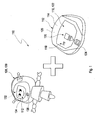
- an inventive measuring system 110 for detecting an analyte in a body fluid is shown.
- the measuring system is set up to determine a blood glucose concentration.
- the measuring system 110 comprises a measuring device 112, which in the illustration according to FIG. 1 shown separately on the bottom right.
- This measuring device 112 has a housing 114 which, for example, may be wholly or partially made of rigid plastic. Also, a multi-part design of this housing 114 is possible, for example, a configuration with different plastics, for example, to improve the ergonomics of the meter 112.
- the housing 114 provides, for example, a protection of the interior of the measuring device 112 against moisture and / or contamination as well as protection against mechanical damage.
- the housing 114 allows the meter 112 to be used independently of the described metering system 110.
- the meter 112 may correspond to a commercially available conventional meter 112.
- the measuring device 112 has a display element 116.
- This display element 116 is configured in the illustrated embodiment as an optical display element and includes, for example, a display.
- Various types of displays can be used here, for example liquid-crystal displays and / or organic light-emitting diode displays.
- measured values can be displayed by means of the display element 116. These measurements are in FIG. 1 symbolically denoted by the reference numeral 118. However, other representations are possible in principle.
- user instructions can be displayed, which in FIG. 1 symbolically denoted by the reference numeral 120, and which, for example, for entering a (in FIG. 1 not shown) can request test element.
- the measuring device 118 additionally has one or more operating elements. These controls may be configured independently of the display element 116, but may also be fully or partially integrated into the display element 116.
- the display element 116 may be designed in whole or in part as a touch screen, which is shown in FIG FIG. 1 symbolically indicated by the reference numeral 122. In this way, for example, a menu control or other type of input of control commands and / or parameters into the meter 112 by a user.
- the measuring device 112 comprises an application opening 124.
- this application opening 124 is arranged below the display element 116 on a front side 126.
- the arrangement of the application opening 124 on the front side 126 that is to say on the same side on which the display element 116 and / or one of a plurality of display elements 116 is arranged, facilitates simultaneous access to the display element 116 and the application opening 124 during integration into the measuring system 110
- other embodiments are possible in principle.
- a test element in particular a test strip
- the application opening 124 for example, a test element, in particular a test strip
- a test element is at least partially input into the measuring device 112 and / or at least partially output from the measuring device 112.
- a test element has an application site on which the liquid sample is applied.
- the inputting or outputting of the test element into the application opening or from the application opening 124 generally takes place in such a way that this application site is exposed, so that the application of the liquid sample is possible.
- the measuring device 112 may be a commercially available measuring device, so that reference may be made in particular to the prior art for further possible embodiments of this measuring device.
- the illustrated embodiment is a preferred embodiment within the scope of the measuring system 110 according to the invention.
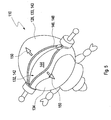
- the meter 112 is in FIG. 1 bottom right as well as in FIG. 2 shown in the right part of the picture. Furthermore, the measuring system 110 includes, as in FIG. 1 top left and in FIG. 2 shown in the left part of the picture, a toy 128.
- This toy 128 may be, for example, a modified stuffed toy or, as in the FIGS. 1 and 2 symbolically represented to act a figure in the form of a doll or a fantasy figure.
- the toy 128 includes a toy case 130 that substantially determines the outer shape of the toy 128.
- This toy case 130 may, depending on the toy 128, for example, be made of a hard and / or deformable, in particular flexible material.
- natural materials and / or artificial materials can be used.
- material, color, shape, illustrated figure or other manifestations of the toy case 130 can be adapted to a specific target group, as explained in more detail below.
- the toy 128 has a receptacle 132, which in the FIGS. 1 and 2 is merely hinted at and which is wholly or partially inside the toy case 130.
- This receptacle 132 is below, for example, based on the Figures 5 and 6A and FIG. 6B is explained in further possible details.
- the receptacle 132 is configured in such a way that when the measuring device 112 is accommodated in the receptacle 132, the display element 116 of the measuring device 112 is at least partially accessible.
- the toy casing 130 may have one or more openings 134, 136 in the region of the receptacle 132, as in FIG FIG. 1 indicated.
- a first opening 134 is provided which, for example, substantially corresponds to the area of the display element 116.
- the opening may be completely unlocked or, which should also be subsumed under the term of an opening, be completely or partially closed by a - preferably transparent - cover, so that the means of the display element 116 provided optical information as before by a Users can be perceived.
- the second opening 136 can be arranged, for example, in the region of the application opening 124 of the measuring device 112, so that through this opening 136 an input and / or output of one or more test elements is possible. Alternatively or additionally, however, this second opening 136 may also be wholly or partially combined with the first opening 134.
- This second opening 136 is preferably completely or partially uncovered and / or at least releasable with an opening mechanism, so that the input and / or output of the test element can take place.
- FIG. 3 the adaptation of the measuring system 110 to target groups of child users is represented symbolically.
- this illustration shows how the external appearance of the measuring system 110 can be adapted according to the invention to the different age groups of the user.
- infants from 1 to 3 years generally prefer simple toys 128, which are preferably made of soft material and typically can be held in pastel shades
- users aged 4-10 years prefer toys 128 with figure representation with more pronounced character details.
- certain dolls, from movies, radio and television known figures or the like come into consideration. Teenagers, however, from the age of about 11 years, prefer, as in FIG.
- FIG. 3 also indicated (right partial image) more complex toys 128, which may, for example, in turn, deviate from a figure representation or which may also be adapted to known characters from cinema, radio and television.
- All measuring systems 110 in FIG. 3 can be based on the same meter 112, with only the toy case 130 and the toy 128 must be replaced. For example, a family can live with a single meter 112, to which only toys 128 must be replaced if child users are to use the measuring system 110.
- FIGS. 4A and 4B are a front view ( FIG. 4A ) or a side view (FIG. 4B) of an alternative embodiment of a measuring device 112, which can be used within the scope of the measuring system 110 according to the invention.
- this meter 112 is similar to that in FIG. 1 , Partial image bottom right, illustrated measuring device 112 configured and in turn comprises a housing 114, which is also similar to the in FIG. 1 illustrated housing 114 is configured. Furthermore, in turn, a display element 116 and an application opening 124 are included.
- the page presentation according to FIG. 4B shows that the housing 114 may be ergonomically designed by corresponding handle members 138 to allow easy handling by a user outside of the measuring system 110. This will cause the meter 112 to be attractively designed for users who want to use the meter 112 without toys 128 as well.
- the figure preferably has a head 140 in the illustrated embodiment.
- the receptacle 132 already described above is preferably arranged.
- the receptacle 132 in this case comprises a receiving space 142 in the interior of the head 140, in which the measuring device 112 is at least partially receivable.
- This receiving space 142 is provided by said opening 134, which may be completely or partially covered, for example, also with a transparent material, for example a transparent envelope, in order to allow visual access to the display element 116 in this exemplary embodiment. In this way, additional protection of the display element 116 can be ensured.
- the opening 134 may also be completely uncovered, since in general the housing 114 of the measuring device 112, which may also comprise the display element 116 and / or a transparent cover of this display element 116, can already provide sufficient protection.
- the receptacle 132 or the receiving space 142 preferably have at least one receiving opening 144.
- This at least one receiving opening 144 is configured in the illustrated embodiment as a slot along an upper side of the head 140.
- This receiving opening 144 preferably has at least one closure element 146, by means of which the receiving opening 144 can be closed for use and opened or closed for insertion and / or removal of the measuring device 112.
- This closure element 146 can, as in the Figures 5 . 6A and 6B symbolically illustrated, for example, include a zipper 148.
- other types of closure elements 146 can be used, for example, Velcro fasteners, snaps, textile buttons or the like.
- the closure member 146 should also be easy to open by a user, although, for example, a child safety device may be provided to prevent unwanted removal of the meter 112 by a child patient.
- FIG. 6A a simple manufacturing method for producing the measuring system 110 is indicated.
- a first step is in FIG. 6A the closure element 146 is opened (indicated by the arrows 150) and in a second, in FIG. 6B Sub-step shown inserted the meter 112 in the receptacle 132 (indicated by the reference numeral 152).
- the toy 128 may be configured as a purely passive toy. Such an embodiment is particularly advantageous for use by infants. Alternatively, however, the toy 128 may also have more complex functionality and perform at least one toy-specific function. This function can, for example, a communication function and / or a movement function (for example, in the Figures 6A and 6B moving the arms 154) or the like. To actively control this toy function, the toy 128 may include, for example, a toy controller 156 incorporated in the Figures 6A and 6B is indicated schematically. For example, this toy controller 156 may include one or more electronic components, such as one or more microprocessors.
- the toy controller 156 may be configured to communicate with a controller of the meter 112 via one or more interfaces not shown in the figures.
- the control of the meter 112 is in the Figures 6A and 6B symbolically denoted by the reference numeral 158.
- This controller 158 may, for example, in turn comprise one or more electronic components, for example, in turn, one or more microprocessors.
- the controller 158 may optionally include one or more memory elements, for example volatile and / or non-volatile memory. In this way, via the interface, for example, the controller 158 and the toy controller 156 may exchange data and / or control commands with each other.
- the toy functionality may be coordinated and / or synchronized with, for example, the functionality of the meter 112, for example, to display a facial expression on the display 116 in synchronization with the functionality of the toy 128.
- the toy 128 may also include an identifier 160 which may be included in the Figures 6A and 6B is merely indicated and which, for example, wholly or partly integrated in the toy control 156 or may be independently included in the toy 128.
- the identifier 160 may be configured, for example, as an RFID chip.
- the meter 112 may be configured to read at least one piece of information from the identifier 160. This can be done for example by a corresponding reader, which is not shown in the figures. This reader can also be completely or partially combined with the interface.
- the measuring device 112 or the controller 158 may be set up to adapt at least one function of the measuring device to the information read out.
- the information may include information about a type of the toy 128 so that, for example, the correct sentence may be selected from a plurality of stored parameter sets of character parameters. This selection may correspond to the respectively used figure of the toy 128 or the type of the toy 128.
- the reading and selection can be done automatically, for example, so that no additional user input is required if, according to the Figures 6A and 6B the meter 112 is inserted into a toy 128.
- the measurement system 110 is preferably configured to interact with a user in a variety of ways. Examples of such user interaction are in the FIGS. 7 and 8th shown. So shows FIG. 7 an embodiment of an interaction between a measuring system 110 and a user 162, for example a patient or another person.
- a measuring system 110 in the exemplary embodiment according to FIG. 7
- it may be configured as described in the preceding exemplary embodiments, so that reference may be made, for example, to the above description for the possible embodiment of this measuring system 110 and the measuring device 112 and the toy 128 accommodated therein.
- the measuring system 110 which may optionally also be the case in the preceding exemplary embodiments, has an input system 164 for the input of acoustic signals and an output system 166, which likewise can be set up for the output of acoustic signals.
- This input system 164 and the output system 166 are here according to the embodiment FIG. 7 symbolically associated with the meter 112.
- the meter 112 may include one or more microphones as the input system 164 and / or one or more speakers as the output system 166.
- one or both of the systems 164, 166 may be wholly or partially associated with the toy 128, such as the toy controller 156.
- the configuration of the measuring system 110 with the input system 164 and the output system 166 allows a paging call of the user 162, which in FIG. 7 symbolically denoted by the reference numeral 168.
- this paging 168 may include simply calling a designation of the measurement system 110 and / or the toy 128.
- the metering system 110 and / or toy 128 may be provided with a user and / or manufacturer name, such as the name "buddy.”
- search call 168 may simply call the term "buddy” and / or a more complex query, such as "Buddy, where are you?" include.
- the measuring system 110 may be configured to answer this paging 168.
- This answer is in FIG. 7 symbolically denoted by the reference numeral 170.
- this response 170 for example in the form of a voice output.
- other signals may also be output, preferably acoustic signals, such as hum, beep or the like.
- a voice output for example in the form of a response 170 "Hey-hey, I'm here!.
- interaction with user 162 shown is just one of many possible embodiments, with numerous other embodiments are possible.
- FIG. 8 an interaction with a user 162 is shown symbolically, which relates specifically to the measuring functions of the measuring device 112. Alternatively or additionally, however, this interaction can in turn also be implemented in whole or in part in other components of the measuring system 110, in particular in components of the toy 128, for example once again in the toy controller 156.
- a measuring system 110 which, in turn, for example, the measuring systems described above 110 may correspond.
- the measuring system in this exemplary embodiment comprises a measuring device 112, for example as described above, which is based, for example, on the use of one or more test elements 172 for the qualitative and / or quantitative detection of the at least one analyte in the liquid sample.
- FIG. 8 In the right half of the picture FIG. 8 In this case, different signals are shown, which the measuring system 110 can output to support the measuring function.
- the interaction with the user can, as in FIG. 8 shown in the right half, for example by means of acoustic signals, which in FIG. 8 symbolically denoted by the reference numeral 174, and / or by means of optical signals, which in FIG. 8 symbolically denoted by the reference numeral 176. A combination of these signals is possible.
- the reference numeral 178 denotes a first combination of acoustic and optical signals 174, 176, which, however, can also be implemented individually.
- a time display 180 takes place, in combination for example with an acoustic signal, which recalls the necessity of carrying out a measurement (reminder signal 182).
- this reminder signal 182 again comprise a voice output, for example the voice output "ok, time to measure!.
- acoustic and optical signals 174, 176 are combined, which in turn can also be implemented individually.
- this second combination 184 can be used, while an evaluation of the measurement by means of the test element 172 takes place.
- This second combination 184 may include, for example, a waiting indication 186 as an optical signal 176 and / or an acoustic waiting request 188, for example again a voice output, for example the request "one more moment!.
- the third combination 190 may include a positive display 194 as an optical signal 176 and / or a positive acoustic rating 196.
- the positive acoustic rating 196 may again include a voice output, such as the voice output "hey, great values today!.
- This third combination 190 can thus be used, for example, when the measurement results are within a predetermined target range.
- the fourth combination 192 can be used to transmit and / or evaluate negative measurement results, in particular measurement results outside a nominal range.
- This fourth combination 192 may include, for example, a negative display 198 as an optical signal 176, and / or a negative acoustic score 200 as an audible signal 174, such as a voice output again, such as the voice "oh ... a lot of sugar!.
- the optical and / or acoustic signals 176, 174 may be adapted specifically to the toy 128 used, for example by the optical signals 176 adapting a facial expression corresponding to the toy 128. Alternatively or additionally, a voice of a voice output of the acoustic signals 174 may be adjusted. Numerous other embodiments of this interaction are possible, such as intermediate values between the positive situation represented by the third combination 190 and the negative situation represented by the fourth combination 192. Overall, the acceptance of the measuring system 110 can be significantly increased by this interaction.
- FIG. 9 is again exemplified a possible use of the meter 112 without the toy 128 shown.
- the meter 112 may be configured as described above.
- the measuring device 112 in turn comprises an application opening 124 whose surrounding area in the partial image in the upper right in FIG. 9 (indicated by the letter A) is shown enlarged again.
- a user 162 pushes a test element 172 into the application opening 124.
- This test element 172 which can be configured, for example, as an optical and / or electrochemical test element, in particular as a test strip, can then comprise an application site 202, which in FIG FIG.
- the meter 112 may be automatically and / or on request, for example perform by the user 162 a detection of the analyte in the liquid sample.
- test element 172 can also be completely or partially stored in the measuring device 112 and be wholly or partially ejected through the application opening 124 for application of the liquid sample.
- application opening 124 may also comprise a simple opening, which releases a test area of the test element 172 for a user, so that a task of the sample is possible. Numerous other embodiments are conceivable.
- FIG. 10A and 10B is another embodiment of a measuring device 112 in a side view ( Figure 10A ) and a backside view ( FIG. 10B ), which can also be used within the scope of the measuring system 110 according to the invention.
- the measuring device 112 differs slightly in terms of ergonomic design of the embodiment according to the FIGS. 4A and 4B but there are similarities.
- the meter 112 includes handle members 138 that facilitate handling of the meter 112. In this way, the measuring device 112 can be used independently of the measuring system 110, for example. However, in synergy, these handle members 138 may also be used to stabilize support of the gauge 112 in the toy 128.
- FIG. 11 the measuring system 110 according to the embodiments described above is shown again in an enlarged perspective view.
- the embodiment of the toy 128 recognizable as a figure, which is particularly preferred.
- a head 140 of the toy 128 can be configured in such a way that it can have a pronounced facial area 204, for example in addition to additional elements of the head, such as ears 206.
- the face region 204 which may comprise, for example, the openings 134, 136, the main interaction of the measuring device 112 with the toy 128 may take place, so that the functions of the measuring device 112 and of the toy 128 complement one another to the measuring system 110.
- the face region 204 can be designed, for example, wholly or partially transparent, so that the display element 116 can be visible, for example, by means of a transparent cover film in the region of the opening 134.
- the application opening 124 can also be integrated in the face area 204 in terms of design, so that it is perceived, for example, as a "mouth” 208.
- Other components of the measuring device 112 may also be visible to a user from the outside.
- the described embodiments merely represent examples of how a commercially available measuring device 112 can be creatively integrated into the toy 128. Numerous other embodiments are conceivable.
- kit 212 according to the invention is shown symbolically.
- this kit 212 can be used to produce a measuring system 110 according to the invention, but on the other hand can also be used by a user as a kit for detecting one or more analytes in a body fluid.
- the kit comprises, in addition to one or more measuring devices 112, wherein preferably only one measuring device 112 is used, a plurality of toys 128 in various embodiments.
- the meter 112 is in FIG. 12 merely hinted.
- Each of the toys 128 is configured to receive a meter 112, for example, according to the above with reference to FIGS Figures 5 and 6A and 6B designed embodiments.
- the kit 212 may include a plurality of dolls, fantasy figures, game animals, in particular cuddly toys or similar toys 128.
- An integration into toys 128, to which the childish fantasy does not ascribe its own character, is basically possible.
- kits 212 may be used for various purposes. On the one hand, such kits 212 facilitate the production of a measuring system 110 according to the invention.
- the plurality of toys 128 can be kept in stock, for example, with one or more specific types of measuring devices 112.
- a target-specific measuring system 110 can be simple and simple be provided in a cost effective manner.
- a kit 212 may also be employed by a user or group of users 162, such as a family. In this way, the external appearance of the measurement systems 110 can be quickly adapted to the particular individual user 162 who is to perform a measurement. This can also save costs and increase user friendliness.
Landscapes
- Health & Medical Sciences (AREA)
- Life Sciences & Earth Sciences (AREA)
- Physics & Mathematics (AREA)
- Medical Informatics (AREA)
- Surgery (AREA)
- Biophysics (AREA)
- Pathology (AREA)
- Engineering & Computer Science (AREA)
- Biomedical Technology (AREA)
- Heart & Thoracic Surgery (AREA)
- Veterinary Medicine (AREA)
- Molecular Biology (AREA)
- Public Health (AREA)
- Animal Behavior & Ethology (AREA)
- General Health & Medical Sciences (AREA)
- Optics & Photonics (AREA)
- Emergency Medicine (AREA)
- Toys (AREA)
- Investigating Or Analysing Biological Materials (AREA)
- Measurement Of The Respiration, Hearing Ability, Form, And Blood Characteristics Of Living Organisms (AREA)
- Medicines Containing Material From Animals Or Micro-Organisms (AREA)
Claims (16)
- Système de mesure (110) destiné à détecter au moins un analyte présent dans un liquide corporel et en particulier à détecter le glucose dans le sang,- comprenant au moins un appareil de mesure (112) qui détecte l'analyte présent dans le liquide corporel, en particulier un appareil de mesure (112) présent sur le marché, l'appareil de mesure (112) étant configuré comme appareil manuel portable et présentant un boîtier (114) doté d'au moins un élément d'affichage (116), l'appareil de mesure (112) présentant en outre au moins un élément de commande (122), l'appareil de mesure (112) étant conçu pour détecter l'analyte au moyen d'au moins un élément de test (172), l'appareil de mesure (112) présentant au moins une ouverture d'application (124), l'ouverture d'application (124) étant conçue pour permettre de placer un échantillon du liquide corporel,- comprenant en outre au moins un jouet (128), en particulier une figure de jeu ou un animal de jeu, le jouet (128) présentant au moins un logement (132) qui permet de loger l'appareil de mesure (112) de manière réversible, le logement (132) étant conçu de manière à donner un accès au moins partiel à l'élément d'affichage (116) lorsque l'appareil de mesure (112) est logé dans le logement (132), le logement (132) étant conçu de telle sorte que lorsque l'appareil de mesure (112) est logé dans le logement (132), l'élément de commande (122) soit au moins partiellement accessible, le logement (132) étant conçu de telle sorte que l'échantillon puisse être placé lorsque l'appareil de mesure (112) est logé dans le logement (132), le logement (132) présentant au moins un dispositif de fixation, le dispositif de fixation étant conçu pour immobiliser l'appareil de mesure (112) par rapport au jouet (128),l'appareil de mesure (112) étant conçu de manière à pouvoir être utilisé sélectivement aussi bien dans le système de mesure (110) que de manière indépendante du jouet (128).
- Système de mesure (110) selon la revendication précédente, dans lequel le logement (132) présente au moins un espace de réception (142), l'appareil de mesure (112) pouvant être reçu au moins en partie dans l'espace de réception (142), le logement (132) présentant en outre au moins un élément de fermeture (146), l'élément de fermeture (146) étant conçu pour maintenir l'appareil de mesure (112) lorsqu'il est en position fermée dans l'espace de réception (142) et pour permettre d'enlever l'appareil de mesure (112) du logement (132) lorsqu'il est en position ouverte.
- Système de mesure (110) selon la revendication précédente, dans lequel l'élément de fermeture (146) comprend au moins l'un des éléments suivants : une fermeture à frottement (148), un bouton poussoir, un bouton textile ou un verrou qui peut être libéré par l'utilisateur (162).
- Système de mesure (110) selon l'une des revendications précédentes, dans lequel le jouet (128) est configuré au moins en partie comme figure humaine, figure d'animal ou figure de fantaisie, le logement (132) présentant une ouverture (134, 136), l'ouverture (134, 136) étant disposée au moins en partie dans une zone de visage de la figure, l'ouverture (134, 136) étant configurée de telle sorte que l'élément d'affichage (116) puisse être vu au moins en partie dans l'ouverture (134, 136) lorsque l"appareil de mesure (112) est logé dans le logement (132).
- Système de mesure (110) selon la revendication précédente, dans lequel l'appareil de mesure (112) présente une commande (158), la commande (158) étant conçue pour représenter sur l'élément d'affichage (116) au moins des parties du visage de la figure dans au moins un mode de fonctionnement.
- Système de mesure (110) selon la revendication précédente, dans lequel la commande (158) est conçue pour modifier l'expression du visage en fonction d'une ou plusieurs des conditions suivantes : le résultat d'une mesure de détection de l'analyte dans le liquide corporel, un instant et en particulier l'instant auquel une mesure doit être exécutée.
- Système de mesure (110) selon l'une des revendications précédentes, dans lequel l'appareil de mesure (112) présente en outre au moins un élément acoustique (166), l'élément acoustique (166) étant conçu pour délivrer des signaux acoustiques et en particulier une émission vocale.
- Système de mesure (110) selon la revendication précédente, dans lequel l'émission de signaux acoustiques et en particulier l'émission vocale comprend une ou plusieurs des fonctions suivantes : la fourniture d'au moins un résultat de mesure de détection de l'analyte dans le liquide corporel, un avis sur au moins un résultat de mesure de détection de l'analyte dans le liquide corporel, une invitation à entreprendre une mesure, une invitation à entreprendre au moins une manipulation, en particulier à remplacer une réserve d'énergie et une réponse à un appel de l'utilisateur (162).
- Système de mesure (110) selon l'une des revendications précédentes, dans lequel l'appareil de mesure (112) comporte au moins un élément d'introduction (164) qui permet d'introduire des signaux acoustiques.
- Système de mesure (110) selon l'une des revendications précédentes, dans lequel l'appareil de mesure (112) présente au moins un élément de mémoire, plusieurs jeux de paramètres caractéristiques de différents types de jouets (128) étant conservés dans l'élément de mémoire, un jeu défini pouvant être sélectionné en fonction du jouet (128) particulier.
- Système de mesure (110) selon l'une des revendications précédentes, dans lequel le jouet (128) présente au moins une commande de jouet (156), la commande de jouet (156) étant conçue pour exécuter au moins une fonction spécifique au jouet, le jouet (128) présentant en outre au moins une interface qui permet d'échanger des données et/ou des ordres de commande avec l'appareil de mesure (112), la commande (156) du jouet étant conçue pour communiquer avec une commande (158) de l'appareil de mesure (112).
- Système de mesure (110) selon la revendication précédente, dans lequel l'appareil de mesure (112) est conçu pour adapter au moins une fonction au jouet (128).
- Système de mesure (110) selon l'une des revendications précédentes, dans lequel le jouet (128) présente au moins un identificateur (160), l'identificateur (160) présentant au moins une information concernant le jouet (128), l'appareil de mesure (112) étant conçu pour lire l'identificateur (160), de préférence automatiquement.
- Trousse (212) de détection d'au moins un analyte dans un liquide corporel, en particulier de détection du glucose présent dans le sang, et comprenant au moins un appareil de mesure (112) qui détecte l'analyte présent dans le liquide corporel, en particulier un appareil de mesure (112) habituel du marché, l'appareil de mesure (112) étant configuré comme appareil manuel portable et présentant un boîtier (114) doté d'au moins un élément d'affichage (116), et comprenant en outre plusieurs jouets (128), en particulier des figures de jeu et/ou des animaux de jeu, les jouets (128) présentant tous au moins un logement (132) qui loge l'appareil de mesure (112), les logements (132) étant conçus de manière à donner accès au moins en partie à l'élément d'affichage (116) lorsque l'appareil de mesure (112) est logé dans le logement (132), l'appareil de mesure (112) étant conçu de manière à pouvoir être utilisé sélectivement aussi bien de manière remplaçable dans l'un des jouets (128) qu'indépendamment des jouets (128), l'appareil de mesure (112) et chacun des jouets (128) formant ensemble un système de mesure (110) selon l'une des revendications précédentes.
- Procédé de fabrication d'un système de mesure (110) destiné à détecter au moins un analyte présent dans un liquide corporel, en particulier un système de mesure (110) selon l'une des revendications précédentes qui concernent l'appareil de mesure (110), dans lequel on utilise un appareil (112) pour détecter l'analyte présent dans le liquide corporel, en particulier un appareil de mesure (112) habituel du marché, l'appareil de mesure (112) étant configuré comme appareil manuel portable et présentant un boîtier (114) doté d'au moins un élément d'affichage (116), un jouet (128), en particulier une figure de jeu ou un animal de jeu étant utilisé, l'appareil de mesure (112) étant reçu de manière réversible dans au moins un logement (132) du jouet, le logement (132) étant conçu de manière à donner au moins en partie accès à l'élément d'affichage (116) lorsque l'appareil de mesure (112) est logé dans le logement (132), l'appareil de mesure (112) présentant en outre au moins un élément de commande (122), l'appareil de mesure (132) étant conçu de manière à donner accès au moins en partie à l'élément de commande (122) lorsque l'appareil de mesure (112) est logé dans le logement (132), l'appareil de mesure (112) étant conçu pour détecter l'analyte au moyen d'au moins un élément de test (172), l'appareil de mesure (112) présentant au moins une ouverture d'application (124), l'ouverture d'application (124) étant conçue pour permettre de placer un échantillon du liquide corporel, le logement (132) étant conçu de manière à pouvoir réaliser le placement de l'échantillon lorsque l'appareil de mesure (112) est logé dans le logement (132), le logement (132) présentant au moins un dispositif de fixation, le dispositif de fixation étant conçu pour immobiliser l'appareil de mesure (112) par rapport au jouet (128), l'appareil de mesure (112) étant conçu pour pouvoir être utilisé aussi bien dans le système de mesure (110) que sélectivement de manière indépendante du jouet (128).
- Procédé selon la revendication précédente, dans lequel plusieurs types différents de jouets (128) sont conservés dans une réserve, un type défini de jouet (128) étant sélectionné pour fabriquer le système de mesure (110) en fonction du groupe cible d'utilisateurs (162).
Priority Applications (4)
| Application Number | Priority Date | Filing Date | Title |
|---|---|---|---|
| AT08166805T ATE507769T1 (de) | 2008-10-16 | 2008-10-16 | Kinderfreundliches blutglucosemessgerät |
| DE502008003441T DE502008003441D1 (de) | 2008-10-16 | 2008-10-16 | Kinderfreundliches Blutglucosemessgerät |
| EP08166805A EP2177154B1 (fr) | 2008-10-16 | 2008-10-16 | Appareil de mesure de glycémie adapté aux enfants |
| US12/580,317 US8591415B2 (en) | 2008-10-16 | 2009-10-16 | Child-friendly analyte measurement instrument |
Applications Claiming Priority (1)
| Application Number | Priority Date | Filing Date | Title |
|---|---|---|---|
| EP08166805A EP2177154B1 (fr) | 2008-10-16 | 2008-10-16 | Appareil de mesure de glycémie adapté aux enfants |
Publications (2)
| Publication Number | Publication Date |
|---|---|
| EP2177154A1 EP2177154A1 (fr) | 2010-04-21 |
| EP2177154B1 true EP2177154B1 (fr) | 2011-05-04 |
Family
ID=40251629
Family Applications (1)
| Application Number | Title | Priority Date | Filing Date |
|---|---|---|---|
| EP08166805A Not-in-force EP2177154B1 (fr) | 2008-10-16 | 2008-10-16 | Appareil de mesure de glycémie adapté aux enfants |
Country Status (4)
| Country | Link |
|---|---|
| US (1) | US8591415B2 (fr) |
| EP (1) | EP2177154B1 (fr) |
| AT (1) | ATE507769T1 (fr) |
| DE (1) | DE502008003441D1 (fr) |
Families Citing this family (4)
| Publication number | Priority date | Publication date | Assignee | Title |
|---|---|---|---|---|
| US20140179197A1 (en) * | 2012-12-21 | 2014-06-26 | Dyana Bradley | Toy apparatus with simulated lcd screen face |
| FI20135852A7 (fi) * | 2013-08-21 | 2015-03-06 | Modz Oy | Laite ja järjestelmä veren glukoosipitoisuuden mittaamiseksi ja esittämiseksi |
| JP6519560B2 (ja) * | 2016-09-23 | 2019-05-29 | カシオ計算機株式会社 | ロボット、ロボットの作動方法及びプログラム |
| DE102021106403A1 (de) * | 2021-03-16 | 2022-09-22 | Geobra Brandstätter Stiftung & Co. Kg | Spielsystem und Spiel mit dem Spielsystem |
Family Cites Families (10)
| Publication number | Priority date | Publication date | Assignee | Title |
|---|---|---|---|---|
| US6165035A (en) * | 1997-11-26 | 2000-12-26 | Avner; David B. | Decorative covers for medical equipment |
| WO2002002200A1 (fr) * | 2000-07-01 | 2002-01-10 | Smirnov Alexander V | Jouets a interaction |
| US6693253B2 (en) * | 2001-10-05 | 2004-02-17 | Universite De Sherbrooke | Multi-coil induction plasma torch for solid state power supply |
| WO2003034912A1 (fr) | 2001-10-26 | 2003-05-01 | Disetronic Licensing Ag | Dispositif de simulation destine a l'evaluation et a l'affichage ludiques de la glycemie |
| US7223103B2 (en) * | 2003-09-12 | 2007-05-29 | Trainikins, Inc. | CPR training device |
| US20050176461A1 (en) * | 2004-02-11 | 2005-08-11 | Bozzone Stephen O. | Modular communication system |
| US8137618B2 (en) * | 2004-08-18 | 2012-03-20 | Abbott Laboratories | Blood glucose monitoring kit |
| US20080015422A1 (en) * | 2005-12-29 | 2008-01-17 | Guidance Interactive Healthcare, Inc. | Combined peripheral and health monitoring devices |
| US20080096459A1 (en) * | 2006-09-25 | 2008-04-24 | Terrina Mingle | Intravenous Bag Covering |
| US20080220688A1 (en) * | 2007-03-07 | 2008-09-11 | Jarret Peter Cuisinier | Stuffed toy |
-
2008
- 2008-10-16 AT AT08166805T patent/ATE507769T1/de active
- 2008-10-16 EP EP08166805A patent/EP2177154B1/fr not_active Not-in-force
- 2008-10-16 DE DE502008003441T patent/DE502008003441D1/de active Active
-
2009
- 2009-10-16 US US12/580,317 patent/US8591415B2/en not_active Expired - Fee Related
Also Published As
| Publication number | Publication date |
|---|---|
| DE502008003441D1 (de) | 2011-06-16 |
| US8591415B2 (en) | 2013-11-26 |
| EP2177154A1 (fr) | 2010-04-21 |
| US20100121162A1 (en) | 2010-05-13 |
| ATE507769T1 (de) | 2011-05-15 |
Similar Documents
| Publication | Publication Date | Title |
|---|---|---|
| Thwaites et al. | Conceptualizing empathy in cognitive behaviour therapy: Making the implicit explicit | |
| Schutz et al. | Teacher emotion, emotional labor and teacher identity. | |
| Frank | Projective methods for the study of personality | |
| Dunn | Performance of typical children on the sensory profile: An item analysis | |
| Gathercole et al. | Working memory abilities and children's performance in laboratory analogues of classroom activities | |
| Siegelman | Evaluation of Bronfenbrenner's questionnaire for children concerning parental behavior | |
| CA2753587C (fr) | Systeme et procede pour l'evaluation cognitive et le dressage d'un animal | |
| Howe et al. | When autobiographical memory begins | |
| EP2177154B1 (fr) | Appareil de mesure de glycémie adapté aux enfants | |
| Bracken | Clinical observation of preschool assessment behavior | |
| Moran et al. | Committed action in practice: A clinician's guide to assessing, planning, and supporting change in your client | |
| Lavori | ANOVA, MANOVA, my black hen: comments on repeated measures | |
| Rosenwald | The thematic apperception test | |
| MacDonald | Alpha: The figure in the cage | |
| WO2007124608A2 (fr) | Dispositif et procédé pour la détection, l'affichage et l'évaluation de données électroniques mobiles | |
| Church et al. | Tensions of trans-institutionalization in disabled childhoods: A photo essay | |
| Mowrer | Evaluating speech therapy through precision recording | |
| Miller | A comparison of methods of inquiry: Testing and interviewing contributions to the diagnostic process | |
| Boulboullé | Laboratory Epistemologies: A Hands-On Perspective | |
| KR20000030384A (ko) | 사이버 에고 시뮬레이션 제어장치 | |
| Bartoshuk | Sensation and perception: an integrated approach | |
| Zeddies | A psychoanalytic unconscious and emotional availability: Aspects in the development of analysts and analytic therapists | |
| EP1852068A2 (fr) | Méthode et dispositif de contrôle du niveau de glucose | |
| Seivewright et al. | What the clinician needs to know about magic mushrooms | |
| EP2160979A1 (fr) | Individualisation de moyens d'aide médicaux |
Legal Events
| Date | Code | Title | Description |
|---|---|---|---|
| PUAI | Public reference made under article 153(3) epc to a published international application that has entered the european phase |
Free format text: ORIGINAL CODE: 0009012 |
|
| 17P | Request for examination filed |
Effective date: 20090806 |
|
| AK | Designated contracting states |
Kind code of ref document: A1 Designated state(s): AT BE BG CH CY CZ DE DK EE ES FI FR GB GR HR HU IE IS IT LI LT LU LV MC MT NL NO PL PT RO SE SI SK TR |
|
| AX | Request for extension of the european patent |
Extension state: AL BA MK RS |
|
| GRAP | Despatch of communication of intention to grant a patent |
Free format text: ORIGINAL CODE: EPIDOSNIGR1 |
|
| AKX | Designation fees paid |
Designated state(s): AT BE BG CH CY CZ DE DK EE ES FI FR GB GR HR HU IE IS IT LI LT LU LV MC MT NL NO PL PT RO SE SI SK TR |
|
| GRAS | Grant fee paid |
Free format text: ORIGINAL CODE: EPIDOSNIGR3 |
|
| GRAA | (expected) grant |
Free format text: ORIGINAL CODE: 0009210 |
|
| AK | Designated contracting states |
Kind code of ref document: B1 Designated state(s): AT BE BG CH CY CZ DE DK EE ES FI FR GB GR HR HU IE IS IT LI LT LU LV MC MT NL NO PL PT RO SE SI SK TR |
|
| REG | Reference to a national code |
Ref country code: GB Ref legal event code: FG4D Free format text: NOT ENGLISH |
|
| REG | Reference to a national code |
Ref country code: CH Ref legal event code: EP |
|
| REG | Reference to a national code |
Ref country code: IE Ref legal event code: FG4D Free format text: LANGUAGE OF EP DOCUMENT: GERMAN |
|
| REF | Corresponds to: |
Ref document number: 502008003441 Country of ref document: DE Date of ref document: 20110616 Kind code of ref document: P |
|
| REG | Reference to a national code |
Ref country code: DE Ref legal event code: R096 Ref document number: 502008003441 Country of ref document: DE Effective date: 20110616 |
|
| REG | Reference to a national code |
Ref country code: NL Ref legal event code: VDEP Effective date: 20110504 |
|
| PG25 | Lapsed in a contracting state [announced via postgrant information from national office to epo] |
Ref country code: SE Free format text: LAPSE BECAUSE OF FAILURE TO SUBMIT A TRANSLATION OF THE DESCRIPTION OR TO PAY THE FEE WITHIN THE PRESCRIBED TIME-LIMIT Effective date: 20110504 Ref country code: LT Free format text: LAPSE BECAUSE OF FAILURE TO SUBMIT A TRANSLATION OF THE DESCRIPTION OR TO PAY THE FEE WITHIN THE PRESCRIBED TIME-LIMIT Effective date: 20110504 Ref country code: NO Free format text: LAPSE BECAUSE OF FAILURE TO SUBMIT A TRANSLATION OF THE DESCRIPTION OR TO PAY THE FEE WITHIN THE PRESCRIBED TIME-LIMIT Effective date: 20110804 Ref country code: PT Free format text: LAPSE BECAUSE OF FAILURE TO SUBMIT A TRANSLATION OF THE DESCRIPTION OR TO PAY THE FEE WITHIN THE PRESCRIBED TIME-LIMIT Effective date: 20110905 |
|
| PG25 | Lapsed in a contracting state [announced via postgrant information from national office to epo] |
Ref country code: SI Free format text: LAPSE BECAUSE OF FAILURE TO SUBMIT A TRANSLATION OF THE DESCRIPTION OR TO PAY THE FEE WITHIN THE PRESCRIBED TIME-LIMIT Effective date: 20110504 Ref country code: ES Free format text: LAPSE BECAUSE OF FAILURE TO SUBMIT A TRANSLATION OF THE DESCRIPTION OR TO PAY THE FEE WITHIN THE PRESCRIBED TIME-LIMIT Effective date: 20110815 Ref country code: IS Free format text: LAPSE BECAUSE OF FAILURE TO SUBMIT A TRANSLATION OF THE DESCRIPTION OR TO PAY THE FEE WITHIN THE PRESCRIBED TIME-LIMIT Effective date: 20110904 Ref country code: GR Free format text: LAPSE BECAUSE OF FAILURE TO SUBMIT A TRANSLATION OF THE DESCRIPTION OR TO PAY THE FEE WITHIN THE PRESCRIBED TIME-LIMIT Effective date: 20110805 Ref country code: FI Free format text: LAPSE BECAUSE OF FAILURE TO SUBMIT A TRANSLATION OF THE DESCRIPTION OR TO PAY THE FEE WITHIN THE PRESCRIBED TIME-LIMIT Effective date: 20110504 Ref country code: LV Free format text: LAPSE BECAUSE OF FAILURE TO SUBMIT A TRANSLATION OF THE DESCRIPTION OR TO PAY THE FEE WITHIN THE PRESCRIBED TIME-LIMIT Effective date: 20110504 Ref country code: CY Free format text: LAPSE BECAUSE OF FAILURE TO SUBMIT A TRANSLATION OF THE DESCRIPTION OR TO PAY THE FEE WITHIN THE PRESCRIBED TIME-LIMIT Effective date: 20110504 |
|
| REG | Reference to a national code |
Ref country code: IE Ref legal event code: FD4D |
|
| PG25 | Lapsed in a contracting state [announced via postgrant information from national office to epo] |
Ref country code: NL Free format text: LAPSE BECAUSE OF FAILURE TO SUBMIT A TRANSLATION OF THE DESCRIPTION OR TO PAY THE FEE WITHIN THE PRESCRIBED TIME-LIMIT Effective date: 20110504 |
|
| PG25 | Lapsed in a contracting state [announced via postgrant information from national office to epo] |
Ref country code: IE Free format text: LAPSE BECAUSE OF FAILURE TO SUBMIT A TRANSLATION OF THE DESCRIPTION OR TO PAY THE FEE WITHIN THE PRESCRIBED TIME-LIMIT Effective date: 20110504 Ref country code: EE Free format text: LAPSE BECAUSE OF FAILURE TO SUBMIT A TRANSLATION OF THE DESCRIPTION OR TO PAY THE FEE WITHIN THE PRESCRIBED TIME-LIMIT Effective date: 20110504 Ref country code: CZ Free format text: LAPSE BECAUSE OF FAILURE TO SUBMIT A TRANSLATION OF THE DESCRIPTION OR TO PAY THE FEE WITHIN THE PRESCRIBED TIME-LIMIT Effective date: 20110504 |
|
| PG25 | Lapsed in a contracting state [announced via postgrant information from national office to epo] |
Ref country code: PL Free format text: LAPSE BECAUSE OF FAILURE TO SUBMIT A TRANSLATION OF THE DESCRIPTION OR TO PAY THE FEE WITHIN THE PRESCRIBED TIME-LIMIT Effective date: 20110504 Ref country code: SK Free format text: LAPSE BECAUSE OF FAILURE TO SUBMIT A TRANSLATION OF THE DESCRIPTION OR TO PAY THE FEE WITHIN THE PRESCRIBED TIME-LIMIT Effective date: 20110504 Ref country code: DK Free format text: LAPSE BECAUSE OF FAILURE TO SUBMIT A TRANSLATION OF THE DESCRIPTION OR TO PAY THE FEE WITHIN THE PRESCRIBED TIME-LIMIT Effective date: 20110504 Ref country code: RO Free format text: LAPSE BECAUSE OF FAILURE TO SUBMIT A TRANSLATION OF THE DESCRIPTION OR TO PAY THE FEE WITHIN THE PRESCRIBED TIME-LIMIT Effective date: 20110504 |
|
| PLBE | No opposition filed within time limit |
Free format text: ORIGINAL CODE: 0009261 |
|
| STAA | Information on the status of an ep patent application or granted ep patent |
Free format text: STATUS: NO OPPOSITION FILED WITHIN TIME LIMIT |
|
| 26N | No opposition filed |
Effective date: 20120207 |
|
| BERE | Be: lapsed |
Owner name: F. HOFFMANN-LA ROCHE A.G. Effective date: 20111031 Owner name: ROCHE DIAGNOSTICS G.M.B.H. Effective date: 20111031 |
|
| PG25 | Lapsed in a contracting state [announced via postgrant information from national office to epo] |
Ref country code: HR Free format text: LAPSE BECAUSE OF FAILURE TO SUBMIT A TRANSLATION OF THE DESCRIPTION OR TO PAY THE FEE WITHIN THE PRESCRIBED TIME-LIMIT Effective date: 20111123 Ref country code: IT Free format text: LAPSE BECAUSE OF FAILURE TO SUBMIT A TRANSLATION OF THE DESCRIPTION OR TO PAY THE FEE WITHIN THE PRESCRIBED TIME-LIMIT Effective date: 20110504 Ref country code: MC Free format text: LAPSE BECAUSE OF NON-PAYMENT OF DUE FEES Effective date: 20111031 |
|
| REG | Reference to a national code |
Ref country code: DE Ref legal event code: R097 Ref document number: 502008003441 Country of ref document: DE Effective date: 20120207 |
|
| REG | Reference to a national code |
Ref country code: FR Ref legal event code: ST Effective date: 20120629 |
|
| PG25 | Lapsed in a contracting state [announced via postgrant information from national office to epo] |
Ref country code: BE Free format text: LAPSE BECAUSE OF NON-PAYMENT OF DUE FEES Effective date: 20111031 |
|
| PG25 | Lapsed in a contracting state [announced via postgrant information from national office to epo] |
Ref country code: FR Free format text: LAPSE BECAUSE OF NON-PAYMENT OF DUE FEES Effective date: 20111102 |
|
| PG25 | Lapsed in a contracting state [announced via postgrant information from national office to epo] |
Ref country code: MT Free format text: LAPSE BECAUSE OF FAILURE TO SUBMIT A TRANSLATION OF THE DESCRIPTION OR TO PAY THE FEE WITHIN THE PRESCRIBED TIME-LIMIT Effective date: 20110504 |
|
| PG25 | Lapsed in a contracting state [announced via postgrant information from national office to epo] |
Ref country code: LU Free format text: LAPSE BECAUSE OF NON-PAYMENT OF DUE FEES Effective date: 20111016 |
|
| REG | Reference to a national code |
Ref country code: CH Ref legal event code: PL |
|
| GBPC | Gb: european patent ceased through non-payment of renewal fee |
Effective date: 20121016 |
|
| PG25 | Lapsed in a contracting state [announced via postgrant information from national office to epo] |
Ref country code: BG Free format text: LAPSE BECAUSE OF FAILURE TO SUBMIT A TRANSLATION OF THE DESCRIPTION OR TO PAY THE FEE WITHIN THE PRESCRIBED TIME-LIMIT Effective date: 20110804 |
|
| PG25 | Lapsed in a contracting state [announced via postgrant information from national office to epo] |
Ref country code: CH Free format text: LAPSE BECAUSE OF NON-PAYMENT OF DUE FEES Effective date: 20121031 Ref country code: GB Free format text: LAPSE BECAUSE OF NON-PAYMENT OF DUE FEES Effective date: 20121016 Ref country code: LI Free format text: LAPSE BECAUSE OF NON-PAYMENT OF DUE FEES Effective date: 20121031 |
|
| PG25 | Lapsed in a contracting state [announced via postgrant information from national office to epo] |
Ref country code: TR Free format text: LAPSE BECAUSE OF FAILURE TO SUBMIT A TRANSLATION OF THE DESCRIPTION OR TO PAY THE FEE WITHIN THE PRESCRIBED TIME-LIMIT Effective date: 20110504 |
|
| PG25 | Lapsed in a contracting state [announced via postgrant information from national office to epo] |
Ref country code: HU Free format text: LAPSE BECAUSE OF FAILURE TO SUBMIT A TRANSLATION OF THE DESCRIPTION OR TO PAY THE FEE WITHIN THE PRESCRIBED TIME-LIMIT Effective date: 20110504 |
|
| PG25 | Lapsed in a contracting state [announced via postgrant information from national office to epo] |
Ref country code: HR Free format text: LAPSE BECAUSE OF FAILURE TO SUBMIT A TRANSLATION OF THE DESCRIPTION OR TO PAY THE FEE WITHIN THE PRESCRIBED TIME-LIMIT Effective date: 20110504 |
|
| REG | Reference to a national code |
Ref country code: AT Ref legal event code: MM01 Ref document number: 507769 Country of ref document: AT Kind code of ref document: T Effective date: 20131016 |
|
| PG25 | Lapsed in a contracting state [announced via postgrant information from national office to epo] |
Ref country code: AT Free format text: LAPSE BECAUSE OF NON-PAYMENT OF DUE FEES Effective date: 20131016 |
|
| REG | Reference to a national code |
Ref country code: DE Ref legal event code: R081 Ref document number: 502008003441 Country of ref document: DE Owner name: ROCHE DIABETES CARE GMBH, DE Free format text: FORMER OWNER: ROCHE DIAGNOSTICS GMBH, 68305 MANNHEIM, DE |
|
| PGFP | Annual fee paid to national office [announced via postgrant information from national office to epo] |
Ref country code: DE Payment date: 20180917 Year of fee payment: 11 |
|
| REG | Reference to a national code |
Ref country code: DE Ref legal event code: R119 Ref document number: 502008003441 Country of ref document: DE |
|
| PG25 | Lapsed in a contracting state [announced via postgrant information from national office to epo] |
Ref country code: DE Free format text: LAPSE BECAUSE OF NON-PAYMENT OF DUE FEES Effective date: 20200501 |