EP2177312B1 - Tampon à polir mécanique et chimique ayant une fenêtre avec fonction d'identification intégrale - Google Patents
Tampon à polir mécanique et chimique ayant une fenêtre avec fonction d'identification intégrale Download PDFInfo
- Publication number
- EP2177312B1 EP2177312B1 EP09155069A EP09155069A EP2177312B1 EP 2177312 B1 EP2177312 B1 EP 2177312B1 EP 09155069 A EP09155069 A EP 09155069A EP 09155069 A EP09155069 A EP 09155069A EP 2177312 B1 EP2177312 B1 EP 2177312B1
- Authority
- EP
- European Patent Office
- Prior art keywords
- polishing
- chemical mechanical
- window
- identification feature
- mechanical polishing
- Prior art date
- Legal status (The legal status is an assumption and is not a legal conclusion. Google has not performed a legal analysis and makes no representation as to the accuracy of the status listed.)
- Ceased
Links
Images


Classifications
-
- B—PERFORMING OPERATIONS; TRANSPORTING
- B24—GRINDING; POLISHING
- B24B—MACHINES, DEVICES, OR PROCESSES FOR GRINDING OR POLISHING; DRESSING OR CONDITIONING OF ABRADING SURFACES; FEEDING OF GRINDING, POLISHING, OR LAPPING AGENTS
- B24B7/00—Machines or devices designed for grinding plane surfaces on work, including polishing plane glass surfaces; Accessories therefor
- B24B7/20—Machines or devices designed for grinding plane surfaces on work, including polishing plane glass surfaces; Accessories therefor characterised by a special design with respect to properties of the material of non-metallic articles to be ground
- B24B7/22—Machines or devices designed for grinding plane surfaces on work, including polishing plane glass surfaces; Accessories therefor characterised by a special design with respect to properties of the material of non-metallic articles to be ground for grinding inorganic material, e.g. stone, ceramics, porcelain
- B24B7/228—Machines or devices designed for grinding plane surfaces on work, including polishing plane glass surfaces; Accessories therefor characterised by a special design with respect to properties of the material of non-metallic articles to be ground for grinding inorganic material, e.g. stone, ceramics, porcelain for grinding thin, brittle parts, e.g. semiconductors, wafers
-
- B—PERFORMING OPERATIONS; TRANSPORTING
- B24—GRINDING; POLISHING
- B24B—MACHINES, DEVICES, OR PROCESSES FOR GRINDING OR POLISHING; DRESSING OR CONDITIONING OF ABRADING SURFACES; FEEDING OF GRINDING, POLISHING, OR LAPPING AGENTS
- B24B37/00—Lapping machines or devices; Accessories
- B24B37/04—Lapping machines or devices; Accessories designed for working plane surfaces
-
- B—PERFORMING OPERATIONS; TRANSPORTING
- B24—GRINDING; POLISHING
- B24D—TOOLS FOR GRINDING, BUFFING OR SHARPENING
- B24D13/00—Wheels having flexibly-acting working parts, e.g. buffing wheels; Mountings therefor
- B24D13/14—Wheels having flexibly-acting working parts, e.g. buffing wheels; Mountings therefor acting by the front face
Definitions
- Figure 4 is a cross sectional cut away view of a chemical mechanical polishing pad of the present invention.
- polishing medium encompasses particle-containing polishing solutions and non-particle-containing solutions, such as abrasive-free and reactive-liquid polishing solutions.
- Non-color indicia suitable for use with the present invention are observable through the window at the polishing face throughout the useful life of the chemical mechanical polishing pad.
- the non-color indicia is a two-dimensional shape or outline selected from a polygon, a reuleaux polygon, a circle, an oval, an ellipse, a lens, a lune, a superellipse, a squoval, a squircle, a quartic plane curve and a symbol.
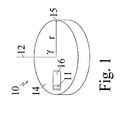
- the chemical mechanical polishing pad further comprises a central axis 12, wherein the chemical mechanical polishing pad is adapted for rotation about the central axis 12.
- the polishing layer 10 is in a plane substantially perpendicular to the central axis 12 (i.e., ⁇ 10° from perpendicular).
- the polishing layer 10 is adapted for rotation in a plane that is at an angle, ⁇ , of 85 to 95° to the central axis 12, more preferably of 90° from the central axis 12.
- the polishing layer 10 has a polishing surface 14 that has a substantially circular cross section perpendicular to the central axis 12.
- the longest radius, r, for a cross section of the polishing surface 14 perpendicular to the central axis 12 is preferably ⁇ 20% longer than the shortest radius, r, for the cross section.
- the integral identification feature 30 is applied to or incorporated in at least a portion of the window 20. (see, e.g., Figure 6 ).
- the integral identification feature 30 comprises a color based indicia 32.
- the color based indicia 32 is not present at the polishing surface 42 of the polishing layer 40 or the polishing face 22 of the window 20.
- the method of making the chemical mechanical polishing pad of the present invention having a window with an integral identification feature further comprises providing an intervening layer having an aperture and a subpad having an aperture, wherein the intervening layer is interposed between the polishing layer and the subpad.
- the polishing layer, the intervening layer and the subpad are interfaced using at least one stack adhesive.
- the at least one stack adhesive is selected from a pressure sensitive adhesive, a contact adhesive and a reactive hot melt adhesive.
- the aperture in the intervening layer has a cross sectional area parallel to and smaller than the cross sectional area of the polishing face of the window and the integral identification feature is applied to or incorporated in at least a portion of the intervening layer adjacent to the aperture, wherein the integral identification feature is observable through the window at the polishing face.
- the aperture in the intervening layer has a cross sectional area parallel to and smaller than the cross sectional area of the polishing face of the window and the integral identification feature is applied to or incorporated in at least a portion of (i) the stack adhesive interposed between the intervening layer and the polishing layer, or (ii) the stack adhesive interposed between the intervening layer and the subpad; wherein the integral identification feature is observable through the window at the polishing face.
- the integral identification feature comprises a color based indicia observable through the window at the polishing face.
- the color based indicia comprises a colorant that does not interfere with effective endpoint detection.
- the window used in the methods of the invention can be selected from integral windows and plug-in-place windows.
- a method of making the chemical mechanical polishing pad of the present invention having a plug-in-place window with an integral identification feature comprises: providing a chemical mechanical polishing layer with a polishing surface and an aperture, providing a subpad having an aperture; providing a plug-in-place window for endpoint detection, having a polishing face and a nonpolishing face; providing an integral identification feature; and, interfacing the plug-in-place window with the subpad such that the integral identification feature is observable through the plug-in-place window at the polishing face; wherein the polishing surface is adapted for polishing a substrate selected from a magnetic substrate, an optical substrate and a semiconductor substrate.
- the integral identification feature comprises a color based indicia observable through the plug-in-place window at the polishing face.
- the color based indicia comprises a colorant that does not interfere with effective endpoint detection.
- the method of making the chemical mechanical polishing pad of the present invention having a plug-in-place window with an integral identification feature further comprises applying an integral identification feature to or incorporating an integral identification feature in at least a portion of the plug-in-place window.
- the portion of the window to which the integral identification feature is applied does not include the polishing face.
- the integral identification feature is applied to the nonpolishing face of the plug-in-place window.
- the integral identification feature is applied to or incorporated in at least a portion of the plug-in-place window before it is interfaced with another component of the chemical mechanical polishing pad (e.g., the polishing layer, the subpad, an intervening layer, an adhesive).
- the integral identification feature is applied to or incorporated in at least a portion of the plug-in-place window after it is interfaced with another component of the chemical mechanical polishing pad.
- the aperture in the subpad has a cross sectional area parallel to and smaller than the cross sectional area of at least a slice of the plug-in-place window at or between the polishing face and the nonpolishing face and the integral identification feature is applied to or incorporated in at least a portion of the subpad adjacent to the aperture, wherein the integral identification feature is observable through the plug-in-place window at the polishing face.
- the aperture in the intervening layer has a cross sectional area parallel to and smaller than the cross sectional area of at least a slice of the plug-in-place window at or between the polishing face and the nonpolishing face and the integral identification feature is applied to or incorporated in at least a portion of the intervening layer adjacent to the aperture, wherein the integral identification feature is observable through the window at the polishing face.
- the method for chemical mechanical polishing of a substrate selected from a magnetic substrate, an optical substrate and a semiconductor substrate comprises: providing a chemical mechanical polishing apparatus having a platen; providing at least one substrate selected from a magnetic substrate, an optical substrate and a semiconductor substrate; providing at least two polishing operations; providing a plurality of types of chemical mechanical polishing pads having a window; wherein each type of chemical mechanical polishing pad has different polishing properties and an integral identification feature to distinguish each type of chemical mechanical polishing pad from the other types of chemical mechanical polishing pads in the plurality of types; wherein the integral identification feature is non-polish active; optionally, wherein the integral identification feature comprises a color based indicia; and, optionally, wherein the integral identification feature is selected to be observable through the window and to uniquely identify each type of chemical mechanical polishing pad in the plurality of types; providing at least two polishing recipes, wherein each polishing recipe corresponds to one of the at least two polishing operations and wherein each polishing recipe includes an identification of the integral identification feature associated with the type
- the method may optionally further comprise: selecting a subsequent polishing operation from the at least two polishing operations ("the subsequent polishing operation") and a corresponding subsequent polishing recipe ("the subsequent recipe”); installing onto the platen the type of chemical mechanical polishing pad identified in the subsequent recipe ("the subsequently installed polishing pad”); observing the integral identification feature of the subsequently installed polishing pad and verifying that it corresponds with that identified in the subsequent recipe; and performing the subsequent polishing operation on the at least one substrate.
- the multiple polishing operations can be performed using a single chemical mechanical polishing apparatus, wherein the multiple polishing operations are performed on the same substrate using at least two different types of chemical mechanical polishing pads (e.g., multiple polishing operations on a given semiconductor wafer).
- the method for chemical mechanical polishing of a substrate selected from a magnetic substrate, an optical substrate and a semiconductor substrate comprises: providing a chemical mechanical polishing apparatus having a platen; providing at least one substrate selected from a magnetic substrate, an optical substrate and a semiconductor substrate; providing at least two polishing operations; providing at least two types of chemical mechanical polishing pads having a window, wherein each type of chemical mechanical polishing pad has different polishing properties and an integral identification feature, wherein the integral identification feature is nonpolish active, wherein the integral identification feature comprises a color based indicia, wherein the color based indicia is selected to be observable through the window and to uniquely identify each type of chemical mechanical polishing pad in the plurality of types, and wherein the color based indicia is unique for each type of chemical mechanical polishing pad in the plurality of types; providing at least two polishing recipes, wherein each polishing recipe corresponds to one of the at least two polishing operations and wherein each polishing recipe includes an identification of the integral identification feature for the type of
Landscapes
- Engineering & Computer Science (AREA)
- Mechanical Engineering (AREA)
- Chemical & Material Sciences (AREA)
- Ceramic Engineering (AREA)
- Inorganic Chemistry (AREA)
- Finish Polishing, Edge Sharpening, And Grinding By Specific Grinding Devices (AREA)
- Mechanical Treatment Of Semiconductor (AREA)
Claims (10)
- Feutre de polissage mécano-chimique pour polir un substrat choisi parmi un substrat magnétique, un substrat optique et un substrat semi-conducteur ; comprenant :une couche de polissage (10 ; 40 ; 140) ayant une surface de polissage (14 ; 42 ; 142) adaptée pour polir le substrat, une fenêtre (16; 20 ; 120) et une caractéristique d'identification intégrale (11 ; 30) ; etoù la fenêtre (16 ; 20 ; 120) a une face de polissage (22 ; 122) et une face de non polissage (24 ; 124), où la caractéristique d'identification intégrale (11 ; 30) est observable à travers la fenêtre (16 ; 20 ; 120), où la caractéristique d'identification intégrale (11 ; 30) identifie le feutre de polissage mécano-chimique comme un type de feutre de polissage mécano-chimique choisi parmi une pluralité de types de feutres de polissage mécano-chimique.
- Feutre de polissage mécano-chimique selon la revendication 1 où la caractéristique d'identification intégrale (11 ; 30) n'est pas incorporée dans la couche de polissage.
- Feutre de polissage mécano-chimique selon la revendication 1 où la caractéristique d'identification intégrale (11 ; 30) comprend un indice à base de couleur (32) appliqué à une partie d'identification de la face de non polissage (24 ; 124) de la fenêtre (16 ; 20 ; 120).
- Feutre de polissage mécano-chimique selon la revendication 1 où la fenêtre (16 ; 20 ; 120) est choisie parmi une fenêtre mise en place et une fenêtre intégrale.
- Procédé de production du feutre de polissage mécano-chimique ayant une fenêtre (16 ; 20 ; 120) avec une caractéristique d'identification intégrale (11 ; 30), comprenant :la fourniture d'une couche de polissage (10 ; 40 ; 140) avec une surface de polissage (14 ; 42 ; 142) et une fenêtre (16 ; 20 ; 120), où la fenêtre (16 ; 20 ; 120) a une face de polissage (22 ; 122) et une face de non plissage (24 ; 124) et où la face de polissage (22 ; 122) est parallèle à la surface de polissage (14 ; 42 ; 142) ;la fourniture d'une caractéristique d'identification intégrale (11; 30) ; etla liaison de la caractéristique d'identification intégrale (11 ; 30) avec la couche de polissage (10 ; 40 ; 140) ;où la caractéristique d'identification intégrale (11 ; 30) est observable à travers la fenêtre (16 ; 20 ; 120) au niveau de la face de polissage (22 ; 122) ; etoù la surface de polissage (14 ; 42 ; 142) est adaptée pour polir le substrat.
- Procédé selon la revendication 5 où la caractéristique d'identification intégrale (11 ; 30) comprend un indice à base de couleur (32) appliqué à une partie de la face de non polissage (22 ; 122) de la fenêtre (16 ; 20 ; 120).
- Procédé selon la revendication 5 comprenant en outre :la fourniture d'un sous-feutre (60 ; 160) ayant une ouverture (62 ; 162) ; etla liaison du sous-feutre (60 ; 160) et de la couche de polissage (10 ; 40 ; 140).
- Procédé selon la revendication 7 où l'ouverture (62 ; 162) est dimensionnellement plus petite que la face de polissage (22 ; 122) de la fenêtre (16 ; 20 ; 120) ; où la caractéristique d'identification intégrale (11 ; 30) comprend un indice à base de couleur (32) appliqué à une partie du sous-feutre (60 ; 160) adjacente à l'ouverture (62 ; 162).
- Procédé selon la revendication 5 où la fenêtre (16 ; 20 ; 120) est choisie parmi une fenêtre intégrale et une fenêtre mise en place.
- Procédé pour le polissage mécano-chimique d'un substrat choisi parmi un substrat magnétique, un substrat optique et un substrat semi-conducteur, comprenant :la fourniture d'un appareil de polissage mécano-chimique ayant un plateau ;la fourniture d'au moins un substrat choisi parmi un substrat magnétique, un substrat optique et un substrat semi-conducteur ;la fourniture d'au moins deux opérations de polissage ;la fourniture d'une pluralité de types de feutres de polissage mécano-chimique ayant une fenêtre (16 ; 20 ; 120), où chaque type de feutre de polissage mécano-chimique a des propriétés de polissage différentes et une caractéristique d'identification intégrale (11 ; 30) pour distinguer chaque type de feutre de polissage mécano-chimique des autres types de feutres de polissage mécano-chimique dans la pluralité de types, où la caractéristique d'identification intégrale (11 ; 30) n'est pas active pour le polissage,où la caractéristique d'identification intégrale (11 ; 30) est choisie pour être observable à travers la fenêtre (16 ; 20 ; 120) et pour identifier de manière unique chaque type de feutre de polissage mécano-chimique dans la pluralité de types ;la fourniture d'au moins deux formulations de polissage, où chaque formulation de polissage correspond à l'une des au moins deux opérations de polissage et où chaque formulation de polissage inclut une identification de la caractéristique d'identification intégrale (11 ; 30) associée avec le type de feutre de polissage mécano-chimique à utiliser ;le choix d'une opération de polissage à réaliser parmi les au moins deux opérations de polissage ("l'opération de polissage choisie") et d'une formulation de polissage correspondante ("la formulation choisie") ;l'installation sur le plateau du type de feutre de polissage mécano-chimique identifié dans la formulation choisie ;l'observation de la caractéristique d'identification intégrale (11 ; 30) du feutre de polissage mécano-chimique installé et la vérification de ce qu'elle correspond avec celle identifiée dans la formulation choisie ; et la mise en oeuvre de l'opération de polissage choisie sur le au moins un substrat.
Applications Claiming Priority (2)
| Application Number | Priority Date | Filing Date | Title |
|---|---|---|---|
| US12/252,820 US8118644B2 (en) | 2008-10-16 | 2008-10-16 | Chemical mechanical polishing pad having integral identification feature |
| US12/397,535 US8118641B2 (en) | 2009-03-04 | 2009-03-04 | Chemical mechanical polishing pad having window with integral identification feature |
Publications (2)
| Publication Number | Publication Date |
|---|---|
| EP2177312A1 EP2177312A1 (fr) | 2010-04-21 |
| EP2177312B1 true EP2177312B1 (fr) | 2011-04-27 |
Family
ID=41539963
Family Applications (1)
| Application Number | Title | Priority Date | Filing Date |
|---|---|---|---|
| EP09155069A Ceased EP2177312B1 (fr) | 2008-10-16 | 2009-03-13 | Tampon à polir mécanique et chimique ayant une fenêtre avec fonction d'identification intégrale |
Country Status (2)
| Country | Link |
|---|---|
| EP (1) | EP2177312B1 (fr) |
| DE (1) | DE602009001168D1 (fr) |
Families Citing this family (2)
| Publication number | Priority date | Publication date | Assignee | Title |
|---|---|---|---|---|
| US9238295B2 (en) * | 2013-05-31 | 2016-01-19 | Rohm And Haas Electronic Materials Cmp Holdings, Inc. | Soft and conditionable chemical mechanical window polishing pad |
| KR102624629B1 (ko) | 2021-11-19 | 2024-01-15 | 에스케이하이닉스 주식회사 | 윈도우 삽입형 연마패드 및 이의 제조방법 |
Family Cites Families (2)
| Publication number | Priority date | Publication date | Assignee | Title |
|---|---|---|---|---|
| US5533923A (en) | 1995-04-10 | 1996-07-09 | Applied Materials, Inc. | Chemical-mechanical polishing pad providing polishing unformity |
| US20070010169A1 (en) * | 2002-09-25 | 2007-01-11 | Ppg Industries Ohio, Inc. | Polishing pad with window for planarization |
-
2009
- 2009-03-13 EP EP09155069A patent/EP2177312B1/fr not_active Ceased
- 2009-03-13 DE DE602009001168T patent/DE602009001168D1/de active Active
Also Published As
| Publication number | Publication date |
|---|---|
| DE602009001168D1 (de) | 2011-06-09 |
| EP2177312A1 (fr) | 2010-04-21 |
Similar Documents
| Publication | Publication Date | Title |
|---|---|---|
| US8118641B2 (en) | Chemical mechanical polishing pad having window with integral identification feature | |
| KR102849658B1 (ko) | 균일 윈도우를 갖는 cmp 폴리싱 패드 | |
| CN100388431C (zh) | 具有减压通道的抛光垫座 | |
| JP2005175464A (ja) | 光透過性が高い窓を有する研磨パッド | |
| US8118644B2 (en) | Chemical mechanical polishing pad having integral identification feature | |
| US20090247057A1 (en) | Polishing platen and polishing apparatus | |
| EP2177312B1 (fr) | Tampon à polir mécanique et chimique ayant une fenêtre avec fonction d'identification intégrale | |
| JPH08309658A (ja) | 研磨布及び該研磨布を備えたポリッシング装置 | |
| US20220023991A1 (en) | Polishing pads and systems and methods of making and using the same | |
| JP5023099B2 (ja) | 研磨パッドおよび研磨装置 | |
| JP2018029142A (ja) | 研磨パッド及びそれを用いた研磨方法 | |
| KR102440303B1 (ko) | Cmp용 다층 연마 패드 | |
| JP2012004335A (ja) | 低欠陥の一体型窓を有する化学機械研磨パッド | |
| JP2019508272A (ja) | 薄い研磨パッド内の窓 | |
| KR100963044B1 (ko) | 웨이퍼의 양면 연마장치 | |
| JP4320169B2 (ja) | 研磨パッドおよび研磨装置 | |
| CN115056137A (zh) | 一种具有研磨一致性终点检测窗的抛光垫及其应用 | |
| US6503766B1 (en) | Method and system for detecting an exposure of a material on a semiconductor wafer during chemical-mechanical polishing | |
| JP5478030B2 (ja) | 研磨パッド及び研磨パッド用のクッション体 | |
| JP4165118B2 (ja) | 研磨装置、研磨部材厚さ検出方法および研磨部材厚さ検出装置 | |
| TWI510526B (zh) | 具有低缺陷一體成型窗之化學機械研磨墊 | |
| KR20250018129A (ko) | 이중 경화제로부터 형성된 폴리싱 패드 | |
| JP2014054725A (ja) | 研磨パッド及び研磨パッド用のクッション体 | |
| KR20170045185A (ko) | 저결함성 창을 갖는 화학 기계 연마 패드 | |
| KR20060074765A (ko) | 마모상태 확인이 가능한 cmp 연마패드 구조 및 제조방법 |
Legal Events
| Date | Code | Title | Description |
|---|---|---|---|
| PUAI | Public reference made under article 153(3) epc to a published international application that has entered the european phase |
Free format text: ORIGINAL CODE: 0009012 |
|
| 17P | Request for examination filed |
Effective date: 20090313 |
|
| AK | Designated contracting states |
Kind code of ref document: A1 Designated state(s): AT BE BG CH CY CZ DE DK EE ES FI FR GB GR HR HU IE IS IT LI LT LU LV MC MK MT NL NO PL PT RO SE SI SK TR |
|
| AX | Request for extension of the european patent |
Extension state: AL BA RS |
|
| GRAP | Despatch of communication of intention to grant a patent |
Free format text: ORIGINAL CODE: EPIDOSNIGR1 |
|
| AKX | Designation fees paid |
Designated state(s): DE FR |
|
| GRAS | Grant fee paid |
Free format text: ORIGINAL CODE: EPIDOSNIGR3 |
|
| GRAA | (expected) grant |
Free format text: ORIGINAL CODE: 0009210 |
|
| AK | Designated contracting states |
Kind code of ref document: B1 Designated state(s): DE FR |
|
| REF | Corresponds to: |
Ref document number: 602009001168 Country of ref document: DE Date of ref document: 20110609 Kind code of ref document: P |
|
| REG | Reference to a national code |
Ref country code: DE Ref legal event code: R096 Ref document number: 602009001168 Country of ref document: DE Effective date: 20110609 |
|
| PLBE | No opposition filed within time limit |
Free format text: ORIGINAL CODE: 0009261 |
|
| STAA | Information on the status of an ep patent application or granted ep patent |
Free format text: STATUS: NO OPPOSITION FILED WITHIN TIME LIMIT |
|
| 26N | No opposition filed |
Effective date: 20120130 |
|
| REG | Reference to a national code |
Ref country code: DE Ref legal event code: R097 Ref document number: 602009001168 Country of ref document: DE Effective date: 20120130 |
|
| REG | Reference to a national code |
Ref country code: FR Ref legal event code: PLFP Year of fee payment: 8 |
|
| REG | Reference to a national code |
Ref country code: FR Ref legal event code: PLFP Year of fee payment: 9 |
|
| REG | Reference to a national code |
Ref country code: FR Ref legal event code: PLFP Year of fee payment: 10 |
|
| PGFP | Annual fee paid to national office [announced via postgrant information from national office to epo] |
Ref country code: DE Payment date: 20200303 Year of fee payment: 12 |
|
| PGFP | Annual fee paid to national office [announced via postgrant information from national office to epo] |
Ref country code: FR Payment date: 20200214 Year of fee payment: 12 |
|
| REG | Reference to a national code |
Ref country code: DE Ref legal event code: R119 Ref document number: 602009001168 Country of ref document: DE |
|
| PG25 | Lapsed in a contracting state [announced via postgrant information from national office to epo] |
Ref country code: FR Free format text: LAPSE BECAUSE OF NON-PAYMENT OF DUE FEES Effective date: 20210331 Ref country code: DE Free format text: LAPSE BECAUSE OF NON-PAYMENT OF DUE FEES Effective date: 20211001 |