EP2177681A2 - Beton-Baustoff, Bauelement zur Wärmedämmung und mauersteinförmiges Wärmedämmelement, jeweils unter Verwendung des Beton-Baustoffs - Google Patents
Beton-Baustoff, Bauelement zur Wärmedämmung und mauersteinförmiges Wärmedämmelement, jeweils unter Verwendung des Beton-Baustoffs Download PDFInfo
- Publication number
- EP2177681A2 EP2177681A2 EP20090013038 EP09013038A EP2177681A2 EP 2177681 A2 EP2177681 A2 EP 2177681A2 EP 20090013038 EP20090013038 EP 20090013038 EP 09013038 A EP09013038 A EP 09013038A EP 2177681 A2 EP2177681 A2 EP 2177681A2
- Authority
- EP
- European Patent Office
- Prior art keywords
- concrete
- building material
- thermal insulation
- strength
- components
- Prior art date
- Legal status (The legal status is an assumption and is not a legal conclusion. Google has not performed a legal analysis and makes no representation as to the accuracy of the status listed.)
- Granted
Links
Images
Classifications
-
- E—FIXED CONSTRUCTIONS
- E04—BUILDING
- E04B—GENERAL BUILDING CONSTRUCTIONS; WALLS, e.g. PARTITIONS; ROOFS; FLOORS; CEILINGS; INSULATION OR OTHER PROTECTION OF BUILDINGS
- E04B1/00—Constructions in general; Structures which are not restricted either to walls, e.g. partitions, or floors or ceilings or roofs
- E04B1/003—Balconies; Decks
- E04B1/0038—Anchoring devices specially adapted therefor with means for preventing cold bridging
-
- C—CHEMISTRY; METALLURGY
- C04—CEMENTS; CONCRETE; ARTIFICIAL STONE; CERAMICS; REFRACTORIES
- C04B—LIME, MAGNESIA; SLAG; CEMENTS; COMPOSITIONS THEREOF, e.g. MORTARS, CONCRETE OR LIKE BUILDING MATERIALS; ARTIFICIAL STONE; CERAMICS; REFRACTORIES; TREATMENT OF NATURAL STONE
- C04B26/00—Compositions of mortars, concrete or artificial stone, containing only organic binders, e.g. polymer or resin concrete
- C04B26/02—Macromolecular compounds
- C04B26/10—Macromolecular compounds obtained otherwise than by reactions only involving carbon-to-carbon unsaturated bonds
-
- C—CHEMISTRY; METALLURGY
- C04—CEMENTS; CONCRETE; ARTIFICIAL STONE; CERAMICS; REFRACTORIES
- C04B—LIME, MAGNESIA; SLAG; CEMENTS; COMPOSITIONS THEREOF, e.g. MORTARS, CONCRETE OR LIKE BUILDING MATERIALS; ARTIFICIAL STONE; CERAMICS; REFRACTORIES; TREATMENT OF NATURAL STONE
- C04B28/00—Compositions of mortars, concrete or artificial stone, containing inorganic binders or the reaction product of an inorganic and an organic binder, e.g. polycarboxylate cements
- C04B28/02—Compositions of mortars, concrete or artificial stone, containing inorganic binders or the reaction product of an inorganic and an organic binder, e.g. polycarboxylate cements containing hydraulic cements other than calcium sulfates
-
- C—CHEMISTRY; METALLURGY
- C04—CEMENTS; CONCRETE; ARTIFICIAL STONE; CERAMICS; REFRACTORIES
- C04B—LIME, MAGNESIA; SLAG; CEMENTS; COMPOSITIONS THEREOF, e.g. MORTARS, CONCRETE OR LIKE BUILDING MATERIALS; ARTIFICIAL STONE; CERAMICS; REFRACTORIES; TREATMENT OF NATURAL STONE
- C04B2111/00—Mortars, concrete or artificial stone or mixtures to prepare them, characterised by specific function, property or use
- C04B2111/10—Compositions or ingredients thereof characterised by the absence or the very low content of a specific material
- C04B2111/1056—Silica-free or very low silica-content materials
-
- C—CHEMISTRY; METALLURGY
- C04—CEMENTS; CONCRETE; ARTIFICIAL STONE; CERAMICS; REFRACTORIES
- C04B—LIME, MAGNESIA; SLAG; CEMENTS; COMPOSITIONS THEREOF, e.g. MORTARS, CONCRETE OR LIKE BUILDING MATERIALS; ARTIFICIAL STONE; CERAMICS; REFRACTORIES; TREATMENT OF NATURAL STONE
- C04B2111/00—Mortars, concrete or artificial stone or mixtures to prepare them, characterised by specific function, property or use
- C04B2111/20—Resistance against chemical, physical or biological attack
- C04B2111/28—Fire resistance, i.e. materials resistant to accidental fires or high temperatures
-
- C—CHEMISTRY; METALLURGY
- C04—CEMENTS; CONCRETE; ARTIFICIAL STONE; CERAMICS; REFRACTORIES
- C04B—LIME, MAGNESIA; SLAG; CEMENTS; COMPOSITIONS THEREOF, e.g. MORTARS, CONCRETE OR LIKE BUILDING MATERIALS; ARTIFICIAL STONE; CERAMICS; REFRACTORIES; TREATMENT OF NATURAL STONE
- C04B2201/00—Mortars, concrete or artificial stone characterised by specific physical values
- C04B2201/50—Mortars, concrete or artificial stone characterised by specific physical values for the mechanical strength
-
- E—FIXED CONSTRUCTIONS
- E04—BUILDING
- E04B—GENERAL BUILDING CONSTRUCTIONS; WALLS, e.g. PARTITIONS; ROOFS; FLOORS; CEILINGS; INSULATION OR OTHER PROTECTION OF BUILDINGS
- E04B1/00—Constructions in general; Structures which are not restricted either to walls, e.g. partitions, or floors or ceilings or roofs
- E04B1/62—Insulation or other protection; Elements or use of specified material therefor
- E04B1/74—Heat, sound or noise insulation, absorption, or reflection; Other building methods affording favourable thermal or acoustical conditions, e.g. accumulating of heat within walls
- E04B1/76—Heat, sound or noise insulation, absorption, or reflection; Other building methods affording favourable thermal or acoustical conditions, e.g. accumulating of heat within walls specifically with respect to heat only
- E04B2001/7679—Means preventing cold bridging at the junction of an exterior wall with an interior wall or a floor
-
- Y—GENERAL TAGGING OF NEW TECHNOLOGICAL DEVELOPMENTS; GENERAL TAGGING OF CROSS-SECTIONAL TECHNOLOGIES SPANNING OVER SEVERAL SECTIONS OF THE IPC; TECHNICAL SUBJECTS COVERED BY FORMER USPC CROSS-REFERENCE ART COLLECTIONS [XRACs] AND DIGESTS
- Y02—TECHNOLOGIES OR APPLICATIONS FOR MITIGATION OR ADAPTATION AGAINST CLIMATE CHANGE
- Y02W—CLIMATE CHANGE MITIGATION TECHNOLOGIES RELATED TO WASTEWATER TREATMENT OR WASTE MANAGEMENT
- Y02W30/00—Technologies for solid waste management
- Y02W30/50—Reuse, recycling or recovery technologies
- Y02W30/91—Use of waste materials as fillers for mortars or concrete
Definitions
- the invention relates to a concrete building material, consisting of a particular high-strength concrete of strength class C 55 and higher. It further relates to a structural element for thermal insulation in building construction with pressure elements made of concrete building material and also a brick-shaped thermal insulation element for use in Mauerfuß Scheme between a ceiling or floor slab and a rising building wall with an existing concrete building material supporting element.
- the high strength concrete used in this case is usually from about one third cement, one third quartz sand, one sixth basalt and microsilica in the order of about 5%, water in the order of about 10% and a flow agent content in the order of about 1.5 %, wherein the percentages are based on the mass of the concrete.
- Thermal engineering studies have now shown that in the mentioned area between two components, the existing concrete pressure element still represent a weak point in bathentkopplungshun.
- the object of the present invention is to provide, based on these findings, a concrete building material of the type mentioned above, which is characterized by better thermal insulation properties characterized without having significant losses in terms of its carrying properties.
- the concrete is thereby formed as a thermal insulation support building material that it contains titanium minerals as an additive.
- titanium minerals which consist of titanium iron or titanium ore and in particular of ilmenite, are characterized by the fact that they have, for example, an approximately 100% higher density compared to conventional additives and quartz sand, for example
- the 1970s as an additive for radiation protection for example, in concrete components of nuclear power plants have been used, but then forgotten again.
- the degraded ilmenite has been used for decades mainly for the production of colors; Titanium dioxide has an extremely high "whitening power" and is the most important white pigment in paints - and is also approved as food additive E171 because of its non-toxicity. This means that the use as a concrete additive for radiation protection plays no noticeable role in the decomposition of ilmenite (more).
- titanium minerals and in particular by ilmenite can be significantly improved by the titanium minerals and in particular by ilmenite but not only the strength, but especially the thermal insulation properties of high-strength concrete, in an example case by 50%.
- the usual additives such as quartz sand in particular in terms of their share in the concrete to less than 10% and in particular to a proportion close to or equal to zero
- an advantageous concrete composition is, for example, that the titanium minerals have a volume fraction of concrete in the order of about one third and / or have a mass fraction of the order of about 50% or more, that the concrete is produced entirely without quartz sand, and that the titanium minerals have a maximum grain size of 0.5 mm, as is known per se for high-strength concretes with regard to other aggregates, but is unusual for the mining of titanium minerals (normally the maximum grain size customary in the trade is about 5 mm) , Benefits also result from using titanium minerals of different grain sizes, i. the titanium minerals are used both as a coarse addition and as a fine surcharge, wherein the volume and / or mass fraction of the coarse aggregate is advantageously substantially twice as large as the proportion of the fine aggregate.
- the present invention can be used not only in conventional cementitious concrete, but also in concretes that do without cement or at least also have other binders.
- reaction resins e.g., polyester, vinyl ester, polyurethane, epoxy or MMA resin
- cement is used here only as a further filler (for the expansion of the aggregate) and takes over primarily no binding effect.
- reaction resins perform the same tasks as the cement paste in conventional concrete.
- Another advantage of the polymer concrete from said polymer concrete precursors and ilmenite is the increase in flexural strength by, for example, up to 40 N / mm 2 .
- the bending tensile strength is a measure of the stability of the structure of the material. Thus, this value is well above the values for conventional concretes and high-performance cement-based concretes.
- the concrete products such as the compressive force elements, can be further optimized.
- a portion of the ilmenite is replaced by ceramic hollow spheres.
- polymer concrete with fillers up to an exemplary largest grain size of up to 0.5 mm and a resin content of between about 18 and 35 vol.% (10 - 50%) high compressive strengths, high bending tensile strengths can be achieved with low thermal conductivities, which in their function to optimize the concrete product, eg lead the pressure elements.
- the use as concrete pressure element for said components for thermal insulation between two parts of the building has already been indicated above.
- the present invention is expressly to extend to a device for thermal insulation with concrete pressure element, as it is basically in the EP-A 1 225 283 is described, the content of which is expressly incorporated herein by reference, but with the significant further development that it is used instead of a "normal" high-strength concrete, the thermal insulation support building material according to the invention, which has titanium minerals as an additive, the titanium minerals made of titanium or titanium ore and in particular of ilmenite.
- the new concrete building material can also be used as a support element for a brick-shaped thermal insulation element for heat decoupling between wall parts and floor or ceiling parts, as it is known from EP-A 1 231 329 is known, the contents of which is expressly incorporated herein by reference.
- the structure is carried out by force-transmitting support elements on the one hand and insulating on the other hand, whereby previously the support elements made of lightweight concrete, lightweight mortar or plastic. If, instead, the new highly heat-insulating concrete building material is used, the carrying behavior of this support element consisting of it can be improved according to the invention, and consequently its dimensioning can also be adapted to the improved strength values.
- the Isolierelementanteil increased and thus the heat decoupling properties can be further improved.
- the present invention is also expressly extend, with the features listed in the dependent claims 2 to 8 features represent advantageous developments of the brick-shaped thermal insulation element.
- novel concrete building material wherever a thermal insulation is particularly important, such as in the connection area of ceilings or floor slabs to supports, as used for example in a superimposed on supports building.
- the in-situ concrete otherwise used in this area can be replaced by the novel concrete building material, which significantly increases or improves the thermal insulation in this area.
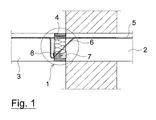
- a component 1 is shown for thermal insulation, which is arranged between a supporting member 2 in the form of a building ceiling panel and a supported component 3 in the form of a balcony slab.
- the component 1 for thermal insulation consists of an insulating body 4 and reinforcing elements, which serve to force and torque transmission between the two components and consist in the present case of extending in the horizontal direction steel tension rods 5 and inclined by the insulating body 4 extending steel transverse force bars 6 and connected to both components 2, 3 concrete pressure elements. 7
- the concrete pressure elements 7 close approximately flush with the insulating body 4 and the overall component 1 and thus are hardly available in the concrete components 2, 3, to which they rest flat with their terminal end faces. They are covered at least at these components facing the end faces with a plastic sliding layer, in the present example, the plastic sliding layer consists of the concrete pressure element at least laterally surrounding lost mold 8, in which the concrete pressure element 7 is filled during its manufacture and with which the concrete pressure element is installed together in the component 1.
- the thermal insulation property is in the foreground.
- the concrete printing elements 7 represent a very important area due to their relatively large area ratio, which is further optimized by the present invention:
- a high-strength concrete is used, which has in the inventive manner ilmenite as an additive and in contrast to the otherwise conventional quartz sand is omitted.
- the heat conductivity is significantly reduced in a particularly advantageous manner, which contributes in particular to an improvement of the thermal insulation of the so equipped device 1.
- a particular advantage lies in the fact that the concrete building material according to the invention can be easily used to replace the otherwise high-strength concretes, without this leading to any disadvantages.
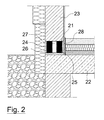
- FIG. 2 a brick-shaped thermal insulation element 21 is shown, which rests on a concrete floor slab 22 and which in turn carries a building wall 23.
- the brick-shaped thermal insulation element 21 forms in the so-called Mauerfuß a decoupling area, in order to keep any rising from the concrete floor plate 22 cold from the building wall 23.
- the thermal insulation element 21 consists of two beam-shaped support elements 24, 25 and of an insulating element surrounding these support elements with the sections 26, 27, 28.
- each of the two support elements 24, 25 now consists of the novel concrete building material, which is designed as a thermal insulation-supporting building material in that the usual quartz sand is completely replaced by ilmenite.
- the support elements can have different shapes; It is essential that they reduce the area or volume represent skeletal supporting framework and that the remaining area of the brick mold thus formed can be filled by insulating material.
- the new concrete building material can be used in various areas of concrete construction, where you want to improve the thermal insulation. Since, of course, such a concrete is slightly more expensive than a normal in-situ concrete, this can be limited to the new high-strength concrete on those areas that are to be optimized for heat, including either the high-strength concrete - as in the above component for thermal insulation - prefabricate and further processed as a finished element or by working with a formwork during the casting of the high-strength concrete on the construction site, which is then removed after the setting of the high-strength concrete, whereupon the more cost-effective in-situ concrete can be poured against this high-strength concrete.
- the present invention proposes a concrete building material containing titanium minerals as an additive and thus can be used as a novel particularly advantageous thermal insulation support building material.
- This thermal insulation support building material is able to improve the function of various components, such as a thermal insulation element according to claims 10 and 11 or a brick-shaped thermal insulation element according to claims 12 and 13.
- concrete has been so far for used such elements.
- titanium minerals as an additive - and in particular of ilmenite, which was previously used only for completely non-generic concretes - allows a concrete of a completely new category, which is not only high strength, but also has completely surprising yet unprecedented thermal insulation property.
Landscapes
- Chemical & Material Sciences (AREA)
- Engineering & Computer Science (AREA)
- Ceramic Engineering (AREA)
- Structural Engineering (AREA)
- Organic Chemistry (AREA)
- Materials Engineering (AREA)
- Architecture (AREA)
- Chemical Kinetics & Catalysis (AREA)
- Civil Engineering (AREA)
- Physics & Mathematics (AREA)
- Electromagnetism (AREA)
- Inorganic Chemistry (AREA)
- Building Environments (AREA)
- Environmental & Geological Engineering (AREA)
- Curing Cements, Concrete, And Artificial Stone (AREA)
- Combustion & Propulsion (AREA)
- Compositions Of Oxide Ceramics (AREA)
Abstract
Description
- Die Erfindung betrifft einen Beton-Baustoff, bestehend aus einem insbesondere hochfesten Beton der Festigkeitsklasse C 55 und höher. Sie betrifft des weiteren ein Bauelement zur Wärmedämmung im Hochbau mit Druckelementen aus dem Beton-Baustoff und außerdem ein mauersteinförmiges Wärmedämmelement zum Einsatz im Mauerfußbereich zwischen einer Decken- oder Bodenplatte und einer aufgehenden Gebäudewand mit einem aus dem Beton-Baustoff bestehenden Tragelement.
- Aus der
EP-A 1 225 283 ist ein Bauelement zur Wärmedämmung zwischen zwei Bauteilen bekannt, das neben einem Isolierkörper auch Druckkraft übertragende und an beide Bauteile angeschlossene Druckelemente aufweist, die aus hochfestem Beton bestehen. Die Verwendung von hochfestem Beton in diesem statisch und auch wärmetechnisch sehr wichtigen Bereich hat sich in der jüngsten Zeit immer stärker durchgesetzt und begonnen, die bis dahin üblichen Edelstahldruckelemente abzulösen, wobei auch die gestiegenen Stahlpreise zu diesem Trend beigetragen haben. - Der hierbei Verwendung findende hochfeste Beton ist üblicherweise aus etwa einem Drittel Zement, einem Drittel Quarzsand, einem Sechstel Basalt sowie Mikrosilika in der Größenordnung von etwa 5 %, Wasser in der Größenordnung von etwa 10 % und einem Fließmittelanteil in der Größenordnung von etwa 1,5 % zusammengesetzt, wobei die Prozentangaben auf die Masse des Betons bezogen sind. Wärmetechnische Untersuchungen haben nun ergeben, dass im genannten Bereich zwischen zwei Bauteilen das vorliegend aus Beton bestehende Druckelement immer noch eine Schwachstelle in Wärmeentkopplungshinsicht darstellen. Somit liegt der vorliegenden Erfindung die Aufgabe zugrunde, von diesen Erkenntnissen ausgehend einen Beton-Baustoff der eingangs genannten Art zur Verfügung zu stellen, der sich durch bessere Wärmedämmeigenschaften auszeichnet, ohne dass er wesentliche Einbußen hinsichtlich seiner Trageigenschaften aufweist.
- Diese Aufgabe wird erfindungsgemäß dadurch gelöst, dass der Beton dadurch als Wärmedämm-Trag-Baustoff ausgebildet ist, dass er Titan-Minerale als Zusatzstoff enthält. Diese Titan-Minerale, die aus Titaneisen oder Titaneisenerz und insbesondere aus Ilmenit bestehen, zeichnen sich dadurch aus, dass sie gegenüber sonst üblichen Zuschlagstoffen und beispielsweise gegenüber Quarzsand eine beispielsweise um etwa 100 % höhere Dichte aufweisen - aus diesem Grunde waren sie auch schon einmal in den 70er Jahren als Zuschlagstoff für den Strahlenschutz, beispielsweise in Betonbauteilen von Kernkraftwerken eingesetzt worden, danach aber wieder in Vergessenheit geraten. Aus diesem Grunde wird das abgebaute Ilmenit schon seit Jahrzehnten überwiegend nur noch zur Herstellung von Farben verwendet; denn Titandioxid weist eine extrem hohe "Weißkraft" auf und ist das wichtigste Weißpigment in Anstrichmitteln - und ist außerdem wegen seiner Ungiftigkeit noch als Lebensmittelzusatz E171 zugelassen. Das heißt, die Verwendung als Beton-Zuschlagstoff für den Strahlenschutz spielt bei den Abbaumengen von Ilmenit keine spürbare Rolle (mehr).
- Es hat sich nun überraschenderweise herausgestellt, dass sich durch die Titan-Minerale und insbesondere durch Ilmenit aber nicht nur die Festigkeit, sondern vor allem auch die Wärmedämmeigenschaften des hochfesten Betons deutlich verbessern lassen, in einem Beispielfall um 50 %. Wenn man somit die sonst üblichen Zuschlagstoffe wie insbesondere Quarzsand hinsichtlich ihres Anteils im Beton reduziert auf weniger als 10 % und insbesondere auf einen Anteil nahe oder gleich Null, so kann man Titan-Minerale und insbesondere Ilmenit als Ersatz-Zusatzstoff einsetzen, erhält dabei insbesondere bessere Wärmedämmeigenschaften und sogar eine größere Festigkeit, ohne dass es zu sonstigen nachteiligen Effekten kommt.
- Bei Vergleichstests (Zweiplattenverfahren) zwischen einem bekannten repräsentativen mikrostahlfaserbewehrten Hochleistungsfeinbeton (REF) und dem erfindungsgemäßen Ilmenit-Beton (ILM) ergaben sich in Anlehnung an DIN EN 12664 durchschnittlich etwa folgende Verhältnisse bzw. Unterschiede:
Wärmestromdichte REF: 220 W/m 2 Wärmestromdichte ILM: 140 W/m 2 Wärmedurchlasswiderstand RREF: 0,02 m 2 K/WWärmedurchlasswiderstand RILM: 0,03 m 2 K/WWärmeleitfähigkeit λREF: 1,5 W/(m·K) Wärmeleitfähigkeit λILM: 0,9 W/(m·K) - Eine vorteilhafte Betonzusammensetzung besteht somit beispielsweise daraus, dass die Titan-Minerale einen Volumenanteil an Beton in der Größenordnung von etwa einem Drittel aufweisen und/oder einen Massenanteil in der Größenordnung von etwa 50% oder mehr aufweisen, dass der Beton ganz ohne Quarzsand hergestellt wird und dass die Titan-Minerale eine Korngröße von maximal 0,5 mm aufweisen, wie es an sich für hochfeste Betone hinsichtlich anderer Zuschlagstoffe bekannt ist, jedoch für den Abbau von Titan-Mineralen unüblich ist (normalerweise liegt die handelsübliche maximale Korngröße bei etwa 5 mm). Vorteile ergeben sich außerdem dadurch, dass man Titan-Minerale verschiedener Körnung verwendet, d.h. die Titan-Minerale sowohl als Grobzuschlag als auch als Feinzuschlag einsetzt, wobei der Volumen- und/oder Masseanteil des Grobzuschlags vorteilhafterweise im Wesentlichen doppelt so groß wie der Anteil des Feinzuschlags ist.
- Die vorliegende Erfindung lässt sich nicht nur bei herkömmlichem zementgebundenem Beton verwenden, sondern auch bei Betonen, die ohne Zement auskommen bzw. zumindest auch andere Bindemittel aufweisen.
- So werden bei so genanntem Polymerbeton, auf den sich die vorliegende Erfindung ausdrücklich auch erstrecken soll, Reaktionsharze (z.B. Polyester, Vinylester, Polyurethan-, Epoxid- oder MMA-Harz) als Bindemittel verwendet, um die Zuschlagsstoffe zusammenzuhalten. Zement wird hierbei nur als ein weiterer Füllstoff (zur Erweiterung der Gesteinskörnung) eingesetzt und übernimmt primär keine Bindewirkung. Maßgebend ist, dass die Reaktionsharze die gleichen Aufgaben wie der Zementleim bei herkömmlichem Beton übernehmen.
- Als Füllstoffe können bei Polymerbeton sämtliche Bestandteile der herkömmlichen Betonmischungen dienen (z.B. Quarzsand, Basaltmehl, Mikrosilika, Zement, Flugasche). Auch hier wird durch den Einsatz von Ilmenit in Kombination mit Mikrosilika und Zement eine Optimierung der Wärmeleitfähigkeit bei gleichzeitiger Festigkeitszunahme von bis zu 180 N/mm2 erzielt. Der Anteil an Reaktionsharz variiert hierbei zwischen etwa 18 und 35 Vol.-%. Der restliche Anteil an Füllstoffen beträgt zwischen etwa 65 und 82 Vol.%. Der maximale Größtkorndurchmesser liegt dabei in der Größenordnung von zwischen 0,1 und 0,5 mm. Somit kann der Beton in seiner Funktion als Kraft übertragendes Element z.B. bei Kragplattenanschlüssen auch zusätzlich zur Optimierung der Wärmeleitfähigkeit beitragen, ohne hierdurch Verluste bezüglich der Festigkeit hinnehmen zu müssen. Ein weiterer Vorteil des Polymerbetons aus den genannten Polymerbeton-Ausgangsstoffen und Ilmenit ist die Zunahme der Biegezugfestigkeit um beispielsweise bis zu 40 N/mm2. Die Biegezugfestigkeit ist ein Maß für die Stabilität des Gefüges des Werkstoffes. Somit liegt dieser Wert deutlich oberhalb der Werte für herkömmliche Betone und Hochleistungsbetone aus Zementleim.
- Beim Einsatz von keramischen Hohlkugeln (sog. E-Spheres) und Mikroglashohlkugeln mit einer Partikelgröße von z.B. max. 0,3 mm können die Betonprodukte, beispielsweise die Druckkraftelemente, noch weiter optimiert werden. Hierbei wird ein Anteil des Ilmenits durch keramische Hohlkugeln ersetzt.
- Durch die Herstellung von Polymerbeton mit Füllstoffen bis einer beispielhaften Größtkorngröße von bis zu 0,5 mm und einem Harzanteil von etwa zwischen 18 und 35 Vol.% (10 - 50%) können somit hohe Druckfestigkeiten, hohe Biegezugfestigkeiten bei geringen Wärmeleitfähigkeiten erreicht werden, welche in ihrer Funktion zur Optimierung des Betonprodukts, also z.B. der Druckelemente führen.
- Werden dem Beton noch Fasern, insbesondere Stahlfasern beigemischt, so sorgt dies für die benötigte und gewünschte Duktilität, ohne die der hochfeste Beton im genannten Anwendungsgebiet nicht optimal einsetzbar wäre.
- Betrachtet man sich die neue Betonzusammensetzung und deren besonderen Vorteile in wärmetechnischer und Tragfähigkeitshinsicht, so bieten sich unterschiedliche Verwendungsarten für diesen erfindungsgemäßen Beton-Baustoff an:
- Die Verwendung als Betondruckelement für die genannten Bauelemente zur Wärmedämmung zwischen zwei Gebäudeteilen wurde vorstehend bereits angedeutet. Die vorliegende Erfindung soll sich ausdrücklich auch auf ein Bauelement zur Wärmedämmung mit Beton-Druckelement erstrecken, wie es grundsätzlich in der
EP-A 1 225 283 beschrieben ist, auf deren Inhalt hier ausdrücklich Bezug genommen wird, jedoch mit der wesentlichen Weiterentwicklung, dass dabei anstatt eines "normalen" hochfesten Betons der erfindungsgemäße Wärmedämm-Trag-Baustoff verwendet wird, der Titan-Minerale als Zusatzstoff aufweist, wobei die Titan-Minerale aus Titaneisen oder Titaneisenerz und insbesondere aus Ilmenit bestehen . Dadurch dass bei einem solchen Bauelement zur Wärmedämmung das Druckelement, über das die Druckkräfte zwischen den beiden angrenzenden Gebäudeteilen übertragen wird, aus dem erfindungsgemäßen Beton-Baustoff besteht, lassen sich erfindungsgemäß die Wärmedämmeigenschaften im Vergleich zu den bekannten Bauelementen zur Wärmedämmung, deren Druckelemente aus herkömmlichem hochfesten Beton oder aus Edelstahl bestehen, wesentlich verbessern und das ohne Nachteile hinsichtlich des Tragverhaltens. Auch die in den Unteransprüchen 2 bis 8 aufgeführten vorteilhaften Weiterbildungen des erfindungsgemäßen Beton-Baustoffs lassen sich für vorteilhafte Ausgestaltungen des Bauelements zur Wärmedämmung heranziehen. - Darüber hinaus lässt sich der neue Beton-Baustoff auch als Tragelement für ein mauersteinförmiges Wärmedämmelement zur Wärmeentkopplung zwischen Wandteilen und Boden- oder Deckenteilen verwenden, wie es an sich aus der
EP-A 1 231 329 bekannt ist, auf deren Inhalt hier ausdrücklich Bezug genommen wird. Bei diesen mauersteinförmigen Wärmedämmelementen erfolgt der Aufbau durch kraftübertragende Tragelemente einerseits und Isolierelemente andererseits, wobei bisher die Tragelemente aus Leichtbeton, Leichtmörtel oder Kunststoff bestanden. Wird nun statt dessen der neue hoch wärmedämmende Beton-Baustoff verwendet, so lässt sich erfindungsgemäß das Tragverhalten dieses daraus bestehenden Tragelements verbessern und folglich dessen Dimensionierung auch an die verbesserten Festigkeitswerte anpassen. Hierdurch kann beispielsweise der Isolierelementanteil vergrößert und somit die Wärmeentkopplungseigenschaften weiter verbessert werden. Auf eine solche Verwendung des Beton-Baustoffs und das so hergestellte mauersteinförmige Wärmedämmelement soll sich die vorliegende Erfindung ebenfalls ausdrücklich erstrecken, wobei auch die in den Unteransprüchen 2 bis 8 aufgeführten Merkmale vorteilhafte Weiterbildungen des mauersteinförmigen Wärmedämmelementes darstellen. - Daneben ist es auch möglich, den neuartigen Beton-Baustoff überall dort zu verwenden, wo eine Wärmedämmung besonders wichtig ist, so beispielsweise im Anschlussbereich von Decken oder Bodenplatten an Stützen, wie sie zum Beispiel bei einem auf Stützen aufgelagerten Gebäude eingesetzt werden. Dort lässt sich der sonst in diesem Bereich verwendete Ortbeton durch den neuartigen Beton-Baustoff ersetzen, wodurch man die Wärmedämmung in diesem Bereich erheblich vergrößert bzw. verbessert.
- Weitere Merkmale und Vorteile der vorliegenden Erfindung ergeben sich aus den beigefügten Ansprüchen, auf die hiermit ausdrücklich Bezug genommen werden soll, und aus den nachfolgenden Beschreibungen zweier Ausführungsbeispiel anhand der Zeichnung; hierbei zeigen
- Figur 1
- ein Bauelement zur Wärmedämmung mit einem aus dem erfindungsgemäßen Beton-Baustoff bestehenden Betondruckelement; und
- Figur 2
- ein mauersteinförmiges Wärmedämmelement mit einem aus dem erfindungsgemäßen Beton-Baustoff bestehenden Tragelement.
- In
Figur 1 ist ein Bauelement 1 zur Wärmedämmung dargestellt, das zwischen einem tragenden Bauteil 2 in Form einer Gebäudedeckenplatte und einem getragenen Bauteil 3 in Form einer Balkonplatte angeordnet ist. Das Bauelement 1 zur Wärmedämmung besteht hierzu aus einem Isolierkörper 4 sowie Bewehrungselementen, die zur Kraft- und Momentenübertragung zwischen den beiden Bauteilen dienen und im vorliegenden Fall aus in horizontaler Richtung verlaufenden Stahl-Zugstäben 5 bestehen sowie aus geneigt durch den Isolierkörper 4 verlaufenden Stahl-Querkraftstäben 6 und aus an beide Bauteile 2, 3 angeschlossenen Beton-Druckelementen 7. - Die Beton-Druckelemente 7 schließen etwa bündig mit dem Isolierkörper 4 bzw. dem Gesamt-Bauelement 1 ab und stehen somit nur kaum in die Beton-Bauteile 2, 3 vor, an die sie flächig mit ihren endständigen Stirnseiten anliegen. Sie sind zumindest an diesen den Bauteilen zugewandten Stirnseiten mit einer Kunststoff-Gleitschicht abgedeckt, wobei im vorliegenden Beispiel die Kunststoff-Gleitschicht aus einer das Beton-Druckelement zumindest seitlich umgebenden verlorenen Gießform 8 besteht, in die das Beton-Druckelement 7 bei dessen Herstellung eingefüllt wird und mit der das Betondruckelement zusammen in das Bauelement 1 eingebaut wird.
- Da das Bauelement 1 zur Wärmedämmung nicht nur statische bzw. dynamische, sondern vor allem wärmetechnische Aufgaben erfüllen muss, steht die Wärmedämmeigenschaft mit im Vordergrund. Hierbei stellen die Beton-Druckelemente 7 aufgrund ihres vergleichsweise großen Flächenanteils einen durchaus wichtigen Bereich dar, der durch die vorliegende Erfindung weiter optimiert wird: Hierzu wird ein hochfester Beton verwendet, der in erfindungsgemäßer Art und Weise Ilmenit als Zuschlagsstoff aufweist und dagegen ganz auf den sonst üblichen Quarzsand verzichtet. Dadurch wird aufgrund der höheren Dichte von Ilmenit gegenüber Quarzsand nicht nur die Festigkeit des Betondruckelements 7 verbessert, sondern vor allem wird in besonders vorteilhafter Weise die Wärmeleitfähigkeit deutlich reduziert, was insbesondere zu einer Verbesserung der Wärmedämmung des so ausgestatteten Bauelements 1 beiträgt. Ein besonderer Vorteil liegt auch darin, dass der erfindungsgemäße Beton-Baustoff einfach dazu verwendet werden kann, die sonst üblichen hochfesten Betone zu ersetzen, ohne dass dies zu irgendwelchen Nachteilen führt.
- In
Figur 2 ist ein mauersteinförmiges Wärmedämmelement 21 dargestellt, das auf einer Betonbodenplatte 22 ruht und das wiederum eine Gebäudewand 23 trägt. Somit bildet das mauersteinförmige Wärmedämmelement 21 im so genannten Mauerfuß einen Entkopplungsbereich, um etwaige von der Betonbodenplatte 22 aufsteigende Kälte von der Gebäudewand 23 fernzuhalten. Das Wärmedämmelement 21 besteht dabei im gezeigten Beispiel aus zwei balkenförmigen Tragelementen 24, 25 und aus einem diese Tragelemente umgebenden Isolierelement mit den Abschnitten 26, 27, 28. - Erfindungsgemäß besteht nunmehr jedes der beiden Tragelemente 24, 25 aus dem neuartigen Beton-Baustoff, der als Wärmedämm-Trag-Baustoff ausgebildet ist, indem der sonst übliche Quarzsand vollständig durch Ilmenit ersetzt ist. Es versteht sich von selbst, dass die Tragelemente unterschiedliche Form aufweisen können; wesentlich ist dabei, dass sie ein flächen- bzw. volumenreduziertes bzw. skelettartiges Traggerüst darstellen und dass die restlichen Bereich der so gebildeten Mauersteinform durch Isoliermaterial ausgefüllt werden können.
- Wie vorstehend bereits erwähnt, lässt sich der neue Beton-Baustoff in verschiedensten Bereichen des Betonbaus einsetzen, wo man die Wärmedämmung verbessern möchte. Da natürlich ein solcher Beton etwas teurer ist als ein normaler Ortbeton, kann man hierzu den neuen hochfesten Beton auf diejenigen Bereiche beschränken, die wärmeoptimiert werden sollen, wozu man entweder den hochfesten Beton - wie beim genannten Bauteil zur Wärmedämmung - vorfertigen und so als Fertigelement weiterverarbeiten kann oder indem man beim Vergießen des hochfesten Betons auf der Baustelle mit einer Schalung arbeitet, die dann nach dem Abbinden des hochfesten Betons entfernt wird, woraufhin dann der kostengünstigere Ortbeton gegen diesen hochfesten Beton gegossen werden kann.
- Zusammenfassend schlägt die vorliegende Erfindung einen Beton-Baustoff vor, der Titan-Minerale als Zusatzstoff enthält und damit als neuartiger besonders vorteilhafter Wärmedämm-Trag-Baustoff verwendet werden kann. Dieser Wärmedämm-Trag-Baustoff ist dazu in der Lage, die Funktion verschiedener Bauteile zu verbessern, so zum Beispiel eines Bauelements zur Wärmedämmung gemäß den Ansprüchen 10 und 11 oder eines mauersteinförmigen Wärmedämmelements gemäß den Ansprüchen 12 und 13. Beton wurde zwar bisher auch schon für derartige Elemente verwendet. Aber die Verwendung von Titan-Mineralen als Zusatzstoff - und insbesondere von Ilmenit, das bisher nur für völlig gattungsfremde Betone eingesetzt wurde - ermöglicht einen Beton einer völlig neuen Kategorie, der nicht nur hochfest ist, sondern auch völlig überraschende bisher noch nicht dagewesene Wärmedämmeigenschaft aufweist.
Claims (13)
- Beton-Baustoff, insbesondere bestehend aus einem hochfesten Beton der Festigkeitsklasse C55 und höher,
dadurch gekennzeichnet,
dass der Beton dadurch als Wärmedämm-Trag-Baustoff ausgebildet ist, dass er Titan-Minerale als Zusatzstoff enthält. - Beton-Baustoff nach Anspruch 1,
dadurch gekennzeichnet,
dass die als Zusatzstoff für den hochfesten Beton fungierenden Titan-Minerale aus Titaneisen oder Titaneisenerz und insbesondere aus Ilmenit bestehen. - Beton-Baustoff nach zumindest Anspruch 1,
dadurch gekennzeichnet,
dass die als Zusatzstoff für den hochfesten Beton fungierenden Titan-Minerale einen Volumenanteil am Beton in der Größenordnung von etwa einem Drittel und/oder einen Massenanteil in der Größenordnung von etwa 50% oder mehr aufweisen. - Beton-Baustoff nach zumindest Anspruch 1,
dadurch gekennzeichnet,
dass der hochfeste Beton einen Massenanteil von Quarzsand in der Größenordnung von weniger als 10%, insbesondere nahe oder gleich Null aufweist. - Beton-Baustoff nach zumindest Anspruch 1,
dadurch gekennzeichnet,
dass die als Zusatzstoff für den hochfesten Beton fungierenden Titan-Minerale eine Korngröße von maximal 0,5 mm aufweisen. - Beton-Baustoff nach zumindest Anspruch 1,
dadurch gekennzeichnet,
dass dem Beton Fasern, insbesondere Stahlfasern beigemischt sind. - Beton-Baustoff nach zumindest Anspruch 1,
dadurch gekennzeichnet,
dass der Beton unter Verwendung von zumindest Zement als Bindemittel hergestellt ist. - Beton-Baustoff nach zumindest Anspruch 1,
dadurch gekennzeichnet,
dass der Beton unter Verwendung von zumindest Reaktionsharz als Bindemittel hergestellt ist. - Verwendung des Beton-Baustoffs nach einem der vorstehenden Ansprüche als Wärmedämm-Trag-Baustoff im Betonbau, insbesondere im Anschlussbereich von Gebäuden an sie tragende Stützen.
- Verwendung des Beton-Baustoffes nach einem der vorstehenden Ansprüche in einem Druckkraft übertragenden Betondruckelement (7) für ein Bauelement (1) zur Wärmedämmung zwischen zwei Betonbauteilen, wobei das Bauelement (1) einen Isolierkörper (4) aufweist sowie an beide Betonbauteile anschließbare Bewehrungselemente (5, 6, 7) zur Kraft- und/oder Momentenübertragung zwischen den beiden Bauteilen, wobei eines der Bewehrungselemente als Druckelement (7) zur Druckkraftübertragung ausgebildet und hierzu an die beiden Betonbauteile angeschlossen ist und aus dem Beton-Baustoff besteht.
- Bauelement zur Wärmedämmung zwischen zwei Betonbauteilen (2, 3), wobei das Bauelement (1) einen Isolierkörper (4) aufweist sowie an beide Beton-bauteile anschließbare Bewehrungselemente (5, 6, 7) zur Kraft- und/oder Momentenübertragung zwischen den beiden Bauteilen, wobei eines der Bewehrungselemente als Druckelement (7) zur Druckkraftübertragung ausgebildet und hierzu an die beiden Betonbauteile angeschlossen ist und aus hochfestem Beton besteht,
dadurch gekennzeichnet,
dass der Beton aus einem Beton-Baustoff nach zumindest einem der vorstehenden Ansprüche 1 bis 8 besteht. - Verwendung des Beton-Baustoffes nach einem der vorstehenden Ansprüche in einem mauersteinförmigen Wärmedämmelement (11) zum Einsatz im Mauerfußbereich zwischen einer Decken- oder Bodenplatte (22) und einer aufgehenden Gebäudewand (23), wobei das Wärmedämmelement zumindest ein aus dem Beton-Baustoff bestehendes Tragelement (24, 25) und zumindest einen das Tragelement seitlich umgebenden Isolierkörper (26, 27, 28) aufweist.
- Mauersteinförmiges Wärmedämmelement (11) zum Einsatz im Mauerfußbereich zwischen einer Decken- oder Bodenplatte (22) und einer aufgehenden Gebäudewand (23), wobei das Wärmedämmelement zumindest ein aus einem Betonmaterial bestehendes Tragelement (24, 25) und zumindest einen das Tragelement seitlich umgebenden Isolierkörper (26, 27, 28) aufweist,
dadurch gekennzeichnet,
dass das Betonmaterial aus einem Beton-Baustoff nach zumindest einem der vorstehenden Ansprüche 1 bis 8 besteht.
Priority Applications (2)
| Application Number | Priority Date | Filing Date | Title |
|---|---|---|---|
| PL09013038.6T PL2177681T5 (pl) | 2008-10-17 | 2009-10-15 | Materiał betonowy, element konstrukcyjny do izolacji termicznej i element termoizolacyjny w postaci cegły do robót murowych, z których w każdym zastosowano materiał betonowy |
| EP09013038.6A EP2177681B2 (de) | 2008-10-17 | 2009-10-15 | Beton-Baustoff, Bauelement zur Wärmedämmung und mauersteinförmiges Wärmedämmelement, jeweils unter Verwendung des Beton-Baustoffs |
Applications Claiming Priority (2)
| Application Number | Priority Date | Filing Date | Title |
|---|---|---|---|
| EP08018227 | 2008-10-17 | ||
| EP09013038.6A EP2177681B2 (de) | 2008-10-17 | 2009-10-15 | Beton-Baustoff, Bauelement zur Wärmedämmung und mauersteinförmiges Wärmedämmelement, jeweils unter Verwendung des Beton-Baustoffs |
Publications (4)
| Publication Number | Publication Date |
|---|---|
| EP2177681A2 true EP2177681A2 (de) | 2010-04-21 |
| EP2177681A3 EP2177681A3 (de) | 2012-11-14 |
| EP2177681B1 EP2177681B1 (de) | 2016-11-30 |
| EP2177681B2 EP2177681B2 (de) | 2020-10-14 |
Family
ID=40291201
Family Applications (1)
| Application Number | Title | Priority Date | Filing Date |
|---|---|---|---|
| EP09013038.6A Active EP2177681B2 (de) | 2008-10-17 | 2009-10-15 | Beton-Baustoff, Bauelement zur Wärmedämmung und mauersteinförmiges Wärmedämmelement, jeweils unter Verwendung des Beton-Baustoffs |
Country Status (5)
| Country | Link |
|---|---|
| US (1) | US8991124B2 (de) |
| EP (1) | EP2177681B2 (de) |
| JP (1) | JP2010095994A (de) |
| CA (1) | CA2682413A1 (de) |
| PL (1) | PL2177681T5 (de) |
Cited By (5)
| Publication number | Priority date | Publication date | Assignee | Title |
|---|---|---|---|---|
| WO2013021069A1 (de) * | 2011-08-11 | 2013-02-14 | Schöck Bauteile GmbH | Bauelement zur wärmedämmung |
| DE102011109962A1 (de) * | 2011-08-11 | 2013-02-14 | Schöck Bauteile GmbH | Bauelement zur Wärmedämmung |
| DE202013006229U1 (de) * | 2013-07-11 | 2014-10-13 | H-Bau Technik Gmbh | Thermisch isolierendes Bauteil |
| CN108691366A (zh) * | 2017-04-05 | 2018-10-23 | 哈尔芬有限公司 | 起热隔离作用的结构元件 |
| CN114150776A (zh) * | 2022-01-06 | 2022-03-08 | 浩伦建工有限公司 | 一种建筑幕墙用覆膜岩棉板保温系统的制备方法 |
Families Citing this family (8)
| Publication number | Priority date | Publication date | Assignee | Title |
|---|---|---|---|---|
| US9027905B2 (en) | 2010-11-02 | 2015-05-12 | Aisin Seiki Kabushiki Kaisha | Fluid control valve |
| CN102561581A (zh) * | 2011-07-14 | 2012-07-11 | 彭昊 | 自保温隔音砌块及其使用方法 |
| PL3272958T3 (pl) * | 2016-07-22 | 2020-08-24 | Schöck Bauteile GmbH | Element budowlany do izolacji cieplnej |
| DE102016124736A1 (de) * | 2016-12-19 | 2018-06-21 | Schöck Bauteile GmbH | Bauelement zur Wärmedämmung |
| CN107555881A (zh) * | 2017-10-21 | 2018-01-09 | 长沙仲善新能源科技有限公司 | 一种建筑保温新材料 |
| EP3737799B1 (de) * | 2018-01-10 | 2022-12-28 | Jencol Innovations, LLC | Thermische trennung für betonplatten |
| CN111499277A (zh) * | 2020-03-16 | 2020-08-07 | 佛冈龙清电力器材有限公司 | 一种超低电阻高强水泥基复合纤维材料及其制备方法 |
| CA3225713A1 (en) * | 2023-01-11 | 2025-01-20 | Thermal B Solutions Inc. | Structural thermal break |
Citations (2)
| Publication number | Priority date | Publication date | Assignee | Title |
|---|---|---|---|---|
| EP1225283A1 (de) | 2001-01-23 | 2002-07-24 | Schöck Entwicklungsgesellschaft mbH | Bauelement zur Wärmedämmung |
| EP1231329A1 (de) | 2001-02-10 | 2002-08-14 | Schöck Entwicklungsgesellschaft mbH | Mauersteinförmiges Wärmedämmelement |
Family Cites Families (28)
| Publication number | Priority date | Publication date | Assignee | Title |
|---|---|---|---|---|
| US2279262A (en) * | 1937-02-15 | 1942-04-07 | Continental Oil Co | Weighted cement |
| US3357851A (en) * | 1966-07-20 | 1967-12-12 | Richard M Colgate | Heavy concrete pipe coating composition and method |
| DE1646883A1 (de) † | 1966-07-29 | 1971-10-07 | Heidelberg Portland Zement | Kuenstliche Zuschlagstoffe fuer Beton bzw. Bauelemente auch fuer den Schutz gegen ionisierende Strahlen |
| US3437602A (en) * | 1966-11-25 | 1969-04-08 | Irving Tashlick | Radiation shielding material and method of making same |
| US3645916A (en) * | 1967-11-02 | 1972-02-29 | William Cornelius Hall | Metallic mortars |
| BE755427A (fr) † | 1969-08-28 | 1971-02-01 | Nihon Cement | Procede de fabrication de ciments atteignant rapidement une tres haute resistance |
| US4288955A (en) * | 1975-10-24 | 1981-09-15 | Hiatt Carl C | Structural building element |
| US4337755A (en) * | 1980-04-23 | 1982-07-06 | Pitha Jay R | Solar collector block |
| CH658283A5 (fr) * | 1984-08-15 | 1986-10-31 | Werner Baumberger | Plot de construction. |
| EP0186466B1 (de) † | 1984-12-25 | 1990-08-29 | SHIMIZU CONSTRUCTION Co. LTD. | Hitzebeständige Betonzusammensetzung mit dimensionaler Stabilität |
| FR2647437B1 (fr) † | 1989-05-26 | 1991-10-04 | Savoie Refractaires | Nouvelles compositions refractaires contenant de la zircone monoclinique et articles formes a partir de ces compositions presentant une resistance mecanique a chaud et une resistance aux chocs thermiques ameliorees |
| DK49592D0 (da) * | 1992-04-13 | 1992-04-13 | Aalborg Portland As | Cementkomposition |
| US5443918A (en) * | 1994-09-07 | 1995-08-22 | Universite Laval | Metal fiber with optimized geometry for reinforcing cement-based materials |
| DE69620173T2 (de) * | 1995-06-07 | 2002-11-14 | Cp Kelco Aps, Lille Skensved | Stabile hydrokolloidale suspension |
| WO1996040598A1 (en) * | 1995-06-07 | 1996-12-19 | The Nutrasweet Company | Stable suspension of hydrocolloids and superplasticizer |
| US6113684A (en) † | 1999-04-16 | 2000-09-05 | Kunbargi; Hassan | Rapid hardening, ultra-high early strength Portland-type cement compositions, novel clinkers and methods for their manufacture which reduce harmful gaseous emissions |
| US6540501B1 (en) * | 2000-11-21 | 2003-04-01 | Allan Block Corporation | Method and apparatus for producing concrete blocks with textured surfaces |
| JP2002161553A (ja) * | 2000-11-24 | 2002-06-04 | Maeda Seikan Kk | カウンタウエイト |
| EP1236699A1 (de) † | 2001-03-01 | 2002-09-04 | Sika AG, vorm. Kaspar Winkler & Co. | Verbundmaterial und geformter Körper mit einstellbaren thermische Leitfähigkeit und spezifischen Gewicht |
| GB2412402B (en) * | 2001-12-24 | 2005-11-09 | Univ Sheffield | Fibre reinforced concrete |
| DE10213712A1 (de) † | 2002-03-26 | 2003-10-09 | Schrickel Joerg | Leichtbeton und daraus hergestellte Platten |
| AU2003252138A1 (en) † | 2002-08-02 | 2004-03-29 | Charles Edgar Price | Cementitious composition comprising bottom ash, methods of making and use thereof |
| EP1596018A3 (de) † | 2004-05-11 | 2007-02-14 | Ullermann, Klaus | Mauerstein sowie Masse und Verfahren zum Herstellen desselben |
| JP2006083615A (ja) * | 2004-09-16 | 2006-03-30 | Daiko Bussan Kk | 電波吸収体 |
| EP1932814A1 (de) † | 2006-12-05 | 2008-06-18 | Nicolas Fernando Tejada Juarez | Zusammensetzung aus Polymerbeton |
| US20100269735A1 (en) † | 2007-09-10 | 2010-10-28 | Martin Shichtel | Composition Based on Phosphatic Raw Materials and Process for the Preparation Thereof |
| JP4711196B2 (ja) * | 2007-09-13 | 2011-06-29 | 太平洋セメント株式会社 | 高強度組成物補強用鋼繊維 |
| DE202008010803U1 (de) † | 2008-08-05 | 2008-10-09 | Mostafa, Kamal, Dr. | Wärmedämmender Mauerstein |
-
2009
- 2009-10-12 US US12/577,311 patent/US8991124B2/en active Active
- 2009-10-13 CA CA 2682413 patent/CA2682413A1/en not_active Abandoned
- 2009-10-15 EP EP09013038.6A patent/EP2177681B2/de active Active
- 2009-10-15 PL PL09013038.6T patent/PL2177681T5/pl unknown
- 2009-10-19 JP JP2009240576A patent/JP2010095994A/ja active Pending
Patent Citations (2)
| Publication number | Priority date | Publication date | Assignee | Title |
|---|---|---|---|---|
| EP1225283A1 (de) | 2001-01-23 | 2002-07-24 | Schöck Entwicklungsgesellschaft mbH | Bauelement zur Wärmedämmung |
| EP1231329A1 (de) | 2001-02-10 | 2002-08-14 | Schöck Entwicklungsgesellschaft mbH | Mauersteinförmiges Wärmedämmelement |
Cited By (8)
| Publication number | Priority date | Publication date | Assignee | Title |
|---|---|---|---|---|
| WO2013021069A1 (de) * | 2011-08-11 | 2013-02-14 | Schöck Bauteile GmbH | Bauelement zur wärmedämmung |
| DE102011109962A1 (de) * | 2011-08-11 | 2013-02-14 | Schöck Bauteile GmbH | Bauelement zur Wärmedämmung |
| US9382705B2 (en) | 2011-08-11 | 2016-07-05 | Schöck Bauteile GmbH | Structural element for heat-insulating purposes |
| US9435115B2 (en) | 2011-08-11 | 2016-09-06 | Schöck Bauteile GmbH | Structural element for heat-insulating purposes |
| DE202013006229U1 (de) * | 2013-07-11 | 2014-10-13 | H-Bau Technik Gmbh | Thermisch isolierendes Bauteil |
| EP2824249A1 (de) * | 2013-07-11 | 2015-01-14 | H-Bau Technik GmbH | Thermisch isolierendes Bauelement |
| CN108691366A (zh) * | 2017-04-05 | 2018-10-23 | 哈尔芬有限公司 | 起热隔离作用的结构元件 |
| CN114150776A (zh) * | 2022-01-06 | 2022-03-08 | 浩伦建工有限公司 | 一种建筑幕墙用覆膜岩棉板保温系统的制备方法 |
Also Published As
| Publication number | Publication date |
|---|---|
| US8991124B2 (en) | 2015-03-31 |
| EP2177681A3 (de) | 2012-11-14 |
| EP2177681B2 (de) | 2020-10-14 |
| CA2682413A1 (en) | 2010-04-17 |
| US20100095616A1 (en) | 2010-04-22 |
| PL2177681T3 (pl) | 2017-07-31 |
| EP2177681B1 (de) | 2016-11-30 |
| JP2010095994A (ja) | 2010-04-30 |
| PL2177681T5 (pl) | 2023-07-17 |
Similar Documents
| Publication | Publication Date | Title |
|---|---|---|
| EP2177681B1 (de) | Beton-Baustoff, Bauelement zur Wärmedämmung und mauersteinförmiges Wärmedämmelement, jeweils unter Verwendung des Beton-Baustoffs | |
| DE69931289T2 (de) | Selbstnivellierender, besonders leistungsstarker Beton sowie Verfahren zu dessen Herstellung und dessen Einsatz | |
| EP2837476B1 (de) | Betonbauteil, das im Schleuderverfahren hergestellt und als Stütze oder Mast ausgebildet ist, bestehend aus ultrahochfestem Beton | |
| WO2014094864A1 (de) | Baustoffzusammensetzung zur herstellung eines leichtbetons | |
| EP3175058B1 (de) | Verfahren zum herstellen eines durch eine bewehrung vorgespannten betonwerkstücks und durch eine bewehrung vorgespanntes betonwerkstück | |
| DE112013006042T5 (de) | Ultrahochfester Stahlfaserbeton | |
| DE3876805T2 (de) | Vorgespanntes konstruktionselement in verbundstruktur und herstellungsverfahren fuer dieses element. | |
| EP3696153A1 (de) | Zementmischung zur bildung eines ultrahochfesten leichtbetons | |
| EP3519340A1 (de) | Freistehende führungsschiene für eine aufzuganlage sowie führungsschienenanordnung und aufzuganlage mit selbiger | |
| EP1141497B1 (de) | Dünnwandiges bauteil aus hydraulisch erhärtetem zementsteinmaterial sowie verfahren zu seiner herstellung | |
| EP2177489A1 (de) | Baustoff mit pflanzlichem Zuschlag | |
| EP1282751B1 (de) | Drahtfaser | |
| DE2459141A1 (de) | Beton oder dergleichen moertel, daraus hergestellte formsteine sowie verwendung dieser formsteine | |
| EP3261811B1 (de) | Dachstein sowie verfahren zur herstellung eines solchen dachsteins | |
| DE1800103A1 (de) | Einpressmoertel fuer Spannrohre | |
| DE102012015795A1 (de) | "Beton, Betonformteil und Verfahren zur Herstellung eines Betonteils" | |
| EP0387825A2 (de) | Beschwerte Verstärkungsfaser und faserverstärkte Baustoffmischung, Verfahren zu deren Herstellung und deren Verwendung | |
| AT286579B (de) | Bauteil, wie Träger, Platte, Decke, Wand od.dgl. | |
| DE10310896A1 (de) | Bewehrungselement für den Betonbau | |
| DE20121241U1 (de) | Fasermischung für Beton | |
| EP4339390A1 (de) | Mehrlagiges dämmungssystem | |
| DE2240026A1 (de) | Konstruktiv tragendes und gegebenenfalls gestalterisches kleineres bauteil | |
| AT200769B (de) | Verfahren zur Herstellung von Bauwerken aus Beton und hiernach hergestelltes Bauwerk | |
| EP3222600A1 (de) | Schnell erhärtende betonzusammensetzung | |
| AT401948B (de) | Betondachstein |
Legal Events
| Date | Code | Title | Description |
|---|---|---|---|
| PUAI | Public reference made under article 153(3) epc to a published international application that has entered the european phase |
Free format text: ORIGINAL CODE: 0009012 |
|
| AK | Designated contracting states |
Kind code of ref document: A2 Designated state(s): AT BE BG CH CY CZ DE DK EE ES FI FR GB GR HR HU IE IS IT LI LT LU LV MC MK MT NL NO PL PT RO SE SI SK SM TR |
|
| AX | Request for extension of the european patent |
Extension state: AL BA RS |
|
| PUAL | Search report despatched |
Free format text: ORIGINAL CODE: 0009013 |
|
| AK | Designated contracting states |
Kind code of ref document: A3 Designated state(s): AT BE BG CH CY CZ DE DK EE ES FI FR GB GR HR HU IE IS IT LI LT LU LV MC MK MT NL NO PL PT RO SE SI SK SM TR |
|
| AX | Request for extension of the european patent |
Extension state: AL BA RS |
|
| RIC1 | Information provided on ipc code assigned before grant |
Ipc: C04B 14/30 20060101ALI20121009BHEP Ipc: E04B 1/00 20060101AFI20121009BHEP |
|
| 17P | Request for examination filed |
Effective date: 20130514 |
|
| 17Q | First examination report despatched |
Effective date: 20130813 |
|
| GRAP | Despatch of communication of intention to grant a patent |
Free format text: ORIGINAL CODE: EPIDOSNIGR1 |
|
| INTG | Intention to grant announced |
Effective date: 20160607 |
|
| GRAS | Grant fee paid |
Free format text: ORIGINAL CODE: EPIDOSNIGR3 |
|
| GRAA | (expected) grant |
Free format text: ORIGINAL CODE: 0009210 |
|
| AK | Designated contracting states |
Kind code of ref document: B1 Designated state(s): AT BE BG CH CY CZ DE DK EE ES FI FR GB GR HR HU IE IS IT LI LT LU LV MC MK MT NL NO PL PT RO SE SI SK SM TR |
|
| REG | Reference to a national code |
Ref country code: CH Ref legal event code: EP Ref country code: GB Ref legal event code: FG4D Free format text: NOT ENGLISH |
|
| REG | Reference to a national code |
Ref country code: AT Ref legal event code: REF Ref document number: 849944 Country of ref document: AT Kind code of ref document: T Effective date: 20161215 |
|
| REG | Reference to a national code |
Ref country code: IE Ref legal event code: FG4D Free format text: LANGUAGE OF EP DOCUMENT: GERMAN |
|
| REG | Reference to a national code |
Ref country code: DE Ref legal event code: R096 Ref document number: 502009013428 Country of ref document: DE |
|
| REG | Reference to a national code |
Ref country code: NL Ref legal event code: FP |
|
| PG25 | Lapsed in a contracting state [announced via postgrant information from national office to epo] |
Ref country code: LV Free format text: LAPSE BECAUSE OF FAILURE TO SUBMIT A TRANSLATION OF THE DESCRIPTION OR TO PAY THE FEE WITHIN THE PRESCRIBED TIME-LIMIT Effective date: 20161130 |
|
| REG | Reference to a national code |
Ref country code: LT Ref legal event code: MG4D |
|
| PG25 | Lapsed in a contracting state [announced via postgrant information from national office to epo] |
Ref country code: NO Free format text: LAPSE BECAUSE OF FAILURE TO SUBMIT A TRANSLATION OF THE DESCRIPTION OR TO PAY THE FEE WITHIN THE PRESCRIBED TIME-LIMIT Effective date: 20170228 Ref country code: LT Free format text: LAPSE BECAUSE OF FAILURE TO SUBMIT A TRANSLATION OF THE DESCRIPTION OR TO PAY THE FEE WITHIN THE PRESCRIBED TIME-LIMIT Effective date: 20161130 Ref country code: SE Free format text: LAPSE BECAUSE OF FAILURE TO SUBMIT A TRANSLATION OF THE DESCRIPTION OR TO PAY THE FEE WITHIN THE PRESCRIBED TIME-LIMIT Effective date: 20161130 |
|
| PG25 | Lapsed in a contracting state [announced via postgrant information from national office to epo] |
Ref country code: FI Free format text: LAPSE BECAUSE OF FAILURE TO SUBMIT A TRANSLATION OF THE DESCRIPTION OR TO PAY THE FEE WITHIN THE PRESCRIBED TIME-LIMIT Effective date: 20161130 Ref country code: HR Free format text: LAPSE BECAUSE OF FAILURE TO SUBMIT A TRANSLATION OF THE DESCRIPTION OR TO PAY THE FEE WITHIN THE PRESCRIBED TIME-LIMIT Effective date: 20161130 Ref country code: PT Free format text: LAPSE BECAUSE OF FAILURE TO SUBMIT A TRANSLATION OF THE DESCRIPTION OR TO PAY THE FEE WITHIN THE PRESCRIBED TIME-LIMIT Effective date: 20170330 Ref country code: ES Free format text: LAPSE BECAUSE OF FAILURE TO SUBMIT A TRANSLATION OF THE DESCRIPTION OR TO PAY THE FEE WITHIN THE PRESCRIBED TIME-LIMIT Effective date: 20161130 |
|
| PG25 | Lapsed in a contracting state [announced via postgrant information from national office to epo] |
Ref country code: CZ Free format text: LAPSE BECAUSE OF FAILURE TO SUBMIT A TRANSLATION OF THE DESCRIPTION OR TO PAY THE FEE WITHIN THE PRESCRIBED TIME-LIMIT Effective date: 20161130 Ref country code: RO Free format text: LAPSE BECAUSE OF FAILURE TO SUBMIT A TRANSLATION OF THE DESCRIPTION OR TO PAY THE FEE WITHIN THE PRESCRIBED TIME-LIMIT Effective date: 20161130 Ref country code: EE Free format text: LAPSE BECAUSE OF FAILURE TO SUBMIT A TRANSLATION OF THE DESCRIPTION OR TO PAY THE FEE WITHIN THE PRESCRIBED TIME-LIMIT Effective date: 20161130 Ref country code: DK Free format text: LAPSE BECAUSE OF FAILURE TO SUBMIT A TRANSLATION OF THE DESCRIPTION OR TO PAY THE FEE WITHIN THE PRESCRIBED TIME-LIMIT Effective date: 20161130 Ref country code: SK Free format text: LAPSE BECAUSE OF FAILURE TO SUBMIT A TRANSLATION OF THE DESCRIPTION OR TO PAY THE FEE WITHIN THE PRESCRIBED TIME-LIMIT Effective date: 20161130 |
|
| REG | Reference to a national code |
Ref country code: DE Ref legal event code: R026 Ref document number: 502009013428 Country of ref document: DE |
|
| PG25 | Lapsed in a contracting state [announced via postgrant information from national office to epo] |
Ref country code: SM Free format text: LAPSE BECAUSE OF FAILURE TO SUBMIT A TRANSLATION OF THE DESCRIPTION OR TO PAY THE FEE WITHIN THE PRESCRIBED TIME-LIMIT Effective date: 20161130 Ref country code: BG Free format text: LAPSE BECAUSE OF FAILURE TO SUBMIT A TRANSLATION OF THE DESCRIPTION OR TO PAY THE FEE WITHIN THE PRESCRIBED TIME-LIMIT Effective date: 20170228 |
|
| PLBI | Opposition filed |
Free format text: ORIGINAL CODE: 0009260 |
|
| 26 | Opposition filed |
Opponent name: HALFEN GMBH Effective date: 20170829 |
|
| PLAX | Notice of opposition and request to file observation + time limit sent |
Free format text: ORIGINAL CODE: EPIDOSNOBS2 |
|
| REG | Reference to a national code |
Ref country code: FR Ref legal event code: PLFP Year of fee payment: 9 |
|
| PG25 | Lapsed in a contracting state [announced via postgrant information from national office to epo] |
Ref country code: SI Free format text: LAPSE BECAUSE OF FAILURE TO SUBMIT A TRANSLATION OF THE DESCRIPTION OR TO PAY THE FEE WITHIN THE PRESCRIBED TIME-LIMIT Effective date: 20161130 |
|
| PLBB | Reply of patent proprietor to notice(s) of opposition received |
Free format text: ORIGINAL CODE: EPIDOSNOBS3 |
|
| PG25 | Lapsed in a contracting state [announced via postgrant information from national office to epo] |
Ref country code: MC Free format text: LAPSE BECAUSE OF FAILURE TO SUBMIT A TRANSLATION OF THE DESCRIPTION OR TO PAY THE FEE WITHIN THE PRESCRIBED TIME-LIMIT Effective date: 20161130 |
|
| REG | Reference to a national code |
Ref country code: IE Ref legal event code: MM4A |
|
| PG25 | Lapsed in a contracting state [announced via postgrant information from national office to epo] |
Ref country code: LU Free format text: LAPSE BECAUSE OF NON-PAYMENT OF DUE FEES Effective date: 20171015 |
|
| PG25 | Lapsed in a contracting state [announced via postgrant information from national office to epo] |
Ref country code: MT Free format text: LAPSE BECAUSE OF FAILURE TO SUBMIT A TRANSLATION OF THE DESCRIPTION OR TO PAY THE FEE WITHIN THE PRESCRIBED TIME-LIMIT Effective date: 20161130 |
|
| REG | Reference to a national code |
Ref country code: FR Ref legal event code: PLFP Year of fee payment: 10 |
|
| PG25 | Lapsed in a contracting state [announced via postgrant information from national office to epo] |
Ref country code: IE Free format text: LAPSE BECAUSE OF NON-PAYMENT OF DUE FEES Effective date: 20171015 |
|
| PG25 | Lapsed in a contracting state [announced via postgrant information from national office to epo] |
Ref country code: HU Free format text: LAPSE BECAUSE OF FAILURE TO SUBMIT A TRANSLATION OF THE DESCRIPTION OR TO PAY THE FEE WITHIN THE PRESCRIBED TIME-LIMIT; INVALID AB INITIO Effective date: 20091015 |
|
| PG25 | Lapsed in a contracting state [announced via postgrant information from national office to epo] |
Ref country code: CY Free format text: LAPSE BECAUSE OF NON-PAYMENT OF DUE FEES Effective date: 20161130 |
|
| REG | Reference to a national code |
Ref country code: CH Ref legal event code: PK Free format text: BERICHTIGUNGEN |
|
| PG25 | Lapsed in a contracting state [announced via postgrant information from national office to epo] |
Ref country code: MK Free format text: LAPSE BECAUSE OF FAILURE TO SUBMIT A TRANSLATION OF THE DESCRIPTION OR TO PAY THE FEE WITHIN THE PRESCRIBED TIME-LIMIT Effective date: 20161130 |
|
| RIC2 | Information provided on ipc code assigned after grant |
Ipc: C04B 26/10 20060101AFI20191107BHEP Ipc: C04B 28/02 20060101ALI20191107BHEP Ipc: E04B 1/00 20060101ALI20191107BHEP Ipc: C04B 111/28 20060101ALI20191107BHEP Ipc: C04B 111/10 20060101ALI20191107BHEP |
|
| REG | Reference to a national code |
Ref country code: CH Ref legal event code: PK Free format text: BERICHTIGUNGEN |
|
| REG | Reference to a national code |
Ref country code: CH Ref legal event code: PK Free format text: BERICHTIGUNGEN |
|
| RIC2 | Information provided on ipc code assigned after grant |
Ipc: E04B 1/76 20060101AFI20191209BHEP |
|
| RIC2 | Information provided on ipc code assigned after grant |
Ipc: C04B 111/10 20060101ALI20200107BHEP Ipc: E04B 1/76 20060101ALI20200107BHEP Ipc: C04B 28/02 20060101ALI20200107BHEP Ipc: E04B 1/00 20060101ALI20200107BHEP Ipc: C04B 26/10 20060101AFI20200107BHEP Ipc: C04B 111/28 20060101ALI20200107BHEP |
|
| PG25 | Lapsed in a contracting state [announced via postgrant information from national office to epo] |
Ref country code: TR Free format text: LAPSE BECAUSE OF FAILURE TO SUBMIT A TRANSLATION OF THE DESCRIPTION OR TO PAY THE FEE WITHIN THE PRESCRIBED TIME-LIMIT Effective date: 20161130 |
|
| PG25 | Lapsed in a contracting state [announced via postgrant information from national office to epo] |
Ref country code: GR Free format text: LAPSE BECAUSE OF FAILURE TO SUBMIT A TRANSLATION OF THE DESCRIPTION OR TO PAY THE FEE WITHIN THE PRESCRIBED TIME-LIMIT Effective date: 20161130 |
|
| PG25 | Lapsed in a contracting state [announced via postgrant information from national office to epo] |
Ref country code: IS Free format text: LAPSE BECAUSE OF FAILURE TO SUBMIT A TRANSLATION OF THE DESCRIPTION OR TO PAY THE FEE WITHIN THE PRESCRIBED TIME-LIMIT Effective date: 20170330 |
|
| PUAH | Patent maintained in amended form |
Free format text: ORIGINAL CODE: 0009272 |
|
| STAA | Information on the status of an ep patent application or granted ep patent |
Free format text: STATUS: PATENT MAINTAINED AS AMENDED |
|
| REG | Reference to a national code |
Ref country code: CH Ref legal event code: AELC |
|
| 27A | Patent maintained in amended form |
Effective date: 20201014 |
|
| AK | Designated contracting states |
Kind code of ref document: B2 Designated state(s): AT BE BG CH CY CZ DE DK EE ES FI FR GB GR HR HU IE IS IT LI LT LU LV MC MK MT NL NO PL PT RO SE SI SK SM TR |
|
| REG | Reference to a national code |
Ref country code: DE Ref legal event code: R102 Ref document number: 502009013428 Country of ref document: DE |
|
| PG25 | Lapsed in a contracting state [announced via postgrant information from national office to epo] |
Ref country code: IT Free format text: LAPSE BECAUSE OF NON-PAYMENT OF DUE FEES Effective date: 20191015 |
|
| REG | Reference to a national code |
Ref country code: NL Ref legal event code: FP |
|
| P01 | Opt-out of the competence of the unified patent court (upc) registered |
Effective date: 20230513 |
|
| PGFP | Annual fee paid to national office [announced via postgrant information from national office to epo] |
Ref country code: FR Payment date: 20231023 Year of fee payment: 15 |
|
| PG25 | Lapsed in a contracting state [announced via postgrant information from national office to epo] |
Ref country code: FR Free format text: LAPSE BECAUSE OF NON-PAYMENT OF DUE FEES Effective date: 20241031 |
|
| REG | Reference to a national code |
Ref country code: CH Ref legal event code: U11 Free format text: ST27 STATUS EVENT CODE: U-0-0-U10-U11 (AS PROVIDED BY THE NATIONAL OFFICE) Effective date: 20251101 |
|
| PGFP | Annual fee paid to national office [announced via postgrant information from national office to epo] |
Ref country code: NL Payment date: 20251023 Year of fee payment: 17 |
|
| PGFP | Annual fee paid to national office [announced via postgrant information from national office to epo] |
Ref country code: DE Payment date: 20250827 Year of fee payment: 17 |
|
| PGFP | Annual fee paid to national office [announced via postgrant information from national office to epo] |
Ref country code: GB Payment date: 20251024 Year of fee payment: 17 |
|
| PGFP | Annual fee paid to national office [announced via postgrant information from national office to epo] |
Ref country code: AT Payment date: 20251021 Year of fee payment: 17 |
|
| PGFP | Annual fee paid to national office [announced via postgrant information from national office to epo] |
Ref country code: BE Payment date: 20251022 Year of fee payment: 17 |
|
| PGFP | Annual fee paid to national office [announced via postgrant information from national office to epo] |
Ref country code: CH Payment date: 20251101 Year of fee payment: 17 |
|
| PGFP | Annual fee paid to national office [announced via postgrant information from national office to epo] |
Ref country code: PL Payment date: 20251003 Year of fee payment: 17 |