EP2178011A1 - Correspondance de formes basée sur des points et distance appliquée à des modèles de canal auditif - Google Patents
Correspondance de formes basée sur des points et distance appliquée à des modèles de canal auditif Download PDFInfo
- Publication number
- EP2178011A1 EP2178011A1 EP09172553A EP09172553A EP2178011A1 EP 2178011 A1 EP2178011 A1 EP 2178011A1 EP 09172553 A EP09172553 A EP 09172553A EP 09172553 A EP09172553 A EP 09172553A EP 2178011 A1 EP2178011 A1 EP 2178011A1
- Authority
- EP
- European Patent Office
- Prior art keywords
- mesh model
- ear
- points
- matching
- point
- Prior art date
- Legal status (The legal status is an assumption and is not a legal conclusion. Google has not performed a legal analysis and makes no representation as to the accuracy of the status listed.)
- Withdrawn
Links
Images

Classifications
-
- H—ELECTRICITY
- H04—ELECTRIC COMMUNICATION TECHNIQUE
- H04R—LOUDSPEAKERS, MICROPHONES, GRAMOPHONE PICK-UPS OR LIKE ACOUSTIC ELECTROMECHANICAL TRANSDUCERS; ELECTRIC HEARING AIDS; PUBLIC ADDRESS SYSTEMS
- H04R25/00—Electric hearing aids
- H04R25/65—Housing parts, e.g. shells, tips or moulds, or their manufacture
- H04R25/652—Ear tips; Ear moulds
-
- G—PHYSICS
- G06—COMPUTING OR CALCULATING; COUNTING
- G06F—ELECTRIC DIGITAL DATA PROCESSING
- G06F30/00—Computer-aided design [CAD]
-
- H—ELECTRICITY
- H04—ELECTRIC COMMUNICATION TECHNIQUE
- H04R—LOUDSPEAKERS, MICROPHONES, GRAMOPHONE PICK-UPS OR LIKE ACOUSTIC ELECTROMECHANICAL TRANSDUCERS; ELECTRIC HEARING AIDS; PUBLIC ADDRESS SYSTEMS
- H04R25/00—Electric hearing aids
- H04R25/65—Housing parts, e.g. shells, tips or moulds, or their manufacture
- H04R25/658—Manufacture of housing parts
-
- H—ELECTRICITY
- H04—ELECTRIC COMMUNICATION TECHNIQUE
- H04R—LOUDSPEAKERS, MICROPHONES, GRAMOPHONE PICK-UPS OR LIKE ACOUSTIC ELECTROMECHANICAL TRANSDUCERS; ELECTRIC HEARING AIDS; PUBLIC ADDRESS SYSTEMS
- H04R2225/00—Details of deaf aids covered by H04R25/00, not provided for in any of its subgroups
- H04R2225/55—Communication between hearing aids and external devices via a network for data exchange
-
- H—ELECTRICITY
- H04—ELECTRIC COMMUNICATION TECHNIQUE
- H04R—LOUDSPEAKERS, MICROPHONES, GRAMOPHONE PICK-UPS OR LIKE ACOUSTIC ELECTROMECHANICAL TRANSDUCERS; ELECTRIC HEARING AIDS; PUBLIC ADDRESS SYSTEMS
- H04R2225/00—Details of deaf aids covered by H04R25/00, not provided for in any of its subgroups
- H04R2225/77—Design aspects, e.g. CAD, of hearing aid tips, moulds or housings
Definitions
- the present disclosure relates to ear canal models and, more specifically, to point-based shape matching and distance applied to ear canal models.
- Digital shape modeling is the process by which the shape of a device to be manufactured is designed with the assistance of computer aided design (CAD) software. After the desired shape is modeled in CAD software, the model file may be used in fabrication to produce a device with the desired shape.
- CAD computer aided design
- the use of digital shape modeling is widespread, however, when used for the modeling of organic shapes, such as in the field of medical prostheses, the complexity, irregularity and uncertainty of shapes can pose particular problems for digital shape modeling.
- One important example is the field of custom hearing aid manufacture.
- a hearing aid is an electroacoustic device for the amplification of sound.
- Modem hearing aids may be worn either partially or fully within the ear canal. Examples of such hearing aids include in the canal (ITC), mini canal (MIC), and completely in the canal (CIC) aids.
- ITC in the canal
- MIC mini canal
- CIC completely in the canal
- the entire hearing aid is designed to fit securely in the wearer's ear. To achieve this secure fit, the hearing aid is incorporated into an outer shell that is custom fitted to the shape of the wearer's ear canal.
- Custom fitting of the hearing aid shell is accomplished by first taking an impression of the wearer's ear canal. This may be achieved by applying hardening foam or other molding substance into the ear of the wearer. Once removed and allowed to harden, the three-dimensional shape of the mold may be digitally scanned and imported into CAD software. Technicians may then perform various modifications and transformations to the three-dimensional geometry to convert the geometry of the wearer's ear into a model for fabricating the shell of a hearing aid. These geometry processing steps may be labor intensive, tedious and prone to error. These factors may then add to the cost and time required to produce a suitable hearing aid.
- a method for determining a degree of similarity between ear canal models includes receiving a first mesh model representing an inner surface of a first ear. A set of points is sampled within the first mesh model. Each of the sampled set of points is matched to a corresponding point of a second mesh model representing an inner surface of a second ear. A shape distance between the first mesh model and the second mesh model is calculated based on the matched sets of points. A determination of the degree of similarity between the inner surface of the first ear and the inner surface of the second ear is provided based on the calculated shape distance.
- Sampling the set of points within the first mesh model may include identifying a randomly selected set of points within the first mesh model and/or identifying a set of points within the first mesh model at predetermined regular increments.
- Segmentation may be performed within the first mesh model to identify a plurality of regions. Thereafter one or more regions of interest may be selected and data pertaining to regions that are not of interest may be removed from the first mesh model such that the first mesh model is reduced to one or more regions of interest.
- the regions of interest may be an ear canal.
- the shape distance between the first mesh model and the second mesh model may be calculated as the cumulative difference between each set of corresponding points between the first mesh model and the second mesh model.
- an alignment step may be performed to adjust characteristics of the points of the first mesh model to more closely conform to the second mesh model. Adjusting the characteristics of the first mesh model may include one or more of adjusting rotation, performing translation, or adjusting scale.
- the matching step may be repeated to establish an improved point-to-point correspondence. The matching step and alignment step may be repeated to iteratively improve the matching.
- the step of matching each of the sampled set of points to a corresponding point of the second mesh model may include, for each point of the first mesh model, calculating a histogram representing the entire first mesh model from the point of view of each point in a radial dimension, an inclination angle and an azimuth angle and comparing that three-dimensional histogram to similar three-dimensional histograms of points of the second mesh model until a match is found.
- the provided determination as to the degree of similarity between the inner surface of the first ear and the inner surface of the second ear may be used to transform the first mesh model into a design for a hearing aid to be placed into the first ear.
- the first mesh model may be transformed into a design for a hearing aid using a geometry processing routine, the implementation of which may be dependent upon the calculated shape distance between the first mesh model and the second mesh model.
- a shape distance between the first mesh model and a third mesh model representing an inner surface of a third ear may be calculated and may then be compared to the calculated shape distance between the first mesh model and the second mesh model to determine whether the inner surface of the first ear is more similar to the inner surface of the second ear or the inner surface of the third ear.
- a first geometry processing routine may be performed on the first mesh model if the inner surface of the first ear is more similar to the inner surface of the second ear and a second geometry processing routine is performed on the first mesh model if the inner surface of the first ear is more similar to the inner surface of the third ear.
- a system for designing a hearing aid device includes receiving a first mesh model representing an inner surface of a first ear, sampling a set of points within the first mesh model, matching each of the sampled set of points to a corresponding point of a second mesh model representing an inner surface of a second ear, calculating a shape distance between the first mesh model and the second mesh model based on the matched sets of points, and performing a geometry processing routine that is dependent upon the calculated shape distance between the first mesh model and the second mesh model to transform the first mesh model into a design for a hearing aid to be placed into the first ear.
- Sampling the set of points within the first mesh model may include identifying a randomly selected set of points within the first mesh model or identifying a set of points within the first mesh model at predetermined regular increments.
- Segmentation may be performed within the first mesh model to identify a plurality of regions. Thereafter one or more regions of interest may be selected and data pertaining to regions that are not of interest may be removed from the first mesh model such that the first mesh model is reduced to one or more regions of interest.
- the regions of interest may be an ear canal.
- the shape distance between the first mesh model and the second mesh model may be calculated as the cumulative difference between each set of corresponding points between the first mesh model and the second mesh model.
- an alignment step may be performed to adjust characteristics of the points of the first mesh model to more closely conform to the second mesh model.
- the step of matching each of the sampled set of points to a corresponding point of the second mesh model may include, for each point of the first mesh model, calculating a histogram representing the entire first mesh model from the point of view of each point in a radial dimension, an inclination angle and an azimuth angle and comparing that three-dimensional histogram to similar three-dimensional histograms of points of the second mesh model until a match is found.
- a computer system includes a processor and a program storage device readable by the computer system, embodying a program of instructions executable by the processor to perform method steps for determining a degree of similarity between ear canal models.
- the method includes receiving a first mesh model representing an inner surface of a first ear, sampling a set of points within the first mesh model, matching the sampled set of points to corresponding points of a second mesh model representing an inner surface of a second ear, calculating a shape distance between the first mesh model and the second mesh model based on the matching, and outputting the calculated shape distance.
- Exemplary embodiments of the present invention seek to provide for an automated or partially automated approach to hearing aid modeling and design whereby geometry processing steps traditionally performed by a CAD technician may be partially or fully automated.
- anatomical shapes such as that of the ear canal may be substantially different from patient to patient, it may be difficult to apply the same automatic processing steps to every ear canal.
- exemplary embodiments of the present invention first seek to differentiate between various classifications of ear canal shapes so that automated geometry processing may be specific to the particular class of shape that any given ear canal most conforms to. This classification may be performed using the concept of shape distances whereby the differentiation between a given ear canal and a model ear canal may be quantified as a distance.
- shape distance between a given ear canal and a model ear canal it may be determined whether the automated geometry processing techniques established for the model ear canal may be successfully applied to the given ear canal and/or what shape class-specific geometry processing rules to apply for the given context. Moreover, where there are multiple model ear canals each with corresponding sets of automated geometry processing techniques, shape distances may be calculated between the given ear canal and each of the multiple model ear canals so that a best match may be found and the corresponding set of automated geometry processing techniques may be applied.
- exemplary embodiments of the present invention may make use of a meaningful notion of shape distance.
- This task may be closely coupled to the problem of establishing pointwise correspondences between two subjects, in this case, the given ear canal and the model ear canal.
- Pointwise correspondences may be particularly difficult for thee-dimensional surfaces, especially for organic shapes, where anatomical variations make automatic solutions for landmark detection very challenging.
- Exemplary embodiments of the present invention may utilize a three-dimensional shape context to define a non-Euclidian shape metric space between canal structures of the ear anatomy models and the given ear canals, where points are chosen uniformly at random from each exemplar.
- point matching and similarity transformation may be reiterated for mutual improvement.
- shape matching may be performed to an extent that is commensurate with the human notion of shape categorization and at the same time robust towards reasonable amounts of noise and matching outliers.
- accuracy of human shape categorization may be achieved without the need for human input.
- various classifications of digital hearing aid design process may be established and for the manufacturing of a given hearing aid, a classification may easily be determined to provide for a selection of an optimal processing path.
- Exemplary embodiments of the present invention compare the shape of canal parts of a human outer ear to one or more three-dimensional models.
- Three-dimensional models of the outer ear may be represented as bounded triangular meshes.
- Shape classes may be identified for several anatomical parts of outer ear three-dimensional models including the canal part. To this end, a meaningful notion of shape distance may be provided to differentiate between subjects in a population of shapes. Shape classes of anatomical parts may be used to derive shape class specific rules for the manipulation of outer ear surface geometries in hearing aid design.
- the correspondence computation may be based on invariant attributes of point locations to ensure that the resulting shape distance is invariant with respect to a chosen finite dimensional group (e.g., the similarity group) and to additional non-ideal conditions, such as noise and small local deformations.
- exemplary embodiments of the present invention utilize shape context in order to establish point correspondence between two ear canal shapes. These correspondences may be determined by solving a linear assignment problem. It may be assumed herein that corresponding points on similar three-dimensional canal shapes have similar shape context distributions, despite the presence of small local deformations and reasonable amounts of noise.
- FIG. 1 is a flow chart illustrating an approach for computing the shape distance between corresponding anatomical structures of two three-dimensional mesh models according to an exemplary embodiment of the present invention.
- the shape distance may be expressed as D l ( X,X' ) where X is the first three-dimensional mesh model, for example, a given ear shape being categorized and X' is the second three-dimensional mesh model, for example, an ear shape of a known shape class.
- the shape distance D l is calculated for all l wherein l is the set of corresponding anatomical regions l ⁇ ⁇ 1,..., M ⁇ .
- the two three-dimensional mesh models ( X,X' ) are received (Step S 11).
- the first three-dimensional mesh model X may be the given ear shape being categorized and the second three-dimensional mesh model X' may be the ear shape of a known shape class.
- the three-dimensional mesh models may be geometric representations of the inner surface of an ear. These geometries may be restricted to surface imagery although the presence of image data reflecting internal structures need not prevent exemplary embodiments of the present invention from utilizing such image data.
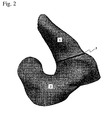
- FIG. 2 An example of segmentation may be seen in FIG. 2 where the ear surface mesh model has been segmented into an external ear structure 2 and a canal structure 1.
- the plane of separation 3 between the ear canal 1 and the external ear 2 has been identified.
- one of the three-dimensional mesh models is in fact a known ear shape of a particular shape class
- the complete set of anatomical regions may be already segmented, in which case segmentation is performed only with respect to the given ear shape being categorized.
- segmentation may be performed for each model.
- Segmentation may be performed within the mesh models to identify multiple regions. Thereafter one or more regions of interest may be selected from among the multiple regions.
- the mesh model may be divided into two regions including a canal region and an external ear region. In such a case, the canal region may be considered the region of interest.
- Data pertaining to regions that are not of interest may be removed from the mesh models such that the mesh models is reduced to one or more regions of interest.
- the external ear region may be removed and the mesh models may be reduced to include only the ear canal.
- Decomposition of the triangular meshes into distinct anatomical regions may be automatically performed as part of the segmentation step. By removing the regions that are not of interest, point matching and subsequent processing steps may be simplified.
- Point sampling may then be performed on each mesh model to characterize each mesh model as a collection of points that is a sample of the complete set of vertices of the corresponding mesh model.
- Sampling may be performed, for example, either randomly or at fixed intervals.
- the result is a set of points P representing the first mesh model X and a set of points P ' representing the second mesh model. It may also be possible to skip the step of point sampling and instead consider the full set of vertices as the set of points, however, to make efficient use of limited computational resources, sampling may be used.
- Point matching may then be performed to determine point-for-point correspondences between the points of the sets of points P and P' (Step S14).
- the result of point matching is to determine which point from P corresponds to which point from P ' for all points, or at least for all points that have analogs.
- Correspondences may be established between two point sets P and P', for example, by employing a shape context, which in three-dimensions, for a given point p ⁇ P and p ' ⁇ P ' is a descriptor that measures the loci of all other points p ⁇ ⁇ P and p ⁇ ' ⁇ P' relative to p and p ' based on a three-dimensional statistic of spherical coordinates ( r , ⁇ , ⁇ ), where r denotes the radial dimension, and ⁇ and ⁇ are angles denoting the elevation and azimuth dimensions, respectively.
- the resulting correspondence is a quantification of how the entire shape appears from the point of view of each particular sample point and by comparing this quantification from a point p of the first mesh model with a point p ' on the second mesh model, the degree of correspondence may be ascertained. Then, a global cost function may be produced by the sum of pairwise correspondences. Optimal correspondence may then be solved for, for example, using bipartite matching. Optimal correspondences, herein, represent the point matching.
- Alignment represents the steps necessary to align the set of points P and with the set of points P ', based on the previously-determined point matching. Alignment may include, for example, an adjustment of the rotation, translation, and scale in a manner that best aligns P with P '. Alignment may, in the simplest example, be linear, however, non-ridged transformations may also be used. For the purpose of ease of explanation, exemplary embodiments of the present invention are described herein utilizing rigid alignment.
- the steps of point matching (S 14) and alignment (S15) may be performed iteratively the step of performing the alignment may allow for a more accurate subsequent point matching, and that in turn may allow for a more accurate subsequent alignment. Accordingly, these steps may be repeated either for a predetermined number of iterations, for example, n where n is a positive integer, for example, 2, or repetition may continue until the point at which subsequent iteration ceases to produce additional refinement.
- the shape distance between P ' and P ' may be calculated using the final point-to-point correspondences (Step S16).
- the calculated shape distance may then be used, for example, to determine how to process the geometry by choosing a geometry processing routine based on a shape category or by modifying geometry processing steps based on the calculated shape distance.
- a patient's ear shape model X may be compared either to a single model X' or to multiple models X'' , X''' , etc.
- a set of shape distances may be calculated for the model of the patient's ear so that, for example, a closest match may be found and a corresponding geometry processing routine followed.
- a closest match may be found and a corresponding geometry processing routine followed.
- following the geometry processing routine for a closest match does not preclude the possibility that the geometry processing steps could be dependent upon one or more of the shape distances.
- Exemplary embodiments of the present invention may accordingly measure the shape distance between canal parts of outer ear three-dimensional models.
- shape distance may be symmetric, the correspondence may be expressed as a bijective mapping ⁇ : P ⁇ P ' between two sets of points P ⁇ X , P' ⁇ X 'sampled from the canal part of a triangular mesh.
- P denotes the set of points sampled from the canal part of X
- P ' contains the points sampled from the canal part of X '.
- a fixed number of points N is sampled from the set of vertices V of a triangular mesh.
- the shape of a subsurface may be reasonably approximated with a roughly uniform spacing between points. It is not necessary that the sampled points correspond to anatomical landmarks or other key points such as the curvature extrema.
- the sampled points may thus be either randomly selected or selected at fixed intervals, for example, as described above.
- the global cost of matching may be defined by assuming that Q ( ⁇ ) is given by the sum of certain local costs. Accordingly, a function q may be defined as ⁇ ⁇ , which assigns a pair of matching points p ⁇ P , p ' ⁇ P ' a scalar, that quantifies the local cost of matching.
- Shape contexts may be highly discriminative and thus may be inherently insensitive to small perturbations of parts of the shape.
- Scale invariance may be obtained by normalizing all radial distances of a shape context histogram. This may be achieved by computing twice the centroid size for a point set P and P ', respectively. Rotation invariance may also be obtained.
- a shape context may be formed by dividing each dimension into bins that are, for example, equally spaced in the angular dimensions and logarithmically spaced along the radial dimension.
- the optimal number of r -bins, ⁇ -bins and ⁇ -bins may be known for example, having been determined through experimentation.
- the resulting total number of bins may be expressed as K .
- Each histogram bin k , 0 ⁇ k ⁇ K may accumulate the number of points whose spherical coordinates relative to p fall within the discrete interval represented by the k -th bin.
- a robust treatment of matching outliers may be achieved by adding rows/columns with a constant (high) matching cost ⁇ , which may be equivalent to adding "dummy" points to the point sets. In this case, a point would be matched to a "dummy" whenever there is no real match available at smaller cost than ⁇ .
- the steps of point matching (S14) and alignment (S 15) can be iterated, for example, to increase robustness to potential matching outliers.
- Alignment may be performed, for example, by using a similarity transform for the transformation of a three-dimensional point cloud.
- P and P ' there may be two point sets P and P '.
- i 1, ..., N ⁇ .
- Equation (5) a closed-form solution of Equation (5)
- the variational approach may also be used to approximate the solution.
- Exemplary embodiments of the present invention provide a framework for computing the shape distance between canal structures of previously segmented outer ear models.
- the three-dimensional shape context has been employed to establish one-to-one point correspondences.
- the proposed shape distance may closely mimic the human notion of shape similarity.
- This framework may also be used to find clusters in a population of shapes, and to interpret the classes in terms of manufacturing categories.
- an extension of the shape context descriptor for example, the geodesic shape context, may be used.
- the topology of triangular meshes may be incorporated in terms of geodesic distances between a histogram basis point and points located in the histogram bins.
- a non-linear dimensionality reduction technique may be used to allow for a visual assessment of the sample distribution.
- clustering methodologies may be applied on the resulting lower dimensional embedding space.
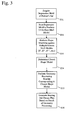
- FIG. 3 is a flow chart illustrating an approach for hearing aid design using shape categories according to an exemplary embodiment of the present invention.
- an impression mold of a patient's ear may be obtained (Step S31). This may be achieved, for example, by applying hardening foam or other molding substance into the ear of the wearer. Once removed and allowed to harden, the three-dimensional shape of the mold may be digitally scanned to produce a thee-dimensional digital surface geometry, referred to herein as the mesh model (Step S32).
- Shape matching may then be performed against multiple known mesh models, which may be, for example, X ', X '', X '', etc. (Step S33). Shape matching may be performed, for example, as described above with respect to FIG. 1 and may include all steps S 11 through S16. Shape matching may be performed using the shape model of the patient's ear against each of the multiple known mesh models.
- a closest shape model may be determined (Step S34).
- the closest shape model may be defined as the known shape model with the smallest shape distance to the shape model of the patient's ear.
- each of the multiple known mesh models may have a corresponding geometry processing routine for transforming the mesh model of the patient's ear into a form that is usable for constructing a custom-fitted hearing aid
- the geometry processing routine corresponding to the closest known mesh model may be performed (Step S35).
- Exemplary embodiments of the present invention may also combine these approaches such that there is a unique geometry processing routine for each known mesh model and each unique geometry processing routine is dependent upon the calculated shape distances.
- Step S36 After the geometry processing routine is performed, and/or before the geometry processing routine is performed, additional automatic, manual or semiautomatic geometry processing steps may be performed to generate a design plan for a hearing aid based on the results of the performed geometry processing routine (Step S36).
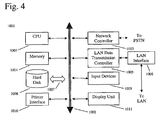
- FIG. 4 shows an example of a computer system which may implement a method and system of the present disclosure.
- the system and method of the present disclosure may be implemented in the form of a software application running on a computer system, for example, a mainframe, personal computer (PC), handheld computer, server, etc.
- the software application may be stored on a recording media locally accessible by the computer system and accessible via a hard wired or wireless connection to a network, for example, a local area network, or the Internet.
- the computer system referred to generally as system 1000 may include, for example, a central processing unit (CPU) 1001, random access memory (RAM) 1004, a printer interface 1010, a display unit 1011, a local area network (LAN) data transmission controller 1005, a LAN interface 1006, a network controller 1003, an internal bus 1002, and one or more input devices 1009, for example, a keyboard, mouse etc.
- the system 1000 may be connected to a data storage device, for example, a hard disk, 1005 via a link 1007.
Landscapes
- Engineering & Computer Science (AREA)
- Physics & Mathematics (AREA)
- Manufacturing & Machinery (AREA)
- Signal Processing (AREA)
- Neurosurgery (AREA)
- Otolaryngology (AREA)
- General Health & Medical Sciences (AREA)
- Acoustics & Sound (AREA)
- Health & Medical Sciences (AREA)
- Theoretical Computer Science (AREA)
- Computer Hardware Design (AREA)
- Evolutionary Computation (AREA)
- Geometry (AREA)
- General Engineering & Computer Science (AREA)
- General Physics & Mathematics (AREA)
- Image Analysis (AREA)
Applications Claiming Priority (2)
| Application Number | Priority Date | Filing Date | Title |
|---|---|---|---|
| US10439908P | 2008-10-10 | 2008-10-10 | |
| US12/573,216 US20100100362A1 (en) | 2008-10-10 | 2009-10-05 | Point-Based Shape Matching And Distance Applied To Ear Canal Models |
Publications (1)
| Publication Number | Publication Date |
|---|---|
| EP2178011A1 true EP2178011A1 (fr) | 2010-04-21 |
Family
ID=41571574
Family Applications (1)
| Application Number | Title | Priority Date | Filing Date |
|---|---|---|---|
| EP09172553A Withdrawn EP2178011A1 (fr) | 2008-10-10 | 2009-10-08 | Correspondance de formes basée sur des points et distance appliquée à des modèles de canal auditif |
Country Status (2)
| Country | Link |
|---|---|
| US (1) | US20100100362A1 (fr) |
| EP (1) | EP2178011A1 (fr) |
Cited By (4)
| Publication number | Priority date | Publication date | Assignee | Title |
|---|---|---|---|---|
| US20100100362A1 (en) * | 2008-10-10 | 2010-04-22 | Siemens Corporation | Point-Based Shape Matching And Distance Applied To Ear Canal Models |
| EP2051187A3 (fr) * | 2007-10-16 | 2012-05-30 | Siemens Hearing Instruments, Inc. | Système et procédé d'analyse de la taxonomie basique du canal d'oreille |
| US20190254561A1 (en) * | 2013-12-09 | 2019-08-22 | TechMah Medical, LLC | Bone reconstruction and orthopedic implants |
| US20240130630A1 (en) * | 2013-12-09 | 2024-04-25 | Techmah Medical Llc | Bone reconstruction and orthopedic implants |
Families Citing this family (13)
| Publication number | Priority date | Publication date | Assignee | Title |
|---|---|---|---|---|
| US9629698B2 (en) | 2014-11-04 | 2017-04-25 | James R. Glidewell Dental Ceramics, Inc. | Method and apparatus for generation of 3D models with applications in dental restoration design |
| WO2017047116A1 (fr) * | 2015-09-14 | 2017-03-23 | ヤマハ株式会社 | Dispositif d'analyse de forme d'oreille, dispositif de traitement d'informations, procédé d'analyse de forme d'oreille, et procédé de traitement d'informations |
| US12496030B2 (en) | 2016-11-17 | 2025-12-16 | James R. Glidewell Dental Ceramics, Inc. | Scanning dental impressions |
| US11559378B2 (en) | 2016-11-17 | 2023-01-24 | James R. Glidewell Dental Ceramics, Inc. | Scanning dental impressions |
| KR101836125B1 (ko) | 2016-12-22 | 2018-04-19 | 아주대학교산학협력단 | 모델의 형상 특징 정보 생성 방법 및 형상 유사도 분석 방법 |
| US11049331B2 (en) * | 2017-12-01 | 2021-06-29 | Hearables 3D Pty Ltd | Customization method and apparatus |
| US11534271B2 (en) | 2019-06-25 | 2022-12-27 | James R. Glidewell Dental Ceramics, Inc. | Processing CT scan of dental impression |
| US11540906B2 (en) | 2019-06-25 | 2023-01-03 | James R. Glidewell Dental Ceramics, Inc. | Processing digital dental impression |
| US11622843B2 (en) | 2019-06-25 | 2023-04-11 | James R. Glidewell Dental Ceramics, Inc. | Processing digital dental impression |
| WO2021117206A1 (fr) * | 2019-12-13 | 2021-06-17 | 日本電気株式会社 | Dispositif de détermination de paramètre, procédé de détermination de paramètre et support d'enregistrement |
| WO2021231265A1 (fr) | 2020-05-11 | 2021-11-18 | Cognex Corporation | Procédés et appareil de génération d'histogrammes en nuages de points |
| US11544846B2 (en) | 2020-08-27 | 2023-01-03 | James R. Glidewell Dental Ceramics, Inc. | Out-of-view CT scan detection |
| WO2024254710A1 (fr) * | 2023-06-15 | 2024-12-19 | Eers Global Technologies Inc. | Procédés et systèmes de modélisation de forme statistique de l'oreille humaine pour concevoir des dispositifs auditifs portables et des aides auditives |
Citations (2)
| Publication number | Priority date | Publication date | Assignee | Title |
|---|---|---|---|---|
| EP1796428A1 (fr) * | 2005-12-07 | 2007-06-13 | Siemens Medical Solutions USA, Inc. | Procédé et appareil de classification de fonctionnalités de surface d'une impression d'oreille |
| WO2008063510A1 (fr) * | 2006-11-13 | 2008-05-29 | Siemens Medical Solutions Usa, Inc. | Alignement rigide généralisé de modèles d'empreinte de l'oreille en 3d |
Family Cites Families (25)
| Publication number | Priority date | Publication date | Assignee | Title |
|---|---|---|---|---|
| US6608913B1 (en) * | 2000-07-17 | 2003-08-19 | Inco Limited | Self-contained mapping and positioning system utilizing point cloud data |
| US7625335B2 (en) * | 2000-08-25 | 2009-12-01 | 3Shape Aps | Method and apparatus for three-dimensional optical scanning of interior surfaces |
| US7050876B1 (en) * | 2000-10-06 | 2006-05-23 | Phonak Ltd. | Manufacturing methods and systems for rapid production of hearing-aid shells |
| ES2378060T3 (es) * | 2001-03-02 | 2012-04-04 | 3Shape A/S | Procedimiento para modelar piezas auriculares personalizadas |
| US7084870B2 (en) * | 2002-12-19 | 2006-08-01 | Siemens Corporate Research, Inc. | Interactive binaural shell modeling for hearing aids |
| DK1574111T3 (en) * | 2002-12-19 | 2017-10-02 | Siemens Corp | Automatic binaural ear shell modulation for hearing aids |
| DE602004017835D1 (de) * | 2003-02-05 | 2009-01-02 | Vivatone Hearing Systems Llc | Hörgerätesystem |
| US7949385B2 (en) * | 2003-03-11 | 2011-05-24 | Siemens Medical Solutions Usa, Inc. | System and method for reconstruction of the human ear canal from optical coherence tomography scans |
| US7308328B2 (en) * | 2003-05-15 | 2007-12-11 | Siemens Medical Solutions Usa, Inc. | Synchronized processing of ear shells for hearing aids |
| US7343039B2 (en) * | 2003-06-13 | 2008-03-11 | Microsoft Corporation | System and process for generating representations of objects using a directional histogram model and matrix descriptor |
| US7447556B2 (en) * | 2006-02-03 | 2008-11-04 | Siemens Audiologische Technik Gmbh | System comprising an automated tool and appertaining method for hearing aid design |
| US7720268B2 (en) * | 2005-07-15 | 2010-05-18 | Siemens Corporation | System and method for ultrasound specific segmentation using speckle distributions |
| US8005652B2 (en) * | 2005-08-31 | 2011-08-23 | Siemens Corporation | Method and apparatus for surface partitioning using geodesic distance |
| US7979244B2 (en) * | 2005-09-13 | 2011-07-12 | Siemens Corporation | Method and apparatus for aperture detection of 3D hearing aid shells |
| US8086427B2 (en) * | 2005-09-13 | 2011-12-27 | Siemens Corporation | Method and apparatus for the registration of 3D ear impression models |
| US7801708B2 (en) * | 2005-09-13 | 2010-09-21 | Siemens Corporation | Method and apparatus for the rigid and non-rigid registration of 3D shapes |
| US7991594B2 (en) * | 2005-09-13 | 2011-08-02 | Siemens Corporation | Method and apparatus for the rigid registration of 3D ear impression shapes with skeletons |
| US7787678B2 (en) * | 2005-10-07 | 2010-08-31 | Siemens Corporation | Devices, systems, and methods for processing images |
| US20070206880A1 (en) * | 2005-12-01 | 2007-09-06 | Siemens Corporate Research, Inc. | Coupled Bayesian Framework For Dual Energy Image Registration |
| US7680634B2 (en) * | 2006-10-03 | 2010-03-16 | Siemens Hearing Instruments, Inc. | Ellipsoidal line cut system and method for hearing aid shell design |
| US20090063184A1 (en) * | 2007-08-30 | 2009-03-05 | Siemens Hearing Instruments Inc. | Method For Automatic Project File Reconstruction and Batch Processor |
| EP2190520A4 (fr) * | 2007-09-20 | 2011-01-26 | Estimme Ltd | Stimulation électrique dans l'oreille moyenne pour le traitement de troubles auditifs |
| US20090116731A1 (en) * | 2007-11-01 | 2009-05-07 | Rupen Melkisetoglu | Method and system for detection of concha and intertragal notch point in 3D undetailed ear impressions |
| KR101042104B1 (ko) * | 2008-10-01 | 2011-06-16 | (주)알고코리아 | 귓속 삽입형 범용 보청기를 위한 표준 이어 쉘의 제조방법 |
| US20100100362A1 (en) * | 2008-10-10 | 2010-04-22 | Siemens Corporation | Point-Based Shape Matching And Distance Applied To Ear Canal Models |
-
2009
- 2009-10-05 US US12/573,216 patent/US20100100362A1/en not_active Abandoned
- 2009-10-08 EP EP09172553A patent/EP2178011A1/fr not_active Withdrawn
Patent Citations (2)
| Publication number | Priority date | Publication date | Assignee | Title |
|---|---|---|---|---|
| EP1796428A1 (fr) * | 2005-12-07 | 2007-06-13 | Siemens Medical Solutions USA, Inc. | Procédé et appareil de classification de fonctionnalités de surface d'une impression d'oreille |
| WO2008063510A1 (fr) * | 2006-11-13 | 2008-05-29 | Siemens Medical Solutions Usa, Inc. | Alignement rigide généralisé de modèles d'empreinte de l'oreille en 3d |
Non-Patent Citations (5)
| Title |
|---|
| "Anatomically-Aware, Automatic, and Fast Registration of 3D Ear Impression Models", 3D DATA PROCESSING, VISUALIZATION, AND TRANSMISSION, THIRD INTERNATIONAL SYMPOSIUM, 1 June 2006 (2006-06-01) |
| ALEXANDER ZOUHAR ET AL: "Anatomically-Aware, Automatic, and Fast Registration of 3D Ear Impression Models", 3D DATA PROCESSING, VISUALIZATION, AND TRANSMISSION, THIRD INTERNATION AL SYMPOSIUM ON, IEEE, PI, 1 June 2006 (2006-06-01), pages 240 - 247, XP031078947, ISBN: 978-0-7695-2825-0 * |
| GOZDE UNAL ET AL.: "Customized Design of Hearing Aids Using Statistical Shape Learning", MEDICAL IMAGE COMPUTING AND COMPUTER-ASSISTED INTERVENTION (MICCAI), 6 September 2008 (2008-09-06) |
| GOZDE UNAL ET AL: "Customized Design of Hearing Aids Using Statistical Shape Learning", 6 September 2008, MEDICAL IMAGE COMPUTING AND COMPUTER-ASSISTED INTERVENTION Â MICCAI 2008; [LECTURE NOTES IN COMPUTER SCIENCE], SPRINGER BERLIN HEIDELBERG, BERLIN, HEIDELBERG, PAGE(S) 518 - 526, ISBN: 9783540859871, XP019105069 * |
| SLABAUGH G ET AL: "3-D shape modeling for hearing aid design [Applications Corner]", IEEE SIGNAL PROCESSING MAGAZINE, IEEE SERVICE CENTER, PISCATAWAY, NJ, US, vol. 25, no. 5, 1 September 2008 (2008-09-01), pages 98 - 102, XP011233606, ISSN: 1053-5888 * |
Cited By (5)
| Publication number | Priority date | Publication date | Assignee | Title |
|---|---|---|---|---|
| EP2051187A3 (fr) * | 2007-10-16 | 2012-05-30 | Siemens Hearing Instruments, Inc. | Système et procédé d'analyse de la taxonomie basique du canal d'oreille |
| US20100100362A1 (en) * | 2008-10-10 | 2010-04-22 | Siemens Corporation | Point-Based Shape Matching And Distance Applied To Ear Canal Models |
| US20190254561A1 (en) * | 2013-12-09 | 2019-08-22 | TechMah Medical, LLC | Bone reconstruction and orthopedic implants |
| US11813049B2 (en) * | 2013-12-09 | 2023-11-14 | Techmah Medical Llc | Bone reconstruction and orthopedic implants |
| US20240130630A1 (en) * | 2013-12-09 | 2024-04-25 | Techmah Medical Llc | Bone reconstruction and orthopedic implants |
Also Published As
| Publication number | Publication date |
|---|---|
| US20100100362A1 (en) | 2010-04-22 |
Similar Documents
| Publication | Publication Date | Title |
|---|---|---|
| EP2178011A1 (fr) | Correspondance de formes basée sur des points et distance appliquée à des modèles de canal auditif | |
| EP2216726A2 (fr) | Système et procédé pour prototyper en apprenant à partir d'exemples | |
| AU2018377863B2 (en) | Customization method and apparatus | |
| JP5506785B2 (ja) | 勾配ヒストグラムを用いた指紋表現 | |
| CN116167668A (zh) | 基于bim的绿色节能建筑施工质量评价方法及系统 | |
| US20220005212A1 (en) | Shape supplementation device, shape supplementation learning device, method, and program | |
| CN108491850B (zh) | 三维牙齿网格模型的特征点自动提取方法及装置 | |
| CN106530341A (zh) | 一种保持局部拓扑不变性的点配准算法 | |
| CN112488148A (zh) | 基于变分自编码器的聚类方法和装置 | |
| EP1796428B1 (fr) | Procédé et appareil de classification de fonctionnalités de surface d'une impression d'oreille | |
| US7706612B2 (en) | Method for automatic shape classification | |
| US7995817B2 (en) | System and method for the analysis of basic ear canal taxonomy | |
| CN112581513B (zh) | 锥束计算机断层扫描图像特征提取与对应方法 | |
| CN111862176A (zh) | 基于腭皱襞的三维口腔点云正畸前后精确配准方法 | |
| CN119850886B (zh) | 一种基于跨模态和深度修补的点云补全方法及相关设备 | |
| CN112529021B (zh) | 一种基于尺度不变特征变换算法特征的航拍图像匹配方法 | |
| CN107194994A (zh) | 一种无标定曲面点云数据重建圆柱面的方法及装置 | |
| Unal et al. | Customized design of hearing aids using statistical shape learning | |
| CN114528973B (zh) | 业务处理模型的生成方法、业务处理方法和装置 | |
| US8005652B2 (en) | Method and apparatus for surface partitioning using geodesic distance | |
| CN114742868A (zh) | 一种点云配准的方法、装置以及电子设备 | |
| US8983153B2 (en) | Methods and apparatus for comparison | |
| CN117036617B (zh) | 快速构建大场景三维模型方法、系统及计算机系统 | |
| Meidow et al. | Enhancement of generic building models by recognition and enforcement of geometric constraints | |
| CN120279087A (zh) | 电缆弯曲半径确定方法、装置和计算机设备 |
Legal Events
| Date | Code | Title | Description |
|---|---|---|---|
| PUAI | Public reference made under article 153(3) epc to a published international application that has entered the european phase |
Free format text: ORIGINAL CODE: 0009012 |
|
| AK | Designated contracting states |
Kind code of ref document: A1 Designated state(s): AT BE BG CH CY CZ DE DK EE ES FI FR GB GR HR HU IE IS IT LI LT LU LV MC MK MT NL NO PL PT RO SE SI SK SM TR |
|
| AX | Request for extension of the european patent |
Extension state: AL BA RS |
|
| 17P | Request for examination filed |
Effective date: 20100408 |
|
| 17Q | First examination report despatched |
Effective date: 20100517 |
|
| STAA | Information on the status of an ep patent application or granted ep patent |
Free format text: STATUS: THE APPLICATION IS DEEMED TO BE WITHDRAWN |
|
| 18D | Application deemed to be withdrawn |
Effective date: 20130501 |