EP2178263A1 - Verfahren und system zur dynamischen erzeugung von videoinhalt aus unter verwendung von standard-web-anwendungsprogrammierwerkzeugen entwickelten interaktiven anwendungen - Google Patents
Verfahren und system zur dynamischen erzeugung von videoinhalt aus unter verwendung von standard-web-anwendungsprogrammierwerkzeugen entwickelten interaktiven anwendungen Download PDFInfo
- Publication number
- EP2178263A1 EP2178263A1 EP07712566A EP07712566A EP2178263A1 EP 2178263 A1 EP2178263 A1 EP 2178263A1 EP 07712566 A EP07712566 A EP 07712566A EP 07712566 A EP07712566 A EP 07712566A EP 2178263 A1 EP2178263 A1 EP 2178263A1
- Authority
- EP
- European Patent Office
- Prior art keywords
- video
- content
- platform
- module
- virtual
- Prior art date
- Legal status (The legal status is an assumption and is not a legal conclusion. Google has not performed a legal analysis and makes no representation as to the accuracy of the status listed.)
- Withdrawn
Links
Images
Classifications
-
- H—ELECTRICITY
- H04—ELECTRIC COMMUNICATION TECHNIQUE
- H04N—PICTORIAL COMMUNICATION, e.g. TELEVISION
- H04N7/00—Television systems
- H04N7/14—Systems for two-way working
- H04N7/141—Systems for two-way working between two video terminals, e.g. videophone
- H04N7/147—Communication arrangements, e.g. identifying the communication as a video-communication, intermediate storage of the signals
-
- H—ELECTRICITY
- H04—ELECTRIC COMMUNICATION TECHNIQUE
- H04L—TRANSMISSION OF DIGITAL INFORMATION, e.g. TELEGRAPHIC COMMUNICATION
- H04L65/00—Network arrangements, protocols or services for supporting real-time applications in data packet communication
- H04L65/10—Architectures or entities
- H04L65/102—Gateways
- H04L65/1023—Media gateways
- H04L65/1026—Media gateways at the edge
-
- H—ELECTRICITY
- H04—ELECTRIC COMMUNICATION TECHNIQUE
- H04L—TRANSMISSION OF DIGITAL INFORMATION, e.g. TELEGRAPHIC COMMUNICATION
- H04L65/00—Network arrangements, protocols or services for supporting real-time applications in data packet communication
- H04L65/10—Architectures or entities
- H04L65/1063—Application servers providing network services
-
- H—ELECTRICITY
- H04—ELECTRIC COMMUNICATION TECHNIQUE
- H04L—TRANSMISSION OF DIGITAL INFORMATION, e.g. TELEGRAPHIC COMMUNICATION
- H04L65/00—Network arrangements, protocols or services for supporting real-time applications in data packet communication
- H04L65/60—Network streaming of media packets
- H04L65/61—Network streaming of media packets for supporting one-way streaming services, e.g. Internet radio
-
- H—ELECTRICITY
- H04—ELECTRIC COMMUNICATION TECHNIQUE
- H04L—TRANSMISSION OF DIGITAL INFORMATION, e.g. TELEGRAPHIC COMMUNICATION
- H04L65/00—Network arrangements, protocols or services for supporting real-time applications in data packet communication
- H04L65/60—Network streaming of media packets
- H04L65/75—Media network packet handling
- H04L65/756—Media network packet handling adapting media to device capabilities
-
- H—ELECTRICITY
- H04—ELECTRIC COMMUNICATION TECHNIQUE
- H04L—TRANSMISSION OF DIGITAL INFORMATION, e.g. TELEGRAPHIC COMMUNICATION
- H04L65/00—Network arrangements, protocols or services for supporting real-time applications in data packet communication
- H04L65/60—Network streaming of media packets
- H04L65/75—Media network packet handling
- H04L65/762—Media network packet handling at the source
-
- H—ELECTRICITY
- H04—ELECTRIC COMMUNICATION TECHNIQUE
- H04L—TRANSMISSION OF DIGITAL INFORMATION, e.g. TELEGRAPHIC COMMUNICATION
- H04L67/00—Network arrangements or protocols for supporting network services or applications
- H04L67/01—Protocols
- H04L67/02—Protocols based on web technology, e.g. hypertext transfer protocol [HTTP]
-
- H—ELECTRICITY
- H04—ELECTRIC COMMUNICATION TECHNIQUE
- H04L—TRANSMISSION OF DIGITAL INFORMATION, e.g. TELEGRAPHIC COMMUNICATION
- H04L67/00—Network arrangements or protocols for supporting network services or applications
- H04L67/50—Network services
- H04L67/56—Provisioning of proxy services
-
- H—ELECTRICITY
- H04—ELECTRIC COMMUNICATION TECHNIQUE
- H04L—TRANSMISSION OF DIGITAL INFORMATION, e.g. TELEGRAPHIC COMMUNICATION
- H04L67/00—Network arrangements or protocols for supporting network services or applications
- H04L67/50—Network services
- H04L67/56—Provisioning of proxy services
- H04L67/565—Conversion or adaptation of application format or content
-
- H—ELECTRICITY
- H04—ELECTRIC COMMUNICATION TECHNIQUE
- H04N—PICTORIAL COMMUNICATION, e.g. TELEVISION
- H04N21/00—Selective content distribution, e.g. interactive television or video on demand [VOD]
- H04N21/20—Servers specifically adapted for the distribution of content, e.g. VOD servers; Operations thereof
- H04N21/23—Processing of content or additional data; Elementary server operations; Server middleware
- H04N21/234—Processing of video elementary streams, e.g. splicing of video streams or manipulating encoded video stream scene graphs
- H04N21/2343—Processing of video elementary streams, e.g. splicing of video streams or manipulating encoded video stream scene graphs involving reformatting operations of video signals for distribution or compliance with end-user requests or end-user device requirements
- H04N21/234336—Processing of video elementary streams, e.g. splicing of video streams or manipulating encoded video stream scene graphs involving reformatting operations of video signals for distribution or compliance with end-user requests or end-user device requirements by media transcoding, e.g. video is transformed into a slideshow of still pictures or audio is converted into text
-
- H—ELECTRICITY
- H04—ELECTRIC COMMUNICATION TECHNIQUE
- H04L—TRANSMISSION OF DIGITAL INFORMATION, e.g. TELEGRAPHIC COMMUNICATION
- H04L67/00—Network arrangements or protocols for supporting network services or applications
- H04L67/50—Network services
- H04L67/56—Provisioning of proxy services
- H04L67/59—Providing operational support to end devices by off-loading in the network or by emulation, e.g. when they are unavailable
Definitions
- the applicable field of the invention is comprised within the industrial sector of telecommunications in general, and more specifically in everything related to the generation of video-content and the development of interactive video-telephony applications in environments of 3G video calls accessible from any mobile device with the capability of establishing a connection with video (UMTS, CDMA, HSDPA, WIFI, WIMAX technologies, etc).
- Text Overlay allows for the superimposition of text over a fixed video in a more or less controlled and dynamic manner, but without being able to accurately calculate the position of the overlaid fixed text and with limited typographic capabilities.
- the content provider or developer again finds here a sometimes insurmountable obstacle, given that the original format of the video available (whether in real time or previously stored video) is almost never suitable to be used directly by the video content platforms. It is then required a video format transcoding which is very costly in terms of computer processing and which often entails loss of quality and synchronism.
- the present invention relates to a method for the quick, direct and simple running of all types of interactive applications which can be performed by means of a mobile device with the capability to establish a connection with video, particularly a third generation (3G) mobile telephone and the UMTS network or any mobile user device with capability of establishing a connection with video.
- This system provides essential novel characteristics and notable advantages with respect to the means known and used for the same purposes in the current state of the art.
- the object of the invention consists of an architecture which comprises a series of modules necessary to permit that said interactive applications can be carried out, efficiently and quickly, using interfaces and standard Web programming tools which can allow for the production and generation of content to 3G devices from pre-existing applications or from applications of easy implementation in QCIF (Quarter Common Intermediate Format) format or other formats that adapt to 3G mobiles.
- QCIF Quadrater Common Intermediate Format
- the present invention is, therefore, centered on the dynamic creation of content by using the multimedia capabilities of the current information systems based on WEB, and on the interactive mechanisms therewith by the user who gains access to them through a mobile device with capability to make a video call, so that what can be shown on a WEB page will be able to be shown in real time in a 3G video call.
- New mechanisms have also been implemented which permit the programming of the applications so that the user who calls the video content platform can interact with the underlying web application, without it being necessary to previously download any computing application to the mobile device.
- system object of the present invention permits a substantial savings in infrastructure as it only requires, as 3G platform infrastructure, an access port or “gateway” and the dynamic content creation server module itself which will be called “Media Server DCSC” or MSDCSC.
- the mobile device is that which allows for the establishment of a video connection through, for example, a packet-switched network or a switched telephone network.
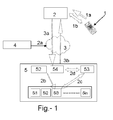
- the system proposed by the invention is designed so that it is possible to carry out with it the entire process associated to the access from a 3G telephone to web applications, this process being formed by a first phase (1a) wherein the user (1) makes a video call from a 3G telephone to the telephone number of the video content platform (2).
- the user (1) gains access to the 3G access platform (2) of the content provider, a platform (2) which can be its own (single entity) or shared (multi entity) so that the owner of the system object of this invention can render services to more than one content provider simultaneously.
- a session (3a) will be opened based on the content of the applications server (4).
- This session (3a) is established through the IP network (3) against the MSDCSC dynamic content creation module (5) and a return video IP channel (3b) is established based on RTP (Real-time transport Protocol) protocol/transport.
- RTP Real-time transport Protocol
- the 3G platform (2) via the applications server module (4), orders the MSDCSC module (5) to navigate through active virtual Web pages in a Web server module (52) which forms an integral part of the MSDCSC module (5).
- This Web server module (52) is designed to "fit” in its virtual memory "n” virtual explorers where the applications and content that the user sees are running, and that have been generated with standard programming tools following the procedures.
- modules 5i1, 5i2, 5i3, ... 5in are identified as modules 5i1, 5i2, 5i3, ... 5in, and form an integral part of the system object of the present invention.
- the information from the Web server module (52) can also correspond to information coming from any application or programme under execution contained in an active window of the operating system.
- the virtual Web pages of the Web server module (52) use the QCIF format (176x144 pixels).
- the essence of the invention continues to remain and is even enhanced, since other types of video formats of any resolution are also permitted.
- the active session (3a) of the calling user can view one of those "n" virtual screens, according to an assignation by the applications server module (4) depending on the application, this phase being identified in Figure 1 with the numerical reference (2b).
- the MSDCSC module (5) is navigating the corresponding page of the Web server module (52), this is already being seen in the 3G mobile through the video channel (3b) established between the access platform (2) and the MSDCSC module (5).
- the function of video streaming in real time is performed by the module (54).
- the function of transcoding between the virtual screen and the video streaming generator (54) is carried out by a transcoding module (53) which is continuously two-way monitoring said virtual screen in a process identified as (2c), and supplies the video streaming server module (54) already with a valid format for the recipient, in the stage identified as (2d).
- the transcoding module (53) samples the video memory of the "virtual screen” in real time with a variable cadence of frames per second (typically 15 or 30) and encodes them in real time according to the characteristics of the established video call, typically under the regulation or specification H263 or H264.
- the monitoring (2c) of the virtual screen described in the foregoing paragraph includes the capture of image and video in real time and in parallel for all the sessions as well as the capture of audio in the event that the virtual explorer was reproducing an application equipped with sound.
- the transcoding of the translating module (53) also permits the monitoring of all type of virtual screen size adapting (scaling) its content to the real size of the calling mobile device.
- the calling user (1) can interact with the keypad of their telephone with the MSDCSC module (5), which will receive said digits or keystrokes and will send them to the Web server module (52) through the HTTP/SOAP session established therewith. This will permit the caller to navigate Web pages that they are viewing by sending them commands from their keypad.
- the content that they wish to offer can therefore be programmed with the standard Web page generation tools, the system object of this invention performing all the transcodings and intermediate steps necessary to offer them automatically on the screen of a mobile device with capability of establishing a call with video.
- the web applications accessible under this system must act, not based on commands or selections generated by mouse movements or keystrokes or introduction of text in the case of forms (these options are not always available at a user terminal), but rather to exclusively receive these commands or selections through keystrokes of the keys, i.e. through DTMF multifrequency tones (numbers 0 to 9 and asterisk and pound).
- the applications should preferably be prepared to show their content in the space defined in QCIF, i.e. 176x144 pixels. If the applications require more space to show the information, they must procure that by means of certain reserved keys (amongst those previously mentioned) the user can move vertically and/or laterally the content, in order to show it in the QCIF viewing area that is shown on the screen of the user's device.
- the system of the invention permits any type of format, the transcoding module (53) performing the re-dimensioning function, i.e. going from resolution a x b of the virtual pages to another resolution a' x b' of the user's device, at the expense of a greater CPU consumption of the MSDCSC module (5).
Landscapes
- Engineering & Computer Science (AREA)
- Multimedia (AREA)
- Signal Processing (AREA)
- Computer Networks & Wireless Communication (AREA)
- Telephonic Communication Services (AREA)
Applications Claiming Priority (1)
| Application Number | Priority Date | Filing Date | Title |
|---|---|---|---|
| PCT/ES2007/000076 WO2008099026A1 (es) | 2007-02-12 | 2007-02-12 | Metodo y sistema para la generacion dinamica de video contenidos a partir de aplicaciones interactivas desarrolladas utilizando herramientas de programacion estandar de aplicaciones web |
Publications (2)
| Publication Number | Publication Date |
|---|---|
| EP2178263A1 true EP2178263A1 (de) | 2010-04-21 |
| EP2178263A4 EP2178263A4 (de) | 2014-05-14 |
Family
ID=39689685
Family Applications (1)
| Application Number | Title | Priority Date | Filing Date |
|---|---|---|---|
| EP07712566.4A Withdrawn EP2178263A4 (de) | 2007-02-12 | 2007-02-12 | Verfahren und system zur dynamischen erzeugung von videoinhalt aus unter verwendung von standard-web-anwendungsprogrammierwerkzeugen entwickelten interaktiven anwendungen |
Country Status (2)
| Country | Link |
|---|---|
| EP (1) | EP2178263A4 (de) |
| WO (1) | WO2008099026A1 (de) |
Family Cites Families (3)
| Publication number | Priority date | Publication date | Assignee | Title |
|---|---|---|---|---|
| US6704024B2 (en) * | 2000-08-07 | 2004-03-09 | Zframe, Inc. | Visual content browsing using rasterized representations |
| US20020131395A1 (en) * | 2001-03-19 | 2002-09-19 | Chenghui Wang | Session initiation protocol (SIP) user agent in a serving GPRS support node (SGSN) |
| EP1619853A1 (de) * | 2004-07-21 | 2006-01-25 | Siemens Mobile Communications S.p.A. | Erweiterte RTSP proxy zur Erfassung von Ereignissen in einer Streaming-Sitzung und zur Berichterstattung dieser an Streaming -Anwendungen |
-
2007
- 2007-02-12 WO PCT/ES2007/000076 patent/WO2008099026A1/es not_active Ceased
- 2007-02-12 EP EP07712566.4A patent/EP2178263A4/de not_active Withdrawn
Also Published As
| Publication number | Publication date |
|---|---|
| WO2008099026A1 (es) | 2008-08-21 |
| EP2178263A4 (de) | 2014-05-14 |
Similar Documents
| Publication | Publication Date | Title |
|---|---|---|
| US11979636B2 (en) | Systems and methods for transmission of data streams | |
| US20220239515A1 (en) | Collaboration system for a virtual session with multiple types of media streams | |
| EP1642443B1 (de) | Verfahren zur verwaltung eines streaming-media-dienstes | |
| EP2658232A1 (de) | Verfahren und System für optimiertes Multimedia-Kommunikationssystem | |
| EP2974294B1 (de) | Bereitstellung von videokonferenzdiensten mithilfe eines mikropops zur erweiterung von medienverarbeitungen in unternehmensnetzwerke | |
| US20070133773A1 (en) | Composite services delivery | |
| WO2008111067A1 (en) | Method of providing a service over a hybrid network and system thereof | |
| CN112543301A (zh) | 一种基于ims的智能会议系统及其实现方法 | |
| CN116847128A (zh) | 基于5G VoLTE视频电话会议的视频叠加处理方法 | |
| US20070133512A1 (en) | Composite services enablement of visual navigation into a call center | |
| CN113452947B (zh) | 关键帧获取方法、装置、计算机设备和存储介质 | |
| CN112995573B (zh) | 一种视频会议直播系统及方法 | |
| CN107395551A (zh) | 一种信令架构及其实现呼叫处理的方法和装置 | |
| US20070133513A1 (en) | View coordination for callers in a composite services enablement environment | |
| EP2178263A1 (de) | Verfahren und system zur dynamischen erzeugung von videoinhalt aus unter verwendung von standard-web-anwendungsprogrammierwerkzeugen entwickelten interaktiven anwendungen | |
| US20070133511A1 (en) | Composite services delivery utilizing lightweight messaging | |
| KR20180091319A (ko) | 사운드 공유 장치 및 방법 | |
| WO2020015539A1 (zh) | 一种数据处理方法、装置及计算机可读存储介质 | |
| US20130198399A1 (en) | Input/output communication | |
| KR101492007B1 (ko) | Sip 기반의 통화와 디지털멀티미디어 공유를 지원하는 iptv를 이용한 정보 공유 방법 및 시스템 | |
| EP2866456A1 (de) | System und Verfahren zur Erfassung von Live-Audio und -Video von einer Rechnervorrichtung und Verbreitung von Audio und Video an eine digitale PBX unter Verwendung von einem nur standardbasierten WEBRTC-kompatiblen Web-Browser | |
| JP2005123702A (ja) | 顧客対応システム、モバイル用端末装置、オペレータ用端末装置 |
Legal Events
| Date | Code | Title | Description |
|---|---|---|---|
| PUAI | Public reference made under article 153(3) epc to a published international application that has entered the european phase |
Free format text: ORIGINAL CODE: 0009012 |
|
| 17P | Request for examination filed |
Effective date: 20091105 |
|
| AK | Designated contracting states |
Kind code of ref document: A1 Designated state(s): AT BE BG CH CY CZ DE DK EE ES FI FR GB GR HU IE IS IT LI LT LU LV MC NL PL PT RO SE SI SK TR |
|
| A4 | Supplementary search report drawn up and despatched |
Effective date: 20140415 |
|
| RIC1 | Information provided on ipc code assigned before grant |
Ipc: H04L 29/06 20060101AFI20140409BHEP |
|
| STAA | Information on the status of an ep patent application or granted ep patent |
Free format text: STATUS: THE APPLICATION IS DEEMED TO BE WITHDRAWN |
|
| 18D | Application deemed to be withdrawn |
Effective date: 20140902 |