EP2178264B1 - Multiprotokoll-Druckclient-Serverkommunikation - Google Patents
Multiprotokoll-Druckclient-Serverkommunikation Download PDFInfo
- Publication number
- EP2178264B1 EP2178264B1 EP08253373A EP08253373A EP2178264B1 EP 2178264 B1 EP2178264 B1 EP 2178264B1 EP 08253373 A EP08253373 A EP 08253373A EP 08253373 A EP08253373 A EP 08253373A EP 2178264 B1 EP2178264 B1 EP 2178264B1
- Authority
- EP
- European Patent Office
- Prior art keywords
- server
- client
- udp
- message
- messages
- Prior art date
- Legal status (The legal status is an assumption and is not a legal conclusion. Google has not performed a legal analysis and makes no representation as to the accuracy of the status listed.)
- Active
Links
Images

Classifications
-
- H—ELECTRICITY
- H04—ELECTRIC COMMUNICATION TECHNIQUE
- H04L—TRANSMISSION OF DIGITAL INFORMATION, e.g. TELEGRAPHIC COMMUNICATION
- H04L67/00—Network arrangements or protocols for supporting network services or applications
- H04L67/01—Protocols
- H04L67/02—Protocols based on web technology, e.g. hypertext transfer protocol [HTTP]
-
- H—ELECTRICITY
- H04—ELECTRIC COMMUNICATION TECHNIQUE
- H04L—TRANSMISSION OF DIGITAL INFORMATION, e.g. TELEGRAPHIC COMMUNICATION
- H04L69/00—Network arrangements, protocols or services independent of the application payload and not provided for in the other groups of this subclass
- H04L69/18—Multiprotocol handlers, e.g. single devices capable of handling multiple protocols
Definitions
- the present invention relates to communication between a print server and print clients on a computer network.
- a print server 3 acts as an intermediary between clients 2 and one more printers 8 in arranging for print jobs generated on the clients 2 to be printed on the printers.
- the server 3 provides functions such as queuing of jobs and logging of the amounts of printing done.
- the client 2 communicates with the print server 3 by means of an open HTTP request 4, i.e. one in which the server does not immediately send a response leaving the possibility of a later response.
- HTTP stands for the "Hypertext Transfer Protocol”.
- the information 5 transmitted back to the client may be, for example, about some event, such as the completion of a print job, and so on.
- the information may be in the form of an HTML page which is displayed to the user as a popup window.
- An example of that would be a job ticket for a print job with input fields for print settings (e.g. stapling, duplex printing etc.); when the user the user has completed those the setting data is returned to the server in HTML format.
- the "Uniflow OM" (trademark) print servers and clients are ones that use this form of HTTP communication.
- this client notification mechanism is (i) that it is generally communicated through firewalls because it uses standard HTTP, which of course nearly all firewalls are set to pass, and (ii) that it works via NAT (Network Address Translation) because the connection between the client to the server is established by the client, not the other way around, so the client can easily sit behind a NAT/firewall router 6 and make its connection to the server.
- NAT Network Address Translation
- the disadvantage of this mechanism is that the HTTP request from each client consumes a respective TCP/IP connection socket 7 on the server, which is kept open for an extended period while waiting for activity, causing, in large environments, a large allocation of sockets.
- Such environments may have thousands of clients connected to a print server, and this may give rise to a further problem which is that the operating system may well impose a limit on the number of sockets; one such limit is 4096 sockets..
- there is also some network bandwidth used for refreshing these HTTP connections as every connection is kept open for only a maximum of 1 minute before it is refreshed by opening a new TCP connection. Thus, for each client refresh a few TCP packets are transmitted between the client and the server.
- the obtaining of the indication may comprise sending one or more UDP messages from the client to the server, responding to the or each such message by the server sending a UDP message back to the client, and deciding on the basis of whether the response or responses are received or not, whether the communication of UDP messages from the server to the client is viable.
- the method may include sending a UDP registration message from the client to the server using UDP, the registration message indicating that the client is requesting to use UDP communication.
- the method may include the server sending a confirmation message to the client using UDP in response to the UDP registration message.
- the method may include deciding on the basis of, or taking into account, whether the UDP confirmation message is received by the client or not, whether the communication of UDP messages from the server to the client is viable.
- the method may comprise sending a message from the client to the server requesting the number of a port to which certain
- HTTP requests from the client to the server should be made, and sending a message from the server to the client indicating that port.
- the message from the server to the client indicating the port for HTTP requests may be made using UDP.
- the method may include deciding whether the communication of UDP messages from the server to the client is viable on the basis of, or taking into account, whether the message from the server to the client indicating the port for HTTP requests is received by the client or not.
- the said UDP message from the client to the server may record as the source port a port on which the client is set to listen for UDP messages from the server in order to indicate to a filtering device between the server and the client that certain UDP messages from the server to the client should not be filtered out.
- the method may comprise sending a UDP message from the client to the server wherein the message records as the source port a port on which the client is set to listen for UDP messages from the server in order to indicate to a filtering device between the server and the client that certain UDP messages from the server to the client should not be filtered out.
- the method may comprise sending, in the case that UDP messaging from the server to the client is being used, a UDP message from time to time to the client from the server in order to indicate to a filtering device between the server and the client that certain UDP messages from the server to the client should not be filtered out.
- the present invention also provides a system comprising a print client and a print server, wherein:
- the client may be arranged to send one or more UDP messages from the client to the server, and the server may be arranged to respond to the or each such message by sending a UDP message back to the client; the client may also be arranged to decide on the basis of whether the response or responses are received or not, whether the communication of UDP messages from the server to the client is viable.
- the client may be arranged to send a UDP registration message to the server using UDP, the registration message indicating that the client is requesting to use UDP communication.
- the server may be arranged to send a confirmation message to the client using UDP in response to the UDP registration message.
- the client may be arranged to decide on the basis of, or taking into account, whether the UDP confirmation message is received by the client or not, whether the communication of UDP messages from the server to the client is viable.
- the client may be arranged to send a message to the server requesting the number of a port to which certain HTTP requests from the client to the server should be made, and the server may be arranged to respond to that request be sending a message to the client indicating that port.
- the server may be arranged to send the message to the client indicating the port for HTTP requests using UDP.
- the client may be arranged to decide on the basis of, or taking into account, whether the message from the server to the client indicating the port for HTTP requests is received by the client or not, whether the communication of UDP messages from the server to the client is viable.
- the client may be arranged to record a port on which the client is set to listen for UDP messages from the server in the said UDP message to the server in order to indicate to a filtering device between the server and the client that certain UDP messages from the server to the client should not be filtered out.
- the client may be arranged to send a UDP message to the server wherein the message records as the source port a port on which the client is set to listen for UDP messages from the server in order to indicate to a filtering device between the server and the client that certain UDP messages from the server to the client should not be filtered out.
- the server may be arranged to send, in the case that UDP messaging from the server to the client is being used, a UDP message from time to time to the client in order to indicate to a filtering device between the server and the client that certain UDP messages from the server to the client should not be filtered out.
- the present invention further provides a print client that is arranged to co-operate with a print server to obtain an indication of the viability of communication of User Datagram Protocol (UDP) messages from the server to the client, the client being arranged, if the indication is that UDP messages are viable, to expect UDP messages from the server, the client being arranged, if the indication is otherwise, to make an Hypertext Transfer Protocol (HTTP) request to the server and to leave that request open, and to receive a message from the server, when the server so wishes, as the response to the open HTTP request.
- UDP User Datagram Protocol
- HTTP Hypertext Transfer Protocol
- the client may be arranged to send one or more UDP messages to the server, and to decide on the basis of whether a UDP response or responses, to that message or those messages, from the server are received or not, whether the communication of UDP messages from the server to the client is viable.
- the client may be arranged to send a UDP registration message to the server using UDP, the registration message indicating that the client is requesting to use UDP communication.
- the client may be arranged to decide on the basis of, or taking into account, whether a confirmation message from the server is received by the client by UDP or not, whether the communication of UDP messages from the server to the client is viable.
- the client may be arranged to send a message to the server requesting the number of a port to which certain HTTP requests from the client to the server should be made.
- the client may be arranged to decide on the basis of, or taking into account, whether a message from the server to the client indicating the port for HTTP requests is received by the client by UDP or not, whether the communication of UDP messages from the server to the client is viable.
- the client may be arranged to record, in the said UDP message to the server, a port on which the client is set to listen for UDP messages from the server, in order to indicate to a filtering device between the server and the client that certain UDP messages from the server to the client should not be filtered out.
- the client may be arranged to send a UDP message to the server wherein the message records as the source port a port on which the client is set to listen for UDP messages from the server in order to indicate to a filtering device between the server and the client that certain UDP messages from the server to the client should not be filtered out.
- the present invention also provides a print server that is arranged to co-operate with a print client to obtain an indication of the viability of communication of User Datagram Protocol (UDP) messages from the server to the client,
- UDP User Datagram Protocol
- the server being arranged, if the indication is that UDP messages are viable, to send messages to the client using UDP, the server being arranged, if the indication is otherwise, to receive an Hypertext Transfer Protocol (HTTP) request from the client and to leave that request open, and to send a message to the client, when the server so wishes, as the response to the open HTTP request.
- HTTP Hypertext Transfer Protocol
- the server may be arranged to respond to one or more UDP messages received from the client by sending a UDP message back to the client.
- the server may be arranged to send a confirmation message to the client by UDP in response to a UDP registration message sent to the server using UDP, the registration message indicating that the client is requesting to use UDP communication.
- the server may be arranged to respond to a request from the client for the number of a port to which certain HTTP requests from the client to the server should be made by sending a message to the client indicating that port.
- the server may be arranged to send the message to the client indicating the port for HTTP requests using UDP.
- the server may be arranged to send, in the case that UDP messaging from the server to the client is being used, a UDP message from time to time to the client in order to indicate to a filtering device between the server and the client that certain UDP messages from the server to the client should not be filtered out.
- the present invention also provides a set of computer program products that when executed on a print client and a print server performs the steps of method of the invention.
- the present invention provides a computer program product that when executed on a device provides the print client of the invention and a computer program product that when executed on a device provides the print server the invention.
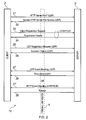
- FIG 2 shows operations in a print client-server system 10 in accordance with the present invention.
- communication is between a plurality of print clients 2' (potentially thousands thereof) and a print server 3'.
- the print clients will usually form part of a general purpose computer that requires printing services, for example, the workstation of an office worker.
- the print server will often form part of a general purpose computer, for example, a server computer, but can also be embedded in a print device - i.e. in Figure 1 items 8 and 3 are provided in the same unit. For simplicity only a single client 2' is shown in Figure 2 .
- Figure 2 shows a series of requests from a particular client and the responses of the server for a series of initialisation steps, followed by general communication of messages concerning actual printing or related matters. As will be seen, depending on the conditions found by the client and the server, these messages are passed either using UDP 27 or HTTP 27', the former being used in preference to the later.
- a firewall/router 6 is shown between the client and the server. This is in dashed outline because for some clients there may well be such a device on the route between the client and the server, while for other clients there may not be. Note that, as is known, routers and firewalls can be separate devices or may be combined in the same device, so one or other or neither of those may be one the route between the client and the server.
- a first initialisation step 21, 22 the client 2' sends an interrogation request 21 to the server 3' asking for the number of a special HTTP port that the server is using to support HTTP requests to the print server 3'.
- This message is sent by UDP, which stands for the "User Datagram Protocol”.
- the server 3' responds to the request with a message 22, also using UDP, giving the requested port number (or an error message).
- the client records, for future reference, either the special HTTP port number or a failure. The latter may be either because an error message as been returned or because no reply has been received.
- UDP is a connectionless transport protocol and so is not reliable - if the UDP request datagram 21 or the UDP reply datagram 22 is dropped by the network then the client will not get any answer to its request with the result that the interrogation request fails. Either datagram may be dropped either due to network congestion or by being filtered out by any firewall 6 on the route between the client and the server.
- the UDP request 21 is made to a predetermined port number on the server to which the server is set to listen for such requests.
- the client is also set to listen for the response 22 on a particular port number.
- this latter port number is recorded in the request UDP datagram 21 as the source port. This is because firewalls are often set to allow UDP datagrams from an external station addressed to a particular port on an internal station if that station has specified that particular port as the source port in a recent outgoing UDP datagram to that external station.
- the client sends a client registration message 23 to the server 3' using HTTP. If the special port number has been successfully provided to the client in the first initialisation step then that special port number is used for this HTTP request, otherwise the standard port number of 80 is used.
- the registration message 23 provides all the usual information needed to register the client and is not, or need not be, any different to that used in an existing print server, such as the "Uniflow OM" server. The details given in the request include account identification and verification and so on.
- the response 24 is to provide registration handle for use in later communications between the client and the server.
- the response 24 provided as the HTTP response to the HTTP request 23.
- Sending the registration message over HTTP provides backward compatibility if a client in accordance with the invention is used with a server of the known kind that only uses HTTP for communications with clients. It is also highly reliable.
- the HTTP request 23 and response 24 are sent, as is usual for HTTP requests, over a TCP ("Transmission Control Protocol") connection at the transport level, the same connection being used for the request and the response.
- TCP Transmission Control Protocol
- This TCP connection provides reliability by resending packets if they are dropped owing to congestion.
- Firewalls are also generally set to allow all TCP connections initiated from the internal side, whatever the port being used and so are unlikely to obstruct this initialisation step.
- the client sends a UDP registration request 25, using UDP.
- UDP This is a request to use UDP, rather than HTTP, for some, if not all, subsequent communications between the client and server (for example, event notifications from the server to the client).
- This request includes the registration handle received during the previous registration step.
- the reply 26, which is also sent by UDP indicates to the client whether the server has acceded to the request to use UDP in future. Generally if the UDP function is operational on the server, the server will accede and send the response 26 accordingly.
- the client 2' knows whether UDP communications with the server 3' are possible and are to be used.
- the client does not set up an open HTTP request 4 to the server to provide a channel for notifications 5 from the server. Therefore no socket 7 is maintained on the server 3' in respect of that open HTTP request and therefore the resources it would have used are saved. When there are thousands of clients this is an important benefit.
- the client and server send each other messages 27, from time to time, concerning printing and related matters.
- These messages can use any predetermined port numbers. This port number (for one direction) can be a single number, or more than one can be used for different classes of message.
- the server sends a short packet 28 to the client quoting the port number on which the client is listening for UDP messages from the server as the destination port field of the packet. (If there is more than one such port on which the client is listening then the server sends such a short packet for each.)
- the UDP notifications 27 that are sent to the client by the server either (i) indicate the necessary information in the notifications datagram itself or (ii) are in a form indicating a particular HTTP request is to be made by the client to the server.
- the client makes the HTTP request to the server.
- the response to that HTTP request then provides the client with the information required, or in some cases provides a web page for display directly to the user, either to inform the user, or as a web form to be filled in by the user.
- These HTTP requests are not kept open longer than necessary (i.e. there is no waiting for notification from the server to the client of some further event) and so do not tie up resources on the server.
- the client 2' proceeds to set up an open HTTP request 4 for the receipt of notifications 5 from the server 3' in the manner of the known system of Figure 1 (symbolised in Figure 2 by double headed arrow 27').
- the server uses the open HTTP request to send any notifications as an HTTP response.
- the client sends any message it wishes to send to the server as an HTTP request.
- the server On receipt of the HTTP request that is left open, the server records that the client has decided to use HTTP rather than UDP to receive notifications from the server. Thereafter the server acts accordingly by sending print notifications to the client by the HTTP route and not by UDP.
- UDP is more likely to be a viable in environments where there are no firewalls or routers, for example, where the client and server are on the same local area network ("LAN").
- LAN local area network
- UDP communications are established that they stop working at a later time.
- the client 2' when sensing this (for example by noting that the keep alive packets 28 are not being received, or otherwise) repeats the initialisation process, which will result in the communications switching to being via HTTP (or if UDP is in fact still viable, in UDP communications be re-established).
- two of the initialisation messages involve UDP messages from the server to the client.
- the client decides that UDP messaging is viable if both of these are successful, but not otherwise.
- Other bases for the decision are possible.
- the client can be arranged to decide that UDP is viable if one or other of those UDP messages arrives at the client, or if a particular one of the two arrives at the client. It can be decided upon the arrival of UDP messages other than those in the example.
- the client is informed of a special port number for HTTP requests from the client to the server.
- the purpose of this is as follows. Normally HTTP requests are made to HTTP or "web" server on port 80.
- Examples of general purpose web servers include Microsoft's Internet Information Server and Apache. These provide both standard delivery of predetermined web pages and scripting facilities that are used to provide an interface between HTTP requests and more complex application programs, which is what both the known print server 3 and the print server 3' of the present invention use. Nonetheless in order to provide a more efficient and scalable interface to the print server an optimised web server is provided as another interface to the print server 3 of the invention.
- the general purpose web server is set to listen on port 80, with the optimised print server being set to listen on a non-standard port, for example, port 8008.
- the optimised web server does not replace the standard general purpose web server, so the administrator can use it for whatever other purposes they wish, and so that print clients that fail to receive the non-standard port number for the optimised web server can still work with the print server.
Landscapes
- Engineering & Computer Science (AREA)
- Computer Networks & Wireless Communication (AREA)
- Signal Processing (AREA)
- Computer Security & Cryptography (AREA)
- Computer And Data Communications (AREA)
Claims (17)
- Verfahren zum Kommunizieren zwischen einem Druckclient und einem Druckserver, umfassend:Empfang einer Angabe bezüglich der Verfügbarkeit einer Kommunikation mittels User-Datagram-Protocol-Nachrichten vom Server zum Client,falls die Angabe ist, dass UDP-Nachrichten verfügbar sind, Senden von Nachrichten vom Server zum Client unter Verwendung von UDP,falls die Angabe anders ist, Erstellen eines Hypertext-Transfer-Protocol-Aufrufes vom Client an den Server, Offenhalten des Aufrufes, und wenn der Server bereit zum Senden einer Nachricht an den Client ist, Senden der Nachricht als Antwort auf den offengehaltenen HTTP-Aufruf.
- Verfahren nach Anspruch 1, wobei der Empfang der Angabe das Senden einer oder mehrerer UDP-Nachrichten vom Client an den Server umfasst, Antworten auf die oder jede derartige Nachricht durch den Server, indem eine UDP-Nachricht zum Client zurückgesendet wird, und Entscheiden in Abhängigkeit, ob die Antwort oder die Antworten empfangen wurden oder nicht, ob die Kommunikation von UDP-Nachrichten vom Server zum Client verfügbar ist.
- Verfahren nach Anspruch 1, wobei das Verfahren das Senden einer UDP-Registriernachricht vom Client zum Server unter Verwendung von UDP umfasst, wobei die Registriernachricht angibt, dass der Client die Verwendung von UDP-Kommunikation anfordert.
- Verfahren nach Anspruch 3, wobei das Verfahren umfasst, dass der Server eine Bestätigungsnachricht an den Client unter Verwendung von UDP als Antwort auf die UDP-Registriernachricht sendet.
- Verfahren nach Anspruch 4, wobei das Verfahren eine Entscheidung in Abhängigkeit oder unter Berücksichtigung von dergestalt umfasst, ob die UDP-Bestätigungsnachricht vom Client empfangen wurde oder nicht und damit ob die Kommunikation von UDP-Nachrichten vom Server zum Client verfügbar ist.
- Verfahren nach einem der vorhergehenden Ansprüche, wobei das Verfahren das Senden einer Nachricht vom Client zum Server umfasst und in der Nachricht die Nummer eines Ports angefordert wird, zu der bestimmten HTTP-Aufrufen vom Client an den Server gerichtet werden können und Senden einer Nachricht vom Server zum Client, in der der Port angegeben ist.
- Verfahren nach Anspruch 6, wobei die Nachricht vom Server zum Client, welche den Port für den HTTP-Aufruf angibt, als UDP erstellt wird.
- Verfahren nach Anspruch 7, wobei das Verfahren eine Entscheidung umfasst, ob in Abhängigkeit oder unter Berücksichtigung von die Kommunikation von UDP-Nachrichten vom Server zum Client verfügbar ist und die Nachricht vom Server zum Client, die den Port für den HTTP-Aufruf angibt, vom Client empfangen wurde oder nicht.
- Verfahren nach einem der vorhergehenden Ansprüche, umfassend das Senden einer UDP-Nachricht vom Client zum Server, wobei die Nachricht als Quellen-Port einen Port angibt, an welchem der Client UDP-Nachrichten vom Server erwartet, um eine zwischen dem Server und dem Client angeordneten Filtervorrichtung darauf hinzuweisen, dass bestimmte UDP-Nachrichten vom Server zum Client nicht ausgefiltert werden sollen.
- Verfahren nach einem der Ansprüche 2 bis 8, wobei die bestimmte UDP-Nachricht vom Client zum Server als Quellen-Port den Port angibt, an welchem der Client UDP-Nachrichten vom Server erwartet, um eine zwischen dem Server und dem Client angeordneten Filtervorrichtung darauf hinzuweisen, dass bestimmte UDP-Nachrichten vom Server zum Client nicht ausgefiltert werden sollen..
- Verfahren nach einem der vorhergehenden Ansprüche, umfassend das Senden einer UDP-Nachricht von Zeit zu Zeit an den Client vom Server für den Fall, dass UDP-Nachrichten vom Server zum Client verwendet werden, um eine zwischen dem Server und dem Client angeordneten Filtervorrichtung darauf hinzuweisen, dass bestimmte UDP-Nachrichten vom Server zum Client nicht ausgefiltert werden sollen.
- System, umfassend einen Druckclient und einen Druckserver, wobei:der Client und der Server dergestalt ausgebildet sind und zum Zwecke des Empfanges einer Angabe über die Verfügbarkeit der Kommunikation von User-Datagram-Protocol-Nachrichten vom Server zum Client dergestalt zusammenwirken, dassder Server dergestalt ausgebildet ist, falls die Angabe ist, dass UDP-Nachrichten verfügbar sind, unter Verwendung von UDP Nachrichten an den Client zu senden, dassder Client dergestalt ausgebildet ist, falls die Angabe anders ist, an den Server einen Hypertext-Transfer-Protocol-Aufruf zu erstellen und den Aufruf offenzuhalten, und der Server an den Client als Antwort auf den offengehaltenen HTTP- Aufruf eine Nachricht sendet, wenn der Server dazu bereit ist.
- Druckclient, ausgebildet zum Zusammenwirken mit einem Druckserver, um eine Angabe über die Verfügbarkeit einer Kommunikation von User-Data-gram-Protocol-Nachrichten vom Server zum Client zu empfangen,
der Client dergestalt ausgebildet ist, falls die Angabe ist, dass UDP-Nachrichten verfügbar sind, UDP-Nachrichten vom Server zu erwarten,
der Client dergestalt ausgebildet ist, falls die Angabe anders ist, an den Server einen Hypertext-Transfer-Protocol-Aufruf zu senden und den Aufruf offenzuhalten, und als Antwort auf den offengehaltenen HTTP-Aufruf vom Server eine Nachricht zu empfangen, wenn der Server dazu bereit ist. - Druckserver, ausgebildet zum Zusammenwirken mit einem Druckclient, um eine Angabe über die Verfügbarkeit der Kommunikation von User-Datagram-Protocol-Nachrichten vom Server zum Client zu empfangen,
der Server dergestalt ausgebildet ist, falls die Angabe ist, dass UDP-Nachrichten verfügbar sind, Nachrichten unter Verwendung von UDP an den Client zu senden,
der Server dergestalt ausgebildet ist, falls die Angabe anders ist, vom Client einen Hypertext-Transfer-Protocol- Aufruf zu empfangen und den Aufruf offenzuhalten und als Antwort auf die offengehaltenen HTTP-Aufruf eine Nachricht an den Client zu senden, wenn der Server dazu bereit ist. - Anzahl von Computerprogramm-Produkten, die bei Ausführung auf einem Druckclient und auf einem Druckserver die Schritte des Verfahrens nach einem der Ansprüche 1 bis 11 ausführen.
- Computerprogramm-Produkt, welches bei Ausführung auf einer Vorrichtung den Druckclient nach Anspruch 13 bereitstellt.
- Computerprogramm-Produkt, welches bei Ausführung auf einer Vorrichtung den Druckserver nach Anspruch 14 bereitstellt.
Priority Applications (3)
| Application Number | Priority Date | Filing Date | Title |
|---|---|---|---|
| EP08253373A EP2178264B1 (de) | 2008-10-17 | 2008-10-17 | Multiprotokoll-Druckclient-Serverkommunikation |
| AT08253373T ATE519317T1 (de) | 2008-10-17 | 2008-10-17 | Multiprotokoll-druckclient-serverkommunikation |
| US12/580,961 US8086669B2 (en) | 2008-10-17 | 2009-10-16 | Multi-protocol print client-server communication |
Applications Claiming Priority (1)
| Application Number | Priority Date | Filing Date | Title |
|---|---|---|---|
| EP08253373A EP2178264B1 (de) | 2008-10-17 | 2008-10-17 | Multiprotokoll-Druckclient-Serverkommunikation |
Publications (2)
| Publication Number | Publication Date |
|---|---|
| EP2178264A1 EP2178264A1 (de) | 2010-04-21 |
| EP2178264B1 true EP2178264B1 (de) | 2011-08-03 |
Family
ID=40427180
Family Applications (1)
| Application Number | Title | Priority Date | Filing Date |
|---|---|---|---|
| EP08253373A Active EP2178264B1 (de) | 2008-10-17 | 2008-10-17 | Multiprotokoll-Druckclient-Serverkommunikation |
Country Status (3)
| Country | Link |
|---|---|
| US (1) | US8086669B2 (de) |
| EP (1) | EP2178264B1 (de) |
| AT (1) | ATE519317T1 (de) |
Families Citing this family (9)
| Publication number | Priority date | Publication date | Assignee | Title |
|---|---|---|---|---|
| EP2216713A1 (de) | 2009-02-09 | 2010-08-11 | Canon Europa N.V. | Verbesserungen in Bezug auf Roaming-Druck |
| KR101606831B1 (ko) * | 2010-06-03 | 2016-03-28 | 삼성전자주식회사 | 화상형성장치, 호스트 장치 및 인쇄 제어 방법 |
| US20140379778A1 (en) * | 2013-06-20 | 2014-12-25 | Microsoft Corporation | Asynchronous transport setup and selection for interactive applications |
| WO2015160953A2 (en) * | 2014-04-16 | 2015-10-22 | Pixia Corp. | Method and system of transmitting data over a network using a communication protocol |
| TWI573073B (zh) * | 2014-06-05 | 2017-03-01 | Seiko Epson Corp | A printing control device, a printing system, and a printing control method |
| US10334052B2 (en) | 2016-10-28 | 2019-06-25 | Caterpillar Inc. | System and method for communicating negotiated groups of parameters |
| US10353654B1 (en) * | 2018-04-30 | 2019-07-16 | Ricoh Company, Ltd. | Application integration mechanism |
| US11811609B2 (en) * | 2018-05-04 | 2023-11-07 | International Business Machines Corporation | Storage target discovery in a multi-speed and multi-protocol ethernet environment |
| CN114527946A (zh) * | 2022-01-12 | 2022-05-24 | 杭州石原子科技有限公司 | 基于浏览器的静默打印客户端 |
Family Cites Families (5)
| Publication number | Priority date | Publication date | Assignee | Title |
|---|---|---|---|---|
| US6704786B1 (en) * | 1997-12-15 | 2004-03-09 | Sun Microsystems, Inc. | Network and end-host efficiency for web communication |
| US6219706B1 (en) * | 1998-10-16 | 2001-04-17 | Cisco Technology, Inc. | Access control for networks |
| JP2002182866A (ja) * | 2000-12-13 | 2002-06-28 | Fujitsu Ltd | ネットワーク環境における印刷制御方法、プリントサーバ、クライアント、および記録媒体 |
| JP2007293503A (ja) * | 2006-04-24 | 2007-11-08 | Canon Inc | デバイス、その制御方法、及びプログラム |
| US20080184248A1 (en) * | 2007-01-29 | 2008-07-31 | Yahoo! Inc. | Optimization of job scheduling for resource clusters with access control and usage reporting |
-
2008
- 2008-10-17 EP EP08253373A patent/EP2178264B1/de active Active
- 2008-10-17 AT AT08253373T patent/ATE519317T1/de not_active IP Right Cessation
-
2009
- 2009-10-16 US US12/580,961 patent/US8086669B2/en not_active Expired - Fee Related
Also Published As
| Publication number | Publication date |
|---|---|
| EP2178264A1 (de) | 2010-04-21 |
| US8086669B2 (en) | 2011-12-27 |
| ATE519317T1 (de) | 2011-08-15 |
| US20100100588A1 (en) | 2010-04-22 |
Similar Documents
| Publication | Publication Date | Title |
|---|---|---|
| EP2178264B1 (de) | Multiprotokoll-Druckclient-Serverkommunikation | |
| US8510376B2 (en) | Processing requests transmitted using a first communication directed to an application that uses a second communication protocol | |
| US7653075B2 (en) | Processing communication flows in asymmetrically routed networks | |
| EP2469792B1 (de) | Datenübertragungssystem und Verwendungsverfahren für einen Verzögerungsserver | |
| CN104852919B (zh) | 实现门户Portal认证的方法及装置 | |
| EP2074791B1 (de) | Kommunikationssystem | |
| JP6343178B2 (ja) | 通信システムおよびその制御方法、第一の端末およびその制御方法、並びにプログラム | |
| EP4085598B1 (de) | System und verfahren zur unterstützung von permanenten http-verbindungen | |
| KR101109608B1 (ko) | 인터넷 리스너/퍼블리셔 | |
| EP1744498A1 (de) | Internet-verbindungs-endgerätevorrichtung und internet-verbindungs-statusbestimmungsverfahren | |
| JP2000200245A (ja) | 情報利用システム及び情報利用方法 | |
| EP0980616B1 (de) | Verfahren und system zur automatischen erkennung von netzdruckern | |
| EP1313292A2 (de) | Sendung der Benachrichtigungen durch eine Firewall | |
| EP1236328B1 (de) | Verfahren und system zur bestimmung der zugänglichkeit einer datei in einem verteilten system | |
| US11429446B2 (en) | Device data collector agent component on cloud computing network | |
| JP7402613B2 (ja) | 情報処理装置、通信制御方法とプログラム | |
| WO2021049120A1 (ja) | コンピュータプログラム、情報処理方法、情報処理装置及び情報処理システム | |
| JP2009098985A (ja) | セッション管理方法、通信システムおよび通信装置 |
Legal Events
| Date | Code | Title | Description |
|---|---|---|---|
| PUAI | Public reference made under article 153(3) epc to a published international application that has entered the european phase |
Free format text: ORIGINAL CODE: 0009012 |
|
| AK | Designated contracting states |
Kind code of ref document: A1 Designated state(s): AT BE BG CH CY CZ DE DK EE ES FI FR GB GR HR HU IE IS IT LI LT LU LV MC MT NL NO PL PT RO SE SI SK TR |
|
| AX | Request for extension of the european patent |
Extension state: AL BA MK RS |
|
| 17P | Request for examination filed |
Effective date: 20101021 |
|
| AKX | Designation fees paid |
Designated state(s): AT BE BG CH CY CZ DE DK EE ES FI FR GB GR HR HU IE IS IT LI LT LU LV MC MT NL NO PL PT RO SE SI SK TR |
|
| GRAP | Despatch of communication of intention to grant a patent |
Free format text: ORIGINAL CODE: EPIDOSNIGR1 |
|
| GRAS | Grant fee paid |
Free format text: ORIGINAL CODE: EPIDOSNIGR3 |
|
| GRAA | (expected) grant |
Free format text: ORIGINAL CODE: 0009210 |
|
| AK | Designated contracting states |
Kind code of ref document: B1 Designated state(s): AT BE BG CH CY CZ DE DK EE ES FI FR GB GR HR HU IE IS IT LI LT LU LV MC MT NL NO PL PT RO SE SI SK TR |
|
| REG | Reference to a national code |
Ref country code: GB Ref legal event code: FG4D |
|
| REG | Reference to a national code |
Ref country code: CH Ref legal event code: EP |
|
| REG | Reference to a national code |
Ref country code: CH Ref legal event code: NV Representative=s name: BOVARD AG Ref country code: IE Ref legal event code: FG4D |
|
| REG | Reference to a national code |
Ref country code: NL Ref legal event code: T3 |
|
| REG | Reference to a national code |
Ref country code: DE Ref legal event code: R096 Ref document number: 602008008595 Country of ref document: DE Effective date: 20111006 |
|
| LTIE | Lt: invalidation of european patent or patent extension |
Effective date: 20110803 |
|
| PG25 | Lapsed in a contracting state [announced via postgrant information from national office to epo] |
Ref country code: NO Free format text: LAPSE BECAUSE OF FAILURE TO SUBMIT A TRANSLATION OF THE DESCRIPTION OR TO PAY THE FEE WITHIN THE PRESCRIBED TIME-LIMIT Effective date: 20111103 Ref country code: PT Free format text: LAPSE BECAUSE OF FAILURE TO SUBMIT A TRANSLATION OF THE DESCRIPTION OR TO PAY THE FEE WITHIN THE PRESCRIBED TIME-LIMIT Effective date: 20111205 Ref country code: FI Free format text: LAPSE BECAUSE OF FAILURE TO SUBMIT A TRANSLATION OF THE DESCRIPTION OR TO PAY THE FEE WITHIN THE PRESCRIBED TIME-LIMIT Effective date: 20110803 Ref country code: IS Free format text: LAPSE BECAUSE OF FAILURE TO SUBMIT A TRANSLATION OF THE DESCRIPTION OR TO PAY THE FEE WITHIN THE PRESCRIBED TIME-LIMIT Effective date: 20111203 Ref country code: SE Free format text: LAPSE BECAUSE OF FAILURE TO SUBMIT A TRANSLATION OF THE DESCRIPTION OR TO PAY THE FEE WITHIN THE PRESCRIBED TIME-LIMIT Effective date: 20110803 Ref country code: LT Free format text: LAPSE BECAUSE OF FAILURE TO SUBMIT A TRANSLATION OF THE DESCRIPTION OR TO PAY THE FEE WITHIN THE PRESCRIBED TIME-LIMIT Effective date: 20110803 Ref country code: HR Free format text: LAPSE BECAUSE OF FAILURE TO SUBMIT A TRANSLATION OF THE DESCRIPTION OR TO PAY THE FEE WITHIN THE PRESCRIBED TIME-LIMIT Effective date: 20110803 |
|
| REG | Reference to a national code |
Ref country code: AT Ref legal event code: MK05 Ref document number: 519317 Country of ref document: AT Kind code of ref document: T Effective date: 20110803 |
|
| PG25 | Lapsed in a contracting state [announced via postgrant information from national office to epo] |
Ref country code: LV Free format text: LAPSE BECAUSE OF FAILURE TO SUBMIT A TRANSLATION OF THE DESCRIPTION OR TO PAY THE FEE WITHIN THE PRESCRIBED TIME-LIMIT Effective date: 20110803 Ref country code: SI Free format text: LAPSE BECAUSE OF FAILURE TO SUBMIT A TRANSLATION OF THE DESCRIPTION OR TO PAY THE FEE WITHIN THE PRESCRIBED TIME-LIMIT Effective date: 20110803 Ref country code: GR Free format text: LAPSE BECAUSE OF FAILURE TO SUBMIT A TRANSLATION OF THE DESCRIPTION OR TO PAY THE FEE WITHIN THE PRESCRIBED TIME-LIMIT Effective date: 20111104 Ref country code: CY Free format text: LAPSE BECAUSE OF FAILURE TO SUBMIT A TRANSLATION OF THE DESCRIPTION OR TO PAY THE FEE WITHIN THE PRESCRIBED TIME-LIMIT Effective date: 20110803 Ref country code: AT Free format text: LAPSE BECAUSE OF FAILURE TO SUBMIT A TRANSLATION OF THE DESCRIPTION OR TO PAY THE FEE WITHIN THE PRESCRIBED TIME-LIMIT Effective date: 20110803 Ref country code: PL Free format text: LAPSE BECAUSE OF FAILURE TO SUBMIT A TRANSLATION OF THE DESCRIPTION OR TO PAY THE FEE WITHIN THE PRESCRIBED TIME-LIMIT Effective date: 20110803 |
|
| PG25 | Lapsed in a contracting state [announced via postgrant information from national office to epo] |
Ref country code: BE Free format text: LAPSE BECAUSE OF FAILURE TO SUBMIT A TRANSLATION OF THE DESCRIPTION OR TO PAY THE FEE WITHIN THE PRESCRIBED TIME-LIMIT Effective date: 20110803 |
|
| PG25 | Lapsed in a contracting state [announced via postgrant information from national office to epo] |
Ref country code: SK Free format text: LAPSE BECAUSE OF FAILURE TO SUBMIT A TRANSLATION OF THE DESCRIPTION OR TO PAY THE FEE WITHIN THE PRESCRIBED TIME-LIMIT Effective date: 20110803 Ref country code: CZ Free format text: LAPSE BECAUSE OF FAILURE TO SUBMIT A TRANSLATION OF THE DESCRIPTION OR TO PAY THE FEE WITHIN THE PRESCRIBED TIME-LIMIT Effective date: 20110803 |
|
| PG25 | Lapsed in a contracting state [announced via postgrant information from national office to epo] |
Ref country code: MC Free format text: LAPSE BECAUSE OF NON-PAYMENT OF DUE FEES Effective date: 20111031 Ref country code: RO Free format text: LAPSE BECAUSE OF FAILURE TO SUBMIT A TRANSLATION OF THE DESCRIPTION OR TO PAY THE FEE WITHIN THE PRESCRIBED TIME-LIMIT Effective date: 20110803 Ref country code: IT Free format text: LAPSE BECAUSE OF FAILURE TO SUBMIT A TRANSLATION OF THE DESCRIPTION OR TO PAY THE FEE WITHIN THE PRESCRIBED TIME-LIMIT Effective date: 20110803 Ref country code: EE Free format text: LAPSE BECAUSE OF FAILURE TO SUBMIT A TRANSLATION OF THE DESCRIPTION OR TO PAY THE FEE WITHIN THE PRESCRIBED TIME-LIMIT Effective date: 20110803 |
|
| PLBE | No opposition filed within time limit |
Free format text: ORIGINAL CODE: 0009261 |
|
| STAA | Information on the status of an ep patent application or granted ep patent |
Free format text: STATUS: NO OPPOSITION FILED WITHIN TIME LIMIT |
|
| PG25 | Lapsed in a contracting state [announced via postgrant information from national office to epo] |
Ref country code: DK Free format text: LAPSE BECAUSE OF FAILURE TO SUBMIT A TRANSLATION OF THE DESCRIPTION OR TO PAY THE FEE WITHIN THE PRESCRIBED TIME-LIMIT Effective date: 20110803 |
|
| 26N | No opposition filed |
Effective date: 20120504 |
|
| REG | Reference to a national code |
Ref country code: IE Ref legal event code: MM4A |
|
| REG | Reference to a national code |
Ref country code: DE Ref legal event code: R097 Ref document number: 602008008595 Country of ref document: DE Effective date: 20120504 |
|
| PG25 | Lapsed in a contracting state [announced via postgrant information from national office to epo] |
Ref country code: IE Free format text: LAPSE BECAUSE OF NON-PAYMENT OF DUE FEES Effective date: 20111017 |
|
| PG25 | Lapsed in a contracting state [announced via postgrant information from national office to epo] |
Ref country code: MT Free format text: LAPSE BECAUSE OF FAILURE TO SUBMIT A TRANSLATION OF THE DESCRIPTION OR TO PAY THE FEE WITHIN THE PRESCRIBED TIME-LIMIT Effective date: 20110803 |
|
| PG25 | Lapsed in a contracting state [announced via postgrant information from national office to epo] |
Ref country code: ES Free format text: LAPSE BECAUSE OF FAILURE TO SUBMIT A TRANSLATION OF THE DESCRIPTION OR TO PAY THE FEE WITHIN THE PRESCRIBED TIME-LIMIT Effective date: 20111114 |
|
| PG25 | Lapsed in a contracting state [announced via postgrant information from national office to epo] |
Ref country code: LU Free format text: LAPSE BECAUSE OF NON-PAYMENT OF DUE FEES Effective date: 20111017 |
|
| PG25 | Lapsed in a contracting state [announced via postgrant information from national office to epo] |
Ref country code: BG Free format text: LAPSE BECAUSE OF FAILURE TO SUBMIT A TRANSLATION OF THE DESCRIPTION OR TO PAY THE FEE WITHIN THE PRESCRIBED TIME-LIMIT Effective date: 20111103 |
|
| PG25 | Lapsed in a contracting state [announced via postgrant information from national office to epo] |
Ref country code: TR Free format text: LAPSE BECAUSE OF FAILURE TO SUBMIT A TRANSLATION OF THE DESCRIPTION OR TO PAY THE FEE WITHIN THE PRESCRIBED TIME-LIMIT Effective date: 20110803 |
|
| PG25 | Lapsed in a contracting state [announced via postgrant information from national office to epo] |
Ref country code: HU Free format text: LAPSE BECAUSE OF FAILURE TO SUBMIT A TRANSLATION OF THE DESCRIPTION OR TO PAY THE FEE WITHIN THE PRESCRIBED TIME-LIMIT Effective date: 20110803 |
|
| REG | Reference to a national code |
Ref country code: DE Ref legal event code: R082 Ref document number: 602008008595 Country of ref document: DE Representative=s name: WESER & KOLLEGEN, DE |
|
| REG | Reference to a national code |
Ref country code: FR Ref legal event code: PLFP Year of fee payment: 8 |
|
| REG | Reference to a national code |
Ref country code: FR Ref legal event code: PLFP Year of fee payment: 9 |
|
| REG | Reference to a national code |
Ref country code: FR Ref legal event code: PLFP Year of fee payment: 10 |
|
| REG | Reference to a national code |
Ref country code: FR Ref legal event code: PLFP Year of fee payment: 11 |
|
| REG | Reference to a national code |
Ref country code: DE Ref legal event code: R079 Ref document number: 602008008595 Country of ref document: DE Free format text: PREVIOUS MAIN CLASS: H04L0029060000 Ipc: H04L0065000000 |
|
| REG | Reference to a national code |
Ref country code: DE Ref legal event code: R081 Ref document number: 602008008595 Country of ref document: DE Owner name: NT - WARE SYSTEMPROGRAMMIERUNGS-GMBH, DE Free format text: FORMER OWNER: CANON EUROPA N.V., AMSTELVEEN, NL Ref country code: DE Ref legal event code: R081 Ref document number: 602008008595 Country of ref document: DE Owner name: NT-WARE SYSTEMPROGRAMMIERUNG GMBH, DE Free format text: FORMER OWNER: CANON EUROPA N.V., AMSTELVEEN, NL |
|
| REG | Reference to a national code |
Ref country code: NL Ref legal event code: PD Owner name: NT-WARE SYSTEMPROGRAMMIERUNGS-GMBH; DE Free format text: DETAILS ASSIGNMENT: CHANGE OF OWNER(S), ASSIGNMENT; FORMER OWNER NAME: CANON EUROPA N.V. Effective date: 20240806 Ref country code: GB Ref legal event code: 732E Free format text: REGISTERED BETWEEN 20240718 AND 20240724 |
|
| REG | Reference to a national code |
Ref country code: DE Ref legal event code: R081 Ref document number: 602008008595 Country of ref document: DE Owner name: NT - WARE SYSTEMPROGRAMMIERUNGS-GMBH, DE Free format text: FORMER OWNER: NT-WARE SYSTEMPROGRAMMIERUNG GMBH, 49186 BAD IBURG, DE |
|
| REG | Reference to a national code |
Ref country code: DE Ref legal event code: R082 Ref document number: 602008008595 Country of ref document: DE Representative=s name: DENNEMEYER & ASSOCIATES RECHTSANWALTSGESELLSCH, DE Ref country code: DE Ref legal event code: R082 Ref document number: 602008008595 Country of ref document: DE Representative=s name: DENNEMEYER & ASSOCIATES S.A., DE |
|
| REG | Reference to a national code |
Ref country code: CH Ref legal event code: U11 Free format text: ST27 STATUS EVENT CODE: U-0-0-U10-U11 (AS PROVIDED BY THE NATIONAL OFFICE) Effective date: 20251101 |
|
| PGFP | Annual fee paid to national office [announced via postgrant information from national office to epo] |
Ref country code: NL Payment date: 20251021 Year of fee payment: 18 |
|
| PGFP | Annual fee paid to national office [announced via postgrant information from national office to epo] |
Ref country code: DE Payment date: 20251021 Year of fee payment: 18 |
|
| PGFP | Annual fee paid to national office [announced via postgrant information from national office to epo] |
Ref country code: GB Payment date: 20251022 Year of fee payment: 18 |
|
| PGFP | Annual fee paid to national office [announced via postgrant information from national office to epo] |
Ref country code: FR Payment date: 20251029 Year of fee payment: 18 |
|
| PGFP | Annual fee paid to national office [announced via postgrant information from national office to epo] |
Ref country code: CH Payment date: 20251101 Year of fee payment: 18 |
|
| REG | Reference to a national code |
Ref country code: DE Ref legal event code: R082 Ref document number: 602008008595 Country of ref document: DE Representative=s name: DENNEMEYER & ASSOCIATES RECHTSANWALTSGESELLSCH, DE |