EP2178707B1 - Document de sécurité à structure de type filigrane - Google Patents
Document de sécurité à structure de type filigrane Download PDFInfo
- Publication number
- EP2178707B1 EP2178707B1 EP08801587.0A EP08801587A EP2178707B1 EP 2178707 B1 EP2178707 B1 EP 2178707B1 EP 08801587 A EP08801587 A EP 08801587A EP 2178707 B1 EP2178707 B1 EP 2178707B1
- Authority
- EP
- European Patent Office
- Prior art keywords
- recess
- layers
- layer
- document
- hollow
- Prior art date
- Legal status (The legal status is an assumption and is not a legal conclusion. Google has not performed a legal analysis and makes no representation as to the accuracy of the status listed.)
- Not-in-force
Links
Images

Classifications
-
- B—PERFORMING OPERATIONS; TRANSPORTING
- B42—BOOKBINDING; ALBUMS; FILES; SPECIAL PRINTED MATTER
- B42D—BOOKS; BOOK COVERS; LOOSE LEAVES; PRINTED MATTER CHARACTERISED BY IDENTIFICATION OR SECURITY FEATURES; PRINTED MATTER OF SPECIAL FORMAT OR STYLE NOT OTHERWISE PROVIDED FOR; DEVICES FOR USE THEREWITH AND NOT OTHERWISE PROVIDED FOR; MOVABLE-STRIP WRITING OR READING APPARATUS
- B42D25/00—Information-bearing cards or sheet-like structures characterised by identification or security features; Manufacture thereof
- B42D25/30—Identification or security features, e.g. for preventing forgery
- B42D25/324—Reliefs
-
- B—PERFORMING OPERATIONS; TRANSPORTING
- B42—BOOKBINDING; ALBUMS; FILES; SPECIAL PRINTED MATTER
- B42D—BOOKS; BOOK COVERS; LOOSE LEAVES; PRINTED MATTER CHARACTERISED BY IDENTIFICATION OR SECURITY FEATURES; PRINTED MATTER OF SPECIAL FORMAT OR STYLE NOT OTHERWISE PROVIDED FOR; DEVICES FOR USE THEREWITH AND NOT OTHERWISE PROVIDED FOR; MOVABLE-STRIP WRITING OR READING APPARATUS
- B42D25/00—Information-bearing cards or sheet-like structures characterised by identification or security features; Manufacture thereof
- B42D25/20—Information-bearing cards or sheet-like structures characterised by identification or security features; Manufacture thereof characterised by a particular use or purpose
- B42D25/29—Securities; Bank notes
-
- B—PERFORMING OPERATIONS; TRANSPORTING
- B42—BOOKBINDING; ALBUMS; FILES; SPECIAL PRINTED MATTER
- B42D—BOOKS; BOOK COVERS; LOOSE LEAVES; PRINTED MATTER CHARACTERISED BY IDENTIFICATION OR SECURITY FEATURES; PRINTED MATTER OF SPECIAL FORMAT OR STYLE NOT OTHERWISE PROVIDED FOR; DEVICES FOR USE THEREWITH AND NOT OTHERWISE PROVIDED FOR; MOVABLE-STRIP WRITING OR READING APPARATUS
- B42D25/00—Information-bearing cards or sheet-like structures characterised by identification or security features; Manufacture thereof
-
- B—PERFORMING OPERATIONS; TRANSPORTING
- B42—BOOKBINDING; ALBUMS; FILES; SPECIAL PRINTED MATTER
- B42D—BOOKS; BOOK COVERS; LOOSE LEAVES; PRINTED MATTER CHARACTERISED BY IDENTIFICATION OR SECURITY FEATURES; PRINTED MATTER OF SPECIAL FORMAT OR STYLE NOT OTHERWISE PROVIDED FOR; DEVICES FOR USE THEREWITH AND NOT OTHERWISE PROVIDED FOR; MOVABLE-STRIP WRITING OR READING APPARATUS
- B42D25/00—Information-bearing cards or sheet-like structures characterised by identification or security features; Manufacture thereof
- B42D25/30—Identification or security features, e.g. for preventing forgery
- B42D25/333—Watermarks
-
- B—PERFORMING OPERATIONS; TRANSPORTING
- B42—BOOKBINDING; ALBUMS; FILES; SPECIAL PRINTED MATTER
- B42D—BOOKS; BOOK COVERS; LOOSE LEAVES; PRINTED MATTER CHARACTERISED BY IDENTIFICATION OR SECURITY FEATURES; PRINTED MATTER OF SPECIAL FORMAT OR STYLE NOT OTHERWISE PROVIDED FOR; DEVICES FOR USE THEREWITH AND NOT OTHERWISE PROVIDED FOR; MOVABLE-STRIP WRITING OR READING APPARATUS
- B42D25/00—Information-bearing cards or sheet-like structures characterised by identification or security features; Manufacture thereof
- B42D25/40—Manufacture
- B42D25/45—Associating two or more layers
-
- B42D2033/22—
-
- B—PERFORMING OPERATIONS; TRANSPORTING
- B42—BOOKBINDING; ALBUMS; FILES; SPECIAL PRINTED MATTER
- B42D—BOOKS; BOOK COVERS; LOOSE LEAVES; PRINTED MATTER CHARACTERISED BY IDENTIFICATION OR SECURITY FEATURES; PRINTED MATTER OF SPECIAL FORMAT OR STYLE NOT OTHERWISE PROVIDED FOR; DEVICES FOR USE THEREWITH AND NOT OTHERWISE PROVIDED FOR; MOVABLE-STRIP WRITING OR READING APPARATUS
- B42D25/00—Information-bearing cards or sheet-like structures characterised by identification or security features; Manufacture thereof
- B42D25/30—Identification or security features, e.g. for preventing forgery
- B42D25/346—Perforations
Definitions
- the invention relates to composite security documents and to methods for producing such composite security documents which comprise a document body, wherein the document body is a monolithic laminate body produced from a plurality of layers.
- watermarks are made by structures that are located in a sieve, with which the pulp is scooped out of the water. At locations where the screen is raised, fewer fibers accumulate than at those locations where the screen has recesses. There are more fibers collecting. At the points where there are fewer fibers, the paper is more transparent than at those points where more fibers have collected. In transmitted light, the watermark without technical aids is also easy to recognize for a layman. Modern paper mills are able to display patterns, characters and other graphic representations in different shades of gray. As a result, a simulation of a watermark, eg by an oily substance, almost impossible.
- paper documents have other disadvantages with regard to their security against counterfeiting, so that modern security documents are almost exclusively plastic-based documents in which several layers are fused into a monolithic block in a lamination process.
- a document body is also referred to as a card body, since the security documents are generally transverse to a direction of layering of the individual Layers or foils that are laminated to one another have a greater extent than along the lamination direction, so that the resulting composite security documents have a card shape.
- plastic-based documents are known from the prior art, as they are used, for example, for credit and debit cards, but also as identification documents, e.g. for identity cards and driving licenses, etc., find use.
- One of the most suitable manufacturing methods for such plastic-based documents is a lamination method of a layer or stack construction in which individual layers stacked on top of each other, such as plastic films, are heated above their glass transition temperature and subjected to high pressure for a long time to form the individual layers monolithic card body to merge.
- no methods are known to incorporate a watermark comparable security feature in the cards.
- embossing plates which impress structures in the outer layers, for example lens structures, in order to produce an angle-dependent representation, as described, for example, in US Pat DE 199 49 945 or the DE 100 36 505 are described.
- a disadvantage of these embossments is that the stamping plates are very expensive to produce, since the Himalayagenden structures must protrude as negative structures from the plate surface, which makes a production very expensive.
- embossing plates are subject to high wear.
- a simple variation of the Himalayagenden structures is therefore not readily possible, as each new stamping plates must be made.
- a small series production of individualized security documents with embossed structures is therefore not possible according to the current state of the art at a reasonable cost.
- WO 2005/108110 A1 is a value document, in particular a banknote, with a layer sequence known, into which by the action of laser radiation visually or machine recognizable markings in the form of patterns, letters, Numbers or pictures are introduced.
- the layer sequence receives a marking layer of a color mixture which has a mixture component absorbing the laser radiation and a mixture component transparent to the laser radiation, the marking being visually and / or mechanically recognizable due to an irreversible change in the optical properties of the color mixture caused by the action of the laser radiation.
- the invention is therefore based on the technical object of composite security documents, which is a document body, which is a monolithic laminate body produced from several layers, with a Watermark-like security feature include, and to provide a method for its production, which eliminate the disadvantages described above and in particular allow individualization of the composite security elements in a simpler manner.
- the invention is based on the idea of creating hollow relief-like structures inside the composite security document.
- it is provided according to the invention to create one or more empty cavities in the layer or stack structure prior to lamination. These cavities can be created by recesses in the material to be laminated of the layers.
- an empty recess or empty cavity one is considered which has no material to be laminated or another material in the stack construction and is completely surrounded by plastic material to be laminated.
- the resulting from the empty recess during lamination structure is referred to as a hollow relief-like structure.
- the security feature formed in the composite security document is referred to as a hollow-relief-type structure.
- a composite security document having an internal hollow relief-like structure
- a document body being a monolithic laminate body made of several layers
- the document body comprising at least one hollow-relief-like structure used in a high-temperature, high-pressure lamination process, from an upper and lower side, formed on a layering direction of the layers, formed in at least one of the layers before the lamination process empty recess is formed.
- a method for producing a composite security document with a document body comprises the following steps: providing a plurality of layers, arranging the plurality of layers one above the other, and laminating the plurality on top of one another arranged layers in a high-temperature high-pressure lamination process to a monolithic card body, wherein at least one of the plurality of layers at least one recess is introduced and the plurality of layers are arranged so that the at least one recess to a top and a bottom of the superimposed layers is completed and the volume of the recess is empty and the empty recess is preferably evacuated and the lamination is carried out so that a hollow-relief-like structure is formed in the card body.
- the new knowledge is exploited that above the glass transition temperature of the plastics to which the layers are heated in the high-temperature high-pressure lamination process, can be kept in a viscosity range, which causes a complete fusion of the superimposed layers, but on the other hand
- the result is that the empty recesses and cavities are not filled so completely by material of the layers that the contours of the recess completely disappear.
- the plastics are also above the glass transition temperature and at high pressures unable to fill the recess leveling with material, as would be expected for a low viscosity liquid. The recess can therefore be seen slightly lowered with running contours.
- Recesses can be formed by depressions, ie recesses which do not completely break through the respective layer. Furthermore, recesses may be formed by apertures that completely penetrate a layer and form a passage opening in this layer or represent. Breakthroughs can be made in different ways. Recesses may also be formed by a combination of perforations and depressions in different layers or be.
- the recess is formed in at least one layer lying in front of the lamination. This ensures that the inner hollow relief-like structure protrudes deep into the document body viewed from one of the surfaces.
- the recess formed in the inner layer is formed by means of an opening or comprises an opening which penetrates completely through at least one layer, ie. a passage opening through the layer.
- the at least one recess comprises at least one opening through at least one layer lying inside during the stratification.
- the at least one recess is formed in such an embodiment by introducing into at least one of the layers, which becomes or is an inner layer, an aperture which completely penetrates the respective layer.
- the hollow-relief-like structure comprises a recess perceptible on one of the surfaces.
- a surface-perceptible recess can also be achieved in manufacturing processes in which the recess prior to lamination is deposited only in internal layers, i. is not formed in the layer disposed on a surface of the document body.
- the advantage of such an embodiment is that the hollow-relief-like structure is perceived not only visually, but also tactile.
- parts of a material from which the layers are formed above and / or below the recess in addition to the material of the layers; in which the recess is located, used to fill the recess.
- "contour changes" thus occur in layers arranged above or below.
- an optically variable security feature is incorporated in a region of the at least one hollow-relief-like structure, in particular by a structure with an interference color in a hollow relief-like structure overlapping area printed layer is incorporated between the original recess and the outside of the document body.
- An optically variable security feature is understood to be any security feature that produces a different impression as a function of a viewing direction. For example, an interference color changes its perceived color depending on the viewing angle.
- the security feature is not only visible in a grainy viewing of the document. In the area of the hollow relief-like structure, therefore, different colors appear without the need to change a viewing angle of the document. Thus, a verification of the hollow-relief-like structure is greatly simplified.
- the optically variable security feature is also incorporated in an inner layer, so that a tamper resistance and protection against wear are increased.
- the at least one hollow-relief-like structure has regions of different material thickness with respect to the direction of the layering, apart from an edge contour.
- the recess in different areas which are not edge regions of the recess, ie, are not regions that indicate a contour of the recess in plan view, different thicknesses, with respect to a direction of lamination of the individual comprising layers laminated together.
- An optical perceptibility is increased by the fact that above or below the recess, an opaque layer, which may be printed, for example, is arranged. That is, preferably, before the lamination, an opaque layer or at least a part of an opaque layer is disposed between the recess and a surface of the layer stack.
- a grayscale watermark-like structure can also be introduced into a document body if the document body is formed at least one further hollow-relief-like structure formed by at least one of the preferably inwardly located layers before lamination, which has a geometrical configuration, in particular their extent, with respect to the layering direction, of the at least one hollow-relief-like structure distinguishes.
- the plurality of hollow-relief-like structures arranged in a pattern preferably have different dimensions along the direction of the lamination. The greater the extent along the direction of the layering, the more the layers arranged toward a surface of the document body can be influenced and changed in the region of the recess during lamination.
- the plurality of hollow-relief-like layers preferably lead to different thicknesses of the card document at the different hollow relief-like structures.
- the multiplicity of hollow-relief-type structures are produced by means of a multiplicity of recesses, which have a different extent with respect to a laminating direction. The larger the extent of the recess with respect to the direction of the layering, the more the material thickness in the region of the forming hollow-relief-like structure is lower.
- the recesses can be produced in a particularly simple manner by punching out internal layers. Punches are particularly easy to make breakthroughs.
- the advantage of using punched-outs is that they can be easily introduced and a plurality of punch-outs can be made to produce a pattern in a layer. A variation of the pattern is easily possible.
- the at least one recess and / or the at least one further recess are formed by superimposed punches of a plurality of inner layers.
- the at least one recess and the at least one further recess are punched out and additional recesses are introduced into at least one further layer and the at least one layer and the at least one further layer are arranged as inner layers during the layering in such a way that they are covered
- different numbers of recesses and / or different deep recesses are arranged one above the other, so that form different hollow-relief-like structures of the at least one recess and the at least one further recess.
- Grayscale can be generated in a punched pattern, for example, by punching in several of the layers recesses, so that when stacking the plurality of punched layers as inner layers at different locations different numbers of punched holes are stacked.
- different hollow relief-like structures form in the document body.
- the hollow-relief-like structures in different structures ie in different planes perpendicular to the layer plane, may be formed in the document body.
- apertures made in a similar manner to apertures may be used to create recesses of varying depth in a stack of layers prior to lamination.
- Recesses can be introduced into the layers not only by punching, but also all other techniques can be used, which can effect a layer thickness modulation. These preferably include, in addition to punching, engraving, different laser processing techniques, etc.
- diffractive surface structures are produced on at least one surface of the document body by means of the hollow-relief-like structures.
- Advantage of this embodiment is that simple punched can be used to produce diffractive surface structures. Elaborate printing plates or stamping plates, as used in the prior art, are not required for this purpose.
- a contrast-generating material This may be a paint or paste comprising, for example, metallic particles, carbon black or the like. Such an embodiment is able to produce a contrast even in transmitted light.
- a contrast in the visible range, UV range or in the infrared wavelength range is formed. It is particularly preferred if In contrast to the rest of the document body material, a contrast is produced both in the visible and in the infrared wavelength range, so that both a simple optical backlight test and a machine test in the infrared wavelength range can take place.
- an overprint of the document body with a transparent color in the infrared wavelength range is particularly preferred.
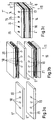
- the composite security document 1 comprises a document body 2 made of multiple layers 3-7 in a high-pressure, high-pressure lamination process. This means that the multiple layers 3-7 are using a suitable temperature and pressure profile are laminated. Such methods are known to the person skilled in the art.
- the in Fig. 1c shown document body is composed of five layers 3-7. Generally, the number of layers used is between 3 and 15, preferably between 5 and 12.
- the document body 2 has a hollow-relief-like structure 8, which is produced in the high-pressure high-temperature lamination of an empty recess in an inner layer, here a middle layer 5.
- the hollow-relief-like structure 8 is a watermark-like structure of the composite security document 1.
- a recess is first incorporated into a layer 5, which is preferably a plastic film.
- a T-shaped recess 9 is introduced via an opening, which is preferably made by means of a punching.
- the plastic film is preferably a film having a thickness ⁇ 100 ⁇ m, preferably ⁇ 50 ⁇ m and particularly preferably ⁇ 35 ⁇ m.
- the layer 5 provided with the T-shaped recess 9 is layered as a middle layer between the remaining layers 3, 4 and 6, 7.
- the layers are preferably carried out in vacuo. As a result, the empty space in the recess 9 is evacuated.
- stacked state is thus the empty and evacuated recess in the middle of the layer stack 10. It is surrounded on all sides by plastic material of the layers 3,4,5.
- the layer stack 10 is now in a high-pressure high-temperature lamination process to a monolithic document body 2, the in Fig. 1c is shown merged.
- the individual layers 3-7 are heated to a temperature above the glass transition temperature of the individual plastics of which the layers 3-7 are made.
- plastic layers in particular plastic films with high softening temperature are used.
- polyethylene terephthalate and its derivatives are particularly preferably polycarbonates, in particular bisphenol A polycarbonate.
- thermoplastically processable plastics such as polyvinyl chloride, acrylonitrile-butadiene-styrene and a composite material such as Teslin are used. These are preferably heated to temperatures ⁇ 100 ° C, preferably to temperatures ⁇ 120 ° C and most preferably to temperatures above 140 ° C.
- the layers are pressed together by high pressure. The pressure is applied parallel to a direction of lamination 11. That is, the upper layer 3 and the lower layer 7 adjacent elements exert a pressure on the films, so that they are pressed parallel to the laminating direction 11 to each other. In this case, pressures of more than 50 bar are typically used.
- the T-shaped recess is not completely filled by material of the middle layer 5 as well as material of the overlying layer 4 and underlying layer 6 so that a homogeneous card body in the region of the recess results. Rather, a hollow-relief-like structure 8 remains, which results from the fact that parts of the material of the overlying layer 4 and / or the underlying layer 6 are virtually drawn into the recess 9.
- the originally T-shaped contour 12 of the recess 9 washed out is still discernible as a blurred or washed-out contour 13. This is in Fig. 1c indicated by a dashed representation of the washed-out contour 13.
- an opaque layer here the layers 4 and 6, between the recess 9 and the upper side 15 and / or the lower side 16.
- These opaque layers 4 and 6 may be printed, for example.
- an interference ink for example, at least in the region covering the T-shaped recess 9.
- An interference color is an optically variable feature that can be used as a security feature.
- the hollow-relief-like structure 8 is made well visible not only under grazing viewing angle.
- the hollow-relief-like structure produces a characteristic appearance and / or a characteristic color spectrum at a fixed viewing angle. Changing the viewing angle usually changes the appearance and the color spectrum.
- Fig. 2a to 2c schematically the production of a further composite security document 1 'is shown schematically.
- a layer formed as a film 5 ' a plurality of recesses 17 are introduced, which form a pattern.
- the recesses 17 may preferably be punched.
- any other methods, such as laser processing methods, may be used to insert the recesses 17 into the film.
- the recesses do not have to completely penetrate the film, ie represent through openings.
- the recesses are formed as openings of the films.
- the layer 5 ' is then layered over films 7 and 6 formed as films.
- Over layer 5 'further layers 4 and 3 formed as films are layered.
- the films are preferably stacked under vacuum conditions so that the recesses 17 are evacuated.
- the layers 3, 4, 5 ', 6, 7 are fused into a monolithic document body 2' in a high-pressure, high-temperature lamination process.
- a variation of an extent of the individual recesses 17 in the layer 5 'and over a distance of the recesses 17, an optical impression can be varied. This makes it possible to produce gray scale-like watermark-like overall structures which consist of individual hollow-relief-type structures 8 '.
- FIG. 3a to 3c schematically shows the production of a further composite security document 1 "In this embodiment, recesses are introduced in two layers 5" and 5 '", which are formed as apertures, which are again preferably punched in.
- the layers 5" and 5'"become Subsequently, the layers 5 "and 5"'are arranged so that some of the recesses 18 of the layer 5 "are arranged over recesses 19 of the layer 5"'. and a recess 21 in the layer 5 '"are not arranged one above the other, resulting in a layer stack 10 recesses of different dimensions along the layering direction 11.
- the layering is again preferably under vacuum conditions, so that the resulting recesses, which partially consist of two recesses 18, 19 are formed, are empty and each up and down by one over it / underlying, preferably opaque, layer 6, 4 are completed.
- the individual layers 3, 4, 5 ", 5"', 6, 7 are fused to form a document body 2 "of the composite security document 1".
- hollow-relief-like structures 23 and 25 which consist of the recess 20 in layer 5 "and the recess 21 in layer 5"
- an opaque layer as here the layers. 4 and 6 are included, which are printed, for example, with an optically variable security feature, such as an interference color.
- the hollow-relief-like structures are formed so that tactilely perceptible depressions form on an upper side 15 and / or lower side 16, they can in one embodiment be filled with a substance producing a contrast.
- a substance producing a contrast For example, pastes or gels may be incorporated in these recesses, which include soot particles, metal particles, etc.
- contrast formation in different wavelength ranges can be achieved.
- the patterns introduced into the layers 5 'or 5 "and 5"' are varied so that individualized card bodies are produced. For example, information about the extent of the recess along the direction of layering before the lamination process can be encoded.
- both transparent and translucent hollow-relief-like structures can be formed in a document body.
- the described embodiments are merely exemplary embodiments.
- the individual described features of the various described embodiments may be combined in any combination for realizing the invention.
- the described composite security document may be a complete security document. In other embodiments, for example, it may be included in a "higher level" security document, such as a passbook.
Landscapes
- Business, Economics & Management (AREA)
- Accounting & Taxation (AREA)
- Finance (AREA)
- Engineering & Computer Science (AREA)
- Manufacturing & Machinery (AREA)
- Credit Cards Or The Like (AREA)
Claims (15)
- Document composite de sécurité (1, 1', 1") à structure interne de type relief en creux (8, 8' ; 23, 24, 25), comprenant un corps de document (2, 2', 2"), sachant que le corps de document (2, 2', 2") est un corps stratifié monolithique fabriqué à partir de plusieurs couches (3-7),
caractérisé en ce
que le corps de document (2, 2', 2") comprend au moins une structure de type relief en creux (8, 8' ; 23, 24, 25), qui est formée au cours d'un procédé de laminage sous haute température et sous haute pression, à partir d'un évidement (9 ; 17 ; 18-21) fermé en direction d'un côté supérieur et d'un côté inférieur (15, 16) par rapport à une direction de l'empilage (11) des couches (3-7), réalisé dans au moins une des couches (3-7) avant le processus de laminage. - Document de sécurité composite (1, 1', 1") selon la revendication 1, caractérisé en ce que l'évidement (9 ; 17 ; 18-21) au moins au nombre de un est réalisé dans au moins une couche (5, 5', 5", 5"') située à l'intérieur dans le cadre de l'empilage.
- Document de sécurité composite (1, 1', 1") selon la revendication 1 ou 2, caractérisé en ce que la structure de type relief en creux (8, 8' ; 23, 24, 25) comprend un renfoncement perceptible au niveau d'une des surfaces (14).
- Document de sécurité composite (1, 1', 1") selon l'une quelconque des revendications 1 à 3, caractérisé en ce qu'une caractéristique de sécurité à variation optique est intégrée dans une zone de la structure de type relief en creux (8, 8' ; 23, 24, 25) au moins au nombre de une, en particulier en ce qu'une couche imprimée à l'aide d'une couleur d'interférence dans une zone recouvrant la structure de type relief en creux (8, 8'; 23, 24, 25) est intégrée entre l'évidement d'origine (9 ; 17 ; 18-21) et la surface (14) du corps de document (2).
- Document de sécurité composite (1, 1', 1") selon l'une quelconque des revendications 1 à 4, caractérisé en ce que la structure de type relief en creux (8, 8' ; 23, 24, 25) au moins au nombre de une présente, abstraction faite d'un contour de bord (13), des zones d'extensions diverses par rapport à la direction de l'empilage (11).
- Document de sécurité composite (1, 1', 1") selon l'une quelconque des revendications 1 à 5, caractérisé en ce qu'au moins une autre structure de type relief en creux (8' ; 23, 25) formée du fait d'un autre évidement vide se trouvant avant le laminage dans au moins une des couches (5, 5', 5", 5"') se trouvant de préférence à l'intérieur est réalisée dans le corps de document (2), la forme géométrique, en particulier l'extension par rapport à la direction de l'empilage (11), de ladite structure de type relief en creux se différenciant de celles de la structure de type relief en creux (8' ; 24) au moins au nombre de une.
- Document de sécurité composite (1, 1', 1") selon l'une quelconque des revendications 1 à 6, caractérisé en ce que la structure de type relief en creux (8, 8' ; 24) au moins au nombre de une formée à partir de l'évidement (9,17, 18, 19) au moins au nombre de un comprend, sur un côté opposé du corps de document (2), un renfoncement symétrique en miroir.
- Document de sécurité composite (1, 1', 1") selon l'une quelconque des revendications 1 à 7, caractérisé en ce que l'évidement (9 ; 17 ; 18-21) au moins au nombre de un comprend au moins une traversée à travers au moins une couche (5, 5', 5", 5"') se trouvant à l'intérieur dans le cadre de l'empilage.
- Procédé servant à fabriquer un document de sécurité composite (1, 1', 1") avec un corps de document (2), comprenant les étapes suivantes consistant à :fournir plusieurs couches (3-7) ;disposer plusieurs couches (3-7) les unes sur les autres ;laminer les nombreuses couches (3-7) disposées les unes sur les autres lors d'un procédé de laminage sous haute température et sous haute pression pour obtenir un corps de document (2) monolithique,caractérisé en cequ'est pratiqué, dans au moins une des nombreuses couches (3-7), au moins un évidement (9 ; ;17 18-21),et en ce que les nombreuses couches (3-7) sont disposées de telle manière que l'évidement (9 ; 17 ; 18-21) au moins au nombre de un est fermé en direction d'un côté supérieur et d'un coté inférieur (15, 16) des couches (3-7) disposées les unes sur les autres, et en ce que le volume de l'évidement (9 ; 17 ; 18-21) est vide, et en ce que le vide est fait dans l'évidement (9 ; 17 ; 18-21) vide au moins au nombre de un, et en ce que le laminage est effectué de telle sorte qu'une structure de type relief en creux (8, 8' ; 23, 24, 25) se forme dans le corps de document (2).
- Procédé selon la revendication 9, caractérisé en ce qu'une couche (4, 6) disposée entre la couche (5, 5', 5", 5"') au moins au nombre de une, pourvue de l'évidement (9 ; 17 ; 18-21) au moins au nombre de un, et une surface (14) comprend, dans une zone recouvrant l'évidement (9 ; 17 ; 18-21), une caractéristique de sécurité à variation optique, est imprimée en particulier à l'aide d'une couleur d'interférence.
- Procédé selon la revendication 9 ou 10, caractérisé en ce que l'évidement au moins au nombre de un présente des zones de profondeurs diverses par rapport à la direction de l'empilage (11).
- Procédé selon l'une quelconque des revendications 9 à 11, caractérisé en ce qu'au moins un autre évidement est réalisé avant le laminage dans la couche (5', 5", 5"') au moins au nombre de une pourvue de l'évidement (19) au moins au nombre de un, la forme géométrique, en particulier la profondeur par rapport à la direction de l'empilage (11), dudit évidement se différenciant de celles de l'évidement au moins au nombre de un.
- Procédé selon l'une quelconque des revendications 9 à 12, caractérisé en ce que l'évidement (18) au moins au nombre de un et l'autre évidement (20) au moins au nombre de un sont estampés à partir de la couche (5") au moins au nombre de une, et en ce que des évidements supplémentaires (19, 24) sont pratiqués dans au moins une autre couche (5"'), et en ce que la couche (5") au moins au nombre de une et l'autre couche (5"') au moins au nombre de une sont disposées en tant que couches intérieures lors de l'empilage de telle manière que de nombreux évidements (18-21) différents par rapport à la direction de l'empilage (11) et/ou des évidements présentant des extensions diverses sont disposés les uns sur les autres de manière à former, dans le corps de document (2), diverses structures de type relief en creux (23, 24,25).
- Procédé selon l'une quelconque des revendications 13, caractérisé en ce que la structure de type relief en creux (8) au moins au nombre de une est réalisée de manière à former, au niveau de la surface (14), au moins un renfoncement perceptible au toucher et de manière à remplir le renfoncement perceptible au moins au nombre de un d'un matériau produisant un contraste.
- Procédé selon l'une quelconque des revendications 9 à 14, caractérisé en ce que l'évidement (9 ; 17 ; 18-21) au moins au nombre de un est formé en ce qu'une traversée traversant complètement la couche respective (5, 5', 5", 5"') est pratiquée dans au moins une des couches (5, 5', 5", 5"') se trouvant à l'intérieur.
Applications Claiming Priority (2)
| Application Number | Priority Date | Filing Date | Title |
|---|---|---|---|
| DE102007037982A DE102007037982A1 (de) | 2007-08-10 | 2007-08-10 | Sicherheitsdokument mit wasserzeichenartiger Struktur |
| PCT/EP2008/006696 WO2009021738A1 (fr) | 2007-08-10 | 2008-08-08 | Document de sécurité à structure de type filigrane |
Publications (2)
| Publication Number | Publication Date |
|---|---|
| EP2178707A1 EP2178707A1 (fr) | 2010-04-28 |
| EP2178707B1 true EP2178707B1 (fr) | 2014-05-14 |
Family
ID=40139924
Family Applications (1)
| Application Number | Title | Priority Date | Filing Date |
|---|---|---|---|
| EP08801587.0A Not-in-force EP2178707B1 (fr) | 2007-08-10 | 2008-08-08 | Document de sécurité à structure de type filigrane |
Country Status (3)
| Country | Link |
|---|---|
| EP (1) | EP2178707B1 (fr) |
| DE (1) | DE102007037982A1 (fr) |
| WO (1) | WO2009021738A1 (fr) |
Cited By (1)
| Publication number | Priority date | Publication date | Assignee | Title |
|---|---|---|---|---|
| EP3286012B1 (fr) | 2015-04-21 | 2019-03-20 | Giesecke+Devrient Mobile Security GmbH | Élément de sécurité multicouche |
Families Citing this family (14)
| Publication number | Priority date | Publication date | Assignee | Title |
|---|---|---|---|---|
| EP2332738B1 (fr) * | 2009-12-10 | 2012-07-04 | Agfa-Gevaert | Document de sécurité avec fonction de sécurité sur le bord |
| PL2335938T3 (pl) | 2009-12-18 | 2013-07-31 | Agfa Gevaert | Znakowalna laserowo folia zabezpieczająca |
| ES2400741T3 (es) | 2009-12-18 | 2013-04-11 | Agfa-Gevaert | Película de seguridad marcable por laser |
| DE102011004935A1 (de) * | 2011-03-01 | 2012-09-06 | Bundesdruckerei Gmbh | Verbundkörper und Verfahren zur Herstellung eines Verbundkörpers mit einem innenliegenden Sicherheitsmerkmal |
| DE102011117239A1 (de) * | 2011-10-28 | 2013-05-02 | Giesecke & Devrient Gmbh | Verfahren und Vorrichtung zur Untersuchung eines blatt- oder kartenförmigen Wertdokuments mit einem Sicherheitsmerkmal mit einen oder mehreren Hohlräume |
| DE102012204340A1 (de) * | 2012-03-19 | 2013-09-19 | Bundesdruckerei Gmbh | Sicherheitsdokument mit einem Perforationsfenster und Verfahren zu dessen Herstellung |
| DE102012215741A1 (de) | 2012-09-05 | 2014-03-27 | Bundesdruckerei Gmbh | Verbundkörper mit innenliegendem Linsenarray |
| US9855720B2 (en) * | 2013-09-23 | 2018-01-02 | Morphotrust Usa, Llc | Unidirectional opacity watermark |
| DE102013019948A1 (de) * | 2013-10-11 | 2015-04-16 | Giesecke & Devrient Gmbh | Verfahren zur Herstellung eines Wasserzeichens |
| FR3013872B1 (fr) * | 2013-11-25 | 2017-03-24 | Oberthur Technologies | Procede de fabrication d'une carte a relief apparent |
| DE102013021965A1 (de) | 2013-12-20 | 2015-06-25 | Giesecke & Devrient Gmbh | Sicherheitsdokument sowie Verfahren zum Herstellen eines Sicherheitsdokuments |
| DE102013021964A1 (de) | 2013-12-20 | 2015-06-25 | Giesecke & Devrient Gmbh | Sicherheitsdokument sowie Verfahren zum Herstellen eines Sicherheitsdokuments |
| US10479128B2 (en) * | 2017-10-27 | 2019-11-19 | Assa Abloy Ab | Security feature |
| DE102018106430B4 (de) * | 2018-03-20 | 2021-08-12 | Bundesdruckerei Gmbh | Sicherheitselement mit Mikro- oder Nanostrukturierung |
Family Cites Families (8)
| Publication number | Priority date | Publication date | Assignee | Title |
|---|---|---|---|---|
| DE3231460A1 (de) * | 1982-08-24 | 1984-03-01 | GAO Gesellschaft für Automation und Organisation mbH, 8000 München | Ausweiskarte mit im auf- und durchlicht pruefbaren merkmalen |
| ATE215887T1 (de) * | 1995-11-28 | 2002-04-15 | Ovd Kinegram Ag | Optischer informationstrager |
| DE19934434B4 (de) * | 1999-07-22 | 2006-10-05 | Bundesdruckerei Gmbh | Wert- und Sicherheitserzeugnis mit Mikrokanälen |
| DE19949945A1 (de) | 1999-10-16 | 2001-08-30 | Bundesdruckerei Gmbh | Datenträger mit Echtheitsmerkmalen und Herstellverfahren hierfür |
| DE10036505A1 (de) | 2000-07-27 | 2003-08-14 | Orga Kartensysteme Gmbh | Optisch wirksame Struktur zur Personalisierung von Karten u. dgl., sowie Verfahren zu deren Herstellung |
| DE102004022080A1 (de) | 2004-05-05 | 2005-11-24 | Giesecke & Devrient Gmbh | Wertdokument mit visuell erkennbaren Kennzeichnungen |
| DE102004061635A1 (de) * | 2004-12-17 | 2006-07-06 | Giesecke & Devrient Gmbh | Kartenförmiger Datenträger |
| DE102005028162A1 (de) * | 2005-02-18 | 2006-12-28 | Giesecke & Devrient Gmbh | Sicherheitselement und Verfahren zu seiner Herstellung |
-
2007
- 2007-08-10 DE DE102007037982A patent/DE102007037982A1/de not_active Withdrawn
-
2008
- 2008-08-08 EP EP08801587.0A patent/EP2178707B1/fr not_active Not-in-force
- 2008-08-08 WO PCT/EP2008/006696 patent/WO2009021738A1/fr not_active Ceased
Cited By (1)
| Publication number | Priority date | Publication date | Assignee | Title |
|---|---|---|---|---|
| EP3286012B1 (fr) | 2015-04-21 | 2019-03-20 | Giesecke+Devrient Mobile Security GmbH | Élément de sécurité multicouche |
Also Published As
| Publication number | Publication date |
|---|---|
| WO2009021738A1 (fr) | 2009-02-19 |
| DE102007037982A1 (de) | 2009-02-12 |
| EP2178707A1 (fr) | 2010-04-28 |
Similar Documents
| Publication | Publication Date | Title |
|---|---|---|
| EP2178707B1 (fr) | Document de sécurité à structure de type filigrane | |
| EP2477823B1 (fr) | Élément à couche mince doté d'une structure de couches d'interférence | |
| EP2483082B1 (fr) | Support de données à fenêtre | |
| DE3634857C2 (de) | Ausweiskarte mit visuell sichtbarem Echtheitsmerkmal und Verfahren zur Herstellung derselben | |
| DE102004046695A1 (de) | Optisch variables Sicherheitselement | |
| EP2448766B1 (fr) | Élément de sécurité et procédé de production correspondant | |
| AT521633A1 (de) | Prägewerkzeug und Verfahren zur Minimierung der Blasenbildung in Prägestrukturen | |
| DE102008028705B4 (de) | Verfahren zum Herstellen eines Wert- und/oder Sicherheitsdokuments sowie Wert- und/oder Sicherheitsdokument mit einer demetallisierten Struktur | |
| WO2013139748A1 (fr) | Procédé de fabrication d'un corps composite de sécurité, et corps composite de sécurité comportant une structure intérieure provoquant un effet de réfraction | |
| EP2384898B1 (fr) | Elément de sécurité pour papiers de sécurité, documents de valeur ou analogues | |
| EP2886364B1 (fr) | Document de sécurité et procédé de fabrication d'un document de sécurité | |
| DE102014017535B4 (de) | Identifikationsdokument mit Informationen aus thermochromer Tinte und Verfahren zum Herstellen eines ldentifikationsdokuments sowie Verfahren zum Verifizieren eines ldentifikationsdokuments | |
| EP3580068B1 (fr) | Production d'un élément de sécurité optique | |
| DE102010023218B4 (de) | Verfahren zur Herstellung eines Wert- oder Sicherheitsdokuments mit einem Wasserzeichen | |
| EP3996933B1 (fr) | Produit de valeur ou produit de sécurité et procédé de production associé | |
| EP3666542B1 (fr) | Procédé de fabrication d'un stratifié et stratifié ainsi que document de sécurité ou de valeur doté d'une caractéristique de sécurité située à l'intérieur | |
| EP4384401A1 (fr) | Procédé de production d'un élément de sécurité, élément de sécurité pour un support de données, support de données et feuille de stratification | |
| EP2550166B1 (fr) | Papier ou document de sécurité ou similaire et son procédé de fabrication | |
| EP3511176B1 (fr) | Élément de sécurité doté d'une structure optique variable dans une cavité | |
| EP4015229B1 (fr) | Produit de valeur ou de sécurité, ainsi que son procédé de fabrication | |
| WO2020233749A1 (fr) | Élément de sécurité comprenant une image anamorphique | |
| EP4357147A1 (fr) | Page de données avec charnière de sécurité | |
| EP2892728B1 (fr) | Élément composite muni d'un réseau de lentilles interne | |
| EP4219185A1 (fr) | Film, bande de film, document de valeur et procédé de fabrication | |
| EP2965918B1 (fr) | Support de donnees ayant une structure a relief tactile |
Legal Events
| Date | Code | Title | Description |
|---|---|---|---|
| PUAI | Public reference made under article 153(3) epc to a published international application that has entered the european phase |
Free format text: ORIGINAL CODE: 0009012 |
|
| 17P | Request for examination filed |
Effective date: 20100304 |
|
| AK | Designated contracting states |
Kind code of ref document: A1 Designated state(s): AT BE BG CH CY CZ DE DK EE ES FI FR GB GR HR HU IE IS IT LI LT LU LV MC MT NL NO PL PT RO SE SI SK TR |
|
| AX | Request for extension of the european patent |
Extension state: AL BA MK RS |
|
| DAX | Request for extension of the european patent (deleted) | ||
| 17Q | First examination report despatched |
Effective date: 20130515 |
|
| GRAP | Despatch of communication of intention to grant a patent |
Free format text: ORIGINAL CODE: EPIDOSNIGR1 |
|
| INTG | Intention to grant announced |
Effective date: 20131220 |
|
| GRAS | Grant fee paid |
Free format text: ORIGINAL CODE: EPIDOSNIGR3 |
|
| GRAA | (expected) grant |
Free format text: ORIGINAL CODE: 0009210 |
|
| AK | Designated contracting states |
Kind code of ref document: B1 Designated state(s): AT BE BG CH CY CZ DE DK EE ES FI FR GB GR HR HU IE IS IT LI LT LU LV MC MT NL NO PL PT RO SE SI SK TR |
|
| REG | Reference to a national code |
Ref country code: GB Ref legal event code: FG4D Free format text: NOT ENGLISH |
|
| RIC1 | Information provided on ipc code assigned before grant |
Ipc: B42D 15/00 20060101AFI20140404BHEP Ipc: B42D 25/00 20140101ALI20140404BHEP |
|
| REG | Reference to a national code |
Ref country code: AT Ref legal event code: REF Ref document number: 667956 Country of ref document: AT Kind code of ref document: T Effective date: 20140615 |
|
| REG | Reference to a national code |
Ref country code: IE Ref legal event code: FG4D Free format text: LANGUAGE OF EP DOCUMENT: GERMAN |
|
| REG | Reference to a national code |
Ref country code: DE Ref legal event code: R096 Ref document number: 502008011768 Country of ref document: DE Effective date: 20140703 |
|
| REG | Reference to a national code |
Ref country code: NL Ref legal event code: T3 |
|
| REG | Reference to a national code |
Ref country code: LT Ref legal event code: MG4D |
|
| PG25 | Lapsed in a contracting state [announced via postgrant information from national office to epo] |
Ref country code: GR Free format text: LAPSE BECAUSE OF FAILURE TO SUBMIT A TRANSLATION OF THE DESCRIPTION OR TO PAY THE FEE WITHIN THE PRESCRIBED TIME-LIMIT Effective date: 20140815 Ref country code: NO Free format text: LAPSE BECAUSE OF FAILURE TO SUBMIT A TRANSLATION OF THE DESCRIPTION OR TO PAY THE FEE WITHIN THE PRESCRIBED TIME-LIMIT Effective date: 20140814 Ref country code: CY Free format text: LAPSE BECAUSE OF FAILURE TO SUBMIT A TRANSLATION OF THE DESCRIPTION OR TO PAY THE FEE WITHIN THE PRESCRIBED TIME-LIMIT Effective date: 20140514 Ref country code: IS Free format text: LAPSE BECAUSE OF FAILURE TO SUBMIT A TRANSLATION OF THE DESCRIPTION OR TO PAY THE FEE WITHIN THE PRESCRIBED TIME-LIMIT Effective date: 20140914 Ref country code: LT Free format text: LAPSE BECAUSE OF FAILURE TO SUBMIT A TRANSLATION OF THE DESCRIPTION OR TO PAY THE FEE WITHIN THE PRESCRIBED TIME-LIMIT Effective date: 20140514 |
|
| PG25 | Lapsed in a contracting state [announced via postgrant information from national office to epo] |
Ref country code: PL Free format text: LAPSE BECAUSE OF FAILURE TO SUBMIT A TRANSLATION OF THE DESCRIPTION OR TO PAY THE FEE WITHIN THE PRESCRIBED TIME-LIMIT Effective date: 20140514 Ref country code: SE Free format text: LAPSE BECAUSE OF FAILURE TO SUBMIT A TRANSLATION OF THE DESCRIPTION OR TO PAY THE FEE WITHIN THE PRESCRIBED TIME-LIMIT Effective date: 20140514 Ref country code: ES Free format text: LAPSE BECAUSE OF FAILURE TO SUBMIT A TRANSLATION OF THE DESCRIPTION OR TO PAY THE FEE WITHIN THE PRESCRIBED TIME-LIMIT Effective date: 20140514 Ref country code: HR Free format text: LAPSE BECAUSE OF FAILURE TO SUBMIT A TRANSLATION OF THE DESCRIPTION OR TO PAY THE FEE WITHIN THE PRESCRIBED TIME-LIMIT Effective date: 20140514 Ref country code: LV Free format text: LAPSE BECAUSE OF FAILURE TO SUBMIT A TRANSLATION OF THE DESCRIPTION OR TO PAY THE FEE WITHIN THE PRESCRIBED TIME-LIMIT Effective date: 20140514 |
|
| PG25 | Lapsed in a contracting state [announced via postgrant information from national office to epo] |
Ref country code: PT Free format text: LAPSE BECAUSE OF FAILURE TO SUBMIT A TRANSLATION OF THE DESCRIPTION OR TO PAY THE FEE WITHIN THE PRESCRIBED TIME-LIMIT Effective date: 20140915 |
|
| PG25 | Lapsed in a contracting state [announced via postgrant information from national office to epo] |
Ref country code: SK Free format text: LAPSE BECAUSE OF FAILURE TO SUBMIT A TRANSLATION OF THE DESCRIPTION OR TO PAY THE FEE WITHIN THE PRESCRIBED TIME-LIMIT Effective date: 20140514 Ref country code: RO Free format text: LAPSE BECAUSE OF FAILURE TO SUBMIT A TRANSLATION OF THE DESCRIPTION OR TO PAY THE FEE WITHIN THE PRESCRIBED TIME-LIMIT Effective date: 20140514 Ref country code: DK Free format text: LAPSE BECAUSE OF FAILURE TO SUBMIT A TRANSLATION OF THE DESCRIPTION OR TO PAY THE FEE WITHIN THE PRESCRIBED TIME-LIMIT Effective date: 20140514 Ref country code: EE Free format text: LAPSE BECAUSE OF FAILURE TO SUBMIT A TRANSLATION OF THE DESCRIPTION OR TO PAY THE FEE WITHIN THE PRESCRIBED TIME-LIMIT Effective date: 20140514 Ref country code: CZ Free format text: LAPSE BECAUSE OF FAILURE TO SUBMIT A TRANSLATION OF THE DESCRIPTION OR TO PAY THE FEE WITHIN THE PRESCRIBED TIME-LIMIT Effective date: 20140514 |
|
| REG | Reference to a national code |
Ref country code: DE Ref legal event code: R097 Ref document number: 502008011768 Country of ref document: DE |
|
| PLBE | No opposition filed within time limit |
Free format text: ORIGINAL CODE: 0009261 |
|
| STAA | Information on the status of an ep patent application or granted ep patent |
Free format text: STATUS: NO OPPOSITION FILED WITHIN TIME LIMIT |
|
| PG25 | Lapsed in a contracting state [announced via postgrant information from national office to epo] |
Ref country code: LU Free format text: LAPSE BECAUSE OF FAILURE TO SUBMIT A TRANSLATION OF THE DESCRIPTION OR TO PAY THE FEE WITHIN THE PRESCRIBED TIME-LIMIT Effective date: 20140808 Ref country code: MC Free format text: LAPSE BECAUSE OF FAILURE TO SUBMIT A TRANSLATION OF THE DESCRIPTION OR TO PAY THE FEE WITHIN THE PRESCRIBED TIME-LIMIT Effective date: 20140514 |
|
| REG | Reference to a national code |
Ref country code: CH Ref legal event code: PL |
|
| 26N | No opposition filed |
Effective date: 20150217 |
|
| PG25 | Lapsed in a contracting state [announced via postgrant information from national office to epo] |
Ref country code: IT Free format text: LAPSE BECAUSE OF FAILURE TO SUBMIT A TRANSLATION OF THE DESCRIPTION OR TO PAY THE FEE WITHIN THE PRESCRIBED TIME-LIMIT Effective date: 20140514 Ref country code: LI Free format text: LAPSE BECAUSE OF NON-PAYMENT OF DUE FEES Effective date: 20140831 Ref country code: CH Free format text: LAPSE BECAUSE OF NON-PAYMENT OF DUE FEES Effective date: 20140831 Ref country code: BE Free format text: LAPSE BECAUSE OF NON-PAYMENT OF DUE FEES Effective date: 20140831 |
|
| REG | Reference to a national code |
Ref country code: IE Ref legal event code: MM4A |
|
| REG | Reference to a national code |
Ref country code: DE Ref legal event code: R097 Ref document number: 502008011768 Country of ref document: DE Effective date: 20150217 |
|
| PG25 | Lapsed in a contracting state [announced via postgrant information from national office to epo] |
Ref country code: SI Free format text: LAPSE BECAUSE OF FAILURE TO SUBMIT A TRANSLATION OF THE DESCRIPTION OR TO PAY THE FEE WITHIN THE PRESCRIBED TIME-LIMIT Effective date: 20140514 |
|
| PG25 | Lapsed in a contracting state [announced via postgrant information from national office to epo] |
Ref country code: IE Free format text: LAPSE BECAUSE OF NON-PAYMENT OF DUE FEES Effective date: 20140808 |
|
| REG | Reference to a national code |
Ref country code: AT Ref legal event code: MM01 Ref document number: 667956 Country of ref document: AT Kind code of ref document: T Effective date: 20140808 |
|
| PG25 | Lapsed in a contracting state [announced via postgrant information from national office to epo] |
Ref country code: AT Free format text: LAPSE BECAUSE OF NON-PAYMENT OF DUE FEES Effective date: 20140808 |
|
| PG25 | Lapsed in a contracting state [announced via postgrant information from national office to epo] |
Ref country code: BG Free format text: LAPSE BECAUSE OF FAILURE TO SUBMIT A TRANSLATION OF THE DESCRIPTION OR TO PAY THE FEE WITHIN THE PRESCRIBED TIME-LIMIT Effective date: 20140514 |
|
| PG25 | Lapsed in a contracting state [announced via postgrant information from national office to epo] |
Ref country code: MT Free format text: LAPSE BECAUSE OF FAILURE TO SUBMIT A TRANSLATION OF THE DESCRIPTION OR TO PAY THE FEE WITHIN THE PRESCRIBED TIME-LIMIT Effective date: 20140514 |
|
| PG25 | Lapsed in a contracting state [announced via postgrant information from national office to epo] |
Ref country code: HU Free format text: LAPSE BECAUSE OF FAILURE TO SUBMIT A TRANSLATION OF THE DESCRIPTION OR TO PAY THE FEE WITHIN THE PRESCRIBED TIME-LIMIT; INVALID AB INITIO Effective date: 20080808 Ref country code: TR Free format text: LAPSE BECAUSE OF FAILURE TO SUBMIT A TRANSLATION OF THE DESCRIPTION OR TO PAY THE FEE WITHIN THE PRESCRIBED TIME-LIMIT Effective date: 20140514 |
|
| REG | Reference to a national code |
Ref country code: FR Ref legal event code: PLFP Year of fee payment: 9 |
|
| REG | Reference to a national code |
Ref country code: FR Ref legal event code: PLFP Year of fee payment: 10 |
|
| REG | Reference to a national code |
Ref country code: FR Ref legal event code: PLFP Year of fee payment: 11 |
|
| P01 | Opt-out of the competence of the unified patent court (upc) registered |
Effective date: 20230526 |
|
| PGFP | Annual fee paid to national office [announced via postgrant information from national office to epo] |
Ref country code: NL Payment date: 20230823 Year of fee payment: 16 |
|
| PGFP | Annual fee paid to national office [announced via postgrant information from national office to epo] |
Ref country code: GB Payment date: 20230824 Year of fee payment: 16 Ref country code: FI Payment date: 20230823 Year of fee payment: 16 |
|
| PGFP | Annual fee paid to national office [announced via postgrant information from national office to epo] |
Ref country code: FR Payment date: 20230822 Year of fee payment: 16 Ref country code: DE Payment date: 20230822 Year of fee payment: 16 |
|
| REG | Reference to a national code |
Ref country code: DE Ref legal event code: R119 Ref document number: 502008011768 Country of ref document: DE |
|
| REG | Reference to a national code |
Ref country code: NL Ref legal event code: MM Effective date: 20240901 |
|
| PG25 | Lapsed in a contracting state [announced via postgrant information from national office to epo] |
Ref country code: FI Free format text: LAPSE BECAUSE OF NON-PAYMENT OF DUE FEES Effective date: 20240808 |
|
| GBPC | Gb: european patent ceased through non-payment of renewal fee |
Effective date: 20240808 |
|
| PG25 | Lapsed in a contracting state [announced via postgrant information from national office to epo] |
Ref country code: NL Free format text: LAPSE BECAUSE OF NON-PAYMENT OF DUE FEES Effective date: 20240901 |
|
| PG25 | Lapsed in a contracting state [announced via postgrant information from national office to epo] |
Ref country code: DE Free format text: LAPSE BECAUSE OF NON-PAYMENT OF DUE FEES Effective date: 20250301 |
|
| PG25 | Lapsed in a contracting state [announced via postgrant information from national office to epo] |
Ref country code: GB Free format text: LAPSE BECAUSE OF NON-PAYMENT OF DUE FEES Effective date: 20240808 |
|
| PG25 | Lapsed in a contracting state [announced via postgrant information from national office to epo] |
Ref country code: FR Free format text: LAPSE BECAUSE OF NON-PAYMENT OF DUE FEES Effective date: 20240831 |