EP2180010B1 - System und Verfahren zur Verbesserung der Haftung und der Verschleißfestigkeit mithilfe eines Vorderseitenübertragungsverfahrens zur Herstellung von mehrfach beschichteten, photochromen optischen Linsen - Google Patents
System und Verfahren zur Verbesserung der Haftung und der Verschleißfestigkeit mithilfe eines Vorderseitenübertragungsverfahrens zur Herstellung von mehrfach beschichteten, photochromen optischen Linsen Download PDFInfo
- Publication number
- EP2180010B1 EP2180010B1 EP09173585A EP09173585A EP2180010B1 EP 2180010 B1 EP2180010 B1 EP 2180010B1 EP 09173585 A EP09173585 A EP 09173585A EP 09173585 A EP09173585 A EP 09173585A EP 2180010 B1 EP2180010 B1 EP 2180010B1
- Authority
- EP
- European Patent Office
- Prior art keywords
- latex
- photochromic
- optical article
- coating
- polyurethane
- Prior art date
- Legal status (The legal status is an assumption and is not a legal conclusion. Google has not performed a legal analysis and makes no representation as to the accuracy of the status listed.)
- Active
Links
- 238000000034 method Methods 0.000 title claims abstract description 38
- 230000008569 process Effects 0.000 title claims abstract description 33
- 230000003287 optical effect Effects 0.000 title claims abstract description 28
- 238000005299 abrasion Methods 0.000 title claims description 11
- 238000004519 manufacturing process Methods 0.000 title claims 3
- 238000012546 transfer Methods 0.000 title abstract description 7
- 239000004816 latex Substances 0.000 claims abstract description 117
- 229920000126 latex Polymers 0.000 claims abstract description 117
- 239000004814 polyurethane Substances 0.000 claims abstract description 55
- 229920002635 polyurethane Polymers 0.000 claims abstract description 54
- 238000000576 coating method Methods 0.000 claims abstract description 42
- 239000000203 mixture Substances 0.000 claims abstract description 40
- 239000011248 coating agent Substances 0.000 claims abstract description 35
- 239000012528 membrane Substances 0.000 claims description 22
- 239000000178 monomer Substances 0.000 claims description 13
- 239000002245 particle Substances 0.000 claims description 12
- 238000012360 testing method Methods 0.000 claims description 12
- 150000001875 compounds Chemical class 0.000 claims description 10
- XLYOFNOQVPJJNP-UHFFFAOYSA-N water Substances O XLYOFNOQVPJJNP-UHFFFAOYSA-N 0.000 claims description 9
- NIXOWILDQLNWCW-UHFFFAOYSA-N acrylic acid group Chemical group C(C=C)(=O)O NIXOWILDQLNWCW-UHFFFAOYSA-N 0.000 claims description 8
- 238000006116 polymerization reaction Methods 0.000 claims description 7
- 239000012074 organic phase Substances 0.000 claims description 6
- 239000004094 surface-active agent Substances 0.000 claims description 6
- 239000008346 aqueous phase Substances 0.000 claims description 4
- 230000006872 improvement Effects 0.000 claims description 4
- 229920000728 polyester Polymers 0.000 claims description 3
- 239000011541 reaction mixture Substances 0.000 claims description 3
- 230000000379 polymerizing effect Effects 0.000 claims description 2
- 238000009472 formulation Methods 0.000 abstract description 14
- 239000010410 layer Substances 0.000 description 50
- NIXOWILDQLNWCW-UHFFFAOYSA-M Acrylate Chemical compound [O-]C(=O)C=C NIXOWILDQLNWCW-UHFFFAOYSA-M 0.000 description 15
- 239000002987 primer (paints) Substances 0.000 description 10
- 239000003795 chemical substances by application Substances 0.000 description 7
- 230000006641 stabilisation Effects 0.000 description 6
- 238000011105 stabilization Methods 0.000 description 6
- -1 Acrylate Ester Chemical class 0.000 description 5
- 150000002191 fatty alcohols Chemical class 0.000 description 5
- OZAIFHULBGXAKX-UHFFFAOYSA-N 2-(2-cyanopropan-2-yldiazenyl)-2-methylpropanenitrile Chemical compound N#CC(C)(C)N=NC(C)(C)C#N OZAIFHULBGXAKX-UHFFFAOYSA-N 0.000 description 4
- MHAJPDPJQMAIIY-UHFFFAOYSA-N Hydrogen peroxide Chemical compound OO MHAJPDPJQMAIIY-UHFFFAOYSA-N 0.000 description 4
- 239000011247 coating layer Substances 0.000 description 4
- 238000001035 drying Methods 0.000 description 4
- 230000000694 effects Effects 0.000 description 4
- 238000002474 experimental method Methods 0.000 description 4
- 238000006243 chemical reaction Methods 0.000 description 3
- 238000005470 impregnation Methods 0.000 description 3
- LEJBBGNFPAFPKQ-UHFFFAOYSA-N 2-(2-prop-2-enoyloxyethoxy)ethyl prop-2-enoate Chemical compound C=CC(=O)OCCOCCOC(=O)C=C LEJBBGNFPAFPKQ-UHFFFAOYSA-N 0.000 description 2
- SOGAXMICEFXMKE-UHFFFAOYSA-N Butylmethacrylate Chemical compound CCCCOC(=O)C(C)=C SOGAXMICEFXMKE-UHFFFAOYSA-N 0.000 description 2
- LZZYPRNAOMGNLH-UHFFFAOYSA-M Cetrimonium bromide Chemical compound [Br-].CCCCCCCCCCCCCCCC[N+](C)(C)C LZZYPRNAOMGNLH-UHFFFAOYSA-M 0.000 description 2
- CWYNVVGOOAEACU-UHFFFAOYSA-N Fe2+ Chemical compound [Fe+2] CWYNVVGOOAEACU-UHFFFAOYSA-N 0.000 description 2
- 125000000217 alkyl group Chemical group 0.000 description 2
- QVGXLLKOCUKJST-UHFFFAOYSA-N atomic oxygen Chemical compound [O] QVGXLLKOCUKJST-UHFFFAOYSA-N 0.000 description 2
- 230000008901 benefit Effects 0.000 description 2
- 239000011258 core-shell material Substances 0.000 description 2
- 239000007822 coupling agent Substances 0.000 description 2
- 230000007547 defect Effects 0.000 description 2
- SWXVUIWOUIDPGS-UHFFFAOYSA-N diacetone alcohol Chemical compound CC(=O)CC(C)(C)O SWXVUIWOUIDPGS-UHFFFAOYSA-N 0.000 description 2
- 150000002148 esters Chemical class 0.000 description 2
- 125000001495 ethyl group Chemical group [H]C([H])([H])C([H])([H])* 0.000 description 2
- BXWNKGSJHAJOGX-UHFFFAOYSA-N hexadecan-1-ol Chemical compound CCCCCCCCCCCCCCCCO BXWNKGSJHAJOGX-UHFFFAOYSA-N 0.000 description 2
- DCAYPVUWAIABOU-UHFFFAOYSA-N hexadecane Chemical compound CCCCCCCCCCCCCCCC DCAYPVUWAIABOU-UHFFFAOYSA-N 0.000 description 2
- 125000002496 methyl group Chemical group [H]C([H])([H])* 0.000 description 2
- 238000012986 modification Methods 0.000 description 2
- 230000004048 modification Effects 0.000 description 2
- HMZGPNHSPWNGEP-UHFFFAOYSA-N octadecyl 2-methylprop-2-enoate Chemical compound CCCCCCCCCCCCCCCCCCOC(=O)C(C)=C HMZGPNHSPWNGEP-UHFFFAOYSA-N 0.000 description 2
- 239000001301 oxygen Substances 0.000 description 2
- 229910052760 oxygen Inorganic materials 0.000 description 2
- 125000001436 propyl group Chemical group [H]C([*])([H])C([H])([H])C([H])([H])[H] 0.000 description 2
- 229910052708 sodium Inorganic materials 0.000 description 2
- 239000011734 sodium Substances 0.000 description 2
- 238000004528 spin coating Methods 0.000 description 2
- 125000000008 (C1-C10) alkyl group Chemical group 0.000 description 1
- KILURZWTCGSYRE-LNTINUHCSA-K (z)-4-bis[[(z)-4-oxopent-2-en-2-yl]oxy]alumanyloxypent-3-en-2-one Chemical compound CC(=O)\C=C(\C)O[Al](O\C(C)=C/C(C)=O)O\C(C)=C/C(C)=O KILURZWTCGSYRE-LNTINUHCSA-K 0.000 description 1
- JDSQBDGCMUXRBM-UHFFFAOYSA-N 2-[2-(2-butoxypropoxy)propoxy]propan-1-ol Chemical compound CCCCOC(C)COC(C)COC(C)CO JDSQBDGCMUXRBM-UHFFFAOYSA-N 0.000 description 1
- TXBCBTDQIULDIA-UHFFFAOYSA-N 2-[[3-hydroxy-2,2-bis(hydroxymethyl)propoxy]methyl]-2-(hydroxymethyl)propane-1,3-diol Chemical compound OCC(CO)(CO)COCC(CO)(CO)CO TXBCBTDQIULDIA-UHFFFAOYSA-N 0.000 description 1
- JOYRKODLDBILNP-UHFFFAOYSA-N Ethyl urethane Chemical compound CCOC(N)=O JOYRKODLDBILNP-UHFFFAOYSA-N 0.000 description 1
- DGAQECJNVWCQMB-PUAWFVPOSA-M Ilexoside XXIX Chemical compound C[C@@H]1CC[C@@]2(CC[C@@]3(C(=CC[C@H]4[C@]3(CC[C@@H]5[C@@]4(CC[C@@H](C5(C)C)OS(=O)(=O)[O-])C)C)[C@@H]2[C@]1(C)O)C)C(=O)O[C@H]6[C@@H]([C@H]([C@@H]([C@H](O6)CO)O)O)O.[Na+] DGAQECJNVWCQMB-PUAWFVPOSA-M 0.000 description 1
- BLRPTPMANUNPDV-UHFFFAOYSA-N Silane Chemical compound [SiH4] BLRPTPMANUNPDV-UHFFFAOYSA-N 0.000 description 1
- DBMJMQXJHONAFJ-UHFFFAOYSA-M Sodium laurylsulphate Chemical compound [Na+].CCCCCCCCCCCCOS([O-])(=O)=O DBMJMQXJHONAFJ-UHFFFAOYSA-M 0.000 description 1
- LSNNMFCWUKXFEE-UHFFFAOYSA-N Sulfurous acid Chemical compound OS(O)=O LSNNMFCWUKXFEE-UHFFFAOYSA-N 0.000 description 1
- HVVWZTWDBSEWIH-UHFFFAOYSA-N [2-(hydroxymethyl)-3-prop-2-enoyloxy-2-(prop-2-enoyloxymethyl)propyl] prop-2-enoate Chemical compound C=CC(=O)OCC(CO)(COC(=O)C=C)COC(=O)C=C HVVWZTWDBSEWIH-UHFFFAOYSA-N 0.000 description 1
- LXEKPEMOWBOYRF-UHFFFAOYSA-N [2-[(1-azaniumyl-1-imino-2-methylpropan-2-yl)diazenyl]-2-methylpropanimidoyl]azanium;dichloride Chemical compound Cl.Cl.NC(=N)C(C)(C)N=NC(C)(C)C(N)=N LXEKPEMOWBOYRF-UHFFFAOYSA-N 0.000 description 1
- 239000000853 adhesive Substances 0.000 description 1
- 230000001070 adhesive effect Effects 0.000 description 1
- 229910052783 alkali metal Inorganic materials 0.000 description 1
- 150000001340 alkali metals Chemical class 0.000 description 1
- 239000006117 anti-reflective coating Substances 0.000 description 1
- 239000006118 anti-smudge coating Substances 0.000 description 1
- RWCCWEUUXYIKHB-UHFFFAOYSA-N benzophenone Chemical compound C=1C=CC=CC=1C(=O)C1=CC=CC=C1 RWCCWEUUXYIKHB-UHFFFAOYSA-N 0.000 description 1
- 239000012965 benzophenone Substances 0.000 description 1
- 238000009835 boiling Methods 0.000 description 1
- ADKBGLXGTKOWIU-UHFFFAOYSA-N butanediperoxoic acid Chemical compound OOC(=O)CCC(=O)OO ADKBGLXGTKOWIU-UHFFFAOYSA-N 0.000 description 1
- CQEYYJKEWSMYFG-UHFFFAOYSA-N butyl acrylate Chemical class CCCCOC(=O)C=C CQEYYJKEWSMYFG-UHFFFAOYSA-N 0.000 description 1
- 125000000484 butyl group Chemical group [H]C([*])([H])C([H])([H])C([H])([H])C([H])([H])[H] 0.000 description 1
- 230000015556 catabolic process Effects 0.000 description 1
- 229960000541 cetyl alcohol Drugs 0.000 description 1
- 230000008859 change Effects 0.000 description 1
- 150000008371 chromenes Chemical class 0.000 description 1
- 238000004581 coalescence Methods 0.000 description 1
- 239000008199 coating composition Substances 0.000 description 1
- 239000003431 cross linking reagent Substances 0.000 description 1
- YQHLDYVWEZKEOX-UHFFFAOYSA-N cumene hydroperoxide Chemical compound OOC(C)(C)C1=CC=CC=C1 YQHLDYVWEZKEOX-UHFFFAOYSA-N 0.000 description 1
- 238000006731 degradation reaction Methods 0.000 description 1
- 239000008367 deionised water Substances 0.000 description 1
- 229910021641 deionized water Inorganic materials 0.000 description 1
- 238000007865 diluting Methods 0.000 description 1
- VVSMKOFFCAJOSC-UHFFFAOYSA-L disodium;dodecylbenzene;sulfate Chemical compound [Na+].[Na+].[O-]S([O-])(=O)=O.CCCCCCCCCCCCC1=CC=CC=C1 VVSMKOFFCAJOSC-UHFFFAOYSA-L 0.000 description 1
- 230000001747 exhibiting effect Effects 0.000 description 1
- 229910001448 ferrous ion Inorganic materials 0.000 description 1
- NBVXSUQYWXRMNV-UHFFFAOYSA-N fluoromethane Chemical compound FC NBVXSUQYWXRMNV-UHFFFAOYSA-N 0.000 description 1
- 239000003292 glue Substances 0.000 description 1
- 238000010348 incorporation Methods 0.000 description 1
- 230000005764 inhibitory process Effects 0.000 description 1
- 239000002563 ionic surfactant Substances 0.000 description 1
- 238000003475 lamination Methods 0.000 description 1
- 239000002346 layers by function Substances 0.000 description 1
- 239000011159 matrix material Substances 0.000 description 1
- 150000002734 metacrylic acid derivatives Chemical class 0.000 description 1
- 239000002736 nonionic surfactant Substances 0.000 description 1
- 150000002894 organic compounds Chemical class 0.000 description 1
- 239000003973 paint Substances 0.000 description 1
- WXZMFSXDPGVJKK-UHFFFAOYSA-N pentaerythritol Chemical compound OCC(CO)(CO)CO WXZMFSXDPGVJKK-UHFFFAOYSA-N 0.000 description 1
- 150000002978 peroxides Chemical class 0.000 description 1
- JRKICGRDRMAZLK-UHFFFAOYSA-L persulfate group Chemical group S(=O)(=O)([O-])OOS(=O)(=O)[O-] JRKICGRDRMAZLK-UHFFFAOYSA-L 0.000 description 1
- 229920000515 polycarbonate Polymers 0.000 description 1
- 239000004417 polycarbonate Substances 0.000 description 1
- 229920001296 polysiloxane Polymers 0.000 description 1
- 229910052700 potassium Inorganic materials 0.000 description 1
- 239000011591 potassium Substances 0.000 description 1
- 238000002360 preparation method Methods 0.000 description 1
- 230000001681 protective effect Effects 0.000 description 1
- 238000011084 recovery Methods 0.000 description 1
- 229910000077 silane Inorganic materials 0.000 description 1
- 229940083575 sodium dodecyl sulfate Drugs 0.000 description 1
- 235000019333 sodium laurylsulphate Nutrition 0.000 description 1
- 125000003003 spiro group Chemical group 0.000 description 1
- BDHFUVZGWQCTTF-UHFFFAOYSA-M sulfonate Chemical compound [O-]S(=O)=O BDHFUVZGWQCTTF-UHFFFAOYSA-M 0.000 description 1
- 150000003467 sulfuric acid derivatives Chemical class 0.000 description 1
- 230000002194 synthesizing effect Effects 0.000 description 1
- CIHOLLKRGTVIJN-UHFFFAOYSA-N tert‐butyl hydroperoxide Chemical compound CC(C)(C)OO CIHOLLKRGTVIJN-UHFFFAOYSA-N 0.000 description 1
- 238000012719 thermal polymerization Methods 0.000 description 1
- 230000007704 transition Effects 0.000 description 1
- BPSIOYPQMFLKFR-UHFFFAOYSA-N trimethoxy-[3-(oxiran-2-ylmethoxy)propyl]silane Chemical compound CO[Si](OC)(OC)CCCOCC1CO1 BPSIOYPQMFLKFR-UHFFFAOYSA-N 0.000 description 1
- 238000001771 vacuum deposition Methods 0.000 description 1
Images
Classifications
-
- C—CHEMISTRY; METALLURGY
- C08—ORGANIC MACROMOLECULAR COMPOUNDS; THEIR PREPARATION OR CHEMICAL WORKING-UP; COMPOSITIONS BASED THEREON
- C08F—MACROMOLECULAR COMPOUNDS OBTAINED BY REACTIONS ONLY INVOLVING CARBON-TO-CARBON UNSATURATED BONDS
- C08F2/00—Processes of polymerisation
- C08F2/44—Polymerisation in the presence of compounding ingredients, e.g. plasticisers, dyestuffs, fillers
-
- B—PERFORMING OPERATIONS; TRANSPORTING
- B29—WORKING OF PLASTICS; WORKING OF SUBSTANCES IN A PLASTIC STATE IN GENERAL
- B29D—PRODUCING PARTICULAR ARTICLES FROM PLASTICS OR FROM SUBSTANCES IN A PLASTIC STATE
- B29D11/00—Producing optical elements, e.g. lenses or prisms
- B29D11/00634—Production of filters
- B29D11/00653—Production of filters photochromic
-
- B—PERFORMING OPERATIONS; TRANSPORTING
- B29—WORKING OF PLASTICS; WORKING OF SUBSTANCES IN A PLASTIC STATE IN GENERAL
- B29D—PRODUCING PARTICULAR ARTICLES FROM PLASTICS OR FROM SUBSTANCES IN A PLASTIC STATE
- B29D11/00—Producing optical elements, e.g. lenses or prisms
- B29D11/00865—Applying coatings; tinting; colouring
- B29D11/00894—Applying coatings; tinting; colouring colouring or tinting
- B29D11/00903—Applying coatings; tinting; colouring colouring or tinting on the surface
-
- C—CHEMISTRY; METALLURGY
- C08—ORGANIC MACROMOLECULAR COMPOUNDS; THEIR PREPARATION OR CHEMICAL WORKING-UP; COMPOSITIONS BASED THEREON
- C08F—MACROMOLECULAR COMPOUNDS OBTAINED BY REACTIONS ONLY INVOLVING CARBON-TO-CARBON UNSATURATED BONDS
- C08F2/00—Processes of polymerisation
- C08F2/12—Polymerisation in non-solvents
- C08F2/16—Aqueous medium
- C08F2/22—Emulsion polymerisation
- C08F2/24—Emulsion polymerisation with the aid of emulsifying agents
Definitions
- the present invention relates generally to optical lenses, and in particular, to a photochromic ophthalmic lens and process for producing the same.
- Front Side Transfer is a well known process, the details of which are described in U.S. Patent Application Publication No. 2007/0034322 .
- the FST process involves the transfer of a multiple-coated stack of coating layers deposited onto a carrier, from the carrier onto the front side of a lens.
- a thin carrier usually a polycarbonate carrier having a curvature adapted to the curvature of the lens which will be coated, is coated by spin coating using different coatings, each having a specific function.
- the carrier is:
- Each layer is deposited by a spin process and is able to be cured by thermal polymerization or photopolymerization.
- This carrier comprising the multiple-coated stack is then transferred to the lens by the establishment of a contact between the last deposited layer onto the carrier and the front side of the lens through a glue layer deposited either on the front side of the lens or the said last deposited layer, and using a FST device as described in the above-mentioned patent application.
- This process is also able to transfer other functional layers to the lens like anti-reflective coatings, anti-smudge coatings, photochromic layers, etc.
- Polyphasic photochromic latex layers as described in U.S. Patent No. 6,770,710 are very efficient at imparting photochromic properties to a lens using the FST process. Nonethless, the final photochromic lens obtained presents a defect in adhesion. This defect in adhesion appears on the lens between the photochromic layer and the hard-coat layer.
- the present invention is directed to a system, method and process to improve adhesion between a smooth cured surface (e.g., a hard coat based to an acrylic coating for example) and a large particle size polyphasic latex layer (photochromic layer).
- a smooth cured surface e.g., a hard coat based to an acrylic coating for example
- a large particle size polyphasic latex layer photochromic layer
- a problem in adhesion typically exists when polyphasic latex is spin coated on a hard coat layer like an acrylic coating.
- a novel photochromic latex formulation having improved adhesion qualities, in particular, adhesion onto a hard coat layer.
- a polyurethane latex to the polyphasic latex improved impregnation and coaslescence into the acrylate layer.
- a novel process for optimizing adhesion between acrylate and polyphasic latex coatings wherein a separate layer of polyurethane latex is formed, a drying process for achieving a certain desired moisture content of the polyurethane latex is performed, and a polyphasic latex layer is added thereon.
- a process for making a photochromic optical article comprising the steps of:
- a photochromic optical article having a coating comprising a novel photochromic latex composition as described herein (e.g., as in claim 1).
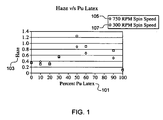
- FIG. 1 is an exemplary graphical representation of Table 1, showing the amount of haze of various polyphasic latex formulations having different percentages of polyurethane latex, and applied at different spin speeds.
- Exemplary coating layer arrangements may be as follows:
- Polyphasic latex is a core-shell latex (Essilor patent) and is described, e.g., in U.S. Patent No. 6,770,710 .
- Polyurethane Latex (PU Latex): The Polyurethane Latex layer presents the following composition: PU Latex % Deionized water 33.50 Propylene glycol Ether 12.00 Polyurethane Latex (W234 - Baxenden) 52.00 Coupling Agent 2.50 Coupling Agent Formulation % GLYMO (3-Glycidyloxypropyl-trimethoxsilanc) 33.10 3-Acryloxypropyltrimcthoxysilane 41.80 0.1 N HCl 19.80 Diacetone alcohol 3.80 Aluminium acetylacetonate 1.50
- compositions of a PU latex primer coating are described in U.S. 2007/0034322 , which further discloses a process (i.e., a FST procss) for making a coated optical article comprising the steps of:
- the at least one coating may comprise, e.g., a photochromic coating.
- the at least one coating comprises a novel photochromic latex formulation having improved characteristics, such as e.g., improved adhesion with a hard coat layer, as described below.
- a novel photochromic latex formulation comprising a polyurethane latex added to the polyphasic latex.
- the quantity of polyurethane latex included in the photochromic latex formulation is comprised from 10 to 30%, and in a most preferred embodiment is about 20%.
- the polyphasic latex preferably comprises a core-shell latex (as described in U.S. 6,770,710 ) which presents a size of particles which are in the range of 300 nm to 450 nm.
- a stabilization agent of the miniemulsion is added to the mixture in step (1).
- the mixture of step (1) is obtained by preparing separately a solution A containing the monomer(s), the photochromic compounds and, optionally, the stabilization agent(s) and a solution B containing water and the surfactant(s), then by combining the two solutions A and B.
- the Z monomers recommended are monomers of the alkyl (meth) acrylate type, preferably of the mono(meth) acrylate type.
- the alkyl groups are preferably C 1 -C 10 alkyl groups, such as methyl, ethyl, propyl and butyl.
- the methyl, ethyl, propyl and butyl acrylates and methacrylates may be mentioned. It is also possible to use mixtures of these monomers, in particular, mixtures ofC 2 -C 10 alkyl acrylate and C 1 -C 3 alkyl methacrylate monomers.
- the organic photochromic compounds comprise all organic compounds exhibiting photochromic properties.
- the compounds are well known in the state of the art.
- the preferred compounds are chromenes and spiroxazines.
- the photochromic compound is introduced in sufficient quantity to obtain the desired photochromic effect in the final latex films.
- the concentrations of photochromic compound usually vary from 1 to 10% and preferably from 2 to 7% by weight, with respect to the weight of polymerizable monomers present in the latex.
- the surfactant may be ionic, non-ionic or amphoteric, or mixtures of same.
- ionic surfactants mention may be made of sodium dodecylsulfate, sodium dodecylbenzene sulfate, sodium sulfonate, the sulfates of sthoxylated fatty alcohols and cetyl trimethylammonium bromide (CTAB).
- CTAB cetyl trimethylammonium bromide
- Non-ionic surfactants may comprise ethoxylated fatty alcohols.
- the stabilization agent may be an n-alkane, a halogenated n-alkane, or a polymerizable or non-polymerizable monomer, comprising a fatty chain such as a fatty alcohol or an ester of a fatty alcohol.
- Preferred stabilization agents may comprise hexadecane, cetyl alcohol and stearyl methacrylate.
- the content of stabilization agent in the mixture usually varies from 0.1 to 10%, preferably from 2 to 6%, with respect to the weight of polymerizable monomers present in the mixture.
- the polymerization primer may be any primer conventionally used that may be water soluble or in the organic phase, e.g., alkali metal and ammonium persulfates, in particular sodium or potassium persulfates, hydrogen peroxide and 2,2'-azobis (2-amidino propane) dihydrochloride. It is also possible to use partially water soluble peroxides such as persuccinic acid and t-butyl hydroperoxide, or redox systems such as the persulfates combined with a ferrous ion. Mention may be made of cumyl hydroperoxide or hydrogen peroxide, in the presence of ferrous, sulfite or bisulfite ions. Primers soluble in the organic phase may be made of azobisisobutyronitrile (AIBN).
- AIBN azobisisobutyronitrile
- the particle size of the polyurethane latex is less than the particle size of the polyphasic latex.
- the polyurethane latex incorporated in the polyphasic latex typically is selected to present a particle size less than 200 nm, preferably less than 100 nm, and more preferably comprised from 20 nm to 50 nm.
- these characteristics are relevant because the smaller size of the polyurethane latex particles relative to the polyphasic latex particles fills the gaps created by the larger-sized polyphasic latex particles.
- a photochromic latex formulation according to the present invention provides better impregnation (followed by coalescence) into an acrylate layer as compared to 100% polyphasic latex. Accordingly, the novel photochromic latex formulation demonstrates improved adhesive characteristics, in particular, improved adhesion onto a hard coat layer such as an acrylate coating layer or a silane based coating layer.
- polyurethane latex and more particularly, using PU latex W234 from Baxenden®.
- PU latex W234 from Baxenden®.
- other types of latex preferably having similar particle sizes as the polyurethane latex, e.g., a size of particles which are in the range of 20 nm to 200 nm, may be utilized.
- Exemplary types of latex which may alternately be used may include, e.g., (meth)acrylic latexes such as the acrylic latex commercialized under the name Acrylic Latex A-639 by Zeneca, Polyurethane latexes such as latexes commercialized under the names W-240 by Baxenden and polyester latexes.
- a novel process is provided wherein a separate layer of wet polyurethane latex, preferably about 2 microns thick, is formed on a lens, on top of which a polyphasic latex layer is added.
- a controlled drying process is performed on the applied polyurethane latex layer so as to optimize and achieve a certain moisture level or "wetness" of same, thus creating a semi-dry state of the polyumthane layer, which advantageously prevents attack from the polyphasic layer.
- Exemplary preferred drying times/conditions to achieve the desired moisture level comprised 1 minute to 5 minutes at 60°C, and most preferably, comprised 5 minutes in an oven at 60 degrees Celsius.
- Polyphasic latex is then applied to the semi-dried polyurethane. It is noted that over drying the wet polyurethane layer causes adhesion failure.
- the semi-dried polyurethane layer having the desired moisture level allows impregnation of the polyphasic layer, which improves adhesion between the polyphasic and polyurethane layers, without diluting the polyphasic layer.
- both of the above exemplary embodiments of the present invention provided improved dry and wet adhesion between the polyphasic and polyurethane latex layers, improving dry and wet adhesion scores from 5 (total removal) to 0 (no removal).
- This dry and wet adhesion tests are usual in ophthalmic topics to estimate the quality of the adhesion between coatings.
- a thicker layer of polyurethane latex may be formed to further improve adhesion.
- the thickness of such a layer is 0.5 ⁇ m to 5.0 ⁇ m, and preferably is 2.0 ⁇ m.
- This experiment was a very specific experiment performed to assess the effect on haze, in which solutions of polyphasic latex (no dye) and PU latex were created in different ratios. These solutions were then spun on a convex side of a plano orma lens and cured. Coating thicknesses and haze were then noted.
- Table 1 750 rpm 300 rpm Test # %W234 THK HAZE THK HAZE 221-201-1 100 8.71 0.1 15.15 0.11 221-201-2 90 8.76 0.51 14.26 0.76 221-201-3 50 8.26 0.9 13.74 1.23 221-201-4 60 8.76 0.67 16.48 0.89 221-201-5 30 8.87 0.55 17.19 0.54 221-201-6 20 8.96 0.34 14.62 0.3 221-201-7 10 9.44 0.38 16.91 0.29 221-201-8 0 11.38 0.35 23.11 0.35 Test #: Number of Example %W234 : % of polyurethane latex W234 incorporated into the formulation of the polyphasic photochromic latex THK: thickness of the polyphasic photochromic latex 750 rpm/300 rpm: spin speed
- the level of haze is almost the same as that of 100% polyphasic latex (0% W234), however, as discussed above, improved adhesion is obtained.
- the polyphasic layer presents a thickness comprised from about 9 ⁇ m to about 20 ⁇ m. It is noted that the level of haze is independent of the thickness of the layer.
- FIG. 1 is an exemplary graphical representation of Table 1, showing the amount of haze 103 of various polyphasic latex formulations having different percentages 101 of polyurethane latex, and applied at different spin speeds, e.g., at a 750 rpm spin speed 105, or at a 300 rpm spin speed 107.
- a significant improvement in abrasion performance was noted, likely due to the reversed sequence of the application of coatings on a carrier.
- UV coatings tend to have a lower conversion rate at the surface of the cured layer due in part to exposure to oxygen, which negatively affects the cure rate (oxygen inhibition).
- oxygen inhibition oxygen inhibition
- the improved abrasion performance may be due to a gradient hardness value which increases as one proceeds from the layers nearest to the lens to the layers away from lens.
- a carrier e.g., as in the FST process
- using a carrier to transfer a coating stack results in a flipped layer arrangement upon transfer to a lens, such that the layer adjacent to the carrier becomes the layer which is outermost on the lens surface. This enables the application of a more abrasion-resistant hard coating. It appears that in film that was transferred, the ISTM Bayer test score improved from 2.3 to 4.5 (approximately 100 % improvement).
- Table 4 shows Bayer results from applying a UV curable coating via a carrier (e.g., FST process) compared with conventionally coating a lens with and without the extra heat of transferring applied.
- a carrier e.g., FST process
- Test #221-200-1 (Lenses A- D) are Bayer abrasion results from coating via an FST process.
- Test #221-200-2(Lenses A-D) are abrasion results of conventionally coated lenses with the same stack exposed to the additional heat of transferring.
- Test #221-200-3(Lenses A-D) are abrasion results of conventionally coated lens with the same stack and no additional heat of transferring.
- Table 4 Bayer Abrasion ISTM 02002 Test # Lens A Lens B Lens C Lens D Average 95% 221-200-1 4.84 4.76 5.1 4.42 4.78 0.27 221-200-2 2.46 2.57 2.53 2.39 2.48 0.08 221-200-3 2.22 2.2 2.21 2.25 2.22 0.02
Landscapes
- Chemical & Material Sciences (AREA)
- Health & Medical Sciences (AREA)
- Engineering & Computer Science (AREA)
- Organic Chemistry (AREA)
- Chemical Kinetics & Catalysis (AREA)
- Medicinal Chemistry (AREA)
- Polymers & Plastics (AREA)
- Mechanical Engineering (AREA)
- Ophthalmology & Optometry (AREA)
- Manufacturing & Machinery (AREA)
- Eyeglasses (AREA)
- Optical Filters (AREA)
- Non-Silver Salt Photosensitive Materials And Non-Silver Salt Photography (AREA)
- Compositions Of Macromolecular Compounds (AREA)
Claims (14)
- Verfahren zur Herstellung eines photochromen Latex umfassend die Schritte von (1) Zubereitung einer Mischung umfassend zumindest ein organisches Monomer Z mit einer C=C Gruppe, zumindest einem organischen photochromen Verbindung, zumindest einem Netzmittel und Wasser;
(2) Behandlung der in Schritt (1) erhaltenen Mischung um eine Miniemulsion zu erhalten, die aus einer organischen Phase, welche in Form von Tröpfchen mit einem Durchmesser von 50 bis 500 nm in einer wässrigen Phase dispergiert ist, besteht; (3) Hinzufügen eines Polymerisationsprimers zu der Miniemulsion, wenn dieser nicht schon in Schritt (1) eingebracht wurde, oder einer Menge von Primer zusätzlich zu der hinzugefügten Menge in Schritt (1); (4) Polymerisation der in Schritt (3) erhaltenen Reaktionsmischung und (5) Gewinnung des photochromen Latex, wobei die Verbesserung umfasst:
(6) Einbringen eines zusätzlichen Latexbestandteiles ausgewählt aus der Gruppe bestehend aus einem Poly(meth)acrylatlatex, einem Polyurethanlatex und einem Polyesterlatex und deren Kombinationen, wobei der zusätzliche Latexbestandteil die Trübung reduziert und die Abriebfestigkeit des gewonnenen photochromen Latex erhöht. - Verfahren nach Anspruch 1, bei dem der zusätzliche Latexbestandteil einen Polyurethanlatex umfasst.
- Verfahren nach Anspruch 2, bei dem der Polyurethanlatex 10 Gew.% bis 30 Gew.% im Bezug auf den photochromen Latex.
- Verfahren nach Anspruch 2, bei dem der Polyurethanlatex 20 Gew.% im Bezug auf den photochromen Latex.
- Verfahren nach Anspruch 2, bei dem die Partikelgröße des Polyurethanlatex 20 nm bis 200 nm ist.
- Verfahren nach Anspruch 1, bei dem der Schritt (2) eine Miniemulsion bildet, die aus einer organischen Phase besteht, welche in der Form von Tröpfchen mit einem Durchmesser von 50 bis 300 nm in einer wässrigen Phase dispergiert ist.
- Eine Latexzusammensetzung, welche nach dem Verfahren von Anspruch 1 hergestellt ist.
- Verfahren zur Herstellung eines photochromen optischen Gegenstandes, wobei dieses Verfahren ein Verfahren zur Herstellung einer photochromen Latexzusammensetzung wie sie gemäß des Verfahrens in Anspruch 1 erhalten wird, umfasst und wobei dieses Verfahren weiterhin die Schritte umfasst von:Bereitstellen eines optischen Gegenstands, welcher eine vordere konvexe Fläche und eine hintere konkave Fläche hat;Bereitstellen eines flexiblen Trägers, welcher eine konkave Fläche und eine konvexe Fläche, wobei die konkave Fläche des Trägers zumindest eine Beschichtung trägt;Bereitstellen einer Vorrichtung die einen verformbaren Part und eine aufblasbare Membraneinrichtung umfasst, wobei der verformbare Part und die aufblasbare Membran der aufblasbaren Membraneinrichung zwischen sich einen Aufnahmeraum definieren;Positionieren des Trägers auf der aufblasbaren Membran innerhalb des Aufnahmeraums;Anordnen des optischen Gegenstands vor dem flexiblen Träger, so dass seine konvexe Fläche zum flexiblen Träger weist und seine konkave Fläche zum verformbaren Part weist;Aufblasen der Membran der aufblasbaren Membraneinrichtung, so dass die beschichtete konkave Fläche des Trägers mit der konvexen Fläche des optischen Gegenstands zusammen passt;Entlüften der Membran der aufblasbaren Membraneinrichtung; undGewinnung des optischen Gegenstands mit seiner vorderen konvexen Fläche, welche mit der zumindest einen Beschichtung beschichtet ist, welche von dem flexiblen Träger übertragen wurde, wobei die Beschichtung die photochrome Latexzusammensetzung umfasst.
- Photochromer optischer Gegenstand, der eine Beschichtung hat, welche eine photochrome Latexzusammensetzung wie beschrieben in Anspruch 1 umfasst.
- Photochromer optischer Gegenstand des Anspruches 9, bei dem das Trübungs-Level der Beschichtung von 0,2 bis 0,4 reicht.
- Photochromer optischer Gegenstand des Anspruches 9, bei dem das Trübungs-Level der Beschichtung 0,3 ist.
- Photochromer optischer Gegenstand des Anspruches 9, bei dem das Trübungs-Level der Beschichtung unabhängig von ihrer Dicke ist.
- Photochromer optischer Gegenstand wie in Anspruch 9, bei dem der optische Gegenstand einen Abriebsfestigkeitswert hat, wie durch einen Bayer-Test gemessen, der größer oder gleich 3,0 ist.
- Photochromer optischer Gegenstand wie in Anspruch 9, bei dem der optische Gegenstand einen Abriebsfestigkeitswert hat, wie durch einen Bayer-Test gemessen, der größer oder gleich 4,0 ist.
Applications Claiming Priority (1)
| Application Number | Priority Date | Filing Date | Title |
|---|---|---|---|
| US12/255,317 US20100096602A1 (en) | 2008-10-21 | 2008-10-21 | System and method for improving adhesion and abrasion resistance using a front side transfer process to manufacture multi-coated photochromic optical lenses |
Publications (2)
| Publication Number | Publication Date |
|---|---|
| EP2180010A1 EP2180010A1 (de) | 2010-04-28 |
| EP2180010B1 true EP2180010B1 (de) | 2011-03-30 |
Family
ID=41278842
Family Applications (1)
| Application Number | Title | Priority Date | Filing Date |
|---|---|---|---|
| EP09173585A Active EP2180010B1 (de) | 2008-10-21 | 2009-10-21 | System und Verfahren zur Verbesserung der Haftung und der Verschleißfestigkeit mithilfe eines Vorderseitenübertragungsverfahrens zur Herstellung von mehrfach beschichteten, photochromen optischen Linsen |
Country Status (4)
| Country | Link |
|---|---|
| US (1) | US20100096602A1 (de) |
| EP (1) | EP2180010B1 (de) |
| AT (1) | ATE503773T1 (de) |
| DE (1) | DE602009000983D1 (de) |
Families Citing this family (3)
| Publication number | Priority date | Publication date | Assignee | Title |
|---|---|---|---|---|
| FR2901552B1 (fr) * | 2006-05-26 | 2008-07-11 | Essilor Int | Article d'optique comportant un revetement externe hydrophobe et/ou oleophobe revetu d'une couche temporaire |
| US8724206B2 (en) | 2012-09-28 | 2014-05-13 | Google Inc. | Photo-chromic coating for optics |
| CN102875822B (zh) * | 2012-10-30 | 2014-04-16 | 天津科技大学 | 一种光致变色胶乳乳液的制备方法 |
Family Cites Families (7)
| Publication number | Priority date | Publication date | Assignee | Title |
|---|---|---|---|---|
| FR2790264A1 (fr) * | 1999-02-26 | 2000-09-01 | Essilor Int | Procede de preparation d'un latex a proprietes photochromiques et ses applications, en particulier dans le domaine ophtalmique |
| FR2811322B1 (fr) * | 2000-07-07 | 2002-10-18 | Essilor Int | Procede de preparation d'un latex de polyurethane photochromique et application a l'optique ophtalmique |
| FR2816950B1 (fr) * | 2000-11-17 | 2003-02-14 | Essilor Int | Procede d'obtention d'un latex photochromique |
| FR2869039B1 (fr) * | 2004-04-16 | 2007-11-30 | Essilor Int | Latex colore par des pigments et procede de traitement d'un substrat transparent a l'aide dudit latex colore. |
| US7854865B2 (en) * | 2005-06-08 | 2010-12-21 | Essilor International | Method of injection molding thin thermoplastic lenses |
| US20070034322A1 (en) * | 2005-08-15 | 2007-02-15 | Essilor International Compagnie Generale D'optique | System and process for making a coated article |
| US20080026217A1 (en) * | 2005-12-02 | 2008-01-31 | Kim Hye M | Method for preparing a photochromic nanoparticle and nanoparticle prepared therefrom |
-
2008
- 2008-10-21 US US12/255,317 patent/US20100096602A1/en not_active Abandoned
-
2009
- 2009-10-21 EP EP09173585A patent/EP2180010B1/de active Active
- 2009-10-21 DE DE602009000983T patent/DE602009000983D1/de active Active
- 2009-10-21 AT AT09173585T patent/ATE503773T1/de not_active IP Right Cessation
Also Published As
| Publication number | Publication date |
|---|---|
| ATE503773T1 (de) | 2011-04-15 |
| EP2180010A1 (de) | 2010-04-28 |
| US20100096602A1 (en) | 2010-04-22 |
| DE602009000983D1 (de) | 2011-05-12 |
Similar Documents
| Publication | Publication Date | Title |
|---|---|---|
| JP7138161B2 (ja) | 光学物品の製造方法 | |
| CN103492932B (zh) | 眼镜用光致变色透镜 | |
| TW201042281A (en) | Antireflection film and polarizing plate comprising the same | |
| EP3480651B1 (de) | Brillenglas und brille | |
| EP2599799A1 (de) | Einschichtige folie und hydrophiles material damit | |
| AU2017287528B2 (en) | Method for manufacturing spectacle lens | |
| JP2012141459A (ja) | ハードコート層形成用組成物、光学フィルム、光学フィルムの製造方法、偏光板、及び画像表示装置 | |
| WO2016108061A1 (en) | Uv curable coating compositions for improved abrasion resistance | |
| JP4547579B2 (ja) | 塗布膜の硬化方法 | |
| EP2180010A1 (de) | System und Verfahren zur Verbesserung der Haftung und der Verschleißfestigkeit mithilfe eines Vorderseitenübertragungsverfahrens zur Herstellung von mehrfach beschichteten, photochromen optischen Linsen | |
| WO2002093236A1 (fr) | Lentilles photochromiques plastiques pour lunettes et procede de production desdites lentilles | |
| JP5449760B2 (ja) | 塗布組成物、積層体及び積層体の製造方法 | |
| KR20180127050A (ko) | 플렉서블 윈도우 적층체, 이를 포함하는 표시 장치 | |
| JP4819464B2 (ja) | 塗布方法、並びに光学フィルム及び反射防止フィルムの製造方法 | |
| JPWO2019189875A1 (ja) | 光学物品 | |
| US20070062445A1 (en) | Coating method and equipment, process for producing optical film, and process for producing antireflection film | |
| JP5249375B2 (ja) | 積層フィルムの製造方法 | |
| JP2007291372A (ja) | 硬化性組成物、該硬化性組成物を用いた光学フィルム、該光学フィルムを用いた偏光板及び画像表示装置 | |
| JP2006095442A (ja) | 塗布膜の硬化方法、装置及び光学フィルム | |
| JP2007075798A (ja) | 塗布方法、装置、光学フィルムの製造方法、及び反射防止フィルムの製造方法 | |
| JP2007264603A (ja) | 光学フィルム及びその製造方法、反射防止フィルム、偏光板、並びにディスプレイ装置 | |
| JP4123658B2 (ja) | 硬化性樹脂組成物、硬化物および反射防止膜積層体 | |
| JP2007256925A (ja) | 光学フィルム、反射防止フィルム、偏光板、ディスプレイ装置、光学フィルムの製造方法 | |
| JP2012068295A (ja) | フォトクロミックレンズおよびその製造方法 | |
| KR20070032228A (ko) | 도포방법 및 도포장치, 광학필름의 제조방법, 및반사방지필름의 제조방법 |
Legal Events
| Date | Code | Title | Description |
|---|---|---|---|
| PUAI | Public reference made under article 153(3) epc to a published international application that has entered the european phase |
Free format text: ORIGINAL CODE: 0009012 |
|
| AK | Designated contracting states |
Kind code of ref document: A1 Designated state(s): AT BE BG CH CY CZ DE DK EE ES FI FR GB GR HR HU IE IS IT LI LT LU LV MC MK MT NL NO PL PT RO SE SI SK SM TR |
|
| 17P | Request for examination filed |
Effective date: 20100414 |
|
| RIC1 | Information provided on ipc code assigned before grant |
Ipc: B29D 11/00 20060101ALI20100915BHEP Ipc: G02B 1/10 20060101ALI20100915BHEP Ipc: C08F 2/44 20060101AFI20100915BHEP Ipc: C08F 2/24 20060101ALI20100915BHEP |
|
| GRAP | Despatch of communication of intention to grant a patent |
Free format text: ORIGINAL CODE: EPIDOSNIGR1 |
|
| GRAS | Grant fee paid |
Free format text: ORIGINAL CODE: EPIDOSNIGR3 |
|
| GRAA | (expected) grant |
Free format text: ORIGINAL CODE: 0009210 |
|
| AK | Designated contracting states |
Kind code of ref document: B1 Designated state(s): AT BE BG CH CY CZ DE DK EE ES FI FR GB GR HR HU IE IS IT LI LT LU LV MC MK MT NL NO PL PT RO SE SI SK SM TR |
|
| REG | Reference to a national code |
Ref country code: GB Ref legal event code: FG4D |
|
| REG | Reference to a national code |
Ref country code: CH Ref legal event code: EP |
|
| REG | Reference to a national code |
Ref country code: IE Ref legal event code: FG4D |
|
| REF | Corresponds to: |
Ref document number: 602009000983 Country of ref document: DE Date of ref document: 20110512 Kind code of ref document: P |
|
| REG | Reference to a national code |
Ref country code: DE Ref legal event code: R096 Ref document number: 602009000983 Country of ref document: DE Effective date: 20110512 |
|
| REG | Reference to a national code |
Ref country code: NL Ref legal event code: VDEP Effective date: 20110330 |
|
| PG25 | Lapsed in a contracting state [announced via postgrant information from national office to epo] |
Ref country code: LV Free format text: LAPSE BECAUSE OF FAILURE TO SUBMIT A TRANSLATION OF THE DESCRIPTION OR TO PAY THE FEE WITHIN THE PRESCRIBED TIME-LIMIT Effective date: 20110330 Ref country code: LT Free format text: LAPSE BECAUSE OF FAILURE TO SUBMIT A TRANSLATION OF THE DESCRIPTION OR TO PAY THE FEE WITHIN THE PRESCRIBED TIME-LIMIT Effective date: 20110330 Ref country code: SE Free format text: LAPSE BECAUSE OF FAILURE TO SUBMIT A TRANSLATION OF THE DESCRIPTION OR TO PAY THE FEE WITHIN THE PRESCRIBED TIME-LIMIT Effective date: 20110330 Ref country code: GR Free format text: LAPSE BECAUSE OF FAILURE TO SUBMIT A TRANSLATION OF THE DESCRIPTION OR TO PAY THE FEE WITHIN THE PRESCRIBED TIME-LIMIT Effective date: 20110701 Ref country code: HR Free format text: LAPSE BECAUSE OF FAILURE TO SUBMIT A TRANSLATION OF THE DESCRIPTION OR TO PAY THE FEE WITHIN THE PRESCRIBED TIME-LIMIT Effective date: 20110330 |
|
| LTIE | Lt: invalidation of european patent or patent extension |
Effective date: 20110330 |
|
| PG25 | Lapsed in a contracting state [announced via postgrant information from national office to epo] |
Ref country code: NO Free format text: LAPSE BECAUSE OF FAILURE TO SUBMIT A TRANSLATION OF THE DESCRIPTION OR TO PAY THE FEE WITHIN THE PRESCRIBED TIME-LIMIT Effective date: 20110630 Ref country code: SI Free format text: LAPSE BECAUSE OF FAILURE TO SUBMIT A TRANSLATION OF THE DESCRIPTION OR TO PAY THE FEE WITHIN THE PRESCRIBED TIME-LIMIT Effective date: 20110330 Ref country code: FI Free format text: LAPSE BECAUSE OF FAILURE TO SUBMIT A TRANSLATION OF THE DESCRIPTION OR TO PAY THE FEE WITHIN THE PRESCRIBED TIME-LIMIT Effective date: 20110330 Ref country code: CY Free format text: LAPSE BECAUSE OF FAILURE TO SUBMIT A TRANSLATION OF THE DESCRIPTION OR TO PAY THE FEE WITHIN THE PRESCRIBED TIME-LIMIT Effective date: 20110330 Ref country code: AT Free format text: LAPSE BECAUSE OF FAILURE TO SUBMIT A TRANSLATION OF THE DESCRIPTION OR TO PAY THE FEE WITHIN THE PRESCRIBED TIME-LIMIT Effective date: 20110330 |
|
| PG25 | Lapsed in a contracting state [announced via postgrant information from national office to epo] |
Ref country code: BE Free format text: LAPSE BECAUSE OF FAILURE TO SUBMIT A TRANSLATION OF THE DESCRIPTION OR TO PAY THE FEE WITHIN THE PRESCRIBED TIME-LIMIT Effective date: 20110330 |
|
| PG25 | Lapsed in a contracting state [announced via postgrant information from national office to epo] |
Ref country code: PT Free format text: LAPSE BECAUSE OF FAILURE TO SUBMIT A TRANSLATION OF THE DESCRIPTION OR TO PAY THE FEE WITHIN THE PRESCRIBED TIME-LIMIT Effective date: 20110801 Ref country code: EE Free format text: LAPSE BECAUSE OF FAILURE TO SUBMIT A TRANSLATION OF THE DESCRIPTION OR TO PAY THE FEE WITHIN THE PRESCRIBED TIME-LIMIT Effective date: 20110330 |
|
| PG25 | Lapsed in a contracting state [announced via postgrant information from national office to epo] |
Ref country code: ES Free format text: LAPSE BECAUSE OF FAILURE TO SUBMIT A TRANSLATION OF THE DESCRIPTION OR TO PAY THE FEE WITHIN THE PRESCRIBED TIME-LIMIT Effective date: 20110711 Ref country code: RO Free format text: LAPSE BECAUSE OF FAILURE TO SUBMIT A TRANSLATION OF THE DESCRIPTION OR TO PAY THE FEE WITHIN THE PRESCRIBED TIME-LIMIT Effective date: 20110330 Ref country code: SK Free format text: LAPSE BECAUSE OF FAILURE TO SUBMIT A TRANSLATION OF THE DESCRIPTION OR TO PAY THE FEE WITHIN THE PRESCRIBED TIME-LIMIT Effective date: 20110330 Ref country code: CZ Free format text: LAPSE BECAUSE OF FAILURE TO SUBMIT A TRANSLATION OF THE DESCRIPTION OR TO PAY THE FEE WITHIN THE PRESCRIBED TIME-LIMIT Effective date: 20110330 Ref country code: IS Free format text: LAPSE BECAUSE OF FAILURE TO SUBMIT A TRANSLATION OF THE DESCRIPTION OR TO PAY THE FEE WITHIN THE PRESCRIBED TIME-LIMIT Effective date: 20110730 |
|
| PG25 | Lapsed in a contracting state [announced via postgrant information from national office to epo] |
Ref country code: NL Free format text: LAPSE BECAUSE OF FAILURE TO SUBMIT A TRANSLATION OF THE DESCRIPTION OR TO PAY THE FEE WITHIN THE PRESCRIBED TIME-LIMIT Effective date: 20110330 |
|
| PLBE | No opposition filed within time limit |
Free format text: ORIGINAL CODE: 0009261 |
|
| STAA | Information on the status of an ep patent application or granted ep patent |
Free format text: STATUS: NO OPPOSITION FILED WITHIN TIME LIMIT |
|
| PG25 | Lapsed in a contracting state [announced via postgrant information from national office to epo] |
Ref country code: PL Free format text: LAPSE BECAUSE OF FAILURE TO SUBMIT A TRANSLATION OF THE DESCRIPTION OR TO PAY THE FEE WITHIN THE PRESCRIBED TIME-LIMIT Effective date: 20110330 |
|
| 26N | No opposition filed |
Effective date: 20120102 |
|
| REG | Reference to a national code |
Ref country code: DE Ref legal event code: R097 Ref document number: 602009000983 Country of ref document: DE Effective date: 20120102 |
|
| PG25 | Lapsed in a contracting state [announced via postgrant information from national office to epo] |
Ref country code: MC Free format text: LAPSE BECAUSE OF NON-PAYMENT OF DUE FEES Effective date: 20111031 Ref country code: IT Free format text: LAPSE BECAUSE OF FAILURE TO SUBMIT A TRANSLATION OF THE DESCRIPTION OR TO PAY THE FEE WITHIN THE PRESCRIBED TIME-LIMIT Effective date: 20110330 |
|
| PGFP | Annual fee paid to national office [announced via postgrant information from national office to epo] |
Ref country code: DE Payment date: 20111227 Year of fee payment: 3 |
|
| REG | Reference to a national code |
Ref country code: FR Ref legal event code: ST Effective date: 20120629 |
|
| REG | Reference to a national code |
Ref country code: IE Ref legal event code: MM4A |
|
| PG25 | Lapsed in a contracting state [announced via postgrant information from national office to epo] |
Ref country code: FR Free format text: LAPSE BECAUSE OF NON-PAYMENT OF DUE FEES Effective date: 20111102 |
|
| PG25 | Lapsed in a contracting state [announced via postgrant information from national office to epo] |
Ref country code: IE Free format text: LAPSE BECAUSE OF NON-PAYMENT OF DUE FEES Effective date: 20111021 |
|
| PG25 | Lapsed in a contracting state [announced via postgrant information from national office to epo] |
Ref country code: MK Free format text: LAPSE BECAUSE OF FAILURE TO SUBMIT A TRANSLATION OF THE DESCRIPTION OR TO PAY THE FEE WITHIN THE PRESCRIBED TIME-LIMIT Effective date: 20110330 Ref country code: MT Free format text: LAPSE BECAUSE OF FAILURE TO SUBMIT A TRANSLATION OF THE DESCRIPTION OR TO PAY THE FEE WITHIN THE PRESCRIBED TIME-LIMIT Effective date: 20110330 |
|
| PG25 | Lapsed in a contracting state [announced via postgrant information from national office to epo] |
Ref country code: SM Free format text: LAPSE BECAUSE OF FAILURE TO SUBMIT A TRANSLATION OF THE DESCRIPTION OR TO PAY THE FEE WITHIN THE PRESCRIBED TIME-LIMIT Effective date: 20110330 |
|
| PG25 | Lapsed in a contracting state [announced via postgrant information from national office to epo] |
Ref country code: LU Free format text: LAPSE BECAUSE OF NON-PAYMENT OF DUE FEES Effective date: 20111021 |
|
| PG25 | Lapsed in a contracting state [announced via postgrant information from national office to epo] |
Ref country code: BG Free format text: LAPSE BECAUSE OF FAILURE TO SUBMIT A TRANSLATION OF THE DESCRIPTION OR TO PAY THE FEE WITHIN THE PRESCRIBED TIME-LIMIT Effective date: 20110630 |
|
| PG25 | Lapsed in a contracting state [announced via postgrant information from national office to epo] |
Ref country code: DE Free format text: LAPSE BECAUSE OF NON-PAYMENT OF DUE FEES Effective date: 20130501 |
|
| REG | Reference to a national code |
Ref country code: DE Ref legal event code: R119 Ref document number: 602009000983 Country of ref document: DE Effective date: 20130501 |
|
| PG25 | Lapsed in a contracting state [announced via postgrant information from national office to epo] |
Ref country code: TR Free format text: LAPSE BECAUSE OF FAILURE TO SUBMIT A TRANSLATION OF THE DESCRIPTION OR TO PAY THE FEE WITHIN THE PRESCRIBED TIME-LIMIT Effective date: 20110330 |
|
| PG25 | Lapsed in a contracting state [announced via postgrant information from national office to epo] |
Ref country code: HU Free format text: LAPSE BECAUSE OF FAILURE TO SUBMIT A TRANSLATION OF THE DESCRIPTION OR TO PAY THE FEE WITHIN THE PRESCRIBED TIME-LIMIT Effective date: 20110330 |
|
| REG | Reference to a national code |
Ref country code: CH Ref legal event code: PL |
|
| GBPC | Gb: european patent ceased through non-payment of renewal fee |
Effective date: 20131021 |
|
| PG25 | Lapsed in a contracting state [announced via postgrant information from national office to epo] |
Ref country code: LI Free format text: LAPSE BECAUSE OF NON-PAYMENT OF DUE FEES Effective date: 20131031 Ref country code: CH Free format text: LAPSE BECAUSE OF NON-PAYMENT OF DUE FEES Effective date: 20131031 Ref country code: GB Free format text: LAPSE BECAUSE OF NON-PAYMENT OF DUE FEES Effective date: 20131021 |
|
| P01 | Opt-out of the competence of the unified patent court (upc) registered |
Effective date: 20230525 |