EP2180824B1 - Testvorrichtung für glucosetoleranz, verfahren und verwendung - Google Patents
Testvorrichtung für glucosetoleranz, verfahren und verwendung Download PDFInfo
- Publication number
- EP2180824B1 EP2180824B1 EP08788413.6A EP08788413A EP2180824B1 EP 2180824 B1 EP2180824 B1 EP 2180824B1 EP 08788413 A EP08788413 A EP 08788413A EP 2180824 B1 EP2180824 B1 EP 2180824B1
- Authority
- EP
- European Patent Office
- Prior art keywords
- test
- data
- sample
- glucose tolerance
- user
- Prior art date
- Legal status (The legal status is an assumption and is not a legal conclusion. Google has not performed a legal analysis and makes no representation as to the accuracy of the status listed.)
- Active
Links
Images

Classifications
-
- A—HUMAN NECESSITIES
- A61—MEDICAL OR VETERINARY SCIENCE; HYGIENE
- A61B—DIAGNOSIS; SURGERY; IDENTIFICATION
- A61B5/00—Measuring for diagnostic purposes; Identification of persons
- A61B5/15—Devices for taking samples of blood
- A61B5/150007—Details
- A61B5/150358—Strips for collecting blood, e.g. absorbent
-
- A—HUMAN NECESSITIES
- A61—MEDICAL OR VETERINARY SCIENCE; HYGIENE
- A61B—DIAGNOSIS; SURGERY; IDENTIFICATION
- A61B5/00—Measuring for diagnostic purposes; Identification of persons
- A61B5/145—Measuring characteristics of blood in vivo, e.g. gas concentration or pH-value ; Measuring characteristics of body fluids or tissues, e.g. interstitial fluid or cerebral tissue
- A61B5/14532—Measuring characteristics of blood in vivo, e.g. gas concentration or pH-value ; Measuring characteristics of body fluids or tissues, e.g. interstitial fluid or cerebral tissue for measuring glucose, e.g. by tissue impedance measurement
-
- A—HUMAN NECESSITIES
- A61—MEDICAL OR VETERINARY SCIENCE; HYGIENE
- A61B—DIAGNOSIS; SURGERY; IDENTIFICATION
- A61B5/00—Measuring for diagnostic purposes; Identification of persons
- A61B5/15—Devices for taking samples of blood
- A61B5/150007—Details
- A61B5/150015—Source of blood
- A61B5/150022—Source of blood for capillary blood or interstitial fluid
-
- A—HUMAN NECESSITIES
- A61—MEDICAL OR VETERINARY SCIENCE; HYGIENE
- A61B—DIAGNOSIS; SURGERY; IDENTIFICATION
- A61B2562/00—Details of sensors; Constructional details of sensor housings or probes; Accessories for sensors
- A61B2562/02—Details of sensors specially adapted for in-vivo measurements
- A61B2562/0295—Strip shaped analyte sensors for apparatus classified in A61B5/145 or A61B5/157
-
- A—HUMAN NECESSITIES
- A61—MEDICAL OR VETERINARY SCIENCE; HYGIENE
- A61B—DIAGNOSIS; SURGERY; IDENTIFICATION
- A61B5/00—Measuring for diagnostic purposes; Identification of persons
- A61B5/0002—Remote monitoring of patients using telemetry, e.g. transmission of vital signals via a communication network
-
- A—HUMAN NECESSITIES
- A61—MEDICAL OR VETERINARY SCIENCE; HYGIENE
- A61B—DIAGNOSIS; SURGERY; IDENTIFICATION
- A61B5/00—Measuring for diagnostic purposes; Identification of persons
- A61B5/145—Measuring characteristics of blood in vivo, e.g. gas concentration or pH-value ; Measuring characteristics of body fluids or tissues, e.g. interstitial fluid or cerebral tissue
- A61B5/1468—Measuring characteristics of blood in vivo, e.g. gas concentration or pH-value ; Measuring characteristics of body fluids or tissues, e.g. interstitial fluid or cerebral tissue using chemical or electrochemical methods, e.g. by polarographic means
-
- A—HUMAN NECESSITIES
- A61—MEDICAL OR VETERINARY SCIENCE; HYGIENE
- A61B—DIAGNOSIS; SURGERY; IDENTIFICATION
- A61B5/00—Measuring for diagnostic purposes; Identification of persons
- A61B5/145—Measuring characteristics of blood in vivo, e.g. gas concentration or pH-value ; Measuring characteristics of body fluids or tissues, e.g. interstitial fluid or cerebral tissue
- A61B5/1468—Measuring characteristics of blood in vivo, e.g. gas concentration or pH-value ; Measuring characteristics of body fluids or tissues, e.g. interstitial fluid or cerebral tissue using chemical or electrochemical methods, e.g. by polarographic means
- A61B5/1486—Measuring characteristics of blood in vivo, e.g. gas concentration or pH-value ; Measuring characteristics of body fluids or tissues, e.g. interstitial fluid or cerebral tissue using chemical or electrochemical methods, e.g. by polarographic means using enzyme electrodes, e.g. with immobilised oxidase
-
- A—HUMAN NECESSITIES
- A61—MEDICAL OR VETERINARY SCIENCE; HYGIENE
- A61B—DIAGNOSIS; SURGERY; IDENTIFICATION
- A61B5/00—Measuring for diagnostic purposes; Identification of persons
- A61B5/15—Devices for taking samples of blood
- A61B5/150007—Details
- A61B5/150847—Communication to or from blood sampling device
-
- A—HUMAN NECESSITIES
- A61—MEDICAL OR VETERINARY SCIENCE; HYGIENE
- A61B—DIAGNOSIS; SURGERY; IDENTIFICATION
- A61B5/00—Measuring for diagnostic purposes; Identification of persons
- A61B5/15—Devices for taking samples of blood
- A61B5/157—Devices characterised by integrated means for measuring characteristics of blood
-
- A—HUMAN NECESSITIES
- A61—MEDICAL OR VETERINARY SCIENCE; HYGIENE
- A61B—DIAGNOSIS; SURGERY; IDENTIFICATION
- A61B5/00—Measuring for diagnostic purposes; Identification of persons
- A61B5/72—Signal processing specially adapted for physiological signals or for diagnostic purposes
- A61B5/7271—Specific aspects of physiological measurement analysis
- A61B5/7275—Determining trends in physiological measurement data; Predicting development of a medical condition based on physiological measurements, e.g. determining a risk factor
-
- Y—GENERAL TAGGING OF NEW TECHNOLOGICAL DEVELOPMENTS; GENERAL TAGGING OF CROSS-SECTIONAL TECHNOLOGIES SPANNING OVER SEVERAL SECTIONS OF THE IPC; TECHNICAL SUBJECTS COVERED BY FORMER USPC CROSS-REFERENCE ART COLLECTIONS [XRACs] AND DIGESTS
- Y10—TECHNICAL SUBJECTS COVERED BY FORMER USPC
- Y10T—TECHNICAL SUBJECTS COVERED BY FORMER US CLASSIFICATION
- Y10T436/00—Chemistry: analytical and immunological testing
- Y10T436/11—Automated chemical analysis
- Y10T436/115831—Condition or time responsive
-
- Y—GENERAL TAGGING OF NEW TECHNOLOGICAL DEVELOPMENTS; GENERAL TAGGING OF CROSS-SECTIONAL TECHNOLOGIES SPANNING OVER SEVERAL SECTIONS OF THE IPC; TECHNICAL SUBJECTS COVERED BY FORMER USPC CROSS-REFERENCE ART COLLECTIONS [XRACs] AND DIGESTS
- Y10—TECHNICAL SUBJECTS COVERED BY FORMER USPC
- Y10T—TECHNICAL SUBJECTS COVERED BY FORMER US CLASSIFICATION
- Y10T436/00—Chemistry: analytical and immunological testing
- Y10T436/14—Heterocyclic carbon compound [i.e., O, S, N, Se, Te, as only ring hetero atom]
- Y10T436/142222—Hetero-O [e.g., ascorbic acid, etc.]
- Y10T436/143333—Saccharide [e.g., DNA, etc.]
- Y10T436/144444—Glucose
Definitions
- the invention relates to a glucose tolerance test device and to a method of use therefor, and in particular to a device adapted to simplify administration of a predetermined glucose tolerance test protocol, for example to facilitate domestic use without the requirement for direct clinical supervision.
- a patient is required to fast for a period, for example overnight, before commencement of the protocol.
- the patient then typically attends a medical centre where, under clinical supervision, a first blood test is taken, and passed for analysis and the results recorded.
- a first blood test is taken, and passed for analysis and the results recorded.
- the patient is then given a glycaemic load to ingest, for example in the form of a drink or solid food stuff adapted to deliver a predetermined glycaemic load.
- a second blood sample is taken and analysed in similar manner to the first blood sample, and the results recorded. Further blood samples after further time periods may also be taken. In general, it is desirable that the patient minimizes movement and physical activity between test samples.
- a comparison of the results of the respective blood samples, and in particular the glucose levels therein, taken together with the time periods and other data for example concerning the glycaemic load, may be used to determine the glycaemic status of the patient in familiar manner.
- a normal glucose tolerance test protocol involves supervision by a medical practitioner, and for example attendance at a medical centre, at least for the taking of blood before and after ingestion of the glycaemic load, and for the development and analysis of the results, which typically involves a more detailed consideration of a broader range of parameters than might be the case for a single simple routine glucose test carried out domestically.
- This requirement for the protocol to be practitioner led, and in many instances to be carried out at a medical facility can be a source of inconvenience for patients and healthcare professionals and limits the resources available to perform the test.
- US Patent 4,731,726 describes a patient-operated glucose monitor and diabetes management system including means for measuring blood glucose and including means for inputting patent data, transmitting and receiving data to and from the monitor.
- a reflectance photometer within the device measures blood glucose concentration by use of separate blood glucose strips inserted into a strip guide.
- a test data collection device for testing glucose tolerance comprising: a test zone having a means to receive at least first and second blood test samples spaced apart by a predetermined time interval; a timer to measure such a time interval, and for example to measure elapsed time after collection of a said first sample; an indicator to indicate at least that a second test is due, operatively linked to the timer so as to make such indication after a lapse of a predetermined time interval; a data collector to collect data from the test zone in relation to each test sample; a data register to store data in relation to each test sample, in data communication with the said data collector; and wherein said test zone is adapted by provision of a plural of integral sample collection areas for receiving at least two blood samples over at least one predetermined specified time interval for analysis by the said data collector.
- the device of the invention is specifically adapted to implement a particular glucose tolerance testing protocol and to collect data in accordance with the protocol.
- An example protocol is described hereinafter by way of illustration of the device.
- a user first fasts for a specified time period, for example at least eight hours fasting overnight, as specified by instructions accompanying the glucose tolerance test device of the invention and/or on the instruction of an advising medical or other supervising practitioner.
- the user then obtains a blood drop sample, for example via a finger prick test by means of a lancet in familiar manner, and adds this sample to a test zone.
- the data collector collects data concerning the sample in the test zone, and this is communicated to the data register for storage.
- the user then ingests a standardised glycaemic load for example in the form of a glucose drink.
- the timer of the device of the invention is adapted to measure an elapsed time interval and to function co-operatively with the indicator to indicate at least, expiry of this time interval.
- the timer may be adapted to mark commencement of the predetermined time interval and begin to measure the same automatically on performance of the first test when a first blood sample is placed in a test zone.
- means may be provided to allow the user to start the process of timing the predetermined interval, for example by means of a user operable start control, such as a start button.
- This alternative is particularly preferred, since it gives a user flexibility over timing. For example a user may start the timing process on ingestion of the standard glycaemic load, the button thus constituting a "confirm glycaemic load ingestion" button and/or a user may start the timing process from the blood spot addition.
- the user waits the predetermined time interval before performing at least one further blood test.
- the indicator acts in conjunction with the timer to provide an indication at least on expiration of the predetermined wait time and thus an indication that the next test is due.
- the user obtains a second blood drop sample, in similar manner to the first, and supplies this to a test zone on the glucose tolerance test device.
- a user may obtain further blood samples in the manner of the first blood sample and add each blood sample in turn to a test zone on the glucose tolerance test device.
- the user waits for a suitable test time until the glucose tolerance test device has concluded a test procedure.
- the test device may include a test completed indicator, or the requirements for the test to be concluded may be provided in accompanying instructions.
- the test protocol is then complete.
- the device of the invention facilitates performance of a glucose tolerance test protocol in a simple compact device which is adapted to take a standard routine finger prick blood spot and which is adapted to guide a user through the most necessary steps of the protocol.
- a simple compact device which is adapted to take a standard routine finger prick blood spot and which is adapted to guide a user through the most necessary steps of the protocol.
- the device enables a user to perform a basic glucose tolerance test protocol and collection of the test data at home and without direct clinical supervision with little more difficulty than the user will be familiar with from routine blood glucose level tests.
- the process is much simplified.
- the ability offered by the invention to perform a simple but still reasonably representative glucose tolerance test protocol in a domestic environment offers similar advantages to those offered by simple blood glucose level tests, reducing the time taken and the clinician involvement at the initial data collection stage of procedure.
- the timer is adapted at least to measure a specified first time predetermined interval in order to work in conjunction with the indicator to indicate when a second test is due.
- this time interval may commence automatically when a first sample is placed in a sample collection area, or may commence in response to a user input, for example input by a user once the glycaemic load has been consumed.
- an optional featue of the device is that the user may also indicate that the drink has been taken, for example by depressing the confirmation button, but that this will not be registered as the commencement time, rather it will only serve to provide the user with a way of confirming that the glycaemic load has been consumed.
- the timer additionally measures at least a first elapsed time between performance of the first test, when a first sample is placed in a sample collection area, and/or when the time interval start control is actuated and performance of the second test, when a second sample is placed in a sample collection area.
- the timer is in data communication with the data register which is further adapted to store such time interval data.
- a test zone includes a means to detect the presence of a sample in a sample collection area, and thus to indicate when a test is performed.
- a timer may measure one or more specified predetermined further time intervals and/or one or more further elapsed times as the case may be.
- the or each predetermined time interval may be preloaded into a memory register within the device, or may be input by suitable input means. These may be set by a clinician or other supervisor of the protocol at the outset, or may be user settable, for example in accordance with such a supervisor's instructions or otherwise.
- a parameter being pre-settable or being suitable for input it will be appreciated that this could be done by a supervising clinician or other supervisor, or by an end user.
- the device of the invention may be provided with, or adapted to be placed in data communication with, a suitable input means.
- any such parameter may be inherently pre-set in a memory register comprised as a part of the device.
- a test zone is adapted for the collection of at least two successive samples over at least one predetermined specified time interval, and optionally of a larger plurality of successive samples spaced apart by a plurality of predetermined intervals.
- a test zone includes one or more sample collection areas for receiving a blood sample for analysis by the data collector.
- a sample is a blood sample, and in particular a pin prick blood sample for example produced by a finger prick procedure.
- a sample collection area therefore preferably comprises a sample collection well to retain such a fluid sample in situ during performance of the test in fluid communication with a suitable means to provide for data collection.
- a sample collection well for example comprises an apertured or structured portion in a device body defining a receptacle structure into which a sample can be received and retained for testing.
- a sample collection well constitutes a circular aperture or structure in the body of the device defining such a sample retention area.
- the sample retention area may include a layer of absorbent material into which the sample can be absorbed in situ during performance of the
- the device preferably includes one or more sample analysers.
- a sample analyser is provided in association with (e.g. in fluid communication with) a test zone.
- a sample analyser may be located in a test zone.
- a sample analyser is for example an electrochemical biosensor, and may for example be of similar construction similar to those electrochemical biosensors used in test strips supplied with conventional glucose meters.
- a plurality of detachable sample collection modules may be provided, one for each sample to be collected, initially as an integral part of the device of the invention but adapted to be detached, for example for hygiene reasons, once a sample has been processed on the sample collection area and data therefrom collected by the data collector.
- the indicator in the device of the invention indicates at least that a predetermined time interval has completed, and that it is therefore time to perform a subsequent blood test in accordance with the protocol.
- the indicator may comprise an audio and/or a visual indication of the expiry of this time limit. More preferably, the indicator also provides an indication of the lapse of time as the time limit progresses, for example in some form of countdown. This may take the form of alphanumeric display, successive lights indicating progression of a time interval, electronically sensitive ink strips indicating progression of a time interval, or any other suitable combination.
- the indicator is an audiovisual display and a visual display is given of the progress of the time interval and an audio alarm is given on its expiry.
- the indicator may be further adapted to give other indications, and for example to indicate the completion of a particular step, such as the completion of an individual test.
- a data collector is provided to collect data concerning the sample in use in a sample collection area, and in particular to collect data concerning the following: timing information relating to the addition of samples to the test device, for example the time and date, the temperature of the test device or its environment at the time of performing tests; test signals relating for example to the concentration of glucose in a test sample.
- Said test signals may be varied in nature, for example test signals may relate to electrical current, potential or capacitance, or may be optical, for example fluorescence.
- an equivalent plurality of data collectors may be provided each in data communication with a single such zone or area, or the device may be adapted for a single data collector to analyse each zone or area successively as each test is performed.
- a data register is provided to collect at least data from the data collector.
- the register also stores additional data associated with the test procedure.
- the data register may store data collected by the timer concerning time intervals between tests etc.
- the data register may record the time and/or the date of an event in which the test was commenced, or a particular stage of the test protocol was carried out.
- the data register may record the time and/or date that the test was commenced, the time and/or date of the addition of a first blood sample, the time and/or date when an actuation of a time interval control indicating consumption of the glycaemic load was made, the time and/or date indicating the addition of a second blood sample, the time and/or date of the addition of one or more further blood samples, relevant secondary data concerning each test procedure performed using the test zones of the glucose tolerance test device, for example recording test signals at predetermined time intervals, such as microamps each second for 20 seconds, recording the temperature of the test device of the time when each test signal reading was obtained etc.
- the device may include a clock/calendar means, or the date and/or time may be input by a user.
- the device may include a temperature measuring and recording means, or the temperature may be input by a user.
- a user identification may be stored in the device which can be entered either by the user or by a medical practitioner.
- a device of the invention may include, or be adapted to facilitate the download from the data register of data into, a suitable processing means to process the raw data collected by the data collector and stored in the data register, in order to effect calibration of the device and/or obtain clinically meaningful data, and for example diagnostic data, therefrom.
- the raw test data When the raw test data is collected, it should be calibrated using a specific algorithm which uses for example raw sensor data and temperature data. This can be done on the device but preferably is done externally in a separate instrument or database using a calibration algorithm matched to the particular device's data set. In an embodiment of the device in which the raw data is processed on-board the device to produce a test result, the result is stored within the device for display to the user and/or for upload to a remote database or the like.
- a specific algorithm which uses for example raw sensor data and temperature data. This can be done on the device but preferably is done externally in a separate instrument or database using a calibration algorithm matched to the particular device's data set.
- the result is stored within the device for display to the user and/or for upload to a remote database or the like.
- the device is adapted both to collect data in a simple domestic environment under non-expert use and to allow the data to be readily passed to a clinical supervisor for processing.
- the device is provided in two parts, comprising a data collecting part including at least the test zone and for example also the data collector, and a recording part including at least the data register, the two parts being in data communication, but the data recording part being detachable from the data collecting part after use.
- the data recording part can be kept relatively small, and can be readily transported to a remote site for retrieval of data, while the data collecting part can be adapted either for reuse or discard.
- the recording part is selectively sized and shaped to facilitate handling and transport of the recording device to the relevant processing facility.
- the above embodiment relates to a recording part that is sufficiently small and light to be transported via a conventional transport means for example, and not by way of limitation, the postal service or courier service.
- a detachable recording part is provided in retro-fit form, i.e. it may be desirable to adapt a pre-existing data collection device to receive a recording part to enable data recording and storage.
- the assessment device may be manufactured as a single unit.
- said recording part or device may be attached to an existing data collection part or device to enable data recording.
- the device may be adapted to allow for electronic download of collected data to a remote site, for example in that it includes a data connection means to enable a communicating connection to a data network site such as an ethernet port, a serial or parallel port for connection to a computer, a port for connection to a wired or wireless telecommunications network for direct download, or any other suitable data connection link.
- Data transfer ideally will be encrypted to prevent third party access and decoded at a processing facility via responsible healthcare worker.
- the data connection means also enables download of test protocol data and parameters.
- test protocol data and parameters would include the time interval between the first and second blood test.
- the data can be downloaded during an initialization procedure when the test device is first made operable, or download of data can be instigated by a user-initiated operation.
- the device can be configured, for example, to test blood for gestational diabetes where the test time interval is 1 hour, or test blood for type 1 or type 2 diabetes where the test time interval is at least 2 hours. It should be understood that in practice the device can be configured for any test time interval.
- the recording device/part includes a microprocessor or other similar electronic device.
- the recording device is photographic, comprising, for example, a photographic emulsion, the stored images of which are developed at a processing facility. It is envisaged that the device can record data by known analogue photographic means or by known digital means, for example by employing a CCD, a photo detector, a photo-chemical detector or the like.
- At least one control or calibration is provided in the assessing device.
- a control conduit may be provided for monitoring flow through the device.
- Said control conduit may optionally be provided with assay reagents, or alternatively, the elements to be detected by the assay in order to produce a positive result or identification.
- test device may be fabricated to have a generally planar body, for example being fabricated from planar sheet-like material, which should be taken as to include its being folded, for example for compactness, and in particular being folded prior to use and unfolded for use.
- a generally planar body for example being fabricated from planar sheet-like material, which should be taken as to include its being folded, for example for compactness, and in particular being folded prior to use and unfolded for use.
- Any suitable sheet material can be used, and in particular cardboard or plastics material.
- the sheet material preferably comprises fluid resistant material or is provided with a fluid resistant surface layer or laminated structure.
- the device is preferably provided with accompanying instructions.
- An advantage of the sheet-like configuration is that at least some of these instructions may be printed upon a surface of the sheet in order to guide a user as to correct performance of the test protocol.
- the invention is not limited to a particular construction, and the device may be of any convenient construction, for example folded sheet, moulded plastic casing etc.
- the glucose tolerance test device comprises an element of a glucose tolerance test kit, being provided in combination with one or more of the following: a standardised glycaemic load; one or more test strips selectively attachable to the device to provide at least a sample collection area of a test zone; one or more lancets to obtain a finger prick sample from a user, for example in the form of a lancing pen; additional instructions for performance of successive tests in accordance with the predetermined protocol.
- a standardised glycaemic load is preferably provided containing a specific and known amount of a predefined glycaemic substance, for example glucose.
- the standardised glycaemic load may be in the form of a pre-packaged drink, or in the form of a powder which is to be added to a specified volume of liquid such as water to produce a drink, or incorporated into a solid food stuff.
- a method of collecting data for performance of at least a data collection phase of a glucose tolerance test comprising the use of a device in accordance with the foregoing.
- the device of the invention is specifically adapted to implement a particular glucose tolerance testing protocol.
- a user carries out the following steps: fasts for a specified time period, for example at least eight hours fasting overnight; obtains a test device as above described; obtains a first blood spot sample, for example via a finger prick test by means of a lancet in familiar manner, and adds this sample to a test zone on the test device to obtain a first result; ingests a standardised glycaemic load; optionally following ingestion of a standardised glycaemic load operates a user operable control to indicate the start of a predetermined time interval; waits a predetermined time interval before performing at least one further blood test by obtaining at least one further blood sample, for example via a finger prick test by means of a lancet in familiar manner, and adding this sample to a test zone on the test device to obtain a further result.
- the method therefore comprises a method to perform a glucose tolerance test using the device of the invention up to the point where raw data is collected and stored in data register.
- the data is analysed, by comparing test data from the at least two tests, and data concerning the predetermined time interval and/or a measured time interval between the carrying out of at least those two tests, and optionally further data such as described hereinabove, is analysed to produce clinically useful results and for example diagnostic results.
- the analysis step may be performed domestically by a user with suitable data processing equipment. However, as set out hereinabove, the analysis step is preferably performed remotely and for example under more direct clinical supervision.
- the method of the invention may include the final step of supplying data collected as above for such a final analysis. In a preferred embodiment of the device, this is achieved in that the device comprises a detachable collecting/recording part, and the method comprises detaching the collecting/recording part and forwarding it to a medical third party for analysis of the stored data and/or processed results. Alternatively, the method comprises forwarding the data for analysis by other means, for example electronically, and for example by downloading the data in the data register by a suitable electronic communication means.
- the on-board processor of the collecting/recording part includes software or a suitable algorithm to enable the recorded raw test data to be converted into an actual test result(s) that is then stored on the device. Subsequently, the test result(s) can be either displayed to the user via the device display and/or up-loaded to a remote database to which the medical practitioner concerned has access.
- Figure 1 represents a simple schematic of one possible embodiment of the invention.
- a device that provides for a test protocol involving two blood tests spaced apart by a suitable time interval at the commencement of which a standard glycaemic load will be ingested is shown. Separate areas are provided for the placement of each test sample. The test areas are included integrally in the device.
- the glucose tolerance test device thus includes two test areas (18a) and (18b) allowing for discrete application of a blood sample respectively before and after the interval period.
- Each test area includes an analytical means containing reagents required for the performing of a glucose test.
- Said analytical means may be in the form of an electrochemical biosensor.
- the remaining modules are provided for data processing, input and storage. These constitute respectively an electronic controller (11), a data storage register (12) and a data communication controller (13) which together make up an electronic control unit for example in the form of a suitable chip; test indicators in the form of a visual indicator (14) and audible indicator (15); and a data input means (17) to enable the input of additional data about the test.
- the electronic control unit may include other features such as a clock/calendar function, basic data concerning the protocol etc.
- Figure 2 illustrates a comparative device, not being an embodiment of the invention.
- This device provides for a test protocol involving two blood tests spaced apart by a suitable time interval at the commencement of which a standard glycaemic load will be ingested is shown. Separate areas are provided for the placement of each test sample.
- Most of the components in this schematic representation are equivalent, and like reference numerals are used to refer to them.
- test zones are provided by removable test strips, respectively (19a) and (19b) for performing tests prior to and subsequent to expiry of the predetermined time period.
- These strips may be supplied separately, and are attachable to the body of the test device via sockets (20) which receive a portion of the test strip provided with data connectors (21).
- sockets (20) which receive a portion of the test strip provided with data connectors (21).
- Each test strip contains reagents required for the performing of a glucose test. Said reagents may be in the form of an electrochemical biosensor.
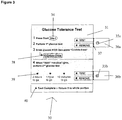
- Figure 3 represents an illustration of a specific device of an embodiment of the invention shown in plan view. This embodiment is closer in principle to the schematic representation in Figure 2 , in that it includes removable sample collection areas, although these are in the form of a strips which are originally fabricated integrally but to be torn off after use, rather than strips which are fabricated separately for attachment.
- the device in this embodiment comprises a laminated cardboard sheet (30).
- the sheet may be folded prior to use, for example for compactness during storage, but is shown in an unfolded configuration.
- the sheet has a water resistant surface layer, and includes basic printed instructions on its face which co-operate with features incorporated into the sheet to assist a user in performing the test protocol correctly.
- the test protocol for this embodiment is a two test protocol, with first and second tests separated by a suitable time interval, the first test performed after fasting, and the second test performed a predetermined time interval after ingestion of a glucose drink.
- the test device includes suitable control electronics, which are not shown in the representation of Figure 3 , but which would for example parallel those in the previous schematic diagrams, and a suitable power source such as a small battery.
- the test device includes a start button (34), for example comprising paired opposing conductors which are brought into contact to close a circuit by depression of the button area, which allows a user to start the test.
- a finger prick blood sample is then applied to a sample receiving area (35a) on a test strip (36a).
- Adjacent to the strip is an "add sample” indicator LED which illuminates at the start of the test, and a “remove” indicator LED, which illuminates at the end of the test, at which point data has been suitably collected, and the whole strip (36a) can be torn away and discarded via the perforation (37).
- the user then consumes a glucose drink, and presses a "confirm drink” button (38), again taking the form of paired opposing conductors which serve to close a switching circuit when the button area is depressed.
- the device in response to either the pressing of the "confirm drink” button or the completion of the first blood test procedure, starts to time the necessary delay period between first and second tests. Progress of this delay period is indicated by successive illumination of LEDs (39), and once the time period has expired an audio alarm (not shown) also sounds.
- the second blood test is performed by applying a blood sample to a sample receiving area (35b) on a second strip (36b). Again, LEDs indicate when the test should be performed, and when the strip can be removed.
- test complete LED (40) illuminates and the main portion of the device (3 1) can be forwarded to allow the data to processed.
- the test strips (36a and 36b) which contain the used blood samples have been removed from the device during the protocol and the device can thus be handled and transported safely in its entirety.
- the device portion (31) could be further subdivided providing a detachable sub-portion containing a data recording chip or the like, and this can be transported.
- other ways of processing the raw data collected by the basic device in accordance with the basic method whether by a user or remotely, can be readily envisaged.
- the test procedure may incorporate the some or all of following actions performed by the present glucose tolerance test device:
- the test procedure may include a step prior to the provision of the present glucose tolerance test device to a user or other person for the purposes of assessing a particular person's glucose tolerance status by performing a glucose tolerance test on said person wherein:
- the information recorded by the present glucose tolerance test device maybe retrieved into a database or other form of computer software system for the purposes of:
- the data may be downloaded to the database in any suitable way, for example by the device facilitating connection by a user to a suitable electronic download means, or by being provided in two parts to allow a data recording part to be physically forwarded to a database manager in the manner above described.
- a device of the invention facilitates performance by a user in a non-clinical environment and with reduced clinical supervision of a simple standard glucose tolerance test protocol, in order to collect raw data concerning glucose tolerance in a simple and effective manner and in a format which is readily available to a supervising practitioner for subsequent analysis, for example as part of a diagnostic process.
- the device enables the data necessary for the clinician to make the diagnosis to be collected in a non-clinical environment, for example at home, minimising inconvenience to the patient, and then to be forwarded simply and effectively for subsequent processing, so that clinical intervention is necessary only in performance of those steps where the expertise of the clinician is particularly required.
- the device can be used within a clinical setting, where the overall test protocol may be supervised by a nurse but where the test device eliminates the requirement for blood samples to be collected and tested or sent for testing by the clinic's personnel, with the test device also administering and controlling the timing of the test protocol and the performing of the blood tests separately for each patient being tested at the clinic.
Landscapes
- Health & Medical Sciences (AREA)
- Life Sciences & Earth Sciences (AREA)
- Physics & Mathematics (AREA)
- Medical Informatics (AREA)
- Surgery (AREA)
- Biophysics (AREA)
- Pathology (AREA)
- Engineering & Computer Science (AREA)
- Biomedical Technology (AREA)
- Heart & Thoracic Surgery (AREA)
- Veterinary Medicine (AREA)
- Molecular Biology (AREA)
- Public Health (AREA)
- Animal Behavior & Ethology (AREA)
- General Health & Medical Sciences (AREA)
- Hematology (AREA)
- Optics & Photonics (AREA)
- Emergency Medicine (AREA)
- Investigating Or Analysing Biological Materials (AREA)
- Measurement Of The Respiration, Hearing Ability, Form, And Blood Characteristics Of Living Organisms (AREA)
- Automatic Analysis And Handling Materials Therefor (AREA)
Claims (15)
- Testdaten-Sammelvorrichtung zum Testen der Glukosetoleranz, umfassend:eine Testzone (18) mit einem Mittel zum Aufnehmen zumindest einer ersten und einer zweiten Bluttestprobe, die in beabstandeten Intervallen genommen wurden;einen Zeitgeber zur Messung eines solchen Zeitintervalls, und zum Beispiel zum Messen der abgelaufenen Zeit nach dem Abnehmen einer ersten Probe;eine Anzeige (15), um zumindest anzuzeigen, dass ein zweiter Test ansteht, wobei die Anzeige mit dem Zeitgeber wirkverbunden ist, um eine solche Anzeige nach dem Ablauf eines vorbestimmten Zeitintervalls zu machen;einen Datensammler, um Daten von der Testzone in Verbindung mit jeder Testprobe zu sammeln;ein Datenregister (12), um Daten in Verbindung mit jeder Testprobe zu speichern, wobei das Datenregister in Datenkommunikation mit dem Datensammler steht;DADURCH GEKENNZEICHNET, DASSdie Testzone dazu geeignet ist, durch Vorsehung einer Vielzahl von integrierten Probenahmebereichen, zumindest zwei Blutproben über zumindest ein vorbestimmtes gegebenes Zeitintervall zur Analyse durch den Datensammler aufzunehmen.
- Testdaten-Sammelvorrichtung nach Anspruch 1, wobei der Probenahmebereich eine Probenahmemulde umfasst, um eine solche Blutprobe während der Durchführung des Tests in situ zu halten, wobei die Mulde in Fluidverbindung mit dem Datensammler steht.
- Vorrichtung nach Anspruch 1 oder Anspruch 2, wobei der Zeitgeber zusätzlich eine erste abgelaufene Zeit zwischen der Durchführung eines Tests, wenn eine erste Probe in den Probenahmebereich platziert wurde, und/oder wenn eine Zeitintervall-Startsteuerung (34) betätigt wird, und der Durchführung eines zweiten Tests, wenn eine zweite Probe in einen Probenahmebereich platziert wird, misst.
- Vorrichtung nach einem der Ansprüche 1 bis 3, umfassend eine vom Benutzer betätigbare Zeitintervall-Startsteuerung (34), um die Messung einer abgelaufenen Zeit einzuleiten.
- Vorrichtung nach einem der vorhergehenden Ansprüche, wobei eine Testzone ein Mittel umfasst, um das Vorliegen einer Probe in einem Probenahmebereich zu erfassen, und damit eine Anzeige und/oder Aufzeichnung zu ermöglichen, wenn ein Test durchgeführt wird.
- Vorrichtung nach einem der vorhergehenden Ansprüche, wobei die Vorrichtung mit einer Datenverbindung mit einem geeigneten Eingabemittel zur Eingabe von Daten in Verbindung mit dem Test versehen ist, bzw. dazu geeignet ist, in Datenverbindung versetzt zu werden.
- Vorrichtung nach einem der vorhergehenden Ansprüche, wobei die Vielzahl von Testzonen (18) eine Vielzahl von abnehmbaren Probenahmemodulen (36), eine für jede zu nehmende Probe, umfasst, die anfänglich als ein integraler Teil der Vorrichtung nach der Erfindung vorgesehen sind, aber dazu geeignet sind, abgetrennt und entsorgt zu werden, sobald eine Probe auf dem Probenahmebereich verarbeitet und Daten davon durch den Datensammler gesammelt wurden.
- Vorrichtung nach einem der vorhergehenden Ansprüche, wobei die Vorrichtung in zwei Teilen vorgesehen ist, die einen Datensammelteil mit zumindest der Testzone und zum Beispiel auch dem Datensammler, sowie einen Aufzeichnungsteil mit zumindest dem Datenregister umfassen, wobei die beiden Teile während der Verwendung in Datenverbindung stehen, der Datenaufzeichnungsteil aber von dem Datensammelteil nach der Verwendung ablösbar ist.
- Vorrichtung nach einem der vorhergehenden Ansprüche, wobei die Vorrichtung, oder gegebenenfalls der Datenaufzeichnungsteil, dazu geeignet ist, das elektronische Herunterladen von gesammelten Daten an eine entfernte Stelle zu erlauben, indem sie ein Datenverbindungsmittel zur Ermöglichung der Verbindung an eine Datennetzwerkstelle, wie etwa einen Ethernetanschluss, einen seriellen oder parallelen Anschluss zur Verbindung mit einem Computer, einen Anschluss zur Verbindung mit einem kabelgebundenen oder drahtlosen Telekommunikationsnetzwerk für das direkte Herunterladen, oder eine beliebige andere geeignete Datenverbindung umfasst.
- Vorrichtung nach einem der vorhergehenden Ansprüche, die so hergestellt ist, dass sie einen im Wesentlichen ebenen Körper aufweist, der aus einem ebenen, bogenförmigen Material hergestellt ist.
- Vorrichtung nach Anspruch 10, die mit beiliegenden Anweisungen versehen ist, die zur Anleitung eines Benutzers zur korrekten Durchführung eines Testprotokolls auf eine Oberfläche des Bogens aufgedruckt sind.
- Glukosetoleranz-Testkit, umfassend eine Vorrichtung nach einem der vorhergehenden Ansprüche, die in Kombination mit einem oder mehreren aus den Folgenden vorgesehen ist:einer standardisierten glykämischen Last;eine oder mehrere Lanzetten, zur Abnahme einer Fingerstichprobe von einem Benutzer, zum Beispiel in Form eines Lanzettenstiftes;zusätzliche Anweisungen zur Durchführung aufeinander folgender Tests in Übereinstimmung mit dem vorbestimmten Protokoll.
- Verwendung einer Vorrichtung nach einem der vorhergehenden Ansprüche zur Durchführung eines Glukosetoleranztests.
- Verfahren zur Sammlung von Daten zur Durchführung eines Glukosetoleranztests, bei dem der Benutzer die folgenden Schritte ausführt:Erhalten einer Testvorrichtung nach einem der Ansprüche 1 bis 11;Fasten für eine angegebene Zeitperiode;Zugeben einer ersten Blutstichprobe, die von dem Benutzer erhalten wurde, in eine Testzone an der Testvorrichtung, um ein erstes Ergebnis zu erhalten;Einnehmen einer standardisierten glykämischen Last;auf die Einnahme der standardisierten glykämischen Last folgend, optional Betätigen einer durch den Benutzer betätigbaren Steuerung zur Anzeige des Beginns des vorbestimmten Zeitintervalls;Abwarten eines vorbestimmten Zeitintervalls vor dem Zugeben einer zweiten Blutstichprobe, die von dem Benutzer nach dem vorbestimmten Zeitintervall erhalten wurde, in eine Testzone an der Testvorrichtung, um ein weiteres Ergebnis zu erhalten.
- Verfahren nach Anspruch 14, umfassend den weiteren Schritt des Lieferns der gesammelten Daten für die endgültige Analyse, indem die Vorrichtung einen ablösbaren Datenaufzeichnungsteil umfasst, und das Verfahren das Ablösen des Datenaufzeichnungsteils und das Weiterleiten desselben zur Analyse der Daten umfasst.
Applications Claiming Priority (2)
| Application Number | Priority Date | Filing Date | Title |
|---|---|---|---|
| GBGB0716427.0A GB0716427D0 (en) | 2007-08-23 | 2007-08-23 | Glucose tolerance test device |
| PCT/GB2008/002853 WO2009024794A1 (en) | 2007-08-23 | 2008-08-22 | Glucose tolerance test device |
Publications (2)
| Publication Number | Publication Date |
|---|---|
| EP2180824A1 EP2180824A1 (de) | 2010-05-05 |
| EP2180824B1 true EP2180824B1 (de) | 2016-05-04 |
Family
ID=38599121
Family Applications (1)
| Application Number | Title | Priority Date | Filing Date |
|---|---|---|---|
| EP08788413.6A Active EP2180824B1 (de) | 2007-08-23 | 2008-08-22 | Testvorrichtung für glucosetoleranz, verfahren und verwendung |
Country Status (7)
| Country | Link |
|---|---|
| US (1) | US8420401B2 (de) |
| EP (1) | EP2180824B1 (de) |
| JP (2) | JP5613051B2 (de) |
| CN (1) | CN101835418B (de) |
| ES (1) | ES2585344T3 (de) |
| GB (1) | GB0716427D0 (de) |
| WO (1) | WO2009024794A1 (de) |
Families Citing this family (27)
| Publication number | Priority date | Publication date | Assignee | Title |
|---|---|---|---|---|
| WO2010101626A1 (en) | 2009-03-02 | 2010-09-10 | Seventh Sense Biosystems, Inc. | Techniques and devices associated with blood sampling |
| US9295417B2 (en) | 2011-04-29 | 2016-03-29 | Seventh Sense Biosystems, Inc. | Systems and methods for collecting fluid from a subject |
| WO2011065972A2 (en) * | 2009-11-24 | 2011-06-03 | Seventh Sense Biosystems, Inc. | Patient-enacted sampling technique |
| US8775095B2 (en) | 2010-06-18 | 2014-07-08 | Roche Diagnostics Operations, Inc. | Methods and apparatus for decentralized diabetes monitoring |
| US20130158482A1 (en) | 2010-07-26 | 2013-06-20 | Seventh Sense Biosystems, Inc. | Rapid delivery and/or receiving of fluids |
| US20120039809A1 (en) | 2010-08-13 | 2012-02-16 | Seventh Sense Biosystems, Inc. | Systems and techniques for monitoring subjects |
| WO2012064802A1 (en) | 2010-11-09 | 2012-05-18 | Seventh Sense Biosystems, Inc. | Systems and interfaces for blood sampling |
| JP2012177677A (ja) * | 2011-02-02 | 2012-09-13 | Arkray Inc | 分析装置 |
| US20130158468A1 (en) | 2011-12-19 | 2013-06-20 | Seventh Sense Biosystems, Inc. | Delivering and/or receiving material with respect to a subject surface |
| JP6121400B2 (ja) | 2011-04-29 | 2017-04-26 | セブンス センス バイオシステムズ,インコーポレーテッド | 流体の送達および/または受け取り |
| EP3236259A1 (de) | 2011-04-29 | 2017-10-25 | Seventh Sense Biosystems, Inc. | Plasma- oder serumherstellung und entfernung von flüssigkeiten bei reduziertem druck |
| US9317653B2 (en) * | 2011-07-22 | 2016-04-19 | Sysmex Corporation | Analyzer, and method for performing a measurement on a sample |
| US10514385B2 (en) | 2011-07-22 | 2019-12-24 | Sysmex Corporation | Hematology analyzer, method, and system for quality control measurements |
| US9297819B2 (en) * | 2011-07-22 | 2016-03-29 | Sysmex Corporation | Hematology analyzing system and analyzer |
| GB2499838A (en) * | 2012-03-02 | 2013-09-04 | Smartsensor Telemed Ltd | Biological test device |
| CN104349717A (zh) * | 2012-06-01 | 2015-02-11 | 赛诺菲-安万特德国有限公司 | 用于引出血液样品的测试构件 |
| USD726320S1 (en) * | 2013-03-05 | 2015-04-07 | Smartsensor Telemed Limited | Glycaemic assessment test device |
| USD726321S1 (en) * | 2013-03-05 | 2015-04-07 | Smartsensor Telemed Limited | Glycaemic assessment test device |
| CN103932681B (zh) * | 2014-04-13 | 2016-05-04 | 曹春杰 | 出血时间监测仪 |
| EP3243434B1 (de) * | 2016-05-13 | 2022-07-20 | Roche Diabetes Care GmbH | Analytmesssysteminitialisierungsverfahren |
| WO2018119663A1 (zh) * | 2016-12-27 | 2018-07-05 | 创新精密仪器有限公司 | 糖尿病检测方法及糖尿病检测系统 |
| EP3704466B1 (de) * | 2017-11-01 | 2023-10-11 | The Board of Trustees of the Leland Stanford Junior University | Analytnachweisverfahren |
| TWI723731B (zh) * | 2019-08-02 | 2021-04-01 | 華廣生技股份有限公司 | 生物感測器之植入裝置及其植入方法 |
| EP3828895A1 (de) * | 2019-11-28 | 2021-06-02 | Radiometer Medical ApS | System und verfahren zur steuerung des timings aufeinanderfolgender biologischer proben |
| CA3179837A1 (en) | 2020-05-22 | 2021-11-25 | Yelena Nabutovsky | Systems, devices, and methods for analyte monitoring and benefits thereof |
| CN116134531A (zh) * | 2020-05-22 | 2023-05-16 | 雅培糖尿病护理公司 | 分析物监测系统、设备和方法 |
| US20230138432A1 (en) * | 2021-11-01 | 2023-05-04 | Lee Tzong Yann | Portable circulatory shock detecting device |
Family Cites Families (12)
| Publication number | Priority date | Publication date | Assignee | Title |
|---|---|---|---|---|
| US4731726A (en) * | 1986-05-19 | 1988-03-15 | Healthware Corporation | Patient-operated glucose monitor and diabetes management system |
| US5837546A (en) * | 1993-08-24 | 1998-11-17 | Metrika, Inc. | Electronic assay device and method |
| JP2849809B2 (ja) * | 1996-04-23 | 1999-01-27 | 株式会社京都第一科学 | 体液成分を測定するとともにその検査データーを保存管理する装置 |
| EP1075286A2 (de) * | 1998-05-06 | 2001-02-14 | Isotechnika, Inc. | 13c glukose-atemtest zur diagnosis von diabetes |
| JP3298008B2 (ja) | 2000-02-09 | 2002-07-02 | オムロン株式会社 | 糖代謝能力判定装置 |
| EP1167971B1 (de) * | 2000-04-17 | 2007-02-07 | Nec Corporation | Verfahren und System zur Bereitstellung eines heimbasierten Gesundheitsdienstes |
| WO2002018936A2 (en) * | 2000-08-28 | 2002-03-07 | Cygnus, Inc. | Methods of monitoring glucose levels in a subject and uses thereof |
| DE20213607U1 (de) * | 2002-02-21 | 2003-07-03 | Paul Hartmann AG, 89522 Heidenheim | Blutanalysegerät zur Bestimmung eines Analyten |
| US20030212379A1 (en) * | 2002-02-26 | 2003-11-13 | Bylund Adam David | Systems and methods for remotely controlling medication infusion and analyte monitoring |
| US20030211617A1 (en) * | 2002-05-07 | 2003-11-13 | International Business Machines Corporation | Blood glucose meter that reminds the user to test after a hypoglycemic event |
| US7258673B2 (en) * | 2003-06-06 | 2007-08-21 | Lifescan, Inc | Devices, systems and methods for extracting bodily fluid and monitoring an analyte therein |
| JP2006071421A (ja) * | 2004-09-01 | 2006-03-16 | Nishitomo Co Ltd | 生体情報測定装置及び血糖値測定装置 |
-
2007
- 2007-08-23 GB GBGB0716427.0A patent/GB0716427D0/en not_active Ceased
-
2008
- 2008-08-22 ES ES08788413.6T patent/ES2585344T3/es active Active
- 2008-08-22 CN CN200880112917.3A patent/CN101835418B/zh active Active
- 2008-08-22 JP JP2010521477A patent/JP5613051B2/ja active Active
- 2008-08-22 WO PCT/GB2008/002853 patent/WO2009024794A1/en not_active Ceased
- 2008-08-22 US US12/733,290 patent/US8420401B2/en active Active
- 2008-08-22 EP EP08788413.6A patent/EP2180824B1/de active Active
-
2013
- 2013-09-19 JP JP2013193938A patent/JP2013250283A/ja active Pending
Also Published As
| Publication number | Publication date |
|---|---|
| JP2013250283A (ja) | 2013-12-12 |
| US8420401B2 (en) | 2013-04-16 |
| GB0716427D0 (en) | 2007-10-03 |
| JP2010537185A (ja) | 2010-12-02 |
| US20100240079A1 (en) | 2010-09-23 |
| EP2180824A1 (de) | 2010-05-05 |
| CN101835418B (zh) | 2016-08-03 |
| CN101835418A (zh) | 2010-09-15 |
| JP5613051B2 (ja) | 2014-10-22 |
| ES2585344T3 (es) | 2016-10-05 |
| WO2009024794A1 (en) | 2009-02-26 |
Similar Documents
| Publication | Publication Date | Title |
|---|---|---|
| EP2180824B1 (de) | Testvorrichtung für glucosetoleranz, verfahren und verwendung | |
| US8917184B2 (en) | Analyte testing method and system | |
| US5443080A (en) | Integrated system for biological fluid constituent analysis | |
| US8673214B2 (en) | Self contained in-vitro diagnostic device | |
| JP3905764B2 (ja) | 小型検査機器及び精度管理チップ | |
| JP2009543041A (ja) | 使い捨て分析装置及び分析方法 | |
| JP2002521665A (ja) | 複合検査モジュールを有する携帯型瞬時応答医療分析器 | |
| JP2012132938A (ja) | 試験システム | |
| CN111902875A (zh) | 血液检查支持装置、血液检查支持系统、血液检查支持方法及程序 | |
| US11169164B2 (en) | System for biological sample collection, examination and reading in quick biochemical tests and data management | |
| JP2013076598A (ja) | 医療機器、エラー情報処理システム及びエラー情報処理プログラム | |
| US11567093B2 (en) | Biological sample reader for biochemical testing | |
| HK1135007A (en) | Analyte testing method and system |
Legal Events
| Date | Code | Title | Description |
|---|---|---|---|
| PUAI | Public reference made under article 153(3) epc to a published international application that has entered the european phase |
Free format text: ORIGINAL CODE: 0009012 |
|
| 17P | Request for examination filed |
Effective date: 20100209 |
|
| AK | Designated contracting states |
Kind code of ref document: A1 Designated state(s): AT BE BG CH CY CZ DE DK EE ES FI FR GB GR HR HU IE IS IT LI LT LU LV MC MT NL NO PL PT RO SE SI SK TR |
|
| AX | Request for extension of the european patent |
Extension state: AL BA MK RS |
|
| 17Q | First examination report despatched |
Effective date: 20100715 |
|
| DAX | Request for extension of the european patent (deleted) | ||
| RAP3 | Party data changed (applicant data changed or rights of an application transferred) |
Owner name: SMARTSENSOR TELEMED LIMITED |
|
| GRAP | Despatch of communication of intention to grant a patent |
Free format text: ORIGINAL CODE: EPIDOSNIGR1 |
|
| INTG | Intention to grant announced |
Effective date: 20151124 |
|
| GRAS | Grant fee paid |
Free format text: ORIGINAL CODE: EPIDOSNIGR3 |
|
| GRAA | (expected) grant |
Free format text: ORIGINAL CODE: 0009210 |
|
| AK | Designated contracting states |
Kind code of ref document: B1 Designated state(s): AT BE BG CH CY CZ DE DK EE ES FI FR GB GR HR HU IE IS IT LI LT LU LV MC MT NL NO PL PT RO SE SI SK TR |
|
| REG | Reference to a national code |
Ref country code: GB Ref legal event code: FG4D |
|
| REG | Reference to a national code |
Ref country code: CH Ref legal event code: EP |
|
| REG | Reference to a national code |
Ref country code: AT Ref legal event code: REF Ref document number: 796133 Country of ref document: AT Kind code of ref document: T Effective date: 20160515 |
|
| REG | Reference to a national code |
Ref country code: IE Ref legal event code: FG4D |
|
| REG | Reference to a national code |
Ref country code: DE Ref legal event code: R096 Ref document number: 602008044044 Country of ref document: DE |
|
| REG | Reference to a national code |
Ref country code: FR Ref legal event code: PLFP Year of fee payment: 9 |
|
| REG | Reference to a national code |
Ref country code: NL Ref legal event code: MP Effective date: 20160504 |
|
| REG | Reference to a national code |
Ref country code: LT Ref legal event code: MG4D |
|
| REG | Reference to a national code |
Ref country code: ES Ref legal event code: FG2A Ref document number: 2585344 Country of ref document: ES Kind code of ref document: T3 Effective date: 20161005 |
|
| PG25 | Lapsed in a contracting state [announced via postgrant information from national office to epo] |
Ref country code: NL Free format text: LAPSE BECAUSE OF FAILURE TO SUBMIT A TRANSLATION OF THE DESCRIPTION OR TO PAY THE FEE WITHIN THE PRESCRIBED TIME-LIMIT Effective date: 20160504 Ref country code: FI Free format text: LAPSE BECAUSE OF FAILURE TO SUBMIT A TRANSLATION OF THE DESCRIPTION OR TO PAY THE FEE WITHIN THE PRESCRIBED TIME-LIMIT Effective date: 20160504 Ref country code: LT Free format text: LAPSE BECAUSE OF FAILURE TO SUBMIT A TRANSLATION OF THE DESCRIPTION OR TO PAY THE FEE WITHIN THE PRESCRIBED TIME-LIMIT Effective date: 20160504 Ref country code: NO Free format text: LAPSE BECAUSE OF FAILURE TO SUBMIT A TRANSLATION OF THE DESCRIPTION OR TO PAY THE FEE WITHIN THE PRESCRIBED TIME-LIMIT Effective date: 20160804 |
|
| REG | Reference to a national code |
Ref country code: AT Ref legal event code: MK05 Ref document number: 796133 Country of ref document: AT Kind code of ref document: T Effective date: 20160504 |
|
| PG25 | Lapsed in a contracting state [announced via postgrant information from national office to epo] |
Ref country code: GR Free format text: LAPSE BECAUSE OF FAILURE TO SUBMIT A TRANSLATION OF THE DESCRIPTION OR TO PAY THE FEE WITHIN THE PRESCRIBED TIME-LIMIT Effective date: 20160805 Ref country code: SE Free format text: LAPSE BECAUSE OF FAILURE TO SUBMIT A TRANSLATION OF THE DESCRIPTION OR TO PAY THE FEE WITHIN THE PRESCRIBED TIME-LIMIT Effective date: 20160504 Ref country code: LV Free format text: LAPSE BECAUSE OF FAILURE TO SUBMIT A TRANSLATION OF THE DESCRIPTION OR TO PAY THE FEE WITHIN THE PRESCRIBED TIME-LIMIT Effective date: 20160504 Ref country code: PT Free format text: LAPSE BECAUSE OF FAILURE TO SUBMIT A TRANSLATION OF THE DESCRIPTION OR TO PAY THE FEE WITHIN THE PRESCRIBED TIME-LIMIT Effective date: 20160905 Ref country code: HR Free format text: LAPSE BECAUSE OF FAILURE TO SUBMIT A TRANSLATION OF THE DESCRIPTION OR TO PAY THE FEE WITHIN THE PRESCRIBED TIME-LIMIT Effective date: 20160504 |
|
| PG25 | Lapsed in a contracting state [announced via postgrant information from national office to epo] |
Ref country code: BE Free format text: LAPSE BECAUSE OF NON-PAYMENT OF DUE FEES Effective date: 20160831 |
|
| PG25 | Lapsed in a contracting state [announced via postgrant information from national office to epo] |
Ref country code: DK Free format text: LAPSE BECAUSE OF FAILURE TO SUBMIT A TRANSLATION OF THE DESCRIPTION OR TO PAY THE FEE WITHIN THE PRESCRIBED TIME-LIMIT Effective date: 20160504 Ref country code: RO Free format text: LAPSE BECAUSE OF FAILURE TO SUBMIT A TRANSLATION OF THE DESCRIPTION OR TO PAY THE FEE WITHIN THE PRESCRIBED TIME-LIMIT Effective date: 20160504 Ref country code: CZ Free format text: LAPSE BECAUSE OF FAILURE TO SUBMIT A TRANSLATION OF THE DESCRIPTION OR TO PAY THE FEE WITHIN THE PRESCRIBED TIME-LIMIT Effective date: 20160504 Ref country code: SK Free format text: LAPSE BECAUSE OF FAILURE TO SUBMIT A TRANSLATION OF THE DESCRIPTION OR TO PAY THE FEE WITHIN THE PRESCRIBED TIME-LIMIT Effective date: 20160504 Ref country code: EE Free format text: LAPSE BECAUSE OF FAILURE TO SUBMIT A TRANSLATION OF THE DESCRIPTION OR TO PAY THE FEE WITHIN THE PRESCRIBED TIME-LIMIT Effective date: 20160504 |
|
| REG | Reference to a national code |
Ref country code: DE Ref legal event code: R097 Ref document number: 602008044044 Country of ref document: DE |
|
| PG25 | Lapsed in a contracting state [announced via postgrant information from national office to epo] |
Ref country code: AT Free format text: LAPSE BECAUSE OF FAILURE TO SUBMIT A TRANSLATION OF THE DESCRIPTION OR TO PAY THE FEE WITHIN THE PRESCRIBED TIME-LIMIT Effective date: 20160504 Ref country code: PL Free format text: LAPSE BECAUSE OF FAILURE TO SUBMIT A TRANSLATION OF THE DESCRIPTION OR TO PAY THE FEE WITHIN THE PRESCRIBED TIME-LIMIT Effective date: 20160504 Ref country code: BE Free format text: LAPSE BECAUSE OF FAILURE TO SUBMIT A TRANSLATION OF THE DESCRIPTION OR TO PAY THE FEE WITHIN THE PRESCRIBED TIME-LIMIT Effective date: 20160504 |
|
| PLBE | No opposition filed within time limit |
Free format text: ORIGINAL CODE: 0009261 |
|
| STAA | Information on the status of an ep patent application or granted ep patent |
Free format text: STATUS: NO OPPOSITION FILED WITHIN TIME LIMIT |
|
| PG25 | Lapsed in a contracting state [announced via postgrant information from national office to epo] |
Ref country code: MC Free format text: LAPSE BECAUSE OF FAILURE TO SUBMIT A TRANSLATION OF THE DESCRIPTION OR TO PAY THE FEE WITHIN THE PRESCRIBED TIME-LIMIT Effective date: 20160504 |
|
| REG | Reference to a national code |
Ref country code: CH Ref legal event code: PL |
|
| 26N | No opposition filed |
Effective date: 20170207 |
|
| PG25 | Lapsed in a contracting state [announced via postgrant information from national office to epo] |
Ref country code: LI Free format text: LAPSE BECAUSE OF NON-PAYMENT OF DUE FEES Effective date: 20160831 Ref country code: CH Free format text: LAPSE BECAUSE OF NON-PAYMENT OF DUE FEES Effective date: 20160831 |
|
| PG25 | Lapsed in a contracting state [announced via postgrant information from national office to epo] |
Ref country code: SI Free format text: LAPSE BECAUSE OF FAILURE TO SUBMIT A TRANSLATION OF THE DESCRIPTION OR TO PAY THE FEE WITHIN THE PRESCRIBED TIME-LIMIT Effective date: 20160504 |
|
| REG | Reference to a national code |
Ref country code: IE Ref legal event code: MM4A |
|
| PG25 | Lapsed in a contracting state [announced via postgrant information from national office to epo] |
Ref country code: IE Free format text: LAPSE BECAUSE OF NON-PAYMENT OF DUE FEES Effective date: 20160822 |
|
| REG | Reference to a national code |
Ref country code: FR Ref legal event code: PLFP Year of fee payment: 10 |
|
| PG25 | Lapsed in a contracting state [announced via postgrant information from national office to epo] |
Ref country code: LU Free format text: LAPSE BECAUSE OF NON-PAYMENT OF DUE FEES Effective date: 20160822 |
|
| PG25 | Lapsed in a contracting state [announced via postgrant information from national office to epo] |
Ref country code: CY Free format text: LAPSE BECAUSE OF FAILURE TO SUBMIT A TRANSLATION OF THE DESCRIPTION OR TO PAY THE FEE WITHIN THE PRESCRIBED TIME-LIMIT Effective date: 20160504 Ref country code: HU Free format text: LAPSE BECAUSE OF FAILURE TO SUBMIT A TRANSLATION OF THE DESCRIPTION OR TO PAY THE FEE WITHIN THE PRESCRIBED TIME-LIMIT; INVALID AB INITIO Effective date: 20080822 |
|
| PG25 | Lapsed in a contracting state [announced via postgrant information from national office to epo] |
Ref country code: TR Free format text: LAPSE BECAUSE OF FAILURE TO SUBMIT A TRANSLATION OF THE DESCRIPTION OR TO PAY THE FEE WITHIN THE PRESCRIBED TIME-LIMIT Effective date: 20160504 Ref country code: MT Free format text: LAPSE BECAUSE OF NON-PAYMENT OF DUE FEES Effective date: 20160831 Ref country code: IS Free format text: LAPSE BECAUSE OF FAILURE TO SUBMIT A TRANSLATION OF THE DESCRIPTION OR TO PAY THE FEE WITHIN THE PRESCRIBED TIME-LIMIT Effective date: 20160504 |
|
| PG25 | Lapsed in a contracting state [announced via postgrant information from national office to epo] |
Ref country code: BG Free format text: LAPSE BECAUSE OF FAILURE TO SUBMIT A TRANSLATION OF THE DESCRIPTION OR TO PAY THE FEE WITHIN THE PRESCRIBED TIME-LIMIT Effective date: 20160504 |
|
| REG | Reference to a national code |
Ref country code: FR Ref legal event code: PLFP Year of fee payment: 11 |
|
| REG | Reference to a national code |
Ref country code: GB Ref legal event code: 732E Free format text: REGISTERED BETWEEN 20200514 AND 20200520 |
|
| REG | Reference to a national code |
Ref country code: DE Ref legal event code: R082 Ref document number: 602008044044 Country of ref document: DE Representative=s name: NOVAGRAAF BREVETS, FR Ref country code: DE Ref legal event code: R081 Ref document number: 602008044044 Country of ref document: DE Owner name: DIGOSTICS LIMITED, GB Free format text: FORMER OWNER: SMARTSENSOR TELEMED LTD., ABINGDON, OXFORDSHIRE, GB |
|
| PGFP | Annual fee paid to national office [announced via postgrant information from national office to epo] |
Ref country code: ES Payment date: 20250917 Year of fee payment: 18 |
|
| PGFP | Annual fee paid to national office [announced via postgrant information from national office to epo] |
Ref country code: DE Payment date: 20250819 Year of fee payment: 18 |
|
| PGFP | Annual fee paid to national office [announced via postgrant information from national office to epo] |
Ref country code: IT Payment date: 20250829 Year of fee payment: 18 |
|
| PGFP | Annual fee paid to national office [announced via postgrant information from national office to epo] |
Ref country code: GB Payment date: 20250825 Year of fee payment: 18 |
|
| PGFP | Annual fee paid to national office [announced via postgrant information from national office to epo] |
Ref country code: FR Payment date: 20250821 Year of fee payment: 18 |