EP2181120B1 - Allergene aus aspergillus versicolor und verfahren zum nachweis einer innenraumbedingten schimmelpilzallergie - Google Patents
Allergene aus aspergillus versicolor und verfahren zum nachweis einer innenraumbedingten schimmelpilzallergie Download PDFInfo
- Publication number
- EP2181120B1 EP2181120B1 EP08774700.2A EP08774700A EP2181120B1 EP 2181120 B1 EP2181120 B1 EP 2181120B1 EP 08774700 A EP08774700 A EP 08774700A EP 2181120 B1 EP2181120 B1 EP 2181120B1
- Authority
- EP
- European Patent Office
- Prior art keywords
- versicolor
- allergens
- allergen
- aspergillus
- detection
- Prior art date
- Legal status (The legal status is an assumption and is not a legal conclusion. Google has not performed a legal analysis and makes no representation as to the accuracy of the status listed.)
- Not-in-force
Links
- 239000013566 allergen Substances 0.000 title claims description 66
- 241000203233 Aspergillus versicolor Species 0.000 title claims description 56
- 206010020751 Hypersensitivity Diseases 0.000 title claims description 20
- 230000007815 allergy Effects 0.000 title claims description 19
- 208000026935 allergic disease Diseases 0.000 title claims description 16
- 238000000034 method Methods 0.000 title claims description 16
- 238000001514 detection method Methods 0.000 claims description 16
- 102000006602 glyceraldehyde-3-phosphate dehydrogenase Human genes 0.000 claims description 15
- 108020004445 glyceraldehyde-3-phosphate dehydrogenase Proteins 0.000 claims description 15
- 239000008194 pharmaceutical composition Substances 0.000 claims description 7
- 210000002966 serum Anatomy 0.000 claims description 6
- 238000000338 in vitro Methods 0.000 claims description 5
- 238000002965 ELISA Methods 0.000 claims description 4
- 102000004190 Enzymes Human genes 0.000 claims description 4
- 108090000790 Enzymes Proteins 0.000 claims description 4
- 210000001124 body fluid Anatomy 0.000 claims description 4
- 239000010839 body fluid Substances 0.000 claims description 4
- 239000003550 marker Substances 0.000 claims description 4
- 210000004369 blood Anatomy 0.000 claims description 2
- 239000008280 blood Substances 0.000 claims description 2
- 210000001175 cerebrospinal fluid Anatomy 0.000 claims description 2
- 238000000586 desensitisation Methods 0.000 claims description 2
- 210000002381 plasma Anatomy 0.000 claims description 2
- 238000003127 radioimmunoassay Methods 0.000 claims description 2
- 210000003296 saliva Anatomy 0.000 claims description 2
- 210000002700 urine Anatomy 0.000 claims description 2
- 238000003018 immunoassay Methods 0.000 claims 1
- 229960004784 allergens Drugs 0.000 description 36
- 108090000623 proteins and genes Proteins 0.000 description 32
- 102000004169 proteins and genes Human genes 0.000 description 28
- 241001225321 Aspergillus fumigatus Species 0.000 description 18
- 150000007523 nucleic acids Chemical class 0.000 description 18
- 108020004707 nucleic acids Proteins 0.000 description 14
- 102000039446 nucleic acids Human genes 0.000 description 14
- 125000003275 alpha amino acid group Chemical group 0.000 description 12
- 229940091771 aspergillus fumigatus Drugs 0.000 description 12
- 241001123663 Penicillium expansum Species 0.000 description 8
- 206010070834 Sensitisation Diseases 0.000 description 8
- 230000008313 sensitization Effects 0.000 description 8
- 210000004027 cell Anatomy 0.000 description 7
- 244000005700 microbiome Species 0.000 description 7
- 230000004044 response Effects 0.000 description 7
- 238000012744 immunostaining Methods 0.000 description 6
- 241000233866 Fungi Species 0.000 description 5
- 108091028043 Nucleic acid sequence Proteins 0.000 description 4
- 238000003745 diagnosis Methods 0.000 description 4
- 238000004519 manufacturing process Methods 0.000 description 4
- 108091023037 Aptamer Proteins 0.000 description 3
- 102000016938 Catalase Human genes 0.000 description 3
- 108010053835 Catalase Proteins 0.000 description 3
- FBPFZTCFMRRESA-FSIIMWSLSA-N D-Glucitol Natural products OC[C@H](O)[C@H](O)[C@@H](O)[C@H](O)CO FBPFZTCFMRRESA-FSIIMWSLSA-N 0.000 description 3
- 108020004414 DNA Proteins 0.000 description 3
- 102000013460 Malate Dehydrogenase Human genes 0.000 description 3
- 108010026217 Malate Dehydrogenase Proteins 0.000 description 3
- CTQNGGLPUBDAKN-UHFFFAOYSA-N O-Xylene Chemical compound CC1=CC=CC=C1C CTQNGGLPUBDAKN-UHFFFAOYSA-N 0.000 description 3
- 102000004316 Oxidoreductases Human genes 0.000 description 3
- 108090000854 Oxidoreductases Proteins 0.000 description 3
- 102000012288 Phosphopyruvate Hydratase Human genes 0.000 description 3
- 108010022181 Phosphopyruvate Hydratase Proteins 0.000 description 3
- 238000006243 chemical reaction Methods 0.000 description 3
- 239000003814 drug Substances 0.000 description 3
- 239000000284 extract Substances 0.000 description 3
- 239000000499 gel Substances 0.000 description 3
- 239000000600 sorbitol Substances 0.000 description 3
- 241000894007 species Species 0.000 description 3
- 239000008096 xylene Substances 0.000 description 3
- 102000002260 Alkaline Phosphatase Human genes 0.000 description 2
- 108020004774 Alkaline Phosphatase Proteins 0.000 description 2
- 241000228212 Aspergillus Species 0.000 description 2
- 206010003645 Atopy Diseases 0.000 description 2
- 102000004142 Trypsin Human genes 0.000 description 2
- 108090000631 Trypsin Proteins 0.000 description 2
- 239000002671 adjuvant Substances 0.000 description 2
- 230000000172 allergic effect Effects 0.000 description 2
- 208000010668 atopic eczema Diseases 0.000 description 2
- 230000007613 environmental effect Effects 0.000 description 2
- 230000014509 gene expression Effects 0.000 description 2
- 230000036541 health Effects 0.000 description 2
- 230000001900 immune effect Effects 0.000 description 2
- 238000004949 mass spectrometry Methods 0.000 description 2
- 238000000746 purification Methods 0.000 description 2
- 230000009257 reactivity Effects 0.000 description 2
- 239000000523 sample Substances 0.000 description 2
- 239000007790 solid phase Substances 0.000 description 2
- 208000024891 symptom Diseases 0.000 description 2
- 230000009466 transformation Effects 0.000 description 2
- 239000012588 trypsin Substances 0.000 description 2
- 108010011170 Ala-Trp-Arg-His-Pro-Gln-Phe-Gly-Gly Proteins 0.000 description 1
- 101150054111 Aspg gene Proteins 0.000 description 1
- 238000009007 Diagnostic Kit Methods 0.000 description 1
- 206010052804 Drug tolerance Diseases 0.000 description 1
- 241000588724 Escherichia coli Species 0.000 description 1
- 206010051841 Exposure to allergen Diseases 0.000 description 1
- 102000002464 Galactosidases Human genes 0.000 description 1
- 108010093031 Galactosidases Proteins 0.000 description 1
- 206010061598 Immunodeficiency Diseases 0.000 description 1
- 241000235058 Komagataella pastoris Species 0.000 description 1
- 208000031888 Mycoses Diseases 0.000 description 1
- 102000003992 Peroxidases Human genes 0.000 description 1
- 108010090804 Streptavidin Proteins 0.000 description 1
- 239000013543 active substance Substances 0.000 description 1
- 229940074608 allergen extract Drugs 0.000 description 1
- 230000002009 allergenic effect Effects 0.000 description 1
- 230000003321 amplification Effects 0.000 description 1
- 238000004458 analytical method Methods 0.000 description 1
- 239000000427 antigen Substances 0.000 description 1
- 108091007433 antigens Proteins 0.000 description 1
- 102000036639 antigens Human genes 0.000 description 1
- 239000007864 aqueous solution Substances 0.000 description 1
- 238000003556 assay Methods 0.000 description 1
- 230000015572 biosynthetic process Effects 0.000 description 1
- 239000000969 carrier Substances 0.000 description 1
- 238000012512 characterization method Methods 0.000 description 1
- 238000004587 chromatography analysis Methods 0.000 description 1
- 238000010367 cloning Methods 0.000 description 1
- 238000010276 construction Methods 0.000 description 1
- 230000008878 coupling Effects 0.000 description 1
- 238000010168 coupling process Methods 0.000 description 1
- 238000005859 coupling reaction Methods 0.000 description 1
- 229940079593 drug Drugs 0.000 description 1
- 239000000428 dust Substances 0.000 description 1
- 238000001952 enzyme assay Methods 0.000 description 1
- 238000009472 formulation Methods 0.000 description 1
- 239000012634 fragment Substances 0.000 description 1
- 230000002068 genetic effect Effects 0.000 description 1
- 238000010353 genetic engineering Methods 0.000 description 1
- 230000026781 habituation Effects 0.000 description 1
- 230000006872 improvement Effects 0.000 description 1
- 239000003978 infusion fluid Substances 0.000 description 1
- 238000002347 injection Methods 0.000 description 1
- 239000007924 injection Substances 0.000 description 1
- 239000000203 mixture Substances 0.000 description 1
- 238000003199 nucleic acid amplification method Methods 0.000 description 1
- 230000002018 overexpression Effects 0.000 description 1
- 230000001717 pathogenic effect Effects 0.000 description 1
- 239000013610 patient sample Substances 0.000 description 1
- 238000002360 preparation method Methods 0.000 description 1
- 230000003449 preventive effect Effects 0.000 description 1
- 230000008569 process Effects 0.000 description 1
- 108090000765 processed proteins & peptides Proteins 0.000 description 1
- 230000000241 respiratory effect Effects 0.000 description 1
- 210000002345 respiratory system Anatomy 0.000 description 1
- 239000000126 substance Substances 0.000 description 1
- 239000000758 substrate Substances 0.000 description 1
- 239000000725 suspension Substances 0.000 description 1
- 230000001225 therapeutic effect Effects 0.000 description 1
- 238000002560 therapeutic procedure Methods 0.000 description 1
- 239000003053 toxin Substances 0.000 description 1
- 231100000765 toxin Toxicity 0.000 description 1
- 108700012359 toxins Proteins 0.000 description 1
- 238000001890 transfection Methods 0.000 description 1
- 238000000539 two dimensional gel electrophoresis Methods 0.000 description 1
- 238000009423 ventilation Methods 0.000 description 1
- 230000036642 wellbeing Effects 0.000 description 1
- 238000001262 western blot Methods 0.000 description 1
Images

Classifications
-
- A—HUMAN NECESSITIES
- A61—MEDICAL OR VETERINARY SCIENCE; HYGIENE
- A61K—PREPARATIONS FOR MEDICAL, DENTAL OR TOILETRY PURPOSES
- A61K39/00—Medicinal preparations containing antigens or antibodies
- A61K39/35—Allergens
-
- A—HUMAN NECESSITIES
- A61—MEDICAL OR VETERINARY SCIENCE; HYGIENE
- A61P—SPECIFIC THERAPEUTIC ACTIVITY OF CHEMICAL COMPOUNDS OR MEDICINAL PREPARATIONS
- A61P37/00—Drugs for immunological or allergic disorders
- A61P37/02—Immunomodulators
- A61P37/04—Immunostimulants
-
- A—HUMAN NECESSITIES
- A61—MEDICAL OR VETERINARY SCIENCE; HYGIENE
- A61P—SPECIFIC THERAPEUTIC ACTIVITY OF CHEMICAL COMPOUNDS OR MEDICINAL PREPARATIONS
- A61P37/00—Drugs for immunological or allergic disorders
- A61P37/08—Antiallergic agents
-
- C—CHEMISTRY; METALLURGY
- C07—ORGANIC CHEMISTRY
- C07K—PEPTIDES
- C07K14/00—Peptides having more than 20 amino acids; Gastrins; Somatostatins; Melanotropins; Derivatives thereof
- C07K14/37—Peptides having more than 20 amino acids; Gastrins; Somatostatins; Melanotropins; Derivatives thereof from fungi
- C07K14/38—Peptides having more than 20 amino acids; Gastrins; Somatostatins; Melanotropins; Derivatives thereof from fungi from Aspergillus
Definitions
- the invention relates to seven allergens of Aspergillus versicolor , which are suitable for specific diagnostics and for the sensitization to this mainly indoor polluting mold.
- the invention also provides an immunological method for detecting a sensitization to A. versicolor , in particular an allergy, in which one or more of said seven allergens found are used as diagnostic markers.
- the invention further relates to a pharmaceutical composition containing one or more of these seven allergens as an active substance and the use of one or more of these seven allergens for desensitizing to A. versicolor .
- the allergens are proteins that are found in the spores of the molds and mainly via the respiratory tract in the human Organism get where they can cause respiratory problems and discomfort.
- the burden of mold can be demonstrated on the one hand by the examination of visible mold or by the determination of the spore concentration in air or dust samples.
- Various studies have shown that besides the highly pathogenic A. fumigatus Aspergillus versicolor often occurs indoors.
- a possible sensitization of the patients against molds is determined in the prick test or by the determination of specific IgE.
- the known diagnostic kits that are currently marketed cover a relatively wide range of food and environmental molds, but not the most interiorly relevant species.
- the invention relates to the objects described in the claims.
- the invention relates to glyceraldehyde-3-phosphate dehydrogenase (GAPDH) having a molecular weight of 36,389 daltons, an isoelectric point of 6.97 as the allergen of Aspergillus versicolor.
- GPDH glyceraldehyde-3-phosphate dehydrogenase
- Preferred proteins are selected from the group comprising a glyceraldehyde-3-phosphate dehydrogenase (GAPDH; Asp a, b, c) having the amino acid sequence SEQ ID NO. 1 or parts thereof, as far as these parts are not identical with parts of the amino acid sequence of the GAPDH of Aspergillus fumigatus, a hypothetical xylene / sorbitol reductase having the amino acid sequence SEQ ID NO.
- GPDH glyceraldehyde-3-phosphate dehydrogenase
- the proteins with SEQ ID no. 1 and SEQ ID No.3 have sequence identity to their Aspergillus fumigatus homologs of 83% and 82%, respectively.
- allergens of Aspergillus versicolor selected from the group comprising a glyceraldehyde-3-phosphate dehydrogenase (GAPDH, allergen designation Asp a, b, c) having the amino acid sequence SEQ ID NO. 1 or parts thereof, as far as these parts are not identical with parts of the amino acid sequence of the GAPDH of Aspergillus fumigatus, and a hypothetical xylene / sorbitol reductase (protein AO090012000287, allergen name Asp d) having the amino acid sequence SEQ ID NO.
- GAPDH glyceraldehyde-3-phosphate dehydrogenase
- allergens of Aspergillus versicolor encompasses not only those allergy genes which are isolated or recovered directly from A. versicolor, whose spores or parts or homogenates thereof are isolated, but also synthetic or genetically engineered allergens according to the invention.
- the protein and allergen of the present invention are particularly suitable for use as diagnostic markers for the in vitro detection of mold allergy to A. versicolor, as a drug and for desensitization to A. versicolor.
- Nucleic acids are also disclosed which contain at least one nucleic acid sequence which codes for an allergen according to the invention.
- Preferred nucleic acids contain a sequence selected from the nucleic acid sequence having the SEQ ID no. 2, which for the allergen with the SEQ ID no. 1, and from the nucleic acid sequence having SEQ ID NO. 4, which for the allergen with the SEQ ID no. 3 coded.
- Revealed nucleic acids can be natural or artificial nucleic acids. They may consist of or contain DNA or RNA or derivatives thereof.
- Disclosed nucleic acids also include nucleic acids that carry a nucleic acid sequence encoding one of the allergens and include additional sequence segments that permit genetic engineering of the nucleic acid into a cell or into a microorganism, e.g. a suitable vector system.
- a suitable vector system e.g. a suitable vector system.
- the person skilled in the art is familiar with suitable vector systems as well as techniques for producing and cloning disclosed nucleic acids.
- the allergens or genetically modified cells or microorganisms thus produced are particularly suitable for the further uses according to the invention.
- Another object of the invention is an immunological method for the in vitro detection of a mold allergy to A. versicolor, which is characterized in that the allergen is used to in a body fluid sample A. versicolor specific IgE and / or IgG antibodies by Detect binding to this specific allergen.
- the detection according to the invention of the specific IgE and / or IgG antibodies takes place in an enzyme or radioimmunoassay, wherein in an assay according to the invention preferably antibodies or aptamers or derivatives thereof are used for the detection.
- the solid-phase technique of the ELISA is particularly preferably used.
- the allergen according to the invention is bound to a solid phase, incubated with the patient samples containing the specific IgE and / or IgG antibodies to be detected, and the binding via enzyme- or fluorescence-labeled secondary antibodies or secondary aptamers against the antibodies of the patient (anti-IgE and / or anti-IgG antibodies).
- a detection system can, for.
- the enzymes peroxidase, alkaline phosphatase or galactosidase and the corresponding substrates serve.
- the body fluid sample can be blood, serum, plasma, urine, cerebrospinal fluid or saliva, in particular serum samples are used.
- the disclosed allergens against A. versicolor have hitherto been recovered and identified by separating the spore proteins of A. versicolor by one- and two-dimensional electrophoresis, blotting, and detecting with the IgE antibodies contained in the patient's serum.
- the allergens were excised from the 2D gels and trypsin digested and identified by mass spectrometry.
- the allergens are purified by means of chromatographic methods from spore extracts. Overexpression of the genes to be sequenced in E. coli or Pichia pastoris (or other expression systems) and coupling to Taqs such as His tag or Strep tag during expression facilitates the purification and production of larger amounts of the allergens.
- the allergen according to claim 1 is particularly preferably used in the process according to the invention.
- the present invention furthermore relates to the use of the allergen according to the invention as claimed in claim 1 as a diagnostic marker for the in vitro detection of A. versicolor mold allergy.
- the invention also relates to a pharmaceutical composition
- a pharmaceutical composition comprising as active component at least one allergen according to the invention.
- the pharmaceutical composition is used for desensitizing against A. versicolor .
- the pharmaceutical composition contains conventional adjuvants, in particular carriers and / or adjuvants.
- the pharmaceutical composition of the invention is preferably provided as an injection or infusion solution, e.g. B. as an aqueous solution or aqueous or oily suspension.
- the active component (s) are contained in the pharmaceutical composition in a therapeutic or preventive amount, preferably in an amount of 0.05 to 80% by weight, based on the total weight of the formulation.
- the allergen of the present invention for the manufacture of a medicament for desensitizing to A. versicolor.
- the disclosed genetically-altered cells and microorganisms are used for the preparation of a medicament for desensitizing for A. versicolor.
- the allergen according to the invention can be used.
- patients allergic to proteins of Aspergillus versicolor are brought into contact with low doses of the allergen of the invention.
- habituation to this low dose exposure leads to a decrease in allergy symptoms to renewed contact with A. versicolor or its spores.
- proteins which are selected from the group comprising a glyceraldehyde-3-phosphate dehydrogenase (GAPDH; Asp a, b, c) having the amino acid sequence SEQ ID NO. 1 or parts thereof, as far as these parts are not identical with parts of the amino acid sequence of the GAPDH of Aspergillus fumigatus, a hypothetical xylene / sorbitol reductase having the amino acid sequence SEQ ID NO.
- GPDH glyceraldehyde-3-phosphate dehydrogenase
- a prerequisite for the identification of allergens and the detection of sensitization of patients is the presence of specific IgE in sera directed against proteins of A. versicolor . Reactivity is detected on blotmembranes loaded with electrophoretically separated A. versicolor proteins. A band or a spot is detected in the subsequent immunostaining by means of secondary anti-IgE antibody (coupled with alkaline phosphatase) and stands in each case for an allergenic protein.
- secondary anti-IgE antibody coupled with alkaline phosphatase
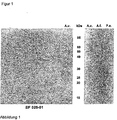
- illustration 1 shows 2D and 1D immunostaining of a patient that specifically responds to A. versicolor spore proteins.
- the border marks the protein spots most frequently detected in 2D immunostaining.
- A. V. Aspergillus versicolor
- A.f. Aspergillus fumigatus
- P.e. Penicillium expansum
- Figure 2 Figure 9 is a sectional view showing the reactivity of the patient sera to the spore proteins of the molds A. versicolor, A. fumigatus and P. expansum in 1D immunostaining, the numbers corresponding to the number of reactive sera.
- the detection of allergens through the mediation of patient-specific IgE antibodies is here the means for finding the allergens and at the same time the "proof of principle" for a detection method of the sensitization of these patients based on the patient's own IgE antibodies. Initially, this can also be detected with the Western Blot method described here, but can also be converted to the ELISA format. But even in the ELISA format, the primary detection of the allergen by the patient's own IgE antibodies.
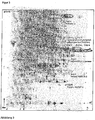
- Figure 3 shows the proteins of A. versicolor separated in a 2D gel by isoelectric point and molecular weight.
- Table 1 summarizes the characterization of the allergens found.
- Table 1 Table 1
Landscapes
- Health & Medical Sciences (AREA)
- Life Sciences & Earth Sciences (AREA)
- Chemical & Material Sciences (AREA)
- Immunology (AREA)
- Medicinal Chemistry (AREA)
- Organic Chemistry (AREA)
- General Health & Medical Sciences (AREA)
- Veterinary Medicine (AREA)
- Mycology (AREA)
- Pharmacology & Pharmacy (AREA)
- Animal Behavior & Ethology (AREA)
- Public Health (AREA)
- Engineering & Computer Science (AREA)
- Biochemistry (AREA)
- Epidemiology (AREA)
- Bioinformatics & Cheminformatics (AREA)
- Chemical Kinetics & Catalysis (AREA)
- General Chemical & Material Sciences (AREA)
- Nuclear Medicine, Radiotherapy & Molecular Imaging (AREA)
- Microbiology (AREA)
- Gastroenterology & Hepatology (AREA)
- Proteomics, Peptides & Aminoacids (AREA)
- Biophysics (AREA)
- Genetics & Genomics (AREA)
- Molecular Biology (AREA)
- Pulmonology (AREA)
- Peptides Or Proteins (AREA)
- Measuring Or Testing Involving Enzymes Or Micro-Organisms (AREA)
- Medicines Containing Antibodies Or Antigens For Use As Internal Diagnostic Agents (AREA)
Description
- Die Erfindung betrifft sieben Allergene von Aspergillus versicolor, die zur spezifischen Diagnostik und für die Sensibilisierung gegen diesen hauptsächlich Innenräume belastenden Schimmelpilz geeignet sind. Gegenstand der Erfindung ist auch ein immunologisches Verfahren zum Nachweis einer Sensibilisierung gegen A. versicolor, insbesondere einer Allergie, bei dem eines oder mehrere der genannten sieben gefundenen Allergene als diagnostische Marker eingesetzt werden. Die Erfindung betrifft weiterhin eine pharmazeutische Zusammensetzung, die eines oder mehrere dieser sieben Allergene als aktive Substanz enthält und die Verwendung eines oder mehrerer dieser sieben Allergene zur Desensibilisierung gegen A. versicolor.
- In der heutigen Zeit wird die Gesundheit der Menschen immer mehr von Allergien beeinträchtigt. Auslöser allergischer Reaktionen können sowohl natürliche als auch künstliche Stoffe sein. Bei der Entstehung einer Allergie spielt neben der genetischen Disposition auch der sogenannte Lebensstil eine bedeutende Rolle. In den modernen Industrienationen verbringt der Mensch einen großen Teil seiner Zeit in Wohn- und Arbeitsräumen, wobei die Qualität der Innenraumluft einen wichtigen Faktor für dessen gesundheitliches Wohlbefinden darstellt. Bei fehlerhafter Bauweise und ungenügender Belüftung können sich in Innenräumen Schimmelpilze ansiedeln. Diese können die Gesundheit der Bewohner direkt beeinträchtigen, denn das Schimmelpilzwachstum führt zur Freisetzung von Schimmelpilzsporen, die in der Innenraumluft hohe Konzentration erreichen können. Neben Mykosen bei immungeschwächten Patienten oder Mykotoxikosen durch Schimmelpilztoxine werden durch die Schimmelpilze aber auch Allergien ausgelöst. Wahrscheinlich sind mehr als 5 % der deutschen Bevölkerung von einer Schimmelpilzallergie betroffen.
- Als Allergene wirken dabei Proteine, die sich in den Sporen der Schimmelpilze befinden und hauptsächlich über den Atmungstrakt in den menschlichen Organismus gelangen, wo sie Atemwegsbeschwerden und Befindlichkeitsstörungen hervorrufen können. Der häufige Aufenthalt in Innenräumen und die dadurch verstärkte Exposition mit Allergenen, besonderes in der kalten Jahreszeit, begünstigt die Ausbildung einer Schimmelpilzallergie. Die Belastung durch Schimmelpilze kann einerseits durch die Untersuchung von sichtbarem Schimmel oder durch die Bestimmung der Sporenkonzentration in Luft- oder Staubproben nachgewiesen werden. Verschiedene Studien zeigten dabei, dass außer dem hochpathogenen A. fumigatus häufig Aspergillus versicolor in Innenräumen auftritt. Eine mögliche Sensibilisierung der Patienten gegen Schimmelpilze wird im Pricktest oder durch die Bestimmung spezifischer IgE bestimmt. Die bekannten diagnostischen Kits, die gegenwärtig vertrieben werden, erfassen ein relativ großes Spektrum von nahrungs- und umweltspezifischen Schimmelpilzen, nur gerade nicht die besonders innenraumrelevanten Arten.
- Trotz des häufigen Auftretens von A. versicolor in Innenräumen ist nichts über seine Allergene bekannt und es existieren keine spezifischen Tests zum Nachweis einer Allergie gegen A. versicolor. In der anerkannten Allergendatenbank Allergome (www.allergome.org) sind bisher keine Allergene von A. versicolor hinterlegt. Es war bislang in der Fachwelt nicht bekannt, dass A. versicolor überhaupt Proteine aufweist, die sich als Allergene eignen. Im Gegenteil, Sing et al. berichtet z.B. , dass keines der Seren von 19 Personen, die in einer Bäckerei arbeiteten, keines der Seren von 53 atopischen Patienten und keines der Seren von 15 gesunden Kontrollprobanden mit einer Proteinfraktion von A. versicolor spezifisch reagierte, während solche Reaktionen für die anderen untersuchten Aspergillus Spezies nachweisbar waren, insbesondere für A. fumigatus (Singh et al., Sensitization to different species of Aspergillus in bakery workers and general atopic population, Asian Pacific Journal of Allergy and Immunology (1998) 16, 5-15). Es wurde daher bislang davon ausgegangen, dass A. versicolor keine geeigneten Allergene aufweist, die spezifisch sind für diese Spezies und für eine Diagnostik oder Sensibilisierung nutzbar wären. Nach allgemeiner Auffassung eignete sich A. versicolor nicht für die Suche nach neuen Allergenen.
- Es wurden nun drei Hauptallergene und vier weitere Allergene von A. versicolor gefunden, die sich in den Sporen befinden und die überraschenderweise für keinen anderen Schimmelpilz als Allergene bekannt sind. Somit werden sie bisher auch nicht bei der Allergietestung auf Aspergillus fumigatus erfasst. Mit den sieben offenbarten Markerantigenen von Aspergillus versicolor ist nun eine spezifische Diagnostik von A. versicolor und damit eine deutliche Verbesserung der Diagnostik von Allergien gegen innenraumrelevante Schimmelpilze möglich.
- Die Erfindung betrifft die in den Ansprüchen beschriebenen Gegenstände. Insbesondere betrifft die Erfindung Glyceraldehyd-3-phosphat-dehydrogenase (GAPDH) mit einem Molekulargewicht von 36.389 Dalton, einem isoelektrischen Punkt von 6,97 als Allergen von Aspergillus versicolor.
- Offenbart sind die sieben gefunden Proteine gemäß Tabelle 1, und
Abbildung 3 . Bevorzugte Proteine sind ausgewählt aus der Gruppe umfassend eine Glyceraldehyd-3-phosphat-dehydrogenase (GAPDH; Asp a, b, c) mit der Aminosäuresequenz SEQ ID No. 1 oder Teilen davon, soweit diese Teile nicht identisch sind mit Teilen der Aminosäuresequenz der GAPDH von Aspergillus fumigatus, eine hypothetische Xylol/Sorbitol Reduktase mit der Aminosäuresequenz SEQ ID No. 3 oder Teilen davon, soweit diese Teile nicht identisch sind mit Teilen der Aminosäuresequenz des entsprechenden Proteins von Aspergillus fumigatus mit der "genebank accession number" gi/71002394/ref/XP_755878.1, eine Katalase A mit einem Molekulargewicht von 84.108 Dalton und einem isoelektrischen Punkt von 6,02 (Asp e), ein Protein mit einem Molekulargewicht von 26.713 Dalton und einem isoelektrischen Punkt von 6,53 (,Asp f), eine Enolase mit einem Molekulargewicht von 47.519 Dalton und einem isoelektrischen Punkt von 5,37 (Asp g), ein Protein mit einem Molekulargewicht von 22.007 Dalton und einem isoelektrischen Punkt von 5,85 (Asp h), eine Malatdehydrogenase mit einem Molekulargewicht von 35.764 Dalton und einem isoelektrischen Punkt von 8,82 (Asp i). - Die Proteine mit der SEQ ID No. 1 und SEQ ID No.3 weisen eine Sequenzidentität zu ihren Homologen aus Aspergillus fumigatus von jeweils 83% bzw. 82% auf.
- Besonders bevorzugt sind Allergene von Aspergillus versicolor ausgewählt aus der Gruppe umfassend eine Glyceraldehyd-3-phosphat-dehydrogenase (GAPDH; Allergenbezeichnung Asp a, b, c) mit der Aminosäuresequenz SEQ ID No. 1 oder Teilen davon, soweit diese Teile nicht identisch sind mit Teilen der Aminosäuresequenz der GAPDH von Aspergillus fumigatus, und eine hypothetische Xylol/Sorbitol Reduktase (Protein AO090012000287; Allergenbezeichnung Asp d) mit der Aminosäuresequenz SEQ ID No. 3 oder Teilen davon, soweit diese Teile nicht identisch sind mit Teilen der Aminosäuresequenz des entsprechenden Proteins von Aspergillus fumigatus mit der genebank accession number gi/71002394/ref/XP_755878.1.
- Der Begriff "Allergene von Aspergillus versicolor" umfasst im Sinne der vorliegenden Erfindung nicht nur solche Alllergene die direkt aus A. versicolor, dessen Sporen oder Teilen bzw. Homogenisaten davon isoliert oder gewonnen werden, sondern auch synthetisch oder gentechnisch hergestellte erfindungsgemäße Allergene.
- Das erfindungsgemäße Protein und Allergen eignet sich besonders zur Verwendung als diagnostische Marker zum in-vitro-Nachweis einer Schimmelpilzallergie gegen A. versicolor, als Medikament und zur Desensibilisierung gegen A. versicolor.
- Offenbart sind auch Nukleinsäuren, die mindestens eine Nukleinsäuresequenz enthalten, die für ein erfindungsgemäßes Allergen kodiert. Bevorzugte Nukleinsäuren enthalten eine Sequenz ausgewählt aus der Nukleinsäuresequenz mit der SEQ ID No. 2, die für das Allergen mit der SEQ ID No. 1 kodiert, und aus der Nukleinsäuresequenz mit der SEQ ID No. 4, die für das Allergen mit der SEQ ID No. 3 kodiert. Offenbarte Nukleinsäuren können natürliche oder künstliche Nukleinsäuren sein. Sie können aus DNA oder RNA oder Derivaten davon bestehen oder diese enthalten.
- Offenbarte Nukleinsäuren umfassen auch Nukleinsäuren, die eine Nukleinsäuresequenz kodierend für eines der Allergene tragen und weitere Sequenzabschnitte beinhalten, die eine gentechnische Verbringung der Nukleinsäure in eine Zelle oder in einen Mikroorganismus erlauben, wie z.B. ein geeignetes Vektorsystem. Dem Fachmann sind geeignete Vektorsysteme sowie Techniken zur Herstellung und Klonierung offenbarter Nukleinsäuren bekannt.
- Offenbart ist auch ein Verfahren zur Herstellung eines oder mehrerer der Allergene. In einem bevorzugten Verfahren kommen offenbarte Nukleinsäuren zum Einsatz. Nukleinsäuren, die für ein erfindungsgemäßes Allergen kodieren, können z.B. in ein geeignetes Vektorsystem kloniert werden, welches dann dazu verwendet wird, eine geeignete Zelle oder einen geeigneten Mikroorganismus zu transfizieren bzw. zu transformieren. Die so hergestellten genetisch veränderten Zellen oder Mikroorganismen exprimieren dann das gewünschte Allergen. Ggf. kann dieses Allergen nachfolgend isoliert und/oder gereinigt werden. Ein besonders bevorzugtes Verfahren zur Herstellung eines oder mehrerer Allergene umfasst die Schritte:
- a) Einsatz einer offenbarten Nukleinsäure,
- b) Transformation eines Mikroorgansimus oder Transfektion einer Zelle mit einer Nukleinsäure enthaltend eine erfindungsgemäße Nukleinsäure, und
- c) ggf. Reinigung des hergestellten Allergens.
- Die so hergestellten Allergene oder genetisch veränderten Zellen oder Mikroorganismen eignen sich besonders für die weiteren erfindungsgemäßen Verwendungen.
- Offenbart sind genetisch veränderte Zellen oder Mikroorganismen enthaltend mindestens eine offenbarte Nukleinsäure.
- Weiterer Gegenstand der Erfindung ist ein immunologisches Verfahren zum in-vitro-Nachweis einer Schimmelpilzallergie gegen A. versicolor, das dadurch gekennzeichnet ist, dass das gefundene Allergen eingesetzt wird, um in einer Körperflüssigkeitsprobe A. versicolor spezifische IgE- und/oder IgG-Antikörper durch Bindung an dieses spezifische Allergen nachzuweisen. Vorzugsweise erfolgt der erfindungsgemäße Nachweis der spezifischen IgE- und/oder IgG-Antikörper in einem Enzym- oder Radioimmunoassay, wobei in einem erfindungsgemäßen Assay bevorzugt Antikörper oder Aptamere bzw. Derivate davon zum Nachweis verwendet werden.
- Besonders bevorzugt wird die Festphasentechnik des ELISA angewendet. Dazu wird das erfindungsgemäße Allergen an eine feste Phase gebunden, mit den Patientenproben, die die nachzuweisenden spezifischen IgE- und/oder IgG-Antikörper enthalten, inkubiert und die Bindung über enzym- oder fluoreszenzmarkierte Sekundärantikörper oder Sekundäraptamer gegen die Antikörper des Patienten (Anti-IgE- und/oder Anti-IgG-Antikörper) nachgewiesen. Als Detektionssystem können z. B. die Enzyme Peroxidase, alkalische Phosphatase oder Galactosidase und die entsprechenden Substrate dienen.
- Selbstverständlich ist auch die Möglichkeit der Signalverstärkung über die Bindung mehrerer Sekundärantikörper oder Sekundäraptamere an die IgE/IgG-Primärantikörper gegeben. Auch ermöglicht die Verwendung von Streptavidin und biotinyliertem Marker-Enzym die Verknüpfung einer größeren Zahl Enzymmoleküle mit einem Antikörpermolekül.
- Erfindungsgemäß kann es sich bei der Körperflüssigkeitsprobe um Blut, Serum, Plasma, Urin, Cerebrospinalflüssigkeit oder Saliva handeln, insbesondere werden Serumproben eingesetzt.
- Die offenbarten Allergene gegen A. versicolor wurden bisher gewonnen und identifiziert, indem die Sporenproteine von A. versicolor durch ein- und zweidimensionale Elektrophorese aufgetrennt, geblottet worden und mit den im Patientenserum enthaltenen IgE-Antikörpern detektiert wurden. Die offenbarten Allergene wurden aus den 2D-Gelen ausgeschnitten und tryptisch verdaut und mittels Massenspektrometrie identifiziert. Für ihre Anwendung in Diagnostik und Therapie werden die Allergene mittels chromatographischer Methoden aus Sporenextrakten gereinigt. Die Überexpression der zu sequenzierenden Gene in E. coli oder Pichia pastoris (oder anderen Expressionsystemen) und die Kopplung an Taqs wie His-Tag oder Strep-Tag während der Expression erleichtert die Reinigung und Herstellung größerer Mengen der Allergene.
- Besonders bevorzugt kommt in den erfindungsgemäßen Verfahren das Allergen gemäß Anspruch 1 zum Einsatz.
- Gegenstand der vor vorliegenden Erfindung ist des Weiteren die Verwendung des erfindungsgemäßen Allergens gemäß Anspruch 1 als diagnostischer Marker zum in-vitro-Nachweis einer Schimmelpilzallergie gegen A. versicolor.
- Die Erfindung betrifft auch eine pharmazeutische Zusammensetzung, die als aktive Komponente mindestens ein erfindungsgemäßes Allergen umfasst. Die pharmazeutische Zusammensetzung wird zur Desensibilisierung gegen A. versicolor angewendet. Neben der/den aktiven Komponente/n enthält die pharmazeutische Zusammensetzung konventionelle Hilfsstoffe, insbesondere Träger und/oder Adjuvantien. Die pharmazeutische Zusammensetzung der Erfindung wird vorzugsweise als Injektions- oder Infusionslösung bereitgestellt, z. B. als wässrige Lösung oder wässrige oder ölige Suspension. Die aktive(n) Komponente(n) sind in der pharmazeutischen Zusammensetzung in therapeutischer oder präventiver Menge enthalten, vorzugsweise in einer Menge von 0,05 bis 80 Gew.%, bezogen auf das Gesamtgewicht der Formulierung.
- Offenbart ist auch die Verwendung des erfindungsgemäßen Allergens zur Herstellung eines Arzneimittels zur Desensibilisierung gegen A. versicolor. Auch die offenbarten genetisch veränderten Zellen und Mikroorganismen werden verwendet zur Herstellung eines Arzneimittels zur Desensibilisierung gegen A. versicolor.
- Im Rahmen von Desensibilisierungsmaßnahmen kann das erfindungsgemäße Allergen verwendet werden. Bei diesem Verfahren werden Patienten, die allergisch auf Proteine aus Aspergillus versicolor reagieren mit niedrigen Dosen des erfindungsgemäßen Allergens in Kontakt gebracht. Bei diesem Verfahren führt die Gewöhnung an diese niedrig dosierte Exposition zu einer Abnahme der Allergiesymptome gegenüber einem erneuten Kontakt mit A. versicolor oder dessen Sporen.
- In einem bevorzugten Verfahren zur Desensibilisierung gegen A. versicolor, werden Proteine eingesetzt, die ausgewählt sind aus der Gruppe umfassend eine Glyceraldehyd-3-phosphat-dehydrogenase (GAPDH; Asp a, b, c) mit der Aminosäuresequenz SEQ ID No. 1 oder Teilen davon, soweit diese Teile nicht identisch sind mit Teilen der Aminosäuresequenz der GAPDH von Aspergillus fumigatus, eine hypothetische Xylol/Sorbitol Reduktase mit der Aminosäuresequenz SEQ ID No. 3 oder Teilen davon, soweit diese Teile nicht identisch sind mit Teilen der Aminosäuresequenz des entsprechenden Proteins von Aspergillus fumigatus mit der genebank accession number gi/71002394/ref/XP_755878.1, eine Katalase A mit einem Molekulargewicht von 84.108 Dalton und einem isoelektrischen Punkt von 6,02 (Asp e), ein Protein mit einem Molekulargewicht von 26.713 Dalton und einem isoelektrischen Punkt von 6,53 (,Asp f), eine Enolase mit einem Molekulargewicht von 47.519 Dalton und einem isoelektrischen Punkt von 5,37 (Asp g), ein Protein mit einem Molekulargewicht von 22.007 Dalton und einem isoelektrischen Punkt von 5,85 (Asp h), eine Malatdehydrogenase mit einem Molekulargewicht von 35.764 Dalton und einem isoelektrischen Punkt von 8,82 (Asp i).
- Nachfolgend soll die Erfindung an Ausführungsbeispielen näher erläutert werden, ohne sie darauf einzuschränken.
- Voraussetzung für die Identifizierung von Allergenen und den Nachweis einer Sensibilisierung der Patienten ist das Vorhandensein spezifischer IgE in Seren, die gegen Proteine von A. versicolor gerichtet sind. Der Nachweis der Reaktivität erfolgt auf Blotmembranen, die mit elektrophoretisch getrennten Proteinen von A. versicolor beladen sind. Eine Bande bzw. ein Spot wird in der nachfolgenden Immunfärbung mittels sekundärer anti-IgE-Antikörper (gekoppelt mit alkalischer Phosphatase) nachgewiesen und steht dabei jeweils für ein allergenes Protein.
-
Abbildung 1 zeigt 2D- und 1 D- Immunfärbung eines Patienten, der spezifisch auf Sporenproteine von A. versicolor reagiert. Die Umrandung markiert die Proteinspots, welche in der 2D- Immunfärbung am häufigsten detektiert wurden. - A.v. = Aspergillus versicolor, A.f. = Aspergillus fumigatus, P.e. = Penicilium expansum
- Die initiale Analyse von Patientenseren mit der 1D-Immunfärbung zeigte bei 47 Patienten von 100, die sich wegen allgemeiner allergischer Symptome in Behandlung begeben hatten, eine positive Reaktion auf die Allergenextrakte der Schimmelpilze A. versicolor, A. fumigatus oder P. expansum. Auffällig war, dass nicht ein Patientenserum exklusiv auf A. fumigatus oder P. expansum reagierte (siehe
Abbildung 2 ). Jedoch befanden sich unter den 47 positiven Patientenseren 31 Seren, die auf alle Schimmelextrakte reagierten, während 8 Seren nur auf A. versicolor eine Reaktion zeigten. Diese Daten belegen, dass mit einem Test basierend auf Extrakten von A. fumigatus oder auf P. expansum nicht automatisch eine Sensibilisierung gegenüber A. versicolor erfasst wird. -
Abbildung 2 zeigt ein Schnittmengendiagramm zur Darstellung der Reaktivität der Patientenseren auf die Sporenproteine der Schimmelpilze A. versicolor, A. fumigatus und P. expansum in der 1D- Immunfärbung, wobei die Zahlen der Anzahl der reaktiven Seren entsprechen. Alleinige Reaktion auf Aspergillus versicolor (8, weiß), alleinige Reaktion auf Aspergillus fumigatus (0, schraffiert), alleinige Reaktion auf Penicilium expansum (0, Netz), Reaktion auf Penicilium expansum und Aspergillus fumigatus (1), Reaktion auf Aspergillus versicolor und Penicilium expansum (1), Reaktion auf Aspergillus versicolor und Aspergillus fumigatus (7), Reaktion auf alle drei Schimmelpilze (31), Gesamtzahl der Patienten (100, grau) - Der Nachweis von Allergenen durch die Vermittlung von patienteneigenen IgE Antikörpern ist hier das Mittel zum Auffinden der Allergene und gleichzeitig der "proof of principle" für eine auf den patienteneigenen IgE Antikörpern beruhende Nachweismethode der Sensibilisierung dieser Patienten. Zunächst kann diese auch mit den hier beschriebenen Western-Blot-Verfahren nachgewiesen werden, kann aber auch auf das ELISA-Format umgestellt werden. Aber auch im ELISA-Format erfolgt die primäre Erkennung des Allergens durch die patienteneigenen IgE-Antikörper.
- Diese gewonnenen Daten ermöglichten außerdem die Identifizierung von Allergenen aus Sporen von A. versicolor. Zur Identifizierung wurden erkannte Allergene aus 2D-Gelen ausgeschnitten, tryptisch verdaut und die Peptidmassen sowie ihre Fragmentmassen mittels Massenspektrometrie gemessen (siehe
Abbildung 3 , vgl. Tab. 1). Die drei erfindungsgemäßen Hauptallergene wurden bei über 70 % der analysierten Patienten gefunden und zeigten die stärkste Reaktionsintensität in der 2D-Immunfärbung. Die vier weiteren Allergene wurden ebenfalls bei mehr als 50 % der Patienten gefunden. -
Abbildung 3 zeigt die Proteine von A. versicolor getrennt in einem 2D- Gel nach isoelektrischem Punkt und Molekulargewicht. Tabelle 1 fasst die Charakterisierung der gefundenen Allergene zusammen.
Tabelle 1Tabelle 1 Allergenbezeichnung Allergenname Isolektrischer Punkt Molekulargewicht (Dalton) Asp a, b, c Glyceraldehyd-3-phosphatdehydrogenase (GAPDH) 6,97 36.389 Asp d Protein AO090012000287 6,11 28.784 Asp e Katalase A 6,02 84.108 Asp f Protein AN6918.2 6,53 26.713 Aspg Enolase 5,37 47.519 Asp h Protein AN0297.2 5,85 22.007 Asp i Malatdehydrogenase 8,82 35.764 -
- <110> Helmholtz-Zentrum für Umweltforschung GmbH - UFZ
- <120> Allergene aus Aspergillus versicolor und Verfahren zum Nachweis einer innenraumbedingten Schimmelpilzallergie
- <130> P483907PC
- <150>
DE 10 2007 031 947.0
<151> 2007-07-06 - <160> 4
- <170> PatentIn version 3.3
- <210> 1
<211> 336
<212> PRT
<213> Aspergillus versicolor - <400> 1


- <210> 2
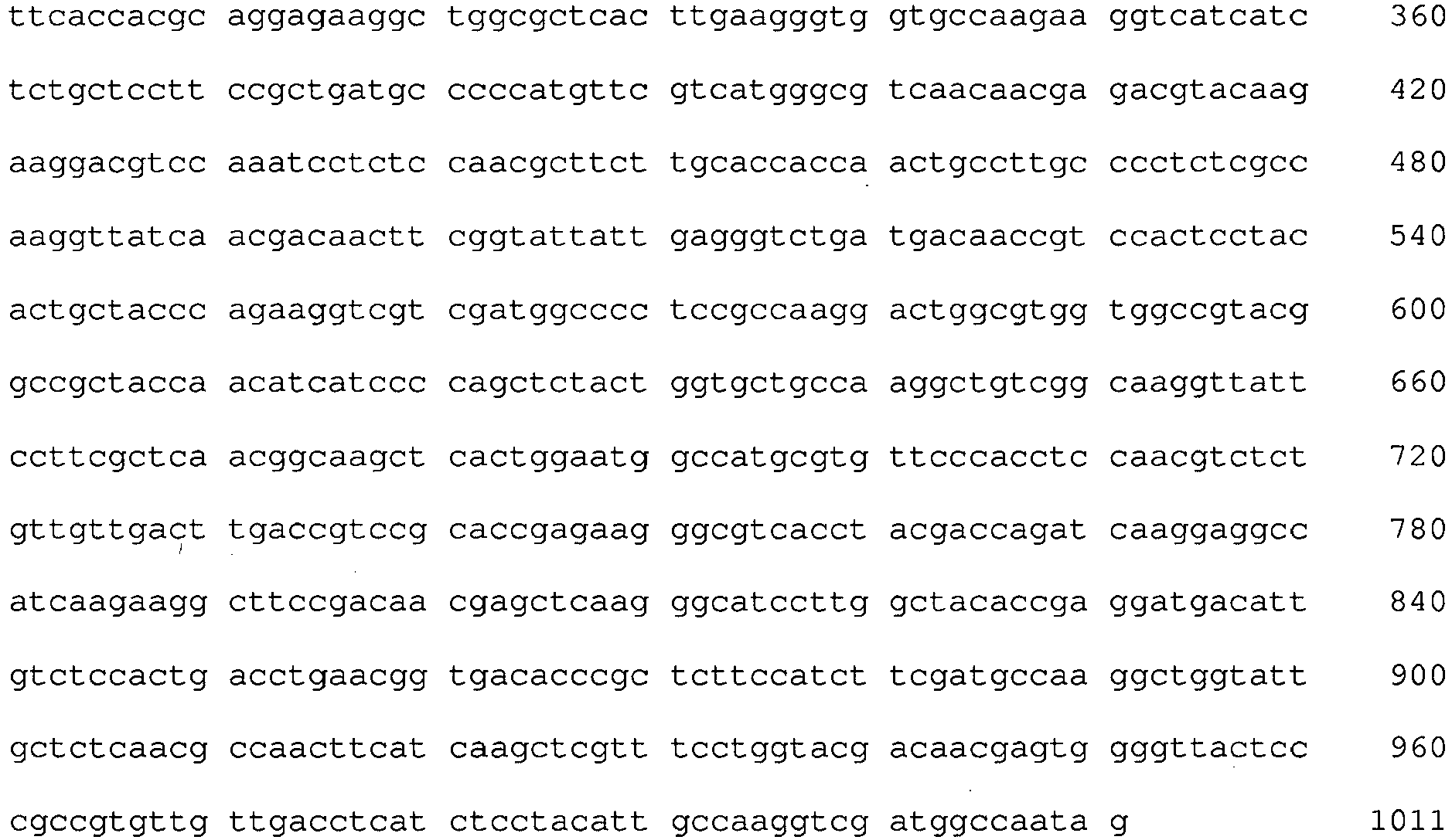
<211> 1011
<212> DNA
<213> Aspergillus versicolor - <400> 2

- <210> 3
<211> 266
<212> PRT
<213> Aspergillus versicolor - <400> 3


- <210> 4
<211> 801
<212> DNA
<213> Aspergillus versicolor - <400> 4


Claims (8)
- Glyceraldehyd-3-phosphat-dehydrogenase (GAPDH) mit einem Molekulargewicht von 36.389 Dalton, einem isoelektrischen Punkt von 6,97 als Allergen von Aspergillus versicolor.
- Verfahren zum in-vitro-Nachweis einer Schimmelpilzallergie gegen Aspergillus versicolor, dadurch gekennzeichnet, dass in einer Körperflüssigkeitsprobe A. versicolor spezifische IgE- und/oder IgG-Antikörper durch Bindung an das spezifische Allergen von A. versicolor nach Anspruch 1 nachgewiesen werden.
- Verfahren gemäß Anspruch 2, dadurch gekennzeichnet, dass der Nachweis in einem Enzymimmunoassay oder Radioimmunoassay erfolgt.
- Verfahren gemäß Anspruch 2 oder 3, dadurch gekennzeichnet, dass der Nachweis in einem ELISA erfolgt.
- Verfahren gemäß einem der Ansprüche 2 bis 4, dadurch gekennzeichnet, dass die Körperflüssigkeit Blut, Serum, Plasma, Urin, Cerebrospinalflüssigkeit oder Saliva ist, vorzugsweise Serum.
- Verwendung des Allergens nach Anspruch 1 als diagnostische Marker zum in-vitro-Nachweis einer Schimmelpilzallergie gegen A. versicolor.
- Pharmazeutische Zusammensetzungen umfassend als aktive Komponente das Allergen nach Anspruch 1.
- Allergen nach Anspruch 1 zur Verwendung in der Desensibilisierung gegen A. versicolor.
Applications Claiming Priority (2)
| Application Number | Priority Date | Filing Date | Title |
|---|---|---|---|
| DE102007031947A DE102007031947A1 (de) | 2007-07-06 | 2007-07-06 | Allergene aus Aspergillus versicolor und Verfahren zum Nachweis einer innenraumbedingten Schimmelpilzallergie |
| PCT/EP2008/058581 WO2009007298A2 (de) | 2007-07-06 | 2008-07-03 | Allergene aus aspergillus versicolor und verfahren zum nachweis einer innenraumbedingten schimmelpilzallergie |
Publications (2)
| Publication Number | Publication Date |
|---|---|
| EP2181120A2 EP2181120A2 (de) | 2010-05-05 |
| EP2181120B1 true EP2181120B1 (de) | 2016-03-30 |
Family
ID=39769468
Family Applications (1)
| Application Number | Title | Priority Date | Filing Date |
|---|---|---|---|
| EP08774700.2A Not-in-force EP2181120B1 (de) | 2007-07-06 | 2008-07-03 | Allergene aus aspergillus versicolor und verfahren zum nachweis einer innenraumbedingten schimmelpilzallergie |
Country Status (4)
| Country | Link |
|---|---|
| US (1) | US8394383B2 (de) |
| EP (1) | EP2181120B1 (de) |
| DE (1) | DE102007031947A1 (de) |
| WO (1) | WO2009007298A2 (de) |
Family Cites Families (5)
| Publication number | Priority date | Publication date | Assignee | Title |
|---|---|---|---|---|
| DE69934233T2 (de) * | 1999-12-02 | 2007-10-25 | Council Of Scientific & Industrial Research | Aspergillus Fumigatus Peptidsequenzen zur Diagnose von Aspergillose |
| JP2007535897A (ja) * | 2003-06-10 | 2007-12-13 | エース バイオサイエンシズ エー/エス | 細胞外コウジカビポリペプチド |
| US7259255B2 (en) | 2003-06-25 | 2007-08-21 | E. I. Du Pont De Nemours And Company | Glyceraldehyde-3-phosphate dehydrogenase and phosphoglycerate mutase promoters for gene expression in oleaginous yeast |
| US20100105081A1 (en) * | 2004-08-12 | 2010-04-29 | Mayo Medical Ventures | Detecting fungi in human samples |
| CA2599640A1 (en) * | 2005-03-18 | 2006-09-21 | Dsm Ip Assets B.V. | Improved method of expression cloning in a host cell |
-
2007
- 2007-07-06 DE DE102007031947A patent/DE102007031947A1/de not_active Withdrawn
-
2008
- 2008-07-03 WO PCT/EP2008/058581 patent/WO2009007298A2/de not_active Ceased
- 2008-07-03 US US12/667,902 patent/US8394383B2/en not_active Expired - Fee Related
- 2008-07-03 EP EP08774700.2A patent/EP2181120B1/de not_active Not-in-force
Also Published As
| Publication number | Publication date |
|---|---|
| DE102007031947A1 (de) | 2009-01-08 |
| WO2009007298A3 (de) | 2009-05-07 |
| US20110052638A1 (en) | 2011-03-03 |
| WO2009007298A2 (de) | 2009-01-15 |
| EP2181120A2 (de) | 2010-05-05 |
| US8394383B2 (en) | 2013-03-12 |
Similar Documents
| Publication | Publication Date | Title |
|---|---|---|
| EP1399476A1 (de) | Verwendung löslicher cytokeratin-1-fragmente in diagnostik und therapie | |
| WO2003048780A2 (de) | Verwendungen der aldose-1-epimerase für die diagnose und therapie von entzündungserkrangungen und sepsis | |
| DE10119804A1 (de) | Entzündungsspezifische Peptide und deren Verwendungen | |
| DE102005029845B4 (de) | Verfahren zur Diagnose von rheumatischen Erkrankungen | |
| WO2010034514A2 (de) | Cfhr1 als inhibitor der c5 konvertase zur behandlung von autoimmunerkrankungen | |
| EP2149051B1 (de) | Verfahren und immunabsorbentien zur spezifischen detektion und absorption zöliakie- und dermatitis herpetiformis assoziierter antikörper | |
| EP1191100A2 (de) | Rekombinante Allergene aus der Dörrobstmotte Plodia interpunctella | |
| EP3088414A1 (de) | Verbesserter nachweis von nussallergien | |
| WO2009007298A2 (de) | Allergene aus aspergillus versicolor und verfahren zum nachweis einer innenraumbedingten schimmelpilzallergie | |
| WO1999014231A2 (de) | Bifidogene peptide und deren verwendung | |
| EP3149485B1 (de) | Verfahren zur diagnose einer durch den alternativen weg des komplementsystems vermittelten krankheit oder eines risikos hierfür | |
| EP1478662B2 (de) | Verfahren zur herstellung von hypoallergenem birkenpollenhauptallergen rbet v 1 | |
| EP2392591B1 (de) | DNA-Sequenz und rekombinante Herstellung des Graspollen-Allergens Phl p 4 | |
| DE69427508T2 (de) | Endothelin konvertierendes Enzym bestehend aus Apolipoprotein B | |
| EP2272863B1 (de) | Poa p 5-Derivate mit reduzierter Allergenität und erhaltener T-Zellrealktivität | |
| WO2000017232A2 (de) | Regulatorisches protein aus humanen keratinozyten | |
| DE102004024674A1 (de) | Mittel und Verfahren zur Diagnose, Prophylaxe und Therapie von Bindegewebserkrankungen | |
| EP1495115B1 (de) | Nucleinsäuresequenz und protein sowie polypeptide kodierend für mannit-dehydrogenasen oder deren teile sowie deren herstellung und verwendung in diagnostik und therapie | |
| DE69932815T2 (de) | Cyclophilin als Allergen identifiziert | |
| EP1556488B1 (de) | Humanes chondroosteomodulin (tig2), herstellung und verwendung zur behandlung oder diagnose von knochen- und knorpelerkrankungen, fettsucht sowie entzündlichen erkrankungen und hauterkrankungen | |
| AT501996B1 (de) | Verfahren zur herstellung von humanem somatotropin | |
| DE4445562C1 (de) | Klonierung, Expression und Charakterisierung einer neuen Form der Phosphatidylinositol-3-Kinase | |
| DE19856301C1 (de) | Regulatorisches Protein pKe#83 aus humanen Keratinozyten | |
| DE19754815C2 (de) | Verfahren zur Herstellung von Komplexen aus Leptin und alpha2-Makroglobulin und zur Bestimmung von Leptin-alpha2-Makroglobulin-Komplexen in menschlichen, tierischen und anderen biologischen Flüssigkeiten | |
| EP1004668B1 (de) | Regulatorisches Protein pKe 83 aus humanen Keratinozyten |
Legal Events
| Date | Code | Title | Description |
|---|---|---|---|
| PUAI | Public reference made under article 153(3) epc to a published international application that has entered the european phase |
Free format text: ORIGINAL CODE: 0009012 |
|
| 17P | Request for examination filed |
Effective date: 20100126 |
|
| AK | Designated contracting states |
Kind code of ref document: A2 Designated state(s): AT BE BG CH CY CZ DE DK EE ES FI FR GB GR HR HU IE IS IT LI LT LU LV MC MT NL NO PL PT RO SE SI SK TR |
|
| AX | Request for extension of the european patent |
Extension state: AL BA MK RS |
|
| 17Q | First examination report despatched |
Effective date: 20100525 |
|
| DAX | Request for extension of the european patent (deleted) | ||
| GRAP | Despatch of communication of intention to grant a patent |
Free format text: ORIGINAL CODE: EPIDOSNIGR1 |
|
| INTG | Intention to grant announced |
Effective date: 20151102 |
|
| GRAS | Grant fee paid |
Free format text: ORIGINAL CODE: EPIDOSNIGR3 |
|
| GRAA | (expected) grant |
Free format text: ORIGINAL CODE: 0009210 |
|
| AK | Designated contracting states |
Kind code of ref document: B1 Designated state(s): AT BE BG CH CY CZ DE DK EE ES FI FR GB GR HR HU IE IS IT LI LT LU LV MC MT NL NO PL PT RO SE SI SK TR |
|
| REG | Reference to a national code |
Ref country code: GB Ref legal event code: FG4D Free format text: NOT ENGLISH |
|
| REG | Reference to a national code |
Ref country code: CH Ref legal event code: EP |
|
| REG | Reference to a national code |
Ref country code: AT Ref legal event code: REF Ref document number: 785304 Country of ref document: AT Kind code of ref document: T Effective date: 20160415 |
|
| REG | Reference to a national code |
Ref country code: IE Ref legal event code: FG4D Free format text: LANGUAGE OF EP DOCUMENT: GERMAN |
|
| REG | Reference to a national code |
Ref country code: CH Ref legal event code: NV Representative=s name: ISLER AND PEDRAZZINI AG, CH |
|
| REG | Reference to a national code |
Ref country code: DE Ref legal event code: R096 Ref document number: 502008014018 Country of ref document: DE |
|
| REG | Reference to a national code |
Ref country code: LT Ref legal event code: MG4D |
|
| PG25 | Lapsed in a contracting state [announced via postgrant information from national office to epo] |
Ref country code: NO Free format text: LAPSE BECAUSE OF FAILURE TO SUBMIT A TRANSLATION OF THE DESCRIPTION OR TO PAY THE FEE WITHIN THE PRESCRIBED TIME-LIMIT Effective date: 20160630 Ref country code: GR Free format text: LAPSE BECAUSE OF FAILURE TO SUBMIT A TRANSLATION OF THE DESCRIPTION OR TO PAY THE FEE WITHIN THE PRESCRIBED TIME-LIMIT Effective date: 20160701 Ref country code: FI Free format text: LAPSE BECAUSE OF FAILURE TO SUBMIT A TRANSLATION OF THE DESCRIPTION OR TO PAY THE FEE WITHIN THE PRESCRIBED TIME-LIMIT Effective date: 20160330 Ref country code: HR Free format text: LAPSE BECAUSE OF FAILURE TO SUBMIT A TRANSLATION OF THE DESCRIPTION OR TO PAY THE FEE WITHIN THE PRESCRIBED TIME-LIMIT Effective date: 20160330 |
|
| REG | Reference to a national code |
Ref country code: NL Ref legal event code: MP Effective date: 20160330 |
|
| PG25 | Lapsed in a contracting state [announced via postgrant information from national office to epo] |
Ref country code: LT Free format text: LAPSE BECAUSE OF FAILURE TO SUBMIT A TRANSLATION OF THE DESCRIPTION OR TO PAY THE FEE WITHIN THE PRESCRIBED TIME-LIMIT Effective date: 20160330 Ref country code: SE Free format text: LAPSE BECAUSE OF FAILURE TO SUBMIT A TRANSLATION OF THE DESCRIPTION OR TO PAY THE FEE WITHIN THE PRESCRIBED TIME-LIMIT Effective date: 20160330 Ref country code: LV Free format text: LAPSE BECAUSE OF FAILURE TO SUBMIT A TRANSLATION OF THE DESCRIPTION OR TO PAY THE FEE WITHIN THE PRESCRIBED TIME-LIMIT Effective date: 20160330 |
|
| PG25 | Lapsed in a contracting state [announced via postgrant information from national office to epo] |
Ref country code: NL Free format text: LAPSE BECAUSE OF FAILURE TO SUBMIT A TRANSLATION OF THE DESCRIPTION OR TO PAY THE FEE WITHIN THE PRESCRIBED TIME-LIMIT Effective date: 20160330 |
|
| PG25 | Lapsed in a contracting state [announced via postgrant information from national office to epo] |
Ref country code: IS Free format text: LAPSE BECAUSE OF FAILURE TO SUBMIT A TRANSLATION OF THE DESCRIPTION OR TO PAY THE FEE WITHIN THE PRESCRIBED TIME-LIMIT Effective date: 20160730 Ref country code: PL Free format text: LAPSE BECAUSE OF FAILURE TO SUBMIT A TRANSLATION OF THE DESCRIPTION OR TO PAY THE FEE WITHIN THE PRESCRIBED TIME-LIMIT Effective date: 20160330 Ref country code: EE Free format text: LAPSE BECAUSE OF FAILURE TO SUBMIT A TRANSLATION OF THE DESCRIPTION OR TO PAY THE FEE WITHIN THE PRESCRIBED TIME-LIMIT Effective date: 20160330 |
|
| PGFP | Annual fee paid to national office [announced via postgrant information from national office to epo] |
Ref country code: CH Payment date: 20160726 Year of fee payment: 9 Ref country code: DE Payment date: 20160727 Year of fee payment: 9 |
|
| PG25 | Lapsed in a contracting state [announced via postgrant information from national office to epo] |
Ref country code: SK Free format text: LAPSE BECAUSE OF FAILURE TO SUBMIT A TRANSLATION OF THE DESCRIPTION OR TO PAY THE FEE WITHIN THE PRESCRIBED TIME-LIMIT Effective date: 20160330 Ref country code: CZ Free format text: LAPSE BECAUSE OF FAILURE TO SUBMIT A TRANSLATION OF THE DESCRIPTION OR TO PAY THE FEE WITHIN THE PRESCRIBED TIME-LIMIT Effective date: 20160330 Ref country code: RO Free format text: LAPSE BECAUSE OF FAILURE TO SUBMIT A TRANSLATION OF THE DESCRIPTION OR TO PAY THE FEE WITHIN THE PRESCRIBED TIME-LIMIT Effective date: 20160330 Ref country code: ES Free format text: LAPSE BECAUSE OF FAILURE TO SUBMIT A TRANSLATION OF THE DESCRIPTION OR TO PAY THE FEE WITHIN THE PRESCRIBED TIME-LIMIT Effective date: 20160330 Ref country code: PT Free format text: LAPSE BECAUSE OF FAILURE TO SUBMIT A TRANSLATION OF THE DESCRIPTION OR TO PAY THE FEE WITHIN THE PRESCRIBED TIME-LIMIT Effective date: 20160801 |
|
| PGFP | Annual fee paid to national office [announced via postgrant information from national office to epo] |
Ref country code: AT Payment date: 20160720 Year of fee payment: 9 |
|
| PG25 | Lapsed in a contracting state [announced via postgrant information from national office to epo] |
Ref country code: BE Free format text: LAPSE BECAUSE OF NON-PAYMENT OF DUE FEES Effective date: 20160731 Ref country code: IT Free format text: LAPSE BECAUSE OF FAILURE TO SUBMIT A TRANSLATION OF THE DESCRIPTION OR TO PAY THE FEE WITHIN THE PRESCRIBED TIME-LIMIT Effective date: 20160330 |
|
| REG | Reference to a national code |
Ref country code: DE Ref legal event code: R097 Ref document number: 502008014018 Country of ref document: DE |
|
| PG25 | Lapsed in a contracting state [announced via postgrant information from national office to epo] |
Ref country code: DK Free format text: LAPSE BECAUSE OF FAILURE TO SUBMIT A TRANSLATION OF THE DESCRIPTION OR TO PAY THE FEE WITHIN THE PRESCRIBED TIME-LIMIT Effective date: 20160330 |
|
| PLBE | No opposition filed within time limit |
Free format text: ORIGINAL CODE: 0009261 |
|
| STAA | Information on the status of an ep patent application or granted ep patent |
Free format text: STATUS: NO OPPOSITION FILED WITHIN TIME LIMIT |
|
| 26N | No opposition filed |
Effective date: 20170103 |
|
| GBPC | Gb: european patent ceased through non-payment of renewal fee |
Effective date: 20160703 |
|
| PG25 | Lapsed in a contracting state [announced via postgrant information from national office to epo] |
Ref country code: MC Free format text: LAPSE BECAUSE OF FAILURE TO SUBMIT A TRANSLATION OF THE DESCRIPTION OR TO PAY THE FEE WITHIN THE PRESCRIBED TIME-LIMIT Effective date: 20160330 |
|
| PG25 | Lapsed in a contracting state [announced via postgrant information from national office to epo] |
Ref country code: FR Free format text: LAPSE BECAUSE OF NON-PAYMENT OF DUE FEES Effective date: 20160801 |
|
| REG | Reference to a national code |
Ref country code: FR Ref legal event code: ST Effective date: 20170331 |
|
| REG | Reference to a national code |
Ref country code: IE Ref legal event code: MM4A |
|
| PG25 | Lapsed in a contracting state [announced via postgrant information from national office to epo] |
Ref country code: GB Free format text: LAPSE BECAUSE OF NON-PAYMENT OF DUE FEES Effective date: 20160703 Ref country code: SI Free format text: LAPSE BECAUSE OF FAILURE TO SUBMIT A TRANSLATION OF THE DESCRIPTION OR TO PAY THE FEE WITHIN THE PRESCRIBED TIME-LIMIT Effective date: 20160330 |
|
| PG25 | Lapsed in a contracting state [announced via postgrant information from national office to epo] |
Ref country code: IE Free format text: LAPSE BECAUSE OF NON-PAYMENT OF DUE FEES Effective date: 20160703 |
|
| PG25 | Lapsed in a contracting state [announced via postgrant information from national office to epo] |
Ref country code: LU Free format text: LAPSE BECAUSE OF NON-PAYMENT OF DUE FEES Effective date: 20160703 |
|
| REG | Reference to a national code |
Ref country code: DE Ref legal event code: R119 Ref document number: 502008014018 Country of ref document: DE |
|
| REG | Reference to a national code |
Ref country code: CH Ref legal event code: PL |
|
| REG | Reference to a national code |
Ref country code: AT Ref legal event code: MM01 Ref document number: 785304 Country of ref document: AT Kind code of ref document: T Effective date: 20170703 |
|
| PG25 | Lapsed in a contracting state [announced via postgrant information from national office to epo] |
Ref country code: CH Free format text: LAPSE BECAUSE OF NON-PAYMENT OF DUE FEES Effective date: 20170731 Ref country code: DE Free format text: LAPSE BECAUSE OF NON-PAYMENT OF DUE FEES Effective date: 20180201 Ref country code: LI Free format text: LAPSE BECAUSE OF NON-PAYMENT OF DUE FEES Effective date: 20170731 |
|
| PG25 | Lapsed in a contracting state [announced via postgrant information from national office to epo] |
Ref country code: HU Free format text: LAPSE BECAUSE OF FAILURE TO SUBMIT A TRANSLATION OF THE DESCRIPTION OR TO PAY THE FEE WITHIN THE PRESCRIBED TIME-LIMIT; INVALID AB INITIO Effective date: 20080703 Ref country code: CY Free format text: LAPSE BECAUSE OF FAILURE TO SUBMIT A TRANSLATION OF THE DESCRIPTION OR TO PAY THE FEE WITHIN THE PRESCRIBED TIME-LIMIT Effective date: 20160330 Ref country code: AT Free format text: LAPSE BECAUSE OF NON-PAYMENT OF DUE FEES Effective date: 20170703 |
|
| PG25 | Lapsed in a contracting state [announced via postgrant information from national office to epo] |
Ref country code: TR Free format text: LAPSE BECAUSE OF FAILURE TO SUBMIT A TRANSLATION OF THE DESCRIPTION OR TO PAY THE FEE WITHIN THE PRESCRIBED TIME-LIMIT Effective date: 20160330 Ref country code: MT Free format text: LAPSE BECAUSE OF FAILURE TO SUBMIT A TRANSLATION OF THE DESCRIPTION OR TO PAY THE FEE WITHIN THE PRESCRIBED TIME-LIMIT Effective date: 20160330 |
|
| PG25 | Lapsed in a contracting state [announced via postgrant information from national office to epo] |
Ref country code: BG Free format text: LAPSE BECAUSE OF FAILURE TO SUBMIT A TRANSLATION OF THE DESCRIPTION OR TO PAY THE FEE WITHIN THE PRESCRIBED TIME-LIMIT Effective date: 20160330 |