EP2181159B1 - Mélanges de polyimides aromatiques et de polymères sulfoniques aromatiques - Google Patents
Mélanges de polyimides aromatiques et de polymères sulfoniques aromatiques Download PDFInfo
- Publication number
- EP2181159B1 EP2181159B1 EP08786820.4A EP08786820A EP2181159B1 EP 2181159 B1 EP2181159 B1 EP 2181159B1 EP 08786820 A EP08786820 A EP 08786820A EP 2181159 B1 EP2181159 B1 EP 2181159B1
- Authority
- EP
- European Patent Office
- Prior art keywords
- recurring units
- aromatic
- polyimide
- carbon atoms
- polymers
- Prior art date
- Legal status (The legal status is an assumption and is not a legal conclusion. Google has not performed a legal analysis and makes no representation as to the accuracy of the status listed.)
- Active
Links
- 0 C1C2C3C1C2C*3 Chemical compound C1C2C3C1C2C*3 0.000 description 8
- YWYHGNUFMPSTTR-UHFFFAOYSA-N Cc(cc1)ccc1Oc1ccc(C)cc1 Chemical compound Cc(cc1)ccc1Oc1ccc(C)cc1 YWYHGNUFMPSTTR-UHFFFAOYSA-N 0.000 description 1
- OHZHQDMOCQPJST-UHFFFAOYSA-N Cc(cc1)ccc1S(c(cc1)ccc1Oc(cc1)ccc1OC)(=O)=O Chemical compound Cc(cc1)ccc1S(c(cc1)ccc1Oc(cc1)ccc1OC)(=O)=O OHZHQDMOCQPJST-UHFFFAOYSA-N 0.000 description 1
Classifications
-
- C—CHEMISTRY; METALLURGY
- C08—ORGANIC MACROMOLECULAR COMPOUNDS; THEIR PREPARATION OR CHEMICAL WORKING-UP; COMPOSITIONS BASED THEREON
- C08G—MACROMOLECULAR COMPOUNDS OBTAINED OTHERWISE THAN BY REACTIONS ONLY INVOLVING UNSATURATED CARBON-TO-CARBON BONDS
- C08G73/00—Macromolecular compounds obtained by reactions forming a linkage containing nitrogen with or without oxygen or carbon in the main chain of the macromolecule, not provided for in groups C08G12/00 - C08G71/00
- C08G73/06—Polycondensates having nitrogen-containing heterocyclic rings in the main chain of the macromolecule
- C08G73/10—Polyimides; Polyester-imides; Polyamide-imides; Polyamide acids or similar polyimide precursors
- C08G73/1046—Polyimides containing oxygen in the form of ether bonds in the main chain
- C08G73/1053—Polyimides containing oxygen in the form of ether bonds in the main chain with oxygen only in the tetracarboxylic moiety
-
- C—CHEMISTRY; METALLURGY
- C08—ORGANIC MACROMOLECULAR COMPOUNDS; THEIR PREPARATION OR CHEMICAL WORKING-UP; COMPOSITIONS BASED THEREON
- C08J—WORKING-UP; GENERAL PROCESSES OF COMPOUNDING; AFTER-TREATMENT NOT COVERED BY SUBCLASSES C08B, C08C, C08F, C08G or C08H
- C08J3/00—Processes of treating or compounding macromolecular substances
- C08J3/005—Processes for mixing polymers
-
- C—CHEMISTRY; METALLURGY
- C08—ORGANIC MACROMOLECULAR COMPOUNDS; THEIR PREPARATION OR CHEMICAL WORKING-UP; COMPOSITIONS BASED THEREON
- C08L—COMPOSITIONS OF MACROMOLECULAR COMPOUNDS
- C08L79/00—Compositions of macromolecular compounds obtained by reactions forming in the main chain of the macromolecule a linkage containing nitrogen with or without oxygen or carbon only, not provided for in groups C08L61/00 - C08L77/00
- C08L79/04—Polycondensates having nitrogen-containing heterocyclic rings in the main chain; Polyhydrazides; Polyamide acids or similar polyimide precursors
- C08L79/08—Polyimides; Polyester-imides; Polyamide-imides; Polyamide acids or similar polyimide precursors
-
- C—CHEMISTRY; METALLURGY
- C08—ORGANIC MACROMOLECULAR COMPOUNDS; THEIR PREPARATION OR CHEMICAL WORKING-UP; COMPOSITIONS BASED THEREON
- C08L—COMPOSITIONS OF MACROMOLECULAR COMPOUNDS
- C08L81/00—Compositions of macromolecular compounds obtained by reactions forming in the main chain of the macromolecule a linkage containing sulfur with or without nitrogen, oxygen or carbon only; Compositions of polysulfones; Compositions of derivatives of such polymers
- C08L81/06—Polysulfones; Polyethersulfones
-
- C—CHEMISTRY; METALLURGY
- C08—ORGANIC MACROMOLECULAR COMPOUNDS; THEIR PREPARATION OR CHEMICAL WORKING-UP; COMPOSITIONS BASED THEREON
- C08J—WORKING-UP; GENERAL PROCESSES OF COMPOUNDING; AFTER-TREATMENT NOT COVERED BY SUBCLASSES C08B, C08C, C08F, C08G or C08H
- C08J2379/00—Characterised by the use of macromolecular compounds obtained by reactions forming in the main chain of the macromolecule a linkage containing nitrogen with or without oxygen, or carbon only, not provided for in groups C08J2361/00 - C08J2377/00
- C08J2379/04—Polycondensates having nitrogen-containing heterocyclic rings in the main chain; Polyhydrazides; Polyamide acids or similar polyimide precursors
- C08J2379/08—Polyimides; Polyester-imides; Polyamide-imides; Polyamide acids or similar polyimide precursors
-
- C—CHEMISTRY; METALLURGY
- C08—ORGANIC MACROMOLECULAR COMPOUNDS; THEIR PREPARATION OR CHEMICAL WORKING-UP; COMPOSITIONS BASED THEREON
- C08J—WORKING-UP; GENERAL PROCESSES OF COMPOUNDING; AFTER-TREATMENT NOT COVERED BY SUBCLASSES C08B, C08C, C08F, C08G or C08H
- C08J2381/00—Characterised by the use of macromolecular compounds obtained by reactions forming in the main chain of the macromolecule a linkage containing sulfur with or without nitrogen, oxygen, or carbon only; Polysulfones; Derivatives of such polymers
- C08J2381/06—Polysulfones; Polyethersulfones
-
- C—CHEMISTRY; METALLURGY
- C08—ORGANIC MACROMOLECULAR COMPOUNDS; THEIR PREPARATION OR CHEMICAL WORKING-UP; COMPOSITIONS BASED THEREON
- C08L—COMPOSITIONS OF MACROMOLECULAR COMPOUNDS
- C08L2205/00—Polymer mixtures characterised by other features
- C08L2205/02—Polymer mixtures characterised by other features containing two or more polymers of the same C08L -group
-
- C—CHEMISTRY; METALLURGY
- C08—ORGANIC MACROMOLECULAR COMPOUNDS; THEIR PREPARATION OR CHEMICAL WORKING-UP; COMPOSITIONS BASED THEREON
- C08L—COMPOSITIONS OF MACROMOLECULAR COMPOUNDS
- C08L2205/00—Polymer mixtures characterised by other features
- C08L2205/03—Polymer mixtures characterised by other features containing three or more polymers in a blend
Definitions
- the present invention relates to blends based on aromatic polyimides and aromatic sulfone polymers. More particularly, the present invention relates to blends comprising aromatic polyimides, aromatic sulfone polymers and an additional constituent selected among aromatic polyetherimides. The invention also relates to a process for the preparation of said blends as well as to articles or parts of articles comprising those blends.
- Aromatic polyimides in particular aromatic polyamide-imide (PAI), form a class of thermoplastic polymers that offer some excellent engineering properties such as, for instance, very high heat resistance, high strength and excellent chemical resistance. They are thus well suitable for a wide variety of applications requiring strength and durability at extremely high temperatures. Nevertheless, in certain demanding industries, the level of properties achieved by aromatic polyimides, like their impact strength and processability, are insufficient.
- PAI aromatic polyamide-imide
- thermoplastic polymers such as aromatic sulfone polymers, in particular polyphenylsulfones (PPSU), feature high strength and stiffness at high temperature ; they exhibit outstanding toughness among other polymers of same temperature class ; they possess very good chemical resistance, can be rather easily processed in the melt either for making injection molded articles or for extrusion of films and sheets, have excellent transparency and ease of colorability ; moreover sulfone polymers are inherently flame-resistant materials with low smoke emission.
- aromatic sulfone polymers like their tensile and compressive strengths, should still be improved.
- US-A-5037902 discloses miscible blends of biphenyl-containing poly(arylsulfones) and isopropylidene-based polyimides. It is mentioned in this document that "imide groups in conjunction with isopropylidene groups ... appear to be necessary as no polyamide or amide-imide not containing an isopropylidene linkage is found to be miscible with a poly(aryl sulfone)". Furthermore, in accordance with the teachings of this document, the biphenyl linkages in the poly(aryl sulfone) and the isopropylidene linkages in the polyamide or amide-imide must be in specific proportions for the blend to be miscible. There are thus several conditions limiting in practice the number of blends miscible according to US-A-5037902 .
- US-A-4581264 discloses polyamide-imide polymers and copolymers comprising about 0.1 to about 50 percent by weight of polyetherimides and further discloses polyamide-imide polymers and copolymers comprising about 0.1 to about 50 percent by weight of polysulfones.
- US-A-6046285 discloses blends of polymers containing sulfoxide groups and high-performance polymers, such as polyesters, polyethersulfones, polysulfones, polyetherimides, polyamidoimides and polyacetals.
- EP 0 564 299 A discloses thermoplastic resin compositions comprising one or more thermoplastic resins and one or more liquid crystal type aromatic polyimide.
- the present invention aims to overcome these disadvanges by improving the miscibility of these blends based on aromatic polyimides and aromatic sulfone polymers, while, in the same time, improving important properties of each of their constituents.
- the present invention relates to blends (B) comprising :
- the blends (B) comprise at least one polyimide (P1), as defined above.
- the recurring units (R1) of polymer (P1) comprise at least one aromatic ring, at least one imide group and from zero to one ether group (- O -).
- the imide groups contained in the recurring units (R1) can be imide groups as such [formula (I)] and/or in their amic acid form [formula (II)] :
- the imide groups as such and/or in their corresponding amic acid form, are advantageously linked to an aromatic ring, as illustrated below : whereas Ar' denotes a moiety containing at least one aromatic ring.
- the imide groups are advantageously present as condensed aromatic system, yielding a five- or six-membered heteroaromatic ring, such as, for instance, with benzene [phthalimide-type structure, formula (V)] and naphthalene [naphthalimide-type structure, formula (VI)].
- ether group (-O-) should be understood as having the following meaning : “ether groups which links two moieties containing each at least one aromatic ring”.
- the recurring units (R1) of the polyimide (P1) are further free from amide groups other than those possibly included in the amic acid form of the imide groups [recurring units (R1a)].
- Recurring units (R1a) are preferably of one or more formulae (VII), (VIII) and (IX) here below : where :
- the polyimide (P1) is an aromatic polyamide-imide.
- an aromatic polyamide-imide is intended to denote any polymer of which more than 50 wt. % of the recurring units (R1) comprise at least one aromatic ring, at least one imide group, as such and/or in its amic acid form, and at least one amide group which is not included in the amic acid form of an imide group [recurring units (R1b)].
- the recurring units (R1b) are preferably : and/or where :
- recurring units (R1b) are chosen from : and/or the corresponding amide-amic acid containing recurring unit: wherein the attachment of the two amide groups to the aromatic ring as shown in (XIII) will be understood to represent the 1,3 and the 1,4 polyamide-amic acid configurations ; and/or the corresponding amide-amic acid containing recurring unit: wherein the attachment of the two amide groups to the aromatic ring as shown in (XV) will be understood to represent the 1,3 and the 1,4 polyamide-amic acid configurations ; and and/or the corresponding amide-amic acid containing recurring unit: wherein the attachment of the two amide groups to the aromatic ring as shown in (XVII) will be understood to represent the 1,3 and the 1,4 polyamide-amic acid configurations.
- Recurring units (R1b) are preferably a mix of recurring units (R1b-2) and (R1b-3).
- Polyamide-imides where essentially all, if not all, recurring units are recurring units complying with this criterion are commercialized by SOLVAY ADVANCED POLYMERS, L.L.C. as TORLON® polyamide-imides.
- the aromatic polyamide-imide can be notably manufactured by a process including the polycondensation reaction between (i) at least one acid monomer chosen from trimellitic anhydride and trimellitic anhydride monoacid halides and (ii) at least one comonomer chosen from diamines and diisocyanates.
- trimellitic anhydride monoacid chloride is preferred.
- the comonomer comprises preferably at least one aromatic ring. Besides, it comprises preferably at most two aromatic rings. More preferably, the comonomer is a diamine. Still more preferably, the diamine is chosen from the group consisting of 4,4'-diaminodiphenylmethane, 4,4'-diaminodiphenylether, m-phenylenediamine and mixtures thereof.
- the blends (B) in accordance with the present invention further comprise at least one aromatic sulfone polymer (P2).
- aromatic sulfone polymer is intended to denote any polymer of which more than 50 wt % of recurring units (R2) comprise at least one group of formula XVIII : said recurring units (R2) being free of imide groups, as such and/or in their amic acid form, as defined above in connection with the definition of polymer (P1).
- the aromatic sulfone polymer (P2) preferably contains more than 70 % wt of recurring units (R2), more preferably contains more than 90 % wt of recurring units (R2). Most preferably, it contains no recurring unit other than recurring units (R2).
- more than 50 % wt of the recurring units (R2) of aromatic sulfone polymer (P2) are recurring units (R2a) and/or recurring units (R2b) : wherein :
- Recurring units (R2a) are preferably chosen from : and mixtures thereof.
- Recurring units (R2b) are preferably chosen from : and mixtures thereof.
- recurring units (R2b) are units (j) as above detailed.
- aromatic sulfone polymer (P2) contains no recurring unit other than recurring units (R2a) and/or (R2b).
- aromatic sulfone polymer (P2) contains no recurring unit other than recurring units (R2b).
- aromatic sulfone polymer (P2) is most preferably chosen among the group consisting of polysulfone, polyphenylsulfone, polyethersulfone, copolymers and mixtures thereof and is most preferably a polyphenylsulfone, i.e. a polymer whereof the recurring units are units (j) as above detailed.
- Polyphenylsulfone is notably available as RADEL® R from SOLVAY ADVANCED POLYMERS, L.L.C.
- the aromatic sulfone polymer (P2) may be prepared by any known method. Methods well known in the art are for instance those described in documents US-A-3634355 ; US-A-4008203 ; US-A-4108837 and US-A-4175175
- the blends (B) in accordance with the present invention further comprise at least one polyimide (P3).
- polyimide (P3) is intended to denote any polymer of which more than 50 wt. % of the recurring units comprise at least one aromatic ring, at least one imide group, as such and/or in its amic acid form, and at least two ether groups [recurring units (R3)].
- Recurring units (R3) may optionally further comprise at least one amide group which is not included in the amic acid form of an imide group.
- a first class of polyimides (P3) consists of those wherein the recurring units (R3) are chosen from : and where :
- Examples belonging to this first class of polyimides are those wherein the recurring units (R3) are of formula : and/or its two corresponding amic acid forms [see formulae (XX) and (XXI) vs. the wholly imide form of formula (XIX)].
- Polyimides (P3) wherein essentially all, if not all, the recurring units are of formula (XXIV), and/or their two corresponding amic acid forms, are notably commercially available from MITSUI as AURUM® polyimide.
- a second class of polyimides is composed of those wherein the recurring units (R3) are recurring units (R3c) of formula wherein :
- the recurring units (R3c) may be contained in the polyimide (P3) as such and/or in their two amic acid forms.
- polyimides are prepared by methods well known in the art as set forth in, for example, U.S. Pat. Nos. 3,833,544 , 3,887,588 , 4,017,511 , 3,965,125 and 4,024,110 .
- the polyimides (P3) wherein the recurring units (R3) are recurring units (R3c) may, for example, be prepared by effecting reaction in the presence of a dipolar aprotic solvent of a mixture of ingredients comprising, for instance, (1) a bis(nitrophthalimide) of the general formula : wherein R 2 is defined as hereinabove, and (2) an alkali metal salt of an organic compound of the general formula : MO-R 1 -OM (XXXIII) wherein M is an alkali metal and R 1 is defined as hereinabove.
- the diamines are as described infra, when discussing the third class of aromatic polyetherimides.
- nitrophthalic anhydrides useful in the present invention are 3-nitrophthalic anhydride, 4-nitrophthalic anhydride and mixtures thereof.
- a third class of polyimides (P3) consists of those wherein the recurring units (R3) are recurring units (R3d) as such, and/or in their amic acid forms and/or wherein :
- polyimides (P3) wherein the recurring units (R3) are recurring units (R3d) may be prepared by any of the methods well-known to those skilled in the art including the reaction of any aromatic bis(ether anhydride)s of the formula where E is as defined hereinbefore, with a diamino compound of the formula H 2 N-Ar"-NH 2 (XXXVIII) where Ar" is as defined hereinbefore.
- the reactions can be advantageously carried out employing well-known solvents, e.g., o-dichlorobenzene, m-cresol/toluene, N,N-dimethylacetamide, etc., in which to effect interaction between the dianhydrides and diamines, at temperatures of from about 20°C to about 250°C.
- solvents e.g., o-dichlorobenzene, m-cresol/toluene, N,N-dimethylacetamide, etc.
- these polyimides can be prepared by melt polymerization of any dianhydrides of formula (XXXVII) with any diamino compound of formula (XXXVIII) while heating the mixture of the ingredients at elevated temperatures with concurrent intermixing.
- aromatic bis(ether anhydride)s of formula (XXXVII) include, for example :
- the organic diamines of formula (XXXVIII) include, for example, m-phenylenediamine, p-phenylenediamine, 2,2-bis(p-aminophenyl)propane, 4,4'-diaminodiphenyl-methane, 4,4'-diaminodiphenyl sulfide, 4,4'-diamino diphenyl sulfone, 4,4'-diaminodiphenyl ether, 1,5-diaminonaphthalene, 3,3'-dimethylbenzidine, 3,3'-dimethoxybenzidine,
- E is preferably chosen from (E-i) with the R' having the same meaning as above ; more preferably, E is unsubstituted m-phenylene.
- Ar is preferably chosen from (Ar"-ii) with Y being chosen from (Y-i), (Y-ii), (Y-iii), (Y-iv), (Y-v), (Y-vi), (Y-vii), (Y-viii) and (Y-ix), as above defined. More preferably, Ar" is
- polyimides those belonging to this third and last class are generally preferred.
- polyimide (P3) was chosen from polyimides of which essentially all, if not all, the recurring units were of formula (XXXIX), and/or their corresponding amic acid forms (XL) and/or (XLI).
- Such polyimides are notably commercially available from GENERAL ELECTRIC as ULTEM® polyetherimides.
- the weight of the polyimide (P1) is generally at least 10 %, preferably at least 30 %, more preferably of at least 50 % and still more preferably of at least 60 %.
- the weight of the polyimide (P1), based on the total weight of polymers (P1), (P2) and (P3) is generally of at most 97 %, preferably of at most 95 %, more preferably of at most 92,5 % and still more preferably of at most 85 %.
- the weight of the aromatic sulfone polymer (P2) is generally at least 2,5 %, preferably at least 5 %, more preferably of at least 8 % and still more preferably of at least 10 %.
- the weight of the aromatic sulfone polymer (P2), based on the total weight of polymers (P1), (P2) and (P3) is generally of at most 89,5 %, preferably of at most 40 %, more preferably of at most 35 % and still more preferably of at most 30 %.
- the combined weight of the polyimide (P1) and the aromatic sulfone polymer (P2), based on the total weight of blend (B), is generally above 65 %, preferably above 75 %, more preferably above 80 % and still more preferably above 85 %.
- the combined weight of the polyimide (P1) and the aromatic sulfone polymer (P2), based on the total weight of blend (B) is generally below 98 %, preferably below 95 %, more preferably below 92 % and still more preferably below 90 %.
- the respective amounts of polyimide (P1) and aromatic sulfone polymer (P2) in blends (B) are not actually critical. They are in a weight ratio (P1) / (P2) generally higher than 1.5 / 1, preferably higher than 2 / 1 and more preferably higher than 5 / 1.
- the respective amounts of polyimide (P1) and aromatic sulfone polymer (P2) in blends (B) are in a weight ratio (P1) / (P2) generally lower than 15 / 1, preferably lower than 12 / 1 and more preferably lower than 9 / 1.
- the polyimide (P3) operates as a compatibilising agent, i.e. appears to enhance the miscibility of the aromatic sulfone polymer (P2) and the polyimide (P1). This is a reason why the amount of polyimide (P3) may be significantly lower than the combined amounts of polymers (P1) and (P2) in said blends (B).
- the weight of polyimide (P3) is generally of at least 0,5 %, preferably of at least 2 %, more preferably of at least 4 % and still more preferably of at least 5 %.
- the weight of the polyimide (P3) is generally of at most 35 %, preferably of at most 30 %, more preferably of at most 20 % and still more preferably of at most 15 %.
- the inherent viscosity (I.V.) of the polyimide (P1) is generally higher than 0.01 dl/g, preferably higher than 0.1 dl/g, more preferably higher than 0.4 dl/g. Further, the I.V. of the polyimide (P1) is generally lower than 1.0 dl/g, preferably lower than 0.9 dl/g, more preferably lower than 0.75 dl/g.
- the relative melt viscosity of the of the aromatic sulfone polymer (P2) is generally higher than 5 g /10 min, preferably higher than 8 g / 10 min, more preferably higher than 10 g / 10 min.
- the MFR of the aromatic sulfone polymer (P2) is generally lower than 50 g / 10 min, preferably lower than 40 g / 10 min, more preferably lower than 35 g / 10 min.
- Blends (B) in accordance with the invention may comprise one and only one of each of the polyimide (P1) and of the aromatic sulfone polymer (P2). Alternately, they can comprise two, three, or even more than three polyimides (P1), respectively aromatic sulfone polymers (P2).
- Blends (B) in accordance with the present invention may further contain conventional ingredients of compositions based on polymers (P1) and / or (P2), including reinforcing agents, lubricating agents, heat stabilizers, processing aids, anti-static agents, extenders, organic and/or inorganic pigments like TiO 2 , carbon black, acid scavengers, such as MgO, stabilizers, i.e., metal oxides and sulfides such as zinc oxide and zinc sulfide, antioxidants, flame retardants, smoke-suppressing agents, and particulate fillers and nucleating agents such as talc, mica, titanium dioxide, kaolin and the like.
- a fluorinated polymers e.g. poly(tetrafluor-ethylene) and the like, as processing aids in blends (B).
- the weight of said optional ingredients ranges generally from 0 to 30 %, preferably from 0 to 20 %, more preferably from 0 to 10 %, still more preferably from 0 to 5 %.
- the blend (B) may also be substantially free of said optional ingredients
- Blends (B) in accordance with the invention may be prepared by any conventional mixing method.
- a certain method comprises dry mixing the ingredients of the said blends in powder or granular form, using e.g. a mechanical blender, then extruding the mixture into strands and chopping the strands into pellets.
- a certain other method comprises dissolving the respective polymers (P1), (P2) and (P3) in one or more organic solvents (or dissolving the said polymers in an organic solvent, then causing the dissolved polymers to precipitate by the addition of a non solvent, and finally molding the recovered dried cake.
- Still another method to prepare the blends (B), which is preferred and which constitutes another aspect of the present invention comprises :
- the melt mixing of the polymers (P1), (P2) and (P3) can be achieved by any appropriate means.
- the melt mixing is advantageously made under a sufficiently high shear, so as to achieve a high degree of mixing of the polymers in the blend (B) ("shear-mixing").
- the melt mixing can notably be achieved in a desirable manner by coextruding the polymers (P1), (P2) and (P3) and the possible processing aid, so as to obtained strands of blend (B). Very preferably, the so-obtained strands are then chopped into pellets.
- Blends (B) in accordance with the invention exhibit an excellent balance of properties, including :
- the presence of the polyimide (P3) in the blends (B) in accordance with the invention allows to obtain an overall unexpected improvement of their elongation at break and impact strength.
- Blends (B) in accordance with the invention can be shaped in a large variety of articles or parts of articles usable in applications requiring high strength, especially compressive and impact strength, high temperature capability, chemical resistance, etc.
- Blends (B) may be shaped, for instance, in the form of thermoplastic calendar rollers for the paper industry, where these properties are required, together with another property featured by the said blends, i.e. good adhesive bonding strength with epoxy resins (which are used to bond the thermoplastic part of the rollers to the steel core thereof)
- P1 polyamideimide homopolymer
- P2 polyphenylsulfone homopolymer
- Table 1 The compositions of the blends are shown in Table 1 hereunder.
- Table 1 Example 1R 2R 3 Polyamideimide (weight %) 69 79 69 Polyphenylsulfone (weight %) 30 20 20 Polytetrafluorethylene (weight %) 1 1 1 Polyetherimide (weight %) - - 10
- Powder of the (P1) polymer, preblended with PTFE powder, was fed separately from pellets of the (P2) polymer (preblended with pellets of the (P3) polymer in example 3) to a Berstorff 25 mm co-rotating twin-screw extruder using two gravimetric feeders that were adjusted for each run to achieve the target blend ratio of (P1) to (P2).
Landscapes
- Chemical & Material Sciences (AREA)
- Health & Medical Sciences (AREA)
- Chemical Kinetics & Catalysis (AREA)
- Medicinal Chemistry (AREA)
- Polymers & Plastics (AREA)
- Organic Chemistry (AREA)
- Compositions Of Macromolecular Compounds (AREA)
Claims (13)
- Mélange (B) comprenant :• au moins un polyimide (P1), dans lequel plus de 50 % en poids des motifs récurrents (R1) comprennent au moins un cycle aromatique, au moins un groupe imide et 0 à 1 groupe éther (-O-) ;• au moins un polymère de sulfone aromatique (P2) ;• au moins un polyimide (P3), dans lequel plus de 50 % en poids des motifs récurrents (R3) comprennent au moins un cycle aromatique, au moins un groupe imide et au moins deux groupes éther (-O-).
- Mélange selon la revendication 1, caractérisé en ce que le polyimide (P1) est un polyamide-imide aromatique.
- Mélange selon la revendication 2, caractérisé en ce que le polyamide-imide aromatique comprend plus de 50 % en poids de motifs récurrents (R1b) qui comprennent au moins un cycle aromatique, au moins un groupe imide, tel quel et/ou sous sa forme d'acide amique, et au moins un groupe amide qui n'est pas inclus sous la forme d'acide amique d'un groupe imide, les motifs récurrents (R1b) étant :
 - Ar est :
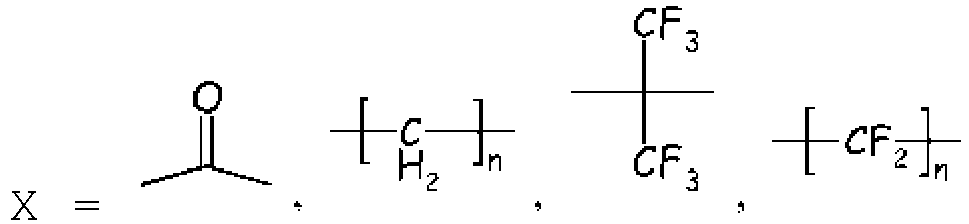 - R est :

- Mélange selon l'une quelconque des revendications précédentes, caractérisé en ce que le polymère de sulfone aromatique (P2) comprend au moins 50 % en poids de motifs récurrents (R2a) et/ou motifs récurrents (R2b), lesdits motifs récurrents (R2a) étant choisis parmi :


- Mélange selon la revendication 4, caractérisé en ce que le polymère de sulfone aromatique (P2) est une polyphénylsulfone, les motifs récurrents de ceux-ci étant des motifs (j) :

- Mélange selon l'une quelconque des revendications précédentes, caractérisé en ce que le polyimide (P3) comprend plus de 50 % en poids de motifs récurrents (R3) contenant un cycle aromatique, au moins un groupe imide, tel quel et/ou sous sa forme d'acide amique, et au moins deux groupes éther, lesdits motifs récurrents (R3) étant choisis parmi :
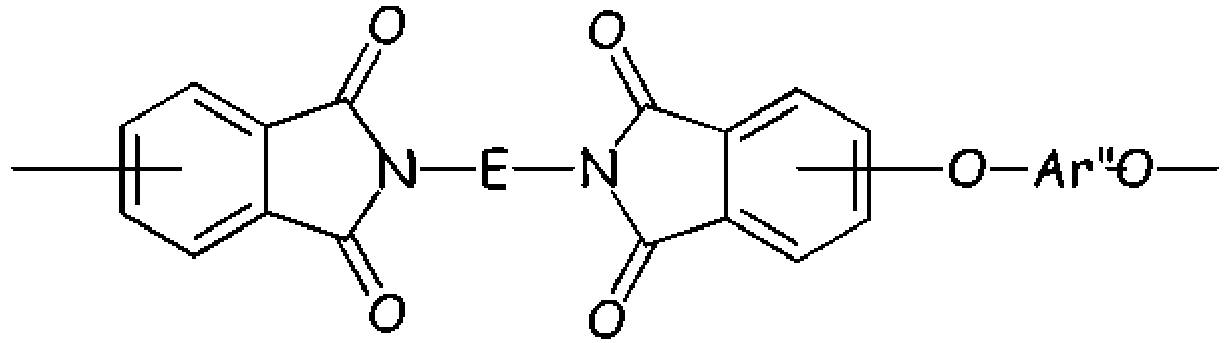

 • le → désigne une isomérie telle que, dans un motif récurrent quelconque, les groupes vers lesquels les flèches pointent peuvent exister comme décrit ou dans une position échangée ;• E est choisi parmi :(E-i)
 (E-ii)
 (E-iii)
 (E-iv)
et Y étant choisi parmi :(Y-i) alkylènes de 1 à 6 atomes de carbone, en particulier
 (Y-ii) perfluoroalkylènes de 1 à 6 atomes de carbone, en particulier
 (Y-iii) cycloalkylènes de 4 à 8 atomes de carbone ;(Y-iv) alkylidènes de 1 à 6 atomes de carbone ;(Y-v) cycloalkylidènes de 4 à 8 atomes de carbone ;
 - Ar" est choisi parmi :(Ar"-i) radicaux hydrocarbonés aromatiques ayant de 6 à 20 atomes de carbone et un dérivé substitué halogéné de ceux-ci, ou des dérivés substitués par alkyle de ceux-ci, dans lequel le groupe de substitution alkyle contient 1 à 6 atomes de carbone, tel que :
 (Ar"-ii)
 (Ar"-iii) radicaux alkylène et cycloalkylène ayant de 2 à 20 atomes de carbone, et(Ar"-iv) polydiorganosiloxanes terminés.
 - Mélange selon la revendication 6, caractérisé en ce que, dans le polyétherimide aromatique (P3), les motifs récurrents de celui-ci sont des motifs récurrents :


- Mélange selon l'une quelconque des revendications précédentes, caractérisé en ce que le poids du polyimide (P1), sur la base du poids total de polymères (P1), (P2) et (P3), est au moins 40 % et au plus 95 %.
- Mélange selon l'une quelconque des revendications précédentes, caractérisé en ce que le poids du polymère de sulfone aromatique (P2), sur la base du poids total des polymères (P1), (P2) et (P3), est au moins 5 % et au plus 40 %.
- Mélange selon l'une quelconque des revendications précédentes, caractérisé en ce qu'il est essentiellement composé des polymères (P1), (P2) et (P3), le poids combiné du polyimide (P1) et du polymère de sulfone aromatique (P2), sur la base du poids total du mélange (B), étant supérieur à 75 % et inférieur à 95 %.
- Mélange selon l'une quelconque des revendications précédentes, caractérisé en ce que les quantités respectives de polyimide (P1) et de polymère de sulfone aromatique (P2) sont dans un rapport en poids (P1)/(P2) supérieur à 1,5/1 et inférieur à 15/1.
- Mélange selon l'une quelconque des revendications précédentes, caractérisé en ce que, sur la base du poids total des polymères (P1), (P2) et (P3), le poids du polyimide (P3) est au moins 2 % et au plus 23 %.
- Procédé de préparation du mélange (B) selon l'une quelconque des revendications précédentes, qui comprend :• une étape de mélange à sec d'un polymère de sulfone aromatique (P2) avec un polyimide (P3) ;• une étape de mélange à l'état fondu des polymères mélangés comme décrit ci-dessus tandis qu'il est séparément ajouté à ceux-ci le polyimide (P1), seul ou conjointement avec un adjuvant de traitement.
Applications Claiming Priority (2)
| Application Number | Priority Date | Filing Date | Title |
|---|---|---|---|
| US95482107P | 2007-08-09 | 2007-08-09 | |
| PCT/EP2008/060207 WO2009019241A2 (fr) | 2007-08-09 | 2008-08-04 | Mélanges de polyimides aromatiques et de polymères sulfoniques aromatiques |
Publications (2)
| Publication Number | Publication Date |
|---|---|
| EP2181159A2 EP2181159A2 (fr) | 2010-05-05 |
| EP2181159B1 true EP2181159B1 (fr) | 2019-11-13 |
Family
ID=40202905
Family Applications (1)
| Application Number | Title | Priority Date | Filing Date |
|---|---|---|---|
| EP08786820.4A Active EP2181159B1 (fr) | 2007-08-09 | 2008-08-04 | Mélanges de polyimides aromatiques et de polymères sulfoniques aromatiques |
Country Status (2)
| Country | Link |
|---|---|
| EP (1) | EP2181159B1 (fr) |
| WO (1) | WO2009019241A2 (fr) |
Families Citing this family (1)
| Publication number | Priority date | Publication date | Assignee | Title |
|---|---|---|---|---|
| EP3010976B1 (fr) | 2013-06-21 | 2023-01-04 | Solvay Specialty Polymers USA, L.L.C. | Compositions renforcées |
Family Cites Families (4)
| Publication number | Priority date | Publication date | Assignee | Title |
|---|---|---|---|---|
| US4581264A (en) * | 1984-03-30 | 1986-04-08 | Standard Oil Company (Indiana) | Process for extruding an article from an amide-imide copolymer and the resultant article |
| US5037902A (en) * | 1988-12-30 | 1991-08-06 | Amoco Corporation | Miscible blends of imide containing polymers with poly(aryl sulfones) |
| US5321096A (en) * | 1992-04-02 | 1994-06-14 | Mitsui Toatsu Chemical, Incorporated | Polyimide composition |
| DE19636001A1 (de) * | 1996-09-05 | 1998-03-12 | Hoechst Ag | Sulfoxidgruppenhaltige Polymermischungen |
-
2008
- 2008-08-04 EP EP08786820.4A patent/EP2181159B1/fr active Active
- 2008-08-04 WO PCT/EP2008/060207 patent/WO2009019241A2/fr not_active Ceased
Non-Patent Citations (1)
| Title |
|---|
| None * |
Also Published As
| Publication number | Publication date |
|---|---|
| WO2009019241A2 (fr) | 2009-02-12 |
| WO2009019241A3 (fr) | 2009-09-24 |
| EP2181159A2 (fr) | 2010-05-05 |
Similar Documents
| Publication | Publication Date | Title |
|---|---|---|
| US7820767B2 (en) | Aromatic polyimide composition | |
| EP0333406B1 (fr) | Composition de résine polyimide | |
| EP0294144B1 (fr) | Composition de résine polyimide | |
| KR940005648B1 (ko) | 폴리이미드계 수지 조성물 | |
| EP3562864B1 (fr) | Procédé de fabrication d'un polyétherimide et polyétherimide ainsi produit | |
| EP0294129B1 (fr) | Composition de résine polyimide | |
| EP2181159B1 (fr) | Mélanges de polyimides aromatiques et de polymères sulfoniques aromatiques | |
| EP1994094B1 (fr) | Nouvelle composition de polyimide aromatique | |
| KR920004193B1 (ko) | 폴리이미드계 수지조성물 | |
| JP2535535B2 (ja) | ポリイミド系樹脂組成物 | |
| JP2981301B2 (ja) | 摺動材用ポリイミド系樹脂組成物 | |
| KR940005649B1 (ko) | 폴리이미드계 수지 조성물 | |
| KR940005650B1 (ko) | 폴리이미드계 수지조성물 | |
| JP2540574B2 (ja) | ポリイミド系樹脂組成物 | |
| KR910009828B1 (ko) | 폴리이미드 수지조성물 | |
| JPH01240565A (ja) | ポリイミド系樹脂組成物 | |
| KR910009826B1 (ko) | 폴리이미드 수지조성물 | |
| KR970000212B1 (ko) | 폴리이미드수지조성물, 및 탄소섬유강화 폴리이미드수지조성물 | |
| JP2535536B2 (ja) | ポリイミド系樹脂組成物 | |
| KR920006215B1 (ko) | 폴리이미드계 수지조성물 | |
| KR910009827B1 (ko) | 폴리이미드 수지조성물 | |
| KR910009837B1 (ko) | 폴리이미드 수지조성물 | |
| JPH0681804B2 (ja) | 芳香族ポリスルホン樹脂組成物 | |
| JPH0759664B2 (ja) | ポリイミド系樹脂組成物 | |
| JPH0681806B2 (ja) | 芳香族ポリスルホン樹脂組成物 |
Legal Events
| Date | Code | Title | Description |
|---|---|---|---|
| PUAI | Public reference made under article 153(3) epc to a published international application that has entered the european phase |
Free format text: ORIGINAL CODE: 0009012 |
|
| 17P | Request for examination filed |
Effective date: 20100324 |
|
| AK | Designated contracting states |
Kind code of ref document: A2 Designated state(s): AT BE BG CH CY CZ DE DK EE ES FI FR GB GR HR HU IE IS IT LI LT LU LV MC MT NL NO PL PT RO SE SI SK TR |
|
| AX | Request for extension of the european patent |
Extension state: AL BA MK RS |
|
| 17Q | First examination report despatched |
Effective date: 20100806 |
|
| DAX | Request for extension of the european patent (deleted) | ||
| RAP1 | Party data changed (applicant data changed or rights of an application transferred) |
Owner name: SOLVAY SPECIALTY POLYMERS USA, LLC. |
|
| STAA | Information on the status of an ep patent application or granted ep patent |
Free format text: STATUS: EXAMINATION IS IN PROGRESS |
|
| GRAP | Despatch of communication of intention to grant a patent |
Free format text: ORIGINAL CODE: EPIDOSNIGR1 |
|
| STAA | Information on the status of an ep patent application or granted ep patent |
Free format text: STATUS: GRANT OF PATENT IS INTENDED |
|
| INTG | Intention to grant announced |
Effective date: 20190613 |
|
| GRAS | Grant fee paid |
Free format text: ORIGINAL CODE: EPIDOSNIGR3 |
|
| GRAA | (expected) grant |
Free format text: ORIGINAL CODE: 0009210 |
|
| STAA | Information on the status of an ep patent application or granted ep patent |
Free format text: STATUS: THE PATENT HAS BEEN GRANTED |
|
| AK | Designated contracting states |
Kind code of ref document: B1 Designated state(s): AT BE BG CH CY CZ DE DK EE ES FI FR GB GR HR HU IE IS IT LI LT LU LV MC MT NL NO PL PT RO SE SI SK TR |
|
| REG | Reference to a national code |
Ref country code: GB Ref legal event code: FG4D |
|
| REG | Reference to a national code |
Ref country code: AT Ref legal event code: REF Ref document number: 1201613 Country of ref document: AT Kind code of ref document: T Effective date: 20191115 Ref country code: CH Ref legal event code: EP |
|
| REG | Reference to a national code |
Ref country code: DE Ref legal event code: R096 Ref document number: 602008061636 Country of ref document: DE |
|
| REG | Reference to a national code |
Ref country code: IE Ref legal event code: FG4D |
|
| REG | Reference to a national code |
Ref country code: NL Ref legal event code: FP |
|
| REG | Reference to a national code |
Ref country code: LT Ref legal event code: MG4D |
|
| PG25 | Lapsed in a contracting state [announced via postgrant information from national office to epo] |
Ref country code: ES Free format text: LAPSE BECAUSE OF FAILURE TO SUBMIT A TRANSLATION OF THE DESCRIPTION OR TO PAY THE FEE WITHIN THE PRESCRIBED TIME-LIMIT Effective date: 20191113 Ref country code: LT Free format text: LAPSE BECAUSE OF FAILURE TO SUBMIT A TRANSLATION OF THE DESCRIPTION OR TO PAY THE FEE WITHIN THE PRESCRIBED TIME-LIMIT Effective date: 20191113 Ref country code: PT Free format text: LAPSE BECAUSE OF FAILURE TO SUBMIT A TRANSLATION OF THE DESCRIPTION OR TO PAY THE FEE WITHIN THE PRESCRIBED TIME-LIMIT Effective date: 20200313 Ref country code: FI Free format text: LAPSE BECAUSE OF FAILURE TO SUBMIT A TRANSLATION OF THE DESCRIPTION OR TO PAY THE FEE WITHIN THE PRESCRIBED TIME-LIMIT Effective date: 20191113 Ref country code: BG Free format text: LAPSE BECAUSE OF FAILURE TO SUBMIT A TRANSLATION OF THE DESCRIPTION OR TO PAY THE FEE WITHIN THE PRESCRIBED TIME-LIMIT Effective date: 20200213 Ref country code: LV Free format text: LAPSE BECAUSE OF FAILURE TO SUBMIT A TRANSLATION OF THE DESCRIPTION OR TO PAY THE FEE WITHIN THE PRESCRIBED TIME-LIMIT Effective date: 20191113 Ref country code: SE Free format text: LAPSE BECAUSE OF FAILURE TO SUBMIT A TRANSLATION OF THE DESCRIPTION OR TO PAY THE FEE WITHIN THE PRESCRIBED TIME-LIMIT Effective date: 20191113 Ref country code: NO Free format text: LAPSE BECAUSE OF FAILURE TO SUBMIT A TRANSLATION OF THE DESCRIPTION OR TO PAY THE FEE WITHIN THE PRESCRIBED TIME-LIMIT Effective date: 20200213 Ref country code: PL Free format text: LAPSE BECAUSE OF FAILURE TO SUBMIT A TRANSLATION OF THE DESCRIPTION OR TO PAY THE FEE WITHIN THE PRESCRIBED TIME-LIMIT Effective date: 20191113 Ref country code: GR Free format text: LAPSE BECAUSE OF FAILURE TO SUBMIT A TRANSLATION OF THE DESCRIPTION OR TO PAY THE FEE WITHIN THE PRESCRIBED TIME-LIMIT Effective date: 20200214 |
|
| PG25 | Lapsed in a contracting state [announced via postgrant information from national office to epo] |
Ref country code: HR Free format text: LAPSE BECAUSE OF FAILURE TO SUBMIT A TRANSLATION OF THE DESCRIPTION OR TO PAY THE FEE WITHIN THE PRESCRIBED TIME-LIMIT Effective date: 20191113 Ref country code: IS Free format text: LAPSE BECAUSE OF FAILURE TO SUBMIT A TRANSLATION OF THE DESCRIPTION OR TO PAY THE FEE WITHIN THE PRESCRIBED TIME-LIMIT Effective date: 20200313 |
|
| PG25 | Lapsed in a contracting state [announced via postgrant information from national office to epo] |
Ref country code: RO Free format text: LAPSE BECAUSE OF FAILURE TO SUBMIT A TRANSLATION OF THE DESCRIPTION OR TO PAY THE FEE WITHIN THE PRESCRIBED TIME-LIMIT Effective date: 20191113 Ref country code: EE Free format text: LAPSE BECAUSE OF FAILURE TO SUBMIT A TRANSLATION OF THE DESCRIPTION OR TO PAY THE FEE WITHIN THE PRESCRIBED TIME-LIMIT Effective date: 20191113 Ref country code: CZ Free format text: LAPSE BECAUSE OF FAILURE TO SUBMIT A TRANSLATION OF THE DESCRIPTION OR TO PAY THE FEE WITHIN THE PRESCRIBED TIME-LIMIT Effective date: 20191113 Ref country code: DK Free format text: LAPSE BECAUSE OF FAILURE TO SUBMIT A TRANSLATION OF THE DESCRIPTION OR TO PAY THE FEE WITHIN THE PRESCRIBED TIME-LIMIT Effective date: 20191113 |
|
| REG | Reference to a national code |
Ref country code: DE Ref legal event code: R097 Ref document number: 602008061636 Country of ref document: DE |
|
| REG | Reference to a national code |
Ref country code: AT Ref legal event code: MK05 Ref document number: 1201613 Country of ref document: AT Kind code of ref document: T Effective date: 20191113 |
|
| PG25 | Lapsed in a contracting state [announced via postgrant information from national office to epo] |
Ref country code: SK Free format text: LAPSE BECAUSE OF FAILURE TO SUBMIT A TRANSLATION OF THE DESCRIPTION OR TO PAY THE FEE WITHIN THE PRESCRIBED TIME-LIMIT Effective date: 20191113 |
|
| PLBE | No opposition filed within time limit |
Free format text: ORIGINAL CODE: 0009261 |
|
| STAA | Information on the status of an ep patent application or granted ep patent |
Free format text: STATUS: NO OPPOSITION FILED WITHIN TIME LIMIT |
|
| 26N | No opposition filed |
Effective date: 20200814 |
|
| PG25 | Lapsed in a contracting state [announced via postgrant information from national office to epo] |
Ref country code: SI Free format text: LAPSE BECAUSE OF FAILURE TO SUBMIT A TRANSLATION OF THE DESCRIPTION OR TO PAY THE FEE WITHIN THE PRESCRIBED TIME-LIMIT Effective date: 20191113 Ref country code: AT Free format text: LAPSE BECAUSE OF FAILURE TO SUBMIT A TRANSLATION OF THE DESCRIPTION OR TO PAY THE FEE WITHIN THE PRESCRIBED TIME-LIMIT Effective date: 20191113 |
|
| PG25 | Lapsed in a contracting state [announced via postgrant information from national office to epo] |
Ref country code: IT Free format text: LAPSE BECAUSE OF FAILURE TO SUBMIT A TRANSLATION OF THE DESCRIPTION OR TO PAY THE FEE WITHIN THE PRESCRIBED TIME-LIMIT Effective date: 20191113 |
|
| PG25 | Lapsed in a contracting state [announced via postgrant information from national office to epo] |
Ref country code: MC Free format text: LAPSE BECAUSE OF FAILURE TO SUBMIT A TRANSLATION OF THE DESCRIPTION OR TO PAY THE FEE WITHIN THE PRESCRIBED TIME-LIMIT Effective date: 20191113 |
|
| REG | Reference to a national code |
Ref country code: CH Ref legal event code: PL |
|
| PG25 | Lapsed in a contracting state [announced via postgrant information from national office to epo] |
Ref country code: LI Free format text: LAPSE BECAUSE OF NON-PAYMENT OF DUE FEES Effective date: 20200831 Ref country code: CH Free format text: LAPSE BECAUSE OF NON-PAYMENT OF DUE FEES Effective date: 20200831 Ref country code: LU Free format text: LAPSE BECAUSE OF NON-PAYMENT OF DUE FEES Effective date: 20200804 |
|
| REG | Reference to a national code |
Ref country code: BE Ref legal event code: MM Effective date: 20200831 |
|
| PG25 | Lapsed in a contracting state [announced via postgrant information from national office to epo] |
Ref country code: BE Free format text: LAPSE BECAUSE OF NON-PAYMENT OF DUE FEES Effective date: 20200831 Ref country code: IE Free format text: LAPSE BECAUSE OF NON-PAYMENT OF DUE FEES Effective date: 20200804 |
|
| PG25 | Lapsed in a contracting state [announced via postgrant information from national office to epo] |
Ref country code: TR Free format text: LAPSE BECAUSE OF FAILURE TO SUBMIT A TRANSLATION OF THE DESCRIPTION OR TO PAY THE FEE WITHIN THE PRESCRIBED TIME-LIMIT Effective date: 20191113 Ref country code: MT Free format text: LAPSE BECAUSE OF FAILURE TO SUBMIT A TRANSLATION OF THE DESCRIPTION OR TO PAY THE FEE WITHIN THE PRESCRIBED TIME-LIMIT Effective date: 20191113 Ref country code: CY Free format text: LAPSE BECAUSE OF FAILURE TO SUBMIT A TRANSLATION OF THE DESCRIPTION OR TO PAY THE FEE WITHIN THE PRESCRIBED TIME-LIMIT Effective date: 20191113 |
|
| P01 | Opt-out of the competence of the unified patent court (upc) registered |
Effective date: 20230624 |
|
| PGFP | Annual fee paid to national office [announced via postgrant information from national office to epo] |
Ref country code: NL Payment date: 20250704 Year of fee payment: 18 |
|
| PGFP | Annual fee paid to national office [announced via postgrant information from national office to epo] |
Ref country code: DE Payment date: 20250702 Year of fee payment: 18 |
|
| PGFP | Annual fee paid to national office [announced via postgrant information from national office to epo] |
Ref country code: GB Payment date: 20250703 Year of fee payment: 18 |
|
| PGFP | Annual fee paid to national office [announced via postgrant information from national office to epo] |
Ref country code: FR Payment date: 20250703 Year of fee payment: 18 |