EP2181637A2 - Lave-vaisselle doté d'un effet de rinçage amélioré - Google Patents
Lave-vaisselle doté d'un effet de rinçage amélioré Download PDFInfo
- Publication number
- EP2181637A2 EP2181637A2 EP09013027A EP09013027A EP2181637A2 EP 2181637 A2 EP2181637 A2 EP 2181637A2 EP 09013027 A EP09013027 A EP 09013027A EP 09013027 A EP09013027 A EP 09013027A EP 2181637 A2 EP2181637 A2 EP 2181637A2
- Authority
- EP
- European Patent Office
- Prior art keywords
- cleaning
- items
- continuous
- washed
- rinsing
- Prior art date
- Legal status (The legal status is an assumption and is not a legal conclusion. Google has not performed a legal analysis and makes no representation as to the accuracy of the status listed.)
- Withdrawn
Links
- 230000000694 effects Effects 0.000 title description 24
- 238000004140 cleaning Methods 0.000 claims abstract description 128
- 238000000034 method Methods 0.000 claims abstract description 14
- 239000012530 fluid Substances 0.000 claims abstract description 7
- 239000007788 liquid Substances 0.000 claims description 67
- 239000013505 freshwater Substances 0.000 claims description 47
- 238000004851 dishwashing Methods 0.000 claims description 31
- 230000005484 gravity Effects 0.000 claims description 10
- 239000007921 spray Substances 0.000 description 27
- XLYOFNOQVPJJNP-UHFFFAOYSA-N water Substances O XLYOFNOQVPJJNP-UHFFFAOYSA-N 0.000 description 26
- 238000011010 flushing procedure Methods 0.000 description 21
- 238000005507 spraying Methods 0.000 description 12
- 238000001035 drying Methods 0.000 description 11
- 230000002000 scavenging effect Effects 0.000 description 5
- 238000010276 construction Methods 0.000 description 3
- 238000013461 design Methods 0.000 description 3
- 239000011521 glass Substances 0.000 description 3
- 238000010926 purge Methods 0.000 description 3
- 239000002245 particle Substances 0.000 description 2
- 230000003134 recirculating effect Effects 0.000 description 2
- 238000000926 separation method Methods 0.000 description 2
- 239000004094 surface-active agent Substances 0.000 description 2
- 230000008719 thickening Effects 0.000 description 2
- 241000792859 Enema Species 0.000 description 1
- ATJFFYVFTNAWJD-UHFFFAOYSA-N Tin Chemical compound [Sn] ATJFFYVFTNAWJD-UHFFFAOYSA-N 0.000 description 1
- 239000000654 additive Substances 0.000 description 1
- 230000004888 barrier function Effects 0.000 description 1
- 239000012459 cleaning agent Substances 0.000 description 1
- 239000011538 cleaning material Substances 0.000 description 1
- 238000007796 conventional method Methods 0.000 description 1
- 239000000645 desinfectant Substances 0.000 description 1
- 238000011161 development Methods 0.000 description 1
- 230000018109 developmental process Effects 0.000 description 1
- 239000007920 enema Substances 0.000 description 1
- 229940095399 enema Drugs 0.000 description 1
- 238000005516 engineering process Methods 0.000 description 1
- 238000002474 experimental method Methods 0.000 description 1
- 230000002349 favourable effect Effects 0.000 description 1
- 230000036541 health Effects 0.000 description 1
- 238000010438 heat treatment Methods 0.000 description 1
- 239000012535 impurity Substances 0.000 description 1
Images

Classifications
-
- A—HUMAN NECESSITIES
- A47—FURNITURE; DOMESTIC ARTICLES OR APPLIANCES; COFFEE MILLS; SPICE MILLS; SUCTION CLEANERS IN GENERAL
- A47L—DOMESTIC WASHING OR CLEANING; SUCTION CLEANERS IN GENERAL
- A47L15/00—Washing or rinsing machines for crockery or tableware
- A47L15/24—Washing or rinsing machines for crockery or tableware with movement of the crockery baskets by conveyors
- A47L15/241—Washing or rinsing machines for crockery or tableware with movement of the crockery baskets by conveyors the dishes moving in a horizontal plane
- A47L15/245—Washing or rinsing machines for crockery or tableware with movement of the crockery baskets by conveyors the dishes moving in a horizontal plane the dishes being placed directly on the conveyors, i.e. not in dish racks
-
- A—HUMAN NECESSITIES
- A47—FURNITURE; DOMESTIC ARTICLES OR APPLIANCES; COFFEE MILLS; SPICE MILLS; SUCTION CLEANERS IN GENERAL
- A47L—DOMESTIC WASHING OR CLEANING; SUCTION CLEANERS IN GENERAL
- A47L15/00—Washing or rinsing machines for crockery or tableware
- A47L15/24—Washing or rinsing machines for crockery or tableware with movement of the crockery baskets by conveyors
- A47L15/247—Details specific to conveyor-type machines, e.g. curtains
- A47L15/248—Details specific to conveyor-type machines, e.g. curtains relating to the conveyors
Definitions
- the invention relates to a continuous dishwashing machine and a method for cleaning items to be washed.
- Such continuous dishwashers and methods are used in particular in commercial kitchens to wash larger amounts of items to be washed, such as plates, cups, trays, cutlery, glasses or similar items to be washed.
- the proposed dishwasher and the proposed method can also be used for cleaning other types of items to be washed, for example dishes that do not come into direct or indirect contact with food or drinks.
- a particular focus of the invention is on the field of dishwashing and there in particular on the flushing of flat items to be washed, such as plates, trays or boxes with at least one flat surface.
- dishwashers In the field of commercial kitchens, for example in universities, hospitals, care facilities, government agencies, dining facilities and similar such devices, dishwashers are needed, which with high throughput items of various types, such as dinnerware, cutlery, glasses, trays, pots, pans, containers or the like clean.
- continuous dishwashers For fast and reliable cleaning of large quantities of items to be washed, in particular, continuous dishwashers have proven successful, in which the items to be washed are automatically moved by at least one transport device through at least one cleaning zone to be acted upon in this cleaning zone with at least one cleaning liquid.
- Such continuous dishwashers in which the items to be washed are moved by means of the described relative movement through the at least one cleaning zone are known, for example, in the form of tape transport machines or in the form of basket pass machines.
- Conventional continuous dishwashers have at least one cleaning zone, but usually several cleaning zones.
- one or more rinse zones can be followed by one or more rinse zones in which the items to be rinsed are rinsed with one or more rinse liquids.
- Many continuous dishwashers have a Frischwasserklar Hugheszone, in which the items to be washed with hot fresh water is rinsed.
- the heated fresh water can usually rinse aid, for example in the form of surfactants, are added, which cause a relaxation of the fresh water and thus improve the result of rinsing.
- rinse aid for example in the form of surfactants
- the cleaning zones may include one or more prepurification zones or pre-evacuation zones, one or more main-purge zones, one or more recirculating rinsing zones for rinsing with recirculating water or other types of rinse solution or other zones.
- a technical challenge with such continuous dishwashers is to achieve an optimum cleaning result with a simultaneous low need for resources.
- a particular problem consists in optimizing the consumption of fresh water, which can be used except for filling tanks at the start of operation and usually during the entire period of operation for the fresh water rinse. From the water consumption of the continuous dishwasher is then usually the need for cleaning agents and energy, such as electrical energy, in particular for heating the final rinse, influenced.
- the fresh water requirement is significantly influenced by the design and quality and / or performance of the flushing systems of the continuous dishwashing machine, such as the fresh water rinse.
- Such rinsing systems generally have one or more rinsing arms, which can be configured in particular as spray arms.
- a fixed spray pipe can be provided with nozzles, which sprays the cleaning liquid, for example the Vietnamese Vietnamesewasser, from above on the items to be washed, and possibly a corresponding, usually also fixed arm in the form of a spray tube with nozzles, which the cleaning liquid in particular the Vietnamese Singh Spray on the dishes from below.
- the nozzles are usually designed such that they produce a fan-shaped jet and are usually arranged such that over the length of the rinsing arms or spray pipes or over the width of the respective cleaning zones away a closed curtain of cleaning liquid, for example a Water curtain, results.
- continuous dishwashing machines examples of such continuous dishwashing machines, in which such flushing systems are provided are in EP 1 704 809 A2 , in DE 198 05 066 A1 , in US 4,228,813 , in DE 10 2004 003 797 A1 described.
- embodiments of continuous dishwashing machines are known in which one or more additional vertical spray tubes with nozzles are provided laterally of the transport device in order to further improve the rinse aid result.
- An example of such a continuous dishwashing machine is in DE 10 2004 030 003 A1 described.
- the generation of the described curtains of cleaning liquid, especially of water curtains, as well as the transport of the items to be washed by means of the transport device through the curtains described, should ensure an optimal cleaning effect.
- rinse liquid such as fresh, hot water
- the continuous dishwashing machine and the method should be set up in order to achieve optimum results Cleaning effect with low need for cleaning fluid, especially fresh water to allow.
- the continuous dishwasher is used for cleaning dishes.
- a continuous dishwashing machine is generally understood a device which has at least one cleaning zone in which the items to be washed can be acted upon with at least one cleaning liquid and which further comprises at least one transport device which is adapted to transport the items to be washed through the cleaning zone, preferably automatically.
- a transport device which is adapted to transport the items to be washed through the cleaning zone, preferably automatically.
- the continuous dishwasher has one or more cleaning zones.
- a cleaning zone is understood, irrespective of the actual intended use within the continuous dishwasher, to be a zone which is set up in order to supply the wash ware with the at least one cleaning liquid.
- this at least one cleaning zone is configured as a fresh water rinsing zone.
- another embodiment is also possible, for example a configuration in which the at least one cleaning zone comprises a pre-evacuation zone, a rinsing zone for main cleaning, a circulating rinsing zone or other types of cleaning zones or is configured as such a cleaning zone. If several cleaning zones are provided within the continuous dishwasher, then one, several or all of these cleaning zones can be designed according to the invention, whereas possibly remaining cleaning zones can be configured conventionally.
- the cleaning liquid may in particular comprise water.
- the water may be admixed with additives, for example disinfectants and / or cleaners and / or rinse aid.
- additives for example disinfectants and / or cleaners and / or rinse aid.
- the at least one cleaning liquid may comprise pure fresh water and / or fresh water to which, according to the above description, at least one rinse aid, for example in the form of one or more surfactants, is admixed.
- the continuous dishwasher has a transport device by means of which the items to be washed can be received in one orientation.
- this transport device may for example comprise a conveyor belt.
- the transport device comprises one or more rollers, a link chain, gears or the like.
- the items to be washed may basically comprise a multiplicity of types of items to be washed, for example the types of items to be washed mentioned above.
- the invention will be described essentially with reference to dishes in the form of dishes, ie objects which come directly or indirectly in contact with food or drinks, for example, plates, cups, glasses, trays, cutlery, bowls, bowls, pots, pans or similar.
- other embodiments are also possible in principle, for example, the use of items to be washed from other areas of cleaning technology, for example in the field of health and geriatric care.
- Most items to be washed has at least one washware surface. Often, this washware surface is at least partially configured essentially flat. Overall, it is preferred if the items to be washed are configured essentially as flat, flat dishes, since in this case the advantages of the invention described below are particularly favorable. Accordingly, it is preferred if the items to be washed include, for example, plates and / or trays. Alternatively or additionally, however, the items to be washed can also have, for example, containers, in particular containers with essentially planar surfaces, in particular, for example, boxes, for example, tin boxes or boxes made of plastic.
- the invention is based on the finding that flushing systems in the known state of the art are arranged essentially at right angles to the transport direction, which is also referred to below as "transverse" to the continuous-type dishwashing machine. Furthermore, spray pipes are installed in the systems known from the prior art substantially horizontally above or below the transport device in the final rinse zone. At the same time, it is generally customary to use the items to be washed, for example plates or trays, with their main extent essentially perpendicular to the transport direction into the receptacle of the transport device, for example a conveyor belt.
- the present invention is based on the finding that a deviation from this customary orientation can lead to a reduced consumption of cleaning liquid, in particular fresh water, with simultaneously improved cleaning result, for example rinse aid result.
- the Spülgutober configuration has a surface normal. This surface normal tightens a plane with the direction of gravity, which is referred to below as the dish level.
- the gravitational direction refers to the direction in which gravity acts on the components of the continuous dishwasher, the items to be washed and the cleaning liquid during operation of the continuous dishwasher.
- a further effect may be that the cleaning liquid forms liquid fronts on the washware surface, which, in contrast to cleaning liquid that simply runs downwards, can have a larger alluvial effect, and thereby can better wipe off dirt particles or adhering cleaning liquid from previous cleaning zones.
- the invention makes itself particularly advantageous when the cleaning zone comprises a rinse zone in which the wash ware is treated with a final rinse liquid, in particular fresh water and / or a fresh rinse liquid containing fresh water.
- the inclination can be based on an inclined position of a scavenging curtain relative to the transport device.
- the cleaning zone may, for example, comprise at least one rinsing arm with a plurality of rinsing nozzles.
- a flushing arm is generally understood to mean a device which orients the plurality of flushing nozzles relative to one another so that they are arranged essentially along a longitudinal direction of extension.
- the flushing nozzles should be designed to produce at least one flushing curtain, in contrast, for example, to an arrangement with individual flushing nozzles.
- a scavenging curtain is to be understood as meaning preferably an area of cleaning liquid which is substantially closed over the cross section of the cleaning zone, at least in the region of the scavenging product.
- the spraying direction of the quantities of cleaning fluid emerging from the flushing nozzles can be oriented as desired, for example downwards, to the side or upwards.
- the rinsing arm should have a direction of longitudinal extension which, together with the direction of gravity, spans a rinsing curtain plane.
- the Spülvorhancreatee represents the plane in which lies the flushing curtain described above.
- this rinsing curtain plane can be configured in an orientation to the transport direction, which deviates from a vertical orientation.
- the transport direction and the gravitational direction can span a machine plane, wherein the rinse curtain plane intersects the machine plane at a curtain angle other than 90 °.
- the curtain angle shown above thus represents the angle at which the Spülvorhangbene cuts the machine plane.
- the Spülvorhancreatee is, as stated above, generally spanned by the longitudinal direction and the direction of gravity. In principle, however, it is also possible that the longitudinal extension direction is aligned parallel to the direction of gravity.
- the purge curtain plane is generally understood to mean the plane of the purge curtain, that is to say the plane of the cleaning liquid film described above.
- the curtain angle has a deviation of 90 °, which is between 1 ° and 40 °, preferably between 5 ° and 20 ° and particularly preferably at 10 °. Deviations of 90 ° upwards and downwards are possible.
- the at least one rinsing curtain can impinge on the items to be washed from above and / or from below.
- the at least one washware surface may have an upwardly facing, in particular obliquely upwardly pointing, upper side surface.
- the washware surface may also have at least one backside surface, with a backside normal, which has a directional component parallel to the gravitational direction, ie downwards.
- the at least one rinsing arm and / or its rinsing nozzles can spray into other spraying directions and in this way produce rinsing curtains.
- the at least one rinsing arm can be, for example, a lower rinsing arm and / or comprise such a lower rinsing arm, the lower rinsing arm being arranged to apply the cleaning liquid in an upward direction to the dishes, ie in a spraying direction opposite to the direction of gravity or with a directional component against the gravitational direction.
- at least one upper spray arm for spraying in a downward direction and at least one lower spray arm for spraying in an upward direction may be provided.
- the above-described effect of an oblique running direction is particularly advantageous.
- the gravitational force acts directly opposite to the direction of movement of the liquid particles.
- the flow direction would therefore directed the spray direction opposite, which particularly difficult even flushing the back surface.
- the flow direction is selected such that a non-parallel flow direction occurs by a suitable choice of angles, this effect of a liquid barrier on the back surface is at least largely avoided, and a more uniform cleaning takes place, even with less use of cleaning liquid.
- the transport device can have at least one receptacle in which the items to be washed can be received.
- the transport direction and the gravitational direction can span a machine plane, wherein the receptacle is set up in such a way that the washware plane and the machine plane are arranged at a scavenging angle deviating from 0 ° when the washware is held in the receptacle.
- a spraying of the washware surface takes place directly with a component laterally to Spülgutebene so that the above-described effect of oblique drainage on the Spülgutober Structure is directly effected.
- the Ab Hughes in a range between 1 ° and 40 °, preferably between 5 ° and 20 ° and particularly preferably at about 10 °.
- the transport device or the receptacle have a conveyor belt with at least one receiving compartment.
- the continuous dishwasher can thus be configured, for example, as a belt conveyor dishwasher.
- the receptacle or the transport device can also have one or more dish racks with at least one receiving compartment, wherein the receiving compartments are in both cases set up such that the angle condition described above for the rinsing angle can be fulfilled.
- a method for cleaning items to be washed is also proposed, in particular using a continuous-type dishwasher according to one or more of the embodiments described above.
- the items to be washed are received by means of at least one transport device in an orientation and transported in a transport direction through at least one cleaning zone.
- the items to be washed are subjected to at least one cleaning liquid.
- the items to be washed on at least one Spülgutober Structure, wherein a surface normal of the Spülgutober Structure and a gravitational direction span a Spülgutebene.
- the loading of the items to be washed with the cleaning liquid takes place in such a way that the cleaning liquid applied to the items to be washed expires in a direction deviating from a parallel orientation to the position of the items to be washed on the items to be washed.
- the proposed continuous dishwashing machine and the proposed method have a number of advantages over conventional continuous dishwashers and conventional methods.
- a more uniform and reliable cleaning of the washware surfaces can be achieved by means of the proposed oblique washdown.
- the need for cleaning fluid can be considerably reduced without impairing the rinsing result, for example the rinsing result.
- the proposed invention can be easily implemented.
- the rinsing systems for the freshwater rinsing can be set up in such a way that the freshwater rinsing curtain or the water film in the freshwater rinse forms at an angle deviating from the perpendicularity to the transporting direction.
- at least one rinsing arm for example a spray pipe, can be provided above and below the transport device of the continuous dishwasher, each having a plurality of rinsing nozzles. These rinsing nozzles can each produce a fan-shaped jet, which is aligned along the rinsing arm or spray tube.
- the rinsing arms can not be arranged at right angles to the transport direction, but for example at an angle of 70 ° or 110 °, preferably 80 ° or 100 °, to the transport direction in the fresh water rinsing zone.
- the rinsing nozzles along the rinsing arms can then produce with their fan-shaped beams the desired water curtain, which is oriented obliquely to the transport direction.
- Such an embodiment of the invention is technically easy to implement.
- the second possibility described above for producing the improved rinsing effect can also be implemented, for example, in that the items to be washed, for example the plates and / or trays, with its washware surface, for example the main extension plane (for example the plate surface and / or the tray surface) are not at right angles to the transport direction, but obliquely to this in the recording, for example, the conveyor belt and / or the dish rack, is used.
- the rinsing arms or the curtain of the cleaning liquid in particular in the fresh water rinsing in the classical arrangement, can be left perpendicular to the transport direction.
- an inclination in the sense of the above description is basically feasible.
- the film of cleaning liquid for example the water film
- the cleaning liquid for example water and / or rinse solution, which flows back from above.
- the Ab Brighton Sign Sign on the backs of the dishes is hampered.
- the film of the cleaning liquid, in particular the water film of the rinsing systems, and the back surfaces of the items to be washed are arranged obliquely relative to one another, according to one or both of the embodiments described above, then a lateral component in the flow of the cleaning liquid on the back surfaces of the items to be washed adjust, through which the rinsing effect can be significantly improved.
- the amount of fresh water can be significantly reduced, especially in a rinse.
- the inventive design can also be used advantageously in other cleaning zones and / or when using other types of cleaning fluids.
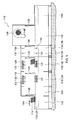
- FIG. 1 is shown in a sectional view from the side of a state-of-the-art continuous dishwashing machine 110.
- a continuous dishwasher 110 can for example be modified according to the invention.
- this continuous dishwasher 110 for example, can largely be applied to the DE 10 2004 003 797 A1 to get expelled.
- the continuous dishwashing machine 110 In the continuous dishwashing machine 110, items to be washed 114 pass through a cleaning chamber 118 in a transport direction 116.
- the items to be washed 114 are conveyed in the illustrated continuous-type dishwasher 110 by means of a transport device 112, which may comprise, for example, a conveyor belt 120.
- the continuous dishwashing machine 110 can thus be designed, for example, as a belt conveyor dishwasher. However, other embodiments are possible in principle.
- ware 114 received on the upper side of the conveyor belt 120 enters an inlet tunnel 124.
- the inlet tunnel 124 is shielded to the outside by means of a separation curtain 126 in order to prevent or at least reduce the escape of steam waves in the region of the inlet tunnel 124.
- the washware 114 received at the top of the conveyor belt 120 has passed the inlet tunnel 124, it enters the cleaning chamber 118, which is subdivided into a plurality of cleaning zones 119.
- the washware 114 is transported into a first cleaning zone 119 in the form of a pre-wash zone 128.
- a pre-rinse system 130 is arranged within this pre-rinse zone 128, a pre-rinse system 130 is arranged.
- the pre-rinse system 130 has spray tubes 131, which are arranged on the underside and / or above the revolving conveyor belt 120. About one in FIG. 1 pump, not shown, the pre-rinse system 130 is supplied with cleaning liquid.
- the pre-rinse zone 128 is separated by a further separation curtain 126 from a subsequent cleaning zone 119 in the form of a rinse zone 132.
- the rinsing zone 132 comprises a rinsing system 134 which likewise has spraying pipes 131 arranged above and below the upper side of the circulating conveyor belt 120 again.
- the rinsing zone 132 is separated by a further separating curtain 126 from a subsequent cleaning zone 119 in the form of a pump rinsing zone 136.
- This also has a flushing system in the form of two opposing spray tubes 131.
- the pump rinsing zone 136 is adjoined by a further cleaning zone 119 in the form of a fresh water rinsing zone 138.
- the fresh water rinsing zone again comprises spray pipes 140 above and below the conveyor belt 120.
- the items to be washed 114 are rinsed with fresh water in order to remove remaining impurities and / or previously applied cleaning liquid from this item to be washed 114 before the items to be washed 114 enter a subsequent drying zone 142 is promoted.
- separating curtain 126 Downstream of the fresh water rinsing zone 138, there is another separating curtain 126, which separates the fresh water rinsing zone 138 from the drying zone 142.
- a drying fan 146 Within the drying zone 142, which is connected downstream of a take-off section 144, a drying fan 146 is accommodated. The drying fan sucks in air and heats it. The air heated in the drying fan 146 enters an outlet funnel 148, at the lower end of which there is an outlet nozzle, which directs the exiting drying air onto the washware 114 passing through the drying zone 142. Viewed in the transport direction 116 of the washware 114, the drying zone 142 is shielded against the take-off conveyor 144 via a further separating curtain 126. At the removal path 144, the cleaned, clear rinsed and dried items to be washed 114, such as plates, trays or the like, are removed for further use.
- the invention essentially relates to the manner and the orientation under which the cleaning liquid is applied to the items to be washed 114.
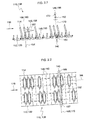
- the invention preferably relates to the fresh water rinsing zone 138 Figures 2.1 and 2.2 is therefore in a side view ( Figure 2.1 ) or in plan view ( Figure 2.2 ) illustrates the orientation of the washware 114 according to the prior art.
- a section from the Frischbergklar Hugheszone 138 of the continuous dishwashing machine 110 according to FIG. 1 shown. Shown is schematically the position of the dishes 114, which is symbolized in the example according to the figures by plates. Shown is the position of this wash item 114 on the transport device 112 and the orientation of the spray pipes 140 for the fresh water rinse according to the prior art.
- dish level 164 which in the plan view according to FIG Figure 2.2 is indicated as a dashed line and which in the illustration according to Figure 2.1 corresponds to the drawing plane or is arranged parallel to this plane of the drawing.
- the spray tube 140 of the fresh water rinse zone 138 has, as in Figure 2.2 it can be seen, rinsing arms 166, which extend in a longitudinal direction of extension 168.
- This longitudinal extension direction 168 is also in FIG Figure 2.2 indicated in the form of a dashed line.
- the longitudinal extension direction 168 and gravity direction 154 can define another level, which is referred to as Spülvorhangbene and which in Figure 2.2 denoted by reference numeral 170.
- This Spülvorhangbene extends into Figure 2.2 parallel to the longitudinal direction 168 and perpendicular to the plane. Also in Figure 2.1 this Spülvorhangbene 170 extends perpendicular to the plane.
- the Spülgutebene 164 is oriented substantially parallel to the transport direction 116 and substantially perpendicular to Spülvorhancreatee 170.
- the rinsing curtain plane 170 is generally oriented perpendicular to the transport direction 116.
- the spray pipes 140 of the fresh water rinsing zone 138 are thus oriented generally parallel to the compartments 150 of the conveyor belt 120 and at right angles to the transport direction 116.
- the rinsing arms 166 have rinsing nozzles 172 along their longitudinal direction 168, out of which cleaning liquid (in the case of the fresh water rinsing zone 138, as a rule, heated fresh water, if appropriate with the addition of rinse aids) exits or is ejected.
- This cleaning liquid forms a curtain, which in the Figures 2.1 and 2.2 is designated as water curtain 152. Due to gravity, this water curtain 152 is oriented substantially vertically, ie perpendicular to the plane in FIG Figure 2.2 , If an oblique spraying out of the flushing nozzles 172, this water curtain 152 can also assume a slightly curved shape viewed from the side.
- the water curtain 152 of the fresh water rinse is formed essentially in a straight line, parallel to the spray pipes 140 and thus at right angles to the transport direction 116.
- the drainage of the cleaning liquid on the washware surfaces 156 thus always takes place in one direction within the washware plane 164 spanned by the gravitational direction 154 and the surface normal 162.
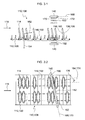
- FIG. 1 The opposite show the Figures 3.1 and 3.2 a first embodiment of a continuous dishwashing machine 110 according to the invention, in one of the Figures 2.1 and 2.2 analog representation.
- the continuous dishwashing machine 110 may, for example, according to the embodiment according to FIG. 1 be designed.
- Figures 3.1 and 3.2 only schematically shows the position of the dishes 114, in the example turn plate, on the transport device 112 and the orientation of the rinse arms 166 in the fresh water rinsing zone 138 shown.
- Figure 3.1 again shows the situation in side view, with inserted into the compartments 150 items to be washed 114.
- spraying pipes 140 are arranged with Spülarms 166.
- an embodiment with a larger or smaller number of rinsing arms 166 is possible, for example, only one Arrangement with rinsing arms 166 above the conveyor belt 120th
- Figure 3.2 the plan view of this situation is shown.
- the transport direction 116 and the gravitational direction 154 in the arrangement shown span a further plane, which is designated as machine plane 174.
- This machine level 174 is in Figure 3.1 the drawing plane or parallel to the drawing plane, whereas the machine plane 174 in Figure 3.2 is shown as a dashed line.
- the Spülvorhancreatee 170 is no longer perpendicular to the transport direction 116 and the machine plane 174 in the orientation according to the invention according to the first embodiment of the invention.
- a normal to the rinse curtain level 170 is in Figure 3.2 designated by the reference numeral 176. From this it can be seen that in the embodiment according to the invention there is a deviation between these normals and the transport direction 116, which in Figure 3.2 denoted by ⁇ .
- This angular deviation ⁇ is preferably in the range between 1 ° and 40 °, for example between 5 ° and 20 ° and particularly preferably at about 10 °.
- the rinse arms 166 for the fresh water rinse are thus arranged at an angle to the transport direction 116, which deviates from a right angle.
- a water curtain 152 which may be configured substantially planar, which, due to a non-perpendicular arrangement of the flushing nozzles 142, but also may be slightly curved.
- This water curtain 152 is also no longer disposed perpendicular to the Spülgutebene 164, so that the surface normal 162 of Spülguts 114 this water curtain 152 is no longer perpendicular, but in a deviation from the vertical by the angle ⁇ .
- FIG. 4 is a second embodiment of a continuous dishwashing machine 110 according to the invention in one Figure 2.2 and to Figure 3.2 shown analog representation.
- the embodiment described there can also with the in the Figures 3.1 and 3.2 described embodiment variant can be combined.
- a fresh water rinsing zone 138 of the continuous dishwashers 110 is shown, from which schematically the position of the dishes 114, in the example shown again plates, on the conveyor 112 and the orientation of the spray tubes 140 and the rinse arms 166 for the Frischiganklar Hopkinszone 138 shows.
- Rinse arms 166 may be disposed above and / or below the conveyor belt 120.
- the rinsing curtain plane 170 is oriented essentially perpendicular to the transport direction 116 and to the machine plane 174.
- the normal 176 to Spülvorhancreatee 170 is thus substantially parallel to the transport direction 116 and the machine plane 174.
- the Spülgutebene 164 is tilted by an angle ⁇ of the machine plane 174.
- this angle ⁇ is preferably between 1 ° and 40 °, in particular between 5 ° and 20 ° and particularly preferably at about 10 °.
- the compartments 150 for the items to be washed 114 can accordingly be arranged on the conveyor belt 120 such that the items to be cleaned can be placed obliquely on the conveyor belt 120 and held in such a way.
- the Spülgutoberfest 156 tilted by the water curtains 152 of the spray arms 166 pass through.
- This oblique position of the items to be washed 114 also results in the above-described lateral relative movement of the water front on the items to be washed 156 of the items to be washed 114, and thus the improved rinsing effect.
Landscapes
- Washing And Drying Of Tableware (AREA)
Applications Claiming Priority (1)
| Application Number | Priority Date | Filing Date | Title |
|---|---|---|---|
| DE200810055817 DE102008055817A1 (de) | 2008-11-04 | 2008-11-04 | Geschirrspülmaschine mit verbessertem Spüleffekt |
Publications (2)
| Publication Number | Publication Date |
|---|---|
| EP2181637A2 true EP2181637A2 (fr) | 2010-05-05 |
| EP2181637A3 EP2181637A3 (fr) | 2014-04-30 |
Family
ID=42035550
Family Applications (1)
| Application Number | Title | Priority Date | Filing Date |
|---|---|---|---|
| EP09013027.9A Withdrawn EP2181637A3 (fr) | 2008-11-04 | 2009-10-15 | Lave-vaisselle doté d'un effet de rinçage amélioré |
Country Status (2)
| Country | Link |
|---|---|
| EP (1) | EP2181637A3 (fr) |
| DE (1) | DE102008055817A1 (fr) |
Cited By (1)
| Publication number | Priority date | Publication date | Assignee | Title |
|---|---|---|---|---|
| CN113786143A (zh) * | 2021-10-14 | 2021-12-14 | 张远宏 | 洗碗机漂洗装置 |
Families Citing this family (3)
| Publication number | Priority date | Publication date | Assignee | Title |
|---|---|---|---|---|
| JP2022092903A (ja) * | 2020-12-11 | 2022-06-23 | 株式会社アイホー | 洗浄装置 |
| JP7525384B2 (ja) * | 2020-12-11 | 2024-07-30 | 株式会社アイホー | 洗浄方法 |
| JP7128254B2 (ja) * | 2020-12-11 | 2022-08-30 | 株式会社アイホー | 搬送装置 |
Citations (5)
| Publication number | Priority date | Publication date | Assignee | Title |
|---|---|---|---|---|
| US4228813A (en) | 1979-04-02 | 1980-10-21 | Noren Tore H | Low temperature conveyor, rack-type dishwasher |
| DE19805066A1 (de) | 1998-02-10 | 1999-08-12 | Winterhalter Gastronom Gmbh | Geschirrspülmaschine |
| DE102004003797A1 (de) | 2004-01-26 | 2005-08-18 | Meiko Maschinenbau Gmbh & Co. Kg | Geschirrspülautomat mit regelbarer Wärmrückgewinnung |
| DE102004030003A1 (de) | 2004-06-22 | 2006-01-12 | Premark Feg L.L.C. (N.D.Ges.D. Staates Delaware), Wilmington | Spülmaschinen-Betriebsverfahren und Transportspülmaschine |
| EP1704809A2 (fr) | 2005-03-24 | 2006-09-27 | Premark FEG L.L.C. | Lave-vaiselle à bande transporteuse et mode d'emploi |
Family Cites Families (6)
| Publication number | Priority date | Publication date | Assignee | Title |
|---|---|---|---|---|
| EP1046370A1 (fr) * | 1999-04-19 | 2000-10-25 | CHEMISCHE FABRIK DR. WEIGERT (GMBH & CO.) | Machine à laver la vaisselle à bande |
| DK200000202Y6 (da) * | 2000-06-13 | 2001-01-12 | Jeros As | Gennemløbsvaskemaskine, navnlig for vask af kasser |
| DE102005015156A1 (de) * | 2005-04-02 | 2006-10-05 | Premark Feg L.L.C., Wilmington | Transportgeschirrspülmaschine und Sprührohr dafür |
| DE102006047344A1 (de) * | 2006-10-06 | 2008-04-10 | Meiko Maschinenbau Gmbh & Co. Kg | Verfahren zum Verteilen eines Fluides in Reinigungsautomaten |
| DE102007016331A1 (de) * | 2007-04-04 | 2008-10-09 | Winterhalter Gastronom Gmbh | Transportvorrichtung für eine Durchlaufspülmaschine mit einer Vorrichtung zur Abgabe eines fluiden Mediums, Durchlaufspülmaschine und Verfahren zum Reinigen von Spülgut |
| DE102008030356A1 (de) * | 2008-06-26 | 2010-01-07 | Meiko Maschinenbau Gmbh & Co.Kg | Geschirrspülmaschine mit Schwenkvorrichtung |
-
2008
- 2008-11-04 DE DE200810055817 patent/DE102008055817A1/de not_active Ceased
-
2009
- 2009-10-15 EP EP09013027.9A patent/EP2181637A3/fr not_active Withdrawn
Patent Citations (5)
| Publication number | Priority date | Publication date | Assignee | Title |
|---|---|---|---|---|
| US4228813A (en) | 1979-04-02 | 1980-10-21 | Noren Tore H | Low temperature conveyor, rack-type dishwasher |
| DE19805066A1 (de) | 1998-02-10 | 1999-08-12 | Winterhalter Gastronom Gmbh | Geschirrspülmaschine |
| DE102004003797A1 (de) | 2004-01-26 | 2005-08-18 | Meiko Maschinenbau Gmbh & Co. Kg | Geschirrspülautomat mit regelbarer Wärmrückgewinnung |
| DE102004030003A1 (de) | 2004-06-22 | 2006-01-12 | Premark Feg L.L.C. (N.D.Ges.D. Staates Delaware), Wilmington | Spülmaschinen-Betriebsverfahren und Transportspülmaschine |
| EP1704809A2 (fr) | 2005-03-24 | 2006-09-27 | Premark FEG L.L.C. | Lave-vaiselle à bande transporteuse et mode d'emploi |
Cited By (2)
| Publication number | Priority date | Publication date | Assignee | Title |
|---|---|---|---|---|
| CN113786143A (zh) * | 2021-10-14 | 2021-12-14 | 张远宏 | 洗碗机漂洗装置 |
| CN113786143B (zh) * | 2021-10-14 | 2023-08-22 | 张远宏 | 洗碗机漂洗装置及方法 |
Also Published As
| Publication number | Publication date |
|---|---|
| DE102008055817A1 (de) | 2010-05-06 |
| EP2181637A3 (fr) | 2014-04-30 |
Similar Documents
| Publication | Publication Date | Title |
|---|---|---|
| DE102011004853B4 (de) | Fördervorrichtung zum Zuführen von Spülgut an eine Transportspülmaschine | |
| DE102008037344B4 (de) | Transportspülmaschine und Verfahren zum Betreiben einer Transportspülmaschine | |
| DE102010062471A1 (de) | Transportspülmaschine | |
| DE102010062457A1 (de) | Beladevorrichtung für eine Transportspülmaschine | |
| DE102007018447B3 (de) | Durchlaufspülmaschine mit geregelter Trocknung | |
| DE102008030356A1 (de) | Geschirrspülmaschine mit Schwenkvorrichtung | |
| DE102008057178A1 (de) | Anlage zum Spülen von Spülgut und Verfahren zum Betreiben einer solchen Anlage | |
| DE102015214300B4 (de) | Transportspülmaschine sowie Verfahren zum Betreiben einer Transportspülmaschine | |
| DE102012203839B4 (de) | Abstapelsystem für Transportspülmaschinen | |
| DE102005014353A1 (de) | Transportspülmaschine und Verfahren hierfür | |
| DE102008014921A1 (de) | Transportspülmaschine sowie Verfahren zum Betreiben einer Transportspülmaschine | |
| DE102004030003A1 (de) | Spülmaschinen-Betriebsverfahren und Transportspülmaschine | |
| DE102011088494A1 (de) | Sprüharm einer Geschirrspülmaschine | |
| DE102004030014A1 (de) | Spülmaschinen-Betriebsverfahren und Transportspülmaschine | |
| DE102004030015A1 (de) | Spülmaschinen-Betriebsverfahren und Transportspülmaschine | |
| EP2181637A2 (fr) | Lave-vaisselle doté d'un effet de rinçage amélioré | |
| DE102019102800A1 (de) | System zum Beladen einer Spülmaschine und Spülmaschine mit einem derartigen System | |
| EP2217124B1 (fr) | Lave-vaisselle et procédé permettant de le faire fonctionner | |
| DE102011017294A1 (de) | Transportspülmaschine mit Sonderbehandlungszonen | |
| EP2076161B1 (fr) | Procédé pour distribuer un fluide dans des machines automatiques de nettoyage | |
| DE102004030001A1 (de) | Spülmaschinen-Betriebsverfahren und Transportspülmaschine | |
| DE102019102813A1 (de) | Entladeanordnung zum Entladen von insbesondere auf Tabletts oder tablettartigen Gegenständen angeordneten Spülgutteilen | |
| DE102021106853B4 (de) | Verfahren und system zum vorzugsweise automatischen reinigen von tabletts in einer spülmaschine | |
| DE1428411B2 (de) | Schmutzabscheider in einer Geschirrspülmaschine | |
| DE19515025C2 (de) | Verfahren und Gestell zum Reinigen von Innenwänden einer Geschirrspülmaschine |
Legal Events
| Date | Code | Title | Description |
|---|---|---|---|
| PUAI | Public reference made under article 153(3) epc to a published international application that has entered the european phase |
Free format text: ORIGINAL CODE: 0009012 |
|
| AK | Designated contracting states |
Kind code of ref document: A2 Designated state(s): AT BE BG CH CY CZ DE DK EE ES FI FR GB GR HR HU IE IS IT LI LT LU LV MC MK MT NL NO PL PT RO SE SI SK SM TR |
|
| AX | Request for extension of the european patent |
Extension state: AL BA RS |
|
| PUAL | Search report despatched |
Free format text: ORIGINAL CODE: 0009013 |
|
| AK | Designated contracting states |
Kind code of ref document: A3 Designated state(s): AT BE BG CH CY CZ DE DK EE ES FI FR GB GR HR HU IE IS IT LI LT LU LV MC MK MT NL NO PL PT RO SE SI SK SM TR |
|
| AX | Request for extension of the european patent |
Extension state: AL BA RS |
|
| RIC1 | Information provided on ipc code assigned before grant |
Ipc: A47L 15/00 20060101AFI20140325BHEP Ipc: A47L 15/24 20060101ALI20140325BHEP |
|
| 17P | Request for examination filed |
Effective date: 20140530 |
|
| RBV | Designated contracting states (corrected) |
Designated state(s): AT BE BG CH CY CZ DE DK EE ES FI FR GB GR HR HU IE IS IT LI LT LU LV MC MK MT NL NO PL PT RO SE SI SK SM TR |
|
| 17Q | First examination report despatched |
Effective date: 20141111 |
|
| STAA | Information on the status of an ep patent application or granted ep patent |
Free format text: STATUS: THE APPLICATION IS DEEMED TO BE WITHDRAWN |
|
| 18D | Application deemed to be withdrawn |
Effective date: 20151218 |