EP2182451A1 - Appareil de classification de documents électroniques - Google Patents
Appareil de classification de documents électroniques Download PDFInfo
- Publication number
- EP2182451A1 EP2182451A1 EP08167884A EP08167884A EP2182451A1 EP 2182451 A1 EP2182451 A1 EP 2182451A1 EP 08167884 A EP08167884 A EP 08167884A EP 08167884 A EP08167884 A EP 08167884A EP 2182451 A1 EP2182451 A1 EP 2182451A1
- Authority
- EP
- European Patent Office
- Prior art keywords
- threshold
- accuracy
- class
- score
- training
- Prior art date
- Legal status (The legal status is an assumption and is not a legal conclusion. Google has not performed a legal analysis and makes no representation as to the accuracy of the status listed.)
- Withdrawn
Links
Images


Classifications
-
- G—PHYSICS
- G06—COMPUTING OR CALCULATING; COUNTING
- G06F—ELECTRIC DIGITAL DATA PROCESSING
- G06F16/00—Information retrieval; Database structures therefor; File system structures therefor
- G06F16/30—Information retrieval; Database structures therefor; File system structures therefor of unstructured textual data
- G06F16/35—Clustering; Classification
- G06F16/353—Clustering; Classification into predefined classes
-
- G—PHYSICS
- G06—COMPUTING OR CALCULATING; COUNTING
- G06F—ELECTRIC DIGITAL DATA PROCESSING
- G06F16/00—Information retrieval; Database structures therefor; File system structures therefor
- G06F16/90—Details of database functions independent of the retrieved data types
- G06F16/93—Document management systems
Definitions
- the invention relates to a document classification apparatus and a computer implemented method of classification. More generally, the invention relates to a pattern classifier apparatus and to a method of pattern classification.
- Automated pattern classification is well known per se. It has been applied for example to the automatic classification of electronic documents, object recognition, detection of abnormal situations in manufacturing processes etc.
- Scoring modules may be optimized for specific pattern recognition tasks, using machine learning techniques applied to examples of patterns in combination with the classes that have to be assigned to the patterns.
- Such a score is not yet a classification.
- the score for an object has to be compared to a threshold to determine whether the object belongs to a class.
- the use of a threshold introduces two types of errors: false positive errors and false negative errors, one type of error involving assignment of an object to a class when that object does not belong to the class, and a second type of error involving not assigning an object to a class when the object does belong to the class.
- the rate of false positive errors increases when the threshold is lowered, but when the threshold is raised the rate of false negative errors increases.
- two thresholds may be used for a class: a first threshold to distinguish between scores of objects that will definitely be classified as belonging to the class and other objects, and a second threshold to distinguish between scores of objects that will definitely not be classified as belonging to the class and other objects.
- a first threshold to distinguish between scores of objects that will definitely be classified as belonging to the class and other objects
- a second threshold to distinguish between scores of objects that will definitely not be classified as belonging to the class and other objects.
- One problem of this type of classification involves the selection of the threshold.
- User input is indispensible at this point, because only the context of use of the classification can determine how the costs of false positive errors and false negative errors and human inspection should be balanced.
- users typically cannot oversee the consequences of the selection of a threshold value, especially if a plurality of thresholds has to be selected. This makes the selection of thresholds a cumbersome process that often results in suboptimal threshold selection.
- An apparatus is provided as set forth in claim 1. This apparatus requires the user to specify a minimum accuracy level for the classification.
- the apparatus uses this specified accuracy in a search for a combination of threshold values that optimizes classifier yield, in terms of a maximized fraction of patterns in a training set that need not be turned over for further inspection without definite classification.
- the search is subject to the condition that the combination of thresholds results in at least the specified accuracy over the training set.
- the apparatus is implemented using a computer, programmed with a feature extraction program, score computing program, a threshold comparator and a threshold determination program.
- Figure 3 shows an embodiment wherein in addition to computer 10, the apparatus comprises a storage device 15 for storing electronic documents and a program to process the electronic documents to extract parameter values that are descriptive of the documents.
- parameters may be integer numbers (e.g. numbers represented by at least eight bits), other numbers, vectors of numbers, binary values, input classification values, etc.
- the programs for the computer are software modules that may be stored on a computer readable medium such as a magnetic or optical disc, or they may be transmitted as messages over a network.
- the apparatus may comprise one or more sensors 12 to measure values of parameters of an object to be classified. A camera may be used as a sensor for example, or sensors to monitor parameters of a manufacturing process.
- the apparatus has an input interface 12 to enter parameters that have been determined for an object.
- feature extraction may involves counting the number of times that various words are used in a document that has to be classified, or statistics of other document features. In other embodiments feature extraction may involve measuring properties of the object to be classified.
- Score computation from parameters of an object is known per se.
- computation of scores may involve weighted addition of the extracted parameters for example.
- the score is a number from a quasi continuous range e.g. a numbers represented by at least eight bits.
- Threshold comparison comprises comparison of the computed score S with a first and second threshold T1, T2. If the computed score S exceeds the first threshold T1 the comparator signals that the object belongs to a class. If the computed score S is below the second threshold T2 the comparator signals that the object does not belong to the class.
- a single comparison may suffice, if a first comparison shows that the score is above the highest threshold or below the lowest threshold. Dependent on these signals various actions may be taken.
- a logic storage location e.g. a directory
- a stored list of classified objects may be updated by entering a reference to the object dependent on the signal.
- further processing of the document in an optional further processing unit 16 may be triggered when the score is above the first threshold and the document may be discarded or archived if the score is above the second threshold.
- the comparator signals that further inspection of the object is needed.
- An output program may be used to display information about the object to a human user at an output device 16, dependent on this signal and to receive back an input about the classification.
- this input may be used to control further processing, for example by applying either the further processing action to the object that is defined for a score above the first threshold or applying the action defined for a score below the second threshold, dependent on whether the input indicates that the object belongs to the class or not.
- the threshold determination program determines the first and second threshold value T1, T2 for use in the threshold comparator.
- the threshold determination program is provided with a minimum accuracy value MIN received from a user input device 14 and with a set of training examples, each associated with a "ground truth" classification that should be assigned to the example.
- the score computation program is applied to the training examples to determine score values S for the examples. Given a first and second threshold value T1, T2 the score S for a training example and the "ground truth" classification of the training example, it can be determined for each example which of the following conditions applies assigned class: "+” assigned class: "-" assigned class: "?” ground truth: "+” TP FN M ground truth: "-" FP TN
- the assigned class of the training example is "+” if the score for the example exceeds the first threshold, the assigned class is "-"if the score is lower than the second threshold and the assigned class is "?" otherwise.
- the accuracy and yield values that are defined in this way depend on the threshold values T1, T2 and the scores S of the examples.
- the threshold determination program searches for a combination of threshold values T1, T2 that among all possible threshold values result in a maximum value of the yield computed from the training set, subject to the conditions that the computed accuracy for the training set is at least equal to the minimum accuracy value MIN received from the user input.
- These threshold values are fed to the threshold comparator and used for subsequent pattern recognition. In this way the user needs to specify only one meaningful parameter, the minimum accuracy in order to enable the threshold determination program to provide the first and second threshold.
- Any type of search may be used, for example an exhaustive search wherein all possible combinations of first and second threshold values on a grid of threshold values are tried to determine the desired combination, but other types of search may work equally well.
- search may work equally well.
- any formula for the accuracy may be used wherein increasing TP and TN contribute to increased accuracy, and/or wherein increasing FP and FN contribute to decrease accuracy.
- classifier stacking for example, wherein successive classifiers are used to make successively more refined class distinctions between classes identified by earlier classifiers.
- the next classifier may be used to assign the object to different sub-classes B of that class and/or different subclasses B' of objects that do not belong to the class.
- Class A may be a single class that can be an output of the stacked classification or a group of classes that need to be distinguished to obtain an output of the stacked classification.
- a comparison with respective pair of a first and second threshold may be used, in order to distinguish between objects that can be definitely classified and objects that need further inspection.
- the threshold determination program may be configured to receive minimum accuracy values for each of at least part of the classifiers in the succession and to search for first and second threshold pairs for each of these classifiers that maximize yield subject to the specified minimum accuracy.
- a single minimum accuracy input from a user may be used for all searches for threshold pairs.
- the training sets may be adapted per classifier. For selecting the thresholds for the first classifier a complete training set may be used, wherein "ground truth" classifications of different classes may be combined to define an overarching class if the first classifier serves to distinguish patterns from such an overarching class from other patterns. For selecting the training sets for subsequent classifiers subsets of the training set may be used, containing patterns that must be distinguished by these classifiers.
- the component based evaluation which is the model for TREC is sometimes referred to as intrinsic evaluation in contrast to an evaluation where the component's performance is measured in the user context (extrinsic).
- intrinsic evaluation approximates performance evaluation and extrinsic evaluation is related to adequacy measurement[3].
- factors such as usability play a crucial role. Performance measurements are usually aimed at comparing systems, whereas adequacy measurements focus more on the usability and practical use for an end user.
- section 2 we give a formal definition of the new ensemble of evaluation measures and discuss the relationship of these measures with operational characteristics of an abstracted workflow (an office where analysts manually label documents).
- Section 3 illustrates the ensemble of measures by reporting experiments concerning automatic detection of domestic violence cases in police files and a spam detection task.
- Section 4 describes the ternary classifier architecture.
- Section 5 presents two experiments that illustrate the value of the evaluation method and the ternary classifier. The paper concludes with a discussion section.
- precision and recall measures are set based measures which can best be visualized by looking at a contingency table (Table 2). Whereas the original precision and recall measures are hardly used anymore in IR (instead mean average uninterpolated precision is the norm for ranking tasks), they are regularly reported for classification experiments. Precision and recall have the desirable property that they relate well to intuitive characteristics of quality. Better systems have higher precision and or recall values. A disadvantage of precision and recall is that the test set must be a representative sample of the real class population. An opposite approach is to quantify the error rates of a classifier, where a better system has smaller error rates. For a binary classifier scenario both type I and type II error rates (false alarms and misses) can be measured independently from the actual class distribution in the test set.
- Precision is a measure of fidelity and is inversely related to type I errors (false positives). Recall can be seen as a measure of completeness, being inversely related to type II errors (false negatives). An important nuance to make here is that fidelity and completeness are defined with respect to the positive class label, i.e. the task modeled is correctly identifying items with a positive class label. Precision and recall can be combined into a single measure F_beta[7], which helps to compare systems at a certain operating point (usually precision and recall are considered equally important).
- classifier accuracy Another measure that is often reported for classifier evaluation experiments is classifier accuracy. This is a fairly intuitive measure for classification quality provided the prior class distribution is fairly homoge- neous. The accuracy quantifies the accuracy of the average decision made by the classifier. This averaging behaviour makes accuracy highly sensitive to a skewed distribution of class priors (imbalanced natural class distribution). This means that it is difficult to interpret accuracy results unless the class distribution of the test set is known. A simple majority classifier can have a very high accuracy for skewed distributions.
- a subclass of typical real-life classification problems are detection tasks. These can be characterized the capabilities of the classifier at hand.
- Typical application scenarios are binary detectors.
- a binary classifier is combined with a meta-classifier mapping all decisions of the first classifier that do not meet a pre-specified confidence value to a third category: for manual inspection.
- the classifier combination can be seen as a ternary classifier, which can now be evaluated in terms of its yield at a pre-specified confidence level, where yield is defined as the proportion of observations that can be classified automatically with a minimum pre-specified accuracy.
- classifier accuracy is a way to measure the fidelity of the classification task and classifier yield can be viewed as a measure for classifier completeness at the task level.
- the intended use of the ensemble ⁇ accuracy,yield ⁇ is to measure the classifier yield at a fixed (minimum) level of accuracy.
- a biometric detector at an accuracy level of 99%.
- binary classification tasks with a skewed natural class distribution i.e. the negative cases are much more common than the positive cases.
- a training data set needs to contain sufficient positive examples of a relatively rare phenomenon.
- the test data set however should contain enough negative examples in order to have a proper estimate of false positives.
- Table 2 shows a modified contingency table where the classifier can assign one additional label: "?” (queue for manual inspection).
- the TREC filtering task used a linear utility function for the adaptive filtering task, which is a rather complex classification task where a system can use feedback in order to set its optimal operating point (decision threshold) in a dynamic fashion.
- detection cost is measured at different levels of Miss/False Alarm trade-off by threshold sweeping, thus generating a detection cost curve.
- the detection cost function is motivated by the desire to quantify different types of error and sum the complete cost of a detection task for a certain data collection (taking into account the relative proportion of the class population sizes). However, the detection cost is based on a fully automatic scenario. Incorporating the cost of manually assessing observations would make the detection cost function less intuitive.
- AUC area under curve
- AUC is the ROC (receiver operating curve) equivalent of mean average uninterpolated precision.
- ROC is based on a plot of the true positive rate (recall) versus the false positive rate.
- ROC curves are less optimal for unbalanced classes, since the interesting part of the curve needs zooming [5].
- AUC is not a very intuitive quality measure for non-experts.
- FAR false alarm rate
- FRR maximum false reject rate
- FAR false alarm rate
- FRR maximum false reject rate
- Our proposed procedure is similar in the respect that a certain operating point is pre-defined in order to compare systems.
- the pre-defined operating point provides an "anchor" in the recall-precision trade-off and simplifies evaluation to a single measure just like Fbeta defines a certain operating point in the precision recall space.
- the experiments that were carried out to illustrate the evaluation procedure were based on a two-level classifier architecture.
- the first level classifier was implemented by an information diffusion kernel machine. This kernel machine presupposes L1-normalized data (relative frequencies) and estimates similarity between documents using a geodesic distance measure applied to the Riemannian manifold that represents this data [8].
- the (parameter free) diffusion kernel machine was modified to provide a posterior probability as output in addition to the predicted class [6].
- the mapping function was trained on a separate development data set.
- the posterior probability (Platt score) was subsequently used as an input for a second classifier that was implemented by a decision rule based on two thresholds theta 1 and theta_u.
- the thresholds maximizing the yield while reaching the minimum accuracy were computed through exhaustive search by a 2 dimensional parameter sweep (for both threshold values) on a development set.
- the development data set for parameter training should be chosen carefully since we assume that the class distribution is the same in the development set and the test set and that the Platt score distribution is more or less similar in the development and test set, for both classes.
- the first experiment concerns the detection of domestic violence in police files.
- the second experiment is about spam detection
- the ternary classifier architecture used the same feature set as the baseline classifier.
- Example features are my father beats and my uncle abducts, where verb forms were normalized.
- the diffusion kernel and Platt function were trained on the development set.
- optimal upper and lower decision score threshold were computed using the development data with a pre-specified accuracy > 0.90.
- Table 5.1 lists the evaluation results (measured in terms of accuracy) for the baseline rule based ranking classifier and the diffusion kernel machine. The more advanced classifier architecture has a superior performance thanks to its generalizing capabilities. Still the accuracy of the diffusion kernel machine is too low for deployment at RPAA.
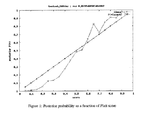
- score thresholds are learned on a development set2 to isolate those reports where the classifier decision is based on a low confidence score. These reports can then be forwarded for manual inspection. As an illustration, Figure 1 shows the probability that the classifier is correct as a function of its score.
- Table 3 Results for the detection of domestic violence on the full test set using a single classifier accuracy yield baseline classifier 0.73 1 diffusion kernel machine 0.84 1
- Table 4 Results for the detection of domestic violence experiment using the ternary classifier accuracy yield development set 0.90 0.70 full test set 0.92 0.86 test set sample A 0.93 0.86 test set sample B 0.92 0.89 test set sample C 0.93 0.86
- Task A models three users. For each user there are 4000 labeled training email messages and 2500 for evaluation. We divided the evaluation sets in a development set of 500 emails and the remaining 2000 for evaluation. Table 5: Results for the detection of spam emails using a binary and ternary classifier #pos dev #pos test binary classifier accuracy ternary classifier accuracy ternary classifier yield user 0 248 1002 0.62 0.89 0.19 user 1 241 1009 0.65 0.90 0.39 user 2 268 982 0.78 0.91 0.69
- Table 5 lists the results of the spam detection experiment. The first two columns give the number of spam messages in the development and test set respectively. The third column gives the accuracy of the standard binary classifier (diffusion kernel machine). The fourth and fifth column give results on accuracy and yield when the ternary classifier's thresholds have been set for a minimum accuracy level of 0.90 using the development subsets. The desired accuracy (0.9) can be achieved for about 20-70% of the email messages depending on the user, making it a much harder task than the domestic violence detection.
- Figure 2 illustrates the optimal operation curves for each user mailbox in a so-called yieldplot, where the classifier yield is plotted as a function of the desired accuracy level.
- a second insight is the concept of a ternary classifier, which is able to assess the confidence of its own decisions. Decisions below a certain confidence level can be forwarded to human experts, thereby reducing the error rate of the classifier.
- Our method estimated two posterior probability threshold levels. The experiments show that the yield accuracy plot makes it easy to use the ternary classifier in an operational workflow. Also, the ternary classifier can effectively forward difficult cases for human inspection.
- the classifier In fact it is not essential that the classifier outputs true probabilities, it can be any monotonous increasing ranking function. As long as ranking values can be compared across collections, since the threshold values will always be optimized on a different data set than the test set.
Landscapes
- Engineering & Computer Science (AREA)
- Theoretical Computer Science (AREA)
- Databases & Information Systems (AREA)
- Data Mining & Analysis (AREA)
- Physics & Mathematics (AREA)
- General Engineering & Computer Science (AREA)
- General Physics & Mathematics (AREA)
- Business, Economics & Management (AREA)
- General Business, Economics & Management (AREA)
- Information Retrieval, Db Structures And Fs Structures Therefor (AREA)
Priority Applications (4)
| Application Number | Priority Date | Filing Date | Title |
|---|---|---|---|
| EP08167884A EP2182451A1 (fr) | 2008-10-29 | 2008-10-29 | Appareil de classification de documents électroniques |
| EP09748512A EP2356588A1 (fr) | 2008-10-29 | 2009-10-29 | Appareil de classification de documents électroniques |
| US13/125,701 US8554715B2 (en) | 2008-10-29 | 2009-10-29 | Electronic document classification apparatus |
| PCT/NL2009/050654 WO2010050811A1 (fr) | 2008-10-29 | 2009-10-29 | Appareil de classification de document électronique |
Applications Claiming Priority (1)
| Application Number | Priority Date | Filing Date | Title |
|---|---|---|---|
| EP08167884A EP2182451A1 (fr) | 2008-10-29 | 2008-10-29 | Appareil de classification de documents électroniques |
Publications (1)
| Publication Number | Publication Date |
|---|---|
| EP2182451A1 true EP2182451A1 (fr) | 2010-05-05 |
Family
ID=40467031
Family Applications (2)
| Application Number | Title | Priority Date | Filing Date |
|---|---|---|---|
| EP08167884A Withdrawn EP2182451A1 (fr) | 2008-10-29 | 2008-10-29 | Appareil de classification de documents électroniques |
| EP09748512A Withdrawn EP2356588A1 (fr) | 2008-10-29 | 2009-10-29 | Appareil de classification de documents électroniques |
Family Applications After (1)
| Application Number | Title | Priority Date | Filing Date |
|---|---|---|---|
| EP09748512A Withdrawn EP2356588A1 (fr) | 2008-10-29 | 2009-10-29 | Appareil de classification de documents électroniques |
Country Status (3)
| Country | Link |
|---|---|
| US (1) | US8554715B2 (fr) |
| EP (2) | EP2182451A1 (fr) |
| WO (1) | WO2010050811A1 (fr) |
Cited By (1)
| Publication number | Priority date | Publication date | Assignee | Title |
|---|---|---|---|---|
| WO2012162044A1 (fr) * | 2011-05-20 | 2012-11-29 | Aol Inc. | Systèmes et procédés pour ranger en catégories et modérer un contenu généré par un utilisateur dans un environnement en ligne |
Families Citing this family (31)
| Publication number | Priority date | Publication date | Assignee | Title |
|---|---|---|---|---|
| CA2307404A1 (fr) * | 2000-05-02 | 2001-11-02 | Provenance Systems Inc. | Systeme de classification automatisee d'enregistrements electroniques lisibles par ordinateur |
| US20140125455A1 (en) * | 2005-09-01 | 2014-05-08 | Memphis Technologies, Inc. | Systems and algorithms for classification of user based on their personal features |
| US20130262144A1 (en) | 2010-09-01 | 2013-10-03 | Imran N. Chaudhri | Systems and Methods for Patient Retention in Network Through Referral Analytics |
| US11610653B2 (en) | 2010-09-01 | 2023-03-21 | Apixio, Inc. | Systems and methods for improved optical character recognition of health records |
| US12165754B2 (en) | 2010-09-01 | 2024-12-10 | Apixio, Llc | Systems and methods for improved optical character recognition of health records |
| US11481411B2 (en) * | 2010-09-01 | 2022-10-25 | Apixio, Inc. | Systems and methods for automated generation classifiers |
| US11195213B2 (en) | 2010-09-01 | 2021-12-07 | Apixio, Inc. | Method of optimizing patient-related outcomes |
| US12198820B2 (en) | 2010-09-01 | 2025-01-14 | Apixio, Llc | Systems and methods for patient retention in network through referral analytics |
| US11694239B2 (en) | 2010-09-01 | 2023-07-04 | Apixio, Inc. | Method of optimizing patient-related outcomes |
| US11544652B2 (en) | 2010-09-01 | 2023-01-03 | Apixio, Inc. | Systems and methods for enhancing workflow efficiency in a healthcare management system |
| US8768071B2 (en) * | 2011-08-02 | 2014-07-01 | Toyota Motor Engineering & Manufacturing North America, Inc. | Object category recognition methods and robots utilizing the same |
| US9122681B2 (en) | 2013-03-15 | 2015-09-01 | Gordon Villy Cormack | Systems and methods for classifying electronic information using advanced active learning techniques |
| US10331782B2 (en) | 2014-11-19 | 2019-06-25 | Lexisnexis, A Division Of Reed Elsevier Inc. | Systems and methods for automatic identification of potential material facts in documents |
| US10229117B2 (en) | 2015-06-19 | 2019-03-12 | Gordon V. Cormack | Systems and methods for conducting a highly autonomous technology-assisted review classification |
| WO2017040663A1 (fr) * | 2015-09-01 | 2017-03-09 | Skytree, Inc. | Création d'un ensemble de données d'apprentissage basé sur des données textuelles non étiquetées |
| JP6514305B1 (ja) * | 2017-11-28 | 2019-05-15 | 株式会社東芝 | 認識辞書メンテナンス装置、パターン認識システム、認識辞書メンテナンス方法およびプログラム |
| US11488055B2 (en) * | 2018-07-26 | 2022-11-01 | International Business Machines Corporation | Training corpus refinement and incremental updating |
| US10832659B2 (en) | 2018-08-31 | 2020-11-10 | International Business Machines Corporation | Intent authoring using weak supervision and co-training for automated response systems |
| WO2020132322A1 (fr) | 2018-12-19 | 2020-06-25 | Aquifi, Inc. | Systèmes et procédés d'apprentissage commun de tâches d'inspection visuelle complexes à l'aide de la vision par ordinateur |
| US11574241B2 (en) * | 2019-04-24 | 2023-02-07 | Cisco Technology, Inc. | Adaptive threshold selection for SD-WAN tunnel failure prediction |
| US11106875B2 (en) | 2019-05-20 | 2021-08-31 | International Business Machines Corporation | Evaluation framework for intent authoring processes |
| US11144727B2 (en) | 2019-05-20 | 2021-10-12 | International Business Machines Corporation | Evaluation framework for intent authoring processes |
| US20210073686A1 (en) * | 2019-09-06 | 2021-03-11 | Yuan Yuan Ding | Self-structured machine learning classifiers |
| US11380306B2 (en) | 2019-10-31 | 2022-07-05 | International Business Machines Corporation | Iterative intent building utilizing dynamic scheduling of batch utterance expansion methods |
| WO2021229660A1 (fr) * | 2020-05-11 | 2021-11-18 | 日本電気株式会社 | Dispositif de détermination, procédé d'apprentissage, et support d'enregistrement |
| US11222232B1 (en) | 2020-06-19 | 2022-01-11 | Nvidia Corporation | Using temporal filters for automated real-time classification |
| US11978266B2 (en) | 2020-10-21 | 2024-05-07 | Nvidia Corporation | Occupant attentiveness and cognitive load monitoring for autonomous and semi-autonomous driving applications |
| EP4174739A1 (fr) * | 2021-10-29 | 2023-05-03 | Panakeia Technologies Limited | Procédé de classification |
| CN118891641A (zh) * | 2022-03-25 | 2024-11-01 | 三菱电机株式会社 | 信息处理装置和信息处理方法 |
| GB2624485A (en) * | 2023-04-19 | 2024-05-22 | Neurovirt Ltd | Methods and systems for using real world objects for functional therapy in an extended reality environment |
| US20240356948A1 (en) * | 2023-04-21 | 2024-10-24 | Barracuda Networks, Inc. | System and method for utilizing multiple machine learning models for high throughput fraud electronic message detection |
Family Cites Families (2)
| Publication number | Priority date | Publication date | Assignee | Title |
|---|---|---|---|---|
| US9405792B2 (en) * | 2007-08-14 | 2016-08-02 | John Nicholas and Kristin Gross Trust | News aggregator and search engine using temporal decoding |
| US8503797B2 (en) * | 2007-09-05 | 2013-08-06 | The Neat Company, Inc. | Automatic document classification using lexical and physical features |
-
2008
- 2008-10-29 EP EP08167884A patent/EP2182451A1/fr not_active Withdrawn
-
2009
- 2009-10-29 EP EP09748512A patent/EP2356588A1/fr not_active Withdrawn
- 2009-10-29 US US13/125,701 patent/US8554715B2/en active Active
- 2009-10-29 WO PCT/NL2009/050654 patent/WO2010050811A1/fr not_active Ceased
Non-Patent Citations (10)
| Title |
|---|
| ARONOW D B ET AL: "Automated identification of episodes of asthma exacerbation for quality measurement in a computer-based medical record", NINETEENTH ANNUAL SYMPOSIUM ON COMPUTER APPLICATIONS IN MEDICAL CARE. TOWARD COST-EFFECTIVE CLINICAL COMPUTING. PROCEEDINGS HANLEY & BELFUS PHILADELPHIA, PA, USA, 1995, pages 309 - 313, XP002521603, ISBN: 1-56053-123-1 * |
| C. J. VAN RIJSBERGEN., INFORMATION RETRIEVAL., 1979 |
| CHRISTOPHER D. MANNING; PRABHAKAR RAGHAVAN; HINRICH SCHTZE.: "Introduction to Information Retrieval.", 2008, CAMBRIDGE UNIVERSITY PRESS |
| CIRAVEGAN F ET AL: "User-system cooperation in document annotation based on information extraction", KNOWLEDGE ENGINEERING AND KNOWLEDGE MANAGEMENT. ONTOLOGIES AND THE SEMANTIC WEB. 13TH INTERNATIONAL CONFERENCE, EKAW 2002. PROCEEDINGS (LECTURE NOTES IN ARTIFICIAL INTELLIGENCE VOL.2473) SPRINGER-VERLAG BERLIN, GERMANY, 1 October 2002 (2002-10-01) - 14 October 2002 (2002-10-14), pages 122 - 137, XP002521604, ISBN: 3-540-44268-5, Retrieved from the Internet <URL:http://eprints.whiterose.ac.uk/3951/1/petrellid9.pdf> [retrieved on 20090326] * |
| DAVID A. HULL; STEPHEN E. ROBERTSON.: "The TREC-8 filtering track final report", IN PROCEEDINGS OF TREC-8, 1999 |
| DELL ZHANG; XI CHEN; WEE SUN LEE.: "In SIGIR '05: Proceedings of the 28th annual international ACM SIGIR conference on Research and development in information retrieval", 2005, ACM, article "Text classification with kernels on the multinomial manifold", pages: 266 - 273 |
| J. PLATT.: "Advances in Large Margin Classier", 2000, article "Probabilistic outputs for support vector machines and comparison to regularized likelihood methods", pages: 61 - 74 |
| JONATHAN G. FISCUS; GEORGE R. DODDINGTON.: "In Topic detection and tracking: event-based information organization", 2002, KLUWER ACADEMIC PUBLISHERS, article "Topic detection and tracking evaluation overview", pages: 17 - 31 |
| L. HIRSCHMAN; H. S. THOMPSON.: "Overview of Evaluation in Speech and Natural Language Processing", 1996 |
| RUUD BOLLE ET AL.: "Guide to Biometrics", 2003, SPRINGERVERLAG |
Cited By (6)
| Publication number | Priority date | Publication date | Assignee | Title |
|---|---|---|---|---|
| WO2012162044A1 (fr) * | 2011-05-20 | 2012-11-29 | Aol Inc. | Systèmes et procédés pour ranger en catégories et modérer un contenu généré par un utilisateur dans un environnement en ligne |
| US8954316B2 (en) | 2011-05-20 | 2015-02-10 | AOL, Inc. | Systems and methods for categorizing and moderating user-generated content in an online environment |
| US9824141B2 (en) | 2011-05-20 | 2017-11-21 | Oath Inc. | Systems and methods for categorizing and moderating user-generated content in an online environment |
| US10482117B2 (en) | 2011-05-20 | 2019-11-19 | Oath Inc. | Systems and methods for categorizing and moderating user-generated content in an online environment |
| US10942962B2 (en) | 2011-05-20 | 2021-03-09 | Verizon Media Inc. | Systems and methods for categorizing and moderating user-generated content in an online environment |
| US11550837B2 (en) | 2011-05-20 | 2023-01-10 | Verizon Patent And Licensing Inc. | Systems and methods for categorizing and moderating user-generated content in an online environment |
Also Published As
| Publication number | Publication date |
|---|---|
| US8554715B2 (en) | 2013-10-08 |
| US20110251989A1 (en) | 2011-10-13 |
| EP2356588A1 (fr) | 2011-08-17 |
| WO2010050811A1 (fr) | 2010-05-06 |
Similar Documents
| Publication | Publication Date | Title |
|---|---|---|
| EP2182451A1 (fr) | Appareil de classification de documents électroniques | |
| US10685044B2 (en) | Identification and management system for log entries | |
| US7779349B2 (en) | Method for adapting a K-means text clustering to emerging data | |
| US6778941B1 (en) | Message and user attributes in a message filtering method and system | |
| US9430562B2 (en) | Classifier indexing | |
| US7383241B2 (en) | System and method for estimating performance of a classifier | |
| US20140214835A1 (en) | System and method for automatically classifying documents | |
| US20090012970A1 (en) | Root cause analysis using interactive data categorization | |
| US20250037060A1 (en) | Efficiency analysis method for intelligent interaction system | |
| US20050192824A1 (en) | System and method for determining a behavior of a classifier for use with business data | |
| US12177178B2 (en) | System and method for electronic chat production | |
| US12341741B2 (en) | System and method for electronic chat production | |
| US20250252255A1 (en) | System and Method for Electronic Chat Production | |
| Parlak | A novel feature ranking algorithm for text classification: Brilliant probabilistic feature selector (BPFS) | |
| Hand et al. | Selecting a classification performance measure: matching the measure to the problem | |
| Trivedi et al. | A modified content-based evolutionary approach to identify unsolicited emails | |
| US12130852B1 (en) | Multi-stage narrative analysis | |
| JP2023145767A (ja) | 語彙抽出支援システムおよび語彙抽出支援方法 | |
| Kraaij et al. | Maximizing classifier utility for a given accuracy | |
| Kraaij et al. | Maximizing classifier yield for a given accuracy | |
| Choi et al. | Refinement method of post-processing and training for improvement of automated text classification | |
| Li et al. | Advanced P-Tree based K-Nearest neighbors for customer preference reasoning analysis | |
| US20250298849A1 (en) | Apparatus and a method for heuristic re-indexing of stochastic data to optimize data storage and retrieval efficiency | |
| Punjabi et al. | Applying Ensemble Machine Learning Techniques for Fake News Identification | |
| Silva et al. | Improving text classification performance with incremental background knowledge |
Legal Events
| Date | Code | Title | Description |
|---|---|---|---|
| PUAI | Public reference made under article 153(3) epc to a published international application that has entered the european phase |
Free format text: ORIGINAL CODE: 0009012 |
|
| AK | Designated contracting states |
Kind code of ref document: A1 Designated state(s): AT BE BG CH CY CZ DE DK EE ES FI FR GB GR HR HU IE IS IT LI LT LU LV MC MT NL NO PL PT RO SE SI SK TR |
|
| AX | Request for extension of the european patent |
Extension state: AL BA MK RS |
|
| AKY | No designation fees paid | ||
| REG | Reference to a national code |
Ref country code: DE Ref legal event code: 8566 |
|
| STAA | Information on the status of an ep patent application or granted ep patent |
Free format text: STATUS: THE APPLICATION IS DEEMED TO BE WITHDRAWN |
|
| 18D | Application deemed to be withdrawn |
Effective date: 20101106 |