EP2182645B1 - Procédé et système pour l'acquisition de signal à dispersion spectrale - Google Patents
Procédé et système pour l'acquisition de signal à dispersion spectrale Download PDFInfo
- Publication number
- EP2182645B1 EP2182645B1 EP08425696.5A EP08425696A EP2182645B1 EP 2182645 B1 EP2182645 B1 EP 2182645B1 EP 08425696 A EP08425696 A EP 08425696A EP 2182645 B1 EP2182645 B1 EP 2182645B1
- Authority
- EP
- European Patent Office
- Prior art keywords
- signal
- code
- vectors
- despreading
- fourier transform
- Prior art date
- Legal status (The legal status is an assumption and is not a legal conclusion. Google has not performed a legal analysis and makes no representation as to the accuracy of the status listed.)
- Active
Links
- 238000000034 method Methods 0.000 title claims description 76
- 238000001228 spectrum Methods 0.000 title claims description 20
- 239000013598 vector Substances 0.000 claims description 52
- 239000011159 matrix material Substances 0.000 claims description 19
- 230000001934 delay Effects 0.000 claims description 15
- 238000009825 accumulation Methods 0.000 claims description 13
- 230000001186 cumulative effect Effects 0.000 claims description 13
- 238000005070 sampling Methods 0.000 claims description 3
- 238000012545 processing Methods 0.000 claims description 2
- 230000010363 phase shift Effects 0.000 claims 1
- 230000001427 coherent effect Effects 0.000 description 13
- 238000010586 diagram Methods 0.000 description 10
- 238000012937 correction Methods 0.000 description 6
- 238000004422 calculation algorithm Methods 0.000 description 3
- 238000004364 calculation method Methods 0.000 description 3
- 230000009466 transformation Effects 0.000 description 3
- 230000007704 transition Effects 0.000 description 3
- 238000001914 filtration Methods 0.000 description 2
- 230000004048 modification Effects 0.000 description 2
- 238000012986 modification Methods 0.000 description 2
- 230000000630 rising effect Effects 0.000 description 2
- 230000008859 change Effects 0.000 description 1
- 238000004891 communication Methods 0.000 description 1
- 230000001955 cumulated effect Effects 0.000 description 1
- 238000000605 extraction Methods 0.000 description 1
- 230000010354 integration Effects 0.000 description 1
- 230000008569 process Effects 0.000 description 1
- 230000009467 reduction Effects 0.000 description 1
- 230000004044 response Effects 0.000 description 1
- 238000004088 simulation Methods 0.000 description 1
- 230000002194 synthesizing effect Effects 0.000 description 1
- 230000002123 temporal effect Effects 0.000 description 1
Images


Classifications
-
- H—ELECTRICITY
- H04—ELECTRIC COMMUNICATION TECHNIQUE
- H04B—TRANSMISSION
- H04B1/00—Details of transmission systems, not covered by a single one of groups H04B3/00 - H04B13/00; Details of transmission systems not characterised by the medium used for transmission
- H04B1/69—Spread spectrum techniques
- H04B1/707—Spread spectrum techniques using direct sequence modulation
- H04B1/7073—Synchronisation aspects
- H04B1/7075—Synchronisation aspects with code phase acquisition
-
- G—PHYSICS
- G01—MEASURING; TESTING
- G01S—RADIO DIRECTION-FINDING; RADIO NAVIGATION; DETERMINING DISTANCE OR VELOCITY BY USE OF RADIO WAVES; LOCATING OR PRESENCE-DETECTING BY USE OF THE REFLECTION OR RERADIATION OF RADIO WAVES; ANALOGOUS ARRANGEMENTS USING OTHER WAVES
- G01S19/00—Satellite radio beacon positioning systems; Determining position, velocity or attitude using signals transmitted by such systems
- G01S19/01—Satellite radio beacon positioning systems transmitting time-stamped messages, e.g. GPS [Global Positioning System], GLONASS [Global Orbiting Navigation Satellite System] or GALILEO
- G01S19/13—Receivers
- G01S19/24—Acquisition or tracking or demodulation of signals transmitted by the system
- G01S19/29—Acquisition or tracking or demodulation of signals transmitted by the system carrier including Doppler, related
-
- H—ELECTRICITY
- H04—ELECTRIC COMMUNICATION TECHNIQUE
- H04L—TRANSMISSION OF DIGITAL INFORMATION, e.g. TELEGRAPHIC COMMUNICATION
- H04L27/00—Modulated-carrier systems
- H04L27/0014—Carrier regulation
-
- H—ELECTRICITY
- H04—ELECTRIC COMMUNICATION TECHNIQUE
- H04B—TRANSMISSION
- H04B2201/00—Indexing scheme relating to details of transmission systems not covered by a single group of H04B3/00 - H04B13/00
- H04B2201/69—Orthogonal indexing scheme relating to spread spectrum techniques in general
- H04B2201/707—Orthogonal indexing scheme relating to spread spectrum techniques in general relating to direct sequence modulation
- H04B2201/70715—Orthogonal indexing scheme relating to spread spectrum techniques in general relating to direct sequence modulation with application-specific features
Definitions
- the present invention relates to spread-spectrum communication systems, and in particular it refers to a spread spectrum signal acquisition method, according to the preamble of first claim.
- the present invention also refers to a spread spectrum signal acquisition system.
- DSSS direct-sequence spread spectrum
- DSSS direct-sequence spread spectrum technique
- CDMA code division multiple access technique
- the CDMA access technique foresees that a plurality of transmitters share the same channel each using a different pseudo-random code, cross correlation among different codes being equal to zero. Then a receiver has to select a suitable pseudo-random code and execute an acquisition method, which allows the receiver to determine frequency and code delay of received signal.
- GNSS type applications Global Navigation Satellite System
- the receiver is not previously aware if a received signal has been transmitted from a specific transmitter, so that the acquisition method is tried out using possible replicas of different pseudo-random codes, available to the receiver.
- the first task of the receiver is to search for signals transmitted by satellites. This process is called acquisition method.
- acquisition method When a signal is discovered, this same signal is traced in order to obtain the information required for determining the receiver's position. If the signal, for some reason, is lost, the acquisition method is executed again, for searching the same satellite or another satellite.
- the signal acquisition method represents a search in a two dimensional time space (for determining phase or code delay) and frequency (for determining Doppler carrier shift, i.e. frequency shift with respect to carrier nominal frequency, due to the fact the satellites are moving along orbital trajectories at speeds of several km per second, creating a significant Doppler shift, which is also caused by frequency misalignment of transmitter and receiver clocks). More precisely, the two dimensional space search is defined in an uncertainty region of such space.
- the search space is quantized in both dimensions, and time and frequency are divided in a finite number of units or "bins".
- GNSS signal acquisition methods are known, or more generally various spread spectrum signal acquisition methods are known, for determining, in the receiver, the code delay and Doppler shift for a received signal.
- parallel search acquisition methods which comprise parallel analyzing of a dimension of the two dimensional search grid. Since this grid is two dimensional, two different types of parallel search methods exist:
- PCS and PFS methods ensure good results in terms of scan time of search grid.
- PCS methods require a large memory, whereas PFS methods have a high computational cost.
- the object of the present invention is to provide an acquisition method having a performance which represents a compromise between scan time of search grid, computational cost and memory requirements.
- Another object of the present invention is an acquisition system according to claim 13.
- signal s(t) is a signal provided by a satellite of a GNSS system and is preferably a CDMA signal (Code division multiple access).
- the signal s(t) is a CDMA signal of the type provided in an UMTS system.
- Signal s(t) is a signal modulated with a pseudo-random code signal, or PRN code, with length Nc and which is transmitted over a carrier frequency.
- the acquisition method 100 comprises a step 101 of receiving signal s(t).
- the receiving step 101 comprises a step of suitably processing signal s(t) in order to demodulate and convert said signal to baseband (or almost to baseband), an extraction step of in-phase and quadrature components of the baseband signal and a sampling step at frequency f s , in order to transform the received signal into a stream of complex digital samples.
- the above steps are known to the skilled in the art, and therefore will not be described in further detail.
- the receiving step 101 comprises a decimation step of stream of complex digital samples in order to reduce the frequency of this stream from value fs to a reduced value fk, which represents the operating frequency, or clock frequency, of the acquisition method 100.
- fk fs/2.
- M tc*fk samples.
- a filtering of stream of digital samples is provided, before decimation, by means of a low-pass filter, for example by means of a FIR filter, in order to avoid or reduce the aliasing phenomenon occurring on the decimated stream.
- the receiving step 101 comprises the step of storing the digital samples of the received signal, which, in this example is filtered and decimated, on a delay line, provided with N taps.
- the storing of digital samples of received signal in a delay line provided with N taps provides, at any clock instant, a set of N consecutive samples of received signal, i.e. N-long segments, having different clock times and code delay increasing between 0 and N-1, with respect to a locally available code reference.
- the received signal s(t) shows, with respect to signal output from satellite, a code delay, or phase delay, and a Doppler shift with respect to transmitted carrier frequency.
- the acquisition method 100 is therefore provided for determining a code delay, or phase delay, of received spread spectrum signal and a Doppler shift with respect to carrier frequency of transmitted signal (in this example, by the satellite), said determination being conveniently performed on a two dimensional discrete space of M possible code delays and F possible frequency shifts, wherein M is the length of local replica of PRN code, sampled at frequency fk and F is a positive integer.
- the acquisition method 100 comprises a step of providing 102 a local replica signal of pseudo-random code signal, or PRN code.
- PRN code represents a code reference.
- the M samples of PRN code are stored into a look-up table, i.e. in a matrix data structure, comprising vectors with length N, each provided for storing an N-long segment of PRN code, and wherein consecutive segments of PRN code are sequentially stored in consecutive vectors of said matrix data structure.
- a look-up table i.e. in a matrix data structure, comprising vectors with length N, each provided for storing an N-long segment of PRN code, and wherein consecutive segments of PRN code are sequentially stored in consecutive vectors of said matrix data structure.
- the acquisition method 100 comprises a step 103 of performing a despreading of sampled spread spectrum signal, in this example at operating frequency fk, by means of local replica signal of PRN code, by performing said dispreading for a plurality of possible code delays between the sampled signal and the replica signal of PRN code.
- the step of despreading 3 is such as to provide, at output, a plurality of vectors, which will be called “despreaded vectors", comprising Mn despreaded vectors for each code delay.
- the operation of despreading is a bit-by-bit multiplication of two N-long vectors.
- a despreading step 103 in which the despreading is performed by performing a bit-by-bit vector multiplication without introducing any limitation.
- 200 is a delay line containing, at any instant, N samples of the received signal and 201 indicates the look-up table containing the samples of the local replica of PRN code.
- the N stored samples in the delay line 200 are multiplied by N stored code samples in a column C1 of look-up table 201.
- the content of the delay line 200 will be updated by shifting by one position the samples stored in the previous step, wherein an old sample 205 is output from the delay line 200 and a new sample 206 is introduced into the delay line.
- the updated content of delay line 200 is multiplied using vector multiplication 203 by the N samples of column C1 of look-up table 201.
- This is equivalent to a despreading of an N-long segment of received signal by an N-long segment of PRN code, with an additional code delay equal to one between the received signal and the PRN code, with respect to the preceding step.
- This operation is performed for N consecutive times, i.e. for N code delays, updating at each step the content of delay line 200, but without changing column C1.
- a multiplication of content of delay line 200 by column C2 for additional N code delays is performed, i.e. by updating N times the content of delay line 200, and so on, until reaching multiplication by column CMn.
- the result of despreading step 103 is subject to a following step 104 of calculating a Fourier transform, in order to perform a parallel frequency search on results provided by output of despreading step 103.
- step 104 the despreading 103 is performed by using a vector bit-by-bit multiplication, it is appreciated that such multiplication combined with the Fourier transform represent a correlation step, wherein, additionally, due to multiplication by a complex exponent, included in the Fourier transform, a parallel removal of plural Doppler frequencies is performed.
- the applied Fourier transform is a fractional Fourier transform.
- This transform step allows the calculation of the Discrete Fourier Transform (DFT), which is applied only on a portion of the spectrum, at higher resolution, as opposed to applying the same to the range of all possible frequencies [-f k /2, f k /2].
- the interval [- ⁇ f w /F, + ⁇ f w /F] may therefore be selected as an interval suitable for covering the most usual Doppler frequencies a received signal may have.
- the fractional Fourier transform is performed by performing two fast Fourier transforms (FFT) on 2*N opt samples; wherein N opt is for example selected as the smallest power of two greater than N.
- FFT fast Fourier transforms
- the calculation of a Fourier transform 104 comprises the calculation of the Fourier transform of each of the despreaded vectors output by step 103, in order to obtain a plurality of respective vectors transformed in a discrete frequency domain.
- the method 100 moreover comprises a step of accumulating 105, 106, in a coherent way, the despreaded vectors output by step 103, and associated to same code delay, so that a plurality of cumulative vectors is obtained, each one of them being associated to a respective code delay.
- the accumulation step 105, 106 is performed after the Fourier transform 104, by coherently accumulating into N cumulative vectors the despreaded vectors associated to the same delay between 0 and N-1, and transformed into the frequency domain by the Fourier transform step 104.
- two despreaded vectors associated to a same delay will be available for accumulation in the same cumulative vector relative to said delay, every N input samples of delay line 200.
- the received and sampled signal is shifted by N samples, but also the local replica of PRN code is shifted by the same quantity, due to the column shift in look-up table 201.
- a frequency transformed despreaded vector represents a correlation contribution associated to a given code delay and which is to be added (i.e. cumulated) to other correlation contributions associated to same delay.
- the accumulation step 105 comprises a step 106 of synthesizing a phase correction signal, of correcting by means of said phase correction signal the result of the accumulation 105 at preceding step, related to a given delay between 0 and N-1, and adding the accumulated and corrected result to a new despreaded vector associated to said delay, between 0 and N-1.
- a phase correction is applied to the content of each cumulative vector before adding a new despreaded vector, or, more specifically, its Fourier transform, to the content of said cumulative vector.
- N multiplications of the content of delay line 200 by the content of column C1 by scanning the whole matrix 201 of PRN code, column by column, when the N multiplications of content of delay line 200 and content of column CMn are completed, for each delay between 0 and N-1, Mn despreaded N-long vectors will be accumulated, which are transformed into the spatial domain of discrete Doppler frequencies.
- a matrix of complex numbers or search matrix will be obtained, which in this example is an NxN matrix, which identifies a search space of N delays and N discrete frequencies.
- the acquisition method 100 comprises:
- method 100 moreover comprises a step 111 of selecting another look-up table containing the samples of a PRN code relative to a different satellite and a new iteration of method 100 for acquiring said satellite, and so on, for possible additional satellites of the GNSS constellation to be acquired.
- step 110 if the comparison with a threshold has not provided the signal acquisition, the above said steps of method 100 are repeated from the beginning:
- the steps of method 100 are repeated, starting from the third column of look-up table, and so on, until the last column CMn is reached.
- the search for M possible code delays is performed by considering single consecutive segments of N delays.
- Nacc an arbitrary integer
- NxN dimensional search grids obtained by repeating the scan of the matrix containing samples of PRN codes, starting from the same column. If no peak is found, the search on successive N PRN code delays of a new PRN code is performed.
- the estimation of noise power is performed based on the transformed despreaded vectors output by transformation step 104.
- the quadratic modulus (or modulus) of complex vectors output by transformation step 104 is calculated and a median is formed on all the transform outputs (the noise power is an invariant with respect to frequency) and then time-filtered, preferably by using a first order IIR filter (Infinite Impulse Response).
- IIR filter Infinite Impulse Response
- the threshold is set at a real multiple of estimated noise power, said multiple being defined based on specific false-alarm probability requirements, and is updated in real time or almost in real time.
- a secondary PRN code or a sequence of symbols or information bits is superimposed to the primary PRN code (the characteristics of a data sequence or of a secondary code with respect to a primary code are well known to the skilled in the art; in other words, the chip of the secondary code is as long as a whole primary code and a symbol or information bit is as long as an integer number of times the primary code), since this secondary code or data sequence may falsify the result of the coherent accumulation, it is possible to foresee that the despreading step 103 is performed by keeping the same starting column of matrix 201 for two or more complete scans of all columns C1-CMn of said matrix.
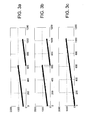
- Figs. 3a, 3b and 3c show the variation in time of the code phase of received signal (i.e. the input signal of delay line), the local replica signal of PRN code (i.e. the one extracted from the look-up table) and the content of the coherent accumulator (step 105 of method of fig. 1 ), respectively.
- the sequence of the primary PRN code is represented by a rising ramp, although in reality it's a rectangular sequence of positive and negative symbols; in fig. 3c the amplitude of modulus of content of coherent accumulator is shown.
- the diagrams of figs. 3a, 3b, 3c have been traced, on the assumption that no secondary code is present.
- the code phase is represented, by diagram convention, as a rising integer number from 0 up to a maximum number of chips in the code minus 1. In this case, a code length of 1023 has been considered.
- the received signal ( fig. 3a ) and the PRN code signal ( fig. 3b ) are perfectly aligned, i.e. they have the same code phase at the same instant in time, and the coherent accumulation ( fig. 3c ) is always increasing, reaching a maximum value equal to the code length.
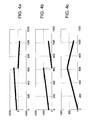
- figs. 4a, 4b, 4c diagrams are shown, which correspond to those represented in figs. 4a, 4b, 4c , for the case when a secondary PRN code is present, i.e. a code, whose chip is as long as a whole PRN primary code (1023 in this example) and by hypothesizing a sign transition between the chip of the secondary code and the following chip.
- this sign inversion is represented as a sign change in the code phase of the received signal ( fig. 4a ). Obviously, such an inversion can only occur when the code phase is 0, i.e. at the beginning of each primary code. As in the situation of figs.
- the received signal and the code signal are perfectly aligned but the coherent accumulation of fig. 4c cannot reach the maximum preceding value ( fig. 3c ), since across the sign transition of secondary code chip, it begins to fall and the final value is almost zero.
- the final value depends on the initial code phase of received signal.
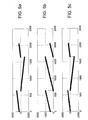
- the identified solution foresees to keep the same starting column of the matrix containing the code, for two code epochs, instead of only one.
- the code epoch is the temporal length of a code. This would therefore correspond to extending the coherent integration time to 2 code epochs.
- figs. 5a and 5b refer to the same case of figs. 4a and 4b (being identical to the same) whereas fig. 5c shows the result of the accumulation, in the case of above said solution.
- the coherent accumulator is reset at the beginning of a new code epoch, i.e. when the phase of PRN code signal starts again from 0, so that again a maximum (modulus) value equal to 1023 is obtained (the sign "-" in the diagram is only due to the sign transition).
- the result of the above said operation is an increase of the total acquisition time, by a factor of two, and in the general case, of more than one accumulation, it entails the loss of only one code epoch time.
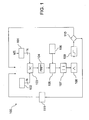
- Fig. 6 shows, in a very schematic and illustrative way, the block diagram of an acquisition system 600 for executing the above said acquisition method.
- This system is for example a component of a GNSS receiver, as a satellite navigator.
- System 600 comprises a delay line with N taps 601, for storing the samples of a complex, received baseband or almost baseband signal, which is optionally previously filtered and decimated.
- System 600 moreover comprises at least one memory 602, for example a look-up table for storing a local replica of the PRN code, according to the already described procedure, with reference to method 100.
- system 600 comprises a memory 602 for storing more than one look-up table, each of them relating to a PRN code of a respective satellite.
- System 600 moreover comprises a vector multiplier 603 for performing the despreading step 103 of the method.
- System 600 moreover comprises a module 604 for performing the Fourier transform of complex vectors produced and output by multiplier 603, according to the description of method 100. Furthermore the system is provided with a coherent resettable accumulator 605, for outputting cumulative vectors, each associated to a respective code delay, between kN and kN-1 (where k is an integer), a module 607 for computing the modulus or quadratic modulus, and which is preferably provided with a resettable non coherent accumulator 614, for integrating on N acc > 1 successive code epochs, according to the description of method 100. The zeroing of this accumulator 614 is performed before the beginning of the search for a new code signal from a satellite.
- the acquisition system 600 moreover comprises a phase synthesizer 606 for phase correction, by means of multiplier 612, of cumulative vectors in order to allow a coherent accumulation with vectors which are successively provided by the output of transformation block 604.
- the system 600 moreover comprises a delay line 613 for delaying the output of multiplier 613 by N clock cycles, said delay being such as to account for the fact that the update of each of the cumulative vectors by the contributions output by block 602 occurs every N clock cycles, as already described for the acquisition method 100.
- System 600 also comprises a control logic 611, for correctly addressing the columns of the look-up table stored in memory 602 and for sending, with a correct timing required by above said method 100, a reset signal to the coherent accumulator 604.
- a control logic 611 for correctly addressing the columns of the look-up table stored in memory 602 and for sending, with a correct timing required by above said method 100, a reset signal to the coherent accumulator 604.
- System 100 may be implemented by means of a suitable combination of hardware and software, for example in a FPGA or ASICs.
- the ACSE method has a computational cost which is lower than other algorithms, with the exception of the parallel phase search, which, on the other hand, requires longer FFT, which is problematic when the method is implemented on a FPGA.
Landscapes
- Engineering & Computer Science (AREA)
- Computer Networks & Wireless Communication (AREA)
- Signal Processing (AREA)
- Radar, Positioning & Navigation (AREA)
- Remote Sensing (AREA)
- Physics & Mathematics (AREA)
- General Physics & Mathematics (AREA)
- Position Fixing By Use Of Radio Waves (AREA)
- Digital Transmission Methods That Use Modulated Carrier Waves (AREA)
- Complex Calculations (AREA)
Claims (15)
- Procédé (100) d'acquisition d'un signal à dispersion spectrale à séquence directe (s(t)), lequel est transmis sur une fréquence porteuse, et lequel est modulé avec un signal de code, d'une longueur égale à Nc éléments, en vue de déterminer un retard de code dudit signal à dispersion spectrale et un décalage par effet Doppler relativement à ladite fréquence porteuse, ladite détermination étant mise en oeuvre sur un espace bidimensionnel discret de M retards de code possibles et F décalages de fréquence possibles, le procédé (100) comprenant les étapes ci-dessous consistant à :- recevoir et échantillonner (102) ledit signal à dispersion spectrale afin d'obtenir un signal à dispersion spectrale échantillonné ;- mettre en oeuvre une opération de désétalement (103) dudit signal à dispersion spectrale échantillonné avec un signal de réplique local dudit signal de code, en mettant en oeuvre ledit désétalement pour une pluralité de retards de codes possibles entre ledit signal échantillonné et ledit signa de réplique ;- mettre en oeuvre une recherche de fréquence (104, 105, 107, 108, 109) en mettant en oeuvre une étape (104) de calcul d'une transformée de Fourier ;caractérisé en ce que
ladite recherche de fréquence (104, 105, 107, 108, 109) est une recherche de fréquence parallèle mise en oeuvre sur le résultat de ladite étape de désétalement ;
ladite transformée de Fourier est une transformée de Fourier fractionnaire mise en oeuvre sur ledit résultat. - Procédé (100) selon la revendication 1, dans lequel l'étape de désétalement (103) comprend les étapes de désétalement, au moyen de Mn = M/N segments consécutifs de longueur N du signal échantillonné, et de mise en oeuvre, au moyen de chacun desdits Mn segments du signal de réplique local, du désétalement pour N retards successifs possibles entre ledit signal de réplique local et ledit signal échantillonné.
- Procédé (100) selon la revendication 2, dans lequel l'étape de désétalement (103) est de nature à fournir en sortie une pluralité de vecteurs désétalés, ladite pluralité comprenant Mn vecteurs désétalés pour chaque retard de code.
- Procédé (100) selon la revendication 3, dans lequel ladite étape de calcul d'une transformée de Fourier comprend une étape consistant à calculer la transformée de Fourier pour chacun desdits vecteurs désétalés de ladite pluralité, en vue d'obtenir une pluralité de vecteurs transformés respectifs dans un domaine fréquentiel discret.
- Procédé (100) selon la revendication 2, dans lequel l'étape de désétalement (103) comporte une étape consistant à multiplier, échantillon par échantillon, des segments de signal par des segments de réplique respectifs, fournissant des vecteurs de produits respectifs, et dans lequel ladite étape de calcul de la transformée de Fourier est mise en oeuvre sur chacun desdits vecteurs de produits.
- Procédé (100) selon la revendication 2, comprenant en outre l'étape consistant à :- accumuler de manière cohérente, au sein de vecteurs cumulatifs, des vecteurs désétalés associés à un même retard de code, fournissant N vecteurs cumulatifs, dont chacun est associé à un retard respectif.
- Procédé (100) selon la revendication 6, dans lequel l'étape d'accumulation (105) est mise en oeuvre postérieurement à ladite étape consistant à calculer la transformée de Fourier (104), et de manière à accumuler de façon cohérente lesdits vecteurs transformés dans le domaine fréquentiel.
- Procédé (100) selon la revendication 7, dans lequel ladite étape d'accumulation (105) comporte une étape (106) consistant à annuler un déphasage d'un résultat partiel de ladite accumulation, avant d'ajouter une nouvelle contribution audit résultat partiel.
- Procédé (100) selon l'une quelconque des revendications précédentes, dans lequel ladite étape de réception et d'échantillonnage (102) comprend une étape consistant à stocker ledit signal échantillonné dans une ligne à retard (200).
- Procédé (100) selon les revendications 2 et 9, dans lequel la ligne à retard (200) est une ligne à retard avec N prises.
- Procédé (100) selon la revendication 10, dans lequel ledit signal de réplique local est stocké dans une structure de données de matrice (201) comprenant Mn vecteurs de longueur N, dont chacun est destiné à stocker un segment de N échantillons dudit code, et dans lequel des segments d'échantillons successifs dudit code sont stockés séquentiellement dans des vecteurs successifs de ladite matrice, l'étape de désétalement (103) comprenant une étape consistant à multiplier N fois un vecteur de ladite matrice (201) par le contenu de ladite ligne à retard (200), ladite ligne à retard étant respectivement mise à jour avec des échantillons dudit signal reçu.
- Procédé (100) selon la revendication 11, comprenant en outre une étape de recherche d'un maximum (108), postérieurement à la mise en oeuvre d'au moins un balayage, au moyen de ladite multiplication, sur la totalité des vecteurs de ladite matrice (201), et comprenant en outre une étape de vérification de l'acquisition au moyen d'une comparaison (109) dudit maximum à un seuil.
- Procédé (100) selon la revendication 12, comprenant les étapes supplémentaires ci-dessous consistant à :- estimer, en commençant par un résultat de ladite étape de calcul de la transformée de Fourier, une intensité du bruit ;- modifier de façon adaptative ledit seuil, sur la base de ladite intensité du bruit estimée.
- Système d'acquisition (600) comprenant une unité de traitement destinée à mettre en oeuvre un procédé selon l'une quelconque des revendications précédentes.
- Récepteur de signaux de géolocalisation et navigation par un système de satellites, GNSS, comprenant un système d'acquisition selon la revendication 14.
Priority Applications (5)
| Application Number | Priority Date | Filing Date | Title |
|---|---|---|---|
| EP08425696.5A EP2182645B1 (fr) | 2008-10-29 | 2008-10-29 | Procédé et système pour l'acquisition de signal à dispersion spectrale |
| CN200980142926.1A CN102282773B (zh) | 2008-10-29 | 2009-10-26 | 用于捕捉扩频信号的方法和系统 |
| RU2011121664/07A RU2510134C2 (ru) | 2008-10-29 | 2009-10-26 | Способ и система для обнаружения сигнала с расширенным спектром |
| US13/125,204 US8630331B2 (en) | 2008-10-29 | 2009-10-26 | Method and system for spread spectrum signal acquisition |
| PCT/EP2009/064088 WO2010049392A1 (fr) | 2008-10-29 | 2009-10-26 | Procédé et système pour acquisition de signal à étalement de spectre |
Applications Claiming Priority (1)
| Application Number | Priority Date | Filing Date | Title |
|---|---|---|---|
| EP08425696.5A EP2182645B1 (fr) | 2008-10-29 | 2008-10-29 | Procédé et système pour l'acquisition de signal à dispersion spectrale |
Publications (2)
| Publication Number | Publication Date |
|---|---|
| EP2182645A1 EP2182645A1 (fr) | 2010-05-05 |
| EP2182645B1 true EP2182645B1 (fr) | 2014-07-02 |
Family
ID=40460017
Family Applications (1)
| Application Number | Title | Priority Date | Filing Date |
|---|---|---|---|
| EP08425696.5A Active EP2182645B1 (fr) | 2008-10-29 | 2008-10-29 | Procédé et système pour l'acquisition de signal à dispersion spectrale |
Country Status (5)
| Country | Link |
|---|---|
| US (1) | US8630331B2 (fr) |
| EP (1) | EP2182645B1 (fr) |
| CN (1) | CN102282773B (fr) |
| RU (1) | RU2510134C2 (fr) |
| WO (1) | WO2010049392A1 (fr) |
Families Citing this family (21)
| Publication number | Priority date | Publication date | Assignee | Title |
|---|---|---|---|---|
| CN103947123B (zh) | 2011-11-16 | 2016-07-06 | 飞思卡尔半导体公司 | 直接序列扩展频谱信号接收设备和方法 |
| US9025640B2 (en) * | 2012-06-18 | 2015-05-05 | The United States Of America As Represented By The Secretary Of The Air Force | Global navigation satellite system signal decomposition and parameterization algorithm |
| FR2993369B1 (fr) * | 2012-07-11 | 2017-10-13 | Centre Nat D'etudes Spatiales | Signal radio gnss pour une synchronisation amelioree |
| CN103427870B (zh) * | 2013-08-16 | 2016-06-29 | 北京理工大学 | 基于稀疏傅里叶变换的深度扩频捕获与干扰抑制方法 |
| CN103592664B (zh) * | 2013-10-17 | 2015-10-28 | 中国科学院光电研究院 | 一种粗捕加细捕的扩频信号同步方法 |
| GB201613075D0 (en) * | 2016-07-28 | 2016-09-14 | Qinetiq Ltd | Method and apparatus for the reception of a signal |
| CN106707309B (zh) * | 2016-11-23 | 2019-08-13 | 北京自动化控制设备研究所 | 一种载波伪码二维搜索的精捕方法 |
| CN107135013B (zh) * | 2017-05-04 | 2019-01-25 | 中国电子科技集团公司第五十四研究所 | 一种直接序列扩频信号快速捕获方法 |
| CN109884673B (zh) * | 2017-12-06 | 2021-09-14 | 北京自动化控制设备研究所 | 一种新体制卫星信号nh码剥离方法 |
| CN109405954B (zh) * | 2018-10-23 | 2022-01-14 | 哈尔滨工程大学 | 一种基于矢量水听器阵列的uuv移动水声通信技术 |
| CN110907961B (zh) * | 2019-07-25 | 2023-10-24 | 南京航空航天大学 | 一种基于截断非相干累加的长码捕获方法 |
| CN111694027B (zh) * | 2020-06-04 | 2023-08-22 | 长沙北斗产业安全技术研究院股份有限公司 | 超大动态扩频信号捕获方法与装置 |
| CN112578411B (zh) * | 2020-11-06 | 2023-10-13 | 中国科学院国家空间科学中心 | 一种微弱bds-3 b1c基带信号的捕获方法及系统 |
| CN113296130B (zh) * | 2021-05-24 | 2022-08-26 | 北京航空航天大学合肥创新研究院(北京航空航天大学合肥研究生院) | 一种gnss信号捕获方法及装置 |
| CN113518051B (zh) * | 2021-09-14 | 2021-12-07 | 中国人民解放军国防科技大学 | 多载波扩频通信系统的信号接收方法、装置、设备及介质 |
| CN114050844B (zh) * | 2021-11-24 | 2023-04-04 | 成都亿凌特科技有限公司 | 一种超宽带跳扩信号快速捕获方法 |
| CN114221674B (zh) * | 2021-12-06 | 2023-08-11 | 西北工业大学 | 一种扩频信号速率自适应捕获方法 |
| CN115061165B (zh) * | 2022-08-18 | 2022-11-15 | 中国人民解放军国防科技大学 | 基于低损耗降采样策略的导航扩频信号捕获方法及系统 |
| CN115412125B (zh) * | 2022-08-26 | 2023-07-21 | 天津津航计算技术研究所 | 一种大频偏直扩信号一阶差分位同步方法及系统 |
| CN115396269B (zh) * | 2022-08-26 | 2024-01-16 | 天津津航计算技术研究所 | 一种适用于突发通信的载波参数估计方法及系统 |
| CN117978202B (zh) * | 2024-02-01 | 2024-11-15 | 武汉梦芯科技有限公司 | 一种扩频码捕获方法、系统、介质以及电子设备 |
Family Cites Families (10)
| Publication number | Priority date | Publication date | Assignee | Title |
|---|---|---|---|---|
| US6285316B1 (en) * | 2000-06-02 | 2001-09-04 | Cellguide Ltd. | Locating a mobile unit using signals from both mobile beacons and stationary beacons |
| US6618433B1 (en) * | 2000-08-04 | 2003-09-09 | Intel Corporation | Family of linear multi-user detectors (MUDs) |
| US6452961B1 (en) * | 2000-09-12 | 2002-09-17 | Interstate Electronics Corporation | Massively paralleled sequential test algorithm |
| EP2273688B1 (fr) | 2001-06-25 | 2016-12-21 | Sony Corporation | Appareil et procédé de démodulation de signal à spectre étendu |
| US6847678B2 (en) * | 2002-04-25 | 2005-01-25 | Raytheon Company | Adaptive air interface waveform |
| US7224721B2 (en) * | 2002-10-11 | 2007-05-29 | The Mitre Corporation | System for direct acquisition of received signals |
| WO2006017265A2 (fr) * | 2004-07-12 | 2006-02-16 | Signal-Labs, Inc. | Systeme et procede de detection et de suivi de cibles |
| US7436878B1 (en) * | 2005-05-24 | 2008-10-14 | L-3 Communications Corporation | Method and apparatus for efficient carrier bin search for a composite spreading code |
| CN1889546A (zh) * | 2006-07-25 | 2007-01-03 | 华为技术有限公司 | 一种基于叠加导频信号的信道估计方法及装置 |
| US8265178B2 (en) * | 2006-11-07 | 2012-09-11 | Qualcomm Incorporated | Methods and apparatus for signal and timing detection in wireless communication systems |
-
2008
- 2008-10-29 EP EP08425696.5A patent/EP2182645B1/fr active Active
-
2009
- 2009-10-26 WO PCT/EP2009/064088 patent/WO2010049392A1/fr not_active Ceased
- 2009-10-26 CN CN200980142926.1A patent/CN102282773B/zh not_active Expired - Fee Related
- 2009-10-26 US US13/125,204 patent/US8630331B2/en not_active Expired - Fee Related
- 2009-10-26 RU RU2011121664/07A patent/RU2510134C2/ru not_active IP Right Cessation
Also Published As
| Publication number | Publication date |
|---|---|
| CN102282773A (zh) | 2011-12-14 |
| EP2182645A1 (fr) | 2010-05-05 |
| RU2510134C2 (ru) | 2014-03-20 |
| RU2011121664A (ru) | 2012-12-10 |
| US8630331B2 (en) | 2014-01-14 |
| US20110200074A1 (en) | 2011-08-18 |
| CN102282773B (zh) | 2014-06-18 |
| WO2010049392A1 (fr) | 2010-05-06 |
Similar Documents
| Publication | Publication Date | Title |
|---|---|---|
| EP2182645B1 (fr) | Procédé et système pour l'acquisition de signal à dispersion spectrale | |
| EP1388241B1 (fr) | Procede et appareil destines a calculer la correlation de signaux | |
| CA2328310C (fr) | Recepteur gps a acquisition rapide et a grande sensibilite | |
| EP1676144B1 (fr) | Procede et appareil de mise en oeuvre d'une correlation de signaux au moyen de donnees de correlation historiques | |
| EP1284050B1 (fr) | Procede et appareil destine a la poursuite de phase de code | |
| US6704348B2 (en) | Method and apparatus for computing signal correlation at multiple resolutions | |
| US8351486B2 (en) | Parallel correlator implementation using hybrid correlation in spread-spectrum communication | |
| US20070160121A1 (en) | Method and apparatus for performing signal correlation | |
| WO2003028240A1 (fr) | Procede et appareil permettant de realiser une correlation de signaux au moyen de donnees historiques de correlation | |
| JP2005519311A (ja) | 信号相関を実行する方法及び装置 | |
| EP1159690B1 (fr) | Procede et appareil de correlation numerique | |
| US8391335B2 (en) | Apparatus and method for correlation in a GPS receiver | |
| HK1165120A (en) | Method and system for spread spectrum signal acquisition | |
| AU754282B2 (en) | Fast acquisition, high sensitivity GPS receiver | |
| KR100854048B1 (ko) | 수신기에서 획득 수행 | |
| Akopian et al. | Fast DS-SS Acquisition Implementation for High Sensitivity Receivers | |
| WO2009002936A1 (fr) | Annulation d'interférences parallèles retardée pour récepteurs de code c/a de gps | |
| AU8756098A (en) | Fast acquisition, high sensitivity gps receiver |
Legal Events
| Date | Code | Title | Description |
|---|---|---|---|
| PUAI | Public reference made under article 153(3) epc to a published international application that has entered the european phase |
Free format text: ORIGINAL CODE: 0009012 |
|
| AK | Designated contracting states |
Kind code of ref document: A1 Designated state(s): AT BE BG CH CY CZ DE DK EE ES FI FR GB GR HR HU IE IS IT LI LT LU LV MC MT NL NO PL PT RO SE SI SK TR |
|
| AX | Request for extension of the european patent |
Extension state: AL BA MK RS |
|
| RIN1 | Information on inventor provided before grant (corrected) |
Inventor name: ROVELLI, DAVIDE Inventor name: CROSTA, PAOLO Inventor name: IACONE, PATRIZIA |
|
| 17P | Request for examination filed |
Effective date: 20101006 |
|
| AKX | Designation fees paid |
Designated state(s): AT BE BG CH CY CZ DE DK EE ES FI FR GB GR HR HU IE IS IT LI LT LU LV MC MT NL NO PL PT RO SE SI SK TR |
|
| REG | Reference to a national code |
Ref country code: DE Ref legal event code: R079 Ref document number: 602008033079 Country of ref document: DE Free format text: PREVIOUS MAIN CLASS: H04B0001707000 Ipc: H04B0001707500 |
|
| GRAP | Despatch of communication of intention to grant a patent |
Free format text: ORIGINAL CODE: EPIDOSNIGR1 |
|
| RIC1 | Information provided on ipc code assigned before grant |
Ipc: H04B 1/7075 20110101AFI20140110BHEP |
|
| INTG | Intention to grant announced |
Effective date: 20140207 |
|
| GRAS | Grant fee paid |
Free format text: ORIGINAL CODE: EPIDOSNIGR3 |
|
| GRAA | (expected) grant |
Free format text: ORIGINAL CODE: 0009210 |
|
| AK | Designated contracting states |
Kind code of ref document: B1 Designated state(s): AT BE BG CH CY CZ DE DK EE ES FI FR GB GR HR HU IE IS IT LI LT LU LV MC MT NL NO PL PT RO SE SI SK TR |
|
| REG | Reference to a national code |
Ref country code: GB Ref legal event code: FG4D |
|
| REG | Reference to a national code |
Ref country code: CH Ref legal event code: EP |
|
| REG | Reference to a national code |
Ref country code: IE Ref legal event code: FG4D |
|
| REG | Reference to a national code |
Ref country code: DE Ref legal event code: R096 Ref document number: 602008033079 Country of ref document: DE Effective date: 20140814 |
|
| REG | Reference to a national code |
Ref country code: NL Ref legal event code: VDEP Effective date: 20140702 |
|
| REG | Reference to a national code |
Ref country code: AT Ref legal event code: REF Ref document number: 700076 Country of ref document: AT Kind code of ref document: T Effective date: 20141215 |
|
| REG | Reference to a national code |
Ref country code: LT Ref legal event code: MG4D |
|
| PG25 | Lapsed in a contracting state [announced via postgrant information from national office to epo] |
Ref country code: BG Free format text: LAPSE BECAUSE OF FAILURE TO SUBMIT A TRANSLATION OF THE DESCRIPTION OR TO PAY THE FEE WITHIN THE PRESCRIBED TIME-LIMIT Effective date: 20141002 Ref country code: SE Free format text: LAPSE BECAUSE OF FAILURE TO SUBMIT A TRANSLATION OF THE DESCRIPTION OR TO PAY THE FEE WITHIN THE PRESCRIBED TIME-LIMIT Effective date: 20140702 Ref country code: NO Free format text: LAPSE BECAUSE OF FAILURE TO SUBMIT A TRANSLATION OF THE DESCRIPTION OR TO PAY THE FEE WITHIN THE PRESCRIBED TIME-LIMIT Effective date: 20141002 Ref country code: ES Free format text: LAPSE BECAUSE OF FAILURE TO SUBMIT A TRANSLATION OF THE DESCRIPTION OR TO PAY THE FEE WITHIN THE PRESCRIBED TIME-LIMIT Effective date: 20140702 Ref country code: PT Free format text: LAPSE BECAUSE OF FAILURE TO SUBMIT A TRANSLATION OF THE DESCRIPTION OR TO PAY THE FEE WITHIN THE PRESCRIBED TIME-LIMIT Effective date: 20141103 Ref country code: LT Free format text: LAPSE BECAUSE OF FAILURE TO SUBMIT A TRANSLATION OF THE DESCRIPTION OR TO PAY THE FEE WITHIN THE PRESCRIBED TIME-LIMIT Effective date: 20140702 Ref country code: FI Free format text: LAPSE BECAUSE OF FAILURE TO SUBMIT A TRANSLATION OF THE DESCRIPTION OR TO PAY THE FEE WITHIN THE PRESCRIBED TIME-LIMIT Effective date: 20140702 Ref country code: GR Free format text: LAPSE BECAUSE OF FAILURE TO SUBMIT A TRANSLATION OF THE DESCRIPTION OR TO PAY THE FEE WITHIN THE PRESCRIBED TIME-LIMIT Effective date: 20141003 |
|
| PG25 | Lapsed in a contracting state [announced via postgrant information from national office to epo] |
Ref country code: IS Free format text: LAPSE BECAUSE OF FAILURE TO SUBMIT A TRANSLATION OF THE DESCRIPTION OR TO PAY THE FEE WITHIN THE PRESCRIBED TIME-LIMIT Effective date: 20141102 Ref country code: PL Free format text: LAPSE BECAUSE OF FAILURE TO SUBMIT A TRANSLATION OF THE DESCRIPTION OR TO PAY THE FEE WITHIN THE PRESCRIBED TIME-LIMIT Effective date: 20140702 Ref country code: NL Free format text: LAPSE BECAUSE OF FAILURE TO SUBMIT A TRANSLATION OF THE DESCRIPTION OR TO PAY THE FEE WITHIN THE PRESCRIBED TIME-LIMIT Effective date: 20140702 Ref country code: LV Free format text: LAPSE BECAUSE OF FAILURE TO SUBMIT A TRANSLATION OF THE DESCRIPTION OR TO PAY THE FEE WITHIN THE PRESCRIBED TIME-LIMIT Effective date: 20140702 Ref country code: CY Free format text: LAPSE BECAUSE OF FAILURE TO SUBMIT A TRANSLATION OF THE DESCRIPTION OR TO PAY THE FEE WITHIN THE PRESCRIBED TIME-LIMIT Effective date: 20140702 Ref country code: HR Free format text: LAPSE BECAUSE OF FAILURE TO SUBMIT A TRANSLATION OF THE DESCRIPTION OR TO PAY THE FEE WITHIN THE PRESCRIBED TIME-LIMIT Effective date: 20140702 |
|
| REG | Reference to a national code |
Ref country code: AT Ref legal event code: MK05 Ref document number: 700076 Country of ref document: AT Kind code of ref document: T Effective date: 20140702 |
|
| REG | Reference to a national code |
Ref country code: DE Ref legal event code: R097 Ref document number: 602008033079 Country of ref document: DE |
|
| PG25 | Lapsed in a contracting state [announced via postgrant information from national office to epo] |
Ref country code: DK Free format text: LAPSE BECAUSE OF FAILURE TO SUBMIT A TRANSLATION OF THE DESCRIPTION OR TO PAY THE FEE WITHIN THE PRESCRIBED TIME-LIMIT Effective date: 20140702 Ref country code: SK Free format text: LAPSE BECAUSE OF FAILURE TO SUBMIT A TRANSLATION OF THE DESCRIPTION OR TO PAY THE FEE WITHIN THE PRESCRIBED TIME-LIMIT Effective date: 20140702 Ref country code: EE Free format text: LAPSE BECAUSE OF FAILURE TO SUBMIT A TRANSLATION OF THE DESCRIPTION OR TO PAY THE FEE WITHIN THE PRESCRIBED TIME-LIMIT Effective date: 20140702 Ref country code: RO Free format text: LAPSE BECAUSE OF FAILURE TO SUBMIT A TRANSLATION OF THE DESCRIPTION OR TO PAY THE FEE WITHIN THE PRESCRIBED TIME-LIMIT Effective date: 20140702 |
|
| PLBE | No opposition filed within time limit |
Free format text: ORIGINAL CODE: 0009261 |
|
| STAA | Information on the status of an ep patent application or granted ep patent |
Free format text: STATUS: NO OPPOSITION FILED WITHIN TIME LIMIT |
|
| PG25 | Lapsed in a contracting state [announced via postgrant information from national office to epo] |
Ref country code: LU Free format text: LAPSE BECAUSE OF FAILURE TO SUBMIT A TRANSLATION OF THE DESCRIPTION OR TO PAY THE FEE WITHIN THE PRESCRIBED TIME-LIMIT Effective date: 20141029 Ref country code: MC Free format text: LAPSE BECAUSE OF FAILURE TO SUBMIT A TRANSLATION OF THE DESCRIPTION OR TO PAY THE FEE WITHIN THE PRESCRIBED TIME-LIMIT Effective date: 20140702 Ref country code: AT Free format text: LAPSE BECAUSE OF FAILURE TO SUBMIT A TRANSLATION OF THE DESCRIPTION OR TO PAY THE FEE WITHIN THE PRESCRIBED TIME-LIMIT Effective date: 20140702 |
|
| REG | Reference to a national code |
Ref country code: CH Ref legal event code: PL |
|
| 26N | No opposition filed |
Effective date: 20150407 |
|
| REG | Reference to a national code |
Ref country code: IE Ref legal event code: MM4A |
|
| PG25 | Lapsed in a contracting state [announced via postgrant information from national office to epo] |
Ref country code: CH Free format text: LAPSE BECAUSE OF NON-PAYMENT OF DUE FEES Effective date: 20141031 Ref country code: LI Free format text: LAPSE BECAUSE OF NON-PAYMENT OF DUE FEES Effective date: 20141031 |
|
| PG25 | Lapsed in a contracting state [announced via postgrant information from national office to epo] |
Ref country code: IE Free format text: LAPSE BECAUSE OF NON-PAYMENT OF DUE FEES Effective date: 20141029 |
|
| PG25 | Lapsed in a contracting state [announced via postgrant information from national office to epo] |
Ref country code: SI Free format text: LAPSE BECAUSE OF FAILURE TO SUBMIT A TRANSLATION OF THE DESCRIPTION OR TO PAY THE FEE WITHIN THE PRESCRIBED TIME-LIMIT Effective date: 20140702 |
|
| PG25 | Lapsed in a contracting state [announced via postgrant information from national office to epo] |
Ref country code: TR Free format text: LAPSE BECAUSE OF FAILURE TO SUBMIT A TRANSLATION OF THE DESCRIPTION OR TO PAY THE FEE WITHIN THE PRESCRIBED TIME-LIMIT Effective date: 20140702 Ref country code: HU Free format text: LAPSE BECAUSE OF FAILURE TO SUBMIT A TRANSLATION OF THE DESCRIPTION OR TO PAY THE FEE WITHIN THE PRESCRIBED TIME-LIMIT; INVALID AB INITIO Effective date: 20081029 Ref country code: MT Free format text: LAPSE BECAUSE OF FAILURE TO SUBMIT A TRANSLATION OF THE DESCRIPTION OR TO PAY THE FEE WITHIN THE PRESCRIBED TIME-LIMIT Effective date: 20140702 |
|
| REG | Reference to a national code |
Ref country code: FR Ref legal event code: PLFP Year of fee payment: 9 |
|
| REG | Reference to a national code |
Ref country code: FR Ref legal event code: PLFP Year of fee payment: 10 |
|
| REG | Reference to a national code |
Ref country code: FR Ref legal event code: PLFP Year of fee payment: 11 |
|
| PGFP | Annual fee paid to national office [announced via postgrant information from national office to epo] |
Ref country code: BE Payment date: 20180924 Year of fee payment: 11 |
|
| PGFP | Annual fee paid to national office [announced via postgrant information from national office to epo] |
Ref country code: CZ Payment date: 20181018 Year of fee payment: 11 |
|
| PG25 | Lapsed in a contracting state [announced via postgrant information from national office to epo] |
Ref country code: CZ Free format text: LAPSE BECAUSE OF NON-PAYMENT OF DUE FEES Effective date: 20191029 |
|
| REG | Reference to a national code |
Ref country code: BE Ref legal event code: MM Effective date: 20191031 Ref country code: BE Ref legal event code: NE Effective date: 20150928 Ref country code: BE Ref legal event code: NG |
|
| PG25 | Lapsed in a contracting state [announced via postgrant information from national office to epo] |
Ref country code: BE Free format text: LAPSE BECAUSE OF NON-PAYMENT OF DUE FEES Effective date: 20191031 |
|
| PGFP | Annual fee paid to national office [announced via postgrant information from national office to epo] |
Ref country code: GB Payment date: 20240919 Year of fee payment: 17 |
|
| PGFP | Annual fee paid to national office [announced via postgrant information from national office to epo] |
Ref country code: FR Payment date: 20240923 Year of fee payment: 17 |
|
| PGFP | Annual fee paid to national office [announced via postgrant information from national office to epo] |
Ref country code: IT Payment date: 20240926 Year of fee payment: 17 |
|
| PGFP | Annual fee paid to national office [announced via postgrant information from national office to epo] |
Ref country code: DE Payment date: 20240925 Year of fee payment: 17 |