EP2183228B1 - CYCLIC INHIBITORS OF 11ß -HYDROXYSTERIOD DEHYDROGENASE 1 - Google Patents
CYCLIC INHIBITORS OF 11ß -HYDROXYSTERIOD DEHYDROGENASE 1 Download PDFInfo
- Publication number
- EP2183228B1 EP2183228B1 EP08794727.1A EP08794727A EP2183228B1 EP 2183228 B1 EP2183228 B1 EP 2183228B1 EP 08794727 A EP08794727 A EP 08794727A EP 2183228 B1 EP2183228 B1 EP 2183228B1
- Authority
- EP
- European Patent Office
- Prior art keywords
- halo
- alkyl
- alkoxy
- hydroxy
- cycloalkyl
- Prior art date
- Legal status (The legal status is an assumption and is not a legal conclusion. Google has not performed a legal analysis and makes no representation as to the accuracy of the status listed.)
- Not-in-force
Links
- 239000003112 inhibitor Substances 0.000 title description 8
- 101710088194 Dehydrogenase Proteins 0.000 title description 3
- 125000005843 halogen group Chemical group 0.000 claims description 757
- -1 heteroaromatic radical Chemical class 0.000 claims description 523
- 125000004169 (C1-C6) alkyl group Chemical group 0.000 claims description 482
- 125000004191 (C1-C6) alkoxy group Chemical group 0.000 claims description 385
- 125000004890 (C1-C6) alkylamino group Chemical group 0.000 claims description 225
- 125000004457 alkyl amino carbonyl group Chemical group 0.000 claims description 173
- 125000005913 (C3-C6) cycloalkyl group Chemical group 0.000 claims description 172
- 125000004356 hydroxy functional group Chemical group O* 0.000 claims description 164
- 125000002496 methyl group Chemical group [H]C([H])([H])* 0.000 claims description 147
- 125000003545 alkoxy group Chemical group 0.000 claims description 119
- 125000001495 ethyl group Chemical group [H]C([H])([H])C([H])([H])* 0.000 claims description 118
- 125000004093 cyano group Chemical group *C#N 0.000 claims description 111
- 125000004178 (C1-C4) alkyl group Chemical group 0.000 claims description 109
- 125000004043 oxo group Chemical group O=* 0.000 claims description 109
- 125000000882 C2-C6 alkenyl group Chemical group 0.000 claims description 102
- 125000004390 alkyl sulfonyl group Chemical group 0.000 claims description 99
- 150000001875 compounds Chemical class 0.000 claims description 97
- 125000003917 carbamoyl group Chemical group [H]N([H])C(*)=O 0.000 claims description 91
- 150000003839 salts Chemical class 0.000 claims description 91
- 125000001072 heteroaryl group Chemical group 0.000 claims description 86
- 125000003806 alkyl carbonyl amino group Chemical group 0.000 claims description 80
- 125000001997 phenyl group Chemical group [H]C1=C([H])C([H])=C(*)C([H])=C1[H] 0.000 claims description 80
- 125000004750 (C1-C6) alkylaminosulfonyl group Chemical group 0.000 claims description 79
- 125000006274 (C1-C3)alkoxy group Chemical group 0.000 claims description 76
- 125000004845 (C1-C6) alkylsulfonylamino group Chemical group 0.000 claims description 75
- 125000004644 alkyl sulfinyl group Chemical group 0.000 claims description 75
- 125000000000 cycloalkoxy group Chemical group 0.000 claims description 75
- 125000004454 (C1-C6) alkoxycarbonyl group Chemical group 0.000 claims description 74
- 125000005112 cycloalkylalkoxy group Chemical group 0.000 claims description 74
- 125000001316 cycloalkyl alkyl group Chemical group 0.000 claims description 73
- 125000005148 cycloalkylalkanesulfinyl group Chemical group 0.000 claims description 73
- 125000006700 (C1-C6) alkylthio group Chemical group 0.000 claims description 72
- 239000011737 fluorine Substances 0.000 claims description 69
- 229910052731 fluorine Inorganic materials 0.000 claims description 69
- PXGOKWXKJXAPGV-UHFFFAOYSA-N Fluorine Chemical compound FF PXGOKWXKJXAPGV-UHFFFAOYSA-N 0.000 claims description 68
- 125000000217 alkyl group Chemical group 0.000 claims description 63
- 125000002023 trifluoromethyl group Chemical group FC(F)(F)* 0.000 claims description 58
- ZAMOUSCENKQFHK-UHFFFAOYSA-N Chlorine atom Chemical compound [Cl] ZAMOUSCENKQFHK-UHFFFAOYSA-N 0.000 claims description 54
- 239000000460 chlorine Substances 0.000 claims description 54
- 229910052801 chlorine Inorganic materials 0.000 claims description 54
- 125000005167 cycloalkylaminocarbonyl group Chemical group 0.000 claims description 54
- 229910052736 halogen Inorganic materials 0.000 claims description 54
- 125000003601 C2-C6 alkynyl group Chemical group 0.000 claims description 50
- 150000002367 halogens Chemical group 0.000 claims description 50
- 108010088011 11-beta-Hydroxysteroid Dehydrogenase Type 1 Proteins 0.000 claims description 46
- 102000008645 11-beta-Hydroxysteroid Dehydrogenase Type 1 Human genes 0.000 claims description 46
- 125000003368 amide group Chemical class 0.000 claims description 44
- 229910003844 NSO2 Inorganic materials 0.000 claims description 43
- 125000000623 heterocyclic group Chemical group 0.000 claims description 43
- WKBOTKDWSSQWDR-UHFFFAOYSA-N Bromine atom Chemical compound [Br] WKBOTKDWSSQWDR-UHFFFAOYSA-N 0.000 claims description 40
- GDTBXPJZTBHREO-UHFFFAOYSA-N bromine Substances BrBr GDTBXPJZTBHREO-UHFFFAOYSA-N 0.000 claims description 40
- 229910052794 bromium Inorganic materials 0.000 claims description 40
- 125000006517 heterocyclyl carbonyl group Chemical group 0.000 claims description 39
- 125000006650 (C2-C4) alkynyl group Chemical group 0.000 claims description 38
- 125000000954 2-hydroxyethyl group Chemical group [H]C([*])([H])C([H])([H])O[H] 0.000 claims description 37
- 125000006620 amino-(C1-C6) alkyl group Chemical group 0.000 claims description 35
- 125000004170 methylsulfonyl group Chemical group [H]C([H])([H])S(*)(=O)=O 0.000 claims description 34
- 125000000449 nitro group Chemical group [O-][N+](*)=O 0.000 claims description 34
- 239000003862 glucocorticoid Substances 0.000 claims description 33
- 125000003118 aryl group Chemical group 0.000 claims description 32
- 125000001188 haloalkyl group Chemical group 0.000 claims description 31
- 125000000816 ethylene group Chemical group [H]C([H])([*:1])C([H])([H])[*:2] 0.000 claims description 30
- 125000004916 (C1-C6) alkylcarbonyl group Chemical group 0.000 claims description 28
- 125000000753 cycloalkyl group Chemical group 0.000 claims description 26
- 125000004414 alkyl thio group Chemical group 0.000 claims description 25
- 125000002947 alkylene group Chemical group 0.000 claims description 24
- 125000005145 cycloalkylaminosulfonyl group Chemical group 0.000 claims description 24
- 125000004076 pyridyl group Chemical group 0.000 claims description 24
- RWRDLPDLKQPQOW-UHFFFAOYSA-N tetrahydropyrrole Natural products C1CCNC1 RWRDLPDLKQPQOW-UHFFFAOYSA-N 0.000 claims description 24
- 125000003178 carboxy group Chemical group [H]OC(*)=O 0.000 claims description 23
- 125000004663 dialkyl amino group Chemical group 0.000 claims description 22
- 208000037265 diseases, disorders, signs and symptoms Diseases 0.000 claims description 22
- 230000000694 effects Effects 0.000 claims description 21
- 125000006273 (C1-C3) alkyl group Chemical group 0.000 claims description 20
- NQRYJNQNLNOLGT-UHFFFAOYSA-N Piperidine Chemical group C1CCNCC1 NQRYJNQNLNOLGT-UHFFFAOYSA-N 0.000 claims description 18
- 201000010099 disease Diseases 0.000 claims description 17
- 229910052760 oxygen Inorganic materials 0.000 claims description 17
- 125000003226 pyrazolyl group Chemical group 0.000 claims description 16
- 208000008589 Obesity Diseases 0.000 claims description 15
- 235000020824 obesity Nutrition 0.000 claims description 15
- 125000000335 thiazolyl group Chemical group 0.000 claims description 15
- 208000001072 type 2 diabetes mellitus Diseases 0.000 claims description 15
- 206010020772 Hypertension Diseases 0.000 claims description 14
- WYURNTSHIVDZCO-UHFFFAOYSA-N Tetrahydrofuran Chemical group C1CCOC1 WYURNTSHIVDZCO-UHFFFAOYSA-N 0.000 claims description 14
- 125000001559 cyclopropyl group Chemical group [H]C1([H])C([H])([H])C1([H])* 0.000 claims description 14
- 125000006552 (C3-C8) cycloalkyl group Chemical group 0.000 claims description 13
- 125000001544 thienyl group Chemical group 0.000 claims description 13
- 229910003600 H2NS Inorganic materials 0.000 claims description 12
- SJRJJKPEHAURKC-UHFFFAOYSA-N N-Methylmorpholine Chemical group CN1CCOCC1 SJRJJKPEHAURKC-UHFFFAOYSA-N 0.000 claims description 12
- SECXISVLQFMRJM-UHFFFAOYSA-N N-Methylpyrrolidone Chemical group CN1CCCC1=O SECXISVLQFMRJM-UHFFFAOYSA-N 0.000 claims description 12
- 125000004633 N-oxo-pyridyl group Chemical group 0.000 claims description 12
- 125000001769 aryl amino group Chemical group 0.000 claims description 12
- 206010012601 diabetes mellitus Diseases 0.000 claims description 12
- 125000005241 heteroarylamino group Chemical group 0.000 claims description 12
- 208000014311 Cushing syndrome Diseases 0.000 claims description 11
- 208000001145 Metabolic Syndrome Diseases 0.000 claims description 11
- 201000000690 abdominal obesity-metabolic syndrome Diseases 0.000 claims description 11
- 201000009395 primary hyperaldosteronism Diseases 0.000 claims description 11
- 125000000714 pyrimidinyl group Chemical group 0.000 claims description 11
- GLUUGHFHXGJENI-UHFFFAOYSA-N Piperazine Chemical group C1CNCCN1 GLUUGHFHXGJENI-UHFFFAOYSA-N 0.000 claims description 10
- 125000006254 cycloalkyl carbonyl group Chemical group 0.000 claims description 10
- 229910052717 sulfur Inorganic materials 0.000 claims description 10
- 125000003831 tetrazolyl group Chemical group 0.000 claims description 10
- 125000003386 piperidinyl group Chemical group 0.000 claims description 9
- LOZWAPSEEHRYPG-UHFFFAOYSA-N 1,4-dithiane Chemical group C1CSCCS1 LOZWAPSEEHRYPG-UHFFFAOYSA-N 0.000 claims description 8
- 125000003903 2-propenyl group Chemical group [H]C([*])([H])C([H])=C([H])[H] 0.000 claims description 8
- 208000004611 Abdominal Obesity Diseases 0.000 claims description 8
- 208000024172 Cardiovascular disease Diseases 0.000 claims description 8
- 208000032928 Dyslipidaemia Diseases 0.000 claims description 8
- 208000002705 Glucose Intolerance Diseases 0.000 claims description 8
- 206010022489 Insulin Resistance Diseases 0.000 claims description 8
- 208000017170 Lipid metabolism disease Diseases 0.000 claims description 8
- YNAVUWVOSKDBBP-UHFFFAOYSA-N Morpholine Chemical group C1COCCN1 YNAVUWVOSKDBBP-UHFFFAOYSA-N 0.000 claims description 8
- 230000014509 gene expression Effects 0.000 claims description 8
- WJRBRSLFGCUECM-UHFFFAOYSA-N hydantoin Chemical group O=C1CNC(=O)N1 WJRBRSLFGCUECM-UHFFFAOYSA-N 0.000 claims description 8
- 125000001449 isopropyl group Chemical group [H]C([H])([H])C([H])(*)C([H])([H])[H] 0.000 claims description 8
- XUWHAWMETYGRKB-UHFFFAOYSA-N piperidin-2-one Chemical group O=C1CCCCN1 XUWHAWMETYGRKB-UHFFFAOYSA-N 0.000 claims description 8
- HNJBEVLQSNELDL-UHFFFAOYSA-N pyrrolidin-2-one Chemical group O=C1CCCN1 HNJBEVLQSNELDL-UHFFFAOYSA-N 0.000 claims description 8
- 125000000719 pyrrolidinyl group Chemical group 0.000 claims description 8
- 230000029663 wound healing Effects 0.000 claims description 8
- 125000004209 (C1-C8) alkyl group Chemical group 0.000 claims description 7
- WQADWIOXOXRPLN-UHFFFAOYSA-N 1,3-dithiane Chemical group C1CSCSC1 WQADWIOXOXRPLN-UHFFFAOYSA-N 0.000 claims description 7
- 206010018429 Glucose tolerance impaired Diseases 0.000 claims description 7
- 125000003342 alkenyl group Chemical group 0.000 claims description 7
- QVGXLLKOCUKJST-UHFFFAOYSA-N atomic oxygen Chemical compound [O] QVGXLLKOCUKJST-UHFFFAOYSA-N 0.000 claims description 7
- 125000000113 cyclohexyl group Chemical group [H]C1([H])C([H])([H])C([H])([H])C([H])(*)C([H])([H])C1([H])[H] 0.000 claims description 7
- VILAVOFMIJHSJA-UHFFFAOYSA-N dicarbon monoxide Chemical compound [C]=C=O VILAVOFMIJHSJA-UHFFFAOYSA-N 0.000 claims description 7
- 239000001301 oxygen Substances 0.000 claims description 7
- 125000001436 propyl group Chemical group [H]C([*])([H])C([H])([H])C([H])([H])[H] 0.000 claims description 7
- 201000001320 Atherosclerosis Diseases 0.000 claims description 6
- 208000010412 Glaucoma Diseases 0.000 claims description 6
- 208000031226 Hyperlipidaemia Diseases 0.000 claims description 6
- 206010024229 Leprosy Diseases 0.000 claims description 6
- 208000001132 Osteoporosis Diseases 0.000 claims description 6
- 125000005529 alkyleneoxy group Chemical group 0.000 claims description 6
- 125000006263 dimethyl aminosulfonyl group Chemical group [H]C([H])([H])N(C([H])([H])[H])S(*)(=O)=O 0.000 claims description 6
- 239000003814 drug Substances 0.000 claims description 6
- 201000001421 hyperglycemia Diseases 0.000 claims description 6
- 125000001160 methoxycarbonyl group Chemical group [H]C([H])([H])OC(*)=O 0.000 claims description 6
- 125000004193 piperazinyl group Chemical group 0.000 claims description 6
- 201000010065 polycystic ovary syndrome Diseases 0.000 claims description 6
- 230000001737 promoting effect Effects 0.000 claims description 6
- 125000000999 tert-butyl group Chemical group [H]C([H])([H])C(*)(C([H])([H])[H])C([H])([H])[H] 0.000 claims description 6
- 125000001113 thiadiazolyl group Chemical group 0.000 claims description 6
- 125000000391 vinyl group Chemical group [H]C([*])=C([H])[H] 0.000 claims description 6
- 229920002554 vinyl polymer Chemical group 0.000 claims description 6
- 208000026872 Addison Disease Diseases 0.000 claims description 5
- 206010065941 Central obesity Diseases 0.000 claims description 5
- 206010012289 Dementia Diseases 0.000 claims description 5
- 241000124008 Mammalia Species 0.000 claims description 5
- 201000004681 Psoriasis Diseases 0.000 claims description 5
- 208000025302 chronic primary adrenal insufficiency Diseases 0.000 claims description 5
- 208000010877 cognitive disease Diseases 0.000 claims description 5
- 208000035475 disorder Diseases 0.000 claims description 5
- 210000001596 intra-abdominal fat Anatomy 0.000 claims description 5
- 125000006262 isopropyl amino sulfonyl group Chemical group 0.000 claims description 5
- 208000024891 symptom Diseases 0.000 claims description 5
- 208000011580 syndromic disease Diseases 0.000 claims description 5
- 238000002560 therapeutic procedure Methods 0.000 claims description 5
- 201000008827 tuberculosis Diseases 0.000 claims description 5
- 125000006555 (C3-C5) cycloalkyl group Chemical group 0.000 claims description 4
- AGZILYNCQWRIIP-UHFFFAOYSA-N 1,2,5-thiadiazolidine 1,1-dioxide;1,2-thiazolidine 1,1-dioxide Chemical compound O=S1(=O)CCCN1.O=S1(=O)NCCN1 AGZILYNCQWRIIP-UHFFFAOYSA-N 0.000 claims description 4
- CIISBYKBBMFLEZ-UHFFFAOYSA-N 1,2-oxazolidine Chemical group C1CNOC1 CIISBYKBBMFLEZ-UHFFFAOYSA-N 0.000 claims description 4
- NQPJDJVGBDHCAD-UHFFFAOYSA-N 1,3-diazinan-2-one Chemical group OC1=NCCCN1 NQPJDJVGBDHCAD-UHFFFAOYSA-N 0.000 claims description 4
- VDFVNEFVBPFDSB-UHFFFAOYSA-N 1,3-dioxane Chemical group C1COCOC1 VDFVNEFVBPFDSB-UHFFFAOYSA-N 0.000 claims description 4
- IMLSAISZLJGWPP-UHFFFAOYSA-N 1,3-dithiolane Chemical group C1CSCS1 IMLSAISZLJGWPP-UHFFFAOYSA-N 0.000 claims description 4
- OYELEBBISJGNHJ-UHFFFAOYSA-N 1,3-oxazinan-2-one Chemical group O=C1NCCCO1 OYELEBBISJGNHJ-UHFFFAOYSA-N 0.000 claims description 4
- YNGDWRXWKFWCJY-UHFFFAOYSA-N 1,4-Dihydropyridine Chemical group C1C=CNC=C1 YNGDWRXWKFWCJY-UHFFFAOYSA-N 0.000 claims description 4
- RYHBNJHYFVUHQT-UHFFFAOYSA-N 1,4-Dioxane Chemical group C1COCCO1 RYHBNJHYFVUHQT-UHFFFAOYSA-N 0.000 claims description 4
- NDOVLWQBFFJETK-UHFFFAOYSA-N 1,4-thiazinane 1,1-dioxide Chemical group O=S1(=O)CCNCC1 NDOVLWQBFFJETK-UHFFFAOYSA-N 0.000 claims description 4
- GFPOCAYEKCWFPD-UHFFFAOYSA-N 1-(2,2,2-trifluoroethyl)piperazine Chemical group FC(F)(F)CN1CCNCC1 GFPOCAYEKCWFPD-UHFFFAOYSA-N 0.000 claims description 4
- LLAPDLPYIYKTGQ-UHFFFAOYSA-N 1-aminoethyl Chemical group C[CH]N LLAPDLPYIYKTGQ-UHFFFAOYSA-N 0.000 claims description 4
- DNCYBUMDUBHIJZ-UHFFFAOYSA-N 1h-pyrimidin-6-one Chemical group O=C1C=CN=CN1 DNCYBUMDUBHIJZ-UHFFFAOYSA-N 0.000 claims description 4
- IZXIZTKNFFYFOF-UHFFFAOYSA-N 2-Oxazolidone Chemical group O=C1NCCO1 IZXIZTKNFFYFOF-UHFFFAOYSA-N 0.000 claims description 4
- VSWICNJIUPRZIK-UHFFFAOYSA-N 2-piperideine Chemical group C1CNC=CC1 VSWICNJIUPRZIK-UHFFFAOYSA-N 0.000 claims description 4
- 125000004105 2-pyridyl group Chemical group N1=C([*])C([H])=C([H])C([H])=C1[H] 0.000 claims description 4
- GCNTZFIIOFTKIY-UHFFFAOYSA-N 4-hydroxypyridine Chemical group OC1=CC=NC=C1 GCNTZFIIOFTKIY-UHFFFAOYSA-N 0.000 claims description 4
- DHXVGJBLRPWPCS-UHFFFAOYSA-N Tetrahydropyran Chemical group C1CCOCC1 DHXVGJBLRPWPCS-UHFFFAOYSA-N 0.000 claims description 4
- YPWFISCTZQNZAU-UHFFFAOYSA-N Thiane Chemical group C1CCSCC1 YPWFISCTZQNZAU-UHFFFAOYSA-N 0.000 claims description 4
- 125000002777 acetyl group Chemical group [H]C([H])([H])C(*)=O 0.000 claims description 4
- 125000000484 butyl group Chemical group [H]C([*])([H])C([H])([H])C([H])([H])C([H])([H])[H] 0.000 claims description 4
- 229910002091 carbon monoxide Inorganic materials 0.000 claims description 4
- 125000005448 ethoxyethyl group Chemical group [H]C([H])([H])C([H])([H])OC([H])([H])C([H])([H])* 0.000 claims description 4
- 125000005842 heteroatom Chemical group 0.000 claims description 4
- YAMHXTCMCPHKLN-UHFFFAOYSA-N imidazolidin-2-one Chemical group O=C1NCCN1 YAMHXTCMCPHKLN-UHFFFAOYSA-N 0.000 claims description 4
- 125000002883 imidazolyl group Chemical group 0.000 claims description 4
- 230000002401 inhibitory effect Effects 0.000 claims description 4
- 238000004519 manufacturing process Methods 0.000 claims description 4
- 125000004184 methoxymethyl group Chemical group [H]C([H])([H])OC([H])([H])* 0.000 claims description 4
- 125000002816 methylsulfanyl group Chemical group [H]C([H])([H])S[*] 0.000 claims description 4
- VSEAAEQOQBMPQF-UHFFFAOYSA-N morpholin-3-one Chemical group O=C1COCCN1 VSEAAEQOQBMPQF-UHFFFAOYSA-N 0.000 claims description 4
- 125000002757 morpholinyl group Chemical group 0.000 claims description 4
- 125000001715 oxadiazolyl group Chemical group 0.000 claims description 4
- 239000008194 pharmaceutical composition Substances 0.000 claims description 4
- UYWQUFXKFGHYNT-UHFFFAOYSA-N phenylmethyl ester of formic acid Natural products O=COCC1=CC=CC=C1 UYWQUFXKFGHYNT-UHFFFAOYSA-N 0.000 claims description 4
- IWELDVXSEVIIGI-UHFFFAOYSA-N piperazin-2-one Chemical group O=C1CNCCN1 IWELDVXSEVIIGI-UHFFFAOYSA-N 0.000 claims description 4
- UBQKCCHYAOITMY-UHFFFAOYSA-N pyridin-2-ol Chemical group OC1=CC=CC=N1 UBQKCCHYAOITMY-UHFFFAOYSA-N 0.000 claims description 4
- 229920006395 saturated elastomer Polymers 0.000 claims description 4
- YLQBMQCUIZJEEH-UHFFFAOYSA-N tetrahydrofuran Chemical group C=1C=COC=1 YLQBMQCUIZJEEH-UHFFFAOYSA-N 0.000 claims description 4
- RAOIDOHSFRTOEL-UHFFFAOYSA-N tetrahydrothiophene Chemical group C1CCSC1 RAOIDOHSFRTOEL-UHFFFAOYSA-N 0.000 claims description 4
- DNGMYXZLJGHHOM-UHFFFAOYSA-N thiazinane 1,1-dioxide Chemical compound O=S1(=O)CCCCN1 DNGMYXZLJGHHOM-UHFFFAOYSA-N 0.000 claims description 4
- BRNULMACUQOKMR-UHFFFAOYSA-N thiomorpholine Chemical group C1CSCCN1 BRNULMACUQOKMR-UHFFFAOYSA-N 0.000 claims description 4
- WNXJIVFYUVYPPR-UHFFFAOYSA-N 1,3-dioxolane Chemical group C1COCO1 WNXJIVFYUVYPPR-UHFFFAOYSA-N 0.000 claims description 3
- 125000000175 2-thienyl group Chemical group S1C([*])=C([H])C([H])=C1[H] 0.000 claims description 3
- 125000003349 3-pyridyl group Chemical group N1=C([H])C([*])=C([H])C([H])=C1[H] 0.000 claims description 3
- IHXNIOYEXQWUNI-UHFFFAOYSA-N 4,5-dihydro-1h-pyrimidin-6-one Chemical group O=C1CCN=CN1 IHXNIOYEXQWUNI-UHFFFAOYSA-N 0.000 claims description 3
- 125000000339 4-pyridyl group Chemical group N1=C([H])C([H])=C([*])C([H])=C1[H] 0.000 claims description 3
- 125000001584 benzyloxycarbonyl group Chemical group C(=O)(OCC1=CC=CC=C1)* 0.000 claims description 3
- 239000003085 diluting agent Substances 0.000 claims description 3
- 239000003937 drug carrier Substances 0.000 claims description 3
- 125000002206 pyridazin-3-yl group Chemical group [H]C1=C([H])C([H])=C(*)N=N1 0.000 claims description 3
- 125000000246 pyrimidin-2-yl group Chemical group [H]C1=NC(*)=NC([H])=C1[H] 0.000 claims description 3
- 125000004527 pyrimidin-4-yl group Chemical group N1=CN=C(C=C1)* 0.000 claims description 3
- 125000004528 pyrimidin-5-yl group Chemical group N1=CN=CC(=C1)* 0.000 claims description 3
- 125000004214 1-pyrrolidinyl group Chemical group [H]C1([H])N(*)C([H])([H])C([H])([H])C1([H])[H] 0.000 claims description 2
- 125000002941 2-furyl group Chemical group O1C([*])=C([H])C([H])=C1[H] 0.000 claims description 2
- 125000000389 2-pyrrolyl group Chemical group [H]N1C([*])=C([H])C([H])=C1[H] 0.000 claims description 2
- 125000003682 3-furyl group Chemical group O1C([H])=C([*])C([H])=C1[H] 0.000 claims description 2
- 125000001397 3-pyrrolyl group Chemical group [H]N1C([H])=C([*])C([H])=C1[H] 0.000 claims description 2
- 125000001541 3-thienyl group Chemical group S1C([H])=C([*])C([H])=C1[H] 0.000 claims description 2
- 125000004453 alkoxycarbonyl group Chemical group 0.000 claims description 2
- 125000004531 indol-5-yl group Chemical group [H]N1C([H])=C([H])C2=C([H])C(*)=C([H])C([H])=C12 0.000 claims description 2
- 125000004307 pyrazin-2-yl group Chemical group [H]C1=C([H])N=C(*)C([H])=N1 0.000 claims description 2
- 125000004940 pyridazin-4-yl group Chemical group N1=NC=C(C=C1)* 0.000 claims description 2
- 208000022309 Alcoholic Liver disease Diseases 0.000 claims 4
- 208000024827 Alzheimer disease Diseases 0.000 claims 4
- 208000019901 Anxiety disease Diseases 0.000 claims 4
- 208000035150 Hypercholesterolemia Diseases 0.000 claims 4
- 206010054834 Hypergonadism Diseases 0.000 claims 4
- 206010060378 Hyperinsulinaemia Diseases 0.000 claims 4
- 206010049287 Lipodystrophy acquired Diseases 0.000 claims 4
- 206010033645 Pancreatitis Diseases 0.000 claims 4
- 208000018262 Peripheral vascular disease Diseases 0.000 claims 4
- 206010036049 Polycystic ovaries Diseases 0.000 claims 4
- 208000017442 Retinal disease Diseases 0.000 claims 4
- 206010038923 Retinopathy Diseases 0.000 claims 4
- 208000006011 Stroke Diseases 0.000 claims 4
- 230000007000 age related cognitive decline Effects 0.000 claims 4
- 230000036506 anxiety Effects 0.000 claims 4
- 230000006999 cognitive decline Effects 0.000 claims 4
- 208000029078 coronary artery disease Diseases 0.000 claims 4
- 230000003451 hyperinsulinaemic effect Effects 0.000 claims 4
- 201000008980 hyperinsulinism Diseases 0.000 claims 4
- 208000006575 hypertriglyceridemia Diseases 0.000 claims 4
- 208000000509 infertility Diseases 0.000 claims 4
- 230000036512 infertility Effects 0.000 claims 4
- 231100000535 infertility Toxicity 0.000 claims 4
- 208000017169 kidney disease Diseases 0.000 claims 4
- 150000002632 lipids Chemical class 0.000 claims 4
- 208000006132 lipodystrophy Diseases 0.000 claims 4
- 230000004770 neurodegeneration Effects 0.000 claims 4
- 208000015122 neurodegenerative disease Diseases 0.000 claims 4
- 201000001119 neuropathy Diseases 0.000 claims 4
- 230000007823 neuropathy Effects 0.000 claims 4
- 208000033808 peripheral neuropathy Diseases 0.000 claims 4
- 208000037803 restenosis Diseases 0.000 claims 4
- 230000002792 vascular Effects 0.000 claims 4
- 230000003612 virological effect Effects 0.000 claims 4
- 125000004648 C2-C8 alkenyl group Chemical group 0.000 claims 1
- 125000004448 alkyl carbonyl group Chemical group 0.000 claims 1
- 125000001424 substituent group Chemical group 0.000 description 111
- 125000006645 (C3-C4) cycloalkyl group Chemical group 0.000 description 75
- JUJWROOIHBZHMG-UHFFFAOYSA-N Pyridine Chemical compound C1=CC=NC=C1 JUJWROOIHBZHMG-UHFFFAOYSA-N 0.000 description 66
- KYQCOXFCLRTKLS-UHFFFAOYSA-N Pyrazine Chemical group C1=CN=CC=N1 KYQCOXFCLRTKLS-UHFFFAOYSA-N 0.000 description 50
- 125000004765 (C1-C4) haloalkyl group Chemical group 0.000 description 45
- 229910052757 nitrogen Inorganic materials 0.000 description 43
- 125000004433 nitrogen atom Chemical group N* 0.000 description 37
- 125000006526 (C1-C2) alkyl group Chemical group 0.000 description 35
- QOXOZONBQWIKDA-UHFFFAOYSA-N 3-hydroxypropyl Chemical group [CH2]CCO QOXOZONBQWIKDA-UHFFFAOYSA-N 0.000 description 28
- FZWLAAWBMGSTSO-UHFFFAOYSA-N Thiazole Chemical compound C1=CSC=N1 FZWLAAWBMGSTSO-UHFFFAOYSA-N 0.000 description 28
- UMJSCPRVCHMLSP-UHFFFAOYSA-N pyridine Natural products COC1=CC=CN=C1 UMJSCPRVCHMLSP-UHFFFAOYSA-N 0.000 description 28
- 125000000229 (C1-C4)alkoxy group Chemical group 0.000 description 26
- IJGRMHOSHXDMSA-UHFFFAOYSA-N Atomic nitrogen Chemical compound N#N IJGRMHOSHXDMSA-UHFFFAOYSA-N 0.000 description 26
- 125000004767 (C1-C4) haloalkoxy group Chemical group 0.000 description 25
- PCNDJXKNXGMECE-UHFFFAOYSA-N Phenazine Chemical group C1=CC=CC2=NC3=CC=CC=C3N=C21 PCNDJXKNXGMECE-UHFFFAOYSA-N 0.000 description 25
- WTKZEGDFNFYCGP-UHFFFAOYSA-N Pyrazole Chemical group C=1C=NNC=1 WTKZEGDFNFYCGP-UHFFFAOYSA-N 0.000 description 25
- CZPWVGJYEJSRLH-UHFFFAOYSA-N Pyrimidine Chemical group C1=CN=CN=C1 CZPWVGJYEJSRLH-UHFFFAOYSA-N 0.000 description 25
- 125000001207 fluorophenyl group Chemical group 0.000 description 25
- PBMFSQRYOILNGV-UHFFFAOYSA-N pyridazine Chemical group C1=CC=NN=C1 PBMFSQRYOILNGV-UHFFFAOYSA-N 0.000 description 25
- 150000004867 thiadiazoles Chemical group 0.000 description 25
- JYGXADMDTFJGBT-VWUMJDOOSA-N hydrocortisone Chemical compound O=C1CC[C@]2(C)[C@H]3[C@@H](O)C[C@](C)([C@@](CC4)(O)C(=O)CO)[C@@H]4[C@@H]3CCC2=C1 JYGXADMDTFJGBT-VWUMJDOOSA-N 0.000 description 24
- 125000004435 hydrogen atom Chemical group [H]* 0.000 description 18
- 125000002924 primary amino group Chemical group [H]N([H])* 0.000 description 18
- 125000005479 oxodihydropyridyl group Chemical group 0.000 description 17
- 125000004432 carbon atom Chemical group C* 0.000 description 14
- 229940037128 systemic glucocorticoids Drugs 0.000 description 14
- 229910052799 carbon Inorganic materials 0.000 description 13
- 239000001257 hydrogen Substances 0.000 description 13
- 229910052739 hydrogen Inorganic materials 0.000 description 13
- 125000000325 methylidene group Chemical group [H]C([H])=* 0.000 description 13
- 125000001153 fluoro group Chemical group F* 0.000 description 12
- 229960000890 hydrocortisone Drugs 0.000 description 12
- 125000004458 methylaminocarbonyl group Chemical group [H]N(C(*)=O)C([H])([H])[H] 0.000 description 12
- 125000003830 C1- C4 alkylcarbonylamino group Chemical group 0.000 description 11
- 239000000203 mixture Substances 0.000 description 11
- 238000006467 substitution reaction Methods 0.000 description 11
- ZMANZCXQSJIPKH-UHFFFAOYSA-N Triethylamine Chemical compound CCN(CC)CC ZMANZCXQSJIPKH-UHFFFAOYSA-N 0.000 description 10
- 150000001721 carbon Chemical group 0.000 description 10
- 125000001309 chloro group Chemical group Cl* 0.000 description 10
- 229910052740 iodine Inorganic materials 0.000 description 10
- 238000011282 treatment Methods 0.000 description 9
- 239000003153 chemical reaction reagent Substances 0.000 description 8
- 230000005764 inhibitory process Effects 0.000 description 8
- 210000001519 tissue Anatomy 0.000 description 8
- 125000003282 alkyl amino group Chemical group 0.000 description 7
- 239000000543 intermediate Substances 0.000 description 7
- 230000004410 intraocular pressure Effects 0.000 description 7
- UIIMBOGNXHQVGW-UHFFFAOYSA-M Sodium bicarbonate Chemical compound [Na+].OC([O-])=O UIIMBOGNXHQVGW-UHFFFAOYSA-M 0.000 description 6
- 125000000304 alkynyl group Chemical group 0.000 description 6
- 125000003725 azepanyl group Chemical group 0.000 description 6
- 238000006243 chemical reaction Methods 0.000 description 6
- 238000000034 method Methods 0.000 description 6
- 125000000472 sulfonyl group Chemical group *S(*)(=O)=O 0.000 description 6
- 108010086356 11-beta-Hydroxysteroid Dehydrogenase Type 2 Proteins 0.000 description 5
- 102000006739 11-beta-Hydroxysteroid Dehydrogenase Type 2 Human genes 0.000 description 5
- 241000699670 Mus sp. Species 0.000 description 5
- 239000002253 acid Substances 0.000 description 5
- 150000001412 amines Chemical class 0.000 description 5
- 210000000988 bone and bone Anatomy 0.000 description 5
- 210000004027 cell Anatomy 0.000 description 5
- 230000004060 metabolic process Effects 0.000 description 5
- 230000003287 optical effect Effects 0.000 description 5
- 125000003373 pyrazinyl group Chemical group 0.000 description 5
- 125000002098 pyridazinyl group Chemical group 0.000 description 5
- UKGJZDSUJSPAJL-YPUOHESYSA-N (e)-n-[(1r)-1-[3,5-difluoro-4-(methanesulfonamido)phenyl]ethyl]-3-[2-propyl-6-(trifluoromethyl)pyridin-3-yl]prop-2-enamide Chemical compound CCCC1=NC(C(F)(F)F)=CC=C1\C=C\C(=O)N[C@H](C)C1=CC(F)=C(NS(C)(=O)=O)C(F)=C1 UKGJZDSUJSPAJL-YPUOHESYSA-N 0.000 description 4
- FUFLCEKSBBHCMO-UHFFFAOYSA-N 11-dehydrocorticosterone Natural products O=C1CCC2(C)C3C(=O)CC(C)(C(CC4)C(=O)CO)C4C3CCC2=C1 FUFLCEKSBBHCMO-UHFFFAOYSA-N 0.000 description 4
- GQHTUMJGOHRCHB-UHFFFAOYSA-N 2,3,4,6,7,8,9,10-octahydropyrimido[1,2-a]azepine Chemical compound C1CCCCN2CCCN=C21 GQHTUMJGOHRCHB-UHFFFAOYSA-N 0.000 description 4
- HZAXFHJVJLSVMW-UHFFFAOYSA-N 2-Aminoethan-1-ol Chemical compound NCCO HZAXFHJVJLSVMW-UHFFFAOYSA-N 0.000 description 4
- XYWIPYBIIRTJMM-IBGZPJMESA-N 4-[[(2S)-2-[4-[5-chloro-2-[4-(trifluoromethyl)triazol-1-yl]phenyl]-5-methoxy-2-oxopyridin-1-yl]butanoyl]amino]-2-fluorobenzamide Chemical compound CC[C@H](N1C=C(OC)C(=CC1=O)C1=C(C=CC(Cl)=C1)N1C=C(N=N1)C(F)(F)F)C(=O)NC1=CC(F)=C(C=C1)C(N)=O XYWIPYBIIRTJMM-IBGZPJMESA-N 0.000 description 4
- HBAQYPYDRFILMT-UHFFFAOYSA-N 8-[3-(1-cyclopropylpyrazol-4-yl)-1H-pyrazolo[4,3-d]pyrimidin-5-yl]-3-methyl-3,8-diazabicyclo[3.2.1]octan-2-one Chemical class C1(CC1)N1N=CC(=C1)C1=NNC2=C1N=C(N=C2)N1C2C(N(CC1CC2)C)=O HBAQYPYDRFILMT-UHFFFAOYSA-N 0.000 description 4
- MFYSYFVPBJMHGN-ZPOLXVRWSA-N Cortisone Chemical compound O=C1CC[C@]2(C)[C@H]3C(=O)C[C@](C)([C@@](CC4)(O)C(=O)CO)[C@@H]4[C@@H]3CCC2=C1 MFYSYFVPBJMHGN-ZPOLXVRWSA-N 0.000 description 4
- MFYSYFVPBJMHGN-UHFFFAOYSA-N Cortisone Natural products O=C1CCC2(C)C3C(=O)CC(C)(C(CC4)(O)C(=O)CO)C4C3CCC2=C1 MFYSYFVPBJMHGN-UHFFFAOYSA-N 0.000 description 4
- YMWUJEATGCHHMB-UHFFFAOYSA-N Dichloromethane Chemical compound ClCCl YMWUJEATGCHHMB-UHFFFAOYSA-N 0.000 description 4
- QOSSAOTZNIDXMA-UHFFFAOYSA-N Dicylcohexylcarbodiimide Chemical compound C1CCCCC1N=C=NC1CCCCC1 QOSSAOTZNIDXMA-UHFFFAOYSA-N 0.000 description 4
- 102000004190 Enzymes Human genes 0.000 description 4
- 108090000790 Enzymes Proteins 0.000 description 4
- LFQSCWFLJHTTHZ-UHFFFAOYSA-N Ethanol Chemical compound CCO LFQSCWFLJHTTHZ-UHFFFAOYSA-N 0.000 description 4
- 108090000375 Mineralocorticoid Receptors Proteins 0.000 description 4
- 102100021316 Mineralocorticoid receptor Human genes 0.000 description 4
- PXIPVTKHYLBLMZ-UHFFFAOYSA-N Sodium azide Chemical compound [Na+].[N-]=[N+]=[N-] PXIPVTKHYLBLMZ-UHFFFAOYSA-N 0.000 description 4
- 210000000577 adipose tissue Anatomy 0.000 description 4
- 229960004544 cortisone Drugs 0.000 description 4
- CSJLBAMHHLJAAS-UHFFFAOYSA-N diethylaminosulfur trifluoride Chemical compound CCN(CC)S(F)(F)F CSJLBAMHHLJAAS-UHFFFAOYSA-N 0.000 description 4
- PGRMNXHYAZYNPG-UHFFFAOYSA-N fluoro hydrogen carbonate Chemical group OC(=O)OF PGRMNXHYAZYNPG-UHFFFAOYSA-N 0.000 description 4
- 150000004677 hydrates Chemical class 0.000 description 4
- 150000002431 hydrogen Chemical group 0.000 description 4
- 230000004179 hypothalamic–pituitary–adrenal axis Effects 0.000 description 4
- 239000012442 inert solvent Substances 0.000 description 4
- 108090000623 proteins and genes Proteins 0.000 description 4
- 239000012453 solvate Substances 0.000 description 4
- 125000003107 substituted aryl group Chemical group 0.000 description 4
- JOXIMZWYDAKGHI-UHFFFAOYSA-N toluene-4-sulfonic acid Chemical compound CC1=CC=C(S(O)(=O)=O)C=C1 JOXIMZWYDAKGHI-UHFFFAOYSA-N 0.000 description 4
- 125000006536 (C1-C2)alkoxy group Chemical group 0.000 description 3
- 125000006531 (C2-C5) alkyl group Chemical group 0.000 description 3
- QTBSBXVTEAMEQO-UHFFFAOYSA-N Acetic acid Chemical compound CC(O)=O QTBSBXVTEAMEQO-UHFFFAOYSA-N 0.000 description 3
- UHOVQNZJYSORNB-UHFFFAOYSA-N Benzene Chemical compound C1=CC=CC=C1 UHOVQNZJYSORNB-UHFFFAOYSA-N 0.000 description 3
- 125000004649 C2-C8 alkynyl group Chemical group 0.000 description 3
- VEXZGXHMUGYJMC-UHFFFAOYSA-M Chloride anion Chemical compound [Cl-] VEXZGXHMUGYJMC-UHFFFAOYSA-M 0.000 description 3
- IAZDPXIOMUYVGZ-UHFFFAOYSA-N Dimethylsulphoxide Chemical compound CS(C)=O IAZDPXIOMUYVGZ-UHFFFAOYSA-N 0.000 description 3
- 102000003676 Glucocorticoid Receptors Human genes 0.000 description 3
- 108090000079 Glucocorticoid Receptors Proteins 0.000 description 3
- 241001465754 Metazoa Species 0.000 description 3
- YXFVVABEGXRONW-UHFFFAOYSA-N Toluene Chemical compound CC1=CC=CC=C1 YXFVVABEGXRONW-UHFFFAOYSA-N 0.000 description 3
- 206010052428 Wound Diseases 0.000 description 3
- 208000027418 Wounds and injury Diseases 0.000 description 3
- 230000009471 action Effects 0.000 description 3
- 210000001789 adipocyte Anatomy 0.000 description 3
- 150000001408 amides Chemical class 0.000 description 3
- 230000009286 beneficial effect Effects 0.000 description 3
- 210000004556 brain Anatomy 0.000 description 3
- 239000011575 calcium Substances 0.000 description 3
- 239000011203 carbon fibre reinforced carbon Substances 0.000 description 3
- IJOOHPMOJXWVHK-UHFFFAOYSA-N chlorotrimethylsilane Chemical compound C[Si](C)(C)Cl IJOOHPMOJXWVHK-UHFFFAOYSA-N 0.000 description 3
- 230000003920 cognitive function Effects 0.000 description 3
- 239000000470 constituent Substances 0.000 description 3
- 230000002950 deficient Effects 0.000 description 3
- 230000006870 function Effects 0.000 description 3
- 230000028993 immune response Effects 0.000 description 3
- 230000001404 mediated effect Effects 0.000 description 3
- 125000002950 monocyclic group Chemical group 0.000 description 3
- 230000035772 mutation Effects 0.000 description 3
- 210000000963 osteoblast Anatomy 0.000 description 3
- 125000006239 protecting group Chemical group 0.000 description 3
- 102000005962 receptors Human genes 0.000 description 3
- 108020003175 receptors Proteins 0.000 description 3
- 229910000030 sodium bicarbonate Inorganic materials 0.000 description 3
- 239000002904 solvent Substances 0.000 description 3
- 125000000547 substituted alkyl group Chemical group 0.000 description 3
- FPGGTKZVZWFYPV-UHFFFAOYSA-M tetrabutylammonium fluoride Chemical compound [F-].CCCC[N+](CCCC)(CCCC)CCCC FPGGTKZVZWFYPV-UHFFFAOYSA-M 0.000 description 3
- FYSNRJHAOHDILO-UHFFFAOYSA-N thionyl chloride Chemical class ClS(Cl)=O FYSNRJHAOHDILO-UHFFFAOYSA-N 0.000 description 3
- XLYOFNOQVPJJNP-UHFFFAOYSA-N water Substances O XLYOFNOQVPJJNP-UHFFFAOYSA-N 0.000 description 3
- 229910001868 water Inorganic materials 0.000 description 3
- 229910052727 yttrium Inorganic materials 0.000 description 3
- 125000006272 (C3-C7) cycloalkyl group Chemical group 0.000 description 2
- 125000006625 (C3-C8) cycloalkyloxy group Chemical group 0.000 description 2
- 125000003088 (fluoren-9-ylmethoxy)carbonyl group Chemical group 0.000 description 2
- WSLDOOZREJYCGB-UHFFFAOYSA-N 1,2-Dichloroethane Chemical compound ClCCCl WSLDOOZREJYCGB-UHFFFAOYSA-N 0.000 description 2
- LMDZBCPBFSXMTL-UHFFFAOYSA-N 1-Ethyl-3-(3-dimethylaminopropyl)carbodiimide Substances CCN=C=NCCCN(C)C LMDZBCPBFSXMTL-UHFFFAOYSA-N 0.000 description 2
- 102100036506 11-beta-hydroxysteroid dehydrogenase 1 Human genes 0.000 description 2
- NHQDETIJWKXCTC-UHFFFAOYSA-N 3-chloroperbenzoic acid Chemical compound OOC(=O)C1=CC=CC(Cl)=C1 NHQDETIJWKXCTC-UHFFFAOYSA-N 0.000 description 2
- 102100031126 6-phosphogluconolactonase Human genes 0.000 description 2
- 108010029731 6-phosphogluconolactonase Proteins 0.000 description 2
- OKTJSMMVPCPJKN-UHFFFAOYSA-N Carbon Chemical compound [C] OKTJSMMVPCPJKN-UHFFFAOYSA-N 0.000 description 2
- 108700043439 Cortisone reductase deficiency Proteins 0.000 description 2
- RTZKZFJDLAIYFH-UHFFFAOYSA-N Diethyl ether Chemical compound CCOCC RTZKZFJDLAIYFH-UHFFFAOYSA-N 0.000 description 2
- QMMFVYPAHWMCMS-UHFFFAOYSA-N Dimethyl sulfide Chemical compound CSC QMMFVYPAHWMCMS-UHFFFAOYSA-N 0.000 description 2
- XEKOWRVHYACXOJ-UHFFFAOYSA-N Ethyl acetate Chemical compound CCOC(C)=O XEKOWRVHYACXOJ-UHFFFAOYSA-N 0.000 description 2
- WQZGKKKJIJFFOK-GASJEMHNSA-N Glucose Natural products OC[C@H]1OC(O)[C@H](O)[C@@H](O)[C@@H]1O WQZGKKKJIJFFOK-GASJEMHNSA-N 0.000 description 2
- VEXZGXHMUGYJMC-UHFFFAOYSA-N Hydrochloric acid Chemical compound Cl VEXZGXHMUGYJMC-UHFFFAOYSA-N 0.000 description 2
- AVXURJPOCDRRFD-UHFFFAOYSA-N Hydroxylamine Chemical compound ON AVXURJPOCDRRFD-UHFFFAOYSA-N 0.000 description 2
- KFZMGEQAYNKOFK-UHFFFAOYSA-N Isopropanol Chemical compound CC(C)O KFZMGEQAYNKOFK-UHFFFAOYSA-N 0.000 description 2
- 241000699660 Mus musculus Species 0.000 description 2
- JGFZNNIVVJXRND-UHFFFAOYSA-N N,N-Diisopropylethylamine (DIPEA) Chemical compound CCN(C(C)C)C(C)C JGFZNNIVVJXRND-UHFFFAOYSA-N 0.000 description 2
- UFWIBTONFRDIAS-UHFFFAOYSA-N Naphthalene Chemical compound C1=CC=CC2=CC=CC=C21 UFWIBTONFRDIAS-UHFFFAOYSA-N 0.000 description 2
- 108010022233 Plasminogen Activator Inhibitor 1 Proteins 0.000 description 2
- 102100039418 Plasminogen activator inhibitor 1 Human genes 0.000 description 2
- 241000700159 Rattus Species 0.000 description 2
- 230000002378 acidificating effect Effects 0.000 description 2
- 125000000129 anionic group Chemical group 0.000 description 2
- 125000002619 bicyclic group Chemical group 0.000 description 2
- 230000033228 biological regulation Effects 0.000 description 2
- 230000015572 biosynthetic process Effects 0.000 description 2
- UWTDFICHZKXYAC-UHFFFAOYSA-N boron;oxolane Chemical compound [B].C1CCOC1 UWTDFICHZKXYAC-UHFFFAOYSA-N 0.000 description 2
- 125000002091 cationic group Chemical group 0.000 description 2
- 201000004076 cortisone reductase deficiency Diseases 0.000 description 2
- 239000013078 crystal Substances 0.000 description 2
- 230000007423 decrease Effects 0.000 description 2
- 230000001419 dependent effect Effects 0.000 description 2
- GUVUOGQBMYCBQP-UHFFFAOYSA-N dmpu Chemical compound CN1CCCN(C)C1=O GUVUOGQBMYCBQP-UHFFFAOYSA-N 0.000 description 2
- 229940079593 drug Drugs 0.000 description 2
- 235000019197 fats Nutrition 0.000 description 2
- 238000001640 fractional crystallisation Methods 0.000 description 2
- 239000012458 free base Substances 0.000 description 2
- 108010002929 galactose-6-phosphate dehydrogenase Proteins 0.000 description 2
- 239000008103 glucose Substances 0.000 description 2
- 125000004438 haloalkoxy group Chemical group 0.000 description 2
- 125000005347 halocycloalkyl group Chemical group 0.000 description 2
- 230000008348 humoral response Effects 0.000 description 2
- 150000004678 hydrides Chemical class 0.000 description 2
- 210000000987 immune system Anatomy 0.000 description 2
- 150000002576 ketones Chemical class 0.000 description 2
- QARBMVPHQWIHKH-UHFFFAOYSA-N methanesulfonyl chloride Chemical compound CS(Cl)(=O)=O QARBMVPHQWIHKH-UHFFFAOYSA-N 0.000 description 2
- 230000008569 process Effects 0.000 description 2
- 235000018102 proteins Nutrition 0.000 description 2
- 102000004169 proteins and genes Human genes 0.000 description 2
- 150000003222 pyridines Chemical class 0.000 description 2
- 230000009467 reduction Effects 0.000 description 2
- 238000006722 reduction reaction Methods 0.000 description 2
- 230000008929 regeneration Effects 0.000 description 2
- 238000011069 regeneration method Methods 0.000 description 2
- 230000004044 response Effects 0.000 description 2
- 230000002441 reversible effect Effects 0.000 description 2
- 238000002821 scintillation proximity assay Methods 0.000 description 2
- 230000028327 secretion Effects 0.000 description 2
- 229910000104 sodium hydride Inorganic materials 0.000 description 2
- HEMHJVSKTPXQMS-UHFFFAOYSA-M sodium hydroxide Inorganic materials [OH-].[Na+] HEMHJVSKTPXQMS-UHFFFAOYSA-M 0.000 description 2
- 239000000243 solution Substances 0.000 description 2
- 125000005346 substituted cycloalkyl group Chemical group 0.000 description 2
- 238000004808 supercritical fluid chromatography Methods 0.000 description 2
- 238000001356 surgical procedure Methods 0.000 description 2
- 238000003786 synthesis reaction Methods 0.000 description 2
- DYHSDKLCOJIUFX-UHFFFAOYSA-N tert-butoxycarbonyl anhydride Chemical compound CC(C)(C)OC(=O)OC(=O)OC(C)(C)C DYHSDKLCOJIUFX-UHFFFAOYSA-N 0.000 description 2
- MHYGQXWCZAYSLJ-UHFFFAOYSA-N tert-butyl-chloro-diphenylsilane Chemical compound C=1C=CC=CC=1[Si](Cl)(C(C)(C)C)C1=CC=CC=C1 MHYGQXWCZAYSLJ-UHFFFAOYSA-N 0.000 description 2
- 238000004809 thin layer chromatography Methods 0.000 description 2
- VZCYOOQTPOCHFL-UHFFFAOYSA-N trans-butenedioic acid Natural products OC(=O)C=CC(O)=O VZCYOOQTPOCHFL-UHFFFAOYSA-N 0.000 description 2
- 238000011830 transgenic mouse model Methods 0.000 description 2
- XFQNWPYGEGCIMF-HCUGAJCMSA-N (1e,4e)-1,5-diphenylpenta-1,4-dien-3-one;palladium Chemical compound [Pd].[Pd].[Pd].[Pd].C=1C=CC=CC=1\C=C\C(=O)\C=C\C1=CC=CC=C1.C=1C=CC=CC=1\C=C\C(=O)\C=C\C1=CC=CC=C1.C=1C=CC=CC=1\C=C\C(=O)\C=C\C1=CC=CC=C1.C=1C=CC=CC=1\C=C\C(=O)\C=C\C1=CC=CC=C1.C=1C=CC=CC=1\C=C\C(=O)\C=C\C1=CC=CC=C1.C=1C=CC=CC=1\C=C\C(=O)\C=C\C1=CC=CC=C1 XFQNWPYGEGCIMF-HCUGAJCMSA-N 0.000 description 1
- WMSUFWLPZLCIHP-UHFFFAOYSA-N (2,5-dioxopyrrolidin-1-yl) 9h-fluoren-9-ylmethyl carbonate Chemical compound C12=CC=CC=C2C2=CC=CC=C2C1COC(=O)ON1C(=O)CCC1=O WMSUFWLPZLCIHP-UHFFFAOYSA-N 0.000 description 1
- AOFUBOWZWQFQJU-SNOJBQEQSA-N (2r,3s,4s,5r)-2,5-bis(hydroxymethyl)oxolane-2,3,4-triol;(2s,3r,4s,5s,6r)-6-(hydroxymethyl)oxane-2,3,4,5-tetrol Chemical compound OC[C@H]1O[C@](O)(CO)[C@@H](O)[C@@H]1O.OC[C@H]1O[C@H](O)[C@H](O)[C@@H](O)[C@@H]1O AOFUBOWZWQFQJU-SNOJBQEQSA-N 0.000 description 1
- CUKWUWBLQQDQAC-VEQWQPCFSA-N (3s)-3-amino-4-[[(2s)-1-[[(2s)-1-[[(2s)-1-[[(2s,3s)-1-[[(2s)-1-[(2s)-2-[[(1s)-1-carboxyethyl]carbamoyl]pyrrolidin-1-yl]-3-(1h-imidazol-5-yl)-1-oxopropan-2-yl]amino]-3-methyl-1-oxopentan-2-yl]amino]-3-(4-hydroxyphenyl)-1-oxopropan-2-yl]amino]-3-methyl-1-ox Chemical compound C([C@@H](C(=O)N[C@@H]([C@@H](C)CC)C(=O)N[C@@H](CC=1NC=NC=1)C(=O)N1[C@@H](CCC1)C(=O)N[C@@H](C)C(O)=O)NC(=O)[C@@H](NC(=O)[C@H](CCCN=C(N)N)NC(=O)[C@@H](N)CC(O)=O)C(C)C)C1=CC=C(O)C=C1 CUKWUWBLQQDQAC-VEQWQPCFSA-N 0.000 description 1
- NXLNNXIXOYSCMB-UHFFFAOYSA-N (4-nitrophenyl) carbonochloridate Chemical compound [O-][N+](=O)C1=CC=C(OC(Cl)=O)C=C1 NXLNNXIXOYSCMB-UHFFFAOYSA-N 0.000 description 1
- 125000006729 (C2-C5) alkenyl group Chemical group 0.000 description 1
- 125000006532 (C3-C5) alkyl group Chemical group 0.000 description 1
- 125000006530 (C4-C6) alkyl group Chemical group 0.000 description 1
- GHOKWGTUZJEAQD-ZETCQYMHSA-N (D)-(+)-Pantothenic acid Chemical compound OCC(C)(C)[C@@H](O)C(=O)NCCC(O)=O GHOKWGTUZJEAQD-ZETCQYMHSA-N 0.000 description 1
- 125000004515 1,2,4-thiadiazol-3-yl group Chemical group S1N=C(N=C1)* 0.000 description 1
- 125000004521 1,3,4-thiadiazol-2-yl group Chemical group S1C(=NN=C1)* 0.000 description 1
- ADFXKUOMJKEIND-UHFFFAOYSA-N 1,3-dicyclohexylurea Chemical compound C1CCCCC1NC(=O)NC1CCCCC1 ADFXKUOMJKEIND-UHFFFAOYSA-N 0.000 description 1
- DFPYXQYWILNVAU-UHFFFAOYSA-N 1-hydroxybenzotriazole Chemical compound C1=CC=C2N(O)N=NC2=C1.C1=CC=C2N(O)N=NC2=C1 DFPYXQYWILNVAU-UHFFFAOYSA-N 0.000 description 1
- 102000004277 11-beta-hydroxysteroid dehydrogenases Human genes 0.000 description 1
- 108090000874 11-beta-hydroxysteroid dehydrogenases Proteins 0.000 description 1
- 229940126558 11β-HSD1 inhibitor Drugs 0.000 description 1
- 125000004793 2,2,2-trifluoroethoxy group Chemical group FC(CO*)(F)F 0.000 description 1
- 125000004206 2,2,2-trifluoroethyl group Chemical group [H]C([H])(*)C(F)(F)F 0.000 description 1
- HORQAOAYAYGIBM-UHFFFAOYSA-N 2,4-dinitrophenylhydrazine Chemical compound NNC1=CC=C([N+]([O-])=O)C=C1[N+]([O-])=O HORQAOAYAYGIBM-UHFFFAOYSA-N 0.000 description 1
- FPQQSJJWHUJYPU-UHFFFAOYSA-N 3-(dimethylamino)propyliminomethylidene-ethylazanium;chloride Chemical compound Cl.CCN=C=NCCCN(C)C FPQQSJJWHUJYPU-UHFFFAOYSA-N 0.000 description 1
- FEWJPZIEWOKRBE-UHFFFAOYSA-M 3-carboxy-2,3-dihydroxypropanoate Chemical compound OC(=O)C(O)C(O)C([O-])=O FEWJPZIEWOKRBE-UHFFFAOYSA-M 0.000 description 1
- ALKYHXVLJMQRLQ-UHFFFAOYSA-M 3-carboxynaphthalen-2-olate Chemical compound C1=CC=C2C=C(C([O-])=O)C(O)=CC2=C1 ALKYHXVLJMQRLQ-UHFFFAOYSA-M 0.000 description 1
- XKTYXVDYIKIYJP-UHFFFAOYSA-N 3h-dioxole Chemical compound C1OOC=C1 XKTYXVDYIKIYJP-UHFFFAOYSA-N 0.000 description 1
- BTJIUGUIPKRLHP-UHFFFAOYSA-M 4-nitrophenolate Chemical compound [O-]C1=CC=C([N+]([O-])=O)C=C1 BTJIUGUIPKRLHP-UHFFFAOYSA-M 0.000 description 1
- KDDQRKBRJSGMQE-UHFFFAOYSA-N 4-thiazolyl Chemical compound [C]1=CSC=N1 KDDQRKBRJSGMQE-UHFFFAOYSA-N 0.000 description 1
- FBXGQDUVJBKEAJ-UHFFFAOYSA-N 4h-oxazin-3-one Chemical group O=C1CC=CON1 FBXGQDUVJBKEAJ-UHFFFAOYSA-N 0.000 description 1
- CWDWFSXUQODZGW-UHFFFAOYSA-N 5-thiazolyl Chemical group [C]1=CN=CS1 CWDWFSXUQODZGW-UHFFFAOYSA-N 0.000 description 1
- QTBSBXVTEAMEQO-UHFFFAOYSA-M Acetate Chemical compound CC([O-])=O QTBSBXVTEAMEQO-UHFFFAOYSA-M 0.000 description 1
- WEVYAHXRMPXWCK-UHFFFAOYSA-N Acetonitrile Chemical compound CC#N WEVYAHXRMPXWCK-UHFFFAOYSA-N 0.000 description 1
- PQSUYGKTWSAVDQ-ZVIOFETBSA-N Aldosterone Chemical compound C([C@@]1([C@@H](C(=O)CO)CC[C@H]1[C@@H]1CC2)C=O)[C@H](O)[C@@H]1[C@]1(C)C2=CC(=O)CC1 PQSUYGKTWSAVDQ-ZVIOFETBSA-N 0.000 description 1
- PQSUYGKTWSAVDQ-UHFFFAOYSA-N Aldosterone Natural products C1CC2C3CCC(C(=O)CO)C3(C=O)CC(O)C2C2(C)C1=CC(=O)CC2 PQSUYGKTWSAVDQ-UHFFFAOYSA-N 0.000 description 1
- QGZKDVFQNNGYKY-UHFFFAOYSA-N Ammonia Chemical compound N QGZKDVFQNNGYKY-UHFFFAOYSA-N 0.000 description 1
- QGZKDVFQNNGYKY-UHFFFAOYSA-O Ammonium Chemical compound [NH4+] QGZKDVFQNNGYKY-UHFFFAOYSA-O 0.000 description 1
- 102000005862 Angiotensin II Human genes 0.000 description 1
- 229940123413 Angiotensin II antagonist Drugs 0.000 description 1
- 101800000733 Angiotensin-2 Proteins 0.000 description 1
- 102000004881 Angiotensinogen Human genes 0.000 description 1
- 108090001067 Angiotensinogen Proteins 0.000 description 1
- BVKZGUZCCUSVTD-UHFFFAOYSA-M Bicarbonate Chemical compound OC([O-])=O BVKZGUZCCUSVTD-UHFFFAOYSA-M 0.000 description 1
- 201000004569 Blindness Diseases 0.000 description 1
- 208000020084 Bone disease Diseases 0.000 description 1
- 241000283690 Bos taurus Species 0.000 description 1
- CPELXLSAUQHCOX-UHFFFAOYSA-M Bromide Chemical compound [Br-] CPELXLSAUQHCOX-UHFFFAOYSA-M 0.000 description 1
- OYPRJOBELJOOCE-UHFFFAOYSA-N Calcium Chemical compound [Ca] OYPRJOBELJOOCE-UHFFFAOYSA-N 0.000 description 1
- 241000282472 Canis lupus familiaris Species 0.000 description 1
- 241000283707 Capra Species 0.000 description 1
- 239000004215 Carbon black (E152) Substances 0.000 description 1
- BVKZGUZCCUSVTD-UHFFFAOYSA-L Carbonate Chemical compound [O-]C([O-])=O BVKZGUZCCUSVTD-UHFFFAOYSA-L 0.000 description 1
- 241000700198 Cavia Species 0.000 description 1
- KRKNYBCHXYNGOX-UHFFFAOYSA-K Citrate Chemical compound [O-]C(=O)CC(O)(CC([O-])=O)C([O-])=O KRKNYBCHXYNGOX-UHFFFAOYSA-K 0.000 description 1
- 208000028698 Cognitive impairment Diseases 0.000 description 1
- 102400000739 Corticotropin Human genes 0.000 description 1
- 101800000414 Corticotropin Proteins 0.000 description 1
- 239000000055 Corticotropin-Releasing Hormone Substances 0.000 description 1
- 241001274613 Corvus frugilegus Species 0.000 description 1
- RGHNJXZEOKUKBD-SQOUGZDYSA-M D-gluconate Chemical compound OC[C@@H](O)[C@@H](O)[C@H](O)[C@@H](O)C([O-])=O RGHNJXZEOKUKBD-SQOUGZDYSA-M 0.000 description 1
- 230000004568 DNA-binding Effects 0.000 description 1
- FEWJPZIEWOKRBE-JCYAYHJZSA-N Dextrotartaric acid Chemical compound OC(=O)[C@H](O)[C@@H](O)C(O)=O FEWJPZIEWOKRBE-JCYAYHJZSA-N 0.000 description 1
- KCXVZYZYPLLWCC-UHFFFAOYSA-N EDTA Chemical compound OC(=O)CN(CC(O)=O)CCN(CC(O)=O)CC(O)=O KCXVZYZYPLLWCC-UHFFFAOYSA-N 0.000 description 1
- 241000283086 Equidae Species 0.000 description 1
- 241000282326 Felis catus Species 0.000 description 1
- VZCYOOQTPOCHFL-OWOJBTEDSA-N Fumaric acid Chemical compound OC(=O)\C=C\C(O)=O VZCYOOQTPOCHFL-OWOJBTEDSA-N 0.000 description 1
- 239000007821 HATU Substances 0.000 description 1
- 108010023302 HDL Cholesterol Proteins 0.000 description 1
- 108010010234 HDL Lipoproteins Proteins 0.000 description 1
- 102000015779 HDL Lipoproteins Human genes 0.000 description 1
- 206010020112 Hirsutism Diseases 0.000 description 1
- 241000282412 Homo Species 0.000 description 1
- 101000928753 Homo sapiens 11-beta-hydroxysteroid dehydrogenase 1 Proteins 0.000 description 1
- 101100499217 Homo sapiens HSD11B1 gene Proteins 0.000 description 1
- CPELXLSAUQHCOX-UHFFFAOYSA-N Hydrogen bromide Chemical compound Br CPELXLSAUQHCOX-UHFFFAOYSA-N 0.000 description 1
- 208000019025 Hypokalemia Diseases 0.000 description 1
- DGAQECJNVWCQMB-PUAWFVPOSA-M Ilexoside XXIX Chemical compound C[C@@H]1CC[C@@]2(CC[C@@]3(C(=CC[C@H]4[C@]3(CC[C@@H]5[C@@]4(CC[C@@H](C5(C)C)OS(=O)(=O)[O-])C)C)[C@@H]2[C@]1(C)O)C)C(=O)O[C@H]6[C@@H]([C@H]([C@@H]([C@H](O6)CO)O)O)O.[Na+] DGAQECJNVWCQMB-PUAWFVPOSA-M 0.000 description 1
- 206010061218 Inflammation Diseases 0.000 description 1
- 208000031773 Insulin resistance syndrome Diseases 0.000 description 1
- 108010044467 Isoenzymes Proteins 0.000 description 1
- ODKSFYDXXFIFQN-BYPYZUCNSA-N L-arginine Chemical compound OC(=O)[C@@H](N)CCCN=C(N)N ODKSFYDXXFIFQN-BYPYZUCNSA-N 0.000 description 1
- 229930064664 L-arginine Natural products 0.000 description 1
- 235000014852 L-arginine Nutrition 0.000 description 1
- WHUUTDBJXJRKMK-VKHMYHEASA-N L-glutamic acid Chemical compound OC(=O)[C@@H](N)CCC(O)=O WHUUTDBJXJRKMK-VKHMYHEASA-N 0.000 description 1
- 108010028554 LDL Cholesterol Proteins 0.000 description 1
- 238000008214 LDL Cholesterol Methods 0.000 description 1
- JVTAAEKCZFNVCJ-UHFFFAOYSA-M Lactate Chemical compound CC(O)C([O-])=O JVTAAEKCZFNVCJ-UHFFFAOYSA-M 0.000 description 1
- FYYHWMGAXLPEAU-UHFFFAOYSA-N Magnesium Chemical compound [Mg] FYYHWMGAXLPEAU-UHFFFAOYSA-N 0.000 description 1
- OFOBLEOULBTSOW-UHFFFAOYSA-L Malonate Chemical compound [O-]C(=O)CC([O-])=O OFOBLEOULBTSOW-UHFFFAOYSA-L 0.000 description 1
- 208000037093 Menstruation Disturbances Diseases 0.000 description 1
- 206010027339 Menstruation irregular Diseases 0.000 description 1
- AFVFQIVMOAPDHO-UHFFFAOYSA-N Methanesulfonic acid Chemical compound CS(O)(=O)=O AFVFQIVMOAPDHO-UHFFFAOYSA-N 0.000 description 1
- 239000012359 Methanesulfonyl chloride Substances 0.000 description 1
- 241000699666 Mus <mouse, genus> Species 0.000 description 1
- MBBZMMPHUWSWHV-BDVNFPICSA-N N-methylglucamine Chemical compound CNC[C@H](O)[C@@H](O)[C@H](O)[C@H](O)CO MBBZMMPHUWSWHV-BDVNFPICSA-N 0.000 description 1
- 150000001204 N-oxides Chemical class 0.000 description 1
- 229910002651 NO3 Inorganic materials 0.000 description 1
- 206010029350 Neurotoxicity Diseases 0.000 description 1
- NHNBFGGVMKEFGY-UHFFFAOYSA-N Nitrate Chemical compound [O-][N+]([O-])=O NHNBFGGVMKEFGY-UHFFFAOYSA-N 0.000 description 1
- 102000007399 Nuclear hormone receptor Human genes 0.000 description 1
- 108020005497 Nuclear hormone receptor Proteins 0.000 description 1
- 102000004316 Oxidoreductases Human genes 0.000 description 1
- 108090000854 Oxidoreductases Proteins 0.000 description 1
- 229910019142 PO4 Inorganic materials 0.000 description 1
- 241001494479 Pecora Species 0.000 description 1
- YGYAWVDWMABLBF-UHFFFAOYSA-N Phosgene Chemical compound ClC(Cl)=O YGYAWVDWMABLBF-UHFFFAOYSA-N 0.000 description 1
- 239000004698 Polyethylene Substances 0.000 description 1
- ZLMJMSJWJFRBEC-UHFFFAOYSA-N Potassium Chemical compound [K] ZLMJMSJWJFRBEC-UHFFFAOYSA-N 0.000 description 1
- 108010029485 Protein Isoforms Proteins 0.000 description 1
- 102000001708 Protein Isoforms Human genes 0.000 description 1
- 229910006074 SO2NH2 Inorganic materials 0.000 description 1
- KEAYESYHFKHZAL-UHFFFAOYSA-N Sodium Chemical compound [Na] KEAYESYHFKHZAL-UHFFFAOYSA-N 0.000 description 1
- 206010041277 Sodium retention Diseases 0.000 description 1
- 241000282887 Suidae Species 0.000 description 1
- QAOWNCQODCNURD-UHFFFAOYSA-L Sulfate Chemical compound [O-]S([O-])(=O)=O QAOWNCQODCNURD-UHFFFAOYSA-L 0.000 description 1
- 229920002253 Tannate Polymers 0.000 description 1
- 206010044221 Toxic encephalopathy Diseases 0.000 description 1
- GSEJCLTVZPLZKY-UHFFFAOYSA-N Triethanolamine Chemical class OCCN(CCO)CCO GSEJCLTVZPLZKY-UHFFFAOYSA-N 0.000 description 1
- 208000025865 Ulcer Diseases 0.000 description 1
- 208000013521 Visual disease Diseases 0.000 description 1
- HCHKCACWOHOZIP-UHFFFAOYSA-N Zinc Chemical compound [Zn] HCHKCACWOHOZIP-UHFFFAOYSA-N 0.000 description 1
- XJLXINKUBYWONI-DQQFMEOOSA-N [[(2r,3r,4r,5r)-5-(6-aminopurin-9-yl)-3-hydroxy-4-phosphonooxyoxolan-2-yl]methoxy-hydroxyphosphoryl] [(2s,3r,4s,5s)-5-(3-carbamoylpyridin-1-ium-1-yl)-3,4-dihydroxyoxolan-2-yl]methyl phosphate Chemical compound NC(=O)C1=CC=C[N+]([C@@H]2[C@H]([C@@H](O)[C@H](COP([O-])(=O)OP(O)(=O)OC[C@@H]3[C@H]([C@@H](OP(O)(O)=O)[C@@H](O3)N3C4=NC=NC(N)=C4N=C3)O)O2)O)=C1 XJLXINKUBYWONI-DQQFMEOOSA-N 0.000 description 1
- QQIRAVWVGBTHMJ-UHFFFAOYSA-N [dimethyl-(trimethylsilylamino)silyl]methane;lithium Chemical compound [Li].C[Si](C)(C)N[Si](C)(C)C QQIRAVWVGBTHMJ-UHFFFAOYSA-N 0.000 description 1
- FYJKEHKQUPSJDH-UHFFFAOYSA-N [dimethyl-(trimethylsilylamino)silyl]methane;potassium Chemical compound [K].C[Si](C)(C)N[Si](C)(C)C FYJKEHKQUPSJDH-UHFFFAOYSA-N 0.000 description 1
- 230000004913 activation Effects 0.000 description 1
- 125000005073 adamantyl group Chemical group C12(CC3CC(CC(C1)C3)C2)* 0.000 description 1
- 230000002411 adverse Effects 0.000 description 1
- 229960002478 aldosterone Drugs 0.000 description 1
- 125000004471 alkyl aminosulfonyl group Chemical group 0.000 description 1
- 125000004688 alkyl sulfonyl alkyl group Chemical group 0.000 description 1
- 125000005154 alkyl sulfonyl amino alkyl group Chemical group 0.000 description 1
- 125000004397 aminosulfonyl group Chemical group NS(=O)(=O)* 0.000 description 1
- 229910021529 ammonia Inorganic materials 0.000 description 1
- 239000003098 androgen Substances 0.000 description 1
- 239000002333 angiotensin II receptor antagonist Substances 0.000 description 1
- 229950006323 angiotensin ii Drugs 0.000 description 1
- 238000010171 animal model Methods 0.000 description 1
- 238000003782 apoptosis assay Methods 0.000 description 1
- 208000005838 apparent mineralocorticoid excess syndrome Diseases 0.000 description 1
- 230000004872 arterial blood pressure Effects 0.000 description 1
- 125000004429 atom Chemical group 0.000 description 1
- 239000002585 base Substances 0.000 description 1
- 229940077388 benzenesulfonate Drugs 0.000 description 1
- SRSXLGNVWSONIS-UHFFFAOYSA-M benzenesulfonate Chemical compound [O-]S(=O)(=O)C1=CC=CC=C1 SRSXLGNVWSONIS-UHFFFAOYSA-M 0.000 description 1
- WPYMKLBDIGXBTP-UHFFFAOYSA-N benzoic acid Chemical compound OC(=O)C1=CC=CC=C1 WPYMKLBDIGXBTP-UHFFFAOYSA-N 0.000 description 1
- HSDAJNMJOMSNEV-UHFFFAOYSA-N benzyl chloroformate Chemical compound ClC(=O)OCC1=CC=CC=C1 HSDAJNMJOMSNEV-UHFFFAOYSA-N 0.000 description 1
- 125000001797 benzyl group Chemical group [H]C1=C([H])C([H])=C(C([H])=C1[H])C([H])([H])* 0.000 description 1
- 150000001277 beta hydroxy acids Chemical class 0.000 description 1
- 230000027455 binding Effects 0.000 description 1
- SIPUZPBQZHNSDW-UHFFFAOYSA-N bis(2-methylpropyl)aluminum Chemical compound CC(C)C[Al]CC(C)C SIPUZPBQZHNSDW-UHFFFAOYSA-N 0.000 description 1
- 230000036772 blood pressure Effects 0.000 description 1
- 229910052791 calcium Inorganic materials 0.000 description 1
- MIOPJNTWMNEORI-UHFFFAOYSA-N camphorsulfonic acid Chemical compound C1CC2(CS(O)(=O)=O)C(=O)CC1C2(C)C MIOPJNTWMNEORI-UHFFFAOYSA-N 0.000 description 1
- OBZHEBDUNPOCJG-SZTGPWMUSA-N carbenoxolone Chemical compound C([C@H]1C2=CC(=O)[C@@H]34)[C@](C)(C(O)=O)CC[C@@]1(C)CC[C@@]2(C)[C@]4(C)CC[C@H]1[C@@]3(C)CC[C@@H](OC(=O)CCC(O)=O)C1(C)C OBZHEBDUNPOCJG-SZTGPWMUSA-N 0.000 description 1
- 229960000530 carbenoxolone Drugs 0.000 description 1
- 150000001720 carbohydrates Chemical class 0.000 description 1
- 235000014633 carbohydrates Nutrition 0.000 description 1
- PFKFTWBEEFSNDU-UHFFFAOYSA-N carbonyldiimidazole Chemical compound C1=CN=CN1C(=O)N1C=CN=C1 PFKFTWBEEFSNDU-UHFFFAOYSA-N 0.000 description 1
- 125000002843 carboxylic acid group Chemical group 0.000 description 1
- 150000001805 chlorine compounds Chemical group 0.000 description 1
- 239000003354 cholesterol ester transfer protein inhibitor Substances 0.000 description 1
- 238000013375 chromatographic separation Methods 0.000 description 1
- 238000004587 chromatography analysis Methods 0.000 description 1
- 230000001684 chronic effect Effects 0.000 description 1
- 230000001886 ciliary effect Effects 0.000 description 1
- 210000001072 colon Anatomy 0.000 description 1
- 210000004922 colonic epithelial cell Anatomy 0.000 description 1
- 239000003246 corticosteroid Substances 0.000 description 1
- 229960001334 corticosteroids Drugs 0.000 description 1
- IDLFZVILOHSSID-OVLDLUHVSA-N corticotropin Chemical compound C([C@@H](C(=O)N[C@@H](CO)C(=O)N[C@@H](CCSC)C(=O)N[C@@H](CCC(O)=O)C(=O)N[C@@H](CC=1NC=NC=1)C(=O)N[C@@H](CC=1C=CC=CC=1)C(=O)N[C@@H](CCCNC(N)=N)C(=O)N[C@@H](CC=1C2=CC=CC=C2NC=1)C(=O)NCC(=O)N[C@@H](CCCCN)C(=O)N1[C@@H](CCC1)C(=O)N[C@@H](C(C)C)C(=O)NCC(=O)N[C@@H](CCCCN)C(=O)N[C@@H](CCCCN)C(=O)N[C@@H](CCCNC(N)=N)C(=O)N[C@@H](CCCNC(N)=N)C(=O)N1[C@@H](CCC1)C(=O)N[C@@H](C(C)C)C(=O)N[C@@H](CCCCN)C(=O)N[C@@H](C(C)C)C(=O)N[C@@H](CC=1C=CC(O)=CC=1)C(=O)N1[C@@H](CCC1)C(=O)N[C@@H](CC(N)=O)C(=O)NCC(=O)N[C@@H](C)C(=O)N[C@@H](CCC(O)=O)C(=O)N[C@@H](CC(O)=O)C(=O)N[C@@H](CCC(O)=O)C(=O)N[C@@H](CO)C(=O)N[C@@H](C)C(=O)N[C@@H](CCC(O)=O)C(=O)N[C@@H](C)C(=O)N[C@@H](CC=1C=CC=CC=1)C(=O)N1[C@@H](CCC1)C(=O)N[C@@H](CC(C)C)C(=O)N[C@@H](CCC(O)=O)C(=O)N[C@@H](CC=1C=CC=CC=1)C(O)=O)NC(=O)[C@@H](N)CO)C1=CC=C(O)C=C1 IDLFZVILOHSSID-OVLDLUHVSA-N 0.000 description 1
- 229960000258 corticotropin Drugs 0.000 description 1
- 230000008878 coupling Effects 0.000 description 1
- 238000010168 coupling process Methods 0.000 description 1
- 238000005859 coupling reaction Methods 0.000 description 1
- 238000002425 crystallisation Methods 0.000 description 1
- 230000008025 crystallization Effects 0.000 description 1
- 125000004966 cyanoalkyl group Chemical group 0.000 description 1
- 125000001995 cyclobutyl group Chemical group [H]C1([H])C([H])([H])C([H])(*)C1([H])[H] 0.000 description 1
- 125000000582 cycloheptyl group Chemical group [H]C1([H])C([H])([H])C([H])([H])C([H])([H])C([H])(*)C([H])([H])C1([H])[H] 0.000 description 1
- 125000000640 cyclooctyl group Chemical group [H]C1([H])C([H])([H])C([H])([H])C([H])([H])C([H])(*)C([H])([H])C([H])([H])C1([H])[H] 0.000 description 1
- 125000001511 cyclopentyl group Chemical group [H]C1([H])C([H])([H])C([H])([H])C([H])(*)C1([H])[H] 0.000 description 1
- 230000007812 deficiency Effects 0.000 description 1
- 238000006356 dehydrogenation reaction Methods 0.000 description 1
- 230000002939 deleterious effect Effects 0.000 description 1
- 238000011161 development Methods 0.000 description 1
- 230000018109 developmental process Effects 0.000 description 1
- ACYGYJFTZSAZKR-UHFFFAOYSA-J dicalcium;2-[2-[bis(carboxylatomethyl)amino]ethyl-(carboxylatomethyl)amino]acetate Chemical compound [Ca+2].[Ca+2].[O-]C(=O)CN(CC([O-])=O)CCN(CC([O-])=O)CC([O-])=O ACYGYJFTZSAZKR-UHFFFAOYSA-J 0.000 description 1
- 235000005911 diet Nutrition 0.000 description 1
- 230000000378 dietary effect Effects 0.000 description 1
- ZBCBWPMODOFKDW-UHFFFAOYSA-N diethanolamine Chemical compound OCCNCCO ZBCBWPMODOFKDW-UHFFFAOYSA-N 0.000 description 1
- 230000004069 differentiation Effects 0.000 description 1
- 125000004212 difluorophenyl group Chemical group 0.000 description 1
- 125000002147 dimethylamino group Chemical group [H]C([H])([H])N(*)C([H])([H])[H] 0.000 description 1
- UXGNZZKBCMGWAZ-UHFFFAOYSA-N dimethylformamide dmf Chemical compound CN(C)C=O.CN(C)C=O UXGNZZKBCMGWAZ-UHFFFAOYSA-N 0.000 description 1
- XPPKVPWEQAFLFU-UHFFFAOYSA-J diphosphate(4-) Chemical compound [O-]P([O-])(=O)OP([O-])([O-])=O XPPKVPWEQAFLFU-UHFFFAOYSA-J 0.000 description 1
- 238000009826 distribution Methods 0.000 description 1
- 239000003596 drug target Substances 0.000 description 1
- 230000008846 dynamic interplay Effects 0.000 description 1
- 230000008482 dysregulation Effects 0.000 description 1
- 229940009662 edetate Drugs 0.000 description 1
- 230000002526 effect on cardiovascular system Effects 0.000 description 1
- 210000000981 epithelium Anatomy 0.000 description 1
- 150000002148 esters Chemical class 0.000 description 1
- 229950000206 estolate Drugs 0.000 description 1
- CCIVGXIOQKPBKL-UHFFFAOYSA-M ethanesulfonate Chemical compound CCS([O-])(=O)=O CCIVGXIOQKPBKL-UHFFFAOYSA-M 0.000 description 1
- 235000019439 ethyl acetate Nutrition 0.000 description 1
- OJCSPXHYDFONPU-UHFFFAOYSA-N etoac etoac Chemical compound CCOC(C)=O.CCOC(C)=O OJCSPXHYDFONPU-UHFFFAOYSA-N 0.000 description 1
- 238000001704 evaporation Methods 0.000 description 1
- 230000008020 evaporation Effects 0.000 description 1
- 238000000605 extraction Methods 0.000 description 1
- 239000012467 final product Substances 0.000 description 1
- 239000012530 fluid Substances 0.000 description 1
- 125000000524 functional group Chemical group 0.000 description 1
- 229940050410 gluconate Drugs 0.000 description 1
- 229930195712 glutamate Natural products 0.000 description 1
- 230000035876 healing Effects 0.000 description 1
- 230000013632 homeostatic process Effects 0.000 description 1
- 230000006801 homologous recombination Effects 0.000 description 1
- 238000002744 homologous recombination Methods 0.000 description 1
- 229940088597 hormone Drugs 0.000 description 1
- 239000005556 hormone Substances 0.000 description 1
- 230000028996 humoral immune response Effects 0.000 description 1
- 229930195733 hydrocarbon Natural products 0.000 description 1
- 150000002430 hydrocarbons Chemical group 0.000 description 1
- IXCSERBJSXMMFS-UHFFFAOYSA-N hydrogen chloride Substances Cl.Cl IXCSERBJSXMMFS-UHFFFAOYSA-N 0.000 description 1
- 229910000041 hydrogen chloride Inorganic materials 0.000 description 1
- XMBWDFGMSWQBCA-UHFFFAOYSA-N hydrogen iodide Chemical compound I XMBWDFGMSWQBCA-UHFFFAOYSA-N 0.000 description 1
- QAOWNCQODCNURD-UHFFFAOYSA-M hydrogensulfate Chemical compound OS([O-])(=O)=O QAOWNCQODCNURD-UHFFFAOYSA-M 0.000 description 1
- NPZTUJOABDZTLV-UHFFFAOYSA-N hydroxybenzotriazole Substances O=C1C=CC=C2NNN=C12 NPZTUJOABDZTLV-UHFFFAOYSA-N 0.000 description 1
- 201000010066 hyperandrogenism Diseases 0.000 description 1
- 230000002519 immonomodulatory effect Effects 0.000 description 1
- 230000001771 impaired effect Effects 0.000 description 1
- 238000001727 in vivo Methods 0.000 description 1
- 230000002779 inactivation Effects 0.000 description 1
- 125000003392 indanyl group Chemical group C1(CCC2=CC=CC=C12)* 0.000 description 1
- 208000015181 infectious disease Diseases 0.000 description 1
- 230000004054 inflammatory process Effects 0.000 description 1
- 150000007529 inorganic bases Chemical class 0.000 description 1
- 230000003914 insulin secretion Effects 0.000 description 1
- 102000027411 intracellular receptors Human genes 0.000 description 1
- 108091008582 intracellular receptors Proteins 0.000 description 1
- SUMDYPCJJOFFON-UHFFFAOYSA-N isethionic acid Chemical compound OCCS(O)(=O)=O SUMDYPCJJOFFON-UHFFFAOYSA-N 0.000 description 1
- 125000000959 isobutyl group Chemical group [H]C([H])([H])C([H])(C([H])([H])[H])C([H])([H])* 0.000 description 1
- 210000003734 kidney Anatomy 0.000 description 1
- 229940001447 lactate Drugs 0.000 description 1
- 229940099584 lactobionate Drugs 0.000 description 1
- JYTUSYBCFIZPBE-AMTLMPIISA-N lactobionic acid Chemical compound OC(=O)[C@H](O)[C@@H](O)[C@@H]([C@H](O)CO)O[C@@H]1O[C@H](CO)[C@H](O)[C@H](O)[C@H]1O JYTUSYBCFIZPBE-AMTLMPIISA-N 0.000 description 1
- 230000021633 leukocyte mediated immunity Effects 0.000 description 1
- 239000007788 liquid Substances 0.000 description 1
- 238000004895 liquid chromatography mass spectrometry Methods 0.000 description 1
- 239000012280 lithium aluminium hydride Substances 0.000 description 1
- YNESATAKKCNGOF-UHFFFAOYSA-N lithium bis(trimethylsilyl)amide Chemical compound [Li+].C[Si](C)(C)[N-][Si](C)(C)C YNESATAKKCNGOF-UHFFFAOYSA-N 0.000 description 1
- 210000004185 liver Anatomy 0.000 description 1
- 230000007774 longterm Effects 0.000 description 1
- 210000004072 lung Anatomy 0.000 description 1
- 239000011777 magnesium Substances 0.000 description 1
- 229910052749 magnesium Inorganic materials 0.000 description 1
- 230000014759 maintenance of location Effects 0.000 description 1
- 229940049920 malate Drugs 0.000 description 1
- VZCYOOQTPOCHFL-UPHRSURJSA-N maleic acid Chemical compound OC(=O)\C=C/C(O)=O VZCYOOQTPOCHFL-UPHRSURJSA-N 0.000 description 1
- BJEPYKJPYRNKOW-UHFFFAOYSA-N malic acid Chemical compound OC(=O)C(O)CC(O)=O BJEPYKJPYRNKOW-UHFFFAOYSA-N 0.000 description 1
- IWYDHOAUDWTVEP-UHFFFAOYSA-M mandelate Chemical compound [O-]C(=O)C(O)C1=CC=CC=C1 IWYDHOAUDWTVEP-UHFFFAOYSA-M 0.000 description 1
- 238000004949 mass spectrometry Methods 0.000 description 1
- 238000001819 mass spectrum Methods 0.000 description 1
- 231100000544 menstrual irregularity Toxicity 0.000 description 1
- 108020004999 messenger RNA Proteins 0.000 description 1
- JZMJDSHXVKJFKW-UHFFFAOYSA-M methyl sulfate(1-) Chemical compound COS([O-])(=O)=O JZMJDSHXVKJFKW-UHFFFAOYSA-M 0.000 description 1
- GDOPTJXRTPNYNR-UHFFFAOYSA-N methyl-cyclopentane Natural products CC1CCCC1 GDOPTJXRTPNYNR-UHFFFAOYSA-N 0.000 description 1
- 125000000250 methylamino group Chemical group [H]N(*)C([H])([H])[H] 0.000 description 1
- 239000002395 mineralocorticoid Substances 0.000 description 1
- PEECTLLHENGOKU-UHFFFAOYSA-N n,n-dimethylpyridin-4-amine Chemical compound CN(C)C1=CC=NC=C1.CN(C)C1=CC=NC=C1 PEECTLLHENGOKU-UHFFFAOYSA-N 0.000 description 1
- 125000004108 n-butyl group Chemical group [H]C([H])([H])C([H])([H])C([H])([H])C([H])([H])* 0.000 description 1
- WOOWBQQQJXZGIE-UHFFFAOYSA-N n-ethyl-n-propan-2-ylpropan-2-amine Chemical compound CCN(C(C)C)C(C)C.CCN(C(C)C)C(C)C WOOWBQQQJXZGIE-UHFFFAOYSA-N 0.000 description 1
- 125000003136 n-heptyl group Chemical group [H]C([H])([H])C([H])([H])C([H])([H])C([H])([H])C([H])([H])C([H])([H])C([H])([H])* 0.000 description 1
- 125000001280 n-hexyl group Chemical group C(CCCCC)* 0.000 description 1
- 125000000740 n-pentyl group Chemical group [H]C([H])([H])C([H])([H])C([H])([H])C([H])([H])C([H])([H])* 0.000 description 1
- 125000004123 n-propyl group Chemical group [H]C([H])([H])C([H])([H])C([H])([H])* 0.000 description 1
- 125000001624 naphthyl group Chemical group 0.000 description 1
- 230000003955 neuronal function Effects 0.000 description 1
- 230000007135 neurotoxicity Effects 0.000 description 1
- 231100000228 neurotoxicity Toxicity 0.000 description 1
- 229930027945 nicotinamide-adenine dinucleotide Natural products 0.000 description 1
- PSACHCMMPFMFAJ-UHFFFAOYSA-N nmm n-methylmorpholine Chemical compound CN1CCOCC1.CN1CCOCC1 PSACHCMMPFMFAJ-UHFFFAOYSA-N 0.000 description 1
- 230000024121 nodulation Effects 0.000 description 1
- 231100000252 nontoxic Toxicity 0.000 description 1
- 230000003000 nontoxic effect Effects 0.000 description 1
- 238000002414 normal-phase solid-phase extraction Methods 0.000 description 1
- QIQXTHQIDYTFRH-UHFFFAOYSA-N octadecanoic acid Chemical compound CCCCCCCCCCCCCCCCCC(O)=O QIQXTHQIDYTFRH-UHFFFAOYSA-N 0.000 description 1
- 150000007530 organic bases Chemical class 0.000 description 1
- 230000002018 overexpression Effects 0.000 description 1
- 150000002923 oximes Chemical class 0.000 description 1
- 210000000496 pancreas Anatomy 0.000 description 1
- 229940014662 pantothenate Drugs 0.000 description 1
- 235000019161 pantothenic acid Nutrition 0.000 description 1
- 239000011713 pantothenic acid Substances 0.000 description 1
- 230000036961 partial effect Effects 0.000 description 1
- 230000008506 pathogenesis Effects 0.000 description 1
- 230000007170 pathology Effects 0.000 description 1
- 238000005897 peptide coupling reaction Methods 0.000 description 1
- 239000003208 petroleum Substances 0.000 description 1
- NBIIXXVUZAFLBC-UHFFFAOYSA-K phosphate Chemical compound [O-]P([O-])([O-])=O NBIIXXVUZAFLBC-UHFFFAOYSA-K 0.000 description 1
- 239000010452 phosphate Substances 0.000 description 1
- 230000001766 physiological effect Effects 0.000 description 1
- 210000002826 placenta Anatomy 0.000 description 1
- 230000029279 positive regulation of transcription, DNA-dependent Effects 0.000 description 1
- 239000011591 potassium Substances 0.000 description 1
- 229910052700 potassium Inorganic materials 0.000 description 1
- IUBQJLUDMLPAGT-UHFFFAOYSA-N potassium bis(trimethylsilyl)amide Chemical compound C[Si](C)(C)N([K])[Si](C)(C)C IUBQJLUDMLPAGT-UHFFFAOYSA-N 0.000 description 1
- 208000024896 potassium deficiency disease Diseases 0.000 description 1
- 201000009104 prediabetes syndrome Diseases 0.000 description 1
- 239000000047 product Substances 0.000 description 1
- 230000005522 programmed cell death Effects 0.000 description 1
- 230000002035 prolonged effect Effects 0.000 description 1
- VVWRJUBEIPHGQF-MDZDMXLPSA-N propan-2-yl (ne)-n-propan-2-yloxycarbonyliminocarbamate Chemical compound CC(C)OC(=O)\N=N\C(=O)OC(C)C VVWRJUBEIPHGQF-MDZDMXLPSA-N 0.000 description 1
- 125000004944 pyrazin-3-yl group Chemical group [H]C1=C([H])N=C(*)C([H])=N1 0.000 description 1
- ILVXOBCQQYKLDS-UHFFFAOYSA-N pyridine N-oxide Chemical group [O-][N+]1=CC=CC=C1 ILVXOBCQQYKLDS-UHFFFAOYSA-N 0.000 description 1
- 239000011541 reaction mixture Substances 0.000 description 1
- 238000006268 reductive amination reaction Methods 0.000 description 1
- YGSDEFSMJLZEOE-UHFFFAOYSA-M salicylate Chemical compound OC1=CC=CC=C1C([O-])=O YGSDEFSMJLZEOE-UHFFFAOYSA-M 0.000 description 1
- 229960001860 salicylate Drugs 0.000 description 1
- 210000003079 salivary gland Anatomy 0.000 description 1
- 229930195734 saturated hydrocarbon Natural products 0.000 description 1
- 125000002914 sec-butyl group Chemical group [H]C([H])([H])C([H])([H])C([H])(*)C([H])([H])[H] 0.000 description 1
- 230000035945 sensitivity Effects 0.000 description 1
- 239000011734 sodium Substances 0.000 description 1
- 229910052708 sodium Inorganic materials 0.000 description 1
- 235000017557 sodium bicarbonate Nutrition 0.000 description 1
- 239000012312 sodium hydride Substances 0.000 description 1
- WGRULTCAYDOGQK-UHFFFAOYSA-M sodium;sodium;hydroxide Chemical compound [OH-].[Na].[Na+] WGRULTCAYDOGQK-UHFFFAOYSA-M 0.000 description 1
- PHICBFWUYUCFKS-UHFFFAOYSA-N spiro[4.4]nonane Chemical compound C1CCCC21CCCC2 PHICBFWUYUCFKS-UHFFFAOYSA-N 0.000 description 1
- 239000007858 starting material Substances 0.000 description 1
- 239000003270 steroid hormone Substances 0.000 description 1
- WPLOVIFNBMNBPD-ATHMIXSHSA-N subtilin Chemical compound CC1SCC(NC2=O)C(=O)NC(CC(N)=O)C(=O)NC(C(=O)NC(CCCCN)C(=O)NC(C(C)CC)C(=O)NC(=C)C(=O)NC(CCCCN)C(O)=O)CSC(C)C2NC(=O)C(CC(C)C)NC(=O)C1NC(=O)C(CCC(N)=O)NC(=O)C(CC(C)C)NC(=O)C(NC(=O)C1NC(=O)C(=C/C)/NC(=O)C(CCC(N)=O)NC(=O)C(CC(C)C)NC(=O)C(C)NC(=O)CNC(=O)C(NC(=O)C(NC(=O)C2NC(=O)CNC(=O)C3CCCN3C(=O)C(NC(=O)C3NC(=O)C(CC(C)C)NC(=O)C(=C)NC(=O)C(CCC(O)=O)NC(=O)C(NC(=O)C(CCCCN)NC(=O)C(N)CC=4C5=CC=CC=C5NC=4)CSC3)C(C)SC2)C(C)C)C(C)SC1)CC1=CC=CC=C1 WPLOVIFNBMNBPD-ATHMIXSHSA-N 0.000 description 1
- KDYFGRWQOYBRFD-UHFFFAOYSA-L succinate(2-) Chemical compound [O-]C(=O)CCC([O-])=O KDYFGRWQOYBRFD-UHFFFAOYSA-L 0.000 description 1
- 238000010189 synthetic method Methods 0.000 description 1
- 229940095064 tartrate Drugs 0.000 description 1
- LMBFAGIMSUYTBN-MPZNNTNKSA-N teixobactin Chemical group C([C@H](C(=O)N[C@@H]([C@@H](C)CC)C(=O)N[C@@H](CO)C(=O)N[C@H](CCC(N)=O)C(=O)N[C@H]([C@@H](C)CC)C(=O)N[C@@H]([C@@H](C)CC)C(=O)N[C@@H](CO)C(=O)N[C@H]1C(N[C@@H](C)C(=O)N[C@@H](C[C@@H]2NC(=N)NC2)C(=O)N[C@H](C(=O)O[C@H]1C)[C@@H](C)CC)=O)NC)C1=CC=CC=C1 LMBFAGIMSUYTBN-MPZNNTNKSA-N 0.000 description 1
- 229950002757 teoclate Drugs 0.000 description 1
- BCNZYOJHNLTNEZ-UHFFFAOYSA-N tert-butyldimethylsilyl chloride Chemical compound CC(C)(C)[Si](C)(C)Cl BCNZYOJHNLTNEZ-UHFFFAOYSA-N 0.000 description 1
- 125000005931 tert-butyloxycarbonyl group Chemical group [H]C([H])([H])C(OC(*)=O)(C([H])([H])[H])C([H])([H])[H] 0.000 description 1
- 210000001550 testis Anatomy 0.000 description 1
- CXWXQJXEFPUFDZ-UHFFFAOYSA-N tetralin Chemical group C1=CC=C2CCCCC2=C1 CXWXQJXEFPUFDZ-UHFFFAOYSA-N 0.000 description 1
- PHCBRBWANGJMHS-UHFFFAOYSA-J tetrasodium;disulfate Chemical compound [Na+].[Na+].[Na+].[Na+].[O-]S([O-])(=O)=O.[O-]S([O-])(=O)=O PHCBRBWANGJMHS-UHFFFAOYSA-J 0.000 description 1
- WROMPOXWARCANT-UHFFFAOYSA-N tfa trifluoroacetic acid Chemical compound OC(=O)C(F)(F)F.OC(=O)C(F)(F)F WROMPOXWARCANT-UHFFFAOYSA-N 0.000 description 1
- 125000000437 thiazol-2-yl group Chemical group [H]C1=C([H])N=C(*)S1 0.000 description 1
- 125000004496 thiazol-5-yl group Chemical group S1C=NC=C1* 0.000 description 1
- 150000003573 thiols Chemical class 0.000 description 1
- 230000035897 transcription Effects 0.000 description 1
- 238000013518 transcription Methods 0.000 description 1
- 230000009261 transgenic effect Effects 0.000 description 1
- 238000012301 transgenic model Methods 0.000 description 1
- 125000000876 trifluoromethoxy group Chemical group FC(F)(F)O* 0.000 description 1
- UCPYLLCMEDAXFR-UHFFFAOYSA-N triphosgene Chemical compound ClC(Cl)(Cl)OC(=O)OC(Cl)(Cl)Cl UCPYLLCMEDAXFR-UHFFFAOYSA-N 0.000 description 1
- 231100000397 ulcer Toxicity 0.000 description 1
- 208000029257 vision disease Diseases 0.000 description 1
- 230000000007 visual effect Effects 0.000 description 1
- 239000011701 zinc Substances 0.000 description 1
- 229910052725 zinc Inorganic materials 0.000 description 1
Classifications
-
- C—CHEMISTRY; METALLURGY
- C07—ORGANIC CHEMISTRY
- C07D—HETEROCYCLIC COMPOUNDS
- C07D413/00—Heterocyclic compounds containing two or more hetero rings, at least one ring having nitrogen and oxygen atoms as the only ring hetero atoms
- C07D413/02—Heterocyclic compounds containing two or more hetero rings, at least one ring having nitrogen and oxygen atoms as the only ring hetero atoms containing two hetero rings
- C07D413/04—Heterocyclic compounds containing two or more hetero rings, at least one ring having nitrogen and oxygen atoms as the only ring hetero atoms containing two hetero rings directly linked by a ring-member-to-ring-member bond
-
- A—HUMAN NECESSITIES
- A61—MEDICAL OR VETERINARY SCIENCE; HYGIENE
- A61P—SPECIFIC THERAPEUTIC ACTIVITY OF CHEMICAL COMPOUNDS OR MEDICINAL PREPARATIONS
- A61P1/00—Drugs for disorders of the alimentary tract or the digestive system
- A61P1/16—Drugs for disorders of the alimentary tract or the digestive system for liver or gallbladder disorders, e.g. hepatoprotective agents, cholagogues, litholytics
-
- A—HUMAN NECESSITIES
- A61—MEDICAL OR VETERINARY SCIENCE; HYGIENE
- A61P—SPECIFIC THERAPEUTIC ACTIVITY OF CHEMICAL COMPOUNDS OR MEDICINAL PREPARATIONS
- A61P1/00—Drugs for disorders of the alimentary tract or the digestive system
- A61P1/18—Drugs for disorders of the alimentary tract or the digestive system for pancreatic disorders, e.g. pancreatic enzymes
-
- A—HUMAN NECESSITIES
- A61—MEDICAL OR VETERINARY SCIENCE; HYGIENE
- A61P—SPECIFIC THERAPEUTIC ACTIVITY OF CHEMICAL COMPOUNDS OR MEDICINAL PREPARATIONS
- A61P13/00—Drugs for disorders of the urinary system
- A61P13/12—Drugs for disorders of the urinary system of the kidneys
-
- A—HUMAN NECESSITIES
- A61—MEDICAL OR VETERINARY SCIENCE; HYGIENE
- A61P—SPECIFIC THERAPEUTIC ACTIVITY OF CHEMICAL COMPOUNDS OR MEDICINAL PREPARATIONS
- A61P15/00—Drugs for genital or sexual disorders; Contraceptives
-
- A—HUMAN NECESSITIES
- A61—MEDICAL OR VETERINARY SCIENCE; HYGIENE
- A61P—SPECIFIC THERAPEUTIC ACTIVITY OF CHEMICAL COMPOUNDS OR MEDICINAL PREPARATIONS
- A61P17/00—Drugs for dermatological disorders
- A61P17/02—Drugs for dermatological disorders for treating wounds, ulcers, burns, scars, keloids, or the like
-
- A—HUMAN NECESSITIES
- A61—MEDICAL OR VETERINARY SCIENCE; HYGIENE
- A61P—SPECIFIC THERAPEUTIC ACTIVITY OF CHEMICAL COMPOUNDS OR MEDICINAL PREPARATIONS
- A61P17/00—Drugs for dermatological disorders
- A61P17/06—Antipsoriatics
-
- A—HUMAN NECESSITIES
- A61—MEDICAL OR VETERINARY SCIENCE; HYGIENE
- A61P—SPECIFIC THERAPEUTIC ACTIVITY OF CHEMICAL COMPOUNDS OR MEDICINAL PREPARATIONS
- A61P19/00—Drugs for skeletal disorders
- A61P19/02—Drugs for skeletal disorders for joint disorders, e.g. arthritis, arthrosis
-
- A—HUMAN NECESSITIES
- A61—MEDICAL OR VETERINARY SCIENCE; HYGIENE
- A61P—SPECIFIC THERAPEUTIC ACTIVITY OF CHEMICAL COMPOUNDS OR MEDICINAL PREPARATIONS
- A61P19/00—Drugs for skeletal disorders
- A61P19/08—Drugs for skeletal disorders for bone diseases, e.g. rachitism, Paget's disease
- A61P19/10—Drugs for skeletal disorders for bone diseases, e.g. rachitism, Paget's disease for osteoporosis
-
- A—HUMAN NECESSITIES
- A61—MEDICAL OR VETERINARY SCIENCE; HYGIENE
- A61P—SPECIFIC THERAPEUTIC ACTIVITY OF CHEMICAL COMPOUNDS OR MEDICINAL PREPARATIONS
- A61P25/00—Drugs for disorders of the nervous system
- A61P25/22—Anxiolytics
-
- A—HUMAN NECESSITIES
- A61—MEDICAL OR VETERINARY SCIENCE; HYGIENE
- A61P—SPECIFIC THERAPEUTIC ACTIVITY OF CHEMICAL COMPOUNDS OR MEDICINAL PREPARATIONS
- A61P25/00—Drugs for disorders of the nervous system
- A61P25/24—Antidepressants
-
- A—HUMAN NECESSITIES
- A61—MEDICAL OR VETERINARY SCIENCE; HYGIENE
- A61P—SPECIFIC THERAPEUTIC ACTIVITY OF CHEMICAL COMPOUNDS OR MEDICINAL PREPARATIONS
- A61P25/00—Drugs for disorders of the nervous system
- A61P25/28—Drugs for disorders of the nervous system for treating neurodegenerative disorders of the central nervous system, e.g. nootropic agents, cognition enhancers, drugs for treating Alzheimer's disease or other forms of dementia
-
- A—HUMAN NECESSITIES
- A61—MEDICAL OR VETERINARY SCIENCE; HYGIENE
- A61P—SPECIFIC THERAPEUTIC ACTIVITY OF CHEMICAL COMPOUNDS OR MEDICINAL PREPARATIONS
- A61P27/00—Drugs for disorders of the senses
- A61P27/02—Ophthalmic agents
-
- A—HUMAN NECESSITIES
- A61—MEDICAL OR VETERINARY SCIENCE; HYGIENE
- A61P—SPECIFIC THERAPEUTIC ACTIVITY OF CHEMICAL COMPOUNDS OR MEDICINAL PREPARATIONS
- A61P27/00—Drugs for disorders of the senses
- A61P27/02—Ophthalmic agents
- A61P27/06—Antiglaucoma agents or miotics
-
- A—HUMAN NECESSITIES
- A61—MEDICAL OR VETERINARY SCIENCE; HYGIENE
- A61P—SPECIFIC THERAPEUTIC ACTIVITY OF CHEMICAL COMPOUNDS OR MEDICINAL PREPARATIONS
- A61P3/00—Drugs for disorders of the metabolism
- A61P3/04—Anorexiants; Antiobesity agents
-
- A—HUMAN NECESSITIES
- A61—MEDICAL OR VETERINARY SCIENCE; HYGIENE
- A61P—SPECIFIC THERAPEUTIC ACTIVITY OF CHEMICAL COMPOUNDS OR MEDICINAL PREPARATIONS
- A61P3/00—Drugs for disorders of the metabolism
- A61P3/06—Antihyperlipidemics
-
- A—HUMAN NECESSITIES
- A61—MEDICAL OR VETERINARY SCIENCE; HYGIENE
- A61P—SPECIFIC THERAPEUTIC ACTIVITY OF CHEMICAL COMPOUNDS OR MEDICINAL PREPARATIONS
- A61P3/00—Drugs for disorders of the metabolism
- A61P3/08—Drugs for disorders of the metabolism for glucose homeostasis
- A61P3/10—Drugs for disorders of the metabolism for glucose homeostasis for hyperglycaemia, e.g. antidiabetics
-
- A—HUMAN NECESSITIES
- A61—MEDICAL OR VETERINARY SCIENCE; HYGIENE
- A61P—SPECIFIC THERAPEUTIC ACTIVITY OF CHEMICAL COMPOUNDS OR MEDICINAL PREPARATIONS
- A61P31/00—Antiinfectives, i.e. antibiotics, antiseptics, chemotherapeutics
- A61P31/04—Antibacterial agents
-
- A—HUMAN NECESSITIES
- A61—MEDICAL OR VETERINARY SCIENCE; HYGIENE
- A61P—SPECIFIC THERAPEUTIC ACTIVITY OF CHEMICAL COMPOUNDS OR MEDICINAL PREPARATIONS
- A61P31/00—Antiinfectives, i.e. antibiotics, antiseptics, chemotherapeutics
- A61P31/12—Antivirals
-
- A—HUMAN NECESSITIES
- A61—MEDICAL OR VETERINARY SCIENCE; HYGIENE
- A61P—SPECIFIC THERAPEUTIC ACTIVITY OF CHEMICAL COMPOUNDS OR MEDICINAL PREPARATIONS
- A61P37/00—Drugs for immunological or allergic disorders
-
- A—HUMAN NECESSITIES
- A61—MEDICAL OR VETERINARY SCIENCE; HYGIENE
- A61P—SPECIFIC THERAPEUTIC ACTIVITY OF CHEMICAL COMPOUNDS OR MEDICINAL PREPARATIONS
- A61P37/00—Drugs for immunological or allergic disorders
- A61P37/02—Immunomodulators
-
- A—HUMAN NECESSITIES
- A61—MEDICAL OR VETERINARY SCIENCE; HYGIENE
- A61P—SPECIFIC THERAPEUTIC ACTIVITY OF CHEMICAL COMPOUNDS OR MEDICINAL PREPARATIONS
- A61P43/00—Drugs for specific purposes, not provided for in groups A61P1/00-A61P41/00
-
- A—HUMAN NECESSITIES
- A61—MEDICAL OR VETERINARY SCIENCE; HYGIENE
- A61P—SPECIFIC THERAPEUTIC ACTIVITY OF CHEMICAL COMPOUNDS OR MEDICINAL PREPARATIONS
- A61P9/00—Drugs for disorders of the cardiovascular system
-
- A—HUMAN NECESSITIES
- A61—MEDICAL OR VETERINARY SCIENCE; HYGIENE
- A61P—SPECIFIC THERAPEUTIC ACTIVITY OF CHEMICAL COMPOUNDS OR MEDICINAL PREPARATIONS
- A61P9/00—Drugs for disorders of the cardiovascular system
- A61P9/10—Drugs for disorders of the cardiovascular system for treating ischaemic or atherosclerotic diseases, e.g. antianginal drugs, coronary vasodilators, drugs for myocardial infarction, retinopathy, cerebrovascula insufficiency, renal arteriosclerosis
-
- A—HUMAN NECESSITIES
- A61—MEDICAL OR VETERINARY SCIENCE; HYGIENE
- A61P—SPECIFIC THERAPEUTIC ACTIVITY OF CHEMICAL COMPOUNDS OR MEDICINAL PREPARATIONS
- A61P9/00—Drugs for disorders of the cardiovascular system
- A61P9/12—Antihypertensives
-
- C—CHEMISTRY; METALLURGY
- C07—ORGANIC CHEMISTRY
- C07D—HETEROCYCLIC COMPOUNDS
- C07D265/00—Heterocyclic compounds containing six-membered rings having one nitrogen atom and one oxygen atom as the only ring hetero atoms
- C07D265/04—1,3-Oxazines; Hydrogenated 1,3-oxazines
- C07D265/06—1,3-Oxazines; Hydrogenated 1,3-oxazines not condensed with other rings
- C07D265/08—1,3-Oxazines; Hydrogenated 1,3-oxazines not condensed with other rings having one double bond between ring members or between a ring member and a non-ring member
- C07D265/10—1,3-Oxazines; Hydrogenated 1,3-oxazines not condensed with other rings having one double bond between ring members or between a ring member and a non-ring member with oxygen atoms directly attached to ring carbon atoms
-
- C—CHEMISTRY; METALLURGY
- C07—ORGANIC CHEMISTRY
- C07D—HETEROCYCLIC COMPOUNDS
- C07D413/00—Heterocyclic compounds containing two or more hetero rings, at least one ring having nitrogen and oxygen atoms as the only ring hetero atoms
- C07D413/02—Heterocyclic compounds containing two or more hetero rings, at least one ring having nitrogen and oxygen atoms as the only ring hetero atoms containing two hetero rings
- C07D413/06—Heterocyclic compounds containing two or more hetero rings, at least one ring having nitrogen and oxygen atoms as the only ring hetero atoms containing two hetero rings linked by a carbon chain containing only aliphatic carbon atoms
-
- C—CHEMISTRY; METALLURGY
- C07—ORGANIC CHEMISTRY
- C07D—HETEROCYCLIC COMPOUNDS
- C07D413/00—Heterocyclic compounds containing two or more hetero rings, at least one ring having nitrogen and oxygen atoms as the only ring hetero atoms
- C07D413/02—Heterocyclic compounds containing two or more hetero rings, at least one ring having nitrogen and oxygen atoms as the only ring hetero atoms containing two hetero rings
- C07D413/10—Heterocyclic compounds containing two or more hetero rings, at least one ring having nitrogen and oxygen atoms as the only ring hetero atoms containing two hetero rings linked by a carbon chain containing aromatic rings
-
- C—CHEMISTRY; METALLURGY
- C07—ORGANIC CHEMISTRY
- C07D—HETEROCYCLIC COMPOUNDS
- C07D413/00—Heterocyclic compounds containing two or more hetero rings, at least one ring having nitrogen and oxygen atoms as the only ring hetero atoms
- C07D413/14—Heterocyclic compounds containing two or more hetero rings, at least one ring having nitrogen and oxygen atoms as the only ring hetero atoms containing three or more hetero rings
-
- C—CHEMISTRY; METALLURGY
- C07—ORGANIC CHEMISTRY
- C07D—HETEROCYCLIC COMPOUNDS
- C07D417/00—Heterocyclic compounds containing two or more hetero rings, at least one ring having nitrogen and sulfur atoms as the only ring hetero atoms, not provided for by group C07D415/00
- C07D417/02—Heterocyclic compounds containing two or more hetero rings, at least one ring having nitrogen and sulfur atoms as the only ring hetero atoms, not provided for by group C07D415/00 containing two hetero rings
- C07D417/04—Heterocyclic compounds containing two or more hetero rings, at least one ring having nitrogen and sulfur atoms as the only ring hetero atoms, not provided for by group C07D415/00 containing two hetero rings directly linked by a ring-member-to-ring-member bond
-
- C—CHEMISTRY; METALLURGY
- C07—ORGANIC CHEMISTRY
- C07D—HETEROCYCLIC COMPOUNDS
- C07D417/00—Heterocyclic compounds containing two or more hetero rings, at least one ring having nitrogen and sulfur atoms as the only ring hetero atoms, not provided for by group C07D415/00
- C07D417/02—Heterocyclic compounds containing two or more hetero rings, at least one ring having nitrogen and sulfur atoms as the only ring hetero atoms, not provided for by group C07D415/00 containing two hetero rings
- C07D417/06—Heterocyclic compounds containing two or more hetero rings, at least one ring having nitrogen and sulfur atoms as the only ring hetero atoms, not provided for by group C07D415/00 containing two hetero rings linked by a carbon chain containing only aliphatic carbon atoms
-
- C—CHEMISTRY; METALLURGY
- C07—ORGANIC CHEMISTRY
- C07D—HETEROCYCLIC COMPOUNDS
- C07D417/00—Heterocyclic compounds containing two or more hetero rings, at least one ring having nitrogen and sulfur atoms as the only ring hetero atoms, not provided for by group C07D415/00
- C07D417/02—Heterocyclic compounds containing two or more hetero rings, at least one ring having nitrogen and sulfur atoms as the only ring hetero atoms, not provided for by group C07D415/00 containing two hetero rings
- C07D417/10—Heterocyclic compounds containing two or more hetero rings, at least one ring having nitrogen and sulfur atoms as the only ring hetero atoms, not provided for by group C07D415/00 containing two hetero rings linked by a carbon chain containing aromatic rings
-
- C—CHEMISTRY; METALLURGY
- C07—ORGANIC CHEMISTRY
- C07D—HETEROCYCLIC COMPOUNDS
- C07D417/00—Heterocyclic compounds containing two or more hetero rings, at least one ring having nitrogen and sulfur atoms as the only ring hetero atoms, not provided for by group C07D415/00
- C07D417/14—Heterocyclic compounds containing two or more hetero rings, at least one ring having nitrogen and sulfur atoms as the only ring hetero atoms, not provided for by group C07D415/00 containing three or more hetero rings
Definitions
- Glucocorticoids such as cortisol (hydrocortisone) are steroid hormones that regulate fat metabolism, function and distribution, and play a role in carbohydrate, protein and fat metabolism. Glucocorticoids are also known to have physiological effects on development, neurobiology, inflammation, blood pressure, metabolism, and programmed cell death. Cortisol and other corticosteroids bind both the glucocorticoid receptor (GR) and the mineralocorticoid receptor (MR), which are members of the nuclear hormone receptor superfamily and have been shown to mediate cortisol function in vivo. These receptors directly modulate transcription via DNA-binding zinc finger domains and transcriptional activation domains.
- cortisol hydrocortisone
- glucocorticoid action was attributed to three primary factors: (1) circulating levels of glucocorticoid (driven primarily by the hypothalamic-pituitary-adrenal (HPA) axis); (2) protein binding of glucocorticoids in circulation; and (3) intracellular receptor density inside target tissues.
- HPA hypothalamic-pituitary-adrenal
- glucocorticoid function has been identified: tissue-specific pre-receptor metabolism by glucocorticoid-activating and -inactivating enzymes.
- 11 ⁇ -hydroxysteroid dehydrogenase pre-receptor control enzymes modulate activation of GR and MR by regulation of glucocorticoid hormones.
- 11 ⁇ -HSD1 also known as 11-beta-HSD type 1, 11betaHSD1, HSD11B1, HDL, and HSD11L
- 11 ⁇ -HSD2 also known as 11-beta-HSD type 1, 11betaHSD1, HSD11B1, HDL, and HSD11L
- 11 ⁇ -HSD1 is a bi-directional oxidoreductase that regenerates active cortisol from inactive 11-keto forms
- 11 ⁇ -HSD2 is a unidirectional dehydrogenase that inactivates biologically active cortisol by converting it into cortisone.
- 11 ⁇ -HSD1 is widely distributed in rat and human tissues; expression of the enzyme and corresponding mRNA have been detected in human liver, adipose tissue, lung, testis, bone and ciliary epithelium. In adipose tissue, increased cortisol concentrations stimulate adipocyte differentiation and may play a role in promoting visceral obesity. In the eye, 11 ⁇ -HSD1 may regulate intraocular pressure and may contribute to glaucoma; some data suggest that inhibition of 11 ⁇ -HSD1 may cause a drop in intraocular pressure in patients with intraocular hypertension ( Kotelevstev et al. (1997), Proc.
- 11 ⁇ -HSD1 catalyzes both 11-beta-dehydrogenation and the reverse 11-oxoreduction reaction
- 11 ⁇ -HSD1 acts predominantly as a NADPH-dependent oxoreductase in intact cells and tissues, catalyzing the formation of active cortisol from inert cortisone ( Low et al. (1994) J. Mol. Endocrin. 13: 167-174 ).
- 11 ⁇ -HSD2 expression is found mainly in mineralocorticoid target tissues such as kidney (cortex and medulla), placenta, sigmoid and rectal colon, salivary gland and colonic epithelial cell lines.
- 11 ⁇ -HSD2 acts as an NAD-dependent dehydrogenase catalyzing the inactivation of cortisol to cortisone ( Albiston et al. (1994) Mol. Cell. Endocrin. 105: R11-R17 ), and has been shown to protect the MR from glucocorticoid excess (e.g., high levels of receptor-active cortisol) ( Blum, et al. (2003) Prog. Nucl. Acid Res. Mol. Biol. 75:173-216 ).
- Mutations in either the 11 ⁇ -HSD1 or the 11 ⁇ -HSD12 genes result in human pathology.
- individuals with mutations in 11 ⁇ -HSD2 are deficient in this cortisol-inactivation activity and, as a result, present with a syndrome of apparent mineralocorticoid excess (also referred to as 'SAME') characterized by hypertension, hypokalemia, and sodium retention ( Edwards et al. (1988) Lancet 2: 986-989 ; Wilson et al. (1998) Proc. Natl. Acad. Sci. 95: 10200-10205 ).
- 'SAME' apparent mineralocorticoid excess
- H6PD cortisone reductase deficiency
- PCOS polycystic ovary syndrome
- 11 ⁇ -HSD1 contributes to increased local conversion of cortisone to cortisol in adipose tissue and hence that 11 ⁇ -HSD1 plays a role in the pathogenesis of central obesity and the appearance of the metabolic syndrome in humans ( Engeli, et al., (2004) Obes. Res. 12: 9-17 ). Therefore, 11 ⁇ -HSD1 is a promising pharmaceutical target for the treatment of the metabolic syndrome ( Masuzaki, et al., (2003) Curr. Drug Targets Immune Endocr. Metabol. Disord. 3: 255-62 ). Furthermore, inhibition of 11 ⁇ -HSD1 activity may prove beneficial in treating numerous glucocorticoid-related disorders.
- 11 ⁇ -HSD1 inhibitors could be effective in combating obesity and/or aspects of the metabolic syndrome cluster, including glucose intolerance, insulin resistance, hyperglycemia, hypertension, and/or hypertipidemia ( Kotelevstev et al. (1997) Proc. Natl. Acad. Sci. 94: 14924-14929 ; Morton et al. (2001) J. Biol. Chem. 276: 41293-41300 : Morton et al. (2004) Diabetes 53: 931-938 ).
- inhibition of 11 ⁇ -HSD1 activity may have beneficial effects on the pancreas, including the enhancement of glucose-stimulated insulin release ( Billaudel and Sutter (1979) Horm. Metab. Res. 11: 555-560 ; Ogawa et al. (1992) J. Clin. Invest. 90: 497-504 ; Davani et al. (2000) J. Biol. Chem. 275: 34841-34844 ).
- glucocorticoids and 11 ⁇ -HSD1 play a role in regulation of in intra-ocular pressure (IOP) ( Stokes et al. (2000) Invest. Ophthalmol. Vis. Sci. 41: 1629-1683 ; Rauz et al. (2001) Invest. Ophthalmol. Vis. Sci. 42: 2037-2042 ); if left untreated, elevated IOP can lead to partial visual field loss and eventually blindness.
- IOP intra-ocular pressure
- Transgenic aP2-11 ⁇ HSD1 mice exhibit high arterial blood pressure and have increased sensitivity to dietary salt. Moreover, plasma angiotensinogen levels are elevated in the transgenic mice, as are angiotensin II and aldosterone; and treatment of the mice with an angiotensin II antagonist alleviates the hypertension ( Masuzaki et al. (2003) J. Clinical Invest. 112: 83-90 ). This suggests that hypertension may be caused or exacerbated by 11 ⁇ -HSD1 activity. Thus, 11 ⁇ -HSD1 inhibitors may be useful for treatment of hypertension and hypertension-related cardiovascular disorders.
- PAI-1 plasminogen activator inhibitor 1
- Glucocorticoids can have adverse effects on skeletal tissues; and prolonged exposure to even moderate glucocorticoid doses can result in osteoporosis ( Cannalis (1996) J. Clin. Endocrinol. Metab. 81: 3441-3447 ).
- 11 ⁇ -HSD1 has been shown to be present in cultures of human primary osteoblasts as well as cells from adult bone ( Cooper et al. (2000) Bone 27: 375-381 ), and the 11 ⁇ -HSD1 inhibitor carbenoxolone has been shown to attenuate the negative effects of glucocorticoids on bone nodule formation ( Bellows et al. (1998) Bone 23: 119-125 ).
- inhibition of 11 ⁇ -HSD1 is predicted to decrease the local glucocorticoid concentration within osteoblasts and osteoblasts, thereby producing beneficial effects in various forms of bone disease, including osteoporosis.
- 11 ⁇ -HSD1 inhibitors may also be useful for immunomodulation.
- glucocorticoids are perceived to suppress the immune system, in actuality, there is a complex, dynamic interaction between the HPA axis and the immune system ( Rook (1999) Baillier's Clin. Endocrinol. Metabl. 13: 576-581 ).
- Glucocorticoids play a role in modulating the balance between cell-mediated and humoral immune response, with high glucocorticoid activity normally associated with a humoral response. Inhibition of 11 ⁇ -HSD1 therefore can be used a means of shifting the immune response towards a cell-mediated response.
- Certain disease states such as tuberculosis, leprosy (Hansen's disease) and psoriasis, trigger immune responses that are biased towards a humoral response whereas the more effective immune response may be a cell-mediated response.
- 11 ⁇ -HSD1 inhibitors may be useful for treating such diseases.
- WO-A-2007 081570 discloses specific cholesteryl ester transfer protein inhibitors said to be useful for raising HDL-cholesterol, reducing LDL-cholesterol and for treating or preventing atheroscherosis.
- novel compounds of the instant invention are effective inhibitors of 11 ⁇ -HSD1.
- a 2 is (a) a bond, O, S or NR 4 ; or (b) (C 1 -C 3 )alkylene or (C 1 -C 2 )alkyleneoxy, each of which is optionally substituted with 1 to 4 groups independently selected from methyl, ethyl, trifluoromethyl or oxo; Cy 2 is meta or para to A 1 and is aryl, heteroaryl, cycloalkyl, pyrrolidine, pyrrolidin-2-one, 1-methylpyrrolidin-2-one, piperidine, piperidin-2-one, dihydropyridine, tetrahydropyridine, piperazine, 1-(2,2,2-trifluoroethyl)piperazine, 1,2-dihydro-2-oxopyridine, 1,4-dihydro-4-oxopyridine, piperazin-2-one, 3,4,5,6-tetrahydro-4-oxopyrimidine, 3,4-dihydro-4-oxopyrimidine
- n is 0;
- Cy 1 is aryl, heteroaryl, monocyclic cycloalkyl or monocyclic heterocyclyl, each optionally substituted with 1 to 4 groups independently selected from fluorine, chlorine, bromine, iodine, cyano, nitro, amino, hydroxy, carboxy, (C 1 -C 6 )alkyl, hydroxy(C 1 -C 6 )alkyl, hydroxy(C 3 -C 6 )cycloalkyl, (C 4 -C 7 )cycloalkylalkyl, (C 2 -C 6 )alkenyl, halo(C 2 -C 6 )alkenyl, hydroxy(C 2 -C 6 )alkenyl,
- Cy 2 is meta or para to A, and is aryl, heteroaryl, cycloalkyl pyrrolidine, pyrrolidin-2-one, 1-methylpyrrolidin-2-one, piperidine, piperidin-2-one, dihydropyridine, tetrahydropyridine, piperazine, 1-(2,2,2-trifluoroethyl)piperazine.
- the variables in Formula (I) are as defined in the first or second embodiment, provided that the substituents for the aryl, heteroaryl, monocyclic cycloalkyl and monocyclic heterocyclyl group represented by Cy 1 can additionally be selected from (C 3 -C 6 )cycloalkylcarbonyl, (C 3 -C 6 )cycloalkylaminocarbonyl, ⁇ (C 3 -C 6 )cycloalkyl ⁇ (C 1 -C 6 )alkyl ⁇ aminocarbonyl, di(C 3 -C 6 )cycloalkylaminocarbonyl, (C 3 -C 6 )cycloalkylaminosulfonyl, ⁇ (C 3 -C 6 )cycloalkyl ⁇ (C 1 -C 6 )alkyl)aminosulfonyl, di(C 3 -C 6 )cycloalkylaminosulfonyl, cyano(C 1 -C 6 )cycloal
- Another embodiment of the invention is the use of a compound of Formulas I, Ia, Ib, Ic, Id, Ie, If, Ig, Ih Ii, Ij, Ik, Il or, Im 1-12 , In 1-12 , Io 1-12 , Ip 1-7 , Iq 1-21 , Ir 1-21 , Is 1-21 , It 1-7 , Iu 1-20 , Iv 1-20 , Iw 1-20 or Ix 1-7 or a pharmaceulically acceptable salt, enantiomer or diastereomer thereof for the manufacture of a medicament for inhibiting 11 ⁇ -HSD1 activity in a mammal in need of such treatment.
- Another embodiment of the invention is the use of a compound of Formulas I, Ia, Ib, Ic, Id, Ie, If, Ig, Ih Ii, Ij, Ik, Il, Im 1-12 , In 1-12 , Io 1-12 , Ip 1-7 , Iq 1-21 , Ir 1-2 , Is 1-21 , It 1-7 , Iu 120 , Iv 1-20 , Iw 1-20 or Ix 1-7 or a pharmaceutically acceptable salt, enantiomer or diastereomer thereof for the manufacture of a medicament for treating a subject with a disease associated with the activity or expression of 11 ⁇ -HSD1.
- Another embodiment of the invention is a compound of Formulas I, Ia, Ib, Ic, Id, Ie, If, Ig, Ih Ii, Ij, Ik, Il, , Im 1-12 , In 1-12 , Io 1-12 , Ip 1-7 , Iq 1-21 , Ir 1-21 , Is 1-21 , It 1-7 , Iu 1-20 , Iv 1-20 , Iw 1-20 or Ix 1-7 or a pharmaceutically acceptable salt, enantiomer or diastereomer thereof for use in inhibiting 11 ⁇ -HSD1 activity in a mammal in need of such treatment.
- Another embodiment of the invention is a compound of Formulas I, Ia, Ib, Ic, Id, Ie, If, Ig, Ih Ii, Ij, Ik, Il, Im 1-12 , In 1-12 , Io 1-12 , Ip 1-7 , Iq 1-21 , Ir 1-21 , Is 1-21 , It 1-7 , Iu 1-20 , Iv 1-20 , Iw 1-20 or Ix 1-7 or a pharmaceutically acceptable salt, enantiomer or diastereomer thereof for use in for treating a subject with a disease associated with the activity or expression of 11 ⁇ -HSD1.
- Another embodiment is a compound of Formula la: wherein A 2 , Cy 2 , E, R 2 , and R 3 are as defined for the first embodiment described for Formula I above, r is 0, 1, 2, 3 or 4 and substituents G are independently selected from fluorine, chlorine, bromine, iodine, cyano, nitro, amino, hydroxy, carboxy, (C 1 -C 6 )alkyl, hydroxy(C 1 -C 6 )alkyl, (C 3 -C 6 )cycloalkyl, hydroxy(C 3 -C 6 )cycloalkyl, (C 4 -C 7 )cycloalkylalkyl, (C 2 -C 6 )alkenyl, halo(C 2 -C 6 )alkenyl, hydroxy(C 2 -C 6 )alkenyl, (C 2 -C 6 )alkynyl, (C 3 -C 6 )cycloalkyl(C 2 -C 4 )al
- a 2 , Cy 2 , E, R 2 , and R 3 are as defined for the second embodiment described for Formula I above, and r is 0, 1, 2, 3 or 4 and substituents G are independently selected from fluorine, chlorine, bromine, iodine, cyano, nitro, amino, hydroxy, carboxy, (C 1 -C 6 )alkyl, hydroxy(C 1 -C 6 )alkyl, (C 3 -C 6 )cycloalkyl, hydroxy(C 3 -C 6 )cycloalkyl, (C 4 -C 7 )cycloalkylalkyl, (C 2 -C 6 )alkenyl, halo(C 2 -C 6 )alkenyl, hydroxy(C 2 -C 6 )alkenyl, (C 2 -C 6 )alkynyl, (C 3 -C 6 )cycloalkyl(C 2 -C 4 )alkynyl,
- a 2 , Cy 2 , E, R 2 , and R 3 are as defined for the second embodiment described for Formula I above, and r is 0,1, 2, 3 or 4 and substituents G are independently selected from fluorine, chlorine, bromine, iodine, cyano, nitro, amino, hydroxy, carboxy, (C 1 -C 6 )alkyl, hydroxy(C 1 -C 6 )alkyl, (C 3 -C 6 )cycloalkyl, hydroxy(C 3 -C 6 )cycloalkyl, (C 4 -C 7 )cycloalkylalkyl, (C 2 -C 6 )alkenyl, halo(C 2 -C 6 )alkenyl, hydroxy(C 2 -C 6 )alkenyl, (C 2 -C 6 )alkynyl, (C 3 -C 6 )cycloalkyl(C 2 -C 4 )alkyny
- Another embodiment is a compound of Formula Ib: wherein A 2 , Cy 2 , E, R 2 , and R 3 are as defined for the first or second embodiments described for Formula I above; or a pharmaceutically acceptable salt, enantiomer or diastereomer thereof.
- Another embodiment is a compound of Formula Ic: wherein A 2 , Cy 2 , E, R 2 . and R 3 are as defined for the first or second embodiments described for Formula I above; or a pharmaceutically acceptable salt, enantiomer or diastereomer thereof.
- Another embodiment is a compound of Formula Id: wherein, Cy 1 , A 1 , R 1 , A 2 , Cy 2 , and R 3 are as defined for the first embodiment described for Formula I above, m is 0, 1, 2, 3 or 4 and substituents X are independently selected from fluorine, chlorine, bromine, iodine, cyano, nitro, amino, hydroxy, carboxy, (C 1 -C 6 )alkyl, hydroxy(C 1 -C 6 )alkyl, (C 3 -C 6 )cycloalkyl, hydroxy(C 3 -C 6 )cycloalkyl, (C 4 -C 7 )cycloalkylalkyl, (C 2 -C 6 )alkenyl, halo(C 2 -C 6 )alkenyl, hydroxy(C 2 -C 6 )alkenyl, (C 2 -C 6 )alkynyl, (C 3 -C 6 )cycloalkyl(
- Cy 1 , A 1 , R 1 , A 2 , Cy 2 , and R 3 are as defined for the second embodiment described for Formula I above, m is 0, 1, 2, 3 or 4 and substituents X are independently selected from fluorine, chlorine, bromine, iodine, cyano, nitro, amino, hydroxy, carboxy, (C 1 -C 6 )alkyl, hydroxy(C 1 -C 6 )alkyl, (C 3 -C 6 )cycloalkyl, hydroxy(C 3 -C 6 )cycloalkyl, (C 4 -C 7 )cycloalkylalkyl, (C 2 -C 6 )alkenyl, halo(C 2 -C 6 )alkenyl, hydroxy(C 2 -C 6 )alkenyl, (C 2 -C 6 )alkynyl, (C 3 -C 6 )cycloalkyl(C 2 -C 4 )
- Cy 1 , A 1 , R 1 , A 2 , Cy 2 , and R 3 are as defined for the second embodiment described for Formula I above, m is 0, 1, 2, 3 or 4 and substituents X are independently selected from fluorine, chlorine, bromine, iodine, cyano, nitro, amino, hydroxy, carboxy, (C 1 -C 6 )alkyl, hydroxy(C 1 -C 6 )alkyl, (C 3 -C 8 )cycloalkyl, hydroxy(C 3 -C 6 )cycloalkyl, (C 4 -C 7 )cycloalkylalkyl, (C 2 -C 6 )alkenyl, halo(C 2 -C 6 )alkenyl, hydroxy(C 2 -C 6 )alkenyl, (C 2 -C 8 )alkynyl, (C 3 -C 6 )cycloalkyl(C 2 -C 4 )
- Another embodiment is a compound of Formula Ie: wherein A 2 , Cy 2 , E, R 2 , and R 3 are as defined for the first embodiment described for Formula I above; r is 0,1, 2, 3 or 4 and substituents G are independently selected from fluorine, chlorine, bromine, iodine, cyano, nitro, amino, hydroxy, carboxy, (C 1 -C 6 )alkyl, hydroxy(C 1 -C 6 )alkyl, (C 3 -C 6 )cycloalkyl, hydroxy(C 3 -C 6 )cycloalkyl, (C 4 -C 7 )cycloalkylalkyl, (C 2 -C 6 )alkenyl, halo(C 2 -C 6 )alkenyl, hydroxy(C 2 -C 6 )alkenyl, (C 2 -C 6 )alkynyl, (C 3 -C 6 )cycloalkyl(C 2 -C 4 )
- Another embodiment is a compound of Formula If: wherein E, R 2 , and R 3 are as defined for the first embodiment described for Formula I above; r and s are independently 0, 1, 2, 3 or 4, and G 1 and G 2 are independently selected from fluorine, chlorine, bromine, iodine, cyano, nitro, amino, hydroxy, carboxy, (C 1 -C 6 )alkyl, hydroxy(C 1 -C 6 )alkyl, (C 3 -C 6 )cycloalkyl, hydroxy(C 3 -C 6 )cycloalkyl, (C 4 -C 7 )cycloalkylalkyl, (C 2 -C 6 )alkenyl, halo(C 2 -C 6 )a)kenyl, hydroxy(C 2 -C 6 )alkenyl, (C 2 -C 6 )alkynyl, (C 3 -C 6 )cycloalkyl(C 2 -C 4 )alkyn
- R 2 , and R 3 are as defined for the first embodiment described for Formula I above; r and s are independently O, 1, 2, 3 or 4, and G 1 and G 2 are independently selected from fluorine, chlorine, bromine, iodine, cyano, nitro, amino, hydroxy, carboxy, (C 1 -C 6 )alkyl, hydroxy(C 1 -C 6 )alkyl, (C 3 -C 6 )cycloalkyl, hydroxy(C 3 -C 6 )cycloalkyl, (C 4 -C 7 )cycloalkylalkyl, (C 2 -C 6 )alkenyl, halo(C 2 -C 6 )alkenyl, hydroxy(C 2 -C 6 )alkenyl, (C 2 -C 6 )alkynyl, (C 3 -C 6 )cycloalkyl(C 2 -C 4 )alkynyl, halo(
- Another embodiment is a compound of Formula Ig: wherein, Cy 1 , A ⁇ R 1 , A 2 , Cy 2 , R 2 , E, R 3 , Y, and n are as defined for the first or second embodiments described for Formula I above and at least one and preferably both stereocenters are in the configuration depicted. Pharmaceutically acceptable salts, enantiomers or diastereomers thereof are also included.
- Another embodiment is a compound of Formula Ih: wherein, Cy 1 , A 1 , R 1 , A 2 , Cy 2 , R 2 , E, R 3 , Y, and n are as defined for the first or second embodiments described for Formula I above and at least one and preferably both stereocenters are in the configuration depicted. Pharmaceutically acceptable salts, enantiomers or diastereomers thereof are also included.
- Another embodiment is a compound of Formula Ii: wherein E, R 2 and R 3 are as defined for the first or second embodiments described for Formula I above, r is 0, 1, 2, 3 or 4, and substituents G are independently selected from fluorine, chlorine, bromine, iodine, cyano, nitro, amino, hydroxy, carboxy, (C 1 -C 6 )alkyl, hydroxy(C 1 -C 6 )alkyl, (C 3 -C 6 )cycloalkyl, hydroxy(C 3 -C 6 )cycloalkyl, (C 4 -C 7 )cycloalkylalkyl, (C 2 -C 6 )alkenyl, halo(C 2 -C 6 )alkenyl, hydroxy(C 2 -C 6 )alkenyl, (C 2 -C 6 )alkynyl, (C 3 -C 6 )cycloalkyl(C 2 -C 4 )alkynyl,
- R 2 and R 3 are as defined for the first or second embodiments described for Formula I above, r is 0, 1, 2, 3 or 4, and substituents G are independently selected from fluorine, chlorine, bromine, iodine, cyano, nitro, amino, hydroxy, carboxy, (C 1 -C 6 )alkyl, hydroxy(C 1 -C 6 )alkyl, (C 3 -C 6 )cycloalkyl, hydroxy(C 3 -C 6 )cycloalkyl, (C 4 -C 7 )cycloalkylalkyl, (C 2 -C 6 )alkenyl, halo(C 2 -C 6 )alkenyl, hydroxy(C 2 -C 6 )alkenyl, (C 2 -C 6 )alkynyl, (C 3 -C 6 )cycloalkyl(C 2 -C 4 )alkynyl, halo(C 1 -C 6 )alkyl
- R 2 and R 3 are as defined for the first or second embodiments described for Formula I above, R 1a is methyl or ethyl, r is 0, 1, 2, 3 or 4, and substituents G are independently selected from fluorine, chlorine, bromine, iodine, cyano, nitro, amino, hydroxy, carboxy, (C 1 -C 6 )alkyl, hydroxy(C 1 -C 6 )alkyl, (C 3 -C 6 )cycloalkyl, hydroxy(C 3 -C 8 )cy d oalkyl, (C 4 -C 7 )cycloalkylalkyl, (C 2 -C 6 )alkenyl, halo(C 2 -C 6 )alkenyl, hydroxy(C 2 -C 6 )alkenyl, (C 2 -C 6 )alkynyl, (C 3 -C 6 )cycloalkyl(C
- Another embodiment is a compound of Formula Ik: wherein Cy 2 , R 2 and R 3 are as defined for the first or second embodiments described for Formula I above, and R 1a is methyl or ethyl; or a pharmaceutically acceptable salt, enantiomer or diastereomer thereof.
- R 1a is methyl or ethyl
- R 2 is phenyl optionally substituted with up to 2 groups selected from halogen, methyl, trifluoromethyl and cyano
- Cy 2 is heterocyclyl optionally substituted with up to 3 groups independently selected from those described for G 2 in Formula If and oxo; or a pharmaceutically acceptable salt, enantiomer or diastereomer thereof.
- R 1a is methyl or ethyl
- R 2 is phenyl optionally substituted with up to 2 groups selected from halogen, methyl, trifluoromethyl and cyano
- Cy 2 is 5-oxo-4,5-dihydro-1 H-pyrazolyl, 3-oxo-2,3-dihydro-1H-pyrazolyl, 5-oxo-4,5-dihydro-1H-imidazolyl, 2-oxo-2,3-dihydro-1H-imidazolyl, 5-oxo-4,5-dihydro-1H-1,2,4-triazol-3-yl, 5-o
- R 1a is methyl or ethyl
- R 2 is phenyl optionally substituted with up to 2 groups selected from halogen, methyl, trifluoromethyl and cyano
- R 3 is 2-hydroxy-2-methylpropyl or 2-cyano-2-methylpropyl
- Cy 2 is 1,2-dihydro-2-oxopyridyl, 2,3-dihydro-3-oxopyridazinyl, 1,2-dihydro-2-oxopyrimidinyl, 3,4-dihydro-4-oxopyrimidinyl or 1,2-dihydro-2-oxopyrazinyl optionally substituted with up to 2 groups independently selected from (C 1 -C 4 )alkyl, (C 3 -C 4 )cycloalkyl, halo(C 1 -C 4 )alkyl and halogen; or a pharmaceutically acceptable salt, enantiomer or diastereomer thereof.
- R 1a is methyl or ethyl
- R 2 is phenyl optionally substituted with up to 2 groups selected from halogen, methyl, trifluoromethyl and cyano
- R 3 is 2-hydroxy-2-methylpropyl or 2-cyano-2-methylpropyl
- Cy 2 is heteroaryl optionally substituted with up 2 groups selected from (C 1 -C 4 )alkyl, halo(C 1 -C 4 )alkyl, halogen, cyano, CONH 2 , (C 1 -C 4 )alkylaminocarbonyl, di(C 1 -C 4 )alkylaminocarbonyl and (C 3 -C 5 )cycloalkylaminocarbonyl or a pharmaceutically acceptable salt, enantiomer or diastereomer thereof.
- Cy 2 is heteroaryl optionally substituted with one group selected from (C 1 -C 4 )alkyl, halo(C 1 -C 4 )alkyl, halogen, cyano, CONHMe and CONMe 2 ; or a pharmaceutically acceptable salt, enantiomer or diastereomer thereof.
- CONH 2 is excluded as a permissible substituent when Cy 2 is pyridine or thiazole.
- Cy 2 is heteroaryl optionally substituted with one group selected from (C 1 -C 4 )alkyl. halo(C 1 -C 4 )alkyl, halogen, cyano; or a pharmaceutically acceptable salt, enantiomer or diastereomer thereof.
- Another embodiment is a compound of Formula Ik wherein R 1a is methyl or ethyl, R 2 is phenyl or fluorophenyl, R 3 is 2-hydroxy-2-methylpropyl or 2-cyano-2-methylpropyl and Cy 2 is pyridine, pyridine N-oxide, pyridazine, pyrimidine, pyrazine, thiazole, pyrazole or thiadiazole optionally substituted with methyl, fluorine, chlorine, cyano, CONH 2 , CONHMe,CONMe 2 , CONHt-Bu or CONHc-Pr, or a pharmaceutically acceptable salt, enantiomer or diastereomer thereof.
- CONH 2 is excluded as a permissible substituent when Cy 2 is pyridine or thiazole.
- Another embodiment of the invention is a compound of any one of Formulas Im 1-12 or a pharmaceutically acceptable salt, enantiomer or diastereomer thereof:
- the oxodihydropyridyl, oxodihydropyridazinyl, oxodihydropyrimidinyl and oxodihydropyrazinyl rings in Formulas Im 1-12 are optionally substituted (substitution at ring carbons bonded to hydrogen and ring nitrogen atoms bonded to hydrogen atoms are encompassed, i.e., a "substitutable ring nitrogen atom") with up to four substituents as described above for Cy 2 .
- Suitable substituents for Cy 2 and suitable values for R 1 , R 2 , R 3 , A 1 , Cy 1 and E are as defined in any one of the first, second, third, fourth, fifth, sixth, seventh, eighth, ninth, tenth, eleventh or twelfth embodiments.
- suitable substituents for Cy 1 and the oxodihydropyridyl, oxodihydropyridazinyl, oxodihydropyrimidinyl and oxodihydropyrazinyl rings in Formulas Im 1-12 are as described for G 1 and G 2 , respectively, in Formula If, and values for R 1 , R 2 , R 3 , A 1 , Cy 1 and E are as defined in any one of the first, second, third, fourth, fifth, sixth, seventh, eighth, ninth, tenth, eleventh or twelfth embodiments.
- suitable substituents for Cy 1 include (C 1 -C 4 )alkyl, (C 1 -C 4 )alkoxy, (C 1 -C 4 )haloalkyl, (C 1 -C 4 )haloalkoxy, halogen, cyano and nitro;
- suitable substituents for a substitutable ring nitrogen atom in the oxodihydropyridyl, oxodihydropyridazinyl, oxodihydropyrimidinyl and oxodihydropyrazinyl rings in Formulas Im 1-12 include (C 1 -C 4 )alkyl, (C 3 -C 4 )cycloalkyl, (C 3 -C 4 )cycloalkyl(C 1 -C 2 )alkyl, and (C 1 -C 4 )haloalkyl; suitable substituents for a ring carbon atom in the oxodihydropyrid
- R 1 is preferably methyl or ethyl.
- R 1 is preferably methyl or ethyl
- R 1 is preferably methyl or ethyl
- R 2 is phenyl optionally substituted with 1, 2 or 3 substituents selected from halo, cyano, CONH 2 , (C 1 -C 4 )alkyl, (C 1 -C 4 )haloalkyl, and SO 2 Me
- R 1 is preferably methyl or ethyl
- R 2 is phenyl optionally substituted with 1, 2 or 3 substituents selected from halo, cyano, CONH 2 , (C 1 -C 4 )alkyl, (C 1 -C 4 )haloalkyl, and SO 2 Me
- R 1 is preferably methyl or ethyl; and R 3 is 2-hydroxy-2-methylpropyl or 2-cyano-2-methylpropyl.
- R 1 is preferably methyl or ethyl
- R 2 is phenyl or fluorophenyl
- R 3 is 2-hydroxy-2-methylpropyl or 2-cyano-2-methylpropyl.
- R 1 is preferably methyl or ethyl
- R 2 is phenyl or fluorophenyl
- R 3 is 2-hydroxy-2-methylpropyl or 2-cyano-2-methylpropyl
- the substituent on the substitutable ring nitrogen atom in the oxodihydropyridyl, oxodihydropyridazinyl, oxodihydropyrimidinyl and oxodihydropyrazinyl rings in Formulas Im 1-12 is (C 1 -C 4 )alkyl, (C 3 -C 4 )cycloalkyl, (C 3 -C 4 )cycloalkyl(C 1 -C 2 )alkyl, or (C 1 -C 2 )haloalkyl; and one or two ring carbon atoms in the oxodihydropyridyl, oxodihydropyr
- Another embodiment of the invention is a compound of any one of Formulas In 1-12 , or a pharmaceutically acceptable salt, enantiomer or diastereomer thereof:
- the oxodihydropyridyl, oxodihydropyridazinyl, oxodihydropyrimidinyl and oxodihydropyrazinyl rings are optionally substituted (substitution at ring carbons bonded to hydrogen and at nitrogen atoms bonded to hydrogen atoms are encompassed, i.e., a "substitutable ring nitrogen atom") with up to four substituents as described above for Cy 2 . Suitable substituents for Cy 2 and suitable values for R 1 , R 2 .
- R 3 and Cy 1 are as defined in any one of the first, second, third, fourth, fifth, sixth, seventh, eighth, ninth, tenth, eleventh or twelfth embodiments.
- suitable substituents for Cy 1 and the oxodihydropyridyl, oxodihydropyridazinyl, oxodihydropyrimidinyl and oxodihydropyrazinyl rings in Formulas In 1-12 are as described for G 1 and G 2 , respectively, in Formula If, and values for R 1 , R 2 , R 3 and Cy 1 are as defined in any one of the first, second, third, fourth, fifth, sixth, seventh, eighth, ninth, tenth, eleventh or twelfth embodiments.
- suitable substituents for Cy 1 include (C 1 -C 4 )alkyl, (C 1 -C 4 )alkoxy, (C 1 -C 4 )haloalkyl, (C 1 -C 4 )haloalkoxy, halogen, cyano and nitro; suitable substituents for a substitutable ring nitrogen atom in the oxodihydropyridyl, oxodihydropyridazinyl, oxodihydropyrimidinyl and oxodihydropyrazinyl rings in Formulas In 1-12 include (C 1 -C 4 )alkyl, (C 3 -C 4 )cycloalkyl, (C 3 -C 4 )cycloalkyl(C 1 -C 2 )alkyl and (C 1 -C 4 )haloalkyl; suitable substituents for a ring carbon atom in the oxodihydropyridy
- R 1 is preferably methyl or ethyl.
- R 1 is preferably methyl or ethyl
- R 1 is preferably methyl or ethyl
- R 2 is phenyl optionally substituted with 1, 2 or 3 substituents selected from halo, cyano, CONH 2 , (C 1 -C 4 )alkyl, (C 1 -C 4 )haloalkyl and SO 2 Me
- R 1 is preferably methyl or ethyl
- R 2 is phenyl optionally substituted with 1, 2 or 3 substituents selected from halo, cyano, CONH 2 , (C 1 -C 4 )alkyl, (C 1 -C 4 )haloalkyl and SO 2 Me
- R 1 is preferably methyl or ethyl; and R 3 is 2-hydroxy-2-methylpropyl or 2-cyano-2-methylpropyl.
- R 1 is preferably methyl or ethyl
- R 2 is phenyl or fluorophenyl
- R 3 is 2-hydroxy-2-methylpropyl or 2-cyano-2-methylpropyl.
- R 1 is preferably methyl or ethyl
- R 2 is phenyl or fluorophenyl
- R 3 is 2-hydroxy-2-methylpropyl or 2-cyano-2-methylpropyl
- the substituent on the substitutable ring nitrogen atom in the oxodihydropyridyl, oxodihydropyridazinyl, oxodihydropyrimidinyl and oxodihydropyrazinyl rings in Formulas In 1-12 is (C 1 -C 4 )alkyl, (C 3 -C 4 )cycloalkyl, (C 3 -C 4 )cycloalkyl(C 1 -C 2 )alkyl, or (C 1 -C 2 )haloalkyl; and one or two ring carbon atoms in the oxodihydropyridyl, oxodihydropyr
- Another embodiment of the invention is a compound of any one for Formulas Io 1-12 , or a pharmaceutically acceptable salt thereof:
- the oxodihydropyridyl, oxodihydropyridazinyl, oxodihydropyrimidinyl and oxodihydropyrazinyl rings in Formulas Io 1-12 are optionally substituted (substitution at ring carbons bonded to hydrogen and at nitrogen atoms bonded to hydrogen atoms are encompassed, i.e., a "substitutable ring nitrogen atom") with up to four substituents as described above for Cy 2 ; suitable values for G 1 are as described for G 1 in Formula If; n is 0, 1, 2 or 3; and suitable substituents for Cy 2 and suitable values for R 1 , R 2 and R 3 are as defined in any one of the first, second, third, fourth, fifth, sixth, seventh, eighth, ninth, tenth, eleventh or twelfth embodiments.
- n 0, 1, 2 or 3;
- suitable values for G 1 and substituents for the oxodihydropyridyl, oxodihydropyridazinyl, oxodihydropyrimidinyl and oxodihydropyrazinyl rings in Formulas Io 1-12 are as described for G 1 and G 2 , respectively, in Formula If, and values for R 1 , R 2 and R 3 are as defined in any one of the first, second, third, fourth, fifth, sixth, seventh, eighth, ninth, tenth, eleventh or twelfth embodiments.
- n is 0, 1, 2 or 3;
- suitable values for G 1 include (C 1 -C 4 )alkyl, (C 1 -C 4 )alkoxy, (C 1 -C 4 )haloalkyl, (C 1 -C 4 )haloalkoxy, halogen, cyano and nitro;
- suitable substituents for a substitutable ring nitrogen atom in the oxodihydropyridyl, oxodihydropyridazinyl, oxodihydropyrimidinyl and oxodihydropyrazinyl rings in Formulas Io 1-12 include C 1 -C 4 alkyl, (C 3 -C 4 )cycloalkyl, (C 3 -C 4 )cycloalkyl(C 1 -C 2 )alkyl and C 1 -C 4 haloalkyl; suitable substituents for a ring carbon atom in the oxopyrid
- R 1 is preferably methyl or ethyl.
- R 1 is preferably methyl or ethyl
- R 1 is preferably methyl or ethyl
- R 2 is phenyl optionally substituted with 1, 2 or 3 substituents selected from halo, cyano, CONH 2 , (C 1 -C 4 )alkyl, (C 1 -C 4 )haloalkyl and SO 2 Me
- R 1 is preferably methyl or ethyl
- R 2 is phenyl optionally substituted with 1, 2 or 3 substituents selected from halo, cyano, CONH 2 , (C 1 -C 4 )alkyl, (C 1 -C 4 )haloalkyl and SO 2 Me
- R 1 is preferably methyl or ethyl; and R 3 is 2-hydroxy-2-methylpropyl or 2-cyano-2-methylpropyl.
- R 1 is preferably methyl or ethyl
- R 2 is phenyl or fluorophenyl
- R 3 is 2-hydroxy-2-methylpropyl or 2-cyano-2-methylpropyl.
- R 1 is preferably methyl or ethyl
- R 2 is phenyl or fluorophenyl
- R 3 is 2-hydroxy-2-methylpropyl or 2-cyano-2-methylpropyl
- the substituent on the substitutable ring nitrogen atom in the oxodihydropyridyl, oxodihydropyridazinyl, oxodihydropyrimidinyl and oxodihydropyrazinyl rings in Formulas Io 1-12 is (C 1 -C 4 )alkyl, (C 3 -C 4 )cycloalkyl, (C 3 -C 4 )cycloalkyl(C 1 -C 2 )alkyl, or (C 1 -C 2 )haloalkyl; and one or two ring carbon atoms in the oxodihydropyridyl, oxodihydr
- G 1 is (C 1 -C 4 )alkyl, (C 1 -C 4 )alkoxy, (C 1 -C 4 )haloalkyl, (C 1 -C 4 )haloalkoxy, halogen, cyano or nitro;
- n is 0, 1 or 2;
- G 2a is (C 1 -C 4 )alkyl, (C 3 -C 4 )cycloalkyl or (C 1 -C 4 )haloalkgl;
- G 2b is hydrogen, fluorine, chlorine, cyano, hydroxy, amino, (C 1 -C 4 )alkyl, (C 3 -C 4 )cycloalkyl, (C 3 -C 4 )cycloalkyl(C 1 -C 2 )alkyl, halo(C 1 -C 4 )alky
- R 1 is preferably methyl or ethyl.
- R 1 is preferably methyl or ethyl
- R 1 is preferably methyl or ethyl
- R 2 is phenyl optionally substituted with 1, 2 or 3 substituents selected from halo, cyano, CONH 2 , (C 1 -C 4 )alkyl, (C 1 -C 4 )haloalkyl and SO 2 Me
- R 1 is preferably methyl or ethyl
- R 2 is phenyl optionally substituted with 1, 2 or 3 substituents selected from halo, cyano, CONH 2 , (C 1 -C 4 )alkyl, (C 1 -C 4 )haloalkyl and SO 2 Me
- R 1 is preferably methyl or ethyl; and R 3 is 2-hydroxy-2-methylpropyl or 2-cyano-2-methylpropyl.
- R 1 is preferably methyl or ethyl
- R 2 is phenyl or fluorophenyl
- R 3 is 2-hydroxy-2-methylpropyl or 2-cyano-2-methylpropyl.
- R 1 is preferably methyl or ethyl
- R 2 is phenyl or fluorophenyl
- R 3 is 2-hydroxy-2-methylpropyl or 2-cyano-2-methylpropyl
- the substituent G 2a is selected from (C 1 -C 4 )alkyl, (C 3 -C 4 )cycloalkyl, (C 3 -C 4 )cydoalkyl(C 1 -C 2 )alkyl, and (C 1 -C 2 )haloalkyl
- G 2b is optionally selected from hydrogen, methyl or ethyl.
- Another embodiment of the invention is a compound of any one of Formulas Iq 1-20 or a pharmaceutically acceptable salt, enantiomer or diastereomer thereof:
- the pyridine, pyridazine, pyrimidine, pyrazine, pyrazole, thiazole and thiadiazole rings in Formulas Iq 1-21 are optionally substituted (substitution at ring carbons bonded to hydrogen and ring nitrogen atoms bonded to hydrogen atoms are encompassed, i.e., a "substitutable ring nitrogen atom") with up to four substituents as described above for Cy 2 .
- Suitable substituents for Cy 2 and suitable values for R 1 , R 2 , R 3 , A 1 , Cy 1 and E are as defined in any one of the first, second, third, fourth, fifth, sixth, seventh, eighth, ninth, tenth, eleventh or twelfth embodiments.
- suitable substituents for Cy 1 include (C 1 -C 4 )alkyl, (C 1 -C 4 )alkoxy, (C 1 -C 4 )haloalkyl, (C 1 -C 4 )haloalkoxy, halogen, cyano and nitro;
- suitable substituents for a substitutable ring nitrogen atom in the pyrazole rings in Formulas Iq 18 , Iq 20 and Iq 21 include (C 1 -C 4 )alkyl, (C 3 -C 4 )cycloalkyl, (C 3 -C 4 )cycloalkyl(C 1 -C 2 )alkyl, and (C 1 -C 4 )haloalkyl;
- suitable substituents for a ring carbon atom in the pyridine, pyridazine, pyrimidine, pyrazine, pyrazole, thiazole and thiadiazole rings in Formulas Iq 1-21 include fluorine, chlorine,
- the embodiments in this paragraph exclude the compound exemplified in Example 205, Example 211, Example 214, Example 222, Example 226, Example 235, Example 236, Example 281, Example 292, Example 295, Example 298, Example 300, Example 302, Example 305, Example 304, Example 306, Example 307, Example 210, Example 296, Example 311, Example 230, Example 244, Example 258 and Example 291 or a pharmaceutically acceptable salt, enantiomer or diastereomer thereof.
- R 1 is preferably methyl or ethyl.
- R 1 is preferably methyl or ethyl
- R 1 is preferably methyl or ethyl
- R 2 is phenyl optionally substituted with 1, 2 or 3 substituents selected from halo, cyano, CONH 2 , (C 1 -C 4 )alkyl, (C 1 -C 4 )haloalkyl and SO 2 Me
- R 1 is preferably methyl or ethyl
- R 2 is phenyl optionally substituted with 1, 2 or 3 substituents selected from halo, cyano, CONH 2 , (C 1 -C 4 )alkyl, (C 1 -C 4 )haloalkyl, and SO 2 Me
- R 1 is preferably methyl or ethyl; and R 3 is 2-hydroxy-2-methylpropyl or 2-cyano-2-methylpropyl.
- R 1 is preferably methyl or ethyl
- R 2 is phenyl or fluorophenyl
- R 3 is 2-hydroxy-2-methylpropyl or 2-cyano-2-methylpropyl.
- R 1 is preferably methyl or ethyl
- R 2 is phenyl or fluorophenyl
- R 3 is 2-hydroxy-2-methylpropyl or 2-cyano-2-methylpropyl
- one or two ring carbon atoms in the pyridine, pyridazine, pyrimidine, pyrazine, pyrazole, thiazole and thiadiazole rings in Formulas Iq 1-21 are optionally substituted with fluoro, chloro, cyano, CONH 2 , CONHMe, CONMe 2 , CONHc-Pr, methoxy, ethoxy, methyl, ethyl or CF 3 .
- the substitutable ring nitrogen atom in the pyrazole rings in Formulas Iq 18 , Iq 20 and Iq 21 are optionally substituted with (C 1 -C 4 )alkyl, (C 3 -C 4 )cycloalkyl, (C 3 -C 4 )cycloalkyl(C 1 -C 2 )alkyl, or (C 1 -C 2 )haloalkyl, the ring nitrogen in the pyridine rings in Formulas Iq 1-4 is optionally substituted by oxo.
- Another embodiment of the invention is a compound of any one of Formulas Ir 1-21 , or a pharmaceutically acceptable salt, enantiomer or diastereomer thereof:
- the pyridine, pyridazine, pyrimidine, pyrazine, pyrazole, thiazole and thiadiazole rings in Formulas Ir 1-21 are optionally substituted (substitution at ring carbons bonded to hydrogen and ring nitrogen atoms bonded to hydrogen atoms are encompassed, i.e., a "substitutable ring nitrogen atom") with up to four substituents as described above for Cy 2 .
- Suitable substituents for Cy 2 and suitable values for R 1 , R 2 , R 3 , Cy 1 and E are as defined in any one of the first, second, third, fourth, fifth, sixth, seventh, eighth, ninth, tenth, eleventh or twelfth embodiments.
- suitable substituents for Cy 1 include (C 1 -C 4 )alkyl, (C 1 -C 4 )alkoxy, (C 1 -C 4 )haloalkyl, (C 1 -C 4 )haloalkoxy, halogen, cyano and nitro;
- suitable substituents for a substitutable ring nitrogen atom in the pyrazole rings in Formulas Ir 18 , Ir 20 and Ir 21 include (C 1 -C 4 )alkyl, (C 3 -C 4 )cycloalkyl, (C 3 -C 4 )cycloalkyl(C 1 -C 2 )alkyl, and (C 1 -C 4 )haloalkyl;
- suitable substituents for a ring carbon atom in the pyridine, pyridazine, pyrimidine, pyrazine, pyrazole, thiazole and thiadiazole rings in Formulas Ir 1-21 include fluorine, chlorine,
- Example 205 the compound exemplified in Example 205, Example 211, Example 214, Example 222, Example 226, Example 235 , Example 236, Example 281, Example 292, Example 295, Example 298, Example 300, Example 302, Example 305, Example 304, Example 306, Example 307, Example 210, Example 296, Example 311, Example 230, Example 244, Example 258 and Example 291 or a pharmaceutically acceptable salt, enantiomer or diastereomer thereof.
- R 1 is preferably methyl or ethyl.
- R 1 is preferably methyl or ethyl
- R 1 is preferably methyl or ethyl
- R 2 is phenyl optionally substituted with 1, 2 or 3 substituents selected from halo, cyano, CONH 2 , (C 1 -C 4 )alkyl, (C 1 -C 4 )haloalkyl and SO 2 Me
- R 1 is preferably methyl or ethyl
- R 2 is phenyl optionally substituted with 1, 2 or 3 substituents selected from halo, cyano, CONH 2 , (C 1 -C 4 )alkyl, (C 1 -C 4 )haloalkyl and SO 2 Me
- R 1 is preferably methyl or ethyl; and R 3 is 2-hydroxy-2-methylpropyl or 2-cyano-2-methylpropyl.
- R 1 is preferably methyl or ethyl
- R 2 is phenyl or fluorophenyl
- R 3 is 2-hydroxy-2-methylpropyl or 2-cyano-2-methylpropyl.
- R 1 is preferably methyl or ethyl
- R 2 is phenyl or fluorophenyl
- R 3 is 2-hydroxy-2-methylpropyl or 2-cyano-2-methylpropyl
- one or two ring carbon atoms in the pyridine, pyridazine, pyrimidine, pyrazine, pyrazole, thiazole and thiadiazole rings in Formulas Ir 1-21 are optionally substituted with fluoro, chloro, cyano, CONH 2 , CONHMe, CONMe 2 , CONHc-Pr, metnoxy, ethoxy, methyl, ethyl or CF 3 .
- the substitutable ring nitrogen atom in the pyrazole rings in Formulas Ir 18 , Ir 20 and Ir 21 are optionally substituted with (C 1 -C 4 )alkyl, (C 3 -C 4 )cycloalkyl, (C 3 -C 4 )cycloalkyl(C 1 -C 2 )alkyl, or (C 1 -C 2 )haloalkyl, the ring nitrogen in the pyridine rings in Formulas Ir 1-4 is optionally substituted by oxo.
- Another embodiment of the invention is a compound of any one of Formulas Is 1-21 , or a pharmaceutically acceptable salt, enantiomer or diastereomer thereof:
- the pyridine, pyridazine, pyrimidine, pyrazine, pyrazole, thiazole and thiadiazole rings in Formulas Is 1-21 are optionally substituted (substitution at ring carbons bonded to hydrogen and ring nitrogen atoms bonded to hydrogen atoms are encompassed, i.e., a "substitutable ring nitrogen atom") with up to four substituents as described above for Cy 2 .
- Suitable values for G 1 are as described in Formula If; n is 0, 1 or 2; substituents for Cy 2 and suitable values for R ⁇ R 2 and R 3 are as defined in any one of the first, second, third, fourth, fifth, sixth, seventh, eighth, ninth, tenth, eleventh or twelfth embodiments.
- n 0, 1 or 2
- suitable values for G 1 in Formulas Is 1-21 and suitable substituents for the pyridine, pyridazine, pyrimidine, pyrazine, pyrazole, thiazole and thiadiazole rings in Formulas Is 1-21 are as described for G' and G 2 , respectively, in Formula If, and values for R 1 , R 2 , R 3 and E are as defined in any one of the first, second, third, fourth, fifth, sixth, seventh, eighth, ninth, tenth, eleventh or twelfth embodiments.
- n is 0, 1 or 2;
- suitable values for G 1 include (C 1 -C 4 )alkyl, (C 1 -C 4 )alkoxy, (C 1 -C 4 )haloalkyl, (C 1 -C 4 )haloalkoxy, halogen, cyano and nitro;
- suitable substituents for a substitutable ring nitrogen atom in the pyrazole rings in Formulas Is 18 , Is 20 and Is 21 include (C 1 -C 4 )alkyl, (C 3 -C 4 )cycloalkyl, (C 3 -C 4 )cycloalkyl(C 1 -C 2 )alkyl, and (C 1 -C 4 )haloalkyl;
- Example 205 Example 211, Example 214, Example 222, Example 226, Example 235, Example 236, Example 281, Example 292, Example 295, Example 298, Example 300, Example 302, Example 305, Example 304, Example 306, Example 307.
- R 1 is preferably methyl or ethyl.
- R 1 is preferably methyl or ethyl
- R 1 is preferably methyl or ethyl
- R 2 is phenyl optionally substituted with 1, 2 or 3 substituents selected from halo, cyano, CONH 2 , (C 1 -C 4 )alkyl, (C 1 -C 4 )haloalkyl and SO 2 Me
- R 1 is preferably methyl or ethyl
- R 2 is phenyl optionally substituted with 1, 2 or 3 substituents selected from halo, cyano.
- R 1 is preferably methyl or ethyl; and R 3 is 2-hydroxy-2-methylpropyl or 2-cyano-2-methytpropyl.
- R 1 is preferably methyl or ethyl
- R 2 is phenyl or fluorophenyl
- R 3 is 2-hydroxy-2-methylpropyl or 2-cyano-2-methylpropyl.
- R 1 is preferably methyl or ethyl
- R 2 is phenyl or fluorophenyl
- R 3 is 2-hydroxy-2-methylpropyl or 2-cyano-2-methylpropyl
- one or two ring carbon atoms in the pyridine, pyridazine, pyrimidine, pyrazine, pyrazole, thiazole and thiadiazole rings in Formulas Is 1-21 are optionally substituted with fluoro, chloro, cyano, CONH 2 , CONHMe, CONMe 2 , CONHc-Pr, methyl, ethyl or CF 3 , the substitutable ring nitrogen atom in the pyrazole rings in Formulas Is 18 .
- Is 20 and Is 21 is optionally substituted with (C 1 -C 4 )alkyl, (C 3 -C 4 )cycloalkyl, (C 3 -C 4 )cycloalkyl(C 1 -C 2 )alkyl, or (C 1 -C 2 )haloalkyl, the ring nitrogen in the pyridine rings in Formulas Is 1-4 is optionally substituted by oxo.
- Another embodiment of the invention is a compound represented by any one of Formulas It 1-6 , or a pharmaceutically acceptable salt thereof:
- G 1 is (C 1 -C 4 )alkyl, (C 1 -C 4 )alkoxy, (C 1 -C 4 )haloalkyl, (C 1 -C 4 )haloalkoxy, halogen, cyano and nitro; n is O 1 or 2; G 2a and G 2b are independently selected from hydrogen, fluorine, chlorine, cyano, amino, (C 1 -C 4 )alkyl, (C 3 -C 4 )cycloalkyl, (C 3 -C 4 )cycloalkyl(C 1 -C 2 )alkyl, halo(C 1 -C 4 )alkyl, (C 1 -C 4 )alkoxy, (C 1 -C 4 )haloalkoxy, CONH 2 , (C 1 -C 4 )alkylaminocarbonyl, di(C 1 -C 4 )alkylaminocarbonyl, (C 3
- Example 205 the compound exemplified in Example 205, Example 211, Example 214, Example 222, Example 226, Example 235, Example 236, Example 281, Example 292, Example 295, Example 298, Example 300, Example 302, Example 305, Example 304, Example 306.
- R 1 is preferably methyl or ethyl.
- R 1 is preferably methyl or ethyl; and R 3 is MeSO 2 NHCH 2 CH 2 CH 2 .
- H 2 NC( O)CH 2 CH 2 .
- R 1 is preferably methyl or ethyl
- R 2 is phenyl optionally substituted with 1, 2 or 3 substituents selected from halo, cyano, CONH 2 , (C 1 -C 4 )alkyl, (C 1 -C 4 )haloalkyl and SO 2 Me
- R 3 is MeSO 2 NHCH 2 CH 2 CH 2 .
- R 1 is preferably methyl or ethyl
- R 2 is phenyl optionally substituted with 1, 2 or 3 substituents selected from halo, cyano, CONH 2 , (C 1 -C 4 )alkyl, (C 1 -C 4 )hatoatkyl and SO 2 Me
- R 1 is preferably methyl or ethyl; and R 3 is 2-hydroxy-2-methylpropyl or 2-cyano-2-methylpropyl.
- R 1 is preferably methyl or ethyl
- R 2 is phenyl or fluorophenyl
- R 3 is 2-hydroxy-2-methylpropyl or 2-cyano-2-methylpropyl.
- -CHO, NH 2 -SO 2 NH 2 , -COOH, and -CONH 2 are excluded as permissible substituents for the pyridine and thiazole rings at the position corresponding to Cy 2 for all of the specific embodiments described above for Formulas Iq 1-21 , Ip 1-21 , Ir 1-21 , Is 1-2 , and It 1-7 .
- Another embodiment of the invention is a compound of any one of Formulas Iu 1-20 or a pharmaceutically acceptable salt, enantiomer or diastereomer thereof:
- the pyridine, pyridazine, pyrimidine, pyrazine, pyrazole, thiazole and thiadiazole rings in Formulas Iu 1-20 are optionally substituted (substitution at ring carbons bonded to hydrogen and ring nitrogen atoms bonded to hydrogen atoms are encompassed, i.e., a "substitutable ring nitrogen atom") with up to four substituents as described above for Cy 2 ; and the pyrrolidine, piperidine and azepane rings are optionally substituted with 0, 1 or 2 substituents as described above for Cy 1 .
- Suitable substituents for Cy 1 and Cy 2 and suitable values for R 2 , R 3 and E are as defined in any one of the first, second, third, fourth, fifth , sixth, seventh, eighth, ninth, tenth, eleventh or twelfth embodiments; and t is 1, 2 or 3.
- suitable substituents for the pyrrolidine, piperidine and azepane rings and the pyridine, pyridazine, pyrimidine, pyrazine, pyrazole, thiazole and thiadiazole rings in Formulas lu 1-20 are as described for G 1 and G 2 , respectively, in Formula If, values for R 2 , R 3 and E are as defined in any one of the first, second, third, fourth, fifth , sixth, seventh, eighth, ninth, tenth, eleventh or twelfth embodiments; and t is 1, 2 or 3.
- suitable substituents for the pyrrolidine, piperidine and azepane rings include oxo, (C 1 -C 4 )alkyl, (C 1 -C 4 )alkoxy, (C 1 -C 4 )haloalkyl, (C 1 -C 4 )haloalkoxy, halogen, cyano and nitro;
- suitable substituents for a substitutable ring nitrogen atom in the pyrazole rings in Formulas lu 18-20 include (C 1 -C 4 )alkyl, (C 3 -C 4 )cycloalkyl, (C 3 -C 4 )cycloalkyl(C 1 -C 2 )alkyl, and (C 1 -C 4 )haloalkyl;
- R 2 is preferably phenyl optionally substituted with 1, 2 or 3 substituents selected from halo, cyano, CONH 2 , (C 1 -C 4 )alkyl, (C 1 -C 4 )haloalkyl and SO 2 Me; and R 3 is preferably MeSO 2 NHCH 2 CH 2 CH 2 .
- R 2 is preferably phenyl optionally substituted with 1, 2 or 3 substituents selected from halo, cyano, CONH 2 .
- t is preferably 2; R 3 is preferably phenyl or fluorophenyl; and R 3 is preferably 2-hydroxy-2-methylpropyl or 2-cyano-2-methylpropyl.
- R 2 is preferably phenyl or fluorophenyl
- R 3 preferably is 2-hydroxy-2-methylpropyl or 2-cyano-2-methylpropyl
- one or two ring carbon atoms in the pyridine, pyridazine, pyrimidine, pyrazine, pyrazole, thiazole and thiadiazole rings in Formulas Iu 1-20 are optionally substituted with fluoro, chloro, cyano, CONH 2 , CONHMe, CONMe 2 , CONHc-Pr, methyl, ethyl or CF 3
- the substitutable ring nitrogen atom in the pyrazole rings in Formulas Iu 18-20 are optionally substituted with (C 1 -C 4 )alkyl, (C 3 -C 4 )cycloalkyl, (C 3 -C 4 )cycloalkyl(C 1 -
- Another embodiment of the invention is a compound of any one of Formulas Iv 1-20 , or a pharmaceutically acceptable salt, enantiomer or diastereomer thereof:
- the pyridine, pyridazine, pyrimidine, pyrazine, pyrazole, thiazole and thiadiazole rings in Formulas Iv 1-20 are optionally substituted (substitution at ring carbons bonded to hydrogen and ring nitrogen atoms bonded to hydrogen atoms are encompassed, i.e., a "substitutable ring nitrogen atom") with up to four substituents as described above for Cy 2 .
- Suitable substituents for Cy 2 and suitable values for R 2 , R 3 and E are as defined in any one of the first, second, third, fourth, fifth , sixth, seventh, eighth, ninth, tenth, eleventh or twelfth embodiments.
- t is 1, 2 or 3.
- suitable substituents for the pyrrolidine, piperidine and azepane rings and the pyridine, pyridazine, pyrimidine, pyrazine, pyrazole, thiazole and thiadiazole rings in Formulas Iv 1-20 are as described for G 1 and G 2 , respectively, in Formula If, t is 1, 2 or 3and values for R 2 , R 3 and E are as defined in any one of the first, second, third, fourth, fifth, sixth, seventh, eighth, ninth, tenth, eleventh or twelfth embodiments.
- suitable substituents for the pyrrolidine, piperidine and azepane rings include oxo, (C 1 -C 4 )alkyl, (C 1 -C 4 )alkoxy, (C 1 -C 4 )haloalkyl, (C 1 -C 4 )haloalkoxy, halogen, cyano and nitro;
- suitable substituents for a substitutable ring nitrogen atom in the pyrazole rings in Formulas Iv 18-20 include (C 1 -C 4 )alkyl, (C 3 -C 4 )cycloalkyl, (C 3 -C 4 )cycloalkyl(C 1 -C 2 )alkyl, and (C 1 -C 4 )haloalkyl;
- R 2 is phenyl optionally substituted with 1, 2 or 3 substituents selected from halo, cyano, CONH 2 , (C 1 -C 4 )alkyl, (C 1 -C 4 )haloalkyl and SO 2 Me; and R 3 is MeSO 2 NHCH 2 CH 2 CH 2 .
- R 2 is phenyl optionally substituted with 1, 2 or 3 substituents selected from halo, cyano, CONH 2 .
- t is preferably 2; R 2 is phenyl or fluorophenyl; and R 3 is 2-hydroxy-2-methylpropyl or 2-cyano-2-methylpropyl.
- t is preferably 2;
- R 2 is phenyl or fluorophenyl;
- R 3 is 2-hydroxy-2-methylpropyl or 2-cyano-2-methylpropyl;
- one or two ring carbon atoms in the pyridine, pyridazine, pyrimidine, pyrazine, pyrazole, thiazole and thiadiazole rings in Formulas Iv 1-20 are optionally substituted with fluoro, chloro, cyano, CONH 2 , CONHMe.
- Another embodiment of the invention is a compound of any one of Formulas Iw 1-20 or a pharmaceutically acceptable salt thereof:
- the pyridine, pyridazine, pyrimidine, pyrazine, pyrazole, thiazole and thiadiazole rings in Formulas Iw 1-20 are optionally substituted (substitution at ring carbons bonded to hydrogen and ring nitrogen atoms bonded to hydrogen atoms are encompassed, i.e., a "substitutable ring nitrogen atom") with up to four substituents as described above for Cy 2 .
- Suitable substituents for Cy 2 and suitable values for R 2 and R 3 are as defined in any one of the first, second, third, fourth, fifth, sixth, seventh, eighth, ninth, tenth, eleventh or twelfth embodiments; suitable values for G 1 is as described for Formula If, n is 0, 1 or 2; and t is 1, 2 or 3.
- suitable values for G 1 are as described for Formula If; substituents for the pyridine, pyridazine, pyrimidine, pyrazine, pyrazole, thiazole and thiadiazole rings in Formulas Iw 1-20 are as described for G 2 in Formula If; n is 0, 1 or 2; t is 1, 2 or 3; and values for R 2 and R 3 are as defined in any one of the first, second, third, fourth, fifth, sixth, seventh, eighth, ninth, tenth, eleventh or twelfth embodiments.
- suitable values for G 1 include oxo, (C 1 -C 4 )alkyl, (C 1 -C 4 )alkoxy, (C 1 -C 4 )haloalkyl, (C 1 -C 4 )haloalkoxy, halogen, cyano and nitro;
- suitable substituents for a substitutable ring nitrogen atom in the pyrazole rings in Formulas Iw 18-20 include (C 1 -C 4 )alkyl, (C 3 -C 4 )cycloalkyl, (C 3 -C 4 )cycloalkyl(C 1 -C 2 )alkyl, and (C 1 -C 4 )haloalkyl;
- suitable substituents for a ring carbon atom in the pyridine, pyridazine, pyrimidine, pyrazine, pyrazole, thiazole and thiadiazole rings in Formulas Iw 1-20 include fluorine, chlorine, cyano,
- t is preferably 2; R 2 is preferably phenyl or fluorophenyl; and R 3 is preferably 2-hydroxy-2-methylpropyl or 2-cyano-2-methylpropyl.
- Formulas Iw 1-20 or a pharmaceutically acceptable salt thereof wherein t is 2: R 2 is phenyl or fluorophenyl; R 3 is 2-hydroxy-2-methylpropyl or 2-cyano-2-methylpropyl; one or two ring carbon atoms in the pyridine, pyridazine, pyrimidine, pyrazine, pyrazole, thiazole and thiadiazole rings in Formulas Iw 1-20 are optionally substituted with fluoro, chloro, cyano, CONH 2 . CONHMe, CONMe 2 .
- the substitutable ring nitrogen atom in the pyrazole rings in Formulas Iw 18-20 is optionally substituted with (C 1 -C 4 )alkyl, (C 3 -C 4 )cycloalkyl, (C 3 -C 4 )cycloalkyl(C 1 -C 2 )alkyl, and (C 1 -C 2 )haloalkyl; the ring nitrogen in the pyridine rings in Formulas Iw 1-4 is optionally substituted by oxo.
- Another embodiment of the invention is a compound represented by any one of Formulas It 1-8 , or a pharmaceutically acceptable salt thereof:
- G 1 is oxo, (C 1 -C 4 )alkyl, (C 1 -C 4 )alkoxy, (C 1 -C 4 )haloalkyl, (C 1 -C 4 )haloalkoxy, halogen, cyano and nitro;
- n is 0, 1 or 2;
- G 2a and G 2b are independently selected from hydrogen, fluorine, chlorine, cyano, hydroxy, amino, (C 1 -C 4 )alkyl, (C 3 -C 4 )cycloalkyl, (C 3 -C 4 )cycloalkyl(C 1 -C 2 )alkyl, halo(C 1 -C 4 )alkyl, (C 1 -C 4 )alkoxy.
- R 2 is preferably phenyl or fluorophenyl; and R 3 preferably is 2-hydroxy-2-methylpropyl or 2-cyano-2-methylpropyl.
- the present invention further provides compounds for use in treating a subject with a disease associated with activity of expression of 11 ⁇ -HSD1 using a compound of Formula I, la, Ib, Ic, Id, Ie, If, Ig, Ih, Ii, Ij, Ik, Il, Im 1-12 , In 1-12 , Io 1-12 , Ip 1-7 , Iq 1-21 , Ir 1-21 , Is 1-21 , It 1-7 , Iu 1-20 , Iv 1-20 , Iw 1-20 or Ix 1-7 of the invention.
- a 2 is a bond and Cy 2 is cyclopropyl.
- a 2 is a bond and Cy 2 is (C 3 -C 7 )cycloalkyl.
- a 2 is a bond and Cy 2 is optionally substituted aryl or optionally substituted heteroaryl.
- a 2 is a bond and Cy 2 is optionally substituted phenyl or optionally substituted pyridyl.
- a 2 is a bond and Cy 2 is optionally substituted phenyl.
- a 2 is a bond and Cy 2 is substituted with 1 to 4 groups independently selected from chlorine or fluorine. In yet another specific embodiment.
- a 2 is a bond and Cy 2 is difluorophenyl. In yet another specific embodiment, A 2 is a bond and Cy 2 is fluorophenyl. In yet another specific embodiment A 2 is a bond and Cy 2 is optionally substituted 2-thienyl, 1-pyrazolyl, 3-pyrazolyl, 1,2,4-thiadiazol-3-yl, thiazolyl or 2-oxo-1,2-dihydro-5-pyridyl. In yet another specific embodiment, A 2 is a bond and Cy 2 is phenyl or thienyl substituted with amino(C 1 -C 6 )alkyl.
- a 2 is a bond and Cy 2 is optionally substituted pyridazinyl, pyrimidinyl, pyrazinyl, 1,2-dihydro-2-oxopyridyl, 2,3-dihydro-3-oxopyridazinyl. 1,2-dihydro-2-oxopyrimidinyl, 3,4-dihydro-4-oxopyrimidinyl or 1,2-dihydro-2-oxopyrazinyl.
- a 2 is a bond and Cy 2 is unsubstituted, methyl substituted or ethyl substituted pyridazinyl, pyrimidinyl.
- a 2 is a bond and Cy 2 is 6-oxo-1,6-dihydropyridin-3-yl, 1-methyl-6-oxo-1,6-dihydropyridin-3-yl, 1-methyl-2-oxo-1,2-dihydropyridin-4-yl, 1-ethyl-6-oxo-1,6-dihydropyridin-3-yl or 1-methyl-6-oxo-1,6-dihydropyridazin-3-yl.
- a 2 is a bond and Cy 2 is optionally substituted heterocyclyl.
- a 2 is a bond and Cy 2 is heterocylyl substituted by one oxo group and up 3 groups independently selected from amino, fluoro, chloro, cyano, CONH 2 , CONHMe, CONMe 2 , CONHc-Pr, methyl, ethyl, isopropyl, t-butyl, cyclopropyl, methoxy, ethoxy or trifluoromethyl.
- a 2 is a bond and Cy 2 is 1,5-dimethyl-6-oxo-1,6-dihydropyridin-3-yl, 1-isopropyl-6-oxo-1,6-dihydropyridin-3-yl, 6-oxo-1-(2,2,2-trifluoroethyl)-1,6-dihydropyridin-3-yl, 1,6-dimethyl-2-oxo-1,2-dihydropyridin-4-yl, 1-ethyl-2-oxo-1,2-dihydropyridin-4-yl, 1-isopropyl-2-oxo-1,2-dihydropyridin-4-yl, 2-oxo-1-(2,2,2-trifluoroethyl)-1,2-dihydropyridin-4-yl, 1-isopropyl-6-oxo-1,6-dihydropyridazin-3-yl, 1-ethyl-6-oxo-1,
- a 2 is a bond and Cy 2 is heteroaryl optionally substituted with by up to 2 groups independently selected from amino, halo, cyano, CONH 2 , (C 1 -C 4 )alkylaminocarbonyl, di(C 1 -C 4 )alkylaminocarbonyl, cyclo(C 3 -C 5 )alkylaminocarbonyl, (C 1 -C 4 )alkyl, (C 1 -C 4 )alkoxy or (C 1 -C 2 )haloalkyl, (C 1 -C 2 )haloalkoxy.
- a 2 is a bond and Cy 2 is pyridinyl, N-oxo-pyridinyl, pyridazinyl, pyrimidinyl, pyrazinyl, thiadiazolyl or thiazolyl optionally substituted by up to 2 groups independently selected from amino, halo, cyano.
- a 2 is a bond and cy 2 is pyridinyl.
- a 2 is a bond and Cy 2 is pyridin-2-yl, pyridin-3-yl, pyridin-4-yl, pyridazin-3-yl, pyrimidin-2-yl, pyrimidin-4-yl, pyrimidin-5-yl, pyrazin-3-yl, 1,3,4-thiadiazol-2-yl, thiazol-2-yl or thiazol-5-yl optionally substituted by up to 2 groups independently selected from amino, fluoro, chloro, cyano, CONH 2 . CONHMe, CONMe 2 , CONHc-Pr, methyl, ethyl, methoxy, ethoxy or trifluoromethyl.
- a 2 is a bond and Cy 2 is pyridinyl or thiazolyl optionally substituted by up to 2 groups independently selected from fluoro, chloro, cyano, CONHMe, CONMe 2 , CONHc-Pr, methyl, ethyl, methoxy, ethoxy or trifluoromethyl.
- a 2 is a bond and Cy 2 is 5-fluoropyridin-2-yl, 5-(trifluoromethyl)pyridin-2-yl, 5-cyanopyridin-2-yl, 5-carbamoylpyridin-2-yl, 5-(methylcarbamoyl)pyridin-2-yl, 5-(dimethylcarbamoyl)pyridin-2-yl, 6-methoxypyridin-3-yl, 5-fluoropyridin-3-yl, 5-chloropyridin-3-yl, 2-methylpyridin-4-yl, 2,6-dimethylpyridin-4-yl, 6-methylpyridazin-3-yl, 2-methylpyrimidin-5-yl, 2-methylpyrimidin-4-yl, 5-methytpyrazin-2-yl, 5-cyanopyrazin-2-yl, 6-cyanopyrazin-2-yl, 5-(dimethylcarbamoyl)thiazol-2-yl, 6-
- R 3 is hydroxy(C 2 -C 4 )alkyl. Alternatively, R 3 is dihydroxy(C 3 -C 4 )alkyl. In another specific embodiment, R 3 is ⁇ -H 2 NCO(C 1 -C 3 )alkyl. In yet another specific embodiment, R 3 is (C 1 -C 2 )alkoxy(C 1 -C 3 )alkyl. In yet another specific embodiment, R 3 is H 2 NSO 2 O(C 2 -C 4 )alkyl. In yet another specific embodiment. R 3 is H 2 NSO 2 NH(C 2 -C 4 )alkyl. In yet another specific embodiment, R 3 is oxo(C 2 -C 4 )alkyl.
- R 3 is hydroxy(C 2 -C 5 )alkyl.
- R 3 is 3-hydroxybutyl, 3-hydroxy-3-methylbutyl, 3-hydroxypropyl, 2-hydroxypropyl, 2-hydroxy-2-methylpropyl, or 2-hydroxyethyl.
- R 3 is dihydroxy(C 3 -C 4 )alkyl.
- R 3 is 2,3-dihydroxypropyl.
- R 3 is amino(C 2 -C 5 )alkyl or methylamino(C 2 -C 5 )alkyl, each optionally substituted with hydroxy.
- R 3 is H 2 NSO 2 O(C 2 -C 4 )alkyl. In yet another specific embodiment, R 3 is H 2 NSO 2 NH(C 2 -C 4 )alkyl. In yet another specific embodiment, R 3 is oxo(C 1 -C 4 )alkyl. In yet another specific embodiment, R 3 is MeCO(C 1 -C 2 alkyl). In yet another specific embodiment, R 3 is HOCO(C 1 -C 2 alkyl). In yet another specific embodiment, R 3 is alkenyl. In yet another specific embodiment, R 3 is alkyl. In yet another specific embodiment, R 3 is allyl.
- R 3 is 2-(4-morpholino)ethyl. In yet another specific embodiment R 3 is 2-(1-imidazolyl)ethyl. In yet another specific embodiment R 3 is 2-(1-aminoimidazolyl)ethyl.
- R 3 is (C 3 -C 4 )cycloalkyl(C 1 -C 2 )alkyl. In another specific embodiment R 3 is (1-hydroxycyclopropyl)methyl. In another specific embodiment R 3 is 1-(hydroxymethyl)cyclopropyl)methyl. In another specific embodiment R 3 is (1-carbamoylcyclopropyl)methyl. In another specific embodiment R 3 is 2-(1-azetidinyl)ethyl.
- R 3 is heterocyclyl(C 1 -C 3 )alkyl.
- R 3 is H 2 NCOCHMeCH 2 -, H 2 NCOC(Me) 2 CH 2 -, NCCHMeCH 2 -, NCC(Me) 2 CH 2 -, H 2 NCH 2 C(Me) 2 CH 2 -, MeCONHCH 2 C(Me) 2 CH 2 -, MeOCONHCH 2 C(Me) 2 CH 2 -.
- R 2 is optionally substituted aryl, optionally substituted heteroaryl or cycloalkyl. In one specific embodiment, R 2 is optionally substituted phenyl or optionally substituted pyridyl. In another specific embodiment, R 2 is optionally substituted phenyl. In yet another specific embodiment, R 2 is fluorophenyl. R 2 is (C 3 -C 5 )alkyl. In one specific embodiment R 2 is isopropyl. In another embodiment R 2 is optionally substituted thienyl. In another specific embodiment R 2 is t-butyl.
- the provisos applied to pharmaceutical compositions comprising compounds of Formula I or Ia-II or Im 1-12 , In 1-12 , Io 1-12 , Ip 1-7 , Iq 1-21 , Ir 1-21 , Is 1-21 , It 1-7 , Iu 1-2 , Iv 1-20 , Iw 1-20 or Ix 1-7 also apply to methods of treatment utilizing any one of the compounds of Formula I or Formulas Ia-Ii or Im 1-12 , In 1-12 , Io 1-12 , Ip 1-7 . Iq 1-21 , Ir 1-21 , Is 1-21 , It 1-7 , Iu 1-20 , Iv 1-20 , Iw 1-20 or Ix 1-7 .
- Another embodiment of the invention is a compound of Formulas I, Ia, Ib, Ic, Id. Ie, If, Ig, Ih. Ii. Ij. Ik, Il Im 1-12 , In 1-12 Io 1-12 , Ip 1-7 Iq 1-21 Ir 1-2 , Is 1-21 , It 1-7 , Iu 1-20 , Iv 1-20 , Iw 1-20 or Ix 1-7 , or a pharmaceutically acceptable salt, enantiomer or diastereomer thereof, wherein any one of the following provisos apply or any combination thereof:
- Another embodiment of the present invention is a compound of Formulas I, Ia, Ib, Ic, Id, Ie, If, Ig, Ih, Ii, Ij, Ik, or II or a pharmaceutically acceptable salt, enantiomer of diastereomer thereof, wherein all of the above Provisos apply.
- Yet another embodiment of the present invention is a compound of Formula I or a phamnaceutically acceptable salt, enantiomer of diastereomer thereof, wherein the above Provisos 3-8 apply.
- Another embodiment of the present invention is a pharmaceutical composition
- a pharmaceutical composition comprising: i) a pharmaceutically acceptable carrier or diluent; and ii) a compound of Formula I, Ia, Ib, Ic, Id, Ie, If, Ig, Ih Ii, Ij, Ik, or II or a pharmaceutically acceptable salt, enantiomer of diastereomer thereof, wherein the above Provisos 1, 2, 6 and 8 apply.
- Another embodiment of the present invention is a pharmaceutical composition
- a pharmaceutical composition comprising a pharmaceutically acceptable carrier or diluent; and ii) a compound of Formulas I, Ia, Ib, Ic, Id, Ie, If, Ig, Ih Ii, Ij, Ik, or II or a pharmaceutically acceptable salt, enantiomer of diastereomer thereof, wherein Provisos 6 and 8 apply.
- Proviso 2 applies when the subject is being treated to lower intraocular pressure.
- Proviso 2 applies when the subject is being treated for cardiovascular disorders.
- Proviso 2 applies when the subject is being treated for dyslipidemia or hypertension.
- Proviso 8 applies when the subject is being treated for atherosclerosis, dyslipidemia, or cardiovascular disorders.
- Proviso 8 applies when the subject is being treated for diabetes, atherosclerosis, dyslipidemia, hypertension, obesity or cardiovascular disorders.
- Provisos 2 and 8 apply to methods of treatment utilizing any one of the compounds of Formula I or Formulas Ia-II.
- alkyl means a straight or branched hydrocarbon radical having 1-10 carbon atoms and includes, for example, methyl, ethyl, n-propyl, isopropyl, n-butyl, sec-butyl, isobutyl, tert-butyl, n-pentyl, n-hexyl, n-heptyl, n-octyl, n-nonyl, n-decyl and the like.
- Carbocyclic aromatic group shall have the same meaning as the term “aryl” is used in U.S. Patent No. 7,186,844 , which is incorporated by reference herein in its entirety.
- the term “carbocyclic aromatic group.” as used in U.S. Patent No. 7,186,844 means is an all carbon, monocyclic or polycyclic ring system which obeys Huckel's 4n + 2 rule ( M. B. Smith and J. March, "March's Advanced Organic Chemistry” 5th Edition, p 57, Wiley-Interscience, 2001 ) and includes, for example, benzene and naphthalene.
- cycloalkyl means a monocyclic, bicyclic or tricyclic, saturated hydrocarbon ring having 3-10 carbon atoms and includes, for example, cyclopropyl (c-Pr), cyclobutyl, cyclopentyl, cyclohexyl, cycloheptyl, cyclooctyl, bicyclo[2.2.2]octyl, bicyclo[2.2.1]heptyl, spiro [4.4]nonane, adamantyl and the like.
- cyclopropyl c-Pr
- cyclobutyl cyclopentyl
- cyclohexyl cycloheptyl
- cyclooctyl bicyclo[2.2.2]octyl
- bicyclo[2.2.1]heptyl bicyclo[2.2.1]heptyl
- spiro [4.4]nonane adamantyl and the like.
- aryl means an aromatic radical which is a phenyl group, a naphthyl group, an indanyl group or a tetrahydronaphthalene group.
- An aryl group is optionally substituted with 1-4 substituents.
- substituents include alkyl, alkoxy, alkylthio, alkylsulfonyl, halogen, trifluoromethyl, dialkylamino, nitro, cyano, CO 2 H, CONH 2 , N-monoalkyl-substituted amido and N,N-dialkyl-substituted amido.
- heteroaryl means a 5- and 6-membered heteroaromatic radical which may optionally be fused to a saturated or unsaturated ring containing 0-4 heteroatoms selected from N, O, and S and includes, for example, a heteroaromatic radical which is 2- or 3-thienyl, 2- or 3-furanyl, 2- or 3- pyrrolyl, 2-,3-, or 4-pyridyl, 2-pyrazinyl, 2-, 4-, or 5-pyrimidinyl, 3- or 4-pyridazinyl, 1 H-indol-6-yl, 1 H-indol-5-yl, 1H-benzimidazol-6-yl, 1H-benzimidazol-5-yl, 2-, 4-, 5-, 6-, 7- or 8-quinazolinyl, 2-, 3-, 5-, 6-, 7- or 8-quinoxalinyl, 2-, 3-, 4-, 5-, 6-, 7- or 8-quinolinyl, 1-, 3-, 4-, 5-, 6-,
- a heteroaryl is optionally substituted.
- substituents include alkyl, alkoxy, alkylthio, alkylsulfonyl, halogen, trifluoromethyl, dialkylamino, nitro, cyano, CO 2 H, CONH 2 , N-monoalkyl-substituted amido and N,N-dialkyl-substituted amido, or by oxo to form an N-oxide.
- heterocyclyl means a 4-, 5-, 6- and 7-membered saturated or partially unsaturated heterocyclic ring containing 1 to 4 heteroatoms independently selected from N, O, and S.
- exemplary heterocyclyls include pyrrolidine, pyrrolidin-2-one, 1-methylpyrrolidin-2-one, piperidine, piperidin-2-one, dihydropyridine, tetrahydropyridine, piperazine, 1-(2,2,2-trifluoroethyl)piperazine, 1,2-dihydro-2-oxopyridine, 1,4-dihydro-4-oxopyridine, piperazin-2-one, 3,4,5,6-tetrahydro-4-oxopyrirnidine, 3,4-dihydro-4-oxopyrimidine, tetrahydrofuran, tetrahydropyran, tetrahydrothiophene, tetrahydrothiopyran, isoxazolidine, 1.3
- spirocycloalkyl means a cycloalkyl group which shares one ring carbon with another alkyl or cycloalkyl group.
- the terms “subject” and “patient” may be used interchangeably, and means a mammal in need of treatment, e.g., companion animals (e.g., dogs, cats, and the like), farm animals (e.g., cows, pigs, horses, sheep, goats and the like) and laboratory animals (e.g., rats, mice, guinea pigs and the like).
- the subject is a human in need of treatment.
- solvates or hydrates of the compound or its pharmaceutically acceptable salts are also included.
- Solvates refer to crystalline forms wherein solvent molecules are incorporated into the crystal lattice during crystallization.
- Solvate may include water or nonaqueous solvents such as ethanol, isopropanol, DMSO, acetic acid, ethanolamine, and EtOAc.
- Solvates, wherein water is the solvent molecule incorporated into the crystal lattice are typically referred to as "hydrates.” Hydrates include stoichiometric hydrates as well as compositions containing variable amounts of water.
- Stereoisomers are compounds that differ only in their spatial arrangement. Enantiomers are pairs of stereoisomers whose mirror images are not superimposable, most commonly because they contain an asymmetrically substituted carbon atom that acts as a chiral center. "Enantiomer” means one of a pair of molecules that are mirror images of each other and are not superimposable. Diastereomers are stereoisomers that are not related as mirror images, most commonly because they contain two or more asymmetrically substituted carbon atoms. The symbol “*" in a structural formula represents the presence of a chiral carbon center. " R “ and “ S " represent the configuration of substituents around one or more chiral carbon atoms. Thus, " R *” and “ S *” denote the relative configurations of substituents around one or more chiral carbon atoms.
- Racemate or “racemic mixture” means a compound of equimolar quantities of two enantiomers, wherein such mixtures exhibit no optical activity; i.e., they do not rotate the plane of polarized light.
- “Geometric isomer” means isomers that differ in the orientation of substituent atoms in relationship to a carbon-carbon double bond, to a cycloalkyl ring, or to a bridged bicyclic system. Atoms (other than H) on each side of a carbon-carbon double bond may be in an E (substituents are on opposite sides of the carbon-carbon double bond) or Z (substituents are oriented on the same side) configuration.
- the compounds of the invention may be prepared as individual isomers by either isomer-specific synthesis or resolved from an isomeric mixture.
- Conventional resolution techniques include forming the salt of a free base of each isomer of an isomeric pair using an optically active acid (followed by fractional crystallization and regeneration of the free base), forming the salt of the acid form of each isomer of an isomeric pair using an optically active amine (followed by fractional crystallization and regeneration of the free acid), forming an ester or amide of each of the isomers of an isomeric pair using an optically pure acid, amine or alcohol (followed by chromatographic separation and removal of the chiral auxiliary), or resolving an isomeric mixture of either a starting material or a final product using various well known chromatographic methods.
- the stereochemistry of a disclosed compound is named or depicted by structure
- the named or depicted stereoisomer is at least 60%, 70%, 80%, 90%. 99% or 99.9% by weight pure relative to the other stereoisomers.
- the depicted or named enantiomer is at least 60%, 70%, 80%, 90%, 99% or 99.9% by weight optically pure. Percent optical purity by weight is the ratio of the weight of the enantiomer over the weight of the enantiomer plus the weight of its optical isomer.
- the compounds of the invention may be present in the form of pharmaceutically acceptable salts.
- the salts of the compounds of the invention refer to non-toxic "pharmaceutically acceptable salts.”
- Pharmaceutically acceptable salt forms include pharmaceutical acceptable acidic/anionic or basic/cationic salts.
- Pharmaceutically acceptable basic/cationic salts include, the sodium, potassium, calcium, magnesium, diethanolamine, n-methyl-D-glucamine, L-lysine, L-arginine, ammonium, ethanolamine, piperazine and triethanolamine salts.
- Pharmaceutically acceptable acidic/anionic salts include, the acetate, benzenesulfonate, benzoate, bicarbonate, bitartrate, bromide, calcium edetate, camsylate, carbonate, chloride, citrate, dihydrochloride, edetate, edisylate, estolate, esylate, fumarate, glyceptate, gluconate, glutamate, glycollylarsanilate hexylresorcinate, hydrobromide, hydrochloride, hydroxynaphthoate, iodide, isethionate, lactate, lactobionate, malate, maleate, malonate, mandelate, mesylate, methylsulfate, mucate, napsylate, nitrate, pamoate, pantothenate, phosphate/diphospate, polygalacturonate, salicylate, stearate, subacetate, succinate, sul
- a compound of Formula I wherein can be prepared by reaction of an aminoalcohol intermediate of Formula II with a reagent of Formula III, wherein Z 1 and Z 2 are leaving groups such as chloride, 1-imidazolyl or aryloxide in an inert solvent such as THF, CH 2 Cl 2 , toluene or MeCN, usually in the presence of an organic or inorganic base such as triethylamine or NaHCO 3 respectively, at -10 °C to 120 °C:
- reagent III is especially convenient because they are commercially available.
- III is phosgene.
- Z 1 and Z 2 are both 1-imidazolyl
- III is carbonyl diimidazole.
- Z 1 is chloride and Z 2 is p-nitrophenoxide
- III is p-nitrophenyl chloroformate.
- Z 1 and Z 2 are both OCCl 3
- III is triphosgene and as little as one third of molar equivalent can be used.
- Aminoalcohol intermediates of Formula II can be prepared by reduction of amides of Formula IV using a hydride reagent such as BH 3 .THF solution, 6H 3 .Me 2 S or LiAIH 4 in an inert solvent ethereal such as THF or DME at 20 °C to 100 °C for between 1 h and 48 h:
- a hydride reagent such as BH 3 .THF solution, 6H 3 .Me 2 S or LiAIH 4 in an inert solvent ethereal such as THF or DME
- Intermediates of Formula IV can be prepared by coupling of a ⁇ -hydroxyacid of Formula V with an amine of Formula VI using standard peptide coupling reagents such as EDC in the presence of HOBt and N,N-diisopropylethylamine in an inert solvent such as CH 2 Cl 2 at 0 - 30 °C for between 1 h and 24 h:
- a hydride reagent such as BH 3 .THF solution, BH 3 .Me 2 S or LiAIH 4 in an inert solvent ethereal such as THF or DME
- Amine intermediates of Formula VI wherein A 1 is a bond, R 1 is absent and Cy 1 is not an aromatic or heteroaromatic ring, can be prepared from ketones of formula VIII via oximes of Formula IX or by reductive amination of a ketone of Formula VIII with ammonia:
- Intermediates of Formula II can also be prepared by reductive amination of ⁇ -hydroxyaldehydes of Formula Xa with amines of Formula VI. Methods for the reductive amination of aldehydes are described in Baxter, E. W. and Reitz, A. B. "Organic Reactions" Volume 59, Ed. Overman, L. E., Wiley Interscience, 2002 .
- Aldehydes of Formula Xa can be prepared from homoallylic alcohols of Formula XXI by treatment with OsO 4 and NalO 4 .
- Epoxide compounds of formula XIV can, in turn, be prepared in a number of ways including, as described in Aube. J. "Epoxidation and Related Processes" Chapter 3.2 in Volume 1 of "Comprehensive Organic Synthesis Edited by B. M. Trost, I. Fleming and Stuart L. Schreiber, Pergamon Press, New York, 1992 .
- Hydroxynitrile intermediates of Formula XV can be prepared by treatment of ketones of Formula XVI with acetonitrile anion, formed by treatment of acetonitrite with n-BuLi or LDA, in an inert, anhydrous solvent such as THF at low temperature:
- Amino-alcohol intermediates of Formula XII, wherein n is 0, can be prepared by treatment of sulfonate intermediates of Formulas XVII, wherein R A is for example methyl, trifluoromethyl or p-methylphenyl, with ammonia:
- Amino-alcohol intermediates of Formula XII can be prepared by treatment of sulfonate intermediates of Formula XVII with sodium azide to give an azide intermediate of Formula XVIII, followed by catalytic hydrogenation or by Staudinger reduction with PPh 3 in wet THF:
- Sulfonate intermediates of Formula XVII can be prepared from diol intermediates of Formula XIX with a sulfonyl chloride R A SO 2 Cl:
- Diol intermediates of Formula XIX can be prepared by hydroboration of allyl alcohols of Formula XX:
- Diol intermediates of Formula XIX can be prepared by ozonolysis and reduction of homoallyl alcohols of Formula XXI:
- Aminoalcohol intermediates of Formula II wherein A 1 is a bond, R 1 is absent, and Cy 1 is a heteroaryl group or an aryl group bearing at least one strongly electron withdrawing group such as CF 3 , can be prepared by reaction of an aminoalcohol intermediate of Formula XII with a compound of Formula XXII, wherein Cy 1 is a heteroaryl group or an aryl group bearing at least one strongly electron withdrawing group such as CF 3 and R B is a leaving group such a fluoro, chloro, bromo or iodo:
- Aminoalcohol intermediates of Formula II, wherein A 1 is (C 1 )alkylene can be prepared by reaction of an aminoalcohol of Formula XII with an aldehyde or methyl ketone of Formula XII in the presence of a reducing agent such as NaCNBH 3 or Na(OAc) 3 BH: Methods for the reductive amination of aldehydes and ketones are described in Baxter, E. W. and Reitz, A. B. "Organic Reactions" Volume 59, Ed. Overman, L. E., Wiley Interscience, 2002 .
- a compound of Formula I can be prepared by reaction of a ketocarbamate of Formula XXIV, wherein R D is alkyl or arylalkyl group such as methyl, t-butyl or benzyl, with an organometallic reagent of Formula XXV wherein M includes, but is not limited to, MgCl, MgBr, Mgl or Li:
- organometallic reagent XXV is allylmagnesium bromide, allylzinc(II) bromide, (2-methylallyl)magnesium chloride or (2-methoxy-2-oxoethyl)zinc(II) bromide.
- M is MgCl, MgBr or Mgl
- CeCl 3 it is advantageous to add CeCl 3 to the reaction mixture.
- Ketocarbamates of Formula XXIV can be prepared by reaction of aminoketones of Formula XXVI with intermediates of Formula XXVII wherein R E is a leaving group such as chloride, succinyloxy, imidazolyl or t-butoxycarboxycarbonyl:
- a compound of Formula I can be prepared by reaction of a compound of Formula XVII with an isocyanate of Formula XXIX in the presence of a base:
- Isocyanates of Formula XXIX can be prepared from amines of Formula VI by treatment with phosgene, diphosgene or triphosgene.
- a compound of Formula I can be prepared by reaction of a halo compound of Formula, wherein Hal is chlorine or bromine, with an isocyanate of Formula XXIX in the presence of a base:
- Halo compounds of Formula XXX can be prepared by reaction of ⁇ -haloketones of Formula XXXI with organometallic reagents of Formula XXV wherein M is a metal containing radical including MgCl, MgBr, Mgl or Li. The reaction is optionally carried out in the presence of anhydrous cerium trichloride:
- a compound of Formula I wherein A 1 is CH 2 or CH 2 CH 2 and R 1 is absent, can be prepared by reaction of a compound of Formula XXXII, with a compound of Formula XXXIII, wherein A 1 is CH 2 or CH 2 CH 2 and R G is a leaving group such as Br, I, OSO 2 Me, OSO 2 CF 3 or OSO 2 Ph, in the presence of a base such as NaH or K 2 CO 3 :
- Compounds of Formula XXXII can be prepared by treatment of compounds of Formula XII with various reagents of Formula III, wherein Z 1 and Z 2 are leaving groups such as chloride, 1-imidazolyl or aryloxide in an inert solvent such as THF, CH 2 Cl 2 . toluene or MeCN, usually in the presence of an organic or inorganic base such as triethylamine or NaHCO 3 respectively, at -10 °C to 120 °C:
- a compound of Formula I, wherein A is a bond can be prepared by reaction of a compound of Formula XXXII, with a compound of Formula XXII, wherein R B is a leaving group such as chloro, bromo, iodo or OSO 2 CF 3 . in the presence of a base such as K 2 CO 3 and a copper or palladium catalyst in an inert solvent such as dioxane, DMF or NMP at elevated temperature:
- a compound of Formula I can be prepared from another compound of Formula I.
- a compound of Formula I can be prepared from another compound of Formula I.
- a compound of Formula I can be prepared from another compound of Formula I.
- Halo compounds of Formula LIII can be formed by the treatment of ⁇ -haloketones of Formula LI with organometallic reagents of Formula LII, wherein M denotes MgCl, and the reaction is performed in the presence of anhydrous cerium trichloride in an inert anhydrous solvent, such as tetrahydrofuran, at about -25 to 0 °C for about 0.5 h.
- Cyclic carbamates of Formula LV can be prepared from the reaction between ⁇ -haloalcohols of Formula LIII where Hal is a chloride and Isocyanates of Formula LIV in the presence of a base, such as but not limited to DBU (1,8-diazabicyclo[5.4.0]undec-7-ene), in a refluxing inert solvent, such as but not limited to tetrahydrofuran.
- a base such as but not limited to DBU (1,8-diazabicyclo[5.4.0]undec-7-ene
- a refluxing inert solvent such as but not limited to tetrahydrofuran.
- Tertiary alcohols of Formula LVII can be derived from trisubstituted alkenes of Formula LV by first epoxidizing the alkene with an epoxidation reagent, such as m-CPBA (3-chloroperbenzoic acid), in an inert solvent, such as dichloromethane to produce the corresponding epoxides of Formula LVI.
- an epoxidation reagent such as m-CPBA (3-chloroperbenzoic acid)
- an inert solvent such as dichloromethane
- the resulting epoxide is then reductively ring opened to provide the corresponding tertiary alcohol LVII via treatment with a strong hydride reagent, such as triethylborohydride, in an anhydrous inert solvent, such as tetrahydrofuran.
- Id is prepared from la' by using a "Suzuki”coupling reaction with Cy 2 -B(OH) 2 and (PH 3 P) 2 PdCl 2 as described in, for example, Example 111:
- the 2-methyl-2-hydroxypropyl group is introduced via epoxidation and hydride ring opening as described above.
- a methoxymethyl ketone of Formula LVIII is reacted with an organometallic allyl reagent of Formula LIX wherein M includes, but is not limited to, MgCl, MgBr, Mgl or Li to yield an allyl compound of Formula LX.
- organometallic reagent LIX is allylmagnesium chloride, allylmagnesium bromide or allylzinc(II) bromide.
- M is MgCl. MgBr or Mgl, it is advantageous to add CeCl 3 to the reaction mixture.
- Allyl compound of Formula LX is converted to the aldehyde of Formula LXII by ozonolysis or by OsO 4 catalysed dihydroxylation followed by cleavage of the glycol of Formula LXI by periodates like sodium periodate.
- Aminocarbinol of Formula LXIV can be prepared by reductive amination with an amine of Formula LXIII using sodium cyanoborohydride or sodium triacetoxyborohydride as reducing agent. Cyclisation of the aminocarbinol of Formula LXIV to the compounds of Formula Ie 1 can be achieved by reacting with activated carbonic acid derivates such as phosgene, diphosgene, triphosgene or 1,1'-carbonyl-diimidazol.
- prep HPLC high pressure liquid chromatography
- prep HPLC refers to preparative reverse phase HPLC on a C-18 column eluted with a water/acetonitrile gradient containing 0.01% TFA run on a Gilson 215 system.
- Analytical samples were purified by reversed-phase HPLC (SunFireTM Prep C 18 OBD TM 5 ⁇ m 19 x 50 mm column, 10% ⁇ 90% CH 3 CN/H 2 O, 0.1% CF 3 COOH over 8 min and then 90% CH 3 CN/H 2 O, 0.1% CF 3 COOH over 2 min, flow rate 20 mL/min) to afford two diastereoisomers.
- Jones reagent was prepared by addition of CrO 3 (1 g) to H 2 SO 4 (1 mL) and addition of water to bring the total volume to 4 mL.
- 3-(2',4'-difluorobiphenyl-3-yl)-6-(2-hydroxyethyl)-6-phenyl-1,3-oxazinan-2-one 100 mg, 0.24 mmol was dissolved in acetone (2 mL), and cooled in an ice bath. Jones reagent (0.2 mL) was slowly added to the mixture and the reaction mixture was stirred overnight.
- Step 1 3-(2',4'-difluorobiphenyl-3-yl)-6-(2,3-dihydroxypropyl)-6-phenyl-1,3-oxazinan-2-one
- Step 2 ( R / S )-6-methyl-3-(( S )-1-(3-(2-oxo-2-(piperazin-1-yl)ethoxy)phenyl)ethyl)-6-phenyl-1,3-oxazinan-2-one
- Step 1 1-Chloro-3-(4-fluorophenyl)hex-5-en-3-ol.
- Step 2 6-Allyl-6-(4-fluorophenyl-3-(( S )-1-phenylethyl)-1,3-oxazinan-2-one.
- methanesulfonyl chloride (5 drops) was added to 6-(2-aminoethyl)-3-(2',4'-difluorobiphenyl-3-yl)-6-phenyl-1,3-oxazinan-2-one (5 mg, 0.012 mmol) and TEA (5 drops) dissolved in methylene chloride (0.5 mL). The reaction was stirred for 2 h.
- Isomer 1 (R)-3-(6-(2,4-difluorophenyl)pyridin-2-yl)-6-(2-fluorophenyl)-6-(2-hydroxyethyl)-1,3-oxazinan-2-one.
- Isomer 2 (S)-3-(6-(2,4-difluorophenyl)pyridin-2-yl)-6-(2-fluorophenyl)-6-(2-hydroxyethyl)-1,3-oxazinan-2-one.
- Step 2 ( R )-6-allyl-3-(( S )-1-(4-bromophenyl)ethyl)-6-(4-fluorophenyl)-1,3-oxazinan-2-one and ( S )-6-allyl-3-(( S )-1-(4-bromophenyl)ethyl)-6-(4-fluorophenyl)-1,3-oxazinan-2-one.
- Step 1 6-allyl-3-(( S )-1-(2',4'-difluorobiphenyl-4-yl)ethyl)-6-(4-fluorophenyl)-1,3-oxazinan-2-one
- Step 1 ( S )-3-(( S )-1-(2',4'-difluorobiphenyl-4-yl)ethyl)-6-(4-fluorophenyl)-6-(2-hydroxyethyl)-1,3-oxazinan-2-one and ( R )-3-(( S )-1-(2',4'-difluorobiphenyl-4-yl)ethyl)-6-(4-fluorophenyl)-6-(2-hydroxyethyl)-1,3-oxazinan-2-one
- the title compound was prepared from 6-(4-fluorophenyl)-3-((S)-1-phenylethyl)-6-vinyl-1,3-oxazinan-2-one by application of procedures analogous to those described in Example 112.
- the isomers were separated by chromatography on silica gel.
- the title compound was prepared from 6-allyl-3-((S)-1-(4-bromophenyl)ethyl)-6-(4-fluorophenyl)-1,3-oxazinan-2-one by application of procedures analogous to those described in Example 112.
- the isomers were separated by chromatography on silica gel.
- the title compound was prepared from 3-((S)-1-(4-bromophenyl)ethyl)-6-(4-fluorophenyl)-6-(2-hydroxyethyl)-1,3-oxazinan-2-one by application of procedures analogous to those described in Example 75 Step 1 using 4-fluorophenylboronic acid.
- the isomers were separated by chromatography on silica gel.
Landscapes
- Health & Medical Sciences (AREA)
- Chemical & Material Sciences (AREA)
- Organic Chemistry (AREA)
- Life Sciences & Earth Sciences (AREA)
- Animal Behavior & Ethology (AREA)
- Pharmacology & Pharmacy (AREA)
- Veterinary Medicine (AREA)
- Public Health (AREA)
- Chemical Kinetics & Catalysis (AREA)
- General Chemical & Material Sciences (AREA)
- Medicinal Chemistry (AREA)
- Nuclear Medicine, Radiotherapy & Molecular Imaging (AREA)
- Bioinformatics & Cheminformatics (AREA)
- General Health & Medical Sciences (AREA)
- Engineering & Computer Science (AREA)
- Diabetes (AREA)
- Physical Education & Sports Medicine (AREA)
- Neurosurgery (AREA)
- Neurology (AREA)
- Biomedical Technology (AREA)
- Immunology (AREA)
- Heart & Thoracic Surgery (AREA)
- Ophthalmology & Optometry (AREA)
- Rheumatology (AREA)
- Orthopedic Medicine & Surgery (AREA)
- Cardiology (AREA)
- Obesity (AREA)
- Hematology (AREA)
- Dermatology (AREA)
- Endocrinology (AREA)
- Communicable Diseases (AREA)
- Oncology (AREA)
- Psychiatry (AREA)
- Urology & Nephrology (AREA)
- Vascular Medicine (AREA)
- Pain & Pain Management (AREA)
- Virology (AREA)
- Child & Adolescent Psychology (AREA)
- Emergency Medicine (AREA)
- Reproductive Health (AREA)
Description
- Glucocorticoids, such as cortisol (hydrocortisone), are steroid hormones that regulate fat metabolism, function and distribution, and play a role in carbohydrate, protein and fat metabolism. Glucocorticoids are also known to have physiological effects on development, neurobiology, inflammation, blood pressure, metabolism, and programmed cell death. Cortisol and other corticosteroids bind both the glucocorticoid receptor (GR) and the mineralocorticoid receptor (MR), which are members of the nuclear hormone receptor superfamily and have been shown to mediate cortisol function in vivo. These receptors directly modulate transcription via DNA-binding zinc finger domains and transcriptional activation domains.
- Until recently, the major determinants of glucocorticoid action were attributed to three primary factors: (1) circulating levels of glucocorticoid (driven primarily by the hypothalamic-pituitary-adrenal (HPA) axis); (2) protein binding of glucocorticoids in circulation; and (3) intracellular receptor density inside target tissues. Recently, a fourth determinant of glucocorticoid function has been identified: tissue-specific pre-receptor metabolism by glucocorticoid-activating and -inactivating enzymes. These 11β-hydroxysteroid dehydrogenase (11β-HSD) pre-receptor control enzymes modulate activation of GR and MR by regulation of glucocorticoid hormones. To date, two distinct isozymes of 11-beta-HSD have been cloned and characterized: 11β-HSD1 (also known as 11-beta-HSD type 1, 11betaHSD1, HSD11B1, HDL, and HSD11L) and 11β-HSD2. 11β-HSD1 is a bi-directional oxidoreductase that regenerates active cortisol from inactive 11-keto forms, whereas 11β-HSD2 is a unidirectional dehydrogenase that inactivates biologically active cortisol by converting it into cortisone.
- The two isoforms are expressed in a distinct tissue-specific fashion, consistent with the differences in their physiological roles. 11β-HSD1 is widely distributed in rat and human tissues; expression of the enzyme and corresponding mRNA have been detected in human liver, adipose tissue, lung, testis, bone and ciliary epithelium. In adipose tissue, increased cortisol concentrations stimulate adipocyte differentiation and may play a role in promoting visceral obesity. In the eye, 11β-HSD1 may regulate intraocular pressure and may contribute to glaucoma; some data suggest that inhibition of 11β-HSD1 may cause a drop in intraocular pressure in patients with intraocular hypertension (Kotelevstev et al. (1997), Proc. Natl. Acad. Sci. USA 94(26):14924-9). Although 11β-HSD1 catalyzes both 11-beta-dehydrogenation and the reverse 11-oxoreduction reaction, 11β-HSD1 acts predominantly as a NADPH-dependent oxoreductase in intact cells and tissues, catalyzing the formation of active cortisol from inert cortisone (Low et al. (1994) J. Mol. Endocrin. 13: 167-174). In contradistinction, 11β-HSD2 expression is found mainly in mineralocorticoid target tissues such as kidney (cortex and medulla), placenta, sigmoid and rectal colon, salivary gland and colonic epithelial cell lines. 11β-HSD2 acts as an NAD-dependent dehydrogenase catalyzing the inactivation of cortisol to cortisone (Albiston et al. (1994) Mol. Cell. Endocrin. 105: R11-R17), and has been shown to protect the MR from glucocorticoid excess (e.g., high levels of receptor-active cortisol) (Blum, et al. (2003) Prog. Nucl. Acid Res. Mol. Biol. 75:173-216).
- Mutations in either the 11β-HSD1 or the 11β-HSD12 genes result in human pathology. For example, individuals with mutations in 11β-HSD2 are deficient in this cortisol-inactivation activity and, as a result, present with a syndrome of apparent mineralocorticoid excess (also referred to as 'SAME') characterized by hypertension, hypokalemia, and sodium retention (Edwards et al. (1988) Lancet 2: 986-989; Wilson et al. (1998) Proc. Natl. Acad. Sci. 95: 10200-10205). Similarly, mutations in 11β-HSD1 and in the gene encoding a co-localized NADPH-generating enzyme, hexose 6-phosphate dehydrogenase (H6PD), can result in cortisone reductase deficiency (CRD); these individuals present with ACTH-mediated androgen excess (hirsutism, menstrual irregularity, hyperandrogenism), a phenotype resembling polycystic ovary syndrome (PCOS) (Draper et al. (2003) Nat. Genet. 34: 434-439).
- Notably, disruption of homeostasis in the HPA axis by either deficient or excess secretion or action results in Cushing's syndrome or Addison's disease, respectively (Miller and Chrousos (2001) Endocrinology and Metabolism, eds. Felig and Frohman (McGraw-Hill, New York), 4th Ed.: 387-524). Patients with Cushing's syndrome or receiving glucocorticoid therapy develop reversible visceral fat obesity. The phenotype of Cushing's syndrome patients closely resembles that of Reaven's metabolic syndrome (also known as Syndrome X or insulin resistance syndrome), the symptoms of which include visceral obesity, glucose intolerance, insulin resistance, hypertension, type 2 diabetes and hyperlipidemia (Reaven (1993) Ann. Rev. Med. 44: 121-131). Although the role of glucocorticoids in human obesity is not fully characterized, there is mounting evidence that 11β-HSD1 activity plays an important role in obesity and metabolic syndrome (Bujalska et al. (1997) Lancet 349: 1210-1213); (Livingstone et al. (2000) Endocrinology 131: 560-563; Rask et al. (2001) J. Clin. Endocrinol. Metab. 86: 1418-1421; Lindsay et al. (2003) J. Clin. Endocrinol. Metab. 88: 2738-2744; Wake et al. (2003) J. Clin. Endocrinol. Metab. 88: 3983-3988).
- Data from studies in mouse transgenic models supports the hypothesis that adipocyte 11β-HSD1 activity plays a central role in visceral obesity and metabolic syndrome (Alberts et al. (2002) Diabetologia. 45(11): 1526-32). Over-expression in adipose tissue of 11β-HSD1 under the control of the aP2 promoter in transgenic mice produced a phenotype remarkably similar to human metabolic syndrome (Masuzaki et al. (2001) Science 294: 2166-2170; Masuzaki et al. (2003) J. Clinical Invest. 112: 83-90). Moreover, the increased activity of 11β-HSD1 in these mice is very similar to that observed in human obesity (Rask et al. (2001) J. Clin. Endocrinol. Metab. 86: 1418-1421). In addition, data from studies with 11β-HSD1-deficient mice produced by homologous recombination demonstrate that the loss of 11β-HSD1 leads to an increase in insulin sensitivity and glucose tolerance due to a tissue-specific deficiency in active glucocorticoid levels (Kotelevstev et al. (1997) Proc. Natl. Acad. Sci. 94: 14924-14929; Morton et al. (2001) J. Biol. Chem. 276: 41293-41300; Morton et al. (2004) Diabetes 53: 931-938).
- The published data supports the hypothesis that increased expression of 11β-HSD1 contributes to increased local conversion of cortisone to cortisol in adipose tissue and hence that 11β-HSD1 plays a role in the pathogenesis of central obesity and the appearance of the metabolic syndrome in humans (Engeli, et al., (2004) Obes. Res. 12: 9-17). Therefore, 11β-HSD1 is a promising pharmaceutical target for the treatment of the metabolic syndrome (Masuzaki, et al., (2003) Curr. Drug Targets Immune Endocr. Metabol. Disord. 3: 255-62). Furthermore, inhibition of 11β-HSD1 activity may prove beneficial in treating numerous glucocorticoid-related disorders. For example, 11β-HSD1 inhibitors could be effective in combating obesity and/or aspects of the metabolic syndrome cluster, including glucose intolerance, insulin resistance, hyperglycemia, hypertension, and/or hypertipidemia (Kotelevstev et al. (1997) Proc. Natl. Acad. Sci. 94: 14924-14929; Morton et al. (2001) J. Biol. Chem. 276: 41293-41300: Morton et al. (2004) Diabetes 53: 931-938). In addition, inhibition of 11β-HSD1 activity may have beneficial effects on the pancreas, including the enhancement of glucose-stimulated insulin release (Billaudel and Sutter (1979) Horm. Metab. Res. 11: 555-560; Ogawa et al. (1992) J. Clin. Invest. 90: 497-504; Davani et al. (2000) J. Biol. Chem. 275: 34841-34844).
- Furthermore, given that inter-individual differences in general cognitive function have been linked to variability in the long-term exposure to glucocorticoids (Lupien et al. (1998) Nat. Neurosci. 1: 69-73) and dysregulation of the HPA axis resulting in chronic exposure to glucocorticoid excess in certain brain subregions has been theorized to contribute to the decline of cognitive function (McEwen and Sapolsky (1995) Curr. Opin. Neurobiol. 5: 205-216), one might predict that inhibition of 11β-HSD1 could reduce exposure to glucocorticoids in the brain and thereby protect against deleterious glucocorticoid effects on neuronal function, including cognitive impairment, dementia, and/or depression. Notably, it is known that stress and glucocorticoids influence cognitive function (de Quervain et al. (1998) Nature 394: 787-790); and it has been shown that 11β-HSD1, through its control of glucocorticoid action in the brain, may have effects on neurotoxicity (Rajan et al. (1996) Neuroscience 16: 65-70; Seckl (2000) Neuroendocrinol. 18:49-99).
- There is also evidence that glucocorticoids and 11β-HSD1 play a role in regulation of in intra-ocular pressure (IOP) (Stokes et al. (2000) Invest. Ophthalmol. Vis. Sci. 41: 1629-1683; Rauz et al. (2001) Invest. Ophthalmol. Vis. Sci. 42: 2037-2042); if left untreated, elevated IOP can lead to partial visual field loss and eventually blindness. Thus, inhibition of 11β-HSD1 in the eye could reduce local glucocorticoid concentrations and IOP, and 11β-HSD1 hence could potentially be used to treat glaucoma and other visual disorders.
- Transgenic aP2-11βHSD1 mice exhibit high arterial blood pressure and have increased sensitivity to dietary salt. Moreover, plasma angiotensinogen levels are elevated in the transgenic mice, as are angiotensin II and aldosterone; and treatment of the mice with an angiotensin II antagonist alleviates the hypertension (Masuzaki et al. (2003) J. Clinical Invest. 112: 83-90). This suggests that hypertension may be caused or exacerbated by 11β-HSD1 activity. Thus, 11β-HSD1 inhibitors may be useful for treatment of hypertension and hypertension-related cardiovascular disorders. Inhibition of 11β-HSD1 in mature adipocytes is also expected to attenuate secretion of plasminogen activator inhibitor 1 (PAI-1), which is an independent cardiovascular risk factor (Halleux et al. (1999) J. Clin. Endocrinol. Metabl. 84: 4097-4105).
- Glucocorticoids can have adverse effects on skeletal tissues; and prolonged exposure to even moderate glucocorticoid doses can result in osteoporosis (Cannalis (1996) J. Clin. Endocrinol. Metab. 81: 3441-3447). In addition, 11β-HSD1 has been shown to be present in cultures of human primary osteoblasts as well as cells from adult bone (Cooper et al. (2000) Bone 27: 375-381), and the 11β-HSD1 inhibitor carbenoxolone has been shown to attenuate the negative effects of glucocorticoids on bone nodule formation (Bellows et al. (1998) Bone 23: 119-125). Thus, inhibition of 11β-HSD1 is predicted to decrease the local glucocorticoid concentration within osteoblasts and osteoblasts, thereby producing beneficial effects in various forms of bone disease, including osteoporosis.
- 11β-HSD1 inhibitors may also be useful for immunomodulation. Although glucocorticoids are perceived to suppress the immune system, in actuality, there is a complex, dynamic interaction between the HPA axis and the immune system (Rook (1999) Baillier's Clin. Endocrinol. Metabl. 13: 576-581). Glucocorticoids play a role in modulating the balance between cell-mediated and humoral immune response, with high glucocorticoid activity normally associated with a humoral response. Inhibition of 11β-HSD1 therefore can be used a means of shifting the immune response towards a cell-mediated response. Certain disease states, such as tuberculosis, leprosy (Hansen's disease) and psoriasis, trigger immune responses that are biased towards a humoral response whereas the more effective immune response may be a cell-mediated response. Hence, 11β-HSD1 inhibitors may be useful for treating such diseases.
- It has been reported that glucocorticoids inhibit wound healing, especially in diabetic patients with ulcers (Bitar et al. (1999) J. Surg. Res. 82: 234-243; Bitar et al. (1999) Surgery 125: 594-601; Bitar (2000) Surgery 127: 687-695; Bitar (1998) Am. J. Pathol. 152: 547-554). Patients that exhibit impaired glucose tolerance and/or type 2 diabetes often also have impaired wound healing. Glucocorticoids have been shown to increase the risk of infection and delay wound healing (Anstead (1998) Adv. Wound Care 11:277-285). Moreover, there is a correlation between elevated levels of cortisol in wound fluid and non-healing wounds (
EP Patent App. No. 0 902 288 ). Recent published patent applications have suggested that certain 11β-HSD1 inhibitors may be useful for promoting wound healing (PCT/US2006/043,951 ). -
WO-A-2007 081570 discloses specific cholesteryl ester transfer protein inhibitors said to be useful for raising HDL-cholesterol, reducing LDL-cholesterol and for treating or preventing atheroscherosis. - As evidenced herein, there is a continuing need for new and improved drugs that inhibit 11β-HSD1. The novel compounds of the instant invention are effective inhibitors of 11β-HSD1.
- It has now been found that compounds of Formula I or pharmaceutically acceptable salts thereof, are effective inhibitors of 11β-HSD1. The invention is a compound represented by Formula I:

- In a first embodiment of the invention, Formula I and its constituent members are defined herein as follows:
- R1 is (a) absent or (b) is selected from (C1-C6)alkyl, (C2-C6)alkenyl, (C2-C6)alkynyl, (C1-C3)alkoxy(C1-C3)alkoxy, or (C1-C3)alkoxy(C1-C3)alkyl and is optionally substituted with up to four groups independently selected from fluorine, cyano, oxo, R4, R4O-, (R4)2N-, R4O2C-, R4S, R4S(=O)-, R4S(=O)2-, R4C(=O)NR4-, (R4)2NC(=O)-, (R4)2NC(=O)O-, (R4)2NC(=O)NR4-, R4OC(=O)NR4-, (R4)2NC(=NCN)NR4-, (R4O)2P(=O)O-, (R4O)2P(=O)NR4-, R4OS(=O)2NR4-, (R4)2NS(=O)2O-, (R4)2NS(=O)2NR4-, R4S(=O)2NR4-, R4S(=O)2NHC(=O)-, R4S(=O)2NHC(=O)O-, R4S(=O)2NHC(=O)NR4-, R4OS(=O)2NHC(=O)-, R4OS(=O)2NHC(=O)O-, R4OS(=O)2NHC(=O)NR4-, (R4)2NS(=O)2NHC(=O)-, (R4)2NS(=O)2NHC(=O)O-, (R4)2NS(=O)2NHC(=O)NR4-, R4C(=O)NHS(=O)2-, R4C(=O)NHS(=O)2O-, R4C(=O)NHS(=O)2NR4-, R4OC(=O)NHS(=O)2-, R4OC(=O)NHS(=O)2O-, R4OC(=O)NHS(=O)2NR4-, (R4)2NC(=O)NHS(=O)2-, (R4)2NC(=O)NHS(=O)2O-, (R4)2NC(=O)NHS(=O)2NR4, heterocyclyl, heteroaryl, arylamino and heteroarylamino;
- A1 is (a) a bond, or (b) (C1-C3)alkylene, CH2CH2O, wherein the oxygen is attached to Cy1, or CH2C(=O), wherein the carbonyl carbon is attached to Cy1;
- Cy1 is aryl, heteroaryl, monocyclic cycloalkyl or monocyclic heterocyclyl and is optionally substituted with 1 to 4 groups independently selected from fluorine, chlorine, bromine, iodine, cyano, nitro, amino, hydroxy, carboxy, (C1-C6)alkyl, hydroxy(C1-C6)alkyl, (C3-C6)cycloalkyl, hydroxy(C3-C6)cycloalkyl, (C4-C7)cycloalkylalkyl, (C2-C6)alkenyl, halo(C2-C6)alkenyl, hydroxy(C2-C6)alkenyl, (C2-C6)alkynyl, (C3-C6)cycloalkyl(C2-C4)alkynyl, halo(C1-C6)alkyl, halo(C3-C6)cycloalkyl, halo(C4-C7)cycloalkylalkyl, (C1-C6)alkoxy, (C3-C6)cycloalkoxy, (C4-C7)cycloalkylalkoxy, halo(C1-C6)alkoxy, halo(C3-C6)cycloalkoxy, halo(C4-C7)cycloalkylalkoxy, (C1-C8)alkythio, (C3-C6)cycloalkythio, (C4-C7)cycloalkylalkylthio, halo(C1-C6)alkylthio, halo(C3-C6)cycloalkythio, halo(C4-C7)cycloalkylalkylthio, (C1-C6)alkanesulfinyl, (C3-C6)cycloalkanesulfinyl, (C4-C7)cycloalkylalkanesulfinyl, halo(C1-C6)alkanesulfinyl, halo(C3-C6)cycloalkanesulfinyl, halo(C4-C7)cycloalkylalkanesulfinyl, (C1-C6)alkanesulfonyl, (C3-C6)cycloalkanesulfonyl, (C4-C7)cycloalkylalkanesulfonyl, halo(C1-C6)alkanesulfonyl. halo(C3-C6)cycloalkanesulfonyl, halo(C4-C7)cyclo-alkylalkanesulfonyl, (C1-C6)alkylamino, di(C1-C6)alkylamino. (C1-C6)alkoxy(C1-C6)alkoxy, halo(C1-C8)alkoxy(C1-C6)alkoxy, (C1-C6)alkoxycarbonyl, H2NCO, H2NSO2, (C1-C6)alkylaminocarbonyl, di(C1-C6)alkylaminocarbonyl, (C1-C3)alkoxy(C1-C3)alkylaminocarbonyl, heterocyclylcarbonyl, (C1-C6)alkylaminosulfonyl, di(C1-C6)alkylaminosulfonyl, heterocyclosulfonyl, (C1-C6)alkylcarbonylamino, (C1-C6)alkylcarbonylamino(C1-C6)alkyl, (C1-C6)alkylsulfonylamino, (C1-C6)alkylsulfonylamino(C1-C6)alkyl, (C1-C6)alkoxycarbonyl(C1-C6)alkoxy, (C1-C6)alkoxy(C1-C6)alkyl, halo(C1-C6)alkoxy(C1-C6)alkyl, hydroxy(C1-C6)alkoxy, heteroaryl oxo, amino(C1-C6)alkyl, (C1-C6)alkylamino(C1-C6)alkyl, di(C1-C6)alkylamino(C1-C6)alkyl amino(C2-C6)alkoxy, (C1-C6)alkylamino(C2-C6)alkoxy, di(C1-C6)alkylamino(C2-C6)alkoxy and (C1-C6)alkylcarbonyl;
- A2 is (a) a bond, O, S or NR4; or (b) (C1-C3)alkylene or (C1-C2)alkyleneoxy, each of which is optionally substituted with 1 to 4 groups independently selected from methyl, ethyl, trifluoromethyl or oxo;
- Cy2 is aryl, heteroaryl, cycloalkyl or heterocyclyl and is optionally substituted with 1 to 4 groups independently selected from fluorine, chlorine, bromine, iodine, cyano, nitro, amino, hydroxy, carboxy, (C1-C6)alkyl, hydroxy(C1-C6)alkyl, (C3-C6)cycloalkyl. hydroxy(C3-C6)cycloalkyl, (C4-C7)cycloalkylalkyl, (C2-C6)alkenyl, halo(C2-C6)alkenyl, hydroxy(C2-C6)alkenyl, (C2-C6)alkynyl, (C3-C6)cycloalkyl(C2-C4)alkynyl, halo(C1-C6)alkyl, halo(C3-C8)cycloalkyl, halo(C4-C7)cycloalkylalkyl, (C1-C6)alkoxy, (C3-C6)cycloalkoxy, (C4-C7)cycloalkylalkoxy, halo(C1-C6)alkoxy, halo(C3-C6)cycloalkoxy, halo(C4-C7)cycloalkylalkoxy, (C1-C6)alkylthio, (C3-C6)cycloalkythio, (C4-C7)cycloalkylalkylthio, halo(C1-C6)alkylthio, halo(C3-C6)cycloalkythio, halo(C4-C7)cycloalkylalkylthio, (C1-C6)alkanesulfinyl, (C3-C6)cycloalkanesulfinyl, (C4-C7)cycloalkylalkanesulfinyl, halo(C1-C6)alkanesulfinyl, halo(C3-C6)cycloalkanesulfinyl, halo(C4-C7)cycloalkyl-alkanesufinyl, (C1-C6)alkanesulfonyl, (C3-C6)cycloalkanesuffonyl, (C4-C7)cycloalkyl-alkanesulfonyl, halo(C1-C6)alkanesulfonyl, halo(C3-C6)cycloalkanesuffonyl, halo(C4-C7)cyclo-alkylalkanesulfonyl, (C1-C6)alkylamino, di(C1-C6)alkylamino, (C1-C6)alkoxy(C1-C6)alkoxy, halo(C1-C6)alkoxy(C1-C6)alkoxy, (C1-C6)alkoxycarbonyl, H2NCO, H2NSO2, (C1-C6)alkylaminocarbonyl, di(C1-C6)alkylaminocarbonyl, (C1-C3)alkoxy(C1-C3)alkylaminocarbonyl, heterocyclylcarbonyl, (C1-C6)alkylaminosulfonyl, di(C1-C6)alkylaminosulfonyl, heterocyclosulfonyl, (C1-C6)alkylcarbonylamino, (C1-C6)alkylcarbonylamino(C1-C6)alkyl, (C1-C6)alkylsulfonylamino. (C1-C6)alkylsulfonylamino(C1-C6)alkyl, (C1-C6)alkoxycarbonyl(C1-C6)alkoxy, (C1-Ca)alkoxy(C1-C6)alkyl, halo(C1-C6)alkoxy(C1-C6)alkyl, hydroxy(C1-C6)alkoxy, heteroaryl, oxo, amino(C1-C6)alkyl, (C1-C6)alkylamino(C1-C6)alkyl, di(C1-C6)alkylamino(C1-C6)alkyl amino(C2-C6)alkoxy, (C1-C6)alkylamino(C2-C6)alkoxy, di(C1-C6)alkylamino(C2-C6)alkoxy and (C1-C6)alkylcarbonyl. In one aspect, the heterocyclyl represented by Cy2 is other than optionally substituted thiazolidine-2,4-dionyl;
- Y is (C1-C6)alkyl, halo(C1-C6)alkyl or oxo;
- n is 0, 1 or 2;
- E is (a) a bond or (b) (C1-C3)alkylene or (C1-C2)alkylenyloxy, wherein the O is attached to R2, each of which is optionally substituted with 1 to 4 groups independently selected from methyl, ethyl, trifluoromethyl or oxo;
- R2 is (C1-C6)alkyl, aryl, heteroaryl, cycloalkyl or heterocyclyl and is optionally substituted with up to 4 groups independently selected from fluorine, chlorine, bromine, iodine, cyano, nitro, amino, hydroxy, carboxy, (C1-C6)alkyl, hydroxy(C1-C6)alkyl, (C3-C6)cycloalkyl, hydroxy(C3-C6)cycloalkyl, (C4-C7)cycloalkylalkyl, (C2-C6)alkenyl, halo(C2-C6)alkenyl, hydroxy(C2-C6)alkenyl, (C2-C6)alkynyl, (C3-C6)cycloalkyl(C2-C4)alkynyl, halo(C1-C6)alkyl, halo(C3-C6)cycloalkyl, halo(C4-C7)cycloalkylalkyl, (C1-C6)alkoxy, (C3-C6)cycloalkoxy, (C4-C7)cycloalkylalkoxy, halo(C1-C6)alkoxy, halo(C3-C6)cycloalkoxy, halo(C4-C7)cycloalkylalkoxy, (C1-C6)alkylthio, (C3-C6)cycloalkythio, (C4-C7)cycloalkylalkytthio, halo(C1-C6)alkylthio, halo(C3-C6)cycloalkythio, halo(C4-C7)cycloalkylalkylthio, (C1-C6)alkanesulfinyl, (C3-C6)cycloalkanesulfinyl, (C4-C7)cycloalkylalkanesulfinyl, halo(C1-C6)alkanesulfinyl, halo(C3-C6)cycloalkanesulfinyl, halo(C4-C7)cycloalkyl-alkanesutfinyl, (C1-C6)alkanesulfonyl, (C3-C6)cycloalkanesuffonyl, (C4-C7)cycloalkyl-alkanesulfonyl, halo(C1-C6)alkanesulfonyl, halo(C3-C6)cycloalkanesulfonyl, halo(C4-C7)cyclo-alkylalkanesulfonyl, (C1-C6)alkylamino, di(C1-C6)alkylamino, (C1-C6)alkoxy(C1-C6)alkoxy, halo(C1-C6)alkoxy(C1-C6)alkoxy, (C1-C6)alkoxycarbonyl, H2NCO, H2NSO2, (C1-C6)alkylaminocarbonyl. di(C1-C6)alkylaminocarbonyl, (C1-C3)alkoxy(C1-C3)alkylaminocarbonyl, heterocyclycarbonyl, (C1-C6)alkylaminosulfonyl, di(C1-C6)alkylaminosulfonyl, heterocyclosulfonyl, (C1-C6)alkylcarbonylamino, (C1-C6)alkylcarbonylamino(C1-C6)alkyl, (C1-C6)alkylsulfonylamino, (C1-C6)alkylsulfonylamino(C1-C6)alkyl, (C1-C6)alkoxycarbonyl(C1-C6)alkoxy, (C1-C6)alkoxy(C1-C6)alkyl, halo(C1-C6)alkoxy(C1-C6)alkyl, hydroxy(C1-C6)alkoxy, heteroaryl, oxo, amino(C1-C6)alkyl, (C1-C6)alkylamino(C1-C6)alkyl, di(C1-C6)alkylamino(C1-C6)alkyl amino(C2-C6)alkoxy, (C1-C6)alkylamino(C2-C6)alkoxy, di(C1-C6)alkylamino(C2-C6)alkoxy and (C1-C6)alkylcarbonyl;
- R3 is selected from (C1-C6)alkyl, (C2-C6)alkenyl, (C2-C6)alkynyl, (C3-C5)cycloalkyl(C1-C4)alkyl, (C1-C3)alkoxy(C1-C3)alkoxy, or (C1-C3)alkoxy(C1-C3)alkyl and is optionally substituted with up to four groups independently selected from fluorine, cyano, oxo, R4, R4O-, (R4)2N-, R4O2C-, R4C(=O)O-, R4S, R4S(=O)-, R4S(=O)2-, R4C(=O)NR4-, (R4)2NC(=O)-, (R4)2NC(=O)O-, (R4)2NC(=O)NR4-, R4OC(=O)NR4-, (R4) 2NC(=NCN)NR4-, (R4O)2P(=O)O-, (R4O)2P(=O)NR4-, R4OS(=O)2NR4-, (R4)2NS(=O)2O-, (R4)2NS(=O)2NR4-, R4S(=O)2NR4-, R4S(=O)2NHC(=O)-, R4S(=O)2NHC(=O)O-, R4S(=O)2NHC(=O)NR4-, R4OS(=O)2NHC(=O)-, R4OS(=O)2NHC(=O)O-, R4OS(=O)2NHC(=O)NR4-, (R4)2NS(=O)2NHC(=O)-, (R4)2NS(=O)2NHC(=O)O-, (R4)NS(=O)2NHC(=O)NR4-, R4C(=O)NHS(=O)2-, R4C(=O)NHS(=O)2O-, R4C(=O)NHS(=O)2NR4-, R4OC(=O)NHS(=O)2-, R4OC(=O)NHS(=O)2O-, R4OC(=O)NHS(=O)2NR4-, (R4)2NC(=O)NHS(=O)2-, (R4)2NC(=O)NHS(=O)2O-, (R4)2NC(=O)NHS(=O)2NR4-. spirocycloalkyl; heterocyclyl (which in turn may be optionally substituted with alkyl, haloalkyl, halogen or oxo), heteroaryl (which in turn may be optionally substituted with alkyl, haloalkyl, alkoxy, alkylthio, alkylsulfonyl, halogen, trifluoromethyl, dialkylamino, nitro, cyano, CO2H, CONH2, N-monoalkyl-substituted amido, N, N-dialkyl-substituted amido, or oxo), arylamino (which in turn may be optionally substituted with alkyl, alkoxy, alkylthio, alkylsulfonyl, halogen, trifluoromethyl, dialkylamino, nitro, cyano, CO2H, CONH2, N-monoalkyl-substituted amido and N,N-dialkyl-substituted amido) and heteroarylamino; (which in turn may be optionally substituted with alkyl, haloalkyl, alkoxy, alkylthio, alkylsulfonyl. halogen, trifluoromethyl, dialkylamino. nitro, cyano, CO2H, CONH2, N-monoalkyl-substituted amido, N,N-dialkyl-substituted amido, or oxo); and
- R4 is independently selected from H, (C1-C6)alkyl, halo(C1-C6)alkyl, amino(C1-C6)alkyl, (C1-C6)alkylamino(C1-C6)alkyl, di(C1-C6)alkylamino(C1-C6)alkyl, hydroxy(C1-C6)alkyl and (C1-C6)alkoxy(C1-C6)alkyl;
- or a pharmaceutically acceptable salt, enantiomer or diastereomer thereof.
- In a second embodiment, Formula I and its constituent members are defined herein as follows:
- R1 is (a) absent or (b) is selected from (C1-C6)alkyl, (C2-C6)alkenyl, (C2-C6)alkynyl, (C1-C3)alkoxy(C1-C3)alkoxy, or (C1-C3)alkoxy(C1-C3)alkyl and is optionally substituted with up to four groups independently selected from fluorine, cyano, oxo, R4, R4O-, (R4)2N-, R4O2C-, R4S, R4S(=O)-, R4S(=O)2-, R4C(=O)NR4-, (R4)2NC(=O)-, (R4)2NC(=O)O-, (R4)2NC(=O)NR4-, R4OC(=O)NR4-, (R4) 2NC(=NCN)NR4-, (R4O)2P(=O)O-, (R4O)2P(=O)NR4-, R4OS(=O)2NR4-, (R4)2NS(=O)2O-, (R4)2NS(=O)2NR4-, R4S(=O)2NR4-, R4S(=O)2NHC(=O)-, R4S(=O)2NHC(=O)O-, R4S(=O)2NHC(=O)NR4-, R4OS(=O)2NHC(=O)-, R4OS(=O)2NHC(=O)O-, R4OS(=O)2NHC(=O)NR4-, (R4)2NS(=O)2NHC(=O)-, (R4)2NS(=O)2NHC(=O)O-, (R4)2NS(=O)2NHC(=O)NR4-, R4C(=O)NHS(=O)2-, R4C(=O)NHS(=O)2O-, R4C(=O)NHS(=O)2NR4-, R4OC(=O)NHS(=O)2-, R4OC(=O)NHS(=O)2O-, R4OC(=O)NHS(=O)2NR4-, (R4)2NC(=O)NHS(=O)2-, (R4)2NC(=O)NHS(=O)2O-, (R4)2NC(=O)NHS(=O)2NR4-, heterocyclyl, heteroaryl, arylamino and heteroarylamino;
- A1 is (a) a bond, or (b) (C1-C3)alkylene, CH2CH2O, wherein the oxygen is attached to Cy1, or CH2C(=O), wherein the carbonyl carbon is attached to Cy1;
- Cy1 is aryl, heteroaryl, monocyclic cycloalkyl or monocyclic heterocyclyl and is optionally substituted with 1 to 4 groups independently selected from fluorine, chlorine, bromine, iodine, cyano, nitro, amino, hydroxy, carboxy, (C1-C6)alkyl, hydroxy(C1-C6)alkyl, (C3-C6)cycloalkyl, hydroxy(C3-C6)cycloalkyl, (C4-C7)cycloalkylalkyl, (C2-C6)alkenyl, halo(C2-C6)alkenyl, hydroxy(C2-C6)alkenyl, (C2-C6)alkynyl, (C3-C6)cycloalkyl(C2-C4)alkynyl, halo(C1-C6)alkyl, halo(C3-C6)cycloalkyl, halo(C4-C7)cycloalkylalkyl, (C1-C6)alkoxy, (C3-C6)cycloalkoxy, (C4-C7)cycloalkylalkoxy, halo(C1-C6)alkoxy, halo(C3-C6)cycloalkoxy, halo(C4-C7)cycloalkylalkoxy, (C1-C6)alkylthio, (C3-C6)cycloalkythio, (C4-C7)cycloalkylalkylthio, halo(C1-C6)alkylthio, halo(C3-C6)cycloalkythio, halo(C4-C7)cycloalkylalkylthio, (C1-C6)alkanesulfinyl, (C3-C6)cycloalkanesufinyl, (C4-C7)cycloalkylalkanesulfinyl, halo(C1-C6)alkanesulfinyl, halo(C3-C6)cycloalkanesulfinyl, halo(C4-C7)cycloalkylalkanesulfinyl, (C1-C6)alkanesulfonyl, (C3-C6)cycloalkanesulfonyl, (C4-C7)cycloalkylalkanesulfonyl, halo(C1-C6)alkanesulfonyl, halo(C3-C6)cycloalkanesulfonyl. halo(C4-C7)cyclo-alkylalkanesulfonyl, (C1-C6)alkylamino, di(C1-C6)alkylamino, (C1-C6)alkoxy(C1-C6)alkoxy, halo(C1-C6)alkoxy(C1-C6)alkoxy, (C1-C6)alkoxycarbonyl, H2NCO, H2NSO2, (C1-C6)alkylaminocarbonyl, di(C1-C6)alkylaminocarbonyl, (C1-C3)alkoxy(C1-C3)alkylaminocarbonyl, heterocyclylcarbonyl. (C1-C6)alkylaminosulfonyl, di(C1-C6)alkylaminosulfonyl, heterocyclosulfonyl, (C1-C6)alkylcarbonylamino, (C1-C6)alkylcarbonylamino(C1-C6)alky). (C1-C6)alkylsulfonylamino, (C1-C6)alkylsulfonylamino(C1-C6)alkyl, (C1-C6)alkoxycarbonyl(C1-C6)alkoxy, (C1-C6)alkoxy(C1-C6)alkyl, halo(C1-C6)alkoxy(C1-C6)alkyl, hydroxy(C1-C6)alkoxy, heteroaryl, oxo, amino(C1-C6)alkyl, (C1-C6)alkylamino(C1-C6)alkyl, di(C1-C6)alkylamino(C1-C6)alkyl amino(C2-C6)alkoxy, (C1-C6)alkylamino(C2-C6)alkoxy, di(C1-C6)alkylamino(C2-C6)alkoxy and (C1-C6)alkylcarbonyl;
- A2 is (a) a bond, O, S or NR4; or (b) (C1-C3)alkylene or (C1-C2)alkyleneoxy, each of which is optionally substituted with 1 to 4 groups independently selected from methyl, ethyl, trifluoromethyl or oxo;
- Cy2 is aryl, heteroaryl, cycloalkyl or heterocyclyl and is optionally substituted with 1 to 4 groups independently selected from fluorine, chlorine, bromine, iodine, cyano, nitro, amino, hydroxy, carboxy, (C1-C6)alkyl, hydroxy(C1-C6)alkyl, (C3-C6)cycloalkyl, hydroxy(C3-C6)cycloalkyl, (C4-C7)cycloalkylalkyl, (C2-C6)alkenyl halo(C2-C6)alkenyl, hydroxy(C2-C6)alkenyl, (C2-C6)alkynyl, (C3-C6)cycloalkyl(C2-C4)alkynyl, halo(C1-C8)alkyl, halo(C3-C6)cycloalkyl, halo(C4-C7)cycloalkylalkyl, (C1-C8)alkoxy, (C3-C8)cycloalkoxy, (C4-C7)cycloalkylalkoxy, halo(C1-C6)alkoxy, halo(C3-C6)cycloalkoxy, halo(C4-C7)cycloalkylalkoxy. (C1-C6)alkylthio, (C3-C6)cycloalkythio, (C4-C7)cycloalkylalkylthio, halo(C1-C6)alkylthio, halo(C3-C6)cycloalkythio, halo(C4-C7)cycloalkylalkylthio, (C1-C6)alkanesulfinyl, (C3-C6)cycloalkanesulfinyl, (C4-C7)cycloalkylalkanesulfinyl, halo(C1-C6)alkanesulfinyl, halo(C3-C6)cycloalkanesulfinyl, halo(C4-C7)cycloalkyl-alkanesulfinyl, (C1-C6)alkanesulfonyl, (C3-C6)cycloalkanesulfonyl, (C4-C7)cycloalkyl-alkanesulfonyl, halo(C1-C6)alkanesulfonyl, halo(C3-C6)cycloalkanesulfonyl, halo(C4-C7)cyclo-alkylalkanesulfonyl, (C1-C6)alkylamino, di(C1-C6)alkylamino, (C1-C6)alkoxy(C1-C6)alkoxy, halo(C1-C6)alkoxy(C1-C6)alkoxy, (C1-C6)alkoxycarbonyl, H2NCO, H2NSO2, (C1-C6)alkylaminocarbonyl, di(C1-C6)alkylaminocarbonyl, (C1-C3)alkoxy(C1-C3)alkylaminocarbonyl, heterocyclylcarbonyl, (C1-C6)alkylaminosulfonyl, di(C1-C6)alkylaminosulfonyl, heterocyclosulfonyl, (C1-C6)alkylcarbonylamino, (C1-C6)alkylcarbonylamino(C1-C6)alkyl, (C1-C6)alkylsulfonylamino, (C1-C6)alkylsulfonylamino(C1-C6)alkyl, (C1-C6)alkoxycarbonyl(C1-C6)alkoxy, (C1-C6)alkoxy(C1-C6)alkyl, halo(C1-C6)alkoxy(C1-C6)alkyl, hydroxy(C1-C6)alkoxy, heteroaryl, oxo, amino(C1-C6)alkyl, (C1-C6)alkylamino(C1-C6)alkyl, di(C1-Ca)alkylamino(C1-C6)alkyl amino(C2-C6)alkoxy, (C1-C6)alkylamino(C2-C6)alkoxy, di(C1-C6)alkylamino(C2-C6)alkoxy and (C1-C6)alkylcarbonyl;
- Y is (C1-C6)alkyl, halo(C1-C6)alkyl or oxo;
- n is 0, 1 or 2;
- E is (a) a bond or (b) (C1-C3)alkylene or (C1-C2)alkylenyloxy, wherein the O is attached to R2, each of which is optionally substituted with 1 to 4 groups independently selected from methyl, ethyl, trifluoromethyl or oxo;
- R2 is (C1-C6)alkyl, aryl, heteroaryl, cycloalkyl or heterocyclyl and is optionally substituted with up to 4 groups independently selected from fluorine, chlorine, bromine, iodine, cyano, nitro, amino, hydroxy, carboxy, (C1-C6)alkyl, hydroxy(C1-C6)alkyl, (C3-C6)cycloalkyl, hydroxy(C3-C6)cycloalkyl, (C4-C7)cycloalkylalkyl, (C2-C6)alkenyl, halo(C2-C6)alkenyl, hydroxy(C2-C6)alkenyl, (C2-C6)alkynyl, (C3-C6)cycloalkyl(C2-C4)alkynyl, halo(C1-C6)alkyl, halo(C3-C6)cycloalkyl, halo(C4-C7)cycloalkylalkyl, (C1-C6)alkoxy, (C3-C6)cycloalkoxy, (C4-C7)cycloalkylalkoxy, halo(C1-C6)alkoxy, halo(C3-C6)cycloalkoxy, halo(C4-C7)cycloalkylalkoxy, (C1-C6)alkylthio, (C3-C6)cycloalkythio, (C4-C7)cycloalkylalkylthio, halo(C1-C6)alkylthio, halo(C3-C6)cycloalkythio, halo(C4-C7)cycloalkylalkylthio, (C1-C6)alkanesulfinyl, (C3-C1)cycloalkanesulfinyl, (C4-C7)cycloalkylalkanesulfinyl, halo(C1-C6)alkanesulfinyl, halo(C3-C6)cycloalkanesulfinyl, halo(C4-C7)cycloalkyl-alkanesulfinyl. (C1-C6)alkanesulfonyl, (C3-C6)cycloalkanesulfonyl, (C4-C7)cycloalkyl-alkanesulfonyl, halo(C1-C6)alkanesulfonyl, halo(C3-C6)cycloalkanesulfonyl, halo(C4-C7)cyclo-alkylalkanesulfonyl, (C1-C8)alkylamino, di(C1-C6)alkylamino, (C1-C6)alkoxy(C1-C6)alkoxy, halo(C1-C6)alkoxy(C1-C6)alkoxy, (C1-C6)alkoxycarbonyl, H2NCO, H2NSO2. (C1-C6)alkylaminocarbonyl, di(C1-C8)alkylaminocarbonyl, (C1-C3)alkoxy(C1-C3)alkylaminocarbonyl, heterocyclylcarbonyl, (C1-C6)alkylaminosulfonyl, di(C1-C6)alkylaminosulfonyl, heterocyclosulfonyl, (C1-C6)alkylcarbonylamino, (C1-C6)alkylcarbonylamino(C1-C6)alkyl, (C1-C6)alkylsulfonylamino, (C1-C6)alkylsulfonylamino(C1-C6)alkyl, (C1-C6)alkoxycarbonyl(C1-C6)alkoxy, (C1-C6)alkoxy(C1-C6)alkyl, halo(C1-C8)alkoxy(C1-C6)alkyl, hydroxy(C1-C6)alkoxy, heteroaryl, oxo, amino(C1-C6)alkyl, (C1-C6)alkylamino(C1-C6)alkyl, di(C1-C6)alkylamino(C1-C8)alkyl amino(C2-C6)alkoxy, (C1-C6)alkylamino(C2-C6)alkoxy, di(C1-C6)alkylamino(C2-C6)alkoxy, (C1-C6)alkylcarbonyl:
- R3 is selected from (C1-C6)alkyl, (C2-C6)alkenyl, (C2-C6)alkynyl, (C1-C3)alkoxy(C1-C3)alkoxy or (C1-C3)alkoxy(C1-C3)alkyl and is optionally substituted with up to four groups independently selected from fluorine, cyano, oxo, R4, R4O-, (R4)2N-, R4O2C-, R4S, R4S(=O)-, R4S(=O)2-, R4C(=O)NR4-, (R4)2NC(=O)-, (R4)2NC(=O)O-, (R4)2NC(=O)NR4-, R4OC(=O)NR4-, (R4)2NC(=NCN)NR4-, (R4O)2P(=O)O-, (R4O)2P(=O)NR4-, R4OS(=O)2NR4-, (R4)2NS(=O)O-, (R4)2NS(=O)2NR4-, R4S(=O)NR4-, R4S(=O)NHC(=O)-, R4S(=O)2NHC(=O)O-, R4S(=O)2NHC(=O)NR4-, R4OS(=0)2NHC(=0)-, R4OS(=O)2NHC(=O)O-, R4OS(=O)2NHC(=O)NR4-, (R4)2NS(=O)2NHC(=O)-, (R4)2NS(=O)2NHC(=O)O-, (R4)2NS(=O)2NHC(=O)NR4-, R4C(=O)NHS(=O)2-, R4C(=O)NHS(=O)2O-, R4C(=O)NHS(=O)2NR4-, R4OC(=O)NHS(=O)2-, R4OC(=O)NHS(=O)2O-, R4OC(=O)NHS(=O)2NR4-, (R4)2NC(=O)NHS(=O)2-, (R4)2NC(=O)NHS(=O)2O, (R4)2NC(=O)NHS(=O)2NR4-, heterocyclyl (which in turn may be optionally substituted with alkyl, haloalkyl or oxo), heteroaryl (which in turn may be optionally substituted with alkyl, haloalkyl, alkoxy, alkylthio, alkylsulfonyl, halogen, trifluoromethyl, dialkylamino, nitro, cyano, CO2H, CONH2, N-monoalkyl-substituted amido, N, N-dialkyl-substituted amido, or oxo), aryl-amino (which in turn may be optionally substituted with alkyl, alkoxy, alkylthio, alkylsulfonyl, halogen, trifluoromethyl, dialkylamino, nitro, cyano, CO2H, CONH2, N-monoalkyl-substituted amido and N,N-dialkyl-substituted amido) and heteroarylamino (which in turn may be optionally substituted with alkyl, haloalkyl, alkoxy. alkylthio, alkylsulfonyl, halogen, trifluoromethyl, dialkylamino, nitro, cyano, CO2H, CONH2, N-monoalkyl-substituted amido, N,N-dialkyl-substituted amido, or oxo); and
- R4 is independently selected from H, (C1-C6)alkyl, halo(C1-C6)alkyl, amino(C1-C6)alkyl, (C1-C6)alkylamino(C1-C6)alkyl, di(C1-C6)alkylamino(C1-C6)alkyl, hydroxy(C1-C6)alkyl and (C1-C6)alkoxy(C1-C6)alkyl;
- or a pharmaceutically acceptable salt, enantiomer or diastereomer thereof.
- In a third embodiment, Formula I and its constituent members are defined herein as follows:
- R1 is absent or is selected from (C1-C6)alkyl or (C2-C6)alkenyl, (C2-C6)alkynyl or (C1-C3)alkoxy(C1-C3)alkoxy and is optionally substituted with up to four groups independently selected from fluorine, cyano, oxo, R4, R4O-, (R4)2N-, R4O2C-, R4S, R4S(=O)-, R4S(=O)2-, R4C(=O)NR4-, (R4)2NC(=O)-, (R4)2NC(=O)O-, (R4)2NC(=O)NR4, R4OC(=O)NR4-, (R4)2NC(=NCN)NR4-, (R4O)2P(=O)O-, (R4O)2P(=O)NR4-, R4OS(=O)2NR4-, (R4)2NS(=O)2O-, (R4)2NS(=O)2NR4-, R4S(=O)2NR4-, R4S(=O)2NHC(=O)-, R4S(=O)2NHC(=O)O-, R4S(=O)2NHC(=O)NR4-, R4OS(=O)2NHC(=O)-, R4OS(=O)2NHC(=O)O-, R4OS(=O)2NHC(=O)NR4-, (R4)2NS(=O)2NHC(=O)-, (R4)2NS(=O)2NHC(=O)O-, (R4)2NS(=O)2NHC(=O)NR4-, R4C(=O)NHS(=O)2-, R4C(=O)NHS(=O)2O-, R4C(=O)NHS(=O)2NR4-, R4OC(=O)NHS(=O)2-, R4OC(=O)NHS(=O)2O-, R4OC(=O)NHS(=O)2NR4-, (R4)=NC(=O)NHS(=O)2-, (R4)2NC(=O)NHS(=O)2O-, (R4)2NC(=O)NHS(=O)2NR4-, heterocyclyl, heteroaryl, arylamino and heteroarylamino;
- A1 is (a) a bond, or (b) (C1-C3)alkylene, CH2CH2O, wherein the oxygen is attached to Cy1, or CH2C(=O), wherein the carbonyl carbon is attached to Cy1;
- Cy1 is aryl, heteroaryl, monocyclic cycloalkyl or monocyclic heterocyclyl each optionally substituted with 1 to 4 groups independently selected from fluorine, chlorine, bromine, iodine, cyano, nitro, amino, hydroxy, carboxy, (C1-C6)alkyl, hydroxy(C1-C6)alkyl, (C3-C8)cycloalkyl, hydroxy(C3-C6)cycloalkyl. (C4-C7)cycloalkylalkyl, (C2-C6)alkynyl, (C3-C8)cycloalkyl(C2-C4)alkynyl, halo(C1-C6)alkyl, halo(C3-C6)cycloalkyl, halo(C4-C7)cycloalkylalkyl, (C1-C6)alkoxy, (C3-C6)cycloalkoxy, (C4-C7)cycloalkylalkoxy. halo(C1-C6)alkoxy, halO(C3-C6)cycloalkoxy, halo(C4-C7)cycloalkylalkoxy, (C1-C6)alkylthio, (C3-C6)cycloalkythio, (C4-C7)cycloalkylalkylthio, halo(C1-C6)alkylthio, halo(C3-C6)cycloalkythio, halo(C4-C7)cycloalkylalkylthio, (C1-C6)alkanesulfinyl, (C3-C6)cycloalkanesulfinyl, (C4-C7)cycloalkylalkanesulfinyl, halo(C1-C6)alkanesulfinyl, halo(C3-C6)cycloalkanesulfinyl, halo(C4-C7)cycloalkylalkanesulfinyl, (C1-C6)alkanesulfonyl, (C3-C6)cycloalkanesulfonyl, (C4-C7)cycloalkylalkanesulfonyl, halo(C1-C6)alkanesulfonyl, halo(C3-C6)cycloalkanesulfonyl, halo(C4-C7)cyclo-alkylalkanesuffonyl, (C1-C6)alkylamino, di(C1-C6)alkylamino, (C1-C6)alkoxy(C1-C6)alkoxy, halo(C1-C6)alkoxy(C1-C6)alkoxy, (C1-C6)alkoxycarbonyl, H2NCO, H2NSO2, (C1-C6)alkylaminocarbonyl, di(C1-C6)alkylaminocarbonyl, (C1-C3)alkoxy(C1-C3)alkylaminocarbonyl, heterocyclylcarbonyl, (C1-C6)alkylaminosulfonyl, di(C1-C6)alkylaminosulfonyl, heterocyclosulfonyl, (C1-C6)alkylcarbonylamino, (C1-C6)alkylcarbonylamino(C1-C6)alkyl, (C1-C6)alkylsulfonylamino, (C1-C6)alkylsulfonylamino(C1-C6)alkyl, (C1-C6)alkoxycarbonyl(C1-C6)alkoxy, (C1-C6)alkoxy(C1-C6)alkyl, halo(C1-C6)alkoxy(C1-C6)alkyl, hydroxy(C1-C6)alkoxy, heteroaryl and oxo;
- A2 is (a) a bond, O, S or NR4; or (b) (C1-C3)alkylene, (C1-C2)alkyleneoxy, each of which is optionally substituted with 1 to 4 groups independently selected from methyl, ethyl, trifluoromethyl or oxo;
- Cy2 is aryl, heteroaryl, cycloalkyl or heterocyclyl each optionally substituted with 1 to 4 groups independently selected from fluorine, chlorine, bromine, iodine, cyano, nitro, amino, hydroxy, carboxy, (C1-C6)alkyl, hydroxy(C1-C6)alkyl, (C3-C6)cycloalkyl, hydroxy(C3-C6)cycloalkyl, (C4-C7)cycloalkylalkyl, (C2-C6)alkynyl, (C3-C6)cycloalkyl(C2-C4)alkynyl, halo(C1-C6)alkyl, halo(C3-C6)cycloalkyl, halo(C4-C7)cycloalkylalkyl, (C1-C6)alkoxy, (C3-C6)cycloalkoxy, (C4-C7)cycloalkylalkoxy, halo(C1-C6)alkoxy, halo(C3-C6)cycloalkoxy, halo(C4-C7)cycloalkylalkoxy, (C1-C6)alkylthio, (C3-C6)cycloalkythio, (C4-C7)cycloalkylalkylthio, halo(C1-C6)alkylthio, hato(C3-C6)cycloalkythio, halo(C4-C7)cycloalkylalkylthio, (C1-C6)alkanesulfinyl, (C3-C6)cycloalkanesulfinyl, (C4-C7)cycloalkylalkanesulfinyl, halo(C1-C6)alkanesulfinyl, halo(C3-C6)cycloalkanesulfinyl, halo(C4-C7)cycloalkylalkanesulfinyl, (C1-C6)alkanesulfonyl, (C3-C6)cycloalkanesulfonyl, (C4-C7)cycloalkylalkanesulfonyl, halo(C1-C6)alkanesulfonyl, halo(C3-C6)cycloalkanesulfonyl, halo(C4-C7)cyclo-alkylalkanesulfonyl, (C1-C6)alkylamino, di(C1-C6)alkylamino, (C1-C6)alkoxy(C1-C6)alkoxy, halo(C1-C6)alkoxy(C1-C6)alkoxy, (C1-C6)alkoxycarbonyl, H2NCO, H2NSO2, (C1-C6)alkylaminocarbonyl, di(C1-C6)alkylaminocarbony), (C1-C3)alkoxy(C1-C3)alkylaminocarbonyl, heterocyclylcarbonyl, (C1-C6)alkylaminosulfonyl, di(C1-C6)alkylaminosulfonyl, heterocyclosulfonyl, (C1-C6)alkylcarbonylamino, (C1-C6)alkylcarbonylamino(C1-C6)alkyl, (C1-C6)alkylsulfonylamino, (C1-C6)alkylsulfonylamino(C1-C6)alkyl, (C1-C6)alkoxycarbonyl(C1-C6)alkoxy, (C1-C6)alkoxy(C1-C6)alkyl, halo(C1-C6)alkoxy(C1-C6)alkyl, hydroxy(C1-C6)alkoxy, heteroaryl and oxo;
- Y is (C1-C6)alkyl, halo(C1-C6)alkyl or oxo;
- n is 0, 1 or 2;
- E is (a) a bond or (b) (C1-C3)alkylene, (C1-C2)alkylenyloxy, wherein the O is attached to R2, each of which is optionally substituted with 1 to 4 groups independently selected from methyl, ethyl, trifluoromethyl or oxo;
- R2 is (C1-C6)alkyl, aryl, heteroaryl, cycloalkyl or heterocyclyl and is optionally substituted with up to 4 groups independently selected from fluorine, chlorine, bromine, iodine, cyano, nitro, amino, hydroxy, carboxy, (C1-C6)alkyl, hydroxy(C1-C6)alkyl, (C3-C6)cycloalkyl, hydroxy(C3-C6)cycloalkyl, (C4-C7)cycloalkylalkyl, (C2-C6)alkynyl, (C3-C6)cycloalkyl(C2-C4)alkynyl, halo(C1-C6)alkyl, halo(C3-C6)cycloalkyl, halo(C4-C7)cycloalkylalkyl, (C1-C6)alkoxy, (C3-C6)cycloalkoxy, (C4-C7)cycloalkylalkoxy, halo(C1-C6)alkoxy, halo(C3-C6)cycloalkoxy, halo(C4-C7)cycloalkylalkoxy, (C1-C6)alkylthio, (C3-C6)cycloalkythio, (C4-C7)cycloalkylalkylthio, halo(C1-C6)alkylthio, halo(C3-C6)cycloalkythio, halo(C4-C7)cycloalkylalkylthio, (C1-C6)alkanesulfinyl, (C3-C6)cycloalkanesulfinyl, (C4-C7)cycloalkylalkanesulfinyl, halo(C1-C6)alkanesulfinyl, halo(C3-C6)cycloalkanesulfinyl, halo(C4-C7)cycloalkylalkanesulfinyl, (C1-C6)alkanesulfonyl, (C3-C6)cycloalkanesulfonyl, (C4-C7)cycloalkylalkanesulfonyl, halo(C1-C6)alkanesulfonyl, halo(C3-C6)cycloalkanesulfonyl, halo(C4-C7)cyclo-alkylalkanesulfonyl, (C1-C6)alkylamino, di(C1-C6)alkylamino, (C1-C6)alkoxy(C1-C6)alkoxy, halo(C1-C6)alkoxy(C1-C6)alkoxy, (C1-C6)alkoxycarbonyl, H2NCO, H2NSO2, (C1-C6)alkylaminocarbonyl, di(C1-C6)alkylaminocarbonyl, (C1-C3)alkoxy(C1-C3)alkylaminocarbonyl, heterocyclylcarbonyl, (C1-C6)alkylaminosulfonyl, di(C1-C6)alkylaminosulfonyl, heterocyclosulfonyl, (C1-C6)alkylcarbonylamino, (C1-C6)alkylcarbonylamino(C1-C6)alkyl, (C1-C6)alkylsulfonylamino, (C1-C6)alkylsulfonylamino(C1-C6)alkyl, (C1-C6)alkoxycarbonyl(C1-C6)alkoxy, (C1-C6)alkoxy(C1-C6)alkyl, halo(C1-C6)alkoxy(C1-C6)alkyl, hydroxy(C1-C6)alkoxy, heteroaryl or oxo;
- R3 is selected from (C1-C6)alkyl, (C2-C6)alkenyl, (C2-C6)alkynyl or (C1-C3)alkoxy(C1-C3)alkoxy and is optionally substituted with up to four groups independently selected from fluorine, cyano, oxo, R4, R4O-, (R4)2N-, R4O2C-, R4S, R4S(=O)-, R4S(=O)2-, R4C(=O)NR4-, (R4)2NC(=O)-, (R4)2NC(=O)O-, (R4)2NC(=O)NR4-, R4OC(=O)NR4-, (R4)2NC(=NCN)NR4-, (R4O)2P(=O)O-, (R4O)2P(=O)NR4-, R4OS(=O)2NR4-, (R4)2NS(=O)2O-, (R4)2NS(=O)2NR4-, R4S(=O)2NR4-, R4S(=O)2NHC(=O)-, R4S(=O)2NHC(=O)O-, R4S(=O)2NHC(=O)NR4-, R4OS(=O)2NHC(=O)-, R4OS(=O)2NHC(=O)O-, R4OS(=O)2NHC(=O)NR4-, (R4)2NS(=O)2NHC(=O)-, (R4)2NS(=O)2NHC(=O)O-, (R4)2NS(=O)2NHC(=O)NR4-, R4C(=O)NHS(=O)2-, R4C(=O)NHS(=O)2O-, R4C(=O)NHS(=O)2NR4-, R4OC(=O)NHS(=O)2-, R4OC(=O)NHS(=O)2O-, R4OC(=O)NHS(=O)2NR4-, (R4)2NC(=O)NHS(=O)2-, (R4)2NC(=O)NHS(=O)2O-, (R4)2NC(=O)NHS(=O)2NR4-, heterocyclyl (which in turn may be optionally substituted with alkyl, haloalkyl or oxo), heteroaryl which in turn may be optionally substituted with alkyl, haloalkyl, alkoxy, alkylthio, alkylsulfonyl, halogen, trifluoromethyl, dialkylamino, nitro, cyano, CO2H, CONH2, N-monoalkyl-substituted amido, N,N-dialkyl-substituted amido, or oxo), arylamino (which in turn may be optionally substituted with alkyl, alkoxy, alkylthio, alkylsulfonyl, halogen, trifluoromethyl, dialkylamino, nitro, cyano, CO2H, CONH2, N-monoalkyl-substituted amido and N,N-dialkyl-substituted amido) and heteroarylamino (which in turn may be optionally substituted with alkyl, haloalkyl, alkoxy, alkylthio, alkylsulfonyl, halogen, trifluoromethyl, dialkylamino, nitro, cyano, CO2H, CONH2, N-monoalkyl-substituted amido, N,N-dialkyl-substituted amido, or oxo); and
- R4 is independently selected from H, (C1-C6)alkyl, halo(C1-C6)alkyl, amino(C4-C6)alkyl, (C1-C6)alkylamino(C1-C6)alkyl, di(C1-C6)alkylamino(C1-C6)alkyl, hydroxy(C1-C6)alkyl and (C1-C6)alkoxy(C1-C6)alkyl;
- or a pharmaceutically acceptable salt, enantiomer or diastereomer thereof.
- In a fourth embodiment,
R1 is (a) absent or (b) is selected from (C1-C6)alkyl, (C2-C6)alkenyl, (C2-C8)alkynyl, (C1-C3)alkoxy(C1-C3)alkoxy, or (C1-C3)alkoxy(C1-C3)alkyl and is optionally substituted with up to four groups independently selected from fluorine, cyano, oxo, R4, R4O-, (R4)2N-, R4O2C-, R4S, R4S(=O)-, R4S(=O)2-, R4C(=O)NR4-, (R4)2NC(=O)-, (R4)2NC(=O)O-, (R4)2NC(=O)NR4-, R4OC(=O)NR4-, (R4) 2NC(=NCN)NR4-, (R4O)2P(=O)O-, (R4O)2P(=O)NR4-, R4OS(=O)2NR4-, (R4)2NS(=O)2O-, (R4)2NS(=O)2NR4-, R4S(=O)2NR4-, R4S(=O)2NHC(=O)-, R4S(=O)2NHC(=O)O-, R4S(=O)2NHC(=O)NR4-, R4OS(=O)2NHC(=O)-, R4OS(=O)2NHC(=O)O-, R4OS(=O)2NHC(=O)NR4-, (R4)2NS(=O)2NHC(=O)-, (R4)2NS(=O)2NHC(=O)O-, (R4)2NS(=O)2NHC(=O)NR4-, R4C(=O)NHS(=O)2-, R4C(=O)NHS(=O)2O-, R4C(=O)NHS(=O)2NR4, R4OC(=O)NHS(=O)2-, R4OC(=O)NHS(=O)2O-, R4OC(=O)NHS(=O)2NR4-, (R4)2NC(=O)NHS(=O)2-, (R4)2NC(=O)NHS(=O)2O-, (R4)2NC(=O)NHS(=O)2NR4-, heterocyclyl, heteroaryl, arylamino and heteroarylamino;
A1 is (a) a bond, or (b) (C1)alkylene, CH2CH2O, wherein the oxygen is attached to Cy1, or CH2C(=O), wherein the carbonyl carbon is attached to Cy1;
Cy1 is aryl, heteroaryl, monocyclic cycloalkyl or monocyclic heterocyclyl, each optionally substituted with 1 to 4 groups independently selected from nitro, amino, hydroxy, carboxy, (C1-C6)alkyl, hydroxy(C1-C6)alkyl, hydroxy(C3-C6)cycloalkyl, (C4-C7)cycloalkylalkyl, (C2-C6)alkenyl, halo(C2-C6)alkenyl, hydroxy(C2-C6)alkenyl, (C2-C6)alkynyl, (C3-C6)cycloalkyl(C2-C4)alkynyl, halo(C1-C6)alkyl, halo(C4-C7)cycloalkylalkyl, (C1-C6)alkoxy, (C3-C6)cycloalkoxy, (C4-C7)cycloalkylalkoxy, halo(C1-C6)alkoxy, halo(C3-C6)cycloalkoxy, halo(C4-C7)cycloalkylalkoxy, (C1-C6)alkylthio, (C3-C6)cycloalkythio, (C4-C7)cycloalkylalkylthio, halo(C1-C6)alkylthio, halo(C3-C6)cycloalkythio, halo(C4-C7)cycloalkylalkylthio, (C1-C6)alkanesulfinyl, (C3-C6)cycloalkanesulfinyl, (C4-C7)cycloalkylalkanesulfinyl, halo(C1-C6)alkanesulfinyl, halo(C3-C6)cycloalkanesulfinyl, halo(C4-C7)cycloalkylalkanesulfinyl, (C1-C6)alkanesulfonyl, (C3-C6)cycloalkanesulfonyl, (C4-C7)cycloalkylalkanesulfonyl, halo(C1-C6)alkanesulfonyl, halo(C3-C6)cycloalkanesulfonyl, halo(C4-C7)cyclo-alkylalkanesulfonyl, (C1-C6)alkylamino, di(C1-C6)alkylamino, (C1-C6)alkoxy(C1-C6)alkoxy, halo(C1-C6)alkoxy(C1-C6)alkoxy, (C1-C6)alkoxycarbonyl, H2NCO, H2NSO2, (C1-C6)alkylaminocarbonyl, di(C1-C6)alkylaminocarbonyl, (C1-C3)alkoxy(C1-C3)alkylaminocarbonyl, heterocyclylcarbonyl, (C1-C6)alkylaminosulfonyl, di(C1-C6)alkylaminosulfonyl, heterocyclosulfonyl, (C1-C6)alkylcarbonylamino, (C1-C6)alkylcarbonylamino(C1-C6)alkyl, (C1-C6)alkylsulfonylamino, (C1-C6)alkylsulfonylamino(C1-C6)alkyl, (C1-C6)alkoxycarbonyl(C1-C6)alkoxy, (C1-C6)alkoxy(C1-C6)alkyl, halo(C1-C6)alkoxy(C1-C6)alkyl, hydroxy(C1-C6)alkoxy, oxo, amino(C1-C6)alkyl, (C1-C6)alkylamino(C1-C6)alkyl, di(C1-C6)alkylamino(C1-C6)alkyl amino(C2-C6)alkoxy, (C1-C6)alkylamino(C2-C6)alkoxy, di(C1-C6)alkylamino(C2-C6)alkoxy and (C1-C6)alkylcarbonyl; or if the substitution is either meta or para to A1, the substituents may also include optionally substituted cycloalkyl, optionally substituted halo cycloalkyl or optionally substituted heteroaryl.
A2 is (a) a bond, O, S or NR4; or (b) (C1-C3)alkylene or (C1-C2)alkyleneoxy, each of which is optionally substituted with 1 to 4 groups independently selected from methyl, ethyl, trifluoromethyl or oxo;
Cy2 is meta or para to A1 and is aryl, heteroaryl, cycloalkyl, pyrrolidine, pyrrolidin-2-one, 1-methylpyrrolidin-2-one, piperidine, piperidin-2-one, dihydropyridine, tetrahydropyridine, piperazine, 1-(2,2,2-trifluoroethyl)piperazine, 1,2-dihydro-2-oxopyridine, 1,4-dihydro-4-oxopyridine, piperazin-2-one, 3,4,5,6-tetrahydro-4-oxopyrimidine, 3,4-dihydro-4-oxopyrimidine, tetrahydrofuran, tetrahydropyran, tetrahydrothiophene, tetrahydrothiopyran, isoxazolidine, 1,3-dioxolane, 1,3-dithiolane, 1,3-dioxane, 1,4-dioxane, 1,3-dithiane, 1,4-dithiane, oxazolidin-2-one, imidazolidin-2-one, imidazolidine-2,4-dione, tetrahydropyrimidin-2(1H)-one, morpholine, N-methylmorpholine, morpholin-3-one, 1,3-oxazinan-2-one, thiomorpholine, thiomorpholine 1,1-dioxide, tetrahydro-1,2,5-thiaoxazole 1,1-dioxide, tetrahydro-2H-1,2-thiazine 1,1-dioxide, hexahydro-1,2,6-thiadiazine 1,1-dioxide, tetrahydro-1,2,5-thiadiazole 1,1-dioxide isothiazolidine 1,1-dioxide, 6-oxo-1,6-dihydropyridazin-3-yl, 6-oxo-1,6-dihydropyridazin-4-yl, 5-oxo-4,5-dihydro-1H-1,2,4-triazol-3-yl and 5-oxo-4,5-dihydro-1H-imidazol-2-yl optionally substituted with 1 to 4 groups independently selected from fluorine, chlorine, bromine, iodine, cyano, nitro, hydroxy (C1-C6)alkyl, hydroxy(C1-C6)alkyl, (C3-C6)cycloalkyl, hydroxy(C3-C6)cycloalkyl, (C4-C7)cycloalkylalkyl, (C2-C6)alkenyl, halo(C2-C6)alkenyl, hydroxy(C2-C6)alkenyl, (C2-C8)alkynyl, (C3-C6)cycloalkyl(C2-C4)alkynyl, halo(C1-C6)alkyl, halo(C3-C6)cycloalkyl, halo(C4-C7)cycloalkylalkyl, (C1-C6)alkoxy, (C3-C6)cycloalkoxy, (C4-C7)cycloalkylalkoxy, halo(C1-C6)alkoxy, halo(C3-C6)cycloalkoxy, halo(C4-C7)cycloalkylalkoxy, (C1-C6)alkylthio, (C3-C6)cycloalkythio, (C4-C7)cycloalkyl-alkylthio, halo(C1-C6)alkylthio, halo(C3-C6)cycloalkythio, halo(C4-C7)cycloalkylalkylthio, (C1-C6)alkanesulfinyl, (C3-C6)cycloalkanesulfinyl, (C4-C7)cycloalkylalkanesulfinyl, halo(C1-C6)alkanesulfinyl, halo(C3-C6)cycloalkanesulfinyl, halo(C4-C7)cycloalkylalkanesulfinyl, (C1-C6)alkanesulfonyl, (C3-C6)cycloalkanesulfonyl, (C4-C7)cycloalkylalkanesulfonyl, halo(C1-C6)alkanesulfonyl, halo(C3-C6)cycloalkanesulfonyl, halo(C4-C7)cyclo-alkylalkanesulfonyl, (C1-C6)alkylamino, di(C1-C6)alkylamino, (C1-C6)alkoxy(C1-C6)alkoxy, halo(C1-C6)alkoxy(C1-C6)alkoxy, (C1-C6)alkoxycarbonyl, (C1-C6)alkylaminocarbonyl, di(C1-C6)alkylaminocarbonyl, (C1-C3)alkoxy(C1-C3)alkylaminocarbonyl, heterocyclylcarbonyl, (C1-C6)alkylaminosulfonyl, di(C1-C6)alkylaminosulfonyl, heterocyclosulfonyl, (C1-C6)alkylcarbonylamino, (C1-C6)alkylcarbonylamino(C1-C6)alkyl, (C1-C6)alkylsulfonylamino, (C1-C6)alkylsulfonylamino(C1-C6)alkyl, (C1-C6)alkoxycarbonyl(C1-C6)alkoxy, (C1-C6)alkoxy(C1-C6)alkyl, halo(C1-C6)alkoxy(C1-C6)alkyl, hydroxy(C1-C6)alkoxy, heteroaryl, oxo, amino(C1-C6)alkyl, (C1-C6)alkylamino(C1-C6)alkyl, di(C1-C6)alkylamino(C1-C6)alkyl amino(C2-C6)alkoxy, (C1-C6)alkylamino(C2-C6)alkoxy, di(C1-C8)alkylamino(C2-C6)alkoxy and (C1-C6)alkylcarbonyl;
Y is (C1-C6)alkyl, halo(C1-C6)alkyl or oxo;
n is 0, 1 or 2;
E is (a) a bond or (b) (C1-C3)alkylene or (C1-C2)alkylenyloxy, wherein the O is attached to R2, each of which is optionally substituted with 1 to 4 groups independently selected from methyl, ethyl, trifluoromethyl or oxo;
R2 is (C1-C6)alkyl, aryl, heteroaryl, cycloalkyl or heterocyclyl and is optionally substituted with up to 4 groups independently selected from fluorine, chlorine, bromine, iodine, cyano, nitro, amino, hydroxy, carboxy, (C1-C6)alkyl, hydroxy(C1-C6)alkyl, (C3-C6)cycloalkyl, hydroxy(C3-C6)cycloalkyl, (C4-C7)cycloalkylalkyl, (C2-C6)alkenyl, halo(C2-C6)alkenyl, hydroxy(C2-Cs)alkenyl, (C2-C6)alkynyl, (C3-C6)cycloalkyl(C2-C4)alkynyl, halo(C1-C6)alkyl, halo(C3-C6)cycloalkyl, halo(C4-C7)cycloalkylalkyl, (C1-C6)alkoxy, (C3-C6)cycloalkoxy, (C4-C7)cycloalkylalkoxy, halo(C1-C6)alkoxy, halo(C3-C6)cycloalkoxy, halo(C4-C7)cycloalkylalkoxy, (C1-C6)alkylthio, (C3-C6)cycloalkythio, (C4-C7)cycloalkylalkylthio, halo(C1-C6)alkylthio, halo(C3-C6)cycloalkythio, halo(C4-C7)cycloalkylalkylthio, (C1-C6)alkanesulfinyl, (C3-C6)cycloalkanesulfinyl, (C4-C7)cycloalkylalkanesulfinyl, halo(C1-C6)alkanesulfinyl, halo(C3-C6)cycloalkanesulfinyl, halo(C4-C7)cycloalkyl-alkanesulfinyl, (C1-C6)alkanesulfonyl, (C3-C6)cycloalkanesulfonyl, (C4-C7)cycloalkyl-alkanesulfonyl, halo(C1-C6)alkanesulfonyl, halo(C3-C6)cycloalkanesulfonyl, halo(C4-C7)cyclo-alkylalkanesulfonyl, (C1-C6)alkylamino, di(C1-C6)alkylamino, (C1-C6)alkoxy(C1-C6)alkoxy, halo(C1-C6)alkoxy(C1-C6)alkoxy, (C1-C6)alkoxycarbonyl, H2NCO, H2NSO2, (C1-C6)alkylaminocarbonyl, di(C1-C6)alkylaminocarbonyl, (C1-C3)alkoxy(C1-C3)alkylaminocarbonyl, heterocyclylcarbonyl, (C1-C6)alkylaminosulfonyl, di(C1-C6)alkylaminosulfonyl, heterocyclosulfonyl, (C1-C6)alkylcarbonylamino, (C1-C6)alkylcarbonylamino(C1-C6)alkyl, (C1-C6)alkylsulfonylamino, (C1-C6)alkylsulfonylamino(C1-C6)alkyl, (C1-C6)alkoxycarbonyl(C1-C6)alkoxy, (C1-C6)alkoxy(C1-C6)alkyl, halo(C1-C6)alkoxy(C1-C6)alkyl, hydroxy(C1-C6)alkoxy, heteroaryl, oxo, amino(C1-C6)alkyl, (C1-C6)alkylamino(C1-C6)alkyl, di(C1-C6)alkylamino(C1-C6)alkyl amino(C2-C6)alkoxy, (C1-C6)alkylamino(C2-C6)alkoxy, di(C1-C6)alkylamino(C2-C6)alkoxy and (C1-C6)alkylcarbonyl;
R3 is selected from (C1-C6)alkyl, (C2-C6)alkenyl, (C2-C6)alkynyl, (C3-C5)cycloalkyl(C1-C4)alkyl, (C1-C3)alkoxy(C1-C3)alkoxy, or (C1-C3)alkoxy(C1-C3)alkyl and is optionally substituted with up to four groups independently selected from fluorine, cyano, oxo, R4, R4O-, (R4)2N-, R4O2C-, R4C(=O)O-, R4S, R4S(=O)-, R4S(=O)2-, R4C(=O)NR4, (R4)2NC(=O)-, (R4)2NC(=O)O-, (R4)2NC(=O)NR4-, R4OC(=O)NR4-, (R4)2NC(=NCN)NR4-, (R4O)2P(=O)O-, (R4O)2P(=O)NR4-, R4OS(=O)2NR4-, (R4)2NS(=O)2O-, (R4)2NS(=O)2NR4-, R4S(=O)2NR4-, R4S(=O)2NHC(=O)-, R4S(=O)2NHC(=O)O-, R4S(=O)2NHC(=O)NR4-, R4OS(=O)2NHC(=O)-, R4OS(=O)2NHC(=O)O-, R4OS(=O)2NHC(=O)NR4-, (R4)2NS(=O)2NHC(=O)-, (R4)2NS(=O)2NHC(=O)O-, (R4)2NS(=O)2NHC(=O)NR4-, R4C(=O)NHS(=O)2-, R4C(=O)NHS(=O)2O, R4C(=O)NHS(=O)2NR4-, R4OC(=O)NHS(=O)2-, R4OC(=O)NHS(=O)2O-, R4OC(=O)NHS(=O)2NR4-, (R4)2NC(=O)NHS(=O)2-, (R4)2NC(=O)NHS(=O)2O-, (R4)2NC(=O)NHS(=O)2NR4-, spirocycloalkyl; heterocyclyl (which in turn may be optionally substituted with alkyl, haloalkyl, halogen or oxo), heteroaryl (which in turn may be optionally substituted with alkyl, haloalkyl, alkoxy, alkylthio, alkylsulfonyl, halogen, trifluoromethyl, dialkylamino, nitro, cyano, CO2H, CONH2, N-monoalkyl-substituted amido, N,N-dialkyl-substituted amido, or oxo), arylamino (which in turn may be optionally substituted with alkyl, alkoxy, alkylthio, alkylsulfonyl, halogen, trifluoromethyl, dialkylamino, nitro, cyano, CO2H, CONH2, N-monoalkyl-substituted amido and N,N-dialkyl-substituted amido) and heteroarylamino (which in turn may be optionally substituted with alkyl, haloalkyl, alkoxy, alkylthio, alkylsulfonyl, halogen, trifluoromethyl, dialkylamino, nitro, cyano, CO2H, CONH2, N-monoalkyl-substituted amido, N,N-dialkyl-substituted amido, or oxo); and
R4 is independently selected from H, (C1-C6)alkyl, halo(C1-C6)alkyl, amino(C1-C6)alkyl, (C1-C6)alkylamino(C1-C6)alkyl, di(C1-C6)alkylamino(C1-C6)alkyl, hydroxy(C1-C6)alkyl and (C1-C6)alkoxy(C1-C6)alkyl;
or a pharmaceutically acceptable salt, enantiomer or diastereomer thereof; and the remainder of the variables are as defined as for the first, second or third embodiments. - In a fifth embodiment,
n is 0;
A1 is (a) a bond, or (b) (C1)alkylene, CH2CH2O, wherein the oxygen is attached to Cy1, or CH2C(=O), wherein the carbonyl carbon is attached to Cy1;
Cy1 is aryl, heteroaryl, monocyclic cycloalkyl or monocyclic heterocyclyl, each optionally substituted with 1 to 4 groups independently selected from fluorine, chlorine, bromine, iodine, cyano, nitro, amino, hydroxy, carboxy, (C1-C6)alkyl, hydroxy(C1-C6)alkyl, hydroxy(C3-C6)cycloalkyl, (C4-C7)cycloalkylalkyl, (C2-C6)alkenyl, halo(C2-C6)alkenyl, hydroxy(C2-C6)alkenyl, (C2-C6)alkynyl, (C3-C6)cycloalkyl(C2-C4)alkynyl, halo(C1-C6)alkyl, halo(C4-C7)cycloalkylalkyl, (C1-C6)alkoxy, (C3-C6)cycloalkoxy, (C4-C7)cycloalkylalkoxy, halo(C1-C6)alkoxy, halo(C3-C6)cycloalkoxy, halo(C4-C7)cycloalkylalkoxy, (C1-C6)alkylthio, (C3-C6)cycloalkythio, (C4-C7)cycloalkylalkylthio, halo(C1-C6)alkylthio, halo(C3-C6)cycloalkythio, halo(C4-C7)cycloalkylalkylthio, (C1-C6)alkanesulfinyl, (C3-C6)cycloalkanesulfinyl, (C4-C7)cycloalkylalkanesulfinyl, halo(C1-C6)alkanesulfinyl, halo(C3-C6)cycloalkanesulfinyl, halo(C4-C7)cycloalkylalkanesulfinyl, (C1-C6)alkanesulfonyl, (C3-C6)cycloalkanesulfonyl, (C4-C7)cycloalkylalkanesulfonyl, halo(C1-C6)alkanesulfonyl, halo(C3-C6)cycloalkanesulfonyl, halo(C4-C7)cyclo-alkylalkanesulfonyl, (C1-C6)alkylamino, di(C1-C6)alkylamino, (C1-C6)alkoxy(C1-C6)alkoxy, halo(C1-C6)alkoxy(C1-C6)alkoxy, (C1-C6)alkoxycarbonyl, H2NCO, H2NSO2, (C1-C6)alkylaminocarbonyl, di(C1-C6)alkylaminocarbonyl, (C1-C3)alkoxy(C1-C3)alkylaminocarbonyl, heterocyclylcarbonyl, (C1-C6)alkylaminosulfonyl, di(C1-C6)alkylaminosulfonyl, heterocyclosulfonyl, (C1-C6)alkylcarbonylamino, (C1-C6)alkylcarbonylamino(C1-C6)alkyl, (C1-C6)alkylsulfonylamino, (C1-C6)alkylsulfonylamino(C1-C6)alkyl, (C1-C6)alkoxycarbonyl(C1-C6)alkoxy, (C1-C6)alkoxy(C1-C6)alkyl, halo(C1-C6)alkoxy(C1-C6)alkyl, hydroxy(C1-C6)alkoxy, oxo, amino(C1-C6)alkyl, (C1-C6)alkylamino(C1-C6)alkyl, di(C1-C6)alkylamino(C1-C6)alkyl amino(C2-C6)alkoxy, (C1-C6)alkylamino(C2-C6)alkoxy, di(C1-C6)alkylamino(C2-C6)alkoxy and (C1-C6)alkylcarbonyl; or if the substitution is either meta or para to A1, the substituents may also include optionally substituted cycloalkyl, optionally substituted halo cycloalkyl or optionally substituted heteroaryl.
Cy2 is meta or para to A, and is aryl, heteroaryl, cycloalkyl pyrrolidine, pyrrolidin-2-one, 1-methylpyrrolidin-2-one, piperidine, piperidin-2-one, dihydropyridine, tetrahydropyridine, piperazine, 1-(2,2,2-trifluoroethyl)piperazine. 1,2-dihydro-2-oxopyridine, 1,4-dihydro-4-oxopyridine, piperazin-2-one, 3,4,5,6-tetrahydro-4-oxopyrimidine, 3,4-dihydro-4-oxopyrimidine, tetrahydrofuran, tetrahydropyran, tetrahydrothiophene, tetrahydrothiopyran, isoxazolidine, 1,3-dioxolane, 1,3-dithiolane, 1,3-dioxane, 1,4-dioxane, 1.3-dithiane, 1,4-dithiane, oxazolidin-2-one, imidazolidin-2-one, imidazolidine-2,4-dione, tetrahydropyrimidin-2(1H)-one, morpholine, N-methylmorpholine, morpholin-3-one, 1,3-oxazinan-2-one, thiomorpholine, thiomorpholine 1,1-dioxide, tetrahydro-1,2,5-thiaoxazole 1,1-dioxide, tetrahydro-2H-1,2-thiazine 1,1-dioxide, hexahydro-1,2,6-thiadiazine 1,1-dioxide, tetrahydro-1,2,5-thiadiazole 1,1-dioxide isothiazolidine 1,1-dioxide, 6-oxo-1,6-dihydropyridazin-3-yl, 6-oxo-1,6-dihydropyridazin-4-yl, 5-oxo-4,5-dihydro-1H-1,2,4-triazol-3-yl and 5-oxo-4,5-dihydro-1H-imidazol-2-yl optionally substituted with 1 to 4 groups independently selected from fluorine, chlorine, bromine, iodine, cyano, nitro, amino, hydroxy, carboxy, (C1-C6)alkyl, hydroxy(C1-C6)alkyl, (C3-C6)cycloalkyl, hydroxy(C3-C6)cycloalkyl, (C4-C7)cycloalkylalkyl, (C2-C6)alkenyl, halo(C2-C6)alkenyl, hydroxy(C2-C6)alkenyl, (C2-C6)alkynyl, (C3-C6)cycloalkyl(C2-C4)alkynyl, halo(C1-C6)alkyl, halo(C3-C6)cycloalkyl, halo(C4-C7)cycloalkylalkyl, (C1-C6)alkoxy, (C3-C6)cycloalkoxy, (C4-C7)cycloalkylalkoxy, halo(C1-C6)alkoxy, halo(C3-C6)cycloalkoxy, halo(C4-C7)cycloalkylalkoxy, (C1-C6)alkylthio, (C3-C6)cycloalkythio, (C4-C7)cycloalkylalkylthio, halo(C1-C6)alkylthio, halo(C3-C6)cycloalkythio, halo(C4-C7)cycloalkylalkylthio, (C1-C6)alkanesulfinyl, (C1-C6)cycloalkanesulfinyl, (C4-C7)cycloalkylalkanesulfinyl, halo(C1-C6)alkanesulfinyl, halo(C3-C6)cycloalkanesulfinyl, halo(C4-C7)cycloalkylalkanesulfinyl, (C1-C6)alkanesulfonyl, (C3-C6)cycloalkanesulfonyl, (C4-C7)cycloalkylalkanesulfonyl, halo(C1-C6)alkanesuffonyl, halo(C3-C6)cycloalkanesulfonyl, halo(C4-C7)cycloalkylalkanesulfonyl, (C1-C6)alkylamino, di(C1-C6)alkylamino, (C1-C6)alkoxy(C1-C6)alkoxy, halo(C1-C6)alkoxy(C1-C6)alkoxy, (C1-C6)alkoxycarbonyl, H2NCO, H2NSO2, (C1-C6)alkylaminocarbonyl, di(C1-C6)alkylaminocarbonyl, (C1-C3)alkoxy(C1-C3)alkylaminocarbonyl, heterocyclylcarbonyl, (C1-C6)alkylaminosulfonyl, di(C1-C6)alkylaminosulfonyl, heterocyclosulfonyl, (C1-C6)alkylcarbonylamino, (C1-C8)alkylcarbonylamino(C1-C6)alkyl, (C1-C6)alkylsulfonylamino, (C1-C6)alkylsulfonylamino(C1-C6)alkyl, (C1-C6)alkoxycarbonyl(C1-C6)alkoxy, (C1-C6)alkoxy(C1-C6)alkyl, halo(C1-C6)alkoxy(C1-C6)alkyl, hydroxy(C1-C6)alkoxy, heteroaryl, oxo, amino(C1-C6)alkyl, (C1-C6)alkylamino(C1-C6)alkyl, di(C1-C6)alkylamino(C1-C6)alkyl amino(C2-C6)alkoxy, (C1-C6)alkylamino(C2-C6)alkoxy, di(Ci-C6)alkylamino(C2-C6)alkoxy and (C1-C6)alkylcarbonyl;
or a pharmaceutically acceptable salt, enantiomer or diastereomer thereof; and the remainder of the variables are as defined as for the first, second, third or fourth embodiments. - In a sixth embodiment,
- R3 is selected from (C1-C6)alkyl, (C2-C6)alkenyl, (C2-C6)alkynyl, (C1-C3)alkoxy(C1-C3)alkoxy or (C1-C3)alkoxy(C1-C3)alkyl and is substituted with one to four groups independently selected from cyano, oxo, R4O-, (R4)2N-, R4O2C-, R4S, R4S(=O)-, R4S(=O)2-, R4C(=O)NR4-, (R4)2NC(=O)-, (R4)2NC(=O)O-, (R4)2NC(=O)NR4-, R4OC(=O)NR4-, (R4) 2NC(=NCN)NR4-, (R4O)2P(=O)O-, (R4O)2P(=O)NR4-, R4OS(=O)2NR4-, (R4)2NS(=O)2O-, (R4)2NS(=O)2NR-, (R4)2S(=O)2NR4-, R4SO2NR4-, R4S(=O)2NHC(=O)-, R4S(=O)2NHC(=O)O-, R4S(=O)2NHC(=O)NR4-, R4OS(=O)2NHC(=O)-, R4OS(=O)2NHC(=O)O-, R4OS(=O)2NHC(=O)NR4-, (R4)2NS(=O)2NHC(=O)-, (R4)2NS(=O)2NHC(=O)O-, (R4)2NS(=O)2NHC(=O)NR4-, R4C(=O)NHS(=O)2-, R4C(=O)NHS(=O)2O-, R4C(=O)NHS(=O)2NR4-, R4OC(=O)NHS(=O)2-, R4OC(=O)NHS(=O)2O-, R4OC(=O)NHS(=O)2NR4-. (R4)2NC(=O)NHS(=O)2-, (R4)2NC(=O)NHS(=O)2O- and (R4)2NC(=O)NHS(=O)2NR4-; or a pharmaceutically acceptable salt, enantiomer or diastereomer thereof; and the remainder of the variables are as defined as for the first, second, third, fourth or fifth embodiments.
- In a seventh embodiment, the variables in Formula (I) are as defined in the first or second embodiment, provided that the substituents for the aryl, heteroaryl, monocyclic cycloalkyl and monocyclic heterocyclyl group represented by Cy1 can additionally be selected from (C3-C6)cycloalkylcarbonyl, (C3-C6)cycloalkylaminocarbonyl, {(C3-C6)cycloalkyl}{(C1-C6)alkyl}aminocarbonyl, di(C3-C6)cycloalkylaminocarbonyl, (C3-C6)cycloalkylaminosulfonyl, {(C3-C6)cycloalkyl}{(C1-C6)alkyl)aminosulfonyl, di(C3-C6)cycloalkylaminosulfonyl, cyano(C1-C6)alkyl, aminocarbonyl(C1-C6)alkyl, (C1-C6)alkylaminocarbonyl(C1-C8)alkyl, di(C1-C6)alkylaminocarbonyl(C1-C6)alkyl, (C3-C6)cycloalkylaminocarbonyl(C1-C6)alkyl, {(C3-C6)cycloalkyl}{(C1-C6)alkyl)aminocarbonyl(C1-C6)alkyl and di(C3-C6)cycloalkylaminocarbonyl(C1-C6)alkyl;
the substituents for the aryl, heteroaryl, cycloalkyl and heterocyclyl group represented by Cy2 can additionally be selected from (C3-C6)cycloalkylcarbonyl, (C3-Ce)cycloalkylaminocarbonyl, {(C3-C8)cycloalkyl}{(C1-C6)alkyl}aminocarbonyl, di(C3-C6)cycloalkylaminocarbonyl, (C3-C8)cycloalkylaminosulfonyl, {(C3-C6)cycloalkyl}{(C1-C6)alkyl}aminosulfonyl, di(C3-C6)cycloalkylaminosulfonyl, cyano(C1-C6)alkyl, aminocarbonyl(C1-C6)alkyl, (C1-C6)alkylaminocarbonyl(C1-C6)alkyl, di(C1-C6)alkylaminocarbonyl(C1-C6)alkyl, (C3-C6)cycloalkylaminocarbonyl(C1-C6)alkyl, {(C3-C6)cycloalkyl}{(C1-C6)alkyl}aminocarbonyl(C1-C6)alkyl and di(C3-C6)cycloalkylaminocarbonyl(C1-C6)alkyl; and
the substituents for the aryl, heteroaryl, cycloalkyl and heterocyclyl group represented by R2 can additionally be selected from (C3-C6)cycloalkylcarbony), (C3-C6)cycloalkylaminocarbonyl, {(C3-C6)cycloalkyl}{(C1-C6)alkyl}aminocarbonyl, di(C3-C6)cycloalkylaminocarbonyl, (C3-C6)cycloalkylaminosulfonyl, {(C3-C6)cycloalkyl}{(C1-C6)alkyl}aminosulfonyl, di(C3-C6)cycloalkylaminosulfonyl, cyano(C1-C6)alkyl, aminocarbonyl(C1-C6)alkyl, (C1-C6)alkylaminocarbonyl(C1-C6)alkyl, di(C1-C6)alkylaminocarbonyl(C1-C6)alkyl, (C3-C6)cycloalkylaminocarbonyl(C1-C6)alkyl, {(C3-C6)cycloalkyl}{(C1-C6)alkyl}aminocarbonyl(C1-C6)alkyl and di(C3-C6)cycloalkylaminocarbonyl(C1-C6)alkyl. - Another embodiment of the invention is the use of a compound of Formulas I, Ia, Ib, Ic, Id, Ie, If, Ig, Ih Ii, Ij, Ik, Il or, Im1-12, In1-12, Io1-12, Ip1-7, Iq1-21, Ir1-21, Is1-21, It1-7, Iu1-20, Iv1-20, Iw1-20 or Ix1-7 or a pharmaceulically acceptable salt, enantiomer or diastereomer thereof for the manufacture of a medicament for inhibiting 11β-HSD1 activity in a mammal in need of such treatment.
- Another embodiment of the invention is the use of a compound of Formulas I, Ia, Ib, Ic, Id, Ie, If, Ig, Ih Ii, Ij, Ik, Il, Im1-12, In1-12, Io1-12, Ip1-7, Iq1-21, Ir1-2, Is1-21, It1-7, Iu120, Iv1-20, Iw1-20 or Ix1-7 or a pharmaceutically acceptable salt, enantiomer or diastereomer thereof for the manufacture of a medicament for treating a subject with a disease associated with the activity or expression of 11 β-HSD1.
- Another embodiment of the invention is a compound of Formulas I, Ia, Ib, Ic, Id, Ie, If, Ig, Ih Ii, Ij, Ik, Il, , Im1-12, In1-12, Io1-12, Ip1-7, Iq1-21, Ir1-21, Is1-21, It1-7, Iu1-20, Iv1-20, Iw1-20 or Ix1-7 or a pharmaceutically acceptable salt, enantiomer or diastereomer thereof for use in inhibiting 11β-HSD1 activity in a mammal in need of such treatment.
- Another embodiment of the invention is a compound of Formulas I, Ia, Ib, Ic, Id, Ie, If, Ig, Ih Ii, Ij, Ik, Il, Im1-12, In1-12, Io1-12, Ip1-7, Iq1-21, Ir1-21, Is1-21, It1-7, Iu1-20, Iv1-20, Iw1-20 or Ix1-7 or a pharmaceutically acceptable salt, enantiomer or diastereomer thereof for use in for treating a subject with a disease associated with the activity or expression of 11β-HSD1.
- In an eighth embodiment, the variables in Formula I or any one of Formulas Ia-Il are as defined in the following paragraphs:
- R1 is (a) absent or (b) (C1-C6)alkyl is optionally substituted with up to four groups independently selected from fluorine, cyano, oxo, R4, R4O-, (R4)2N-, R4O2C-, R4S, R4S(=O)-, R4S(=O)2-. R4C(=O)NR4-, (R4)2NC(-O)-, (R4)2NC(=O)O-, (R4)2NC(=O)NR4-R4OC(=O)NR4-, (R4)2NS(=O)2NR4- and R4S(=O)2NR4-;
- A1 is (a) a bond, or (b) (C1-C2)alkylene;
- Cy1 is aryl, heteroaryl, monocyclic cycloalkyl or monocyclic heterocyclyl and is optionally substituted with 1 to 4 groups independently selected from fluorine, chlorine, bromine, iodine, cyano, nitro, amino, hydroxy, carboxy, (C1-C6)alkyl, hydroxy(C1-C6)alkyl, (C3-C6)cycloalkyl, hydroxy(C3-C8)cycloalkyl, halo(C1-C6)alkyl, (C1-C6)alkoxy. (C3-C6)cycloalkoxy, halo(C1-C6)alkoxy, (C1-C6)alkanesulfonyl, halo(C1-C6)alkanesulfonyl, halo(C3-C6)cycloalkanesulfonyl, H2NCO, H2NSO2, (C1-C6)alkylaminocarbonyl, di(C1-C6)alkylaminocarbonyl, heterocyclylcarbonyl, (C1-C6)alkylaminosulfonyl, di(C1-C6)alkylaminosulfonyl, heterocyclosulfonyl, (C1-C6)alkylcarbonylamino, (C1-C6)alkylcarbonylamino(C1-C6)alkyl, (C1-C6)alkylsulfonylamino, oxo, cyano(C1-C6)alkyl, aminocarbonyl(C1-C6)alkyl, (C1-C6)alkylaminocarbonyl(C1-C6)alkyl and di(C1-C6)alkylaminocarbonyl(C1-C6)alkyl;
- A2 is a bond;
- Cy2 is aryl, heteroaryl, cycloalkyl or heterocyclyl and is optionally substituted with 1 to 4 groups independently selected from fluorine, chlorine, bromine, iodine, cyano, nitro, amino, hydroxy, carboxy, (C1-C6)alkyl, hydroxy(C1-C6)alkyl, (C3-C6)cycloalkyl, hydroxy(C3-C6)cycloalkyl, (C4-C7)cycloalkylalkyl, (C2-C6)alkenyl, halo(C2-C6)alkenyl, hydroxy(C2-C6)alkenyl, (C2-C6)alkynyl, (C3-C8)cycloalkyl(C2-C4)alkynyl, halo(C1-C6)alkyl, halo(C3-C8)cycloalkyl, halo(C4-C7)cycloalkylalkyl, (C1-C6)alkoxy, (C3-C6)cycloalkoxy, (C4-C7)cycloalkylalkoxy, halo(C1-C6)alkoxy, halo(C3-C6)cycloalkoxy, halo(C4-C7)cycloalkylalkoxy, (C1-C6)alkylthio, (C3-C6)cycloalkythio, (C4-C7)cycloalkylalkylthio, halo(C1-C6)alkylthio, halo(C3-C6)cycloalkythio, halo(C4-C7)cycloalkylalkylthio, (C1-C6)alkanesulfinyl, (C3-C6)cycloalkanesulfinyl, (C4-C7)cycloalkylalkanesulfinyl, halo(C1-C6)alkanesulfinyl, halo(C3-C8)cycloalkanesulfinyl, halo(C4-C7)cycloalkyl-alkanesulfinyl, (C1-C6)alkanesulfonyl, (C3-C6)cycloalkanesulfonyl, (C4-C7)cycloalkyl-alkanesulfonyl, halo(C1-C6)alkanesulfonyl, halo(C3-C6)cycloalkanesulfonyl, halo(C4-C7)cyclo-alkylalkanesulfonyl, (C1-C6)alkylamino, di(C1-C6)alkylamino, (C1-C6)alkoxy(C1-C6)alkoxy, halo(C1-C6)alkoxy(C1-C6)alkoxy, (C1-C6)alkoxycarbonyl, H2NCO, H2NSO2, (C1-C6)alkylaminocarbonyl, di(C1-C6)alkylaminocarbonyl, (C1-C3)alkoxy(C1-C3)alkylaminocarbonyl, heterocyclylcarbonyl, (C1-C6)alkylaminosulfonyl, di(C1-C6)alkylaminosulfonyl, heterocyclosulfonyl, (C1-C6)alkylcarbonylamino, (C1-C6)alkylcarbonylamino(C1-C6)alkyl, (C1-C6)alkylsulfonylamino, (C1-C6)alkylsulfonylamino(C1-C6)alkyl, (C1-C6)alkoxycarbonyl(C1-C6)alkoxy, (C1-C6)alkoxy(C1-C6)alkyl, halo(C1-C6)alkoxy(C1-C6)alkyl, hydroxy(C1-C6)alkoxy, heteroaryl, oxo, amino(C1-C6)alkyl, (C1-C6)alkylamino(C1-C6)alkyl, di(C1-C6)alkylamino(C1-C6)alkyl amino(C2-C6)alkoxy, (C1-C6)alkylamino(C2-C6)alkoxy, di(C1-C6)alkylamino(C1-C6)alkoxy, (C1-C6)alkylcarbonyl C3-C6)cycloalkylaminocarbonyl, {(C3-C6)cycloalkyl}{(C1-C6)alkyl}aminocarbonyl, di(C3-C6)cycloalkylaminocarbonyl, (C3-C6)cycloalkylaminosulfonyl, {(C3-C6)cycloalkyl}){(C1-C6)alkyl}aminosulfonyl and di(C3-C6)cycloalkylaminosulfonyl; In one aspect, the heterocyclyl represented by Cy2 is other than optionally substituted thiazolidine-2,4-dionyl;
- n is 0;
- E is a bond;
- R2 is (C1-C6)alkyl, aryl, heteroaryl, cycloalkyl or heterocyclyl and is optionally substituted with up to 4 groups independently selected from fluorine, chlorine, bromine, iodine, cyano, nitro, amino, hydroxy, carboxy, (C1-C6)alkyl, hydroxy(C1-C6)alkyl, (C3-C6)cycloalkyl, hydroxy(C3-C6)cycloalkyl, halo(C1-C6)alkyl, (C1-C6)alkoxy, (C3-C8)cycloalkoxy, halo(C1-C6)alkoxy, (C1-C6)alkanesulfonyl, halo(C1-C6)alkanesulfonyl, halo(C3-C6)cycloalkanesulfonyl, H2NCO, H2NSO2, (C1-C6)alkylaminocarbonyl, di(C1-C6)alkylaminocarbonyl, heterocyclylcarbonyl, (C1-C6)alkylaminosulfonyl, di(C1-C6)alkylaminosulfonyl, heterocyclosulfonyl, (C1-C6)alkylcarbonylamino, (C1-C6)alkylcarbonylamino(C1-C6)alkyl, (C1-C6)alkylsulfonylamino and oxo;
- R3 is selected from (C1-C6)alkyl, (C2-C6)alkenyl, (C2-C6)alkynyl, (C3-C5)cycloalkyl(C1-C4)alkyl, (C1-C3)alkoxy(C1-C3)alkoxy, or (C1-C3)alkoxy(C1-C3)alkyl and is optionally substituted with up to four groups independently selected from fluorine, cyano, oxo, R4, R4O-, (R4)2N-, R4O2C-, R4S, R4S(=O)-, R4S(=O)2-, R4C(=O)NR4-, (R4)2NC(=O)-, (R4)2NC(=O)O-, (R4)2NC(=O)NR4-, R4OC(=O)NR4-, (R4)2NS(=O)2NR4- and R4S(=O)2NR4-; and
- R4 is independently selected from H, (C1-C6)alkyl and halo(C1-C6)alkyl;
- or a pharmaceutically acceptable salt, enantiomer or diastereomer thereof.
- In a ninth embodiment, the variables in Formula I or in any one of Formulas Ia-II are defined in the following paragraphs:
- R1 (for Formulas I, Id, Ig and Ih) is absent or is methyl or ethyl;
- A1 (for Formulas I, Id, Ig and Ih) is a bond or CH2 or CH when R1 is present;
- Cy1 (for Formulas I, Id, Ig, Ih) is phenyl, cyclohexyl, pyridyl, N-oxo-pyridyl, thiazolyl or pyrimidinyl each optionally substituted with 1 to 4 groups independently selected from halo, methyl, trifluoromethyl, hydroxy, methoxy, methoxycarbonyl, carboxy, ethoxycarbonylmethoxy and 2-hydroxy-2-methylpropoxy;
- A2 (for Formulas I, Ia-e, Ig and Ih) is a bond, O or OCH2CO;
- Cy2 (for Formulas I, Ia-e, Ig and Ih) is phenyl, thienyl, pyridyl, N-oxo-pyridyl, cyclopropyl, piperidinyl or piperazinyl each optionally substituted by 1 to 4 groups independently selected from halo, hydroxy, methoxy, hydroxymethyl, methoxycarbonyl, amino, carbamoyl, methylcarbamoyl, dimethylcarbamoyl, (2-methoxyethyl)aminocarbonyl, acetylaminomethyl, methylsulfonyl, methylsulfonylamino, methylaminosulfonyl, isopropylaminosulfonyl, dimethylaminosulfonyl, pyrrolidine-1-sulfonyl, methylsulfonylaminomethyl or tetrazolyl;
- n (for Formulas I, Ig and Ih) is 0;
- E (for Formulas I, la-c and Ie-i) is a bond or CH2;
- R2 (for Formulas I, la-c and Ie-i) is phenyl, thienyl or pyridyl each optionally substituted with halo, methyl, methylthio or (4-morpholino)methyl; and R3 (for Formulas I and la-i) is methyl, ethyl, propyl, vinyl or allyl each optionally substituted with up to two groups independently selected from HO-, MeO-, H2N-, MeC(=O)NH-, MeS(=O)2NH-, H2NC(=O)-, MeNHC(=O)-, HO2C-, (HO)2P(=O)O-, H2NS(=O)2O-, H2NS(=O)2NH-, MeNHC(=O)NH-, MeNHC(=O)O- oxo, cyano, HO2C-, HOCH2CH2NH-, 4-morpholino, HOCH2C(=O)NH-, H2NCH2C(=O)NH-, EtNHC(=O)NH, MeOC(=O)NH-, MeNHC(=NC≡N)NH-, or oxo;
- or a pharmaceutically acceptable salt, enantiomer or diastereomer thereof.
- In a tenth embodiment, the variables in Formula I or in any one of Formulas Ia-II are as defined in the following paragraphs:
- R1 is absent or is methyl or ethyl;
- A1 is a bond, CH2, CH2CH2, or CH when R1 is present;
- Cy1 is phenyl, cyclopropyl, cyclohexyl, pyrrolidinyl, pyridyl, N-oxo-pyridyl, thiazolyl or pyrimidinyl each optionally substituted with 1 to 4 groups independently selected from halo, methyl, trifluoromethyl, hydroxy, methoxy, methoxycarbonyl, carboxy, ethoxycarbonylmethoxy, 2-hydroxy-2-methylpropoxy, cyano, difluoromethoxy, t-butoxycarbonyl, hydroxy, hydroxymethyl, 2-hydroxyethyl, 2-hydroxy-2-propyl, methoxymethyl, methylsulfonyl and methylsulfonylamino;
- A2 is a bond, O, OCH2CO or C=O;
- Cy2 is phenyl, thienyl, pyridyl, N-oxo-pyridyl, cyclopropyl, piperidinyl, piperazinyl, morpholinyl, thiazolyl, oxadiazolyl, thiadiazolyl, pyrazolyl, S,S-dioxothiazinyl, 2-oxo-1,2-dihydropyridyl each optionally substituted by 1 to 4 groups independently selected from halo, hydroxy, methoxy, hydroxymethyl, methoxycarbonyl, amino, carbamoyl, methylcarbamoyl, dimethylrarbamoyl, (2-methoxyethyl)aminocarbonyl, acetylaminomethyl, methylsulfonyl, methylsulfonylamino, methylaminosulfonyl, isopropylaminosulfonyl, dimethylaminosulfonyl, pyrrolidine-1-sulfonyl, methylsulfonylaminomethyl, tetrazolyl, methyl, trifluoromethyl, acetyl, 2-hydroxyethyl and 1-aminoethyl;
- n is 0;
- E is a bond or CH2;
- R2 is phenyl, thienyl, pyridyl or isopropyl each optionally substituted with halo, methyl, methylthio or (4-morpholino)methyl; and
- R3 is methyl, ethyl, propyl, butyl, vinyl, allyl or ethoxyethyl each optionally substituted with up to two groups independently selected from Methyl, HO-, MeO-, H2N-, MeC(=O)NH-, MeS(=O)2NH-, H2NC(=O)-, MeNHC(=O)-, HO2C-, (HO)2P(=O)O-, H2NS(=O)2O-, H2NS(=O)2NH-, MeNHC(=O)NH-, MeNHC(=O)O-. oxo, cyano, HO2C-, HOCH2CH2NH-, 4-morpholino, HOCH2C(=O)NH-, H2NCH2C(=O)NH-, EtNHC(=O)NH, MeOC(=O)NH-, MeNHC(=NC≡N)NH-, Me-, MeS-, MeSO2- MeSO2N(Me)-, MeS(=O)2NHC(=O)-, imidazolylamino-, imidazolyl, tetrazolyl, H2NCONH-, H2NCO2-, HOCH2CH2O-, MeNH-, Me2N- and MeCONMe;
- or a pharmaceutically acceptable salt, enantiomer or diastereomer thereof.
- In an eleventh embodiment, the variables in Formula I or any one of Formulas Ia-II are as defined in the following paragraphs:
- R1 (for Formulas I, Id, Ig and Ih) is absent or is methyl or ethyl;
- R1a (for Formulas Ij and Ik) is methyl or ethyl;
- A1 (for Formulas I, Id, Ig and Ih) is a bond, CH2 or CH2CH2 or CH when R1 is present; Cy1 (for Formulas I, Id, Ig, Ih) is phenyl, cyclopropyl, cyclohexyl, pyrrolidinyl, pyridyl, N-oxo-pyridyl, thiazolyl, piperidinyl or pyrimidinyl each optionally substituted with 1 to 4 groups independently selected from halo, methyl, trifluoromethyl, hydroxy, methoxy, methoxycarbonyl, carboxy, ethoxycarbonylmethoxy, 2-hydroxy-2-methylpropoxy, cyano, difluoromethoxy, t-butoxycarbonyl, hydroxy, hydroxymethyl, 2-hydroxyethyl, 2-hydroxy-2-propyl, methoxymethyl, methylsulfonyl, methylsulfonylamino and benzyloxycarbonyl;
- A2 (for Formulas I, la-e, Ig and Ih) is a bond, CH2, O, OCH2CO or C=O;
- Cy2 (for Formulas I, la-e, Ig, Ih, Ik and II) is phenyl, thienyl, pyridyl, N-oxo-pyridyl, cyclopropyl, piperidinyl, piperazinyl, morpholinyl, thiazolyl, oxadiazolyl, thiadiazolyl, pyrazolyl, S,S-dioxothiazinyl, 2-oxo-1,2-dihydropyridyl each optionally substituted by 1 to 4 groups independently selected from halo, hydroxy, methoxy, hydroxymethyl, methoxycarbonyl, amino, aminomethyl, carbamoyl, methylcarbamoyl, dimethylcarbamoyl, (2-methoxyethyl)aminocarbonyl, acetylaminomethyl, methylsulfonyl, methylsulfonylamino, meihylaminosulfonyl, isopropylaminosulfonyl, dimethylaminosulfonyl, pyrrolidine-1-sulfonyl, methylsulfonylaminomethyl, tetrazolyl, methyl, trifluoromethyl, acetyl, 2-hydroxyethyl and 1-aminoethyl;
- n (for Formulas I, Ig and Ih) is 0;
- E (for Formulas I, la-c and Ie-i) is a bond or CH2:
- R2 (for Formulas I, Ia-c and Ie-I) is phenyl, thienyl, pyridyl, t-butyl or isopropyl each optionally substituted with halo, methyl, methylthio, hydroxymethyl or (4-morpholino)methyl; and
- R3 (for Formulas I and Ia-I) is methyl, ethyl, propyl, butyl, vinyl, allyl or ethoxyethyl each optionally substituted with up to two groups independently selected from methyl, HO-, MeO-, H2N-, MeC(=O)NH-, MeS(=O)2NH-, H2NC(=O)-, MeNHC(=O)-, HO2C-, (HO)2P(=O)O-, H2NS(=O)2O-, H2NS(=O)2NH-, MeNHC(=O)NH-, MeNHC(=O)O-, oxo, cyano, HO2C-, HOCH2CH2NH-, 4-morpholino, HOCH2C(=O)NH-, H2NCH2C(=O)NH-, EtNHC(=O)NH, MeOC(=O)NH-, MeNHC(=NC≡N)NH-, Me-, MeS-, MeSO2- MeSO2N(Me)-, MeS(=O)2NHC(=O)-, imidazolylamino-, imidazolyl, tetrazolyl, spirocyclopropyl, FCH2CH2NH, 1-pyrrolidinyl, 3-fluoro-1-pyrrolidinyl, 3-oxo-1-piperazinyl, 1-azetidinyl, 1,1-dioxo-2-isothiazolidinyl, 2-oxo-1-pyrrolidinyl, H2NCONH-, H2NCO2-, HOCH2CH2O-, MeNH-, Me2N- and MeCONMe;
- G (for Formulas la, Ie, Ii and Ij) is alkyl, alkoxy, alkylthio, alkylsulfonyl, halogen, trifluoromethyl, dialkylamino, nitro, cyano, CO2H, CONH2, N-monoalkyl-substituted amido and N,N-dialkyl-substituted amido;
- r (for Formulas Ia, Ie, Ii and Ij) is 0, 1 or 2;
- G1 and G2 (for Formula If) are independently alkyl, alkoxy, alkylthio, alkylsulfonyl, halogen, trifluoromethyl, dialkylamino, nitro, cyano, CO2H, CONH2, N-monoalkyl-substituted amido and N,N-dialkyl-substituted amido;
- r (for Formulas Ia, Ie, If, Ii and Ij) is 0, 1 or 2;
- s (for Formula If) is 0, 1 or 2;
- t (for Formula II) is 1 or 2;
- or a pharmaceutically acceptable salt, enantiomer or diastereomer thereof.
- In a twelfth embodiment, the variables in formula I or in any one or Formulas Ia-II are as defined in the following paragraphs:
- R1 is absent or is methyl or ethyl;
- A1 is a bond. CH2, CH2CH2, or CH when R1 is present;
- Cy1 is phenyl, cyclopropyl, cyclohexyl, pyrrolidinyl, pyridyl, N-oxo-pyridyl, thiazolyl, pyrimidinyl, piperidinyl, each optionally substituted with 1 to 4 groups independently selected from halo, methyl, trifluoromethyl, hydroxy, methoxy, methoxycarbonyl, carboxy, ethoxycarbonylmethoxy, 2-hydroxy-2-methylpropoxy, cyano, difluoromethoxy, t-butoxycarbonyl, hydroxy, hydroxymethyl, 2-hydroxyethyl, 2-hydroxy-2-propyl, methoxymethyl, methylsulfonyl, methylsulfonylamino, trifluoromethoxy, 2,2,2-trifluoroethoxy and benzyloxycarbonyl;
- A2 is a bond, O, OCH2CO, C=O or CH2;
- Cy2 is phenyl, thienyl, pyridyl, N-oxo-pyridyl, cyclopropyl, piperidinyl, piperazinyl, morpholinyl, thiazolyl, oxadiazolyl, thiadiazolyl, pyrazolyl, S,S-dioxothiazinyl, 2-oxo-1,2-dihydropyridyl, pyridazinyl, pyrimidinyl, pyrazinyl, 3-oxo-2,3-dihydropyridazinyl, 4-oxo-3,4-ditiydropyrimidinyl or 2-oxo-1,2-dihydropyrimidinyl each optionally substituted by 1 to 4 groups independently selected from halo, hydroxy, methoxy, hydroxymethyl, methoxycarbonyl, amino, carbamoyl, methylcarbamoyl, dimethylcarbamoyl, (2-methoxyethyl)aminocarbonyl, acetylaminomethyl, methylsulfonyl, methylsulfonylamino, methylaminosulfonyl, isopropylaminosulfonyl, dimethylaminosulfonyl, pyrrolidine-1-sulfonyl, methylsulfonylaminomethyl, tetrazolyl, methyl, trifluoromethyl, acetyl, 2-hydroxyethyl, 1-aminoethyl, ethyl, isopropyl, 2,2,2-trifluoroethyl, cyano, ethoxy, cyclopropylcarbamoyl and t-butylcarbamoyl;
- n is 0;
- E is a bond or CH2;
- R2 is phenyl, thienyl, pyridyl or isopropyl, t-butyl each optionally substituted with halo, methyl, methylthio or (4-morpholino)methyl; and
- R3 is methyl, ethyl, propyl, butyl, vinyl, allyl or ethoxyethyl each optionally substituted with up to two groups independently selected from methyl, HO-, MeO-, H2N-, MeC(=O)NH-, MeS(=O)2NH-, H2NC(=O)-, MeNHC(=O)-, HO2C-, (HO)2P(=O)O-, H2NS(=O)2O-, H2NS(=O)2NH-, MeNHC(=O)NH-, MeNHC(=O)O-, oxo, cyano, HO2C-, HOCH2CH2NH-, 4-morpholino, HOCH2C(=O)NH-, H2NCH2C(=O)NH-, EtNHC(=O)NH, MeOC(=O)NH-, MeNHC(=NC≡N)NH-, Me-, MeS-, MeSO2- MeSO2N(Me)-, MeS(=O)2NHC(=O)-, imidazolylamino-, imidazolyl, tetrazolyl, H2NCONH-, H2NCO2-, HOCH2CH2O-, MeNH-, Me2N- MeCON(Me)-, 2-fluoroethylamino, azetidinyl, pyrrolidinyl, 3-fluoropyrrolidinyl, 3-oxopiperazinyl, 1,1-dioxoisothiazolidin-2-yl, 5-methyl-1H-imidazol-2-yl, 5-methyl-1,3,4-oxadiazol-2-yl, 5-methyl-1,3,4-thiadiazol-2-yl, EtOC(=O)NH-, and fluoro;
- alternatively R3 is (1-hydroxycyclopropyl)methyl;
- or a pharmaceutically acceptable salt, enantiomer or diastereomer thereof.
- Another embodiment is a compound of Formula la:

or a pharmaceutically acceptable salt, enantiomer or diastereomer thereof. - Alternatively for Formula Ia, A2, Cy2, E, R2, and R3 are as defined for the second embodiment described for Formula I above, and r is 0, 1, 2, 3 or 4 and substituents G are independently selected from fluorine, chlorine, bromine, iodine, cyano, nitro, amino, hydroxy, carboxy, (C1-C6)alkyl, hydroxy(C1-C6)alkyl, (C3-C6)cycloalkyl, hydroxy(C3-C6)cycloalkyl, (C4-C7)cycloalkylalkyl, (C2-C6)alkenyl, halo(C2-C6)alkenyl, hydroxy(C2-C6)alkenyl, (C2-C6)alkynyl, (C3-C6)cycloalkyl(C2-C4)alkynyl, halo(C1-C6)alkyl, halo(C3-C6)cycloalkyl, halo(C4-C7)cycloalkylalkyl, (C1-C6)alkoxy, (C3-C6)cycloalkoxy, (C4-C7)cycloalkylalkoxy, halo(C1-C6)alkoxy, halo(C3-C6)cycloalkoxy, halo(C4-C7)cycloalkylalkoxy, (C1-C6)alkylthio, (C3-C6)cycloalkythio, (C4-C7)cycloalkylalkylthio, halo(C1-C6)alkylthio, halo(C3-C6)cycloalkythio, halo(C4-C7)cycloalkylalkylthio, (C1-C6)alkanesulfinyl, (C3-C6)cycloalkanesulfinyl, (C4-C7)cycloalkylalkanesulfinyl, halo(C1-C6)alkanesulfinyl, halo(C3-C6)cycloalkanesulfinyl, halo(C4-C7)cycloalkylalkanesulfinyl, (C1-C6)alkanesulfonyl, (C3-C6)cycloalkanesulfonyl, (C4-C7)cycloalkylalkanesulfonyl, halo(C1-C6)alkanesulfonyl, halo(C3-C6)cycloalkanesulfonyl, halo(C4-C7 )cyclo-alkylalkanesulfonyl, (C1-C6)alkylamino, di(C1-C6)alkylamino, (C1-C6)alkoxy(C1-C6)alkoxy, halo(C1-C6)alkoxy(C1-C6)alkoxy, (C1-C6)alkoxycarbonyl, H2NCO, H2NSO2, (C1-C6)alkylaminocarbonyl, di(C1-C6)alkylaminocarbonyl, (C1-C3)alkoxy(C1-C3)alkylaminocarbonyl, heterocyclylcarbonyl, (C1-C6)alkylaminosulfonyl, di(C1-C6)alkylaminosulfonyl, heterocyclosulfonyl, (C1-C6)alkylcarbonylamino, (C1-C6)alkylcarbonylamino(C1-C6)alkyl, (C1-C6)alkylsulfonylamino, (C1-C6)alkylsulfonylamino(C1-C6)alkyl, (C1-C6)alkoxycarbonyl(C1-C6)alkoxy, (C1-C6)alkoxy(C1-C6)alkyl, halo(C1-C6)alkoxy(C1-C6)alkyl, hydroxy(C1-C6)alkoxy, heteroaryl and oxo;
or a pharmaceutically acceptable salt, enantiomer or diastereomer thereof. - In another alternative for Formulas Ia, A2, Cy2, E, R2, and R3 are as defined for the second embodiment described for Formula I above, and r is 0,1, 2, 3 or 4 and substituents G are independently selected from fluorine, chlorine, bromine, iodine, cyano, nitro, amino, hydroxy, carboxy, (C1-C6)alkyl, hydroxy(C1-C6)alkyl, (C3-C6)cycloalkyl, hydroxy(C3-C6)cycloalkyl, (C4-C7)cycloalkylalkyl, (C2-C6)alkenyl, halo(C2-C6)alkenyl, hydroxy(C2-C6)alkenyl, (C2-C6)alkynyl, (C3-C6)cycloalkyl(C2-C4)alkynyl, halo(C1-C6)alkyl, halo(C3-C6)cycloalkyl, halo(C4-C7)cycloalkylalkyl, (C1-C6)alkoxy, (C3-C6)cycloalkoxy, (C4-C7)cycloalkylalkoxy, halo(C1-C6)alkoxy, halo(C3-C6)cycloalkoxy, halo(C4-C7 )cycloalkylalkoxy, (C1-C6)alkylthio, (C3-C6)cycloalkythio, (C4-C7)cycloalkylalkylthio, halo(C1-C6)alkylthio, halo(C3-C6)cycloalkythio, halo(C4-C7)cycloalkylalkylthio, (C1-C6)alkanesulfinyl, (C3-C6)cycloalkanesulfinyl, (C4-C7)cycloalkylalkanesulfinyl, halo(C1-C6)alkanesulfinyl, halo(C3-C8)cycloalkanesulfinyl, halo(C4-C7)cycloalkylalkanesulfinyl, (C1-C6)alkanesulfonyl, (C3-C6)cycloalkanesulfonyl, (C4-C7)cycloalkylalkanesulfonyl, halo(C1-C6)alkanesulfonyl, halo(C3-C6)cycloalkanesulfonyl, halo(C4-C7)cyclo-alkylalkanesulfonyl, (C1-C6)alkylamino, di(C1-C6)alkylamino, (C1-C6)alkoxy(C1-C6)alkoxy, halo(C1-C6)alkoxy(C1-C6)alkoxy, (C1-C6)alkoxycarbonyl, H2NCO, H2NSO2, (C1-C6)alkylaminocarbonyl, di(C1-C6)alkylaminocarbonyl, (C1-C3)alkoxy(C1-C3)alkylaminocarbonyl, heterocyclylcarbonyl, (C1-C6)alkylaminosulfonyl, di(C1-C6)alkylaminosulfonyl, heterocyclosulfonyl, (C1-C6)alkylcarbonylamino. (C1-C6)alkylcarbonylamino(C1-C6)alkyl, (C1-C6)alkylsulfonylamino, (C1-C6)alkylsulfonylamino(C1-C6)alkyl, (C1-C6)alkoxycarbonyl(C1-C6)alkoxy, (C1-C6)alkoxy(C1-C6)alkyl, halo(C1-C6)alkoxy(C1-C6)alkyl, hydroxy(C1-C6)alkoxy, heteroaryl, amino(C1-C6)alkyl, (C1-C6)alkylamino(C1-C6)alkyl, di(C1-C6)alkylamino(C1-C6)alkyl amino(C2-C6)alkoxy, (C1-C6)alkylamino(C2-C6)alkoxy, di(C1-C6)alkylamino(C2-C6)alkoxy, (C1-C6)alkylcarbonyl, (C3-C6)cycloalkylcarbonyl, (C3-C6)cycloalkylaminocarbonyl, {(C3-C6)cycloalkyl}{(C1-C6)alkyl}aminocarbonyl, di(C3-C6)cycloalkylaminocarbonyl, (C3-C6)cycloalkylaminosulfonyl, {(C3-C6)cycloalkyl}{(C1-C6)alkyl}aminosulfonyl, di(C3-C6)cycloalkylaminosulfonyl, cyano(C1-C6)alkyl, aminocarbonyl(C1-C6)alkyl, (C1-C6)alkylaminocarbonyl(C1-C8)alkyl, di(C1-C6)alkylaminocarbonyl(C1-C6)alkyl, (C3-C6)cycloalkylaminocarbonyl(C1-C6)alkyl, {(C3-C6)cycloalkyl}{(C1-C6)alkyl}aminocarbonyl(C1-C6)alkyl and di(C3-C6)cycloalkylaminocarbonyl(C1-C6)alkyl; or a pharmaceutically acceptable salt, enantiomer or diastereomer thereof.
- Another embodiment is a compound of Formula Ib:

or a pharmaceutically acceptable salt, enantiomer or diastereomer thereof. - Another embodiment is a compound of Formula Ic:

or a pharmaceutically acceptable salt, enantiomer or diastereomer thereof. - Another embodiment is a compound of Formula Id:

or a pharmaceutically acceptable salt, enantiomer or diastereomer thereof. - Alternatively for Formula Id, Cy1, A1, R1, A2, Cy2, and R3 are as defined for the second embodiment described for Formula I above, m is 0, 1, 2, 3 or 4 and substituents X are independently selected from fluorine, chlorine, bromine, iodine, cyano, nitro, amino, hydroxy, carboxy, (C1-C6)alkyl, hydroxy(C1-C6)alkyl, (C3-C6)cycloalkyl, hydroxy(C3-C6)cycloalkyl, (C4-C7)cycloalkylalkyl, (C2-C6)alkenyl, halo(C2-C6)alkenyl, hydroxy(C2-C6)alkenyl, (C2-C6)alkynyl, (C3-C6)cycloalkyl(C2-C4)alkynyl, halo(C1-C6)alkyl, halo(C3-C6)cycloalkyl, halo(C4-C7)cycloalkylatkyl, (C1-C6)alkoxy, (C3-C6)cycloalkoxy, (C4-C7)cycloalkylalkoxy, halo(C1-C6)alkoxy, halo(C3-C6)cycloalkoxy, halo(C4-C7)cycloalkylalkoxy, (C1-C6)alkylthio, (C3-C6)cycloalkythio, (C4-C7)cycloalkylalkylthio, halo(C1-C6)alkylthio, halo(C3-C6)cycloalkythio, halo(C4-C6)cycloalkylalkylthio, (C1-C6)alkanesulfinyl, (C3-C6)cycloalkanesulfinyl, (C4-C7)cycloalkylalkanesulfinyl, halo(C1-C6)alkanesulfinyl, halo(C3-C6)cycloalkanesulfinyl, halo(C4-C7)cycloalkylalkanesulfinyl, (C1-C6)alkanesulfonyl, (C3-C6)cycloalkanesulfonyl, (C4-C7)cycloalkylalkanesulfonyl, halo(C1-C6)alkanesulfonyl, halo(C3-C6)cycloalkanesulfonyl, halo(C4-C7)cyclo-alkylalkanesulfonyl, (C1-C6)alkylamino, di(C1-C6)alkylamino, (C1-C6)alkoxy(C1-C6)alkoxy, halo(C1-C6)alkoxy(C1-C6)alkoxy, (C1-C6)alkoxycarbonyl, H2NCO, H2NSO2, (C1-C6)alkylaminocarbonyl, di(C1-C6)alkylaminocarbonyl, (C1-C3)alkoxy(C1-C3)alkylaminocarbonyl, heterocyclylcarbonyl, (C1-C6)alkylaminosulfonyl, di(C1-C6)alkylaminosulfonyl, heterocyclosulfonyl, (C1-C6)alkylcarbonylamino, (C1-C6)alkylcarbonylamino(C1-C6)alkyl, (C1-C6)alkylsulfonylamino, (C1-C6)alkylsulfonylamino(C1-C6)alkyl, (C1-C6)alkoxycarbonyl(C1-C6)alkoxy, (C1-C6)alkoxy(C1-C6)alkyl, halo(C1-C6)alkoxy(C1-C6)alkyl, hydroxy(C1-C6)alkoxy and heteroaryl;
or a pharmaceutically acceptable salt, enantiomer or diastereomer thereof. - In another alternative for Formula Id, Cy1, A1, R1, A2 , Cy2, and R3 are as defined for the second embodiment described for Formula I above, m is 0, 1, 2, 3 or 4 and substituents X are independently selected from fluorine, chlorine, bromine, iodine, cyano, nitro, amino, hydroxy, carboxy, (C1-C6)alkyl, hydroxy(C1-C6)alkyl, (C3-C8)cycloalkyl, hydroxy(C3-C6)cycloalkyl, (C4-C7)cycloalkylalkyl, (C2-C6)alkenyl, halo(C2-C6)alkenyl, hydroxy(C2-C6)alkenyl, (C2-C8)alkynyl, (C3-C6)cycloalkyl(C2-C4)alkynyl, halo(C1-C6)alkyl, halo(C3-C6)cycloalkyl, halo(C4-C7)cycloalkylalkyl, (C1-C6)alkoxy, (C3-C6)cycloalkoxy, (C4-C7)cycloalkylalkoxy, halo(C1-C6)alkoxy, halo(C3-C6)cycloalkoxy, halo(C4-C7)cycloalkylalkoxy, (C1-C6)alkylthio, (C3-C6)cycloalkythio, (C4-C7)cycloalkylalkylthio, halo(C1-C6)alkylthio, halo(C3-C6)cycloalkythio, halo(C4-C7)cycloalkylalkylthio, (C1-C6)alkanesulfinyl, (C3-C6)cycloalkanesulfinyl, (C4-C7)cycloalkylalkanesulfinyl, halo(C1-C6)alkanesulfinyl, halo(C3-C6)cycloalkanesulfinyl, halo(C4-C7)cycloalkylalkanesulfinyl, (C1-C6)alkanesulfonyl, (C3-C6)cycloalkanesulfonyl, (C4-C7)cycloalkylalkanesulfonyl, halo(C1-C6)alkanesulfonyl, halo(C3-C6)cycloalkanesulfonyl, halo(C4-C7)cyclo-alkylalkanesulfonyl, (C1-C6)alkylamino, di(C1-C6)alkylamino, (C1-C6)alkoxy(C1-C6)alkoxy, halo(C1-C6)alkoxy(C1-C6)alkoxy, (C1-C6)alkoxycarbonyl, H2NCO, H2NSO2, (C1-C6)alkylaminocarbonyl, di(C1-C6)alkylaminocarbonyl, (C1-C3)alkoxy(C1-C3)alkylaminocarbonyl, heterocyclylcarbonyl, (C1-C6)alkylaminosulfonyl, di(C1-C6)alkylaminosulfonyl, heterocyclosulfonyl. (C1-C6)alkylcarbonylamino, (C1-C6)alkylcarbonylamino(C1-C6)alkyl, (C1-C6)alkylsulfonylamino, (C1-C6)alkylsulfonylamino(C1-C6)alkyl, (C1-C6)alkoxycarbonyl(C1-C6)alkoxy, (C1-C6)alkoxy(C1-C6)alkyl, halo(C1-C6)alkoxy(C1-C6)alkyl, hydroxy(C1-C6)alkoxy, heteroaryl, amino(C1-C6)alkyl, (C1-C6)alkylamino(C1-C6)alkyl, di(C1-C6)alkylamino(C1-C6)alkyl amino(C2-C6)alkoxy, (C1-C6)alkylamino(C2-C6)alkoxy, di(C1-C6)alkylamino(C2-C6)alkoxy, (C1-C6)alkylcarbonyl, (C3-C6)cycloalkylcarbonyl, (C3-C6)cycloalkylaminocarbonyl, {(C3-C6)cycloalkyl}{(C1-C6)alkyl}aminocarbonyl, di(C3-C6)cycloalkylaminocarbonyl, (C3-C6)cycloalkylaminosulfonyl, {(C3-C6)cycloalkyl}{(C1-C6)alkyl}aminosulfonyl, di(C3-C6)cycloalkylaminosulfonyl, cyano(C1-C6)alkyl, aminocarbonyl(C1-C6)alkyl, (C1-C6)alkylaminocarbonyl(C1-C6)alkyl, di(C1-C6)alkylaminocarbonyl(C1-C6)alkyl, (C3-C6)cycloalkylaminocarbonyl(C1-C6)alkyl, {(C3-C6)cycloalkyl}{(C1-C6)alkyl}aminocarbonyl(C1-C6)alkyl and di(C3-C6)cycloalkylaminocarbonyl(C1-C6)alkyl; or a pharmaceutically acceptable salt, enantiomer or diastereomer thereof.
- Another embodiment is a compound of Formula Ie:

or a pharmaceutically acceptable salt, enantiomer or diastereomer thereof. - Another embodiment is a compound of Formula If:

or a pharmaceutically acceptable salt, enantiomer or diastereomer thereof. - In one alternative for Formula If E, R2, and R3 are as defined for the first embodiment described for Formula I above; r and s are independently O, 1, 2, 3 or 4, and G1 and G2 are independently selected from fluorine, chlorine, bromine, iodine, cyano, nitro, amino, hydroxy, carboxy, (C1-C6)alkyl, hydroxy(C1-C6)alkyl, (C3-C6)cycloalkyl, hydroxy(C3-C6)cycloalkyl, (C4-C7)cycloalkylalkyl, (C2-C6)alkenyl, halo(C2-C6)alkenyl, hydroxy(C2-C6)alkenyl, (C2-C6)alkynyl, (C3-C6)cycloalkyl(C2-C4)alkynyl, halo(C1-C6)alkyl, halo(C3-C6)cycloalkyl, halo(C4-C7)cycloalkylalkyl, (C1-C6)alkoxy, (C3-C6)cycloalkoxy, (C4-C7)cycloalkylalkoxy, halo(C1-C6)alkoxy, halo(C3-C6)cycloalkoxy, halo(C4-C7)cycloalkylalkoxy, (C1-C6)alkylthio, (C3-C6)cycloalkythio, (C4-C7)cycloalkylalkylthio, halo(C1-C6)alkylthio, halo(C3-C6)cycloalkythio, halo(C4-C7)cycloalkylalkylthio, (C1-C6)alkanesulfinyl, (C3-C6)cycloalkanesulfinyl, (C4-C7)cycloalkylalkanesulfinyl, halo(C1-C6)alkanesulfinyl, halo(C3-C6)cycloalkanesulfinyl, halo(C4-C7)cycloalkylalkanesulfinyl, (C1-C6)alkanesulfonyl, (C3-C6)cycloalkanesulfonyl, (C4-C7)cycloalkylalkanesulfonyl, halo(C1-C6)alkanesulfonyl, halo(C3-C6)cycloalkanesulfonyl, halo(C4-C7)cyclo-alkylalkanesulfonyl, (C1-C6)alkylamino, di(C1-C6)alkylamino, (C1-C6)alkoxy(C1-C6)alkoxy, halo(C1-C6)alkoxy(C1-C6)alkoxy, (C1-C6)alkoxycarbonyl, H2NCO, H2NSO2, (C1-C6)alkylaminocarbonyl, di(C1-C6)alkylaminocarbonyl, (C1-C3)alkoxy(C1-C3)alkylaminocarbonyl, heterocyclylcarbonyl, (C1-C6)alkylaminosulfonyl, di(C1-C6)alkylaminosulfonyl, heterocyclosulfonyl, (C1-C6)alkylcarbonylamino, (C1-C6)alkylcarbonylamino(C1-C6)alkyl, (C1-C6)alkylsulfonylamino, (C1-C6)alkylsulfonylamino(C1-C6)alkyl, (C1-C6)alkoxycarbonyl(C1-C6)alkoxy, (C1-C6)alkoxy(C1-C6)alkyl, halo(C1-C6)alkoxy(C1-C6)alkyl, hydroxy(C1-C6)alkoxy, heteroaryl, amino(C1-C6)alkyl, (C1-C8)alkylamino(C1-C6)alkyl, di(C1-C6)alkylamino(C1-C6)alkyl amino(C2-C6)alkoxy, (C1-C8)alkylamino(C2-C6)alkoxy, di(C1-C6)alkylamino(C2-C6)alkoxy, (C1-C6)alkylcarbonyl, (C3-C6)cycloalkylcarbonyl, (C3-C6)cycloalkylaminocarbonyl, {(C3-C6)cycloalkyl}{(C1-C6)alkyl}aminocarbonyl, di(C3-C6)cycloalkylaminocarbonyl, (C3-C6)cycloalkylaminosulfonyl, {(C3-C6)cycloalkyl}{(C1-C6)alkyl}aminosulfonyl, di(C3-C6)cycloalkylaminosulfonyl, cyano(C1-C6)alkyl, aminocarbonyl(C1-C6)alkyl, (C1-C6)alkylaminocarbonyl(C1-C6)alkyl, di(C1-C6)alkylaminocarbonyl(C1-C6)alkyl, (C3-C6)cycloalkylaminocarbonyl(C1-C6)alkyl, {(C3-C6)cycloalkyl}(C1-C6)alkyl}aminocarbonyl(C1-C6)alkyl and di(C3-C6)cycloalkylaminocarbonyl(C1-C6)alkyl; or a pharmaceutically acceptable salt, enantiomer or diastereomer thereof.
- Another embodiment is a compound of Formula Ig:

- Another embodiment is a compound of Formula Ih:
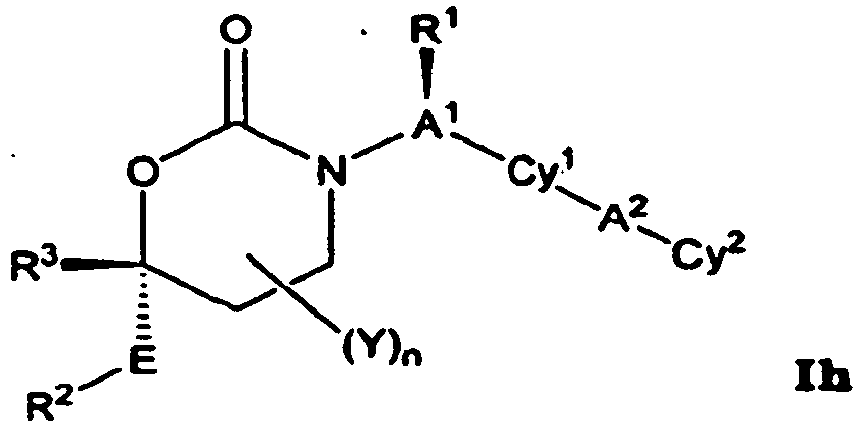
- Another embodiment is a compound of Formula Ii:
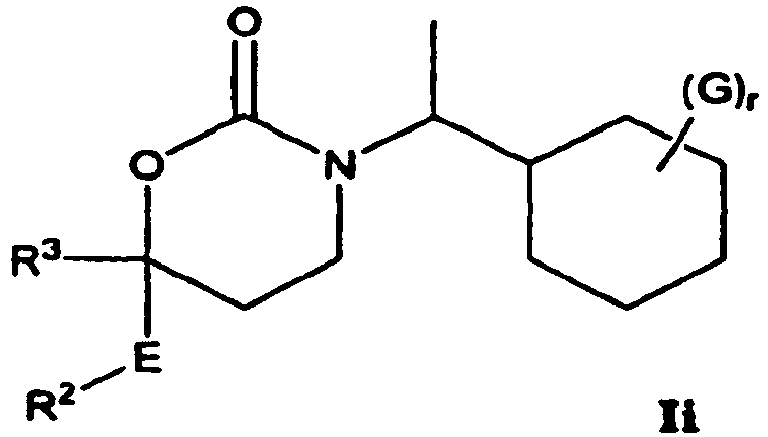
or a pharmaceutically acceptable salt, enantiomer or diastereomer thereof. - Alternatively, for Formula Ii:

- E, R2 and R3 are as defined for the first or second embodiments described for Formula I above, r is 0, 1, 2, 3 or 4, and substituents G are independently selected from fluorine, chlorine, bromine, iodine, cyano, nitro, amino, hydroxy, carboxy, (C1-C6)alkyl, hydroxy(C1-C6)alkyl, (C3-C6)cycloalkyl, hydroxy(C3-C6)cycloalkyl, (C4-C7)cycloalkylalkyl, (C2-C6)alkenyl, halo(C2-C6)alkenyl, hydroxy(C2-C6)alkenyl, (C2-C6)alkynyl, (C3-C6)cycloalkyl(C2-C4)alkynyl, halo(C1-C6)alkyl, halo(C3-C6)cycloalkyl, halo(C4-C7)cycloalkylalkyl, (C1-C6)alkoxy, (C3-C6)cycloalkoxy, (C4-C7)cycloalkylalkoxy, halo(C1-C6)alkoxy, halo(C3-C6)cycloalkoxy, halo(C4-C7)cycloalkylalkoxy, (C1-C6)alkylthio, (C3-C6)cycloalkythio, (C4-C7)cycloalkylalkylthio, halo(C1-C6)alkylthio, halo(C3-C6)cycloalkythio, halo(C4-C7)cycloalkylalkylthio, (C1-C6)alkanesulfinyl, (C3-C6)cycloalkanesulfinyl, (C4-C7)cycloalkylalkanesulfinyl, halo(C1-C6)alkanesulfinyl, halo(C3-C6)cycloalkanesulfinyl, halo(C4-C7)cycloalkylalkanesulfinyl, (C1-C6)alkanesulfonyl, (C3-C6)cycloalkanesulfonyl, (C4-C7)cycloalkylalkanesulfonyl, halo(C1-C6)alkanesulfonyl, halo(C3-C6)cycloalkanesulfonyl, halo(C4-C7)cyclo-alkylalkanesulfonyl, (C1-C6)alkylamino, di(C1-C6)alkylamino, (C1-C6)alkoxy(C1-C6)alkoxy, halo(C1-C6)alkoxy(C1-C6)alkoxy, (C1-C6)alkoxycarbonyl, H2NCO, H2NSO2, (C1-C6)alkylaminocarbonyl, di(C1-C6)alkylaminocarbonyl, (C1-C3)alkoxy(C1-C3)alkylaminocarbonyl, heterocyclylcarbonyl, (C1-C6)alkylaminosulfonyl, di(C1-C6)alkylaminosulfonyl, heterocyclosulfonyl, (C1-C6)alkylcarbonylamino, (C1-C6)alkylcarbonylamino(C1-C6)alkyl, (C1-C6)alkylsutfonylamino, (C1-C6)alkyl-sulfonylamino(C1-C6)alkyl, (C1-C6)alkoxycarbonyl(C1-C6)alkoxy, (C1-C6)alkoxy(C1-C6)alkyl, halo(C1-C6)alkoxy(C1-C6)alkyl, hydroxy(C1-C6)alkoxy, heteroaryl, amino(C1-C6)alkyl, (C1-C6)alkylamino(C1-C6)alkyl, di(C1-C6)alkylamino(C1-C6)alkyl amino(C2-C6)alkoxy, (C1-C6)alkylamino(C2-C6)alkoxy, di(C1-C6)alkylamino(C2-C6)alkoxy, (C1-C6)alkylcarbonyl, (C3-C6)cycloalkylcarbonyl, (C3-C6)cycloalkylaminocarbonyl, {(C3-C6)cycloalkyl}{(C1-C6)alkyl}aminocarbonyl, di(C3-C6)cycloalkylaminocarbonyl, (C3-C6)cycloalkylaminosulfonyl, {(C3-C6)cycloalkyl}{(C1-C6)alkyl}aminosulfonyl, di(C3-C6)cycloalkylaminosulfonyl, cyano(C1-C6)alkyl, aminocarbonyl(C1-C6)alkyl, (C1-C6)alkylaminocarbonyl(C1-C6)alkyl, di(C1-C6)alkylaminocarbonyl(C1-C6)alkyl, (C3-C6)cycloalkylaminocarbonyl(C1-C6)alkyl, {(C3-C6)cycloalkyl}{(C1-C6)alkyl}aminocarbonyl(C1-C6)alkyl and di(C3-C6)cycloalkylaminocarbonyl(C1-C6)alkyl; or a pharmaceutically acceptable salt, enantiomer or diastereomer thereof.
- Another embodiment is a compound of Formula Ij:

or a pharmaceutically acceptable salt, enantiomer or diastereomer thereof. - Alternatively for Formula Ij:
- R2 and R3 are as defined for the first or second embodiments described for Formula I above, R1a is methyl or ethyl, r is 0, 1, 2, 3 or 4, and substituents G are independently selected from fluorine, chlorine, bromine, iodine, cyano, nitro, amino, hydroxy, carboxy, (C1-C6)alkyl, hydroxy(C1-C6)alkyl, (C3-C8)cycloalkyl, hydroxy(C3-C6)cycloalkyl, (C4-C7)cycloalkylalkyl, (C2-C6)alkenyl, halo(C2-C6)alkenyl, hydroxy(C2-C6)alkenyl, (C2-C6)alkynyl, (C3-C8)cycloalkyl(C2-C4)alkynyl, halo(C1-C8)alkyl, halo(C3-C6)cycloalkyl, halo(C4-C7)cycloalkylalkyl, (C1-C6)alkoxy, (C3-C6)cycloalkoxy, (C4-C7)cycloalkylalkoxy, halo(C1-C6)alkoxy, halo(C3-C6)cycloalkoxy, halo(C4-C7)cycloalkylalkoxy, (C1-C6)alkylthio, (C3-C6)cycloalkythio, (C4-C7)cycloalkylalkylthio, halo(C1-C6)alkylthio, halo(C3-C6)cycloalkythio, halo(C4-C7)cycloalkylalkylthio, (C1-C6)alkanesulfinyl, (C3-C6)cycloalkanesulfinyl, (C4-C7)cycloalkylalkanesulfinyl, halo(C1-C6)alkanesulfinyl, halo(C3-C6)cycloalkanesulfinyl, halo(C4-C7)cycloalkylalkanesulfinyl, (C1-C6)alkanesulfonyl, (C3-C6)cycloalkanesulfonyl, (C4-C7)cycloalkylalkanesulfonyl, halo(C1-C6)alkanesutfonyl, halo(C3-C6)cycloalkanesulfonyl, halo(C4-C7)cyclo-alkylalkanesulfonyl, (C1-C6)alkylamino, di(C1-C6)alkylamino, (C1-C6)alkoxy(C1-C6)alkoxy, halo(C1-C6)alkoxy(C1-C6)alkoxy, (C1-C6)alkoxycarbonyl, H2NCO, H2NSO2, (C1-C6)alkylaminocarbonyl, di(C1-C6)alkylaminocarbonyl, (C1-C3)alkoxy(C1-C3)alkylaminocarbonyl, heterocyclylcarbonyl, (C1-C6)alkylaminosulfonyl, di(C1-C6)alkylaminosulfonyl, heterocyclosulfonyl, (C1-C6)alkylcarbonylamino, (C1-C6)alkylcarbonylamino(C1-C6)alkyl, (C1-C6)alkylsulfonylamino, (C1-C6)alkylsulfonylamino(C1-C6)alkyl, (C1-C6)alkoxycarbonyl(C1-C6)alkoxy, (C1-C6)alkoxy(C1-C6)alkyl, halo(C1-C6)alkoxy(C1-C6)alkyl, hydroxy(C1-C6)alkoxy, heteroaryl, amino(C1-C6)alkyl, (C1-C6)alkylamino(C1-C6)alkyl, di(C1-C6)alkylamino(C1-C6)alkyl amino(C2-C6)alkoxy, (C1-C6)alkylamino(C2-C6)alkoxy, di(C1-C6)alkylamino(C2-C6)alkoxy, (C1-C6)alkylcarbonyl, (C3-C6)cycloalkylcarbonyl, (C3-C6)cycloalkylaminocarbonyl, {(C3-C6)cycloalkyl}{(C1-C6)alkyl}aminocarbonyl, di(C3-C6)cycloalkylaminocarbonyl, (C3-C6)cycloalkylaminosulfonyl, {(C3-C6)cycloalkyl}{(C1-C6)alkyl}aminosulfonyl, di(C3-C6)cycloalkylaminosulfonyl, cyano(C1-C6)alkyl, aminocarbonyl(C1-C6)alkyl, (C1-C6)alkylaminocarbonyl(C1-C8)alkyl, di(C1-C6)alkylaminocarbonyl(C1-C6)alkyl, (C3-C6)cycloalkylaminocarbonyl(C1-C6)alkyl, {(C3-C6)cycloalkyl}{(C1-C6)alkyl}aminocarbonyl(C1-C6)alkyl and di(C3-C6)cycloalkylaminocarbonyl(C1-C6)alkyl;
- or a pharmaceutically acceptable salt, enantiomer or diastereomer thereof.
- Another embodiment is a compound of Formula Ik:

or a pharmaceutically acceptable salt, enantiomer or diastereomer thereof. - Another embodiment is a compound of Formula Ik wherein R1a is methyl or ethyl, R2 is phenyl optionally substituted with up to 2 groups selected from halogen, methyl, trifluoromethyl and cyano, R3 is MeSO2NHCH2CH2CH2, H2NC(=O)CH2CH2, H2NC(=O)CMe2CH2, 3-hydroxypropyl, 3-hydroxy-3-methylbutyl, 2-hydroxyethyl, 2-hydroxy-2-methylpropyl or 2-cyano-2-methylpropyl and Cy2 is heterocyclyl optionally substituted with up to 3 groups independently selected from those described for G2 in Formula If and oxo;
or a pharmaceutically acceptable salt, enantiomer or diastereomer thereof. - Another embodiment is a compound of Formula Ik wherein R1a is methyl or ethyl, R2 is phenyl optionally substituted with up to 2 groups selected from halogen, methyl, trifluoromethyl and cyano, R3 is MeSO2NHCH2CH2CH2, H2NC(=O)CH2CH2, H2NC(=O)CMe2CH2, 3-hydroxypropyl, 3-hydroxy-3-methylbutyl, 2-hydroxyethyl, 2-hydroxy-2-methylpropyl or 2-cyano-2-methylpropyl and Cy2 is 5-oxo-4,5-dihydro-1 H-pyrazolyl, 3-oxo-2,3-dihydro-1H-pyrazolyl, 5-oxo-4,5-dihydro-1H-imidazolyl, 2-oxo-2,3-dihydro-1H-imidazolyl, 5-oxo-4,5-dihydro-1H-1,2,4-triazol-3-yl, 5-oxo-4,5-dihydro-1,3,4-thiadiazolyl, 1,2-dihydro-2-oxopyridyl, 2,3-dihydro-3-oxopyridazinyl, 1,2-dihydro-2-oxopyrimidinyl, 3,4-dihydro-4-oxopyrimidinyl or 1,2-dihydro-2-oxopyrazinyl optionally substituted with up to 3 groups independently selected from fluorine, chlorine, cyano, hydroxy, amino, (C1-C4)alkyl, (C3-C4)cycloalkyl, (C3-C4)cycloalkyl(C1-C2)alkyl, halo(C1-C4)alkyl, (C1-C4)alkoxy, (C1-C4)haloalkoxy, CONH2, (C1-C4)alkylaminocarbonyl, di(C1-C4)alkylaminocarbonyl, and (C1-C4)alkylcarbonylamino; or a pharmaceutically acceptable salt, enantiomer or diastereomer thereof. In one alternative, the embodiments described in this paragraph exclude the compound exemplified in Examples 221 or 313 or a pharmaceutically acceptable salt, enantiomer or diastereomer thereof.
- Another embodiment is a compound of Formula Ik wherein R1a is methyl or ethyl, R2 is phenyl optionally substituted with up to 2 groups selected from halogen, methyl, trifluoromethyl and cyano, R3 is 2-hydroxy-2-methylpropyl or 2-cyano-2-methylpropyl and Cy2 is 1,2-dihydro-2-oxopyridyl, 2,3-dihydro-3-oxopyridazinyl, 1,2-dihydro-2-oxopyrimidinyl, 3,4-dihydro-4-oxopyrimidinyl or 1,2-dihydro-2-oxopyrazinyl optionally substituted with up to 2 groups independently selected from (C1-C4)alkyl, (C3-C4)cycloalkyl, halo(C1-C4)alkyl and halogen;
or a pharmaceutically acceptable salt, enantiomer or diastereomer thereof. - Another embodiment is a compound of Formula Ik wherein R1a is methyl or ethyl, R2 is phenyl optionally substituted with up to 2 groups selected from halogen, methyl, trifluoromethyl and cyano, R3 is 2-hydroxy-2-methylpropyl or 2-cyano-2-methylpropyl and Cy2 is heteroaryl optionally substituted with up 2 groups selected from (C1-C4)alkyl, halo(C1-C4)alkyl, halogen, cyano, CONH2, (C1-C4)alkylaminocarbonyl, di(C1-C4)alkylaminocarbonyl and (C3-C5)cycloalkylaminocarbonyl or a pharmaceutically acceptable salt, enantiomer or diastereomer thereof. In another embodiment, Cy2 is heteroaryl optionally substituted with one group selected from (C1-C4)alkyl, halo(C1-C4)alkyl, halogen, cyano, CONHMe and CONMe2; or a pharmaceutically acceptable salt, enantiomer or diastereomer thereof. In an alternative embodiment CONH2 is excluded as a permissible substituent when Cy2 is pyridine or thiazole. In yet another embodiment, Cy2 is heteroaryl optionally substituted with one group selected from (C1-C4)alkyl. halo(C1-C4)alkyl, halogen, cyano;
or a pharmaceutically acceptable salt, enantiomer or diastereomer thereof. - Another embodiment is a compound of Formula Ik wherein R1a is methyl or ethyl, R2 is phenyl or fluorophenyl, R3 is 2-hydroxy-2-methylpropyl or 2-cyano-2-methylpropyl and Cy2 is pyridine, pyridine N-oxide, pyridazine, pyrimidine, pyrazine, thiazole, pyrazole or thiadiazole optionally substituted with methyl, fluorine, chlorine, cyano, CONH2, CONHMe,CONMe2, CONHt-Bu or CONHc-Pr,
or a pharmaceutically acceptable salt, enantiomer or diastereomer thereof. In an alternative embodiment CONH2 is excluded as a permissible substituent when Cy2 is pyridine or thiazole. - Another embodiment of the invention is a compound of any one of Formulas Im1-12 or a pharmaceutically acceptable salt, enantiomer or diastereomer thereof:

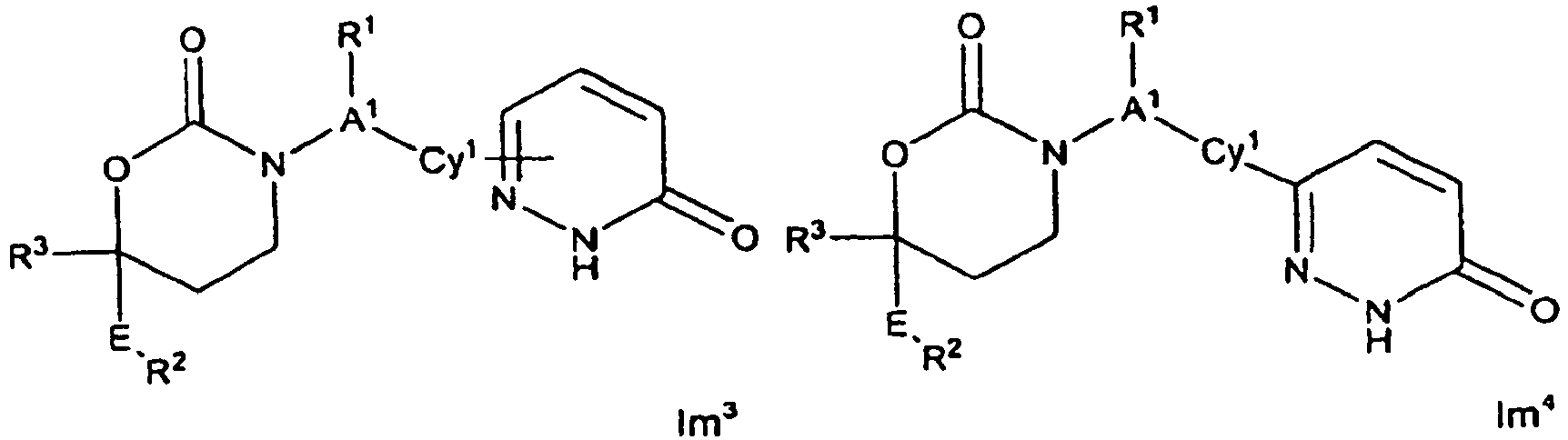


- In Formulas Im1-12, the oxodihydropyridyl, oxodihydropyridazinyl, oxodihydropyrimidinyl and oxodihydropyrazinyl rings in Formulas Im1-12 are optionally substituted (substitution at ring carbons bonded to hydrogen and ring nitrogen atoms bonded to hydrogen atoms are encompassed, i.e., a "substitutable ring nitrogen atom") with up to four substituents as described above for Cy2. Suitable substituents for Cy2 and suitable values for R1, R2, R3, A1, Cy1 and E are as defined in any one of the first, second, third, fourth, fifth, sixth, seventh, eighth, ninth, tenth, eleventh or twelfth embodiments. Alternatively, suitable substituents for Cy1 and the oxodihydropyridyl, oxodihydropyridazinyl, oxodihydropyrimidinyl and oxodihydropyrazinyl rings in Formulas Im1-12 are as described for G1 and G2, respectively, in Formula If, and values for R1, R2, R3, A1, Cy1 and E are as defined in any one of the first, second, third, fourth, fifth, sixth, seventh, eighth, ninth, tenth, eleventh or twelfth embodiments. Alternatively, suitable substituents for Cy1 include (C1-C4 )alkyl, (C1-C4 )alkoxy, (C1-C4 )haloalkyl, (C1-C4)haloalkoxy, halogen, cyano and nitro; suitable substituents for a substitutable ring nitrogen atom in the oxodihydropyridyl, oxodihydropyridazinyl, oxodihydropyrimidinyl and oxodihydropyrazinyl rings in Formulas Im1-12 include (C1-C4)alkyl, (C3-C4)cycloalkyl, (C3-C4)cycloalkyl(C1-C2)alkyl, and (C1-C4)haloalkyl; suitable substituents for a ring carbon atom in the oxodihydropyridyl, oxodihydropyridazinyl, oxodihydropyrimidinyl and oxodihydropyrazinyl rings in Formulas Im1-12 include fluorine, chlorine, cyano, hydroxy, amino, (C1-C4)alkyl, (C3-C4)cycloalkyl, (C3-C4)cycloalkyl(C1-C2)alkyl, halo(C1-C4)alkyl, (C1-C4)alkoxy, (C1-C4)haloalkoxy, CONH2, (C1-C4)alkylaminocarbonyl, di(C1-C4)alkylaminocarbonyl and (C1-C4)alkylcarbonylamino, and suitable values for R1, R2, R3, A1, Cy1 and E are as defined in any one of the first, second, third, fourth, fifth, sixth, seventh, eighth, ninth, tenth, eleventh or twelfth embodiments. In another alternative, the embodiments in this paragraph exclude the compound exemplified in Example 221 and Example 313 or a pharmaceutically acceptable salt, enantiomer or diastereomer thereof.
- For each of the embodiments described in the previous paragraph, R1 is preferably methyl or ethyl.
- For each of the embodiments described in the paragraph immediately following Formulas Im1-12 , R1 is preferably methyl or ethyl; and R3 is MeSO2NHCH2CH2CH2, H2NC(=O)CH2CH2, H2NC(=O)CMe2CH2, 3-hydroxypropyl, 3-hydroxy-3-methylbutyl, 2-hydroxyethyl, 2-hydroxy-2-methylpropyl or 2-cyano-2-methylpropyl.
- For each of the embodiments described in the paragraph immediately following Formulas Im1-12, R1 is preferably methyl or ethyl; and R3 is H2NC(=O)CMe2CH2, 3-hydroxy-3-methylbutyl, 2-hydroxy-2-methylpropyl or 2-cyano-2-methylpropyl.
- For each of the embodiments described in the paragraph immediately following Formulas Im1-12, R1 is preferably methyl or ethyl; R2 is phenyl optionally substituted with 1, 2 or 3 substituents selected from halo, cyano, CONH2, (C1-C4)alkyl, (C1-C4)haloalkyl, and SO2Me; and R3 is MeSO2NHCH2CH2CH2, H2NC(=O)CH2CH2, H2NC(=O)CMe2CH2, 3-hydroxypropyl, 3-hydroxy-3-methylbutyl, 2-hydroxyethyl, 2-hydroxy-2-methylpropyl or 2-cyano-2-methylpropyl.
- For each of the embodiments described in the paragraph immediately following Formulas Im1-12 , R1 is preferably methyl or ethyl; R2 is phenyl optionally substituted with 1, 2 or 3 substituents selected from halo, cyano, CONH2, (C1-C4)alkyl, (C1-C4)haloalkyl, and SO2Me; and R3 is H2NC(=O)CMe2CH2, 3-hydroxy-3-methylbutyl, 2-hydroxy-2-methylpropyl or 2-cyano-2-methylpropyl.
- For each of the embodiments described in the paragraph immediately following Formulas Im1-12, R1 is preferably methyl or ethyl; and R3 is 2-hydroxy-2-methylpropyl or 2-cyano-2-methylpropyl.
- For each of the embodiments described in the paragraph immediately following Formulas Im1-12 , R1 is preferably methyl or ethyl; R2 is phenyl or fluorophenyl; and R3 is 2-hydroxy-2-methylpropyl or 2-cyano-2-methylpropyl.
- For each of the embodiments described in the paragraph immediately following Formulas Im1-12, R1 is preferably methyl or ethyl; R2 is phenyl or fluorophenyl; R3 is 2-hydroxy-2-methylpropyl or 2-cyano-2-methylpropyl; the substituent on the substitutable ring nitrogen atom in the oxodihydropyridyl, oxodihydropyridazinyl, oxodihydropyrimidinyl and oxodihydropyrazinyl rings in Formulas Im1-12 is (C1-C4 )alkyl, (C3-C4)cycloalkyl, (C3-C4)cycloalkyl(C1-C2)alkyl, or (C1-C2 )haloalkyl; and one or two ring carbon atoms in the oxodihydropyridyl, oxodihydropyridazinyl, oxodihydropyrimidinyl and oxodihydropyrazinyl rings in Formulas Im1-12 are optionally substituted with methyl or ethyl.
- Another embodiment of the invention is a compound of any one of Formulas In1-12, or a pharmaceutically acceptable salt, enantiomer or diastereomer thereof:


- In Formulas In1-12, the oxodihydropyridyl, oxodihydropyridazinyl, oxodihydropyrimidinyl and oxodihydropyrazinyl rings are optionally substituted (substitution at ring carbons bonded to hydrogen and at nitrogen atoms bonded to hydrogen atoms are encompassed, i.e., a "substitutable ring nitrogen atom") with up to four substituents as described above for Cy2. Suitable substituents for Cy2 and suitable values for R1, R2. R3 and Cy1 are as defined in any one of the first, second, third, fourth, fifth, sixth, seventh, eighth, ninth, tenth, eleventh or twelfth embodiments. Alternatively, suitable substituents for Cy1 and the oxodihydropyridyl, oxodihydropyridazinyl, oxodihydropyrimidinyl and oxodihydropyrazinyl rings in Formulas In1-12 are as described for G1 and G2, respectively, in Formula If, and values for R1, R2, R3 and Cy1 are as defined in any one of the first, second, third, fourth, fifth, sixth, seventh, eighth, ninth, tenth, eleventh or twelfth embodiments. Alternatively, suitable substituents for Cy1 include (C1-C4 )alkyl, (C1-C4 )alkoxy, (C1-C4 )haloalkyl, (C1-C4 )haloalkoxy, halogen, cyano and nitro; suitable substituents for a substitutable ring nitrogen atom in the oxodihydropyridyl, oxodihydropyridazinyl, oxodihydropyrimidinyl and oxodihydropyrazinyl rings in Formulas In1-12 include (C1-C4 )alkyl, (C3-C4)cycloalkyl, (C3-C4)cycloalkyl(C1-C2)alkyl and (C1-C4)haloalkyl; suitable substituents for a ring carbon atom in the oxodihydropyridyl, oxodihydropyridazinyl, oxodihydropyrimidinyl and oxodihydropyrazinyl rings in Formulas In1-12 include fluorine, chlorine, cyano, hydroxy, amino, (C1-C4)alkyl, (C3-C4)cycloalkyl, (C3-C4)cycloalkyl(C1-C2)alkyl, halo(C1-C4)alkyl, (C1-C4)alkoxy, (C1-C4)haloalkoxy, CONH2, (C1-C4)alkylaminocarbonyl, di(C1-C4)alkylaminocarbonyl and (C1-C4)alkylcarbonylamino; and suitable values for R1, R2, R3, and Cy1 are as defined in any one of the first, second, third, fourth, fifth, sixth, seventh, eighth, ninth, tenth, eleventh or twelfth embodiments. In another alternative, the embodiments described in this paragraph exclude the compound exemplified in Example 221 and Example 313 or a pharmaceutically acceptable salt, enantiomer or diastereomer thereof.
- For each of the embodiments described in the previous paragraph, R1 is preferably methyl or ethyl.
- For each of the embodiments described in the paragraph immediately following Formulas In1-12, R1 is preferably methyl or ethyl; and R3 is MeSO2NHCH2CH2CH2, H2NC(=O)CH2CH2, H2NC(=O)CMe2CH2, 3-hydroxypropyl, 3-hydroxy-3-methylbutyl, 2-hydroxyethyl, 2-hydroxy-2-methylpropyl or 2-cyano-2-methylpropyl.
- For each of the embodiments described in the paragraph immediately following Formulas In1-12 , R1 is preferably methyl or ethyl; and R3 is H2NC(=O)CMe2CH2, 3-hydroxy-3-methylbutyl, 2-hydroxy-2-methylpropyl or 2-cyano-2-methylpropyl.
- For each of the embodiments described in the paragraph immediately following Formulas In1-12, R1 is preferably methyl or ethyl; R2 is phenyl optionally substituted with 1, 2 or 3 substituents selected from halo, cyano, CONH2, (C1-C4)alkyl, (C1-C4)haloalkyl and SO2Me; and R3 is MeSO2NHCH2CH2CH2, H2NC(=O)CH2CH2, H2NC(=O)CMe2CH2, 3-hydroxypropyl, 3-hydroxy-3-methylbutyl, 2-hydroxyethyl, 2-hydroxy-2-methylpropyl or 2-cyano-2-methylpropyl.
- For each of the embodiments described in the paragraph immediately following Formulas In1-12 R1 is preferably methyl or ethyl; R2 is phenyl optionally substituted with 1, 2 or 3 substituents selected from halo, cyano, CONH2, (C1-C4)alkyl, (C1-C4)haloalkyl and SO2Me; and R3 is H2NC(=O)CMe2CH2, 3-hydroxy-3-methylbutyl, 2-hydroxy-2-methylpropyl or 2-cyano-2-methylpropyl.
- For each of the embodiments described in the paragraph immediately following Formulas In1-12 , R1 is preferably methyl or ethyl; and R3 is 2-hydroxy-2-methylpropyl or 2-cyano-2-methylpropyl.
- For each of the embodiments described in the paragraph immediately following Formulas In1-12, R1 is preferably methyl or ethyl; R2 is phenyl or fluorophenyl; and R3 is 2-hydroxy-2-methylpropyl or 2-cyano-2-methylpropyl.
- For each of the embodiments described in the paragraph immediately following Formulas In1-12 , R1 is preferably methyl or ethyl; R2 is phenyl or fluorophenyl; R3 is 2-hydroxy-2-methylpropyl or 2-cyano-2-methylpropyl; the substituent on the substitutable ring nitrogen atom in the oxodihydropyridyl, oxodihydropyridazinyl, oxodihydropyrimidinyl and oxodihydropyrazinyl rings in Formulas In1-12 is (C1-C4)alkyl, (C3-C4)cycloalkyl, (C3-C4)cycloalkyl(C1-C2)alkyl, or (C1-C2)haloalkyl; and one or two ring carbon atoms in the oxodihydropyridyl, oxodihydropyridazinyl, oxodihydropyrimidinyl and oxodihydropyrazinyl rings in Formulas In1-12 are optionally substituted with methyl or ethyl.
- Another embodiment of the invention is a compound of any one for Formulas Io1-12, or a pharmaceutically acceptable salt thereof:


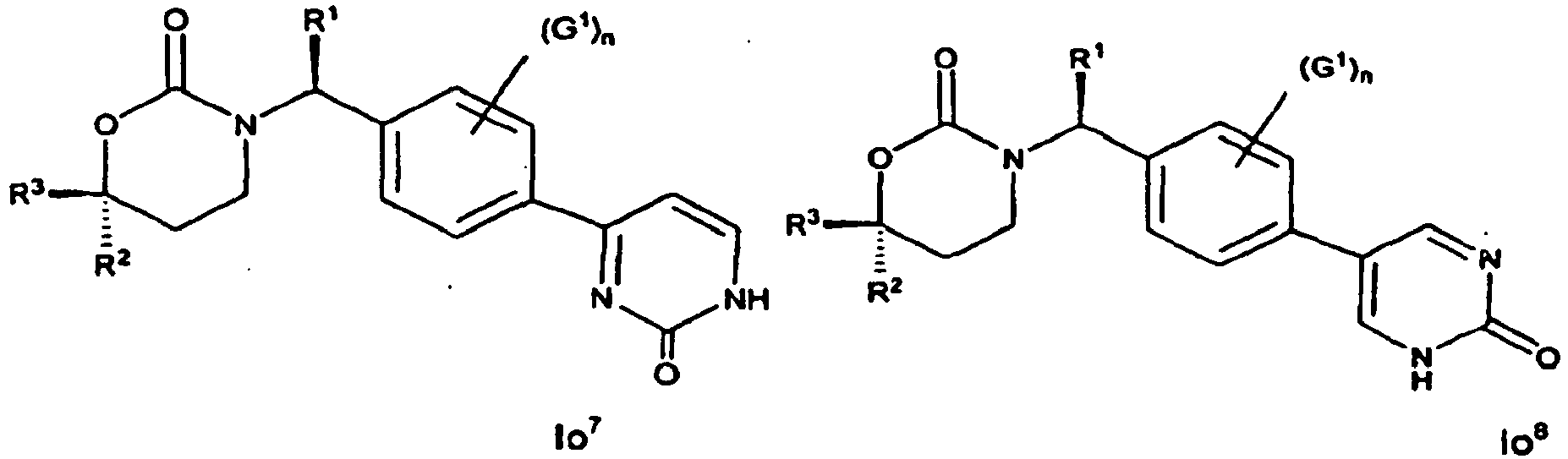

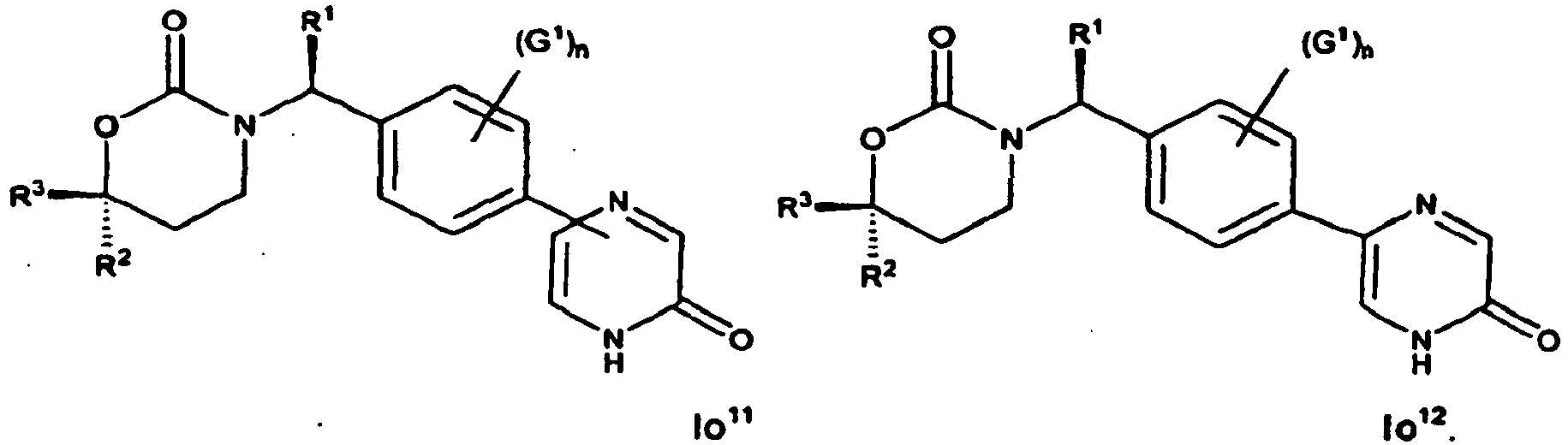
- In Formulas Io1-12, the oxodihydropyridyl, oxodihydropyridazinyl, oxodihydropyrimidinyl and oxodihydropyrazinyl rings in Formulas Io1-12 are optionally substituted (substitution at ring carbons bonded to hydrogen and at nitrogen atoms bonded to hydrogen atoms are encompassed, i.e., a "substitutable ring nitrogen atom") with up to four substituents as described above for Cy2; suitable values for G1 are as described for G1 in Formula If; n is 0, 1, 2 or 3; and suitable substituents for Cy2 and suitable values for R1, R2 and R3 are as defined in any one of the first, second, third, fourth, fifth, sixth, seventh, eighth, ninth, tenth, eleventh or twelfth embodiments. Alternatively, n is 0, 1, 2 or 3; suitable values for G1 and substituents for the oxodihydropyridyl, oxodihydropyridazinyl, oxodihydropyrimidinyl and oxodihydropyrazinyl rings in Formulas Io1-12 are as described for G1 and G2, respectively, in Formula If, and values for R1, R2 and R3 are as defined in any one of the first, second, third, fourth, fifth, sixth, seventh, eighth, ninth, tenth, eleventh or twelfth embodiments. Alternatively, n is 0, 1, 2 or 3; suitable values for G1 include (C1-C4 )alkyl, (C1-C4 )alkoxy, (C1-C4 )haloalkyl, (C1-C4)haloalkoxy, halogen, cyano and nitro; suitable substituents for a substitutable ring nitrogen atom in the oxodihydropyridyl, oxodihydropyridazinyl, oxodihydropyrimidinyl and oxodihydropyrazinyl rings in Formulas Io1-12 include C1-C4 alkyl, (C3-C4)cycloalkyl, (C3-C4)cycloalkyl(C1-C2)alkyl and C1-C4 haloalkyl; suitable substituents for a ring carbon atom in the oxopyridyl, oxopyridazinyl, oxopyrimidinyl and oxopyrazinyl rings in Formulas Io1-12 include fluorine, chlorine, cyano, hydroxy, amino, (C1-C4)alkyl, (C3-C4)cycloalkyl, (C3-C4)cycloalkyl(C1-C2)alkyl, halo(C1-C4)alkyl, (C1-C4)alkoxy, (C1-C4)haloalkoxy, CONH2, (C1-C4)alkylaminocarbonyl, di(C1-C4)alkylaminocarbonyl and (C1-C4)alkylcarbonylamino; and suitable values for R1, R2 and R3 are as defined in any one of the first, second, third, fourth, fifth, sixth, seventh, eighth, ninth, tenth, eleventh or twelfth embodiments. In another alternative, the embodiments described in this paragraph exclude the compound exemplified in Example 221 and Example 313 or a pharmaceutically acceptable salt, enantiomer or diastereomer thereof.
- For each of the embodiments described in the previous paragraph, R1 is preferably methyl or ethyl.
- For each of the embodiments described in the paragraph immediately following Formulas Io1-12, R1 is preferably methyl or ethyl; and R3 is MeSO2NHCH2CH2CH2, H2NC(=O)CH2CH2, H2NC(=O)CMe2CH2, 3-hydroxypropyl, 3-hydroxy-3-methylbutyl, 2-hydroxyethyl, 2-hydroxy-2-methylpropyl or 2-cyano-2-methylpropyl.
- For each of the embodiments described in the paragraph immediately following Formulas Io1-12, R1 is preferably methyl or ethyl; and R3 is H2NC(=O)CMe2CH2, 3-hydroxy-3-methylbutyl, 2-hydroxy-2-methylpropyl or 2-cyano-2-methylpropyl.
- For each of the embodiments described in the paragraph immediately following Formulas Io1-12 , R1 is preferably methyl or ethyl; R2 is phenyl optionally substituted with 1, 2 or 3 substituents selected from halo, cyano, CONH2, (C1-C4)alkyl, (C1-C4)haloalkyl and SO2Me; and R3 is MeSO2NHCH2CH2CH2, H2NC(=O)CH2CH2, H2NC(=O)CMe2CH2, 3-hydroxypropyl, 3-hydroxy-3-methylbutyl, 2-hydroxyethyl, 2-hydroxy-2-methylpropyl or 2-cyano-2-methylpropyl.
- For each of the embodiments described in the paragraph immediately following Formulas Io1-12 , R1 is preferably methyl or ethyl; R2 is phenyl optionally substituted with 1, 2 or 3 substituents selected from halo, cyano, CONH2, (C1-C4)alkyl, (C1-C4)haloalkyl and SO2Me; and R3 is H2NC(=O)CMe2CH2, 3-hydroxy-3-methylbutyl, 2-hydroxy-2-methylpropyl or 2-cyano-2-methylpropyl.
- For each of the embodiments described in the paragraph immediately following Formulas Io1-12, R1 is preferably methyl or ethyl; and R3 is 2-hydroxy-2-methylpropyl or 2-cyano-2-methylpropyl.
- For each of the embodiments described in the paragraph immediately following Formulas Io1-12, R1 is preferably methyl or ethyl; R2 is phenyl or fluorophenyl; and R3 is 2-hydroxy-2-methylpropyl or 2-cyano-2-methylpropyl.
- For each of the embodiments described in the paragraph immediately following Formulas Io1-12 , R1 is preferably methyl or ethyl; R2 is phenyl or fluorophenyl; R3 is 2-hydroxy-2-methylpropyl or 2-cyano-2-methylpropyl; the substituent on the substitutable ring nitrogen atom in the oxodihydropyridyl, oxodihydropyridazinyl, oxodihydropyrimidinyl and oxodihydropyrazinyl rings in Formulas Io1-12 is (C1-C4 )alkyl, (C3-C4)cycloalkyl, (C3-C4)cycloalkyl(C1-C2)alkyl, or (C1-C2 )haloalkyl; and one or two ring carbon atoms in the oxodihydropyridyl, oxodihydropyridazinyl, oxodihydropyrimidinyl and oxodihydropyrazinyl rings in Formulas Io1-12 are optionally substituted with methyl or ethyl.
- Another embodiment of the invention is a compound represented by any one of Formulas Ip1-7, or a pharmaceutically acceptable salt thereof:


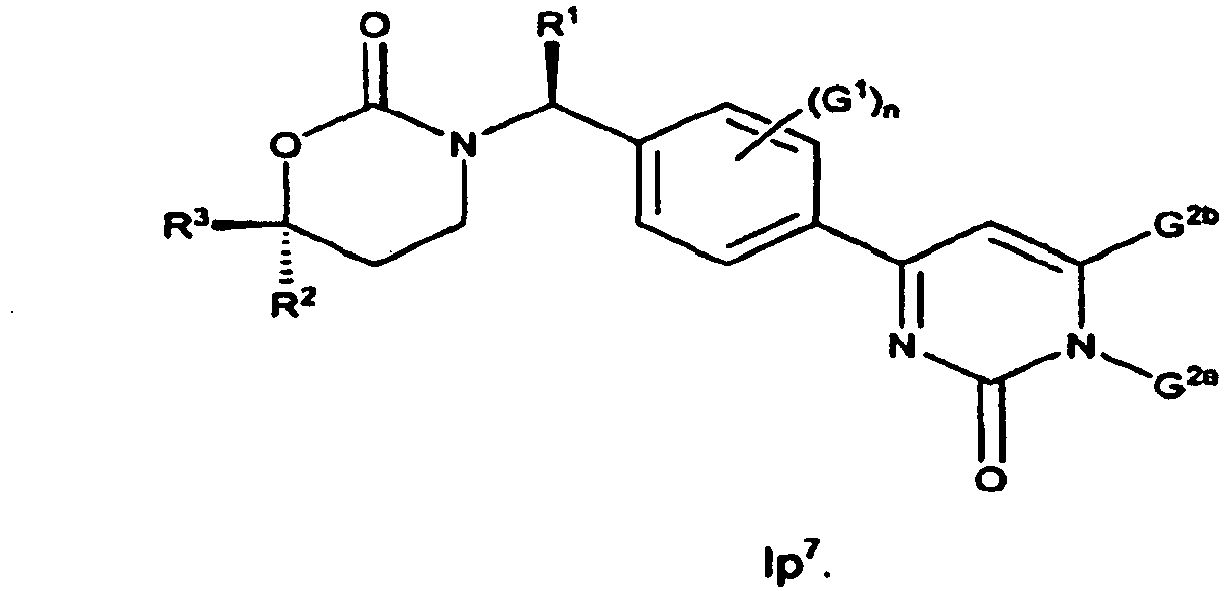
- For each of the embodiments described in the previous paragraph, R1 is preferably methyl or ethyl.
- For each of the embodiments described in the paragraph immediately following Formulas Ip1-7, R1 is preferably methyl or ethyl; and R3 is MeSO2NHCH2CH2CH2, H2NC(=O)CH2CH2, H2NC(=O)CMe2CH2, 3-hydroxypropyl, 3-hydroxy-3-methylbutyl, 2-hydroxyethyl, 2-hydroxy-2-methylpropyl or 2-cyano-2-methylpropyl.
- For each of the embodiments described in the paragraph immediately following Formulas Ip1-7, R1 is preferably methyl or ethyl; and R3 is H2NC(=O)CMe2CH2, 3-hydroxy-3-methylbutyl, 2-hydroxy-2-methylpropyl or 2-cyano-2-methylpropyl.
- For each of the embodiments described in the paragraph immediately following Formulas Ip1-7, R1 is preferably methyl or ethyl; R2 is phenyl optionally substituted with 1, 2 or 3 substituents selected from halo, cyano, CONH2, (C1-C4)alkyl, (C1-C4)haloalkyl and SO2Me; and R3 is MeSO2NHCH2CH2CH2, H2NC(=O)CH2CH2. H2NC(=O)CMe2CH2, 3-hydroxypropyl, 3-hydroxy-3-methylbutyl, 2-hydroxyethyl, 2-hydroxy-2-methylpropyl or 2-cyano-2-methylpropyl.
- For each of the embodiments described in the paragraph immediately following Formulas Ip1-7 , R1 is preferably methyl or ethyl; R2 is phenyl optionally substituted with 1, 2 or 3 substituents selected from halo, cyano, CONH2, (C1-C4)alkyl, (C1-C4)haloalkyl and SO2Me; and R3 is H2NC(=O)CMe2CH2, 3-hydroxy-3-methylbutyl, 2-hydroxy-2-methylpropyl or 2-cyano-2-methylpropyl.
- For each of the embodiments described in the paragraph immediately following Formulas Ip1-7, R1 is preferably methyl or ethyl; and R3 is 2-hydroxy-2-methylpropyl or 2-cyano-2-methylpropyl.
- For each of the embodiments described in the paragraph immediately following Formulas Ip1-7, R1 is preferably methyl or ethyl; R2 is phenyl or fluorophenyl; and R3 is 2-hydroxy-2-methylpropyl or 2-cyano-2-methylpropyl.
- For each of the embodiment described in the paragraph immediately following Formulas Ip1-7, R1 is preferably methyl or ethyl; R2 is phenyl or fluorophenyl; R3 is 2-hydroxy-2-methylpropyl or 2-cyano-2-methylpropyl; the substituent G2a is selected from (C1-C4 )alkyl, (C3-C4)cycloalkyl, (C3-C4)cydoalkyl(C1-C2)alkyl, and (C1-C2)haloalkyl; and G2b is optionally selected from hydrogen, methyl or ethyl.
- Another embodiment of the invention is a compound of any one of Formulas Iq1-20 or a pharmaceutically acceptable salt, enantiomer or diastereomer thereof:


- In Formulas Iq1-21, the pyridine, pyridazine, pyrimidine, pyrazine, pyrazole, thiazole and thiadiazole rings in Formulas Iq1-21 are optionally substituted (substitution at ring carbons bonded to hydrogen and ring nitrogen atoms bonded to hydrogen atoms are encompassed, i.e., a "substitutable ring nitrogen atom") with up to four substituents as described above for Cy2. Suitable substituents for Cy2 and suitable values for R1, R2, R3, A1, Cy1 and E are as defined in any one of the first, second, third, fourth, fifth, sixth, seventh, eighth, ninth, tenth, eleventh or twelfth embodiments. Alternatively, suitable substituents for Cy1 and the pyridine, pyridazine, pyrimidine, pyrazine, pyrazole, thiazole and thiadiazole rings in Formulas Iq1-21 are as described for G1 and G2, respectively, in Formula If, and values for R1, R2, R3, A1, Cy1 and E are as defined in any one of the first, second, third, fourth, fifth, sixth, seventh, eighth, ninth, tenth, eleventh or twelfth embodiments. Alternatively, suitable substituents for Cy1 include (C1-C4)alkyl, (C1-C4)alkoxy, (C1-C4)haloalkyl, (C1-C4 )haloalkoxy, halogen, cyano and nitro; suitable substituents for a substitutable ring nitrogen atom in the pyrazole rings in Formulas Iq18, Iq20 and Iq21 include (C1-C4)alkyl, (C3-C4)cycloalkyl, (C3-C4)cycloalkyl(C1-C2)alkyl, and (C1-C4 )haloalkyl; suitable substituents for a ring carbon atom in the pyridine, pyridazine, pyrimidine, pyrazine, pyrazole, thiazole and thiadiazole rings in Formulas Iq1-21 include fluorine, chlorine, cyano, amino, (C1-C4)alkyl, (C3-C4)cycloalkyl, (C3-C4)cycloalkyl(C1-C2)alkyl. halo(C1-C4)alkyl, (C1-C4)alkoxy, (C1-C4)haloalkoxy, CONH2, (C1-C4)alkylaminocarbonyl, di(C1-C4)alkylaminocarbonyl, (C3-C4)cycloalkylaminocarbonyl, {(C1-C4)alkyl}{(C3-C4)cycloalkyl}aminocarbonyl and (C1-C4)alkylcarbonylamino; the ring nitrogen in the pyridine rings in Formulas Iq1-4 is optionally substituted by oxo; and suitable values for R1, R2, R3, A1, Cy1 and E are as defined in any one of the first, second, third, fourth, fifth, sixth, seventh, eighth, ninth, tenth, eleventh or twelfth embodiments. In another alternative, the embodiments in this paragraph exclude the compound exemplified in Example 205, Example 211, Example 214, Example 222, Example 226, Example 235, Example 236, Example 281, Example 292, Example 295, Example 298, Example 300, Example 302, Example 305, Example 304, Example 306, Example 307, Example 210, Example 296, Example 311, Example 230, Example 244, Example 258 and Example 291 or a pharmaceutically acceptable salt, enantiomer or diastereomer thereof.
- For each of the embodiments described in the previous paragraph, R1 is preferably methyl or ethyl.
- For each of the embodiments described in the paragraph immediately following Formulas Iq1-21, R1 is preferably methyl or ethyl; and R3 is MeSO2NHCH2CH2CH2, H2NC(=O)CH2CH2, H2NC(=O)CMe2CH2, 3-hydroxypropyl, 3-hydroxy-3-methylbutyl, 2-hydroxyethyl, 2-hydroxy-2-methylpropyl or 2-cyano-2-methylpropyl.
- For each of the embodiments described in the paragraph immediately following Formulas Iq1-21, R1 is preferably methyl or ethyl; and R3 is H2NC(=O)CMe2CH2, 3-hydroxy-3-methylbutyl, 2-hydroxy-2-methylpropyl or 2-cyano-2-methylpropyl.
- For each of the embodiments described in the paragraph immediately following Formulas Iq1-21, R1 is preferably methyl or ethyl; R2 is phenyl optionally substituted with 1, 2 or 3 substituents selected from halo, cyano, CONH2, (C1-C4)alkyl, (C1-C4)haloalkyl and SO2Me; and R3 is MeSO2NHCH2CH2CH2, H2NC(=O)CH2CH2, H2NC(=O)CMe2CH2, 3-hydroxypropyl, 3-hydroxy-3-methylbutyl, 2-hydroxyethyl, 2-hydroxy-2-methylpropyl or 2-cyano-2-methylpropyl.
- For each of the embodiments described in the paragraph immediately following Formulas Iq1-21, R1 is preferably methyl or ethyl; R2 is phenyl optionally substituted with 1, 2 or 3 substituents selected from halo, cyano, CONH2, (C1-C4)alkyl, (C1-C4)haloalkyl, and SO2Me; and R3 is H2NC(=O)CMe2CH2, 3-hydroxy-3-methylbutyl, 2-hydroxy-2-methylpropyl or 2-cyano-2-methylpropyl.
- For each of the embodiments described in the paragraph immediately following Formulas Iq1-21, R1 is preferably methyl or ethyl; and R3 is 2-hydroxy-2-methylpropyl or 2-cyano-2-methylpropyl.
- For each of the embodiments described in the paragraph immediately following Formulas Iq1-21, R1 is preferably methyl or ethyl; R2 is phenyl or fluorophenyl; and R3 is 2-hydroxy-2-methylpropyl or 2-cyano-2-methylpropyl.
- For each of the embodiments described in the paragraph immediately following Formulas Iq1-21, R1 is preferably methyl or ethyl; R2 is phenyl or fluorophenyl; R3 is 2-hydroxy-2-methylpropyl or 2-cyano-2-methylpropyl; one or two ring carbon atoms in the pyridine, pyridazine, pyrimidine, pyrazine, pyrazole, thiazole and thiadiazole rings in Formulas Iq1-21 are optionally substituted with fluoro, chloro, cyano, CONH2, CONHMe, CONMe2, CONHc-Pr, methoxy, ethoxy, methyl, ethyl or CF3. the substitutable ring nitrogen atom in the pyrazole rings in Formulas Iq18, Iq20 and Iq21 are optionally substituted with (C1-C4 )alkyl, (C3-C4)cycloalkyl, (C3-C4)cycloalkyl(C1-C2)alkyl, or (C1-C2 )haloalkyl, the ring nitrogen in the pyridine rings in Formulas Iq1-4 is optionally substituted by oxo.
- Another embodiment of the invention is a compound of any one of Formulas Ir1-21, or a pharmaceutically acceptable salt, enantiomer or diastereomer thereof:

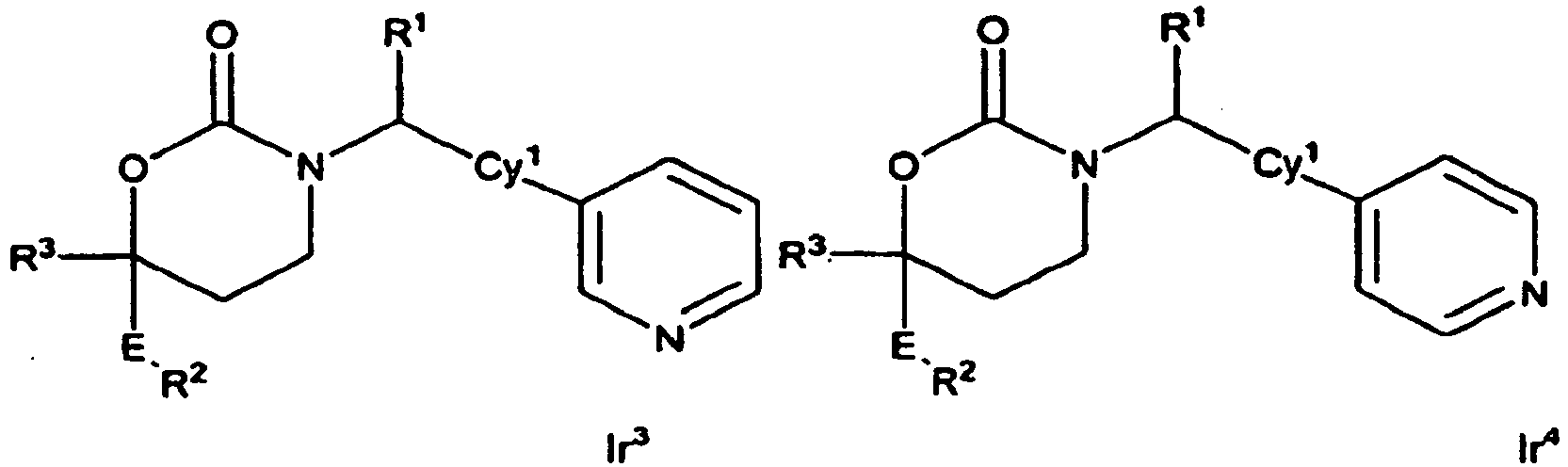


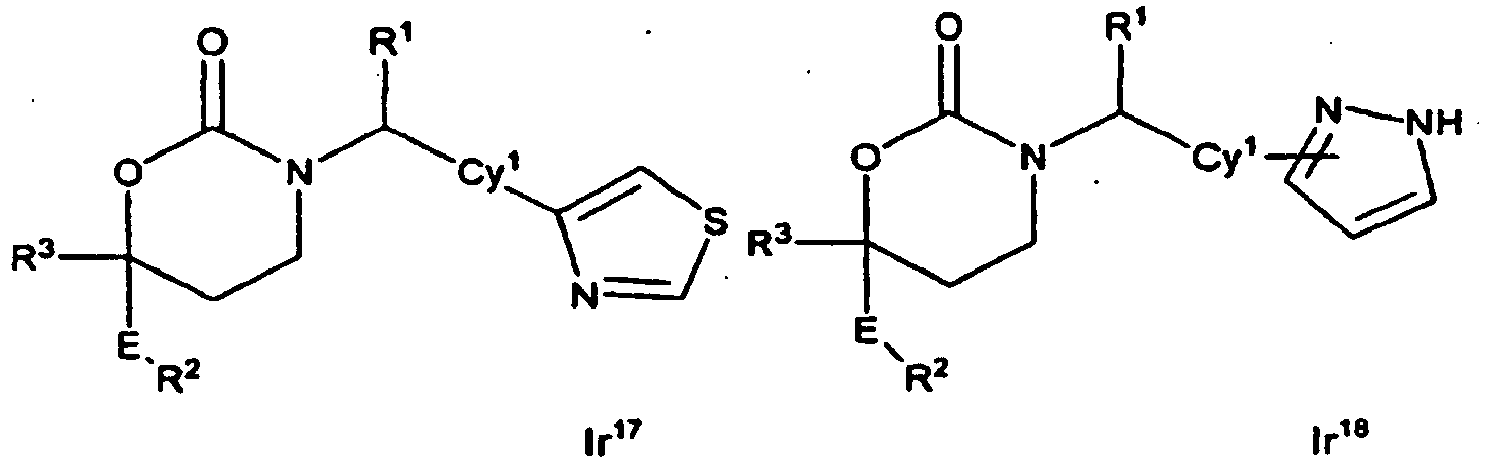


- In Formulas Ir1-21, the pyridine, pyridazine, pyrimidine, pyrazine, pyrazole, thiazole and thiadiazole rings in Formulas Ir1-21 are optionally substituted (substitution at ring carbons bonded to hydrogen and ring nitrogen atoms bonded to hydrogen atoms are encompassed, i.e., a "substitutable ring nitrogen atom") with up to four substituents as described above for Cy2. Suitable substituents for Cy2 and suitable values for R1, R2, R3, Cy1 and E are as defined in any one of the first, second, third, fourth, fifth, sixth, seventh, eighth, ninth, tenth, eleventh or twelfth embodiments. Alternatively, suitable substituents for Cy1 and the pyridine, pyridazine, pyrimidine, pyrazine, pyrazole, thiazole and thiadiazole rings in Formulas Ir1-21 are as described for G1 and G2, respectively, in Formula If, and values for R1, R2, R3, Cy1 and E are as defined in any one of the first, second, third, fourth, fifth, sixth, seventh, eighth, ninth, tenth, eleventh or twelfth embodiments. Alternatively, suitable substituents for Cy1 include (C1-C4)alkyl, (C1-C4)alkoxy, (C1-C4)haloalkyl, (C1-C4)haloalkoxy, halogen, cyano and nitro; suitable substituents for a substitutable ring nitrogen atom in the pyrazole rings in Formulas Ir18, Ir20 and Ir21 include (C1-C4)alkyl, (C3-C4)cycloalkyl, (C3-C4)cycloalkyl(C1-C2)alkyl, and (C1-C4 )haloalkyl; suitable substituents for a ring carbon atom in the pyridine, pyridazine, pyrimidine, pyrazine, pyrazole, thiazole and thiadiazole rings in Formulas Ir1-21 include fluorine, chlorine, cyano, hydroxy, amino, (C1-C4)alkyl, (C3-C4)cycloalkyl, (C3-C4)cycloalkyl(C1-C2)alkyl, halo(C1-C4)alkyl, (C1-C4)alkoxy, (C1-C4)haloalkoxy, CONH2, (C1-C4)alkylaminocarbonyl, di(C1-C4)alkylaminocarbonyl, (C3-C4)cycloalkylaminocarbonyl, {(C1-C4)alkyl}{(C3-C4)cycloalkyl}aminocarbonyl and (C1-C4)alkylcarbonylamino; the ring nitrogen in pyridines Ir1-4 is optionally substituted by oxo; and suitable values for R1, R2, R3, Cy1 and E are as defined in any one of the first, second, third, fourth, fifth, sixth, seventh, eighth, ninth, tenth, eleventh or twelfth embodiments. In another alternative, the embodiments described in this paragraph exclude the compound exemplified in Example 205, Example 211, Example 214, Example 222, Example 226, Example 235, Example 236, Example 281, Example 292, Example 295, Example 298, Example 300, Example 302, Example 305, Example 304, Example 306, Example 307, Example 210, Example 296, Example 311, Example 230, Example 244, Example 258 and Example 291 or a pharmaceutically acceptable salt, enantiomer or diastereomer thereof.
- For each of the embodiment described in the previous paragraph, R1 is preferably methyl or ethyl.
- For each of the embodiment described in the paragraph immediately following Formulas Ir1-21, R1 is preferably methyl or ethyl; and R3 is MeSO2NHCH2CH2CH2, H2NC(=O)CH2CH2, H2NC(=O)CMe2CH2, 3-hydroxypropyl, 3-hydroxy-3-methylbutyl, 2-hydroxyethyl, 2-hydroxy-2-methylpropyl or 2-cyano-2-methylpropyl.
- For each of the embodiment described in the paragraph immediately following Formulas Ir1-21, R1 is preferably methyl or ethyl; and R3 is H2NC(=O)CMe2CH2, 3-hydroxy-3-methylbutyl, 2-hydroxy-2-methylpropyl or 2-cyano-2-methylpropyl.
- For each of the embodiment described in the paragraph immediately following Formulas Ir1-21, R1 is preferably methyl or ethyl; R2 is phenyl optionally substituted with 1, 2 or 3 substituents selected from halo, cyano, CONH2, (C1-C4)alkyl, (C1-C4)haloalkyl and SO2Me; and R3 is MeSO2NHCH2CH2CH2, H2NC(=O)CH2CH2, H2NC(=O)CMe2CH2, 3-hydroxypropyl, 3-hydroxy-3-methylbutyl, 2-hydroxyethyl, 2-hydroxy-2-methylpropyl or 2-cyano-2-methylpropyl.
- For each of the embodiment described in the paragraph immediately following Formulas Ir1-21, R1 is preferably methyl or ethyl; R2 is phenyl optionally substituted with 1, 2 or 3 substituents selected from halo, cyano, CONH2, (C1-C4)alkyl, (C1-C4)haloalkyl and SO2Me; and R3 is H2NC(=O)CMe2CH2, 3-hydroxy-3-methylbutyl, 2-hydroxy-2-methylpropyl or 2-cyano-2-methylpropyl.
- For each of the embodiment described in the paragraph immediately following Formulas Ir1-21, R1 is preferably methyl or ethyl; and R3 is 2-hydroxy-2-methylpropyl or 2-cyano-2-methylpropyl.
- For each of the embodiment described in the paragraph immediately following Formulas Ir1-21, R1 is preferably methyl or ethyl; R2 is phenyl or fluorophenyl; and R3 is 2-hydroxy-2-methylpropyl or 2-cyano-2-methylpropyl.
- For each of the embodiment described in the paragraph immediately following Formulas Ir1-21, R1 is preferably methyl or ethyl; R2 is phenyl or fluorophenyl; R3 is 2-hydroxy-2-methylpropyl or 2-cyano-2-methylpropyl; one or two ring carbon atoms in the pyridine, pyridazine, pyrimidine, pyrazine, pyrazole, thiazole and thiadiazole rings in Formulas Ir1-21 are optionally substituted with fluoro, chloro, cyano, CONH2, CONHMe, CONMe2, CONHc-Pr, metnoxy, ethoxy, methyl, ethyl or CF3. the substitutable ring nitrogen atom in the pyrazole rings in Formulas Ir18, Ir20 and Ir21 are optionally substituted with (C1-C4 )alkyl, (C3-C4)cycloalkyl, (C3-C4)cycloalkyl(C1-C2)alkyl, or (C1-C2 )haloalkyl, the ring nitrogen in the pyridine rings in Formulas Ir1-4 is optionally substituted by oxo.
- Another embodiment of the invention is a compound of any one of Formulas Is1-21, or a pharmaceutically acceptable salt, enantiomer or diastereomer thereof:


- In Formulas Is1-21, the pyridine, pyridazine, pyrimidine, pyrazine, pyrazole, thiazole and thiadiazole rings in Formulas Is1-21 are optionally substituted (substitution at ring carbons bonded to hydrogen and ring nitrogen atoms bonded to hydrogen atoms are encompassed, i.e., a "substitutable ring nitrogen atom") with up to four substituents as described above for Cy2. Suitable values for G1 are as described in Formula If; n is 0, 1 or 2; substituents for Cy2 and suitable values for R\ R2 and R3 are as defined in any one of the first, second, third, fourth, fifth, sixth, seventh, eighth, ninth, tenth, eleventh or twelfth embodiments. Alternatively, n is 0, 1 or 2, suitable values for G1 in Formulas Is1-21 and suitable substituents for the pyridine, pyridazine, pyrimidine, pyrazine, pyrazole, thiazole and thiadiazole rings in Formulas Is1-21 are as described for G' and G2, respectively, in Formula If, and values for R1, R2, R3 and E are as defined in any one of the first, second, third, fourth, fifth, sixth, seventh, eighth, ninth, tenth, eleventh or twelfth embodiments. Alternatively, n is 0, 1 or 2; suitable values for G1 include (C1-C4)alkyl, (C1-C4)alkoxy, (C1-C4)haloalkyl, (C1-C4)haloalkoxy, halogen, cyano and nitro; suitable substituents for a substitutable ring nitrogen atom in the pyrazole rings in Formulas Is18, Is20 and Is21 include (C1-C4)alkyl, (C3-C4)cycloalkyl, (C3-C4)cycloalkyl(C1-C2)alkyl, and (C1-C4 )haloalkyl; suitable substituents for a ring carbon atom in the pyridine, pyridazine, pyrimidine, pyrazine, pyrazole, thiazole and thiadiazole rings in Formulas Is1-21 include fluorine, chlorine, cyano, amino, (C1-C4)alkyl, (C3-C4)cycloalkyl, (C3-C4)cycloalkyl(C1-C2)alkyl. halo(C1-C4)alkyl, (C1-C4)alkoxy, (C1-C4)haloalkoxy, CONH2, (C1-C4)alkylaminocarbonyl, di(C1-C4)alkylaminocarbonyl, (C3-C4)cycloalkylaminocarbonyl, {(C1-C4)alkyl}{(C3-C4)cycloalkyl}aminocarbonyl and (C1-C4)alkylcarbonylamino; the ring nitrogen in pyridines Is1-4 is optionally substituted by oxo; and suitable values for R1, R2 and R3 are as defined in any one of the first, second, third, fourth, fifth, sixth, seventh, eighth, ninth, tenth, eleventh or twelfth embodiments. In another alternative, the embodiments described in this paragraph exclude the compound exemplified in Example 205, Example 211, Example 214, Example 222, Example 226, Example 235, Example 236, Example 281, Example 292, Example 295, Example 298, Example 300, Example 302, Example 305, Example 304, Example 306, Example 307. Example 210, Example 296, Example 311, Example 230, Example 244, Example 258 and Example 291, or a pharmaceutically acceptable salt, enantiomer or diastereomer thereof.
- For each of the embodiment described in the previous paragraph, R1 is preferably methyl or ethyl.
- For each of the embodiment described in the paragraph immediately following Formulas Is1-21. R1 is preferably methyl or ethyl; and R3 is MeSO2NHCH2CH2CH2, H2NC(=O)CH2CH2, H2NC(=O)CMe2CH2, 3-hydroxypropyl. 3-hydroxy-3-methylbutyl, 2-hydroxyethyl, 2-hydroxy-2-methylpropyl or 2-cyano-2-methylpropyl.
- For each of the embodiment described in the paragraph immediately following Formulas Is1-21, R1 is preferably methyl or ethyl; and R3 is H2NC(=O)CMe2CH2, 3-hydroxy-3-methylbutyl, 2-hydroxy-2-methylpropyl or 2-cyano-2-methylpropyl.
- For each of the embodiment described in the paragraph immediately following Formulas Is1-21, R1 is preferably methyl or ethyl; R2 is phenyl optionally substituted with 1, 2 or 3 substituents selected from halo, cyano, CONH2, (C1-C4)alkyl, (C1-C4)haloalkyl and SO2Me; and R3 is MeSO2NHCH2CH2CH2, H2NC(=O)CH2CH2, H2NC(=O)CMe2CH2, 3-hydroxypropyl, 3-hydroxy-3-methylbutyl, 2-hydroxyethyl. 2-hydroxy-2-methylpropyl or 2-cyano-2-methylpropyl.
- For each of the embodiment described in the paragraph immediately following Formulas Is1-21, R1 is preferably methyl or ethyl; R2 is phenyl optionally substituted with 1, 2 or 3 substituents selected from halo, cyano. CONH2, (C1-C4)alkyl, (C1-C4)haloalkyl and SO2Me; and R3 is H2NC(=O)CMe2CH2, 3-hydroxy-3-methylbutyl, 2-hydroxy-2-methylpropyl or 2-cyano-2-methylpropyl.
- For each of the embodiment described in the paragraph immediately following Formulas is1-21 , R1 is preferably methyl or ethyl; and R3 is 2-hydroxy-2-methylpropyl or 2-cyano-2-methytpropyl.
- For each of the embodiment described in the paragraph immediately following Formulas is 1-21 R1 is preferably methyl or ethyl; R2 is phenyl or fluorophenyl; and R3 is 2-hydroxy-2-methylpropyl or 2-cyano-2-methylpropyl.
- For each of the embodiment described in the paragraph immediately following Formulas Is1-21, R1 is preferably methyl or ethyl; R2 is phenyl or fluorophenyl; R3 is 2-hydroxy-2-methylpropyl or 2-cyano-2-methylpropyl; one or two ring carbon atoms in the pyridine, pyridazine, pyrimidine, pyrazine, pyrazole, thiazole and thiadiazole rings in Formulas Is1-21 are optionally substituted with fluoro, chloro, cyano, CONH2, CONHMe, CONMe2, CONHc-Pr, methyl, ethyl or CF3, the substitutable ring nitrogen atom in the pyrazole rings in Formulas Is18. Is20 and Is21 is optionally substituted with (C1-C4 )alkyl, (C3-C4)cycloalkyl, (C3-C4)cycloalkyl(C1-C2)alkyl, or (C1-C2 )haloalkyl, the ring nitrogen in the pyridine rings in Formulas Is1-4 is optionally substituted by oxo.
- Another embodiment of the invention is a compound represented by any one of Formulas It1-6, or a pharmaceutically acceptable salt thereof:


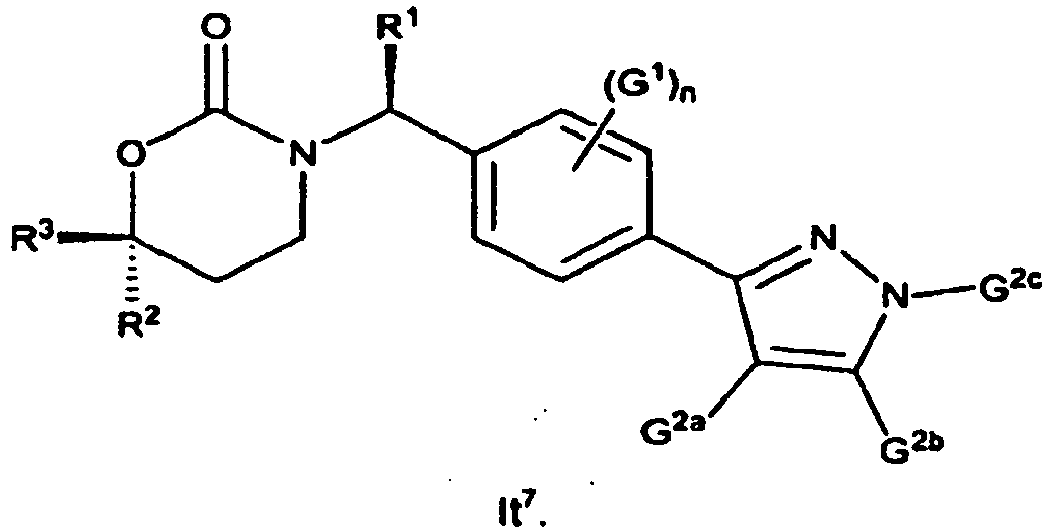
- In Formulas It1-7. G1 is (C1-C4 )alkyl, (C1-C4 )alkoxy, (C1-C4 )haloalkyl, (C1-C4 )haloalkoxy, halogen, cyano and nitro; n is O 1 or 2; G2a and G2b are independently selected from hydrogen, fluorine, chlorine, cyano, amino, (C1-C4)alkyl, (C3-C4)cycloalkyl, (C3-C4)cycloalkyl(C1-C2)alkyl, halo(C1-C4)alkyl, (C1-C4)alkoxy, (C1-C4)haloalkoxy, CONH2, (C1-C4)alkylaminocarbonyl, di(C1-C4)alkylaminocarbonyl, (C3-C4)cycloalkylaminocarbonyl, {(C,-C4)alkyl}{(C3-C4)cycloalkyl}aminocarbonyl and (C1-C4)alkylearbonylamino; G2c is (C1-C4 )alkyl, (C3-C4)cycloalkyl or (C1-C4)haloalkyl; and suitable values for R1, R2 and R3 are as defined in any one of the first, second, third, fourth, fifth, sixth, seventh, eighth, ninth, tenth, eleventh or twelfth embodiments. In another alternative, the embodimentsin the this paragraph exclude the compound exemplified in Example 205, Example 211, Example 214, Example 222, Example 226, Example 235, Example 236, Example 281, Example 292, Example 295, Example 298, Example 300, Example 302, Example 305, Example 304, Example 306. Example 307, Example 210, Example 296, Example 311, Example 230, Example 244, Example 258, and Example 291, or a pharmaceutically acceptable salt, enantiomer or diastereomer thereof.
- For each of the embodiment described in the previous paragraph, R1 is preferably methyl or ethyl.
- For each of the embodiment described in the paragraph immediately following Formulas It1-7, R1 is preferably methyl or ethyl; and R3 is MeSO2NHCH2CH2CH2. H2NC(=O)CH2CH2. H2NC(=O)CMe2CH2, 3-hydroxypropyl, 3-hydroxy-3-methylbutyt, 2-hydroxyethyl, 2-hydroxy-2-methylpropyl or 2-cyano-2-methylpropyl.
- For each of the embodiment described in the paragraph immediately following Formulas It1-7, R1 is preferably methyl or ethyl; and R3 is H2NC(=O)CMe2CH2, 3-hydroxy-3-methylbutyl, 2-hydroxy-2-methylpropyl or 2-cyano-2-methylpropyl.
- For each of the embodiment described in the paragraph immediately following Formulas It1-7. R1 is preferably methyl or ethyl; R2 is phenyl optionally substituted with 1, 2 or 3 substituents selected from halo, cyano, CONH2, (C1-C4)alkyl, (C1-C4)haloalkyl and SO2Me; and R3 is MeSO2NHCH2CH2CH2. H2NC(=O)CH2CH2, H2NC(=O)CMe2CH2, 3-hydroxypropyl, 3-hydroxy-3-methylbutyl, 2-hydroxyethyl, 2-hydroxy-2-methylpropyl or 2-cyano-2-methylpropyl.
- For each of the embodiment described in the paragraph immediately following Formulas It1-7, R1 is preferably methyl or ethyl; R2 is phenyl optionally substituted with 1, 2 or 3 substituents selected from halo, cyano, CONH2, (C1-C4)alkyl, (C1-C4)hatoatkyl and SO2Me; and R3 is H2NC(=O)CMe2CH2. 3-hydroxy-3-methylbutyl, 2-hydroxyethyl, 2-hydroxy-2-methylpropyl or 2-cyano-2-methylpropyl.
- For each of the embodiment described in the paragraph immediately following Formulas It1-7, R1 is preferably methyl or ethyl; and R3 is 2-hydroxy-2-methylpropyl or 2-cyano-2-methylpropyl.
- For each of the embodiment described in the paragraph immediately following Formulas It1-7, R1 is preferably methyl or ethyl; R2 is phenyl or fluorophenyl; and R3 is 2-hydroxy-2-methylpropyl or 2-cyano-2-methylpropyl.
- Alternatively, -CHO, NH2 -SO2NH2, -COOH, and -CONH2 are excluded as permissible substituents for the pyridine and thiazole rings at the position corresponding to Cy2 for all of the specific embodiments described above for Formulas Iq1-21, Ip1-21, Ir1-21, Is1-2, and It1-7.
- Another embodiment of the invention is a compound of any one of Formulas Iu1-20 or a pharmaceutically acceptable salt, enantiomer or diastereomer thereof:


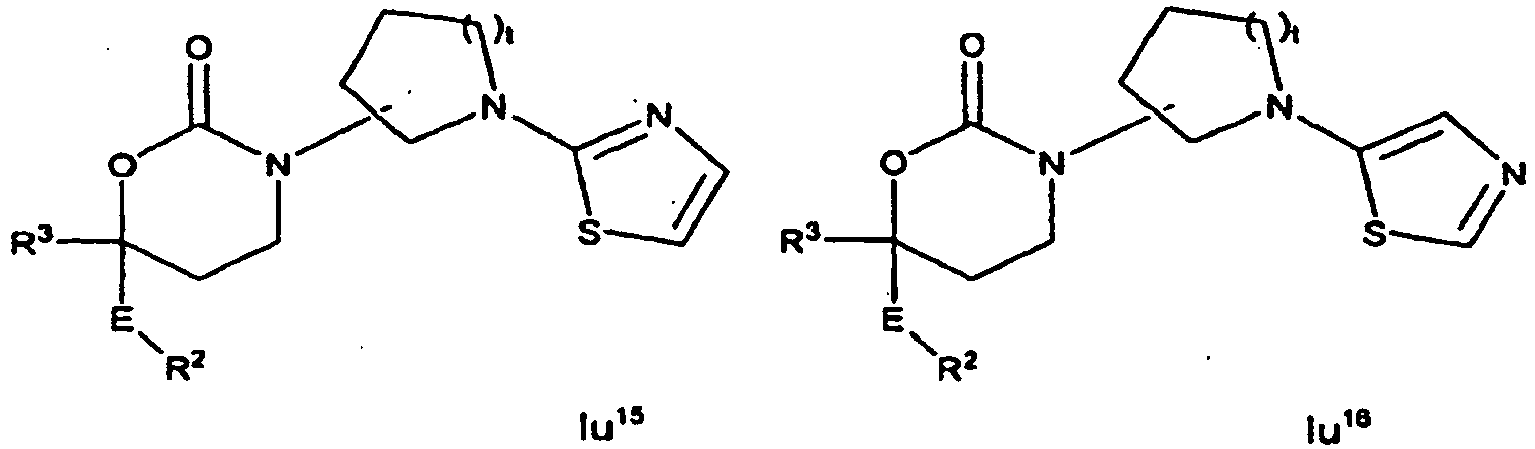


- In Formulas Iu1-20, the pyridine, pyridazine, pyrimidine, pyrazine, pyrazole, thiazole and thiadiazole rings in Formulas Iu1-20 are optionally substituted (substitution at ring carbons bonded to hydrogen and ring nitrogen atoms bonded to hydrogen atoms are encompassed, i.e., a "substitutable ring nitrogen atom") with up to four substituents as described above for Cy2; and the pyrrolidine, piperidine and azepane rings are optionally substituted with 0, 1 or 2 substituents as described above for Cy1. Suitable substituents for Cy1 and Cy2 and suitable values for R2, R3 and E are as defined in any one of the first, second, third, fourth, fifth , sixth, seventh, eighth, ninth, tenth, eleventh or twelfth embodiments; and t is 1, 2 or 3. Alternatively, suitable substituents for the pyrrolidine, piperidine and azepane rings and the pyridine, pyridazine, pyrimidine, pyrazine, pyrazole, thiazole and thiadiazole rings in Formulas lu1-20 are as described for G1 and G2, respectively, in Formula If, values for R2, R3 and E are as defined in any one of the first, second, third, fourth, fifth , sixth, seventh, eighth, ninth, tenth, eleventh or twelfth embodiments; and t is 1, 2 or 3. Alternatively, suitable substituents for the pyrrolidine, piperidine and azepane rings include oxo, (C1-C4)alkyl, (C1-C4)alkoxy, (C1-C4)haloalkyl, (C1-C4)haloalkoxy, halogen, cyano and nitro; suitable substituents for a substitutable ring nitrogen atom in the pyrazole rings in Formulas lu18-20 include (C1-C4)alkyl, (C3-C4)cycloalkyl, (C3-C4)cycloalkyl(C1-C2)alkyl, and (C1-C4 )haloalkyl; suitable substituents for a ring carbon atom in the pyridine, pyridazine, pyrimidine, pyrazine, pyrazole, thiazole and thiadiazole rings in Formulas lu1-20 include fluorine, chlorine, cyano, hydroxy, amino, (C1-C4)alkyl, (C3-C4)cycloalkyl, (C3-C4)cycloalkyl(C1-C2)alkyl, halo(C1-C4)alkyl, (C1-C4)alkoxy, (C1-C4)haloalkoxy, CONH2, (C1-C4)alkylaminocarbonyl, di(C1-C4)alkylaminocartoonyl, (C3-C4)cycloalkylaminocarbonyl, {(C1-C4)alkyl}{(C3-C4)cycloalkyl}aminocarbonyl and (C1-C4)alkylearbonylamino; the ring nitrogen in the pyridine rings in Formulas Iu1-4 is optionally substituted by oxo; t is 1, 2 or 3; and suitable values for R2, R3 and E are as defined in any one of the first, second, third, fourth, fifth , sixth, seventh, eighth, ninth, tenth, eleventh or twelfth embodiments.
- Alternatively, for each of the embodiments described in the paragraph immediately following Formulas Iu1-20. R3 is preferably MeSO2NHCH2CH2CH2, H2NC(=O)CH2CH2, H2NC(=O)CMe2CH2, 3-hydroxypropyl, 3-hydroxy-3-methylbutyl, 2-hydroxyethyl, 2-hydroxy-2-methylpropyl or 2-cyano-2-methylpropyl.
- Alternatively, for each of the embodiments described in the paragraph immediately following Formulas Iu1-20, R3 is preferably H2NC(=O)CMe2CH2, 3-hydroxy-3-methylbutyl, 2-hydroxy-2-methylpropyl or 2-cyano-2-methylpropyl.
- Alternatively, for each of the embodiments described in the paragraph immediately following Formulas Ii1-20, R2 is preferably phenyl optionally substituted with 1, 2 or 3 substituents selected from halo, cyano, CONH2, (C1-C4)alkyl, (C1-C4)haloalkyl and SO2Me; and R3 is preferably MeSO2NHCH2CH2CH2. H2NC(=O)CH2CH2, H2NC(=O)CMe2CH2, 3-hydroxypropyl, 3-hydroxy-3-methylbutyl, 2-hydroxyethyl, 2-hydroxy-2-methylpropyl or 2-cyano-2-methylpropyl.
- Alternatively, for each of the embodiments described in the paragraph immediately following Formulas Iu1-20, R2 is preferably phenyl optionally substituted with 1, 2 or 3 substituents selected from halo, cyano, CONH2. (C1-C4)alkyl. (C1-C4)haloalkyl and SO2Me; and R3 is preferably H2NC(=O)CMe2CH2. 3-hydroxy-3-methylbutyl, 2-hydroxy-2-methylpropyl or 2-cyano-2-methylpropyl.
- Alternatively, for each of the embodiments described in the paragraph immediately following Formulas Iu1-20, t is preferably 2; R3 is preferably phenyl or fluorophenyl; and R3 is preferably 2-hydroxy-2-methylpropyl or 2-cyano-2-methylpropyl.
- Alternatively, for each of the embodiment described in the paragraph immediately following Formulas Iu1-20, wherein t is 2; R2 is preferably phenyl or fluorophenyl; R3 preferably is 2-hydroxy-2-methylpropyl or 2-cyano-2-methylpropyl; one or two ring carbon atoms in the pyridine, pyridazine, pyrimidine, pyrazine, pyrazole, thiazole and thiadiazole rings in Formulas Iu1-20 are optionally substituted with fluoro, chloro, cyano, CONH2, CONHMe, CONMe2, CONHc-Pr, methyl, ethyl or CF3; the substitutable ring nitrogen atom in the pyrazole rings in Formulas Iu18-20 are optionally substituted with (C1-C4)alkyl, (C3-C4)cycloalkyl, (C3-C4)cycloalkyl(C1-C2)alkyl, and (C1C2)haloalkyl; the ring nitrogen in the pyridine rings in Formulas Iu1-4 are optionally substituted by oxo.
- Another embodiment of the invention is a compound of any one of Formulas Iv1-20, or a pharmaceutically acceptable salt, enantiomer or diastereomer thereof:


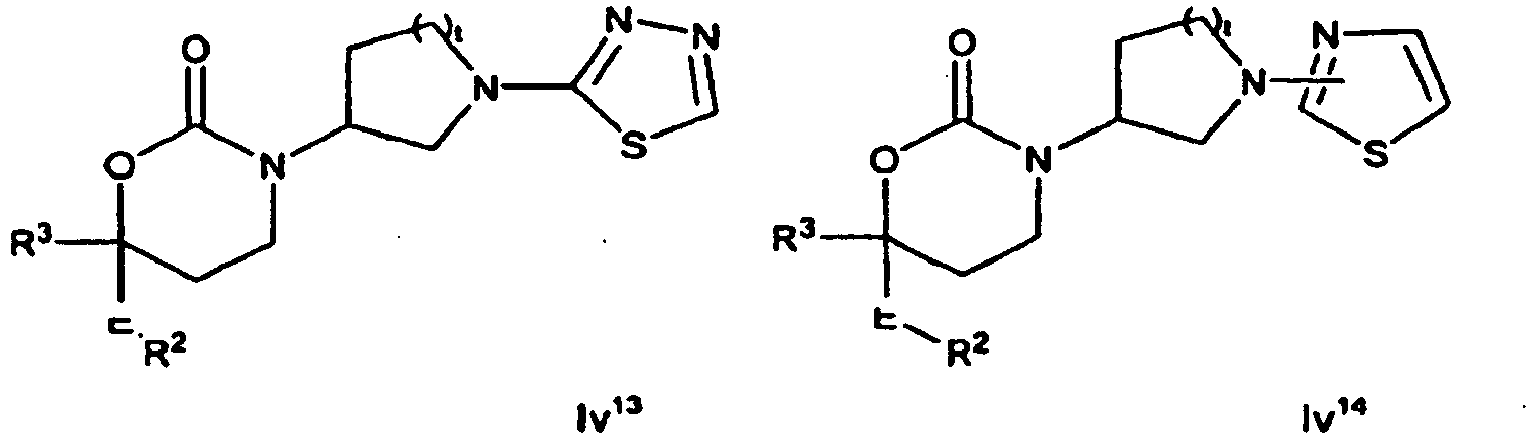


- In Formulas Iv1-20. the pyridine, pyridazine, pyrimidine, pyrazine, pyrazole, thiazole and thiadiazole rings in Formulas Iv1-20 are optionally substituted (substitution at ring carbons bonded to hydrogen and ring nitrogen atoms bonded to hydrogen atoms are encompassed, i.e., a "substitutable ring nitrogen atom") with up to four substituents as described above for Cy2. Suitable substituents for Cy2 and suitable values for R2, R3 and E are as defined in any one of the first, second, third, fourth, fifth , sixth, seventh, eighth, ninth, tenth, eleventh or twelfth embodiments. t is 1, 2 or 3. Alternatively, suitable substituents for the pyrrolidine, piperidine and azepane rings and the pyridine, pyridazine, pyrimidine, pyrazine, pyrazole, thiazole and thiadiazole rings in Formulas Iv1-20 are as described for G1 and G2, respectively, in Formula If, t is 1, 2 or 3and values for R2, R3 and E are as defined in any one of the first, second, third, fourth, fifth, sixth, seventh, eighth, ninth, tenth, eleventh or twelfth embodiments. Alternatively, suitable substituents for the pyrrolidine, piperidine and azepane rings include oxo, (C1-C4)alkyl, (C1-C4)alkoxy, (C1-C4)haloalkyl, (C1-C4 )haloalkoxy, halogen, cyano and nitro; suitable substituents for a substitutable ring nitrogen atom in the pyrazole rings in Formulas Iv18-20 include (C1-C4)alkyl, (C3-C4)cycloalkyl, (C3-C4)cycloalkyl(C1-C2)alkyl, and (C1-C4 )haloalkyl; suitable substituents for a ring carbon atom in the pyridine, pyridazine, pyrimidine, pyrazine, pyrazole, thiazole and thiadiazole rings in Formulas lv1-20 include fluorine, chlorine, cyano, hydroxy, amino, (C1-C4)alkyl, (C3-C4)cycloalkyl, (C3-C4)cycloalkyl(C1-C2)alkyl, halo(C1-C4)alkyl, (C1-C4)alkoxy, (C1-C4)haloalkoxy, CONH2, (C1-C4)alkylaminocarbonyl, di(C1-C4)atkytaminocarbonyl, (C3-C4)cycloalkylaminocarbonyl, {(C1-C4)alkyl}((C3-C4)cycloalkyl)aminocarbonyl and (C1-C4)alkylcarbonylamino; the ring nitrogen in the pyridine rings in Formulas Iv1-4 is optionally substituted by oxo; t is 1, 2 or 3; and suitable values for R2, R3 and E are as defined in any one of the first, second, third, fourth, fifth, sixth, seventh, eighth, ninth, tenth, eleventh or twelfth embodiments.
- For each of the embodiments described in the paragraph immediately following Formulas Iv1-20, R3 is MeSO2NHCH2CH2CH2, H2NC(=O)CH2CH2, H2NC(=O)CMe2CH2. 3-hydroxypropyl, 3-hydroxy-3-methylbutyl, 2-hydroxyethyl. 2-hydroxy-2-methylpropyl or 2-cyano-2-methylpropyl.
- For each of the embodiments described in the paragraph immediately following Formulas Iv1-20, R3 is H2NC(=O)CMe2CH2, 3-hydroxy-3-methylbutyl, 2-hydroxy-2-methylpropyl or 2-cyano-2-methylpropyl.
- For each of the embodiments described in the paragraph immediately following Formulas Iv1-20, R2 is phenyl optionally substituted with 1, 2 or 3 substituents selected from halo, cyano, CONH2, (C1-C4)alkyl, (C1-C4)haloalkyl and SO2Me; and R3 is MeSO2NHCH2CH2CH2. H2NC(=O)CH2CH2, H2NC(=O)CMe2CH2. 3-hydroxypropyl, 3-hydroxy-3-methylbutyl, 2-hydroxyethyl, 2-hydroxy-2-methylpropyl or 2-cyano-2-methylpropyl.
- For each of the embodiments described in the paragraph immediately following Formulas Iv1-2, R2 is phenyl optionally substituted with 1, 2 or 3 substituents selected from halo, cyano, CONH2. (C1-C4)alkyl, (C1-C4)haloalkyl and SO2Me; and R3 is H2NC(=O)CMe2CH2, 3-hydroxy-3-methylbutyl, 2-hydroxy-2-methylpropyl or 2-cyano-2-methylpropyl.
- For each of the embodiments described in the paragraph immediately following Formulas Iv1-20, t is preferably 2; R2 is phenyl or fluorophenyl; and R3 is 2-hydroxy-2-methylpropyl or 2-cyano-2-methylpropyl.
- For each of the embodiments described in the paragraph immediately following Formulas Iv1-20, t is preferably 2; R2 is phenyl or fluorophenyl; R3 is 2-hydroxy-2-methylpropyl or 2-cyano-2-methylpropyl; one or two ring carbon atoms in the pyridine, pyridazine, pyrimidine, pyrazine, pyrazole, thiazole and thiadiazole rings in Formulas Iv1-20 are optionally substituted with fluoro, chloro, cyano, CONH2, CONHMe. CONMe2, CONHc-Pr, methyl, ethyl or CF3; the substitutable ring nitrogen atom in the pyrazole rings in Formulas Iv18-20 is optionally substituted with (C1-C4 )alkyl, (C3-C4)cycloalkyl, (C3-C4)cycloalkyl(C1-C2)alkyl, and (C1-C2)haloalkyl; the ring nitrogen in the pyridine rings in Formulas Iv1-4 is optionally substituted by oxo.
- Another embodiment of the invention is a compound of any one of Formulas Iw1-20 or a pharmaceutically acceptable salt thereof:


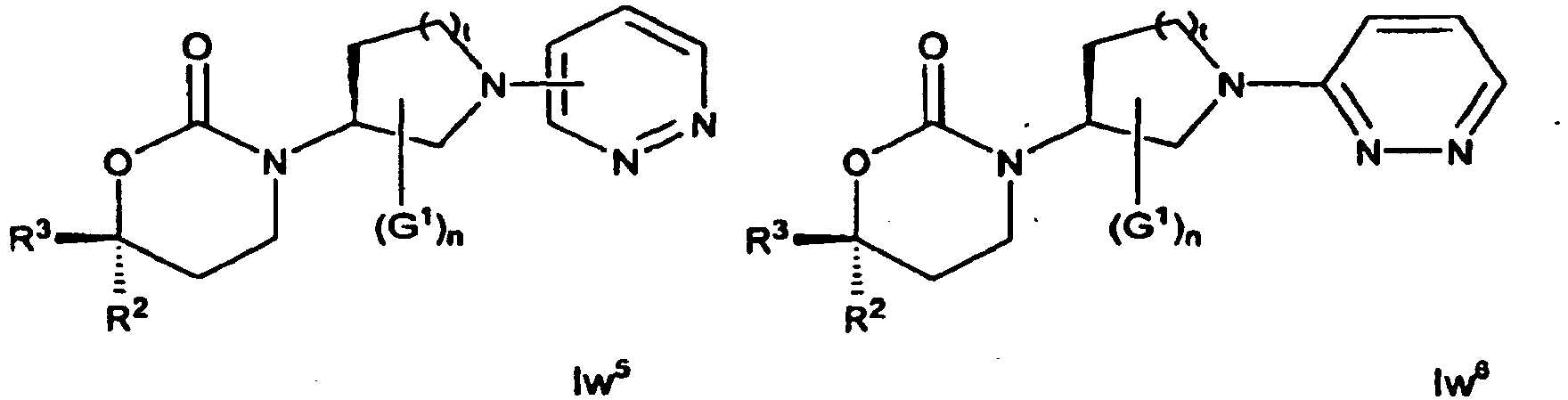


- In Formulas Iw1-20, the pyridine, pyridazine, pyrimidine, pyrazine, pyrazole, thiazole and thiadiazole rings in Formulas Iw1-20 are optionally substituted (substitution at ring carbons bonded to hydrogen and ring nitrogen atoms bonded to hydrogen atoms are encompassed, i.e., a "substitutable ring nitrogen atom") with up to four substituents as described above for Cy2. Suitable substituents for Cy2 and suitable values for R2 and R3 are as defined in any one of the first, second, third, fourth, fifth, sixth, seventh, eighth, ninth, tenth, eleventh or twelfth embodiments; suitable values for G1 is as described for Formula If, n is 0, 1 or 2; and t is 1, 2 or 3. Alternatively, suitable values for G1 are as described for Formula If; substituents for the pyridine, pyridazine, pyrimidine, pyrazine, pyrazole, thiazole and thiadiazole rings in Formulas Iw1-20 are as described for G2 in Formula If; n is 0, 1 or 2; t is 1, 2 or 3; and values for R2 and R3 are as defined in any one of the first, second, third, fourth, fifth, sixth, seventh, eighth, ninth, tenth, eleventh or twelfth embodiments. Alternatively, suitable values for G1 include oxo, (C1-C4)alkyl, (C1-C4)alkoxy, (C1-C4)haloalkyl, (C1-C4 )haloalkoxy, halogen, cyano and nitro; suitable substituents for a substitutable ring nitrogen atom in the pyrazole rings in Formulas Iw18-20 include (C1-C4)alkyl, (C3-C4)cycloalkyl, (C3-C4)cycloalkyl(C1-C2)alkyl, and (C1-C4 )haloalkyl; suitable substituents for a ring carbon atom in the pyridine, pyridazine, pyrimidine, pyrazine, pyrazole, thiazole and thiadiazole rings in Formulas Iw1-20 include fluorine, chlorine, cyano, hydroxy, amino, (C1-C4)alkyl, (C3-C4)cycloalkyl, (C3-C4)cycloalkyl(C1-C2)alkyl, halo(C1-C4)alkyl, (C1-C4)atkoxy. (C1-C4)haloalkoxy, CONH2, (C1-C4)alkylaminocarbonyl, di(C1-C4)alkylaminocarbonyl, (C3-C4)cycloalkylaminocarbonyl, {(C1-C4)alkyl}{(C3-C4)cycloalkyl}aminocarbonyl and (C1-C4)alkylcarbonylamino; the ring nitrogen in the pyridine rings in Formulas Iw1-4 is optionally substituted by oxo; n is 0, 1 or 2; t is 1, 2 or 3; and suitable values for R2 and R3 are as defined in any one of the first, second, third, fourth, fifth , sixth, seventh, eighth, ninth, tenth, eleventh or twelfth embodiments.
- Alternatively, for each of the embodiments described in the paragraph immediately following Formulas Iw1-20, R3 is preferably MeSO2NHCH2CH2CH2, H2NC(=O)CH2CH2, H2NC(=O)CMe2CH2. 3-hydroxypropyl, 3-hydroxy-3-methylbutyl, 2-hydroxyethyl, 2-hydroxy-2-methylpropyl or 2-cyano-2-methylpropyl.
- Alternatively, for each of the embodiments described in the paragraph immediately following Formulas Iw1-20, R3 is preferably H2NC(=O)CMe2CH2, 3-hydroxy-3-methylbutyl, 2-hydroxy-2-methylpropyl or 2-cyano-2-methylpropyl.
- Alternatively, for each of the embodiments described in the paragraph immediately following Formulas Iw1-20, R2 is preferably phenyl optionally substituted with 1, 2 or 3 substituents selected from halo, cyano, CONH2, (C1-C4)alkyl, (C1-C4)haloalkyl and SO2Me; and R3 is preferably MeSO2NHCH2CH2CH2, H2NC(=O)CH2CH2, H2NC(=O)CMe2CH2, 3-hydroxypropyl, 3-hydroxy-3-methylbutyl, 2-hydroxyethyl, 2-hydroxy-2-methylpropyl or 2-cyano-2-methylpropyl.
- Alternatively, for each of the embodiments described in the paragraph immediately following Formulas Iw1-20, R2 is preferably phenyl optionally substituted with 1, 2 or 3 substituents selected from halo, cyano, CONH2, (C1-C4)alkyl, (C1-C4)haloalkyl and SO2Me; and R3 is preferably H2NC(=O)CMe2CH2, 3-hydroxy-3-methylbutyl, 2-hydroxy-2-methylpropyl or 2-cyano-2-methylpropyl.
- Alternatively, for each of the embodiments described in the paragraph immediately following Formulas Iw1-20, t is preferably 2; R2 is preferably phenyl or fluorophenyl; and R3 is preferably 2-hydroxy-2-methylpropyl or 2-cyano-2-methylpropyl.
- Alternatively, for each of the embodiments described in the paragraph immediately following Formulas Iw1-20 or a pharmaceutically acceptable salt thereof:, wherein t is 2: R2 is phenyl or fluorophenyl; R3 is 2-hydroxy-2-methylpropyl or 2-cyano-2-methylpropyl; one or two ring carbon atoms in the pyridine, pyridazine, pyrimidine, pyrazine, pyrazole, thiazole and thiadiazole rings in Formulas Iw1-20 are optionally substituted with fluoro, chloro, cyano, CONH2. CONHMe, CONMe2. CONHc-Pr, methyl, ethyl or CF3; the substitutable ring nitrogen atom in the pyrazole rings in Formulas Iw18-20 is optionally substituted with (C1-C4 )alkyl, (C3-C4)cycloalkyl, (C3-C4)cycloalkyl(C1-C2)alkyl, and (C1-C2 )haloalkyl; the ring nitrogen in the pyridine rings in Formulas Iw1-4 is optionally substituted by oxo.
- Another embodiment of the invention is a compound represented by any one of Formulas It1-8, or a pharmaceutically acceptable salt thereof:

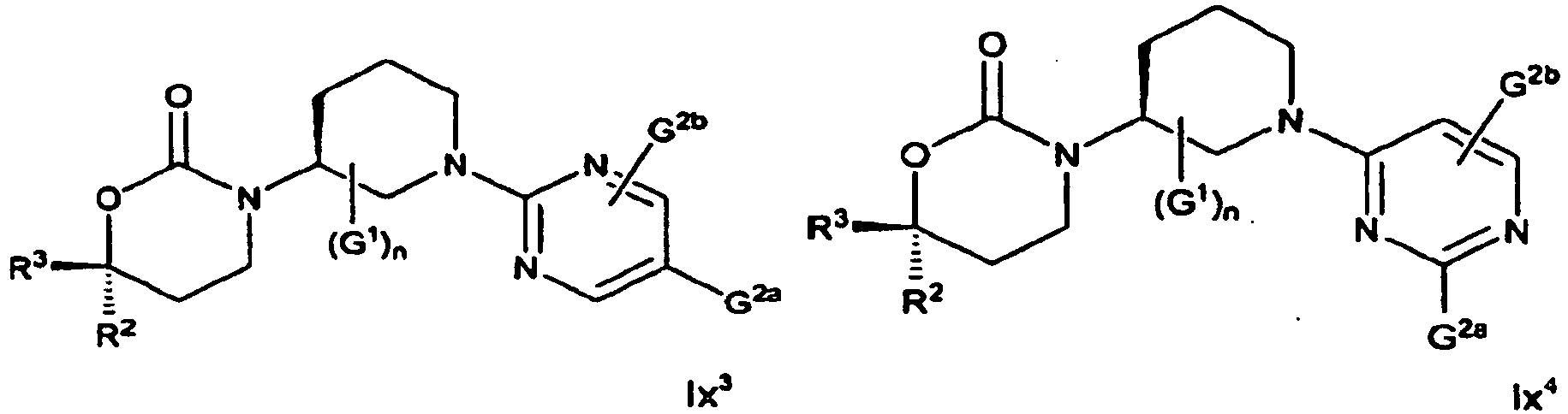


- In Formulas Ix1-7, G1 is oxo, (C1-C4)alkyl, (C1-C4)alkoxy, (C1-C4)haloalkyl, (C1-C4)haloalkoxy, halogen, cyano and nitro; n is 0, 1 or 2; G2a and G2b are independently selected from hydrogen, fluorine, chlorine, cyano, hydroxy, amino, (C1-C4)alkyl, (C3-C4)cycloalkyl, (C3-C4)cycloalkyl(C1-C2)alkyl, halo(C1-C4)alkyl, (C1-C4)alkoxy. (C1-C4)haloalkoxy, CONH2. (C1-C4)alkylaminocarbonyl, di(C1-C4)alkylaminocarbonyl, (C3-C4)-cycloalkylaminocarbonyl, {(C1-C4)alkyl}{(C3-C4)cycloalkyl}aminocarbonyl and (C1-C4)alkylcarbonylamino; and suitable values for R2 and R3 are as defined in any one of the first, second, third, fourth, fifth , sixth, seventh, eighth, ninth, tenth, eleventh or twelfth embodiments.
- Alternatively, for each of the embodiments described in the paragraph immediately following Formulas Ix1-7, R3 is preferably MeSO2NHCH2CH2CH2, H2NC(=O)CH2CH2. H2NC(=O)CMe2CH2, 3-hydroxypropyl, 3-hydroxy-3-methylbutyl, 2-hydroxyethyl, 2-hydroxy-2-methylpropyl or 2-cyano-2-methylpropyl.
- Alternatively, for each of the embodiments described in the paragraph immediately following Formulas Ix1-7, R3 is preferably H2NC(=O)CMe2CH2, 3-hydroxy-3-methylbutyl, 2-hydroxy-2-methylpropyl or 2-cyano-2-methylpropyl.
- Alternatively, for each of the embodiments described in the paragraph immediately following Formulas Ix1-7, R2 is preferably phenyl optionally substituted with 1, 2 or 3 substituents selected from halo, cyano, CONH2, (C1-C4)alkyl, (C1-C4)haloalkyl and SO2Me; and R3 is preferably MeSO2NHCH2CH2CH2, H2NC(=O)CH2CH2, H2NC(=O)CMe2CH2, 3-hydroxypropyl, 3-hydroxy-3-methylbutyl, 2-hydroxyethyl, 2-hydroxy-2-methylpropyl or 2-cyano-2-methylpropyl.
- Alternatively, for each of the embodiments described in the paragraph immediately following Formulas Ix1-7, R2 is preferably phenyl optionally substituted with 1, 2 or 3 substituents selected from halo, cyano, CONH2, (C1-C4)alkyl, (C1-C4)haloalkyl and SO2Me; and R3 is preferably H2NC(=O)CMe2CH2, 3-hydroxy-3-methylbutyl, 2-hydroxy-2-methylpropyl or 2-cyano-2-methylpropyl.
- In another alternative for each of the embodiments described in the paragraph immediately following Formulas Ix1-7, R2 is preferably phenyl or fluorophenyl; and R3 preferably is 2-hydroxy-2-methylpropyl or 2-cyano-2-methylpropyl.
- The present invention further provides compounds for use in treating a subject with a disease associated with activity of expression of 11β-HSD1 using a compound of Formula I, la, Ib, Ic, Id, Ie, If, Ig, Ih, Ii, Ij, Ik, Il, Im1-12, In1-12, Io1-12, Ip1-7, Iq1-21, Ir1-21, Is1-21, It1-7, Iu1-20, Iv1-20, Iw1-20 or Ix1-7 of the invention.
- Preferred values for the variables in the above-described structural formulas I, Ia, Ib, Ic, Id, Ie If, Ig, Ih, Ii, Ij, Ik, Il Im1-12, In1-12, Io1-12, Ip1-7, Iq1-21, Ir1-21, Is1-21, It1-7, Ii1-20, Iv1-20. Iw1-20 or Ix1-7 are provided below:
- A1 is a bond. Alternatively, A1 is (C1-C3)alkylene. In another specific embodiment. A1 is methylene. In another specific embodiment, A1 is CH when R1 is present.
- R1 is (C1-C6)alkyl. Alternatively, R1 is methyl or ethyl.
- Cy1 is optionally substituted aryl or optionally substituted heteroaryl. Alternatively, Cy1 is optionally substituted phenyl or optionally substituted pyridyl. In another alternative, Cy1 is optionally substituted phenyl. In yet another specific embodiment, Cy1 is substituted with fluorine or bromine. In another embodiment Cy1 is phenyl substituted with trifluoromethoxy or 2,2,2-trifluoroethoxy. Alternatively Cy1 is optionally substituted heterocyclyl. In another embodiment Cy1 is optionally substituted pyrrolidinyl, piperidinyl or azepanyl.
- Alternatively, A2 is a bond and Cy2 is cyclopropyl. Alternatively. A2 is a bond and Cy2 is (C3-C7)cycloalkyl. Alternatively, A2 is a bond and Cy2 is optionally substituted aryl or optionally substituted heteroaryl. In another specific embodiment, A2 is a bond and Cy2 is optionally substituted phenyl or optionally substituted pyridyl. In yet another specific embodiment, A2 is a bond and Cy2 is optionally substituted phenyl. In yet another specific embodiment. A2 is a bond and Cy2 is substituted with 1 to 4 groups independently selected from chlorine or fluorine. In yet another specific embodiment. A2 is a bond and Cy2 is difluorophenyl. In yet another specific embodiment, A2 is a bond and Cy2 is fluorophenyl. In yet another specific embodiment A2 is a bond and Cy2 is optionally substituted 2-thienyl, 1-pyrazolyl, 3-pyrazolyl, 1,2,4-thiadiazol-3-yl, thiazolyl or 2-oxo-1,2-dihydro-5-pyridyl. In yet another specific embodiment, A2 is a bond and Cy2 is phenyl or thienyl substituted with amino(C1-C6)alkyl. In another embodiment A2 is a bond and Cy2 is optionally substituted pyridazinyl, pyrimidinyl, pyrazinyl, 1,2-dihydro-2-oxopyridyl, 2,3-dihydro-3-oxopyridazinyl. 1,2-dihydro-2-oxopyrimidinyl, 3,4-dihydro-4-oxopyrimidinyl or 1,2-dihydro-2-oxopyrazinyl. In yet another embodiment. A2 is a bond and Cy2 is unsubstituted, methyl substituted or ethyl substituted pyridazinyl, pyrimidinyl. pyrazinyl, 1,2-dihydro-2-oxopyridyl, 2,3-dihydro-3-oxopyridazinyl, 1,2-dihydro-2-oxopyrimidinyl, 3,4-dihydro-4-oxopyrimidinyl or 1,2-dihydro-2-oxopyrazinyl. In yet another specific embodiment A2 is a bond and Cy2 is 6-oxo-1,6-dihydropyridin-3-yl, 1-methyl-6-oxo-1,6-dihydropyridin-3-yl, 1-methyl-2-oxo-1,2-dihydropyridin-4-yl, 1-ethyl-6-oxo-1,6-dihydropyridin-3-yl or 1-methyl-6-oxo-1,6-dihydropyridazin-3-yl. In another embodiment A2 is a bond and Cy2 is optionally substituted heterocyclyl. In another embodiment A2 is a bond and Cy2 is heterocylyl substituted by one oxo group and up 3 groups independently selected from amino, fluoro, chloro, cyano, CONH2, CONHMe, CONMe2, CONHc-Pr, methyl, ethyl, isopropyl, t-butyl, cyclopropyl, methoxy, ethoxy or trifluoromethyl. In yet another specific embodiment A2 is a bond and Cy2 is 1,5-dimethyl-6-oxo-1,6-dihydropyridin-3-yl, 1-isopropyl-6-oxo-1,6-dihydropyridin-3-yl, 6-oxo-1-(2,2,2-trifluoroethyl)-1,6-dihydropyridin-3-yl, 1,6-dimethyl-2-oxo-1,2-dihydropyridin-4-yl, 1-ethyl-2-oxo-1,2-dihydropyridin-4-yl, 1-isopropyl-2-oxo-1,2-dihydropyridin-4-yl, 2-oxo-1-(2,2,2-trifluoroethyl)-1,2-dihydropyridin-4-yl, 1-isopropyl-6-oxo-1,6-dihydropyridazin-3-yl, 1-ethyl-6-oxo-1,6-dihydropyridazin-3-yl, 1-ethyl-5-methyl-6-oxo-1,6-dihydropyridin-3-yl or 6-oxo-1-(2,2,2-trifluoroethyl)-1,6-dihydropyridazin-3-yl. In another specific embodiment, A2 is a bond and Cy2 is heteroaryl optionally substituted with by up to 2 groups independently selected from amino, halo, cyano, CONH2, (C1-C4)alkylaminocarbonyl, di(C1-C4)alkylaminocarbonyl, cyclo(C3-C5)alkylaminocarbonyl, (C1-C4)alkyl, (C1-C4)alkoxy or (C1-C2)haloalkyl, (C1-C2)haloalkoxy. In yet another embodiment A2 is a bond and Cy2 is pyridinyl, N-oxo-pyridinyl, pyridazinyl, pyrimidinyl, pyrazinyl, thiadiazolyl or thiazolyl optionally substituted by up to 2 groups independently selected from amino, halo, cyano. CONH2, (C1-C4)alkylaminocarbonyl, di(C1-C4)alkylaminocarbonyl, cyclo(C3-C5)alkylaminocarbonyl, (C1-C4)alkyl, (C1-C4)alkoxy or (C1-C2)haloalkyl, (C1-C2)haloalkoxy. In yet another embodiment A2 is a bond and cy2 is pyridinyl. N-oxo-pyridinyl, pyridazinyl, pyrimidinyl, pyrazinyl, thiadiazolyl or thiazolyl optionally substituted by up to 2 groups independently selected from amino, fluoro, chloro, cyano, CONH2, CONHMe, CONMe2, CONHc-Pr. CONHt-Bu, methyl, ethyl, methoxy, ethoxy or trifluoromethyl. In yet another embodiment A2 is a bond and Cy2 is pyridin-2-yl, pyridin-3-yl, pyridin-4-yl, pyridazin-3-yl, pyrimidin-2-yl, pyrimidin-4-yl, pyrimidin-5-yl, pyrazin-3-yl, 1,3,4-thiadiazol-2-yl, thiazol-2-yl or thiazol-5-yl optionally substituted by up to 2 groups independently selected from amino, fluoro, chloro, cyano, CONH2. CONHMe, CONMe2, CONHc-Pr, methyl, ethyl, methoxy, ethoxy or trifluoromethyl. In yet another embodiment A2 is a bond and Cy2 is pyridinyl or thiazolyl optionally substituted by up to 2 groups independently selected from fluoro, chloro, cyano, CONHMe, CONMe2, CONHc-Pr, methyl, ethyl, methoxy, ethoxy or trifluoromethyl. In yet another specific embodiment A2 is a bond and Cy2 is 5-fluoropyridin-2-yl, 5-(trifluoromethyl)pyridin-2-yl, 5-cyanopyridin-2-yl, 5-carbamoylpyridin-2-yl, 5-(methylcarbamoyl)pyridin-2-yl, 5-(dimethylcarbamoyl)pyridin-2-yl, 6-methoxypyridin-3-yl, 5-fluoropyridin-3-yl, 5-chloropyridin-3-yl, 2-methylpyridin-4-yl, 2,6-dimethylpyridin-4-yl, 6-methylpyridazin-3-yl, 2-methylpyrimidin-5-yl, 2-methylpyrimidin-4-yl, 5-methytpyrazin-2-yl, 5-cyanopyrazin-2-yl, 6-cyanopyrazin-2-yl, 5-(dimethylcarbamoyl)thiazol-2-yl, 6-carbamoylpyrazin-2-yl, 6-ethoxy-5-methylpyridin-3-yl, or 5-(cydopropylcarbamoyl)pyridin-2-yl.
- R3 is hydroxy(C2-C4)alkyl. Alternatively, R3 is dihydroxy(C3-C4)alkyl. In another specific embodiment, R3 is ω-H2NCO(C1-C3)alkyl. In yet another specific embodiment, R3 is (C1-C2)alkoxy(C1-C3)alkyl. In yet another specific embodiment, R3 is H2NSO2O(C2-C4)alkyl. In yet another specific embodiment. R3 is H2NSO2NH(C2-C4)alkyl. In yet another specific embodiment, R3 is oxo(C2-C4)alkyl. In yet another specific embodiment, R3 is alkenyl. In yet another specific embodiment, R3 is allyl. In yet another specific embodiment, R3 is MeC(=O)NH(C2-C4)alkyl. In yet another specific embodiment R3 is 2-hydroxy-2-methylpropyl, 3-hydroxypropyl, 2-hydroxypropyl or 2-hydroxyethyl. In yet another specific embodiment R3 is 2,3-dihydroxypropyl. In yet another specific embodiment R3 is H2NC(=O)CH2CH2-. In yet another specific embodiment R3 is 2-(4-morpholino)ethyl. In yet another embodiment R3 is MeSO2NH(C2-C4)alkyl. In yet another specific embodiment R3 is MeSO2NHCH2CH2CH2.
- R3 is (HO)2P(=)O(C1-C4)alkyl. R3 is hydroxy(C2-C5)alkyl. In yet another specific embodiment R3 is 3-hydroxybutyl, 3-hydroxy-3-methylbutyl, 3-hydroxypropyl, 2-hydroxypropyl, 2-hydroxy-2-methylpropyl, or 2-hydroxyethyl. Alternatively, R3 is dihydroxy(C3-C4)alkyl. In yet another specific embodiment R3 is 2,3-dihydroxypropyl. R3 is amino(C2-C5)alkyl or methylamino(C2-C5)alkyl, each optionally substituted with hydroxy. In another specific embodiment, R3 is ω-H2NCO(C1-C3)alkyl. In another specific embodiment, R3 is H2NCONH(C1-C3)alkyl, optionally substituted with hydroxy. In another specific embodiment, R3 is H2NCH2CONH(C1-C3)alkyl, optionally substituted with hydroxy. In another specific embodiment, R3 is (C1-C3)alkylHNCONH(C1-C3)alkyl. In yet another specific embodiment, R3 is H2NC(=O)C1-C4 alkyl. In yet another specific embodiment, R3 is MeC(=O)NHC1-C4 alkyl. In yet another specific embodiment, R3 is MeOC(=O)NHC1-C4 alkyl. In yet another specific embodiment, R3 is MeNHC(=O)C1-C4 alkyl. In yet another specific embodiment R3 is H2NC(=O)OC1-C4 alkyl. In yet another specific embodiment, R3 is MeHNC(=O)OC1-C4 alkyl. In yet another specific embodiment, R3 is (C1-C2)alkoxy(C1-C3)alkyl, optionally substituted with hydroxy. In yet another specific embodiment, R3 is (C1-C2)alkylthio(C1-C3)alkyl, optionally substituted with hydroxy. In yet another specific embodiment, R3 is H2NSO2O(C2-C4)alkyl. In yet another specific embodiment, R3 is H2NSO2NH(C2-C4)alkyl. In yet another specific embodiment, R3 is oxo(C1-C4)alkyl. In yet another specific embodiment, R3 is MeCO(C1-C2alkyl). In yet another specific embodiment, R3 is HOCO(C1-C2alkyl). In yet another specific embodiment, R3 is alkenyl. In yet another specific embodiment, R3 is alkyl. In yet another specific embodiment, R3 is allyl. In yet another specific embodiment, R3 is MeC(=O)NH(C2-C4)alkyl. In yet another specific embodiment, . R3 is MeOC(=O)NH(C2-C4)alkyl. In yet another specific embodiment, R3 is cyanoalkyl. In yet another specific embodiment, R3 is alkylsulfonylaminoalkyl. In yet another specific embodiment, R3 is alkylsulfonylalkyl. In yet another specific embodiment R3 is MeSO2NH(C2-C4)alkyl, optionally substituted with hydroxy. In yet another specific embodiment, R3 is aminocarbonylaminoalkyl. In yet another specific embodiment, R3 is aminocarboxyalkyl. In yet another specific embodiment R3 is 2-(4-morpholino)ethyl. In yet another specific embodiment R3 is 2-(1-imidazolyl)ethyl. In yet another specific embodiment R3 is 2-(1-aminoimidazolyl)ethyl.
- In another embodiment R3 is (C3-C4)cycloalkyl(C1-C2)alkyl. In another specific embodiment R3 is (1-hydroxycyclopropyl)methyl. In another specific embodiment R3 is 1-(hydroxymethyl)cyclopropyl)methyl. In another specific embodiment R3 is (1-carbamoylcyclopropyl)methyl. In another specific embodiment R3 is 2-(1-azetidinyl)ethyl. 2-(1-pyrrolidinyl)ethyl, 2-(3-fluoro-1pyrrolidinyl)ethyl, 2-(2-oxo-1-pyrrolidinyl)ethyl, 2-(1,1-dioxo-2-isothiazolidinyl)ethyl, 2-(3-oxo-1-piperazinyl)ethyl, (5-methyl-1,3,4-thiadiazol-2-yl)methyl, 2-(5-methyl-1,3,4-thiadiazol-2-yl)ethyl, (5-methyl-1,3,4-oxadiazol-2-yl)methyl or 2-(5-methyl-1,3,4-oxadiazol-2-yl)ethyl. In another embodiment R3 is heterocyclyl(C1-C3)alkyl.
- In another specific embodiment R3 is H2NCOCHMeCH2-, H2NCOC(Me)2CH2-, NCCHMeCH2-, NCC(Me)2CH2-, H2NCH2C(Me)2CH2-, MeCONHCH2C(Me)2CH2-, MeOCONHCH2C(Me)2CH2-. MeSO2NHCH2C(Me)2CH2-, HOCH2CHMeCH2-, HOCH2C(Me)2CH2-, MeSO2NMeCH2CH2- or MeSO2NMeCH2CH2CH2. In another specific embodiment R3 is methyl, ethyl, FCMe2CH2-, MeC(=O)NHCMe2CH2-, MeOC(=O)NHCMe2CH2- or MeS(=O)2NHCMe2CH2-.
- E is a bond.
- R2 is optionally substituted aryl, optionally substituted heteroaryl or cycloalkyl. In one specific embodiment, R2 is optionally substituted phenyl or optionally substituted pyridyl. In another specific embodiment, R2 is optionally substituted phenyl. In yet another specific embodiment, R2 is fluorophenyl. R2 is (C3-C5)alkyl. In one specific embodiment R2 is isopropyl. In another embodiment R2 is optionally substituted thienyl. In another specific embodiment R2 is t-butyl.
- In another embodiment of the invention, the provisos applied to pharmaceutical compositions comprising compounds of Formula I or Ia-II or Im1-12, In1-12, Io1-12, Ip1-7, Iq1-21, Ir1-21, Is1-21, It1-7, Iu1-2, Iv1-20, Iw1-20 or Ix1-7 also apply to methods of treatment utilizing any one of the compounds of Formula I or Formulas Ia-Ii or Im1-12, In1-12, Io1-12, Ip1-7. Iq1-21, Ir1-21, Is1-21, It1-7, Iu1-20, Iv1-20, Iw1-20 or Ix1-7.
- Another embodiment of the invention is a compound of Formulas I, Ia, Ib, Ic, Id. Ie, If, Ig, Ih. Ii. Ij. Ik, Il Im1-12, In1-12 Io1-12, Ip1-7 Iq1-21 Ir1-2, Is1-21, It1-7, Iu1-20, Iv1-20, Iw1-20 or Ix1-7, or a pharmaceutically acceptable salt, enantiomer or diastereomer thereof, wherein any one of the following provisos apply or any combination thereof:
- Proviso 1: If (a) either R3 or E-R2 is (C1-C4)alkyl or benzyl substituted with halogen or (C1-C2)alkoxy, and (b) n is not zero, then Y cannot be either oxo or (C1-C3)alkyl at the position β to the nitrogen atom in the ring.
- Proviso 2: If A1 is a C2-C3 alkylene, then -Cy1-A2-Cy2 cannot be

- Proviso 3: If (a) A1 and A2 are both bonds, (b) R3 is an alkyl optionally substituted with amino, alkyl, alkoxy, oxo, carboxy, hydroxy, fluorine, or sutfonyl, or an unsubstituted alkynyl (c) E-R2 is (i) a optionally substituted alkyl or an optionally substituted carbocyclic aromatic group wherein the substituent is an amino, alkyl, alkenyl, alkynyl, alkoxy, carboxy, hydroxy, halogen or sulfonyl, or (ii) an unsubstituted cycloalkyl, and (d) Cy2 is H, then Cy1 is not (i) an unsubstituted monocyclic cycloalkyl or (ii) a substituted or unsubstituted carbocyclic aromatic group.
- Proviso 4: If (a) A1 and A2 are both bonds, (b) R3 is an alkyl optionally substituted with amino, alkyl, alkoxy, oxo, carboxy, hydroxy, fluorine, or sulfonyl, or an unsubstituted alkynyl (c) E-R2 is (i) a optionally substituted alkyl or an optionally substituted carbocyclic aromatic group wherein the substituent is an amino, alkyl, alkenyl, alkynyl, alkoxy, carboxy, hydroxy, halogen or sulfonyl, or (ii) an unsubstituted cycloalkyl, and (d) Cy1 is an optionally substituted carbocyclic aromatic group, then Cy2 is not an unsubstituted carbocyclic aromatic group.
- Proviso 5: If (a) A1 is alkyl optionally substituted with amino, alkyl, alkoxy, oxo, carboxy, hydroxy, fluorine, or sulfonyl, (b) R3 is an alkyl substituted with amino, alkyl, alkoxy, oxo, carboxy, hydroxy, fluorine, or sulfonyl, or an unsubstituted alkynyl (c) E-R2 is (i) a optionally substituted alkyl or an optionally substituted carbocyclic aromatic group wherein the substituent is an amino, alkyl, alkenyl, alkynyl, alkoxy, carboxy, hydroxy, halogen or sulfonyl, or (ii) an unsubstituted cycloalkyl, then Cy1 is a carbocyclic aromatic group optionally substituted with C1C4 alkoxy or halogen.
- Proviso 6: If (a) A1 is a bond or alkylene, (b) Cy1 is (C3-C7)cycloalkyl, aryl or heteroaryl, and (c) E is a bond, then R2 is not 3, 4-dialkoxyphenyl optionally substituted with halogen or hydroxy, or 3, 4-dicycloalkoxyphenyl optionally substituted with halogen or 3, 4-dialkoxyalkoxyphenyl optionally substituted with halogen.
- Proviso 7: If (a) A1 is a bond, (b) Cy1 is phenyl, (c) A2 is unsubstituted methylene, (d) Cy2 is H, and (e) n is 1, then Y is not oxo adjacent to the nitrogen in the oxazinone ring.
- Proviso 8: If E is a bond or C1alkylene, R2 is aryl, heteroaryl or heterocyclyl, A1 is (C1)alkylene, R3 is optionally fluorinated (C1-C5)alkyl, (C2-C5)alkenyl or (C2-C6)alkynyl and Cy1 is optionally substituted phenyl, then Cy1 is not substituted at the ortho position by optionally substituted aryl, heteroaryl, heterocyclyl or cycloalkyl.
- Another embodiment of the present invention is a compound of Formulas I, Ia, Ib, Ic, Id, Ie, If, Ig, Ih, Ii, Ij, Ik, or II or a pharmaceutically acceptable salt, enantiomer of diastereomer thereof, wherein all of the above Provisos apply. Yet another embodiment of the present invention is a compound of Formula I or a phamnaceutically acceptable salt, enantiomer of diastereomer thereof, wherein the above Provisos 3-8 apply.
- Another embodiment of the present invention is a pharmaceutical composition comprising: i) a pharmaceutically acceptable carrier or diluent; and ii) a compound of Formula I, Ia, Ib, Ic, Id, Ie, If, Ig, Ih Ii, Ij, Ik, or II or a pharmaceutically acceptable salt, enantiomer of diastereomer thereof, wherein the above Provisos 1, 2, 6 and 8 apply.
- Another embodiment of the present invention is a pharmaceutical composition comprising a pharmaceutically acceptable carrier or diluent; and ii) a compound of Formulas I, Ia, Ib, Ic, Id, Ie, If, Ig, Ih Ii, Ij, Ik, or II or a pharmaceutically acceptable salt, enantiomer of diastereomer thereof, wherein Provisos 6 and 8 apply.
- In one embodiment, Proviso 2 applies when the subject is being treated to lower intraocular pressure.
- In one embodiment, Proviso 2 applies when the subject is being treated for cardiovascular disorders.
- In one embodiment, Proviso 2 applies when the subject is being treated for dyslipidemia or hypertension.
- In one embodiment, Proviso 8 applies when the subject is being treated for atherosclerosis, dyslipidemia, or cardiovascular disorders.
- In one embodiment, Proviso 8 applies when the subject is being treated for diabetes, atherosclerosis, dyslipidemia, hypertension, obesity or cardiovascular disorders.
- In another embodiment, Provisos 2 and 8 apply to methods of treatment utilizing any one of the compounds of Formula I or Formulas Ia-II.
- The term "alkyl" means a straight or branched hydrocarbon radical having 1-10 carbon atoms and includes, for example, methyl, ethyl, n-propyl, isopropyl, n-butyl, sec-butyl, isobutyl, tert-butyl, n-pentyl, n-hexyl, n-heptyl, n-octyl, n-nonyl, n-decyl and the like.
- The term "carbocyclic aromatic group" shall have the same meaning as the term "aryl" is used in
U.S. Patent No. 7,186,844 , which is incorporated by reference herein in its entirety. For further clarity, the term "carbocyclic aromatic group." as used inU.S. Patent No. 7,186,844 , means is an all carbon, monocyclic or polycyclic ring system which obeys Huckel's 4n + 2 rule (M. B. Smith and J. March, "March's Advanced Organic Chemistry" 5th Edition, p 57, Wiley-Interscience, 2001) and includes, for example, benzene and naphthalene. - The term "cycloalkyl" means a monocyclic, bicyclic or tricyclic, saturated hydrocarbon ring having 3-10 carbon atoms and includes, for example, cyclopropyl (c-Pr), cyclobutyl, cyclopentyl, cyclohexyl, cycloheptyl, cyclooctyl, bicyclo[2.2.2]octyl, bicyclo[2.2.1]heptyl, spiro [4.4]nonane, adamantyl and the like.
- The term "aryl" means an aromatic radical which is a phenyl group, a naphthyl group, an indanyl group or a tetrahydronaphthalene group. An aryl group is optionally substituted with 1-4 substituents. Exemplary substituents include alkyl, alkoxy, alkylthio, alkylsulfonyl, halogen, trifluoromethyl, dialkylamino, nitro, cyano, CO2H, CONH2, N-monoalkyl-substituted amido and N,N-dialkyl-substituted amido.
- The term "heteroaryl" means a 5- and 6-membered heteroaromatic radical which may optionally be fused to a saturated or unsaturated ring containing 0-4 heteroatoms selected from N, O, and S and includes, for example, a heteroaromatic radical which is 2- or 3-thienyl, 2- or 3-furanyl, 2- or 3- pyrrolyl, 2-,3-, or 4-pyridyl, 2-pyrazinyl, 2-, 4-, or 5-pyrimidinyl, 3- or 4-pyridazinyl, 1 H-indol-6-yl, 1 H-indol-5-yl, 1H-benzimidazol-6-yl, 1H-benzimidazol-5-yl, 2-, 4-, 5-, 6-, 7- or 8-quinazolinyl, 2-, 3-, 5-, 6-, 7- or 8-quinoxalinyl, 2-, 3-, 4-, 5-, 6-, 7- or 8-quinolinyl, 1-, 3-, 4-, 5-, 6-, 7- or 8-isoquinolinyl, 2-, 4-, or 5-thiazolyl, 2-, 3-, 4-, or 5-pyrazolyl, 2-, 3-, 4-, or 5-imidazotyl. A heteroaryl is optionally substituted. Exemplary substituents include alkyl, alkoxy, alkylthio, alkylsulfonyl, halogen, trifluoromethyl, dialkylamino, nitro, cyano, CO2H, CONH2, N-monoalkyl-substituted amido and N,N-dialkyl-substituted amido, or by oxo to form an N-oxide.
- The term "heterocyclyl" means a 4-, 5-, 6- and 7-membered saturated or partially unsaturated heterocyclic ring containing 1 to 4 heteroatoms independently selected from N, O, and S. Exemplary heterocyclyls include pyrrolidine, pyrrolidin-2-one, 1-methylpyrrolidin-2-one, piperidine, piperidin-2-one, dihydropyridine, tetrahydropyridine, piperazine, 1-(2,2,2-trifluoroethyl)piperazine, 1,2-dihydro-2-oxopyridine, 1,4-dihydro-4-oxopyridine, piperazin-2-one, 3,4,5,6-tetrahydro-4-oxopyrirnidine, 3,4-dihydro-4-oxopyrimidine, tetrahydrofuran, tetrahydropyran, tetrahydrothiophene, tetrahydrothiopyran, isoxazolidine, 1.3-dioxolane, 1,3-dithiolane, 1,3-dioxane, 1,4-dioxane, 1,3-dithiane, 1,4-dithiane, oxazolidin-2-one, imidazolidin-2-one, imidazolidine-2,4-dione, tetrahydropyrimidin-2(1H)-one, morpholine, N-methylmorpholine, morpholin-3-one, 1,3-oxazinan-2-one, thiomorpholine, thiomorpholine 1,1-dioxide, tetrahydro-1,2,5-thiaoxazole 1,1-dioxide, tetrahydro-2H-1,2-thiazine 1,1-dioxide, hexahydro-1,2,6-thiadiazine 1,1-dioxide, tetrahydro-1,2,5-thiadiazole 1,1-dioxide isothiazolidine 1.1-dioxide, 6-oxo-1,6-dihydropyridazin-3-yl, 6-oxo-1,6-dihydropyridazin-4-yl, 5-oxo-4,5-dihydro-1H-1,2,4-triazol-3-yl and 5-oxo-4,5-dihydro-1H-imidazol-2-yl. A heterocyclyl can be optionally substituted with 1-4 substituents. Exemplary substituents include alkyl, haloalkyl, halogen and oxo.
- The term "spirocycloalkyl" means a cycloalkyl group which shares one ring carbon with another alkyl or cycloalkyl group.
- As used herein the terms "subject" and "patient" may be used interchangeably, and means a mammal in need of treatment, e.g., companion animals (e.g., dogs, cats, and the like), farm animals (e.g., cows, pigs, horses, sheep, goats and the like) and laboratory animals (e.g., rats, mice, guinea pigs and the like). Typically, the subject is a human in need of treatment.
- When a disclosed compound or its pharmaceutically acceptable salt is named or depicted by structure, it is to be understood that solvates or hydrates of the compound or its pharmaceutically acceptable salts are also included. "Solvates" refer to crystalline forms wherein solvent molecules are incorporated into the crystal lattice during crystallization. Solvate may include water or nonaqueous solvents such as ethanol, isopropanol, DMSO, acetic acid, ethanolamine, and EtOAc. Solvates, wherein water is the solvent molecule incorporated into the crystal lattice, are typically referred to as "hydrates." Hydrates include stoichiometric hydrates as well as compositions containing variable amounts of water.
- Certain of the disclosed compounds may exist in various stereoisomeric forms. Stereoisomers are compounds that differ only in their spatial arrangement. Enantiomers are pairs of stereoisomers whose mirror images are not superimposable, most commonly because they contain an asymmetrically substituted carbon atom that acts as a chiral center. "Enantiomer" means one of a pair of molecules that are mirror images of each other and are not superimposable. Diastereomers are stereoisomers that are not related as mirror images, most commonly because they contain two or more asymmetrically substituted carbon atoms. The symbol "*" in a structural formula represents the presence of a chiral carbon center. "R" and "S" represent the configuration of substituents around one or more chiral carbon atoms. Thus, "R*" and "S*" denote the relative configurations of substituents around one or more chiral carbon atoms.
- "Racemate" or "racemic mixture" means a compound of equimolar quantities of two enantiomers, wherein such mixtures exhibit no optical activity; i.e., they do not rotate the plane of polarized light.
- "Geometric isomer" means isomers that differ in the orientation of substituent atoms in relationship to a carbon-carbon double bond, to a cycloalkyl ring, or to a bridged bicyclic system. Atoms (other than H) on each side of a carbon-carbon double bond may be in an E (substituents are on opposite sides of the carbon-carbon double bond) or Z (substituents are oriented on the same side) configuration.
- "R," "S," "S*," "R*," "E," "Z," "cis," and "trans," indicate configurations relative to the core molecule.
- The compounds of the invention may be prepared as individual isomers by either isomer-specific synthesis or resolved from an isomeric mixture. Conventional resolution techniques include forming the salt of a free base of each isomer of an isomeric pair using an optically active acid (followed by fractional crystallization and regeneration of the free base), forming the salt of the acid form of each isomer of an isomeric pair using an optically active amine (followed by fractional crystallization and regeneration of the free acid), forming an ester or amide of each of the isomers of an isomeric pair using an optically pure acid, amine or alcohol (followed by chromatographic separation and removal of the chiral auxiliary), or resolving an isomeric mixture of either a starting material or a final product using various well known chromatographic methods.
- When the stereochemistry of a disclosed compound is named or depicted by structure, the named or depicted stereoisomer is at least 60%, 70%, 80%, 90%. 99% or 99.9% by weight pure relative to the other stereoisomers. When a single enantiomer is named or depicted by structure, the depicted or named enantiomer is at least 60%, 70%, 80%, 90%, 99% or 99.9% by weight optically pure. Percent optical purity by weight is the ratio of the weight of the enantiomer over the weight of the enantiomer plus the weight of its optical isomer.
- When a disclosed compound is named or depicted by structure without indicating the stereochemistry, and the compound has at least one chiral center, it is to be understood that the name or structure encompasses one enantiomer of compound free from the corresponding optical isomer, a racemic mixture of the compound and mixtures enriched in one enantiomer relative to its corresponding optical isomer.
- When a disclosed compound is named or depicted by structure without indicating the stereochemistry and has at least two chiral centers, it is to be understood that the name or structure encompasses a diastereomer free of other diastereomers, a pair of diastereomers free from other diastereomeric pairs, mixtures of diastereomers, mixtures of diastereomeric pairs, mixtures of diastereomers in which one diastereomer is enriched relative to the other diastereomer(s) and mixtures of diastereomeric pairs in which one diastereomeric pair is enriched relative to the other diastereomeric pair(s).
- The compounds of the invention may be present in the form of pharmaceutically acceptable salts. For use in medicines, the salts of the compounds of the invention refer to non-toxic "pharmaceutically acceptable salts." Pharmaceutically acceptable salt forms include pharmaceutical acceptable acidic/anionic or basic/cationic salts.
- Pharmaceutically acceptable basic/cationic salts include, the sodium, potassium, calcium, magnesium, diethanolamine, n-methyl-D-glucamine, L-lysine, L-arginine, ammonium, ethanolamine, piperazine and triethanolamine salts.
- Pharmaceutically acceptable acidic/anionic salts include, the acetate, benzenesulfonate, benzoate, bicarbonate, bitartrate, bromide, calcium edetate, camsylate, carbonate, chloride, citrate, dihydrochloride, edetate, edisylate, estolate, esylate, fumarate, glyceptate, gluconate, glutamate, glycollylarsanilate hexylresorcinate, hydrobromide, hydrochloride, hydroxynaphthoate, iodide, isethionate, lactate, lactobionate, malate, maleate, malonate, mandelate, mesylate, methylsulfate, mucate, napsylate, nitrate, pamoate, pantothenate, phosphate/diphospate, polygalacturonate, salicylate, stearate, subacetate, succinate, sulfate, hydrogensulfate, tannate, tartrate, teoclate, tosylate, and triethiodide salts.
- The following abbreviations have the indicated meanings:
Abbreviation Meaning A% Area percentage Boc tert-butoxy carbonyl or t-butoxy carbonyl (Boc)2O di-tert-butyl dicarbonate Cbz Benzyloxycarbonyl CbzCl Benzyl chloroformate c-Pr cyclopropyl DAST diethylaminosulfur trifluoride DBU 1,8-diazabicyclo[5.4.0]undec-7-ene DCC N,N'-dicyclohexylcarbodiimide DCU N,N'-dicyclohexylurea DIAD diisopropyl azodicarboxylate DIBAL-H diisobutylaluminum hydride DIEA N, N-diisopropylethylamine DMAP 4-(dimethylamino)pyridine DMF N,N-dimethylformamide DMPU 1,3-dimethyl-3,4,5,6-tetrahydro-2(1H)-pyrimidinone 2,4-DNP 2,4-dinitrophenylhydrazine DPTBS Diphenyl-t-butylsilyl dr diastereomer ratio EDC.HCI, EDCl 1-[3=(dimethylamino)propyl]-3-ethylcarbodiimide hydrochloride Equiv equivalents EtOAc ethyl acetate Fmoc 1-{[(9H-fluoren-9-ylmethoxy)carbonyl]oxy]- Fmoc-OSu 1-[[(9H-fluoren-9-ylmethoxy)carbonyl]oxy]-2,5-pyrrolidinedione h, hr hour(s) HOBt 1-hydroxybenzotriazole HATU 2-(7-Aza-1H-benzotriazole-1-yl)-1,1,3,3-tetramethyluronium hexafluorophosphate HBTU 2-(1H-Benzotriazol-1-yl)-1,1,3,3-tetramethyluronium hexafluorophosphate KHMDS potassium hexamethyldisilazane LAH or LiAJH4 lithium aluminum hydride LC-MS liquid chromatography-mass spectroscopy LHMDS lithium hexamethyldisilazane m-CPBA meta-chloroperoxybenzoic acid Me methyl MsCl methanesulfonyl chloride Min minute MS mass spectrum NaH sodium hydride NaHCO3 sodium bicarbonate NaN3 sodium azide NaOH sodium hydroxide Na2SO4 sodium sulfate NMM N-methylmorpholine NMP N-methylpyrrolidinone Pd2(dba)3 tris(dibenzylideneacetone)dipalladium(0) PE petroleum ether Quant quantitative yield rt room temperature Satd saturated SOCl2 thionyl chloride SFC supercritical fluid chromatography SPA scintillation proximity assay SPE solid phase extraction TBAF tetrabutylammonium fluoride TBS t-butyldimethylsilyl TBDPS t-butyldiphenylsilyl TBSCI t-butyldimethylsilyl chloride TBDPSCl t-butyldiphenylsilyl chloride TEA triethylamine or Et3N TEMPO 2,2,6,6-tetramethyl-1-piperidinyloxy free radical Teoc 1-[2-(trimethylsilyl)ethoxycarbonytoxyl- Teoc-OSu 1-[2-(trimethylsilyl)ethoxycarbonyloxylpyrrolidin-2,5-dione Text External temperature Tint Internal temperature TFA trifluoroacetic acid Tlc, TLC thin layer chromatography TMS trimethylsilyl TMSCI chlorotrimethylsilane or trimethylsilyl chloride t R retention time TsOH p-toluenesulfonic acid - Compounds of Formulas I can be prepared by several processes. In the discussion below, A1, A2, Cy1, Cy2, E, R1, R2, R3, Y and n have the meanings indicated above unless otherwise noted. In cases where the synthetic intermediates and final products of Formulas I described below contain potentially reactive functional groups, for example amino, hydroxyl, thiol and carboxylic acid groups, that may interfere with the desired reaction, it may be advantageous to employ protected forms of the intermediate. Methods for the selection, introduction and subsequent removal of protecting groups are well known to those skilled in the art. (T.W. Greene and P. G. M. Wuts "Protective Groups in Organic Synthesis" John Wiley & Sons, Inc.. New York 1999). Such protecting group manipulations are assumed in the discussion below and not described explicitly. Generally, reagents in the reaction schemes are used in equimolar amounts; however, in certain cases it may be desirable to use an excess of one reagent to drive a reaction to completion. This is especially the case when the excess reagent can be readily removed by evaporation or extraction. Bases employed to neutralize HCl in reaction mixtures are generally used in slight to substantial excess (1.05 - 5 equivalents).
- In a first process a compound of Formula I, wherein can be prepared by reaction of an aminoalcohol intermediate of Formula II with a reagent of Formula III, wherein Z1 and Z2 are leaving groups such as chloride, 1-imidazolyl or aryloxide in an inert solvent such as THF, CH2Cl2, toluene or MeCN, usually in the presence of an organic or inorganic base such as triethylamine or NaHCO3 respectively, at -10 °C to 120 °C:

- Certain instances of reagent III are especially convenient because they are commercially available. For example when Z1 and Z2 are both chloride, III is phosgene. When Z1 and Z2 are both 1-imidazolyl, III is carbonyl diimidazole. When Z1 is chloride and Z2 is p-nitrophenoxide, III is p-nitrophenyl chloroformate. When Z1 and Z2 are both OCCl3, III is triphosgene and as little as one third of molar equivalent can be used.
- Aminoalcohol intermediates of Formula II can be prepared by reduction of amides of Formula IV using a hydride reagent such as BH3.THF solution, 6H3.Me2S or LiAIH4 in an inert solvent ethereal such as THF or DME at 20 °C to 100 °C for between 1 h and 48 h:

- Intermediates of Formula IV can be prepared by coupling of a β-hydroxyacid of Formula V with an amine of Formula VI using standard peptide coupling reagents such as EDC in the presence of HOBt and N,N-diisopropylethylamine in an inert solvent such as CH2Cl2 at 0 - 30 °C for between 1 h and 24 h:

- Amine intermediates of Formula VI, wherein A1 = CH2 and R1 is absent, can be prepared by reduction of amides of Formula VII using a hydride reagent such as BH3.THF solution, BH3.Me2S or LiAIH4 in an inert solvent ethereal such as THF or DME at 20 °C to 100 °C for between 1 h and 48 h:

- Amine intermediates of Formula VI, wherein A1 is a bond, R1 is absent and Cy1 is not an aromatic or heteroaromatic ring, can be prepared from ketones of formula VIII via oximes of Formula IX or by reductive amination of a ketone of Formula VIII with ammonia:

- Methods for the conversion of ketones to oximes are described in Smith, M. B. and March, J. "March's Advanced Organic Chemistry" pp 1194-1195, 5th Edition, Wiley, New York, NY, 2001. Methods for the reduction of oximes to primary amines are described in Smith. M. B. and March, J. "March's Advanced Organic Chemistry" p 1555, 5th Edition, Wiley, New York, NY, 2001. Methods for the reductive amination of ketones are described in Baxter, E. W. and Reitz, A. B. "Organic Reactions" Volume 59, Ed. Overman, L. E., Wiley Interscience, 2002.
- Intermediates of Formula II, wherein n = 0, can be prepared by reaction of oxetanes of Formula X with amines of Formula VI as described in Smith, M. B. and March, J. "March's Advanced Organic Chemistry" p 505, 5th Edition, Wiley, New York, NY, 2001:

- Intermediates of Formula II can also be prepared by reductive amination of β-hydroxyaldehydes of Formula Xa with amines of Formula VI. Methods for the reductive amination of aldehydes are described in Baxter, E. W. and Reitz, A. B. "Organic Reactions" Volume 59, Ed. Overman, L. E., Wiley Interscience, 2002.

- Intermediates of Formula II, wherein A1 = CH2 and R1 is absent, can be prepared by reduction of amide intermediates of formula XI using a hydride reagent such as BH3. THF solution, BH3.Me2S or LiAIH4 in an inert solvent ethereal such as THF or DME at 20 °C to 100 °C for between 1 h and 48 h:

- Amide intermediates of Formula XI can be prepared by reaction of an amino-alcohol intermediate of Formula XII with activated carboxylic acid of Formula XIII wherein Z3 = chloride or an activated ester, such as an N-hydroxysuccinimide ester

- Amino-alcohol intermediates of Formula XII, wherein n = 0, can be prepared by reaction of an epoxide of Formula XIV with cyanide ion followed by reduction of the resulting hydroxynitrile of Formula XV with hydrogen gas in the presence of a catalyst or with a hydride source such as LiAlH4:

- Epoxide compounds of formula XIV can, in turn, be prepared in a number of ways including, as described in Aube. J. "Epoxidation and Related Processes" Chapter 3.2 in Volume 1 of "Comprehensive Organic Synthesis Edited by B. M. Trost, I. Fleming and Stuart L. Schreiber, Pergamon Press, New York, 1992.
- Hydroxynitrile intermediates of Formula XV can be prepared by treatment of ketones of Formula XVI with acetonitrile anion, formed by treatment of acetonitrite with n-BuLi or LDA, in an inert, anhydrous solvent such as THF at low temperature:

- Amino-alcohol intermediates of Formula XII, wherein n is 0, can be prepared by treatment of sulfonate intermediates of Formulas XVII, wherein RA is for example methyl, trifluoromethyl or p-methylphenyl, with ammonia:

- Amino-alcohol intermediates of Formula XII can be prepared by treatment of sulfonate intermediates of Formula XVII with sodium azide to give an azide intermediate of Formula XVIII, followed by catalytic hydrogenation or by Staudinger reduction with PPh3 in wet THF:

- Sulfonate intermediates of Formula XVII can be prepared from diol intermediates of Formula XIX with a sulfonyl chloride RASO2Cl:

- Diol intermediates of Formula XIX can be prepared by hydroboration of allyl alcohols of Formula XX:

- Diol intermediates of Formula XIX can be prepared by ozonolysis and reduction of homoallyl alcohols of Formula XXI:

- Aminoalcohol intermediates of Formula II, wherein A1 is a bond, R1 is absent, and Cy1 is a heteroaryl group or an aryl group bearing at least one strongly electron withdrawing group such as CF3, can be prepared by reaction of an aminoalcohol intermediate of Formula XII with a compound of Formula XXII, wherein Cy1 is a heteroaryl group or an aryl group bearing at least one strongly electron withdrawing group such as CF3 and RB is a leaving group such a fluoro, chloro, bromo or iodo:

- Aminoalcohol intermediates of Formula II, wherein A1 is (C1)alkylene can be prepared by reaction of an aminoalcohol of Formula XII with an aldehyde or methyl ketone of Formula XII in the presence of a reducing agent such as NaCNBH3 or Na(OAc)3BH:

- In a second process a compound of Formula I can be prepared by reaction of a ketocarbamate of Formula XXIV, wherein RD is alkyl or arylalkyl group such as methyl, t-butyl or benzyl, with an organometallic reagent of Formula XXV wherein M includes, but is not limited to, MgCl, MgBr, Mgl or Li:
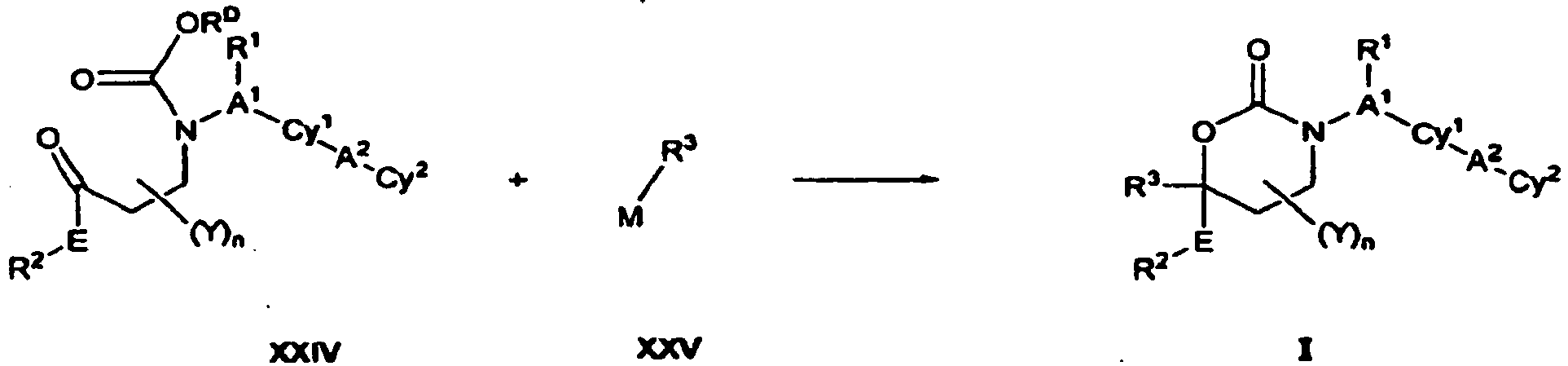
- Ketocarbamates of Formula XXIV can be prepared by reaction of aminoketones of Formula XXVI with intermediates of Formula XXVII wherein RE is a leaving group such as chloride, succinyloxy, imidazolyl or t-butoxycarboxycarbonyl:

- Aminoketones of Formula XXVI, wherein n = 0, can be prepared by reaction of α,β-unsaturated ketones of Formula XXVIII with amines of Formula VI:

- Aminoketones of Formula XXVI, wherein n = 0, can be prepared by reaction of β-dialkylaminoketones of Formula XXVIII, wherein RF is lower alkyl especially methyl, with amines of Formula VI:
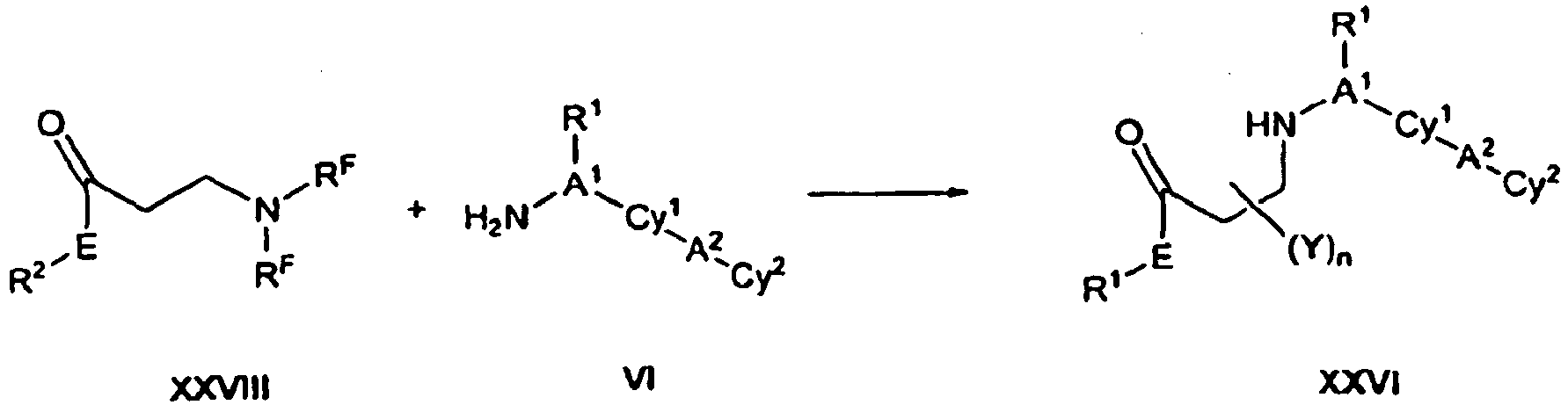
- In a third process a compound of Formula I, can be prepared by reaction of a compound of Formula XVII with an isocyanate of Formula XXIX in the presence of a base:

- In a fourth process a compound of Formula I can be prepared by reaction of a halo compound of Formula, wherein Hal is chlorine or bromine, with an isocyanate of Formula XXIX in the presence of a base:

- Halo compounds of Formula XXX can be prepared by reaction of β-haloketones of Formula XXXI with organometallic reagents of Formula XXV wherein M is a metal containing radical including MgCl, MgBr, Mgl or Li. The reaction is optionally carried out in the presence of anhydrous cerium trichloride:

- In a fifth process a compound of Formula I, wherein A1 is CH2 or CH2CH2 and R1 is absent, can be prepared by reaction of a compound of Formula XXXII, with a compound of Formula XXXIII, wherein A1 is CH2 or CH2CH2 and RG is a leaving group such as Br, I, OSO2Me, OSO2CF3 or OSO2Ph, in the presence of a base such as NaH or K2CO3:

- Compounds of Formula XXXII can be prepared by treatment of compounds of Formula XII with various reagents of Formula III, wherein Z1 and Z2 are leaving groups such as chloride, 1-imidazolyl or aryloxide in an inert solvent such as THF, CH2Cl2. toluene or MeCN, usually in the presence of an organic or inorganic base such as triethylamine or NaHCO3 respectively, at -10 °C to 120 °C:

- In a sixth process a compound of Formula I, wherein A is a bond can be prepared by reaction of a compound of Formula XXXII, with a compound of Formula XXII, wherein RB is a leaving group such as chloro, bromo, iodo or OSO2CF3. in the presence of a base such as K2CO3 and a copper or palladium catalyst in an inert solvent such as dioxane, DMF or NMP at elevated temperature:

- In a seventh process a compound of Formula I can be prepared from another compound of Formula I. For example:
- (1) a compound of Formula I wherein Cy1 is substituted with bromine or iodine, A2 is a bond and Cy2 is hydrogen can be reacted with an optionally substituted aryl or heteroarylboronic acid or ester in the presence of a palladium catalyst to give a compound of Formula I wherein A2 is a bond and Cy2 is optionally substituted aryl or heteroaryl.
- (2) a compound of Formula I wherein R1 or R3 is ω-hydroxy(C2-C6)alkyl can be oxidized to a compound of Formula I wherein R1 or R3 is ω-carboxy(C1-C5)alkyl using Jones reagent.
- (3) a compound of Formula I wherein R1 or R3 is ω-carboxy(C1-C6)alkyl can be coupled with ammonia or a (C1-C6)alkylamine using a standard peptide coupling reagent such as EDC to afford a compound of Formula I wherein R1 or R3 is ω-H2NC(=O)(C1-C6)alkyl or ca-{(C1-C6)alkylNHC(=O)}(C1-C6)alkyl.
- (4) a compound of Formula I wherein R1 or R3 is ω-hydroxy(C1-C6)alkyl can
be converted to its methanesulfonate or trifluoromethanesulfonate, treated with sodium azide and reduced to give a compound of Formula I. wherein R1 or R3 is ω-amino(C1-C6)alkyl. - (5) a compound of Formula I wherein R1 or R3 is amino(C1-C6)alkyl can be reacted with acetic anhydride or acetyl chloride to give a compound of Formula I wherein R1 or R3 is {acetylamino}(C1-C6)alkyl.
- (6) a compound of Formula I wherein R1 or R3 is amino(C1-C6)alkyl can be reacted with methanesulfonyl chloride to give a compound of Formula I wherein R1 or R3 is {methanesulfonylamino}(C1-C6)alkyl.
- (7) a compound of Formula I, wherein R1 is (C2-C6)alkenyl is hydroborated to afford a compound of Formula I wherein R1 is hydroxy(C2-C6)alkyl.
- (8) a compound of Formula I, wherein R3 is (C2-C6)alkenyl, is hydroborated to afford a compound of Formula I wherein R3 is hydroxy(C2-C6)alkyl.
- (9) a compound of Formula I, wherein R1 is (C2-C6)alkenyl, can be reacted with osmium tetroxide and N-methylmorpholine-N-oxide to afford a compound of Formula I wherein R1 is vicinal dihydroxy(C2-C6)alkyl,.
- (10) a compound of Formula I, wherein R3 is (C2-C8)alkenyl, can be reacted with osmium tetroxide and N-methylmorpholine-N-oxide to afford a vicinal diol compound of Formula I wherein R3 is vicinal dihydroxy(C2-C6)alkyl,.
- (11) a compound of Formula I, wherein R1 is (C2-C6)alkenyl, can be reacted with ozone followed by NaBH4 to give a compound of Formula I wherein R1 is ω-hydroxy(C1-C5)alkyl.
- (12) a compound of Formula I, wherein R3 is (C2-C6)alkenyl, can be reacted with ozone followed by NaBH4 to give a compound of Formula I wherein R3 is ω-hydroxy(C1-C5)alkyl.
- (13) a compound of Formula I wherein R1 or R3 is amino(C1-C6)alkyl can be reacted with an (C1-C6)alkyl isocyanate to give a compound of Formula I wherein R1 or R3 is (C1-C6)alkylaminocarbonylamino(C1-C6)alkyl.
- (14) a compound of Formula I wherein R1 or R3 is amino(C1-C6)alkyl can be reacted with an (C1-C6)alkyl chloroformate to give a compound of Formula I wherein R1 or R3 is (C1-C6)alkoxycarbonylamino(C1-C6)alkyl.
- (15) a compound of Formula I wherein R1 or R3 is amino(C1-C6)alkyl can be reacted with chlorosulfonyl isocyanate or sulfamide to give a compound of Formula I wherein R1 or R3 is aminosulfonylamino(C1-C6)alkyl.
- (16) a compound of Formula I wherein R1 or R3 is amino(C1-C6)alkyl can be reacted with a (C1-C6)alkylsulfamoyl chloride to give a compound of Formula I wherein R1 or R3 is (C1-C6)alkylaminosulfonylamino(C1-C6)alkyl.
- (17) a compound of Formula I wherein R1 or R3 is hydroxy(C1-C6)alkyl can be reacted with chlorosulfonyl isocyanate to give a compound of Formula I wherein R1 or R4 is aminosulfonyloxy(C1-C6)alkyl.
- (18) a compound of Formula I wherein R1 or R3 is hydroxy(C1-C6)alkyl can be reacted with p-nitrophenyl chforoformate, pentafluorophenyl chloroformate or carbonyl diimidazole, followed by ammonia, a (C1-C6)alkylamine or a di(C1-C6)alkylamine to give a compound of Formula I wherein R1 or R3 is aminocarboxy(C1-C6)alkyl, (C1-C6)alkyl aminocarboxy(C1-C8)alkyl or di(C1-C6)alkyl aminocarboxy(C1-C6)alkyl.
- (19) a compound of Formula I wherein R1 or R3 is hydroxy(C1-C6)alkyl can be reacted with POCl3 to give a compound of Formula I wherein R1 or R3 is (HO)2P(=O)O(C1-C6)alkyl.
- (20) a compound of Formula I wherein Cy1 is substituted with bromine or iodine, A2 is a bond and Cy2 is hydrogen can be reacted with a cyclic amine in the presence of a palladium catalyst to give a compound of Formula I wherein A2 is a bond and Cy2 is a cyclic amino moiety attached through its nitrogen atom.
- (21) a compound of Formula I wherein Cy1 is aryl or heteroaryl substituted with bromine or iodine, A2 is a bond and Cy2 is hydrogen can be reacted with bis(pinacolato)diboron in the presence of a palladium catalyst to give a boronate ester which can be further reacted with (a) an aryl, heteroaryl or heterocyclyl halide again in the presence of a palladium catalyst to give a compound of Formula I wherein A2 is a bond and Cy2 is aryl, heteroaryl or heterocyclyl.
- (22) a compound of Formula I, wherein R3 is allyl or homoallyl can be reacted with oxygen in the presence of PdCl2 and CuCl to afford a compound of Formula I, wherein R3 is 2-oxopropyl or 3-oxobutyl respectively.
- (23) a compound of Formula I, wherein R3 is 2-oxopropyl or 3-oxobutyl can be reacted with MeMgX, wherein X is Cl, Br or I, to give a compound of Formula I, wherein R3 is 2-hydroxy-2-methylpropyl or 3-hydroxy-3-methylpropyl respectively.
- (24) a compound of Formula I, wherein R3 is -CH2CO2Me can be treated with MeMgX, wherein X is Cl. Br or I, to give a compound of Formula I, wherein R3 is 2-hydroxy-2-methylpropyl.
- (25) a compound of Formula I, wherein R3 is allyl or -CH2C(Me)=CH2 can be hydrocyanated with TsCN in the presence of triphenylsilane and various cobalt catalysts to afford compounds of Formula I, wherein R3 is -CH2CH(CN)Me or - CH2CMe2CN respectively.
- (26) a compound of Formula I, wherein R3 is CH2C(Me)2CN, can be treated with acetamide in the presence of PdCl2 to give a compound of Formula I, wherein R3 is CH2CMe2CONH2.
- (27) a compound of Formula I, wherein R3 is -CH2C(Me)=CH2 can be treated with m-CPBA followed by lithium triethylborohydride to afford a compound of Formula I, wherein R3 is 2-hydroxy-2-methylpropyl.
- In an eighth process, compounds of the invention as prepared as follows:

- Halo compounds of Formula LIII can be formed by the treatment of β-haloketones of Formula LI with organometallic reagents of Formula LII, wherein M denotes MgCl, and the reaction is performed in the presence of anhydrous cerium trichloride in an inert anhydrous solvent, such as tetrahydrofuran, at about -25 to 0 °C for about 0.5 h.
- Cyclic carbamates of Formula LV can be prepared from the reaction between β-haloalcohols of Formula LIII where Hal is a chloride and Isocyanates of Formula LIV in the presence of a base, such as but not limited to DBU (1,8-diazabicyclo[5.4.0]undec-7-ene), in a refluxing inert solvent, such as but not limited to tetrahydrofuran.
- Tertiary alcohols of Formula LVII can be derived from trisubstituted alkenes of Formula LV by first epoxidizing the alkene with an epoxidation reagent, such as m-CPBA (3-chloroperbenzoic acid), in an inert solvent, such as dichloromethane to produce the corresponding epoxides of Formula LVI. The resulting epoxide is then reductively ring opened to provide the corresponding tertiary alcohol LVII via treatment with a strong hydride reagent, such as triethylborohydride, in an anhydrous inert solvent, such as tetrahydrofuran.
- In another variation, Id is prepared from la' by using a "Suzuki"coupling reaction with Cy2-B(OH)2 and (PH3P)2PdCl2 as described in, for example, Example 111:

- The 2-methyl-2-hydroxypropyl group is introduced via epoxidation and hydride ring opening as described above.
- In a ninth process, compounds of Formula Ie1 can be prepared according to the following scheme:

- A methoxymethyl ketone of Formula LVIII is reacted with an organometallic allyl reagent of Formula LIX wherein M includes, but is not limited to, MgCl, MgBr, Mgl or Li to yield an allyl compound of Formula LX. In specific examples, organometallic reagent LIX is allylmagnesium chloride, allylmagnesium bromide or allylzinc(II) bromide. In certain cases when M is MgCl. MgBr or Mgl, it is advantageous to add CeCl3 to the reaction mixture.
Allyl compound of Formula LX is converted to the aldehyde of Formula LXII by ozonolysis or by OsO4 catalysed dihydroxylation followed by cleavage of the glycol of Formula LXI by periodates like sodium periodate. Aminocarbinol of Formula LXIV can be prepared by reductive amination with an amine of Formula LXIII using sodium cyanoborohydride or sodium triacetoxyborohydride as reducing agent. Cyclisation of the aminocarbinol of Formula LXIV to the compounds of Formula Ie1 can be achieved by reacting with activated carbonic acid derivates such as phosgene, diphosgene, triphosgene or 1,1'-carbonyl-diimidazol. - Compounds of the invention can be purified by high pressure liquid chromatography (prep HPLC). Unless otherwise specified, prep HPLC refers to preparative reverse phase HPLC on a C-18 column eluted with a water/acetonitrile gradient containing 0.01% TFA run on a Gilson 215 system.
- Column: Chromolith SpeedRod, RP-18e, 50 x 4.6 mm; Mobil phase: A: 0.01%TFA/water, B: 0.01%TFA/CH3CN; Flow rate: 1 mL/min; Gradient:
Time (min) A% B% 0.0 90 10 2.0 10 90 2.4 10 90 2.5 90 10 3.0 90 10 -
Column YMC-PACK ODS-AQ , 50×2.0mm 5µm Mobile Phase A: water (4 L) + TFA (1.5 mL)) B: acetonitrile (4 L) + TFA (0.75 mL)) TIME(min) A% B% 0 90 10 2.2 20 80 2.5 20 80 Flow Rate 1 mL/min Wavelength UV 220 nm Oven Temp 50°C MS ionization ESI -
Column YMC-PACK ODS-AQ, 50×2.0mm 5µm Mobile Phase A: water (4 L) + TFA (1.5 mL)) B: acetonitrile (4 L) + TFA (0.75 mL)) TIME(min) A% B% 0 70 30 2.2 10 90 2.5 10 90 Flow Rate 1 mL/min Wavelength UV220 Oven Temp 50 °C MS ionization ESI - Some of the examples do not fall within the scope of the claims but they serve to illustrate the invention.
-

- To a solution of acetophenone (30 g. 0.25 mol) in dry THF (250 mL) at -78 °C was added dropwise 1M allylmagnesium bromide (1.25 L. 1.25 mol). After addition was complete, the mixture was allowed to stir at rt for 3 h. The reaction was quenched with satd aq NH4Cl solution (30 mL). The mixture was extracted with EtOAc (200 mL). The organic layer was washed with brine (30 mL), dried over anhydrous Na2SO4 and concentrated to give 2-phenylpent-4-en-2-ol (40.2 g), which was used for the next step without purification.
- A solution of 2-phenylpent-4-en-2-ol (74 g, 0.457 mol) in dry CH2Cl2 (1 L) was treated with ozone at -78 °C until the mixture turned blue. The system was then flushed with oxygen to remove excess ozone. NaBH4 (42.8 g, 1.143 mol) was added to the mixture in portions at -20 °C. The mixture was stirred overnight at rt. The mixture was quenched with water and the layers were separated. The aqueous layer was extracted with CH2Cl2 (2 x). The organic layers were combined, washed with brine, dried over anhydrous Na2SO4 and concentrated to give 3-phenylbutane-1,3-diol (67.8 g), which was used for the next step without purification.
- To a solution of 3-phenylbutane-1,3-diol (68 g, 0.41mol) in dry CH2Cl2 (500 mL) was added dropwise a solution of TsCl (78 g, 0.41 mol) and triethylamine (71 mL, 0.45 mol) in dry CH2Cl2 (500 mL) at 0 °C. The mixture was stirred overnight. The mixture was poured into water and separated. The aqueous layer was extracted with CH2Cl2 (200 mL) twice. The organic layer was combined, washed with brine, dried over anhydrous Na2SO4 and concentrated to give the crude product. The crude product was purified by column chromatography to give 3-hydroxy-3-phenylbutyl 4-methylbenzenesulfonate (62 g, 42%). 1H NMR (400MHz, CDCl3): δ=1.55 (s, 3H), 1.93 (w, 1H), 2.19∼2.24 (q, 2H), 2.45 (s, 3H), 3.87∼4.01 (m, 1H), 4.09∼4.16 (m, 1H). 7.19∼7.34 (m, 7H), 7.68∼7.76 (d, 2H).
- To a solution of 3-hydroxy-3-phenylbutyl 4-methylbenzenesulfonate (1 g, 3.12 mmol) and DBU (1.4 g, 9.26 mmol) in CH2Cl2 (15 mL) was added a solution of 3-methylphenyl isocyanate (623 mg, 4.68 mmol) in CH2Cl2 (5 mL) at 0 °C over 0.5 h. The mixture was stirred at rt overnight. The mixture was concentrated to give the crude product, which was purified by column chromatography and then by preparative HPLC to afford 6-methyl-6-phenyl-3-m-tolyl-1,3-oxazinan-2-one. LC-MS Method 2, tR = 2.706 min, m/z = 282. 1H NMR (CDCl3) 1.75 (s, 3H), 2.30 (s, 3H), 2.35-2.50 (m, 2H), 3.30 (m, 1H),3.50 (m, 1H), 6.95 (m, 2H), 7.05 (m, 1H), 7.20-7.30 (m, 1H), 7.35 (m, 1 H), 7:42-7.50 (m, 4H).
- Chiral preparative SFC using a ChiralPak-AD, 400 x 25 mm I.D, 20 µm (Daicel Chemical Industries, Ltd) column maintained at 35 C eluted with 70:30 supercritical CO2/0.1% diethylamine in MeOH at a flow rate of 70 mL min-1 and a nozzle pressure of 100 bar afforded two isomers.
- Isomer 1 (90 mg) gave the following spectral data: 1H NMR (400MHz, CDCl3): δ=1.62 (m, 1H), 1.76 (s, 3H), 2.31 (s, 3H), 2.48 (m, 2H), 3.28 (m, 1H), 3.50 (m, 1H), 6.95 (m, 1 H), 7.04 (m, 1H), 7.23 (t, 1H), 7.35 (m, 1H), 7.44 (m, 4H);
- Isomer 2 (100 mg) gave the following spectral data: (400MHz, CDCl3): δ=1.62 (m, 1H), 1.76 (s, 3H), 2.31 (s, 3H), 2.48 (m, 2H), 3.28 (m, 1 H), 3.50 (m, 1H), 6.95 (m, 1H), 7.04 (m, 1H), 7.23 (t, 1H), 7.35 (m, 1H), 7.44 (m, 4H).
-

- The title compound was prepared following procedures analogous to those described in Example 1 Steps 1 - 4 using 4-chlorophenyl isocyanate in Step 4. LC-MS Method 2, tR = 2.798 min, m/z = 324. 1H NMR (CD3OD) 1.75 (s, 3H), 2.45 (m, 1 H), 2.65 (m, 1 H), 3.27 (m, 1 H), 3.60 (m, 1H), 7.15 (d, 2H), 7.35 (dd, 3H), 7.47 (m, 4H).
-
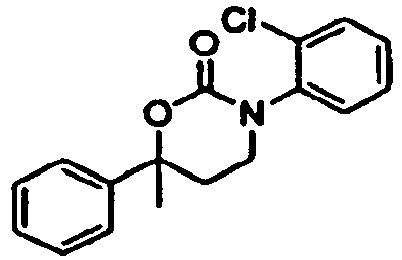
- The title compound was prepared following procedures analogous to those described in Example 1 Steps 1 - 4 using 2-chlorophenyl isocyanate in Step 4. LC-MS Method 3, tR = 1.14 min, m/z = 625.1. 1H NMR (CD3OD) 1.80 (d, 3H), 2.50 (m, 1H), 2.62 (m, 1H), 3.20-3.30 (m, 1H), 3.42 (m, 1H), 3.50-3.60 (m, 2H), 7.03 (d, 1H), 7.30-7.50 (m, 5H), 7.50-7.60 (m, 4H).
-

- The title compound was prepared following procedures analogous to those described in Example 1 Steps 1 - 4 using 3-chlorophenyl isocyanate in Step 4. LC-MS Method 2, tR = 2.291 min, m/z = 301. 1H NMR (CD3OD) 1.75 (s, 3H), 2.50 (m, 1H), 2.70 (m, 1H), 3.30 (m, 1H),3.68 (m, 1H), 7.12 (d, 1H), 7.30-7.45 (m, 4H), 7.50 (d, 4H).
-

- The title compound was prepared following procedures analogous to those described in Example 1 Steps 1 - 4 using 4-(trifluoromethyl)phenyl isocyanate in Step 4. LC-MS Method 2, tR = 2.903 min, m/z = 336. 1H NMR (CD3OD) 1.75 (s, 3H), 2.50 (m, 1H), 2.70 (m, 1H), 3.40 (m, 1H), 3.70 (m, 1H), 7.32-7.42 (m, 3H), 7.45-7.50 (m, 4H), 7.70 (d, 2H).
-

- The title compound was prepared following procedures analogous to those described in Example 1 Steps 1 - 4 using 3-bromophenyl isocyanate in Step 4. LC-MS Method 3, tR = 1.232 min, m/z = 367.9. 1H NMR (CDCl3) 1.70 (s, 2H), 2.30-2.40 (m, 1H), 3.45 (m, 1H). 7.07 (d, 1H). 7.12 (t, 1H), 7.22-7.30 (m, 3H), 7.35-7.40 (m, 4H).
-
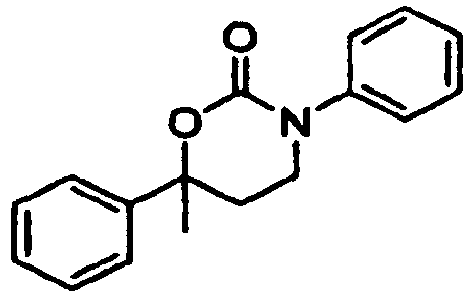
- The title compound was prepared following procedures analogous to those described in Example 1 Steps 1 - 4 using phenyl isocyanate in Step 4. LC-MS Method 2, tR = 1.99 min, m/z = 268. 1H NMR (CD3OD) 1.75 (s, 3H), 2.45 (m, 1H), 2.65 (m, 1H), 3.25 (m, 1H), 3.60 (m, 1H), 7.12 (d, 2H), 7.25 (t, 1H), 7.35 (m, 3H), 7.45-7.53 (m, 4H).
-

- The title compound was prepared following procedures analogous to those described in Example 1 Steps 1 - 4 using cyclohexyl isocyanate in Step 4. LC-MS Method 3, tR = 1.529 min, m/z = 274.1. 1H NMR (CDCl3) 0.97-1.15 (m, 3H), 1.20-1.37 (m, 2H), 1.55 (d, 1H), 1.65 (m, 2H), 1.80-1.90 (m, 2H), 2.05 (s, 1H), 2.75 (m, 2H), 3.40 (b, 1H), 4.10 (t, 2H), 5.08 (s, 1 H), 7.18 (m, 1H), 7.25 (m, 2H), 7.34 (dd, 2H).
-

- To a solution of 3-(3-bromophenyl)-6-methyl-6-phenyl-1,3-oxazinan-2-one (50 mg, 0.14 mmol) and phenylboronic acid (35 mg, 0.29 mmol) in THF (2 mL) was added a solution of NaHCO3 (31 mg, 0.29 mmol) in H2O (2 mL) followed by Pd(PPh3)Cl2 (9 mg, 0.01 mmol). The mixture was refluxed overnight. The mixture was concentrated to give the crude product, which was purified by column chromatography, followed by preparative HPLC to afford 3-(biphenyl-3-yl)-6-methyl-6-phenyl-1,3-oxazinan-2-one (10 mg, 20%). 1H NMR: (400MHz, CDCl3): δ 1.71 (s, 3H), 2.40 (m, 1 H), 2.48 (m, 1H), 3.31 (m, 1H), 3.54 (m, 1H), 7.08 (m, 1H), 7.30 (m, 3H), 7.7.32-7.42 (m, 8H), 7.46 (m, 2H). LC-MS Method 3, tR = 1.362 min, m/z = 344. 1H NMR (CDCl3) 1.75 (s, 3H), 2.32-2.43 (m, 1H), 2.50 (m, 1H), 3.20 (m, 1H), 3.52 (m, 1H), 7.10 (d, 1H), 7.25-7.45 (m, 11H), 7.50 (d, 2H).
-

- The title compound was prepared following procedures analogous to those in Example 9 using 2-chlorophenylboronic acid. LC-MS Method 3, tR = 1.479 min, m/z = 378.1. 1H NMR (CDCl3) 1.63 (s, 3H), 2.38 (m, 1H), 2.67 (m, 1H), 3.18-3.26 (m, 1 H), 3.59 (m, 1 H), 7.09 (m, 2H), 7.24 (m, 5H), 7.38 (m, 6H).
-

- The title compound was prepared following procedures analogous to those in Example 9 using 4-(methylsulfonyl)phenylboronic acid. LC-MS Method 3, tR = 2.042 min, m/z = 422.1. 1H NMR (CD3OD) 1.69 (s, 3H), 2.40-2.50 (m, 1H), 2.50-2.60 (m, 1H), 3.20 (s, 1 H), 3.51-3.60 (m, 1H), 4.5 (m, 1 H), 7.05-7.11 (m, 2H), 7.20-7.30 (m, 5H), 7.30-7.45 (m, 6H).
-

- The title compound was prepared following procedures analogous to those in Example 9 using 2-cyanophenylboronic acid. LC-MS Method 3, tR = 1.376 min, m/z = 369.1. 1H NMR (CD3OD) 1.73(s, 3H), 2.38-2.60 (m, 1H), 2.62-2.78 (m, 1H), 3.38-3.52(m, 1H), 3.65-3.78 (m, 1H), 7.22-7.28(m, 1H), 7.32-7.39(m, 2H), 7.40-7.52(m, 6H), 7.53-7.62(m, 2H). 7.68-7.85 (m, 2H).
-

- The title compound was prepared following procedures analogous to those in Example 9 using 4-(isopropylaminosulfonyl)phenylboronic acid. LC-MS Method 3, tR = 1.566 min, m/z = 465.1. 1H NMR (CDCl3) 1.11-1.15(m, 6H), 1.79 (s, 3H), 2.40-2.50 (m, 1 H), 2.50-2.60 (m, 1H), 3.40 (s, 4H), 3.45-3.62 (m, 2H), 7.15-7.20(m, 1H), 7.32-7.55 (m, 8H), 7.60-7.68 (m, 2H), 7.92-7.96(m, 2H).
-

- The title compound was prepared following procedures analogous to those in Example 9 using 3-(dimethylaminosutfonyl)phenylboronic acid. LC-MS Method 3, tR = 1.459 min, m/z = 451.1. 1H NMR (CDCl3) 1.71 (s, 3H), 2.40-2.50 (m, 1H), 2.50-2.58 (m, 1H), 3.25-3.35 (m, 1H), 3.51-3.65 (m, 1H), 7.10-7.12 (m, 1H), 7.25-7.40 (m, 8H). 7.50-7.60(m, 1H), 7.65-7.70(m, 2H). 7.80-7.85 (m, 1H).
-

- The title compound was prepared following procedures analogous to those in Example 9 using 2-(methylsulfonyl)phenylboronic acid. LC-MS Method 3, tR = 1.464 min, m/z = 422. 1H NMR (CDCl3) 1.77 (s, 3H), 2.40-2.50 (m, 1H), 2.50-2.60 (m, 1H), 2.60-2.68(m, 3H), 3.38-3.48 (m, 1H), 3.62-3.70 (m, 1H), 4.90-5.02 (s, 2H), 7.30-7.45 (m, 5H), 7.45-7.50 (m, 5H), 7.52-7.70(m, 2H), 8.20-8.25(m, 1H).
-

- The title compound was prepared following procedures analogous to those in Example 9 using 4-(pyrrolidin-1-ylsulfonyl)phenylboronic acid. LC-MS Method 3, tR = 1.504 min, m/z = 477.2. 1H NMR (CDCl3) 1.72-1.75 (m, 7H), 2.35-2.42 (m, 1H), 2.45-2.52 (m, 1H), 3.20-3.28 (m, 6H), 3.30-3.35 (m, 1H), 3.50-3.58 (m, 1H), 7.10-7.15 (m, 1H), 7.26-7.40 (m, 4H), 7.52-7.60(m, 2H), 7.60-7.70(m, 2H), 7.80-7.90(m, 3H).
-

- The title compound was prepared following procedures analogous to those in Example 9 using 3-cyanophenylboronic acid. LC-MS Method 3, tR = 1.487 min, m/z = 369.1. 1H NMR (CDCl3) 1.72 (s, 3H), 2.32-2.58 (m, 2H), 3.25-3.38 (m, 1 H), 3.45-3.57 (m, 1H), 7.12-7.18 (m, 1H), 7.25-7.32 (m, 2H), 7.33-7.42(m, 6H), 7. 42-7.50(m, 1 H), 7.52-7.58(m, 1 H), 7.66-7.75(m, 2H).
-

- The title compound was prepared following procedures analogous to those in Example 9 using 3-(2-methoxyethylcarbamoyl)phenylboronic acid. LC-MS Method 3, tR = 1.328 min, m/z = 445.2. 1H NMR (CDCl3) 1.70 (s, 3H), 2.45 (m, 2H), 3.27 (m, 1H), 3.33 (s, 3H), 3.50 (m, 3H), 3.65 (m, 2H), 6.52 (m, 1H), 7.10 (m, 1H), 7.30-7.47 (m, 10H), 7.60 (m, 1H), 7.68 (m, 1H), 7.90 (s, 1H).
-

- The title compound was prepared following procedures analogous to those in Example 9 using 4-(methylsulfonamidomethyl)phenylboronic acid. LC-MS Method 3, tR = 1.19 min, m/z = 450.9. 1H NMR (CDCl3) 1.70 (s, 3H), 2.35-2.60 (m, 2H), 2.95 (s, 3H), 3.35 (m, 1H), 3.60 (m, 1H), 4.40 (m, 2H), 4.65 (b, 1H), 6.95-7.20 (m, 3H), 7.30-7.60 (m, 11 H).
-

- The title compound was prepared following procedures analogous to those in Example 9 using 3-pyridylboronic acid. LC-MS Method 2, tR = 1.819 min, m/z = 345.1. 1H NMR (CDCl3) 1.80 (s, 3H), 2.45-2.65 (m, 2H), 3.40 (m, 1H), 3.62 (m, 1H), 7.30-7.60 (m, 8H), 7.85 (m, 1H). 8.40 (m, 1H), 8.75 (m, 1H), 9.00 (m, 1H). 9.30-9.50 (b, 2H).
-

- The title compound was prepared following procedures analogous to those in Example 9 using 2-methoxyphenylboronic acid. LC-MS Method 3, tR = 1.55 min, m/z = 374.1. 1 H NMR (CDCl3) 1.69 (s, 3H), 2.36 (m, 1 H), 2.46 (m, 1H), 3.31 (m, 1 H), 3.52 (m, 1H), 4.5 (m, 1 H), 5.17 (m, 1H), 7.06 (m, 1H), 7.12 (m, 1H), 7.18 (m, 1H), 7.28 (m, 3H), 7.33 (m, 2H), 7.38 (m, 4H), 7.45 (m, 1H).
-

- The title compound was prepared following procedures analogous to those in Example 9 using 2,6-dichlorophenylboronic acid. LC-MS Method 3, tR = 1.676 min, m/z = 412. 1H NMR (CDCl3) 1.69 (s, 3H), 2.36 (m, 1H), 2.45 (m,1H), 3.30 (m, 1H), 3.50 (m, 1H), 7.05 (m, 2H). 7.16 (m, 1H), 7.25 (m, 2H), 7.30 (m, 1H), 7.32 (m, 1 H), 7.40 (m, 5H).
-

- The title compound was prepared following procedures analogous to those in Example 9 using 2,4-difluorophenylboronic acid. LC-MS Method 3, tR = 1.595 min. m/z = 380.1. 1H NMR (CDCl3) 1.69 (s, 3H), 2.30-2.50 (m, 2H), 3.28 (m, 1H), 3.50 (m, 1H), 6.86 (m, 2H), 7.13 (m, 1H), 7.21 (m, 1 H), 7.28 (m, 3H), 7.35 (m, 5H).
-

- The title compound was prepared following procedures analogous to those in Example 9 using 3-chlorophenylboronic acid. LC-MS Method 3, tR = 1.67 min, m/z = 378. 1H NMR (CDCl3) (s, 3H), 2.36 (m, 1H), 2.48(m, 1 H), 3.28 (m, 1H), 3.49 (m, 1H), 7.12 (m. 1 H), 7.27 (m, 4H), 7.32 (m, 3H), 7.38 (m, 4H), 7.42 (m, 1H).
-

- The title compound was prepared following procedures analogous to those in Example 9 using 3-fluorophenylboronic acid. LC-MS Method 3, tR = 1.69 min, m/z = 362.1. 1H NMR (CDCl3) 1.68 (s, 3H), 2.46 (m, 1H), 2.57(m, 1H), 3.38 (m, 1H), 3.62 (m, 1H), 7.06 (m,1H), 7.17 (m, 1H), 7.23 (m, 1 H), 7.32 (m, 2H), 7.38 (m,2H), 7.48 (m, 6H).
-

- The title compound was prepared following procedures analogous to those in Example 9 using 2,5-difluorophenylboronic acid. LC-MS Method 3, tR = 1.686 min, m/z = 380.1. 1H NMR (CDCl3) 1.77 (s, 3H), 2.42 (m, 1H), 2.55 (m, 1H), 3.35 (m, 1H), 3.58 (m, 1H), 6.98 (m, 1H), 7.08 (m, 2H), 7.23 (m, 1H), 7.35 (m, 2H), 7.43 (m, 6H).
-
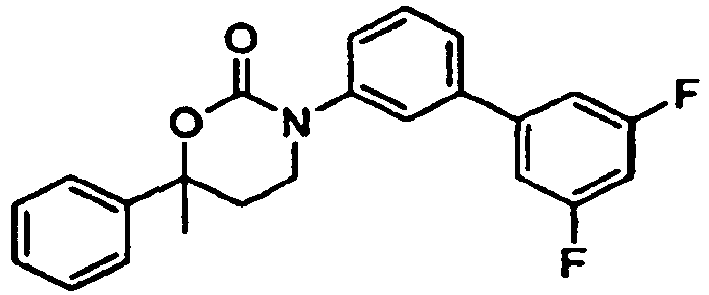
- The title compound was prepared following procedures analogous to those in Example 9 using 3,5-difluorophenylboronic acid. LC-MS Method 3, tR = 1.468 min, m/z = 379.9. 1H NMR (CDCl3) 1.78 (s, 3H). 2.42 (m, 1H), 2.56 (m, 1H), 3.37(m, 1H), 3.58 (m, 1H), 6.78 (m, 1H), 7.03 (m, 2H), 7.23 (m, 1H), 7.32 (m, 1H), 7.38 (m, 1 H), 7.42 (m, 2H), 7.48(m, 4H).
-

- The title compound was prepared following procedures analogous to those in Example 9 using 4-fluorophenylboronic acid. LC-MS Method 3, tR = 1.38 min, m/z = 362.1. 1H NMR (CDCl3) 1.77 (s, 3H), 2.42 (m, 1H), 2.55 (m, 1H), 3.35 (m, 1H), 3.58 (m, 1H), 7.13 (m, 3H), 7.32 (m, 1H), 7.36 (m, 1H), 7.39 (m, 2H), 7.48 (m, 6H).
- Chiral preparative SFC using a ChiralCel-AS, 400 × 25 mm I.D, 20 µm (Daicel Chemical Industries, Ltd) column maintained at 35 C eluted with 60:40 supercritical CO2/0.1% diethylamine in MeOH at a flow rate of 70 mL min-1 and a nozzle pressure of 100 bar afforded the two enantiomers.
- Isomer 1: LC-MS Method 3, tR = 1.38 min, m/z = 362.1. 1H NMR (CDCl3) 1.81 (s, 3H), 2.41-2.50 (m, 2H), 3.35 (m, 1H), 3.51 (m, 1H), 7.15 (m, 3H), 7.33-7.52 (m, 10H).
- Isomer 2: LC-MS Method 3, tR = 1.392 min, m/z = 362.1. 1H NMR (CDCl3) 1.70 (s, 3H), 2.32-2.50 (m, 2H). 3.28 (m, 1H), 3.51 (m, 1H), 7.05 (m, 3H), 7.22-7.45(m, 10H).
-

- The title compound was prepared following procedures analogous to those in Example 9 using 3-(methylsulfonylamino)phenylboronic acid. LC-MS Method 3, tR = 1.626 min, m/z = 437.1. 1H NMR (CDCl3) 1.70 (s, 3H), 2.34-2.50 (m, 2H), 2.98 (s, 3H), 3.21 (m, 1H), 3.51 (m, 1H), 6.48 (m, 1H), 7.05 (m, 1H), 7.18 (m, 1H), 7.25-7.40 (m, 11H).
-

- The title compound was prepared following procedures analogous to those in Example 9 using 3-(methylaminosulfonyl)phenylboronic acid. LC-MS Method 3, tR = 1.184 min, m/z = 437.1. 1H NMR (CDCl3) 1.11-1.13 (m, 6H), 1.70(m, 3H), 2.40-2.50 (m, 1H), 2.50-2.60 (m, 1H), 3.20-3.49 (s, 4H), 3.49-3.65 (m, 2H), 7.15-7.21 (m, 1H), 7.31-7.56 (m, 8H), 7.62-7.68(m, 2H), 7.90-7.96(m, 2H).
-

- The title compound was prepared following procedures analogous to those in Example 9 using 3-(methylcarbamoyl)phenylboronic acid. LC-MS Method 3, tR = 1.11 min, m/z = 401.1. 1H NMR (CDCl3) 1.70 (s, 3H), 2.35 (m, 1 H), 2.46 (m, 1 H), 2.95 (s, 3H), 3.30 (m, 1H), 3.50 (m, 1H), 6.45 (m, 1H), 7.17 (m, 1H), 7.30 (m, 2H), 7.38 (m, 6H), 7.55 (m, 1H), 7.65 (m, 1H), 7.80 (s, 1H).
-

- The title compound was prepared following procedures analogous to those in Example 9 using 3-aminophenylboronic acid. LC-MS Method 2, tR = 1.761 min, m/z = 359.1. 1H NMR (CDCl3) 1.70 (s, 3H), 2.30-2.50 (m, 2H), 3.30 (m, 1H), 3.50 (m, 1H), 6.62 (m, 1H), 6.80-6.90 (m, 2H), 7.05-7.47 (m, 10H).
-

- The title compound was prepared following procedures analogous to those in Example 9 using 4-pyridylboronic acid. LC-MS Method 2, tR = 1.329 min, m/z = 345.1. 1H NMR (CDCl3) 1.70 (s, 3H), 2.30-2.50 (m, 2H), 3.30 (m, 1H), 3.50 (m, 1H), 4.10 (m, 2H), 7.27-7.50 (m, 9H), 8.60 (b, 1H).
-

- The title compound was prepared following procedures analogous to those in Example 9 using 3-methoxyphenylboronic acid. LC-MS Method 3, tR= 1.392 min, m/z = 374.1. 1H NMR (CDCl3,) 1.70 (s, 3H), 2.30-2.50 (m, 2H), 3.30 (m, 1H), 3.50 (m, 1 H), 3.80 (s, 3H), 6.85 (m, 1H), 7.00-7.45 (m, 12H).
-

- The title compound was prepared following procedures analogous to those in Example 9 using 2-hydroxymethylphenylboronic acid. LC-MS Method 3, tR = 1.375 min, m/z = 769.3. 1H NMR (CDCl3) 1.69 (s, 3H), 2.36 (m, 1H), 2.46 (m, 1H), 3.31 (m, 1H), 3.52 (m, 1H), 4.5 (m, 1H), 5.17 (m, 1H), 7.06 (m, 1H), 7.12 (m, 1H), 7.18 (m, 1H), 7.28 (m, 3H). 7.33 (m, 2H). 7.38 (m, 4H), 7.45 (m, 1H).
-

- The title compound was prepared following procedures analogous to those in Example 9 using 2-thienylboronic acid. LC-MS Method 3, tR = 1.721 min, m/z = 350. 1H NMR (CDCl3) 1.69 (s, 3H), 2.33-2.50 (m, 2H), 3.27 (m, 1H), 3.52 (m, 1H), 3.71 (S, 3H), 6.94 (m, 1H), 7.09 (m, 1H), 7.21-7.40 (m, 11H).
-

- The title compound was prepared following procedures analogous to those in Example 9 using 2-fluorophenylboronic acid. LC-MS Method 3, tR = 1.772 min, m/z = 362.1. 1H NMR (CDCl3) 1.15 (s, 3H), 2.30-2.53 (m, 2H), 3.30 (m, 1H), 3.50 (m, 1H), 7.08 (m, 3H), 7.25 (m, 2H), 7.32 (m, 3H), 7.38 (m, 5H).
-

- The title compound was prepared following procedures analogous to those in Example 9 using 3-methoxycarbonylphenylboronic acid. LC-MS Method 3, tR = 1.745 min, m/z = 402.1. 1H NMR (CDCl3) 1.20 (s, 3H), 2.32-2.50 (m, 2H), 3.30 (m, 1 H), 3.55 (m, 1H), 3.89 (s, 3H), 7.10 (m, 1H), 7.30-7.47 (m, 9H), 7.65 (m, 1H), 7.95 (m, 1 H), 8.12 (m, 1H).
-

- The title compound was prepared following procedures analogous to those in Example 9 using 3-hydroxymethylphenylboronic acid. LC-MS Method 3, tR = 1.35 min, m/z = 374.1. 1H NMR (CDCl3) 1.70 (s, 3H), 2.30-2.50 (m, 2H), 3.30 (m, 1H). 4.70 (d, 2H), 7.05 (m, 1H), 7.27-7.55 (m, 13H).
-

- The title compound was prepared following procedures analogous to those in Example 9 using 3-(methylsulfonyl)phenylboronic acid. LC-MS Method 3, tR = 1.172 min, m/z = 422.1. 1H NMR (CDCl3) 1.71 (s, 3H), 2.37-2.44 (m, 1H), 2.46-2.52 (m, 1H), 3.02 (s, 3H), 3.27-3.35 (m, 1H), 3.51-3.58 (m, 1H), 7.11 (d, 1 H), 7.26 (m, 1 H), 7.35-7.42 (m, 6H), 7.52-7.58 (t, 2H), 7.75 (d, 1H), 7.88 (d, 1H), 8.01 (s, 1H).
-

- The title compound was prepared following procedures analogous to those in Example 9 using 3-(acetamidomethyl)phenylboronic acid. LC-MS Method 3, tR = 1.329 min, m/z = 415.2. 1H NMR (CDCl3) 1.70 (s, 3H), 2.00 (s, 3H). 2.38 (m, 1H), 2.50 (m, 1 H), 3.30 (m, 1H), 3.52 (m, 1H), 4.40 (m, 2H), 6.35 (m, 1H), 7.27-7.62 (m, 19H).
-

- The title compound was prepared following procedures analogous to those in Example 9 using 4-(dimethylcarbamoyl)phenylboronic acid. LC-MS Method 3, tR = 1.157 min, m/z = 415.1. 1H NMR (CDCl3) 1.70 (s, 2H), 2.30-2.50 (m, 2H), 2.85 (m, 1H), 2.97 (s, 3H), 3.10 (s, 3H), 3.30(m, 1H), 3.50 (m, 1H), 7.00-7.60 (m, 14H).
-

- The title compound was prepared following procedures analogous to those in Example 9 using 4-hydroxyphenylboronic acid. LC-MS Method 3, tR = 1.381 min, m/z = 360.1. 1H NMR (CDCl3) 1.70 (s, 3H), 2.35-2.50 (m, 2H), 3.30 (m, 1H), 3.50 (m, 1H), 6.80 (m, 2H), 7.0 (m, 1H), 7.20-7.65 (m, 12H).
-

- The title compound was prepared following procedures analogous to those in Example 9 using 4-(carbamoyl)phenylboronic acid. LC-MS Method 2, tR = 1.999 min, m/z = 386.9. 1H NMR (CDCl3) 1.79 (s, 3H), 1.930 (s, 3H), 2.46 (m, 1H), 2.52 (m, 1H), 3.38 (m, 1H), 3.62 (m, 1H), 6.46 (m, 1H), 7.26 (m, 1H), 7.2 (m, 1H), 7.38 (m, 2H), 7.43 (m, 5H), 7.48 (m, 1H), 7.13 (m, 2H), 7.17 (m, 1H), 7.88 (m, 1H).
-

- The title compound was prepared following procedures analogous to those in Example 9 using 2-(methylsulfonylamino)phenylboronic acid. LC-MS Method 3, tR = 1.167 min, m/z = 437.1. 1H NMR (CDCl3) 1.69 (s, 3H), 2.32-2.41 (m, 1H), 2.46-2.52 (m, 1H), 2.86 (s, 2H), 3.30-3.40 (m, 1H), 3.40-3.60 (m, 1H), 6.50(s, 1H), 7.10-7.18 (m, 4H), 7.20-7.40 (m, 8H), 7.51-7.59 (m, 1H).
-

- The title compound was prepared following procedures analogous to those in Example 9 using 4-(methoxycarbonyl)phenylboronic acid. LC-MS Method 3, tR = 1.359 min, m/z = 402.1. 1H NMR (CDCl3) 1.80 (s, 3H), 2.42-2.62 (m, 2H), 3.38-3.44 (m, 1 H), 3.60 (m, 1 H), 3.95 (s, 3H), 7.19 (d, 1 H), 7.34-7.53 (m, 8H), 7.60 (d, 2H), 8.10 (d, 2H).
-

- The title compound was prepared following procedures analogous to those in Example 9 using 4-(methylaminosulfonyl)phenylboronic acid. LC-MS Method 3, tR = 1.403 min, m/z = 437.1. 1H NMR (CDCl3) 1.70 (s, 3H), 2.40-2.50 (m, 1H), 2.50-2.60 (m, 1H), 3.20 (s, 3H), 3.32-3.42 (m, 1H), 3.52-3.62 (m, 1H), 7.15-7.20 (m, 1H), 7.30-7.50 (m, 8H), 7.60-7.70 (m, 2H), 7.86-7.95(m, 2H).
-

- The title compound was prepared following procedures analogous to those in Example 9 using 4-(hydroxmethyl)phenylboronic acid. LC-MS Method 3, tR = 1.123 min, m/z = 374.1. 1H NMR (CDCl3) 1.80 (s, 3H), 2.40-2.60 (m, 2H), 3.35 (m, 1H), 3.60 (m, 1 H), 4.75 (d, 2H), 7.15 (m, 1H), 7.34-7.62 (m, 13H).
-
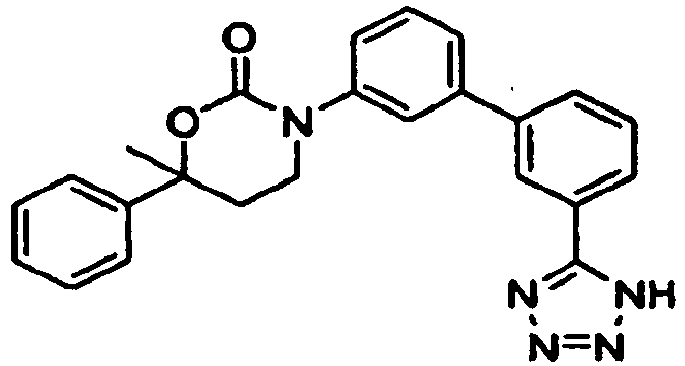
- The title compound was prepared following procedures analogous to those in Example 9 using 3-(2H-tetrazol-5-yl)phenylboronic acid. LC-MS Method 3, tR = 1.341 min, m/z = 412.2. 1H NMR (CDCl3) 1.85 (s, 3H), 2.50-2.70 (m, 2H), 3.40 (m, 1H), 3.65 (m, 1H), 7.05 (d, 1H), 7.20-7.35 (m, 3H), 7.40-7.50 (m, 3H), 7.52 (m, 4H), 7.80 (s, 1H), 7.90(d, 1H).
-

- The title compound was prepared by application of procedures analogous to those described in Example 63 using o-fluoroacetophenone in Step 1 and 2-amino-6-bromopyridine in Step 2, followed by Example 74 and Example 75 Step 1 using 2-chloro-4-fluorophenylboronic acid. LC-MS Method 3, tR = 1.381 min, m/z = 444.11. 1H NMR (CD3OD) 6=2.20-2.60 (m, 3H), 2.75 (dd, 1H), 3.42 (m, 2H), 3.72 (m, 1H), 4.15 (m, 1H), 7.03-7.30 (m, 4H), 7.42 (m, 3H), 7.55 (m, 1H), 7.75 (m, 2H).
-

- The title compound was prepared from 3-((S)-1-(2',4'-difluorobiphenyl-4-yl)ethyl)-6-(4-fluorophenyl)-6-(2-hydroxyethyl)-1,3-oxazinan-2-one by application of procedures analogous to those described in Example 70 followed by Example 76. Two isomers were isolated.
- Isomer 1: 2-((S)-3-((S)-1-(2',4'-difluorobiphenyl-4-yl)ethyl)-6-(4-fluorophenyl)-2-oxo-1,3-oxazinan-6-yl)acetamide LC-MS Method 1, tR = 1.71 min, m/z = 469. 1H NMR (CDCl3) 7.25-7.33 (m, 5H), 6.86-7.06 (m, 6H), 5.66 (q, 1H), 2.95-2.99 (m, 1H), 2.83 (d, 1H), 2.72 (d, 1H), 2.30-2.50 (m, 3H), 2.55 (d, 3H).
- Isomer 2: 2-((R)-3-((S)-1-(2',4'-difluorobiphenyl-4-yl)ethyl)-6-(4-fluorophenyl)-2-oxo-1,3-oxazinan-6-yl)acetamide LC-MS Method 1 tR = 1.75 min, m/z = 469 (M+1); 1H NMR (CDCl3) 7.49-6.88 (m, 11H), 6.19 (br s, 1H), 5.75 (q, J = 6.8 Hz, 1H), 5.46 (br s, 1H), 2.85-2.69 (m, 4H), 2.43-2.38 (m, 1H), 2.29-2.21 (m, 1H), 1.33 (d, J = 6.8 Hz, 3H).
-

- A mixture of (R)-6-allyl-3-((S)-1-(2',4'-difluorobiphenyl-4-yl)ethyl)-6-(4-fluorophenyl)-1,3-oxazinan-2-one (1.2722 g, 2.82 mmol), 4-methylmorpholine N-oxide monohydrate (0.8926 g, 6.60 mmol), and OsO4 (2.5 wt.% solution in t-BuOH, 0.2800 g, 0.0275 mmol) in CH2Cl2 (25 mL) was stirred at rt for 16 h. The mixture was treated with EtOAc and washed with 0.5 N HCl, brine, dried (Na2SO4), filtered, and concentrated under reduced pressure to give 1.3462 g of the crude diol as a foam. The crude diol was directly used in the next step without further purification. LC-MS tR = 1.71 min in 3 min chromatography, m/z 486 (MH+).
- Analytical samples were purified by reversed-phase HPLC (SunFire™ Prep C18 OBD™ 5µm 19 x 50 mm column, 10% →90% CH3CN/H2O, 0.1% CF3COOH over 8 min and then 90% CH3CN/H2O, 0.1% CF3COOH over 2 min, flow rate 20 mL/min) to afford two diastereoisomers.
- Isomer 1: (6S)-3-((S)-1-(2',4'-difluorobiphenyl-4-yl)ethyl)-6-(2,3-dihydroxypropyl)-6-(4-fluorophenyl)-1,3-oxazinan-2-one. LC-MS Method 1, tR = 1.7 min, m/z = 486. 1H NMR (CD3OD) 7.35-7.29 (m, 3H), 7.18 (d, J = 7.0 Hz, 2H), 7.04-6.88 (m, 6H), 5.48 (q, J = 7.0 Hz, 1H), 3.36-3.27 (m, 3H), 3.09-3.04 (m, 1H), 2.67-2.61 (m, 1H), 2.37-2.30 (m, 1H), 2.23-2.15 (m, 1H), 2.02-1.91 (m, 2H), 1.47 (d, J = 7.0 Hz, 3H).
- Isomer 2: (6S)-3-((S)-1-(2',4'-difluorobiphenyl-4-yl)ethyl)-6-(2,3-dihydroxypropyl)-6-(4-fluorophenyl)-1,3-oxazinan-2-one. LC-MS Method 1, tR = 1.71 min, m/z = 486. 1H NMR (CD3OD) 7.36-7.19 (m, 5H), 7.04-6.91 (m, 6H), 5.51 (q, J = 7.0 Hz, 1H), 3.76-3.71 (m, 1H), 3.06-3.01 (m, 1H), 2.44-2.37 (m, 2H), 2.25-2.18 (m, 1 H), 1.98 (dd, J = 14.9, 2.6 Hz, 1H), 1.84 (dd, J = 15.2, 7.9 Hz, 1H), 1.48 (d, J = 7.0 Hz, 3H).
-

- Dry THF (15 mL) was cooled to -78 °C and 2.5M n-BuLi (5.18mL, 2.0 equiv.) was added. A solution of acetonitrile (680 µL, 2.0 equiv.) in dry THF (2 mL) was added dropwise over 2 min. The mixture was stirred at -78 °C for 1 h. A solution of 3-chloroacetophenone (835µL, 6.468 mmol) in dry THF (2 mL) was added dropwise over 2 min. 30 min. The mixture was stirred at -78°C for 30 min. and was warmed to rt slowly. After being stirred at rt for 15 min., the mixture was quenched with water (10 mL), diluted by ether (20 mL), washed with 2% aq HCl (15 mL). The aqueous layer was extracted with ether (2 x 10mL). The combined organic layers were washed with satd aq NaHCO3 (5 mL) and brine (10 mL), and dried over Na2SO4. After filtration and concentration, the crude product (1.4g, quant. yield) was used for next step without further purification. LC-MS Method 1 tR = 1.40 min., m/z = 219, 221 (M+Na).
- A solution of 3-(3-chlorophenyl)-3-hydroxybutanenitrile (400 mg, 2.04 mmol) in dry THF (10 mL) was cooled to 0 °C. LiAlH4 powder (155 mg, 2 equiv.) was added. After 5 min, the mixture was warmed to rt and stirred for 4 h. The mixture was then heated to reflux for 6 h. The mixture was diluted with 1 M aq NaOH (30 mL) and extracted with CH2Cl2 (2 x 100 mL). The combined CH2Cl2 extracts were washed with brine, dried over Na2SO4 and concentrated to afford crude 4-amino-2-(3-chlorophenyl)butan-2-ol (550 mg, quant) which was used without purification. LC-MS Method 1, tR = 0.88 min, m/z = 200, 202.
- A stirred solution of crude 4-amino-2-(3-chlorophenyl)butan-2-ol (550 mg) and i-Pr2NEt (1 mL, 5.5 mmol) in CH2Cl2 was cooled in an ice bath and solid triphosgene (286 mg, 0.96 mmol) was added. The ice bath was allowed to melt and the mixture was stirred overnight at rt. The mixture was diluted with ether (150 mL), washed with 5% aq HCl (50 mL) and satd aq NaHCO3 (50 mL) and dried over MgSO4. Removal of the solvent left a brown oil (590 mg) which was purified by chromatography on a 12-g silica cartridge eluted with a 0 - 100% EtOAc in hexanes gradient to afford 6-(3-chlorophenyl)-6-methyl-1,3-oxazinan-2-one (57 mg).
- A mixture of 6-(3-chlorophenyl)-6-methyl-1,3-oxazinan-2-one (28 mg, 0.12 mmol), 2-bromo-6-piperidinopyridine (33 mg, 0.14 mmol), CuI (7 mg, 0.037 mmol), powdered K2CO3 (19 mg, 0.14 mmol) and CH2Cl2 (0.25 mL) was heated to 130 C under a stream of N2 such that the CH2Cl2 evaporated. The vessel was sealed and the mixture was heated at 130 °C for 1 h under N2. The residue was dissolved in MeCN (0.5 mL) and DMSO (0.5 mL) and purified by prep HPLC to afford 6-(3-chlorophenyl)-6-methyl-3-(6-(piperidin-1-yl)pyridin-2-yl)-1,3-oxazinan-2-one (20 mg) as a brown oil. LC-MS Method 1, tR = 2.08 min, m/z = 386, 388. 1H NMR (CDCl3) 1.62 (6H), 1.73 (s, 3H), 2.35 (m, 1 H), 2.48 (m, 1H), 3.43 (5H), 4.11 (m, 1H), 6.50 (d, 1 H), 7.20-7.60 (6H).
-


- Dry THF was cooled to -20 °C and 2.5 M n-Buli (100 mL, 0.25 mol) was added. A solution of CH3CN (11.25 g, 0.25 mol) in dry THF was added dropwise over 10 min. Then the mixture was stirred for 1 h at -20 °C and a solution of acetophenone (30 g, 0.25 mol) in THF was added dropwise over 10 min. The mixture was stirred at -20 °C for 15 min and warmed to rt over 15 min. Aq NH4Cl was added to quench the reaction. The solution was extract with EtOAc. The organic layer washed with brine, dried over anhydrous Na2SO4 and concentrated to give 3-hydroxy-3-phenylbutanenitrile (30 g, yield 75%). 1H NMR (CDCl3, 400 MHz): 6=1.76 (s, 3H), 2.83 (s, 2H), 7.34 (m, 1H), 7.41 (m, 2H), 7.5 (m. 2H).
- To a solution of 3-hydroxy-3-phenylbutanenitrile (1 g, 6.2 mmol) in THF (10 mL) was added dropwise BH3.Me2S (32 mL, 62 mmol) under a N2 atmosphere. The mixture was stirred at rt overnight. The reaction was quenched with MeOH (10 mL). The mixture was concentrated to give crude 4-amino-2-phenylbutan-2-ol (1.2 g, crude), which was used in the next step without further purification.
- To a solution of 4-amino-2-phenyl-butan-2-ol (1.2 g, 0.0072 mmol) and DIEA in CH2Cl2 (15 ml) was added dropwise a solution of 2,4-dichloro-pyrimidine (980 mg, 0.0072 mmol) in CH2Cl2 slowly at 0 °C under N2. The mixture was stirred at rt overnight. The mixture was concentrated to give the crude product, which was purified by preparative TLC to afford a mixture of 4-(2-chloro-pyrimidin-4-ylamino)-2-phenyl-butan-2-ol and 4-(4-chloropyrimidin-2-ylamino)-2-phenylbutan-2-ol (450 mg, 23%). 1H NMR (CDCl3, 400 MHz): 6=1.55 (s, 3H), 2.05 (m, 2H), 3.03 (m, 2H), 3.6 (m, 1 H), 6.02 (m, 2H), 7.28 (m, 1H), 7.28 (m, 2H), 7.28 (m, 2H).
- To a solution of 4-(4-chloro-pyrimidin-2-ylamino)-2-phenyl-butan-2-ol (450 mg, 1.6 mmol) and Et3N (508 mg, 4.8 mmol) in CH2Cl2 (2 ml) was added dropwise a solution of triphosgene (159 mg, 0.54 mmol) in CH2Cl2 slowly at 0 °C under nitrogen atmosphere. The mixture was stirred at rt overnight. The mixture was concentrated to give the crude product, which was purified by TLC and preparative HPLC to afford 3-(2-chloropyrimidin-4-yl)-6-methyl-6-phenyl-1,3-oxazinan-2-one (250 mg, 52%) 1H NMR (CDCl3, 400 MHz): δ=1.73 (s, 3H), 2.38 (m, 1H), 2.63 (m, 1H), 3.49 (m, 1H), 4.2 (m, 1H), 7.36 (m, 5H), 8.28 (m, 1H), 8.52 (m, 1H) and 3-(4-chloropyrimidin-2-yl)-6-methyl-6-phenyl-1,3-oxazinan-2-one (20 mg, 9%) [Example 57]. 1H NMR (CDCl3, 400 MHz): δ=1.73 (s, 3H), 2.4 (m, 1H), 2.58 (m, 1H), 3.47 (m, 1H), 4.13 (m, 1H), 7.06 (m, 5H), 7.16-7.55 (m, 5H), 8.54 (m, 1H).
- To a solution of 3-(2-chloropyrimidin-4-yl)-6-methyl-6-phenyl-1,3-oxazinan-2-one (100 mg, 0.33 mmol) and 3-chlorophenylboronic acid (0.53 mmol) in 2M aq K2CO3 (1 mL, 2 mmol) and 1,4-dioxane (3 mL) was slowly added Pd(Ph3)2Cl2 (20 mg, 10%) at 0 °C under N2. The mixture was refluxed overnight. The mixture was concentrated to give crude product, which was purified by TLC and preparative HPLC to afford 3-(2-chloropyrimidin-4-yl)-6-methyl-6-phenyl-1,3-oxazinan-2-one (13 mg). 1H NMR (CDCl3, 400 MHz): δ=1.78 (s, 3H), 2.43 (m, 1H), 2.57 (m, 1H), 3.6 (m, 1H), 4.4 (m, 1H), 7.3-7.5 (m, 6H), 8.2-8.4 (m, 3H), 8.65 (m, 1H). LC-MS Method 3, tR = 1.655 min, m/z = 380.
-

- To a solution of 3-(2-chloropyrimidin-4-yl)-6-methyl-6-phenyl-1,3-oxazinan-2-one (50 mg, 0.165 mmol) and 4-fluorophenylboronic acid (32 mg, 0.33 mmol), K2CO3 (0.5 mL, 2 M) in 1,4-dioxane (1.5 ml) at 0 °C under N2 was slowly added Pd(Ph3)2Cl2 (10 mg, 20%). The mixture was refluxed overnight. The mixture was concentrated to give the crude product, which was purified by TLC and preparative HPLC to afford 3-(2-(4-fluorophenyl)pyrimidin-4-yl)-6-methyl-6-phenyl-1,3-oxazinan-2-one (15 mg, yield 25%). 1H NMR (CDCl3, 400 MHz): δ = 1.75 (s, 3H), 2.4 (m, 1H), 2.54 (m, 1H), 3.6 (m, 1 H), 4.4 (m, 1 H), 7.1 (m, 2H), 7.25-7.4 (m, 5H), 8.08 (m, 1 H), 8.34 (m, 2H), 8.62 (m, 1H). LC-MS Method 3, tR = 1.519 min, m/z = 364.1. 1H NMR (CDCl3) 1.80 (s, 3H), 2.40 (m, 1H), 2.60-2.70 (d, 1H), 3.60 (m, 1H), 4.40 (t, 1H), 7.10 (t, 2H), 7.20-7.45 (m, 5H), 8.17 (d, 1H), 8.35 (t, 2H), 8.65 (d, 1H).
-

- To a solution of 3-(2-chloropyrimidin-4-yl)-6-methyl-6-phenyl-1,3-oxazinan-2-one (100 mg, 0.33 mmol) and 3-fluorophenylboronic acid (80 mg, 0.53 mmol), K2CO3 (1 mL, 2 M) in 1,4-dioxane (3 ml) at 0 °C under N2 was slowly added Pd(Ph3)2Cl2 (20 mg, 20%). The mixture was refluxed overnight. The mixture was concentrated to give the crude product, which was purified by TLC and preparative HPLC to afford 3-(2-(3-fluorophenyl)pyrimidin-4-yl)-6-methyl-6-phenyl-1,3-oxazinan-2-one (20 mg, yield 17%). 1H NMR (CDCl3, 400 MHz): δ=1.71 (s, 3H), 2.37 (m, 1H), 2.6 (m, 1H), 3.54 (m, 1H), 4.34 (m, 1H), 7.08 (m, 1 H), 7.25 (m, 1H), 7.34 (m, 5H), 7.96 (m, 1H), 8.09 (m, 1H), 8.16 (m, 1H), 8.6 (m, 1H). LC-MS Method 3, tR = 1.46 min, m/z = 364.
-

- The title compound was isolated as described in Example 54 Step 3. LC-MS Method 3, tR = 1.007 min, m/z = 304. 1H NMR (CDCl3) 1.73 (s, 3H), 2.4 (m, 1H), 2.58 (m, 1 H), 3.47 (m, 1H), 4.13 (m, 1H), 7.06 (m, 5H), 7.16-7.55 (m, 5H), 8.54 (m, 1H).
-

- The title compound was prepared following procedures analogous to those in Example 56 using 3-(4-chloropyrimidin-2-yl)-6-methyl-6-phenyl-1,3-oxazinan-2-one and 3-chlorophenylboronic acid. LC-MS Method 3, tR = 1.354 min, m/z = 781.1. 1H NMR (CDCl3) 1.80 (s, 3H), 2.48-2.53 (m, 1H), 2.62-2.71 (m, 1H), 3.55-3.67 (m, 1H), 4.30-4.40(m, 1H), 7.30-7.60 (m, 8H), 7.90-7.95 (m, 1H), 8.05 (s, 1H), 8.80-8.85 (m, 1H).
-

- The title compound was prepared following procedures analogous to those in Example 56 using 3-(4-chloropyrimidin-2-yl)-6-methyl-6-phenyl-1,3-oxazinan-2-one and 2,4-difluorophenylboronic acid. LC-MS Method 3, tR = 1.238 min, m/z = 785. 1H NMR (CDCl3) 1.80 (s, 3H), 2.48-2.53 (m, 1H), 2.62-2.71 (m, 1H), 3.58-3.67 (m, 1H), 4.35-4.45 (m, 1H), 6.93-7.08 (m, 2H), 7.30-7.48 (m, 5H), 7.62-7.65 (m, 1H), 8.15-8.23 (m, 1H), 8.78-8.81 (m, 1 H).
-

- The title compound was prepared following procedures analogous to those in Example 56 using 3-(4-chloropyrimidin-2-yl)-6-methyl-6-phenyl-1,3-oxazinan-2-one and 2,6-dichlorophenylboronic acid. LC-MS Method 3, tR = 1.317 min, m/z = 414. 1H NMR (CDCl3) 1.70 (s, 3H), 2.30-2.40 (m, 1H), 2.48-2.52 (m, 1H), 3.47-3.51 (m, 1H), 4.10-4.15 (m, 1H), 7.10-7.40 (m, 10H), 8.78-8.79 (m, 1H).
-

- The title compound was prepared following procedures analogous to those in Example 56 using 3-(4-chloropyrimidin-2-yl)-6-methyl-6-phenyl-1,3-oxazinan-2-one and 4-fluorophenylboronic acid. LC-MS Method 3, tR = 1.193 min, m/z = 363.9. 1H NMR (CDCl3) 1.60 (s, 1H), 1.80 (s, 3H), 2.48-2.53 (m, 1H), 2.62-2.71 (m, 1 H), 3.60-3.67 (m, 1H), 4.30-4.40(m, 1H), 7.20-7.55 (m, 10H), 7.60-7.62 (m, 1H), 8.05-8.15 (m, 3H), 8.80-8.85 (m, 1 H).
-

- The title compound was prepared following procedures analogous to those in Example 56 using 3-(4-chloropyrimidin-2-yl)-6-methyl-6-phenyl-1,3-oxazinan-2-one and 3-fluorophenylboronic acid. LC-MS Method 3, tR = 1.215 min, m/z = 749. 1H NMR (CDCl3) 1.80 (s, 3H), 2.48-2.53 (m, 1H), 2.62-2.71 (m, 1H), 3.58-3.67 (m, 1H), 4.30-4.40 (m, 1H), 7.30-7.65 (m, 10H), 7.80-7.90 (m, 2H), 8.90-8.95 (m, 1H).
-

- The solution of acetophenone (30 g, 0.25 mol) and Me2NH.HCl (0.28 mol) in EtOH (400 mL) was heated at 70 °C overnight. The resulting mixture was concentrated and the residue was washed with EtOAc to give 3-(dimethylamino)-1-phenylpropan-1-one (17.7 g, 40%). 1H NMR (400MHz, CDCl3): δ=2.36 (m, 6H), 2.74 (m, 2H), 3.14 (m, 2H), 7.43 (m, 2H), 7.52 (m, 1H), 7.94 (m, 2H).
- A mixture of 3-(dimethylamino)-1-phenylpropan-1-one (0.1 mol) and 3-bromoaniline (0.1 mol) in 1:1 EtOH/H2O (100 mL) was heated at 80 °C overnight. The resulting mixture was concentrated and the residue was washed with H2O and then EtOH several times to give to give 3-(3-bromophenylamino)-1-phenylpropan-1-one (27 g, 90%). 1H NMR (400MHz, CDCl3): δ=3.52 (m, 2H), 4.33 (m, 2H), 4.51 (m, 1H), 6.8 (m, 1 H), 7.05 (m, 2H), 7.28 (m, 1H), 7.72 (m, 2H), 7.80 (m, 1H), 8.2 (m, 2H).
- To the solution of 3-(3-bromophenylamino)-1-phenylpropan-1-one (0.03 mol) in anhydrous THF (30 mL) was added K2CO3 (0.06 mol) and methyl chloroformate (0.033 mol) at 0 °C under N2 atmosphere. Then the reaction mixture was stirred at rt for 2 h. The resulting mixture was filtered and the filtrate was concentrated. The residue was washed with H2O, 1N HCl and brine and then extracted with EtOAc. The combined organic layers were concentrated to give crude product, which was purified by column chromatography to afford methyl 3-bromophenyl(3-oxo-3-phenylpropyl)carbamate (30.5 g, 95%). 1H NMR (400MHz, CDCl3): δ=3.22 (m, 2H). 3.62 (s, 3H), 4.02 (m, 2H), 7.05-7.20 (m, 2H), 7.3-7.5 (m, 4H), 7.8 (m, 1H).
- To a solution of methyl 3-bromophenyl(3-oxo-3-phenylpropyl)carbamate (250 mg, 0.69 mmol) in dry THF (2 mL) was added dropwise 1 M allylmagnesium bromide (10 mL) -78 °C. The reaction mixture was stirred at rt for 3 h. The resulting mixture was quenched with sattd aq NH4Cl and extracted with EtOAc. The combined organic layers were washed with brine, dried over anhydrous Na2SO4 and concentrated to give 6-allyl-3-(3-bromophenyl)-6-phenyl-1,3-oxazinan-2-one (120 mg, 47%). 1H NMR (400MHz, CDCl3): δ=2.48 (m, 2H), 2.55-2.7 (m, 2H), 3.23 (m, 1H), 3.51 (m, 1H), 5.04 (m, 2H), 5.72 (m, 1H), 7.01 (m, 1H), 7.11 (m, 1H), 7.23 (m, 1H), 7.3 (m, 1 H), 7.35 (m, 6H).
-

- To a solution of 6-allyl-3-(3-bromophenyl)-6-phenyl-1,3-oxazinan-2-one (50 mg, 0.134 mmol) and 2,4-difluorophenylboronic acid (40 mg, 0.215 mmol), K2CO3 (0.5 mL, 2 M) in 1,4-dioxane (1.5 ml) was slowly added Pd(Ph3)2Cl2 (10 mg, 20%) at 0 °C under N2. The mixture was refluxed overnight. The mixture was concentrated to give the crude product, which was purified by TLC and preparative HPLC to afford 6-allyl-3-(2',4'- difluorobiphenyl-3-yl)-6-phenyl-1,3-oxazinan-2-one (10 mg, 18%). 1H NMR (400MHz, CDCl3): δ=2.40 (m, 2H), 2.55-2.72 (m, 2H), 3.26 (m, 1H), 3.47 (m, 1H), 5.05 (m, 2H), 5.76 (m, 1H), 6.76-6.90 (m, 2H), 7.04 (m, 1H), 7.28 (m, 4H), 7.36 (m, 2H).
-

- A solution of 6-allyl-3-(2',4'-difluorobiphenyl-3-yl)-6-phenyl-1,3-oxazinan-2-one (600 mg, 1.47 mmol) in dry CH2Cl2(10 mL) was treated with ozone at -78 °C until the mixture turned blue. The system was then flushed with oxygen to remove excess ozone. NaBH4 (450 mg, 11.7 mmol) was added to the mixture in portions at -20 °C. The mixture was stirred overnight at rt. The mixture was quenched with water and the layers were separated. The aqueous layer was extracted with CH2Cl2 (2 x). The organic layers were combined, washed with brine, dried over anhydrous Na2SO4 and concentrated to give 3-(2',4'-difluorobiphenyl-3-yl)-6-(2-hydroxyethyl)-6-phenyl-1,3-oxazinan-2-one (150 mg, 25%). 1H NMR (400MHz, CDCl3): δ=2.12-2.35 (m, 2H), 2.51(m, 2H), 3.26 (m, 1H), 3.47-3.6 (m, 2H), 4.25 (m, 1H), 6.83 (m, 2H), 7.06 (m, 1H), 7.26-7.51 (m, 8H).
- Preparative HPLC on a Chiralpak IA, 4.6x250 mm, 5 micron column eluted with 10% EtOH in hexanes at a flow rate of 1 mL min-1 afforded two isomers.
- Isomer 1: LC-MS Method 1, tR = min, m/z = 410 (M+1). 1H NMR (CDCl3) 7.47-7.33 (m, 8H), 7.27-7.26 (m, 1H), 7.16-7.13 (m, 1H), 6.96-6.86 (m, 2H), 3.86-3.80 (m, 1H), 3.64-3.61 (m, 1 H), 3.58-3.53 (m, 1H), 3.35-3.28 (m, 1 H), 2.58-2.52 (m, 2H), 2.37-2.23 (m, 2H).
- Isomer 2 was not characterized.
-

- The title compound was prepared by application of procedures analogous to those described in Example 63 using p-fluoroacetophenone in Step 1 and 3-bromo-4-fluoroaniline in Step 2 followed by procedures analogous to those described in Example 64 using 4-fluorophenylboronic acid followed by procedures analogous to those described in Example 65. LC-MS Method 3, tR = 1.234 min, m/z = 428. 1H NMR (CDCl3) 1.62-1.70 (m, 1H), 2.2-2.38 (m, 2H), 2.5-2.6 (m, 2H), 3.22-3.35 (m, 1H), 3.50-3.65 (m, 2H), 3.80-3.90 (m, 1H), 7.05-7.2 (m, 7H), 7.5-7.6 (m, 4H).
-

- The title compound was prepared by application of procedures analogous to those described in Example 63 using o-fluoroacetophenone in Step 1 and 3-bromo-4-fluoroaniline in Step 2 followed by procedures analogous to those described in Example 64 using 4-fluorophenylboronic acid followed by procedures analogous to those described in Example 65. LC-MS Method 3, tR = 1.263 min, m/z = 428.1. 1H NMR (CDCl3) 2.35-2.6 (m, 3H), 2.79-2.85 (m, 1H), 3.28-3.40 (m, 2H), 3.52-3.60 (m, 1H), 3.63-3.72 (m, 1H), 3.80-3.88 (m, 1H), 7.05-7.20 (m, 6H), 7.22-7.3 (m, 1H), 7.38-7.50 (m, 3H), 7.52-7.61 (m, 1H).
-

- The title compound was prepared by application of procedures analogous to those described in Example 64 using 2-chloro-4-fluorophenylboronic acid in Step 1 followed by procedures analogous to those described in Example 65. LC-MS Method 3, tR = 1.268 min, m/z = 426. 1H NMR (CD30D) 2.2-2.30 (m, 2H), 2.45-2.60 (m, 1 H), 2.60-2.70 (m, 1H), 3.15-3.25 (m, 1H), 3.3-3.40 (m, 1 H), 3.5-3.65 (m, 1H), 3.65-3.77 (m, 1 H), 7.0-7.2 (m, 3H), 7.3-7.48 (m, 9H).
-

- The title compound was prepared by application of procedures analogous to those described in Example 64 using 2,6-dichlorophenylboronic acid in Step 1 followed by procedures analogous to those described in Example 65. LC-MS Method 3, tR = 1.28 min, m/z = 441.9. 1H NMR (CDCl3) 2.26-2.44 (m, 2H), 2.60 (m, 2H), 3.37-3.48 (m, 1H), 3.60-3.70 (m, 1H), 3.88 (m, 1H), 7.11 (m, 1H), 7.19 (m, 1H), 7.29 (m, 1H), 7.45 (m, 4H), 7.50 (m, 4H).
-

- Jones reagent was prepared by addition of CrO3 (1 g) to H2SO4 (1 mL) and addition of water to bring the total volume to 4 mL. 3-(2',4'-difluorobiphenyl-3-yl)-6-(2-hydroxyethyl)-6-phenyl-1,3-oxazinan-2-one (100 mg, 0.24 mmol) was dissolved in acetone (2 mL), and cooled in an ice bath. Jones reagent (0.2 mL) was slowly added to the mixture and the reaction mixture was stirred overnight. Solvent was removed in vacuo and the obtained residue was purified by preparative HPLC to afford 2-(3-(2',4'-difluorobiphenyl-3-yl)-2-oxo-6-phenyl-1,3-oxazinan-6-yl)acetic acid (20 mg, yield 19%). 1H NMR (400MHz, CDCl3): δ=2.7-2.9 (m, 4H), 3.55 (m, 2H), 6.86 (m, 2H), 7.05 (m, 1H), 7.19 (m, 1H), 7.33 (m, 5H), 7.44 (m, 3H).
-

- To a solution of 3-hydroxy-3-phenylbutanenitrile (13 g, 0.081 mol) in THF (150 mL) was added BH3.Me2S (2 M, 122 mL) at 0 °C. The mixture was refluxed overnight. The reaction mixture was quenched with MeOH and extracted with EtOAc. The organic layer was washed with brine, dried over Na2SO4 and concentrated to obtain crude. 4-amino-2-phenylbutan-2-ol (15 g, 100%). 1H NMR (CDCl3): 1.60 (s, 3H), 1.60 (s, 3H), 2.10-2.20 (m, 1H), 2.30-2.40 (m, 1H), 2.90-3.00 (m, 1H), 3.65-3.85 (m, 1H), 7.20-7.40 (m, 5H).
- A solution of 4-amino-2-phenylbutan-2-ol (5.0 g, 0.03 mol) in CH2Cl2 (50 mL) was added triphosgene (2.97 g, 0.01 mol) and Et3N (9.09 g, 0.09 mol) at 0 °C. After stirring for 1 h, the mixture was diluted with water and extracted with CH2Cl2. The organic layer was washed with brine, dried over Na2SO4, concentrated and purified by chromatography to afford 6-methyl-6-phenyl-1,3-oxazinan-2-one (1.14 g, 20%). 1H NMR (CDCl3): 1.60 (s, 3H), 1.80-2.00 (m, 1H), 2.30-2.40 (m, 1H), 3.15-3.21 (m, 1H), 6.00 (s, 1H), 7.30-7.45 (m, 5H), 8.90-9.01 (m, 1H).
- A solution of 6-methyl-6-phenyl-1,3-oxazinan-2-one (500 mg, 2.62 mmol) and NaH (189 mg, 7.86 mmol) in dry THF (10 mL) was stirred for 1 h. A solution of m-bromobenzyl bromide (1.31 g, 5.24 mmol) in dry THF (3 mL) was added. The mixture was stirred overnight at rt. The reaction mixture was quenched water and extracted with EtOAc. The organic layer was washed with brine, dried over Na2SO4, concentrated and purified by preparative TLC to afford 3-(3-bromobenzyl)-6-methyl-6-phenyl-1,3-oxazinan-2-one (300 mg, 32%). 1H NMR (CDCl3): 1.60-1.70 (s, 3H), 2.15-2.30 (m, 1H), 2.35-2.48 (m, 1H), 2.79-2.90 (m, 1H), 3.00-3.10(m, 1H), 4.30-4.40 (m, 1H), 4.50-4.60 (m, 1H), 6.90-7.00 (m, 1H), 7.00-7.10 (m, 1H), 7.20-7.45 (m, 7H).
-

- The title compound was prepared following procedures analogous to those described in Example 71 using o-bromobenzyl bromide in Step 3. LC-MS Method 3, tR = 1.305 min, m/z = 362. 1H NMR (CDCl3) 1.60-1.65 (s, 3H), 2.15-2.26 (m, 1H), 2.30-2.40 (m, 1H), 2.81-2.92 (m, 1H), 3.00-3.08 (m, 1H), 4.45-4.65 (m, 2H), 6.80-6.90 (m, 1H), 7.00-7.10 (m, 1H), 7.21-7.38 (m, 5H), 7.40-7.45 (m, 1H).
-

- The title compound was prepared following procedures analogous to those described in Example 71 using p-bromobenzyl bromide in Step 3. LC-MS Method 3, tR = 1.317 min, m/z = 361.8. 1H NMR (CDCl3) 1.55-1.65 (s, 3H), 2.10-2.20 (m, 1H), 2.30-2.40 (m, 1H), 2.79-2.80 (m, 1H), 2.90-3.00 (m, 1H), 4.25-4.50 (m, 2H), 6.80-6.90 (m, 1H), 7.21-7.38 (m, 7H).
-

- A solution of 6-allyl-3-(3-bromophenyl)-6-phenyl-1,3-oxazinan-2-one (200 mg, 0.54 mmol) in dry CH2Cl2(10 mL) was treated with ozone at -78 °C until the mixture turned blue. The system was then flushed with oxygen to remove excess ozone. NaBH4 (207 mg, 5.4 mmol) was added to the mixture in portions at -20 °C. The mixture was stirred overnight at rt. The mixture was quenched with water and the layers were separated. The aqueous layer was extracted with CH2Cl2 (2 x). The organic layers were combined, washed with brine, dried over anhydrous Na2SO4 and concentrated to give 3-(3-bromophenyl)-6-(2-hydroxyethyl)-6-phenyl-1,3-oxazinan-2-one (75 mg, 37%). 1H NMR (400MHz, CDCl3): δ=2.12-2.30 (m, 2H), 2.47 (m, 2H), 3.19 (m, 1H), 3.40 (m, 1H), 3.53 (m, 1H), 3.76 (m, 1H), 7.06 (m, 1H), 7.13 (m, 1H), 7.22 (m, 1H), 7.25-7.40 (m, 6H).
-

- To a solution of 3-(3-bromophenyl)-6-(2-hydroxyethyl)-6-phenyl-1,3-oxazinan-2-one (200 mg, 0.538 mmol), 4-fluorophenylboronic acid (128 mg, 0.806 mmol), and aq. K2CO3 (1 mL, 2 M) in 1,4-dioxane (3 ml) was slowly added Pd(Ph3)2Cl2 (20 mg, 10%) at 0 °C under N2. The mixture was refluxed overnight. The mixture was concentrated to give the crude product, which was purified by TLC and preparative HPLC to afford 3-(2',4'-diftuorobiphenyl-3-yl)-6-(2-hydroxyethyl)-6-phenyl-1,3-oxazinan-2-one (200 mg, 91 %). 1H-NMR (400MHz, CDCl3): δ=2.12-2.35 (m, 2H), 2.51(m, 2H), 3.26 (m, 1H), 3.47-3.6 (m, 2H), 4.25 (m, 1H), 6.83 (m, 2H), 7.06 (m, 1 H), 7.26-7.51 (m, 8H).
- To a solution of 3-(2', 4'-difluorobiphenyl-3-yl)-6-(2-hydroxyethyl)-6-phenyl-1,3-oxazinan-2-one (200 mg, 0.49 mmol) in dry CH2Cl2 (4 mL) was added Et3N (0.234 mL, 1.46 mmol) at 0 - -5 °C. A solution of methanesulfonyl chloride (67 mg, 0.59 mmol) in dry CH2Cl2 (1 mL) was added dropwise at the same temperature. After addition, the mixture was allowed to warm to rt gradually. When the reaction was complete, water (10 mL) was added and the mixture was extracted with CH2Cl2 (3 x 10 mL). The combined organic layers were washed with 10% aq citric acid, satd aq NaHCO3 and brine, then dried over Na2SO4, filtered and concentrated to give 2-(3-(2',4'-difluorobiphenyl-3-yl)-2-oxo-6-phenyl-1,3- oxazinan-6-yl)ethyl methanesulfonate (230 mg, 97%), which was used in the next step without purification.
- To a solution of 2-(3-(2',4'-difluorobiphenyl-3-yl)-2-oxo-6-phenyl-1,3-oxazinan-6-yl)ethyl methanesulfonate (230 mg, 0.47 mmol) in anhydrous DMF (5 mL) was added NaN3 (92 mg, 1.42 mmol). The reaction mixture was heated to 70 °C overnight. The reaction mixture was cooled to rt and diluted with EtOAc (30 mL), and water (20 ml). The organic phase was washed with water (3 x 20 mL), dried over Na2SO4 and evaporated to give 6-(2-azidoethyl)-3-(2',4'-difluorobiphenyl-3-yl)-6-phenyl-1,3-oxazinan-2- one (100 mg, 49%).
- To a solution of 6-(2-azidoethyl)-3-(2',4'-difluorobiphenyl-3-yl)-6-phenyl-1,3-oxazinan-2-one (100 mg, 0.23 mmol) in 20:1 THF/H2O (3 mL) was added PPh3 (72 mg, 0.28 mmol). The reaction mixture was stirred at rt overnight. The solvent was removed under reduced pressure, and the residue was purified by column chromatography on silica gel to afford 6-(2-aminoethyl)-3-(2',4'-difluorobiphenyl-3-yl)-6-phenyl-1,3-oxazinan-2-one (30 mg, 31%). 1H NMR (400MHz, CDCl3): δ=2.20-2.51 (m, 2H), 2.51-2.60 (m, 2H), 2.72 (m, 1 H), 3.00 (m, 1H), 3.24 (m, 1H), 3.53 (m, 1H), 6.85-6.99 (m, 2H), 7.14 (m, 1H), 7.31-7.50 (m, 8H).
-

- A solution of 2-(3-(2',4'-difluorobiphenyl-3-yl)-2-oxo-6-phenyl-1,3-oxazinan-6-yl)acetic acid (30 mg, 0.072 mmol), HOBt (18 mg, 0.144 mmol), EDCl (30 mg, 0.144 mmol) and DIEA (0.2 ML) in anhydrous CH2Cl2 (3 mL) was stirred at 0 °C under NH3. Then the solution was stirred at rt overnight. Solvent was removed in vacuo, the residue was purified by HPLC to get 2-(3-(2',4'-difluorobiphenyl-3-yl)-2-oxo- 6-phenyl-1,3-oxazinan- 6-yl) acetamide (1.68 mg, 6%). 1H-NMR (400MHz, CDCl3): δ=2.58 (m, 2H), 2.80-3.00 (m, 2H), 3.27 (m, 1H), 3.50 (m, 1H), 6.00 (s, 1H), 6.36 (s, 1H), 6.78-6.90 (m, 2H), 7.05 (m, 1 H), 7.23-7.55 (m, 9H).
-

- To a solution of 6-allyl-3-(2',4'-difluorobiphenyl-3-yl)-6-phenyl-1,3-oxazinan-2-one (7.1 mg, 0.018 mmol) in acetone (0.5 mL) was added NMO.H2O (6 mg, .044 mmol), then OsO4 (10 µL, 2.5 wt % in 2-Me-2-propanol). The reaction was stirred overnight at rt. The solvent was evaporated and the residue was redissolved in EtOAc. The organic layer was washed with 10% aq Na2S2O3 (2 x), 1M aq HCl (2x) and brine (1 x). The organic layer was dried over Na2SO4, filtered, evaporated, and purified by prep HPLC to afford 3-(2',4'-difluorobiphenyl-3-yl)-6-(2,3-dihydroxypropyl)-6-phenyl-1,3-oxazinan-2-one (6.53 mg). LC-MS Method 1, m/z = 440 (M+H)+. 1H NMR (CDCl3) 7.47-7.33 (m), 7.15-7.12 (m), 6.96-6.86 (m), 3.51 (br m), 3.37-3.26 (m), 2.69 (br m), 2.58-2.48 (m), 2.29-2.23 (m), 2.14 (d), 2.06 (d).
-

- To a 0 °C solution of 6-allyl-3-(2',4'-difluorobiphenyl-3-yl)-6-phenyl-1,3-oxazinan-2-one (18 mg, 0.045 mmol) in THF (1 mL) was added BH3.THF (60 µL, 1M THF solution) and the mixture was stirred overnight at rt. The reaction was cooled to 0 °C and NaBO3.H2O (19 mg, 0.20 mmol) was added and stirred for 2 h warming to rt. The solvent was removed in vacuo and the residue was redissolved in CH3CN (4 mL). The solution was filtered and purified by prep HPLC to afford 3-(2',4'-difluorobiphenyl-3-yl)-6-(3-hydroxypropyl)-6-phenyl-1,3-oxazinan-2-one (4.44 mg). LC-MS Method 1, tR = 1.97 min, m/z = 424 (M+H). 1H NMR (CDCl3) 7.47-7.33 (m), 7.32-7.26 (m), 7.16-7.12 (m), 6.96-6.85 (m), 4.28 (t), 3.52-3.13 (m), 3.36-3.27 (m), 2.5-2.47 (m), 2.15-1.99 (m).
-

- The title compound was prepared following procedures analogous to those described in Example 53 using 3-bromobiphenyl in Step 4. LC-MS Method 1, tR = 1.99 min, m/z = 378, 380. 1H NMR (CDCl3) 1.78 (s, 3H), 2.43 (m, 2H), 3.38 (m, 1H), 3.61 (m, 1H), 7.10-7.60 (13H).
-

- The title compound was prepared following procedures analogous to those described in Example 82 using 2',4'-difluorobiphenyl-3-amine in Step 1 and 2-pyridylmagnesium bromide in Step 2. LC-MS Method 1, tR = 1.72 min, m/z = 381 (M+1). 1H NMR (CD3OD) 8.55-8.54 (m, 1H), 7.91-7.87 (m, 1H), 7.62-7.60 (m, 1H), 7.44-7.32 (m, 4H), 7.26-7.25 (m, 1H), 7.14-7.11 (m, 1H), 7.00-6.94 (m, 2H), 3.66-3.60 (m, 1H), 3.25-3.18 (m, 1H), 2.78-2.72 (m, 1 H), 2.43-2.35 (m, 1H), 1.69 (s, 3H).
-

- The title compound was prepared following procedures analogous to those described in Example 82 using 3-phenoxyaniline in Step 1. LC-MS Method 1, tR = 1.9 min, m/z = 360 (M+1). 1H NMR (CD3OD) 7.37-7.22 (m, 8H), 7.08-7.04 (m, 1H), 6.92-6.90 (m, 2H), 6.81-6.78 (m, 2H), 6.68-6.67 (m, 1H), 3.55-3.50 (m, 1H), 3.18-3.11 (m, 1H), 2.58-2.53 (m, 1H), 2.39-2.31 (m, 1H), 1.63 (s, 3H).
-

- A solution of (S)-1-phenylethanamine (0.1.901 g, 1.57 mmol, 1.0 equiv) and methyl vinyl ketone (0.1117 g, 1.59 mmol, 1.02 equiv) in THF (5 mL) was allowed to stand in a refrigerator (ca. 3.3 °C) for 2 d. Boc2O (0.6700 g, 3.07 mmol, 1.95 equiv) was added to the solution at rt. The solution was stirred for 2 h and the solvent was removed under reduced pressure. The residue was purified by chromatography on silica gel eluted with hexanes/EtOAc to give (S)-tert-butyl 3-oxobutyl(1-phenylethyl)carbamate (0.3235 g, 71% over two steps) as a colorless oil.
- A solution of phenylmagnesium bromide (1.0 M in THF, 1.0 mL) was added dropwise to a solution of (S)-tert-butyl 3-oxobutyl(1-phenylethyl)carbamate (0.0421 g, 0.144 mmol in THF (4 mL) under N2 at rt. After the solution was stirred for 14 h, the reaction was quenched with 10% aq Na2CO3 (0.5 mL) and diluted with CH2Cl2. The organic layer was dried over Na2SO4. After the solvents were evaporated, the crude product was directly used in the next step without further purification.
- A mixture of crude tert-butyl 3-hydroxy-3-phenylbutyl((S)-1-phenylethyl)carbamate, obtained as described above, 60% NaH in oil (0.320 g) and THF (5 mL) was heated to reflux for 21 h. The reaction was then quenched with H2O (1.5 mL) and diluted with CH2Cl2. The organic layer was dried over Na2SO4. After the solvents were evaporated, the residue was purified by reversed-phase HPLC to afford 6-methyl-6-phenyl-3-((S)-1-phenylethyl)-1,3-oxazinan-2-one. After the solvents were evaporated, the residue was purified by reversed-phase HPLC (phenomenex® Luna 5µ C18(2) 100A, 250 x 21.20 mm, 5 micron, 10% →90% CH3CN/H2O, 0.1% CF3COOH over 13 min and then 90% CH3CN/H2O, 0.1% CF3COOH over 4 min, flow rate 25 mL/min) to afford 6-methyl-6-phenyl-3-((S)-1-phenylethyl)-1,3-oxazinan-2-one as a mixture of diastereomers. LC-MS Method 1 tR = 1.71, 1.75 min, m/z = 296 (MH+); 1H NMR (400 MHz, CD3OD) δ 7.36-7.18 (m), 7.06-7.02 (m), 6.89-6.85 (m), 5.54 (q, J = 7.1 Hz), 5.47 (q, J = 7.0 Hz), 3.00-2.95 (m), 2.73-2.69 (m), 2.40-2.34 (m), 2.26-2.19 (m), 2.13-2.05 (m), 2.00-1.92 (m), 1.53 (s), 1.52 (s), 1.45 (d, J = 7.0 Hz), 1.23 (d, J = 7.0 Hz). A fraction containing on the less polar diastereomer was also isolated (Isomer 1). LC-MS Method 1 t R = 1.75 min, m/z = 296 (MH+); 1H NMR (400 MHz, CD3OD) δ 7.35-7.18 (m, 10H), 5.54 (q, J = 7.0 Hz, 1H), 2.72-2.69 (m, 2H), 2.39-2.33 (m, 1H), 1.99-1.92 (m, 1H), 1.52 (s, 3H), 1.23 (d, J = 7.0 Hz, 3H).
-

- The two diastereomers of the title compound were prepared and separated following procedures analogous to those described in Example 82 using (R)-1-phenylethanamine in Step 1.
- Isomer 1: LC-MS Method 1, tR = 1.75 min, m/z = 296 (M+1). 1H NMR (CD3OD) 7.35-7.18 (m, 10H), 5.54 (q, J = 7.1 Hz, 1H), 2.72-2.69 (m, 2H), 2.39-2.34 (m, 1H), 2.00-1.92 (m, 1H), 1.52 (s, 3H), 1.23 (d, J = 7.0 Hz, 3H).
- Isomer 2: LC-MS Method 1, tR = 1.71 min, m/z = 296 (M+1). 1H NMR (CD3OD) 7.37-7.18 (m), 7.06-7.01 (m), 6.89-6.85 (m), 5.54 (q, J = 7.2 Hz), 5.47 (q, J = 7.0 Hz), 3.00-2.95 (m), 2.72-2.69 (m), 2.40-2.34 (m), 2.25-2.18 (m), 2.13-2-05-(m), 2.00-1.92 (m), 1.53 (s), 1.52 (s), 1.45 (d, J = 7.0 Hz), 1.23 (d, J = 7.0 Hz).
-

- The two diastereomers of the title compound were prepared and separated following procedures analogous to those described in Example 82 using (S)-1-(3-methoxyphenyl)ethanamine in Step 1.
- Isomer 1: LC-MS Method 1, tR = 1.72 min, m/z = 326 (M+1). 1H NMR (CDCl3) 7.40-7.23 (m, 6H), 6.91-6.80 (m, 3H), 5.78 (q, J = 7.0 Hz, 1H), 3.80 (s, 3H), 2.70-2.67 (m, 2H), 2.29-2.23 (m, 1H), 2.06-1.98 (m, 1H), 1.64 (s, 3H), 1.27 (d, J = 7.3 Hz, 3H).
- Isomer 2: LC-MS Method 1, tR = 1.68 min, m/z = 326 (M+1). 1H NMR (PDCl3) 7.34-7.25 (m, 5H), 7.06-7.02 (m, 1H), 6.70-6.67 (m, 1 H), 6.57-6.54 (m, 2H), 5.68 (q, J = 7.0 Hz, 1H), 3.63 (s, 3H), 2.92-2.87 (m, 1H), 2.39-2.26 (m, 2H), 2.17-2.10 (m, 1H), 1.64 (s, 3H), 1.52 (d, J = 7.0 Hz, 3H).
-

- The two diastereomers of the title compound were prepared and separated following procedures analogous to those described in Example 82 (S)-1-(4-methoxyphenyl)ethanamine in Step 1.
- Isomer 1: LC-MS Method 1, tR = 1.72 min, m/z = 326 (M+1). 1H NMR (CDCl3) 7.40-7.21 (m, 7H), 6.88-6.84 (m, 2H), 5.76 (q, J = 7.1 Hz, 1H), 3.80 (s, 3H), 2.68-2.65 (m, 2H), 2.27-2.22 (m, 1H), 2.02-1.95 (m, 1 H), 1.62 (s, 3H), 1.26 (d, J = 7.3 Hz, 3H).
- Isomer 2: LC-MS Method 1, tR = 1.68 min, m/z = 326 (M+1). 1H NMR (CDCl3) 7.37-7.27 (m, 5H), 6.88-6.84 (m, 2H), 6.66-6.62 (m, 2H), 5.65 (q, J = 7.1 Hz, 1H), 3.73 (s, 3H), 2.90-2.85 (m, 1H), 2.32-2.25 (m, 2H), 2.16-2.09 (m, 1H), 1.64 (s, 3H), 1.50 (d, J = 7.0 Hz, 3H).
-
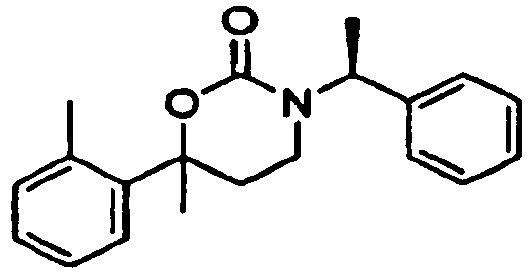
- The two diastereomers of the title compound were prepared and separated following procedures analogous to those described in Example 82 using o-tolylmagnesium bromide in Step 2.
- Isomer 1: LC-MS Method 1, tR = 1.83 min, m/z = 310 (M+1). 1H NMR (CDCl3) 7.42-7.16 (m, 9H), 5.77 (q, J = 7.1 Hz, 1H), 2.79-2.66 (m, 2H), 2.61-255 (m, 1H), 2.47 (s, 3H), 2.03-1.95 (m, 1H), 1.70 (s, 3H), 1.27 (d, J = 7.3 Hz, 3H).
- Isomer 2: LC-MS Method 1, tR = 1.79 min, m/z = 310 (M+1). 1H NMR (CDCl3) 7.35-7.33 (m, 1H), 7.23-7.06 (m, 6H), 6.86-6.84 (m, 2H), 5.66 (q, J = 7.0 Hz, 1H), 2.96-2.91 (m, 1H), 2.62-2.56 (m, 1 H), 2.48 (s, 3H), 2.43-2.36 (m, 1 H), 2.16-2.08 (m, 1H), 1.71 (s, 3H), 1.53 (d, J = 7.0 Hz, 3H).
-

- The two diastereomers of the title compound were prepared and separated following procedures analogous to those described in Example 82 using m-tolylmagnesium bromide in Step 2.
- Isomer 1: LC-MS Method 1, tR = 1.84 min, m/z = 310 (M+1). 1H NMR (CDCl3) 7.36-7.24 (m, 6H), 7.16-7.10 (m, 3H), 5.81 (q, J = 7.1 Hz, 1H), 2.74-2.63 (m, 2H), 2.37 (s, 3H), 2.26-2.21 (m, 1H), 2.03-1.95 (m, 1H), 1.62 (s, 3H), 1.31 (d, J = 7.0 Hz, 3H).
- Isomer 2: LC-MS Method 1, tR = 1.80 min, m/z = 310 (M+1). 1H NMR (CDCl3) 7.24-7.20 (m, 1H), 7.14-7.09 (m, 6H), 6.98-6.95 (m, 2H), 5.73 (q, J = 7.0 Hz, 1H), 2.93-2.87 (m, 1H), 2.35 (s, 3H), 2.34-2.23 (m, 2H), 2.17-2.09 (m, 1H), 1.64 (s, 3H), 1.53 (d, J = 7.0 Hz, 3H).
-

- The two diastereomers of the title compound were prepared and separated following procedures analogous to those described in Example 82 using p-tolylmagnesium bromide in Step 2.
- Isomer 1: LC-MS Method 1, tR = 1.86 min, m/z = 310 (M+1). 1H NMR (CDCl3) 7.36-7.17 (m, 9H), 5.81 (q, J = 7.2 Hz, 1H), 2.74-2.63 (m, 2H), 2.35 (s, 3H), 2.25-2.20 (m, 1H), 2.03-1.95 (m, 1H), 1.61 (s, 3H), 1.31 (d, J = 7.3 Hz, 3H).
- Isomer 2: LC-MS Method 1, tR = 1.80 min, m/z = 310 (M+1). 1H NMR (CDCl3) 7.22-7.19 (m, 2H), 7.16-7.08 (m, 5H), 6.96-6.93 (m, 2H), 5.71 (q, J = 7.0 Hz, 1H), 2.92-2.87 (m, 1H), 2.36 (s, 3H), 2.35-2.23 (m, 2H), 2.16-2.08 (m, 1H), 1.62 (s, 3H), 1.53 (d, J = 7.0 Hz, 3H).
-

- A mixture of 3-((S)-1-(3-methoxyphenyl)ethyl)-6-methyl-6-phenyl-1.3-oxazinan-2-one Isomer 1 (0.1240 g, 0.381 mmol) and EtSNa (0.2115 g, 2.51 mmol) in DMF (2 mL) was heated at 170 °C for 2.5 h under nitrogen. The mixture was diluted with EtOAc, washed with 1 N aq HCl. The aqueous phase was extracted with EtOAc (2 x). The combined organic phase was dried over Na2SO4. After the solvents were evaporated, the residue was purified by chromatography on silica gel eluted with hexanes/EtOAc to afford of 3-((S)-1-(3-hydroxyphenyl)ethyl)-6-methyl-6-phenyl-1,3-oxazinan-2-one (0.1036 g, 87%). LC-MS Method 1 tR = 1.49 min, m/z 312 (MH+); 1H NMR (400 MHz, CDCl3) δ 7.59-7.53 (m, 1H), 7.40-7.28 (m, 5H), 7.19-7.15 (m, 1H), 6.98 (m, 1H), 6.83-6.75 (m, 2H), 5.74 (q, J = 7.1 Hz, 1H), 2.80-2.67 (m, 2H), 2.30-2.25 (m, 1H), 2.09-2.01 (m, 1H), 1.62 (s, 3H), 1.25 (d, J = 7.0 Hz, 3H).
-

- The title compound was prepared following procedures analogous to those described in Example 82 using p-(methylthio)phenylmagnesium bromide in Step 2. LC-MS Method 1, tR = 1.84 min, m/z = 342 (M+1). 1H NMR (CDCl3) 7.37-7.24 (m, 9H), 5.81 (q, J = 7.2 Hz, 1H), 2.75-2.65 (m, 2H), 2.50 (s, 3H), 2.25-2.19 (m, 1H), 2.04-1.96 (m, 1H), 1.61 (s, 3H), 1.33 (d, J = 7.0 Hz, 3H).
-

- A mixture of (R/S)-3-((S)-1-(3-hydroxyphenyl)ethyl)-6-methyl-6-phenyl-1,3-oxazinan-2-one (0.0955 g, 0.31 mmol, 1.0 equiv), Cs2CO3 (0.3307 g, 1.01 mmol, 3.3 equiv), and ethyl bromoacetate (0.1468 g, 0.88 mmol, 2.8 equiv) in CH3CN (1.5 mL) was stirred at rt for 3 d. The mixture was diluted with CH2Cl2, treated with H2O (2 mL), dried over Na2SO4. After the solvents were evaporated, the residue was purified by chromatography on silica gel eluted with hexanes/EtOAc to afford 0.1025 g (84%) of ethyl 2-(3-((S)-1-((R/S)-6-methyl-2-oxo-6-phenyl-1,3-oxazinan-3-yl)ethyl)phenoxy)acetate. LC-MS Method 1, tR = 1.75 min, m/z = 398 (M+1). 1H NMR (CDCl3) 7.40-7.23 (m, 6H), 6.95-6.93 (m, 1H), 6.88 (m, 1H), 6.81-6.78 (m, 1H), 5.76 (q, J = 7.1 Hz, 1 H), 4.61 (s, 2H), 4.27 (q, J = 7.1 Hz, 2H), 2.68-2.65 (m, 2H), 2.28-2.23 (m, 1H), 2.06-1.98 (m, 1H), 1.63 (s, 3H), 1.30 (t, J = 7.2 Hz, 3H), 1.26 (d, J = 7.3 Hz, 3H).
-

- The title compound was prepared following procedures analogous to those described in Example 82 using (4-(morpholinomethyl)phenyl)magnesium bromide in Step 2. LC-MS Method 1, tR = 1.12 min, m/z = 395 (M+1). 1H NMR (CD3OD) 7.48 (d, J = 8.5 Hz, 2H), 7.42 (d, J = 8.5 Hz, 2H), 7.27-7.16 (m, 5H), 5.51 (q, J = 7.2 Hz, 1H), 4.28 (s, 2H), 3.95-3.92 (m, 2H), 3.66-3.60 (m, 2H), 3.28-3.25 (m, 2H), 3.13-3.08 (m, 2H), 2.72-2.69 (m, 2H), 2.36-2.30 (m, 1H), 2.02-1.94 (m, 1H), 1.49 (s, 3H), 1.22 (d, J = 7.0 Hz, 3H).
-

- To a solution of ethyl 2-(3-((S)-1-((R/S)-6-methyl-2-oxo-6-phenyl-1,3-oxazinan-3-yl)ethyl)phenoxy)acetate (0.0369 g, 0.0928 mmol) in THF (5 mL) was added methylmagnesium bromide (1.4 M in toluene/THF, 1.0 mL, 1.4 mmol) at rt under nitrogen. After stirring for 1 h, the mixture was quenched with saturated NH4Cl (1 mL), diluted with CH2Cl2, and dried over Na2SO4. After the solvents were evaporated, the residue was purified by chromatography on silica gel eluted with hexanes/EtOAc to afford 0.0268 g (75%) of (R/S)-3-((S)-1-(3-(2-hydroxy-2-methylpropoxy)phenyl)ethyl)-6-methyl-6-phenyl-1,3-oxazinan-2-one. LC-MS Method 1, tR = 1.64 min, m/z = 384 (M+1). 1H NMR (CDCl3) 7.41-7.23 (m, 6H), 6.92-6.88 (m, 2H), 6.84-6.81 (m, 1H), 5.77 (q, J = 7.0 Hz, 1H), 3.78 (s, 2H), 2.70-2.67 (m, 2H), 2.29-2.24 (m, 1H), 2.23 (s, 1H), 2.06-1.98 (m, 1H), 1.64 (s, 3H), 1.35 (s, 6H), 1.27 (d, J = 7.0 Hz, 3H).
-

- A mixture of ethyl 2-(3-((S)-1-((R/S)-6-methyl-2-oxo-6-phenyl-1.3-oxazinan-3-yl)ethyl)phenoxy)acetate (0.0587 g, 0.148 mmol) and lithium hydroxide monohydrate (0.4275 g, 10.2 mmol) in THF (10 mL) and H2O (10 mL) was vigorously stirred at rt for 2 d. The mixture was treated with 1 N HCl (30 mL), extracted with EtOAc (3 x), dried over Na2SO4. After the solvents were evaporated, the crude product was directly used in the next step without further purification. LC-MS t R = 1.48 min in 3 min chromatography, m/z 370 (MH+).
- A mixture of 2-(3-((S)-1-((R/S)-6-methyl-2-oxo-6-phenyl-1,3-oxazinan-3-yl)ethyl)phenoxy)acetic acid (0.0178 g, 0.0481 mmol), piperazine (0.0575 g, 0.67 mmol), HATU (0.1136 g, 0.30 mmol), and i-Pr2NEt (0.5 mL, 2.87 mmol) in DMF (1 mL) was stirred overnight at rt. After the solvents were removed in vacuo, the residue was purified by reversed-phase HPLC (Phenomenex® Luna 5µ C18(2) 100A, 250 x 21.20 mm, 5 micron, 10% →90% CH3CN/H2O, 0.1% CF3COOH over 13 min, flow rate 25 mL/min) to give 0.0207 g of TFA salt of (R/S)-6-methyl-3-((S)-1-(3-(2-oxo-2-(piperazin-1-yl)ethoxy)phenyl)ethyl)-6-phenyl-1.3-oxazinan-2-one. LC-MS Method 1, tR = 1.17 min, m/z = 438 (M+1). 1H NMR (CD3OD) 7.34-7.17 (m, 6H), 6.84-6.80 (m, 3H), 5.47 (q, J = 7.1 Hz, 1H), 4.78 (m, 2H). 3.78-3.75 (m, 4H), 3.18 (m, 4H), 2.72-2.69 (m, 2H), 2.40-2.34 (m, 1H), 2.01-1.93 (m, 1H), 1.52 (s, 3H), 1.20 (d, J = 7.3 Hz, 3H).
-

- To a solution of 1,1'-bi-2-naphthol (0.2280 g, 0.80 mmol, 0.26 equiv), CH2Cl2 (5 mL) and titanium(IV) isopropoxide (0.2243 g, 0.79 mmol, 0.26 equiv) were added 2-propanol (3.1620 g, 52.6 mmol, 17 equiv), tetraallylstannane (1.2538 g, 4.43 mmol, 1.43 equiv), and 3-chloro-1-(4-fluorophenyl)propan-1-one (0.5760 g, 3.09 mmol, 1.0 equiv) successively. The reaction mixture was stirred at rt under nitrogen for 22 h. The reaction was quenched with satd aq NH4Cl and extracted with EtOAc. The organic layer was dried over Na2SO4. After the solvents were evaporated, the residue was purified by chromatography on silica gel eluted with hexanes/EtOAc to afford 1-chloro-3-(4-fluorophenyl)hex-5-en-3-ol as an oil.
- A mixture of 1-chloro-3-(4-fluorophenyl)hex-5-en-3-ol (0.0889 g, 0.39 mmol, 1.0 equiv), (S)-(-)α-methylbenzyl isocyanate (0.0823 g, 0.56 mmol, 1.44 equiv), and DBU (0.1397 g, 0.92 mmol, 2.36 equiv) in THF (2 mL) was heated to reflux for 17 h. After the solvent was removed, the residue was purified by chromatography on silica gel eluted with hexanes/EtOAc to give 0.0990 g (75%) of the product as a mixture of diastereomers. Selected fractions contained the individual diastereomers.
- Isomer 1: (R)-6-allyl-6-(4-fluorophenyl)-3-((S)-1-phenylethyl)-1,3-oxazinan-2-one. LC-MS Method 1, tR = 1.89 min, m/z = 340 (M+1). 1H NMR (CDCl3) 7.36-7.27 (m, 7H), 7.10-7.05 (m, 2H), 5.79-5.67 (m, 2H), 5.09-4.98 (m, 2H), 2.72-2.68 (m, 2H), 2.64-2.53 (m, 2H), 2.22-2.16 (m, 1 H), 2.09-2.01 (m, 1H), 1.26 (d, J = 7.3 Hz, 3H).
- Isomer 2: (S)-6-allyl-6-(4-fluorophenyl)-3-((S)-1-phenylethyl)-1,3-oxazinan-2-one. LC-MS Method 1, tR = 1.86 min, m/z = 340 (M+1). 1H NMR (CDCl3) 7.29-7.24 (m, 2H), 7.14-7.08 (m, 3H), 7.05-7.00 (m, 2H), 6.88-6.85 (m, 2H), 5.77-5.63 (m, 2H), 5.10-5.00 (m, 2H), 2.93-2.88 (m, 1H), 2.65-2.52 (m, 2H), 2.32-2.17 (m, 3H), 1.51 (d, J = 7.0 Hz, 3H).
-

- The title compound was prepared by application of procedures analogous to those described in Example 63 using 4',6-diftuorobiphenyl-3-amine in Step 2 followed by Example 65. LC-MS Method 3, tR = 1.215 min, m/z = 410. 1H NMR (CDCl3) 2.12-2.30 (m, 2H), 2.47(m, 2H), 3.21 (m, 1H), 3.42 (m, 1H), 3.54 (m, 1H), 3.75 (m, 2H), 7.06-7.11 (m, 5H), 7.26-7.40 (m, 7H).
- Chiral preparative SFC using a ChiralCel-AS, 400 x 25 mm I.D, 20 µm (Daicel Chemical Industries, Ltd) column maintained at 35 °C eluted with 70:30 supercritical CO2/0.1% diethylamine in MeOH at a flow rate of 70 mL min-1 and a nozzle pressure of 100 bar afforded the two enantiomers.
- Isomer 1: (S)-3-(4,6-difluorobiphenyl-3-yl)-6-(2-hydroxyethyl)-6-phenyl-1,3-oxazinan-2-one. LC-MS Method 3, tR = 1.214 min, m/z = 410. 1H NMR (CDCl3) δ=2.12-2.30 (m, 2H), 2.47(m, 2H), 3.21 (m, 1 H), 3.42 (m, 1H), 3.54 (m, 1H), 3.75 (m, 2H), 7.06-7.11 (m, 5H), 7.26-7.40 (m, 7H).
- Isomer 2: (R)-3-(4',6-difluorobiphenyl-3-yl)-6-(2-hydroxyethyl)-6-phenyl-1,3-oxazinan-2-one. LC-MS Method 3, tR = 1.207 min, m/z = 410. 1H NMR (CDCl3) δ=2.20-2.40 (m, 2H), 2.57 (m, 2H), 3.30 (m, 1H), 3.53 (m, 2H), 3.64 (m, 1H), 3.84 (m, 1H), 7.06-7.20 (m, 5H), 7.39 (m, 1H), 7.45 (m, 6H).
-

- To a solution of 6-allyl-6-(4-fluorophenyl)-3-((S)-1-phenylethyl)-1,3-oxazinan-2-one (0.1016 g, 0.30 mmol, 1.0 equiv) in THF-H2O (1:1, 6 mL) were added NalO4 (0.3240 g, 1.5 mmol, 5 equiv) and OsO4 (2.5 wt.% solution in t-BuOH, 0.0507 g, 0.0049 mmol, 0.016 equiv), and the mixture was stirred at rt for 2 h. The mixture was diluted with EtOAc, dried over Na2SO4, and concentrated under reduced pressure. The residue was dissolved in MeOH (3 mL) and NaBH4 (0.100 g) was added. After the mixture was stirred for 1.5 h at rt, acetone was added. The solvents were removed in vacuo, the residue was treated with saturated brine, extracted with CH2Cl2, and dried over Na2SO4. After the solvents were evaporated, the residue was purified by chromatography on silica gel eluted with hexanes/EtOAc to afford the two diastereomers of 6-(4-fluorophenyl)-6-(2-hydroxyethyl)-3-((S)-1-phenylethyl)-1,3-oxazinan-2-one.
- Isomer 1: (R)-6-(4-fluorophenyl)-6-(2-hydroxyethyl)-3-((S)-1-phenylethyl)-1,3-oxazinan-2-one. LC-MS Method 1 t R = 1.51 min, m/z = 344 (MH+); 1H NMR (400 MHz, CDCl3) δ 7.36-7.27 (m, 7H), 7.12-7.07 (m, 2H), 5.76 (q, J = 7.1 Hz, 1H), 3.78-3.74 (m, 1H), 3.58-3.51 (m, 1H), 2.72-2.62 (m, 2H), 2.28-2.08 (m, 4H), 1.80 (br s, 1 H), 1.28 (d, J = 7.3 Hz, 3H); 19F NMR (376 MHz, CDCl3) δ -114.84 (m).
- Isomer 2: (S)-6-(4-fluorophenyl)-6-(2-hydroxyethyl)-3-((S)-1-phenylethyl)-1,3-oxazinan-2-one. LC-MS Method 1 tR = 1.48 min, m/z = 344 (MH+); 1H NMR (400 MHz, CDCl3) δ 7.29-7.25 (m, 2H), 7.16-7.10 (m, 3H), 7.07-7.02 (m, 2H), 6.93-6.90 (m, 2H), 5.66 (q, J = 7.0 Hz, 1H), 3.80-3.74 (m, 1H), 3.58-3.53 (m, 1H), 2.94-2.88 (m, 1H), 2.32-2.07 (m, 5H), 1.79 (br s, 1H), 1.52 (d, J = 7.0 Hz, 3H); 19F NMR (376 MHz, CDCl3) δ -115.03 (m).
-
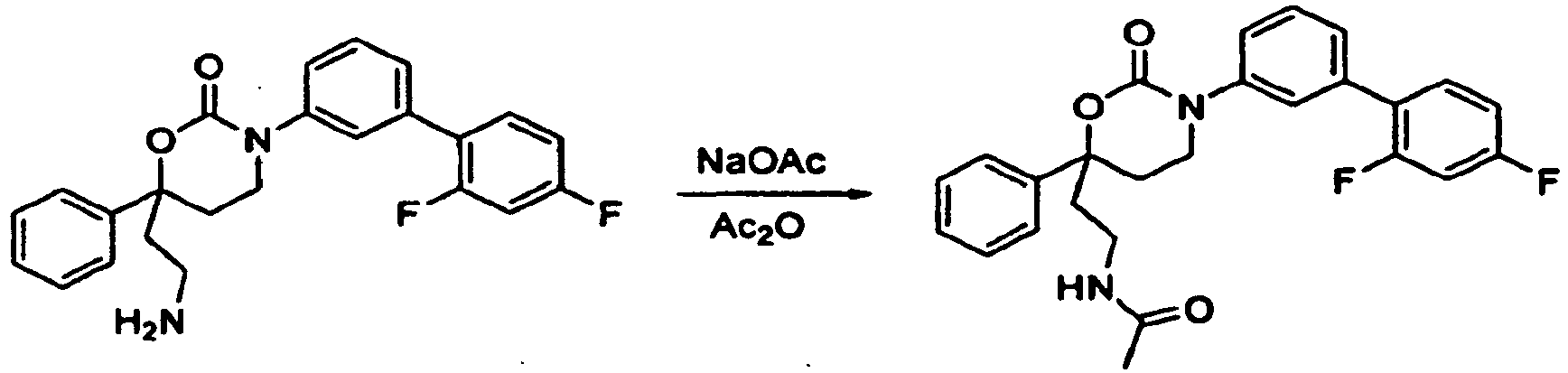
- In a 5 dram vial, sodium acetate (3 mg, 0.04 mmol) was added to 6-(2-aminoethyl)-3-(2',4'-difluorobiphenyl-3-yl)-6-phenyl-1,3-oxazinan-2-one (5.13 mg, 0.013 mmol) in acetic anhydride (0.5 mL). The reaction was stirred for 2 h. The solvent was evaporated and the crude residue purified via prep HPLC to afford 1.88 mg of N-(2-(3-(2',4'-difluorobiphenyl-3-yl)-2-oxo-6-phenyl-1,3-oxazinan-6-yl)ethyl)acetamide. LC-MS Method 1 m/z = 451 (M+H)+.
-

- In a 5 dram vial, methanesulfonyl chloride (5 drops) was added to 6-(2-aminoethyl)-3-(2',4'-difluorobiphenyl-3-yl)-6-phenyl-1,3-oxazinan-2-one (5 mg, 0.012 mmol) and TEA (5 drops) dissolved in methylene chloride (0.5 mL). The reaction was stirred for 2 h. The solvent was evaporated and the crude residue purified via prep HPLC to afford 3.56 mg of N-(2-(3-(2',4'-difluorobiphenyl-3-yl)-2-oxo-6-phenyl-1,3-oxazinan-6-yl)ethyl)methanesulfonamide. LC-MS Method 1 m/z = 487 (M+H)+.
-

- The title compound was prepared by sequential application of procedures analogous to those described in Example 63 using p-fluoroacetophenone in Step 1 and 3-bromo-4-fluoroaniline in Step 2, Example 74 and Example 75 Step 1 using 2-chloro-4-fluorophenylboronic acid. LC-MS Method 3, tR = 1.265 min, m/z = 462. 1H NMR (CDCl3) 2.10-2.30 (m, 2H), 2.45-2.51 (m, 2H), 3.20-3.31 (m, 1H), 3.55-3.60 (m, 2H), 3.70-3.80 (m, 1H), 6.90-7.16 (m, 6H), 7.20-7.40 (m, 4H).
-
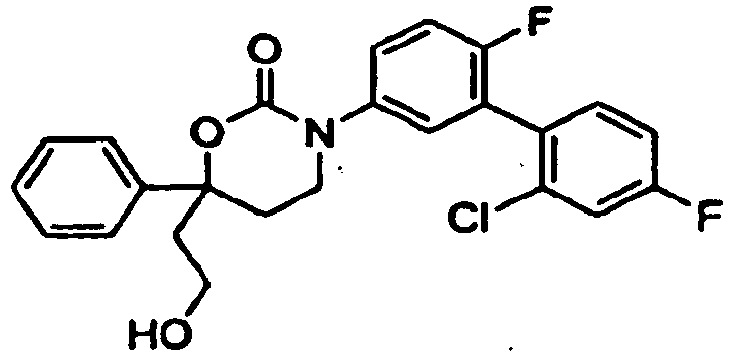
- The title compound was prepared by sequential application of procedures analogous to those described in Example 63 using 3-bromo-4-fluoroaniline in Step 2, Example 74 and Example 75 Step 1 using 2-chloro-4-fluorophenylboronic acid. LC-MS Method 3, tR = 1.367 min, m/z = 466.1. 1H NMR (CD3OD) δ=2.17 (m, 2H), 2.47(m, 1H), 2.58 (m,1H), 3.16 (m, 1H), 3.25 (m, 1H), 3.54 (m, 1H), 3.63 (m, 1H), 6.98 (m, 1H), 7.08 (m, 3H), 7.26 (m, 3H), 7.37 (m, 4H).
-

- The title compound was prepared by application of procedures analogous to those described in Example 63 using 2-amino-6-bromopyridine in Step 2, followed by Example 74 and Example 75 Step 1 using 4-fluorophenylboronic acid. LC-MS Method 3, tR = 1.217 min, m/z = 393. 1H NMR (CD3OD) δ=2.29 (m, 2H), 2.51(m, 1H), 2.73 (m, 1 H), 3.47 (m, 2H), 3.75 (m, 1H), 4.21 (m, 1H), 7.14 (m, 2H), 7.35 (m, 1H), 7.46 (m, 4H), 7.63 (m, 1 H), 7.68 (m, 1H), 7.72 (m, 1H), 8.00 (m, 2H).
- Chiral preparative SFC using a ChiralCel-AS, 400 × 25 mm I.D, 20 µm (Daicel Chemical Industries, Ltd) column maintained at 35 °C eluted with 65:35 supercritical CO2/0.1% diethylamine in MeOH at a flow rate of 70 mL min-1 and a nozzle pressure of 100 bar afforded the two enantiomers.
- Isomer 1: (R)-3-(6-(4-fluorophenyl)pyridin-2-yl)-6-(2-hydroxyethyl)-6-phenyl-1,3-oxazinan-2-one. LC-MS Method 3, tR = 1.2 min, m/z = 393. 1H NMR (CD3OD) δ=2.29 (m, 2H), 2.51(m, 1 H), 2.68 (m, 1H), 3.42 (m, 2H), 3.75 (m, 1H), 4.16 (m, 1H), 7.11 (m, 2H), 7.33 (m, 1H), 7.46 (m, 4H), 7.53 (m, 1H), 7.72 (m, 2H), 7.98 (m, 2H).
- Isomer 2: (S)-3-(6-(4-fluorophenyl)pyridin-2-yl)-6-(2-hydroxyethyl)-6-phenyl-1,3-oxazinan-2-one. LC-MS Method 3, tR = 1.183 min, m/z = 393. 1H NMR (CD3OD) δ=2.27 (m, 2H), 2.48 (m, 1H), 2.63 (m, 1H), 3.45 (m, 2H), 3.75 (m, 1H), 4.18 (m, 1H), 7.08 (m, 2H), 7.31 (m, 1H), 7.44 (m, 4H), 7.50 (m, 1H), 7.68 (m, 2H), 7.91 (m, 2H).
-

- The title compound was prepared by application of procedures analogous to those described in Example 63 using p-fluoroacetophenone in Step 1 and 2-amino-6-bromopyridine in Step 2, followed by Example 74 and Example 75 Step 1 using 4-fluorophenylboronic acid. LC-MS Method 2, tR = 2.25 min, m/z = 411. 1H NMR (CD3OD) .25 (m, 2H), 2.55 (m, 1H), 2.60 (m, 1H), 3.40 (m, 1 H), 3.50 (m, 1H), 3.75 (m, 1H), 4.20 (m, 1H), 7.15 (m, 4H), 7.50 (m, 2H), 7.65 (m, 2H), 7.80 (m, 1H), 8.00 (m, 2H).
-

- The title compound was prepared by application of procedures analogous to those described in Example 63 using o-fluoroacetophenone in Step 1 and 2-amino-6-bromopyridine in Step 2, followed by Example 74 and Example 75 Step 1 using 4-fluorophenylboronic acid. LC-MS Method 3, tR = 1.26 min, m/z = 410.14. 1H NMR (CD3OD) δ=2.20-2.40 (m, 2H), 2.45 (m, 1H), 2.75 (m, 1H), 3.42 (m, 2H), 3.72 (m, 1H), 4.15 (m, 1 H), 7.03-7.20 (m, 4H), 7.35 (m, 2H), 7.55 (m, 1 H), 7.65 (m, 1 H), 7.75 (m, 1H), 7.95 (m, 2H).
- Chiral preparative SFC using a ChiralCel-AS, 400 × 25 mm I.D, 20 µm (Daicel Chemical Industries, Ltd) column maintained at 35 °C eluted with 75:25 supercritical CO2/0.1% diethylamine in MeOH at a flow rate of 70 mL min-1 and a nozzle pressure of 100 bar afforded the two enantiomers.
- Isomer 1: (R)-6-(2-ftuoropheny))-3-(6-(4-fluorophenyl)pyridin-2-yl)-6-(2-hydroxyethyl)-1,3-oxazinan-2-one. LC-MS Method 3, tR = 1.255 min, m/z = 410.14. 1H NMR (CD3OD) δ=2.20-2.40 (m, 2H), 2.45 (m, 1H), 2.75 (m, 1H), 3.35 (m, 2H), 3.72 (m, 1H), 4.15 (m, 1 H), 7.03-7.20 (m, 4H), 7.35 (m, 2H), 7.55 (m, 1H), 7.65 (m, 1H), 7.75 (m, 1H), 7.95 (m, 2H).
- Isomer 2: (S)-6-(2-fluorophenyl)-3-(6-(4-fluorophenyl)pyridin-2-yl)-6-(2-hydroxyethyl)-1,3-oxazinan-2-one. LC-MS Method 3, tR = 1.262 min, m/z = 410.14. 1H NMR (CD3OD) δ=2.20-2.40 (m, 2H), 2.45 (m, 1H), 2.75 (m, 1H), 3.42 (m, 2H), 3.72 (m, 1H), 4.15 (m. 1H), 7.03-7.20 (m, 4H), 7.45 (m, 2H), 7.55 (m, 1H), 7.65 (m, 1H), 7.75 (m, 1H), 7.95 (m, 2H).
-

- The title compound was prepared by sequential application of procedures analogous to those described in Example 63 using p-fluoroacetophenone in Step 1 and 3-bromo-4-fluoroaniline in Step 2, Example 74 and Example 75 Step 1 using 2,4-difluorophenylboronic acid. LC-MS Method 3, tR = 1.225 min. m/z = 446. 1H NMR (CDCl3) δ=2.15-2.30 (m, 2H), 2.50-2.60 (m, 2H), 3.22-3.37 (m, 1H), 3.50-3.65 (m, 2H), 3.75-3.85 (m, 1H), 6.89-6.92 (m, 2H), 7.10-7.20 (m, 5H), 7.30-7.40 (m, 3H).
-
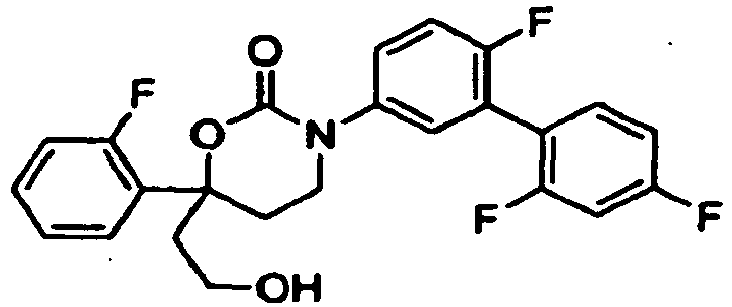
- The title compound was prepared by sequential application of procedures analogous to those described in Example 63 using o-fluoroacetophenone in Step 1 and 3-bromo-4-fluoroaniline in Step 2, Example 74 and Example 75 Step 1 using 2,4-difluorophenylboronic acid. LC-MS Method 3, tR = 1.237 min, m/z = 446. 1H NMR (CDCl3) δ=2.30-2.50 (m, 3H), 2.70-2.80 (m, 1H), 3.20-3.30 (m, 1H), 3.40-3.50 (m, 1H), 3.55-3.65 (m, 1H), 3.70-3.80 (m, 1H), 6.85-6.90 (m, 2H), 7.00-7.10 (m, 4H), 7.20-7.38 (m, 3H), 7.45-7.52 (m, 1H).
-

- The title compound was prepared by application of procedures analogous to those described in Example 63 using 2-amino-6-bromopyridine in Step 2, followed by Example 74 and Example 75 Step 1 using 2,4-difluorophenylboronic acid. LC-MS Method 3, tR = 1.25 min, m/z = 411. 1H NMR (CD3OD) δ=2.27 (m, 2H), 2.53 (m, 1H), 2.72 (m, 1 H), 3.38 (m, 2H), 3.74 (m, 1H), 4.15 (m, 1H), 7.02 (m, 2H), 7.32 (m, 1 H), 7.42 (m, 4H), 7.55 (m, 1H), 7.71 (m, 1H), 7.78 (m, 1 H), 7.91 (m, 1H).
-

- The title compound was prepared by application of procedures analogous to those described in Example 63 using p-fluoroacetophenone in Step 1 and 2-amino-6-bromopyridine in Step 2, followed by Example 74 and Example 75 Step 1 using 2,4-difluorophenylboronic acid. LC-MS Method 2, tR = 2.311 min, m/z = 429.4. 1H NMR (CD3OD) 2.25 (m, 2H), 2.55 (m, 1H), 2.60 (m, 1H), 3.40 (m, 2H), 3.50 (m, 1H), 3.75 (m, 1H), 7.15 (m, 3H), 7.30 (m, 1H), 7.45 (m, 3H), 7.75 (m, 1H), 7.80 (m, 1H).
- 3-(6-(2,4-difluorophenyl)pyridin-2-yl)-6-(2-fluorophenyl)-6-(2-hydroxyethyl)-1,3-oxazinan-2-one

- The title compound was prepared by application of procedures analogous to those described in Example 63 using o-fluoroacetophenone in Step 1 and 2-amino-6-bromopyridine in Step 2, followed by Example 74 and Example 75 Step 1 using 2,4-difluorophenylboronic acid. LC-MS Method 2, tR = 2.311 min, m/z = 429. 1H NMR (CD3OD) 2.35 (m, 2H), 2.55 (m, 1H), 2.80 (m, 1H), 3.45 (m, 2H), 3.75 (m, 1H), 4.20 (m, 1H), 7.05 (m, 2H), 7.20 (m, 2H), 7.40 (m, 2H), 7.60 (m, 1H), 7.80 (m, 2H), 7.90 (m, 1H).
- The isomers were separated by
Isomer 1: (R)-3-(6-(2,4-difluorophenyl)pyridin-2-yl)-6-(2-fluorophenyl)-6-(2-hydroxyethyl)-1,3-oxazinan-2-one.
Isomer 2: (S)-3-(6-(2,4-difluorophenyl)pyridin-2-yl)-6-(2-fluorophenyl)-6-(2-hydroxyethyl)-1,3-oxazinan-2-one. -

- A 250-mL flask was charged with anhydrous CeCl3 (5.58 g, 22.6 mmol) and THF (40 mL). The mixture was vigorously stirred for 3.5 h at rt. The suspension was then cooled to -78 °C and a solution of allylmagnesium bromide (1.0 M in THF, 21 mL, 21.0 mmol) was added. After stirring for 2 h at -78 °C, a solution of 3-chloro-1-(4-fluorophenyl)propan-1-one (2.522 g, 13.5 mmol) in THF (30 mL) was added via cannula. The reaction mixture was allowed to slowly warm to 8 °C while stirring overnight (18 h). The reaction was then quenched with satd aq NaHCO3, extracted with EtOAc, and dried over Na2SO4. After the solvents were evaporated, the residue was purified by chromatography on silica gel eluted with hexanes/EtOAc to afford of 1-chloro-3-(4-fluorophenyl)hex-5-en-3-ol (3.0049 g, 97%) as an oil. LC-MS Method 1 tR = 1.79 min, m/z 213, 211 (M-OH)+; 1H NMR (400 MHz, CDCl3) δ 7.37-7.32 (m, 2H), 7.07-7.02 (m, 2H), 5.57-5.47 (m, 1H), 5.20-5.19 (m, 1H), 5.16 (m, 1H), 3.59-3.52 (m, 1H), 3.24-3.18 (m, 1H), 2.70 (dd, J = 13.8, 5.9 Hz, 1H), 2.50 (dd, J = 13.8, 8.5 Hz, 1H), 2.29 (t, J = 7.9 Hz, 2H), 2.22 (s, 1 H); 19F NMR (376 MHz, CDCl3) 8 -116.52 (m). Step 2. (R)-6-allyl-3-((S)-1-(4-bromophenyl)ethyl)-6-(4-fluorophenyl)-1,3-oxazinan-2-one and (S)-6-allyl-3-((S)-1-(4-bromophenyl)ethyl)-6-(4-fluorophenyl)-1,3-oxazinan-2-one.
- A mixture of 1-chloro-3-(4-fluorophenyl)hex-5-en-3-ol (0.4129 g, 1.8 mmol, 1.0 equiv), (S)-(-)-1-(4-bromophenyl)ethyl isocyanate (0.5005 g, 2.2 mmol, 1.2 equiv), and DBU (0.7375 g, 4.8 mmol, 2.7 equiv) in THF (10 mL) was heated to reflux for 25 h. The mixture was diluted with EtOAc and washed with 1 N aq HCl. The aqueous phase was extracted with EtOAc (2 ×). The combined organic phase was dried over Na2SO4. After the solvents were evaporated, the crude product was directly used in the next step without further purification.
- An analytical sample was purified by chromatography on silica gel eluted with hexanes/EtOAc to afford the two diastereomers of 6-allyl-3-((S)-1-(4-bromo-phenyl)ethyl)-6-(4-fluorophenyl)-1,3-oxazinan-2-one.
- Isomer 1: (S)-6-allyl-3-((S)-1-(4-bromophenyl)ethyl)-6-(4-fluorophenyl)-1,3-oxazinan-2-one. LC-MS Method 1 tR = 2.03 min, m/z 420, 418 (MH+); 1H NMR (400 MHz, CDCl3) δ 7.46 (d, J = 8.2 Hz, 2H), 7.31-7.28 (m, 2H), 7.17 (d, J = 8.2 Hz, 2H), 7.07 (t, J = 8.5 Hz, 2H), 5.76-5.66 (m, 2H), 5.10-4.99 (m, 2H), 2.75-2.52 (m, 4H). 2.23-2.19 (m, 1H), 2.08-2.00 (m, 1H), 1.24 (d, J = 7.0 Hz, 3H); 19F NMR (376 MHz, CDCl3) δ -115.07 (m).
- Isomer 2: (R)-6-allyl-3-((S)-1-(4-bromophenyl)ethyl)-6-(4-fluorophenyl)-1,3-oxazinan-2-one. LC-MS Method 1 t R = 1.98 min, m/z 420, 418 (MH+); 1H NMR (400 MHz, CDCl3) δ 7.25-7.20 (m, 4H), 7.05-7.01 (m, 2H), 6.71 (d, J = 8.5 Hz, 2H), 5.74-5.64 (m, 1H), 5.58 (q, J = 7.0 Hz, 1H), 5.09-4.99 (m, 2H), 2.92-2.87 (m, 1H), 2.63-2.50 (m, 2H), 2.33-2.16 (m, 3H), 1.47 (d, J = 7.0 Hz, 3H); 19F NMR (376 MHz, CDCl3) δ -114.91 (m).
- (R)-6-allyl-3-((S)-1-(4-chlorophenyl)ethyl)-6-phenyl-1,3-oxazinan-2-one was prepared following procedures analogous to those described above using 3-chloro-1-phenylpropan-1-one in Step 1 and (S)-1-chloro-4-(1-isocyanatoethyl)benzene in Step 2.
-

- To a solution of 6-allyl-3-((S)-1-(4-bromophenyl)ethyl)-6-(4-fluorophenyl)-1,3-oxazinan-2-one (0.3860 g, 0.92 mmol, 1.0 equiv) in THF (10 mL) were added, under a nitrogen atmosphere, 2,4-difluorophenylboronic acid (0.2708 g, 1.71 mmol, 1.86 equiv), 2 M aq Na2CO3 (8 mL), and (Ph3P)2PdCl2 (0.0308 g, 0.0438 mmol, 0.047 equiv). The mixture was stirred for 2 d at 100 °C. Brine was then added, the mixture was extracted with Et2O (3 ×), and the combined ether extracts were dried over Na2SO4. After the solvents were evaporated, the crude product was directly used in the next step without further purification. LC-MS t R = 2.13, 2.17 min in 3 min chromatography, m/z 452 (MH+).
- Isomer 1: (S)-6-allyl-3-((S)-1-(2',4'-difluorobiphenyl-4-yl)ethyl)-6-(4-fluorophenyl)-1,3-oxazinan-2-one. LC-MS Method 1, tR = 2.17 min, m/z = 452. 1H NMR (CDCl3) 7.47 (d, J = 8.2 Hz, 2H), 7.42-7.30 (m, 5H), 7.08 (t, J = 8.2 Hz, 2H), 6.98-6.88 (m, 2H), 5.82-5.68 (m, 2H), 5.08 (d, J = 10.2 Hz, 1H), 5.02 (d, J = 17.0 Hz, 1H), 2.78-2.71 (m, 2H), 2.66-2.54 (m, 2H), 2.25-2.20 (m, 1H), 2.13-2.05 (m, 1H). 1.30 (d, J = 7.0 Hz, 3H).
- Isomer 2: (R)-6-allyl-3-((S)-1-(2',4'-difluorobiphenyl-4-yl)ethyl)-6-(4-fluorophenyl)-1,3-oxazinan-2-one. LC-MS Method 1, tR = 2.13 min, m/z = 452. 1H NMR (CDCl3) 7.33-7.23 (m, 5H), 7.03 (t, J = 8.2 Hz, 2H), 6.96-6.86 (m, 4H), 5.77-5.67 (m, 2H), 5.10 (d, J = 10.3 Hz, 1H), 5.04 (d, J = 17.3 Hz, 1H), 2.99-2.94 (m, 1H), 2.66-2.54 (m, 2H), 2.41-2.34 (m, 1H), 2.30-2.17 (m, 2H), 1.55 (d, J = 7.0 Hz, 3H).
-

- To a solution of 6-allyl-3-((S)-1-(2',4'-difluorobiphenyl-4-yl)ethyl)-6-(4-fluorophenyl)-1,3-oxazinan-2-one (obtained as described in Example 111) in THF-H2O (1:1, 20 mL) were added NalO4 (1.0148 g, 4.74 mmol, 5 equiv) and OsO4 (2.5 wt.% solution in t-BuOH, 0.1708 g, 0.0167 mmol, 0.018 equiv), and the mixture was stirred at rt for 2 h. The mixture was diluted with EtOAc, dried over Na2SO4, and concentrated under reduced pressure. The residue was dissolved in MeOH (10 mL) and NaBH4 (0.200 g) was added. After the mixture was stirred for 1 h at rt, acetone was added. The solvents were removed in vacuo, the residue was treated with saturated brine, extracted with CH2Cl2, and dried over Na2SO4. After the solvents were evaporated, the residue was purified by chromatography on silica gel eluted with hexanes/EtOAc to afford the two diastereomers of 3-((S)-1-(2',4'-difluorobiphenyl-4-yl)ethyl)-6-(4-fluorophenyl)-6-(2-hydroxyethyl)-1,3-oxazinan-2-one.
- Isomer 1: (R)-3-((S)-1-(2',4'-difluorobiphenyl-4-yl)ethyl)-6-(4-fluorophenyl)-6-(2-hydroxyethyl)-1,3-oxazinan-2-one, less polar isomer, LC-MS Method 1 t R = 1.86 min, m/z 456 (MH+); 1H NMR (400 MHz, CDCl3) δ 7.48-7.30 (m, 7H), 7.13-6.88 (m, 4H), 5.78 (q, J = 7.0 Hz, 1H), 3.78-3.74 (m, 1H), 3.57-3.50 (m, 1H), 2.79-2.67 (m, 2H), 2.31-2.11 (m, 4H), 1.81 (br s, 1H), 1.31 (d, J = 7.3 Hz, 3H); 19F NMR (376 MHz, CDCl3) δ -111.48 (m), -113.88 (m), -114.67 (m).
- Isomer 2: (S)-3-((S)-1-(2',4'-difluorobiphenyl-4-yl)ethyl)-6-(4-fluorophenyl)-6-(2-hydroxyethyl)-1,3-oxazinan-2-one, more polar isomer, LC-MS Method 1 t R = 1.80 min, m/z 456 (MH+); 1H NMR (400 MHz, CDCl3) δ 7.24-7.17 (m, 5H), 7.00-6.79 (m, 6H), 5.62 (q, J = 7.0 Hz, 1H), 3.74-3.68 (m, 1H), 3.51-3.45 (m, 1H), 2.91-2.88 (m, 1 H), 2.30-2.01 (m, 5H), 1.96 (br s, 1H), 1.48 (d, J = 7.0 Hz, 3H); 19F NMR (376 MHz, EDCl3) δ -111.61 (m), -114.05 (m), -114.90 (m). The absolute configuration was determined by X-ray crystallography.
-

- The title compound was prepared by application of procedures analogous to those described in Example 110 using vinylmagnesium bromide in Step 1 and (S)-(1-isocyanatoethyl)benzene in Step 2. The isomers were separated by chromatography on silica gel.
- Isomer 1: LC-MS Method 1, tR = 1.8 min, m/z = 348 (M+23), 326 (M+1). 1H NMR (CDCl3) 7.39-7.28 (m, 7H), 7.06 (t, J = 8.6 Hz, 2H), 5.96 (dd, J = 17.3, 10.8 Hz, 1H), 5.80 (q, J = 7.0 Hz. 1H), 5.32 (d, J = 17.3 Hz, 1H), 5.21 (d, J = 10.8 Hz, 1H), 2.87-2.81 (m, 1H), 2.74-2.68 (m, 1H), 2.31-2.24 (m, 1H), 2.18-2.11 (m, 1H), 1.41 (d, J = 7.3 Hz, 3H).
- Isomer 2: LC-MS Method 1, tR = 1.79 min, m/z = 348 (M+23), 326 (M+1). 1H NMR (CDCl3) 7.39-7.35 (m, 2H), 7.25-7.22 (m, 3H), 7.12-7.10 (m, 2H), 7.03 (t, J = 8.6 Hz, 2H), 6.00 (dd, J = 17.3, 10.8 Hz, 1H), 5.78 (q, J = 7.0 Hz, 1H), 5.34 (d, J = 17.3 Hz, 1H), 5.27 (d, J = 10.5 Hz, 1H), 3.10-3.04 (m, 1H), 2.59-2.53 (m, 1H), 2.24-2.20 (m, 2H), 1.53 (d, J = 7.3 Hz, 3H).
-

- The title compound was prepared from 6-(4-fluorophenyl)-3-((S)-1-phenylethyl)-6-vinyl-1,3-oxazinan-2-one by application of procedures analogous to those described in Example 112. The isomers were separated by chromatography on silica gel.
- Isomer 1 of 6-(4-fluorophenyl)-6-(hydroxymethyl)-3-((S)-1-phenylethyl)-1,3-oxazinan-2-one: LC-MS Method 1, tR = 1.5 min, m/z = 330. 1H NMR (CDCl3) 7.34-7.25(m, 7H), 7.07(t,2H), 7.73(q, 1H), 3.76(d, 1H), 3.62(d, 1H), 2.75(m, 2H), 2.39(m, 1H), 2.13(dt, 1H), 1.30(d, 3H).
- Isomer 2 of 6-(4-fluorophenyl)-6-(hydroxymethyl)-3-((S)-1-phenylethyl)-1,3-oxazinan-2-one: LC-MS Method 1, tR = 1.48 min, m/z = 330. 1H NMR (CDCl3) 7.27(m, 2H), 7.12(m, 3H), 7.02(t, 2H), 7.90(m, 2H), 5.63(q, 1H), 3.78(d, 1H), 3.61 (d, 1H), 2.96(m, 1 H), 2.54(m, 1H), 2.29(m, 1H), 2.18(m, 1H), 1.51 (d, 3H).
-

- The title compound was prepared from 6-allyl-3-((S)-1-(4-bromophenyl)ethyl)-6-(4-fluorophenyl)-1,3-oxazinan-2-one by application of procedures analogous to those described in Example 112. The isomers were separated by chromatography on silica gel.
- Isomer 1: (R)-3-((S)-1-(4-bromophenyl)ethyl)-6-(4-fluorophenyl)-6-(2-hydroxyethyl)-1,3-oxazinan-2-one: LC-MS Method 1, tR = 1.67 min, m/z = 423. 1H NMR (CDCl3) 7.44-7.48 (ad, 2H), 7.28-7.32 (m, 2H), 7.16-7.19 (ad, 7.09 (at,2H), 5.69 (q, 1H), 3.73-3.79 (m, 1H), 3.51-3.57 (m, 1 H), 2.67 (dd, 2H), 2.28 (dt, 1 H), 2.22-2.07 (m, 3H), 1.25 (d, 3H).
- Isomer 2: (S)-3-((S)-1-(4-bromophenyl)ethyl)-6-(4-fluorophenyl)-6-(2-hydroxyethyl)-1,3-oxazinan-2-one: LC-MS Method 1, tR = 1.63 min, m/z = 423. 1H NMR (CDCl3) 7.23-7.29 (m, 4H), 7.02-7.08 (m, 2H), 6.77 9d, 2H), 5.58 (q, 1H), 3.73-3.79 (m, 1H), 3.51-3.57 (m, 1H), 2.86-2.94 (m, 1H), 2.25-2.34 (m, 3H), 2.06-2.21 (m, 2H), 1.49 (d, 3H).
-

- The title compound was prepared by application of procedures analogous to those described in Example 63 using acetophenone in Step 1 and 2-amino-6-bromopyridine in Step 2, followed by Example 74 and Example 75 Step 1 using 2-chloro-4-fluorophenylboronic acid. LC-MS Method 3, tR = 1.267 min, m/z = 427. 1H NMR (CD3OD) δ=2.28 (m, 2H), 2.53 (m, 1H), 2.72 (m, 1H), 3.41 (m, 2H), 3.76 (m, 1H), 4.13 (m, 1 H), 7.15 (m, 1 H), 7.32 (m, 2H), 7.44 (m, 5H), 7.55 (m, 1 H), 7.76 (m, 1H), 7.85 (m, 1H).
-

- A 100-mL of flask was charged with 3-(2', 4'-difluorobiphenyl-3-yl)-6-(2-hydroxyethyl) -6-phenyl-1,3-oxazinan-2-one (1 g, 2.4 mmol) dissolved in acetone (10 mL). Jones reagent (CrO3: 1 g; H2SO4: 1 mL, H2O: 4 mL) was added at 0 °C under N2 protection. The mixture was stirred overnight at rt. Aqueous K2CO3 (5 mL) was added and the mixture was extracted with EtOAc (3 x 15 mL). The organic layers were combined, washed with brine, dried over Na2SO4, filtered and concentrated. The residue (1.03 g) was used directly for the next step.
- A 100-mL of flask was charged with 2-(3-(2',4'-difluorobiphenyl-3-yl)-2-oxo-6-phenyl -1,3-oxazinan-6-yl)acatic acid (1.02 g, 2.4 mmol) dissolved in-MeOH (15 mL). Then thionyl chloride (418 mg, 3.5 mmol) was added dropwise slowly at 0 °C under N2 protection. The mixture was stirred overnight under reflux. The mixture was concentrated to give the crude product, which was purified by chromatography to give the pure product (230 mg, 23%).
- A 25-mL of flask was charged with methyl 2-(3-(2',4'-difluorobiphenyl-3-yl)-2-oxo-6-phenyl-1,3-oxazinan-6-yl)acetate (100 mg, 0.23 mmol) dissolved in dry THF (3 mL) under N2 protection at -78 °C. Then methylmagnesium bromide (3.0 M, 1 mL, 3 mmol) was added dropwise slowly at -78 °C and stirred overnight. The mixture was quenched with water and extracted with EtOAc (3 x 5 mL). The organic layers were combined, washed with brine, dried over Na2SO4, filtered and concentrated. The residue was purified by preparative HPLC to give the pure product (2.38 mg, 2%). LC-MS Method 3, tR = 1.267 min, m/z = 897.3. 1H NMR (CD3OD): 1.0 (s, 3H), 1.30 (s, 3H), 2.30 (s, 2H), 2.60 (m, 1 H), 2.80 (m, 1H), 3.17 (m, 1 H), 3.60 (m, 1H), 7.02 (m, 2H), 7.10 (m, 1H), 7.23 (s, 1H), 7.30-7.50 (m, 6H).
-

- The title compound was prepared by application of procedures analogous to those described in Example 63 using p-fluoroacetophenone in Step 1 and 2-amino-6-bromopyridine in Step 2, followed by Example 74 and Example 75 Step 1 using 2-chloro-4-fluorophenylboronic acid. LC-MS Method 3, tR = 1.347 min, m/z = 445.1. 1H NMR (CD3OD) 2.25 (m, 2H), 2.55 (m, 1H), 2.60 (m, 1H), 3.40 (m, 2H), 3.50 (m, 1H), 3.75 (m, 1 H), 7.15 (m, 3H), 7.30 (m, 1H), 7.45 (m, 3H), 7.75 (m, 1H), 7.80 (m, 1H).
-

- The title compound was prepared from 3-((S)-1-(4-bromophenyl)ethyl)-6-(4-fluorophenyl)-6-(2-hydroxyethyl)-1,3-oxazinan-2-one by application of procedures analogous to those described in Example 75 Step 1 using 4-fluorophenylboronic acid. The isomers were separated by chromatography on silica gel.
- Isomer 1: (S)-3-((S)-1-(4'-fluorobiphenyl-4-yl)ethyl)-6-(4-fluorophenyl)-6-(2-hydroxyethyl)-1,3-oxazinan-2-one. LC-MS Method 1, tR = 1.79 min, m/z = 438. 1H NMR (CDCl3) 7.47-7.44 (m, 2H), 7.32-7.27 (m, 4H), 7.13-7.04 (m, 4H), 6.98 (d, J = 7.9 Hz, 2H), 5.69 (q, J = 7.0 Hz, 1H), 3.80-3.74 (m, 1H), 3.60-3.54 (m, 1H), 2.99-2.95 (m, 1H), 2.38-2.28 (m, 3H), 2.24-2.19 (m, 1H), 2.18-2.08 (m, 1H), 1.56 (d, J = 7.0 Hz, 3H).
- Isomer 2: (R)-3-((S)-1-(4'-fluorobiphenyl-4-yl)ethyl)-6-(4-fluorophenyl)-6-(2-hydroxyethyl)-1,3-oxazinan-2-one. LC-MS Method 1, tR = 1.84 min, m/z = 438.
-

- 1-chloro-3-(4-fluorophenyl)hex-5-en-3-ol (126 mg, 0.55 mmol), (S)-(+)-1-cyclohexylethyl isocyanate (160mg, 1.44 equiv.) and proton sponge (271 mg, 2.3equiv.) were dissolved in dry THF (5mL) and heated to reflux for 3 h. The mixture was then cooled to 0°C and NaH (22 mg, 1.0 equiv.) was added slowly. After 5 min, the mixture was heated to reflux overnight. LC-MS showed the reaction was complete. The mixture was diluted with EtOAc (50 mL) and washed with 1% aq HCl (2 x 15 mL), satd aq NaHCO3 (10 mL) and brine (10 mL), and dried over Na2SO4. After filtration and concentration, the residue was purified by chromatography on a 12-g silica cartridge eluted with a 10-45% EtOAc in hexanes gradient to afford two isomeric products.
- Isomer 1: (R)-6-allyl-3-((S)-1-cyclohexylethyl)-6-(4-fluorophenyl)-1,3-oxazinan-2-one (57.5mg, 30%). LC-MS Method 1, tR = 2.05 min, m/z = 346. 1H NMR (CDCl3) 7.29(m, 2H), 7.02(m, 2H), 5.70(m, 1H), 5.05(dd, 2H), 3.94(m, 1H), 3.06(m, 1 H), 2.68-2.49(m, 3H), 2.33(m, 1H), 2.14(m, 1H), 1.17(d, 3H), 0.78(m, 2H).
- Isomer 2: (6)-6-allyl-3-((S)-1-cyclohexylethyl)-6-(4-fluorophenyl)-1,3-oxazinan-2-one (56mg, 29%). LC-MS Method 1, tR = 2.06 min, m/z = 346. 1H NMR (CDCl3) 7.27(m, 2H), 7.03(t, 2H), 5.71 (m, 1H), 5.05(dd, 2H), 3.95(m, 1H), 2.92(m, 1 H), 2.72(m, 1H), 2.57 (m, 2H), 2.22 (m, 2H), 1.49(d, 1H), 1.32(m, 1H), 0.86(d, 3H).
-

- To a solution of 2-bromo-1-phenylethanone (20 g, 0.1 mol) in acetone (170 mL) was added NaSCN (8.1 g, 0.1 mol). The mixture was stirred till the reaction was complete. The mixture was filtered, and the filtrate was concentrated to give the crude 1-phenyl-2-thiocyanato- ethanone (20 g), which was used for the next step without further purification.
- To a solution of 1-phenyl-2-thiocyanato-ethanone (20 g, 113 mmol) in HOAc (100 mL) was added 50% aqueous H2SO4 (20 mL). The mixture was refluxed for 10 min. The mixture was poured into water. The solid formed was collected by filtration to give crude 4-phenyl-3H-thiazol-2-one (20 g) which was used for the next step without further purification.
- 4-Phenyl-3H-thiazol-2-one (5 g, 28.2 mmol) was dissolved in POCl3 (30 mL), and the mixture was refluxed overnight. The mixture was concentrated in vacuum, and the residue was purified by column chromatography to give 2-chloro-4-phenylthiazole (3.1 g, 57%).
- A mixture of 2-chloro-4-phenylthiazole (300 mg, 1.5 mmol), 4-amino-2-phenyl-butan-2-ol (294 mg, 1.5 mmol) and DBU (1.5 mL) was heated to 100 °C under N2 in a microwave for 2 h. After the material was consumed, the mixture was neutralized with 1 N HCl solution (5 mL), extracted with CH2Cl2 (3 x 5 mL). The combined organic extracts were dried over Na2SO4 and concentrated to leave a residue, which was purified by column chromatography (1:2 petroleum ether/EtOAc) to afford 2-phenyl-4-(4-phenylthiazol-2-ylamino)butan-2-ol (100 mg, 20%).
- To a solution of 2-phenyl-4-(4-phenylthiazol-2-ylamino)butan-2-ol (50 mg, 0.15 mmol) and Et3N (80 mg, 0.75 mmol) in CH2CH2 (5 mL) was added triphosgene (15 mg, 0.05 mmol) at 0 °C. Then, the mixture was stirred at rt overnight. The reaction solution was concentrated to give an oil, which was purified by column chromatography (1:2 petroleum ether/EtOAc) to afford 6-methyl-6-phenyl-3-(4-phenylthiazol-2-yl)-1,3-oxazinan-2-one (20 mg, 37%). LC-MS Method 3, tR = 1.446 min, m/z = 351. 1H NMR (CDCl3, 400 Hz): 1.80 (s, 3H), 2.45 (m, 1H), 2.65b (m, 1H), 3.70 (m, 1H), 4.42 (m, 1H), 7.18 (s, 1H), 7.20-7.40 (m, 8H), 7.80 (d, 2H).
-

- The title compound was prepared from (R)-6-allyl-3-((S)-1-cyclohexylethyl)-6-(4-fluorophenyl)-1,3-oxazinan-2-one using a procedure analogous to that described in Example 78. LC-MS Method 1, tR = 1.72 min, m/z = 364. 1H NMR (CDCl3) 7.29(m, 2H), 7.06(m, 2H), 3.98(m, 1H), 3.57(t, 2H), 3.07(m, 1H), 2.64(m, 1H), 2.16(m, 1H), 1.95(m, 2H), 1.09(d, 3H), 0.66(m, 1H).
-

- A mixture of (R)-6-allyl-3-((S)-1-(4-bromophenyl)ethyl)-6-(4-fluorophenyl)-1,3-oxazinan-2-one (15mg, 0.036mmol), cyclopropylboronic acid (5.5mg, 1.78 equiv.), Pd(OAc)2 (2mg, 25%mol), tricyclohexylphosphine (5mg, 50%mol), K3PO4 (20mg, excess), water (1mL) and DMF(1mL) were heated in a microwave oven for 45 min at 100 °C. The mixture was diluted with EtOAc (10 mL), washed with water (4mL) and brine (5mL), and dried over Na2SO4. After filtration and concentration, the residue was purified by preparative HPLC to afford (R)-6-allyl-3-((S)-1-(4-cyclopropylphenyl)ethyl)-6-(4-fluorophenyl)-1,3-oxazinan-2-one (6.2mg, 45%). LC-MS Method 1, tR = 2.02 min, m/z = 380. 1H NMR (CDCl3) 7.24(m, 2H), 7.02(t, 2H), 6.76(q, 4H), 5.75-5.56(m, 2H), 5.10-4.98(dd, 2H), 2.57(m, 2H), 1.48(d, 3H), 0.92(m, 2H), 0.60(m, 2H).
- Methyl 4-((S)-1-((R)-6-allyl-6-(4-fluorophenyl)-2-oxo-1,3-oxazinan-3-yl)ethyl)benzoate

- To a 16mm culture tube with a Teflon-coated stirring bar, a solution of (R)-6-allyl-3-((S)-1-(4-bromophenyl)ethyl)-6-(4-fluorophenyl)-1,3-oxazinan-2-one (87 mg, 0.209 mmol) in dry DMSO (4 mL) and dry methanol (1.5 mL), triethylamine (60 µL, 2 equiv), Pd(OAc)2 (10 mg, 0.2 equiv) and 1,3-bis(diphenylphosphino)propane (35mg, 0.4 equiv) were added. The tube was sealed with a septum and Parafilm tape. The reaction mixture was purged with CO gas through a long needle for 1 min. A balloon filled with CO gas was attached to maintain a CO atmosphere. The reaction mixture was submerged in an oil bath preheated to 85 °C and stirred vigorously. After 12 h, LC-MS showed the reaction was complete. The mixture was filtered through a thin pad of Celite. The Celite was washed with EtOAc (35 mL). The filtrate was washed with 3% aq HCl (10 mL), water (2 x 8mL) and brine (2 x 7 mL), and dried over Na2SO4. After filtration and concentration, the residue was purified by chromatography on a 12-g silica gel cartridge eluted with a 10-60% EtOAc in hexanes gradient to afford methyl 4-((S)-1-((R)-6-allyl-6-(4-fluorophenyl)-2-oxo-1,3-oxazinan-3-yl)ethyl)benzoate (68.4 mg, 83%). LC-MS Method 1, tR = 1.79 min, m/z = 398. 1H NMR (CDCl3) 7.79(d, 2H), 7.26(m, 2H), 7.04(t, 2H), 6.94(d, 2H), 5.69(m, m, 2H), 5.07(dd, 2H), 3.89(s, 3H), 2.94(m, 1H), 2.58(m, 2H), 1.54(d, 3H).
-

- The title compound was prepared from (R)-6-allyl-3-((S)-1 -(4-cyclopropyl-phenyl)ethyl)-6-(4-fluorophenyl)-1,3-oxazinan-2-one using a procedure analogous to that described in Example 78. LC-MS Method 1, tR = 1.71 min, m/z = 420. 1H NMR (CDCl3) 7.31 (m, 4H), 7.07(m, 2H), 6.82(d, 2H), 5.65(m, 1H), 3.96(m, 1H), 3.58(t, 2H), 1.48(t, 3H), 1.12(d, 2H), 0.92(d, 2H).
-

- The title compound was prepared from (S)-3-(6-(4-fluorophenyl)pyridin-2-yl)-6-(2-hydroxyethyl)-6-phenyl-1,3-oxazinan-2-one using a procedure analogous to that described in Example 129. LC-MS Method 2, tR = 1.637 min, m/z = 409.1. 1H NMR (CD3OD) 2.25-2.40 (m, 2H), 2.56-2.70 (m, 2H), 3.05-3.14 (m, 1H), 3.32-3.40 (m, 1H), 3.62-3.80 (m, 2H), 7.15-7.26 (m, 2H), 7.30-7.68 (m, 7H), 7.70-7.88 (m, 2H).
-

- The title compound was prepared from methyl 4-((S)-1-((R)-6-allyl-6-(4-fluorophenyl)-2-oxo-1,3-oxazinan-3-yl)ethyl)benzoate using a procedure analogous to that described in Example 78. LC-MS Method 1, tR = 1.49 min, m/z = 416. 1H NMR (CDCl3) 7.80(d, 2H), 7.23(m, 2H), 7.02(m, 4H), 5.67(m, 1H), 3.88(s, 3H), 3.576(t, 2H), 2.94(m, 1H), 1.65(m, 1H), 1.53(d, 3H), 1.35(m, 1 H).
-

- The title compound was prepared following using a procedure analogous to that described in Example 95 using (S)-5-bromo-2-(1-isocyanatoethyl)pyridine in Step 2.
- Isomer 1: (R)-6-allyl-3-((S)-1-(5-bromopyridin-2-yl)ethyl)-6-(4-fluorophenyl)-1,3-oxazinan-2-one. LC-MS Method 3, tR = 1.281 min, m/z = 419. 1H NMR (COCl3) 1.25 (s, 1 H), 1.60 (m, 3H), 2.25-2.33 (m, 1 H), 2.35 (s, 3H), 2.46-2.55 (m, 2H), 2.60-2.70 (m, 1H), 3.80 (s, 1 H), 4.48-4.59 (m, 2H), 5.06-5.14 (m, 2H), 5.52-5.65 (m, 1H), 6.30 (d, 2H), 6.95 (m, 3H), 7.27 (m, 1H), 7.35 (m, 2H).
- Isomer 2: (S)-6-allyl-3-((S)-1-(5-bromopyridin-2-yl)ethyl)-6-(4-fluorophenyl)-1,3-oxazinan-2-one. LC-MS Method 3, tR = 1.242 min, m/z = 419. 1H NMR (CDCl3) 2.05 (m, 1H), 2.13 (d, 3H), 2.24 (m, 1H), 2.36 (m, 3H), 2.52 (m, 1 H), 3.63 (m, 1 H), 3.85 (m, 1H), 4.09 (m, 1H), 4.99 (m, 2H), 5.55 (m, 1H), 6.13 (d, 1H), 6.48 (m, 1H), 6.83 (m, 1 H), 6.98 (m, 1H), 7.22 (m, 2H), 7.33 (m, 1H).
-

- 6-(2-fluorophenyl)-3-(6-(4-fluorophenyl)pyridin-2-yl)-6-(2-hydroxyethyl)-1,3-oxazinan-2-one (680 mg, 1.66 mmol) was added to acetic acid (20 mL), 30% aq hydrogen peroxide (50 mL) was added at rt and the reaction mixture was stirred for about 5 h at 80 °C. The mixture was extracted with CH2Cl2 and the organic phase washed with Na2SO3 solution, then dried over Na2SO4. Removal of the solvent gave the crude product, which was purified by HPLC and give 2-(4-fluorophenyl)-6-(6-(2-fluorophenyl)-6-(2-hydroxyethyl)-2-oxo-1,3-oxazinan-3-yl)pyridine 1-oxide (80 mg, 11%). LC-MS Method 2, tR = 1.704 min, m/z = 427.1. 1H NMR (CD3OD) 2.33-2.50 (m, 2H), 2.60-2.77 (m, 2H), 3.08-3.20 (m, 1H), 3.32-3.40 (m, 1H), 3.40-3.52 (m, 1H), 3.70-3.85 (m, 1H), 7.08-7.37 (m, 5H), 7.40-7.69 (m, 4H), 7.70-7.86 (m, 2H). 1H NMR (400MHz, CDCl3): δ=2.5 (s, 2H), 2.6 (m, 2H), 3.05 (m, 1H), 3.3 (m, 1H), 3.35-3.6 (m, 1H), 3.75 (m, 1 H), 7.0-7.8 (m, 11H).
- The enantiomers were separated by chiral SFC.
- Isomer 1: LC-MS Method 2, tR = 1.843 min, m/z = 427.1. 1H NMR (CD3OD) 2.40-2.52 (m, 2H), 2.62-2.80 (m, 2H), 3.12-3.23 (m, 1H), 3.35-3.45 (m, 1H), 3.58-3.65 (m, 1H), 3.72-3.88 (m, 1H), 7.12-7.49 (m, 5H), 7.50-7.70 (m, 4H), 7.72-7.90 (m, 2H).
- Isomer 2: LC-MS Method 2, tR = 1.841 min, m/z = 427.1. 1H NMR (CD3OD) 2.26-2.40 (m, 2H), 2.50-2.70 (m, 2H), 3.06 (m, 1H), 3.23-3.32 (m, 1H), 3.23-3.58 (m, 1H), 3.62-3.75 (m, 1H), 6.98-7.30 (m, 1H), 7.30-7.60 (m, 4H), 7.62-7.78 (m, 2H).
-

- The title compound was prepared following using a procedure analogous to that described in Example 95 using (S)-1-bromo-4-(1-isocyanatopropyl)benzene in Step 2.
- Isomer 1: (R)-6-allyl-3-((S)-1-(4-bromophenyl)propyl)-6-(4-fluorophenyl)-1,3-oxazinan-2-one. LC-MS Method 3, tR = 1.415 min, m/z = 432. 1H NMR (CD3OD) 0.94 (t, 3H), 1.96 (m, 2H), 2.28 (m, 2H), 2.46 (m, 1H), 2.62 (m, 2H), 3.10 (m, 1H), 5.06 (m, 1H), 5.28 (m, 1H), 5.68 (m, 1H), 6.92 (m, 2H), 7.06 (m, 2H), 7.29 (m, 4H)
- Isomer 2: (S)-6-allyl-3-((S)-1-(4-bromophenyl)propyl)-6-(4-fluorophenyl)-1,3-oxazinan-2-one. LC-MS Method 3, tR = 1.454 min, m/z = 432. 1H NMR (CD3OD) 0.56 (d, 3H), 1.65-1.75 (m, 1H), 1.76-1.88 (m, 1H), 1.98-2.08 (m, 1H), 2.46-2.55 (m, 1 H), 2.60 (m, 2H), 2.72-2.86 (m, 2H), 4.98-5.08 (m, 2H), 5.30 (m, 1H), 5.62-5.72 (m, 1H), 7.11-7.18 (m, 1H), 7.25 (m, 2H), 7.39 (m, 2H). 7.50 (m, 2H).
- (S)-1-bromo-4-(1-isocyanatopropyl)benzene was prepared as follows.

- TFAA (27 mL) was dissolved in methylene chloride (121 mL) and cooled in ice water bath. A solution of (S)-1-phenylpropan-1-amine (25 g, 0.1851 mol) in methylene chloride (41 mL) was added and the ice water removed. The reaction mixture was stirred at rt for 3 h. The reaction mixture was cooled in ice water and MsOH (32.5 mL) was added followed by 1,3-dibromo-5,5-dimethylimidazolidine-2,4-dione (DBDMH) (26.16g, 0.09255 mol). The mixture was stirred overnight. The mixture was quenched with water, and the precipitate was filtered to give (S)-N-(1-(4-bromophenyl)propyl) -2,2,2-trifluoroacetamide (45.24 g, 79%).
- To a solution of (S)-N-(1-(4-bromophenyl)propyl)-2,2,2-trifluoroacetamide (45.24 g, 0.1464 mol) in methanol (317 mL) was added a solution of NaOH (188 mL, 13%) at 0 °C. The mixture was stirred for 2 h. The mixture was concentrated and extracted with methylene chloride. The solvent was removed to give (S)-1-(4-bromophenyl)propan-1-amine (29.65 g, 95%). 1H NMR (CDCl3): 084 (t, 3H), 1.63 (m, 2H), 3.79 (m, 1H), 7.19 (m, 2H), 7.45 (m, 2H).
- (S)-1-(4-bromophenyl)propan-1-amine was used in a procedure analogous to that described in Example 392 Step 1 to afford (S)-1-bromo-4-(1-isocyanatopropyl)benzene.
-

- A solution of 6-allyl-3-(1-(5-bromopyridin-2-yl)ethyl)-6-(4-fluorophenyl)-1,3-oxazinan-2-one (100 mg, 0.24 mmol), 2,4-difluorophenylboronic acid (56.9 mg, 0.36 mmol), PdCl2(PPh3)2 (10 mg, 10%) and aqueous solution of Cs2CO3 (2 M, 0.2 mL) in 1,4-dioxane (3 mL) was heated to reflux overnight. After the solvents were evaporated, the crude product was purified by preparative TLC to give 6-allyl-3-(1-(5-(2,4-difluorophenyl)pyridin-2-yl)ethyl)-6-(4-fluorophenyl)-1,3-oxazinan-2-one (50 mg, 46%). LC-MS Method 3, tR = 1.336 min, m/z = 453.1. 1H NMR (CDCl3): 2.30-2.40 (m, 1H), 2.39-2.42 (d, 3H), 2.50-2.60 (m, 2H), 2.60-2.70 (m, 2H), 4.10-4.20 (m, 1H), 4.50-4.65 (m, 2H), 5.55-5.70 (m, 2H), 6.40-6.50 (d, 1H), 6.80-7.00 (m, 4H), 7.10-7.15 (m, 1H), 7.22-7.30 (m, 2H), 7.30-7.40 (m, 3H).
-

- The title compound was prepared from 3-(6-(2,4-difluorophenyl)pyridin-2-yl)-6-(2-fluorophenyl)-6-(2-hydroxyethyl)-1,3-oxazinan-2-one following a procedure analogous to that described in Example 129. LC-MS Method 2, tR = 1.724 min, m/z = 445. 1H NMR (CD3OD) 2.32-2.50 (m, 3H), 2.78-2.86 (m, 1H), 3.33-3.53 (m, 1H), 3.63 (m, 1H), 3.80 (m, 1H), 4.25 (m, 1H), 7.05-7.13 (m, 3H), 7.18 (m, 1H), 7.32 (m, 1H), 7.50 (m, 1 H), 7.65-7.70 (m, 5H).
-

- A mixture of 6-(2-fluorophenyl)-3-(6-(4-fluorophenyl)pyridin-2-yl)-6-(2-hydroxyethyl)-1,3-oxazinan-2-one (30 mg, 0.07 mmol), NaOAc (9 mg, 0.11 mmol) in HOAc (4 mg, 0.07 mmol), CH3CN (2 mL), H2O (0.1 mL) and CH2Cl2 (2 mL) was stirred at rt for 5 min. A solution of 1,3,5-trichloro-1.3,5-triazinane-2,4,6-trione (37 mg, 0.11 mmol) in CH3CN (0.5 mL) was added slowly. The mixture was stirred for 20 min and heated to 40 °C for 2 h. The reaction was quenched with aq NaHSO3 and extracted with CH2Cl2. The organic layer was dried with Na2SO4, concentrated to afford the crude product. Purification afforded 3-(5-chloro-6-(4-fluorophenyl)pyridin-2-yl)-6-(2-fluorophenyl)-6-(2-hydroxyethyl)-1,3-oxazinan-2-one (15 mg, 48%). LC-MS Method 3, tR = 1.331 min, m/z = 445. 1H NMR (CDCl3, 400 Hz): 2.40 (m, 3H), 2.84 (m, 1 H), 3.40 (m, 1H), 3.66 (m, 1 H), 3.82 (m, 1 H), 4.26 (m, 1 H), 7.10 (m, 3H), 7.18 (m, 1H), 7.34 (m, 1H), 7.50 (m, 1H), 7.68 (m, 2H), 7.76 (m, 1H), 8.01 (m, 1H).
-

- The title compound was prepared from (S)-3-((S)-1-(2',4'-difluorobiphenyl-4-yl)ethyl)-6-(4-fluorophenyl)-6-(2-hydroxyethyl)-1,3-oxazinan-2-one following procedures analogous to those described in Example 75 Steps 2, 3 and 4. LC-MS Method 2, tR = 1.981 min, m/z = 455.2. 1H NMR (CDCl3) 1.50 (m, 3H), 2.29 (m, 3H), 2.34-2.50 (m, 1H), 2.80-3.18 (m, 5H), 5.60 (m, 1H), 6.85-7.09 (m, 6H), 7.21 (m, 2H), 7.30 (m, 2H), 8.05-8.35 (m, 2H).
-

- The title compound was prepared from 3-(6-(2,4-difluorophenyl)pyridin-2-yl)-6-(2-fluorophenyl)-6-(2-hydroxyethyl)-1,3-oxazinan-2-one using a procedure analogous to that described in Example 133. LC-MS Method 3, tR = 1.314 min, m/z = 463. 1H NMR (CDCl3) 2.42-2.53 (m, 3H), 2.64-2.86 (m, 1H), 3.29-3.40 (m, 1H), 3.65 (m, 1H), 3.78 (m, 1H), 4.20 (m, 1H), 4.30-4.58 (m, 1H), 6.83-6.95 (m, 2H), 7.09 (m, 1H), 7.18 (m, 1H), 7.30-7.40 (m, 2H), 7.42-7.51 (m, 1H), 7.76 (m, 1H), 8.05 (m, 1H).
-

- The title compound was prepared from (R)-6-allyl-3-((S)-1-(2',4'-difluorobiphenyl-4-yl)ethyl)-6-(4-fluorophenyl)-1,3-oxazinan-2-one using a procedure analogous to that described in Example 78. LC-MS Method 1, tR = 1.84 min, m/z = 470. 1H NMR (CDCl3) 7.34-7.22(m, 4H), 7.07-6.98(m, 4H), 6.96-6.85(m, 3H), 5.69(m, 1 H), 3.58(t, 1 H), 1.56(d, 3H).
-

- To a stirred solution of crude (6S)-3-((S)-1-(2',4'-difluorobiphenyl-4-yl)ethyl)-6-(2,3-dihydroxypropyl)-6-(4-fluorophenyl)-1,3-oxazinan-2-one (0.2726 g, 0.56 mmol) in acetone/water (4:1, 5 mL) was added NalO4 (0.3070 g, 1.43 mmol) at rt. The white suspension was stirred for 1 h and treated with EtOAc, dried (Na2SO4), filtered, and concentrated under reduced pressure to give crude aldehyde (0.2669 g) as a foam. The crude aldehyde was directly used in the next step without further purification. LC-MS Method 1 tR = 1.93 min, m/z 454 (MH+).
- To a stirred solution of 2-((S)-3-((S)-1-(2',4'-difluorobiphenyl-4-yl)ethyl)-6-(4-fluorophenyl)-2-oxo-1,3-oxazinan-6-yl)acetaidehyde in THF (3 mL) was added MeMgBr (1.4 M in toluene/THF, 3 mL, 4.2 mmol) at 0 °C. The mixture was warmed up to rt and stirred for 1.5 h before quenching with satd aq NH4Cl (3 mL). The mixture was diluted with CH2Cl2 and dried over Na2SO4. Removal of the solvent gave the crude alcohol as a mixture of diastereomers.
- Analytical samples were purified by reversed-phase HPLC (SunFire™ Prep C18 OBD™ 5µm 19 × 50 mm column, 10% →90% CH3CN/H2O, 0.1% CF3COOH over 8 min and then 90% CH3CN/H2O, 0.1% CF3COOH over 2 min, flow rate 20 mL/min) to afford two diastereoisomers.
- Isomer 1: (S)-3-((S)-1-(2',4'-difluorobiphenyl-4-yl)ethyl)-6-(4-fluorophenyl)-6-(2-hydroxypropyl)-1,3-oxazinan-2-one. LC-MS Method 1, tR = 1.87 min, m/z = 470. 1H NMR (CD3OD) 7.34-7.16 (m, 5H), 7.03-6.87 (m, 6H), 5.47 (q, J = 7.0 Hz, 1H). 3.47-3.43 (m, 1H), 3.07-3.02 (m, 1H), 2.63-2.58 (m, 1H), 2.35-2.28 (m, 1H), 2.19-2.12 (m, 1 H), 2.01 (dd, J = 14.3, 7.6 Hz, 1H), 1.86 (dd, J = 14.3, 4.4 Hz, 1 H), 1.46 (d, J = 7.0 Hz, 3H), 1.04 (d, J = 6.4 Hz, 3H).
- Isomer 2: (S)-3-((S)-1-(2',4'-difluorobiphenyl-4-yl)ethyl)-6-(4-fluorophenyl)-6-(2-hydroxypropyl)-1,3-oxazinan-2-one. LC-MS Method 1, tR = 1.88 min. m/z = 470. 1H NMR (CD3OD) 7.35-7.19 (m, 5H), 7.03-6.92 (m, 6H), 5.50 (q, J = 7.0 Hz, 1H), 3.90-3.86 (m, 1H), 3.04-2.99 (m, 1H), 2.40-2.36 (m, 2H), 2.23-2.16 (m, 1H), 1.95 (dd, J = 15.1, 7.5 Hz, 1H), 1.85 (dd, J = 15.1, 3.4 Hz, 1H), 1.48 (d, J = 7.0 Hz, 3H), 0.95 (d, J = 6.4 Hz, 3H).
-

- A mixture of the above alcohol (0.1830 g, 0.39 mmol) and Dess-Martin periodinane (0.1760 g, 0.41 mmol) in CH2Cl2 was stirred at rt for 2 h. The mixture was treated with satd aq NaHCO3, diluted with EtOAc, and dried over Na2SO4. After the solvent was evaporated under reduced pressure, the residue was purified by preparative HPLC (SunFire™ Prep C18 OBD™ 5µm 19 × 50 mm column, 10% →90% CH3CN/H2O, 0.1% CF3COOH over 8 min and then 90% CH3CN/H2O, 0.1% CF3COOH over 2 min, flow rate 20 mL/min) to afford (S)-3-((S)-1-(2',4'-difluorobiphenyl-4-yl)ethyl)-6-(4-fluorophenyl)-6-(2-oxopropyl)-1,3-oxazinan-2-one. LC-MS Method 1 tR = 1.94 min, m/z 468 (MH+); 1H NMR (400 MHz, CD3OD) δ 7.34-7.27 (m, 3H), 7.19 (d, J = 7.6 Hz, 2H), 7.01-6.90 (m, 6H), 5.49 (q. J = 7.0 Hz, 1H), 3.06-3.02 (m, 1H), 2.99 (s, 2H), 2.54-2.49 (m, 1H), 2.38-2.24 (m, 2H), 1.97 (s, 3H), 1.46 (d, J = 7.3 Hz, 3H); 19F NMR (376 MHz, CD3OD) δ -113.66 (m), -115.74 (m), - 116.72 (m).
-

- To a stirred solution of (S)-3-((S)-1-(2',4'-difluorobiphenyl-4-yl)ethyl)-6-(4-fluorophenyl)-6-(2-oxopropyl)-1,3-oxazinan-2-one (0.0303 g, 0.0648 mmol) in THF (5 mL) was added MeMgBr (1.4 M in toluene/THF, 1 mL, 1.4 mmol) at 0 °C. The mixture was warmed to rt and stirred for 1 h before quenching with satd aq NH4Cl (1 mL). The mixture was diluted with CH2Cl2 and dried over Na2SO4. After the solvent was evaporated under reduced pressure, the residue was purified by preparative HPLC (SunFire™ Prep C18 OBD™ 5µm 19 × 50 mm column, 10% →90% CH3CN/H2O, 0.1% CF3COOH over 8 min and then 90% CH3CN/H2O, 0.1% CF3COOH over 2 min, flow rate 20 mL/min) to afford (S)-3-((S)-1-(2',4'-difluorobiphenyl-4-yl)ethyl)-6-(4-fluorophenyl)-6-(2-hydroxy-2-methylpropyl)-1,3-oxazinan-2-one. LC-MS Method 1 tR = 1.91 min, m/z 484 (MH+), 426; 1H NMR (400 MHz, CD3OD) 8 7.36-7.20 (m, 5H), 7.02-6.92 (m, 6H), 5.52 (q, J = 7.0 Hz, 1H), 3.05-3.00 (m, 1 H), 2.49-2.35 (m, 2H), 2.22-2.15 (m, 1H), 2.06 (s, 2H), 1.48 (d, J = 7.0 Hz, 3H), 1.19 (s, 3H), 0.90 (s, 3H); 19F NMR (376 MHz, CD3OD) δ -113.78 (m), -115.82 (m), -117.50 (m).
-

- A mixture of NaH 6 mg, 0.21 mmol in THF (2 mL) was added dropwise to a mixture of (S)-3-((S)-1-(2',4'-difluorobiphenyl-4-yl)ethyl)-6-(4-fluorophenyl)-6-(2-hydroxyethyl)-1,3- oxazinan-2-one (80 mg, 0.196 mmol) in THF (5 mL) at -20 °C. The mixture was stirred at -20 °C for 1 h, then iodomethane (30 mg, 0.21 mmol) was added dropwise. The mixture was refluxed overnight. The reaction was quenched with water and the mixture was extracted with EtOAc (3 x 10 mL). The organic layer was washed with brine, dried over sodium sulfate, filtered and concentrated to give the residue, which was purified by preparative TLC to give (S)-3-((S)-1-(2',4'-difluorobiphenyl-4-yl)ethyl)-6-(4-fluorophenyl)- 6-(2-hydroxyethyl)-1,3-oxazinan-2-one (30 mg, 37%. 1H NMR (400MHz, CD3OD): δ=1.5 (m, 3H), 2.1 (m, 2H), 2.3 (m, 2H), 2.5 (m, 1H), 3.1 (m, 2H), 3.2 (s, 3H), 3.53 (m, 1H), 5.5 (m, 1H), 7.0 (m, 4H), 7.15 (m, 2H), 7.30 (m, 2H), 7.42 (m, 2H), 7.50 (m, 1H); LC-MS Method 3, tR = 1.393 min, m/z = 470.2.
-

- To a solution of methylamine (11 mg, 0.11 mmol) and CDI (20 mg, 0.13 mmol) in anhydrous CH2Cl2 (3 mL) was added DIEA (130 mg, 1.00 mmol) at 0 °C under nitrogen. The resulting mixture was stirred at ambient temperature for 1 h. (R)-6-(2-aminoethyl)-3-((S)-1-(2',4'-difluorobiphenyl-4-yl)ethyl)-6-(4-fluorophenyl)-1,3-oxazinan-2-one (40 mg, 0.088 mmol) was added to the above mixture, and the mixture was stirred at rt overnight. The mixture was concentrated in vacuo to give a residue, which was purified by preparative HPLC to afford 1-(2-((R)-3-((S)-1-(2',4'-difluorobiphenyl-4-yl)ethyl)-6-(4-fluorophenyl)-2-oxo-1,3-oxazinan-6-yl)ethyl)-3-methylurea (5 mg, 12%). 1H NMR (CDCl3): 1.56 (m, 3H), 2.10-2.30 (m, 4H), 2.35 (m, 1H), 2.75 (s, 3H), 3.01 (m, 1 H), 3.09 (m, 1H), 3.30 (m, 1 H), 5.69 (m, 1H), 6.86-6.96 (m, 2H), 7.08 (m, 4H), 7.25 (m, 2H), 7.30 (m, 3H).
-

- The title compound was prepared following a procedure analogous to that described in Example 94 Step 1. LC-MS Method 1 tR = 1.18 min, m/z = 424(M+Na); 1H NMR (CD3OD) 7.79(d, 2H), 7.32(m, 2H), 7.13-6.97(m, 4H), 5.57(q, 1H), 3.47(t, 2H), 3.14(m, 2H), 2.48(d, 1H), 2.34(td, 1H), 2.23(m, 1H), 1.55(d, 3H).
-

- The title compound was prepared from 6-allyl-3-((S)-1-(4-bromophenyl)propyl)-6-(4-fluorophenyl)-1,3-oxazinan-2-one following a procedure analogous to that described in Example 74. The isomers were separated to afford:
- Isomer 1: (R)-3-((S)-1-(4-bromophenyl)propyl)-6-(4-fluorophenyl)-6-(2-hydroxyethyl)-1,3-oxazinan-2-one. LC-MS Method 3 tR = 1.206 min, m/z = 435.9; 1H NMR (CD3OD) 0.58 (m, 3H), 1.67-1.87 (m, 2H), 2.08 (m, 3H), 2.56 (m, 1H), 2.71-2.89 (m, 2H), 3.69 (m, 1H), 5.30(m, 1H), 7.15-7.25 (m, 2H), 7.28 (m, 2H), 7.43 (m, 2H), 7.50 (m, 2H).
- Isomer 2: (S)-3-((S)-1-(4-bromophenyl)propyl)-6-(4-fluorophenyl)-6-(2-hydroxyethyl)-1,3-oxazinan-2-one. LC-MS Method 3 tR = 1.287 min, m/z = 460.1; 1H NMR (CD3OD) 0.97 (m, 3H), 1.94-2.04 (m, 2H), 2.12 (m, 2H), 2.30 (m, 2H), 2.49 (m, 1 H), 3.09 (m, 1H), 3.66 (m, 1H), 5.28 (m, 1H), 6.94(m, 2H), 7.05 (m, 2H), 7.28 (m, 4H).
-

- The title compound was prepared from (R)-6-allyl-3-((S)-1-(4-bromophenyl)ethyl)-8-(4-fluorophenyl)-1,3-oxazinan-2-one following a procedure analogous to that described in Example 77. The two isomers were separated by chromatography.
- Isomer 1: LC-MS Method 1 tR= 1.55 min, m/z = 452, 454; 1H NMR (CD3OD) 7.27-7.24 (m, 2H). 7.21 (d, J = 8.2 Hz, 2H), 7.04 (t, J = 8.8 Hz, 2H), 6.80 (d, J = 8.5 Hz, 2H), 5.42 (q, J = 7.0 Hz, 1H), 3.75-3.71 (m, 1H), 3.22 (m, 2H), 3.04-2.99 (m, 1H), 2.44-2.39 (m, 2H), 2.21-2.14 (m, 1H), 2.00-1.95 (m, 1H), 1.87-1.81 (m, 1H), 1.44 (d, J = 7.0 Hz, 3H).
- Isomer 2: LC-MS Method 1 tR = 1.52 min, m/z = 452, 454; 1H NMR (CD3OD) 7.34-7.30 (m, 2H), 7.19 (d, J = 8.5 Hz, 2H), 7.04 (t, J = 8.6 Hz, 2H), 6.75 (d, J = 8.8 Hz, 2H), 5.40 (q, J = 7.0 Hz, 1 H), 3.38-3.27 (m, 3H), 3.08-3.04 (m, 1H), 2.67-2.61 (m, 1H), 2.34-2.27 (m, 1H), 2.23-2.15 (m, 1H), 2.03-1.91 (m, 2H), 1.43 (d, J = 7.0 Hz, 3H).
-

- The title compound was prepared from 3-((R)-3-((S)-1-(2',4'-difluorobiphenyl-4-yl)ethyl)-6-(4-fluorophenyl)-2-oxo-1,3-oxazinan-6-yl)propanoic acid following a procedure analogous to that described in Example 76. LC-MS Method 3 tR = 1.212 min, m/z = 483.1; 1H NMR (CD3OD) 1.50 (m, 3H), 1.92-2.08 (m, 1H), 2.10-2.39 (m, 5H), 2.43 (m, 1H), 5.63(m, 1H), 5.85 (s, 1H), 6.02 (s,1H), 6.84 (m, 2H), 6.98 (m ,4H), 7.20 (m, 2H), 7.26 (m, 3H).
-

- The title compound was prepared from 3-((R)-3-((S)-1-(2',4'-difluorobiphenyl-4-yl)ethyl)-6-(4-fluorophenyl)-2-oxo-1,3-oxazinan-6-yl)propanoic acid following a procedure analogous to that described in Example 76 using methylamine in place of ammonia. LC-MS Method 3 tR = 1.249 min. m/z = 497.2; 1H NMR (CD3OD) 1.51 (m, 3H), 1.97 (s, 1H), 2.07-2.31 (m, 6H), 2.64- 2.74 (s, 3H). 2.94 (d ,1H), 5.62 (m, 1H), 6.13 (s, 1H), 6.79- 6.89 (m, 2H), 6.97 (m, 4H), 7.15 (s, 2H), 7.23 (m, 3H).
-

- The title compound was prepared from (R)-6-(2-aminoethyl)-3-((S)-1-(2',4'-difluorobiphenyl-4-yl)ethyl)-6-(4-fluorophenyl)-1,3-oxazinan-2-one following a procedure analogous to that described in Example 98. LC-MS Method 3 tR = 1.252 min, m/z = 497.1; 1H NMR (CD3OD) 1.57 (m, 3H), 1.80-1.96 (s, 3H), 2.13 (m, 2H), 2.23 (s, 2H), 2.35 (m, 1H), 2.99 (m, 1H), 3.08 (m, 1H), 3.40 (m, 1H), 5.68 (m, 1H), 6.26 (s, 1H), 6.90 (m, 2H), 7.04 (m ,4H), 7.22-7.33 (m, 6H).
-

- A solution of 4-nitrophenyl chloroformate (133 mg, 0.66 mmol) in dichloromethane (1 mL) was added to a solution of (S)-3-((S)-1-(2',4'-difluorobiphenyl-4-yl)ethyl)-6-(4-fluorophenyl)-6-(2-hydroxyethyl)-1,3-oxazinan-2-one (100 mg, 0.22 mmol) and pyridine (608 mg, 7.7 mmol) in dichloromethane (2.8 mL). The mixture was stirred at rt overnight. The reaction was quenched with 1 N HCl (7 mL), and the mixture was extracted with EtOAc (3 x 10 mL). The combined organic layer was washed with brine, dried and concentrated to give 2-((S)-3-((S)-1-(2',4'-difluorobiphenyl-4-yl) ethyl)-6-(4-fluorophenyl)-2-oxo-1,3-oxazinan-6-yl)ethyl 4-nitrophenyl carbonate (70 mg, crude), which was used for the next step without purification.
- Methylamine (15 mg, 0.22 mmol) and TEA (2 mL) was added to a solution of 2-((S)-3-((S)-1-(2',4'-difluorobiphenyl-4-yl)ethyl)-6-(4-fluorophenyl)-2-oxo-1,3-oxazinan-6-yl)ethyl 4- nitrophenyl carbonate (70 mg, crude) in 8 mL of THF. The mixture was stirred at rt overnight. The reaction was quenched with saturated NH4Cl. The mixture was extracted with EtOAc for 3 times, washed with brine, dried over anhydrous Na2SO4 and concentrated to give the residue, which was purified by preparative HPLC to give 2-((S)-3-((S)-1-(2',4'-difluorobiphenyl-4-yl)ethyl)-6-(4-fluorophenyl)-2-oxo-1.3-oxazinan-6-yl)ethyl methylcarbamate (5 mg, 9%). 1H NMR (CDCl3): 1.55 (m, 3H), 2.36 (m, 5H), 2.74 (m, 3H), 2.99 (m, 1H), 4.09 (m, 2H), 5.71 (m, 1H), 6.92 (m, 2H), 7.04 (m, 4H), 7.33 (m, 5H). LC-MS Method 3 tR = 1.32 min, m/z = 513, 535.
-

- A mixture of (R)-6-(2-aminoethyl)-3-((S)-1-(2',4'-difluorobiphenyl-4-yl)ethyl)-6-(4-fluoro phenyl)-1,3-oxazinan-2-one (40 mg, 0.09 mmol) and sulfamide (44 mg, 0.45 mmol) in 1,4-dioxane (10 mL) was heated to reflux overnight. When the reaction was over, the solvent was removed to give the residue, which was purified by preparative HPLC to give the desired product (12 mg, 25%). 1H NMR (CDCl3): 1.54 (m, 3H), 2.26 (m, 5H), 3.08 (m, 3H), 4.56 (s, 2H), 5.67 (m, 1H), 6.89 (m, 2H), 7.05 (m, 4H), 7.28 (m, 5H). LC-MS Method 3 tR = 1.24 min, m/z = 534.
-

- To a solution of chlorosulfonyl isocyanate (64 mg, 0.45 mmol) in MeCN (2 mL) was added dropwise a solution of formic acid (20 mg, 0.45 mmol) in MeCN (1 mL) at 0 °C. After stirring at rt for 3 h, the reaction mixture was cooled to 0 °C. A solution of (S)-3-((S)-1-(2', 4'-difluorobiphenyl- 4-yl)ethyl)-6-(4-fluorophenyl)-6-(2-hydroxy ethyl)-1,3-oxazinan-2-one (40 mg, 0.09 mmol) and DIEA (58 mg, 0.45 mmol) in MeCN (1 mL) was added, and the mixture was stirred at rt overnight. The mixture was concentrated, and the residue was dissolved in EtOAc (50 mL). The mixture was washed with water, 2 N aq HCl and brine, dried over anhydrous sodium sulfate and concentrated to give the residue, which was purified by preparative HPLC to give 2-((S)-3-((S)-1-(2',4'-difluorobiphenyl-4-yl)ethyl)-6-(4-fluorophenyl)-2-oxo-1,3-oxazinan-6-yl)ethylsulfamate (6 mg, 12%). 1H NMR (CDCl3): 1.49 (m, 3H), 2.35 (m, 5H), 2.92 (m, 1H), 4.02 (m, 1H), 4.29 (m, 1 H), 5.16 (s, 2H), 5.61 (m, 1H), 6.82 (m, 2H), 7.01 (m, 4H), 7.22 (m, 5H). LC-MS Method 3 tR = 1.28 min, 535, 557.
-

- To a solution of (S)-3-((S)-1-(2',4'-difluorobiphenyl-4-yl)ethyl)-6-(4-fluorophenyl)-6-2-hydroxyethyl)-1,3-oxazinan-2-one (500 mg, 1.1 mmol) and Et3N (222 mg, 2.2 mmol) in THF (20 mL) was added POCl3 (340 mg, 2.2 mmol) in THF at 0 °C. The mixture was quenched with NaHCO3 and treated with 1 N HCl. The organic phase was separated, and concentrated to give the crude product, which was purified by preparative HPLC to give 2-((S)-3-((S)-1-(2',4'-difluorobiphenyl-4-yl)ethyl)-6-(4-fluorophenyl)-2-oxo- 1,3-oxazinan-6-yl)ethyl dihydrogen phosphate (120 mg, 20%). 1H NMR: (400 MHz, CD30D): δ=1.55 (d, 3H), 2.30 (m, 4H), 2.55 (m, 1H), 3.10 (m, 1H), 3.75 (m, 1H), 4.10 (m, 1H), 5.50 (m, 1 H), 7.00 (m, 4H), 7.10 (m, 2H), 7.25 (m, 2H), 7.35 (m, 2H), 7.40 (m, 1H).
-

- A solution of (R)-6-(2-aminoethyl)-3-((S)-1-(2',4'-difluorobiphehyl-4-yl)ethyl)-6-(4-fluorophenyl)-1,3-oxazinan-2-one (100 mg, 0.22 mmol), 2-(tert-butoxy-carbonylamino)acetic acid (58 mg, 0.33 mmol), HOBt (60 mg, 0.44 mmol), EDC (87 mg, 0.44 mmol) and i-Pr2NEt (142 mg, 1.1 mmol) in CH2Cl2 (5 mL) was stirred at rt overnight. After the solvents were evaporated, the crude product was purified by preparative TLC to give tert-butyl 2-(2-((R)-3-((S)-1-(2',4'-difluorobiphenyl-4-yl)ethyl)-6-(4-fluorophenyl)-2-oxo-1,3-oxazinan-6-yl)ethytamino)-2-oxoethylcarbamate (98 mg, 74%).
- A solution of tert-butyl 2-(2-((R)-3-((S)-1-(2',4'-difluorobiphenyl-4-yl)ethyl)-6-(4-fluorophenyl)-2-oxo-1,3-oxazinan-6-yl)ethylamino)-2-oxoethylcarbamate (98 mg, 0.16 mmol) in TFA/CH2Cl2 (20%. 5 mL) was stirred at 0 °C for 2 h. The solvent was evaporated to give the crude product, which was purified by preparative HPLC to afford 2-amino-N-(2-((R)-3-((S)-1-(2',4'-difluorobiphenyl-4-yl)ethyl)-6-(4-fluorophenyl)-2-oxo-1,3-oxazinan-6-yl)ethyl)acetamide (50 mg, 60%). 1H NMR (CDCl3): 1.41-1.49 (d, 3H), 2.15-2.29 (m, 5H), 2.80-2.94 (m, 2H), 3.25-3.36 (m, 1H), 3.70-3.85 (m, 2H), 5.50 (m, 1H), 6.75-6.97 (m, 7H), 7.00-7.14 (m, 3H), 7.26-7.29 (m, 1H).
-

- 4-((S)-1-((R)-6-allyl-6-(4-fluorophenyl)-2-oxo-1,3-oxazinan-3-yl)ethyl)benzoic acid (12mg, 0.03mmol), ammonia in methanol (c.a. 7N, 1mL, excess), HATU (12mg, 1.1equiv.). and DIEPA (11µL, 2equiv.) were mixed in 4:1 CH2Cl2 and DMF (2mL). The mixture was stirred overnight at rt, diluted with EtOAc (5mL), washed with 5% aq HCl (2 x 2 mL). The organic layer was concentrated and purified by prep HPLC to afford 4-((S)-1-((R)-6-allyl-6-(4-fluorophenyl)-2-oxo-1,3-oxazinan-3-yl)ethyl)benzamide (2 mg, 17.5%) product. LC-MS Method 1 tR = 1.4 min, m/z = 383(M+1); 1H NMR (CDCl3) 7.55(d, 2H), 7.25(t, 2H), 7.03(t, 2H), 6.94(d, 2H), 6.03(br d, 2H), 5.68(m, 2H), 5.05(dd, 2H), 2.95(m, 1H), 1.54(d, 3H).
-

- Methyl 4-((S)-1-((R)-6-(4-fluorophenyl)-6-(3-hydroxypropyl)-2-oxo-1,3-oxazinan-3-yl)ethyl)benzoate (10mg, 0.024mmol) was dissolved in dry THF (4mL) and cooled to 0°C. LiAlH4 (2mg, excess) was added slowly. After 10min, the mixture was warmed to rt and stirred for 2 h. LC-MS found reaction completed. The mixture was quenched with water, diluted with EtOAc (5 mL), washed with 1% aq HCl (2 mL). After concentration, the residue was purified by prep HPLC to afford (R)-6-(4-fluorophenyl)-3-((S)-1-(4-(hydroxymethyl)phenyl)ethyl)-6-(3-hydroxypropyl)-1,3-oxazinan-2-one (3.0 mg, 32%). LC-MS Method 1 tR = 1.2 min, m/z = 410(M+Na); 1H NMR (CDCl3) 7.23(m, 2H), 7.14(d, 2H), 7.03(q, 2H), 6.95(t, 2H), 5.66(m, 1H), 4.61 (s, 2H), 3.59(t, 2H), 1.53(d, 3H).
-

- The title compound was prepared following a procedure analogous to that described in Example 153, using methylamine in place of ammonia. LC-MS Method 1 tR = 1.47 min, m/z = 397(M+1); 1H NMR (CDCl3) 7.49(d, 2H), 7.24(dd, 2H), 7.04(t, 2H), 6.92(d, 2H), 6.29(br s, 1H), 5.65(m, 2H), 5.06(dd, 2H), 3.03(s, 3H), 2.59(m, 2H), 1.53(d, 3H).
-

- Methyl 4-((S)-1-((R)-6-allyl-6-(4-fluorophenyl)-2-oxo-1,3-oxazinan-3-yl)ethyl)benzoate (34.5 mg, 0.087 mmol) and Cul (2 mg, cat. amount) were mixed with dry THF (3 mL). The mixture was degassed and refilled with N2 gas for 3 times. The mixture was then cooled to -78 °C. A solution of methyl lithium (1.0M in diethyl ether, 500µL, excess) was added slowly. After 15 min, the mixture was warmed up to rt slowly and stirred overnight at rt. The mixture was quenched with said aq NH4Cl (5 mL), diluted with EtOAc (8 mL), washed with 1% aq HCl (3 mL). brine (2 mL), and dried over Na2SO4. After filtration and concentration, the residue was purified by prep HPLC to afford (R)-6-allyl-6-(4-fluorophenyl)-3-((S)-1-(4-(2-hydroxypropan-2-yl)phenyl)ethyl)-1,3-oxazinan-2-one (7.1 mg, 21% yield). LC-MS Method 1 tR = 1.65 min, m/z = 398(M+1); 1H NMR (CDCl3) 7.24-7.18(m, 4H), 7.00(q, 2H), 6.83(dd, 2H), 5.63(m, 2H), 5.03(dd, 2H), 2.92(m, 1H), 2.57(m, 2H), 1.50(d, 9H).
-
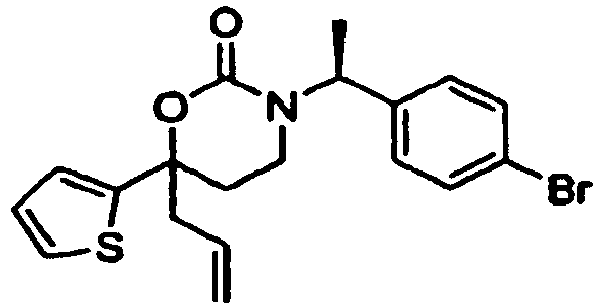
- The title compound was prepared following a procedure analogous to that described in Example 95 using 3-chloro-1-(thiophen-2-yl)propan-1-one in place of 3-chloro-1-(4-fluorophenyl)propan-1-one. The diastereomers were separated by chromatography on silica gel.
- Isomer 1: (R)-6-allyl-3-((S)-1-(4-bromophenyl)ethyl)-6-(thiophen-2-yl)- 1,3-oxazinan -2-one (10 g, 32.6%). 1H NMR (CD3OD): 1.52 (t, 3H), 2.25 (m, 1H), 240 (m, 1H), 2.58 (m, 1H), 2.68 (t, 2H), 3.14 (m, 1H), 5.19 (t, 2H), 5.48 (m, 1H), 5.70 (m, 1 H), 6.86 (d, 3H), 6.98 (t, 1 H), 7.28 (d, 2H), 741 (d, 1H). LC-MS Method 3 tR = 1.33 min, m/z = 406, 408.
- Isomer 2: (S)-6-Allyl-3-((S)-1-(4-bromophenyl)ethyl)-6-(thiophen-2-yl)-1,3-oxazinan-2-one (10 g, 32.6 %). 1H NMR (CD3OD): 1.38 (t, 3H), 2.10 (m, 1H), 2.38 (m, 1H), 2.68 (m, 2H), 2.75 (m, 1 H), 3.04 (m, 1H), 5.19 (t, 2H), 5.50 (m, 1H), 5.70 (m, 1H), 6.96 (d, 1H), 7.08 (t, 1H), 7.22 (d, 2H), 738 (d, 1H), 7.48 (d, 2H). LC-MS Method 3 tR = 1.35 min, m/z = 406, 408.
-

- 1-Chloro-3-(4-fluorophenyl)hex-5-en-3-of (223 mg, 0.97 mmol), (1-phenylpiperidin-4-yl)methanamine (295mg, 1.6equiv).), potassium iodide (178mg, 1.1equiv.) and DIEPA (186µL, 1.1equiv.) were mixed with DMF (5mL) and heated at 80 °C for overnight. The mixture was diluted with EtOAc (50mL), washed by water (2 x 15mL), brine (2 x 10mL), and dried over Na2SO4. After filtration and concentration, the residue was purified by chromatography on a 12-g silica gel cartridge eluted with a 0∼20% methanol in CH2Cl2 gradient to afford 3-(4-fluorophenyl)-1-((1-phenylpiperidin-4-yl)methylamino)hex-5-en-3-ol (245 mg. 66%).
- 3-(4-fluorophenyl)-1-((1-phenylpiperidin-4-yl)methylamino)hex-5-en-3-ol (120 mg, 0.314 mmol) was dissolved in THF (30 mL) and pyridine (c.a. 500µL. excess). A solution of triphosgene (60mg, excess) in THF (5 mL) was added slowly in 4 batches. After stirring 4h at rt, DBU (94µL, 2 equiv.) was added and the mixture was heated to reflux for overnight. There was still a lot of starting material on LC-MS spectra. The mixture was concentrated, redissolved in EtOAc (40mL), washed with 5% aq HCl (2 x 8 mL), brine (8 mL), and dried over Na2SO4. After filtration and concentration, the residue was purified by prep HPLC to afford 6-allyl-6-(4-fluorophenyl)-3-((1-phenylpiperidin-4-yl)methyl)-1,3-oxazinan-2-one (17mg, 13%). LC-MS Method 1 tR = 1.32 min, m/z = 409(M+1); 1H NMR (CD3OD) 7.62-7.53(m, 4H), 7.39(m, 2H), 7.13(t, 2H), 5.67(m, 1H), 5.04(dd, 2H), 3.05(m, 2H), 2.63(d, 2H),2.57(d, 1H), 2.32(m, 1H), 2.06(m, 1H).
-

- The title compound was prepared following a procedure analogous to that described in Example 74. 1H NMR (CDCl3): 1.53 (m, 3H). 2.29 (m, 5H), 2.91 (m, 1H), 3.56 (m, 1H), 3.75 (m, 1H), 6.56 (m, 1H), 6.93 (m, 2H), 7.06 (m, 2H), 7.35 (m, 7H), 7.43 (m, 2H). LC-MS Method 3 tR = 1.23 min, m/z = 420, 442.
-

- The two diastereomers of the title compound were prepared separately from the diastereomers of 6-allyl-3-((S)-1-(4-bromophenyl)ethyl)-6-(thiophen-2-yl)-1,3-oxazinan-2-one following a procedure analogous to that described in Example 111 using 4-fluorophenylboronic acid. The diastereomers were separated.
- Isomer 1: 1H NMR (CD3OD): 1.38 (t, 3H), 2.10 (m, 1H), 238 (m, 1H), 2.68 (m, 2H), 2.85 (m, 1H), 3.04 (m, 1H), 5.09 (t, 2H), 5.55-5.80 (m, 2H), 6.98 (d, 2H), 7.15 (t, 2H), 7.22-7.42 (m, 4H), 758 (m, 3H).
- Isomer 2: 1H NMR (CD3OD): 1.52-1.60 (d, 3H), 2.20-2.26 (m, 2H), 2.58-2.62 (m, 3H), 2.95-3.04 (m, 1H), 5.05-5.47 (m, 2H), 5.68-5.80 (m, 2H), 6.90 (m, 1H), 6.94 (m, 1H), 7.00-7.05 (m, 2H), 7.05-7.14 (m, 2H), 7.23 (m, 1H), 7.29-7.34 (m, 2H), 7.42-7.54 (m, 2H).
-

- To a solution of 1-bromo-4-fluorobenzene (28 g, 0.162 mol) in THF (90 mL) was added n-BuLi (70 mL, 2.5 M) at -78 °C and stirred for 1 h under nitrogen. Then to a premixed solution of CuCl (18 g, 0.16 mol) and LiCl (15 g, 0.354 mol) in THF (160 mL) at -78 °C was added the above solution quickly. The formed solution was stirred for 20 minutes, and was treated with crotonyl chloride (21 g, 0.176 mol). The resulting solution was stirred for 30 minutes. The mixture was quenched with aq NH4Cl, the organic phase was separated, concentrated to give the crude product which was purified by column chromatography to afford 1-(4-fluorophenyl)but-2-en-1-one (2.6 g, 10%). 1H NMR (400MHz, CDCl3): δ=2.02 (d, 3H), 6.88 (m, 1H), 7.10 (m, 3H), 7.98 (m, 2H).
- A solution of 1-(4-fluorophenyl)but-2-en-1-one (13 g, 79.2 mmol) in EtOH (150 mL) was added (S)-1-(4-bromophenyl)ethanamine (32 g, 158 mmol), and the resulting mixture was stirred overnight. The solvent was removed in vacuo to give the crude 3-((S)-1-(4- bromophenyl)ethylamino)-1-(4-fluorophenyl)butan-1-one which was used for the next step without purification.
- A solution of 3-((S)-1-(4-bromophenyl)ethylamino)-1-(4-fluorophenyl)butan-1-one (28.8 g, 79.2 mmol) and K2CO3 (100 g, 0.79 mol) in methylene chloride (1000 mL) was added methyl carbonochloridate (100 g, 0.72 mol) at 0 °C. The formed mixture was stirred at rt overnight. The mixture was filtered and concentrated to give the crude product, which was purified by preparative HPLC to give methyl (S)-1-(4-bromophenyl) ethyl(4-(4-fluorophenyl)-4-oxobutan-2-yl)carbamate (7.5 g, 23%). 1H NMR (400MHz, CDCl3): δ=1.28 (d, 3H), 1.52 (d, 3H), 2.59 (m, 1H), 3.72 (m, 5H), 5.43 (m, 1H), 6.98 (m, 3H), 7.16 (m, 2H), 7.31 (m, 2H), 7.60 (m, 2H).
- To a solution of methyl (S)-1-(4-bromophenyl)ethyl((S)-4-(4-fluorophenyl)-4-oxobutan- -yl)carbamate (0.5 g, 1.18 mmol) in THF (10 mL) was added allylmagnesium bromide (3 mL, 1 M) under nitrogen at -78 °C. The mixture was stirred overnight at rt. The mixture was quenched by water and extracted with EtOAc, the combined organic phase was concentrated to give the crude methyl (S)-1-(4-bromophenyl)ethyl(4-(4-fluorophenyl)-4-hydroxyhept-6-en-2-yl)carbamate, which was used for the next step without purification.
- To a solution of methyl (S)-1-(4-bromophenyl)ethyl(4-(4-fluorophenyl)-4-hydroxyhept-6-en-2-yl)carbamate (20 mg, 0.043 mmol) was added NaH at 0 °C. The mixture was stirred and heated to reflux for 1 h. The mixture was cooled to rt and quenched with water. The organic phase was extracted by EtOAc and concentrated to give the crude product which was purified by preparative TLC to give three isomers of 6-allyl-3-((S)-1-(4-bromophenyl)ethyl)-6-(4-fluorophenyl)-4-methyl-1,3-oxazinan-2-one.
- Isomer 1: 1H NMR (400MHz, CDCl3): δ=0.78 (d, 3H), 1.56 (d, 3H), 2.04 (m, 1H), 2.13 (m, 1H), 2.50 (m, 2H), 3.25 (m, 1H), 4.94 (m, 1H), 5.03 (m, 1H), 5.38 (m, 1H), 5.60(m, 1H), 6.96 (m, 2H), 7.18 (m, 2H), 7.30 (m, 2H), 7.43 (m, 2H).
- Isomer 2: 1H NMR (400MHz, EDCl3): δ=1.02 (d, 3H), 1.43 (d, 3H), 2.00 (m, 1 H), 2.50 (m, 3H), 3.32 (m, 1H), 4.76 (m, 1 H), 4.95-5.08 (m, 2H), 5.68 (m, 1H), 6.88 (m, 2H), 7.00(m, 2H), 7.18 (m, 2H), 7.28 (m, 2H).
- Isomer 3: 1H NMR (400MHz, CDCl3):δ=0.52 (d. 3H), 1.62 (d. 3H), 2.08 (m, 1H), 2.36 (m, 1H), 2.52 (d, 2H), 3.65 (m, 1H), 4.90 (m, 1H), 5.00 (m, 1H), 5.29 (m, 1 H), 5.53 (m, 1H), 6.96 (m, 2H), 7.20(m, 2H), 7.30 (m, 2H), 7.35 (m, 2H).
-

- The title compound was prepared following a procedure analogous to that described in Example 78 starting with (R)-6-allyl-3-((S)-1-(4'-fluorobiphenyl-4-yl)ethyl)-6-phenyl-1,3-oxazinan-2-one. 1H NMR (CDCl3): 6=1.34 (m, 1H), 1.48 (m, 3H), 1.63 (m, 1H), 1.91 (m, 2H), 2.12 (m, 1 H), 2.22 (m, 2H), 2.83 (m, 1 H), 3.50 (m, 2H), 5.61 (m, 1H), 6.87 (m, 2H), 7.02 (m, 2H), 7.25 (m, 5H),7.29 (m, 2H), 7.37 (m, 2H). LC-MS Method 3 tR = 1.28 min, m/z = 434, 456.
-

- Isomer 1 of the title compound was prepared from 6-allyl-3-((S)-1-(4-bromophenyl)ethyl)-6-(4-fluorophenyl)-4-methyl-1,3-oxazinan-2-one isomer 1 following a procedure analogous to that described in Example 74. 1H NMR (400MHz, DCCl3): δ=0.78 (d, 3H), 1.59 (d, 3H), 2.00-2.06 (m, 4H), 3.30 (m, 1 H), 3.40 (m, 1H), 3.61 (m, 1H), 5.40 (m, 1H), 7.00 (m, 2H), 7.18 (m, 2H), 7.28 (m, 2H), 7.42 (m, 2H).
- Isomer 2 of the title compound was prepared from 6-allyl-3-((S)-1-(4-bromophenyl)ethyl)-6-(4-fluorophenyl)-4-methyl-1,3-oxazinan-2-one isomer 2 following a procedure analogous to that described in Example 74.
- Isomer 3 of the title compound was prepared from 6-allyl-3-((S)-1-(4-bromophenyl)ethyl)-6-(4-fluorophenyl)-4-methyl-1,3-oxazinan-2-one isomer 3 following a procedure analogous to that described in Example 74.
-

- The title compound was prepared following a procedure analogous to that described in Example 74. 1H NMR (CDCl3): 1.49 (m, 3H), 2.14-2.32 (m, 2H), 2.28 (m, 3H), 2.89 (m, 1H), 3.50 (m, 0.6H), 3.70 (m, 0.6H), 4.18 (m, 0.4H), 4.44 (m, 0.4H), 5.61 (m, 1H), 6.76-6.89 (m, 4H), 7.18 (m, 2H), 7.20-7.30 (m, 6H). LC-MS Method 3 tR = 1.25 min, m/z = 438, 460.
-

- The title compound was prepared following a procedure analogous to that described in Example 111. 1H NMR (CD3OD): 1.42 (t, 3H), 2.16 (m, 1H), 238 (m, 1H), 2.68 (m, 2H), 2.80 (m, 1H), 3.04 (m, 1H), 5.09 (t, 2H), 5.58-5.70 (m, 2H), 6.98 (d, 2H), 7.15 (t, 2H), 7.30 (m, 1H), 7.42 (m, 3H), 748 (m, 3H). LC-MS Method 4 tR = 1.1 min, m/z = 440, 462.
-

- The title compound was prepared following a procedure analogous to that described in Example 78 starting with (S)-6-allyl-3-((S)-1-(4-fluorobiphenyl-4-yl)ethyl)-6-(thiophen-2-yl)-1,3-oxazinan-2-one. 1H NMR (CDCl3): 1.32 (m, 3H), 1.45 (m, 1H), 1.73 (m, 2H), 1.89-2.18 (m, 4H), 2.72 (m, 1H), 2.86 (m, 1H), 3.52 (m, 2H), 5.75 (m, 1H), 6.90 (m, 2H), 7.15 (m, 2H), 7.25 (m, 4H), 748 (m, 3H).
-

- The title compound was isolated as a byproduct following a procedure analogous to that described in Example 78 starting with (S)-6-allyl-3-((S)-1-(4'-fluorobiphenyl-4-yl)ethyl)-6-(thiophen-2-yl)-1,3-oxazinan-2-one. The alcohol epimers were separated by preparative TLC.
- Isomer 1: 1H NMR (CDCl3,): 1.18 (m, 3H), 1.30 (m, 3H), 1.90-2.18 (m, 3H), 2.28 (m, 1H), 2.63-2.96 (m, 2H), 4.04 (m, 1H), 4.56 (m, 1 H), 5.72 (m, 1H), 6.90 (m, 2H), 7.05 (m, 2H), 7.25 (m, 4H), 748 (m, 3H).
- Isomer 2: 1H NMR (CDCl3): 1.14 (m, 3H), 1.34 (m, 3H), 1.96 (m, 1H), 2.05-2.20 (m, 3H), 2.68-2.96 (m, 2H), 3.86-4.02 (m, 1H), 4.60 (s, 1H), 5.74 (m, 1H), 6.90 (m, 2H), 7.05 (m, 2H), 7.25 (m, 3H), 748 (m, 4H).
-

- The title compound was prepared following a procedure analogous to that described in Example 52 starting with (S)-6-allyl-3-((S)-1-(4'-fluorobiphenyl-4-yl)ethyl)-S-(thiophen-2-yl)-1,3-oxazinan-2-one. The secondary alcohol epimers were separated.
- Isomer 1: 1H NMR (CDCl3): 1.48 (m, 3H), 1.95 (m, 1H), 2.09 (m, 1H), 2.35 (m, 5H), 2.87 (m, 1 H), 3.41 (m, 1H), 3.52 (m, 1H), 3.73 (m, 1 H), 5.61 (m, 1 H), 6.84 (m, 2H), 7.03 (m, 2H), 7.19 (m, 3H), 7.29 (m, 5H), 7.37 (m, 2H).
- Isomer 2: 1HNMR (CDCl3): 1.49 (m, 3H), 1.89 (m, 1H), 2.08 (m, 1H), 2.25 (m, 3H), 2.82 (m, 1H), 3.27 (m, 1 H), 3.38 (m, 1H), 3.77 (m, 1H), 5.61 (m, 1H), 6.89 (m, 2H), 7.03 (m, 2H), 7.19 (m, 1H), 7.25 (m, 6H), 7.43 (m, 2H).
-

- The title compound was prepared from (R)-6-allyl-3-((S)-1-(2',4'-difluorobiphenyl-4-yl)ethyl)-6-phenyl-1,3-oxazinan-2-one following a procedure analogous to that described in Example 78. 1H NMR (CDCl3): 1.32 (m, 1H), 1.49 (m, 3H), 1.68 (m, 1H), 1.90 (m, 2H), 2.14 (m, 1H), 2.28 (m, 2H), 2.88 (m, 1H), 3.50 (m, 2H), 5.53 (m, 1H), 6.77-6.90 (m, 4H), 7.15 (m, 2H), 7.26 (m, 6H).
-

- The title compound was isolated as a byproduct following a procedure analogous to that described in Example 78. 1H NMR (CDCl3): 0.97-1.13 (m, 3H), 1.49 (m, 3H), 1.85-1.96 (m, 1H), 2.04 (m, 1H), 2.17-2.94 (m, 3H), 2.86 (m, 1H), 3.79-4.00 (m, 1H), 5.52 (m, 1H), 6.79-6.92 (m, 4H), 7.16 (m, 2H), 7.21-7.35 (m, 5H).
-

- Isomer 1: (R)-3-((S)-1-(2',4'-difluorobiphenyl-4-yl)ethyl)-6-(3-hydroxypropyl)-6-(thiophen-2-yl)-1,3-oxazinan-2-one was prepared following a procedure analogous to that described in Example 78. 1H NMR (CD3OD): 1.40 (m, 1H), 1.50 (m, 3H), 1.65 (m, 1H), 2.00 (m, 2H), 2.35 (m, 1H), 2.40 (m, 1H), 2.60 (m, 1H), 3.15 (m, 1H), 3.50 (m, 2H), 5.60 (m, 1H), 6.90 (m, 1H), 7.00 (m, 3H), 7.10 (m, 2H), 7.40 (m, 4H). LC-MS Method 3 tR = 1.42 min, m/z = 458, 480.
- Isomer 2: (S)-3-((S)-1-(2',4'-difluorobiphenyl-4-yl)ethyl)-6-(3-hydroxypropyl)-6-(thiophen-2-yl)-1,3-oxazinan-2-one was prepared following a procedure analogous to that described in Example 78. 1H NMR (CDCl3) 1.38 (m, 4H), 1.64 (m, 1 H), 1.98 (m, 2H), 2.13 (m, 1H), 2.35 (m, 1 H), 2.86 (m, 1H), 3.02 (m, 1H), 3.45 (m, 2H), 5.62 (m, 1H), 6.98 (m, 4H), 7.34 (m, 3H), 7.42 (m, 3H).
-

- To a solution of 3-((R)-3-((S)-1-(2'.4'-difluorobiphenyl-4-yl)ethyl)- 6-(4-fluorophenyl) -2-oxo- 1,3-oxazinan-6-yl) propanamide (80 mg, 0.166 mmol) in anhydrous CH2Cl2 (5 mL) and DIEA (0.5 mL) was added TFAA (72 mg, 0.332 mmol) at 0 °C. The mixture was stirred for 2 h. The solvent was removed under reduced pressure, and the residue was purified by preparative HPLC to afford 3-((R)-3-((S)-1-(2',4'-difluorobiphenyl-4-yl)ethyl)-6-(4-fluorophenyl)-2-oxo-1,3-oxazinan-6-yl) propanenitrile (40 mg, yield 54%). 1H NMR (CDCl3): 1.96-2.18 (m, 1H), 2.11-2.40 (m, 4H), 2.51-2.60 (m, 1H), 2.92 (m, 1H), 5.53 (m, 1H), 6.80-6.90 (m, 2H), 6.94 (m, 2H), 7.01 (m, 2H), 7.19 (m, 2H), 7.21 (m, 2H). LC-MS Method 3 tR = 1.22 min, m/z = 488.
-

- A solution of (R)-6-allyl-3-((S)-1-(2',4'-difluorobiphenyl-4-yl)ethyl)-6-phenyl-1,3-oxazinan- 2-one (200 mg, 0.46 mmol) in tert-BuOH (7 mL) was added dropwise to an ice-cooled solution of AD-mix-β (800 mg )in H2O (7 mL). The reaction mixture was stirred for 3 days. Na2SO3 was added, and the mixture was stirred at rt for 1 h. The mixture was extracted with EtOAc. The organic phase was dried over Na2SO4, filtered and concentrated to give the residue, which was purified by preparative HPLC to afford two isomers.
- Isomer 1: (20 mg, 9%). 1H NMR (CDCl3): 1.48 (m, 3H), 1.96 (m, 1 H), 2.08 (m, 1 H), 2.15-2.42 (m, 5H), 2.89 (m, 1H), 3.41 (m, 1H), 3.55 (m, 1 H), 3.74 (m, 1 H), 5.60 (m, 1H), 6.79-6.90 (m, 4H), 7.17 (m, 2H), 7.20-7.35 (m, 6H).
- Isomer 2: (13 mg, 7%). 1H NMR (CDCl3): 1.49 (m, 3H), 1.85-1.95 (m, 1H), 2.10 (m, 2H), 2.30 (m, 2H), 2.71-2.96 (m, 1H), 3.21-3.45 (m, 2H), 3.79 (m, 1H), 5.61 (m, 1H), 6.78-6.94 (m, 4H), 7.19 (m, 2H), 7.20-7.48 (m, 6H).
-
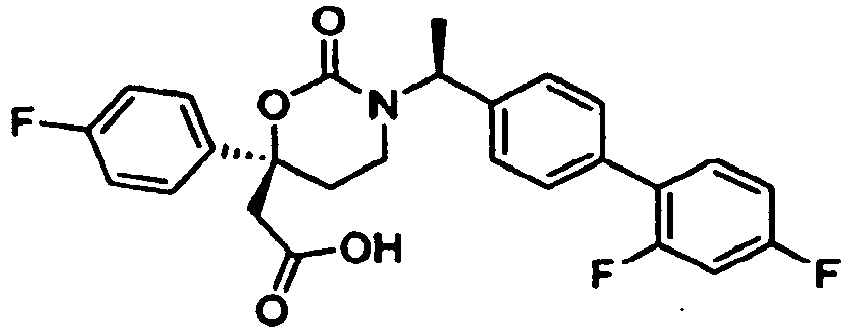
- The title compound was prepared following a procedure analogous to that described in Example 70. 1H NMR (CDCl3): 1.56 (m, 3H), 2.39 (m, 1H), 2.55 (m, 1H), 2.69 (m, 1H), 2.82-2.94 (m, 2H), 3.14 (m, 1H), 5.06 (m, 1H), 6.93-7.11 (m, 6H), 7.26 (m, 2H), 7.50 (m, 3H). LC-MS
-

- To a solution of (S)-3-((S)-1-(4-bromophenyl)propyl)-6-(4-fluorophenyl)-6-(2-hydroxy ethyl) -1,3-oxazinan-2-one (60 mg, 0.14 mmol), 2,4-difluorophenylboronic acid (26 mg, 0.17 mmol) and Pd(PPh3)4 (16 mg, 0.01 mmol) in dioxane (5 mL) was added a solution of CsCO3 (2 M, 1 mL) at 0 °C. Then the reaction mixture was refluxed overnight under nitrogen. The reaction mixture was washed with water and then extract with CH2Cl2 twice. The combined organic phases were dried over Na2SO4, filtered and concentrated to give the residue, which was purified by preparative HPLC to afford (S)-3-((S)-1-(2',4'-difluorobiphenyl-4-yl) propyl) -6-(4-fluorophenyl)-6-(2-hydroxyethyl)-1,3-oxazinan-2-one (17 mg, 26%). 1H NMR (CD3OD): 0.96 (m, 3H), 2.01 (m, 2H), 2.12 (m, 2H), 2.30 (m, 2H), 2.48 (m, 1H), 3.10 (m, 1H), 3.33 (m, 1H), 3.65 (m, 1H), 5.38 (m, 1H), 7.02 (m, 4H), 7.08 (m, 2H), 7.28 (m, 4H), 7.42 (m, 1 H). 443-114-3.
- (R)-3-((S)-1-(2',4'-difluorobiphenyl-4-yl) propyl) -6-(4-fluorophenyl)-6-(2-hydroxyethyl)-1,3-oxazinan-2-one was prepared from (R)-3-((S)-1-(4-bromophenyl)propyl)-6-(4-fluorophenyl)-6-(2-hydroxy ethyl) -1,3-oxazinan-2-one following a procedure analogous to that described immediately above. 1H NMR (CD3OD): 0.62 (m, 3H), 1.76 (m, 1H), 1.92 (m, 1H), 2.12 (m, 3H), 2.56 (m, 1H), 2.78 (m, 1H), 2.89 (m, 1H), 3.33 (m, 1H), 3.71 (m, 1H), 5.38 (m, 1H), 7.05 (m, 2H), 7.16 (m, 2H), 7.44 (m, 7H).
-

- (R)-6-(2-aminoethyl)-3-((S)-1-(2',4'-difluorobiphenyl-4-yl)ethyl)-6-(4-fluorophenyl)-1,3-oxazinan-2-one (50 mg, 0.11 mmol) was added to form acid, followed by the addition of 30% aqueous solution of formaldehyde at 0 °C. The solution was then heated to 90 °C and stirred for 24 h. After leaving to cool, 0.1 mol of 1 M HCl was added and the mixture was extracted with dichloromethane for 3 times. Aqueous NaOH solution (20%) was then added to the thus purified aqueous phase until the pH was basic. The alkaline water was extracted with dichloromethane. The organic solution was dried over Na2SO4, filtered off and evaporated under reduced pressure to give the crude product, which was purified by preparative TLC and separated by preparative HPLC to give (R)-3-((S)-1-(2',4'-difluorobiphenyl-4-yl)ethyl)-6-(2-(dimethylamino)ethyl)-6-(4-fluorophenyl)-1,3-oxazinan-2-one (2.78 mg, 5%). 1H NMR (CDCl3): 6.60 (s, 1H), 7.35 (d, 1H), 7.70 (m, 1H), 7.82 (m, 1H), 7.95 (d, 1H), 8.60 (d, 1H).
-

- The title compound was prepared following a procedure analogous to that described in Example 70. 1H NMR (CDCl3): 1.56 (m, 3H), 2.05 (m, 1H), 2.10-2.28 (m, 3H), 2.29-2.50 (m, 3H), 3.12 (m, 1H), 5.09 (m, 1H), 6.98-7.10 (m, 6H), 7.29 (m, 4H), 7.39 (m, 1H). LC-MS Method 3 tR = 1.27 min, m/z = 484, 506.
-

- To a solution of (S)-3-((S)-1-(2', 4'-difluorobiphenyl-yl)ethyl)-6-(4-fluorophenyl)-6-(2- hydroxyethyl)-1,3-oxazinan-2-one (50 mg, 0.11 mmol) in dry CH2Cl2 (2 mL) was added Et3N (33 mg, 0.33 mmol) at 0 ∼ -5 °C. Then a solution of MsCl (12 mg, 0.13 mmol) in dry CH2Cl2 (1 mL) was added dropwise at the same temperature. After addition, the mixture was allowed to warm to rt gradually. When the reaction was over, water (10 mL) was added. The layers were separated, and the aqueous layer was extracted with CH2Cl2 (3×10 mL). The combined organic layers was washed with 10% citric acid, aqueous NaHCO3 and brine respectively, dried over Na2SO4, filtered and concentrated to give 2-((S)-3-((S)-1-(2',4'-difluorobi-phenyl-4-yl)ethyl)-6-(4-fluorophenyl)-2-oxo-1,3-oxazinan-6-yl)ethyl methane-sulfonate (58 mg, crude), which was used for the next step without purification.
- To a solution of 2-((S)-3-((S)-1-(2',4'-difluorobi-phenyl-4-yl)ethyl)-6-(4-fluorophenyl) 2-oxo 1,3-oxazinan-6-yl)ethyl methane-sulfonate (58 mg, 0.11 mmol) in anhydrous MeOH was added 2-amino-ethanol (54 mg, 0.88 mmol). Then the reaction mixture was refluxed overnight. When the reaction was over, solvent was removed in vacuo. The residue was purified by preparative HPLC to give (R)-3-((S)-1-(2',4'-difluorobiphenyl-4-yl)ethyl) -6- (4- fluorophenyl) -6-(2-(2-hydroxyethylamino)ethyl)-1,3-oxazinan-2-one (2 mg, 3%). 1H NMR (CDCl3): 1.53 (m, 3H), 2.25-2.36 (m, 4H), 2.51 (m, 1H), 2.87-3.24 (m, 5H), 3.75-4.02 (m, 2H), 5.60 (m, 1H), 6.85-6.96 (m, 2H), 6.96-7.10 (m, 4H), 7.22 (m, 2H), 7.38 (m, 4H).
-

- To a solution of (R)-S-(2-aminoethyl)-3-((S)-1-(2',4'-difluorobiphenyl-4-yl)ethyl)-6-(4-fluoro- phenyl)-1,3-oxazinan-2-one stirred in anhydrous CH2Cl2 (5 ml) was added HOBT (36 mg, 0.264 mmol), EDCl (52 mg, 0.264 mmol), DIEA (0.5 ml) and hydroxy-acetic acid (50.1 mg, 0.66 mmol) at 0 °C under N2 atmosphere. The solution was stirred at rt overnight Then the solvent was removed under reduced pressure to give the residue, which was purified by preparative HPLC to afford N-(2-((R)-3-((S)-1-(2',4'-difluorobiphenyl-4- yl)ethyl)-6-(4-fluorophenyl)-2-oxo-1,3-oxazinan-6-yl)ethyl)-2-hydroxyacetamide (19.2mg, 28.6%). 1H NMR (CDCl3): 1.49-1.50 (d, 3H), 2.01-2.13 (m, 1H), 2.14-2.15 (m, 3H), 2.17 (m, 1H), 2.97-2.98 (m, 2H), 3.46-3.52(m, 4H), 4.01-4.02 (m, 2H), 5.60-5.61 (m, 1H), 6.82-6.88 (m, 2H), 6.98-7.04 (m, 3H),7.17 (s, 1H), 7.19-7.22 (m, 3H), 7.25-7.27 (m, 3H).
-

- To a solution of (R)-6-(2-aminoethyl)-3-((S)-1-(2',4'-difluorobiphenyl-4-yl) ethyl)-6- (4- fluorophenyl) -1,3-oxazinan-2-one (40 mg, 0.088 mmol) and DMAP (4 mg, 10%) in dry CH2Cl2 (3 mL), was added Et3N (27 mg, 0.264 mmol). The resulting mixture was cooled to 0∼5 °C under ice-water bath, and a solution of methyl chloroformate (41 mg, 0.44 mmol) in dry CH2Cl2 (1 mL) was added dropwise. After addition, the reaction mixture was stirred for 1-2 h at 0-5 °C. After the starting material was disappeared, water (5 mL) was added. The layers were separated, and the aqueous layer was extracted with CH2Cl2 (3×5 mL). The combined organic layers were washed with 10% citric acid (2×10 mL) and brine, dried over Na2SO4. filtered and concentrated to give the residue, which was purified by preparative HPLC to afford methyl 2-((R)-3-((S)-1-(2',4'-difluorobiphenyl-4-yl)ethyl)-6 -(4-fluorophenyl) - 2-oxo-1,3-oxazinan-6-yl)ethylcarbamate (10 mg, 22%). 1H NMR (CDCl3): 1.50 (m, 3H), 2.06 (m, 2H), 2.10-2.32 (m, 4H), 3.10 (m, 1H), 3.05-3.20 (m, 2H), 3.55 (s, 3H), 4.88 (s, 1 H), .5.63 (m, 1H), 6.80-6.90 (m, 2H)., 6.92-7.01 (m, 4H), 7.21 (m, 1H), 7.25 (m, 4H).
-

- The title compound was prepared following a procedure analogous to that described in Example 178 using morpholine in place of ethanolamine. 1H NMR (CDCl3): 1.50 (m, 3H), 2.06-2.29 (m, 3H), 2.30-2.51 (m, 3H), 2.61-2.82 (m, 3H), 2.90 (m, 1H), 3.10-3.29 (m, 2H), 3.49 (m, 1H), 3.79-3.98 (m, 4H), 5.62 (m, 2H), 6.80-6.89 (m, 2H), 7.00 (m, 4H), 7.16 (m, 2H), 7.23 (m, 3H).
-

- The title compound was prepared following a procedure analogous to that described in Example 141. 1H NMR (400MHz, CDCl3): 1.46 (t, 3H), 1.56 (m, 3H), 2.14 (m, 2H), 2.25 (m, 2H), 2.37 (m, 1H), 2.98 (m, 3H), 3.14 (q, 2H), 3.30 (m, 2H), 5.67 (m, 1H), 6.87 (m, 2H), 7.04 (m, 4H), 7.21 (m, 2H), 7.30 (m, 3H).
-

- A mixture of (R)-6-(2-aminoethyl)-3-((S)-1-(2',4'-difluorobiphenyl-4-yl)ethyl)-6-(4- fluoro phenyl)-1,3-oxazinan-2-one (40 mg, 0.09 mmol) and dimethyl cyanocarbonimidodithioate (40 mg, 0.27 mmol) in acetonitrile (4 mL) was heated to reflux overnight. The solvent was removed to give methyl N'-cyano-N-(2-((R)-3-((S)-1-(2',4'- difluorobiphenyl-4-yl) ethyl) -6-(4-fluorophenyl)-2-oxo-1,3-oxazinan-6-yl)ethyl)carbamimidothioate (50 mg, crude), which was used for the next step without purification.
- A mixture of (Z)-methyl N-cyano-N-(2-((R)-3-((S)-1-(2', 4'-difluorobiphenyl-4-yl)ethyl)-6-(4- luorophenyl)-2-oxo-1,3-oxazinan-6-yl)ethyl) carbamimidothioate (50 mg, crude) in the solution of methylamine in ethanol (10 mL) was heated to reflux overnight. The solvent was removed under reduced pressure, and the residue was purified by preparative HPLC to give 2-cyano-1-(2-((R)-3-((S)-1-(2',4'-difluorobiphenyl-4-yl)ethyl)-6-(4-fluorophenyl)-2-oxo-1,3-oxazinan-6-yl)ethyl)-3-methylguanidine (10 mg, 21%). 1H NMR (CDCl3): 1.49 (m, 3H), 2.15 (m, 4H), 2.26 (m, 2H), 2.71 (s, 3H), 2.95 (m, 1H), 3.08 (s, 1H), 3.28 (s, 1H), 5.60 (m, 2H), 6.85 (m, 2H), 7.01 (m, 4H), 7.19 (m, 2H), 7.23 (m, 3H). LC-MS Method 3 tR = 1.28 min, m/z = 536.
- 3-((R)-3-((S)-1-(2',4'-difluorobiphenyl-4-yl)ethyl)-6-(4-fluorophenyl)-2-oxo-1,3-oxazinan-6-yl)-N-(methylsulfonyl)propanamide

- A mixture of 3-((R)-3-((S)-1-(2',4'-difluorobiphenyl-4-yl)ethyl)-6-(4-fluorophenyl)-2-oxo- 1,3-oxazinan-6-yl)propanoic acid (60 mg, 0.13 mmol), methanesulfonamide (24 mg, 0.26 mmol), HOBt (53 mg, 0.39 mmol). EDCl (75 mg, 0.39 mmol) and DIEA (1 mL) in CH2Cl2 was stirred at rt overnight. The solvent was removed to give the crude product. It was purified by preparative HPLC to give 3-((R)-3-((S)-1-(2',4'- difluorobiphenyl-4-yl)ethyl)-6-(4-fluorophenyl)-2-oxo-1,3-oxazinan-6-yl)-N-(methylsulfonyl)propanamide (7 mg, 10%). 1H NMR (CDCl3): 1.50 (m, 3H), 2.21 (m, 6H), 2.54 (m, 1H), 2.93 (m, 1H), 3.15 (s, 3H), 5.59 (m, 1H), 6.83 (m, 2H), 6.98 (m, 4H), 7.18 (m, 2H), 7.24 (m, 3H), 9.58 (s, 1H). LC-MS Method 3, tR = 1.26 min, m/z = 561.
-

- The title compound was prepared from (R)-6-(3-aminopropyl)-3-((S)-1-(2',4'-difluorobiphenyl-4-yl)ethyl)-6-(4-fluorophenyl)-1,3-oxazinan-2-one following a procedure analogous to that described in Example 99. LC-MS Method 3 tR = 1.47 min, m/z = 547; 1H NMR (CDCl3) 1.44-1.53 (d, 3H), 1.59-1.68 (m, 1H), 2.17-2.20 (m, 1H), 2.22-2.33 (m, 2H), 2.76 (s, 3H), 2.89-2.97 (m, 1 H), 2.09-3.05 (m, 2H), 4.18-4.32 (m, 1H), 5.58-5.67 (m, 1H), 6.76-6.89 (m, 2H), 6.91-7.03 (m, 4H), 7.13-7.18 (m, 2H), 7.22-7.27 (m, 3H).
-

- A 1000-mL flask was charged with anhydrous CeCl3 (50 g, 0.2 mol) and THF (360 mL). The mixture was vigorously stirred for 3.5 h at rt. The suspension was then cooled to -78 °C, and a solution of allylmagnesium bromide (1.0 M in THF, 200 mL) was added. After stirring for 2 h at -78 °C, a solution of 3-chloro-1-phenyl-propan-1-one (25 g, 149 mmol) in THF (269 mL) was added dropwise. The reaction mixture was allowed to slowly warm to rt while stirring overnight. The reaction was then quenched with satd aq NaHCO3, extracted with EtOAc, and dried over Na2SO4. After the solvents were evaporated, the residue was purified by chromatography on silica gel eluted with hexanes/EtOAc to afford of 1-chloro-3-phenyl-hex-5-en-3-ol (25 g, 82%) as an oil. 1H NMR (CDCl3): 2.30 (m, 2H), 2.51 (m, 1H), 2.72 (m, 1H), 3.20 (m, 1H), 3.54 (m, 1H), 5.16 (m. 2H), 5.51 (m, 1H), 7.24 (m, 1H), 7.35 (m, 4H).
- A mixture of 1-chloro-3-phenyl-hex-5-en-3-ol (500 mg, 2.38 mmol), phenethylamine (348 mg, 2.862.24 mmol), and K2CO3 (643 mg, 4.76 mmol) in anhydrous CH3CN (10 mL) were stirred at rt under N2. Then the solution was refluxing at 80-90 °C overnight. The solid was filtered, and the filtrate was condensed under reduced pressure to give the residue, which was purified by preparative TLC to afford 1-phenethytamino-3-phenyl-hex -5-en-3-ol (320 mg, 45%). 1H NMR (CDCl3): 2.07-2.15 (m, 1H), 2.28-2.39 (m, 1H), 2.51-2.69 (m, 3H), 2.81 (m, 1H), 2.90-3.01 (m, 3H), 3.09 (m, 1H), 5.04 (m, 2H), 5.47-5.58 (m, 1H), 7.17-7.38 (m, 11H).
- To a solution of 1-phenethylamino-3-phenyl-hex-5-en-3-ol (120 mg, 0.41 mmol) and Et3N (0.5 mL) in anhydrous CH2Cl2 (5 mL) was added triphosgene (40 mg, 0.134 mmol) in portions at 0 °C under N2. Then the solution was refluxing at 80-90 °C overnight. The solvent was removed under reduced pressure, and the residue was purified by preparative TLC to afford 6-allyl-3-phenethyl-6-phenyl-[1,3]oxazinan-2-one (234 mg, yield: 19%). 1H NMR (CDCl3): 2.07-2.17 (m, 2H), 2.44-2.60 (m, 2H), 2.62-2.84 (m, 4H), 3.25 (m, 1H), 3.52 (m, 1H), 3.09 (m, 1H), 5.04 (m, 2H), 5.47-5.58 (m, 1H), 6.94 (m, 2H), 7.10 (m, 3H), 7.27 (m, 3H), 7.31 (m, 2H).
- To a solution of 6-allyl-3-phenethyl-6-phenyl-[1,3]oxazinan-2-one (100 mg, 0.31 mmol) in dry THF (4 mL) was added dropwise BH3.THF (0.6 mL, 0.62 mmol, 1 M) at 0 °C. After 2 h at rt, the reaction mixture was cooled to 0 °C, and water (1 mL), aqueous NaOH (1 mL, 3 M) and H2O2 (0.5 mL, 30%) were successively added. The mixture was stirred for 2-3 h at rt, and then diluted with water (8 mL). The pH of the mixture was adjusted to 6-7 with 0.5 N HCl. The layers were separated, and the aqueous phase was extracted with EtOAc (3×6 mL). The combined organic layers were washed with a saturated aqueous NaHCO3 solution (10 mL) and brine (10 mL), dried over Na2SO4, and concentrated in vacuo to give the crude product, which was purified by preparative TLC to afford two isomers of 6-(3-hydroxypropyl)-3-phenethyl-6-phenyl-1,3-oxazinan-2-one.
- Isomer 1 (12 mg, 11%). LC-MS Method 3 tR = 1.13, min, m/z = 340, 362; 1H NMR (CDCl3): 1.21-1.33 (m, 1H), 1.64 (m, 1H), 1.81-1.98 (m, 2H), 2.06 (m, 2H), 2.15 (m, 1H), 2.61-2.83 (m, 4H), 3.29 (m, 1H), 3.51 (m, 3H), 6.99 (m, 2H), 7.12 (m, 3H), 7.21 (m, 1 H), 7.25 (m, 1H), 7.28 (m, 1 H), 7.30 (m, 2H).
- Isomer 2: (12 mg, 17%). LC-MS Method 3 tR = 1.13, min, m/z = 340, 362; 1H NMR (CDCl3): 1.20-1.38 (m, 2H), 1.67 (m, 2H), 1.86-2.00 (m, 2H), 2.02-2.34 (m, 2H), 2.64-2.88 (m, 4H), 3.31 (m, 1H), 3.50-3.62 (m, 3H), 7.02 (m, 2H), 7.15 (m, 3H), 7.21 (m, 1H), 7.28 (m, 2H), 7.33 (m, 2H).
-

- In a 10 mL glass tube was placed 6-allyl-3-((S)-1-(4-bromophenyl)ethyl)-6-isopropyl-1,3- oxazinan-2-one (50 mg, 0.14 mmol), nickel(II) chloride (18 mg, 0.14 mmol) and DMF (0.5 mL). The vessel was sealed with a spectrum and placed into the microwave cavity. Microwave irradiation of 100 W was used, the temperature being ramped from rt to 170 °C. Once this temperature was reached, the reaction mixture was held at this temperature for 8 minutes. After the mixture cooled to rt, the reaction vessel was opened and the contents were poured into a separating funnel, and the tube was washed with water and then EtOAc, these washings being added to the separatory funned. The mixture was partitioned. The aqueous layer was extracted with EtOAc for 3 times, the combined organic layer was washed with brine, dried over Na2SO4, and concentrated to give 6-allyl-3-((S)-1-(4-chlorophenyl)ethyl)-6-isopropyl-1,3-oxazinan-2-one (45 mg, crude).
- To a solution of 6-allyl-3-((S)-1-(4-chlorophenyl)ethyl)-6-isopropyl-1,3-oxazinan-2-one (45 mg, 0.14 mmol) in dry THF (5 mL) was added dropwise 1 M BH3.THF (0.28 mL, 0.28 mmol) at 0 °C. After 2 h at rt, the reaction mixture was cooled to 0 °C, and water (1 mL), 3 M aqueous NaOH (1 mL, 3 M) and 30% H2O2 (0.5 mL) were successively added. The mixture was stirred for 2-3 h at rt and was then diluted with water (6 mL). The pH of the mixture was adjusted to 6-7 with 0.5 N HCl. The layers were separated, and the aqueous phase was extracted with EtOAc (3×5 mL). The combined organic layers were washed with a saturated aqueous NaHCO3 solution (8 mL) and brine (8 mL), dried over Na2SO4, and concentrated in vacuo to give the crude product, which was purified by preparative TLC followed by preparative HPLC to afford two isomers.
- Isomer 1: (5 mg, 10%) LC-MS Method 3 tR = 1.22, min, m/z = 340, 362; 1H NMR (CDCl3) 0.86 (m, 6H), 1.46 (m, 3H), 1.58-1.74 (m, 6H), 1.94 (m, 1H), 2.66 (m, 1H), 3.08 (m, 1H), 3.61 (m, 2H), 5.70 (m, 1H), 7.19 (m, 2H), 7.27 (m, 2H).
- Isomer 2 (5 mg, 10%): LC-MS Method 3 tR = 1.19, min, m/z = 340, 362; 1H NMR (CDCl3) 0.91 (m, 6H), 1.49 (m, 3H), 1.62 (m, 5H), 1.87 (m, 1H), 2.07 (m, 1H), 2.68 (m, 1H), 3.03 (m, 1H), 3.59 (m, 2H), 5.74 (m, 1H). 7.22 (m, 2H), 7.29 (m, 2H).
-

- To a solution of 2-phenylcyclopropanecarboxylic acid (1.0 g, 6.17 mmol) in dry toluene (20 mL) was added triethylamine (934 mg, 9.26 mmol) and DPPA (2.0 g, 7.41 mmol) under N2, and the reaction mixture was refluxed for 3 h. The solution was concentrated to give (2-isocyanatocyclopropyl)benzene (800 mg), which was used for the next step without further purification.
- To a solution of (2-isocyanatocyclopropyl)benzene (800 mg, 5.03 mmol) in THF (15 mL) was added DBU (1.61 g, 10.48 mmol) and 1-chloro-3-phenylhex-5-en-3-ol (880 mg, 4.19 mmol), and the mixture was refluxed overnight. The solution was diluted with EtOAc, and washed with 1 N HCl (2 x 15 mL). The aqueous phase was extracted with EtOAc. The combined organic layers were washed with brine, dried over Na2SO4, filtered and concentrated to give crude product, which was purified by preparative TLC to afford 6-allyl-6-phenyl-3-(2-phenylcyclopropyl)-1,3-oxazinan-2-one (100 mg, 6%). 1H NMR (CDCl3): 1.05-1.21 (m, 3H), 1.36-1.42 (m, 1H), 2.13-2.34 (m, 1H), 2.39-2.61 (m, 2H), 2.92-3.15 (m, 1H), 3.76-4.01 (m, 1 H), 4.95-5.10 (m, 2H), 5.42-5.73 (m, 1H), 6.95-6.99 (m, 1H), 7.10-7.24 (m, 10H).
- To a solution of 6-allyl-6-phenyl-3-(2-phenylcyclopropyl)-1,3-oxazinan-2-one (200 mg, 0.60 mmol) in dry THF (5 mL) was added dropwise 1 M of BH3/THF (1.8 mL, 1.8 mmol) at 0 °C under N2. After stirring at rt for 2 h, the reaction mixture was cooled to 0 °C again, and water (0.1 mL), 3 M of aqueous NaOH solution (0.1 mL), and 30% H2O2 (0.3 mL) were added sequentially. After the mixture was stirred at rt for another 2 h, 1 N aqueous HCl (0.5 mL) was added. The mixture was extracted with EtOAc. The organic layer was washed with brine, dried over Na2SO4, filtered and concentrated to give the crude product, which was purified by preparative TLC followed by preparative HPLC to afford two isomers.
- Isomer 1 (20 mg, 9%): LC-MS Method 3 tR = 1.151, min, m/z = 352.2; 1H NMR (CDCl3) 0.83 (m, 2H), 1.12 (m, 1H), 1.23 (m, 4H), 1.68 (m, 1H), 1.97 (m, 2H), 2.16 (m, 1 H), 2.21 (m, 1H), 2.84 (m, 1H), 3.13 (m, 1H), 3.52 (m, 2H), 4.14 (m, 1H), 7.03 (m, 2H), 7.11 (m, 1H), 7.17 (m, 2H), 7.29 (m, 4H), 7.46-7.63 (m, 1H).
- Isomer 2 (15 mg, 7%): LC-MS Method 3 tR = 1.149, min, m/z = 352.2; 1H NMR (CDCl3) 0.85 (m, 2H), 1.11 (m, 1H), 1.26 (m, 3H), 1.67 (m, 2H), 1.96 (m, 2H), 2.18 (m, 1H), 2.27 (m, 1H), 2.83 (m, 1H), 3.13 (m, 1H), 3.52 (m, 2H), 4.15 (m, 1H), 7.02 (m, 2H), 7.11 (m, 1H), 7.15 (m, 2H), 7.26 (m, 3H), 7.29 (m, 2H), 7.46-7.63 (m, 1H).
-

- The title compound was prepared following a procedure analogous to that described in Example 110 Step 2 using (S)-1-(1-isocyanatoethyl)-4-methylbenzene. Two isomers were isolated.
- Isomer 1: LC-MS Method 1 tR = 1.94, min, m/z = 354; 1H NMR (CDCl3) 7.31-7.27 (m, 2H), 7.19-7.13 (m, 4H), 7.10-7.05 (m, 2H), 5.75-5.63 (m, 2H), 5.09-4.97 (m. 2H), 2.73-2.52 (m, 4H), 2.34 (s, 3H), 2.22-2.16 (dt, 1H), 2.07-1.99 (m, 1H), 1.25 (d, 3H).
- Isomer 2: LC-MS Method 1 tR = 1.99, min, m/z = 354; 1H NMR (CDCl3) 7.26-7.22, 7.03-6.95, 5.75-5.57, 5.08-4.98, 2.3, 1.47.
-

-
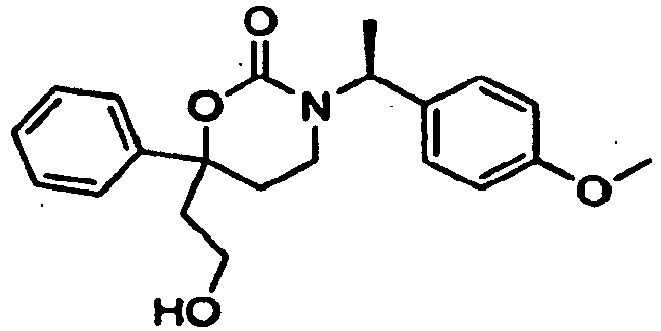
- The title compound was prepared from (R)-6-allyl-6-(4-fluorophenyl)-3-((S)-1-(4-methoxyphenyl)ethyl)-1,3-oxazinan-2-one following a procedure analogous to that described in Example 74. LC-MS Method 3 tR = 0.893, min, m/z = 355.9; 1H NMR (CDCl3) 1.43 (d, 3H), 2.02-2.23 (m, 5H), 2.73 (m, 1H), 3.51 (m, 1 H), 3.68 (s, 3H), 3.72 (m, 1H), 5.53 (m, 1H), 6.57 (d, 1 H), 6.76 (d, 1 H), 7.19-7.33 (m, 5H).
-
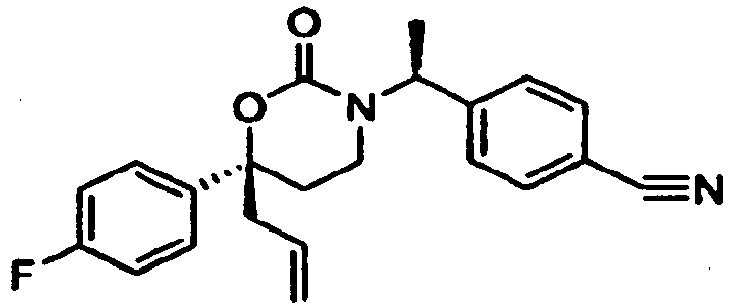
- The title compound was prepared from 4-((S)-1-((R)-6-allyl-6-(4-fluorophenyl)-2-oxo-1,3-oxazinan-3-yl)ethyl)benzamide using a procedure analogous to that described in Example 172. LC-MS Method 1 tR = 1.74, min, m/z = 365; 1H NMR (CDCl3) 7.39(d, 2H), 7.26(t, 2H), 7.05(t, 2H), 6.93(d, 2H), 5.74-5.62(m, 2H), 5.06(dd, 2H), 2.99(m, 2H), 2.59(m, 2H), 1.53(d, 3H).
-

- The title compound was prepared following a procedure analogous to that described in Example 110 Step 2 using (S)-1-(1-isocyanatoethyl)-4-methoxybenzene. Two isomers were isolated.
- Isomer 1: LC-MS Method 1 tR = 1.82, min. m/z = 370; 1H NMR (CDCl3) 7.28-7.23 (m, 2H), 7.04-7.00 (m, 2H), 6.79 (d, J = 8.8 Hz, 2H), 6.64 (d, J = 8.8 Hz, 2H), 5.77-5.66 (m, 1H), 5.60 (q, J = 7.0 Hz, 1H), 5.10-5.00 (m, 2H), 3.74 (s, 3H), 2.90-2.85 (m, 1 H), 2.64-2.52 (m, 2H), 2.30-2.13 (m, 3H), 1.48 (d, J = 7.0 Hz, 3H).
- Isomer 2: LC-MS Method 1 tR = 1.88, min, m/z = 370; 1H NMR (CDCl3) 7.32-7.27 (m, 2H), 7.22 (d, J = 8.5 Hz, 2H), 7.09-7.05 (m, 2H), 6.86 (d, J = 8.5 Hz, 2H), 5.77-5.66 (m, 2H), 5.08-4.98 (m, 2H), 3.80 (s, 3H), 2.70-2.66 (m, 2H), 2.63-2.52 (m, 2H), 2.20-2.15 (m, 1H), 2.06-1.98 (m, 1H), 1.23 (d, J = 7.0 Hz, 3H).
-

- A mixture of (R)-3-((S)-1-(4-bromophenyl)ethyl)-6-(3-hydroxypropyl)-6-phenyl-1,3- oxazinan-2-one (80 mg, 0.19 mmol), Pd(PPh3)2Cl2 (14 mg, 0.02 mmol) and TEA (38 mg, 0.38 mmol) in methanol (10 mL) was stirred in a sealed tube under 50 Psi carbon monoxide atmosphere at 80 °C overnight. The mixture was filtered, and the filtrate was concentrated to give the crude product, which was purified by preparative TLC to give methyl 4-((S)-1-((R)-6-(3-hydroxypropyl)-2-oxo-6-phenyl-1,3-oxazinan-3-yl)ethyl)benzoate (60 mg, crude).
- To a solution of methyl 4-((S)-1-((R)-6-(3-hydroxypropyl)-2-oxo-6-phenyl-1,3-oxazinan-3- yl)ethyl)benzoate (60 mg, 0.25 mmol) in THF (5 mL) was added NaBH4 (48 mg, 1.25 mmol). The mixture was heated to reflux for 15 minutes. Then methanol (3 mL) was added. The mixture was heated to reflux overnight. The reaction was quenched with water, and the solvent was removed. The aqueous layer was extracted with EtOAc for 3 times. The combined organic layer was washed with brine, dried over Na2SO4, and concentrated to give the crude product, which was purified by preparative TLC to give (R)-3-((S)-1-(4-(hydroxymethyl)phenyl)ethyl)-6-(3-hydroxypropyl)-6-phenyl-1,3-oxazinan-2-one (5 mg, 5%). LC-MS Method 2 tR = 1.29, min, m/z = 370, 392; 1H NMR (CDCl3): 1.33 (m, 1H), 1.45 (m, 3H), 1.64 (m, 1H), 1.90 (m, 2H), 2.11-2.24 (m, 2H), 2.81 (m, 1H), 3.50 (m, 2H), 4.52 (s, 2H), 5.58 (m, 1H), 6.82 (m, 2H), 7.03 (m, 2H), 7.25 (m, 5H).
-

- The title compound was prepared from (R)-6-allyl-6-(4-fluorophenyl)-3-((S)-1-(4-methoxyphenyl)ethyl)-1,3-oxazinan-2-one following a procedure analogous to that described in Example 97. LC-MS Method 1 tR = 1.45, min, m/z = 374; 1H NMR (CD3OD) 7.28-7.24 (m, 2H), 7.06-7.02 (m, 2H), 6.82 (d, J = 8.5 Hz, 2H), 6.62 (d, J = 8.5 Hz, 2H), 5.44 (q, J = 7.0 Hz, 1H), 3.67 (s, 3H), 3.66-3.60 (m, 1H), 3.31-3.25 (m, 1 H), 3.02-2.95 (m, 1H), 2.44-2.38 (m, 1 H), 2.24-2.10 (m, 2H), 2.07 (t, J = 7.3 Hz, 2H), 1.44 (d, J = 7.0 Hz, 3H).
-

- The title compound was prepared following a procedure analogous to that described in Example 110 Step 2 using (S)-1-chloro-4-(1-isocyanatoethyl)benzene. Two isomers were isolated.
- Isomer 1: (R)-6-allyl-3-((S)-1-(4-chlorophenyl)ethyl)-6-(4-fluorophenyl)-1,3-oxazinan-2-one: LC-MS Method 1 tR = 1.97, min, m/z = 374; 1H NMR (CDCl3) 7.28-7.24 (m, 2H), 7.09-7.02 (m, 4H), 6.78 (d, 2H), 5.75-5.64 (m, 1H), 5.64-5.59 (q, 1H), 5.11-5.00 (m, 2H), 2.94-2.89 (m, 1H), 2.64-2.52 (m, 2H), 2.34-2.15 (m, 3H), 1.49 (d, 3H).
- Isomer 2: (S)-6-allyl-3-((S)-1-(4-chlorophenyl)ethyl)-6-(4-fluorophenyl)-1,3-oxazinan-2-one: LC-MS Method 1 tR = 2.01, m/z = 374 (M+1); 1H NMR (CDCl3) 7.32-7.21 (m, 6H), 7.10-7.04 (t, 2H, J = 9.0 Hz), 5.75-5.65 (m, 2H), 5.09-4.98 (m, 2H), 2.75-2.64 (m, 2H), 2.62-2.52 (m, 2H), 2.24-2.19 (m, 1 H), 2.08-2.00 (m, 1H), 1.24 (d, 3H, J = 7.3 Hz).
-

- The title compound was prepared from (R)-6-allyl-3-((S)-1-cyclohexylethyl)-6-(4-fluorophenyl)-1,3-oxazinan-2-one using AD-mix-β following a procedure analogous to that described in Example 173. Two isomers were isolated.
- Isomer 1: LC-MS Method 2 tR = 2.183, min, m/z = 402.2; 1H NMR (CDCl3) 1.01-1.13 (m, 6H), 1.42-1.71 (m, 5H), 1.92-2.43 (m, 8H), 2.51-2.71 (m, 2H), 3.08 (m, 1H), 3.47 (m, 1 H), 3.61 (m, 1 H), 3.75 (m, 1H), 3.97 (m, 1H), 7.02-7.09 (m, 2H), 7.22-7.39 (m, 2H).
- Isomer 2: LC-MS Method 2 tR = 2.215, min, m/z = 402.2; 1H NMR (CDCl3) 0.96-1.03 (m, 6H), 1:38-1.71 (m, 8H), 1.73 (m, 1H), 2.01-2.09 (m, 1H), 2.29 (m, 3H), 2.53 (m, 1 H), 3.01 (m, 1H), 3.22 (m, 1H), 3.48 (m, 1H), 3.73 (m, 1H), 3.89 (m, 1 H), 7.03 (m, 2H), 7.22 (m, 2H).
-

- A solution of (R)-3-((S)-1-(4-bromophenyl)ethyl)-6-(3-hydroxypropyl)-6-phenyl-1,3-oxazina n-2-one (200 mg, 0.462 mmol), tributyl-vinyl-stannane (198 mg. 0.624 mmol), Pd2(dba)3 (23 mg, 0.005 mmol) and BINAP (6.84 mg, 0.011 mmol)in toluene (20 mL) was heated to reflux overnight. The reaction mixture was filtered, and the filtrate was concentrated to give the crude product, which was purified by preparative TLC to give (R)-6-(3-hydroxypropyl) -6 -phenyl-3-((S)-1-(4-vinylphenyl)ethyl)-1,3-oxazinan-2-one (50 mg, 30%). 1H NMR (CDCl3): 0.81 (m, 2H), 1.07-1.28 (m, 5H), 1.53 (d, 3H),1.83-1.97 (m, 4H), 2.22 (m, 3H), 2.83 (m, 1H), 3.55 (m, 2H), 5.09 (m, 1H), 5.21 (m, 1H), 5.58 (m, 1H), 6.63-6.77 (m, 2H), 7.04-28 (m, 13H), 7.43 (m, 2H), 7.68 (m, 1 H).
- To a solution of (R)-6-(3-hydroxypropyl)-6-phenyl-3-((S)-1-(4-vinylphenyl)ethyl)-1,3 -oxazinan-2-one (50 mg, 0.137 mmol) and imidazole (11.2 mg 0.165 mmol) in CH2Cl2 (10 mL) was added a solution of TBSCI (24.6 mg, 0.164 mmol) in CH2Cl2 (15 mL) dropwise at 0 °C. The mixture was stirred overnight at rt. The mixture was filtered, and the solvent was evaporated to give (R)-6-(3-(tert-butyldimethylsilyloxy)propyl)- 6-phenyl-3-((S)-1-(4-vinylphenyl)ethyl)-1,3-oxazinan-2-one (40 mg, 60%). 1H NMR (CDCl3): 0.02 (s, 6H), 0.87 (m, 9H), 1.23 (m, 1H), 1.52 (d, 3H), 1.62 (m, 1H), 1.98 (m, 2H), 2.14-2.38 (m, 3H), 2.97 (m, 1H), 3.58 (m, 2H), 5.28 (m, 1H), 5.71 (m, 1 H), 6.68 (m, 1H), 6.88 (m, 1H), 7.16 (m, 1H), 7.22-7.38 (m, 7H).
- To a solution of (R)-6-(3-(tert-butyldimethylsilyloxy) propyl)-6-phenyl-3-((S)-1-(4-vinylphen yl)ethyl)-1,3-oxazinan-2-one (20 mg, 0.042 mmol) in dry THF (10 mL) was added BH3 THF(0.5 ml, 0.5 mmol) dropwise at 0 °C. After stirring for 2h at rt, the mixture was cooled to 0 °C, and H2O (0.5 mL), 3 M aqueous NaOH (0.5 mL) and 30% H2O2 (0.5 mL) were added successively added. The mixture was stirred overnight at rt. The mixture was diluted with 1 M HCl, and the pH of the mixture was adjusted to 6-7 with 1 M HCl. The layers were separated, and the aqueous phase was extracted with EtOAc (3×5 mL). The combined organic layer was washed with a saturated aqueous NaHCO3 solution (5 mL) and brine (5 mL), dried over Na2SO4, and concentrated in vacuo to give the crude product, which was purified by TLC and preparative HPLC to afford (R)-3-((S)-1 -(4 -(2 -hydroxyethyl)phenyl)ethyl)-6- (3-hydroxy propyl)-6 -phenyl-1,3-oxazinan -2-one (7.02 mg, 20%). LC-MS Method 2 tR = 1.757, min, m/z = 406.2; 1H NMR (CDCl3): 1.31 (m, 1H), 1.47 (d, 3H), 1.68 (m,1H), 1.89 (m, 2H), 2.18 (m, 2H). 2.70 (m, 1H), 2.83 (m, 1H), 3.49 (m, 2H), 3.71 (m, 2H), 5.58 (m, 1H), 6.75 (m, 2H), 6.88 (m, 2H), 7.23 (m, 5H).
-

- To a solution of (R)-6-(3-(tert-butyldimethylsilyloxy)propyl)-6 -phenyl-3-((S)-1-(4-vinylphen yl)ethyl)-1,3-oxazinan-2-one (40 mg, 0.08 mmol) in CH2Cl2 (15 mL) was treated with ozone at -78 °C until the mixture turned blue. The system was then flushed with oxygen to move excess ozone. NaBH4 (12.2 mg, 0.32 mmol) was added to the mixture in portions at rt, and the mixture was stirred overnight at rt. The reaction was quenched by water, and the layers were separated. The aqueous layer was extracted with CH2Cl2 (2 x). The organic layer was combined, washed with brine, dried over anhydrous Na2SO4 and concentrated to give the crude product, which was purified by preparative TLC to give (R)-6-(3-(tert-butyldimethylsilyloxy)propyl)-3-((S)-1-(4-(hydroxyl methyl)phenyl)ethyl)-6-phenyl-1,3-oxazinan-2-one (10 mg, 25%). 1H NMR (CDCl3): 0.00 (s, 4H), 0.09 (s, 2H), 0.87 (s, 8H), 1.28 (s, 4H),1.53 (d, 3H), 1.98 (d, 2H),3.53(m, 2H),4.25 (m, 1H), 4.98 (m, 1H), 4.61 (m, 1 H), 5.71 (m, 1H), 6.90 (m, 1 H), 7.12-7.38 (m, 10H).
- To a solution of (R)-6-(3-(tert-butyldimethylsilyloxy)propyl)-3-((S)-1-(4-(hydroxymethyl) phenyl) ethyl)-6-phenyl-1,3-oxazinan-2-one (10 mg, 0.02 mmol) in THF (5 mL) was added NaH (1.4 mg) at 0 °C. After stirring for 1 h at rt, the mixture was cooled to 0 °C, and CH3I (90 mg 0.78 mmol) was added. The mixture was stirred overnight at rt. The reaction was quenched with H2O, and the layers were separated. The aqueous layer was extracted with CH2Cl2 for two times. The organic layer was combined, washed with brine, dried over Na2SO4 and concentrated to give the crude product, which was purified by preparative TLC to give (R)-6-(3-(tert-butyldimethy Isily loxy)propyl)-3-((S)- 1-(4 -(methoxymethyl)phenyl)ethyl)-6-phenyl-1,3-oxazinan-2-one (10 mg, 71%).
- To a solution of (R)-6-(3-(tert-butyldimethylsilyloxy)propyl)-3-((S)-1-(4-(methoxymethyl) phenyl)ethyl)-6-phenyl-1,3-oxazinan-2-one (7 mg, 0.02 mmol) in EtOAc (5 mL) was added TBAF (26.1 mg, 0.10 mmol) at rt, and the mixture was stirred at rt overnight. The mixture was concentrated in vacuo to give the crude product, which was purified by preparative TLC followed by preparative HPLC to afford (R)-6-(3-hydroxypropyl)-3-((S)-1-(4-(methoxymethyl)phenyl)ethyl)-6-phenyl-1,3-oxazinan-2-one(1.63 mg). LC-MS Method 3 tR = 0.96, min, m/z = 406; 1H NMR (CDCl3): 1.39 (m, 1H), 1.49(m, 3H), 1.71(m, 1H),1.89 (m,3H), 2.01 (m, 1H), 2.18 (m, 2H), 2.75-2.88 (m, 3H), 3.23 (m, 1H), 3.48 (m, 1H), 3.70 (m, 1H)□4.19 (m, 1 H), 5.58 (m, 1H), 6.73-6.86 (m, 2H), 7.08-7.29 (m, 6H).
-

- The title compound was prepared from 6-allyl-3-((S)-1-(4-bromophenyl)ethyl)-6-isopropyl-1,3-oxazinan-2-one following a procedure analogous to that described in Example 78. Two isomers were isolated.
- Isomer 1: LC-MS Method 3 tR = 1.28, min, m/z = 384, 386; 1H NMR (CDCl3) 0.90 (m, 6H), 1.51 (m, 3H), 1.62-1.94 (m, 6H), 2.02 (m, 1H), 2.73 (m, 1H), 3.15 (m, 1H), 3.66 (m, 2H), 5.73 (m, 1H), 7.18 (m, 2H), 7.46 (m, 2H).
- LC-MS Method 3 tR = 1.24, min. m/z = 384, 386; 1H NMR (CDCl3) 0.92 (m, 6H), 1.51 (m, 3H), 1.62 (m, 5H), 1.87 (m, 1H), 2.05 (m, 1H), 2.69 (m, 1H), 3.04 (m, 1H), 3.61 (m, 2H), 5.73 (m, 1H), 7.18 (m, 2H), 7.46 (m, 2H).
-
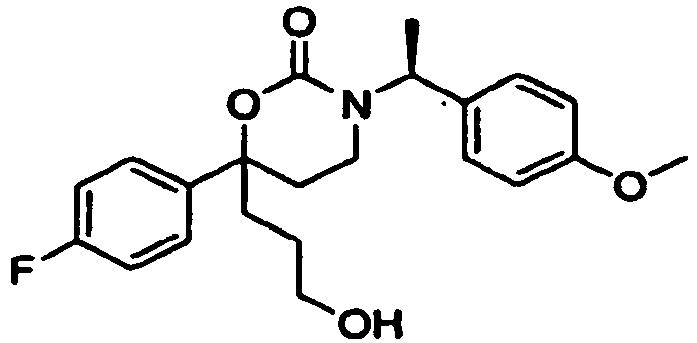
- The title compound was prepared from 6-allyl-6-(4-fluorophenyl)-3-((S)-1-(4-methoxyphenyl)ethyl)-1,3-oxazinan-2-one following a procedure analogous to that described in Example 78. Two isomers were isolated.
- Isomer 1: (R)-6-(4-fluorophenyl)-6-(3-hydroxypropyl)-3-((S)-1-(4-methoxyphenyl)ethyl)-1,3-oxazinan-2-one. LC-MS Method 1 tR = 1.49, min, m/z = 388; 1H NMR (CD3OD) 7.24-7.21 (m, 2H), 7.03-6.99 (m, 2H), 6.80 (d, J = 8.8 Hz, 2H), 6.60 (d, J = 8.5 Hz, 2H), 5.42 (q, J = 7.0 Hz, 1H), 3.64 (s, 3H), 3.39 (t, J = 6.2 Hz, 2H), 2.98-2.94 (m, 1H), 2.39-2.31 (m, 1H), 2.19-2.06 (m, 2H), 1.88-1.81 (m, 2H), 1.57-1.49 (m, 1H), 1.42 (d, J = 7.0 Hz, 3H), 1.27-1.18 (m, 1 H).
- Isomer 2: (S)-6-(4-fluorophenyl)-6-(3-hydroxypropyl)-3-((S)-1-(4-methoxyphenyl)ethyl)-1,3-oxazinan-2-one. LC-MS Method 1 tR = 1.55, min, m/z = 388; 1H NMR (CD3OD) 7.31-7.27 (m, 2H), 7.15 (d, J = 8.8 Hz, 2H), 7.10-7.06 (m, 2H), 6.83 (d, J = 8.5 Hz, 2H), 5.49 (q, J = 7.0 Hz, 1H), 3.71 (s, 3H), 3.40-3.36 (m, 2H), 2.74-2.63 (m, 3H), 2.35-2.30 (m, 1H), 2.04-1.91 (m, 1H), 1.89-1.83 (m, 2H), 1.59-1.50 (m, 1H), 1.20 (d, J = 7.0 Hz, 3H).
-

- The title compound was prepared from (R)-6-allyl-3-((S)-1-(4-chlorophenyl)ethyl)-6-(4-fluorophenyl)-1,3-oxazinan-2-one following a procedure analogous to that described in Example 78. LC-MS Method 1 tR = 1.64, min, m/z = 414; 1H NMR (CDCl3) 7.25-7.22 (m, 2H), 7.12-7.02 (m, 4H), 6.86-6.84 (d, 2H), 5.65-5.59 (m, 1H), 3.58 (t, 2H), 2.95-2.89 (m, 1H), 2.31-2.17 (m, 3H), 2.01-1.91 (m, 2H), 1.77-1.63 (m, 1 H), 1.50 (d, 3H), 1.42-1.31 (m, 1 H).
-

- The title compound was prepared from (R)-6-allyl-3-((S)-1-(4-bromophenyl)ethyl)-6-(4-fluorophenyl)-1,3-oxazinan-2-one using a procedure analogous to that described in Example 187 Step 1, followed by a procedure analogous to that described in Example 408 Step 1, followed by a procedure analogous to that described in Example 372 Step 3. Two isomers were isolated.
- Isomer 1: LC-MS Method 1 tR = 1.69, m/z = 414.
- Isomer 2: LC-MS Method 2 tR = 1.337 min, m/z = 391.14; 1H NMR (CDCl3) 1.05 (d, 3H), 1.48 (d, 3H), 1.55-1.71 (s, 1H), 1.84 (d, 1H), 2.00 (m, 1H), 2.15 (m, 2H) 2.30 (m, 1H) 2.83 (m, 1 H), 3.85 (m, 1H), 5.56 (m, 1 H), 6.79 (d, 2H), 7.03 (m, 2H) 7.21 (m, 2H).
- The title compound was also isolated as a byproduct from the procedure used to prepare Example 202. LC-MS Method 1 tR = 1.7, min, m/z = 392.
-

- The title compound was prepared from 3-chloro-1-phenylpropan-1-one following a procedure analogous to that described in Example 110. Two isomers were isolated.
- Isomer 1: (R)-6-allyl-3-((S)-1-(4-bromophenyl)ethyl)-6-phenyl-1,3-oxazinan-2-one LC-MS Method 3 tR = 1.55, min, m/z = 400, 402; 1H NMR (CDCl3) 1.41 (m, 3H), 2.09-2.29 (m, 3H), 2.48-2.59 (m, 2H), 2.80 (m, 1H), 5.02 (m, 2H), 5.49 (m, 1H), 5.69 (m, 1H), 6.57 (m, 2H), 7.08 (m, 2H), 7.20-7.30 (m, 6H).
- Isomer 2: (S)-6-allyl-3-((S)-1-(4-bromophenyl)ethyl)-6-phenyl-1,3-oxazinan-2-one LC-MS Method 2 tR = 1.56 min, m/z = 401.9; 1H NMR (CDCl3) 1.18-1.26 (d, 3H), 1.99-2.12 (m, 1H), 2.24 (m, 1H), 2.52-2.79 (m, 4H), 4.97-5.13 (m, 2H), 5.62-5.86 (m, 2H), 7.18 (d, 2H), 7.31 (m, 3H), 7.38 (m, 2H), 7.43 (d, 2H).
-

- The title compound was prepared from (R)-6-allyl-3-((S)-1-(4-bromophenyl)ethyl)-6-phenyl-1,3-oxazinan-2-one and pyridine-3-boronic acid using a procedure analogous to that described in Example 64 followed by a procedure analogous to that described in Example 74. LC-MS Method 2 tR = 1.44, min, m/z = 403; 1H NMR (CDCl3) 1.50 (t. 3H), 1.68 (m, 2H), 1.91 (m, 2H), 2.05 (m, 1H), 2.26 (m, 2H), 2.83 (m, 1H), 3.53 (m, 2H), 5.62 (q, 1H), 6.93 (d, 2H), 7.20-7.32 (m, 8H), 7.73 (m, 1H), 8.51 (s, 1H), 8.72 (s, 1H).
-

- The title compound was prepared from (R)-6-allyl-6-(4-fluorophenyl)-3-((S)-1-(4-methoxyphenyl)ethyl)-1,3-oxazinan-2-one following a procedure analogous to that described in Example 77. Two isomers were isolated.
- Isomer 1: LC-MS Method 1 tR = 1.34, min, m/z = 404; 1H NMR (CD3OD) 7.30-7.27 (m, 2H), 7.03-6.99 (m, 2H), 6.74 (d, J = 8.8 Hz, 2H), 6.58 (d, J = 8.8 Hz, 2H), 5.39 (q, J = 7.0 Hz, 1H), 3.63 (s, 3H), 3.35-3.28 (m, 3H), 3.00-2.95 (m, 1H), 2.60-2.56 (m, 1H), 2.25-2.10 (m, 2H), 2.00-1.86 (m, 2H), 1.40 (d, J = 7.0 Hz, 3H).
- Isomer 2: LC-MS Method 1 tR = 1.37, min, m/z = 404; 1H NMR (CD3OD) 7.25-7.21 (m, 2H), 7.02-6.98 (m, 2H), 6.79 (d, J = 8.8 Hz, 2H), 6.59 (d, J = 8.5 Hz, 2H), 5.40 (q, J = 7.0 Hz, 1H), 3.74-3.68 (m, 1H), 3.63 (s, 3H), 3.23-3.16 (m, 2H), 2.95-2.90 (m, 1H), 2.39-2.32 (m, 2H), 2.11-2.04 (m, 1 H), 1.95 (dd, J = 14.9, 2.6 Hz, 1H), 1.82 (dd, J = 15.2, 7.9 Hz, 1H), 1.40 (d, J = 7.0 Hz, 3H).
-

- To a solution of 4-methyl-3-oxo-pentanoic acid ethyl ester (79 g, 0.5 mol) and ethane-1,2-diol (62 g, 1 mol) in toluene (1600 mL) was added TsOH (1.9 g, 0.1 mol). The mixture was refluxed till the reaction was over. The mixture was concentrated in vacuum to give the crude (2-isopropyl-[1,3]dioxolan-2-yl)-acetic acid ethyl ester (83 g, crude), which was used for the next step without further purification.
- To a solution of (2-isopropyl-[1,3]dioxolan-2-yl)-acetic acid ethyl ester (83 g, 0.41 mol) in MeOH (1600 mL) was added NaBH4 (78 g, 2.05 mol) and ZnCl2 (8.3 g). The mixture was stirred overnight. The mixture was concentrated, and the residue was dissolved in the mixture of EtOAc and water. The layers were separated, and the aqueous layer was extracted with EtOAc. The combined organic phase was dried over N32SO4, and concentrated to give the crude product, which was purified by column to give 2-(2-isopropyl-[1,3] dioxolan-2-yl)-ethanol (30 g, crude).
- To a solution of 2-(2-isopropyl-[1,3]dioxolan-2-yl)-ethanol (11 g, 0.069 mol) and TEA (20.91 g, 0.207 mol) in dried CH2Cl2 (110 mL) was added MsCl (15.8 g, 0.138 mol) dropwise at 0 °C. The mixture was stirred till the reaction was over. The reaction was quenched with water. The layers were separated, and the aqueous layer was extracted with CH2Cl2. The combined organic phase was dried over Na2SO4, and concentrated to give the crude methanesulfonic acid 2-(2-isopropyl-[1,3]dioxolan-2-yl)-ethyl ester (19 g, crude), which was used for the next step without further purification.
- To a solution of methanesulfonic acid 2-(2-isopropyl-[1,3]dioxolan-2-yl)-ethyl ester (19 g, 0.08 mol) was added 1-(4-bromo-phenyl)-ethylamine (48 g, 0.24 mol). The mixture was refluxed overnight. The mixture was condensed to give the crude product, which was purified by column to give [1-(4-bromo-phenyl)-ethyl]-[2-(2-isopropyl-[1,3]dioxolan-2-yl)- ethyl]-amine (22 g, crude). 1H NMR (CDCl3): 0.88 (m, 6H), 1.32 (m, 3H), 1.83 (m, 3H), 2.51 (m, 2H), 3.69 (m, 1H), 3.87 (m, 4H), 7.18 (m, 2H), 7.43 (m, 2H).
- To a solution of [1-(4-bromo-phenyl)-ethyl]-[2-(2-isopropyl-[1,3]dioxolan-2-yl)-ethyl]-amine (14.5 g, 0.042 mol) in MeOH (70 mol) was added HCl (36%, 70 mol). The mixture was stirred at 65 °C till the reaction was over. The mixture was cooled to 0 °C. The pH of the mixture was adjusted to 7. The mixture was condensed, and the residue was extracted with EtOAc. The organic phase was dried over Na2SO4, and concentrated to give the crude 1-[1-(4-bromo-phenyl)-ethylamino]-4-methyl-pentan-3-one (10.3 g, crude), which was used for the next step without further purification. 1H NMR (CDCl3): 1.08 (m, 6H), 1.35 (m, 3H), 2.51-2.70 (m, 6H), 3.72 (m, 1H), 7.19 (m, 2H), 7.42 (m, 2H).
- To a solution of 1-[1-(4-bromo-phenyl)-ethylamino)-4-methyl-pentan-3-one (3.42 g, 0.01 mol) and K2CO3 (6.9g, 0.05mol) in dried CH2Cl2 (50 mL) was added chloroformate (1.41 g, 0.015 mol). The mixture was refluxed overnight. The solvent was removed to give the crude product, which was purified by column to give [1-(4-bromo-phenyl)-ethyl)-(4-methyl-3-oxo- pentyl)-carbamic acid methyl ester (2.8 g, 79%). 1H NMR (CDCl3): 1.01 (m, 6H), 1.48 (m, 3H), 2.25-2.47 (m, 2H), 2.62 (m, 1H), 3.24 (m, 2H), 5.46 (s, 1H), 7.17 (m, 2H), 7.45 (m, 2H).
- To a solution of [1-(4-bromo-phenyl)-ethyl]-(4-methyl-3-oxo-pentyl) -carbamic acid methyl ester (1.78 g, 5 mmol) in dried THF (20 mL) was added allymagnesium bromide (1 M, 25 mL, 25 mmol) dropwise at -78 °C. The mixture was stirred overnight. The reaction was quenched with aqueous sat. NH4Cl. The mixture was extracted with EtOAc. The organic phase was dried over Na2SO4, and condensed to give 3-{2-[1-(4-bromo-phenyl)- ethylamino]-ethyl}-2-methyl-hex-5-en-3-ol (2.2 g, crude).
- To a solution of 3-{2-[1-(4-bromo-phenyl)-ethylamino]-ethyl}-2-methyl-hex-5-en-3-ol (2.2 g, crude) and TEA (4 eq) in dried CH2Cl2 (60 mL) at 0 °C was added triphosgene (2.12 g, 7.12 mmol). The mixture was stirred at rt till the reaction was over. Water was added, and the layers were separated. The aqueous layer was extracted with CH2Cl2. The combined organic phase was washed with water, dried over Na2SO4, and condensed to give the crude product, which was purified by column to give 6-allyl-3-[1-(4-bromo-phenyl)-ethyl]-6-isopropyl-[1,3]oxazinan-2-one (500 mg, crude).
- A mixture of 6-allyl-3-[1-(4-bromo-phenyl)-ethyl]-6-isopropyl-[1,3]oxazinan-2-one (200 mg, 0.55 mmol), 2,4-difluorophenylboronic acid (104 mg, 0.66 mmol), PdCl2(PPh3)2 (20 mg), aqueous Cs2CO3 solution (2 M, 2 mL) in 1,4-dioxane (8 mL) was heated to reflux for 2 h. The mixture was filtered, and the filtrate was extracted with EtOAc for 3 times. The combined organic layer was washed with brine, dried over Na2SO4 and concentrated to give the crude product, which was purified by preparative TLC to give 6-allyl-3-((S)- 1-(2',4'-difluorobiphenyl-4-yl)ethyl)-6-isopropyl-1,3-oxazinan-2-one (160 mg, 73%). 1H NMR (CDCl3): 0.96 (m, 6H), 1.61 (m, 3H), 1.68-2.09 (m, 3H), 2.32-2.47 (m, 2H), 2.84 (m, 1H), 3.18 (m, 1H), 5.02-5.19 (m, 2H), 5.84 (m, 2H), 6.93 (m, 2H), 7.41 (m, 3H), 7.50 (m, 2H).
- A solution of 6-allyl-3-((S)-1-(2',4'-difluorobiphenyl-4-yl)ethyl)-6-isopropyl-1,3-oxazinan- 2-one (60 mg, crude) in dry CH2Cl2 (10 mL) was treated with ozone at -78 °C until the mixture turned blue. The system was then flushed with oxygen to remove excess ozone. NaBH4 (29 mg, 0.75 mmol) was added to the mixture in portions at rt. The mixture was stirred overnight at rt. The mixture was quenched with water, and the layers were separated. The aqueous layer was extracted with CH2Cl2 (2 x). The organic layers were combined, washed with brine, dried over anhydrous Na2SO4 and concentrated to give the crude product, which was purified by preparative TLC to give two isomers.
- Isomer 1 (30 mg, 49%): LC-MS Method 3 tR = 1.37, min, m/z = 404, 426; 1H NMR (CDCl3) 0.89 (m, 6H), 1.53 (d, 3H), 1.74 (m, 4H), 2.11 (m, 1H), 2.81 (m, 1H), 3.15 (m, 1H), 3.76-4.02 (m, 2H), 5.78 (m, 1H), 6.88 (m, 2H), 7.33 (m, 3H), 7.45 (m, 2H).
- Isomer 2 (10 mg, 17%): LC-MS Method 3 tR = 1.38, min, m/z = 404, 426; 1H NMR (CDCl3) 0.95 (m, 6H), 1.52 (d, 3H), 1.72 (m, 2H), 1.84 (m, 2H), 2.05 (m, 1H), 2.79 (m, 1H), 3.08 (m, 1H), 3.77 (m, 2H), 5.76 (m, 1H), 6.86 (m, 2H), 7.35 (m, 3H), 7.42 (m, 2H).
-

- Isomer 1: LC-MS Method 2 tR = 2.033, min, m/z = 305.2; 1H NMR (CDCl3) 1.18 (m, 1H), 1.33 (s, 9H), 1.64 (m, 1 H), 1.81-2.09 (m, 4H), 2.16 (m, 1 H), 2.29 (m, 1H), 2.73 (m, 1H), 2.80-2.97 (m, 1 H), 3.04 (m, 1H), 3.22 (m, 1H), 3.35 (m, 2H), 3.51 (t, 2H), 4.78 (m, 1H), 7.20 (m, 3H), 7.31 (m, 2H).
- Isomer 2: LC-MS Method 2 tR = 1.244, min, m/z = 304.9; 1H NMR (CDCl3) 1.28 (m, 1H), 1.46 (s, 9H), 1.39 (m, 1H), 1.63 (m, 2H), 1.81 (m, 1H), 1.92 (m, 2H), 2.14 (m, 1H), 2.31 (m, 1H), 2.71 (m, 1H), 3.03 (m, 1H), 3.16 (m, 2H), 3.48-3.58 (m, 3H), 4.78 (m, 1H), 7.20-7.27 (m, 3H), 7.29-7.36 (m, 2H).
(3R)-tert-butyl 3-(6-(3-hydroxypropyl)-2-oxo-6-phenyl-1,3-oxazinan-3-yl)pyrrolidine-1-carboxylate was prepared as described immediately above using (R)-tert-butyl 3-isocyanatopyrrolidine-1-carboxylate to afford two isomers. - Isomer 3: LC-MS Method 3 tR = 1.09, min, m/z = 305, 427; 1H NMR (CDCl3) 1.38 (s, 9H), 1.63-1.70 (m, 2H), 1.80 (m, 1H), 1.95 (m, 2H), 2.16 (m, 1 H), 2.30 (m, 1H), 2.71 (m, 1H), 3.0-3.30 (m, 3H), 3.52 (m, 3H), 4.82 (m, 1 H), 7.20-7.27 (m, 3H). 7.28-7.39 (m, 2H).
- Isomer 4: LC-MS Method 2 tR = 2.03, min, m/z = 405, 427; 1H NMR (CDCl3) 1.29 (m, 1H), 1.33 (s, 9H), 1.68 (m, 1H), 1.81-2.09 (m, 4H), 2.10-2.22 (m, 1H), 2.31 (m, 1H), 2.72 (m, 1H), 2.78-2.99 (m, 1H), 2.99-3.12 (m, 1H), 3.21 (m, 1H), 3.30-3.48 (m, 2H), 3.50 (m, 2H), 4.79 (m, 1H), 7.22 (m, 3H), 7.32 (m, 2H).
-

- The title compound was prepared from (R)-6-(2-aminoethyl)-3-((S)-1-(2',4'-difluorobiphenyl-4-yl)ethyl)-6-(4-fluorophenyl)-1,3-oxazinan-2-one following a procedure analogous to that described in Example 99. LC-MS Method 3 tR = 1.45, min, m/z = 533; 1H NMR (CDCl3) 1.52-1.57 (d, 3H), 2.10-2.34 (m, 5H), 2.86 (s, 3H), 2.92-2.99 (m, 1 H), 3.00-3.08 (m, 1H), 3.11-3.21 (m, 1H), 4.48-4.57 (s, 1H), 5.63-5.71 (m, 1H), 6.83-6.94 (m, 2H), 6.98-7.09 (m, 4H), 7.17-7.21 (m, 1 H), 7.24-7.32 (m, 3H).
-

- The title compound was prepared from (R)-6-allyl-3-((S)-1-(4-bromophenyl)ethyl)-6-phenyl-1,3-oxazinan-2-one and pyridine-4-boronic acid using a procedure analogous to that described in Example 64 followed by a procedure analogous to that described in Example 74. LC-MS Method 2 tR = 2.2, min, m/z = 417; 1H NMR (CDCl3) 1.48 (m, 2H), 1.50 (t, 2H), 1.92 (m, 2H), 2.28 (m, 3H), 2.89 (m, 1H), 3.53 (m, 3H), 5.66 (m, 1H), 6.99 (m, 2H), 7.28 (q, 8H), 7.52 (d, 2H), 8.51 (m, 1H), 8.63 (m, 1H).
-

- The title compound was prepared from (R)-6-allyl-3-((S)-1-(4-bromophenyl)ethyl)-6-phenyl-1,3-oxazinan-2-one and pyridine-3-boronic acid using a procedure analogous to that described in Example 64 followed by a procedure analogous to that described in Example 78. LC-MS Method 2 tR = 1.5, min, m/z = 417; 1H NMR (CDCl3) 1.32 (m, 2H), 1.50 (t, 3H), 1.68 (m, 2H), 1.91 (m, 2H), 2.15 (m, 1H), 2.26 (m, 2H), 2.83 (m, 1 H), 3.51 (m, 2H), 5.62 (q, 1H), 6.93 (d, 2H), 7.20-7.32 (m, 8H), 7.73 (m, 1H), 8.51 (s, 1H), 8.72 (s, 1H).
-

- The title compound was prepared from 6-allyl-3-((S)-1-(2',4'-difluorobiphenyl-4-yl)ethyl)-6-isopropyl-1,3-oxazinan-2-one following a procedure analogous to that described in Example 211. Two isomers were isolated.
- Isomer 1: LC-MS Method 3 tR = 1.42, min, m/z = 418; 1H NMR (CDCl3) 0.91 (m, 6H), 1.58 (m, 3H), 1.62-1.95 (m, 6H), 2.03 (m, 1 H), 2.82 (m, 1 H), 3.19 (m, 1H), 3.67 (m, 2H), 5.82 (m, 1H), 6.93 (m, 2H), 7.39 (m, 3H), 7.47 (m, 2H).
- Isomer 2: LC-MS Method 3 tR = 1.42, min, m/z = 418; 1H NMR (CDCl3) 0.89 (m, 6H), 1.52 (m, 3H), 1.62 (m, 5H), 1.84 (m, 1H), 2.03 (m, 1H), 2.72 (m, 1H), 3.03 (m, 1H), 3.57 (m, 2H), 5.79 (m, 1H), 6.86 (m, 2H), 7.32 (m, 3H), 7.43 (m, 2H).
-
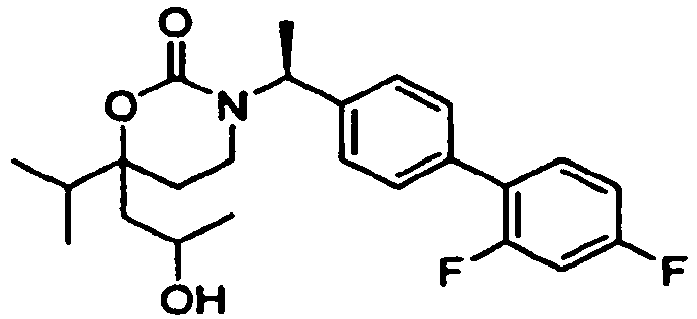
- The title compound was isolated as a byproduct from the procedure described in Example 212. LC-MS Method 3 tR = 1.48, min, m/z = 418; 1H NMR (CDCl3) 0.83-0.97 (m. 6H), 1.13 (m, 3H), 1.33-1.46 (m, 1H), 1.52 (m, 3H), 1.56 (m, 1H), 1.73-1.94 (m, 3H), 2.09 (m, 1H), 2.81 (m, 1H), 3.02-3.14 (m, 1H), 3.98-4.15 (m, 1 H), 5.76 (m, 1H), 6.88 (m, 2H), 7.35 (m, 3H), 7.44 (m, 2H).
-

- The title compound was prepared from (R)-6-allyl-3-((S)-1-(4-bromophenyl)ethyl)-6-(4-fluorophenyl)-1,3-oxazinan-2-one and pyridine-3-boronic acid using a procedure analogous to that described in Example 64 followed by a procedure analogous to that described in Example 74. LC-MS Method 2 tR = 1.412, min, m/z = 421.2; 1H NMR (CDCl3) 1.52 (d, 3H), 2.03-2.17 (m, 3H), 2.22-2.32 (m, 3H), 2.81 (m, 1 H), 3.47-3.52 (m, 1H), 3.72 (m, 1H), 5.63 (m, 1 H), 6.93-7.01 (m, 4H), 7.21-7.26 (m, 2H), 7.28-7.33 (m, 3H), 7.73 (m, 1H), 8.51 (m, 1H), 8.68 (m, 1H).
-

- 4-((S)-1-((R)-6-allyl-6-(4-fluorophenyl)-2-oxo-1,3-oxazinan-3-yl)ethyl)benzoic acid (40 mg, 0.104 mmol) was dissolved in CH2Cl2 (6 mL). At 0 °C, thionyl chloride (1mL, excess) was added slowly. After 10 min., the mixture was warmed up to rt and stirred 1h at rt The mixture was concentrated and redissolved in CH2Cl2 (6 mL). NaHCO3 (22mg, 2.5equiv.) and acetohydrazide (12mg, 1.5equiv.) were added slowly. After stirring 1 h at rt, LC-MS found reaction completed. The mixture was diluted with CH2Cl2 (10 mL), filtered NaHCO3 and washed by water (5 mL), 5% aq HCl (2 x 5mL), satd aq NaHCO3 (4mL), brine (4 mL) and dried over Na2SO4. After filtration and concentration, the crude N-acetyl-4-((S)-1-((R)-6-allyl-6-(4-fluorophenyl)-2-oxo-1,3-oxazinan-3-yl)ethyl)benzohydrazide (34 mg, 74%) was used for next step without further purification.
- Crude N'-acetyl-4-((S)-1-((R)-6-allyl-6-(4-fluorophenyl)-2-oxo-1,3-oxazinan-3-yl)ethyl)benzohydrazide (5mg, 0.0114mmol) was mixed with Burgess reagent (-4 mg, excess), dry THF (1 mL) and put into Microwave Oven, heated to 180 °C for 10 min. at 100W. LC-MS found reaction completed. The mixture was diluted with EtOAc (8 mL), washed with water (2 x 3 mL), concentrated and purified by prep HPLC to afford (R)-6-allyl-6-(4-fluorophenyl)-3-((S)-1-(4-(5-methyl-1,3,4-oxadiazol-2-yl)phenyl)ethyl)-1,3-oxazinan-2-one (1.4mg, 29%). LC-MS Method 1 tR = 1.61, min, m/z = 422; 1H NMR (CDCl3) 7.77(d, 2H), 7.26(m, 3H), 7.01(m, 3H), 5.70(m, 2H), 5.07(dd, 2H), 2.98(m, 1H), 2.62(s, 3H), 1.55(d, 3H).
-

- The title compound was prepared from (R)-6-allyl-6-phenyl-3-((S)-1-(4-(thiophen-2-yl)phenyl)ethyl)-1,3-oxazinan-2-one and thiophene-2-boronic acid using a procedure analogous to that described in Example 64 followed by a procedure analogous to that described in Example 78. LC-MS Method 2 tR = 2.47, min, m/z = 422; 1H NMR (CDCl3) 1.49 (d, 3H), 1.84-1.92 (m, 2H), 2.0-2.15 (m, 4H), 2.25 (m, 2H), 2.84 (m, 1H), 3.52 (m, 1H), 4.20 (m, 1H), 5.60 (m, 1H), 6.82 (dd, 2H), 7.0 (m, 1H), 7.15-7.38 (m, 9H).
-

- A flask was charged with (R)-6-allyl-3-((S)-1-(4-bromophenyl)ethyl)-6-(4-fluorophenyl) -1,3-oxazinan-2-one (400 mg, 0.96 mmol), morpholine (100 mg, 1.15 mmol) and t-BuONa (129 mg, 1.34 mmol) and Pd2(dba)3 (9 mg, 0.01 mmol) and BINAP (6 mg, 0.01 mmol) and toluene. The flask was heated to 80 °C and stirred overnight. The reaction mixture was concentrated to leave a residue, which was purified by preparative TLC to give (R)-6-allyl-6-(4-fluorophenyl) -3-((S)-1-(4-morpholinophenyl)ethyl)-1,3-oxazinan-2-one (162 mg, 0.4 mmol). LC-MS Method 3 tR = 1.29, min, m/z = 425; 1H NMR (CD3OD): 1.50 (m, 3H), 2.20 (m, 2H), 2.40 (m, 1H), 2.60 (m, 2H), 3.00 (m, 5H), 3.85 (m, 4H), 5.00 (m, 2H), 5.45 (m, 1H), 5.65 (m, 1 H), 6.70 (m, 2H), 6.90 (m, 2H), 7.05 (m, 2H), 7.30 (m, 2H).
-

- Pd(PPh3)2Cl2 (100 mg) was added to the solution of (R)-6-allyl-3-((S)-1-(4-bromophenyl)ethyl)-6-(thiophen-2-yl)-1,3-oxazinan-2-one (1.0 g, 2.5 mmol), 4-fluorophenylboronic acid (420 mg, 3.0 mmol) in 1,4-dioxane. Cs2CO3 (5 mL) was slowly added. The mixture was heated to reflux for 2 h. The mixture was quenched with water and separated, extracted with EtOAc twice, dried over anhydrous Na2SO4 and concentrated to afford the residue, which was purified by TLC to give (R)-6-allyl-3-((S)-1-(4'-fluorobiphenyl-4-yl)ethyl)- 6-(thiophen-2-yl)-1,3-oxazinan-2-one (768 mg, 73%).
- To a solution of (R)-6-allyl-3-((S)-1-(4'-fluorobiphenyl-4-yl)ethyl)-6-(thiophen-2-yl)-1,3- oxazinan-2-one (300 mg, 0.71 mmol) was added aqueous solution of KMnO4 (66 mg, 0.42 mmol) and NalO4 (537 mg, 2.52 mmol). The reaction mixture was stirred at rt overnight. The reaction mixture was filtered and concentrated, then extracted with CH2Cl2. The organic phases was dried over Na2SO4, filtered and concentrated to afford 2-((S)-3-((S)-1-(4-fluorobiphenyl-4-yl)ethyl)-2-oxo-6-(thiophen-2-yl)-1,3-oxazinan-6-yl)acetic acid (218 mg, 70%).
- A solution of 2-((S)-3-((S)-1-(4'-fluorobiphenyl-4-yl)ethyl)-2-oxo-6-(thiophen-2-yl)-1,3- oxazinan-6-yl)acetic acid (218 mg, 0.5 mmol) in THF anhydrous (10 mL) was added BH3 (3.0 mL) at 0 □ and then stirred at reflux for 2h. Then the reaction mixture quenched by water and separated, extracted with EtOAc twice. The organic phases was dried over Na2SO4, filtered and concentrated to afford the residue, which was purified by TLC to give (S)-3-((S)-1-(4'-fluorobiphenyl-4-yl)ethyl)-6-(2-hydroxyethyl)-6-(thiophen-2-yl)-1,3-oxazinan-2-one (85 mg, 40%). LC-MS Method 3 tR = 1.35, min, m/z = 426, 448; 1H NMR (CD3OD): 1.50 (m, 3H), 2.15 (m, 2H), 2.30 (m, 1 H), 2.40 (m, 1 H), 2.60 (m, 1 H), 3.15 (m, 1H), 3.45 (m, 1H), 3.70 (m, 1H), 5.60 (m, 1H), 6.90 (m, 1H), 7.00 (m, 1H), 7.10 (m, 4H), 7.35 (m, 3H), 7.55 (m, 2H).
- (R)-3-((S)-1-(4'-fluorobiphenyl-4-yl)ethyl)-6-(2-hydroxyethyl)-6-(thiophen-2-yl) 1,3-oxazinan-2-one was prepared following a procedure analogous to that described immediately above. LC-MS Method 3 tR = 1.4, min, m/z = 426, 448; 1H NMR (CD3OD) 1.38 (d, 3H), 2.01 (m, 1H), 2.18 (m, 3H), 2.41 (m, 1H), 2.86 (m, 1H), 3.02 (m, 1H), 3.41 (m, 1H), 3.72 (m, 1H), 5.62 (m, 1H), 6.98 (m, 1H), 7.03 (m, 1 H), 7.15 (m, 1H), 7.36 (m, 3H), 7.58 (m, 4H).
-

- To a solution of 3-((R)-3-((S)-1-(4'-fluorobiphenyl-4-yl)ethyl)-2-oxo-6-phenyl-1,3-oxazinan-6-yl)propanamide (110 mg, 0.25 mmol) and DIEA (170 mg, 1.05 mmol ) in anhydrous CH2Cl2 (5 mL) was added TFAA (158 mg, 0.75 mmol) at 0 °C. The mixture was stirred for 2 h. The solvent was removed under reduced pressure, and the residue was purified by preparative HPLC to afford 3-((R)-3-((S)-1-(4'-fluorobiphenyl-4-yl)ethyl)-2-oxo-6-phenyl -1,3-oxazinan-6-yl)propanenitrile (8 mg , yield 10%). LC-MS Method 3 tR = 1.458, min, m/z = 429.2; 1H NMR (CDCl3): 1.52 (d, 3H), 2.01 (m, 1H), 2.14 (m, 2H), 2.29 (m, 3H), 2.53 (m, 2H), 2.90 (m, 1H), 5.62 (m, 1H), 6.93 (m, 2H), 7.04 (m, 2H), 7.16-7.25 (m, 2H), 7.30-7.47 (m, 5H).
-

- To a solution of (S)-1-phenylpropan-1-amine (3.00 g, 14 mmol) in the mixture of methylene chloride (50 mL) and saturated NaHCO3 (50 mL) was added triphosgene (1.40 g, 4.60 mmol) at 0 °C. The mixture was stirred for 15 minutes. The organic phase was separated, dried and concentrated to give (S)-(1-isocyanatopropyl)benzene (3.0 g, 88%). 1H NMR (CDCl3): δ=0.93 (q, 3H), 1.81 (m, 2H), 4.50 (m, 1H), 7.13 (m, 2H), 7.22 (m, 1H), 7.50 (m, 2H).
- A mixture of (S)-(1-isocyanatopropyl)benzene (3.0 g, 12.5 mmol), 1-chloro-3-phenylhex- 5-en-3-ol (3.6 g, 12.5 mmol) and DBU (3.80 g, 25 mmol) in tetrahydrofuran (20 mL) was heated to reflux overnight. The mixture was washed by 1 N HCl and extracted with EtOAc. The organic phase was concentrated to give the crude product which was purified by column chromatography to give (R)-6-allyl-3-((S)-1- (4-bromophenyl)propyl)-6-phenyl-1,3- oxazinan-2-one (1.0 g, 20%). 1H NMR (400MHz, CDCl3): 6=0.92 (t, 3H), 1.72-2.00 (m, 4H), 2.06-2.31 (m, 4H), 2.53 (m, 2H), 2.82 (m, 1 H), 4.99 (m, 2H), 5.32 (m, 1H), 5.69 (m, 1H), 6.72 (m, 1H), 7.12 (m, 4H), 7.25 (m, 4H).
- To a solution of (R)-6-allyl-3-((S)-1-(4-bromophenyl)propyl)-6-phenyl-3-oxazinan-2-one (100 mg, 0.242 mmol) in tetrahydrofuran (10 mL) was added BH3 THF (3 mL, l mol/L) at 0 °C under nitrogen. The formed mixture was stirred for 2 h. Then the reaction was quenched by water, followed by 3 mol/L NaOH and H2O2 (3 mL). The PH of the mixture was adjusted to <7 with 5% HCl. The organic phase was separated, extracted by EtOAc, and concentrated to give the crude product, which was purified by preparative HPLC to give (R)-3-((S)-1-(4-bromophenyl)propyl)-6-(3-hydroxypropyl)-6-phenyl-1,3-oxazinan-2-one (15 mg, 15%). LC-MS Method 3 tR = 1.36, min, m/z = 432, 434; 1H NMR (CDCl3): δ=0.99 (t, 3H), 1.29 (m, 1H), 1.63 (m, 1 H), 1.98 (m, 4H), 2.20-2.42 (m, 2H), 2.48 (m, 1H), 3.08 (m, 1H), 3.49 (m, 1H), 5.30 (m, 1H), 6.92 (m, 2H), 7.26 (m, 4H), 7.35 (m, 2H).
-
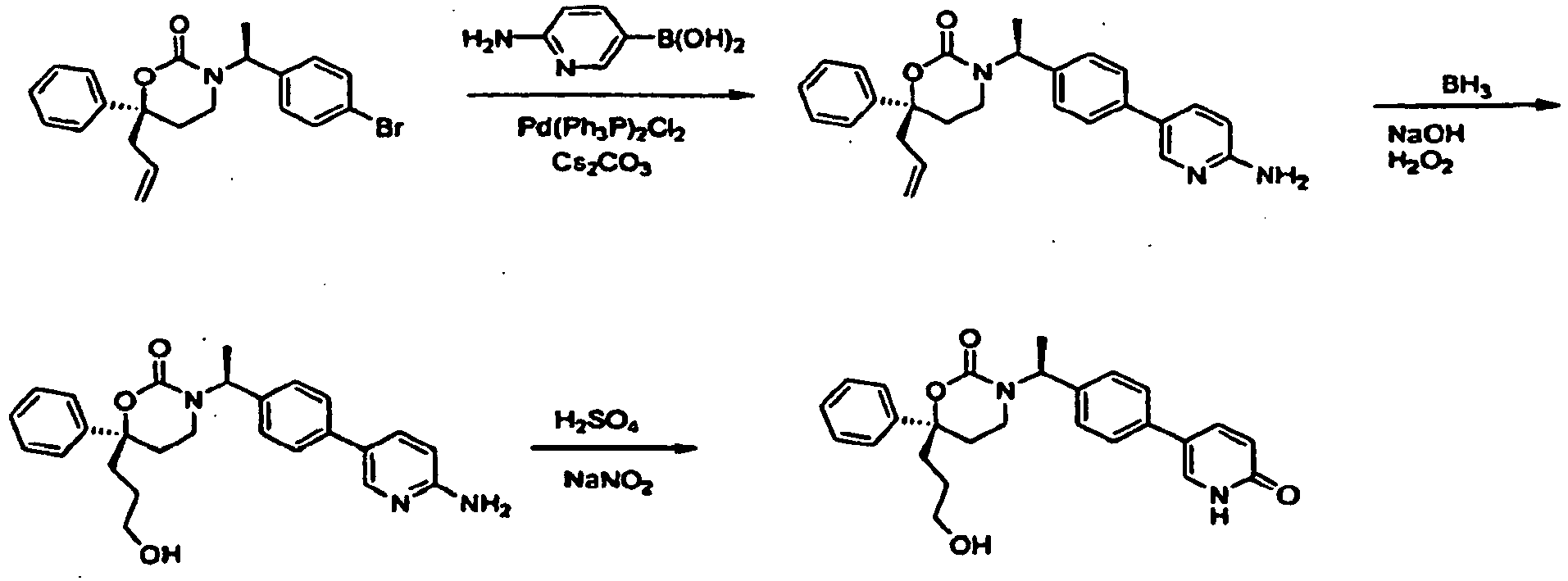
- A mixture of (R)-6-allyl-3-((S)-1-(4-bromophenyl)ethyl)-6-phenyl-1,3-oxazinan-2-one (150 mg, 0.375 mmol) and 6-aminopyridin-3-ylboronic acid (56 mg, 0.45 mmol), Pd(Ph3P)2Cl2 (15 mg), and aqueous Cs2CO3 solution (0.5 mL, 2 M) in 1,4-dioxane (10 mL) was stirred and heated to reflux for 2 h. The organic phase was separated, and concentrated to give the crude product, which was purified by preparative HPLC to give (R)-6-allyl-3-((S)-1-(4-(6- aminopyridin-3-yl)phenyl)ethyl)-6-phenyl-1,3-oxazinan-2-one (90 mg, 60%).
- To a solution of (R)-6-allyl-3-((S)-1-(4-(6-aminopyridin-3-yl)phenyl)ethyl)-6-phenyl-1,3- oxazinan-2-one (90 mg, 0.23 mmol) in tetrahydrofuran (10 mL) was added BH3 THF (3.0 mL, l mol/L, 4 mmol) at 0 °C under nitrogen atmosphere. The formed mixture was stirred for 2 h. The reaction was quenched by water. Then NaOH (2 mL, 3 mol/L) and H2O2 (1 mL) was added to the above mixture. When the reaction was over, the mixture was extracted with EtOAc. The combined organic phase was concentrated to give the crude product, which was purified by preparative HPLC to give (R)-3-((S)-1-(4-(6-aminopyridin -3-yl)phenyl)ethyl)-6-3-hydroxypropyl)-6-phenyl-1,3-oxa zinan -2- one (40 mg, 41%).
- (R)-3-((S)-1-(4-(6-aminopyridin-3-yl)phenyl)ethyl)-6-(3-hydroxypropyl)-6-phenyl-1,3-oxazinan-2-one (40 mg, 0.09 mmoL) was dissolved in 3.5 M H2SO4 (10 mL), and 2 M NaNO2 (10 mL) was added at 0 °C. The reaction mixture was stirred at rt for 2 h and treated with NaOH solution. The mixture was extracted with EtOAc. The combined organic layer was washed with brine, dried over anhydrous Na2SO4, and concentrated to afford the residue, which was purified by preparative HPLC to give (R)-6-(3-hydroxypropyl)-3-((S)-1-(4-(6-oxo-1,6-dihydropyridin-3-yl)phenyl)ethyl)-6-phenyl-1,3-oxazinan-2-one (10 mg, 20%). LC-MS Method 2 tR = 1.66, min, m/z = 433, 455; 1H NMR (CDCl3): 1.36 (m, 2H), 1.50 (m, 3H), 1.68 (m, 2H), 1.92 (m, 2H), 2.10-2.30 (m, 3H), 2.84 (m, 1H), 3.50 (m, 2H), 5.12 (m, 1H), 6.62 (m, 1N), 6.86 (m, 2H), 7.08 (m, 2H), 7.18-7.32 (m, 5H), 7.46 (m, 1H), 7.62 (m, 1H).
-

- A mixture of (R)-1-((S)-1-(4'-fluorobiphenyl-4-yl)ethyl)-4-(4-fluorophenyl)-4-(3-hydroxyprop yl)tetra-hydropyrimidin-2(1H)-one(30 mg, 0.07 mmol) and 3-chloro-perbenzoic acid (84 mg, 0.49 mmol) in THF (1.5 mL) was stirred at rt for 3 h. Satd aq NaHCO3 was added to the reaction mixture, and the organic layer was separated. The organic layer was washed with brine, dried over Na2SO4 and concentrated to give the crude product, which was purified by preparative HPLC to give 3-(4-((S)-1-((R)-6-(3-hydroxypropyl)-2-oxo-6-phenyl-1,3-oxazinan-3-yl)ethyl)phenyl)pyridine 1-oxide (2.83 mg, 9%). LC-MS Method 2 tR = 1.623, min, m/z = 433.2; 1H NMR (400 MHz, CDCl3): δ=1.54 (t, 3H), 1.94 (m, 2H), 2.21-2.24 (m, 2H), 2.35-2.39 (m,2H), 2.49 (m,1H),3.1 (m, 1H), 3.44 (m, 1H), 5.57 (m, 1H), 7.07 (m, 2H), 7.28-7.42 (m, 6H), 7.58 (m, 1 H), 7.77 (m, 1H), 8.19 (m, 1 H), 8.28 (m, 1H), 8.49 (m, 1H).
-

- The title compound was prepared from 6-allyl-3-((S)-1-(2',4'-difluorobiphenyl-4-yl)ethyl)-6-isopropyl-1,3-oxazinan-2-one following a procedure analogous to that described in Example 173. Four isomers were isolated.
- Isomer 1: LC-MS Method 2 tR = 1.34 min, m/z = 456; 1H NMR (CDCl3) 0.87 (m, 6H), 1.53 (m, 3H), 1.65 (m, 2H), 1.82 (m, 2H), 2.05 (m, 1H), 2.75 (m, 1H),3.13 (m, 1H), 3.39 (m, 1H), 3.59 (m, 1H), 4.03 (m, 1H), 5.74 (m, 1H), 6.88 (m, 2H), 7.34 (m, 3H), 7.43 (m, 2H).
- Isomer 2: LC-MS Method 2 tR = 1.336 min, m/z = 456.1; 1H NMR (CDCl3) 0.83 (m, 3H), 0.95 (m, 3H), 1.52 (m, 3H), 1.64 (m, 1H), 1.76-1.87 (m, 3H), 2.05 (m, 1H), 2.75 (m, 1H),3.13 (m, 1H), 3.45 (m, 1H), 3.58(m, 1H), 3.95(m, 1H), 5.74 (m, 1H), 6.88 (m, 2H), 7.34 (m, 3H), 7.43 (m, 2H).
- Isomer 3: LC-MS Method 2 tR = 1.335, min, m/z = 456.1; 1H NMR (CDCl3) 0.89-0.96 (m, 6H), 1.51 (d, 3H), 1.57 (m, 2H), 1.81-1.94 (m, 2H), 2.13 (m, 1H), 2.73 (m, 1H), 3.07 (m, 1H), 3.36 (m, 1H), 3.57 (m, 1 H), 3.98 (m, 1H), 5.76 (m, 1H), 6.81-6.92 (m, 2H), 7.28-7.37 (m, 3H), 7.43 (m, 2H).
- Isomer 4: LC-MS Method 2 tR = 2.328 min, m/z = 456.2; 1H NMR (CDCl3) 0.87 (m, 3H), 0.94 (m, 3H), 1.57 (m, 3H), 1.79-1.94 (m, 3H), 2.11 (m, 1H), 2.41 (m, 1 H),2.79 (m, 1H), 3.11 (m, 1 H), 3.45 (m, 1H), 3.54 (m, 1H), 4.23 (m, 1H), 5.75 (m, 1 H), 6.82-6.93 (m, 2H), 7.33 (m, 3H), 7.43 (m, 2H).
-

- The title compound was isolated as a byproduct of hydroboration of (R)-6-allyl-3-((S)-1-(4'-fluorobiphenyl-4-yl)ethyl)-6-phenyl-1,3-oxazinan-2-one following a procedure analogous to that described in Example 78. LC-MS Method 3 tR = 1.47, min, m/z = 434; 1H NMR (CDCl3) 1.06 (m, 3H), 1.19 (s, 1H), 1.48 (m, 3H), 1.82-2.11 (m, 2H), 2.14-2.45 (m, 3H), 2.84 (m, 1H), 3.72-3.96 (m, 1H), 5.58 (m, 1H), 6.81 (m, 1H), 6.90 (m, 1H), 7.03 (m, 2H), 7.15-7.38 (m, 9H).
- Two isomers were separated by preparative HPLC.
- Isomer 1: LC-MS Method 1 tR = 1.84, min, m/z = 434; 1H NMR (CD3OD) 7.45-7.41 (m, 2H), 7.33-7.24 (m, 5H), 7.22 (d, J = 8.5 Hz, 2H), 7.08-7.03 (m. 2H), 6.84 (d, J = 8.2 Hz, 2H), 5.46 (q, J = 7.0 Hz, 1H), 3.49-3.45 (m, 1H), 3.03-2.98 (m, 1 H), 2.64-2.59 (m, 1H), 2.34-2.27 (m, 1H), 2.19-2.12 (m, 1 H), 2.04 (dd, J = 14.3, 7.3 Hz, 1H), 1.88 (dd, J = 14.3, 4.7 Hz, 1H), 1.46 (d, J = 7.0 Hz, 3H), 1.06 (d, J = 6.2 Hz, 3H).
- Isomer 2: LC-MS Method 1 tR = 1.88, min, m/z = 434; 1H NMR (CD3OD) 7.45-7.41 (m, 2H), 7.32-7.22 (m, 7H), 7.08-7.03 (m, 2H), 6.90 (d, J = 8.2 Hz, 2H), 5.48 (q, J = 7.1 Hz, 1H), 3.91-3.86 (m, 1H), 2.99-2.94 (m, 1H), 2.39-2.35 (m, 2H), 2.20-2.13 (m, 1H), 1.97 (dd, J = 14.9, 7.3 Hz, 1H), 1.87 (dd, J = 14.9, 3.5 Hz, 1H), 1.47 (d, J = 7.3 Hz, 3H), 0.93 (d, J = 6.2 Hz, 3H).
-

- The title compound was prepared from (R)-6-allyl-6-(4-fluorophenyl)-3-((S)-1-(4-(pyridin-3-yl)phenyl)ethyl)-1,3-oxazinan-2-one following a procedure analogous to that described in Example 78. LC-MS Method 2 tR = 1.463, min, m/z = 435.2; 1H NMR (CDCl3) 1.51 (d, 3H), 1.82-1.98 (m, 3H), 2.11-2.21 (m, 2H), 2.22-2.32 (m, 2H), 2.93 (m, 1H), 3.53 (m, 2H), 5.66 (m, 1H), 6.93-7.01 (m, 4H), 7.22 (m, 1H), 7.28 (m, 2H), 7.33 (m, 1 H), 7.79 (m, 1H), 8.52 (m, 1H), 8.68 (m, 1H).
-

- To a solution of (R)-6-allyl-3-((S)-1-(2',4'-difluorobiphenyl-4-yl)ethyl)-6-phenyl-1,3-oxazinan-2-one (0.2475 g, 0.57 mmol, 1.0 equiv) in 6 mL of dry THF was added 9-BBN (0.5 M solution in THF, 2.3 mL, 1.15 mmol, 2.0 equiv). The mixture was stirred for 3 h at rt. It was then subjected to oxidative workup by adding 3 N aqueous NaOH (6 mL) followed by careful and dropwise addition of 50% aq H2O2 (4 mL) with vigorous stirring. The reaction mixture was stirred for 1 h, extracted with CH2Cl2, and dried over Na2SO4. Surprisingly, the reductive product was observed instead of hydroboration - oxidation. After the solvent was evaporated under reduced pressure, the residue was purified by reversed-phase HPLC (SunFire™ Prep C18 OBD™ 5µm 19 × 50 mm column, 10% →90% CH3CN/H2O, 0.1% CF3COOH over 8 min and then 90% CH3CN/H2O, 0.1% CF3COOH over 2 min, flow rate 20 mL/min) to afford 0.0902 g of (R)-3-((S)-1-(2',4'-difluorobiphenyl-4-yl)ethyl)-6-phenyl-6-propyl-1,3-oxazinan-2-one LC-MS Method 1 tR = 2.22, min, m/z = 436; 1H NMR (400 MHz, CD3OD) δ 7.33-7.14 (m, 8H), 6.96-6.87 (m, 4H), 5.48 (q, J = 7.0 Hz, 1H), 3.01-2.96 (m, 1 H), 2.41-2.36 (m, 1H), 2.29-2.21 (m, 1H), 2.14-2.07 (m, 1H), 1.81-1.72 (m, 2H), 1.46 (d, J = 7.0 Hz, 3H), 1.39-1.29 (m, 1H), 1.08-0.98 (m, 1H), 0.76 (t, J = 7.5 Hz, 3H); 19F NMR (376 MHz, CD3OD) δ -113.79 (m), -115.77 (m).
-

- (R)-3-((S)-1-(4-bromophenyl)ethyl)-6-(4-fluorophenyl)-6-(3-hydroxypropyl)-1,3-oxazinan-2-one was prepared from (R)-6-allyl-3-((S)-1-(4-bromophenyl)ethyl)-6-(4-fluorophenyl)-1,3-oxazinan-2-one following a procedure analogous to that described in Example 78. LC-MS Method 3 tR = 1.287, min, m/z = 458.1; 1H NMR (CDCl3) 1.43 (d, 3H), 1.58-1.69 (m, 2H), 1.81-1.97 (m, 2H), 2.11-2.24 (m, 3H), 2.82 (m, 1H), 3.51 (m, 2H), 5.52 (m, 1H), 6.71 (d, 2H), 6.98 (m, 2H), 7.22 (m, 4H).
- (S)-3-((S)-1-(4-bromophenyl)ethyl)-6-(4-fluorophenyl)-6-(3-hydroxypropyl)-1,3-oxazinan-2-one was prepared from (S)-6-allyl-3-((S)-1-(4-bromophenyl)ethyl)-6-(4-fluorophenyl)-1,3-oxazinan-2-one following a procedure analogous to that described in Example 78. LC-MS Method 3 tR = 1.27, min, m/z = 436, 458; 1H NMR (CDCl3) 1.48 (d, 3H), 1.55-1.65 (m, 2H), 1.82-1.94 (m, 2H), 2.08-2.24 (m, 3H), 2.84 (m, 1H), 3.50 (m, 2H), 5.53 (m, 1H), 6.72 (d, 2H), 6.96 (m, 2H), 7.19 (m, 4H).
-

- A mixture of (S)-3-((S)-1-(4-bromophenyl)ethyl)-6-(4-fluorophenyl)-6-(2-hydroxyethyl)-1,3-oxazinan-2-one (0.4300 g, 1.02 mmol), 4-dimethylaminopyridine (0.0783 g, 0.64 mmol), triethylamine (0.8 mL, 5.74 mmol), and tert-butyldimethylsilyl chloride (0.2870 g, 1.90 mmol) in CH2Cl2 was stirred for 16 h at rt. After the solvents were removed in vacuo, the residue was purified by chromatography on silica gel eluted with hexanes/EtOAc to give 0.2856 g of (S)-3-((S)-1-(4-bromophenyl)ethyl)-6-(2-(tert-butyldimethylsilyloxy)ethyl)-6-(4-fluorophenyl)-1,3-oxazinan-2-one as a solid. LC-MS Method 1 t R = 2.49 min, m/z 560, 558 (MNa+), 538, 536 (MH+), 494, 492;'H NMR (400 MHz, CDCl3) δ 7.34-7.25 (m, 4H), 7.10-7.05 (m, 2H), 6.78 (d, J = 8.5 Hz, 2H), 5.63 (q, J = 7.0 Hz, 1H), 3.84-3.78 (m, 1H), 3.44-3.38 (m, 1H), 2.96-2.90 (m, 1H), 2.78-2.27 (m, 3H), 2.18-2.04 (m, 2H), 1.52 (d, J = 7.3 Hz, 3H), 0.87 (s, 9H), 0.02 (s, 3H), 0.00 (s, 3H); 19F NMR (376 MHz, CDCl3) δ -114.99 (m).
- A mixture of (S)-3-((S)-1-(4-bromophenyl)ethyl)-6-(2-(tert-butyldimethylsilyloxy)ethyl)-6-(4-fluorophenyl)-1,3-oxazinan-2-one (0.0465 g, 0.0866 mmol), methanesulfonamide (0.0945 g), K3PO4 (0.2753 g), N,N-dimethylglycine (0.0686 g), and Cul (0.0687 g) in DMF (2 mL) was heated at 120 °C for 17 h. The mixture was diluted with EtOAc, filtered, washed with CH2Cl2. After the solvent was evaporated under reduced pressure, the residue was purified by reversed-phase HPLC (SunFire™ Prep C18 OBD™ 5µm 19 × 50 mm column, 10% →90% CH3CN/H2O, 0.1% CF3COOH over 8 min and then 90% CH3CN/H2O, 0.1% CF3COOH over 2 min, flow rate 20 mL/min) to afford N-(4-((S)-1-((S)-6-(2-(tert-butyldimethylsilyloxy)ethyl)-6-(4-fluorophenyl)-2-oxo-1,3-oxazinan-3-yl)ethyl)phenyl)methanesulfonamide. LC-MS t R = 2.10 min in 3 min chromatography, m/z 551 (MH+), 507.
- To a solution of N-(4-((S)-1-((S)-6-(2-(tert-butyldimethylsilyloxy)ethyl)-6-(4-fluorophenyl)-2-oxo-1,3-oxazinan-3-yl)ethyl)phenyl)methanesulfonamide in acetonitrile - water, obtained as described above, was added 15 mL of 2 N HCl. The mixture was vigorously stirred at rt for 20 h. After the solvents were removed in vacuo, the residue was purified by reversed-phase HPLC (SunFire™ Prep C18 OBO™ 5µm 19 × 50 mm column, 10% →90% CH3CN/H2O, 0.1% CF3COOH over 8 min and then 90% CH3CN/H2O, 0.1% CF3COOH over 2 min, flow rate 20 mL/min) to afford N-(4-((S)-1-((S)-6-(4-fluorophenyl)-6-(2-hydroxyethyl)-2-oxo-1,3-oxazinan-3-yl)ethyl)phenyl)methanesulfonamide. LC-MS Method 1 tR = 1.17, min, m/z = 437; 1H NMR (400 MHz, CD3OD) δ 7.25-7.22 (m, 2H), 7.03-6.99 (m, 2H), 6.94 (d, J = 8.5 Hz, 2H), 6.84 (d, J = 8.5 Hz, 2H), 5.43 (q, J = 7.0 Hz, 1 H), 3.63-3.56 (m, 1H), 3.27-3.21 (m, 1H), 3.03-2.96 (m, 1H), 2.79 (s, 3H), 2.44-2.37 (m, 1 H), 2.22-2.12 (m, 2H), 2.03 (t, J = 7.2 Hz, 2H), 1.42 (d, J = 7.0 Hz, 3H); 19F NMR (376 MHz, CD3OD) δ -117.03 (m).
-

- To a solution of (S)-3-((S)-1-(2',4'-difluorobiphenyl-4-yl)ethyl)-6-(4-fluorophenyl)-6- (2-(methylthio)ethyl)-1,3-oxazinan-2-one (30 mg, 0.062 mmol) in methylene chloride (5 mL) was added m-CPBA (25 mg, 0.12 mmol). The formed mixture was stirred for 1 h and then washed with saturated Na2CO3. The organic phase was separated, and concentrated to give the crude product which was purified by preparative HPLC to afford (S)-3-((S)-1-(2',4'- difluorobiphenyl-4-yl)ethyl)-6-(4-fluorophenyl)-6-(2-(methylsulfonyl)ethyl)-1,3-oxazinan-2-one (6 mg, 18%). LC-MS Method 3 tR = 1.44, min, m/z = 518; 1H NMR (400MHz, CDCl3): δ=1.52 (d, 3H), 2.13-2.36 (m, 4H), 2.42 (m, 1H), 2.58 (m, 1H), 3.01 (m, 1 H), 3.29 (m, 1H), 5.63 (m, 1H), 6.35 (m, 2H), 7.00 (m, 4H), 7.18 (m, 2H), 7.22 (m, 3H).
-

- N'-acetyl-4-((S)-1-((R)-6-allyl-6-(4-fluorophenyl)-2-oxo-1,3-oxazinan-3-yl)ethyl)benzohydrazide (4 mg, 0.009 mmol) was dissolved in 5:1 toluene/pyridine (1.5 mL). Phosphorous pentasulfide (8.1 mg, 2equiv.) was added and the mixture was heated in Microwave Oven for 25 min at 130 °C. LC-MS found reaction completed. The mixture was diluted with EtOAc (8 mL), washed with 5% HCl (2 x 5mL), satd aq NaHCO3 solution (4 mL), brine (4 mL) and dried over Na2SO4. After filtration and concentration, the residue was purified by prep HPLC to afford 2.43mg (61% yield). LC-MS Method 1 tR = 1.7, min, m/z = 438; 1H NMR (CDCl3) 7.66(d, 2H), 7.26(t, 2H), 7.02(t, 2H), 6.97(d, 2H), 5.69(m, 2H), 5.07(dd, 2H), 2.98(m, 1H), 2.83(s, 3H), 1.56(d, 3H).
-

- A mixture of (R)-6-allyl-3-((S)-1-(4-bromophenyl)ethyl)-6-(4-fluorophenyl)-1,3-oxazinan -2-one (400 mg, 0.96 mmol), 1-methylpiperazine (100 mg, 1.0 mmol), t-BuONa (129 mg, 1.34 mmol), Pd2(dba)3 (9 mg, 0.01 mmol), BINAP (6 mg, 0.01 mmol) in toluene. was heated to 80 °C and stirred overnight. Then the reaction mixture was concentrated to afford the residue, which was purified by preparative TLC to give (R)-6-allyl-6-(4-fluorophenyl) -3-((S)-1-(4-(4-methylpiperazin-1-yl)phenyl)ethyl)-1,3-oxazinan-2-one (162 mg, 0.4 mmol). LC-MS Methods 2 tR = 1.77, min, m/z = 438; 1H NMR (CD3OD) 1.50 (m, 3H), 2.20 (m, 2H), 2.30 (m, 3H), 2.35 (m, 1H), 2.60 (m, 6H), 3.00 (m, 1H), 3.10 (m, 4H), 5.00 (m, 2H), 5.45 (m, 1H), 5.65 (m, 1H), 6.70 (m, 2H), 6.80 (m, 2H), 7.05 (m, 2H), 7.25 (m, 2H).
-

- The title compound was prepared from (R)-6-allyl-3-((S)-1-(4'-fluorobiphenyl-4-yl)ethyl)-6-(thiophen-2-yl)-1,3-oxazinan-2-one following a procedure analogous to that described in Example 78. LC-MS Method 3 tR = 1.39, min, m/z = 440; 1H NMR (CD3OD) 1.40 (m, 1H), 1.50 (m, 3H), 1.65 (m, 1H), 2.00 (m, 2H), 2.35 (m, 1H), 2.40 (m, 1H), 2.60 (m, 1H), 3.15 (m, 1H), 3.45 (m, 2H), 5.60 (m, 1H), 6.90 (m, 1H), 7.00 (m, 1H), 7.10 (m, 4H), 7.35 (m, 3H), 7.55 (m, 2H).
-

- (S)-3-((S)-1-(2',4'-difluorobiphenyl-4-yl)ethyl)-6-(2-hydroxyethyl)-6-(thiophen-2-yl)-1,3-oxazinan-2-one was prepared from (R)-6-allyl-3-((S)-1-(2',4'-difluorobiphenyl-4-yl)ethyl)-6-(thiophen-2-yl)-1,3-oxazinan-2-one following a procedure analogous to that described in Example 218. LC-MS Method 3 tR = 1.38, min, m/z = 444, 466; 1H NMR (CD3OD) 1.55 (m, 3H), 2.18 (m, 2H), 2.30 (m, 1H), 2.45 (m, 1H), 2.60 (m, 1H), 3.15 (m, 1H), 3.45 (m, 1H), 3.70 (m, 1H), 5.60 (m, 1H), 6.90 (m, 1 H), 7.00 (m, 5H), 7.30 (m, 2H), 7.40 (m, 2H).
- (R)-3-((S)-1-(2',4'-difluorobiphenyl-4-yl)ethyl)-6-(2-hydroxyethyl)-6-(thiophen-2-yl)-1,3-oxazinan-2-one was prepared from (S)-6-allyl-3-((S)-1-(2',4'-difluorobiphenyl-4-yl)ethyl)-6-(thiophen-2-yl)-1,3-oxazinan-2-one following a procedure analogous to that described in Example 218. LC-MS Method 3 tR = 1.26, min, m/z = 444, 466; 1H NMR (CD3OD) 1.38 (d, 3H), 2.17 (m, 2H), 2.21 (m, 1H), 2.41 (m, 1H), 2.86 (m, 1H), 3.02 (m, 1H), 3.45 (m, 1H), 3.71 (m, 1H), 5.62 (m, 1H), 6.98 (m, 4H), 7.36 (m, 3H), 7.45 (m, 3H).
-

- CrO3 (1 g) was added to H2SO4 (1 mL) and water was added to bring the total volume to 4 mL. (R)-3-((S)-1-(4'-fluorobiphenyl-4-yl)ethyl)-6-(3- hydroxypropyl) -6-phenyl-1,3- oxazinan- 2- one (600 mg, 1.4 mmol) was dissolved in 10 mL acetone, and cooled in an ice bath. The Jones reagent (0.5 mL) was slowly added to the mixture and stirred overnight. Solvent was removed in vacuo, the residue was dissolved in CH2Cl2 (10 mL) and water (10 mL). The layers were separated, and the aq layer was extracted with CH2Cl2 (3x10 mL). The combined organic layers were washed with brine, dried over Na2SO4, filtered and concentrated to give 3-((R)-3-((S)-1-(4'-fluorobiphenyl-4-yl)ethyl)-2-oxo-6-phenyl-1,3- oxazinan-6-yl) propanoic acid (500 mg, crude), which was not purified.
- A mixture of 3-((R)-3-((S)-1-(4'-fluorobiphenyl-4-yl)ethyl)-2-oxo-6-phenyl-1,3-oxazinan -6-yl) propanoic acid (500 mg, 1.12 mmol), HOBT (302 mg, 2.24 mmol) , EDCI (440 mg, 2.24 mmol) and DIEA (1 mL) in anhydrous CH2Cl2 (10 mL) were stirred at 0 □ under NH3. Then the solution was stirred at rt overnight. The solvent was removed under reduced pressure, and the residue was purified by preparative HPLC to afford 3-((R)-3-((S)-1-(4'-fluorobiphenyl-4-yl)ethyl)-2-oxo-6-phenyl-1,3-oxazinan-6-yl)propanamide (234 mg , yield 48%). 1H NMR (CDCl3): 1.49 (m, 3H), 1.91-2.02 (m, 1 H), 1.87-1.98 (m, 1), 2.10-2.31 (m, 5H), 2.39-2.5 (m, 1H), 2.87 (m, 1H), 5.27 (s, 1H), 5.51 (s, 1H), 5.64 (m, 1H), 6.94 (m, 2H), 7.04 (m, 2H), 7.21-7.35 (m, 6H), 7.39 (m, 2H). LC-MS Method 3 tR = 1.3, min, m/z = 447, 469; 1H NMR (CDCl3) 1.49 (m, 3H), 1.91-2.02 (m, 1H), 1.87-1.98 (m, 1), 2.10-2.31 (m, 5H), 2.39-2.5 (m, 1H), 2.87 (m, 1 H), 5.27 (s, 1 H), 5.51 (s, 1H), 5.64 (m, 1H), 6.94 (m, 2H), 7.04 (m, 2H), 7.21-7.35 (m, 6H), 7.39 (m, 2H).
-
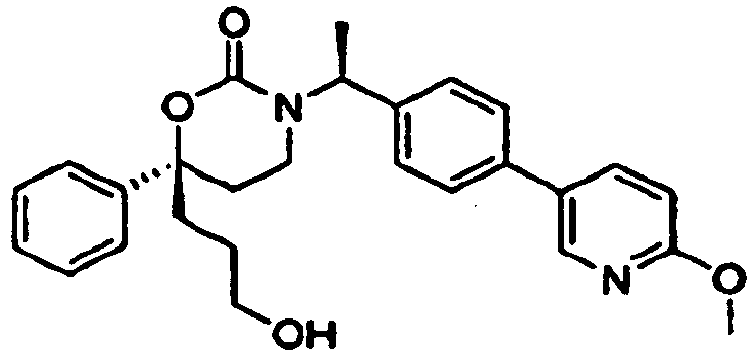
- The title compound was prepared from (R)-6-allyl-3-((S)-1-(4-bromophenyl)ethyl)-6-phenyl-1,3-oxazinan-2-one and 2-methoxypyridine-5-boronic acid using a procedure analogous to that described in Example 64 followed by a procedure analogous to that described in Example 78. LC-MS Method 3 tR = 1.22, min, m/z = 447; 1H NMR (CDCl3) 1.01 (d, 1 H), 1.10 (d, 1 H), 1.49 (s, 3 H), 1.85-1.95 (m, 1H), 2.00-2.07 (m, 1 H), 2.21-2.30 (m, 2 H), 2.40 (m, 1 H), 2.35 (m, 1 H), 3.87 (m,. 1 H), 3.90 (s, 3 H), 3.95 (m, 1 H), 5.61 (m, 1 H), 6.71 (d, 1 H), 6.83 (d, 1 H), 6.91 (m, 1 H), 7.16 (m, 2 H), 7.25 (m, 2 H), 7.31 (m, 3 H), 7.61 (d, 1 H), 8.22 (s, 1H).
-

- The title compound was prepared from (R)-6-(4-fluorophenyl)-6-(3-hydroxypropyl)-3-((S)-1-(4-(pyridin-3-yl)phenyl)ethyl)-1,3-oxazinan-2-one following a procedure analogous to that described in Example 234. LC-MS Method 2 tR = 1.372, min, m/z = 448.3; 1H NMR (CDCl3) 1.52 (d, 3H), 1.97 (m, 2H), 2.27-2.33 (m, 4H), 2.43 (m, 1H), 2.97 (m, 1H), 5.13 (s, 1H), 5.24 (s, 1H), 5.66 (m, 1H), 6.92-7.08 (m, 4H), 7.22 (m, 2H), 7.31 (m, 2H), 7.48 (m, 1H), 7.97 (m, 1H), 8.57 (m, 1H), 8.74 (m, 1H).
-

- The title compound was prepared from (R)-6-allyl-3-((S)-1-(4-bromophenyl)propyl)-6-phenyl-1,3-oxazinan-2-one and 4-fluorobenzeneboronic acid using a procedure analogous to that described in Example 64 followed by a procedure analogous to that described in Example 78. LC-MS Method 3 tR = 1.48, min, m/z = 448; 1H NMR (CDCl3) 0.99 (t, 3H), 1.28 (m, 1H), 1.62 (m, 1H), 1.91-2.08 (m, 4H), 2.25 (m, 1H), 2.34 (m, 1H), 2.42 (m, 1H), 3.08 (m, 1H), 3.46 (m, 2H), 5.39 (m, 1H), 7.02-7.16 (m, 4H), 7.22-7.42 (m, 7H), 7.51 (m, 2H).
-

- A mixture of (R)-6-allyl-3-((S)-1-(4-bromophenyl)ethyl)-6-phenyl-1,3-oxazinan-2-one (5.83 g, 15 mmol), 4-fluorophenylboronic acid (3 g, 22 mmol), PdCl2(PPh3)2 (1 g, 1.4 mmol), and aqueous Cs2CO3 solution (2 M, 8.0 mL) in 1,4-dioxane (50 mL) was heated to reflux for 2 h. The mixture was filtered, and the filtrate was extracted with EtOAc (3 x). The combined organic layer was washed with brine, dried over Na2SO4 and concentrated to give the crude product, which was purified by preparative TLC to give (R)-6-allyl-3-((S)-1-(4'-fluorobiphenyl-4-yl)ethyl)-6-phenyl-1,3-oxazinan-2-one (5.3 g, 88%).
- To a solution of (R)-6-allyl-3-((S)-1-(4'-fluorobiphenyl-4-yl)ethyl)-6-phenyl-1,3-oxazinan-2-one (3 g, 7.23 mmol) in acetone (20 mL) was added a solution of KMnO4 (685 mg, 4.34 mmol) and NalO4 (5.6 g, 26 mmol) in H2O (15 mL) dropwise at 0 °C. The mixture was stirred for 4 h. When TLC showed that the starting material had disappeared, the precipitate was removed by filtration, and the acetone was removed under reduced pressure. The resulting mixture was basified to pH=13 by the addition of 1 M aq NaOH, and then washed with ether (3 x 50 mL). The aqueous phase was acidified to pH=1 by addition of 1 N aq HCl, and extracted with CH2Cl2 (3 × 15 mL). The organic layers were combined, washed with brine, dried over Na2SO4 and concentrated in vacuo to give 2-((S)-3-((S)-1-(4'-fluorobiphenyl-4-yl)ethyl)-2-oxo-6-phenyl-1,3-oxazinan-6-yl) acetic acid (2.8 g, 90%).
- To a solution of 2-((S)-3-((S)-1-(4'-fluorobiphenyl-4-yl)ethyl)-2-oxo-6-phenyl-1,3-oxazinan-6-yi) acetic acid (1 g, 2.3 mmol) in MeOH (15 mL) was added thionyl chloride (408 mg, 3.5 mmol) dropwise at 0 °C under N2 atmosphere. After refluxing overnight, the mixture was concentrated to give the crude product, which was purified by chromatography to give methyl 2-((S)-3-((S)-1-(4'-fluorobiphenyl-4-yl)ethyl) -2-oxo-6-phenyl-1,3-oxazinan-6-yl) acetate (680 mg, 68%).
- To a solution of methyl 2-((S)-3-((S)-1-(4'-fluorobiphenyl-4-yl)ethyl)-2-oxo-6-phenyl -1,3- oxazinan-6-yl)acetate (180 mg, 0.4 mmol) in dry THF (5 mL) under N2 at -78 °C was added methylmagnesium bromide (1.5 mL, 3 M, 4.5 mmol) dropwise at - 78 °C. After addition, the mixture was stirred for 1 h at rt. Then the reaction was quenched with water and the mixture was extracted with ethyl acetate for three times (3 x 5 mL). The organic layers were combined, washed with brine, dried over Na2SO4, filtered and concentrated. The residue was purified by preparative HPLC to give (S)-3-((S)-1-(4'-fluorobiphenyl-4-yl)ethyl)-6-(2-hydroxy-2-methylpropyl)-6-phenyl-1,3-oxazinan-2-one (2.48 mg, 1%). 1H NMR (CDCl3): 1.05 (s, 1H), 1.13 (s, 3H), 1.50 (d, 3H), 2.14-2.23 (m, 2H), 2.25-2.40 (m, 1H), 2.80 (m, 1H), 5.63 (m, 1H), 6.94 (m, 2H), 7.02 (m, 2H), 7.18-7.30 (m, 7H), 7.38 (m, 2H). LC-MS Method 3 tR = 1.51, min, m/z = 448, 470.
-

- The title compound was prepared from (R)-6-allyl-3-((S)-1-(4-bromophenyl)propyl)-6-phenyl-1,3-oxazinan-2-one using AD-mix-beta following a procedure analogous to that described in Example 173. Two isomers were isolated.
- Isomer 1: LC-MS Method 3 tR = 1.2, min, m/z = 448, 472; 1H NMR (CDCl3) 0.96 (d, 3H), 1.93 (m, 2H), 2.04 (m, 2H), 2.22-2.41 (m, 2H), 2.50 (m, 2H), 3.04 (m, 1H), 3.38 (m, 1H), 3.42 (m, 2H), 5.28 (m, 1H), 6.85 (m, 2H), 7.24 (m, 2H), 7.35 (m, 5H).
- Isomer 2: LC-MS Method 3 tR = 1.18, min, m/z = 448, 472; 1H NMR (CDCl3) 0.99 (d, 3H), 1.93 (m, 2H), 2.04 (m, 2H); 2.22-2.41 (m, 2H), 2.70 (m, 1H), 3.04 (m, 1 H), 3.32 (m, 1H), 3.42 (m, 2H), 5.27 (m, 1H), 6.85 (m, 2H), 7.24 (m, 2H), 7.35 (m, 5H).
-
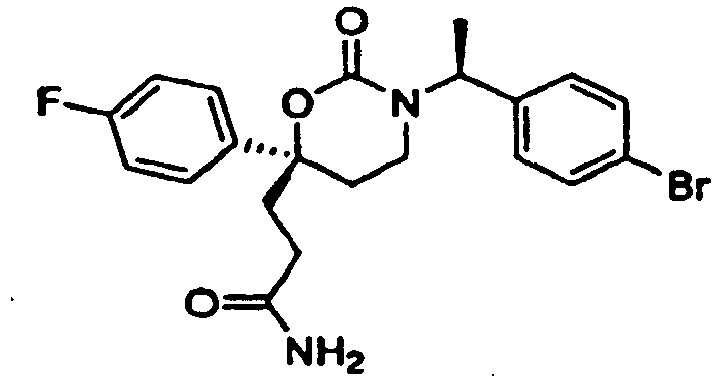
- The title compound was prepared from (R)-3-((S)-1-(4-bromophenyl)ethyl)-6-(4-fluorophenyl)-6-(3-hydroxypropyl)-1,3-oxazinan-2-one following a procedure analogous to that described in Example 234. LC-MS Method 3 tR = 1.18, min, m/z = 449, 451; 1H NMR (CDCl3) 1.49 (m, 3H), 1.91-2.00 (m, 1H), 2.11-2.32 (m, 5H), 2.46 (m, 1H), 2.90 (m, 1H), 5.31-5.55 (s, 2H), 5.61 (m, 1H), 6.81 (m, 2H), 7.02 (m, 2H), 7.22 (m, 2H), 7.28 (m, 2H).
-

- The title compound was prepared from (R)-6-allyl-3-((S)-1-(4-bromophenyl)propyl)-6-(4-fluorophenyl)-1,3-oxazinan-2-one following a procedure analogous to that described in Example 78. LC-MS Method 3 tR = 1.37, min, m/z = 450, 452, 472, 474; 1H NMR (CDCl3) 0.99 (t, 3H), 1.34 (m, 1H), 1.67 (m, 1H), 1.81-2.02 (m, 4H), 2.21 (m, 1H), 2.32 (m, 1H), 2.92 (m, 1H), 3.56 (t, 2H), 5.39 (m, 1H), 6.87 (d, 2H), 6.98 (m, 2H), 7.19 (m, 2H), 7.25 (d, 2H).
-

- To a solution of 2-((S)-3-((S)-1-(2',4'-difluorobiphenyl-4-yl)ethyl)-6-(4-fluorophenyl)-2-oxo- 1,3-oxazinan-6-yl)acetamide (60 mg, 0.128 mmol) in anhydrous CH2Cl2 (4 mL) and DIEA (0.3 mL) was added TFAA (55 mg, 0.256 mmol) at 0 □. The mixture was stirred for 2 h. The solvent was removed under reduced pressure, and the residue was purified by preparative TLC to afford 2-((S)-3-((S)-1-(2',4'-difluorobiphenyl-4-yl)ethyl)-6-(4-fluorophenyl)-2-oxo- 1,3-oxazinan-6-yl) acetonitrile (40 mg , 82%). LC-MS Method 3 tR = 1.52, min, m/z = 451, 473; 1H NMR (CDCl3): 1.56 (m, 3H), 2.40 (m, 2H), 2.54 (m, 1H), 2.82-2.98 (m, 2H), 3.04 (m, 1H), 5.64 (m, 1H), 6.83-6.94 (m, 5H), 7.09 (m, 2H), 7.21 (m, 1H), 7.28 (m, 1H), 7.37 (m, 2H).
-

- The title compound was prepared from 4-((S)-1-((R)-6-allyl-6-(4-fluorophenyl)-2-oxo-1,3-oxazinan-3-yl)ethyl)benzoic acid following a procedure analogous to that described in Example 153. LC-MS Method 1 tR = 1.72, min, m/z = 451; 1H NMR (CDCl3) 7.26(t, 2H), 7.13(d, 2H), 7.04(t, 2H), 5.73-5.60(m, 2H), 5.07(dd, 2H), 3.71(br s, 2H), 3.26(br s, 2H), 2.91(m, 1H), 2.59(m, 2H), 1.52(d, 5H).
-

- The title compound was prepared from (R)-6-allyl-3-((S)-1-(4-bromophenyl)ethyl)-6-(4-fluorophenyl)-1,3-oxazinan-2-one and 2,4-dimethylthiazole-5-boronic acid following a procedure analogous to that described in Example 64. LC-MS Method 1 tR = 1.82, min, m/z = 451; 1H NMR (CDCl3) 7.26(t, 2H), 7.13(d, 2H), 7.03(t, 2H), 6.91 (d, 2H), 5.76-5.64 (m, 2H), 5.06(dd, 2H), 2.98(m, 1H), 2.74(s, 3H), 2,42(s, 3H), 1.53(d, 3H).
-

- The title compound was prepared from (R)-6-allyl-3-((S)-1-(4'-fluorobiphenyl-4-yl)ethyl)-6-(4-fluorophenyl)-1,3-oxazinan-2-one following a procedure analogous to that described in Example 78. LC-MS Method 3 tR = 1.45, min, m/z = 452, 474; 1H NMR (CDCl3) 1.30 (m, 1H), 1.50 (m, 3H), 1.66 (m, 1H), 1.91 (m, 2H), 2.20 (m, 3H), 2.88 (m, 1H), 3.50 (m, 2H), 5.63 (m, 1 H), 6.90-7.09 (m, 6H), 7.18 (m, 1H), 7.23 (m, 3H), 7.40 (m, 2H).
- (R)-3-((S)-1-(4'-fluorobiphenyl-4-yl)ethyl)-6-(2-fluorophenyl)-6-(3-hydroxypropyl)-1,3-oxazinan-2-one

- 1-(2-Fluorophenyl)ethanone (170 g, 1.23 mol), dimethylamine (137 g, 1.72 mol), and paraformaldehyde (55 g, 1.85 mol) were suspended in ethanol (500 mL), then concentrated HCl (3 mL) was added, and the mixture was heated to reflux overnight. The solvent was removed under vacuum. The residue was washed with EtOAc for 3 times to give 3-(dimethylamino)-1-(2-fluorophenyl)propan-1-one (207 g, 88%), which was used for the next step without purification. 1H NMR (CDCl3): δ=2.69 (s, 6H), 2.52 (m, 4H), 7.30 (m, 2H), 7.66 (m, 1H), 7.96 (m, 1H).
- A solution of 3-dimethylamino-1-(2-fluoro-phenyl)-propan-1-one (17 g, 0.087 mol) and (S)-1-(4-bromophenyl)ethanamine (17 g, 0.087 mol) in EtOH (50 mL)/H2O (50 mL) was refluxed at 80 °C over night. The solvent was removed under vacuum. The residue was purified by column chromatography to afford (S)-3-(1-(4-bromophenyl)ethylamino)-1 -(2-fluorophenyl)propan-1-one (1 g, 3%).
- To a solution of (S)-3-(1-(4-bromophenyl)ethylamino)-1-(2-fluorophenyl)propan-1-one (500 mg, 1.43 mmol) in anhydrous CH3CN (15 mL) was added K2CO3 and methyl carbonochloridate (403 mg, 4.29 mmol), and the mixture was stirred at rt for 2h. The solution was concentrate, and the residue was purified by preparative TLC to afford (S)-methyl 1-(4-bromophenyl)ethyl(3-(2-fluorophenyl)-3-oxopropyl)carbamate (400 mg, 70%). 1H NMR (CDCl3): δ= 1.50 (m, 3H), 3.00 (m, 2H), 3.36 (m, 2H), 3.78 (m, 3H), 5.40 (m, 1H), 7.11 (m, 4H), 7.28-7.50 (m, 3H), 7.71 (m, 1H).
- To a solution of (S)-methyl-1-(4-bromophenyl)ethyl(3-(2-fluorophenyl)-3-oxopropyl)carb amate (400 mg, 1 mmol) in dry THF (10 mL) was added dropwise 1 M allylmagnesium bromide (20 mL) -78 °C. After addition completely, the mixture was allowed to stir at rt for 3 h. The reaction was quenched with saturated aq NH4Cl solution, and the solution was extract with EtOAc. The combined organic layer was washed with brine, dried over anhydrous Na2SO4 and concentrated to give methyl (S)-1-(4-bromophenyl)ethyl (3-(2-fluorophenyl)-3-hydroxyhex-5-enyl)carbamate (300 mg, 67%).
- To a suspension of NaH (55 g, 1.4 mmol) in THF (10 mL) at 0 °C was added a solution of methyl (S)-1-(4-bromophenyl)ethyl(3-(2-fluorophenyl)-3-hydroxyhex-5-enyl) carbamate (300 mg, 0.68 mmol) in THF (10 mL). The resulting mixture was stirred for 10 minutes, and then was refluxed for 1 h. The reaction was quenched with saturated aq NH4Cl solution, and the solution was extract with EtOAc. The combine organic layer washed with brine, dried over anhydrous Na2SO4 and concentrated. The residue was purified by preparative TLC to afford (R)-6-allyl-3-((S)-1-(4-bromophenyl)ethyl)-6-(2-fluorophenyl)-1,3-oxazinan- 2-one (100 mg, 35%) and (S)-6-allyl-3-((S)-1-(4-bromophenyl)ethyl)-6-(2-fluorophenyl)-1,3-oxazinan- 2-one (100 mg, 35%).
- A mixture of (R)-6-allyl-3-((S)-1-(4-bromophenyl)ethyl)-6-(2-fluorophenyl)-1,3-oxazinan -2-one (100 mg, 0.24 mmol) and 4-fluorophenylboronic acid (55 mg, 0.36 mmol), Pd(Ph3P)2Cl2 (20 mg), and aq Cs2CO3 solution (0.5 mL, 2 M) in 1,4-dioxane (10 mL) was stirred and heated to reflux for 2 h. The organic phase was separated, and concentrated to give the crude product, which was purified by preparative TLC to give (R)-6-allyl-3-((S)-1-(4'-fluorobiphenyl-4-yl)ethyl)-6-(2-fluorophenyl)-1,3-oxazinan-2-one (80 mg, 80%). 1H NMR (CDCl3): δ=1.49 (m, 3H), 2.13 (m, 1H), 2.32 (m, 1H), 2.50 (m, 1H), 2.69 (m, 2H), 2.89 (m, 1H), 5.00 (m, 2H), 5.75 (m, 2H), 6.91-7.10 (m, 6H), 7.15 (m, 1H), 7.22 (m, 2H), 7.38 (m, 2H), 7.48 (m, 1H).
- To a solution of (R)-6-allyl-3-((S)-1-(4'-fluorobiphenyl-4-yl)ethyl)-6-(2-fluorophenyl)-1,3- oxazinan-2-one (80 mg, 0.18 mmol) in THF (10 mL) was added BH3 THF (1.5 mL, I mol/L) at 0 °C under nitrogen. The formed mixture was stirred for 2 h. The reaction was quenched by water. Then aq NaOH (0.3 mL, 3 mol/L) solution and H2O2 (3 mL) was added to the above mixture. The resulting mixture was stirred for 1.5 h. The mixture was extracted with EtOAc, and the combined organic phase was concentrated to give the crude product, which was purified by preparative HPLC to give (R)-3-((S)-1-(4'-fluorobiphenyl-4-yl)ethyl)-6-(2-fluorophenyl)-6-(3-hydroxypropyl)-1,3-oxazinan-2-one (15 mg, 17%). LC-MS Method 2 tR = 1.48, min, m/z = 452.2; 1H NMR (CD3OD) 1.22-1.34 (m, 2H), 1.53 (d, 3H), 1.62-1.73 (m, 1H), 1.98-2.33 (m, 4H), 2.61 (d, 1H), 3.13 (m, 1H), 3.51 (m, 2H), 5.61 (m, 1H), 7.01-7.19 (m, 5H), 7.23 (m, 1H), 7.31-7.43 (m, 4H), 7.53 (m, 2H).
- (S)-3-((S)-1-(4'-fluorobiphenyl-4-yl)ethyl)-6-(2-fluorophenyl)-6-(3-hydroxypropyl)-1,3-oxazinan-2-one was prepared from (S)-6-allyl-3-((S)-1-(4-bromophenyl)ethyl)-6-(2-fluorophenyl)-1,3-oxazinan- 2-one following procedures analogous to those described in Steps 6 and 7 immediately above. LC-MS Method 3 tR = 1.531, min, m/z = 452.2; 1H NMR (CD3OD) 1.18-1.30 (m, 2H), 1.33 (d, 3H), 1.62-1.73 (m, 1H), 1.97-2.21 (m, 3H), 2.57-2.62 (d, 1H), 2.73-2.92 (m, 2H), 3.42-3.52 (m, 2H), 5.63 (m, 1H), 7.04-7.18 (m, 3H), 7.26 (m, 1H), 7.32-7.46 (m, 4H), 7.56-7.63 (m, 4H).
-

- The title compound was prepared from 3-chloro-1-(3-fluorophenyl)propan-1-one using a procedure analogous to that described in Example 95 followed by a procedure analogous to that described in Example 78. LC-MS Method 3 tR = 1.214, min, m/z = 452.1; 1H NMR (CDCl3) 1.36-1.42 (m, 1H), 1.53 (d, 3H), 1.92-2.08 (m, 2H), 2.17-2.38 (m, 3H), 2.96 (m, 1H), 3.58 (m, 1H), 3.78-3.93 (m, 2H), 4.23 (m, 1H), 5.69 (m, 1H), 6.92-7.13 (m, 7H), 7.21-7.37 (m, 4H), 7.41-7.47 (m, 2H).
-

- The title compound was prepared from (R)-3-((S)-1-(4'-fluorobiphenyl-4-yl)ethyl)-6-(3-hydroxypropyl)-6-phenyl-1,3-oxazinan-2-one using a procedure analogous to that described in Example 117. LC-MS Method 3 tR = 1.284, min, m/z = 484.1; 1H NMR (CDCl3) 1.03 (s, 3H), 1.04 (s, 3H), 1.11-1.21 (m, 1H), 1.46 (d, 3H), 1.58-1.67 (m, 1H), 1.84-2.02 (m, 2H), 2.09-2.31 (m, 3H), 2.84 (m, 1H), 5.61-5.68 (m, 1 H), 6.84-6.89 (m, 2H), 7.01-7.08 (m, 2H), 7.21 (m, 1H), 7.23 (m, 3H), 7.29 (m, 2H), 7.38 (m, 2H).
-

- The title compound was prepared from (R)-6-allyl-3-((S)-1-(4-bromophenyl)ethyl)-6-phenyl-1,3-oxazinan-2-one and 5-acetylthiophene-2-boronic acid using a procedure analogous to that described in Example 64 followed by a procedure analogous to that described in Example 78. LC-MS Method 3 tR = 1.26, min, m/z = 464, 486; 1H NMR (CDCl3) 1.46 (d, 3H), 1.63 (m, 2H), 1.92(m, 2H), 2.12(m, 1H), 2.26(t, 2H), 2.49(s, 3H), 2.85(m, 1H), 3.50(t, 2H), 5.60(q, 1H), 6.85(d, 2H), 7.20(m, 8H), 7.56(d, 1H).
-

- The title compound was prepared from (R)-3-((S)-1-(2',4'-diftuorobiphenyl-4-yl)ethyl)-6-(3-hydroxypropyl)-6-phenyl-1,3-oxazinan-2-one using a procedure analogous to that described in Example 234. LC-MS Method 3 tR = 1.3, min, m/z = 465;1H NMR (CDCl3): 1.51-1.60 (d, 3H), 1.91-2.03 (m, 1H), 2.12-2.38 (m, 5H), 2.46-2.57 (m, 1H), 2.88-2.97 (m, 1H), 5.32-5.54 (d, 2H), 5.63-5.74 (m, 1H), 6.82-6.93 (m, 2H), 6.94-7.02 (m, 2H), 7.19-7.22 (m. 1H), 7.27-7.38 (m, 6H).
-

- (R)-3-((S)-1-(4-(5-acetylthiophen-2-yl)phenyl)ethyl)-6-(3-hydroxypropyl)-6-phenyl-1,3-oxa- zinan-2-one (40 mg, 0.086 mmol) and tetraisopropoxytitanium (49 mg, 0.17 mmol) are stirred overnight in the solution of NH3 in EtOH. To this solution/paste was added NaBH4 and stirring another 24 h. The reaction was diluted with NH4OH and stirred for 1 h. The mixture was filtered through celite and rinsed with EtOAc. Water and EtOAc were added and the organic layer was separated. The aq layer is extracted with EtOAc for three times. The combined organic layer was dried over Na2SO4, filtered and concentrated to afford (6R)-3-((1S)-1-(4-(5-(1-aminoethyl)thiophen-2-yl)phenyl)ethyl)-6- (3-hydroxypropyl)-6-phenyl-1,3-oxazinan-2-one (1.26 mg, 3%). LC-MS Method 2 tR = 1.014, min, m/z = 448.1; 1H NMR (CDCl3, 400 MHz): 1.33 (m, 1H), 1.47 (q, 6H), 1.90 (m, 2H), 2.13 (m, 1H), 2.22 (m, 2H), 2.82 (m, 1H), 3.50 (m, 2H), 4.33 (q, 1H), 5.58 (q, 1H), 6.81 (m, 3H), 6.98 (d, 1H), 7.25 (m, 7H).
-

- The title compound was prepared from (R)-6-allyl-3-((S)-1-(4'-fluorobiphenyl-4-yl)propyl)-6-(4-fluorophenyl)-1,3-oxazinan-2-one using a procedure analogous to that in Example 78 LC-MS Method 3 tR = 1.48, min, m/z = 466, 488; 1H NMR (CDCl3) 1.02 (t, 3H), 1.44 (m, 1H), 1.68 (m, 2H), 1.90-2.06 (m, 4H), 2.23 (m, 2H), 2.34 (m, 1H), 2.98 (m, 1H), 3.58 (t, 2H), 5.5-48 (m, 1H), 6.97 (m, 2H), 7.02-7.12 (m, 4H), 7.18-7.23 (m, 2H), 7.31 (d, 2H), 7.46 (m, 2H).
-

- The title compound was prepared from (R)-6-allyl-3-((S)-1-(2',4'-difluorobiphenyl-4-yl)propyl)-6-phenyl-1,3-oxazinan-2-one using a procedure analogous to that in Example 78. LC-MS Method 3 tR = 1.5, min, m/z = 466; 1H NMR (CDCl3) 1.02 (t, 3H), 1.31 (m, 1H), 1.63 (m, 1H), 1.96-2.11 (m, 4H), 2.25 (m, 1H), 2.36 (m, 1H), 2.48 (m, 1H), 3.12 (m, 1H), 3.49 (m, 2H), 5.39 (m, 1H), 7.00-7.11 (m, 4H), 7.22-7.36 (m, 7H), 7.42 (m, 1H).
-

- LC-MS Method 2 tR = 2.13, min, m/z =466, 488; 1H NMR (CDCl3) 1.45(d, 2H), 1.56(d, 2H), 1.64(m, 2H), 1.90(m, 2H), 2.11(m, 1H), 2.21(m, 2H), 2.31 (s, 1H), 2.80(m, 1H), 3.49(t, 2H), 5.03(q, 1H), 5.57(q, 1H), 6.80(d, 2H), 6.84, (d, 1H), 6.98(d, 1H), 7.24(m, 7H).
-

- The title compound was prepared from (R)-6-allyl-3-((S)-1-(4-bromophenyl)propyl)-6-(4-fluorophenyl)-1,3-oxazinan-2-one using a procedure analogous to that described in Example 173. Two isomers were isolated.
- Isomer 1: LC-MS Method 3 tR = 1.175, min, m/z = 488.1; 1H NMR (CDCl3) 0.99 (t, 3H), 1.82-2.01 (m, 3H), 2.22-2.31 (m, 3H), 2.33-2.43 (m, 1 H), 2.96 (m, 1 H), 3.33 (m, 1H), 3.48 (m, 1 H), 3.79 (m, 1H), 5.38 (m, 1H), 6.88 (m, 2H), 7.03 (m, 2H), 7.19 (m, 2H), 7.28 (m, 2H).
- Isomer 2: LC-MS Method 3 tR = 1.186, min, m/z = 490.1; 1H NMR (CDCl3) 0.97-1.02 (m, 3H), 1.82-1.98 (m, 3H), 2.21-2.32 (m, 3H), 2.33-2.45 (m, 1H), 2.89-2.94 (m, 1H), 3.32 (m, 1H), 3.48 (m, 1H), 3.78 (m, 1H), 5.88 (m, 1H), 6.89 (m, 2H), 7.02 (m, 2H), 7.18 (m, 2H), 7.27(m, 2H).
-

- The title compound was prepared from (R)-3-((S)-1-(2',4'-difluorobiphenyl-4-yl)ethyl)-6-(4-fluorophenyl)-6-(3-hydroxypropyl)-1,3-oxazinan-2-one using procedures analogous to those described in Example 75 Steps 2 to 4. LC-MS Method 2 tR = 2.15, min, m/z = 469; 1H NMR (CDCl3) 1.42-1.51 (d, 3H), 1.51-1.54 (m, 1 H), 1.73-1.82 (m, 1H), 1.96-2.06 (m, 2H), 2.13-2.26 (m, 3H), 2.82-2.96 (m, 3H), 5.46-5.53 (m, 1 H), 6.79-6.98 (m, 6H), 7.10-7.14 (m, 2H), 7.22-7.27 (m, 2H), 8.13-8.29 (m, 2H).
-

- To a solution of (R)-6-(2-aminoethyl)-3-((S)-1-(2',4'-difluorobiphenyl-4-yl)ethyl)-6-(4-fluorophenyl)-1,3-oxazinan-2-one (150 mg, 0.33 mmol) and Et3N (83.3 mg, 0.825 mmol) in dichloromethane (5 mL) was added di-tert-butyl dicarbonate(85.5 mg, 0.4 mmol) at 0~5 °C. The resulting mixture was stirred at rt overnight. The solid was filtered and the resulting filtrate was washed with 5% HCl, extracted with CH2Cl2 give the organic layer which was concentrated to give tert-butyl 2-((R)-3-((S)-1-(2',4'-difluorobiphenyl-4-yl)ethyl)-6-(4-fluorophenyl)-2-oxo-1,3-oxazinan-6-yl)ethylcarbamate (53 mg, 29%).
- To a solution of tert-butyl 2-((R)-3-((S)-1-(2',4'-difluorobiphenyl-4-yl)ethyl)-6-(4-fluoroph enyl)-2-oxo-1,3-oxazinan-6-yl)ethylcarbamate (53 mg, 0.1 mmol) in tetrahydrofuran was added NaH (300 mg, 12.5 mmol) at 0 °C. The mixture was stirred at 0 °C for 1 h. Then iodomethane (1.3 g, 9.15 mmol) was added to the above mixture and the mixture was stirred for 2 h. The reaction was quenched with H2O and extracted with EtOAc to give the organic layer which was washed with brine, dried over Na2SO4 and filtered. The filtrate was concentrated to give tert-butyl 2-((R)-3-((S)-1-(2',4'-difluorobiphenyl-4-yl)eth yl)-6-(4-fluorophenyl)-2-oxo-1,3-oxazinan-6-yl)ethyl(methyl)carbamate (36 mg, 66%).
- A solution of tert-butyl 2-((R)-3-((S)-1-(2',4'-difluorobiphenyl-4-yl)ethyl)-6-(4-fluorophen yl)-2-oxo-1,3-oxazinan-6-yl)ethyl(methyl)carbamate (73 mg, 0.13 mmol) in TFA/CH2Cl2 (20%, 6 mL) was stirred at 0 °C for 1 h. After the material was consumed, the solution was concentrated to give residue, which was purified by preparative TLC followed by preparative HPLC to give (R)-3-((S)-1-(2',4'-difluorobiphenyl-4-yl)ethyl)-6-(4-fluorophenyl)- 6-(2-(meth ylamino)ethyl)-1,3-oxazinan-2-one (13 mg, 21 %). LC-MS Method 3 tR = 1.1 0, min, m/z = 469; 1H NMR (CDCl3): 1.50 (d, 3H), 2.25 (m, 4H), 2.37 (m, 1H), 2.60 (m, 3H), 2.81 (m, 1H), 2.98 (m, 2H) 6.85 (m, 2H), 7.00 (m, 4H), 7.18 (m, 2H), 7.28 (m, 3H).
-

- (R)-6-Allyl-3-((S)-1-(4-bromophenyl)ethyl)-6-(4-fluorophenyl)-1,3-oxazinan-2-one (20mg, 0.048mmol), 3-(tritluoromethyl)-1H-pyrazole (20mg, 3equiv.). Cul (1.4mg, 15%mol), (1R, 2R)-(-)-1,2-transcyclohexanediamine (2mg, 30%mol), K3PO4 (20mg, 2equiv.) were mixed with dry toluene (2mL) and heated in Microwave Oven for 1h at 130°C. LC-MS found product peak. The mixture was diluted with EtOAc (8 mL), washed by water (2 mL), brine (3 mL) and dried over Na2SO4. After filtration and concentration, the residue was purified chromatography on a 4-g silica gel cartridge eluted with a gradient from 5 to 55% EtOAc in gexanes to afford (R)-6-allyl-6-(4-fluorophenyl)-3-((S)-1-(4-(3-(trifluoromethyl)-1H-pyrazol-1-yl)phenyl)ethyl)-1,3-oxazinan-2-one (9.7 mg, 43%) product. LC-MS Method 1 tR = 2.05, min, m/z = 474; 1H NMR (CDCl3) 7.86(s, 1H), 7.43(d, 2H), 7.26(t, 2H), 7.01(dd, 2H), 6.69(d, 1H), 5.76-5.64(m, 2H), 5.05(dd, 2H), 2.95(m, 1H), 2.65-2.51 (m, 2H), 1.54(d, 3H).
-

- The title compound was prepared from (S)-3-((S)-1-(4-bromophenyl)ethyl)-6-(4-fluorophenyl)-6-(2-hydroxyethyl)-1,3-oxazinan-2-one and 1,1-dioxo-hexahydro-1,2-thiazine following a procedure analogous to that described in Example 228. LC-MS Method 1 tR = 1.35, min, m/z = 477; 1H NMR (CD3OD) 7.26-7.22 (m, 2H), 7.05-7.01 (m, 4H), 6.87 (d, J = 8.5 Hz, 2H), 5.45 (q, J = 7.0 Hz, 1H), 3.61-3.55 (m, 4H), 3.15-3.12 (m, 2H), 3.05-3.01 (m, 1H), 2.44-2.40 (m, 1H), 2.24-2.17 (m, 4H), 2.04 (t, J = 7.2 Hz, 2H), 1.83-1.77 (m, 2H), 1.44 (d, J = 7.0 Hz, 3H).
-

- The title compound was prepared from (R)-3-((S)-1-(2',4'-difluorobiphenyl-4-yl)ethyl)-6-(3-hydroxypropyl)-6-phenyl-1,3-oxazinan-2-one following a procedure analogous to that described in Example 117. LC-MS Method 3 tR = 1.561, min, m/z = 436.3; 1H NMR (CDCl3) 1.11 (s, 3H), 1.13 (s, 3H), 1.18-1.27 (m, 1H), 1.53 (d, 3H), 1.61-1.72 (m, 1H), 1.91-2.06 (m, 2H), 2.16-2.24 (m, 1H), 2.27-2.38 (m, 2H), 2.91 (m, 1H), 5.68-5.72 (m,1H), 6.82-6.97 (m, 4H), 7.19 (m, 2H), 7.23-7.36(m, 6H).
-

- The title compound was prepared from (R)-6-allyl-3-((S)-1-(4-bromophenyl)propyl)-6-(4-fluorophenyl)-1,3-oxazinan-2-one and 2,4-difluorobenzeneboronic acid using a procedure analogous to that described in Example 64 followed by a procedure analogous to that described in Example 78. LC-MS Method 3 tR = 1.49, min, m/z = 484; 1H NMR (CDCl3) 1.01 (t, 3H), 1.34 (m, 1 H), 1.68 (m, 2H), 1.89-2.04 (m, 4H), 2.23 (m, 2H), 2.34 (m, 1H), 2.98 (m, 1H), 3.58 (t, 2H), 5.49 (t, 1H), 6.85-6.98 (m, 4H), 7.09 (d, 2H), 7.21 (m, 2H), 7.25-7.31 (m, 3H).
-

- To a solution of (S)-3-((S)-1-(2',4'-difluorobiphenyl-4-yl)ethyl)-6-(4-fluorophenyl)-6- (2-hydroxyethyl)-1,3-oxazinan-2-one (250 mg, 0.55 mmol) in methylene chloride (10 mL) was added pyridine (0.5 mL) and PBr3 (75 mg). The formed mixuture was stirred for 2 h. The mixture was washed with water. The organic phase was separated, and concentrated to give the crude product, which was purified by preparative TLC to afford (S)-6-(2-bromoethyl)-3-((S)-1-(2',4'-difluorobiphenyl-4-yl)ethyl)-6-(4-fluorophenyl)-1,3-oxazinan-2-one (60 mg, 23%). 1H NMR: (400MHz, CDCl3): δ=1.45 (d, 3H), 2.12-2.38 (d, 4H), 2.43 (m, 1H), 2.94 (m, 2H), 3.49 (m, 1H), 5.22 (m, 1H), 6.83 (m, 2H), 6.95 (m, 4H), 7.19 (m, 1H), 7.22 (m, 2H).
- To a solution of (S)-6-(2-bromoethyl)-3-((S)-1-(2',4'-difluorobiphenyl-4-yl)ethyl)-6- (4-fluorophenyl)-1,3-oxazinan-2-one (30 mg, 0.058 mmol) in tetrahydrofuran (10 mL) was added CH3SNa (0.5 mL). The formed mixture was stirred overnight. The mixture was washed with water. The organic phase was separated, and concentrated to give the crude product, which was purified by preparative TLC to afford (S)-3-((S)-1- (2',4'-difluorobiphenyl-4-yl)ethyl)-6-(4-fluorophenyl)-6-(2-(methylthio)ethyl)-1,3-oxazinan-2-one (20 mg, 71%). LC-MS Method 3 tR = 1.74, min, m/z = 486, 508; 1H NMR: (400MHz, CDCl3): δ=1.48 (d, 3H), 1.96 (m, 2H), 2.02 (m, 1H), 2.11-2.31 (m, 6H), 2.61 (m, 1H), 2.90 (m, 1H), 5.64 (q, 1 H), 6.80-6.90 (m, 2H), 6.92-6.98 (m, 4H), 7.18 (m, 2H), 7.26 (m, 2H).
- 1-(2-((R)-3-(S)-1-(2',4'-difluorobiphenyl-4-yl)ethyl)-6-(4-fluorophenyl)-2-oxo-1,3-oxazinan-6-yl)ethyl)urea

- To a solution of (R)-6-(2-aminoethyl)-3-((S)-1-(2',4'-difluorobiphenyl-4-yl)ethyl)-6-(4-fluoro- phenyl)-1,3-oxazinan-2-one (30 mg, 0.065 mmol) and urea (16 mg, 0.26 mmol) in H2O (3 mL) was added concentrated HCl (0.05 mL), and the mixture was refluxed overnight. The reaction mixture was crystallized by standing at rt. The precipitate was filtered and rinsed well with water to give 1-(2-((R)-3-((S)-1-(2',4'-difluorobiphenyl-4-yl)ethyl)-6-(4-fluorophenyl)-2-oxo-1,3-oxazinan-6-yl)ethyl)urea (20 mg, 68%). LC-MS Method 3 tR = 1.3, min, m/z = 498; 1H NMR (CDCl3): 1.54-1.60 (d, 3H), 2.01-2.09 (m, 1H), 2.22-2.41 (m, 4H), 2.91-3.14 (m, 2H), 3.35-3.44 (m, 1H), 5.56-5.62 (s, 1H), 5.63-5.71 (m, 1H), 6.87-6.99 (m, 2H), 7.01-7.12 (m, 3H), 7.22-7.31 (m, 2H), 7.32-7.48 (m, 3H).
-

- (S)-3-((S)-1-(2',4'-difluorobiphenyl-4-yl)ethyl)-6-(4-fluorophenyl)-6-(2-hydroxyethyl)-1,3-oxazinan-2-one (50 mg, 0.11 mmol) was dissolved in CH2Cl2 (3 mL), followed by the addition of TEA (1 mL) and 4-nitrophenyl carbonochloridate (88 mg, 0.44 mmol). The mixture was stirred at rt overnight. Aqueous ammonia (2 mL) was added and the mixture was stirred at rt for 3 h. After separation of the water layer, the organic layer was washed with brine, dried over Na2SO4, and concentrated in vacuo to give the crude product, which was purified by preparative TLC to afford 2-((S)-3-((S)-1-(2',4'-difluorobiphenyl-4-yl)ethyl)-6-(4-fluorophenyl)-2-oxo-1,3-oxazinan-6-yl)ethyl carbamate (20 mg, 35%). LC-MS Method 3 tR = 1.36, min, m/z = 499; 1H NMR (CDCl3): 1.48 (m, 3H), 2.14-2.33 (m, 5H), 2.91(m, 1H), 3.42 (s, 1H), 3.95 (m, 1H), 4.07 (m, 1H), 4.62 (s, 2H), 5.61 (m, 1H), 6.79-7.01 (m, 6H), 7.23 (m, 5H).
-

- To a solution of (R)-6-allyl-3-((S)-1-(2',4'-difluorobiphenyl-4-yl)ethyl)-6-(4-fluorophenyl)-1,3 -oxazinan-2-one (900 mg, 2.0 mmol) in dry CH2Cl2 (30 mL) was added dropwise 3-chlorobenzoperoxoic acid (690 mg, 4.0 mmol) by portion at 0 °C. Then the reaction mixture was stirred overnight at ambient temperature. The reaction mixture was quenched by 10% Na2SO3 solution. The organic phase was dried over Na2SO4, filtered and concentrated to afford the residue, which was purified by TLC to give (6S)-3-((S)-1-(2',4'-difluorobiphenyl-4-yl)ethyl)-6-(4-fluorophenyl)-6-(oxiran-2-ylmethyl)-1,3-oxazinan-2-one (470 mg, 50%). 1H NMR (CDCl3): 1.54 (m, 3H), 1.71 (m, 3H), 2.01 (m, 1H), 2.15 (m, 3H), 2.48 (m, 2H), 2.67 (m, 1H), 3.00 (m, 1H), 5.67 (m, 1 H), 6.84 (m, 4H), 7.02 (m, 2H), 7.21 (m, 4H), 7.31 (m, 1H).
- To a solution of (6S)-3-((S)-1-(2',4'-difluorobiphenyl-4-yl)ethyl)-6-(4-fluorophenyl)-6-(oxiran -2-ylmethyl)-1,3-oxazinan-2-one (135 mg, 0.289 mmol) in MeOH (2 mL) was added methylamine alcohol solution (2 mL, 25 mmol) at 0 □. Then the mixture was stirred overnight at ambient temperature. The reaction mixture was concentrated to give the residue, which was purified by preparative HPLC to give (6S)-3-((S)-1-(2',4'-difluorobiphenyl-4-yl) ethyl)-6-(4-fluorophenyl)-6-(2-hydroxy-3-(methylamino)propyl)-1,3-oxazinan-2-one (23 mg, 16%). 1H NMR (CDCl3): 1.52 (m, 3H), 1.81 (m, 2H), 2.03 (m, 6H), 2.28 (m, 2H), 2.63 (m, 3H), 2.51 (m, 2H), 2.95 (m, 1H), 3.46 (m, 1H), 5.64 (m, 1H), 6.85 (m, 4H), 7.01 (m, 2H), 7.22 (m, 4H), 7.32 (m, 1H).
-

- To a solution of (S)-3-((S)-1-(2',4'-difluorobiphenyl-4-yl)ethyl)-6-(4-fluorophenyl)-6-(2-hydro -xyethyl)-1,3-oxazinan-2-one (100 mg, 0.22 mmol) in THF (5 mL) was added NaH (30 mg, 1.10 mmol) at 0 °C. After stirring for 1 h, allyl bromide (79 mg, 0.66 mmol) was added, and the mixture was stirred at rt overnight. The reaction was quenched with water, and extracted with EtOAc. The combined organic layers were washed with brine, dried over Na2SO4, filtered and concentrated. The residue was purified by preparative TLC to give (S)-6-(2-(allyloxy)ethyl)-3-((S)-1-(2',4'-difluorobiphenyl-4-yl)ethyl)-6-(4-fluorophenyl) -1,3-oxazinan-2-one (100 mg, 92%) 1H NMR (CDCl3): 1.47-1.59 (d, 3H), 2.05-2.15 (m, 2H), 2.21-2.38 (m, 3H), 2.88-2.93 (m, 1H), 3.12-3.19 (m, 1H), 3.52-3.59 (m, 1H). 3.62-3.85 (m, 2H), 5.03-5.18 (m, 2H), 5.61-5.69 (m, 1H), 5.71-5.81 (m, 1H), 6.81-6.92 (m, 3H), 6.92-7.01 (m, 2H), 7.13-7.20 (m, 4H), 7.21-7.26 (m, 3H).
- A solution of (S)-6-(2-(allyloxy)ethyl)-3-((S)-1-(2',4'-difluorobiphenyl-4-yl)ethyl)-6-(4- fluorophenyl)-1,3-oxazinan-2-one (100 mg, 0.20 mmol) in CH2Cl2 (10 mL) was treated with O3 at -78 °C till the mixture was turned blue. Then NaBH4 (50 mg, 1.0 mmol) was added, and the mixture was stirred at rt overnight. The solution was concentrated and the residue was purified by preparative HPLC to give (S)-3-((S)-1-(2',4'-difluorobiphenyl- 4-yl)ethyl)-6-(4-fluorophenyl)-6-(2-(2-hydroxyethoxy)ethyl)-1,3-oxazinan-2-one (40 mg, 30%). LC-MS Method 3 tR = 1.41, min, m/z = 500, 522; 1H NMR (CDCl3): 1.48-1.61 (d, 3H), 1.92-2.05 (m, 2H), 2.09-2.41 (m, 5H), 2.88-3.02 (m, 1H), 3.27-3.56 (m, 2H), 3.58-3.69 (m, 2H), 5.63-5.72 (m, 1 H), 6.82-7.08 (m, 6H), 7.17-7.34 (m, 5H).
-

- A mixture of 2-((S)-3-((S)-1-(2',4'-difluorobiphenyl-4-yl)ethyl)-6-(4-fluorophenyl)-2-oxo-1,3- oxazinan-6-yl)ethyl methanesulfonate (230 mg, 0.43 mmol), imidazole (44 mg, 0.65 mmol), K2CO3 (178.7 mg, 1.29 mmol) in acetonitrile (4 mL) was heated to reflux overnight. The solvent was removed and the residue was partitioned between EtOAc and water. The aqueous layer was extracted with EtOAc and the combined organic layer was washed with brine, dried over Na2SO4, filtered and concentrated to give the crude product, which was purified by preparative HPLC to give (R)-3-[(S)-1-(2',4'-difluoro-biphenyl-4-yl)-ethyl]-6-(4- fluoro-phenyl)-6-(2-imidazol-1-yl-ethyl)-[1,3]oxazinan-2-one (2.5 mg, 1.2%). LC-MS Method 2 tR = 2.14, min, m/z = 506; 1H NMR (CDCl3): 1.51 (d, 3H), 2.16-2.63 (m, 7H), 2.94 (m, 2H), 3.91 (m, 1 H), 4.32 (m, 1H), 5.66 (m, 1H), 6.25 (m, 1H), 6.81-6.90 (m, 2H), 6.94-7.08 (m, 5H), 7.14 -7.26(m, 6H).
-

- To a solution of 3-((R)-3-((S)-1-(2,4'-difluorobiphenyl- 4-yl)ethyl)-6-(4-fluorophenyl)-2-oxo- 1,3-oxazinan-6-yl) propanenitrile (40 mg, 0.086 mmol) in anhydrous toluene (3 mL) was added Me3SnN3 (89 mg, 0.43 mmol) at 0 °C. The mixture was refluxed overnight. The solvent was removed under reduced pressure and the residue was purified by preparative TLC to afford (R)-6-(2-(1H-tetrazol-5-yl)ethyl)-3-((S)-1-(2',4'-difluorobiphenyl-4-yl)ethyl)-6- (4-fluorophenyl)-1,3-oxazinan-2-one (10 mg, yield: 22%). 1H NMR (CDCl3): 1.20 (m, 3H), 1.73-1.88 (m, 1H), 1.91-2.07 (m, 4H), 2.20-2.31 (m, 1H), 2.58-2.77 (m, 2H), 5.43 (m, 1H), 6.67-6.90 (m, 7H), 7.01 (m, 2H), 7.11 (m, 2H), 7.18 (m, 1H).
-

- To a solution of (R)-6-(2-aminoethyl)-3-((S)-1-(2',4'-difluorobiphenyl-4-yl)ethyl)-6-(4- fluorophenyl)-1,3-oxazinan-2-one (120 mg, 0.264 mmol) and pyridine (41 mg, 0.528 mmol) in anhydrous CH2Cl2 (5 mL) was dropwise added acetic anhydride (30 mg, 0.291 mmol) in anhydrous CH2Cl2 (5 mL) at 0 °C under nitrogen. The above mixture was allowed to stir for overnight at ambient temperature. The mixture was diluted with CH2Cl2 and washed with water. The organic layer was dried over Na2SO4 and concentrate to give the crude product, which was purified by preparative TLC to give N-(2-((R)-3-((S)-1-(2',4'-difluorobiphenyl-4- yl)ethyl)-6-(4-fluorophenyl)-2-oxo-1,3-oxazinan-6-yl)ethyl)acetamide (60 mg, 46%).
- A solution of N-(2-((R)-3-((S)-1-(2',4'-difluorobiphenyl-4-yl)ethyl)-6-(4-fluorophenyl)-2-oxo- 1,3-oxazinan-6-yl)ethyl)acetamide (60 mg, 0.121 mmol) in tetrahydrofuran anhydrous (5 mL) was added sodium hydride (15 mg, 0.605 mmol) at 0 °C and then stirred for 30 minutes at the same temperature. Iodomethane (86 mg, 0.605 mmol) was then added to the above mixture. The reaction mixture was stirred at rt for a further 8 h. The reaction mixture was poured into ice/water and extracted with EtOAc. The combined organic phases were dried over Na2SO4, filtered and concentrated to afford the residue, which was purified by TLC and separated by preparative HPLC to give N-(2-((R)-3-((S)-1- (2',4'-difluorobiphenyl-4-yl)ethyl)-6-(4-fluorophenyl)-2-oxo-1,3-oxazinan-6-yl)ethyl)-N-methylacetamide (9 mg, 15%). LC-MS Method 3tR = 1.43, min, m/z = 511; 1H NMR (CDCl3): 1.26 (m, 1H), 1.56 (m, 3H), 1.96 (m, 1H), 2.04 (m, 3H); 2:22 (m, 4H), 2.83 (m, 1H), 2.94 (m, 3H), 3.36 (m, 1H), 5.69 (m, 1 H), 6.87 (m, 2H), 7.04 (m, 4H), 7.26 (m, 5H).
-

- The title compound was prepared from (R)-6-(3-aminopropyl)-3-((S)-1-(4'-fluorobiphenyl-4-yl)ethyl)-6-phenyl-1,3-oxazinan-2-one following a procedure analogous to that described in Example 99. LC-MS Method 3 tR = 1.396, min, m/z = 511.3; 1H NMR (CDCl3) 1.23-1.34 (m, 1H), 1.51 (d, 3H), 1.61-1.68 (m, 1H), 1.89-1.93 (m, 3H), 2.19-2.32 (m, 3H), 2.82 (s, 3H), 2.83-2.92 (m, 1H), 3.03 (m, 2H), 4.22 (s, 1 H), 5.63 (m, 1H), 6.93 (m, 2H), 7.01-7.08 (m, 2H), 7.20-7.23 (m, 5H), 7.31 (m, 2H), 7.33 (m, 2H).
-

- The title compound was prepared from (R)-6-(3-aminopropyl)-3-((S)-1-(2',4'-difluorobiphenyl-4-yl)ethyl)-6-(4-fluorophenyl)-1,3-oxazinan-2-one following a procedure analogous to that described in Example 263. LC-MS Method 3 tR = 1.32, min, m/z = 512; 1H NMR (CD3OD) 1.44-1.53 (m, 1H), 1.62-1.73 (d, 3H), 1.97-2.09 (m, 2H), 2.31-2.38 (m, 1 H), 2.43-2.52 (m, 1H), 2.54-2.63 (m, 1H), 3.13-3.18 (m, 2H), 3.13-3.28 (m, 1H), 4.71 (s, 1H), 5.68-5.76 (m, 1H), 7.12-7.24 (m, 5H), 7.36-7.49 (m, 4H), 7.49-7.58 (m, 1H).
-

- The title compound was prepared from (R)-3-((S)-1-(2',4'-difluorobiphenyl-4-yl)ethyl)-6-(4-fluorophenyl)-6-(3-hydroxypropyl)-1,3-oxazinan-2-one following a procedure analogous to that described in Example 264. 1H NMR (CD3OD) 1.31 (m, 1H), 1.46 (m, 3H), 1.62 (m, 1H), 1.86 (m, 2H), 2.13 (m, 1 H), 2.24 (m, 1H), 2.39 (m, 1H), 3.02 (m, 1H), 3.21 (m, 1H), 3.83 (m, 2H), 5.49 (m, 1H), 6.98 (m, 6H), 7.21 (m, 4H), 7.31 (m, 1H).
-

- The title compound was prepared from (6S)-3-((S)-1-(2',4'-difluorobiphenyl-4-yl)ethyl)-6-(4-fluorophenyl)-6-(oxiran-2-ylmethyl)-1,3-oxazinan-2-one and dimethylamine following a procedure analogous to that described in Example 265 Step 2. Two isomers were isolated.
- Isomer 1: LC-MS Method 3 tR = 1.1, min, m/z = 513; 1H NMR (CD3OD) 1.46 (m, 3H), 1.81 (m, 1H), 2.95 (m, 2H), 2.08 (m, 6H), 2.22 (m, 2H), 2.38 (m, 1H), 3.01 (m, 1H), 3.83 (m, 1H), 5.49 (m, 1H), 6.91 (m, 4H), 7.01 (m, 2H), 7.24 (m, 2H), 7.30 (m, 3H).
- Isomer 2: LC-MS Method 3 tR = 1.09, min, m/z = 513; 1 H NMR (CD3OD) 1.46 (m, 3H), 1.95 (m, 2H), 2.19 (m, 6H), 2.22 (m, 3H), 2.33 (m, 1H), 2.60 (m, 1H), 3.05 (m, 1H), 3.43 (m, 1H), 5.48 (m, 1H), 6.89 (m, 4H), 7.00 (m, 2H), 7.17 (m, 2H), 7.30 (m, 3H).
-

- A mixture of 2-((S)-3-((S)-1-(2',4'-difluorobiphenyl-4-yl)ethyl)-6-(4-fluorophenyl)-2-oxo-1,3- oxazinan-6-yl)ethyl methanesulfonate (40 mg, 0.07 mmol), 1H-imidazol-2-amine (18 mg, 0.21 mmol), K2CO3 (29 mg, 0.21 mmol) in acetonitrile (4 mL) was heated to reflux overnight. The solvent was removed and the residue was partitioned between EtOAc and water. The aqueous layer was extracted with EtOAc and the combined organic layer was washed with brine, dried over Na2SO4, filtered and concentrated to give the crude product. It was purified by preparative HPLC to give (R)-6-(2-(1H-imidazol-2-ylamino)ethyl)-3-((S)-1-(2',4'-difluorobiphenyl-4-yl)ethyl)-6-(4-fluorophenyl)-1,3-oxazinan-2-one (7 mg, 17%). LC-MS Method 3 tR = 1.15, min, m/z = 521; 1H NMR (CDCl3): 1.55 (m, 3H), 2.16-2.33 (m, 7H), 2.94 (m, 1H), 3.56 (m, 1H), 4.02 (m, 1H), 5.66 (m, 1H), 6.25 (m, 1 H), 6.52 (m, 1H), 6.90 (m, 2H), 7.04 (m, 4H), 7.18 (m, 2H), 7.26 (m, 3H).
-

- The title compound was prepared from (R)-6-(3-aminopropyl)-3-((S)-1-(2',4'-difluorobiphenyl-4-yl)ethyl)-6-(4-fluorophenyl)-1,3-oxazinan-2-one following a procedure analogous to that described in Example 141. LC-MS Method 3 tR = 1.38, min, m/z = 526; 1H NMR (CDCl3) 1.28-1.41 (m, 1H), 1.42-1.53 (d, 3 H), 1.81-1.92 (m, 2H), 2.09-2.31 (m, 4H), 2.72 (s, 3H), 2.84-2.93 (m, 1 H), 3.04-3.12 (m, 2 H), 5.56-5.65 (m, 1H), 6.80-6.91 (m, 2H), 6.92-6.99 (m, 3H), 7.12-7.19 (m, 2H), 7.21-7.29 (m, 3H).
-

- To a solution of (6S)-6-(3-amino-2-hydroxypropyl)-3-((S)-1-(2',4'-difluorobiphenyl-4-yl)ethyl)-6-(4-fluorophenyl)-1,3-oxazinan-2-one (300 mg, 0.62 mmol) in H2O (10 mL) was added HCl (12 N, 0.05 mL), urea (372 mg, 6.2 mmol) and EtOH (2 mL). Then the mixture was heated to reflux overnight. The reaction mixture was cooled to rt and adjusted pH to 9-10 by saturated NaHCO3 solution. The mixture was concentrated and extracted by CH2Cl2. The combined organic layer was dried and concentrated to give the residue, which was purified by preparative HPLC followed by chiral preparative HPLC to give two isomers.
- Isomer 1 (51 mg, 16%): 1H NMR (CD3OD): 1.59 (d, 3H), 2.02 (m, 2H), 2.31 (m, 1H), 2.49 (m, 2H), 2.93 (m, 1 H), 3.14 (m, 2H), 3.81 (m, 1H), 4.62 (s, 3H), 5.59 (q, 1H), 7.00∼7.14 (m, 6H), 7.29∼7.46 (m, 5H). 445-018-1P.
- Isomer 2 (23 mg, 7%): LC-MS Method 3 tR = 1.28, min, m/z = 528; 1H NMR (CD3OD): 1.59 (d, 3H), 2.06 (m, 2H), 2.31 (m, 1H), 2.45 (m, 1H), 2.72 (m, 1H), 3.09 (m, 1H), 3.15 (m, 2H), 3.49 (m, 1H), 4.62 (s, 3H), 5.59 (q, 1H), 6.98∼7.14 (m, 6H), 7.29 (m, 2H), 7.45 (m, 3H).
-

- Methanesulfonamide (57 mg, 0.60 mmol), K2CO3 (41 mg, 0.30 mmol) and (C4H9)4NHSO4 (101 mg, 0.30 mmol) were added into a solution of 3-[1-4-fluoro-biphenyl-4-yl]-ethyl]-6- (4-fluoro-phenyl)-6-oxiranylmethyl-[1,3]oxazinan-2-one (70 mg, 0.15 mmol) with 1,4- dioxane (10 mL) as solvents. Then the reaction mixture was refluxed for 6 h. After the solvents were evaporated, the crude product was purified by preparation HPLC to give two isomers.
- Isomer 1: (3.4 mg, 4%): LC-MS Method 3 tR = 1.156, min, m/z = 545.1; 1H NMR (CDCl3): 1.48 (m, 3H), 1.86-1.91 (m, 2H), 2.18 (m, 1H), 2.22 (m, 2H), 2.86 (m, 3H), 2.91 (m, 2H), 3.06 (m, 1 H), 3.71 (m, 2H), 4.72 (m, 1H), 5.61 (m, 1H), 6.94-7.08 (m, 6H), 7.23 (m, 2H), 7.25 (m, 2H), 7.38 (m, 2H).
- Isomer 2: (12.3 mg, 16%). LC-MS Method 3 tR = 1.152, min, m/z = 545.1; 1H NMR (CDCl3): 1.49 (m, 3H), 2.02-1.11 (m, 2H), 2.21-2.29 (m, 3H), 2.91 (m, 3H), 3.07 (m, 1H), 3.23 (m, 1H), 3.75 (m, 2H), 5.08 (m, 1H), 5.61 (m, 1H), 6.94 (m, 2H), 7.08 (m, 4H), 7.26 (m, 2H), 7.41 (m, 2H).
-

- The title compound was prepared from 3-[1-4-fluoro-biphenyl-4-yl]-ethyl]-6-(4-fluoro-phenyl)-6-oxiranylmethyl-[1,3]oxazinan-2-one and N-methyl methanesulfonamide using a procedure analogous to that described in Example 277. Two isomers were isolated.
- Isomer 1: LC-MS Method 3 tR = 1.409, min, m/z = 559.1; 1H NMR (CDCl3) 1.49 (d, 3H), 1.96-2.08 (m, 3H), 2.17-2.38 (m, 3H), 2.69 (m, 5H), 2.68-3.04 (m, 3H). 3.12 (s, 1 H), 3.68 (m, 1H), 5.62 (m, 1H), 6.92-7.07 (m, 5H), 7.22 (m, 5H), 7.39 (m, 2H).
- Isomer 2: LC-MS Method 2 tR = 1.397, m/z = 559.1; 1H NMR (CDCl3) 1.49 (d, 3H), 2.07 (m, 2H), 2.15-2.35 (m, 2H), 2.41 (m, 1H), 2.78 (d, 6H), 2.91-3.31 (m, 3H), 3.73 (m, 1H), 5.60 (m, 1H), 6.91 (m, 2H), 7.06 (m, 4H), 7.28 (m, 4H), 7.33 (m, 2H).
-

- TFAA (134 mL, 948 mmol) was dissolved in CH2Cl2 (600 mL) and cooled in an ice water bath. A solution of (S)-1-phenylpropan-1-amine (112.8 g, 930 mmol) in CH2Cl2 (200 mL) was added dropwise and then the ice bath was removed. The reaction mixture was stirred for 3 hrs at ambient temperature. Then the above mixture was cooled in an ice bath and MsOH (160 mL, 2.5 mol) was added dropwise followed by DBDMH (130 g, 454 mmol). The reaction mixture was left stirring overnight at rt and then quenched with water and brine. The combined organic phases were dried over NaSO4, filtered and concentrated to give (R)-N-(1-(4-bromophenyl)ethyl)-2,2,2-trifluoroacetamide (120 g, 44%) as a off-white solid. 1H NMR (CDCl3): 1.56 (m, 3H), 1.86 (m, 2H), 5.11 (m, 1H), 6.63 (m, 1H), 7.18 (m, 2H), 7.50 (m, 2H).
- (R)-N-(1-(4-bromophenyl)ethyl)-2,2,2-trifluoroacetamide (20 g, 68 mmol) was dissolved in methanol (200 mL) and cooled in an ice-water bath. Then aqueous NaOH (2 M, 100 mL) was added to the above mixture. The reaction mixture was stirred overnight at ambient temperature. The reaction mixture was concentrated and then partitioned between CH2Cl2 and water. The aqueous layer was extracted with addition CH2Cl2 and the combined organic phases were dried over Na2SO4, filtered and concentrated to give (R)-1-(4-bromophenyl)ethan amine (9.8 g, 73%). 1H NMR (DMSO): 1.19 (m, 3H), 3.92 (m, 1H), 7.28 (m, 2H), 7.42 (m, 2H).
- To a solution of (S)-1-(4-bromophenyl)propan-1-amine (5 g, 25 mmol) in CH2Cl2 (10 mL) was added saturated aqueous N3HCO3 (10 mL) and then triphosgene (2.45 g, 8 mmol) at 0 □. Then the reaction mixture was stirred for 15 minutes at 0 °C under nitrogen. The reaction mixture was extracted with CH2Cl2 twice. The combined organic phases were dried over Na2SO4, filtered and concentrated to afford (R)-1-bromo-4-(1-isocyanatoethyl)benzene (2.5 g, 44%), which was used for the next step without purification.
- To a solution of (R)-1-bromo-4-(1-isocyanatoethyl)benzene (2.5 g, 11 mmol) in THF anhydrous (40 mL) was added 1-chloro-3-(4-fluorophenyl)hex-5-en-3-ol (1.69 g, 7 mmol) and DBU (5.68 g, 33 mmol) at ambient temperature and the reaction mixture was refluxed overnight. The reaction mixture was extracted with 1 N aq HCl and EtOAc. The combined organic phases were dried over Na2SO4, filtered and concentrated to afford the residue, which was purified by column chromatography to give two isomers.
- Isomer 1: (R)-6-allyl-3-((R) -1-(4-bromophenyl)ethyl)-6-(4-fluorophenyl)-1,3-oxazinan-2-one (334 mg, 7%). 1H NMR (CD3OD): 1.50 (m, 3H), 2.16-2.38 (m, 2H), 2.46 (m, 1H), 2.60 (m, 2H), 3.10 (m, 1H), 5.05 (m, 2H), 5.48 (m, 1H), 5.66 (m, 1H), 6.82 (m, 2H), 7.08 (m, 2H), 7.26 (m, 4H).
- Isomer 2: (S)-6-allyl-3-((R) -1-(4-bromophenyl)ethyl)-6-(4-fluorophenyl)-1,3-oxazinan-2-one.
- A solution of (R)-6-allyl-3-((R)-1-(4-bromophenyl)ethyl)-6-(4-fluorophenyl)-1,3-oxazinan-2 -one (334 mg, 0.80 mmol) in dry CH2Cl2 (20 mL) was treated with ozone at -78 °C until the reaction mixture became blue. Then the mixture was flushed with oxygen to remove excess ozone. To the above mixture was added NaBH4 (273 mg, 7 mmol) at 0 °C and the reaction mixture was stirred for 4 hrs at ambient temperature under nitrogen. The reaction mixture was washed with water and then extract with CH2Cl2 twice. The combined organic phases were dried over NaSO4, filtered and concentrated to give the residue, which was purified by preparative HPLC to afford (S)-3-((R)-1-(4-bromophenyl)ethyl)-6-(4-fluorophenyl)-6-(2-hydroxyethyl)-1,3-oxazinan-2-one (118 mg, 35%). 1H NMR (CD3OD): 1.50 (m, 3H), 2.12 (m, 2H), 2.29 (m, 2H), 2.50 (m, 1 H), 3.10 (m, 1H), 3.33 (m, 1H), 3.68 (m, 1H), 4.56 (m, 1H), 5.50 (m, 1H), 6.86 (m, 2H), 7.10 (m, 2H), 7.30 (m, 4H).
- To a solution of (S)-3-((R)-1-(4-bromophenyl)ethyl)-6-(4-fluorophenyl)-6-(2-hydroxyethyl)- 1,3-oxazinan-2-one (109mg, 0.26 mmol), 2,4-difluorophenylboronic acid (49 mg, 0.31 mmol) and Pd(PPh3)4 (30 mg, 0.03 mmol) in dioxane (8 mL) was added a solution of CsCO3 (2 M, 1 mL) at 0 □. Then the reaction mixture was refluxed overnight under nitrogen. The reaction mixture was washed with water and then extract with CH2Cl2 twice. The combined organic phases were dried over Na2SO4, filtered and concentrated to give the residue, which was purified by preparative HPLC to afford (S)-3-((R)-1-(2',4'-difluorobiphenyl-4-yl)ethyl)-6-(4-fluorophenyl)-6-(2-hydroxyethyl)-1,3-oxazinan-2-one (49 mg, 42%). LC-MS Method 3 tR = 1.41, min, m/z = 456; 1H NMR (CD3OD): 1.55 (m, 3H), 2.12 (m, 2H), 2.22-2.46 (m, 3H), 2.52 (m, 1H), 3.12 (m, 1H), 3.33 (m, 1H), 3.68 (m, 1H). 5.56 (m, 1H), 7.08 (m, 6H), 7.08 (m, 2H), 7.35 (m, 5H). 443-155-3.
- (R)-3-((R)-1-(2',4'-difluorobiphenyl-4-yl)ethyl)-6-(4-fluorophenyl)-6-(2-hydroxyethyl)-1,3-oxazinan-2-one was prepared from (S)-6-allyl-3-((R) -1-(4-bromophenyl)ethyl)-6-(4-fluorophenyl)-1,3-oxazinan-2-one following procedures analogous to those described in Steps 5 and 6 immediately above. LC-MS Method 3 tR = 1.47, min, m/z = 456; 1H NMR (CD3OD) 1.35 (m, 3H), 2.18 (m, 2H), 2.40 (m, 1H), 2.51 (m, 1H), 2.82 (m, 2H), 3.33 (m, 1H), 3.71 (m, 1H), 4.22-4.48 (m, 1H), 5.62 (m, 1H), 7.03 (m, 2H), 7.18 (m, 2H), 7.38 (m, 4H), 7.50 (m, 3H).
-

- A mixture of (R)-3-((S)-1-(4-bromophenyl)ethyl)-6-(3-hydroxypropyl)-6-phenyl-1,3- oxazinan -2-one (3 g, 7.2 mmol), tributyl(vinyl)stannane (2.73 g, 8.64 mmol) and Pd(PPh3)4 (1 g, 0.87 mmol) in toluene (100 mL) was heated to reflux for 3 h. The reaction mixture was filtered, and the filtrate was concentrated to give the crude product, which was purified by column chromatography to afford (R)-6-(3-hydroxypropyl)-6-phenyl-3-((S)-1-(4-vinylphenyl)ethyl)-1,3-oxazinan-2-one (1.8 g, 68%). 1H NMR (CDCl3): 1.32 (m, 1H), 1.46 (m, 3H), 1.65 (m, 1H), 1.84-2.22 (m, 5H), 2.78 (m, 1H), 3.51 (m, 2H), 5.12 (m, 1 H), 5.59 (m, 2H), 6.54 (m, 1 H), 6.78 (m, 1H), 7.07 (m, 1H), 7.16 (m, 1H), 7.18-7.32 (m, 6H).
- A round-bottom flask was charged with copper(I) chloride (49 mg, 0.5 mmol), and a solution of (R)-6-(3-hydroxypropyl)-6-phenyl-3-((S)-1-(4-vinylphenyl)ethyl)-1,3-oxazinan- 2-one (80 mg, 0.2 mmol) in DMF (3 mL) was added, followed by H2O (0.5 mL) and palladium(II) chloride (18 mg, 0.1 mmol). The reaction mixture was vigorously stirred under a balloon of oxygen at rt overnight. The reaction was diluted with EtOAc (5 mL), and filtered. The filtrate was separated, and the aqueous layer was extracted with EtOAc (3 x). The combined organic layer was washed with brine, dried over Na2SO4 and concentrated to give the crude product, which was purified by preparative TLC to afford (R)-3-((S)-1-(4-acetylphenyl)ethyl)-6-(3-hydroxypropyl)-6-phenyl-1,3-oxazinan-2-one (40 mg, 52%). 1H NMR (CDCl3): 1.34 (m, 1H), 1.49 (m, 3H), 1.68 (m, 1H), 1.92 (m, 2H), 2.11-2.27 (m, 3H), 2.46 (s, 3H), 2.84 (m, 2H), 3.51 (m, 2H), 5.64 (m, 1H), 6.86 (m, 2H), 7.26 (m, 6H), 7.51 (m, 2H).
- To a solution of (R)-3-((S)-1-(4-acetylphenyl)ethyl)-6-(3-hydroxypropyl)-6-phenyl- 1,3-oxazinan-2-one (40 mg, 0.1 mmol) in THF (10 mL) was added dropwise methylmagnesium bromide (3 M, 1 mL, 1 mmol) at -78 °C under N2. The mixture was stirred at rt for 2 days. The reaction was quenched with water, and the layers were separated. The aqueous layer was extracted with EtOAc (3 x). The combined organic layer was washed with brine, dried over Na2SO4 and concentrated to give the crude product, which was purified by preparative HPLC to give (R)-3-((S)-1-(4-(2-hydroxypropan -2-yl)phenyl)ethyl)-6-(3-hydroxypropyl)-6-phenyl-1,3- oxazinan-2-one (5 mg, 13%). 1H NMR (CDCl3): 1.31 (m, 1H), 1.44 (m, 3H), 1.64 (m, 1H), 1.93 (m, 2H), 2.11-2.25 (m, 3H), 2.82 (m, 1H), 3.51 (m, 2H), 5.58 (m, 1H), 6.81 (m, 2H), 7.14 (m, 2H), 7.27 (m, 5H). LC-MS Method 2 tR = 1.141, min, m/z = 420.
-

- The title compound was prepared from (R)-3-((S)-1-(4-bromophenyl)ethyl)-6-(4-fluorophenyl)-6-(3-hydroxypropyl)-1,3-oxazinan-2-one and 2-trifluoromethylpyridine-3-boronic acid following a procedure analogous to that described in Example 64. LC-MS Method 3 tR = 1.36 min, m/z = 459.3; 1H NMR (CDCl3) 1.40 (m, 1H), 1.51 (m, 3H), 1.63 (m, 1H), 1.70-1.98 (m, 3H), 2.11-2.33 (m, 3H), 2.95 (m, 1H),3.50-3.63 (m, 2H), 5.66 (m, 1H), 6.97 (m, 4H), 7.20 (m, 2H), 7.29 (m, 2H), 7.67(m, 1 H), 7.87-7.90 (m, 1H), 8.78 (m,1H).
-

- (R)-6-(3-hydroxypropyl)-3-((S)-1-(4-methoxyphenyl)ethyl)-6-phenyl-1,3-oxazinan-2-one was prepared from (R)-6-allyl-3-((S)-1-(4-methoxyphenyl)ethyl)-6-phenyl-1,3-oxazinan-2-one following a procedure analogous to that described in Example 78. LC-MS Method 3 tR = 1.092 min, m/z = 761.3; 1H NMR (CDCl3) 1.26-1.49 (m, 2H), 1.55 (m, 3H), 1.98 (m, 2H), 2.23 (m, 3H), 2.85 (m, 1H),3.59 (m, 2H), 3.73 (s, 3H), 5.63 (m, 1H), 6.63 (m, 2H), 6.83 (m, 2H), 7.31 (m, 5H).
- (S)-6-(3-hydroxypropyl)-3-((S)-1-(4-methoxyphenyl)ethyl)-6-phenyl-1,3-oxazinan-2-one was prepared from (S)-6-allyl-3-((S)-1-(4-methoxyphenyl)ethyl)-6-phenyl-1,3-oxazinan-2-one following a procedure analogous to that described in Example 78. LC-MS Method 2 tR = 2.149 min, m/z = 761.3; 1H NMR (CDCl3) 0.93 (m, 1H), 1.17 (m, 3H), 1.25 (m, 1H), 1.56 (m, 1H), 1.91 (m, 3H), 2.15 (m, 1H), 2.58 (m, 1H), 3.49 (m, 2H), 3.73 (s, 3H), 5.67 (m, 1H), 6.79 (m, 2H), 7.17 (m, 2H), 7.23 (m, 3H), 7.31 (m, 2H).
-

- A mixture of 1-chloro-3-(4-fluorophenyl)hex-5-en-3-ol (547 mg, 2.4 mmol), (S)-1-(3-fluorophenyl)ethanamine (500 mg, 3.6 mmol), K2CO3 (662 mg, 4.8 mmol), and Kl (797 mg, 4.8 mmol) in anhydrous CH3CN (15 mL) was stirred at rt under N2. Then the solution was refluxed overnight. The solid was filtered off, and the solvent was removed under reduced pressure. The residue was purified by preparative TLC to afford 3-(4-fluorophenyl)-1-((S)-1-(3-fluorophenyl)ethylamino)hex-5-en-3-ol (350 mg, 44%).
- To a solution of 3-(4-fluorophenyl)-1-((S)-1-(3-fluorophenyl)ethylamino)hex-5-en- 3-ol (350 mg, 1.1 mmol) and Et3N (333 mg, 3.3 mmol) in anhydrous CH2Cl2 (6 mL) was added triphosgene (155 mg, 0.52 mmol) in portions at 0 °C under N2. Then the solution was refluxed overnight. After the solvent was removed under reduced pressure, the residue was purified by preparative TLC to afford (R)-6-allyl-6-(4-fluorophenyl)-3-((S)-1-(3- fluorophenyl) ethyl)-1,3-oxazinan-2-one (80 mg , 21%).
- To a solution of (R)-6-allyl-6-(4-fluorophenyl)-3-((S)-I-(3-fluorophenyl)ethyl) - 1,3- oxazinan -2-one (80 mg, 0.392 mmol) in dry THF (4 mL) was added dropwise BH3.THF (0.2 mL, 0.2 mmol, 1 M) at 0°C. After stirring for 2 h at rt, the reaction mixture was cooled to 0 °C and water (1 mL), aqueous NaOH (0.5 mL, 3 M) and H2O2 (0.3 mL, 30%) were added successively. The mixture was stirred for 2-3 h at rt and diluted with water (8 mL). The pH was adjusted to 6-7 with 0.5 N aq HCl. The layers were separated, and the aqueous phase was extracted with EtOAc (3 × 6 mL). The combined organic layers were washed with a satd aq NaHCO3 (10 mL) and brine
- (10 mL), dried over Na2SO4, and concentrated in vacuo to give the crude product, which was purified by preparative TLC to afford (R)-6-(4-fluorophenyl)-3-((S)-1-(3-fluorophenyl)ethyl) -6-(3-hydroxypropyl)-1,3-oxazinan-2-one (40 mg, 48%). LC-MS Method 2 tR = 2.151 min, m/z = 332.1; 1H NMR (CDCl3): 1.31 (m, 1H) 1.49 (m, 3H), 1.64 (m, 1H), 1.81-1.93 (m, 2H), 2.14-2.26 (m, 3H), 2.88 (m, 1H), 3.51 (m, 2H), 5.68 (m, 1H), 6.96 (m, 2H), 7.13 (m, 1H), 7.19 (m, 4H), 7.37 (m, 1H).
-
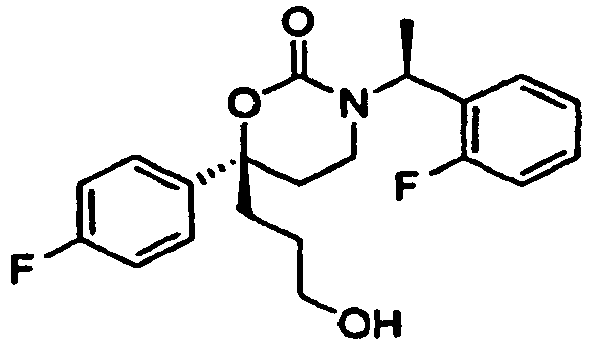
- The title compound was prepared following a procedure analogous to that described in Example 283 using (S)-1-(2-fluorophenyl)ethanamine in Step 1. LC-MS Method 3 tR = 1.12 min. m/z = 332.1; 1H NMR (CDCl3) 1.24-1.41 (m, 1 H), 1.52 (d, 3H), 1.61-1.72 (m, 1H), 2.03-2.38 (m, 2H), 2.10-2.28 (m, 3H), 2.98 (m, 1H), 3.53 (t, 2H), 4.22 (t, 1H), 5.70 (q, 1H), 6.84 (t, 1 H), 6.99 (m, 3H), 7.16 (m, 4H).
-

- The title compound was prepared following a procedure analogous to that described in Example 283 using (S)-1-(4-fluorophenyl)ethanamine in Step 1. LC-MS Method 3 tR = 1.155 min, m/z = 332.1; 1H NMR (CDCl3) 1.25-1.38 (m, 1H), 1.46 (d, 3H), 1.67 (m, 1H), 1.81-1.98 (m, 2H), 2.11-2.23 (m, 3H), 2.84 (m, 1H), 3.51 (t, 2H), 5.58 (t, 1H), 6.75(t, 2H), 6.84 (m, 2H), 6.98 (t, 2H), 7.18 (t, 2H)
-

- Isomer 1: LC-MS Method 2 tR = 1.156 min, m/z = 386; 1H NMR (CDCl3) 1.41 (d, 3H), 1.98 (dd, 1H), 2.6 (m, 1H), 2.16 (m, 2 H), 2.25 (m, 3H), 2.79 (m, 1 H), 3.41 (m, 1H), 3.53 (m, 1 H), 3.63 (s, 3H), 3.73 (m, 1 H), 5.51 (q, 1 H), 6.54 (d, 2H), 6.72 (d, 2H), 7.21-7.32 (m, 5H).
- Isomer 2: LC-MS Method 2 tR = 1.166 min, m/z = 386.1; 1H NMR (CDCl3) 1.41 (d, 3H), 1.89 (dd, 1 H), 2.02-2.14 (m, 1 H), 2.8 (m, 2 H), 2.25-2.38 (m, 3H), 2.71-2.82 (m, 1H), 3.24 (m, 1 H), 3.339 (m, 1H), 3.65 (s, 3H), 3.77(m, 1H), 5.51 (q, 1H), 6.58 (d, 2H), 6.78 (d, 2H), 7.19-7.31(m, 5H).
(6R)-6-(2,3-dihydroxypropyl)-3-((1S)-1-(4-methoxyphenyl)ethyl)-6-phenyl-1,3-oxazinan-2-one was prepared from (S)-6-allyl-3-((S)-1-(4-methoxyphenyl)ethyl)-6-phenyl-1,3-oxazinan-2-one following a procedure analogous to that described in Example 173. Two isomers were isolated. - Isomer 3: LC-MS Method 2 tR = 1.964 min, m/z = 386.2; 1H NMR (CDCl3) 1.18 (d, 3H), 1.35 (m, 1H), 1.90 (d, 1H), 2.02-2.12 (m, 2H), 2.18 (d, 1H), 2.48-2.67 (m, 2H), 3.26(m, 1H),3.32-3.42 (m, 1H), 3.75 (s, 3H), 5.68 (q, 1 H), 6.79 (d, 2H), 7.14 (d, 2H), 7.21-7.42 (m, 3H), 7.35 (m, 2H).
- Isomer 4: LC-MS Method 2 tR = 1.937 min, m/z = 386.2; 1H NMR (CDCl3) 1.18 (d, 3H), 1.92-2.12 (m, 4H), 2.25 (d, 1H), 2.54-2.65 (m, 2H), 3.41 (m, 1H),3.50 (m, 1 H), 3.74 (s, 3H), 5.63 (q, 1H), 6.78 (d, 2H ), 7.14 (d, 2H), 7.27 (m, 3H), 7.34 (m, 2H).
-

- The title compound was prepared from (R)-3-((S)-1-(4-chlorophenyl)ethyl)-6-(3-hydroxypropyl)-6-phenyl-1,3-oxazinan-2-one following a procedure analogous to that described in Example 234. LC-MS Method 2 tR = 2.118 min, m/z = 343.1; 1H NMR (CDCl3) 1.45 (d, 3H), 1.91 (m, 1H), 2.01-2.28 (m, 5H), 2.38-2.48 (m, 1 H), 2.84 (m, 1H), 5.54 (q, 1H). 6.78 (d, 2H), 7.01 (d, 2H), 7.21-7.33(m, 4H).
-

- The title compound was prepared from (R)-6-(4-fluorophenyl)-3-((S)-1-(3-fluorophenyl)ethyl)-6-(3-hydroxypropyl)-1,3-oxazinan-2-one following a procedure analogous to that described in Example 234. LC-MS Method 2 tR = 1.998 min, m/z = 345.1; 1H NMR (CDCl3) 1.39 (d, 3H), 1.86-1.98 (m, 2H), 2.12 (m, 2H), 2.22 (m, 2H), 2.38-2.49 (m, 1H), 2.87 (m, 1H), 2.98-3.10 (m, 1 H), 3.60 (m, 1 H), 5.23 (s, 1H), 5.48 (s, 1H), 5.52 (q, 1H), 6.58 (d, 1H), 6.68 (d, 1H), 6.79 (t, 1 H), 6.98 (m, 2H), 7.05 (t, 1 H), 7.18 (t, 2H).
-
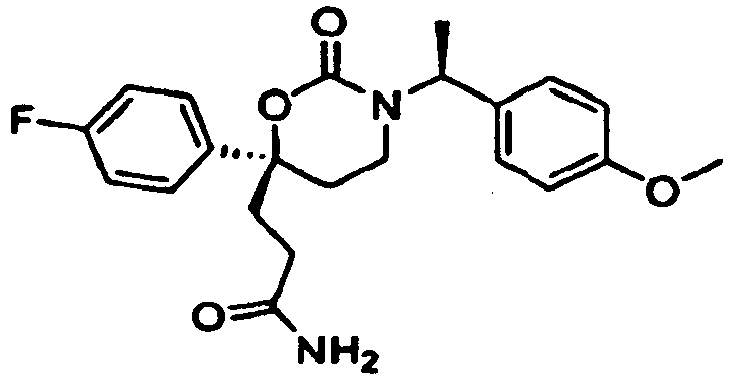
- The title compound was prepared from (R)-6-(4-fluorophenyl)-6-(3-hydroxypropyl)-3-((S)-1-(4-methoxyphenyl)ethyl)-1,3-oxazinan-2-one following a procedure analogous to that described in Example 234. LC-MS Method 2 tR = 1.953 min, m/z = 401.2; 1H NMR (CDCl3) 1.42 (d, 3H), 1.35-1.98 (m, 1H), 2.05-2.22 (m, 5H), 2.36-2.48 (m, 1 H), 2.82 (m, 1H), 3.67 (s, 3H), 5.13(m, 1H), 5.32 (m, 1H), 5.55 (q, 1H), 6.61 (d, 2H ), 6.81 (d, 2H), 6.97 (t, 2H), 7.17 (m, 2H).
-

- To a mixture of (R)-6-allyl-6-(4-fluorophenyl)-3-((S)-1-(4-hydroxyphenyl)ethyl)-1,3-oxazinan-2-one (0.5227 g, 1.47 mmol), K2CO3 (7.7665 g, 56.2 mmol), CH3CN (6 mL) and H2O (6 mL) at room temperature was added 2-chloro-2,2-difluoroacetophene (1.6500 g, 8.66 mmol). The reaction flask was sealed, and the mixture was heated at 80 °C and stirred for 4 h. Then the mixture was diluted with CH2Cl2, quenched with 6 N HCl (17.5 mL), extracted with CH2Cl2, and dried over Na2SO4. After the solvents were evaporated, the residue was purified by reversed-phase HPLC (SunFire™ Prep C18 OBD™ 5µm 19 × 50 mm column, 10% →90% CH3CN/H2O, 0.1% CF3COOH over 8 min and then 90% CH3CN/H2O, 0.1% CF3COOH over 2 min, flow rate 20 mL/min) to afford 0.2780 g (47%) of (R)-6-allyl-3-((S)-1-(4-(difluoromethoxy)phenyl)ethyl)-6-(4-fluorophenyl)-1,3-oxazinan-2-one. LC-MS Method 1 tR = 1.90 min, m/z = 406 (M+1); 1H NMR (CD3OD) 7.25-7.21 (m, 2H), 7.01 (t, J = 8.6 Hz, 2H), 6.88 (d, J = 8.8 Hz, 2H), 6.82 (d, J = 8.8 Hz, 2H), 6.65 (t, J = 74.1 Hz, 1H), 5.66-5.56 (m, 1H), 5.44 (q, J = 7.1 Hz, 1H), 4.99-4.92 (m, 2H), 3.05-3.01 (m, 1H), 2.53 (d, J = 7.3 Hz, 2H), 2.40-2.35 (m, 1H), 2.26-2.08 (m, 2H), 1.44 (d, J = 7.3 Hz, 3H).
- (R)-3-((S)-1-(4-(1H-pyrazol-3-yl)phenyl)ethyl)-6-(3-hydroxypropyl)-6-phenyl-1,3-oxazinan-2-one

- The title compound was prepared from (R)-6-allyl-3-((S)-1-(4-bromophenyl)ethyl)-6-phenyl-1,3-oxazinan-2-one and pyrazole-3-boronic acid using a procedure analogous to that described in Example 64 followed by a procedure analogous to that described in Example 78. LC-MS Method 2 tR = 1.808 min, m/z = 362.2; 1H NMR (CDCl3) 1.48 (d, 3H), 1.60-1.72 (m, 2H), 1.90 (m, 2H), 2.22 (m, 3H). 2.84 (m, 1 H), 3.46-3.54 (m, 2H), 5.61 (q, 1H), 6.48 (s, 1H), 6.89 (d, 2H), 7.19-7.30 (m, 6H), 7.43 (d, 2H), 7.52 (s, 1H).
-

- The title compound was prepared from (R)-6-allyl-3-((S)-1-(4-bromophenyl)ethyl)-6-phenyl-1,3-oxazinan-2-one and 5-fluoropyridine-3-boronic acid using a procedure analogous to that described in Example 64. LC-MS Method 1 tR = 1.84 min, m/z = 417 (M+1); 1H NMR (CDCl3) 8.58 (s, 1H), 8.45 (d, 1H, J = 3 Hz), 7.57-7.54 (m, 1H), 7.39-7.30 (m, 5H), 7.27-7.25 (m, 2H), 6.93 (d, 2H, J = 8 Hz), 5.80-5.68 (m, 2H), 5.11-5.03 (m, 2H), 2.97-2.91 (m, 1H), 2.69-2.55 (m, 2H), 2.41-2.21 (m, 3H), 1.55 (d, 3H, J =7 Hz).
-

- The title compound was prepared from (R)-6-allyl-6-(4-fluorophenyl)-3-((S)-1-(3-(trifluoromethyl)phenyl)ethyl)-1,3-oxazinan-2-one following a procedure analogous to that described in Example 78. LC-MS Method 3 tR = 1.103 min, m/z = 382; 1H NMR (CDCl3) 1.32-1.45 (m, 1H), 1.51 (m, 3H), 1.65 (m, 1H), 1.82-1.96 (m, 2H), 2.03-2.22 (m, 3H), 2.86 (m, 1H),3.42-3.53 (m, 2H), 5.68 (m, 1H), 6.96 (m, 2H), 7.03(m, 1H), 7.17 (m, 4H), 7.36 (m, 1H).
-

- The title compound was prepared from (R)-6-allyl-6-(4-fluorophenyl)-3-((S)-1-(4-(trifluoromethyl)phenyl)ethyl)-1,3-oxazinan-2-one following a procedure analogous to that described in Example 78. LC-MS Method 3 tR = 1.112 min, m/z = 382; 1H NMR (CDCl3) 1.23-1.48 (m, 1H), 1.48 (d, 3H), 1.58-1.71 (m, 1H), 1.81-1.98 (m, 2H), 2.15 (m, 1H), 2.19-2.30 (m, 2H), 2.89 (m, 1H), 3.51 (t, 2H), 5.63(q, 1H), 6.97 (m, 4H), 7.16-7.31 (m, 2H), 7.33 (d, 2H).
-

- The title compound was prepared from (R)-6-(3-hydroxypropyl)-6-phenyl-3-((S)-1-(4-(pyridin-3-yl)phenyl)ethyl)-1,3-oxazinan-2-one following a procedure analogous to that described in Example 234. LC-MS Method 2 tR = 1.381 min, m/z = 430.2; 1H NMR (CDCl3) 1.56 (m, 3H), 1.92-2.03 (m, 3H), 2.18-2.37 (m, 5H), 2.51 (m, 1H), 2.94 (m, 1H), 5.29-5.61 (m, 2H), 5.71 (m, 1H), 7.03 (m, 2H), 7.21-7.38 (m, 8H), 7.77 (m, 1H), 8.53 (m, 1H), 8.72 (s, 1H).
-
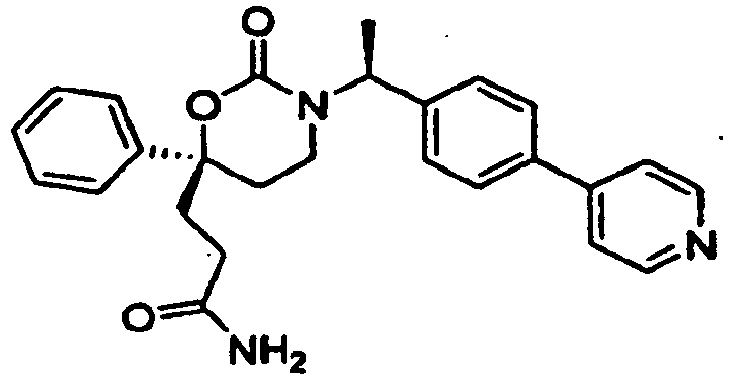
- The title compound was prepared from (R)-6-(3-hydroxypropyl)-6-phenyl-3-((S)-1-(4-(pyridin-4-yl)phenyl)ethyl)-1,3-oxazinan-2-one following a procedure analogous to that described in Example 234. LC-MS Method 2 tR = 1.327 min, m/z = 430.2; 1H NMR (CDCl3) 1.49 (m, 3H), 1.93 (m, 1 H), 2.12-2.34 (m, 5H), 2.44 (m, 1H), 2.94 (m, 1H), 5.46 (m, 2H), 5.67 (m, 1H), 7.08 (m, 2H), 7.19-7.42 (m, 5H), 7.45 (m, 2H), 7.80 (m, 2H), 8.76 (m ,2H).
-

- The title compound was prepared from (S)-6-allyl-3-((S)-1-(4-fluorobiphenyl-4-yl)ethyl)-6-phenyl-1,3-oxazinan-2-one following a procedure analogous to that described in Example 78. LC-MS Method 3 tR = 1.463 min, m/z = 433.21; 1H NMR (CDCl3) 1.28 (d, 3H), 1.35 (m, 1H), 1.74 (m, 1H), 1.96 (m, 3H), 2.24 (m, 1H), 2.69 (m, 2H), 3.56 (m, 2H), 5.80 (q, 1H), 7.12 (t, 2H), 7.28-7.42 (m, 7H), 7.49 (m, 4H)
-

- The title compound was prepared from (R)-6-allyl-3-((S)-1-(4-(5-fluoropyridin-3-yl)phenyl)ethyl)-6-phenyl-1,3-oxazinan-2-one following a procedure analogous to that described in Example 78. LC-MS Method 1 tR = 1.5 min, m/z = 457 (M+Na); 1H NMR (CDCl3) 8.64 (s, 1H), 8.50 (s, 1H), 7.74-7.71 (dd, 1H, J = 2, 9 Hz), 7.41-7.27 (m, 7H), 7.05 (dd, 2H, J = 3, 8 Hz), 5.74-5.68 (m, 1H), 4.27-4.24 (t, 1H, J = 6, 6 Hz), 3.60-3.57 (t, 1H, J =6, 6 Hz), 2.98-2.93 (m, 1H), 2.38-2.20 (m, 3H), 2.10-1.93 (m, 3H), 1.73-1.70 (1H, m), 1.57 (d, 3H, J = 7 Hz), 1.41-1.37 (m, 1H).
-

- The title compound was prepared from (R)-6-(4-fluorophenyl)-6-(3-hydroxypropyl)-3-((S)-1-(3-(trifluoromethyl)phenyl)ethyl)-1,3-oxazinan-2-one following a procedure analogous to that described in Example 234. LC-MS Method 2 tR = 2.194 min, m/z = 439.2; 1H NMR (CDCl3) 1.49 (m, 3H), 1.89 (m, 1H), 2.10-2.22 (m, 5H), 2.41 (m, 1 H), 2.87 (m, 1H), 5.30 (s, 1H),5.45 (s, 1H), 5.66 (m. 1H), 6.97 (m, 2H), 7.08 (m, 1H), 7.19 (m, 4H), 7.36 (m, 1H).
-

- The title compound was prepared from 3-((R)-2-oxo-6-phenyl-3-((S)-1-(4-(pyridin-3-yl)phenyl)ethyl)-1,3-oxazinan-6-yl)propanamide following a procedure analogous to that described Example 222. LC-MS Method 2 tR = 1.476 min, m/z = 445.2; 1H NMR (CDCl3) 1.56 (d, 3H), 1.98-2.15 (m, 1 H), 2.18-2.37 (m, 5H), 2.47-2.58 (m, 1H), 2.96 (m, 1H), 5.51 (s, 1H), 5.57 (s, 1H), 5.70 (q, 1H), 7.03 (q, 2H), 7.26-7.38 (m, 9H), 8.20 (d, 1H),8.49 (s, 1H).
-

- The title compound was prepared from (R)-6-(2-aminoethyl)-6-(4-fluorophenyl)-3-((S)-1-(4-methoxyphenyl)ethyl)-1,3-oxazinan-2-one following a procedure analogous to that described Example 99. LC-MS Method 3 tR = 1.017 min, m/z = 451; 1H NMR (CDCl3) 1.48 (d, 3H),2.06-2.22 (m, 5H), 2.82 (s, 4H), 2.92-3.02 (m, 1H), 3.08-3.19 (m, 1 H), 3.67 (s, 3H), 5.55 (q, 1H), 6.59 (d, 2H), 6.82 (d, 2H ), 7.01 (t, 2H), 7.18 (t, 2H).
-

- The title compound was prepared from (R)-6-allyl-6-(4-fluorophenyl)-3-((S)-1-(4-(5-fluoropyridin-3-yl)phenyl)ethyl)-1,3-oxazinan-2-one following a procedure analogous to that described in Example 78. LC-MS Method 1 tR = 1.84 min, m/z = 435 (M+1); 1H NMR (CDCl3) 8.58 (t, 1H, J= 1.5, 1.5 Hz), 8.44 (d, 1H, J = 3Hz), 7.51-7.48 (ddd, 1H, J = 9, 4. 2 Hz), 7.33-7.262 (m, 4H), 7.04 (at, J = 9, 9 Hz), 6.98 (d, 2H, 8 Hz), 5.76-5.66 (m, 2H), 5.11-5.00 (m, 2H), 3.00-2.95 (m, 1H), 2.65-2.5 (m, 2H), 2.41-2.33 (m, 1H) 2.31-2.18 (m, 2H), 1.55 (d, 3H, J = 7 Hz).
-

- To a solution of 3-((R)-3-((S)-1-(4'-fluorobiphenyl-4-yl)ethyl)-2-oxo-6-phenyl-1,3- oxazinan -6-yl)propanenitrile (35 mg, 0.08 mmol) in dry THF (15 mL) in ice-bath under N2 protection was added LiHMDS (1 mL/1M) dropwise slowly. After addition, HMPA (31 mg, 0.16 mmol) was added, and the mixture was stirred for 1 hour at 0 °C. Then Mel (114 mg, 0.8 mmol) was added dropwise slowly. The mixture was stirred for 4 h and cooled to 0 °C. To the above solution was added LiHMDS (1 mL/1M) and HMPA (31 mg, 0.16 mmol). The mixture was stirred for 1 h, and Mel (114 mg, 0.8 mmol) was added. Then the mixture was stirred overnight. The reaction was quenched with satd aq NH4Cl (5 mL), and the mixture was extracted with EtOAc (3 × 10 mL). The combined organic phase was washed with brine, dried over Na2SO4, filtered and concentrated. The residue was purified by chromatography to give3-{(R)-3-(S)-[1-(4'-fluoro-biphenyl-4-yl)-ethyl]-2- oxo-6- phenyl -[1,3]oxazinan-6-yl}-2,2-dimethyl-propionitrile (10 mg, 27%).
- LC-MS Method 3 tR = 1.323 min, m/z = 479.1; 1H NMR (CDCl3) 1.18 (s, 6H), 1.28 (s, 3H), 1.37 (t, 2H), 1.42 (s, 3 H), 1.48 (d, 3H), 1.79 (m, 1H), 2.10 (s, 2H), 2.19-2.30 (m, 1H), 2.45 (m, 2H), 2.81-2.91(m, 1H), 3.06 (m, 1H), 3.68 (m, 1H), 5.61 (q, 1H), 6.83 (d, 2H), 7.02 (t, 2H), 7.18 (m, 2H), 7.30 (m, 4H), 7.37 (m, 2H)
-

- The title compound was prepared from 3-((R)-3-((S)-1-(4-bromophenyl)ethyl)-2-oxo-6-phenyl-1,3-oxazinan-6-yl)propanamide and 6-methoxypyridine-3-boronic acid following a procedure analogous to that described in Example 64. LC-MS Method 3 tR = 1.106 min, m/z = 460.2; 1H NMR (CD3OD) 1.54 (m, 3H), 1.95 (m, 1H), 2.16-2.29 (m, 4H), 2.40 (m, 2H), 2.44 (m, 1H), 3.10 (m, 1H), 3.99 (s, 3H), 5.56 (m, 1H), 6.94 (m, 1H), 7.03 (m, 2H), 7.28-7.39 (m, 8H), 7.93 (m, 1H), 8.28 (m ,1H).
-

- The title compound was prepared from (R)-3-((S)-1-(4-bromophenyl)ethyl)-6-(4-fluorophenyl)-6-(3-hydroxypropyl)-1,3-oxazinan-2-one and 5-methoxypyridine-3-boronic acid following a procedure analogous to that described in Example 64. LC-MS Method 2 tR = 1.694 min, m/z = 465.2; 1H NMR (CDCl3) 1.34 (m, 1H), 1.53 (m, 3H), 1.68 (m, 1H), 1.94 (m, 3H), 2.18-2.32 (m, 3H), 2.95 (m, 1H),3.56 (m, 2H), 3.88 (s, 3H), 5.69 (m, 1H), 7.01 (m, 4H), 7.24 (m, 3H), 7.31 (m, 2H), 8.25 (m, 1H), 8.34 (m,1H).
-
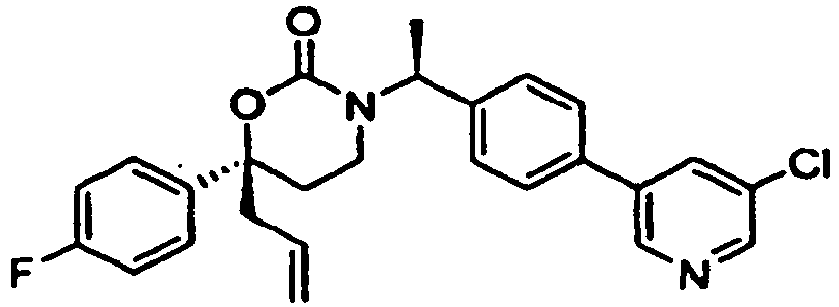
- The title compound was prepared from (R)-3-((S)-1-(4-bromophenyl)ethyl)-6-(4-fluorophenyl)-6-(3-hydroxypropyl)-1,3-oxazinan-2-one and 5-chloropyridine-3-boronic acid following a procedure analogous to that described in Example 64. LC-MS Method 1 tR = 1.97 min, m/z = 451 (M+1); 1H NMR (CDCl3) 8.68 (d, 1H, J =2 Hz), 8.59 (d, 1H, J = 2 Hz), 7.94 (t, 1H, J = 2,2 Hz), 7.33-7.27 (m, 4H), 7.04 (ap q, 2H, J = 9, 17 Hz), 5.75-5.65 (m, 2H), 5.12-5.02 (m, 2H), 3.03-2.98 (m, 1H), 2.66-2.54 (m, 2H), 2.41-2.17 (m, 3H), 1.56 (d, 3H, J = 7 Hz).
-

- The title compound was prepared from (R)-6-(2-aminoethyl)-6-phenyl-3-((S)-1-(4-(pyridin-3-yl)phenyl)ethyl)-1,3-oxazinan-2-one following a procedure analogous to that described in Example 99. LC-MS Method 2 tR = 1.525 min, m/z = 480.2; 1H NMR (CDCl3) 1.52 (d, 3H), 2.05-2.32 (m, 6H), 2.81 (s, 3H), 2.86 (m, 1 H), 2.93-3.04 (m, 1H), 3.06-3.20 (m, 1 H),4.73 (s, 1H), 5.63 (q, 1H), 6.95 (d, 2H), 7.05-7.22 (m, 2H ), 7.23-7.40 (m, 6H), 7.71 (d, 1H), 8.50 (d, 1H), 8.66 (s, 1H).
-

- The title compound was prepared using conditions analogous to those described in Example 229. LC-MS Method 1 tR = 1.18 min, m/z = 422 (M+1); 1H NMR (CD3OD) 7.66 (d, J = 7.9 Hz, 2H), 7.28-7.24 (m, 2H), 7.15 (d, J = 8.2 Hz, 2H), 7.04 (t, J = 8.5 Hz, 2H), 5.51 (q, J = 7.0 Hz, 1H), 3.64-3.57 (m, 1H), 3.29-3.23 (m, 1H), 3.15-3.11 (m, 1H), 2.98 (s, 3H), 2.49-2.43 (m, 1H), 2.33-2.20 (m, 2H), 2.05 (t, J = 7.2 Hz, 2H), 1.50 (d, J = 7.0 Hz, 3H).
-

- A solution of (R)-6-allyl-3-((S)-1-(4-(difluoromethoxy)phenyl)ethyl)-6-(4-fluorophenyl)-1,3-oxazinan-2-one (0.2780 g, 0.686 mmol, 1.0 equiv) in THF (20 mL) was degassed and then cooled with an ice-salt bath (- 9 °C). To this solution was added a solution of 1.0 M BH3-THF complex in THF (1.5 mL, 1.5 mmol, 2.2 equiv). The resulting mixture was allowed to slowly warm to rt while stirring overnight (21 h) and then quenched with H2O (3 mL) and NaBO3·H2O (0.680 g, 6.8 mmol, 10 equiv). The mixture was vigorously stirred at rt overnight and then diluted with CH2Cl2, and dried over Na2SO4. After the solvents were evaporated, the residue was purified by chromatography on silica gel eluted with hexanes/ethyl acetate to give 0.2337 g (80%) of (R)-3-((S)-1-(4-(difluoromethoxy)phenyl)ethyl)-6-(4-fluorophenyl)-6-(3-hydroxypropyl)-1,3-oxazinan-2-one. LC-MS Method 1 t R = 1.59 min, m/z 446 (MNa+). 380, 210, 171; 1H NMR (400 MHz, CD3OD) δ 7.27-7.23 (m, 2H), 7.04 (t, J = 8.8 Hz, 2H), 6.94 (d, J = 8.5 Hz, 2H), 6.85 (d, J = 8.8 Hz, 2H), 6.67 (t, J = 74.1 Hz, 1H), 5.48 (q, J = 7.1 Hz, 1H), 3.43-3.39 (m, 2H), 3.07-3.02 (m, 1H), 2.42-2.37 (m, 1H), 2.26-2.10 (m, 2H), 1.91-1.85 (m, 2H), 1.58-1.50 (m, 1H), 1.46 (d, J = 7.0 Hz, 3H), 1.29-1.20 (m, 1 H).; 19F NMR (376 MHz, CD3OD) δ -83.95 (d, J = 73.8 Hz), -117.51 (m).
-

- The title compound was prepared from (R)-3-((S)-1-(4'-fluorobiphenyl-4-yl)ethyl)-6-(3-hydroxypropyl)-6-phenyl-1,3-oxazinan-2-one following a procedure analogous to that described in Example 151. LC-MS Method 1 tR = 1.63 min, m/z = 514 (M+1); 1H NMR (CD3OD) 7.48-7.44 (m, 2H), 7.34-7.24 (m, 7H), 7.07 (t, J = 8.5 Hz, 2H), 6.94 (d, J = 7.9 Hz, 2H), 5.51 (q, J = 7.0 Hz, 1H), 3.84 (q, J = 6.4 Hz, 2H), 3.05-3.00 (m, 1H), 2.44-2.39 (m, 1H), 2.29-2.12 (m, 2H), 1.98-1.93 (m, 2H), 1.76-1.68 (m. 1H), 1.49 (d, J = 7.0 Hz, 3H), 1.44-1.35 (m, 1H).
-

- The title compound was prepared from (R)-3-((S)-1-(4-bromophenyl)ethyl)-6-(4-fluorophenyl)-6-(3-hydroxypropyl)-1,3-oxazinan-2-one and 2-methylpyridine-4-boronic acid following a procedure analogous to that described in Example 64. LC-MS Method 1 tR = 1.29 min, m/z = 431 (M+1); 1H NMR (CDCl3) 8.71 (d, 1H, J = 6 Hz), 7.78 (d, 1H, J = 6 Hz), 7.7 (s, 1H), 7.49 (t, 2H, J =7, 7 Hz), 7.27-7.24 (m, 2H), 7.17 (m, 2H), 7.09-7.02 (aq, 2H, J = 9, 17 Hz), 5.73 (q, 1H, J = 7, 14 Hz), 4.27 (t, 1H, J = 6, 6 Hz), 3.60 (t, 1H, J = 6, 6 Hz), 3.09-3.03 (m, 1H), 2.95 (s, 3H), 2.41-2.25 (m, 3H), 2.06-1.90 (m, 2H) 1.73-1.64 (m, 1H), 1.58 (d, 3H, J = 7 Hz), 1.40-1.33 (m, 1H).
-

- To a suspension of NaH (180 mg, 4.4 mmol) in THF (5 mL) was added a solution of (R)-6-(3-hydroxypropyl)-6-phenyl-3-((S)-1-(4-vinylphenyl)ethyl)-'1,3-oxazinan-2-one (800 mg, 2.2 mmol) in THF (10 mL) at 0 °C. The resulting mixture was stirred for 30 min. Then PMBCI (520 mg, 3.3 mmol) was added to the above mixture. The mixture was stirred for 3 h. The reaction was quenched with aqueous NH4Cl solution. The organic phase was separated, and concentrated to give the crude (R)-6-(3-(4-methoxybenzyloxy) propyl)-6-phenyl-3-((S)-1-(4-vinylphenyl)ethyl)-1,3-oxazinan-2-one, which was used for the next step without purification (460 mg, 46%).
- To a solution of (R)-6-(3-(4-methoxybenzyloxy)propyl)-6-phenyl-3-((S)-1-(4-vinylphenyl) ethyl)-1,3-oxazinan-2-one (260 mg, 0.536 mmol) in THF (3 mL) was added BH3 THF (1.6 mL, I mol/L) at 0 °C under nitrogen atmosphere. The formed mixture was stirred for 2 h. The reaction was quenched with water. Then aqueous NaOH solution (1 mol/L, 2 mL) and H2O2 (1 mL) were added to the above mixture. The resulting mixture was stirred for 1.5 h. The mixture was extracted with EtOAc and the combined organic phase was concentrated to give crude (R)-3-((S)-1-(4-(2-hydroxyethyl)phenyl)ethyl)-6-(3- (4-methoxybenzyloxy)propyl)-6-phenyl-1,3-oxazinan-2-one (260 mg, 96%), which was used for the next step without purification. 1H NMR (CDCl3): 6=1.32 (m, 2H), 1.41 (d, 3H), 1.89 (m, 2H), 2.12 (m, 1H), 2.22 (m, 2H), 2.68 (m, 1H), 2.81 (m, 1H), 3.27 (m, 2H), 3.72 (s, 3H), 4.26 (s, 2H), 5.53 (q, 1H), 6.71-6.88 (m, 5H), 7.13 (m, 2H), 7.26 (m, 4H).
- To a solution of (R)-3-((S)-1-(4-(2-hydroxyethyl)phenyl)ethyl)-6-(3-(4-methoxybenzyloxy) propyl)-6-phenyl-1,3-oxazinan-2-one (260 mg, 0.517 mmol) in acetone (2 mL) was added Jones reagent (0.25 mL, 2.5 mol/L), and the formed mixture was stirred for 30 min. The mixture was extracted with EtOAc. The combined organic layer was concentrated to give crude 2-(4-((S)-1-((R)-6-(3-(4-methoxybenzyloxy)propyl)-2-oxo- 6-phenyl-1,3- oxazinan-3-yl)ethyl)phenyl)acetic acid (260 mg, 97%), which was used for the next step without purification.
- To a mixture of 2-(4-((S)-1-((R)-6-(3-(4-methoxybenzyloxy)propyl)-2-oxo-6-phenyl- 1,3-oxazinan-3-yl)ethyl)phenyl)acetic acid (260mg, 0.50 mmol) and K2CO3 in DMF (2 mL) was added CH3I (0.2 g, 1 mmol). The resulting mixture was stirred overnight. The solid was filtered, and the filtrate was concentrated to give the crude product, which was purification by TLC to afford methyl 2-(4-((S)-1-((R)-6-(3-(4-methoxybenzyloxy)propyl)- 2-oxo-6-phenyl-1,3-oxazinan-3-yl)ethyl)phenyl)acetate (100 mg, 37%). 1H NMR (CDCl3): δ=1.42 (d, 3H), 1.68 (m, 1H), 1.88 (m, 2H), 2.12 (m, 1 H), 2.23 (m, 2H), 2.78 (m, 1H), 3.29 (m, 2H), 3.44 (s, 2H), 3.64 (s, 3H), 3.75 (s, 3H), 4.28 (s, 2H), 5.56 (q, 1H), 6.73 (m, 4H), 6.92 (m, 2H), 7.14 (m, 2H), 7.25 (m, 5H).
- To a solution of methyl 2-(4-((S)-1-((R)-6-(3-(4-methoxybenzyloxy)propyl)-2-oxo-6- phenyl -1,3-oxazinan-3-yl)ethyl)phenyl)acetate (100 mg, 0.188 mmol) in THF (2 mL) was added methylmagnesium bromide (0.3 mL, 3 mol/L) at -78 °C. The formed mixture was stirred for 3 h. The reaction was quenched by aqueous solution of NH4Cl. The organic phase was separated and concentrated to provide the crude product, which was purified by TLC to give (R)-3-((S)-1-(4-(2-hydroxy-2-methylpropyl)phenyl)ethyl)-6- (3-hydroxypropyl)- 6-phenyl-1,3-oxazinan-2-one (10 mg, 10%). 1H NMR (CDCl3): δ=1.08 (d, 6H), 1.19 (m, 2H), 1.42 (d, 3H), 1.64 (m, 2H), 1.84 (m, 2H), 2.04-2.19 (m, 4H), 2.53 (s, 2H), 2.80 (m, 1H), 3.29 (t, 2H), 3.72 (s, 3H), 4.25 (s, 2H), 5.54 (q, 1H), 6.74 (m, 5H), 6.82 (m, 2H), 7.10 (m, 3H), 7.23 (m, 4H).
- To a solution of methyl (R)-3-((S)-1-(4-(2-hydroxy-2-methylpropyl)phenyl)ethyl)-6- (3-(4-methoxybenzyloxy)propyl)-6-phenyl-1,3-oxazinan-2-one (10 mg, 0.188 mmol) in DCM/H2O (10:1, 2 mL) was added CAN (100 mg). The formed mixture was stirred for 3 h. The reaction was washed with water and extracted with CH2Cl2. The combined organic phase was concentrated to provide the crude product, which was purified by preparative HPLC to give (R)-3-((S)-1-(4-(2-hydroxy-2-methylpropyl)phenyl)ethyl)-6- (3-(4-methoxybenzyloxy)propyl)-6-phenyl-1,3-oxazinan-2-one (0.8 mg, 10%). LC-MS Method 2 tR = 1.191 min, m/z = 411.24; 1H NMR (CDCl3): δ=0.81 (m, 4H). 1.09 (d, 6H), 1.43 (d, 3H), 1.64 (m, 3H), 1.92 (m, 3H), 2.16-2.26 (m, 4H), 2.59 (s, 2H), 2.83 (m, 1H), 3.52 (t, 2H), 5.62 (q, 1 H), 6.78 (m, 2H), 6.86 (m, 2H), 6.94 (m, 1H), 7.26 (m, 4H).
-

- To a suspension of NaH (4.8 g, 0.2 mol) in THF (10 mL) was added a solution of 5- bromopyridin-2(1H)-one (8.6 g, 0.05 mol) in THF (120 mL) at 0°C. The resulting mixture was stirred for 1 h and CH3l (35.5 g, 0.25 mol) was added. The mixture was stirred for 3 h. The reaction was quenched with aqueous NH4Cl solution. The organic phase was concentrated to give the crude product, which was purified by column chromatography to give 5-bromo-1-methylpyridin-2(1H)-one (8.9 g, 96.78 %). 1H NMR (CDCl3): δ= 3.5 (S, 3H), 6.52 (m, 1H), 7.32 (m, 1H), 7.45(m, 1H).
- To a solution of (R)-6-allyl-3-((S)-1-(4-bromophenyl)ethyl)-6-phenyl-1,3-oxazinan- 2-one (5 g, 12.5 mmol) in tetrahydrofuran (60 mL) was added BH3 THF (25 mL, I mol/L, 25 mmol) at 0 °C under nitrogen atmosphere. The formed mixture was stirred for 2 h. The reaction was quenched with water. Then NaOH (3 mol/L, 10 mL) and H2O2 (15 mL) were added to the above mixture. When the reaction was over, the mixture was extracted with EtOAc. The combined organic phase was concentrated to give the crude product, which was purified by column chromatography to give (R)-3-((S)-1-(4-bromophenyl)ethyl)-6-(3-hydroxypropyl)-6-pheny I-1,3- oxazinan-2-one (2.5 g, 40%). 1H NMR: (400MHz, CDCl3): δ=1.48 (t, 3H), 1.53 (m, 1H), 1.73 (m, 1H), 1.93-1.98(m, 2H), 2.17-2.28 (m,3H), 3.57 (t, 2H), 5.59 (m, 1H), 6.72 (m, 2H), 7.20(m, 2H), 7.25-7.37 (m, 5H).
- To a solution of ((R)-3-((S)-1-(4-bromophenyl)ethyl)-6-(3-hydroxypropyl)-6-phenyl-1,3-oxazinan-2-one (2 g, 4.8 mmol) in DMSO (30 mL) were added bis(pinacolato)diboron (1.58 g, 6.3 mmol), KOAc (1.51 g, 15.4 mmol) and PdCl2 (130 mg, 0.16 mmol) under nitrogen atmosphere. The formed mixture was stirred at 90°C for 20 h. The reaction was quenched with water and extracted with EtOAc. The combined organic phase was concentrated to give the crude product, which was purified by column chromatography to give(R)-6-(3-hydroxypropyl)-6-phenyl-3-((S)-1-(4-(4,4,5,5-tetramethyl-1,3,2-dioxaborolan-2-yl)phenyl)ethyl)-1,3-oxazinan-2-one (1.7 g, 77%). 1H NMR: (400MHz, CDCl3): δ=1.18 (t, 1H), 1.33 (S, 11H), 1.43 (m, 2H), 1.48 (m, 3H), 1.71(m, 1H), 1.88 (m,2H), 2.1-2.3 (t, 3H), 2.7(m, 1H)□3.5 (m, 2H), 5.5 (m, 1H),6.72 (m, 1H), 7.25-7.37 (m, 5H),7.48(m, 2H).
- A mixture of (R)-6-(3-hydroxypropyl)-6-phenyl-3-((S)-1-(4-(4,4,5,5-tetramethyl-1,3,2- dioxaborolan-2-yl)phenyl)ethyl)-1,3-oxazinan-2-one (1.7 g, 3.7 mmol) and 5-bromo-1- methylpyridin-2(1H)-one (816 mg, 4.4 mmol), Pd(Ph3P)2Cl2 (200mg), and aq Cs2CO3 solution (4mL, 2M) in 1,4-dioxane (30 mL) was stirred and heated to reflux for 2 h. When the reaction was over, the mixture was washed with water and extracted with EtOAc, and the organic phase was washed with brine, dried over Na2SO4. filtered and concentrated to give crude product, which was purified by preparative TLC to give (R)-6-(3-hydroxypropyl) -3-((S)-1-(4-(1-methyl -6- oxo-1,6-dihydropyridin-3-yl)phenyl)ethyl)-6-phenyl-1,3-oxazinan- 2-one (614 mg, 37%). LC-MS Method 2 tR = 1.075 min, m/z = 447.1; 1H NMR (CDCl3): δ=1.38 (m, 1H) 1.47 (d, 3H), 1.73 (m, 2H), 1.98 (m, 2H), 2.20 (m, 1H), 2.31 (m, 2H), 2.94 (m, 1H), 3.51 (m, 2H), 3.56 (s, 3H), 5.63 (m, 1H), 6.67 (m, 1H), 6.87 (m, 2H), 7.05 (m, 2H), 7.31-7.41 (m, 6H), 7.48 (m, 1H).
-

- The title compound was prepared from (R)-6-(3-aminopropyl)-6-(4-fluorophenyl)-3-((S)-1-(4-methoxyphenyl)ethyl)-1,3-oxazinan-2-one following procedures analogous to those described in Example 319. LC-MS Method 3 tR = 1.032 min, m/z = 465.1; 1H NMR (CDCl3) 1.28-1.40 (m, 1H), 1.48 (d, 3H), 1.66 (m, 1 H), 1.82-1.92 (m, 1H), 1.93-2.08 (m, 1 H), 2.21 (m, 2H), 2.83-2.93 (m, 4H), 3.06 (t, 2H), 3.71 (s, 3H), 4.42 (s, 1H), 5.58 (q, 1H), 6.66 (d, 2H), 6.86 (d, 2H), 7.02 (t, 2H), 7.18 (m, 2H).
-

- The title compound was prepared from (R)-6-(3-hydroxypropyl)-3-((S)-1-(4-methoxyphenyl)ethyl)-6-phenyl-1,3-oxazinan-2-one one following a procedure analogous to that described Example 234. LC-MS Method 2 tR = 1.166 min, m/z = 383.1; 1H NMR (CDCl3) 1.43 (d, 3H), 1.86 (m, 1 H), 2.09 (m, 2H), 2.12-2.14 (m, 1 H), 2.19 (m, 2H), 2.60 (m, 1H), 2.78 (m, 1H), 3.66 (s, 3H), 5.42 (s, 1H), 5.55 (q, 1 H), 6.58 (d, 2H), 6.80 (d, 2H), 7.15 (m, 1H), 7.26 (m, 3H).
-
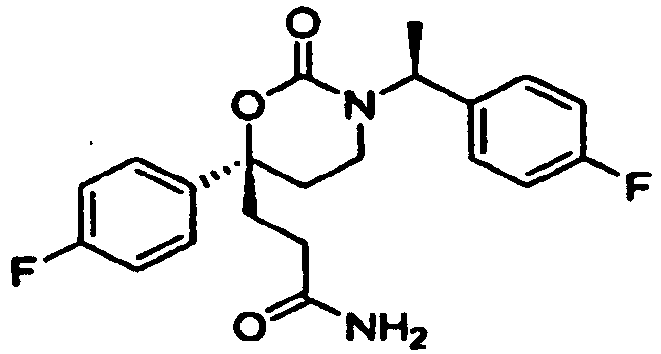
- The title compound was prepared from (R)-6-(4-fluorophenyl)-3-((S)-1-(4-fluorophenyl)ethyl)-6-(3-hydroxypropyl)-1,3-oxazinan-2-one following a procedure analogous to that described Example 234. LC-MS Method 2 tR = 1.212 min, m/z = 410.9; 1H NMR (CDCl3) 1.48 (d, 3H), 1.83-1.98 (m, 1H), 2.06-2.22 (m, 5H), 2.38-2.49 (m, 1H), 2.85 (m, 1H), 5.28 (s, 1H), 5.42 (s, 1H), 5.58 (q, 1H), 6.77 (m, 2H), 6.87 (m, 2H), 6.92-7.02 (m, 2H), 7.18 (m, 2H).
-

- The title compound was prepared from (R)-3-((S)-1-cyclohexylethyl)-6-(4-fluorophenyl)-6-(3-hydroxypropyl)-1,3-oxazinan-2-one following a procedure analogous to that described Example 234. LC-MS Method 2 tR = 1.304 min, m/z = 398.9; 1H NMR (CDCl3) 1.13 (d, 6H), 1.20 (s, 2H), 1.37-1.71 (m, 6H), 1.83-1.95 (m, 1 H), 2.04-2.20 (m, 3H), 2.30 (d, 1H), 2.36-2.48 (m, 1H), 2.48-2.58 (m, 1H), 3.00 (m, 1H), 3.88-3.98(m, 1H), 5.35 (s, 2H), 7.01 (t, 2H), 7.22 (m, 2H).
-

- The title compound was prepared from (R)-6-(2-aminoethyl)-3-((S)-1-cyclohexylethyl)-6-(4-fluorophenyl)-1,3-oxazinan-2-one following a procedure analogous to that described Example 99. LC-MS Method 2 tR = 1.373 min, m/z = 427; 1H NMR (CDCl3) 1.04 (d, 6H), 1.20 (s, 1H), 1.38-1.54 (m, 3H), 1.55-1.68 (m, 4 H), 2.02-2.21 (m, 3H), 2.30 (d, 1H), 2.48-2.58 (m, 1H), 2.80 (s, 3H), 2.91-3.02 (m, 2H), 3.05-3.18 (m, 1H), 4.54 (m, 1H), 7.04 (t, 2H), 7.23 (m, 2H).
-

- To a solution of (R)-3-((S)-1-cyclohexylethyl)-6-(4-fluorophenyl)-6-(3-hydroxy propyl)-1,3-oxazinan-2-one (200 mg, 0.55 mmol) in CH2Cl2 (10 mL) was added Et3N (290 mg, 2.87 mmol) and MsCl (196 mg, 1.72 mmol) at 0 °C. The reaction solution was stirred at rt for 2 h. The reaction was quenched by H2O and extracted with CH2Cl2. The organic phase was concentrated to give the 3-((R)-3-((S)-1-cyclohexylethyl)-6 -(4-fluorophen-yl)-2-oxo-1,3-oxazinan-6-yl)propyl methanesulfonate (240 mg, 92%).
- To a solution of 3-((R)-3-((S)-1-cyclohexylethyl)-6-(4-fluorophenyl)-2-oxo-1,3-oxazinan-6-yl)propyl methanesulfonate (240 mg, 0.54 mmol) in DMF (10 mL) was added NaN3 (112 mg, 1.72mmol). After stirring at 100 °C for 3 h, the reaction was quenched by H2O, and the mixture was extracted with EtOAc. The organic phase was washed with brine and concentrated to give (R)-6-(3-azidopropyl)-3-((S)-1-cyclohexylethyl)-6-(4-fluorophenyl) -1,3-oxazinan-2-one (180 mg, 88%). 1H NMR (CDCl3): δ= 1.04 (m, 6H), 1.21 (m, 1H), 1.41 (m, 1H), 1.5 (m,2H), 1.7 (m, 1H), 1.8 (m,7H), 2.12 (m, 1H), 2.3 (m, 1H), 2.6 (m, 1 H), 3.01 (m, 2H), 3.22 (m, 2H), 3.92 (m, 1H), 7.02 (m, 2H), 7.3 (m, 2H).
- To a solution of (R)-6-(3-azidopropyl)-3-((S)-1-cyclohexylethyl)-6-(4-fluorophenyl) -1,3-oxazinan-2-one (210 mg, 0.54 mmol) in THF (5 mL) and H2O (0.25 mL) was added Ph3P (420mg, 1.60 mmol). After refluxing for 3 h, the mixture was concentrated to give the crude product, which was purified by preparative TLC to give (R)-6-(3-aminopropyl)-3-((S)-1-cyclohexyle-thyl)-6-(4-fluorophenyl)-1,3-oxazinan-2-one (50 mg, 25%).
- To a solution of (R)-6-(3-aminopropyl)-3-((S)-1-cyclohexylethyl)-6-(4-fluorophenyl)- 1,3 -oxazinan-2-one (30 mg, 0.10 mmol) was added Et3N (40 mg, 0.4 mmol) and MsCl (30 mg, 0.24 mmol) at 0 °C. The reaction solution was stirred at rt for 2 h. The reaction was quenched by H2O and the mixture was extracted with CH2Cl2. The organic phase was concentrated to give the crude product, which was purified by preparative TLC to give N-(3-((R)-3-((S)-1-cyclohexylethyl)-6-(4-fluorophenyl)-2-oxo-1,3-oxazinan-6-yl) propyl)methanesulfonamide (11.5 mg, 33%). LC-MS Method 2 tR = 1.397 min, m/z = 440.9; 1H NMR (CDCl3) 1.04 (d, 6H), 1.13-1.34 (m, 2H), 1.43-1.68 (m, 6H), 1.73-1.98 (m, 3 H), 2.03-2.14 (m, 1H), 2.29 (d, 1H), 2.52 (tt, 1H), 2.85 (s, 3H), 2.92-3.08 (m, 3H), 3.68(m, 1H), 3.88-3.98 (m, 1H), 4.33 (t, 1H), 7.01 (t, 2H), 7.22 (m, 2H).
-

- To a mixture of (R)-6-allyl-6-(4-fluorophenyl)-3-((S)-1-(4-hydroxyphenyl)ethyl)-1,3-oxazinan-2-one (0.5227 g, 1.47 mmol), K2CO3 (7.7665 g, 56.2 mmol), CH3CN (6 mL) and H2O (6 mL) at room temperature was added 2-chloro-2,2-difluoroacetophene (1.6500 g, 8.66 mmol). The reaction flask was sealed, and the mixture was heated at 80°C and stirred for 4 h. Then the mixture was diluted with CH2Cl2, quenched with 6 N HCl (17.5 mL), extracted with CH2Cl2, and dried over Na2SO4. After the solvents were evaporated, the residue was purified by reversed-phase HPLC (SunFire™ Prep C18 OBD™ 5µm 19 × 50 mm column, 10% →90% CH3CN/H2O, 0.1% CF3COOH over 8 min and then 90% CH3CN/H2O, 0.1% CF3COOH over 2 min, flow rate 20 mL/min) to afford 0.2780 g (47%) of (R)-6-allyl-3-((S)-1-(4-(difluoromethoxy)phenyl)ethyl)-6-(4-fluorophenyl)-1,3-oxazinan-2-one. LC-MS Method 1 t R = 1.90 min, m/z 406 (MH+), 171; 1H NMR (400 MHz, CD3OD) δ 7.25-7.21 (m; 2H), 7.01 (t, J = 8.6 Hz, 2H), 6.88 (d, J = 8.8 Hz, 2H), 6.82 (d, J = 8.8 Hz, 2H), 6.65 (t, J = 74.1 Hz, 1H), 5.66-5.56 (m, 1H), 5.44 (q, J = 7.1 Hz, 1 H), 4.99-4.92 (m, 2H), 3.05-3.01 (m, 1H), 2.53 (d, J = 7.3 Hz, 2H), 2.40-2.35 (m, 1H), 2.26-2.08 (m, 2H), 1.44 (d, J = 7.3 Hz, 3H); 19F NMR (376 MHz, CD3OD) δ -83.96 (d, J = 73.7 Hz), - 117.39 (m).
- A mixture of (R)-6-allyl-3-((S)-1-(4-(difluoromethoxy)phenyl)ethyl)-6-(4-fluorophenyl)-1,3-oxazinan-2-one (0.0320 g, 0.0789 mmol, 1.0 equiv), NMO-H2O (0.0587 g, 0.434 mmol, 5.5 equiv), and OsO4 (2.5 wt. % in t-BuOH, 0.0450 g, 0.0044 mmol, 0.056 equiv) in CH2Cl2 (5 mL) was stirred at rt for 17 h. The mixture was diluted with CH2Cl2, washed with 1 N aq HCl, and dried over Na2SO4. After the solvents were evaporated, the residue was purified by reversed-phase HPLC (SunFire™ Prep C18 OBD™ 5µm 19 × 50 mm column, 10% →90% CH3CN/H2O, 0.1% CF3COOH over 8 min and then 90% CH3CN/H2O, 0.1% CF3COOH over 2 min, flow rate 20 mL/min) to afford 0.0340 g (98%) of (6S)-3-((S)-1-(4-(difluoromethoxy)phenyl)ethyl)-6-(2,3-dihydroxypropyl)-6-(4-fluorophenyl)-1,3-oxazinan-2-one. LC-MS t R = 1.46 min in 3 min chromatography, m/z 440 (MH+), 396. 270, 226, 171.
- To a solution of (6S)-3-((S)-1-(4-(difluoromethoxy)phenyl)ethyl)-6-(2,3-dihydroxypropyl)-6-(4-fluorophenyl)-1,3-oxazinan-2-one (0.0340 g, 0.0773 mmol, 1.0 equiv) in acetone (2 mL) and H2O (0.5 mL) was added NalO4 (0.0545 g, 0.255 mmol, 3.3 equiv). The mixture was stirred at room temperature for 2 h and then diluted with EtOAc, dried over Na2SO4. LC-MS t R = 1.67 min in 3 min chromatography, m/z 408 (MH+), 238, 171.
- After the solvents were evaporated, the crude aldehyde was dissolved into MeOH. To this solution was added NaBH4 (0.100 g). The resulting mixture was stirred at rt for 20 min and then quenched with acetone and stirred overnight. After the solvent was evaporated, the residue was purified by reversed-phase HPLC (SunFire™ Prep C18 OBD™ 5µm 19 × 50 mm column, 10% →90% CH3CN/H2O. 0.1% CF3COOH over 8 min and then 90% CH3CN/H2O, 0.1% CF3COOH over 2 min, flow rate 20 mL/min) to afford 0.0165 g (52%) of (S)-3-((S)-1-(4-(difluoromethoxy)phenyl)ethyl)-6-(4-fluorophenyl)-6-(2-hydroxyethyl)-1,3-oxazinan-2-one. LC-MS Method 1 t R = 1.53 min, m/z 410 (MH+), 171; 1H NMR (400 MHz. CDCl3) δ 7.27-7.24 (m, 2H), 7.04 (t, J = 8.5 Hz, 2H), 6.92-6.86 (m, 4H), 6.43 (t, J = 73.8 Hz, 1H), 5.63 (q, J = 6.7 Hz, 1 H), 3.76 (m, 1 H), 3.55 (m, 1H), 2.98 (br s, 1H), 2.97-2.91 (m, 1H), 2.32-2.08 (m, 5H), 1.50 (d, J = 6.7 Hz, 3H); 19F NMR (376 MHz, CDCl3) δ - 81.50 (d, J = 73.7 Hz), -114.70 (m).
-

- The title compound was prepared following a procedure analogous to that described in Example 328 Step 1. LC-MS Method 1 tR = 1.69 min, m/z = 444 (M+23); 1H NMR (CDCl3) 7.34-7.30 (m, 2H), 7.02 (t, J = 8.5 Hz, 2H), 6.87-6.82 (m, 4H), 6.43 (t, J = 73.8 Hz, 1 H), 5.60 (q, J = 7.0 Hz, 1 H), 3.01-2.92 (m, 3H), 2.63-2.55 (m, 1H), 2.41-2.28 (m, 2H), 2.07 (s, 3H), 1.49 (d, J = 7.0 Hz, 3H).
-

- The title compound was prepared following a procedure analogous to that described in Example 328 Step 2. LC-MS Method 1 tR = 1.66 min, m/z = 460 (M+23); 1H NMR (CD30D) 7.25-7.21 (m, 2H), 7.01-6.97 (m, 2H), 6.92 (d, J = 8.8 Hz, 2H), 6.83 (d, J = 8.5 Hz, 2H), 6.64 (t, J = 73.8 Hz, 1H), 5.45 (q, J = 7.0 Hz, 1H); 2.99-2.96 (m, 1H), 2.45-2.32 (m, 2H), 2.14-2.06 (m, 1H), 2.04 (s, 2H), 1.43 (d, J = 7.0 Hz, 3H), 1.17 (s, 3H), 0.88 (s, 3H).
-

- A solution of 4-(difluoromethoxy)benzaldehyde (3.1060 g, 18.04 mmol, 1.08 equiv). (R)-(+)-2-methyl-2-propanesulfinamide (2.0210 g, 16.67 mmol, 1.0 equiv), and Ti(OEt)4 (8.080 g, 35.4 mmol, 2.1 equi) in THF (25 mL) was heated at 100 °C for 15 h. After cooling, the reaction mixture was quenched with saturated brine (7 mL), with vigorous stirring. The mixture was diluted with CH2Cl2 and dried over Na2SO4. After the solvents were evaporated, the residue was purified by chromatography on silica gel eluted with hexanes/ethyl acetate to give 4.2666 g (93%) of [N(E), S(R)]-N-(4-(difluoromethoxy)benzylidene)-2-methylpropane-2-sulfinamide as a solid. LC-MS Method 1 t R = 1.78 min, m/z, 276 (MH+), 220; 1H NMR (400 MHz, CDCl3) δ 8.56 (s, 1H), 7.87 (d, J = 8.2 Hz, 2H), 7.21 (d, J = 8.5 Hz, 2H), 6.59 (t, J = 73.0 Hz, 1H), 1.26 (s, 9H); 19F NMR (376 MHz, CDCl3) δ -82.04 (d, J = 72.4 Hz); 13C NMR (100 MHz, CDCl3) δ 161.32, 154.08 (t, J= 2.7 Hz), 131.18, 131.12, 119.44, 115.36 (t, J = 261.5 Hz), 57.83, 22.57.
- Methylmagnesium bromide (1.4 M solution in toluene/THF, 120 mL, 168 mmol, 11 equiv) was added dropwise to a solution of [N(E), S(R)]-N-(4-(difluoromethoxy)benzylidene)-2-methylpropane-2-sulfinamide (4.2263 g, 15.35 mmol, 1.0 equiv) in THF (30 mL) at -78°C under N2. The reaction mixture was stirred at -78 °C and gradually warmed to 18 °C over 24 h. The reaction mixture was cooled to -78 °C and quenched with saturated NH4Cl (30 mL), with vigorous stirring. The mixture was extracted with CH2Cl2 and dried over Na2SO4. After the solvents were evaporated, the residue was purified by chromatography on silica gel eluted with hexanes/ethyl acetate to give 4.2086 g (94%) of [S(R)]-N-((1S)-1-(4-(difluoromethoxy)phenyl)ethyl)-2-methylpropane-2-sulfinamide as a solid. LC-MS Method 1 tR = 1.57 min, m/z 292 (MH+), 218, 171; 1H NMR (400 MHz, CDCl3) δ 7.33 (d, J = 8.5 Hz, 2H), 7.09 (d, J = 8.5 Hz, 2H), 6.51 (t, J = 73.9 Hz, 1H), 4.60-4.54 (m, 1H), 3.31 (m, 1H), 1.52 (d, J=6.7 Hz, 3H), 1.20 (s, 9H); 19F NMR (376 MHz, CDCl3) δ -81.14 (d, J = 73.7 Hz); 13C NMR (100 MHz, CDCl3) δ 140.57, 128.37, 119.53, 115.89 (t, J = 260 Hz), 55.57, 53.87, 25.15, 22.53.
- A solution of [S(R))-N-((1S)-1-(4-(difluoromethoxy)phenyl)ethyl)-2-methylpropane-2-sulfinamide (2.1356 g, 7.33 mmol) in a mixture of 4 M HCl in dioxane (15 mL) and MeOH (15 mL) was stirred at room temperature for 24 h. After the solvents were removed in vacuo, the residue was treated with 3 N NaOH (15 mL), extracted with CH2Cl2, dried over K2CO3. After the solvents were evaporated. the crude product was directly used in the next step without further purification. LC-MS Method 1 t R = 0.83 min, m/z 171 (M+-NH2); 1H NMR (400 MHz, CDCl3) δ 7.34 (d, J = 8.5 Hz, 2H), 7.07 (d, J = 8.5 Hz, 2H), 6.48 (t, J = 73.9 Hz, 1H), 4.13 (q, J = 6.7 Hz, 1H), 1.36 (d, J = 6.7 Hz, 3H), 1.18 (s, 9H); 19F NMR (376 MHz, CDCl3) δ -80.99 (d, J = 73.7 Hz).
- (S)-1-(difluoromethoxy)-4-(1-isocyanatoethyl)benzene was prepared from (S)-1-(4-(difluoromethoxy)phenyl)ethanamine.
- 1-chloro-3-(4-fluorophenyl)hept-6-en-3-ol was prepared from 3-chloro-1-(4-fluorophenyl)propan-1-one and 3-butenylmagnesium bromide following a procedure analogous to that described in Example 110 Step 1.
- 6-(but-3-enyl)-3-((S)-1-(4-(difluoromethoxy)phenyl)ethyl)-6-(4-fluorophenyl)-1,3-oxazinan-2-one was prepared from 1-chloro-3-(4-fluorophenyl)hept-6-en-3-ol and (S)-1-(difluoromethoxy)-4-(1-isocyanatoethyl)benzene following a procedure analogous to that described in Example 110 Step 2. Two isomers were isolated.
- Isomer 1: LC-MS Method 1 tR = 2.02 min, m/z = 420 (M+1); 1H NMR (CDCl3) 7.29-7.24 (m, 4H), 7.08-7.03 (m, 4H), 6.49 (t, J = 73.8 Hz, 1H), 5.75-5.61 (m, 2H), 4.93-4.86 (m, 2H), 2.68-2.63 (m, 2H), 2.26-2.17 (m, 2H), 2.06-1.71 (m, 4H), 1.24 (d, J = 7.3 Hz, 3H).
- Isomer 2: LC-MS Method 1 tR = 1.96 min, m/z = 420 (M+1); 1H NMR (CDCl3) 7.25-7.20 (m, 2H), 7.04-6.99 (m, 2H), 6.90-6.86 (m, 4H), 6.42 (t, J = 73.8 Hz, 1H), 5.73-5.61 (m, 2H), 4.95-4.87 (m, 2H), 2.92-2.88 (m, 1H), 2.28-2.16 (m, 4H), 1.99-1.77 (m, 3H), 1.49 (d, J = 7.3 Hz, 3H).
-

- A mixture of (R)-3-((S)-1-(4-(difluoromethoxy)phenyl)ethyl)-6-(4-fluorophenyl)-6-(3-hydroxypropyl)-1,3-oxazinan-2-one (0.1608 g, 0.38 mmol, 1.0 equiv), RuCl3·xH2O (0.0490 g, 0.24 mmol, 0.6 equiv), and NalO4 (0.5990 g, 2.8 mmol, 7.4 equiv) in 14 mL of solvent (1:1:1.5 CCl4:CH3CN:H2O) was stirred at 0°C for 3 h. The reaction mixture was then quenched with 1 N HCl (1 mL), extracted with CH2Cl2 and dried over Na2SO4. After the solvents were evaporated, the residue was purified by reversed-phase HPLC (SunFire™ Prep C18 OBD™ 5µm 19 × 50 mm column, 10% →90% CH3CN/H2O, 0.1% CF3COOH over 8 min and then 90% CH3CN/H2O, 0.1% CF3COOH over 2 min, flow rate 20 mL/min) to afford 0.0920 g (55%) of 3-((R)-3-((S)-1-(4-(difluoromethoxy)phenyl)ethyl)-6-(4-fluorophenyl)-2-oxo-1,3-oxazinan-6-yl)propanoic acid. LC-MS Method 1 t R = 1.59 min, m/z = 460 (MNa+), 438 (MH+), 171; 1H NMR (400 MHz, CDCl3) δ 9.31 (br s, 1 H), 7.22-7.19 (m, 2H), 7.01 (t, J= 8.5 Hz, 2H), 6.94 (d, J = 8.8 Hz, 2H), 6.88 (d, J = 8.8 Hz, 2H), 6.43 (t, J = 73.8 Hz, 1H), 5.61 (q, J= 6.9 Hz, 1H), 2.97-2.94 (m, 1H), 2.53-2.44 (m, 1H), 2.30-2.07 (m, 6H), 1.49 (d, J = 7.0 Hz, 3H); 19F NMR (376 MHz, CDCl3) δ -81.54 (d, J = 73.7 Hz), -114.53 (m).
- To a solution of 3-((R)-3-((S)-1-(4-(difluoromethoxy)phenyl)ethyl)-6-(4-fluorophenyl)-2-oxo-1,3-oxazinan-6-yl)propanoic acid (0.0485 g, 0.11 mmol) in DMF (2 mL) was added HATU (0.2603 g, 0.68 mmol), DIPEA (0.5 mL), and 0.8 M NH3 in THF (3 mL). The mixture was stirred at rt for 22 h. After the solvents were removed in vacuo, the residue was purified by reversed-phase HPLC (SunFire™ Prep C18 OBD™ 5µm 19 × 50 mm column, 10% →90% CH3CN/H2O, 0.1% CF3COOH over 8 min and then 90% CH3CN/H2O, 0.1% CF3COOH over 2 min, flow rate 20 mL/min) to afford 0.0235 g (49%) of 3-((R)-3-((S)-1-(4-(difluoromethoxy)phenyl)ethyl)-6-(4-fluorophenyl)-2-oxo-1,3-oxazinan-6-yl)propanamide. LC-MS Method 1 t R = 1.48 min, m/z 459 (MNa+), 393; 1H NMR (400 MHz, CDCl3) δ 7.23-7.20 (m, 2H), 7.04-6.99 (m, 2H), 6.95 (d, J = 8.2 Hz, 2H), 6.89 (d, J = 8.5 Hz, 2H), 6.43 (t, J = 73.8 Hz, 1H), 5.83-5.78 (m, 2H), 5.62 (q, J = 7.0 Hz, 1H), 2.95-2.91 (m, 1H), 2.45 (m, 1 H), 2.27-2.15 (m, 5H), 1.98 (m, 1H), 1.49 (d, J = 7.0 Hz, 3H); 19F NMR (376 MHz, CDCl3) δ -81.51 (d, J = 73.7 Hz), -114.66 (m).
-

- To a solution of (R)-3-((S)-1-(4-(difluoromethoxy)phenyl)ethyl)-6-(4-fluorophenyl)-6-(3-hydroxypropyl)-1,3-oxazinan-2-one (0.0332 g. 0.0784 mmol) and methanesulfonamide (0.0549 g, 0.577 mmol) in dry toluene (2 mL) was added (cyanomethene)tributylphosphorane (CMBP. 0.1720 g. 0.713 mmol) at rt under N2. The mixture was stirred for 19 h at rt. After the solvents were removed in vacuo, the residue was purified by reversed-phase HPLC (SunFire™ Prep C18 OBD™ 5µm 19 × 50 mm column, 10% →90% CH3CN/H2O, 0.1% CF3COOH over 8 min and then 90% CH3CN/H2O, 0.1% CF3COOH over 2 min, flow rate 20 mL/min) to afford 0.0137 g (35%) of N-(3-((R)-3-((S)-1-(4-(difluoromethoxy)phenyl)ethyl)-6-(4-fluorophenyl)-2-oxo-1,3-oxazinan-6-yl)propyl)methanesulfonamide. LC-MS Method 1 t R = 1.64 min, m/z = 523 (MNa+), 501 (MH+), 171; 1H NMR (400 MHz, CD3OD) δ 7.24-7.21 (m, 2H), 7.01 (t, J = 8.6 Hz, 2H), 6.92 (d, J = 8.8 Hz, 2H), 6.83 (d, J = 8.5 Hz, 2H), 6.65 (t, J = 73.8 Hz, 1 H), 5.45 (q, J= 7.0 Hz, 1H), 3.04-3.00 (m, 1 H), 2.93-2.86 (m, 2H), 2.77 (s, 3H), 2.38-2.34 (m, 1 H), 2.22-2.09 (m, 2H), 1.92-1.82 (m, 2H), 1.58-1.50 (m, 1H), 1.44 (d, J = 7.0 Hz, 3H), 1.26-1.18 (m, 1H); 19F NMR (376 MHz, CD3OD) δ -83.93 (d, J = 75.0 Hz), -117.33 (m).
-

- (S)-1-(difluoromethoxy)-4-(1-isocyanatopropyl)benzene was prepared following conditions analogous to those described in Example 323 Steps 1 to 4 using EtMgBr in Step 2. 6-allyl-3-((S)-1-(4-(difluoromethoxy)phenyl)propyl)-6-(4-fluorophenyl)-1,3-oxazinan-2-one was prepared following a procedure analogous to that described in Example 110 Step 2 using (S)-1-(difluoromethoxy)-4-(1-isocyanatopropyl)benzene and 1-chloro-3-(4-fluorophenyl)hex-5-en-3-ol. (R)-6-allyl-3-((S)-1-(4-(difluoromethoxy)phenyl)propyl)-6-(4-fluorophenyl)-1,3-oxazinan-2-one was separated chromatographically. (R)-3-((S)-1-(4-(difluoromethoxy)phenyl)propyl)-6-(4-fluorophenyl)-6-(3-hydroxypropyl)-1,3-oxazinan-2-one was prepared following a procedure analogous to that described in Example 78. 3-((R)-3-((S)-1-(4-(difluoromethoxy)phenyl)propyl)-6-(4-fluorophenyl)-2-oxo-1,3-oxazinan-6-yl)propanamide was prepared following a procedure analogous to that described in Example 234. LC-MS Method 2 tR = 1.251 min, m/z = 451.4; 1H NMR (CDCl3) 0.92 (t, 3H), 1.78-1.92 (m, 3H), 2.10-2.23 (m, 5H), 2.43 (m, 1H), 2.90 (m, 1 H), 5.34 (t, 1H), 5.40-5.63 (d, 2H), 6.18-6.56 (m, 1H), 6.89 (m, 4H), 6.99 (d, 2H), 7.11 (m, 2H).
-

- The title compound was prepared from (R)-6-allyl-3-((S)-1-(4-(difluoromethoxy)phenyl)ethyl)-6-phenyl-1,3-oxazinan-2-one following procedures analogous to those described in Example 320. LC-MS Method 2 tR = 1.248 min, m/z = 319.16; 1H NMR (CDCl3) 1.48 (d, 3H), 2.02-2.33 (m, 5H), 2.82 (m, 1H), 3.51 (m, 1H), 3.72 (m, 1H) 5.55 (m, 1H) 6.16-6.54 (m, 1H), 6.76 (m, 4H), 7.18-7.31 (m, 5H).
-

- To a solution of (R)-6-allyl-3-((S)-1-(4-(difluoromethoxy)phenyl)ethyl)-6-phenyl-1,3- oxazinan-2-one (379 mg, 1 mmol) in DMF were added CuCl (227 mg, 2.3 mmol) and PdCl2 (53 mg, 0.3 mmol) at 0 °C under O2, and the mixture was stirred overnight at 30°C. The mixture was washed with water and extracted with EtOAc. The organic layer was separated, and concentrated to give the crude product, which was purified by preparative TLC to afford (S)-3-((S)-1-(4-(difluoromethoxy)phenyl)ethyl)-6-(2-oxopropyl)-6-phenyl- 1,3- oxazinan-2-one (180 mg, 50%).
- To a solution of (S)-3-((S)-1-(4-(difluoromethoxy)phenyl)ethyl)-6-(2-oxopropyl)-6- phenyl-1,3-oxazinan-2-one (150 mg, 0.39 mmol) in THF (10 mL) was added methylmagnesium bromide (1 M, 2.5 mL) under nitrogen at -78 °C. The mixture was stirred at rt until the reaction was over. The reaction was quenched with satd aq NH4Cl. The organic phase was separated and concentrated to give crude product, which was purified by preparative HPLC to give (S)-3-((S)-1-(4-(difluoromethoxy)phenyl)ethyl)-6- (2-hydroxy-2-methylpropyl)-6-phenyl-1,3 -oxazinan-2-one (15 mg, 10%). 1H NMR (CDCl3): 1.05 (s, 3H), 1.10 (s, 3H), 1.45 (s, 3H), 2.10 (m, 1H), 2.16 (m, 2H), 2.20 (m, 1H), 2.33 (m, 1H), 2.76 (m, 1H), 5.60 (m, 1H), 6.16-6.58 (m, 1H), 6.78 (m, 2H), 6.86 (m, 2H), 7.26 (m, 5H).
-

- The title compound was prepared following procedures analogous to those described in Example 78 starting with (R)-6-allyl-3-((S)-1-(4-(difluoromethoxy)phenyl)ethyl)-6-phenyl-1,3-oxazinan-2-one. LC-MS Method 2 tR = 1.868 min, m/z = 428.1; 1H NMR (CDCl3) 1.35 (m, 1H), 1.49 (d, 3H), 1.65 (m, 1H), 1.85-1.99 (m, 2H), 2.83 (m, 1H), 3.50 (m, 2H), 5.57 (m, 1H), 6.16-6.54 (t, 1H), 6.77 (dd, 4H), 7.25 (m, 4H).
-
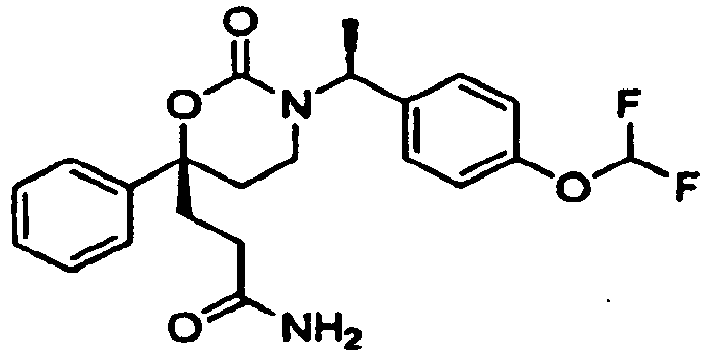
- The title compound was prepared following procedures analogous to those described in Example 234 starting with (R)-3-((S)-1-(4-(difluoromethoxy)phenyl)ethyl)-6-(3-hydroxypropyl)-6-phenyl-1,3-oxazinan-2-one. LC-MS Method 2 tR = 1.769 min, m/z = 464.1; 1H NMR (CDCl3) 1.49 (d, 3H), 2.91 (m, 1H), 2.11-2.30 (m, 5H), 2.45 (m, 1H), 2.83 (m, 1H), 5.21 (s, 1H), 5.35 (d, 1H), 5.60 (m, 1H), 6.16-6.54 (t, 1H), 6.74 (m, 2H), 6.85 (m, 2H), 7.18-7.30 (m, 5H).
-

- The title compound was prepared following procedures analogous to those described in Example 359 starting with (R)-3-((S)-1-(4-(difluoromethoxy)phenyl)ethyl)-6-(3-hydroxypropyl)-6-phenyl-1,3-oxazinan-2-one. LC-MS Method 2 tR = 1.3 min, m/z = 483; 1H NMR (CDCl3) 1.34 (m, 1H), 1.51 (d, 3H), 1.65 (m, 1H), 1.95 (m, 1H), 2.05 (m, 1H), 2.10-2.34 (m, 3H), 2.39 (s, 3H), 2.91 (m, 1H), 3.06 (m, 2H), 4.30 (m, 1H), 5.62 (m, 1H), 6.20-6.62 (m, 1H), 6.90(dd, 4H), 7.20 (m, 2H), 7.34 (m, 3H).
-

- The title compound was prepared following procedures analogous to those described in Example 207 using (S)-1-(4-methoxyphenyl)ethanamine in Step 4. Two isomers were isolated.
- Isomer 1: LC-MS Method 3 tR = 0.91 min, m/z = 693.3; 1H NMR (CDCl3) 1.26 (m, 6H), 1.25 (s, 1H), 1.45 (d, 3H), 1.58-1.66 (m, 6H), 1.95 (m, 1H), 2.66 (m, 3H), 3.05 (m, 1H), 3.60 (m, 2H), 3.74 (s, 3H), 5.70 (m, 1H), 6.83 (m, 2H), 7.18 (m, 2H).
- Isomer 2:
-

- The title compound was prepared following procedures analogous to those described in Example 234 starting with 6-(3-hydroxypropyl)-6-isopropyl-3-((S)-1-(4-methoxyphenyl)ethyl)-1,3-oxazinan-2-one. Two isomers were isolated.
- Isomer 1: LC-MS Method 2 tR = 1.133 min, m/z = 349.1; 1H NMR (CDCl3) 0.84 (m, 6H), 1.43 (d, 3H), 1.58 (m, 1H), 1.67 (m, 1H), 1.92 (m, 3H), 2.33 (m, 2H), 2.65 (m, 1 H), 3.02 (m, 1 H), 3.76 (s, 3H), 5.31 (m, 1H), 5.54 (m, 1H), 5.67 (m, 1 H), 6.89 (m, 2H), 7.18 (m, 2H).
- Isomer 2: LC-MS Method 2 tR = 1.169 min, m/z = 371; 1H NMR (CDCl3) 0.89 (d, 6H), 1.42 (d, 3H), 1.50-1.69 (m, 1 H), 1.77-1.91 (m, 3H), 1.99 (m, 1H), 2.29 (m, 2H), 2.70 (m, 2H), 3.00 (m, 1H), 3.72 (s, 3H), 5.66 (m, 1H), 5.78-5.89 (s, 1H), 5.90-6.02 (s, 1H), 6.81 (d, 2H), 7.18 (d, 2H).
-

- The title compound was prepared from 6-allyl-3-((S)-1-(4-bromophenyl)ethyl)-6-isopropyl-1,3-oxazinan-2-one isomer 1 following procedures analogous to those described in Example 187 Steps 1 and 2 followed by procedures analogous to those described in Example 234. Two isomers were isolated.
- Isomer 1: LC-MS Method 3 tR = 1.409 min, m/z = 353; 1H NMR (CDCl3) 0.87 (m, 6H), 1.19 (m, 1 H), 1.50 (d, 3H), 1.55 (m, 1H), 1.73 (m, 1 H), 1.87-2.00 (m, 3H), 2.68 (m, 1H), 3.11 (m, 1H), 5.50 (m, 1H), 5.65 (m, 1H), 5.78 (m, 1H), 7.14-7.45 (m, 4H).
- Isomer 2: LC-MS Method 2 tR = 0.917 min, m/z = 353; 1H NMR (CDCl3) 0.89 (m, 6H), 1.47 (d, 3H), 1.51-1.62 (m, 1H), 2.01 (m, 1H), 2.29 (m, 2H), 2.70 (m, 1H), 3.01 (m, 1H), 5.28-5.41 (s, 1H), 5.56-5.65 (s, 1H), 5.69 (m, 1H), 7.21 (d, 2H), 7.28 (d, 2H).
-

- 6-allyl-3-((S)-1-(4-bromophenyl)ethyl)-6-tert-butyl-1,3-oxazinan-2-one was prepared from ethyl 4,4-dimethyl-3-oxopentanoate following procedures analogous to those described in Example 207 Steps 1 to 8. The title compound was prepared from 6-allyl-3-((S)-1-(4-bromophenyl)ethyl)-6-tert-butyl-1,3-oxazinan-2-one following procedures analogous to those described in Example 78. Two isomers were isolated.
- Isomer 1: LC-MS Method 2 tR = 1.349 min, m/z = 397.13; 1H NMR (CDCl3) 0.94 (s, 9H), 1.44 (d, 3H), 1.54 (m, 3H), 1.58 (m, 1H), 1.65 (m, 2H), 1.97 (m, 1 H), 2.66 (m, 1H), 2.93 (m, 1H), 3.48 (m, 1H), 5.67 (m, 1H), 7.16 (d, 2H), 7.40 (d, 2H).
- LC-MS Method 2 tR = 1.383 min, m/z = 397.13; 1H NMR (CDCl3) 0.93 (s, 9H), 1.44 (d, 3H), 1.58-1.68 (m, 4H), 1.80 (m, 2H), 2.68 (m, 1H), 3.10 (m, 1H), 3.58 (m, 2H), 5.67 (m, 1 H), 7.16 (d, 2H), 7.40 (d, 2H).
-

- The title compound was prepared from ethyl 4,4-dimethyl-3-oxopentanoate following procedures analogous to those described in Example 207. Two isomers were isolated.
- Isomer 1: LC-MS Method 3 tR = 1.207 min, m/z = 431.23; 1H NMR (CD3OD) 1.01 (S, 9H), 1.50 (m, 2H), 1.57 (d, 3H), 1.59-1.90 (m, 4H), 2.14 (m, 1H), 2.84 (m, 1H), 3.17 (m, 1H), 3.44 (m, 2H), 5.66 (m, 1H), 7.04 (m, 2H), 7.43-7.53 (m, 5H).
- Isomer 2: LC-MS Method 3 tR = 1.219 min, m/z = 431.23; 1H NMR (CD3OD) 1.02 (S, 9H), 1.59 (d, 3H), 1.63 (m, 2H), 1.81-1.94 (m, 4H), 2.98 (m, 1H), 3.31 (m, 1H), 3.56 (m, 2H), 5.68 (m, 1H), 7.04 (m, 2H), 7.42-7.53 (m, 5H).
-

- A heavy walled glass tube was charged with 1-chloro-3-(4-fluorophenyl)hex-5-en-3-ol (250 mg, 1.1 mmol), (2-((4-methylpiperazin-1-yl)methyl)phenyl)methanamine (239 mg, 1.1 mmol), KI (200 mg, 1.2 mmol), i-Pr2NEt (0.22 mL, 1.2 mmol) and DMF (2 mL). The mixture was sealed, heated and stirred at 80 °C for 16 h. The mixture was cooled to rt, diluted with EtOAc (80 mL) and extracted with water (2 x 25 mL). The combined water layer was diluted with THF (50 mL) and solid K2CO3 (5 g) was added, followed by Boc2O (357 mg, 1.64 mmol). The mixture was stirred at rt for 3 h, diluted with brine (50 mL) and extracted with EtOAc (2 x 75 mL). These EtOAc extracts were combined dried over Na2SO4 and concentrated to afford crude tert-butyl 3-(4-fluorophenyl)-3-hydroxyhex-5-enyl(2-((4-methylpiperazin-1-yl)methyl)benzyl)carbamate (323 mg, 72%) which was used without further purification. LC-MS Method 1 tR = 0.95 min, m/z = 412.
- tert-Butyl 3-(4-fluorophenyl)-3-hydroxyhex-5-enyl(2-((4-methylpiperazin-1-yl)methyl)benzyl)carbamate (17 mg, 34 µmol) was dissolved in dry THF (1 mL) and 60% NaH in oil (7 mg, 0.17 mmol) was added. The mixture was heated and stirred at 50 °C for 24 h. Water (0.5 mL) was added, followed by hexanes (1 mL) and MeOH (1.5 mL). The aqueous MeOH layer was separated and submitted to preparative HPLC to afford 6-allyl-6-(4-fluorophenyl)-3-(2-((4-methylpiperazin-1-yl)methyl)benzyl)-1,3-oxazinan-2-one as its TFA salt (1.1 mg, 8%). LC-MS Method 1 tR = 1.35 min, m/z = 438.
-

- A mixture of 1-chloro-3-(4-fluorophenyl)hex-5-en-3-ol (760 mg, 3.3 mmol), (S)-tert-butyl 3-aminopiperidine-1-carboxylate (1.0 g, 5 mmol), KI (1.1 g, 6.7 mmol) and K2CO3 (920 mg, 6.7 mmol) in acetonitrile (33 mL) was heated to reflux overnight. The reaction mixture was filtered. The filtrate was condensed to give the crude product, which was purified by preparative TLC to afford (3S)-tert-butyl-3-(3-(4-fluorophenyl) -3- hydroxyhex-5- enylamino)piperidine-1-carboxylate (500 mg, 38%). 1H NMR: (CDCl3): 1.23 (m, 1H), 1.38 (d, 9H), 1.57 (m, 1H), 1.75 (broad, 1H), 1.94 (m, 2H), 2.37 (m, 1H), 2.43 (m, 2H), 2.56 (m, 1H), 2.80 (broad, 3H), 3.49 (broad, 1H), 3.71 (broad, 3H), 4.95 (d, 2H), 5.56 (m, 1H), 6.95 (t, 2H), 7.32 (m, 2H).
- To a solution of (3S)-tert-butyl 3-(3-(4-fluorophenyl)-3-hydroxyhex-5-enylamino)- piperidine-1-carboxylate (500 mg, 1.27 mmol) and triethylamine (515 mg, 5.1 mmol) in dried methylene chloride (13 mL) at 0 °C was added triphosgene (126 mg, 0.42 mmol). The mixture was stirred at room temperature till the reaction was over. Water was added, and the layers were separated. The aqueous layer was extracted with methylene chloride. The combined organic layer was washed with water, dried over Na2SO4, and condensed to give the crude product, which was purified by column chromatography on silica gel to afford (3S)-tert-butyl 3-(6-allyl-6-(4-fluorophenyl)-2-oxo-1,3-oxazinan-3-yl)piperidine-1-carboxylate (70 mg, 13%). 1H NMR: (CDCl3): 1.37 (d, 9H), 1.43 (m, 1H), 1.64 (m, 1 H), 2.22 (m, 2H), 2.64 (m, 5H), 3.11 (m, 1H), 3.91 (broad, 3H), 5.00 (q, 2H), 5.65 (m, 1H), 6.99 (t, 3H), 7.20 (m, 2H).
- The title compound was prepared from (3S)-tert-butyl 3-(6-allyl-6-(4-fluorophenyl)-2-oxo-1,3-oxazinan-3-yl)piperidine-1-carboxylate following a procedure analogous to that described in Example 78. Two isomers were isolated.
- Isomer 1: LC-MS Method 2 tR = 1.308 min. m/z = 459; 1H NMR (CDCl3) 1.24 (m, 1H), 1.34 (s, 9H), 1.42 (m, 2H), 1.62 (m, 3H), 1.80-1.97 (m, 2H), 2.10 (m, 1H), 2.24 (m, 1H), 2.34-2.48 (m, 1H), 2.57 (m, 1H), 2.67 (m, 1H), 3.10 (m, 1 H), 3.48 (t, 2H), 3.55-4.06 (m, 3H), 6.98 (t, 2H), 7.18 (m, 2H).
- Isomer 2: LC-MS Method 2 tR = 1.313 min, m/z = 337; 1H NMR (CDCl3) 1.27 (m, 1H), 1.39 (s, 9H), 1.41-1.52 (m, 4H), 1.56 (m, 2H), 1.59-1.61 (m, 1H), 1.83-2.00 (m, 2H), 2.09-2.20 (m, 1H), 2.25 (m, 1 H), 2.39-2.57 (m, 1 H), 2.69-2.83 (m, 2H), 3.01 (m, 1H), 3.50 (t, 2H), 3.70-3.88 (s, 1H), 3.89-4.00 (m, 2H), 6.94-7.03 (t, 2H), 7.18-7.29 (m, 2H).
-
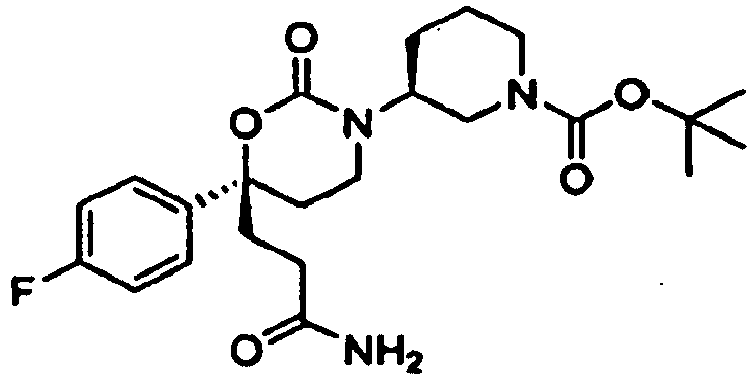
- The title compound was prepared following procedures analogous to those described in Example 234 using PDC in place of Jones reagent. LC-MS Method 2 tR = 1.207 min, m/z = 350.4; 1H NMR (CDCl3) 1.36 (s, 9H), 1.46 (m, 1H), 1.62 (m, 2H), 1.71 (m, 1H), 1.86 (m,1H), 2.10 (m, 1H), 2.18 (m, 2H), 2.23 (m, 1H), 2.42 (m, 2H), 2.66 (m, 2H), 3.12 (m, 1H), 3.70-3.98 (d, 2H), 5.29 (s, 1H), 5.43 (s, 1 H), 7.01 (t, 2H), 7.18 (m. 2H).
-

- A solution of (S)-tert-butyl 3-((R)-6-allyl-6-(4-fluorophenyl)-2-oxo-1,3-oxazinan-3-yl)piperidine-1-carboxylate (150 mg, 0.359 mmol) in 20% TFA/CH2Cl2 (5 mL) was stirred at 0 °C for 2 h. The mixture was concentrated to give (R)-6-allyl-6-(4-fluorophenyl)-3-((S)-piperidin-3-yl)-1,3-oxazinan-2-one (112 mg, crude), which was used for the next without further purification.
- To a solution of (R)-6-allyl-6-(4-fluorophenyl)-3-((S)-piperidin-3-yl)-1,3-oxazinan-2-one (112, mg, 0.35 mmol) and Et3N (71 mg, 0.70 mmol) in CH2Cl2 (10 mL) was added CbzCl (71 mg, 0.7 mmol) at 0 °C. Then the mixture was stirred at rt till the reaction was over. The reaction was quenched with H2O. The mixture was extracted with EtOAc, and the organic phase was washed with brine, dried over Na2SO4, filtered and concentrated to give the crude product, which was purified by preparative TLC to afford (S)-benzyl 3-((R)-6-allyl-6-(4-fluorophenyl)-2-oxo-1,3-oxazinan-3-yl)piperidine-1-carboxylate (78 mg, 49%). 1H NMR (CDCl3): 1.63 (m, 3H), 2.07-2.26 (m, 2H), 2.54 (m, 3H), 2.21 (m, 2H), 3.09 (m, 1H), 3.68 (m, 1H), 3.99 (m, 1H), 4.93-5.09 (m, 4H), 5.09-5.18 (m, 1H), 6.87-7.03 (m, 2H), 7.14 (m, 1H), 7.31 (m, 6H).
- To a solution of (S)-benzyl 3-((R)-6-allyl-6-(4-fluorophenyl)-2-oxo-1,3-oxaz.inan-3-yl)piperidine-1-carboxylate (78 mg, 0.17 mmol) in THF (3 mL) was added BH3 THF (0.5 mL, I mol/L) at 0 °C under nitrogen atmosphere. The formed mixture was stirred for 2 h. The reaction was quenched with water. Then aqueous NaOH solution (3 mol/L, 0.2 mL) and H2O2 (30%, 0.4 mL) was added to the above mixture. The resulting mixture was stirred for 1.5 h. The mixture was extracted with EtOAc, and the combined organic phase was concentrated to give the crude product, which was purified by preparative TLC to give (S)-benzyl 3-((R)-6-(4-fluorophenyl)-6-(3-hydroxypropyl)-2-oxo-1,3-oxazinan-3-yl)piperidine-1-carboxylate (15 mg, 20%). LC-MS Method 2 tR = 1.299 min, m/z = 493.1; 1H NMR (CDCl3): 1.12-1.35 (m, 2H), 1.46 (m, 1H), 1.57-1.28 (m, 4H), 1.82-1.98 (m, 2H), 2.11 (m, 1H), 2.23 (m, 1H), 2.46-2.73 (m, 3H), 3.11 (m, 1H), 3.50 (m, 2H), 3.86-4.03 (m, 1H), 5.06 (m, 2H), 6.89-7.01 (m, 2H), 7.16 (m, 2H), 7.23-7.33 (m, 4H).
-

- To a solution of (S)-tert-butyl 3-((R)-6-allyl-6-(4-fluorophenyl)-2-oxo-1,3-oxazinan-3-yl)piperidine-1-carboxylate (700 mg, 1.67mmol) in CH2Cl2 (16 mL) was added TFA(3.2 mL) at 0 °C. The mixture was stirred at rt for 2 h. Then aqueous solution of NaHCO3 was added, and the mixture was extracted with CH2Cl2 The organic layer was dried over Na2SO4 and concentrated. The residue was purified by preparative TLC to give (R)-6-allyl-6-(4-fluorophenyl)-3-((S)-piperidin-3-yl)-1,3-oxazinan-2-one (530 mg, 100%).
- To a solution of (R)-6-allyl-6-(4-fluorophenyl)-3-((S)-piperidin-3-yl)-1,3-oxazinan-2-one (530 mg, 1.67 mmol) in DMF (10 mL) was added benzyl bromide (573 mg, 3.35 mmol) and K2CO3 (924 mg, 6.7 mmol), and the mixture was heated to 80 °C for 5 hours. The reaction was quenched by H2O. The layers were separated, and the aqueous phase was extracted with CH2Cl2. The combined organic layer was dried over Na2SO4 and concentrated. The residue was purified by preparative TLC to give (R)-6-allyl-3-((S)-1-benzylpiperidin-3-yl)-6-(4-fluorophenyl)-1,3-oxazinan-2-one (90 mg, 13%).
- To a solution of (R)-6-allyl-3-((S)-1-benzytpiperidin-3-yl)-6-(4-fluorophenyl)-1,3-oxazinan-2-one (90 mg, 0.22 mmol) in THF (3 mL) was added BH3/THF(1 M, 0.44 mL) at 0 °C and the mixture was stirred at rt for 2 h. Then the mixture was cooled at 0 °C, and H2O (0.2 ml), NaOH (3 M, 0.15 mL), 30% H2O2 (0.4 mL) were added. After the solution was stirred at rt for another 2 h, 1 N aq HCl was added, and the mixture was extracted with EtOAc. The combined organic layer was dried over Na2SO4 and concentrated. The residue was purified by preparative TLC to give (R)-3-((S)-1-benzylpiperidin-3-yl)-6-(4-fluorophenyl)-6-(3-hydroxypropyl)-1,3-oxazinan-2-one (30 mg, 30%). LC-MS Method 2 tR = 0.976 min, m/z = 427.7; 1H NMR (CDCl3): 1.28 (m, 2H), 1.36-1.45 (m, 1H), 1.58-1.67 (m, 6H), 1.88 (m, 2H), 2.10 (m, 1H), 2.17 (m, 1H), 2.48 (m, 1H), 2.64 (m, 2H), 3.12 (m, 1H), 3.34 (s, 2H), 3.48 (m, 2H), 4.05-4.15 (m, 1 H), 6.94 (m, 2H), 7.15 (m, 5H), 7.22 (m, 2H).
-

- A mixture of 1-chloro-3-(4-fluorophenyl)hex-5-en-3-ol (100 mg), EtOH (4 mL) and conc NH4OH (2 mL) was heated at 120 °C for 30 min in the microwave. The mixture was concentrated and the residue was partitioned between 5% aq HCl (2 x 40 mL) and ether (70 mL). The combined aq HCl layers were basified by addition of solid K2CO3 and extracted with CH2Cl2 (2 x 45 mL). The combined CH2Cl2 extracts were washed with brine (10 mL) and dried over Na2SO4. Removal of the solvent left 1-amino-3-(4-fluorophenyl)hex-5-en-3-ol (53 mg) as an oil. LC-MS Method 1 tR = 0.90 min, m/z = 210. 192.
- A stirred solution of 1-amino-3-(4-fluorophenyl)hex-5-en-3-ol (53 mg, 0.25 mmol) and i-Pr2NEt (0.091 mL, 0.50 mmol) in CH2Cl2 (10 mL) was cooled in an ice bath and solid triphosgene (25 mg, 0.08 mmol) was added. The ice bath was allowed to melt and the mixture was stirred at rt for 6 h. The mixture was diluted with ether (80 mL), washed with 5% aq HCl (20 mL) and satd aq NaHCO3 (20 mL), and dried over MgSO4. Removal of the solvent afforded 6-allyl-6-(4-fluorophenyl)-1,3-oxazinan-2-one (50 mg, 84%) as an oil, which was used without further purification. LC-MS Method 1 tR = 1.32 min, m/z = 236.
- To a stirred solution of 6-allyl-6-(4-fluorophenyl)-1,3-oxazinan-2-one (15 mg, 0.064 mmol) and 2,4-dichlorobenzyl chloride (25 mg, 0.13 mmol) in dry DMF (0.5 mL) under N2 was added 60% NaH in oil in small portions until gas evolution ceased. The mixture was stirred overnight at rt and quenched with water (0.5 mL). The mixture was applied to a10-mL Chem-Elut cartridge and eluted with ether (50 mL). The eluate was evaporated to dryness and the residue was purified by preparative HPLC to afford 6-allyl-3-(2,4-dichlorobenzyl)-6-(4-fluorophenyl)-1,3-oxazinan-2-one (5.5 mg, 22%). LC-MS Method 1 tR = 2.1 min, m/z = 394; 1H NMR (CDCl3) 2.30 (2H), 2.60 (m, 2H), 2.96 (m, 1H), 3.08 (m, 1H), 4.44 (d, 1H), 4.65 (d, 1 H), 4.75 (1 H), 5.06 (m, 2H), 5.67 (m, 1H), 6.86 (d, 1H), 7.08 (3H), 7.30 (3H).
-

- A stirred solution of BH3.Me2S (0.7 mL, 7.0 mmol) in dry THF (7 mL) was cooled in an ice bath and 2 M 2-methylbutene in THF (7 mL. 14 mmol) was added dropwise over 3 min. The mixture was stirred in the ice bath for 1.5 h. An aliquot of this solution (0.25 mL, 0.12 mmol) was added to an ice-cold solution of 6-allyl-3-(2,4-dichlorobenzyl)-6-(4-fluorophenyl)-1,3-oxazinan-2-one (3.2 mg, 8.0 µmol) in dry THF (0.5 mL). The mixture was stirred overnight at rt. Water (2 mL) was added and the mixture was stirred for 3 h. Solid NaBO3.H2O (10 mg) was added. The mixture was stirred overnight, applied to a 10-mL ChemElut cartridge and eluted with CH2Cl2 (20 mL). The eluate was concentrated and the residue was purified by prep HPLC to afford 3-(2,4-dichlorobenzyl)-6-(4-fluorophenyl)-6-(3-hydroxypropyl)-1,3-oxazinan-2-one (1.3 mg, 39%). LC-MS Method 1 tR = 1.78 min, m/z = 368; 1H NMR (CDCl3) 1.37 (m, 1H), 1.66 (m, 1 H), 1.99 (m. 2H), 2.30 (m, 2H), 2.92 (m, 1H), 3.10 (m, 1H), 3.58 (t, 2H), 4.50 (d, 1H), 4.63 (d, 1H), 6.90-7.35 (7H).
-

- The title compound was prepared following procedures analogous to those described in Example 342 using 2,5-dichlorobenzyl bromide. LC-MS Method 1 tR= 2.07 min, m/z = 394; 1H NMR (CDCl3) 2.32 (m, 2H), 2.60 (m, 2H), 2.99 (m, 1H), 3.08 (m, 1H), 4.39 (d, 1H), 4.79 (d, 1H), 5.06 (m, 2H), 5.72 (m, 1H), 6.77 (s, 1H), 7.05-7.40 (6H).
-

- The title compound was prepared following procedures analogous to those described in Example 343. LC-MS Method 1 tR = 1.72 min, m/z = 368; 1H NMR (CDCl3) 1.39 (m, 1H), 1.74 (m, 1H), 1.99 (m, 2H), 2.35 (m, 2H), 2.94 (m, 1H), 3.08 (m, 1 H), 3.59 (t, 2H), 4.41 (d, 1H), 4.78 (d, 1H), 6.88 (s, 1H), 7.05-7.35 (6H).
-

- The title compound was prepared following procedures analogous to those described in Example 342 using 2,6-dichlorobenzyl bromide. LC-MS Method 1 tR = 1.98 min, m/z = 418, 416, 396, 394; 1H NMR (CDCl3) 2.19 (m, 2HO, 2.57 (3H), 2.95 (m, 2H), 4.79 (d, 1H), 4.95 (d, 1H), 6.02 (m, 2H), 5.64 (m, 1H), 6.99 (m, 2H), 7.12 (m, 1 H), 7.20 (4H).
-

- The title compound was prepared from 6-allyl-3-(2,6-dichlorobenzyl)-6-(4-fluorophenyl)-1,3-oxazinan-2-one following procedures analogous to those described in Example 343. LC-MS Method 1 tR = 1.65 min, m/z = 368; 1H NMR (CDCl3) 1.26 (m, 1H), 1.62 (m, 1H), 1.90 (m, 2H), 2.17 (m, 2H), 2.54 (m, 1H), 2.92 (m, 1H), 3.48 (t, 2H), 4.78 (d, 1H), 4.93 (d, 1H), 6.90-7.20 (7H).
-

- The title compound was prepared following a procedures analogous to that described in Example 342 using 2,6-difluorobenzyl bromide, followed by a procedure analogous to that described in Example 343. LC-MS Method 1 tR = 1.5 min, m/z = 336; 1H NMR (CDCl3) 1.34 (m, 1H), 1.70 (m, 1H), 1.97 (m, 2H), 2.24 (m, 2H), 2.77 (m, 1 H), 3.10 (m, 1H), 3.58 (t, 2H), 4.48 (d, 1H), 4.80 (d, 1H), 6.81 (t, 2H), 7.00 (m, 2H), 7.20 (3H).
-
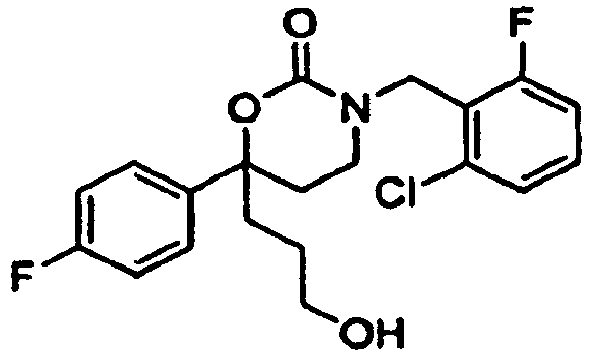
- The title compound was prepared following a procedures analogous to that described in Example 342 using 2-chloro-6-fluorobenzyl bromide, followed by a procedure analogous to that described in Example 343. LC-MS Method 1 tR = 1.58 min, m/z = 352; 1H NMR (CDCl3) 1.33 (m, 1H), 1.68 (m, 1H). 1.95 (m, 2H), 2.21 (m, 2H), 2.63 (m, 1H), 3.02 (m, 1H), 3.57 (t, 2H), 4.64 (d, 1H), 4.91 (d, 1H), 6.90-7.30 (7H).
-
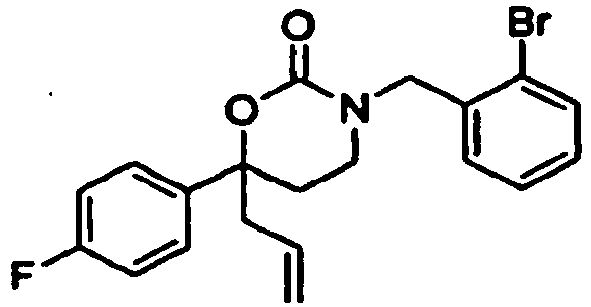
- The title compound was prepared following procedures analogous to those described in Example 342 using 2-bromobenzyl bromide. LC-MS Method 1 tR = 1.94 min, m/z = 406, 404; 1H NMR (CDCl3) 2.30 (m, 2H), 2.61 (m, 2H), 2.94 (m, 1H), 3.08 (m, 1H), 4.48 (d, 1H), 4.68 (d, 1H), 5.08 (m, 2H), 5.72 (m, 1H), 6.83 (m, 1 H). 7.10 (4H), 7.37 (m, 2H), 7.46 (m, 1H).
-

- The title compound was prepared from 6-allyl-3-(2-bromobenzyl)-6-(4-fluorophenyl)-1,3-oxazinan-2-one following procedures analogous to those described in Example 343. LC-MS Method 1 tR = 1.67 min, m/z = 380, 378; 1H NMR (CDCl3) 1.38 (m, 1 H), 1.69 (m, 1H), 1.90 (1 H), 1.98 (m, 2H), 2.30 (m, 2H), 2.90 (m, 1H), 3.08 (m, 1 H), 3.58 (m, 2H), 5.56 (d, 1H), 5.67 (d, 1H), 6.88 (m, 1H), 7.05-7.20 (4H), 7.34 (m, 2H), 7.48 (d, 1H).
-

- The title compound was prepared from (R)-6-allyl-3-(2-bromobenzyl)-6-(4-fluorophenyl)-1,3-oxazinan-2-one following a procedure analogous to that described in Example 124, followed by a procedure analogous to that described in Example 78. LC-MS Method 1 tR = 1.48 min, m/z = 424(M+Na); 1H NMR (CDCl3) 7.90(d, 1H), 7.30(m, 4H), 7.10(q, 2H), 7.00(t, 1H), 4.92(d, 2H), 4.26(t, 1H), 3.85(s, 3H), 3.13(m, 1H), 2.92(m, 1H), 2.33(m, 2H), 2.10-1.91(m, 3H).
-

- The title compound was prepared following procedures analogous to those described in Example 337 except that methyl chloroformate was used in place of Boc2O in Step 2. LC-MS Method 1 tR = 1.99 min, m/z = 418(M+1); 1H NMR (CDCl3) 7.25(m, 3H), 7.06-6.94(m, 4H), 6.77(d, 1H), 5.76-5.59(m, 2H), 5.10-5.00(dd, 2H), 2.90(m, 1H), 2.56(m, 2H), 2.34-2.14(m, 3H), 1.49(d, 3H).
-

- The title compound was prepared from (R)-6-allyl-3-((S)-1-(3-bromophenyl)ethyl)-6-(4-fluorophenyl)-1,3-oxazinan-2-one following procedures analogous to those described in Example 343. LC-MS Method 1 tR = 1.67 min, m/z = 458(M+Na); 1H NMR (CDCl3) 7.26(m, 3H), 7.10-6.97(m, 4H), 6.84(t, 1H), 5.64(q, 1H), 4.26(t, 1H), 3.57(t, 1H), 3.14(m, 1H), 2.31-2.16(m, 3H), 1.49(d, 3H), 1.32(t, 2H).
-

- (R)-6-allyl-3-((S)-1-(3-bromophenyl)ethyl)-6-(4-fluorophenyl)-1,3-oxazinan-2-one (55 mg, 0.13 mmol), PdCl2 (6mg, 0.3equiv.), and CuCl (26 mg, 2.3 equiv.) were mixed with DMF(2 mL) and water (-250 µL). A balloon of oxygen was attached to the flask and the mixture was stirred vigorously overnight. LC-MS found the reaction completed. The mixture was quenched by satd aq NH4Cl solution (2 mL), diluted with EtOAc (20 mL), washed by brine (7 mL), dried over Na2SO4. After filtration and concentration, the residue was purified by preparative HPLC to afford (S)-3-((S)-1-(3-bromophenyl)ethyl)-6-(4-fluorophenyl)-6-(2-oxopropyl)-1,3-oxazinan-2-one (49 mg, 86% yield). LC-MS (3min) tR = 1.76 min, m/z = 434, 436 (M+1).
- A solution of (S)-3-((S)-1-(3-bromophenyl)ethyl)-6-(4-fluorophenyl)-6-(2-oxopropyl)-1,3-oxazinan-2-one (12mg, 0.028mmol) in 3:1 THF/MeOH (4mL) was cooled to 0 °C. NaBH4 (2.1 mg, 2equiv) was added. After 15min, the mixture was warmed to rt slowly. After stirring 1.5h, LC-MS found the reaction completed. The mixture was quenched by water (2 mL), concentrated, and purified by preparative HPLC to afford (6S)-3-((S)-1-(3-bromophenyl)ethyl)-6-(4-fluorophenyl)-6-(2-hydroxypropyl)-1,3-oxazinan-2-one (4.4 mg, 36%). LC-MS (3min) tR= 1.68 min, m/z = 458, 460 (M+Na). 1H NMR (CDCl3) 7.36-7.21 (m, 3H), 7.12-6.96(m, 4H), 6.83(m, 1H), 5.63(m, 1H), 2.93(m, 1H), 1.51(d, 3H), 1.17(d, 3H).
-

- A solution of (S)-3-((S)-1-(3-bromophenyl)ethyl)-6-(4-fluorophenyl)-6-(2-oxopropyl)-1,3-oxazinan-2-one (18.5 mg, 0.043 mmol) in dry toluene (3 mL) was cooled to 0 °C. A solution of MeMgBr (3.0M in THF, 45µL, 3equiv) was added. After 15min, the mixture was warmed to rt slowly and stirred 2 h. LC-MS found reaction completed. The reaction was quenched by said aq NH4Cl solution (2 mL), diluted with EtOAc (10mL), washed with 1% aq HCl (3mL), brine (3mL), and dried over Na2SO4. After filtration and concentration, the residue was purified by preparative HPLC to afford (S)-3-((S)-1-(3-bromophenyl)ethyl)-6-(4-fluorophenyl)-6-(2-hydroxy-2-methylpropyl)-1,3-oxazinan-2-one (8.0 mg, 42%). LC-MS (3min) tR = 1.75 min, m/z = 472, 474 (M+Na); 1H NMR (CDCl3) 7.32-7.21 (m, 3H), 7.12-6.98(m, 4H), 6.89(m, 1H), 5.65(q, 1H), 2.89(m, 1H), 1.50(d, 3H), 1.15(d, 6H).
-

- The title compound was prepared from methyl 3-((R)-3-((S)-1-(3-bromophenyl)ethyl)-6-(4-fluorophenyl)-2-oxo-1,3-oxazinan-6-yl)propanoate following procedures analogous to those described in Example 117. LC-MS Method 1 tR = 1.79 min, m/z = 464, 466(M+1); 1H NMR (CDCl3) 7.30(d, 1H), 7.23(m ,2H), 7.10-6.99(m, 4H), 6.87(d, 1H), 6.65(q, 1H), 2.92(m, 1H), 2.32-2.18(m, 3H), 2.08-1.88(m, 2H), 1.63(td, 1H), 1.51 (d, 3H), 1.15(d, 6H).
-

- The title compound was prepared from (R)-3-((S)-1-(3-bromophenyl)ethyl)-6-(4-fluorophenyl)-6-(3-hydroxypropyl)-1,3-oxazinan-2-one following procedures analogous to those described in Example 234. LC-MS Method 1 tR = 1.55 min, m/z = 449, 451 (M+1); 1H NMR (CDCl3) 7.32(d, 1H), 7.22(m, 2H), 7.12-7.02(m, 4H), 6.90(m, 2H), 6.33(br s, 1H), 5.62(q, 1 H), 2.96(m, 1 H), 2.50(m, 1 H), 2.34-2.17(m, 5H), 2.10(m, 1H), 1.52(d, 3H).
-

- To a solution of (R)-3-((S)-1-(3-bromophenyl)ethyl)-6-(4-fluorophenyl)-6-(3-hydroxypropyl)-1,3-oxazinan-2-one (20 mg, 0.046 mmol) in CH2Cl2 (2 mL) was added Et3N (13µL, 2equiv) and MsCl (6 µL, 1.55 equiv) at 0 °C. After 5 min, the mixture was warmed to rt and stirred for 1 h. The mixture was concentrated, acidified with 5% aq HCl to pH=~6 and purified by preparative HPLC to afford 3-((R)-3-((S)-1-(3-bromophenyl)ethyl)-6-(4-fluorophenyl)-2-oxo-1,3-oxazinan-6-yl)propyl methanesulfonate (6.8 mg, 29%). LC-MS (3min) tR= 1.83 min., m/z 514, 516(M+1).
- 3-((R)-3-((S)-1-(3-bromophenyl)ethyl)-6-(4-fluorophenyl)-2-oxo-1,3-oxazinan-6-yl)propyl methanesulfonate (6.8 mg, 0.013 mmol) was diluted with acetonitrile (2 mL), added K2CO3 (10 mg, excess) and methanesulfonamide (2.5mg, 2equiv.). The mixture was stirred overnight at rt. After filtration and concentration, the residue was purified by preparative HPLC to afford N-(3-((R)-3-((S)-1-(3-bromophenyl)ethyl)-6-(4-fluorophenyl)-2-oxo-1,3-oxazinan-6-yl)propyl)methanesulfonamide (2.5 mg, 37%). LC-MS (3min) tR= 1.87 min, m/z = 514, 516(M+1). 1H NMR (CDCl3) 7.31(m, 1H), 7.23(m, 2H), 7.14-7.05(m, 3H), 7.02(t, 1H), 6.87(d, 1H), 5.64(q, 1H), 4.17(m, 2H), 2.97(s, 3H), 2.33-2.11 (m, 3H), 1.52(d, 3H).
-

- The title compound was prepared from (R)-6-allyl-3-((S)-1-(3-bromophenyl)ethyl)-6-(4-fluorophenyl)-1,3-oxazinan-2-one following procedures analogous to those described in Example 187. LC-MS Method 1 tR = 1.66 min, m/z = 392(M+1); 1H NMR (CDCl3) 7.34-7.20(m, 2H), 7.15-7.02(m, 4H), 6.89(s, 1 H), 6.81 (m, 1H), 5.64(m, 1H), 3.58(t, 2H), 2.93(m, 1H), 1.50(d, 3H).
-

- The title compound was prepared from methyl 3-((S)-1-((R)-6-allyl-6-(4-fluorophenyl)-2-oxo-1,3-oxazinan-3-yl)ethyl)benzoate by treatment with LiOH in aq THF, followed by a procedure analogous to that described in Example 153, followed by a procedure analogous to that described in Example 78, followed by a procedure analogous to that described in Example 172. LC-MS Method 1 tR = 1.9 min, m/z = 479(M+1); 1H NMR (CDCl3) 8.89(d, 1H), 7.85(t, 1H), 7.47(d, 1H), 7.24(m, 2H), 7.08(m, 3H), 5.68(m, 1H), 4.27(t, 1H), 1.53(d, 3H).
-

- The title compound was prepared from (R)-6-allyl-3-((S)-1-(3-bromophenyl)ethyl)-6-(4-fluorophenyl)-1,3-oxazinan-2-one following procedures analogous to those described in Example 124. LC-MS Method 1 tR = 1.82 min, m/z = 420(M+Na); 1H NMR (CDCl3) 7.82(d, 1H), 7.67(s, 1H), 7.22(m, 2H), 7.16(t, 1H), 6.99(m, 3H), 5.67(m, 2H), 5.05(dd, 2H), 3.88(s, 3H), 2.93(m, 1H), 2.57(m, 2H), 2.22(m, 3H), 1.55(d, 3H).
-

- LC-MS Method 1 tR = 1.24 min, m/z = 410(M+Na); 1H NMR (CDCl3) 7.23(m, 2H), 7.15(m, 2H), 7.04(q, 2H), 6.94(s, 1H), 6.86(m, 1 H), 5.63(m, 1H), 4.52(s, 2H), 3.57(t, 1 H), 1.52(d, 3H),
-

- The title compound was prepared from methyl 3-((S)-1-((R)-6-allyl-6-(4-fluorophenyl)-2-oxo-1,3-oxazinan-3-yl)ethyl)benzoate following procedures analogous to those described in Example 238 Step 3. LC-MS Method 1 tR = 1.68 min, m/z = 420(M+Na); 1H NMR (CDCl3) 7.26(m, 3H), 7.12(m, 2H), 7.01 (t, 2H), 6.81 (d, 1H), 5.65(m, 2H), 5.15(dd, 2H), 2.89(m, 1H), 2.58(m, 2H), 1.54(d, 3H), 1.42(d, 6H).
-

- The title compound was prepared from 3-chloro-1-(2,4-difluorophenyl)propan-1-one using a procedure analogous to that described in Example 110 followed by a procedure analogous to that described in Example 97. 3-chloro-1-(2,4-difluorophenyl)propan-1-one was prepared by treatment of 1,3-difluorobenzene with 3-chloropropanoyl chloride and AlCl3. Two isomers were isolated.
- Isomer 1: (S)-3-((S)-1-(4-bromophenyl)ethyl)-6-(2,4-difluorophenyl)-6-(2-hydroxyethyl)-1,3-oxazinan-2-one LC-MS Method 1 tR = 1.71 min, m/z = 442, 440 (M+1); 1H NMR (CD3OD) 7.28-7.21 (m, 3H), 6.94-6.84 (m, 4H), 5.44 (q, J = 7.0 Hz, 1H), 3.65-3.59 (m, 1H), 3.32-3.26 (m, 1 H), 3.11-3.03 (m, 1H), 2.52-2.43 (m, 1H), 2.23-2.07 (m, 4H), 1.43 (d, J = 7.3 Hz, 3H).
- Isomer 2: (R)-3-((S)-1-(4-bromophenyl)ethyl)-6-(2,4-difluorophenyl)-6-(2-hydroxyethyl)-1,3-oxazinan-2-one LC-MS Method 1 tR = 1.75 min, m/z = 442, 440 (M+1); 1H NMR (CD3OD) 7.43-7.14 (m, 5H), 6.99-6.93 (m, 2H), 5.45 (q, J = 7.3 Hz, 1 H), 3.65-3.59 (m, 1H), 3.31-3.24 (m, 1H), 2.79-2.66 (m, 2H), 2.49-2.45 (m, 1H), 2.22-2.01 (m, 3H), 1.25 (d. J = 7.3 Hz, 3H).
-

- The title compound was prepared from (R)-6-allyl-3-((S)-1-(4-bromophenyl)ethyl)-6-(2,4-difluorophenyl)-1,3-oxazinan-2-one following procedures analogous to those described in Example 78. LC-MS Method 1 tR = 1.76 min, m/z = 456, 454 (M+1); 1H NMR (CD3OD) 7.30-7.24 (m, 3H), 6.95-6.85 (m, 4H), 5.44 (q, J = 7.0 Hz, 1H), 3.42-3.37 (m, 2H). 3.11-3.06 (m, 1H), 2.52-2.45 (m, 1H), 2.24-2.09 (m, 2H), 2.05-1.87 (m, 2H), 1.62-1.53 (m, 1H), 1.44 (d, J = 7.0 Hz, 3H), 1.22-1.13 (m, 1H).
-

- The title compound was prepared following procedures analogous to those described in Example 283 using (S)-1-(6-methylpyridin-3-yl)ethanamine in Step 1. LC-MS Method 2 tR = 1.198 min, m/z = 372.18; 1H NMR (CD3OD) 1.18 (m, 1H), 1.47 (d, 3H), 1.52 (m, 1H), 1.84 (m, 2H), 2.17 (m, 1H), 2.37-2.42 (m, 3H), 2.56 (s, 3H), 3.36 (m, 2H), 5.48 (m, 1H), 6.96 (m, 2H), 7.26 (m, 3H), 7.46 (m, 1H), 8.40 (s, 1H).
-

- The title compound was prepared from (R)-3-((S)-1-(4-bromophenyl)propyl)-6-(4-fluorophenyl)-6-(3-hydroxypropyl)-1,3-oxazinan-2-one following procedures analogous to those described in Example 234. LC-MS Method 3 tR = 1.092 min, m/z = 464.9; 1H NMR (CDCl3) 0.91 (t, 3H), 1.90 (m, 2H), 2.12-2.22 (m, 5H), 2.23-2.39 (m, 1H), 2.89 (m, 1H), 5.34 (m, 1H), 5.41-5.59 (m, 2H), 6.86-6.95 (m, 4H), 7.11 (m, 2H). 7.21 (m, 2H).
-

- The title compound was prepared from (R)-3-((S)-1-(4-bromophenyl)ethyl)-6-(4-fluorophenyl)-6-(3-hydroxypropyl)-1,3-oxazinan-2-one following procedures analogous to those described in Example 359. LC-MS Method 3 tR = 1.168 min, m/z = 512.08; 1H NMR (CDCl3) 1.28 (m, 1H), 1.44 (d, 3H), 1.60 (m, 1 H), 1.80-1.95 (m, 2H), 2.10-2.21 (m, 2H), 2.84 (s, 3H), 3.00 (m, 2H), 4.21 (m, 1H), 5.52 (m, 1H), 6.75 (d, 2H), 6.99 (t, 2H), 7.12-7.22 (m, 4H).
-

- The title compound was prepared from (R)-6-allyl-3-((S)-1-(4-bromophenyl)ethyl)-6-(4-fluorophenyl)-1,3-oxazinan-2-one following procedures analogous to those described in Example 356. LC-MS Method 3 tR = 1.168 min, m/z = 472; 1H NMR (CDCl3) 1.06 (d, 6H), 1.18 (s, 1H), 1.43 (d, 3H), 2.10 (m, 4H), 2.33 (m, 1H), 2.79 (m, 1H), 5.54 (m, 1H), 6.77 (d, 2H), 6.98 (t, 2H), 7.19 (m, 2H), 7.22 (m, 2H).
-

- The title compound was prepared from (S)-3-((S)-1-(4-bromophenyl)ethyl)-6-(4-fluorophenyl)-6-(2-oxopropyl)-1,3-oxazinan-2-one following procedures analogous to those described in Example 355. Two isomers were isolated.
- Isomer 1: LC-MS Method 2 tR = 1.368 min, m/z = 460.1; 1H NMR (CDCl3) 1.20 (d, 3H), 1.42 (d, 3H), 1.88 (m, 1H), 2.01 (m, 1H), 2.18-2.30 (m, 2H), 2.35-2.54 (m, 1 H), 2.80-2.90 (m, 1H), 3.78-3.90 (m, 1 H), 5.52 (m, 1H), 6.65 (d, 2H), 6.94-7.03 (m, 2H), 7.17-7.45 (m, 4H).
- Isomer 2: LC-MS Method 2 tR = 1.399 min, m/z = 459.9; 1H NMR (CDCl3) 1.01 (d, 3H), 1.43 (d, 3H), 1.85 (d, 1H), 2.03 (m, 1H), 2.19 (m, 2H), 2.28 (m, 1H), 2.83 (m, 1H), 3.82 (m, 1H), 5.52 (m, 1H), 6.74 (d, 2H), 7.01 (t, 2H), 7.19 (m, 5H).
-

- To a solution of (R)-6-allyl-3-((S)-1-(4-bromophenyl)ethyl)-6-(4-fluorophenyl)-1,3- oxazinan-2-one (2.0 g, 4.8 mmol) in THF (48 ml) was added BH3THF (5.7 ml, l mol/L) at 0 °C under nitrogen atmosphere, and the resulting solution was stirred for 2 h at rt. The reaction was quenched with water. Then aqueous NaOH solution (2.0 ml, 3 mol/L) and H2O2 (2 mL, 30%) were added to the mixture. The resulting mixture was stirred for 2 h at rt. The mixture was diluted with EtOAc, and the pH was adjusted to 6-7 with 1 M aq HCl. The aqueous phase was extracted with EtOAc, and the combined organic phase was washed with satd aq NaHCO3 and brine, dried over Na2SO4, concentrated to give the crude product, which was purified on silica gel to give (R)-3-((S)-1-(4-bromophenyl)ethyl)-6-(4-fluorophenyl)-6-(3-hydroxypropyl)-1,3-oxazinan-2-one (1.13 g, 54%). 1H NMR: (400 MHz, CDCl3): 1.32 (m, 1H), 1.43 (d, 3H), 1.63 (m, 1H), 1.90 (m, 2H), 2.21 (m, 3H), 2.84 (m, 1H), 3.51 (t, 2H), 5.54 (q, 1H), 6.72 (d, 2H), 6.98 (t, 2H), 7.18 (m, 4H).
- A mixture of (R)-3-((S)-1-(4-bromophenyl)ethyl)-6-(4-fluorophenyl)-6-(3-hydroxy- propyl) -1,3-oxazinan-2-one (500 mg, 1.15 mmol), PDC (870 mg, 2.30 mmol) and 3 A molecular sieves (1.3 g) in methylene chloride was stirred at room temperature for 3 hours. The reaction mixture was chromatographed on silica gel directly to give 3-((R)-3-((S)-1-(4-bromophenyl)ethyl)-6-(4-fluorophenyl)-2-oxo-1,3-oxazinan-6-yl)propanal (300 mg, 60%). 1H NMR: (400 MHz, CDCl3): 1.43 (d, 2H), 2.10 (m, 2H), 2.19 (m, 3H), 2.67 (m, 1H), 2.86 (m, 1H), 5.54 (q, 1H), 6.75 (d, 2H), 7.00 (t, 2H), 7.17 (m, 4H), 9.60 (s, 1H).
- To a solution of 3-((R)-3-((S)-1-(4-bromophenyl)ethyl)-6-(4-fluorophenyl)-2-oxo- 1,3- oxazinan-6-yl)propanal (300 mg, 0.69 mmol) in THF (4ml) was added dropwise MeMgBr (0.7 ml, 3mol/L) at -78 °C. The mixture was stirred for 2 h and the temperature was allowed to be warm to rt at this stage. The reaction was quenched with aqueous NH4Cl. The organic layer was separated, and the aqueous layer was extracted with EtOAc. The combined organic layer was washed with brine, dried over Na2SO4 and concentrated to give the crude product, which was purified by HPLC and chiral HPLC to give two isomers.
- Isomer 1: (30.76 mg, 10%). LC-MS Method 2 tR = 1.389 min, m/z = 474; 1H NMR (CDCl3) 1.05 (d, 4H), 1.42 (d, 4H), 1.49-1.50 (m, 1H), 1.81-1.91 (m, 1H), 1.92-2.01 (m, 1 H), 2.07-2.18 (m, 1H), 2.19-2.36 (m, 2H), 2.79-2.91 (m, 1H), 3.65 (m, 1 H), 5.54 (m, 1 H), 6.73 (d, 2H), 6.94 (m, 2H), 7.17 (m, 4H).
- Isomer 2: LC-MS Method 2 tR = 1.417 min, m/z = 473.8; 1H NMR (CDCl3) 1.07 (d, 3H), 1.18-1.30 (m, 1H), 1.44 (d, 4H), 1.47-1.57 (m, 1H), 1.71-1.82 (m, 1H), 1.94-2.09 (m, 1 H), 2.11-2.29 (m, 3H), 2.83 (m, 1H), 3.60 (m, 1 H), 5.54 (m, 1 H), 6.70 (d, 2H), 6.96-6.99 (t, 2H), 7.16-7.19 (m, 5H).
-

- The title compound was prepared from (R)-3-((S)-1-(4-bromophenyl)ethyl)-6-(4-fluorophenyl)-6-(3-hydroxypropyl)-1,3-oxazinan-2-one following procedures analogous to those described in Example 117. LC-MS Method 2 tR = 1.434 min, m/z = 487.8; 1H NMR (CDCl3) 1.07 (d, 6H), 1.12-1.20 (m, 1H), 1.45 (d, 3H), 1.54-1.64 (m, 1H), 1.80-2.01 (m, 2H), 2.10-2.23 (m, 3H), 2.84 (m, 1H), 5.54 (m, 1H), 6.72 (d, 2H), 6.97 (t, 2H), 7.15-7.20 (m, 4H).
-

- The title compound was prepared from (S)-3-((S)-1-(4-bromophenyl)ethyl)-6-(4-fluorophenyl)-6-(2-hydroxyethyl)-1,3-oxazinan-2-one and azetidine following procedures analogous to those described in Example 178. LC-MS Method 2 tR = 1.15 min, m/z = 463; 1H NMR (CDCl3) 1.43 (d, 4H), 2.05-2.27 (m, 7H), 2.56-2.74 (m, 2H), 2.86 (m, 1H), 3.20 (m, 1H), 3.50 (m, 1H), 3.71 (m, 1H), 4.17-4.39 (d, 2H), 5.52 (m, 1H), 6.80 (d, 2H), 6.95-7.02 (m, 2H), 7.13-7.24 (m, 4H).
-

- The title compound was prepared from (S)-3-((S)-1-(4-bromophenyl)ethyl)-6-(4-fluorophenyl)-6-(2-hydroxyethyl)-1,3-oxazinan-2-one and 2-fluoroethylamine following procedures analogous to those described in Example 178. LC-MS Method 2 tR = 1.1 min, m/z = 489; 1H NMR (CDCl3) 1.50 (d, 3H), 1.97-2.38 (m, 7H), 2.41-2.56 (m, 1H), 2.79-2.98 (m, 3H), 4.45 (m, 1H), 4.54 (m, 1H), 5.61 (m, 1 H), 6.80 (d, 2H), 7.03-7.14 (t, 2H), 7.21-7.31 (m, 6H).
-

- The title compound was prepared from (S)-3-((S)-1-(4-bromophenyl)ethyl)-6-(4-fluorophenyl)-6-(2-hydroxyethyl)-1,3-oxazinan-2-one and pyrrolidine following procedures analogous to those described in Example 178. LC-MS Method 2 tR = 1.167 min, m/z = 475.1; 1H NMR (CDCl3) 1.48 (d, 3H), 2.00 (m, 2H), 2.13 (m, 2H), 2.22 (m, 1H), 2.32 (m, 1H), 2.43 (m, 1H), 2.58 (m, 1 H), 2.76 (m, 2H), 2.88 (m, 1H), 3.18 (m, 1H), 3.61 (m, 1H), 3.75 (m, 1H), 4.41 (s, 2H), 5.52 (m, 1H), 6.80 (d, 2H), 7.02 (t, 2H), 7.13 (m, 2H), 7.24 (m, 2H).
-

- The title compound was prepared from (S)-3-((S)-1-(4-bromophenyl)ethyl)-6-(4-fluorophenyl)-6-(2-hydroxyethyl)-1,3-oxazinan-2-one and (S)-3-fluoropyrrolidine following procedures analogous to those described in Example 178. LC-MS Method 2 tR = 0.984 min, m/z = 517; 1H NMR (CDCl3) 1.43 (d, 3H), 1.84-2.09 (m, 4H), 2.11-2.29 (m, 5H), 2.61 (m, 1H), 2.71-2.87 (m, 3H), 4.96 (s, 1H), 5.13 (s ,1H), 5.53 (m, 1H), 6.71 (d, 2H), 6.98 (t, 2H), 7.18 (m, 3H), 7.20 (m, 1H).
-

- The title compound was prepared from (S)-3-((S)-1-(4-bromophenyl)ethyl)-6-(4-fluorophenyl)-6-(2-hydroxyethyl)-1,3-oxazinan-2-one and (R)-3-fluoropyrrolidine following procedures analogous to those described in Example 178. LC-MS Method 2 tR = 1.682 min, m/z = 516.9; 1H NMR (CDCl3) 1.42 (d, 3H), 1.82-2.30 (m, 9H), 2.52-2.64 (m, 1H), 2.67-2.88 (m, 3H), 4.93-5.13 (m, 1H), 5.53 (m, 1H), 6.71 (d, 2H), 6.98 (m, 2H), 7.18 (m, 2H), 7.19 (m, 1H).
-

- The title compound was prepared from (S)-3-((S)-1-(4-bromophenyl)ethyl)-6-(4-fluorophenyl)-6-(2-hydroxyethyl)-1,3-oxazinan-2-one and piperazin-2-one following procedures analogous to those described in Example 178. LC-MS Method 2 tR = 1.117 min, m/z = 506; 1H NMR (CDCl3) 1.42 (d, 3H), 2.16-2.35 (m, 5H), 2.75-2.88 (m, 2H), 3.17-3.40 (m, 3H), 3.56-3.80 (m, 4H), 5.45 (m, 1H), 5.61-6.52 (s, 2H), 6.78 (d, 2H), 7.01-7.24 (m, 6H).
-

- The title compound was prepared from (S)-3-((S)-1-(4-bromophenyl)ethyl)-6-(4-fluorophenyl)-6-(2-hydroxyethyl)-1,3-oxazinan-2-one following procedures analogous to those described in Example 187 Step 1. LC-MS Method 3 tR = 1.077 min, m/z = 377.12; 1H NMR (CDCl3) 1.19 (m, 1H), 1.44 (d, 3H), 1.97-2.25 (m, 5H), 2.84 (m, 1H), 3.49 (m, 1H), 3.68 (m, 1H), 5.54 (m, 1H), 6.76 (d, 2H), 7.02 (m, 4H), 7.21 (m, 2H).
-

- The title compound was prepared from (S)-3-((S)-1-(4-bromophenyl)ethyl)-6-(4-fluorophenyl)-6-(2-hydroxy-2-methylpropyl)-1,3-oxazinan-2-one following procedures analogous to those described in Example 187 Step 1. LC-MS Method 3 tR = 1.106 min, m/z = 428; 1H NMR (CDCl3) 1.08 (d, 6H), 1.19 (s, 1H), 1.43 (d, 3H), 2.04-2.22 (m, 4H), 2.28-2.40 (m, 1H), 2.80 (m, 1 H), 5.56 (m, 1H), 6.83 (d, 2H), 6.95 (m, 2H), 7.15 (m. 2H), 7.22 (m, 2H).
-

- The title compound was prepared from (R)-3-((S)-1-(4-bromophenyl)ethyl)-6-(4-fluorophenyl)-6-(3-hydroxy-3-methylbutyl)-1,3-oxazinan-2-one following procedures analogous to those described in Example 187 Step 1. LC-MS Method 2 tR = 1.391 min, m/z = 442; 1H NMR (CDCl3) 1.02-1.19 (m, 6H), 1.48 (s, 3H), 1.57 (m, 1H), 1.81-1.99 (m, 2H), 2.08-2.23 (m, 3H), 2.83 (m, 1H), 3.42 (s, 1H), 5.55 (m, 1 H), 6.77 (d, 2H), 6.96-7.05 (m, 4H), 7.17 (m, 2H).
-

- The title compound was prepared from (6R)-3-((S)-1-(4-bromophenyl)ethyl)-6-(4-fluorophonyl)-6-(3-hydroxybutyl)-1,3-oxazinan-2-one following procedures analogous to those described in Example 187 Step 1. Two isomers were isolated.
- Isomer 1: LC-MS Method 2 tR = 1.203 min, m/z = 362.25; 1H NMR (CDCl3) 1.05 (m, 4H), 1.42 (d, 3H), 1.53 (m, 1H), 1.86 (m, 1H), 1.93 (m, 1H), 2.05-2.26 (m, 3H), 2.84 (m, 1H), 3.67 (m, 1H), 5.56 (m, 1H), 6.78 (d, 2H), 6.97 (t, 2H), 7.04 (d, 2H), 7.17 (m, 2H).
- Isomer 2: LC-MS Method 2 tR = 1.353 min, m/z = 405.15; 1H NMR (CDCl3) 1.05 (d, 3H), 1.24 (m, 1H), 1.48 (d, 3H), 1.76 (m, 1 H), 2.01 (m, 1H), 2.10-2.28 (m, 3H), 2.73 (m, 1H) 3.61 (m, 1H), 5.57 (m, 1H), 6.77 (d, 2H), 6.95-7.08 (m, 4H), 7.15 (m, 2H).
-

- The title compound was prepared from N-(3-((R)-3-((S)-1-(4-bromophenyl)ethyl)-6-(4-fluorophenyl)-2-oxo-1,3-oxazinan-6-yl)propyl)methanesulfonamide following procedures analogous to those described in Example 187 Step 1. LC-MS Method 3 tR = 2.026 min, m/z = 468.13; 1H NMR (CDCl3) 1.28 (m, 1 H), 1.45 (d, 3H), 1.61 (m, 1H), 1.83-1.95 (m, 2H), 2.10-2.21 (m, 4H), 2.84 (s, 3H), 2.90 (m, 2H), 4.20 (m, 1H), 5.55 (m, 1H), 6.82 (d, 2H), 6.98 (t, 2H), 7.06 (d, 2H), 7.16 (m, 2H).
-

- The title compound was prepared from 3-((R)-3-((S)-1-(4-bromophenyl)ethyl)-6-(4-fluorophenyl)-2-oxo-1,3-oxazinan-6-yl)propanamide following procedures analogous to those described in Example 187 Step 1. LC-MS Method 3 tR = 1.491 min, m/z = 427.1; 1H NMR (CDCl3) 1.50 (d, 3H), 2.01 (m, 1H), 2.14 (m, 2H), 2.46 (m, 2H), 2.89 (s, 2H), 2.90 (m, 1H), 5.63 (m, 2H), 5.72 (s, 1H), 6.89 (d, 2H), 7.03 (t, 2H), 7.12 (d, 2H), 7.4 (m, 2H).
-

- A thick-walled vial was charged with 3-(2-bromobenzyl)-6-(4-fluorophenyl)-6-(3-hydroxypropyl)-1,3-oxazinan-2-one (9.1 mg, 22 µmol), PdCl2(PPh3)2 (4 mg, 5 µmol), Cs2CO3 (56 mg, 0.17 mmol), H2O (0.5 mL) and dioxane (2 mL). The vial was capped and N2 was bubbled through the mixture for 15 min. The mixture was heated at 120 C for 30 min in a microwave. The mixture was applied to a 10-mL ChemEtut cartridge prewetted with water and eluted with CH2Cl2 (50 mL). The eluate was concentrated and the residue was purified by prep HPLC to afford 2'-((6-(4-fluorophenyl)-6-(3-hydroxypropyl)-2-oxo-1,3-oxazinan-3-yl)methyl)biphenyl-4-carboxamide (2.8 mg, 28%) as an oil. LC-MS Method 1 tR = 1.37 min, m/z = 419; 1H NMR (CDCl3) 1.35 (m, 1H), 1.63 (m, 1H), 1.90 (m, 2H), 2.10 (m, 1H), 2.19 (m, 1H), 2.63 (m, 1H), 2.78 (m, 1H), 3.57 (t, 2H), 4.42 (d, 1H), 4.59 (d, 1 H), 7.00-7.40 (10H), 7.83 (d, 2H).
-

- The title compound was prepared from (R)-6-allyl-6-(4-fluorophenyl)-3-((S)-1-(4-(trifluoromethyl)phenyl)ethyl)-1,3-oxazinan-2-one following procedures analogous to those described in Example 65. LC-MS Method 2 tR = 1.082 min, m/z = 475; 1H NMR (CDCl3) 1.47 (d, 3H), 2.01-2.17 (m, 2H), 2.25 (m, 3H), 2.89 (m, 1H), 3.49 (m, 1H), 3.70 (m, 1H), 5.63 (m, 1H), 6.98 (m, 4H), 7.21 (m, 2H), 7.30 (m, 2H).
-

- The title compound was prepared from (R)-6-allyl-6-(4-fluorophenyl)-3-((S)-1-(4-(trifluoromethyl)phenyl)ethyl)-1,3-oxazinan-2-one following a procedure analogous to that described in Example 355. Two isomers were isolated.
- Isomer 1: LC-MS Method 2 tR = 1.362 min, m/z = 425.16; 1H NMR (CDCl3) 1.04 (d, 3H), 1.48 (d, 3H), 1.85 (d, 1H), 2.01 (m, 1H), 2.21 (m, 2H), 2.33 (m, 1H), 2.50 (s. 1H), 2.89 (m, 1H), 3.83 (m, 1H), 5.60 (m, 1H), 6.94 (m, 4H), 7.18 (m, 3H), 7.43 (d, 2H).
- Isomer 2: LC-MS Method 2 tR = 1.344 min, m/z = 448; 1H NMR (CDCl3) 1.09 (d, 3H), 1.46 (d, 2H), 1.86 (d, 1H), 2.01 (m, 1H), 2.20-2.31 (m, 2H), 2.44 (m, 2H), 2.92 (m, 1H), 3.79 (s, 1H), 5.62 (m, 1H), 6.91 (d, 2H), 6.99 (t, 2H), 7.24-7.35 (m, 4H).
-

- The title compound was prepared from (R)-6-(4-fluorophenyl)-6-(3-hydroxypropyl)-3-((S)-1-(4-(trifluoromethyl)phenyl)ethyl)-1,3-oxazinan-2-one following procedures analogous to those described in Example 359. LC-MS Method 3 tR = 1.143 min, m/z = 502.15; 1H NMR (CDCl3) 1.48 (d, 3H), 1.63 (m, 2H), 1.85 (m, 2H), 1.94 (m, 1H), 2.11-2.33 (m, 3H), 2.86 (s, 3H) 2.95 (m, 1H), 3.04 (m, 2H), 4.15 (s, 1H), 5.62 (m, 1H), 6.97 (m, 4H), 7.15 (m, 2H), 7.35 (m, 2H).
-
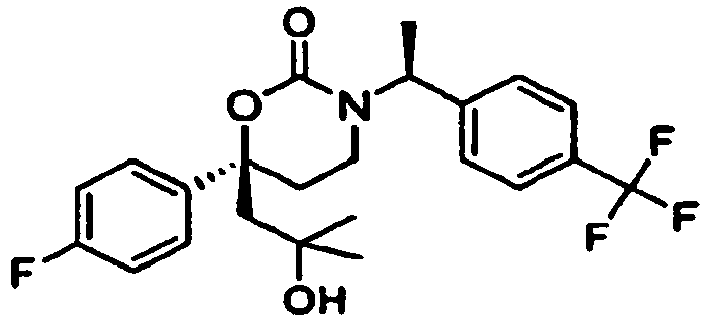
- The title compound was prepared from (R)-6-allyl-6-(4-fluorophenyl)-3-((S)-1-(4-(trifluoromethyl)phenyl)ethyl)-1,3-oxazinan-2-one following procedures analogous to those described in Example 280. LC-MS Method 2 tR = 1.374 min, m/z = 439.18; 1H NMR (CDCl3) 1.06 (d, 6H), 1.48 (d, 3H), 2.10-2.25 (m, 4H), 2.45 (m, 1H), 2.85 (m, 1H), 5.63 (m, 1H), 6.99 (m, 4H), 7.22 (m, 2H), 7.35 (d, 2H).
-

- The title compound was prepared from (R)-6-(4-fluorophenyl)-6-(3-hydroxypropyl)-3-((S)-1-(4-(trifluoromethyl)phenyl)ethyl)-1,3-oxazinan-2-one following procedures analogous to those described in Example 234. LC-MS Method 3 tR = 1.051 min, m/z = 461.1; 1H NMR (CDCl3) 1.50 (d, 3H), 1.98 (m, 1H), 2.21 (m, 4H), 2.27 (m, 1H), 2.42 (m, 1H), 2.94 (m, 1H), 5.63 (m, 1H), 5.74 (s, 1H), 6.13 (s, 1H), 7.03 (m, 4H), 7.16 (m, 2H), 7.36 (d, 2H).
-

- To a solution of (S)-1-(4-bromophenyl)ethanamine (40 g, 0.2 mol) in methylene chloride (600 mL) and satd aq NaHCO3 (600 mL) was added triphosgene (27 g, 0.025 mol) at 0 °C. The mixture was stirred for 15 min. The organic phase was separated, dried and concentrated to give 1-bromo-4-(1-isocyanato-ethyl)-benzene (35 g, crude).
- A mixture of 1-chloro-3-phenyl-hex-5-en-3-ol (27.5 g, 130 mmol), (S)-(-)-1-(-bromophenyl)ethyl isocyanate (35 g, 160 mmol), and DBU (80 g, 325 mmol) in THF (400 mL) was heated to reflux for 25 h. The mixture was diluted with EtOAc and washed with 1 N aq HCl. The aqueous phase was extracted with EtOAc (3 x). The combined organic phase was dried over Na2SO4. After the solvents were evaporated, the crude product was purified by column chromatography to give (R)-6-allyl-3-((S)-1-(4-brornophenyl)ethyl)-6-phenyhl,3-oxazinan-2-one (30 g, yield 45 %).
- The title compound was prepared from (R)-6-allyl-3-((S)-1-(4-bromophenyl)ethyl)-6-phenyl-1,3-oxazinan-2-one following a procedure analogous to that described in Example 78. LC-MS Method 2 tR = 1.36 min, m/z = 440.1; 1H NMR
- (CDCl3) 1.26-1.39 (m, 1H), 1.42 (d, 3H), 1.58-1.71 (m, 1 H), 1.85-1.95 (m, 2H), 2.11-2.45 (m, 3H), 2.79 (m, 1H), 3.52 (m, 2H), 5.54 (m, 1H), 6.67 (d, 2H), 7.12-7.31 (m, 7H).
-

- The title compound was prepared from (R)-3-((S)-1-(4-bromophenyl)ethyl)-6-(3-hydroxypropyl)-6-phenyl-1,3-oxazinan-2-one following procedures analogous to those described in Example 234. LC-MS Method 2 tR = 1.288 min, m/z = 431.2; 1H NMR (CDCl3) 1.48 (m, 3H), 1.91 (m, 1H), 2.08-2.3 (m, 5H), 2.45 (m, 1H), 2.81 (m, 1H), 5.32-5.51 (m, 2H), 5.60 (m, 1H), 6.72 (d, 2H), 7.02 (m, 4H), 7.32 (m, 3H).
-

- The title compound was prepared from (R)-3-((S)-1-(4-bromophenyl)ethyl)-6-(3-hydroxypropyl)-6-phenyl-1,3-oxazinan-2-one following procedures analogous to those described in Example 359. LC-MS Method 2 tR = 1.458 min, m/z = 494.09; 1H NMR (CDCl3) 1.48 (d, 3H), 1.54 (m, 1H), 1.89-2.09 (m, 3H), 2.12-2.31 (m, 3H), 2.54 (s, 1H), 2.88 (m, 1H), 2.94 (s, 3H), 4.14 (m, 2H), 5.59 (m, 1H), 6.74 (d, 6H), 7.22 (m, 4H), 7.34 (m, 3H).
-

- The title compound was prepared from (R)-6-allyl-3-((S)-1-(4-bromophenyl)ethyl)-6-phenyl-1,3-oxazinan-2-one following procedures analogous to those described in Example 280. LC-MS Method 2 tR = 1.387 min, m/z = 455.8; 1H NMR (CDCl3) 1.10 (s, 3H), 1.16 (s, 3H), 1.49 (d, 3H), 2.13 (m, 1H), 2.19 (m, 2H), 2.26 (m, 1H), 2.37 (m, 1H), 2.82 (m, 1H), 5.61 (m, 1H), 6.77 (d, 2H), 7.24 (m, 1H), 7.32 (m, 5H).
-

- To a solution of (S)-1-(4-bromophenyl)ethanamine (240 g, 1.2 mol) in methylene chloride (3 L) and satd aq NaHCO3 (3 L) solution was added triphosgene (118 g, 0.396 mol) at 0 °C. The mixture was stirred for 15 min. The organic phase was separated, dried over Na2SO4 and concentrated to give 1-bromo-4-(1-isocyanato-ethyl) -benzene (170 g, 63%).
- To a solution of 3-chloro-1-phenylpropan-1-one (170 g, 1.01 mol) in anhydrous THF (1200 mL) was added allylmagnesium bromide (1.2 L, 1mol/L) at -78 °C under nitrogen. The formed mixture was stirred for 30 min at -78 °C. The reaction was quenched with aqueous NaHCO3 solution. The organic phase was separated, dried over Na2SO4 and concentrated to give the crude product, which was purified by column chromatography (petroleum ether/EtOAc=100:1) to afford 1-chloro-3-phenylhex-5-en-3-ol (180 g, 86%). 1H NMR (CDCl3): 2.27 (m, 2H), 2.51 (m, 1H), 2.74 (m, 1 H), 3.22 (m, 1H), 3.58 (m, 1H), 5.16 (m, 2H), 5.53 (m, 1H), 7.23 (m, 1H), 7.39 (m, 4H).
- A mixture of 1-chloro-3-phenyl-hex-5-en-3-ol (105 g, 0.050 mmol), (S)-(-)-1-(-bromophenyl)ethyl isocyanate (170 g, 0.752 mol), and DBU (228 g, 1.5 mol) in THF (1700 mL) was heated to reflux overnight. The mixture was diluted with EtOAc and washed with 1N aq HCl. The aqueous phase was extracted with EtOAc (3 x). The combined organic phase was dried over Na2SO4. After the solvents were evaporated, the crude product was purified by column chromatography (petroleum ether/EtOAc =20:1 to 5:1) to give (R)-6-allyl-3-((S)-1-(4-bromophenyl)ethyl)-6-phenyl-1,3-oxazinan-2-one (100 g, 34 %). 1H NMR (CDCl3): 1.39 (d, 3H), 2.14 (m, 1H), 2.24 (m, 2H), 2.48-2.61 (m, 3H), 2.82 (m, 2H), 5.01 (m, 2H), 5.52 (q, 1H), 5.73 (m, 1 H), 6.62 (d, 2H), 7.12 (m, 2H), 7.28 (m, 2H).
- To a solution of (R)-6-allyl-3-((S)-1-(4-bromophenyl)ethyl)-6-phenyl-1,3-oxazinan-2-one (31 g, 78 mmol) and CuCl (19.3 g, 195 mmol) in dry DMF (150 mL) was added H2O (50 mL) and PdCl2 (4.10 g, 23 mmol) at rt. After addition, the mixture was stirred overnight under oxygen. After TLC showed the starting material had disappeared, the solid was filtered off. Water (200 mL) and EtOAc (200 mL) was added, the organic layers were separated and the aqueous layer was extracted with EtOAc (3 x 40 mL). The combined organic layer was washed with brine, dried over Na2SO4, filtered and concentrated to give a residue which was purified by column chromatography (petroleum ether/EtOAc =5:1 to 1:1) to give a mixture of (S)-3-((S)-1-(4-bromophenyl)ethyl)-6-(2-oxopropyl)-6-phenyl-1,3-oxazinan-2-one and 3-((R)- 3-((S)-1-(4-bromophenyl)ethyl)-2-oxo-6-phenyl-1,3-oxazinan-6-yl)propanal, (26 g, 81%).
- To a mixture of (S)-3-((S)-1-(4-bromophenyl)ethyl)-6-(2-oxopropyl)-6-phenyl-1,3-oxazinan-2-one and 3-((R)-3-((S)-1-(4-bromophenyl)ethyl)-2-oxo-6-phenyl-1,3-oxazinan-6- yl)propanal (20 g, 48.2 mmol) in t-BuOH (250 mL) and 2-methyl-2-butene (50 mL) was added a solution of NaClO2 (19.3 g, 0.213 mol) and NaH2PO4 (28 g, 0.179 mol) in H2O (300 mL) at 0 °C. The formed mixture was stirred for 1 h at 0 °C. The mixture was treated with water (100 mL) and extracted with CH2Cl2. The combined organic layer was dried over Na2SO4, filtered and concentrated to leave a residue, which was purified by column chromatography (petroleum ether/EtOAc =5:1 to 2.5:1) to afford (S)-3-((S)-1-(4-bromophenyl)ethyl)-6-(2-oxopropyl)-6-phenyl-1,3-oxazinan-2-one (10.0 g, 83%). 1H NMR (CDCl3): 1.49 (d, 3H), 2.12 (s, 3H), 2.33 (m, 2H), 2.63 (m, 1H), 2.86-3.08 (m, 3H), 5.57 (q, 1 H), 6.66 (d, 2H), 7.19 (m, 2H), 7.33 (m, 5H).
- To a solution of (S)-3-((S)-1-(4-bromophenyl)ethyl)-6-(2-oxopropyl)-6-phenyl-1,3-oxazinan-2-one (20 g, 46.4 mmol) in anhydrous THF (200 mL) was added dropwise methylmagnesium bromide (31 mL, 144 mmol) at -78 °C under nitrogen. Then the mixture was stirred at rt for 1 h. The reaction mixture was quenched with aq NaHCO3 (50 mL) under ice water bath. The organic layers were separated. The aqueous layer was extracted with EtOAc (150 mL). The combined organic layers were washed with brine, dried over Na2SO4 and concentrated in vacuo to give the crude product, which was purified column chromatography (petroleum ether/EtOAc =5:1 to 2:1) to afford (S)-3-((S)-1-(4-bromophenyl)ethyl)-6-(2-hydroxy-2-methylpropyl)-6-phenyl-1,3-oxazinan-2- one (13 g, 65%). After re-crystallization from EtOH, 4 g of the pure compound was obtained. 1H NMR (CDCl3): 1.06 (s, 3H), 1.12 (s, 3H), 1.44 (d, 3H), 2.14 (m, 3H), 2.21 (m, 1H), 2.33 (m, 1H), 2.76 (m, 1H), 5.54 (q, 1H), 6.74 (d, 2H), 7.16 (d, 2H), 7.28 (m, 5H).
-

- A solution of 3-chloro-1-phenylpropan-1-one (100 g, 0.595 mol) in THF (280 ml) was added dropwise to a well-stirred mixture of zinc powder (need not be activated) (40 g, 1.231 mol, satd aq NH4Cl solution (1500 ml) and THF (400 ml). Allyl bromide (143 g, 1.19 mol) was dissolved in THF (200 ml) was slowly added to the reaction mixture. The reaction was mildly exothermic, and the mixture began to reflux spontaneously. After refluxing had ceased, the mixture was stirred for 1 h. The mixture was extracted with EtOAc, dried over anhydrous Na2SO4, and concentrated to give 1-chloro-3-phenylhex-5-en-3-ol (122 g, 97%). 1H NMR: (400MHz, CDCl3): δ=2.24(s, 1H), 2.34 (m, 2H), 2.53 (m, 1H), 2.75 (m, 1H), 3.20 (m, 1H), 3.58 (m, 1 H), 5.18 (t, 1H), 5.51 (m, 1 H), 7.26 (m, 1H), 7.26-7.39 (m, 3H).
-

- To a stirred suspension of magnesium turnings (46.7 g, 1.94 mol) in 1500 mL of THF (H2O <100 ppm based on Karl Fischer titration) was charged 53.0 mL of 1 M DIBAL-H in hexane under nitrogen at rt. Then 3-chloro-2-methylprop-1-ene (160 g, 1.77 mol) was introduced while maintaining the internal temperature below 30 °C. The resulting solution was agitated for 2 h at rt. The solution was titrated in the presence of 1.1'-bipyridine to indicate 0.8 M of the corresponding Grignard reagent. To a dry flask containing 307.0 g of anhydrous CeCl3 (1.25 mol) at rt under nitrogen was added 1556.8 mL of the Grignard reagent (0.8 M, 1.25 mol). The resulting slurry was cooled to -10 °C and agitated for 0.5 h. To the slurry was added 200 g of 3-chloro-1-phenylpropan-1-one (1.19 mol) in 200 mL of THF while maintaining the internal temperature below 0 °C. After the mixture was stirred for 0.5 h. 1200 mL of 1 M aq HCl was added to obtain a clear solution while maintaining the internal temperature below 30 °C. After the phase cut, the aqueous layer was extracted with EtOAc (500 mL). The combined organic layers were washed with brine and dried over sodium sulfate. Removal of the solvent under vacuum produced crude 1-chloro-5-methyl-3-phenyl-hex-5-en-3-ol, which was chased with THF to achieve H2O <500 ppm based on Karl Fischer titration. The crude product (306 g, 83wt%, 95% yield) was used directly in Step 3. 1H-NMR spectroscopy (500 MHz, CDCl3) δ 7.38-7.37 (d. J= 7.8 Hz, 2H), 7.33 (t, J= 7.9 Hz, 2H), 7.24 (t, J= 7.4 Hz, 1 H), 4.91 (s, 1H), 4.76 (s, 1 H), 3.57 (ddd, J= 5.6, 10.7, and 10.7, 1H), 3.13 (ddd, J= 4.7, 10.7 and 10.7 Hz, 1H), 2.66 (d, J= 13.3 Hz, 1H), 2.54 (d, J= 11.3 Hz, 1H), 2.53 (s, 1H), 2.36 (ddd, J= 5.4, 10.6 and 13.9 Hz. 1H), 2.29 (ddd, J=5.6, 11.3 and 13.3 Hz, 1H), 1.29 (s, 3H). 13C-NMR spectroscopy (125 MHz, CDCl3) δ 144.3, 141.4, 128.0, 126.6, 124.8, 116.1, 74.2, 51.2, 46.0, 39.9, 23.9.
- To a 10 L jacketed reactor was charged 241 g of sodium bicarbonate (2.87 mol, 2.30 equiv) and 5 L of deionized water. The resulting solution was agitated for 10-20 min, until the solids dissolved (homogeneous). To the clear solution was charged 250 g (1.25 mol, 1.00 equiv) of (S)-(-)-1-(4-bromophenyl)ethylamine as a solution in 1.00 L of dichloromethane. An additional 4 L of dichloromethane was charged to the reactor. The biphasic solution was agitated and cooled to Tint=2-3 °C. Triphosgene (126 g, 424 mmol, 0.340 equiv) was charged to the reactor in approximately two equal portions ~ 6 min apart. It should be noted that a slight exotherm was noted upon the addition of triphosgene. The resulting murky solution was agitated at Tint=2-5 °C for 30 min, at which point HPLC analysis indicates >99 A% conversion (220 nm). The dichloromethane layer was cut and dried with anhydrous sulfate. The resulting solution was passed through a celite plug and concentrated to -1.5 L which fine particles of a white solid developed. The solution was filtered and concentrated to a thick oil via reduced pressure to produce 239 g of 1-bromo-4-((S)-1-isocyanato-ethyl)-benzene (93.7 wt%, 79.4 % yield). 1H-NMR spectroscopy (400 MHz, CD2Cl2) δ 7.53 (d, J= 11.4 Hz, 2 H), 7.26 (d, J= 8.2 Hz, 2 H), 4.80 (q, J= 6.7 Hz, 1H), 1.59 (d, J= 6.7 Hz, 3 H). The material was used in Step 3 without further purification.
- To a dried 10 L jacketed reactor under a nitrogen atmosphere was charged 1-chloro-5-methyl-3-phenyl-hex-5-en-3-ol (167 g, 81.7 wt%, 610 mmol, 1.00 equiv), 1-bromo-4-((S)-1-isocyanato-ethyl)-benzene (219 g, 93.7 wt%, 911 mmol, 1.50 equiv), anhydrous tetrahydrofuran (3.00 L), and then 1,8-diazabicyclo[5.4.0]undec-7-ene (DBU, 409 mL, 2.73 mol, 4.50 equiv). The resulting solution was agitated and refluxed (Tint= 67-69 °C, Text= 75 °C) for 19 h, at which point HPLC analysis indicated - 1A% (220 nm) of the 1-chloro-5-methyl-3-phenyl-hex-5-en-3-ol remained. The dark solution was cooled to Tint= 20-25 °C. Two liters of tetrahydrofuran were removed by distillation under reduced pressure. The remaining dark solution was diluted with 4.0 L of ethyl acetate and 1.0 L of hexanes. The resulting solution was washed with 4.0 L of a 1.0 M aqueous solution of hydrogen chloride (note: the wash is slightly exothermic). The aqueous solution was cut and the remaining organic solution was dried with anhydrous sodium sulfate, filtered and then concentrated to an oil via reduced pressure. The resulting material was subjected to flash silica chromatography (5-30 % ethyl acetate/hexanes, 1.74 kg of silica) to produce 137.8 g of material (59 wt%, 3.1:1 diastereomeric ratio favoring the desired diastereomer (R)-3-((S)-1-(4-bromophenyl)ethyl)-6-(2-methylallyl)-6-phenyl-1,3-oxazinan-2-one, 32.3 % yield). The material was used in Step 4 without further purification.
- Analytical data for (R)-3-((S)-1-(4-bromophenyl)ethyl)-6-(2-methylallyl)-6-phenyl-1,3-oxazinan-2-one: 1H-NMR spectroscopy (500 MHz, CD2Cl2) δ 7.42-7.35 (m, 3 H), 7.33-7.31 (m, 2H), 7.25-7.23 (m, 2H), 6.80-6.74 (m, 2), 5.55 (q, J= 7.1 Hz, 1 H), 5.37-5.36 (m, 1H), 4.89 (s, 1H), 4.69 (s, 1H), 2.96-2.93 (m, 1H), 2.61 (dd, J= 13.8 and 26.4 Hz, 2 H), 2.37-2.25 (m, 3H), 1.68 (s, 3H), 1.50 (d, J= 7.1 Hz, 3 H). 13C-NMR spectroscopy (125 MHz, CD2Cl2) δ 152.5. 141.5, 140.1, 138.3, 130.6, 128.1. 128.0, 126.9, 124.4, 120.2, 115.3, 82.4, 52.1, 50.1, 36.6, 29.8, 23.4, 14.5.
- Analytical data for (S)-3-((S)-1-(4-bromophenyl)ethyl)-6-(2-methylallyl)-6-phenyl-1,3-oxazinan-2-one: 1H-NMR spectroscopy (400 MHz, CD2Cl2) δ 7.50-7.48 (m, 2H), 7.43-7.39 (m, 2H), 7.35-7.32 (m, 3H), 7.20-7.18 (m, 2H), 5.60 (q, J= 7.1 Hz, 1H), 4.85 (s, 1H), 4.66 (s, 1H), 2.73-2.67 (m, 2H), 2.60 (dd, J= 13.9 and 19.4 Hz, 2H), 2.28 (dt, J= 3.3 and 13.7 Hz, 1H), 2.14-2.05 (m, 1H), 1.66 (s, 3H), 1.24 (d, J= 7.2 Hz, 3 H). 13C-NMR spectroscopy (100 MHz, CD2Cl2) δ 153.4, 142.5, 141.0, 140.1, 131.8, 129.3, 128.9, 127.8, 125.3, 121.5, 116.3, 83.9, 53.2, 51.0, 36.6, 31.3, 24.3, 15.4.
- To a 1.0 L 2-neck RBF was charged (R)-3-((S)-1-(4-bromophenyl)ethyl)-6-(2-methylallyl)-6-phenyl-1,3-oxazinan-2-one (135.8 g, 59 wt%, 3.1:1 dr, 193 mmol, 1.00 equiv), dichloromethane (700 mL), and then 3-chloroperbenzoic acid (m-CPBA, 70%, 95.3 g, 386 mmol, 2.0 equiv). The resulting solution was agitated at rt (Tint=20-25 °C) for 1 h, which HPLC analysis indicates >99 A% (220 nm) conversion. The resulting solution was diluted with 700 mL of methyl tert-butyl ether (MTBE) and washed with 1x500 mL of 30 wt% solution of sodium thiosulfate and 1x500 mL of saturated aqueous solution of sodium bicarbonate. The wash sequence was repeated until the peak on an HPLC trace of the organic solution that corresponds to a HPLC sample peak of m-CPBA is <2.5 A% (220 nm), which in this example the wash sequence was repeated 3 times. The resulting organic layer was dried with anhydrous sodium sulfate, filtered and then concentrated to an oil via reduced pressure. The resulting material was diluted with 200 mL of anhydrous tetrahydrofuran and then concentrated to a thick oil via reduced pressure to provide (6S)-3-((S)-1-(4-bromophenyl)ethyl)-6-((2-methyloxiran-2-yl)methyl)-6-phenyl-1,3-oxazinan-2-one which was used directly in Step 5.
- To a 2.0 L 3-neck oven-dried RBF was charged the crude (6S)-3-((S)-1-(4-bromophenyl)ethyl)-6-((2-methyloxiran-2-yl)methyl)-6-phenyl-1,3-oxazinan-2-one and 750 mL of anhydrous THF. The resulting solution was agitated and cooled to Tint= 2-3 °C. To the agitated clear solution was charged 1.0 M lithium triethylborohydride in tetrahydrofuran (Super Hydride, 348 mL, 348 mmol, 1.8 equiv). The addition is exothermic and addition was controlled to maintain Tint = 8 °C. The resulting solution was agitated at Tint = 2-3 °C for 1.5 h and then allowed to warm to Tint = 10-13 °C over a 2.5 h, which HPLC analysis indicates ~94 A% (220 nm) conversion. To the agitated solution was charged a solution of hydrogen peroxide (95.7 mL of a 35 wt% aqueous solution diluted with 400 mL of water, 1.08 mol, 5.60 equiv). The addition is highly exothermic and addition was controlled to maintain Tint = < 25 °C. The resulting solution was diluted with 1.00 L of methyl tert-butyl ether (MTBE) and washed with 1.00 L of water followed by 500 mL of a -30 wt% solution of sodium thiosulfate. The organic solution was dried with anhydrous sodium sulfate, filtered, and then concentrated via reduced pressure. The resulting material was subjected to flash silica chromatography (10-60% ethyl acetate, 600 g of silica) to produce 68 g of material consisting of both diastereomers (1.98:1 dr) and 41 g of the desired diastereomer, (>99:1 dr). The material consisting of the mixed fractions was recrystallized from 250 mL of isopropyl acetate (IPAC) and 200 mL of heptane (anti-solvent) to produce upon filtration 31.3 g of product (95.7 A% at 220 nm, 74:1 dr). The two samples were combined to produce 72.3 g of (S)-3-((S)-1-(4-bromophenyl)ethyl)-6-(2-hydroxy-2-methylpropyl)-6-phenyl-1,3-oxazinan-2-one (83.6 % yield for the two step operation). 1H-NMR spectroscopy (400 MHz, CDCl3) δ 7.37-7.29 (m, 5H), 7.25-7.21 (m, 2H), 6.82-6.79 (m, 2H), 5.61 (q, J= 6.9 Hz, 1 H), 2.83 (ddd, J= 2.5, 5.4 and 11.6 Hz, 1H), 2.39 (ddd, J= 5.7, 12.0 and 14.1 Hz, 1H), 2.27 (ddd, J= 2.6, 4.8 and 14.0 Hz, 1H), 2.21-2.14 (m, 3H), 2.08 (s, 1H), 1.49 (d, J= 7.0 Hz, 3H), 1.18 (s, 3H), 1.13 (s, 3H). 13C-NMR spectroscopy (100 MHz, CDCl3) δ 153.2, 142.6, 138.5, 131.6, 129.13, 129.10, 128.0, 125.3, 121.6, 84.2, 71.4, 54.1, 53.3, 36.4, 33.6, 32.1, 30.8, 15.6.
-

- The title compound was prepared from (R)-6-allyl-3-((S)-1-(4-bromophenyl)ethyl)-6-phenyl-1,3-oxazinan-2-one following procedures analogous to those described in Example 74. LC-MS Method 2 tR = 1.332 min, m/z = 425.9; 1H NMR (CDCl3) 1.42 (d, 3H), 2.04-2.33 (m, 5H), 2.81 (m, 1H), 3.51 (m, 1H), 3.21 (m, 1 H), 5.53 (m, 1H), 6.65 (d, 2H), 7.12 (m, 2H), 7.22-7.31 (m, 5H).
-

- The title compound was prepared from (S)-3-((S)-1-(4-bromophenyl)ethyl)-6-(2-hydroxyethyl)-6-phenyl-1,3-oxazinan-2-one following procedures analogous to those described in Example 178. LC-MS Method 2 tR = 1.645 min, m/z = 472.14; 1H NMR (CDCl3) 1.52 (d, 3H), 1.65 (s, 2H), 2.14 (m, 3H), 2.20-2.42 (m, 7H), 2.58 (m, 1H), 2.89 (m, 1H), 3.67 (m, 4H), 5.64 (m, 1H), 6.75 (d, 2H), 7.23 (d, 2H), 7.30 (m, 2H), 7.37 (m, 3H).
-

- The title compound was prepared from (R)-3-((S)-1-(4-bromophenyl)propyl)-6-(3-hydroxypropyl)-6-phenyl-1,3-oxazinan-2-one following procedures analogous to those described in Example 234. LC-MS Method 2 tR = 1.328 min, m/z = 469; 1H NMR (CDCl3) 0.91 (t, 3H), 1.75-1.93 (m, 3H), 2.11-2.26 (m, 5H), 2.37-2.47 (m, 1H), 2.86 (m, 1H), 5.22 (m, 1H), 5.35 (m, 2H). 6.82 (d, 2H), 7.12-7.25 (m, 7H).
-

- The title compound was prepared from (R)-6-allyl-6-phenyl-3-((S)-1-(4-(trifluoromethyl)phenyl)ethyl)-1.3-oxazinan-2-one following procedures analogous to those described in Example 74. LC-MS Method 3 tR = 1.074 min, m/z = 394; 1H NMR (CDCl3) 1.47 (d, 3H), 2.03-2.19 (m, 2H), 2.20-2.37 (m, 3H), 2.87 (m, 1H), 3.53 (m, 1H), 3.72 (m, 1H), 5.62 (m, 1H), 6.89 (d, 2H), 7.20-7.34 (m, 7H).
-

- The title compound was prepared from (R)-6-allyl-6-phenyl-3-((S)-1-(4-(trifluoromethyl)phenyl)ethyl)-1,3-oxazinan-2-one following procedures analogous to those described in Example 280. LC-MS Method 3 tR = 1.17 min, m/z = 444; 1H NMR (CDCl3) 1.06 (s, 3H), 1.11 (s, 3H), 1.48 (d, 3H), 2.09-2.17 (m, 3H), 2.24 (m, 1H), 2.37 (m, 1H), 2.81 (m, 1H), 5.63 (m, 1H), 6.97 (d, 2H), 7.21-7.73 (m, 7H).
-

- The title compound was prepared from (S)-3-((S)-1-(4-bromophenyl)ethyl)-6-(2-hydroxyethyl)-6-phenyl-1,3-oxazinan-2-one following procedures analogous to those described in Example 187 Step 1. LC-MS Method 2 tR = 1.95 min, m/z = 359.9; 1H NMR (CDCl3) 1.49 (d, 3H), 2.09-2.40 (m, 5H), 2.89 (m, 1H), 3.56 (m, 1H), 3.74 (m, 1H), 5.61 (m, 1H), 6.79 (d, 2H), 7.06 (d, 2H), 7.28 (m, 2H), 7.37 (m, 3H).
-

- The title compound was prepared from (R)-6-allyl-3-((S)-1-(4-chlorophenyl)ethyl)-6-phenyl-1,3-oxazinan-2-one following procedures analogous to those described in Example 328. LC-MS Method 2 tR = 1.35 min, m/z = 409.95; 1H NMR (CDCl3) 1.08 (s, 3H), 1.21 (s, 3H), 1.43 (d, 3H), 2.12 (m, 1H), 2.17 (m, 2H), 2.18 (m, 1H), 2.32 (m, 1H), 2.77 (m, 1 H), 5.54 (m, 1 H), 6.81 (d,, 2H), 7.02 (d, 2H), 7.23-7.31 (m, 5H).
-

- The title compound was prepared from (R)-3-((S)-1-(4-bromophenyl)ethyl)-6-(3-hydroxypropyl)-6-phenyl-1,3-oxazinan-2-one following a procedure analogous to that described in Example 187 Step 1. LC-MS Method 2 tR = 1.334 min, m/z = 396; 1H NMR (CDCl3) 1.40 (m, 1H), 1.53 (d, 3H), 1.73 (m, 1H), 2.00 (m, 2H), 2.12-2.35 (m, 3H), 2.86 (m, 1H), 3.59 (m, 2H), 5.63 (m, 1H), 6.79 (d, 2H), 7.06 (d, 2H), 7.28 (m, 2H), 7.37 (m, 3H).
-

- The title compound was prepared from N-(3-((R)-3-((S)-1-(4-bromophenyl)ethyl)-2-oxo-6-phenyl-1,3-oxazinan-6-yl)propyl)methanesulfonamide following a procedure analogous to that described in Example 187 Step 1. LC-MS Method 2 tR = 1.449 min, m/z = 452.1; 1H NMR (CDCl3) 1.41 (d, 3H), 1.50 (m, 2H), 1.88-1.98 (m, 3H), 2.08-2.26 (m, 3H), 2.79 (m, 1H), 2.91 (s, 3H), 4.07- (m, 2H), 5.56 (m, 1H), 6.73 (s, 2H), 6.98 (s, 2H), 7.18 (m, 2H), 7.26 (m, 3H).
-

- The title compound was prepared by treatment of (R)-6-allyl-3-((S)-1-(4-bromophenyl)ethyl)-6-(4-fluorophenyl)-1,3-oxazinan-2-one with Zn(CN)2 followed by a procedure analogous to that described in Example 78 followed by a procedure analogous to that described in Example 243. LC-MS Method 3 tR = 0.697 min, m/z = 418; 1H NMR (CDCl3) 1.55 (d, 3H), 2.21 (m, 1H), 2.23-2.34 (m, 4H), 2.52 (m, 1H), 3.03 (m, 1H), 5.44 (m, 2H), 5.70 (m, 1H), 7.08 (m, 4H), 7.26 (m, 2H), 7.48 (d, 2H).
-

- The title compound was prepared from (R)-6-allyl-6-(4-fluorophenyl)-3-((S)-1-(4-fluorophenyl)ethyl)-1,3-oxazinan-2-one following procedures analogous to those described in Example 74. LC-MS Method 2 tR = 1.251 min, m/z = 361.38; 1H NMR (CD3OD) 1.51 (m, 3H), 2.11 (t, 2H), 2.25 (m, 2H), 2.47 (m, 1H), 3.08 (m, 1H), 3.34 (m, 1 H), 3.68 (m, 1 H), 5.51 (m, 1H), 6.85 (m, 2H), 6.97 (m, 2H), 7.10 (m, 2H), 7.231 (m, 3H).
-

- The title compound was prepared from (R)-6-allyl-6-(4-fluorophenyl)-3-((S)-1-(4-fluorophenyl)ethyl)-1,3-oxazinan-2-one following procedures analogous to those described in Example 328. LC-MS Method 2 tR = 1.939 min, m/z = 412; 1H NMR (CDCl3) 1.15 (d, 6H), 1.48 (d, 3H), 2.09-2.26 (m, 4H), 2.40 (m, 1 H), 2.87 (m, 1 H), 5.64 (m, 1H), 6.80 (t, 2H), 6.90 (t, 2H), 7.02 (t, 2H), 7.27 (m, 2H).
-

- Ozone was passed into a solution of (R)-6-allyl-6-(4-fluorophenyl)-3-((S)-1-(4-fluorophenyl)ethyl)-1,3-oxazinan-2-one (500 mg, 1.40 mmol) in anhydrous CH2Cl2 (20 mL) at -78 °C until a blue color appeared. Then Ph3P (920 mg, 3.5 mmol) was added at -78 °C. The formed mixture was stirred overnight. The mixture was concentrated to give crude 2-((S)-6-(4-fluorophenyl)-3-((S)-1-(4-fluorophenyl)ethyl)-2-oxo-1,3-oxazinan-6-yl)acetaldehyde, which was used for the next step without purification.
- To a solution of 2-((S)-6-(4-fluorophenyl)-3-((S)-1-(4-fluorophenyl)ethyl)-2-oxo-1,3-oxazinan-6-yl)acetaldehyde (500 mg, 1.40 mmol) in anhydrous THF (100 mL) was added CH3MgBr (5 mL, 3 mol/L) at -78 °C under nitrogen. The formed mixture was stirred for 3 h at -78 °C. The reaction was quenched by water. The organic phase was separated and concentrated to give the crude product, which was purified by TLC and chiral preparative HPLC to afford (6S)-6-(4-fluorophenyl)-3-((S)-1-(4-fluorophenyl)ethyl)-6-(2-hydroxypropyl)-1,3-oxazinan-2-one (19 mg, 4%). LC-MS Method 2 tR = 1.92 min, m/z = 398; 1H NMR: (400 MHz, CDCl3): δ=1.02 (d, 3H), 1.48 (d, 3H), 1.84 (m, 4H), 2.01 (m, 1H), 2.14 (m, 1H), 2.29 (m, 1H), 2.84 (m, 1H), 3.83 (m, 1H), 5.54 (q, 1 H), 6.74 (m, 2H), 6.82(m, 2H), 6.99 (m, 2H), 7.21 (m, 1H).
-

- The title compound was prepared from (R)-6-(4-fluorophenyl)-3-((S)-1-(4-fluorophenyl)ethyl)-6-(3-hydroxypropyl)-1,3-oxazinan-2-one following procedures analogous to those described in Example 359. LC-MS Method 3 tR = 1.071 min, m/z = 452.16; 1H NMR (CDCl3) 1.27 (m, 1H), 1.48 (d, 3H), 1.54-1.67 (m, 1H), 1.85 (m, 1H), 1.94 (m, 1H), 2.09-2.21 (m, 3H), 2.78 (m, 4H), 3.01 (t, 2H), 4.39 (s, 1H), 5.55 (m, 1H), 6.77 (m, 2H), 6.86(m, 2H), 6.98 (m, 2H), 7.15 (m, 2H).
-

- The title compound was prepared from (R)-6-(4-fluorophenyl)-3-((S)-1-(4-fluorophenyl)ethyl)-6-(3-hydroxypropyl)-1,3-oxazinan-2-one following procedures analogous to those described in Example 117. LC-MS Method 2 tR = 1.331 min, m/z = 426; 1H NMR (CDCl3) 1.08-1.19 (m, 7H), 1.49 (d, 3H), 1.51 (m, 1H), 1.87-2.06 (m, 2H), 2.21 (m, 3H), 2.90 (m, 1H), 5.63 (m, 1 H), 6.82 (m, 2H), 6.89 (m, 2H), 7.04 (m, 2H), 7.10 (m, 2H).
-

- The title compound was prepared from (R)-6-allyl-6-(4-fluorophenyl)-3-((S)-1-(4-fluorophenyl)ethyl)-1,3-oxazinan-2-one following procedures analogous to those described in Example 372. Two isomers were isolated.
- Isomer 1: LC-MS Method 2 tR = 1.296 min, m/z = 412; 1H NMR (CDCl3) 1.04 (d, 3H), 1.43 (d, 3H), 1.50-1.60 (m, 1 H), 1.79-2.00 (m, 2H), 2.05-2.15 (m, 3H), 2.84 (m, 1H), 3.65 (m, 1H), 5.58 (m, 1H), 6.75 (t, 2H), 6.84 (m, 2H), 6.96 (t, 2H), 7.18 (m, 2H).
- Isomer 2: LC-MS Method 2 tR = 1.307 min, m/z = 389.18; 1H NMR (CDCl3) 1.01 (d, 3H), 1.21 (m, 1H), 1.48 (d, 3H), 1.50 (m, 1H), 1.72 (m, 1H), 1.94 (m, 1H), 2.11 (m, 3H), 2.78 (m, 1H), 3.55 (m, 1H), 5.52 (m, 1 H), 6.66-6.80 (m, 4H), 6.91 (m, 2H), 7.14 (m, 2H).
-

- The title compound was prepared from (R)-6-allyl-3-((S)-1-(4-fluorophenyl)ethyl)-6-phenyl-1,3-oxazinan-2-one following procedures analogous to those described in Example 74. LC-MS Method 3 tR = 0.921 min, m/z = 343.9; 1H NMR (CDCl3) 1.19 (m, 1H), 1.43 (d, 3H), 2.03-2.34 (m, 4H), 2.82 (m, 1 H), 3.51 (m, 1H), 3.69 (m, 1 H), 5.56 (m, 1 H), 6.71 (m, 2H), 6.78 (m, 2H), 7.18 -7.32 (m, 4H).
-

- The title compound was prepared from (R)-6-allyl-3-((S)-1-(4-fluorophenyl)ethyl)-6-phenyl-1,3-oxazinan-2-one following procedures analogous to those described in Example 280. LC-MS Method 3 tR = 1.059 min, m/z = 394; 1H NMR (CDCl3) 1.05 (s, 3H), 1.11 (s, 3H), 1.43 (d, 3H), 2.05 (m, 1H), 2.18 (s, 2H), 2.21 (m, 1 H), 2.33 (m, 1H), 2.76 (m, 1H), 5.59 (m, 1H), 6.75 (m, 2H), 6.86 (m, 2H), 7.21-7.30 (m, 5H).
-

- The title compound was prepared from (R)-6-allyl-3-((S)-1-(4-fluorophenyl)ethyl)-6-phenyl-1,3-oxazinan-2-one following procedures analogous to those described in Example 78. LC-MS Method 2 tR = 1.105 min, m/z = 314.1; 1H NMR (CDCl3) 1.26-1.39 (m, 1H), 1.33 (m, 3H), 1.59-1.72 (m, 1H), 1.79-2.09 (m, 2H), 2.09-2.29 (m, 3H), 2.80 (m, 1H), 3.51 (m, 2H), 5.57 (m, 1H), 6.68 (m, 2H), 6.79 (m, 2H), 7.28 (m, 4H).
-
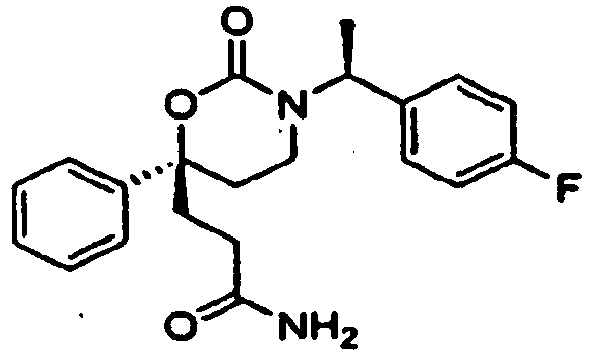
- The title compound was prepared from (R)-3-((S)-1-(4-fluorophenyl)ethyl)-6-(3-hydroxypropyl)-6-phenyl-1,3-oxazinan-2-one following procedures analogous to those described in Example 234. LC-MS Method 2 tR = 1.037 min, m/z = 371.1; 1H NMR (CDCl3) 1.42 (m, 3H), 1.88-2.02 (m, 1H), 2.04-2.28 (m, 5H), 2.38-2.51 (m, 1H), 2.82 (m, 1H), 5.56 (m, 1H), 5.88 (m, 1 H), 6.06 (m, 1H), 6.71 (m, 2H), 6.86 (m, 2H), 7.19 (m, 2H), 7.20-7.34 (m, 3H).
-

- The title compound was prepared from (R)-3-((S)-1-(4-fluorophenyl)ethyl)-6-(3-hydroxypropyl)-6-phenyl-1,3-oxazinan-2-one following procedures analogous to those described in Example 117. LC-MS Method 3 tR = 1.073 min, m/z = 408.1; 1H NMR (CDCl3) 1.05-1.17 (m, 7H), 1.46 (d, 3H), 1.63 (m, 1H), 1.88-2.05 (m, 2H), 2.14-2.26 (m, 3H), 2.83 (m, 1H), 5.56 (m, 1H), 6.72 (m, 2H), 6.85 (m, 2H), 7.15-7.31 (m, 5H).
-

- The title compound was prepared from (R)-6-allyl-6-(4-fluorophenyl)-3-((S)-1-p-tolylethyl)-1,3-oxazinan-2-one following procedures analogous to those described in Example 280. LC-MS Method 1 tR = 1.71, m/z = 386 (M+1); 1H NMR (CDCl3) 7.29-7.25 (m, 2H), 7.02 (t, 2H, J = 9.0 Hz), 6.95 (d, 2H, J = 8.0 Hz), 6.85 (d, 2H, J = 8.0 Hz), 5.63 (q, 1H, J = 7 Hz), 2.86-2.80 (m, 1H), , 2.40-2.32 (m, 1H), 2.25 (s, 3H), 2.21-2.10 (m, 4H), 1.49 (d, 3H, J = 7.0 Hz), 1.16 (s, 3H), 1.11 (s, 3H).
-

- The title compound was prepared from (R)-6-allyl-6-(4-fluorophenyl)-3-((S)-1-p-tolylethyl)-1,3-oxazinan-2-one following a procedure analogous to that described in Example 343.
-

- The title compound was prepared from (R)-6-(4-fluorophenyl)-6-(3-hydroxypropyl)-3-((S)-1-p-tolylethyl)-1,3-oxazinan-2-one following procedures analogous to those described in Example 234.
-

- The title compound was prepared from (R)-6-(4 fluorophenyl)-6-(3-hydroxypropyl)-3-((S)-1-p-tolylethyl)-1,3-oxazinan-2-one following procedures analogous to those described in Example 359.
-

- The title compound was prepared from (R)-6-allyl-6-(4-fluorophenyl)-3-((S)-1-p-tolylethyl)-1,3-oxazinan-2-one following procedures analogous to those described in Example 74.
-

- The title compound was prepared from (R)-6-allyl-6-phenyl-3-((S)-1-p-tolylethyl)-1,3-oxazinan-2-one following procedures analogous to those described in Example 328. LC-MS Method 1 tR = 1.7 min, m/z = 368(M+1); 1H NMR (CDCl3) 7.32(m, 5H), 6.88(dd, 4H), 5.62(q, 1H), 2.81 (m, 1H), 2.23(s. 3H), 1.50(d, 3H), 1.14(d, 6H).
-

- The title compound was prepared from (R)-6-allyl-6-phenyl-3-((S)-1-p-tolylethyl)-1,3-oxazinan-2-one following a procedure analogous to that described in Example 343. LC-MS Method 1 tR = 1.62 min, m/z = 354(M+1); 1H NMR (CDCl3) 7.40-7.18(m, 5H), 6.91 (d, 2H), 6.79(d, 2H), 5.59(m, 1H), 3.60(m, 1H), 2.87(m, 1H), 2.26(s, 3H), 1.51(d, 3H).
-

- The title compound was prepared from (R)-6-(3-hydroxypropyl)-6-phenyl-3-((S)-1-p-tolylethyl)-1,3-oxazinan-2-one following procedures analogous to those described in Example 234. 1H NMR (CDCl3) 1.50 (d, 3H), 1.98 (m, 1H), 2.10-2.30 (8H), 2.52 (m, 1H), 2.83 (m, 1H), 5.59 (q, 1H), 6.03 (2H), 6.80 (d, 2H), 6.93 (d, 2H), 7.20-7.40 (4H).
-

- The title compound was prepared from (R)-6-allyl-6-(4-fluorophenyl)-3-((S)-1-(4-methoxyphenyl)ethyl)-1,3-oxazinan-2-one following procedures analogous to those described in Example 328. LC-MS Method 2 tR = 1.129 min, m/z = 4.47.3; 1H NMR (CDCl3) 1.05 (s, 3H), 1.09 (s, 3H), 1.42 (s, 3H), 2.08 (m, 4H), 2.29 (m, 1H), 2.79 (m, 1H), 3.67 (s, 3H), 5.55 (m, 1H), 6.61 (d, 2H), 6.85 (d, 2H), 6.96 (t, 2H), 7.21 (d, 2H).
-

- The title compound was prepared from (R)-6-(4-fluorophenyl)-6-(3-hydroxypropyl)-3-((S)-1-(4-methoxyphenyl)ethyl)-1,3-oxazinan-2-one following procedures analogous to those described in Example 117. LC-MS Method 2 tR = 1.306 min, m/z = 438.1; 1H NMR (CDCl3) 1.06 (s, 3H), 1.09 (s, 3H), 1.16 (m, 1H), 1.48 (d, 3H), 1.58 (m, 1H), 1.79-1.98 (m, 3H), 2.06-2.19 (m, 3H), 2.79 (m, 1H), 3.67 (s, 1H), 5.56 (m, 1H), 6.59 (d, 2H), 6.79 (d, 2H), 6.94 (t, 2H), 7.16 (m, 2H).
-

- The title compound was prepared from (R)-6-allyl-3-((S)-1-(4-methoxyphonyl)ethyl)-6-phenyl-1,3-oxazinan-2-one following procedures analogous to those described in Example 328. LC-MS Method 3 tR = 1.498 min, m/z = 789.3; 1H NMR (CDCl3) 1.10 (s, 3H), 1.18 (s, 3H), 1.49 (d, 3H), 1.77 (s, 2H), 2.04-2.50 (m, 5H), 2.80 (m, 1H), 3.73 (s, 3H), 5.60 (m, 1 H), 6.63 (d, 2H), 6.89 (d, 2H), 7.25-7.52 (m, 5H).
-

- The title compound was prepared from (R)-6-(3-hydroxypropyl)-3-((S)-1-(4-methoxyphenyl)ethyl)-6-phenyl-1,3-oxazinan-2-one following procedures analogous to those described in Example 117. LC-MS Method 2 tR = 1.291 min, m/z = 420.1; 1H NMR (CDCl3) 1.12 (m, 6H), 1.25 (m, 1H), 1.48 (d, 3H), 1.66 (m, 1H), 1.89-2.05 (m, 2H), 2.14-2.28 (m, 3H), 2.84 (m, 1 H), 3.70 (s, 3H), 5.62 (m, 1H), 6.62 (d, 2H), 6.80 (d, 2H), 7.21-7.38 (m, 5H).
-

- A solution of (S)-1-(4-methoxyphenyl)ethanamine (1.1570 g, 7.65 mmol, 1.0 equiv) and methyl vinyl ketone (0.5900 g, 8.42 mmol, 1.1 equiv) in THF (18 mL) was allowed to stand in a refrigerator (ca. 3.3 °C) for 3 d. Boc2O (2.6800 g, 12.28 mmol, 1.6 equiv) was added to the mixture at room temperature. After stirring for 2 h, the solvent was removed under reduced pressure. The residue was purified by chromatography on silica gel eluted with hexanes/ethyl acetate to give 2.2074 g (90% in two steps) of (S)-tert-butyl 1-(4-methoxyphenyl)ethyl(3-oxobutyl)carbamate as an oil. LC-MS Method 1 tR = 1.82 min, m/z 344 (MNa+).
- A solution of (4-(1.3-dioxan-2-yl)phenyl)magnesium bromide (0.25 M in THF, 34 mL, 8.5 mmol) was added dropwise to a solution of (S)-tert-butyl 1-(4-methoxyphenyl)ethyl(3-oxobutyl)carbamate (0.4222 g, 1.31 mmol) in THF (5 mL) under N2 at 0 °C. After stirring for 24 h at rt, the mixture was quenched with 1 mL of satd aq NH4Cl and diluted with CH2Cl2, dried over K2CO3. After the solvents were evaporated, the crude product was directly used in the next step without further purification. LC-MS Method 1 t R = 2.02 min, m/z = 508 (MNa+), 412.
- A mixture of tert-butyl 3-(4-(1,3-dioxan-2-yl)phenyl)-3-hydroxybutyl((S)-1-(4-methoxyphenyl)ethyl)carbamate, obtained as described above, and 1.340 g of 60% NaH in THF (10 mL) was heated to reflux for 24 h. The reaction was then quenched with 1.5 mL of H2O, diluted with CH2Cl2, dried over Na2SO4. Removal of the solvent afforded crude 6-(4-(1,3-dioxan-2-yl)phenyl)-3-((S)-1-(4-methoxyphenyl)ethyl)-6-methyl-1,3-oxazinan-2-one. LC-MS Method 1 tR = 1.65, 1.69 min, m/z = 412 (MH+).
- The crude product was purified by reversed-phase HPLC (SunFire™ Prep C18 OBD™ 5µm 19 x 50 mm column, 10% →90% CH3CN/H2O, 0.1% CF3COOH over 8 min and then 90% CH3CN/H2O, 0.1% CF3COOH over 2 min, flow rate 20 mL/min) to afford two isomers of 4-(3-((S)-1-(4-methoxyphenyl)ethyl)-6-methyl-2-oxo-1,3-oxazinan-6-yl)benzaldehyde.
- Isomer 1: 0.0145 g LC-MS Method 1 t R = 1.53 min, m/z = 354 (MH+).
- Isomer 2: 0.0163 g LC-MS Method 1 t R = 1.59 min, m/z = 354 (MH+).
- A mixture of 0.0163 g of 4-(3-((S)-1-(4-methoxyphenyl)ethyl)-6-methyl-2-oxo-1,3-oxazinan-6-yl)benzaldehyde isomer 2, obtained as described above, and 0.100 g of NaBH4 in MeOH (3 mL) was stirred at room temperature for 24 h. After the solvent was evaporated, the residue was purified by reversed-phase HPLC (SunFire™ Prep C18 OBD™ 5µm 19 x 50 mm column, 10% →90% CH3CN/H2O, 0.1% CF3COOH over 8 min and then 90% CH3CN/H2O, 0.1% CF3COOH over 2 min, flow rate 20 mL/min) to afford (S)-6-(4-(hydroxymethyl)phenyl)-3-((S)-1-(4-methoxyphenyl)ethyl)-6-methyl-1,3-oxazinan-2-one. LC-MS Method 1 tR = 1.43 min, m/z 356 (MH+); 1H NMR (400 MHz, CD3OD) δ 7.42-7.25 (m, 4H), 7.14 (d, J = 8.8 Hz, 2H), 6.81 (d, J = 8.8 Hz, 2H), 5.50 (q, J = 7.3 Hz, 1H), 4.53 (s, 2H), 3.69 (s, 3H), 2.70-2.65 (m, 2H), 2.36-2.30 (m, 1 H), 1.98-1.87 (m, 1H), 1.50 (s, 3H), 1.19 (d, J = 7.3 Hz, 3H).
- Reaction of 4-(3-((S)-1-(4-methoxyphenyl)ethyl)-6-methyl-2-oxo-1,3-oxazinan-6-yl)benzaldehyde isomer 1 with NaBH4, under conditions analogous to those described above for isomer 2, afforded (R)-6-(4-(hydroxymethyl)phenyl)-3-((S)-1-(4-methoxyphenyl)ethyl)-6-methyl-1,3-oxazinan-2-one. LC-MS Method 1 tR = 1.39 min, m/z = 356 (M+1); 1H NMR (CD3OD) 7.27 (d, J = 8.5 Hz, 2H), 7.21 (d, J = 8.5 Hz, 2H), 6.78 (d, J = 8.8 Hz, 2H), 6.59 (d, J = 8.8 Hz, 2H), 5.41 (q, J = 7.0 Hz, 1H), 4.53 (s, 2H), 3.62 (s, 3H), 2.96-2.91 (m, 1H), 2.37-2.32 (m, 1H), 2.22-2.15 (m, 1H), 2.10-2.02 (m, 1H), 1.51 (s, 3H), 1.41 (d, J = 7.0 Hz, 3H).
-

- The title compound was prepared from (S)-3-((S)-1-(4-bromophenyl)ethyl)-6-(4-fluorophenyl)-6-(2-hydroxyethyl)-1,3-oxazinan-2-one and pyridine-2-boronic acid following a procedure analogous to that described in Example 75 Step 1. LC-MS Method 2 tR = 1.462 min, m/z = 420.18; 1H NMR (CDCl3) 1.48 (d, 3H), 2.03-2.30 (m, 5H), 2.85 (m, 1H), 3.50 (m, 1H), 3.72 (m, 1H), 5.65 (m, 1H), 6.98 (m, 4H), 7.24 (m, 2H), 7.60 (m, 1H), 7.74 (m, 3H), 8.62 (m, 1H).
-

- The title compound was prepared from (S)-3-((S)-1-(4-bromophenyl)ethyl)-6-(4-fluorophenyl)-6-(2-hydroxy-2-methylpropyl)-1,3-oxazinan-2-one and pyridine-2-boronic acid following a procedure analogous to that described in Example 75 Step 1. LC-MS Method 2 tR = 1.049 min, m/z = 391; 1H NMR (CDCl3) 1.06-1.19 (d, 6H), 1.50 (s, 3H), 2.11-2.38 (m, 6H), 2.80 (m, 1H), 5.66 (m, 1 H), 6.97 (m, 2H), 7.04 (d, 2H), 7.18 (m, 1H), 7.23 (m, 2H), 7.58 (m, 1 H), 7.73 (m. 3H), 8.60 (d, 1H).
-

- The title compound was prepared from (R)-3-((S)-1-(4-bromophenyl)ethyl)-6-(4-fluorophenyl)-6-(3-hydroxypropyl)-1,3-oxazinan-2-one and pyridine-2-boronic acid following a procedure analogous to that described in Example 75 Step 1. LC-MS Method 2 tR = 0.905 min, m/z = 435.2; 1H NMR (CDCl3) 1.22-1.37 (m, 1H), 1.49 (d, 3H), 1.60-1.70 (m, 2H), 1.80-1.97 (m, 2H), 2.07-2.31 (m, 3H), 2.85 (m, 1H), 3.50 (m, 2H), 5.65 (m, 1H), 6.97 (m, 4H), 7.20 (m, 3H), 7.57-7.70 (m, 4H), 8.60 (m, 1H).
-

- The title compound was prepared from 3-((R)-3-((S)-1-(4-bromophenyl)ethyl)-6-(4-fluorophenyl)-2-oxo-1,3-oxazinan-6-yl)propanamide and pyridine-2-boronic acid following a procedure analogous to that described in Example 75 Step 1. LC-MS Method 2 tR = 0.976 min, m/z = 448; 1H NMR (CDCl3) 1.50 (d, 3H), 1.91 (m, 1H), 2.17-2.23 (m, 5H), 2.41 (m, 1H), 2.86 (m, 1 H), 5.18 (m, 1H), 5.32 (m, 1H), 5.66 (m, 1H), 7.00 (m, 4H), 7.18 (m, 3H), 7.57 (d, 1H), 7.69 (m, 3H), 8.58 (d, 1H).
-

- The title compound was prepared from N-(3-((R)-3-((S)-1-(4-bromophenyl)ethyl)-6-(4-fluorophenyl)-2-oxo-1,3-oxazinan-6-yl)propyl)methanesulfonamide and pyridine-2-boronic acid following a procedure analogous to that described in Example 75 Step 1. LC-MS Method 2 tR = 1.036 min, m/z = 512.1; 1H NMR (CDCl3) 1.49 (d, 3H), 1.60-1.70 (m, 1H), 1.84 (m, 1H), 1.89-1.99 (m, 2H), 2.10-2.20 (m, 2H), 2.25 (m, 1 H), 2.74 (s, 3H), 3.01 (m, 2H), 4.22 (m, 1H), 5.64 (m, 1H), 6.97 (m, 4H), 7.16 (m, 3H), 7.58 (d, 1H), 7.70 (m, 3H), 8.60 (m, 1H).
-

- The title compound was prepared from (R)-3-((S)-1-(4-bromophenyl)ethyl)-6-(4-fluorophenyl)-6-(3-hydroxypropyl)-1,3-oxazinan-2-one and 6-methylpyridine-2-boronic acid following a procedure analogous to that described in Example 75 Step 1. LC-MS Method 2 tR = 0.868 min, m/z = 449.2; 1H NMR (CD3OD) 1.28 (m, 1 H), 1.56 (d, 3H), 1.61 (m, 1H), 1.95 (m, 2H), 2.23 (m, 1H), 2.34 (m, 1H), 2.46 (m, 1H), 2.55 (s, 3H), 3.11 (m, 1H), 3.46 (m, 2H), 5.50 (m, 1 H), 7.06 (m, 4H), 7.19 (d, 1H), 7.31 (m, 2H), 7.51 (d, 1H), 7.73 (m, 3H).
-

- The title compound was prepared from (S)-3-((S)-1-(4-bromophenyl)ethyl)-6-(4-fluorophenyl)-6-(2-hydroxyethyl)-1,3-oxazinan-2-one and 6-methoxypyridine-3-boronic acid following a procedure analogous to that described in Example 75 Step 1. LC-MS Method 2 tR = 1.887 min, m/z = 450.2; 1H NMR (CDCl3) 1.54 (d, 3H), 2.07-2.29 (m, 2H), 2.34 (m, 3H), 2.97 (m, 1H), 3.55 (m, 1 H), 3.74 (m, 1H), 4.06 (d, 3H), 5.64 (m, 1H), 6.93 (m, 1H), 6.95-7.11 (m, 2H), 7.26-7.37 (m, 2H), 7.90 (m, 1H), 8.38 (m, 1H).
-

- The title compound was prepared from (S)-3-((S)-1-(4-bromophenyl)ethyl)-6-(4-fluorophenyl)-6-(2-hydroxy-2-methylpropyl)-1,3-oxazinan-2-one and 6-methoxypyridine-3-boronic acid following a procedure analogous to that described in Example 75 Step 1. LC-MS Method 3 tR = 1.111 min, m/z = 478.23; 1H NMR (CDCl3) 1.15 (d, 6H), 1.55 (d, 3H), 2.17-2.29 (m, 4H), 2.42 (m, 1H), 2.91 (m, 1H), 3.95 (s, 3H), 5.70 (m, 1H) 6.80 (d, 1H), 7.03 (m, 4H), 7.30 (m, 4H), 7.71 (m, 1H), 8.30 (s, 1H).
-

- The title compound was prepared from (R)-3-((S)-1-(4-bromophenyl)ethyl)-6-(4-fluorophenyl)-6-(3-hydroxypropyl)-1,3-oxazinan-2-one and 6-methoxypyridine-3-boronic acid following a procedure analogous to that described in Example 75 Step 1. LC-MS Method 2 tR = 1.3 min, m/z = 487.1; 1H NMR (CD3OD) 1.25-1.37 (m, 1H), 1.55 (d, 3H), 1.61 (m, 1H), 1.95 (m, 2H), 2.17-2.28 (m, 1H), 2.36 (m, 1H), 2.48 (m, 1H), 3.12 (m, 1H), 3.48 (m, 2H), 3.94 (s, 3H), 5.58 (m, 1 H), 6.86 (d, 1H), 7.07 (m, 4H), 7.35 (m, 4H), 7.86 (dd, 1H), 8.28 (s, 1H).
-

- The title compound was prepared from 3-((R)-3-((S)-1-(4-bromophenyl)ethyl)-6-(4-fluorophenyl)-2-oxo-1,3-oxazinan-6-yl)propanamide and 6-methoxypyridine-3-boronic acid following a procedure analogous to that described in Example 75 Step 1. LC-MS Method 2 tR = 1.254 min, m/z = 477.21; 1H NMR (CDCl3) 1.55 (d, 3H), 2.01 (m, 1H), 2.15-2.34 (m, 5H), 2.46 (m, 1 H), 2.96 (m, 1H), 4.00 (s, 3H), 5.66 (m, 1H), 5.80 (s, 1H), 6.19 (s, 1H), 6.86 (d, 1 H), 7.03 (m, 4H), 7.23 (m, 2H), 7.79 (dd, 1H), 8.36 (s, 1H).
-
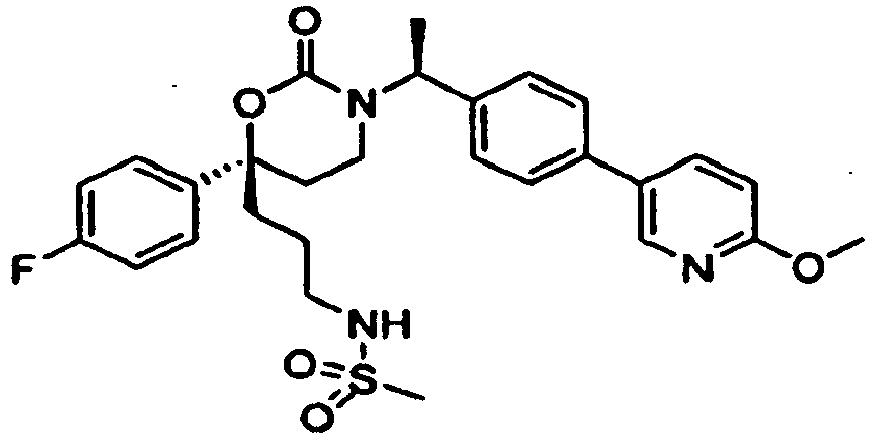
- The title compound was prepared from N-(3-((R)-3-((S)-1-(4-bromophenyl)ethyl)-6-(4-fluorophenyl)-2-oxo-1,3-oxazinan-6-yl)propyl)methanesulfonamide and 6-methoxypyridine-3-boronic acid following a procedure analogous to that described in Example 75 Step 1. LC-MS Method 2 tR = 1.327 min, m/z = 542.1; 1H NMR (CD3OD) 1.33 (m, 1H), 1.58 (d, 3H), 1.66 (m, 1H), 1.98 (m, 2H), 2.20-2.39 (m, 2H), 2.47 (m, 1H), 2.87 (s, 3H), 2.99 (m, 2H), 3.15 (m, 1H), 3.96 (s, 3H), 5.60 (m, 1 H), 6.87 (d, 1H), 7.12 (m, 4H), 7.36 (m, 4H), 7.87 (d, 1H), 8.29 (s, 1H).
-

- To a solution of 3-((R)-6-(4-fluorophenyl)-2-oxo-3-((S)-1-(4-(pyridin-3-yl)phenyl) ethyl) -1,3-oxazinan-6-yl) propanamide (70 mg, 0.16 mmol) in CH2Cl2 (10 mL), was added m-CPBA (135 mg, 0.79 mmol), and the reaction mixture was stirred at rt for 3 h. After the solvent was removed under reduced pressure, the residue was purified by preparative TLC to afford 3-((R)-6-(4-fluorophenyl)-2-oxo-3-((S)-1-(4-(pyridin-3-yl) phenyl)ethyl)-1,3- oxazinan-6-yl)propanoic acid (10 mg, 15%). LC-MS Method 2 tR = 0.987 min, m/z = 464.17; 1H NMR (CDCl3): 1.51 (m, 3H), 1.92 (m, 1 H), 2.12-2.28 (m, 5H), 2.43 (m, 1H), 2.95 (m, 1 H), 5.56 (m, 1H), 5.65 (m, 1 H), 5.31 (m, 1H), 6.95 (m, 2H), 7.08 (m, 2H), 7.15 (m, 1H), 7.20 (m, 1H), 7.25 (m, 2H), 7.56 (m, 1 H), 7.24 (m, 1H), 8.35 (m, 1H), 8.65 (m, 1H).
-

- The title compound was prepared from (R)-3-((S)-1-(4-bromophenyl)ethyl)-6-(4-fluorophenyl)-6-(3-hydroxypropyl)-1,3-oxazinan-2-one and 5-chloropyridine-3-boronic acid following a procedure analogous to that described in Example 75 Step 1.
-

- The title compound was prepared from (R)-6-(4-fluorophenyl)-3-((S)-1-(4-(5-fluoropyridin-3-yl)phenyl)ethyl)-6-(3-hydroxypropyl)-1,3-oxazinan-2-one following a procedure analogous to that described in Example 234 Step 1.
-

- To a solution of (R)-6-allyl-3-((S)-1-(4-bromophenyl)ethyl)-6-(4-fluorophenyl)-1,3-oxazinan- 2-one (1 g, 2.4 mmol) in dry THF (15 mL) was added dropwise BH3. THF (5 mL, 1 M) at 0 °C. After stirring for 2 h at rt, the reaction mixture was cooled to 0 °C and water (1 mL), aqueous NaOH (0.5 mL, 3 M) and H2O2 (0.5 mL, 30%) were successively added. The mixture was stirred for 2-3 h at rt and diluted with water (8 mL). The pH was adjusted to 6-7 with 0.5 N HCl. The layers were separated, and the aqueous phase was extracted with EtOAc (3×10 mL). The combined organic layers were washed with a satd aq NaHCO3 (20 mL) and brine (20 mL), dried over Na2SO4, and concentrated in vacuo to give the crude product, which was purified by preparative TLC to afford (R)-3-((S)-1-(4-bromophenyl)ethyl)-6-(4-fluorophenyl)-6-(3-hydroxypropyl)-3-oxazinan-2-one (400 mg, 38%).
- A mixture of (R)-3-((S)-1-(4-bromophenyl)ethyl)-6-(4-fluorophenyl)-6-(3-hydroxypropyl)-1,3-oxazinan-2-one (250 mg, 0.6 mmol), 5-(methoxycarbonyl)pyridin-3-ylboronic acid (163 mg, 0.9 mmol), PdCl2(PPh3)2 (50 mg, 20%) and aqueous Cs2CO3 solution (2 M, 2 mL) in 1,4-dioxane (6 mL) was heated to reflux at 100 °C overnight under N2. The mixture was filtered, and the filtrate was extracted with EtOAc for 3 times. The combined organic layer was washed with brine, dried over Na2SO4 and concentrated to the crude product, which was purified by preparative HPLC to give methyl 5-(4-((S)-1-((R)-6-(4-fluorophenyl)-6-(3-hydroxypropyl)-2-oxo-1,3-oxazinan-3-yl)ethyl)phenyl)nicotinate (220 mg, crude).
- Methyl 5-(4-((S)-1-((R)-6-(4-fluorophenyl)-6-(3-hydroxypropyl)-2-oxo-1,3-oxazinan-3-yl)ethyl)phenyl)nicotinate (30 mg, 0.1 mmol) was dissolved in anhydrous NH3 in EtOH (5 mL). Then the mixture was stirred at rt overnight. The solvent was removed in vacuo to give the crude product, which was purified by preparative HPLC to provide 5-(4-((S)-1-(R)-6-(4-luorophenyl)-6-(3-hydroxypropyl)-2-oxo-1,3-oxazinan-3-yl)ethyl)phenyl) nicotinamide (10 mg, 34%). LC-MS Method 2 tR = 1.022 min, m/z = 478; 1H NMR (CD3OD): 1.31 (m, 1 H), 1.56 (m, 3H), 1.59 (m, 1 H), 1.91 (m, 2H), 2.17-2.28 (m, 1H), 2.33 (m, 1H), 2.44 (m, 1H), 3.14 (m, 1 H), 3.44 (m, 2H), 5.60 (m, 1H), 7.04-7.17 (m, 4H), 7.29 (m, 2H), 7.49 (m, 2H), 8.41 (m, 1H), 8.86 (m, 1H), 8.97 (m, 1H).
-
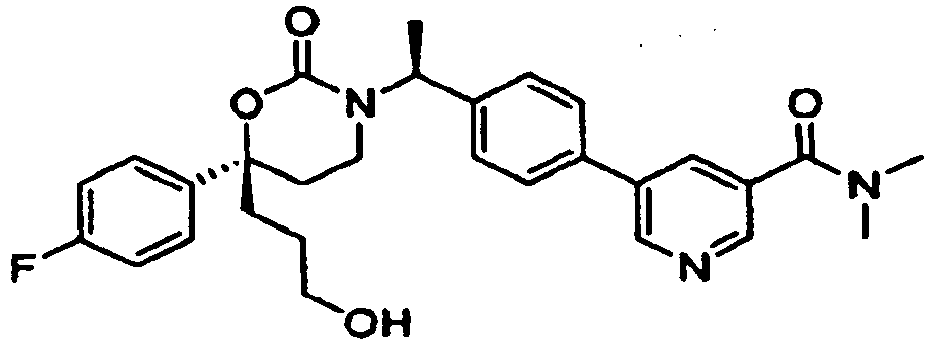
- The title compound was prepared methyl 5-(4-((S)-1-((R)-6-(4-fluorophenyl)-6-(3-hydroxypropyl)-2-oxo-1,3-oxazinan-3-yl)ethyl)phenyl)nicotinate following a procedure analogous to that described in Example 444 Step 3 using dimethylamine in place of ammonia. LC-MS Method 2 tR = 1.086 min, m/z = 506.3; 1H NMR (CDCl3) 0.87 (m, 1H), 1.21-1.37 (m, 4H), 1.64 (m, 1H), 1.98 (m, 2H), 2.22 (m, 1H), 2.35 (m, 1H), 2.54 (m, 1H), 2.65 (m, 1H), 3.05 (m, 3H), 3.15 (m, 4H), 3.45 (m, 2H), 5.63 (m, 1H), 7.03-7.18 (m, 4H), 7.34 (m, 2H), 7.49 (m, 2H), 8.06 (m, 1 H), 8.58 (m, 1H), 8.81 (m, 1 H).
-
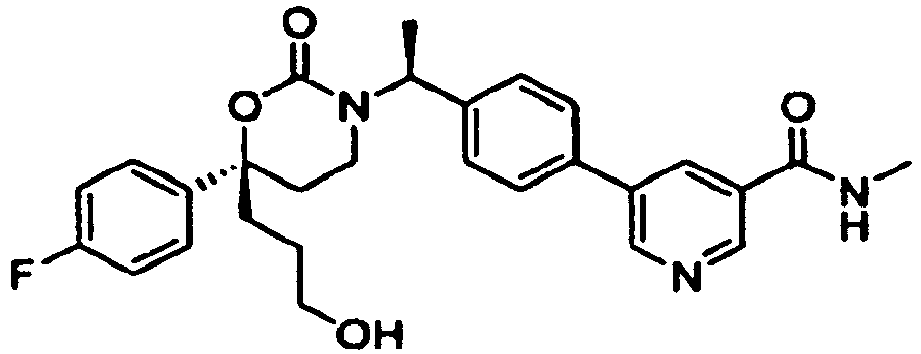
- The title compound was prepared methyl 5-(4-((S)-1-((R)-6-(4-fluorophenyl)-6-(3-hydroxypropyl)-2-oxo-1,3-oxazinan-3-yl)ethyl)phenyl)nicotinate following a procedure analogous to that described in Example 444 Step 3 using methylamine in place of ammonia. LC-MS Method 2 tR = 1.055 min, m/z = 491.12; 1H NMR (CD3OD) 1.18 (m, 1H), 1.48 (d, 3H), 1.51 (m, 1H), 1.85 (m, 2H), 2.13 (m, 1H), 2.25 (m, 1H), 2.48 (m, 1H), 2.88 (s, 3H), 3.09 (m, 1H), 3.38 (m, 2H), 5.51 (m, 1H), 6.98-7.07 (m, 4H), 7.22 (m, 2H), 7.42 (m, 2H), 8.28 (m, 1H), 8.75 (s, 1H), 8.82 (s, 1H).
-

- The title compound was prepared from 3-((R)-3-((S)-1-(4-bromophenyl)ethyl)-6-(4-fluorophenyl)-2-oxo-1,3-oxazinan-6-yl)propanamide and pyridine-4-boronic acid following a procedure analogous to that described in Example 75 Step 1. LC-MS Method 2 tR = 0.906 min, m/z = 448.1; 1H NMR (CDCl3) 1.59 (d, 3H), 2.15 (m, 1H), 2.24-2.32 (m, 4H), 2.45 (m, 1H), 3.07 (m, 2H), 5.66 (m, 1H), 5.71 (m, 1H), 5.84 (m, 1 H), 7.03 (m, 2H), 7.05 (m, 2H), 7.22 (m, 1H), 7.25 (m, 1H), 7.50 (d, 2H), 7.93 (d, 2H), 8.84 (d, 2H).
-

- The title compound was prepared from (S)-3-((S)-1-(4-bromophenyl)ethyl)-6-(4-fluorophenyl)-6-(2-hydroxyethyl)-1,3-oxazinan-2-one and 2-methylpyridine-4-boronic acid following a procedure analogous to that described in Example 75 Step 1. LC-MS Method 2 tR = 0.945 min, m/z = 435.5; 1H NMR (CD3OD) 1.56 (d, 3H), 1.92 (m, 1H), 2.01 (m, 1H), 2.17 (m, 2H), 2.36 (m, 2H), 2.48 (m, 1H), 2.56 (m, 3H), 3.12 (m, 1H), 3.62 (m, 1H), 5.62 (m, 1H), 7.05 (m, 4H), 7.30 (m, 2H), 7.44 (m, 1H), 7.54 (m, 3H), 8.39 (s, 2H).
-

- The title compound was prepared from (S)-3-((S)-1-(4-bromophenyl)ethyl)-6-(4-fluorophenyl)-6-(2-hydroxy-2-methylpropyl)-1,3-oxazinan-2-one and 2-methylpyridine-4-boronic acid following a procedure analogous to that described in Example 75 Step 1. LC-MS Method 2 tR = 0.976 min, m/z = 463.8; 1H NMR (CDCl3) 1.09 (d, 6H), 1.49 (d, 3H), 2.16 (m, 4H), 2.35 (m, 1H), 2.56 (d, 3H), 2.85 (m, 1H), 5.65 (m, 1H), 6.94-7.05 (m, 4H), 7.17-7.26 (m, 4H), 7.34 (d, 2H), 8.47 (d, 1H).
-

- The title compound was prepared from (R)-6-(4-fluorophenyl)-6-(3-hydroxypropyl)-3-((S)-1-(4-(2-methylpyridin-4-yl)phenyl)ethyl)-1,3-oxazinan-2-one following procedures analogous to those described in Example 234 Step 1.
-

- The title compound was prepared from 3-((R)-6-(4-fluorophenyl)-3-((S)-1-(4-(2-methylpyridin-4-yl)phenyl)ethyl)-2-oxo-1,3-oxazinan-6-yl)propanoic acid following procedures analogous to those described in Example 234 Step 2. LC-MS Method 2 tR = 0.793 min, m/z = 462.2; 1H NMR (CDCl3) 1.51 (d, 3H), 2.12-2.38 (m, 6H), 2.43 (m, 1 H), 2.61 (s, 3H), 2.89 (m, 1H), 5.10-5.34 (d, 2H), 5.66 (m, 1 H), 6.99 (m, 4H), 7.17-7.27 (m, 4H), 7.36 (d, 2H), 8.46 (d, 1H).
-

- The title compound was prepared from (R)-6-(4-fluorophenyl)-6-(3-hydroxypropyl)-3-((S)-1-(4-(2-methylpyridin-4-yl)phenyl)ethyl)-1,3-oxazinan-2-one following procedures analogous to those described in Example 117. LC-MS Method 2 tR = 0.992 min, m/z = 477.5; 1H NMR (CDCl3) 1.08 (d, 6H), 1.15 (m, 1H), 1.52 (d, 3H), 1.59 (m, 1H), 1.84-2.01 (m, 2H), 2.15-2.34 (m, 3H), 2.83 (s, 3H), 2.98 (m, 1H), 5.67 (m, 1H), 6.96 (t, 2H), 7.09 (d, 2H), 7.20 (m, 2H), 7.41 (d, 2H), 7.65 (d, 2H), 8.75 (s, 1 H).
- N-(3-((R)-6-(4-fluorophenyl)-3-((S)-1-(4-(2-methylpyridin-4-yl)phenyl)ethyl)-2-oxo-1,3-oxazinan-6-yl)propyl)methanesulfonamide

- The title compound was prepared from N-(3-((R)-3-((S)-1-(4-bromophenyl)ethyl)-6-(4-fluorophenyl)-2-oxo-1,3-oxazinan-6-yl)propyl)methanesulfonamide and 2-methylpyridine-4-boronic acid following procedures analogous to those described in Example 75 Step 1. LC-MS Method 2 tR = 0.964 min, m/z = 525.21; 1H NMR (CDCl3) 1.31-1.43 (m, 1H), 1.50 (d, 3H), 1.62 (m, 2H), 1.07-2.09 (m, 2H), 2.13-2.47 (m, 3H), 2.83 (d, 6H), 3.01 (m, 3H), 4.35 (s, 1H), 5.66 (m, 1H) 7.07 (m, 2H), 7.14 (m ,2H), 7.29 (m, 5H), 7.44 (m, 2H), 7.65 (m, 1H), 7.73 (d, 1H), 8.78 (d, 1H).
-

- The title compound was prepared from (R)-6-allyl-3-((S)-1-(4-bromophenyl)ethyl)-6-(4-fluorophenyl)-1,3-oxazinan-2-one following a procedure analogous to that described in Example 455 Steps 1 and 2, using 4-bromo-2,6-dimethylpyridine-N-oxide in step 2, followed by a procedure analogous to that described in Example 343. LC-MS Method 1 tR = 1.1 min, m/z = 463(M+1); 1H NMR (CDCl3) 7.50(s, 2H), 7.45(d, 1 H), 7.25(m, 3H), 7.17-6.99(m, 4H), 5.73(q, 1H), 4.28(t, 1H), 3.04(m, 1H), 2.82(s, 6H), 2.31(m, 3H), 1.91(m, 3H), 1.58(d, 3H).
-
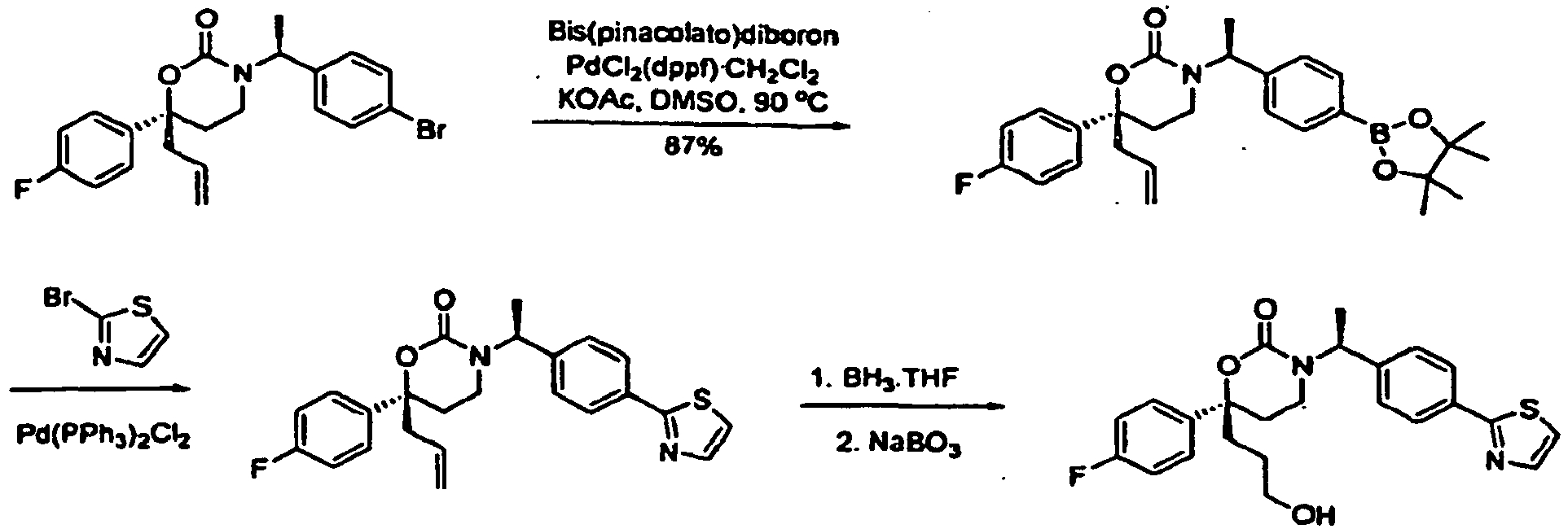
- A mixture of (R)-6-allyl-3-((S)-1-(4-bromophenyl)ethyl)-6-(4-fluorophenyl)-1,3-oxazinan-2-one (0.4910 g, 1.17 mmol, 1.0 equiv), bis(pinacolato)diboron (0.3925 g, 1.55 mmol, 1.3 equiv), KOAc (0.3696 g, 3.76 mmol, 3.2 equiv), and PdCl2(dppf)·CH2Cl2 (0.0316 g, 0.0386 mmol, 0.033 equiv) in DMSO (6 mL) was heated at 90 °C under N2 for 20 h. After cooling, the reaction mixture was partitioned between EtOAc and water. The organic phase was washed with brine, and dried over Na2SO4. After the solvents were evaporated, the residue was purified by chromatography on silica gel eluted with hexanes/ethyl acetate to give 0.4776 g (87%) of (R)-6-allyl-6-(4-fluorophenyl)-3-((S)-1-(4-(4,4,5,5-tetramethyl-1,3,2-dioxaborolan-2-yl)phenyl)ethyl)-1,3-oxazinan-2-one as a white solid.
- (R)-6-allyl-6-(4-fluorophenyl)-3-((S)-1-(4-(4,4,5,5-tetramethyl-1,3,2-dioxaborolan-2-yl)phenyl)ethyl)-1,3-oxazinan-2-one (20 mg, 0.043 mmol), 2-bromothiazole (14 mg, 2 equiv), 2M aq Na2SO4 solution (0.5 mL) and Pd(PPh3)2Cl2 were mixed with THF (0.6 mL) and heated in a microwave oven for 2 h at 140 °C. LC-MS found reaction completed. The mixture was diluted with EtOAc (8 mL), washed with water (2 mL), 1% aq HCl (2 mL) and brine (1.5 mL). After concentration, the residue was purified by preparative HPLC to afford (R)-6-allyl-6-(4-fluorophenyl)-3-((S)-1-(4-(thiazol-2-yl)phenyl)ethyl)-1,3-oxazinan-2-one (6.0 mg, 33%). LC-MS (3min) tR = 1.86 min, m/z = 423 (M+1).
- (R)-6-allyl-6-(4-fluorophenyl)-3-((S)-1-(4-(thiazol-2-yl)phenyl)ethyl)-1,3-oxazinan-2-one (6.0 mg, 0.014 mmol) was dissolved in dry THF (2 mL) and cooled to 0°C. BH3-THF (1.0M, 100µL, excess) was added slowly. After 10min, the mixture was warmed to rt and stirred for 3 h. LC-MS found reaction completed. The mixture was quenched with water (1 mL). NaBO3 (ca 4mg) was added. The mixture was stirred 40 min, filtered, concentrated and purified by preparative HPLC to afford (R)-3-((S)-1-(4-(2,6-dimethylpyridin-4-yl)phenyl)ethyl)-6-(4-fluorophenyl)-6-(3-hydroxypropyl)-1,3-oxazinan-2-one (3.4 mg, 54%), LC-MS (3min) tR = 1.86 min, m/z = 423(M+1). LC-MS Method 1 tR = 1.86 min, m/z = 423(M+1); 1H NMR (CDCl3) 7.71(m, 2H), 7.40-7.22(m, 4H), 7.16-7.03(m, 3H), 6.96(m, 1H), 5.66(m, 1H), 2.96(m, 1H), 1.54(d, 3H).
-
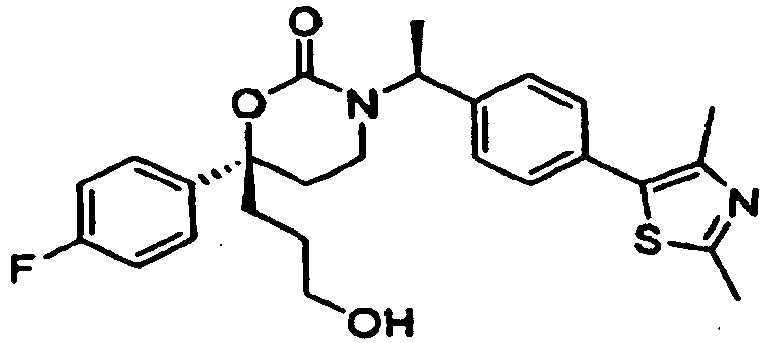
- The title compound was prepared from (R)-6-allyl-3-((S)-1-(4-bromophenyl)ethyl)-6-(4-fluorophenyl)-1,3-oxazinan-2-one and 2,4-dimethylthiazole-5-boronic acid following a procedure analogous to that described in Example 111, followed by a procedure analogous to that described in Example 78. LC-MS Method 1 tR = 1.49 min, m/z = 469; 1H NMR (CDCl3) 7.28(m, 2H), 7.15(d, 2H), 7.03(q, 4H), 5.68(q, 1H), 3.59(t, 1H), 3.02(m, 1H), 2.91(s, 3H), 2.48(s, 3H), 1.55(d, 3H).
-

- The title compound was prepared from (R)-3-((S)-1-(4-(2,4-dimethylthiazol-5-yl)phenyl)ethyl)-6-(4-fluorophenyl)-6-(3-hydroxypropyl)-1,3-oxazinan-2-one following procedures analogous to those described in Example 234. LC-MS Method 1 tR = 1.38 min, m/z = 482(M+1); 1H NMR (CDCl3) 7.32(m, 5H), 7.18(d, 2H), 7.04(m, 4H), 5.69(q, 1H), 2.84(s, 3H), 2.45(s, 3H), 2.02(m, 1H), 1.55(d, 3H).
-

- The title compound was prepared from (R)-6-allyl-3-((S)-1-(4-bromophenyl)ethyl)-6-(4-fluorophenyl)-1,3-oxazinan-2-one following a procedure analogous to that described in Example 455 Steps 1 and 2, using 5-bromo-1-methylpyridin-2(1H)-one in Step 2, followed by a procedure analogous to that described in Example 97. LC-MS Method 1 tR = 1.21 min, m/z = 451 (M+1); 1H NMR (CD3OD) 7.80 (m, 1H), 7.69 (d, J = 9.4 Hz, 1H), 7.22-7.19 (m, 4H), 7.00-6.92 (m, 4H), 6.52 (d, J = 9.4 Hz, 1H), 5.45 (q, J = 7.0 Hz, 1H), 3.60-3.52 (m, 1H), 3.52 (s, 3H), 3.24-3.18 (m, 1H), 3.02-2.98 (m, 1H), 2.39-2.35 (m, 1H), 2.23-2.12 (m, 2H), 2.01 (t, J = 7.3 Hz, 2H), 1.43 (d, J = 7.0 Hz, 3H).
-

- A mixture of (R)-6-allyl-3-((S)-1-(4-bromophenyl)ethyl)-6-(4-fluorophenyl)-1,3-oxa zinan- 2-one (1.6 g, 3.84 mmol) and 6-aminopyridin-3-ylboronic acid (1.0 g, 4.61 mmol), Pd(Ph3P)2Cl2 (150 mg), and aq Cs2CO3 solution (3.84 mL, 2 M) in 1,4-dioxane (150 mL) was stirred and heated to reflux for 2 h. The mixture was filtered and the filtrate was extracted with EtOAc. The combined organic phase was washed with brine, dried over anhydrous Na2SO4. and concentrated to give (R)-6-allyl-3-((S)-1-(4- (6-aminopyridin -3-yl) phenyl)ethyl)-6-(4-fluorophenyl)-1,3-oxazinan-2-one (1.5 g, 90%), which was used for the next step without purification. 1H NMR (CDCl3): δ=1.51 (d, 3H), 2.17-2.31 (m, 3H), 2.54-2.60 (m, 2H), 2.90 (m, 1H), 4.46 (s, 2H), 4.99-5.09 (m, 2H), 5.65-5.71 (m, 2H), 6.54 (m, 2H), 6.88 (d, 2H), 7.03 (t, 2H), 7.21-7.27 (m, 3H), 7.58 (d, 1H), 8.22 (d, 1H).
- To a solution of (R)-6-allyl-3-((S)-1-(4-(6-aminopyridin-3-yl)phenyl)ethyl)-6-(4-fluorophenyl)-1,3-oxazinan-2-one (1.5 g, 3.47 mmoL) in 3.5 M H2SO4 (25 mL) was added 2 M NaNO2 (15 mL) at 0 °C. The reaction mixture was stirred at rt overnight. The reaction was treated with aqueous NaOH solution (8%), and the mixture was extracted with CH2Cl2. The combined organic layer was washed with brine, dried over anhydrous Na2SO4 and concentrated to give crude product , which was purified by preparative TLC to give (R)-6-allyl-6-(4-fluorophenyl)-3-((S)-1-(4-(6-oxo-1,6-dihydropyridin-3-yl)phenyl) ethyl)-1,3-oxazinan-2-one (891 mg, 59%). 1H NMR (CDCl3): δ=1.52 (d, 3H), 2.15-2.38 (m, 3H), 2.51-2.60 (m, 2H), 2.94 (m, 1H), 4.99-5.11 (m, 2H), 5.65-5.74 (m, 2H), 6.67 (m, 1H), 6.89 (d, 2H), 7.00 (t, 2H), 7.13-7.20 (m, 2H), 7.20-7.27 (d, 2H), 7.33 (m, 1H), 7.46 (m, 1 H), 7.77 (m, 1H).
- To a suspension of NaH (330 mg, 8.24 mmol) in THF (20 mL) was added a solution of (R)-6- allyl-6-(4-fluorophenyl)-3-((S)-1-(4-(6-oxo-1,6-dihydropyridin-3-yl)phenyl)ethyl)- 1,3- oxazinan-2-one (891 mg, 0.174mmol) in THF (30 mL) at 0 °C, and the resulting mixture was stirred for 1 h. CH3I (2 ml) was added and the mixture was stirred overnight. The reaction was quenched by aqueous NH4Cl solution. The organic phase was separated, and concentrated to give the crude product, which was purified by preparative TLC to give (R)-6-allyl-6-(4-fluorophenyl)-3-((S)-1-(4-(1-methyl-6-oxo-1,6-dihydropyridin-3-yl)phenyl)ethyl)-1,3-oxazinan-2-one (634 mg, 69%). 1H NMR (CDCl3): δ=1.52 (d, 3H), 2.16-2.35 (m, 3H), 2.52-2.64 (m, 2H), 2.94 (m, 1H), 3.61 (s, 3H), 5.00-5.11 (m, 2H), 5.66-5.74 (m, 2H), 6.64 (d, 1H), 6.90 (d, 2H), 7.02 (t, 2H), 7.11-7.14 (d, 2H), 7.25-7.28 (m, 2H), 7.41 (m, 1 H), 7.53 (m, 1H).
- To a solution of (R)-6-allyl-6-(4-fluorophenyl)-3-((S)-1-(4-(1-methyl-6-oxo-1,6-dihydropyridin-3-yl)phenyl)ethyl)-1,3-oxazinan-2-one (320 mg, 0.717mmol) in acetone (20 mL) was added aqueous KMnO4 and NalO4 solution (15 mL). Then the formed mixture was stirred for 30 min at 0 °C. The mixture was filtered, and the filtrate was adjusted to pH = 5-6 with 1 N aq HCl solution. The mixture was extracted with EtOAc, and the combined organic phase was washed with brine, dried over anhydrous Na2SO4 and concentrated to give 2-((S)-6-(4-fluorophenyl)-3-((S)-1-(4-(1-methyl-6-oxo-1,6-dihydropyridin-3-yl)phenyl)ethyl)-2-oxo-1,3-oxazinan-6-yl)acetic acid.
- To a solution of 2-((S)-6-(4-fluorophenyl)-3-((S)-1-(4-(1-methyl-6-oxo-1,6-dihydropyridin-3-yl)phenyl)ethyl)-2-oxo-1,3-oxazinan-6-yl)acetic acid (290 mg, 0.625 mol) in MeOH (20 mL) was added SOCl2 (2 mL) at 0 °C, and the reaction mixture was stirred at rt for 2 h. The reaction mixture was concentrated to give the residue, which was purified by preparative TLC to give methyl 2-((S)-6-(4-fluorophenyl)-3-((S)-1-(4-(1-methyl-6-oxo-1,6-dihydropyridin-3-yl)phenyl)ethyl)-2-oxo-1,3-oxazinan-6-yl)acetate (130 mg, 43.5%). 1H NMR (CDCl3): δ=1.52 (d, 3H), 2.36-2.55 (m, 3H), 2.67-2.71 (m, 2H), 2.90-3.04 (m, 3H), 3.68 (s, 3H), 3.71 (s, 3H), 5.66 (m, 2H), 6.66 (d, 1H), 6.90 (d, 2H), 7.03 (t, 2H), 7.13-7.15 (d, 2H), 7.23-7.29 (m, 2H), 7.42 (m, 1H), 7.56 (m, 1 H).
- To a solution of methyl 2-((S)-6-(4-fluorophenyl)-3-((S)-1-(4-(1-methyl-oxo-1,6-dihydropyridin-3-yl)phenyl)ethyl)-2-oxo-1,3-oxazinan-6-yl)acetate (130 mg, 0.22 mmol) in dry THF (20 mL) was added MeMgBr (2 mL) at -78 °C, and the mixture was stirred under N2 at rt overnight. The reaction was quenched with water, and the mixture was extracted with EtOAc. The combined organic phase was dried over Na2SO4, and concentrated to give the residue, which was purified by preparative HPLC to give (S)-6-(4-fluorophenyl) -6-(2-hydroxy-2-methylpropyl)-3-((S)-1-(4-(1-methyl-6-oxo-1,6-dihydropyridin-3-yl)phenyl)ethyl)-1,3-oxazinan-2-one (24 mg, 30%). LC-MS Method 2 tR = 1.116 min, m/z = 479.1; 1H NMR (CDCl3): 1.1 (m, 6H), 1.18 (m, 1H), 1.48 (d, 3H), 1.58 (m, 1H), 1.80-2.00 (m, 2H), 2.21 (m, 3H), 2.86 (m, 1H), 5.55 (m, 1H), 7.72 (m, 2H), 7.00 (m, 2H), 7.18 (m, 4H).
-

- To a solution of (R)-6-allyl-3-((S)-1-(4-bromophenyl)ethyl)-6-(4-fluorophenyl) - 1,3-oxazinan-2-one (5 g, 12 mmol) and CuCl (2.75 g, 27.8 mmol) in dry DMF (50 mL) was added H2O (20 mL) and PdCl2 (950 mg, 3.2 mmol) at room temperature. The mixture was vigorously stirred under a balloon of oxygen for 24 h. After TLC showed the starting material had disappeared, the solid was filtered off. Water (200 mL) and EtOAc (50 mL) was added, the layers were separated and the aqueous layer was extracted with EtOAc (3 × 40 mL). The combined organic layer was washed with brine, dried over Na2SO4, filtered and concentrated to give (S)-3-((S)-1-(4-bromophenyl)ethyl)-6-(4-fluorophenyl)-6-(2-oxopropyl)-1,3-oxazinan -2-one (5.25 g, 92%), which was purified by column chromatography. 1H NMR (CDCl3): 1.47 (s, 3H), 2.06 (s, 3H), 2.10-2.36 (m, 3H), 2.58 (m, 1H), 2.90 (m, 2H), 5.58 (m, 1H), 6.69 (m, 1H), 6.79 (m, 1H), 7.02 (m. 2H), 7.19-7.33 (m, 4H).
- To a solution of (S)-3-((S)-1-(4-bromophenyl)ethyl)-6-(4-fluorophenyl)-6-(2-oxopropyl)-1,3-oxazinan -2-one (5.25 g, 12.1 mmol) in anhydrous THF (100 mL) was added dropwise methylmagnesium bromide (20 mL, 60 mmol) at -78 °C under nitrogen. Then the mixture was stirred at rt for 2 h. The reaction mixture was cooled in an ice bath and quenched with aqueous NH4Cl. The layers were separated. The aqueous layer was extracted with EtOAc (15 mL) ,washed with a brine (30 mL), dried over Na2SO4 and concentrated in vacuo to give the crude product, which was purified by preparative HPLC and chiral HPLC to afford (S)-3-((S)-1-(4-bromophenyl)ethyl)-6-(4-fluorophenyl)-6-(2-hydroxy-2-methylpropyl)-1,3-oxazinan-2-one (2.5 mg, 46%). 1H NMR (CDCl3): 1.08 (s, 3H), 1.12 (s, 3H), 1.48 (m, 3H), 1.99 (m, 1H), 2.10-2.24 (m, 4H), 2.35 (m, 1H), 2.85 (m, 1H), 5.61 (m, 1H), 6.80 (m, 2H), 6.99 (m, 2H), 7.15-7.28 (m, 5H).
- A mixture of (S)-3-((S)-1-(4-bromophenyl)ethyl)-6-(4-fluorophenyl)-6-(2-hydroxy-2- methylpropyl)-1,3-oxazinan-2-one (640 mg, 1.42 mmol), 4,4,4',4',5,5,5',5'-octamethyl-2,2'- bi(1,3,2-dioxaborolane) (470 mg, 1.85 mmol), PdCl2dppf (40 mg, 0.047mmol□KOAc (490 mg, 4.97 mmol) in DMSO (8 mL) was heated at 90 °C for 20 h. The mixture was diluted with EtOAc, and washed with water. The organic phase was separated, and concentrated to give the crude product, which was purified by preparative TLC to afford (S)-6-(4-fluorophenyl)-6-(2-hydroxy-2-methylpropyl)-3-((S)-1-(4-(4,4,5,5-tetramethyl-1,3,2- dioxaborolan-2-yl)phenyl)ethyl)-1,3-oxazinan-2-one (700 mg, 99%). 1H NMR (CDCl3): δ=1.08 (s, 3H), 1.13 (s, 3H), 1.32 (s, 12H), 1.51 (t, 3H), 1.94 (m, 2H), 2.16 (m, 5H), 2.33 (m, 1H), 2.83 (m, 1H), 5.69 (m, 1H), 6.99 (m, 4H), 7.25 (m, 2H), 7.61 (m, 2H).
- A mixture of (S)-6-(4-fluorophenyl)-6-(2-hydroxy-2-methylpropyl)-3-((S)-1-(4-(4,4,5,5-tetramethyl-1,3,2-dioxaborolan-2-yl)phenyl)ethyl)-1,3-oxazinan-2-one (700 mg, 1.41 mmol), 5-bromo-1-methylpyridin-2(1H)-one (398 mg, 2.12 mmol), PdCl2(Ph3P)2 (70 mg), Cs2CO3 (1.5 mL, 3.0 mmol) in 1,4-dioxane (15 mL) was heated under reflux for 2 h. The mixture was diluted with EtOAc, and washed with water. The organic phase was separated, and concentrated to give the crude product, which was purified by preparative TLC to afford (S)-6-(4-fluorophenyl)-6-(2-hydroxy-2-methylpropyl)-3-((S)-1-(4-(1-methyl-6-oxo-1,6-dihydropyridin-3-yl)phenyl)ethyl)-1,3-oxazinan-2-one (150 mg, 22%). 1H NMR (CDCl3): δ=1.12 (s, 3H), 1.13 (s, 3H), 1.51 (t, 3H), 2.16 (m, 2H), 2.21 (m, 2H), 2.41 (m, 1H), 2.92 (m, 1H), 3.63 (s, 3H), 5.69 (q, 1H), 6.69 (m, 1H), 6.99 (m, 4H), 7.18 (m, 2H)δ7.27 (m, 2H) δ 7.42 (m, 1 H), 7.52 (m, 1H).
-

- To a solution of (R)-6-allyl-3-((S)-1-(4-bromophenyl)ethyl)-6-(4-fluorophenyl)-1,3- oxazinan -2-one (1.19g, 2.8mmol) in THF (30 mL) was added BH3 THF (8.5 mL, I mol/L, 8.5mmol) at 0 °C under nitrogen atmosphere. The formed mixture was stirred for 2 h. The reaction was quenched with water. Then NaOH (1 mol/L, 6mL) and H2O2 (5 mL) were added to the above mixture. When the reaction was over, the mixture was extracted with EtOAc. The combined organic phase was concentrated to give the crude product, which was purified by preparative TLC to give (R)-3-((S)1-(4-bromophenyl) ethyl)-6- (4-fluorophenyl)-6-(3-hydroxypropyl)-1,3-oxazinan-2-one (1.13 g, 92%).
- A mixture of (R)-3-((S)-1-(4-bromophenyl)ethyl)-6-(4-fluorophenyl)-6- (3-hydroxypropyl)- 1,3-oxazinan-2-one (520mg, 1.2mmol) and 6-aminopyridin-3-ylboronic acid (280mg, 1.44mmol), Pd(Ph3P)2Cl2 (100mg), and aq Cs2CO3 solution (3mL, 2M) in 1,4-dioxane (20 mL) was stirred and heated to reflux for 2 h. The organic phase was separated, and concentrated to give crude product, which was purified by preparative TLC to give (R)-3-((S)-1-(4-(6-aminopyridin-3-yl)phenyl)ethyl)-6-(4-fluoophenyl)-6-(3-hydroxy propyl)-1,3-oxazinan-2-one (400mg, 74%).
- (R)-3-((S)-1-(4-(6-aminopyridin-3-yl)phenyl)ethyl)-6-(4-fluorophenyl)-6-(3-hydroxypropyl)-1,3-oxazinan-2-one (400 mg, 0.88 mmoL) was dissolved in 3.5 M H2SO4 (10 mL), and 2 M NaNO2 (6 mL) was added at 0 °C. The reaction mixture was stirred at rt for 20 min. The reaction mixture was then treated with aqueous NaOH solution (8%), and extracted with CH2Cl2. The combined organic layer was washed with brine, dried over anhydrous Na2SO4. and concentrated to give crude product, which was purified by preparative TLC to give (R)-6-(4-fluorophenyl)-6-(3-hydroxypropyl)-3-((S)-1-(4-(6-oxo-1,6-dihydropyridin-3-yl)phenyl)ethyl)-1,3-oxazinan-2-one (350 mg, 0.78 mmol). 1H NMR (CDCl3): δ=1.10-1.25 (m, 8H), 1.37 (m, 1H), 1.42-1.55 (m, 2H), 1.78-1.93 (m, 2H), 2.10-2.38 (m, 2H), 2.87 (m, 2H), 3.52-3.58 (m, 1H), 3.31-3.97 (m, 1H), 4.12-4.19 (m, 1H), 5.53-5.63 (m, 1 H), 6.85-7.15 (m, 3H), 7.35-7.55 (m, 1H), 7.75-7.89 (m, 1 H), 8.10-8.12 (m, 1 H).
- A mixture of (R)-6-(4-fluorophenyl)-6-(3-hydroxypropyl)-3-((S)-1-(4-(6-oxo-1,6-dihydropyridin-3-yl)phenyl)ethyl)-1,3-oxazinan-2-one (100 mg, 0.78 mmol), imidazole (142.8 mg, 2.1 mmol), and tert-butylchlorodimethylsilane (350 mg, 2.34 mmol) in CH2Cl2 (20 mL) was stirred overnight. The mixture was washed with water and extracted with EtOAc. The combined organic phase was washed with brine, dried over Na2SO4, filtered and concentrated to give crude (R)-6-(3-(tert-butyldimethylsilyloxy)propyl)-6-(4-fluorophenyl)-3-((S)-1-(4-(6-oxo-1,6-dihydropyridin-3-yl)phenyl)ethyl)-1,3-oxazinan-2-one (120 mg), which was used for the next step without further purification.
- To a suspension of NaH (18 mg, 0.72 mmol) in THF (0.5 mL) was added a solution of (R)-6-(3-(tert-butyldimethylsilyloxy)propyl)-6-(4-fluorophenyl)-3-((S)-1-(4-(6-oxo-1,6-dihydropyridin-3-yl)phenyl)ethyl)-1,3-oxazinan-2-one (100mg, 0.18 mmol) in THF (10 mL) at 0 °C. The resulting mixture was stirred for 1 h. Then CH3I (613 mg, 43.2 mmol) was added, and the mixture was stirred for 3 h. The reaction was quenched with aq NH4Cl solution. The organic phase was separated, and concentrated to give (R)-6-(3-(tert-butyldimethylsilyloxy)propyl)-6-(4-fluorophenyl)-3-((S)-1-(4-(1-methyl-6-oxo-1,6-dihydropyridin-3-yl)phenyl)ethyl)-1,3-oxazinan-2-one (104 mg, 100%), which was used for the next step without further purification.
- A mixture of (R)-6-(3-(tert-butyldimethylsilyloxy)propyl)-6-(4-fluorophenyl)-3-((S)-1-(4-(1-methyl-6-oxo-1,6-dihydropyridin-3-yl)phenyl)ethyl)-1,3-oxazinan-2-one (200 mg. 0.35 mmol) and TBAF (182 mg, 0.7 mmol) in CH3CN was stirred and heated to reflux for 15 min. When the reaction was over, the mixture was washed with water and extracted with EtOAc. The combined organic phase was washed with brine, dried over Na2SO4, filtered and concentrated to give crude product, which was purified by preparative HPLC to give (R)-6-(4-fluorophenyl)-6-(3-hydroxypropyl)-3-((S)-1-(4-(1-methyl-6-oxo-1,6-dihydropyridin-3-yl)phenyl)ethyl)-1,3-oxazinan-2-one (5.01 mg, 4%). LC-MS Method 2 tR = 1.065 min, m/z = 464.21; 1H NMR (CDCl3): δ=1.38 (m, 1H),1.47 (d, 3H), 1.63 (m, 2H), 1.91 (m, 2H), 2.10-2.30 (m, 3H), 2.87 (m, 1H), 2.84 (m, 1H), 3.51 (m, 2H), 3.56 (s, 3H), 5.63 (m, 1H), 6.67 (m, 1H), 6.87-6.98 (m, 4H), 7.15 (m, 2H), 7.27 (m, 1H), 7.29(m, 1H), 7.32 (m, 1H), 7.55(m, 1H).
-

- The title compound was prepared from (R)-6-(4-fluorophenyl)-6-(3-hydroxypropyl)-3-((S)-1-(4-(1-methyl-6-oxo-1,6-dihydropyridin-3-yl)phenyl)ethyl)-1,3-oxazinan-2-one following procedures analogous to those described in Example 359. LC-MS Method 2 tR = 1.02 min, m/z = 542.3; 1H NMR (CDCl3) 1.35 (m, 1 H), 1.53 (d, 3H), 1.69 (m, 1H), 1.89 (m, 1H), 2.00 (m, 1H), 2.17-2.33 (m, 3H), 2.89 (s, 3H), 2.97 (m, 1H), 3.06 (m, 2H), 3.66 (s, 3H), 4.38 (s, 1H), 5.67 (m, 1H), 6.82 (d, 1H), 6.99 (m, 4H), 7.15 (m, 2H), 7.22 (m, 2H), 7.47 (s, 1H), 7.63 (d, 1H).
-

- The title compound was prepared from (S)-3-((S)-1-(4'-fluorobiphenyl-4-yl)ethyl)-6-(4-fluorophenyl)-6-(2-hydroxyethyl)-1,3-oxazinan-2-one following procedures analogous to those described in Example 178 using azetidine in Step 2. LC-MS Method 2 tR = 1.193 min, m/z = 477.2; 1H NMR (CD3OD) 1.57 (d, 3H), 2.16 (m, 2H), 2.26 (m, 2H), 2.48 (m, 1H), 2.50 (m, 2H), 3.01 (m, 1H), 3.11 (m, 1H), 3.25 (m, 1H), 3.40 (m, 2H), 4.20 (m, 2H), 5.59 (m, 1H), 7.08 (d, 2H), 7.14 (m, 4H), 7.33 (m, 2H), 7.37 (m, 2H), 7.54 (m, 2H).
-

- The title compound was prepared from (S)-3-((S)-1-(4'-fluorobiphenyl-4-yl)ethyl)-6-(4-fluorophenyl)-6-(2-hydroxyethyl)-1,3-oxazinan-2-one following procedures analogous to those described in Example 178 using 2-fluoroethylamine in Step 2. LC-MS Method 2 tR = 1.183 min, m/z = 505.1; 1H NMR (CDCl3) 1.48 (d, 3H), 1.94-2.32 (m, 5H), 2.40 (m, 1H), 2.67-2.85 (m, 3H), 2.86 (m, 1H), 4.34 (t, 1H), 4.45 (t, 1H), 5.62 (m, 1H), 6.88-7.19 (m, 6H), 7.20 (m, 4H), 7.40 (m, 2H).
-

- The title compound was prepared from (S)-3-((S)-1-(4'-fluorobiphenyl-4-yl)ethyl)-6-(4-fluorophenyl)-6-(2-hydroxyethyl)-1,3-oxazinan-2-one following procedures analogous to those described in Example 178 using pyrrolidine in Step 2. LC-MS Method 2 tR = 1.225 min, m/z = 491.1; 1H NMR (CD3OD) 1.62 (d, 3H), 2.01 (m, 2H), 2.14 (m, 2H), 2.22-2.49 (m, 4H), 2.56 (m, 1H), 2.92-3.13 (m, 3H), 3.19 (m, 1H), 3.41 (m, 1H), 3.69 (m, 2H), 5.64 (m, 1H), 7.12 (d, 2H), 7.21 (m, 3H), 7.43 (m, 4H), 7.57 (m, 2H).
-

- The title compound was prepared from (S)-3-((S)-1-(4'-fluorobiphenyl-4-yl)ethyl)-6-(4-fluorophenyl)-6-(2-hydroxyethyl)-1,3-oxazinan-2-one following procedures analogous to those described in Example 178 using (S)-3-fluoropyrrolidine in Step 2. LC-MS Method 3 tR = 0.962 min, m/z = 531.1; 1H NMR (CDCl3) 0.80-0.92 (m, 1H), 1.46-1.57 (m, 4H), 1.59 (s, 3H), 2.16-2.40 (m, 6H), 2.75-3.09 (m, 3H), 5.10-5.38 (m, 1H), 5.70 (m, 1H), 7.01-7.13 (m, 6H), 7.30-7.49 (m, 4H), 7.46 (m, 2H).
-
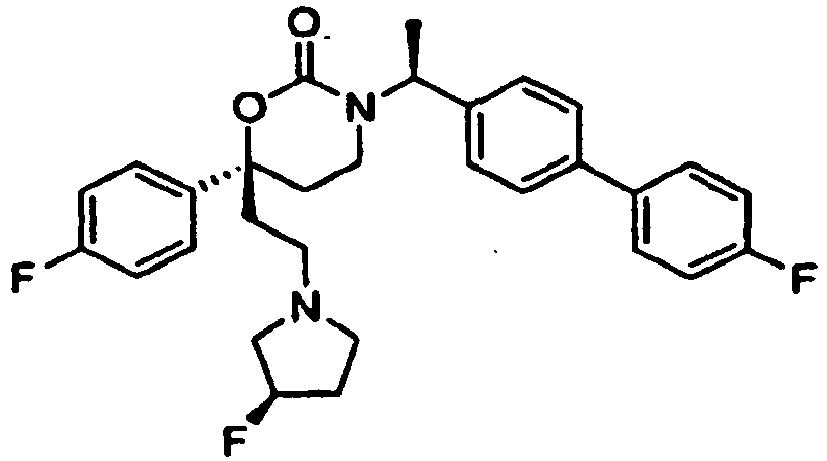
- The title compound was prepared from (S)-3-((S)-1-(4'-fluorobiphenyl-4-yl)ethyl)-6-(4-fluorophenyl)-6-(2-hydroxyethyl)-1,3-oxazinan-2-one following procedures analogous to those described in Example 178 using (R)-3-fluoropyrrolidine in Step 2. LC-MS Method 2 tR = 1.2 min, m/z = 509.1; 1H NMR (CDCl3) 0.67-0.86 (m, 1H), 1.47 (d, 6H), 1.87-2.34 (m, 7H), 2.70-2.91 (m, 3H), 5.00-5.23 (d, 2H), 5.63 (m, 1H), 6.92-7.06 (m, 6H), 7.25 (m, 4H), 7.39 (m, 2H).
-

- The title compound was prepared from (S)-3-((S)-1-(4'-fluorobiphenyl-4-yl)ethyl)-6-(4-fluorophenyl)-6-(2-hydroxyethyl)-1,3-oxazinan-2-one following procedures analogous to those described in Example 178 using piperazin-2-one in Step 2. LC-MS Method 2 tR = 1.213 min, m/z = 519.23; 1H NMR (CDCl3) 1.46 (d, 3H), 2.13-2.27 (m, 3H), 2.35 (m, 2H), 2.75 (m, 1H), 2.88 (m, 1H), 3.20-3.39 (m, 3H), 3.51 (s, 2H), 3.66 (s, 2H), 5.54 (m, 1H), 6.94-7.05 (m, 6H), 7.14 (m, 2H), 7.25 (d, 2H), 7.37 (m, 2H), 7.85 (m, 1H).
-
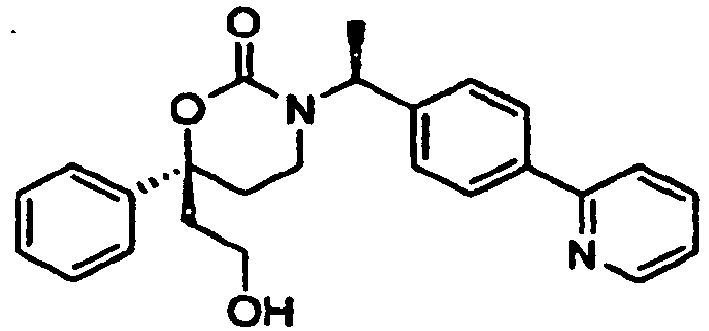
- The title compound was prepared from (S)-3-((S)-1-(4-bromophenyl)ethyl)-6-(2-hydroxyethyl)-6-phenyl-1,3-oxazinan-2-one and pyridine-2-boronic acid following procedures analogous to those described in Example 75 Step 1. LC-MS Method 2 tR = 0.976 min, m/z = 805.3; 1H NMR (CDCl3) 1.50 (d, 2H), 2.06-2.19 (m, 2H), 2.26 (m, 3H), 2.83 (m, 1H), 3.53 (m, 1H), 3.71 (m, 1H), 5.64 (m, 1H), 6.94 (d, 2H), 7.14 (m, 1H), 7.24 (m, 3H), 7.28 (m, 2H), 7.56 (d, 2H), 7.67 (m, 3H), 8.59 (d, 1H).
-

- The title compound was prepared from (S)-3-((S)-1-(4-bromophenyl)ethyl)-6-(2-hydroxy-2-methylpropyl)-6-phenyl-1,3-oxazinan-2-one and pyridine-2-boronic acid following procedures analogous to those described in Example 75 Step 1. LC-MS Method 2 tR = 1.542 min, m/z = 430.23; 1H NMR (CDCl3) 1.02-1.15 (d, 6H), 1.50 (d, 3H), 2.09-2.21 (m, 6H), 2.32 (m, 1H), 2.78 (m, 1 H), 5.65 (m, 1 H), 6.98 (d, 2H), 7.15-7.30 (m, 6H), 7.55 (m, 1H), 7.70 (d, 1H), 8.60 (d, 1H).
-

- The title compound was prepared from (R)-3-((S)-1-(4-bromophenyl)ethyl)-6-(3-hydroxypropyl)-6-phenyl-1,3-oxazinan-2-one and pyridine-2-boronic acid following procedures analogous to those described in Example 75 Step 1. LC-MS Method 2 tR = 1.01 min, m/z = 416.21; 1H NMR (CD3OD) 1.30 (m, 1H), 1.55 (d, 3H), 1.62 (m, 1H), 1.94 (m, 2H), 2.20 (m, 1H), 2.32 (m, 1H), 2.48 (m, 1H), 3.09 (m, 1H), 3.44 (m, 2H), 5.57 (m, 1H), 7.03 (d, 2H), 7.29-7.40 (m, 6H), 7.67 (d, 2H), 7.73 (d, 1H), 7.84 (t, 1H), 8.55 (d, 1 H).
-

- The title compound was prepared from 3-((R)-3-((S)-1-(4-bromophenyl) ethyl)-2-oxo-6-phenyl-1,3-oxazinan-6-yl)propanamide and pyridine-2-boronic acid following procedures analogous to those described in Example 75 Step 1. LC-MS Method 2 tR = 0.932 min, m/z = 430.1; 1H NMR (CDCl3) 1.52 (d, 3H), 1.90 (m, 1H), 2.13 (m, 1H), 2.21 (m, 4H), 2.45 (m, 1H), 2.82 (m, 1 H), 5.15 (s, 1H), 5.35 (s, 1H), 5.65 (m, 1H), 6.98 (d, 2H), 7.13-7.32 (m, 6H), 7.56 (m, 1H), 7.65 (m, 3H), 8.57 (d, 1H).
-

- The title compound was prepared from N-(3-((R)-3-((S)-1-(4-bromophenyl)ethyl)-2-oxo-6-phenyl-1,3-oxazinan-6-yl)propyl)methanesulfonamide and pyridine-2-boronic acid following procedures analogous to those described in Example 75 Step 1. LC-MS Method 2 tR = 1.017 min, m/z = 494.1; 1H NMR (CDCl3) 1.37-1.48 (m, 1H), 1.49 (d, 3H), 1.67 (m, 1H), 1.82-1.99 (m, 2H), 2.05-2.18 (m, 1H), 2.12-2.23 (m, 2H), 2.82 (m, 4H), 3.00 (m, 2H), 4.25 (m, 1H), 5.65 (m, 1H), 6.96 (d, 2H), 7.14-7.29 (m, 6H), 7.55 (d, 1H), 7.65 (m, 3H), 8.58 (d, 1H).
-

- The title compound was prepared from (R)-3-((S)-1-(4-bromophenyl)ethyl)-6-(3-hydroxypropyl)-6-phenyl-1,3-oxazinan-2-one and 6-methylpyridine-2-boronic acid following procedures analogous to those described in Example 75 Step 1. LC-MS Method 2 tR = 0.986 min, m/z = 431.1; 1H NMR (CDCl3) 1.33 (m, 2H), 1.52 (d, 3H), 1.69 (m, 1H), 1.97 (m, 2H), 2.12-2.30 (m, 3H), 2.56 (s, 3H), 2.85 (m, 1H), 3.52 (t, 2H), 5.67 (m, 1H), 6.95 (d, 2H), 7.03 (d, 1H), 7.22-7.37 (m, 6H), 7.55 (t, 1H), 7.64 (d, 2H).
-

- The title compound was prepared from N-(3-((R)-3-((S)-1-(4-bromophenyl)ethyl)-2-oxo-6-phenyl-1,3-oxazinan-6-yl)propyl)methanesulfonamide and pyridine-3-boronic acid following procedures analogous to those described in Example 75 Step 1. LC-MS Method 2 tR = 1.466 min, m/z = 497.3; 1H NMR (CDCl3) 1.33 (m, 1H), 1.53 (d, 3H), 1.63 (m, 1H), 1.84-2.03 (m, 2H), 2.18 (m, 1H), 2.30 (m, 2H), 2.84 (s, 3H), 2.93 (m, 1H), 3.02 (t, 2H), 4.30 (s, 1H), 5.64 (m, 1H), 7.02 (d, 2H), 7.22 (m, 2H), 7.31 (m, 5H), 7.77 (m, 1H), 7.80 (d, 1H), 8.71 (d, 1H), 8.93 (s, 1H).
-

- The title compound was prepared from (S)-3-((S)-1-(4-bromophenyl)ethyl)-6-(2-hydroxyethyl)-6-phenyl-1,3-oxazinan-2-one and 6-methoxypyridine-3-boronic acid following procedures analogous to those described in Example 75 Step 1. LC-MS Method 2 tR = 1.269 min, m/z = 432.2; 1H NMR (CDCl3) 1.50 (d, 3H), 2.05-2.35 (m, 5H), 2.90 (m, 1H), 3.51 (m, 1 H), 3.70 (m, 1H), 3.97 (s, 3H), 5.63 (m, 1 H), 6.85 (d, 1H), 6.92 (m, 2H), 7.17-7.35 (m, 6H), 7.81 (d, 1H), 8.32 (s, 1H).
-

- The title compound was prepared from (S)-3-((S)-1-(4-bromophenyl)ethyl)-6-(2-hydroxy-2-mothylpropyl)-6-phenyl-1,3-oxazinan-2-one and 6-methoxypyridine-3-boronic acid following procedures analogous to those described in Example 75 Step 1. LC-MS Method 2 tR = 1.989 min, m/z = 403.1; 1H NMR (CDCl3) 1.10 (s, 3H), 1.17 (s, 3H), 1.52 (d, 3H), 2.13-2.28 (m, 6H), 2.47 (m, 1H), 2.87 (m, 1H). 3.95 (s, 3H), 5.70 (m, 1H), 6.79 (d, 1 H), 7.02 (d, 2H), 7.21-7.38 (m, 6H), 7.58 (d, 1H), 8.27 (d, 1H).
-
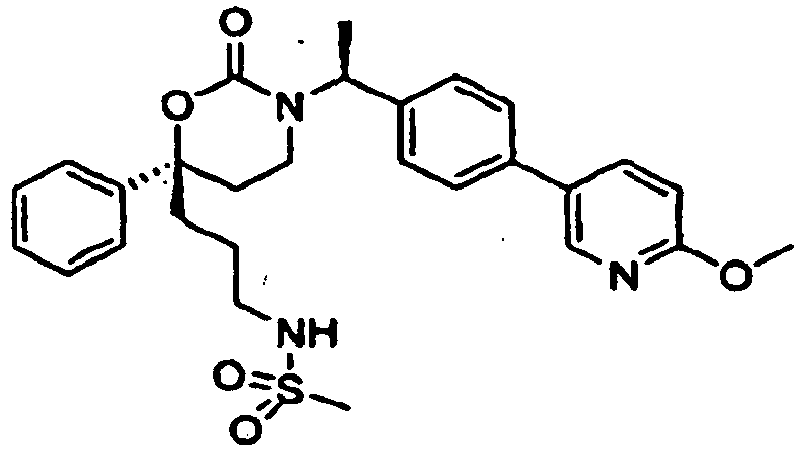
- The title compound was prepared from N-(3-((R)-3-((S)-1-(4-bromophenyl)ethyl)-2-oxo-6-phenyl-1,3-oxazinan-6-yl)propyl)methanesulfonamide and 6-methoxypyridine-3-boronic acid following procedures analogous to those described in Example 75 Step 1. LC-MS Method 2 tR = 1.316 min, m/z = 524.1; 1H NMR (CDCl3) 1.28-1.38 (m, 1H), 1.48 (d, 3H), 1.67 (m, 1H), 1.81-1.98 (m, 2H), 2.13 (m, 1H), 2.24 (m, 2H), 2.83 (m, 4H), 3.01 (m, 2H), 3.91 (s, 3H), 4.15 (m, 1H), 5.62 (m, 1H), 6.73 (d, 1H), 6.91 (d, 2H), 7.18-7.32 (m, 7H), 7.62 (dd, 1H), 8.21 (s, 1H).
-

- The title compound was prepared from (R)-3-((S)-1-(4-bromophenyl)ethyl)-6-(3-hydroxypropyl)-6-phenyl-1,3-oxazinan-2-one and 6-aminopyridine-3-boronic acid following procedures analogous to those described in Example 75 Step 1. LC-MS Method 2 tR = 0.963 min, m/z = 431.8; 1H NMR (CDCl3) 1.36 (d, 3H), 1.75 (m, 1H), 1.98 (m, 3H), 2.21 (m, 1H), 2.38 (m, 2H), 2.89 (m, 1H), 3.56(m, 2H), 5.05 (s,1H), 5.65 (m, 1H), 6.62 (d, 1 H), 6.97 (d, 2H), 7.17 (d, 2H), 7.20-7.39 (m, 5H), 7.63 (d, 1 H), 8.12 (s, 1H).
-

- The title compound was prepared from (S)-3-((S)-1-(4-bromophenyl)ethyl)-6-(2-hydroxyethyl)-6-phenyl-1,3-oxazinan-2-one and 2-methylpyridine-4-boronic acid following procedures analogous to those described in Example 75 Step 1. LC-MS Method 2 tR = 0.928 min, m/z = 444.4; 1H NMR (CDCl3) 1.50 (d, 3H), 2.05-2.18 (m, 2H), 2.26-2.39 (m, 6H), 2.82 (s, 3H), 2.94 (m, 1H), 3.51 (m, 1H), 3.72 (m, 1H), 5.54 (m, 1H), 7.00 (d, 2H), 7.24-7.38 (m, 7H), 7.57 (s, 1H). 7.64 (d, 1H), 8.75 (d, 1H).
-
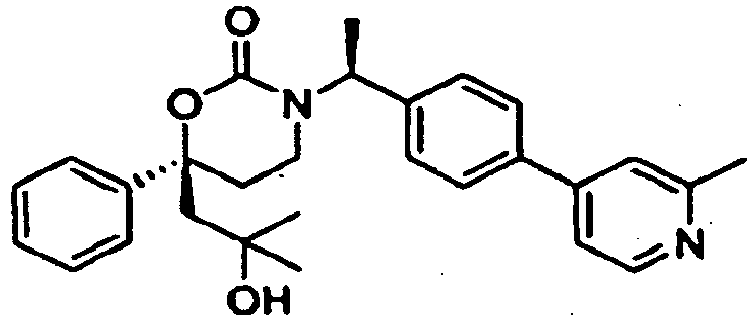
- The title compound was prepared from (S)-3-((S)-1-(4-bromophenyl)ethyl)-6-(2-hydroxy-2-methylpropyl)-6-phenyl-1,3-oxazinan-2-one and 2-methylpyridine-4-boronic acid following procedures analogous to those described in Example 75 Step 1. LC-MS Method 2 tR = 0.866 min, m/z = 444.2; 1H NMR (CDCl3) 1.04-1.16 (d, 6H), 1.50 (d, 3H), 2.14-2.25 (m, 4H), 2.45 (m, 1H), 2.57 (s, 3H), 2.83 (m, 1H), 5.65 (m, 1H), 7.04 (d, 2H), 7.20-7.33 (m, 9H), 8.45 (d, 1H).
-

- The title compound was prepared from 3-((R)-3-((S)-1-(4-bromophenyl)ethyl)-2-oxo-6-phenyl-1,3-oxazinan-6-yl)propanamide and 2-methylpyridine-4-boronic acid following procedures analogous to those described in Example 75 Step 1. LC-MS Method 2 tR = 0.917 min, m/z = 444.4; 1H NMR (CDCl3) 1.51 (d, 3H), 1.92 (m, 1H), 2.13-2.32 (m, 5H), 2.44 (m, 1H), 2.82 (s, 3H), 2.93 (m, 1H), 5.50-5.68 (m, 3H), 7.06 (d, 2H), 7.19-7.35 (m, 5H), 7.39 (d, 2H), 7.58 (s, 1H), 7.65 (d, 1H), 8.74 (d, 1H).
-

- The title compound was prepared from N-(3-((R)-3-((S)-1-(4-bromophenyl)ethyl)-2-oxo-6-phenyl-1,3-oxazinan-6-yl)propyl)methanesulfonamide and 2-methylpyridine-4-boronic acid following procedures analogous to those described in Example 75 Step 1. LC-MS Method 2 tR = 0.988 min, m/z = 508.2; 1H NMR (CDCl3) 1.36 (m, 1H), 1.51 (d, 3H), 1.70 (m, 1H), 1.96 (m, 2H), 2.17 (m, 1H), 2.26 (m, 2H), 2.59 (s, 3H), 2.86 (m, 4H), 3.02 (m ,2H), 4.19 (m, 1H), 5.62 (m, 1H), 6.96 (d, 2H), 7.19 (m, 3H), 7.26 (d, 2H), 7.29 (m, 4H), 8.47 (d, 1H).
-
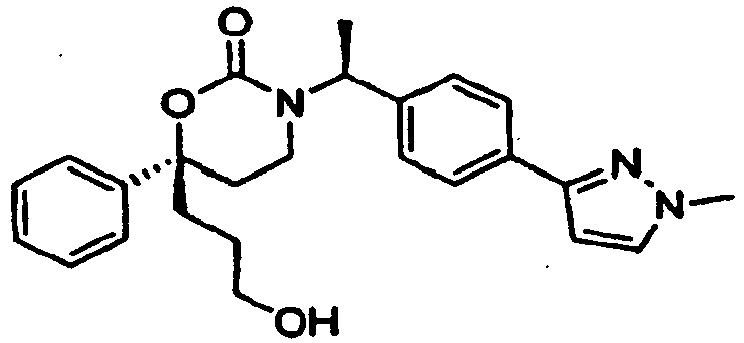
- The title compound was prepared from (R)-6-allyl-3-((S)-1-(4-bromophenyl)ethyl)-6-phenyl-1,3-oxazinan-2-one and pyrazole-3-boronic acid following a procedure analogous to that described in Example 64, followed by treatment with NaH and Mel, using a procedure analogous to that described in Example 199 Step 2, and hydroboration using a procedure analogous to that described in Example 78. LC-MS Method 3 tR= 1.18 min, m/z = 442.1; 1H NMR (CDCl3) 1.29 (m, 1H), 1.47 (d, 3H), 1.65 (m, 1H), 1.83-2.03 (m, 3H), 2.11 (m, 1H), 2.18-2.37 (m, 3H), 2.75-2.96 (m, 1H), 3.52 (m, 2H), 3.78 (m, 1H), 3.91 (s, 1H), 5.63 (m, 1H), 6.41 (s, 1H), 6.87 (d, 2H), 6.94 (d, 1H), 7.08 (d, 1H), 7.19-7.37 (m, 7H), 7.43 (d, 2H).
-

- The title compound was prepared from (R)-6-(3-hydroxypropyl)-3-((S)-1-(4-(6-oxo-1,6-dihydropyridin-3-yl)phenyl)ethyl)-6-phenyl-1,3-oxazinan-2-one following procedures analogous to those described in Example 234. LC-MS Method 2 tR = 0.999 min, m/z = 446.1; 1H NMR (CD3OD) 1.53 (d, 3H), 1.91-2.01 (m, 1H), 2.18-2.34 (m, 4H), 2.35-2.51 (m, 2H), 3.03-3.12 (m, 1H), 5.56 (m, 1H), 6.62 (d, 2H), 7.03 (d, 2H), 7.24-7.44 (m, 7H), 7.59 (m, 1 H), 7.87 (m, 1H).
-

- The title compound was prepared from (R)-6-allyl-3-((S)-1-(4-bromophenyl)ethyl)-6-phenyl-1,3-oxazinan-2-one using a procedure analogous to that described in Example 74, followed by procedures analogous to those described in Example 458 Steps 2 to 6. LC-MS Method 2 tR = 1.038 min, m/z = 433.1; 1H NMR (CDCl3) 1.48 (d, 3H), 2.06-2.19 (m, 2H), 2.11-2.31 (m, 3H), 2.84 (m, 1H), 3.50 (m ,1H), 3.54 (s, 3H), 3.72 (m, 1H), 5.62 (m, 1H), 6.60 (d, 1H), 6.86 (d, 2H), 7.06 (d, 2H), 7.26 (m, 3H), 7.32 (m, 3H), 7.47 (d, 1H).
-

- The title compound was prepared from (R)-6-allyl-3-((S)-1-(4-bromophenyl)ethyl)-6-phenyl-1,3-oxazinan-2-one using procedures analogous to those described in Example 458 Steps 2, 3 and 5, followed by procedures analogous to those described in Example 328. LC-MS Method 2 tR = 1.116 min, m/z = 461.1; 1H NMR (CDCl3) 1.09 (s, 3H), 1.16 (s, 3H), 1.51 (m, 3H), 2.05-2.20 (4H), 2.40 (m, 1H), 2.84 (m, 1H), 3.59 (s, 3H), 5.64 (m, 1H), 6.62 (m, 1H), 6.96 (m, 2H), 7.14 (m, 2H), 7.28-7.39 (m, 5H), 7.48 (m, 1H), 7.50 (m, 1H).
-

- To a solution of (R)-6-allyl-3-((S)-1-(4-bromophenyl)ethyl)-6-phenyl-1,3-oxazinan- 2-one (20 g, 50 mmol) and CuCl (12.4 g, 125 mmol) in dry DMF (50 mL) was added H2O (12 mL) and PdCl2 (2.66 g, 15 mmol) at 0 ~ -5 °C. After addition, the mixture was allowed to warm to rt gradually for 48 h under O2. After TLC showing the stating material had disappeared, the solid was filtered off. Water (200 mL) and EtOAc (50mL) were added. The layers were separated and the aqueous layer was extracted with EtOAc (3 x 40 mL). The combined organic layer was washed with brine, dried over Na2SO4, filtered and concentrated to give a residue, which was purified by column chromatography to give (S)-3-((S)-1-(4-bromo-phenyl)ethyl)-6-(2-oxopropyl)-6-phenyl-1,3-oxazinan-2-one (12 g, 58%).
- To a solution of (S)-3-((S)-1-(4-bromophenyl)ethyl)-6-(2-oxopropyl)-6-phenyl-1,3- oxazinan- 2-one (12 g, 28.8 mmol) in anhydrous THF (100 mL) was added dropwise methylmagnesium bromide (48 mL, 144 mmol) at -78 °C under nitrogen. The mixture was stirred at rt for 1 h. The reaction mixture was quenched with aqueous NH4Cl solution (50 mL) in ice water bath. The layers were separated and the aqueous layer was extracted with EtOAc (150 mL). The combined organic phases were washed with brine (30 mL), dried over Na2SO4 and concentrated in vacuo to give the crude product, which was purified by preparative HPLC and chiral HPLC to afford (S)-3-((S)-1-(4-bromophenyl)ethyl)-6-(2-hydroxy-2-methylpropyl)-6-phenyl-1,3-oxazinan-2- one (6.6 g, 53%).
- To a solution of (S)-3-((S)-1-(4-bromophenyl)ethyl)-6-(2-hydroxy-2-methylpropyl)-6-phenyl-1,3-oxazinan-2-one (6.6 g, 15.2 mmol) and 4,4,4',4',5,5,5',5'-octamethyl- 2,2'-bi(1,3,2- dioxaborolane) (6.1g, 24.3 mmol) in dry DMSO (20 mL) was added KOAc (4.8 g, 48.6 mmol) and Pd(dppf)cl2 (372 mg, 0.46 mmol). After addition, the mixture was allowed to warm to 100 °C for 20 h. After TLC showed the starting material had disappeared, the solid was filtered off. Water (60 mL) and EtOAc (20mL) were added. The layers were separated and the aqueous layer was extracted with EtOAc (3 x 15 mL). The combined organic layer was washed with brine, dried over Na2SO4, filtered and concentrated to give a residue, which was purified by column chromatography to give (S)-6-(2-hydroxy-2-methylpropyl)- 6-phenyl-3-((S)-1-(4-(4,4,5,5-tetramethyl-1,3,2-dioxaborol-an-2-yl)phenyl)ethyl)-1,3-oxazinan-2-one (4.4 g, 60%).
- To a solution of (S)-6-(2-hydroxy-2-methylpropyl)-6- phenyl-3-((S)- 1-(4-(4,4,5,5- tetramethyl-1,3,2-dioxaborolan-2- yl)phenyl)ethyl)-1,3-oxazinan-2-one (2.2 g, 4.58 mmol) and 5-bromo-1-methylpyridin-2(1H)-one (1.37 g, 7.33 mmol) in dry 1,4-dioxane (4 mL) was added aqueous CsCO3 solution (10 mL, 10 mmol) and Pd(PPh3)2Cl2 (967 mg, 1.38 mmol). After addition, the mixture was heated at 110 °C for 30 min in a microwave. After TLC showed the stating material had disappeared, the solid was filtered off. Water (20 mL) and EtOAc (10mL) were added. The layers were separated and the aqueous layer was extracted with EtOAc (3 x 10 mL). The combined organic layer was washed with brine, dried over Na2SO4, filtered and concentrated to give a residue, which was purified by preparative HPLC to give (S)-6-(2-hydroxy-2- methylpropyl)-3-((S)-1-(4-(1-methyl-6-oxo- 1,6-dihydropyridin-3-yl)phenyl)ethyl)-6-phenyl-1,3-oxazinan-2-one (730 mg, 35%). 1H NMR (CDCl3): 1.09 (s, 3H), 1.16 (s, 3H), 1.51 (m, 3H), 2.05-2.20 (4H), 2.40 (m, 1H), 2.84 (m, 1H), 3.59 (s, 3H), 5.64 (m, 1H). 6.62 (m, 1 H), 6.96 (m, 2H), 7.14 (m, 2H), 7.28-7.39 (m, 5H), 7.48 (m, 1H), 7.50 (m, 1H).
-
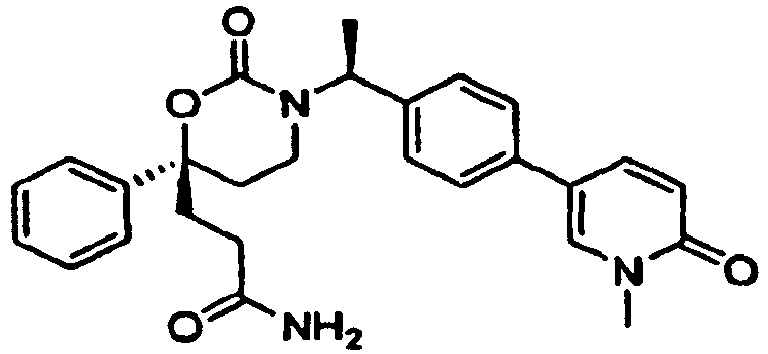
- The title compound was prepared from (R)-6-allyl-3-((S)-1-(4-(1-methyl-6-oxo-1,6-dihydropyridin-3-yl)phenyl)ethyl)-6-phenyl-1,3-oxazinan-2-one using a procedure analogous to that described in Example 78 followed by procedures analogous to those described in Example 234. LC-MS Method 2 tR = 1.028 min, m/z = 460.2; 1H NMR (CDCl3) 1.53 (d, 3H), 1.91-2.01 (m, 1H), 2.11-2.42 (m, 5H), 2.46-2.54 (m, 1H), 2.88-2.96 (m, 1 H), 3.60 (s, 3H), 5.26 (s, 1H), 5.42 (s, 1H), 5.66 (m, 1H), 6.69 (d, 1H), 6.95-7.03 (d, 2H), 7.12-7.20 (m, 2H), 7.24-7.41 (m, 5H), 7.52 (m, 1H).
-
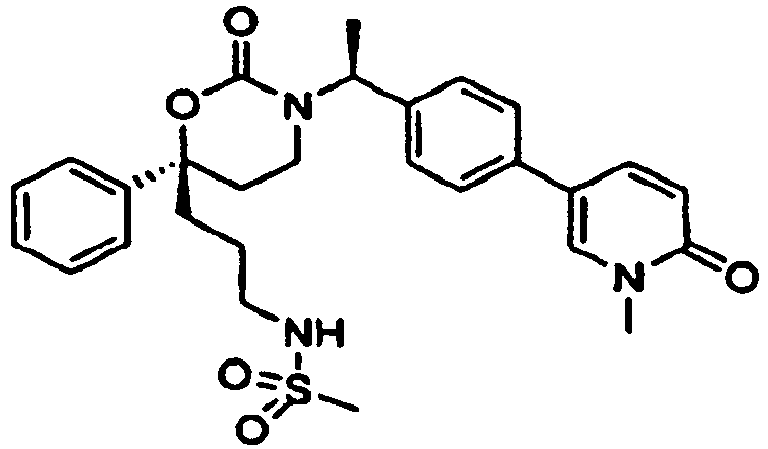
- The title compound was prepared from (R)-6-(3-hydroxypropyl)-3-((S)-1-(4-(1-methyl-6-oxo-1.6-dihydropyridin-3-yl)phenyl)ethyl)-6-phenyl-1,3-oxazinan-2-one following procedures analogous to those described in Example 359. LC-MS Method 2 tR = 1.095 min, m/z = 524.1; 1H NMR (CDCl3) 1.30-1.41 (m, 1H), 1.52 (d, 3H), 1.71 (m, 1H), 1.87-2.07 (m, 3H), 2.09-2.20 (m, 3H), 2.22-2.32 (m, 2H), 2.88 (s, 3H), 3.06 (m, 2H), 3.60 (s, 3H), 4.32 (s, 1H), 5.65 (m, 1H), 6.67 (d, 1H), 6.94 (m, 2H), 7.11 (d, 2H), 7.25 (m, 1H), 7.27-7.40 (m, 4H), 7.53 (dd, 1H).
-

- The title compound was prepared from (R)-6-allyl-3-((S)-1-(4-bromophenyl)ethyl)-6-phenyl-1,3-oxazinan-2-one and phenylboronic acid using a procedure analogous to that described in Example 64 followed by a procedure analogous to that described in Example 65. LC-MS Method 2 tR = 1.412 min, m/z = 825.3; 1H NMR (CDCl3) 1.55 (d, 3H), 2.11-2.39 (m, 5H), 2.92 (m, 1H), 3.57 (m, 1H), 3.76 (m, 1 H), 5.66 (m, 1H), 6.93 (d, 1H), 7.21-7.48 (m, 10H), 7.48(m, 2H).
-

- The title compound was prepared from (R)-6-allyl-3-((S)-1-(4-bromophenyl)ethyl)-6-phenyl-1,3-oxazinan-2-one and phenylboronic acid using a procedure analogous to that described in Example 64 followed by a procedure analogous to that described in Example 78. LC-MS Method 2 tR = 1.408 min, m/z = 415.52; 1H NMR (CD3OD) 1.25-1.36 (m, 2H), 1.53 (d, 3H), 1.61 (m, 1H), 1.93 (m, 2H), 2.20 (m, 1H), 2.30 (m, 1H), 2.46 (m, 1H), 3.7 (m, 1H), 3.44 (t, 2H), 5.46 (m, 1H), 6.96 (d, 2H), 7.28-7.40 (m, 10H), 7.48 (m, 2H).
-
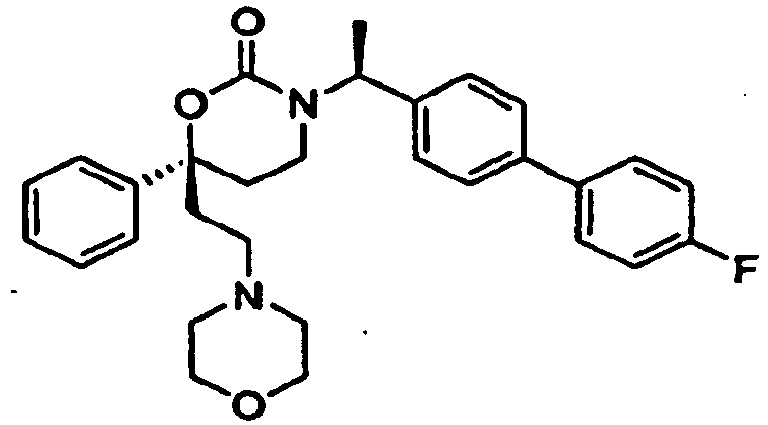
- The title compound was prepared from (S)-3-((S)-1-(4-fluorobiphenyl-4-yl)ethyl)-6-(2-hydroxyethyl)-6-phenyl-1,3-oxazinan-2-one and morpholine following procedures analogous to those described in Example 178. LC-MS Method 2 tR = 1.19 min, m/z = 511.2; 1H NMR (CDCl3) 1.49 (t, 3H), 2.05-2.11 (m, 3H), 2.16 (m, 1H), 2.23-2.41 (m, 5H), 2.51 (m, 1 H), 2.71 (m, 1H), 3.61 (m, 4H), 5.61 (m, 1H), 6.83 (d, 2H), 7.20-7.32 (m, 4H), 7.31 (m, 5H), 7.43 (m, 2H).
-

- The title compound was prepared from (R)-3-((S)-1-(2',4'-difluorobiphenyl-4-yl)ethyl)-6-(3-hydroxypropyl)-6-phenyl-1,3-oxazinan-2-one following procedures analogous to those described in Example 151. LC-MS Method 1 tR = 1.64 min, m/z = 532 (M+1); 1H NMR (CD3OD) 7.21-7.03 (m, 8H), 6.83-6.78 (m, 4H), 5.38 (q, J = 7.0 Hz, 1H), 3.71 (q, J = 6.4 Hz, 2H), 2.91-2.86 (m, 1H), 2.31-2.26 (m, 1H), 2.17-2.10 (m, 1H), 2.06-1.98 (m, 1H), 1.85-1.80 (m, 2H), 1.64-1.55 (m, 1H), 1.35 (d, J = 7.0 Hz, 3H), 1.31-1.22 (m, 1H).
-

- The title compound was prepared from (R)-6-allyl-3-((S)-1-(4-bromophenyl)ethyl)-6-phenyl-1,3-oxazinan-2-one and 3-(aminomethyl)phenylboronic acid following a procedure analogous to that described in Example 64 followed by a procedure analogous to that described in Example 78. LC-MS Method 2 tR = 1.008 min, m/z = 889.5; 1H NMR (CDCl3) 1.25 (m, 1H), 1.56 (m, 3H), 1.62 (d, 1H), 1.92 (m, 2H), 2.22 (m, 1H), 2.33 (m, 1H), 2.46 (m, 1H), 3.15 (m, 1H), 3.48 (m, 2H), 5.56 (m, 1H), 7.12 (m, 2H), 7.31 (m, 3H), 7.35 (m, 2H), 7.47 (m, 3H), 7.56 (m, 1H), 7.61 (m, 2H).
-

- The title compound was prepared from (R)-3-((S)-1-(4-bromophenyl)ethyl)-6-(3-hydroxypropyl)-6-phenyl-1,3-oxazinan-2-one following procedures analogous to those described in Example 75 Step 1. LC-MS Method 2 tR = 0.983 min, m/z = 444.57; 1H NMR (CD3OD) 1.35 (m, 1H), 1.52 (d, 3H), 1.65 (m, 1H), 1.92 (m, 2H), 2.20 (m, 1H), 2.30 (m, 1H), 2.45 (m, 1H), 3.09 (m, 1H), 3.45 (m, 2H), 4.61 (s, 2H), 5.54 (m, 1H), 6.99 (d, 2H), 7.28-7.41 (m, 9H), 7.50 (m, 2H).
-

- The title compound was prepared from (R)-6-allyl-3-((S)-1-(4-bromophenyl)ethyl)-6-phenyl-1,3-oxazinan-2-one and 4-carbamoylphenylboronic acid following procedures analogous to those described in Example 131 followed by a procedure analogous to that described in Example 78. LC-MS Method 2 tR = 1.008 min, m/z = 424.18; 1H NMR (CD3OD) 1.28 (m, 1H), 1.56 (d, 3H), 1.60 (m, 1H), 1.92 (m, 2H), 2.15 (m, 2H), 3.28 (m, 1H), 3.45 (m, 2H), 4.17 (m, 2H), 5.54 (m, 1H), 7.13 (m, 2H), 7.32 (m, 3H), 7.39 (m, 2H), 7.41 (m, 3H), 7.58 (m, 2H), 7.63 (m, 2H).
-

- The title compound was prepared from (S)-6-allyl-3-((S)-1-(2',4'-difluorobiphenyl-4-yl)ethyl)-6-phenyl-1,3-oxazinan-2-one following a procedure analogous to that described in Example 78. LC-MS Method 3 tR = 1.273 min, m/z = 474.1; 1H NMR (CDCl3) 1.29 (d, 3H), 1.34 (m, 1H), 1.76 (m, 1H), 1.99 (m, 2H), 2.06 (m, 1H), 2.25 (m, 1H), 2.72 (m, 2H), 3.56 (m, 2H), 5.81 (m, 1 H), 6.96 (m, 2H), 7.29 (m, 3H), 7.36 (m, 5H), 7.43 (m, 2H).
-

- A mixture of (R)-N-((S)-1-(4-chloro-3-fluorophenyl)ethyl)-2-methylpropane-2-sulfinamide and (R)-N-((R)-1-(4-chloro-3-fluorophenyl)ethyl)-2-methylpropane-2-sulfinamide was prepared following procedures analogous to those described in Example 326 Steps 1 and 2. The two diastereomers were separated by chromatography on silica gel. The t-butylsifinyl group was removed from (R)-N-((S)-1-(4-chloro-3-fluorophenyl)ethyl)-2-methylpropane-2-sulfinamide by treatment with HCl and the resulting (S)-1-(4-chloro-3-fluorophenyl)ethanamine was reacted with 1-chloro-3-(4-fluorophenyl)hex-5-en-3-ol following procedures analogous to those described in Example 353 to afford isomers 1 and 2 of the title compound.
Isomer 1: (S)-6-allyl-3-((S)-1-(4-chloro-3-fluorophenyl)ethyl)-6-(4-fluorophenyl)-1,3-oxazinan-2-one LC-MS Method 1 tR = 2.03, m/z = 392 (M+1); 1H NMR (CDCl3) 7.36-7.24 (m, 3H), 7.11-7.00 (m, 4H), 5.76-5.65 (m, 2H), 5.10-4.98 (m, 2H), 2.78-2.65 (m, 2H), 2.64-2.52 (m, 2H), 2.27-2.22 (m, 1H), 2.10-2.02 (m, 1H), 1.23 (d, 3H, J = 7.3 Hz).
Isomer 2: (R)-6-allyl-3-((S)-1-(4-chloro-3-fluorophenyl)ethyl)-6-(4-fluorophenyl)-1,3-oxazinan-2-one LC-MS Method 1 tR = 1.99, m/z = 392 (M+1); 1H NMR (CDCl3) 7.28-7.23 (m, 2H), 7.13-7.09 (t, 1H, J = 8.0 Hz). 7.08-7.01 (m, 2H), 6.60-6.55 (m, 2H), 5.75-5.64 (m, 1H), 5.62-5.71 (q, 1H, J = 7.0 Hz), 5.1-5.0 (m, 2H), 2.97-2.91 (m, 1H), 2.64-2.51 (m, 2H), 2.38-2.16 (m, 3H), 1.47 (d, 3H, J = 7 Hz). - The t-butylsifinyl group was removed from (R)-N-((R)-1-(4-chloro-3-fluorophenyl)ethyl)-2-methylpropane-2-sulfinamide by treatment with HCl and the resulting (R)-1-(4-chloro-3-fluorophenyl)ethanamine was reacted with 1-chloro-3-(4-fluorophenyl)hex-5-en-3-ol following procedures analogous to those described in Example 353 to afford isomers 3 and 4 of the title compound.
Isomer 3: (S)-6-allyl-3-((R)-1-(4-chloro-3-fluorophenyl)ethyl)-6-(4-fluorophenyl)-1,3-oxazinan-2-one LC-MS Method 1 tR = 2.03, m/z = 392 (M+1); 1H NMR (CDCl3) 7.36-7.26 (m, 3H), 7.10-7.01 (m, 4H), 5.76-5.64 (m, 2H), 5.10-4.99 (m, 2H), 2.77-2.65 (m, 2H), 2.64-2.53 (m, 2H), 2.27-2.22 (m, 1H), 2.10-2.02 (m, 1H), 1.23 (d, 3H, J = 7.0 Hz).
Isomer 4: (R)-6-allyl-3-((R)-1-(4-chloro-3-fluorophenyl)ethyl)-6-(4-fluorophenyl)-1,3-oxazinan-2-one LC-MS Method 1 tR = 1.99, m/z = 392 (M+1); 1H NMR (CDCl3) 7.28-7.24 (m, 2H), 7.13-7.09 (t, 1H, J = 8 Hz), 7.08-7.03 (m, 2H), 6.60-6.55 (m, 2H), 5.75-5.64 (m, 1H), 5.63-5.57 (q, 1H, J=7.0 Hz), 5.10-5.00 (m, 2H), 2.97-2.92 (m, 1H), 2.64-2.52 (m, 2H), 2.38-2.17 (m, 3H), 1.47 (d, 3H, J = 7 Hz). -

- The title compound was prepared from (R)-6-allyl-3-((S)-1-(4-chloro-3-fluorophenyl)ethyl)-6-(4-fluorophenyl)-1,3-oxazinan-2-one following a procedure analogous to that described in Example 343. LC-MS Method 1 tR = 1.67, m/z = 410 (M+1); 1H NMR (CDCl3) 7.25-7.22 (m, 2H), 7.15 (t, 1H, 8 Hz), 7.06 (t, 2H, J = 8.6 Hz), 6.70-6.63 (m, 2H), 5.62 (q, 1H, J = 7.0 Hz), 3.59 (m, 1H), 2.98-2.93 (m, 1H), 2.54-2.17 (m, 4H), 2.04-1.89 (m. 2H), 1.74-1.63 (m, 1H), 1.49 (d, 3H, J = 7 Hz), 1.42-1.32 (m, 2H).
-

- The title compound was prepared from (S)-3-((S)-1-(4-bromophenyl)propyl)-6-(2-hydroxyethyl)-6-phenyl-1,3-oxazinan-2-one following procedures analogous to those described in Example 313 Steps 3 and 4. (S)-3-((S)-1-(4-bromophenyl)propyl)-6-(2-hydroxyethyl)-6-phenyl-1,3-oxazinan-2-one was prepared from (R)-6-allyl-3-((S)-1-(4-bromophenyl)propyl)-6-phenyl-1,3-oxazinan-2-one following a procedure analogous to that described in Example 74. (R)-6-allyl-3-((S)-1-(4-bromophenyl)propyl)-6-phenyl-1,3-oxazinan-2-one was prepared from (R)-6-allyl-3-((S)-1-(4-bromophenyl)propyl)-6-phenyl-1,3-oxazinan-2-one and (S)-1-bromo-4-(1-isocyanatopropyl)benzene following procedures analogous to those described in Example 95. (S)-1-bromo-4-(1-isocyanatopropyl)benzene was prepared from (S)-1-(4-bromophenyl)propan-1-amine which was prepared by bromination of (S)-1-phenylpropan-1-amine with 1,3-dibromo-5,5-dimethylimidazolidine-2,4-dione and TFAA. LC-MS Method 2 tR = 1.627, m/z = 447.1; 1H NMR (CDCl3) 1.06 (m, 3H), 1.87-2.06 (m, 2H), 2.11-2.28 (m, 2H), 2.33 (m, 3H), 2.96 (m, 1H), 3.53 (m, 1H), 3.62 (s, 3H), 3.78 (m, 1H), 5.48 (m, 1H), 6.69 (m, 1H), 7.03 (m, 2H), 7.14 (m, 2H), 7.21-7.38 (m, 4H), 7.41 (s, 1 H), 7.56 (m, 1H).
-

- To a solution of (R)-6-allyl-3-((S)-1-(4-bromophenyl)ethyl)-6-(4-fluorophenyl)-1,3 -oxazinan-2-one (450 mg, 1.01 mmol) in acetone (10 mL) was added a solution of KMnO4 (190 mg, 1.2 mmol) and NalO4 (1.5 g, 7.2 mmol) in water (10 mL). The mixture was stirred for 2 h at 0 °C. The mixture was filtered and the filtrate was adjusted to pH 5-6 with aqueous 1 N aq HCl solution. The mixture was extracted with EtOAc. The organic phase washed with brine, dried over anhydrous Na2SO4 and concentrated to give 2-((S)-3-((S)-1-(4-bromophen-yl)ethyl)-6- (4-fluorophenyl)-2-oxo-1,3-oxazinan-6-yl)acetic acid (540 mg, crude), which was used for the next step without purification.
- To a solution of 2-((S)-3-((S)-1-(4-bromophen-yl)ethyl)-6- (4-fluorophenyl)-2-oxo-1,3-oxazinan-6-yl)acetic acid (540 mg, 1.24 mol) in MeOH (20 mL) was added SOCl2 (5 mL) at 0 °C, and the reaction mixture was stirred at rt for 2 h. The reaction mixture was concentrated and the residue was purified by preparative TLC to give methyl 2-((S)-6-(4-fluorophenyl)-3-((S)-1-(4-(1-methyl-6-oxo-1,6-dihydropyridin-3-yl)phenyl)-ethyl)-2-oxo-1,3-oxazinan-6-yl)acetate (150 mg, 27%). 1H NMR (CDCl3): δ=1.49 (d, 3H), 2.19 (m, 1H), 2.44 (m, 1H), 2.60 (m, 1H), 2.77-3.08 (m, 3H), 3.51 (s, 3H), 5.52 (m, 2H), 6.62 (d, 2H), 6.98 (t, 2H), 7.23 (t, 2H), 7.28 (m, 2H).
- To a solution of methyl 2-((S)-6-(4-fluorophenyl)-3-((S)-1-(4-(1-methyl-6-oxo-1,6-dihydropyridin-3-yl)phenyl)-ethyl)-2-oxo-1,3-oxazinan-6-yl)acetate (150 mg, 0.33 mmol), and tetraisopropoxytitanium (189 mg, 0.66 mmol) in THF (20 mL) was added 3.0 M ethylmagnesium bromide (4 mL, 12 mmol) at rt under nitrogen. Then the mixture was stirred for 2 h. The reaction was quenched with aqueous NH4Cl solution, and the mixture was filtered. The filtrate was extracted with EtOAc. The combined organic phase was washed with brine, dried over anhydrous Na2SO4 and concentrated to give the crude product, which was purified by preparative HPLC to give (S)-3-((S)-1-(4-bromophenyl)ethyl)-6-(4-fluorophenyl)-6-((1-hydroxycyclopropyl)methyl)-1,3-oxazinan-2-one (2.51 mg, 2%). 1H NMR (CDCl3): 0.03 (m, 1H), 0.18 (m, 1H), 0.49 (m, 1H), 0.60 (m, 1H), 1.43 (m, 3H), 2.08 (s, 2H), 2.26 (m, 1H), 2.37 (m, 2H), 2.88 (m, 1H), 5.53 (m, 1H), 6.66 (d, 2H), 6.97 (t, 2H), 7.16 (m, 2H), 7.26 (m, 2H).
-

- The title compound was prepared from (R)-6-allyl-6-(4-fluorophenyl)-3-((S)-1-(4-(4,4,5,5-tetramethyl-1,3,2-dioxaborolan-2-yi)phenyl)ethyl)-1,3-oxazinan-2-one following a procedure analogous to that described in Example 313 Step 4 using 3-bromopyridin-2(1H)-one. LC-MS Method 1 tR = 1.24, m/z = 452(M+1); 1H NMR (CDCl3) 7.76(d, 1H), 7.52(d, 1H), 7.42(dd, 2H), 7.24(m, 2H), 7.08-7.00(m, 4H), 6.75(t, 1H), 5.70(m, 1H), 3.58(t, 1H), 2.94(m, 1H), 1.54(d, 3H).
-

- The title compound was prepared from (R)-6-allyl-6-(4-fluorophenyl)-3-((S)-1-(4-(4,4,5,5-tetramethyl-1,3,2-dioxaborolan-2-yl)phenyl)ethyl)-1,3-oxazinan-2-one following a procedure analogous to that described in Example 313 Step 4 using 2-bromo-5-cyanopyridine. LC-MS Method 1 tR = 1.58, m/z = 482(M+Na); 1 H NMR (CDCl3) 8.93(d, 1H), 8.01 (dt, 1H), 7.79(m, 3H), 7.25(m,1 H), 7.07(m, 5H), 5.74(q. 1H), 4.28(t, 1H), 3.59(t, 1H), 2.98(m, 1H), 1.58(d, 3H), 1.53(m, 1H).
-

- The title compound was prepared from (R)-3-((S)-1-(2',4'-difluorobiphenyl-4-yl)ethyl)-6-(3-hydroxypropyl)-6-phenyl-1,3-oxazinan-2-one as described in Example 234 Step 1. LC-MS Method 2 tR = 1.421, m/z = 466; 1H NMR (CDCl3) 1.52 (d, 3H), 2.08-2.21 (m, 3H), 2.23-2.38 (m, 3H), 2.56 (m, 1H), 2.92 (m, 1H), 5.68 (m, 1H), 6.89 (m, 2H), 6.93 (m, 2H), 7.22 (m, 2H), 7.23-7.38 (m, 5H).
-

- The title compound was prepared from 3-(3-((S)-1-(4-bromophenyl)ethyl)-6-(2,4-difluorophenyl)-2-oxo-1,3-oxazinan-6-yl)propanamide following procedures analogous to those described in Example 234. Two isomers were isolated.
- Isomer 1: 3-((S)-3-((S)-1-(4-bromophenyl)ethyl)-6-(2,4-difluorophenyl)-2-oxo-1,3-oxazinan-6-yl)propanamide LC-MS Method 1 tR = 1.66, m/z = 467, 469 (M+1); 1H NMR (CD3OD) 7.40 (d, J = 8.2 Hz, 2H), 7.29-7.22 (m, 1H), 7.14 (d, J = 8.8 Hz, 2H), 6.97-6.88 (m, 2H), 5.43 (q, J = 7.0 Hz, 1H), 2.78-2.66 (m, 2H), 2.49-2.45 (m, 1H), 2.30-2.23 (m, 2H), 2.17-2.09 (m, 1H), 2.03-1.94 (m, 1H), 1.88-1.83 (m, 1H), 1.24 (d, J = 7.0 Hz, 3H).
- Isomer 2: 3-((R)-3-((S)-1-(4-bromophenyl)ethyl)-6-(2,4-difluorophenyl)-2-oxo-1,3-oxazinan-6-yl)propanamide LC-MS Method 1 tR = 1.62, m/z = 467, 469 (M+1); 1H NMR (CD3OD) 7.29-7.23 (m, 3H), 6.95-6.86 (m, 4H), 5.45 (q, J = 7.0 Hz, 1H), 3.12-3.08 (m, 1H), 2.51-2.47 (m, 1H), 2.33-2.10 (m, 5H), 1.94-1.88 (m, 1H), 1.45 (d, J = 7.0 Hz, 3H).
-

- To a solution of (R)-6-allyl-6-(4-fluorophenyl)-3-((S)-1-(4-methoxyphenyl)ethyl)-1,3-oxazinan-2-one (1.5 g, 4.07 mmol) in CH2Cl2 (40 mL) was added BBr3 (3 g, 12.2 mmol) at -78°C. The mixture was stirred at this temperature for 2 h. The solution was washed with satd aq NaHCO3 and the aqueous layer was extracted with CH2Cl2. The organic layer was dried over Na2SO4 and concentrated to give (R)-6-allyl-6-(4-fluorophenyl)-3-((S)-1-(4-hydroxyphenyl)ethyl)-1,3-oxazinan-2-one (1.2 g, 83%), which was used for the next step without further purification.
- A mixture of (R)-6-allyl-6-(4-fluorophenyl)-3-((S)-1-(4-hydroxyphenyl)ethyl)-1,3-oxazinan-2-one (700 mg, 1.97 mmol), CF3CH2I (621 mg, 2.96 mmol) and CsF (360 mg, 2.37 mmol) in DMSO (10 mL) was heated under 120 °C overnight. The mixture was poured into water and extracted with EtOAc. The organic layer was dried over Na2SO4 and concentrated. The residue was purified by preparative TLC to give (R)-6-allyl-6-(4-fluorophenyl)-3-((S)-1-(4-(2,2,2-trifluoroethoxy)phenyl)ethyl)-1,3-oxazinan-2-one (500 mg, 58%).
- To a solution of (R)-6-allyl-6-(4-fluorophenyl)-3-((S)-1-(4-(2,2,2-trifluoroethoxy)phenyl)ethyl)-1,3-oxazinan-2-one (500 mg, 1.6 mmol) in THF (20 mL) was added BH3/THF (1 M, 3.2 mL) at 0 °C. The mixture was stirred at rt for 2 h. The mixture was quenched with H2O (2.5 mL) at 0 °C, then NaOH (3 M, 1.1 mL) and 30% H2O2 (2.5 mL) were added. After stirring at rt for another 2 h, 1N HCl was added to the mixture. The mixture was extracted with EtOAc. The combined organic layer was dried over Na2SO4 and concentrated. The residue was purified by preparative TLC to give (R)-6-(4-fluorophenyl)-6-(3-hydroxypropyl)-3-((S)-1-(4-(2,2,2-trifluoroethoxy)phenyl)ethyl)-1,3-oxazinan-2-one (320 mg, 62%).
- To a solution of (R)-6-(4-fluorophenyl)-6-(3-hydroxypropyt)-3-((S)-1-(4-(2,2,2-trifluoroethoxy)phenyl)ethyl)-1,3-oxazinan-2-one (320 mg, 0.7mmol) in acetone (7 mL) was added Jones reagent (2.5 M□1.05 mL) at 0 °C. The mixture was stirred at this temperature for 30 min. The formed mixture was filtered and the filtrate was concentrated. The residue was treated with H2O (10 mL) and CH2Cl2 (10 mL). The mixture was separated, and the organic layer was washed with brine and concentrated. The residue was purified by preparative TLC to give 3-((R)-6-(4-fluorophenyl)-2-oxo-3-((S)-1-(4-(2,2,2-trifluoroethoxy)phenyl)ethyl)-1,3-oxazinan-6-yl)propanoic acid (290 mg, 88%).
- To a solution of 3-((R)-6-(4-fluorophenyl)-2-oxo-3-((S)-1-(4-(2,2,2-trifluoroethoxy)phenyl)ethyl)-1,3-oxazinan-6-yl)propanoic acid (145mg, 1.37 mmol) in CH2Cl2 (5 mL) was added HOBt (167 mg, 1.24 mmol), EDCl (243 mg, 1.24 mmol) and DIEA (194 mg, 1.55 mmol) under NH3 at 0 °C. The mixture was stirred at rt overnight. 1 N HCl was added and the mixture was extracted with CH2Cl2. The organic layer was dried and concentrated to give the residue, which was purified by preparative HPLC to give 3-((R)-6-(4-fluorophenyl)-2-oxo-3-((S)-1-(4-(2,2,2-trifluoroethoxy)phenyl)ethyl)-1,3-oxazinan-6-yl)propanamide (21 mg, 15%). LC-MS Method 2 tR = 1.16 min, m/z = 491, 469, 425. 1H NMR (CDCl3, 400MHz):1.43 (d, 3H), 1.88-1.95 (m, 1H), 2.07-2.19 (m, 5H), 2.40 (m. 1H), 2.83 (m, 1 H), 4.21 (m, 1H), 5.18 (s, 1H), 5.33 (s, 1H), 5.56 (m, 1H), 6.64 (d, 2H), 6.85(d, 2H), 6.97 (t, 2H), 7.17 (m, 2H).
-

- To a solution of (R)-3-((S)-1-(4-bromophenyl)ethyl)-6-(3-hydroxypropyl)-6-phenyl-1,3-oxazinan-2-one (200 mg, 0.48 mmol) in CH2Cl2 (5 mL) was added Et3N (240 mg, 2.4 mmol) and methanesulfonyl chloride (164 mg, 1.4 mmol) at 0 °C. The reaction solution was stirred at rt for 1 h. The reaction was quenched with H2O and the mixture was extracted with CH2Cl2. The organic phase was concentrated to give 3-((R)-3-((S)-1-(4-bromophenyl)ethyl)-2-oxo-6-phenyl-1,3-oxazinan-6-yl)propyl methanesulfonate (234 mg, 98%), which was used for the next step without further purification.
- To a solution of 3-((R)-3-((S)-1-(4-bromophenyl)ethyl)-2-oxo-6-phenyl-1,3-oxazinan-6-yl)propyl methanesulfonate (234 mg, 0.24 mmol) in CH2Cl2 (3 mL) was added NaH (82 mg, 3.4 mmol) at 0 °C. The mixture was stirred at rt for 30 min. Then N-methylacetamide (204 mg, 2.8 mmol) was added the above mixture. The formed mixture was stirred at 80 °C for 5 h. After the reaction was over, the reaction was quenched with water and the mixture was extracted with EtOAc. The combined organic phase was concentrated to give the crude product, which was purified by preparative TLC to give N-(3-((R)-3-((S)-1-(4-bromophenyl)ethyl)-2-oxo-6-phenyl-1,3-oxazinan-6-yl)propyl)-N-methylacetamide (150 mg, 68%). LC-MS Method 2 tR = 1.50 min, m/z = 497, 495, 475, 473. 1H NMR (400MHz, CDCl3): δ=1.41 (m, 1H), 1.48 (t, 3H), 1.73 (m, 1H), 1.83-1.95 (m, 2H), 2.01 (m, 3H), 2.1-2.3 (m, 3H), 2.71 (m, 1H), 2.81 (s, 3H), 3.1 (m, 1H), 3.2 (m, 1H), 5.5 (m, 1H), 6.72 (m, 2H), 7.10 (m, 2H), 7.20 (m, 2H), 7.37 (m, 3H).
-
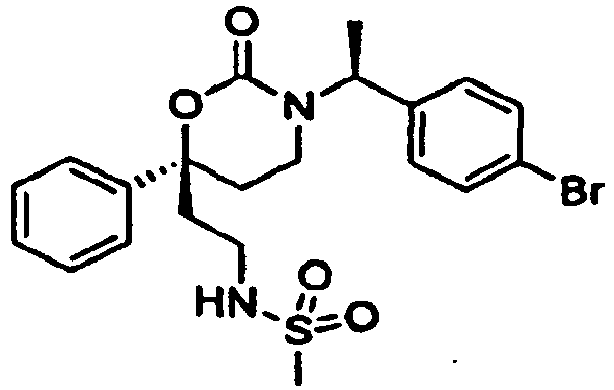
- The title compound was prepared from (S)-3-((S)-1-(4-bromophenyl)ethyl)-6-(2-hydroxyethyl)-6-phenyl-1,3-oxazinan-2-one following a procedures analogous to those described in Example 359. LC-MS Method 2 tR = 1.336, m/z = 482.7; 1H NMR (CDCl3) 1.48 (d, 3H), 2.11-2.23 (m, 2H), 2.26-2.34 (m, 4H), 2.81 (s, 3H), 2.84 (m, 2H), 3.05 (m, 1H), 3.21 (m, 1H), 4.48 (s, 1H), 5.59 (m, 1H), 6.76 (d, 2H), 7.21 (m, 2H), 7.23 (m, 1H), 7.28 (m, 1H), 7.39 (m, 3H).
-

- A mixture of (R)-6-(4-fluorophenyl)-6-(3-hydroxypropyl)-3-((S)-piperidin-3-yl)-1,3- oxazinan-2-one (100 mg, 0.30 mmol), 2-bromo-5-(trifluoromethyl)pyridine (67 mg, 0.36 mmol), and triethylamine (91 mg, 0.90 mmol) in acetonitrile was heated to reflux for 3 h. The reaction mixture was concentrated. The residue was purified by preparative TLC and preparative HPLC to afford (R)-6-(4-fluorophenyl)-6-(3-hydroxypropyl)-3-((S)-1-(5- (trifluoromethyl)pyridin-2-yl) piperidin-3-yl)-1,3-oxazinan-2-one (10.09 mg, 7%). LC-MS Method 2 tR = 1.34 min, m/z = 482. 1H NMR (400MHz, CDCl3): 1.28 (m, 1 H), 1.64 (m, 2H), 1.76 (m, 3H), 1.92 (m, 2H), 2.18 (m, 1H), 2.27 (m, 1H), 2.77 (m, 3H), 3.21 (m, 1H), 3.52 (t, 2H), 3.83 (broad, 1H), 4.11 (d. 1 H), 4.25 (d, 1H), 6.57 (d, 1H), 7.03 (t, 2H), 7.23 (m, 2H), 7.54 (d, 1H), 8.29 (s, 1H).
-

- The title compound was prepared from (R)-3-((S)-1-(4-bromophenyl)ethyl)-6-(3-hydroxypropyl)-6-phenyl-1,3-oxazinan-2-one following procedures analogous to those described in Example 506. LC-MS Method 3 tR = 1.26, m/z = 486.9; 1H NMR (CDCl3) 1.26 (m, 1H), 1.42 (d, 3H), 1.63-1.96 (m, 5H), 2.05-2.24 (m, 3H), 2.29 (m, 2H), 2.74 (m, 1H), 3.11 (m, 3H), 3.21 (m, 1H), 5.56 (m, 1H), 6.68 (d, 2H), 7.13-7.21 (m, 4H), 7.23-7.34 (m, 3H).
-

- The title compound was prepared from N-(3-((R)-3-((S)-1-(4-bromophenyl)ethyl)-2-oxo-6-phenyl-1,3-oxazinan-6-yl)propyl)-N-methylacetamide and 2-methylpyridine-4-boronic acid following a procedure analogous to that described in Example 459 Step 1. LC-MS Method 2 tR = 0.98, m/z = 486.2; 1H NMR (CDCl3) 1.21-1.38 (m, 1H), 1.52 (d, 3H), 1.61-1.90 (m, 3H), 2.05 (d, 3H), 2.17 (m, 1H), 2.42 (m, 2H), 2.78 (s, 1H), 2.83 (s, 3H), 2.85 (s, 2H), 2.92 (m, 1H), 3.11-3.33(m, 2H), 5.65(m, 1H), 7.05 (d, 2H), 7.21 (m, 2H), 7.30 (m, 3H), 7.38 (d, 2H), 7.60 (s, 1H), 7.71 (d, 1H), 8.72 (d, 1H).
-
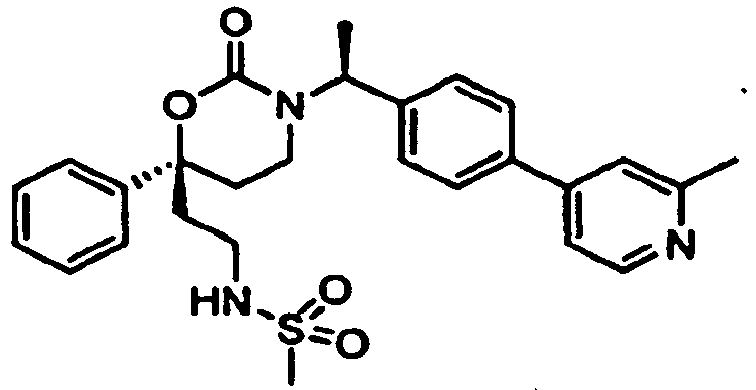
- The title compound was prepared from N-(2-((S)-3-((S)-1-(4-bromophenyl)ethyl)-2-oxo-6-phenyl-1,3-oxazinan-6-yl)ethyl)methanesulfonamide and 2-methylpyridine-4-boronic acid following a procedure analogous to that described in Example 459 Step 1. LC-MS Method 2 tR = 1.12, m/z = 494; 1H NMR (CDCl3) 1.48 (d, 3H), 2.10 (m, 2H), 2.20-2.41 (m, 2H), 2.43 (m, 1H), 2.71 (s, 3H), 2.73 (s, 3H), 3.11 (m, 2H), 5.52 (m, 1 H), 7.13 (d, 2H), 7.25 (m, 3H), 7.34 (m, 2H), 7.62 (d, 2H), 7.91 (m, 1H), 8.08 (s, 1 H), 8.56 (d, 1H).
-

- The title compound was prepared from (R)-3-((S)-1-(4-bromophenyl)ethyl)-6-(3-(2-oxopyrrolidin-1-yl)propyl)-6-phenyl-1,3-oxazinan-2-one and 2-methylpyridine-4-boronic acid following a procedure analogous to that described in Example 459 Step 1. LC-MS Method 2 tR = 0.992, m/z = 498.1; 1H NMR (CDCl3) 1.21 (m, 3H), 1.48 (d, 3H), 1.61-1.95 (m, 5H), 2.12 (m, 1H), 2.26 (m, 4H), 2.52 (s, 3H), 2.83 (m, 1H), 3.11 (m, 3H), 3.22 (m,1H), 5.67 (m, 1H), 6.95 (d, 2H), 7.18 (m, 1H), 7.21 (m,1H), 7.23 (m, 2H), 7.29 (m, 3H), 7.30 (m, 2H), 8.41 (d, 1H).
-

- To a solution of (R)-6-allyl-3-((S)-1-(4-bromophenyl)ethyl)-6-phenyl-1,3-oxazinan-2- one (3 g, 7.5 mmol) in CH2Cl2 (50 mL) was treated with O3 at -78 °C till the mixture turned blue. Then NaBH4 (285 mg, 75 mmol) was added to the solution at 0 °C, and the reaction solution was stirred at room temperature for 3 hours. The reaction was quenched by H2O, and the mixture was extracted with EtOAc. The combined organic phase was concentrated to give the crude product, which was purified by preparative TLC to give (S)-3-((S)-1-(4-bromo-phenyl)ethyl)-6-(2-hydroxyethyl)-6-phenyl-1,3-oxazinan-2-one (2.5 g, 84%). 1H NMR (CDCl3): 1.48 (t, 3H), 2.05-2.41 (m, 4H), 2.71-2.92 (m, 2H), 3.51 (m, 1 H), 3.71 (m, 1H), 5.58 (m, 1 H), 6.73 (d, 2H), 7.12 (m, 2H), 7.23-7.45 (m, 6H).
- To a solution of (S)-3-((S)-1-(4-bromophenyl)ethyl)-6-(2-hydroxyethyl)-6-phenyl-1,3- oxazinan-2-one (300 mg, 0.75 mmol) in dichloromethane (20 mL) were added Et3N (390 mg, 3.75 mmol) and methanesulfonyl chloride (256 mg, 2.25 mmol) at 0 °C. The reaction solution was stirred at rt for 1 h. The reaction was quenched with H2O and the mixture was extracted with dichloromethane. The organic phase was concentrated to give 2-((S)-3-((S)-1-(4-bromophenyl)ethyl)-2-oxo-6-phenyl-1,3-oxazinan-6-yl)ethyl-methane sulfonate (352.8 mg, 98%), which was used for the next step without further purification.
- To a solution of 2-((S)-3-((S)-1-(4-bromophenyl)ethyt)-2-oxo-6-phenyl-1,3-oxazinan- 6-yl)ethyl-methanesulfonate (360 mg, 0.75 mmol) and K2CO3 (207 mg, 1.5 mmol) in acetonitrile (10 mL) was added isothiazolidine 1,1-dioxide (121 mg, 4.6 mmol), and the mixture was refluxed overnight. The mixture was filtered and the filtrate was concentrated to give the crude product, which was purified by preparative HPLC to afford compound (S)-3-((S)-1-(4-bromophenyl)ethyl)-6-(2-(1,-dioxo-isothiazolidin-2-yl)ethyl)-8-phenyl-1,3-oxazinan-2-one (2.43 mg, 1%). LC-MS Method 2 tR = 1.37 min, m/z = 509, 507. 1H NMR (CDCl3): 1.48 (t, 3H), 2.05-2.41 (m, 7H), 2.71-2.92 (m, 2H), 3.11 (m, 3H), 3.21 (m, 2H), 5.58 (m, 1H), 6.73 (d, 2H), 7.18 (m, 1H), 7.23 (m, 3H);7.35 (m, 3H).
-
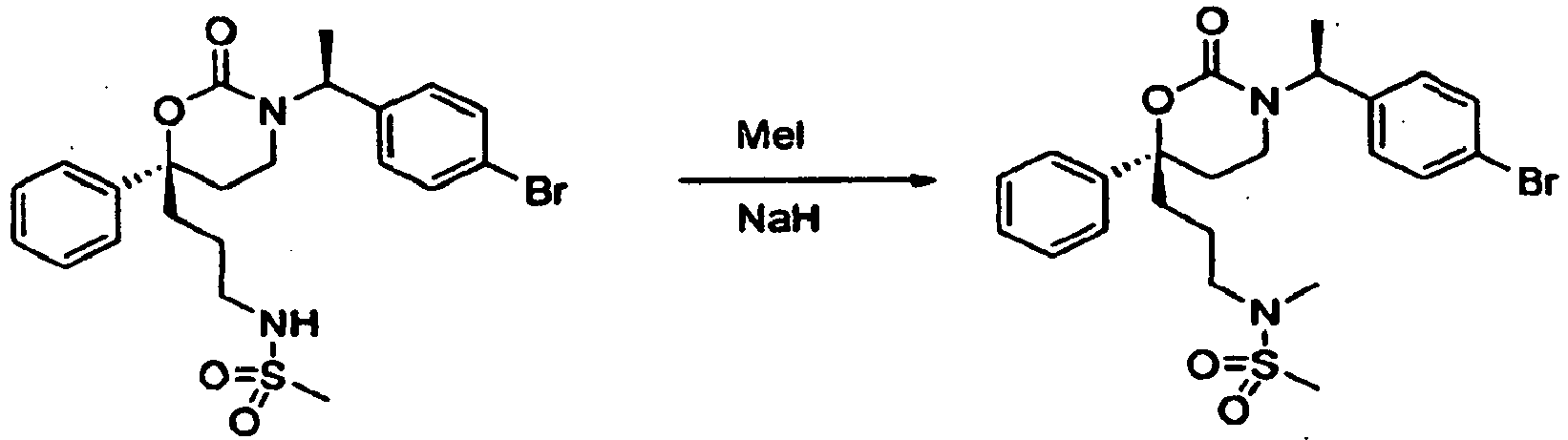
- To a solution of 3-((R)-3-((S)-1-(4-bromophenyl)ethyl)-2-oxo-6-phenyl-1,3-oxazinan-6-yl) propyl methanesulfonate (180 mg, 0.36 mmol) in DMF (5 mL) was added NaH (14.6 mg, 0.36 mmol) at 0 °C. The mixture was stirred at rt for 30 min. Then iodomethane (153 mg, 1.1 mmol) was added to the above mixture. The formed mixture was stirred at 40 °C for 3 h. After the reaction was over, the reaction was quenched with NH4Cl solution and the mixture was extracted with EtOAc. The combined organic phase was concentrated to give the crude product, which was purified by preparative TLC to give N-(3-((R)-3-((S)-1-(4-bromophenyl)ethyl)-2-oxo-6-phenyl-1,3-oxazinan-6- yl)propyl)-N-methylmethanesulfonamide (100 mg, 55%). LC-MS Method 2 tR = 1.41 min, m/z = 511, 509. 1H NMR (400MHz, CDCl3): δ=1.45 (m, 1H), 1.48 (t, 3H), 1.83-1.97 (m, 3H), 2.1-2.2 (m, 3H), 2.61 (s, 3H), 2.71 (s, 3H), 2.91 (m, 1H), 3.0 (m, 2H), 5.5 (m, 1H), 6.72 (m, 2H), 7.10 (m, 2H), 7.20 (m, 2H), 7.37 (m, 3H).
-
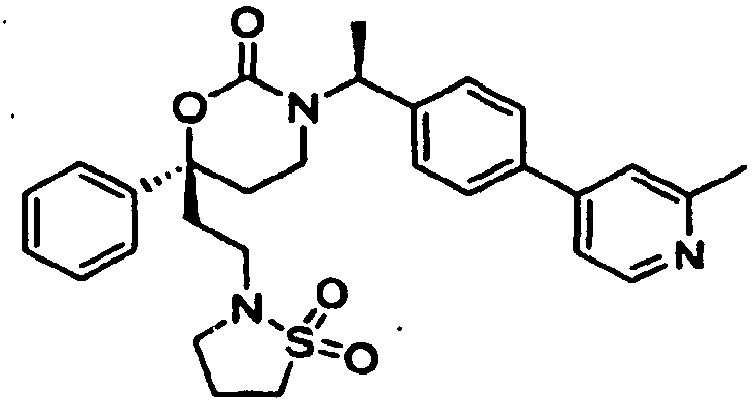
- The title compound was prepared from (S)-3-((S)-1-(4-bromophenyl)ethyl)-6-(2-(1,-dioxo-isothiazolidin-2-yl)ethyl)-6-phenyl-1,3-oxazinan-2-one and 2-methylpyridine-4-boronic acid following a procedure analogous to that described in Example 459 Step 1. LC-MS Method 2 tR = 0.984, m/z = 520.1; 1H NMR (CDCl3) 1.52 (d, 3H), 2.11-2.29 (m, 5H), 2.32 (m, 2H), 2.81 (s, 3H), 2.83-2.96 (m, 2H), 2.98-3.08 (m, 3H), 3.11-3.22 (m, 2H), 5.67 (m, 1H), 7.06 (d, 2H),7.24-7.36 (m, 5H), 7.38 (d, 2H), 7.61 (s, 1H), 7.69 (m, 1 H), 8.73(d, 1 H).
-

- The title compound was prepared from (R)-3-((S)-1-(4-bromophenyl)ethyl)-6-(3-hydroxypropyl)-6-phenyl-1,3-oxazinan-2-one following a procedure analogous to that described in Example 513. LC-MS Method 2 tR = 1.277, m/z = 524.5; 1H NMR (CDCl3) 1.31 (m, 1H), 1.42 (d, 3H), 1.64 (m, 1H), 1.81-1.94 (m, 2H), 2.11-2.28 (m, 5H), 2.43 (m, 1H), 2.82 (m, 2H), 2:93-3.14 (m, 5H), 3.36 (m, 1H), 5.56 (m, 1H), 6.72 (d, 2H), 7.16(m, 2H), 7.21 (m, 2H), 7.33 (m, 3H).
-

- The title compound was prepared from (R)-3-((S)-1-(4-bromophenyl)ethyl)-6-(3-(1,1-dioxo-isothiazolidin-2-yl)propyl)-6-phenyl-1,3-oxazinan-2-one and 2-methylpyridine-4-boronic acid following a procedure analogous to that described in Example 459 Step 1. LC-MS Method 2 tR = 1.001, m/z = 534.1; 1H NMR (CDCl3) 1.22-1.33 (m, 1H), 1.52 (d, 3H), 1.68-1.81 (m, 1H), 1.83-2.03 (m, 2H), 2.12-2.38 (m, 5H), 2.83-2.91 (m, 5H), 2.93-3.13 (m, 5H), 5.68 (m, 1H), 7.09 (d, 2H), 7.18-7.32 (m, 5H), 7.36(d, 2H), 7.61 (s, 1H), 7.68 (s, 1H), 8.24 (s, 1H).
-

- The title compound was prepared following procedures analogous to those described in Example 353 using 4-chloro-2-phenylbutan-2-ol in Step 1. Two isomers were isolated.
- Isomer 1: (S)-3-((S)-1-(4-bromophenyl)ethyl)-6-(4-fluorophenyl)-6-methyl-1,3-oxazinan-2-one LC-MS Method 1 tR = 1.93, m/z = 392 (M+); 1H NMR (CDCl3) 7.47 (ap d, 2H, J = 8.5 Hz), 7.33-7.29 (m, 2H), 7.19 (d, 2H, J = 8.5 Hz), 7.07 (ap t, 2H, J = 8.7 Hz), 5.74 (q, 1H, J = 7.3 Hz), 2.74-2.63 (m, 2H), 2.27-2.22 (dt, 1H, J = 13.8 Hz, 4 Hz), 2.03-1.97 (m, 1H), 1.61 (s, 3H), 1.29 (d, 3H, J = 7 Hz).
- Isomer 2: (R)-3-((S)-1-(4-bromophenyl)ethyl)-6-(4-fluorophenyl)-6-methyl-1,3-oxazinan-2-one LC-MS Method 1 tR = 1.89, m/z = 392 (M+); 1H NMR (CDCl3) 7.31-7.27 (m, 4 H), 7.04 (t, 2H, J = 8.8 Hz), 6.83 (d, 2H, J = 8.8 Hz), 5.64 (q, 1H, J = 5.7 Hz), 2.97-2.92 (m, 1H), 2.37-2.25 (m, 2H), 2.19-2.11 (m, 1H), 1.62 (s, 3H), 1.50 (d, 3H, J = 7.2 Hz).
-

- Isomer 1 of the title compound, (S)-6-(4-fluorophenyl)-6-methyl-3-((S)-1-(4-(2-methylpyridin-4-yl)phenyl)ethyl)-1,3-oxazinan-2-one, was prepared from (S)-3-((S)-1-(4-bromophenyl)ethyl)-6-(4-fluorophenyl)-6-methyl-1,3-oxazinan-2-one and 2-methylpyridine-4-boronic acid following a procedure analogous to that described in Example 64 LC-MS Method 1 tR = 1.28, m/z = 405 (M+1); 1H NMR (CDCl3) 8.84 (d, 1H, J =6.1 Hz), 7.81 (d, 1H, J = 5.9 Hz), 7.75 (s, 1H), 7.70 (d, 2H, J = 8.2 Hz), 7.52 (d, 2H, J = 8.20 Hz), 7.34-7.31 (m, 2H), 7.09 (t, 2H, J = 8.6 Hz), 5.81 (q, 1H, J = 7.2 Hz), 2.89 (s, 3H), 2.84-2.72 (m, 2H), 2.31 (dt, 1H, J = 13.9, 3.7 Hz), 2.11-2.03 (m, 1H), 1.64 (s, 3H), 1.38 (d, 3H, J = 7 Hz).
- Isomer 2 of the title compound, (R)-6-(4-fluorophenyl)-6-methyl-3-((S)-1-(4(2-methylpyridin-4-yl)phenyl)ethyl)-1,3-oxazinan-2-one, was prepared from (R)-3-((S)-1-(4-bromophenyl)ethyl)-6-(4-fluorophenyl)-6-methyl-1,3-oxazinan-2-one and 2-methylpyridine-4-boronic acid following a procedure analogous to that described in Example 64. LC-MS Method 1 tR = 1.18, m/z = 405 (M+1); 1H NMR (CDCl3) 8.83 (s, 1H), 7.72 (s, 1H), 7.66 (s, 1H), 7.48 (d, 2H, J = 7.3 Hz), 7.32 (br m, 2H), 7.16 (d, 2H, J = 6.7), 7.04 (t, 2H, J =7.6 Hz), 5.77 (q, 1H, J = 6.7 Hz), 3.05 (br m, 1H), 2.89 (s, 3H, 2.42-2.32 (m, 2H), 2.23 (br m, 1H), 1.64 (s, 3H), 1.59 (d, 3H, J = 6.7 Hz).
-
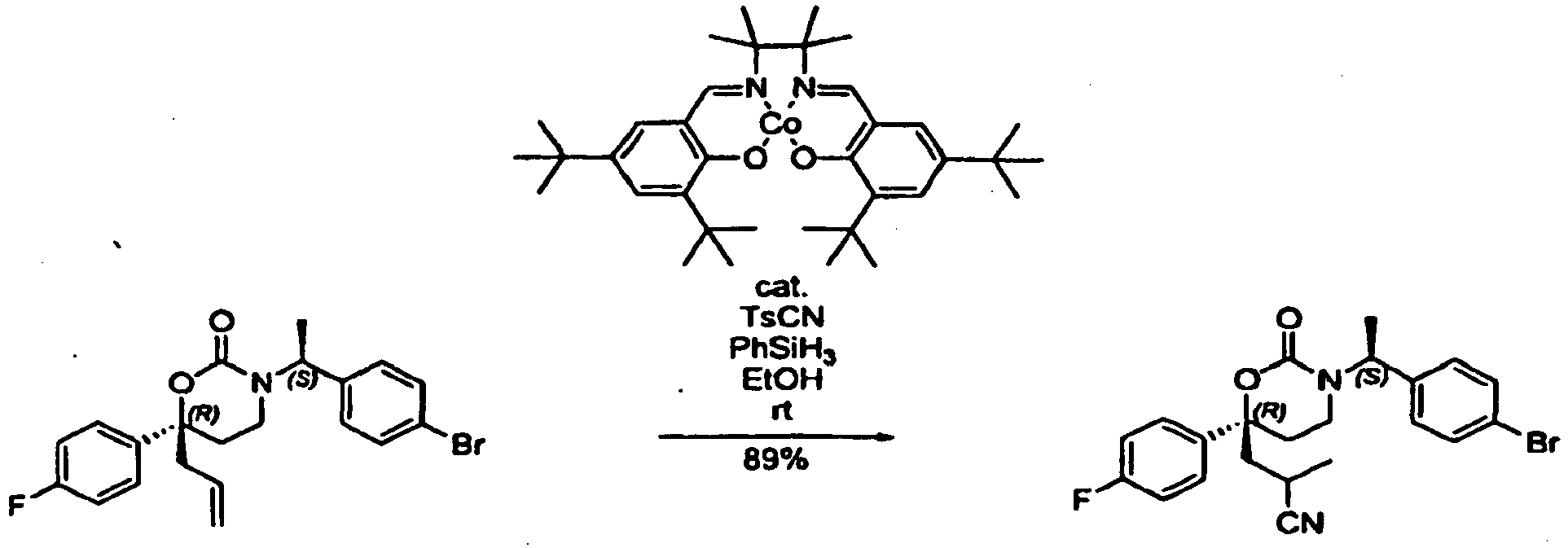
- A 50 mL flask was charged with N,N'-bis(3,5-di-tert-butylsalicylidene)-1,1,2,2-tetramethylethenediamine (0.4302 g, 0.78 mmol, 1.0 equiv), EtOH (17 mL), and Co(OAc)2 (0.1385 g, 0.78 mmol, 1.0 equiv). The mixture was degassed and then heated to reflux under nitrogen for 3 h, cooled to room temperature. The precipitate was filtered and the purple solid was washed with EtOH (10 mL) and dried under high vacuum to give 0.3533 g (75%) of the cobalt(II) complex.
- A mixture of (R)-6-allyl-3-((S)-1-(4-bromophenyl)ethyl)-6-(4-fluorophenyl)-1,3-oxazinan-2-one (1.0668 g, 2.55 mmol, 1.0 equiv), the cobalt(II) catalyst (0.0160 g, 0.0264 mmol, 0.010 equiv), TsCN (0.5546 g, 3.06 mmol, 1.2 equiv), and PhSiH3 (0.2944 g, 2.72 mmol, 1.07 equiv) in EtOH (5 mL) was stirred at room temperature for 4 h. After the solvent was removed under reduced pressure, the residue was purified by chromatography on silica gel eluted with hexanes/ethyl acetate to afford 1.0130 g (89%) of 3-((R)-3-((S)-1-(4-bromophenyl)ethyl)-(4-fluorophenyl)-2-oxo-1,3-oxazinan-6-yl)-2-methylpropanenitrile as a solid. LC-MS tR = 1.83, 1.86 min in 3 min chromatography, m/z 445, 447 (MH+); 1H NMR (400 MHz, CDCl3) δ 7.32-7.22 (m, 4H), 7.13-7.05 (m, 2H), 6.80-6.73 (m, 2H), 5.60-5.56 (m, 1H), 3.00-1.94 (m, 7H), 1.51-1.49 (m, 3H), 1.35-1.32 (m, 1.5H), 1.27-1.24 (m, 1.5H); 19F NMR (376 MHz, CDCl3) δ -113.08 (m), -113.69(m).
-

- To a solution of 3-((R)-3-((S)-1-(4-bromophenyl)ethyl)-6-(4-fluorophenyl)-2-oxo-1,3-oxazinan-6-yl)-2-methylpropanenitrile (0.3322 g, 0.746 mmol) and Mel (1.40 g, 13 equiv) in THF (12 mL) at -78 °C was added 2.4 mL (2.4 mmol, 3.2 equiv) of a 1.0 M LiHMDS solution in THF. The resulting mixture was stirred overnight, with the temperature slowly rising to ambient. The reaction mixture was quenched with brine (1 mL), diluted with CH2Cl2, and dried over Na2SO4. After the solvents were evaporated, the residue was purified by reversed-phase HPLC (SunFire™ Prep C18 OBD™ 5µm 19 x 50 mm column, 10% →90% CH3CN/H2O, 0.1% CF3COOH over 8 min and then 90% CH3CN/H2O, 0.1% CF3COOH over 2 min, flow rate 20 mL/min) to afford 0.2547 g (74%) of 3-((R)-3-((S)-1-(4-bromophenyl)ethyl)-6-(4-fluorophenyl)-2-oxo-1,3-oxazinan-6-yl)-2,2-dimethylpropanenitrile. LC-MS Method 1 t R = 1.89 min, m/z 459, 461 (MH+); 1H NMR (400 MHz, CD3OD) δ 7.31-7.27 (m, 2H), 7.22-7.18 (m, 2H), 7.04-6.99 (m, 2H), 6.83 (d, J = 8.2 Hz, 2H), 5.41 (q, J = 7.0 Hz, 1H), 3.02-2.97 (m, 1 H), 2.42-2.36 (m, 1H), 2.29-2.08 (m, 4H), 1.42 (d, J= 7.0 Hz, 3H), 1.30 (s, 3H), 1.22 (s, 3H); 19F NMR (376 MHz, CD3OD) δ -116.50 (m).
-

- A mixture of 3-((R)-3-((S)-1-(4-bromophenyl)ethyl)-6-(4-fluorophenyl)-2-oxo-1,3-oxazinan-6-yl)-2,2-dimethylpropanenitrile (0.1232 g, 2.68 mmol, 1.0 equiv), acetamide (0.5723 g, 9.7 mmol. 36 equiv), and PdCl2 (0.0273 g, 0.154 mmol, 0.57 equiv) in THF-H2O (3:1, 6 mL) was stirred at room temperature for 24 h. The reaction mixture was purified by reversed-phase HPLC (SunFire™ Prep C18 OBD™ 5µm 19 × 50 mm column, 10% →90% CH3CN/H2O, 0.1% CF3COOH over 8 min and then 90% CH3CN/H2O, 0.1% CF3COOH over 2 min, flow rate 20 mL/min) to afford 0.1250 g of product, which was further purified by chromatography on silica gel eluted with CH2Cl2/MeOH to give 0.0972 g (76%) of 3-((R)-3-((S)-1-(4-bromophenyl)ethyl)-6-(4-fluorophenyl)-2-oxo-1,3-oxazinan-6-yl)-2,2-dimethylpropanamide. LC-MS Method 1 t R = 1.64 min, m/z 477, 479 (MH+); 1H NMR (400 MHz, CD3OD) δ 7.25-7.20 (m, 4H), 6.98 (t, J = 8.8 Hz, 2H), 6.83 (d, J = 8.5 Hz, 2H), 5.42 (q, J = 7.0 Hz, 1H), 3.01-2.97 (m, 1 H), 2.33 (d, J= 15 Hz, 1H), 2.27-2.10 (m, 3H), 2.05 (d, J = 15 Hz, 1H), 1.42 (d, J = 7.0 Hz, 3H), 1.10 (s, 3H), 1.07 (s, 3H); 19F NMR (376 MHz, CD3OD) δ -117.39 (m).
-

- The title compound was prepared from 3-((R)-3-((S)-1-(4-bromophenyl)ethyl)-6-(4-fluorophenyl)-2-oxo-1,3-oxazinan-6-yl)-2-methylpropanenitrile following a procedure analogous to that described in Example 522. Two isomers were isolated.
- Isomer 1: LC-MS Method 1 tR = 1.56, m/z = 463, 465 (M+1); 1H NMR (CD3OD) 7.18-7.14 (m, 4H), 6.96-6.91 (m, 2H), 6.77 (d, J = 8.5 Hz, 2H), 5.37 (q, J = 7.0 Hz, 1H), 2.98-2.94 (m, 1H), 2.38-2.27 (m, 3H), 2.15-2.07 (m, 2H), 1.74-1.70 (m, 1H), 1.38 (d, J = 7.0 Hz, 3H), 1.00 (d, J = 6.5 Hz, 3H).
- Isomer 2: LC-MS Method 1 tR = 1.63, m/z = 463, 465 (M+1); 1H NMR (CD3OD) 7.27-7.18 (m, 4H), 7.04-7.00 (m, 2H), 6.80 (d, J = 8.5 Hz, 2H), 5.40 (q, J = 7.0 Hz, 1H), 3.04-3.00 (m, 1H), 2.47-2.36 (m, 2H), 2.28-2.08 (m, 3H), 1.68-1.64 (m, 1H), 1.41 (d, J = 7.0 Hz, 3H), 0.88 (d, J = 6.7 Hz, 3H).
-

- The title compound was prepared from 3-((R)-3-((S)-1-(4-bromophenyl)ethyl)-6-(4-fluorophenyl)-2-oxo-1,3-oxazinan-6-yl)propanamide following a procedure analogous to that described in Example 172. LC-MS Method 1 tR = 1.79, m/z = 431, 433 (M+1); 1H NMR (CD3OD) 7.22-7.15 (m, 4H), 7.01 (t, J = 8.8 Hz, 2H), 6.78 (d, J = 8.5 Hz, 2H), 5.37 (q, J = 7.0 Hz, 1H), 2.99-2.97 (m, 1H), 2.46-2.32 (m, 2H), 2.21-2.04 (m, 5H), 1.38 (d, J = 7.0 Hz, 3H).
-

- To a solution of NaHCO3 (0.0475 g, 0.56 mmol) in H2O (0.2 mL)/CH3CN (1.5 mL)/ EtOAc (1.5 mL) were added 20 µL (2 µmol) of a 0.1 M RuCl3·×H2O solution in H2O and 0.6804 g (1.1 mmol) of Oxone®. After the resulting mixture was stirred at room temperature to yield the bright yellow color, (6S)-3-((S)-1-(4-bromophenyl)ethyl)-6-(2,3-dihydroxypropyl)-6-(4-fluorophenyl)-1,3-oxazinan-2-one (0.1000 g, 0.22 mmol) was added in one portion. After 1h, the reaction mixture was quenched with satd aq NaHCO3 (3 mL) and saturated Na2SO3 (3 mL), diluted with CH2Cl2, and dried over Na2SO4. After the solvents were evaporated, the residue was purified by reversed-phase HPLC (SunFire™ Prep C18 OBD™ 5µm 19 × 50 mm column, 10% →90% CH3CN/H2O, 0.1% CF3COOH over 8 min and then 90% CH3CN/H2O, 0.1% CF3COOH over 2 min, flow rate 20 mL/min) to afford 0.0030 g of (S)-3-((S)-1-(4-bromophenyl)ethyl)-6-(4-fluorophenyl)-6-(3-hydroxy-2-oxopropyl)-1,3-oxazinan-2-one: LC-MS Method 1 tR = 1.62 min, m/z 450, 452 (MH+); 1H NMR (400 MHz, CD3OD) δ 7.30-7.27 (m, 2H), 7.21 (d, J = 8.8 Hz, 2H), 7.03 (t, J = 8.8 Hz, 2H), 6.79 (d, J = 8.8 Hz, 2H), 5.41 (q, J = 7.0 Hz, 1H), 4.08 (d, J = 19.0 Hz, 1H), 3.96 (d, J = 19.0 Hz, 1H), 3.06-3.02 (m, 1H), 2.93 (s, 2H), 2.58-2.54 (m, 1H), 2.44-2.36 (m, 1H), 2.28-2.22 (m, 1H), 1.43 (d, J = 7.0 Hz, 3H); 19F NMR (376 MHz, CD3OD) δ -116.60 (m) and 0.0260 g of 2-((S)-3-((S)-1-(4-bromophenyl)ethyl)-6-(4-fluorophenyl)-2-oxo-1,3-oxazinan-6-yl)acetic acid: LC-MS Method 1 t R = 1.66 min, m/z 436, 438 (MH+).
- To a solution of 2-((S)-3-((S)-1-(4-bromophenyl)ethyl)-6-(4-fluorophenyl)-2-oxo-1,3-oxazinan-6-yl)acetic acid (0.0259 g, 0.059 mmol) in DMF (2 mL) was added HATU (0.2298 g, 0.60 mmol), DIPEA (0.5 mL), and 0.8 M NH3 in THF (4 mL). The mixture was stirred at rt for 2 d. After the solvents were removed in vacuo, the residue was purified by reversed-phase HPLC (SunFire™ Prep C18 OBD™ 5µm 19 × 50 mm column, 10% →90% CH3CN/H2O, 0.1% CF3COOH over 8 min and then 90% CH3CN/H2O, 0.1% CF3COOH over 2 min, flow rate 20 mL/min) to afford 0.0146 g (57%) of 2-((S)-3-((S)-1-(4-bromophenyl)ethyl)-6-(4-fluorophenyl)-2-oxo-1,3-oxazinan-6-yl)acetamide. LC-MS Method 1 t R = 1.55 min, m/z 435, 437 (MH+), 391, 393; 1H NMR (400 MHz, CD3OD) δ 7.30-7.26 (m, 2H), 7.19-7.16 (m, 2H), 7.04-6.99 (m, 2H), 6.74 (d, J = 8.5 Hz, 2H), 5.39 (q, J = 7.0 Hz, 1H), 3.06-3.01 (m, 1H), 2.72-2.58 (m, 3H), 2.42-2.34 (m, 1H), 2.26-2.19 (m, 1H), 1.41 (d, J = 7.0 Hz, 3H); 19F NMR (376 MHz, CD3OD) δ -116.70 (m).
-

- The title compound was prepared from (R)-3-((S)-1-(4-bromophenyl)ethyl)-6-(4-fluorophenyl)-6-(3-hydroxypropyl)-1,3-oxazinan-2-one following a procedure analogous to that described in Example 324 Step 1. LC-MS Method 2 tR = 1.487, m/z = 449.9; 1H NMR (CDCl3) 1.52 (d, 3H), 2.11-2.22 (m, 3H), 2.23-2.35 (m, 3H), 2.54 (m, 1H), 2.96 (m, 1 H), 5.61 (m, 1H), 6.82 (d, 2H), 7.08 (t, 2H), 7.11-7.32 (m, 4H).
-

- The title compound was isolated as a minor product from the oxidation of (6S)-3-((S)-1-(4-bromophenyl)ethyl)-6-(2,3-dihydroxypropyl)-6-(4-fluorophenyl)-1,3-oxazinan-2-one with RuCl3/oxone described in Example 525 Step 1. LC-MS Method 1 tR = 1.62, m/z = 450, 452 (M+1); 1 H NMR (CD3OD) 7.30-7.27 (m, 2H), 7.21 (d, J = 8.8 Hz, 2H), 7.03 (t, J = 8.8 Hz, 2H), 6.79 (d, J = 8.8 Hz, 2H), 5.41 (q, J = 7.0 Hz, 1H), 4.08 (d, J = 19.0 Hz, 1H), 3.96 (d, J = 19.0 Hz, 1 H), 3.06-3.02 (m, 1H), 2.93 (s, 2H), 2.58-2.54 (m, 1H), 2.44-2.36 (m, 1H), 2.28-2.22 (m, 1H), 1.43 (d, J = 7.0 Hz, 3H).
-

- To a stirred solution of 3-((R)-3-((S)-1-(4-bromophenyl)ethyl)-6-(4-fluorophenyl)-2-oxo-1,3-oxazinan-6-yl)-2,2-dimethylpropanenitrile (0.0640 g, 0.14 mmol) in CH2Cl2 (4 mL) at -78 °C under a nitrogen atmosphere was added DIBAL-H/heptane (1.0 M, 0.6 mL, 0.6 mmol). After 2 h, the reaction mixture was quenched with 0.1 M aqueous L-tartaric acid (2 mL) and allowed to warm to room temperature. The mixture was diluted with CH2Cl2, dried over Na2SO4. After the solvent was removed in vacuo, the crude aldehyde was directly used in the next step without further purification. LC-MS Method 1 tR = 1.93 min, m/z 462, 464 (MH+).
- To a stirred solution of the aldehyde, obtained as described above, in MeOH (5 mL) at 0 °C was added NaBH4 (0.170 g, 4.5 mmol). After 1.5 h, the reaction mixture was purified by reversed-phase HPLC (SunFire™ Prep C18 OBD™ 5µm 19 × 50 mm column, 10% →90% CH3CN/H2O, 0.1% CF3COOH over 8 min and then 90% CH3CN/H2O, 0.1% CF3COOH over 2 min, flow rate 20 mL/min) to afford 0.0125 g of (R)-3-((S)-1-(4-bromophenyl)ethyl)-6-(4-fluorophenyl)-6-(3-hydroxy-2,2-dimethylpropyl)-1,3-oxazinan-2-one. LC-MS Method 1 t R = 1.85 min, m/z 464, 466 (MH+), 420, 422; 1H NMR (400 MHz, CD3OD) δ 7.26-7.21 (m, 4H), 6.99 (t, J = 8.8 Hz, 2H), 6.88 (d, J = 8.2 Hz, 2H), 5.43 (q, J = 7.0 Hz, 1H), 3.12 (d, J = 11 Hz, 1H), 2.99-2.95 (m, 2H), 2.27-2.04 (m, 3H), 1.95-1.93 (m, 2H), 1.42 (d, J = 7.0 Hz, 3H), 0.69 (s, 3H), 0.59 (s, 3H); 19F NMR (376 MHz, CD3OD) δ -117.52 (m).
-

- The title compound was prepared from 2-((S)-3-((S)-1-(4-bromophenyl)ethyl)-2-oxo-6-phenyl-1,3-oxazinan-6-yl)ethyl methanesulfonate following a procedure analogous to that described in Example 514. LC-MS Method 3 tR = 1.281, m/z = 494.9; 1H NMR (CDCl3) 1.48 (d, 3H), 2.15-2.33 (m, 5H), 2.68 (s, 3H), 2.72(s, 1H), 2.81-2.96 (m, 2H), 3.35 (m, 1H), 5.61 (m, 1H), 6.73 (d, 2H), 7.21 (m, 4H),7.38 (m, 3H).
-
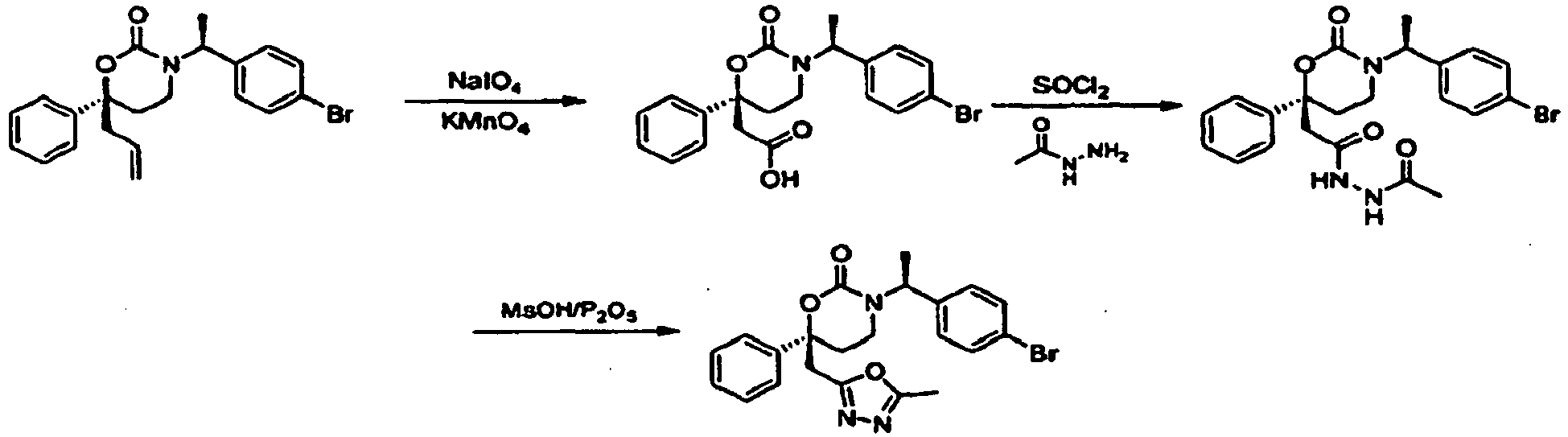
- To a solution of (R)-6-allyl-3-((S)-1-(4-bromophenyl)ethyl)-6-phenyl-1,3-oxazinan- 2-one (4.0 g, 0.01 mol) in acetone (50 mL) was added a solution of NalO4 (10.6 g, 0.048 mol) and KMnO4 (1.26 g, 8 mmol) in water (50 mL). The formed mixture was stirred for 1 h. The mixture was filtered, and the filtrate was concentrated to give a residue, which was acidified to pH<7 with 1 N aq HCl. The mixture was extracted with EtOAc, and the organic phase was concentrated to give crude 2-((S)-3-((S)-1-(4-bromophenyl)ethyl)-2-oxo-6-phenyl-1,3- oxazinan-6-yl)acetic acid (3.5 g, 84%), which was used for the next step without purification. 1H NMR (400 MHz, CDCl3): δ=1.61 (d. 3H), 2.41 (m, 1H), 2.62 (m. 1H), 2.79 (m, 1H), 2.98 (m, 2H), 3.18 (m, 1H), 5.52 (q, 1H), 6.88 (m, 2H), 7.29 (m, 2H), 7.46 (m, 5H).
- To a solution of 2-((S)-3-((S)-1-(4-bromophenyl)ethyl)-2-oxo-6-phenyl-1,3-oxazinan- 6-yl)acetic acid (200 mg, 0.47 mmol) in CH2Cl2 (2 mL) was added SOCl2 (290 mg, 2.39 mmol) at room temperature. The mixture was stirred for 2 h. The reaction was concentrated to give a residue, which was dissolved in 1,4-dioxane (2 mL). Acethylhydrazide was added to the above solution. The resulting mixture was stirred for 10 min. The mixture was diluted with EtOAc, and washed with water. The organic layer was concentrated to give crude N'-acetyl-2-((S)-3-((S)-1-(4-bromophenyl)ethyl)-2-oxo-6-phenyl-1,3-oxazinan-6-yl)acetohydrazide, which was used for the next step without purification (200 mg, 88%). 1H NMR (400 MHz, CDCl3): δ=1.42 (d, 3H), 1.98 (s, 3H), 2.21 (m, 2H), 2.41 (m, 1H), 2.54 (m, 1H), 2.71 (m, 1H), 2.86 (m, 2H), 5.49 (q, 1H), 6.64 (m, 2H), 7.12 (m, 2H), 7.22 (m, 2H), 7.31 (m, 3H), 7.94 (br, 1H), 8.51 (br, 1H).
- A suspension of P2O5 (73 mg, 0.52 mmol) and methanesulfonic acid (500 mg, 5.25 mmol) was stirred for 1 hour at room temperature. Then N'-acetyl-2-((S)-3-((S)-1-(4- bromo phenyl) ethyl)-2-oxo-6-phenyl-1,3-oxazinan-6-yl)acetohydrazide (50 mg, 0.105 mmol) was added. After heating at 70-80 °C for 4 h, the mixture was neutralized with aqueous sodium carbonate. The resulting mixture was extracted with EtOAc, and the combined organic layer was concentrated to give the crude product, which was purified by preparative HPLC to afford (S)-3-((S)-1-(4-bromophenyl)ethyl)-6-((5-methyl-1,3,4-oxadiazol-2-yl)methyl)-6-phenyl-1,3-oxazinan-2-one (2.5 mg, 5%). 1H NMR (400 MHz, CDCl3): δ=1.51 (d, 3H), 2.32-2.41 (m, 2H), 2.48 (s, 3H), 2.73 (m, 2H), 3.16 (m, 2H), 5.49 (m, 1H). 6.78 (d, 2H), 7.24 (m, 2H), 7.32 (m, 2H), 7.41 (m, 3H).
-

- To a solution of N'-acetyl-2-((S)-3-((S)- 1-(4-bromophenyl)ethyl)-2-oxo-6-phenyl- 1,3-oxazinan-6-yl)acetohydrazide (100 mg, 0.21 mmol) in CH2Cl2 (2 mL) was added pyridine (37 mg, 0.46 mmol). The reaction mixture was cooled to -10 °C and triflic anhydride (125 mg, 0.44 mmol) was added. The reaction mixture was stirred at -10 °C for 1 h and at 0 °C for 1 h. The mixture was warmed to rt and quenched by addition of satd aq NaHCO3. The aqueous layer was washed with CH2Cl2 and the combined organic phase was concentrated to give the crude product, which was purified by preparative TLC to afford (S)-3-((S)-1-(4-bromophenyl)ethyl)-6-((5-methyl-1,3,4-oxadiazol-2-yl)methyl)-6-phenyl-1,3-oxazinan-2-one (56 mg, 58%). 1H NMR (400 MHz, CDCl3): δ=1.51 (d, 3H), 2.32-2.41 (m, 2H), 2.48 (s, 3H), 2.73 (m, 2H), 3.16 (m, 2H), 5.49 (m, 1H), 6.78 (d, 2H), 7.24 (m, 2H), 7.32 (m, 2H), 7.41 (m, 3H).
-

- To a solution of N'-acetyl-2-((S)-3-((S)-1-(4-bromophenyl)ethyl)-2-oxo-6-phenyl- 1,3-oxazinan-6-yl)acetohydrazide (50 mg, 0.105 mmol) in anhydrous THF (2 mL) was added Lawesson's Reagent (50 mg, 0.126 mmol) at rt. The mixture was heated to reflux for 3 h. The mixture was concentrated to give the crude product, which was purified by preparative TLC to give (S)-3-((S)-1-(4-bromophenyl)ethyl)-6-((5-methyl-1,3,4 -thiadiazol-2-yl)methyl)- 6-phenyl- 1,3-oxazinan-2-one (10 mg, 20%). 1H NMR (400 MHz, CDCl3): δ=1.39 (d, 3H), 2.02 (m, 1H), 2.22 (m, 1H), 2.39 (m, 1H), 2.69 (s, 3H), 2.81 (m, 1H), 3.58 (m, 1H), 5.52 (q, 1H), 6.66 (m, 2H), 7.16 (m, 2H), 7.21 (m, 2H), 7.32 (m, 3H).
-

- The title compound was prepared from (R)-6-allyl-6-phenyl-3-((S)-1-(4-(trifluoromethyl)phenyl)ethyl)-1,3-oxazinan-2-one following a procedure analogous to that described in Example 78. LC-MS Method 3 tR = 1.108, m/z = 408; 1H NMR (CDCl3) 1.32 (m, 1H), 1.48 (m, 3H), 1.66 (m, 1H), 1.92 (m, 2H), 2.05-2.29 (m, 3H), 2.85 (m, 1H), 3.51 (t, 2H), 5.67 (m, 1 H),6.92 (d, 2H), 7.18 (m, 2H), 7.27 (m, 5H).
-

- The title compound was prepared from (R)-6-allyl-3-((S)-1-(4-chloro-3-fluorophenyl)ethyl)-6-(4-fluorophenyl)-1,3-oxazinan-2-one following a procedure analogous to that described in Example 97. LC-MS Method 1 tR = 1.63, m/z = 396 (M+); 1H NMR (CDCl3) 7.3-7.28 (m, 2H), 7.15 (t, 1H, J = 7.6 Hz), 7.05 (ap t, 2H, J = 8.6 Hz), 6.67-6.62 (m, 2H), 5.61 (q. 1H, J = 7 Hz), 3.81-3.75 (m, 1H), 3.59-3.53 (m, 1H), 2.99-2.91 (m, 1H), 2.39-2.29 (m, 3H), 2.22-2.08 (m, 2H), 1.49 (d, 3H, J = 7.2 Hz).
-

- The title compound was prepared from (R)-6-allyl-3-((S)-1-(4-chloro-2-fluorophenyl)ethyl)-6-(4-fluorophenyl)-1,3-oxazinan-2-one following a procedure analogous to that described in Example 343. LC-MS Method 1 tR = 1.64, m/z = 432 (M+Na).
-
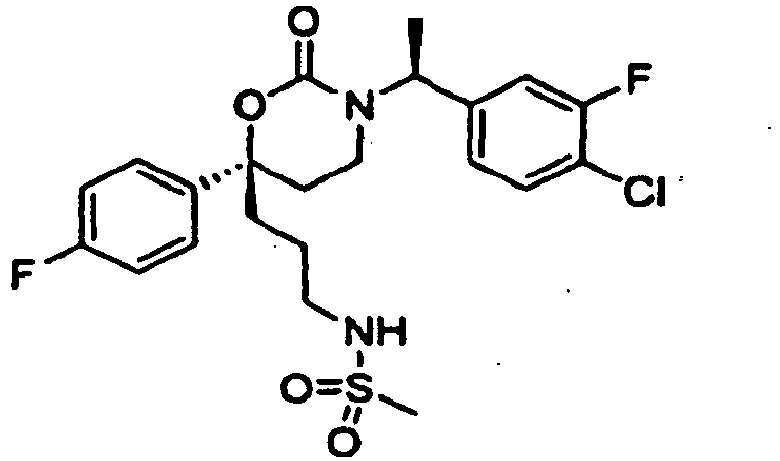
- The title compound was prepared from (R)-3-((S)-1-(4-chloro-3-fluorophenyl)ethyl)-6-(4-fluorophenyl)-6-(3-hydroxypropyl)-1,3-oxazinan-2-one following a procedure analogous to that described in Example 359. LC-MS Method 1 tR = 1.72, m/z = 487 (M+1); 1H NMR (CDCl3) 7.25-7.22 (m, 2H), 7.16 (t, 1H, J = 8 Hz), 7.07 (t, 2H, J = 8.6 Hz), 6.71-6.64 (m, 2H), 5.61 (q, 1H, J = 7 Hz), 3.87 (q, 2H, J = 7 Hz), 2.97-2.94 (m, 1H), 2.91 (s, 3H), 2.34-2.15 (m, 4 Hz), 2.04-1.86 (m, 2H), 1.77-1.66 (m, 1H), 1.49 (d, 3H, J = 7 Hz).
-

- The title compound was prepared from (R)-6-allyl-6-(4-fluorophenyl)-3-((S)-1-(4-(trifluoromethoxy)phenyl)ethyl)-1,3-oxazinan-2-one using a procedure analogous to that described in Example 78 followed by procedures analogous to those described in Example 234. LC-MS Method 2 tR = 1.299, m/z = 477; 1H NMR (CDCl3) 1.46 (d, 3H), 1.91 (m, 1H), 2.10-2.23 (m, 5H), 2.48 (m, 1H), 2.91 (m, 1 H), 5.22 (s, 1H), 5.39 (s, 1H), 5.61 (m, 1H), 6.91-7.01 (m, 6H), 7.18 (m, 2H).
-

- The title compound was prepared from (R)-6-allyl-3-((S)-1-(4-(difluoromethoxy)phenyl)propyl)-6-phenyl-1,3-oxazinan-2-one using a procedure analogous to that described in Example 78 followed by procedures analogous to those described in Example 234. LC-MS Method 3 tR = 0.975, m/z = 433.4; 1H NMR (CDCl3) 0.98 (t, 3H), 1.71-1.92 (m, 3H), 2.05-2.28 (m, 5H), 2.38-2.49 (m, 1H), 2.81 (m, 1H), 5.41 (m, 1H), 5.55 (s, 1H), 5.78 (s, 1H), 6.16-6.55 (t, 1H), 6.81 (d, 2H), 6.92 (d, 2H), 7.14 (d, 2H), 7.18-7.27 (m, 3H).
-

- The title compound was prepared from (R)-6-allyl-6-(4-fluorophenyl)-3-((S)-1-(4-(4,4,5,5-tetramethyl-1,3,2-dioxaborolan-2-yl)phenyl)ethyl)-1,3-oxazinan-2-one. First a procedure analogous to that described in Example 313 Step 4 was followed using 3-bromopyridin-2(1H)-one. Second a procedure analogous to that described in Example 313 Step 1 was used. Third a procedure analogous to that described in Example 343 was used. LC-MS Method 1 tR = 1.33, m/z = 487(M+1); 1H NMR (CDCl3) 7.47(dd, 1H), 7.41 (d, 2H), 7.37(dd, 1H), 7.25(m, 2H), 7.07(t, 2H), 6.96(d, 2H), 6.39(t, 1H), 5.66(m, 1H), 4.26(t, 1H), 3.66(s, 3H), 2.91(m, 1H), 1.54(d, 3H).
-

- The title compound was prepared from (R)-6-allyl-3-((S)-1-(4-bromophenyl)ethyl)-6-(4-fluorophenyl)-1,3-oxazinan-2-one following procedures analogous to those described in Example using and 6-chloropyridazin-3(2H)-one in Step 4. LC-MS Method 2 tR = 1.231, m/z = 490; 1H NMR (CD3OD) 1.33 (m, 1H), 1.56 (d, 3H), 1.61 (m, 1H), 1.98 (m, 2H), 2.21 (m, 1H), 2.31 (m, 1H), 2.43 (m, 2H), 3.13 (m, 1H), 3.48 (m, 2H), 5.53 (m, 1H), 6.69 (d, 1 H), 7.07-7.13 (m, 4H), 7.32 (m, 2H), 7.63 (m, 3H).
-

- The title compound was prepared following procedures analogous to those described in Example 313 using 5-bromo-1-ethylpyridin-2(1H)-one in Step 4. LC-MS Method 2 tR = 1.297, m/z = 461.1; 1H NMR (CDCl3) 1.31 (m, 1H), 1.36 (t, 3H), 1.51 (d, 3H), 1.68 (m, 1H), 1.86-2.01 (m, 2H), 2.18 (m, 1 H), 2.27 (m, 2H), 2.91 (m, 1 H), 3.52 (m, 2H), 4.18 (m, 2H), 5.13 (m, 1H), 5.62 (m, 1H), 6.91 (m, 3H), 7.08 (m, 2H), 7.18-7.33 (m, 5H), 7.41 (s, 1H), 7.61 (d, 1H).
-

- The title compound was prepared from (R)-6-allyl-3-((S)-1-(4-bromophenyl)propyl)-6-phenyl-1,3-oxazinan-2-one following procedures analogous to those described in Example 313. LC-MS Method 2 tR = 1.113, m/z = 461.1; 1H NMR (CDCl3) 0.95 (t, 3H), 1.30 (m, 1 H), 1.68 (m, 1H), 1.81-1.99 (m, 2H), 2.11-2.32 (m, 3H), 2.88 (m, 1H), 3.50 (m, 2H), 3.58 (m, 2H), 5.43 (m, 1H), 6.49 (d, 1 H), 6.98 (d, 2H), 7.08 (d, 2H), 7.19 (m, 1H), 7.25 (m, 4H), 7.32 (s, 1 H), 7.47 (m, 1H).
-
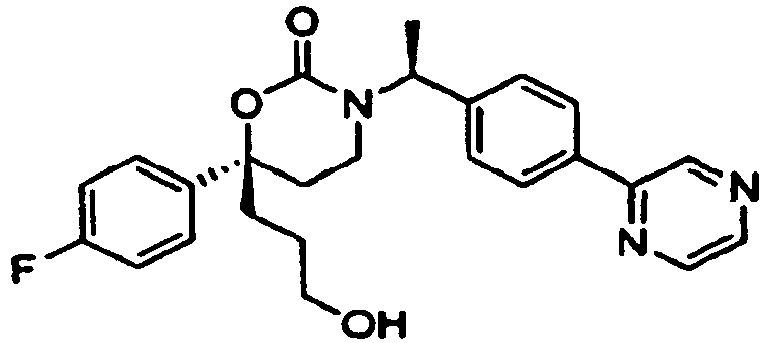
- The title compound was prepared from (R)-6-allyl-3-((S)-1-(4-bromophenyl)ethyl)-6-(4-fluorophenyl)-1,3-oxazinan-2-one following procedures analogous to those described in Example 313 using 2-bromopyrazine in Step 4. LC-MS Method 2 tR = 1.157, m/z = 458; 1H NMR (CDCl3) 1.31 (m, 1H), 1.52 (d, 3H), 1.63 (m, 1H), 1.81-1.95 (m, 2H), 2.09-2.32 (m, 3H), 2.91 (m, 1H), 3.68 (t, 2H), 5.69 (m, 1H), 6.91 (m, 4H), 7.21 (m, 2H), 7.73 (m, 2H), 8.43 (s, 1H), 8.56 (s, 1H), 8.89 (s, 1H).
-

- The title compound was prepared from (R)-6-allyl-3-((S)-1-(4-bromophenyl)ethyl)-6-(4-fluorophenyl)-1,3-oxazinan-2-one following procedures analogous to those described in Example 313 using 2-bromo-5-(trifluoromethyl)pyridine in Step 4. LC-MS Method 1 tR = 1.86, m/z = 503(M+1); 1H NMR (CDCl3) 8.87(s, 1H), 7.93(dd, 1H), 7.72(t, 3H), 7.18(m, 2H), 6.98(m, 4H), 5.67(m, 1H), 3.52(t, 1H), 2.89(m, 1H), 1.49(d, 3H).
-
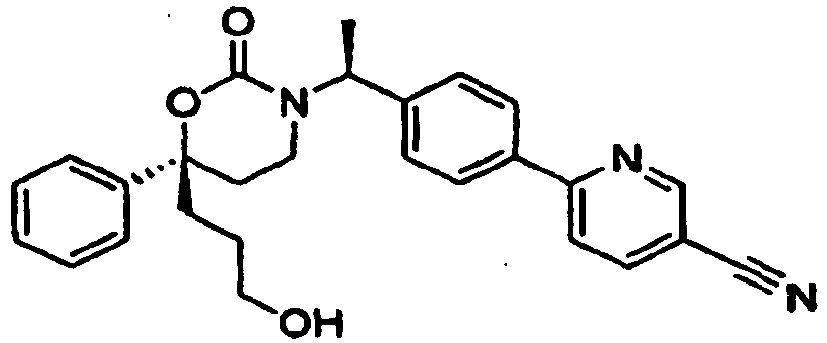
- The title compound was prepared from (R)-6-allyl-3-((S)-1-(4-bromophenyl)propyl)-6-phenyl-1,3-oxazinan-2-one following procedures analogous to those described in Example 313 using 2-bromo-5-cyanopyridine in Step 4. LC-MS Method 2 tR = 1.159, m/z = 442.4; 1H NMR (CD3OD) 1.21 (m, 1H), 1.48 (d, 3H), 1.53 (m, 1H), 1.85 (m, 2H), 2.15 (m, 1H), 2.22 (m, 1H), 2.42 (m, 1H), 3.05 (m, 1 H), 3.38 (m, 2H), 5.50 (m, 1 H), 6.98 (d, 2H), 7.25 (m, 3H), 7.28 (m, 2H), 7.79 (d, 2H), 7.89 (d, 1 H), 8.08 (m, 1H), 8.82 (s, 1H).
-

- The title compound was prepared from (S)-3-((S)-1-(4-bromophenyl)ethyl)-6-(4-fluorophenyl)-6-(2-hydroxy-2-methylpropyl)-1,3-oxazinan-2-one following procedures analogous to those described in Example 313 Steps 3 and 4 using 2-bromo-5-cyanopyridine in Step 4. LC-MS Method 2 tR = 1.301, m/z = 416; 1H NMR (CDCl3) 1.09 (d, 6H), 1.49 (d, 3H), 2.09-2.22 (m, 4H), 2.37 (m, 1H), 2.87 (m, 1H), 5.68 (m, 1H), 6.92-7.01 (t, 2H), 7.06 (m, 2H), 7.23 (m, 2H), 7.71 (d, 1H), 7.78 (d, 2H), 7.91 (d, 1H), 8.88 (s, 1H).
-

- The title compound was prepared from (R)-3-((S)-1-(4-bromophenyl)ethyl)-6-(3-hydroxypropyl)-6-phenyl-1,3-oxazinan-2-one following procedures analogous to those described in Example 313 Steps 3 and 4 using 2-bromo-5-fluoropyridine in Step 4. LC-MS Method 2 tR = 1.197, m/z = 435.1; 1H NMR (CDCl3) 1.21-1.37 (m, 2H), 1.48 (d, 3H), 1.81-1.95 (m, 2H), 2.18 (m, 1H), 2.20-2.31 (m, 2H), 2.85 (m, 1H), 3.52 (t, 2H), 5.65 (m, 1H), 6.95 (d, 2H), 7.22 (m, 3H), 7.28 (m, 2H), 7.40 (m, 1H), 7.58 (m, 3H), 8.42 (d, 1H).
-
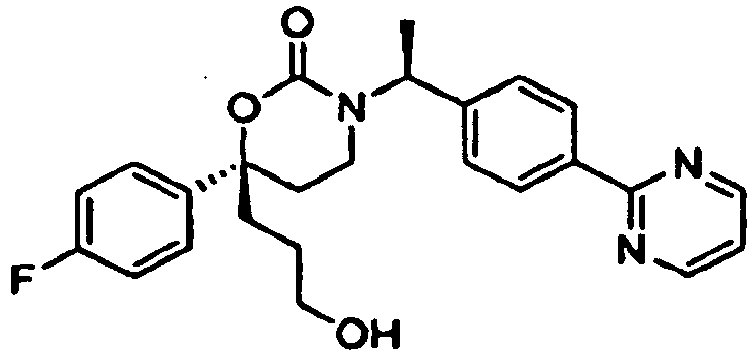
- The title compound was prepared from (R)-3-((S)-1-(4-bromophenyl)ethyl)-6-(4-fluorophenyl)-6-(3-hydroxypropyl)-1,3-oxazinan-2-one following procedures analogous to those described in Example 313 Steps 3 and 4 using 2-chloropyrimidine in Step 4. LC-MS Method 2 tR = 1.401, m/z = 436.1; 1H NMR (CDCl3) 1.53 (d, 3H), 1.62 (m, 1H), 1.81-1.98 (m, 3H), 2.15 (m, 2H), 2.31 (m, 1H), 2.76 (m, 1H), 3.51 (t, 2H), 5.67 (m, 1H), 6.92 (m, 4H), 7.11 (m, 1H), 7.19 (m, 1H), 8.15 (d, 2H), 8.71 (d, 2H).
-

- The title compound was prepared from (R)-3-((S)-1-(4-bromophenyl)ethyl)-6-(4-fluorophenyl)-6-(3-hydroxypropyl)-1,3-oxazinan-2-one following procedures analogous to those described in Example 313 Steps 3 and 4 using 3-chloro-6-methylpyridazine in Step 4. LC-MS Method 2 tR = 1.09, m/z = 450; 1H NMR (CDCl3) 1.26-1.39 (m, 1H), 1.50 (d, 3H), 1.59-1.70 (m, 1H), 1.81-1.99 (m, 3H), 2.09-2.20 (m, 2H), 2.22-2.34 (m, 1H), 2.71 (s, 3H), 2.90 (m, 1H), 3.50 (t, 2H), 5.67 (m, 1H), 6.90-7.08 (m. 4H), 7.19 (m, 1H), 7.21 (m, 1H),7.33 (d, 1H), 7.62 (d, 1H), 7.77 (d, 2H).
-

- The title compound was prepared from (S)-3-((S)-1-(4-bromophenyl)ethyl)-6-(4-fluorophenyl)-6-((1-hydroxycyclopropyl)methyl)-1,3-oxazinan-2-one and 2-methylpyridine-4-boronic acid following a procedure analogous to that described in Example 459 Step 1. LC-MS Method 2 tR = 0.996, m/z = 461.1; 1H NMR (CDCl3) 0.35 (m, 1H), 0.17 (m, 3H), 0.51 (m, 1H), 0.61 (m, 1H), 1.48 (d, 3H), 2.11(s, 2H), 2.28 (m, 1H), 2.42 (m, 2H), 2.56 (s,3H), 2.71 (s, 1H), 2.95 (m, 1H), 5.63 (m, 1H), 6.91 (m, 2H), 6.98 (m, 2H), 7.19 (m, 1H), 7.26-7.38 (m, 5H), 8.49 (d, 1H).
-

- The title compound was prepared from 3-((R)-3-((S)-1-(4-bromophenyl)ethyl)-6-(4-fluorophenyl)-2-oxo-1,3-oxazinan-6-yl)-2,2-dimethylpropanenitrile and 2-methylpyridine-4-boronic acid following a procedure analogous to that described in Example 459 Step 1. LC-MS Method 2 tR = 0.926, m/z = 472.2; 1H NMR (CD3OD) 1.31 (s, 3H), 1.41 (s, 1H), 1.58 (d, 3H), 2.30 (m, 2H), 2.34 (m, 1H), 2.43 (m, 1H), 2.61 (d, 2H), 2.81 (s, 3H), 3.21 (m, 1H), 5.62 (m, 1H), 7.08 (m, 2H), 7.29 (d, 2H), 7.41 (m, 2H), 7.79 (d, 2H), 8.09 (m, 1H), 8.19 (s, 1H), 8.68 (d, 1 H).
-

- The title compound was prepared from N-(2-((S)-3-((S)-1-(4-bromophenyl)ethyl)-2-oxo-6-phenyl-1,3-oxazinan-6-yl)ethyl)-N-methylmethanesulfonamide and 2-methylpyridine-4-boronic acid following a procedure analogous to that described in Example 459 Step 1. LC-MS Method 2 tR = 0.989, m/z = 508.1; 1H NMR (CDCl3) 1.53 (d, 3H), 2.17-2.32 (m, 5H), 2.63 (s. 3H), 2.71 (s, 3H), 2.81 (s, 3H), 2.93 (m, 2H), 3.22 (m, 1H), 5.67 (m, 1H), 7.08 (m, 2H), 7.21 (s, 2H), 7.25 (m, 3H), 7.33 (m, 2H), 7.61 (s, 1H), 7.71 (d, 1H), 8.72 (d, 1H).
-

- The title compound was prepared from (S)-3-((S)-1-(4-bromophenyl)ethyl)-6-(2-(1,1-dioxo-isothiazolidin-2-yl)ethyl)-6-phenyl-1,3-oxazinan-2-one and 2-methylpyridine-4-boronic acid following a procedure analogous to that described in Example 459 Step 1.
-

- The title compound was prepared from N-(3-((R)-3-((S)-1-(4-bromophenyl)ethyl)-2-oxo-6-phenyl-1,3-oxazinan-6-yl)propyl)-N-methylmethanesulfonamide and 2-methylpyridine-4-boronic acid following a procedure analogous to that described in Example 459 Step 1. LC-MS Method 2 tR = 1, m/z = 522.1; 1H NMR (CDCl3) 1.23 (m, 1H), 1.48 (d, 3H), 1.68-1.99 (m, 3H), 2.11-2.31 (m, 3H), 2.56 (s, 3H), 2.66 (s, 3H), 2.68(s, 3H), 2.84-3.08 (m, 3H), 5.68 (m, 1H), 6.92 (d, 1H), 7.15 (d, 1H), 7.25(m, 4H), 7.31 (m, 4H), 8.43 (d, 1H).
-

- The title compound was prepared from (R)-3-((S)-1-(4-bromophenyl)ethyl)-6-(3-hydroxypropyl)-6-phenyl-1,3-oxazinan-2-one following procedures analogous to those described in Example 313 Steps 3 and 4 using 4-bromo-2,6-dimethylpyridine-N-oxide in Step 4. LC-MS Method 2 tR = 1.086, m/z = 461.1; 1H NMR (CDCl3) 1.34 (m, 1H), 1.50 (d, 3H), 1.61-1.72 (m, 2H), 1.88-2.00 (m, 2H), 2.18 (m, 1H), 2.22-2.34 (m, 2H), 2.62 (s, 6H), 2.88 (m, 1 H), 3.51 (t, 2H), 5.65 (m, 1H), 6.93 (d, 2H), 7.21 (m, 1H), 7.26 (m, 4H), 7.29-7.38 (m, 4H).
-

- The title compound was prepared from (S)-3-((S)-1-(4-bromophenyl)ethyl)-6-(2-hydroxy-2-methylpropyl)-6-phenyl-1,3-oxazinan-2-one following procedures analogous to those described in Example 313 Steps 3 and 4 using 4-bromo-2,6-dimethylpyridine-N-oxide in Step 4. LC-MS Method 2 tR = 1.185, m/z = 459.1; 1H NMR (CDCl3) 1.11 (s, 3H), 1.18 (s, 3H), 1.57 (d, 3H), 2.20 (s, 2H), 2.22-2.35 (m, 2H), 2.38-2.49 (m, 1H), 2.72 (s, 6H), 2.91 (m, 1H), 5.70 (m, 1H), 7.08 (d, 2H), 7.31 (m, 3H), 7.37 (m, 4H), 7.43 (s, 2H).
-

- The title compound was prepared from (R)-3-((S)-1-(4-bromophenyl)ethyl)-6-(4-fluorophenyl)-6-(3-hydroxypropyl)-1,3-oxazinan-2-one following procedures analogous to those described in Example 313 Steps 3 and 4 using 4-bromo-2,6-dimethylpyridine-N-oxide in Step 4. LC-MS Method 2 tR = 1.092, m/z = 479.1; 1H NMR (CDCl3) 1.38 (m, 1H), 1.56 (d, 3H), 1.71 (m, 1H), 1.95 (m, 2H), 2.19-2.31 (m, 3H), 2.58 (s, 3H), 2.61 (s, 3H), 2.95 (m, 1H), 3.58 (m, 1H), 5.71 (m, 1H), 7.05 (m, 4H), 7.21-7.32 (m, 4H), 7.38 (m, 2H).
-

- The title compound was prepared from (S)-3-((S)-1-(4-bromophenyl)ethyl)-6-(4-fluorophenyl)-6-(2-hydroxy-2-methylpropyl)-1,3-oxazinan-2-one following procedures analogous to those described in Example 313 Steps 3 and 4 using 4-bromo-2,6-dimethylpyridine-N-oxide in Step 4. LC-MS Method 2 tR = 1.354, m/z = 493; 1H NMR (CDCl3) 1.18 (d, 6H), 1.48 (d, 3H), 2.08-2.21 (m, 5H), 2.36 (m, 1H), 2.53 (s, 6H), 2.82 (m, 1H), 5.65 (m, 1H), 6.98 (m, 4H), 7.18 (m, 4H), 7.28 (m, 2H).
-

- The title compound was prepared from (S)-6-(4-fluorophenyl)-6-(2-hydroxy-2-methylpropyl)-3-((S)-1-(4-(2-methylpyridin-4-yl)phenyl)ethyl)-1,3-oxazinan-2-one following a procedure analogous to that described in Example 441. LC-MS Method 1 tR = 1.28, m/z = 479 (M+1); 1H NMR (CDCl3) 8.52 (d, J = 6.2 Hz, 1H), 7.56-7.27 (m, 6H), 7.11-7.00 (m, 4H), 5.70 (q, J = 7.0 Hz, 1H), 2.97-2.93 (m, 1 H), 2.69 (s, 3H), 2.50-2.42 (m, 1H), 2.31-2.16 (m, 4H), 1.55 (d, J = 7.0 Hz, 3H), 1.14 (s, 6H).
-

- The title compound was prepared from (R)-3-((S)-1-(4-bromophenyl)ethyl)-6-(3-hydroxypropyl)-6-phenyl-1,3-oxazinan-2-one following procedures analogous to those described in Example 313 Steps 3 and 4 using 2-amino-4-bromopyridine in Step 4. LC-MS Method 2 tR = 0.951, m/z = 432: 1H NMR (CDCl3) 1.26-1.40 (m, 1H), 1.48 (d, 3H), 1.59-1.63 (m, 1H), 1.83-1.95 (m, 2H), 2.09-2.20 (m, 1H), 2.21-2.37 (m, 2H), 2.86 (m, 1H), 3.50 (m, 2H), 4.54-4.75 (s, 2H), 5.62 (m, 1H), 6.56 (s, 1H), 6.71 (d, 1H), 6.90 (d, 2H), 7.21-7.33 (m, 7H), 8.00 (m, 1H).
-

- The title compound was prepared from (R)-3-((S)-1-(4-bromophenyl)ethyl)-6-(3-hydroxypropyl)-6-phenyl-1,3-oxazinan-2-one following procedures analogous to those described in Example 313 Steps 3 and 4 using 4-bromo-2-hydroxypyridine in Step 4. LC-MS Method 2 tR = 1.019, m/z = 865.4; 1H NMR (CDCl3) 1.29-1.40 (m, 1H), 1.49 (d, 3H), 1.60-1.72 (m, 1H), 1.83-2.01 (m, 3H), 2.18 (m, 1H), 2.21-2.37 (m, 2H), 2.88 (m, 1H), 3.51 (m, 2H), 5.63 (m, 1H), 6.41 (d, 1H), 6.68 (s, 1 H), 6.90 (d, 2H), 7.21-7.33 (m, 7H), 7.39 (d, 1H).
-

- The title compound was prepared from (R)-3-((S)-1-(4-bromophenyl)ethyl)-6-(4-fluorophenyl)-6-(3-hydroxypropyl)-1,3-oxazinan-2-one following procedures analogous to those described in Example 313 Steps 3 and 4 using 4-bromo-2-methylpyrimidine in Step 4. LC-MS Method 2 tR = 1.159, m/z = 450; 1H NMR (CDCl3) 1.33 (m, 3H), 1.52 (m, 3H), 1.63 (m, 3H), 1.80-1.95 (m, 2H), 2.15-2.30 (m, 3H), 2.75 (s, 3H), 2.90 (m, 1H), 3.51 (m, 2H), 5.68 (m, 1H), 6.99 (m, 4H), 7.20 (m, 2H), 7.41 (m, 1H), 7.79 (d, 2H), 8.60 (m, 1H).
-

- The title compound was prepared from (R)-3-((S)-1-(4-bromophenyl)ethyl)-6-4-fluorophenyl)-6-(3-hydroxypropyl)-1,3-oxazinan-2-one following procedures analogous to those described in Example 313 Steps 3 and 4 using 4-bromo-2,6-dimethylpyrimidine in Step 4. LC-MS Method 2 tR = 1.073, m/z = 464.1; 1H NMR (CD3OD) 1.21 (m, 1H), 1.48 (d, 3H), 1.82 (m, 2H), 2.15 (m, 1H), 2.23 (m, 2H), 2.38 (m, 1H), 2.46 (s, 3H), 2.62 (s, 3H), 3.08 (m, 1H), 3.39 (m, 2H), 5.51 (m, 1H), 6.95-7.08 (m, 4H), 7.21 (m, 2H), 7.51 (s, 1H), 7.83 (d, 2H).
-

- The title compound was prepared from (R)-3-((S)-1-(4-bromophenyl)ethyl)-6-(4-fluorophenyl)-6-(3-hydroxypropyl)-1,3-oxazinan-2-one following procedures analogous to those described in Example 313 Steps 3 and 4 using 4-chloropyrimidine in Step 4. LC-MS Method 2 tR = 1.172, m/z = 392.1; 1H NMR (CDCl3) 1.28-1.40 (m, 1H), 1.52 (m, 3H), 1.64 (m, 2H), 1.81-1.99 (m, 2H), 2.09-2.37 (m, 3H), 2.90 (m, 1H), 3.51 (t, 2H), 5.68 (m, 1H), 6.88-7.07 (m, 3H), 7.16-7.28 (m, 3H), 7.58 (m, 1H), 7.79 (d, 2H), 8.61- 8.80 (d, 1H), 9.18 (s, 1H).
-

- The title compound was prepared from (R)-3-((S)-1-(4-bromophenyl)ethyl)-6-(4-fluorophenyl)-6-(3-hydroxypropyl)-1,3-oxazinan-2-one following procedures analogous to those described in Example 313 Steps 3 and 4 using 5-bromopyrimidine in Step 4. LC-MS Method 2 tR = 1.332, m/z = 436.1; 1 H NMR (CD3OD) 1.49 (d, 3H), 1.83 (m, 2H), , 2.14-2.28 (m, 4H), 2.42 (m, 1H), 3.08 (m, 1H), 3.49 (m, 2H), 5.52 (m, 1H), 6.99 (t, 2H), 7.08 (d, 2H), 7.23 (m, 2H), 7.42 (d, 2H), 8.91 (s, 2H), 9.06(s, 1 H).
-
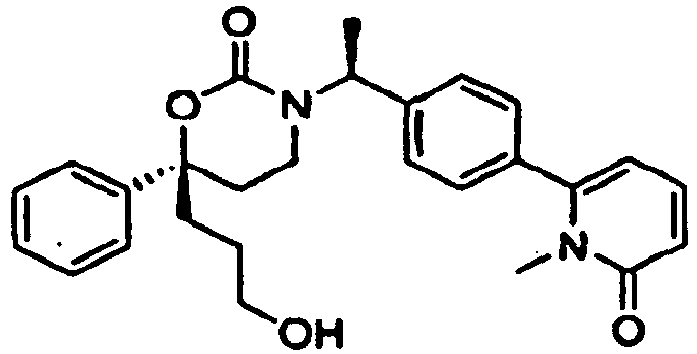
- The title compound was prepared from (R)-3-((S)-1-(4-bromophenyl)ethyl)-6-(3-hydroxypropyl)-6-phenyl-1,3-oxazinan-2-one following procedures analogous to those described in Example 313 Steps 3 and 4 using 6-bromo-1-methylpyridin-2(1H)-one in Step 4. LC-MS Method 2 tR = 1.088, m/z = 447; 1H NMR (CDCl3) 1.38 (m, 1H), 1.56 (d, 3H), 1.70 (m, 1H), 1.95-2.08 (m, 2H), 2.23 (m, 1H), 2.37 (s, 2H), 3.05 (m, 1H), 3.33 (s, 3H), 3.58 (m, 2H), 5.73 (m, 1H), 6.29 (d, 1H), 6.89 (d, 1H), 7.01-7.09 (m, 4H), 7.21-7.39 (m, 5H), 7.53 (t, 1H).
- 6-Bromo-1-methylpyridin-2(1H)-one was prepared from 6-bromopyridin-2(1H)-one following a procedure analogous to that described in Example 313 Step 1.
-

- To a suspension of NaH (80 mg, 2 mmol) in THF (10 mL) was added 4-bromopyridin-2-ol (80 mg, 0.46 mmol) at 0 °C. The resulting mixture was stirred for 1 h. Then CH3I (355 mg, 2.5 mmol) was added to the above mixture, and the mixture was stirred overnight. The reaction was quenched with aqueous NH4Cl solution. The organic phase was concentrated to give the crude product, which was purified by column to give 4-bromo-1-methylpyridin-2(1H)-one (42.3 mg, 50%).
- A mixture of (R)-6-(3-hydroxypropyl)-6-phenyl-3-((S)-1-(4-(4,4,5,5-tetramethyl-1,3,2- dioxaborolan-2-yl)phenyl)ethyl)-1,3-oxazinan-2-one (50 mg, 0.11 mmol) and 4-bromo-1- methylpyridin-2(1H)-one (30 mg, 0.16 mmol). Pd(Ph3P)2Cl2 (10 mg), and aq. Cs2CO3 solution (4 mL, 2 M) in 1,4-dioxane (10 mL) was stirred and heated to reflux for 2 h. When the reaction was over, the mixture was washed with water and extracted with EtOAc. The organic phase was washed with brine, dried over Na2SO4, filtered and concentrated to give the crude product, which was purified by preparative TLC to give (R)-6-(3-hydroxypropyl)-3-((S)-1-(4-(1-methyl-2-oxo-1,2-dihydropyridin-4-yl)phenyl)ethyl)-6-phenyl-1,3-oxazinan-2-one (25 mg , 51%). 1H NMR (CDCl3): δ=1.35 (m, 1H), 1.47 (d, 3H), 1.63 (m, 2H), 1.94 (m, 2H), 2.18 (m, 1H), 2.39 (m, 2H), 2.86 (m, 1H), 3.51 (m, 5H), 5.63 (m, 1 H), 6.31 (m, 1H), 6.70 (m, 1H), 6.91 (m, 2H), 7.20-7.32 (m, 8H).
-
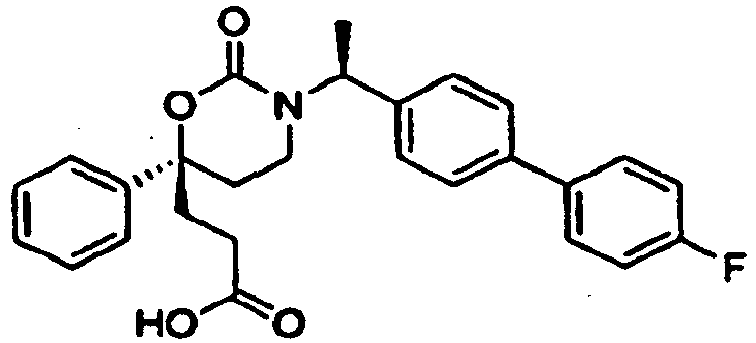
- The title compound was prepared from (R)-3-((S)-1-(4'-fluorobiphenyl-4-yl)ethyl)-6-(3-hydroxypropyl)-6-phenyl-1,3-oxazinan-2-one as described in Example 234 Step 1. LC-MS Method 2 tR = 1.397, m/z = 448; 1H NMR (CDCl3) 1.53 (d, 3H). 2.08-2.21 (m, 3H), 2.24-2.35 (m, 3H), 2.61 (m, 1H), 2.89 (m, 1H), 5.68 (m, 1H), 6.95 (d, 2H), 7.08 (m, 2H), 7.26 (m, 5H), 7.34 (m, 2H), 7.42 (m, 2H).
-

- The title compound was prepared from 3-((R)-3-((S)-1-(4'-fluorobiphenyl-4-yl)ethyl)-2-oxo-6-phenyl-1,3-oxazinan-6-yl)-2,2-dimethylpropanenitrile following a procedure analogous to that described in Example 522. LC-MS Method 1 tR = 1.79, m/z = 475 (M+1); 1H NMR (CDCl3) 7.45-7.42 (m, 2H), 7.31-7.27 (m, 7H), 7.10 (t, J = 8.5 Hz, 2H), 7.03 (d, J = 8.2 Hz, 2H), 5.70 (m, 1H), 2.96-2.93 (m, 1H), 2.66 (m, 2H), 2.49-2.45 (m, 1H), 2.30-2.23 (m, 2H), 1.56 (d, J = 5.9 Hz, 3H), 1.26 (s, 3H), 1.20 (s, 3H).
-

- The title compound was prepared from (S)-3-((S)-1-(4-bromophenyl)ethyl)-6-(2-hydroxy-2-methylpropyl)-6-phenyl-1,3-oxazinan-2-one following procedures analogous to those described in Example 313 Steps 3 and 4 using 2-bromopyrazine. LC-MS Method 2 tR = 1.249, m/z = 374; 1H NMR (CDCl3) 1.12 (s, 3H), 1.28 (s, 3H), 1.58 (m, 3H), 2.19-2.20 (m, 4H), 2.39 (m, 1H), 2.89 (m, 1H), 5.74 (m, 1H), 7.09 (m, 2H), 7.28-7.40 (m, 5H), 7.78 (m, 2H), 8.48 (m, 1H), 8.59 (m, 1 H), 8.94 (m, 1H).
-

- The title compound was prepared from (S)-3-((S)-1-(4-bromophenyl)ethyl)-6-(2-hydroxy-2-methylpropyl)-6-phenyl-1,3-oxazinan-2-one following procedures analogous to those described in Example 313 Steps 3 and 4 using 4-chloropyrimidine in Step 4. LC-MS Method 2 tR = 1.167, m/z = 374; 1H NMR (CDCl3) 1.06 (s, 3H), 1.11 (s, 3H), 1.49 (d, 3H), 2.11 (s, 1H), 2.17 (s, 2H), 2.21 (m, 1H), 2.35 (m, 1H), 2.80 (m, 1 H), 5.66 (m, 1 H), 7.02 (d, 2H), 7.21-7.36 (m, 5H), 7.54 (d, 1H), 7.78 (d, 2H), 8.68 (d, 1H), 9.16 (s, 1H).
-

- The title compound was prepared from (R)-3-((S)-1-(4-bromophenyl)ethyl)-6-(4-fluorophenyl)-6-(3-hydroxypropyl)-1,3-oxazinan-2-one following procedures analogous to those described in Example 313 Steps 3 and 4 using 3-chloropyridazine in Step 4. LC-MS Method 2 tR = 1.067, m/z = 436.1; 1H NMR (CDCl3) 0.82 (m, 3H), 1.52 (d, 3H), 1.65 (m, 1H), 1.80-1.98 (m, 2H), 2.11-2.28 (m, 3H), 2.91 (m, 1H), 3.51 (t, 3H), 5.68 (m, 1H), 6.94-7.04 (m, 4H), 7.18 (m, 2H), 7.47 (m, 1H), 7.71 (d, 1H), 7.78 (d, 2H), 9.08 (d, 1H).
-

- The title compound was prepared from (R)-3-((S)-1-(4-bromophenyl)ethyl)-6-(3-hydroxypropyl)-6-phenyl-1,3-oxazinan-2-one following procedures analogous to those described in Example 313 Steps 3 and 4 using 4-bromo-2,6-dimethylpyridine in Step 4. LC-MS Method tR = 1.228, m/z = 445; 1H NMR (CDCl3) 1.32 (m, 1H) 1.51 (d, 3H), 1.60-1.72 (m, 1H), 1.86-2.02 (m, 2H), 2.19 (m, 1H), 2.25-2.39 (m, 2H), 2.79 (s, 6H), 2.93 (m, 1H), 3.50 (t, 2H), 5.64 (m, 1H), 7.00 (d, 2H), 7.21 (m, 2H), 7.29 (m, 2H), 7.32 (m, 3H), 7.40 (m, 2H).
-

- The title compound was prepared from (S)-3-((S)-1-(4-bromophenyl)ethyl)-6-(2-hydroxy-2-methylpropyl)-6-phenyl-1,3-oxazinan-2-one following procedures analogous to those described in Example 313 Steps 3 and 4 using 3-chloro-6-methylpyridazine in Step 4. LC-MS Method 2 tR = 1.118, m/z = 446; 1H NMR (CD3OD) 0.96 (s, 3H), 1.26 (s, 3H), 1.58 (d, 3H), 2.17 (s, 2H), 2.26 (m, 1H), 2.50 (m, 2H), 2.69 (s, 3H), 3.08 (m, 1H), 5.59 (m, 1H), 7.11 (m, 2H), 7.25-7.40 (5H), 7.63 (m, 1 H), 7.82 (m, 2H), 7.98 (d, 1H).
-

- (S)-6-(2-Hydroxy-2-methyl-propyl)-3-{(S)-1-[4-(6-methyl-pyridazin-3-yl)-phenyl]-ethyl}-6-phenyl-[1,3]oxazinan-2-one was prepared from (S)-6-(2-hydroxy-2-methylpropyl)-6-phenyl-3-[(S)-1-(4-(4,4,5,5- tetramethyl-1,3,2-dioxaborolan-2-yl)phenyl)ethyl]-1,3-oxazinan-2-one and 3-chloro-6-methyl-pyridazine following a procedure analogous to that described in Example 583 Method 2. Yield: 3.09 g (62% of theory). Mass spectrum (ESI*): m/z = 446 [M+H]+
-

- The title compound was prepared from (S)-3-((S)-1-(4-bromophenyl)ethyl)-6-(2-hydroxy-2-methylpropyl)-6-phenyl-1,3-oxazinan-2-one following procedures analogous to those described in Example 313 Steps 3 and 4 using 4-chloro-2-methylpyrimidine in Step 4. LC-MS Method 2 tR = 1.196, m/z = 446; 1H NMR (CD3OD) 0.92 (s, 3H), 1.27 (s, 3H), 1.58 (d, 3H), 2.12 (s. 2H), 2.23 (m, 1H), 2.51-2.66 (m, 2H), 2.70 (s, 3H), 3.07 (m, 1H), 5.59 (m, 1H), 7.09 (d, 2H), 7.16-7.42 (m, 5H), 7.65 (d, 1H), 7.89 (d, 2H), 8.61 (d, 1H).
-

- The title compound was prepared from (S)-3-((S)-1-(4-bromophenyl)ethyl)-6-(2-hydroxy-2-methylpropyl)-6-phenyl-1,3-oxazinan-2-one following procedures analogous to those described in Example 313 Steps 3 and 4 using 2-bromo-5-fluoropyridine in Step 4. LC-MS Method 2 tR = 1.363, m/z = 390.9; 1H NMR (CDCl3) 1.11 (s, 3H), 1.19 (s, 3H), 1.53 (d, 3H), 2.16-2.30 (m, 4H), 2.32-2.43 (m, 1H), 2.86 (m, 1H), 5.71 (m, 1H), 7.03 (d, 2H), 7.30 (m, 1H), 7.36 (m, 4H), 7.44 (m, 1H), 7.69 (dd, 1H), 7.68 (d, 2H), 8.43 (d, 1H).
-

- To a solution of ZnBr2 (1.33 g, 6 mmol) in THF (15 mL) was added MeMgBr (0.69 g, 6 mmol) under N2 at -78 °C. The mixture was stirred for 1 h and used for next step. To a solution of 5-bromo-2-iodo-pyrimidine (1.42 g, 5 mmol) in THF (15 mL) was added Pd(PPh3)4 (0.366 g, 0.33 mmol) and the prepared MeZnBr solution (10 mL) under N2 at 0 °C. The mixture was heated to 60 °C for 5 h during which time a second portion of MeZnBr solution (5 mL) was added. After cooling to room temperature, the reaction was poured into aqueous NH4Cl solution. The mixture was extracted with EtOAc. The organic phase was separated and dried over Na2SO4, concentrated to give 5-bromo-2-methylpyrimidine (60 mg, 7%). 1H NMR (CDCl3): 1.63 (s, 3H), 8.82 (s, 2H).
- To a solution of (R)-6-(4-fluorophenyl)-6-(3-hydroxypropyl)-3-((S)-1-(4-(4,4,5,5-tetramethyl-1,3,2-dioxaborolan-2-yl)phenyl)ethyl)-1,3-oxazinan-2-one (61 mg, 0.13 mmol), 5-bromo-2-methylpyrimidine (18 mg, 0.11 mmol), PdCl2(PPh3)2 (6 mg, 10%) and aqueous solution of Cs2CO3 (2 mol/L, 0.13 mL) in 1,4-dioxane (1 mL) was heated to reflux overnight. The reaction was quenched with water. The organic layer was separated, dried and concentrated to give the residue, which was purified by column chromatography to give (R)-6-(4-fluorophenyl)-6-(3-hydroxypropyl)-3-((S)-1-(4-(2-methylpyrimidin-5-yl)phenyl)ethyl)-1,3-oxazinan-2-one (22 mg, 39%). 1H NMR (CDCl3): 1.42 (m, 1H), 1.48 (d, 3H), 1.67 (m, 1H), 1.71-1.99 (m, 4H), 2.11-2.41 (m, 3H), 2.52 (s, 3H), 2.72 (m, 1H), 3.53 (m, 2H), 5.62 (m, 1H), 6.89-7.04 (m, 4H), 7.15-7.33 (m, 4H), 8.70 (s, 2H). LC-MS Method 2 tR = 1.184, m/z = 450; 1H NMR (CDCl3) 1.20 (d, 1H), 1.27-1.40 (m, 1H), 1.49 (d, 3H), 1.59-1.70 (m, 1H), 1.71-2.07 (m, 4H), 2.11-2.33 (m, 3H), 2.70 (s, 3H), 2.90 (m, 1H), 3.46-3.61 (t, 2H), 5.67 (m, 1H), 6.90-7.11 (m, 4H), 7.26 (m, 4H), 8.57-8.83 (s, 2H).
-

- The title compound was prepared from 3-((R)-3-((S)-1-(4-bromophenyl)ethyl)-6-(4-fluorophenyl)-2-oxo-1,3-oxazinan-6-yl)-2-methylpropanenitrile following a procedure analogous to that described in Example 522. Two isomers were isolated by chromatography on a chiral column.
- Isomer 1: LC-MS Method 1 tR = 1.78, m/z = 450, 452 (M+1); 1H NMR (CD3OD) 7.24-7.17 (m, 4H), 7.03-6.98 (m, 2H), 6.79 (d, J = 8.5 Hz, 2H), 5.40 (q, J = 7.0 Hz, 1H), 3.33-3.29 (m, 1H), 3.00-2.96 (m, 1H), 2.34-2.28 (m, 1H), 2.18-2.07 (m, 2H), 1.95-1.90 (m, 1H), 1.62-1.54 (m, 2H), 1.40 (d, J = 7.0 Hz, 3H), 1.23-1.18 (m, 1H), 0.59 (d, J = 6.5 Hz, 3H).
- Isomer 2: LC-MS Method 1 tR = 1.75, m/z = 450, 452 (M+1); 1H NMR (CD3OD) 7.25-7.19 (m, 4H), 7.01 (t, J = 8.8 Hz, 2H), 6.82 (d, J = 8.5 Hz, 2H), 5.41 (q, J = 7.0 Hz, 1H), 3.05-3.00 (m, 3H), 2.33-2.29 (m, 1H), 2.22-2.09 (m, 2H), 1.98-1.94 (m, 1H), 1.61-1.55 (m, 1H), 1.42 (d, J = 7.0 Hz, 3H), 1.24-1.19 (m, 1H), 0.83 (d, J = 6.7 Hz, 3H).
-

- The title compound was prepared from (R)-6-allyl-3-((S)-1-(4-chloro-2-fluorophenyl)ethyl)-6-(4-fluorophenyl)-1,3-oxazinan-2-one by sequentially following procedures analogous to those described in Examples 520, 521 and 522. LC-MS Method 1 tR = 1.62, m/z = 451 (M+1).
-

- A mixture of (R)-6-(4-fluorophenyl)-6-(3-hydroxypropyl)-3-((S)-1-(4-(4,4,5,5-tetramethyl-1,3,2-dioxaborolan-2-yl)phenyl)ethyl)-1,3-oxazinan-2-one (500 mg, 1.03 mmol), 2,4-dichloropyrimidine (183.7 mg, 1.24 mmol), PdCl2(PPh3)2 (41.2 mg, 5.9%) and aqueous solution of Cs2CO3 (2 mol/L, 2 mL) in 1,4-dioxane (5 mL) was heated to reflux overnight. The reaction was quenched with water. The organic layer was separated, dried, and concentrated to give the residue, which was purified by column chromatography to give (R)-3-((S)-1-(4-(2-chloropyrimidin-4-yl)phenyl)ethyl)-6-(4-fluorophenyl)-6-(3-hydroxypropyl)-1,3-oxazinan-2-one (300 mg, 62%).
- (R)-3-((S)-1-(4-(2-chloropyrimidin-4-yl)phenyl)ethyl)-6-(4-fluorophenyl)-6-(3-hydroxypropyl)-1,3-oxazinan-2-one (300 mg, 0.6 mmol) was dissolved in MeOH/NH3 (10 mL). The resulting mixture was heated to 90 °C for 24 h. The mixture was concentrated to give the crude product, which was purified by preparative TLC to give (R)-3-((S)-1-(4-(2-aminopyrimidin-4-yl)phenyl)ethyl)-6-(4-fluorophenyl)-6-(3-hydroxypropyl)-1,3-oxazinan-2-one (270 mg, 90%).
- To a solution of (R)-3-((S)-1-(4-(2-aminopyrimidin-4-yl)phenyl)ethyl)-6-(4-fluorophenyl)-6-(3-hydroxypropyl)-1,3-oxazinan-2-one (40 mg, 0.089 mmol) in CH3COOH (0.3 mL) and H2O (0.13 mL) was added an aqueous solution of NaNO2 (2 mol/L, 0.5 mL) dropwise at 0 °C. The reaction was stirred for 10 min at this temperature before heating at 60 °C for 3 h. After the mixture was evaporated to dryness, the mixture was adjusted pH 9 with aqueous NaHCO3 solution. The mixture was extracted with EtOAc, and the organic layer was dried and concentrated to give the residue, which was purified by preparative TLC to give (R)-6-(4-fluorophenyl)-6-(3-hydroxypropyl)-3-((S)-1-(4-(2-hydroxypyrimidin-4-yl) phenyl)ethyl)-1,3-oxazinan-2-one (3.18 mg, 8%). LC-MS Method 2 tR = 0.87 min, m/z = 452. 1H NMR (CD3OD): 1.19-1.23 (m, 2H), 1.48 (d, 3H), 1.82-1.86 (m, 2H), 2.05-2.41 (m, 3H), 3.01-3.10 (m, 1H), 3.37 (t, 2H), 5.50 (q, 1H), 6.90 (d, 1H), 6.95-7.02 (m, 4H), 7.18-7.22 (m, 2H), 7.00-7.05 (m, 3H), 7.21-7.24 (m, 2H), 7.80 (d, 2H).
-

- To a mixture of ((R)-6-(4-fluorophenyl)-6-(3-hydroxypropyl)-3-((S)-1-(4-(4,4,5,5- tetramethyl-1,3,2-dioxaborolan-2-yl)phenyl)ethyl)-1,3-oxazinan-2-one (30 mg, 0.062 mmol), 4,6-dichloropyrimidine (12 mg, 0.081 mmol), and 2 M aqueous Cs2CO3 (1.0 mL) in dry THF (2 mL) was added Pd(dppf)Cl2 (6 mg, 0.00621 mmol) under N2 atmosphere. The mixture was heated to reflux for 2 hours. Then the solvent was evaporated, and the residue was purified by preparative TLC to afford (R)-3-((S)-1-(4-(6-chloropyrimidin-4-yl) phenyl)ethyl)-6-(4-fluorophenyl)-6-(3-hydroxypropyl)-1,3-oxazinan-2-one (20 mg, yield 68%).
- A mixture of (R)-3-((S)-1-(4-(6-chloropyrimidin-4-yl)phenyl)ethyl)-6-(4-fluorophenyl)-6- (3-hydroxypropyl)-1,3-oxazinan-2-one (20 mg, 0.0426 mmol) in 15% aq NaOH (5 mL) was heated to 110 °C overnight. Then the solvent was evaporated, and the residue was washed with EtOAc. The solid was filted off and the filtrate was dried, and condensed in vacuum to give the crude product, which was purified by preparative HPLC to afford (R)-6-(4-fluorophenyl)-6-(3-hydroxypropyl)-3-((S)-1-(4-(6-hydroxypyrimidin-4-yl)phenyl)ethyl)-1,3-oxazinan-2-one (15 mg, 78%). LC-MS Method 2 tR = 0.91 min, m/z = 452, 408. 1H NMR (CD3OD): δ=1.31 (m, 1H), 1.59 (m, 3H), 1.95 (m, 2H), 2.25 (m, 1H), 2.35 (m, 1H), 2.46 (m, 1H), 3.15 (m, 1H), 3.48 (m, 2H), 5.59 (m, 1H), 6.81 (s, 1H), 7.12 (m, 4H), 7.33 (m, 2H), 7.79 (m, 2H), 8.25 (s, 1H).
-

- The title compound was prepared from (R)-6-allyl-3-((S)-1-(4-bromo-2-fluorophenyl)ethyl)-6-(4-fluorophenyl)-1,3-oxazinan-2-one following a procedure analogous to that described in Example 343.
-

- To a solution of 2-(tert-butoxycarbonylamino)acetic acid (8.75 g, 0.05 mol) in tetrahydrofuran (150 mL) was added CDI (11.34 g, 0.07 mmol) at 0 °C. The formed mixture was stirred for 1 h. Then N,O-dimethylhydroxylamine (6.8 g, 0.07 mol) and TEA (8 mL) were added to the above mixture. The mixture was stirred at rt overnight. When the reaction was over, the mixture was concentrated. The residue was washed with 1 N aq HCl and aq. NaHCO3 (3 x). The combined organic phase was concentrated to give crude product, which was used for next step without purification. 1H NMR (400 MHz, CDCl3): δ=1.42 (s, 9H), 3.16 (s, 3H), 3.66 (s, 3H), 4.04 (s, 2H), 5.22 (s, 1 H).
- To a solution of tert-butyl 2-(methoxy(methyl)amino)-2-oxoethylcarbamate (4.36 g, 0.02 mol) in THF (50 mL) added MeMgBr (40 ml, 0.08 ol) at -78 °C. The formed mixture was stirred overnight. The mixture was quenched with NH4Cl and extracted with EtOAc. The organic phase was separated, dried over anhydrous Na2SO4, concentrated and purified by column chromatography to give tert-butyl 2-oxopropylcarbamate (2.5 g, 72%). 1H NMR (400 MHz, CDCl3): δ=1.42 (s, 9H), 2.18 (s, 3H), 4.01 (s, 2H), 5.22 (s, 1H).
- tert-Butyl 2-oxopropylcarbamate (2.5 g, 0.014 mol) was dissolved in a solution of 20% (V/V) TFA/CH2Cl2 (50 mL). The reaction mixture was stirred at rt for 1 h, and concentrated in vacuo to afford 1-aminopropan-2-one (1.03 g, 99%), which was used for next step directly without purification.
- To a solution of (R)-6-allyl-3-((S)-1-(4-bromophenyl)ethyl)-6-phenyl-1,3-oxazinan-2- one (3.0 g, 7.52 mmol) in acetone (50 mL) was added a solution of NalO4 (7.95 g, 30.8 mmol) and KMnO4 (0.95 g, 4.51 mmol) in water (30 mL). The formed mixture was stirred for 1 h. The solid was filtered, and the filtrate was concentrated to give the residue, which was acidified to pH<7 with 1 N aq HCl. The mixture was extracted with EtOAc, and the organic phase was concentrated to give crude 2-((S)-3-((S)-1-(4-bromophenyl)ethyl)-2-oxo-6-phenyl- 1,3-oxazinan-6-yl)acetic acid (2.6 g, 84%), which was used for the next step without purification.
- To a solution of 2-((S)-3-((S)-1-(4-bromophenyl)ethyl)-2-oxo-6-phenyl-1,3-oxazinan- 6-yl)acetic acid (200 mg, 0.5 mmol) in anhydrous CH2Cl2 (10 mL) was added 1-aminopropan-2-one (119 mg, 0.7 mmol), HOBt (195 mg, 1.44 mmol). EDCI (283 mg, 1.44 mmol) and DIEA (620 mg, 4.8 mol) at 0 °C. The formed mixture was stirred overnight at ambient temperature under nitrogen. Then the reaction mixture was washed with 1N aq HCl and water. The organic phase was dried over Na2SO4, filtered and concentrated to afford the residue, which was purified by prep TLC to give 2-((S)-3-((S)-1-(4-bromophenyl) ethyl)-2-oxo-6-phenyl-1,3-oxazinan-6-yl)-N-(2-oxopropyl)acetamide (118 mg, 50%). 1H NMR (400 MHz, CDCl3): δ=1.43 (d, 3H), 2.06 (s, 3H), 2.20 (m. 1H), 2.43 (m, 2H), 2.68 (m, 1H), 2.86 (m, 2H), 3.90 (m, 1H), 4.12 (m, 1H), 5.51 (m, 1H), 6.53 (m, 1H), 6.78 (m, 2H), 7.14 (m, 2H), 7.30 (m, 5H).
- To a solution of 2-((S)-3-((S)-1-(4-bromophenyl)ethyl)-2-oxo-6-phenyl-1,3-oxazinan-6-yl)- N-(2-oxopropyl)acetamide (50 mg, 0.11 mmol) in toluene (30 mL) was added CH3COOH (2 mL) and NH4OAc (500 mg) at room temperature. The formed mixture was heated to reflux for 4 hours. The mixture was concentrated to give the crude product, which was purified by preparative TLC and preparative HPLC to give (S)-3-((S)-1-(4-bromophenyl) ethyl)-6-((5-methyl-1H-imidazol-2-yl)methyl)-6-phenyl-1,3-oxazinan-2-one (1.86 mg, 4%). LC-MS Method 2, tR = 1.18 min, m/z = 454. 1H NMR (400 MHz, CDCl3): δ=1.51 (d, 3H), 2.23 (s, 3H), 2.25 (m, 1H), 2.68 (m, 1H), 3.11 (m, 1H), 3.50 (m, 2H), 5.46 (m, 1H), 6.78 (m, 2H), 7.04 (m, 1H), 7.18 (m, 2H), 7.23 (m, 2H), 7.36 (m, 3H).
-

- To a solution of (S)-6-(2-hydroxy-2-methylpropyl)-6-phenyl-3-((S)-1-(4-(4,4,5,5- tetramethyl-1,3,2-dioxaborolan-2-yl)phenyl)ethyl)-1,3-oxazinan-2-one (200 mg, 0.42 mmol) in 1,4-dioxane (1.5 mL) was added 6-bromonicotinonitrile (123 mg, 0.67 mmol), Pd(PPh3)2Cl2 (30 mg, 0.042 mmol), and Cs2CO3 (1 mL, 2 M) were added. The vessel was sealed with a septum and placed into the microwave cavity. Microwave irradiation of 100 W was used, and the temperature being ramped from rt to 120 °C. Once this temperature was reached, the reaction mixture was held at this temperature for 30 min. After the mixture was cooled to rt, the mixture was filtered. The filtrate was extracted with EtOAc (4 x 20 mL). The organic layer was washed with brine, dried over Na2SO4 and concentrated to give the crude product, which was purified by preparative TLC to give 6-(4-((S)-1-((S)-6-(2-hydroxy-2-methylpropyl)-2-oxo-6-phenyl-1,3-oxazinan-3-yl)ethyl)phenyl)nicotinonitrile (120 mg, 62%). LC-MS Method 2 tR = 1.33, m/z = 398; 1H NMR (CDCl3): 1.13 (s, 3H), 1.19 (s, 3H), 1.58 (d, 3H), 2.22 (m, 2H), 2.27 (m, 2H), 2.40 (m, 1H), 2.89 (m, 1H), 3.49 (s, 1H), 5.73 (m, 1H), 7.11 (d, 2H), 7.28-7.38 (m, 5H), 7.80 (m, 3H), 8.00 (d, 1H), 8.93 (s, 1H).
-

-

- To a solution of 6-((S)-3-((R)-6-(4-fluorophenyl)-6-(3-hydroxypropyl)-2-oxo-1,3-oxazinan-3-yl)piperidin-1-yl)nicotinonitrile (520 mg, 1.19 mmol) in DMSO (10 mL) was added H2O2 (30%, 1 mL) and K2CO3 (82 mg, 0.59 mmol). The mixture was stirred at rt for 1 d. After water and EtOAc were added, the mixture was extracted with EtOAc. The organic layers were dried and concentrated to give 6-((S)-3-((R)-6-(4-fluorophenyl)-6-(3-hydroxypropyl)-2-oxo-1,3-oxazinan-3-yl)piperidin-1-yl)nicotinamide (430 mg, 79%). LC-MS Method 2 tR = 0.99 min, m/z = 457. 1H NMR (400MHz, CDCl3): 1.29-1.30 (m, 1H), 1.58-1.63 (m, 2H), 1.82-1.86 (m, 2H), 1.91-2.00 (m, 3H), 2.21-2.32 (m, 1H), 2.49-2.52 (m, 1H), 2.65-2.71 (m. 1H), 2.81-2.96 (m, 3H), 3.39 (m, 1H), 3.42-4.48 (m, 2H), 3.87(m, 1 H), 4.21-4.24 (m, 1H), 4.30 (s, 1H), 6.75-6.78 (d, 1H), 7.39-7.72 (t, 2H), 7.94-7.97 (m, 1H), 8.59-8.60 (s, 1H). LC-MS Method 2 tR = 0.99 min, m/z = 457.
-

- The title compound was prepared from (S)-3-((S)-1-(4-bromophenyl)ethyl)-6-(2-hydroxy-2-methylpropyl)-6-phenyl-1,3-oxazinan-2-one following procedures analogous to those described in Example 313 Steps 3 and 4 using 4-bromo-2,6-dimethylpyridine in Step 4. LC-MS Method 2 tR = 1.049, m/z = 459.1; 1H NMR (CD3OD) 0.94 (s, 3H), 1.24 (s, 3H), 1.55 (d, 3H), 2.15 (s, 2H), 2.23 (m, 1H), 2.45 (m, 1H), 2.51 (s, 6H), 3.05 (m, 1H), 5.57 (m, 1H), 7.04 (d, 2H), 7.24 (s, 2H), 7.26-7.38 (m, 5H), 7.45 (m, 1H).
-
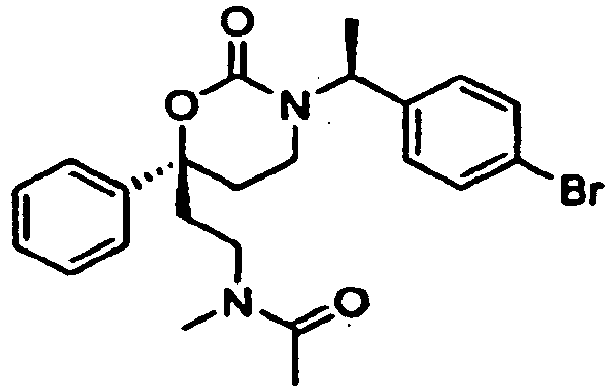
- The title compound was prepared from (S)-3-((S)-1-(4-bromophenyl)ethyl)-6-(2-hydroxyethyl)-8-phenyl-1,3-oxazinan-2-one by sequntial application of procedures analogous to those described in Examples 75 Steps 2, 3 and 4, Example 98 and Example 313 Step 1. LC-MS Method 2 tR = 1.359, m/z = 460.9; 1H NMR (CD3OD) 1.49 (d, 3H), 1.84-1.96 (d, 3H), 2.08-2.31 (m, 4H), 2.38-2.52 (m, 1H), 2.75-2.92 (d, 3H), 3.03 (m, 1H), 3.22 (m, 1H), 3.36-3.52 (m, 1H), 5.49 (m, 1H), 6.88 (m, 2H), 7.21-7.57 (m, 7H).
-

- 6-(4-((S)-1-((R)-6-(3-hydroxypropyl)-2-oxo-6-phenyl-1,3-oxazinan-3-yl)ethyl)phenyl)nicotinonitrile (50 mg, 0.11 mmol) and H2O2 (0.04 mL, 30%), K2CO3 (6.27 mg, 0.046 mmol) in DMSO (0.39 mL) was stirred overnight at room temperature. The reaction was added water and EtOAc. The layer was separated. The organic phase was washed with brine and dried, concentrated to give the product (9.95 mg, 19%) LC-MS Method 2 tR = 1.083, m/z = 460.1; 1H NMR (CD3OD) 1.21 (m, 1H), 1.51 (d, 3H), 1.53-1.64 (m, 1H), 1.85-1.94 (m, 2H), 2.10-2.21 (m, 1H), 2.29 (m, 1 H), 2.42 (m, 1 H), 3.03 (m, 1H), 3.39 (t, 2H), 5.52 (m, 1 H), 6.99 (d, 2H). 7.21-7.34 (m, 5H), 7.22 (d, 2H), 7.31 (d, 1 H), 8.22 (d, 1H), 8.98 (s, 1H).
-
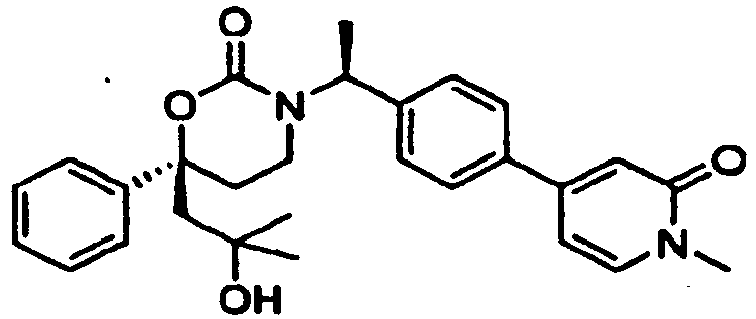
- The title compound was prepared from (S)-3-((S)-1-(4-bromophenyl)ethyl)-6-(2-hydroxy-2-methylpropyl)-6-phenyl-1,3-oxazinan-2-one following procedures analogous to those described in Example 313 Steps 3 and 4 using 4-bromo-1-methylpyridin-2(1H)-one in Step 4. LC-MS Method 2 tR = 1.16, m/z = 921.5; 1H NMR (CDCl3) 1.11 (s, 3H), 1.18 (s, 3H), 1.22 (t, 1H), 1.52 (m, 3H), 2.21 (s, 2H), 2.22-2.34 (m, 2H), 2.34-2.46 (m, 1H), 2.85 (m, 1H), 3.57 (s, 3H), 5.59 (m, 1H), 6.33 (d, 1H), 6.68 (s, 1H), 7.01 (d, 2H), 7.29-7.41 (m, 8H); 1H NMR (CD3OD) 0.98 (s, 3H), 1.29 (s, 3H), 1.58 (d, 3H), 2.17 (s, 2H), 2.22 (m, 1H), 2.50 (m, 2H), 3.08 (m, 1H), 3.59 (s, 3H), 5.59 (m, 1H), 6.61 (d, 1H), 6.66 (s, 1H), 7.08 (m, 2H), 7.30-7.40 (5H), 7.42 (d, 2H), 7.70 (d. 1H).
- 4-bromo-1-methylpyridin-2(1H)-one was prepared from 4-bromo-2-hydroxypyridine following a procedure analogous to that described in Example 313 Step 1.
-

- The title compound was prepared from (R)-3-((S)-1-(4-bromophenyl)ethyl)-6-(4-fluorophenyl)-6-(3-hydroxypropyl)-1,3-oxazinan-2-one following procedures analogous to those described in Example 313 Steps 3 and 4 using 3-bromo-2,6-dimethylpyridine in Step 4. LC-MS Method 2 tR = 1.012. m/z = 463.1; 1H NMR (CDCl3) 1.32 (m, 2H), 1.49 (d, 3H), 1.62 (m, 2H), 1.86-1.96 (m, 2H), 2.17-2.29 (m. 3H), 2.31 (s, 3H), 2.49 (s, 3H), 2.93 (m, 1H), 3.51 (m, 2H), 5.68 (m, 1H), 6.88-7.03 (m, 7H), 7.25 (m, 3H).
-

- To a stirred solution of 3-((R)-3-(S)-1-(4-bromophenyl)ethyl)-6-(4-fluorophenyl)-2-oxo-1,3-oxazinan-6-yl)-2,2-dimethylpropanenitrile (0.0665 g, 0.14 mmol) in CH2Cl2 (4 mL) at 0 °C under a nitrogen atmosphere was added DIBAL-H/heptane (1.0 M, 0.9 mL, 0.9 mmol). The reaction mixture was allowed to slowly warm to rt white stirring overnight. After 25 h, the solvent was evaporated under reduced pressure. The residue was dissolved into EtOH (5 mL) and then NaBH4 (0.3370 g) was added. After stirring at 0 °C for 2h, the reaction mixture was purified by reversed-phase HPLC (SunFire™ Prep C18 OBD™ 5µm 19 x 50 mm column, 10% →90% CH3CN/H2O, 0.1% CF3COOH over 8 min and then 90% CH3CN/H2O, 0.1% CF3COOH over 2 min, flow rate 20 mL/min) to afford 0.0210 g of TFA salt of (R)-6-(3-amino-2,2-dimethylpropyl)-3-((S)-1-(4-bromophenyl)ethyl)-6-(4-fluorophenyl)-1,3-oxazinan-2-one. LC-MS Method 1 t R = 1.45 min. m/z 463, 465 (MH+); 1H NMR (400 MHz, CD3OD) δ 7.23-7.21 (m, 4H), 7.04-7.00 (m, 2H), 6.89 (d, J = 7 Hz, 2H), 5.41 (q, J = 6 Hz, 1H), 2.98-2.91 (m, 2H), 2.61-2.57 (m, 1H), 2.31-2.27 (m, 1H), 2.11-1.94 (m, 4H), 1.41 (d, J = 6 Hz, 3H), 0.85 (s, 3H), 0.43 (s, 3H); 19F NMR (376 MHz, CD3OD) δ -116.58 (m).
-

- The title compound was prepared from (R)-6-(4-fluorophenyl)-6-(3-hydroxypropyl)-3-((S)-1-(4-(6-hydroxypyrimidin-4-yl)phenyl)ethyl)-1,3-oxazinan-2-one using a procedure analogous to that described in Example 198 Step 2, followed by procedures analogous to those described in Example 199 Steps 2 and 3. LC-MS Method 2 tR = 0.87, m/z = 452.15; 1H NMR (CD3OD) 1.20 (m, 2H), 1.49 (d, 3H), 1.83 (m, 2H), 2.15 (m, 1H), 2.22-2.41 (m, 2H), 3.07 (m, 1H), 3.38 (t, 2H), 5.50 (m, 1H), 6.88 (d, 1H), 7.01 (m, 4H), 7.21 (m, 2H), 7.79 (m, 2H), 7.90 (s, 1H).
-

-

- The title compound was prepared from 3-((R)-3-((S)-1-(4-bromophenyl)ethyl)-2-oxo-6-phenyl-1,3-oxazinan-6-yl)-2,2-dimethylpropanenitrile following procedures analogous to those described in Example 313 Steps 3 and 4. LC-MS Method 2 tR = 1.231, m/z = 470.1; 1H NMR (CDCl3) 1.28 (s, 3H), 1.40 (s, 3H), 1.47 (d, 3H), 2.09 (s, 2H), 2.21 (m, 1H), 2.41 (m, 2H), 2.83 (m, 1H), 3.52 (s, 3H), 5.56 (m, 1H), 6.58 (d, 1H), 6.82 (d, 2H), 7.02 (d, 2H), 7.30 (m, 6H), 7.43 (m, 1H).
- 3-((R)-3-((S)-1-(4-bromophenyl)ethyl)-2-oxo-6-phenyl-1,3-oxazinan-6-yl)-2,2-dimethylpropanenitrile was prepared from (R)-6-allyl-3-((S)-1-(4-bromophenyl)ethyl)-6-phenyl-1,3-oxazinan-2-one by sequential application of procedures analogous to those described in Examples 520 and 521.
-

- A solution of 2,2-dimethyl-3-((R)-2-oxo-3-((S)-1-(4-(6-oxo-1,6-dihydropyridin-3-yl)phenyl)ethyl)-6-phenyl-1,3-oxazinan-6-yl)propanenitrile (202 mg, 0.444 mmol) and Mel (110 µL, 4equiv) in dry THF (5 mL) was cooled to 0 °C. NaH (60% in mineral oil, 36mg, 2equiv) was added. After 10min, the mixture was warmed to rt slowly and stirred for 3 h. LC-MS showed about 50% conversion. The mixture was heated for 1 h at 60 °C. LC-MS found the reaction completed. After cooling to rt, the mixture was cooled to 0 °C and quenched with satd aq NH4Cl (3 mL). The mixture was then diluted with CH2Cl2 (20mL), washed with 1% aq HCl (5 mL) and brine (4 mL). and dried over Na2SO4. After filtration and concentration, the residue was purified by prep HPLC to afford 2,2-dimethyl-3-((R)-3-((S)-1-(4-(1-methyl-6-oxo-1,6-dihydropyridin-3-yl)phenyl)ethyl)-2-oxo-6-phenyl-1,3-oxazinan-6-yl)propanenitrile (177.4 mg, 85% yield) product as a light brown oil.
-

- 2,2-Dimethyl-3-(3-{(S)-1-[4-(1-methyl-6-oxo-1,6-dihydro-pyridin-3-yl)-phenyl]-ethyl}-2-oxo-(S)-6-phenyl-[1,3]oxazinan-6-yl)-propionitrile was prepared from (S)-6-(2-hydroxy-2-methylpropyl)-3-((S)-1-(4-(1-methyl-6-oxo-1,6-dihydropyridin-3-yl)phenyl)ethyl)-6-phenyl-1,3-oxazinan-2-one following procedures analogous to those described in Example 658 in the Alternative Method to Prepare 3-((R)-3-((S)-1-(4-bromophenyl)ethyl)-2-oxo-6-phenyl-1,3-oxazinan-6-yl)-2,2-dimethylpropanenitrile. (S)-6-(2-hydroxy-2-methyl-propyl)-3-{(S)-1-[4-(1-methyl-6-oxo-1,6-dihydro-pyridin-3-yl)-phenyl]-ethyl}-6-phenyl-[1,3]oxazinan-2-one, is obtained from coupling (S)-6-(2-hydroxy-2-methylpropyl)-6-phenyl-3-[(S)-1-(4-(4,4,5,5-tetramethyl-1,3,2-dioxaborolan-2-yl)phenyl)ethyl]-1,3-oxazinan-2-one with 5-iodo-1-methyl-1H-pyridin-2-one by the action of Pd(PPh3)4 and 2 M aqueous Na2CO3 solution in a mixture of methanol and dioxane (1:3) at 80 °C.
-

- The title compound was prepared from 3-((R)-3-((S)-1-(4-bromophenyl)ethyl)-2-oxo-6-phenyl-1,3-oxazinan-6-yl)-2,2-dimethylpropanenitrile hollowing procedures analogous to those described in Example 313 Steps 3 and 4 using 4-bromo-1-methylpyridin-2(1H)-one in Step 4. LC-MS Method 2 tR = 1.103, m/z = 470.4; 1H NMR (CDCl3) 1.26 (s, 3H), 1.41 (s, 3H), 1.49 (d, 3H), 2.09 (s, 2H), 2.24 (m, 1H), 2.53 (m, 2H), 2.88 (m, 1H), 3.56 (s, 3H), 5.59 (m, 1H), 6.38 (d, 1H), 6.78 (s, 1H), 6.84 (d, 2H), 7.19 (m, 2H), 7.31 (m, 6H).
-

- (S)-2,2-Dimethyl-3-(3-{1-[(S)-4-(1-methyl-2-oxo-1,2-dihydro-pyridin-4-yl)-phenyl]-ethyl}-2-oxo-6-phenyl-[1,3]oxazinan-6-yl)-propionitrile was prepared from (S)-6-(2-hydroxy-2-methylpropyl)-3-((S)-1-(4-(1-methyl-2-oxo-1,2-dihydropyridin-4-yl)phenyl)ethyl)-6-phenyl-1,3-oxazinan-2-one following procedures analogous to those described in Example 658 Alternative Method to Prepare 3-((R)-3-((S)-1-(4-bromophenyl)ethyl)-2-oxo-6-phenyl-1,3-oxazinan-6-yl)-2,2-dimethylpropanenitrile. The starting compound, (S)-6-(2-hydroxy-2-methyl-propyl)-3-{(S)-1-[4-(1-methyl-2-oxo-1,2-dihydro-pyridin-4-yl)-phenyl]-ethyl}-6-phenyl-[1,3]oxazinan-2-one, is obtained from coupling (S)-6-(2-hydroxy-2-methylpropyl)-6-phenyl-3-[(S)-1-(4-(4,4,5,5-tetramethyl-1,3,2-dioxaborolan-2-yl)phenyl)ethyl]-1,3-oxazinan-2-one with trifluoromethanesulfonic acid 1-methyl-2-oxo-1,2-dihydro-pyridin-4-yl ester employing the standard conditions, Pd(dppf)Cl2*CH2Cl2, 2 M aqueous Na2CO3 solution, DMF, 90 °C, 2 h.
-

- The title compound was prepared from (R)-3-((S)-1-(4-bromophenyl)ethyl)-6-(3-hydroxypropyl)-6-phenyl-1,3-oxazinan-2-one by sequential application of procedures analogous to those described in Example 234 Step 1 and Example 530 Steps 1, 2 and alternative Step 3. LC-MS Method 2 tR = 1.379, m/z = 471.9; 1H NMR (CDCl3) 1.43 (d, 3H), 2.11-2.39 (m, 5H), 2.41 (s, 3H), 2.52 (m, 2H), 2.87 (m, 1H), 3.01 (m, 1H), 5.56 (m, 1H), 6.71 (d, 2H), 7.19 (m, 2H), 7.21 (m, 2H), 7.29-7.38 (m, 3H).
-
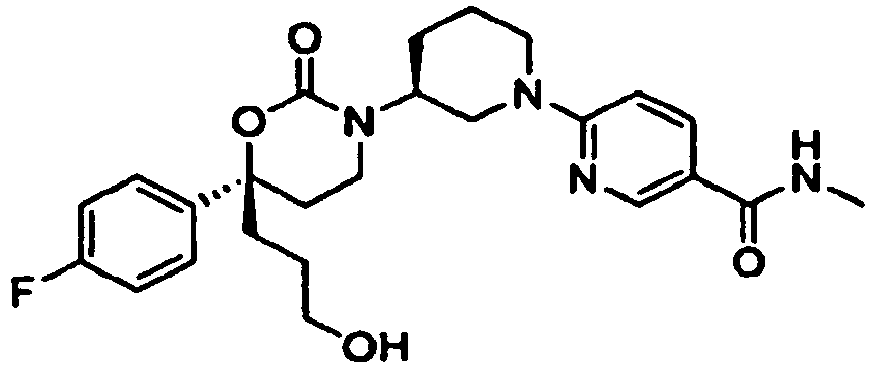
- The title compound was prepared from 6-((S)-3-((R)-6-(4-fluorophenyl)-6-(3-hydroxypropyl)-2-oxo-1,3-oxazinan-3-yl)piperidin-1-yl)nicotinamide using a procedure analogous to that described in Example 198 Step 2, followed by procedures analogous to those described in Example 199 Steps 2 and 3. LC-MS Method 2 tR = 0.96, m/z = 471.1; 1H NMR (CDCl3) 0.83 (m, 1H), 1.20-1.33 (m, 2H), 1.58 (m, 1H), 1.70-1.81 (m, 3H), 1.83-2.00 (m, 2H), 2.18 (m, 1H), 2.28 (m, 1 H), 2.68 (m, 1H), 2.79 (m, 2H), 2.91 (d, 3H), 3.20 (m, 1H), 3.51 (t, 2H), 3.84 (m, 1H), 4.12 (m, 1H), 4.24 (m, 1 H), 6.00 (m, 1 H), 6.52 (d, 1H), 7.02 (t, 2H), 7.25 (m, 2H), 7.80 (dd, 1H), 8.42 (d, 1H).
-

- The title compound was prepared from 3-((R)-3-((S)-1-(4-bromophenyl)ethyl)-2-oxo-6-phenyl-1,3-oxazinan-6-yl)-2,2-dimethylpropanenitrile following procedures analogous to those described in Example 313 Steps 3 and 4 using 4-chloro-2-methylpyrimidine in Step 4. LC-MS Method 1 tR = 1.55, m/z = 473(M+1); 1H NMR (CDCl3) 8.96(s, 1H), 7.98(d, 2H), 7.84(s, 1H), 7.29(m, 2H), 7.10(m, 4H), 5.72(d, 1H), 3.05(d, 1H), 2.97(s, 3H), 2.91 (m, 1H), 2.51 (d, 1H), 1.61 (d, 3H), 1.38(d, 3H), 1.27(d, 3H).
-

- To a solution of 6-(4-((S)-1-((S)-6-(2-hydroxy-2-methylpropyl)-2-oxo-6-phenyl-1,3-oxazinan-3-yl)ethyl)phenyl)nicotinonitrite (120 mg, 0.26 mmol) in DMSO (8 mL) were added H2O2 (0.5 mL, 30%) and K2CO3 (35 mg, 0.26 mmol), and the mixture was stirred at rt for 3 h. The reaction was quenched with H2O (10 mL) and the mixture was extracted with EtOAc (4 x 20 mL). The organic layer was washed with brine, dried over Na2SO4 and concentrated to give the crude product, which was purified by preparative HPLC to give 6-(4-((S)-1-((S)-6-(2-hydroxy-2-methylpropyl)-2-oxo-6-phenyl-1,3-oxazinan-3-yl) ethyl)phenyl)nicotinamide (55.46 mg, 45%). LC-MS Method 2 tR = 1.12 min, m/z = 474, 416. 1H NMR (CDCl3): 1.03 (s, 3H), 1.09 (s, 3H), 1.46 (d, 3H), 2.13-2.26 (m, 5H), 2.30 (m, 1H), 2.44 (s, 1H), 2.79 (d, 1H), 5.61 (m, 1H), 6.15-6.38 (s, 1H), 6.97 (d, 2H), 7.13-7.29 (m, 5H), 7.60 (d, 2H), 7.70 (d, 2H), 8.15 (d, 1H), 9.05 (s, 1 H).
-

- The title compound was prepared from (S)-3-((S)-1-(4-bromophenyl)ethyl)-6-(4-fluorophenyl)-6-(2-hydroxy-2-methylpropyl)-1,3-oxazinan-2-one following procedures analogous to those described in Example 313 Steps 3 and 4 using 4-bromo-2,6-dimethylpyridine in Step 4. LC-MS Method 2 tR = 1.001, m/z = 477.1; 1H NMR (CDCl3) 1.05-1.23 (d, 6H), 1.49 (d, 3H), 2.10-2.23 (m, 4H), 2.31-2.42 (m, 1H), 2.56 (s, 6H), 2.89 (m, 1 H), 5.67 (m, 1H), 6.92-7.07 (m, 4H), 7.08 (s, 2H), 7.22 (m, 2H), 7.33 (d, 2H).
-

- The title compound was prepared from 6-((S)-3-((R)-6-(4-fluorophenyl)-6-(3-hydroxypropyl)-2-oxo-1,3-oxazinan-3-yl)piperidin-1-yl)nicotinamide using a procedure analogous to that described in Example 198 Step 2, followed by procedures analogous to those described in Example 199 Steps 2 and 3. LC-MS Method 2 tR = 1.012, m/z = 485.1; 1H NMR (CDCl3) 0.79 (m, 1H), 1.19 (m, 2H), 1.76 (m, 3H), 1.92 (m, 2H), 2.17 (m, 1H), 2.28 (m, 1H), 2.68 (m, 1 H), 2.79 (m, 2H), 3.00 (s, 6H), 3.20 (m, 1H), 3.51 (t, 2H), 3.84 (m, 1 H), 4.12 (dd, 1H), 4.24 (m, 1H), 6.52 (d, 1H), 7.02 (t, 2H), 7.22 (m, 2H), 7.53 (dd, 1H), 8.19 (d, 1H).
-

- The title compound was prepared from N'-acetyl-3-((R)-3-((S)-1-(4-bromophenyl)ethyl)-2-oxo-6-phenyl-1,3-oxazinan-6-yl)propanehydrazide following procedures analogous to those described in Example 531. LC-MS Method 2 tR = 1.403, m/z = 487.9; 1H NMR (CD3OD) 1.49 (d, 3H), 2.20-2.31 (m, 2H), 2.33-2.44 (m, 2H), 2.52 (m, 1H), 2.63 (s, 3H), 2.81 (m, 1H), 3.06 (m, 1H), 3.20 (m, 1H), 3.81 (s, 1H), 5.47 (m, 1H), 6.82 (d, 2H), 7.21 (m, 2H), 7.30 (m, 2H), 7.34-7.46 (m, 3H).
-

- The title compound was prepared from (R)-3-((S)-1-(4-chloro-2-fluorophenyl)ethyl)-6-(4-fluorophenyl)-6-(3-hydroxypropyl)-1,3-oxazinan-2-one following procedures analogous to those described in Example 359. LC-MS Method 1 tR = 1.7, m/z = 487 (M+1); 1H NMR (CDCl3) 7.12-7.09 (m, 2H), 7.03 (t, 1H, J = 8.1 Hz), 6.97-6.93 (m, 3H), 684 (dd, 1H, J = 10.0, 2.1 Hz), 5.56 (q, 1 H, J = 7.1 Hz), 4.33 (br m, 1H), 2.99 (q, 2H, J = 6.4 Hz), 2.94-2.88 (m, 1H), 2.84 (s, 3H), 2.24-2.02 (m, 3H), 1.98-1.81 (m, 2H), 1.68-1.58 (m, 1H), 1.44 (d, 3H, J = 7.3 Hz), 1.31-1.19 (m, 1H).
-

- The title compound was prepared from 3-((R)-3-((S)-1-(4-bromophenyl)ethyl)-2-oxo-6-phenyl-1,3-oxazinan-6-yl)-2,2-dimethylpropanenitrile following procedures analogous to those described in Example 313 Steps 3 and 4 using 4-bromo-1-methylpyridin-2(1 H)-one in Step 4, followed by a procedure analogous to that described in Example 598. LC-MS Method 2 tR = 1.133, m/z = 488.1; 1H NMR (CDCl3) 1.12 (s, 3H), 1.19 (s, 3H), 1.49 (d, 3H), 2.09-2.28 (m, 3H), 2.32-2.58 (m, 2H), 2.89 (m, 1 H), 3.59 (s, 3H), 5.61 (m, 1H), 6.54 (m, 1H), 6.88 (m, 1H), 6.97-7.10 (m, 2H), 7.28 (m, 6H), 7.42 (m, 1H), 7.53 (m, 1H).
-

- The title compound was prepared from N'-acetyl-3-((R)-3-((S)-1-(4-(5-cyanopyridin-2-yl)phenyl)ethyl)-2-oxo-6-phenyl-1,3-oxazinan-6-yl)propanehydrazide following a procedure analogous to that described in Example 530 Alternative Step 3. LC-MS Method 2 tR = 1.265, m/z = 494.1; 1H NMR (CDCl3) 1.59 (d, 3H), 2.06 (m, 1H), 2.33 (m, 5H), 2.48 (s, 2H), 2.52-2.71 (m, 2H), 2.97 (m, 1H), 3.09 (m, 1H), 5.72 (m, 1H), 7.08 (d, 2H), 7.29 (m, 2H), 7.32 (m, 2H), 7.34-7.58 (m, 2H), 7.77 (m, 2H), 7.99 (d, 1H), 8.89 (s, 1H).
-

- The title compound was prepared from (R)-6-(3-amino-2,2-dimethylpropyl)-3-((S)-1-(4-bromophenyl)ethyl)-6-(4-fluorophenyl)-1,3-oxazinan-2-one following a procedure analogous to that described in Example 98. LC-MS Method 1 tR = 1.78, m/z = 505, 507 (M+1); 1H NMR (CD3OD) 7.26-7.23 (m, 4H), 7.01 (t, J = 8.8 Hz, 2H), 6.89 (d, J = 8.2 Hz, 2H), 5.44 (q, J = 7.0 Hz, 1H), 2.98-2.94 (m, 1H), 2.90 (s, 2H), 2.30-2.25 (m, 1H), 2.20-2.12 (m, 1H), 2.10-2.03 (m, 1H), 1.94 (d, J = 15 Hz, 1H), 1.88 (d, J = 15 Hz, 1H), 1.88 (s, 3H), 1.43 (d, J = 7.0 Hz, 3H), 0.69 (s, 3H), 0.59 (s, 3H).
-

- The title compound was prepared from (R)-6-(3-amino-2,2-dimethylpropyl)-3-((S)-1-(4-bromophenyl)ethyl)-6-(4-fluorophenyl)-1,3-oxazinan-2-one following a procedure analogous to that described in Example 180. LC-MS Method 1 tR = 1.87, m/z = 507, 509 (M+1); 1H NMR (CD3OD) 7.23-7.19 (m, 4H), 6.98 (t, J = 8.8 Hz, 2H), 6.83 (d, J = 8.2 Hz, 2H), 5.41 (q, J = 7.0 Hz, 1H), 3.33 (s, 3H), 2.98-2.93 (m, 1H), 2.45 (d. J = 15 Hz, 1H), 2.28-2.16 (m, 3H), 2.13-2.06 (m, 1 H), 1.42 (d, J = 7.0 Hz, 3H), 1.17 (s, 3H), 1.14 (s, 3H).
-

- The title compound was prepared from N'-acetyl-3-((R)-3-((S)-1-(4-(5-cyanopyridin-2-yl)phenyl)ethyl)-2-oxo-6-phenyl-1,3-oxazinan-6-yl)propanehydrazide following a procedure analogous to that described in Example 531. LC-MS Method 2 tR = 1.306, m/z = 511.1; 1H NMR (CDCl3) 1.59 (d, 3H), 2.25 (m, 1H), 2.43 (m, 2H), 2.49 (m, 2H), 2.74 (s, 3H), 2.82 (m, 1H), 2.99 (m, 1H), 3.31 (m, 1 H), 5.72 (m, 1 H), 7.09 (d, 2H), 7.31 (m, 3H), 7.40 (m, 2H), 7.72-7.87 (m, 3H), 8.00 (d, 1H), 8.91 (s, 1H).
-

- The title compound was prepared from (R)-6-(3-amino-2,2-dimethylpropyl)-3-((S)-1-(4-bromophenyl)ethyl)-6-(4-fluorophenyl)-1,3-oxazinan-2-one following a procedure analogous to that described in Example 99. LC-MS Method 1 tR = 1.89, m/z = 541, 543 (M+1); 1H NMR (CD3OD) 7.28-7.24 (m, 4H), 7.03 (t, J = 8.8 Hz, 2H), 6.92 (d, J = 8.2 Hz, 2H), 5.45 (q, J = 7.0 Hz, 1H), 3.01-2.96 (m, 1H), 2.85 (s, 3H), 2.84 (d, J = 13 Hz, 1H), 2.67 (d, J = 13 Hz, 1H), 2.30-2.25 (m, 1H), 2.21-2.13 (m, 1H), 2.11-2.04 (m, 1H), 2.02 (d, J = 15 Hz, 1H), 1.93 (d, J = 15 Hz, 1H), 1.45 (d, J = 7.0 Hz, 3H), 0.68 (s, 3H), 0.66 (s, 3H).
-

- The title compound was prepared from (R)-3-((S)-1-(4-bromophenyl)ethyl)-6-(4-fluorophenyl)-6-(3-hydroxypropyl)-1,3-oxazinan-2-one and 2-methoxypyridin-4-ylboronic acid following a procedure analogous to that described in Example 75 Step 1. LC-MS Method 1 tR = 1.9 min, m/z = 447 (M+1); 1H NMR (CDCl3) 8.29 (1H, d, J = 5.5 Hz), 7.34 (2H, m), 7.21-7.15 (m, 3H), 7.02-6.93 (5H, m), 5.67-5.61 (1H, m), 4.05 (3H, s), 3.53 (1H, t, J = 6.41 Hz), 2.97-2.93 (1H, m), 2.33-2.11 (3H, m), 2.06-1.83 (3H, m), 1.67-1.57 (1H, m), 1.50 (3H, d, J = 7.03), 1.36-1.26 (1H, m).
-
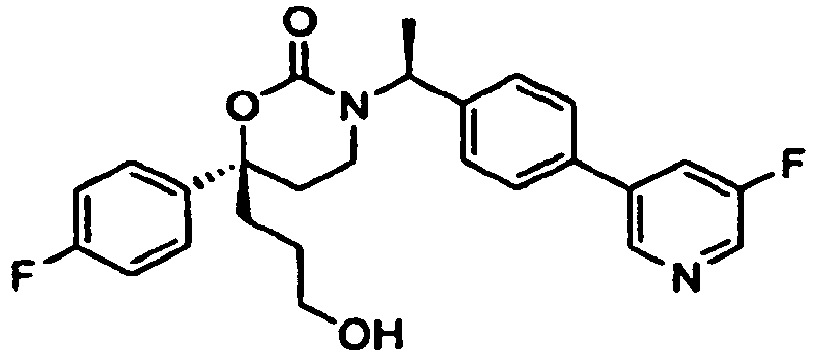
- The title compound was prepared from (R)-3-((S)-1-(4-bromophenyl)ethyl)-6-(4-fluorophenyl)-6-(3-hydroxypropyl)-1,3-oxazinan-2-one and 5-fluoropyridin-3-ylboronic acid following a procedure analogous to that described in Example 75 Step 1. LC-MS Method 1 tR = 1.5 min, m/z = 453 (M+1).
-

- The title compound was prepared from (R)-6-(4-fluorophenyl)-6-(3-hydroxypropyl)-3-((S)-piperidin-3-yl)-1,3-oxazinan-2-one and 2-bromo-5-cyanopyridine following a procedure analogous to that described in Example 508. LC-MS Method 2 tR = 1.218 min. m/z =439.1; 1H NMR (CDCl3) 1.21-1.36 (m, 1H), 1.62 (m, 1 H), 1.78 (m, 3H), 1.56 (m, 2H), 1.86-2.00 (m, 2H), 2.19 (m, 1H), 2.29 (m, 1H), 2.67-2.86 (m, 3H), 3.20 (m, 1H), 3.50 (t, 2H). 3.79 (m, 1H), 4.12 (m, 1 H), 4.30 (d, 1H), 6.53 (m, 1 H), 7.01 (t, 2H), 7.24 (m, 2H), 7.51 (d, 1H), 8.30 (s, 1H).
-

- To a solution of 3-((R)-3-((S)-1-(4-bromophenyl)ethyl)-6-(4-fluorophenyl)-2-oxo-1,3-oxazinan-6-yl)propanamide (0.0135 g, 0.03 mmol, 1.0 equiv) in MeOH (10 mL) was added Phl(OCOCF3)2 (0.0649 g, 0.15 mmol, 5 equiv) at room temperature. The resulting mixture was stirred at room temperature for 24 h. The reaction mixture was purified by reversed-phase HPLC (SunFire™ Prep C18 OBD™ 5µm 19 x 250 mm column, 10% →90% CH3CN/H2O, 0.1% CF3COOH over 13 min and then 90% CH3CN/H2O, 0.1% CF3COOH over 4 min, flow rate 25 mL/min) to afford 0.0070 g (49%) of methyl 2-((R)-3-((S)-1-(4-bromophenyl)ethyl)-6-(4-fluorophenyl)-2-oxo-1,3-oxazinan-6-yl)ethylcarbamate. LC-MS Method 1 t R = 1.76 min, m/z = 479, 481 (MH+); 1H NMR (400 MHz, CD3OD) δ 7.27-7.21 (m, 4H), 7.04 (t, J = 8.8 Hz, 2H), 6.82 (d, J = 8.2 Hz, 2H), 5.43 (q, J = 7.0 Hz, 1H), 3.50 (s, 3H), 3.12-3.01 (m, 2H), 2.92-2.85 (m, 1H), 2.39-2.35 (m, 1H), 2.24-2.15 (m, 2H), 2.02 (t, J = 7.6 Hz, 2H), 1.44 (d, J= 7.0 Hz, 3H); 19F NMR (376 MHz, CD3OD) δ -117.06 (m).
-

- The title compound was prepared from (R)-6-(4-fluorophenyl)-6-(3-hydroxypropyl)-3-((S)-1-(4-(2-hydroxypyrimidin-4-yl)phenyl)ethyl)-1,3-oxazinan-2-one using procedures analogous to those described in Example 460 Steps 4, 5 and 6. LC-MS Method 2 tR = 1.079 min, m/z = 466.2; 1H NMR (CD3OD) 1.20 (m, 3H), 1.49 (d, 3H), 1.78-1.91 (m, 2H), 2.08 (s, 1 H), 2.14 (m, 1 H), 2.28 (m, 1H), 2.39 (m, 1H), 3.07 (m, 1H), 3.36 (m, 3H), 3.50 (s, 3H), 4.50 (s, 2H), 5.49 (m, 1H), 6.90 (d, 1H), 6.95-7.08 (m, 4H), 7.21 (m, 2H), 7.80 (d, 2H), 8.06 (d, 1H).
-

- The title compound was prepared from (R)-6-allyl-3-((S)-1-(4-bromophenyl)propyl)-6-phenyl-1,3-oxazinan-2-one following a procedure analogous to that described in Example 459 Method 2 using 5-bromo-1-ethylpyridin-2(1H)-one in Step 4. LC-MS Method 2 tR = 1.732 min, m/z = 475.1: 1H NMR (CDCl3) 0.95 (s, 3H),1.01 (t, 3H), 1.26 (s, 3H), 1.38 (t, 3H), 2.06 (m, 2H), 2.18-2.31 (m, 3H), 2.36 (m, 1H), 2.55 (m, 1H), 3.04 (m, 1H), 4.11 (m, 2H), 5.37 (m, 1H), 6.66 (d, 1H), 7.11 (m, 2H), 7.20-7.33 (m, 7H), 7.76 (d, 1H), 7.88 (s, 1H).
-

- The title compound was prepared from (R)-6-allyl-3-((S)-1-(4-bromophenyl)ethyl)-6-phenyl-1,3-oxazinan-2-one following a procedure analogous to that described in Example 459 Method 2 using 5-bromo-1-ethylpyridin-2(1H)-one in Step 4. LC-MS Method 2 tR = 1.224 min, m/z = 475.1; 1H NMR (CDCl3) 1.11 (s, 3H), 1.19 (s, 3H), 1.39 (t, 3H), 1.56 (d, 3H), 2.20 (s, 2H), 2.26 (m, 1 H), 2.36-2.57 (m, 2H), 2.87 (m, 1 H), 4.03 (m, 2H), 5.69 (m, 1 H), 6.62 (d, 1H), 7.00 (d, 2H), 7.17 (d, 2H), 7.28-7.51 (m, 6H), 7.50 (d, 1H).
-

- The title compound was prepared from (R)-6-allyl-3-((S)-1-(4-bromophenyl)propyl)-6-phenyl-1,3-oxazinan-2-one following a procedure analogous to that described in Example 459 Method 2 using 5-bromo-1-methylpyridin-2(1H)-one in Step 4. LC-MS Method 2 tR = 1.746 min, m/z = 475.2; 1H NMR (CD3OD) 1.04 (t, 3H), 1.11 (s, 3H), 1.24 (s, 3H), 1.95-2.04 (m, 2H), 2.13-2.26 (m, 4H), 2.44 (m, 1H), 2.91 (m, 1H), 3.61 (s, 3H), 5.36 (m, 1H), 6.67 (d, 1H), 7.10-7.33 (m, 8H), 7.42(s, 1H), 7.55 (d, 1H).
-

- To a solution of 3,6-dichloro-pyridazine (1g, 0.006759mol) in AcOH/H2O (5/1) (20mL) was added KOAc (0.662g, 0.006759moL), and the mixture was heated to 140 °C for 70 min under microwave conditions. The vial was cooled and the solvent was evaporated in vacuo. EtOAc and H2O were added. The layers were separated, and the aqueous layer was extracted with EtOAc. The combined organic phase was washed brine, dried over Na2SO4, and concentrated to give 6-chloro-2H-pyridazin-3-one (0.813g, 92.5%). 1H NMR (CDCl3): 6.96 (d, 1H), 7.25 (d, 1H).
- To a solution of 6-chloropyridazin-3(2H)-one (600 mg, 4.23 mmol) were added potassium carbonate (1.2 g, 8.46 mmol) and methyl iodide (1.2 g, 8.46 mmol) in DMF (3 mL). The resulting mixture was stirred at 25 °C for 4 h. After the reaction, water was added to the reaction solution, followed by extraction with EtOAc. The organic layer was washed with water and brine, dried over sodium sulfate and then filtered. The filtrate was concentrated under reduced pressure to give the residue which was purified by column chromatography to give 6-chloro-2-methylpyridazin- 3(2H)-one (550 mg, 91%). 1H NMR (CDCl3): 3.76 (s, 3H), 6.92 (d, 1H), 7.19 (d, 1H).
- To a solution of (S)-6-(2-hydroxy-2-methylpropyl)-6-phenyl-3-((S)-1-(4-(4,4,5,5-tetramethyl-1,3,2-dioxaborolan-2-yl)phenyl)ethyl)-1,3-oxazinan-2-one (774 mg, 1.62 mmol), 6-chloro-2-methylpyridazin-3(2H)-one (244.8 mg, 1.7 mmol), PdCl2(PPh3)2 (77.4 mg, 10%) and aqueous solution of Cs2CO3 (2 mol/L, 1.6 mL) in 1,4-dioxane (15 mL) was heated to reflux overnight. The reaction was quenched with water. The organic layer was separated, dried, and concentrated to give the residue, which was purified by column chromatography to give (R)-6-(4-fluorophenyl)-6-(3-hydroxypropyl)-3-((S)-1-(4-(2-methylpyrimidin-5-yl)phenyl)ethyl)-1,3-oxazinan-2-one (321 mg, 43%). LC-MS Method 2 tR = 1.158 min, m/z = 404; 1H NMR (CDCl3): 1.12 (s, 3H), 1.18 (s, 3H), 1.54 (d, 3H), 2.18-2.27 (m, 4H), 2.33-2.48 (m, 1H), 2.82-2.92 (m, 1 H), 3.86 (s, 3H), 5.70 (m, 1H), 6.99 (d, 2H), 7.05 (d, 2H), 7.26-7.50 (m, 5H), 7.51 (m, 2H), 7.57 (d, 1H).
-

- The title compound was prepared from (R)-6-allyl-3-((S)-1-(4-bromophenyl)propyl)-6-phenyl-1,3-oxazinan-2-one following a procedure analogous to that described in Example 459 Method 2 using 4-bromo-1-methylpyridin-2(1H)-one in Step 4. LC-MS Method 2 tR = 1.203 min, m/z = 971.4: 1H NMR (CDCl3) 0.97 (t, 3H), 1.12 (s, 3H), 1.19 (s, 3H), 1.79-2.02 (m, 2H), 2.11-2.24 (m, 4H), 2.29-2.42 (m, 1H), 2.81 (m, 1H), 3.50 (s, 3H), 5.40 (m, 1H), 6.28 (d, 1H), 6.64 (s, 1H), 7.02 (d, 2H), 7.18 (m, 3H), 7.20 (m, 2H), 7.28 (m, 3H).
-

- The title compound was prepared from (S)-6-(2-hydroxy-2-methylpropyl)-6-phenyl-3-((S)-1-(4-(4,4,5,5-tetramethyl-1,3,2-dioxaborolan-2-yl)phenyl)ethyl)-1,3-oxazinan-2-one and 2-methyl-5-bromopyrimidine following a procedure analogous to that described in Example 459 Step 4. LC-MS Method 2 tR = 1.221 min, m/z = 468.2; 1H NMR (CDCl3) 1.06 (s, 3H), 1.12 (s, 3H), 1.49 (d, 3H), 2.11-2.28 (m, 4H), 2.31-2.42 (m, 1H), 2.70 (s, 3H), 2.82 (m, 1H), 5.65 (m, 1H), 7.00 (d, 2H), 7.21-7.34 (m, 7H), 8.19 (s, 2H).
-
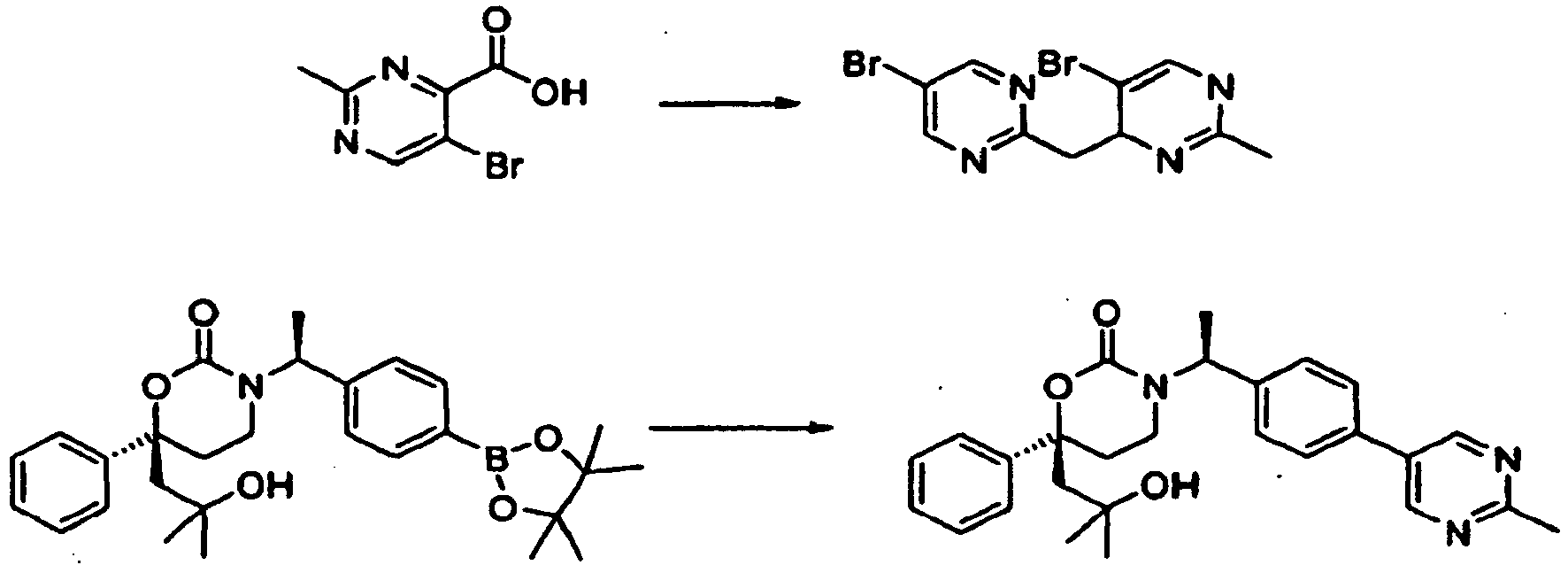
- 5-Bromo-2-methyl-pyrimidine-4-carboxylic acid (5.0 g) was heated above its melting point (mp 176 °C) during which decarboxylation takes place. After cooling to ambient temperature, the tar-like substance was purified by chromatography on silica gel (CH2Cl2/MeOH 90:10->70:30) to afford the title compound as a black liquid. Yield: 0.45 g (6% of theory). Mass spectrum (ESI*): m/z = 345/347/349 (2 Br) [M+H]*
- 2 M aqueous Na2CO3 solution (1.67 mL) was added to a solution of (S)-6-(2-hydroxy-2-methylpropyl)-6-phenyl-3-[(S)-1-(4-(4,4,5,5- tetramethyl-1,3,2-dioxaborolan-2-yl)phenyl)ethyl]-1,3- oxazinan-2-one (0.80 g) and 5-bromo-2-(5-bromo-2-methyl-1,4-dihydro-pyrimidin-4-ylmethyl)-pyrimidine (0.40 g) in dimethylformamide (5 mL). The resulting mixture was sparged with argon for 5 min, before [1,1'-bis(diphenylphosphino)ferrocene]-dichloropalladium(II) dichloromethane complex (82 mg) was added. The mixture was heated to 100 °C and stirred at this temperature overnight. After cooling to ambient temperature, water was added, and the resulting mixture was extracted with ethyl acetate. The combined organic extracts were washed with brine, dried (MgSO4), and concentrated. The residue was purified by chromatography on silica gel (CH2Cl2MeOH 95:5->80:20) followed by HPLC (MeCN/H2O/NH4OH) to afford the title compound (340 mg) which was crystallized from iPr2O. Yield: 0.25 g (34% of theory). Mass spectrum (ESI+): m/z = 446 [M+H]+
-

- The title compound was prepared from 3-((R)-3-((S)-1-(4-bromophenyl)ethyl)-6-(4-fluorophenyl)-2-oxo-1,3-oxazinan-6-yl)propanamide following a procedure analogous to that described in Example 612 using ethanol as solvent. LC-MS Method 1 tR = 1.83 min, m/z = 493, 495 (M+1): 1H NMR (CD3OD) 7.25-7.20 (m, 4H), 7.03 (t, J = 8.8 Hz, 2H), 6.81 (d, J = 8.2 Hz, 2H), 5.41 (q, J = 7.3 Hz, 1H), 3.91 (q, J = 7.2 Hz, 2H), 3.10-3.00 (m, 2H), 2.90-2.85 (m, 1H), 2.38-2.34 (m, 1H), 2.22-2.14 (m, 2H), 2.01 (t, J = 7.6 Hz, 2H), 1.42 (d, J = 7.3 Hz, 3H), 1.10 (t, J = 7.2 Hz, 3H).
-

- The title compound was prepared from 3-((R)-3-((S)-1-(4-bromophenyl)ethyl)-6-(4-fluorophenyl)-2-oxo-1,3-oxazinan-6-yl)propanamide following a procedure analogous to that described in Example 612 using t-butanol as solvent followed by treatment with 2 N aq HCl/CH3CN at rt. LC-MS Method 1 tR = 1.41 min, m/z = 449, 451 (M+1); 1H NMR (CD3OD) 7.28-7.20 (m, 4H), 7.04 (t, J = 8.6 Hz, 2H), 6.96 (d, J = 8.2 Hz, 2H), 5-46 (q, J = 7.0 Hz, 1H), 2.99-2.94 (m, 1H), 2.34-2.28 (m, 3H), 2.16-2.07 (m, 2H), 1.43 (d, J = 7.0 Hz, 3H), 1.13 (s, 3H), 0.90 (s, 3H).
-

- The title compound was prepared from (R)-3-((S)-1-(4-bromophenyl)propyl)-6-ethyl-6-phenyl-1,3-oxazinan-2-one following procedures analogous to those described in Example 459 Steps 3 and 4. LC-MS Method 1 tR = 1.6 min, m/z = 431 (M+1).
- (R)-3-((S)-1-(4-bromophenyl)propyl)-6-ethyl-6-phenyl-1,3-oxazinan-2-one was prepared from 1-chloro-3-phenylpentan-3-ol and (S)-1-(4-bromophenyl)propan-1-amine following procedures analogous to those described in Example 353.
- 1-chloro-3-phenylpentan-3-ol was prepared from 3-chloro-1-phenylpropan-1-one and ethylmagnesium bromide following a procedure analogous to that described in Example 110 Step 1.
-
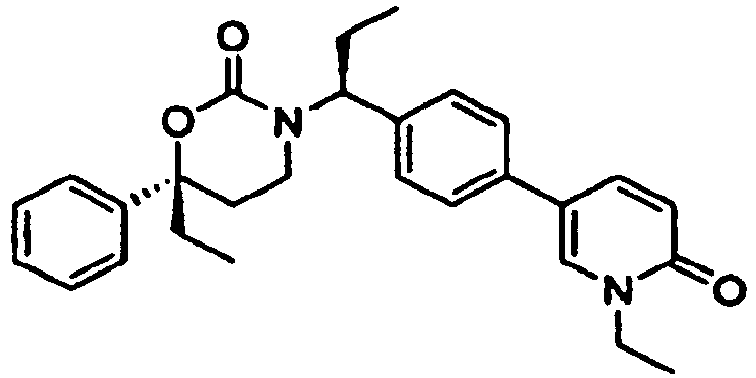
- The title compound was prepared from (R)-3-((S)-1-(4-bromophenyl)propyl)-6-ethyl-6-phenyl-1,3-oxazinan-2-one following procedures analogous to those described in Example 459 Steps 3 and 4 using 5-bromo-1-ethylpyridin-2(1H)-one in Step 4. LC-MS Method 1 tR = 1.68 min, m/z = 445 (M+1).
-

- The title compound was prepared from (R)-3-((S)-1-(4-bromophenyl)propyl)-6-ethyl-6-phenyl-1,3-oxazinan-2-one following procedures analogous to those described in Example 459 Steps 3 and 4 using 4-iodo-1-methylpyridin-2(1H)-one in Step 4. LC-MS Method 1 tR = 1.58 min, m/z = 431 (M+1); 1H NMR (CDCl3) 7.33 (1H, d, J = 7.03 Hz), 7.29 - 7.21 (7H, m), 7.01 (2H, d, J = 8.20 Hz), 6.75 (1H, d, J = 2.05), 6.39 (1H, dd, J = 2.05, 7.03), 5.48 (1H, ap dd, J = 6.44, 9.66), 3.58 (3H, s), 2.95-2.87 (1H, m), 2.37-2.14 (3H, m), 2.06-1.81 (m, 4H), 1.00 (3H, t, J = 7.32), 082 (3H, t, J = 7.61).
-

- At -78 °C, (CH3OCH2CH2)2NSF3 (21 µL, 2equiv.) was added to a solution of (S)-3-((S)-1-(4-bromophenyl)ethyl)-6-(4-fluorophenyl)-6-(2-hydroxy-2-methylpropyl)-1,3-oxazinan-2-one (26mg, 0.0058mmol) in dry CH2Cl2 (1.5mL). After 20min, the mixture was warmed to rt slowly. After stirring 2h at rt LC-MS found the reaction was complete. The mixture was quenched with satd aq NaHCO3 (2 mL), diluted with CH2Cl2 (20mL). After separation, the aqueous layer was extracted with CH2Cl2 (6mL). The combined organic layers were dried over Na2SO4. After concentration, the residue was purified by prep HPLC to afford (S)-3-((S)-1-(4-bromophenyl)ethyl)-6-(2-fluoro-2-methylpropyl)-6-(4-fluorophenyl)-1,3-oxazinan-2-one (9.8mg, 26%). LC-MS Method 1 tR = 2.02min., mlz 452, 454(M+1); 1H NMR(CDCl3) δ 7.25(m, 4H), 7.05(m, 2H), 6.77(m, 2H), 5.59(q, 1H), 2.89(m, 1H), 2.50(m, 1H), 2.34(m, 1H), 2.28-2.17(m, 3H), 1.50(m, 6H), 1.19(d, 3H); 19F NMR(CDCl3) δ-114.5, -133.1.
-

- The title compound was prepared from (S)-6-(2-amino-2-methylpropyl)-3-((S)-1-(4-bromophenyl)ethyl)-6-(4-fluorophenyl)-1,3-oxazinan-2-one following a procedure analogous to that described in Example 98. LC-MS Method 1 tR = 1.7 min, m/z = 491, 493 (M+1); 1H NMR (CD3OD) 7.25-7.21 (m, 4H), 7.01 (t, J = 8.8 Hz, 2H), 6.87 (d, J = 8.8 Hz, 2H), 5.43 (q, J = 7.0 Hz, 1H), 3.00-2.96 (m, 1H), 2.62 (d, J = 15.2 Hz, 1H), 2.33 (d, J = 15.2 Hz, 1H), 2.24-2.08 (m, 3H), 1.48 (s, 3H), 1.44 (d, J = 7.0 Hz, 3H), 1.24 (s, 3H), 1.16 (s, 3H).
-

- To a solution of (S)-3-((S)-1-(4-bromophenyl)ethyl)-6-(2-hydroxy-2-methylpropyl)- 6-phenyl-1,3-oxazinan-2-one (6.6 g, 15.2 mmol) and 4,4,4',4'.5.5,5',5'-octamethyl- 2,2'-bi(1,3,2- dioxaborolane) (6.1g, 24.3 mmol) in dry DMSO (20 mL) was added KOAc (4.8 g, 48.6 mmol) and Pd(dppf)Cl2 (372 mg, 0.46 mmol). After addition, the mixture was warmed to 100 °C for 20 h. After TLC showed the starting material had disappeared, the solid was filtered off. Water (60 mL) and EtOAc (20mL) were added, the layers were separated and the aqueous layer was extracted with EtOAc (3 x 15 mL). The combined organic layer was washed with brine, dried over Na2SO4, filtered and concentrated to give (S)-6-(2-hydroxy-2-methylpropyl)-6-phenyl-3-((S)-1- (4-(4,4,5,5-tetramethyl-1,3,2- dioxaborolan-2-yl)phenyl)ethyl)-1,3-oxazinan-2-one (4.4 g, 60%), which was purified by column. 1H NMR (CDCl3): 1.03 (s, 3H), 1.12 (s, 3H), 1.22 (s, 12H), 1.49 (d, 3H), 2.13 (m, 4H), 2.26 (m, 1H), 2.73 (m, 1H), 5.64 (q, 1H), 6.91 (d, 2H), 7.38 (m, 5H), 7.51 (d, 2H).
- To a solution of (S)-6-(2-hydroxy-2-methylpropyl)-6- phenyl-3-((S)-1-(4-(4,4,5,5- tetramethyl- 1,3,2-dioxaborolan-2- yl)phenyl)ethyl)-1,3- oxazinan-2-one (500 mg, 1.04 mmol) and methyl 6-bromonicotinate (292 mg, 1.35 mmol) in dry 1,4-dioxane (5 mL) was added CsCO3 (1 mL, 2 mmol) and Pd(PPh3)2Cl2 (50 mg). After addition, the mixture was warmed to 110 °C for 30 min under microwave. After TLC showed the starting material had disappeared, the solid was filtered off. Water (20 mL) and EtOAc (10 mL) was added, the layers were separated and the aqueous layer was extracted with EtOAc (3 x 10 mL). The combined organic layer was washed with brine, dried over Na2SO4, filtered and concentrated to give methyl 6-(4-((S)-1-((S)-6-(2-hydroxy-2- methylpropyl)-2-oxo-6-phenyl- 1,3-oxazinan- 3-yl)ethyl)phenyl)nicotinate (507 mg, 89%), which was purified by preparative TLC. 1H NMR (CDCl3): 1.13 (s, 3H). 1.19 (s, 3H), 1.61 (d, 3H), 2.24 (m, 4H), 2.37 (m, 1H), 2.88 (m, 1H), 4.02 (s, 3H), 5.76 (q, 1H), 7.11 (d, 2H), 7.29-7.47 (m, 6H), 7.78 (m, 1H), 7.82 (m, 2H), 8.38 (d, 1H), 9.31 (s, 1H).
- Methyl 6-(4-((S)-1-((S)-6-(2-hydroxy-2- methylpropyl)-2- oxo- 6- phenyl- 1,3-oxazinan-3-yl)ethyl)phenyl)nicotinate (150 mg, 0.307 mmol) was dissolved in NH2Me/MeOH (10 mL). The mixture was stirred at rt overnight. The solvent was removed in vacuo to give the crude product, which was purified by preparative HPLC and chiral HPLC to afford 6-(4-((S)-1-((S)-6-(2- hydroxy-2-methylpropyl)-2-oxo-6-phenyl- 1,3-oxazinan-3- yl) ethyl)phenyl)-N-methylnicotinamide (54 mg, 36%). LC-MS Method 2 tR = 1.117 min, m/z = 430.1; 1H NMR (CD3OD) 0.93 (s, 3H), 1.27 (s, 3H), 1.59 (d, 3H), 2.16 (s, 2H), 2.22-2.37 (m, 1H), 2.41-2.60 (m, 2H), 2.99 (s, 3H), 3.11 (m, 1H), 5.60 (m, 1H), 7.12 (d, 1H), 7.29 (m, 5H), 7.80 (m, 2H), 8.01 (d, 1H), 8.41 (d, 1H), 9.03 (s, 1 H).
-

- To a solution of 5-bromopyridin-2-ol (1 g, 5.75 mmol) in DMF (10 mL) were added 2-iodopropane (4.9 g, 28.75 mmol) and K2CO3 (4 g, 28.75 mmol). The mixture was stirred at rt overnight. The mixture was diluted with water (20 mL) extracted with EtOAc (3 x 25 mL), the combined organic phase was washed with brine, dried over Na2SO4, concentrated and purified by prep TLC to give 5-bromo-1-isopropylpyridin-2(1H)-one (380 mg, 31 %). 1H NMR (CDCl3): 1.35 (d, 6H), 5.65-5.75 (m, 1H), 6.48 (d, 1H), 7.30 (m, 1H), 7.41 (d, 1H).
- To a solution of (S)-6-(2-hydroxy-2-methylpropyl)-6-phenyl-3-((S)-1-(4-(4,4,5,5-tetramethyl-1,3,2-dioxaborolan-2-yl)phenyl)ethyl)-1,3-oxazinan-2-one (100 mg, 0.21 mmol) in 1,4-dioxane (2 mL) was added 5-bromo-1-isopropylpyridin-2(1H)one (54.2 mg, 0.25 mmol). Then catalysts of Pd(PPh3)2Cl2 (14 mg, 0.02 mmol), Cs2CO3 (1 mL, 2M) were added. The vessel was sealed with a septum and placed into the microwave cavity. Microwave irradiation of 100 W was used, the temperature being ramped from room temperature to 120 °C. Once this temperature was reached, the reaction mixture was held at this temperature for 30 min. After the mixture cooled to rt, the mixture was filtered. The filtrate was extracted with EtOAc (20 mLx4), the organic layer was washed with brine, dried over Na2SO4 and concentrated to give the crude product which was purified by preparative HPLC to give (S)-6-(2-hydroxy-2-methylpropyl)-3-((S)-1-(4-(1-isopropyl-6-oxo-1,6-dihydropyridin-3-yl)phenyl)ethyl)-6-phenyl-1,3-oxazinan-2-one (22 mg, 21%). 1H NMR (CDCl3): 1.13 (s, 3H), 1.19 (s, 3H), 1.40 (6H), 1.53 (d, 3H), 2.18-2.30 (m, 4H), 2.40 (m, 1H), 2.88 (m, 1H), 5.31 (m, 1 H), 5.70 (m, 1 H), 6.73 (d, 1H), 7.02 (d, 2H), 7.15 (d, 2H), 7.27-7.38 (m, 5H), 7.43 (d, 1H), 7.50 (d, 1H).
-

- The title compound was prepared from (S)-6-(2-hydroxy-2-methylpropyl)-6-phenyl-3-((S)-1-(4-(4,4,5,5-tetramethyl-1,3,2-dioxaborolan-2-yl)phenyl)ethyl)-1,3-oxazinan-2-one and 2-bromo-5-methylpyrazine following a procedure analogous to that described in Example 459 Step 4. LC-MS Method 2 tR = 1.257 min, m/z = 388; 1H NMR (CDCl3) 1.07 (s, 3H), 1.12 (s. 3H), 1.49 (d, 3H), 2.01-2.13 (m, 4H), 2.28-2.39 (m, 1H), 2.57 (s, 3H), 2.80 (m, 1H), 5.68 (m, 1H), 7.02 (d, 2H), 7.21-7.33 (m, 5H), 7.67 (d, 2H), 8.41 (s, 1 H), 8.76 (s, 1H).
-

- The title compound was prepared from (R)-3-((S)-1-(4-bromophenyl)propyl)-6-ethyl-6-phenyl-1,3-oxazinan-2-one following procedures analogous to those described in Example 459 Steps 3 and 4 using 5-bromo-1-isopropylpyridin-2(1H)-one in Step 4. LC-MS Method 1 tR = 1.75 min, m/z = 459 (M+1); 1H NMR (CDCl3) 7.49, (1H, dd, J = 2.34, 9.37 Hz), 7.42 (1H, d, J = 2.34 Hz), 7.32-7.24 (5H, m), 7.13 (1H, d, J = 8.20), 7.04 (1H, d, J =8.49), 6.66 (1H, d, J =9.37), 5.49 (1H, aq q, J = 6.44, 9.37). 5.33 (1H, m), 2.96-2.91 (1H, m), 2.39-2.32 (1H, m), 2.29-2.17 (2H, m), 2.05-1.85 (m, 4H), 1.41 (6H, dd, J = 1.17, 6.73), 1.01 (3H, t, J = 7.32 Hz), 0.832 (3H, t, J = 7.32 Hz).
- 5-bromo-1-isopropylpyridin-2(1H)-one was prepared from 5-bromopyridin-2(1H)-one and isopropyl iodide following a procedure analogous to that described in Example 628 Step 1.
-

- The title compound was prepared from (S)-3-((S)-1-(4-(5-fluoropyridin-2-yl)phenyl)ethyl)-6-(2-hydroxy-2-methylpropyl)-6-phenyl-1,3-oxazinan-2-one following a procedure analogous to that described in Example 441. LC-MS Method 1 tR = 1.29 min, m/z = 465 (M+1), 407; 1H NMR (CD3OD) 8.37 (m, 1 H), 7.50-7.37 (m, 4H), 7.29-7.19 (m, 5H), 6.97 (d, J = 7.9 Hz, 2H), 5.48 (q, J = 7.0 Hz, 1H), 2.99-2.94 (m, 1H), 2.46-2.33 (m, 2H), 2.22-2.14 (m, 1H), 2.06 (s, 2H), 1.46 (d, J = 7.0 Hz, 3H), 1.16 (s, 3H), 0.85 (s, 3H).
-

- The title compound was prepared from (S)-6-(4-fluorophenyl)-6-(2-hydroxy-2-methylpropyl)-3-((S)-1-(4-(4,4,5,5-tetramethyl-1,3,2-dioxaborolan-2-yl)phenyl)ethyl)-1,3-oxazinan-2-one and 5-chloropyrazine-2-carbonitrile following a procedure analogous to that described in Example 459 Step 4. LC-MS Method 1 tR = 1.64 min, m/z = 497(M+Na); 1H NMR (CDCl3) 8.98(d, 2H), 7.89(d, 2H), 7.27(m, 1H), 7.17(m, 2H), 7.04(m, 3H), 5.72(q, 1H), 4.40(br s, 1H), 2,98(m, 1 H), 1.59(d, 3H), 1.13(d, 6H).
-

- The title compound was prepared from (S)-6-(2-hydroxy-2-methylpropyl)-6-phenyl-3-((S)-1-(4-(4,4,5,5-tetramethyl-1,3,2-dioxaborolan-2-yl)phenyl)propyl)-1,3-oxazinan-2-one and 4-bromo-2,6-dimethylpyridine-N-oxide following a procedure analogous to that described in Example 459 Step 4. LC-MS Method 2 tR = 1.185 min, m/z = 489.2; 1H NMR (CDCl3) 0.96 (t, 3H), 1.03 (s, 3H), 1.12 (s, 3H), 1.81-2.00 (m, 4H), 2.11-2.22 (m, 5H), 2.30-2.42 (m, 1H), 2.57 (s, 6H), 2.87 (m, 1H), 5.43 (m, 1 H), 7.09 (d, 2H), 7.18 (m, 1H), 7.22 (m, 4H), 7.26 (m, 2H), 7.31 (m. 2H).
-

- The title compound was prepared from (S)-6-(4-fluorophenyl)-6-(2-hydroxy-2-methylpropyl)-3-((S)-1-(4-(4,4,5,5-tetramethyl-1,3,2-dioxaborolan-2-yl)phenyl)ethyl)-1,3-oxazinan-2-one and 3-chloro-6-methylpyridazine following a procedure analogous to that described in Example 459 Step 4. LC-MS Method 2 tR = 1.163 min, m/z = 464; 1H NMR (CDCl3) 1.12 (d, 6H), 1.55 (d, 3H), 2.18 (s, 2H), 2.19-2.28 (m, 2H), 2.40 (m, 1H), 2.74 (s, 3H), 2.90 (m, 1H), 5.71 (m, 1 H), 6.96-7.05 (t, 2H), 7.10 (d, 2H), 7.29 (m, 2H), 7.38 (d, 2H), 7.69 (d, 1H), 7.82 (d, 2H).
-

- The title compound was prepared from methyl 6-(4-((S)-1-((S)-6-(2-hydroxy-2-methylpropyl)-2-oxo-6-phenyl-1,3-oxazinan-3-yl)ethyl)phenyl)nicotinate and dimethylamine following a procedure analogous to that described in Example 627. LC-MS Method 2 tR = 1.708 min, m/z = 444.1; 1H NMR (CDCl3) 1.10 (s, 3H), 1.18 (s, 3H), 1.56 (d, 3H), 2.18-2.31 (m, 4H), 2.32-2.53 (m. 1H), 2.86 (m, 1 H), 3.08 (s, 3H), 3.13 (s, 3H), 5.71 (m, 1H), 7.08 (d, 2H), 7.29-7.52 (m, 5H), 7.69 (d, 1H), 7.76 (d, 1H), 7.82 (d, 1H), 8.70 (s, 1 H).
-

- The title compound was prepared from (S)-6-(4-fluorophenyl)-6-(2-hydroxy-2-methylpropyl)-3-((S)-1-(4-(4,4,5,5-tetramethyl-1,3,2-dioxaborolan-2-yl)phenyl)ethyl)-1,3-oxazinan-2-one and 6-chloro-2-methylpyridazin-3(2H)-one following a procedure analogous to that described in Example 459 Step 4. LC-MS Method 2 tR = 1.179 min, m/z = 422.1; 1H MMR (CDCl3) 1.08 (d, 6H), 1.49 (d, 3H), 2.10 (s, 3H), 2.18 (m, 1H), 2.32-2.41 (m, 1H), 2.83 (m, 1H), 3.79 (s, 3H), 5.63 (m, 1H), 6.90-7.03 (m, 5H), 7.23 (m, 2H), 7.46-7.59 (m, 3H).
-
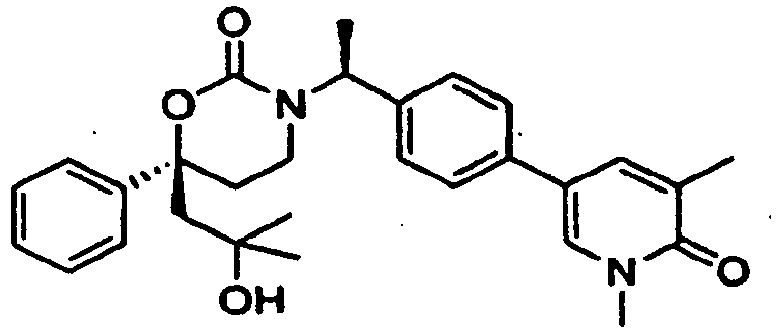
- The title compound was prepared following a procedure analogous to that described in Example 628 using 1 5-bromo-3-methylpyridin-2(1H)-one and methyl iodide in Step 1. LC-MS Method 2 tR = 1.197 min, m/z = 475.1; 1H NMR (CDCl3) 1.04 (s, 3H), 1.11 (s, 3H), 1.46 (d, 3H), 2.18 (m, 5H), 2.21 (m, 1H), 2.29-2.40 (m, 1H), 2.80 (m, 1H), 3.41 (s, 3H), 3.56 (s, 3H), 5.60 (m, 1H), 6.91 (d, 2H), 7.07 (d, 2H), 7.21-7.40 (m, 7H).
-

- The title compound was prepared following a procedure analogous to that described in Example 628, using 5-bromopyridin-2(1H)-one and ethyl iodide in Step 1 and (S)-6-(4-fluorophenyl)-6-(2-hydroxy-2-methylpropyl)-3-((S)-1-(4-(4,4,5,5-tetramethyl-1,3,2-dioxaborolan-2-yl)phenyl)ethyl)-1,3-oxazinan-2-one in Step 2. LC-MS Method 2 tR = 1.205 min, m/z = 493.2; 1H NMR (CDCl3) 1.16 (d, 6H), 1.39 (t, 3H), 1.52 (d, 3H), 2.19 (s, 4H), 2.20-2.31 (m, 2H), 2.38-2.50 (m, 1H), 2.90 (m, 1H), 4.04 (m, 2H), 5.69 (m, 1H), 6.66 (d, 1H), 7.00 (m, 4H), 7.18 (d, 2H), 7.30 (m, 2H), 7.41 (s, 1H), 7.51 (d, 1 H).
-

- The title compound was prepared from (R)-3-((S)-1-(4-bromophenyl)propyl)-6-methyl-6-phenyl-1,3-oxazinan-2-one following procedures analogous to those described in Example 459 Steps 3 and 4 using 4-iodo-1-methylpyridin-2(1 H)-one in Step 4. LC-MS Method 1 tR = 1.55 min, m/z = 417 (M+1); 1H NMR (CDCl3) 7.41 (1H, d, J = 7.03 Hz), 7.33 (2H, d, J = 8.20 Hz), 7.29-7.19 (5H, m), 7.10 (1H, d, J = 8.20), 6.95 (1H, d = 1.76), 6.55 (1H, dd, J = 2, 7.03 Hz), 5.51 (1H, q, J =6.49, 9.66 Hz), 3.65 (3H, s), 3.00-2.95 (1H, m), 2.44-2.36 (1H, m), 2.33-2.15 (2H, m), 2.06-1.86 (2H, m), 1.64 (3H, s), 1.02 (3H, t, J = 7.32 Hz).
- (R)-3-((S)-1-(4-bromophenyl)propyl)-6-methyl-6-phenyl-1,3-oxazinan-2-one was prepared from 4-chloro-2-phenylbutan-2-ol and (S)-1-(4-bromophenyl)propan-1-amine following procedures analogous to those described in Example 353.
- 4-chloro-2-phenylbutan-2-ol was prepared from 3-chloro-1-phenylpropan-1-one and methylmagnesium bromide following a procedure analogous to that described in Example 110 Step 1.
-

- The title compound was prepared from (S)-6-(4-fluorophenyl)-6-(2-hydroxy-2-methylpropyl)-3-((S)-1-(4-(4,4,5,5-tetramethyl-1,3,2-dioxaborolan-2-yl)phenyl)ethyl)-1,3-oxazinan-2-one and 6-chloropyrazine-2-carbonitrile following a procedure analogous to that described in Example 459 Step 4. LC-MS Method 1 tR = 1.61 min, m/z = 497(M+Na); 1H NMR (CDCl3) 8.98(d, 2H), 7.87(d, 2H), 7.26(m, 1H), 7.18(m, 3H), 7.04(t, 2H), 5.72(q, 1H), 2,99(m, 1H), 1.59(d, 3H), 1.14(d, 6H).
-

- The title compound was prepared from (S)-6-(2-hydroxy-2-methylpropyl)-6-phenyl-3-((S)-1-(4-(4,4,5,5-tetramethyl-1,3,2-dioxaborolan-2-yl)phenyl)propyl)-1,3-oxazinan-2-one and 4-bromo-1,6-dimethylpyridin-2(1H)-one following a procedure analogous to that described in Example 459 Step 4. LC-MS Method 2 tR = 1.173 min, m/z = 475.2; 1H NMR (CDCl3) 1.10 (s, 3H),1.16 (s, 3H), 1.51 (d, 3H),2.18 (m, 3H), 2.21 (m, 1H), 2.42 (m, 4H), 2.86 (m,1H), 3.54 (s, 3H), 5.66 (m, 1H), 6.21 (s, 1H), 6.60 (s, 1H), 6.97 (m, 2H), 7.23-7.34(m, 7H).
- 4-bromo-1,6-dimethylpyridin-2(1H)-one was prepared by methylation of 4-bromo-6-methylpyridin-2(1H)-one with methyl iodide using K2CO3 following a procedure analogous to that described in Example 628 Step 1.
-

- The title compound was prepared from (S)-6-(2-hydroxy-2-methylpropyl)-6-phenyl-3-((S)-1-(4-(4,4,5,5-tetramethyl-1,3,2-dioxaborolan-2-yl)phenyl)propyl)-1,3-oxazinan-2-one and 1-ethyl-4-iodopyridin-2(1H)-one following a procedure analogous to that described in Example 459 Step 4. LC-MS Method 2 tR = 1.228 min, m/z = 971.4; 1H NMR (CDCl3) 1.10 (s, 3H), 1.14 (s, 3H), 1.36 (m, 3H), 1.53 (d, 3H), 2.17 (s, 2H), 2.21-2.32 (m, 2H), 2.32-2.48 (m, 1H), 2.88 (m, 1H), 4.00 (m, 2H), 5.68 (m, 1H), 6.39 (d, 1H), 6.78 (s, 1H), 6.99 (d, 2H), 7.27-7.38 (m, 8H).
- 1-ethyl-4-iodopyridin-2(1H)-one was prepared from 4-iodopyndin-2(1H)-one and ethyl iodide following a procedure analogous to that described in Example 628 Step 1.
-

- The title compound was prepared from (S)-6-(2-hydroxy-2-methylpropyl)-6-phenyl-3-((S)-1-(4-(4,4,5,5-tetramethyl-1,3,2-dioxaborolan-2-yl)phenyl)propyl)-1,3-oxazinan-2-one and 4-iodo-1-(2,2,2-trifluoroethyl)pyridin-2(1H)-one following a procedure analogous to that described in Example 459 Step 4. LC-MS Method 2 tR = 1.871 min, m/z = 471.1; 1H NMR (CDCl3) 1.11 (s, 3H), 1.17 (s, 3H), 1.53 (d, 3H), 2.16-2.33 (m, 4H), 2.35-2.47 (m, 1H), 2.89 (m, 1 H), 4.58-4.70 (m, 2H), 5.69 (m, 1H), 6.71 (s, 1H), 7.00 (d, 2H), 7.19-7.38 (m, 8H).
- 4-iodo-1-(2,2,2-trifluoroethyl)pyridin-2(1H)-one was prepared from 4-iodopyridin-2(1H)-one and 2,2,2-trifluoroethyl trifluoromethanesulfonate following a procedure analogous to that described in Example 628 Step 1.
-

- The title compound was prepared from (S)-6-(2-hydroxy-2-methylpropyl)-6-phenyl-3-((S)-1-(4-(4,4,5,5-tetramethyl-1,3,2-dioxaborolan-2-yl)phenyl)propyl)-1,3-oxazinan-2-one and 2-bromo-N,N-dimethylthiazole-5-carboxamide following a procedure analogous to that described in Example 459 Step 4. LC-MS Method 2 tR = 1.215 min, m/z = 450.1; 1H NMR (CD3OD) 0.92 (s, 3H), 1.22 (s, 3H), 1.53 (d, 3H), 2.11 (s, 2H), 2.19-2.28 (m, 1H), 2.40-2.58 (m, 2H), 3.00-3.31 (m, 4H), 5.56 (m, 1H), 7.02 (d, 2H), 7.26-7.39 (m, 5H), 7.69 (d, 2H), 8.08 (s, 1H).
-

- The title compound was prepared from 6-(4-((S)-1-((S)-6-(4-fluorophenyl)-6-(2-hydroxy-2-methylpropyl)-2-oxo-1,3-oxazinan-3-yl)ethyl)phenyl)pyrazine-2-carbonitrile following a procedure analogous to that described in Example 584. LC-MS Method 1 tR = 1.32 min, m/z = 493; 1H NMR (CDCl3) 9.24(d, 2H), 7.88(s, 1H), 7.83(d, 2H), 4.29(m, 2H), 7.16(d, 2H), 7.06(t, 2H), 6.62(s, 1H), 5.74(q, 1H), 3.00(m, 1H), 2.48(m, 1H), 1.60(d, 3H), 1.17(d, 6H).
-

- The title compound was prepared from (S)-6-(2-hydroxy-2-methylpropyl)-6-phenyl-3-((S)-1-(4-(4,4,5,5-tetramethyl-1,3,2-dioxaborolan-2-yl)phenyl)propyl)-1,3-oxazinan-2-one and 5-bromo-1-(2,2,2-trifluoroethyl)pyridin-2(1H)-one following a procedure analogous to that described in Example 459 Step 4. LC-MS Method 2 tR = 1.323 min, m/z = 471.1; 1H NMR (CDCl3) 1.13 (s, 3H), 1.19 (s, 3H), 1.53 (d, 3H), 2.19-2.30 (m, 4H), 2.40 (m, 1H), 2.89 (m, 1H), 4.67 (m, 2H), 5.69 (m, 1H), 6.70 (d, 1 H), 7.03 (d, 2H), 7.13 (d, 2H), 7.29-7.38 (m, 6H), 7.55 (d, 1H).
- 5-bromo-1-(2,2,2-trrtluoroethyl)pyridin-2(1H)-one was prepared from 5-bromopyridin-2(1H)-one and 2,2,2-trifluoroethyl trifluoromethanesulfonate following a procedure analogous to that described in Example 628 Step 1.
-

- The title compound was prepared from (S)-6-(2-hydroxy-2-methylpropyl)-6-phenyl-3-((S)-1-(4-(4,4,5,5-tetramethyl-1,3,2-dioxaborolan-2-yl)phenyl)propyl)-1,3-oxazinan-2-one and 4-iodo-1-isopropylpyridin-2(1H)-one following a procedure analogous to that described in Example 459 Step 4. LC-MS Method 2 tR = 1.846 min, m/z =489.2; 1H NMR (CDCl3) 1.10 (s, 3H), 1.24 (s, 3H), 1.39 (d, 6H), 1.52 (d, 3H), 2.17-2.31 (m, 4H), 2.35-2.46 (m, 1H), 2.88 (m, 1H), 5.27 (m, 1H), 5.69 (m, 1H), 6.49 (d, 1H), 6.88 (s, 1H), 7.00 (d, 2H), 7.29-7.38 (m, 7H), 7.40 (d,1H).
- 4-iodo-1-isopropylpyridin-2(1H)-one was prepared from 4-iodopyridin-2(1H)-one and isopropyl iodide following a procedure analogous to that described in Example 628 Step 1.
-

- The title compound was prepared from (S)-6-allyl-3-((S)-1-(4-bromophenyl)ethyl)-6-phenyl-1,3-oxazinan-2-one following a procedure analogous to that described in Example 280. LC-MS Method 2 tR = 2.119 min, m/z = 375.8; 1H NMR (CDCl3) 1.09 (s, 3H), 1.19 (m, 1H), 1.27 (d, 3H), 2.17-2.28 (m, 4H), 2.52-2.69 (m, 2H), 5.67-5.79 (m, 1H), 7.18 (d, 2H), 7.34 (m, 3H), 7.39 (m, 2H), 7.42 (d, 2H).
-

- The title compound was prepared following procedures analogous to those described in Example 395 using (R)-1-(4-bromophenyl)ethanamine in Step 1. Two isomers were isolated.
- Isomer 1: LC-MS Method 2 tR = 1.552 min, m/z = 401.8; 1H NMR (CDCl3) 1.22 (d, 3H),2.00-2.11 (m, 1H), 2.25 (m, 1H), 2.56-2.78 (m, 4H), 5.00-5.12 (m, 2H), 5.69-5.81 (m, 2H), 7.19 (d, 2H), 7.31 (m, 3H), 7.39 (m, 2H), 7.46 (m, 2H).
- Isomer 2: LC-MS Method 2 tR = 1.493 min, m/z = 400; 1H NMR (CD3OD) 1.49 (d, 3H), 2.17-2.36 (m, 2H), 2.48 (m, 1H), 2.61 (m, 2H), 3.06 (m, 1H), 5.02 (m, 2H), 5.46 (m, 1H), 5.65-5.78 (m, 1H), 6.79 (d, 2H), 7.22 (m, 2H), 7.28-7.41 (m, 5H).
-

- The title compound was prepared following a procedure analogous to that described in Example 617 using ethyl bromide in Step 2. LC-MS Method 2 tR = 1.297 min, m/z = 418; 1H NMR (CDCl3) 1.12 (s, 3H), 1.19 (s, 3H), 1.43 (t, 3H), 1.56 (d, 3H), 2.20-2.31 (m, 4H), 2.37-2.48 (m, 1H), 2.88 (m, 1H), 4.29 (m, 2H), 5.70 (m, 1H), 6.98 (d, 1 H), 7.06 (d, 2H), 7.29-7.40 (m, 5H), 7.56 (m, 3H).
-

- The title compound was prepared from 3-((R)-3-((S)-1-(4-bromophenyl)ethyl)-6-(4-fluorophenyl)-2-oxo-1,3-oxazinan-6-yl)-2,2-dimethylpropanenitrile following procedures analogous to those described in Example 313 Steps 3 and 4. LC-MS Method 1 tR = 1.45 min, m/z = 488; 1H NMR (CDCl3) 7.68(dd, 1H), 7.52(d, 1H), 7.32(q, 2H), 7.17(d, 2H), 7.06(t, 2H), 6.97(d, 2H), 6.91 (d, 1H), 5.66(q, 1H), 3.72(s, 3H), 2.99(dt, 1H), 2.48(dd, 2H), 2.27(m, 1H), 2.11(s, 2H), 1.55(d, 3H), 1.44(s, 3H), 1.34(s, 3H).
-

- The title compound was prepared following a procedure analogous to that described in Example 617 using isopropyl iodide in Step 2. LC-MS Method 2 tR = 1.885 min, m/z = 432.1; 1H NMR (CDCl3) 1.10 (s, 3H), 1.18 (s, 3H), 1.39 (d, 6H), 1.53 (d, 3H), 2.18-2.29 (m, 4H), 2.31-2.47 (m, 1H), 2.88 (m, 1H), 5.32 (m, 1H); 5.69 (m, 1 H), 6.92 (d, 1H), 7.03 (d, 2H), 7.27-7.38 (m, 5H), 7.52 (d, 3H).
-

-

- Isomer 1 of the title compound was prepared from isomer 1 of 6-allyl-3-((1R)-1-(4-bromophenyl)ethyl)-6-phenyl-1,3-oxazinan-2-one following procedures analogous to those described in Example 395 Method 2 Steps 4, 5 and 6. LC-MS Method 2 tR = 1.362 min, m/z = 374, 376; 1H NMR (CDCl3) 1.12 (s, 3H), 1.17 (s, 3H), 1.48-1.49 (d, 3H), 2.14-2.20 (m, 4H), 2.24-2.29 (m, 1H), 2.35-2.43 (m, 1H), 2.80-2.85 (m, 1H), 5.58-5.64 (m, 1H), 6.79-6.81 (d, 2H), 7.21-7.24 (d, 2H), 7.29-7.37 (m, 5H).
- Isomer 2 of the title compound was prepared following procedures analogous to those described in Example 395 Method 2 Steps 4, 5 and 6. LC-MS Method 2 tR = 1.509 min, m/z = 374; 1H NMR (CDCl3) 1.00 (s, 3H), 1.12 (s, 3H), 1.20 (d, 3H), 2.10-2.20 (m, 4H), 2.52 (m, 2H), 5.64 (m, 1H), 7.10(d, 2H), 7.25(m, 3H), 7.32(m, 2H), 7.38(m, 2H).
-

- The tittle compound was prepared from (S)-6-(2-hydroxy-2-methylpropyl)-6-phenyl-3-((S)-1-(4-(4,4,5,5-tetramethyl-1,3,2-dioxaborolan-2-yl)phenyl)ethyl)-1,3-oxazinan-2-one and 5-bromo-1-ethyl-3-methylpyridin-2(1 H)-one following procedures analogous to those described in Example 486 Step 4. LC-MS Method 2 tR = 1.314 min, m/z = 489: 1H NMR (CDCl3) 1.09 (s, 3H), 1.15 (s, 3H), 1.35 (t, 3H), 1.50 (d, 3H), 2.15-2.25 (m, 7H), 2.35 (m, 1H), 2.86 (m, 1H), 4.03 (m, 2H), 5.66 (q, 1H), 6.96 (d, 2H), 7.13 (d, 2H), 7.25-7.36 (m, 7H).
- 5-Bromo-1-ethyl-3-methylpyridin-2(1H)-one was prepared by alkylation of 5-bromo-3-methylpyridin-2(1H)-one with ethyl iodide following a procedure analogous to that described in Example 628 Step 1.
-

- The title compound was isolated as a byproduct from the preparation of Example 655. LC-MS Method tR = 1.314 min, m/z = 489; 1H NMR (CDCl3) 1.04 (s, 3H), 1.11 (s, 3H), 1.34 (t, 3H), 1.47 (d, 3H), 2.13-2.24 (m, 7H), 2.32 (m, 1H), 2.81 (m, 1H), 4.34 (q, 2H), 5.62 (q, 1H), 6.93 (d, 2H), 7.17-7.27 (m, 7H), 7.42 (s, 1H), 8.02 (s, 1H).
-

- The title compound was prepared from (S)-6-(2-hydroxy-2-methylpropyl)-6-phenyl-3-((S)-1-(4-(4,4,5,5-tetramethyl-1,3,2-dioxaborolan-2-yl)phenyl)ethyl)-1,3-oxazinan-2-one and 6-bromo-N-cyclopropylnicotinamide following procedures analogous to those described in Example 486 Step 4. LC-MS Method tR = 1.74 min, m/z = 456.1; 1H NMR (CDCl3) 0.61 (m, 2H), 0.82 (m, 2H), 1.13 (s, 3H), 1.22 (s, 3H), 1.49 (d, 3H), 2.17 (m, 3H), 2.21 (m, 1H), 2.31 (m, 1H), 2.79 (m. 1H), 2.88 (m, 1H), 5.66 (m, 1H), 6.40 (s, 1H), 6.99 (d, 1H), 7.20-7.31 (m, 5H), 7.60 (d, 1H), 7.68 (d, 2H), 8.07 (d, 1H), 8.89 (s, 1H).
- 6-bromo-N-cyclopropylnicotinamide was prepared from 6-bromonicotinoyl chloride and cyclopropylamine.
-

- A 250 mL flask was charged with anhydrous CeCl3 (7.1890 g, 29.2 mmol) and THF (55 mL). The mixture was vigorously stirred for 2 h at rt. The suspension was then cooled to -78 °C and a solution of 2-methylallylmagnesium chloride (0.5 M in THF, 56 mL, 28.0 mmol) was added. After stirring for 2 h at -78 °C, a solution of 3-chloropropiophenone (3.350 g, 19.8 mmol) in THF (30 mL) was added via cannula. The reaction mixture was allowed to slowly warm to 8 °C while stirring overnight (18 h). The reaction was then quenched with satd aq NaHCO3, extracted with EtOAc, and dried over Na2SO4. After the solvents were evaporated, the crude 1-chloro-5-methyl-3-phenylhex-5-en-3-ol was directly used in the next step without further purification. LC-MS Method 1 tR = 1.91 min, m/z 248, 207 (M-OH)+; 1H NMR (400 MHz, CDCl3) δ 7.39-7.22 (m, 5H), 4.92 (m, 1H), 4.77 (m, 1H), 3.60-3.53 (m, 1H), 3.1.7-3.10 (m, 1H), 2.67 (d, J = 13.2 Hz, 1H), 2.55 (d, J = 13.2 Hz, 1H), 2.41-2.25 (m, 2H), 1.29 (s, 3H); "C NMR (100 MHz, CDCl3) δ 144.55, 141.72, 128.32, 126.88, 125.07, 116.50, 74.44, 51.46, 46.34, 40.19, 24.22.
- 1-chloro-5-methyl-3-phenylhex-5-en-3-ol (1.28 g, 5.7 mmol), (S)-1-(4-bromophenyl)ethanamine (1.37 g, 1.2 equiv), KI (995 mg, 1.05 equiv), K2CO3 (1.57 g, 2 equiv) were mixed with acetonitrile (15 mL) and heated to reflux (oil bath 96°C) for overnight. After being cooled to rt, the mixture was filtered, concentrated, and purified by chromatography on a 40-g silica gel column, eluted with 0-8% MeOH in CH2Cl2, to afford 1-((S)-1-(4-bromophenyl)ethylamino)-5-methyl-3-phenylhex-5-en-3-ol (1.33 g, 60%).
- To a solution of 1-((S)-1-(4-bromophenyl)ethylamino)-5-methyl-3-phenylhex-5-en-3-ol (1.33 g, 3.43 mmol) in CH2Cl2 (100 mL) was added pyridine (277 µL, 1 equiv) and triethylamine (717 µL, 1.5equiv). The mixture was cooled to 0 °C. Methyl chloroformate (397 µL, 1.5 equiv) was added slowly. After 15 min, the mixture was warmed to rt slowly and stirred for 3 h. The mixture was then diluted with ether (200 mL), washed with 5% aq HCl (2 x 25 mL), satd aq NaHCO3 (25 mL) and brine (20 mL), and dried over Na2SO4. After filtration and concentration, the crude methyl (S)-1-(4-bromophenyl)ethyl(3-hydroxy-5-methyl-3-phenylhex-5-enyl)carbamate was used for next steps without further purification.
- The crude methyl (S)-1-(4-bromophenyl)ethyl(3-hydroxy-5-methyl-3-phenylhex-5-enyl)carbamate from above procedure was dissolved in dry THF (75 mL), NaH (60% in mineral oil, 274 mg, 2 equiv) was added slowly at rt. After 10 min, the mixture was heated to reflux for 2 h. LC-MS found reaction completed. The mixture was cooled to 0 °C, quenched with satd aq NH4Cl (10 mL), diluted with ether (100 mL), washed with 1% aq HCl (25 mL) and brine (15 mL), and dried over Na2SO4. After filtration and concentration, the crude product was purified by by chromatography on a 40-g silica gel column, eluted with 10∼35% EtOAc in hexanes. The second UV active peak was collected to afford (R)-3-((S)-1-(4-bromophenyl)ethyl)-6-(2-methylallyl)-6-phenyl-1,3-oxazinan-2-one (490mg 34.5% overall yield for Steps 3 and 4).
- A mixture of (R)-3-((S)-1-(4-bromophenyl)ethyl)-6-(2-methylallyl)-6-phenyl-1,3-oxazinan-2-one (490 mg, 1.18 mmol), TsCN (257 mg, 1.2 equiv), PhSiH3 (157 µL, 1.07 equiv) and the cobalt N,N'-bis(3,5-di-tert-butylsalicylidene)-1,1,2,2-tetramethylethenediamine catalyst prepared as described in Example 520 Step1 (7.5 mg, 0.01 equiv) and ethanol (20 mL) was stirred 4 h at rt. LC-MS found the reaction completed. The mixture was concentrated and purified by ISCO (40g column, 25-80% EtOAc in Hexanes) to afford 267mg product (51% yield). LC-MS Method 1 tR = 1.89min., m/z 441, 443 (M+1).
- To a solution of 3-((Rr3-((S)-1-(4-bromophenyl)ethyl)-2-oxo-6-phenyl-1,3-oxazinan-6-yl)-2,2-dimethylpropanenitrile (208mg, 0.47mmol) in 1,4-dioxane (5 mL) were added 6-oxo-1,6-dihydropyridin-3-ylboronic acid (98mg, 1.5equiv.). 2.0 M aq Cs2CO3 solution (500 µL), and Pd(dppf)Cl2 (20mg, 0.06equiv.). The mixture was degassed and refilled with N2 gas 3 times, before being heated to 90 °C (oil bath) for 3 h. LC-MS found the reaction was complete. The mixture was cooled to rt, diluted with EtOAc (25 mL), and washed with water (10 mL) The aqueous layer was extracted with EtOAc (2 × 10 mL). The combined organic layers were washed with water (10 mL) and brine (8 mL), and dried over Na2SO4. After filtration and concentration, the residue was purified by chromatography (12-g silica gel cartridge, 0 -10% MeOH in CH2Cl2, major UV peak) to afford 2,2-dimethyl-3-((R)-2-oxo-3-((S)-1-(4-(6-oxo-1,6-dihydropyridin-3-yl)phenyl)ethyl)-6-phenyl-1,3-oxazinan-6-yl)propanenitrile (202 mg, 94%) as a brown oil. LC-MS Method 1 tR = 1.34 min, m/z = 456 (M+1); 1H NMR (CDCl3) 8.01 (d, 1H), 7.80 (s, 1H), 7.36 (dt, 6H), 7.19 (d, 2H), 6.98 (m, 3H), 5.65 (d, 1H), 2.98 (d, 1 H), 2.50 (m, 2H), 2.32 (m, 1H), 2.17 (s, 2H), 1.57 (d, 3H), 1.40 (s, 3H), 1.32 (s, 3H).
-

- (Methoxycarbonylsulfamoyl)triethylammonium hydroxide (1.38 g) is added to 3-[(S)-1-(4-bromo-phenyl)-ethyl)-(S)-6-(2-hydroxy-2-methyl-propyl)-6-phenyl-[1,3]oxazinan-2-one (2.0 g) dissolved in tetrahydrofuran (30 mL) and toluene (15 mL). The resulting solution was stirred at room temperature for 0.5 h and at 75 °C for 1 h. After cooling to room temperature, the solution was concentrated and ethyl acetate was added to the residue. The resulting mixture was washed with aqueous NaHCO3 solution and brine and dried (MgSO4). The title compound was obtained after removal of the solvent. Yield: 1.9 g (quantitative). Mass spectrum (ESI+): m/z = 414/416 (Br) [M+H]+
- 3-[(S)-1-(4-Bromo-phenyl)-ethyl]-(S)-6-(2-methyl-allyl)-6-phenyl-[1,3]oxazinan-2-one (0.21 g), p-toluenesulfonyl cyanide (143 mg), tert-BuOOH (5.5 M in decane, 27 µL), and phenylsilane (64 µL) were added in the given order to a flask charged with a stir bar, (1R,2R)-(-)-1,2-cyclohexanediamino-N,N'-bis(3,5-di-tert-butylsalicyliden)cobalt(II) (3 mg) and ethanol (15 mL) in argon atmosphere. The resulting solution was stirred at room temperature for 3 h and then concentrated under reduced pressure. The residue was purified by chromatography on silica gel (cyclohexane/ethyl acetate 60:40->0:100) to afford the title compound as a resin-like solid. Yield: 0,16 g (70% of theory). Mass spectrum (ESI+): m/z = 441/443 (Br) [M+H]+
-

- The title compound was prepared from (S)-6-(2-hydroxy-2-methylpropyl)-6-phenyl-3-((S)-1-(4-(4.4,5,5-tetramethyl-1,3,2-dioxaborolan-2-yl)phenyl)ethyl)-1,3-oxazinan-2-one and 4-bromo-1-ethyl-6-methylpyridin-2(1H)-one following a procedure analogous to that described in Example 459 Step 4. LC-MS Method 2 tR = 1.211 min, m/z = 489.2; 1H NMR (CDCl3) 1.10 (s, 3H), 1.17 (s, 3H), 1.49 (s, 9H), 1.57 (d, 3H), 2.22 (m, 4H), 2.37 (m, 1H), 2.84 (m, 1H), 5.60 (m, 1H), 5.91 (s, 1H), 7.06 (d, 2H), 7.27-7.40 (m, 5H), 7.68 (d, 1H), 7.24 (d, 2H), 8.09 (d, 1H), 8.90 (s, 1H).
- 4-bromo-1-ethyl-6-methylpyridin-2(1H)-one was prepared by alkylation of 4-bromo-6-methylpyridin-2(1H)-one with ethyl iodide using K2CO3 following a procedure analogous to that described in Example 628 Step 1.
-

- The title compound was isolated as a byproduct from the preparation of Example 659. LC-MS Method 2 tR = 1.259 min, m/z = 489.2; 1H NMR (CDCl3) 1.10 (s, 3H),1.15 (s, 3H), 1.34 (m, 3H), 1.49 (m, 3H), 2.16 (m, 3H), 2.19 (m, 1H), 2.32 (m, 1H), 2.42 (m, 3H), 2.79 (m, 1H), 4.32 (m, 2H), 5.66 (m, 1H), 6.55 (s, 1H), 6.76 (s, 1H), 6.98 (m, 2H), 7.19-7.29 (m, 7H).
-

- The title compound was prepared from (S)-6-(2-hydroxy-2-methylpropyl)-6-phenyl-3-((S)-1-(4,4,5,5-tetramethyl-1,3,2-dioxaborolan-2-yl)phenyl)ethyl)-1,3-oxazinan-2-one and 6-bromo-N-tert-butylnicotinamide following procedures analogous to those described in Example 486 Step 4. LC-MS Method 2 tR = 1.898 min, m/z = 472.2; 1H NMR (CDCl3) 1.08 (s, 3H), 1.15 (s, 3H), 1.34 (s, 9H), 1.49 (d, 3H), 2.16 (m, 3H), 2.19 (m, 1H),2.32 (m, 1H),2.42 (m, 3H), 2.79 (m,1H), 4.32 (m,2H) 5.66 (m, 1H), 6.55 (s, 1H), 6.76 (s, 1H), 6.98 (m, 2H), 7.19-7.29 (m, 7H).
- 6-bromo-N-tert-butylnicotinamide was prepared from 6-bromonicotinoyl chloride and tert-butylamine.
-

- The title compound was prepared from (S)-6-(2-hydroxy-2-methylpropyl)-6-phenyl-3-((S)-1-(4-(4,4,5,5-tetramethyl-1,3,2-dioxaborolan-2-yl)phenyl)ethyl)-1,3-oxazinan-2-one and 2-bromoisonicotinonitrile following a procedure analogous to that described in Example 583. LC-MS Method 2 tR = 1.419 min, m/z = 478.1; 1H NMR (CD3OD) 0.93 (s, 3H), 1.26 (s, 3H), 1.57 (d, 3H), 2.17 (s, 2H), 2.25 (m, 1H), 2.41-2.58 (m, 2H), 3.06 (m, 1H), 5.58 (m, 1H), 7.08 (d, 2H), 7.25-7.40 (m, 5H), 7.59 (d, 1H), 7.80 (d, 2H), 8.10 (s, 1H), 8.29 (d, 1 H).
-

- The title compound was prepared from (S)-6-(2-hydroxy-2-methylpropyl)-6-phenyl-3-((S)-1-(4-(4,4,5,5- tetramethyl-1,3,2-dioxaborolan-2-yl)phenyl)ethyl)-1,3-oxazinan-2-one and 2-bromonicotinonitrile following a procedure analogous to that described in Example 583. LC-MS Method 2 tR = 1.23 min, m/z = 398.1; 1H NMR (CD3OD) 0.93 (s, 3H), 1.26 (s, 3H), 1.57 (d, 3H), 2.17 (s, 2H). 2.28 (m, 1H), 2.50 (m 2H), 3.09 (m, 1H), 5.58 (m, 1H), 7.08 (d, 2H), 7.22-7.41 (m, 5H), 7.50 (m, 1H), 7.62 (d, 2H), 8.23 (d, 1H), 8.81 (m, 1H).
-

- The title compound was prepared from (S)-6-(2-hydroxy-2-methylpropyl)-6-phenyl-3-((S)-1-(4-(4,4,5-tetramethyl-1,3,2-dioxaborolan-2-yl)phenyl)ethyl)-1,3-oxazinan-2-one and 4-bromo-1,5,6-trimethylpyridin-2(1H)-one following a procedure analogous to that described in Example 459 Step 4. LC-MS Method 2 tR = 1.187 min, m/z = 489.2; 1H NMR (CDCl3) 1.10 (s, 3H), 1.15 (s, 3H), 1.32 (m, 3H), 1.52 (m, 3H), 1.72 (s, 1H), 2.18 (m, 3H), 2.19 (m, 1H), 2.42 (m, 4H), 2.86 (m, 1H), 4.12 (m, 2H), 5.66 (m, 1H), 6.16 (s, 1H), 6.53 (s, 1H), 6.98 (m, 2H), 7.23-7.34 (m, 7H).
- 4-bromo-1,5,6-trimethylpyridin-2(1H)-one was prepared by alkylation of 4-bromo-5,6-dimethylpyridin-2(1H)-one with methyl iodide using K2CO3 following a procedure analogous to that described in Example 628 Step 1. 4-bromo-5,6-dimethylpyridin-2(1 H)-one was prepared following the procedure described in McElroy, W. T. and DeShong, P. Org. Lett. 2003, 5, 4779.
-

- The title compound was prepared from 2,2-dimethyl-3-((R)-2-oxo-6-phenyl-3-((S)-1-(4-(4,4,5,5-tetramethyl-1,3,2-dioxaborolan-2-yl)phenyl)ethyl)-1,3-oxazinan-6-yl)propanenitrile and 3-chloro-6-methylpyridazine following a procedure analogous to that described in Example 459 Step 4. LC-MS Method 1 tR = 1.41 min, m/z = 455; 1H NMR (CDCl3) 8.20 (d, 1H), 7.92 (d, 1 H), 7.74 (d, 2H), 7.37 (dt, 6H), 7.05 (d, 2H), (q, 1H), 3.00 (dm, 1H), 2.93 (s, 3H), 2.49 (m, 2H), 2.34 (m, 1H), 2.17 (d, 2H), 1.58 (d, 3H), 1.39 (s, 3H), 1.33 (s, 3H).
- The inhibition of a microsomal preparation of 11β-HSD1 by compounds of the invention was measured essentially as previously described (K. Solly, S.S. Mundt, H.J. Zokian, G.J. Ding, A. Hermanowski-Vosatka, B. Strutovici, and W. Zheng. High-Throughput Screening of 11-Beta-Hydroxyseroid Dehydrogenase Type 1 in Scintillation Proximity Assay Format. Assay Drug Dev Technol 3 (2005) 377-384). All reactions were carried out at rt in 96 well clear flexible PET Microbeta plates (PerkinElmer). The assay begins by dispensing 49 µl of substrate solution (50mM HEPES, pH 7.4, 100mM KCl, 5mM NaCl, 2mM MgCl2, 2 mM NADPH and 160 nM [3H]cortisone (1 Ci/mmol)) and mixing in 1 µL of the test compounds in DMSO previously diluted in half-log increments (8 points) starting at 0.1 mM. After a 10 minute pre-incubation. 50 µL of enzyme solution containing microsomes isolated from CHO cells overexpressing human 11β-HSD1 (10-20 µg/ml of total protein) was added, and the plates were incubated for 90 minutes at rt. The reaction was stopped by adding 50 µl of the SPA beads suspension containing 10 µM 18β-glycyrrhetinic acid, 5 mg/ml protein A coated YSi SPA beads (GE Healthcare) and 3.3 µg/ml of anti-cortisol antibody (East Coast Biologics) in Superblock buffer (Bio-Rad). The plates were shaken for 120 minutes at rt, and the SPA signal corresponding to [3H]cortisol was measured on a Microbeta plate reader.
- The inhibition of 11β-HSD1 by compounds of this invention was measured in whole cells as follows. Cells for the assay were obtained from two sources: fully differentiated human omental adipocytes from Zen-Bio, Inc.; and human omental pre-adipocytes from Lonza Group Ltd. Pre-differentiated omental adipocytes from Zen-Bio Inc. were purchased in 96-well plates and were used in the assay at least two weeks after differentiation from precursor preadipocytes. Zen-Bio induced differentiation of pre-adipocytes by supplementing medium with adipogenic and lipogenic hormones (human insulin, dexamethasone, isobutylmethylxanthine and PPAR-gamma agonist). The cells were maintained in full adipocyte medium (DMEM/Ham's F-12 (1:1, v/v), HEPES pH 7.4, fetal bovine serum, penicillin, streptomycin and Amphotericin B, supplied by Zen-Bio, Inc.) at 37°C, 5% CO2.
- Pre-adipocytes were purchased from Lonza Group Ltd. and placed in culture in Preadipocyte Growth Medium-2 supplemented with fetal bovine serum, penicillin, and streptomycin (supplied by Lonza) at 37°C, 5% CO2. Pre-adipocytes were differentiated by the addition of insulin, dexamethasone, indomethacin and isobutylmethylxanthine (supplied by Lonza) to the Preadipocyte Growth Medium-2. Cells were exposed to the differentiating factors for 7 days, at which point the cells were differentiated and ready for the assay. One day before running the assay, the differentiated omental adipocytes were transferred into serum- and phenol-red-free medium for overnight incubation. The assay was performed in a total volume of 200 µL. The cells were pre-incubated with serum-free, phenol-red-free medium containing 0.1% (v/v) of DMSO and various concentrations of the test compounds at least 1 h before [3H] cortisone in ethanol (50Ci/mmol, ARC, Inc.) was added to achieve a final concentration of cortisone of 100 nM. The cells were incubated for 3-4 hrs at 37°C, 5% CO2. Negative controls were incubated without radioactive substrate and received the same amount of [3H] cortisone at the end of the incubation. Formation of [3H] cortisol was monitored by analyzing 25 µL of each supernatant in a scintillation proximity assay (SPA). (Solly, K.; Mundt, S. S.;Zokian. H.J.;Ding, G. J.; Hermanowski-Vosatka, A.; Strulovici, B.; Zheng, W. Assay Drug Dev. Technol. 2005, 3, 377-384). Many compounds of the invention showed significant activity in this assay.
TABLE OF BIOLOGICAL ASSAY RESULTS Compound Biological Test Example 1 IC50 Rangea Average % inhibition at 100 nM Average % inhibition at 111.1 nM EXAMPLE 1 ++ 62.7 EXAMPLE 1 Isomer 1 ++ 78.7 EXAMPLE 1 Isomer 2 + 32.6 EXAMPLE 2 + 28.8 EXAMPLE 3 ++ 74.3 EXAMPLE 4 + 56.2 EXAMPLE 5 + 34.4 EXAMPLE 6 ++ 78.1 EXAMPLE 7 + 37.3 EXAMPLE 8 + 6.4 EXAMPLE 9 ++ 93.8 EXAMPLE 10 ++ 90.5 EXAMPLE 11 + 28.4 EXAMPLE 12 ++ 86.4 EXAMPLE 13 + 19.2 EXAMPLE 14 + 21.9 EXAMPLE 15 + 38.5 EXAMPLE 16 + 35.7 EXAMPLE 17 ++ 58.8 EXAMPLE 18 + 7.2 EXAMPLE 19 + 24.0 EXAMPLE 20 ++ 54.8 EXAMPLE 21 ++ 76.7 EXAMPLE 22 ++ 88.9 EXAMPLE 23 ++ 94.0 88.3 EXAMPLE 24 ++ 93.4 86.0 EXAMPLE 25 ++ 91.7 84.2 EXAMPLE 26 ++ 88.2 87.0 EXAMPLE 27 ++ 67.0 EXAMPLE 28 ++ 93.6 82.3 EXAMPLE 28 Isomer 1 ++ 72.3 EXAMPLE 28 Isomer 2 ++ 96.6 EXAMPLE 29 + 29.8 EXAMPLE 30 + 23.1 EXAMPLE 31 + 27.5 EXAMPLE 32 + 46.0 EXAMPLE 33 + 37.1 EXAMPLE 34 ++ 72.0 EXAMPLE 35 + 26.7 EXAMPLE 36 ++ 63.3 EXAMPLE 37 ++ 81.0 EXAMPLE 38 + 17.8 EXAMPLE 39 + 24.8 EXAMPLE 40 + 28.8 EXAMPLE 41 + 19.9 EXAMPLE 42 + 36.7 EXAMPLE 43 ++ 77.7 EXAMPLE 44 + 35.0 EXAMPLE 45 + 31.2 EXAMPLE 46 + 46.4 EXAMPLE 47 + 36.3 EXAMPLE 48 + 37.0 EXAMPLE 49 + 15.4 EXAMPLE 50 ++ 96.3 EXAMPLE 51 Isomer 1 ++ 93.7 EXAMPLE 51 Isomer 2 + 38.6 EXAMPLE 52 ++ 98.6 EXAMPLE 52 Isomer 1 ++ 92.8 EXAMPLE 52 Isomer 2 ++ 90.8 97.0 EXAMPLE 53 ++ 57.1 EXAMPLE 54 + 15.5 EXAMPLE 55 + 3.7 EXAMPLE 56 + 5.6 EXAMPLE 57 + 10.4 EXAMPLE 58 + 34.8 EXAMPLE 59 + 18.0 EXAMPLE 60 + 51.3 EXAMPLE 61 + 17.7 EXAMPLE 62 + 20.5 EXAMPLE 63 ++ 59.0 EXAMPLE 64 ++ 94.0 EXAMPLE 65 ++ 95.9 98.4 EXAMPLE 65 Isomer 1 ++ 94.8 97.6 EXAMPLE 65 Isomer 2 ++ 48.8 57.1 EXAMPLE 66 ++ 90.8 93.0 EXAMPLE 67 ++ 93.1 96.6 EXAMPLE 68 ++ 92.0 92.9 EXAMPLE 69 ++ 94.7 94.8 EXAMPLE 70 + 9.3 EXAMPLE 71 + EXAMPLE 72 ++ 77.5 EXAMPLE 73 + 48.4 EXAMPLE 74 ++ 70.0 EXAMPLE 75 ++ 57.8 EXAMPLE 76 ++ 81.0 EXAMPLE 77 ++ 88.7 89.2 EXAMPLE 78 ++ 93.8 EXAMPLE 79 ++ 75.3 EXAMPLE 80 ++ 77.8 EXAMPLE 81 ++ 72.2 EXAMPLE 82 Isomer 1 ++ 87.6 EXAMPLE 82 Isomer 2 ++ 89.2 EXAMPLE 83 Isomer 1 + 50.3 EXAMPLE 83 Isomer 2 + 45.8 EXAMPLE 84 ++ 94.6 EXAMPLE 84 Isomer 1 ++ 74.8 EXAMPLE 85 ++ 102.0 EXAMPLE 85 Isomer 1 ++ 93.1 EXAMPLE 86 ++ 85.7 EXAMPLE 86 Isomer 1 + 43.3 EXAMPLE 87 ++ EXAMPLE 87 Isomer 1 + 13.3 EXAMPLE 88 ++ 97.1 EXAMPLE 88 Isomer 1 + 74.4 EXAMPLE 89 ++ 71.4 EXAMPLE 90 ++ 83.1 EXAMPLE 91 + 39.8 EXAMPLE 92 + 35.0 EXAMPLE 93 + 45.3 EXAMPLE 94 + 16.2 EXAMPLE 95 ++ 97.3 EXAMPLE 95 Isomer 1 ++ 91.0 EXAMPLE 96 ++ 91.9 EXAMPLE 96 Isomer 1 ++ 88.3 98.5 EXAMPLE 96 Isomer 2 - 9.7 EXAMPLE 97 Isomer 1 + 52.8 EXAMPLE 97 Isomer 2 ++ 88.2 EXAMPLE 98 ++ 73.4 EXAMPLE 99 ++ 75.3 EXAMPLE 100 ++ 93.7 EXAMPLE 101 ++ 84.4 EXAMPLE 102 ++ 91.7 EXAMPLE 102 Isomer 1 + 35.4 EXAMPLE 102 Isomer 2 ++ 94.0 95.5 EXAMPLE 103 ++ 86.9 EXAMPLE 104 ++ 85.7 EXAMPLE 104 Isomer 1 + 44.3 EXAMPLE 104 Isomer 2 ++ 98.1 EXAMPLE 105 ++ 87.4 EXAMPLE 106 ++ 88.7 EXAMPLE 107 ++ 90.9 97.0 EXAMPLE 108 ++ 55.4 EXAMPLE 109 ++ 94.1 94.0 EXAMPLE 109 Isomer 1 ++ 67.0 EXAMPLE 109 Isomer 2 ++ 98.4 93.7 EXAMPLE 110 Isomer 1 ++ 90.5 EXAMPLE 110 Isomer 2 ++ 96.6 95.0 EXAMPLE 111 Isomer 1 ++ 90.9 EXAMPLE 111 Isomer 2 ++ 58.9 EXAMPLE 112 Isomer 1 ++ 34.7 EXAMPLE 112 Isomer 2 ++ 95.2 99.9 EXAMPLE 113 Isomer 1 ++ 83.2 EXAMPLE 113 Isomer 2 ++ 82.6 EXAMPLE 114 Isomer 1 - 17.4 EXAMPLE 114 Isomer 2 ++ 66.6 EXAMPLE 115 Isomer 1 + 54.7 EXAMPLE 115 Isomer 2 ++ 99.3 104.2 EXAMPLE 116 ++ 97.6 EXAMPLE 117 ++ 82.8 EXAMPLE 118 ++ 96.8 EXAMPLE 119 Isomer 1 ++ 95.4 EXAMPLE 119 Isomer 2 ++ 56.3 EXAMPLE 120 Isomer 1 ++ 91.8 91.5 EXAMPLE 120 Isomer 2 ++ 90.6 EXAMPLE 121 + 34.2 EXAMPLE 122 ++ 94.1 95.6 EXAMPLE 123 ++ 97.6 EXAMPLE 124 ++ 95.2 96.8 EXAMPLE 125 ++ 98.3 94.0 EXAMPLE 126 ++ 79.0 80.7 EXAMPLE 127 ++ 86.3 EXAMPLE 128 Isomer 1 + 26.1 27.5 EXAMPLE 128 Isomer 2 - 6.5 EXAMPLE 129 + 32.1 EXAMPLE 129 Isomer 1 + 29.2 EXAMPLE 129 Isomer 2 + 20.9 EXAMPLE 130 Isomer 1 ++ 92.2 EXAMPLE 130 Isomer 2 ++ 87.7 EXAMPLE 131 - 6.6 11.3 EXAMPLE 132 + 30.4 EXAMPLE 133 ++ 85.8 95.4 EXAMPLE 134 ++ 93.9 96.2 EXAMPLE 135 ++ 88.9 93.8 EXAMPLE 136 ++ 96.4 97.3 EXAMPLE 137 Isomer 1 ++ 96.7 EXAMPLE 137 Isomer 2 ++ 96.4 95.5 EXAMPLE 138 ++ 95.9 95.4 EXAMPLE 139 ++ 93.8 96.2 EXAMPLE 140 ++ 95.6 97.1 EXAMPLE 141 ++ 90.6 92.2 EXAMPLE 142 + 34.4 27.4 EXAMPLE 143 Isomer 1 ++ 54.4 EXAMPLE 143 Isomer 2 ++ 95.4 EXAMPLE 144 Isomer 1 ++ 90.6 EXAMPLE 144 Isomer 2 ++ 95.3 96.6 EXAMPLE 145 ++ 96.5 EXAMPLE 146 ++ 79.9 EXAMPLE 147 ++ 89.5 EXAMPLE 148 ++ 85.0 EXAMPLE 149 ++ 95.3 EXAMPLE 150 ++ 92.9 EXAMPLE 151 ++ 77.0 EXAMPLE 152 ++ 79.0 EXAMPLE 153 + 27.0 26.6 EXAMPLE 154 ++ 79.0 EXAMPLE 155 + 45.6 EXAMPLE 156 ++ 93.8 EXAMPLE 157 Isomer 1 ++ 97.4 EXAMPLE 157 Isomer 2 ++ 92.9 90.7 EXAMPLE 158 + 23.8 EXAMPLE 159 ++ 98.6 EXAMPLE 160 Isomer 1 ++ 93.5 EXAMPLE 160 Isomer 2 ++ 95.9 95.2 EXAMPLE 161 Isomer 1 ++ 81.7 EXAMPLE 161 Isomer 2 + 60.5 EXAMPLE 161 Isomer 3 ++ 93.2 89.8 EXAMPLE 162 ++ 96.5 EXAMPLE 163 Isomer 1 ++ 66.8 EXAMPLE 163 Isomer 2 ++ 96.9 EXAMPLE 163 Isomer 3 # 11.3 EXAMPLE 164 ++ 95.9 EXAMPLE 165 ++ 92.9 EXAMPLE 166 ++ 81.8 EXAMPLE 167 Isomer 1 ++ 73.7 79.0 EXAMPLE 167 Isomer 2 ++ 77.2 EXAMPLE 168 Isomer 1 ++ 97.2 EXAMPLE 168 Isomer 2 ++ 95.6 EXAMPLE 169 ++ 97.0 EXAMPLE 170 ++ 97.0 EXAMPLE 171 Isomer 1 ++ 95.7 EXAMPLE 171 Isomer 2 ++ 68.6 EXAMPLE 172 ++ 95.8 EXAMPLE 173 Isomer 1 ++ 96.7 EXAMPLE 173 Isomer 2 ++ 94.5 EXAMPLE 174 + 48.0 EXAMPLE 175 Isomer 1 ++ 94.3 93.7 EXAMPLE 175 Isomer 2 + 25.8 EXAMPLE 176 + 54.8 EXAMPLE 177 ++ 77.4 EXAMPLE 178 ++ 77.7 EXAMPLE 179 ++ 79.4 EXAMPLE 180 ++ 85.2 84.9 EXAMPLE 181 ++ 101.0 90.7 EXAMPLE 182 ++ 79.5 EXAMPLE 183 ++ 88.6 EXAMPLE 184 + 65.4 EXAMPLE 185 ++ 98.4 EXAMPLE 186 Isomer 1 ++ 64.5 EXAMPLE 186 Isomer 2 # 33.5 EXAMPLE 187 Isomer 1 ++ 98.7 EXAMPLE 187 Isomer 2 ++ 46.4 EXAMPLE 188 Isomer 1 ++ 77.0 EXAMPLE 188 Isomer 2 # 31.7 EXAMPLE 189 Isomer 1 ++ 95.2 EXAMPLE 189 Isomer 2 ++ 90.1 EXAMPLE 190 ++ 76.0 EXAMPLE 191 Isomer 1 ++ 98.9 EXAMPLE 191 Isomer 2 ++ 69.0 EXAMPLE 192 ++ 70.7 EXAMPLE 193 Isomer 1 ++ 95.6 EXAMPLE 193 Isomer 2 ++ 94.3 EXAMPLE 194 ++ 89.5 EXAMPLE 195 ++ 96.8 EXAMPLE 196 Isomer 1 ++ 101.1 EXAMPLE 196 Isomer 2 ++ 98.9 EXAMPLE 197 Isomer 1 ++ 90.4 EXAMPLE 197 Isomer 2 ++ 82.1 EXAMPLE 198 ++ 88.2 EXAMPLE 199 ++ 90.3 EXAMPLE 200 Isomer 1 ++ 98.4 EXAMPLE 200 Isomer 2 ++ 73.1 EXAMPLE 201 Isomer 1 ++ 93.2 EXAMPLE 201 Isomer 2 # 27.0 EXAMPLE 202 ++ 95.9 EXAMPLE 203 Isomer 1 ++ 88.6 EXAMPLE 203 Isomer 2 ++ 93.8 EXAMPLE 204 Isomer 1 ++ 97.4 EXAMPLE 204 Isomer 2 ++ 99.4 EXAMPLE 205 ++ 98.0 EXAMPLE 206 Isomer 1 ++ 90.3 EXAMPLE 206 Isomer 2 ++ 85.9 EXAMPLE 207 Isomer 1 ++ 89.9 EXAMPLE 207 Isomer 2 ++ 89.3 EXAMPLE 208 Isomer 1 ++ 76.6 EXAMPLE 208 Isomer 2 # 38.5 EXAMPLE 208 Isomer 3 ++ 64.6 EXAMPLE 208 Isomer 4 ++ 29.3 EXAMPLE 209 ++ 88.8 EXAMPLE 210 ++ 96.3 EXAMPLE 211 ++ 93.3 EXAMPLE 212 Isomer 1 ++ 96.8 EXAMPLE 212 Isomer 2 ++ 82.6 EXAMPLE 213 ++ 79.1 EXAMPLE 214 ++ 94.3 EXAMPLE 215 ++ 72.1 EXAMPLE 216 ++ 92.6 EXAMPLE 217 ++ 88.0 EXAMPLE 218 Isomer 1 ++ 97.4 EXAMPLE 218 Isomer 2 ++ 60.3 EXAMPLE 219 ++ 92.7 EXAMPLE 220 ++ 85.5 EXAMPLE 221 ++ 94.1 EXAMPLE 222 ++ 87.3 EXAMPLE 223 Isomer 1 ++ 94.2 EXAMPLE 223 Isomer 2 ++ 97.1 EXAMPLE 223 Isomer 3 # 27.8 EXAMPLE 223 Isomer 4 # 52.5 EXAMPLE 224 ++ 97.3 EXAMPLE 224 Isomer 1 ++ 100.4 EXAMPLE 224 Isomer 2 ++ 95.6 EXAMPLE 225 ++ 96.5 EXAMPLE 226 ++ 90.7 EXAMPLE 227 Isomer 1 ++ 95.0 EXAMPLE 227 Isomer 2 ++ 60.7 EXAMPLE 228 + 30.6 19.6 EXAMPLE 229 ++ 81.6 EXAMPLE 230 ++ 73.6 EXAMPLE 231 ++ 57.0 EXAMPLE 232 ++ 96.9 EXAMPLE 233 Isomer 1 ++ 98.9 EXAMPLE 233 Isomer 2 ++ 64.1 EXAMPLE 234 ++ 93.4 EXAMPLE 235 ++ 93.4 EXAMPLE 236 ++ 96.8 EXAMPLE 237 ++ 92.6 EXAMPLE 238 ++ 98.0 EXAMPLE 239 Isomer 1 ++ 91.5 EXAMPLE 239 Isomer 2 ++ 89.5 EXAMPLE 240 ++ 94.6 EXAMPLE 241 ++ 96.7 EXAMPLE 242 ++ 91.4 EXAMPLE 243 ++ 38.9 EXAMPLE 244 ++ 90.9 EXAMPLE 245 ++ 92.6 EXAMPLE 246 Isomer 1 ++ 94.8 EXAMPLE 246 Isomer 2 ++ 92.9 EXAMPLE 247 ++ 96.8 EXAMPLE 248 ++ 96.7 EXAMPLE 249 ++ 96.3 EXAMPLE 250 ++ 97.1 EXAMPLE 251 ++ 90.9 EXAMPLE 252 ++ 99.0 EXAMPLE 253 ++ 93.3 EXAMPLE 254 ++ 96.0 EXAMPLE 255 Isomer 1 ++ 92.5 EXAMPLE 255 Isomer 2 ++ 89.3 EXAMPLE 256 ++ 93.1 EXAMPLE 257 ++ 78.5 EXAMPLE 258 ++ 86.2 EXAMPLE 259 ++ 43.1 EXAMPLE 260 ++ 94.1 EXAMPLE 261 ++ 96.2 EXAMPLE 262 ++ 86.5 EXAMPLE 263 ++ 92.3 EXAMPLE 264 ++ 99.9 EXAMPLE 265 ++ 56.8 EXAMPLE 266 ++ 93.5 EXAMPLE 267 ++ 88.0 EXAMPLE 268 ++ 50.8 EXAMPLE 269 ++ 92.8 EXAMPLE 270 ++ 96.1 EXAMPLE 271 ++ 94.6 EXAMPLE 272 ++ 93.8 EXAMPLE 273 Isomer 1 ++ 53.6 EXAMPLE 273 Isomer 2 # 17.9 EXAMPLE 274 ++ 96.2 EXAMPLE 275 ++ 91.5 EXAMPLE 276 Isomer 1 ++ 83.1 EXAMPLE 276 Isomer 2 # 35.4 EXAMPLE 277 Isomer 1 ++ 91.1 EXAMPLE 277 Isomer 2 ++ 65.6 EXAMPLE 278 Isomer 1 ++ 86.6 EXAMPLE 278 Isomer 2 ++ 65.5 EXAMPLE 279 Isomer 1 # 11.9 EXAMPLE 279 Isomer 2 ++ 42.5 EXAMPLE 280 ++ 82.4 EXAMPLE 281 ++ 100.1 EXAMPLE 282 Isomer 1 ++ 94.0 EXAMPLE 282 Isomer 2 ++ 77.8 EXAMPLE 283 ++ 92.6 EXAMPLE 284 ++ 97.7 EXAMPLE 285 ++ 96.2 EXAMPLE 286 Isomer 1 ++ 94.1 EXAMPLE 286 Isomer 2 ++ 94.5 EXAMPLE 286 Isomer 3 ++ 70.5 EXAMPLE 286 Isomer 4 # 29.3 EXAMPLE 287 ++ 89.8 EXAMPLE 288 ++ 72.4 EXAMPLE 289 ++ 94.1 EXAMPLE 290 ++ 91.8 EXAMPLE 291 ++ 96.7 EXAMPLE 292 ++ 93.4 EXAMPLE 293 ++ 94.0 EXAMPLE 294 ++ 97.2 EXAMPLE 295 ++ 91.0 EXAMPLE 296 ++ 94.3 EXAMPLE 297 ++ 86.6 EXAMPLE 298 ++ 96.7 EXAMPLE 299 ++ 71.7 EXAMPLE 300 ++ 81.2 EXAMPLE 301 ++ 86.7 EXAMPLE 302 ++ 96.1 EXAMPLE 303 ++ 98.4 EXAMPLE 304 ++ 94.5 EXAMPLE 305 ++ 98.7 EXAMPLE 306 ++ 97.1 EXAMPLE 307 ++ 96.5 EXAMPLE 308 - 25.0 8.6 EXAMPLE 309 ++ 97.2 EXAMPLE 310 ++ 77.5 EXAMPLE 311 ++ 96.7 EXAMPLE 312 ++ 85.7 EXAMPLE 313 ++ 96.7 EXAMPLE 314 ++ 96.5 EXAMPLE 315 ++ 93.2 EXAMPLE 316 ++ 88.8 EXAMPLE 317 ++ 87.5 EXAMPLE 318 ++ 83.8 EXAMPLE 319 ++ 93.4 EXAMPLE 320 ++ 97.5 EXAMPLE 321 ++ 96.1 EXAMPLE 322 ++ 96.3 EXAMPLE 323 Isomer 1 ++ 85.9 EXAMPLE 323 Isomer 2 ++ 100.9 EXAMPLE 324 ++ 94.3 EXAMPLE 325 ++ 97.1 EXAMPLE 326 ++ 97.7 EXAMPLE 327 ++ 97.2 EXAMPLE 328 ++ 98.8 EXAMPLE 329 ++ 99.8 EXAMPLE 330 ++ 97.8 EXAMPLE 331 ++ 97.1 EXAMPLE 332 Isomer 1 ++ 97.8 EXAMPLE 332 Isomer 2 # 32.2 EXAMPLE 333 Isomer 1 ++ 96.2 EXAMPLE 333 Isomer 2 # 9.1 EXAMPLE 334 Isomer 1 ++ 96.6 EXAMPLE 334 Isomer 2 # 31.9 EXAMPLE 335 Isomer 1 ++ 48.2 EXAMPLE 335 Isomer 2 ++ 96.7 EXAMPLE 336 Isomer 1 ++ 50.8 EXAMPLE 336 Isomer 2 ++ 94.6 EXAMPLE 337 ++ 59.4 EXAMPLE 338 Isomer 1 ++ 89.1 EXAMPLE 338 Isomer 2 # 30.5 EXAMPLE 339 ++ 65.9 EXAMPLE 340 ++ 75.9 EXAMPLE 341 ++ 82.0 EXAMPLE 342 ++ 64.2 EXAMPLE 343 ++ 82.3 EXAMPLE 344 ++ 65.7 EXAMPLE 345 ++ 74.7 EXAMPLE 346 ++ 94.0 EXAMPLE 347 ++ 96.0 EXAMPLE 348 ++ 48.9 EXAMPLE 349 ++ 89.8 EXAMPLE 350 ++ 91.8 EXAMPLE 351 ++ 83.1 EXAMPLE 352 ++ 60.8 EXAMPLE 353 ++ 90.7 EXAMPLE 354 ++ 95.2 EXAMPLE 355 ++ 95.5 EXAMPLE 356 ++ 92.0 EXAMPLE 357 ++ 60.7 EXAMPLE 358 ++ 84.0 EXAMPLE 359 ++ 67.5 EXAMPLE 360 ++ 97.0 EXAMPLE 361 ++ 67.4 EXAMPLE 362 ++ 93.4 EXAMPLE 363 ++ 74.5 EXAMPLE 364 ++ 66.3 EXAMPLE 365 Isomer 1 ++ 97.5 EXAMPLE 365 Isomer 2 ++ 61.1 EXAMPLE 366 ++ 95.1 EXAMPLE 367 ++ 44.8 EXAMPLE 368 ++ 96.9 EXAMPLE 369 ++ 100.1 EXAMPLE 370 ++ 97.0 EXAMPLE 371 Isomer 1 ++ 98.4 EXAMPLE 371 Isomer 2 ++ 97.4 EXAMPLE 372 Isomer 1 ++ 97.7 EXAMPLE 372 Isomer 2 ++ 98.8 EXAMPLE 373 ++ 89.1 EXAMPLE 374 ++ 52.2 EXAMPLE 375 ++ 70.9 EXAMPLE 376 ++ 50.3 EXAMPLE 377 ++ 72.0 EXAMPLE 378 ++ 70.0 EXAMPLE 379 ++ 57.7 EXAMPLE 380 ++ 97.2 EXAMPLE 381 ++ 97.2 EXAMPLE 382 ++ 81.3 EXAMPLE 383 Isomer 1 ++ 94.7 EXAMPLE 383 Isomer 2 ++ 95.3 EXAMPLE 384 ++ 89.2 EXAMPLE 385 ++ 95.3 EXAMPLE 386 ++ 52.5 EXAMPLE 387 ++ 95.8 EXAMPLE 388 Isomer 1 ++ 92.8 EXAMPLE 388 Isomer 2 ++ 94.7 EXAMPLE 389 ++ 96.4 EXAMPLE 390 ++ 96.3 EXAMPLE 391 ++ 94.5 EXAMPLE 392 ++ 97.9 EXAMPLE 393 ++ 99.2 EXAMPLE 394 ++ 99.1 EXAMPLE 395 ++ 98.8 EXAMPLE 396 ++ 98.6 EXAMPLE 397 ++ 94.7 EXAMPLE 398 ++ 97.7 EXAMPLE 399 ++ 97.9 EXAMPLE 400 ++ 96.8 EXAMPLE 401 ++ 98.6 EXAMPLE 402 ++ 96.8 EXAMPLE 403 ++ 99.5 EXAMPLE 404 ++ 91.2 EXAMPLE 405 ++ 55.7 EXAMPLE 406 ++ 86.4 EXAMPLE 407 ++ 94.7 EXAMPLE 408 ++ 90.2 EXAMPLE 409 ++ 91.6 EXAMPLE 410 ++ 52.0 EXAMPLE 411 Isomer 1 ++ 88.7 EXAMPLE 411 Isomer 2 ++ 93.1 EXAMPLE 412 ++ 94.7 EXAMPLE 413 ++ 95.3 EXAMPLE 414 ++ 94.4 EXAMPLE 415 ++ 87.6 EXAMPLE 416 ++ 55.1 EXAMPLE 417 ++ 97.1 EXAMPLE 418 ++ 99.2 EXAMPLE 419 ++ 96.9 EXAMPLE 420 ++ 97.3 EXAMPLE 421 ++ 96.1 EXAMPLE 422 ++ 100.3 EXAMPLE 423 ++ 97.6 EXAMPLE 424 ++ 97.0 EXAMPLE 425 ++ 96.2 EXAMPLE 426 ++ 82.5 EXAMPLE 427 ++ 97.8 EXAMPLE 428 ++ 82.0 EXAMPLE 429 Isomer 1 ++ 77.9 EXAMPLE 429 Isomer 2 # 23.0 EXAMPLE 430 ++ 99.4 EXAMPLE 431 ++ 97.4 EXAMPLE 432 ++ 100.5 EXAMPLE 433 ++ 91.9 EXAMPLE 434 ++ 96.2 EXAMPLE 435 ++ 97.9 EXAMPLE 436 ++ 101.1 EXAMPLE 437 ++ 99.6 EXAMPLE 438 ++ 99.0 EXAMPLE 439 ++ 95.6 EXAMPLE 440 ++ 100.9 EXAMPLE 441 ++ 50.0 EXAMPLE 442 ++ 98.3 EXAMPLE 443 ++ 49.7 EXAMPLE 444 ++ 68.7 EXAMPLE 445 ++ 64.8 EXAMPLE 446 ++ 65.3 EXAMPLE 447 ++ 95.7 EXAMPLE 448 ++ 97.7 EXAMPLE 449 ++ 98.7 99.4 EXAMPLE 450 ++ 79.9 EXAMPLE 451 ++ 95.8 EXAMPLE 452 ++ 76.9 EXAMPLE 453 ++ 96.0 EXAMPLE 454 ++ 99.3 EXAMPLE 455 ++ 98.1 EXAMPLE 456 ++ 94:7 EXAMPLE 457 ++ 93.3 EXAMPLE 458 ++ 90.1 EXAMPLE 459 ++ 96.4 EXAMPLE 460 ++ 95.9 EXAMPLE 461 ++ 95.0 EXAMPLE 462 ++ 72.3 EXAMPLE 463 ++ 81.3 EXAMPLE 464 ++ 80.2 EXAMPLE 465 ++ 65.0 EXAMPLE 466 ++ 55.3 EXAMPLE 467 ++ 81.2 EXAMPLE 468 ++ 94.3 EXAMPLE 469 ++ 99.6 EXAMPLE 470 ++ 99.8 EXAMPLE 471 ++ 98.3 EXAMPLE 472 ++ 98.9 EXAMPLE 473 ++ 96.7 EXAMPLE 474 ++ 90.2 EXAMPLE 475 ++ 97.3 EXAMPLE 476 ++ 101.5 EXAMPLE 477 ++ 98.7 EXAMPLE 478 ++ 93.9 EXAMPLE 479 ++ 99.8 EXAMPLE 480 ++ 98.8 EXAMPLE 481 ++ 97.8 EXAMPLE 482 ++ 98.5 EXAMPLE 483 ++ 93.1 EXAMPLE 484 ++ 95.8 EXAMPLE 485 ++ 95.0 EXAMPLE 486 ++ 96.5 EXAMPLE 487 ++ 74.3 EXAMPLE 488 ++ 99.1 EXAMPLE 489 ++ 98.3 EXAMPLE 490 ++ 94.8 EXAMPLE 491 ++ 99.3 EXAMPLE 492 ++ 87.7 EXAMPLE 493 ++ 89.1 EXAMPLE 494 ++ 100.1 EXAMPLE 495 ++ 95.8 EXAMPLE 496 ++ 87.7 EXAMPLE 497 Isomer 1 ++ EXAMPLE 497 Isomer 2 ++ EXAMPLE 497 Isomer 3 # EXAMPLE 497 Isomer 4 ++ EXAMPLE 498 ++ 97.8 EXAMPLE 499 ++ 95.9 EXAMPLE 500 ++ 98.2 EXAMPLE 501 ++ 88.7 EXAMPLE 502 ++ 100.4 EXAMPLE 503 ++ 90.1 EXAMPLE 504 Isomer 1 ++ 49.9 EXAMPLE 504 Isomer 2 ++ 94.4 EXAMPLE 505 ++ 96.3 EXAMPLE 506 ++ 97.7 EXAMPLE 507 ++ 96.1 EXAMPLE 508 ++ 94.9 EXAMPLE 509 ++ 83.1 EXAMPLE 510 ++ 94.3 EXAMPLE 511 ++ 98.5 EXAMPLE 512 ++ 88.0 EXAMPLE 513 ++ 84.4 EXAMPLE 514 ++ 93.1 EXAMPLE 515 ++ 86.3 EXAMPLE 516 ++ 91.3 EXAMPLE 517 ++ 79.6 EXAMPLE 518 Isomer 1 ++ 92.2 EXAMPLE 518 Isomer 2 ++ 98.0 EXAMPLE 519 Isomer 1 ++ 95.5 EXAMPLE 519 Isomer 2 ++ 93.6 EXAMPLE 520 ++ 98.0 EXAMPLE 521 ++ 98.1 EXAMPLE 522 ++ 97.5 EXAMPLE 523 Isomer 1 ++ 94.5 EXAMPLE 523 Isomer 2 ++ 85.4 EXAMPLE 524 ++ 97.9 EXAMPLE 525 ++ 86.0 EXAMPLE 526 ++ 54.6 EXAMPLE 527 ++ 89.7 EXAMPLE 528 ++ 98.6 EXAMPLE 529 ++ 93.7 EXAMPLE 530 ++ 73.3 EXAMPLE 531 ++ 73.5 EXAMPLE 532 ++ 96.3 EXAMPLE 533 ++ 94.5 EXAMPLE 534 ++ 98.5 EXAMPLE 535 ++ 96.8 EXAMPLE 536 ++ 95.7 EXAMPLE 537 ++ 94.7 EXAMPLE 538 ++ 88.4 EXAMPLE 539 ++ 73.4 EXAMPLE 540 ++ 96.6 EXAMPLE 541 ++ 102.0 EXAMPLE 542 ++ 98.1 EXAMPLE 543 ++ 91.5 EXAMPLE 544 ++ 93.9 EXAMPLE 545 ++ 97.6 EXAMPLE 546 ++ 95.2 EXAMPLE 547 ++ 92.4 EXAMPLE 548 ++ 98.9 EXAMPLE 549 ++ 95.1 EXAMPLE 550 ++ 99.6 EXAMPLE 551 ++ 93.9 EXAMPLE 552 ++ EXAMPLE 553 ++ 90.8 EXAMPLE 554 ++ 93.1 EXAMPLE 555 ++ 97.3 EXAMPLE 556 ++ 94.5 EXAMPLE 557 ++ 93.6 89.7 EXAMPLE 558 ++ 88.1 EXAMPLE 559 ++ 98.6 EXAMPLE 560 ++ 97.9 EXAMPLE 561 ++ 96.7 EXAMPLE 562 ++ 93.7 EXAMPLE 563 ++ 96.5 EXAMPLE 564 ++ 93.9 EXAMPLE 565 ++ 94.8 EXAMPLE 566 ++ 100.1 EXAMPLE 567 ++ 78.3 EXAMPLE 568 ++ 97.7 EXAMPLE 569 ++ 97.9 EXAMPLE 570 ++ 98.5 EXAMPLE 571 ++ 95.2 EXAMPLE 572 ++ 99.2 EXAMPLE 573 ++ 97.6 EXAMPLE 574 ++ 97.3 EXAMPLE 575 ++ 97.8 99.9 EXAMPLE 576 ++ 99.0 EXAMPLE 577 Isomer 1 ++ 99.5 EXAMPLE 577 Isomer 2 ++ 94.7 EXAMPLE 578 ++ 97.7 EXAMPLE 579 ++ 91.8 EXAMPLE 580 ++ 53.3 EXAMPLE 581 ++ 96.4 EXAMPLE 582 ++ 61.2 EXAMPLE 583 ++ 100.0 EXAMPLE 584 ++ 81.6 77.0 EXAMPLE 585 ++ 97.6 EXAMPLE 586 ++ 98.0 EXAMPLE 587 ++ 98.7 EXAMPLE 588 ++ 95.0 EXAMPLE 589 ++ 101.9 EXAMPLE 590 ++ 92.3 EXAMPLE 591 ++ 89.0 EXAMPLE 592 ++ 96.5 EXAMPLE 593 ++ 97.4 EXAMPLE 594 ++ 97.1 EXAMPLE 595 ++ 90.6 EXAMPLE 596 ++ 55.2 EXAMPLE 597 ++ 96.4 EXAMPLE 598 ++ 97.6 98.3 EXAMPLE 599 ++ 98.6 EXAMPLE 600 ++ 72.5 EXAMPLE 601 ++ 89.4 EXAMPLE 602 ++ 98.6 EXAMPLE 603 ++ 93.4 EXAMPLE 604 ++ 72.4 EXAMPLE 605 ++ 85.8 EXAMPLE 606 ++ 96.2 EXAMPLE 607 ++ 78.9 EXAMPLE 608 ++ 84.7 EXAMPLE 609 ++ 98.7 EXAMPLE 610 ++ 97.4 EXAMPLE 611 ++ 94.7 EXAMPLE 612 ++ 80.7 EXAMPLE 613 ++ 53.9 EXAMPLE 614 ++ 95.4 EXAMPLE 615 ++ 96.6 EXAMPLE 616 ++ 96.0 EXAMPLE 617 ++ 96.4 EXAMPLE 618 ++ 96.6 EXAMPLE 619 ++ 95.5 EXAMPLE 620 ++ 68.7 EXAMPLE 621 ++ 78.3 EXAMPLE 622 ++ 102.8 EXAMPLE 623 ++ 102.2 EXAMPLE 624 ++ 104.7 EXAMPLE 625 ++ 103.4 EXAMPLE 626 ++ 94.8 EXAMPLE 627 ++ 97.0 EXAMPLE 628 ++ 95.9 EXAMPLE 629 ++ 97.0 EXAMPLE 630 ++ 94.5 EXAMPLE 631 ++ 65.4 EXAMPLE 632 ++ 94.7 EXAMPLE 633 ++ 90.7 EXAMPLE 634 ++ 94.7 EXAMPLE 635 ++ 96.4 EXAMPLE 636 ++ 93.9 EXAMPLE 637 ++ 96.2 EXAMPLE 638 ++ 96.9 EXAMPLE 639 ++ 96.2 EXAMPLE 640 ++ 96.3 EXAMPLE 641 ++ 94.9 EXAMPLE 642 ++ 96.1 EXAMPLE 643 ++ 96.0 EXAMPLE 644 ++ 95.7 EXAMPLE 645 ++ 94.6 EXAMPLE 646 ++ 97.7 EXAMPLE 647 ++ 95.6 EXAMPLE 648 ++ 69.8 EXAMPLE 649 Isomer 1 ++ 72.2 EXAMPLE 649 Isomer 2 ++ 56.5 EXAMPLE 650 ++ 94.5 EXAMPLE 651 ++ 98.1 EXAMPLE 652 ++ 94.7 EXAMPLE 653 ++ 95.5 EXAMPLE 654 Isomer 1 # 18.5 EXAMPLE 654 Isomer 2 ++ 81.5 EXAMPLE 655 ++ 96.5 EXAMPLE 656 ++ 95.0 EXAMPLE 657 ++ 95.1 EXAMPLE 658 ++ 92.2 EXAMPLE 659 ++ 95.6 EXAMPLE 660 ++ 87.2 EXAMPLE 661 ++ 90.3 EXAMPLE 662 ++ 99.4 EXAMPLE 663 ++ 94.5 EXAMPLE 664 ++ 99.2 EXAMPLE 665 ++ 96.5 a ++ means IC50 = <100 nM, + means IC50 = 100 - 1000 nM, # means IC50 > 100 nM,
- means IC50 > 1000 nM. -

- NEt3 (60 mL) followed by (S)-1-(4-chloro-phenyl)-ethylamine (20.5 g) was added to a solution of 3-chloro-1-phenyl-propan-1-one (23.2 g) in tetrahydrofuran (200 mL). The resulting mixture was stirred at room temperature overnight. Then, the solution was concentrated, water (100 mL) was added to the residue, and the resulting mixture was extracted with tert-butyl methyl ether. The combined organic extracts were washed with water and brine and dried (MgSO4). The title compound was obtained after removal of the solvent.
Yield: 38.0 g (quantitative)
Mass spectrum (ESI+): m/z = 288/290 (Cl) [M+H]+ - The following compound was obtained in analogy to Intermediate I: 3-[(S)-1-(4-Bromo-phenyl)-ethylamino]-1-phenyl-propan-1-one

-

- Methyl chloroformate (15.5 mL) dissolved in dichloromethane (100 mL) was added to a mixture of 3-[(S)-1-(4-chloro-phenyl)-ethylamino]-1-phenyl-propan-1-one (38.0 g) and Na2CO3 (23.5 g) in a mixture of dichloromethane (100 mL) and water (100 mL) at such a rate that the solution temperature maintains between 20 and 26 °C. After complete addition, the solution was stirred at ambient temperature for an additional 30 min. Then, the organic phase was separated and the aqueous phase was extracted once with dichloromethane. The combined organic phases were washed with brine and dried (MgSO4). Then, silica gel (20 g) was added and the resulting mixture was stirred vigorously for 30 min. The silica gel was separated by filtration, washed with dichloromethane (200 mL), and the combined filtrate was concentrated under reduced pressure to give an oil. The oil was treated with iPr2O (150 mL) to precipitate the title compound that was separated by filtration, washed with petroleum ether (30 mL), and dried. The filtrate was concentrated and the residue was taken up in petroleum ether (60 mL). The precipitate formed after a while of stirring was separated by filtration, washed with petroleum ether (20 mL), dried, and combined with the precipitate obtained before.
Yield: 38.2 g (82% of theory)
Mass spectrum (ESI+): m/z = 346/348 (Cl) [M+H]+ - The following compound was obtained in analogy to Intermediate II:
- [(S)-1-(4-Bromo-phenyl)-ethyl]-(3-oxo-3-phenyl-propyl)-carbamic acid methyl ester

- Mass spectrum (ESI+): m/z = 390/392 (Br) [M+H]+
-

- Et2Zn (1 M in hexane, 55 mL) was added dropwise to [(S)-1-(4-chloro-phenyl)-ethyl]-(3-oxo-3-phenyl-propyl)-carbamic acid methyl ester (3.80 g) dissolved in 1,2-dichloroethane (30 mL) and chilled to 0 °C under argon atmosphere. Then, (Ph3P)3RhCl (0.50 g) was added followed by the dropwise addition of methyl bromoacetate (1.0 mL) dissolved in 1,2-dichloroethane (10 mL). The resulting solution was stirred at 0-5 °C for 1 h and at ambient temperature for another 1.5 h. The solution was poured into ice-cold half-saturated aqueous NH4Cl solution (150 mL). After addition of dichloromethane, the mixture was filtered through Celite that was extracted with an additional portion of dichloromethane. The organic phase was separated and washed with water and dried (MgSO4). The solvent was removed and the residue was purified by chromatography on silica gel (cyclohexane/ethyl acetate 85:15->70:30) to give the title compound as a mixture of two diastereomers.
Yield: 4.6 g (quantitative)
Mass spectrum (ESI+): m/z = 420/422 (CI) [M+H]+ - The following compound was obtained in analogy to Intermediate III: 5-{[(S)-1-(4-Bromo-phenyl)-ethyl]-methoxycarbonyl-amino}-3-hydroxy-3-phenyl-pentanoic acid methyl ester (mixture of two diastereomers)

-

- MeLi (1.6 M in Et2O, 5.1 mL) diluted with tetrahydrofuran (3 mL) was added to a solution of 5-{[(S)-1-(4-chloro-phenyl)-ethyl]-methoxycarbonyl-amino}-3-hydroxy-3-phenyl-pentanoic acid methyl ester (product from Intermediate III, 1.10 g) in tetrahydrofuran (8 mL) chilled to -75 °C under argon atmosphere. The solution was stirred at ca. -70 °C for 2.5 h and then poured into half-saturated aqueous NH4Cl solution (150 mL). The resulting mixture was extracted with ethyl acetate and the combined extracts were washed with brine and dried (MgSO4). The solvent was removed and the residue was purified by chromatography on silica gel (cyclohexane/ethyl acetate 85:15->70:30) to give the title compound as a mixture of two diastereomers.
Yield: 0.62 g (56% of theory)
Mass spectrum (ESI+): m/z = 420/422 (CI) [M+H]+ - The reaction may also be conducted using MeMgCl instead of MeLi as described above.
- The following compound was obtained in analogy to Intermediate IV:
- [(S)-1-(4-Bromo-phenyl)-ethyl]-(3,5-dihydroxy-5-methyl-3-phenyl-hexyl)-carbamic acid methyl ester (mixture of two diastereomers)

- Mass spectrum (ESI+): m/z = 464/466 (Br) [M+H]+
-

- NaH (60% in mineral oil, 0.15 g) was added to a solution of [(S)-1-(4-chloro-phenyl)-ethyl]-(3,5-dihydroxy-5-methyl-3-phenyl-hexyl)-carbamic acid methyl ester (product from Intermediate IV, 0.60 g) in tetrahydrofuran (10 mL) under argon atmosphere. The resulting mixture was stirred at reflux temperature for 2.5 h. Then, aqueous NH4Cl solution was added and the resulting mixture was extracted with ethyl acetate. The combined organic extracts were washed with brine, dried (MgSO4), and concentrated. The residue was purified by chromatography on silica gel (cyclohexane/ethyl acetate 60:40->0:100) to give the two title compounds separated. 3-[(S)-1-(4-Chloro-phenyl)-ethyl]-(S)-6-(2-hydroxy-2-methyl-propyl)-6-phenyl-[1,3]oxazinan-2-one: Yield: 40 mg (7% of theory)
Mass spectrum (ESI+): m/z = 388/390 (CI) [M+H]+
1H NMR (400 MHz, DMSO-d 6) δ 0.80 (s, 3H), 1.18 (s, 3H), 1.41 (d, J = 7.0 Hz, 3H), 2.01 (s, 2H), 2.08 (td, J = 11.5, 5.4 Hz, 1H), 2.37-2.51 (m, 2H), 2.95-3.02 (m, 1H), 4.23 (s, 1H), 5.38 (q, J = 7.0 Hz, 1H), 6.86 (d, J = 8.4 Hz, 2H), 7.14 (d, J = 8.4 Hz, 2H), 7.27-7.39 (m, 5 H). - Mass spectrum (ESI+): m/z = 388/390 (CI) [M+H]+
1 H NMR (400 MHz, DMSO-d 6) δ 0.81 (s, 3H), 1.16 (s, 3H), 1.18 (d, J = 7.3 Hz, 3H), 2.03 (s, 2H), 2.31-2.41 (m, 2H), 2.51-2.59 (m, 1 H), 2.64-2.71 (m, 1H), 4.20 (s, 1 H), 5.31 (q, J = 7.1 Hz, 1H), 7.25 (d, J = 8.4 Hz, 2H), 7.28-7.35 (m, 3H), 7.37-7.43 (m, 4 H). - The following compound was obtained in analogy to Intermediate V:
- 3-[((S)-1-(4-Bromo-phenyl)-ethyl]-(S)-6-(2-hydroxy-2-methyl-propyl)-6-phenyl-[1,3]oxazinan-2-one

- The compound was obtained from [(S)-1-(4bromo-phenyl)-ethyl]-(3,5-dihydroxy-5-methyl-3-phenyl-hexyl)-carbamic acid methyl ester (mixture of two diastereomers) in a mixture with 3-[(S)-1-(4-bromo-phenyl)-ethyl]-(R)-6-(2-hydroxy-2-methyl-propyl)-6-phenyl-[1,3]oxazinan-2-one that was resolved into the pure diastereomers by chromatography as described above.
-

- A flask charged with a stir bar, 3-[(S)-1-(4-bromo-phenyl)-ethyl]-(S)-6-(2-hydroxy-2-methyl-propyl)-6-phenyl-[1,3]oxazinan-2-one (4.00 g), bis(pinacolato)diboron (3.05 g), 1,1'-bis(diphenylphosphino)ferrocene (0.25 g), KOAc (3.18 g), and dimethyl sulfoxide (30 mL) was sparged with argon for 15 min. Then, [1,1'-bis(diphenylphosphino)ferrocene]-dichloropalladium(II) dichloromethane complex (0.38 g) was added and the resulting mixture was heated to 90 °C and stirred at thwas temperature overnight After cooling to ambient temperature, ethyl acetate (150 mL) was added and the mixture was washed with water (3x 50 mL) and brine (50 mL) and dried (MgSO4). The solvent was removed under reduced pressure and the residue was purified by chromatography on silica gel (cyclohexane/ethyl acetate 33:66->0:100) to give the title compound as a colorless solid.
Yield: 3.50 mg (79% of theory)
Mass spectrum (ESI+): m/z = 480 [M+H]+ - The following compound was obtained in analogy to Intermediate VI:
- (1) (R)-6-Methoxymethyl-6-phenyl-3-{(S)-1-[4-(4,4,5,5-tetramethyl-[1,3,2]dioxaborolan-2-yl)-phenyl]-ethyl}-[1,3]oxazinan-2-one

-

- A suspension of 3,6-dichloro-4-methylpyridazine (6.60 g) in 3.3 M aqueous NaOH solution (66 mL) was stirred at reflux temperature for 2 h. The heating bath was removed and 50% aqueous acetic acid (25 mL) was added. The aqueous solution was adjusted to pH value 6 and the precipitate formed thereafter was separated by filtration and washed with little water. The precipitate was purified by chromatography on silica gel (cyclohexane/ethyl acetate 90:10->0:100) to afford the two title compounds separated.
6-Chloro-4-methyl-2H-pyridazin-3-one: Yield: 2.70 g (46% of theory)
Mass spectrum (ESI+): m/z = 145/147 (Cl) [M+H]+
1H NMR (400 MHz, DMSO-d 6) δ 2.06 (d, J= 1.3 Hz, 3H), 7.44 (incompletely resolved q, J = 1.3 Hz, 1H), 13.03 (broad s, 1H)-
6-Chloro-5-methyl-2H-pyridazin-3-one: Yield: 1.90 g (32% of theory)
Mass spectrum (ESI+): m/z = 145/147 (Cl) [M+H]+ 1H NMR (400 MHz, DMSO-d6 ) δ 2.19 (d, J = 1.3 Hz, 3H), 6.91 (incompletely resolved q, J = 1.3 Hz, 1H), 13.02 (broad s, 1 H). - The following compound was obtained in analogy to Intermediate VII: 6-Chloro-2H-pyridazin-3-one

-
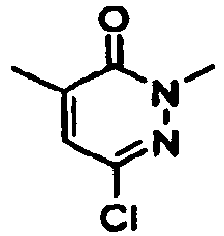
- Methyl iodide (1.3 mL) was added to a mixture of 6-chloro-4-methyl-2H-pyridazin-3-one (2.70 g) and K2CO3 (3.40 g) in dimethylformamide (27 mL). The resulting mixture was stirred at ambient temperature overnight. Then, water was added and the mixture was extracted with ethyl acetate. The combined organic extracts were washed with water and brine and dried (MgSO4). After removal of the solvent, the title compound was obtained as a solid.
Yield: 2.97 g (100% of theory)
Mass spectrum (ESI+): m/z = 159/161 (CI) [M+H]+ - The following compound was obtained in analogy to Intermediate VIII: 6-Chloro-2,5-dimethyl-2H-pyridazin-3-one

-

- Methylamine (2 M in tetrahydrofuran, 11.4 mL) was added to a mixture of 4-bromo-2-fluoro-1-nitro-benzene (2.50 g) and K2CO3 (1.90 g) in dimethylformamide (40 mL). The resulting mixture was stirred at ambient temperature overnight. Then, the mixture was concentrated under reduced pressure and dichloromethane was added. The resulting mixture was washed with 0.5 M aqueous HCl solution and brine and dried (MgSO4). The solvent was removed to give the product as a solid.
Yield: 2.60 g (99% of theory)
Mass spectrum (ESI+): m/z = 231/233 (Br) [M+H]+ - The following compound was obtained in analogy to Intermediate IX:
- (4-Bromo-2-nitro-phenyl)-methyl-amine

- Mass spectrum (ESI+): m/z = 231/233 (Br) [M+H]+
-

- A mixture of (5-bromo-2-nitro-phenyl)-methyl-amine (2.60 g) and Raney nickel (0.25 g) in tetrahydrofuran (100 mL) was shaken under hydrogen atmosphere (50 psi) at room temperature overnight. Then, the catalyst was separated by filtration and the filtrate was concentrated under reduced pressure to give the crude title compound as a brown oil that was used without further purification.
Yield: 2.20 g (97% of theory)
Mass spectrum (ESI+): m/z = 201/203 (Br) [M+H]+ - The following compound was obtained in analogy to Intermediate X: 5-Bromo-2-methylamino-aniline

-

- A solution of 4-bromo-2-methylamino-aniline (1.10 g) In acetic acid (15 mL) was stirred at 130 °C for 2 h. After cooling to ambient temperature, the solution was concentrated under reduced pressure and the residue was taken up in ethyl acetate. The resulting solution was washed with 10% aqueous K2CO3 solution and brine and dried (MgSO4). The solvent was removed and the remainder was purified by chromatography on silica gel (CH2Cl2/MeOH/NH4OH 99:1:0.1->9:1:0.1) to give the title compound as a solid.
Yield: 0.58 g (47% of theory)
Mass spectrum (ESI+): m/z = 225/227 (Br) [M+H]+ - The following compound was obtained in analogy to Intermediate XI: 5-Bromo-1,2-dimethyl-1H-benzoimidazole

-

- Cyclopropylmethyl bromide (0.82 mL) was added to a mixture of 6-chloro-2H-pyridazin-3-one (1.0 g) and K2CO3 (2.10 g) in dimethylformamide (10 mL). The resulting mixture was stirred at 60 °C overnight. Then, water was added and the mixture was extracted with ethyl acetate. The combined organic extracts were washed with water and brine and dried (MgSO4). After removal of the solvent, the residue was purified by chromatography on silica gel (CH2Cl2/MeOH/NH4OH 99:1:0.1) to afford the title compound as an oil.
Yield: 0.85 g (60% of theory)
Mass spectrum (ESI+): m/z = 185/187 (Cl) [M+H]+ -
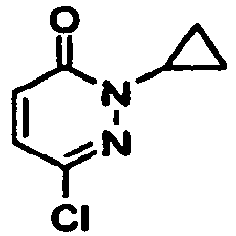
- A microwave-suited vessel charged with a stir bar, 6-chloro-2H-pyridazin-3-one (0.15 g). cyclopropylboronic acid (0.30 g), pyridine (0.75 mL), triethylamine (0.8 mL), and tetrahydrofuran (5 mL) was sparged with argon for 5 min. Then, Cu(OAc)2 (0.42 g) was added and the mixture was stirred in a microwave oven under microwave irradiation at 140 °C for 10 min. Then, the solvent was evaporated and water was added. The resultant mixture was extracted with ethyl acetate and the combined organic extracts were washed with water and aqueous NaHCO3 solution. After drying (MgSO4) and removing the solvent, the residue was purified by chromatography on silica gel (CH2Cl2/MeOH/NH4OH 99:1:0.1->9:1:0.1) to afford the title compound.
Yield: 35 mg (18% of theory)
Mass spectrum (ESI+): m/z = 171/173 (CI) [M+H]+ - The following compound was obtained In analogy to Intermediate XIII: 1-Cyclopropyl-4-(4-methoxy-benzyloxy)-1H-pyridin-2-one

-

- Dimethylformamide (5 mL) was added to a flask charged with a stir bar, 3-[(S)-1-(4-bromo-phenyl)-ethyl]-(S)-6-(2-hydroxy-2-methyl-propyl)-6-phenyl-[1,3]oxazinan-2-one (0.30 g), 4-(4,4,5,5-tetramethyl-[1,3,2]dioxaborolan-2-yl)-3,6-dihydro-2H-pyridine-1-carboxylic acid tert-butyl ester (0.22 g). K2CO3 (0.29 g), and [1,1'-bis(diphenylphosphino)ferrocene]-dichloropalladium(II) (57 mg) under argon atmosphere. The resulting mixture was stirred at 80 °C overnight. After cooling to ambient temperature, water was added and the resulting mixture was extracted with ethyl acetate. The combined organic extracts were washed with brine, dried (MgSO4), and concentrated. The residue was purified by chromatography on silica gel (cyclohexane/ethyl acetate 40:60->0:100) to afford the title compound.
Yield: 0.35 g (93% of theory)
Mass spectrum (ESI+): m/z = 535 [M+H]+ -

- A mixture of 4-(4-{(S)-1-[(S)-6-(2-hydroxy-2-methyl-propyl)-2-oxo-6-phenyl-[1,3]oxazinan-3-yl]-ethyl}-phenyl)-3,6-dihydro-2H-pyridine-1-carboxylic acid tert-butyl ester (0.34 g) and 10% palladium on carbon (60 mg) in methanol (10 mL) was shaken in hydrogen atmosphere (50 psi) for 4 h. Then, the catalyst was separated by filtration and the filtrate was concentrated to yield the title compound.
Yield: 0.30 g (88% of theory)
Mass spectrum (ESI+) m/z = 537 [M+H]+ -

- Trifluoroacetic acid (0.40 mL) was added to a solution of 4-(4-{(S)-1-[(S)-6-(2-hydroxy-2-methyl-propyl)-2-oxo-6-phenyl-[1,3]oxazinan-3-yl]-ethyl}-phenyl)-piperidine-1-carboxylic acid tert-butyl ester (0.29 g) in dichloromethane (10 mL). The resulting solution was stirred at room temperature overnight. Then, more dichloromethane was added and the solution was neutralized using aqueous saturated NaHCO3 solution. The organic phase was separated, washed with water, and dried (MgSO4). The solvent was removed under reduced pressure to give the title compound.
Yield: 0.22 g (93% of theory) -

- 2 M aqueous Na2CO3 solution (1.3 mL) was added to a solution of (S)-6-(2-hydroxy-2-methylpropyl)-6-phenyl-3-[(S)-1-(4-(4,4,5,5-tetramethyl-1,3,2-dioxaborolan-2-yl)phenyl)ethyl]-1,3- oxazinan-2-one (0.60 g) and 5-bromo-pyridine-2-carboxylic acid methyl ester (0.41 g) in dimethylformamide (4 mL). The resulting mixture was sparged with argon for 10 min, before [1,1'-bis(diphenylphosphino)ferrocene]-dichloropalladium(II) dichloromethane complex (61 mg) was added. The mixture was heated to 100 °C and stirred at this temperature overnight. After cooling to ambient temperature, the mixture was diluted with ethyl acetate and extracted with water and brine. The aqueous extracts were combined, acidified (pH ca. 5-6) using citric acid, and extracted with CH2Cl2/MeOH (ca. 10:1). The combined organic extracts were washed with brine and dried (MgSO4). The solvent was removed and the residue was purified by chromatography on silica gel (CH2Cl2/MeOH 98:2->50:50) to afford the title compound as a resin-like solid.
Yield: 0.44 g (73% of theory)
Mass spectrum (ESI+): m/z = 475 [M+H]+ -

- A flask charged with a stir bar, 3-[(S)-1-(4-bromo-phenyl)-ethyl]-(S)-6-(2-hydroxy-2-methyl-propyl)-6-phenyl-[1.3]oxazinan-2-one (1.00 g), 2-nitro-4-(4,4,5,5-tetramethyl-[1,3,2]dioxaborolan-2-yl)-phenylamine (0.92 g), and 2 M aqueous Na2CO3 solution (2.3 rriL) was sparged with argon for 15 min. Then, [1,1'-bis(diphenylphosphino)ferrocene]-dichloropalladium(II) dichloromethane complex (57 mg) was added and the mixture was stirred at 100 °C overnight. After cooling to ambient temperature, water was added and the resulting mixture was extracted with ethyl acetate. The combined organic extracts are washed with brine, dried (MgSO4), and concentrated. The residue was purified by chromatography on silica gel (CH2Cl2/MeOH 98:2->80:20) to afford the title compound as an oil that was crystallized using a mixture of ethyl acetate and iPr2O (ca. 10:1).
Yield: 0.53 g (93% of theory)
Mass spectrum (ESI+): m/z = 490 [M+H]+ -

- A mixture of 3-[(S)-1-(4'-amino-3'-nitro-biphenyl-4-yl)-ethyl]-(S)-(2-hydroxy-2-methyl-propyl)-6-phenyl-[1,3]oxazinan-2-one (0.50 g) and 10% palladium on carbon (0.10 g) in a mixture of methanol (10 mL) and tetrahydrofuran (10 mL) was shaken in hydrogen atmosphere (3 bar) at room temperature for 3.5 h. Then, the catalyst was separated by filtration and the filtrate was concentrated under reduced pressure to afford the title compound as an oil.
Yield: 0.46 g (97% of theory)
Mass spectrum (ESI+): m/z = 460 [M+H]+ -

- Trifluoroacetic acid (1 mL) was added to a flask charged with a stir bar and 1-cyclopropyl-4-(4-methoxy-benzyloxy)-1H-pyridin-2-one (0.17 g) and chilled in an ice/EtOH bath. The resulting mixture was stirred with cooling for 1.5 h and at ambient temperature for another 4.5 h. Then, the solution was concentrated under reduced pressure and the residue was triturated with tert-butyl methyl ether and dried to give the title compound as a solid.
Yield: 0.10 g (quantitative)
Mass spectrum (ESI+): m/z = 152 [M+H]+ -

- Trifluoromethanesulfonic anhydride (0.12 mL) was added to a flask charged with a stir bar, 1-cyclopropyl-4-hydroxy-1H-pyridin-2-one (0.10 g), NEt3 (0.24 mL), and dichloromethane (8 mL) and chilled in an ice/EtOH bath. The resulting mixture was stirred with cooling for 2 h and at ambient temperature for another 2 h. Then, the solution was diluted with dichloromethane and washed in succession with water, aqueous NaHCO3 solution, and water. The organic solution was dried (MgSO4), the solvent was removed, and the residue was purified by chromatography on silica gel (dichloromethane/methanol 99:1->90:10) to afford the title compound as a resin-like solid.
Yield: 0.07 g (36% of theory)
Mass spectrum (ESI+): m/z = 284 [M+H]+ - The following compound was obtained in analogy to Intermediate XXI:
- (1) Trifluoro-methanesulfonic acid 1-methyl-2-oxo-1,2-dihydro-pyridin-4-yl ester

-

- KO t Bu (0.68 g) was added to a solution of 5-bromo-1H-pyridin-2-one (1.00 g) in tetrahydrofuran (20 mL) at room temperature. After stirring for 30 min, cyclopropylmethyl bromide (0.77 mL) and dimethylformamide (3 mL) were added to the suspension and the resulting mixture was warmed to 70 °C. After stirring the mixture at 70 °C for 2 h, the reaction was complete. The mixture was cooled to room temperature, diluted with ethyl acetate (50 mL), and washed with water (2x 20 mL) and brine (20 mL). Then, the solution was dried (MgSO4) and the solvent was removed to give the title compound as a colorless oil.
Yield: 1.18 g (90% of theory)
Mass spectrum (ESI+): m/z = 228/230 (Br) [M+H]+ -

- 2-Methoxy-1-phenyl-ethanone (5.00 g) dissolved in tetrahydrofuran (50 mL) was added to 2 M allylmagnesium chloride in tetrahydrofuran (21 mL) at room temperature. The solution was stirred at room temperature for 3 h and then 10 % aqueous NH4Cl solution (50 mL) was added. The resulting mixture was extracted with tert-butyl methyl ether (3x 50 mL) and the combined extracts were washed with water (50 mL) and brine (50 mL). The solvent was evaporated to afford the title compound as a colorless oil.
Yield: 6.40 g (quantitative)
Mass spectrum (ESI+): m/z = 175 [M+H-H2O]+ -

- OsO4 (4% in water, 2 mL; alternatively, K2OsO4 may be used) followed by N-methylmorpholine-N-oxide (5.20 g) was added to a solution of 1-methoxy-2-phenyl-pent-4-en-2-ol (1.10 g) in tetrahydrofuran (10 mL) chilled in an ice bath. The cooling bath was removed and the solution was stirred at room temperature overnight. Then, 10% aqueous Na2S2O5 solution (10 mL) was added and the resulting mixture was stirred at room temperature for another 1.5 h. After removal of the organic solvent under reduced pressure, the remaining mixture was extracted with ethyl acetate. The combined extracts were washed with brine and dried (MgSO4). The solvent was evaporated to afford the title compound in good purity (ca. 95%).
Yield: 1.20 g (96% of theory)
Mass spectrum (ESI-): m/z = 225 [M-H]- -

- NalO4 (5.20 g) was added to a mixture of 5-methoxy-4-phenyl-pentane-1,2,4-triol (1.10 g), dichloromethane (10 mL), and water (5 mL) chilled in an ice bath. The mixture was stirred vigorously while warming to ambient temperature in the cooling bath and further stirred at this temperature overnight. Then, water (20 mL) and dichloromethane (50 mL) were added, the organic layer was separated, and the aqueous layer was extracted with dichloromethane (2x 25 mL). The combined organic phases were washed with water and dried (MgSO4). After removal of the solvents, the title compound was yielded which was directly submitted to the next reaction step (glycol cleavage).
Yield: 0.94 g (quantitative) -

- (S)-1-(4-Bromo-phenyl)-ethylamine (0.93 g), NaB(OAc)3 (0.98 g), and acetic acid (0.27 mL) were added in the given order to a solution of 3-hydroxy-4-methoxy-3-phenyl-butyraldehyde (0.90 g) in tetrahydrofuran (20 mL) at ca. 10-15 °C. The cooling bath was removed and the mixture was stirred at room temperature for 2 h. Then, water (50 mL) and 1 M aqueous NaOH solution (20 mL) were added and the resulting mixture was stirred for another 30 min. The mixture was extracted with ethyl acetate and the combined extracts were washed with water and brine. After drying (MgSO4), the solvent was removed to give the title compound which was submitted to the subsequent reaction step without further purification.
Yield: 1.80 g (quantitative)
Mass spectrum (ESI+): m/z = 378/380 (Br) [M+H]+ -

- NEt3 (0.47 mL) and [1,1'-bis(diphenylphosphino)ferrocene]-dichloropalladium(II) dichloromethane complex (0.15 g) were added to a solution of 3-[(S)-1-(4-bromo-phenyl)-ethyl]-(S)-6-(2-hydroxy-2-methyl-propyl)-6-phenyl-[1,3]oxazinan-2-one (1.04 g) in MeCN (2.5 mL), MeOH (20 mL), and dimethylformamide (5 mL). The resulting mixture was sparged with argon for 5 min and then transferred to a pressure-proved vessel that was filled with CO (5.5. bar). The mixture was heated to 70 °C and stirred at thwas temperature for 18 h before another portion of [1,1'-bis(diphenylphosphino)ferrocene]-dichloropalladium(II) dichloromethane complex (0.15 g) was added. After stirring at 70°C for another 4 h, the mixture was cooled to ambient temperature, filtered, and concentrated under reduced pressure. The residue was taken up in ethyl acetate and the resulting mixture was washed with water and brine and dried (MgSO4). The solvent was removed and the residue was purified by chromatography on silica gel (cyclohexane/ethyl acetate 40:60->0:100) to afford the title compound as an oil.
Yield: 0.73 g (55% of theory)
Mass spectrum (ESI-): m/z = 456 [M+HCOO]- -

- 1 M aqueous NaOH solution (5 mL) was added to a solution of 4-{(S)-1-[(S)-6-(2-hydroxy-2-methyl-propyl)-2-oxo-6-phenyl-[1,3]oxazinan-3-yl]-ethyl}-benzoic acid methyl ester (0.73 g) in tetrahydrofuran (5 mL). The resulting solution was stirred at room temperature overnight. Then, the solution was concentrated and the residue was taken up in water and filtered. The aqueous filtrate was acidified with 1 M hydrochloric acid and the resulting mixture was extracted with ethyl acetate. The combined extracts were washed with brine and dried (MgSO4). The solvent was removed to afford the title compound as a foam-like solid.
Yield: 0.38 g (72% of theory)
Mass spectrum (ESI+): m/z = 398 [M+H]+ -

- TBTU [2-(1H-benzotriazol-1-yl)-1,1,3,3-tetramethyluronium tetrafluoroborate, 0.33 g] was added to 4-{(S)-1-[(S)-6-(2-hydroxy-2-methyl-propyl)-2-oxo-6-phenyl-[1.3]oxazinan-3-yl]-ethyl}-benzoic acid (0.37 g) and EtN/Pr2 (0.41 mL) dissolved in dimethylformamide (5 mL). After stirring the solution at room temperature for 10 min, hydrazine hydrate (0.23 mL) was added. The solution was stirred at room temperature overnight and then diluted with water. The resulting mixture was extracted with ethyl acetate and the combined extracts were washed with brine and dried (MgSO4). The solvent was removed and the residue was purified by chromatography on silica gel (CH2Cl2/MeOH 98:2->90:10) to afford the tittle compound as a colorless foam-like solid.
Yield: 0.19 g (50% of theory)
Mass spectrum (ESI-): m/z = 410 [M-H]- -

- 2 M aqueous Na2CO3 solution (0.31 mL) was added to a solution of (S)-6-(2-hydroxy-2-methylpropyl)-6-phenyl-3-[(S)-1-(4-(4,4,5,5-tetramethyl-1,3.2-dioxaborolan-2-yl)phenyl)ethyl]-1,3-oxazinan-2-one (0.15 g) and 6-chloro-2,4-dimethyl-2H-pyridazin-3-one (75 mg) in dimethylformamide (1 mL). The resulting mixture was sparged with argon for 10 min, before (1,1'-bis(diphenylphosphino)ferrocene)-dichloropalladium(II) dichloromethane complex (15 mg) was added. The mixture was heated to 100 °C and stirred at this temperature overnight. After cooling to ambient temperature, water was added, and the resulting mixture was extracted with ethyl acetate. The combined organic extracts were washed with brine, dried (MgSO4), and concentrated. The residue was purified by chromatography on silica gel (CH2Cl2/MeOH 98:2->80:20) to afford the title compound.
Yield: 0.10 g (67% of theory)
Mass spectrum (ESI+): m/z = 476 [M+H]+ - The following compounds were obtained in analogy to Example 666:
- The reactions were carried out using either the bromo, chloro or trifluoromethanesulfonyloxyl derivatized coupling partners (= electrophilic component)
-

-

-
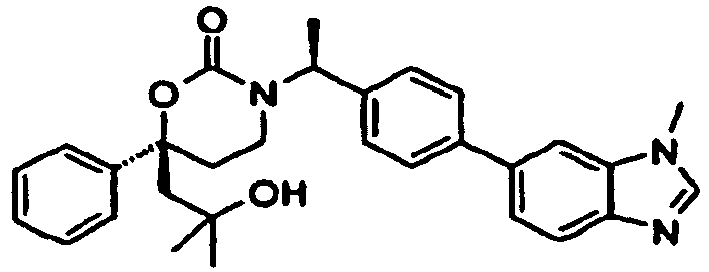
-
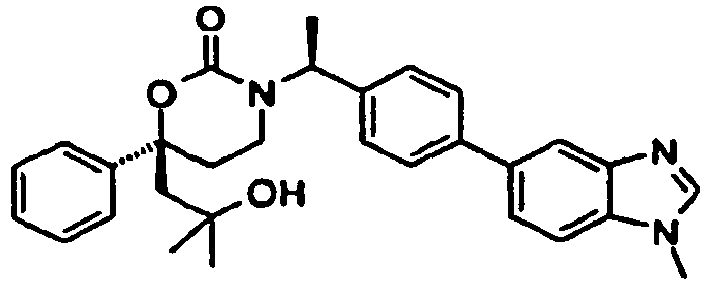
-
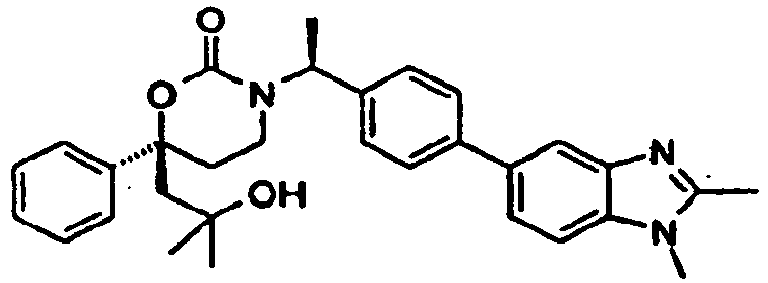
-
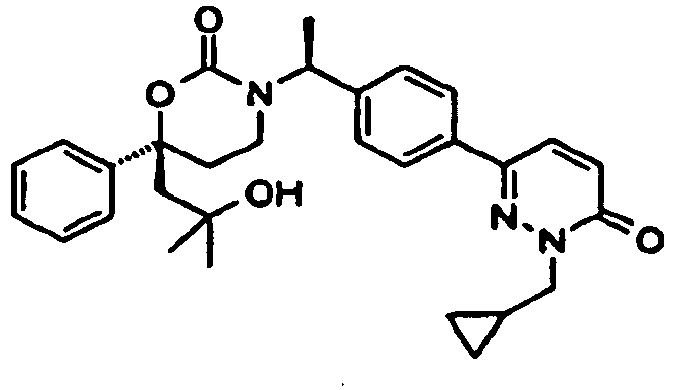
-

-

- Trifluoro-methanesulfonic acid 1-cyclopropyl-2-oxo-1,2-dihydro-pyridin-4-yl ester was employed as the coupling partner under the conditions described above.
-

-

-
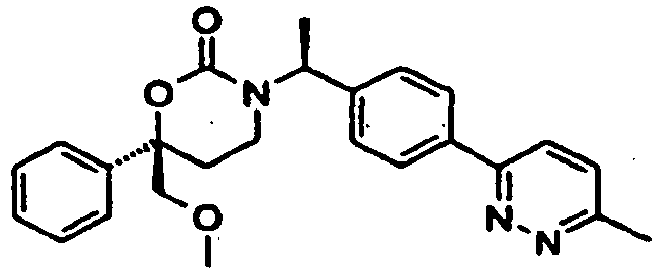
-

-
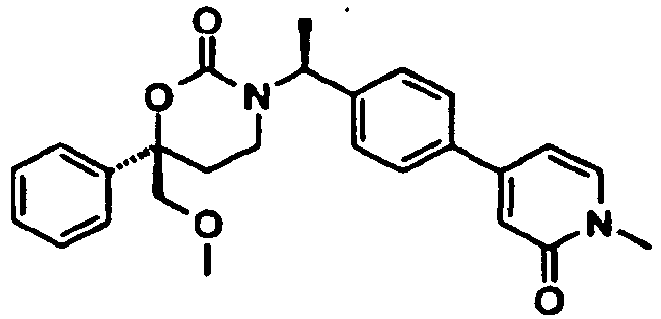
- Trifluoro-methanesulfonic acid 1-methyl-2-oxo-1,2-dihydro-pyridin-4-yl ester was used as the coupling partner under the conditions described above.
-

- 2-(1H-Benzotriazol-1-yl)-1,1,3,3-tetramethyluronium tetrafluoroborate (75 mg) was added to a solution of 5-(4-{(S)-1-[(S)-6-(2-hydroxy-2-methyl-propyl)-2-oxo-6-phenyl-[1,3]oxazinan-3-yl]-ethyl}-phenyl)-pyridine-2-carboxylic acid (0.10 g) and diisopropylethylamine (50 µL) in dimethylformamide (1 mL) at room temperature. The resulting solution was stirred for 25 min, before diethylamine (70% in water, 50 µL) was added. The solution was stirred at room temperature overnight and then concentrated under reduced pressure. The crude product was purified by HPLC on reversed phase (MeCN/H2O) to afford the title compound as a foam-like solid.
Yield: 25 mg (24% of theory)
Mass spectrum (ESI+): m/z = 502 [M+H]+ - The following compounds were obtained in analogy to Example 680:
-

-

-

- Triethylamine (0.10 mL), acetic anhydride (50 µL), and 4-dimethylaminopyridine (5 mg) were added consecutively to (S)-6-(2-hydroxy-2-methyl-propyl)-6-phenyl-3-[(S)-1-(4-piperidin-4-yl-phenyl)-ethyl]-[1,3]oxazinan-2-one (0.12 g) dissolved in tetrahydrofuran (5 mL) at room temperature. The solution was stirred at room temperature for 4 h and then diluted with ethyl acetate. The resulting solution was washed with aqueous saturated NaHCO3 solution and brine and dried (Na2SO4). After removal of the solvent, the residue was purified by chromatography on silica gel (CH2Cl2/MeOH 98:2->90:10) to afford the title compound as a colorless foam-like solid.
Yield: 80 mg (61% of theory)
Mass spectrum (ESI+): m/z = 479 [M+H]+ -
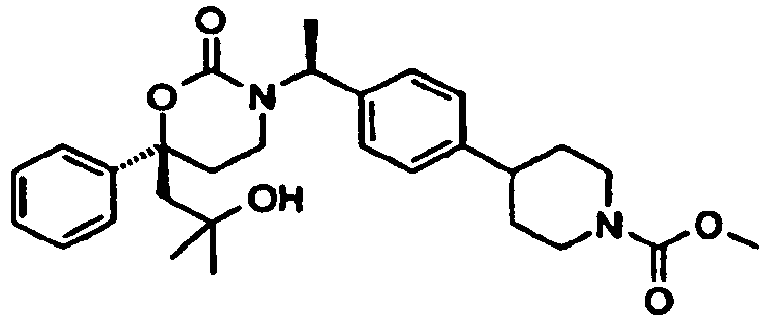
- Triethylamine (0.10 mL) and methyl chloroformate (24 µL) were added consecutively to (S)-6-(2-hydroxy-2-methyl-propyl)-6-phenyl-3-[(S)-1-(4-pipeiidin-4-yl-phenyl)-ethyl]-[1,3]oxazinan-2-one (0.12 g) dissolved in dichloromethane (5 mL) at room temperature. The resulting solution was stirred at room temperature overnight and then diluted with dichloromethane. The resulting solution was washed with water and brine and dried (Na2SO4). After removal of the solvent, the residue was purified by chromatography on silica gel (CH2Cl2/MeOH 99:1->90:10) to afford the title compound as a foam-like solid.
Yield: 100 mg (70% of theory)
Mass spectrum (ESI+): m/z = 495 [M+H]+ -

- A solution of NaNO2 (0.16 g) in water (2 mL) was added dropwise to an ice-cold solution of 3-[(S)-1-(3',4'-diamino-biphenyl-4-yl)-ethyl]-(S)-6-(2-hydroxy-2-methyl-propyl)-6-phenyl-[1,3]oxazinan-2-one (0.43 g) in acetic acid (10 mL). The resulting mixture was stirred with cooling for 2 h and at room temperature for another 1 h. Then, water (100 mL) was added and the resulting mixture was extracted with ethyl acetate. The combined organic extracts were washed with saturated aqueous NaHCO3 solution, water, and brine and dried (Na2SO4). The solvent was removed and the residue was purified by chromatography on silica gel (ethyl acetate/MeOH 98:2->80:20) to afford the title compound as a foam-like solid.
Yield: 0.30 g (69% of theory)
Mass spectrum (ESI+): m/z = 471 [M+H]+ -

- 3-[(S)-1-(3',4'-Diamino-biphenyl-4-yl)-ethyl]-(S)-6-(2-hydroxy-2-methyl-propyl)-6-phenyl-[1,3]oxazinan-2-one (120 mg) taken up in acetic acid (2 mL) was stirred under microwave irradiation at 150 °C for 30 min. After cooling to ambient temperature, the mixture was concentrated under reduced pressure and the residue was purified by HPLC on reversed phase (MeCN/H2O) to afford the title compound.
Yield: 77 mg (61% of theory)
Mass spectrum (ESI+): m/z = 484 [M+H]+ -

- Triphosgene (157 mg) was added to an ice-cold solution of 4-[(S)-1-(4-bromophenyl)-ethylamino]-1-methoxy-2-phenyl-butan-2-ol (1:1 diastereomeric mixture, 200 mg) and EtNrPr2 (91 µL) in dichloromethane (5 mL). The resulting solution was stirred with cooling for 2 h and at room temperature overnight. Then, the solution was concentrated under reduced pressure and the residue was purified by HPLC on reversed phase (MeCN/H2O/NH3) to afford the title compounds in separate fractions. Example 687: 3-[(S)-1-(4-Bromo-phenyl)-ethyl]-(R)-6-methoxymethyl-6-phenyl-[1,3]oxazinan-2-one
Yield: 45 mg (21% of theory)
Mass spectrum (ESI+): m/z = 404 [M+H]+
1H NMR (400 MHz, DMSO-d6 ) δ 1.41 (d, J = 7.1 Hz, 3H), 2.19 (td, J = 11.2, 5.2 Hz, 1 H), 2.24-2.34 (m, 1H), 2.34-2.41 (m, 1H), 3.02-3.09 (m, 1 H), 3.27 (s, 3H), 3.49 (d, B part of an AB signal, J = 10.6 Hz, 1H), 3.53 (d, A part of an AB signal, J = 10.6 Hz, 1H), 5.34 (q. J = 7.0 Hz, 1 H), 6.80 (dm, J = 8.4 Hz, 2H), 7.27 (dm, J = 8.4 Hz, 2H), 7.32-7.42 (m, 5H).
Example 688: 3-[(S)-1-(4-Bromo-phenyl)-ethyl]-(S)-6-methoxymethyl-6-phenyl-[1,3]oxazinan-2-one
Yield: 45 mg (21% of theory)
Mass spectrum (ESI+): m/z = 404 [M+H]+
1H NMR (400 MHz, OMSO-d6 ) δ 1.20 (d, J = 7.2 Hz, 3H), 2.13-2.23 (m, 1H), 2.32-2.40 (m, 1H), 2.63-2.72 (m. 1H), 2.73-2.81 (m, 1H), 3.26 (s, 3H), 3.48 (d, B part of an AB signal, J = 10.6 Hz, 1H), 3.55 (d, A part of an AB signal, J = 10.6 Hz, 1H), 5.35 (q, J = 7.2 Hz, 1H), 7.19 (dm, J = 8.4 Hz, 2H), 7.32-7.45 (m, 5H), 7.53 (dm, J = 8.4 Hz, 2H). -

- A mixture of 4-{(S)-1-[(S)-6-(2-hydroxy-2-methyl-propyl)-2-oxo-6-phenyl-[1,3]oxazinan-3-yl]-ethyl}-benzoic acid hydrazide (90 mg), toluene-4-sulfonic acid monohydrate (10 mg), and 1,1,1-trimethoxy-ethane (1 ml) was stirred at room temperature for 1 h, at 80 °C for 2 h, and finally at reflux temperature for 1.5 h. After cooling to ambient temperature, ethyl acetate was added and the resulting mixture was washed with aqueous NaHCO3 solution and brine. The solvent was removed under reduced pressure and the residue was purified by chromatography on silica gel (CH2Cl2/MeOH 99:1->95:5) to afford the title compound as a colorless resin-like solid.
Yield: 55 mg (60% of theory)
Mass spectrum (ESI+): m/z = 418 [M+H]+ - In vitro inhibition of 11 β-HSD1 by test compounds was determined with HTRF (Homogeneous Time-Resolved Fluorescence) technology (cisbio international, France) detecting cortisol generated from cortisterone by human liver microsomes. Briefly, compounds were incubated for 1 hour at 37 °C in Tris buffer (20 mM tris, 5 mM EDTA, pH 6.0) containing NADPH (200 µM) and cortisone (80 nM). Cortisol generated in the reaction is then detected with a competitive immunoassay, involving two HTRF conjugates: cortisol linked to XL665 and anti-cortisol antibody labeled with Europium cryptate. The incubation period for detection reaction was typically 2 hours. The amount of cortisol was determined by reading the time-resolved fluorescence of the wells (Ex 320/75 nm; Em 615/8.5 nm and 665/7.5 nm). The ratio of the two emission signals was then calculated (Em665*10000/Em615). Each assay contained incubations with vehicle controls instead of compound as controls for non-inhibited cortisol generation (100% CTL; 'high values') and incubations with carbenoxolone as controls for fully inhibited enzyme and cortisol background (0% CTL; 'low values'). Each assay also contained a calibration curve with cortisol to transform the fluorescent data into cortisol concentrations. Percent inhibition of each compound was determined relative to the carbenoxolone signal..
- In following table the 11β-HSD 1 inhibitory activities, determined as described above, wherein 100% indicates no inhibition and a value of zero or below zero indicates complete inhibition.
TABLE OF BIOLOGICAL ASSAY RESULTS FOR BIOLOGICAL TEST 3 Example Average % control inhibition at 100 nM Example Average % control inhibition at 100 nM Example Average % control inhibition at 100 nM 666 14 674 -14 683 -1 667 63 676 17 684 -13 668 -3 677 43 685 34 669 3 678 59 686 23 670 -5 679 58 687 28 671 -19 680 -32 688 88 672 10 681 -19 673 9 682 -8 -

- 2,2-dimethyl-3-((R)-2-oxo-3-((S)-1-(4-(6-oxo-1,6-dihydropyridin-3-yl)phenyl)ethyl)-6-phenyl-3-oxazinan-6-yl)propanenitrile (6 mg, 0.013 mmol) was dissolved in DMF (2.5 mL). Cs2CO3 (c.a. 15 mg, excess) and i-Prl (100µL, excess) were added. The mixture was stirred for 3 h at rt. LC-MS found the reaction was complete. The mixture was purified by prep HPLC to afford 3-((R)-3-((S)-1-(4-(1-isopropyl-6-oxo-1,6-dihydropyridin-3-yl)phenyl)ethyl)-2-oxo-6-phenyl-1,3-oxazinan-6-yl)-2,2-dimethylpropanenitrile (1.99 mg, 30%). LC-MS Method 1 tR = 2.03 min, m/z = 498; 1H NMR (CDCl3) 8.35(d, 1H), 7.80(dd, 1H), 7.37(m, 5H), 7.22(d, 2H), 6.92(d. 2H), 6.83(d, 1H), 5.66(q, 1H), 5.22(m, 1H), 2.93(m, 1H), 2.16(s, 2H), 1.55(d, 3H), 1,46(s, 3H), 1.40(d, 6H), 1.33(s, 3H).
-

- To a solution of 3-((R)-3-((S)-1-(4-bromophenyt)ethyl)-2-oxo-6-phenyl-1,3-oxazinan-6-yl)-2,2-dimethylpropanamide (41 mg, 0.090 mmol) in 1:1 acetonitrile:water [2M] was added [bis(trifluoroacetoxy)iodo]benzene (60 mg, 0.13 mmol). The reaction was allowed to stir overnight. The solvent was evaporated and purified via prep HPLC to afford the TFA salt of (S)-6-(2-amino-2-methylpropyl)-3-((S)-1-(4-bromophenyl)ethyl)-6-phenyl-1,3-oxazinan-2-one (49 mg). LC-MS Method 1 tR = 1.39 min, m/z = 431; 1H NMR (CDCl3) 7.39-7.22 (7H, m), 6.90 (2H, d, J = 8.5 Hz), 5.54 (1H, q. J = 6.4 Hz), 2.81 (1H, dd, J = 12.3 2.9 Hz), 2.72 (1H, d, J = 15 Hz), 2.33-2.16 (3H, m), 2.02 (1H, dt, J = 12.2, 4.4 Hz), 1.47 (3H, d, J = 6.7 Hz). 1.38 (3H, s), 0.94 (3H, s).
-

- A solution of trifluoroacetic acid salt (S)-6-(2-amino-2-methylpropyl)-3-((S)-1-(4-bromophenyl)ethyl)-6-phenyl-1,3-oxazinan-2-one (10 mg, 0.02 mmol) in DMF (.2 mL) was added to i-Pr2NEt (5 drops), HATU (9 mg, 0.02 mmol), and cyclopropane carboxylic acid. The reaction mixture was diluted with acetonitrile and purified via prep HPLC to afford N-(1-((S)-3-((S)-1-(4-bromophenyl)ethyl)-2-oxo-6-pheny)-1,3-oxazinan-6-yl)-2-methylpropan-2-yl)cyclopropanecarboxamide (6 mg). LC-MS Method 1 tR = 1.83 min, m/z = 499: 1H NMR (CDCl3) 7.35-7.28 (5H, m). 7.23 (2H, d, J = 8.5 Hz), 5.59 (1H, q, J = 7.02 Hz), 5.41 (1H, s), 2.83 (1H, m), 2.68 (1H, d, J = 15.2 Hz), 2.29 (1H, d, J = 15.2 Hz), 2.17 (3H, s), 1.48 (3H, d, J = 7.0 Hz), 1.37 (3H, s), 1.22 (3H, s), 0.88-0.84 (1H, m), 0.77-0.75 (2H, m), 0.61-0.51 (2H, m).
-

-

- The title compound was prepared (S)-6-(2-amino-2-methylpropyl)-3-((S)-1-(4-bromophenyl)ethyl)-6-phenyhl-1,3-oxazinan-2-one following a procedure analogous to that described in Example 99. LC-MS Method 1 tR = 1.8 min, m/z = 509; 1H NMR (CDCl3) 7.39-7.29 (5H, m), 7.23 (1H, d, J = 8.5 Hz), 6.82 (1H, d, J = 7.9 Hz), 5.59 (1H, q, J = 7.0 Hz), 4.59 (1H, s), 2.92 (3H, s), 2.85 (1H, dt, J = 11.3, 4.0 Hz), 2.45 (1H, d, J = 15.2 Hz), 2.31 (1H, d, J = 15.2 Hz), 2.28-2.24 (2H, m), 2.17-2.11 (1H, m), 1.48 (3H, d, J = 7.0 Hz), 1.32 (3H, s), 1.26 (3H, s).
TABLE OF BIOLOGICAL ASSAY RESULTS FOR EXAMPLES 690-694 Compound Biological Test Example 1 IC50 Rangea Average % inhibition at 100 nM Average % inhibition at 111.1 nM EXAMPLE 690 ++ 94.9 EXAMPLE 691 ++ 90.1 EXAMPLE 692 ++ 80.65 EXAMPLE 693 # 17.65 EXAMPLE 694 ++ 91.5 a ++ means IC50 = <100 nM, + means IC50 = 100- 1000 nM, # means IC50 > 100 nM,
- means IC50 > 1000 nM. -
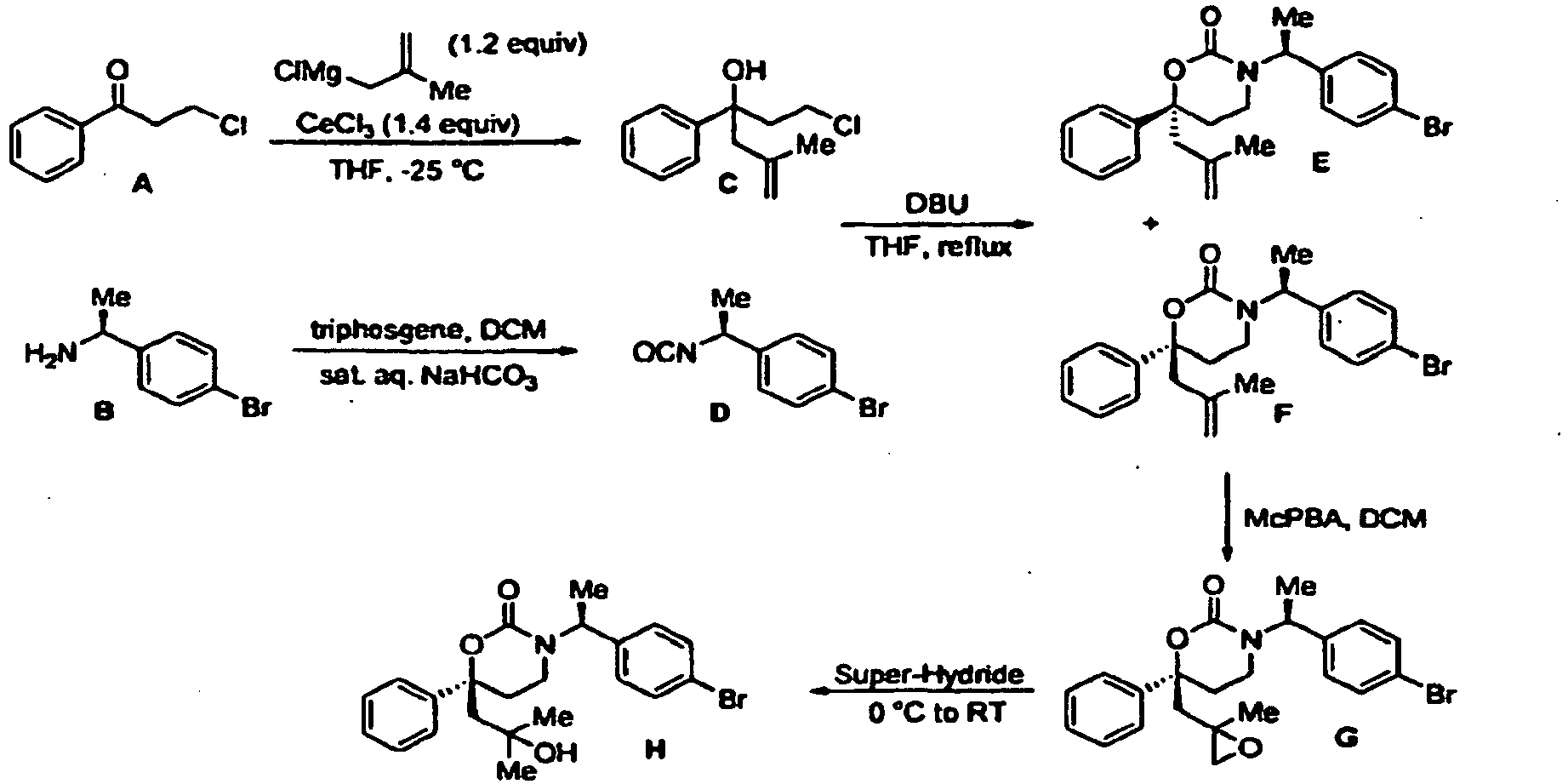
-

- To a stirred suspension of magnesium turnings (46.7 g, 1.94 mol) in 1500 mL of THF (KF <100 ppm) was charged 53.0 mL of 1 M DIBAL-H in hexane under nitrogen at room temperature. Then beta-methylallylic chloride (160 g, 1.77 mol) was introduced while maintaining the internal temperature below 30 °C. The resulting solution was agitated for 2 h at room temperature. The solution was titrated in the presence of 1.1'-bipyridine to indicate 0.8 M of the corresponding Grignard reagent. To a dry flask containing 307.0 g of anhydrous CeCl3 (1.25 mol) at room temperature under nitrogen was added 1556.8 mL of the Grignard reagent (0.8 M, 1.25 mol). The resulting slurry was cooled to -10 °C and agitated for 0.5 h. To the slurry was added 200 g of the ketone (1.19 mol) in 200 mL of THF while maintaining the internal temperature below 0 °C. After the mixture was stirred for 0.5 h, 1200 mL of 1 M HCl was added to obtain a clear solution while maintaining the internal temperature below 30 °C. After the phase cut, the aqueous layer was extracted with EtOAc (500 mL). The combined organic layers were washed with brine and dried over sodium sulfate. Removal of the solvent under vacuum produced the crude product, which was chased with THF to achieve KF <500 ppm. The crude product (306 g, 83wt%, 95% yield) was used directly for subsequent coupling. Analytical data for C: 1H-NMR spectroscopy (500 MHz, CDCl3) δ 7.38-7.37 (d, J = 7.8 Hz, 2H), 7.33 (t, J = 7.9 Hz, 2H), 7.24 (t, J= 7.4 Hz, 1 H), 4.91 (s, 1H), 4.76 (s, 1H), 3.57 (ddd, J= 5.6, 10.7, and 10.7, 1H), 3.13 (ddd, J= 4.7, 10.7 and 10.7 Hz, 1H), 2.66 (d, J= 13.3 Hz, 1H), 2.54 (d, J= 11.3 Hz, 1H), 2.53 (s, 1H), 2.36 (ddd, J= 5.4, 10.6 and 13.9 Hz. 1H), 2.29 (ddd, J=5.6, 11.3 and 13.3 Hz, 1H), 1.29 (s, 3H). 13C-NMR spectroscopy (125 MHz, CDCl3) δ 144.3, 141.4, 128.0, 126.6, 124.8, 116.1, 74.2, 51.2, 46.0, 39.9, 23.9.
-

- To a 10 L jacketed reactor was charged 241 g of sodium bicarbonate (2.87 mol, 2.30 equiv) and 5 L of deionized water. The resulting solution was agitated for 10-20 min, until the solids dissolved (homogeneous). To the clear solution was charged 250 g (1.25 mol, 1.00 equiv) of (S)-(-)-1-(4-bromophenyl)ethylamine as a solution in 1.00 L of dichloromethane. An additional 4 L of dichloromethane was charged to the reactor. The biphasic solution was agitated and cooled to Tint=2-3 °C. Triphosgene (126 g, 424 mmol, 0.340 equiv) was charged to the reactor in approximately two equal portions - 6 min apart. It should be noted that a slight exotherm was noted upon the addition of triphosgene. The resulting murky solution was agitated at Tint=2-5 °C for 30 min, at which point HPLC analysis indicates >99 A% conversion (220 nm). The dichloromethane layer was cut and dried with anhydrous sulfate. The resulting solution was passed through a celite plug and concentrated to ∼1.5 L which fine particles of a white solid developed. The solution was filtered and concentrated to a thick oil via reduced pressure to produce 239 g of product (93.7 wt%, 79.4 % yield). The material was used in the following coupling without further purification. Analytical data for D: 1H-NMR spectroscopy (400 MHz, CD2Cl2) δ 7.53 (d, J= 11.4 Hz, 2 H), 7.26 (d, J= 8.2 Hz, 2 H), 4.80 (q, J=6.7 Hz, 1H), 1.59 (d, J= 6.7 Hz, 3 H).
-

- (To a dried 10 L jacketed reactor under a nitrogen atmosphere was charged 1-chloro-5-methyl-3-phenyl-hex-5-en-3-ol (C, 167 g, 81.7 wt%, 610 mmol, 1.00 equiv), 1-bromo-4-((S)-1-isocyanato-ethyl)-benzene (D, 219 g, 93.7 wt%, 911 mmol, 1.50 equiv), anhydrous tetrahydrofuran (3.00 L), and then 1,8-diazabicyclo[5.4.0]undec-7-ene (DBU, 409 mL, 2.73 mol, 4.50 equiv). The resulting solution was agitated and refluxed (Tint= 67-69 °C, Text= 75 °C) for 19 h, at which point HPLC analysis indicates - 1A% (220 nm) of the 1-chloro-5-methyl-3-phenyl-hex-5-en-3-ol (3) remains. The dark solution was cooled to Tint= 20-25 °C. Two liters of tetrahydrofuran were removed by distillation under reduced pressure. The remaining dark solution was diluted with 4.0 L of ethyl acetate and 1.0 L of hexanes. The resulting solution was washed with 4.0 L of a 1.0 M aqueous solution of hydrogen chloride (note: the wash is slightly exothermic). The aqueous solution was cut and the remaining organic solution was dried with anhydrous sodium sulfate, filtered and then concentrated to an oil via reduced pressure. The resulting material was subjected to flash silica chromatography (5-30 % ethyl acetate/hexanes, 1.74 kg of silica) to produce 137.8 g of material (59 wt%, 3.1:1 diastereomeric ratio favoring the desired diastereomer 6, 32.3 % yield). The material was used in the following epoxidation without further purification.
- Analytical data for (R)-3-[(S)-1-(4-bromo-phenyl)-ethyl]-6-(2-methyl-allyl)-6-phenyl-perhydro-1,3-oxazin-2-one (F): 1H-NMR spectroscopy (500 MHz, CD2Cl2) δ 7.42-7.35 (m, 3 H), 7.33-7.31 (m, 2H), 7.25-7.23 (m, 2H), 6.80-6.74 (m, 2), 5.55 (q, J= 7.1 Hz, 1 H), 5.37-5.36 (m, 1H). 4.89 (s, 1H), 4.69 (s, 1H), 2.96-2.93 (m, 1H), 2.61 (dd, J= 13.8 and 26.4 Hz, 2 H), 2.37-2.25 (m, 3H), 1.68 (s, 3H), 1.50 (d, J= 7.1 Hz, 3 H). 13C-NMR spectroscopy (125 MHz, CD2Cl2) δ 152.5, 141.5, 140.1, 138.3, 130.6, 128.1, 128.0, 126.9, 124.4, 120.2, 115.3, 82.4, 52.1, 50.1, 35.6, 29.8, 23.4, 14.5.
- Analytical data for (S)-3-[(S)-1-(4-bromo-phenyl)-ethyl]-6-(2-methyl-allyl)-6-phenyl-perhydro-1,3-oxazin-2-one (E): 1H-NMR spectroscopy (400 MHz, CD2Cl2) δ 7.50-7.48 (m, 2H), 7.43-7.39 (m, 2H), 7.35-7.32 (m, 3H), 7.20-7.18 (m, 2H), 5.60 (q, J= 7.1 Hz, 1H), 4.85 (s, 1H), 4.66 (s, 1H), 2.73-2.67 (m, 2H), 2.60 (dd, J= 13.9 and 19.4 Hz, 2H), 2.28 (dt, J= 3.3 and 13.7 Hz, 1H), 2.14-2.05 (m, 1H), 1.66 (s. 3H), 1.24 (d, J= 7.2 Hz, 3 H). 13C-NMR spectroscopy (100 MHz, CD2Cl2) δ 153.4, 142.5, 141.0, 140.1, 131.8, 129.3, 128.9, 127.8, 125.3, 121.5, 116.3, 83.9, 53.2, 51.0, 36.6, 31.3, 24.3, 15.4.
-

- To a 1.0 L 2-neck RBF was charged (R)-3-[(S)-1-(4-bromo-phenyl)-ethyl]-6-(2-methyl-allyl)-6-phenyl-perhydro-1,3-oxazin-2-one (F, 135.8 g, 59 wt%, 3.1:1 dr, 193 mmol, 1.00 equiv), dichloromethane (700 mL), and then 3-chloroperbenzoic acid (MCPBA, 70%. 95.3 g, 386 mmol, 2.0 equiv). The resulting solution was agitated at RT (Tint=20-25 °C) for 1 H, which HPLC analysis indicates >99 A% (220 nm) conversion. The resulting solution was diluted with 700 mL of methyl tert-butyl ether (MTBE) and washed with 1x500 mL of 30 wt% solution of sodium thiosulfate and 1x500 mL of saturated aqueous solution of sodium bicarbonate. The wash sequence were repeated until the peak on an HPLC trace of the organic solution that corresponds to a HPLC sample peak of MCPBA is <2.5 A% (220 nm), which in this example the wash sequence was repeated 3 times. The resulting organic layer was dried with anhydrous sodium sulfate, filtered and then concentrated to an oil via reduced pressure. The resulting material was diluted with 200 mL of anhydrous tetrahydrofuran and then concentrated to a thick oil via reduced pressure to provide (S)-3-[(S)-1-(4-bromo-phenyl)-ethyl]-6-(2-methyl-oxiranylmethyl)-6-phenyl-perhydro-1,3-oxazin-2-one (G) which was used directly in the following reduction.
- To a 2.0 L 3-neck oven-dried RBF was charged the crude (S)-3-[(S)-1-(4-bromo-phenyl)-ethyl]-6-(2-methyl-oxiranylmethyl)-6-phenyl-perhydro-1,3-oxazin-2-one (G) and 750 mL of anhydrous tetrahydrofuran. The resulting solution was agitated and cooled to Tint= 2-3 °C. To the agitated clear solution was charged 1.0 M lithium triethylborohydride in tetrahydrofuran (Super Hydride, 348 mL, 348 mmol), 1.8 equiv). The addition is exothermic and addition controlled to maintain Tint= < 8 °C. The resulting solution was agitated at Tint= 2-3 °C for 1.5 h and then allowed to warm to Tint= 10-13 °C over a 2.5 h, which HPLC analysis indicates ~94 A% (220 nm) conversion. To the agitated solution was charged a solution of hydrogen peroxide (95.7 mL of a 35 wt% aqueous solution diluted with 400 mL of water, 1.08 mol, 5.60 equiv). The addition is highly exothermic and addition controlled to maintain Tint= < 25 °C. The resulting solution was diluted with 1.00 L of methyl tert-butyl ether (MTBE) and washed with 1.00 L of water followed by 500 mL of a ∼30 wt% solution of sodium thiosulfate. The organic solution was dried with anhydrous sodium sulfate, filtered, and then concentrated via reduced pressure. The resulting material was subjected to flash silica chromatography (10-60% ethyl acetate, 600 g of silica) to produce 68 g of material consisting of both diastereomers (1.98:1 dr) and 41 g of the desired diastereomer (>99:1 dr). The material consisting of the mixed fractions was recrystallized from 250 mL of isopropyl acetate (IPAC) and 200 mL of heptane (anti-solvent) to produce upon filtration 31.3 g of product (95.7 A% at 220 nm, 74:1 dr). The two samples were combined to produce 72.3 g of product (83.6 % yield for the two step operation). Analytical data for H: 1H-NMR spectroscopy (400 MHz, CDCl3) δ 7.37-7.29 (m, 5H), 7.25-7.21 (m, 2H), 6.82-6.79 (m, 2H), 5.61 (q, J= 6.9 Hz, 1H), 2.83 (ddd, J= 2.5, 5.4 and 11.6 Hz, 1H), 2.39 (ddd, J= 5.7, 12.0 and 14.1 Hz, 1H), 2.27 (ddd, J= 2.6, 4.8 and 14.0 Hz, 1H), 2.21-2.14 (m, 3H), 2.08 (s, 1H), 1.49 (d, J= 7.0 Hz, 3H), 1.18 (s, 3H), 1.13 (s, 3H). 13C-NMR spectroscopy (100 MHz, CDCl3) δ 153.2, 142.6, 138.5, 131.6, 129.13, 129.10, 128.0, 125.3, 121.6, 84.2, 71.4, 54.1, 53.3, 36.4, 33.6, 32.1, 30.8, 15.6.
- The compounds of the invention are useful for ameliorating or treating disorders or diseases in which decreasing the level of cortisol is effective in treating a disease state. Thus, the compounds of the invention can be used in the treatment or prevention of diabetes mellitus (e.g., type II diabetes) , obesity, symptoms of metabolic syndrome, glucose intolerance, hyperglycemica, hypertension, hyperlipidemia, insulin resistance, cardiovascular disease, dyslipidemia, atherosclerosis, lipodystrophy, osteoporosis, glaucoma, Cushing's syndrome, Addison's Disease, visceral fat obesity associated with glucocorticoid therapy, depression, anxiety, Alzheimer's disease, dementia, cognitive decline (including age-related cognitive decline), polycystic ovarian syndrome, infertility and hypergonadism. The compounds of the invention can be used as therapeutic agents for pseudo Cushing's Syndrome associated with alcoholic liver disease. In addition, the compounds modulate the function of B and T cells of the immune system and can therefore be used to treat diseases such as tuberculosis, leprosy and psoriasis. They can also be used to promote wound healing, particularly in diabetic patients.
- Additional diseases or disorders that are related to 11β-HSD1 activity include those selected from the group consisting of lipid disorders, hypretriglyceridemia, hypercholesterolemia, low HDL levels, high LDL levels, vascular restenosis, pancreatitis, abdominal obesity, neurodegenerative disease, retinopathy, nephropathy, neuropathy, diabetes, coronary heart disease, stroke, peripheral vascular disease. Cushing's syndrome, hyperinsulinemia, viral diseases, and Syndrome X. A further disease related to 11β-HSD1 activity is pseudo Cushing's Syndrome associated with alcoholic liver disease.
- A pharmaceutical composition of the invention may, alternatively or in addition to a compound of Formula I, comprise a pharmaceutically acceptable salt of a compound of Formula I or a prodrug or pharmaceutically active metabolite of such a compound or salt and one or more pharmaceutically acceptable carriers therefore. Alternatively, a pharmaceutical composition of the invention may comprise a compound of Formula I, Ia-I or a pharmaceutical salt thereof as the only pharmaceutically active agent in the pharmaceutical composition. The disclosed 11β-HSD1 inhibitors can be used alone or in a combination therapy with one or more additional agents for the treatment of diabetes, dyslipidemia, cardiovascular disease, hypertension, obesity, cancer or glaucoma.
- The compositions of the invention are 11β-HSD1 inhibitors. Said compositions contain compounds having a mean inhibition constant (IC50) against 11β-HSD1 of below about 1,000 nM; preferably below about 100 nM; more preferably below about 50 nM; even more preferably below about 5 nM; and most preferably below about 1 nM.
- The invention includes a therapeutic method for treating or ameliorating an 11β-HSD1 mediated disorder in a subject in need thereof comprising administering to a subject in need thereof an effective amount of a compound of Formula I, or an enantiomer, diastereomer, or pharmaceutically acceptable salt thereof of composition thereof. As used herein, "treating" or "treatment" includes both therapeutic and prophylactic treatment. Therapeutic treatment includes reducing the symptoms associated with a disease or condition and/or increasing the longevity of a subject with the disease or condition. Prophylactic treatment includes delaying the onset of a disease or condition in a subject at risk of developing the disease or condition or reducing the likelihood that a subject will then develop the disease or condition in a subject that is at risk for developing the disease or condition.
- An embodiment of the invention includes administering an 11β-HSD1 inhibiting compound of Formula I or composition thereof in a combination therapy with one or more additional agents for the treatment of diabetes, dyslipidemia, cardiovascular disease, hypertension, obesity, cancer or glaucoma. Agents for the treatment of diabetes include insulins, such as Humulin® (Eli Lilly), Lantus® (Sanofi Aventis), Novolin (Novo Nordisk), and Exubera® (Pfizer); PPAR gamma agonists, such as Avandia® (rosiglitizone maleate, GSK) and Actos® (pioglitazone hydrochloride, Takeda/Eli Lilly); sulfonylureas, such as Amaryl® (glimepiride, Sanofi Aventis), Diabeta® (glyburide, Sanofi Aventis), Micronase®/Glynase® (glyburide, Pfizer), and Glucotrol®/Glucotrol XL® and (glipizide, Pfizer); meglitinides, such as Prandin®/NovoNorm® (repaglinide, Novo Nordisk), Starlix® (nateglinide, Novartis), and Glufast® (mitiglinide, Takeda); biguanides, such as Glucophase®/Glucophase XR® (metformin HCl, Bristol Myers Squibb) and Glumetza (metformin HCl, Depomed); thiazolidinediones; amylin analogs, GLP-1 analogs; DPP-IV inhibitors; PTB-1B inhibitors; protein kinase inhibitors (including AMP-activated protein kinase inhibitors); glucagon antagonists, glycogen synthase kinase-3 beta inhibitors; glucose-6-phoshatase inhibitors; glycogen phosphorylase inhibitors; sodium glucose co-transporter inhibitors, and alpha-glucosidase inhibitors, such as Precose®/Glucobay®/Prandase®/Glucor® (acarbose, Bayer) and Glyset® (miglitol, Pfizer). Agents for the treatment of dyslipidemia and cardiovascular disease include statins, fibrates, and ezetimbe. Agents for the treatment of hypertension include alpha-blockers, beta-blockers, calcium channel blockers, diuretics, angiotensin converting enzyme (ACE) inhibitors, dual ACE and neutral endopeptidase (NEP) inhibitors, angiotensin-receptor blockers (ARBs), aldosterone synthase inhibitors, aldosterone-receptor antagonists, or endothelin receptor antagonist. Agents for the treatment of obesity include orlistat, phentermine, sibutramine and rimonabant.
- An embodiment of the invention includes administering an 11β-HSD1 inhibiting compound of Formula I or composition thereof in a combination therapy with one or more other 11β-HSD1 inhibitors (whether such inhibitors are also compounds of Formula I or are compounds of a different class/genus), or with combination products, such as Avandamet® (metformin HCl and rosiglitazone maleate, GSK); Avandaryl® (glimepiride and rosiglitazone maleate, GSK); Metaglip® (glipizide and metformin HCl, Bristol Myers Squibb); and Glucovance® (glyburide and metformin HCl, Bristol Myers Squibb).
- The compounds of the present invention can be prepared and administered in a wide variety of oral and parenteral dosage forms. Thus, the compounds of the present invention can be administered by injection, that is, intravenously, intramuscularly, intracutaneously, subcutaneously, intraduodenally, or intraperitoneally. Additionally, the compounds of the present invention can be administered intranasally or transdermally. It will be obvious to those skilled in the art that the following dosage forms may comprise as the active ingredient, either compounds or a corresponding pharmaceutically acceptable salt of a compound of the present invention.
- For preparing pharmaceutical compositions from the compounds of the present invention, pharmaceutically acceptable carriers can either be solid or liquid. Solid form preparations include powders, tablets, pills, capsules, cachets, suppositories, and dispersible granules. A solid carrier can be one or more substances which may also act as diluents, flavoring agents, solubilizers, lubricants, suspending agents, binders, preservatives, tablet disintegrating agents, or an encapsulating material. In powders, the carrier is a finely divided solid which is in a mixture with the finely divided active ingredient.
- In tablets, the active ingredient is mixed with the carrier having the necessary binding properties in suitable proportions and compacted in the shape and size desired.
- The powders and tablets preferably contain from about one to about seventy percent of the active ingredient. Suitable carriers are magnesium carbonate, magnesium stearate, talc, sugar, lactose, pectin, dextrin, starch, gelatin, tragacanth, methylcellulose, sodium caboxymethylcellulose, a low-melting wax, cocoa butter, and the like. Tablets, powders, cachets, lozenges, fast-melt strips, capsules and pills can be used as solid dosage forms containing the active ingredient suitable for oral administration.
- For preparing suppositories, a low-melting wax, such as a mixture of fatty acid glycerides or cocoa butter, is first-melted and the active ingredient is dispersed homogeneously therein, as by stirring. The molten homogeneous mixture is then poured into convenient sized molds, allowed to cool, and thereby to solidify.
- Liquid form preparations include solutions, suspensions, retention enemas, and emulsions, for example, water or water propylene glycol solutions. For parenteral injection, liquid preparations can be formulated in solution in aqueous polyethylene glycol solution.
- Aqueous solutions suitable for oral administration can be prepared by dissolving the active ingredient in water and adding suitable colorants, flavors, stabilizing, and thickening agents as desired. Aqueous suspensions for oral administration can be prepared by dispersing the finely divided active ingredient in water with viscous material, such as natural or synthetic gums, resins, methylcellulose, sodium carboxymethylcellulose, and other well-known suspending agents.
- The pharmaceutical composition is preferably in unit dosage form. In such form, the composition is subdivided into unit doses containing appropriate quantities of the active ingredient. The unit dosage form can be a packaged preparation, the package containing discrete quantities of, for example, tablets, powders, and capsules in vials or ampules. Also, the unit dosage form can be a tablet, cachet, capsule, or lozenge itself, or it can be the appropriate amount of any of these in packaged form.
- The quantity of active ingredient in a unit dose preparation may be varied or adjusted from about 0.1 mg to about 1000.0 mg, preferably from about 0.1 mg to about 100 mg. The dosages, however, may be varied depending upon the requirements of the patient, the severity of the condition being treated, and the compound being employed. Determination of the proper dosage for a particular situation is within the skill in the art. Also, the pharmaceutical composition may contain, if desired, other compatible therapeutic agents.
- In therapeutic treatment or as a method-of-use as an inhibitor of 11β-HSD1 or an inhibitor in the production of cortisol in the cell, the active ingredient is preferably administered orally in a solid dosage form as disclosed above in an amount of about 0.1 mg to about 100 mg per daily dose where the dose is administered once or more than once daily.
- All publications, patents and patent applications mentioned in this specification are herein incorporated by reference to the same extent as if each individual publication or patent application were specifically and individually designated as having been incorporated by reference. It is understood that the examples and embodiments described herein are for illustrative purposes only, and it will be appreciated that the invention is susceptible to modification, variation and change without departing from the proper scope or fair meaning of the appended claims.
Claims (19)
- A compound of Formula (I)
 R1 is (a) absent or (b) is selected from (C1-C6)alkyl, (C2-C6)alkenyl, (C2-C6)alkynyl, (C1-C3)alkoxy(C1-C3)alkoxy, or (C1-C3)alkoxy(C1-C3)alkyl and is optionally substituted with up to four groups independently selected from fluorine, cyano, oxo, R4, R4O-, (R4)2N-, R4O2C-, R4S, R4S(=O)-, R4S(=O)2-, R4C(=O)NR4-, (R4)2NC(=O)-, (R4)2NC(=O)O-, (R4)2NC(=O)NR4-, R4OC(=O)NR4-, (R4)2NC(=NCN)NR4-, (R4O)2P(=O)O-, (R4O)2P(=O)NR4-, R4OS(=O)2NR4-, (R4)2NS(=O)2O-, (R4)2NS(=O)2NR4-, R4S(=O)2NR4-, R4S(=O)2NHC(=O)-, R4S(=O)2NHC(=O)O-, R4S(=O)2NHC(=O)NR4-, R4OS(=O)2NHC(=O)-, R4OS(=O)2NHC(=O)O-, R4OS(=O)2NHC(=O)NR4-, (R4)2NS(=O)2NHC(=O)-, (R4)2NS(=O)2NHC(=O)O-, (R4)2NS(=O)2NHC(=O)NR4-, R4C(=O)NHS(=O)2-, R4C(=O)NHS(=O)2O-, R4C(=O)NHS(=O)2NR4-, R4OC(=O)NHS(=O)2-, R4OC(=O)NHS(=O)2O-, R4OC(=O)NHS(=O)2NR4-, (R4)2NC(=O)NHS(=O)2-, (R4)2NC(=O)NHS(=O)2O-, (R4)2NC(=O)NHS(=O)2NR4-, heterocyclyl, heteroaryl, arylamino and heteroarylamino;A1 is (a) a bond, or (b) (C1-C3)alkylene, CH2CH2O, wherein the oxygen is attached to Cy1, or CH2C(=O), wherein the carbonyl carbon is attached to Cy1;Cy1 is aryl, heteroaryl, monocyclic cycloalkyl or monocyclic heterocyclyl and is optionally substituted with 1 to 4 groups independently selected from fluorine, chlorine, bromine, iodine, cyano, nitro, amino, hydroxy, carboxy, (C1-C6)alkyl, hydroxy(C1-C6)alkyl, (C3-C6)cycloalkyl, hydroxy(C3-C6)cycloalkyl, (C4-C7)cycloalkylalkyl, (C2-C6)alkenyl, halo(C2-C6)alkenyl, hydroxy(C2-C6)alkenyl, (C2-C6)alkynyl, (C3-C6)cycloalkyl(C2-C4)alkynyl, halo(C1-C6)alkyl, halo(C3-C6)cycloalkyl, halo(C4-C7)cycloalkylalkyl, (C1-C6)alkoxy, (C3-C6)cycloalkoxy, (C4-C7)cycloalkylalkoxy, halo(C1-C6)alkoxy, halo(C3-C6)cycloalkoxy, halo(C4-C7)cycloalkylalkoxy, (C1-C6)alkylthio, (C3-C6)cycloalkythio, (C4-C7)cycloalkylalkylthio, halo(C1-C6)alkylthio, halo(C3-C6)cycloalkythio, halo(C4-C7)cycloalkylalkylthio, (C1-C6)alkanesulfinyl, (C3-C6)cycloalkanesulfinyl, (C4-C7)cycloalkylalkanesulfinyl, halo(C1-C6)alkanesulfinyl, halo(C3-C6)cycloalkanesulfinyl, halo(C4-C7)cycloalkylalkanesulfinyl, (C1-C6)alkanesulfonyl, (C3-C6)cycloalkanesulfonyl, (C4-C7)cycloalkylalkanesulfonyl, halo(C1-C6)alkanesulfonyl, halo(C3-C6)cycloalkanesulfonyl, halo(C4-C7)cyclo-alkylalkanesulfonyl, (C1-C6)alkylamino, di(C1-C6)alkylamino, (C1-C6)alkoxy(C1-C6)alkoxy, halo(C1-C6)alkoxy(C1-C6)alkoxy, (C1-C6)alkoxycarbonyl, H2NCO, H2NSO2, (C1-C6)alkylaminocarbonyl, di(C1-C6)alkylaminocarbonyl, (C1-C3)alkoxy(C1-C3)alkylaminocarbonyl, heterocyclylcarbonyl, (C1-C6)alkylaminosulfonyl, di(C1-C6)alkylaminosulfonyl, heterocyclosulfonyl, (C1-C6)alkylcarbonylamino, (C1-C6)alkylcarbonylamino(C1-C6)alkyl, (C1-C6)alkylsulfonylamino, (C1-C6)alkylsulfonylamino(C1-C6)alkyl, (C1-C8)alkoxycarbonyl(C1-C6)alkoxy, (C1-C6)alkoxy(C1-C6)alkyl, halo(C1-C6)alkoxy(C1-C6)alkyl, hydroxy(C1-C6)alkoxy, heteroaryl, oxo, amino(C1-C6)alkyl, (C1-C6)alkylamino(C1-C6)alkyl, di(C1-C6)alkylamino(C1-C6)alkyl amino(C2-C6)alkoxy, (C1-C6)alkylamino(C2-C6)alkoxy, di(C1-C6)alkylamino(C2-C6)alkoxy, (C1-C6)alkylcarbonyl, (C3-C6)cycloalkylcarbonyl, (C3-C6)cycloalkylaminocarbonyl, {(C3-C6)cycloalkyl}{(C1-C6)alkyl}aminocarbonyl, di(C3-C6)cycloalkylaminocarbonyl, (C3-C6)cycloalkylaminosulfonyl, {(C3-C6)cycloalkyl}{(C1-C6)alkyl}aminosulfonyl, di(C3-C6)cycloalkylaminosulfonyl, cyano(C1-C6)alkyl, aminocarbonyl(C1-C6)alkyl, (C1-C6)alkylaminocarbonyl(C1-C6)alkyl, di(C1-C6)alkylaminocarbonyl(C1-C6)alkyl, (C3-C6)cycloalkylaminocarbonyl(C1-C6)alkyl, {(C3-C6)cycloalkyl}{C1-C6)alkyl}aminocarbonyl(C1-C6)alkyl and di(C3-C6)cycloalkylaminocarbonyl(C1-C6)alkyl;A2 is (a) a bond, O, S or NR4; or (b) (C1-C3)alkylene or (C1-C2)alkyleneoxy, each of which is optionally substituted with 1 to 4 groups independently selected from methyl, ethyl, trifluoromethyl or oxo;Cy2 is aryl, heteroaryl, cycloalkyl or heterocyclyl and is optionally substituted with 1 to 4 groups independently selected from fluorine, chlorine, bromine, iodine, cyano, nitro, amino, hydroxy, carboxy, (C1-C6)alkyl, hydroxy(C1-C6)alkyl, (C3-C6)cycloalkyl, hydroxy(C3-C6)cycloalkyl, (C4-C7)cycloalkylalkyl, (C2-C6)alkenyl, halo(C2-C6)alkenyl, hydroxy(C2-C6)alkenyl, (C2-C6)alkynyl, (C3-C6)cycloalkyl(C2-C4)alkynyl, halo(C1-C6)alkyl, halo(C3-C6)cycloalkyl, halo(C4-C7)cycloalkylalkyl, (C1-C6)alkoxy, (C3-C6)cycloalkoxy, (C4-C7)cycloalkylalkoxy, halo(C1-C6)alkoxy, halo(C3-C6)cycloalkoxy, halo(C4-C7)cycloalkylalkoxy, (C1-C6)alkylthio, (C3-C6)cycloalkythio, (C4-C7)cycloalkylalkylthio, halo(C1-C6)alkylthio, halo(C3-C6)cycloalkythio, halo(C4-C7)cycloalkylalkylthio, (C1-C6)alkanesulfinyl, (C3-C6)cycloalkanesulfinyl, (C4-C7)cycloalkylalkanesulfinyl, halo(C1-C6)alkanesulfinyl, halo(C3-C6)cycloalkanesulfinyl, halo(C4-C7)cycloalkylalkanesulfinyl, (C1-C6)alkanesulfonyl, (C3-C6)cycloalkanesulfonyl, (C4-C7)cycloalkylalkanesulfonyl, halo(C1-C6)alkanesulfonyl, halo(C3-C6)cycloalkanesulfonyl, halo(C4-C7)cyclo-alkylalkanesulfonyl, (C1-C6)alkylamino, di(C1-C6)alkylamino, (C1-C6)alkoxy(C1-C6)alkoxy, halo(C1-C6)alkoxy(C1-C6)alkoxy, (C1-C6)alkoxycarbonyl, H2NCO, H2NSO2, (C1-C6)alkylaminocarbonyl, di(C1-C6)alkylaminocarbonyl, (C1-C3)alkoxy(C1-C3)alkylaminocarbonyl, heterocyclylcarbonyl, (C1-C6)alkylaminosulfonyl, di(C1-C6)alkylamino-sulfonyl, heterocyclosulfonyl, (C1-C6)alkylcarbonylamino, (C1-C6)alkylcarbonylamino(C1-C6)alkyl, (C1-C6)alkylsulfonylamino, (C1-C6)alkylsulfonylamino(C1-C6)alkyl, (C1-C6)alkoxycarbonyl(C1-C6)alkoxy, (C1-C6)alkoxy(C1-C8)alkyl, halo(C1-C6)alkoxy(C1-C6)alkyl, hydroxy(C1-C6)alkoxy, heteroaryl, oxo, amino(C1-C6)alkyl, (C1-C6)alkylamino(C1-C6)alkyl, di(C1-C6)alkylamino(C1-C6)alkyl amino(C2-C6)alkoxy, (C1-C6)alkylamino(C2-C6)alkoxy, di(C1-C6)alkylamino(C2-C6)alkoxy, (C1-C6)alkylcarbonyl, (C3-C6)cycloalkylcarbonyl, (C3-C6)cycloalkylaminocarbonyl, {(C3-C6)cycloalkyl}{(C1-C6)alkyl}aminocarbonyl, di(C3-C6)cycloalkylaminocarbonyl, (C3-C6)cycloalkylaminosulfonyl, {(C3-C6)cycloalkyl}{(C1-C6)alkyl}aminosulfonyl, di(C3-C6)cycloalkylaminosulfonyl, cyano(C1-C6)alkyl, aminocarbonyl(C1-C6)alkyl, (C1-C6)alkylaminocarbonyl(C1-C6)alkyl, di(C1-C6)alkylaminocarbonyl(C1-C6)alkyl, (C3-C6)cycloalkylaminocarbonyl(C1-C6)alkyl, {(C3-C6)cycloalkyl}{(C1-C6)alkyl}aminocarbonyl(C1-C6)alkyl and di(C3-C6)cycloalkylaminocarbonyl(C1-C6)alkyl;Y is (C1-C6)alkyl, halo(C1-C6)alkyl or oxo;n is 0, 1 or 2;E is (a) a bond or (b) (C1-C3)alkylene or (C1-C2)alkylenyloxy, wherein the O is attached to R2, each of which is optionally substituted with 1 to 4 groups independently selected from methyl, ethyl, trifluoromethyl or oxo;R2 is (C1-C6)alkyl, aryl, heteroaryl, cycloalkyl or heterocyclyl and is optionally substituted with up to 4 groups independently selected from fluorine, chlorine, bromine, iodine, cyano, nitro, amino, hydroxy, carboxy, (C1-C6)alkyl, hydroxy(C1-C6)alkyl, (C3-C6)cycloalkyl, hydroxy(C3-C6)cycloalkyl, (C4-C7)cycloalkylalkyl, (C2-C6)alkenyl, halo(C7-C6)alkenyl, hydroxy(C2-C6)alkenyl, (C2-C6)alkynyl, (C3-C6)cycloalkyl(C2-C4)alkynyl, halo(C1-C6)alkyl, halo(C3-C6)cycloalkyl, halo(C4-C7)cycloalkylalkyl, (C1-C6)alkoxy, (C3-C6)cycloalkoxy, (C4-C7)cycloalkylalkoxy, halo(C1-C6)alkoxy, halo(C3-C6)cycloalkoxy, halo(C4-C7)cycloalkylalkoxy, (C1-C6)alkylthio, (C3-C6)cycloalkythio, (C4-C7)cycloalkylalkylthio, halo(C1-C6)alkylthio, halo(C3-C6)cycloalkythio, halo(C4-C7)cycloalkylalkylthio, (C1-C6)alkanesulfinyl, (C3-C6)cycloalkanesulfinyl, (C4-C7)cycloalkylalkanesulfinyl, halo(C1-C6)alkanesulfinyl, halo(C3-C6)cycloalkanesulfinyl, halo(C4-C7)cycloalkylalkanesulfinyl, (C1-C6)alkanesulfonyl, (C3-C6)cycloalkanesulfonyl, (C4-C7)cycloalkylalkanesulfonyl, halo(C1-C6)alkanesulfonyl, halo(C3-C6)cycloalkanesulfonyl, halo(C4-C7)cyclo-alkylalkanesulfonyl, (C1-C6)alkylamino, di(C1-C6)alkylamino, (C1-C6)alkoxy(C1-C6)alkoxy, halo(C1-C6)alkoxy(C1-C6)alkoxy, (C1-C6)alkoxycarbonyl, H2NCO, H2NSO2, (C1-C6)alkylaminocarbonyl, di(C1-C6)alkylaminocarbonyl, (C1-C3)alkoxy(C1-C3)alkylaminocarbonyl, heterocyclylcarbonyl, (C1-C6)alkylaminosulfonyl, di(C1-C6)alkylaminosulfonyl, heterocyclosulfonyl, (C1-C6)alkylcarbonylamino, (C1-C6)alkylcarbonylamino(C1-C6)alkyl, (C1-C6)alkylsulfonylamino, (C1-C6)alkylsulfonylamino(C1-C6)alkyl, (C1-C6)alkoxycarbonyl(C1-C6)alkoxy, (C1-C6)alkoxy(C1-C6)alkyl, halo(C1-C6)alkoxy(C1-C6)alkyl, hydroxy(C1-C6)alkoxy, heteroaryl, oxo, amino(C1-C6)alkyl, (C1-C6)alkylamino(C1-C6)alkyl, di(C1-C6)alkylamino(C1-C6)alkyl amino(C2-C6)alkoxy, (C1-C6)alkylamino(C2-C6)alkoxy, di(C1-C6)alkylamino(C2-C6)alkoxy, (C1-C6)alkylcarbonyl, (C3-C6)cycloalkylcarbonyl, (C3-C6)cycloalkylaminocarbonyl, {(C3-C6)cycloalkyl}{(C1-C6)alkyl)aminocarbonyl, di(C3-C6)cycloalkylaminocarbonyl, (C3-C6)cycloalkylaminosulfonyl, {(C3-C6)cycloalkyl}{(C1-C6)alkyl}aminosulfonyl, di(C3-C6)cycloalkylaminosulfonyl, cyano(C1-C6)alkyl, aminocarbonyl(C1-C6)alkyl, (C1-C6)alkylaminocarbonyl(C1-C6)alkyl, di(C1-C6)alkylaminocarbonyl(C1-C6)alkyl, (C3-C6)cycloalkylaminocarbonyl(C1-C6)alkyl, {(C3-C6)cycloalkyl}{(C1-C6)alkyl}aminocarbonyl(C1-C6)alkyl and di(C3-C6)cycloalkylaminocarbonyl(C1-C6)alkyl;R3 is selected from (C1-C6)alkyl, (C2-C6)alkenyl, (C2-C6)alkynyl, (C3-C5)cycloalkyl(C1-C4)alkyl, (C1-C3)alkoxy(C1-C3)alkoxy, or (C1-C3)alkoxy(C1-C3)alkyl and is optionally substituted with up to four groups independently selected from fluorine, cyano, oxo, R4, R4O-, (R4)2N-, R4O2C-, R4C(=O)O-, R4S, R4S(=O)-, R4S(=O)2-, R4C(=O)NR4-, (R4)2NC(=O)-, (R4)2NC(=O)O-, (R4)2NC(=O)NR4-, R4OC(=O)NR4-, (R4)2NC(=NCN)NR4-, (R4O)2P(=O)O-, (R4O)2P(=O)NR4-, R4OS(=O)2NR4-, (R4)2NS(=O)2O-, (R4)2NS(=O)2NR4-, R4S(=O)2NR4-, R4S(=O)2NHC(=O)-, R4S(=O)2NHC(=O)O-, R4S(=O)2NHC(=O)NR4-, R4OS(=O)2NHC(=O)-, R4OS(=O)2NHC(=O)O-, R4OS(=O)2NHC(=O)NR4-, (R4)2NS(=O)2NHC(=O)-, (R4)2NS(=O)2NHC(=O)O-, (R4)2NS(=O)2NHC(=O)NR4-, R4C(=O)NHS(=O)2-, R4C(=O)NHS(=O)2O-, R4C(=O)NHS(=O)2NR4-, R4OC(=O)NHS(=O)2-, R4OC(=O)NHS(=O)2O-, R4OC(=O)NHS(=O)2NR4-, (R4)2NC(=O)NHS(=O)2-, (R4)2NC(=O)NHS(=O)2O-, (R4)2NC(=O)NHS(=O)2NR4-, spirocycloalkyl; heterocyclyl (which in turn may be optionally substituted with alkyl, haloalkyl, halogen or oxo), heteroaryl (which in turn may be optionally substituted with alkyl, haloalkyl, alkoxy, alkylthio, alkylsulfonyl, halogen, trifluoromethyl, dialkylamino, nitro, cyano, CO2H, CONH2, N-monoalkyl-substituted amido, N,N-dialkyl-substituted amido, or oxo), arylamino (which in turn may be optionally substituted with alkyl, alkoxy, alkylthio, alkylsulfonyl, halogen, trifluoromethyl, dialkylamino, nitro, cyano, CO2H, CONH2, N-monoalkyl-substituted amido and N,N-dialkyl-substituted amido) and heteroarylamino (which in turn may be optionally substituted with alkyl, haloalkyl, alkoxy, alkylthio, alkylsulfonyl, halogen, trifluoromethyl, dialkylamino, nitro, cyano, CO2H, CONH2, N-monoalkyl-substituted amido, N,N-dialkyl-substituted amido, or oxo); andR4 is independently selected from H, (C1-C6)alkyl, halo(C1-C6)alkyl, amino(C1-C6)alkyl, (C1-C6)alkylamino(C1-C6)alkyl, di(C1-C6)alkylamino(C1-C6)alkyl, hydroxy(C1-C6)alkyl and (C1-C6)alkoxy(C1-C6)alkyl;
or a pharmaceutically acceptable salt, enantiomer or diastereomer thereof;wherein heteroaryl means a 5- and 6-membered heteroaromatic radical which may optionally be fused to a saturated or unsaturated ring containing 0-4 heteroatoms selected from N, O, and S and and includes, for example, 2- or 3-thienyl, 2- or 3-furanyl, 2- or 3- pyrrolyl, 2-,3-, or 4-pyridyl, 2-pyrazinyl, 2-, 4-, or 5-pyrimidinyl, 3- or 4-pyridazinyl, 1 H-indol-6-yl, 1H-indol-5-yl, 1H-benzimidazol-6-yl, 1H-benzimidazol-5-yl, 2-, 4-, 5-, 6-, 7- or 8-quinazolinyl, 2-, 3-, 5-, 6-, 7- or 8-quinoxalinyl, 2-, 3-, 4-, 5-, 6-, 7- or 8-quinolinyl, 1-, 3-, 4-, 5-, 6-, 7- or 8-isoquinolinyl, 2-, 4-, or thiazolyl, 2-, 3-, 4-, or 5-pyrazolyl, 2-, 3-, 4-, or 5-imidazolyl; andwherein heterocyclyl means a 4-, 5-, 6- and 7-membered saturated or partially unsaturated heterocyclic ring containing 1 to 4 heteroatoms independently selected from N, O, and S and wherein exemplary heterocyclyls include pyrrolidine, pyrrolidin-2-one, 1-methylpyrrolidin-2-one, piperidine, piperidin-2-one, dihydropyridine, tetrahydropyridine, piperazine, 1-(2,2,2-trifluoroethyl)piperazine, 1,2-dihydro-2-oxopyridine, 1,4-dihydro-4-oxopyridine, piperazin-2-one, 3,4,5,6-tetrahydro-4-oxopyrimidine, 3,4-dihydro-4-oxopyrimidine, tetrahydrofuran, tetrahydropyran, tetrahydrothiophene, tetrahydrothiopyran, isoxazolidine, 1,3-dioxolane, 1,3-dithiolane, 1,3-dioxane, 1,4-dioxane, 1,3-dithiane, 1,4-dithiane, oxazolidin-2-one, imidazolidin-2-one, imidazolidine-2,4-dione, tetrahydropyrimidin-2(1H)-one, morpholine, N-methylmorpholine, morpholin-3-one, 1,3-oxazinan-2-one, thiomorpholine, thiomorpholine 1,1-dioxide, tetrahydro-1,2,5-thiaoxazole 1,1-dioxide, tetrahydro-2H-1,2-thiazine 1,1-dioxide, hexahydro-1,2,6-thiadiazine 1,1-dioxide, tetrahydro-1,2,5-thiadiazole 1,1-dioxide isothiazolidine 1,1-dioxide, 6-oxo-1,6-dihydropyridazin-3-yl, 6-oxo-1,6-dihydropyridazin-4-yl, 5-oxo-4,5-dihydro-1H-1,2,4-triazol-3-yl and 5-oxo-4,5-dihydro-1H-imidazol-2-yl. - The compound of Claim 1 wherein:R1 is absent or is selected from (C1-C6)alkyl or (C2-C6)alkenyl, (C2-C6)alkynyl or (C1-C3)alkoxy(C1-C3)alkoxy and is optionally substituted with up to four groups independently selected from fluorine, cyano, oxo, R4, R4O-, (R4)2N-, R4O2C-, R4S, R4S(=O)-, R4S(=O)2-, R4C(=O)NR4-, (R4)2NC(=O)-, (R4)2NC(=O)O-, (R4)2NC(=O)NR4-, R4OC(=O)NR4-, (R4)2NC(=NCN)NR4-, (R4O)2P(=O)O-, (R4O)2P(=O)NR4-, R4OS(=O)2NR4-, (R4)2NS(=O)2O-, (R4)2NS(=O)2NR4-, R4S(=O)2NR4-, R4S(=O)2NHC(=O)-, R4S(=O)2NHC(=O)O-, R4S(=O)2NHC(=O)NR4-, R4OS(=O)2NHC(=O)-, R4OS(=O)2NHC(=O)O-, R4OS(=O)2NHC(=O)NR4-, (R4)2NS(=O)2NHC(=O)-, (R4)2NS(=O)2NHC(=O)O-, (R4)2NS(=O)2NHC(=O)NR4-, R4C(=O)NHS(=O)2-, R4C(=O)NHS(=O)2O-, R4C(=O)NHS(=O)2NR4-, R4OC(=O)NHS(=O)2-, R4OC(=O)NHS(=O)2O-, R4OC(=O)NHS(=O)2NR4-, (R4)2NC(=O)NHS(=O)2-, (R4)2NC(=O)NHS(=O)2O-, (R4)2NC(=O)NHS(=O)2NR4-, heterocyclyl, heteroaryl, arylamino and heteroarylamino;A1 is (a) a bond, or (b) (C1-C3)alkylene, CH2CH2O, wherein the oxygen is attached to Cy1, or CH2C(=O), wherein the carbonyl carbon is attached to Cy1;Cy1 is aryl, heteroaryl, monocyclic cycloalkyl or monocyclic heterocyclyl each optionally substituted with 1 to 4 groups independently selected from fluorine, chlorine, bromine, iodine, cyano, nitro, amino, hydroxy, carboxy, (C1-C6)alkyl, hydroxy(C1-C6)alkyl, (C3-C6)cycloalkyl, hydroxy(C3-C6)cycloalkyl, (C4-C7)cycloalkylalkyl, (C2-C6)alkynyl, (C3-C6)cycloalkyl(C2-C4)alkynyl, halo(C1-C6)alkyl, halo(C3-C6)cycloalkyl, halo(C4-C7)cycloalkylalkyl, (C1-C6)alkoxy, (C3-C6)cycloalkoxy, (C4-C7)cycloalkylalkoxy, halo(C1-C6)alkoxy, halo(C3-C6)cycloalkoxy, halo(C4-C7)cycloalkylalkoxy, (C1-C6)alkylthio, (C3-C6)cycloalkythio, (C4-C7)cycloalkylalkylthio, halo(C1-C6)alkylthio, halo(C3-C6)cycloalkythio, halo(C4-C7)cycloalkylalkylthio, (C1-C6)alkanesulfinyl, (C3-C6)cycloalkanesulfinyl, (C4-C7)cycloalkylalkanesulfinyl, halo(C1-C6)alkanesulfinyl, halo(C3-C6)cycloalkanesulfinyl, halo(C4-C7)cycloalkylalkanesulfinyl, (C1-C6)alkanesulfonyl, (C3-C6)cycloalkanesulfonyl, (C4-C7)cycloalkylalkanesulfonyl, halo(C1-C6)alkanesulfonyl, halo(C3-C6)cycloalkanesulfonyl, halo(C4-C7)cyclo-alkylalkanesulfonyl, (C1-C6)alkylamino, di(C1-C6)alkylamino, (C1-C6)alkoxy(C1-C6)alkoxy, halo(C1-C6)alkoxy(C1-C6)alkoxy, (C1-C6)alkoxycarbonyl, H2NCO, H2NSO2, (C1-C6)alkylaminocarbonyl, di(C1-C6)alkylaminocarbonyl, (C1-C3)alkoxy(C1-C3)alkylaminocarbonyl, heterocyclylcarbonyl, (C1-C6)alkylaminosulfonyl, di(C1-C6)alkylaminosulfonyl, heterocyclosulfonyl, (C1-C6)alkylcarbonylamino, (C1-C6)alkylcarbonylamino(C1-C6)alkyl, (C1-C6)alkylsulfonylamino, (C1-C6)alkylsulfonylamino(C1-C6)alkyl, (C1-C6)alkoxycarbonyl(C1-C6)alkoxy, (C1-C6)alkoxy(C1-C6)alkyl, halo(C1-C6)alkoxy(C1-C6)alkyl, hydroxy(C1-C6)alkoxy, heteroaryl and oxo;A2 is (a) a bond, O, S or NR4; or (b) (C1-C3)alkylene, (C1-C2)alkyleneoxy, each of which is optionally substituted with 1 to 4 groups independently selected from methyl, ethyl, trifluoromethyl or oxo;Cy2 is aryl, heteroaryl, cycloalkyl or heterocyclyl each optionally substituted with 1 to 4 groups independently selected from fluorine, chlorine, bromine, iodine, cyano, nitro, amino, hydroxy, carboxy, (C1-C6)alkyl, hydroxy(C1-C6)alkyl, (C3-C6)cycloalkyl, hydroxy(C3-C6)cycloalkyl, (C4-C7)cycloalkylalkyl, (C2-C6)alkynyl, (C3-C6)cycloalkyl(C2-C4)alkynyl, halo(C1-C6)alkyl, halo(C3-C6)cycloalkyl, halo(C4-C7)cycloalkylalkyl, (C1-C6)alkoxy, (C3-C6)cycloalkoxy, (C4-C7)cycloalkylalkoxy, halo(C1-C6)alkoxy, halo(C3-C6)cycloalkoxy, halo(C4-C7)cycloalkylalkoxy, (C1-C6)alkylthio, (C3-C6)cycloalkythio, (C4-C7)cycloalkylalkylthio, halo(C1-C6)alkylthio, halo(C3-C6)cycloalkythio, halo(C4-C7)cycloalkylalkylthio, (C1-C6)alkanesulfinyl, (C3-C6)cycloalkanesulfinyl, (C4-C7)cycloalkylalkanesulfinyl, halo(C1-C6)alkanesulfinyl, halo(C3-C6)cycloalkanesulfinyl, halo(C4-C7)cycloalkylalkanesulfinyl, (C1-C6)alkanesulfonyl, (C3-C6)cycloalkanesulfonyl, (C4-C7)cycloalkylalkanesulfonyl, halo(C1-C6)alkanesulfonyl, halo(C3-C6)cycloalkanesulfonyl, halo(C4-C7)cyclo-alkylalkanesulfonyl, (C1-C6)alkylamino, di(C1-C6)alkylamino, (C1-C6)alkoxy(C1-C6)alkoxy, halo(C1-C6)alkoxy(C1-C6)alkoxy, (C1-C6)alkoxycarbonyl, H2NCO, H2NSO2, (C1-C6)alkylaminocarbonyl, di(C1-C6)alkylaminocarbonyl, (C1-C3)alkoxy(C1-C3)alkylaminocarbonyl, heterocyclylcarbonyl, (C1-C6)alkylaminosulfonyl, di(C1-C6)alkylaminosulfonyl, heterocyclosulfonyl, (C1-C6)alkylcarbonylamino, (C1-C6)alkylcarbonylamino(C1-C6)alkyl, (C1-C6)alkylsulfonylamino, (C1-C6)alkylsulfonylamino(C1-C6)alkyl, (C1-C6)alkoxycarbonyl(C1-C6)alkoxy, (C1-C6)alkoxy(C1-C6)alkyl, halo(C1-C6)alkoxy(C1-C6)alkyl, hydroxy(C1-C6)alkoxy, heteroaryl and oxo;Y is (C1-C6)alkyl, halo(C1-C6)alkyl or oxo;n is 0, 1 or 2;E is (a) a bond or (b) (C1-C3)alkylene, (C1-C2)alkylenyloxy, wherein the O is attached to R2, each of which is optionally substituted with 1 to 4 groups independently selected from methyl, ethyl, trifluoromethyl or oxo;R2 is (C1-C6)alkyl, aryl, heteroaryl, cycloalkyl or heterocyclyl and is optionally substituted with up to 4 groups independently selected from fluorine, chlorine, bromine, iodine, cyano, nitro, amino, hydroxy, carboxy, (C1-C6)alkyl, hydroxy(C1-C6)alkyl, (C3-C6)cycloalkyl, hydroxy(C3-C6)cycloalkyl, (C4-C7)cycloalkylalkyl, (C2-C6)alkynyl, (C3-C6)cycloalkyl(C2-C4)alkynyl, halo(C1-C6)alkyl, halo(C3-C6)cycloalkyl, halo(C4-C7)cycloalkylalkyl, (C1-C6)alkoxy, (C3-C6)cycloalkoxy, (C4-C7)cycloalkylalkoxy, halo(C1-C6)alkoxy, halo(C3-C6)cycloalkoxy, halo(C4-C7)cycloalkylalkoxy, (C1-C6)alkylthio, (C3-C6)cycloalkythio, (C4-C7)cycloalkylalkylthio, halo(C1-C6)alkylthio, halo(C3-C6)cycloalkythio, halo(C4-C7)cycloalkylalkylthio, (C1-C6)alkanesulfinyl, (C3-C6)cycloalkanesulfinyl, (C4-C7)cycloalkylalkanesulfinyl, halo(C1-C6)alkanesulfinyl, halo(C3-C6)cycloalkanesulfinyl, halo(C4-C7)cycloalkylalkanesulfinyl, (C1-C6)alkanesulfonyl, (C3-C6)cycloalkanesulfonyl, (C4-C7)cycloalkylalkanesulfonyl, halo(C1-C6)alkanesulfonyl, halo(C3-C6)cycloalkanesulfonyl, halo(C4-C7)cyclo-alkylalkanesulfonyl, (C1-C6)alkylamino, di(C1-C6)alkylamino, (C1-C6)alkoxy(C1-C6)alkoxy, halo(C1-C6)alkoxy(C1-C6)alkoxy, (C1-C6)alkoxycarbonyl, H2NCO, H2NSO2, (C1-C6)alkylaminocarbonyl, di(C1-C6)alkylaminocarbonyl, (C1-C3)alkoxy(C1-C3)alkylaminocarbonyl, heterocyclylcarbonyl, (C1-C6)alkylaminosulfonyl, di(C1-C6)alkylaminosulfonyl, heterocyclosulfonyl, (C1-C6)alkylcarbonylamino, (C1-C6)alkylcarbonylamino(C1-C6)alkyl, (C1-C6)alkylsulfonylamino, (C1-C6)alkylsulfonylamino(C1-C6)alkyl, (C1-C6)alkoxycarbonyl(C1-C6)alkoxy, (C1-C6)alkoxy(C1-C6)alkyl, halo(C1-C6)alkoxy(C1-C6)alkyl, hydroxy(C1-C6)alkoxy, heteroaryl or oxo;R3 is selected from (C1-C6)alkyl, (C2-C6)alkenyl, (C2-C6)alkynyl or (C1-C3)alkoxy(C1-C3)alkoxy and is optionally substituted with up to four groups independently selected from fluorine, cyano, oxo, R4, R4O-, (R4)2N-, R4O2C-, R4S, R4S(=O)-, R4S(=O)2-, R4C(=O)NR4-, (R4)2NC(=O)-, (R4)2NC(=O)O-, (R4)2NC(=O)NR4-, R4OC(=O)NR4-, (R4)2NC(=NCN)NR4-, (R4O)2P(=O)O-, (R4O)2P(=O)NR4-, R4OS(=O)2NR4-, (R4)2NS(=O)2O-, (R4)2NS(=O)2NR4-, R4S(=O)2NR4-, R4S(=O)2NHC(=O)-, R4S(=O)2NHC(=O)O-, R4S(=O)2NHC(=O)NR4-, R4OS(=O)2NHC(=O)-, R4OS(=O)2NHC(=O)O-, R4OS(=O)2NHC(=O)NR4-, (R4)2NS(=O)2NHC(=O)-, (R4)2NS(=O)2NHC(=O)O-, (R4)2NS(=O)2NHC(=O)NR4-, R4C(=O)NHS(=O)2-, R4C(=O)NHS(=O)2O-, R4C(=O)NHS(=O)2NR4-, R4OC(=O)NHS(=O)2-, R4OC(=O)NHS(=O)2O-, R4OC(=O)NHS(=O)2NR4-, (R4)2NC(=O)NHS(=O)2-, (R4)2NC(=O)NHS(=O)2O-, (R4)2NC(=O)NHS(=O)2NR4-, heterocyclyl (which in turn may be optionally substituted with alkyl, haloalkyl or oxo), heteroaryl which in turn may be optionally substituted with alkyl, haloalkyl, alkoxy, alkylthio, alkylsulfonyl, halogen, trifluoromethyl, dialkylamino, nitro, cyano, CO2H, CONH2, N-monoalkyl-substituted amido, N,N-dialkyl-substituted amido, or oxo), arylamino (which in turn may be optionally substituted with alkyl, alkoxy, alkylthio, alkylsulfonyl, halogen, trifluoromethyl, dialkylamino, nitro, cyano, CO2H, CONH2, N-monoalkyl-substituted amido and N,N-dialkyl-substituted amido) and heteroarylamino (which in turn may be optionally substituted with alkyl, haloalkyl, alkoxy, alkylthio, alkylsulfonyl, halogen, trifluoromethyl, dialkylamino, nitro, cyano, CO2H, CONH2, N-monoalkyl-substituted amido, N,N-dialkyl-substituted amido, or oxo); andR4 is independently selected from H, (C1-C6)alkyl, halo(C1-C6)alkyl, amino(C1-C6)alkyl, (C1-C6)alkylamino(C1-C6)alkyl, di(C1-C6)alkylamino(C1-C6)alkyl, hydroxy(C1-C6)alkyl and (C1-C6)alkoxy(C1-C6)alkyl;
or a pharmaceutically acceptable salt, enantiomer or diastereomer thereof. - The compound of claim 1 or claim 2, wherein;
R1 is absent or is methyl or ethyl;
A1 is a bond or CH2; or CH if R1 is present;
Cy1 is phenyl, cyclohexyl, pyridyl, N-oxo-pyridyl, thiazolyl or pyrimidinyl each optionally substituted with 1 to 4 groups independently selected from halo, methyl, trifluoromethyl, hydroxy, methoxy, methoxycarbonyl, carboxy, ethoxycarbonylmethoxy and 2-hydroxy-2-methylpropoxy;
A2 is a bond, O or OCH2CO;
Cy2 is phenyl, thienyl, pyridyl, N-oxo-pyridyl, cyclopropyl, piperidinyl or piperazinyl each optionally substituted by 1 to 4 groups independently selected from halo, hydroxy, methoxy, hydroxymethyl, methoxycarbonyl, amino, carbamoyl, methylcarbamoyl, dimethylcarbamoyl, (2-methoxyethyl)aminocarbonyl, acetylaminomethyl, methylsulfonyl, methylsulfonylamino, methylaminosulfonyl, isopropylaminosutfonyl, dimethylaminosulfonyl, pyrrolidine-1-sulfonyl, methylsulfonylaminomethyl or tetrazolyl;
n is 0;
E is a bond or CH2;
R2 is phenyl or pyridyl each optionally substituted with one group selected from halo, methyl, methylthio or (4-morpholino)methyl, and
R3 is methyl, ethyl, propyl, vinyl or allyl each optionally substituted with up to two groups independently selected from methyl, HO-, MeO-, H2N-, MeC(=O)NH-, MeS(=O)2NH-, H2NC(=O)-MeNHC(=O)-, HO2C-, (HO)2P(=O)O-, H2NS(=O)2O-, H2NS(=O)2NH-, MeNHC(=O)NH-, MeNHC(=O)O-, cyano, HO2C-, HOCH2CH2NH-, 4-morpholino, HOCH2C(=O)NH-, H2NCH2C(=O)NH-, EtNHC(=O)NH, MeOC(=O)NH-, MeNHC(=NC≡N)NH-, or oxo;
or a pharmaceutically acceptable salt, enantiomer or diastereomer thereof. - The compound of claim 1 or claim 2, wherein
R1 is absent or is methyl or ethyl;
A1 is a bond, CH2 or CH2CH2 or CH when R1 is present;
Cy1 is phenyl, cyclopropyl, cyclohexyl, pyrrolidinyl, pyridyl, N-oxo-pyridyl, thiazolyl, or pyrimidinyl each optionally substituted with 1 to 4 groups independently selected from halo, methyl, trifluoromethyl, hydroxy, methoxy, methoxycarbonyl, carboxy, ethoxycarbonylmethoxy, 2-hydroxy-2-methylpropoxy, cyano, difluoromethoxy, t-butoxycarbonyl, hydroxy, hydroxymethyl, 2-hydroxyethyl, 2-hydroxy-2-propyl, methoxymethyl, methylsulfonyl, methylsulfonylamino and benzyloxycarbonyl;
A2 is a bond, CH2, O, OCH2CO or C=O;
Cy2 is phenyl, thienyl, pyridyl, N-oxo-pyridyl, cyclopropyl, piperidinyl, piperazinyl, morpholinyl, thiazolyl, oxadiazolyl, thiadiazolyl, pyrazolyl, S,S-dioxothiazinyl, 2-oxo-1,2-dihydropyridyl each optionally substituted by 1 to 4 groups independently selected from halo, hydroxy, methoxy, hydroxymethyl, methoxycarbonyl, amino, aminomethyl, carbamoyl, methylcarbamoyl, dimethylcarbamoyl, (2-methoxyethyl)aminocarbonyl, acetylaminomethyl, methylsulfonyl, methylsulfonylamino, methylaminosulfonyl, isopropylaminosulfonyl, dimethylaminosulfonyl, pyrrolidine-1-sulfonyl, methylsulfonylaminomethyl, tetrazolyl, methyl, trifluoromethyl, acetyl, 2-hydroxyethyl and 1-aminoethyl;
n is 0;
E is a bond or CH2;
R2 is phenyl, thienyl, pyridyl, t-butyl or isopropyl each optionally substituted with halo, methyl, methylthio, hydroxymethyl or (4-morpholino)methyl; and
R3 is methyl, ethyl, propyl, butyl, vinyl, allyl or ethoxyethyl each optionally substituted with up to two groups independently selected from methyl, HO-, MeO-, H2N-, MeC(=O)NH-, MeS(=O)2NH-, H2NC(=O)-, MeNHC(=O)-, HO2C-, (HO)2P(=O)O-, H2NS(=O)2O-, H2NS(=O)2NH-, MeNHC(=O)NH-, MeNHC(=O)O-, oxo, cyano, HO2C-, HOCH2CH2NH-, 4-morpholino, HOCH2C(=O)NH-, H2NCH2C(=O)NH-, EtNHC(=O)NH, MeOC(=O)NH-, MeNHC(=NC≡N)NH-, Me-, MeS-, MeSO2- MeSO2N(Me)-, MeS(=O)2NHC(=O)-, imidazolylamino-, imidazolyl, tetrazolyl, spirocyclopropyl, FCH2CH2NH, 1-pyrrolidinyl, 3-fluoro-1-pyrrolidinyl. 3-oxo-1-piperazinyl, 1-azetidinyl, 1,1-dioxo-2-isothiazolidinyl, 2-oxo-1-pyrrolidinyl, H2NCONH-, H2NCO2-, HOCH2CH2O-, MeNH-, Me2N- and MeCONMe;
or a pharmaceutically acceptable salt, enantiomer or diastereomer thereof. - The compound of claim 1 or claim 2, wherein the compound is of Formula (Ia):
 r is 0,1, 2, 3 or 4; andG is independently selected from fluorine, chlorine, bromine, iodine, cyano, nitro, amino, hydroxy, carboxy, (C1-C6)alkyl, hydroxy(C1-C6)alkyl, (C3-C8)cycloalkyl, hydroxy(C1-C6)cycloalkyl, (C4-C7)cydoalkylalkyl, (C2-C6)alkynyl, (C3-C6)cycloalkyl(C2-C4)alkynyl, halo(C1-C6)alkyl, halo(C3-C6)cycloalkyl, halo(C4-C7)cycloalkylalkyl, (C1-C6)alkoxy, (C3-C6)cycloalkoxy, (C4-C7)cycloalkylalkoxy, halo(C1-C6)alkoxy, halo(C3-C6)cydoalkoxy, halo(C4-C7)cycloalkylalkoxy, (C1-C6)alkylthio, (C3-C6)cycloalkythio, (C4-C7)cycloalkylalkylthio, halo(C1-C6)alkylthio, halo(C3-C6)cycloalkythio, halo(C4-C7)cycloalkylalkylthio, (C1-C6)alkanesulfinyl, (C3-C6)cycloalkanesulfinyl, (C4-C7)cycloalkylalkanesulfinyl, halo(C1-C6)alkanesulfinyl, halo(C3-C6)cycloalkanesulfinyl, halo(C4-C7)cycloalkylalkanesulfinyl, (C1-C6)alkanesulfonyl, (C3-C6)cycloalkanesulfonyl, (C4-C7)cycloalkylalkanesulfonyl, halo(C1-C6)alkanesulfonyl, halo(C3-C6)cycloalkanesulfonyl, halo(C4-C7)cyclo-alkylalkanesulfonyl, (C1-C6)alkylamino, di(C1-C6)alkylamino, (C1-C6)alkoxy(C1-C6)alkoxy, halo(C1-C6)alkoxy(C1-C6)alkoxy, (C1-C6)alkoxycarbonyl, H2NCO, H2NSO2, (C1-C6)alkylaminocarbonyl, di(C1-C6)alkylaminocarbonyl, (C1-C3)alkoxy(C1-C3)alkylaminocarbonyl, heterocyclylcarbonyl, (C1-C6)alkylaminosulfonyl, di(C1-C6)alkylaminosulfonyl, heterocyclosulfonyl, (C1-C6)alkylcarbonylamino, (C1-C6)alkylcarbonylamino(C1-C6)alkyl, (C1-C6)alkylsulfonylamino, (C1-C6)alkylsulfonylamino(C1-C6)alkyl, (C1-C6)alkoxycarbonyl(C1-C6)alkoxy, (C1-C6)alkoxy(C1-C6)alkyl, halo(C1-C6)alkoxy(C1-C6)alkyl, hydroxy(C1-C6)alkoxy and heteroaryl;
or a pharmaceutically acceptable salt, enantiomer or diastereomer thereof. - The compound of claim 1 or claim 2 wherein the compound is of Formula (Ib):

- The compound of claim 1 or claim 2, wherein the compound is of Formula (Ic):

- The compound of claim 1 or claim 2, wherein the compound is of Formula (Id):
 m is 0, 1, 2, 3 or 4; andX is independently selected from fluorine, chlorine, bromine, iodine, cyano, nitro, amino, hydroxy, carboxy, (C1-C6)alkyl, hydroxy(C1-C6)alkyl, (C3-C6)cycloalkyl, hydroxy(C3-C6)cycloalkyl, (C4-C7)cycloalkylalkyl, (C2-C8)alkenyl, halo(C2-C6)alkenyl, hydroxy(C2-C6)alkenyl, (C2-C6)alkynyl, (C3-C8)cycloalkyl(C2-C4)alkynyl, halo(C1-C6)alkyl, halo(C3-C6)cycloalkyl, halo(C4-C7)cycloalkylalkyl, (C1-C6)alkoxy, (C3-C6)cycloalkoxy, (C4-C7)cycloalkylalkoxy, halo(C1-C6)alkoxy, halo(C3-C6)cycloalkoxy, halo(C4-C7)cydoalkylalkoxy, (C1-C6)alkylthio, (C3-C6)cycloalkythio, (C4-C7)cycloalkylalkylthio, halo(C1-C6)alkylthio, halO(C3-C6)cycloalkythio, halo(C4-C7)cycloalkylalkylthio, (C1-C6)alkanesulfinyl, (C3-C6)cycloalkanesulfinyl, (C4-C7)cycloalkylalkanesulfinyl, halo(C1-C6)alkanesulfinyl, halo(C3-C6)cycloalkanesulfinyl, halo(C4-C7)cycloalkylalkanesulfinyl, (C1-C6)alkanesulfonyl, (C3-C6)cycloalkanesulfonyl, (C4-C7)cycloalkylalkanesulfonyl, halo(C1-C6)alkanesutfonyl, halo(C3-C6)cycloalkanesulfonyl, halo(C4-C7)cyclo-alkylalkanesulfonyl, (C1-C6)alkylamino, di(C1-C6)alkylamino, (C1-C6)alkoxy(C1-C6)alkoxy, halo(C1-C6)alkoxy(C1-C6)alkoxy, (C1-C6)alkoxycarbonyl, H2NCO, H2NSO2, (C1-C6)alkylaminocarbonyl, di(C1-C6)alkylaminocarbonyl, (C1-C3)alkoxy(C1-C3)alkylaminocarbonyl, heterocyclylcarbonyl, (C1-C6)alkylaminosulfonyl, di(C1-C6)alkylamino-sulfonyl, heterocyclosulfonyl, (C1-C6)alkylcarbonylamino, (C1-C6)alkylcarbonylamino(C1-C6)alkyl, (C1-C6)alkylsulfonylamino, (C1-C6)alkylsulfonylamino(C1-C6)alkyl, (C1-C6)alkoxycarbonyl(C1-C6)alkoxy, (C1-C6)alkoxy(C1-C6)alkyl, halo(C1-C6)alkoxy(C1-C6)alkyl, hydroxy(C1-C6)alkoxy heteroaryl, amino(C1-C6)alkyl, (C1-C6)alkylamino(C1-C6)alkyl, di(C1-C6)alkylamino(C1-C6)alkyl amino(C2-C6)alkoxy, (C1-C6)alkylamino(C2-C6)alkoxy, di(C1-C6)alkylamino(C2-C6)alkoxy and (C1-C6)alkylcarbonyl;or a pharmaceutically acceptable salt, enantiomer or diastereomer thereof.
 - The compound of claim 1 or claim 2, wherein the compound is of Formula (Ie):
 r is 0, 1, 2, 3 or 4; andG is independently selected from fluorine, chlorine, bromine, iodine, cyano, nitro, amino, hydroxy, carboxy, (C1-C6)alkyl, hydroxy(C1-C6)alkyl, (C3-C6)cycloalkyl, hydroxy(C3-C6)cycloalkyl, (C4-C7)cydoalkylalkyl, (C2-C6)alkenyl, halo(C2-C6)alkenyl, hydroxy(C2-C6)alkenyl, (C2-C6)alkynyl, (C3-C6)cycloalkyl(C2-C4)alkynyl, halo(C1-C6)alkyl, halo(C3-C6)cycloalkyl, halo(C4-C7)cycloalkylalkyl, (C1-C6)alkoxy, (C3-C6)cycloalkoxy, (C4-C7)cycloalkylalkoxy, halo(C1-C6)alkoxy, halo(C3-C6)cycloalkoxy, halo(C4-C7)cycloalkylalkoxy, (C1-C6)alkylthio, (C3-C6)cycloalkythio, (C4-C7)cycloalkylalkylthio, halo(C1-C6)alkylthio, halo(C3-C6)cycloalkythio, halo(C4-C7)cycloalkylalkylthio, (C1-C6)alkanesulfinyl, (C3-C6)cycloalkanesulfinyl, (C4-C7)cycloalkylalkanesulfinyl, halo(C1-C6)alkanesulfinyl, halo(C3-C6)cycloalkanesulfinyl, halo(C4-C7)cycloalkylalkanesulfinyl, (C1-C6)alkanesulfonyl, (C3-C6)cycloalkanesulfonyl, (C4-C7)cycloalkylalkanesulfonyl, halo(C1-C6)alkanesulfonyl, halo(C3-C6)cycloalkanesulfonyl, halo(C4-C7)cyclo-alkylalkanesulfonyl, (C1-C6)alkylamino, di(C1-C6)alkylamino, (C1-C6)alkoxy(C1-C6)alkoxy, halo(C1-C6)alkoxy(C1-C6)alkoxy, (C1-C6)alkoxycarbonyl, H2NCO, H2NSO2, (C1-C6)alkylaminocarbonyl, di(C1-C6)alkylaminocarbonyl, (C1-C3)alkoxy(C1-C3)alkyl-aminocarbonyl, heterocyclylcarbonyl, (C1-C6)alkylaminosulfonyl, di(C1-C6)alkylaminosulfonyl, heterocyclosulfonyl, (C1-C6)alkylcarbonylamino, (C1-C6)alkylcarbonylamino(C1-C6)alkyl, (C1-C6)alkylsulfonylamino, (C1-C6)alkylsulfonylamino(C1-C6)alkyl, (C1-C6)alkoxycarbonyl(C1-C6)alkoxy, (C1-C6)alkoxy(C1-C6)alkyl, halo(C1-C6)alkoxy(C1-C6)alkyl, hydroxy(C1-C6)alkoxy heteroaryl, amino(C1-C6)alkyl, (C1-C6)alkylamino(C1-C6)alkyl, di(C1-C6)alkylamino(C1-C6)alkyl amino(C1-C6)alkoxy, (C1-C6)alkylamino(C2-C6)alkoxy, di(C1-C6)alkylamino(C2-C6)alkoxy and (C1-C8)alkylcarbonyl;
or a pharmaceutically acceptable salt, enantiomer or diastereomer thereof. - The compound of claim 1 or claim 2, wherein the compound is of Formula (If):
 r and s are independently 0, 1, 2, 3 or 4;G1 and G2 are independently selected from fluorine, chlorine, bromine, iodine, cyano, nitro, amino, hydroxy, carboxy, (C1-C6)alkyl, hydroxy(C1-C6)alkyl, (C3-C6)cycloalkyl, hydroxy(C3-C6)cycloalkyl, (C4-C7)cycloalkylalkyl, (C2-C6)alkenyl, halo(C2-C6)alkenyl, hydroxy(C2-C6)alkenyl, (C2-C6)alkynyl, (C3-C6)cycloalkyl(C2-C4)alkynyl, halo(C1-C6)alkyl, halo(C3-C6)cycloalkyl, halo(C4-C7)cycloalkylalkyl, (C1-C6)alkoxy, (C3-C6)cycloalkoxy, (C4-C7)cycloalkylalkoxy, halo(C1-C6)alkoxy, halo(C3-C6)cycloalkoxy, halo(C4-C7)cycloalkylalkoxy, (C1-C6)alkykhio, (C3-C6)cycloalkythio, (C4-C7)cycloalkylalkylthio, halo(C1-C6)alkylthio, halo(C3-C6)cycloalkythio, halo(C4-C7)cycloalkylalkylthio, (C1-C6)alkanesulfinyl, (C3-C6)cycloalkanesulfinyl, (C4-C7)cycloalkylalkanesulfinyl, halo(C1-C6)alkanesulfinyl, halo(C1-C6)cycloalkanesulfinyl, halo(C4-C7)cycloalkylalkanesulfinyl, (C1-C6)alkanesulfonyl, (C3-C6)cycloalkanesulfonyl, (C4-C7)cycloalkylalkanesulfonyl, halo(C1-C6)alkanesulfonyl, halo(C3-C6)cycloalkanesulfonyl, halo(C4-C7)cyclo-alkylalkanesulfonyl, (C1-C6)alkylamino, di(C1-C6)alkylamino, (C1-C6)alkoxy(C1-C6)alkoxy, halo(C1-C6)alkoxy(C1-C6)alkoxy, (C1-C6)alkoxycarbonyl, H2NCO, H2NSO2, (C1-C6)alkylaminocarbonyl, di(C1-C6)alkylaminocarbonyl, (C1-C3)alkoxy(C1-C3)alkyl-aminocarbonyl, heterocyclylcarbonyl, (C1-C6)alkylaminosulfonyl, di(C1-C6)alkylaminosulfonyl, heterocyclosulfonyl, (C1-C6)alkylcarbonylamino, (C1-C6)alkylcarbonylamino(C1-C6)alkyl, (C1-C6)alkylsulfonylamino, (C1-C6)alkylsulfonylamino(C1-C6)alkyl, (C1-C6)alkoxycarbonyl(C1-C6)alkoxy, (C1-C6)alkoxy(C1-C6)alkyl, halo(C1-C6)alkoxy(C1-C6)alkyl, hydroxy(C1-C6)alkoxy, heteroaryl, amino(C1-C6)alkyl, (C1-C6)alkylamino(C1-C6)alkyl, di(C1-C6)alkylamino(C1-C6)alkyl amino(C2-C6)alkoxy, (C1-C6)alkylamino(C2-C6)alkoxy, di(C1-C6)alkylamino(C2-C6)alkoxy and (C1-C6)alkylcarbonyl;
or a pharmaceutically acceptable salt, enantiomer or diastereomer thereof. - The compound of claim 1 or claim 2, wherein the compound is of Formula (Ih):

- The compound of claim 1 or claim 2, wherein the compound is of Formula (Ik):

or a pharmaceutically acceptable salt, enantiomer or diastereomer thereof. - Use of a compound according to any one of claims 1-12 in the manufacture of a medicament for treating a subject with a disease associated with the activity or expression of 11β-HSD1 wherein the disease is diabetes mellitus, for example Type II diabetes, obesity, symptoms of metabolic syndrome, glucose intolerance, hyperglycemia, hypertension, hyperlipidemia, insulin resistance, cardiovascular disease, dyslipidemia, atherosclerosis, lipodystrophy, osteoporosis, glaucoma, Cushing's syndrome, Addison's Disease, visceral fat obesity associated with glucocorticoid therapy, depression, anxiety, Alzheimer's disease, dementia, cognitive decline, including age-related cognitive decline, polycystic ovarian syndrome, infertility, hypergonadism, pseudo Cushing's Syndrome associated with alcoholic liver disease, tuberculosis, leprosy, psoriasis, lipid disorders, hypertriglyceridemia, hypercholesterolemia, low HDL levels, high LDL levels, vascular restenosis, pancreatitis, abdominal obesity, neurodegenerative disease, retinopathy, nephropathy, neuropathy, diabetes, coronary heart disease, stroke, peripheral vascular disease, hyperinsulinemia, a viral disease or Syndrome X, or for promoting wound healing.
- Use of a compound according to any one of claims 1-12 in the manufacture of a medicament for inhibiting 11β-HSD1 activity in a mammal to treat a disease which is diabetes mellitus, for example Type II diabetes, obesity, symptoms of metabolic syndrome, glucose intolerance, hyperglycemia, hypertension, hyperlipidemia, insulin resistance, cardiovascular disease, dyslipidemia, atherosclerosis, lipodystrophy, osteoporosis, glaucoma, Cushing's syndrome, Addison's Disease, visceral fat obesity associated with glucocorticoid therapy, depression, anxiety, Alzheimer's disease, dementia, cognitive decline, including age-related cognitive decline, polycystic ovarian syndrome, infertility, hypergonadism, pseudo Cushing's Syndrome associated with alcoholic liver disease, tuberculosis, leprosy, psoriasis, lipid disorders, hypertriglyceridemia, hypercholesterolemia, low HDL levels, high LDL levels, vascular restenosis, pancreatitis, abdominal obesity, neurodegenerative disease, retinopathy, nephropathy, neuropathy, diabetes, coronary heart disease, stroke, peripheral vascular disease, hyperinsulinemia, a viral disease or Syndrome X, or for promoting wound healing.
- A compound according to any one of claims 1-12 for use in treating a subject with a disease associated with the activity or expression of 11β-HSD1 wherein the disease is diabetes mellitus, for example Type II diabetes, obesity, symptoms of metabolic syndrome, glucose intolerance, hyperglycemia, hypertension, hyperlipidemia, insulin resistance, cardiovascular disease, dyslipidemia, atherosclerosis, lipodystrophy, osteoporosis, glaucoma, Cushing's syndrome, Addison's Disease, visceral fat obesity associated with glucocorticoid therapy, depression, anxiety, Alzheimer's disease, dementia, cognitive decline, including age-related cognitive decline, polycystic ovarian syndrome, infertility, hypergonadism, pseudo Cushing's Syndrome associated with alcoholic liver disease, tuberculosis, leprosy, psoriasis, lipid disorders, hypertriglyceridemia, hypercholesterolemia, low HDL levels, high LDL levels, vascular restenosis, pancreatitis, abdominal obesity, neurodegenerative disease, retinopathy, nephropathy, neuropathy, diabetes, coronary heart disease, stroke, peripheral vascular disease, hyperinsulinemia, a viral disease or Syndrome X, or for use in promoting wound healing.
- A compound according to any one of claims 1-12 for use in inhibiting 11β-HSD1 activity in a mammal to treat a disease which is diabetes mellitus, for example Type II diabetes, obesity, symptoms of metabolic syndrome, glucose intolerance, hyperglycemia, hypertension, hyperlipidemia, insulin resistance, cardiovascular disease, dyslipidemia, atherosclerosis, lipodystrophy, osteoporosis, glaucoma, Cushing's syndrome, Addison's Disease, visceral fat obesity associated with glucocorticoid therapy, depression, anxiety, Alzheimer's disease, dementia, cognitive decline, including age-related cognitive decline, polycystic ovarian syndrome, infertility, hypergonadism, pseudo Cushing's Syndrome associated with alcoholic liver disease, tuberculosis, leprosy, psoriasis, lipid disorders, hypertriglyceridemia, hypercholesterolemia, low HDL levels, high LDL levels, vascular restenosis, pancreatitis, abdominal obesity, neurodegenerative disease, retinopathy, nephropathy, neuropathy, diabetes, coronary heart disease, stroke, peripheral vascular disease, hyperinsulinemia, a viral disease or Syndrome X, or for use in promoting wound healing.
- The use of Claims 13 and 14 or the compound for use of Claims 15 and 16 wherein the disease is Type II diabetes, obesity, glucose intolerance, hyperglycemia, hyperlipidemia, insulin resistance or dyslipidemia.
- The use of Claim 13 or Claim 14 or the compound for use of Claim 15 or Claim 16 or the use or compound for use of Claim 17 wherein the disease is Type II diabetes.
- A pharmaceutical composition comprising: i) a pharmaceutically acceptable carrier or diluent; and ii) the compound in any one of claims 1 to 12 or a pharmaceutically acceptable salt, enantiomer or diastereomer thereof.
Applications Claiming Priority (4)
| Application Number | Priority Date | Filing Date | Title |
|---|---|---|---|
| US96205807P | 2007-07-26 | 2007-07-26 | |
| US125307P | 2007-10-31 | 2007-10-31 | |
| US4965008P | 2008-05-01 | 2008-05-01 | |
| PCT/US2008/009017 WO2009017664A1 (en) | 2007-07-26 | 2008-07-25 | CYCLIC INHIBITORS OF 11β-HYDROXYSTERIOD DEHYDROGENASE 1 |
Related Child Applications (1)
| Application Number | Title | Priority Date | Filing Date |
|---|---|---|---|
| EP12184756 Division-Into | 2012-09-17 |
Publications (2)
| Publication Number | Publication Date |
|---|---|
| EP2183228A1 EP2183228A1 (en) | 2010-05-12 |
| EP2183228B1 true EP2183228B1 (en) | 2014-08-20 |
Family
ID=39942701
Family Applications (2)
| Application Number | Title | Priority Date | Filing Date |
|---|---|---|---|
| EP08794727.1A Not-in-force EP2183228B1 (en) | 2007-07-26 | 2008-07-25 | CYCLIC INHIBITORS OF 11ß -HYDROXYSTERIOD DEHYDROGENASE 1 |
| EP08794755A Not-in-force EP2183229B1 (en) | 2007-07-26 | 2008-07-25 | Synthesis of inhibitors of 11beta-hydroxysteroid dehydrogenase type 1 |
Family Applications After (1)
| Application Number | Title | Priority Date | Filing Date |
|---|---|---|---|
| EP08794755A Not-in-force EP2183229B1 (en) | 2007-07-26 | 2008-07-25 | Synthesis of inhibitors of 11beta-hydroxysteroid dehydrogenase type 1 |
Country Status (10)
| Country | Link |
|---|---|
| US (2) | US8329897B2 (en) |
| EP (2) | EP2183228B1 (en) |
| JP (2) | JP5470557B2 (en) |
| AR (1) | AR067673A1 (en) |
| AT (1) | ATE554078T1 (en) |
| CA (2) | CA2697147A1 (en) |
| CL (1) | CL2008002199A1 (en) |
| ES (1) | ES2395081T3 (en) |
| TW (1) | TW200911796A (en) |
| WO (2) | WO2009017671A1 (en) |
Families Citing this family (60)
| Publication number | Priority date | Publication date | Assignee | Title |
|---|---|---|---|---|
| CA2678577A1 (en) | 2007-02-26 | 2008-09-04 | Vitae Pharmaceuticals, Inc. | Cyclic urea and carbamate inhibitors of 11.beta.-hydroxysteroid dehydrogenase 1 |
| JP5470557B2 (en) | 2007-07-26 | 2014-04-16 | ヴァイティー ファーマシューティカルズ,インコーポレイテッド | Synthesis of inhibitors of 11β-hydroxysteroid dehydrogenase type 1 |
| AR069207A1 (en) | 2007-11-07 | 2010-01-06 | Vitae Pharmaceuticals Inc | CYCLIC UREAS AS INHIBITORS OF THE 11 BETA - HIDROXI-ESTEROIDE DESHIDROGENASA 1 |
| TW200927115A (en) | 2007-11-16 | 2009-07-01 | Boehringer Ingelheim Int | Aryl-and heteroarylcarbonyl derivatives of benzomorphanes and related scaffolds, medicaments containing such compounds and their use |
| US8440658B2 (en) | 2007-12-11 | 2013-05-14 | Vitae Pharmaceuticals, Inc. | Cyclic urea inhibitors of 11β-hydroxysteroid dehydrogenase 1 |
| TW200934490A (en) | 2008-01-07 | 2009-08-16 | Vitae Pharmaceuticals Inc | Lactam inhibitors of 11 &abgr;-hydroxysteroid dehydrogenase 1 |
| WO2009094169A1 (en) * | 2008-01-24 | 2009-07-30 | Vitae Pharmaceuticals, Inc. | Cyclic carbazate and semicarbazide inhibitors of 11beta-hydroxysteroid dehydrogenase 1 |
| CA2714532A1 (en) * | 2008-02-11 | 2009-08-20 | Vitae Pharmaceuticals, Inc. | 1,3-oxazepan-2-one and 1,3-diazepan-2-one inhibitors of 11.beta.-hydroxysteroid dehydrogenase 1 |
| JP5538239B2 (en) * | 2008-02-12 | 2014-07-02 | ベーリンガー インゲルハイム インターナショナル ゲゼルシャフト ミット ベシュレンクテル ハフツング | Benzomorphane and related skeleton urea derivatives, medicaments containing such compounds and their use |
| US8598160B2 (en) * | 2008-02-15 | 2013-12-03 | Vitae Pharmaceuticals, Inc. | Cycloalkyl lactame derivatives as inhibitors of 11-beta-hydroxysteroid dehydrogenase 1 |
| WO2009117109A1 (en) * | 2008-03-18 | 2009-09-24 | Vitae Pharmaceuticals, Inc. | Inhibitors of 11beta-hydroxysteroid dehydrogenase type 1 |
| JP5696037B2 (en) * | 2008-05-01 | 2015-04-08 | ヴァイティー ファーマシューティカルズ,インコーポレイテッド | Cyclic inhibitor of 11β-hydroxysteroid dehydrogenase 1 |
| EP2291370B1 (en) * | 2008-05-01 | 2013-11-27 | Vitae Pharmaceuticals, Inc. | Cyclic inhibitors of 11beta-hydroxysteroid dehydrogenase 1 |
| US8242111B2 (en) | 2008-05-01 | 2012-08-14 | Vitae Pharmaceuticals, Inc. | Cyclic inhibitors of 11β-hydroxysteroid dehydrogenase 1 |
| RU2531272C2 (en) | 2008-05-01 | 2014-10-20 | Вайтаи Фармасьютиклз, Инк. | Cyclic inhibitors of 11beta-hydroxysteroid-dehydrogenase 1 |
| AR071719A1 (en) | 2008-05-13 | 2010-07-07 | Boehringer Ingelheim Int | ALICICLIC DERIVATIVES OF CARBOXILIC ACID OF BENZOMORPHANS AND RELATED STRUCTURES, MEDICINES CONTAINING THESE COMPOUNDS AND THEIR USE. OBTAINING PROCESSES |
| ES2383246T3 (en) | 2008-06-05 | 2012-06-19 | Glaxo Group Limited | 4-amino-indazoles |
| WO2009147188A1 (en) | 2008-06-05 | 2009-12-10 | Glaxo Group Limited | Benzpyrazol derivatives as inhibitors of pi3 kinases |
| WO2009147189A1 (en) | 2008-06-05 | 2009-12-10 | Glaxo Group Limited | Novel compounds |
| NZ590495A (en) * | 2008-07-25 | 2012-10-26 | Vitae Pharmaceuticals Inc | Dihydropyridin-phenyl-3-oxazinan-2-ones as inhibitors of 11beta-hydroxysteroid dehydrogenase 1 |
| EP2323994A1 (en) * | 2008-07-25 | 2011-05-25 | Boehringer Ingelheim International GmbH | Synthesis of inhibitors of 11beta-hydroxysteroid dehydrogenase type 1 |
| WO2010010157A2 (en) | 2008-07-25 | 2010-01-28 | Boehringer Ingelheim International Gmbh | INHIBITORS OF 11beta-HYDROXYSTEROID DEHYDROGENASE 1 |
| AR073920A1 (en) | 2008-10-23 | 2010-12-09 | Boehringer Ingelheim Int | UREA DERIVATIVES OF SUBSTITUTED NORTROPANS, DRUGS CONTAINING THESE COMPOUNDS, THEIR USE IN THE TREATMENT OF DISEASES MEDIATED BY THE INHIBITION OF THE 11BETA-HYDROXIESTEROID DISHYDROGENASE DISEASE AND PROCESS FOR PREPARATION. |
| JP5679997B2 (en) * | 2009-02-04 | 2015-03-04 | ベーリンガー インゲルハイム インターナショナル ゲゼルシャフト ミット ベシュレンクテル ハフツング | Cyclic inhibitor of 11β-hydroxysteroid dehydrogenase 1 |
| JP5656880B2 (en) | 2009-03-09 | 2015-01-21 | グラクソ グループ リミテッドGlaxo Group Limited | 4-oxadiazol-2-yl-indazole as an inhibitor of PI3 kinase |
| TW201040167A (en) * | 2009-04-30 | 2010-11-16 | Boehringer Ingelheim Int | Cyclic inhibitors of 11beta-hydroxysteroid dehydrogenase 1 |
| US8680093B2 (en) | 2009-04-30 | 2014-03-25 | Vitae Pharmaceuticals, Inc. | Cyclic inhibitors of 11beta-hydroxysteroid dehydrogenase 1 |
| JP5784006B2 (en) * | 2009-04-30 | 2015-09-24 | ベーリンガー インゲルハイム インターナショナル ゲゼルシャフト ミット ベシュレンクテル ハフツング | Cyclic inhibitor of 11β-hydroxysteroid dehydrogenase 1 |
| LT2899191T (en) | 2009-04-30 | 2017-10-25 | Glaxo Group Limited | Oxazole substituted indazoles as pi3-kinase inhibitors |
| US8703765B2 (en) | 2009-06-02 | 2014-04-22 | Boehringer Ingelheim International Gmbh | Cyclic inhibitors of 11β-hydroxysteroid dehydrogenase 1 |
| US8927539B2 (en) | 2009-06-11 | 2015-01-06 | Vitae Pharmaceuticals, Inc. | Cyclic inhibitors of 11β-hydroxysteroid dehydrogenase 1 based on the 1,3-oxazinan-2-one structure |
| EP2448928B1 (en) * | 2009-07-01 | 2014-08-13 | Vitae Pharmaceuticals, Inc. | Cyclic inhibitors of 11beta-hydroxysteroid dehydrogenase 1 |
| WO2011056737A1 (en) | 2009-11-05 | 2011-05-12 | Boehringer Ingelheim International Gmbh | Novel chiral phosphorus ligands |
| AR078887A1 (en) | 2009-11-06 | 2011-12-07 | Boehringer Ingelheim Int | ARILO AND HETEROARILCARBONILO DERIVATIVES OF HEXAHYDROINDENOPIRIDINE AND OCTAHYDROBENZOQUINOLINE AND PHARMACEUTICAL COMPOSITIONS CONTAINING THEM. |
| WO2011107494A1 (en) | 2010-03-03 | 2011-09-09 | Sanofi | Novel aromatic glycoside derivatives, medicaments containing said compounds, and the use thereof |
| EP2576570A1 (en) | 2010-05-26 | 2013-04-10 | Boehringer Ingelheim International GmbH | 2-oxo-1,2-dihydropyridin-4-ylboronic acid derivatives |
| WO2011159760A1 (en) | 2010-06-16 | 2011-12-22 | Vitae Pharmaceuticals, Inc. | Substituted 5-,6- and 7-membered heterocycles, medicaments containing such compounds, and their use |
| US8530413B2 (en) | 2010-06-21 | 2013-09-10 | Sanofi | Heterocyclically substituted methoxyphenyl derivatives with an oxo group, processes for preparation thereof and use thereof as medicaments |
| WO2011161128A1 (en) | 2010-06-25 | 2011-12-29 | Boehringer Ingelheim International Gmbh | Azaspirohexanones as inhibitors of 11-beta-hsd1 for the treatment of metabolic disorders |
| TW201215387A (en) | 2010-07-05 | 2012-04-16 | Sanofi Aventis | Spirocyclically substituted 1,3-propane dioxide derivatives, processes for preparation thereof and use thereof as a medicament |
| TW201215388A (en) | 2010-07-05 | 2012-04-16 | Sanofi Sa | (2-aryloxyacetylamino)phenylpropionic acid derivatives, processes for preparation thereof and use thereof as medicaments |
| TW201221505A (en) | 2010-07-05 | 2012-06-01 | Sanofi Sa | Aryloxyalkylene-substituted hydroxyphenylhexynoic acids, process for preparation thereof and use thereof as a medicament |
| GB201018124D0 (en) | 2010-10-27 | 2010-12-08 | Glaxo Group Ltd | Polymorphs and salts |
| WO2012059416A1 (en) | 2010-11-02 | 2012-05-10 | Boehringer Ingelheim International Gmbh | Pharmaceutical combinations for the treatment of metabolic disorders |
| TWI537258B (en) | 2010-11-05 | 2016-06-11 | 百靈佳殷格翰國際股份有限公司 | Aryl-and heteroarylcarbonyl derivatives of hexahydroindenopyridine and octahydrobenzoquinoline |
| JP2014508125A (en) * | 2010-12-20 | 2014-04-03 | ベーリンガー インゲルハイム インターナショナル ゲゼルシャフト ミット ベシュレンクテル ハフツング | Process for producing diastereoisomeric organic compounds |
| WO2013025664A1 (en) | 2011-08-17 | 2013-02-21 | Boehringer Ingelheim International Gmbh | Indenopyridine derivatives |
| WO2013037390A1 (en) | 2011-09-12 | 2013-03-21 | Sanofi | 6-(4-hydroxy-phenyl)-3-styryl-1h-pyrazolo[3,4-b]pyridine-4-carboxylic acid amide derivatives as kinase inhibitors |
| WO2013045413A1 (en) | 2011-09-27 | 2013-04-04 | Sanofi | 6-(4-hydroxy-phenyl)-3-alkyl-1h-pyrazolo[3,4-b]pyridine-4-carboxylic acid amide derivatives as kinase inhibitors |
| PT2800754T (en) * | 2011-12-19 | 2017-08-18 | Saudi Basic Ind Corp (Sabic) | Process for the preparation of metallocene complexes |
| CN104093730A (en) * | 2011-12-19 | 2014-10-08 | 沙特基础工业公司 | Method for preparing metallocene complexes |
| WO2013097052A1 (en) | 2011-12-30 | 2013-07-04 | Abbott Laboratories | Bromodomain inhibitors |
| CR20170077A (en) | 2014-08-04 | 2017-06-26 | Nuevolution As | OPTIONALLY CONDENSED HEREROCICLYL PYRIMIDINE DERIVATIVES USEFUL FOR THE TREATMENT OF INFLAMMATORY, METABOLIC, ONCOLOGICAL AND AUTOINMUNITY DISEASES |
| PT3442972T (en) | 2016-04-15 | 2020-05-29 | Abbvie Inc | Bromodomain inhibitors |
| GB201702221D0 (en) | 2017-02-10 | 2017-03-29 | Univ Of Sussex | Compounds |
| GB201803340D0 (en) | 2018-03-01 | 2018-04-18 | Univ Of Sussex | Compounds |
| UY38994A (en) | 2019-12-20 | 2021-07-30 | Nuevolution As | ACTIVE COMPOUNDS AGAINST NUCLEAR RECEPTORS |
| MX2022007265A (en) | 2019-12-20 | 2022-09-09 | Nuevolution As | Compounds active towards nuclear receptors. |
| AU2021245397A1 (en) | 2020-03-31 | 2022-10-20 | Nuevolution A/S | Compounds active towards nuclear receptors |
| WO2021198956A1 (en) | 2020-03-31 | 2021-10-07 | Nuevolution A/S | Compounds active towards nuclear receptors |
Family Cites Families (211)
| Publication number | Priority date | Publication date | Assignee | Title |
|---|---|---|---|---|
| US3378587A (en) * | 1963-03-14 | 1968-04-16 | Du Pont | 3, 3'-diaminomethyl-1, 1'-biadamantane |
| NL127995C (en) | 1963-12-20 | Geigy Ag J R | ||
| US3341538A (en) * | 1965-06-18 | 1967-09-12 | Geigy Chem Corp | Certain 2, 6-methano-3-benzazocines |
| DE2108954A1 (en) | 1971-02-25 | 1972-09-07 | Boehringer Sohn Ingelheim | 2-(furylmethyl)-6,7-benzomorphans - useful as cns active agents |
| DE1801556A1 (en) | 1968-10-05 | 1970-05-21 | Huels Chemische Werke Ag | Substd hexahydro-pyrimidinones |
| GB1304175A (en) * | 1969-03-31 | 1973-01-24 | ||
| DE2105743C3 (en) | 1971-02-08 | 1979-11-29 | Boehringer Sohn Ingelheim | 2- (Furylmethyl) - a -5,9-dialkyl -6,7benzomorphane, process for their preparation and their use |
| US3681349A (en) * | 1970-03-05 | 1972-08-01 | Morton Norwich Products Inc | 1-(substituted benzyl) tetrahydro-2-(1h) pyrimidones |
| US4043927A (en) * | 1972-03-07 | 1977-08-23 | Sun Ventures, Inc. | Friction or tractive drive containing ethers of adamantanes |
| DE2229695A1 (en) | 1972-06-19 | 1974-01-31 | Boehringer Sohn Ingelheim | 2- (HETEROARYL-METHYL) -5,9 BETA-DIALKYL6,7-BENZOMORPHANES, THEIR ACID ADDITIONAL SALTS AND THE PROCESS FOR THEIR PRODUCTION |
| DE2338369A1 (en) | 1973-07-26 | 1975-02-13 | Schering Ag | MICROBIOLOGICAL HYDROXYLATION OF 2,6-METHANO-3-BENZAZOCINES |
| SU511005A3 (en) | 1973-10-27 | 1976-04-15 | К.Х.Берингер Зон., (Фирма) | The method of obtaining (methoxymethylfurylmethyl) 6,7-benzomorfan or morphinan |
| US4009171A (en) * | 1974-02-21 | 1977-02-22 | Sterling Drug Inc. | N-acylated-11-oxygenated-2,6-methano-3-benzazocine intermediates |
| DE2411382C3 (en) | 1974-03-09 | 1979-09-06 | C.H. Boehringer Sohn, 6507 Ingelheim | 2-Tetrahydrofurfuryl-6,7-benzomorphane, process for the preparation and their use |
| US4136162A (en) * | 1974-07-05 | 1979-01-23 | Schering Aktiengesellschaft | Medicament carriers in the form of film having active substance incorporated therein |
| US4136145A (en) * | 1974-07-05 | 1979-01-23 | Schering Aktiengesellschaft | Medicament carriers in the form of film having active substance incorporated therein |
| DE2437610A1 (en) | 1974-08-05 | 1976-02-26 | Boehringer Sohn Ingelheim | NEW 5.9-BETA-DISUBSTITUTED 2-TETRAHYDROFURFURYL-6,7-BENZOMORPHANES, THEIR ACID-ADDITIONAL SALTS, THEIR USE AS A MEDICINAL PRODUCTS AND METHOD FOR THEIR PRODUCTION |
| GB1513961A (en) * | 1975-02-25 | 1978-06-14 | Acf Chemiefarma Nv | 6,7-benzomorphans method for their preparation and intermediates |
| US4108857A (en) * | 1975-08-18 | 1978-08-22 | Sterling Drug Inc. | Imidazolylmethyl methanobenzazocines |
| DE2828039A1 (en) | 1978-06-26 | 1980-01-10 | Boehringer Sohn Ingelheim | 2- (2-ALKOXYETHYL) -2'-HYDROXY-6,7-BENZOMORPHANES THEIR ACID ADDITION SALTS, THESE MEDICINAL PRODUCTS, AND METHOD FOR THE PRODUCTION THEREOF |
| CA2023492A1 (en) | 1989-08-31 | 1991-03-01 | Barry Clifford Lange | Herbicidal glutarimides |
| US5393735A (en) * | 1990-08-09 | 1995-02-28 | Rohm And Haas Company | Herbicidal glutarimides |
| US5098916A (en) * | 1990-03-29 | 1992-03-24 | G. D. Searle & Co. | Propanobicyclic amine derivatives for cns disorders |
| EP0454444A1 (en) | 1990-04-24 | 1991-10-30 | Nissan Chemical Industries Ltd. | Glutarimide derivatives and herbicides |
| US5215992A (en) * | 1990-04-30 | 1993-06-01 | G. D. Searle & Co. | Ethanobicyclic amine derivatives for CNS disorders |
| US5089506A (en) * | 1990-04-30 | 1992-02-18 | G. D. Searle & Co. | Ethanobicyclic amine derivatives for cns disorders |
| CA2049244A1 (en) | 1990-08-16 | 1992-02-17 | Steven H. Christiansen | Process for absorption of sulfur compounds from fluids using heterocyclic compounds having at least one ring nitrogen atom |
| KR970005927B1 (en) * | 1990-10-10 | 1997-04-22 | 쉐링 코포레이션 | Pyridine and dyridine n-oxide derivatives of diaryl methyl piperidines or piperazines, and compositions and process for preparation thereof |
| DE4119611A1 (en) * | 1991-06-14 | 1992-12-17 | Bayer Ag | AGENTS FOR CONTROLLING PESTS BASED ON SUBSTITUTED OXAZOLIDINONE, NEW SUBSTITUTED OXAZOLIDINONE, THEIR PRODUCTION AND USE |
| US5610294A (en) * | 1991-10-11 | 1997-03-11 | The Du Pont Merck Pharmaceutical Company | Substituted cyclic carbonyls and derivatives thereof useful as retroviral protease inhibitors |
| KR0146931B1 (en) * | 1992-04-30 | 1998-08-17 | 고바야시 유끼오 | Oxazolidine derivatives and pharmaceutically acceptable salts thereof |
| JPH0753721B2 (en) | 1992-09-11 | 1995-06-07 | 工業技術院長 | Method for producing cyclic urethane compound |
| GB9225377D0 (en) * | 1992-12-04 | 1993-01-27 | Ici Plc | Herbicides |
| AU668818B2 (en) | 1993-04-07 | 1996-05-16 | Taiho Pharmaceutical Co., Ltd. | Thiazolidine derivative and pharmaceutical composition containing the same |
| TW280812B (en) * | 1993-07-02 | 1996-07-11 | Bayer Ag | |
| EP0640594A1 (en) | 1993-08-23 | 1995-03-01 | Fujirebio Inc. | Hydantoin derivative as metalloprotease inhibitor |
| JPH07157681A (en) | 1993-12-08 | 1995-06-20 | Konica Corp | Production of organic pigment and electrophotographic photoreceptor containing organic pigment |
| JPH07309850A (en) * | 1994-05-16 | 1995-11-28 | Canon Inc | Optically active compound, liquid crystal composition containing the same, liquid crystal element having the same, display method using the same, and display device |
| DE19500118A1 (en) * | 1994-05-18 | 1995-11-23 | Bayer Ag | Substituted diazacyclohexanedi (thi) one |
| US5780466A (en) * | 1995-01-30 | 1998-07-14 | Sanofi | Substituted heterocyclic compounds method of preparing them and pharmaceutical compositions in which they are present |
| FR2729954B1 (en) | 1995-01-30 | 1997-08-01 | Sanofi Sa | SUBSTITUTED HETEROCYCLIC COMPOUNDS, PROCESS FOR THEIR PREPARATION AND PHARMACEUTICAL COMPOSITIONS CONTAINING THEM |
| GB9510459D0 (en) | 1995-05-24 | 1995-07-19 | Zeneca Ltd | Bicyclic amines |
| US5776959A (en) * | 1995-06-05 | 1998-07-07 | Washington University | Anticonvulsant and anxiolytic lactam and thiolactam derivatives |
| GB9517622D0 (en) * | 1995-08-29 | 1995-11-01 | Univ Edinburgh | Regulation of intracellular glucocorticoid concentrations |
| JPH09151179A (en) | 1995-11-30 | 1997-06-10 | Canon Inc | Optically active compound, liquid crystal composition containing the same, liquid crystal element having the same, liquid crystal device using the same and display method |
| DE69730980T2 (en) * | 1996-07-31 | 2006-02-23 | Nikken Chemicals Co., Ltd. | 6-PHENYLTETRAHYDRO-1,3-OXAZIN-2-ON DERIVATIVES AND MEDICAL COMPOSITIONS CONTAINING THEY |
| US5866702A (en) * | 1996-08-02 | 1999-02-02 | Cv Therapeutics, Incorporation | Purine inhibitors of cyclin dependent kinase 2 |
| US6794390B2 (en) * | 1996-08-02 | 2004-09-21 | Cv Therapeutics, Inc. | Purine inhibitors of cyclin dependent kinase 2 & ikappabalpha |
| GB9623944D0 (en) | 1996-11-15 | 1997-01-08 | Zeneca Ltd | Bicyclic amine derivatives |
| US6159990A (en) * | 1997-06-18 | 2000-12-12 | Synaptic Pharmaceutical Corporation | Oxazolidinones as α1A receptor antagonists |
| US6089506A (en) * | 1997-06-30 | 2000-07-18 | Scheffel; Bernd W. | Thermal center flight indicator for gliders |
| EP1772453A1 (en) * | 1997-11-07 | 2007-04-11 | Pharmacia & Upjohn Company LLC | Process to produce Oxazolidinones |
| US5936124A (en) * | 1998-06-22 | 1999-08-10 | Sepacor Inc. | Fluoxetine process from benzoylpropionic acid |
| US7410995B1 (en) | 1998-08-14 | 2008-08-12 | Gpi Nil Holdings Inc. | N-linked sulfonamide of heterocyclic thioesters for vision and memory disorders |
| DE19918725A1 (en) | 1999-04-24 | 2000-10-26 | Bayer Ag | New heterocyclic-substituted N-cyano-sulfonanilide compounds, useful as total or selective pre- or post-emergence herbicides, showing desiccant, defoliant, germination inhibiting and especially weed-killing activities |
| DE19929348A1 (en) | 1999-06-26 | 2000-12-28 | Bayer Ag | Pure 2-heterocyclylmethyl-benzoic acid derivative preparation in high yield, for use as pharmaceutical or agrochemical intermediate, from phthalide compound and nitrogen-containing heterocycle |
| US7256005B2 (en) * | 1999-08-10 | 2007-08-14 | The Chancellor, Masters And Scholars Of The University Of Oxford | Methods for identifying iminosugar derivatives that inhibit HCV p7 ion channel activity |
| CA2381111A1 (en) | 1999-08-26 | 2001-03-01 | Leah M. Giupponi | Npy antagonists: spiroisoquinolinone derivatives |
| US6436928B1 (en) * | 1999-12-17 | 2002-08-20 | Schering Corporation | Selective neurokinin antagonists |
| ES2258485T3 (en) | 1999-12-17 | 2006-09-01 | Schering Corporation | SELECTIVE ANTAGONISTS OF NEUROQUININA. |
| GB0003397D0 (en) * | 2000-02-14 | 2000-04-05 | Merck Sharp & Dohme | Therapeutic agents |
| DE10034623A1 (en) | 2000-07-17 | 2002-01-31 | Bayer Ag | New heterocyclic substituted pyridine derivatives useful as tumor necrosis factor-alpha inhibitors in treatment of e.g. atherosclerosis, arthritis, Crohn's disease, osteoporosis, transplant rejection and psoriasis |
| DE10034803A1 (en) | 2000-07-18 | 2002-01-31 | Bayer Ag | Substituted sulfonic acid anilides |
| DE10034800A1 (en) | 2000-07-18 | 2002-01-31 | Bayer Ag | Substituted benzo nitrogen heterocycles |
| DE10035908A1 (en) * | 2000-07-21 | 2002-03-07 | Asta Medica Ag | New heteroaryl derivatives and their use as medicines |
| DE10035928A1 (en) * | 2000-07-21 | 2002-03-07 | Asta Medica Ag | New heteroaryl derivatives and their use as medicines |
| DE10035927A1 (en) * | 2000-07-21 | 2002-03-07 | Asta Medica Ag | New heteroaryl derivatives and their use as medicines |
| MXPA03001344A (en) * | 2000-08-16 | 2004-04-05 | Neurogen Corp | 2,4-substituted pyridine derivatives. |
| EP1318988A2 (en) | 2000-09-11 | 2003-06-18 | Sepracor, Inc. | Ligands for monoamine receptors and transporters, and methods of use thereof (neurotransmission) |
| US7294637B2 (en) * | 2000-09-11 | 2007-11-13 | Sepracor, Inc. | Method of treating addiction or dependence using a ligand for a monamine receptor or transporter |
| JP2002179572A (en) | 2000-10-06 | 2002-06-26 | Nikken Chem Co Ltd | Allergic eye disease treatment |
| US6841671B2 (en) * | 2000-10-26 | 2005-01-11 | Pfizer Inc. | Spiro-pyrimidine-2,4,6-trione metalloproteinase inhibitors |
| US20030143668A1 (en) | 2001-06-18 | 2003-07-31 | National Institute Of Advanced Industrial | Guanosine triphosphate-binding protein coupled receptors |
| JP3873115B2 (en) | 2001-09-25 | 2007-01-24 | 独立行政法人産業技術総合研究所 | Cyclic urethane production method |
| KR100687954B1 (en) * | 2001-10-15 | 2007-02-27 | 쉐링 코포레이션 | Imidazo (4,3-e) -1,2,4-triazolo (1,5-c) pyrimidine as adenosine A2a receptor antagonist |
| MXPA04004830A (en) | 2001-11-22 | 2004-07-30 | Ono Pharmaceutical Co | Piperidin-2-one derivative compounds and drugs containing these compounds as the active ingredient. |
| JP2003300884A (en) | 2002-04-08 | 2003-10-21 | Nikken Chem Co Ltd | TNF-α production inhibitor |
| AU2003216660A1 (en) * | 2002-04-26 | 2003-11-10 | Pfizer Products Inc. | N-substituted-heteroaryloxy-aryl-spiro-pyrimidine-2,4,6-trione metalloproteinase inhibitors |
| AU2003219410A1 (en) * | 2002-04-26 | 2003-11-10 | Pfizer Products Inc. | Triaryl-oxy-aryl-spiro-pyrimidine-2, 4, 6-trione metalloproteinase inhibitors |
| DE60335359D1 (en) | 2002-04-30 | 2011-01-27 | Kudos Pharm Ltd | phthalazinone |
| CA2486157C (en) | 2002-05-17 | 2013-04-16 | Jenken Biosciences, Inc. | Opioid and opioid-like compounds and uses thereof |
| CN1678317B (en) | 2002-07-03 | 2010-10-27 | 先灵公司 | 1-Acylamino-4-phenyl-4-benzyloxymethyl-piperidine derivatives and related compound |
| WO2004009559A2 (en) | 2002-07-18 | 2004-01-29 | Queen's University At Kingston | Dihydrouracil compounds as anti-ictogenic or anti-epileptogenic agents |
| GB0218630D0 (en) | 2002-08-10 | 2002-09-18 | Tanabe Seiyaku Co | Novel compounds |
| AR041198A1 (en) * | 2002-10-11 | 2005-05-04 | Otsuka Pharma Co Ltd | COMPOUND 2,3-DIHIDRO-6-NITROIMIDAZO [2,1-B] OXAXOL, AND PHARMACEUTICAL COMPOSITIONS CONTAINING IT |
| AU2003302027A1 (en) | 2002-11-21 | 2004-06-15 | Vicore Pharma Ab | New tricyclic angiotensin ii agonists |
| GB0228410D0 (en) * | 2002-12-05 | 2003-01-08 | Glaxo Group Ltd | Novel Compounds |
| WO2004055008A1 (en) * | 2002-12-13 | 2004-07-01 | Smithkline Beecham Corporation | Compounds, compositions and methods |
| WO2004056744A1 (en) | 2002-12-23 | 2004-07-08 | Janssen Pharmaceutica N.V. | Adamantyl acetamides as hydroxysteroid dehydrogenase inhibitors |
| CN1764458A (en) * | 2003-03-26 | 2006-04-26 | 麦克公司 | Bicyclic piperidine derivatives as melanocortin-4 receptor agonists |
| US7700583B2 (en) * | 2003-04-11 | 2010-04-20 | High Point Pharmaceuticals, Llc | 11β-hydroxysteroid dehydrogenase type 1 active compounds |
| ATE482747T1 (en) | 2003-04-11 | 2010-10-15 | High Point Pharmaceuticals Llc | NEW AMIDE DERIVATIVES AND THEIR PHARMACEUTICAL USES |
| DE10358004A1 (en) * | 2003-12-11 | 2005-07-14 | Abbott Gmbh & Co. Kg | Ketolactam compounds and their use |
| US7186844B2 (en) * | 2004-01-13 | 2007-03-06 | Mitsubishi Gas Chemical Co., Inc. | Method for producing cyclic carbamate ester |
| JP4324669B2 (en) | 2004-01-21 | 2009-09-02 | 独立行政法人産業技術総合研究所 | Method for producing cyclic urethane |
| JP2005239670A (en) | 2004-02-27 | 2005-09-08 | Ono Pharmaceut Co Ltd | Nitrogen-containing heterocyclic compound and pharmaceutical use thereof |
| CN101014574A (en) | 2004-03-09 | 2007-08-08 | 默克公司 | HIV integrase inhibitors |
| US8519158B2 (en) * | 2004-03-12 | 2013-08-27 | Ligand Pharmaceuticals Incorporated | Androgen receptor modulator compounds and methods |
| JP2005272321A (en) | 2004-03-23 | 2005-10-06 | Ono Pharmaceut Co Ltd | Nitrogen-containing heterocyclic compound and pharmaceutical use thereof |
| AU2005240784C1 (en) | 2004-05-07 | 2011-12-22 | Janssen Pharmaceutica N.V. | Pyrrolidin-2-one and piperidin-2-one derivatives as 11-beta hydroxysteroid dehydrogenase inhibitors |
| GB0411404D0 (en) | 2004-05-21 | 2004-06-23 | Glaxo Group Ltd | Novel compounds |
| BRPI0510394A (en) | 2004-05-24 | 2007-11-13 | Amgen Inc | 11-beta-hydroxysteroid dehydrogenase type 1 inhibitors |
| CA2571258A1 (en) | 2004-06-24 | 2006-01-05 | Incyte Corporation | Amido compounds and their use as pharmaceuticals |
| GB0414438D0 (en) | 2004-06-28 | 2004-07-28 | Syngenta Participations Ag | Chemical compounds |
| DOP2005000123A (en) * | 2004-07-02 | 2011-07-15 | Merck Sharp & Dohme | CETP INHIBITORS |
| EP1621539A1 (en) * | 2004-07-27 | 2006-02-01 | Aventis Pharma S.A. | Heterocycle -substituted cyclic urea derivatives, preparation thereof and pharmaceutical use thereof as kinase inhibitors |
| EP1621536A1 (en) * | 2004-07-27 | 2006-02-01 | Aventis Pharma S.A. | Amino cyclic urea derivatives, preparation thereof and pharmaceutical use thereof as kinase inhibitors |
| EP1621535A1 (en) * | 2004-07-27 | 2006-02-01 | Aventis Pharma S.A. | Substituted cyclic urea derivatives, preparation thereof and pharmaceutical use thereof as kinase inhibitors |
| JP2008508358A (en) | 2004-08-02 | 2008-03-21 | オーエスアイ・ファーマスーティカルズ・インコーポレーテッド | Aryl-amino substituted pyrrolopyrimidine multikinase inhibitor compounds |
| EP1784175A4 (en) * | 2004-08-23 | 2009-07-22 | Merck & Co Inc | INHIBITORS OF AKT ACTIVITY |
| CN101300005B (en) * | 2004-08-30 | 2013-05-01 | 詹森药业有限公司 | N-2 adamantyl-2-phenoxy-acetamide derivatives as 11-beta hydroxysteroid dehydrogenase inhibitors |
| CA2579514A1 (en) * | 2004-09-10 | 2006-03-23 | Janssen Pharmaceutica N.V. | Novel imidazolidin-2-one derivatives as selective androgen receptor modulators (sarms) |
| ES2547724T3 (en) * | 2004-11-10 | 2015-10-08 | Incyte Corporation | Lactam compounds and their use as pharmaceutical products |
| GT200500375A (en) | 2004-12-20 | 2006-11-28 | PIPERIDINE DERIVATIVES AND THEIR USE AS ANTI-INFLAMMATORY AGENTS | |
| JP2008525357A (en) | 2004-12-23 | 2008-07-17 | キエシ・フアルマチエウテイチ・ソチエタ・ペル・アチオニ | An azole derivative having antimuscarinic activity |
| JP5274842B2 (en) * | 2004-12-28 | 2013-08-28 | エグゼリクシス, インコーポレイテッド | [1H-piperazo [3,4-d] pyrimidin-4-yl] -piperazine as a serine-threonine kinase modulator (p70S6K, Akt-1 and Akt-2) for the treatment of immune, inflammatory and proliferative disorders Or [1H-piperazo [3,4-d] pyrimidin-4-yl] -piperazine compounds |
| WO2006078992A2 (en) * | 2005-01-19 | 2006-07-27 | Neurogen Corporation | Heteroaryl substituted piperazinyl-pyridine analogues |
| MX2007010067A (en) * | 2005-02-16 | 2007-12-07 | Schering Corp | Novel heterocyclic substituted pyridine or phenyl compounds with cxcr3 antagonist activity. |
| MX2007010068A (en) * | 2005-02-16 | 2007-10-10 | Schering Corp | Piperazine-piperidines with cxcr3 antagonist activity. |
| JP2008530218A (en) * | 2005-02-16 | 2008-08-07 | シェーリング コーポレイション | Piperazine-piperidine substituted with pyridyl and phenyl having CXCR3 antagonist activity |
| PE20061164A1 (en) * | 2005-02-16 | 2006-10-27 | Schering Corp | PIPERAZIN-PIPERIDINES SUBSTITUTED WITH PYRAZINYL WITH ANTAGONIST ACTIVITY OF CXCR3 |
| JP4873352B2 (en) * | 2005-02-16 | 2012-02-08 | シェーリング コーポレイション | Piperazine substituted with a heterocyclic ring having CXCR3 antagonist activity |
| EP1853583B1 (en) * | 2005-02-16 | 2011-09-07 | Schering Corporation | Amine-linked pyridyl and phenyl substituted piperazine-piperidines with cxcr3 antagonist activity |
| ZA200707119B (en) | 2005-02-24 | 2009-09-30 | Nihon Nohyaku Co Ltd | Novel haloalkylsulfonanilide derivative, herbicide, and method of use thereof |
| JPWO2006104280A1 (en) * | 2005-03-31 | 2008-09-11 | 武田薬品工業株式会社 | Diabetes prevention and treatment |
| WO2006109056A1 (en) | 2005-04-12 | 2006-10-19 | Vicore Pharma Ab | New tricyclic angiotensin ii agonists |
| WO2007008529A2 (en) | 2005-07-08 | 2007-01-18 | Kalypsys, Inc | Celullar cholesterol absorption modifiers |
| US20100168070A1 (en) * | 2005-08-11 | 2010-07-01 | Niklas Heine | Compounds for the treatment of alzheimer's disease |
| CA2619881A1 (en) | 2005-08-16 | 2007-02-22 | Genzyme Corporation | Chemokine receptor binding compounds |
| CA2625762A1 (en) * | 2005-10-11 | 2007-04-26 | Schering Corporation | Substituted heterocyclic compounds with cxcr3 antagonist activity |
| CA2627234A1 (en) | 2005-10-27 | 2007-05-03 | Ucb Pharma, S.A. | Compounds comprising a lactam or a lactam derivative moiety, processes for making them, and their uses |
| JP2007140188A (en) | 2005-11-18 | 2007-06-07 | Fujifilm Corp | Positive photosensitive composition and pattern forming method using the same |
| JP5204662B2 (en) | 2005-11-22 | 2013-06-05 | アムジエン・インコーポレーテツド | Inhibitors of 11-β-hydroxysteroid dehydrogenase type 1 |
| CA2630492C (en) * | 2005-12-05 | 2015-04-14 | Incyte Corporation | Spiro-lactam compounds |
| EP1801098A1 (en) | 2005-12-16 | 2007-06-27 | Merck Sante | 2-Adamantylurea derivatives as selective 11B-HSD1 inhibitors |
| WO2007076055A2 (en) | 2005-12-22 | 2007-07-05 | Entremed, Inc. | Compositions and methods comprising proteinase activated receptor antagonists |
| DE102005062990A1 (en) * | 2005-12-28 | 2007-07-05 | Grünenthal GmbH | Substituted thiazoles and their use for the preparation of medicaments |
| WO2007081570A2 (en) | 2005-12-30 | 2007-07-19 | Merck & Co., Inc. | Cholesteryl ester transfer protein inhibitors |
| EP1971595B1 (en) | 2005-12-30 | 2013-10-16 | Merck Sharp & Dohme Corp. | Cetp inhibitors |
| EP1973889B1 (en) | 2005-12-30 | 2016-08-24 | Merck Sharp & Dohme Corp. | Cetp inhibitors |
| NZ568904A (en) | 2005-12-30 | 2011-05-27 | Merck Sharp & Dohme | 1,3-oxazolidin-2-one derivatives useful as CETP inhibitors |
| WO2007084314A2 (en) | 2006-01-12 | 2007-07-26 | Incyte Corporation | MODULATORS OF 11-ß HYDROXYL STEROID DEHYDROGENASE TYPE 1, PHARMACEUTICAL COMPOSITIONS THEREOF, AND METHODS OF USING THE SAME |
| CA2643163C (en) | 2006-02-27 | 2020-01-28 | Bayer Healthcare Llc | Temperature-adjusted analyte determination for biosensor systems |
| US20070213311A1 (en) | 2006-03-02 | 2007-09-13 | Yun-Long Li | Modulators of 11-beta hydroxyl steroid dehydrogenase type 1, pharmaceutical compositions thereof, and methods of using the same |
| WO2007103719A2 (en) | 2006-03-03 | 2007-09-13 | Incyte Corporation | MODULATORS OF 11-β HYDROXYL STEROID DEHYDROGENASE TYPE 1, PHARMACEUTICAL COMPOSITIONS THEREOF, AND METHODS OF USING THE SAME |
| WO2007109456A2 (en) | 2006-03-16 | 2007-09-27 | Pharmacopeia, Inc. | Substituted biphenyl isoxazole sulfonamides as dual angiotensin endothelin receptor antagonists |
| JP2007254409A (en) | 2006-03-24 | 2007-10-04 | Taisho Pharmaceut Co Ltd | Imidazolidinone derivatives |
| US7435833B2 (en) | 2006-04-07 | 2008-10-14 | Abbott Laboratories | Inhibitors of the 11-beta-hydroxysteroid dehydrogenase Type 1 enzyme |
| WO2007123853A2 (en) | 2006-04-20 | 2007-11-01 | E. I. Du Pont De Nemours And Company | Five-membered heterocyclic invertebrate pest control agents |
| EA014718B1 (en) | 2006-04-21 | 2011-02-28 | Эли Лилли Энд Компани | Biphenyl amidelactam derivatives as inhibitors of 11-beta-hydroxysteroid dehydrogenase 1 |
| AU2007240450B2 (en) * | 2006-04-21 | 2011-12-22 | Eli Lilly And Company | Cyclohexylimidazole lactam derivatives as inhibitors of 11-beta-hydroxysteroid dehydrogenase 1 |
| CN101432265B (en) | 2006-04-25 | 2011-12-14 | 伊莱利利公司 | Inhibitors of 11-beta-hydroxysteroid dehydrogenase 1 |
| US8178005B2 (en) * | 2006-06-20 | 2012-05-15 | Chemtura Corporation | Liquid phosphite compositions having different alkyl groups |
| TW200811170A (en) * | 2006-06-27 | 2008-03-01 | Sanofi Aventis | Urea derivatives of tropane, their preparation and their therapeutic application |
| WO2008012622A2 (en) * | 2006-07-25 | 2008-01-31 | Pfizer Products Inc. | Azabenzimidazolyl compounds as potentiators of mglur2 subtype of glutamate receptor |
| WO2008012623A1 (en) * | 2006-07-25 | 2008-01-31 | Pfizer Products Inc. | Benzimidazolyl compounds as potentiators of mglur2 subtype of glutamate receptor |
| US7649007B2 (en) * | 2006-08-15 | 2010-01-19 | Wyeth Llc | Oxazolidine derivatives as PR modulators |
| WO2008021338A2 (en) * | 2006-08-15 | 2008-02-21 | Wyeth | Tricyclic oxazolidone derivatives useful as pr modulators |
| US7538107B2 (en) * | 2006-08-15 | 2009-05-26 | Wyeth | Oxazinan-2-one derivatives useful as PR modulators |
| US8927715B2 (en) | 2006-08-25 | 2015-01-06 | Vitae Pharmaceuticals, Inc. | Inhibitors of 11β-hydroxysteroid dehydrogenase type 1 |
| CA2663280A1 (en) | 2006-09-14 | 2008-03-20 | Neuromed Pharmaceuticals Ltd. | Diaryl piperidine compounds as calcium channel blockers |
| CA2662574A1 (en) | 2006-09-22 | 2008-03-27 | Novartis Ag | Heterocyclic organic compounds |
| DE102007005799B4 (en) | 2006-10-18 | 2018-01-25 | Heinz-Jürgen Mühlen | Process for producing a hydrogen-rich product gas |
| TW200829171A (en) * | 2006-11-17 | 2008-07-16 | Nihon Nohyaku Co Ltd | Haloalkyl sulfonanilide derivatives or salts thereof, herbicide using it as effective constituent and use-method thereof |
| EP1935420A1 (en) | 2006-12-21 | 2008-06-25 | Merck Sante | 2-Adamantyl-butyramide derivatives as selective 11beta-HSD1 inhibitors |
| CA2678577A1 (en) * | 2007-02-26 | 2008-09-04 | Vitae Pharmaceuticals, Inc. | Cyclic urea and carbamate inhibitors of 11.beta.-hydroxysteroid dehydrogenase 1 |
| MX2009010207A (en) | 2007-03-23 | 2009-10-19 | Schering Corp | Hydrazido-peptides as inhibitors of hcv ns3-protease. |
| WO2008119663A1 (en) * | 2007-03-29 | 2008-10-09 | F. Hoffmann-La Roche Ag | Heterocyclic antiviral compounds |
| JP5470557B2 (en) * | 2007-07-26 | 2014-04-16 | ヴァイティー ファーマシューティカルズ,インコーポレイテッド | Synthesis of inhibitors of 11β-hydroxysteroid dehydrogenase type 1 |
| WO2009020140A1 (en) | 2007-08-06 | 2009-02-12 | Dainippon Sumitomo Pharma Co., Ltd. | Adamantylurea derivative |
| JP2009110842A (en) | 2007-10-31 | 2009-05-21 | Sumitomo Chemical Co Ltd | Laminated resin body for button switch coating |
| AR069207A1 (en) * | 2007-11-07 | 2010-01-06 | Vitae Pharmaceuticals Inc | CYCLIC UREAS AS INHIBITORS OF THE 11 BETA - HIDROXI-ESTEROIDE DESHIDROGENASA 1 |
| TW200927115A (en) | 2007-11-16 | 2009-07-01 | Boehringer Ingelheim Int | Aryl-and heteroarylcarbonyl derivatives of benzomorphanes and related scaffolds, medicaments containing such compounds and their use |
| US8440658B2 (en) | 2007-12-11 | 2013-05-14 | Vitae Pharmaceuticals, Inc. | Cyclic urea inhibitors of 11β-hydroxysteroid dehydrogenase 1 |
| KR101460359B1 (en) | 2007-12-13 | 2014-11-10 | 삼성전자주식회사 | Handover method and apparatus in mobile communication system |
| TW200934490A (en) | 2008-01-07 | 2009-08-16 | Vitae Pharmaceuticals Inc | Lactam inhibitors of 11 &abgr;-hydroxysteroid dehydrogenase 1 |
| WO2009094169A1 (en) | 2008-01-24 | 2009-07-30 | Vitae Pharmaceuticals, Inc. | Cyclic carbazate and semicarbazide inhibitors of 11beta-hydroxysteroid dehydrogenase 1 |
| CA2714532A1 (en) * | 2008-02-11 | 2009-08-20 | Vitae Pharmaceuticals, Inc. | 1,3-oxazepan-2-one and 1,3-diazepan-2-one inhibitors of 11.beta.-hydroxysteroid dehydrogenase 1 |
| JP5538239B2 (en) | 2008-02-12 | 2014-07-02 | ベーリンガー インゲルハイム インターナショナル ゲゼルシャフト ミット ベシュレンクテル ハフツング | Benzomorphane and related skeleton urea derivatives, medicaments containing such compounds and their use |
| US8598160B2 (en) | 2008-02-15 | 2013-12-03 | Vitae Pharmaceuticals, Inc. | Cycloalkyl lactame derivatives as inhibitors of 11-beta-hydroxysteroid dehydrogenase 1 |
| JP5108557B2 (en) | 2008-02-27 | 2012-12-26 | 東京エレクトロン株式会社 | Load lock device and substrate cooling method |
| JP5451646B2 (en) | 2008-02-27 | 2014-03-26 | ヴァイティー ファーマシューティカルズ,インコーポレイテッド | Inhibitors of 11β-hydroxysteroid dehydrogenase type 1 |
| WO2009117109A1 (en) | 2008-03-18 | 2009-09-24 | Vitae Pharmaceuticals, Inc. | Inhibitors of 11beta-hydroxysteroid dehydrogenase type 1 |
| TW200944526A (en) | 2008-04-22 | 2009-11-01 | Vitae Pharmaceuticals Inc | Carbamate and urea inhibitors of 11β-hydroxysteroid dehydrogenase 1 |
| RU2531272C2 (en) | 2008-05-01 | 2014-10-20 | Вайтаи Фармасьютиклз, Инк. | Cyclic inhibitors of 11beta-hydroxysteroid-dehydrogenase 1 |
| JP5696037B2 (en) | 2008-05-01 | 2015-04-08 | ヴァイティー ファーマシューティカルズ,インコーポレイテッド | Cyclic inhibitor of 11β-hydroxysteroid dehydrogenase 1 |
| EP2291370B1 (en) | 2008-05-01 | 2013-11-27 | Vitae Pharmaceuticals, Inc. | Cyclic inhibitors of 11beta-hydroxysteroid dehydrogenase 1 |
| US8242111B2 (en) | 2008-05-01 | 2012-08-14 | Vitae Pharmaceuticals, Inc. | Cyclic inhibitors of 11β-hydroxysteroid dehydrogenase 1 |
| AR071719A1 (en) | 2008-05-13 | 2010-07-07 | Boehringer Ingelheim Int | ALICICLIC DERIVATIVES OF CARBOXILIC ACID OF BENZOMORPHANS AND RELATED STRUCTURES, MEDICINES CONTAINING THESE COMPOUNDS AND THEIR USE. OBTAINING PROCESSES |
| US20110224242A1 (en) | 2008-07-23 | 2011-09-15 | Bioalliance Pharma | Styrlyquinolines, their process of preparation and their therapeutic uses |
| EP2323994A1 (en) | 2008-07-25 | 2011-05-25 | Boehringer Ingelheim International GmbH | Synthesis of inhibitors of 11beta-hydroxysteroid dehydrogenase type 1 |
| CA2730208C (en) | 2008-07-25 | 2016-10-25 | Boehringer Ingelheim International Gmbh | 1,1'-diadamantyl carboxylic acids, medicaments containing such compounds and their use |
| NZ590495A (en) | 2008-07-25 | 2012-10-26 | Vitae Pharmaceuticals Inc | Dihydropyridin-phenyl-3-oxazinan-2-ones as inhibitors of 11beta-hydroxysteroid dehydrogenase 1 |
| WO2010010157A2 (en) | 2008-07-25 | 2010-01-28 | Boehringer Ingelheim International Gmbh | INHIBITORS OF 11beta-HYDROXYSTEROID DEHYDROGENASE 1 |
| CA2735204C (en) | 2008-08-25 | 2017-06-20 | Boehringer Ingelheim International Gmbh | Aryl- and heteroarylcarbonyl derivatives of substituted nortropanes, medicaments containing such compounds and their use |
| AR073920A1 (en) | 2008-10-23 | 2010-12-09 | Boehringer Ingelheim Int | UREA DERIVATIVES OF SUBSTITUTED NORTROPANS, DRUGS CONTAINING THESE COMPOUNDS, THEIR USE IN THE TREATMENT OF DISEASES MEDIATED BY THE INHIBITION OF THE 11BETA-HYDROXIESTEROID DISHYDROGENASE DISEASE AND PROCESS FOR PREPARATION. |
| JP5679997B2 (en) | 2009-02-04 | 2015-03-04 | ベーリンガー インゲルハイム インターナショナル ゲゼルシャフト ミット ベシュレンクテル ハフツング | Cyclic inhibitor of 11β-hydroxysteroid dehydrogenase 1 |
| CA2750517A1 (en) | 2009-02-04 | 2010-08-12 | Vitae Pharmaceuticals, Inc. | Cyclic inhibitors of 11beta-hydroxysteroid dehydrogenase 1 |
| US8563583B2 (en) | 2009-03-09 | 2013-10-22 | Bristol-Myers Squibb Company | Pyridone analogs useful as melanin concentrating hormone receptor-1 antagonists |
| US8680093B2 (en) | 2009-04-30 | 2014-03-25 | Vitae Pharmaceuticals, Inc. | Cyclic inhibitors of 11beta-hydroxysteroid dehydrogenase 1 |
| GEP20156309B (en) | 2009-04-30 | 2015-07-10 | Vitae Pharmaceuticals Inc | Cyclic inhibitors of 11beta-hydroxysteroid dehydrogenase 1 |
| US8703765B2 (en) | 2009-06-02 | 2014-04-22 | Boehringer Ingelheim International Gmbh | Cyclic inhibitors of 11β-hydroxysteroid dehydrogenase 1 |
| AR076936A1 (en) | 2009-06-02 | 2011-07-20 | Vitae Pharmaceuticals Inc | CARBAMATE AND UREA INHIBITORS OF THE 11 BETA HYDROXIESTEROID DEHYDROGENASE 1 |
| US8927539B2 (en) | 2009-06-11 | 2015-01-06 | Vitae Pharmaceuticals, Inc. | Cyclic inhibitors of 11β-hydroxysteroid dehydrogenase 1 based on the 1,3-oxazinan-2-one structure |
| EP2448928B1 (en) | 2009-07-01 | 2014-08-13 | Vitae Pharmaceuticals, Inc. | Cyclic inhibitors of 11beta-hydroxysteroid dehydrogenase 1 |
| SG179083A1 (en) | 2009-09-11 | 2012-04-27 | Cylene Pharmaceuticals Inc | Pharmaceutically useful heterocycle-substituted lactams |
| WO2011056737A1 (en) | 2009-11-05 | 2011-05-12 | Boehringer Ingelheim International Gmbh | Novel chiral phosphorus ligands |
| AR078887A1 (en) | 2009-11-06 | 2011-12-07 | Boehringer Ingelheim Int | ARILO AND HETEROARILCARBONILO DERIVATIVES OF HEXAHYDROINDENOPIRIDINE AND OCTAHYDROBENZOQUINOLINE AND PHARMACEUTICAL COMPOSITIONS CONTAINING THEM. |
| WO2011159760A1 (en) | 2010-06-16 | 2011-12-22 | Vitae Pharmaceuticals, Inc. | Substituted 5-,6- and 7-membered heterocycles, medicaments containing such compounds, and their use |
| WO2011161128A1 (en) | 2010-06-25 | 2011-12-29 | Boehringer Ingelheim International Gmbh | Azaspirohexanones as inhibitors of 11-beta-hsd1 for the treatment of metabolic disorders |
| WO2012059416A1 (en) | 2010-11-02 | 2012-05-10 | Boehringer Ingelheim International Gmbh | Pharmaceutical combinations for the treatment of metabolic disorders |
-
2008
- 2008-07-25 JP JP2010518233A patent/JP5470557B2/en not_active Expired - Fee Related
- 2008-07-25 AR ARP080103215A patent/AR067673A1/en unknown
- 2008-07-25 US US12/670,209 patent/US8329897B2/en not_active Expired - Fee Related
- 2008-07-25 EP EP08794727.1A patent/EP2183228B1/en not_active Not-in-force
- 2008-07-25 WO PCT/US2008/009048 patent/WO2009017671A1/en not_active Ceased
- 2008-07-25 ES ES08794755T patent/ES2395081T3/en active Active
- 2008-07-25 CA CA2697147A patent/CA2697147A1/en not_active Abandoned
- 2008-07-25 CA CA2697168A patent/CA2697168A1/en not_active Abandoned
- 2008-07-25 CL CL2008002199A patent/CL2008002199A1/en unknown
- 2008-07-25 JP JP2010518226A patent/JP5451611B2/en not_active Expired - Fee Related
- 2008-07-25 US US12/670,205 patent/US8575156B2/en not_active Expired - Fee Related
- 2008-07-25 AT AT08794755T patent/ATE554078T1/en active
- 2008-07-25 TW TW097128296A patent/TW200911796A/en unknown
- 2008-07-25 WO PCT/US2008/009017 patent/WO2009017664A1/en not_active Ceased
- 2008-07-25 EP EP08794755A patent/EP2183229B1/en not_active Not-in-force
Also Published As
| Publication number | Publication date |
|---|---|
| JP5451611B2 (en) | 2014-03-26 |
| CA2697147A1 (en) | 2009-02-05 |
| ATE554078T1 (en) | 2012-05-15 |
| JP2010534654A (en) | 2010-11-11 |
| CL2008002199A1 (en) | 2009-10-23 |
| TW200911796A (en) | 2009-03-16 |
| CA2697168A1 (en) | 2009-02-05 |
| JP5470557B2 (en) | 2014-04-16 |
| US8329897B2 (en) | 2012-12-11 |
| ES2395081T3 (en) | 2013-02-08 |
| WO2009017671A1 (en) | 2009-02-05 |
| JP2010534656A (en) | 2010-11-11 |
| US20110015157A1 (en) | 2011-01-20 |
| WO2009017664A1 (en) | 2009-02-05 |
| AR067673A1 (en) | 2009-10-21 |
| EP2183229B1 (en) | 2012-04-18 |
| EP2183229A1 (en) | 2010-05-12 |
| US20100256363A1 (en) | 2010-10-07 |
| US8575156B2 (en) | 2013-11-05 |
| EP2183228A1 (en) | 2010-05-12 |
Similar Documents
| Publication | Publication Date | Title |
|---|---|---|
| EP2183228B1 (en) | CYCLIC INHIBITORS OF 11ß -HYDROXYSTERIOD DEHYDROGENASE 1 | |
| US8569292B2 (en) | Cyclic inhibitors of 11β-hydroxysteroid dehydrogenase 1 | |
| EP2291370B1 (en) | Cyclic inhibitors of 11beta-hydroxysteroid dehydrogenase 1 | |
| EP2300461B1 (en) | Cyclic inhibitors of 11beta-hydroxysteroid dehydrogenase 1 | |
| EP2291373B1 (en) | Cyclic inhibitors of 11beta-hydroxysteroid dehydrogenase 1 | |
| EP2324018B1 (en) | Cyclic inhibitors of 11 beta-hydroxysteroid dehydrogenase 1 | |
| EP2448928B1 (en) | Cyclic inhibitors of 11beta-hydroxysteroid dehydrogenase 1 | |
| US8680093B2 (en) | Cyclic inhibitors of 11beta-hydroxysteroid dehydrogenase 1 | |
| EP2220052B1 (en) | CYCLIC UREA INHIBITORS OF 11ß-HYDROXYSTEROID DEHYDROGENASE 1 | |
| US8927539B2 (en) | Cyclic inhibitors of 11β-hydroxysteroid dehydrogenase 1 based on the 1,3-oxazinan-2-one structure |
Legal Events
| Date | Code | Title | Description |
|---|---|---|---|
| PUAI | Public reference made under article 153(3) epc to a published international application that has entered the european phase |
Free format text: ORIGINAL CODE: 0009012 |
|
| 17P | Request for examination filed |
Effective date: 20100225 |
|
| AK | Designated contracting states |
Kind code of ref document: A1 Designated state(s): AT BE BG CH CY CZ DE DK EE ES FI FR GB GR HR HU IE IS IT LI LT LU LV MC MT NL NO PL PT RO SE SI SK TR |
|
| AX | Request for extension of the european patent |
Extension state: AL BA MK RS |
|
| 17Q | First examination report despatched |
Effective date: 20100917 |
|
| DAX | Request for extension of the european patent (deleted) | ||
| GRAC | Information related to communication of intention to grant a patent modified |
Free format text: ORIGINAL CODE: EPIDOSCIGR1 |
|
| GRAP | Despatch of communication of intention to grant a patent |
Free format text: ORIGINAL CODE: EPIDOSNIGR1 |
|
| RIN1 | Information on inventor provided before grant (corrected) |
Inventor name: CACATIAN, SALVACION Inventor name: CLAREMON, DAVID, A. Inventor name: ZHUANG, LINGHANG Inventor name: ZHAO, WEI Inventor name: HE, WEI Inventor name: TICE, COLIN, M. Inventor name: LEFTHERIS, KATERINA Inventor name: XU, ZHENRONG Inventor name: MCGEEHAN, GERARD Inventor name: SINGH, SURESH, B. Inventor name: YE, YUANJIE |
|
| GRAP | Despatch of communication of intention to grant a patent |
Free format text: ORIGINAL CODE: EPIDOSNIGR1 |
|
| INTG | Intention to grant announced |
Effective date: 20140117 |
|
| GRAJ | Information related to disapproval of communication of intention to grant by the applicant or resumption of examination proceedings by the epo deleted |
Free format text: ORIGINAL CODE: EPIDOSDIGR1 |
|
| GRAP | Despatch of communication of intention to grant a patent |
Free format text: ORIGINAL CODE: EPIDOSNIGR1 |
|
| INTG | Intention to grant announced |
Effective date: 20140306 |
|
| GRAS | Grant fee paid |
Free format text: ORIGINAL CODE: EPIDOSNIGR3 |
|
| GRAA | (expected) grant |
Free format text: ORIGINAL CODE: 0009210 |
|
| AK | Designated contracting states |
Kind code of ref document: B1 Designated state(s): AT BE BG CH CY CZ DE DK EE ES FI FR GB GR HR HU IE IS IT LI LT LU LV MC MT NL NO PL PT RO SE SI SK TR |
|
| REG | Reference to a national code |
Ref country code: GB Ref legal event code: FG4D |
|
| REG | Reference to a national code |
Ref country code: CH Ref legal event code: EP |
|
| REG | Reference to a national code |
Ref country code: AT Ref legal event code: REF Ref document number: 683385 Country of ref document: AT Kind code of ref document: T Effective date: 20140915 |
|
| REG | Reference to a national code |
Ref country code: IE Ref legal event code: FG4D |
|
| REG | Reference to a national code |
Ref country code: DE Ref legal event code: R096 Ref document number: 602008034000 Country of ref document: DE Effective date: 20141002 |
|
| REG | Reference to a national code |
Ref country code: AT Ref legal event code: MK05 Ref document number: 683385 Country of ref document: AT Kind code of ref document: T Effective date: 20140820 |
|
| REG | Reference to a national code |
Ref country code: NL Ref legal event code: VDEP Effective date: 20140820 |
|
| REG | Reference to a national code |
Ref country code: LT Ref legal event code: MG4D |
|
| PG25 | Lapsed in a contracting state [announced via postgrant information from national office to epo] |
Ref country code: SE Free format text: LAPSE BECAUSE OF FAILURE TO SUBMIT A TRANSLATION OF THE DESCRIPTION OR TO PAY THE FEE WITHIN THE PRESCRIBED TIME-LIMIT Effective date: 20140820 Ref country code: BG Free format text: LAPSE BECAUSE OF FAILURE TO SUBMIT A TRANSLATION OF THE DESCRIPTION OR TO PAY THE FEE WITHIN THE PRESCRIBED TIME-LIMIT Effective date: 20141120 Ref country code: FI Free format text: LAPSE BECAUSE OF FAILURE TO SUBMIT A TRANSLATION OF THE DESCRIPTION OR TO PAY THE FEE WITHIN THE PRESCRIBED TIME-LIMIT Effective date: 20140820 Ref country code: GR Free format text: LAPSE BECAUSE OF FAILURE TO SUBMIT A TRANSLATION OF THE DESCRIPTION OR TO PAY THE FEE WITHIN THE PRESCRIBED TIME-LIMIT Effective date: 20141121 Ref country code: LT Free format text: LAPSE BECAUSE OF FAILURE TO SUBMIT A TRANSLATION OF THE DESCRIPTION OR TO PAY THE FEE WITHIN THE PRESCRIBED TIME-LIMIT Effective date: 20140820 Ref country code: ES Free format text: LAPSE BECAUSE OF FAILURE TO SUBMIT A TRANSLATION OF THE DESCRIPTION OR TO PAY THE FEE WITHIN THE PRESCRIBED TIME-LIMIT Effective date: 20140820 Ref country code: NO Free format text: LAPSE BECAUSE OF FAILURE TO SUBMIT A TRANSLATION OF THE DESCRIPTION OR TO PAY THE FEE WITHIN THE PRESCRIBED TIME-LIMIT Effective date: 20141120 Ref country code: PT Free format text: LAPSE BECAUSE OF FAILURE TO SUBMIT A TRANSLATION OF THE DESCRIPTION OR TO PAY THE FEE WITHIN THE PRESCRIBED TIME-LIMIT Effective date: 20141222 |
|
| PG25 | Lapsed in a contracting state [announced via postgrant information from national office to epo] |
Ref country code: LV Free format text: LAPSE BECAUSE OF FAILURE TO SUBMIT A TRANSLATION OF THE DESCRIPTION OR TO PAY THE FEE WITHIN THE PRESCRIBED TIME-LIMIT Effective date: 20140820 Ref country code: IS Free format text: LAPSE BECAUSE OF FAILURE TO SUBMIT A TRANSLATION OF THE DESCRIPTION OR TO PAY THE FEE WITHIN THE PRESCRIBED TIME-LIMIT Effective date: 20141220 Ref country code: AT Free format text: LAPSE BECAUSE OF FAILURE TO SUBMIT A TRANSLATION OF THE DESCRIPTION OR TO PAY THE FEE WITHIN THE PRESCRIBED TIME-LIMIT Effective date: 20140820 Ref country code: HR Free format text: LAPSE BECAUSE OF FAILURE TO SUBMIT A TRANSLATION OF THE DESCRIPTION OR TO PAY THE FEE WITHIN THE PRESCRIBED TIME-LIMIT Effective date: 20140820 |
|
| PG25 | Lapsed in a contracting state [announced via postgrant information from national office to epo] |
Ref country code: NL Free format text: LAPSE BECAUSE OF FAILURE TO SUBMIT A TRANSLATION OF THE DESCRIPTION OR TO PAY THE FEE WITHIN THE PRESCRIBED TIME-LIMIT Effective date: 20140820 |
|
| PG25 | Lapsed in a contracting state [announced via postgrant information from national office to epo] |
Ref country code: RO Free format text: LAPSE BECAUSE OF FAILURE TO SUBMIT A TRANSLATION OF THE DESCRIPTION OR TO PAY THE FEE WITHIN THE PRESCRIBED TIME-LIMIT Effective date: 20140820 Ref country code: SK Free format text: LAPSE BECAUSE OF FAILURE TO SUBMIT A TRANSLATION OF THE DESCRIPTION OR TO PAY THE FEE WITHIN THE PRESCRIBED TIME-LIMIT Effective date: 20140820 Ref country code: IT Free format text: LAPSE BECAUSE OF FAILURE TO SUBMIT A TRANSLATION OF THE DESCRIPTION OR TO PAY THE FEE WITHIN THE PRESCRIBED TIME-LIMIT Effective date: 20140820 Ref country code: EE Free format text: LAPSE BECAUSE OF FAILURE TO SUBMIT A TRANSLATION OF THE DESCRIPTION OR TO PAY THE FEE WITHIN THE PRESCRIBED TIME-LIMIT Effective date: 20140820 Ref country code: DK Free format text: LAPSE BECAUSE OF FAILURE TO SUBMIT A TRANSLATION OF THE DESCRIPTION OR TO PAY THE FEE WITHIN THE PRESCRIBED TIME-LIMIT Effective date: 20140820 Ref country code: CZ Free format text: LAPSE BECAUSE OF FAILURE TO SUBMIT A TRANSLATION OF THE DESCRIPTION OR TO PAY THE FEE WITHIN THE PRESCRIBED TIME-LIMIT Effective date: 20140820 |
|
| REG | Reference to a national code |
Ref country code: DE Ref legal event code: R097 Ref document number: 602008034000 Country of ref document: DE |
|
| PG25 | Lapsed in a contracting state [announced via postgrant information from national office to epo] |
Ref country code: PL Free format text: LAPSE BECAUSE OF FAILURE TO SUBMIT A TRANSLATION OF THE DESCRIPTION OR TO PAY THE FEE WITHIN THE PRESCRIBED TIME-LIMIT Effective date: 20140820 |
|
| PLBE | No opposition filed within time limit |
Free format text: ORIGINAL CODE: 0009261 |
|
| STAA | Information on the status of an ep patent application or granted ep patent |
Free format text: STATUS: NO OPPOSITION FILED WITHIN TIME LIMIT |
|
| REG | Reference to a national code |
Ref country code: FR Ref legal event code: PLFP Year of fee payment: 8 |
|
| 26N | No opposition filed |
Effective date: 20150521 |
|
| PGFP | Annual fee paid to national office [announced via postgrant information from national office to epo] |
Ref country code: DE Payment date: 20150722 Year of fee payment: 8 Ref country code: GB Payment date: 20150722 Year of fee payment: 8 |
|
| PG25 | Lapsed in a contracting state [announced via postgrant information from national office to epo] |
Ref country code: SI Free format text: LAPSE BECAUSE OF FAILURE TO SUBMIT A TRANSLATION OF THE DESCRIPTION OR TO PAY THE FEE WITHIN THE PRESCRIBED TIME-LIMIT Effective date: 20140820 |
|
| PGFP | Annual fee paid to national office [announced via postgrant information from national office to epo] |
Ref country code: FR Payment date: 20150629 Year of fee payment: 8 |
|
| PG25 | Lapsed in a contracting state [announced via postgrant information from national office to epo] |
Ref country code: MC Free format text: LAPSE BECAUSE OF FAILURE TO SUBMIT A TRANSLATION OF THE DESCRIPTION OR TO PAY THE FEE WITHIN THE PRESCRIBED TIME-LIMIT Effective date: 20140820 |
|
| REG | Reference to a national code |
Ref country code: CH Ref legal event code: PL |
|
| PG25 | Lapsed in a contracting state [announced via postgrant information from national office to epo] |
Ref country code: LU Free format text: LAPSE BECAUSE OF FAILURE TO SUBMIT A TRANSLATION OF THE DESCRIPTION OR TO PAY THE FEE WITHIN THE PRESCRIBED TIME-LIMIT Effective date: 20150725 |
|
| REG | Reference to a national code |
Ref country code: IE Ref legal event code: MM4A |
|
| PG25 | Lapsed in a contracting state [announced via postgrant information from national office to epo] |
Ref country code: CH Free format text: LAPSE BECAUSE OF NON-PAYMENT OF DUE FEES Effective date: 20150731 Ref country code: LI Free format text: LAPSE BECAUSE OF NON-PAYMENT OF DUE FEES Effective date: 20150731 |
|
| PG25 | Lapsed in a contracting state [announced via postgrant information from national office to epo] |
Ref country code: IE Free format text: LAPSE BECAUSE OF NON-PAYMENT OF DUE FEES Effective date: 20150725 Ref country code: BE Free format text: LAPSE BECAUSE OF FAILURE TO SUBMIT A TRANSLATION OF THE DESCRIPTION OR TO PAY THE FEE WITHIN THE PRESCRIBED TIME-LIMIT Effective date: 20140820 |
|
| REG | Reference to a national code |
Ref country code: DE Ref legal event code: R119 Ref document number: 602008034000 Country of ref document: DE |
|
| GBPC | Gb: european patent ceased through non-payment of renewal fee |
Effective date: 20160725 |
|
| PG25 | Lapsed in a contracting state [announced via postgrant information from national office to epo] |
Ref country code: MT Free format text: LAPSE BECAUSE OF FAILURE TO SUBMIT A TRANSLATION OF THE DESCRIPTION OR TO PAY THE FEE WITHIN THE PRESCRIBED TIME-LIMIT Effective date: 20140820 |
|
| PG25 | Lapsed in a contracting state [announced via postgrant information from national office to epo] |
Ref country code: DE Free format text: LAPSE BECAUSE OF NON-PAYMENT OF DUE FEES Effective date: 20170201 Ref country code: FR Free format text: LAPSE BECAUSE OF NON-PAYMENT OF DUE FEES Effective date: 20160801 |
|
| REG | Reference to a national code |
Ref country code: FR Ref legal event code: ST Effective date: 20170331 |
|
| PG25 | Lapsed in a contracting state [announced via postgrant information from national office to epo] |
Ref country code: HU Free format text: LAPSE BECAUSE OF FAILURE TO SUBMIT A TRANSLATION OF THE DESCRIPTION OR TO PAY THE FEE WITHIN THE PRESCRIBED TIME-LIMIT; INVALID AB INITIO Effective date: 20080725 Ref country code: GB Free format text: LAPSE BECAUSE OF NON-PAYMENT OF DUE FEES Effective date: 20160725 |
|
| PG25 | Lapsed in a contracting state [announced via postgrant information from national office to epo] |
Ref country code: CY Free format text: LAPSE BECAUSE OF FAILURE TO SUBMIT A TRANSLATION OF THE DESCRIPTION OR TO PAY THE FEE WITHIN THE PRESCRIBED TIME-LIMIT Effective date: 20140820 |
|
| PG25 | Lapsed in a contracting state [announced via postgrant information from national office to epo] |
Ref country code: TR Free format text: LAPSE BECAUSE OF FAILURE TO SUBMIT A TRANSLATION OF THE DESCRIPTION OR TO PAY THE FEE WITHIN THE PRESCRIBED TIME-LIMIT Effective date: 20140820 |