EP2184033A1 - Brosse à dents électrique et sa brosse - Google Patents
Brosse à dents électrique et sa brosse Download PDFInfo
- Publication number
- EP2184033A1 EP2184033A1 EP08019351A EP08019351A EP2184033A1 EP 2184033 A1 EP2184033 A1 EP 2184033A1 EP 08019351 A EP08019351 A EP 08019351A EP 08019351 A EP08019351 A EP 08019351A EP 2184033 A1 EP2184033 A1 EP 2184033A1
- Authority
- EP
- European Patent Office
- Prior art keywords
- bristle
- bristle tufts
- tufts
- brush head
- axis
- Prior art date
- Legal status (The legal status is an assumption and is not a legal conclusion. Google has not performed a legal analysis and makes no representation as to the accuracy of the status listed.)
- Withdrawn
Links
- 230000002093 peripheral effect Effects 0.000 claims description 15
- 230000001154 acute effect Effects 0.000 claims description 11
- 230000000630 rising effect Effects 0.000 claims description 2
- 230000007423 decrease Effects 0.000 claims 2
- 230000005540 biological transmission Effects 0.000 abstract description 2
- 230000033001 locomotion Effects 0.000 description 38
- 238000004140 cleaning Methods 0.000 description 37
- 230000000694 effects Effects 0.000 description 20
- 230000007935 neutral effect Effects 0.000 description 10
- 238000011161 development Methods 0.000 description 9
- 230000010355 oscillation Effects 0.000 description 8
- 238000005452 bending Methods 0.000 description 5
- 238000006243 chemical reaction Methods 0.000 description 5
- 230000002349 favourable effect Effects 0.000 description 5
- 230000035807 sensation Effects 0.000 description 4
- 239000000606 toothpaste Substances 0.000 description 4
- 229940034610 toothpaste Drugs 0.000 description 4
- 230000001680 brushing effect Effects 0.000 description 3
- 239000000969 carrier Substances 0.000 description 3
- 230000000295 complement effect Effects 0.000 description 3
- 238000013461 design Methods 0.000 description 3
- 238000011086 high cleaning Methods 0.000 description 3
- 230000035515 penetration Effects 0.000 description 3
- 230000009467 reduction Effects 0.000 description 3
- 230000006978 adaptation Effects 0.000 description 2
- 230000015572 biosynthetic process Effects 0.000 description 2
- 239000012459 cleaning agent Substances 0.000 description 2
- 239000000551 dentifrice Substances 0.000 description 2
- 230000001419 dependent effect Effects 0.000 description 2
- 238000009826 distribution Methods 0.000 description 2
- 238000004519 manufacturing process Methods 0.000 description 2
- 230000003534 oscillatory effect Effects 0.000 description 2
- 238000012549 training Methods 0.000 description 2
- QNRATNLHPGXHMA-XZHTYLCXSA-N (r)-(6-ethoxyquinolin-4-yl)-[(2s,4s,5r)-5-ethyl-1-azabicyclo[2.2.2]octan-2-yl]methanol;hydrochloride Chemical compound Cl.C([C@H]([C@H](C1)CC)C2)CN1[C@@H]2[C@H](O)C1=CC=NC2=CC=C(OCC)C=C21 QNRATNLHPGXHMA-XZHTYLCXSA-N 0.000 description 1
- 238000012935 Averaging Methods 0.000 description 1
- 235000008694 Humulus lupulus Nutrition 0.000 description 1
- 241000736305 Marsilea quadrifolia Species 0.000 description 1
- 241000904500 Oxyspora paniculata Species 0.000 description 1
- 240000007643 Phytolacca americana Species 0.000 description 1
- 238000010521 absorption reaction Methods 0.000 description 1
- 238000004146 energy storage Methods 0.000 description 1
- 238000000605 extraction Methods 0.000 description 1
- 210000003608 fece Anatomy 0.000 description 1
- 230000005484 gravity Effects 0.000 description 1
- 239000012535 impurity Substances 0.000 description 1
- 238000007373 indentation Methods 0.000 description 1
- 238000003780 insertion Methods 0.000 description 1
- 230000037431 insertion Effects 0.000 description 1
- 239000000463 material Substances 0.000 description 1
- 238000000034 method Methods 0.000 description 1
- 239000000203 mixture Substances 0.000 description 1
- 239000011505 plaster Substances 0.000 description 1
- 230000008569 process Effects 0.000 description 1
- 230000010349 pulsation Effects 0.000 description 1
- 230000001020 rhythmical effect Effects 0.000 description 1
- 238000007493 shaping process Methods 0.000 description 1
- 238000003892 spreading Methods 0.000 description 1
- 230000007480 spreading Effects 0.000 description 1
- 230000007704 transition Effects 0.000 description 1
Images





Classifications
-
- A—HUMAN NECESSITIES
- A61—MEDICAL OR VETERINARY SCIENCE; HYGIENE
- A61C—DENTISTRY; APPARATUS OR METHODS FOR ORAL OR DENTAL HYGIENE
- A61C17/00—Devices for cleaning, polishing, rinsing or drying teeth, teeth cavities or prostheses; Saliva removers; Dental appliances for receiving spittle
- A61C17/16—Power-driven cleaning or polishing devices
- A61C17/22—Power-driven cleaning or polishing devices with brushes, cushions, cups, or the like
- A61C17/32—Power-driven cleaning or polishing devices with brushes, cushions, cups, or the like reciprocating or oscillating
- A61C17/34—Power-driven cleaning or polishing devices with brushes, cushions, cups, or the like reciprocating or oscillating driven by electric motor
- A61C17/3409—Power-driven cleaning or polishing devices with brushes, cushions, cups, or the like reciprocating or oscillating driven by electric motor characterized by the movement of the brush body
- A61C17/3472—Power-driven cleaning or polishing devices with brushes, cushions, cups, or the like reciprocating or oscillating driven by electric motor characterized by the movement of the brush body with combined movements of the brush body
-
- A—HUMAN NECESSITIES
- A61—MEDICAL OR VETERINARY SCIENCE; HYGIENE
- A61C—DENTISTRY; APPARATUS OR METHODS FOR ORAL OR DENTAL HYGIENE
- A61C17/00—Devices for cleaning, polishing, rinsing or drying teeth, teeth cavities or prostheses; Saliva removers; Dental appliances for receiving spittle
- A61C17/16—Power-driven cleaning or polishing devices
- A61C17/22—Power-driven cleaning or polishing devices with brushes, cushions, cups, or the like
- A61C17/32—Power-driven cleaning or polishing devices with brushes, cushions, cups, or the like reciprocating or oscillating
- A61C17/34—Power-driven cleaning or polishing devices with brushes, cushions, cups, or the like reciprocating or oscillating driven by electric motor
-
- A—HUMAN NECESSITIES
- A46—BRUSHWARE
- A46B—BRUSHES
- A46B13/00—Brushes with driven brush bodies or carriers
- A46B13/02—Brushes with driven brush bodies or carriers power-driven carriers
-
- A—HUMAN NECESSITIES
- A46—BRUSHWARE
- A46B—BRUSHES
- A46B9/00—Arrangements of the bristles in the brush body
- A46B9/02—Position or arrangement of bristles in relation to surface of the brush body, e.g. inclined, in rows, in groups
- A46B9/028—Bristle profile, the end of the bristle defining a surface other than a single plane or deviating from a simple geometric form, e.g. cylinder, sphere or cone
-
- A—HUMAN NECESSITIES
- A46—BRUSHWARE
- A46B—BRUSHES
- A46B9/00—Arrangements of the bristles in the brush body
- A46B9/02—Position or arrangement of bristles in relation to surface of the brush body, e.g. inclined, in rows, in groups
- A46B9/04—Arranged like in or for toothbrushes
-
- A—HUMAN NECESSITIES
- A61—MEDICAL OR VETERINARY SCIENCE; HYGIENE
- A61C—DENTISTRY; APPARATUS OR METHODS FOR ORAL OR DENTAL HYGIENE
- A61C17/00—Devices for cleaning, polishing, rinsing or drying teeth, teeth cavities or prostheses; Saliva removers; Dental appliances for receiving spittle
- A61C17/16—Power-driven cleaning or polishing devices
- A61C17/22—Power-driven cleaning or polishing devices with brushes, cushions, cups, or the like
- A61C17/32—Power-driven cleaning or polishing devices with brushes, cushions, cups, or the like reciprocating or oscillating
- A61C17/34—Power-driven cleaning or polishing devices with brushes, cushions, cups, or the like reciprocating or oscillating driven by electric motor
- A61C17/3409—Power-driven cleaning or polishing devices with brushes, cushions, cups, or the like reciprocating or oscillating driven by electric motor characterized by the movement of the brush body
- A61C17/3436—Rotation around the axis perpendicular to the plane defined by the bristle holder
-
- A—HUMAN NECESSITIES
- A61—MEDICAL OR VETERINARY SCIENCE; HYGIENE
- A61C—DENTISTRY; APPARATUS OR METHODS FOR ORAL OR DENTAL HYGIENE
- A61C17/00—Devices for cleaning, polishing, rinsing or drying teeth, teeth cavities or prostheses; Saliva removers; Dental appliances for receiving spittle
- A61C17/16—Power-driven cleaning or polishing devices
- A61C17/22—Power-driven cleaning or polishing devices with brushes, cushions, cups, or the like
- A61C17/32—Power-driven cleaning or polishing devices with brushes, cushions, cups, or the like reciprocating or oscillating
- A61C17/34—Power-driven cleaning or polishing devices with brushes, cushions, cups, or the like reciprocating or oscillating driven by electric motor
- A61C17/3409—Power-driven cleaning or polishing devices with brushes, cushions, cups, or the like reciprocating or oscillating driven by electric motor characterized by the movement of the brush body
- A61C17/3463—Translation along the axis perpendicular to the plane defined by the bristle holder
Definitions
- the present invention relates to an electric toothbrush and a brush head therefor, having a preferably plate-shaped bristle carrier which carries a bristle field having a bristle carrier main axis preferably perpendicular to the bristle carrier, drive and / or transmitter means for spatially multi-dimensional driving the bristle carrier rotationally oscillating about an axis of rotation as well as poking back and forth along a Stocherachse, and with connecting means for connecting the brush head with a toothbrush hand part, wherein in the connected state, a Bürstenkopflteilsachse extends approximately parallel to a toothbrush longitudinal axis.
- Electric toothbrushes regularly have rotationally oscillating drivable bristle carriers with bristle fields mounted thereon, whose main axis extends approximately at right angles to the toothbrush longitudinal axis, which is defined by the toothbrush handpiece and / or the toothbrush neck formed by a brush tube.
- the rotation about an axis of rotation in the center of the brush head results in the use of an automatic centering of the brush head around the respective tooth to be cleaned.
- the bristle tufts furthest apart in the toothbrush longitudinal direction from the rotation axis reciprocate in the depressions between two teeth or the interdental spaces, while the axis of rotation in the center of the bristle field is directed centrally on the corresponding tooth flank.
- Such a centering effect results in particular when the bristle field has circumferentially higher bristles or a central bristle field recess.
- Such a toothbrush shows, for example, the EP 0835081 B1 ,
- toothbrushes with an imbalance drive in the brush head and inclined brush head have been proposed, whereby the brush head and also the bristles move on a circular path or an ellipse. Since there is no axis of rotation in the center of the brush head, around which the head oscillates rotationally, in such toothbrushes, however, the above-mentioned auto-centering effect remains. Even with little pressure, the toothbrush almost hops around on the teeth in all directions and is difficult to position. At higher pressure even the cleaning performance breaks strongly due to the drive, so that the brush head as in a manual toothbrush in reciprocating movements must be performed over the teeth. However, a centering of the brush head relative to the tooth via an axis of rotation in the center of the bristle field is of course no longer possible.
- the object of the present invention is to provide an improved electric toothbrush and an improved brush head therefor, in each case according to the aforementioned type, which avoid the disadvantages of the prior art and develop the latter in an advantageous manner.
- an effective tooth cleaning which also penetrates deeply into interdental spaces, should be made possible and, on the other hand, a gentle cleaning sensation should be achieved without sacrificing the auto-centering effect of the bristle field movement.
- the bristle carrier in a special manner with the bristle field, which is spatially oscillating about an axis of rotation in a rotational manner and poking along a sting axis, so that the bristle tufts are not exactly perpendicular to the tooth or pin during the poking movement
- the bristle field when rotating / tilting about the oscillation or rotation axis, however, they cause a self-centering of the bristle field.
- the bristle carrier with the bristle field to the brush head longitudinal axis which forms the central axis of the rotationally symmetrical brush head tube
- toothbrush longitudinal axis tilted arranged such that the main bristle field axis is inclined at an acute angle to a perpendicular to the toothbrush and / or Bürstenkopfl Kunststoffsachse.
- the bristle carrier with the bristle field arranged thereon is tilted toward the toothbrush or brush head longitudinal axis in such a way that the bristle main axis perpendicular to the surface of the bristle carrier and / or parallel to the bristle carrier A plurality of the bristle tufts extends, is inclined to a perpendicular to the toothbrush or Bürstenkopfl Kunststoffsachse at an angle of about 2.5 ° to 25 °, in particular 3 ° to 17 °.
- the said angle of inclination of the bristle field main axis to the perpendicular to the toothbrush or brush head longitudinal axis can be 8 ° +/- 3 °, whereby a particularly good compromise is achieved from gentle cleaning sensation on the one hand and easy handling with high cleaning performance on the other hand.
- the bristle field has a work surface
- the Tilting of the bristle carrier is inclined in opposite directions.
- a stronger tilting of the bristle carrier can be provided with a stronger inclination of the bristle field main axis, which is compensated with respect to the seat of the bristle field on the tooth surface by the opposite inclination of the working surface of the bristle field. Due to an oblique course of the working surface not parallel to the bristle carrier surface, the bristle field with its working surface still sits snugly on the tooth surface even when the bristle field is more strongly tilted with its main axis.
- the slope of the working surface of the bristle field can in principle be designed differently strong, with “slope” does not have to mean a flat surface that is inclined in the manner of an inclined plane. Rather, an arched, in particular channel-shaped, curved working surface can also be provided, wherein a slope means a gutter formation of different height for different sides, or the slope means a secant or tangent, or any other approximation of the surface shape detecting or characterizing surface inclination.
- the inclination angle of the working surface which also characterizes the slope of a curved surface in the manner mentioned, to a perpendicular to the bristle field main axis in terms of magnitude smaller than the inclination angle of said main bristle field axis to a perpendicular to the toothbrush or brush head longitudinal axis.
- the bristle carrier with the bristle field fastened thereon is tilted such that the bristle main axis is inclined to the perpendicular to the toothbrush or brush head longitudinal axis at an angle of 8 ° +/- 3 °
- an angle of inclination of the working surface to a perpendicular to the bristle field main axis of 1.5 ° to 4.5 °, in particular about 3.5 ° +/- 1 may be provided.
- the angle of inclination of the working surface of the bristle field to the perpendicular to the main bristle field axis about 25% to 65%, preferably about 40% of the inclination angle of said main bristle field axis to the perpendicular to the toothbrush longitudinal axis.
- the bristle carrier can be tilted to different sides. For example, it would be possible in principle to tilt the bristle carrier toward the toothbrush handpiece so that, viewed from the toothbrush handpiece, the bristle-carrying surface of the bristle carrier can be seen.
- the bristle carrier is tilted away from the toothbrush hand part such that an obtuse angle is provided between the main bristle field axis and a portion of the toothbrush brush head or brush head longitudinal axis facing the toothbrush handpiece part.
- an end of the bristle carrier facing the toothbrush handpiece or a bristle field section arranged there is higher than an end of the bristle carrier facing away from the toothbrush hand part or a bristle field section arranged there.
- the bristle carrier and / or the bristle field can basically have different outer contour contours, wherein the bristle carrier is in particular round.
- the bristle carrier is not circular in this case, but provided with a deviating from the circular shape.
- the bristle carrier can be oval or elliptical or slightly flattened in a similar manner.
- at least the outer row or the outer ring of bristle tufts can be arranged on an oval or an ellipse or a ring flattened in a similar manner.
- the bristle tufts are in this case viewed in the plan view of the bristle carrier advantageously symmetrical with respect to the main axes of the bristle carrier and / or arranged rotationally symmetrical, in particular such that the bristle tufts or their attachment locations on the bristle carrier by a 180-degree rotation are interconvertible.
- the bristle field seen in a side view, in particular transverse to the toothbrush longitudinal axis, have an asymmetric contour, in particular such that the height profile increases to one side more than the other, so that the working surface of the bristle field, the free ends the bristles is defined, has a slope and is not parallel to the bristle carrier surface.
- the bristle field has a central depression in the working surface defined by the free ends of the bristle tufts, which may advantageously have a channel-shaped bottom, which is curved in one direction and is substantially straight in the direction perpendicular thereto.
- a substantially uniaxial arched depression in a central portion of the bristle field or its working surface can not only achieve a better absorption of the toothpaste or a similar, gel-like dentifrice but, above all, a better tooth cleaning effect with a more pleasant, gentler cleaning sensation.
- the rising to opposite peripheral sides contour of the work surface nestles better on the lateral tooth flanks, which are encased so to speak accurately, so that in particular the adjacent to the interdental spaces sections of the tooth flanks are better cleaned.
- the trough-shaped curvature of the recessed, central portion of the bristle field surface can basically be achieved in various ways.
- a correspondingly curved bristle carrier could be provided with a constant length of the bristle tufts.
- vary the bristle tufts, in particular the inner bristle tufts in their length such that they define the said trough-shaped curvature with their free ends.
- the length of the inner bristle tufts in the direction of warping of the work surface defined by the free ends may increase with increasing distance from a center of the bristle carrier such that said trough-shaped warping of the central recess is defined.
- the free ends of the inner bristle tufts which define said working surface in the region of the recess, not parallel to the bristle carrier extending end faces, but to the surface of the bristle carrier acute angled end faces, with different inner Bristle tufts differently inclined face have such that the differently inclined faces complement each other define the said groove-shaped contour of the central recess.
- the inclination of the end faces of the free ends of the bristle tufts can be increasingly formed with increasing distance of the bristle tufts from the center of the bristle carrier, resulting in an increasingly steeper wall of the trough-shaped bottom toward the peripheral edges of the bristle field.
- the bristle tufts can form a flat surface at their free ends.
- the inner bristle tufts define said trough-shaped curvature so to speak in buckling form with gradually increasing tuft from tuft to tuft.
- the free ends of the inner tufts at their free ends may have a non-planar, but rather arcuately curved end face such that the complementary free ends of adjacent bristle tufts define a continuously curved envelope surface which forms the aforementioned trough-shaped depression ,
- the curved end faces of the individual tufts are advantageously curved uniaxially, i. in itself already trough-shaped curved, so that they have a straight course in one direction, while they have a vault in a direction perpendicular thereto.
- the trough-shaped curved bottom of the central region of the working surface of the bristle field can in principle be formed symmetrically, i. have a substantially parabolic course.
- the inner bristle tufts with their free ends rise substantially equally towards opposite circumferential sides of the bristle field.
- the trough-shaped curvature may be part of a cylinder jacket whose radius of z. B. 10 to 14 mm determines the curvature of the trough-shaped curvature.
- the bristle tufts defining the central recess in the working surface of the bristle field rise unevenly towards opposite circumferential sides, so that one upper edge of the trough-shaped depression is higher than the opposite edge.
- the aforementioned asymmetric increase is advantageously oriented in the aforementioned manner in opposite directions to the tilting of the bristle carrier or of the bristle field main axis.
- the outer, longer or higher bristle tufts in each case at least one chamfer on the end-side end faces.
- the lateral edges of the end faces can be chamfered in the manner of a chamfer.
- the said longer outer bristle tufts can penetrate better into the interdental spaces.
- the brush head can also move easier and gentler from tooth to tooth, since the chamfers of the circumferentially outer bristle tufts lift the bristle field, so to speak in the manner of a wedge-shaped inclined surface on the next tooth flank.
- the outer, longer bristle tufts can basically be bevelled both towards the inner side and towards the outer side.
- only one chamfer is provided on one of the sides of the respective bristle tufts, so that a sufficiently wide, non-beveled end surface remains, whereby a cleaning effect is achieved equally in the interdental spaces as well as on the tooth flanks.
- the inside provided plane surface of the outer bristle tufts is hereby advantageously offset in height relative to the inner, the trough-shaped depression forming bristle tufts, so that a height jump is formed from the central recess to the edge provided longer bristles.
- a high self-centering effect and, on the other hand, a particularly effective interdental cleaning effect can be achieved.
- the inside edge of the end face of said outer, longer bristle tufts may also have the chamfer.
- the working surface of the bristle field fits snugly to the bulbous tooth flanks.
- the inside bevel continues, as it were, the gutter-shaped indentation in the center of the working surface of the bristle field.
- the bevel can be formed to different degrees on the peripheral, longer bristle tufts.
- a good cleaning effect both between the teeth and on their surfaces can be achieved if said bevel of the circumferential bristle tufts under a Angle of about 20 ° to 60 ° with respect to the non-tapered end face of said bristle tufts is inclined.
- the depth of the chamfer may in principle be selected differently, wherein it proves to be an advantageous compromise between ease in the interdental spaces and remaining brushing ability on the tooth flanks when said chamfer extends over about 25% to 75% of the width of the bristle tufts at the end ,
- width is meant the extent of the bristle tufts perpendicular to its longitudinal axis and transversely to the longitudinal direction of the bevel.
- peripheral, longer outer bristle tufts in particular in conjunction with said bevels, when said bristle tufts are inclined at least with their outer side towards a perpendicular to the bristle carrier acute angle to the outer peripheral side, and preferably at an angle in the range of 1.5 ° to 15 °, preferably about 3 ° to 10 °. This gives the bristle tufts when moving the brush head in one direction a reduced buckling resistance, resulting in a better insertion into the interdental spaces.
- said longer outer bristle tufts have a cross-sectional area which increases towards their free ends and / or side flanks diverging away from the bristle carrier.
- said circumferentially outer bristle tufts may be trapezoidal in shape when viewed in a longitudinal section, such that the free ends of the tuft are wider than its base on the bristle carrier.
- the trapezoidal formation of the outer, longer bristle tufts here is advantageously formed asymmetrically with respect to a perpendicular to the bristle carrier.
- an inner flank of said bristle tufts facing the inner bristle tufts may extend substantially perpendicular to the surface of the bristle carrier, while an outer side of the respective tufts of bristles facing away from the inner bristle tufts may be angled towards the vertical on the bristle carrier Outside is inclined.
- the outer flanks thus project obliquely outwards, while the inner flanks stand straight, that is to say they are aligned essentially perpendicular to the bristle carrier surface.
- the abovementioned bevel at the free end of the bristle tuft advantageously extends parallel and / or tangentially to the longitudinal axis of the elongated end face of the bristle tuft.
- outer bristle tufts are provided on opposite circumferential sides in opposite circumferential sectors on the outer peripheral side, so that the central depression in the working surface of the bristle field extends between the opposite longer circumferential tufts.
- the longer, outer bristle tufts are advantageously not provided along the entire circumference of the bristle field, but only in limited angular sectors of preferably less than 60 ° sector angle, while in intermediate sectors in which the groove-shaped curved recess in the central region has its lowest points , no longer, longer outer tufts are placed on the circumference.
- the channel-shaped central depression extends, as it were, across the entire bristle field.
- the outer, circumferential bristle tufts are in the mentioned sectors in which the groove-shaped depression has its lowest points, adapted to the course of the groove-shaped recess contour or form part of it.
- the brush head is fundamentally drivable in various ways. Depending on the design of the toothbrush and its drive various drive kinematics can be realized.
- the drive movement in this case comprises a rotational oscillation about an axis of rotation which extends through the bristle carrier.
- said rotation axis can extend through the center or center of gravity perpendicular to the plane of the bristle carrier.
- the axis of rotation may also be positioned eccentrically, so that differently sized components of movement are generated at different circumferential sides of the bristle field.
- the eccentricity is given with respect to the longer, outer bristle tufts, that is, the axis of rotation is parallel to a connecting line through the opposite, outer, longer bristle tufts shifted.
- the eccentricity can be designed differently strong, and it shows a good compromise between desirably different sized cleaning movements on different peripheral sides on the one hand and still tolerable shaking on the other hand, if the axis of rotation a diameter line of the bristle carrier in the aspect ratio of 55% to 45% 70% divided to 30%.
- the axis of rotation of the bristle carrier may be inclined at an acute angle to the plane defined thereby, wherein the inclination is preferably at an angle of 89 ° to 65 °, in particular 88 ° to 82 ° to the plane of the bristle carrier.
- the rotational movement of a poking movement can be superimposed in connection with the groove-shaped curved surface image of the bristle field.
- the axis of rotation is tilted in such a way that the bristle field is tilted away from the handpiece of the toothbrush.
- the aforementioned bevels at the outer ends of the longer outer bristle tufts may still have a straight course in development of the invention, preferably substantially tangential to the arcuately curved, elongated end face of the tufts. This simplifies the one hand, the production of bristle tufts. On the other hand, there is a circumferentially varying width of the chamfers and related to the non-tapered end faces, which can cause a constant penetration and extraction of the corresponding bristle tufts from the interdental spaces in the manner of wedge surfaces.
- the chamfers may also have a curved shape curved around the axis of rotation, in particular such that the chamfers and / or the remaining, non-chamfered end faces of the bristle tufts have a circumferentially constant contour and width. In this way, a particularly gentle contacting of the bristle tufts with the tooth flanks and favorable penetration into the interdental spaces can be achieved.
- the outer, longer bristle tufts surround the inner bristle tufts along about 25% to 75% of the circumference of the bristle field or bristle carrier.
- the inner bristle tufts which define the said central depression in the work surface with their free ends, can form with their free ends a substantially continuous, continuous surface, thus resulting in an actually continuous groove-shaped depression.
- a full-surface encompassing of the tooth flanks and thus a surface cleaning effect can be achieved.
- this has a favorable effect on the positioning of the toothpaste or dentifrice, which is better kept on the working surface of the bristle field and does not flow so easily between the bristle tufts on the bristle carrier.
- the said inner bristle tufts can form with their free ends separate end faces, whereby a better removal of dissolved impurities can be achieved.
- the bristles provided in the bristle field advantageously only a part of them, can be formed spliced at their ends.
- the bristle ends receive several fraying, thin ends, which wrap around the tooth surfaces with a large surface area.
- such spliced bristles are advantageously mixed with non-splicing bristles.
- the corresponding, i. the splicing bristles are self-splicing in such a way that the cleaning forces acting on the bristles during normal brushing lead to a splitting of the bristle at its free end. As a result, consuming splicing and corresponding splicing can be saved in the production of the toothbrush.
- the splicing bristles with the laterally projecting longitudinal ribs are in this case advantageously combined in corresponding bristle tufts with non-self-splicing bristles, so that a mixture of splicing and non-splitting bristles is present in the corresponding bristle tufts.
- a good Umschmiegung the tooth surface, a good cleaning agent distribution and a pleasant feel with still high cleaning performance in terms of plaque removal can be combined.
- a high bristle density in a bristle tufts and thus on the bristle carrier of the brush head can be realized.
- the mixed bristle tufts which have both splitting bristles with lateral longitudinal ribs and longitudinal rib-free, normal bristles, arranged in an inner portion of the bristle field of the brush head, while at an outer edge of the bristle field bristle tufts are provided from Vietnamese splitting bristles, wherein these outer bristle tufts can advantageously have a greater length and / or height and / or diameter than the inner bristle tufts, so that a particularly effective interdental cleaning can be achieved with these outer bristle tufts of non-splitting bristles.
- the splitting bristles in the inner region of the bristle field ensure effective cleaning of the tooth flanks.
- the bristle body including its core portion is thereby formed free of predetermined breaking points, i. it advantageously has a homogeneous material and microstructure over the entire cross section.
- the bristles have a special shape.
- the bristle body can be shaped such that longitudinal ribs project laterally for suitable shaping, which then split up at the bristle ends under the influence of the cleaning forces.
- the bristle body of such a bristle can have a different number of longitudinal ribs.
- in particular three or four longitudinal ribs are provided.
- the longitudinal ribs of the bristle body can basically have different geometries.
- a particularly advantageous embodiment of the invention is that the cross-section of the bristle body is in fact cloverleaf-shaped and / or the longitudinal ribs have an outer contour, which corresponds in each case to a partial circular cylinder.
- the longitudinal ribs may also have other outer contours.
- the outer contours partial cylinder with a triangular cross-section, a rectangular cross section, a rhombic cross section or a hexagonal cross section correspond.
- all longitudinal ribs have a mutually identical outer contour in order to achieve a uniform splicing.
- the aforementioned bristles with longitudinal ribs can in principle be added in a different mixing ratio to the splicing-free, normal bristles. Depending on the application, more splicing bristles, but also more non-splitting bristles can be used.
- a good compromise with respect to plaque removal on the one hand and Umschmiegung the tooth surfaces and cleaning agent distribution on the other hand is achieved in the invention that 50% +/- 10%saufspli hitd trained bristles with laterally projecting longitudinal ribs on the one hand and 50% +/- 10% spliceless, normal
- bristles can be used per mixed bristle tuft.
- the spliceless bristles can basically have different cross-sectional geometries.
- they are longitudinally rib-free with a geometric basic cross-sectional shape such as rectangular or hexagonal.
- spliceless bristles those with a round, in particular circular, cross-section are provided.
- the bristle tufts are concentrated at the outer edge of the bristle field and / or in the central region and provided between these large bristle tufts on the edge and in the center on a central bristle tuft ring cross-sectional area small bristle tufts.
- a plurality of tufts of bristles having a cross section smaller than the cross section of the elongated bristle tufts are arranged within the elongated bristle tufts on the outer ring on a middle ring and again within these small bristle tufts on the middle ring is at least one bristle tufts with a cross section larger than the cross section of Bristle tufts of the middle ring provided.
- the bristle tufts of said central ring and the innermost bristle tufts are provided with said splicing bristles.
- bristle tufts of different cross-sectional shapes are arranged on the at least one middle bristle ring.
- bristle tufts may be provided on said at least one central ring which have an approximately square tuft cross-section.
- bristle tufts with a round cross section, in particular a circular cross section may also be provided on the said middle ring. If both angular, in particular square, as well as round, in particular circular bristle tufts are arranged on said middle ring, these are advantageously concentrated in different sectors. There are basically different possibilities for this.
- round bristle tufts are arranged on the middle ring in opposite sectors which contain the toothbrush longitudinal axis in the undeflected neutral position of the bristle carrier.
- the angular bristle tufts of the middle ring are advantageously arranged in opposite sectors of the bristle carrier, which are arranged in the neutral position of the bristle carrier symmetrical to a transverse axis.
- the bristle tufts of the middle ring have at least approximately the same cross-sectional area, regardless of their various tufts cross-sectional shapes, with the cross-sectional areas varying in a range of preferably less than +/- 25%.
- the outer elongated bristle tufts on the outer ring and, according to another embodiment, the at least one innermost bristle tufts in the center of the bristle field are at least twice as large in cross-sectional area.
- the bristle carrier which contain the toothbrush longitudinal axis in its undeflected neutral position, longer and / or larger in cross-sectional area elongated bristle tufts than in perpendicular oriented sectors transverse to the toothbrush longitudinal axis.
- bristle tufts of non-oblong contour may advantageously be provided on the outer ring, which may advantageously have an approximately circular or square cross section whose cross sectional area is smaller than the cross sectional area of the elongated bristle tufts.
- two likewise elongated bristle tufts are provided whose longitudinal axis, i. the longitudinal extension of the elongated cross section, each aligned parallel to a major axis of the bristle carrier.
- the said innermost bristle tufts can be oriented with their longitudinal axes in the undeflected neutral position of the bristle carrier parallel to the toothbrush longitudinal axis and / or be oriented towards the elongated bristle tufts of the outer ring, which have on the outer ring the greatest height and / or largest cross-sectional area.
- toothbrush 1 comprises a handle part 2 and a brush head 4 which can be coupled thereto. More precisely, the brush head 4 can be coupled to a neck 3 of the toothbrush 1 connected to the handpiece 2 by preferably positive connection means, which is in the form of a hollow brush tube. However, it would also be possible for the brush head 4 to comprise the said neck 3 or at least a part thereof and to couple it to the handpiece 2.
- the handpiece 2 takes in its interior an energy storage 20, preferably in the form of a battery, a motor 5, preferably in the form of an electric motor, and a control device 21.
- the rotational movement of the motor 5 is converted via a gear 22 in the illustrated embodiment in a rotationally oscillating movement of a drive shaft 23 which extends through the neck 3 through the brush head 4 back.
- a mounted on the handpiece 2 switch 24 the toothbrush 1 can be activated or turned off.
- the brush head 4 is in a known manner by means of a suitable transmission preferred (deviating from the illustrated embodiment via a bevel gear 25) by means of a push rod at the end of the drive shaft 23 in an oscillating rotational movement about a rotation axis 9, which is substantially transverse to the toothbrush longitudinal axis 26 extends.
- the angle range swept thereby by the bristle carrier 7 of the brush head 4 advantageously assumes a value in the range of approximately ⁇ 35 ° ⁇ 5 °, but an oscillation in the range of ⁇ 10 ° to ⁇ 100 ° is also possible.
- the oscillation frequency may vary and, for example, be between 10 Hz and 100 Hz.
- the axis of rotation 9 forms the axis of rotation 9 with the toothbrush longitudinal axis 26 a right angle.
- the pitting axis 48 is therefore identical to the oscillation axis 46 and in other cases inclined (at an acute angle) or approximately perpendicular to the toothbrush longitudinal axis 26.
- the brush head is additionally driven thus poking towards the tooth.
- FIG. 1 drawn embodiment forms the axis of rotation 9 with the toothbrush longitudinal axis 26 an obtuse angle, since the brush head is tilted away from the handpiece 2 away, as described below with reference to FIG. 8 will be explained.
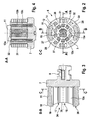
- FIGS. 2 to 5 A preferred embodiment of the brush head 4 of the toothbrush 1 is in the FIGS. 2 to 5 shown.
- the bristle carrier 7 is here round, but advantageously not circular, but slightly oval and / or elliptical, wherein the longer axis of the oval or the ellipse in the neutral position of the bristle carrier 7 parallel to the toothbrush longitudinal axis 26 and the shorter axis of the oval or the Ellipse runs across it.
- FIG. 2 is the longer axis of the oval or ellipse parallel to the line BB.
- bristle carrier 7 On the bristle carrier 7 in this case a plurality of bristle tufts are arranged, which are arranged in a plurality of rings 12, 14 and 15 and distributed over the bristle field 10.
- On an outer ring 12 are in the illustrated embodiment according to FIG. 2 eight bristle tufts are positioned, four of which have an elongated contour, while four have a - roughly speaking - round or equilateral cross-sectional contour.
- the length of the bristle tufts on said outer ring 12 varies here, as will be explained in more detail, wherein - broadly speaking - longer bristle tufts are generally provided in opposite sectors 27 and 28 which contain the toothbrush longitudinal axis 26 in the initial position of the bristle carrier 7 as in For this purpose, cross-oriented or intermediate sectors 29 and 30, cf. FIG. 2 ,
- bristle tufts 11 and 31 of the outer ring 12 in the plan view are each elongated, while the intermediate bristle tufts 32 have an approximately equilateral contour or an approximately cubic or round cross-section.
- the said elongated bristle tufts 11 and 31 each have an arcuate curve around the axis of rotation 9 around, see.
- FIG. 2 shows, lying on the main axes BB and AA bristle tufts 11 and 31 of the outer ring 12 in the plan view are each elongated, while the intermediate bristle tufts 32 have an approximately equilateral contour or an approximately cubic or round cross-section.
- the said elongated bristle tufts 11 and 31 each have an arcuate curve around the axis of rotation 9 around, see.
- FIG. 2 shows, lying on the main axes BB and AA bristle tufts 11 and 31 of the outer ring 12 in the plan view are each elongated, while the intermediate bristle tufts 32
- the sitting on the longer main axis BB outer bristle tufts 11 extend over a peripheral portion of about 50 ° to 90 °, preferably about 70 °, while sitting on the shorter main axis AA outer bristle tufts 31 over a peripheral portion of each about 20 ° to 45 °, preferably about 30 °.
- a total of 10 bristle tufts 13a and 13b are positioned, some of which have a circular cross section and others have a polygonal cross section. In particular, how are FIG.
- the angular bristle tufts 13b of the central ring 14, at least some thereof, with respect to the main axes AA and BB of the bristle carrier 7 and also with respect to Ring contour of the ring 14 on which they are arranged, are acute-angled twisted.
- at least one of the angular bristle brushes, preferably every second angular bristle tufts 13b may be rotated with its main axis 37 such that the main axis 37 of the tufts cross-section is inclined at an acute angle to a tangential to the central ring 14.
- corresponding anchor plates are correspondingly rotated out of the collision area of other anchor plates.
- the bending behavior of the bristle field can be formed overall more homogeneous and in particular less direction-dependent.
- two elongated bristle tufts 13c are provided in an entirely inner area or a third ring of tufts viewed from the outside, which extend with their longitudinal extent 38 in each case parallel to the longer main axis B-B.
- the innermost bristle tufts 13c are significantly larger in terms of their cross-sectional area than the bristle tufts 13a and 13b of the middle ring. In the illustrated embodiment, its cross-sectional area between 200% and 400% of the cross-sectional area of the bristle tufts 13 a and 13 b of the middle ring 14th
- the innermost bristle tufts 13c are elongate, so that their longitudinal extent 38 is more than 150% of their transverse extent, preferably about 150% to 300%.
- the innermost bristle tufts 13c are advantageously bulged vaulted on an outer contour and formed straight on an inner contour, wherein the inner and outer contours are advantageously connected by rounded end contours.
- the innermost bristle tufts 13c are advantageously aligned with their longitudinal axes 38 parallel to the main axis of the bristle carrier, which extends in the undeflected neutral position of the bristle carrier 7 parallel to the toothbrush longitudinal axis 26 and, thus, a longitudinal center plane.
- the bristle tufts of the bristle field 10 are contoured at their free ends or coordinated with respect to their length and / or height such that the defined by the free ends of the bristle tufts working surface 34 of the bristle field 10 has a central recess 16 which has a channel-shaped Floor 17 has a curved course in one direction and a straight course in a direction perpendicular thereto.
- the curvature advantageously extends in the direction of the longer main axis BB or in the direction of the toothbrush longitudinal axis 26 when the bristle carrier 7 is in its undeflected neutral position.
- the recess 16 has a straight contour, as this FIG. 3 shows.
- the central recess 16 may be formed deep different.
- the deepest point of the recess 16 by an amount of about 1 mm to 3 mm, preferably about 2 mm from the highest point of the bristle field Set 10 lower.
- the groove-shaped contouring of the bottom 17 of the recess 16 can in this case be fundamentally differently curved.
- an arcuate contour with a radius of curvature in the range of 8 mm to 17 mm, preferably about 11 mm to 14 mm is provided, but this may vary depending on the dimensioning and configuration of the bristle field.
- FIG. 3 shows, in this case the end faces of the inner tufts 13a, 13b and 13c and the end faces of the shorter, outer tufts 31, which also define the channel-shaped bottom 17, not formed as a flat surfaces, but also curved in a gutter-shaped.
- the respective gutter-shaped curved end surfaces 35 complement each other and together form said trough-shaped contour of the bottom 17 of the central recess 16.
- the inclination of the end surfaces of the inner bristle tufts 13 increases with increasing distance from the axis of rotation 9 in the direction parallel to the main axis BB, cf. , FIG.
- the bristle tufts arranged on the transverse axis AA for this purpose are slightly curved at their free ends, but aligned essentially parallel to the bristle carrier surface, while the inclination of the free ends increases with increasing distance from said main axis AA.
- FIG. 3 also shows, arranged in the sectors 27 and 28 outer tufts 11 of the outer ring 12 are extended relative to the remaining tufts of bristles or have a greater height so that they project beyond the remaining bristle tufts. This also results in a height level with respect to the central recess 16, see. FIG. 3 , that is, the central recess 16 goes to the in FIG. 3 drawn execution not continuously in the end faces of said outer tufts 11 over.
- the said outer tufts 11 in the opposite sectors 27 and 28, which in the neutral position of the bristle carrier comprise the toothbrush longitudinal axis 26, advantageously have end faces 36 which comprise a flat portion 19 which is oriented substantially perpendicular to the longitudinal axis of the tufts 11 and bevels 18, the beveled end surfaces 36 to the outside.
- said chamfers 18 extend at an angle? in the range of 20 ° to 60 °, preferably about 30 ° to 40 °.
- the chamfers 18 are advantageously formed so deep or wide that they extend over about 25% to 75% of the width W of the respective bristle tufts 11.
- the width W means the extent of the bristle tufts perpendicular to its longitudinal axis and perpendicular to the longitudinal extent of the chamfer 18, in the region of the free end of the bristle tufts, cf.
- FIG. 5 In the in FIG. 5 drawn design so the chamfer extends over about 1/4 to 3/4 of the width W.
- the said longer outer bristle tufts 11 are in this case viewed in their longitudinal section as a whole trapezoidal. While the inner flank of the respective bristle tufts 11 extends substantially perpendicular to the plane defined by the bristle carrier 7, the outer flank is perpendicular to the bristle carrier 7 at an angle a of approximately 1.5 ° to 10 °, preferably approximately 3 ° inclined to 5 °, so that the cross section of the bristle tufts 11 increases towards its free end, that is, the bristle tufts is wider towards the free end.
- a large work surface can be achieved.
- favorable geometric conditions at the free end of the bristle tufts 11 with respect to the bevel 18 result.
- the bristle tufts with their free ends advantageously at least 35% to 55% of the surface defined by the bristle carrier 7, preferably 50% or more of this.
- the bristle tufts on the outer ring 12 may extend over a peripheral portion of about 200 ° to 300 °, when the extension of all bristle tufts is added together.
- the externally viewed second ring 14 of bristle tufts may extend over a circumference of a total of about also 200 ° to 300 °, when the extension of all bristle tufts is added together along the circumference.
- the innermost bristle tufts can advantageously cover with their free ends a substantially full-surface closed area.
- the bristle tufts defining the central recess 16 are at least partially provided with self-splitting bristles, wherein in particular the in Fig. 2 shown bristle tufts 13a and 13b of the central ring 14 and / or the innermost bristle tufts 13c may include such self-splicing bristles.
- Fig. 6 In this case shows a preferred embodiment of such a self-splitting bristle, which has a cross-section that is basically the same over its length, which is advantageously designed trefoil-shaped, as this Fig. 6 shows.
- the bristle body 40 here comprises three laterally projecting longitudinal ribs 41, which project from a core portion 42 star-shaped to the outer peripheral side.
- the longitudinal ribs 41 are distributed uniformly over the circumference.
- the longitudinal ribs 41 in this case advantageously have an outer contour that corresponds to a portion of a circular cylinder or other rounded body.
- FIG. 7 Another embodiment of the bristle shows Fig. 7 ,
- the basic concept essentially corresponds to the Fig. 6 , so that corresponding reference numerals are used.
- Fig. 7 from Fig. 6 in that, instead of three longitudinal ribs 41, four longitudinal ribs 41 are provided, and thus therefore the bristle body 40 has the cross-section of a four-leaf clover.
- the longitudinal ribs 41 are uniformly distributed over the circumference and provided with an outer contour corresponding to a pitch circle cylinder.
- FIGS. 6 and 7 shown splicing bristles partially in the aforementioned bristle tufts of the central ring 14 and the innermost bristle tufts 13c combined with "normal", ie non-splicing bristles, advantageously in a mixing ratio of about 50 +/- 10% to 50 + / - 10%.
- the bristle carrier 7 is tilted to the toothbrush longitudinal axis in a special way and the bristle field 10, more precisely its working surface 34 (which is here in contact with teeth) provided with an opposite skew.
- the bristle carrier 7 is opposite the toothbrush longitudinal axis 26, which coincides in the mounted state of the brush head 4 with the Bürstenkopflfitsachse away from the toothbrush handle 2 away, so that the bristle main axis 46 to a perpendicular to the toothbrush longitudinal axis 26 at an inclination angle F of preferably about 8 ° + / - 3 ° inclined, so that the bristle field 10 with its main axis 46 from the toothbrush handle 2 "looks away".
- the working surface 34 of the bristle field 10 which is formed by the free ends of the bristles, obliquely, ie it does not extend parallel to the surface of the bristle carrier 7, advantageously such that said inclination is opposite to the tilting of the bristle carrier.
- the angle of inclination? said work surface 34 to the perpendicular to the main bristle field axis 46 is advantageously about 3.5 ° +/- 1 °.
- the said inclination means the inclination of an approximately laid over the work surface level, for example, by the highest points of the work surface and / or can be determined by statistical averaging of the section inclinations.
- Fig. 8 can by tilting the bristle main axis 46 by the angle F and the opposite slope? the working surface 34 on the one hand reaches an inclined position of the bristle tufts to be treated tooth surface and thus the buckling bar case are largely avoided, while on the other hand, the concave contour of the bristle field 10 and sitting of its working surface 34 fits snugly on the tooth surface, whereby the brush centered by itself.
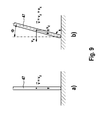
- Fig. 9 clarifies the resulting speed or kinematic conditions. While Fig. (A) shows a vertical bristle, in which the poke movement in a poking movement of the poking movement exactly in the longitudinal direction of the bristle, the partial view (b) shows an obliquely bristle, in which the poking movement a vertical component to the tooth surface and a For this purpose, that has parallel to the tooth surface component. As a result, corresponding reaction forces are generated. While in the vertical case according to Fig. 9 (a) the reaction forces generated by the poking movement are introduced vertically in the longitudinal direction of the bristle in this, is in the inclined case according to Fig. 9 (b) introduced a component of the reaction force approximately transversely to the longitudinal axis of the bristle.
- the oscillation or rotation axis 9 with respect to the main bristle field axis 46 may also be arranged eccentric and / or tilted at an acute angle.
- an eccentricity can preferably be provided in the direction of the longitudinal extent of the oval bristle carrier 7, if this is in its undeflected neutral position, or in the direction of the toothbrush longitudinal direction, wherein the eccentricity relative to the largest diameter of the bristle carrier 7 preferably not more than 25%, in particular about 5% to 15%.
- Fig. 12b can also be a tilting of the axis of rotation 9 relative to the main bristle field axis, preferably in the range of 5 ° to 15 °, whereby a stronger spatial component of the drive movement can be achieved.
- the spatial motion component has the same frequency as that of the oscillation / rotational motion component (since all motions are coupled).
Landscapes
- Health & Medical Sciences (AREA)
- Dentistry (AREA)
- Epidemiology (AREA)
- Life Sciences & Earth Sciences (AREA)
- Animal Behavior & Ethology (AREA)
- General Health & Medical Sciences (AREA)
- Public Health (AREA)
- Veterinary Medicine (AREA)
- Physics & Mathematics (AREA)
- Geometry (AREA)
- Brushes (AREA)
Priority Applications (10)
| Application Number | Priority Date | Filing Date | Title |
|---|---|---|---|
| EP08019351A EP2184033A1 (fr) | 2008-11-05 | 2008-11-05 | Brosse à dents électrique et sa brosse |
| EP09759802.3A EP2349071B1 (fr) | 2008-11-05 | 2009-11-04 | Brosse à dents électrique et tête pour brosse à dents électrique |
| ES09759802.3T ES2447373T3 (es) | 2008-11-05 | 2009-11-04 | Cepillo dental eléctrico y cabeza de cepillo para un cepillo dental eléctrico |
| CN2009801440909A CN102202604B (zh) | 2008-11-05 | 2009-11-04 | 电动牙刷及用于电动牙刷的刷头 |
| CA2741590A CA2741590A1 (fr) | 2008-11-05 | 2009-11-04 | Brosse a dents electrique et tete pour brosse a dents electrique |
| AU2009312460A AU2009312460A1 (en) | 2008-11-05 | 2009-11-04 | Electric toothbrush and brush head for an electric toothbrush |
| PCT/IB2009/054904 WO2010052658A1 (fr) | 2008-11-05 | 2009-11-04 | Brosse à dents électrique et tête pour brosse à dents électrique |
| KR1020117010201A KR101340759B1 (ko) | 2008-11-05 | 2009-11-04 | 전동 칫솔 및 전동 칫솔용 브러시 헤드 |
| JP2011533926A JP5373099B2 (ja) | 2008-11-05 | 2009-11-04 | 電動歯ブラシ及び電動歯ブラシ用のブラシヘッド |
| US13/101,447 US20110247154A1 (en) | 2008-11-05 | 2011-05-05 | Electric Toothbrush And Brush Head Therefor |
Applications Claiming Priority (1)
| Application Number | Priority Date | Filing Date | Title |
|---|---|---|---|
| EP08019351A EP2184033A1 (fr) | 2008-11-05 | 2008-11-05 | Brosse à dents électrique et sa brosse |
Publications (1)
| Publication Number | Publication Date |
|---|---|
| EP2184033A1 true EP2184033A1 (fr) | 2010-05-12 |
Family
ID=40497755
Family Applications (2)
| Application Number | Title | Priority Date | Filing Date |
|---|---|---|---|
| EP08019351A Withdrawn EP2184033A1 (fr) | 2008-11-05 | 2008-11-05 | Brosse à dents électrique et sa brosse |
| EP09759802.3A Active EP2349071B1 (fr) | 2008-11-05 | 2009-11-04 | Brosse à dents électrique et tête pour brosse à dents électrique |
Family Applications After (1)
| Application Number | Title | Priority Date | Filing Date |
|---|---|---|---|
| EP09759802.3A Active EP2349071B1 (fr) | 2008-11-05 | 2009-11-04 | Brosse à dents électrique et tête pour brosse à dents électrique |
Country Status (9)
| Country | Link |
|---|---|
| US (1) | US20110247154A1 (fr) |
| EP (2) | EP2184033A1 (fr) |
| JP (1) | JP5373099B2 (fr) |
| KR (1) | KR101340759B1 (fr) |
| CN (1) | CN102202604B (fr) |
| AU (1) | AU2009312460A1 (fr) |
| CA (1) | CA2741590A1 (fr) |
| ES (1) | ES2447373T3 (fr) |
| WO (1) | WO2010052658A1 (fr) |
Cited By (1)
| Publication number | Priority date | Publication date | Assignee | Title |
|---|---|---|---|---|
| WO2018177851A1 (fr) * | 2017-03-31 | 2018-10-04 | Trisa Holding Ag | Brosse de soin corporel électrique |
Families Citing this family (11)
| Publication number | Priority date | Publication date | Assignee | Title |
|---|---|---|---|---|
| EP2184032A1 (fr) * | 2008-11-05 | 2010-05-12 | Braun Gmbh | Brosse à dents éléctrique et tête de brosse associée |
| EP3337350B1 (fr) | 2015-09-08 | 2022-05-11 | Colgate-Palmolive Company | Instrument d'hygiène bucco-dentaire |
| US11213120B2 (en) | 2016-11-14 | 2022-01-04 | Colgate-Palmolive Company | Oral care system and method |
| US11043141B2 (en) | 2016-11-14 | 2021-06-22 | Colgate-Palmolive Company | Oral care system and method |
| US11361672B2 (en) | 2016-11-14 | 2022-06-14 | Colgate-Palmolive Company | Oral care system and method |
| US10835028B2 (en) | 2016-11-14 | 2020-11-17 | Colgate-Palmolive Company | Oral care system and method |
| US10582764B2 (en) | 2016-11-14 | 2020-03-10 | Colgate-Palmolive Company | Oral care system and method |
| CN109717978B (zh) * | 2017-10-30 | 2023-10-31 | 南京牙小白健康科技有限公司 | 一种可弯曲的振动牙刷刷头 |
| US11596508B2 (en) * | 2019-03-08 | 2023-03-07 | Church & Dwight Co., Inc. | Electric toothbrush and a brush head for the same |
| CN112493658B (zh) * | 2020-11-23 | 2022-10-14 | 深圳素士科技股份有限公司 | 浮动牙刷头及电动牙刷 |
| USD1080215S1 (en) | 2022-11-07 | 2025-06-24 | Mohammed Ahmed | Rotary dental micro-brush |
Citations (10)
| Publication number | Priority date | Publication date | Assignee | Title |
|---|---|---|---|---|
| US4420851A (en) * | 1981-12-07 | 1983-12-20 | Wiener Stanley M | Mechanized tooth brush having movement in two planes |
| WO1998026730A1 (fr) * | 1996-12-17 | 1998-06-25 | Koninklijke Philips Electronics N.V. | Brosse a dents comprenant un element brosse pourvu de soies de differentes longueurs et element brosse a soies de differentes longueurs pour brosse a dents |
| EP0835081B1 (fr) | 1995-06-24 | 1999-11-10 | Braun Aktiengesellschaft | Brossette pour brosse a dents electrique |
| WO2001060281A1 (fr) * | 2000-02-15 | 2001-08-23 | Glaxosmithkline Consumer Healthcare Gmbh & Co Kg | Partie brosse d'une brosse a dents electrique |
| US20020184719A1 (en) * | 2001-06-08 | 2002-12-12 | Eyal Eliav | Brush section for an electric toothbrush |
| DE10247137A1 (de) * | 2001-10-10 | 2003-04-30 | Fukoku Ageo Kk | Elektrische Zahnbürste |
| US20050011023A1 (en) * | 2003-07-17 | 2005-01-20 | Chan Kwok Sing | Electric toothbrush |
| US20050144744A1 (en) * | 2004-01-02 | 2005-07-07 | Pn, Llc | Cleaning apparatus with reciprocating or rotating brush head |
| WO2007011758A1 (fr) * | 2005-07-15 | 2007-01-25 | Colgate-Palmolive Company | Brosse à dents ayant un élément de nettoyage vertical mobile |
| DE202007017676U1 (de) * | 2007-12-13 | 2008-03-06 | Häusler, Wolfgang | Bürstenkopf für eine Zahnbürste |
Family Cites Families (44)
| Publication number | Priority date | Publication date | Assignee | Title |
|---|---|---|---|---|
| US4479516A (en) * | 1982-02-08 | 1984-10-30 | Hunter Frank M | Electrically driven toothbrush |
| DE4239251A1 (de) * | 1992-11-21 | 1994-05-26 | Braun Ag | Elektrische Zahnbürste mit drehbarem Borstenträger |
| DE4309035C2 (de) * | 1993-03-20 | 1999-04-08 | Braun Ag | Elektrische Zahnbürste und Bürstenteil für eine elektrische Zahnbürste |
| DE4438732A1 (de) * | 1994-10-29 | 1996-05-02 | Braun Ag | Bürstenteil für eine elektrische Zahnbürste |
| DE4438731A1 (de) * | 1994-10-29 | 1996-05-02 | Braun Ag | Bürstenteil für eine elektrische Zahnbürste |
| DE19512318A1 (de) * | 1995-04-01 | 1996-10-10 | Braun Ag | Bürstenteil für eine elektrische Zahnbürste |
| JP3475581B2 (ja) * | 1995-06-27 | 2003-12-08 | 松下電工株式会社 | 電動歯ブラシ |
| ATE214253T1 (de) * | 1995-12-28 | 2002-03-15 | Koninkl Philips Electronics Nv | Vorrichtung zum zähneputzen und zubehör für diese vorrichtung |
| US5822821A (en) * | 1996-01-12 | 1998-10-20 | Pentalpha Enterprises Ltd. | Electric toothbrush |
| US5697117A (en) * | 1996-01-26 | 1997-12-16 | Teledyne Industries, Inc. | Brush head assembly for motor powered toothbrush |
| US6058541A (en) * | 1996-07-03 | 2000-05-09 | Gillette Canada Inc. | Crimped bristle toothbrush |
| DE19627752A1 (de) * | 1996-07-10 | 1998-01-15 | Braun Ag | Elektrische Zahnbürste |
| US6371294B1 (en) * | 1998-09-30 | 2002-04-16 | The Procter & Gamble Company | Electric toothbrush |
| CN1341006A (zh) * | 1999-10-29 | 2002-03-20 | 皇家菲利浦电子有限公司 | 一种具有主刚毛和横纵向均可调节的齿间刚毛的牙刷 |
| US7086111B2 (en) * | 2001-03-16 | 2006-08-08 | Braun Gmbh | Electric dental cleaning device |
| US6434773B1 (en) * | 2000-08-28 | 2002-08-20 | Youti Kuo | Dentifrice dispensing electrical toothbrush with snap-on dual brush unit |
| DE10044031A1 (de) * | 2000-09-06 | 2002-03-21 | Braun Gmbh | Motorisch angetriebene Zahnbürste und Bürstenkopf hierfür |
| CA2430849A1 (fr) * | 2000-12-07 | 2002-06-13 | Glaxosmithkline Consumer Healthcare Gmbh & Co Kg | Element de brosse destine a une brosse a dents |
| DE10159395B4 (de) * | 2001-12-04 | 2010-11-11 | Braun Gmbh | Vorrichtung zur Zahnreinigung |
| DK1367958T3 (da) * | 2001-03-14 | 2008-01-28 | Braun Gmbh | Anordning til tandrensning |
| US20020138926A1 (en) * | 2001-04-02 | 2002-10-03 | Braun Gmbh | Electric toothbrush head |
| US6836917B2 (en) * | 2001-05-07 | 2005-01-04 | The Procter & Gamble Company | Replaceable head electric toothbrush and connection structure therefor |
| DE10123258A1 (de) * | 2001-05-12 | 2002-11-21 | Braun Gmbh | Zahnbürstenkopf |
| US6721986B2 (en) * | 2001-06-28 | 2004-04-20 | Qingping Zhuan | Electric toothbrush |
| JP2003260072A (ja) * | 2002-03-11 | 2003-09-16 | Fukoku Co Ltd | 電動歯ブラシ |
| US7640614B2 (en) * | 2001-11-06 | 2010-01-05 | The Procter & Gamble Company | Multi motion toothbrush |
| DE10211391A1 (de) * | 2002-03-15 | 2003-10-02 | Braun Gmbh | Elektrische Zahnbürste und Zahnbürstenkopf hierfür |
| JP2003265504A (ja) * | 2002-03-20 | 2003-09-24 | Ichiro Sugimoto | 自動進退歯ブラシ |
| CN2543500Y (zh) * | 2002-04-22 | 2003-04-09 | 洁齿亮有限公司 | 一种电动按摩牙刷及双功能电动牙刷 |
| CN1451359A (zh) * | 2002-05-17 | 2003-10-29 | 高露洁-棕榄公司 | 电动牙刷头 |
| JP4081656B2 (ja) * | 2002-05-31 | 2008-04-30 | サンスター株式会社 | 電動ブラシ |
| US7757326B2 (en) * | 2003-10-30 | 2010-07-20 | Cologate-Palmolive Company | Toothbrush with enhanced cleaning effects |
| AU2003272336A1 (en) * | 2002-09-11 | 2004-04-30 | The Procter And Gamble Company | Multi-motion stainbrush |
| US7140058B2 (en) * | 2002-09-27 | 2006-11-28 | Colgate-Palmolive Company | Toothbrush with kinetic plate |
| US7636976B2 (en) * | 2002-12-30 | 2009-12-29 | The Procter & Gamble Company | Power toothbrush |
| WO2005000149A1 (fr) * | 2003-06-27 | 2005-01-06 | Koninklijke Philips Electronics, N.V. | Systeme de fixation d'une tete de brosse pour une brosse a dents electrique |
| US7941886B2 (en) * | 2003-09-19 | 2011-05-17 | Braun Gmbh | Toothbrushes |
| US7386906B2 (en) * | 2004-06-22 | 2008-06-17 | Pacific Bioscience Laboratories, Inc. | Oscillating brushhead attachment system for a personal care appliance |
| US7861348B2 (en) * | 2004-12-08 | 2011-01-04 | The Procter & Gamble Company | Electric toothbrushes |
| US7020925B1 (en) * | 2004-12-22 | 2006-04-04 | Avtipus Patents & Inventions Ltd. | Mechanical toothbrush |
| CA2623023C (fr) * | 2005-09-26 | 2011-09-20 | Colgate-Palmolive Company | Brosse a dents a nettoyage et confort ameliores |
| JP4854285B2 (ja) * | 2005-12-05 | 2012-01-18 | 花王株式会社 | 歯ブラシ |
| DE102006027756A1 (de) * | 2006-06-16 | 2007-12-20 | Braun Gmbh | Zahnbürste sowie Zahnbürstenkopf und Zahnputzborste hierfür |
| KR20090039826A (ko) * | 2006-09-08 | 2009-04-22 | 더 질레트 컴퍼니 | 구강 위생 장치, 칫솔 및 복수의 세정 작동 제공 방법 |
-
2008
- 2008-11-05 EP EP08019351A patent/EP2184033A1/fr not_active Withdrawn
-
2009
- 2009-11-04 JP JP2011533926A patent/JP5373099B2/ja not_active Expired - Fee Related
- 2009-11-04 ES ES09759802.3T patent/ES2447373T3/es active Active
- 2009-11-04 AU AU2009312460A patent/AU2009312460A1/en not_active Abandoned
- 2009-11-04 KR KR1020117010201A patent/KR101340759B1/ko not_active Expired - Fee Related
- 2009-11-04 CA CA2741590A patent/CA2741590A1/fr not_active Abandoned
- 2009-11-04 EP EP09759802.3A patent/EP2349071B1/fr active Active
- 2009-11-04 CN CN2009801440909A patent/CN102202604B/zh active Active
- 2009-11-04 WO PCT/IB2009/054904 patent/WO2010052658A1/fr not_active Ceased
-
2011
- 2011-05-05 US US13/101,447 patent/US20110247154A1/en not_active Abandoned
Patent Citations (10)
| Publication number | Priority date | Publication date | Assignee | Title |
|---|---|---|---|---|
| US4420851A (en) * | 1981-12-07 | 1983-12-20 | Wiener Stanley M | Mechanized tooth brush having movement in two planes |
| EP0835081B1 (fr) | 1995-06-24 | 1999-11-10 | Braun Aktiengesellschaft | Brossette pour brosse a dents electrique |
| WO1998026730A1 (fr) * | 1996-12-17 | 1998-06-25 | Koninklijke Philips Electronics N.V. | Brosse a dents comprenant un element brosse pourvu de soies de differentes longueurs et element brosse a soies de differentes longueurs pour brosse a dents |
| WO2001060281A1 (fr) * | 2000-02-15 | 2001-08-23 | Glaxosmithkline Consumer Healthcare Gmbh & Co Kg | Partie brosse d'une brosse a dents electrique |
| US20020184719A1 (en) * | 2001-06-08 | 2002-12-12 | Eyal Eliav | Brush section for an electric toothbrush |
| DE10247137A1 (de) * | 2001-10-10 | 2003-04-30 | Fukoku Ageo Kk | Elektrische Zahnbürste |
| US20050011023A1 (en) * | 2003-07-17 | 2005-01-20 | Chan Kwok Sing | Electric toothbrush |
| US20050144744A1 (en) * | 2004-01-02 | 2005-07-07 | Pn, Llc | Cleaning apparatus with reciprocating or rotating brush head |
| WO2007011758A1 (fr) * | 2005-07-15 | 2007-01-25 | Colgate-Palmolive Company | Brosse à dents ayant un élément de nettoyage vertical mobile |
| DE202007017676U1 (de) * | 2007-12-13 | 2008-03-06 | Häusler, Wolfgang | Bürstenkopf für eine Zahnbürste |
Cited By (3)
| Publication number | Priority date | Publication date | Assignee | Title |
|---|---|---|---|---|
| WO2018177851A1 (fr) * | 2017-03-31 | 2018-10-04 | Trisa Holding Ag | Brosse de soin corporel électrique |
| US11553999B2 (en) | 2017-03-31 | 2023-01-17 | Trisa Holding Ag | Electrical body care brush |
| US12575919B2 (en) | 2017-03-31 | 2026-03-17 | Trisa Holding Ag | Electrical body care brush |
Also Published As
| Publication number | Publication date |
|---|---|
| EP2349071A1 (fr) | 2011-08-03 |
| KR20110081271A (ko) | 2011-07-13 |
| WO2010052658A1 (fr) | 2010-05-14 |
| EP2349071B1 (fr) | 2013-12-18 |
| CN102202604B (zh) | 2013-11-13 |
| AU2009312460A1 (en) | 2010-05-14 |
| CN102202604A (zh) | 2011-09-28 |
| US20110247154A1 (en) | 2011-10-13 |
| JP5373099B2 (ja) | 2013-12-18 |
| KR101340759B1 (ko) | 2013-12-12 |
| JP2012506754A (ja) | 2012-03-22 |
| ES2447373T3 (es) | 2014-03-11 |
| CA2741590A1 (fr) | 2010-05-14 |
Similar Documents
| Publication | Publication Date | Title |
|---|---|---|
| EP2186434B1 (fr) | Brosse à dent, brosse et tête de brosse pour une brosse à dent | |
| EP2184032A1 (fr) | Brosse à dents éléctrique et tête de brosse associée | |
| EP2184031A1 (fr) | Brosse à dents électrique et tête de brosse correspondante | |
| EP1776893B1 (fr) | Tête de brosse et procédé pour la fabrication de cette tête de brosse | |
| EP2028969B1 (fr) | Brosse à dents et tête de brosse à dents ainsi que soie de nettoyage dentaire pour celle-ci | |
| DE10331369B4 (de) | Zahnbürste | |
| EP2605683B1 (fr) | Brosse à dents dotée d'une topographie particulière des soies | |
| EP2886081B1 (fr) | Brosse à dents électrique dotée d'une tête de brosse | |
| EP1646299B1 (fr) | Brosse a dents manuelle | |
| DE602004001667T2 (de) | Zahnbürste | |
| EP1993398B1 (fr) | Brosse à dents et tête de brosse à dents pour celle-ci | |
| EP0848593A1 (fr) | Brosse a dents | |
| EP2420156A1 (fr) | Brosse à dents dotée de faisceaux de soies, dont les soies ont des longueurs différentes, et dispositif pour appliquer les soies sur une telle brosse à dents | |
| EP1173081B1 (fr) | Brosse a dents | |
| EP0269665B1 (fr) | Brosse a dents | |
| EP0453954B1 (fr) | Brosse avec des soies artificielles, en particulier une brosse à dents | |
| DE202012105098U1 (de) | Vorrichtung zur Zungenreinigung | |
| DE102012113227B3 (de) | Vorrichtung und Verfahren zur Zungenreinigung | |
| EP1774924A1 (fr) | Tête de brosse pour brosse à dents électrique | |
| DE102019132194A1 (de) | Bürstennacharbeitsvorrichtung und Verfahren zum Nachbearbeiten von Bürsten | |
| DE9016467U1 (de) | Bürste mit Kunststoffborsten, insbesondere Zahnbürste |
Legal Events
| Date | Code | Title | Description |
|---|---|---|---|
| PUAI | Public reference made under article 153(3) epc to a published international application that has entered the european phase |
Free format text: ORIGINAL CODE: 0009012 |
|
| 17P | Request for examination filed |
Effective date: 20081112 |
|
| AK | Designated contracting states |
Kind code of ref document: A1 Designated state(s): AT BE BG CH CY CZ DE DK EE ES FI FR GB GR HR HU IE IS IT LI LT LU LV MC MT NL NO PL PT RO SE SI SK TR |
|
| AX | Request for extension of the european patent |
Extension state: AL BA MK RS |
|
| AKX | Designation fees paid |
Designated state(s): AT BE BG CH CY CZ DE DK EE ES FI FR GB GR HR HU IE IS IT LI LT LU LV MC MT NL NO PL PT RO SE SI SK TR |
|
| STAA | Information on the status of an ep patent application or granted ep patent |
Free format text: STATUS: THE APPLICATION IS DEEMED TO BE WITHDRAWN |
|
| 18D | Application deemed to be withdrawn |
Effective date: 20101113 |