EP2184347A2 - Nouveaux composants et nouveau système de bioréacteurs pour la culture et la stimulation mécanique de matériau biologique - Google Patents
Nouveaux composants et nouveau système de bioréacteurs pour la culture et la stimulation mécanique de matériau biologique Download PDFInfo
- Publication number
- EP2184347A2 EP2184347A2 EP09175335A EP09175335A EP2184347A2 EP 2184347 A2 EP2184347 A2 EP 2184347A2 EP 09175335 A EP09175335 A EP 09175335A EP 09175335 A EP09175335 A EP 09175335A EP 2184347 A2 EP2184347 A2 EP 2184347A2
- Authority
- EP
- European Patent Office
- Prior art keywords
- bioreactor
- biological material
- seal
- chamber
- bioreactor chamber
- Prior art date
- Legal status (The legal status is an assumption and is not a legal conclusion. Google has not performed a legal analysis and makes no representation as to the accuracy of the status listed.)
- Withdrawn
Links
- 239000012620 biological material Substances 0.000 title claims abstract description 107
- 230000000638 stimulation Effects 0.000 title claims description 10
- 238000007789 sealing Methods 0.000 claims abstract description 51
- 230000033001 locomotion Effects 0.000 claims description 31
- 238000005096 rolling process Methods 0.000 claims description 28
- 239000000463 material Substances 0.000 claims description 26
- 239000007788 liquid Substances 0.000 claims description 23
- 238000004113 cell culture Methods 0.000 claims description 17
- 229920001296 polysiloxane Polymers 0.000 claims description 12
- 230000001105 regulatory effect Effects 0.000 claims description 11
- 239000001963 growth medium Substances 0.000 claims description 10
- 239000011324 bead Substances 0.000 claims description 4
- 230000033228 biological regulation Effects 0.000 abstract description 8
- 230000001419 dependent effect Effects 0.000 abstract 1
- 239000007789 gas Substances 0.000 description 25
- 239000000523 sample Substances 0.000 description 25
- 239000012528 membrane Substances 0.000 description 16
- 210000004027 cell Anatomy 0.000 description 10
- 239000002609 medium Substances 0.000 description 10
- 230000006835 compression Effects 0.000 description 9
- 238000007906 compression Methods 0.000 description 9
- 238000013461 design Methods 0.000 description 9
- 230000035876 healing Effects 0.000 description 8
- 208000010392 Bone Fractures Diseases 0.000 description 7
- 206010017076 Fracture Diseases 0.000 description 7
- 210000001519 tissue Anatomy 0.000 description 7
- 230000007423 decrease Effects 0.000 description 6
- 230000005540 biological transmission Effects 0.000 description 5
- 239000006143 cell culture medium Substances 0.000 description 5
- 238000013519 translation Methods 0.000 description 5
- 238000004458 analytical method Methods 0.000 description 4
- QVGXLLKOCUKJST-UHFFFAOYSA-N atomic oxygen Chemical compound [O] QVGXLLKOCUKJST-UHFFFAOYSA-N 0.000 description 4
- 230000000694 effects Effects 0.000 description 4
- 238000003384 imaging method Methods 0.000 description 4
- 230000002427 irreversible effect Effects 0.000 description 4
- 238000000034 method Methods 0.000 description 4
- 230000003287 optical effect Effects 0.000 description 4
- 239000001301 oxygen Substances 0.000 description 4
- 229910052760 oxygen Inorganic materials 0.000 description 4
- 238000012360 testing method Methods 0.000 description 4
- 239000004952 Polyamide Substances 0.000 description 3
- 210000000845 cartilage Anatomy 0.000 description 3
- 230000024245 cell differentiation Effects 0.000 description 3
- 239000003814 drug Substances 0.000 description 3
- 230000006870 function Effects 0.000 description 3
- 208000015181 infectious disease Diseases 0.000 description 3
- 239000002655 kraft paper Substances 0.000 description 3
- 238000005259 measurement Methods 0.000 description 3
- 239000000203 mixture Substances 0.000 description 3
- 235000015097 nutrients Nutrition 0.000 description 3
- 229920002647 polyamide Polymers 0.000 description 3
- 230000008569 process Effects 0.000 description 3
- 238000012546 transfer Methods 0.000 description 3
- 229930040373 Paraformaldehyde Natural products 0.000 description 2
- 239000004696 Poly ether ether ketone Substances 0.000 description 2
- 230000009471 action Effects 0.000 description 2
- 238000013459 approach Methods 0.000 description 2
- 210000001188 articular cartilage Anatomy 0.000 description 2
- 210000000988 bone and bone Anatomy 0.000 description 2
- 230000007547 defect Effects 0.000 description 2
- 230000003111 delayed effect Effects 0.000 description 2
- 238000011161 development Methods 0.000 description 2
- 230000018109 developmental process Effects 0.000 description 2
- 238000006073 displacement reaction Methods 0.000 description 2
- 230000014509 gene expression Effects 0.000 description 2
- 230000002706 hydrostatic effect Effects 0.000 description 2
- 238000000338 in vitro Methods 0.000 description 2
- 238000004519 manufacturing process Methods 0.000 description 2
- 230000035699 permeability Effects 0.000 description 2
- 229920003229 poly(methyl methacrylate) Polymers 0.000 description 2
- 229920002530 polyetherether ketone Polymers 0.000 description 2
- 239000004926 polymethyl methacrylate Substances 0.000 description 2
- 229920006324 polyoxymethylene Polymers 0.000 description 2
- 239000004800 polyvinyl chloride Substances 0.000 description 2
- 108090000623 proteins and genes Proteins 0.000 description 2
- 230000007704 transition Effects 0.000 description 2
- 230000005428 wave function Effects 0.000 description 2
- 241001136792 Alle Species 0.000 description 1
- 241000894006 Bacteria Species 0.000 description 1
- 241000195493 Cryptophyta Species 0.000 description 1
- 241000233866 Fungi Species 0.000 description 1
- 206010020649 Hyperkeratosis Diseases 0.000 description 1
- 206010021143 Hypoxia Diseases 0.000 description 1
- 102000005741 Metalloproteases Human genes 0.000 description 1
- 108010006035 Metalloproteases Proteins 0.000 description 1
- 241001465754 Metazoa Species 0.000 description 1
- 241000906034 Orthops Species 0.000 description 1
- 241000700605 Viruses Species 0.000 description 1
- 238000010521 absorption reaction Methods 0.000 description 1
- 230000001133 acceleration Effects 0.000 description 1
- 239000013543 active substance Substances 0.000 description 1
- 230000006978 adaptation Effects 0.000 description 1
- 238000004026 adhesive bonding Methods 0.000 description 1
- 244000052616 bacterial pathogen Species 0.000 description 1
- 238000005452 bending Methods 0.000 description 1
- 230000008901 benefit Effects 0.000 description 1
- 230000010478 bone regeneration Effects 0.000 description 1
- 230000011712 cell development Effects 0.000 description 1
- 238000002659 cell therapy Methods 0.000 description 1
- 230000008859 change Effects 0.000 description 1
- 238000006243 chemical reaction Methods 0.000 description 1
- 239000003795 chemical substances by application Substances 0.000 description 1
- 230000000295 complement effect Effects 0.000 description 1
- 239000002131 composite material Substances 0.000 description 1
- 238000011109 contamination Methods 0.000 description 1
- 238000002316 cosmetic surgery Methods 0.000 description 1
- 125000004122 cyclic group Chemical group 0.000 description 1
- 230000006866 deterioration Effects 0.000 description 1
- 230000004069 differentiation Effects 0.000 description 1
- 238000009792 diffusion process Methods 0.000 description 1
- 229940079593 drug Drugs 0.000 description 1
- 238000003255 drug test Methods 0.000 description 1
- 238000002474 experimental method Methods 0.000 description 1
- 230000004907 flux Effects 0.000 description 1
- 239000011521 glass Substances 0.000 description 1
- 239000003102 growth factor Substances 0.000 description 1
- 230000001146 hypoxic effect Effects 0.000 description 1
- 230000001771 impaired effect Effects 0.000 description 1
- 239000007943 implant Substances 0.000 description 1
- 230000000977 initiatory effect Effects 0.000 description 1
- 230000002452 interceptive effect Effects 0.000 description 1
- 238000011835 investigation Methods 0.000 description 1
- 210000003127 knee Anatomy 0.000 description 1
- 230000007774 longterm Effects 0.000 description 1
- 238000005297 material degradation process Methods 0.000 description 1
- 239000011159 matrix material Substances 0.000 description 1
- 210000002901 mesenchymal stem cell Anatomy 0.000 description 1
- 239000002184 metal Substances 0.000 description 1
- 244000005700 microbiome Species 0.000 description 1
- 230000008450 motivation Effects 0.000 description 1
- 238000000465 moulding Methods 0.000 description 1
- 210000000056 organ Anatomy 0.000 description 1
- 230000036284 oxygen consumption Effects 0.000 description 1
- 230000036961 partial effect Effects 0.000 description 1
- 230000010412 perfusion Effects 0.000 description 1
- 230000000737 periodic effect Effects 0.000 description 1
- 239000002861 polymer material Substances 0.000 description 1
- -1 polyoxymethylene Polymers 0.000 description 1
- 229920000915 polyvinyl chloride Polymers 0.000 description 1
- 239000011148 porous material Substances 0.000 description 1
- 238000004886 process control Methods 0.000 description 1
- 230000035755 proliferation Effects 0.000 description 1
- 230000002035 prolonged effect Effects 0.000 description 1
- 102000004169 proteins and genes Human genes 0.000 description 1
- 230000002829 reductive effect Effects 0.000 description 1
- 230000003252 repetitive effect Effects 0.000 description 1
- 230000002441 reversible effect Effects 0.000 description 1
- 238000012552 review Methods 0.000 description 1
- 238000004088 simulation Methods 0.000 description 1
- 210000000130 stem cell Anatomy 0.000 description 1
- 230000036962 time dependent Effects 0.000 description 1
- 238000002054 transplantation Methods 0.000 description 1
- 238000003466 welding Methods 0.000 description 1
Images




Classifications
-
- C—CHEMISTRY; METALLURGY
- C12—BIOCHEMISTRY; BEER; SPIRITS; WINE; VINEGAR; MICROBIOLOGY; ENZYMOLOGY; MUTATION OR GENETIC ENGINEERING
- C12M—APPARATUS FOR ENZYMOLOGY OR MICROBIOLOGY; APPARATUS FOR CULTURING MICROORGANISMS FOR PRODUCING BIOMASS, FOR GROWING CELLS OR FOR OBTAINING FERMENTATION OR METABOLIC PRODUCTS, i.e. BIOREACTORS OR FERMENTERS
- C12M23/00—Constructional details, e.g. recesses, hinges
- C12M23/38—Caps; Covers; Plugs; Pouring means
-
- C—CHEMISTRY; METALLURGY
- C12—BIOCHEMISTRY; BEER; SPIRITS; WINE; VINEGAR; MICROBIOLOGY; ENZYMOLOGY; MUTATION OR GENETIC ENGINEERING
- C12M—APPARATUS FOR ENZYMOLOGY OR MICROBIOLOGY; APPARATUS FOR CULTURING MICROORGANISMS FOR PRODUCING BIOMASS, FOR GROWING CELLS OR FOR OBTAINING FERMENTATION OR METABOLIC PRODUCTS, i.e. BIOREACTORS OR FERMENTERS
- C12M35/00—Means for application of stress for stimulating the growth of microorganisms or the generation of fermentation or metabolic products; Means for electroporation or cell fusion
- C12M35/04—Mechanical means, e.g. sonic waves, stretching forces, pressure or shear stimuli
Definitions
- Bioreactors are widely used in the field of so-called "tissue engineering", for example in order to cultivate and functionalize tissue for subsequent transplantation into the human body.
- tissue engineering for example in order to cultivate and functionalize tissue for subsequent transplantation into the human body.
- a large number of different systems are known, a major part of which is the production of cartilage grafts ( Donkelaar et al., Review of Patents for Mechanical Stimulation of Articular Cartilage Tissue Engineering. Recent Patents on Biomedical Engineering 2008, 1, 1-12 ).
- Matrix metalloprotease activity is an essential link between mechanical stimulus and mesenchymal stem cell behavior , Stem Cells, 25 (2007): 1985-1 994 ).
- the mechanical stimulus to the biological material is achieved by impressing a silicone membrane with an external punch.
- This approach has the disadvantage that the medium-filled lumen of the reactor chamber of the bioreactor is impaired thereby creating undefined volume and pressure changes in the reactor chamber.
- the mechanical stimulus is applied by a magnetic stamp, which can be controlled by a magnet arranged outside the reactor space.
- This system has the problem that such magnetic controls are limited in the ability to control the mechanical stimulus with respect to the absolute force as well as with respect to the movement form sufficiently accurately.
- the applicable frequency is limited to a few hertz.
- this system only allows the application of a mechanical stimulus from one side of the biological material. Two such magnetic stamp with different orientation can not be easily controlled or regulated from the outside easily.
- Another problem with the mechanical stimulation of biological material over a long period of time in a bioreactor is that irreversible deformations of the biological material may occur over time and thus the deformed biological material will no longer have the same mechanical forces as at the beginning of the treatment ,
- the object of the present invention is to reduce or overcome one or more disadvantages of the prior art.
- it is an object of the invention to provide means for exposing biological material to defined mechanical stimuli over an extended period of time.
- the present invention provides a bioreactor for the culture and mechanical stimulation of biological material.
- the bioreactor according to the invention comprises a bioreactor chamber, a cell culture unit and a unit for exerting mechanical stimuli on the biological material to be cultivated, wherein the unit for exerting mechanical stimuli comprises at least two independent, controllable and / or controllable drives, wherein a first drive is a piezo drive which allows generation of mechanical stimuli, and a second drive is a linear drive that allows regulation of the position of the biological material in the bioreactor chamber.
- a piezo drive can be used, which allows generation of mechanical stimuli with a maximum frequency of ⁇ 5 Hz.
- the bioreactor according to the invention may additionally comprise a force meter, which is arranged and configured such that the forces actually acting on the biological material can be determined thereon.
- the bioreactor may additionally comprise a control and / or regulating unit which is arranged and configured in such a way that the position of the biological material can be regulated as a function of the values measured at the force meter.
- the cell culture unit may comprise a micropump and / or a culture medium reservoir with integrated gas exchange membrane.
- the bioreactor according to the invention may have a bioreactor chamber according to the invention and / or one or more seals according to the invention.
- a piston rod is received in the receptacle of the sealing element of the seal, then this piston rod can be moved in the longitudinal axial direction such that the rolling region rolls inwards or outwards, while the receptacle and piston rod remain fluidly and / or gas tightly connected Essentially do not allow relative movement to each other.
- the seal remains liquid and / or gas tight during this movement, there is no special sealing of sliding parts necessary.
- the seal according to the invention thus permits the transmission of a longitudinal axial movement from the environment into the lumen of a bioreactor chamber by means of a piston rod mounted in the receptacle of the seal over a defined distance which is determined by the selected dimensioning of the rolling region of the rolling membrane of the seal, without the remainder the sealing element is subjected to a significant deformation.
- the use of such a seal thus makes it possible to transfer mechanical stimuli to a biological material arranged in a bioreactor chamber, whereby the lumen of the bioreactor chamber is only minimally affected.
- the seal according to the invention can be distinguished by the fact that a piston rod can be received in such a force-locking, material-locking and / or form-fitting manner in the receiving region that a relative movement of piston rod to the receiving region is substantially prevented.
- the rolling region of the seal may be designed such that the receiving region is movable in the longitudinal axial direction over a predetermined distance, without there being any substantial deformation of the sealing element outside the rolling diaphragm.
- the gasket or parts thereof, such as the mold element or the gasket, may include or consist of silicone or a silicone-containing material.
- the molded element of the seal may have a sealing edge and / or a sealing surface and optionally comprise one or more sealing beads.
- the stamp (s) and / or the device for receiving biological material may be designed in such a way that the placed biological material can flow around culture medium during the culture.
- the plunger (s) and / or the biological material receiving device may have a region which may directly or indirectly contact the biological material during culture, this region being composed of four radially arranged centrally interconnected V's -formal support elements is formed and the contact surfaces of the individual V-shaped support elements are present separated by channels through which medium can flow through culture medium.
- the bioreactor chamber can have two oppositely arranged, inventive seals, wherein in the reactor chamber, the stamp of the two seals themselves are arranged opposite each other, wherein the pistons are movable independently of each other via the piston rod mounted in the receptacle of the respective seal in the longitudinal axial direction and wherein one of the two punches serves as a device for receiving biological material.
- the two punches may be aligned with each other by guide means so that, as the punches move toward one another, the punches move towards each other in substantially the predetermined orientation.
- the seal 1 according to the invention is designed such that it can serve to seal a bioreactor chamber.
- a bioreactor chamber is understood to mean the device of a bioreactor, in which the corresponding biological material can be arranged during the culture and / or experimental period and exposed to defined conditions.
- biological material is meant any material which is of biological origin and is preferably culturable over a certain period of time.
- the biological material includes viruses, cells, mixtures or compositions of cells of different types, cell aggregates, tissues, organs or parts thereof and biological support materials for these biological components, and and whole organisms, in particular microorganisms such as bacteria, fungi and / or algae.
- the biological material is not limited to any particular origin or donor (e.g., of human or plant origin).
- liquid and / or gas-tight means that substantially no culture-significant liquids and / or gases from the environment can enter the reactor chamber during operation of the bioreactor chamber in an uncontrolled manner. This ensures on the one hand that the culture can be carried out under constant, defined conditions and on the other hand no germs or other interfering materials can penetrate, so that the longest possible culture of the biological material is possible.
- substantially no liquids and / or gases which are significant for the culture also preferably escape from the reactor chamber into the environment in an uncontrolled manner.
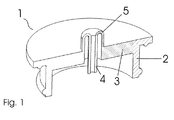
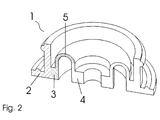
- the seal 1 according to the invention comprises a shaped element 2 and a sealing element 3.
- the mold element 2 is designed such that it permits a liquid-tight and / or gas-tight sealing of a contact region of the seal with a surface of a bioreactor chamber.
- the mold element 2 is shaped so that it is contactable with a surface of a bioreactor chamber, so that an opening of the bioreactor through the Seal 1 liquid and / or gas-tight is closed.
- the mold element 2 may have a sealing edge and / or a sealing surface.
- the mold element 2 may have one or more sealing beads. In Fig.
- the mold element 2 is designed as a radially encircling, "L" -shaped web, the long end of the "L” representing a sealing surface and the short end of the "L” forming a sealing edge. Both the sealing surface and the sealing edge each have a separate sealing bead.
- the seal 1, in particular parts of the molding element 2 may be connected or fixed to the bioreactor chamber by further means.
- Such means may comprise threaded connections wherein, for example, a sealing edge of the mold element 2 is pressed onto a surface of the bioreactor chamber, e.g. by screwing a threaded part on a complementary thread, which is provided on the Bioreaktorhunt.
- the seal 1 also has a sealing element 3.
- the sealing element 3 serves to completely or partially cover or fill the area of the opening of a bioreactor chamber to be closed by the seal 1.
- the transitions between the form element 2 and the sealing element 3 can be fluent and a region of the seal 1 can serve, for example, both as a form element 2 and as a sealing element 3.
- the sealing element 3 has a rolling diaphragm which comprises a receiving region 4 and a rolling region 5.
- the receiving area 4 is used for liquid and / or gas-tight reception of a piston rod, so that a relative movement between the piston rod and receiving area 4 is substantially not possible.
- the receiving region 4 may be configured such that a piston rod is non-positively, cohesively and / or positively received therein, so that a relative movement of the piston rod to the receiving area 4 is substantially suppressed.
- the receiving area 4 of the seal 1 due to dimensioning and / or material properties of the materials of the receiving area 4 are in contact with a piston rod such that a relative movement in the expected forces that may occur during the intended use of the seal 1, in essentially omitted.
- the inclusion of the piston rod in the receiving area 4 of the seal 1 can be reversible or irreversible.
- the piston rod can only be accommodated in the receiving region 4 in a force-locking manner due to the clamping force of the material of the receiving region 4.
- the piston rod can also be connected by adhesive bonding or welding cohesively with the receiving area 4, for example.
- the piston rod and the receiving region 4 can be designed to be connected to one another in a form-fitting manner, for example in a kind of "tongue-and-groove principle". It also includes combinations of different recording techniques.
- the rolling area 5 connects the receiving area 4 with the remaining sealing element 3 and represents the second functional element of the rolling membrane.
- the rolling area comprises a membrane made of flexible material, which is designed in the form of a "U", so that two layers of the membrane are guided parallel to one another and connected at one end. If the receiving area 4, e.g. after receiving a piston rod by a force exerted on the piston rod force, moved longitudinally, so “rolls” or inverts the membrane of the rolling area 5 either from or on, depending on the direction of movement of the receiving area 4, and thus allows movement of the receiving area without it essentially comes to a deformation of the sealing element outside the rolling diaphragm.
- a bioreactor chamber with such a seal 1 is not only sealed liquid and / or gas-tight, but it can be transmitted via a placed in the receiving area 4 piston rod and a mechanical stimulus in the reactor chamber of the bioreactor chamber, without causing a significant deterioration of the reactor chamber lumen ,
- the rolling region 5 can be designed such that the receiving region 4 is movable in the longitudinal axial direction over a predetermined distance, without essentially resulting in a deformation of the sealing element 3 outside the rolling diaphragm.
- the dimensioning of the rolling region 5 of the rolling diaphragm, the maximum running distance of the receiving region 4 and thus the maximum achievable upward and / or downward stroke in the bioreactor chamber can be determined and defined.
- Fig. 1 an embodiment of the seal 1 according to the invention for receiving a piston rod with a small diameter
- Fig. 2 a second embodiment of the seal 1 according to the invention for receiving a piston rod is shown with a relatively larger diameter.
- the rolling diaphragm can make up a more or less large proportion of the sealing element 3. It is also possible that the sealing element 3 consists essentially of the rolling diaphragm.
- the rolling region 5 of the seal 1 is formed from a flexible material which allows a repeated "rolling up and down" of the rolling area.
- the rolling area 5 is formed of the same material as the sealing element 3. More preferably, the entire seal 1 is formed of the same material.
- the gasket 1 may be made in one piece or composed of a plurality of individually manufactured components.
- the seal 1 with mold element 2 and sealing element 3 consists of a single molded part, which is made of the same material.
- An advantage of a one-piece seal 1 is that there are no material transitions or connections that may possibly be particularly prone to wear or have different resistances or lifetimes.
- the seal 1, the mold element 2 and / or the sealing element 3 silicone or a silicone-containing material or consists thereof.
- a bioreactor chamber according to the invention is shown in isometric or in sectional view.
- a bioreactor chamber according to the invention is shown as a version with optical window in a sectional view
- the bioreactor chamber 20 serves for use as a reaction space in a bioreactor.
- the bioreactor chamber 20 comprises a main body 21 and two seals 22a and 22b according to the invention.
- the seal 22a of the seal 1 from Fig. 1 and the gasket 22b corresponds to the gasket 1 Fig. 2 correspond.
- the main body 21 and the seals 22a and 22b together form the liquid-tight and / or gas-tight reactor chamber 23.
- the seals 22a and 22b are fixed to the base body 21 by the threaded screws 24a and 24b, respectively.
- the reactor space 23 serves to receive and culture the biological material. In the reactor chamber 23, the be exposed to biological material both defined culture conditions and mechanical stimuli.
- the main body can be made, for example, from a material that contains or consists of glass, polymethylmethacrylate (PMMA), polyoxymethylene (POM), polyetheretherketone (PEEK) and / or silicone.
- the bioreactor chamber 20 has at least two ports 25a and 25b, via which the reactor chamber 23 liquid and / or gas can be added and / or removed.
- the biological material in the reactor space 23 can be supplied, for example, with the necessary culture medium.
- two independent ports 25a and 25b it is possible to generate a continuous flow of liquid and / or gas in the reactor space 23 and, if necessary, to cultivate the biological material 29 under laminar flow conditions. Since new nutrients can be fed in and spent medium can be removed again and again, the period for the culture of the biological material in the reactor chamber 23 is not limited by the supply situation and basically long culture periods of> 1 week are possible.
- a device for receiving biological material 27 is arranged in the reactor chamber 23.
- This device 27 is fixed in the receiving region of the seal 22b by sealing and is thus movable in the longitudinal direction of the bioreactor chamber 20 in the reactor chamber 23.
- a stamp 26 is arranged in the reactor chamber 23.
- the punch 26 is movable via a piston rod 28 in the longitudinal axial direction in the reactor chamber 23 from the outside.
- the piston rod 28 is liquid and / or gas-tightly received in the receptacle of the sealing element of the seal 22a.
- the plunger 26 is placed above the biological material receiving device 27 so that mechanical stimulus is transferable from outside the bioreactor chamber 20 via the plunger 26 and / or device 27 to the reactor space 23 and to the biological material 29 placed there ,
- the bioreactor chamber 20 has two seals 22a and 22b, whereby the punch 26 can be moved through the seal 22a from the outside, while the device for receiving biological material 27 can be moved through the seal 22b from the outside.
- Stamp 26 and device 27 are arranged directly opposite to each other, so that the biological material 29 both on the punch 26 and over the device 27 can be changed in its spatial position and / or exposed to a mechanical stimulus, for example by periodic compression.
- the biological material 29 in the reactor chamber 23 can be exposed to a wide variety of compressions, mechanical stimuli and / or changes in position, as well as combinations thereof.
- the mechanical compressions, stimuli and / or positional changes of the biological material 29 can be transmitted or made from two different directions.
- the present invention also includes such bioreactor chambers, in which only a seal according to the invention is provided and a mechanical stimulus can only be transmitted from one direction into the reactor space.
- the stamp 26 and the device 27 are designed such that the biological material can flow around the culture chamber during substantially all culture and / or mechanical stimulation in the reactor chamber 23.
- the support surface of the device 27 and the punch 26, which is contacted or in contact with the biological material as small as possible to ensure a mass transfer between the culture medium and the biological material over as large a surface.
- the contact surface is large enough and distributed homogeneously and evenly enough so that the biological material rests safely without slipping and so that the transmission of a mechanical stimulus into the biological material can be as homogeneous and uniform as possible.
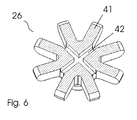
- Suitable embodiments of the punch 26 and the device 27 are in the FIGS. 6 and 7 shown.
- the bearing surface or contact surface of the punch 26 see Fig.
- the device 27 is formed in each case by four radially arranged, centrally interconnected "V" -shaped support elements 41.
- the contact surface of the individual "V" -shaped support elements 41 is separated from each other by channels 42.
- culture medium can flow and thus, possibly via porous support plates 30a and 30b, also reach the support side of the biological material.
- the diffusion distances are kept as small as possible in those areas that can not be directly in contact with the medium flow, while providing the largest possible support surface over which a mechanical stimulus can be transmitted to the biological material.
- punch 26 and device 27 are guided longitudinally in the main body 21.
- stamp 26 and / or device 27 may have an insignificantly smaller outer diameter, as the present inner diameter of the main body 21st
- the device 27 on guide means 40 which ensure that stamp 26, device 27 and biological material 29 in the reactor chamber 23 of the bioreactor 20 are aligned, so that In the event of longitudinal axial movement of the punch 26 and / or the device 27 towards each other, the biological material is mechanically moved or deformed by the punch 26 and device 27 substantially in the predetermined orientation.
- guide means 40 may include, for example, pin-shaped extensions, in particular metal pins, or consist thereof.
- FIG. 5 another possible design of the bioreactor chamber 20 is shown, which allows observation of the biological material by means of microscopes or other imaging methods.
- the bioreactor chamber 20b in contrast to the design Fig. 4 a modified punch 31, in which a cylindrical, preferably improved to improve the nutrient transport porous material 32 is pressed.
- the biological material 29 rests on a transparent to the respective imaging process disc 33, which is glued into a sleeve 34 and the seal 22 c via a clamping ring 35 is tightly connected.
- the biological material with the imaging method can be displayed and / or analyzed.
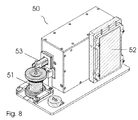
- FIG. 8 and 9 an embodiment of the bioreactor according to the invention is shown in isometric or in sectional view.
- the bioreactor according to the invention is used for culture and mechanical stimulation of biological material.
- the in Fig. 8 The bioreactor 50 shown includes a bioreactor chamber 51, a cell culture unit 52, and a mechanical stimuli-applying unit 53 to be cultivated biological material.
- the bioreactor according to the invention is compact, designed as a portable unit.
- the bioreactor chamber 51 serves to receive and culture the biological material.
- the bioreactor chamber 51 is also the location where the biological material can be exposed to mechanical stimuli.
- a bioreactor chamber according to the invention can be used (for example, the in Fig. 3 . 4 and 5 bioreactor chambers 20 or 20b disclosed) or also another bioreactor chamber, in which, for example, one or more seals according to the invention (for example, the seals disclosed in US Pat Fig. 1 and 2 disclosed seal 1) can be used.
- other conventional bioreactor chambers may be used which allow the transmission of mechanical stimuli into the reactor chamber.
- the cell culture unit 52 serves to provide the culture conditions required for the culture of the desired biological material and to ensure it over the desired period of time.
- the cell culture unit 52 has a medium reservoir, a device for gas exchange and a pump, which ensures the necessary movement of the culture medium.
- the cell culture unit usually comprises tubular connections between the individual modules of the cell culture system and the bioreactor chamber, so that the desired culture operations can be provided in the reactor space of the bioreactor chamber at the desired time.
- the pump may be designed as a controllable and / or controllable micropump.
- a micropump allows a compact and space-saving design of the bioreactor.
- Suitable micropumps are manufactured and sold, for example, by the company thinXXS Microtechnology AG, DE.
- the cell culture unit 52 may comprise a medium reservoir with integrated gas exchange membrane, eg a silicone membrane. This type of gas exchange also allows the most compact, space-saving design of the bioreactor.
- an integrated gas exchange membrane instead of a conventional direct gas-liquid contact, the circulation of the culture medium is completely closed to the environment, which reduces the risk of infection or contamination and thus allows longer culture periods.
- hose connections with the lowest possible gas permeability are used at the same time, eg hoses made of polyvinyl chloride (PVC) or polyamide (PA), the gas exchange essentially takes place exclusively via the gas exchange membrane instead. There is then no need to operate the bioreactor in a CO 2 incubator. The bioreactor is thus no longer bound to a specific location, such as a CO 2 incubator, but can be used and used mobile.
- PVC polyvinyl chloride
- PA polyamide
- the unit for the exercise of mechanical stimuli 53 comprises at least two independent, separately controllable and / or controllable drives or actuators.
- a possible embodiment of the unit for the exercise of mechanical stimuli is in Fig. 9 shown.
- the first drive is designed as a piezo drive.
- Piezo drives allow the generation and initiation of mechanical force patterns with high dynamics and high resolution.
- the piezo drive allows the display of various stimulus patterns such as linear motion, simple wave functions (sine, triangle) or characteristic pressure curves, as they typically occur when walking.
- the limited travel ranges of the piezo drive 71 can be expanded by selecting a suitable translation to the desired extent.
- Suitable piezo drives include both piezo actuators and piezo motors. Such piezo drives are known to the person skilled in the art and he has no difficulty to adapt known piezo drives in such a way that they can be used in a bioreactor according to the invention.
- the piezo drive is designed and positioned in such a way that it is capable of ensuring the generation and, if necessary, introduction of mechanical stimuli into the biological material. Preference is given to using piezo drives which ensure the generation and optionally introduction of mechanical stimuli into the biological material with a maximum frequency of ⁇ 5 Hz, particularly preferably with a maximum frequency of ⁇ 10 Hz, very particularly preferably with a maximum frequency of ⁇ 100 Hz.
- the second drive is a linear drive 61.
- the linear drive 61 allows regulation of the position of the biological material in the reactor space of the bioreactor chamber along the longitudinal axis of the bioreactor chamber.
- the linear drive 61 is configured as an electromechanical linear drive.
- the linear drive 61 of the bioreactor 50 as in Fig. 9 is shown in the housing of the bioreactor 50 is arranged. Via a translation 62, the horizontal movements of the linear drive 61 are translated into substantially vertical movements of a boom 63 along the longitudinal axis of the bioreactor chamber.
- the boom 63 is in contact with the biological material receiving device 27 of FIG Bioreactor chamber 20.
- the mechanical stimuli are transferred from the boom 63 by means of the movable device 27 to the biological material.
- the portion of the boom 63 in contact with the sleeve 34 and the bottom of the bioreactor chamber 20b may be configured such that the biological material is microscopically diffusible through the bottom of the bioreactor chamber 20b.
- the piezo drive 71 of the bioreactor 50 is also arranged in the housing of the bioreactor 50.
- the mechanical movements of the piezo drive 71 are translated from a maximum of 500 microns to a travel of about 1500 microns.
- the support arm 72 has, at its end facing away from the piezo drive 71, a translation 73 which can preferably be fastened and released by simple means, which permits a translation of the movements of the support arm 72 into a movement of the plunger 26 along the longitudinal axis of the bioreactor chamber 20.
- the translation 73 allows sufficient clearance to translate the radial movement of the support arm 72 about the hinge into a substantially linear motion that most closely follows the longitudinal axis of the bioreactor chamber 20, such as during transmission of mechanical stimuli the biological material, the bearing surfaces of the punch 26 and the device 27 remain as parallel as possible.
- the bioreactor 50 may additionally comprise a force sensor 80, which is arranged in such a way that the forces actually acting on the biological material can be determined.
- the force sensor may be connected to the arm 63 of the linear drive. This makes it possible to directly measure the forces that actually act on the biological material. It is known that biological material can permanently deform over time due to the action of mechanical forces. Thus, by repeated or prolonged directional compression of the biological material, a permanent decrease in the thickness of the biological material along the direction of the mechanical force may occur. If the mechanical stimulus is offered unchanged, the force actually acting on the biological material changes over time. The mechanical stimulus actually acting on the biological material decreases over time. About the force sensor 80, this decrease can be determined.
- the position of the biological material in the reactor space of the bioreactor chamber 20 can be readjusted by means of the linear drive 61 such that the biological material, with a constant mechanical stimulus of the piezo drive 71, again subjected to such forces that substantially correspond to the forces originally applied to the biological material.
- a material deformation of the biological material over time can thus be compensated without the travel of the piezo drive itself must be readjusted.
- the measurement of the actually acting on the biological material forces using the force sensor 80 in combination with the high-resolution piezo drive 71 also allows the determination of material characteristics such as the modulus of elasticity of the biological material or cell-loaded, but also cell-free biomaterials or other materials such as polymer materials at the same time Cultivation in the bioreactor.
- the bioreactor according to the invention may additionally have a control and / or regulating unit.
- This control and / or regulating unit is configured and arranged such that the position of the biological material in the reactor space of the bioreactor chamber can be varied as a function of the force values measured at the force meter.
- the control and / or regulating unit is able to record and process measured values of the dynamometer. The measured force values are then compared with a desired value and, if necessary, a deviation is determined.
- the linear drive can be controlled by means of the control and / or regulating unit such that the position of the biological material in the bioreactor chamber is changed via the linear drive such that the force values measured at the force meter no longer lead to deviations that exceed the predetermined threshold.
- control and / or regulating unit may be designed to take over even more control and / or regulating tasks in the bioreactor according to the invention.
- control and / or regulating unit it may be possible, for example, to also operate the cell culture unit and / or to determine the mechanical stimuli that are to act on the biological material by operating the piezo drive.
- the motivation for the present invention is to provide a test device that simulates the biochemical and mechanical environment of the fracture gap.
- the bioreactor is preferably a closed system, consisting of a cell culture unit (liquid circuit and its components) and a unit for generating the mechanical force pattern.
- the interface between the two units is the reactor chamber.
- the cell culture unit contains a reservoir with a silicone membrane for gas exchange and a micropump. Connected to this is a gas mixing unit in order to achieve the desired oxygen concentration in the circulation and to keep the pH at a constant level. So it is possible to realize variable oxygen partial pressures and thus z.
- B. hypoxic environment as is known to occur in the early stage of Frakturkallusody.
- Optochemical and electrical sensors optionally attached to the reservoir measure the most important cell culture parameters (pO2, pH, temperature).
- the system may be designed for a low total volume of cell culture medium (15-25 ml) to more sensitively detect proteins secreted into the medium and to minimize the cost of applying growth factors. At any time small amounts of medium can be taken for analysis.
- the medium can be completely exchanged during a longer cultivation period.
- a gas exchange membrane instead of direct gas / liquid contact, the circulation of the cell culture medium is completely closed to the environment, minimizing the risk of infection.
- the gas exchange membrane eg as a silicone membrane. Consequently, there is no need for the use of a CO 2 incubator. In this cycle it should also be possible to measure the oxygen consumption of the biological material as an indicator of proliferation or differentiation.
- the unit for generating the mechanical force pattern uses a piezo actuator with high dynamics and high resolution.
- a piezo actuator with high dynamics and high resolution.
- patterns such as simple wave functions (sinus, triangle, etc.) or characteristic pressure curves resulting from the measurement of physiological forces (eg while walking) using instrumented implants (group of Prof. Bergman in Julius-Wolff Institute).
- instrumented implants group of Prof. Bergman in Julius-Wolff Institute.
- frequencies up to approx. 100 Hz can be realized. Since the travel of the piezoelectric actuator is limited to 500 ⁇ m (in the bioreactor 1500 ⁇ m are achieved by a lever ratio), a high-resolution linear drive is used to position the biological material in the working area of the piezoelectric actuator.
- a highly dynamic piezo drive and a slow linear drive with a large travel are therefore combined into a very compact unit, which can realize the desired movement pattern.
- the applied to the biological material force can be detected by a load cell, which is connected to the support arm. This arm is moved by the linear drive. Since no disturbing acceleration or friction forces occur, the force acting on the sample can be measured very precisely.
- the linear actuator is also used to automatically adjust the sample position. This is necessary because the thickness of the sample decreases over time as a result of compression, as has been shown in test series in our existing bioreactor system.
- the cylindrical sample is located in the center of the reactor chamber. Here it is supplied with cell culture medium, while it is compressed axially by the force acting on two plunger force.
- the transfer of the movement to the plunger located in the chamber is made possible by two specially shaped seals.
- the seals are made of silicone, have a low resistance to the applied forces and at the same time act as a seal for the reactor chamber.
- the shape of the plungers can be varied to accommodate different types of media flows such as free flow around the sample or forced perfusion.
- the sample is also on the front sides in contact with the medium.
- a slightly modified chamber allows optical access to the sample.
- a confocal laser scanning microscope can be used to examine the sample. The imaging can be performed without interrupting the flow of the cell culture medium, as well as during the compression of the sample or without the action of external forces.
- bioreactor according to the invention for the development and / or testing of medicaments, in particular of medicaments for the treatment of complications in bone healing.
- medicaments in particular of medicaments for the treatment of complications in bone healing.
- Such drugs can be used in endoprosthetics (knee, hip, shoulder), surgical dentistry or plastic surgery.
- Studies in the bioreactor according to the invention can help to reduce the number of animal experiments required.
- bioreactor according to the invention in the testing of biomaterials, for example with regard to the influence of these materials on the cell development, with regard to the time-dependent change of the mechanical properties of these materials, with regard to the material degradation or absorption or with regard to the release of active substances from materials loaded therewith. These studies may e.g. give an indication of what effect the materials have on the healing fracture.
- the bioreactor of the invention can be used to find an optimized cell composition for local cell therapy in bone fractures and defects.
Landscapes
- Engineering & Computer Science (AREA)
- Health & Medical Sciences (AREA)
- Life Sciences & Earth Sciences (AREA)
- Wood Science & Technology (AREA)
- Organic Chemistry (AREA)
- Bioinformatics & Cheminformatics (AREA)
- Chemical & Material Sciences (AREA)
- Zoology (AREA)
- Genetics & Genomics (AREA)
- Biotechnology (AREA)
- Sustainable Development (AREA)
- Microbiology (AREA)
- Biochemistry (AREA)
- General Engineering & Computer Science (AREA)
- General Health & Medical Sciences (AREA)
- Biomedical Technology (AREA)
- Clinical Laboratory Science (AREA)
- Mechanical Engineering (AREA)
- Cell Biology (AREA)
- Apparatus Associated With Microorganisms And Enzymes (AREA)
Priority Applications (1)
| Application Number | Priority Date | Filing Date | Title |
|---|---|---|---|
| EP09175335A EP2184347A3 (fr) | 2008-11-06 | 2009-11-06 | Nouveaux composants et nouveau système de bioréacteurs pour la culture et la stimulation mécanique de matériau biologique |
Applications Claiming Priority (4)
| Application Number | Priority Date | Filing Date | Title |
|---|---|---|---|
| EP08168534 | 2008-11-06 | ||
| DE102008056951 | 2008-11-07 | ||
| EP08168650 | 2008-11-07 | ||
| EP09175335A EP2184347A3 (fr) | 2008-11-06 | 2009-11-06 | Nouveaux composants et nouveau système de bioréacteurs pour la culture et la stimulation mécanique de matériau biologique |
Publications (2)
| Publication Number | Publication Date |
|---|---|
| EP2184347A2 true EP2184347A2 (fr) | 2010-05-12 |
| EP2184347A3 EP2184347A3 (fr) | 2011-05-18 |
Family
ID=41719217
Family Applications (1)
| Application Number | Title | Priority Date | Filing Date |
|---|---|---|---|
| EP09175335A Withdrawn EP2184347A3 (fr) | 2008-11-06 | 2009-11-06 | Nouveaux composants et nouveau système de bioréacteurs pour la culture et la stimulation mécanique de matériau biologique |
Country Status (1)
| Country | Link |
|---|---|
| EP (1) | EP2184347A3 (fr) |
Cited By (1)
| Publication number | Priority date | Publication date | Assignee | Title |
|---|---|---|---|---|
| CN107858285A (zh) * | 2017-12-13 | 2018-03-30 | 刘延群 | 分体式生物反应器 |
Citations (1)
| Publication number | Priority date | Publication date | Assignee | Title |
|---|---|---|---|---|
| WO2005040332A2 (fr) | 2003-10-21 | 2005-05-06 | Universität Leipzig | Procede et bioreacteur pour la mise en culture et la stimulation de greffons cellulaires tridimensionnels, vitaux et mecaniquement resistants |
Family Cites Families (3)
| Publication number | Priority date | Publication date | Assignee | Title |
|---|---|---|---|---|
| JP4666335B2 (ja) * | 2002-09-04 | 2011-04-06 | 晶夫 岸田 | 機械的振動による生物機能の制御方法とその装置 |
| US7410792B2 (en) * | 2003-09-19 | 2008-08-12 | St3 Development Corporation | Instrumented bioreactor with material property measurement capability and process-based adjustment for conditioning tissue engineered medical products |
| EP1780266A4 (fr) * | 2004-06-17 | 2009-09-09 | Ken Nakata | Procédé de mise en culture de cellules par contrainte de stimulus biomécanique et son dispositif |
-
2009
- 2009-11-06 EP EP09175335A patent/EP2184347A3/fr not_active Withdrawn
Patent Citations (1)
| Publication number | Priority date | Publication date | Assignee | Title |
|---|---|---|---|---|
| WO2005040332A2 (fr) | 2003-10-21 | 2005-05-06 | Universität Leipzig | Procede et bioreacteur pour la mise en culture et la stimulation de greffons cellulaires tridimensionnels, vitaux et mecaniquement resistants |
Non-Patent Citations (7)
Cited By (1)
| Publication number | Priority date | Publication date | Assignee | Title |
|---|---|---|---|---|
| CN107858285A (zh) * | 2017-12-13 | 2018-03-30 | 刘延群 | 分体式生物反应器 |
Also Published As
| Publication number | Publication date |
|---|---|
| EP2184347A3 (fr) | 2011-05-18 |
Similar Documents
| Publication | Publication Date | Title |
|---|---|---|
| EP1425384B1 (fr) | Procede pour cultiver et analyser des cultures de cellules individuelles microbiennes | |
| EP2879789B1 (fr) | System comprenant une plaque de connexion pour une puce microfluidique, la puce microfluidique et une unite de controle | |
| EP1675939A2 (fr) | Procede et bioreacteur pour la mise en culture et la stimulation de greffons cellulaires tridimensionnels, vitaux et mecaniquement resistants | |
| DE102018132770B3 (de) | Vorrichtung zur Probenuntersuchung für ein atmosphärisches oder druckvariables Rasterelektronenmikroskop, Mikroskopiesystem sowie Mikroskopieverfahren | |
| Lee et al. | Effects of Staphylococcus epidermidis on osteoblast cell adhesion and viability on a Ti alloy surface in a microfluidic co-culture environment | |
| WO2004074426A2 (fr) | Procede et dispositifs permettant de deplacer une sonde sans lesion a travers une matiere cellulaire biologique | |
| US12473581B2 (en) | Multiplexable microfluidic culture chamber for imaging monolayer growth of single cells | |
| EP2254987A2 (fr) | Bioréacteur à perfusion pour fabrication et/ou culture d'un vaisseau sanguin humain ou animal et/ou d'un tissu humain ou animal | |
| EP2044438B1 (fr) | Installation pour des mesures en ligne sur des cellules | |
| DE4443902C1 (de) | Kammer zur Kultivierung von Zellen, insbesondere Mikroskopkammer | |
| EP4093844B1 (fr) | Bioréacteur pour cultivation des cellules | |
| DE102009057698A1 (de) | Zweikammerkultivierungssystem mit elastischer, poröser Membran zur uniaxialen mechanischen Stimulation von Epithelzellen und Epithelzellverbänden für die Testung endogener und exogener Faktoren | |
| Männik et al. | Lab-on-a-chip based mechanical actuators and sensors for single-cell and organoid culture studies | |
| DE102008058782A1 (de) | Vorrichtung zur physiologischen, dynamischen in-vitro Zelldehnung | |
| DE10151822B9 (de) | Vorrichtung und Verfahren zur elektrischen und mechanischen Stimulierung von Zellen und/oder Geweben | |
| EP1311850B1 (fr) | Dispositif et procede de mesure de forces produites par des matieres vivantes | |
| WO2005087912A2 (fr) | Bioreacteurs et systemes de bioreacteur | |
| Xu et al. | Cell bioprinting as a potential high-throughput method for fabricating cell-based biosensors (CBBs) | |
| DE102024100350B3 (de) | Zelldehnungsvorrichtung, Verfahren zur Durchführung von Zelldehnungsuntersuchungen und System dafür | |
| DE102005042373B3 (de) | Probenkammer für Untersuchungen zu Einflüssen auf Zellkulturen in Kegel-Platte-Rheometern | |
| DE102022123877B4 (de) | Grundkörper eines Mehrkammer-Biochips, Herstellung des Mehrkammer-Biochips und dessen Verwendung für die Etablierung von Organ- und Krankheitsmodellen und Substanztestungen | |
| Saravanan et al. | In vitro assays to study biofilms | |
| DE102007034935A1 (de) | Anordnung für Online-Messungen an Zellen | |
| Bakhchova | Advanced technologies and applications based on Polydimethylsiloxane (PDMS) | |
| DE202019107176U1 (de) | Vorrichtung zur Durchführung von Experimenten |
Legal Events
| Date | Code | Title | Description |
|---|---|---|---|
| PUAI | Public reference made under article 153(3) epc to a published international application that has entered the european phase |
Free format text: ORIGINAL CODE: 0009012 |
|
| AK | Designated contracting states |
Kind code of ref document: A2 Designated state(s): AT BE BG CH CY CZ DE DK EE ES FI FR GB GR HR HU IE IS IT LI LT LU LV MC MK MT NL NO PL PT RO SE SI SK SM TR |
|
| AX | Request for extension of the european patent |
Extension state: AL BA RS |
|
| PUAL | Search report despatched |
Free format text: ORIGINAL CODE: 0009013 |
|
| AK | Designated contracting states |
Kind code of ref document: A3 Designated state(s): AT BE BG CH CY CZ DE DK EE ES FI FR GB GR HR HU IE IS IT LI LT LU LV MC MK MT NL NO PL PT RO SE SI SK SM TR |
|
| AX | Request for extension of the european patent |
Extension state: AL BA RS |
|
| STAA | Information on the status of an ep patent application or granted ep patent |
Free format text: STATUS: THE APPLICATION IS DEEMED TO BE WITHDRAWN |
|
| 18D | Application deemed to be withdrawn |
Effective date: 20111119 |