EP2184600A2 - Oberflächenqualitätsbestimmung eines Objekts - Google Patents
Oberflächenqualitätsbestimmung eines Objekts Download PDFInfo
- Publication number
- EP2184600A2 EP2184600A2 EP09175633A EP09175633A EP2184600A2 EP 2184600 A2 EP2184600 A2 EP 2184600A2 EP 09175633 A EP09175633 A EP 09175633A EP 09175633 A EP09175633 A EP 09175633A EP 2184600 A2 EP2184600 A2 EP 2184600A2
- Authority
- EP
- European Patent Office
- Prior art keywords
- light
- surface quality
- sight
- entity
- line
- Prior art date
- Legal status (The legal status is an assumption and is not a legal conclusion. Google has not performed a legal analysis and makes no representation as to the accuracy of the status listed.)
- Withdrawn
Links
- 238000007689 inspection Methods 0.000 claims abstract description 53
- 238000000034 method Methods 0.000 claims abstract description 24
- 238000012545 processing Methods 0.000 claims description 21
- 230000009466 transformation Effects 0.000 claims description 7
- 238000004590 computer program Methods 0.000 claims description 6
- 230000008569 process Effects 0.000 claims description 5
- 239000000123 paper Substances 0.000 description 11
- 238000005259 measurement Methods 0.000 description 10
- 230000008901 benefit Effects 0.000 description 8
- 238000005286 illumination Methods 0.000 description 8
- 230000000737 periodic effect Effects 0.000 description 6
- 230000003287 optical effect Effects 0.000 description 5
- 238000004891 communication Methods 0.000 description 4
- 238000012935 Averaging Methods 0.000 description 3
- 230000008859 change Effects 0.000 description 3
- 238000012937 correction Methods 0.000 description 3
- 238000003702 image correction Methods 0.000 description 3
- 239000000463 material Substances 0.000 description 3
- 239000011111 cardboard Substances 0.000 description 2
- 238000013461 design Methods 0.000 description 2
- 230000008520 organization Effects 0.000 description 2
- 239000011087 paperboard Substances 0.000 description 2
- 241001467036 Peanut mottle virus Species 0.000 description 1
- 238000000774 X-filter Methods 0.000 description 1
- 230000001174 ascending effect Effects 0.000 description 1
- 238000004364 calculation method Methods 0.000 description 1
- 229910003460 diamond Inorganic materials 0.000 description 1
- 239000010432 diamond Substances 0.000 description 1
- 230000000694 effects Effects 0.000 description 1
- 238000011156 evaluation Methods 0.000 description 1
- 230000006870 function Effects 0.000 description 1
- 230000008676 import Effects 0.000 description 1
- 230000006872 improvement Effects 0.000 description 1
- 230000010287 polarization Effects 0.000 description 1
- 238000001228 spectrum Methods 0.000 description 1
- 238000002211 ultraviolet spectrum Methods 0.000 description 1
Images


Classifications
-
- G—PHYSICS
- G01—MEASURING; TESTING
- G01N—INVESTIGATING OR ANALYSING MATERIALS BY DETERMINING THEIR CHEMICAL OR PHYSICAL PROPERTIES
- G01N21/00—Investigating or analysing materials by the use of optical means, i.e. using sub-millimetre waves, infrared, visible or ultraviolet light
- G01N21/84—Systems specially adapted for particular applications
- G01N21/88—Investigating the presence of flaws or contamination
-
- G—PHYSICS
- G01—MEASURING; TESTING
- G01N—INVESTIGATING OR ANALYSING MATERIALS BY DETERMINING THEIR CHEMICAL OR PHYSICAL PROPERTIES
- G01N21/00—Investigating or analysing materials by the use of optical means, i.e. using sub-millimetre waves, infrared, visible or ultraviolet light
- G01N21/84—Systems specially adapted for particular applications
- G01N21/88—Investigating the presence of flaws or contamination
- G01N21/8806—Specially adapted optical and illumination features
-
- G—PHYSICS
- G01—MEASURING; TESTING
- G01N—INVESTIGATING OR ANALYSING MATERIALS BY DETERMINING THEIR CHEMICAL OR PHYSICAL PROPERTIES
- G01N33/00—Investigating or analysing materials by specific methods not covered by groups G01N1/00 - G01N31/00
- G01N33/34—Paper
- G01N33/346—Paper sheets
-
- G—PHYSICS
- G01—MEASURING; TESTING
- G01N—INVESTIGATING OR ANALYSING MATERIALS BY DETERMINING THEIR CHEMICAL OR PHYSICAL PROPERTIES
- G01N21/00—Investigating or analysing materials by the use of optical means, i.e. using sub-millimetre waves, infrared, visible or ultraviolet light
- G01N21/84—Systems specially adapted for particular applications
- G01N21/86—Investigating moving sheets
- G01N2021/8663—Paper, e.g. gloss, moisture content
-
- G—PHYSICS
- G01—MEASURING; TESTING
- G01N—INVESTIGATING OR ANALYSING MATERIALS BY DETERMINING THEIR CHEMICAL OR PHYSICAL PROPERTIES
- G01N21/00—Investigating or analysing materials by the use of optical means, i.e. using sub-millimetre waves, infrared, visible or ultraviolet light
- G01N21/17—Systems in which incident light is modified in accordance with the properties of the material investigated
- G01N21/55—Specular reflectivity
- G01N21/57—Measuring gloss
-
- G—PHYSICS
- G01—MEASURING; TESTING
- G01N—INVESTIGATING OR ANALYSING MATERIALS BY DETERMINING THEIR CHEMICAL OR PHYSICAL PROPERTIES
- G01N2201/00—Features of devices classified in G01N21/00
- G01N2201/02—Mechanical
- G01N2201/022—Casings
- G01N2201/0221—Portable; cableless; compact; hand-held
Definitions
- the present invention relates to device and method for measuring the surface quality of an object.
- All of these devices use light sources that are in some way directed towards the object that is to be inspected.
- the gloss of the surface may become uneven. Dots with high gloss may occur and they may then be detected. This also means that the quality of the surface may not be correctly determined.
- the present invention is therefore directed towards providing an improved device and method for measuring the surface quality of an object.
- One object of the present invention is therefore to provide an improved device for measuring the surface quality of an object.
- This object is according to a first aspect of the present invention solved through a device for measuring the surface quality of an object, for instance a paper, comprising:
- Another object of the present invention is to provide an improved method for measuring the surface quality of an object.
- This object is according to a second aspect of the present invention solved through a method for measuring the surface quality of an object, comprising the steps of:
- the present invention has a number of advantages. Through the claimed illumination according to the invention it is possible to provide the light sources closer to the object and thus the size of the portable object inspection entity can be reduced, which makes it easier to carry it around. This is furthermore done while at the same time guaranteeing satisfactory measurement results.
- the processing of image data of the object involves performing a Fourier transformation on said image data in order to obtain light intensity values grouped according to spatial wavelength, calculating a median value for a number of light intensity values in a number of spatial wavelength intervals of a spatial wavelength range, where the range (R) includes at least one interval, and summing up the median values of each such interval of the range in order to obtain an indication of the quality of the object.
- calibration data comprising printing instructions for printing a calibration area on an object, said printing instructions including colour or grey scale codes, and when being used by a printer device on an object, forms a number of sets of fields with differing reflectance, where each field in a set provides one level of reflectance, said printing instructions further providing the fields of the sets evenly distributed interspersed with each other and with areas lacking such fields in a calibration area (68) on the surface of the object being sized for covering the object inspection opening.
- This calibration data has the advantage of enabling both calibration of grey scale to reflectance and to correct uneven illumination. It also provides information about spatial distortion and resolution of an image that could be used for further image corrections.
- Figure 1 schematically shows a device 10 for measuring the surface quality of an object according to an embodiment of the present invention.
- the device 10 includes a portable object inspection entity 12 which is connected to a processing entity 14, which processing entity is here provided in the form of a computer.
- the connection may be provided through a cable provided between for instance a USB port on the computer 14 and the portable object inspection entity 12.
- the portable object inspecting entity may be prepared for mounting with a weight-reducing hang-up or to be mounted in a stand for stationary work where the lifting of the portable object inspecting entity is controlled by a foot-pedal.
- the portable object inspection entity 12 is adapted to be placed on an object 16, for instance a piece of paper or cardboard, the surface quality of which is to be inspected.
- a light detecting unit which is here a camera, captures a digital image of a part of the surface of the object 16.
- This image is then transmitted to the computer 14, in which an object surface quality determining unit or function processes the image in order to determine the surface quality of the object.
- Typical surface quality determinations are determinations regarding mottle or gloss.
- fig. 2 shows a sectional view through the middle of the portable object inspection entity 12 and to fig. 3 , which schematically shows a number of units inside the portable object inspection entity.
- the section in fig. 2 is here a section taken vertically through the middle of the portable inspection unit, while the view in fig. 3 is a view from above of some of the units in the interior of the portable entity.
- the portable object inspection entity 12 includes a chamber 18 having a top surface 20, a bottom surface 22 and one side wall 24 joining the bottom surface 22 with the top surface 20.
- the chamber 18 does here have a cylindrical shape and therefore the wall 24 is a circular wall.
- the chamber 18 does thus here have a circular cross-section.
- the present invention is not limited to this shape of the chamber, but that a chamber having for instance quadratic, rectangular, triangular or elliptical cross-section may be provided. There may thus be provided more walls.
- the top surface 20 of the chamber furthermore includes an opening 28.
- a tube 30 aligned with and stretching from said top surface opening 28 in a direction away from the object inspection opening 26.
- the tube 30 is sealed in one end, the upper end that is located furthest from the bottom surface 22, and is open in the opposite end in order to be connected with the chamber 18. More importantly the tube 30 is also aligned with the object inspection opening 26.
- a light detecting unit 34 which is here in the form of a digital camera.
- the camera may be a 1-chip colour camera or a monochrome or 3-chip camera.
- the camera 34 is furthermore directed towards the object inspection opening 26 in the bottom surface 22, and then preferably the centre of this object inspection opening. In this way there is defined a line of sight 36 of the camera 34 that stretches through the chamber 18 towards the object inspection opening 26. This line of sight 36 is thus perpendicular to the object inspection opening 26. The camera 34 is thus provided at one end of this line of sight 36, while the object inspection opening 26 is provided at the opposite end.
- a set of light sources 32 which are placed regularly around the line of sight 36 within the chamber 18 and here typically regularly spaced around the wall 24. They are furthermore each provided at the same distance from this line of sight.
- the number of light sources may vary. As an example in order to exemplify the present invention four are shown in fig. 3 , while two are shown in fig. 2 . It should be realized that many more may be provided such as for instance 24 or 30.
- the light sources 32 are here light emitting diodes (LEDs) with a continuous spectrum.
- the power for the diodes may be supported through an external stabilized power-supply. This gives a very stable illumination.
- the diodes may be mounted on a flexible circuit board. This opens the possibility to change the design of the illumination for different purposes. For standard mottle measurements LEDs with visible light may be used.
- the LEDs 32 which furthermore each has an aperture angle ⁇ of about 140 degrees, are furthermore directed towards the line of sight 36 of the camera. They are thus directed in parallel with the object inspection opening 26 and thereby with the surface of the object 16 to be inspected. Thereby these diodes 32 generally emit light in a direction perpendicular to the line of sight 36.
- each diode there may furthermore be provided a diffusing element 38 in order to diffuse the light emitted by a diode as well as a polarizing element 40.
- the diffusing element 38 is thus here provided between the LED and the polarizing element 40.
- FIG. 3 there is only shown one diffusing element 38 and one polarizing element 40 in front of one LED. It should however be realized that when these elements are used they are normally provided in front of each LED.
- These may each furthermore be provided as a strip of diffusing material and a strip of polarizing material provided around the wall 24 of the chamber 18. It should here be realized that it is also possible to provide colour filters in front of the LEDs. These colour filters would then be provided between the diffusing elements and the polarizing elements.
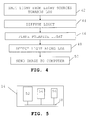
- fig. 2, 3 and 4 shows a flow chart of a number of method steps taken in a method of measuring the surface quality of an object according to the invention and being performed in the portable object inspection entity.
- the portable object inspecting entity 12 is brought onto the object 16, such that the bottom side 22 is placed onto the object 16.
- the object should here be placed in close contact with the opening and should cover the whole of the opening so that not light will enter the chamber between the object and the opening.
- the camera 34 thus faces the object 16.
- the LEDs 32 emit light, step 42, which light is then emitted from the periphery of the chamber 18 towards the centre, i.e. towards the line of sight 36.
- the light is diffused by the diffusing element 38, step 44, and then plane polarized by the polarizing element 40, step 46.
- the camera 34 detects light along the line of sight 36, step 48, and then light that has been reflected off the surface of the object 16 in the direction of the line of sight 36. This detected light is then captured as a digital image by the camera 34, which image is then sent from the camera 34 to the computer 14, step 50.
- the way that the object is illuminated by the LEDs has a number of advantages. Since the LEDs, which are placed close to the object surface, are directed in parallel with this object surface and have a wide aperture angle, the gloss of the surface will become more even. In this way, dots with high gloss, which may otherwise appear in the image, are avoided.
- the diffusing element helps to provide an even intensity of the light that falls onto the object 16.
- the polarizing element 40 which thus polarizes the light in the plane attenuates gloss reflectance (e.g. for print mottle) and therefore also helps in obtaining a better result. Through this way of illuminating it is possible to provide the LEDs closer to the object and thus the size of the portable object inspection entity 12 can be reduced, which makes it easier to carry it around. This is furthermore done while at the same time guaranteeing satisfactory measurement results.
- an aperture angle of 140 degrees at the same time guarantees that enough light will reach the object surface.
- LED for visible light could for instance be combined with LEDs in the UV-spectrum and thus make it possible to measure print/paper properties with or without UV or in only UV-light.
- the UV-light could be used for getting information on the distribution of optical brightener in a paper.
- the polarizer may be rotated by 90 degrees or replaced by a polarizing element with parallel polarization in order to enhance gloss. This may be done in order to measure print gloss variations instead of mottle. Of course also other filters can be included if needed.
- the portable entity with an image memory. In such a memory digital images may be temporarily stored. This allows the portable entity to be used separately from the computer in order to capture images of an object. When these images are then to be processed, the portable entity is brought to and connected to the computer and the captured images are loaded from the image memory to the computer for processing.
- Fig. 5 schematically shows a simplified internal organization of units in the computer 14.
- the computer 14 includes a processor 52, a first program memory 54 and a second memory 56. All these units communicate with each other using a bus 58.
- bus 58 In order to simplify the description of the present invention there is no communication interface to the portable object inspection entity shown or described. Since the use of for instance USB ports for communicating with other parts of a computer are well known within the art they need not be described any further. There is normally a communication interface connected to the bus 58 for providing such communication. Naturally there may be more units connected to the bus than what is shown in fig. 5 .
- the processing functionality used for investigating the surface quality of the object is according to an embodiment of the present invention provided in the form of a computer program including a number of computer program instructions.
- This computer program is according to this embodiment loaded in the program memory 54.
- the processor 52 here executes these program instructions.
- the combination of processor and program memory is therefore considered as an object surface quality determining unit.
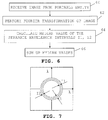
- fig. 6 shows a flow chart of a number of method steps taken in a method of processing a digital image of an object according to the invention and being performed by the surface quality determining unit
- fig. 7 which schematically shows a two-dimensional graphical representation of the result of a Fourier transformation being performed on a digital image captured by the portable object inspection entity.
- Image data corresponding to light detected by the camera in the form of the above-described digital image is thus transferred from the camera to the object surface quality determining unit 52, 54.
- the object surface quality determining unit 52, 54 thus receives the digital image from the camera in the portable entity, step 60.
- the image does, as is well known in the art include a number of pixels, each having a light intensity.
- the object surface quality determining unit 52, 54 processes the image in order to determine the surface quality of the object.
- the object surface quality determining unit 52 54 more particularly performs a Fourier transformation of the image, step 62. This is preferably performed using an FFT function. Through this transformation light intensity values grouped according to spatial wavelength are obtained. A two-dimensional representation of this is shown in fig. 7 .
- Light intensities are thus grouped according to spatial wavelength ⁇ , where the variance of mottle in all directions is provided in an image.
- the spatial wavelengths ⁇ are here provided along the X- and Y-axis.
- the intensity values provided in a range R of spatial wavelengths are gathered in order to be analysed, for instance with regard to mottle.
- this range R is first divided into a number of spatial wavelength intervals, here exemplified by two intervals I1, I2.
- a median value is calculated for the light intensity values of each interval I1, I2, step 64.
- the median values of each interval in the range are summed up, step 66, in order to obtain an indication of the quality of the object, for instance concerning mottle.
- the above-described range may include only one interval, i.e. the range is the whole interval. Alternatively there may be several more intervals.
- the object surface quality determining unit Since different scanners and cameras can give different results for measurements of e.g. mottle the object surface quality determining unit has a possibility to enter correction-factors to level the measurements according to accepted standards. This correction can be based either on a 2 nd degree fit or a lin-log curve.
- the software used in the object surface quality determining unit may be modularly built. This makes it possible to add new calculations/measurement-routines.
- the image capturing functionality may be modular, which enables other cameras, scanners or file reading elements to be added and selected from the object surface quality determining unit. This means that several capturing elements can be used from the same computer.
- the settings of the software can be saved both as “User-Settings” and as "Default”.
- the default settings may be password-protected to avoid change by mistake.
- a backup may be created at each change of settings. These files can be loaded back to the software together with the settings. The data can then be printed out, saved to file or new measurements can be added.
- the object surface quality determining unit can save data as Excel-files or as text files.
- a list of sample names can be imported from a text file and a user may be allowed to select from this list.
- the software may also be prepared for a barcode reading.
- the surface quality determining unit was above being described as being provided as software loaded into a computer.
- This software may also be provided in the form of computer program code on a data carrier, such as a portable carrier, like a CD ROM disc or a memory stick, which performs the functionality of the object surface quality determining unit when said program code is loaded in the computer.
- a data carrier such as a portable carrier, like a CD ROM disc or a memory stick, which performs the functionality of the object surface quality determining unit when said program code is loaded in the computer.
- the processing entity may be a data carrier comprising the object surface quality determining unit in the form of computer program code.
- the computer may furthermore be any type of computer like a PC, laptop or a palm top computer.
- This calibration area may be provided through calibration data, for instance in the form of a calibration data file, which may be stored in the second memory 56 shown in fig. 4 .
- This file would then include printing instructions for printing calibration information on an object, like a sheet of paper.
- the printing instructions would then include colour or grey scale codes that when used by a printer device on an object, forms the calibration area.
- This file may be invoked by the software with one command each time the surface quality determining unit is started or when a user makes major changes in settings.
- the calibration area may furthermore be mounted on the stand that also serves as protection. When the portable entity is not in use it may thus be placed on the stand and thereby both this entity and the calibration area are protected from mechanical damage and harmful light. During transport the stand may be locked to the portable entity.
- the calibration area is provided for enabling both calibration of grey scale to reflectance and to correct uneven illumination. It also provides information about spatial distortion and resolution of the image that could be used for further image corrections.
- the calibration area 68 is schematically shown in fig. 8 . It includes a number of sets of fields with differing reflectance, where each field is here diamond shaped, and each set has a different reflectance and thus provides one level of reflectance. There is thus a first set with fields 70 having a first reflectance, here caused by a first grey scale, a second set with fields 72 having a second reflectance here caused by a second grey scale, a third set with fields 74 having a third reflectance here caused by a third grey scale and a fourth set with fields 76 having a fourth reflectance here caused by a fourth grey scale.
- the fields are furthermore evenly distributed interspersed with each other and with areas lacking such fields in the calibration area 68 on the surface of the object.
- the area 68 is here sized for covering the object inspection opening.
- a first row of fields including fields 70 of the first set with the first reflectance alternating with fields 74 of the third set with the third reflectance is alternating with fields 74 of the third set with the third reflectance.
- the first row which here includes eleven fields, furthermore starts and ends with a field 70 of the first set.
- a second row of fields including the fields 72 of the second set with the second reflectance alternating with fields 76 of the fourth set with the fourth reflectance follows.
- the row which here also includes eleven fields, starts and ends with a field 72 of the second set.
- the area 68 thus provides an 11x11 lattice of fields, with the fields of the sets evenly distributed interspersed with each other, so that no fields of the same set are provided adjacent each other.
- the fields are diamond-shaped there are furthermore diamond-shaped areas of non-printed material between the fields of the different rows. Every row thus includes fields from two sets. Every column of the lattice furthermore includes fields from all four sets in consecutive order after each other. There is however a shift of two fields in the fields of the same set between neighbouring columns.
- the fields 70 of the first set may here be the darkest fields, i.e. the fields with the lowest reflectance; the fields 72 in the second set may be the second darkest fields, i.e.
- the fields with the second lowest reflectance; the fields 74 in the third set may be the second brightest fields, i.e. the fields with the second highest reflectance and the fields 76 in the fourth set may be the brightest fields, i.e. the fields with the highest reflectance. They could of course also be provided the opposite way around so that the fields in the first set are the brightest and the fields in the fourth set the darkest. In this way the fields of the sets are evenly distributed interspersed with each other and with areas lacking such fields.
- the area was above built up of diamond-shaped areas. However, it should be realized that other shapes may be provided, for instance circular, elliptical, quadratic or rectangular. It should here also be realized that more or fewer sets may be provided, for instance five.
- the lattice may furthermore include more or fewer rows and/or columns. The same levels of grey scale may also be present in a strip with larger fields, for instance rectangular or quadratic fields. These may be provided beside said lattice.
- the areas representing the object background may be slightly smaller than the printed fields and may not allow measurement of density. Since the demand of a paper may be that it must be very even in reflectance it is assumed that this measurement can be performed elsewhere on the sheet.
- the calibration information provides both reflectance and evenness information.
- the following properties will furthermore be possible to estimate/perform:
- the lattice holds four printed levels of reflectance. Together with the paper background it gives 5 levels to use for reflectance calibration. The darkest fields have been selected to ensure that reflectance will be above the black level of the camera for most normal settings.
- a calibration routine in the surface quality determining unit will assume that the camera has a linear relationship to reflectance. Any deviations from this should be corrected for by for instance entering a correct Gamma Value. It should be realized that some cameras may have a linear relationship without such Gamma-correction.
- the non-printed areas are positioned in a regular spaced lattice. By fitting a lattice to the centre of each area and by comparing centre points to points of lattice an estimation of geometrical distortion can be made. This feature can be used to correct for warp in images.
- the parameters from the lattice estimated for geometrical distortion can be used to estimate pixel resolution in X and Y direction, i.e. in the directions that rows and columns are provided in the lattice.
- the calibration data can be added into the computer in 2 ways:
- the file may also with advantage be provided on a data carrier, for instance together with the program code that is used for realizing the surface quality determining unit.
- the present invention thus has a number of advantages.
- a portable object inspection entity where an object is illuminated by LEDs have a number of advantages. Since the LEDs directed in parallel with the object surface, the gloss of the surface will become more even. Through this way of illuminating it is possible to provide the LEDs closer to the object and thus the size of the portable object inspection entity can be reduced, which makes it easier to carry it around. This is furthermore done while at the same time guaranteeing satisfactory measurement results.
- Through calculating median values in the processing of a digital image in the object surface quality determining unit it is possible to obtain a mottle value that is less influenced by the high peak intensities from periodic variations. In this way a more reliable processing of an image of the object is provided.
- the calibration area has the advantage of enabling both calibration of grey scale to reflectance and to correct uneven illumination. It also provides information about spatial distortion and resolution of an image that could be used for further image corrections.
- the present invention may be varied in a number of further ways apart from those already described.
- the various parts of the described invention may be provided separately. It is for instance possible to only provide the portable entity. It may then be combined with a known surface quality determining unit using averaging.
- the surface quality determining unit of the invention may likewise be used together with known object inspection entities, portable or fixed.
- the calibration data is likewise possible to use with such known surface quality determining unit and such known object inspection entity.
- the connection between the two entities need of course not be by cable. It is possible to use other means of communication, such as for instance Bluetooth.
Landscapes
- Health & Medical Sciences (AREA)
- Life Sciences & Earth Sciences (AREA)
- Chemical & Material Sciences (AREA)
- General Health & Medical Sciences (AREA)
- Physics & Mathematics (AREA)
- Analytical Chemistry (AREA)
- Biochemistry (AREA)
- General Physics & Mathematics (AREA)
- Immunology (AREA)
- Pathology (AREA)
- Food Science & Technology (AREA)
- Medicinal Chemistry (AREA)
- Engineering & Computer Science (AREA)
- Investigating Materials By The Use Of Optical Means Adapted For Particular Applications (AREA)
- Investigating Or Analysing Materials By Optical Means (AREA)
Applications Claiming Priority (1)
| Application Number | Priority Date | Filing Date | Title |
|---|---|---|---|
| SE0850074A SE533594C2 (sv) | 2008-11-11 | 2008-11-11 | Bestämning av ytegenskaper hos ett objekt |
Publications (2)
| Publication Number | Publication Date |
|---|---|
| EP2184600A2 true EP2184600A2 (de) | 2010-05-12 |
| EP2184600A3 EP2184600A3 (de) | 2010-07-21 |
Family
ID=41649297
Family Applications (1)
| Application Number | Title | Priority Date | Filing Date |
|---|---|---|---|
| EP09175633A Withdrawn EP2184600A3 (de) | 2008-11-11 | 2009-11-11 | Oberflächenqualitätsbestimmung eines Objekts |
Country Status (2)
| Country | Link |
|---|---|
| EP (1) | EP2184600A3 (de) |
| SE (1) | SE533594C2 (de) |
Cited By (2)
| Publication number | Priority date | Publication date | Assignee | Title |
|---|---|---|---|---|
| WO2021001437A1 (de) * | 2019-07-02 | 2021-01-07 | diemietwaesche.de gmbh + co. kg | Prüfgerät und verfahren zur prüfung der retroreflexion und/oder fluoreszenz eines objekts |
| US20210262943A1 (en) * | 2018-06-25 | 2021-08-26 | Oetiker Ny, Inc. | Connection verifier |
Citations (4)
| Publication number | Priority date | Publication date | Assignee | Title |
|---|---|---|---|---|
| US5377000A (en) | 1993-04-29 | 1994-12-27 | Color And Appearance Technology, Inc. | Portable appearance measuring apparatus |
| US5724139A (en) | 1996-06-28 | 1998-03-03 | Polaroid Corporation | Dark field, photon tunneling imaging probes |
| WO2002093109A1 (en) | 2001-05-16 | 2002-11-21 | X-Rite, Incorporated | Glare-directed imaging |
| US7227648B2 (en) | 2001-05-08 | 2007-06-05 | Wolfgang Weinhold | Method and apparatus for a touch-free examination of objects, particularly regarding the surface character of the same |
Family Cites Families (5)
| Publication number | Priority date | Publication date | Assignee | Title |
|---|---|---|---|---|
| US3827808A (en) * | 1973-05-09 | 1974-08-06 | Industrial Nucleonics Corp | Method and apparatus for measuring the opacity of sheet material in which the transmittance signal is compensated for the reflectivity of the material |
| US3936189A (en) * | 1974-03-13 | 1976-02-03 | Sentrol Systems Ltd. | On-line system for monitoring the color, opacity and brightness of a moving web |
| CN1133633A (zh) * | 1993-10-26 | 1996-10-16 | 旭化成工业株式会社 | 光泽不均匀、印刷不均匀的测定方法及装置 |
| JP2004361147A (ja) * | 2003-06-02 | 2004-12-24 | Tdk Corp | 含水量測定装置 |
| CN101076833A (zh) * | 2004-12-14 | 2007-11-21 | 阿克佐诺贝尔国际涂料股份有限公司 | 用于测量涂膜的粗糙度的方法和装置 |
-
2008
- 2008-11-11 SE SE0850074A patent/SE533594C2/sv not_active IP Right Cessation
-
2009
- 2009-11-11 EP EP09175633A patent/EP2184600A3/de not_active Withdrawn
Patent Citations (4)
| Publication number | Priority date | Publication date | Assignee | Title |
|---|---|---|---|---|
| US5377000A (en) | 1993-04-29 | 1994-12-27 | Color And Appearance Technology, Inc. | Portable appearance measuring apparatus |
| US5724139A (en) | 1996-06-28 | 1998-03-03 | Polaroid Corporation | Dark field, photon tunneling imaging probes |
| US7227648B2 (en) | 2001-05-08 | 2007-06-05 | Wolfgang Weinhold | Method and apparatus for a touch-free examination of objects, particularly regarding the surface character of the same |
| WO2002093109A1 (en) | 2001-05-16 | 2002-11-21 | X-Rite, Incorporated | Glare-directed imaging |
Cited By (3)
| Publication number | Priority date | Publication date | Assignee | Title |
|---|---|---|---|---|
| US20210262943A1 (en) * | 2018-06-25 | 2021-08-26 | Oetiker Ny, Inc. | Connection verifier |
| US11994475B2 (en) * | 2018-06-25 | 2024-05-28 | Oetiker Ny, Inc. | Connection verifier |
| WO2021001437A1 (de) * | 2019-07-02 | 2021-01-07 | diemietwaesche.de gmbh + co. kg | Prüfgerät und verfahren zur prüfung der retroreflexion und/oder fluoreszenz eines objekts |
Also Published As
| Publication number | Publication date |
|---|---|
| SE533594C2 (sv) | 2010-11-02 |
| SE0850074A1 (sv) | 2010-05-12 |
| EP2184600A3 (de) | 2010-07-21 |
Similar Documents
| Publication | Publication Date | Title |
|---|---|---|
| JP5293355B2 (ja) | 光沢感評価方法、光沢感評価装置、該装置を有する画像評価装置、画像評価方法および該方法を実行するためのプログラム | |
| US7763876B2 (en) | Gloss and differential gloss measuring system | |
| EP2403229B1 (de) | Spektralmerkmal-Bewertungsvorrichtung, Bilderzeugungsvorrichtung damit und Spektralmerkmal-Bewertungsverfahren | |
| JP7687559B2 (ja) | 撮像システム | |
| CN100419778C (zh) | 用于量化平面对象反面上的印刷图像的可视透背的方法和设备 | |
| EP3557216B1 (de) | Inspektionsvorrichtung, inspektionsverfahren und programm | |
| WO2010050946A1 (en) | Imaging device calibration system and method | |
| US20230230345A1 (en) | Image analysis method, image analysis device, program, and recording medium | |
| EP2171639A1 (de) | Maschine zur erfassung und verarbeitung eines bildes für die computeranzeige | |
| EP2184600A2 (de) | Oberflächenqualitätsbestimmung eines Objekts | |
| JP2019168388A (ja) | 画像検査方法および画像検査装置 | |
| KR101227110B1 (ko) | 검사 장치의 진단 및 측정변수 설정 방법 | |
| JP2021518579A (ja) | 複数波長を用いたオーバーレイ測定 | |
| EP3531115B1 (de) | Bildinspektionsvorrichtung und bildinspektionsverfahren | |
| US12301770B2 (en) | Information processing apparatus, abnormality detection method, storage medium, and information processing system | |
| JP2003501753A (ja) | 指及び/又は掌の表面構造物を検知するための配列構造 | |
| JP6557688B2 (ja) | 計測装置、情報処理装置、情報処理方法、およびプログラム | |
| US10382655B2 (en) | System and method for calibrating a linear array using a calibration standard and a calibration piece with dark and light response measurements | |
| JP7402992B2 (ja) | 画像補正装置、画像補正方法、プログラムおよび記録媒体 | |
| KR20050057296A (ko) | 스캐너에 기한 화상 분석 시스템을 더욱 밀접하게 연관시키기 위하여 그레이 스케일 응답을 조정하는 방법 | |
| JP6623599B2 (ja) | 画像処理システム、画像処理装置およびプログラム | |
| JP5006589B2 (ja) | 光学的伝達関数の測定方法及び測定装置並びにテストチャート | |
| KR101216453B1 (ko) | 측정대상물 검사방법 | |
| JP5135899B2 (ja) | 周期性パターンのムラ検査方法及びムラ検査装置 | |
| WO2023027718A1 (en) | Spectrographic measurements |
Legal Events
| Date | Code | Title | Description |
|---|---|---|---|
| PUAI | Public reference made under article 153(3) epc to a published international application that has entered the european phase |
Free format text: ORIGINAL CODE: 0009012 |
|
| AK | Designated contracting states |
Kind code of ref document: A2 Designated state(s): AT BE BG CH CY CZ DE DK EE ES FI FR GB GR HR HU IE IS IT LI LT LU LV MC MK MT NL NO PL PT RO SE SI SK SM TR |
|
| PUAL | Search report despatched |
Free format text: ORIGINAL CODE: 0009013 |
|
| AK | Designated contracting states |
Kind code of ref document: A3 Designated state(s): AT BE BG CH CY CZ DE DK EE ES FI FR GB GR HR HU IE IS IT LI LT LU LV MC MK MT NL NO PL PT RO SE SI SK SM TR |
|
| RIC1 | Information provided on ipc code assigned before grant |
Ipc: G01N 21/88 20060101AFI20100212BHEP Ipc: G01N 21/95 20060101ALI20100615BHEP |
|
| 17P | Request for examination filed |
Effective date: 20110121 |
|
| 17Q | First examination report despatched |
Effective date: 20120828 |
|
| STAA | Information on the status of an ep patent application or granted ep patent |
Free format text: STATUS: THE APPLICATION IS DEEMED TO BE WITHDRAWN |
|
| 18D | Application deemed to be withdrawn |
Effective date: 20130108 |