EP2184701A2 - Appareil d'agencement automatique de chaîne de mots et procédé associé - Google Patents
Appareil d'agencement automatique de chaîne de mots et procédé associé Download PDFInfo
- Publication number
- EP2184701A2 EP2184701A2 EP09154896A EP09154896A EP2184701A2 EP 2184701 A2 EP2184701 A2 EP 2184701A2 EP 09154896 A EP09154896 A EP 09154896A EP 09154896 A EP09154896 A EP 09154896A EP 2184701 A2 EP2184701 A2 EP 2184701A2
- Authority
- EP
- European Patent Office
- Prior art keywords
- stroke
- words
- word
- strokes
- word string
- Prior art date
- Legal status (The legal status is an assumption and is not a legal conclusion. Google has not performed a legal analysis and makes no representation as to the accuracy of the status listed.)
- Withdrawn
Links
Images


Classifications
-
- G—PHYSICS
- G06—COMPUTING OR CALCULATING; COUNTING
- G06V—IMAGE OR VIDEO RECOGNITION OR UNDERSTANDING
- G06V30/00—Character recognition; Recognising digital ink; Document-oriented image-based pattern recognition
- G06V30/10—Character recognition
- G06V30/14—Image acquisition
- G06V30/146—Aligning or centring of the image pick-up or image-field
- G06V30/1475—Inclination or skew detection or correction of characters or of image to be recognised
- G06V30/1478—Inclination or skew detection or correction of characters or of image to be recognised of characters or characters lines
-
- G—PHYSICS
- G06—COMPUTING OR CALCULATING; COUNTING
- G06V—IMAGE OR VIDEO RECOGNITION OR UNDERSTANDING
- G06V30/00—Character recognition; Recognising digital ink; Document-oriented image-based pattern recognition
- G06V30/10—Character recognition
- G06V30/14—Image acquisition
- G06V30/148—Segmentation of character regions
- G06V30/15—Cutting or merging image elements, e.g. region growing, watershed or clustering-based techniques
-
- G—PHYSICS
- G06—COMPUTING OR CALCULATING; COUNTING
- G06V—IMAGE OR VIDEO RECOGNITION OR UNDERSTANDING
- G06V30/00—Character recognition; Recognising digital ink; Document-oriented image-based pattern recognition
- G06V30/10—Character recognition
Definitions
- the present invention relates to a word string arranging apparatus and method thereof, and especially to an automatic word string arranging apparatus and method.
- Mouse and keyboard are standard input equipments for computers. However, there are many differences among mouse, keyboard and pen in writing and drawing. Therefore, it is necessary for a novice to spend much time to study how to control mouse and keyboard and to remember the positions of the basic characters in keyboard. Therefore, a digital board is developed for resolving the foregoing problems.
- the digital board includes a pen and a sensor board.
- a user uses the pen to draw in the sensor board.
- the sensor board can sense the drawing content and transform the content to digital signals to send to a computer to display.
- such input method requires the user to keep a close watch on the display to insure that the display position in the display is correct. It is very inconvenient for a user.
- the sensitivity of the digital board is not good, the size and the position of the content shown in the display will be different from what the user wants. For example, the user needs a word string arranged in a line shown in the display. However, because of not good sensitivity of the digital board, the word string shown in the display can be arranged at an angle.
- the present invention provides an apparatus and a method to automatically arrange word string in the display based on a datum point.
- the present invention discloses a method to automatically arrange word string in a display.
- the word string includes two words.
- the method includes the following steps.
- the first step is to define the positions of the start position and the stop position of strokes of the two words.
- the second step is to group the start position and the stop position based on a threshold value.
- the third step is to circle the words based on the grouping result.
- the final step is to rearrange the two words based on a datum point.
- the present invention discloses an apparatus to automatically arrange word string in a display.
- the word string includes two words.
- the apparatus includes a selecting module to define the positions of the start position and the stop position of strokes of the two words, a grouping module to group the start position and the stop position based on a threshold value and to circle the words based on the grouping result and an arranging module to rearrange the two words based on a datum point.
- the words are divided into a plurality of strokes. Then, these strokes are arranged in the display to constitute the words again based on a datum point.
- Such apparatus and method can correct the word string from being arranged at an angle to be arranged in a line.
- the present invention provides an apparatus and method to automatically arrange the word string to resolve the foregoing problems.
- each stroke of the word is sequentially written to form the word.
- Each stroke has a start position and a stop position.
- a user intentionally leaves a space between two adjacent words for distinguishing each word in a word string.
- the present invention uses the foregoing features to distinguish range of each word in a word string. Then, the word string is arranged again based on the range.
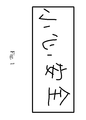
- a user uses an input device to input a word string, , and displays in a display.
- An orientation problem causes the word string, , arranged at an angle as illustrated in figure 1 .
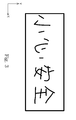
- the present invention can automatically arrange the word string, , again to make the lowest position of each word shown in the display have the same position in the Y-direction as illustrated in figure 3 .
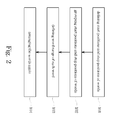
- Figure 2 is a flow chart of automatically arranging a word string according to the present invention.
- step 101 the positions of the start position and the stop position of strokes of the words are defined.
- the pen can apply a pressure to the sensor board.
- the sensor board senses the pressure to orientate the start position of a stroke of the word.
- the pen leaves the sensor board and the pressure applied by the pen is removed.
- the sensor board senses the pressure change to orientate the stop position. Because each stroke is distinguished, each stroke is exactly defined by sensing the start position and the stop position. The length of each stroke is calculated according to the start position and the stop position.
- step 102 adjacent defined positions are grouped.
- a user intentionally leaves a space between two adjacent words for distinguishing each word in a word string. Typically, the space is half of the range of a word.
- the average length of all strokes is defined as the range of a word.
- the present invention uses this foregoing definition to group the defined positions. These positions in a group represent the start positions or the stop positions of a word. A start position and a stop position that are sequentially defined represents a stroke exists between this start position and this stop position. When the distance between two adjacent strokes is less than half of the average length of all strokes, the two adjacent strokes is determined to belong to same word. For example, the word, , is illustrated in the figure 5 .
- the step 101 defines the start positions and the stop positions of the word,
- the word, includes three strokes A, B and C based on the defined start positions and stop positions. Then, the average length of the three strokes A, B and C are calculated. The average length is used as the range in the X direction and in the Y direction of the word, . After the range is determined, the distance between two adjacent strokes is less than half of the range, the two adjacent strokes are determined to belong to same word. Then, these start positions and stop positions forming these strokes are grouped together. Accordingly, the word string, " " is grouped into four groups.
- an auxiliary determination method is provided in the following.
- the first stroke is determined to belong to this word even though the distances among the first stroke and other strokes is larger than half of the range the word occupied therein.
- the strokes 401, 402 and 404 of the word " " have been determined to belong to a same word.
- the stroke 403 is determined to belong to this word " " even though the distances among the stroke 403 and strokes 401, 402 and 404 is larger than half of the range the word " " occupied therein.
- a first stroke crosses a second stroke and the second stroke follows the first stroke
- the first stroke and the second stroke are determined to belong to a same word.
- the stroke 405 crosses the stroke 406 in the word " " and the stroke 406 follows the stroke 405, the stroke 405 and the stroke 406 are determined to belong to a same word.
- the stroke 407, 408 and 409 cross the stroke 410 in the word " ". Therefore, the stroke 407, 408, 409 and 4109 are determined to belong to a same word.
- a projecting method is used to divide a word string.
- a gray level projection drawing is formed.
- Figure 6A shows a paragraph that is divided into a plurality of lines according to a gray-level projection drawing in the X-direction.
- Figure 6B shows a word string that is divided into a plurality of words according to a gray-level projection drawing in the Y-direction.
- a wave peak 602 in the projection diagram represents a word exists in corresponding positions, otherwise, a wave trough 601 is shown in the projection diagram.
- the height of the wave peak 602 and the wave trough 601 are related to the word writing range and word size. A larger writing range causes a wave peak with a higher height value.
- the larger ratio of the wave peak 602 to the wave trough 601 means the paragraph or the word string has a more obvious dividing relationship between two adjacent lines or two adjacent words.
- the dividing result of the paragraph or the word string is conformed because the paragraph or the word string has a more obvious dividing relationship. For example, if the word has a size of 20 dot, the dividing result of the paragraph or the word string is conformed when the gray level value of the wave trough 601 is less than 60 dot.
- the height of the wave trough 601 is larger than triple height of the word, the dividing result of the paragraph or the word string is not conformed. In this case, the projection method is given up. For example, if the word has a size of 20 dot, the dividing result of the paragraph or the word string is not conformed when the wave trough 601 is larger than 60 dot.
- step 103 is to circle the words based on the grouping result in step 102.
- a word range is also defined in this step 103 by determining the pixel position of the strokes of the word. For example, in figure 4 , the pixel position of the position 411 of the word “ “ “ is determined as the bottom position of the word “ “.” The pixel position of the position 412 of the word “ “ “ is determined as the top position of the word “ “. The pixel position of the position 413 of the word “ “ is determined as the left position of the word “ “.” The pixel position of the position 414 of the word “ “ is determined as the right position of the word “ “.
- the four positions 411, 412, 413 and 414 constitute a rectangular range to be as the range of the word " ".
- step 104 is to arrange the words.
- the words are arranged again based on the range defined in step 103 and based on a datum point.
- the datum point is the lowest position of the words defined in the step 103.
- the datum point is the pixel position of the position 411 of the word " " because the pixel position of the position 411 is the lowest position in the word string. Therefore, when the four words are arranged again, the bottom positions of four words aimed at the pixel position of the position 411 as shown in the figure 3 .
- the datum point is the pixel position of the position 415 of the word " " because the pixel position of the position 415 is the highest position in the word string.
- the datum point is a defined pixel position.
- FIG. 7 is an apparatus of automatically arranging word string according to the present invention.
- the arranging word string apparatus 700 includes an input module 701, a dividing module 702 and arranging module 703.
- the input module 701 provides a user to input a word string.
- the dividing module 702 divides the word string into a plurality of words.
- the arranging module 703 arranges the word string again based on a datum point.
- the dividing module 702 further includes a selecting module 7021 to define the positions of the start position and the stop position of strokes of the two words, a grouping module 7022 to group the start position and the stop position based on a threshold value and to circle the words based on the grouping result.
- the grouping module 7022 averages the length of the strokes and determining the two adjacent strokes to belong to a same word when a distance of these two strokes is less than half of the average length. Then, these strokes that are determined to belong to a same word are grouped together.
- the dividing module 702 further includes a projecting module 7023 to project a word string or a paragraph to form a gray level projection drawing.
- a wave peak 602 is formed in the projection diagram; otherwise, a wave trough 601 is formed in the projection diagram as shown in the figure 6A .
- the grouping module 7022 groups theses positions based on the wave trough 601 to divide the word string. For example, the projection module 7023 projects a word string.
- the grouping module 7022 groups theses positions based on the wave trough 601 to divide the word string.
- the words are divided into a plurality of strokes. Then, these strokes are arranged in the display to constitute the words again based on a datum point.
- Such apparatus and method can correct the word string from being arranged at an angle to be arranged in a line.
Landscapes
- Engineering & Computer Science (AREA)
- Computer Vision & Pattern Recognition (AREA)
- Physics & Mathematics (AREA)
- General Physics & Mathematics (AREA)
- Multimedia (AREA)
- Theoretical Computer Science (AREA)
- User Interface Of Digital Computer (AREA)
- Controls And Circuits For Display Device (AREA)
- Character Discrimination (AREA)
Applications Claiming Priority (1)
| Application Number | Priority Date | Filing Date | Title |
|---|---|---|---|
| TW097142694A TWI385584B (zh) | 2008-11-05 | 2008-11-05 | 自動排列手寫字串之裝置及方法 |
Publications (2)
| Publication Number | Publication Date |
|---|---|
| EP2184701A2 true EP2184701A2 (fr) | 2010-05-12 |
| EP2184701A3 EP2184701A3 (fr) | 2011-01-05 |
Family
ID=41665583
Family Applications (1)
| Application Number | Title | Priority Date | Filing Date |
|---|---|---|---|
| EP09154896A Withdrawn EP2184701A3 (fr) | 2008-11-05 | 2009-03-11 | Appareil d'agencement automatique de chaîne de mots et procédé associé |
Country Status (3)
| Country | Link |
|---|---|
| US (1) | US20100115404A1 (fr) |
| EP (1) | EP2184701A3 (fr) |
| TW (1) | TWI385584B (fr) |
Families Citing this family (2)
| Publication number | Priority date | Publication date | Assignee | Title |
|---|---|---|---|---|
| US8910038B2 (en) * | 2008-04-04 | 2014-12-09 | Canon Kabushiki Kaisha | Apparatus and method for image separation, layout, and templating |
| JP5337194B2 (ja) * | 2011-04-25 | 2013-11-06 | シャープ株式会社 | 画像処理装置 |
Citations (6)
| Publication number | Priority date | Publication date | Assignee | Title |
|---|---|---|---|---|
| EP0377129A2 (fr) | 1989-01-05 | 1990-07-11 | International Business Machines Corporation | Sectionneur spatial rapide pour caractères manuscrits |
| US5396566A (en) | 1993-03-04 | 1995-03-07 | International Business Machines Corporation | Estimation of baseline, line spacing and character height for handwriting recognition |
| EP0849698A2 (fr) * | 1996-12-17 | 1998-06-24 | Canon Kabushiki Kaisha | Procédé et dispositif pour le traitement des images |
| US6021218A (en) | 1993-09-07 | 2000-02-01 | Apple Computer, Inc. | System and method for organizing recognized and unrecognized objects on a computer display |
| US6333994B1 (en) | 1999-03-31 | 2001-12-25 | International Business Machines Corporation | Spatial sorting and formatting for handwriting recognition |
| US20060271580A1 (en) | 2005-05-30 | 2006-11-30 | Microsoft Corporation | Grouping lines in freeform handwritten text |
Family Cites Families (19)
| Publication number | Priority date | Publication date | Assignee | Title |
|---|---|---|---|---|
| US1A (en) * | 1836-07-13 | John Ruggles | Locomotive steam-engine for rail and other roads | |
| US5517578A (en) * | 1993-05-20 | 1996-05-14 | Aha! Software Corporation | Method and apparatus for grouping and manipulating electronic representations of handwriting, printing and drawings |
| US5613019A (en) * | 1993-05-20 | 1997-03-18 | Microsoft Corporation | System and methods for spacing, storing and recognizing electronic representations of handwriting, printing and drawings |
| JP2933801B2 (ja) * | 1993-06-11 | 1999-08-16 | 富士通株式会社 | 文字の切り出し方法及びその装置 |
| SE521911C2 (sv) * | 2001-01-15 | 2003-12-16 | Decuma Ab Ideon Res Park | Metod, anordning och datorprogram för igenkänning av ett handskrivet tecken |
| US6909805B2 (en) * | 2001-01-31 | 2005-06-21 | Matsushita Electric Industrial Co., Ltd. | Detecting and utilizing add-on information from a scanned document image |
| JP3880044B2 (ja) * | 2002-02-22 | 2007-02-14 | 富士通株式会社 | 手書き文字入力支援装置及び方法 |
| US7120872B2 (en) * | 2002-03-25 | 2006-10-10 | Microsoft Corporation | Organizing, editing, and rendering digital ink |
| US7164797B2 (en) * | 2002-04-25 | 2007-01-16 | Microsoft Corporation | Clustering |
| US7392472B2 (en) * | 2002-04-25 | 2008-06-24 | Microsoft Corporation | Layout analysis |
| US6904170B2 (en) * | 2002-05-17 | 2005-06-07 | Hewlett-Packard Development Company, L.P. | Method and system for document segmentation |
| JP2004145072A (ja) * | 2002-10-25 | 2004-05-20 | Riso Kagaku Corp | 手書き文字フォント作成装置及び手書き文字フォント作成プログラム |
| US7072514B1 (en) * | 2003-02-06 | 2006-07-04 | The United States Of America As Represented By The National Security Agency | Method of distinguishing handwritten and machine-printed images |
| US7174043B2 (en) * | 2003-02-25 | 2007-02-06 | Evernote Corp. | On-line handwriting recognizer |
| EP1854047A1 (fr) * | 2005-02-28 | 2007-11-14 | ZI Decuma AB | Reconnaissance basee sur la segmentation |
| US7570816B2 (en) * | 2005-03-31 | 2009-08-04 | Microsoft Corporation | Systems and methods for detecting text |
| JP4658848B2 (ja) * | 2006-03-30 | 2011-03-23 | 日本電産サンキョー株式会社 | 文字列認識方法及び文字列認識装置 |
| US20080008387A1 (en) * | 2006-07-06 | 2008-01-10 | Cheng Yi-Hsun E | Method and apparatus for recognition of handwritten symbols |
| TW200837640A (en) * | 2007-03-02 | 2008-09-16 | Mitac Int Corp | Handwriting recognition system and method |
-
2008
- 2008-11-05 TW TW097142694A patent/TWI385584B/zh not_active IP Right Cessation
-
2009
- 2009-03-11 EP EP09154896A patent/EP2184701A3/fr not_active Withdrawn
- 2009-04-02 US US12/416,936 patent/US20100115404A1/en not_active Abandoned
Patent Citations (6)
| Publication number | Priority date | Publication date | Assignee | Title |
|---|---|---|---|---|
| EP0377129A2 (fr) | 1989-01-05 | 1990-07-11 | International Business Machines Corporation | Sectionneur spatial rapide pour caractères manuscrits |
| US5396566A (en) | 1993-03-04 | 1995-03-07 | International Business Machines Corporation | Estimation of baseline, line spacing and character height for handwriting recognition |
| US6021218A (en) | 1993-09-07 | 2000-02-01 | Apple Computer, Inc. | System and method for organizing recognized and unrecognized objects on a computer display |
| EP0849698A2 (fr) * | 1996-12-17 | 1998-06-24 | Canon Kabushiki Kaisha | Procédé et dispositif pour le traitement des images |
| US6333994B1 (en) | 1999-03-31 | 2001-12-25 | International Business Machines Corporation | Spatial sorting and formatting for handwriting recognition |
| US20060271580A1 (en) | 2005-05-30 | 2006-11-30 | Microsoft Corporation | Grouping lines in freeform handwritten text |
Also Published As
| Publication number | Publication date |
|---|---|
| US20100115404A1 (en) | 2010-05-06 |
| TW201019236A (en) | 2010-05-16 |
| TWI385584B (zh) | 2013-02-11 |
| EP2184701A3 (fr) | 2011-01-05 |
Similar Documents
| Publication | Publication Date | Title |
|---|---|---|
| US9946696B2 (en) | Aligning content in an electronic document | |
| JP6840132B2 (ja) | デジタルノートテイキングのシステムおよび方法 | |
| US20040205624A1 (en) | System and method for scaling and repositioning drawings | |
| US20090090567A1 (en) | Gesture determination apparatus and method | |
| US7409090B2 (en) | Handwritten character input device and handwritten character input processing method | |
| WO2009117810A1 (fr) | Procédé et outil pour reconnaître un tableau tracé à la main | |
| US7836408B1 (en) | Methods and apparatus for displaying relative emphasis in a file | |
| CN111259888A (zh) | 基于图像的信息比对方法、装置及计算机可读存储介质 | |
| CN104020944A (zh) | 基于滑块的数据输入方法 | |
| WO2023000960A1 (fr) | Tableau blanc électronique et son procédé d'affichage de graphique | |
| CN106096524A (zh) | 一种汉字美观度的获取方法及装置 | |
| US20140285442A1 (en) | Method for inputting characters and apparatus for the same | |
| EP2184701A2 (fr) | Appareil d'agencement automatique de chaîne de mots et procédé associé | |
| US10572066B2 (en) | System and method for calibrating touch error | |
| US20030107594A1 (en) | Method for mapping screen display objects with spatial coordinates into an HTML table | |
| CN107544743A (zh) | 一种调整文字的方法、装置及电子设备 | |
| CN109669579B (zh) | 辨识系统及其辨识方法 | |
| CN104007952A (zh) | 一种输入方法、装置及电子设备 | |
| US10037308B2 (en) | Method for adding two rows of tiles to an existing two rows of tiles based on the number of tiles in each of the existing two rows | |
| JP4678671B2 (ja) | 手書き文字配置整形方法及び電子ボードシステム | |
| US8643651B2 (en) | Type-setting method for a text image file | |
| CN113849106A (zh) | 翻页笔迹处理方法、设备、电子设备及存储介质 | |
| CN114882513B (zh) | 一种数据识别的方法及智能交互显示设备 | |
| US10042515B2 (en) | Using genture direction to input data into multiple spin dial list boxes | |
| JP7095541B2 (ja) | 階層構造認識プログラム、階層構造認識方法及び階層構造認識装置 |
Legal Events
| Date | Code | Title | Description |
|---|---|---|---|
| PUAI | Public reference made under article 153(3) epc to a published international application that has entered the european phase |
Free format text: ORIGINAL CODE: 0009012 |
|
| 17P | Request for examination filed |
Effective date: 20090709 |
|
| AK | Designated contracting states |
Kind code of ref document: A2 Designated state(s): AT BE BG CH CY CZ DE DK EE ES FI FR GB GR HR HU IE IS IT LI LT LU LV MC MK MT NL NO PL PT RO SE SI SK TR |
|
| AX | Request for extension of the european patent |
Extension state: AL BA RS |
|
| PUAL | Search report despatched |
Free format text: ORIGINAL CODE: 0009013 |
|
| AK | Designated contracting states |
Kind code of ref document: A3 Designated state(s): AT BE BG CH CY CZ DE DK EE ES FI FR GB GR HR HU IE IS IT LI LT LU LV MC MK MT NL NO PL PT RO SE SI SK TR |
|
| AX | Request for extension of the european patent |
Extension state: AL BA RS |
|
| AKX | Designation fees paid |
Designated state(s): AT BE BG CH CY CZ DE DK EE ES FI FR GB GR HR HU IE IS IT LI LT LU LV MC MK MT NL NO PL PT RO SE SI SK TR |
|
| RAP1 | Party data changed (applicant data changed or rights of an application transferred) |
Owner name: AVER INFORMATION INC. |
|
| 17Q | First examination report despatched |
Effective date: 20120229 |
|
| STAA | Information on the status of an ep patent application or granted ep patent |
Free format text: STATUS: THE APPLICATION IS DEEMED TO BE WITHDRAWN |
|
| 18D | Application deemed to be withdrawn |
Effective date: 20120711 |