EP2185662B1 - Photoaktives tio2 in beschichtungsmaterialien - Google Patents
Photoaktives tio2 in beschichtungsmaterialien Download PDFInfo
- Publication number
- EP2185662B1 EP2185662B1 EP08787515A EP08787515A EP2185662B1 EP 2185662 B1 EP2185662 B1 EP 2185662B1 EP 08787515 A EP08787515 A EP 08787515A EP 08787515 A EP08787515 A EP 08787515A EP 2185662 B1 EP2185662 B1 EP 2185662B1
- Authority
- EP
- European Patent Office
- Prior art keywords
- coating material
- pigments
- component
- material according
- coating
- Prior art date
- Legal status (The legal status is an assumption and is not a legal conclusion. Google has not performed a legal analysis and makes no representation as to the accuracy of the status listed.)
- Revoked
Links
Classifications
-
- C—CHEMISTRY; METALLURGY
- C09—DYES; PAINTS; POLISHES; NATURAL RESINS; ADHESIVES; COMPOSITIONS NOT OTHERWISE PROVIDED FOR; APPLICATIONS OF MATERIALS NOT OTHERWISE PROVIDED FOR
- C09D—COATING COMPOSITIONS, e.g. PAINTS, VARNISHES OR LACQUERS; FILLING PASTES; CHEMICAL PAINT OR INK REMOVERS; INKS; CORRECTING FLUIDS; WOODSTAINS; PASTES OR SOLIDS FOR COLOURING OR PRINTING; USE OF MATERIALS THEREFOR
- C09D7/00—Features of coating compositions, not provided for in group C09D5/00; Processes for incorporating ingredients in coating compositions
- C09D7/40—Additives
- C09D7/60—Additives non-macromolecular
- C09D7/61—Additives non-macromolecular inorganic
- C09D7/62—Additives non-macromolecular inorganic modified by treatment with other compounds
-
- A—HUMAN NECESSITIES
- A61—MEDICAL OR VETERINARY SCIENCE; HYGIENE
- A61L—METHODS OR APPARATUS FOR STERILISING MATERIALS OR OBJECTS IN GENERAL; DISINFECTION, STERILISATION OR DEODORISATION OF AIR; CHEMICAL ASPECTS OF BANDAGES, DRESSINGS, ABSORBENT PADS OR SURGICAL ARTICLES; MATERIALS FOR BANDAGES, DRESSINGS, ABSORBENT PADS OR SURGICAL ARTICLES
- A61L9/00—Disinfection, sterilisation or deodorisation of air
-
- B—PERFORMING OPERATIONS; TRANSPORTING
- B01—PHYSICAL OR CHEMICAL PROCESSES OR APPARATUS IN GENERAL
- B01J—CHEMICAL OR PHYSICAL PROCESSES, e.g. CATALYSIS OR COLLOID CHEMISTRY; THEIR RELEVANT APPARATUS
- B01J21/00—Catalysts comprising the elements, oxides, or hydroxides of magnesium, boron, aluminium, carbon, silicon, titanium, zirconium, or hafnium
- B01J21/06—Silicon, titanium, zirconium or hafnium; Oxides or hydroxides thereof
-
- B—PERFORMING OPERATIONS; TRANSPORTING
- B82—NANOTECHNOLOGY
- B82Y—SPECIFIC USES OR APPLICATIONS OF NANOSTRUCTURES; MEASUREMENT OR ANALYSIS OF NANOSTRUCTURES; MANUFACTURE OR TREATMENT OF NANOSTRUCTURES
- B82Y30/00—Nanotechnology for materials or surface science, e.g. nanocomposites
-
- C—CHEMISTRY; METALLURGY
- C01—INORGANIC CHEMISTRY
- C01G—COMPOUNDS CONTAINING METALS NOT COVERED BY SUBCLASSES C01D OR C01F
- C01G23/00—Compounds of titanium
- C01G23/04—Oxides; Hydroxides
- C01G23/047—Titanium dioxide
-
- C—CHEMISTRY; METALLURGY
- C09—DYES; PAINTS; POLISHES; NATURAL RESINS; ADHESIVES; COMPOSITIONS NOT OTHERWISE PROVIDED FOR; APPLICATIONS OF MATERIALS NOT OTHERWISE PROVIDED FOR
- C09C—TREATMENT OF INORGANIC MATERIALS, OTHER THAN FIBROUS FILLERS, TO ENHANCE THEIR PIGMENTING OR FILLING PROPERTIES ; PREPARATION OF CARBON BLACK ; PREPARATION OF INORGANIC MATERIALS WHICH ARE NO SINGLE CHEMICAL COMPOUNDS AND WHICH ARE MAINLY USED AS PIGMENTS OR FILLERS
- C09C1/00—Treatment of specific inorganic materials other than fibrous fillers; Preparation of carbon black
- C09C1/36—Compounds of titanium
- C09C1/3607—Titanium dioxide
- C09C1/3684—Treatment with organo-silicon compounds
-
- C—CHEMISTRY; METALLURGY
- C09—DYES; PAINTS; POLISHES; NATURAL RESINS; ADHESIVES; COMPOSITIONS NOT OTHERWISE PROVIDED FOR; APPLICATIONS OF MATERIALS NOT OTHERWISE PROVIDED FOR
- C09D—COATING COMPOSITIONS, e.g. PAINTS, VARNISHES OR LACQUERS; FILLING PASTES; CHEMICAL PAINT OR INK REMOVERS; INKS; CORRECTING FLUIDS; WOODSTAINS; PASTES OR SOLIDS FOR COLOURING OR PRINTING; USE OF MATERIALS THEREFOR
- C09D5/00—Coating compositions, e.g. paints, varnishes or lacquers, characterised by their physical nature or the effects produced; Filling pastes
-
- C—CHEMISTRY; METALLURGY
- C09—DYES; PAINTS; POLISHES; NATURAL RESINS; ADHESIVES; COMPOSITIONS NOT OTHERWISE PROVIDED FOR; APPLICATIONS OF MATERIALS NOT OTHERWISE PROVIDED FOR
- C09D—COATING COMPOSITIONS, e.g. PAINTS, VARNISHES OR LACQUERS; FILLING PASTES; CHEMICAL PAINT OR INK REMOVERS; INKS; CORRECTING FLUIDS; WOODSTAINS; PASTES OR SOLIDS FOR COLOURING OR PRINTING; USE OF MATERIALS THEREFOR
- C09D5/00—Coating compositions, e.g. paints, varnishes or lacquers, characterised by their physical nature or the effects produced; Filling pastes
- C09D5/16—Antifouling paints; Underwater paints
- C09D5/1606—Antifouling paints; Underwater paints characterised by the anti-fouling agent
- C09D5/1612—Non-macromolecular compounds
- C09D5/1618—Non-macromolecular compounds inorganic
-
- C—CHEMISTRY; METALLURGY
- C09—DYES; PAINTS; POLISHES; NATURAL RESINS; ADHESIVES; COMPOSITIONS NOT OTHERWISE PROVIDED FOR; APPLICATIONS OF MATERIALS NOT OTHERWISE PROVIDED FOR
- C09D—COATING COMPOSITIONS, e.g. PAINTS, VARNISHES OR LACQUERS; FILLING PASTES; CHEMICAL PAINT OR INK REMOVERS; INKS; CORRECTING FLUIDS; WOODSTAINS; PASTES OR SOLIDS FOR COLOURING OR PRINTING; USE OF MATERIALS THEREFOR
- C09D7/00—Features of coating compositions, not provided for in group C09D5/00; Processes for incorporating ingredients in coating compositions
- C09D7/40—Additives
- C09D7/66—Additives characterised by particle size
- C09D7/68—Particle size between 100-1000 nm
-
- D—TEXTILES; PAPER
- D06—TREATMENT OF TEXTILES OR THE LIKE; LAUNDERING; FLEXIBLE MATERIALS NOT OTHERWISE PROVIDED FOR
- D06M—TREATMENT, NOT PROVIDED FOR ELSEWHERE IN CLASS D06, OF FIBRES, THREADS, YARNS, FABRICS, FEATHERS OR FIBROUS GOODS MADE FROM SUCH MATERIALS
- D06M11/00—Treating fibres, threads, yarns, fabrics or fibrous goods made from such materials, with inorganic substances or complexes thereof; Such treatment combined with mechanical treatment, e.g. mercerising
- D06M11/32—Treating fibres, threads, yarns, fabrics or fibrous goods made from such materials, with inorganic substances or complexes thereof; Such treatment combined with mechanical treatment, e.g. mercerising with oxygen, ozone, ozonides, oxides, hydroxides or percompounds; Salts derived from anions with an amphoteric element-oxygen bond
- D06M11/36—Treating fibres, threads, yarns, fabrics or fibrous goods made from such materials, with inorganic substances or complexes thereof; Such treatment combined with mechanical treatment, e.g. mercerising with oxygen, ozone, ozonides, oxides, hydroxides or percompounds; Salts derived from anions with an amphoteric element-oxygen bond with oxides, hydroxides or mixed oxides; with salts derived from anions with an amphoteric element-oxygen bond
- D06M11/46—Oxides or hydroxides of elements of Groups 4 or 14 of the Periodic Table; Titanates; Zirconates; Stannates; Plumbates
-
- D—TEXTILES; PAPER
- D06—TREATMENT OF TEXTILES OR THE LIKE; LAUNDERING; FLEXIBLE MATERIALS NOT OTHERWISE PROVIDED FOR
- D06M—TREATMENT, NOT PROVIDED FOR ELSEWHERE IN CLASS D06, OF FIBRES, THREADS, YARNS, FABRICS, FEATHERS OR FIBROUS GOODS MADE FROM SUCH MATERIALS
- D06M11/00—Treating fibres, threads, yarns, fabrics or fibrous goods made from such materials, with inorganic substances or complexes thereof; Such treatment combined with mechanical treatment, e.g. mercerising
- D06M11/77—Treating fibres, threads, yarns, fabrics or fibrous goods made from such materials, with inorganic substances or complexes thereof; Such treatment combined with mechanical treatment, e.g. mercerising with silicon or compounds thereof
- D06M11/79—Treating fibres, threads, yarns, fabrics or fibrous goods made from such materials, with inorganic substances or complexes thereof; Such treatment combined with mechanical treatment, e.g. mercerising with silicon or compounds thereof with silicon dioxide, silicic acids or their salts
-
- C—CHEMISTRY; METALLURGY
- C01—INORGANIC CHEMISTRY
- C01P—INDEXING SCHEME RELATING TO STRUCTURAL AND PHYSICAL ASPECTS OF SOLID INORGANIC COMPOUNDS
- C01P2004/00—Particle morphology
- C01P2004/60—Particles characterised by their size
- C01P2004/64—Nanometer sized, i.e. from 1-100 nanometer
-
- C—CHEMISTRY; METALLURGY
- C01—INORGANIC CHEMISTRY
- C01P—INDEXING SCHEME RELATING TO STRUCTURAL AND PHYSICAL ASPECTS OF SOLID INORGANIC COMPOUNDS
- C01P2004/00—Particle morphology
- C01P2004/80—Particles consisting of a mixture of two or more inorganic phases
- C01P2004/82—Particles consisting of a mixture of two or more inorganic phases two phases having the same anion, e.g. both oxidic phases
- C01P2004/84—Particles consisting of a mixture of two or more inorganic phases two phases having the same anion, e.g. both oxidic phases one phase coated with the other
- C01P2004/86—Thin layer coatings, i.e. the coating thickness being less than 0.1 time the particle radius
-
- C—CHEMISTRY; METALLURGY
- C01—INORGANIC CHEMISTRY
- C01P—INDEXING SCHEME RELATING TO STRUCTURAL AND PHYSICAL ASPECTS OF SOLID INORGANIC COMPOUNDS
- C01P2006/00—Physical properties of inorganic compounds
- C01P2006/60—Optical properties, e.g. expressed in CIELAB-values
-
- C—CHEMISTRY; METALLURGY
- C08—ORGANIC MACROMOLECULAR COMPOUNDS; THEIR PREPARATION OR CHEMICAL WORKING-UP; COMPOSITIONS BASED THEREON
- C08K—Use of inorganic or non-macromolecular organic substances as compounding ingredients
- C08K3/00—Use of inorganic substances as compounding ingredients
- C08K3/18—Oxygen-containing compounds, e.g. metal carbonyls
- C08K3/20—Oxides; Hydroxides
- C08K3/22—Oxides; Hydroxides of metals
-
- C—CHEMISTRY; METALLURGY
- C08—ORGANIC MACROMOLECULAR COMPOUNDS; THEIR PREPARATION OR CHEMICAL WORKING-UP; COMPOSITIONS BASED THEREON
- C08K—Use of inorganic or non-macromolecular organic substances as compounding ingredients
- C08K9/00—Use of pretreated ingredients
- C08K9/02—Ingredients treated with inorganic substances
-
- C—CHEMISTRY; METALLURGY
- C08—ORGANIC MACROMOLECULAR COMPOUNDS; THEIR PREPARATION OR CHEMICAL WORKING-UP; COMPOSITIONS BASED THEREON
- C08K—Use of inorganic or non-macromolecular organic substances as compounding ingredients
- C08K9/00—Use of pretreated ingredients
- C08K9/10—Encapsulated ingredients
-
- Y—GENERAL TAGGING OF NEW TECHNOLOGICAL DEVELOPMENTS; GENERAL TAGGING OF CROSS-SECTIONAL TECHNOLOGIES SPANNING OVER SEVERAL SECTIONS OF THE IPC; TECHNICAL SUBJECTS COVERED BY FORMER USPC CROSS-REFERENCE ART COLLECTIONS [XRACs] AND DIGESTS
- Y10—TECHNICAL SUBJECTS COVERED BY FORMER USPC
- Y10T—TECHNICAL SUBJECTS COVERED BY FORMER US CLASSIFICATION
- Y10T428/00—Stock material or miscellaneous articles
- Y10T428/29—Coated or structually defined flake, particle, cell, strand, strand portion, rod, filament, macroscopic fiber or mass thereof
- Y10T428/2982—Particulate matter [e.g., sphere, flake, etc.]
- Y10T428/2991—Coated
Definitions
- the present invention relates to a coating material comprising at least one binder and at least one photocatalytically active particle, a process for producing this coating material and the use of this coating material.
- Coating materials which contain photocatalytically active particles are already known from the prior art.
- JP 11 181339 A discloses a hydrophilic coating agent for metals, polymers, concrete comprising photocatalytically active titanium dioxide particles.
- the titanium dioxide particles according to JP 11 181339 A have a particle diameter of 1 to 100 nm, contain particles of SnO 2 and are coated with silica and / or a silicone.
- the layer thickness of this coating of silica and / or silicone is not disclosed.
- the coating material prevents fouling of a surface coated with this material.
- a surface treated in this way has self-cleaning properties when it hits rain. Therefore, the coating materials are according to JP 11 181339 A suitable for coating surfaces of buildings, window frames and other goods.
- JP 2006-18 14 90 discloses a coating method for coating materials.
- a photocatalyst consisting of titanium dioxide, zirconium dioxide, zinc oxide, tin oxide, cerium oxide, antimony oxide, indium oxide doped with tin, tin oxide doped with antimony with a non-aqueous solvent is applied to the surfaces to be protected.
- a photocatalyst consisting of titanium dioxide is coated with ceramics such as apatite, silica, activated carbon, activated alumina, or porous glass to affix the photocatalyst on the surface to be treated.
- the method according to this document is complicated by the necessity of applying at least two layers.
- JP 2006-233343 discloses a liquid photocatalyst composition for coating textiles containing photocatalyst particles of pre-determined particle diameter and a coating.
- the size of these photocatalyst particles is 0.5 to 10 microns.
- the core of the photocatalyst particle is titanium dioxide, and the shell is silica. A thickness or the porosity of the shell of the photocatalytically active particle are not disclosed.
- JP 11228873 A discloses a paint composition comprising porous silica coated titanium dioxide particles having photocatalytic properties. Further, the composition contains titanium dioxide as a pigment and an organic resin as a binder. In JP 11228873 A it is not disclosed which particle diameter the photocatalytically active particles have, or which layer thickness has the silica layer.
- WO 2005/100459 A1 discloses a coating material comprising a binder and at least one particle having a size and / or surface roughness of 100 ⁇ m or less and a catalytically active agent, wherein the binder is at least partially degraded by the photocatalytic action to form a microstructured, self-cleaning surface.
- a photocatalytically active agent is according to WO 2005/100459 an oxide of titanium, zinc, iron, manganese, molybdenum and / or tungsten is used, which contains at least one additive selected from C, N, S and / or of a transition metal oxide and / or halide.
- WO 2005/100459 A1 does not disclose which particle size the photocatalytically active particles have.
- EP 1 956 041 A1 discloses aqueous organic-inorganic hybrid compositions comprising a metal oxide (A) having a particle diameter of 1 to 400 nm and a polymer particle (B) having a particle diameter of 10 to 800 nm.
- the metal oxide may be selected from silica, alumina, antimony oxide, titania, indium oxide , Tin oxide and others. These photocatalysts may also be coated with silica.
- the polymer present in the composition according to this document necessarily contains silane group-containing monomers, vinylamide-containing monomers and optionally further vinylic monomers.
- Suitable solvents are water, optionally in combination with organic solvents, such as alcohols.
- JP 2005 028575 A discloses ultrathin porous oxide films prepared by alternately laminating a layered nanoscale oxide and aluminum hydroxides on a subbing layer. Further, core-shell particles having a porous ultrathin oxide film as a coating on a polymer sphere are also disclosed.
- WO 99/01766 A discloses metal particles comprising a metal core and a silane-containing shell, wherein the core comprises a metal selected from the group consisting of gold, silver, platinum, palladium, rhodium, ruthenium, osmium, iridium and mixtures thereof and the shell has a mercaptosilane radical attached to this metal core, contains. Furthermore, this document also discloses a material comprising a matrix material or a carrier material, wherein therein the described Metal particles may be embedded, wherein the matrix material or the carrier material is selected from the group consisting of polymers, porous glasses, colored glasses, porous titanium dioxide, zeolites, silica and others.
- the coating materials described in the prior art contain photocatalytically active particles which have the disadvantage that not only the impurities present on the coating material in use are photocatalytically decomposed, which is desirable, but also the binder which is present in the coating material is photocatalytically degraded. This is undesirable and the photocatalytic destruction of the organic matrices described in the prior art lowers the photoactivity of the surface created. Both the photoactivity and the durability or resistance of the coating materials according to the prior art is therefore insufficient.
- coating material means a mixture of substances which is suitable for being applied to different materials and for forming a corresponding, solid coating.
- Conventional coating materials may contain, in addition to the components mentioned, further components, for example solvents, surfactants, dyes, fillers, pigment distributors, defoamers and polymers.
- Materials which can be coated with coating agents may be intended for exterior or interior applications made of metal, inorganic or organic materials.
- the coating material according to the invention contains at least one binder.
- the binder used as component (A) is selected from the group consisting of based on water and / or organic solvents plastic dispersions based on non-polymeric crosslinking systems, acrylates, caprolactam, vinylcaprolactam, N-vinylformamide, acrylic esters, styrene / acrylic esters and Vinyl acetates, polyurethanes, epoxy resins, alkyd resins, and mixtures thereof.
- Suitable non-polymeric crosslinking systems as component (A) are multifunctional methylol derivatives of urea and substituted ureas, melamine, dimethylolurea or N, N'-bis (hydroxymethyl) urea, methylol derivatives of melamine consisting of up to six methylol groups per molecule, preferably in which the methylol groups are partially or completely converted into methoxymethyl groups, 1,3-bis (hydroxymethyl) tetrahydro-2- (1H) -pyrimidinone, triazone such as hydroxyethyltriazone, 5-hydroxy-1,3-bis (hydroxymethyl) -hexahydroxy s-triazin-2-one, urones such as tetrahydro-3,5-bis (hydroxymethyl) -4H-1,3,5-oxadiazin-4-one, methylol derivatives of carbamates, preferably methyl carbamate and methoxyethyl carbamate, methylol derivatives of dihydroxyethylene
- polyacrylates which are suitable as component (A) are obtainable, for example, by copolymerization of at least one (meth) acrylic acid C 1 -C 1 -alkyl ester, for example methyl acrylate, ethyl acrylate, n-butyl acrylate, n-butyl methacrylate, 2-ethylhexyl acrylate, with at least one further comonomer, for example a further (meth) acrylic C 1 -C 10 -alkyl ester, (meth) acrylic acid, (meth) acrylamide, N-methylol (meth) acrylamide, glycidyl (meth) acrylate or a vinyl aromatic compound such as styrene.
- at least one (meth) acrylic acid C 1 -C 1 -alkyl ester for example methyl acrylate, ethyl acrylate, n-butyl acrylate, n-butyl methacrylate, 2-e
- suitable preferably anionic polyurethanes in the context of the present invention are obtainable, for example, by reacting one or more aromatic or preferably aliphatic or cycloaliphatic diisocyanate with one or more polyester diols and preferably one or more hydroxycarboxylic acids, eg. B is hydroxyacetic acid, or preferably dihydroxycarboxylic acids, for example 1,1-dimethylolpropionic acid, 1,1-dimethylolbutyric acid or 1,1-dimethylolethanoic acid.
- Ethylene (meth) acrylic acid copolymers which are particularly suitable as component (A) are, for example, by copolymerization of ethylene, (meth) acrylic acid and optionally at least one further comonomer, such as (meth) acrylic acid C 1 -C 10 -alkyl ester, maleic anhydride, isobutene or vinyl acetate obtainable, preferably by copolymerization at temperatures in the range of 190 to 350 ° C and pressures in the range of 1500 to 3500, preferably 2000 to 2500 bar.
- Ethylene (meth) acrylic acid copolymers which are particularly suitable as component (A) can comprise, for example, up to 90% by weight of ethylene in copolymerized form and have a melt viscosity in the range from 60 mm 2 / s to 10,000 mm 2 / s, preferably 100 mm 2 / s up to 5,000 mm 2 / s, measured at 120 ° C.
- Ethylene (meth) acrylic acid copolymers which are particularly suitable as component (A) can comprise, for example, up to 90% by weight of ethylene in copolymerized form and have a melt flow rate (MFR) in the range from 1 to 50 g / 10 min, preferably 5 to 20 g / 10 min, more preferably 7 to 15 g / 10 min, measured at 160 ° C and a load of 325 g according to EN ISO 1133.
- MFR melt flow rate
- component (A) particularly suitable copolymers of at least one vinyl aromatic with at least one conjugated diene and optionally further Comonomers, for example styrene-butadiene binders, contain at least one ethylenically unsaturated carboxylic acid or dicarboxylic acid or a suitable derivative, for example the corresponding anhydride, in copolymerized form.
- Particularly suitable vinylaromatics are para-methylstyrene, .alpha.-methylstyrene and in particular styrene.
- Particularly suitable conjugated dienes are isoprene, chloroprene and in particular 1,3-butadiene.
- Particularly suitable ethylenically unsaturated carboxylic acids or dicarboxylic acids or suitable derivatives thereof are exemplified by (meth) acrylic acid, maleic acid, itaconic acid, maleic anhydride or itaconic anhydride.
- potassium silicate glass in particular for silicate paints, and other customary binders known to the person skilled in the art for exterior and interior paints, coating compositions for industrial applications, technical apparatuses and special coatings, can be used.
- Component (A) is generally present in an amount of 5 to 99.9% by weight. If the coating material according to the invention is used for outdoor applications, then component (A) is preferably present in an amount of from 5 to 99.9% by weight, more preferably from 5 to 98.5% by weight. If the coating material according to the invention is used for interior applications, component (A) is preferably present in an amount of 5 to 99.5% by weight, more preferably 5 to 98% by weight.
- the coating material according to the invention comprises at least one photocatalytically active particle described above.
- Component (B) is generally present in the coating material according to the invention in an amount of 0.1 to 10% by weight. If the coating material according to the invention is used for exterior applications, component (B) is preferably present in an amount of 0.1 to 8 Wt .-%, particularly preferably 0.5 to 5 wt .-%, before. If the coating material according to the invention is used for interior applications, then component (B) is preferably present in an amount of from 0.5 to 10% by weight, particularly preferably from 2 to 8% by weight.
- the non-porous core of the photocatalytically active particle contains at least one metal or semimetal oxide, and the at least one porous shell of the nanoparticle contains at least one further metal or semimetal oxide.
- Suitable metals or semimetals whose oxides are present in the non-porous core of at least one photocatalytically active particle present as component (B) are generally selected from the group consisting of elements of groups I to XV of the Periodic Table of the Elements (according to IUPAC), lanthanides , Actinoids and mixtures thereof, more preferably from the group consisting of V, Ti, Zr, Ce, Mo, Bi, Zn, Mn, Si, Ba, Au, Ag, Pd, Pt, Ru, Rh, La and mixtures thereof.
- a particularly preferred metal or semimetal oxide present in the non-porous core of component (B) is TiO 2 , which is substantially anatase-modified, that is, more than 50%, more preferably 60-65%, by weight the anatase modification is present.
- metal or semimetal oxides comprising elements of groups I to XV of the Periodic Table of the Elements (according to IUPAC), lanthanides, actinides and mixtures thereof are present, more preferably selected the group consisting of V, Ti, Zr, Ce, Mo, Bi, Zn, Mn, Si, Ba, Au, Ag, Pd, Pt, Ru, Rh, La and mixtures thereof.
- Very particularly preferred metal or semimetal oxides which are present in the at least one porous shell of component (B) are SiO 2 , ZnO, CeO 2 , TiO 2 , SnO or mixtures thereof.
- component (B) has a non-porous core of TiO 2 and a porous shell of SiO 2 .
- the photocatalytically active particles present as component (B) in the coating material according to the invention preferably have a narrow particle size distribution.
- a narrow particle size distribution means that preferably ⁇ 70%, more preferably ⁇ 80%, very preferably ⁇ 90% of the particle sizes are within a range of at most 20 nm, preferably at most 15 nm, particularly preferably at most 10 nm deviates from the average particle sizes.
- the core-shell nanoparticles are characterized by having a non-porous core and a porous coating. Due to the specifically adjustable porosity and thickness of the coating, it is possible to adjust the catalytic activity of the core specifically to the corresponding requirements of the coating material according to the invention.
- the porosity of the SiO 2 layer is measured by XPS (X-ray Photo Electron Spectroscopy - ESCA Electron Spectroscopy for Chemical Analysis).
- XPS X-ray Photo Electron Spectroscopy - ESCA Electron Spectroscopy for Chemical Analysis.
- the photoactivity against fluid contaminants is more than 60% of the photoactivity of a standard photocatalyst (Degussa P25), more preferably more than 70%, most preferably more than 80%.
- Photoactivity to fixed templates, i. the at least one binder present as component (A) in the coating composition according to the invention is preferably less than 50% of the photoactivity of a standard photocatalyst (Degussa P25), more preferably less than 40%, and most preferably less than 30%.
- component (B) is active towards impurities and not active towards matrix materials.
- the non-porous core of the photocatalytically active particle used as component (B) has a diameter of 0.1 nm to 1 .mu.m and the shell of the particle has an average layer thickness of 0.1 to 10 nm.
- the non-porous core has a diameter of at least 0.1 nm.
- the diameter of the non-porous core is 1 to 200 nm, more preferably 5 to 50 nm.
- the average layer thickness of the porous shell is 0.1 to 5 nm, especially preferably 1 to 3 nm.
- the porosity of the shell of the photocatalytically active particle used according to the invention as component (B) can be expressed by the ratio of metal in the shell, for example Si, in atomic percent to metal in the core, for example Ti, in atomic percent and is preferably 2 to 80, more preferably 5 to 60, most preferably 8 to 40, each measured by XPS (X-Ray Photo Electron Spectroscopy-ESCA Electron Spectroscopy for Chemical Analysis).
- the photocatalytically active particles which are preferably used as component (B) in the coating material according to the invention can be prepared by all methods known to the person skilled in the art.
- the wet-chemical sol-gel process and the flame-synthesis process are mentioned as suitable processes for the preparation of the photocatalytically active particles used according to the invention. These methods are known to the person skilled in the art.
- the coating material according to the invention optionally contains a pigment as component (C).
- the coating material of the invention comprises as component (C) at least one pigment selected from the group consisting of titanium dioxide, barium sulfate, zinc oxide, colored pigments such as iron oxides, carbon black, zinc yellow, zinc green, ultramarine, luminescent or fluorescent pigments, or azo, Isoindolinone and isoindoline, phthalocyanine, quinacridone, perinone, perylene, anthraquinone, diketopyrrolopyrrole, thioindigo, dioxazine, triphenylmethane, quinophthalone pigments and mixtures thereof.
- component (C) at least one pigment selected from the group consisting of titanium dioxide, barium sulfate, zinc oxide, colored pigments such as iron oxides, carbon black, zinc yellow, zinc green, ultramarine, luminescent or fluorescent pigments, or azo, Isoindolinone and isoindoline, phthalocyanine, quinacridone, perinone, perylene
- a suitable pigment is available, for example, as TiO 2 in the rutile modification.
- Component (C) is preferably present in an amount of 5 to 30 wt .-%, preferably 10 to 20 wt .-% before.
- the coating material according to the invention generally contains from 30 to 75% by weight and preferably from 40 to 65% by weight of nonvolatile constituents. These are to be understood as meaning all constituents of the coating composition which are not water, but at least the total amount of binder (component (A)), optionally pigment, optionally filler (component (E)) and polymeric auxiliaries.
- the coating material according to the invention may optionally contain a solvent as component (D).
- component (D) all solvents and solvent mixtures known and suitable to the person skilled in the art for the present application can be used in the coating material according to the invention.
- the solvent present as component (D) is essentially water. Essentially, this means that preferably at least 75% by weight of the solvent is water, more preferably at least 90% by weight.
- volatile organic solvent and film-forming aids may be added to the color formulation.
- organic solvents and film formers are volatile hydrocarbons such as gasoline fractions, white oils, liquid paraffins, glycols such as butylene glycol, ethylene glycol, diethylene glycol and propylene glycol, glycol ethers such as glycol butyl ether, diethylene glycol monobutyl ether, 1-methoxy-2-propanol, dipropylene glycol methyl ether, dipropylene glycol propyl ether, dipropylene glycol n-butyl ether, tripropylene glycol n-butyl ether, 2,3-phenoxypropanol, glycol esters and ether esters such as butyl glycol acetate, diethylene glycol mono-n-butyl ether acetate, 2,2,4-trimethylpentane-1,3-diol monoisobutyrate and the like, and organic plasticizers (organic plasticizers (organic plasticizers
- Component (D), if present, is present in an amount of from 0.1 to 75% by weight.
- At least one filler is present in the coating material according to the invention.
- This at least one filler generally has in the coating material according to the invention the task of increasing the viscosity of the coating material, preferably in liquid form, to be applied to the material to be coated, in order to ensure good processability.
- the at least one filler is selected from the group consisting of minerals, for example inorganic salts of the alkali and alkaline earth metals, and the transition metals and the other metals and the semimetals of the main groups of the Periodic Table of the Elements, for example Mg, Ca and / or Si.
- these salts preferably have oxide, carbonate, bicarbonate, sulfate, halide and nitrogen-containing anions, preferably chloride and / or oxide anions.
- Suitable fillers include aluminosilicates such as feldspars, silicates such as kaolin, talc, mica, wollastonite, magnesite, alkaline earth carbonates such as calcium carbonate, for example in the form of calcite or chalk, magnesium carbonate, dolomite, alkaline earth sulfates such as calcium sulfate, silica, etc.
- the fillers can be used as Single components are used. In practice, filler blends have proven particularly useful, e.g. Calcium carbonate / kaolin, calcium carbonate / talc.
- Suitable fillers which can be used as component (E) in the coating material according to the invention are known to the person skilled in the art.
- Component (E) is present in the coating material according to the invention, if present, in an amount of 10 to 40 wt .-%, preferably 15 to 30 wt .-%, each based on the total coating material.
- the pigment volume concentration PVK of the coating material according to the invention is from 20 to 65.
- the PVK is preferably from 20 to 60, in particular from 30 to 60, and especially from 35 to 59.
- finely divided fillers for example, in dispersion paints with supercritical formulation (highly filled inks, PVK> PVK critical), e.g. used finely divided calcium carbonate or mixtures of different calcium carbonates with different particle sizes.
- highly filled inks PVK> PVK critical
- blends of color pigments and fillers are preferably used.
- At least one pigment distributor is present as component (F) in the coating material according to the invention.
- Component (F) is generally a homo- or copolymer composed of ethylenically unsaturated monomers which are free-radically polymerized.
- suitable monomers are ⁇ , ⁇ -unsaturated mono- and dicarboxylic acids, for example acrylic acid, methacrylic acid, fumaric acid, maleic acid, itaconic acid, and their mono- or diesters with aliphatic or aromatic monohydric or polyhydric alcohols having 1 to 12 C atoms, such as Methanol, ethanol, propanols, such as isopropanol, n-propanol, butanols, such as n-butanol, isobutanol, tert-butanol and cyclohexanol.
- Suitable monomers are ethylenically unsaturated, aromatic monomers such as styrene, ⁇ -methylstyrene. Further suitable monomers are also the salts of said acids of monovalent cations, for example ammonium acrylate.
- component (F) in particular preference is given to using homo- and copolymers based on acrylic esters, for example butyl acrylate and / or styrene, as component (F) in the coating material according to the invention.
- Suitable pigment distributors which can be used as component (F) in the coating material according to the invention are known to the person skilled in the art.
- Component (F) is present in the coating material according to the invention, if present, in an amount of 0.1 to 5 wt .-%, preferably 0.2 to 3 wt .-%, each based on the total coating material.
- At least one thickener is present in the coating material according to the invention as component (G).
- Component (G) is optionally present in the coating material of the present invention to adjust the viscosity of the material, thus improving, for example, processability.
- Examples of substances which can be used according to the invention as component (G) are, for example, aqueous solutions based on methylcellulose or cellulose. These aqueous solutions generally have a concentration of 0.1 to 10 wt .-%.
- the viscosity of the aqueous solutions used as thickener is generally from 5000 to 30,000 mPas at room temperature, for example 15,000 to 25,000 mPas.
- the thickeners may also be in bulk, i. without solvent, are introduced into the coating material according to the invention.
- component (G) is introduced into the coating material according to the invention as an aqueous solution, the amount of this solution, if present, is 2 to 20% by weight, preferably 8 to 15% by weight, based in each case on the entire coating material. If component (F) introduced in substance, this is done in an amount of 0.1 to 2 wt .-%, preferably 0.2 to 1.5 wt .-%, each based on the total coating material.
- one or more substances can be introduced into the coating material according to the invention selected from the group consisting of water softeners, dispersing agents, pH adjusters, emulsifiers, preservatives, surfactants, foaming agents, defoamers, polymers and mixtures from that.
- water softeners which also act as dispersing aids are phosphonates and phosphates, for example sodium polyphosphate.
- means for adjusting the pH are organic, aqueous or solid acids and bases, preferably medium-strength bases, for example NH 3 in aqueous solution.
- emulsifier it is possible to use anionic, cationic or preferably nonionic surface-active substances.
- suitable cationic emulsifiers are, for example, C6-C18-alkyl, aralkyl or heterocyclic radical-containing primary, secondary, tertiary or quaternary ammonium salts, alkanolammonium salts, pyridinium salts, imidazolinium salts, oxazolinium salts, morpholinium salts, thiazolinium salts and salts of amine oxides, quinolinium salts, isoquinolinium salts , Tropylium salts, sulfonium salts and phosphonium salts.
- Examples include dodecylammonium acetate or the corresponding hydrochloride, the chlorides or acetates of the various 2- (N, N, N-trimethylammonium) ethylparaffinklareester, N-cetylpyridinium chloride, N-Laurylpyridiniumsulfat and N-cetyl-N, N, N-trimethylammonium bromide, N- Dodecyl-N, N, N-trimethylammonium bromide, N, N-distearyl-N, N-dimethylammonium chloride and the gemini surfactant N, N '- (lauryldimethyl) ethylenediamine dibromide.
- Suitable anionic emulsifiers are alkali metal and ammonium salts of alkyl sulfates (alkyl radical: C8 to C12), of sulfuric monoesters of ethoxylated alkanols (degree of ethoxylation: 4 to 30, alkyl radical: C12-C18) and ethoxylated alkylphenols (degree of ethoxylation: 3 to 50, alkyl radical: C4 -C12), of alkylsulfonic acids (alkyl radical: C12-C18), of alkylarylsulfonic acids (alkyl radical: C9-C18) and of sulfosuccinates, such as, for example, sulfosuccinic mono- or diesters.
- alkyl sulfates alkyl radical: C8 to C12
- sulfuric monoesters of ethoxylated alkanols degree of ethoxylation: 4 to 30, alkyl radical: C12
- Surfactants can be used in the coating material of the invention to increase the compatibility of the coating material with the surfaces to be coated and / or to improve the storage stability.
- present defoamers are added in order to avoid foaming of the coating material according to the invention during processing and / or transport.
- Component (H) is present in the coating material according to the invention, if present, in total, preferably in an amount of 1 to 30 wt .-%, preferably 2 to 25 wt .-%, each based on the total coating material of the invention.
- component A, B present in the coating composition according to the invention and optionally C, D, E, F, G and / or H add up to 100% by weight.
- the present invention also relates to a process for preparing a coating composition according to the invention, wherein components (A) and (B) and optionally (C), (D), (E), (F), (G) and / or (H) be mixed.
- the mixing takes place in a preferred embodiment at a temperature of 5 to 40 ° C, more preferably 15 to 35 ° C instead.
- the photocatalytically active particles are processed prior to processing, i. the coating of the surfaces to be coated with the coating agent, mixed with the coating material, and are not applied to the coating material after application of the coating material to the material to be coated, for example by spraying.
- all components present in the coating material according to the invention are mixed except for the photocatalytically active particle, and the at least one photocatalytically active particle is introduced as a last component into the mixture of the other components.
- the present invention also relates to the use of the coating material according to the invention for coating metallic, organic and inorganic materials for interior and exterior applications of technical apparatus.
- the present invention also relates to the use of the coating material according to the invention for coating metallic, organic and inorganic materials for interior and exterior applications in building chemistry.
- the present invention relates to the use of the coating material of the invention in applications having soil release, deodorizing, air cleaning, water-cleaning, anti-bacterial, super-hydrophilic and / or anti-fog effects.
- the present invention relates to the use of the coating material of the invention for coating materials selected from the group consisting of building materials, packaging materials, water and air purifiers, wallpapers, plastics, indoor and outdoor lighting, appliances, glassware, household appliances, agricultural materials / equipment, tools , agricultural objects, tableware such as crockery and cutlery, bathroom products, toiletries, furniture, filters, machine covers, vehicle covers, roofs, roofing, gutters, window and door frames, automotive parts, motor vehicles, rail vehicles, aircraft, spaceships, containers, bicycles, motorcycles, scoreboards , Road signs, wallpaper, noise barriers, greenhouses, insulators, reflection plates, solar panels, solar water heaters, statues, fences, terraces, fans, air conditioners, bench, roller shutters, scoreboard, mirrors, lenses for example, spectacle lens, optical lenses, camera lens, endoscope lens, semiconductor manufacturing lens, prism, helmets, masks, badges, textiles (fabrics and nonwovens), leather products, paper products, sports equipment, sanitary instruments, medical goods
- a special subject of the present invention is the use of a coating material according to the invention for coating textiles.
- textiles within the scope of the present invention are textile fibers, semi-finished and finished textile products and finished goods produced therefrom which, in addition to textiles for the clothing industry, also include, for example, carpets and other home textiles as well as textile structures serving technical purposes. These include unshaped structures such as flakes, linear structures such as twine, threads, yarns, linen, cords, ropes, threads and body structures such as felts, fabrics, knitted fabrics, non-wovens and wadding.
- the textiles may be of natural origin, for example cotton, silk, cashmere wool, wool, leather, felt or flax, or synthetic, for example polyamide, polyester, polyurethane, modified polyester, polyester blend, polyamide blend, polyacrylonitrile, polyolefin, triacetate, acetate, polycarbonate, polypropylene , Polyvinyl chloride or polyester microfibers.
- textiles may be organic substances or else inorganic substances, in particular glass fibers, carbon fibers, metal fibers and glass fiber fabrics. Textiles in the sense of the present invention can be used indoors or outdoors.
- indoor textiles include curtains, furniture, carpets, upholsteryed furniture, table cloths, shutters, cushions, baskets, bags, sacks, trimmings, toys, cloths, suitcases, tapestries, seat covers, mattresses, blankets, toilet seat covers, soft floor mats, bed sheets, wallpaper, runners, clothing and filters.
- Examples of outdoor textiles are awnings, umbrellas, parasols, hot air balloons, tarpaulins, fabric covers, garden furniture, tents, banners, flagstones, artificial turf, ropes, nets, sportswear, flags, flags, sails, work clothes, wetsuits, top covers, shields, covers, Circus tents, machine covers, vehicle covers, fish pond covers, pool covers and technical textiles for nautical, medical, industrial, aeronautical and recreational applications.
- Copolymers and nonionic emulsifiers ("Agitan 280 ® ", Münzing) defoamers 3.0 15 50% strength, 100 nm ⁇ , about 1000 mPas, MFT 20 ° G ( "Acronal 290 D ®", BASF AG)
- Aqueous dispersion of a polydispersed dispersion of a polymer 220 total 1000.0 Solids content Solid components based on total weight 60% PVK Ratio of (volume pigment + volume filler) to (volume pigment + volume filler + volume dispersion) 60%
- Table 1 shows the composition of the wall paint I again.
- the photocatalyst according to the invention used was TiO 2 in the anatase modification in the core, surrounded by porous SiO 2 as a shell.
- the diameter of the core was 5 to 20 nm, the thickness of the shell was 1 to 2 nm.
- the amount of Si based on the whole particle was 1.1 wt%.
- the porosity of the shell was 11.9.
- This photocatalyst was introduced into the wall paint at room temperature and a relative humidity of 50 to 60%.
- This wall paint I according to the invention was applied with a doctor blade (90 ⁇ m) on a glass substrate.
- the concentration of the photocatalyst was 1 to 50 g / kg, in the present example 43 g / kg.
- the layer was dried for 0.5 to 10 hours at 20-60 ° C.
- the photoactivity of the prepared wall paints I to the dye of the wall paint was determined by determining the photocatalytic decolorization via UV-Vis measurements.
- the total running time of the tests for checking the photocatalytic decolorization of the wall paint under UV irradiation was 6 months.
- the wall paints prepared by the method described in Example 1 were applied with a doctor blade (90 ⁇ m) on a glass substrate and irradiated with UV light at room temperature for six months.
- the UV intensity was 1.5 mW / cm 2 .
- Blank tests were also carried out to decolorize the wall paint under UV irradiation without the addition of a photocatalyst.
- Table 3 shows the ingredients of the wall paint II.
- the photoactivity of wall paint II was measured.
- the wall paint was applied with a squeegee (125 microns) on a Lenetafolie. After 24 hours another layer was shaken with the same gap height above. The film was 7 days in the climatic room dried.
- the wall paint was activated for 25 h under irradiation in the Suntest device (Atlas, Model CPS +, blackboard standard 75 ° C, light intensity 765 W / m 2 , no filter). Dirt like coffee, mustard, lipstick and chalk was applied and allowed to work for 30 minutes. The dirt was wiped with a cloth and then rinsed with water. The sample was allowed to dry at room temperature for 24 hours and irradiated in the Suntest device for 250 hours.
- Blank tests were carried out to reduce soiling under UV irradiation with addition of a standard photocatalyst (Degussa P25) instead of the novel layer photocatalyst.
- the chalking of wall paint II was determined by the Kempf method. To swell the gelatin layer, thin glossy surface photographic paper was placed in a bowl of water for 4 minutes and then dried with non-fibrous filter paper. The photo paper was placed with the gelatin layer on the paint to be tested. A stamping device was placed on the paper and the covered sample coated on a 40 mm diameter surface subjected to a force of 250 N (press through 3 times). The stamper was then removed and the photographic paper stripped from the paint and dried. The samples were irradiated in a Suntest apparatus (Atlas, Model CPS +, blackboard standard 75 ° C, light intensity 765 W / m 2 , no filter) for a total period of 214 hours. The degree of chalking was visually evaluated.
- the photocatalyst according to the invention used was TiO 2 in the anatase modification in the core, surrounded by porous SiO 2 as a shell.
- the diameter of the core was 20-30 nm, the thickness of the shell was 1 to 2 nm.
- the amount of Si based on the whole particle was 0.9 wt%.
- the photocatalyst was introduced into the coating material (stirred for 20 minutes at Ultraturrax 1500 rpm) and applied with a knife on a textile (cotton body). The thickness of the coating was 0.3 mm. The layer was dried for 2 minutes at 100 ° C and fixed at 150 ° C for 2 minutes.
- the photocatalyst according to the invention used was TiO 2 in the anatase modification in the core, surrounded by porous SiO 2 as a shell.
- the diameter of the core is 20-30 nm, the thickness of the shell is 1 to 2 nm.
- the amount of Si based on the whole particle was 0.8% by weight.
- the photocatalyst was introduced into the coating material (stirred for 20 minutes at Ultraturrax 1500 rpm) and applied to a textile (cotton body) with a knife.
- the thickness of the coating was 1.0 mm.
- the layer was dried at 110 ° C for 3 minutes and at 150 ° C for 5 minutes.
- the photoactivities of the textile coatings I and II according to the invention were determined by decolorization of a methylene blue solution. 10 ⁇ L of methylene blue solutions at concentrations of 10, 25 and 100 ⁇ mol / L were applied to the coated surface of the fabric. The textile coated in this way was irradiated in each case with UV light (light intensity 1.5 mW / cm 2 ). The discoloration of the dye methylene blue was observed visually over time.
- Blank tests were also carried out to decolorize the methylene blue under UV irradiation without photocatalyst with the addition of a titanium dioxide pigment in the rutile modification.
- textiles sample Time for complete decolorization 10 ⁇ mol / L 25 mol / L 100 ⁇ mol / L MB solution MB solution MB solution Blank sample (textile coating II without photocatalyst) 5 days 10 days Not completely discolored Textile coating II with standard catalyst Degussa P25 1 hour 5 hours Not completely discolored Textile coating II with SiO 2 -coated TiO 2 photocatalyst according to the invention 1 hour 3 hours 6 weeks Textile coating I with inventive SiO 2 -coated TiO 2 photocatalyst 7 hours 3 days 9 weeks
Landscapes
- Chemical & Material Sciences (AREA)
- Engineering & Computer Science (AREA)
- Organic Chemistry (AREA)
- Materials Engineering (AREA)
- Life Sciences & Earth Sciences (AREA)
- Wood Science & Technology (AREA)
- Nanotechnology (AREA)
- Inorganic Chemistry (AREA)
- Textile Engineering (AREA)
- Crystallography & Structural Chemistry (AREA)
- Composite Materials (AREA)
- Condensed Matter Physics & Semiconductors (AREA)
- General Physics & Mathematics (AREA)
- Physics & Mathematics (AREA)
- Geology (AREA)
- General Life Sciences & Earth Sciences (AREA)
- Environmental & Geological Engineering (AREA)
- Health & Medical Sciences (AREA)
- Epidemiology (AREA)
- Animal Behavior & Ethology (AREA)
- General Health & Medical Sciences (AREA)
- Public Health (AREA)
- Veterinary Medicine (AREA)
- Chemical Kinetics & Catalysis (AREA)
- Paints Or Removers (AREA)
- Catalysts (AREA)
- Application Of Or Painting With Fluid Materials (AREA)
- Inorganic Compounds Of Heavy Metals (AREA)
Description
- Die vorliegende Erfindung betrifft ein Beschichtungsmaterial, umfassend wenigstens ein Bindemittel und wenigstens ein photokatalytisch aktives Teilchen, ein Verfahren zur Herstellung dieses Beschichtungsmaterials und die Verwendung dieses Beschichtungsmaterials.
- Beschichtungsmaterialien, welche photokatalytisch aktive Teilchen enthalten, sind aus dem Stand der Technik bereits bekannt.
-
JP 11 181339 A JP 11 181339 A JP 11 181339 A -
JP 2006-18 14 90 -
JP 2006-233343 -
JP 11228873 A JP 11228873 A -
WO 2005/100459 A1 offenbart ein Beschichtungsmaterial mit einem Bindemittel und mindestens einem Teilchen mit einer Größe und/oder Oberflächenrauhigkeit von 100 µm oder weniger aufweisendem Füllstoff sowie einem katalytisch wirksamen Mittel, wobei das Bindemittel zumindest teilweise durch die photokatalytische Wirkung abgebaut wird und eine mikrostrukturierte, selbstreinigende Oberfläche entsteht. Als photokatalytisch wirksames Mittel wird gemäßWO 2005/100459 ein Oxid von Titan, Zink, Eisen, Mangan, Molybdän und/oder Wolfram eingesetzt, welches mindestens ein Additiv, ausgewählt aus C, N, S und/oder aus einem Übergangsmetalloxid und/oder -halogenid enthält.WO 2005/100459 A1 offenbart nicht, welche Partikelgröße die photokatalytisch aktiven Teilchen aufweisen. -
EP 1 956 041 A1 offenbart wässrige organisch-anorganische Hybridzusammensetzungen enthaltend ein Metalloxid (A) mit einem Partikeldurchmesser von 1 bis 400 nm und einem Polymerpartikel (B) mit einem Partikeldurchmesser von 10 bis 800 nm. Das Metalloxid kann ausgewählt sein aus Siliciumdioxid, Aluminiumoxid, Antimonoxid, Titandioxid, Indiumoxid, Zinnoxid und anderen. Diese Photokatalysatoren können auch mit Siliciumoxid beschichtet sein. Das in der Zusammensetzung gemäß diesem Dokument vorliegende Polymer enthält zwingend Silan-Gruppen enthaltende Monomere, Vinylamid-enthaltende Monomere und gegebenenfalls weitere vinylische Monomere. Geeignete Lösungsmittel sind Wasser, gegebenenfalls in Kombination mit organischen Lösungsmitteln, wie beispielsweise Alkohole. -
JP 2005 028575 A -
WO 99/01766 A - Die im Stand der Technik beschriebenen Beschichtungsmaterialien enthalten photokatalytisch aktive Partikel, welche den Nachteil aufweisen, dass nicht nur die auf dem Beschichtungsmaterial bei der Benutzung vorhandenen Verunreinigungen photokatalytisch abgebaut werden, was erwünscht ist, sondern auch das Bindemittel, welches in dem Beschichtungsmaterial vorhanden ist, ebenfalls photokatalytisch abgebaut wird. Dies ist nicht erwünscht und die im Stand der Technik beschriebene photokatalytische Zerstörung der organischen Matrices erniedrigt die Photoaktivität der erzeugten Oberfläche. Sowohl die Photoaktivität als auch die Haltbarkeit bzw. Widerstandsfähigkeit der Beschichtungsmaterialien gemäß dem Stand der Technik ist dadurch nur unzureichend.
- Aufgabe der vorliegenden Erfindung ist es, ein Beschichtungsmaterial bereitzustellen, welches sich dadurch auszeichnet, dass auf dem Beschichtungsmaterial vorhandene Verschmutzungen durch das Beschichtungsmaterial abgebaut und entfernt werden oder dass superhydrophile Oberflächen erzeugt werden, und dass gleichzeitig das Beschichtungsmaterial eine hohe Widerstandsfähigkeit gegenüber Licht und Witterungseinflüssen aufweist.
- Diese Aufgaben werden gelöst durch ein Beschichtungsmaterial, umfassend
- (A) wenigstens ein Bindemittel als Komponente (A) und
- (B) wenigstens ein photokatalytisch aktives Teilchen, umfassend einen nichtporösen Kern enthaltend wenigstens ein Metall- oder Halbmetalloxid mit einem Durchmesser von 0,1 nm bis 1 µm und wenigstens eine den Kern zumindest teilweise umgebende poröse Hülle enthaltend wenigstens ein weiteres Metall- oder Halbmetalloxid mit einer mittleren Schichtdicke von 0,1 bis 10 nm als Komponente (B).
- Im Rahmen der vorliegenden Erfindung bedeutet Beschichtungsmaterial eine Mischung von Stoffen, die dazu geeignet ist, auf verschiedene Materialien aufgebracht zu werden und eine entsprechende, feste Beschichtung auszubilden. Übliche Beschichtungsmaterialien können neben den genannten Komponenten weitere Komponenten enthalten, beispielsweise Lösungsmittel, Tenside, Farbstoffe, Füllstoffe, Pigmentverteiler, Entschäumer und Polymere. Materialien, die mit Beschichtungsmitteln beschichtet werden können, können für Außen- oder Innenanwendungen vorgesehen sein, aus Metall, anorganischen oder organischen Materialien bestehen.
- Die beiden zwingend vorliegenden Komponenten und optional vorliegende Komponenten des erfindungsgemäßen Beschichtungsmaterials werden im Folgenden näher erläutert.
- Als Komponente (A) enthält das erfindungsgemäße Beschichtungsmaterial wenigstens ein Bindemittel. In einer bevorzugten Ausführungsform ist das als Komponente (A) eingesetzte Bindemittel ausgewählt aus der Gruppe bestehend aus auf Wasser und/oder organischen Lösungsmitteln basierenden Kunststoffdispersionen auf Basis von nichtpolymerischen Vernetzungssystemen, Acrylaten, Caprolactam, Vinylcaprolactam, N-Vinylformamid, Acrylestern, Styrol/Acrylestern und Vinylacetaten, Polyurethanen, Epoxidharzen, Alkydharzen und Mischungen davon. Als Komponente (A) geeignete nicht-polymerische Vernetzungssystemen sind multifunktionale Methylolderivative von Harnstoff und substitutierten Harnstoffen, Melamin, Dimethylolharnstoff oder N,N'-Bis(hydroxymethyl)hamstoff, Methylolderivative von Melamin, die aus bis zu sechs Methylolgruppen pro Molekul bestehen, bevorzugt die, in den die Methylolgruppen teilweise oder völlig in Methoxymethylgruppen umgewandelt sind, 1,3-Bis(hydroxymethyl)tetrahydro-2-(1H)-pyrimidinon, Triazone wie Hydroxyethyltriazon, 5-Hydroxy-1,3-bis(hydroxymethyl)-hexahydro-s-triazin-2-on, Urone wie Tetrahydro-3,5-bis(hydroxymethyl)-4H-1,3,5-oxadiazin-4-on, Methylolderivative von Carbamaten, bevorzugt Methylcarbamat und Methoxyethylcarbamat, Methylolderivative von Dihydroxyethylenhamstoff, Dimethyloldihydroxyethylenharnstoffe (DMDHEU), Dimethyldihydroxyethylenhamstoffe, 4,5-Dihydroxy-1,3-dimethyl-2-imidazolidinon, Polycarboxysäuren wie Zitronensäure und Butantetracarboxysäure. Als Komponente (A) geeignete Polyacrylate im Sinne der vorliegenden Erfindung sind beispielsweise erhältlich durch Copolymerisation von mindestens einem (Meth)acrylsäure-C1-C1a-Alkylester, beispielsweise Acrylsäuremethylester, Acrylsäureethylester, Acrylsäure-n-Butylester, Methacrylsäure-n-butylester, Acrylsäure-2-ethylhexylester, mit mindestens einem weiteren Comonomer, beispielsweise einem weiteren (Meth)acrylsäure-C1-C10-Alkylester, (Meth)acrylsäure, (Meth)acrylamid, N-Methylol(meth)acrylamid, Glycidyl(meth)acrylat oder einer vinylaromatischen Verbindung wie beispielsweise Styrol. Als Komponente (A) geeignete vorzugsweise anionische Polyurethane im Sinne der vorliegenden Erfindung sind beispielsweise erhältlich durch Umsetzung von einem oder mehreren aromatischen oder vorzugsweise aliphatischen oder cycloaliphatischen Diisocyanat mit einem oder mehreren Polyesterdiolen und vorzugsweise einer oder mehreren Hydroxycarbonsauren, z. B Hydroxyessigsaure, oder vorzugsweise Dihydroxycarbonsäuren, beispielsweise 1,1-Dimethylolpropionsäure, 1,1-Dimethylolbuttersäure oder 1,1-Dimethylolethansäure. Als Komponente (A) besonders geeignete Ethylen-(Meth)acrylsaure-Copolymere sind beispielsweise durch Copolymerisation von Ethylen, (Meth)acrylsäure und gegebenenfalls mindestens einem weiteren Comonomer wie beispielsweise (Meth)acrylsäure-C1-C10-Alkylester, Maleinsäureanhydrid, Isobuten oder Vinylacetat erhältlich, vorzugsweise durch Copolymerisation bei Temperaturen im Bereich von 190 bis 350°C und Drücken im Bereich von 1500 bis 3500, bevorzugt 2000 bis 2500 bar. Als Komponente (A) besonders geeignete Ethylen-(Meth)acrylsäure-Copolymere können beispielsweise bis zu 90 Gew.-% Ethylen einpolymerisiert enthälten und eine Schmelzeviskosität im Bereich von 60 mm2/s bis 10.000 mm2/s, bevorzugt 100 mm2/s bis 5.000 mm2/s aufweisen, gemessen bei 120°C. Als Komponente (A) besonders geeignete Ethylen-(Meth)acrylsäure-Copolymere konnen beispielsweise bis zu 90 Gew.-% Ethylen einpolymerisiert enthalten und eine Schmelzemassefliessrate (MFR) im Bereich von 1 bis 50 g/10 min, bevorzugt 5 bis 20 g/10 min, besonders bevorzugt 7 bis 15 g/10 min aufweisen, gemessen bei 160°C und einer Belastung von 325 g nach EN ISO 1133. Als Komponente (A) besonders geeignete Copolymere von mindestens einem Vinylaromaten mit mindestens einem konjugierten Dien und gegebenenfalls weiteren Comonomeren, beispielsweise Styrol-Butadien-Bindemittel, enthalten mindestens eine ethylenisch ungesättigte Carbonsäure oder Dicarbonsäure oder ein geeignetes Derivat, beispielsweise das entsprechende Anhydrid, einpolymerisiert. Besonders geeignete Vinylaromaten sind para-Methylstyrol, α-Methylstyrol und insbesondere Styrol. Besonders geeignete konjugierte Diene sind Isopren, Chloropren und insbesondere 1,3-Butadien. Als besonders geeignete ethylenisch ungesättigte Carbonsäuren oder Dicarbonsäuren oder geeignete Derivate davon seien (Meth)acrylsäure, Maleinsäure, Itaconsäure, Maleinsäureanhydrid bzw. Itaconsäureanhydrid beispielhaft genannt. Des Weiteren kann Kaliwasserglas, insbesondere für Silikatfarben, und weitere übliche und dem Fachmann bekannte Bindemittel für Außen-, Innenfarben, Beschichtungsmittel für industrielle Anwendungen, technische Apparate und Spezialbeschichtungen, eingesetzt werden.
- Komponente (A) liegt im Allgemeinen in einer Menge von 5 bis 99,9 Gew.-% vor. Wird das erfindungsgemäße Beschichtungsmaterial für Außenanwendungen eingesetzt, so liegt Komponente (A) bevorzugt in einer Menge von 5 bis 99,9 Gew.-%, besonders bevorzugt 5 bis 98,5 Ges.-% vor. Wird das erfindungsgemäße Beschichtungsmaterial für Innenanwendungen eingesetzt, so liegt Komponente (A) bevorzugt in einer Menge von 5 bis 99,5 Gew.-%, besonders bevorzugt 5 bis 98 Gew.-% vor.
- Als Komponente (B) umfasst das erfindungsgemäße Beschichtungsmaterial wenigstens ein oben beschriebenes photokatalytisch aktives Teilchen.
- Komponente (B) liegt in dem erfindungsgemäßen Beschichtungsmaterial im Allgemeinen in einer Menge von 0,1 bis 10 Gew.-% vor, Wird das erfindungsgemäße Beschichtungsmaterial für Außenanwendungen eingesetzt, so liegt Komponente (B) bevorzugt in einer Menge von 0,1 bis 8 Gew.-%, besonders bevorzugt 0,5 bis 5 Gew.-%, vor. Wird das erfindungsgemäße Beschichtungsmaterial für Innenanwendungen eingesetzt, so liegt Komponente (B) bevorzugt in einer Menge von 0,5 bis 10 Gew.-%, besonders bevorzugt 2 bis 8 Gew.-%, vor.
- Der nicht poröse Kern des photokatalytisch aktiven Teilchens enthält wenigstens ein Metall- oder Halbmetalloxid, und die wenigstens eine poröse Hülle des Nanopartikels enthält wenigstens ein weiteres Metall- oder Halbmetalloxid.
- Geeignete Metalle oder Halbmetalle, deren Oxide im nicht porösen Kern des als Komponente (B) vorliegenden wenigstens einen photokatalytisch aktiven Teilchens vorliegen, sind im Allgemeinen ausgewählt aus der Gruppe bestehend aus Elementen der Gruppen I bis XV des Periodensystems der Elemente (nach IUPAC), Lanthanoiden. Actinoiden und Mischungen davon, besonders bevorzugt aus der Gruppe bestehend aus V, Ti, Zr, Ce, Mo, Bi, Zn, Mn, Si, Ba, Au, Ag, Pd, Pt, Ru, Rh, La und Mischungen davon.
- Ein besonders bevorzugtes Metall- oder Halbmetalloxid, welches im nicht porösen Kern von Komponente (B) vorliegt, ist TiO2, welches im wesentlichen in der Anatas-Modifikation vorliegt, d.h. bevorzugt zu mehr als 50%, besonders bevorzugt zu 60 bis 65% in der Anatas-Modifikation vorliegt.
- In der in Komponente (B) vorliegenden wenigstens einen porösen Hülle liegen in einer bevorzugten Ausführungsform Metall- oder Halbmetalloxide enthaltend Elemente der Gruppen I bis XV des Periodensystems der Elemente (nach IUPAC), Lanthanoiden, Actinoiden und Mischungen davon, vor, besonders bevorzugt ausgewählt aus der Gruppe bestehend aus V, Ti, Zr, Ce, Mo, Bi, Zn, Mn, Si, Ba, Au, Ag, Pd, Pt, Ru, Rh, La und Mischungen davon. Ganz besonders bevorzugte Metall- oder Halbmetalloxide, die in der wenigstens einen porösen Hülle von Komponente (B) vorliegen, sind SiO2, ZnO, CeO2, TiO2, SnO oder Mischungen davon.
- In einer bevorzugten Ausführungsform des erfindungsgemäßen Beschichtungsmaterials weist Komponente (B) einen nicht porösen Kern aus TiO2 und eine poröse Hülle aus SiO2 auf.
- Die als Komponente (B) in dem erfindungsgemäßen Beschichtungsmaterial vorliegenden photokatalytisch aktiven Teilchen weisen bevorzugt eine enge Teilchengrößenverteilung auf. Im Rahmen der vorliegenden Erfindung bedeutet eine enge Teilchengrößenverteilung, dass bevorzugt ≥ 70%, besonderes bevorzugt ≥ 80%, ganz besonders bevorzugt ≥ 90% der Teilchengrößen in einem Bereich liegen, der höchstens 20 nm, bevorzugt höchstens 15 nm, besonders bevorzugt höchstens 10 nm von der durchschnittlichen Teilchengrößen abweicht.
- Die Kern-Hülle-Nanopartikel zeichnen sich dadurch aus, dass sie einen nicht porösen Kern und eine poröse Beschichtung aufweisen. Durch die gezielt einstellbare Porosität und Dicke der Beschichtung ist es möglich, die katalytische Aktivität des Kerns gezielt auf die entsprechenden Anforderungen an das erfindungsgemäße Beschichtungsmaterial einzustellen. Die Porösität der SiO2-Schicht wird über XPS (X-ray Photo Electron Spectroscopy - ESCA Electron Spectroscopy for Chemical Analysis) gemessen. So ist es möglich, die Aktivität der Kern-Hülle-Partikel so einzustellen, dass an dem erfindungsgemäßen Beschichtungsmaterial anhaftenden Verunreinigungen katalytisch abgebaut werden, jedoch das in dem erfindungsgemäßen Beschichtungsmittel vorliegende Bindemittel im Wesentlichen nicht katalytisch abgebaut wird.
- Die Photoaktivität gegen fluide Schadstoffe, beispielsweise auf dem Beschichtungsmittel anhaftenden Verunreinigungen, beträgt mehr als 60°% der Photoaktivität eines Standardphotokatalysators (Degussa P25), besonders bevorzugt mehr als 70%, ganz besonders bevorzugt mehr als 80%. Die Photoaktivität gegenüber fixierten Matrizen, d.h. dem als Komponente (A) in dem erfindungsgemäßen Beschichtungsmittel vorliegenden wenigstens einen Bindemittel, beträgt bevorzugt weniger als 50% der Photoaktivität eines Standardphotokatalysators (Degussa P25), besonders bevorzugt weniger als 40%, und ganz besonders bevorzugt weniger als 30%.
- In einer bevorzugten Ausführungsform ist in dem erfindungsgemäßen Beschichtungsmaterial Komponente (B) aktiv gegenüber Verunreinigungen und nicht aktiv gegenüber Matrixmaterialien.
- Der nicht poröse Kern des als Komponente (B) eingesetzten photokatalytisch aktiven Teilchens hat einen Durchmesser von 0,1 nm bis 1 µm und die Hülle des Teilchens hat eine mittlere Schichtdicke von 0,1 bis 10 nm. Der nicht poröse Kern hat dabei einen Durchmesser von mindestens 0,1 nm. In einer bevorzugten Ausführungsform beträgt der Durchmesser des nicht porösen Kerns 1 bis 200 nm, besonders bevorzugt 5 bis 50 nm, In einer weiteren bevorzugten Ausführungsform beträgt die mittlere Schichtdicke der porösen Hülle 0,1 bis 5 nm, besonders bevorzugt 1 bis 3 nm.
- Die Porosität der Hülle des erfindungsgemäß als Komponente (B) eingesetzten photokatalytisch aktiven Teilchens kann ausgedrückt werden durch das Verhältnis von Anteil des Metalls in der Hülle, beispielsweise Si, in Atomprozent zu Anteil des Metalls im Kern, beispielsweise Ti, in Atomprozent und beträgt bevorzugt 2 bis 80, besonders bevorzugt 5 bis 60, insbesondere bevorzugt 8 bis 40, jeweils gemessen über XPS (X-Ray Photo Electron Spectroscopy-ESCA Electron Spectroscopy for Chemical Analysis).
- Die in dem erfindungsgemäßen Beschichtungsmaterial als Komponente (B) bevorzugt eingesetzten photokatalytisch aktiven Teilchen können durch alle dem Fachmann bekannten Verfahren hergestellt werden. Beispielhaft sind als geeignete Verfahren zur Herstellung der erfindungsgemäß eingesetzten photokatalytisch aktiven Teilchen die nass-chemischen Sol-Gel-Verfahren und die Flammensynthese-Verfahren genannt. Diese Verfahren sind dem Fachmann bekannt.
- Das erfindungsgemäße Beschichtungsmaterial enthält als Komponente (C) gegebenenfalls ein Pigment.
- In dem erfindungsgemäßen Beschichtungsmaterial können alle dem Fachmann bekannten und für diese Anwendung geeigneten Pigmente verwendet werden. In einer bevorzugten Ausführungsform enthält das erfindungsgemäße Beschichtungsmaterial als Komponente (C) wenigstens ein Pigment ausgewählt aus der Gruppe bestehend aus Titandioxid, Bariumsulfat, Zinkoxid, farbigen Pigmenten wie Eisenoxide, Ruß, Zinkgelb, Zinkgrün, Ultramarin, luminiszierenden oder fluoreszierenden Pigmenten, oder Azo-, Isoindolinon- und Isoindolin-, Phthalocyanin-, Quinacridon-, Perinon-, Perylen-, Anthraquinon-, Diketopyrrolopyrrol-, Thioindigo-, Dioxazin-, Triphenylmethan-, Quinophthalon-Pigmenten und Mischungen davon.
- Ein geeignetes Pigment ist beispielsweise als TiO2 in der Rutil-Modifiktion erhältlich.
- Komponente (C) liegt bevorzugt in einer Menge von 5 bis 30 Gew.-%, bevorzugt 10 bis 20 Gew.-% vor.
- Das erfindungsgemäße Beschichtungsmaterial enthält im Allgemeinen 30 bis 75 Gew.-% und vorzugsweise 40 bis 65 Gew.-% nichtflüchtige Bestandteile. Hierunter sind alle Bestandteile des Beschichtungsmittels zu verstehen, die nicht Wasser sind, zumindest aber die Gesamtmenge an Bindemittel (Komponente (A)), gegebenenfalls Pigment, gegebenenfalls Füllstoff (Komponente (E)) und polymere Hilfsmittel.
- Das erfindungsgemäße Beschichtungsmaterial kann als Komponente (D) gegebenenfalls ein Lösungsmittel enthalten.
- Als Komponente (D) können in dem erfindungsgemäßen Beschichtungsmaterial alle dem Fachmann für die vorliegende Anwendung bekannten und geeigneten Lösungsmittel und Lösungsmittel-Gemische verwendet werden.
- In einer bevorzugten Ausführungsform ist das als Komponente (D) vorliegende Lösungsmittel im Wesentlichen Wasser. Im Wesentlichen bedeutet hierbei, dass bevorzugt wenigstens 75 Gew.-% des Lösungsmittels Wasser sind, besonders bevorzugt wenigstens 90 Gew.-%.
- Zur Verbesserung der Filmbildung, insbesondere bei niedrigen Temperaturen bei der Verarbeitung kann man der Farbformulierung flüchtige organische Löse- und Filmbildehilfsmittel zugeben. Beispiele für organische Löse- und Filmbildehilfsmittel sind flüchtige Kohlenwasserstoffe wie Benzinfraktionen, Weißöle, flüssige Paraffine, Glykole wie Butylenglykol, Ethylenglykol, Diethylenglykol und Propylenglykol, Glykolether wie Glykolbutylether, Diethylenglykol-monobutylether,1-Methoxy-2-propanol, Dipropylenglykolmethylether, Dipropylenglykolpropylether, Dipropylenglykol-n-buthylether, Tripropylenglykol-n-butylether, 2,3-Phenoxypropanol, Glykolester und -etherester wie Butylglykolacetat, Diethylenglykol-mono-n-butyletheracetat, 2,2,4-Trimethylpentan-1,3-diolmonoisobutyrat und vergleichbare, sowie organische Weichmacher (organische Flüssigkeiten mit einem Siedepunkt oberhalb 250°C), wie Dibutylphthalat, Dioctylphthalat, Tributoxyoctylphosphat, 2,2,4-Trimethylpentan-1,3-dioldiisobutyrat und Polypropylenglykolalkylphenylether und - herstellungsbedingt - auch nicht polymerisierte Monomere, so genannte Restmonomere. Je nach Anwendungszweck ist die Art und Menge des Filmbildehilfsmittels auszuwählen.
- Komponente (D) liegt, falls vorhanden, in einer Menge von 0,1 bis 75 Gew.-% vor.
- Als Komponente (E) liegt in dem erfindungsgemäßen Beschichtungsmaterial gegebenenfalls wenigstens ein Füllstoff vor. Dieser wenigstens eine Füllstoff hat im Allgemeinen in dem erfindungsgemäßen Beschichtungsmaterial die Aufgabe, die Viskosität des, bevorzugt in flüssiger Form auf das zu beschichtende Material aufzubringende Beschichtungsmaterial, zu erhöhen, um eine gute Verarbeitbarkeit zu gewährleisten.
- In einer bevorzugten Ausführungsform ist der wenigstens eine Füllstoff ausgewählt aus der Gruppe bestehend aus Mineralien, beispielsweise anorganische Salze der Alkali- und Erdalkalimetalle, sowie der Übergangsmetalle und der übrigen Metalle und der Halbmetalle der Hauptgruppen des Periodensystems der Elemente, beispielsweise Mg, Ca und/oder Si. Als Anionen weisen diese Salze bevorzugt Oxid-, Carbonat-, Hydrogencarbonat-, Sulfat-, Halogenid- und stickstoffhaltige Anionen, bevorzugt Chlorid- und/oder Oxid-Anionen auf. Geeignete Füllstoffe umfassen Alumosilicate, wie Feldspäte, Silicate, wie Kaolin, Talkum, Glimmer, Wollastonit, Magnesit, Erdalkalicarbonate, wie Calciumcarbonat, beispielsweise in Form von Calcit oder Kreide, Magnesiumcarbonat, Dolomit, Erdalkalisulfate, wie Calciumsulfat, Siliciumdioxid etc. Die Füllstoffe können als Einzelkomponenten eingesetzt werden. In der Praxis haben sich Füllstoffmischungen besonders bewährt, z.B. Calciumcarbonat/Kaolin, Calciumcarbonat/Talkum. Geeignete Füllstoffe, die als Komponente (E) in dem erfindungsgemäßen Beschichtungsmaterial eingesetzt werden können, sind dem Fachmann bekannt.
- Komponente (E) liegt in dem erfindungsgemäßen Beschichtungsmaterial, falls vorhanden, in einer Menge von 10 bis 40 Gew.-%, bevorzugt 15 bis 30 Gew.-%, jeweils bezogen auf das gesamte Beschichtungsmaterial, vor.
- Die Pigmentvolumenkonzentration PVK des erfindungsgemäßen Beschichtungsmaterials beträgt 20 bis 65. Beispielsweise liegt die PVK in Beschichtungsmaterialien in Form von Dispersionsfarben für Außenanwendungen vorzugsweise bei 20 bis 60, insbesondere bei 30 bis 60, und speziell bei 35 bis 59.
- Zur Erhöhung der Deckkraft und zur Einsparung von Weißpigmenten werden in Dispersionsfarben mit überkritischer Formulierung (hochgefüllte Farben; PVK > PVK kritisch) häufig feinteilige Füllstoffe, z.B. feinteiliges Calciumcarbonat oder Mischungen verschiedener Calciumcarbonate mit unterschiedlichen Teilchengrößen eingesetzt. Zur Einstellung der Deckkraft, des Farbtons und der Farbtiefe werden vorzugsweise Abmischungen aus Farbpigmenten und Füllstoffen eingesetzt.
- Als Komponente (F) liegt in dem erfindungsgemäßen Beschichtungsmaterial gegebenenfalls wenigstens ein Pigmentverteiler vor.
- Komponente (F) ist im Allgemeinen ein Homo- oder Copolymer aufgebaut aus ethylenisch ungesättigten Monomeren, die radikalisch polymerisiert werden. Beispiele für geeignete Monomere sind α,β-ungesättigte Mono- und Dicarbonsäuren, beispielsweise Acrylsäure, Methacrylsäure, Fumarsäure, Maleinsäure, Itaconsäure, und deren Mono- oder Diester mit aliphatischen oder aromatischen ein- oder mehrwertigen Alkoholen mit 1 bis 12 C-Atomen, wie Methanol, Ethanol, Propanole, wie iso-Propanol, n-Propanol, Butanole, wie n-Butanol, iso-Butanol, tert.-Butanol und Cyclohexanol. Weitere geeignete Monomere sind ethylenisch ungesättigte, aromatische Monomere wie Styrol, α-Methylstyrol. Weitere geeignete Monomere sind auch die Salze der genannten Säuren von einwertigen Kationen, beispielsweise Ammoniumacrylat.
- Besonders bevorzugt werden als Komponente (F) in dem erfindungsgemäßen Beschichtungsmaterial Homo- und Copolymere auf Basis von Acrylsäureestern, beispielsweise Butylacrylat und/oder Styrol eingesetzt. Geeignete Pigmentverteiler, die als Komponente (F) in dem erfindungsgemäßen Beschichtungsmaterial eingesetzt werden können, sind dem Fachmann bekannt.
- Komponente (F) liegt in dem erfindungsgemäßen Beschichtungsmaterial, falls vorhanden, in einer Menge von 0,1 bis 5 Gew.-%, bevorzugt 0,2 bis 3 Gew.-%, jeweils bezogen auf das gesamte Beschichtungsmaterial, vor.
- In dem erfindungsgemäßen Beschichtungsmaterial liegt gegebenenfalls als Komponente (G) wenigstens ein Verdicker vor.
- Komponente (G) ist in dem erfindungsgemäßen Beschichtungsmaterial gegebenenfalls anwesend, um die Viskosität des Materials einzustellen, und so beispielsweise die Verarbeitbarkeit zu verbessern.
- Beispiele für erfindungsgemäß als Komponente (G) einsetzbare Substanzen sind beispielsweise wässrige Lösungen auf Basis Methylcellulose oder Cellulose. Diese wässrigen Lösungen weisen im Allgemeinen eine Konzentration von 0,1 bis 10 Gew.-% auf. Die Viskosität der als Verdicker eingesetzten wässrigen Lösungen beträgt im Allgemeinen bei Raumtemperatur 5000 bis 30000 mPas, beispielsweise 15000 bis 25000 mPas. Die Verdicker können auch in Substanz, d.h. ohne Lösungsmittel, in das erfindungsgemäße Beschichtungsmaterial eingebracht werden.
- Wird Komponente (G) als wässrige Lösung in das erfindungsgemäße Beschichtungsmaterial eingebracht, so beträgt die Menge dieser Lösung, falls vorhanden, 2 bis 20 Gew.-%, bevorzugt 8 bis 15 Gew.-%, jeweils bezogen auf das gesamte Beschichtungsmaterial. Wird Komponente (F) in Substanz eingebracht, so geschieht dies in einer Menge von 0,1 bis 2 Gew.-%, bevorzugt 0,2 bis 1,5 Gew.-%, jeweils bezogen auf das gesamte Beschichtungsmaterial.
- Als Komponenten (H) können in das erfindungsgemäße Beschichtungsmaterial ein oder mehrere Stoff(e) eingebracht werden ausgewählt aus der Gruppe bestehend aus Wasserenthärtern, Dispergierhilfsmitteln, Mitteln zur Einstellung des pH-Wertes, Emulgatoren, Konservierungsmitteln, Tensiden, Schäumern, Entschäumern, Polymeren und Mischungen davon.
- Komponenten, die die genannten Aufgaben in dem erfindungsgemäßen Beschichtungsmittel erfüllen, sind dem Fachmann bekannt und kommerziell erhältlich.
- Beispiele für Wasserenthärter, die gleichzeitig als Dispergierhilfsmittel fungieren sind Phosphonate und Phosphate, beispielsweise Natriumpolyphosphat.
- Beispiele für Mittel zur Einstellung des pH-Wertes sind organische, wässrige oder feste Säuren und Basen, bevorzugt mittelstarke Basen, beispielsweise NH3 in wässriger Lösung.
- Als Emulgator kann man anionische, kationische oder vorzugsweise nicht-ionische oberflächenaktive Substanzen verwenden. Beispiele fur geeignete kationische Emulgatoren sind beispielsweise einen C6-C18-Alkyl-, -Aralkyl- oder heterocyclischen Rest aufweisende primäre, sekundäre, tertiäre oder quartäre Ammoniumsalze, Alkanolammoniumsalze, Pyridiniumsalze, Imidazoliniumsalze, Oxazoliniumsalze, Morpholiniumsalze, Thiazoliniumsalze sowie Salze von Aminoxiden, Chinoliniumsalze, Isochinoliniumsalze, Tropyliumsalze, Sulfoniumsalze und Phosphoniumsalze. Beispielhaft genannt seien Dodecylammoniumacetat oder das entsprechende Hydrochlorid, die Chloride oder Acetate der verschiedenen 2-(N,N,N-Trimethylammonium)ethylparaffinsäureester, N-Cetylpyridiniumchlorid, N-Laurylpyridiniumsulfat sowie N-Cetyl-N,N,N-trimethylammoniumbromid, N-Dodecyl-N,N,N-trimethylammoniumbromid, N,N-Distearyl-N,N-dimethylammoniumchlorid sowie das Gemini-Tensid N,N'-(Lauryldimethyl)ethylendiamindibromid. Beispiele fur geeignete anionische Emulgatoren sind Alkalimetall- und Ammoniumsalze von Alkylsulfaten (Alkylrest: C8 bis C12), von Schwefelsaurehalbestern ethoxylierter Alkanole (Ethoxylierungsgrad: 4 bis 30, Alkylrest: C12-C18) und ethoxylierter Alkylphenole (Ethoxylierungsgrad: 3 bis 50, Alkylrest: C4-C12), von Alkylsulfonsäuren (Alkylrest: C12-C18), von Alkylarylsulfonsäuren (Alkylrest: C9-C18) und von Sulfosuccinaten wie beispielsweise Sulfobernsteinsäuremono- oder diestern.
- Tenside können in dem erfindungsgemäßen Beschichtungsmaterial eingesetzt werden, um die Verträglichkeit des Beschichtungsmaterials mit den zu beschichtenden Flächen zu erhöhen und/oder, um die Lagerstabilität zu verbessern.
- Gegebenenfalls vorliegende Entschäumer werden zugesetzt, um ein Aufschäumen des erfindungsgemäßen Beschichtungsmaterials bei der Verarbeitung und/oder dem Transport zu vermeiden.
- Komponente (H) liegt in dem erfindungsgemäßen Beschichtungsmaterial, falls vorhanden, insgesamt, bevorzugt in einer Menge von 1 bis 30 Gew.-%, bevorzugt 2 bis 25 Gew.-%, jeweils bezogen auf das gesamte erfindungsgemäße Beschichtungsmaterial, vor.
- Die Mengen der in dem erfindungsgemäßen Beschichtungsmittel vorliegende Komponente A, B und gegebenenfalls C, D, E, F, G und/oder H addieren sich zu 100 Gew.-%.
- Die vorliegende Erfindung betrifft auch ein Verfahren zur Herstellung eines erfindungsgemäßen Beschichtungsmittels, wobei die Komponenten (A) und (B) und gegebenenfalls (C), (D), (E), (F), (G) und/oder (H) vermischt werden.
- Das Vermischen findet in einer bevorzugten Ausführungsform bei einer Temperatur von 5 bis 40°C, besonders bevorzugt 15 bis 35°C statt.
- Erfindungsgemäß werden die photokatalytisch aktiven Teilchen (Komponente (B)) vor der Verarbeitung, d.h. der Beschichtung der zu beschichtenden Oberflächen mit dem Beschichtungsmittel, mit dem Beschichtungsmaterial vermischt, und werden nicht erst nach Aufbringen des Beschichtungsmaterials auf das zu beschichtende Material, beispielsweise durch Sprühen, auf das Beschichtungsmaterial aufgebracht.
- In einer weiteren bevorzugten Ausführungsform werden alle in dem erfindungsgemäßen Beschichtungsmaterial vorliegenden Komponenten außer dem photokatalytisch aktiven Teilchen vermischt, und das wenigstens eine photokatalytisch aktive Teilchen wird als letzte Komponente in die Mischung der anderen Komponenten eingebracht.
- Die vorliegende Erfindung betrifft auch die Verwendung des erfindungsgemäßen Beschichtungsmaterials zur Beschichtung von metallischen, organischen und anorganischen Materialien für Innen- und Außenanwendungen für technische Apparate.
- Die vorliegende Erfindung betrifft auch die Verwendung des erfindungsgemäßen Beschichtungsmaterials zur Beschichtung von metallischen, organischen und anorganischen Materialien für Innen- und Außenanwendungen in der Bauchemie.
- Die vorliegende Erfindung betrifft die Verwendung des erfindungsgemäßen Beschichtungsmaterials in Anwendungen, die Schmutzabbau-, deodorisierende-, Luftreinigende-, Wasserreinigende-, anti-bakterielle-, superhydrophile- und/oder Anti-Beschlag-Wirkungen aufweisen.
- Insbesondere betrifft die vorliegende Erfindung die Verwendung des erfindungsgemäßen Beschichtungsmaterials zur Beschichtung von Materialien ausgewählt aus der Gruppe bestehend aus Baumaterialien, Verpackungsmaterialien, Wasser- und Luftreinigungseinrichtungen, Tapeten, Kunststoffe, Innen- und Außenbeleuchtungen, Vorrichtungen, Glasprodukte, Haushaltsgeräte, landwirtschaftliche Materialien/Ausrüstung, Werkzeuge, landwirtschaftliche Objekte, Tischwaren wie Geschirr und Besteck, Badprodukte, Toilettenartikel, Möbel, Filter, Maschinenabdeckungen, Fahrzeugabdeckungen, Dächer, Dachabdeckungen, Dachrinnen, Fenster- und Türrahmen, Automobilteile, Motorfahrzeuge, Schienenfahrzeuge, Flugzeuge, Raumschiffe, Behälter, Fahrräder, Motorräder, Anzeigetafeln, Verkehrsschilder, Tapete, Schallschutzwände, Treibhäuser, Isolatoren, Reflektionsplatten, Solarzellen, Solarwassererhitzer, Statuen, Zäune, Terrassen, Ventilatoren, Klimaanlagen, Bank, Rollladen, Anzeigetafel, Spiegel, Linsen, beispielsweise Brillenglas, optische Linsen, Kameralinse, Endoskop-Linse, Linse zur Herstellung von Halbleitern, Prisma, Helme, Masken, Abzeichen, Textilien (Gewebe und Vliesstoffe), Lederprodukte, Papierprodukte, Sportgeräte, gesundheitliche Instrumente, medizinische Güter, Container, Rohre, Kabel, Sanitärprodukte, u.a.
- Ein spezieller Gegenstand der vorliegenden Erfindung ist die Verwendung eines erfindungsgemäßen Beschichtungsmaterials zur Beschichtung von Textilien. Unter Textilien im Sinne der vorliegenden Erfindung sind im Rahmen der vorliegenden Erfindung Textilfasern, textile Halb- und Fertigfabrikate und daraus hergestellte Fertigwaren zu verstehen, die neben Textilien für die Bekleidungsindustrie beispielsweise auch Teppiche und andere Heimtextilien sowie technischen Zwecken dienende textile Gebilde umfassen. Dazu gehören auch ungeformte Gebilde wie beispielsweise Flocken, linienförmige Gebilde wie Bindfäden, Fäden, Garne, Leinen, Schnüre, Seile, Zwirne sowie Körpergebilde wie beispielsweise Filze, Gewebe, Gewirke, Vliesstoffe (Non-wovens) und Watten. Die Textilien können natürlichen Ursprungs sein, beispielsweise Baumwolle, Seiden, Kaschmirwolle, Wolle, Leder, Filz oder Flachs, oder synthetisch, beispielsweise Polyamid, Polyester, Polyurethan, modifiziertem Polyester, Polyestermischgewebe, Polyamidmischgewebe, Polyacrylnitril, Polyolefin, Triacetat, Acetat, Polycarbonat, Polypropylen, Polyvinylchlorid oder Polyestermikrofasern. Textilien im Sinne der vorliegenden Erfindung können organische Stoffe sein oder aber anorganische Stoffe wie insbesondere Glasfasern, Kohlenstofffasern, Metallfasern und Glasfasergewebe. Textilien im Sinne der vorliegenden Erfindung können im Innen- oder Außenbereich angewendet werden. Beispiele für Textilien im Innenbereich sind Vorhänge, Möbel, Teppiche, Polstermöbel, Tischdecke, Fensterläden, Polster, Korbe, Taschen, Säcke, Posamenten, Spielzeuge, Tuche, Koffer, Wandteppiche, Sitzbezüge, Matratze, Decken, Toilettensitzbezüge, Weichbodenmatten, Bettlaken, Tapete, Läufer, Kleidung und Filter. Beispiele für Textilien im Außenbereich sind Markisen, Regenschirme, Sonnenschirme, Heissluftballone, Persenninge, Stoffverdecke, Gartenmöbel, Zelte, Banner, Fahnentuche, Kunstrasen, Seile, Netze, Sportbekleidung, Flaggen, Fahnen, Segel, Arbeitskleidung, Neoprenanzüge, Verdeckbezüge, Schilde, Abdeckhauben, Zirkuszelte, Maschinenabdeckungen, Fahrzeugabdeckungen, Fischteichabdeckungen, Schwimmbeckenabdeckungen und technische Textilien für nautische, medizinische, industrielle, aeronautische und Freizeitsanwendungen.
-
Tabelle 1 Nr. Inhaltsstoff Funktion Gew. Teile 1 Wasser Lösungsmittel 125,0 2 Ammoniumpolyacrylat 30% Pigmentverteiler 3,0 3 Natriumpolyphosphat Wasserenthärter, Dispergiermittel 4,0 4 Ammoniak (konz.) pH-Wert-Regulierung 2,0 5 Wasserbasierte Kombination aus Chlormethyl-1-methylisothiazolonen und N-/ O-Formalen ("Parmetol A 26®", Schülke & Mayr) Konservierungsmittel 3,0 6 Methylcellulose, 20000 mPa s, 2%ige Lösung Verdickungsmittel 130,0 7 Testbenzin (180-2100°C) Lösungsmittel, Filmbildehilfsmittel 13,0 8 Diisobutylester eines Dicarbonsäuregemisches Lösungsmittel, Filmbildehilfsmittel 7,0 9 Oleyl-E030-H Nichtionisches Tensid 10,0 10 Titandioxid Rutil Pigment 150,0 11 Calciumcarbonat, ca. 12 µm ("Omyacarb 5 GU®", Omya) Füllstoff, 90% CaCO3 180,0 12 Gefälltes Calciumcarbonat, ca. 200 mm Primärpartikel ("Socal P 2®", Solvay) Füllstoff, 100% CaCO3 100,0 13 Talkum Füllstoff, 60% SiO2, 30% MgO 50,0 14 Kombination von flüssigen Kohlenwasserstoffen, hydrophober Kieselsäure, synth. Copolymeren und nichtionischen Emuglatoren ("Agitan 280®", Münzing) Entschäumer 3,0 15 50%ig, 100 nm ∅, ca. 1000 mPas, MFT 20°G ("Acronal 290 D®", BASF AG) Wässrige Dispersion eines Po-Wassrige Dispersion eines Polymers 220 Gesamt 1000,0 Feststoffgehalt Feste Bestandteile bezogen auf Gesamtgewicht 60% PVK Verhältnis von (Volumen Pigment + Volumen Füllstoff) zu (Volumen Pigment + Volumen Füllstoff + Volumen Dispersion) 60% - Tabelle 1 gibt die Zusammensetzung der Wandfarbe I wieder.
- Der verwendete erfindungsgemäße Photokatalysator war TiO2 in der Anatas-Modifikation im Kern, umgeben von porösem SiO2 als Hülle. Der Durchmesser des Kerns betrug 5 bis 20 nm, die Dicke der Hülle betrug 1 bis 2 nm. Die Menge an Si bezogen auf das gesamte Teilchen betrug 1,1 Gew.-%. Die Porosität der Hülle betrug 11,9.
- Dieser Photokatalysator wurde in die Wandfarbe bei Raumtemperatur und einer relativen Luftfeuchte von 50 bis 60% eingebracht. Diese erfindungsgemäße Wandfarbe I wurde mit einer Rakel (90 µm) auf einem Glassubstrat aufgebracht. Die Konzentration des Photokatalysators betrug 1 bis 50 g/kg, im vorliegenden Beispiel 43 g/kg. Die Schicht wurde zwischen 0,5 und 10 Stunde bei 20 - 60°C getrocknet.
- Es wurden jeweils auch entsprechende Wandfarben hergestellt mit Zusatz eines Standardphotokatalysator (Degussa P25) anstelle des erfindungsgemäßen Schichtphotokatalysators.
- Es wurde weiterhin auch eine Wandfarbe ohne Zusatz eines Photokatalysators hergestellt.
- Die Photoaktivität der hergestellten Wandfarben I gegenüber dem Farbstoff der Wandfarbe wurde durch die Bestimmung der photokatalytischen Entfärbung über UV-Vis-Messungen bestimmt. Die Gesamtlaufzeit der Versuche zur Überprüfung der photokatalytischen Entfärbung der Wandfarbe unter UV-Bestrahlung lag bei 6 Monaten. Die durch das in Beispiel 1 beschriebene Verfahren hergestellten Wandfarben wurden mit einer Rakel (90 µm) auf einem Glassubstrat aufgebracht und über sechs Monate mit UV-Licht bei Raumtemperatur bestrahlt. Die UV-Intensität betrug 1,5 mW/cm2.
- Es wurden Blindversuche zur Entfärbung der Wandfarbe unter UV-Bestrahlung mit Zusatz eines Standardphotokatalysators (Degussa P25) anstelle des erfindungsgemäßen Schichtphotokatalysators durchgeführt.
- Es wurden weiterhin Blindversuche zur Entfärbung der Wandfarbe unter UV-Bestrahlung ohne Zusatz eines Photokatalysators durchgeführt.
- Die Ergebnisse sind in Tabelle 2 wiedergegeben.
Tabelle 2 Wandfarbenprobe I Optische Beurteilung der Probe Blindprobe (Wandfarbe I ohne Katalysator) Keine Änderung der grünen Farbe Wandfarbe I mit Standardphotokatalysator Degussa P25 Klare weiße Streifen in der grünen Farbe Wandfarbe I mit erfindungsgemäßem SiO2-beschichtetem Ti02-Photokatalysator Keine Änderung der grünen Farbe -
Tabelle 3 Nr. Inhaltsstoff Funktion Menge in Gew.-Teilen 1 Wasser Lösungsmittel 45,0 2 Hochmolekulare Hydroxyethylcellulose (2000 mPas einer 1%igen Löaung) Verdicker 0,6 3 Natronlauge 20%ig pH-Wert-Regulierung 0,3 4 Copolymer aus Butylacrylat und re, gelöst in Ammoniakwasser, 30% Acrylsäu- Pigmentverteiler 2,4 5 Natriumpolyphosphat Wasserenthärter, Dispergierhilfsmittel 0,3 6 Wasserbasierte Kombination aus Chlormethyt-1-methylisothiazolonen und N-/ O-Formalen ("Parmetol A 26®" Schülke & Mayr) Konservierungsmittel 0,2 7 Mischung schäumzerstörender Polysiloxane und hydrophober Feststoffe in Polyglykol ("Byk 022®", Byk Chemie) Entschäumer 0,3 8 Titandioxid Anatas, umhüllt mit SiO2, erfindungsgemäß Photokatalysator 12,0 9 Titandioxid Rutil Pigment 10,5 10 Sehr feinteiliges Aluminiumsilikat mit 9,5% Al als Al2O3 und 8% Na als Na2O mit mittlerer Ölaufnahme und sehr hohem Weißgrad ("Sipernat P 820®", Degussa) Füllstoff, Al2O3 10%, SiO2 80% 6,0 11 Talcum ("Westmin 30 E®", Mondo Minerals), 12 µm Füllstoff, SiO2 60%, MgO 30% 3,0 14 Glimmer ("Micro Mica W1®", Norwegian Talc AIS), 3,4 µm Füllstoff, Al2O3 30%, SiO2 50%, mgO 15% 7,5 15 Calciumcarbonat, ca. 3 µm ("Omyacarb 2 GU®", Omya) Füllstoff, CaCO3 100%, kleine Teilchen 9,8 16 Calciumcarbonat, ca. 12 µm ("Omyacarb 5 GU®", Omya) Füllstoff, CaCO3 100%, mittlere Teilchen 24,8 17 50%ig, 150 nm ∅, ca. 50 mPas, MFT 4°G ("Acronal DS 6255®", BASF AG) Wässrige Dispersion eines Polymers aus Acrylsäureester und Styrol 27 18 Mischung hydrophober Komponenten in paraffinischem Mineralöl, silikonhaltig ("Byk 038®", Byk Chemie) Entschäumer für Dispersionsfarbenonsfarben 0,3 Gesamt 150,0 - Tabelle 3 gibt die Inhaltsstoffe der Wandfarbe II wieder.
- Die Photoaktivität von Wandfarbe II wurde gemessen. Die Wandfarbe wurde mit einer Rakel (125 µm) auf einer Lenetafolie aufgezogen. Nach 24 h wurde eine weitere Schicht mit der gleichen Spalthöhe darüber gerackelt. Die Folie wurde 7 Tage im Klimaraum getrocknet. Die Wandfarbe wurde über 25 h unter Bestrahlung im Suntest-Gerät (Fa. Atlas, Model CPS+, Schwarztafelstandard 75°C, Lichtintensität 765 W/m2, kein Filter) aktiviert. Schmutz wie Kaffee, Senf, Lippenstift und Wandkreide wurde aufgetragen und 30 Minuten einwirken gelassen. Der Schmutz wurde mit einem Tuch abgewischt und anschließend mit Wasser abgespült. Die Probe wurde 24 h bei Raumtemperatur trocknen gelassen und 250 Stunden im Suntest-Gerät bestrahlt.
- Es wurden Blindversuche zum Abbau von Verschmutzungen unter UV-Bestrahlung mit Zusatz eines Standardphotokatalysator (Degussa P25) anstelle des erfindungsgemäßen Schichtphotokatalysators durchgeführt.
- Es wurden weiterhin Blindversuche zum Abbau von Verschmutzungen unter UV-Bestrahlung ohne Zusatz eines Photokatalysators durchgeführt. Die Ergebnisse sind in Tabelle 4 wiedergegeben.
Tabelle 4 Wandfarbenprobe II Selbstreinigende Eigenschaften (% Abbau) Senf Kaffee Lippenstift Wandkreide Blindprobe (Wandfarbe II ohne Katalysator) Schmutz blieb unverändert an der Oberfläche Wandfarbe II met Standardphotokatalysator Degussa P25 >60% >60% >20% >10% Wandfarbe II mit erfindungsgemäßem SiO2-beschichtetem Ti02-Photokatalysator >90% >90% >95% >30% - Die Verkreidung der Wandfarbe II wurde über die Kempf-Methode bestimmt. Zum Anquellen der Gelatineschicht wurde dünnes Photopapier mit glänzender Oberfläche 4 Minuten lang in eine Schale mit Wasser gelegt und dann mit nichtfaserndem Filtrierpaper getrocknet. Das Photopapier wurde mit der Gelatineschicht auf den zu prüfenden Anstrich gelegt. Ein Stempelgerät wurde auf das Papier aufgesetzt und der abgedeckte Probeanstrich auf einer Fläche mit 40 mm Durchmesser mit einer Kraft von 250 N beansprucht (3 x durchdrücken). Das Stempelgerät wurde dann abgenommen und das Photopapier vom Anstrich abgezogen und getrocknet. Die Proben wurden in einem Suntest Gerät (Fa. Atlas, Model CPS+, Schwarztafelstandard 75°C, Lichtintensität 765 W/m2, kein Filter) über einen gesamten Zeitraum von 214 Stunden bestrahlt. Der Kreidungsgrad wurde visuell beurteilt.
- Der Kreidungsgrad wurde nach der folgenden Abkreidungsskala beurteilt:
0 = 6% Pigmentteilchen auf dem Photopapier 1 = 17 % Pigmentteilchen auf dem Photopapier 2 = 23 % Pigmentteilchen auf dem Photopapier 3 = 30% Pigmentteilchen auf dem Photopapier 4 = 54 % Pigmentteilchen auf dem Photopapier 5 = 74 % Pigmentteilchen auf dem Photopapier. - Es wurden Blindversuche zum Abbau der Polymere unter UV-Bestrahlung mit Zusatz eines Standardphotokatalysators (Degussa P25) anstelle des erfindungsgemäßen Schichtphotokatalysators durchgeführt.
- Es wurden weiterhin Blindversuche zum Abbau von organischen Stoffen unter UV-Bestrahlung ohne Zusatz eines Photokatalysators durchgeführt. Die Ergebnisse sind in Tabelle 5 wiedergegeben.
Tabelle 5 Wandfarbeprobe II Kreidungsgrad Blindprobe (ohne Katalysator) 0 Wandfarbe II mit Standardphotokatalysator Degussa P25 3 Wandfarbe II mit erfindungsgemäßem SiO2-beschichtetem TiO2-Photokatalysator 0 -
Tabelle 6 Herstellung von Textilbeschichtung I Nr. Inhaltsstoff Funktion Menge in Gew.Teilen 1 Wasser Lösungsmittel 153 2 
Emulgator 2 3 51 Gew. -% Lösung eines Umsetzungsprodukts von Hexamethyldiisocyanat mit n-C18H37(OCH2CH2)15OH in Isopropanol/wasser (volumenanteile 2:3) Entschäumer 3 4 Ammoniak (25%) pH-Wert-Regulierung 2 5 Statistische Emulsionscopolymerisats von (in Gew.Teilen): Ethylacrylate 70, Butylacrylate 15, Acrylnitril 10, Acrylamid 2,6, Methylolacrylamid 1,9 sind jeweils bezogen auf gesamten Feststoff, mittlerer Partikeldurchmesser (Gewichtsmittel) 180 nm, bestimmt durch Coulter Counter, Tg = 9 °G, Molekulargewicht = 5000, Feststoffgehalt 51 % Acrylatdispersion 800 6 Titandioxid Pigment/Photokatalysator 28 7 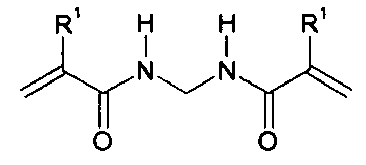
Verdicker 12 Synthetische Verdickungsmittel aus Copolymeren von 85 bis 95 Gew.-% Acrylsäure, 4 bis 14 Gew.-% Acrylamid und 0,01 bis maximal 1 Gew.-% des (Meth)acrylamidderivats mit Molekulargewichten im Bereich von 100.000 bis 2.000.000 g/mol, in denen die Reste R1 gleich oder verschieden sein können und Methyl oder Wasserstoff bedeuten können. Gesamt 1000 - Der verwendete erfindungsgemäße Photokatalysator war TiO2 in der Anatas-Modifikation im Kern, umgeben von porösem SiO2 als Hülle. Der Durchmesser des Kerns betrug 20-30 nm, die Dicke der Hülle 1 bis 2 nm. Die Menge an Si bezogen auf das gesamte Teilchen betrug 0,9 Gew.-%.
- Der Photokatalysator wurde in das Beschichtungsmaterial eingebracht (gerührt über 20 Minuten bei Ultraturrax 1500 rpm) und mit einem Messer auf einem Textil (Baumwoll-Körper) aufgebracht. Die Dicke der Beschichtung betrug 0,3 mm. Die Schicht wurde 2 Minuten bei 100°C getrocknet und 2 Minuten bei 150°C fixiert.
- Es wurden Blindversuche mit Zusatz von einem Standardphotokatalysator (Degussa P25) durchgeführt.
- Es wurden weiterhin Blindversuche ohne Photokatalysator mit Zusatz von einem Titandioxid-Pigment in der Rutil-Modifikation durchgeführt.
-
Tabelle 7 Herstellung von Textilienbeschichtung II Nr. Inhaltsstoff Funktion Menge in Gew.Teilen 1 Wasser Lösungsmittel 128 2 
Emulgator 2 3 AI(OH)3, Al2O3 Al(OH)3, Al2O3 80 4 Ammoniak (25%) pH-Wert-Regulierung 2 5 Statistische Emulsionscopolymerisats von (in Gew.-Teilen): Ethylacrylate 70 , Butylacrylate 15, Acrylnitril 10, Acrylamid 2,6, Methylolacrylamid 1,9 sind jeweils bezogen auf gesamten Feststoff, mittlerer Partikeldurchmesser (Gewichtsmittel) 180 nm, bestimmt durch Coulter Counter, Tg = 9 °G, Molekulargewicht = 5000. Feststoffgehalt 51 Gew.-% Acrylatdispersion 700 6 Titandioxid Pigment/Photokatalysator 40 7 Poymer auf Basis von: Fixierer 5 


8 
Verdicker 8 Synthetische Verdickungsmittel aus Copolymeren von 85 bis 95 Gew.-% Acrylsäure, 4 bis 14 Gew.-% Acrylamid und 0,01 bis maximal 1 Gew.-% des (Meth)acrylamidderivats mit Molekulargewichten im Bereich von 100.000 bis 2.000.000 g/mol, in denen die Reste R1 gleich oder verschieden sein können und Methyl oder Wasserstoff bedeuten können. 9 Dinatrium-4-(octadecilaminno)-4-oxo-2-sulfonatbutyrat, wässrige Lösung, Feststoffgehalt 40 Gew.-%. Schäumermittel 2 10 Ammoniumstearat Schäumermittel 33 Gesamt 1000 - Der verwendete erfindungsgemäße Photokatalysator war TiO2 in der Anatas-Modifikation im Kern, umgeben von porösem SiO2 als Hülle. Der Durchmesser des Kerns beträgt 20-30 nm, die Dicke der Hülle 1 bis 2 nm. Die Menge an Si bezogen auf das gesamte Teilchen betrug 0,8 Gew.-%.
- Der Photokatalysator wurde in das Beschichtungsmaterial eingebracht (gerührt. über 20 Minuten bei Ultraturrax 1500 rpm) und mit einem Messer auf einem Textil (Baumwoll-Körper) aufgebracht. Die Dicke der Beschichtung betrug 1,0 mm. Die Schicht wurde 3 Minuten bei 110°C und 5 Minuten bei 150°C getrocknet.
- Es wurden Blindversuche mit Zusatz von einem Standardphotokatalysator (Degussa P25) durchgeführt.
- Es wurden weiterhin Blindversuche ohne Photokatalysator mit Zusatz von einem Titandioxid-Pigment in der Rutil-Modifikation durchgeführt.
- Die Photoaktivitäten der erfindungsgemäßen Textilbeschichtungen I und II wurden über die Entfärbung von einer Methylenblau-Lösung bestimmt. 10 µL von Methylenblau-Lösungen mit Konzentrationen von 10, 25 und 100 µmol/L wurden auf die beschichtete Oberfläche des Textils aufgebracht. Das so beschichtete Textil wurde jeweils mit UV-Licht (Lichtintensität 1,5 mW/cm2) bestrahlt. Die Entfärbung des Farbstoffs Methylenblau wurde visuell über Zeit beobachtet.
- Es wurden Blindversuche zur Entfärbung des Methylenblaus unter UV-Bestrahlung mit Zusatz von einem Standardphotokatalysator (Degussa P25) durchgeführt.
- Es wurden weiterhin Blindversuche zur Entfärbung des Methylenblaus unter UV-Bestrahlung ohne Photokatalysator mit Zusatz von einem Titandioxid-Pigment in der Rutil-Modifikation durchgeführt.
Textilienprobe Zeit zur vollständigen Entfärbung 10 µmol/L 25 mol/L 100 µmol/L MB-Lösung MB-Lösung MB-Lösung Blindprobe (Textilienbeschichtung II ohne Photokatalysator) 5 Tage 10 Tage Nicht völlig entfärbt Textilbeschichtung II mit Standardkatalysator Degussa P25 1 Stunde 5 Stunden Nicht völlig entfärbt Textilbeschichtung II mit erfindungsgemäßem SiO2-beschichtetem TiO2-Photokatalysator 1 Stunde 3 Stunden 6 Wochen Textilbeschichtung I mit erfindungsgemäßem SiO2-beschichtetem TiO2-Photokatalysator 7 Stunden 3 Tage 9 Wochen
Claims (11)
- Beschichtungsmaterial, umfassend(A) wenigstens ein Bindemittel als Komponente (A) und(B) wenigstens ein photokatalytisch aktives Teilchen, umfassend einen nicht porösen Kern enthaltend wenigstens ein Metall- oder Halbmetalloxid mit einem Durchmesser von 0,1 bis 1 µm und wenigstens eine den Kern zumindest teilweise umgebende poröse Hülle enthaltend wenigstens ein weiteres Metall- oder Halbmetalloxid mit einer mittleren Schichtdicke von 0,1 bis 10 nm als Komponente (B).
- Beschichtungsmaterial nach Anspruch 1, dadurch gekennzeichnet, dass Komponente (A) ausgewählt ist aus der Gruppe bestehend aus auf Wasser und/oder organischen Lösungsmitteln basierenden Kunststoffdispersionen auf Basis von nicht-polymerischen Vernetzungssystemen, Acrylaten, Caprolactam, Vinylcaprolactam, N-Vinylformamid, Acrylestern, Styrol/Acrylestern und Vinylacetaten, Polyurethanen, Epoxidharzen, Alkydharzen und Mischungen davon.
- Beschichtungsmaterial nach Anspruch 1 oder 2, dadurch gekennzeichnet, dass Komponenten (B) einen Kern aus TiO2 und eine Hülle aus SiO2 aufweist.
- Beschichtungsmaterial nach Anspruch 3, dadurch gekennzeichnet, dass das TiO2 im Wesentlichen in der Anatas-Modifikation vorliegt.
- Beschichtungsmaterial nach einem der Ansprüche 1 bis 4, dadurch gekennzeichnet, dass es als Komponente (C) wenigstens ein Pigment ausgewählt aus der Gruppe bestehend aus Titandioxid, Bariumsulfat, Zinkoxid, farbigen Pigmenten, Ruß, Zinkgelb, Zinkgrün, Ultramarin, lumineszierenden oder fluoreszierenden Pigmenten, Azo-, Isoindolinon- und Isoindolin-, Phthalocyanin-, Quinacridon-, Perinon-, Perylen-, Anthraquinon-, Diketopyrrolopyrrol-, Thioindigo-, Dioxazin-, Triphenylmethan-, Quinophthalon-Pigmenten und Mischungen davon enthält.
- Beschichtungsmaterial nach einem der Ansprüche 1 bis 5, dadurch gekennzeichnet, dass Komponente (B) aktiv gegenüber Verunreinigungen und nicht aktiv gegenüber Matrixmaterialien ist.
- Verfahren zur Herstellung eines Beschichtungsmittels nach einem der Ansprüche 1 bis 6, dadurch gekennzeichnet, dass die Komponenten (A) und (B) vermischt werden.
- Verwendung eines Beschichtungsmaterials nach einem der Ansprüche 1 bis 6 zur Beschichtung von metallischen, organischen und anorganischen Materialien für Innen- und Außenanwendungen in der Bauchemie.
- Verwendung eines Beschichtungsmaterials nach einem der Ansprüche 1 bis 6 zur Beschichtung von Textilien.
- Verwendung eines Beschichtungsmaterials nach einem der Ansprüche 1 bis 6 zur Beschichtung von metallischen, organischen und anorganischen Materialien für Innen- und Außenanwendungen für technische Apparate.
- Verwendung eines Beschichtungsmaterials nach einem der Ansprüche 1 bis 6 in Anwendungen, die Schmutzabbau-, deodorisierende-, luftreinigende-, wasserreinigende-. anti-bakterielle-, superhydrophile- und/oder Anti-Beschlag-Wirkungen aufweisen.
Priority Applications (1)
| Application Number | Priority Date | Filing Date | Title |
|---|---|---|---|
| EP08787515A EP2185662B1 (de) | 2007-08-28 | 2008-08-27 | Photoaktives tio2 in beschichtungsmaterialien |
Applications Claiming Priority (3)
| Application Number | Priority Date | Filing Date | Title |
|---|---|---|---|
| EP07115107 | 2007-08-28 | ||
| EP08787515A EP2185662B1 (de) | 2007-08-28 | 2008-08-27 | Photoaktives tio2 in beschichtungsmaterialien |
| PCT/EP2008/061220 WO2009027432A1 (de) | 2007-08-28 | 2008-08-27 | Photoaktives tio2 in beschichtungsmaterialien |
Publications (2)
| Publication Number | Publication Date |
|---|---|
| EP2185662A1 EP2185662A1 (de) | 2010-05-19 |
| EP2185662B1 true EP2185662B1 (de) | 2010-12-22 |
Family
ID=39865561
Family Applications (1)
| Application Number | Title | Priority Date | Filing Date |
|---|---|---|---|
| EP08787515A Revoked EP2185662B1 (de) | 2007-08-28 | 2008-08-27 | Photoaktives tio2 in beschichtungsmaterialien |
Country Status (14)
| Country | Link |
|---|---|
| US (1) | US8283277B2 (de) |
| EP (1) | EP2185662B1 (de) |
| JP (1) | JP2010537033A (de) |
| KR (1) | KR101513755B1 (de) |
| CN (1) | CN101784619B (de) |
| AT (1) | ATE492610T1 (de) |
| AU (1) | AU2008292181C1 (de) |
| BR (1) | BRPI0815627A2 (de) |
| CA (1) | CA2697479C (de) |
| DE (1) | DE502008002107D1 (de) |
| ES (1) | ES2357083T3 (de) |
| MX (1) | MX2010001500A (de) |
| PT (1) | PT2185662E (de) |
| WO (1) | WO2009027432A1 (de) |
Cited By (1)
| Publication number | Priority date | Publication date | Assignee | Title |
|---|---|---|---|---|
| DE102012110319A1 (de) * | 2012-10-29 | 2014-04-30 | Endress + Hauser Gmbh + Co. Kg | Vorrichtung der Automatisierungstechnik mit Umweltfreundlichem Gehäuse |
Families Citing this family (37)
| Publication number | Priority date | Publication date | Assignee | Title |
|---|---|---|---|---|
| TW200704593A (en) * | 2005-04-22 | 2007-02-01 | Dow Corning Toray Co Ltd | Solution or dispersion for substarate surface treatment comprising titanium oxide doped with metallic element, method for substrate surface treatment using the same, and surface-treated material obtained therefrom |
| US9358502B2 (en) * | 2007-08-31 | 2016-06-07 | Cristal Usa Inc. | Photocatalytic coating |
| US20090281207A1 (en) * | 2008-05-06 | 2009-11-12 | John Stratton | De-polluting and self-cleaning epoxy siloxane coating |
| CN102196997A (zh) * | 2008-10-27 | 2011-09-21 | 巴斯夫欧洲公司 | 制备纳米颗粒状金属硼化物悬浮液的方法 |
| WO2010098684A2 (en) * | 2009-02-25 | 2010-09-02 | Uniwersytet Jagielloński | Hybrid photocatalysts, the method of their synthesis and use |
| KR20110120910A (ko) * | 2009-02-26 | 2011-11-04 | 바스프 에스이 | 자가-세정 중합체 |
| US8431220B2 (en) * | 2009-06-05 | 2013-04-30 | Xerox Corporation | Hydrophobic coatings and their processes |
| DE102009034187A1 (de) | 2009-07-22 | 2011-02-03 | Gmbu E.V., Fachsektion Dresden | Waschstabile photokatalytische Textilbeschichtung |
| US9312520B2 (en) | 2009-08-07 | 2016-04-12 | Dai Nippon Printing Co., Ltd. | Electrochemical cell packaging material |
| WO2011059101A1 (ja) * | 2009-11-16 | 2011-05-19 | タムネットワーク株式会社 | 光触媒コーティング |
| PL219301B1 (pl) * | 2010-11-29 | 2015-04-30 | Inst Włókiennictwa | Sposób wytwarzania barierowych materiałów włókienniczych |
| CN102127278B (zh) * | 2010-12-17 | 2012-10-03 | 湖北大学 | 一种透明改性多孔微球/丙烯酸类树脂分散液及其制备方法 |
| KR101346631B1 (ko) | 2011-08-03 | 2014-01-07 | (주)세화피앤씨 | 친수성 방담 필름 |
| CN102372997A (zh) * | 2011-10-11 | 2012-03-14 | 徐梅 | 一种成膜物为聚脂肪酸乙烯醚的涂料 |
| JP2015522678A (ja) * | 2012-07-06 | 2015-08-06 | ビーエーエスエフ ソシエタス・ヨーロピアBasf Se | 水性複合結合剤およびアルキド系の、コーティング剤のための使用 |
| EP2722370B1 (de) * | 2012-10-17 | 2014-05-28 | STO SE & Co. KGaA | Photokatalytische Beschichtungen mit Füllstoffen |
| WO2014097309A1 (en) | 2012-12-17 | 2014-06-26 | Asian Paints Ltd. | Stimuli responsive self cleaning coating |
| CN103992680B (zh) | 2013-02-15 | 2018-05-15 | 罗门哈斯公司 | 烷氧基化的氟烷基磷酸盐组合物 |
| CN103627227B (zh) * | 2013-11-27 | 2015-08-19 | 天津市职业大学 | 一种太阳能玻璃自清洁减反射涂料及其生产方法 |
| KR101979200B1 (ko) * | 2014-10-16 | 2019-05-17 | 주식회사 엘지화학 | 광학 필름 코팅용 조성물 및 이를 포함하는 광학 필름 |
| MX2017001175A (es) * | 2015-06-24 | 2017-03-14 | Am Tech Ltd | Composicion fotocatalitica a base de un aglutinante aereo y uso de esta para la produccion de pinturas a base de agua, en particular para aplicaciones en interiores. |
| US20170102484A1 (en) * | 2015-10-13 | 2017-04-13 | Ford Global Technologies, Llc | Self-cleaning camera lens using photo-catalytic technology |
| CN108701836A (zh) * | 2016-02-29 | 2018-10-23 | 恩亿凯嘉股份有限公司 | 电极用催化剂、气体扩散电极形成用组合物、气体扩散电极、膜电极组件、燃料电池堆 |
| CN106179293A (zh) * | 2016-07-04 | 2016-12-07 | 叶氏化工研发(上海)有限公司 | 一种复合光催化剂及其制备方法和应用 |
| CN107189577A (zh) * | 2017-07-16 | 2017-09-22 | 镇江市神龙电器管件有限公司 | 一种用于铝合金桥架的防火涂料 |
| US11241671B2 (en) * | 2017-09-28 | 2022-02-08 | Sonata Scientific LLC | Monolithic composite photocatalysts |
| US11052385B2 (en) * | 2017-12-06 | 2021-07-06 | Sonata Scientific LLC | Photocatalytic surface systems |
| CN108977068A (zh) * | 2018-05-02 | 2018-12-11 | 安徽沛隆智能机械科技有限公司 | 一种适用于儿童玩具的环保无毒涂料 |
| KR102201165B1 (ko) | 2018-11-16 | 2021-01-12 | 한국생산기술연구원 | 광촉매 자기세정 내지문성 코팅 용액, 그 제조 방법 및 상기 코팅 용액을 이용한 코팅 방법 |
| KR102015274B1 (ko) * | 2019-04-04 | 2019-10-21 | 주식회사 디엠엘이디 | 공기정화 및 탈취 기능을 가지는 분체 도료 조성물, 이를 포함하는 분체 도료 및 이를 포함하는 led 조명장치 |
| KR102160002B1 (ko) * | 2020-02-20 | 2020-09-25 | 주식회사 엔엘씨 | 양자선 제조방법 및 이에 의해 제조된 양자선, 양자직물 |
| CN111849329B (zh) * | 2020-07-10 | 2021-11-02 | 东南大学 | 一种原位调控水性超双疏涂层及其制备方法 |
| CN111718558B (zh) * | 2020-07-30 | 2021-12-03 | 江南大学 | 一种高性能彩色胶结料及其制备方法 |
| CN112516985A (zh) * | 2020-11-12 | 2021-03-19 | 南京国兴环保产业研究院有限公司 | 一种负载光催化剂的超临界发泡材料及其制备方法 |
| KR102596720B1 (ko) * | 2021-04-22 | 2023-11-02 | 주식회사 블루인더스 | 워터 하이드로 차징 공정을 이용한 항균 탈취 헤파 필터의 제조방법 |
| GB202207983D0 (en) * | 2022-05-30 | 2022-07-13 | Univ Of Northumbria At Newcastle | Methods of preparing functional surafces and surfaces prepared thereby |
| WO2024104677A1 (en) * | 2022-11-17 | 2024-05-23 | Basf Coatings Gmbh | Aqueous coating composition comprising an aqueous dispersion of polyamide as thickener |
Family Cites Families (19)
| Publication number | Priority date | Publication date | Assignee | Title |
|---|---|---|---|---|
| JPH05228873A (ja) * | 1992-02-21 | 1993-09-07 | Sony Corp | 真空チャック |
| JPH105598A (ja) * | 1996-06-27 | 1998-01-13 | Ishihara Sangyo Kaisha Ltd | 光触媒粉体およびそれを用いた光触媒体ならびにそれらの製造方法、それらを用いた環境浄化方法 |
| JPH1157494A (ja) * | 1996-08-26 | 1999-03-02 | Sekisui Chem Co Ltd | マイクロカプセル状光触媒体及びその製造方法、塗料組成物、樹脂組成物並びに樹脂体 |
| WO1998011913A1 (en) | 1996-09-16 | 1998-03-26 | Dalhousie University | Use of igf-i for the treatment of polycystic kidney disease and related indications |
| AU3360897A (en) | 1997-07-04 | 1999-01-25 | Universiteit Utrecht | A metal particle, its preparation and use, and a material or device comprising the metal particle |
| JPH11181339A (ja) | 1997-12-22 | 1999-07-06 | Toto Ltd | 親水性コ−ティング組成物 |
| JPH11197515A (ja) * | 1998-01-07 | 1999-07-27 | Sekisui Chem Co Ltd | 光触媒活性を有する機能材料 |
| JP3766900B2 (ja) | 1998-02-16 | 2006-04-19 | イサム塗料株式会社 | 二酸化チタン光触媒含有塗料組成物 |
| JP2000204287A (ja) * | 1998-11-09 | 2000-07-25 | Takenaka Komuten Co Ltd | 低汚染性塗料組成物 |
| EP1089093B1 (de) * | 1999-09-28 | 2008-04-02 | FUJIFILM Corporation | Antireflexbeschichtung, damit versehene Polarisationsplatte, und Bildanzeigegerät mit der Antireflexbeschichtung oder mit der Polarisationsplatte |
| JP2001269573A (ja) * | 2000-03-24 | 2001-10-02 | Titan Kogyo Kk | 光触媒粒子及びその製造方法並びにその用途 |
| DE10260718A1 (de) * | 2002-12-23 | 2004-07-08 | Degussa Ag | Mit Siliziumdioxid umhülltes Titandioxid |
| WO2004062799A1 (ja) * | 2003-01-09 | 2004-07-29 | Showa Denko K.K. | 複合粒子およびその製造方法と用途 |
| JP3772217B2 (ja) | 2003-07-07 | 2006-05-10 | 独立行政法人物質・材料研究機構 | 多孔質酸化物超薄膜および該超薄膜をシェル、ポリマーをコアとするコア・シェル粒子と該コア・シェル粒子から誘導されてなる多孔質中空酸化物シェル構造体およびこれらの製造方法 |
| DE102004018338A1 (de) | 2004-04-15 | 2005-11-10 | Sto Ag | Beschichtungsmaterial |
| JP2006181490A (ja) | 2004-12-28 | 2006-07-13 | Shiima Denshi Kk | 非水系溶媒を使用した塗料の塗装方法 |
| JP4647334B2 (ja) | 2005-02-22 | 2011-03-09 | 日本曹達株式会社 | 光触媒液体組成物 |
| FR2884111B1 (fr) * | 2005-04-07 | 2007-05-18 | Saint Gobain Mat Constr Sas | Granule biocide, notamment pour la fabrication de bardeau d'asphalte |
| TWI419934B (zh) * | 2005-12-13 | 2013-12-21 | Asahi Kasei Chemicals Corp | 水系有機.無機複合組成物 |
-
2008
- 2008-08-27 AU AU2008292181A patent/AU2008292181C1/en not_active Ceased
- 2008-08-27 CA CA2697479A patent/CA2697479C/en not_active Expired - Fee Related
- 2008-08-27 DE DE502008002107T patent/DE502008002107D1/de active Active
- 2008-08-27 MX MX2010001500A patent/MX2010001500A/es active IP Right Grant
- 2008-08-27 PT PT08787515T patent/PT2185662E/pt unknown
- 2008-08-27 KR KR1020107006769A patent/KR101513755B1/ko not_active Expired - Fee Related
- 2008-08-27 JP JP2010522359A patent/JP2010537033A/ja active Pending
- 2008-08-27 US US12/675,300 patent/US8283277B2/en not_active Expired - Fee Related
- 2008-08-27 EP EP08787515A patent/EP2185662B1/de not_active Revoked
- 2008-08-27 CN CN2008801044368A patent/CN101784619B/zh not_active Expired - Fee Related
- 2008-08-27 ES ES08787515T patent/ES2357083T3/es active Active
- 2008-08-27 WO PCT/EP2008/061220 patent/WO2009027432A1/de not_active Ceased
- 2008-08-27 BR BRPI0815627-1A2A patent/BRPI0815627A2/pt not_active IP Right Cessation
- 2008-08-27 AT AT08787515T patent/ATE492610T1/de active
Cited By (1)
| Publication number | Priority date | Publication date | Assignee | Title |
|---|---|---|---|---|
| DE102012110319A1 (de) * | 2012-10-29 | 2014-04-30 | Endress + Hauser Gmbh + Co. Kg | Vorrichtung der Automatisierungstechnik mit Umweltfreundlichem Gehäuse |
Also Published As
| Publication number | Publication date |
|---|---|
| KR20100075869A (ko) | 2010-07-05 |
| EP2185662A1 (de) | 2010-05-19 |
| PT2185662E (pt) | 2011-01-27 |
| CA2697479C (en) | 2015-06-23 |
| AU2008292181A1 (en) | 2009-03-05 |
| US20100311572A1 (en) | 2010-12-09 |
| JP2010537033A (ja) | 2010-12-02 |
| MX2010001500A (es) | 2010-03-10 |
| KR101513755B1 (ko) | 2015-04-21 |
| AU2008292181C1 (en) | 2014-04-10 |
| WO2009027432A1 (de) | 2009-03-05 |
| AU2008292181B2 (en) | 2013-09-26 |
| CN101784619B (zh) | 2012-11-28 |
| BRPI0815627A2 (pt) | 2015-02-18 |
| CN101784619A (zh) | 2010-07-21 |
| CA2697479A1 (en) | 2009-03-05 |
| ES2357083T3 (es) | 2011-04-18 |
| DE502008002107D1 (de) | 2011-02-03 |
| ATE492610T1 (de) | 2011-01-15 |
| US8283277B2 (en) | 2012-10-09 |
Similar Documents
| Publication | Publication Date | Title |
|---|---|---|
| EP2185662B1 (de) | Photoaktives tio2 in beschichtungsmaterialien | |
| DE60123369T2 (de) | Nahe-Infrarotstrahlung reflektierende Kompositpigmente | |
| EP1379725B1 (de) | Textile flächengebilde mit selbstreinigender und wasserabweisender oberfläche | |
| EP2102406B1 (de) | Verfahren und Verwendung einer Ausrüstungsformulierung zur hydrophoben Ausrüstung von fasrigen Substraten | |
| EP3080207B1 (de) | Calciumphosphat-haltige titandioxid-kompositpigmente und verfahren zu ihrer herstellung | |
| EP3368613A1 (de) | Mattierungsmittel und verfahren zur herstellung | |
| WO2008065208A1 (de) | Transparentes zinksulfid grosser spezifischer oberfläche | |
| EP1697434A1 (de) | Mit polyadditionsprodukten umhüllte pigmente, verfahren zu ihrer herstellung und ihre verwendung | |
| EP2771410B1 (de) | Behandelte anorganische pigmente mit verbesserten dispergierungseigenschaften und ihre verwendung in beschichtungszusammensetzungen | |
| WO2016142042A1 (de) | Aluminiumhydroxid-haltige kompositpigmente und verfahren zu ihrer herstellung | |
| DE102012004138B3 (de) | Verwendung einer zinkoxidhaltigen Fritte als UV-Schutzpigment | |
| EP2393883B1 (de) | Mit phosphonocarbonsäure modifizierte zinkoxid-partikel und verwendung von zinkoxid-partikeln | |
| CN107141886A (zh) | 一种用于深色面料的白色数码喷墨墨水 | |
| DE102005013259B4 (de) | Photokatalytisch wirkender Bautenanstrichsstoff und seine Verwendung | |
| DE602005000423T2 (de) | Wasserfreies Zinkantimonat-Sol und Verfahren zu seiner Herstellung | |
| US9228090B2 (en) | Treated inorganic pigments having reduced photoactivity and improved anti-microbial properties and their use in coating compositions | |
| EP1751346A1 (de) | Verfahren zur herstellung von strukturierten oberflächen | |
| EP2016155A1 (de) | Wasserbasierende flammschutzmitteldispersionen | |
| DE2439549B2 (de) | Weißpigmente oder weiße Füllstoffe enthaltende Luftporenlacke | |
| DE10249453A1 (de) | Strukturierte Oberflächen mit Erhebungen und Vertiefungen, Verfahren zur Herstellung solcher Oberflächen sowie deren Verwendung | |
| DE102010005973A1 (de) | Wässrige Dispersionsfarben enthaltend Milchsäureester als Filmbildehilfsmittel | |
| EP1146091B1 (de) | Verfahren zur Herstellung von Farbmitteln | |
| EP3697855B1 (de) | Silanfunktionalisierte faserbasierte beschichtungszusammensetzung und verfahren zu ihrer herstellung | |
| EP1783552B1 (de) | Photopolymerisierbare Zusammensetzung zur Herstellung von Druckformen | |
| DE102010009002A1 (de) | Anatas-haltiges wasserbasiertes Beschichtungsmittel und dessen Anwendung zur Herstellung von photoaktiven Textilien |
Legal Events
| Date | Code | Title | Description |
|---|---|---|---|
| PUAI | Public reference made under article 153(3) epc to a published international application that has entered the european phase |
Free format text: ORIGINAL CODE: 0009012 |
|
| 17P | Request for examination filed |
Effective date: 20100329 |
|
| AK | Designated contracting states |
Kind code of ref document: A1 Designated state(s): AT BE BG CH CY CZ DE DK EE ES FI FR GB GR HR HU IE IS IT LI LT LU LV MC MT NL NO PL PT RO SE SI SK TR |
|
| AX | Request for extension of the european patent |
Extension state: AL BA MK RS |
|
| GRAP | Despatch of communication of intention to grant a patent |
Free format text: ORIGINAL CODE: EPIDOSNIGR1 |
|
| DAX | Request for extension of the european patent (deleted) | ||
| GRAS | Grant fee paid |
Free format text: ORIGINAL CODE: EPIDOSNIGR3 |
|
| GRAA | (expected) grant |
Free format text: ORIGINAL CODE: 0009210 |
|
| AK | Designated contracting states |
Kind code of ref document: B1 Designated state(s): AT BE BG CH CY CZ DE DK EE ES FI FR GB GR HR HU IE IS IT LI LT LU LV MC MT NL NO PL PT RO SE SI SK TR |
|
| REG | Reference to a national code |
Ref country code: GB Ref legal event code: FG4D Free format text: NOT ENGLISH |
|
| REG | Reference to a national code |
Ref country code: CH Ref legal event code: EP |
|
| REG | Reference to a national code |
Ref country code: IE Ref legal event code: FG4D |
|
| REG | Reference to a national code |
Ref country code: PT Ref legal event code: SC4A Free format text: AVAILABILITY OF NATIONAL TRANSLATION Effective date: 20110120 |
|
| REF | Corresponds to: |
Ref document number: 502008002107 Country of ref document: DE Date of ref document: 20110203 Kind code of ref document: P |
|
| REG | Reference to a national code |
Ref country code: DE Ref legal event code: R096 Ref document number: 502008002107 Country of ref document: DE Effective date: 20110203 |
|
| REG | Reference to a national code |
Ref country code: NL Ref legal event code: T3 |
|
| REG | Reference to a national code |
Ref country code: ES Ref legal event code: FG2A Ref document number: 2357083 Country of ref document: ES Kind code of ref document: T3 Effective date: 20110418 |
|
| PG25 | Lapsed in a contracting state [announced via postgrant information from national office to epo] |
Ref country code: LT Free format text: LAPSE BECAUSE OF FAILURE TO SUBMIT A TRANSLATION OF THE DESCRIPTION OR TO PAY THE FEE WITHIN THE PRESCRIBED TIME-LIMIT Effective date: 20101222 |
|
| LTIE | Lt: invalidation of european patent or patent extension |
Effective date: 20101222 |
|
| PG25 | Lapsed in a contracting state [announced via postgrant information from national office to epo] |
Ref country code: FI Free format text: LAPSE BECAUSE OF FAILURE TO SUBMIT A TRANSLATION OF THE DESCRIPTION OR TO PAY THE FEE WITHIN THE PRESCRIBED TIME-LIMIT Effective date: 20101222 Ref country code: HR Free format text: LAPSE BECAUSE OF FAILURE TO SUBMIT A TRANSLATION OF THE DESCRIPTION OR TO PAY THE FEE WITHIN THE PRESCRIBED TIME-LIMIT Effective date: 20101222 Ref country code: BG Free format text: LAPSE BECAUSE OF FAILURE TO SUBMIT A TRANSLATION OF THE DESCRIPTION OR TO PAY THE FEE WITHIN THE PRESCRIBED TIME-LIMIT Effective date: 20110322 Ref country code: CY Free format text: LAPSE BECAUSE OF FAILURE TO SUBMIT A TRANSLATION OF THE DESCRIPTION OR TO PAY THE FEE WITHIN THE PRESCRIBED TIME-LIMIT Effective date: 20101222 Ref country code: SI Free format text: LAPSE BECAUSE OF FAILURE TO SUBMIT A TRANSLATION OF THE DESCRIPTION OR TO PAY THE FEE WITHIN THE PRESCRIBED TIME-LIMIT Effective date: 20101222 Ref country code: LV Free format text: LAPSE BECAUSE OF FAILURE TO SUBMIT A TRANSLATION OF THE DESCRIPTION OR TO PAY THE FEE WITHIN THE PRESCRIBED TIME-LIMIT Effective date: 20101222 Ref country code: SE Free format text: LAPSE BECAUSE OF FAILURE TO SUBMIT A TRANSLATION OF THE DESCRIPTION OR TO PAY THE FEE WITHIN THE PRESCRIBED TIME-LIMIT Effective date: 20101222 |
|
| REG | Reference to a national code |
Ref country code: IE Ref legal event code: FD4D |
|
| PG25 | Lapsed in a contracting state [announced via postgrant information from national office to epo] |
Ref country code: EE Free format text: LAPSE BECAUSE OF FAILURE TO SUBMIT A TRANSLATION OF THE DESCRIPTION OR TO PAY THE FEE WITHIN THE PRESCRIBED TIME-LIMIT Effective date: 20101222 Ref country code: CZ Free format text: LAPSE BECAUSE OF FAILURE TO SUBMIT A TRANSLATION OF THE DESCRIPTION OR TO PAY THE FEE WITHIN THE PRESCRIBED TIME-LIMIT Effective date: 20101222 Ref country code: NO Free format text: LAPSE BECAUSE OF FAILURE TO SUBMIT A TRANSLATION OF THE DESCRIPTION OR TO PAY THE FEE WITHIN THE PRESCRIBED TIME-LIMIT Effective date: 20110322 Ref country code: IS Free format text: LAPSE BECAUSE OF FAILURE TO SUBMIT A TRANSLATION OF THE DESCRIPTION OR TO PAY THE FEE WITHIN THE PRESCRIBED TIME-LIMIT Effective date: 20110422 |
|
| PG25 | Lapsed in a contracting state [announced via postgrant information from national office to epo] |
Ref country code: SK Free format text: LAPSE BECAUSE OF FAILURE TO SUBMIT A TRANSLATION OF THE DESCRIPTION OR TO PAY THE FEE WITHIN THE PRESCRIBED TIME-LIMIT Effective date: 20101222 Ref country code: PL Free format text: LAPSE BECAUSE OF FAILURE TO SUBMIT A TRANSLATION OF THE DESCRIPTION OR TO PAY THE FEE WITHIN THE PRESCRIBED TIME-LIMIT Effective date: 20101222 |
|
| PLBI | Opposition filed |
Free format text: ORIGINAL CODE: 0009260 |
|
| 26 | Opposition filed |
Opponent name: KRONOS INTERNATIONAL, INC. Effective date: 20110920 Opponent name: SACHTLEBEN CHEMIE GMBH Effective date: 20110921 |
|
| PG25 | Lapsed in a contracting state [announced via postgrant information from national office to epo] |
Ref country code: IE Free format text: LAPSE BECAUSE OF FAILURE TO SUBMIT A TRANSLATION OF THE DESCRIPTION OR TO PAY THE FEE WITHIN THE PRESCRIBED TIME-LIMIT Effective date: 20101222 Ref country code: DK Free format text: LAPSE BECAUSE OF FAILURE TO SUBMIT A TRANSLATION OF THE DESCRIPTION OR TO PAY THE FEE WITHIN THE PRESCRIBED TIME-LIMIT Effective date: 20101222 |
|
| PLAX | Notice of opposition and request to file observation + time limit sent |
Free format text: ORIGINAL CODE: EPIDOSNOBS2 |
|
| REG | Reference to a national code |
Ref country code: DE Ref legal event code: R026 Ref document number: 502008002107 Country of ref document: DE Effective date: 20110920 |
|
| PG25 | Lapsed in a contracting state [announced via postgrant information from national office to epo] |
Ref country code: MT Free format text: LAPSE BECAUSE OF FAILURE TO SUBMIT A TRANSLATION OF THE DESCRIPTION OR TO PAY THE FEE WITHIN THE PRESCRIBED TIME-LIMIT Effective date: 20101222 |
|
| PG25 | Lapsed in a contracting state [announced via postgrant information from national office to epo] |
Ref country code: MC Free format text: LAPSE BECAUSE OF NON-PAYMENT OF DUE FEES Effective date: 20110831 |
|
| PLBB | Reply of patent proprietor to notice(s) of opposition received |
Free format text: ORIGINAL CODE: EPIDOSNOBS3 |
|
| REG | Reference to a national code |
Ref country code: GR Ref legal event code: ML Ref document number: 20110400143 Country of ref document: GR Effective date: 20120302 |
|
| PG25 | Lapsed in a contracting state [announced via postgrant information from national office to epo] |
Ref country code: GR Free format text: LAPSE BECAUSE OF NON-PAYMENT OF DUE FEES Effective date: 20120302 |
|
| REG | Reference to a national code |
Ref country code: PT Ref legal event code: MM4A Free format text: LAPSE DUE TO NON-PAYMENT OF FEES Effective date: 20120528 |
|
| PG25 | Lapsed in a contracting state [announced via postgrant information from national office to epo] |
Ref country code: PT Free format text: LAPSE BECAUSE OF NON-PAYMENT OF DUE FEES Effective date: 20120528 |
|
| REG | Reference to a national code |
Ref country code: CH Ref legal event code: PL |
|
| PG25 | Lapsed in a contracting state [announced via postgrant information from national office to epo] |
Ref country code: LI Free format text: LAPSE BECAUSE OF NON-PAYMENT OF DUE FEES Effective date: 20120831 Ref country code: CH Free format text: LAPSE BECAUSE OF NON-PAYMENT OF DUE FEES Effective date: 20120831 |
|
| PG25 | Lapsed in a contracting state [announced via postgrant information from national office to epo] |
Ref country code: LU Free format text: LAPSE BECAUSE OF NON-PAYMENT OF DUE FEES Effective date: 20110827 |
|
| PG25 | Lapsed in a contracting state [announced via postgrant information from national office to epo] |
Ref country code: TR Free format text: LAPSE BECAUSE OF FAILURE TO SUBMIT A TRANSLATION OF THE DESCRIPTION OR TO PAY THE FEE WITHIN THE PRESCRIBED TIME-LIMIT Effective date: 20101222 |
|
| PG25 | Lapsed in a contracting state [announced via postgrant information from national office to epo] |
Ref country code: HU Free format text: LAPSE BECAUSE OF FAILURE TO SUBMIT A TRANSLATION OF THE DESCRIPTION OR TO PAY THE FEE WITHIN THE PRESCRIBED TIME-LIMIT Effective date: 20101222 |
|
| RDAF | Communication despatched that patent is revoked |
Free format text: ORIGINAL CODE: EPIDOSNREV1 |
|
| APBM | Appeal reference recorded |
Free format text: ORIGINAL CODE: EPIDOSNREFNO |
|
| APBP | Date of receipt of notice of appeal recorded |
Free format text: ORIGINAL CODE: EPIDOSNNOA2O |
|
| APAH | Appeal reference modified |
Free format text: ORIGINAL CODE: EPIDOSCREFNO |
|
| APBQ | Date of receipt of statement of grounds of appeal recorded |
Free format text: ORIGINAL CODE: EPIDOSNNOA3O |
|
| PG25 | Lapsed in a contracting state [announced via postgrant information from national office to epo] |
Ref country code: RO Free format text: LAPSE BECAUSE OF FAILURE TO SUBMIT A TRANSLATION OF THE DESCRIPTION OR TO PAY THE FEE WITHIN THE PRESCRIBED TIME-LIMIT Effective date: 20101222 |
|
| REG | Reference to a national code |
Ref country code: AT Ref legal event code: MM01 Ref document number: 492610 Country of ref document: AT Kind code of ref document: T Effective date: 20130827 |
|
| PGFP | Annual fee paid to national office [announced via postgrant information from national office to epo] |
Ref country code: NL Payment date: 20140822 Year of fee payment: 7 |
|
| PG25 | Lapsed in a contracting state [announced via postgrant information from national office to epo] |
Ref country code: AT Free format text: LAPSE BECAUSE OF NON-PAYMENT OF DUE FEES Effective date: 20130827 |
|
| PGFP | Annual fee paid to national office [announced via postgrant information from national office to epo] |
Ref country code: ES Payment date: 20140926 Year of fee payment: 7 Ref country code: FR Payment date: 20140828 Year of fee payment: 7 Ref country code: GB Payment date: 20140829 Year of fee payment: 7 |
|
| PGFP | Annual fee paid to national office [announced via postgrant information from national office to epo] |
Ref country code: IT Payment date: 20140821 Year of fee payment: 7 |
|
| PGFP | Annual fee paid to national office [announced via postgrant information from national office to epo] |
Ref country code: DE Payment date: 20141031 Year of fee payment: 7 |
|
| PGFP | Annual fee paid to national office [announced via postgrant information from national office to epo] |
Ref country code: BE Payment date: 20140929 Year of fee payment: 7 |
|
| REG | Reference to a national code |
Ref country code: DE Ref legal event code: R064 Ref document number: 502008002107 Country of ref document: DE Ref country code: DE Ref legal event code: R103 Ref document number: 502008002107 Country of ref document: DE |
|
| APBU | Appeal procedure closed |
Free format text: ORIGINAL CODE: EPIDOSNNOA9O |
|
| RDAG | Patent revoked |
Free format text: ORIGINAL CODE: 0009271 |
|
| STAA | Information on the status of an ep patent application or granted ep patent |
Free format text: STATUS: PATENT REVOKED |
|
| 27W | Patent revoked |
Effective date: 20151019 |
|
| GBPR | Gb: patent revoked under art. 102 of the ep convention designating the uk as contracting state |
Effective date: 20151019 |
|
| REG | Reference to a national code |
Ref country code: GR Ref legal event code: EP Ref document number: 20110400143 Country of ref document: GR Effective date: 20110218 |
|
| PG25 | Lapsed in a contracting state [announced via postgrant information from national office to epo] |
Ref country code: IT Free format text: LAPSE BECAUSE OF NON-PAYMENT OF DUE FEES Effective date: 20150827 |
|
| REG | Reference to a national code |
Ref country code: AT Ref legal event code: MA03 Ref document number: 492610 Country of ref document: AT Kind code of ref document: T Effective date: 20151019 |
|
| PG25 | Lapsed in a contracting state [announced via postgrant information from national office to epo] |
Ref country code: ES Free format text: LAPSE BECAUSE OF NON-PAYMENT OF DUE FEES Effective date: 20150828 |