EP2186239B1 - Rate-adaptive forward error correction for optical transport systems - Google Patents
Rate-adaptive forward error correction for optical transport systems Download PDFInfo
- Publication number
- EP2186239B1 EP2186239B1 EP08794805.5A EP08794805A EP2186239B1 EP 2186239 B1 EP2186239 B1 EP 2186239B1 EP 08794805 A EP08794805 A EP 08794805A EP 2186239 B1 EP2186239 B1 EP 2186239B1
- Authority
- EP
- European Patent Office
- Prior art keywords
- ots
- rate
- optical
- fec
- performance margin
- Prior art date
- Legal status (The legal status is an assumption and is not a legal conclusion. Google has not performed a legal analysis and makes no representation as to the accuracy of the status listed.)
- Active
Links
Images
Classifications
-
- H—ELECTRICITY
- H04—ELECTRIC COMMUNICATION TECHNIQUE
- H04L—TRANSMISSION OF DIGITAL INFORMATION, e.g. TELEGRAPHIC COMMUNICATION
- H04L1/00—Arrangements for detecting or preventing errors in the information received
- H04L1/0001—Systems modifying transmission characteristics according to link quality, e.g. power backoff
- H04L1/0009—Systems modifying transmission characteristics according to link quality, e.g. power backoff by adapting the channel coding
-
- H—ELECTRICITY
- H04—ELECTRIC COMMUNICATION TECHNIQUE
- H04L—TRANSMISSION OF DIGITAL INFORMATION, e.g. TELEGRAPHIC COMMUNICATION
- H04L1/00—Arrangements for detecting or preventing errors in the information received
- H04L1/0001—Systems modifying transmission characteristics according to link quality, e.g. power backoff
- H04L1/0015—Systems modifying transmission characteristics according to link quality, e.g. power backoff characterised by the adaptation strategy
Definitions
- the present invention relates to optical transport systems (OTSs) and, more specifically, to improving capacity and/or cost effectiveness of an OTS during its lifespan through utilization of rate-adaptive forward error correction (FEC).
- OTSs optical transport systems
- FEC rate-adaptive forward error correction
- WDM wavelength division multiplexing
- SONET synchronous optical network
- each WDM channel is generally required to guarantee a relatively low output bit error rate (BER), typically of the order of 10 -16 . Since the QoS requirements are expected to be met during the entire life of the OTS, a substantial initial performance margin is allocated to each WDM channel at the deployment stage in order to accommodate the subsequent loss of performance margin due to the aging of system components (e.g., optical transmitters, amplifiers, receivers, filters, and multiplexers/demultiplexers) and general degradation in the condition of the optical link.
- the performance margin is usually defined as the difference, in decibels (dB), between the actual signal quality (Q-factor) and the threshold Q-factor at which the system is considered to have just barely acceptable performance.
- the Q-factor is 9.8 dB. Since the typical loss of the performance margin due to aging is about 4 dB over about 20 years (a typical lifespan specified by optical network/system operators), a current OTS is often configured to have an extra performance margin of about 4 dB at the beginning of life (BOL) of the system to guarantee reliable operation over its lifespan.
- the performance margin for a given transmission link between two optical transponders depends on the condition of the transmission link, such as the optical signal-to-noise-ratio (OSNR) after signal transmission, chromatic dispersion (CD) and polarization-mode dispersion (PMD) characteristics, WDM crosstalk, and optical filtering penalties.
- OSNR optical signal-to-noise-ratio
- CD chromatic dispersion
- PMD polarization-mode dispersion
- WDM crosstalk optical filtering penalties.
- the OSNR after signal transmission further depends on signal attenuation in the optical fiber, signal power, and optical amplification. It is not unusual that, at a given time, different WDM channels have different performance margins.
- the performance margin for the WDM channel can vary significantly (e.g., go up and down) over time. This variation may adversely affect the overall throughput of the OTS and/or require the initial extra performance margin to be further increased above the aging-accommodation value of about 4 dB.
- a representative embodiment of the invention provides an optical transport system (OTS) having a plurality of optical transponders (OTs) connected via one or more optical links and adapted to communicate with one another using respective rate-adaptive forward-error-correction (FEC) codes.
- the OTS has a rate control unit (RCU) adapted to configure the OTs to dynamically adjust the rates of the FEC codes based on an estimated performance margin for each link between two respective communicating OTs to optimize the overall capacity of the OTS while maintaining an adequate, but not excessive, overall system margin.
- RCU rate control unit
- the extent of system-resource underutilization in an OTS of the invention is significantly reduced compared to that in a comparable prior-art OTS.
- an optical transport system of the invention comprises: (A) a plurality of optical transponders (OTs) connected via one or more optical links and (B) a rate control unit (RCU). At least first and second OTs of said plurality are adapted to communicate with one another using a rate-adaptive forward-error-correction (FEC) code.
- the RCU is adapted to (i) estimate a performance margin for an optical link between the first and second OTs and (ii) configure the first and second OTs to change a rate of the FEC code based on the estimated performance margin.
- a method of operating an optical transport system of the invention comprises the steps of: (A) estimating a performance margin for an optical link between at least first and second optical transponders (OTs) of a plurality of OTs connected via one or more optical links, wherein the first and second OTs are adapted to communicate with one another using a rate-adaptive forward-error-correction (FEC) code; and (B) configuring the first and second OTs to change a rate of the FEC code based on the estimated performance margin.
- FEC forward-error-correction
- FEC Forward error correction
- RS Random-Solomon
- BCH Bose-Chaudhuri-Hocquenghem
- R C (1 + R O ) -1 .
- a major benefit of using FEC is that the performance margin of a signal channel can be increased significantly.
- a typical RS FEC code with a 7% overhead can reduce the BER from about 6 ⁇ 10 -5 before correction to less than about 10 -16 after the correction, thereby effectively increasing the performance margin by about 6.5 dB.
- a low-density parity-check (LDPC) FEC code with a 7% overhead can reduce the BER from about 1 ⁇ 10 -3 before correction to less than about 10 -16 after the correction, thereby increasing the performance margin by about 8.5 dB. It is feasible to further increase the performance margin of an FEC code based on the use of soft-decoding or other suitable advanced decoding techniques.
- LDPC FEC codes are described in the following publications: (1) U.S. Patent Application Publication No. 2007/0113147 ; (2) J. Hagenauer, "Rate-Compatible Punctured Convolutional Codes (RCPC Codes) and Their Applications," IEEE Trans. Commun., vol. 36, no. 4, pp.389-400, Apr. 1988 ; (3) M. R. Yazdani and A. H. Banihashemi, "On Construction of Rate-Compatible Low-Density Parity-Check Codes," IEEE Commun. Letters, vol. 8, no. 3, pp. 159-161, Mar. 2004 ; and (4) N. Chen, Y. Chang, and D. Yang, "Generation of Rate-Compatible LDPC Codes Based on Linear Transformation,” Communications and Electronics, ICCE -- First International Conference, Oct. 2006, pp. 311-314 .
- FEC In optical communications, FEC is used, for example, in (i) long-haul OTSs to reduce the number of 3R (re-time, re-shape, re-transmit) regenerators and (ii) wavelength division multiplexing (WDM) systems to increase the data rates of individual WDM channels.
- SONET synchronous optical network
- SDH synchronous digital hierarchy
- RS and LDPC FEC codes for transmission of on-off-keyed (OOK) and differential phase-shift keyed (DPSK) optical signals is disclosed, e.g., in an article by G. Kramer, A.
- the European patent application EP 1 278 325 A2 discloses an optical transmission system in which the optical transmission power is ramped up to compensate for link degradation (caused for instance by ageing) such that an acceptable bit error rate is maintained at the receiver.
- the system uses adaptive performance margin thresholds during path set-up and monitoring, respectively, taking into account ageing effects. If the Q factor of an established path falls below a respective threshold, a regenerator is switched into the path or another path is assigned.
- corrected BER the BER after FEC decoding (hereafter termed "corrected BER") that is specified as acceptable for an optical transport system (OTS) is 10 -16 , meaning that, on average, one bit error is considered tolerable per 10 16 decoded information bits. This further means that the probability of an error event is even lower than that, because the output of an FEC code typically gives multiple errors if the error correcting capabilities of the code are exceeded.
- OTS optical transport system
- a prior-art OTS employing an RS FEC code might be configured to have a BER before correction of at least about 10 -9 to provide an extra performance margin of about 4 dB over the corresponding BER threshold of 6 ⁇ 10 -5 to accommodate the performance-margin loss due to system aging.
- an OTS in which an FEC coding gain can be adjusted as needed over the lifespan of the OTS to maintain a performance margin that is sufficient but not excessive for the current condition of the OTS.
- a relatively high FEC-code rate (relatively small FEC overhead rate) can be used to provide just enough coding gain for the OTS to have an adequate performance margin.
- the FEC-code rate can be lowered (the FEC overhead rate can be raised) to provide more coding gain and compensate for the loss of performance margin.
- FEC rate adjustments can be made during a reconfiguration of the OTS to accommodate changes in the condition of the transmission link.
- optical signal rate for a given WDM channel remains fixed, e.g., at 10 or 40 Gb/s, so that no hardware changes, e.g., in the clock and data recovery (CDR) circuitry, are needed, and the effects of transmission impediments, such as chromatic dispersion, polarization-mode dispersion, fiber nonlinearity, and optical filtering, remain unaffected by the code-rate adjustments.
- CDR clock and data recovery
- the OTS can advantageously maintain an adequate, but not excessive, performance margin throughout its entire lifespan and possible network reconfigurations.
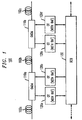
- Fig. 1 shows a block diagram of an OTS 100 according to one embodiment of the invention.
- OTS 100 is connected to an external optical transport network via optical links (e.g., optical fibers) 102a and 102c and is illustratively shown as having optical add-drop multiplexers (OADMs) 110a-b connected to one another via an optical link (e.g., an optical fiber) 102b .
- Each OADM 110 can add and/or drop optical signals originating from and/or directed to the respective optical transponders (OTs) 120 .
- OTs 120a,c are configured to receive optical signals dropped by OADMs 110a-b, respectively, from a WDM multiplex transported by OTS 100 .
- OTs 120b,d are configured to generate optical signals for addition through OADMs 110a-b, respectively, to the WDM multiplex.
- Each of OTs 120a-d is adapted to use rate-adaptive FEC (RAF). More specifically, for at least one WDM channel, OT 120 utilizes an FEC code whose rate R C can be adjusted as needed, while the optical signal rate remains fixed (unchanged). In one embodiment, OT 120 is configured to use a rate-compatible RS FEC code, whose rate R C can be set to any of the following values: 15/16, 7/8, 3/4, and 1/2, which translates into gross coding gains of about 6.2, 7.6, 8.9, and 10.2 dB, respectively.
- RAF rate-adaptive FEC
- OT 120 is configured to use an LDPC FEC code, whose rate R C is selectable from the following values: 15/16, 7/8, 3/4, 1/2, and 3/8, for obtaining gross coding gains of about 8, 9, 10.5, 12, and 13.5 dB, respectively.
- the FEC-code rate used by each of OTs 120a-d is controlled by a rate control unit (RCU) 130 .
- RCU 130 by running an FEC code and detecting and correcting errors, an OT 120 is able to provide BER information to RCU 130 .
- RCU 130 By collecting and analyzing BER information from various OTs 120, RCU 130 is able to determine the present performance margin for each optical link and/or WDM channel. If RCU 130 determines that the present performance margin is adequate, then no action is taken by the RCU. However, if RCU 130 determines that the present performance margin has fallen below a predetermined threshold value, then the RCU configures the appropriate ones of OTs 120 to change their respective FEC-code rates.
- RCU 130 is adapted to select the highest possible rate of the FEC code that provides an acceptable performance margin for the transmission link between the two communicating OTs.
- the resulting change in the gross coding gain translates into an increase in the performance margin of about 1 dB, which might be sufficient to overcome the shortfall.
- RCU 130 can perform FEC-code-rate adjustments based on a predicted performance margin for each of the WDM channels between two communicating OTs.
- the predicted performance margin can be deduced from the conditions of the optical transmission link between the two communicating OTs. These conditions are described by a plurality of parameters, such as the length of the link, the optical signal-to-noise-ratio (OSNR) after transmission over the link, the wavelength of the optical signal being transmitted and received by the two communicating OTs, chromatic dispersion (CD) and polarization-mode dispersion (PMD) characteristics, WDM crosstalk, fiber nonlinear penalty, the optical filtering penalty, and the number of years in service for each of the OTs. Note however that different WDM channels need not have equal FEC-code rates.
- RCU 130 is further adapted to configure two communicating OTs to partition the original information data into data tributaries that are compatible with the synchronous optical network (SONET) standard. More specifically, the partitioned data tributaries can have information rates of about 40 Gb/s (OC768), 10 Gb/s (OC192), 2.5 Gb/s (OC48), 622 Mb/s (OC12), and 155 Mb/s (OC3). Table 1 shows exemplary partitions of 42.7-Gb/s and 10.7-Gb/s optical signals into SONET-compatible data tributaries at different FEC rates.
- SONET synchronous optical network
- RCU 130 is further adapted to configure two communicating OTs to partition the original information data into data tributaries that are compatible with the Ethernet standard. For example, data rates of 10 Gb/s, 1 Gb/s, 100 Mb/s, and 10 Mb/s are compatible with the Ethernet standard (see IEEE Standard 802.3).
- OTS 100 is preferably configured to always transmit redundant bits together with information bits.
- One important reason for this preference is that, in optical transport networks, the distance between a transmitter and a corresponding receiver can be very large, e.g., longer than 100 km, and often on the order of 1,000 km, or even longer than that. Consequently, the latency associated with an ARQ and re-transmission of redundant bits could be disadvantageously large. To avoid this latency, none of OTs 120 is configured to use an ARQ.
- RCU 130 continuously communicates with OTs 120 to be able to adjust the FEC-code rates as needed based on the BER information, optical link condition, and traffic demands.
- an FEC rate adjustment may be needed during a reconfiguration of the transmission link between two communicating OTs, and the desired rate may be "predetermined" based on the predicted link conditions and traffic demand.
- RCU 130 may be configured to adjust FEC-code rates without relying on the current BER information from the OTs.
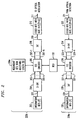
- Fig. 2 shows block diagrams of a receiver data processor (RDP) 220a and a transmitter data processor (TDP) 220b that can be used, e.g., in OTs 120, according to one embodiment of the invention.
- RDP 220a has an optical detector (not explicitly shown in Fig. 2 ) adapted to convert optical signals, e.g., received via a communication link, into the corresponding electrical signals of a bit stream 221 .
- bit stream 221 The bits supplied by bit stream 221 are buffered in a buffer 222 and de-interleaved in a de-interleaver (D-INT) 224 to generate a plurality of bit streams 225-1 through 225-N, each having an N -times lower bit rate than bit stream 221 .
- An FEC decoder 226 receives bit streams 225 and applies an FEC decoding algorithm that matches the FEC encoding algorithm used at the transmitter.
- the output of the decoding algorithm is a plurality of bit streams 227-1 through 227-k that carry the recovered information bits.
- N may be different from or the same as k.
- Bit streams 227 are appropriately interleaved in an interleaver (INT) 228 to generate a bit stream 229 corresponding to the original information-bit stream applied to the transmitter by remote clients.
- Bit stream 229 is stored in a buffer 230, e.g., for further distribution to local clients. Note that further partitioning of information bit stream 229 to SONET-compatible data tributaries according to the partition rules used in the transmitter may be applied. These partition rules depend on the FEC rate, and exemplary partitions are shown in Table 1.
- TDP 220b has a buffer 202 that stores information bits intended for the transmission to a remote receiver having an RDP, such as RDP 220a .
- Buffer 202 applies the stored information bits, via a bit stream 203, to a de-interleaver (D-INT) 204, where that bit stream is appropriately de-interleaved to generate a plurality of bit streams 205-1 through 205-k .
- D-INT de-interleaver
- An FEC encoder 206 receives bit streams 205 and applies to them an FEC encoding algorithm to generate a plurality of bit streams 207-1 through 207-N that carry both the original information bits and redundant bits.
- Bit streams 207 are interleaved in an interleaver (INT) 208 to generate an interleaved bit stream 209 corresponding to bit streams 207 .
- the FEC-encoded bits of bit stream 209 are buffered in an output buffer 210 and applied, via an output bit stream 211, to an optical modulator (not explicitly shown in Fig. 2 ) that generates optical signals, e.g., representing a SONET frame, for transmission to the remote receiver.
- RCU 130 controls the FEC-code rates used by encoder 206 and decoder 226 .
- RCU 130 configures encoder 206 and decoder 226 to run complementary FEC encoding and decoding algorithms, respectively, having equal FEC-code rates.
- RCU 130 configures both OTs 220a-b to adjust their FEC-code rates so that the complementary nature of the FEC encoding and decoding algorithms is preserved.
- encoder 206 and decoder 226 use rate-compatible codes, in which the codeword bits from higher FEC-rate codes are embedded into lower FEC-rate codes.
- rate-compatible codes can be implemented, e.g., through puncturing the redundant bits, extending the redundant bits, or by linear transforming the FEC parity-check matrices. Representative rate-compatible codes are described in the following publications: (1) U.S. Patent No. 6,892,342 and (2) U.S. Patent Application Publication No. 2007/0022362 and (3) the above-cited publications by Hagenauer; Yazdani, et al.; and Chen, et al.
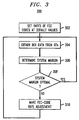
- Fig. 3 shows a flowchart of a method 300 of operating OTS 100 according to one embodiment of the invention.
- RCU 130 (see also Figs. 1-2 ) configures various OTs 120 to use the respective initial (default) FEC-code rates. These initial rates can be based, e.g., on the OTS's topology, design, and optical-link budgets. Step 302 can be performed, for example, at initial deployment of OTS 100 .
- RCU 130 communicates with OTs 120 to obtain BER data for each optical link 102 and/or WDM channel.
- RCU 130 processes the BER data collected at step 304 to determine the performance margin. This determination may include comparing the BER(s) with a target BER value.
- RCU 130 determines whether the performance margin is optimal.
- the term "optimal" means that the determined performance margin is neither excessive nor too low.
- the determined performance margin is compared with two threshold values, e.g., an upper threshold value and a lower threshold value, to determine whether the present performance margin falls within the interval defined by those two threshold values.
- the upper and lower threshold values are generally set based on overall system performance considerations, which may include, but are not limited to, system capacity, traffic demands, and/or encoding/decoding latency. For example, in one system configuration, the lower threshold value can be set at about 0.2 dB, and the upper threshold value can be set at about 1.6 dB.
- step 308 If it is determined at step 308 that the performance margin is within the desirable interval, then RCU 130 takes no action and the processing of method 300 returns back to step 304 . However, if it is determined that the performance margin is outside of the desirable interval, then the processing of method 300 is directed to step 310 .
- RCU 130 configures various OTs 120 to make appropriate FEC-code rate adjustment(s).
- the FEC-code rate adjustments may include an upward rate adjustment and/or a downward rate adjustment. More specifically, if it is determined that the performance margin is excessive, then an upward rate adjustment may be performed. An upward rate adjustment is likely to follow the initial deployment stage, when the default FEC-code rates prove to be too conservative. Also, when a scheduled network reconfiguration is predicted to increase the performance margin of a WDM channel connecting two communicating OTs, RCU 130 may have the requisite knowledge and specify a new FEC rate via an appropriate upward rate adjustment to achieve the optimal performance margin. In one embodiment, step 310 selects the highest possible rate of the FEC code that provides an acceptable performance margin for the transmission link between the communicating OTs.
- a downward rate adjustment is performed. As already indicated above, multiple downward rate adjustments may be performed during the lifespan of OTS 100 due to the aging of system components and general deterioration in the condition of optical links. Also, when a scheduled network reconfiguration is predicted to reduce the performance margin of a WDM channel, RCU 130 may have the requisite knowledge and specify a new FEC rate via an appropriate downward rate adjustment to achieve the optimal performance margin. After step 310, the processing of method 300 is directed back to step 304 . Note that in method 300, RCU 130 may in parallel dynamically optimize the FEC rates for multiple WDM channels.
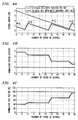
- Figs. 4A-C graphically compare representative characteristics of a prior-art OTS and an embodiment of OTS 100, hereafter referred to as OTS 400 . More specifically, in each of Figs. 4A-C , the respective characteristics of the prior-art OTS and OTS 400 are shown by dashed and solid lines, respectively.
- the prior-art OTS has a plurality of 2.5-Gb/s OTs that run an RS FEC code having a fixed rate ( R C ) of 239/255.
- OTS 400 has a plurality of 10-Gb/s OTs that run a rate-adaptive LDPC FEC code.
- the 2.5-Gb/s optical signal rate in the prior-art system is lower than the 10-Gb/s optical signal rate in OTS 400 because the prior-art OTS is not able to attain the required initial performance margin of about 4 dB using 10-Gb/s OTs.
- Fig. 4A depicts, for both OTSs, the performance margin as a function of time (years in service). Note that the time resolution in Fig. 4A (and also in Figs. 4B-C ) is one year.
- the performance margin decreases linearly with time from about 4 dB at the BOL to about 0 dB at the end of life (EOL), which is 20 years from the BOL.
- the performance margin decreases linearly with time until, sometime during the fourth year, it crosses the lower threshold value specified to be about 0.2 dB.
- This rate adjustment increases the performance margin to about 1.6 dB.
- the performance margin decreases linearly thereafter until, sometime during the twelfth year, it crosses the lower threshold value again.
- the latter rate adjustment increases the performance margin to about 1.4 dB.
- the performance margin decreases linearly thereafter until, sometime during the nineteenth year, it crosses the lower threshold value one more time.
- This rate adjustment brings the performance margin back up to about 1.6 dB.
- the performance margin decreases linearly thereafter until the OTS is taken out of service at the EOL.
- Fig. 4B depicts, for both OTSs, the normalized system capacity as a function of time.
- system capacity refers to the system capacity or throughput for the transport of information bits.
- the system capacity remains fixed from the BOL to the EOL.
- the system capacity is about 3.7, 3.2, 2.1, and 1.6 times that of the prior-art system before the first, second, and third and after the third rate adjustments, respectively.
- OTS 400 provides on average about 2.5 times more system capacity than the prior-art OTS.
- Fig. 4C depicts, for both OTSs, the normalized cost per information bit as a function of time.
- the optical-link cost is the same and constitutes 75% of the overall cost of the prior-art OTS.
- the cost of the 2.5-Gb/s OTs constitutes the remaining 25% of the cost of the prior-art OTS, and the 10-Gb/s OTs used in OTS 400 are assumed to be three times more expensive than the 2.5-Gb/s OTs.
- the cost per bit in OTS 400 is on average about 40% less than the cost per bit in the prior-art OTS.
- Couple refers to any manner known in the art or later developed in which energy is allowed to be transferred between two or more elements, and the interposition of one or more additional elements is contemplated, although not required. Conversely, the terms “directly coupled,” “directly connected,” etc., imply the absence of such additional elements.
Landscapes
- Engineering & Computer Science (AREA)
- Quality & Reliability (AREA)
- Computer Networks & Wireless Communication (AREA)
- Signal Processing (AREA)
- Time-Division Multiplex Systems (AREA)
- Optical Communication System (AREA)
- Detection And Prevention Of Errors In Transmission (AREA)
Priority Applications (2)
| Application Number | Priority Date | Filing Date | Title |
|---|---|---|---|
| EP16155931.5A EP3048749B1 (en) | 2007-08-06 | 2008-07-28 | Rate-adaptive forward error correction for optical transport systems |
| PL16155931T PL3048749T3 (pl) | 2007-08-06 | 2008-07-28 | Adaptacyjne kodowanie korygujące do optycznych układów transportu |
Applications Claiming Priority (2)
| Application Number | Priority Date | Filing Date | Title |
|---|---|---|---|
| US11/834,169 US8122330B2 (en) | 2007-08-06 | 2007-08-06 | Rate-adaptive forward error correction for optical transport systems |
| PCT/US2008/009114 WO2009020529A2 (en) | 2007-08-06 | 2008-07-28 | Rate-adaptive forward error correction for optical transport systems |
Related Child Applications (1)
| Application Number | Title | Priority Date | Filing Date |
|---|---|---|---|
| EP16155931.5A Division EP3048749B1 (en) | 2007-08-06 | 2008-07-28 | Rate-adaptive forward error correction for optical transport systems |
Publications (2)
| Publication Number | Publication Date |
|---|---|
| EP2186239A2 EP2186239A2 (en) | 2010-05-19 |
| EP2186239B1 true EP2186239B1 (en) | 2016-02-24 |
Family
ID=40130625
Family Applications (2)
| Application Number | Title | Priority Date | Filing Date |
|---|---|---|---|
| EP08794805.5A Active EP2186239B1 (en) | 2007-08-06 | 2008-07-28 | Rate-adaptive forward error correction for optical transport systems |
| EP16155931.5A Active EP3048749B1 (en) | 2007-08-06 | 2008-07-28 | Rate-adaptive forward error correction for optical transport systems |
Family Applications After (1)
| Application Number | Title | Priority Date | Filing Date |
|---|---|---|---|
| EP16155931.5A Active EP3048749B1 (en) | 2007-08-06 | 2008-07-28 | Rate-adaptive forward error correction for optical transport systems |
Country Status (8)
| Country | Link |
|---|---|
| US (1) | US8122330B2 (pl) |
| EP (2) | EP2186239B1 (pl) |
| JP (1) | JP2010536240A (pl) |
| KR (1) | KR101510492B1 (pl) |
| CN (2) | CN101796757A (pl) |
| ES (1) | ES2640519T3 (pl) |
| PL (1) | PL3048749T3 (pl) |
| WO (1) | WO2009020529A2 (pl) |
Families Citing this family (28)
| Publication number | Priority date | Publication date | Assignee | Title |
|---|---|---|---|---|
| JP5277071B2 (ja) * | 2009-05-25 | 2013-08-28 | 株式会社日立製作所 | 光アクセスシステム、光集線装置および光加入者装置 |
| US8041216B2 (en) * | 2009-06-10 | 2011-10-18 | Alcatel Lucent | System and method for channel-adaptive error-resilient burst mode transmission |
| US8369705B2 (en) | 2009-06-10 | 2013-02-05 | Alcatel Lucent | System and method for channel-adaptive error-resilient transmission to multiple transceivers |
| US8738986B2 (en) * | 2010-03-05 | 2014-05-27 | Microsoft Corporation | Remote presentation over lossy transport with forward error correction |
| US8553540B2 (en) | 2010-03-05 | 2013-10-08 | Microsoft Corporation | Congestion control for delay sensitive applications |
| US8433969B1 (en) * | 2010-11-18 | 2013-04-30 | Applied Micro Circuits Corporation | Forward error correction (FEC) auto negotiation for an optical transport network (OTN) |
| CN102158308B (zh) * | 2011-02-12 | 2014-09-10 | 中兴通讯股份有限公司 | 一种配置上行前向纠错流程的方法及系统 |
| WO2013026469A1 (en) * | 2011-08-22 | 2013-02-28 | Nokia Siemens Networks Oy | Method and device for processing a communication network |
| CN103650398B (zh) * | 2011-12-08 | 2016-10-19 | 三菱电机株式会社 | 帧生成方法、光传送装置以及光传送系统 |
| JP5950606B2 (ja) * | 2012-02-14 | 2016-07-13 | 三菱電機株式会社 | 光伝送システム制御装置、光伝送システム、光伝送システム制御方法及びプログラム |
| US9612902B2 (en) | 2012-03-12 | 2017-04-04 | Tvu Networks Corporation | Methods and apparatus for maximum utilization of a dynamic varying digital data channel |
| EP2868013B1 (en) * | 2012-07-02 | 2016-06-29 | Telefonaktiebolaget LM Ericsson (publ) | Method and apparatus for configuring an optical path |
| JP5942821B2 (ja) * | 2012-11-30 | 2016-06-29 | 富士通株式会社 | 伝送制御装置、伝送システム、及び伝送方法 |
| US9609400B2 (en) * | 2013-08-22 | 2017-03-28 | Nec Corporation | Reconfigurable and variable-rate shared multi-transponder architecture for flexible ethernet-based optical networks |
| US9479446B2 (en) * | 2013-09-11 | 2016-10-25 | Nec Corporation | Hitless service in a variable rate optical transponder |
| JP6322942B2 (ja) * | 2013-10-01 | 2018-05-16 | 日本電気株式会社 | 伝送装置 |
| US9584256B2 (en) * | 2014-06-09 | 2017-02-28 | Mitsubishi Electric Research Laboratories, Inc. | Adaptive error correction code for optical super-channels |
| US9807408B2 (en) * | 2014-08-27 | 2017-10-31 | Clearone Communications Hong Kong Ltd. | Control mechanism for video output |
| US9973795B2 (en) | 2014-08-27 | 2018-05-15 | ClearOne Inc. | Method for video synchronization in video distribution systems |
| EP3076617A1 (en) * | 2015-03-31 | 2016-10-05 | Alcatel Lucent | Method for maximizing a payload data rate on a communication link and line card thereof |
| TWI606743B (zh) * | 2015-10-02 | 2017-11-21 | 財團法人工業技術研究院 | 多用戶疊加傳輸方法以及使用所述方法的基地台 |
| WO2017178431A1 (en) * | 2016-04-11 | 2017-10-19 | British Telecommunications Public Limited Company | Optical communications |
| US10447430B2 (en) * | 2016-08-01 | 2019-10-15 | Sony Interactive Entertainment LLC | Forward error correction for streaming data |
| JP6666286B2 (ja) * | 2017-03-08 | 2020-03-13 | 株式会社東芝 | 量子通信装置、量子通信システム及び量子通信方法 |
| FI20175623A1 (en) | 2017-06-29 | 2018-12-30 | Labmaster Oy | A method and devices for adaptive measuring of electrochemiluminescence |
| US10425345B2 (en) * | 2017-09-29 | 2019-09-24 | Juniper Networks, Inc. | Methods and apparatus for detecting a signal degradation using the pre-forward error correction bit error rate at an optical transponder |
| JP7003007B2 (ja) * | 2018-06-29 | 2022-01-20 | 株式会社東芝 | 量子暗号通信装置、量子暗号通信システム、量子暗号通信方法及びプログラム |
| CN119356511B (zh) * | 2024-09-29 | 2025-12-30 | 无锡众星微系统技术有限公司 | 一种基于FEC的自适应的SerDes架构及其功耗调节方法 |
Family Cites Families (19)
| Publication number | Priority date | Publication date | Assignee | Title |
|---|---|---|---|---|
| JPH02155323A (ja) * | 1988-12-08 | 1990-06-14 | Nec Corp | 光中継器監視方式 |
| US6370669B1 (en) | 1998-01-23 | 2002-04-09 | Hughes Electronics Corporation | Sets of rate-compatible universal turbo codes nearly optimized over various rates and interleaver sizes |
| JP4164606B2 (ja) * | 1998-02-18 | 2008-10-15 | Kddi株式会社 | 光伝送線路品質測定システム及び方法 |
| TW390082B (en) * | 1998-05-26 | 2000-05-11 | Koninkl Philips Electronics Nv | Transmission system with adaptive channel encoder and decoder |
| US20030016410A1 (en) | 2001-07-18 | 2003-01-23 | Innovance Networks | Method for engineering connections in a dynamically reconfigurable photonic switched network |
| US6829741B1 (en) | 2001-07-27 | 2004-12-07 | Centillium Communications, Inc. | Forward error correction (FEC) based on SONET/SDH framing |
| JP4119721B2 (ja) * | 2002-10-04 | 2008-07-16 | 松下電器産業株式会社 | 無線通信システム、通信端末装置、基地局装置及び制御情報通知方法 |
| US7570643B2 (en) * | 2003-02-12 | 2009-08-04 | Cisco Technology, Inc. | Efficient framing procedure for variable length packets |
| US7181657B2 (en) * | 2003-09-25 | 2007-02-20 | Oki Electric Industry Co., Ltd. | Data transmission apparatus adaptive to data quality on radio-transmission and a method of data transmission therefor |
| US7428669B2 (en) * | 2003-12-07 | 2008-09-23 | Adaptive Spectrum And Signal Alignment, Inc. | Adaptive FEC codeword management |
| KR100589680B1 (ko) * | 2004-07-26 | 2006-06-19 | 한국전자통신연구원 | 이동통신 시스템의 신호 전송 방법 및 그 장치와, 수신방법 및 그 장치 |
| JP4276993B2 (ja) * | 2004-11-01 | 2009-06-10 | 株式会社日立コミュニケーションテクノロジー | エラー訂正符号装置、エラー訂正符号復号装置および伝送装置 |
| JP4447442B2 (ja) * | 2004-12-06 | 2010-04-07 | 三菱電機株式会社 | 波長監視制御装置および波長多重伝送装置 |
| US7424651B2 (en) * | 2004-12-21 | 2008-09-09 | Tyco Telecommunications (Us) Inc. | Method and apparatus for decision threshold control in an optical signal receiver |
| US7783961B2 (en) | 2005-07-01 | 2010-08-24 | Nec Laboratories America, Inc. | Rate-compatible low density parity check coding for hybrid ARQ |
| JP2007036607A (ja) * | 2005-07-26 | 2007-02-08 | Sumitomo Electric Ind Ltd | 光通信システム |
| JP4780518B2 (ja) * | 2005-09-14 | 2011-09-28 | 日本電気株式会社 | 光伝送装置、光伝送システム及び警報発出方法 |
| KR100966043B1 (ko) | 2005-10-31 | 2010-06-25 | 삼성전자주식회사 | 저밀도 패리티 검사 부호를 사용하는 통신 시스템에서 신호 송수신 장치 및 방법 |
| US7661038B2 (en) * | 2006-10-09 | 2010-02-09 | Intel Corporation | Link adaptation for retransmission error-control technique transmissions |
-
2007
- 2007-08-06 US US11/834,169 patent/US8122330B2/en active Active
-
2008
- 2008-07-28 WO PCT/US2008/009114 patent/WO2009020529A2/en not_active Ceased
- 2008-07-28 CN CN200880101892A patent/CN101796757A/zh active Pending
- 2008-07-28 KR KR1020107002583A patent/KR101510492B1/ko not_active Expired - Fee Related
- 2008-07-28 PL PL16155931T patent/PL3048749T3/pl unknown
- 2008-07-28 EP EP08794805.5A patent/EP2186239B1/en active Active
- 2008-07-28 JP JP2010519912A patent/JP2010536240A/ja active Pending
- 2008-07-28 CN CN201510132243.5A patent/CN104852782A/zh active Pending
- 2008-07-28 EP EP16155931.5A patent/EP3048749B1/en active Active
- 2008-07-28 ES ES16155931.5T patent/ES2640519T3/es active Active
Also Published As
| Publication number | Publication date |
|---|---|
| US20090044079A1 (en) | 2009-02-12 |
| KR101510492B1 (ko) | 2015-04-08 |
| JP2010536240A (ja) | 2010-11-25 |
| WO2009020529A3 (en) | 2009-04-02 |
| PL3048749T3 (pl) | 2017-12-29 |
| US8122330B2 (en) | 2012-02-21 |
| ES2640519T3 (es) | 2017-11-03 |
| EP3048749B1 (en) | 2017-06-14 |
| KR20100054790A (ko) | 2010-05-25 |
| CN104852782A (zh) | 2015-08-19 |
| EP2186239A2 (en) | 2010-05-19 |
| WO2009020529A2 (en) | 2009-02-12 |
| EP3048749A1 (en) | 2016-07-27 |
| CN101796757A (zh) | 2010-08-04 |
Similar Documents
| Publication | Publication Date | Title |
|---|---|---|
| EP2186239B1 (en) | Rate-adaptive forward error correction for optical transport systems | |
| US8914711B2 (en) | Variable forward error correction for optical communication links | |
| EP3202057B1 (en) | Hitless, multi-rate optical transmission and reception | |
| US9231721B1 (en) | System and method for scaling total client capacity with a standard-compliant optical transport network (OTN) | |
| US8655169B2 (en) | Degradation adaptation network | |
| US8630544B2 (en) | System and method for channel-adaptive error-resilient burst mode transmission | |
| US8369705B2 (en) | System and method for channel-adaptive error-resilient transmission to multiple transceivers | |
| US20020178417A1 (en) | Communication channel optimization using forward error correction statistics | |
| EP1360844A2 (en) | Method and apparatus for improving transmission performance over wavelength division multiplexed optical communication links using forward error correction coding | |
| JP3863434B2 (ja) | 分散等化装置および分散等化方法 | |
| US20060127100A1 (en) | Simplified signal regenerator structure | |
| US20230198670A1 (en) | Method and apparatus for point-to-multi-point communications using combined block and codeword interleaving | |
| CN110278050B (zh) | 一种超100g wdm传输系统反馈调优的方法及装置 | |
| Mizuochi | Recent progress in forward error correction for optical communication systems | |
| US10044440B2 (en) | Noise margin monitor and control method | |
| CN105027451A (zh) | Xg-pon1和ng-pon2 twdm-pon系统中的下行前向纠错开-关控制的方法和装置 | |
| CN112752170A (zh) | 参数调整方法、装置、系统和存储介质 | |
| JP7587434B2 (ja) | 送信サーバ、送信装置、受信装置及びプログラム | |
| Mehmood et al. | Experimental demonstration of rate-adaptive concatenated codes for flexible optical networks | |
| Xie et al. | FEC performance of PMD-impaired optical communication system with multiple-wavelength interleaving | |
| Leroy et al. | Submarine line terminal | |
| Tychopoulos et al. | Demonstration of a low-cost inband FEC scheme for STM-64 transparent metro networks | |
| EP2043289A1 (en) | Method and communication system for transmitting a date signal over an optical transmission system | |
| Kapse et al. | Forward Error Correction (FEC) computation in Optical Transmission Systems |
Legal Events
| Date | Code | Title | Description |
|---|---|---|---|
| PUAI | Public reference made under article 153(3) epc to a published international application that has entered the european phase |
Free format text: ORIGINAL CODE: 0009012 |
|
| 17P | Request for examination filed |
Effective date: 20100308 |
|
| AK | Designated contracting states |
Kind code of ref document: A2 Designated state(s): AT BE BG CH CY CZ DE DK EE ES FI FR GB GR HR HU IE IS IT LI LT LU LV MC MT NL NO PL PT RO SE SI SK TR |
|
| AX | Request for extension of the european patent |
Extension state: AL BA MK RS |
|
| RIN1 | Information on inventor provided before grant (corrected) |
Inventor name: DE LIND VAN WIJNGAARDEN, ADRIAAN, J. Inventor name: LIU, XIANG Inventor name: GILES, RANDY, CLINTON Inventor name: KOROTKY, STEVEN, K. |
|
| DAX | Request for extension of the european patent (deleted) | ||
| RAP1 | Party data changed (applicant data changed or rights of an application transferred) |
Owner name: ALCATEL-LUCENT USA INC. |
|
| 111Z | Information provided on other rights and legal means of execution |
Free format text: AT BE BG CH CY CZ DE DK EE ES FI FR GB GR HR HU IE IS IT LI LT LU LV MC MT NL NO PL PT RO SE SI SK TR Effective date: 20130410 |
|
| D11X | Information provided on other rights and legal means of execution (deleted) | ||
| GRAP | Despatch of communication of intention to grant a patent |
Free format text: ORIGINAL CODE: EPIDOSNIGR1 |
|
| INTG | Intention to grant announced |
Effective date: 20150728 |
|
| GRAP | Despatch of communication of intention to grant a patent |
Free format text: ORIGINAL CODE: EPIDOSNIGR1 |
|
| INTG | Intention to grant announced |
Effective date: 20151020 |
|
| GRAS | Grant fee paid |
Free format text: ORIGINAL CODE: EPIDOSNIGR3 |
|
| GRAA | (expected) grant |
Free format text: ORIGINAL CODE: 0009210 |
|
| RAP1 | Party data changed (applicant data changed or rights of an application transferred) |
Owner name: ALCATEL LUCENT |
|
| AK | Designated contracting states |
Kind code of ref document: B1 Designated state(s): AT BE BG CH CY CZ DE DK EE ES FI FR GB GR HR HU IE IS IT LI LT LU LV MC MT NL NO PL PT RO SE SI SK TR |
|
| REG | Reference to a national code |
Ref country code: GB Ref legal event code: FG4D |
|
| REG | Reference to a national code |
Ref country code: CH Ref legal event code: EP |
|
| REG | Reference to a national code |
Ref country code: AT Ref legal event code: REF Ref document number: 777207 Country of ref document: AT Kind code of ref document: T Effective date: 20160315 |
|
| REG | Reference to a national code |
Ref country code: IE Ref legal event code: FG4D |
|
| REG | Reference to a national code |
Ref country code: DE Ref legal event code: R096 Ref document number: 602008042523 Country of ref document: DE |
|
| REG | Reference to a national code |
Ref country code: LT Ref legal event code: MG4D |
|
| REG | Reference to a national code |
Ref country code: NL Ref legal event code: MP Effective date: 20160224 |
|
| REG | Reference to a national code |
Ref country code: AT Ref legal event code: MK05 Ref document number: 777207 Country of ref document: AT Kind code of ref document: T Effective date: 20160224 |
|
| REG | Reference to a national code |
Ref country code: FR Ref legal event code: PLFP Year of fee payment: 9 |
|
| PG25 | Lapsed in a contracting state [announced via postgrant information from national office to epo] |
Ref country code: ES Free format text: LAPSE BECAUSE OF FAILURE TO SUBMIT A TRANSLATION OF THE DESCRIPTION OR TO PAY THE FEE WITHIN THE PRESCRIBED TIME-LIMIT Effective date: 20160224 Ref country code: IT Free format text: LAPSE BECAUSE OF FAILURE TO SUBMIT A TRANSLATION OF THE DESCRIPTION OR TO PAY THE FEE WITHIN THE PRESCRIBED TIME-LIMIT Effective date: 20160224 Ref country code: HR Free format text: LAPSE BECAUSE OF FAILURE TO SUBMIT A TRANSLATION OF THE DESCRIPTION OR TO PAY THE FEE WITHIN THE PRESCRIBED TIME-LIMIT Effective date: 20160224 Ref country code: NO Free format text: LAPSE BECAUSE OF FAILURE TO SUBMIT A TRANSLATION OF THE DESCRIPTION OR TO PAY THE FEE WITHIN THE PRESCRIBED TIME-LIMIT Effective date: 20160524 Ref country code: GR Free format text: LAPSE BECAUSE OF FAILURE TO SUBMIT A TRANSLATION OF THE DESCRIPTION OR TO PAY THE FEE WITHIN THE PRESCRIBED TIME-LIMIT Effective date: 20160525 Ref country code: FI Free format text: LAPSE BECAUSE OF FAILURE TO SUBMIT A TRANSLATION OF THE DESCRIPTION OR TO PAY THE FEE WITHIN THE PRESCRIBED TIME-LIMIT Effective date: 20160224 |
|
| PG25 | Lapsed in a contracting state [announced via postgrant information from national office to epo] |
Ref country code: LT Free format text: LAPSE BECAUSE OF FAILURE TO SUBMIT A TRANSLATION OF THE DESCRIPTION OR TO PAY THE FEE WITHIN THE PRESCRIBED TIME-LIMIT Effective date: 20160224 Ref country code: PL Free format text: LAPSE BECAUSE OF FAILURE TO SUBMIT A TRANSLATION OF THE DESCRIPTION OR TO PAY THE FEE WITHIN THE PRESCRIBED TIME-LIMIT Effective date: 20160224 Ref country code: AT Free format text: LAPSE BECAUSE OF FAILURE TO SUBMIT A TRANSLATION OF THE DESCRIPTION OR TO PAY THE FEE WITHIN THE PRESCRIBED TIME-LIMIT Effective date: 20160224 Ref country code: SE Free format text: LAPSE BECAUSE OF FAILURE TO SUBMIT A TRANSLATION OF THE DESCRIPTION OR TO PAY THE FEE WITHIN THE PRESCRIBED TIME-LIMIT Effective date: 20160224 Ref country code: PT Free format text: LAPSE BECAUSE OF FAILURE TO SUBMIT A TRANSLATION OF THE DESCRIPTION OR TO PAY THE FEE WITHIN THE PRESCRIBED TIME-LIMIT Effective date: 20160624 Ref country code: LV Free format text: LAPSE BECAUSE OF FAILURE TO SUBMIT A TRANSLATION OF THE DESCRIPTION OR TO PAY THE FEE WITHIN THE PRESCRIBED TIME-LIMIT Effective date: 20160224 Ref country code: NL Free format text: LAPSE BECAUSE OF FAILURE TO SUBMIT A TRANSLATION OF THE DESCRIPTION OR TO PAY THE FEE WITHIN THE PRESCRIBED TIME-LIMIT Effective date: 20160224 |
|
| PG25 | Lapsed in a contracting state [announced via postgrant information from national office to epo] |
Ref country code: DK Free format text: LAPSE BECAUSE OF FAILURE TO SUBMIT A TRANSLATION OF THE DESCRIPTION OR TO PAY THE FEE WITHIN THE PRESCRIBED TIME-LIMIT Effective date: 20160224 Ref country code: EE Free format text: LAPSE BECAUSE OF FAILURE TO SUBMIT A TRANSLATION OF THE DESCRIPTION OR TO PAY THE FEE WITHIN THE PRESCRIBED TIME-LIMIT Effective date: 20160224 |
|
| REG | Reference to a national code |
Ref country code: DE Ref legal event code: R097 Ref document number: 602008042523 Country of ref document: DE |
|
| PG25 | Lapsed in a contracting state [announced via postgrant information from national office to epo] |
Ref country code: SK Free format text: LAPSE BECAUSE OF FAILURE TO SUBMIT A TRANSLATION OF THE DESCRIPTION OR TO PAY THE FEE WITHIN THE PRESCRIBED TIME-LIMIT Effective date: 20160224 Ref country code: CZ Free format text: LAPSE BECAUSE OF FAILURE TO SUBMIT A TRANSLATION OF THE DESCRIPTION OR TO PAY THE FEE WITHIN THE PRESCRIBED TIME-LIMIT Effective date: 20160224 Ref country code: RO Free format text: LAPSE BECAUSE OF FAILURE TO SUBMIT A TRANSLATION OF THE DESCRIPTION OR TO PAY THE FEE WITHIN THE PRESCRIBED TIME-LIMIT Effective date: 20160224 |
|
| PG25 | Lapsed in a contracting state [announced via postgrant information from national office to epo] |
Ref country code: BE Free format text: LAPSE BECAUSE OF FAILURE TO SUBMIT A TRANSLATION OF THE DESCRIPTION OR TO PAY THE FEE WITHIN THE PRESCRIBED TIME-LIMIT Effective date: 20160224 |
|
| PLBE | No opposition filed within time limit |
Free format text: ORIGINAL CODE: 0009261 |
|
| STAA | Information on the status of an ep patent application or granted ep patent |
Free format text: STATUS: NO OPPOSITION FILED WITHIN TIME LIMIT |
|
| 26N | No opposition filed |
Effective date: 20161125 |
|
| PG25 | Lapsed in a contracting state [announced via postgrant information from national office to epo] |
Ref country code: SI Free format text: LAPSE BECAUSE OF FAILURE TO SUBMIT A TRANSLATION OF THE DESCRIPTION OR TO PAY THE FEE WITHIN THE PRESCRIBED TIME-LIMIT Effective date: 20160224 Ref country code: BG Free format text: LAPSE BECAUSE OF FAILURE TO SUBMIT A TRANSLATION OF THE DESCRIPTION OR TO PAY THE FEE WITHIN THE PRESCRIBED TIME-LIMIT Effective date: 20160524 |
|
| REG | Reference to a national code |
Ref country code: CH Ref legal event code: PL |
|
| PG25 | Lapsed in a contracting state [announced via postgrant information from national office to epo] |
Ref country code: MC Free format text: LAPSE BECAUSE OF FAILURE TO SUBMIT A TRANSLATION OF THE DESCRIPTION OR TO PAY THE FEE WITHIN THE PRESCRIBED TIME-LIMIT Effective date: 20160224 |
|
| PG25 | Lapsed in a contracting state [announced via postgrant information from national office to epo] |
Ref country code: CH Free format text: LAPSE BECAUSE OF NON-PAYMENT OF DUE FEES Effective date: 20160731 Ref country code: LI Free format text: LAPSE BECAUSE OF NON-PAYMENT OF DUE FEES Effective date: 20160731 |
|
| REG | Reference to a national code |
Ref country code: IE Ref legal event code: MM4A |
|
| REG | Reference to a national code |
Ref country code: FR Ref legal event code: PLFP Year of fee payment: 10 |
|
| PG25 | Lapsed in a contracting state [announced via postgrant information from national office to epo] |
Ref country code: IE Free format text: LAPSE BECAUSE OF NON-PAYMENT OF DUE FEES Effective date: 20160728 |
|
| PG25 | Lapsed in a contracting state [announced via postgrant information from national office to epo] |
Ref country code: LU Free format text: LAPSE BECAUSE OF NON-PAYMENT OF DUE FEES Effective date: 20160728 |
|
| PG25 | Lapsed in a contracting state [announced via postgrant information from national office to epo] |
Ref country code: HU Free format text: LAPSE BECAUSE OF FAILURE TO SUBMIT A TRANSLATION OF THE DESCRIPTION OR TO PAY THE FEE WITHIN THE PRESCRIBED TIME-LIMIT; INVALID AB INITIO Effective date: 20080728 Ref country code: CY Free format text: LAPSE BECAUSE OF FAILURE TO SUBMIT A TRANSLATION OF THE DESCRIPTION OR TO PAY THE FEE WITHIN THE PRESCRIBED TIME-LIMIT Effective date: 20160224 |
|
| PG25 | Lapsed in a contracting state [announced via postgrant information from national office to epo] |
Ref country code: IS Free format text: LAPSE BECAUSE OF FAILURE TO SUBMIT A TRANSLATION OF THE DESCRIPTION OR TO PAY THE FEE WITHIN THE PRESCRIBED TIME-LIMIT Effective date: 20160224 Ref country code: MT Free format text: LAPSE BECAUSE OF NON-PAYMENT OF DUE FEES Effective date: 20160731 Ref country code: TR Free format text: LAPSE BECAUSE OF FAILURE TO SUBMIT A TRANSLATION OF THE DESCRIPTION OR TO PAY THE FEE WITHIN THE PRESCRIBED TIME-LIMIT Effective date: 20160224 |
|
| REG | Reference to a national code |
Ref country code: FR Ref legal event code: PLFP Year of fee payment: 11 |
|
| PGFP | Annual fee paid to national office [announced via postgrant information from national office to epo] |
Ref country code: GB Payment date: 20250605 Year of fee payment: 18 |
|
| PGFP | Annual fee paid to national office [announced via postgrant information from national office to epo] |
Ref country code: FR Payment date: 20250610 Year of fee payment: 18 |
|
| PGFP | Annual fee paid to national office [announced via postgrant information from national office to epo] |
Ref country code: DE Payment date: 20250604 Year of fee payment: 18 |