EP2186538B1 - Ventilation percussive intrapulmonaire biphasique à commande manuelle - Google Patents
Ventilation percussive intrapulmonaire biphasique à commande manuelle Download PDFInfo
- Publication number
- EP2186538B1 EP2186538B1 EP09252492.5A EP09252492A EP2186538B1 EP 2186538 B1 EP2186538 B1 EP 2186538B1 EP 09252492 A EP09252492 A EP 09252492A EP 2186538 B1 EP2186538 B1 EP 2186538B1
- Authority
- EP
- European Patent Office
- Prior art keywords
- patient
- respirator
- pressure
- compressor
- gas
- Prior art date
- Legal status (The legal status is an assumption and is not a legal conclusion. Google has not performed a legal analysis and makes no representation as to the accuracy of the status listed.)
- Active
Links
Images




Classifications
-
- A—HUMAN NECESSITIES
- A61—MEDICAL OR VETERINARY SCIENCE; HYGIENE
- A61M—DEVICES FOR INTRODUCING MEDIA INTO, OR ONTO, THE BODY; DEVICES FOR TRANSDUCING BODY MEDIA OR FOR TAKING MEDIA FROM THE BODY; DEVICES FOR PRODUCING OR ENDING SLEEP OR STUPOR
- A61M16/00—Devices for influencing the respiratory system of patients by gas treatment, e.g. ventilators; Tracheal tubes
- A61M16/0096—High frequency jet ventilation
-
- A—HUMAN NECESSITIES
- A61—MEDICAL OR VETERINARY SCIENCE; HYGIENE
- A61M—DEVICES FOR INTRODUCING MEDIA INTO, OR ONTO, THE BODY; DEVICES FOR TRANSDUCING BODY MEDIA OR FOR TAKING MEDIA FROM THE BODY; DEVICES FOR PRODUCING OR ENDING SLEEP OR STUPOR
- A61M16/00—Devices for influencing the respiratory system of patients by gas treatment, e.g. ventilators; Tracheal tubes
- A61M16/0003—Accessories therefor, e.g. sensors, vibrators, negative pressure
- A61M16/0006—Accessories therefor, e.g. sensors, vibrators, negative pressure with means for creating vibrations in patients' airways
-
- A—HUMAN NECESSITIES
- A61—MEDICAL OR VETERINARY SCIENCE; HYGIENE
- A61M—DEVICES FOR INTRODUCING MEDIA INTO, OR ONTO, THE BODY; DEVICES FOR TRANSDUCING BODY MEDIA OR FOR TAKING MEDIA FROM THE BODY; DEVICES FOR PRODUCING OR ENDING SLEEP OR STUPOR
- A61M16/00—Devices for influencing the respiratory system of patients by gas treatment, e.g. ventilators; Tracheal tubes
- A61M16/021—Devices for influencing the respiratory system of patients by gas treatment, e.g. ventilators; Tracheal tubes operated by electrical means
-
- A—HUMAN NECESSITIES
- A61—MEDICAL OR VETERINARY SCIENCE; HYGIENE
- A61M—DEVICES FOR INTRODUCING MEDIA INTO, OR ONTO, THE BODY; DEVICES FOR TRANSDUCING BODY MEDIA OR FOR TAKING MEDIA FROM THE BODY; DEVICES FOR PRODUCING OR ENDING SLEEP OR STUPOR
- A61M16/00—Devices for influencing the respiratory system of patients by gas treatment, e.g. ventilators; Tracheal tubes
- A61M16/08—Bellows; Connecting tubes ; Water traps; Patient circuits
- A61M16/0816—Joints or connectors
- A61M16/0841—Joints or connectors for sampling
- A61M16/0858—Pressure sampling ports
-
- A—HUMAN NECESSITIES
- A61—MEDICAL OR VETERINARY SCIENCE; HYGIENE
- A61M—DEVICES FOR INTRODUCING MEDIA INTO, OR ONTO, THE BODY; DEVICES FOR TRANSDUCING BODY MEDIA OR FOR TAKING MEDIA FROM THE BODY; DEVICES FOR PRODUCING OR ENDING SLEEP OR STUPOR
- A61M16/00—Devices for influencing the respiratory system of patients by gas treatment, e.g. ventilators; Tracheal tubes
- A61M16/0057—Pumps therefor
- A61M16/0063—Compressors
Definitions
- the manually controlled bi-phasic ventilator has industrial application in the technical field of medical respirators.
- Dr. Bird was introduced to fluid dynamics during his pre-terrorism aeronautical studies. His WW II airman's pressure breathing device and anti-g suit regulatory developments were followed by his medical education, enabling him to apply his knowledge of fluid dynamics and clinical medicine toward the development of novel fluidic cardiopulmonary support devices.
- Dr. Bird has developed several unique methodologies and clinical protocols resulting in four generations of cardiopulmonary recruitment and maintenance medical respirators and Intrapulmonary Percussionators® since the 1950's. These devices have been serially noted to increasingly maintain cardiopulmonary functions in patient's failing all other available continuous mechanical ventilation (CMV) types of pulmonary ventilators.
- CMV continuous mechanical ventilation
- Dr. Bird's cardiopulmonary support devices employ Dr. Bird's novel fluidic logic without any use of electromotive forces to create functional applications. Bernoullian and Newtonian logic form the basis of Dr. Bird's fluidic concepts. Essentially, a compressed source of a respiratory gas is used as a form of motivational energy source to controllably manipulate the pulmonary structures.
- the source of compressed respiratory gases (ranging from 20 to 55 psi.) are converted to the useful mechanical ventilation of the lung by means of a calibrated orificial flow control and the servoing of diaphragms to produce valve openings and active or passive closing etc. See, for example, U.S. Patent No. 5,862,802 .
- the inventor's novel “Fluidic Logic” is all based upon orificial calibration servoing pneumatic uploading and downloading logic cells to regulate functional events.
- Dr. Bird's conceived Intrapulmonary Percussive Ventilation or IPV® heart lung recruitment and maintenance logic wherein the PERCUSSIONATORO devices employ total Fluidic Logic, correlated with events occurring within milliseconds, to effectively ventilate the depressed pulmonary structures while providing for a lung protective strategy.
- Dr. Bird's conceived Fluidic Logic cardiopulmonary support devices do not employ any computerized or electrical programming of any kind to recruit or maintain depressed heart or lung functions.
- US 5, 165, 398 discloses a respirator which can add small pulses of gas to the tidal volume but which are not successively increasing in pulsatile form.
- the present invention seeks to advance clinical protocols, technological innovations and methodologies, directed toward the enhancement of clinical efficacies of existing clinical administrations, by administering a manual Bi-PhasicTM scheduled Intrapulmonary Percussive Ventilation IPV® protocol in combination with a varying aerosol particulate spectrum and associated sub tidal volume deliveries into the patient's proximal airway, serving to greatly facilitate intuitive clinical therapeutic peripheral lung recruitment and maintenance.
- the present invention is a system for ventilating a patient's airway during the inspiratory phase and expiratory phase from a source of gas under pressure.
- the system supplies to the patient airway during the inspiratory phase, a plurality of pulses of small volumes of gas from said source of gas, and adds, in succession, pulses of small volumes of gas to provide successively greater volumes of gas successively increasing in pulsatile form the pressure of the gas in the airway of the patient during the inspiratory phase.
- This addition adds successively greater volumes of gas in the airway of the patient caused solely by the successive addition of the small volumes of gas and serves to provide diffusive ventilation to the patient during the inspiratory phase, and, permits the patient to exhale during the expiratory phase.
- a smaller compressor set is used and the entire system is containerized in a nylon, shock absorbing travel bag.
- IPV Intrapulmonary Percussive Ventilation
- Intrapulmonary Percussive Ventilation IPV® Intrapulmonary Percussive Ventilation
- IPV® Intrapulmonary Percussive Ventilation
- Preferential Airways Life supporting bronchioles and their alveoli that remain un-obstructed are called Preferential Airways, which if over-inflated during mechanical lung ventilation can be destroyed by hyperinflational barotraumas.
- Intrapulmonary Percussive Ventilation IPV® can be used during multi scheduled daily home treatments to recruit the diseased peripheral pulmonary bronchioles and alveoli of patients with chronic bronchitis and or other respiratory diseases, with various partially or totally obstructed bronchioles, without airway damaging hyperinflation. Life supporting bronchioles and their alveoli that remain un-obstructed are called PREFERENTIAL airways, which if over-inflated during mechanical lung ventilation can be destroyed by hyper-inflational barotraumas.
- barotraumatic lung injuries are caused by lung maintenance ventilators programmed with a mandated volume-pressure limiting means of lung ventilation.
- the novel Home Therapy (HTTM) Universal Bi-phasicTM IPV® IMPULSATOR® delivers institutional quality, percussive higher frequency smaller sub tidal volumes in milliseconds, instead of volume oriented CMV ventilators with lower cycled rates delivering larger intrapulmonary Tidal Volumes into the lungs in seconds.
- the smaller percussively delivered sub tidal endobronchial volume deliveries in milliseconds provide a Lung Protective Strategy to prevent hyper-inflational barotraumas associated with larger endobronchial Tidal Volumes delivered into the lungs in seconds.
- Preferential Airways the open bronchioles with the least inflow resistance are called "Preferential Airways"
- Preferential Airways become overwhelmed by inflow during CMV ventilatory protocols, as the endobronchial delivery pressures rapidly increase; while attempting to deliver a preselected endobronchial Tidal Volume in seconds.
- Oxygen can be diffusively delivered into the peripheral pulmonary airways during the inspiratory inflation of the lungs with lesser tidal air exchanges than recruiting and exhaling Carbon Dioxide generated from metabolism, which is delivered into the pulmonary alveoli and must be "pumped" up out of the lungs to ambient by larger tidal breaths.
- Dr. Bird's concepts for Intrapulmonary Percussive Ventilation (IPV®) and Volumetric Diffusive Respiration (VDR®) are based upon a higher rate of percussive pulmonary gas exchanges, while maintaining smaller sub tidal volume injections with endobronchial injections timed in milliseconds.
- volume-pressure programmed mechanical lung ventilators deliver large Tidal Volumes "timed in seconds" under available selected peak endobronchial delivery pressures, which are primarily determined by the gross inflow resistances within the pulmonary airways of the lungs.
- This mechanical ventilatory program timed in seconds produces higher sustained bronchiolar airway pressures, which serve to hyperinflate the Preferential Bronchiolar Airways having the least inflow resistances.
- This type of volume-pressure mechanical lung ventilation (CMV) can create hyperinflational barotraumas, destroying the most functional lung tissues.
- Intrapulmonary Percussive Ventilation (IPV®) of the lungs delivers a constant higher frequency percussive delivery of air-bursts, consisting of small sub tidal volumes into the lungs within milliseconds; without the large lung distending Tidal Volume deliveries of Volume-Pressure limited (CMV) ventilators, which are "delivered in seconds".
- IPV® Intrapulmonary Percussive Ventilation
- IPV® with higher frequency millisecond sub tidal pulmonary ventilation allows the patient to breathe spontaneously "at will” through the percussive sub tidal volume deliveries, without hyperinflation of the bronchiolar "PREFERENTIAL” airways.
- Patients with chronic bronchitis and other lung diseases can expand their bronchiolar airways and inflate their pulmonary alveoli at the peak of their spontaneous inhalation.
- IPV® Intrapulmonary Percussive Ventilation
- Asthmatic patients have acute episodes of peripheral lung obstructions, without the constant hyperinflation of their bronchioles and alveoli.
- COPD Patient's with chronic bronchitis have constant unrelenting partial inflation of their bronchioles and their dependent alveoli.
- the constant partial inflation of the Bronchioles and their Alveoli of patient's with chronic Bronchitis etc. serves to stretch and narrow their Bronchiolar Blood Vessels, which are attached to the outer walls of the Bronchioles.
- the mechanical stretching and narrowing of the Bronchiolar blood vessels of the lung structures creates an ischemic reduction in perfusive blood flow through the lung tissues.
- Pulmonary Emphysema The diffuse constant partial inflated condition of the peripheral Bronchiolar airways ultimately creates a necrosis leading to end stage lung disease called Pulmonary Emphysema.
- Novel methodologies were required to create a percussive IPV® therapeutic endobronchial impaction equal to or better than the existing heavy lmpulsator® technology; while employing some one quarter of the current air volume used while maintaining traditional institutional IPV® clinical efficacy, were integrated into novel design.
- the pneumatic oscillator circuitry and integrated Phasitron® patient interface had to be integrated to maintain the percussive impaction qualities within the cyclic IPV® frequency ranges of the existing heavy Impulsator®.
- Design configuration required the innovation of a novel pneumatic oscillation circuitry using a vastly decreased air supply volume, with controlled thermodynamic packaging; to maintain effective environmental compressor cooling within an encapsulating housing; while configuring a condensing temperature drop to cause water condensation beyond the oscillator circuitry.
- the internal pneumatic oscillator circuitry and the integrated external Phasitron® had to be innovated to provide manual control over cyclic frequency amplitude, with a much reduced, operational compressed air volume.
- the Home Therapy HTTM Impulsator®; air compressor oscillation circuit and Phasitron® integration methodology are configured as follows:
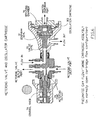
- the OFF-ON pneumatic Therapy Selection switch 5 when in the NEBULIZATION ONLY position (see FIG. 2 switch position), interrupts the Oscillator cartridge 2A pulsed gas deliveries to the Phasitron Service socket 11A thereby blocking pulsed air flows to the venturi jet orifice 11A of the Phasitron®.
- Note #1- The Therapy Selection switch 5 functions are identified by the OFF and ON throws (arrow 401) on the switch stem, which are labeled as follows: In the OFF position, "NEBULIZATION ONLY.” See FIG. 2 . In the ON position, "Bi-phasicTM IPV WITH NEBULIZATION.” See FIG. 1 .
- the opposing leg 6 of the distribution Tee piece 2A is directed into the inlet of an inspiratory loading orifice 6A.
- the outflow from the inspiratory loading orifice 6B is delivered into the common inlet-outlet 6C of the time metering valve 7.
- Note #1- the inspiratory loading orifice 7D in FIG. 6 limits the rate at which the time metering valve air can upload the oscillator cartridge servoing chamber 7E in FIG. 6 to interrupt oscillator cartridge outflow, essentially controlling the limits of the interrupter valve opening time.
- the rotary time metering valve control knob 7A in FIG. 6 with an index arrow is top identified as "Bi-phasicTM PERCUSSION" with a 12:00 index labeled AVERAGE.
- a left facing PERCUSSION control knob rotation toward EASY 7B in FIG. 1 increases the common up-down loading orifice size decreasing the time required for up-loading and down-loading.
- a right facing control knob rotation toward HARD marker 7C decreases the common percussion inflow/outflow orifice size increasing the time required for up-loading and down-loading.
- Note #1- The up-loading pressure within the oscillator timing circuit before flow metering through the inspiratory loading orifice 7D in FIG. 6 would be the same as the venturi jet orifice pressure, which is controlled by the non regulated air compressor operational delivery pressure.
- the clean near immediate opening of the interrupter valve gate 7G Fig 6 within the oscillator cartridge 103 enables a maximum sub tidal volume transfer into the lungs during a selected inspiratory time, for a maximum sub tidal volume to be injected through the Phasitron® into the physiological airways. It follows, that the closing of the interrupter cartridge valve gate 7G must be near instantaneous to allow an immediate opening pressure drop through the Phasitron® to ambient allowing a maximum physiological gas outflow during the allowed expiratory time.
- the constant unregulated air generation of the air compressor is regulated by:
- Note #1- In the Home Therapy HTTM configuration, the "energy surge spikes" created by each compressional piston stroke are directed into the patient's proximal pulmonary airway during sub tidal volume deliveries by the Phasitron® venturi jet orifice 11A in Fig 1 as well as, through the nebulizer jet orifice 9A serving to internally increase the particulate diffusion during the liquid to particle aerosolization process.
- Note #2- The sharp microsecond generated "energy spikes” attach themselves to the scheduled sub tidal volumes which serve as transport vehicles for the delivery of the energy spikes endobronchially during sub tidal volume delivery.
- the entire self contained Home Therapy HTTM Impulsator® apparatus with the limited pressure-volume air compressor 10 in Fig 3 is packaged within a deep drawn aluminum housing 12.
- the compressor 10 is shock mounted in housing 12 to provide isolation and positioning.
- An inserted top cover panel 12B, see FIG. 4 closes the open top of the housing 12 ( FIGs. 3 , 4 ) providing for a labeled control panel 12B for patient control access.
- Cover top flap 12 BB, FIG. 4 further protects the unit.
- a direct internal compressor driven shaft integrated fan 13D provides for diffuse internal circulation within the housing.
- the cooling fans employ the same electrical power as the compressor.
- Compressor 10 is mechanically powered by motor 12A shock mounted in case 12.
- Line power is delivered through a lower (grommeted) hole through the left facing side of the housing 12 by an attached and restrained power cord.
- Entrained air is drawn into the compressor through an ambient vented exchangeable filter 17 in Fig 4 positioned through the top of the control panel 12B.
- the entire deep drawn aluminum housing 12 in Figs 3 , 4 is dropped into a top loading, insulated airline quality nylon container bag 12C in Fig 4 with a reinforced bottom and semi snug fit. Straps 301, 302 and zipper closures 305 secure the unit in the portable bag 12C. Other closure systems may be used.
- Appropriate holes are made through the walls of the nylon container pack 12C to accommodate the aft cooling fans, the left facing side accommodates the electrical power inlet.
- the containing transport pack is fastened to the aluminum housing 12 by installed grommet type accommodations as well as, snap type fasteners. In this manner bag 12C is securely mounted on housing 12.
- IPV® Intrapulmonary Percussive Ventilation
- This device was conceived to allow present or new COPD patients who now have or are considering the heavy home care IPV® Impulsators®, which have been clinically mandated for use at least twice daily; to travel reliably wherever they elect to go with a light weight portable Home Therapy HTTM Impulsator ⁇ IPV® therapy device, without fear of being separated from their mandated daily home treatment schedules.
- Intrapulmonary volume trauma mechanically induced secondary to pulmonary airway hyper-expansional ventilatory CMV scheduling, which can be aggravated by a Positive End Expiratory Pressure (PEEP)
- PEEP Positive End Expiratory Pressure
- PEEP Positive End Expiratory Pressure
- FRC Pulmonary Functional Residual Capacities
- the inventor became involved with Continuous Minimal Airway Pressures (CPAP) in the early 1970's by conceiving the logic for Demand CPAP, which could maintain a near constant minimal proximal to distal pulmonary positive airway pressures during spontaneous or controlled respiration. He has since created a Demand Oscillatory OD-CPAP concept limiting any potential impact upon the Bronchiolar circulation.
- CPAP Continuous Minimal Airway Pressures
- Clinical alveolar septation can be demonstrated in animal experiments when a long term continuous proximal-distal airway pressure gradient is maintained with or without limited mandatory intrapulmonary tidal exchange, during spontaneous respiration. This observation may in part demonstrate that without an adequate percussive physiological or mechanical enhancement, to the three intrathoracic circulations by physiological or mechanical means, such as induced "Pulmonary Vesicular Peristalsis" the bronchial circulation is continuously impaired by partially inflated peripheral airways and their alveoli, serving to stretch and partially narrow the caliber of the Bronchial circulatory vessels, thus creating a long term ischemic trend.
- IPV® Intrapulmonary Percussive Ventilation
- the IPV® concept was directed toward providing a recruiting percussive sub tidal gas exchange into and within the respiratory bronchioles and associated alveolar structures, while providing for a lung protective strategy.
- the inventor's concept was to mechanically provide for peripheral lung recruitment while minimizing the potential for induced barotrauma.
- Vesicular Peristalsis is dependent upon having the proximal airway vented without restriction, to ambient during the repetitive milli-second expiratory phases of sub tidal endobronchial gas exchange.
- the next controlled percussive inspiratory sub tidal volume is mechanically delivered endobronchially, to re-inflate the contracting bronchiolar airways and deflating pulmonary alveoli. Therefore, the entire tracheobronchial tree receives continuous peristaltic directional pulsatile stroking waves from the trachea into the peripheral bronchiolar airways, during programmed sub tidal volume delivery intervals.
- the pulmonary airways are mechanically caused to cyclically contract and expand, the attached vessels of all three intrathoracic circulations are repeatedly peristaltically compressed and released, during the cyclic expansion and contraction of the pulmonary airways to which they are attached.
- Intrapulmonary Percussive Ventilation IPV® serves as a lung recruitment means by the percussive intrapulmonary gas mixing and gas exchange as well as, enhancing the directional vesicular flow of fluids flowing through the three intrathoracic circulations, thus enhancing a mechanically induced "Vesicular Peristalsis”.
- ARDS acute respiratory distress syndrome
- Preferential hyper volume induced pulmonary barotraumas may well be created by volume-pressure (CMV) limiting techniques in patients with obstructive peripheral lung encroachment (disease) however caused.
- CMV volume-pressure
- CMV volume-pressure limited continuous mechanical pulmonary ventilation
- the current Intrapulmonary Percussive Ventilation IPV® heavy Impulsator® is semi portable and has a self-contained IPV® Percussionator® device with an internal high volume/pressure air compressor 10 weighing about 8.16 Kg (18 pounds) (compressor-motor unit) see FIG. 4 , foreground compressor set, capable of generating some 6,25 bar (90 psi).
- the overcapacity air-flow of the heavy Impulsator® is regulated with a pressure reduction regulator monitored by an operational pressure gauge. Normal selected operational pressures are from 1,72 to 3,79 bar (25 to 55 psig). The higher generated flow pressures are vented to ambient by a pneumatic pressure-regulating device.
- an intra pulmonary induced "Sub tidal volume exchange” is the cyclic percussive pulmonary airway injection of an air volume, which is less than the total patient's "Physiological Dead Space” (where a blood gas exchange interface does not exist).
- the selected injection (the Ram Pressure) must be adequately maintained.
- aerosol particles are continuous during percussive higher frequency oscillation or spontaneous respiration provided by the compressed air output flow/pressure, which can be regulated by restrictive multi orifice integration.
- Intrapulmonary percussion is generated, by the controlled cyclic (full opening and closing) of a normally open pneumatic oscillatory flow/timing cartridge timed in milliseconds.
- the selected regulated operational pressure during flow demand is generated by a high rpm stroke volume delivery (some 3500 rpm) with a calculated overlapping piston stroke volume sufficient to provide for the mandated flow/pressure demand of the IPV® apparatus.
- the overlapping pulsatile cumulative compressor stroke volumes create an "Energy Spike" during each stroke, during the repetitive flow/pressure generated volume accumulation, which is super-imposed upon each sub tidal endobronchial delivery.
- Compressor created air inflow is internally interrupted by a flow interrupter Oscillator cartridge, oscillating at selected cycling rates (in milliseconds), usually from about 100 to 500 cycles per minute.
- Cyclic flow interruptions are designed to automatically produce optimal near instantaneous opening and closing, inspiratory-to-expiratory flow gradients with "i/e” ratios of from 1:1+ at the higher selected frequencies down to 1:3 at the lower scheduled frequency selections, which are calibrated to maintain the patient's near normal functional residual capacity (FRC).
- FRC near normal functional residual capacity
- FIGs. 8A , 8B show a physical-physiological proximal airway-interfacing device called a PHASITRON® 101 which serves as a percussive proximal airway located injector/exhalation valve, essentially serving as a pulmonary airway interfacing respirator.
- the PHASITRON® airway-interfacing device contains a sliding venturi tube-jet assembly 102 for endobronchial sub tidal air injection, as well as expiratory ambient venting, of the entire proximal pulmonary airways.
- the oscillator cartridge 103 delivers percussive gas impulses (in milliseconds) into the venturi jet inlet orifice 11A in Fig 1 of the Phasitron® (airway-interfacing device).
- the opening and closing i/e ratios of the Oscillator cartridge 103 in Fig 6 are controlled by pressure differentials created by servoing pressures across a configured diaphragm seal 7F.
- the Closed (Pressurized) Phasitron® sliding venturi 103 in Fig 8B shows a physical-physiological proximal airway interfacing device which is servoed by the Oscillator cartridge 103 in Fig 6 which delivers percussive bursts of air (in milliseconds) into the venturi jet orifice inlet 11A of Fig 1 of the Phasitron® (airway-interfacing device).
- the opening and closing i/e ratios of the oscillator cartridge 103 in Fig 6 are controlled by designed pressure differentials.
- a pneumatic digit (finger-thumb) controlled manually operated "normally open” mode switch 11C in Fig 1 and mode switch orifice 11D, are located atop the nebulizer.
- the digitally operated mode switch 11C is not depressed, (venting the mode switch orifice to ambient) a component of the air routed to the Phasitron® venturi jet orifice is bled to ambient, through the mode switch orifice 11D, creating a flow-pressure decreases to the venturi and nebulizer jet orifices.
- the amplitude of the scheduled sub tidal volume delivery is decreased.
- the mode switch button 11C When the mode switch button 11C is manually depressed, arresting the ambient air bleed, the pressure to the venturi jet and nebulizer orifices are increased, which increases the amplitude of the endobronchial sub tidal volume deliveries.
- the mouthpiece outlet of the Phasitron® airway-interfacing device must be sealed by the patient's lips for repetitive, percussive sub tidal air volumes to be injected into the airways of the lungs.
- Other means to connect the Phasitron® outlet to the patient airways such as masks and indwelling airway tubes can be electively used.
- FIG. 7 demonstrates that a sinusoidal waveformat can be created when the patient systematically depresses and releases the mode switch, creating a Bi-phasicTM sinusoidal high-low amplitude percussive oscillation, during the delivery of the selected periodic sub tidal endobronchial deliveries. If the patient so elects, they can spontaneously breathe though the scheduled percussive oscillatory program. Spontaneous breathing would decrease the peak oscillatory pressure rise during inhalation and increase the peak oscillatory pressure rise during exhalation, within the limits of venturi jet orifice inflows.
- the percussive near instantaneous opening and closing of the oscillator (flow- timing) cartridge 103 in Fig 6 is a factor of design.
- the percussive oscillatory cartridge opening-(flow) and closing- (no flow) time are controlled by reversing flow through the common up-loading and down-loading time metering valve inlet orifice 6C in FIG. 1 .
- the time metering valve orifice 7D with calibrated rotation is labeled from EASY at mark 7B to HARD at mark 7C.
- Intrapulmonary Percussive Ventilation IPV® concept step inflates the lungs to a full ambient venturi flow/pressure clutching, called “oscillatory equilibrium”. See waveform, FIG. 7 .
- the oscillatory pressure rise is determined by patient activation of the mode switch 11C.
- the clinical management of obstructive pulmonary disease is classically directed toward the recruitment and maintenance of the bronchiolar airway patency (size), which is limited by mucosal and sub mucosal edema as well as, retained endobronchial secretions and smooth muscle spasm, diffusely imposing upon alveolar gas exchange.
- the patient must manually select NEBULIZATION therapy without lung recruiting sub tidal volume deliveries. This feature favors the patient maintaining the more effective Bi-phasicTM lung recruitment schedules.
- the Home Therapy HTTM Impulsator® has two separate interfacing oscillator and nebulizer outlet Service sockets appropriately labeled for the user as BI-PHASIC and NEBULIZER. These labels are adjacent service ports in FIG. 4 .
- the first compressor head outlet fitting 1 directs outflow directly into the Oscillator cartridge inlet 1A.
- the second compressor head outlet fitting 9 provides for the continuous flow-pressure demand of the nebulizer through a flow-pressure balance orifice 9B additionally serving to balance the preferential flow into the Phasitron® venturi jet orifice.
- a pneumatic flow timing valve assembly controls the timing of the pulsatile systemic airflows forming an oscillatory circuit with adjustable cycling rates. This is accomplished by delivering oscillator cartridge outlet air 2 through a Therapy Selection switch 5, through a Phasitron® Service socket 5A then delivering the pulsatile sub tidal air flows through an extended tubing to the Phasitron jet orifice 11A.
- servoing chamber 7E in FIG. 6 pressurizes the oscillator servo diaphragm. Upon pressurization the diaphragm moves a valve stem forward effectively closing the valve gate 7G producing a "no flow" condition.
- the diaphragm servoing chamber down loads reciprocally through the common up-down loading time metering valve orifice 7, depressurizing the diaphragm thus causing the reopening of the oscillator cartridge valve 8 in Fig 1 .
- valve closure Upon valve closure "no flow” the reversing down loading air flows to ambient through the common up and down loading and unloading time orifice, creating an equal to or longer down loading (valve closing) time than up loading time (because of the differential up and down loading pressures, mandating a longer “no flow” (expiratory) time.
- the common time metering valve orifice 6C in Fig 1 primarily down-loads through the inspiratory loading orifice (when the therapy selection switch is in the Bi-phasic IPV position) through the cyclically deactivated Phasitron® venturi jet orifice.
- the remote patient operated mode switch 11C controls the amplitude of a selected percussive oscillatory cycling frequency. With the mode switch not depressed part of the periodic inspiratory flow directed into the Phasitron venturi jet orifice is vented to ambient, decreasing the amplitude of the selected sub tidal volume injection. When the patient depresses the mode switch button 11C, the ambient bleed of part of the venturi jet flow is interrupted causing a pressure rise in the Phasitron® venturi jet and nebulizer orifices. This increases the amplitude of sub tidal volume delivery.
- the initiating resistance to Phasitron® jet orifice inflow through the therapy selection switch 5 creates a gradual initiating sub tidal volume delivery, preventing an initial hard endobronchial impaction during the injection of the intrapulmonary sub tidal volume.
- Each percussive endobronchial sub tidal volume delivery serves as an intrapulmonary transmission vehicle to be modulated by the micro compressional "energy spikes" (shock waves), created by each compressive piston upstroke.
- energy spikes shock waves
- thermodynamic control over the internal heat dissipation is designed to prevent water condensation within the Oscillator cartridge and associated flow-timing components.
- Percussive sub tidal volumes are further augmented by modifying the effective (airway-interfacing device) Phasitron® venturi flow-pressure entrainment ratios by increasing the velocity and volume of flow from the venturi jet orifice through the venturi aspirational throat geometry.
- the continuous mandated systemic flow, pressure, volume air generation for repetitive endobronchial percussive sub tidal volume injections can be controlled by balancing any excess compressor generated air volumes through the nebulizer aerosol generating jet orifice.
- the nebulizer is capable of generating therapeutic aerosol volumes far beyond that required for peripheral lung particulate deposition.
- the variations in excessive delivery of aerosol beyond optimal endobronchial airway requirements are used to balance the systemic operational pressures are of little, if any clinical consequence.
- IPV® Intrapulmonary Percussive Ventilation
- Patient operational ease while providing increased clinical efficacy is increased by (aa) The elimination of a pressure reduction regulator and pressure monitoring gauge; (bb) operational flow and pressures do not have to be repeatedly adjusted by the patient to mobilize and then recruit endobronchial secretions, thus increasing operational ease; (cc) clinical nebulization pressures are automatically regulated by the patient's Bi-phasicTM thumb control over the percussive amplitude during sub tidal volume deliveries.
- Patient control is present during both airway recruitment and airway secretion clearance; (dd) manometric monitoring of the patient's proximal airway pressures are eliminated, serving no therapeutic usefulness; (ee) the selection of percussive frequency band-width by the rotation of the (only patient access) time metering control knob 7A in FIG. 6 and FIG. 1 enables the patient or clinician to generally conform to the initiating size and severity of the patient's lung disease; (ff) when the breathing head (normally open) mode switch is ambient vented, the amplitude of the injected sub tidal volumes will be decreased. By applying thumb pressure to the mode switch 11C in FIG. 1 the sub tidal volume amplitude is increased for peripheral lung recruitment.
- the encapsulated Intrapulmonary Percussive Ventilation IPV® therapy apparatus can be used within the institution, home or during vehicular travel when powered by direct ac 50 or 60 cycle and/or dc to ac power conversion; by a patient owner, professional institutional clinician administering to institutional patients, emergency medical team (EMT) etc. for mass cardiopulmonary casualty or localized respiratory care treatments.
- EMT emergency medical team
- the deep drawn aluminum housing containing the IPV® apparatus can be used free standing without the travel case encapsulation.
- FIG. 9A shows the dynamic IPV therapeutic breathing circuit.
- Nebulizer 104 is fed a constant flow of gas into the inlet of the venturi port. Solution in the nebulizer 104 is converted into mist which mist is then mixed at junction 105 with room air.
- the service port (labeled white) leads to another venturi jet and then the activated mist is passed through the Phasitron valving system 210 to mouthpiece 106.
- a pressure monitoring port (labeled red) may lead to a wedge pressure monitor gauge.
- FIG. 9B is a standard Home Therapy HTTM Impulsator® breathing circuit for connecting to facemasks and indwelling physiological airways as well as, patient mouthpieces 106.
- Arrow 204 shows mouthpiece removal.
- the separate universal nebulizer 104 and Phasitron® valving system 210 with a failsafe ambient venting sleeve valve is employed for neonatal, pediatric and adult institutional cardiopulmonary patient use.
- the Figure shows a separate but interconnected Phasitron® 210 with a physical-physiological interface.
- interfacing tubing 11 b (typically consisting of a 48" tube) has connection ports or fixtures 202, 5a, a yellow Nebulizer connection port 202 and white Phasitron® connection port 5a, with interconnections on one end, with Home Therapy HTTM Impulsator yellow Nebulizer and white Bronchotron® service sockets on the opposing end.
- FIG. 9C shows an alternative Phasitron DUOTM breathing head with fixed mouth piece 106 for cooperative long term Home Care COPD and/or chronic cardiopulmonary patient therapy.
- the nebulizer 104 is conjoined with the Phasitron® valving system 210 for cooperative patient Cardiopulmonary patient use. Further, the unit has a separate interconnected Phasitron® physical-physiological interface.
- This alternative head system has interfacing tubing 116 (typically 48") with connection ports or fixtures 202, 5a, that is, a yellow nebulizer connection port 202 and white Phasitron® connection port 5a on one end, and with interconnection ports for the Home Therapy HTTM Impulsator yellow nebulizer and white Bronchotron® service sockets on the opposing end.
- the breathing circuit differs substantially from the standard mono IPV® breathing circuits in the following three manners.
- the Phasitron sliding venturi modulates the delivery of the scheduled repetitive intrapulmonary sub tidal volumes with higher frequency amplified compressional stroke energy bursts, to mechanically increase the inspiratory inflational elastomeric yield of the transporting bronchiolar airway walls, which serves to enhance their associated intrathoracic intravascular pulsatile blood flows as well as directional passive lymphatic fluidic flows.
- This intrapulmonary sub tidal volume with higher frequency amplified compressional stroke energy bursts was not previously available.
- the higher frequency percussive amplitudes of the manually scheduled Bi-phasicTM pulsatile endobronchially delivered sub tidal volume are scheduled by the patient depressing or relaxing digital (thumb or finger) pressure upon a pneumatic Bi-phasicTM impulse amplitude switch.
- This manual percussive amplitude control by the patient enables the patient to manually control a sinusoidal amplitude of the scheduled higher frequency tidal volume deliveries to produce a balanced intrapulmonary gas exchange.
- This manual control of the sinusoidal amplitude enables the patient to increase their oxygen uptake with less tidal delivery amplitude as well as "blow off" CO2 with higher amplitude sub tidal deliveries, while maintaining the same sub tidal delivery frequencies.
Landscapes
- Health & Medical Sciences (AREA)
- Emergency Medicine (AREA)
- Pulmonology (AREA)
- Engineering & Computer Science (AREA)
- Anesthesiology (AREA)
- Biomedical Technology (AREA)
- Heart & Thoracic Surgery (AREA)
- Hematology (AREA)
- Life Sciences & Earth Sciences (AREA)
- Animal Behavior & Ethology (AREA)
- General Health & Medical Sciences (AREA)
- Public Health (AREA)
- Veterinary Medicine (AREA)
- Pharmaceuticals Containing Other Organic And Inorganic Compounds (AREA)
- Percussion Or Vibration Massage (AREA)
Claims (14)
- Respirateur pour ventiler les voies respiratoires d'un patient durant une phase inspiratoire et une phase expiratoire, ledit respirateur étant alimenté en gaz sous pression d'une source de gaz pressurisé, le respirateur comprenant :un moyen d'alimentation pour fournir une pluralité d'impulsions de petits volumes de gaz sous forme de pointes subites d'énergie de ladite source de gaz, aux voies respiratoires du patient durant la phase inspiratoire.un moyen d'addition couplé audit moyen d'alimentation, ledit moyen d'addition pour ajouter successivement de plus grands volumes d'impulsions gazeuses comme faisant partie desdites petites impulsions de gaz en contrôlant soit le cycle soit l'amplitude des volumes successifs de gaz, afin de fournir successivement de plus grands volumes de gaz, augmentant successivement sous une forme pulsatile, la pression du gaz dans les voies respiratoires du patient durant la phase inspiratoire résultant en une ventilation par diffusion du patient durant la phase inspiratoire, etun moyen pour permettre au patient d'exhaler durant la phase expiratoire.
- Respirateur selon la revendication 1, dans lequel ladite source de gaz sous pression comprend un compresseur et le respirateur comprend :un moyen d'alimentation constante en air couplé audit moyen d'alimentation, ledit moyen d'alimentation constante en air destiné à produire une alimentation constante en air pour la percussion des poumons en amplifiant l'alimentation en air provenant dudit compresseur, etun générateur d'aérosol ou nébuliseur maintenant un volume d'air comprimé et un spectre de particules adéquats, ledit générateur d'aérosol ou nébuliseur couplé audit moyen d'alimentation.
- Respirateur selon la revendication 2, le respirateur comprenant un moyen sélecteur de fréquence pour équilibrer la décharge totale du compresseur et l'amplitude de percussion et la nébulisation sur une bande de fréquence prédéterminée sélectionnable, ledit moyen sélecteur de fréquence couplé audit moyen d'alimentation.
- Respirateur selon la revendication 2 ou la revendication 3, le respirateur comprenant un commutateur biphasique manuel avec ledit moyen d'alimentation qui commande les amplitudes et les fréquences oscillatoires pour ledit générateur d'aérosol ou nébuliseur.
- Respirateur selon l'une quelconque des revendications 2 à 4, le respirateur comprenant :une housse-valise dotée d'un intérieur à rembourrage doux pour ledit compresseur;un orifice d'aération de valise permettant l'écoulement d'air ambiant à travers celle-ci pour ledit compresseur,ladite valise ayant des parois d'amortissement limitant le bruit du compresseur et des segments de paroi amortisseurs de chocs;ledit respirateur ayant un tableau de commande;ladite valise ayant une ouverture de tableau de commande avec un couvercle en tissu pour dissimuler ledit tableau de commande.
- Respirateur selon l'une quelconque des revendications 2 à 5, dans lequel le compresseur comprend un piston et ledit moyen d'alimentation utilise des ondes de choc de compression créées durant les déplacements ascendants compressifs répétitifs du piston du compresseur d'air qui servent à moduler des délivrances endobronchiques de volumes courants réduits à pression positive avec une énergie vibratoire.
- Respirateur selon la revendication 6, dans lequel ledit moyen d'alimentation produit des ondes de choc endobronchique avec un rapport vibratoire d'environ sept ondes de choc de modulation durant chaque injection endobronchique de volume courant réduit.
- Respirateur selon la revendication 1, dans lequel :ledit respirateur est un appareil de ventilation contrôlée continue (VC), etledit moyen d'alimentation comprend un moyen pour générer des ondes d'air à pression diffusive de percussion fournies à un appareil de ventilation VC orienté en volume-pression de convection hôte.
- Respirateur selon la revendication 1, dans lequel les volumes successivement plus grands de gaz dans les voies respiratoires du patient sont causés uniquement par l'addition successive de petits volumes de gaz.
- Respirateur selon la revendication 2, dans lequel le compresseur maintient de l'air comprimé adéquat pour actionner un générateur d'aérosol ou autre nébuliseur actionné au gaz avec presque le même spectre de particules et presque le même volume.
- Respirateur selon la revendication 2, dans lequel le moyen d'addition comprend un moyen pour permettre des amplitudes et des fréquences oscillatoires sélectionnables manuellement avec un commutateur biphasique actionné manuellement avec un doigt ou une main à distance ou distal, commandant un orifice qui permet des amplitudes séparées de mobilisation et de recrutement des voies respiratoires pulmonaires périphériques et des fréquences oscillatoires dans deux modalités :une modalité d'oscillation de percussion commencée en permettant une aération ambiante, etune modalité d'alimentation oscillatoire à amplitude biphasique pour les voies respiratoires du patient causant la mobilisation ou le recrutement des poumons du patient en obstruant ou en occluant l'aération ambiante.
- Respirateur selon la revendication 7, dans lequel le compresseur fournit des ondes de choc de compression s'élevant à environ 3500 durant les déplacements ascendants compressifs répétitifs du piston du compresseur d'air qui est un moyen de moduler les délivrances endobronchiques de volumes courants réduits à pression positive avec une énergie vibratoire et de fournir des ondes de choc endobronchique avec un rapport vibratoire d'environ sept durant chaque injection endobronchique de volume courant réduit qui fait que les parois des voies respiratoires pulmonaires se soumettent mieux au changement de volume.
- Respirateur selon l'une quelconque des revendications 10 à 12, dans lequel lesdites pointes d'énergie de la course du compresseur transmettent essentiellement des volumes d'impulsions gazeuses à travers l'orifice de jet d'un corps de venturi servant ainsi comme un injecteur d'air/oxygène pulsatile dans les voies respiratoires du patient, le respirateur comprenant :un orifice de jet secondaire de nébuliseur interconnecté audit compresseur adapté pour convertir un liquide en un aérosol avec un spectre de particules calculé dans une variation de pression d'orifice de jet prédéterminée, un écoulement constant vers l'orifice de jet du nébuliseur variant durant l'injection endobronchique du volume inspiratoire courant réduit et puis passant à une période expiratoire sans écoulement;un écoulement d'orifice de jet variable pour réguler ou amortir une pression opérationnelle dans une plage de pression thérapeutique opérationnelle;un moyen pour planifier des écoulements intrapulmonaires pulsatiles de volume courant réduit de l'orifice de jet du venturi, faisant partie du moyen d'addition et fournissant un gradient de pression d'entrée périodique servant à aspirer un volume de l'aérosol particulaire pour la délivrance concomitante de l'aérosol dans les voies respiratoires du patient;un moyen pour purger après la délivrance de volume courant réduit ou l'intervalle expiratoire, les voies aériennes mécaniques dudit nébuliseur comme faisant partie de la décharge du nébuliseur avant d'aérer la décharge à l'air ambiant avec des gaz physiologiques mixtes exhalés des voies respiratoires du patient;un tube de venturi proximal non à déclenchement contrôlé qui est aéré à l'air ambiant permettant que les gaz compressibles délivrés aux voies respiratoires du patient augmentent et réduisent d'une manière obstructive les pressions du tube de venturi, en conformité presque instantanée avec des résistances endobronchiques d'inflation des voies respiratoires changeantes; etun moyen pour fournir, à une pression d'injection pulsatile presque constante de l'orifice de jet, une variation d'inflation constante sur des résistances des voies respiratoires du patient qui font que des pressions du gradient planifié d'entraînement créé par le venturi soient influencées par des changements dans la résistance des voies respiratoires pulmonaires; etmaîtriser une vitesse de décharge de l'injecteur du tube de venturi par une résistance endobronchique d'inflation pulmonaire toujours changeante des voies respiratoires du patient à l'écoulement d'entrée.
- Respirateur selon la revendication 10, dans lequel le compresseur génère des pointes d'énergie de haute fréquence durant la génération du déplacement du piston dans un système de distribution à labyrinthe servant d'accumulateur dans la préparation des pointes d'énergie à transporter dans les poumons, le respirateur comprenant en outre :un ou plusieurs d'entre (a) un moyen pour réduire des forces d'impaction du volume courant réduit et puis d'augmenter progressivement la délivrance du volume courant réduit par le calibrage initial d'un orifice de chargement à des fréquences cycliques plus basses de délivrance de gaz et (b) un moyen pour rendre silencieuse la délivrance de volume courant réduit avec un commutateur à deux positions ou bimodal représentant un fonctionnement biphasique ou la nébulisation seulement à des fréquences cycliques plus basses de délivrance de gaz; etun moyen pour équilibrer des gradients de pression endobronchique de volume courant réduit avec deux orifices de décharge servant à créer un écoulement d'air opérationnel à pression-volume réglés dans un orifice de jet primaire de venturi avec une hausse de pression équilibrée par un écoulement secondaire à travers l'orifice de jet du nébuliseur ou du générateur d'aérosol et réguler, dans une plage de variation de pression de délivrance prédéterminée, l'injection du volume courant réduit dans les voies respiratoires du patient.
Applications Claiming Priority (2)
| Application Number | Priority Date | Filing Date | Title |
|---|---|---|---|
| US11515108P | 2008-11-17 | 2008-11-17 | |
| US12/421,669 US8347883B2 (en) | 2008-11-17 | 2009-04-10 | Manual controlled bi-phasic intrapulmonary percussive ventilation and methods |
Publications (3)
| Publication Number | Publication Date |
|---|---|
| EP2186538A2 EP2186538A2 (fr) | 2010-05-19 |
| EP2186538A3 EP2186538A3 (fr) | 2010-11-03 |
| EP2186538B1 true EP2186538B1 (fr) | 2014-05-07 |
Family
ID=41851776
Family Applications (1)
| Application Number | Title | Priority Date | Filing Date |
|---|---|---|---|
| EP09252492.5A Active EP2186538B1 (fr) | 2008-11-17 | 2009-10-28 | Ventilation percussive intrapulmonaire biphasique à commande manuelle |
Country Status (4)
| Country | Link |
|---|---|
| US (1) | US8347883B2 (fr) |
| EP (1) | EP2186538B1 (fr) |
| JP (1) | JP5248462B2 (fr) |
| CA (1) | CA2682427C (fr) |
Families Citing this family (63)
| Publication number | Priority date | Publication date | Assignee | Title |
|---|---|---|---|---|
| FR2858236B1 (fr) | 2003-07-29 | 2006-04-28 | Airox | Dispositif et procede de fourniture de gaz respiratoire en pression ou en volume |
| JP2011522621A (ja) | 2008-06-06 | 2011-08-04 | ネルコー ピューリタン ベネット エルエルシー | 患者の努力に比例した換気のためのシステムおよび方法 |
| US8302602B2 (en) | 2008-09-30 | 2012-11-06 | Nellcor Puritan Bennett Llc | Breathing assistance system with multiple pressure sensors |
| US8434479B2 (en) | 2009-02-27 | 2013-05-07 | Covidien Lp | Flow rate compensation for transient thermal response of hot-wire anemometers |
| US8439036B2 (en) | 2009-12-01 | 2013-05-14 | Covidien Lp | Exhalation valve assembly with integral flow sensor |
| US8439037B2 (en) | 2009-12-01 | 2013-05-14 | Covidien Lp | Exhalation valve assembly with integrated filter and flow sensor |
| US8469031B2 (en) | 2009-12-01 | 2013-06-25 | Covidien Lp | Exhalation valve assembly with integrated filter |
| US8469030B2 (en) * | 2009-12-01 | 2013-06-25 | Covidien Lp | Exhalation valve assembly with selectable contagious/non-contagious latch |
| US8714154B2 (en) | 2011-03-30 | 2014-05-06 | Covidien Lp | Systems and methods for automatic adjustment of ventilator settings |
| JP5485214B2 (ja) * | 2011-03-31 | 2014-05-07 | 日本メディカルネクスト株式会社 | ネブライザシステム及びこのネブライザシステムに使用されるヒータ装置 |
| US9629971B2 (en) | 2011-04-29 | 2017-04-25 | Covidien Lp | Methods and systems for exhalation control and trajectory optimization |
| US8776792B2 (en) | 2011-04-29 | 2014-07-15 | Covidien Lp | Methods and systems for volume-targeted minimum pressure-control ventilation |
| US10583265B2 (en) | 2011-09-13 | 2020-03-10 | Koninklijke Philips N.V. | Proportional oxygen conserving device with flow sensing |
| US9642976B2 (en) | 2011-11-07 | 2017-05-09 | Koninklijke Philips N.V. | Systems and methods for intra-pulmonary percussive ventilation integrated in a ventilator |
| US9364624B2 (en) | 2011-12-07 | 2016-06-14 | Covidien Lp | Methods and systems for adaptive base flow |
| US9498589B2 (en) | 2011-12-31 | 2016-11-22 | Covidien Lp | Methods and systems for adaptive base flow and leak compensation |
| US8844526B2 (en) | 2012-03-30 | 2014-09-30 | Covidien Lp | Methods and systems for triggering with unknown base flow |
| US9144658B2 (en) | 2012-04-30 | 2015-09-29 | Covidien Lp | Minimizing imposed expiratory resistance of mechanical ventilator by optimizing exhalation valve control |
| US10362967B2 (en) | 2012-07-09 | 2019-07-30 | Covidien Lp | Systems and methods for missed breath detection and indication |
| CN104812431B (zh) * | 2012-07-17 | 2017-03-08 | 卡尔·赖纳有限责任公司 | 用于产生脉动的气柱的装置 |
| US20140163440A1 (en) * | 2012-11-26 | 2014-06-12 | Hill-Rom Services Pte Ltd. | Pulse generator systems for therapy device |
| US9795756B2 (en) | 2012-12-04 | 2017-10-24 | Mallinckrodt Hospital Products IP Limited | Cannula for minimizing dilution of dosing during nitric oxide delivery |
| TR201707036T4 (en) | 2012-12-04 | 2018-11-21 | Ino Therapeutics Llc | Cannula to minimize dose dilution during administration of nitric oxide |
| US9492629B2 (en) | 2013-02-14 | 2016-11-15 | Covidien Lp | Methods and systems for ventilation with unknown exhalation flow and exhalation pressure |
| USD731049S1 (en) | 2013-03-05 | 2015-06-02 | Covidien Lp | EVQ housing of an exhalation module |
| USD701601S1 (en) | 2013-03-08 | 2014-03-25 | Covidien Lp | Condensate vial of an exhalation module |
| USD731048S1 (en) | 2013-03-08 | 2015-06-02 | Covidien Lp | EVQ diaphragm of an exhalation module |
| USD736905S1 (en) | 2013-03-08 | 2015-08-18 | Covidien Lp | Exhalation module EVQ housing |
| USD693001S1 (en) | 2013-03-08 | 2013-11-05 | Covidien Lp | Neonate expiratory filter assembly of an exhalation module |
| USD731065S1 (en) | 2013-03-08 | 2015-06-02 | Covidien Lp | EVQ pressure sensor filter of an exhalation module |
| USD692556S1 (en) | 2013-03-08 | 2013-10-29 | Covidien Lp | Expiratory filter body of an exhalation module |
| USD744095S1 (en) | 2013-03-08 | 2015-11-24 | Covidien Lp | Exhalation module EVQ internal flow sensor |
| US9981096B2 (en) | 2013-03-13 | 2018-05-29 | Covidien Lp | Methods and systems for triggering with unknown inspiratory flow |
| US9950135B2 (en) | 2013-03-15 | 2018-04-24 | Covidien Lp | Maintaining an exhalation valve sensor assembly |
| ITBS20130072A1 (it) * | 2013-05-20 | 2014-11-21 | Flaem Nuova Spa | Apparecchiatura per la fisioterapia riabilitativa respiratoria |
| US10064583B2 (en) | 2013-08-07 | 2018-09-04 | Covidien Lp | Detection of expiratory airflow limitation in ventilated patient |
| CN104740735B (zh) * | 2013-12-26 | 2018-07-20 | 北京谊安医疗系统股份有限公司 | 呼气潮气量vte计算方法 |
| US9808591B2 (en) | 2014-08-15 | 2017-11-07 | Covidien Lp | Methods and systems for breath delivery synchronization |
| US9950129B2 (en) | 2014-10-27 | 2018-04-24 | Covidien Lp | Ventilation triggering using change-point detection |
| US9925346B2 (en) | 2015-01-20 | 2018-03-27 | Covidien Lp | Systems and methods for ventilation with unknown exhalation flow |
| AU2016243801B2 (en) | 2015-04-02 | 2020-05-21 | Hill-Rom Services Pte. Ltd. | Manifold for respiratory device |
| USD775345S1 (en) | 2015-04-10 | 2016-12-27 | Covidien Lp | Ventilator console |
| US20210205567A1 (en) * | 2016-08-02 | 2021-07-08 | Adel Bougatef | Method and apparatus for providing percussive ventilation therapy to a patient airway |
| US10987274B2 (en) | 2016-08-02 | 2021-04-27 | Adel Bougatef | Method and apparatus for providing percussive ventilation therapy to a patient airway |
| WO2019099185A1 (fr) * | 2017-11-14 | 2019-05-23 | Covidien Lp | Méthodes et systèmes de ventilation spontanée par pression de commande |
| CN120393203A (zh) * | 2018-01-12 | 2025-08-01 | 儿童医院医疗中心 | 用于从气道消除分泌物的阻塞并去除所述分泌物的装置 |
| EP3524303A1 (fr) * | 2018-02-12 | 2019-08-14 | Vortran Medical Technology 1, Inc. | Appareil respiratoire à percussion à faible débit et traitement associé |
| US11478594B2 (en) | 2018-05-14 | 2022-10-25 | Covidien Lp | Systems and methods for respiratory effort detection utilizing signal distortion |
| EP3569276A1 (fr) * | 2018-05-17 | 2019-11-20 | PARI GmbH Spezialisten für effektive Inhalation | Composant de dispositif d'inhalation et système de vibration |
| US11752287B2 (en) | 2018-10-03 | 2023-09-12 | Covidien Lp | Systems and methods for automatic cycling or cycling detection |
| EP3773835B1 (fr) * | 2018-10-17 | 2022-05-18 | Maquet Critical Care AB | Recrutement pulmonaire dans une ventilation mécanique |
| US11324914B2 (en) | 2018-11-01 | 2022-05-10 | Percussionaire Corporation | Percussive ventilation breathing head and accessories |
| USD1051376S1 (en) | 2019-04-23 | 2024-11-12 | Percussionaire Corporation | Ventilator coupler |
| US11324954B2 (en) | 2019-06-28 | 2022-05-10 | Covidien Lp | Achieving smooth breathing by modified bilateral phrenic nerve pacing |
| US11896767B2 (en) | 2020-03-20 | 2024-02-13 | Covidien Lp | Model-driven system integration in medical ventilators |
| US11766531B2 (en) | 2020-03-27 | 2023-09-26 | Percussionaire Corporation | Flow regulated, time cycled high frequency percussive ventilator |
| US12427273B1 (en) | 2020-05-15 | 2025-09-30 | John E. Boyd | Methods for treating respiratory distress and compositions for use in the same |
| US12257437B2 (en) | 2020-09-30 | 2025-03-25 | Covidien Lp | Intravenous phrenic nerve stimulation lead |
| CN112156314B (zh) * | 2020-10-14 | 2023-04-21 | 温州职业技术学院 | 一种可调节式呼吸机的频率调节阀 |
| CN113425965B (zh) * | 2021-06-30 | 2023-04-25 | 南华大学附属第一医院 | 用于精准肺复张的支气管导管和导管组件 |
| US20230293843A1 (en) | 2022-03-17 | 2023-09-21 | Percussionaire Corporation | Safety couplers for medical ventilator system |
| EP4431139B1 (fr) * | 2023-03-17 | 2026-02-18 | Shenzhen Haige Cross Border Technology Co., Ltd. | Atomiseur à fonction d'affichage numérique à commande intelligente |
| CN118178807B (zh) * | 2024-04-29 | 2025-04-01 | 珠海黑马生物科技有限公司 | 气道扩清仪 |
Family Cites Families (11)
| Publication number | Priority date | Publication date | Assignee | Title |
|---|---|---|---|---|
| US4164219A (en) * | 1976-10-08 | 1979-08-14 | Minnesota Mining And Manufacturing Company | Ventilator |
| US5862802A (en) * | 1981-04-03 | 1999-01-26 | Forrest M. Bird | Ventilator having an oscillatory inspiratory phase and method |
| US5165398A (en) * | 1989-12-08 | 1992-11-24 | Bird F M | Ventilator and oscillator for use therewith and method |
| JP3860332B2 (ja) * | 1998-03-25 | 2006-12-20 | 靖 城 | 人工呼吸器 |
| US6651658B1 (en) * | 2000-08-03 | 2003-11-25 | Sequal Technologies, Inc. | Portable oxygen concentration system and method of using the same |
| US6595203B1 (en) * | 2000-11-28 | 2003-07-22 | Forrest M. Bird | Apparatus for administering intermittent percussive ventilation and unitary breathing head assembly for use therein |
| US6581600B2 (en) * | 2001-07-13 | 2003-06-24 | Forrest M. Bird | Interface apparatus and combination and method |
| US6929007B2 (en) * | 2003-09-08 | 2005-08-16 | J.H. Emerson Company | Insufflation-exsufflation system with percussive assist for removal of broncho-pulmonary secretions |
| US7191780B2 (en) * | 2003-09-22 | 2007-03-20 | Comedica Incorporated | Continuous high-frequency oscillation breathing treatment apparatus |
| US7736132B2 (en) * | 2006-04-03 | 2010-06-15 | Respironics Oxytec, Inc. | Compressors and methods for use |
| US7909033B2 (en) * | 2006-05-03 | 2011-03-22 | Comedica Incorporated | Breathing treatment apparatus |
-
2009
- 2009-04-10 US US12/421,669 patent/US8347883B2/en active Active
- 2009-10-13 CA CA2682427A patent/CA2682427C/fr active Active
- 2009-10-28 EP EP09252492.5A patent/EP2186538B1/fr active Active
- 2009-11-11 JP JP2009257672A patent/JP5248462B2/ja active Active
Also Published As
| Publication number | Publication date |
|---|---|
| US20100125227A1 (en) | 2010-05-20 |
| EP2186538A3 (fr) | 2010-11-03 |
| EP2186538A2 (fr) | 2010-05-19 |
| US8347883B2 (en) | 2013-01-08 |
| JP5248462B2 (ja) | 2013-07-31 |
| CA2682427C (fr) | 2016-03-29 |
| CA2682427A1 (fr) | 2010-05-17 |
| JP2010119838A (ja) | 2010-06-03 |
Similar Documents
| Publication | Publication Date | Title |
|---|---|---|
| EP2186538B1 (fr) | Ventilation percussive intrapulmonaire biphasique à commande manuelle | |
| US11969551B2 (en) | Vacuum and positive pressure ventilation systems and methods for intrathoracic pressure regulation | |
| US8011367B2 (en) | CPR devices and methods utilizing a continuous supply of respiratory gases | |
| EP2968807B1 (fr) | Appareil respiratoire | |
| US6374827B1 (en) | Tracheo-esophageal tube and ventilator for pneumatic cardiopulmonary resuscitation | |
| EP1414527B1 (fr) | Appareil d'interface pour respirateur de type volumetrique mecanique continu et ventilateur a percussion intra-pulmonaire, combinaison de ceux-ci | |
| EP2793985B1 (fr) | Systèmes et méthodes de régulation thérapeutique de la pression intrathoracique | |
| US20090133695A1 (en) | Mechanical ventilator system | |
| US20050056277A1 (en) | Bag-valve resuscitation for treatment of hypotention, head trauma, and cardiac arrest | |
| JP2010524578A (ja) | Cprの間に循環を増加させるための容量交換弁システムおよび方法 | |
| US20180154094A1 (en) | Artificial ventilation apparatus able to deliver ventilation and monitoring which are specific to the patients receiving cardiac massage | |
| US5740797A (en) | Cardiac synchronized ventilation | |
| JP2005508203A (ja) | 携帯ガス動力陽圧呼吸装置および方法 | |
| JP2012245294A (ja) | ポンプユニット、呼吸補助装置 | |
| JP4934751B1 (ja) | 呼吸補助装置 | |
| EP2931344A2 (fr) | Appareil médico-chirurgical et procédés | |
| US20140031729A1 (en) | Method and Apparatus for Improved Ventilation and Cardio-Pulmonary Resuscitation | |
| Kunugiyama et al. | High-frequency percussive ventilation using the VDR-4 ventilator: an effective strategy for patients with refractory hypoxemia | |
| JP5211336B2 (ja) | ポンプユニット、呼吸補助装置 | |
| MacIntyre | High-frequency ventilation | |
| CN1106705A (zh) | 紧急心肺复苏机 | |
| Daily et al. | Mechanical Ventilation of the Newborn Infant Part I | |
| GB2411121A (en) | Portable ventilating apparatus | |
| CA3256759A1 (fr) | Dispositif respiratoire pour cas d'urgence |
Legal Events
| Date | Code | Title | Description |
|---|---|---|---|
| PUAI | Public reference made under article 153(3) epc to a published international application that has entered the european phase |
Free format text: ORIGINAL CODE: 0009012 |
|
| AK | Designated contracting states |
Kind code of ref document: A2 Designated state(s): AT BE BG CH CY CZ DE DK EE ES FI FR GB GR HR HU IE IS IT LI LT LU LV MC MK MT NL NO PL PT RO SE SI SK SM TR |
|
| AX | Request for extension of the european patent |
Extension state: AL BA RS |
|
| PUAL | Search report despatched |
Free format text: ORIGINAL CODE: 0009013 |
|
| AK | Designated contracting states |
Kind code of ref document: A3 Designated state(s): AT BE BG CH CY CZ DE DK EE ES FI FR GB GR HR HU IE IS IT LI LT LU LV MC MK MT NL NO PL PT RO SE SI SK SM TR |
|
| AX | Request for extension of the european patent |
Extension state: AL BA RS |
|
| 17P | Request for examination filed |
Effective date: 20110427 |
|
| GRAP | Despatch of communication of intention to grant a patent |
Free format text: ORIGINAL CODE: EPIDOSNIGR1 |
|
| INTG | Intention to grant announced |
Effective date: 20131206 |
|
| GRAS | Grant fee paid |
Free format text: ORIGINAL CODE: EPIDOSNIGR3 |
|
| GRAA | (expected) grant |
Free format text: ORIGINAL CODE: 0009210 |
|
| AK | Designated contracting states |
Kind code of ref document: B1 Designated state(s): AT BE BG CH CY CZ DE DK EE ES FI FR GB GR HR HU IE IS IT LI LT LU LV MC MK MT NL NO PL PT RO SE SI SK SM TR |
|
| REG | Reference to a national code |
Ref country code: GB Ref legal event code: FG4D |
|
| REG | Reference to a national code |
Ref country code: AT Ref legal event code: REF Ref document number: 666118 Country of ref document: AT Kind code of ref document: T Effective date: 20140515 |
|
| REG | Reference to a national code |
Ref country code: IE Ref legal event code: FG4D |
|
| REG | Reference to a national code |
Ref country code: DE Ref legal event code: R096 Ref document number: 602009023842 Country of ref document: DE Effective date: 20140618 |
|
| REG | Reference to a national code |
Ref country code: CH Ref legal event code: NV Representative=s name: ING. MARCO ZARDI C/O M. ZARDI AND CO. S.A., CH |
|
| REG | Reference to a national code |
Ref country code: NL Ref legal event code: T3 |
|
| PGFP | Annual fee paid to national office [announced via postgrant information from national office to epo] |
Ref country code: TR Payment date: 20140610 Year of fee payment: 6 |
|
| REG | Reference to a national code |
Ref country code: LT Ref legal event code: MG4D |
|
| PG25 | Lapsed in a contracting state [announced via postgrant information from national office to epo] |
Ref country code: FI Free format text: LAPSE BECAUSE OF FAILURE TO SUBMIT A TRANSLATION OF THE DESCRIPTION OR TO PAY THE FEE WITHIN THE PRESCRIBED TIME-LIMIT Effective date: 20140507 Ref country code: GR Free format text: LAPSE BECAUSE OF FAILURE TO SUBMIT A TRANSLATION OF THE DESCRIPTION OR TO PAY THE FEE WITHIN THE PRESCRIBED TIME-LIMIT Effective date: 20140808 Ref country code: LT Free format text: LAPSE BECAUSE OF FAILURE TO SUBMIT A TRANSLATION OF THE DESCRIPTION OR TO PAY THE FEE WITHIN THE PRESCRIBED TIME-LIMIT Effective date: 20140507 Ref country code: CY Free format text: LAPSE BECAUSE OF FAILURE TO SUBMIT A TRANSLATION OF THE DESCRIPTION OR TO PAY THE FEE WITHIN THE PRESCRIBED TIME-LIMIT Effective date: 20140507 Ref country code: IS Free format text: LAPSE BECAUSE OF FAILURE TO SUBMIT A TRANSLATION OF THE DESCRIPTION OR TO PAY THE FEE WITHIN THE PRESCRIBED TIME-LIMIT Effective date: 20140907 Ref country code: NO Free format text: LAPSE BECAUSE OF FAILURE TO SUBMIT A TRANSLATION OF THE DESCRIPTION OR TO PAY THE FEE WITHIN THE PRESCRIBED TIME-LIMIT Effective date: 20140807 |
|
| PG25 | Lapsed in a contracting state [announced via postgrant information from national office to epo] |
Ref country code: LV Free format text: LAPSE BECAUSE OF FAILURE TO SUBMIT A TRANSLATION OF THE DESCRIPTION OR TO PAY THE FEE WITHIN THE PRESCRIBED TIME-LIMIT Effective date: 20140507 Ref country code: SE Free format text: LAPSE BECAUSE OF FAILURE TO SUBMIT A TRANSLATION OF THE DESCRIPTION OR TO PAY THE FEE WITHIN THE PRESCRIBED TIME-LIMIT Effective date: 20140507 Ref country code: ES Free format text: LAPSE BECAUSE OF FAILURE TO SUBMIT A TRANSLATION OF THE DESCRIPTION OR TO PAY THE FEE WITHIN THE PRESCRIBED TIME-LIMIT Effective date: 20140507 Ref country code: HR Free format text: LAPSE BECAUSE OF FAILURE TO SUBMIT A TRANSLATION OF THE DESCRIPTION OR TO PAY THE FEE WITHIN THE PRESCRIBED TIME-LIMIT Effective date: 20140507 Ref country code: PL Free format text: LAPSE BECAUSE OF FAILURE TO SUBMIT A TRANSLATION OF THE DESCRIPTION OR TO PAY THE FEE WITHIN THE PRESCRIBED TIME-LIMIT Effective date: 20140507 |
|
| PG25 | Lapsed in a contracting state [announced via postgrant information from national office to epo] |
Ref country code: PT Free format text: LAPSE BECAUSE OF FAILURE TO SUBMIT A TRANSLATION OF THE DESCRIPTION OR TO PAY THE FEE WITHIN THE PRESCRIBED TIME-LIMIT Effective date: 20140908 |
|
| PG25 | Lapsed in a contracting state [announced via postgrant information from national office to epo] |
Ref country code: CZ Free format text: LAPSE BECAUSE OF FAILURE TO SUBMIT A TRANSLATION OF THE DESCRIPTION OR TO PAY THE FEE WITHIN THE PRESCRIBED TIME-LIMIT Effective date: 20140507 Ref country code: RO Free format text: LAPSE BECAUSE OF FAILURE TO SUBMIT A TRANSLATION OF THE DESCRIPTION OR TO PAY THE FEE WITHIN THE PRESCRIBED TIME-LIMIT Effective date: 20140507 Ref country code: SK Free format text: LAPSE BECAUSE OF FAILURE TO SUBMIT A TRANSLATION OF THE DESCRIPTION OR TO PAY THE FEE WITHIN THE PRESCRIBED TIME-LIMIT Effective date: 20140507 Ref country code: EE Free format text: LAPSE BECAUSE OF FAILURE TO SUBMIT A TRANSLATION OF THE DESCRIPTION OR TO PAY THE FEE WITHIN THE PRESCRIBED TIME-LIMIT Effective date: 20140507 Ref country code: DK Free format text: LAPSE BECAUSE OF FAILURE TO SUBMIT A TRANSLATION OF THE DESCRIPTION OR TO PAY THE FEE WITHIN THE PRESCRIBED TIME-LIMIT Effective date: 20140507 |
|
| REG | Reference to a national code |
Ref country code: DE Ref legal event code: R097 Ref document number: 602009023842 Country of ref document: DE |
|
| PLBE | No opposition filed within time limit |
Free format text: ORIGINAL CODE: 0009261 |
|
| STAA | Information on the status of an ep patent application or granted ep patent |
Free format text: STATUS: NO OPPOSITION FILED WITHIN TIME LIMIT |
|
| 26N | No opposition filed |
Effective date: 20150210 |
|
| REG | Reference to a national code |
Ref country code: DE Ref legal event code: R097 Ref document number: 602009023842 Country of ref document: DE Effective date: 20150210 |
|
| PG25 | Lapsed in a contracting state [announced via postgrant information from national office to epo] |
Ref country code: MC Free format text: LAPSE BECAUSE OF FAILURE TO SUBMIT A TRANSLATION OF THE DESCRIPTION OR TO PAY THE FEE WITHIN THE PRESCRIBED TIME-LIMIT Effective date: 20140507 |
|
| PG25 | Lapsed in a contracting state [announced via postgrant information from national office to epo] |
Ref country code: SI Free format text: LAPSE BECAUSE OF FAILURE TO SUBMIT A TRANSLATION OF THE DESCRIPTION OR TO PAY THE FEE WITHIN THE PRESCRIBED TIME-LIMIT Effective date: 20140507 |
|
| PGFP | Annual fee paid to national office [announced via postgrant information from national office to epo] |
Ref country code: IE Payment date: 20151012 Year of fee payment: 7 Ref country code: LU Payment date: 20151111 Year of fee payment: 7 Ref country code: DE Payment date: 20151020 Year of fee payment: 7 Ref country code: GB Payment date: 20151028 Year of fee payment: 7 Ref country code: CH Payment date: 20151012 Year of fee payment: 7 |
|
| PGFP | Annual fee paid to national office [announced via postgrant information from national office to epo] |
Ref country code: AT Payment date: 20150928 Year of fee payment: 7 |
|
| PG25 | Lapsed in a contracting state [announced via postgrant information from national office to epo] |
Ref country code: SM Free format text: LAPSE BECAUSE OF FAILURE TO SUBMIT A TRANSLATION OF THE DESCRIPTION OR TO PAY THE FEE WITHIN THE PRESCRIBED TIME-LIMIT Effective date: 20140507 |
|
| PG25 | Lapsed in a contracting state [announced via postgrant information from national office to epo] |
Ref country code: BG Free format text: LAPSE BECAUSE OF FAILURE TO SUBMIT A TRANSLATION OF THE DESCRIPTION OR TO PAY THE FEE WITHIN THE PRESCRIBED TIME-LIMIT Effective date: 20140507 |
|
| PG25 | Lapsed in a contracting state [announced via postgrant information from national office to epo] |
Ref country code: MT Free format text: LAPSE BECAUSE OF FAILURE TO SUBMIT A TRANSLATION OF THE DESCRIPTION OR TO PAY THE FEE WITHIN THE PRESCRIBED TIME-LIMIT Effective date: 20140507 Ref country code: HU Free format text: LAPSE BECAUSE OF FAILURE TO SUBMIT A TRANSLATION OF THE DESCRIPTION OR TO PAY THE FEE WITHIN THE PRESCRIBED TIME-LIMIT; INVALID AB INITIO Effective date: 20091028 |
|
| REG | Reference to a national code |
Ref country code: FR Ref legal event code: PLFP Year of fee payment: 8 |
|
| REG | Reference to a national code |
Ref country code: DE Ref legal event code: R119 Ref document number: 602009023842 Country of ref document: DE |
|
| REG | Reference to a national code |
Ref country code: CH Ref legal event code: PL |
|
| REG | Reference to a national code |
Ref country code: AT Ref legal event code: MM01 Ref document number: 666118 Country of ref document: AT Kind code of ref document: T Effective date: 20161028 |
|
| GBPC | Gb: european patent ceased through non-payment of renewal fee |
Effective date: 20161028 |
|
| REG | Reference to a national code |
Ref country code: IE Ref legal event code: MM4A |
|
| PG25 | Lapsed in a contracting state [announced via postgrant information from national office to epo] |
Ref country code: DE Free format text: LAPSE BECAUSE OF NON-PAYMENT OF DUE FEES Effective date: 20170503 Ref country code: LI Free format text: LAPSE BECAUSE OF NON-PAYMENT OF DUE FEES Effective date: 20161031 Ref country code: GB Free format text: LAPSE BECAUSE OF NON-PAYMENT OF DUE FEES Effective date: 20161028 Ref country code: CH Free format text: LAPSE BECAUSE OF NON-PAYMENT OF DUE FEES Effective date: 20161031 |
|
| PG25 | Lapsed in a contracting state [announced via postgrant information from national office to epo] |
Ref country code: AT Free format text: LAPSE BECAUSE OF NON-PAYMENT OF DUE FEES Effective date: 20161028 Ref country code: LU Free format text: LAPSE BECAUSE OF NON-PAYMENT OF DUE FEES Effective date: 20161028 |
|
| REG | Reference to a national code |
Ref country code: FR Ref legal event code: PLFP Year of fee payment: 9 |
|
| PG25 | Lapsed in a contracting state [announced via postgrant information from national office to epo] |
Ref country code: IE Free format text: LAPSE BECAUSE OF NON-PAYMENT OF DUE FEES Effective date: 20161028 |
|
| PG25 | Lapsed in a contracting state [announced via postgrant information from national office to epo] |
Ref country code: MK Free format text: LAPSE BECAUSE OF FAILURE TO SUBMIT A TRANSLATION OF THE DESCRIPTION OR TO PAY THE FEE WITHIN THE PRESCRIBED TIME-LIMIT Effective date: 20140507 |
|
| REG | Reference to a national code |
Ref country code: FR Ref legal event code: PLFP Year of fee payment: 10 |
|
| REG | Reference to a national code |
Ref country code: BE Ref legal event code: PD Owner name: PERCUSSIONAIRE CORPORATION; US Free format text: DETAILS ASSIGNMENT: CHANGE OF OWNER(S), ASSIGNMENT; FORMER OWNER NAME: PLUCKER GUY Effective date: 20221011 |
|
| REG | Reference to a national code |
Ref country code: NL Ref legal event code: PD Owner name: PERCUSSIONAIRE CORPORATION; US Free format text: DETAILS ASSIGNMENT: CHANGE OF OWNER(S), ASSIGNMENT; FORMER OWNER NAME: BIRD, FORREST M. Effective date: 20240405 |
|
| PG25 | Lapsed in a contracting state [announced via postgrant information from national office to epo] |
Ref country code: TR Free format text: LAPSE BECAUSE OF NON-PAYMENT OF DUE FEES Effective date: 20161028 |
|
| PGFP | Annual fee paid to national office [announced via postgrant information from national office to epo] |
Ref country code: NL Payment date: 20250912 Year of fee payment: 17 Ref country code: IT Payment date: 20250922 Year of fee payment: 17 |
|
| PGFP | Annual fee paid to national office [announced via postgrant information from national office to epo] |
Ref country code: BE Payment date: 20250917 Year of fee payment: 17 |
|
| PGFP | Annual fee paid to national office [announced via postgrant information from national office to epo] |
Ref country code: FR Payment date: 20250908 Year of fee payment: 17 |