EP2187079A1 - Structure de friction renforcée par des fibres - Google Patents
Structure de friction renforcée par des fibres Download PDFInfo
- Publication number
- EP2187079A1 EP2187079A1 EP09175836A EP09175836A EP2187079A1 EP 2187079 A1 EP2187079 A1 EP 2187079A1 EP 09175836 A EP09175836 A EP 09175836A EP 09175836 A EP09175836 A EP 09175836A EP 2187079 A1 EP2187079 A1 EP 2187079A1
- Authority
- EP
- European Patent Office
- Prior art keywords
- fiber
- reinforced
- ring structure
- friction
- region
- Prior art date
- Legal status (The legal status is an assumption and is not a legal conclusion. Google has not performed a legal analysis and makes no representation as to the accuracy of the status listed.)
- Withdrawn
Links
- 239000000463 material Substances 0.000 claims abstract description 18
- OKTJSMMVPCPJKN-UHFFFAOYSA-N Carbon Chemical compound [C] OKTJSMMVPCPJKN-UHFFFAOYSA-N 0.000 claims abstract description 8
- 229920002430 Fibre-reinforced plastic Polymers 0.000 claims abstract description 7
- 229910052799 carbon Inorganic materials 0.000 claims abstract description 7
- 239000011151 fibre-reinforced plastic Substances 0.000 claims abstract description 7
- 239000004760 aramid Substances 0.000 claims abstract description 3
- 229920003235 aromatic polyamide Polymers 0.000 claims abstract description 3
- 239000011521 glass Substances 0.000 claims abstract description 3
- 239000000835 fiber Substances 0.000 claims description 12
- 239000000919 ceramic Substances 0.000 claims description 11
- 229910052751 metal Inorganic materials 0.000 claims description 9
- 239000002184 metal Substances 0.000 claims description 9
- 239000011226 reinforced ceramic Substances 0.000 claims description 7
- 150000002739 metals Chemical class 0.000 claims description 5
- 238000000926 separation method Methods 0.000 claims description 5
- 230000008878 coupling Effects 0.000 claims description 4
- 238000010168 coupling process Methods 0.000 claims description 4
- 238000005859 coupling reaction Methods 0.000 claims description 4
- 230000007704 transition Effects 0.000 claims description 4
- 230000000694 effects Effects 0.000 claims description 3
- 230000009471 action Effects 0.000 claims description 2
- 238000004026 adhesive bonding Methods 0.000 claims description 2
- 238000000576 coating method Methods 0.000 claims description 2
- 238000000151 deposition Methods 0.000 claims description 2
- 230000003993 interaction Effects 0.000 claims description 2
- 238000003475 lamination Methods 0.000 claims description 2
- 230000002787 reinforcement Effects 0.000 claims description 2
- 229910021332 silicide Inorganic materials 0.000 claims description 2
- 238000009423 ventilation Methods 0.000 description 3
- 239000013585 weight reducing agent Substances 0.000 description 3
- XEEYBQQBJWHFJM-UHFFFAOYSA-N Iron Chemical compound [Fe] XEEYBQQBJWHFJM-UHFFFAOYSA-N 0.000 description 2
- 238000007750 plasma spraying Methods 0.000 description 2
- 229910000906 Bronze Inorganic materials 0.000 description 1
- RYGMFSIKBFXOCR-UHFFFAOYSA-N Copper Chemical compound [Cu] RYGMFSIKBFXOCR-UHFFFAOYSA-N 0.000 description 1
- 229910000640 Fe alloy Inorganic materials 0.000 description 1
- 229910000519 Ferrosilicon Inorganic materials 0.000 description 1
- FYYHWMGAXLPEAU-UHFFFAOYSA-N Magnesium Chemical compound [Mg] FYYHWMGAXLPEAU-UHFFFAOYSA-N 0.000 description 1
- XUIMIQQOPSSXEZ-UHFFFAOYSA-N Silicon Chemical compound [Si] XUIMIQQOPSSXEZ-UHFFFAOYSA-N 0.000 description 1
- 229910000831 Steel Inorganic materials 0.000 description 1
- RTAQQCXQSZGOHL-UHFFFAOYSA-N Titanium Chemical compound [Ti] RTAQQCXQSZGOHL-UHFFFAOYSA-N 0.000 description 1
- 229910052782 aluminium Inorganic materials 0.000 description 1
- XAGFODPZIPBFFR-UHFFFAOYSA-N aluminium Chemical compound [Al] XAGFODPZIPBFFR-UHFFFAOYSA-N 0.000 description 1
- 230000008901 benefit Effects 0.000 description 1
- 230000015572 biosynthetic process Effects 0.000 description 1
- -1 borides or oxides Inorganic materials 0.000 description 1
- 239000010974 bronze Substances 0.000 description 1
- 239000004918 carbon fiber reinforced polymer Substances 0.000 description 1
- 238000010276 construction Methods 0.000 description 1
- 229910052802 copper Inorganic materials 0.000 description 1
- 239000010949 copper Substances 0.000 description 1
- KUNSUQLRTQLHQQ-UHFFFAOYSA-N copper tin Chemical compound [Cu].[Sn] KUNSUQLRTQLHQQ-UHFFFAOYSA-N 0.000 description 1
- 230000007797 corrosion Effects 0.000 description 1
- 238000005260 corrosion Methods 0.000 description 1
- 230000001419 dependent effect Effects 0.000 description 1
- 239000012530 fluid Substances 0.000 description 1
- 229910002804 graphite Inorganic materials 0.000 description 1
- 239000010439 graphite Substances 0.000 description 1
- 230000017525 heat dissipation Effects 0.000 description 1
- 238000010438 heat treatment Methods 0.000 description 1
- 239000003779 heat-resistant material Substances 0.000 description 1
- 229910052742 iron Inorganic materials 0.000 description 1
- 239000000314 lubricant Substances 0.000 description 1
- 229910052749 magnesium Inorganic materials 0.000 description 1
- 239000011777 magnesium Substances 0.000 description 1
- CWQXQMHSOZUFJS-UHFFFAOYSA-N molybdenum disulfide Chemical compound S=[Mo]=S CWQXQMHSOZUFJS-UHFFFAOYSA-N 0.000 description 1
- 238000013021 overheating Methods 0.000 description 1
- 238000009938 salting Methods 0.000 description 1
- 229910052710 silicon Inorganic materials 0.000 description 1
- 239000010703 silicon Substances 0.000 description 1
- 239000010959 steel Substances 0.000 description 1
- 239000010936 titanium Substances 0.000 description 1
- 229910052719 titanium Inorganic materials 0.000 description 1
Images

Classifications
-
- F—MECHANICAL ENGINEERING; LIGHTING; HEATING; WEAPONS; BLASTING
- F16—ENGINEERING ELEMENTS AND UNITS; GENERAL MEASURES FOR PRODUCING AND MAINTAINING EFFECTIVE FUNCTIONING OF MACHINES OR INSTALLATIONS; THERMAL INSULATION IN GENERAL
- F16D—COUPLINGS FOR TRANSMITTING ROTATION; CLUTCHES; BRAKES
- F16D65/00—Parts or details
- F16D65/02—Braking members; Mounting thereof
- F16D65/12—Discs; Drums for disc brakes
- F16D65/125—Discs; Drums for disc brakes characterised by the material used for the disc body
-
- F—MECHANICAL ENGINEERING; LIGHTING; HEATING; WEAPONS; BLASTING
- F16—ENGINEERING ELEMENTS AND UNITS; GENERAL MEASURES FOR PRODUCING AND MAINTAINING EFFECTIVE FUNCTIONING OF MACHINES OR INSTALLATIONS; THERMAL INSULATION IN GENERAL
- F16D—COUPLINGS FOR TRANSMITTING ROTATION; CLUTCHES; BRAKES
- F16D65/00—Parts or details
- F16D65/02—Braking members; Mounting thereof
- F16D2065/13—Parts or details of discs or drums
- F16D2065/1304—Structure
- F16D2065/1316—Structure radially segmented
-
- F—MECHANICAL ENGINEERING; LIGHTING; HEATING; WEAPONS; BLASTING
- F16—ENGINEERING ELEMENTS AND UNITS; GENERAL MEASURES FOR PRODUCING AND MAINTAINING EFFECTIVE FUNCTIONING OF MACHINES OR INSTALLATIONS; THERMAL INSULATION IN GENERAL
- F16D—COUPLINGS FOR TRANSMITTING ROTATION; CLUTCHES; BRAKES
- F16D65/00—Parts or details
- F16D65/02—Braking members; Mounting thereof
- F16D2065/13—Parts or details of discs or drums
- F16D2065/1304—Structure
- F16D2065/132—Structure layered
-
- F—MECHANICAL ENGINEERING; LIGHTING; HEATING; WEAPONS; BLASTING
- F16—ENGINEERING ELEMENTS AND UNITS; GENERAL MEASURES FOR PRODUCING AND MAINTAINING EFFECTIVE FUNCTIONING OF MACHINES OR INSTALLATIONS; THERMAL INSULATION IN GENERAL
- F16D—COUPLINGS FOR TRANSMITTING ROTATION; CLUTCHES; BRAKES
- F16D2200/00—Materials; Production methods therefor
- F16D2200/0034—Materials; Production methods therefor non-metallic
- F16D2200/0039—Ceramics
-
- F—MECHANICAL ENGINEERING; LIGHTING; HEATING; WEAPONS; BLASTING
- F16—ENGINEERING ELEMENTS AND UNITS; GENERAL MEASURES FOR PRODUCING AND MAINTAINING EFFECTIVE FUNCTIONING OF MACHINES OR INSTALLATIONS; THERMAL INSULATION IN GENERAL
- F16D—COUPLINGS FOR TRANSMITTING ROTATION; CLUTCHES; BRAKES
- F16D2200/00—Materials; Production methods therefor
- F16D2200/0034—Materials; Production methods therefor non-metallic
- F16D2200/0052—Carbon
-
- F—MECHANICAL ENGINEERING; LIGHTING; HEATING; WEAPONS; BLASTING
- F16—ENGINEERING ELEMENTS AND UNITS; GENERAL MEASURES FOR PRODUCING AND MAINTAINING EFFECTIVE FUNCTIONING OF MACHINES OR INSTALLATIONS; THERMAL INSULATION IN GENERAL
- F16D—COUPLINGS FOR TRANSMITTING ROTATION; CLUTCHES; BRAKES
- F16D2200/00—Materials; Production methods therefor
- F16D2200/006—Materials; Production methods therefor containing fibres or particles
-
- F—MECHANICAL ENGINEERING; LIGHTING; HEATING; WEAPONS; BLASTING
- F16—ENGINEERING ELEMENTS AND UNITS; GENERAL MEASURES FOR PRODUCING AND MAINTAINING EFFECTIVE FUNCTIONING OF MACHINES OR INSTALLATIONS; THERMAL INSULATION IN GENERAL
- F16D—COUPLINGS FOR TRANSMITTING ROTATION; CLUTCHES; BRAKES
- F16D2200/00—Materials; Production methods therefor
- F16D2200/0078—Materials; Production methods therefor laminated
Definitions
- the present invention relates to a fiber reinforced friction ring structure constructed of fiber reinforced plastic or fiber reinforced ceramic or a combination of both.
- known friction ring structures consist of a friction ring and a central part.
- the friction ring forms the surface on which the brake pads exert a frictional force for braking.
- the surface of the brake band and the diameter of the disc is matched to the mass of the vehicle to be braked.
- the middle part of the friction ring is used for attachment to the hub of the wheel to be braked.
- it has a large bore, through which, for example, the bicycle enters the axis of the wheel to be braked, as well as a few holes arranged in a circle around the large bore, through which screws for fastening the friction ring usually pass at the hub.
- the friction ring can also be attached to the hub.
- Friction rings are used for example in braking and holding systems. They are increasingly subject to the requirements of weight-optimized geometry and material selection in combination with high friction and low wear.
- the friction ring structure (disks and / or friction surface thickness) can also be installed in existing brake systems.
- the object of the invention is to achieve a significant weight reduction of the fiber-reinforced friction ring structure with a braking performance known at least from the prior art, as it offers a high-end solution.
- the weight is reduced by 10-20%.
- the service life of the friction ring structure should increase significantly and the lifetime should be at least doubled.
- iron and iron alloys aluminum, magnesium, titanium, bronze, silicon, ferrosilicon and copper are preferred.
- lubricants such as graphite or molybdenum sulfide can be added.
- the invention relates to a friction ring structure, characterized in that it is constructed of a fiber-reinforced material and a spatial separation between the connection region (location of the connection) and the friction surface region (location of the friction effect) is present.
- the part of the friction-ring structure made of fiber-reinforced plastic or of fiber-reinforced ceramic (by definition also including carbon fiber-reinforced carbon) can be built up which is less thermally but mechanically stressed.
- the friction ring material is extremely resistant to corrosion and thus insensitive to the effects of salting.
- connection points to the substructure can be made metallic or consist of metallic inserts.
- the friction surface itself can be constructed of fiber-reinforced ceramic, for example in the form of ceramic layers.
- the construction of the friction surface can also be effected by plasma spraying or by inserting fiber-reinforced or monolithic ceramics into a sub-structure, for example of carbon fiber-reinforced plastic.
- the thickness of the fiber-reinforced friction ring structure preferably does not exceed an extension of 20 mm.
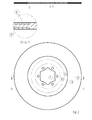
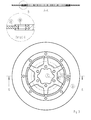
- the friction ring structure is particularly preferably divided into the five areas connection area (I), inner ring area (II), outer ring area (III), substructure area (IV) and friction area area (V).
- the FIG. 2 also shows the view AA a section through the disc at the point AA.
- Detail B shows a possible transition from region (IV) to (V), for example in the case of a friction surface region (V) laminated to region (IV) according to the invention.
- the areas in the FIG. 3 displayed.
- the FIG. 3 also shows the view AA a section through the disc at the point AA.
- the detail B shows a possible transition from region (IV) to (V), here however for example by riveting the friction surface region (V) according to the invention to the substructure region (IV).
- the outer ring region has ventilation holes, which are expediently arranged distributed around the outer ring region.
- the ventilation holes ensure a quick removal of the frictional heat generated during braking.
- the outer ring portion may have recesses for weight reduction. These recesses are expediently arranged distributed regularly around the outer ring area. The recesses for weight reduction also serve the ventilation and thus the heat dissipation.
- the bonding region (I) is defined by the recoverability of locally high surface pressure, such as e.g. Tightening torques of the fastening elements and, if necessary, bearing stress caused by mechanical stress (torque).
- the inner ring area (II) is defined by the recoverability of torques, which is caused by the spatial separation of bonding and friction surface area as well as by the resulting friction forces.
- the outer ring region (III) preferably bridges the spatial separation of the inner ring region (II), the sub-structural region (IV) and the friction surface region (V).
- the substructure region particularly preferably absorbs the forces (pressure, shear) generated during the friction action, moments and thermal loads.
- the friction surface region (V) represents the region of interaction with the friction partner and, in a preferred manner, the coefficient of friction and the wear are optimized accordingly.
- the voltages are represented by FEM analysis.
- area (I) is locally dependent on a compressive stress (black) and a tensile stress (light gray) before.
- area (IV) optionally also in area (V), a tension (light gray) is created locally by the intervention of the friction lining.
- the areas (II) and (III) connect the areas (I) and (IV). There are, again locally differentiated and limited in this representation tensile stresses (light gray) recorded.
- At least portions I to IV are most preferably composed of at least partially reinforced material, wherein the fibers of the fiber reinforced material may exceed the limits of the ranges, i. act coherently.
- the region V is optional and can also consist of fiber-reinforced material, as well as of isotropic or monolithic materials.
- the fiber-reinforced material of the ranges I to IV is preferably made of carbon, glass or aramid fiber-reinforced plastics or a combination of these.
- the friction surface region (V) consists of fiber reinforced plastic, fiber reinforced carbon, fiber reinforced ceramic, ceramic fiber reinforced ceramics, monolithic ceramics or metals loaded in the substructure region (IV), single or multilayer ceramic or metal coatings or combinations thereof, e.g. by plasma spraying on the substructure area.
- the areas particularly preferably have recesses or openings.
- the remaining structure is designed to be load-optimized in a preferred manner.
- the individual areas are positively, non-positively, by gluing, by lamination, by screwing, by riveting, by the transition of fibers or by combinations thereof with each other.
- connection region (I) is reinforced at points of highest load, at least locally, metallically.
- the metallic reinforcement in the form of sleeves or inserted, flat metal structures.
- the friction surface region (V) is preferably applied to ceramics from the range of silicides, borides or oxides, or metals which are inserted, laminated, glued or applied by a layer deposition method.
- the fiber-reinforced friction ring structure is particularly preferably used in braking or coupling application fields.
- the fiber reinforced friction ring structure is used in bicycle brake discs, engine brake discs, parking brakes, or engine clutches.
- the use of the fiber-reinforced friction ring structure is in braking or coupling applications of wind turbines.
- the fiber-reinforced friction ring structures have a largely constant coefficient of friction behavior at high coefficients of friction over a wide temperature and speed range. Particularly advantageous is the low material removal of the friction layer (V) and the resulting high durability of the disc.
- the braking units provided according to the invention can also be used with advantage in rail vehicles and aircraft.
Landscapes
- Engineering & Computer Science (AREA)
- General Engineering & Computer Science (AREA)
- Mechanical Engineering (AREA)
- Braking Arrangements (AREA)
Applications Claiming Priority (1)
| Application Number | Priority Date | Filing Date | Title |
|---|---|---|---|
| DE102008057487 | 2008-11-14 |
Publications (1)
| Publication Number | Publication Date |
|---|---|
| EP2187079A1 true EP2187079A1 (fr) | 2010-05-19 |
Family
ID=41496394
Family Applications (1)
| Application Number | Title | Priority Date | Filing Date |
|---|---|---|---|
| EP09175836A Withdrawn EP2187079A1 (fr) | 2008-11-14 | 2009-11-12 | Structure de friction renforcée par des fibres |
Country Status (1)
| Country | Link |
|---|---|
| EP (1) | EP2187079A1 (fr) |
Cited By (5)
| Publication number | Priority date | Publication date | Assignee | Title |
|---|---|---|---|---|
| EP2373885A1 (fr) * | 2009-04-02 | 2011-10-12 | Clipper Windpower, Inc. | Possibilité d'intervention sur des segments de disque de frein de lacet sans dépose de la nacelle |
| TWI695126B (zh) * | 2019-02-01 | 2020-06-01 | 國家中山科學研究院 | 碳陶瓷煞車碟盤 |
| TWI698594B (zh) * | 2018-11-22 | 2020-07-11 | 國家中山科學研究院 | 碳陶瓷煞車碟盤裝置 |
| DE102013215735B4 (de) * | 2013-08-09 | 2021-04-29 | Volkswagen Aktiengesellschaft | Verfahren zur Herstellung von mehrschichtigen Grünkörpern für keramische Bauteile |
| DE102016004608B4 (de) | 2015-05-14 | 2022-12-29 | Shimano Inc. | Fahrradscheibenbremsrotor |
Citations (5)
| Publication number | Priority date | Publication date | Assignee | Title |
|---|---|---|---|---|
| DE4438456A1 (de) * | 1994-10-28 | 1996-05-02 | Deutsche Forsch Luft Raumfahrt | Reibeinheit |
| DE19719634C1 (de) | 1997-05-09 | 1999-03-04 | Daimler Benz Ag | Bremseinheit mit einer nichtmetallischen Bremsscheibe aus Keramik und einer Nabe aus einem anderen Material |
| DE19822579A1 (de) * | 1997-06-12 | 1999-06-10 | Daimler Benz Ag | Bremsscheibe, insbesondere für ein Kraftfahrzeug |
| JP2001200781A (ja) * | 1999-11-29 | 2001-07-27 | Ecotecnia Soc Coop Catalana Ltda | 風力発電機 |
| EP1961987A1 (fr) | 2007-02-23 | 2008-08-27 | Sgl Carbon Ag | Disque de frein de vélo |
-
2009
- 2009-11-12 EP EP09175836A patent/EP2187079A1/fr not_active Withdrawn
Patent Citations (5)
| Publication number | Priority date | Publication date | Assignee | Title |
|---|---|---|---|---|
| DE4438456A1 (de) * | 1994-10-28 | 1996-05-02 | Deutsche Forsch Luft Raumfahrt | Reibeinheit |
| DE19719634C1 (de) | 1997-05-09 | 1999-03-04 | Daimler Benz Ag | Bremseinheit mit einer nichtmetallischen Bremsscheibe aus Keramik und einer Nabe aus einem anderen Material |
| DE19822579A1 (de) * | 1997-06-12 | 1999-06-10 | Daimler Benz Ag | Bremsscheibe, insbesondere für ein Kraftfahrzeug |
| JP2001200781A (ja) * | 1999-11-29 | 2001-07-27 | Ecotecnia Soc Coop Catalana Ltda | 風力発電機 |
| EP1961987A1 (fr) | 2007-02-23 | 2008-08-27 | Sgl Carbon Ag | Disque de frein de vélo |
Cited By (5)
| Publication number | Priority date | Publication date | Assignee | Title |
|---|---|---|---|---|
| EP2373885A1 (fr) * | 2009-04-02 | 2011-10-12 | Clipper Windpower, Inc. | Possibilité d'intervention sur des segments de disque de frein de lacet sans dépose de la nacelle |
| DE102013215735B4 (de) * | 2013-08-09 | 2021-04-29 | Volkswagen Aktiengesellschaft | Verfahren zur Herstellung von mehrschichtigen Grünkörpern für keramische Bauteile |
| DE102016004608B4 (de) | 2015-05-14 | 2022-12-29 | Shimano Inc. | Fahrradscheibenbremsrotor |
| TWI698594B (zh) * | 2018-11-22 | 2020-07-11 | 國家中山科學研究院 | 碳陶瓷煞車碟盤裝置 |
| TWI695126B (zh) * | 2019-02-01 | 2020-06-01 | 國家中山科學研究院 | 碳陶瓷煞車碟盤 |
Similar Documents
| Publication | Publication Date | Title |
|---|---|---|
| DE19859840B4 (de) | Bremseinheit | |
| EP4111070B1 (fr) | Disque de frein et son procédé de fabrication | |
| EP2815149A1 (fr) | Disque de frein ventilé, en matériau composite renforcé par des fibres, pour véhicule à moteur | |
| EP1930617B1 (fr) | Ressort pour un disque de frein composite et disque de frein composite | |
| DE19830666B4 (de) | Bremsscheibe, insbesondere für ein Kraftfahrzeug | |
| DE102009034503A1 (de) | Bremssattel einer Scheibenbremse | |
| DE102010013160A1 (de) | Bremsscheibe | |
| DE102007009480A1 (de) | Fahrradbremsscheibe | |
| DE69128536T2 (de) | Bremsescheibe oder ähnliche Bauteil aus Verbundwerkstoff mit metallmatrix | |
| EP1913278B1 (fr) | Frein a disque a anneau de disque de frein en materiau friable et vehicule equipe d'un ou de plusieurs freins a disque de ce type | |
| DE10116659B4 (de) | Reibkörper, vorzugsweise Bremsscheibe für eine Scheibenbremse | |
| DE10125113A1 (de) | Zweiteilige Bremseinheit | |
| DE102009010969A1 (de) | Bremsscheibe | |
| DE102007053576B4 (de) | Bremsvorrichtung | |
| DE4400898C1 (de) | Wellenbremsscheibe für Schienenfahrzeuge | |
| DE10321796B4 (de) | Bremsscheibe mit Reibring und Bremsscheibentopf | |
| EP1536156B1 (fr) | Couple frottant pour le frein à main d'une voiture. | |
| DE102013216591A1 (de) | Innenbelüftete Kraftfahrzeugbremsscheibe | |
| WO2008055608A1 (fr) | Frein à disque | |
| EP1230492B1 (fr) | Dispositif de freinage mecanique | |
| EP0738376B1 (fr) | Disque de frein pour freins a disque de vehicules ferroviaires | |
| DE10217180B3 (de) | Bremseinheit für Fahrzeuge oder Flugzeuge | |
| DE10107983A1 (de) | Innenbelüftete, in einem Guß hergestellte Bremsscheibe | |
| DE102004012706A1 (de) | Zahnrad | |
| EP2053265B1 (fr) | Dispositif de frein pour un véhicule automobile |
Legal Events
| Date | Code | Title | Description |
|---|---|---|---|
| PUAI | Public reference made under article 153(3) epc to a published international application that has entered the european phase |
Free format text: ORIGINAL CODE: 0009012 |
|
| AK | Designated contracting states |
Kind code of ref document: A1 Designated state(s): AT BE BG CH CY CZ DE DK EE ES FI FR GB GR HR HU IE IS IT LI LT LU LV MC MK MT NL NO PL PT RO SE SI SK SM TR |
|
| AX | Request for extension of the european patent |
Extension state: AL BA RS |
|
| 17P | Request for examination filed |
Effective date: 20101119 |
|
| 17Q | First examination report despatched |
Effective date: 20110117 |
|
| RAP1 | Party data changed (applicant data changed or rights of an application transferred) |
Owner name: SGL CARBON SE |
|
| STAA | Information on the status of an ep patent application or granted ep patent |
Free format text: STATUS: THE APPLICATION IS DEEMED TO BE WITHDRAWN |
|
| 18D | Application deemed to be withdrawn |
Effective date: 20150602 |