EP2187325B1 - Vorrichtung zur simulation einer kleidungspassform, verfahren zur simulation einer kleidungspassform und programm zur simulation einer kleidungspassform - Google Patents
Vorrichtung zur simulation einer kleidungspassform, verfahren zur simulation einer kleidungspassform und programm zur simulation einer kleidungspassform Download PDFInfo
- Publication number
- EP2187325B1 EP2187325B1 EP08829921.9A EP08829921A EP2187325B1 EP 2187325 B1 EP2187325 B1 EP 2187325B1 EP 08829921 A EP08829921 A EP 08829921A EP 2187325 B1 EP2187325 B1 EP 2187325B1
- Authority
- EP
- European Patent Office
- Prior art keywords
- parts
- human body
- body model
- joining
- virtual
- Prior art date
- Legal status (The legal status is an assumption and is not a legal conclusion. Google has not performed a legal analysis and makes no representation as to the accuracy of the status listed.)
- Not-in-force
Links
Images




Classifications
-
- G—PHYSICS
- G06—COMPUTING OR CALCULATING; COUNTING
- G06T—IMAGE DATA PROCESSING OR GENERATION, IN GENERAL
- G06T17/00—Three-dimensional [3D] modelling for computer graphics
- G06T17/20—Finite element generation, e.g. wire-frame surface description, tesselation
-
- G—PHYSICS
- G06—COMPUTING OR CALCULATING; COUNTING
- G06F—ELECTRIC DIGITAL DATA PROCESSING
- G06F30/00—Computer-aided design [CAD]
- G06F30/20—Design optimisation, verification or simulation
-
- G—PHYSICS
- G06—COMPUTING OR CALCULATING; COUNTING
- G06T—IMAGE DATA PROCESSING OR GENERATION, IN GENERAL
- G06T19/00—Manipulating three-dimensional [3D] models or images for computer graphics
-
- A—HUMAN NECESSITIES
- A41—WEARING APPAREL
- A41H—APPLIANCES OR METHODS FOR MAKING CLOTHES, e.g. FOR DRESS-MAKING OR FOR TAILORING, NOT OTHERWISE PROVIDED FOR
- A41H3/00—Patterns for cutting-out; Methods of drafting or marking-out such patterns, e.g. on the cloth
- A41H3/007—Methods of drafting or marking-out patterns using computers
-
- G—PHYSICS
- G06—COMPUTING OR CALCULATING; COUNTING
- G06F—ELECTRIC DIGITAL DATA PROCESSING
- G06F2113/00—Details relating to the application field
- G06F2113/12—Cloth
-
- G—PHYSICS
- G06—COMPUTING OR CALCULATING; COUNTING
- G06T—IMAGE DATA PROCESSING OR GENERATION, IN GENERAL
- G06T2210/00—Indexing scheme for image generation or computer graphics
- G06T2210/16—Cloth
-
- G—PHYSICS
- G06—COMPUTING OR CALCULATING; COUNTING
- G06T—IMAGE DATA PROCESSING OR GENERATION, IN GENERAL
- G06T2210/00—Indexing scheme for image generation or computer graphics
- G06T2210/21—Collision detection, intersection
Definitions
- the present invention relates to dressing simulation and particularly to a series of processes up to the joining of parts at the periphery of a human body model.
- Patent Documents 1 and 2 disclose simulation of dressing a human body model in a garment.
- the garment is composed of a plurality of parts, and when the garment comes into contact with the human body model, the garment is moved by the repulsion force of the human body model.
- the parts are arranged at the periphery of the human body model, the joining relationship between the parts is specified, and then the parts are virtually stitched together. Stitching the parts together is referred to as "joining" in this specification.
- dressing of the garment is simulated in consideration of a variety of forces acting on the garment.
- the forces acting on the garment include a strain associated with deformation of the garment, repulsion force generated from the human body model, gravity acting on the garment, frictional force between the garment that is caused when the garment is deformed, and frictional force between the garment and the human body model.
- the drapes are formed unnaturally if the garment not formed so as to be able to sag slightly when joining the parts. For this reason, it is necessary to reduce the time required for the simulation by allowing the parts to be arranged easily at the periphery of the human body model and facilitating a series of processes up to the joining. It is also necessary to allow the parts to be formed naturally at the periphery of the human body model and to express the drapes and the like through simulation.
- An object of the present invention is to allow the execution of a series of steps up to the virtual joining of parts in a short period of time, as well as to form the natural shape of a garment at the time of joining.
- the present invention is defined by the independent claims 1, 4 and 5.
- Preferred embodiments are described in the dependent claims 2 and 3.
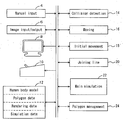
- Figs. 1 to 13 show dressing simulation of an embodiment.
- reference numeral 2 represents a dressing simulation apparatus, and 4 a manual input, such as a keyboard, mouse, trackball, and stylus
- Reference numeral 6 represents an image input/output such as a disc driver or network interface for inputting/outputting image data.
- Reference numeral 8 is a color monitor, and 10 a color printer.
- Reference numeral 12 is a memory that stores three-dimensional data of a human body model, polygon data of each part configuring a garment, data for rending the garment configured by a plurality of polygons, as well as three-dimensional image data of a simulation result. Examples of the rendering data include texture data for mapping the polygons and shading data.
- Reference numeral 14 is a collision detection unit for detecting a collision between the human body model and the garment.
- a moving unit 16 is for moving the end of each part of the garment toward a joining line, and causes the collision detection unit 14 to detect a collision when the end of each part collides with the human body model in the course of joining the parts.
- the joining line is a line expressing a virtual joining portion between the parts, but a row of points for joining the parts may be used instead of the line.
- the moving unit 16 moves each of the parts of the garment so as to reflect it on the surface of the human body model, and moves each part until the ends of the parts come into contact with one another at the joining line.
- An initial movement unit 18 moves the parts to the outside of the human body model so that the human body model does not interfere with the parts when the parts are initially arranged at the periphery of the human body model.
- Each of the parts of the garment is disposed' at the periphery of the human body model by means of the manual input 4 or the like.
- the collision detection unit 14 detects such interference, and the initial movement unit 18 moves the interfering parts away from the human body model to avoid interference.
- a joining line processing unit 20 generates the joining line and moves the joining line in accordance with the movement of the parts.
- the joining line is the line created between the ends of the two parts to be joined, that is, the line that connects the points that are equally distant from the ends of the two parts.
- the parts are moved by the moving unit 16
- the joining line is moved or regenerated accordingly.
- the parts especially the ends of the parts collide with the human body model, the parts are reflected on the surface of the human body model.
- the joining line may be taken out of the human body model so that the parts are not reflected in the course of moving the parts toward the joining line.
- the joining line is moved perpendicularly to a line segment connecting the two ends, up to a position where a line connecting the joining line and the end of each part does not interfere with the human body model.
- a main simulation unit 22 simulates dressing of the human body model in the virtual garment obtained after joining the parts. This simulation is conducted in consideration of, for example, a strain generated according to the positional relationship among the polygons of each part, the gravity acting on the polygons, repulsion force generated as a result of interference between the parts and the human body model, and frictional force between the human body model and the garment or between garments. This simulation itself is well-known from Patent Documents 1 and 2 mentioned above.
- a polygon management unit 24 generates a polygon in each part of the garment, uses a rough polygon in a series of steps up to the joining of the parts and uses a fine polygon in the simulation step performed by the main simulation unit 22, so that the series of processes up to the joining of the parts can be executed in a short period of time and so that precise simulation can be conducted.
- Fig. 2 shows a simulation algorithm.
- the parts of the garment are initially arranged on the human body model, and a joining relationship is specified.
- underwear or other garment may be put on the human body model beforehand, and then each of the parts of the garment may be layered on top of the underwear or other garment.
- the parts may be arranged in contact with the human body model or embedded in the human body model. Interference between each part and the human body model is detected, and interfering parts are moved away from the human body model.
- the joining line is generated between these ends. Then, the ends of the parts are moved toward the joining line. When the ends of the parts interfere with the human body model at this moment, the parts are reflected from the human body model. Furthermore, other portions of the parts are similarly moved as the ends of the parts are moved. Then, when the ends of the parts approach close enough to be joined, the movement of the parts is ended, and the parts are joined together. Thereafter, the polygons are broken up to execute main simulation.
- Fig. 3 shows a simulation program.
- the dressing simulation apparatus 2 is configured by a computer, and the simulation program executes the following instructions stored in the simulation apparatus 2.
- the simulation program also supplies [the instructions] to the simulation apparatus 2 by means of a storage medium such as a CDROM or a carrier wave.
- a joining line processing instruction 31 generates the joining line between the ends of the parts to be joined, and, when the ends of the parts are moved, moves the joining line accordingly.
- a collision detection instruction 32 detects a collision between the human body model and the parts. The collision described here means not only that the human body model and the parts are in contact with each other, but also that the parts are embedded in the human body model.
- An initial movement instruction 33 initially moves the parts interfering with the human body model to the outside of the human body model.
- a movement instruction 34 moves the parts toward the joining line, and reflects the parts on the surface of the human body model when the parts collide with the human body model while moving.
- a main simulation instruction 35 moves the parts to a joining position and executes dressing simulation on the garment in which the parts are virtually joined together.
- a polygon management instruction 36 divides each of the parts of the garment into a plurality of polygons. The size of each polygon is rougher than the size obtained in the main simulation, until the joining of the parts is performed.
- Fig. 4 shows an example of initial movement, wherein reference numeral 40 represents, for example, an arm of the human body model, and 41 an axis of the human body model, which is an axis of the arm.
- reference numeral 40 represents, for example, an arm of the human body model
- 41 an axis of the human body model, which is an axis of the arm.
- Fig. 5 shows how the parts are moved using the joining line, wherein the human body model 40 has parts 43 and 44 on both left and right sides.
- the human body model 40 has parts 43 and 44 on both left and right sides.
- upper ends of the parts 43 and 44 are joined together, and a joining line 45 is formed therebetween.
- the parts 43 and 44 are reflected as shown Fig. 5 because the- parts 43 and 44 interfere with the human body model.
- the incidence angle and reflection angle of the end of each part may or may not be made equal to each other with respect to the surface of the human body model, but the angles may not be needed to be equal to each other.
- the other polygons are also moved accordingly. For example, the polygons in the vicinity of the ends of the parts 43 and 44 are fixed, and the ends of the parts 43 and 44 are moved as the other polygons are drawn to the polygons at the ends by elastic force between the polygons.
- the joining line 45 is moved to a joining line 46 in relation to the moved ends. Then, the left and right parts are moved toward the joining line 46. By repeating this process, the parts can be joined together at the periphery of the human body model 40 to form a part 47. Note that lower ends of the parts 43 and 44 may be joined together at the same time the upper ends are joined together, or the lower ends may be joined after the upper ends are joined together. Some parts have cut lines therein, as in a dart. Therefore, joining within the parts may be executed in priority to joining the parts together.
- the joining line is generated in the middle of the line connecting the ends of the parts together, the parts are then moved toward the joining line, and then the parts are reflected when the parts collide with the human body model.
- the direction of moving the ends of the parts may be changed so that the parts do not come into contact with the human body model.
- the ends instead of moving the ends of the parts horizontally toward the joining line 45, the ends may be moved in a tangential direction toward the human body model 40 as seen from the parts 43 and 44.
- Fig. 6 shows the processes ranging from initially arranging the parts to joining the parts.
- the parts interfere with the human body model at the chest.
- the parts corresponding to a front body part are moved away from the human body model, and then each part is moved toward the joining line, to obtain the state shown in the lower right of Fig. 6 .
- This state is similar to a state where an arm or body is allowed to pass gently through the garment.
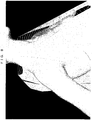
- Figs. 7 to 13 show examples of the initial arrangement.
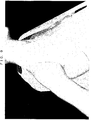
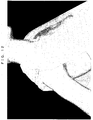
- Figs. 8 to 13 show the enlargement of the process shown in Fig. 7 .
- the parts are taken outside the human body model, but a part of the joining line exists inside the human body model.
- the end of each of the parts is moved toward the joining line, and when the joining line is present outside the human body model the end of each part [is not moved].
- the joining line exists inside the human body model, the end of each part is moved along the human body such that the parts are reflected. In this manner, joining is completed as shown in Fig. 13 .
- the triangles on the human body model or the surface of each part represent the polygons.
Landscapes
- Engineering & Computer Science (AREA)
- Physics & Mathematics (AREA)
- Theoretical Computer Science (AREA)
- General Physics & Mathematics (AREA)
- Software Systems (AREA)
- General Engineering & Computer Science (AREA)
- Geometry (AREA)
- Computer Graphics (AREA)
- Computer Hardware Design (AREA)
- Evolutionary Computation (AREA)
- Manipulator (AREA)
- Professional, Industrial, Or Sporting Protective Garments (AREA)
- Details Of Garments (AREA)
- Processing Or Creating Images (AREA)
Claims (5)
- Ankleidesimulationsvorrichtung (2) zum Verbinden von virtuell geformten Teilen (43, 44) eines Kleidungsstücks, die an einem Umfang eines Menschenkörpermodells (40) angeordnet sind, und zum Simulieren eines Ankleidens des Menschenkörpermodells (40) mit einem virtuellen Kleidungsstück, das durch das Verbinden von zu verbindenden Enden der virtuellen Teile (43, 44) erhalten wird, wobei die Ankleidesimulationsvorrichtung (2) umfasst:Einrichtungen zum Erzeugen eines virtuellen Verbindungsteils in der Mitte eines virtuellen Abstands zwischen einander zugewandten Enden von zwei miteinander zu verbindenden Teilen (43, 44), sodass der virtuelle Verbindungsteil aus einer Verbindungslinie besteht, die gleich weit von den Enden der zwei miteinander zu verbindenden Teile beabstandet ist,Einrichtungen zum Bewegen der Enden der zwei Teile (43, 44) zu dem virtuellen Verbindungsteil, undEinrichtungen zum Bewegen von anderen Abschnitten der zwei Teile (43, 44) in Entsprechung zu den Positionen der Enden, wobei, wenn die Teile (43, 44) mit dem Menschenkörpermodell (40) kollidieren, die Einrichtungen zum Bewegen konfiguriert sind zum Zurückziehen der Teile (43, 44) von dem Menschenkörpermodell (40), undwenn das Verbinden nicht abgeschlossen ist, die Einrichtungen zum Erzeugen eines virtuellen Verbindungsteils konfiguriert sind zum Bewegen der Verbindungslinie senkrecht zu einem die zwei Enden verbindenden Liniensegment nach oben zu einer Position, an der eine die Verbindungslinie und das Ende jedes Teils (43, 44) verbindende Linie nicht mit dem Menschenkörpermodell (40) kollidiert,wobei das Erzeugen des virtuellen Verbindungsteils und das Bewegen der Enden mindestens einmal wiederholt werden, bis die zwei Teile (43, 44) in Kontakt miteinander kommen.
- Ankleidesimulationsvorrichtung (2) nach Anspruch 1, weiterhin gekennzeichnet durch:Einrichtungen zum Erfassen einer Kollision zwischen dem Menschenkörpermodell (40) und den Teilen (43, 44), undEinrichtungen zum, bevor die Enden bewegt werden, Bewegen der mit dem Menschenkörpermodell (40) kollidierenden Teile (43, 44) weg von dem Menschenkörpermodell (40) zu einer Position, an der die Kollision aufgehoben ist.
- Ankleidesimulationsvorrichtung (2) nach Anspruch 1 oder 2, wobei jeder der Teile (43, 44) durch eine Vielzahl von Polygonen konfiguriert wird und die Ankleidesimulationsvorrichtung (2) weiterhin Einrichtungen zum Aufbrechen der Polygone, nachdem die zwei Teile (43, 44) miteinander verbunden wurden, umfasst.
- Ankleidesimulationsverfahren zum Verbinden von virtuell geformten Teilen (43, 44) eines Kleidungsstücks, die an einem Umfang eines Menschenkörpermodells (40) angeordnet sind, und zum Simulieren eines Ankleidens des Menschenkörpermodells (40) mit einem virtuellen Kleidungsstück, das durch das Verbinden von zu verbindenden Enden der virtuellen Teile (43, 44) erhalten wird, wobei das Ankleidesimulationsverfahren die folgenden Schritte umfasst:Erzeugen eines virtuellen Verbindungsteils in der Mitte eines virtuellen Abstands zwischen einander zugewandten Enden von zwei miteinander zu verbindenden Teilen (43, 44), sodass der virtuelle Verbindungsteil aus einer Verbindungslinie besteht, die gleich weit von den Enden der zwei miteinander zu verbindenden Teile beabstandet ist,Bewegen der Enden der zwei Teile (43, 44) zu dem virtuellen Verbindungsteil, undBewegen von anderen Abschnitten der zwei Teile (43, 44) in Entsprechung zu den Positionen der Enden, und, wenn die Teile (43, 44) mit dem Menschenkörpermodell (40) kollidieren, Zurückziehen der Teile (43, 44) von dem Menschenkörpermodell (40),wenn das Verbinden nicht abgeschlossen ist, Bewegen der Verbindungslinie senkrecht zu einem die zwei Enden verbindenden Liniensegment nach oben zu einer Position, an der eine die Verbindungslinie und das Ende jedes Teils (43, 44) verbindende Linie nicht mit dem Menschenkörpermodell (40) kollidiert, undWiederholen des Erzeugens des virtuellen Verbindungsteils und des Bewegens der Enden mindestens einmal, bis die zwei Teile (43, 44) in Kontakt miteinander kommen.
- Ankleidesimulationsprogramm, das durch eine digitale Informationsverarbeitungsvorrichtung ausgeführt wird zum Verbinden von virtuell geformten Teilen (43, 44) eines Kleidungsstücks, die an einem Umfang eines Menschenkörpermodells (40) angeordnet sind, und zum Simulieren eines Ankleidens des Menschenkörpermodells (40) mit einem virtuellen Kleidungsstück, das durch das Verbinden von zu verbindenden Enden der virtuellen Teile (43, 44) erhalten wird, wobei das Ankleidesimulationsprogramm umfasst:einen Befehl zum Erzeugen eines virtuellen Verbindungsteils in der Mitte eines virtuellen Abstands zwischen einander zugewandten Enden von zwei miteinander zu verbindenden Teilen (43, 44), sodass der virtuelle Verbindungsteil aus einer Verbindungslinie besteht, die gleich weit von den Enden der zwei miteinander zu verbindenden Teile beabstandet ist,einen Befehl zum Bewegen der Enden der zwei Teile (43, 44) zu dem virtuellen Verbindungsteil,einen Befehl zum Bewegen von anderen Abschnitten der zwei Teile (43, 44) in Entsprechung zu den Positionen der Enden,wenn die Teile (43, 44) mit dem Menschenkörpermodell (40) kollidieren, einen Befehl zum Zurückziehen der Teile (43, 44) von dem Menschenkörpermodell (40),wenn das Verbinden nicht abgeschlossen ist, einen Befehl zum Bewegen der Verbindungslinie senkrecht zu einem die zwei Enden verbindenden Liniensegment nach oben zu einer Position, an der eine die Verbindungslinie und das Ende jedes Teils (43, 44) verbindende Linie nicht mit dem Menschenkörpermodell (40) kollidiert, undeinen Befehl zum Wiederholen des Erzeugens des virtuellen Verbindungsteils und des Bewegens der Enden mindestens einmal, bis die zwei Teile (43, 44) in Kontakt miteinander kommen.
Applications Claiming Priority (2)
| Application Number | Priority Date | Filing Date | Title |
|---|---|---|---|
| JP2007228508 | 2007-09-04 | ||
| PCT/JP2008/065649 WO2009031491A1 (ja) | 2007-09-04 | 2008-09-01 | 着装シミュレーション装置とシミュレーション方法及びシミュレーションプログラム |
Publications (3)
| Publication Number | Publication Date |
|---|---|
| EP2187325A1 EP2187325A1 (de) | 2010-05-19 |
| EP2187325A4 EP2187325A4 (de) | 2014-05-28 |
| EP2187325B1 true EP2187325B1 (de) | 2018-03-14 |
Family
ID=40428808
Family Applications (1)
| Application Number | Title | Priority Date | Filing Date |
|---|---|---|---|
| EP08829921.9A Not-in-force EP2187325B1 (de) | 2007-09-04 | 2008-09-01 | Vorrichtung zur simulation einer kleidungspassform, verfahren zur simulation einer kleidungspassform und programm zur simulation einer kleidungspassform |
Country Status (4)
| Country | Link |
|---|---|
| EP (1) | EP2187325B1 (de) |
| JP (1) | JP5161230B2 (de) |
| CN (1) | CN101821738B (de) |
| WO (1) | WO2009031491A1 (de) |
Families Citing this family (10)
| Publication number | Priority date | Publication date | Assignee | Title |
|---|---|---|---|---|
| JP2014089665A (ja) * | 2012-10-31 | 2014-05-15 | Toshiba Corp | 画像処理装置、画像処理方法、及び画像処理プログラム |
| US20150134302A1 (en) | 2013-11-14 | 2015-05-14 | Jatin Chhugani | 3-dimensional digital garment creation from planar garment photographs |
| US10366439B2 (en) | 2013-12-27 | 2019-07-30 | Ebay Inc. | Regional item reccomendations |
| US20160092956A1 (en) | 2014-09-30 | 2016-03-31 | Jonathan Su | Garment size mapping |
| US10204375B2 (en) | 2014-12-01 | 2019-02-12 | Ebay Inc. | Digital wardrobe using simulated forces on garment models |
| US9984409B2 (en) | 2014-12-22 | 2018-05-29 | Ebay Inc. | Systems and methods for generating virtual contexts |
| US10475113B2 (en) | 2014-12-23 | 2019-11-12 | Ebay Inc. | Method system and medium for generating virtual contexts from three dimensional models |
| US10310616B2 (en) | 2015-03-31 | 2019-06-04 | Ebay Inc. | Modification of three-dimensional garments using gestures |
| EP3156976B1 (de) * | 2015-10-14 | 2019-11-27 | Dassault Systèmes | Computerimplementiertes verfahren zum definieren von nähten eines virtuellen kleidungsstücks oder von möbelpolsterung |
| US11803664B2 (en) | 2018-10-09 | 2023-10-31 | Ebay Inc. | Distributed application architectures using blockchain and distributed file systems |
Family Cites Families (5)
| Publication number | Priority date | Publication date | Assignee | Title |
|---|---|---|---|---|
| JPH10134095A (ja) | 1996-10-28 | 1998-05-22 | Toray Ind Inc | 組立構造体の組立状態解析方法、衣服の着用状態解析方法ならびに衣服の製造方法および製造支援装置 |
| JP2000003383A (ja) | 1998-03-30 | 2000-01-07 | Toray Ind Inc | 組立構造体の着装状態解析方法ならびに衣料服飾品の製造方法および製造支援装置 |
| JP2000331058A (ja) * | 1999-05-21 | 2000-11-30 | Toray Ind Inc | 組立構造体の製造支援装置および組立構造体の製造方法 |
| JP2001262416A (ja) * | 2000-03-16 | 2001-09-26 | Toyobo Co Ltd | 衣服の型紙作成システム |
| JP4533643B2 (ja) * | 2004-02-26 | 2010-09-01 | 株式会社島精機製作所 | 人体モデルへのニットガーメントの着装シミュレーション方法とその装置、並びにそのプログラム |
-
2008
- 2008-09-01 WO PCT/JP2008/065649 patent/WO2009031491A1/ja not_active Ceased
- 2008-09-01 EP EP08829921.9A patent/EP2187325B1/de not_active Not-in-force
- 2008-09-01 CN CN2008801052468A patent/CN101821738B/zh not_active Expired - Fee Related
- 2008-09-01 JP JP2009531217A patent/JP5161230B2/ja not_active Expired - Fee Related
Non-Patent Citations (1)
| Title |
|---|
| None * |
Also Published As
| Publication number | Publication date |
|---|---|
| JP5161230B2 (ja) | 2013-03-13 |
| WO2009031491A1 (ja) | 2009-03-12 |
| JPWO2009031491A1 (ja) | 2010-12-16 |
| CN101821738B (zh) | 2012-08-29 |
| EP2187325A4 (de) | 2014-05-28 |
| CN101821738A (zh) | 2010-09-01 |
| EP2187325A1 (de) | 2010-05-19 |
Similar Documents
| Publication | Publication Date | Title |
|---|---|---|
| EP2187325B1 (de) | Vorrichtung zur simulation einer kleidungspassform, verfahren zur simulation einer kleidungspassform und programm zur simulation einer kleidungspassform | |
| JP6282798B2 (ja) | 工作物の機械加工のシミュレーション | |
| EP3040797B1 (de) | Simulierung der Verarbeitung eines Werkstücks | |
| EP4089562A1 (de) | Entwurf eines kleidungsstücks unter verwendung einer stillinie | |
| JP4736771B2 (ja) | 効果音生成装置及び効果音生成方法、並びにコンピュータ・プログラム | |
| KR100707841B1 (ko) | 3차원 목표곡선을 이용한 곡면 변형 장치 및 그 방법 | |
| EP2184714B1 (de) | Schichtungssimulationsvorrichtung, simulationsverfahren, simulationsprogramm | |
| US8334869B1 (en) | Method and apparatus for modeling 3-D shapes from a user drawn curve | |
| JP5079801B2 (ja) | ニットウェアの折り畳みシミュレーション装置、シミュレーション方法及び記憶媒体 | |
| CN112486319A (zh) | 基于触觉渲染设备的vr交互方法、装置、设备及介质 | |
| KR102818073B1 (ko) | 의상 시뮬레이션 방법 및 장치 | |
| JP2001266175A (ja) | 3次元モデル処理装置および3次元モデル処理方法、並びにプログラム提供媒体 | |
| JP2004062546A (ja) | 3次元形状処理装置および干渉モデル検出方法 | |
| JP2004178006A (ja) | 3次元形状処理装置、モデル干渉部表示方法、プログラム、及び記憶媒体 | |
| JP5407695B2 (ja) | 三次元曲線モデルにおける自己交差の検出プログラム及び自己交差の検出方法 | |
| EP4339876A1 (de) | Verfahren und vorrichtung zur simulation von kleidungsstücken | |
| JP5122410B2 (ja) | 設計検証表示装置、設計検証表示方法及び設計検証表示コンピュータプログラム | |
| US20160378893A1 (en) | Finger model verification method and information processing apparatus | |
| JP2002092639A (ja) | パーティクルの挙動を表示するアニメーション生成方法および装置 | |
| JP2008203994A (ja) | 3次元モデル表示装置、そのプログラム及び方法 | |
| US11574091B2 (en) | Techniques for recovering from intersections | |
| HK40084738A (en) | Garment simulation method and device | |
| Yoganandan et al. | Prototyping flexible touch screen devices using collocated haptic-graphic elastic-object deformation on the GPU | |
| Chen et al. | Haptic‐constraint modeling based on interactive metaballs | |
| Zhu et al. | Fast cutting simulations with underlying lattices |
Legal Events
| Date | Code | Title | Description |
|---|---|---|---|
| PUAI | Public reference made under article 153(3) epc to a published international application that has entered the european phase |
Free format text: ORIGINAL CODE: 0009012 |
|
| 17P | Request for examination filed |
Effective date: 20100304 |
|
| AK | Designated contracting states |
Kind code of ref document: A1 Designated state(s): AT BE BG CH CY CZ DE DK EE ES FI FR GB GR HR HU IE IS IT LI LT LU LV MC MT NL NO PL PT RO SE SI SK TR |
|
| AX | Request for extension of the european patent |
Extension state: AL BA MK RS |
|
| DAX | Request for extension of the european patent (deleted) | ||
| A4 | Supplementary search report drawn up and despatched |
Effective date: 20140429 |
|
| RIC1 | Information provided on ipc code assigned before grant |
Ipc: G06T 19/00 20110101ALI20140423BHEP Ipc: A41H 3/00 20060101ALN20140423BHEP Ipc: G06T 17/20 20060101ALI20140423BHEP Ipc: G06F 17/50 20060101AFI20140423BHEP |
|
| RIC1 | Information provided on ipc code assigned before grant |
Ipc: G06F 17/50 20060101AFI20140818BHEP Ipc: G06T 17/20 20060101ALI20140818BHEP Ipc: G06T 19/00 20110101ALI20140818BHEP Ipc: A41H 3/00 20060101ALN20140818BHEP |
|
| 17Q | First examination report despatched |
Effective date: 20150819 |
|
| RIC1 | Information provided on ipc code assigned before grant |
Ipc: G06T 19/00 20110101ALI20170711BHEP Ipc: G06T 17/20 20060101ALI20170711BHEP Ipc: G06F 17/50 20060101AFI20170711BHEP Ipc: A41H 3/00 20060101ALN20170711BHEP |
|
| RIC1 | Information provided on ipc code assigned before grant |
Ipc: G06T 17/20 20060101ALI20170727BHEP Ipc: A41H 3/00 20060101ALN20170727BHEP Ipc: G06T 19/00 20110101ALI20170727BHEP Ipc: G06F 17/50 20060101AFI20170727BHEP |
|
| RIC1 | Information provided on ipc code assigned before grant |
Ipc: A41H 3/00 20060101ALN20170807BHEP Ipc: G06T 19/00 20110101ALI20170807BHEP Ipc: G06T 17/20 20060101ALI20170807BHEP Ipc: G06F 17/50 20060101AFI20170807BHEP |
|
| GRAP | Despatch of communication of intention to grant a patent |
Free format text: ORIGINAL CODE: EPIDOSNIGR1 |
|
| INTG | Intention to grant announced |
Effective date: 20171009 |
|
| RIC1 | Information provided on ipc code assigned before grant |
Ipc: G06F 17/50 20060101AFI20170925BHEP Ipc: G06T 19/00 20110101ALI20170925BHEP Ipc: G06T 17/20 20060101ALI20170925BHEP Ipc: A41H 3/00 20060101ALN20170925BHEP |
|
| GRAS | Grant fee paid |
Free format text: ORIGINAL CODE: EPIDOSNIGR3 |
|
| GRAA | (expected) grant |
Free format text: ORIGINAL CODE: 0009210 |
|
| AK | Designated contracting states |
Kind code of ref document: B1 Designated state(s): AT BE BG CH CY CZ DE DK EE ES FI FR GB GR HR HU IE IS IT LI LT LU LV MC MT NL NO PL PT RO SE SI SK TR |
|
| REG | Reference to a national code |
Ref country code: GB Ref legal event code: FG4D |
|
| REG | Reference to a national code |
Ref country code: CH Ref legal event code: EP Ref country code: AT Ref legal event code: REF Ref document number: 979532 Country of ref document: AT Kind code of ref document: T Effective date: 20180315 |
|
| REG | Reference to a national code |
Ref country code: IE Ref legal event code: FG4D |
|
| REG | Reference to a national code |
Ref country code: DE Ref legal event code: R096 Ref document number: 602008054448 Country of ref document: DE |
|
| REG | Reference to a national code |
Ref country code: NL Ref legal event code: MP Effective date: 20180314 |
|
| REG | Reference to a national code |
Ref country code: LT Ref legal event code: MG4D |
|
| PG25 | Lapsed in a contracting state [announced via postgrant information from national office to epo] |
Ref country code: CY Free format text: LAPSE BECAUSE OF FAILURE TO SUBMIT A TRANSLATION OF THE DESCRIPTION OR TO PAY THE FEE WITHIN THE PRESCRIBED TIME-LIMIT Effective date: 20180314 Ref country code: NO Free format text: LAPSE BECAUSE OF FAILURE TO SUBMIT A TRANSLATION OF THE DESCRIPTION OR TO PAY THE FEE WITHIN THE PRESCRIBED TIME-LIMIT Effective date: 20180614 Ref country code: HR Free format text: LAPSE BECAUSE OF FAILURE TO SUBMIT A TRANSLATION OF THE DESCRIPTION OR TO PAY THE FEE WITHIN THE PRESCRIBED TIME-LIMIT Effective date: 20180314 Ref country code: FI Free format text: LAPSE BECAUSE OF FAILURE TO SUBMIT A TRANSLATION OF THE DESCRIPTION OR TO PAY THE FEE WITHIN THE PRESCRIBED TIME-LIMIT Effective date: 20180314 Ref country code: ES Free format text: LAPSE BECAUSE OF FAILURE TO SUBMIT A TRANSLATION OF THE DESCRIPTION OR TO PAY THE FEE WITHIN THE PRESCRIBED TIME-LIMIT Effective date: 20180314 Ref country code: LT Free format text: LAPSE BECAUSE OF FAILURE TO SUBMIT A TRANSLATION OF THE DESCRIPTION OR TO PAY THE FEE WITHIN THE PRESCRIBED TIME-LIMIT Effective date: 20180314 |
|
| REG | Reference to a national code |
Ref country code: AT Ref legal event code: MK05 Ref document number: 979532 Country of ref document: AT Kind code of ref document: T Effective date: 20180314 |
|
| PG25 | Lapsed in a contracting state [announced via postgrant information from national office to epo] |
Ref country code: GR Free format text: LAPSE BECAUSE OF FAILURE TO SUBMIT A TRANSLATION OF THE DESCRIPTION OR TO PAY THE FEE WITHIN THE PRESCRIBED TIME-LIMIT Effective date: 20180615 Ref country code: BG Free format text: LAPSE BECAUSE OF FAILURE TO SUBMIT A TRANSLATION OF THE DESCRIPTION OR TO PAY THE FEE WITHIN THE PRESCRIBED TIME-LIMIT Effective date: 20180614 Ref country code: LV Free format text: LAPSE BECAUSE OF FAILURE TO SUBMIT A TRANSLATION OF THE DESCRIPTION OR TO PAY THE FEE WITHIN THE PRESCRIBED TIME-LIMIT Effective date: 20180314 Ref country code: SE Free format text: LAPSE BECAUSE OF FAILURE TO SUBMIT A TRANSLATION OF THE DESCRIPTION OR TO PAY THE FEE WITHIN THE PRESCRIBED TIME-LIMIT Effective date: 20180314 |
|
| PG25 | Lapsed in a contracting state [announced via postgrant information from national office to epo] |
Ref country code: NL Free format text: LAPSE BECAUSE OF FAILURE TO SUBMIT A TRANSLATION OF THE DESCRIPTION OR TO PAY THE FEE WITHIN THE PRESCRIBED TIME-LIMIT Effective date: 20180314 Ref country code: EE Free format text: LAPSE BECAUSE OF FAILURE TO SUBMIT A TRANSLATION OF THE DESCRIPTION OR TO PAY THE FEE WITHIN THE PRESCRIBED TIME-LIMIT Effective date: 20180314 Ref country code: RO Free format text: LAPSE BECAUSE OF FAILURE TO SUBMIT A TRANSLATION OF THE DESCRIPTION OR TO PAY THE FEE WITHIN THE PRESCRIBED TIME-LIMIT Effective date: 20180314 Ref country code: PL Free format text: LAPSE BECAUSE OF FAILURE TO SUBMIT A TRANSLATION OF THE DESCRIPTION OR TO PAY THE FEE WITHIN THE PRESCRIBED TIME-LIMIT Effective date: 20180314 |
|
| PG25 | Lapsed in a contracting state [announced via postgrant information from national office to epo] |
Ref country code: SK Free format text: LAPSE BECAUSE OF FAILURE TO SUBMIT A TRANSLATION OF THE DESCRIPTION OR TO PAY THE FEE WITHIN THE PRESCRIBED TIME-LIMIT Effective date: 20180314 Ref country code: CZ Free format text: LAPSE BECAUSE OF FAILURE TO SUBMIT A TRANSLATION OF THE DESCRIPTION OR TO PAY THE FEE WITHIN THE PRESCRIBED TIME-LIMIT Effective date: 20180314 Ref country code: AT Free format text: LAPSE BECAUSE OF FAILURE TO SUBMIT A TRANSLATION OF THE DESCRIPTION OR TO PAY THE FEE WITHIN THE PRESCRIBED TIME-LIMIT Effective date: 20180314 |
|
| REG | Reference to a national code |
Ref country code: DE Ref legal event code: R097 Ref document number: 602008054448 Country of ref document: DE |
|
| PG25 | Lapsed in a contracting state [announced via postgrant information from national office to epo] |
Ref country code: PT Free format text: LAPSE BECAUSE OF FAILURE TO SUBMIT A TRANSLATION OF THE DESCRIPTION OR TO PAY THE FEE WITHIN THE PRESCRIBED TIME-LIMIT Effective date: 20180716 |
|
| PLBE | No opposition filed within time limit |
Free format text: ORIGINAL CODE: 0009261 |
|
| STAA | Information on the status of an ep patent application or granted ep patent |
Free format text: STATUS: NO OPPOSITION FILED WITHIN TIME LIMIT |
|
| PG25 | Lapsed in a contracting state [announced via postgrant information from national office to epo] |
Ref country code: DK Free format text: LAPSE BECAUSE OF FAILURE TO SUBMIT A TRANSLATION OF THE DESCRIPTION OR TO PAY THE FEE WITHIN THE PRESCRIBED TIME-LIMIT Effective date: 20180314 |
|
| 26N | No opposition filed |
Effective date: 20181217 |
|
| PG25 | Lapsed in a contracting state [announced via postgrant information from national office to epo] |
Ref country code: SI Free format text: LAPSE BECAUSE OF FAILURE TO SUBMIT A TRANSLATION OF THE DESCRIPTION OR TO PAY THE FEE WITHIN THE PRESCRIBED TIME-LIMIT Effective date: 20180314 |
|
| PG25 | Lapsed in a contracting state [announced via postgrant information from national office to epo] |
Ref country code: MC Free format text: LAPSE BECAUSE OF FAILURE TO SUBMIT A TRANSLATION OF THE DESCRIPTION OR TO PAY THE FEE WITHIN THE PRESCRIBED TIME-LIMIT Effective date: 20180314 |
|
| REG | Reference to a national code |
Ref country code: CH Ref legal event code: PL |
|
| GBPC | Gb: european patent ceased through non-payment of renewal fee |
Effective date: 20180901 |
|
| REG | Reference to a national code |
Ref country code: BE Ref legal event code: MM Effective date: 20180930 |
|
| REG | Reference to a national code |
Ref country code: IE Ref legal event code: MM4A |
|
| PG25 | Lapsed in a contracting state [announced via postgrant information from national office to epo] |
Ref country code: LU Free format text: LAPSE BECAUSE OF NON-PAYMENT OF DUE FEES Effective date: 20180901 |
|
| PG25 | Lapsed in a contracting state [announced via postgrant information from national office to epo] |
Ref country code: IE Free format text: LAPSE BECAUSE OF NON-PAYMENT OF DUE FEES Effective date: 20180901 |
|
| PG25 | Lapsed in a contracting state [announced via postgrant information from national office to epo] |
Ref country code: BE Free format text: LAPSE BECAUSE OF NON-PAYMENT OF DUE FEES Effective date: 20180930 Ref country code: CH Free format text: LAPSE BECAUSE OF NON-PAYMENT OF DUE FEES Effective date: 20180930 Ref country code: LI Free format text: LAPSE BECAUSE OF NON-PAYMENT OF DUE FEES Effective date: 20180930 Ref country code: FR Free format text: LAPSE BECAUSE OF NON-PAYMENT OF DUE FEES Effective date: 20180930 |
|
| PG25 | Lapsed in a contracting state [announced via postgrant information from national office to epo] |
Ref country code: GB Free format text: LAPSE BECAUSE OF NON-PAYMENT OF DUE FEES Effective date: 20180901 |
|
| PGFP | Annual fee paid to national office [announced via postgrant information from national office to epo] |
Ref country code: DE Payment date: 20190820 Year of fee payment: 12 Ref country code: IT Payment date: 20190917 Year of fee payment: 12 |
|
| REG | Reference to a national code |
Ref country code: DE Ref legal event code: R079 Ref document number: 602008054448 Country of ref document: DE Free format text: PREVIOUS MAIN CLASS: G06F0017500000 Ipc: G06F0030000000 |
|
| PG25 | Lapsed in a contracting state [announced via postgrant information from national office to epo] |
Ref country code: MT Free format text: LAPSE BECAUSE OF NON-PAYMENT OF DUE FEES Effective date: 20180901 |
|
| PG25 | Lapsed in a contracting state [announced via postgrant information from national office to epo] |
Ref country code: TR Free format text: LAPSE BECAUSE OF FAILURE TO SUBMIT A TRANSLATION OF THE DESCRIPTION OR TO PAY THE FEE WITHIN THE PRESCRIBED TIME-LIMIT Effective date: 20180314 |
|
| PG25 | Lapsed in a contracting state [announced via postgrant information from national office to epo] |
Ref country code: HU Free format text: LAPSE BECAUSE OF FAILURE TO SUBMIT A TRANSLATION OF THE DESCRIPTION OR TO PAY THE FEE WITHIN THE PRESCRIBED TIME-LIMIT; INVALID AB INITIO Effective date: 20080901 |
|
| PG25 | Lapsed in a contracting state [announced via postgrant information from national office to epo] |
Ref country code: IS Free format text: LAPSE BECAUSE OF FAILURE TO SUBMIT A TRANSLATION OF THE DESCRIPTION OR TO PAY THE FEE WITHIN THE PRESCRIBED TIME-LIMIT Effective date: 20180714 |
|
| REG | Reference to a national code |
Ref country code: DE Ref legal event code: R119 Ref document number: 602008054448 Country of ref document: DE |
|
| PG25 | Lapsed in a contracting state [announced via postgrant information from national office to epo] |
Ref country code: DE Free format text: LAPSE BECAUSE OF NON-PAYMENT OF DUE FEES Effective date: 20210401 |
|
| PG25 | Lapsed in a contracting state [announced via postgrant information from national office to epo] |
Ref country code: IT Free format text: LAPSE BECAUSE OF NON-PAYMENT OF DUE FEES Effective date: 20200901 |