EP2187647A1 - Procédé et dispositif d'approximation d'un coefficient CC d'un bloc de pixels d'un cadre - Google Patents
Procédé et dispositif d'approximation d'un coefficient CC d'un bloc de pixels d'un cadre Download PDFInfo
- Publication number
- EP2187647A1 EP2187647A1 EP08019761A EP08019761A EP2187647A1 EP 2187647 A1 EP2187647 A1 EP 2187647A1 EP 08019761 A EP08019761 A EP 08019761A EP 08019761 A EP08019761 A EP 08019761A EP 2187647 A1 EP2187647 A1 EP 2187647A1
- Authority
- EP
- European Patent Office
- Prior art keywords
- frame
- block
- coefficient
- macro
- blocks
- Prior art date
- Legal status (The legal status is an assumption and is not a legal conclusion. Google has not performed a legal analysis and makes no representation as to the accuracy of the status listed.)
- Withdrawn
Links
Images




Classifications
-
- H—ELECTRICITY
- H04—ELECTRIC COMMUNICATION TECHNIQUE
- H04N—PICTORIAL COMMUNICATION, e.g. TELEVISION
- H04N19/00—Methods or arrangements for coding, decoding, compressing or decompressing digital video signals
- H04N19/10—Methods or arrangements for coding, decoding, compressing or decompressing digital video signals using adaptive coding
- H04N19/134—Methods or arrangements for coding, decoding, compressing or decompressing digital video signals using adaptive coding characterised by the element, parameter or criterion affecting or controlling the adaptive coding
- H04N19/136—Incoming video signal characteristics or properties
- H04N19/14—Coding unit complexity, e.g. amount of activity or edge presence estimation
-
- H—ELECTRICITY
- H04—ELECTRIC COMMUNICATION TECHNIQUE
- H04N—PICTORIAL COMMUNICATION, e.g. TELEVISION
- H04N19/00—Methods or arrangements for coding, decoding, compressing or decompressing digital video signals
- H04N19/10—Methods or arrangements for coding, decoding, compressing or decompressing digital video signals using adaptive coding
- H04N19/134—Methods or arrangements for coding, decoding, compressing or decompressing digital video signals using adaptive coding characterised by the element, parameter or criterion affecting or controlling the adaptive coding
- H04N19/142—Detection of scene cut or scene change
-
- H—ELECTRICITY
- H04—ELECTRIC COMMUNICATION TECHNIQUE
- H04N—PICTORIAL COMMUNICATION, e.g. TELEVISION
- H04N19/00—Methods or arrangements for coding, decoding, compressing or decompressing digital video signals
- H04N19/10—Methods or arrangements for coding, decoding, compressing or decompressing digital video signals using adaptive coding
- H04N19/169—Methods or arrangements for coding, decoding, compressing or decompressing digital video signals using adaptive coding characterised by the coding unit, i.e. the structural portion or semantic portion of the video signal being the object or the subject of the adaptive coding
- H04N19/17—Methods or arrangements for coding, decoding, compressing or decompressing digital video signals using adaptive coding characterised by the coding unit, i.e. the structural portion or semantic portion of the video signal being the object or the subject of the adaptive coding the unit being an image region, e.g. an object
- H04N19/176—Methods or arrangements for coding, decoding, compressing or decompressing digital video signals using adaptive coding characterised by the coding unit, i.e. the structural portion or semantic portion of the video signal being the object or the subject of the adaptive coding the unit being an image region, e.g. an object the region being a block, e.g. a macroblock
-
- H—ELECTRICITY
- H04—ELECTRIC COMMUNICATION TECHNIQUE
- H04N—PICTORIAL COMMUNICATION, e.g. TELEVISION
- H04N19/00—Methods or arrangements for coding, decoding, compressing or decompressing digital video signals
- H04N19/10—Methods or arrangements for coding, decoding, compressing or decompressing digital video signals using adaptive coding
- H04N19/169—Methods or arrangements for coding, decoding, compressing or decompressing digital video signals using adaptive coding characterised by the coding unit, i.e. the structural portion or semantic portion of the video signal being the object or the subject of the adaptive coding
- H04N19/18—Methods or arrangements for coding, decoding, compressing or decompressing digital video signals using adaptive coding characterised by the coding unit, i.e. the structural portion or semantic portion of the video signal being the object or the subject of the adaptive coding the unit being a set of transform coefficients
-
- H—ELECTRICITY
- H04—ELECTRIC COMMUNICATION TECHNIQUE
- H04N—PICTORIAL COMMUNICATION, e.g. TELEVISION
- H04N19/00—Methods or arrangements for coding, decoding, compressing or decompressing digital video signals
- H04N19/48—Methods or arrangements for coding, decoding, compressing or decompressing digital video signals using compressed domain processing techniques other than decoding, e.g. modification of transform coefficients, variable length coding [VLC] data or run-length data
-
- H—ELECTRICITY
- H04—ELECTRIC COMMUNICATION TECHNIQUE
- H04N—PICTORIAL COMMUNICATION, e.g. TELEVISION
- H04N19/00—Methods or arrangements for coding, decoding, compressing or decompressing digital video signals
- H04N19/60—Methods or arrangements for coding, decoding, compressing or decompressing digital video signals using transform coding
- H04N19/61—Methods or arrangements for coding, decoding, compressing or decompressing digital video signals using transform coding in combination with predictive coding
-
- H—ELECTRICITY
- H04—ELECTRIC COMMUNICATION TECHNIQUE
- H04N—PICTORIAL COMMUNICATION, e.g. TELEVISION
- H04N5/00—Details of television systems
- H04N5/14—Picture signal circuitry for video frequency region
- H04N5/147—Scene change detection
Definitions
- An embodiment of the invention relates to a method and device for approximating a DC coefficient of a first block of pixels of a first frame.
- a further embodiment of the invention relates to a method and device for detecting a monochrome frame in a video stream.
- monochrome frames are used to signal borders between different parts of the video stream, e.g. between shots taken by e.g. a camera or camcorder, or between commercial spots or the like.
- Monochrome frames are video frames containing a homogeneous and uniform single color distribution across the frame. Monochrome frames use to appear in the boundaries between two commercials but they also also appear during fades, right before the credits of a film or even during strong flashes. Throughout this specification frames are also referred to as pictures or images.
- MPEG-2 Motion Pictures Expert Group
- Motion Compensation is performed in the spatial domain, that is, after the decoding of the required reference frames.
- the reference frames on which the frame to reconstruct is based have to be decoded and buffered.
- the required pixel information is taken from the corresponding decoded reference frames_and placed in the current frame. Additionally, for predicted frames with differential error coding, the transmitted error is decoded and added to the motion estimation.
- MPEG-1 MPEG-1
- MPEG-2 MPEG-4
- MPEG- 2 is intended for high data rate video application ranging from video conferencing to High Definition TV.
- MPEG-2 tries to reduce the redundancy in the video data.
- uncompressed video data consists of a sequence of consecutive frames taken at different instants in time.
- each frame is hierarchically divided in sslices, macro-blocks (MBs), blocks and pixels (pels).
- the pels are the smallest image elements, and they represent individual sample values of luminance and crominance (equivalent to red, green and blue color intensities in RGB standards).
- a block is a set of 8 x 8 pels
- a macro-block consists of 4 blocks or 16 x 16 pels
- a slice is a horizontal array of 1 x n macro-blocks, n being the number of macro-blocks from 1 to the maximum number of macro-block horizontally.
- MPEG-2 employs a block-based two-dimensional Discrete Cosine Transform (DCT).
- DCT Discrete Cosine Transform
- VLC Variable Length Coding
- I-frames In MPEG-2 there are 3 main types of frames: I-frames, P-frames and B-frames.
- I-frames all macro-blocks are intra-coded, that means, the quantized DCT coefficients of all macro-blocks are transmitted.
- P-frames macro-blocks can be either intra-coded, forward predicted, or skipped, depending on the degree of change of the macro-block with respect to the previous frame.
- B-frames macro-blocks can be intra-coded, skipped, forward predicted, backward predicted or bi-directionally predicted.
- Each forward predicted macro-block is derived from the previous reference frame's (I or P-frame) macro-block pointed to by a motion vector (MV), and an estimated error. That is, instead of transmitting the DCT coefficient of the macro-block, a motion vector pointing to the previous position of the macro-block is provided together with the estimated error of this prediction. This way the DCT coefficient information of previous reference frames is used to derive the current macro-block information. In the same fashion, backward predicted macro-blocks consist of a motion vector pointing to the position of the macro-block in the next reference frame.
- MV motion vector
- Bi-directionally predicted macro-blocks contain two motion vectors, one from the previous reference frame, and one of the next reference frame.
- the motion vectors are calculated during the compression process by comparing each macro-block with some or all other macro-blocks in the previous and/or next reference frame. There are several ways how this motion vectors can be obtained.
- the motion vectors are obtained in the Motion Estimator in the spatial domain, that is, with the uncompressed video information.
- the motion vectors will be differentially encoded: each transmitted motion vector represents the difference with respect to the previously transmitted motion vector.
- the Motion Compensated Predictor obtains the difference between the reconstruction based on motion vector and the original frame.
- the encoded DCT coefficients have to be inverse quantized and inverse transformed.
- the differential error is VLC coded and sent together with the motion vectors and a flag indicating whether there is such error information or not.
- MPEG-2 can deal with both Progressive and Interlaced video.
- a GOP is a combination of one I frame and zero or more P and B-frames which is usually (but not necessarily) periodically repeated during the whole video sequence.
- a GOP contains at least and just one I-frame, which is located at the beginning of the GOP.
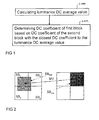
- Fig. 1 a flowchart of a method for approximating a DC coefficient of a first block of pixels of a first frame is schematically depicted.
- S 100 a luminance DC average value is calculated based on DC coefficients of first frame's macro-blocks without an approximation error.
- first frame might also be referred to in this specification as “current frame” or “first frame” and the term “block” might also be referred to as “subblock”.
- the DC coefficient is the lowest frequency coefficient.
- the process to obtain the approximation of the rest of the DCT coefficients is, however, analogous.
- the algorithm will work at a subblock level.
- Each macro-block consists of 4 such luminance subblocks of 8 x 8 DCT coefficients.
- the first coefficient is the lowest frequency component or DC coefficient.
- Each subblock will have assigned the same macro-block type as the macro-block it belongs to.
- Each subblock will have assigned the motion vector of their corresponding macro-block except in the case of field macro-block.
- the motion vectors consist of a pair (x, y) representing the horizontal and vertical shift with respect to the current subblock position.
- the overall process for DC coefficient approximation can be divided in two parts. First, based on the frame type, macro-block type and motion vectors, the reference region and the up to 4 surrounding subblocks have to be located. Then, the currently predicted DC coefficient will be approximated based on one or several of these surrounding subblocks. This process is repeated for each macro-block to be predicted.
- each subblock the location of the corresponding reference subblocks is determined as follows.
- the DC coefficients without an approximation error might be predicted macro-blocks with a zero motion vector with respect to a reference macro-block or they might be macro-blocks that are skipped with respect to a reference macro-block or they might be macro-blocks of the first frame that are intra-coded.
- the DC coefficient of the first block is determined based on the DC coefficient of a second block, wherein the second block is a part of a second frame, which is a reference frame of the first frame.
- the second block overlaps with a reference block of the first block and has the closest DC coefficient to the luminance DC average value.
- the proposed method is also referred to as "Closest to Expected Monochrome Value".
- the method does not intend to obtain an accurate approximation of the original frame. Instead, it intends to correctly reconstruct monochrome frames. As a result, monochrome frames will be reconstructed with higher accuracy than any of previous methods, while non-monochrome frames will experiment a higher approximation error (in terms of MSE: mean square error).
- the method assumes that the current frame is a monochrome frame, and calculates the luminance DC average value from the:
- skipped macro-blocks are equivalent to forward macro-blocks with zero motion vectors and no coded error.
- DC SB Cur DC SB i + DC Err DC SB i - ⁇ ⁇ DC SB j - ⁇ , ⁇ j ⁇ i , i , j ⁇ 1 ⁇ 2 ⁇ 3 ⁇ 4 with DC Err being a transmitted error coefficient. That means, the DC coefficient closest to the expected monochrome DC value will be selected.
- the DC approximation scheme might also comprise a combination of two methods.
- a third block belonging to a third frame that is a reference frame of the second frame is determined.
- the third block has the largest overlap with a reference block of the second block.
- the DC coefficient of the second block is determined based on a DC coefficient of the third block.
- the first method of the combination is also referred to as "Closest Subblock Selection” and might be explained also with reference to Fig. 2 .
- SB Cur current subblock
- MV motion vectors
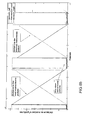
- Fig. 9 a further method of approximating a DC coefficient is depicted, which is also referred to as "weighted sum".
- the closest subblock selection method just needs to perform a round division per Motion vector component to find the selected subblock and then the DC coefficient is just copied.
- a device 300 for approximating a DC coefficient of a first frame comprises a calculation unit 302 configured to calculate the luminance DC average value based on the DC coefficients of the first frame's macro-blocks without approximation error and further comprises a determination unit 304 configured to determine the DC coefficient of the first block based on the DC coefficient of the second block, wherein the second block is a part of the second frame, which is a reference frame of the first frame. The second block overlaps with the reference block of the first block and has the closest DC coefficient to the luminance DC value.
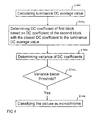
- Fig. 4 a flowchart of a method for detecting a monochrome frame in a video stream is depicted. After approximating the DC coefficients in S 100 and S102 the variance of DC coefficients is determined in S400. In S402 it is checked whether the variance is below a predetermined threshold. If the variance is below the predetermined threshold the frame is classified as monochrome.
- the device 500 includes the device 300 for approximating DC coefficients and a variance determination unit 502 configured to determine the variance of DC coefficients in the frame and a classification unit 504 configured to classify the frame as monochrome if the variance is below a second predetermined threshold.
- Fig. 6 an exemplary frame 600 is depicted.
- an outer part (with a width L bor ) of the frame 600 might be cut to avoid border effects.
- the rest of the frame 600 will then be divided in 5 parts: the corners ⁇ C1,C2,C3,C4 ⁇ , where a channel logo can appear, and the rest of the frame A Proc .
- the variance of the DC coefficients of region A Proc is calculated. If this variance is lower than the predetermined first threshold ⁇ mono 2 , the frame will be classified as monochrome.
- x i be the n DC coefficients' values for region A Proc
- the DC coefficients' variance ⁇ i 2 of each of the corner areas Ci are calculated and compared to a threshold ⁇ log ⁇ o 2 as well. Since flashes are characterized by having a very high luminance, to determine whether the detected monochrome frame (with or without logo) is actually a flash, the mean luminance ⁇ comp of the frame will be compared to a threshold ⁇ flash .
- Monochrome frames come in a variable length train of consecutive frames which ranges from 1 single frame, to more than 20 in some cases. Therefore 2 different situations can occur:
- the alternative approach then is to analyze only those B-frames with a high proportion of intra-coded macro-blocks. This proportion represents a trade-off between speed and sensibility, but in any case should be big enough to ensure that they represent a significant part of the frame.
- the intra-coded DC coefficients are then analyzed in the same way as they were for I- or P-frames.
- the logo information is inherited from the closest I or P monochrome frame.
- Fig. 7 a result of a determination of the monochrome frame is depicted.
- the average ( ⁇ comp ) of the luminance DC coefficients values is calculated. If this average is higher than a certain threshold ⁇ f lash then monochrome frame is labeled as a flash (set value to 2).
- the detection of monochrome frames can be used for several applications, like chaptering, video segmentation or commercial detection.
- For the purpose of commercial detection it has proved one of the most successful features for German TV broadcast content. In this case, only using this feature and a classification and regression tree, an overall accuracy of 96.5% can be achieved.
- Commercials blocks are characterized by often having monochrome frames in the boundaries between two commercial spots. Therefore, the intention is to give the supervised learning algorithms information about the presence of monochrome frames in the surroundings, and not just in the current frame.
- the proposed preprocessing algorithm gives as a result a pair of features arrays.
- the first array MCHL indicates, for every frame position, the distance (in frames) to the previous detected monochrome frame.
- the second array MCHR indicates the distance to next detected monochrome frame.
- a method for detecting monochrome frames in digital video has been described.
- the monochrome feature will be extracted in the compressed domain.
- the method is working directly with compressed digital video.
- the method has been applied for MPEG-2 compressed video, but it could be applied to any other digital video standard which makes use of frequency domain transformations (like the discrete cosine transform or the wavelet transform) and motion estimation of the frames (by using motion vectors or similar approaches).
- the proposed method might also be referred to as "DC coefficients motion compensated interpolation".
Landscapes
- Engineering & Computer Science (AREA)
- Multimedia (AREA)
- Signal Processing (AREA)
- Compression Or Coding Systems Of Tv Signals (AREA)
Priority Applications (3)
| Application Number | Priority Date | Filing Date | Title |
|---|---|---|---|
| EP08019761A EP2187647A1 (fr) | 2008-11-12 | 2008-11-12 | Procédé et dispositif d'approximation d'un coefficient CC d'un bloc de pixels d'un cadre |
| US12/582,801 US8644388B2 (en) | 2008-11-12 | 2009-10-21 | Method and device for approximating a DC coefficient of a block of pixels of a frame |
| CN2009102064011A CN101765015B (zh) | 2008-11-12 | 2009-11-12 | 对帧的像素的块的离散余弦系数进行近似的方法和设备 |
Applications Claiming Priority (1)
| Application Number | Priority Date | Filing Date | Title |
|---|---|---|---|
| EP08019761A EP2187647A1 (fr) | 2008-11-12 | 2008-11-12 | Procédé et dispositif d'approximation d'un coefficient CC d'un bloc de pixels d'un cadre |
Publications (1)
| Publication Number | Publication Date |
|---|---|
| EP2187647A1 true EP2187647A1 (fr) | 2010-05-19 |
Family
ID=40670966
Family Applications (1)
| Application Number | Title | Priority Date | Filing Date |
|---|---|---|---|
| EP08019761A Withdrawn EP2187647A1 (fr) | 2008-11-12 | 2008-11-12 | Procédé et dispositif d'approximation d'un coefficient CC d'un bloc de pixels d'un cadre |
Country Status (3)
| Country | Link |
|---|---|
| US (1) | US8644388B2 (fr) |
| EP (1) | EP2187647A1 (fr) |
| CN (1) | CN101765015B (fr) |
Cited By (2)
| Publication number | Priority date | Publication date | Assignee | Title |
|---|---|---|---|---|
| WO2014151531A1 (fr) * | 2013-03-15 | 2014-09-25 | General Instrument Corporation | Système et procédé de détection d'un feu à éclats en utilisant une fenêtre temporelle |
| WO2014151286A1 (fr) * | 2013-03-15 | 2014-09-25 | General Instrument Corporation | Système et procédé de détection d'un feu à éclats par utilisation de caractéristiques spatiales dans des vues vidéo |
Families Citing this family (4)
| Publication number | Priority date | Publication date | Assignee | Title |
|---|---|---|---|---|
| US8588544B2 (en) * | 2009-10-13 | 2013-11-19 | Sony Corporation | Method and system for reducing ringing artifacts of image deconvolution |
| GB2501535A (en) * | 2012-04-26 | 2013-10-30 | Sony Corp | Chrominance Processing in High Efficiency Video Codecs |
| WO2016002068A1 (fr) * | 2014-07-04 | 2016-01-07 | 三菱電機株式会社 | Dispositif d'expansion d'image, procédé d'expansion d'image, caméra de surveillance, programme, et support d'enregistrement |
| CN118674618B (zh) * | 2024-08-21 | 2024-11-19 | 苏州东方克洛托光电技术有限公司 | 使用图传视频编码信息实现航拍图像快速拼接的方法 |
Citations (2)
| Publication number | Priority date | Publication date | Assignee | Title |
|---|---|---|---|---|
| US20070206931A1 (en) | 2004-04-08 | 2007-09-06 | Koninklijke Philips Electronics, N.V. | Monochrome frame detection method and corresponding device |
| US20070256091A1 (en) | 2006-04-27 | 2007-11-01 | Kabushiki Kaisha Toshiba | Monochrome frame detection method |
Family Cites Families (5)
| Publication number | Priority date | Publication date | Assignee | Title |
|---|---|---|---|---|
| US6950473B2 (en) * | 2002-06-21 | 2005-09-27 | Seiko Epson Corporation | Hybrid technique for reducing blocking and ringing artifacts in low-bit-rate coding |
| US7809154B2 (en) * | 2003-03-07 | 2010-10-05 | Technology, Patents & Licensing, Inc. | Video entity recognition in compressed digital video streams |
| US7880815B2 (en) * | 2005-01-10 | 2011-02-01 | Mavs Lab, Inc. | Method for detecting and eliminating flash scene in digital video |
| US8654848B2 (en) * | 2005-10-17 | 2014-02-18 | Qualcomm Incorporated | Method and apparatus for shot detection in video streaming |
| US8254444B2 (en) * | 2007-05-14 | 2012-08-28 | Samsung Electronics Co., Ltd. | System and method for phase adaptive occlusion detection based on motion vector field in digital video |
-
2008
- 2008-11-12 EP EP08019761A patent/EP2187647A1/fr not_active Withdrawn
-
2009
- 2009-10-21 US US12/582,801 patent/US8644388B2/en not_active Expired - Fee Related
- 2009-11-12 CN CN2009102064011A patent/CN101765015B/zh not_active Expired - Fee Related
Patent Citations (2)
| Publication number | Priority date | Publication date | Assignee | Title |
|---|---|---|---|---|
| US20070206931A1 (en) | 2004-04-08 | 2007-09-06 | Koninklijke Philips Electronics, N.V. | Monochrome frame detection method and corresponding device |
| US20070256091A1 (en) | 2006-04-27 | 2007-11-01 | Kabushiki Kaisha Toshiba | Monochrome frame detection method |
Non-Patent Citations (2)
| Title |
|---|
| SHEN K ET AL: "A fast algorithm for video parsing using MPEG compressed sequences", PROCEEDINGS OF THE INTERNATIONAL CONFERENCE ON IMAGE PROCESSING. (ICIP). WASHINGTON, OCT. 23 - 26, 1995; [PROCEEDINGS OF THE INTERNATIONAL CONFERENCE ON IMAGE PROCESSING. (ICIP)], LOS ALAMITOS, IEEE COMP. SOC. PRESS, US, vol. 2, 23 October 1995 (1995-10-23), pages 252 - 255, XP010197072, ISBN: 978-0-7803-3122-8 * |
| YEO B-L ET AL: "On the extraction of DC sequence from MPEG compressed video", PROCEEDINGS OF THE INTERNATIONAL CONFERENCE ON IMAGE PROCESSING. (ICIP). WASHINGTON, OCT. 23 - 26, 1995; [PROCEEDINGS OF THE INTERNATIONAL CONFERENCE ON IMAGE PROCESSING. (ICIP)], LOS ALAMITOS, IEEE COMP. SOC. PRESS, US, vol. 2, 23 October 1995 (1995-10-23), pages 260 - 263, XP010197074, ISBN: 978-0-7803-3122-8 * |
Cited By (4)
| Publication number | Priority date | Publication date | Assignee | Title |
|---|---|---|---|---|
| WO2014151531A1 (fr) * | 2013-03-15 | 2014-09-25 | General Instrument Corporation | Système et procédé de détection d'un feu à éclats en utilisant une fenêtre temporelle |
| WO2014151286A1 (fr) * | 2013-03-15 | 2014-09-25 | General Instrument Corporation | Système et procédé de détection d'un feu à éclats par utilisation de caractéristiques spatiales dans des vues vidéo |
| US8891021B2 (en) | 2013-03-15 | 2014-11-18 | General Instrument Corporation | System and method of detecting strobe using temporal window |
| US9195892B2 (en) | 2013-03-15 | 2015-11-24 | Arris Technology, Inc. | System for and method of detecting strobe using spatial features in video frames |
Also Published As
| Publication number | Publication date |
|---|---|
| CN101765015A (zh) | 2010-06-30 |
| US20100158122A1 (en) | 2010-06-24 |
| US8644388B2 (en) | 2014-02-04 |
| CN101765015B (zh) | 2013-07-10 |
Similar Documents
| Publication | Publication Date | Title |
|---|---|---|
| US12051212B1 (en) | Image analysis and motion detection using interframe coding | |
| US6449392B1 (en) | Methods of scene change detection and fade detection for indexing of video sequences | |
| US6618507B1 (en) | Methods of feature extraction of video sequences | |
| US7602849B2 (en) | Adaptive reference picture selection based on inter-picture motion measurement | |
| US8098731B2 (en) | Intraprediction method and apparatus using video symmetry and video encoding and decoding method and apparatus | |
| US7362809B2 (en) | Computational reduction in motion estimation based on lower bound of cost function | |
| US20140321552A1 (en) | Optimization of Deblocking Filter Parameters | |
| US8855436B2 (en) | System for and method of selective video frame compression and decompression for efficient event-driven searching in large databases | |
| US8625671B2 (en) | Look-ahead system and method for pan and zoom detection in video sequences | |
| EP2081386A1 (fr) | Prédiction de bord haute précision pour codage intra | |
| CN102342106A (zh) | 用于处理视频数据的运动矢量的系统和方法 | |
| US8644388B2 (en) | Method and device for approximating a DC coefficient of a block of pixels of a frame | |
| US20070092007A1 (en) | Methods and systems for video data processing employing frame/field region predictions in motion estimation | |
| EP2187337A1 (fr) | Extraction de la variance d'éclairage de support à partir d'une séquence de cadres vidéo | |
| JP5178616B2 (ja) | シーンチェンジ検出装置および映像記録装置 | |
| US7983339B2 (en) | Method for coding an image sequence | |
| US7903736B2 (en) | Fast mode-searching apparatus and method for fast motion-prediction | |
| US20070076964A1 (en) | Method of and an apparatus for predicting DC coefficient in transform domain | |
| KR100816013B1 (ko) | 압축영상의 장면전환 검출장치 및 방법 | |
| US9049442B2 (en) | Moving image encoding apparatus and method for controlling the same | |
| WO2005094083A1 (fr) | Codeur video et procede de codage video | |
| JP4763241B2 (ja) | 動き予測情報検出装置 | |
| US8804046B1 (en) | Methods and systems for detection of chroma dropouts in video | |
| Søgaard et al. | No-reference video quality assessment using MPEG analysis | |
| US8064526B2 (en) | Systems, methods, and apparatus for real-time encoding |
Legal Events
| Date | Code | Title | Description |
|---|---|---|---|
| PUAI | Public reference made under article 153(3) epc to a published international application that has entered the european phase |
Free format text: ORIGINAL CODE: 0009012 |
|
| AK | Designated contracting states |
Kind code of ref document: A1 Designated state(s): AT BE BG CH CY CZ DE DK EE ES FI FR GB GR HR HU IE IS IT LI LT LU LV MC MT NL NO PL PT RO SE SI SK TR |
|
| AX | Request for extension of the european patent |
Extension state: AL BA MK RS |
|
| 17P | Request for examination filed |
Effective date: 20101117 |
|
| AKX | Designation fees paid |
Designated state(s): AT BE BG CH CY CZ DE DK EE ES FI FR GB GR HR HU IE IS IT LI LT LU LV MC MT NL NO PL PT RO SE SI SK TR |
|
| 17Q | First examination report despatched |
Effective date: 20110119 |
|
| STAA | Information on the status of an ep patent application or granted ep patent |
Free format text: STATUS: THE APPLICATION IS DEEMED TO BE WITHDRAWN |
|
| 18D | Application deemed to be withdrawn |
Effective date: 20160601 |