EP2188570B1 - Brenngerät - Google Patents
Brenngerät Download PDFInfo
- Publication number
- EP2188570B1 EP2188570B1 EP08829984.7A EP08829984A EP2188570B1 EP 2188570 B1 EP2188570 B1 EP 2188570B1 EP 08829984 A EP08829984 A EP 08829984A EP 2188570 B1 EP2188570 B1 EP 2188570B1
- Authority
- EP
- European Patent Office
- Prior art keywords
- air
- fuel
- admission
- upstream
- flame
- Prior art date
- Legal status (The legal status is an assumption and is not a legal conclusion. Google has not performed a legal analysis and makes no representation as to the accuracy of the status listed.)
- Active
Links
Images





Classifications
-
- F—MECHANICAL ENGINEERING; LIGHTING; HEATING; WEAPONS; BLASTING
- F23—COMBUSTION APPARATUS; COMBUSTION PROCESSES
- F23D—BURNERS
- F23D14/00—Burners for combustion of a gas, e.g. of a gas stored under pressure as a liquid
- F23D14/46—Details
- F23D14/62—Mixing devices; Mixing tubes
-
- F—MECHANICAL ENGINEERING; LIGHTING; HEATING; WEAPONS; BLASTING
- F23—COMBUSTION APPARATUS; COMBUSTION PROCESSES
- F23D—BURNERS
- F23D14/00—Burners for combustion of a gas, e.g. of a gas stored under pressure as a liquid
- F23D14/46—Details
- F23D14/70—Baffles or like flow-disturbing devices
-
- F—MECHANICAL ENGINEERING; LIGHTING; HEATING; WEAPONS; BLASTING
- F23—COMBUSTION APPARATUS; COMBUSTION PROCESSES
- F23D—BURNERS
- F23D14/00—Burners for combustion of a gas, e.g. of a gas stored under pressure as a liquid
- F23D14/46—Details
- F23D14/84—Flame spreading or otherwise shaping
-
- F—MECHANICAL ENGINEERING; LIGHTING; HEATING; WEAPONS; BLASTING
- F23—COMBUSTION APPARATUS; COMBUSTION PROCESSES
- F23D—BURNERS
- F23D2214/00—Cooling
Definitions
- the present disclosure relates to burner assemblies, and particularly to air-fuel burner assemblies. More particularly, the present disclosure relates to internally fired industrial gas burners.
- a known burner assembly is disclosed in US 3 361 365 A .
- a burner assembly in accordance with the present disclosure includes a fuel nozzle and an air-fuel mixing cone coupled to the fuel nozzle.
- a mixing chamber provided in the air-fuel mixing cone is configured to receive and mix fuel discharged by the fuel nozzle with pressurized air extant in a nearby air plenum to generate a combustible air-fuel mixture. This mixture can be ignited to produce a flame.
- the air-fuel mixing cone includes an inner end having an opening receiving the fuel nozzle, an outer end having a downstream combustion-discharge opening, and a funnel-shaped side wall extending between the inner and outer ends.
- the air-fuel mixing cone also includes an air-admission portal comprising various openings formed in the funnel-shaped size wall to conduct pressurized combustion air extant in the air plenum into the mixing chamber to mix with fuel discharged into the mixing chamber by the fuel nozzle.
- the air-admission portal is formed in the funnel-shaped side wall and configured to decrease progressively in effective size (i.e., total open area) along a length of the funnel-shaped wall as the distance away from the fuel nozzle increases.
- This progressive decrease in the total open area of the openings formed in the funnel-shaped side wall to define the air-admission portal causes a greater volume of pressurized combustion air to pass from the air plenum through an "upstream" portion of the air-admission portal into a part of the mixing chamber located near to the fuel nozzle.
- This progressive decrease also causes a lesser volume of pressurized combustion air to pass from the air plenum through a "downstream" portion of the air-admission portal into other parts of the mixing chamber located farther away from the fuel nozzle.
- the funnel-shaped side wall includes a perforated inlet section located near the fuel nozzle and formed to include the air- admission portal.
- a cold-temperature flame-quenching zone is formed in the perforated inlet section and this zone "contains" a first-stage air-and-fuel mixture characterized by a relatively low nitrogen oxide (NOx) content and a relatively high hydrocarbon (HC) content and a relatively high carbon monoxide (CO) content.
- NOx nitrogen oxide
- HC hydrocarbon
- CO carbon monoxide
- the funnel-shaped side wall also includes a "downstream" unperforated outlet section located between the perforated inlet section and the downstream combustion-discharge opening.
- a high-temperature emission-reduction burnout zone is formed in the unperforated outlet section to burn CO and HC included in the first-stage air-and-fuel mixture flowing from the cold-temperature flame-quenching zone of the perforated inlet section into the high-temperature emission-reduction burnout zone.
- CO and unburned HC are burned to produce a second-stage air-and-fuel mixture characterized by a low NOx content, a low CO content, and a low hydrocarbon (HC) content.
- An ignitor is used to ignite the combustible air-and-fuel mixture created in the mixing chamber to produce a flame.
- about 80 to 90 percent of the air needed for combustion is admitted into the mixing chamber through the air-admission portal that is configured to have a progressively smaller effective "open area" or size as the air-admission portal extends away from the fuel nozzle and along the length of the funnel-shaped side wall.
- about 10 to 20 percent of the air needed for combustion is discharged into a downstream combustion zone provided in a burner housing configured to receive the second-stage air-and-fuel mixture exiting through the downstream combustion-discharge opening formed in the air-fuel mixing cone.
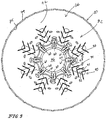
- FIG. 1 An illustrative burner assembly 10 for combining air from an air supply 12 and fuel from a fuel supply 14 to produce a flame (not shown) in a flame chamber 16 in a burner housing 18 is shown in Fig. 1 .
- An air-fuel mixing cone 20 in accordance with the represent disclosure is shown illustratively in Figs. 1 and 3-7 and diagrammatically in Fig. 2 .
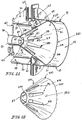
- a second illustrative air-fuel mixing cone 220 is shown in Figs. 9-10
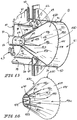
- An alternative air-fuel mixing cone 320 not according to the invention is shown in Figs. 11-12 .
- Another alternative air-fuel mixing cone 420 not according to the invention is shown in Figs. 13-14 .
- Another alternative air-fuel mixing cone 520 not according to the invention is shown in Figs. 15-16 .
- Each of air-fuel mixing cones 20, 220, 320, 420, and 520 is configured in accordance with the present disclosure to regulate flow of combustion air from air supply 12 into a mixing chamber containing fuel from fuel supply 14.
- Each cone is formed to add a lot of combustion air into an upstream region of the mixing chamber near the fuel nozzle, then progressively decrease the amount of combustion air added into the mixing chamber as distance from the fuel nozzle increases, and finally block admission of any combustion air into a downstream region of the mixing chamber.
- an air-fuel mixture 102 characterized by a low nitrogen oxide (NOx) content, a low carbon monoxide (CO) content, and a low hydrocarbon (HC) content as suggested in Fig. 2 .
- NOx nitrogen oxide
- CO carbon monoxide
- HC hydrocarbon
- burner assembly 10 includes an air inlet duct 22 formed to include an air intake opening 24, an air plenum 26 formed to include an air plenum chamber 28 arranged to receive combustion air 30 discharged through an air exhaust opening 34 formed in air inlet duct 22, and a fuel nozzle 36 coupled to fuel supply 14 via a conduit 38 and arranged to extend into air plenum chamber 28 of air plenum 26 to mate with air-fuel mixing cone 20.
- Air inlet duct 22 includes an air-conducting passageway 25 extending from air intake opening 24 to air exhaust opening 34 as suggested in Fig. 1 .
- An air flow regulator 40 comprising an air intake valve 41, an air intake valve controller 42, and a valve-mover linkage 43 interconnecting air intake valve 41 and air intake valve controller 42 is coupled to burner housing 18 to regulate the flow of combustion air 30 discharged into air plenum chamber 28.
- Valve-mover linkage 43 is also coupled to a fuel intake valve 31 (not shown) associated with conduit 38 and a fuel linkage 33 as suggested in Fig. 1 .
- Air intake valve 41 and fuel intake valve 31 are linked via valve-mover linkage 43 and cooperate to regulate flow of combustion air 30 discharged into air plenum chamber 28 and the flow of fuel into fuel nozzle 36.
- An impeller 44 turned by a motor 45 and located in an airflow conduit 46 interconnecting air supply 12 and air intake opening 24 of air inlet duct 22 is used to discharge combustion air 30 into air plenum chamber 28 via air inlet duct 22.
- Burner housing 18 also includes a burner discharge sleeve 50 formed to include an interior region 51 and coupled to air plenum 26 as shown, for example, in Figs. 1 , 9 , 11 , 13 , and 15 .
- a cone support mount 52 is included in burner housing 18 and used to support air-fuel mixing cone 20 partly in air plenum chamber 28 and partly in interior region 51 of burner discharge sleeve 50. It is within the scope of this disclosure to adjust the position of air-fuel mixing cone 20 in directions 53 or 54 and relative to air plenum 26 and burner discharge sleeve 50 as needed.
- cone support mount 52 is formed to include air-flow passageways 54 interconnecting air plenum chamber 28 and interior region 51 in fluid communication.
- fuel nozzle 36 includes a shell 56 having an outer end 58 formed to include several circumferentially spaced-apart fuel-discharge ports 60.
- Shell 56 also is formed to include a fuel-transport passageway 62 arranged to communicate fuel from fuel supply conduit 38 to fuel-discharge ports 60 to cause a stream 61 of fuel (see Figs. 2 and 5-7 ) to be discharged from fuel-transport passageway 62 through each of fuel-discharge ports 60 into a mixing chamber 66 formed in air-fuel mixing cone 20.
- a base 57 of shell 56 is coupled to burner housing 18 and most of fuel nozzle 36 is arranged to lie in air plenum chamber 28 as suggested in Fig. 1 .
- Mixing means 21 is provided for mixing the streams 61 of fuel discharged through fuel-discharge ports 60 formed in fuel nozzle 36 with primary (combustion) air 31 taken from combustion air 30 extant in air plenum 26 associated with fuel nozzle 36 to produce an air-and-fuel mixture 100 that can be ignited in mixing chamber 66 to produce a flame (not shown) as suggested in Fig. 1 .
- Mixing means 21 comprises air-fuel mixing cone 20 and cone support mount 52. As suggested in Figs.
- air-fuel mixing cone 20 is formed to include an inner end 70 defining an upstream nozzle-receiver opening 71, an outer end 74 defining a downstream combustion-discharge opening 75, and a funnel-shaped side wall 72 extending between inner and outer ends 70, 74 to define mixing chamber 66 therebetween.
- Fuel nozzle 36 is arranged to communicate with mixing chamber 66 via upstream nozzle-receiver opening 71 to discharge streams 61 of fuel into mixing chamber 66.
- funnel-shaped side wall 72 of air-fuel mixing cone 20 includes a perforated inlet section 73 and an unperforated outlet section 76.
- Perforated inlet section 73 extends from upstream nozzle-receiver opening 71 to unperforated outlet section 76.
- Unperforated outlet section 76 terminates at downstream combustion-discharge opening 75 and defines an outer region 80 of mixing chamber 66.
- Perforated inlet section 76 is formed to include an upstream territory 77 located adjacent to fuel nozzle 36 and a downstream territory 78 interposed between upstream territory 77 and unperforated outlet section 76.
- Downstream territory 78 is arranged to cooperate with upstream territory 77 to define an inner region 79 of mixing chamber 66 as suggested diagrammatically in Fig. 2 and illustratively in Fig. 4 .
- perforated inlet section 73 of funnel-shaped side wall 72 is formed to include air-admission port means for defining an air-admission portal 82 exposed to pressurized air 30 extant in air plenum chamber 28 of air plenum 26.
- Air-admission portal 82 is configured to extend away from upstream nozzle-receiver opening 71.
- air-admission portal 82 comprises slots and, optionally, apertures formed in funnel-shaped side wall 72 of air-fuel mixing cone 20.
- Air-admission portal 82 (i.e., total open area of all of the slots and/or apertures cooperating to define air-admission portal 82) is configured to decrease in effective size along a length of funnel-shaped side wall 66 as distance from upstream nozzle-receiver opening 71 increases in direction 81 as suggested, for example, in Figs. 1-4 .
- This progressively smaller effective size causes a greater volume of pressurized air 31 to pass through an upstream portion of air-admission portal 82 into upstream territory 77 of inner region 79 of mixing chamber 66 in close proximity to fuel nozzle 36 to mix with the streams 61 of fuel discharged by fuel nozzle 36 to produce a combustible fuel-rich air-and-fuel mixture in upstream territory 77.
- This progressively smaller effective size of air-admission portal 82 also causes a relatively smaller lesser volume of pressurized air 31 to pass through a downstream portion of air-admission portal 82 into downstream territory 78 of inner region 79 of mixing chamber 66 to generate a first-stage air-and-fuel mixture 101 in downstream territory 78.
- First-stage air-and-fuel mixture 101 is characterized by a low nitrogen oxide (NOx) content, a high hydrocarbon (HC) content, and a high carbon monoxide (CO) content so that a cold-temperature flame-quenching zone 83 is established in inner region 79 of mixing chamber 66 and carbon monoxide and unburned hydrocarbon included in first-stage air-and-fuel mixture 101 flow from inner region 79 of mixing chamber 66 into outer region 80 of mixing chamber 66 formed in unperforated outlet section 76.
- NOx nitrogen oxide
- HC high hydrocarbon
- CO carbon monoxide
- Unperforated outlet section 76 of funnel-shaped side wall 72 is separated from air plenum 26 to block admission of pressurized air 30 from air plenum 26 into outer region 80 of mixing chamber 66 to establish a high-temperature emission-reduction burnout zone 84 in outer region 80 of mixing chamber 66 causing carbon monoxide and hydrocarbon admitted into outer region 80 to be burned therein to generate in outer region 80 of mixing chamber 66 a second-stage air-and-fuel mixture 102 as suggested in Fig. 2 .
- Second-stage air-and-fuel mixture 102 is characterized by a relatively low nitrogen oxide content, a relatively low hydrocarbon content, and a relatively low carbon monoxide content and is discharged from outer region 80 of mixing chamber 66 through combustion-discharge opening 75 formed in outer end 74 of air-fuel mixing cone 20.
- Air-admission portal 82 comprises a series of air-admission slots 90 formed in perforated inlet section 73 of funnel-shaped side wall 72 of air-fuel mixing cone 20.
- Each of the air-admission slots 90 is arranged to extend in a downstream direction 81 along a portion of the length of funnel-shaped side wall 72.
- Each of air-admission slots 90 is characterized by a lateral width that varies along a length of the slot and widens in places closer to inner end 71 of air-fuel mixing cone 20.
- Each air-admission slot 90 is defined by first and second flame-anchor edges 91, 92 and a concave curved edge 93 having a first end coupled to first flame-anchor edge 91 and a second end coupled to second flame-anchor edge 92 as suggested in Figs. 2 and 4 .
- First and second flame-anchor edges 91, 92 are arranged to lie in spaced-apart relation to one another to define a downstream air-transferring channel 94 therebetween.
- Concave curved edge 93 is located in a space 95 provided between the first and second flame-anchor edges 91, 92 and upstream nozzle-receiving opening 71 of inner end 70 of air-fuel mixing cone 20 to define an upstream air-transferring aperture 96 communicating with downstream air-transferring channel 94.
- First and second flame-anchor edges 91, 92 are separated by a uniform width dimension and concave curved edge 93 is defined by an arcuate section of a circle having a diameter that is greater than the uniform width dimension provided between first and second flame-anchor edges 91, 92 as suggested in Figs. 2-4 .
- Each of first and second flame-anchor edges 91, 92 has a length that is about 3.5 times the diameter of the circle described above.
- Concave curved edge 93 is arranged to intersect in two places (A and B) a first reference line 131 coincident with first flame-anchor edge 91 and to intersect in two places (C and D) a second reference line 132 coincident with second flame-anchor edge 92 as suggested in Fig. 3 .
- Concave curved edge 93 circumscribes an arc of about 300 degrees and in illustrative embodiments, an arc within a range of about 250-320 degrees
- burner housing 18 includes an interior region comprising at least air-conducting passageway 25 in air duct 22, air plenum chamber 28 in air plenum 26, and the interior region provided in burner discharge sleeve 50.
- Air-fuel mixing cone 20 is located in the interior region of burner housing 18 to expose air-admission portal 82 to primary (combustion) air 31 derived from combustion air 30 extant in air plenum chamber 28 of air plenum 26.
- primary (combustion) air 31 derived from combustion air 30 extant in air plenum chamber 28 of air plenum 26.
- funnel-shaped side wall 72 of air-fuel mixing cone 20 includes an exterior surface 97 that terminates at a large-diameter outer rim 98 and cooperates with a surrounding wall included, for example, in burner discharge sleeve 50 included in burner housing 18 to define means for diverting pressurized combustion air 30 from air plenum 26 to generate a stream of secondary (combustion) air 32 flowing past unperforated outlet section 76 of funnel-shaped side wall 72 to cool funnel-shaped side wall 72 of air-fuel mixing cone 20 and flowing through a secondary air channel 99 defined between large-diameter outer rim 98 and surrounding wall 50 into a combustion zone 103.
- Combustion zone 103 is provided in burner housing 18 and arranged also to receive second-stage air-and-fuel mixture 102 discharged from outer region 80 of mixing chamber 66 through combustion-discharge opening 75 formed in outer end 74 of air-fuel mixing cone 20.
- Air-admission portal 82 is sized to provide primary air means for admitting from air plenum chamber 28 of air plenum 26 about 80 to 90 percent of combustion air needed for combustion into mixing chamber 66 in illustrative embodiments of the present disclosure.
- Secondary air channel 99 defined between large-diameter outer rim 98 and surrounding wall 50 is sized to provide secondary air means for admitting from air plenum chamber 28 of air plenum 26 about 10 to 20 percent of combustion air needed for combustion in combustion zone 103 also in illustrative embodiments of the present disclosure.
- air-admission portal 82 comprises first and second air-admission slots 111, 112 formed in perforated inlet section 73 of funnel-shaped side wall 72 and arranged to lie in spaced-apart relation to one another to define a field 113 located therebetween.
- a first small-size air-admission port 114 is formed in field 113 in perforated inlet section 73 of funnel-shaped side wall 72 and located in spaced-apart relation to upstream nozzle-receiving opening 71 and characterized by a first open-area size.
- a large-size air admission port 116 is formed in field 113 to lie between upstream nozzle-receiving opening 71 and first small-size air-admission port 114 and characterized by a second open-area size that is greater than the first open-area size.
- Air-admission portal 82 further comprises a second small-size air-admission port 115 formed in field 113 and located between first small-size air-admission port 114 and first air-admission slot 111. Second small-size air-admission port 115 is characterized by the first open-area size. It is within the scope of this disclosure to provide air-admission ports in varying numbers, shapes, patterns, and locations in field 113.
- each of the air-admission slots 111, 112 is arranged to extend in a downstream direction along a portion of the length of funnel-shaped side wall 72.
- Each of air-admission slots 111, 112 is characterized by a lateral width that varies along a length of the slot and widens in places closer to inner end 71 of air-fuel mixing cone 20.
- Air-admission ports 116, 115, 114 are progressively reduced in size as distance away from upstream nozzle-receiving opening 71 increases in direction 81 as suggested in Fig. 2 .
- an upstream air-admission port 116 is formed in field 113 along a bifurcation reference line 117 that is arranged to bifurcate field 113 to define a first field section 118 between first air-admission slot 111 and bifurcation reference line 117 and a second field section 119 between second air-admission slot 112 and bifurcation reference line 117.
- First downstream air-admission port 114 is formed in first field section 118 to locate upstream air-admission port 116 between first downstream air-admission port 114 and upstream nozzle-receiving opening 71.
- Second downstream air-admission port 115 is formed in second field section 119 to locate upstream air-admission port 116 between second downstream air-admission port 115 and upstream nozzle-receiving opening 71.
- One of the fuel-discharge ports 60 is oriented to discharge a stream 61 of fuel into upstream territory 77 of mixing chamber 66 along bifurcation reference line 117 as suggested in Fig. 2 .
- Upstream air-admission port 116 provides an opening of a first size and each of the first and second downstream air-admission ports 114, 115 provides an opening of a relatively smaller second size as suggested in Fig. 2 .
- Air-fuel mixing cone 220 is formed to include an inner end 270 defining an upstream nozzle-receiver opening 271, an outer end 274 defining a downstream combustion-discharge opening 275, and a funnel-shaped side wall 272 extending between inner and outer ends 270, 274 to define mixing chamber 266 therebetween.
- Fuel nozzle 36 is arranged to communicate with mixing chamber 266 via upstream nozzle-receiver opening 271 to discharge streams of fuel into mixing chamber 266.
- Air-mixing cone 220 is formed to include an air-admission portal 282 comprising only a series of spaced-apart air-admission slots 290 as shown, for example, in Figs. 9 and 10 . It is, however, within the scope of the present disclosure to form air-mixing cone 220 to include air-admission ports or other openings in the fields 213 between adjacent air-admission slots 290.
- Air-fuel mixing cone 320 is formed to include an inner end 370 defining an upstream nozzle-receiver opening 371, an outer end 374 defining a downstream combustion-discharge opening 375, and a funnel-shaped side wall 372 extending between inner and outer ends 370, 374 to define mixing chamber 366 therebetween.
- Fuel nozzle 36 is arranged to communicate with mixing chamber 366 via upstream nozzle-receiver opening 371 to discharge streams of fuel into mixing chamber 366.
- Air-mixing cone 320 is formed to include an air-admission portal 382 comprising only a series of spaced-apart air-admission slots 390 as shown, for example, in Figs. 11 and 12 . It is, however, within the scope of the present disclosure to form air-mixing cone 320 to include air-admission ports or other openings in the fields 313 between adjacent air-admission slots 390.
- first and second flame-anchor edges 391, 391 are arranged to diverge in an upstream direction toward a concave curved edge 313.
- This arrangement causes the air-admission slot 390 bounded by the first and second flame-anchor edges 391, 392 to have a lateral width that narrows as distance away from concave curved edge 393 increases.
- Each air-admission slot 390 is also bounded by a concave curved edge 393 located between the upstream nozzle-receiving opening 371 and the first and second flame-anchor edges 391, 392 and arranged to interconnect upstream ends of first and second flame-anchor edges 391, 392.
- Concave curved edge 393 is arranged to lie wholly in a space provided between a first reference line coincident with first flame-anchor edge 391 and a second reference line coincident with second flame-anchor edge 392.
- Air-fuel mixing cone 420 in accordance with another alternative not according to the invention is shown, for example, in Figs. 13 and 14 .
- Air-fuel mixing cone 420 is formed to include an inner end 470 defining an upstream nozzle-receiver opening 471, an outer end 474 defining a downstream combustion-discharge opening 475, and a funnel-shaped side wall 472 extending between inner and outer ends 470, 474 to define mixing chamber 466 therebetween.
- Fuel nozzle 36 is arranged to communicate with mixing chamber 466 via upstream nozzle-receiver opening 471 to discharge streams of fuel into mixing chamber 466.
- Air-mixing cone 420 is formed to include an air-admission portal 482 comprising only a series of spaced-apart air-admission slots 490 as shown, for example, in Figs. 13 and 14 . It is, however, within the scope of the present disclosure to form air-mixing cone 420 to include air-admission ports or other openings in the fields 413 between adjacent air-admission slots 490.
- each first and second flame-anchor edge 491, 492 includes an upstream end located in close proximity to the upstream nozzle-receiving opening 471 and an opposite downstream end located between a companion upstream end and downstream combustion-discharge opening 475 formed in outer end 474 of air-fuel mixing cone 420.
- First and second flame-anchor edges 491, 492 intersect at the downstream ends thereof at point 495.
- Each air-admission slot 490 is also bounded by an interior edge 493 formed in funnel-shaped side wall 420 and arranged to interconnect the upstream ends of first and second flame-anchor edges 491, 492.
- each of edges 491, 492, 493 are straight and edges 491, 492, 493 cooperate to form an Isosceles triangle.
- Air-fuel mixing cone 520 is formed to include an inner end 570 defining an upstream nozzle-receiver opening 571, an outer end 574 defining a downstream combustion-discharge opening 575, and a funnel-shaped side wall 572 extending between inner and outer ends 570, 574 to define mixing chamber 566 therebetween.
- Fuel nozzle 36 is arranged to communicate with mixing chamber 566 via upstream nozzle-receiver opening 571 to discharge streams of fuel into mixing chamber 566.
- Air-mixing cone 520 is formed to include an air-admission portal 582 comprising only a series of spaced-apart air-admission slots 590 as shown, for example, in Figs. 15 and 16 . It is, however, within the scope of the present disclosure to form air-mixing cone 520 to include air-admission ports or other openings in the fields 513 between adjacent air-admission slots 590. As suggested in the alternative of Figs. 15 and 16 , each of first and second flame anchor edges 591, 592 intersects a narrow-diameter inner rim 570 defining upstream nozzle-receiving opening 571.
- mixing cones 20, 220, 320, 420, and 520 in accordance with the present disclosure allows for mid to low emission performance without sacrificing burner turndown.
- the burner emissions can be controlled and regulated easily by simply increasing or decreasing excess air.
- Air-fuel mixing cones 20, 220, 320, 420, and 520 can be scaled easily to a larger or smaller burner while maintaining same flame characteristics and emission performance.
- Each air-fuel mixing cone is made out of stainless steel material and provided with holes or slots. The slots are sized for an optimal open area through which air passes and enters the cone.
- the cone is located inside of a burner discharge sleeve 50 and is mounted on a fuel nozzle 36.
- the fuel nozzle 36 delivers fuel into the air-fuel mixing cone and injects fuel 61 between the air-opening slots 90, 290, 390, 490, or 590.
- the slots are sized and shaped to allow for the largest volume of air to enter the cone next to fuel nozzle 36 at the throat of the cone and are smaller as the cone opens.
- the cone openings extend to only half of the cone length. The remaining portion of the cone without openings serves as a protective zone.
- the reason for the opening size and shape is to provide flame with a cold-temperature flame-quenching zone 83 where the flame temperature is minimized, thus reducing the emission of thermal NOx.
- the latter part of the cone without the openings exists to burn out the CO created by the quenched flame in the first zone of the cone.
- the shape and size of the openings are defined to allow for maximum volume of air near fuel nozzle 36 without sacrificing flame stability.
- the fuel 61 is injected between the cone openings at the same or slightly larger angle as the cone, allowing the fuel jet to flow parallel to the cone area between the openings and to progressively mix with air. This enhances the fuel-air mixing, as well as provides an anchor for the flame at low-fire conditions.
- the area in fields 113, 213, 313, 413, and 513 between the slots provides a retention zone where the flame can stabilize near the fuel nozzle and is not directly in the air stream.
- the area between the slots offers a medium for gas to progressively mix with air and to penetrate deeper into the cone.
- the negative pressure around the edge of the slots, produced by the air stream entering the cone creates an eddy effect which enhances the mixing of fuel 61 and air 31.
- the eddy effect not only helps in mixing of fuel and air, but also creates an effective anchor where flame can establish.
- the flame anchor can either encompass the entire circumference of the slot opening or can shift and move to the end of the slot opening.
- the intensity of air stream moves the flame to the end of the slots and anchors the flame in the base of the cone protective zone 84 defined by unperforated outlet section 76.
- the velocity of the air stream greatly decelerates, allowing the flame to establish and to float with minimum flame retention.
- the flame is still anchored to the slot openings.
- a majority of the flame is lifted and burns almost as a premixed flame.
- the anchored flame serves as a supply of ignition for the main flame.
- the base of the flame shifts and moves away from the gas nozzle, the fuel and air are partly mixed before burning.
- the openings (e.g., air-admission ports 114, 115, 116) between the slots provide additional means to quench the flame by injecting air into the base of the flame and also a way to split the fuel and force it to mix with the air flowing form the slots.
- combustion air Nearly all of the combustion air (80 to 90 percent) enters the air-fuel mixing cone throughout the slots and holes at the base of the cone. The rest of the air is directed around the cone and enters combustion zone 103 outside of the cone as secondary air 32.
- the secondary air 32 around the cone is used to cool the cone and to provide additional and final flame quenching.
- the amount of secondary air 32 is controlled by the gap 99 provided between the cone and a discharge sleeve in which the cone is located.
- the slots/openings are sized and shaped to allow the largest volume of air to enter the cone adjacent to the nozzle at the base of the cone and are smaller as the cone opens.
- the cone opening lengths are sized to extend half of the cone length.
- the remaining portion of the cone without openings serves as a protective burnout zone 84.
- One reason for the opening size and shape is to provide flame with a cold temperature flame-quenching zone 83 where the flame temperature is minimized, thus reducing the emission of thermal NOx.
- the later part of the cone without the openings allows for burnout of the remaining CO created in the quenched first zone 83 of the cone.
- the shape of the openings allows for minimum flame retention without sacrificing flame stability.
- a graph illustrated in Fig. 8 shows that the effective size of the combustion air "openings" in an air-fuel mixing cone 20 made in accordance with the present disclosure and defined, e.g., by air-admission slots 90 and ports 115, 116 decreases as (1) the volume of cone 20 increases and (2) the distance from fuel nozzle 36 increases. This is in marked contrast to an increasing effective size of combustion air openings provided in a "typical" air-fuel burner.
- Cones or mixing plates typically use openings that are smaller at the base of the cone next to the fuel nozzle and become progressively larger as they move upward in the cone.
- the combustion air openings can be round with the smallest openings first and the largest last. If slots are utilized, then their orientation is also in the same fashion. They are small at the base next to the fuel nozzle and are progressively larger.
- the prior burners were either designed for a constant airflow or for high turndown performance only, without the emphasis on burner emissions.
- the reason for the traditional layout of the openings is to allow minimum amount of air at the base of the flame next to the gas nozzle and maximum after the flame develops and is established.
- the opening size was progressively larger and sized according to the combustion zone volume. At minimum fire where the combustion zone volume is the smallest and where the flame intensity is the weakest, the air openings in the cone were sized to protect this flame and their open area was sized to only supply the air needed for that particular flame rate. The air openings would get progressively larger corresponding to the flame zone intensity.
- Such design allows for a good flame turndown control. However, it does not allow for NOx or CO emission control.
- the slots/openings provided in air-fuel mixing conies in accordance with the present disclosure are sized and shaped to allow the largest volume of air to enter the cone next to the nozzle at the base of the cone and are smaller as the cone opens.
- the cone openings take up only half of the cone length.
- the remaining portion of the cone without openings serves as a protective zone.
- the reason for the opening size and shape is to provide flame with a cold-quenching zone, thus minimizing the flame temperature and reducing the emission of NOx.
- the later part of the cone without the openings allows for burnout of the unburned hydrocarbons and Co created in the quenched first zone of the cone.
- the opening shape allows for minimum flame retention without sacrificing flame stability.
- the cone openings are sized to allow 80 to 90 percent of air to enter the combustion zone at the base of the flame where the fuel is introduced. This approach allows emission control without sacrificing burner turndown or flame stability. Such opening and spacing are contrary to the traditional approach where a cone or mixing plates are used to create a combustion zone.
Landscapes
- Engineering & Computer Science (AREA)
- Chemical & Material Sciences (AREA)
- Combustion & Propulsion (AREA)
- Mechanical Engineering (AREA)
- General Engineering & Computer Science (AREA)
- Gas Burners (AREA)
Claims (7)
- Brenneranordnung (10) zum Vereinigen von Luft und Brennstoff, um eine Flamme zu erzeugen, wobei die Brenneranordnung (10) eine Brennstoffdüse (36), die eine Schale (56) enthält, die derart gebildet ist, dass sie mehrere Brennstoffauslassöffnungen (60) und einen Brennstofftransportkanal (62), der ausgelegt ist, den Brennstoffauslassöffnungen (60) Brennstoff zuzuführen, um zu bewirken, dass ein Brennstoffstrom aus dem Brennstofftransportkanal (62) durch jede der Brennstoffauslassöffnungen (60) ausgelassen wird, enthält, und Mischmittel zum Mischen der Brennstoffströme, die durch die Brennstoffauslassöffnungen (60) ausgelassen werden, die in der Brennstoffdüse (36) gebildet sind, mit Verbrennungsluft, die in einer Luftkammer (26), die der Brennstoffdüse (36) zugeordnet ist, noch vorhanden ist, um eine Luft-und-Brennstoff-Mischung zu erzeugen, die in einer Mischkammer (66, 266) entzündet werden kann, um eine Flamme zu erzeugen, umfasst, wobei das Mischmittel einen Luft-Brennstoff-Mischkegel (20, 220) enthält, der derart ausgebildet ist, dass er ein inneres Ende (70), das eine stromaufseitige Düsenaufnahmeöffnung (71, 271) definiert, ein äußeres Ende (74), das eine stromabseitige Verbrennungsauslassöffnung (75, 275) definiert, und eine trichterförmige Seitenwand (72), die sich zwischen dem inneren und dem äußeren Ende (74) erstreckt, um dazwischen eine Mischkammer (66, 266) zu definieren, enthält, wobei die Brennstoffdüse (36) ausgelegt ist, mit der Mischkammer (66, 266) über die stromaufseitige Düsenaufnahmeöffnung (71, 271) in Verbindung zu stehen, um Brennstoffströme in die Mischkammer (66, 266) auszulassen, und die trichterförmige Seitenwand (72) einen nicht gelochten Auslassabschnitt (76), der an der stromabseitigen Verbrennungsauslassöffnung (75, 275) endet und einen Außenbereich (80) der Mischkammer (66, 266) definiert, und einen gelochten Einlassabschnitt (73), der sich von der stromaufseitigen Düsenaufnahmeöffnung (71, 271) zu dem nicht gelochten Auslassabschnitt (76) erstreckt und ein stromaufseitiges Gebiet (77), das angrenzend an die Brennstoffdüse (36) angeordnet ist, und ein stromabseitiges Gebiet (78), das zwischen dem stromaufseitigen Gebiet (77) und dem nicht gelochten Auslassabschnitt (76) eingeschoben ist und ausgelegt ist, mit dem stromaufseitigen Gebiet (77) zusammenzuwirken, um einen Innenbereich (79) der Mischkammer (66, 266) zu definieren, enthält, enthält, wobei der gelochte Einlassabschnitt (73) der trichterförmigen Seitenwand (72) derart gebildet ist, dass er Lufteinströmöffnungsmittel zum Definieren eines Lufteinströmportals (82) enthält, das der Druckluft (30) ausgesetzt ist, die in der Luftkammer (26) noch vorhanden ist, und konfiguriert ist, sich von der stromaufseitigen Düsenaufnahmeöffnung (71, 271) weg zu erstrecken und entlang einer Länge der trichterförmigen Seitenwand (72) in seiner wirksamen Größe abzunehmen, während der Abstand von der stromaufseitigen Düsenaufnahmeöffnung (71, 271) zunimmt, um zu bewirken, dass durch einen stromaufseitigen Abschnitt des Lufteinströmportals (82) ein größeres Druckluftvolumen (30) in das stromaufseitige Gebiet (77) des Innenbereichs (79) der Mischkammer (66, 266) in enger räumlicher Nähe zur Brennstoffdüse (36) strömt, um sich mit den Brennstoffströmen zu mischen, die durch die Brennstoffdüse (36) ausgelassen werden, wobei das Lufteinströmportal (82) betreibbar ist, in dem stromaufseitigen Gebiet (77) eine verbrennbare, brennstoffreiche Luft-und-Brennstoff-Mischung zu erzeugen und zu bewirken, dass durch einen stromabseitigen Abschnitt des Lufteinströmportals (82) ein relativ kleineres, geringeres Druckluftvolumen (30) in das stromabseitige Gebiet (78) des Innenbereichs (79) der Mischkammer (66, 266) strömt, um in dem stromabseitigen Gebiet (78) eine Luft-und-Brennstoff-Mischung (101) einer ersten Stufe zu erzeugen, gekennzeichnet durch einen niedrigen Stickoxidgehalt (NOx-Gehalt), einen hohen Kohlenwasserstoffgehalt (HC-Gehalt) und einen hohen Kohlenmonoxidgehalt (CO-Gehalt), derart, dass im Innenbereich (79) der Mischkammer (66, 266) eine Zone (83) zum Löschen von Kalttemperaturflammen eingerichtet ist und Kohlenmonoxid und nicht verbrannter Kohlenwasserstoff, die in der Luft-und-Brennstoff-Mischung (101) der ersten Stufe enthalten sind, aus dem Innenbereich (79) der Mischkammer (66, 266) in den Außenbereich (80) der Mischkammer (66, 266) strömen, der im nicht gelochten Auslassabschnitt (76) gebildet ist, und wobei der nicht gelochte Auslassabschnitt (76) der trichterförmigen Seitenwand (72) zum Sperren des Einströmens von Druckluft (30) aus der Luftkammer (26) in den Außenbereich (80) der Mischkammer (66, 266) von der Luftkammer (26) getrennt ist, um im Außenbereich (80) der Mischkammer (66, 266) eine Hochtemperaturabbrandzone (84) zur Emissionsverringerung einzurichten, die bewirkt, dass darin das Kohlenmonoxid und der Kohlenwasserstoff verbrannt werden, die in den Außenbereich (80) eingelassen werden, um im Außenbereich (80) der Mischkammer (66, 266) eine Luft-und-Brennstoff-Mischung (102) einer zweiten Stufe zu erzeugen, gekennzeichnet durch einen niedrigen Stickoxidgehalt, einen niedrigen Kohlenwasserstoffgehalt und einen niedrigen Kohlenmonoxidgehalt, die aus dem Außenbereich (80) der Mischkammer (66, 266) durch die Verbrennungsauslassöffnung ausgelassen wird, die im äußeren Ende (74) des Luft-Brennstoff-Mischkegels (20, 220) gebildet ist; wobei das Lufteinströmportal (82) eine Reihe von Lufteinströmschlitzen (90, 290) umfasst, die im gelochten Einlassabschnitt (73) der trichterförmigen Seitenwand (72) des Luft-Brennstoff-Mischkegels (20, 220) gebildet sind, wobei jeder der Lufteinströmschlitze (90, 290) ausgelegt ist, sich in einer Stromabwärtsrichtung entlang eines Abschnitts der Länge der trichterförmigen Seitenwand zu erstrecken, und jeder der Lufteinströmschlitze (90, 290) gekennzeichnet ist durch eine seitliche Breite, die entlang einer Länge des Schlitzes variiert und sich an Stellen weitet, die näher am inneren Ende (70) des Luft-Brennstoff-Mischkegels (20, 220) liegen; wobei mindestens einer der Lufteinströmschlitze (90, 290) durch eine erste und eine zweite Flammenankerkante (91, 291, 92, 292) und eine konkav gekrümmte Kante (93, 293) mit einem ersten Ende, das mit der ersten Flammenankerkante (91, 291) gekoppelt ist, und einem zweiten Ende, das mit der zweiten Flammenankerkante (91, 291) gekoppelt ist, definiert ist, wobei die erste und die zweite Flammenankerkante (91, 291, 92, 292) ausgelegt sind, zueinander in einer beabstandeten Beziehung zu stehen, um dazwischen einen stromabseitigen Luftübertragungskanal (94) zu definieren, und die konkav gekrümmte Kante (93, 293) in einem Raum zwischen der ersten und der zweiten Flammenankerkante (91, 291, 92, 292) und der stromaufseitigen Düsenaufnahmeöffnung des inneren Endes (70) des Luft-Brennstoff-Mischkegels (20, 220) angeordnet ist, um eine stromaufseitige Luftübertragungsöffnung (96) zu definieren, die mit dem stromabseitigen Luftübertragungskanal (94) in Verbindung steht; wobei die erste und die zweite Flammenankerkante (91, 291, 92, 292) durch eine gleichmäßige Breitenabmessung getrennt sind und die konkav gekrümmte Kante (93, 293) durch einen bogenförmigen Abschnitt eines Kreises definiert ist, der einen Durchmesser aufweist, der größer als die gleichmäßige Breitenabmessung ist, die zwischen der ersten und der zweiten Flammenankerkante (91, 291, 92, 292) vorgesehen ist.
- Brenneranordnung (10) nach Anspruch 1, wobei die konkav gekrümmte Kante (93, 293) ausgelegt ist, an zwei Stellen (A, B) eine erste Referenzlinie (131) zu kreuzen, die mit der ersten Flammenankerkante (91, 291) übereinstimmt, und an zwei Stellen (C, D) eine zweite Referenzlinie (132) zu kreuzen, die mit der zweiten Flammenankerkante (91, 291) übereinstimmt.
- Brenneranordnung (10) nach Anspruch 1, die ferner ein Brennergehäuse (18) umfasst, das einen Innenraumbereich enthält, und wobei der Luft-Brennstoff-Mischkegel (20, 220) im Innenraumbereich derart angeordnet ist, dass das Lufteinströmportal (82) der primären Verbrennungsluft ausgesetzt ist, die in der Luftkammer (26) noch vorhanden ist, und wobei die trichterförmige Seitenwand (72) des Luft-Brennstoff-Mischkegels (20, 220) eine Außenfläche enthält, die an einem Außenrand (98) mit einem großen Durchmesser endet und mit einer umgebenden Wand zusammenwirkt, die im Brennergehäuse (18) enthalten ist, um Mittel zum Umleiten von Verbrennungsdruckluft (30) aus der Luftkammer (26) zu definieren, um einen Strom einer sekundären Verbrennungsluft (32) zu erzeugen, der an dem nicht gelochten Auslassabschnitt (76) der trichterförmigen Seitenwand (72) vorbeiströmt, um die trichterförmige Seitenwand (72) des Luft-Brennstoff-Mischkegels (20, 220) zu kühlen, und durch einen Sekundärluftkanal (99), der zwischen dem Außenrand (98) mit dem großen Durchmesser und der umgebenden Wand definiert ist, in eine Verbrennungszone (63) strömt, die im Brennergehäuse (18) vorgesehen ist und ausgelegt ist, außerdem die Luft-und-Brennstoff-Mischung der zweiten Stufe aufzunehmen, die aus dem Außenbereich (80) der Mischkammer (66, 266) durch die Verbrennungsauslassöffnung ausgelassen wird, die im äußeren Ende (74) des Luft-Brennstoff-Mischkegels (20, 220) gebildet ist.
- Brenneranordnung (10) nach Anspruch 3, wobei das Lufteinströmportal (82) derart dimensioniert ist, dass es Primärluftmittel zum Einströmen von etwa 80 bis 90 Prozent der Verbrennungsluft, die zur Verbrennung benötigt wird, aus der Luftkammer (26) in die Mischkammer (66, 266) bereitstellt, und der Sekundärluftkanal (99), der zwischen dem Außenrand (98) mit dem großen Durchmesser und der umgebenden Wand definiert ist, derart dimensioniert ist, dass er Sekundärluftmittel zum Einströmen von etwa 10 bis 20 Prozent der Verbrennungsluft, die zur Verbrennung benötigt wird, aus der Luftkammer (26) in die Verbrennungszone (63) bereitstellt.
- Brenneranordnung (10) nach Anspruch 1, wobei die Schlitze (90) einen ersten und einen zweiten Lufteinströmschlitz (111, 112) umfassen, die im gelochten Einlassabschnitt (73) der trichterförmigen Seitenwand (72) gebildet sind und ausgelegt sind, zueinander in einer beabstandeten Beziehung zu stehen, um dazwischen ein Feld (113) zu definieren, wobei eine erste, klein dimensionierte Lufteinströmöffnung (114) in dem Feld (113) im gelochten Einlassabschnitt (73) der trichterförmigen Seitenwand (72) gebildet ist und in einer beabstandeten Beziehung zur stromaufseitigen Düsenaufnahmeöffnung angeordnet ist und gekennzeichnet ist durch eine erste Öffnungsflächengröße, und eine groß dimensionierte Lufteinströmöffnung (116) in dem Feld (113) des gelochten Einlassabschnitts (73) der trichterförmigen Seitenwand (72) derart gebildet ist, dass sie zwischen der stromaufseitigen Düsenaufnahmeöffnung und der ersten, klein dimensionierten Lufteinströmöffnung (114) liegt und gekennzeichnet ist durch eine zweite Öffnungsflächengröße, die größer als die erste Öffnungsflächengröße ist.
- Brenneranordnung (10) nach Anspruch 1, wobei die Schlitze (90) einen ersten und einen zweiten Lufteinströmschlitz (111, 112) umfassen, die im gelochten Einlassabschnitt (73) der trichterförmigen Seitenwand (72) gebildet sind und ausgelegt sind, zueinander in einer beabstandeten Beziehung zu stehen, um dazwischen ein Feld (113) zu definieren, und Lufteinströmöffnungen (114, 115, 116) in dem Feld (113) gebildet sind und wobei die Größe der Lufteinströmschlitze zunehmend verringert wird, während der Abstand von der stromaufseitigen Düsenaufnahmeöffnung weg zunimmt.
- Brenneranordnung (10) nach Anspruch 1, wobei die Schlitze (90) einen ersten und einen zweiten Lufteinströmschlitz (111, 112) umfassen, die im gelochten Einlassabschnitt (73) der trichterförmigen Seitenwand (72) gebildet sind und ausgelegt sind, zueinander in einer beabstandeten Beziehung zu stehen, um dazwischen ein Feld (113) zu definieren, wobei eine stromaufseitige Lufteinströmöffnung (116) in dem Feld (113) entlang einer Verzweigungsreferenzlinie (117) gebildet ist, die das Feld (113) gabelförmig teilt, um einen ersten Feldabschnitt (118) zwischen dem ersten Lufteinströmschlitz und der Referenzlinie (117) und einen zweiten Feldabschnitt (119) zwischen dem zweiten Lufteinströmschlitz und der Referenzlinie (117) zu definieren, wobei eine erste stromabseitige Lufteinströmöffnung (114) im ersten Feldabschnitt (118) derart gebildet ist, dass die stromaufseitige Lufteinströmöffnung (116) zwischen der ersten Lufteinströmöffnung (114) und der stromaufseitigen Düsenaufnahmeöffnung (71) angeordnet ist, und eine zweite stromabseitige Lufteinströmöffnung (115) im zweiten Feldabschnitt (119) derart gebildet ist, dass die stromaufseitige Lufteinströmöffnung (116) zwischen der zweiten Lufteinströmöffnung (115) und der stromaufseitigen Düsenaufnahmeöffnung (71) angeordnet ist, und wobei eine der Brennstoffauslassöffnungen (60) derart ausgerichtet ist, dass sie entlang der Verzweigungsreferenzlinie (117) einen Brennstoffstrom in das stromaufseitige Gebiet (77) der Mischkammer (66) auslässt.
Applications Claiming Priority (2)
| Application Number | Priority Date | Filing Date | Title |
|---|---|---|---|
| US11/854,644 US7591648B2 (en) | 2007-09-13 | 2007-09-13 | Burner apparatus |
| PCT/US2008/073710 WO2009035832A2 (en) | 2007-09-13 | 2008-08-20 | Burner apparatus |
Publications (3)
| Publication Number | Publication Date |
|---|---|
| EP2188570A2 EP2188570A2 (de) | 2010-05-26 |
| EP2188570A4 EP2188570A4 (de) | 2015-11-11 |
| EP2188570B1 true EP2188570B1 (de) | 2018-03-07 |
Family
ID=40452773
Family Applications (1)
| Application Number | Title | Priority Date | Filing Date |
|---|---|---|---|
| EP08829984.7A Active EP2188570B1 (de) | 2007-09-13 | 2008-08-20 | Brenngerät |
Country Status (3)
| Country | Link |
|---|---|
| US (1) | US7591648B2 (de) |
| EP (1) | EP2188570B1 (de) |
| WO (1) | WO2009035832A2 (de) |
Families Citing this family (13)
| Publication number | Priority date | Publication date | Assignee | Title |
|---|---|---|---|---|
| US9217603B2 (en) * | 2007-09-13 | 2015-12-22 | Battelle Energy Alliance, Llc | Heat exchanger and related methods |
| US9254448B2 (en) | 2007-09-13 | 2016-02-09 | Battelle Energy Alliance, Llc | Sublimation systems and associated methods |
| CN201259252Y (zh) * | 2008-08-18 | 2009-06-17 | 何梅顺 | 一种喷气式燃气灶 |
| DE102008063990A1 (de) * | 2008-12-19 | 2010-06-24 | J. Eberspächer GmbH & Co. KG | Fahrzeugbrenner |
| US20120003595A1 (en) * | 2009-09-29 | 2012-01-05 | Honeywell International Inc. | High turn down low nox burner |
| US8496471B2 (en) | 2010-05-04 | 2013-07-30 | Daniel B. Griffith | Pilot light gas line connector assembly |
| US10655911B2 (en) | 2012-06-20 | 2020-05-19 | Battelle Energy Alliance, Llc | Natural gas liquefaction employing independent refrigerant path |
| EP2864702B1 (de) * | 2012-06-22 | 2017-02-22 | Ferndale Investments Pty Ltd | Heizungsbrenner |
| US9388983B2 (en) | 2013-10-03 | 2016-07-12 | Plum Combustion, Inc. | Low NOx burner with low pressure drop |
| WO2016160037A1 (en) * | 2015-04-03 | 2016-10-06 | Frenette Eugene R | Fuel combustion system |
| US11255537B2 (en) * | 2016-07-08 | 2022-02-22 | Nova Chemicals (International) S.A. | Metallic burner tiles |
| JP6479071B2 (ja) * | 2017-03-06 | 2019-03-06 | 中外炉工業株式会社 | バーナー装置及び加熱処理設備 |
| US11149955B2 (en) * | 2019-04-30 | 2021-10-19 | Casey Quimby | Modular forced air burner assembly |
Family Cites Families (18)
| Publication number | Priority date | Publication date | Assignee | Title |
|---|---|---|---|---|
| US3361365A (en) * | 1964-08-07 | 1968-01-02 | Union Oil Co | Oil burner head |
| US3211207A (en) * | 1965-01-22 | 1965-10-12 | Sun Ray Burner Mfg Corp | Air diffuser for oil burner |
| US3574508A (en) * | 1968-04-15 | 1971-04-13 | Maxon Premix Burner Co Inc | Internally fired industrial gas burner |
| US3630499A (en) * | 1969-10-31 | 1971-12-28 | Frederick A Kramer Jr | Burner |
| US3706446A (en) * | 1971-03-29 | 1972-12-19 | Koehring Co | Portable heater |
| US3881863A (en) * | 1973-07-09 | 1975-05-06 | Aero Flow Dynamics Inc The Win | Dual fuel burner |
| JPS5661512A (en) * | 1979-10-24 | 1981-05-27 | Olympia Kogyo Kk | Gas burner |
| US4573907A (en) * | 1984-11-07 | 1986-03-04 | Maxon Corporation | Low oxygen and low pressure drop burner |
| US4673350A (en) * | 1986-08-26 | 1987-06-16 | Eclipse, Inc. | Burner assembly for radiant tube heating system |
| DE58907451D1 (de) * | 1988-10-12 | 1994-05-19 | Ruhrgas Ag | Brenner, insbesondere Hochgeschwindigkeitsbrenner. |
| US4963089A (en) * | 1989-08-24 | 1990-10-16 | Eclipse, Inc. | High turndown burner with integral pilot |
| JPH03140706A (ja) * | 1989-10-25 | 1991-06-14 | Tokyo Gas Co Ltd | 窒素酸化物低発生バーナ |
| US5131836A (en) * | 1991-02-06 | 1992-07-21 | Maxon Corporation | Line burner assembly |
| DE69328300T2 (de) * | 1992-07-07 | 2000-11-30 | Maxon Corp., Muncie | Rohrbrenner |
| US6394795B2 (en) * | 1999-03-11 | 2002-05-28 | Eclipse, Inc. | Air heating burner |
| WO2002027238A1 (en) * | 2000-09-28 | 2002-04-04 | Maxon Corporation | Air-heating gas burner |
| JP2002156115A (ja) * | 2000-11-17 | 2002-05-31 | Mitsubishi Heavy Ind Ltd | 燃焼器 |
| US7028622B2 (en) * | 2003-04-04 | 2006-04-18 | Maxon Corporation | Apparatus for burning pulverized solid fuels with oxygen |
-
2007
- 2007-09-13 US US11/854,644 patent/US7591648B2/en active Active
-
2008
- 2008-08-20 EP EP08829984.7A patent/EP2188570B1/de active Active
- 2008-08-20 WO PCT/US2008/073710 patent/WO2009035832A2/en not_active Ceased
Non-Patent Citations (1)
| Title |
|---|
| None * |
Also Published As
| Publication number | Publication date |
|---|---|
| US7591648B2 (en) | 2009-09-22 |
| US20090075223A1 (en) | 2009-03-19 |
| WO2009035832A3 (en) | 2009-05-07 |
| EP2188570A4 (de) | 2015-11-11 |
| WO2009035832A2 (en) | 2009-03-19 |
| EP2188570A2 (de) | 2010-05-26 |
Similar Documents
| Publication | Publication Date | Title |
|---|---|---|
| EP2188570B1 (de) | Brenngerät | |
| US5435126A (en) | Fuel nozzle for a turbine having dual capability for diffusion and premix combustion and methods of operation | |
| CA2374063C (en) | Metods and apparatus for burning fuel with low nox formation | |
| RU2566887C9 (ru) | Камера сгорания газовой турбины со сверхнизкими выбросами | |
| CN100473905C (zh) | 用于燃烧低热量燃烧气体的预混合燃烧器以及方法 | |
| US6875008B1 (en) | Lean pre-mix low NOx burner | |
| JP2010539437A (ja) | 二次燃料噴射を制御する装置および方法 | |
| JP2004508527A5 (de) | ||
| US6036481A (en) | Burner with flame retainer insert | |
| CN101294715A (zh) | 燃烧装置及烧嘴的燃烧方法 | |
| CN110382956B (zh) | 用于燃烧器的可调节限流器 | |
| EP3152490B1 (de) | Nicht symmetrischer brenner mit niedrigem nox-gehalt und verfahren | |
| BRPI0416953B1 (pt) | Queimador a gás | |
| CN1119571C (zh) | 双流切向进气喷嘴的燃烧方法 | |
| CN102588973B (zh) | 无桩式二次燃料喷嘴 | |
| JPH11515089A (ja) | 燃焼装置用の燃料噴射装置 | |
| US20020076669A1 (en) | NOx reduction device | |
| EP2059721A1 (de) | Brenner | |
| US5681159A (en) | Process and apparatus for low NOx staged-air combustion | |
| US20050026100A1 (en) | Inshot burner | |
| US12196415B2 (en) | Radiant wall burner | |
| US20060246387A1 (en) | Low NOx burner having split air flow | |
| RU2230257C2 (ru) | Устройство для сжигания газообразного топлива | |
| JPH08159474A (ja) | 低NOx燃焼器 | |
| JP2012247135A (ja) | ガスタービン燃焼器 |
Legal Events
| Date | Code | Title | Description |
|---|---|---|---|
| PUAI | Public reference made under article 153(3) epc to a published international application that has entered the european phase |
Free format text: ORIGINAL CODE: 0009012 |
|
| 17P | Request for examination filed |
Effective date: 20100310 |
|
| AK | Designated contracting states |
Kind code of ref document: A2 Designated state(s): AT BE BG CH CY CZ DE DK EE ES FI FR GB GR HR HU IE IS IT LI LT LU LV MC MT NL NO PL PT RO SE SI SK TR |
|
| AX | Request for extension of the european patent |
Extension state: AL BA MK RS |
|
| DAX | Request for extension of the european patent (deleted) | ||
| A4 | Supplementary search report drawn up and despatched |
Effective date: 20151014 |
|
| RIC1 | Information provided on ipc code assigned before grant |
Ipc: F23D 11/40 20060101ALI20151008BHEP Ipc: F23D 14/62 20060101AFI20151008BHEP |
|
| 17Q | First examination report despatched |
Effective date: 20160216 |
|
| GRAP | Despatch of communication of intention to grant a patent |
Free format text: ORIGINAL CODE: EPIDOSNIGR1 |
|
| INTG | Intention to grant announced |
Effective date: 20170712 |
|
| GRAS | Grant fee paid |
Free format text: ORIGINAL CODE: EPIDOSNIGR3 |
|
| GRAA | (expected) grant |
Free format text: ORIGINAL CODE: 0009210 |
|
| AK | Designated contracting states |
Kind code of ref document: B1 Designated state(s): AT BE BG CH CY CZ DE DK EE ES FI FR GB GR HR HU IE IS IT LI LT LU LV MC MT NL NO PL PT RO SE SI SK TR |
|
| REG | Reference to a national code |
Ref country code: GB Ref legal event code: FG4D |
|
| REG | Reference to a national code |
Ref country code: CH Ref legal event code: EP Ref country code: AT Ref legal event code: REF Ref document number: 976970 Country of ref document: AT Kind code of ref document: T Effective date: 20180315 |
|
| REG | Reference to a national code |
Ref country code: IE Ref legal event code: FG4D |
|
| REG | Reference to a national code |
Ref country code: DE Ref legal event code: R096 Ref document number: 602008054378 Country of ref document: DE |
|
| REG | Reference to a national code |
Ref country code: NL Ref legal event code: MP Effective date: 20180307 |
|
| REG | Reference to a national code |
Ref country code: LT Ref legal event code: MG4D |
|
| PG25 | Lapsed in a contracting state [announced via postgrant information from national office to epo] |
Ref country code: CY Free format text: LAPSE BECAUSE OF FAILURE TO SUBMIT A TRANSLATION OF THE DESCRIPTION OR TO PAY THE FEE WITHIN THE PRESCRIBED TIME-LIMIT Effective date: 20180307 Ref country code: HR Free format text: LAPSE BECAUSE OF FAILURE TO SUBMIT A TRANSLATION OF THE DESCRIPTION OR TO PAY THE FEE WITHIN THE PRESCRIBED TIME-LIMIT Effective date: 20180307 Ref country code: LT Free format text: LAPSE BECAUSE OF FAILURE TO SUBMIT A TRANSLATION OF THE DESCRIPTION OR TO PAY THE FEE WITHIN THE PRESCRIBED TIME-LIMIT Effective date: 20180307 Ref country code: FI Free format text: LAPSE BECAUSE OF FAILURE TO SUBMIT A TRANSLATION OF THE DESCRIPTION OR TO PAY THE FEE WITHIN THE PRESCRIBED TIME-LIMIT Effective date: 20180307 Ref country code: NO Free format text: LAPSE BECAUSE OF FAILURE TO SUBMIT A TRANSLATION OF THE DESCRIPTION OR TO PAY THE FEE WITHIN THE PRESCRIBED TIME-LIMIT Effective date: 20180607 Ref country code: ES Free format text: LAPSE BECAUSE OF FAILURE TO SUBMIT A TRANSLATION OF THE DESCRIPTION OR TO PAY THE FEE WITHIN THE PRESCRIBED TIME-LIMIT Effective date: 20180307 |
|
| REG | Reference to a national code |
Ref country code: AT Ref legal event code: MK05 Ref document number: 976970 Country of ref document: AT Kind code of ref document: T Effective date: 20180307 |
|
| REG | Reference to a national code |
Ref country code: FR Ref legal event code: PLFP Year of fee payment: 11 |
|
| PG25 | Lapsed in a contracting state [announced via postgrant information from national office to epo] |
Ref country code: GR Free format text: LAPSE BECAUSE OF FAILURE TO SUBMIT A TRANSLATION OF THE DESCRIPTION OR TO PAY THE FEE WITHIN THE PRESCRIBED TIME-LIMIT Effective date: 20180608 Ref country code: LV Free format text: LAPSE BECAUSE OF FAILURE TO SUBMIT A TRANSLATION OF THE DESCRIPTION OR TO PAY THE FEE WITHIN THE PRESCRIBED TIME-LIMIT Effective date: 20180307 Ref country code: SE Free format text: LAPSE BECAUSE OF FAILURE TO SUBMIT A TRANSLATION OF THE DESCRIPTION OR TO PAY THE FEE WITHIN THE PRESCRIBED TIME-LIMIT Effective date: 20180307 Ref country code: BG Free format text: LAPSE BECAUSE OF FAILURE TO SUBMIT A TRANSLATION OF THE DESCRIPTION OR TO PAY THE FEE WITHIN THE PRESCRIBED TIME-LIMIT Effective date: 20180607 |
|
| PG25 | Lapsed in a contracting state [announced via postgrant information from national office to epo] |
Ref country code: NL Free format text: LAPSE BECAUSE OF FAILURE TO SUBMIT A TRANSLATION OF THE DESCRIPTION OR TO PAY THE FEE WITHIN THE PRESCRIBED TIME-LIMIT Effective date: 20180307 Ref country code: EE Free format text: LAPSE BECAUSE OF FAILURE TO SUBMIT A TRANSLATION OF THE DESCRIPTION OR TO PAY THE FEE WITHIN THE PRESCRIBED TIME-LIMIT Effective date: 20180307 Ref country code: IT Free format text: LAPSE BECAUSE OF FAILURE TO SUBMIT A TRANSLATION OF THE DESCRIPTION OR TO PAY THE FEE WITHIN THE PRESCRIBED TIME-LIMIT Effective date: 20180307 Ref country code: RO Free format text: LAPSE BECAUSE OF FAILURE TO SUBMIT A TRANSLATION OF THE DESCRIPTION OR TO PAY THE FEE WITHIN THE PRESCRIBED TIME-LIMIT Effective date: 20180307 Ref country code: PL Free format text: LAPSE BECAUSE OF FAILURE TO SUBMIT A TRANSLATION OF THE DESCRIPTION OR TO PAY THE FEE WITHIN THE PRESCRIBED TIME-LIMIT Effective date: 20180307 |
|
| PGFP | Annual fee paid to national office [announced via postgrant information from national office to epo] |
Ref country code: FR Payment date: 20180824 Year of fee payment: 11 |
|
| PG25 | Lapsed in a contracting state [announced via postgrant information from national office to epo] |
Ref country code: SK Free format text: LAPSE BECAUSE OF FAILURE TO SUBMIT A TRANSLATION OF THE DESCRIPTION OR TO PAY THE FEE WITHIN THE PRESCRIBED TIME-LIMIT Effective date: 20180307 Ref country code: CZ Free format text: LAPSE BECAUSE OF FAILURE TO SUBMIT A TRANSLATION OF THE DESCRIPTION OR TO PAY THE FEE WITHIN THE PRESCRIBED TIME-LIMIT Effective date: 20180307 Ref country code: AT Free format text: LAPSE BECAUSE OF FAILURE TO SUBMIT A TRANSLATION OF THE DESCRIPTION OR TO PAY THE FEE WITHIN THE PRESCRIBED TIME-LIMIT Effective date: 20180307 |
|
| PGFP | Annual fee paid to national office [announced via postgrant information from national office to epo] |
Ref country code: GB Payment date: 20180831 Year of fee payment: 11 |
|
| REG | Reference to a national code |
Ref country code: DE Ref legal event code: R097 Ref document number: 602008054378 Country of ref document: DE |
|
| PG25 | Lapsed in a contracting state [announced via postgrant information from national office to epo] |
Ref country code: PT Free format text: LAPSE BECAUSE OF FAILURE TO SUBMIT A TRANSLATION OF THE DESCRIPTION OR TO PAY THE FEE WITHIN THE PRESCRIBED TIME-LIMIT Effective date: 20180709 |
|
| PLBE | No opposition filed within time limit |
Free format text: ORIGINAL CODE: 0009261 |
|
| STAA | Information on the status of an ep patent application or granted ep patent |
Free format text: STATUS: NO OPPOSITION FILED WITHIN TIME LIMIT |
|
| PG25 | Lapsed in a contracting state [announced via postgrant information from national office to epo] |
Ref country code: DK Free format text: LAPSE BECAUSE OF FAILURE TO SUBMIT A TRANSLATION OF THE DESCRIPTION OR TO PAY THE FEE WITHIN THE PRESCRIBED TIME-LIMIT Effective date: 20180307 |
|
| 26N | No opposition filed |
Effective date: 20181210 |
|
| PG25 | Lapsed in a contracting state [announced via postgrant information from national office to epo] |
Ref country code: SI Free format text: LAPSE BECAUSE OF FAILURE TO SUBMIT A TRANSLATION OF THE DESCRIPTION OR TO PAY THE FEE WITHIN THE PRESCRIBED TIME-LIMIT Effective date: 20180307 |
|
| PG25 | Lapsed in a contracting state [announced via postgrant information from national office to epo] |
Ref country code: MC Free format text: LAPSE BECAUSE OF FAILURE TO SUBMIT A TRANSLATION OF THE DESCRIPTION OR TO PAY THE FEE WITHIN THE PRESCRIBED TIME-LIMIT Effective date: 20180307 |
|
| REG | Reference to a national code |
Ref country code: CH Ref legal event code: PL |
|
| PG25 | Lapsed in a contracting state [announced via postgrant information from national office to epo] |
Ref country code: CH Free format text: LAPSE BECAUSE OF NON-PAYMENT OF DUE FEES Effective date: 20180831 Ref country code: LU Free format text: LAPSE BECAUSE OF NON-PAYMENT OF DUE FEES Effective date: 20180820 Ref country code: LI Free format text: LAPSE BECAUSE OF NON-PAYMENT OF DUE FEES Effective date: 20180831 |
|
| REG | Reference to a national code |
Ref country code: BE Ref legal event code: MM Effective date: 20180831 |
|
| REG | Reference to a national code |
Ref country code: IE Ref legal event code: MM4A |
|
| PG25 | Lapsed in a contracting state [announced via postgrant information from national office to epo] |
Ref country code: IE Free format text: LAPSE BECAUSE OF NON-PAYMENT OF DUE FEES Effective date: 20180820 |
|
| PG25 | Lapsed in a contracting state [announced via postgrant information from national office to epo] |
Ref country code: BE Free format text: LAPSE BECAUSE OF NON-PAYMENT OF DUE FEES Effective date: 20180831 |
|
| PG25 | Lapsed in a contracting state [announced via postgrant information from national office to epo] |
Ref country code: MT Free format text: LAPSE BECAUSE OF NON-PAYMENT OF DUE FEES Effective date: 20180820 |
|
| PG25 | Lapsed in a contracting state [announced via postgrant information from national office to epo] |
Ref country code: TR Free format text: LAPSE BECAUSE OF FAILURE TO SUBMIT A TRANSLATION OF THE DESCRIPTION OR TO PAY THE FEE WITHIN THE PRESCRIBED TIME-LIMIT Effective date: 20180307 |
|
| GBPC | Gb: european patent ceased through non-payment of renewal fee |
Effective date: 20190820 |
|
| PG25 | Lapsed in a contracting state [announced via postgrant information from national office to epo] |
Ref country code: HU Free format text: LAPSE BECAUSE OF FAILURE TO SUBMIT A TRANSLATION OF THE DESCRIPTION OR TO PAY THE FEE WITHIN THE PRESCRIBED TIME-LIMIT; INVALID AB INITIO Effective date: 20080820 |
|
| PG25 | Lapsed in a contracting state [announced via postgrant information from national office to epo] |
Ref country code: FR Free format text: LAPSE BECAUSE OF NON-PAYMENT OF DUE FEES Effective date: 20190831 Ref country code: IS Free format text: LAPSE BECAUSE OF FAILURE TO SUBMIT A TRANSLATION OF THE DESCRIPTION OR TO PAY THE FEE WITHIN THE PRESCRIBED TIME-LIMIT Effective date: 20180707 |
|
| PG25 | Lapsed in a contracting state [announced via postgrant information from national office to epo] |
Ref country code: GB Free format text: LAPSE BECAUSE OF NON-PAYMENT OF DUE FEES Effective date: 20190820 |
|
| P01 | Opt-out of the competence of the unified patent court (upc) registered |
Effective date: 20230414 |
|
| PGFP | Annual fee paid to national office [announced via postgrant information from national office to epo] |
Ref country code: DE Payment date: 20250827 Year of fee payment: 18 |