EP2188967B1 - Datenpakethäufigkeit - Google Patents
Datenpakethäufigkeit Download PDFInfo
- Publication number
- EP2188967B1 EP2188967B1 EP20070805375 EP07805375A EP2188967B1 EP 2188967 B1 EP2188967 B1 EP 2188967B1 EP 20070805375 EP20070805375 EP 20070805375 EP 07805375 A EP07805375 A EP 07805375A EP 2188967 B1 EP2188967 B1 EP 2188967B1
- Authority
- EP
- European Patent Office
- Prior art keywords
- time
- differentials
- differential
- data
- representative
- Prior art date
- Legal status (The legal status is an assumption and is not a legal conclusion. Google has not performed a legal analysis and makes no representation as to the accuracy of the status listed.)
- Not-in-force
Links
- 238000000034 method Methods 0.000 claims abstract description 52
- 238000001914 filtration Methods 0.000 claims description 8
- 238000004590 computer program Methods 0.000 claims description 5
- 238000006243 chemical reaction Methods 0.000 claims description 3
- 238000012545 processing Methods 0.000 description 34
- 230000005540 biological transmission Effects 0.000 description 11
- 238000004891 communication Methods 0.000 description 9
- 238000005070 sampling Methods 0.000 description 9
- 238000001514 detection method Methods 0.000 description 8
- 238000012937 correction Methods 0.000 description 7
- 230000008569 process Effects 0.000 description 4
- 230000008859 change Effects 0.000 description 3
- 230000006870 function Effects 0.000 description 3
- 238000004458 analytical method Methods 0.000 description 2
- 238000004422 calculation algorithm Methods 0.000 description 2
- 238000004364 calculation method Methods 0.000 description 2
- 230000003247 decreasing effect Effects 0.000 description 2
- 230000004044 response Effects 0.000 description 2
- 230000001934 delay Effects 0.000 description 1
- 238000005516 engineering process Methods 0.000 description 1
- 238000002474 experimental method Methods 0.000 description 1
- 238000012986 modification Methods 0.000 description 1
- 230000004048 modification Effects 0.000 description 1
- 230000003287 optical effect Effects 0.000 description 1
- 230000002123 temporal effect Effects 0.000 description 1
- 238000012360 testing method Methods 0.000 description 1
- 230000000007 visual effect Effects 0.000 description 1
Images


Classifications
-
- H—ELECTRICITY
- H04—ELECTRIC COMMUNICATION TECHNIQUE
- H04L—TRANSMISSION OF DIGITAL INFORMATION, e.g. TELEGRAPHIC COMMUNICATION
- H04L43/00—Arrangements for monitoring or testing data switching networks
- H04L43/10—Active monitoring, e.g. heartbeat, ping or trace-route
- H04L43/106—Active monitoring, e.g. heartbeat, ping or trace-route using time related information in packets, e.g. by adding timestamps
-
- H—ELECTRICITY
- H04—ELECTRIC COMMUNICATION TECHNIQUE
- H04L—TRANSMISSION OF DIGITAL INFORMATION, e.g. TELEGRAPHIC COMMUNICATION
- H04L65/00—Network arrangements, protocols or services for supporting real-time applications in data packet communication
- H04L65/60—Network streaming of media packets
- H04L65/65—Network streaming protocols, e.g. real-time transport protocol [RTP] or real-time control protocol [RTCP]
-
- H—ELECTRICITY
- H04—ELECTRIC COMMUNICATION TECHNIQUE
- H04L—TRANSMISSION OF DIGITAL INFORMATION, e.g. TELEGRAPHIC COMMUNICATION
- H04L69/00—Network arrangements, protocols or services independent of the application payload and not provided for in the other groups of this subclass
- H04L69/28—Timers or timing mechanisms used in protocols
-
- H—ELECTRICITY
- H04—ELECTRIC COMMUNICATION TECHNIQUE
- H04L—TRANSMISSION OF DIGITAL INFORMATION, e.g. TELEGRAPHIC COMMUNICATION
- H04L43/00—Arrangements for monitoring or testing data switching networks
- H04L43/08—Monitoring or testing based on specific metrics, e.g. QoS, energy consumption or environmental parameters
- H04L43/0876—Network utilisation, e.g. volume of load or congestion level
- H04L43/0894—Packet rate
-
- H—ELECTRICITY
- H04—ELECTRIC COMMUNICATION TECHNIQUE
- H04L—TRANSMISSION OF DIGITAL INFORMATION, e.g. TELEGRAPHIC COMMUNICATION
- H04L43/00—Arrangements for monitoring or testing data switching networks
- H04L43/16—Threshold monitoring
Definitions
- the present invention relates to a method of determining frequencies for data packets, an apparatus for carrying out such a method and a computer program which, when executed by a computer, carries out such a method.
- Packetisation of data for communication/transmission of the data is well known.
- the data that is to be communicated (transmitted) is divided into one or more blocks of data. Each block is communicated as a separate data packet.
- Various additional data is added to each block of data to form the corresponding data packet. This additional data may be supplied within a header of the data packet.
- the additional data may include an error correction and/or detection code, a sequence number and a time associated with the data packet and/or its data (represented as a timestamp).
- the error correction and/or detection code helps determine whether a data packet that has been received at a receiver has any errors or is error-free. If an error-correction code is used, it may be possible to correct any detected errors to obtain an error-free data packet.
- the sequence number enables a receiver to order received data packets into the order in which the data packets were originally transmitted (it being possible that the data packets are received out of order).
- the timestamp may provide an indication of the time at which the corresponding data packet was sent or of the time to which the data of that data packet corresponds (for example, the timestamp may represent the time at which the data of that data packet was originally captured, i.e. the moment when the data was sampled in order to be encoded).
- This frequency could be the frequency at which the data packets are transmitted.
- this frequency could relate to a frequency of the data contained within the data packets (such as a video frame-rate for data packets containing video data or an audio sampling-rate for data packets containing audio data). This estimate of the frequency is useful for applications such as video frame-rate detection, video frame-rate conversion (temporal transcoding), motion analysis, and audio up/down sampling.
- embodiments of the invention relate to a method of determining a representative frequency for data packets, each data packet having an associated time, the method comprising: receiving a sequence of time-differentials, wherein a time-differential represents a difference between the time associated with a corresponding first data packet and the time associated with a corresponding second data packet; and determining the representative frequency based on the steps of: grouping a predetermined number N of the time-differentials into one or more groups based on the magnitudes of the N time-differentials; selecting one or more of the one or more groups for use in determining a representative time-differential; determining the representative time-differential as a function of the time-differentials of the selected one or more groups; outputting an inverse of the representative time-differential as the representative frequency.
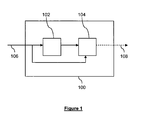
- FIG. 1 schematically illustrates, as an example of an apparatus, a data processor 100 for carrying out a method according to an embodiment of the invention.
- the data processor 100 has a memory 102 and a processor 104.
- the data processor 100 receives input data packets via a communication channel 106.
- the data packets received by the data processor 100 may be stored in the memory 102 or may be supplied directly to the processor 104.
- the processor 104 performs processing on the data packets received by the data processor 100, as will be described in more detail below.
- the processor 104 may process data packets that it receives directly from the communication channel 106 and/or data packets that it reads from the memory 102.
- the output of the processing performed by the processor 104 may include a packetised data stream.
- the output of the processing may include results data (such as statistical data or a velocity estimation).
- the output of the application being executed by the processor 104 may be supplied as an input to another application being executed by the processor 104.
- the data processor 100 may use an optional communication channel 108 to provide the output processed data.
- This communication channel 108 may be used, for example, to provide some or all of the output data to another data processing apparatus.
- This output data may be supplied to the other data processing apparatus via a communication network, such as the Internet, an intranet, a wide area network, a metropolitan area network, or any other suitable communication system.
- the processed output data may be stored in the memory 102 or on a different recording medium (not shown), such as a magnetic or optical disc, a tape or a solid-state storage device (such as a flash memory).
- the data processor 100 may be arranged to display or relate the processed output data to a user, for example via a visual and/or audible presentation of the output data.
- the input data packets are data packets formatted and generated accorded to the RTP standard.
- embodiments of the invention may make use of any packetisation algorithm/protocol/standard in which the data packets have an associated time (which may be represented by a timestamp). This is the case for RTP data packets.
- the header of an RTP data packet has a 32-bit timestamp field that is used to represent a date and/or time associated with that data packet.
- time in this description includes times, dates and date-time combinations.
- the data being communicated (or transmitted) via the RTP data packets is video data.
- the data being communicated may be any other kind of data, such as audio data, audio/video data, text data, multimedia data, financial data, statistical data, experiment data, etc.
- the timestamp field of the RTP data packets is arranged such that a 1-second increment of the time associated with a data packet corresponds to an increment of 90000 in the timestamp field of the data packet.
- other levels of accuracy and data resolution can be used accordingly for the timestamp field of the RTP data packet, and the various threshold values described below may be adapted accordingly for a specific data processing application.
- embodiments of the invention determine representative frequencies for received data packets.
- the representative frequencies may represent a frequency of transmission of the data packets (for example, in embodiments in which a timestamp represents a time of transmission of the data packet).
- the representative frequencies may represent a frequency related to the data being transmitted (such as a video frame-rate when the data being transmitted is video data and the timestamp represents a sampling time for the video data of the data packet).
- the processor 100 may use these representative frequencies for a variety of applications.
- the data processor 100 may be arranged to receive input video data packets with an arbitrary frame-rate and output video data packets with a desired frame-rate.
- the processor 104 therefore performs frame-rate conversion.
- the processor 104 needs accurate estimations of the current frame-rate of the input video. The determination of the frame-rate using the representative frequencies will be discussed in more detail below.
- the representative frequencies that are derived from the video data packets are used to estimate the frame rate for the video data, which is then used to estimate the velocity of an object represented within the video data. If the frame rate is estimated to be R and the object is known to have moved a distance D within a known number F for video frames, then the velocity of that object can be estimated based on the value D*R / F .
- the values of D and F could be input by a user or could be received at the data processor 100 via a communications channel. This application could be used, for example, for analysing speeds of vehicles or sports balls/projectiles.
- a representative frequency reflecting an estimate of the frequency of transmission of the data packets can be determined by analysing the timestamps of the received data packets.
- the timestamp of a data packet represents the time corresponding to the data of that data packet.
- the timestamp represents a time at which the video data was sampled/captured.
- the data sampled at a particular time may be contained within one or multiple data packets.
- the number of data packets may change from video frame to video frame (for example, in long-GOP MPEG2 video encoding, an I-frame may use more data packets than a B- or P-frame).
- the data packets having data with the same corresponding time will then have the same timestamp.
- These data packets (or their data) may be considered to be a single data unit with a single timestamp, and a frequency for the data of the data unit is then estimated.
- each of the data packets for that frame of video has data corresponding to the same sampling time.
- the above-mentioned method ( figures 2 , 3 and 4 ) that can be used to estimate the frequency of transmission of the data packets can be used to estimate the video frame-rate. For example, if each frame of video is contained within a single separate data packet, and a representative frequency of transmission for the data packets is calculated as 25Hz, then an estimate of the frame rate for the video is 25 frames-per-second.
- the data packets containing the data for a single frame will use the same timestamp (to indicate that their data relates to the same sampling point in time). This, though, is catered for by the frequency calculation described below with reference to figures 2 , 3 and 4 .
- the representative frequency determined from the data packets can still be used as a frame-rate estimation.
- the representative frequency is a frequency for the data unit made up of the multiple data packets (or their data) for that video frame.
- sampling time for data of a data packet may be different from the transmission time of that data packet.
- the transmission time may be the sampling time plus any encoding time and delays in actually deciding to transmit the video.
- the processor 104 may, at some stage, rely on the nature/type of the data as part of its processing, the actual processing steps performed as part of embodiments of the invention do not rely on the nature of the data.
- some of the threshold values used in embodiments of the invention may be set in the knowledge of the typical values that can be expected for a particular application and data type.
- FIG. 2 is a schematic flowchart illustrating a method according to an embodiment of the invention. This method is carried out by the processor 104 to determine a representative frequency for data packets that the data processor 100 has received. As discussed above, this processing may be part of an application, being executed by the processor 104, that uses the representative frequencies.
- step S200 two variables, COUNT and FIRST_TIME are initialised to the values of 0 and TRUE respectively. The purpose of these variables will be described in more detail later.
- an input data packet is received.
- Each received data packet has an associated time, as represented by timestamp data within the received data packet.
- the data packets are received at the step S202 in their timestamp order (i.e. non-decreasing timestamp order). It will be appreciated that some data packets may have been lost (i.e. have not been received).
- the order of transmission (as identified by the sequence numbers) may be different to the order of data sampling (as identified by the timestamps). This happens, for example, in long-GOP MPEG2 video encoding, as is known in this field of technology.
- the data processor 100 may have reordered the data packets using their timestamps (and, if two data packets have the same timestamp, the sequence number too) to determine the correct order for processing the data packets.
- the data packets are thus processed in non-decreasing timestamp order.
- a time-differential is determined for the data packet.
- the time-differential for the i-th data packet shall be represented by the value x ( i ).
- the time-differential calculated at the step S204 represents the difference between the time associated with the data packet received at the step S202 and the time associated with the previous data packet received at the step S202.
- This time-differential is calculated as a difference between the timestamp data of the currently received data packet and the timestamp data of the immediately preceding data packet.
- a time-differential of 90000 represents a difference of 1-second between the two data packets.
- a check may be performed to determine whether the time-differential is more than a threshold value, IN_MAX. If the time-differential is more than IN_MAX then the time-differential output from the step S204 is set to be the same as the time-differential previously output from the step S204 when the step S204 was last executed. If no such previously output time-differential exists, then a default value is used. However, some embodiments do not make use of the threshold value IN_MAX in this manner.
- a check may be performed to determine whether the time-differential is less than a threshold value, IN_MIN. If the time-differential is less than IN_MIN then the time-differential output from the step S204 is set to be the same as the time-differential previously output from the step S204 when the step S204 was last executed. If no such previously output time-differential exists, then a default value is used. However, some embodiments do not make use of the threshold value IN_MIN in this manner.
- IN_MIN provides for frequency determination even when the time-differential is 0, i.e. when successive data packets have the same timestamp. This is advantageous when the data for a video frame is contained within several data packets.
- Using IN_MIN sets the time-differential to an effective time-differential that would have resulted from using a single data packet per video frame.
- IN_MAX and IN_MIN may be omitted from the step S204. Instead, IN_MAX and IN_MIN may be used at a later step (a step S222 to be discussed below) instead.
- the reliability of the time-differential output from the step S204 is checked.
- the time-differential is said to be reliable if it has been derived, or determined, from two input data packets that are both error-free.
- a data packet uses an error-detection code, then the error-free status of that data packet can be determined from the error-detection code. If the error-detection code indicates that the data packet has an error, then a time-differential derived from that data packet is not reliable. Error-detection codes are well-known and shall not be described in detail herein.
- a data packet uses an error-correction code, then the error-free status of that data packet can be determined from whether or not any errors in the data packet can be corrected. If there are no errors in the data packet, then the data packet is, naturally, error free. If there are errors in the data packet and these errors can be corrected, then the corrected data packet is error-free and a reliable time-differential can be derived from that corrected data packet (and another error free data packet); otherwise, the data packet has an uncorrectable error and a time-differential derived from that data packet is not reliable.
- the error-correction code may be used in a similar manner to an error-detection code, i.e. if the error-correction code indicates that the data packet has an error, then a time-differential derived from that data packet is not reliable. Error-correction codes are well-known and shall not be described in detail herein.
- a time-differential is said to be reliable if it has been derived, or determined, from two input data packets that are both error-free and have consecutive sequence numbers (i.e. no packet loss has occurred between the two data packets).
- a time-differential is said to be reliable if it has been derived, or determined, from two input data packets that are both error-free and which represent consecutive video frames (i.e. the data packets represent two different video frames and no frame loss has occurred between these two video frames).
- step S206 If, at the step S206, it is determined that the time-differential is reliable, then processing continues at a step S208, at which the variable COUNT is incremented by 1; otherwise processing continues at a step S210, at which the variable COUNT is reset to the value 0.
- the variable COUNT is used to maintain a record of how many successive reliable time-differentials there are in the most recent time-differentials, i.e. the length of the series of reliable time-differentials counting back from the current time-differential.
- a step S212 it is determined whether the value of COUNT is at least a predetermined threshold value N , i.e. whether at least the most recent N time-differentials are reliable. In other words, if the current data packet is the i -th data packet, it is determined whether x ( i ), x ( i - 1), ... , x ( i - N + 1) are reliable.
- the value of N is 30, although other values, such as 20 or 40, may be used instead.
- processing continues at a step S214; otherwise, processing continues at a step S218.
- the value of the variable FIRST TIME is set to be FALSE.
- a representative frequency for the input data packets is determined based on grouping/clustering. Throughout this description, the representative frequency output after the i-th data packet has been processed shall be represented by the value y ( i ). The grouping/clustering will be described in more detail below with reference to figure 3 . Processing then returns to the step S202.
- the step S218 it is determined whether the value of FIRST TIME is TRUE. It will be appreciated that the step S218 can be reached in a number of ways: (i) the number of data packets that have been received is less than N ; (ii) the number of data packets that have been received is at least N, but there has not yet been N successive reliable time-differentials; or (iii) the number of data packets that have been received is at least N , there has been N successive reliable time-differentials, but the most recent N time-differentials are not all reliable. In the last case (iii), the value of FIRST_TIME will be FALSE, having been set to FALSE at the step S214 when the previous N successive reliable time-differentials were received.
- the value of FIRST_TIME will be TRUE, as the steps S214 and S216 will not have been executed yet.
- the variable FIRST_TIME is used to indicate whether or not the steps S214 and S216 have been executed yet, i.e. whether the grouping/clustering at the step S216 has been performed yet.
- step S220 at which the representative frequency for the input data packets that was most recently determined at the step S216 is output again as a representative frequency for the input data packets. Processing then returns to the step S202.
- step S222 processing continues at a step S222, at which at least some of the received time-differentials are filtered to produce a representative time-differential for the input data packets.
- the filtering performed at the step S222 may use an alternative filter.
- different filter coefficients may be used and a different number of filter taps may be used.
- the filter may be linear, non-linear, finite impulse response, or infinite impulse response.
- the output of the filter for the i -th data packet x ⁇ ( i ) may be limited to be within a range around the previous filter output, x ⁇ ( i - 1), i.e. if x ⁇ ( i ) > x ⁇ ( i - 1) + ⁇ 1 (for some positive value ⁇ 1 ) then x ⁇ ( i ) is set to be x ⁇ ( i - 1) + ⁇ 1 , whilst if x ⁇ ( i ) ⁇ x ⁇ ( i - 1) - ⁇ 2 (for some positive value ⁇ 2 ) then x ⁇ ( i ) is set to be x ⁇ ( i - 1) - ⁇ 2 .
- the values of ⁇ 1 and ⁇ 2 may be predetermined. Alternatively, in some embodiments, ⁇ 1 and ⁇ 2 are a predetermined percentage of x ⁇ ( i - 1), such as 5%.
- a step S224 the inverse of the representative time-differential for the current data packet, x ⁇ ( i ), is output as a representative frequency y ( i ) for the input data packets. Processing then returns to the step S202.
- the steps S222 and S224 represent an initialisation phase that uses filtering to produce representative frequencies for the data packets until a sequence of N consecutive reliable time-differentials have been received.
- the representative frequencies for the data packets are produced based on the grouping/clustering method of the step S216 (and figure 3 ) (be that directly or as a repetition of a previous value at the step S220).
- the above-described use of the thresholds IN_MIN and IN_MAX at the step S204 could be performed at the step S222 instead.
- the above-described processing using the thresholds IN_MIN and IN_MAX may be performed prior to, or after, the filtering processing performed at the step S222.
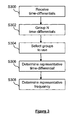
- Figure 3 is a schematic flowchart illustrating the grouping/clustering method performed at the step S216 of figure 2 .
- step S300 the currently determined time-differential is received.
- a representative frequency for the data packets is determined from N consecutive reliable time-differentials. Due to the test performed at the step S212 of figure 2 , there will be at least N consecutive reliable time-differentials available. However, the run of consecutive reliable time-differentials making up the most recent time-differentials may be longer than N time-differentials. The choice of which N consecutive reliable time-differentials, out of the run of N or more available consecutive reliable time-differentials that have been most recently received, to use to determine the representative frequency for the data packets will be described in more detail later.
- the N consecutive reliable time-differentials to be used ( x ( i ), x ( i - 1), ... , x ( i - N + 1)), are grouped together into one or more groups (or clusters) based on their magnitude or size. These groups are generated, or defined, as follows.
- the N time-differentials are processed in an order to generate the groups. It will be appreciated that any order may be used for processing the N time-differentials. However, in an embodiment of the invention, the N time-differentials are processed from the earliest (oldest) one, i.e. x ( i - N + 1), to the latest (newest) one, i.e. x ( i ).
- each group (or cluster) is defined by a corresponding time-differential value.
- This corresponding time-differential may be one of the N time-differentials, or may be an alterative value.
- the corresponding time-differential defining a group shall be referred to as the prototype time-differential for that group.
- a time-differential When a time-differential is processed, a check is made to determine which, if any, of the existing groups that time-differential belongs to. The groups are checked in order. A time-differential belongs to a group if it lies within a predetermined range of the prototype for that group, i.e. a time-differential x lies in a group that has p as its prototype, if p - ⁇ 1 ⁇ x ⁇ p + ⁇ 2 , for some thresholds/margins ⁇ 1 and ⁇ 2 .
- time-differential being processed belongs to the group being checked, then it is added to that group and processing moves to the next time-differential. However, if the time-differential does not belong to any of the existing groups, then a new group is defined using that time-differential as its prototype.
- an underlined value is a prototype value for the corresponding group.
- Group 1 At stage 1, for the 1st time-differential value of 800, no groups have been defined yet. Hence, a new group, Group 1, is defined as having 800 as its prototype. Group 1 then contains the 1st time-differential 800.
- the 2nd time-differential value of 850 does not lie within the range 800-25 to 800+25, and so does not belong Group 1. No other groups have been defined yet. Hence, a new group, Group 2, is defined as having 850 as its prototype. Group 2 then contains the 2nd time-differential 850.
- the 3rd time-differential value of 820 lies within the range 800-25 to 800+25, and so belongs to Group 1.
- Group 1 now has 2 elements.
- the 4th time-differential value of 810 lies within the range 800-25 to 800+25, and so belongs to Group 1.
- Group 1 now has 3 elements.
- the 5th time-differential value of 880 does not lie within the range 800-25 to 800+25, and so does not belong Group 1. It also does not lie within the range 850-25 to 850+25, and so does not belong Group 2. No other groups have been defined yet. Hence, a new group, Group 3, is defined as having 880 as its prototype. Group 3 then contains the 5th time-differential 880.
- the 6th time-differential value of 850 does not lie within the range 800-25 to 800+25, and so does not belong Group 1. However, it does lie within the range 850-25 to 850+25, and so belongs Group 2.
- Group 2 then contains the 6th time-differential 850. Although Group 2 already contains a time-differential with the same value, the 6th time-differential 850 is added to Group 2, so that Group 2 now has 2 elements.
- the 7th time-differential value of 870 does not lie within the range 800-25 to 800+25, and so does not belong Group 1. However, it does lie within the range 850-25 to 850+25, and so belongs Group 2.
- Group 2 then contains the 7th time-differential 870. Group 2 now has 3 elements.
- time-differential value of 870 also lies in the range 880-25 to 880+25.
- the time-differential value of 870 would, at stage 7, have been added to Group 3 instead of Group 2.
- its prototype could be modified to ensure that there is no possible overlap between the newly defined group and any one of the existing groups. For example, the prototype for Group 3 could, at stage 5, have been adjusted to be 900 instead of 880.
- Group 3 would not contain the value of 900, but the actual value of 880, it would use the value of 900 as its prototype, thereby ensuring that there was not an overlap between it and Group 2.
- the values of ⁇ 1 and ⁇ 2 used for a newly defined group could be adjusted to ensure that it does not overlap with an existing group.
- ⁇ 1 could be set to 5 for Group 3, whilst ⁇ 2 could be maintained as 25, thereby ensuring that Group 3 does not overlap with Group 2.
- ⁇ 1 could be adjusted for Group 3 and ⁇ 2 could be adjusted for Group 2 when defining Group 3 to ensure that Groups 2 and 3 do not overlap.
- a priori analysis of the typical values for the time-differentials combined with sufficiently small values for ⁇ 1 and ⁇ 2 may be used to ensure that, in practice, the groups that are defined never actually overlap.
- Group 1 could be defined using the 1st time-differential value 800 as its prototype. A check could then be made to see which of the remaining time-differentials belong to Group 1, namely the 3rd and 4th time-differentials. As not all of the time-differentials have been grouped, Group 2 could be defined using the next available time-differential (the 2nd time-differential value 850) as its prototype. A check could then be made to see which of the remaining time-differentials belong to Group 2, namely the 6th and 7th time-differentials. As not all of the time-differentials have been grouped, Group 3 could be defined using the next available time-differential (the 5th time-differential value 880) as its prototype.
- predetermined ranges such as 750 to 800, 800 to 850, 850 to 900, 900 to 950, etc.
- the time-differentials that are received can then be grouped together in the appropriate predetermined ranges.
- step S304 one or more of the one or more groups are selected for determining a representative frequency for the data packets.
- a group is said to be valid if:
- the processing using threshold values IN_MIN and IN_MAX may be performed at the step S204 of figure 2 or at the step S222 of figure 2 .
- the conditions b) and c) above may be omitted.
- the groups selected for use in determining the representative frequency are only the valid groups. Otherwise, all of the groups (both valid and invalid) are selected for use in determining the representative frequency.
- the value of TOTAL_ELEMENTS is set as a percentage of the value of N.
- the value of TOTAL_ELEMENTS may be set by other means, such as simply specifying an absolute value, independent of N .
- a representative time-differential for the data packets is determined as a function of the time-differentials of the selected groups.
- the inverse of the representative time-differential b is output as a representative frequency for the input data packets.
- N consecutive time-differentials to use for the above processing of figure 3 is as follows. At the beginning, when the length of the run of consecutive reliable time-differentials is only of length N , these are the N time-differentials to use. A predetermined value W is used such that W consecutive representative frequencies output from the step S216 of figure 2 are based on these N time-differentials. As such, once the first representative frequency has been output at the step S216, the processing of figure 3 need not necessarily be performed again for the 2nd to the W -th output representative frequency - instead, the 1 st representative frequency can be repeated when the 2nd to the W -th output representative frequencies are to be calculated at the step S216, as they are based on the same N time-differentials.
- next W Representative frequencies are based on the ( W +1)-th to the ( W+N ) time-differentials, then the next W Representative frequencies are based on the (2 W + 1 )-th to the (2W+N) time-differentials, and so on.
- the value of W is the same as N . However, the value of W may be less than N or may be more than N .
- the length of the run of reliable time-differentials is reset to be 0 (at the step S210).
- the process of selecting N time-differentials to use for the figure 3 processing starts again for the new run of reliable time-differentials.
- FIG. 4 is a schematic flowchart illustrating a method according to an embodiment of the invention. This method is carried out by the processor 104 to determine a representative frequency for data packets that the data processor 100 has received. As discussed above, this processing may be part of an application, being executed by the processor 104, that uses the representative frequencies.
- the flowchart of figure 4 is the same as the flowchart of figure 2 , except that a new step S400 is included.
- the remaining steps of figure 4 are the same as those of figure 2 , and a description of their functionality shall therefore not be repeated.
- the step S400 is performed between the steps S202 and S204.
- step S400 If, at the step S400, it is determined that the data of the data packet received at the step S202 belongs to the same unit (in terms of sampling time) as the data of the data packet previously received at the step S202 (i.e. for video data that the data packet received at the step S202 is for the same video frame as the data packet previously received at the step S202), then processing returns to the step S202; otherwise processing continues at the step S204.
- time differentials used at subsequent steps in figure 4 relate to different data units/video frames.
- step S400 may be performed between the steps S204 and S206 instead by determining whether a time-differential is 0-valued instead of comparing timestamps. In this case, only time-differentials for different data units/video frames are passed to the step S206.
- the use of the thresholds IN_MIN and PROTOTYPE_MIN may be omitted, as 0-valued time-differentials will not be processed.
- the calculation of a time-differential was described above as being the difference between the timestamps of consecutive data packets.
- the timestamps used need not be from consecutive/successive data packets.
- the timestamps from every n-th data packet could be used.
- the representative frequencies determined could then be mulitplied by this value n to yield representative frequencies for all of the data packets (as opposed to frequencies for the every n-th data packet). This can be used to decrease the amount of processing required.
- steps S218 and S220 may be omitted, so that whenever an unreliable time-differential is received, filtering is used at the step S222 until a new sequence of N successive reliable time-differentials has been received.
- the step of checking the size of the group's prototype against PROTOTYPE_MIN and/or PROTOTYPE_MAX may be omitted.
- the group's prototype time-differential may be set to be the average of the elements of that group, this being updated each time a new time-differential is added to the group.
- the group's prototype time-differential may be set to be the time-differential that has been most recently added to the group.
- N time-differentials may be chosen from a run of M most recent consecutive reliable time-differentials (where M ⁇ N ).
Landscapes
- Engineering & Computer Science (AREA)
- Computer Networks & Wireless Communication (AREA)
- Signal Processing (AREA)
- Multimedia (AREA)
- General Health & Medical Sciences (AREA)
- Cardiology (AREA)
- Health & Medical Sciences (AREA)
- Computer Security & Cryptography (AREA)
- Data Exchanges In Wide-Area Networks (AREA)
- Control Of Motors That Do Not Use Commutators (AREA)
- Oscillators With Electromechanical Resonators (AREA)
- Filters And Equalizers (AREA)
- Compression Or Coding Systems Of Tv Signals (AREA)
Claims (15)
- Verfahren zum Bestimmen einer charakteristischen Frequenz für Datenpakete, wobei jedes Datenpaket einen zugehörigen Zeitpunkt aufweist, und wobei das Verfahren umfasst:Empfangen (S300) einer Folge von Zeitdifferenzialen, wobei ein Zeitdifferenzial eine Differenz zwischen dem Zeitpunkt, der einem entsprechenden ersten Datenpaket zugehörig ist, und dem Zeitpunkt, der einem entsprechenden zweiten Datenpaket zugehörig ist, darstellt; undBestimmen (S216) der charakteristischen Frequenz basierend auf:Gruppieren (S302) einer vorbestimmten Anzahl N von Zeitdifferenzialen in einer oder mehreren Gruppen basierend auf den Größen der N Zeitdifferenziale;Auswählen (S304) einer oder mehrerer Gruppen aus der einen oder mehreren Gruppen, zur Verwendung bei dem Bestimmen eines charakteristischen Zeitdifferenzials;Bestimmen (S306) des charakteristischen Zeitdifferenzials als eine Funktion der Zeitdifferenziale der ausgewählten einen oder mehreren Gruppen;Ausgeben (S308) eines Inversen des charakteristischen Zeitdifferenzials als die charakteristische Frequenz.
- Verfahren gemäß Anspruch 1, weiterhin umfassend,
solange bis die empfangenen Zeitdifferenziale N aufeinanderfolgende Zeitdifferenziale umfassen, die von fehlerfreien Datenpaketen abgeleitet wurden:Filtern (S222) wenigstens einiger Zeitdifferenziale der empfangenen Zeitdifferenziale, um ein charakteristisches Zeitdifferenzial zu bestimmen; undAusgeben (S224) eines Inversen des charakteristischen Zeitdifferenzials als charakteristische Frequenz. - Verfahren gemäß Anspruch 2, wobei das Filtern (S222) ein Beschränken des bestimmten charakteristischen Zeitdifferenzials umfasst, so dass das bestimmte charakteristische Zeitdifferential in einem Wertebereich liegt, der durch ein vorher erzeugtes charakteristisches Zeitdifferenzial bestimmt ist.
- Verfahren gemäß einem der vorhergehenden Ansprüche, wobei die N gruppierten Zeitdifferenziale N aufeinanderfolgende Zeitdifferenziale sind, die von fehlerfreien Datenpaketen abgeleitet wurden.
- Verfahren gemäß Anspruch 4, wobei die gleichen N Zeitdifferenziale verwendet werden, um eine vorherbestimmte Anzahl W von aufeinanderfolgenden charakteristischen Frequenzen zu bestimmen.
- Verfahren gemäß einem der vorhergehenden Ansprüche, wobei das Gruppieren (S302) derart erfolgt, dass die Zeitdifferenziale einer Gruppe innerhalb eines vorherbestimmten Bereichs um ein bestimmtes Zeitdifferenzial der Zeitdifferenziale dieser Gruppe liegen.
- Verfahren gemäß einem der vorhergehenden Ansprüche, wobei das Auswählen (S304) umfasst:Bestimmen, dass eine Gruppe bei dem Bestimmen des charakteristischen Zeitdifferenzials verwendet werden kann, wenn die Gruppe mehr als einen Schwellenwert von Zeitdifferenzialen beinhaltet.
- Verfahren gemäß einem der vorhergehenden Ansprüche, wobei das Auswählen (S304) umfasst:Bestimmen, dass eine Gruppe bei dem Bestimmen eines charakteristischen Zeitdifferenzials verwendet werden kann, wenn das Zeitdifferenzial, durch das die Gruppe ursprünglich definiert wurde, innerhalb eines vorherbestimmten Wertebereichs liegt.
- Verfahren gemäß einem der vorhergehenden Ansprüche, umfassend:Auswählen aller Gruppen zur Verwendung bei dem Bestimmen des charakteristischen Zeitdifferenzials, wenn die Gesamtanzahl der Zeitdifferenziale in den Gruppen, die ausgewählt wurden, niedriger als ein Schwellenwert ist.
- Verfahren gemäß einem der vorhergehenden Ansprüche, wobei die Funktion der Zeitdifferenziale der ausgewählten einen oder mehreren Gruppen ein Mittelwert der Zeitdifferenziale der ausgewählten einen oder mehreren Gruppen ist.
- Verfahren zum Bestimmen einer Videobildfrequenz von paketierten Videodaten, wobei das Verfahren umfasst:Bestimmen einer Frequenz der Videodatenpakete unter Verwendung eines Verfahrens gemäß einem der vorhergehenden Ansprüche; undFestlegen, dass die Videobildfrequenz die bestimmte Frequenz ist.
- Verfahren zur Umwandlung paketierter Videodaten auf eine gewünschte Videobildfrequenz, wobei das Verfahren umfasst:Bestimmen einer Videobildfrequenz aus den paketierten Videodaten gemäß dem Verfahren nach Anspruch 11; undAusführen einer Bildfrequenzumwandlung auf den paketierten Videodaten basierend auf der bestimmten Videobildfrequenz und der gewünschten Videobildfrequenz.
- Verfahren zum Bestimmen einer Geschwindigkeit eines innerhalb paketierter Videodaten dargestellten Objektes, wobei das Verfahren umfasst:Empfangen von Daten, die eine Distanz D darstellen, die das Objekt innerhalb einer Anzahl F von Videobildern zurückgelegt hat;Bestimmen einer Videobildfrequenz R aus den paketierten Videodaten gemäß dem Verfahren nach Anspruch 11; undBestimmen der Geschwindigkeit basierend auf der Formel R*D/F.
- Vorrichtung, die dazu ausgelegt ist, ein Verfahren gemäß einem der vorhergehenden Ansprüche auszuführen.
- Computerprogramm, welches, wenn es auf einer programmierbaren Vorrichtung ausgeführt wird, alle Schritte eines Verfahrens gemäß einem der Ansprüche 1 bis 13 ausführt.
Applications Claiming Priority (1)
| Application Number | Priority Date | Filing Date | Title |
|---|---|---|---|
| PCT/IB2007/053187 WO2009022199A1 (en) | 2007-08-10 | 2007-08-10 | Data packet frequency |
Publications (2)
| Publication Number | Publication Date |
|---|---|
| EP2188967A1 EP2188967A1 (de) | 2010-05-26 |
| EP2188967B1 true EP2188967B1 (de) | 2011-04-20 |
Family
ID=39313003
Family Applications (1)
| Application Number | Title | Priority Date | Filing Date |
|---|---|---|---|
| EP20070805375 Not-in-force EP2188967B1 (de) | 2007-08-10 | 2007-08-10 | Datenpakethäufigkeit |
Country Status (5)
| Country | Link |
|---|---|
| US (1) | US9106551B2 (de) |
| EP (1) | EP2188967B1 (de) |
| AT (1) | ATE506800T1 (de) |
| DE (1) | DE602007014122D1 (de) |
| WO (1) | WO2009022199A1 (de) |
Families Citing this family (2)
| Publication number | Priority date | Publication date | Assignee | Title |
|---|---|---|---|---|
| US9531630B2 (en) * | 2012-02-20 | 2016-12-27 | Telefonaktiebolaget Lm Ericsson (Publ) | Capacity estimates using burst-trailer trains |
| EP2913958B1 (de) * | 2014-02-27 | 2017-04-26 | Alcatel Lucent | Vorverarbeitung von Netzwerkverfolgung für zeitliche Analyse |
Family Cites Families (13)
| Publication number | Priority date | Publication date | Assignee | Title |
|---|---|---|---|---|
| US5987493A (en) * | 1997-12-05 | 1999-11-16 | Insoft Inc. | Method and apparatus determining the load on a server in a network |
| US6259677B1 (en) * | 1998-09-30 | 2001-07-10 | Cisco Technology, Inc. | Clock synchronization and dynamic jitter management for voice over IP and real-time data |
| CA2330854A1 (en) | 2001-01-11 | 2002-07-11 | Jaldi Semiconductor Corp. | A system and method for detecting a non-video source in video signals |
| AU2002952566A0 (en) | 2002-11-07 | 2002-11-21 | Dspace Pty Ltd | Pilot symbol patterns in communication systems |
| GB2400255A (en) * | 2003-03-31 | 2004-10-06 | Sony Uk Ltd | Video synchronisation |
| US20050063385A1 (en) | 2003-09-18 | 2005-03-24 | Samsung Electronics Co., Ltd. | Apparatus and method for packet length and enhanced traffic profiling in a massively parallel router |
| US7457868B1 (en) * | 2003-12-30 | 2008-11-25 | Emc Corporation | Methods and apparatus for measuring network performance |
| US7500010B2 (en) * | 2005-04-07 | 2009-03-03 | Jeffrey Paul Harrang | Adaptive file delivery system and method |
| US7701851B2 (en) * | 2005-07-20 | 2010-04-20 | Vidyo, Inc. | System and method for the control of the transmission rate in packet-based digital communications |
| JP4526458B2 (ja) | 2005-07-29 | 2010-08-18 | 富士通株式会社 | パケット処理装置及びパケット処理プログラム |
| US20070140306A1 (en) * | 2005-12-16 | 2007-06-21 | International Business Machines Corporation | Identifying existence and rate of jitter during real-time audio and video streaming |
| US7643422B1 (en) * | 2006-03-24 | 2010-01-05 | Hewlett-Packard Development Company, L.P. | Dynamic trans-framing and trans-rating for interactive playback control |
| US8446467B2 (en) * | 2006-05-05 | 2013-05-21 | Scott K. Tilton | Combined speed detection, video and timing apparatus |
-
2007
- 2007-08-10 AT AT07805375T patent/ATE506800T1/de not_active IP Right Cessation
- 2007-08-10 DE DE200760014122 patent/DE602007014122D1/de active Active
- 2007-08-10 WO PCT/IB2007/053187 patent/WO2009022199A1/en not_active Ceased
- 2007-08-10 EP EP20070805375 patent/EP2188967B1/de not_active Not-in-force
- 2007-08-10 US US12/672,312 patent/US9106551B2/en not_active Expired - Fee Related
Also Published As
| Publication number | Publication date |
|---|---|
| WO2009022199A1 (en) | 2009-02-19 |
| DE602007014122D1 (de) | 2011-06-01 |
| US9106551B2 (en) | 2015-08-11 |
| US20110149082A1 (en) | 2011-06-23 |
| ATE506800T1 (de) | 2011-05-15 |
| EP2188967A1 (de) | 2010-05-26 |
Similar Documents
| Publication | Publication Date | Title |
|---|---|---|
| CN102106113B (zh) | 一种用于控制通过时变传输媒介发送数据流的方法和系统 | |
| CN109889398B (zh) | 一种检测媒体流业务质量的方法及装置、设备、存储介质 | |
| US20060045023A1 (en) | Method for estimating available bandwidth of network | |
| CN104618195A (zh) | 带宽估测方法和装置 | |
| US20100058147A1 (en) | Method and apparatus for reliable media transport | |
| US20070253337A1 (en) | Communication quality evaluation method, derivation device, communication quality evaluation system and computer program | |
| US20210409820A1 (en) | Predicting multimedia session mos | |
| CN111162971B (zh) | 一种时延确定方法及装置 | |
| US8873590B2 (en) | Apparatus and method for correcting jitter | |
| CN103458264B (zh) | 一种媒体质量的评估方法及装置 | |
| CN111556345B (zh) | 一种网络质量检测的方法、装置、电子设备及存储介质 | |
| EP1330071B1 (de) | System für das Netzwerk- oder Dienstmanagement zur Bestimmung der Synchronisation zwitchen zwei Packetströmen | |
| US9106551B2 (en) | Data packet frequency | |
| EP2241065A1 (de) | Verfahren und einrichtung zur transportverzögerungsanalyse | |
| CN101640790B (zh) | 帧标头辨识方法以及系统 | |
| US20180287918A1 (en) | Voice quality monitoring system | |
| CN111682975A (zh) | 网络状态预测方法、装置、电子设备及存储介质 | |
| CN112311690B (zh) | 一种基于ai的拥塞控制方法、装置、设备和介质 | |
| US20080080379A1 (en) | Network device and frame processing method thereof | |
| KR20170072788A (ko) | 기계 학습 기반의 패킷 손실 예측 장치 및 방법 | |
| CN103475906B (zh) | 用于多媒体流的测量方法和测量装置 | |
| JP5508922B2 (ja) | フレーム同期のためのシステム及び方法 | |
| JP5335867B2 (ja) | 基本GoP長を用いた映像品質推定装置及び方法及びプログラム | |
| JPH06152648A (ja) | データ・パケット通信方法 | |
| CN116095362B (zh) | 视频编码、解码、传输方法、电子设备以及存储介质 |
Legal Events
| Date | Code | Title | Description |
|---|---|---|---|
| PUAI | Public reference made under article 153(3) epc to a published international application that has entered the european phase |
Free format text: ORIGINAL CODE: 0009012 |
|
| 17P | Request for examination filed |
Effective date: 20100310 |
|
| AK | Designated contracting states |
Kind code of ref document: A1 Designated state(s): AT BE BG CH CY CZ DE DK EE ES FI FR GB GR HU IE IS IT LI LT LU LV MC MT NL PL PT RO SE SI SK TR |
|
| AX | Request for extension of the european patent |
Extension state: AL BA HR MK RS |
|
| DAX | Request for extension of the european patent (deleted) | ||
| GRAP | Despatch of communication of intention to grant a patent |
Free format text: ORIGINAL CODE: EPIDOSNIGR1 |
|
| GRAS | Grant fee paid |
Free format text: ORIGINAL CODE: EPIDOSNIGR3 |
|
| GRAA | (expected) grant |
Free format text: ORIGINAL CODE: 0009210 |
|
| AK | Designated contracting states |
Kind code of ref document: B1 Designated state(s): AT BE BG CH CY CZ DE DK EE ES FI FR GB GR HU IE IS IT LI LT LU LV MC MT NL PL PT RO SE SI SK TR |
|
| REG | Reference to a national code |
Ref country code: GB Ref legal event code: FG4D |
|
| REG | Reference to a national code |
Ref country code: CH Ref legal event code: EP |
|
| REG | Reference to a national code |
Ref country code: IE Ref legal event code: FG4D |
|
| REF | Corresponds to: |
Ref document number: 602007014122 Country of ref document: DE Date of ref document: 20110601 Kind code of ref document: P |
|
| REG | Reference to a national code |
Ref country code: DE Ref legal event code: R096 Ref document number: 602007014122 Country of ref document: DE Effective date: 20110601 |
|
| REG | Reference to a national code |
Ref country code: NL Ref legal event code: VDEP Effective date: 20110420 |
|
| LTIE | Lt: invalidation of european patent or patent extension |
Effective date: 20110420 |
|
| PG25 | Lapsed in a contracting state [announced via postgrant information from national office to epo] |
Ref country code: PT Free format text: LAPSE BECAUSE OF FAILURE TO SUBMIT A TRANSLATION OF THE DESCRIPTION OR TO PAY THE FEE WITHIN THE PRESCRIBED TIME-LIMIT Effective date: 20110822 Ref country code: LT Free format text: LAPSE BECAUSE OF FAILURE TO SUBMIT A TRANSLATION OF THE DESCRIPTION OR TO PAY THE FEE WITHIN THE PRESCRIBED TIME-LIMIT Effective date: 20110420 Ref country code: SE Free format text: LAPSE BECAUSE OF FAILURE TO SUBMIT A TRANSLATION OF THE DESCRIPTION OR TO PAY THE FEE WITHIN THE PRESCRIBED TIME-LIMIT Effective date: 20110420 |
|
| PG25 | Lapsed in a contracting state [announced via postgrant information from national office to epo] |
Ref country code: CY Free format text: LAPSE BECAUSE OF FAILURE TO SUBMIT A TRANSLATION OF THE DESCRIPTION OR TO PAY THE FEE WITHIN THE PRESCRIBED TIME-LIMIT Effective date: 20110420 Ref country code: SI Free format text: LAPSE BECAUSE OF FAILURE TO SUBMIT A TRANSLATION OF THE DESCRIPTION OR TO PAY THE FEE WITHIN THE PRESCRIBED TIME-LIMIT Effective date: 20110420 Ref country code: IS Free format text: LAPSE BECAUSE OF FAILURE TO SUBMIT A TRANSLATION OF THE DESCRIPTION OR TO PAY THE FEE WITHIN THE PRESCRIBED TIME-LIMIT Effective date: 20110820 Ref country code: FI Free format text: LAPSE BECAUSE OF FAILURE TO SUBMIT A TRANSLATION OF THE DESCRIPTION OR TO PAY THE FEE WITHIN THE PRESCRIBED TIME-LIMIT Effective date: 20110420 Ref country code: BE Free format text: LAPSE BECAUSE OF FAILURE TO SUBMIT A TRANSLATION OF THE DESCRIPTION OR TO PAY THE FEE WITHIN THE PRESCRIBED TIME-LIMIT Effective date: 20110420 Ref country code: AT Free format text: LAPSE BECAUSE OF FAILURE TO SUBMIT A TRANSLATION OF THE DESCRIPTION OR TO PAY THE FEE WITHIN THE PRESCRIBED TIME-LIMIT Effective date: 20110420 Ref country code: LV Free format text: LAPSE BECAUSE OF FAILURE TO SUBMIT A TRANSLATION OF THE DESCRIPTION OR TO PAY THE FEE WITHIN THE PRESCRIBED TIME-LIMIT Effective date: 20110420 Ref country code: ES Free format text: LAPSE BECAUSE OF FAILURE TO SUBMIT A TRANSLATION OF THE DESCRIPTION OR TO PAY THE FEE WITHIN THE PRESCRIBED TIME-LIMIT Effective date: 20110731 |
|
| PG25 | Lapsed in a contracting state [announced via postgrant information from national office to epo] |
Ref country code: NL Free format text: LAPSE BECAUSE OF FAILURE TO SUBMIT A TRANSLATION OF THE DESCRIPTION OR TO PAY THE FEE WITHIN THE PRESCRIBED TIME-LIMIT Effective date: 20110420 Ref country code: MT Free format text: LAPSE BECAUSE OF FAILURE TO SUBMIT A TRANSLATION OF THE DESCRIPTION OR TO PAY THE FEE WITHIN THE PRESCRIBED TIME-LIMIT Effective date: 20110420 |
|
| PG25 | Lapsed in a contracting state [announced via postgrant information from national office to epo] |
Ref country code: EE Free format text: LAPSE BECAUSE OF FAILURE TO SUBMIT A TRANSLATION OF THE DESCRIPTION OR TO PAY THE FEE WITHIN THE PRESCRIBED TIME-LIMIT Effective date: 20110420 Ref country code: CZ Free format text: LAPSE BECAUSE OF FAILURE TO SUBMIT A TRANSLATION OF THE DESCRIPTION OR TO PAY THE FEE WITHIN THE PRESCRIBED TIME-LIMIT Effective date: 20110420 |
|
| PLBE | No opposition filed within time limit |
Free format text: ORIGINAL CODE: 0009261 |
|
| STAA | Information on the status of an ep patent application or granted ep patent |
Free format text: STATUS: NO OPPOSITION FILED WITHIN TIME LIMIT |
|
| PG25 | Lapsed in a contracting state [announced via postgrant information from national office to epo] |
Ref country code: SK Free format text: LAPSE BECAUSE OF FAILURE TO SUBMIT A TRANSLATION OF THE DESCRIPTION OR TO PAY THE FEE WITHIN THE PRESCRIBED TIME-LIMIT Effective date: 20110420 Ref country code: DK Free format text: LAPSE BECAUSE OF FAILURE TO SUBMIT A TRANSLATION OF THE DESCRIPTION OR TO PAY THE FEE WITHIN THE PRESCRIBED TIME-LIMIT Effective date: 20110420 Ref country code: RO Free format text: LAPSE BECAUSE OF FAILURE TO SUBMIT A TRANSLATION OF THE DESCRIPTION OR TO PAY THE FEE WITHIN THE PRESCRIBED TIME-LIMIT Effective date: 20110420 Ref country code: PL Free format text: LAPSE BECAUSE OF FAILURE TO SUBMIT A TRANSLATION OF THE DESCRIPTION OR TO PAY THE FEE WITHIN THE PRESCRIBED TIME-LIMIT Effective date: 20110420 |
|
| 26N | No opposition filed |
Effective date: 20120123 |
|
| PG25 | Lapsed in a contracting state [announced via postgrant information from national office to epo] |
Ref country code: MC Free format text: LAPSE BECAUSE OF NON-PAYMENT OF DUE FEES Effective date: 20110831 |
|
| REG | Reference to a national code |
Ref country code: CH Ref legal event code: PL |
|
| PG25 | Lapsed in a contracting state [announced via postgrant information from national office to epo] |
Ref country code: CH Free format text: LAPSE BECAUSE OF NON-PAYMENT OF DUE FEES Effective date: 20110831 Ref country code: LI Free format text: LAPSE BECAUSE OF NON-PAYMENT OF DUE FEES Effective date: 20110831 |
|
| REG | Reference to a national code |
Ref country code: DE Ref legal event code: R097 Ref document number: 602007014122 Country of ref document: DE Effective date: 20120123 |
|
| REG | Reference to a national code |
Ref country code: IE Ref legal event code: MM4A |
|
| PG25 | Lapsed in a contracting state [announced via postgrant information from national office to epo] |
Ref country code: IT Free format text: LAPSE BECAUSE OF FAILURE TO SUBMIT A TRANSLATION OF THE DESCRIPTION OR TO PAY THE FEE WITHIN THE PRESCRIBED TIME-LIMIT Effective date: 20110420 |
|
| PG25 | Lapsed in a contracting state [announced via postgrant information from national office to epo] |
Ref country code: IE Free format text: LAPSE BECAUSE OF NON-PAYMENT OF DUE FEES Effective date: 20110810 |
|
| PG25 | Lapsed in a contracting state [announced via postgrant information from national office to epo] |
Ref country code: LU Free format text: LAPSE BECAUSE OF NON-PAYMENT OF DUE FEES Effective date: 20110810 |
|
| PG25 | Lapsed in a contracting state [announced via postgrant information from national office to epo] |
Ref country code: BG Free format text: LAPSE BECAUSE OF FAILURE TO SUBMIT A TRANSLATION OF THE DESCRIPTION OR TO PAY THE FEE WITHIN THE PRESCRIBED TIME-LIMIT Effective date: 20110720 |
|
| PG25 | Lapsed in a contracting state [announced via postgrant information from national office to epo] |
Ref country code: TR Free format text: LAPSE BECAUSE OF FAILURE TO SUBMIT A TRANSLATION OF THE DESCRIPTION OR TO PAY THE FEE WITHIN THE PRESCRIBED TIME-LIMIT Effective date: 20110420 |
|
| PG25 | Lapsed in a contracting state [announced via postgrant information from national office to epo] |
Ref country code: HU Free format text: LAPSE BECAUSE OF FAILURE TO SUBMIT A TRANSLATION OF THE DESCRIPTION OR TO PAY THE FEE WITHIN THE PRESCRIBED TIME-LIMIT Effective date: 20110420 |
|
| PG25 | Lapsed in a contracting state [announced via postgrant information from national office to epo] |
Ref country code: GR Free format text: LAPSE BECAUSE OF FAILURE TO SUBMIT A TRANSLATION OF THE DESCRIPTION OR TO PAY THE FEE WITHIN THE PRESCRIBED TIME-LIMIT Effective date: 20110420 |
|
| PGFP | Annual fee paid to national office [announced via postgrant information from national office to epo] |
Ref country code: GB Payment date: 20140827 Year of fee payment: 8 Ref country code: FR Payment date: 20140818 Year of fee payment: 8 |
|
| GBPC | Gb: european patent ceased through non-payment of renewal fee |
Effective date: 20150810 |
|
| REG | Reference to a national code |
Ref country code: FR Ref legal event code: ST Effective date: 20160429 |
|
| PG25 | Lapsed in a contracting state [announced via postgrant information from national office to epo] |
Ref country code: GB Free format text: LAPSE BECAUSE OF NON-PAYMENT OF DUE FEES Effective date: 20150810 |
|
| PG25 | Lapsed in a contracting state [announced via postgrant information from national office to epo] |
Ref country code: FR Free format text: LAPSE BECAUSE OF NON-PAYMENT OF DUE FEES Effective date: 20150831 |
|
| REG | Reference to a national code |
Ref country code: DE Ref legal event code: R081 Ref document number: 602007014122 Country of ref document: DE Owner name: NXP USA, INC. (N.D.GES.D.STAATES DELAWARE), AU, US Free format text: FORMER OWNER: FREESCALE SEMICONDUCTOR, INC., AUSTIN, TEX., US |
|
| PGFP | Annual fee paid to national office [announced via postgrant information from national office to epo] |
Ref country code: DE Payment date: 20190722 Year of fee payment: 13 |
|
| REG | Reference to a national code |
Ref country code: DE Ref legal event code: R119 Ref document number: 602007014122 Country of ref document: DE |
|
| PG25 | Lapsed in a contracting state [announced via postgrant information from national office to epo] |
Ref country code: DE Free format text: LAPSE BECAUSE OF NON-PAYMENT OF DUE FEES Effective date: 20210302 |