EP2189197B1 - Raquette à neige à queue souple - Google Patents
Raquette à neige à queue souple Download PDFInfo
- Publication number
- EP2189197B1 EP2189197B1 EP09176643.6A EP09176643A EP2189197B1 EP 2189197 B1 EP2189197 B1 EP 2189197B1 EP 09176643 A EP09176643 A EP 09176643A EP 2189197 B1 EP2189197 B1 EP 2189197B1
- Authority
- EP
- European Patent Office
- Prior art keywords
- snowshoe
- tail section
- section
- tail
- user
- Prior art date
- Legal status (The legal status is an assumption and is not a legal conclusion. Google has not performed a legal analysis and makes no representation as to the accuracy of the status listed.)
- Active
Links
Images


Classifications
-
- A—HUMAN NECESSITIES
- A63—SPORTS; GAMES; AMUSEMENTS
- A63C—SKATES; SKIS; ROLLER SKATES; DESIGN OR LAYOUT OF COURTS, RINKS OR THE LIKE
- A63C13/00—Snow shoes
- A63C13/003—Means thereof for preventing slipping, e.g. crampons, e.g. on frame or shoe plate
-
- A—HUMAN NECESSITIES
- A63—SPORTS; GAMES; AMUSEMENTS
- A63C—SKATES; SKIS; ROLLER SKATES; DESIGN OR LAYOUT OF COURTS, RINKS OR THE LIKE
- A63C13/00—Snow shoes
- A63C13/005—Frames therefor
-
- A—HUMAN NECESSITIES
- A63—SPORTS; GAMES; AMUSEMENTS
- A63C—SKATES; SKIS; ROLLER SKATES; DESIGN OR LAYOUT OF COURTS, RINKS OR THE LIKE
- A63C13/00—Snow shoes
- A63C13/006—Shoe support thereof, e.g. plate, movable relative to the frame
-
- A—HUMAN NECESSITIES
- A63—SPORTS; GAMES; AMUSEMENTS
- A63C—SKATES; SKIS; ROLLER SKATES; DESIGN OR LAYOUT OF COURTS, RINKS OR THE LIKE
- A63C13/00—Snow shoes
- A63C13/001—Bindings therefor
Definitions
- This invention concerns snowshoes, especially molded plastic or composite snowshoes, and relates to improvements in the comfort and convenience of use of snowshoes.
- Snowshoes are designed to provide enhanced flotation for a person walking over snow and ice surfaces, and to this end the snowshoes place on the user's foot a structure having a surface area larger than that of the foot.
- a snowshoe has larger dimensions in both length and width than a person's foot, and the lengthwise dimension is increased both forward of and behind the user's foot in order to keep a proper load balance on the snowshoe during use.
- the tail of a typical snowshoe extends substantially back from the heel of the user's foot. For this reason, walking with a snowshoe attached to the foot disrupts the normal gait of the user.
- the snowshoe thus acts as a relatively long extension to the foot. Especially when considering this extension in the rearward direction, the portion of the user's gait where the heel of the foot would normally contact the ground, and the following motion of the user's foot and lower body extremities, are greatly affected.
- the extended length at the rear of the snowshoe comes into contact with the terrain surface earliest, and in a location far to the rear of the user's normal heel strike.
- the snowshoe then rotates about this rear point and produces unnatural rotation and leverage against the user's lower extremities during the portions of the gait cycle that follow, as the snowshoe rotates into full contact with the terrain.
- tail of the snowshoe with an upwardly angled or curving shape.
- An example of this is a Tubbs snowshoe that can be seen on the website tubbssnowshoes.com.
- the tail of the snowshoe is less disruptive to the gait of the user than in the case of relative flat tail portion of the same length.
- an upward curve will somewhat decrease the flotation in this portion of the snowshoe, it will not have as negative an effect as shortening the snowshoe.
- the tail of the snowshoe is substantially more flexible than the central portion of the snowshoe.
- the snowshoe tail deforms and bends during the heel strike portion of the gait, when the tail of the snowshoe first contacts the ground.
- the heel portion bending and accommodating the gait in this way, the user is able to walk in a way that more approaches the user's normal gait without snowshoes.
- the flexibility and bending of the tail reduce the impact load associated with the heel strike portion of the gait, especially on relatively rigid terrain such as ice or crusted snow.
- Figure 1 shows a snowshoe 10 having a molded snowshoe body 12 of plastic material supporting a boot binding 14.
- the boot binding is secured to the snowshoe in a known manner that permits pivoting of the binding and the attached user's boot 16 in the pitch direction, which can be via a pivot connection (not specifically shown) at 18.
- Figure 1 the user is taking a step, and the snowshoe has just been brought into contact with the terrain.
- the tail 20 of the snowshoe first makes contact with the terrain, and typically just after this has occurred the user has lowered the boot heel 22 against the snowshoe deck as shown.
- the tail section 20 of the snowshoe 10 of the invention flexes to accommodate the user's gait, thus bending the snowshoe tail 20 upwardly in relation to the central section 24 of the snowshoe body. This makes the use of the snowshoe much more comfortable by effectively shortening the rear extension of the snowshoe during this portion of the gait.
- the tail section 20 still has sufficient stiffness to provide the flotation needed.
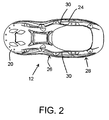
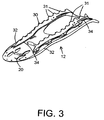
- Figures 2 and 3 show the underside of the snowshoe body 24.
- the tail section 20 preferably is rounded generally as shown, or blunt and somewhat curved.
- the body 24 is formed of molded plastic material, one example being polypropylene, with flexural modulus of about 1000 - 1750 MPa (depending on formulation). Another example is nylon, with flexural modulus in the range of about 1000 - 3000 MPa, depending on the specific nylon and the moisture level.
- the entire snowshoe body 24 can be formed of a rather flexible material but with at least a central region or section 26, and optionally part of a forward or nose section 28, reinforced with metal rails 30 secured to the bottom side of a snowshoe body.
- the snowshoe body can include integrally formed ridges, i.e. elongated bosses or ribs 32 and 34 as indicated.
- the ridges 32 are at the edges of the snowshoe and extend or curl downwardly from the deck.
- the ridges 34 preferably are sinuous as shown, following the metal rails, and there can be a pair of these ridges 34 along each metal rail 30.
- the metal rails and integral reinforcing ridges add rigidity to the main body or central section, i.e. the length of the snowshoe body through which the rails extend.
- At least the central section 26 is relatively stiff in flexure, while the tail section 20 is not reinforced by metal rails and has little or no strengthening via integrally molded features.
- Figures 2 and 3 show the outer ridges 32 extending somewhat into the tail section but tapering down to zero height before the rear end of the tail, which is a preferred embodiment, but the configuration of the tail can vary so long as the stiffness is as defined herein.
- this tail section 20 can be of thinner material than the stiffer main body portion. Sufficient stiffness must be maintained in the tail section such that when the user stands flat on a level snow surface, the flexural deformation of the tail section are relatively small, and sufficient to significantly compromise the flotation afforded by the snowshoe.
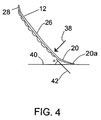
- FIG 4 is a side elevation view, somewhat schematic, showing the snowshoe body 12 of the invention with a load pressed on the snowshoe by the user following contact of the rear tip 20a of the tail portion 20 with the terrain surface.
- the load applied by the weight of the user is indicated by the arrow 38.
- the flexible tail section is that portion of the molded body behind the metal rails 30, which give the central body portion most of its stiffness.
- the snowshoe body is, of course, restrained at the central section 26 by the connection of the binding (not shown in Figure 4 ) to the snowshoe body; this prevents the force 38 from simply pushing the central and upper portion of the snowshoe body down flatly against the terrain.
- the flexible tail section 20 behind that point flexes, bending in a curve, the geometry of which depends on the stiffness along the length of the tail section 20 (i.e. the tail section may vary in strength through its length, as by a tapering thickness or other features).
- the line 40 in Figure 4 represents not necessarily the terrain, but a parallel to the snowshoe tail section at the rear tip 20a. This is a tagent line at the tip 20a if the entire profile of the tail section 20 is assumed to be a curve.
- the line 42 in Figure 4 is parallel to the central or main body section 26 of the snowshoe body.
- the angle alpha in Figure 4 represents the change in angle of the tail section tip 20a due to bending by forced contact of the tip 20a with the terrain during the user's gait. In a preferred embodiment of the invention, this angle is at least about 20°, and more preferably in the range of about 30° to 45°. This assumes the user is within the weight range for which the particular snowshoe is designed.
- TSL snowshoe will flex somewhat in the tail when nearly all a user's weight is pushed down through the heel, with the snowshoe generally in the configuration shown in Figure 4 .
- the tail section of the TSL snowshoe is roughly two or three times as stiff as that of the invention, and the bend that forms in the TSL snowshoe actually extends from the center portion of the snowshoe, forward of the heel strike area, back to the tip of the heel.
- the TSL snowshoe has a fairly uniform stiffness throughout its length, and when forced to bend, the snowshoe body actually bends through a much greater portion of its length than merely the tail.
- the geometry of the TSL snowshoe is different, with a tail section that narrows in a sharp taper and has a tab extending back at its rear tip.
- the flexible tail portion 20 may have a length, for example, of about five or six inches in a snowshoe having an overall length of 24 inches. Thus, it may be about 21% - 25% of the length of the snowshoe; tail length preferably changes with snowshoe length. More broadly, the tail may occupy a length of about 20% to 30% of the overall snowshoe.
- the bendability of the tail section 20 can be expressed as a function of bending moment applied to the tail section. In a preferred embodiment the tail section will bend through an angle alpha of at least about 30° with the application of about 200 - 250 inch pounds (22.6 - 28.25 newton-meters) to the tail section.
- the tail section 20 should generally have a bending modulus in an approximate range as described above to perform in the manner desired.
- the bendable tail section 20 allows deflection during the heel strike portion of the user's gait in a manner that reduces the effective length of the heel portion or rear deck of the snowshoe and reduces the impact forces associated with the heel strike against the snowshoe. This results in a lower moment exerting pressure on the user's knee. Walking with these snowshoes is more comfortable.
- the flexibility of the tail section can be realized in several different ways.
- One way is to simply mold the tail section in a relatively thin dimension, e.g. approximately 3 mm to 4 mm, with no stiffening elements either integrally molded into the tail section or attached (such as metal rails) to that section.
- the softer tail section can be achieved by modifying structural elements molded into the snowshoe body design such that the flexural stiffness in the tail section is greatly reduced.
- transverse grooves can be provided in sections of the tail structure having significant depth, thus flexibilizing these regions.
- Another way of forming the flexible tail section is to construct the tail section 20 from a more flexible material than the central section 26. This option requires either co-molding with different materials.
- FIG. 5 is a bottom perspective view showing a portion of the snowshoe of the invention.
- the flexible tail section is shown at 20.
- Stiffening rails are shown at 30, with cleats or teeth 45 in vertical walls or flanges 47 for traction. These rails are of an L shaped cross section and have base sides or flanges 46 that provide for attachment of the stiffening rails to the molded snowshoe body 12, with fasteners 48 such as rivets.
- Figure 5 shows rear cleats 50 and 52 secured to the snowshoe at a position where the user's heel will strike against the snowshoe deck after the snowshoe tail 20 comes into contact with terrain. Although a single heel cleat could be provided, two spaced apart cleats 50 and 52 are included on this snowshoe.
- the snowshoe has a boot binding 14, a portion of which is visible in Figure 5 , including a toe cleat structure 54. The binding pivots about pivot connections 18 on each side, one side being visible in Figure 5 .
- the stiffening rails 30 preferably are sinuous in shape, as best seen in Figures 2 , 3 and 5 . They generally follow the contour of the snowshoe body 12 near the peripheral edge, and may include two reverse curves as shown, i.e. four curves through the length of a rail. In addition the rails 30 curve upwardly as they extend into the nose section 28 as seen in Figure 3 . The sinuous shape improves traction.
- These rails can be formed of stainless steel or a powder coated steel protected from corrosion. In one preferred form the rails are steel, about 1.2 to 1.5 mm thick, with a vertical flange of about 15 to 30 mm and a horizontal flange of about 4 to 18 mm. The horizontal flange can vary in width, wider at fastener points as shown in Figures 2 , 3 and 5 .
- a preferred embodiment of the snowshoe of the invention will have a nominal decking thickness of about 3.5 mm, and a maximum height of about 21 mm from bottom to top at side edges ridges or ribs 32, in the main body section where the height increases.
- These ribs preferably enter the tail section as shown, but the thickness of the ribs tapers to zero about midway back into the tail.
- the stiffness of the tail i.e. resistance to bending, preferably is about 1300 lb-in 2 to about 2000 lb-in 2 , at least at a point immediately behind the metal rails 30 which begins the tail section. Stiffness preferably lessens somewhat toward the end of the tail.
- the stiffness (as resistance to bending) of the tail is calculated as EI, where I is a function of dimension of an approximately rectangular cross section (basically bh 3 /12, with b and h representing base dimension and height dimension), in a fourth power (in 4 ), and E is Young's modulus or modulus of elasticity of a material, in psi.
- EI Young's modulus or modulus of elasticity of a material
- TSL snowshoe mentioned above has a stiffness of about 1,9 Kg/m 2 (6550) (essentially constant through the snowshoe length) and an MSR snowshoe has a deck stiffness of about 1,21 Kg/m 2 (4200), including in the tail.
- the steel rails 30 greatly stiffen the center region of the snowshoe. There, the stiffness is essentially the stiffness of the metal traction rails plus that of the molded deck material with its molded-in ribs. The stiffness of the molded deck, however, is much less than that of the rails.
Landscapes
- Footwear And Its Accessory, Manufacturing Method And Apparatuses (AREA)
Claims (14)
- Raquette à neige (10) comprenant :un corps de raquette moulé (12) qui présente une zone ouverte dans une partie avant dudit corps,une attache de botte qui est reliée au corps de raquette (12) de manière à permettre un pivotement de celui-ci selon l'inclinaison de la pente par rapport à l'attache de botte (14) de telle sorte qu'une extrémité avant de l'attache (14) puisse osciller vers le bas jusqu'à la zone ouverte, pendant une partie de la marche de l'utilisateur,le corps de raquette (12) ayant une partie rigide qui s'étend au moins sur une section centrale, longitudinalement, de la raquette (10), et une section de queue (20) qui s'étend vers l'arrière à partir de la section centrale, étant précisé que la section de queue peut fléchir selon l'inclinaison de la pente,caractérisée en ce que la section de queue (20) est continue par rapport à la section centrale (24) et est formée d'une seule pièce avec celle-ci, et est plus flexible que ladite section centrale (24), de sorte que la section de queue (20) est apte à se courber selon l'inclinaison de la pente, avec une plus grande courbure que la section centrale (24), la flexibilité de la section de queue (20) selon l'inclinaison de la pente étant suffisante pour que l'extrémité arrière de ladite section de queue (20), quand la raquette (10) est portée par un utilisateur dans une plage de poids pour laquelle la raquette (10) est prévue, fléchisse suivant un angle d'au moins environ 20°, moyennant quoi quand un utilisateur marchera avec la raquette (10) et touchera le terrain avec l'extrémité arrière de la section de queue (20), et abaissera ensuite son talon (22) dans l'attache contre le corps de raquette (12) et exercera une force vers le bas, à partir du talon (22), sur le corps de raquette (12), la section de queue (20) se courbera vers le haut par rapport à la section centrale (24), s'adaptant ainsi à la marche de l'utilisateur à la manière d'une raquette (10) à queue plus courte et augmentant le confort et la facilité de marche avec la raquette (10).
- Raquette à neige (10) de la revendication 1, étant précisé que l'extrémité arrière de la section de queue (20) fléchira suivant un angle d'environ 30° à 45°.
- Raquette à neige (10) de la revendication 1, étant précisé que la flexibilité de la section de queue (20) selon l'inclinaison de la pente est suffisante pour que l'extrémité arrière de la section de queue (20), quand la raquette (10) sera portée par un utilisateur dans une plage de poids d'environ 68 kg (150 livres) à 80 kg (175 livres), fléchisse suivant un angle d'au moins environ 30°.
- Raquette à neige (10) de la revendication 1, étant précisé que la flexibilité de la section de queue (20) selon l'inclinaison de la pente est suffisante pour que l'extrémité arrière de la section de queue, quand un moment de flexion d'environ 22,6 - 28,5 Nm (200 - 250 pouces-livres) sera appliqué sur la section de queue (20), fléchisse suivant un angle d'au moins environ 30°.
- Raquette à neige (10) de la revendication 1, étant précisé que l'extrémité arrière de la section de queue (20) a une forme globalement arrondie.
- Raquette à neige (10) de la revendication 1, étant précisé que le corps de raquette moulé est constitué par un seul élément moulé d'une seule pièce, présentant des arêtes profilées (32, 34) qui s'étendent globalement longitudinalement dans le corps moulé, dans la section centrale (26), pour une rigidité accrue de ladite section centrale (26).
- Raquette à neige (10) de la revendication 6, étant précisé que la raquette (10) comprend par ailleurs des profilés métalliques (30) qui s'étendent globalement longitudinalement et qui sont fixés à un côté inférieur de la section centrale (26) du corps de raquette (12), ce qui ajoute une rigidité significative à la section de corps centrale.
- Raquette à neige (10) de la revendication 7, étant précisé que les profilés métalliques (30) ont une section transversale globalement en L, avec une partie verticale qui comprend des dents de traction pour s'accrocher vers le bas dans le terrain.
- Raquette à neige (10) de la revendication 7, étant précisé que les profilés métalliques (30) ne s'étendent pas jusque dans la section de queue (20).
- Raquette à neige (10) de la revendication 7, étant précisé que la section de queue (20) a une résistance à la flexion, au moins à un endroit situé juste derrière les profilés métalliques (30), qui est située dans la plage d'environ 0,29 - 0,58 kg/m2 (1000 livres-pouce2 à environ 2000 livres-pouce2).
- Raquette à neige (10) de la revendication 10, étant précisé que la résistance à la flexion dans la section de queue (20) juste derrière les profilés métalliques (30) est approximativement de 0,38 kg/m2 (1300 livres-pouce2).
- Raquette à neige (10) de la revendication 7, étant précisé que les profilés métalliques (30) sont sinueux sur leur longueur, avec au moins trois courbes sur la longueur de chaque profilé, et les profilés ayant sur leurs arêtes inférieures des dents de traction pour s'accrocher dans le terrain, moyennant quoi la sinuosité des profilés augmente la traction avec le terrain.
- Raquette à neige (10) de la revendication 1, étant précisé que la section de queue (20) a une résistance à la flexion, au moins à un endroit situé à l'extrémité avant de la section de queue (20), qui est située dans la plage d'environ 0,29 - 0,58 kg/m2 (1000 livres-pouce2 à environ 2000 livres-pouce2).
- Raquette à neige (10) de la revendication 1, étant précisé que le corps de raquette moulé est constitué par un seul élément moulé d'une seule pièce, présentant des arêtes profilées qui s'étendent globalement longitudinalement dans le corps moulé, dans la section centrale (26), pour une rigidité accrue de ladite section centrale (26), les arêtes profilées s'étendant vers l'arrière jusqu'à la section de queue (20), en diminuant en hauteur dans la section de queue et en se terminant à un endroit situé à l'avant de l'extrémité arrière de la section de queue (20).
Applications Claiming Priority (1)
| Application Number | Priority Date | Filing Date | Title |
|---|---|---|---|
| US12/313,913 US8171658B2 (en) | 2008-11-24 | 2008-11-24 | Snowshoe with flexible tail |
Publications (2)
| Publication Number | Publication Date |
|---|---|
| EP2189197A1 EP2189197A1 (fr) | 2010-05-26 |
| EP2189197B1 true EP2189197B1 (fr) | 2014-01-08 |
Family
ID=41796424
Family Applications (1)
| Application Number | Title | Priority Date | Filing Date |
|---|---|---|---|
| EP09176643.6A Active EP2189197B1 (fr) | 2008-11-24 | 2009-11-20 | Raquette à neige à queue souple |
Country Status (2)
| Country | Link |
|---|---|
| US (1) | US8171658B2 (fr) |
| EP (1) | EP2189197B1 (fr) |
Families Citing this family (10)
| Publication number | Priority date | Publication date | Assignee | Title |
|---|---|---|---|---|
| US8544193B2 (en) | 2010-11-12 | 2013-10-01 | K-2 Corporation | Snowshoe with forward frame support |
| FR2999446B1 (fr) * | 2012-12-13 | 2019-04-19 | Tsl Sport Equipment | Perfectionnement pour tamis de raquette a neige. |
| JP6421652B2 (ja) * | 2015-03-06 | 2018-11-14 | 横浜ゴム株式会社 | 空気入りタイヤ |
| US11364380B2 (en) | 2015-03-27 | 2022-06-21 | Elwha Llc | Nerve stimulation system, subsystem, headset, and earpiece |
| US10112104B2 (en) * | 2016-03-15 | 2018-10-30 | Cresent Moon Snowshoes, Inc. | Snowshoe with multi-density foam deck |
| USD877837S1 (en) | 2016-03-15 | 2020-03-10 | Dunn-Rite Products, Inc. | Snowshoe |
| WO2018111997A2 (fr) | 2016-12-16 | 2018-06-21 | Elwha Llc | Système et procédé d'amélioration de l'apprentissage par modulation neuronale |
| FR3075060B1 (fr) * | 2017-12-15 | 2022-03-04 | Martin Plastiques Participations | Raquette a neige |
| FR3087663A3 (fr) * | 2018-10-31 | 2020-05-01 | Compagnie Generale Des Etablissements Michelin | Raquette a neige avec semelle comportant des zones de crampons |
| US11547925B2 (en) * | 2020-09-09 | 2023-01-10 | Kwik Tek, Inc. | Spin tightened snowshoe binding |
Family Cites Families (11)
| Publication number | Priority date | Publication date | Assignee | Title |
|---|---|---|---|---|
| US3600829A (en) * | 1970-04-27 | 1971-08-24 | Rodney M La Violette | Snowshoes |
| US4720927A (en) * | 1986-12-03 | 1988-01-26 | Abegg Sherman T | Demountable snowshoe with flexible frame |
| JPH09505489A (ja) * | 1993-09-01 | 1997-06-03 | ピーター・スミス | スノーシューズ |
| US5517773A (en) | 1993-10-22 | 1996-05-21 | Mountain Safety Research | Variable length snowshoe |
| US5921007A (en) | 1993-10-22 | 1999-07-13 | Mountain Safety Research, Inc. | Mountaineering snowshoe |
| US5459950A (en) * | 1994-09-13 | 1995-10-24 | Damm; Stephen E. | Collapsible snowshoe with a pivoting binding |
| FR2764203B1 (fr) | 1997-06-04 | 1999-07-16 | Salomon Sa | Raquette a neige avec piece de soutien du pied suspendue |
| DE602006014935D1 (de) | 2005-02-11 | 2010-07-29 | Tsl Sport Equipment | Austauschbare kufe und dornen für schneeschuh und schneeschuh mit einer solchen kufe und solchen dornen |
| FR2903022B1 (fr) | 2006-06-30 | 2008-10-17 | Promiles Sa | Raquette a neige |
| FR2903914B1 (fr) | 2006-07-18 | 2009-01-23 | Promiles Snc | Dispositif de reception d'une chaussure ou similaire sur une raquette a neige et raquette a neige equipee d'un tel dispositif de reception. |
| US7937855B2 (en) * | 2008-01-08 | 2011-05-10 | Faber & Co. Inc. | Snowshoe |
-
2008
- 2008-11-24 US US12/313,913 patent/US8171658B2/en active Active
-
2009
- 2009-11-20 EP EP09176643.6A patent/EP2189197B1/fr active Active
Also Published As
| Publication number | Publication date |
|---|---|
| US20100126046A1 (en) | 2010-05-27 |
| US8171658B2 (en) | 2012-05-08 |
| EP2189197A1 (fr) | 2010-05-26 |
Similar Documents
| Publication | Publication Date | Title |
|---|---|---|
| EP2189197B1 (fr) | Raquette à neige à queue souple | |
| US11833104B2 (en) | Crutch with energy storage and energy return | |
| US6502330B1 (en) | Sole for footwear | |
| US6499235B2 (en) | Cleated footwear | |
| JP5392954B2 (ja) | シューズのソール構造体 | |
| US6341432B1 (en) | Shoe | |
| US6202326B1 (en) | Sole for a cross-country, trail or telemark ski-boot | |
| US7793437B2 (en) | Shoe sole | |
| EP0786211B1 (fr) | Support arrière pour chaussure de glisse | |
| JP4524766B1 (ja) | ウォーキング用の杖 | |
| CN100438793C (zh) | 具有弹性鞋子衬垫的鞋子系统 | |
| US4365828A (en) | Skate guard | |
| US10112104B2 (en) | Snowshoe with multi-density foam deck | |
| EP2672855B1 (fr) | Raquette a neige moulée ayant une plateforme composite | |
| US7559571B2 (en) | Downhill ski with thrust control structure | |
| JP3795301B2 (ja) | 陸上用スパイクシューズの硬質靴底 | |
| WO2018075208A1 (fr) | Raquette à neige avec semelle en mousse à densité multiple | |
| JP4004985B2 (ja) | ゴルフシューズ用ソール構造体 | |
| US20100132225A1 (en) | Molded snowshoe with pliable heel contact area | |
| US6401367B2 (en) | Load-bearing apparatus having shovel | |
| CN219396443U (zh) | 一种稳定支撑竞速鞋底 | |
| CN224084753U (zh) | 一种用于鞋底的支撑板及鞋底 | |
| CN120770611A (zh) | 一种助推的支撑件、鞋底和鞋 |
Legal Events
| Date | Code | Title | Description |
|---|---|---|---|
| PUAI | Public reference made under article 153(3) epc to a published international application that has entered the european phase |
Free format text: ORIGINAL CODE: 0009012 |
|
| AK | Designated contracting states |
Kind code of ref document: A1 Designated state(s): AT BE BG CH CY CZ DE DK EE ES FI FR GB GR HR HU IE IS IT LI LT LU LV MC MK MT NL NO PL PT RO SE SI SK SM TR |
|
| AX | Request for extension of the european patent |
Extension state: AL BA RS |
|
| 17P | Request for examination filed |
Effective date: 20101122 |
|
| 17Q | First examination report despatched |
Effective date: 20110118 |
|
| RIN1 | Information on inventor provided before grant (corrected) |
Inventor name: LIN, RACHEL Inventor name: GRANDE, DODD Inventor name: SAMUELS, RUDY LUCAS Inventor name: YOUMANS, SCOTT Inventor name: BARCHET, CHRIS Inventor name: WILLIAMS, MARK S. |
|
| GRAP | Despatch of communication of intention to grant a patent |
Free format text: ORIGINAL CODE: EPIDOSNIGR1 |
|
| INTG | Intention to grant announced |
Effective date: 20130916 |
|
| GRAS | Grant fee paid |
Free format text: ORIGINAL CODE: EPIDOSNIGR3 |
|
| GRAA | (expected) grant |
Free format text: ORIGINAL CODE: 0009210 |
|
| AK | Designated contracting states |
Kind code of ref document: B1 Designated state(s): AT BE BG CH CY CZ DE DK EE ES FI FR GB GR HR HU IE IS IT LI LT LU LV MC MK MT NL NO PL PT RO SE SI SK SM TR |
|
| REG | Reference to a national code |
Ref country code: GB Ref legal event code: FG4D |
|
| REG | Reference to a national code |
Ref country code: CH Ref legal event code: EP |
|
| REG | Reference to a national code |
Ref country code: IE Ref legal event code: FG4D |
|
| REG | Reference to a national code |
Ref country code: AT Ref legal event code: REF Ref document number: 648301 Country of ref document: AT Kind code of ref document: T Effective date: 20140215 |
|
| REG | Reference to a national code |
Ref country code: DE Ref legal event code: R096 Ref document number: 602009021255 Country of ref document: DE Effective date: 20140220 |
|
| REG | Reference to a national code |
Ref country code: CH Ref legal event code: NV Representative=s name: BOHEST AG, CH |
|
| REG | Reference to a national code |
Ref country code: NL Ref legal event code: VDEP Effective date: 20140108 |
|
| REG | Reference to a national code |
Ref country code: LT Ref legal event code: MG4D |
|
| PG25 | Lapsed in a contracting state [announced via postgrant information from national office to epo] |
Ref country code: NO Free format text: LAPSE BECAUSE OF FAILURE TO SUBMIT A TRANSLATION OF THE DESCRIPTION OR TO PAY THE FEE WITHIN THE PRESCRIBED TIME-LIMIT Effective date: 20140408 Ref country code: IS Free format text: LAPSE BECAUSE OF FAILURE TO SUBMIT A TRANSLATION OF THE DESCRIPTION OR TO PAY THE FEE WITHIN THE PRESCRIBED TIME-LIMIT Effective date: 20140508 Ref country code: LT Free format text: LAPSE BECAUSE OF FAILURE TO SUBMIT A TRANSLATION OF THE DESCRIPTION OR TO PAY THE FEE WITHIN THE PRESCRIBED TIME-LIMIT Effective date: 20140108 |
|
| REG | Reference to a national code |
Ref country code: CH Ref legal event code: PCAR Free format text: NEW ADDRESS: HOLBEINSTRASSE 36-38, 4051 BASEL (CH) |
|
| PG25 | Lapsed in a contracting state [announced via postgrant information from national office to epo] |
Ref country code: FI Free format text: LAPSE BECAUSE OF FAILURE TO SUBMIT A TRANSLATION OF THE DESCRIPTION OR TO PAY THE FEE WITHIN THE PRESCRIBED TIME-LIMIT Effective date: 20140108 Ref country code: PT Free format text: LAPSE BECAUSE OF FAILURE TO SUBMIT A TRANSLATION OF THE DESCRIPTION OR TO PAY THE FEE WITHIN THE PRESCRIBED TIME-LIMIT Effective date: 20140508 Ref country code: CY Free format text: LAPSE BECAUSE OF FAILURE TO SUBMIT A TRANSLATION OF THE DESCRIPTION OR TO PAY THE FEE WITHIN THE PRESCRIBED TIME-LIMIT Effective date: 20140108 Ref country code: SE Free format text: LAPSE BECAUSE OF FAILURE TO SUBMIT A TRANSLATION OF THE DESCRIPTION OR TO PAY THE FEE WITHIN THE PRESCRIBED TIME-LIMIT Effective date: 20140108 Ref country code: NL Free format text: LAPSE BECAUSE OF FAILURE TO SUBMIT A TRANSLATION OF THE DESCRIPTION OR TO PAY THE FEE WITHIN THE PRESCRIBED TIME-LIMIT Effective date: 20140108 Ref country code: ES Free format text: LAPSE BECAUSE OF FAILURE TO SUBMIT A TRANSLATION OF THE DESCRIPTION OR TO PAY THE FEE WITHIN THE PRESCRIBED TIME-LIMIT Effective date: 20140108 |
|
| PG25 | Lapsed in a contracting state [announced via postgrant information from national office to epo] |
Ref country code: BE Free format text: LAPSE BECAUSE OF FAILURE TO SUBMIT A TRANSLATION OF THE DESCRIPTION OR TO PAY THE FEE WITHIN THE PRESCRIBED TIME-LIMIT Effective date: 20140108 Ref country code: LV Free format text: LAPSE BECAUSE OF FAILURE TO SUBMIT A TRANSLATION OF THE DESCRIPTION OR TO PAY THE FEE WITHIN THE PRESCRIBED TIME-LIMIT Effective date: 20140108 Ref country code: HR Free format text: LAPSE BECAUSE OF FAILURE TO SUBMIT A TRANSLATION OF THE DESCRIPTION OR TO PAY THE FEE WITHIN THE PRESCRIBED TIME-LIMIT Effective date: 20140108 |
|
| REG | Reference to a national code |
Ref country code: DE Ref legal event code: R097 Ref document number: 602009021255 Country of ref document: DE |
|
| PG25 | Lapsed in a contracting state [announced via postgrant information from national office to epo] |
Ref country code: RO Free format text: LAPSE BECAUSE OF FAILURE TO SUBMIT A TRANSLATION OF THE DESCRIPTION OR TO PAY THE FEE WITHIN THE PRESCRIBED TIME-LIMIT Effective date: 20140108 Ref country code: DK Free format text: LAPSE BECAUSE OF FAILURE TO SUBMIT A TRANSLATION OF THE DESCRIPTION OR TO PAY THE FEE WITHIN THE PRESCRIBED TIME-LIMIT Effective date: 20140108 Ref country code: CZ Free format text: LAPSE BECAUSE OF FAILURE TO SUBMIT A TRANSLATION OF THE DESCRIPTION OR TO PAY THE FEE WITHIN THE PRESCRIBED TIME-LIMIT Effective date: 20140108 Ref country code: EE Free format text: LAPSE BECAUSE OF FAILURE TO SUBMIT A TRANSLATION OF THE DESCRIPTION OR TO PAY THE FEE WITHIN THE PRESCRIBED TIME-LIMIT Effective date: 20140108 |
|
| PLBE | No opposition filed within time limit |
Free format text: ORIGINAL CODE: 0009261 |
|
| STAA | Information on the status of an ep patent application or granted ep patent |
Free format text: STATUS: NO OPPOSITION FILED WITHIN TIME LIMIT |
|
| PG25 | Lapsed in a contracting state [announced via postgrant information from national office to epo] |
Ref country code: PL Free format text: LAPSE BECAUSE OF FAILURE TO SUBMIT A TRANSLATION OF THE DESCRIPTION OR TO PAY THE FEE WITHIN THE PRESCRIBED TIME-LIMIT Effective date: 20140108 Ref country code: SK Free format text: LAPSE BECAUSE OF FAILURE TO SUBMIT A TRANSLATION OF THE DESCRIPTION OR TO PAY THE FEE WITHIN THE PRESCRIBED TIME-LIMIT Effective date: 20140108 |
|
| 26N | No opposition filed |
Effective date: 20141009 |
|
| REG | Reference to a national code |
Ref country code: DE Ref legal event code: R097 Ref document number: 602009021255 Country of ref document: DE Effective date: 20141009 |
|
| PG25 | Lapsed in a contracting state [announced via postgrant information from national office to epo] |
Ref country code: SI Free format text: LAPSE BECAUSE OF FAILURE TO SUBMIT A TRANSLATION OF THE DESCRIPTION OR TO PAY THE FEE WITHIN THE PRESCRIBED TIME-LIMIT Effective date: 20140108 |
|
| PG25 | Lapsed in a contracting state [announced via postgrant information from national office to epo] |
Ref country code: MC Free format text: LAPSE BECAUSE OF FAILURE TO SUBMIT A TRANSLATION OF THE DESCRIPTION OR TO PAY THE FEE WITHIN THE PRESCRIBED TIME-LIMIT Effective date: 20140108 Ref country code: LU Free format text: LAPSE BECAUSE OF FAILURE TO SUBMIT A TRANSLATION OF THE DESCRIPTION OR TO PAY THE FEE WITHIN THE PRESCRIBED TIME-LIMIT Effective date: 20141120 |
|
| GBPC | Gb: european patent ceased through non-payment of renewal fee |
Effective date: 20141120 |
|
| REG | Reference to a national code |
Ref country code: IE Ref legal event code: MM4A |
|
| PG25 | Lapsed in a contracting state [announced via postgrant information from national office to epo] |
Ref country code: IE Free format text: LAPSE BECAUSE OF NON-PAYMENT OF DUE FEES Effective date: 20141120 Ref country code: GB Free format text: LAPSE BECAUSE OF NON-PAYMENT OF DUE FEES Effective date: 20141120 |
|
| REG | Reference to a national code |
Ref country code: FR Ref legal event code: PLFP Year of fee payment: 7 |
|
| PG25 | Lapsed in a contracting state [announced via postgrant information from national office to epo] |
Ref country code: SM Free format text: LAPSE BECAUSE OF FAILURE TO SUBMIT A TRANSLATION OF THE DESCRIPTION OR TO PAY THE FEE WITHIN THE PRESCRIBED TIME-LIMIT Effective date: 20140108 |
|
| PG25 | Lapsed in a contracting state [announced via postgrant information from national office to epo] |
Ref country code: BG Free format text: LAPSE BECAUSE OF FAILURE TO SUBMIT A TRANSLATION OF THE DESCRIPTION OR TO PAY THE FEE WITHIN THE PRESCRIBED TIME-LIMIT Effective date: 20140108 Ref country code: GR Free format text: LAPSE BECAUSE OF FAILURE TO SUBMIT A TRANSLATION OF THE DESCRIPTION OR TO PAY THE FEE WITHIN THE PRESCRIBED TIME-LIMIT Effective date: 20140409 Ref country code: IT Free format text: LAPSE BECAUSE OF FAILURE TO SUBMIT A TRANSLATION OF THE DESCRIPTION OR TO PAY THE FEE WITHIN THE PRESCRIBED TIME-LIMIT Effective date: 20140108 |
|
| PG25 | Lapsed in a contracting state [announced via postgrant information from national office to epo] |
Ref country code: HU Free format text: LAPSE BECAUSE OF FAILURE TO SUBMIT A TRANSLATION OF THE DESCRIPTION OR TO PAY THE FEE WITHIN THE PRESCRIBED TIME-LIMIT; INVALID AB INITIO Effective date: 20091120 Ref country code: TR Free format text: LAPSE BECAUSE OF FAILURE TO SUBMIT A TRANSLATION OF THE DESCRIPTION OR TO PAY THE FEE WITHIN THE PRESCRIBED TIME-LIMIT Effective date: 20140108 Ref country code: MT Free format text: LAPSE BECAUSE OF FAILURE TO SUBMIT A TRANSLATION OF THE DESCRIPTION OR TO PAY THE FEE WITHIN THE PRESCRIBED TIME-LIMIT Effective date: 20140108 |
|
| REG | Reference to a national code |
Ref country code: FR Ref legal event code: PLFP Year of fee payment: 8 |
|
| REG | Reference to a national code |
Ref country code: FR Ref legal event code: PLFP Year of fee payment: 9 |
|
| REG | Reference to a national code |
Ref country code: DE Ref legal event code: R082 Ref document number: 602009021255 Country of ref document: DE Representative=s name: SSM SANDMAIR PATENTANWAELTE RECHTSANWALT PARTN, DE Ref country code: DE Ref legal event code: R082 Ref document number: 602009021255 Country of ref document: DE Ref country code: DE Ref legal event code: R082 Ref document number: 602009021255 Country of ref document: DE Representative=s name: MEISSNER BOLTE PATENTANWAELTE RECHTSANWAELTE P, DE Ref country code: DE Ref legal event code: R082 Ref document number: 602009021255 Country of ref document: DE Representative=s name: MEYER & PARTNER GBR, DE Ref country code: DE Ref legal event code: R081 Ref document number: 602009021255 Country of ref document: DE Owner name: K2 SPORTS, LLC (N.D.GES. DES STAATES INDIANA),, US Free format text: FORMER OWNER: K-2 CORP., SEATTLE, WASH., US |
|
| REG | Reference to a national code |
Ref country code: DE Ref legal event code: R082 Ref document number: 602009021255 Country of ref document: DE Representative=s name: SSM SANDMAIR PATENTANWAELTE RECHTSANWALT PARTN, DE Ref country code: DE Ref legal event code: R082 Ref document number: 602009021255 Country of ref document: DE Ref country code: DE Ref legal event code: R082 Ref document number: 602009021255 Country of ref document: DE Representative=s name: MEISSNER BOLTE PATENTANWAELTE RECHTSANWAELTE P, DE |
|
| REG | Reference to a national code |
Ref country code: AT Ref legal event code: HC Ref document number: 648301 Country of ref document: AT Kind code of ref document: T Owner name: K2 SPORTS, LLC, US Effective date: 20180426 |
|
| PG25 | Lapsed in a contracting state [announced via postgrant information from national office to epo] |
Ref country code: MK Free format text: LAPSE BECAUSE OF FAILURE TO SUBMIT A TRANSLATION OF THE DESCRIPTION OR TO PAY THE FEE WITHIN THE PRESCRIBED TIME-LIMIT Effective date: 20140108 |
|
| REG | Reference to a national code |
Ref country code: FR Ref legal event code: CA Effective date: 20180905 Ref country code: FR Ref legal event code: CD Owner name: K2 SPORTS, US Effective date: 20180905 Ref country code: FR Ref legal event code: GC Effective date: 20180905 |
|
| PGFP | Annual fee paid to national office [announced via postgrant information from national office to epo] |
Ref country code: AT Payment date: 20181101 Year of fee payment: 10 |
|
| PGFP | Annual fee paid to national office [announced via postgrant information from national office to epo] |
Ref country code: GB Payment date: 20181212 Year of fee payment: 6 |
|
| REG | Reference to a national code |
Ref country code: DE Ref legal event code: R082 Ref document number: 602009021255 Country of ref document: DE Ref country code: DE Ref legal event code: R082 Ref document number: 602009021255 Country of ref document: DE Representative=s name: SSM SANDMAIR PATENTANWAELTE RECHTSANWALT PARTN, DE |
|
| REG | Reference to a national code |
Ref country code: DE Ref legal event code: R082 Ref document number: 602009021255 Country of ref document: DE Representative=s name: SSM SANDMAIR PATENTANWAELTE RECHTSANWALT PARTN, DE |
|
| REG | Reference to a national code |
Ref country code: CH Ref legal event code: PL |
|
| PG25 | Lapsed in a contracting state [announced via postgrant information from national office to epo] |
Ref country code: CH Free format text: LAPSE BECAUSE OF NON-PAYMENT OF DUE FEES Effective date: 20191130 Ref country code: LI Free format text: LAPSE BECAUSE OF NON-PAYMENT OF DUE FEES Effective date: 20191130 |
|
| REG | Reference to a national code |
Ref country code: AT Ref legal event code: MM01 Ref document number: 648301 Country of ref document: AT Kind code of ref document: T Effective date: 20191120 |
|
| PG25 | Lapsed in a contracting state [announced via postgrant information from national office to epo] |
Ref country code: AT Free format text: LAPSE BECAUSE OF NON-PAYMENT OF DUE FEES Effective date: 20191120 |
|
| P01 | Opt-out of the competence of the unified patent court (upc) registered |
Free format text: CASE NUMBER: APP_60353/2024 Effective date: 20241108 |
|
| REG | Reference to a national code |
Ref country code: DE Ref legal event code: R081 Ref document number: 602009021255 Country of ref document: DE Owner name: ELEVATE OUTDOOR COLLECTIVE, LLC (N.D.GES. DES , US Free format text: FORMER OWNER: K2 SPORTS, LLC (N.D.GES. DES STAATES INDIANA), SEATTLE, WASH., US |
|
| PGFP | Annual fee paid to national office [announced via postgrant information from national office to epo] |
Ref country code: DE Payment date: 20251128 Year of fee payment: 17 |
|
| PGFP | Annual fee paid to national office [announced via postgrant information from national office to epo] |
Ref country code: FR Payment date: 20251125 Year of fee payment: 17 |