EP2190123A2 - Procede et systeme pour generation de code LDPC (Low Density Parity Check) - Google Patents
Procede et systeme pour generation de code LDPC (Low Density Parity Check) Download PDFInfo
- Publication number
- EP2190123A2 EP2190123A2 EP10001217A EP10001217A EP2190123A2 EP 2190123 A2 EP2190123 A2 EP 2190123A2 EP 10001217 A EP10001217 A EP 10001217A EP 10001217 A EP10001217 A EP 10001217A EP 2190123 A2 EP2190123 A2 EP 2190123A2
- Authority
- EP
- European Patent Office
- Prior art keywords
- ldpc
- bit
- bits
- parity check
- information
- Prior art date
- Legal status (The legal status is an assumption and is not a legal conclusion. Google has not performed a legal analysis and makes no representation as to the accuracy of the status listed.)
- Granted
Links
- 238000000034 method Methods 0.000 title claims description 32
- 239000011159 matrix material Substances 0.000 abstract description 39
- 238000002372 labelling Methods 0.000 abstract description 37
- 238000013459 approach Methods 0.000 abstract description 24
- 238000013507 mapping Methods 0.000 abstract description 19
- 230000010363 phase shift Effects 0.000 abstract description 10
- 230000001131 transforming effect Effects 0.000 abstract description 4
- 238000004891 communication Methods 0.000 description 33
- 238000010586 diagram Methods 0.000 description 26
- 230000008569 process Effects 0.000 description 13
- 238000012545 processing Methods 0.000 description 10
- 238000013461 design Methods 0.000 description 9
- 230000006870 function Effects 0.000 description 8
- 230000003287 optical effect Effects 0.000 description 7
- 230000005540 biological transmission Effects 0.000 description 6
- 230000006872 improvement Effects 0.000 description 6
- 238000004088 simulation Methods 0.000 description 5
- 230000008901 benefit Effects 0.000 description 4
- 238000012937 correction Methods 0.000 description 3
- 239000013598 vector Substances 0.000 description 3
- 238000007792 addition Methods 0.000 description 2
- 238000004422 calculation algorithm Methods 0.000 description 2
- 125000004122 cyclic group Chemical group 0.000 description 2
- 230000033001 locomotion Effects 0.000 description 2
- 230000003068 static effect Effects 0.000 description 2
- RYGMFSIKBFXOCR-UHFFFAOYSA-N Copper Chemical compound [Cu] RYGMFSIKBFXOCR-UHFFFAOYSA-N 0.000 description 1
- 239000000654 additive Substances 0.000 description 1
- 230000000996 additive effect Effects 0.000 description 1
- 230000002238 attenuated effect Effects 0.000 description 1
- 238000004364 calculation method Methods 0.000 description 1
- 230000015556 catabolic process Effects 0.000 description 1
- 238000010276 construction Methods 0.000 description 1
- 230000008878 coupling Effects 0.000 description 1
- 238000010168 coupling process Methods 0.000 description 1
- 238000005859 coupling reaction Methods 0.000 description 1
- 238000006731 degradation reaction Methods 0.000 description 1
- 230000001419 dependent effect Effects 0.000 description 1
- 238000001514 detection method Methods 0.000 description 1
- 230000008030 elimination Effects 0.000 description 1
- 238000003379 elimination reaction Methods 0.000 description 1
- 239000000835 fiber Substances 0.000 description 1
- 230000003993 interaction Effects 0.000 description 1
- 239000004973 liquid crystal related substance Substances 0.000 description 1
- 230000007246 mechanism Effects 0.000 description 1
- 238000012986 modification Methods 0.000 description 1
- 230000004048 modification Effects 0.000 description 1
- 230000008520 organization Effects 0.000 description 1
- 230000002093 peripheral effect Effects 0.000 description 1
- 238000013139 quantization Methods 0.000 description 1
- 230000009467 reduction Effects 0.000 description 1
- 230000008929 regeneration Effects 0.000 description 1
- 238000011069 regeneration method Methods 0.000 description 1
- 238000011160 research Methods 0.000 description 1
- 230000004044 response Effects 0.000 description 1
- 239000013589 supplement Substances 0.000 description 1
- 238000012546 transfer Methods 0.000 description 1
Images





Classifications
-
- H—ELECTRICITY
- H04—ELECTRIC COMMUNICATION TECHNIQUE
- H04L—TRANSMISSION OF DIGITAL INFORMATION, e.g. TELEGRAPHIC COMMUNICATION
- H04L1/00—Arrangements for detecting or preventing errors in the information received
- H04L1/004—Arrangements for detecting or preventing errors in the information received by using forward error control
- H04L1/0045—Arrangements at the receiver end
- H04L1/0047—Decoding adapted to other signal detection operation
- H04L1/005—Iterative decoding, including iteration between signal detection and decoding operation
-
- H—ELECTRICITY
- H03—ELECTRONIC CIRCUITRY
- H03M—CODING; DECODING; CODE CONVERSION IN GENERAL
- H03M13/00—Coding, decoding or code conversion, for error detection or error correction; Coding theory basic assumptions; Coding bounds; Error probability evaluation methods; Channel models; Simulation or testing of codes
- H03M13/03—Error detection or forward error correction by redundancy in data representation, i.e. code words containing more digits than the source words
- H03M13/05—Error detection or forward error correction by redundancy in data representation, i.e. code words containing more digits than the source words using block codes, i.e. a predetermined number of check bits joined to a predetermined number of information bits
- H03M13/11—Error detection or forward error correction by redundancy in data representation, i.e. code words containing more digits than the source words using block codes, i.e. a predetermined number of check bits joined to a predetermined number of information bits using multiple parity bits
-
- H—ELECTRICITY
- H03—ELECTRONIC CIRCUITRY
- H03M—CODING; DECODING; CODE CONVERSION IN GENERAL
- H03M13/00—Coding, decoding or code conversion, for error detection or error correction; Coding theory basic assumptions; Coding bounds; Error probability evaluation methods; Channel models; Simulation or testing of codes
- H03M13/03—Error detection or forward error correction by redundancy in data representation, i.e. code words containing more digits than the source words
- H03M13/05—Error detection or forward error correction by redundancy in data representation, i.e. code words containing more digits than the source words using block codes, i.e. a predetermined number of check bits joined to a predetermined number of information bits
- H03M13/11—Error detection or forward error correction by redundancy in data representation, i.e. code words containing more digits than the source words using block codes, i.e. a predetermined number of check bits joined to a predetermined number of information bits using multiple parity bits
- H03M13/1102—Codes on graphs and decoding on graphs, e.g. low-density parity check [LDPC] codes
-
- H—ELECTRICITY
- H03—ELECTRONIC CIRCUITRY
- H03M—CODING; DECODING; CODE CONVERSION IN GENERAL
- H03M13/00—Coding, decoding or code conversion, for error detection or error correction; Coding theory basic assumptions; Coding bounds; Error probability evaluation methods; Channel models; Simulation or testing of codes
- H03M13/03—Error detection or forward error correction by redundancy in data representation, i.e. code words containing more digits than the source words
- H03M13/05—Error detection or forward error correction by redundancy in data representation, i.e. code words containing more digits than the source words using block codes, i.e. a predetermined number of check bits joined to a predetermined number of information bits
- H03M13/11—Error detection or forward error correction by redundancy in data representation, i.e. code words containing more digits than the source words using block codes, i.e. a predetermined number of check bits joined to a predetermined number of information bits using multiple parity bits
- H03M13/1102—Codes on graphs and decoding on graphs, e.g. low-density parity check [LDPC] codes
- H03M13/1105—Decoding
- H03M13/1111—Soft-decision decoding, e.g. by means of message passing or belief propagation algorithms
-
- H—ELECTRICITY
- H03—ELECTRONIC CIRCUITRY
- H03M—CODING; DECODING; CODE CONVERSION IN GENERAL
- H03M13/00—Coding, decoding or code conversion, for error detection or error correction; Coding theory basic assumptions; Coding bounds; Error probability evaluation methods; Channel models; Simulation or testing of codes
- H03M13/03—Error detection or forward error correction by redundancy in data representation, i.e. code words containing more digits than the source words
- H03M13/05—Error detection or forward error correction by redundancy in data representation, i.e. code words containing more digits than the source words using block codes, i.e. a predetermined number of check bits joined to a predetermined number of information bits
- H03M13/11—Error detection or forward error correction by redundancy in data representation, i.e. code words containing more digits than the source words using block codes, i.e. a predetermined number of check bits joined to a predetermined number of information bits using multiple parity bits
- H03M13/1102—Codes on graphs and decoding on graphs, e.g. low-density parity check [LDPC] codes
- H03M13/1105—Decoding
- H03M13/1111—Soft-decision decoding, e.g. by means of message passing or belief propagation algorithms
- H03M13/1117—Soft-decision decoding, e.g. by means of message passing or belief propagation algorithms using approximations for check node processing, e.g. an outgoing message is depending on the signs and the minimum over the magnitudes of all incoming messages according to the min-sum rule
- H03M13/112—Soft-decision decoding, e.g. by means of message passing or belief propagation algorithms using approximations for check node processing, e.g. an outgoing message is depending on the signs and the minimum over the magnitudes of all incoming messages according to the min-sum rule with correction functions for the min-sum rule, e.g. using an offset or a scaling factor
-
- H—ELECTRICITY
- H03—ELECTRONIC CIRCUITRY
- H03M—CODING; DECODING; CODE CONVERSION IN GENERAL
- H03M13/00—Coding, decoding or code conversion, for error detection or error correction; Coding theory basic assumptions; Coding bounds; Error probability evaluation methods; Channel models; Simulation or testing of codes
- H03M13/03—Error detection or forward error correction by redundancy in data representation, i.e. code words containing more digits than the source words
- H03M13/05—Error detection or forward error correction by redundancy in data representation, i.e. code words containing more digits than the source words using block codes, i.e. a predetermined number of check bits joined to a predetermined number of information bits
- H03M13/11—Error detection or forward error correction by redundancy in data representation, i.e. code words containing more digits than the source words using block codes, i.e. a predetermined number of check bits joined to a predetermined number of information bits using multiple parity bits
- H03M13/1102—Codes on graphs and decoding on graphs, e.g. low-density parity check [LDPC] codes
- H03M13/1105—Decoding
- H03M13/1131—Scheduling of bit node or check node processing
- H03M13/1137—Partly parallel processing, i.e. sub-blocks or sub-groups of nodes being processed in parallel
-
- H—ELECTRICITY
- H03—ELECTRONIC CIRCUITRY
- H03M—CODING; DECODING; CODE CONVERSION IN GENERAL
- H03M13/00—Coding, decoding or code conversion, for error detection or error correction; Coding theory basic assumptions; Coding bounds; Error probability evaluation methods; Channel models; Simulation or testing of codes
- H03M13/03—Error detection or forward error correction by redundancy in data representation, i.e. code words containing more digits than the source words
- H03M13/05—Error detection or forward error correction by redundancy in data representation, i.e. code words containing more digits than the source words using block codes, i.e. a predetermined number of check bits joined to a predetermined number of information bits
- H03M13/11—Error detection or forward error correction by redundancy in data representation, i.e. code words containing more digits than the source words using block codes, i.e. a predetermined number of check bits joined to a predetermined number of information bits using multiple parity bits
- H03M13/1102—Codes on graphs and decoding on graphs, e.g. low-density parity check [LDPC] codes
- H03M13/1148—Structural properties of the code parity-check or generator matrix
- H03M13/116—Quasi-cyclic LDPC [QC-LDPC] codes, i.e. the parity-check matrix being composed of permutation or circulant sub-matrices
- H03M13/1165—QC-LDPC codes as defined for the digital video broadcasting [DVB] specifications, e.g. DVB-Satellite [DVB-S2]
-
- H—ELECTRICITY
- H03—ELECTRONIC CIRCUITRY
- H03M—CODING; DECODING; CODE CONVERSION IN GENERAL
- H03M13/00—Coding, decoding or code conversion, for error detection or error correction; Coding theory basic assumptions; Coding bounds; Error probability evaluation methods; Channel models; Simulation or testing of codes
- H03M13/03—Error detection or forward error correction by redundancy in data representation, i.e. code words containing more digits than the source words
- H03M13/05—Error detection or forward error correction by redundancy in data representation, i.e. code words containing more digits than the source words using block codes, i.e. a predetermined number of check bits joined to a predetermined number of information bits
- H03M13/11—Error detection or forward error correction by redundancy in data representation, i.e. code words containing more digits than the source words using block codes, i.e. a predetermined number of check bits joined to a predetermined number of information bits using multiple parity bits
- H03M13/1102—Codes on graphs and decoding on graphs, e.g. low-density parity check [LDPC] codes
- H03M13/1148—Structural properties of the code parity-check or generator matrix
- H03M13/118—Parity check matrix structured for simplifying encoding, e.g. by having a triangular or an approximate triangular structure
-
- H—ELECTRICITY
- H03—ELECTRONIC CIRCUITRY
- H03M—CODING; DECODING; CODE CONVERSION IN GENERAL
- H03M13/00—Coding, decoding or code conversion, for error detection or error correction; Coding theory basic assumptions; Coding bounds; Error probability evaluation methods; Channel models; Simulation or testing of codes
- H03M13/03—Error detection or forward error correction by redundancy in data representation, i.e. code words containing more digits than the source words
- H03M13/05—Error detection or forward error correction by redundancy in data representation, i.e. code words containing more digits than the source words using block codes, i.e. a predetermined number of check bits joined to a predetermined number of information bits
- H03M13/13—Linear codes
- H03M13/15—Cyclic codes, i.e. cyclic shifts of codewords produce other codewords, e.g. codes defined by a generator polynomial, Bose-Chaudhuri-Hocquenghem [BCH] codes
-
- H—ELECTRICITY
- H03—ELECTRONIC CIRCUITRY
- H03M—CODING; DECODING; CODE CONVERSION IN GENERAL
- H03M13/00—Coding, decoding or code conversion, for error detection or error correction; Coding theory basic assumptions; Coding bounds; Error probability evaluation methods; Channel models; Simulation or testing of codes
- H03M13/25—Error detection or forward error correction by signal space coding, i.e. adding redundancy in the signal constellation, e.g. Trellis Coded Modulation [TCM]
-
- H—ELECTRICITY
- H03—ELECTRONIC CIRCUITRY
- H03M—CODING; DECODING; CODE CONVERSION IN GENERAL
- H03M13/00—Coding, decoding or code conversion, for error detection or error correction; Coding theory basic assumptions; Coding bounds; Error probability evaluation methods; Channel models; Simulation or testing of codes
- H03M13/25—Error detection or forward error correction by signal space coding, i.e. adding redundancy in the signal constellation, e.g. Trellis Coded Modulation [TCM]
- H03M13/255—Error detection or forward error correction by signal space coding, i.e. adding redundancy in the signal constellation, e.g. Trellis Coded Modulation [TCM] with Low Density Parity Check [LDPC] codes
-
- H—ELECTRICITY
- H03—ELECTRONIC CIRCUITRY
- H03M—CODING; DECODING; CODE CONVERSION IN GENERAL
- H03M13/00—Coding, decoding or code conversion, for error detection or error correction; Coding theory basic assumptions; Coding bounds; Error probability evaluation methods; Channel models; Simulation or testing of codes
- H03M13/29—Coding, decoding or code conversion, for error detection or error correction; Coding theory basic assumptions; Coding bounds; Error probability evaluation methods; Channel models; Simulation or testing of codes combining two or more codes or code structures, e.g. product codes, generalised product codes, concatenated codes, inner and outer codes
- H03M13/2906—Coding, decoding or code conversion, for error detection or error correction; Coding theory basic assumptions; Coding bounds; Error probability evaluation methods; Channel models; Simulation or testing of codes combining two or more codes or code structures, e.g. product codes, generalised product codes, concatenated codes, inner and outer codes using block codes
-
- H—ELECTRICITY
- H03—ELECTRONIC CIRCUITRY
- H03M—CODING; DECODING; CODE CONVERSION IN GENERAL
- H03M13/00—Coding, decoding or code conversion, for error detection or error correction; Coding theory basic assumptions; Coding bounds; Error probability evaluation methods; Channel models; Simulation or testing of codes
- H03M13/35—Unequal or adaptive error protection, e.g. by providing a different level of protection according to significance of source information or by adapting the coding according to the change of transmission channel characteristics
- H03M13/356—Unequal error protection [UEP]
-
- H—ELECTRICITY
- H03—ELECTRONIC CIRCUITRY
- H03M—CODING; DECODING; CODE CONVERSION IN GENERAL
- H03M13/00—Coding, decoding or code conversion, for error detection or error correction; Coding theory basic assumptions; Coding bounds; Error probability evaluation methods; Channel models; Simulation or testing of codes
- H03M13/63—Joint error correction and other techniques
- H03M13/6325—Error control coding in combination with demodulation
-
- H—ELECTRICITY
- H03—ELECTRONIC CIRCUITRY
- H03M—CODING; DECODING; CODE CONVERSION IN GENERAL
- H03M13/00—Coding, decoding or code conversion, for error detection or error correction; Coding theory basic assumptions; Coding bounds; Error probability evaluation methods; Channel models; Simulation or testing of codes
- H03M13/65—Purpose and implementation aspects
- H03M13/6577—Representation or format of variables, register sizes or word-lengths and quantization
- H03M13/6583—Normalization other than scaling, e.g. by subtraction
-
- H—ELECTRICITY
- H04—ELECTRIC COMMUNICATION TECHNIQUE
- H04L—TRANSMISSION OF DIGITAL INFORMATION, e.g. TELEGRAPHIC COMMUNICATION
- H04L1/00—Arrangements for detecting or preventing errors in the information received
- H04L1/004—Arrangements for detecting or preventing errors in the information received by using forward error control
- H04L1/0041—Arrangements at the transmitter end
-
- H—ELECTRICITY
- H04—ELECTRIC COMMUNICATION TECHNIQUE
- H04L—TRANSMISSION OF DIGITAL INFORMATION, e.g. TELEGRAPHIC COMMUNICATION
- H04L1/00—Arrangements for detecting or preventing errors in the information received
- H04L1/004—Arrangements for detecting or preventing errors in the information received by using forward error control
- H04L1/0056—Systems characterized by the type of code used
- H04L1/0057—Block codes
-
- H—ELECTRICITY
- H04—ELECTRIC COMMUNICATION TECHNIQUE
- H04L—TRANSMISSION OF DIGITAL INFORMATION, e.g. TELEGRAPHIC COMMUNICATION
- H04L1/00—Arrangements for detecting or preventing errors in the information received
- H04L1/004—Arrangements for detecting or preventing errors in the information received by using forward error control
- H04L1/0056—Systems characterized by the type of code used
- H04L1/0059—Convolutional codes
- H04L1/006—Trellis-coded modulation
-
- H—ELECTRICITY
- H04—ELECTRIC COMMUNICATION TECHNIQUE
- H04L—TRANSMISSION OF DIGITAL INFORMATION, e.g. TELEGRAPHIC COMMUNICATION
- H04L1/00—Arrangements for detecting or preventing errors in the information received
- H04L1/004—Arrangements for detecting or preventing errors in the information received by using forward error control
- H04L1/0056—Systems characterized by the type of code used
- H04L1/0061—Error detection codes
-
- H—ELECTRICITY
- H04—ELECTRIC COMMUNICATION TECHNIQUE
- H04L—TRANSMISSION OF DIGITAL INFORMATION, e.g. TELEGRAPHIC COMMUNICATION
- H04L1/00—Arrangements for detecting or preventing errors in the information received
- H04L1/004—Arrangements for detecting or preventing errors in the information received by using forward error control
- H04L1/0056—Systems characterized by the type of code used
- H04L1/0064—Concatenated codes
- H04L1/0065—Serial concatenated codes
-
- H—ELECTRICITY
- H04—ELECTRIC COMMUNICATION TECHNIQUE
- H04L—TRANSMISSION OF DIGITAL INFORMATION, e.g. TELEGRAPHIC COMMUNICATION
- H04L1/00—Arrangements for detecting or preventing errors in the information received
- H04L1/004—Arrangements for detecting or preventing errors in the information received by using forward error control
- H04L1/0056—Systems characterized by the type of code used
- H04L1/0071—Use of interleaving
-
- H—ELECTRICITY
- H04—ELECTRIC COMMUNICATION TECHNIQUE
- H04L—TRANSMISSION OF DIGITAL INFORMATION, e.g. TELEGRAPHIC COMMUNICATION
- H04L25/00—Baseband systems
- H04L25/02—Details ; arrangements for supplying electrical power along data transmission lines
- H04L25/06—DC level restoring means; Bias distortion correction ; Decision circuits providing symbol by symbol detection
- H04L25/067—DC level restoring means; Bias distortion correction ; Decision circuits providing symbol by symbol detection providing soft decisions, i.e. decisions together with an estimate of reliability
-
- H—ELECTRICITY
- H04—ELECTRIC COMMUNICATION TECHNIQUE
- H04L—TRANSMISSION OF DIGITAL INFORMATION, e.g. TELEGRAPHIC COMMUNICATION
- H04L27/00—Modulated-carrier systems
- H04L27/18—Phase-modulated carrier systems, i.e. using phase-shift keying
-
- H—ELECTRICITY
- H04—ELECTRIC COMMUNICATION TECHNIQUE
- H04L—TRANSMISSION OF DIGITAL INFORMATION, e.g. TELEGRAPHIC COMMUNICATION
- H04L27/00—Modulated-carrier systems
- H04L27/18—Phase-modulated carrier systems, i.e. using phase-shift keying
- H04L27/186—Phase-modulated carrier systems, i.e. using phase-shift keying in which the information is carried by both the individual signal points and the subset to which the individual signal points belong, e.g. coset coding or related schemes
-
- H—ELECTRICITY
- H04—ELECTRIC COMMUNICATION TECHNIQUE
- H04L—TRANSMISSION OF DIGITAL INFORMATION, e.g. TELEGRAPHIC COMMUNICATION
- H04L27/00—Modulated-carrier systems
- H04L27/18—Phase-modulated carrier systems, i.e. using phase-shift keying
- H04L27/20—Modulator circuits; Transmitter circuits
-
- H—ELECTRICITY
- H04—ELECTRIC COMMUNICATION TECHNIQUE
- H04L—TRANSMISSION OF DIGITAL INFORMATION, e.g. TELEGRAPHIC COMMUNICATION
- H04L27/00—Modulated-carrier systems
- H04L27/32—Carrier systems characterised by combinations of two or more of the types covered by groups H04L27/02, H04L27/10, H04L27/18 or H04L27/26
- H04L27/34—Amplitude- and phase-modulated carrier systems, e.g. quadrature-amplitude modulated carrier systems
-
- H—ELECTRICITY
- H04—ELECTRIC COMMUNICATION TECHNIQUE
- H04L—TRANSMISSION OF DIGITAL INFORMATION, e.g. TELEGRAPHIC COMMUNICATION
- H04L27/00—Modulated-carrier systems
- H04L27/32—Carrier systems characterised by combinations of two or more of the types covered by groups H04L27/02, H04L27/10, H04L27/18 or H04L27/26
- H04L27/34—Amplitude- and phase-modulated carrier systems, e.g. quadrature-amplitude modulated carrier systems
- H04L27/36—Modulator circuits; Transmitter circuits
-
- H—ELECTRICITY
- H03—ELECTRONIC CIRCUITRY
- H03M—CODING; DECODING; CODE CONVERSION IN GENERAL
- H03M13/00—Coding, decoding or code conversion, for error detection or error correction; Coding theory basic assumptions; Coding bounds; Error probability evaluation methods; Channel models; Simulation or testing of codes
- H03M13/03—Error detection or forward error correction by redundancy in data representation, i.e. code words containing more digits than the source words
- H03M13/05—Error detection or forward error correction by redundancy in data representation, i.e. code words containing more digits than the source words using block codes, i.e. a predetermined number of check bits joined to a predetermined number of information bits
- H03M13/09—Error detection only, e.g. using cyclic redundancy check [CRC] codes or single parity bit
-
- H—ELECTRICITY
- H03—ELECTRONIC CIRCUITRY
- H03M—CODING; DECODING; CODE CONVERSION IN GENERAL
- H03M13/00—Coding, decoding or code conversion, for error detection or error correction; Coding theory basic assumptions; Coding bounds; Error probability evaluation methods; Channel models; Simulation or testing of codes
- H03M13/03—Error detection or forward error correction by redundancy in data representation, i.e. code words containing more digits than the source words
- H03M13/05—Error detection or forward error correction by redundancy in data representation, i.e. code words containing more digits than the source words using block codes, i.e. a predetermined number of check bits joined to a predetermined number of information bits
- H03M13/13—Linear codes
- H03M13/15—Cyclic codes, i.e. cyclic shifts of codewords produce other codewords, e.g. codes defined by a generator polynomial, Bose-Chaudhuri-Hocquenghem [BCH] codes
- H03M13/151—Cyclic codes, i.e. cyclic shifts of codewords produce other codewords, e.g. codes defined by a generator polynomial, Bose-Chaudhuri-Hocquenghem [BCH] codes using error location or error correction polynomials
- H03M13/152—Bose-Chaudhuri-Hocquenghem [BCH] codes
-
- H—ELECTRICITY
- H04—ELECTRIC COMMUNICATION TECHNIQUE
- H04H—BROADCAST COMMUNICATION
- H04H40/00—Arrangements specially adapted for receiving broadcast information
- H04H40/18—Arrangements characterised by circuits or components specially adapted for receiving
- H04H40/27—Arrangements characterised by circuits or components specially adapted for receiving specially adapted for broadcast systems covered by groups H04H20/53 - H04H20/95
- H04H40/90—Arrangements characterised by circuits or components specially adapted for receiving specially adapted for broadcast systems covered by groups H04H20/53 - H04H20/95 specially adapted for satellite broadcast receiving
Definitions
- the present invention relates to communication systems, and more particularly to coded systems.
- Communication systems employ coding to ensure reliable communication across noisy communication channels. These communication channels exhibit a fixed capacity that can be expressed in terms of bits per symbol at certain signal to noise ratio (SNR), defining a theoretical upper limit (known as the Shannon limit). As a result, coding design has aimed to achieve rates approaching this Shannon limit. Conventional coded communication systems have separately treated the processes of coding and modulation. Moreover, little attention has been paid to labeling of signal constellations.
- SNR signal to noise ratio
- a signal constellation provides a set of possible symbols that are to be transmitted, whereby the symbols correspond to codewords output from an encoder.
- constellation labeling involves Gray-code labeling. With Gray-code labeling, neighboring signal points differ in exactly one bit position. The prevailing conventional view of modulation dictates that any reasonable labeling scheme can be utilized, which in part is responsible for the paucity of research in this area.
- LDPC codes Low Density Parity Check (LDPC) codes.
- LDPC codes have not been widely deployed because of a number of drawbacks.
- One drawback is that the LDPC encoding technique is highly complex. Encoding an LDPC code using its generator matrix would require storing a very large, non-sparse matrix. Additionally, LDPC codes require large blocks to be effective; consequently, even though parity check matrices of LDPC codes are sparse, storing these matrices is problematic.
- LDPC codes have not become widespread in practice.
- a key challenge in LDPC code implementation has been how to achieve the connection network between several processing engines (nodes) in the decoder.
- the computational load in the decoding process specifically the check node operations, poses a problem.
- An encoder such as a Low Density Parity Check (LDPC) encoder, generates encoded signals by transforming an input message into a codeword-represented by a plurality of set of bits. These bits are mapped non-sequentially (e.g., interleaving) a higher order constellation (Quadrature Phase Shift Keying (QPSK), 8-PSK, 16-APSK (Amplitude Phase Shift Keying), 32-APSK, etc.
- QPSK Quadrature Phase Shift Keying
- 8-PSK 8-PSK
- 16-APSK Amplitude Phase Shift Keying
- 32-APSK etc.
- a method for transmitting encoded signals includes receiving one of a plurality of set of bits of a codeword from an encoder for transforming an input message into the codeword.
- the method also includes non-sequentially mapping the one set of bits into a higher order constellation. Further, the method includes outputting a symbol of the higher order constellation corresponding to the one set of bits based on the mapping.
- a transmitter for generating encoded signals includes an encoder configured to transform an input message into a codeword represented by a plurality of set of bits. Additionally, the transmitter includes logic configured to map non-sequentially one set of bits into a higher order constellation, wherein a symbol of the higher order constellation corresponding to the one set of bits is output based on the mapping.
- a method for processing encoded signals includes demodulating a received encoded signal representing a codeword, wherein the encoded signal being modulated according to a non-sequential mapping of a plurality of bits corresponding to the codeword.
- the method also includes decoding the codeword associated with the encoded signal.
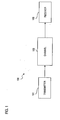
- FIG. 1 is a diagram of a communications system configured to utilize Low Density Parity Check LDPC) codes, according to an embodiment of the present invention
- FIGs. 2A and 2B are diagrams of exemplary LDPC encoders deployed in the transmitter of FIG. 1 ;
- FIG. 3 is a diagram of an exemplary receiver in the system of FIG. 1 ;
- FIG. 4 is a diagram of a sparse parity check matrix, in accordance with an embodiment of the present invention.
- FIG. 5 is a diagram of a bipartite graph of an LDPC code of the matrix of FIG. 4 ;
- FIG. 6 is a diagram of a sub-matrix of a sparse parity check matrix, wherein the sub-matrix contains parity check values restricted to the lower triangular region, according to an embodiment of the present invention
- FIG. 7 is a graph showing performance between codes utilizing unrestricted parity check matrix (H matrix) versus restricted H matrix having a sub-matrix as in FIG. 6 ;
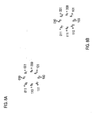
- FIGs. 8A and 8B are, respectively, a diagram of a non-Gray 8-PSK modulation scheme, and a Gray 8-PSK modulation, each of which can be used in the system of FIG. 1 ;
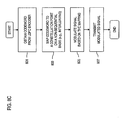
- FIG. 8C is a diagram of a process for bit labeling for a higher order signal constellation, according to an embodiment of the present invention.
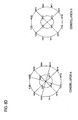
- FIG. 8D is a diagram of exemplary 16-APSK (Amplitude Phase Shift Keying) constellations
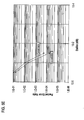
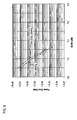
- FIG. 8E is a graph of Packet Error Rate (PER) versus signal-to-noise for the constellations of FIG. 8D ;
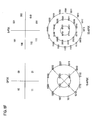
- FIG. 8F is a diagram of constellations for Quadrature Phase Shift Keying (QPSK), 8-PSK, 16-APSK and 32-APSK symbols, in accordance with an embodiment of the present invention.
- QPSK Quadrature Phase Shift Keying
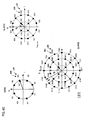
- FIG. 8G is a diagram of alternative constellations for 8-PSK, 16-APSK and 32-APSK symbols, in accordance with an embodiment of the present invention.
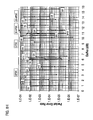
- FIG. 8H is a graph of Packet Error Rate (PER) versus signal-to-noise for the constellations of FIG. 8F ;
- FIG. 9 is a graph showing performance between codes utilizing Gray labeling versus non-Gray labeling
- FIG. 10 is a flow chart of the operation of the LDPC decoder using non-Gray mapping, according to an embodiment of the present invention.
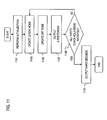
- FIG. 11 is a flow chart of the operation of the LDPC decoder of FIG. 3 using Gray mapping, according to an embodiment of the present invention.
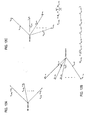
- FIGs. 12A-12C are diagrams of the interactions between the check nodes and the bit nodes in a decoding process, according to an embodiment of the present invention.
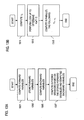
- FIGs. 13A and 13B are flowcharts of processes for computing outgoing messages between the check nodes and the bit nodes using, respectively, a forward-backward approach and a parallel approach, according to various embodiments of the present invention
- FIGs. 14A-14C are graphs showing simulation results of LDPC codes generated in accordance with various embodiments of the present invention.
- FIGs. 15A and 15B are diagrams of the top edge and bottom edge, respectively, of memory organized to support structured access as to realize randomness in LDPC coding, according to an embodiment of the present invention.
- FIG. 16 is a diagram of a computer system that can perform the processes of encoding and decoding of LDPC codes, in accordance with embodiments of the present invention.
- FIG. 1 is a diagram of a communications system configured to utilize Low Density Parity Check (LDPC) codes, according to an embodiment of the present invention.
- a digital communications system 100 includes a transmitter 101 that generates signal waveforms across a communication channel 103 to a receiver 105.
- the transmitter 101 has a message source that produces a discrete set of possible messages; each of the possible messages has a corresponding signal waveform. These signal waveforms are attenuated, or otherwise altered, by communications channel 103.
- LDPC codes are utilized.
- the LDPC codes that are generated by the transmitter 101 enables high speed implementation without incurring any performance loss.
- These structured LDPC codes output from the transmitter 101 avoid assignment of a small number of check nodes to the bit nodes already vulnerable to channel errors by virtue of the modulation scheme (e.g., 8-PSK).
- Such LDPC codes have a parallelizable decoding algorithm (unlike turbo codes), which advantageously involves simple operations such as addition, comparison and table look-up. Moreover, carefully designed LDPC codes do not exhibit any sign of error floor.
- the transmitter 101 generates, using a relatively simple encoding technique, LDPC codes based on parity check matrices (which facilitate efficient memory access during decoding) to communicate with the receiver 105.
- the transmitter 101 employs LDPC codes that can outperform concatenated turbo+RS (Reed-Solomon) codes, provided the block length is sufficiently large.
- FIGs. 2A and 2B are diagrams of exemplary LDPC encoders deployed in the transmitter of FIG. 1 .
- a transmitter 200 is equipped with an LDPC encoder 203 that accepts input from an information source 201 and outputs coded stream of higher redundancy suitable for error correction processing at the receiver 105.
- the information source 201 generates k signals from a discrete alphabet, X.
- LDPC codes are specified with parity check matrices.
- encoding LDPC codes require, in general, specifying the generator matrices. Even though it is possible to obtain generator matrices from parity check matrices using Gaussian elimination, the resulting matrix is no longer sparse and storing a large generator matrix can be complex.
- Encoder 203 generates signals from alphabet Y to a signal mapper 206, which provides a mapping of the alphabet Y to the symbols of the signal constellation corresponding to the modulation scheme employed by a modulator 205.
- This mapping follows a non-sequential scheme, such as interleaving. Exemplary mappings are more fully described below with respect to FIGs. 8C .
- the encoder 203 uses a simple encoding technique that makes use of only the parity check matrix by imposing structure onto the parity check matrix. Specifically, a restriction is placed on the parity check matrix by constraining certain portion of the matrix to be triangular. The construction of such a parity check matrix is described more fully below in FIG. 6 . Such a restriction results in negligible performance loss, and therefore, constitutes an attractive trade-off.
- the modulator 205 modulates the symbols of the signal constellation from the mapper 206 to signal waveforms that are transmitted to a transmit antenna 207, which emits these waveforms over the communication channel 103.
- the transmissions from the transmit antenna 207 propagate to a receiver, as discussed below.
- FIG. 2B shows an LDPC encoder utilized with a Bose Chaudhuri Hocquenghem (BCH) encoder and a cyclic redundancy check (CRC) encoder, according to one embodiment of the present invention.
- the codes generated by the LDPC encoder 203, along with the CRC encoder 209 and the BCH encoder 211, have a concatenated outer BCH code and inner low density parity check (LDPC) code.
- LDPC low density parity check
- error detection is achieved using cyclic redundancy check (CRC) codes.
- the CRC encoder 209 in an exemplary embodiment, encodes using an 8-bit CRC code with generator polynomial (x 5 +x 4 +x 3 +x 2 +1)(x 2 +x+1)(x+1).
- the transmission of the codeword starts in the given order from i 0 and ends with p n ldpc -k ldpc -1 .
- LDPC code parameters ( n ldpc , k ldpc ) are given in Table 1 below.
- Table 1 LDPC Code Parameters ( n ldpc , k ldpc ) Code Rate LDPC Uncoded Block Length k ldpc LDPC Coded Block Length n ldpc 1/2 32400 64800 2/3 43200 64800 3/4 48600 64800 4/5 51840 64800 5/6 54000 64800 3/5 38880 64800 8/9 57600 64800 9/10 58320 64800
- the task of the LDPC encoder 203 is to determine n ldpc - k ldpc parity bits ( p 0 , p 1 ,..., p n ldpc - k ldpc -1) for every block of k ldpc information bits, ( i 0 , i 1 ,..., i k ldpc -1 ).
- the addresses of the parity bit accumulators are given in the second row of the Tables 3 through 10.
- a new row from Tables 3 through 10 are used to find the addresses of the parity bit accumulators.
- the BCH code parameters are enumerated in Table 11.
- Table 11 LDPC Code Rate BCH Uncoded Block Length k bch BCH Coded Block Length n bch BCH Error Correction (bits) 1/2 32208 32400 12 2/3 43040 43200 10 3/4 48408 48600 12 4/5 51648 51840 12 5/6 53840 54000 10 3/5 38688 38880 12 8/9 57472 57600 8 9/10 58192 58320 8
- n bch k ldpc .
- m ( x ) m k bch x k bch -1 + m k bch -2 x k -2 +...+ m 1 x + m 0 is multiplied by x n bch - k bch .
- x n bch - k bch m ( x ) divided by g ( x ).
- the above LDPC codes in an exemplary embodiment, can be used to variety of digital video applications, such as MPEG (Motion Pictures Expert Group) packet transmission.
- MPEG Motion Pictures Expert Group
- FIG. 3 is a diagram of an exemplary receiver in the system of FIG. 1 .
- a receiver 300 includes a demodulator 301 that performs demodulation of received signals from transmitter 200. These signals are received at a receive antenna 303 for demodulation. After demodulation, the received signals are forwarded to a decoder 305, which attempts to reconstruct the original source messages by generating messages, X ', in conjunction with a bit metric generator 307. With non-Gray mapping, the bit metric generator 307 exchanges probability information with the decoder 305 back and forth (iteratively) during the decoding process, which is detailed in FIG. 10 .
- Gray mapping is used (according to one embodiment of the present invention)
- one pass of the bit metric generator is sufficient, in which further attempts of bit metric generation after each LDPC decoder iteration are likely to yield limited performance improvement; this approach is more fully described with respect to FIG. 11 .
- FIG. 4 is a diagram of a sparse parity check matrix, in accordance with an embodiment of the present invention.
- LDPC codes are long, linear block codes with sparse parity check matrix H ( n-k ) xn .
- the block length, n ranges from thousands to tens of thousands of bits.
- the same code can be equivalently represented by the bipartite graph, per FIG. 5 .
- FIG. 5 is a diagram of a bipartite graph of an LDPC code of the matrix of PIG. 4.
- Parity check equations imply that for each check node, the sum (over GF (Galois Field)(2)) of all adjacent bit nodes is equal to zero.
- the LDPC decoder 305 is considered a message passing decoder, whereby the decoder 305 aims to find the values of bit nodes. To accomplish this task, bit nodes and check nodes iteratively communicate with each other. The nature of this communication is described below.
- each bit node From bit nodes to check nodes, each bit node relays to an adjacent check node an estimate about its own value based on the feedback coming from its other adjacent check nodes.
- n 1 has only two adjacent check nodes m 1 and m 3 . If the feedback coming from m 3 to n 1 indicates that the value of n 1 is probably 0, then n 1 would notify m 1 that an estimate of n 1 's own value is 0.
- the bit node performs a majority vote (soft decision) on the feedback coming from its other adjacent check nodes before reporting that decision to the check node it communicates. The above process is repeated until all bit nodes are considered to be correct (i.e., all parity check equations are satisfied) or until a predetermined maximum number of iterations is reached, whereby a decoding failure is declared.
- FIG. 6 is a diagram of a sub-matrix of a sparse parity check matrix, wherein the sub-matrix contains parity check values restricted to the lower triangular region, according to an embodiment of the present invention.
- the encoder 203 (of FIG. 2 ) can employ a simple encoding technique by restricting the values of the lower triangular area of the parity check matrix.
- FIG. 7 is a graph showing performance between codes utilizing unrestricted parity check matrix (H matrix) versus restricted H matrix of FIG. 6 .
- the graph shows the performance comparison between two LDPC codes: one with a general parity check matrix and the other with a parity check matrix restricted to be lower triangular to simplify encoding.
- the modulation scheme for this simulation, is 8-PSK.
- the performance loss is within 0.1 dB. Therefore, the performance loss is negligible based on the restriction of the lower triangular H matrices, while the gain in simplicity of the encoding technique is significant. Accordingly, any parity check matrix that is equivalent to a lower triangular or upper triangular under row and/or column permutation can be utilized for the same purpose.
- FIGs. 8A and 8B are, respectively, a diagram of a non-Gray 8-PSK modulation scheme, and a Gray 8-PSK modulation, each of which can be used in the system of FIG. 1 .
- the non-Gray 8-PSK scheme of FIG. 8A can be utilized in the receiver of FIG. 3 to provide a system that requires very low Frame Erasure Rate (FER). This requirement can also be satisfied by using a Gray 8-PSK scheme, as shown in FIG. 8B , in conjunction with an outer code, such as Bose, Chaudhuri, and Hocquenghem (BCH), Hamming, or Reed-Solomon (RS) code.
- an outer code such as Bose, Chaudhuri, and Hocquenghem (BCH), Hamming, or Reed-Solomon (RS) code.
- the LDPC decoder 305 ( FIG. 3 ) and the bit metric generator 307, which may employ 8-PSK modulation.
- the LDPC decoder 305 using Gray labeling exhibit an earlier error floor, as shown in FIG. 9 below.
- FIG. 8C shows a diagram of a process for bit labeling for a higher order signal constellation, according to an embodiment of the present invention.
- a codeword is output from the LDPC encoder 203 ( FIGs. 2A and 2B ), and is mapped to a constellation point in a higher order signal constellation (as shown in FIGs. 8D and 8F ), per steps 801, 803.
- This mapping is not performed sequentially as in traditional systems, but instead executed on a non-sequential basis, such as interleaving. Such a mapping is further detailed below with respect to FIG. 8F .
- the modulator 205 then modulates, as in step 805, the signal based on the mapping.
- the modulated signal is thereafter transmitted (step 807).
- FIG. 8D shows a diagram of exemplary 16-APSK (Amplitude Phase Shift Keying) constellations.
- Constellations A and B are 16-APSK constellations. The only difference between the two constellations A and B is that the inner circle symbols of Constellation A are rotated 15 degrees counterclockwise with respect to the inner circle symbols of Constellation B, such that inner circle symbols fall between the outer circle symbols to maximize inter-symbol distances. Therefore, intuitively Constellation A is more attractive if the Forward Error Correction (FEC) decoder 305 used a symbolwise decoding algorithm. On the other hand, given the multiplicity of code rates and different constellations, using an FEC code tailored towards bitwise decoding is more flexible.
- FEC Forward Error Correction
- Constellation B is more "Gray-coding friendly.”
- AWGN Additional White Gaussian Noise
- FIG. 8F is a diagram of constellations for Quadrature Phase Shift Keying (QPSK), 8-PSK, 16-APSK and 32-APSK symbols, in accordance with an embodiment of the present invention.
- QPSK Quadrature Phase Shift Keying
- FIGs. 8F show symmetric constellations for QPSK, 8-PSK, 16-APSK and 32-APSK symbols, respectively.
- 8-PSK, 16-APSK and 32-APSK constellation labeling can be chosen as shown in FIG. 8G .
- N LDPC encoded bits are first passed through a bit interleaver.
- the bit interleaving table in an exemplary embodiment, is a two-dimensional array with N /3 rows and 3 columns for 8-PSK, N /4 rows and 4 columns for 16-APSK and N /5 rows and 5 columns for 32-APSK.
- the LDPC encoded bits are written to the interleaver table column by column, and read out row by row.
- this row/column bit interleaver strategy with labeling as shown in FIG. 8G is exactly equivalent to the bit interleaving strategy described above with respect to the labeling shown in FIG. 8F .
- 16-APSK these two strategies are functionally equivalent; that is, they exhibit the same performance on an AWGN channel.
- FIG. 8H illustrates the simulation results (on AWGN Channel) of the above symbol constellations.
- Table 13 Code Es/No (dB) Distance to Capacity (dB) 2/3, 8-PSK 6.59 0.873 3/4, 8-PSK 7.88 0.690 5/6, 8-PSK 9.34 0.659 8/9, 8-PSK 10.65 0.750 9/10, 8-PSK 10.95 0.750 1/2, QPSK 0.99 0.846 3/5, QPSK 2.20 0.750 2/3, QPSK 3.07 0.760 3/4, QPSK 4.02 0.677 4/5, QPSK 4.66 0.627 5/6, QPSK 5.15 0.600 7/8, QPSK 5.93 0.698 8/9, QPSK 6.17 0.681 9/10, QPSK 6.39 0.687 3/4, 16-APSK 10.19 0.890 4/5, 16-APSK 11.0 0.850 5/6, 16-APSK 11.58 0.800 7/8
- FIG. 9 is a graph showing performance between codes utilizing Gray labeling versus non-Gray labeling of FTGs. 8A and 8B.
- the error floor stems from the fact that assuming correct feedback from LDPC decoder 305, regeneration of 8-PSK bit metrics is more accurate with non-Gray labeling since the two 8-PSK symbols with known two bits are further apart with non-Gray labeling. This can be equivalently seen as operating at higher Signal-to-Noise Ratio (SNR). Therefore, even though error asymptotes of the same LDPC code using Gray or non-Gray labeling have the same slope (i.e., parallel to each other), the one with non-Gray labeling passes through lower FER at any SNR.
- SNR Signal-to-Noise Ratio
- Gray labeling without any iteration between LDPC decoder 305 and 8-PSK bit metric generator 307 may be more suitable because re-generating 8-PSK bit metrics before every LDPC decoder iteration causes additional complexity. Moreover, when Gray labeling is used, re-generating 8-PSK bit metrics before every LDPC decoder iteration yields only very slight performance improvement. As mentioned previously, Gray labeling without iteration may be used for systems that require very low FER, provided an outer code is implemented.
- Gray labeling The choice between Gray labeling and non-Gray labeling depends also on the characteristics of the LDPC code. Typically, the higher bit or check node degrees, the better it is for Gray labeling, because for higher node degrees, the initial feedback from LDPC decoder 305 to 8-PSK (or similar higher order modulation) bit metric generator 307 deteriorates more with non-Gray labeling.
- FIG. 10 is a flow chart of the operation of the LDPC decoder using non-Gray mapping, according to an embodiment of the present invention.
- the LDPC decoder and bit metric generator iterate one after the other.
- 8-PSK modulation is utilized; however, the same principles apply to other higher modulation schemes as well.
- the 8-PSK bit metric generator 307 communicates with the LDPC decoder 305 to exchange a priori probability information and a posteriori probability information, which respectively are represented as u , and a . That is, the vectors u and a respectively represent a priori and a poster-iori probabilities of log likelihood ratios of coded bits.
- f (.) f ( f ( a , b ), c ).
- v n ⁇ k l denotes the message that goes from bit node n to its adjacent check node k i
- u n denotes the demodulator output for the bit n
- N is the codeword size.
- a check node, k is updated, whereby the input v yields the output w .
- the incoming messages to the check node k from its d c adjacent bit nodes are denoted by v n 1 ⁇ k , v n 2 ⁇ k ,..., v n dc ⁇ k .
- the goal is to compute the outgoing messages from the check node k back to d c adjacent bit nodes.
- step 1007 it is determined whether all the parity check equations are satisfied. If these parity check equations are not satisfied, then the decoder 305, as in step 1009, re-derives 8-PSK bit metrics and channel input u n . Next, the bit node is updated, as in step 1011. As shown in FIG.
- the incoming messages to the bit node n from its d v adjacent check nodes are denoted by W k 1 ⁇ n W k 2 ⁇ n ,...., w k dv ⁇ n
- FIG. 11 is a flow chart of the operation of the LDPC decoder of FIG. 3 using Gray mapping, according to an embodiment of the present invention.
- bit metrics are advantageously generated only once before the LDPC decoder, as re-generating bit metrics after every LDPC decoder iteration may yield nominal performance improvement.
- initialization of the log likelihood ratios of coded bits, v are performed, and the check node is updated, per steps 1101 and 1103.
- the bit node n is updated, as in step 1105.
- the decoder outputs the a posteriori probability information (step 1107).
- step 1109 a determination is made whether all of the parity check equations are satisfied; if so, the decoder outputs the hard decision (step 1111). Otherwise, steps 1103-1107 are repeated.
- FIG. 13A is a flowchart of process for computing outgoing messages between the check nodes and the bit nodes using a forward-backward approach, according to an embodiment of the present invention.
- the computation of d c ( d c -1) and numerous g (.,.) functions are performed.
- the forward-backward approach reduces the complexity of the computation to 3( d c -2), in which d c -1 variables are stored.
- the incoming messages to the check node k from d c adjacent bit nodes are denoted by v n 1 ⁇ k , v n 2 ⁇ k ,..., v n dc ⁇ k . It is desired that the outgoing messages are computed from the check node k back to d c adjacent bit nodes; these outgoing messages are denoted by W k ⁇ n 1 , W k ⁇ n 2 ,..., w n dc ⁇ k .
- step 1305 these backward variables are then computed. Thereafter, the outgoing messages are computed, as in step 1307, based on the stored forward variables and the computed backward variables.
- the computation load can be further enhance by a parallel approach, as next discussed.
- FIG. 13B is a flowchart of process for computing outgoing messages between the check nodes and the bit nodes using a parallel approach, according to an embodiment of the present invention.
- the In(.) term of the above equation can be obtained using a look-up table LUT x that represents the function ln
- the computational latency of ⁇ k is advantageously log 2 ( d c ).
- FIGs. 14A-14C are graphs showing simulation results of LDPC codes generated in accordance with various embodiments of the present invention.
- FIGs. 14A-14C show the performance of LDPC codes with higher order modulation and code rates of 3/4 (QPSK, 1.485 bits/symbol), 2/3 (8-PSK, 1.980 bits/symbol), and 5/6 (8-PSK, 2.474 bits/symbol).
- the fully parallel architecture may involve greater complexity in realizing all of the nodes and their connections. Therefore with fully parallel architecture, a smaller block size may be required to reduce the complexity. In that case, for the same clock frequency, a proportional reduction in throughput and some degradation in FER versus Es/No performance may result.
- the second approach to implementing LDPC codes is to physically realize only a subset of the total number of the nodes and use only these limited number of "physical" nodes to process all of the "functional" nodes of the code. Even though the LDPC decoder operations can be made extremely simple and can be performed in parallel, the further challenge in the design is how the communication is established between "randomly" distributed bit nodes and check nodes.
- the decoder 305 (of FIG. 3 ), according to one embodiment of the present invention, addresses this problem by accessing memory in a structured way, as to realize a seemingly random code. This approach is explained with respect to FIGs. 15A and 15B .
- FIGs. 15A and 15B are diagrams of the top edge and bottom edge, respectively, of memory organized to support structured access as to realize randomness in LDPC coding, according to an embodiment of the present invention.
- Structured access can be achieved without compromising the performance of a truly random code by focusing on the generation of the parity check matrix.
- a parity check matrix can be specified by the connections of the check nodes with the bit nodes.
- the bit nodes can be divided into groups of a fixed size, which for illustrative purposes is 392.
- the check nodes connected to the first bit node are different from a , b, c so that with a suitable choice of p , all the check nodes have the same degree.
- the edge information can stored to permit concurrent access to a group of relevant edge values during decoding.
- the approach of the present invention facilitates memory access during check node and bit node processing.
- the values of the edges in the bipartite graph can be stored in a storage medium, such as random access memory (RAM). It is noted that for a truly random LDPC code during check node and bit node processing, the values of the edges would need to be accessed one by one in a random fashion. However, such a conventional access scheme would be too slow for a high data rate application.
- the RAM of FIGs. 15A and 15B are organized in a manner, whereby a large group of relevant edges can be fetched in one clock cycle; accordingly, these values are placed "together" in memory, according to a predetermined scheme or arrangement.
- each box contains the value of an edge, which is multiple bits (e.g., 6).
- Edge RAM is divided into two parts: top edge RAM 1501 ( FIG. 15A ) and bottom edge RAM 1503 ( FIG. 15B ).
- Bottom edge RAM contains the edges between bit nodes of degree 2, for example, and check nodes.
- Top edge RAM 1501 contains the edges between bit nodes of degree greater than 2 and check nodes. Therefore, for every check node, 2 adjacent edges are stored in the bottom RAM 1503, and the rest of the edges are stored in the top edge RAM 1501.
- top edge RAM 1501 and bottom edge RAM 1503 for various code rates are given in Table 14: Table 14 1/2 2/3 3/4 5/6 Top Edge RAM 400 x 392 440 x 392 504 x 392 520 x 392 Bottom Edge RAM 160 x 392 110 x 392 72 x 392 52 x 392
- an edge RAM of size 576 x 392 is sufficient to store the edge metrics for all the code rates of 1/2, 2/3, 3/4, and 5/6.
- a group of 392 bit nodes and 392 check nodes are selected for processing at a time.
- q +2 is the degree of each check node.
- the group of 392 bit nodes has degree 2, their edges are located in 2 consecutive rows of the bottom edge RAM 1503. If the bit nodes have degree d > 2, their edges are located in some d rows of the top edge RAM 1501.
- the address of these d rows can be stored in non-volatile memory, such as Read-Only Memory (ROM).
- ROM Read-Only Memory
- the edges in one of the rows correspond to the first edges of 392 bit nodes, the edges in another row correspond to the second edges of 392 bit nodes, etc.
- the column index of the edge that belongs to the first bit node in the group of 392 can also be stored in ROM.
- the edges that correspond to the second, third, etc. bit nodes follow the starting column index in a "wrapped around" fashion.
- the ( j th edge in the row belongs to the first bit node
- the ( j +1)st edge belongs to the second bit node
- ( j +2)nd edge belongs to the third bit node
- ( j -1)st edge belongs to the 392 th bit node.
- FIG. 16 illustrates a computer system upon which an embodiment according to the present invention can be implemented.
- the computer system 1600 includes a bus 1601 or other communication mechanism for communicating information, and a processor 1603 coupled to the bus 1601 for processing information.
- the computer system 1600 also includes main memory 1605, such as a random access memory (RAM) or other dynamic storage device, coupled to the bus 1601 for storing information and instructions to be executed by the processor 1603.
- Main memory 1605 can also be used for storing temporary variables or other intermediate information during execution of instructions to be executed by the processor 1603.
- the computer system 1600 further includes a read only memory (ROM) 1607 or other static storage device coupled to the bus 1601 for storing static information and instructions for the processor 1603.
- a storage device 1609 such as a magnetic disk or optical disk, is additionally coupled to the bus 1601 for storing information and instructions.
- the computer system 1600 may be coupled via the bus 1601 to a display 1611, such as a cathode ray tube (CRT), liquid crystal display, active matrix display, or plasma display, for displaying information to a computer user.
- a display 1611 such as a cathode ray tube (CRT), liquid crystal display, active matrix display, or plasma display
- An input device 1613 such as a keyboard including alphanumeric and other keys, is coupled to the bus 1601 for communicating information and command selections to the processor 1603.
- cursor control 1615 such as a mouse, a trackball, or cursor direction keys for communicating direction information and command selections to the processor 1603 and for controlling cursor movement on the display 1611.
- generation of LDPC codes is provided by the computer system 1600 in response to the processor 1603 executing an arrangement of instructions contained in main memory 1605.
- Such instructions can be read into main memory 1605 from another computer-readable medium, such as the storage device 1609.
- Execution of the arrangement of instructions contained in main memory 1605 causes the processor 1603 to perform the process steps described herein.
- processors in a multi-processing arrangement may also be employed to execute the instructions contained in main memory 1605.
- hard-wired circuitry may be used in place of or in combination with software instructions to implement the embodiment of the present invention.
- embodiments of the present invention are not limited to any specific combination of hardware circuitry and software.
- the computer system 1600 also includes a communication interface 1617 coupled to bus 1601.
- the communication interface 1617 provides a two-way data communication coupling to a network link 1619 connected to a local network 1621.
- the communication interface 1617 may be a digital subscriber line (DSL) card or modem, an integrated services digital network (ISDN) card, a cable modem, or a telephone modem to provide a data communication connection to a corresponding type of telephone line.
- communication interface 1617 may be a local area network (LAN) card (e.g. for EthernetTM or an Asynchronous Transfer Model (ATM) network) to provide a data communication connection to a compatible LAN.
- LAN local area network
- Wireless links can also be implemented.
- communication interface 1617 sends and receives electrical, electromagnetic, or optical signals that carry digital data streams representing various types of information.
- the communication interface 1617 can include peripheral interface devices, such as a Universal Serial Bus (USB) interface, a PCMCIA (Personal Computer Memory Card International Association) interface, etc.
- USB Universal Serial Bus
- PCMCIA Personal Computer Memory Card International Association
- the network link 1619 typically provides data communication through one or more networks to other data devices.
- the network link 1619 may provide a connection through local network 1621 to a host computer 1623, which has connectivity to a network 1625 (e.g. a wide area network (WAN) or the global packet data communication network now commonly referred to as the "Internet") or to data equipment operated by service provider.
- the local network 1621 and network 1625 both use electrical, electromagnetic, or optical signals to convey information and instructions.
- the signals through the various networks and the signals on network link 1619 and through communication interface 1617, which communicate digital data with computer system 1600, are exemplary forms of carrier waves bearing the information and instructions.
- the computer system 1600 can send messages and receive data, including program code, through the network(s), network link 1619, and communication interface 1617.
- a server (not shown) might transmit requested code belonging to an application program for implementing an embodiment of the present invention through the network 1625, local network 1621 and communication interface 1617.
- the processor 1603 may execute the transmitted code while being received and/or store the code in storage device 169, or other non-volatile storage for later execution. In this manner, computer system 1600 may obtain application code in the form of a carrier wave.
- Non-volatile media include, for example, optical or magnetic disks, such as storage device 1609.
- Volatile media include dynamic memory, such as main memory 1605.
- Transmission media include coaxial cables, copper wire and fiber optics, including the wires that comprise bus 1601. Transmission media can also take the form of acoustic, optical, or electromagnetic waves, such as those generated during radio frequency (RF) and infrared (IR) data communications.
- RF radio frequency
- IR infrared
- Computer-readable media include, for example, a floppy disk, a flexible disk, hard disk, magnetic tape, any other magnetic medium, a CD-ROM, CDRW, DVD, any other optical medium, punch cards, paper tape, optical mark sheets, any other physical medium with patterns of holes or other optically recognizable indicia, a RAM, a PROM, and EPROM, a FLASH-EPROM, any other memory chip or cartridge, a carrier wave, or any other medium from which a computer can read.
- a floppy disk a flexible disk, hard disk, magnetic tape, any other magnetic medium, a CD-ROM, CDRW, DVD, any other optical medium, punch cards, paper tape, optical mark sheets, any other physical medium with patterns of holes or other optically recognizable indicia, a RAM, a PROM, and EPROM, a FLASH-EPROM, any other memory chip or cartridge, a carrier wave, or any other medium from which a computer can read.
- the instructions for carrying out at least part of the present invention may initially be borne on a magnetic disk of a remote computer.
- the remote computer loads the instructions into main memory and sends the instructions over a telephone line using a modem.
- a modem of a local computer system receives the data on the telephone line and uses an infrared transmitter to convert the data to an infrared signal and transmit the infrared signal to a portable computing device, such as a personal digital assistance (PDA) and a laptop.
- PDA personal digital assistance
- An infrared detector on the portable computing device receives the information and instructions borne by the infrared signal and places the data on a bus.
- the bus conveys the data to main memory, from which a processor retrieves and executes the instructions.
- the instructions received by main memory may optionally be stored on storage device either before or after execution by processor.
- an encoder such as a Low Density Parity Check (LDPC) encoder, generates encoded signals by transforming an input message into a codeword represented by a plurality of set of bits. These bits are mapped non-sequentially (e.g., interleaving) a higher order constellation (Quadrature Phase Shift Keying (QPSK), 8-PSK, 16-APSK (Amplitude Phase Shift Keying), 32-APSK, etc.
- QPSK Quadrature Phase Shift Keying
- 8-PSK 8-PSK
- 16-APSK Amplitude Phase Shift Keying
- 32-APSK etc.
Landscapes
- Engineering & Computer Science (AREA)
- Physics & Mathematics (AREA)
- Theoretical Computer Science (AREA)
- Probability & Statistics with Applications (AREA)
- Signal Processing (AREA)
- Computer Networks & Wireless Communication (AREA)
- Mathematical Physics (AREA)
- Power Engineering (AREA)
- Algebra (AREA)
- General Physics & Mathematics (AREA)
- Pure & Applied Mathematics (AREA)
- Multimedia (AREA)
- Error Detection And Correction (AREA)
Applications Claiming Priority (13)
| Application Number | Priority Date | Filing Date | Title |
|---|---|---|---|
| US39345702P | 2002-07-03 | 2002-07-03 | |
| US39876002P | 2002-07-26 | 2002-07-26 | |
| US40381202P | 2002-08-15 | 2002-08-15 | |
| US42150502P | 2002-10-25 | 2002-10-25 | |
| US42199902P | 2002-10-29 | 2002-10-29 | |
| US42371002P | 2002-11-04 | 2002-11-04 | |
| US44019903P | 2003-01-15 | 2003-01-15 | |
| US44764103P | 2003-02-14 | 2003-02-14 | |
| US45622003P | 2003-03-20 | 2003-03-20 | |
| US46935603P | 2003-05-09 | 2003-05-09 | |
| US48210703P | 2003-06-24 | 2003-06-24 | |
| US48211203P | 2003-06-24 | 2003-06-24 | |
| EP03763495.3A EP1413059B9 (fr) | 2002-07-03 | 2003-07-03 | Modulation codee a entrelacement de bits utilisant des codes de controle de parite a faible densite (ldpc) |
Related Parent Applications (3)
| Application Number | Title | Priority Date | Filing Date |
|---|---|---|---|
| EP03763495.3A Division EP1413059B9 (fr) | 2002-07-03 | 2003-07-03 | Modulation codee a entrelacement de bits utilisant des codes de controle de parite a faible densite (ldpc) |
| EP03763495.3A Division-Into EP1413059B9 (fr) | 2002-07-03 | 2003-07-03 | Modulation codee a entrelacement de bits utilisant des codes de controle de parite a faible densite (ldpc) |
| EP03763495.3 Division | 2003-07-03 |
Publications (4)
| Publication Number | Publication Date |
|---|---|
| EP2190123A2 true EP2190123A2 (fr) | 2010-05-26 |
| EP2190123A3 EP2190123A3 (fr) | 2010-06-09 |
| EP2190123B1 EP2190123B1 (fr) | 2012-03-07 |
| EP2190123B9 EP2190123B9 (fr) | 2014-08-27 |
Family
ID=46125633
Family Applications (2)
| Application Number | Title | Priority Date | Filing Date |
|---|---|---|---|
| EP10178955.0A Expired - Lifetime EP2273683B9 (fr) | 2002-07-03 | 2003-07-03 | Codage de codes LDPC (Low Density Parity Check) |
| EP10001217.8A Expired - Lifetime EP2190123B9 (fr) | 2002-07-03 | 2003-07-03 | Procédé et système pour la génération de codes LDPC (Low Density Parity Check) |
Family Applications Before (1)
| Application Number | Title | Priority Date | Filing Date |
|---|---|---|---|
| EP10178955.0A Expired - Lifetime EP2273683B9 (fr) | 2002-07-03 | 2003-07-03 | Codage de codes LDPC (Low Density Parity Check) |
Country Status (2)
| Country | Link |
|---|---|
| EP (2) | EP2273683B9 (fr) |
| DK (2) | DK2190123T3 (fr) |
Cited By (6)
| Publication number | Priority date | Publication date | Assignee | Title |
|---|---|---|---|---|
| CN105978664A (zh) * | 2016-06-24 | 2016-09-28 | 中国科学院国家空间科学中心 | 一种用于遥感卫星的高效超高速有效载荷数据传输系统 |
| CN109039975A (zh) * | 2018-09-07 | 2018-12-18 | 航天恒星科技有限公司 | 一种多次重复移相的码移键控调制方法及其解调方法 |
| CN111884764A (zh) * | 2015-02-25 | 2020-11-03 | 三星电子株式会社 | 一种能够在多个模式中的一个模式下操作的发送设备 |
| CN112655152A (zh) * | 2018-08-03 | 2021-04-13 | 科得鲁西达股份有限公司 | 用于编码准循环低密度奇偶校验码的方法及设备 |
| CN112994705A (zh) * | 2013-06-14 | 2021-06-18 | 三星电子株式会社 | 发送方法和接收方法 |
| US20230140784A1 (en) * | 2020-07-16 | 2023-05-04 | Institute Of Microelectronics Of The Chinese Academy Of Sciences | Signal processing methods and rfid system |
Families Citing this family (5)
| Publication number | Priority date | Publication date | Assignee | Title |
|---|---|---|---|---|
| US10372334B2 (en) | 2016-02-11 | 2019-08-06 | International Business Machines Corporation | Reclaiming free space in a storage system |
| US10146652B2 (en) | 2016-02-11 | 2018-12-04 | International Business Machines Corporation | Resilient distributed storage system |
| US10530392B2 (en) | 2017-07-31 | 2020-01-07 | Codelucida, Inc. | Vertical layered finite alphabet iterative decoding |
| US11496155B2 (en) | 2020-04-09 | 2022-11-08 | Codelucida, Inc. | Method and apparatus for vertical layered decoding of quasi-cyclic low-density parity check codes using predictive magnitude maps |
| US11258460B2 (en) | 2020-06-10 | 2022-02-22 | Codelucida, Inc. | Method and apparatus for vertical layered decoding of quasi-cyclic low-density parity check codes built from clusters of circulant permutation matrices |
Family Cites Families (2)
| Publication number | Priority date | Publication date | Assignee | Title |
|---|---|---|---|---|
| FR2799592B1 (fr) * | 1999-10-12 | 2003-09-26 | Thomson Csf | Procede de construction et de codage simple et systematique de codes ldpc |
| WO2002099976A2 (fr) * | 2001-06-06 | 2002-12-12 | Seagate Technology Llc | Procede et appareil de codage utilisant des codes de test de parite de faible densite pour stockage ou emission de donnees |
-
2003
- 2003-07-03 DK DK10001217.8T patent/DK2190123T3/da active
- 2003-07-03 EP EP10178955.0A patent/EP2273683B9/fr not_active Expired - Lifetime
- 2003-07-03 EP EP10001217.8A patent/EP2190123B9/fr not_active Expired - Lifetime
- 2003-07-03 DK DK10178955.0T patent/DK2273683T3/da active
Non-Patent Citations (1)
| Title |
|---|
| None |
Cited By (13)
| Publication number | Priority date | Publication date | Assignee | Title |
|---|---|---|---|---|
| CN112994705A (zh) * | 2013-06-14 | 2021-06-18 | 三星电子株式会社 | 发送方法和接收方法 |
| US12418313B2 (en) | 2013-06-14 | 2025-09-16 | Samsung Electronics Co., Ltd. | Method and apparatus for encoding and decoding of low density parity check codes |
| US11824558B2 (en) | 2013-06-14 | 2023-11-21 | Samsung Electronics Co., Ltd. | Method and apparatus for encoding and decoding of low density parity check codes |
| CN112994705B (zh) * | 2013-06-14 | 2023-08-18 | 三星电子株式会社 | 发送方法和接收方法 |
| US11658770B2 (en) | 2015-02-25 | 2023-05-23 | Samsung Electronics Co., Ltd. | Transmitter and method for generating additional parity thereof |
| CN111884764B (zh) * | 2015-02-25 | 2023-07-21 | 三星电子株式会社 | 一种能够在多个模式中的一个模式下操作的发送设备 |
| CN111884764A (zh) * | 2015-02-25 | 2020-11-03 | 三星电子株式会社 | 一种能够在多个模式中的一个模式下操作的发送设备 |
| US12021616B2 (en) | 2015-02-25 | 2024-06-25 | Samsung Electronics Co., Ltd. | Transmitter and method for generating additional parity thereof |
| CN105978664A (zh) * | 2016-06-24 | 2016-09-28 | 中国科学院国家空间科学中心 | 一种用于遥感卫星的高效超高速有效载荷数据传输系统 |
| CN112655152A (zh) * | 2018-08-03 | 2021-04-13 | 科得鲁西达股份有限公司 | 用于编码准循环低密度奇偶校验码的方法及设备 |
| CN109039975A (zh) * | 2018-09-07 | 2018-12-18 | 航天恒星科技有限公司 | 一种多次重复移相的码移键控调制方法及其解调方法 |
| US20230140784A1 (en) * | 2020-07-16 | 2023-05-04 | Institute Of Microelectronics Of The Chinese Academy Of Sciences | Signal processing methods and rfid system |
| US11922257B2 (en) * | 2020-07-16 | 2024-03-05 | Institute Of Microelectronics Of The Chinese Academy Of Sciences | Signal processing methods and RFID system |
Also Published As
| Publication number | Publication date |
|---|---|
| EP2273683B9 (fr) | 2015-08-19 |
| EP2190123A3 (fr) | 2010-06-09 |
| DK2190123T3 (da) | 2012-05-29 |
| EP2273683B1 (fr) | 2013-06-19 |
| DK2273683T3 (da) | 2013-09-16 |
| EP2273683A3 (fr) | 2011-04-06 |
| EP2190123B9 (fr) | 2014-08-27 |
| EP2273683A2 (fr) | 2011-01-12 |
| EP2190123B1 (fr) | 2012-03-07 |
Similar Documents
| Publication | Publication Date | Title |
|---|---|---|
| EP1413059B9 (fr) | Modulation codee a entrelacement de bits utilisant des codes de controle de parite a faible densite (ldpc) | |
| US7577207B2 (en) | Bit labeling for amplitude phase shift constellation used with low density parity check (LDPC) codes | |
| US7020829B2 (en) | Method and system for decoding low density parity check (LDPC) codes | |
| US8095854B2 (en) | Method and system for generating low density parity check codes | |
| EP1385270A2 (fr) | Procédé et système pour génération de code LDPC (Low Density Parity Check) | |
| EP1379001A2 (fr) | Procédé et système pour décodage de code LDPC (Low Density Parity Check) | |
| EP2273683B9 (fr) | Codage de codes LDPC (Low Density Parity Check) | |
| HK1153056B (en) | Encoding of low density parity check (ldpc) codes | |
| HK1073186B (en) | A method and apparatus for encoding signals in communication system |
Legal Events
| Date | Code | Title | Description |
|---|---|---|---|
| PUAI | Public reference made under article 153(3) epc to a published international application that has entered the european phase |
Free format text: ORIGINAL CODE: 0009012 |
|
| PUAL | Search report despatched |
Free format text: ORIGINAL CODE: 0009013 |
|
| AC | Divisional application: reference to earlier application |
Ref document number: 1413059 Country of ref document: EP Kind code of ref document: P |
|
| AK | Designated contracting states |
Kind code of ref document: A2 Designated state(s): AT BE BG CH CY CZ DE DK EE ES FI FR GB GR HU IE IT LI LU MC NL PT RO SE SI SK TR |
|
| AK | Designated contracting states |
Kind code of ref document: A3 Designated state(s): AT BE BG CH CY CZ DE DK EE ES FI FR GB GR HU IE IT LI LU MC NL PT RO SE SI SK TR |
|
| 17P | Request for examination filed |
Effective date: 20101209 |
|
| RIC1 | Information provided on ipc code assigned before grant |
Ipc: H03M 13/15 20060101ALI20110214BHEP Ipc: H03M 13/25 20060101ALI20110214BHEP Ipc: H03M 13/29 20060101ALI20110214BHEP Ipc: H04L 27/34 20060101ALI20110214BHEP Ipc: H03M 13/11 20060101ALI20110214BHEP Ipc: H04L 27/36 20060101ALI20110214BHEP Ipc: H04L 27/20 20060101ALI20110214BHEP Ipc: H03M 13/00 20060101AFI20110214BHEP Ipc: H04H 40/90 20080101ALN20110214BHEP Ipc: H04L 1/00 20060101ALI20110214BHEP |
|
| 17Q | First examination report despatched |
Effective date: 20110302 |
|
| GRAP | Despatch of communication of intention to grant a patent |
Free format text: ORIGINAL CODE: EPIDOSNIGR1 |
|
| GRAS | Grant fee paid |
Free format text: ORIGINAL CODE: EPIDOSNIGR3 |
|
| GRAA | (expected) grant |
Free format text: ORIGINAL CODE: 0009210 |
|
| AC | Divisional application: reference to earlier application |
Ref document number: 1413059 Country of ref document: EP Kind code of ref document: P |
|
| AK | Designated contracting states |
Kind code of ref document: B1 Designated state(s): AT BE BG CH CY CZ DE DK EE ES FI FR GB GR HU IE IT LI LU MC NL PT RO SE SI SK TR |
|
| REG | Reference to a national code |
Ref country code: GB Ref legal event code: FG4D |
|
| REG | Reference to a national code |
Ref country code: AT Ref legal event code: REF Ref document number: 548803 Country of ref document: AT Kind code of ref document: T Effective date: 20120315 Ref country code: CH Ref legal event code: EP |
|
| REG | Reference to a national code |
Ref country code: CH Ref legal event code: NV Representative=s name: E. BLUM & CO. AG PATENT- UND MARKENANWAELTE VSP |
|
| REG | Reference to a national code |
Ref country code: IE Ref legal event code: FG4D |
|
| REG | Reference to a national code |
Ref country code: DE Ref legal event code: R096 Ref document number: 60340243 Country of ref document: DE Effective date: 20120503 |
|
| REG | Reference to a national code |
Ref country code: ES Ref legal event code: FG2A Ref document number: 2381012 Country of ref document: ES Kind code of ref document: T3 Effective date: 20120522 |
|
| REG | Reference to a national code |
Ref country code: DK Ref legal event code: T3 |
|
| REG | Reference to a national code |
Ref country code: NL Ref legal event code: T3 |
|
| REG | Reference to a national code |
Ref country code: SE Ref legal event code: TRGR |
|
| REG | Reference to a national code |
Ref country code: SK Ref legal event code: T3 Ref document number: E 11856 Country of ref document: SK |
|
| PG25 | Lapsed in a contracting state [announced via postgrant information from national office to epo] |
Ref country code: GR Free format text: LAPSE BECAUSE OF FAILURE TO SUBMIT A TRANSLATION OF THE DESCRIPTION OR TO PAY THE FEE WITHIN THE PRESCRIBED TIME-LIMIT Effective date: 20120608 |
|
| PG25 | Lapsed in a contracting state [announced via postgrant information from national office to epo] |
Ref country code: CY Free format text: LAPSE BECAUSE OF FAILURE TO SUBMIT A TRANSLATION OF THE DESCRIPTION OR TO PAY THE FEE WITHIN THE PRESCRIBED TIME-LIMIT Effective date: 20120307 |
|
| PG25 | Lapsed in a contracting state [announced via postgrant information from national office to epo] |
Ref country code: BE Free format text: LAPSE BECAUSE OF FAILURE TO SUBMIT A TRANSLATION OF THE DESCRIPTION OR TO PAY THE FEE WITHIN THE PRESCRIBED TIME-LIMIT Effective date: 20120307 Ref country code: SI Free format text: LAPSE BECAUSE OF FAILURE TO SUBMIT A TRANSLATION OF THE DESCRIPTION OR TO PAY THE FEE WITHIN THE PRESCRIBED TIME-LIMIT Effective date: 20120307 Ref country code: RO Free format text: LAPSE BECAUSE OF FAILURE TO SUBMIT A TRANSLATION OF THE DESCRIPTION OR TO PAY THE FEE WITHIN THE PRESCRIBED TIME-LIMIT Effective date: 20120307 Ref country code: EE Free format text: LAPSE BECAUSE OF FAILURE TO SUBMIT A TRANSLATION OF THE DESCRIPTION OR TO PAY THE FEE WITHIN THE PRESCRIBED TIME-LIMIT Effective date: 20120307 |
|
| PG25 | Lapsed in a contracting state [announced via postgrant information from national office to epo] |
Ref country code: PT Free format text: LAPSE BECAUSE OF FAILURE TO SUBMIT A TRANSLATION OF THE DESCRIPTION OR TO PAY THE FEE WITHIN THE PRESCRIBED TIME-LIMIT Effective date: 20120709 |
|
| PLBE | No opposition filed within time limit |
Free format text: ORIGINAL CODE: 0009261 |
|
| STAA | Information on the status of an ep patent application or granted ep patent |
Free format text: STATUS: NO OPPOSITION FILED WITHIN TIME LIMIT |
|
| 26N | No opposition filed |
Effective date: 20121210 |
|
| PG25 | Lapsed in a contracting state [announced via postgrant information from national office to epo] |
Ref country code: MC Free format text: LAPSE BECAUSE OF NON-PAYMENT OF DUE FEES Effective date: 20120731 |
|
| REG | Reference to a national code |
Ref country code: DE Ref legal event code: R097 Ref document number: 60340243 Country of ref document: DE Effective date: 20121210 |
|
| REG | Reference to a national code |
Ref country code: IE Ref legal event code: MM4A |
|
| PG25 | Lapsed in a contracting state [announced via postgrant information from national office to epo] |
Ref country code: IE Free format text: LAPSE BECAUSE OF NON-PAYMENT OF DUE FEES Effective date: 20120703 Ref country code: BG Free format text: LAPSE BECAUSE OF FAILURE TO SUBMIT A TRANSLATION OF THE DESCRIPTION OR TO PAY THE FEE WITHIN THE PRESCRIBED TIME-LIMIT Effective date: 20120607 |
|
| PG25 | Lapsed in a contracting state [announced via postgrant information from national office to epo] |
Ref country code: TR Free format text: LAPSE BECAUSE OF FAILURE TO SUBMIT A TRANSLATION OF THE DESCRIPTION OR TO PAY THE FEE WITHIN THE PRESCRIBED TIME-LIMIT Effective date: 20120307 |
|
| PG25 | Lapsed in a contracting state [announced via postgrant information from national office to epo] |
Ref country code: LU Free format text: LAPSE BECAUSE OF NON-PAYMENT OF DUE FEES Effective date: 20120703 |
|
| PG25 | Lapsed in a contracting state [announced via postgrant information from national office to epo] |
Ref country code: HU Free format text: LAPSE BECAUSE OF FAILURE TO SUBMIT A TRANSLATION OF THE DESCRIPTION OR TO PAY THE FEE WITHIN THE PRESCRIBED TIME-LIMIT Effective date: 20030703 |
|
| REG | Reference to a national code |
Ref country code: FR Ref legal event code: PLFP Year of fee payment: 14 |
|
| REG | Reference to a national code |
Ref country code: FR Ref legal event code: PLFP Year of fee payment: 15 |
|
| REG | Reference to a national code |
Ref country code: FR Ref legal event code: PLFP Year of fee payment: 16 |
|
| PGFP | Annual fee paid to national office [announced via postgrant information from national office to epo] |
Ref country code: SK Payment date: 20220621 Year of fee payment: 20 |
|
| PGFP | Annual fee paid to national office [announced via postgrant information from national office to epo] |
Ref country code: NL Payment date: 20220726 Year of fee payment: 20 |
|
| PGFP | Annual fee paid to national office [announced via postgrant information from national office to epo] |
Ref country code: SE Payment date: 20220722 Year of fee payment: 20 Ref country code: IT Payment date: 20220725 Year of fee payment: 20 Ref country code: GB Payment date: 20220719 Year of fee payment: 20 Ref country code: FI Payment date: 20220719 Year of fee payment: 20 Ref country code: ES Payment date: 20220817 Year of fee payment: 20 Ref country code: DK Payment date: 20220722 Year of fee payment: 20 Ref country code: DE Payment date: 20220727 Year of fee payment: 20 Ref country code: CZ Payment date: 20220701 Year of fee payment: 20 Ref country code: AT Payment date: 20220719 Year of fee payment: 20 |
|
| PGFP | Annual fee paid to national office [announced via postgrant information from national office to epo] |
Ref country code: FR Payment date: 20220725 Year of fee payment: 20 |
|
| PGFP | Annual fee paid to national office [announced via postgrant information from national office to epo] |
Ref country code: CH Payment date: 20220726 Year of fee payment: 20 |
|
| REG | Reference to a national code |
Ref country code: DE Ref legal event code: R071 Ref document number: 60340243 Country of ref document: DE |
|
| REG | Reference to a national code |
Ref country code: NL Ref legal event code: MK Effective date: 20230702 |
|
| REG | Reference to a national code |
Ref country code: DK Ref legal event code: EUP Expiry date: 20230703 |
|
| REG | Reference to a national code |
Ref country code: CH Ref legal event code: PL |
|
| REG | Reference to a national code |
Ref country code: GB Ref legal event code: PE20 Expiry date: 20230702 Ref country code: SK Ref legal event code: MK4A Ref document number: E 11856 Country of ref document: SK Expiry date: 20230703 Ref country code: ES Ref legal event code: FD2A Effective date: 20230726 |
|
| PG25 | Lapsed in a contracting state [announced via postgrant information from national office to epo] |
Ref country code: CZ Free format text: LAPSE BECAUSE OF EXPIRATION OF PROTECTION Effective date: 20230703 |
|
| REG | Reference to a national code |
Ref country code: AT Ref legal event code: MK07 Ref document number: 548803 Country of ref document: AT Kind code of ref document: T Effective date: 20230703 |
|
| REG | Reference to a national code |
Ref country code: SE Ref legal event code: EUG |
|
| PG25 | Lapsed in a contracting state [announced via postgrant information from national office to epo] |
Ref country code: GB Free format text: LAPSE BECAUSE OF EXPIRATION OF PROTECTION Effective date: 20230702 Ref country code: ES Free format text: LAPSE BECAUSE OF EXPIRATION OF PROTECTION Effective date: 20230704 |
|
| PG25 | Lapsed in a contracting state [announced via postgrant information from national office to epo] |
Ref country code: SK Free format text: LAPSE BECAUSE OF EXPIRATION OF PROTECTION Effective date: 20230703 |