EP2190708B1 - Module de freinage d'accélérateur - Google Patents
Module de freinage d'accélérateur Download PDFInfo
- Publication number
- EP2190708B1 EP2190708B1 EP08782961.0A EP08782961A EP2190708B1 EP 2190708 B1 EP2190708 B1 EP 2190708B1 EP 08782961 A EP08782961 A EP 08782961A EP 2190708 B1 EP2190708 B1 EP 2190708B1
- Authority
- EP
- European Patent Office
- Prior art keywords
- accelerator
- braking system
- pedal
- vehicle
- secondary reaction
- Prior art date
- Legal status (The legal status is an assumption and is not a legal conclusion. Google has not performed a legal analysis and makes no representation as to the accuracy of the status listed.)
- Not-in-force
Links
Images





Classifications
-
- B—PERFORMING OPERATIONS; TRANSPORTING
- B60—VEHICLES IN GENERAL
- B60T—VEHICLE BRAKE CONTROL SYSTEMS OR PARTS THEREOF; BRAKE CONTROL SYSTEMS OR PARTS THEREOF, IN GENERAL; ARRANGEMENT OF BRAKING ELEMENTS ON VEHICLES IN GENERAL; PORTABLE DEVICES FOR PREVENTING UNWANTED MOVEMENT OF VEHICLES; VEHICLE MODIFICATIONS TO FACILITATE COOLING OF BRAKES
- B60T8/00—Arrangements for adjusting wheel-braking force to meet varying vehicular or ground-surface conditions, e.g. limiting or varying distribution of braking force
- B60T8/32—Arrangements for adjusting wheel-braking force to meet varying vehicular or ground-surface conditions, e.g. limiting or varying distribution of braking force responsive to a speed condition, e.g. acceleration or deceleration
- B60T8/321—Arrangements for adjusting wheel-braking force to meet varying vehicular or ground-surface conditions, e.g. limiting or varying distribution of braking force responsive to a speed condition, e.g. acceleration or deceleration deceleration
- B60T8/3255—Systems in which the braking action is dependent on brake pedal data
- B60T8/3275—Systems with a braking assistant function, i.e. automatic full braking initiation in dependence of brake pedal velocity
-
- B—PERFORMING OPERATIONS; TRANSPORTING
- B60—VEHICLES IN GENERAL
- B60K—ARRANGEMENT OR MOUNTING OF PROPULSION UNITS OR OF TRANSMISSIONS IN VEHICLES; ARRANGEMENT OR MOUNTING OF PLURAL DIVERSE PRIME-MOVERS IN VEHICLES; AUXILIARY DRIVES FOR VEHICLES; INSTRUMENTATION OR DASHBOARDS FOR VEHICLES; ARRANGEMENTS IN CONNECTION WITH COOLING, AIR INTAKE, GAS EXHAUST OR FUEL SUPPLY OF PROPULSION UNITS IN VEHICLES
- B60K26/00—Arrangement or mounting of propulsion-unit control devices in vehicles
- B60K26/02—Arrangement or mounting of propulsion-unit control devices in vehicles of initiating means or elements
-
- B—PERFORMING OPERATIONS; TRANSPORTING
- B60—VEHICLES IN GENERAL
- B60T—VEHICLE BRAKE CONTROL SYSTEMS OR PARTS THEREOF; BRAKE CONTROL SYSTEMS OR PARTS THEREOF, IN GENERAL; ARRANGEMENT OF BRAKING ELEMENTS ON VEHICLES IN GENERAL; PORTABLE DEVICES FOR PREVENTING UNWANTED MOVEMENT OF VEHICLES; VEHICLE MODIFICATIONS TO FACILITATE COOLING OF BRAKES
- B60T7/00—Brake-action initiating means
- B60T7/02—Brake-action initiating means for personal initiation
- B60T7/04—Brake-action initiating means for personal initiation foot actuated
- B60T7/042—Brake-action initiating means for personal initiation foot actuated by electrical means, e.g. using travel or force sensors
-
- B—PERFORMING OPERATIONS; TRANSPORTING
- B60—VEHICLES IN GENERAL
- B60T—VEHICLE BRAKE CONTROL SYSTEMS OR PARTS THEREOF; BRAKE CONTROL SYSTEMS OR PARTS THEREOF, IN GENERAL; ARRANGEMENT OF BRAKING ELEMENTS ON VEHICLES IN GENERAL; PORTABLE DEVICES FOR PREVENTING UNWANTED MOVEMENT OF VEHICLES; VEHICLE MODIFICATIONS TO FACILITATE COOLING OF BRAKES
- B60T8/00—Arrangements for adjusting wheel-braking force to meet varying vehicular or ground-surface conditions, e.g. limiting or varying distribution of braking force
-
- B—PERFORMING OPERATIONS; TRANSPORTING
- B60—VEHICLES IN GENERAL
- B60W—CONJOINT CONTROL OF VEHICLE SUB-UNITS OF DIFFERENT TYPE OR DIFFERENT FUNCTION; CONTROL SYSTEMS SPECIALLY ADAPTED FOR HYBRID VEHICLES; ROAD VEHICLE DRIVE CONTROL SYSTEMS FOR PURPOSES NOT RELATED TO THE CONTROL OF A PARTICULAR SUB-UNIT
- B60W10/00—Conjoint control of vehicle sub-units of different type or different function
- B60W10/04—Conjoint control of vehicle sub-units of different type or different function including control of propulsion units
- B60W10/06—Conjoint control of vehicle sub-units of different type or different function including control of propulsion units including control of combustion engines
-
- B—PERFORMING OPERATIONS; TRANSPORTING
- B60—VEHICLES IN GENERAL
- B60W—CONJOINT CONTROL OF VEHICLE SUB-UNITS OF DIFFERENT TYPE OR DIFFERENT FUNCTION; CONTROL SYSTEMS SPECIALLY ADAPTED FOR HYBRID VEHICLES; ROAD VEHICLE DRIVE CONTROL SYSTEMS FOR PURPOSES NOT RELATED TO THE CONTROL OF A PARTICULAR SUB-UNIT
- B60W10/00—Conjoint control of vehicle sub-units of different type or different function
- B60W10/18—Conjoint control of vehicle sub-units of different type or different function including control of braking systems
- B60W10/184—Conjoint control of vehicle sub-units of different type or different function including control of braking systems with wheel brakes
-
- B—PERFORMING OPERATIONS; TRANSPORTING
- B60—VEHICLES IN GENERAL
- B60W—CONJOINT CONTROL OF VEHICLE SUB-UNITS OF DIFFERENT TYPE OR DIFFERENT FUNCTION; CONTROL SYSTEMS SPECIALLY ADAPTED FOR HYBRID VEHICLES; ROAD VEHICLE DRIVE CONTROL SYSTEMS FOR PURPOSES NOT RELATED TO THE CONTROL OF A PARTICULAR SUB-UNIT
- B60W30/00—Purposes of road vehicle drive control systems not related to the control of a particular sub-unit, e.g. of systems using conjoint control of vehicle sub-units
- B60W30/18—Propelling the vehicle
-
- B—PERFORMING OPERATIONS; TRANSPORTING
- B60—VEHICLES IN GENERAL
- B60W—CONJOINT CONTROL OF VEHICLE SUB-UNITS OF DIFFERENT TYPE OR DIFFERENT FUNCTION; CONTROL SYSTEMS SPECIALLY ADAPTED FOR HYBRID VEHICLES; ROAD VEHICLE DRIVE CONTROL SYSTEMS FOR PURPOSES NOT RELATED TO THE CONTROL OF A PARTICULAR SUB-UNIT
- B60W50/00—Details of control systems for road vehicle drive control not related to the control of a particular sub-unit, e.g. process diagnostic or vehicle driver interfaces
- B60W50/08—Interaction between the driver and the control system
- B60W50/14—Means for informing the driver, warning the driver or prompting a driver intervention
- B60W50/16—Tactile feedback to the driver, e.g. vibration or force feedback to the driver on the steering wheel or the accelerator pedal
Definitions
- the present invention relates to control systems for motor vehicles and, more particularly to the interaction of acceleration and braking of a vehicle and even more particularly to a modular electronic device for implementing same.
- the reaction distance is that distance covered during the delay between which the mind of the driver perceives the situation and decides to act, to the actual activating of the vehicles braking system.
- the braking distance is that distance actually required to bring the vehicle to a standstill from the speed at which it was travelling under the application of the optimum braking force.
- Both the reaction distance and the braking distance are clearly functions of the initial speed of the vehicle, while the braking distance is additionally affected by road and weather conditions as well as the efficiency of the braking system.
- a disadvantage in conventional vehicle control systems in an emergency situation is that the reaction distance is partly made up of the time taken to physically lift the driver's foot from the accelerator pedal, transfer it to the brake pedal and depress that pedal.
- An example of one such device is US 4,491,840 to Nishikawa et al which discloses an intervehicle distance control system that measures the distance from a preceding vehicle and is coupled to a braking system in order to effect the braking operation in an emergency.
- Braking devices according to the preamble of claim 1 that respond to the position or movement of the accelerator pedal are known, for example, DE 199 09 326 to Lucas Ind Plc.
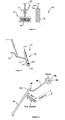
- the controls of a typical motor vehicle include an accelerator pedal 10 and a brake pedal 12.
- a vehicle equipped with a manually operated gear train may be additionally equipped with a clutch pedal, the present invention is concerned only with the two pedals, accelerator pedal 10 and brake pedal 12.
- the brake pedal 12 As also shown in Figure 3 , the brake pedal 12 according to the invention, is provided with a control module 14, the function of which will be explained in more detail below. As best seen in Figures 3 and 4 , the accelerator pedal 10 is provided with a secondary reaction surface 16.
- Secondary reaction surface 16 in a first preferred embodiment shown in Figure 4 comprises an auxiliary pedal 18, attached to a standard accelerator pedal 20 by a hinge 21, and covers at least a portion of the accelerator pedal 20.
- the auxiliary pedal 18 is arranged so it can be depressed against a spring 24 a certain amount relative to the surface 22 of accelerator pedal 20, without inducing movement in accelerator pedal 20.
- the pressure applied is transmitted to the accelerator pedal 20, causing it to depress and urge the vehicle into motion in the usual way.
- Auxiliary pedal 18 is thus arranged to move between a first deactivated state shown in Figure 4 , (when there is a maximum possible movement between the auxiliary pedal 18 and the surface 22 of pedal 20), and the fully activated state at the point where further application of pressure will induce movement in accelerator pedal 20.
- This movement between the deactivated state and the fully activated state is monitored by a sensor in this instance implemented in the form of a potentiometer 205A and relayed by lead 26 to control module 14 as force data.
- the pressure which needs to be applied either to the auxiliary pedal 18 to operate the system from a deactivated state to a fully activated state must be less than the pressure required to depress the accelerator pedal.
- the difference in pressures is such that there is a noticeable neutral feel zone perceptible to a driver. In a preferred form this is implemented by way of a mechanical detent (refer inset in figure 2 ). Also in a preferred form a switch is activated in this zone causing illumination of "coasting" light on the dashboard of the vehicle.
- control module 14 is mounted rearward of arm 32 of brake pedal 12, either on the inside of the firewall 33 or foot well 34 where space permits, or in the engine bay on the outside of firewall 33.
- Control module 14 includes control and logic circuitry and a servomotor (not shown).
- the servomotor may take the form of a linear or rotary actuator which acts on a coupling 38 between the control module 14 and brake pedal arm 32.
- Coupling 38 is flexible, preferably a cable, so that the brake pedal 12 may be activated manually by pressure from the driver's foot regardless of the state of the actuator of control module 14.
- the servomotor acts to vary the depression of brake pedal 12 from its first deactivated state as shown in Figure 6 , to a maximum activated state, that is the state of depression commensurate with at least a percentage of maximum available braking force.
- the secondary reaction surface takes the form of a guide arm mechanically associated with a pivot which operates a sensor 150 preferably in the form of an angle transducer.
- operation is such that depression of accelerator pedal 20 causes a top portion 151 of accelerator pedal 20 to press against a secondary reaction surface in the form of pivot arm extension surface 152 thereby to cause rotation of sensor arm 153 about pivot 154 which causes operation of an angle sensor (not shown).
- the angle sensor can be a potentiometer 205A as shown in Figure 9 thereby to impart a signal proportional to the angular position of pivot arm 153. This angular information is utilised by the control system in the manner previously described.
- accelerator pedal 20 operates against arm 155 which, in turn, operates against secondary reaction surface 156 located on an extended portion of pivot arm 157 of angular sensor 158. Operation of the accelerator pedal 20 causes rotation of pivot arm 157 thereby to vary the angular position of angular sensor 158 thereby to impart an angle signal for use by the control system in the manner previously described.
- brake pedal 12 is provided on its surface with a secondary reaction surface, in this instance a pressure sensitive pad 40, incorporating a switch (not shown). Immediately pressure is applied to the brake pedal via pad 40 by the foot of a driver, the switch disables control module 14, so that manual control of braking action is returned to the driver.
- a secondary reaction surface in this instance a pressure sensitive pad 40, incorporating a switch (not shown).
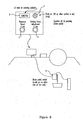
- the control can comprise an illuminated button which illuminates when and only when the system is on. By means of this control, a driver may select to operate the vehicle's braking system via the accelerator, or to retain normal manual control of the brake pedal.
- the first of these controls 3 allows a driver to vary the rate at which the servo motor of the control module 14 responds to input signals received from the accelerator pedal's secondary reaction surface.
- the second control 4 allows the driver to select the percentage of the maximum available braking force of the vehicle as the maximum to be applied by the control module 14.
- the system is further provided with an indicator light 8 mounted in view of the driver which indicates when the secondary reaction surface and the accelerator pedal are in the neutral feel zone, that is to say, when a moving vehicle is coasting, with no acceleration applied to the engine or any retarding force applied by the brakes.
- an indicator light 8 mounted in view of the driver which indicates when the secondary reaction surface and the accelerator pedal are in the neutral feel zone, that is to say, when a moving vehicle is coasting, with no acceleration applied to the engine or any retarding force applied by the brakes.
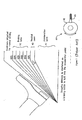
- Figure 7 shows graphically an example of the interaction of the movement of auxiliary pedal 18, with the operation of the vehicle's brakes.
- the control module 14 holds the brake pedal 12 in a depressed state to exert a braking force of 140Nm (the maximum braking force selected by the driver). At this point, the auxiliary pedal 18 has not moved relative to the surface 22 accelerator pedal 20.
- a driver may remove pressure on the secondary reaction surface (and thus on the accelerator pedal) to the point where the accelerator pedal is fully retracted from its depressed state. Further reduction of pressure then begins to reduce the depression of auxiliary pedal 18 from its maximum deflection of 25mm (or the reduction of pressure on pressure sensitive mat 32 from 20Nm). This causes the control module to gradually depress the brake pedal and apply a corresponding proportion of the maximum set braking force, bringing the vehicle to a braked standstill.
- control module is programmed, on sensing the corresponding rate of movement of the accelerator pedal by the accelerator sensor to activate maximum braking power.
- the advantage of the present system in a stop/start traffic situation is that by simply manipulating the accelerator pedal, a driver may alternatively bring the vehicle into motion and to a braked standstill. This is particularly advantageous in an automatic vehicle in which typically creep, even with the accelerator pedal completely released, forces a driver to manually apply the brakes each time the vehicle needs to be brought to a standstill.
- dashboard mounted indicator light 8 becomes dash board mounted indicator light 208.
- accelerator pedal 220 has its position sensed by a potentiometer arrangement 205A or equivalent whereby a signal proportional to accelerator pedal position is passed either directly as a digital signal or via A/D converter 242 to microprocessor 240 within the vehicle electronic control module 202.
- the vehicle electronic control module 202 controls many of the functions of the vehicle based on data it receives from various sensors including the accelerator position sensor just described. Most vehicles also include a master cylinder (which can be combined with a vacuum assist arrangement). The master cylinder 250 is mechanically linked to the brake pedal arm 245. A sensing arrangement 251 communicates brake fluid pressure data via analogue to digital converter 243 to microprocessor 240. In this embodiment an auxiliary control module 252 is in electronic communication with the vehicle control module 202 and also with ancillary components of the braking system of this embodiment including the sensor light 208 and other dashboard mounted components as illustrated in Fig 10 .
- the microprocessor 240 can be programmed to include a modified characteristic as compared with the accelerator/ braking profile illustrated in fig 7 . That is to say in a "hill assist" mode where the vehicle is caused to brake on a sloping surface the "neutral zone” behaviour characteristic is by-passed with the vehicle proceeding from braking mode direct to powered mode so that there is no roll back of the vehicle on the sloping surface.
Landscapes
- Engineering & Computer Science (AREA)
- Transportation (AREA)
- Mechanical Engineering (AREA)
- Chemical & Material Sciences (AREA)
- Combustion & Propulsion (AREA)
- Automation & Control Theory (AREA)
- Human Computer Interaction (AREA)
- Regulating Braking Force (AREA)
- Braking Elements And Transmission Devices (AREA)
- Auxiliary Drives, Propulsion Controls, And Safety Devices (AREA)
- Mechanical Control Devices (AREA)
- Control Of Driving Devices And Active Controlling Of Vehicle (AREA)
Claims (15)
- Système de freinage d'accélérateur pour un véhicule ; ledit système de freinage étant réactif à des forces appliquées à une surface de réaction secondaire (16) d'une pédale d'accélérateur (10) dudit véhicule ; ledit système étant caractérisé par une transmission à un module de commande (14) de données correspondant auxdites forces appliquées à ladite surface de réaction secondaire, dans lequel une force de freinage est graduellement augmentée et réduite par opération de la pédale d'accélérateur (10) ; ledit module de commande incluant en outre un servomoteur installé en arrière d'un bras (32) de ladite pédale de frein (12) et couplé de manière opérationnelle à ladite pédale de frein (12) ; ledit servomoteur agissant pour faire varier l'enfoncement de ladite pédale de frein (12) proportionnellement à au moins un pourcentage de la force de freinage maximale disponible.
- Système de freinage d'accélérateur selon la revendication 1, dans lequel lesdites données comprennent des données de force ou des données d'angle.
- Système de freinage d'accélérateur selon la revendication 1 ou 2, dans lequel ledit module de commande (14) inclut une caractéristique de commande modifiée qui est appliquée lorsque ledit véhicule est sur une pente.
- Système de freinage d'accélérateur selon la revendication 3, dans lequel ladite caractéristique de commande modifiée opère dans un mode "d'assistance en côte" en sorte que lorsque ledit véhicule est amené à freiner sur une surface en pente, une caractéristique de comportement en "zone neutre" est contournée avec le véhicule qui passe directement d'un mode de freinage à un mode entraîné de telle sorte qu'il n'y ait aucun recul du véhicule sur la surface en pente lorsque le véhicule accélère à partir de l'arrêt.
- Système de freinage d'accélérateur selon l'une quelconque des revendications précédentes, dans lequel ledit servomoteur est relié audit bras (32) de ladite pédale de frein (12) au moyen d'un accouplement flexible (38).
- Système de freinage d'accélérateur selon l'une quelconque des revendications 1 à 5, dans lequel la surface de réaction secondaire (16) comprend une pédale auxiliaire articulée (18) fixée à ladite pédale d'accélérateur (20) ; ladite pédale auxiliaire articulée (18) étant agencée pour un mouvement d'un premier état désactivé à un second état entièrement activé par une pression appliquée par un pied d'un conducteur.
- Système de freinage d'accélérateur selon la revendication 6, dans lequel ladite pédale auxiliaire articulée (18) inclut un capteur en communication électronique avec ledit module de commande.
- Système de freinage d'accélérateur selon la revendication 7, dans lequel, dans ledit état entièrement activé, une pression supplémentaire appliquée par ledit pied dudit conducteur est transférée à ladite pédale d'accélérateur de manière à pousser ladite pédale d'accélérateur (20) dans une position activée.
- Système de freinage d'accélérateur selon l'une quelconque des revendications 6 à 8, dans lequel la pression appliquée par ledit pied d'un conducteur pour pousser ladite surface de réaction secondaire (16) dudit état désactivé audit état entièrement activé est inférieure à une pression requise pour pousser ladite pédale d'accélérateur (14) d'un état désactivé dans une dite position activée.
- Système de freinage d'accélérateur selon la revendication 8 ou 9, dans lequel une transition dudit état entièrement activé de ladite surface de réaction secondaire (16) à une dite position activée de ladite pédale d'accélérateur (20) inclut une zone de sensation neutre perceptible par ledit conducteur.
- Système de freinage d'accélérateur selon la revendication 10, dans lequel un voyant d'indication (8) monté à la vue d'un dit conducteur dudit véhicule est activé lorsque la pression appliquée à ladite pédale d'accélérateur est dans ladite zone de sensation neutre.
- Système de freinage d'accélérateur selon l'une quelconque des revendications 6 à 11, dans lequel une transition d'un dit état inactif à un dit état entièrement activé de ladite surface de réaction secondaire (16) est accompagnée d'une transition dudit système de freinage d'au moins un pourcentage de force de freinage maximale à une force de freinage nulle.
- Système de freinage d'accélérateur selon l'une quelconque des revendications 1 à 12, dans lequel ledit système de freinage d'accélérateur est activé par un commutateur d'activation monté de manière adaptée (7) à portée d'un conducteur dudit véhicule.
- Système de freinage d'accélérateur selon l'une quelconque des revendications 1 à 13, dans lequel un relâchement soudain de la pression sur ladite pédale d'accélérateur (20) et ladite surface de réaction secondaire (16) mettra en jeu une force de freinage réglée maximale.
- Système de freinage d'accélérateur selon l'une quelconque des revendications 1 à 14, dans lequel ladite pédale de frein est munie d'une surface de réaction secondaire ; ladite surface de réaction secondaire comprenant un patin sensible à une pression incorporant un commutateur de désactivation, en sorte qu'une pression appliquée à ladite surface de réaction secondaire actionne ledit commutateur pour désactiver ledit module de commande.
Applications Claiming Priority (3)
| Application Number | Priority Date | Filing Date | Title |
|---|---|---|---|
| AU2007904505A AU2007904505A0 (en) | 2007-08-21 | Accelerator Braking Module | |
| AU2007231765A AU2007231765B1 (en) | 2007-08-21 | 2007-10-31 | Accelerator Braking Module |
| PCT/AU2008/001213 WO2009023916A2 (fr) | 2007-08-21 | 2008-08-21 | Module de freinage d'accélérateur |
Publications (3)
| Publication Number | Publication Date |
|---|---|
| EP2190708A2 EP2190708A2 (fr) | 2010-06-02 |
| EP2190708A4 EP2190708A4 (fr) | 2011-10-19 |
| EP2190708B1 true EP2190708B1 (fr) | 2013-06-12 |
Family
ID=39665933
Family Applications (1)
| Application Number | Title | Priority Date | Filing Date |
|---|---|---|---|
| EP08782961.0A Not-in-force EP2190708B1 (fr) | 2007-08-21 | 2008-08-21 | Module de freinage d'accélérateur |
Country Status (4)
| Country | Link |
|---|---|
| US (1) | US20100152988A1 (fr) |
| EP (1) | EP2190708B1 (fr) |
| AU (2) | AU2007231765B1 (fr) |
| WO (1) | WO2009023916A2 (fr) |
Families Citing this family (14)
| Publication number | Priority date | Publication date | Assignee | Title |
|---|---|---|---|---|
| US9248810B2 (en) * | 2007-08-21 | 2016-02-02 | Erland George Olofsson | Accelerator braking module |
| US8930106B2 (en) | 2009-07-09 | 2015-01-06 | Toyota Jidosha Kabushiki Kaisha | Braking/driving force control device |
| DE102010042895A1 (de) | 2010-10-25 | 2012-04-26 | Thilo Frey | Stellvorrichtung zur Leistungssteuerung eines Verbrennungsmotors und Verfahren zur Leistungssteuerung des Verbrennungsmotors |
| AU2011226993B2 (en) * | 2011-06-29 | 2014-01-09 | Erland George Olofsson | Emergency Braking System |
| WO2013000042A1 (fr) * | 2011-06-29 | 2013-01-03 | Olofsson Erland | Pédale d'accélérateur améliorée dotée d'une action de freinage |
| TW201304989A (zh) * | 2011-07-20 | 2013-02-01 | Hon Hai Prec Ind Co Ltd | 車輛安全控制系統及方法 |
| US9371001B2 (en) | 2012-04-20 | 2016-06-21 | The Trustees Of Dartmouth College | Sudden acceleration shutdown device using hydraulic brake pressure detector to disable vehicle on driver panic |
| US9026348B2 (en) | 2012-12-21 | 2015-05-05 | Honda Motor Co., Ltd. | System and method for brake coaching |
| DE102013204716B3 (de) | 2013-03-18 | 2014-05-28 | Ford Global Technologies, Llc | Verfahren zum Betrieb einer hydraulischen Bremsanlage |
| US20150210264A1 (en) * | 2014-01-29 | 2015-07-30 | Continental Automotive Systems, Inc. | Reverse vehicle speed control using only the brake pedal |
| FR3024855A1 (fr) | 2014-08-12 | 2016-02-19 | Peugeot Citroen Automobiles Sa | Procede et dispositif de determination du couple de consigne a appliquer aux roues d'un vehicule automobile |
| JP7363852B2 (ja) * | 2021-04-23 | 2023-10-18 | トヨタ自動車株式会社 | 車両の制御装置 |
| EP4159558B1 (fr) | 2021-09-29 | 2024-05-29 | KNORR-BREMSE Systeme für Nutzfahrzeuge GmbH | Dispositif de frein au pied pour véhicules |
| US12337809B2 (en) * | 2023-03-14 | 2025-06-24 | Ford Global Technologies, Llc | Stowable vehicle pedal system and method |
Family Cites Families (19)
| Publication number | Priority date | Publication date | Assignee | Title |
|---|---|---|---|---|
| US3082851A (en) * | 1958-08-22 | 1963-03-26 | Holland | Accelerator pedal controlled air brake system for vehicles |
| US3726369A (en) * | 1971-01-14 | 1973-04-10 | J Esteves | Automatic brake actuator |
| US3891071A (en) * | 1973-12-10 | 1975-06-24 | Borg Warner | Transient brake application upon accelerator release |
| JPS57167845A (en) | 1981-04-07 | 1982-10-15 | Honda Motor Co Ltd | Vehicle throttle reaction force control system |
| US5007516A (en) * | 1988-10-11 | 1991-04-16 | Japan Electronics Industry, Limited | Motor vehicle braking apparatus using accelerator pedal |
| US5193640A (en) * | 1991-01-17 | 1993-03-16 | Lee Hae Seung | Vehicle safety system for driver pedal misapplication |
| US5810107A (en) * | 1995-09-20 | 1998-09-22 | Alla Krel | One pedal safety driving system |
| DE19745128C2 (de) * | 1997-10-13 | 1999-08-19 | Daimler Chrysler Ag | Verfahren zur Bestimmung eines Auslöseschwellenwertes für einen automatischen Bremsvorgang |
| GB9721723D0 (en) * | 1997-10-15 | 1997-12-10 | Rover Group | Vehicle brake systems |
| DE19753764A1 (de) * | 1997-12-04 | 1999-06-10 | Itt Mfg Enterprises Inc | Verfahren und Vorrichtung zum Manövrieren von Kraftfahrzeugen |
| DE19909326A1 (de) * | 1999-03-03 | 2000-09-21 | Lucas Ind Plc | Vorrichtung und Verfahren zum Steuern der Fahrgeschwindigkeit eines Kraftfahrzeuges |
| DE19922338A1 (de) * | 1999-05-14 | 2000-11-23 | Bayerische Motoren Werke Ag | Verfahren zum Herstellen einer vorgegebenen Wirkbeziehung zwischen der Betätigung des Fahrpedals und dem daraus resultierenden Bremsmoment eines Fahrzeugs |
| EP1065092A3 (fr) * | 1999-07-01 | 2005-03-30 | Hitachi, Ltd. | Appareil pour régler le freinage et l'effort tractif dans un véhicule |
| JP3951546B2 (ja) * | 2000-03-23 | 2007-08-01 | 日産自動車株式会社 | 車両用アクセルペダル装置 |
| AU726946C (en) * | 2000-05-19 | 2002-11-07 | Erland George Olofsson | Accelerator pedal with braking action |
| AU2004201225B2 (en) * | 2000-05-19 | 2007-06-07 | Erland George Olofsson | Accelerator Pedal with Braking Action |
| DE10036337A1 (de) * | 2000-07-26 | 2002-02-14 | Bayerische Motoren Werke Ag | Vorrichtung und Verfahren zur Einstellung einer Sollverzögerung eines Fahrzeuges |
| DE10063062A1 (de) * | 2000-12-18 | 2002-06-20 | Lucas Varity Gmbh | Verfahren und Vorrichtung zum Steuern einer Bremsausrüstung eines Kraftfahrzeuges |
| EP1695859A1 (fr) * | 2005-02-23 | 2006-08-30 | Robert Bosch Gmbh | Système de commande de vitesse adaptatif |
-
2007
- 2007-10-31 AU AU2007231765A patent/AU2007231765B1/en active Active
-
2008
- 2008-08-21 WO PCT/AU2008/001213 patent/WO2009023916A2/fr not_active Ceased
- 2008-08-21 EP EP08782961.0A patent/EP2190708B1/fr not_active Not-in-force
- 2008-08-21 US US12/733,249 patent/US20100152988A1/en not_active Abandoned
-
2013
- 2013-03-14 AU AU2013201516A patent/AU2013201516A1/en not_active Abandoned
Also Published As
| Publication number | Publication date |
|---|---|
| WO2009023916A2 (fr) | 2009-02-26 |
| US20100152988A1 (en) | 2010-06-17 |
| EP2190708A2 (fr) | 2010-06-02 |
| WO2009023916A3 (fr) | 2009-04-09 |
| AU2007231765B1 (en) | 2008-07-10 |
| AU2013201516A1 (en) | 2014-10-02 |
| EP2190708A4 (fr) | 2011-10-19 |
Similar Documents
| Publication | Publication Date | Title |
|---|---|---|
| US20100152988A1 (en) | Accelerator braking module | |
| US9248810B2 (en) | Accelerator braking module | |
| US4676354A (en) | Motor, brake and bearing controlled hill holder | |
| WO2013000042A1 (fr) | Pédale d'accélérateur améliorée dotée d'une action de freinage | |
| EP0983894B1 (fr) | Régulation de la vitesse d'un véhicule en utilisant les freins et le moteur pour obtenir l' accélération désirée | |
| US6994407B2 (en) | Method and device for controlling the braking equipment of a motor vehicle | |
| US4078628A (en) | Double-wheel automotive hand control system | |
| EP2548095B1 (fr) | Système de commande de véhicule | |
| KR100575902B1 (ko) | 자동으로 작동되는 클러치를 가진 차량 및 클러치의 토크를 제어하기 위한 방법. | |
| GB2152710A (en) | Device for regulating the speed of a motor vehicle | |
| GB2341430B (en) | Vehicle brake control | |
| GB2284028A (en) | Parking aid with brake intervention | |
| SE506691C2 (sv) | Anordning för att styra drivningen av ett fordon | |
| AU2018282491B1 (en) | Improved Accelerator Pedal with Braking Action | |
| AU782605B2 (en) | Secondary brake system with electrohydraulic proportional valve | |
| US6296327B1 (en) | Braking device | |
| EP1083075A1 (fr) | Système de régulation de vitesse adaptatif avec commande de freinage | |
| EP0798480A2 (fr) | Embrayage automatique pour véhicules | |
| EP2660114B1 (fr) | Système de détection de force de freinage de stationnement pour tracteur | |
| US20100326778A1 (en) | Brake pedal simulator and brake system | |
| KR100705139B1 (ko) | 가속페달 오조작 방지장치 | |
| KR100405665B1 (ko) | 자동변속기 차량의 후진 오동작 방지 시스템 | |
| RU2730701C1 (ru) | Система управления скоростью автомобиля с двигателем внутреннего сгорания одной педалью | |
| KR20260028272A (ko) | 가속 페달 | |
| JP2007276625A (ja) | 車両の停車保持制御解除装置 |
Legal Events
| Date | Code | Title | Description |
|---|---|---|---|
| PUAI | Public reference made under article 153(3) epc to a published international application that has entered the european phase |
Free format text: ORIGINAL CODE: 0009012 |
|
| 17P | Request for examination filed |
Effective date: 20100319 |
|
| AK | Designated contracting states |
Kind code of ref document: A2 Designated state(s): AT BE BG CH CY CZ DE DK EE ES FI FR GB GR HR HU IE IS IT LI LT LU LV MC MT NL NO PL PT RO SE SI SK TR |
|
| AX | Request for extension of the european patent |
Extension state: AL BA MK RS |
|
| A4 | Supplementary search report drawn up and despatched |
Effective date: 20110916 |
|
| RIC1 | Information provided on ipc code assigned before grant |
Ipc: G05F 1/30 20060101ALI20110912BHEP Ipc: B60T 7/12 20060101ALI20110912BHEP Ipc: B60W 10/18 20060101ALI20110912BHEP Ipc: B60T 7/14 20060101ALI20110912BHEP Ipc: B60W 10/06 20060101AFI20110912BHEP Ipc: B60K 26/02 20060101ALI20110912BHEP Ipc: B60W 10/04 20060101ALI20110912BHEP Ipc: B60T 7/04 20060101ALI20110912BHEP Ipc: B60T 8/32 20060101ALN20110912BHEP |
|
| 17Q | First examination report despatched |
Effective date: 20120712 |
|
| DAX | Request for extension of the european patent (deleted) | ||
| GRAP | Despatch of communication of intention to grant a patent |
Free format text: ORIGINAL CODE: EPIDOSNIGR1 |
|
| RIC1 | Information provided on ipc code assigned before grant |
Ipc: B60T 8/32 20060101ALN20121214BHEP Ipc: B60T 7/12 20060101ALI20121214BHEP Ipc: B60W 10/04 20060101ALI20121214BHEP Ipc: B60T 7/14 20060101ALI20121214BHEP Ipc: B60T 7/04 20060101ALI20121214BHEP Ipc: G05F 1/30 20060101ALI20121214BHEP Ipc: B60K 26/02 20060101ALI20121214BHEP Ipc: B60W 10/06 20060101AFI20121214BHEP Ipc: B60W 10/18 20120101ALI20121214BHEP |
|
| GRAS | Grant fee paid |
Free format text: ORIGINAL CODE: EPIDOSNIGR3 |
|
| GRAA | (expected) grant |
Free format text: ORIGINAL CODE: 0009210 |
|
| AK | Designated contracting states |
Kind code of ref document: B1 Designated state(s): AT BE BG CH CY CZ DE DK EE ES FI FR GB GR HR HU IE IS IT LI LT LU LV MC MT NL NO PL PT RO SE SI SK TR |
|
| REG | Reference to a national code |
Ref country code: GB Ref legal event code: FG4D |
|
| REG | Reference to a national code |
Ref country code: CH Ref legal event code: EP |
|
| REG | Reference to a national code |
Ref country code: AT Ref legal event code: REF Ref document number: 616572 Country of ref document: AT Kind code of ref document: T Effective date: 20130615 |
|
| REG | Reference to a national code |
Ref country code: IE Ref legal event code: FG4D |
|
| REG | Reference to a national code |
Ref country code: DE Ref legal event code: R096 Ref document number: 602008025322 Country of ref document: DE Effective date: 20130808 |
|
| REG | Reference to a national code |
Ref country code: SE Ref legal event code: TRGR |
|
| PG25 | Lapsed in a contracting state [announced via postgrant information from national office to epo] |
Ref country code: ES Free format text: LAPSE BECAUSE OF FAILURE TO SUBMIT A TRANSLATION OF THE DESCRIPTION OR TO PAY THE FEE WITHIN THE PRESCRIBED TIME-LIMIT Effective date: 20130923 Ref country code: SI Free format text: LAPSE BECAUSE OF FAILURE TO SUBMIT A TRANSLATION OF THE DESCRIPTION OR TO PAY THE FEE WITHIN THE PRESCRIBED TIME-LIMIT Effective date: 20130612 Ref country code: LT Free format text: LAPSE BECAUSE OF FAILURE TO SUBMIT A TRANSLATION OF THE DESCRIPTION OR TO PAY THE FEE WITHIN THE PRESCRIBED TIME-LIMIT Effective date: 20130612 Ref country code: FI Free format text: LAPSE BECAUSE OF FAILURE TO SUBMIT A TRANSLATION OF THE DESCRIPTION OR TO PAY THE FEE WITHIN THE PRESCRIBED TIME-LIMIT Effective date: 20130612 Ref country code: GR Free format text: LAPSE BECAUSE OF FAILURE TO SUBMIT A TRANSLATION OF THE DESCRIPTION OR TO PAY THE FEE WITHIN THE PRESCRIBED TIME-LIMIT Effective date: 20130913 Ref country code: NO Free format text: LAPSE BECAUSE OF FAILURE TO SUBMIT A TRANSLATION OF THE DESCRIPTION OR TO PAY THE FEE WITHIN THE PRESCRIBED TIME-LIMIT Effective date: 20130912 |
|
| REG | Reference to a national code |
Ref country code: AT Ref legal event code: MK05 Ref document number: 616572 Country of ref document: AT Kind code of ref document: T Effective date: 20130612 |
|
| REG | Reference to a national code |
Ref country code: NL Ref legal event code: VDEP Effective date: 20130612 |
|
| REG | Reference to a national code |
Ref country code: LT Ref legal event code: MG4D |
|
| PG25 | Lapsed in a contracting state [announced via postgrant information from national office to epo] |
Ref country code: HR Free format text: LAPSE BECAUSE OF FAILURE TO SUBMIT A TRANSLATION OF THE DESCRIPTION OR TO PAY THE FEE WITHIN THE PRESCRIBED TIME-LIMIT Effective date: 20130612 Ref country code: BG Free format text: LAPSE BECAUSE OF FAILURE TO SUBMIT A TRANSLATION OF THE DESCRIPTION OR TO PAY THE FEE WITHIN THE PRESCRIBED TIME-LIMIT Effective date: 20130912 |
|
| PG25 | Lapsed in a contracting state [announced via postgrant information from national office to epo] |
Ref country code: LV Free format text: LAPSE BECAUSE OF FAILURE TO SUBMIT A TRANSLATION OF THE DESCRIPTION OR TO PAY THE FEE WITHIN THE PRESCRIBED TIME-LIMIT Effective date: 20130612 |
|
| PG25 | Lapsed in a contracting state [announced via postgrant information from national office to epo] |
Ref country code: EE Free format text: LAPSE BECAUSE OF FAILURE TO SUBMIT A TRANSLATION OF THE DESCRIPTION OR TO PAY THE FEE WITHIN THE PRESCRIBED TIME-LIMIT Effective date: 20130612 Ref country code: BE Free format text: LAPSE BECAUSE OF FAILURE TO SUBMIT A TRANSLATION OF THE DESCRIPTION OR TO PAY THE FEE WITHIN THE PRESCRIBED TIME-LIMIT Effective date: 20130612 Ref country code: IS Free format text: LAPSE BECAUSE OF FAILURE TO SUBMIT A TRANSLATION OF THE DESCRIPTION OR TO PAY THE FEE WITHIN THE PRESCRIBED TIME-LIMIT Effective date: 20131012 Ref country code: AT Free format text: LAPSE BECAUSE OF FAILURE TO SUBMIT A TRANSLATION OF THE DESCRIPTION OR TO PAY THE FEE WITHIN THE PRESCRIBED TIME-LIMIT Effective date: 20130612 Ref country code: SK Free format text: LAPSE BECAUSE OF FAILURE TO SUBMIT A TRANSLATION OF THE DESCRIPTION OR TO PAY THE FEE WITHIN THE PRESCRIBED TIME-LIMIT Effective date: 20130612 Ref country code: PT Free format text: LAPSE BECAUSE OF FAILURE TO SUBMIT A TRANSLATION OF THE DESCRIPTION OR TO PAY THE FEE WITHIN THE PRESCRIBED TIME-LIMIT Effective date: 20131014 Ref country code: CZ Free format text: LAPSE BECAUSE OF FAILURE TO SUBMIT A TRANSLATION OF THE DESCRIPTION OR TO PAY THE FEE WITHIN THE PRESCRIBED TIME-LIMIT Effective date: 20130612 |
|
| PG25 | Lapsed in a contracting state [announced via postgrant information from national office to epo] |
Ref country code: RO Free format text: LAPSE BECAUSE OF FAILURE TO SUBMIT A TRANSLATION OF THE DESCRIPTION OR TO PAY THE FEE WITHIN THE PRESCRIBED TIME-LIMIT Effective date: 20130612 Ref country code: NL Free format text: LAPSE BECAUSE OF FAILURE TO SUBMIT A TRANSLATION OF THE DESCRIPTION OR TO PAY THE FEE WITHIN THE PRESCRIBED TIME-LIMIT Effective date: 20130612 Ref country code: PL Free format text: LAPSE BECAUSE OF FAILURE TO SUBMIT A TRANSLATION OF THE DESCRIPTION OR TO PAY THE FEE WITHIN THE PRESCRIBED TIME-LIMIT Effective date: 20130612 |
|
| REG | Reference to a national code |
Ref country code: CH Ref legal event code: PL |
|
| PLBE | No opposition filed within time limit |
Free format text: ORIGINAL CODE: 0009261 |
|
| STAA | Information on the status of an ep patent application or granted ep patent |
Free format text: STATUS: NO OPPOSITION FILED WITHIN TIME LIMIT |
|
| PG25 | Lapsed in a contracting state [announced via postgrant information from national office to epo] |
Ref country code: LI Free format text: LAPSE BECAUSE OF NON-PAYMENT OF DUE FEES Effective date: 20130831 Ref country code: MC Free format text: LAPSE BECAUSE OF FAILURE TO SUBMIT A TRANSLATION OF THE DESCRIPTION OR TO PAY THE FEE WITHIN THE PRESCRIBED TIME-LIMIT Effective date: 20130612 Ref country code: DK Free format text: LAPSE BECAUSE OF FAILURE TO SUBMIT A TRANSLATION OF THE DESCRIPTION OR TO PAY THE FEE WITHIN THE PRESCRIBED TIME-LIMIT Effective date: 20130612 Ref country code: CH Free format text: LAPSE BECAUSE OF NON-PAYMENT OF DUE FEES Effective date: 20130831 |
|
| 26N | No opposition filed |
Effective date: 20140313 |
|
| REG | Reference to a national code |
Ref country code: IE Ref legal event code: MM4A |
|
| REG | Reference to a national code |
Ref country code: FR Ref legal event code: ST Effective date: 20140430 |
|
| REG | Reference to a national code |
Ref country code: DE Ref legal event code: R097 Ref document number: 602008025322 Country of ref document: DE Effective date: 20140313 |
|
| PG25 | Lapsed in a contracting state [announced via postgrant information from national office to epo] |
Ref country code: IE Free format text: LAPSE BECAUSE OF NON-PAYMENT OF DUE FEES Effective date: 20130821 |
|
| PG25 | Lapsed in a contracting state [announced via postgrant information from national office to epo] |
Ref country code: FR Free format text: LAPSE BECAUSE OF NON-PAYMENT OF DUE FEES Effective date: 20130902 |
|
| PG25 | Lapsed in a contracting state [announced via postgrant information from national office to epo] |
Ref country code: MT Free format text: LAPSE BECAUSE OF FAILURE TO SUBMIT A TRANSLATION OF THE DESCRIPTION OR TO PAY THE FEE WITHIN THE PRESCRIBED TIME-LIMIT Effective date: 20130612 Ref country code: TR Free format text: LAPSE BECAUSE OF FAILURE TO SUBMIT A TRANSLATION OF THE DESCRIPTION OR TO PAY THE FEE WITHIN THE PRESCRIBED TIME-LIMIT Effective date: 20130612 Ref country code: CY Free format text: LAPSE BECAUSE OF FAILURE TO SUBMIT A TRANSLATION OF THE DESCRIPTION OR TO PAY THE FEE WITHIN THE PRESCRIBED TIME-LIMIT Effective date: 20130612 |
|
| PG25 | Lapsed in a contracting state [announced via postgrant information from national office to epo] |
Ref country code: HU Free format text: LAPSE BECAUSE OF FAILURE TO SUBMIT A TRANSLATION OF THE DESCRIPTION OR TO PAY THE FEE WITHIN THE PRESCRIBED TIME-LIMIT; INVALID AB INITIO Effective date: 20080821 Ref country code: LU Free format text: LAPSE BECAUSE OF NON-PAYMENT OF DUE FEES Effective date: 20130821 |
|
| PGFP | Annual fee paid to national office [announced via postgrant information from national office to epo] |
Ref country code: ES Payment date: 20180904 Year of fee payment: 11 |
|
| PGFP | Annual fee paid to national office [announced via postgrant information from national office to epo] |
Ref country code: SE Payment date: 20180813 Year of fee payment: 11 |
|
| REG | Reference to a national code |
Ref country code: SE Ref legal event code: EUG |
|
| PG25 | Lapsed in a contracting state [announced via postgrant information from national office to epo] |
Ref country code: SE Free format text: LAPSE BECAUSE OF NON-PAYMENT OF DUE FEES Effective date: 20190822 |
|
| REG | Reference to a national code |
Ref country code: DE Ref legal event code: R082 Ref document number: 602008025322 Country of ref document: DE Representative=s name: WINTER, BRANDL, FUERNISS, HUEBNER, ROESS, KAIS, DE Ref country code: DE Ref legal event code: R082 Ref document number: 602008025322 Country of ref document: DE Representative=s name: WINTER, BRANDL - PARTNERSCHAFT MBB, PATENTANWA, DE |
|
| PG25 | Lapsed in a contracting state [announced via postgrant information from national office to epo] |
Ref country code: IT Free format text: LAPSE BECAUSE OF NON-PAYMENT OF DUE FEES Effective date: 20190821 |
|
| PGFP | Annual fee paid to national office [announced via postgrant information from national office to epo] |
Ref country code: DE Payment date: 20240828 Year of fee payment: 17 |
|
| PGFP | Annual fee paid to national office [announced via postgrant information from national office to epo] |
Ref country code: GB Payment date: 20240827 Year of fee payment: 17 |
|
| REG | Reference to a national code |
Ref country code: DE Ref legal event code: R119 Ref document number: 602008025322 Country of ref document: DE |
|
| GBPC | Gb: european patent ceased through non-payment of renewal fee |
Effective date: 20250821 |
|
| PG25 | Lapsed in a contracting state [announced via postgrant information from national office to epo] |
Ref country code: GB Free format text: LAPSE BECAUSE OF NON-PAYMENT OF DUE FEES Effective date: 20250821 |
|
| PG25 | Lapsed in a contracting state [announced via postgrant information from national office to epo] |
Ref country code: DE Free format text: LAPSE BECAUSE OF NON-PAYMENT OF DUE FEES Effective date: 20260303 |