EP2190809B1 - Procédé pour produire des composés -alkylcarbonyle optiquement actifs - Google Patents
Procédé pour produire des composés -alkylcarbonyle optiquement actifs Download PDFInfo
- Publication number
- EP2190809B1 EP2190809B1 EP08802340A EP08802340A EP2190809B1 EP 2190809 B1 EP2190809 B1 EP 2190809B1 EP 08802340 A EP08802340 A EP 08802340A EP 08802340 A EP08802340 A EP 08802340A EP 2190809 B1 EP2190809 B1 EP 2190809B1
- Authority
- EP
- European Patent Office
- Prior art keywords
- radical
- carbon atoms
- compounds
- group
- formula
- Prior art date
- Legal status (The legal status is an assumption and is not a legal conclusion. Google has not performed a legal analysis and makes no representation as to the accuracy of the status listed.)
- Not-in-force
Links
- 238000000034 method Methods 0.000 title claims abstract description 76
- 238000004519 manufacturing process Methods 0.000 title claims abstract description 8
- 125000004448 alkyl carbonyl group Chemical group 0.000 title 1
- -1 alkyl radical Chemical class 0.000 claims description 83
- 125000004432 carbon atom Chemical group C* 0.000 claims description 52
- 150000001875 compounds Chemical class 0.000 claims description 45
- RTZKZFJDLAIYFH-UHFFFAOYSA-N Diethyl ether Chemical compound CCOCC RTZKZFJDLAIYFH-UHFFFAOYSA-N 0.000 claims description 36
- WYURNTSHIVDZCO-UHFFFAOYSA-N Tetrahydrofuran Chemical compound C1CCOC1 WYURNTSHIVDZCO-UHFFFAOYSA-N 0.000 claims description 26
- 238000006243 chemical reaction Methods 0.000 claims description 25
- 125000005842 heteroatom Chemical group 0.000 claims description 19
- 150000005840 aryl radicals Chemical class 0.000 claims description 15
- 229910052717 sulfur Inorganic materials 0.000 claims description 15
- JVTAAEKCZFNVCJ-REOHCLBHSA-N L-lactic acid Chemical compound C[C@H](O)C(O)=O JVTAAEKCZFNVCJ-REOHCLBHSA-N 0.000 claims description 14
- 150000007942 carboxylates Chemical class 0.000 claims description 14
- 150000002367 halogens Chemical group 0.000 claims description 14
- 229910052757 nitrogen Inorganic materials 0.000 claims description 13
- 229910052760 oxygen Inorganic materials 0.000 claims description 13
- 239000002904 solvent Substances 0.000 claims description 13
- 229910052698 phosphorus Inorganic materials 0.000 claims description 12
- 239000002253 acid Substances 0.000 claims description 11
- BJEPYKJPYRNKOW-REOHCLBHSA-N (S)-malic acid Chemical compound OC(=O)[C@@H](O)CC(O)=O BJEPYKJPYRNKOW-REOHCLBHSA-N 0.000 claims description 9
- 229910052736 halogen Inorganic materials 0.000 claims description 9
- 125000002496 methyl group Chemical group [H]C([H])([H])* 0.000 claims description 9
- 150000001413 amino acids Chemical class 0.000 claims description 8
- 229910052799 carbon Inorganic materials 0.000 claims description 7
- 125000005587 carbonate group Chemical group 0.000 claims description 7
- 239000000203 mixture Substances 0.000 claims description 7
- YLQBMQCUIZJEEH-UHFFFAOYSA-N tetrahydrofuran Natural products C=1C=COC=1 YLQBMQCUIZJEEH-UHFFFAOYSA-N 0.000 claims description 7
- KXDHJXZQYSOELW-UHFFFAOYSA-N Carbamic acid Chemical group NC(O)=O KXDHJXZQYSOELW-UHFFFAOYSA-N 0.000 claims description 6
- 125000001797 benzyl group Chemical group [H]C1=C([H])C([H])=C(C([H])=C1[H])C([H])([H])* 0.000 claims description 6
- 125000001495 ethyl group Chemical group [H]C([H])([H])C([H])([H])* 0.000 claims description 6
- 125000002467 phosphate group Chemical group [H]OP(=O)(O[H])O[*] 0.000 claims description 6
- IWYDHOAUDWTVEP-ZETCQYMHSA-N (S)-mandelic acid Chemical compound OC(=O)[C@@H](O)C1=CC=CC=C1 IWYDHOAUDWTVEP-ZETCQYMHSA-N 0.000 claims description 5
- FEWJPZIEWOKRBE-JCYAYHJZSA-N Dextrotartaric acid Chemical compound OC(=O)[C@H](O)[C@@H](O)C(O)=O FEWJPZIEWOKRBE-JCYAYHJZSA-N 0.000 claims description 5
- BJEPYKJPYRNKOW-UHFFFAOYSA-N alpha-hydroxysuccinic acid Natural products OC(=O)C(O)CC(O)=O BJEPYKJPYRNKOW-UHFFFAOYSA-N 0.000 claims description 5
- 235000011090 malic acid Nutrition 0.000 claims description 5
- KXDHJXZQYSOELW-UHFFFAOYSA-M Carbamate Chemical compound NC([O-])=O KXDHJXZQYSOELW-UHFFFAOYSA-M 0.000 claims description 4
- 125000000113 cyclohexyl group Chemical group [H]C1([H])C([H])([H])C([H])([H])C([H])(*)C([H])([H])C1([H])[H] 0.000 claims description 4
- 125000003438 dodecyl group Chemical group [H]C([H])([H])C([H])([H])C([H])([H])C([H])([H])C([H])([H])C([H])([H])C([H])([H])C([H])([H])C([H])([H])C([H])([H])C([H])([H])C([H])([H])* 0.000 claims description 4
- 150000004820 halides Chemical class 0.000 claims description 4
- 125000000959 isobutyl group Chemical group [H]C([H])([H])C([H])(C([H])([H])[H])C([H])([H])* 0.000 claims description 4
- 125000001449 isopropyl group Chemical group [H]C([H])([H])C([H])(*)C([H])([H])[H] 0.000 claims description 4
- 229940116298 l- malic acid Drugs 0.000 claims description 4
- 125000002347 octyl group Chemical group [H]C([*])([H])C([H])([H])C([H])([H])C([H])([H])C([H])([H])C([H])([H])C([H])([H])C([H])([H])[H] 0.000 claims description 4
- 125000001424 substituent group Chemical group 0.000 claims description 4
- JWUJQDFVADABEY-UHFFFAOYSA-N 2-methyltetrahydrofuran Chemical compound CC1CCCO1 JWUJQDFVADABEY-UHFFFAOYSA-N 0.000 claims description 3
- 125000003903 2-propenyl group Chemical group [H]C([*])([H])C([H])=C([H])[H] 0.000 claims description 3
- 229910002651 NO3 Inorganic materials 0.000 claims description 3
- NHNBFGGVMKEFGY-UHFFFAOYSA-N Nitrate Chemical compound [O-][N+]([O-])=O NHNBFGGVMKEFGY-UHFFFAOYSA-N 0.000 claims description 3
- 229910019142 PO4 Inorganic materials 0.000 claims description 3
- QAOWNCQODCNURD-UHFFFAOYSA-L Sulfate Chemical compound [O-]S([O-])(=O)=O QAOWNCQODCNURD-UHFFFAOYSA-L 0.000 claims description 3
- 229910052798 chalcogen Inorganic materials 0.000 claims description 3
- 150000001787 chalcogens Chemical class 0.000 claims description 3
- 229910021645 metal ion Inorganic materials 0.000 claims description 3
- 125000001997 phenyl group Chemical group [H]C1=C([H])C([H])=C(*)C([H])=C1[H] 0.000 claims description 3
- NBIIXXVUZAFLBC-UHFFFAOYSA-K phosphate Chemical compound [O-]P([O-])([O-])=O NBIIXXVUZAFLBC-UHFFFAOYSA-K 0.000 claims description 3
- 239000010452 phosphate Substances 0.000 claims description 3
- 125000001273 sulfonato group Chemical group [O-]S(*)(=O)=O 0.000 claims description 3
- 125000000391 vinyl group Chemical group [H]C([*])=C([H])[H] 0.000 claims description 3
- 229920002554 vinyl polymer Chemical group 0.000 claims description 3
- BVKZGUZCCUSVTD-UHFFFAOYSA-L Carbonate Chemical compound [O-]C([O-])=O BVKZGUZCCUSVTD-UHFFFAOYSA-L 0.000 claims description 2
- 125000002914 sec-butyl group Chemical group [H]C([H])([H])C([H])([H])C([H])(*)C([H])([H])[H] 0.000 claims description 2
- JXLHNMVSKXFWAO-UHFFFAOYSA-N azane;7-fluoro-2,1,3-benzoxadiazole-4-sulfonic acid Chemical compound N.OS(=O)(=O)C1=CC=C(F)C2=NON=C12 JXLHNMVSKXFWAO-UHFFFAOYSA-N 0.000 claims 1
- 125000005394 methallyl group Chemical group 0.000 claims 1
- 125000004108 n-butyl group Chemical group [H]C([H])([H])C([H])([H])C([H])([H])C([H])([H])* 0.000 claims 1
- 229910021653 sulphate ion Inorganic materials 0.000 claims 1
- 125000002827 triflate group Chemical group FC(S(=O)(=O)O*)(F)F 0.000 claims 1
- 239000007858 starting material Substances 0.000 abstract description 31
- 125000000217 alkyl group Chemical group 0.000 abstract description 23
- 150000001728 carbonyl compounds Chemical class 0.000 abstract description 15
- 239000003054 catalyst Substances 0.000 abstract description 6
- 239000011701 zinc Substances 0.000 abstract description 6
- PTFCDOFLOPIGGS-UHFFFAOYSA-N Zinc dication Chemical class [Zn+2] PTFCDOFLOPIGGS-UHFFFAOYSA-N 0.000 abstract description 4
- 229910052725 zinc Inorganic materials 0.000 abstract description 4
- 231100000252 nontoxic Toxicity 0.000 abstract description 3
- 230000003000 nontoxic effect Effects 0.000 abstract description 3
- 238000006467 substitution reaction Methods 0.000 abstract description 3
- 230000014759 maintenance of location Effects 0.000 abstract 1
- 238000002360 preparation method Methods 0.000 description 23
- 125000003118 aryl group Chemical group 0.000 description 19
- 238000003786 synthesis reaction Methods 0.000 description 13
- 125000000999 tert-butyl group Chemical group [H]C([H])([H])C(*)(C([H])([H])[H])C([H])([H])[H] 0.000 description 12
- 230000015572 biosynthetic process Effects 0.000 description 11
- JIAARYAFYJHUJI-UHFFFAOYSA-L zinc dichloride Chemical compound [Cl-].[Cl-].[Zn+2] JIAARYAFYJHUJI-UHFFFAOYSA-L 0.000 description 11
- WMFOQBRAJBCJND-UHFFFAOYSA-M Lithium hydroxide Chemical compound [Li+].[OH-] WMFOQBRAJBCJND-UHFFFAOYSA-M 0.000 description 9
- 239000003208 petroleum Substances 0.000 description 9
- 239000000243 solution Substances 0.000 description 9
- XKRFYHLGVUSROY-UHFFFAOYSA-N Argon Chemical compound [Ar] XKRFYHLGVUSROY-UHFFFAOYSA-N 0.000 description 8
- 125000002915 carbonyl group Chemical group [*:2]C([*:1])=O 0.000 description 8
- 150000003254 radicals Chemical class 0.000 description 8
- 125000003342 alkenyl group Chemical group 0.000 description 7
- 239000000047 product Substances 0.000 description 7
- ITMCEJHCFYSIIV-UHFFFAOYSA-M triflate Chemical compound [O-]S(=O)(=O)C(F)(F)F ITMCEJHCFYSIIV-UHFFFAOYSA-M 0.000 description 7
- 239000011592 zinc chloride Substances 0.000 description 7
- ZAMOUSCENKQFHK-UHFFFAOYSA-N Chlorine atom Chemical compound [Cl] ZAMOUSCENKQFHK-UHFFFAOYSA-N 0.000 description 6
- YMWUJEATGCHHMB-UHFFFAOYSA-N Dichloromethane Chemical compound ClCCl YMWUJEATGCHHMB-UHFFFAOYSA-N 0.000 description 6
- KWYUFKZDYYNOTN-UHFFFAOYSA-M Potassium hydroxide Chemical compound [OH-].[K+] KWYUFKZDYYNOTN-UHFFFAOYSA-M 0.000 description 6
- 229940061720 alpha hydroxy acid Drugs 0.000 description 6
- 150000001280 alpha hydroxy acids Chemical class 0.000 description 6
- 229910052801 chlorine Inorganic materials 0.000 description 6
- 239000000460 chlorine Substances 0.000 description 6
- 125000001153 fluoro group Chemical group F* 0.000 description 6
- 125000001072 heteroaryl group Chemical group 0.000 description 6
- 125000003710 aryl alkyl group Chemical group 0.000 description 5
- 239000003153 chemical reaction reagent Substances 0.000 description 5
- 150000002148 esters Chemical class 0.000 description 5
- 239000011541 reaction mixture Substances 0.000 description 5
- 230000000707 stereoselective effect Effects 0.000 description 5
- FAPWRFPIFSIZLT-UHFFFAOYSA-M Sodium chloride Chemical compound [Na+].[Cl-] FAPWRFPIFSIZLT-UHFFFAOYSA-M 0.000 description 4
- 229910052786 argon Inorganic materials 0.000 description 4
- 239000011777 magnesium Substances 0.000 description 4
- 229910052749 magnesium Inorganic materials 0.000 description 4
- YCCXQARVHOPWFJ-UHFFFAOYSA-M magnesium;ethane;chloride Chemical compound [Mg+2].[Cl-].[CH2-]C YCCXQARVHOPWFJ-UHFFFAOYSA-M 0.000 description 4
- 239000012074 organic phase Substances 0.000 description 4
- 239000000758 substrate Substances 0.000 description 4
- VNRYWEYPDFBIDB-YFKPBYRVSA-N tert-butyl (2s)-2-(trifluoromethylsulfonyloxy)propanoate Chemical compound FC(F)(F)S(=O)(=O)O[C@@H](C)C(=O)OC(C)(C)C VNRYWEYPDFBIDB-YFKPBYRVSA-N 0.000 description 4
- KGIIQSSPLGYFJE-VIFPVBQESA-N tert-butyl (2s)-2-methylhexanoate Chemical compound CCCC[C@H](C)C(=O)OC(C)(C)C KGIIQSSPLGYFJE-VIFPVBQESA-N 0.000 description 4
- 235000005074 zinc chloride Nutrition 0.000 description 4
- RVQSHKHHIAIERU-REOHCLBHSA-N (2s)-2-(trifluoromethylsulfonyloxy)propanoic acid Chemical compound OC(=O)[C@H](C)OS(=O)(=O)C(F)(F)F RVQSHKHHIAIERU-REOHCLBHSA-N 0.000 description 3
- OISVCGZHLKNMSJ-UHFFFAOYSA-N 2,6-dimethylpyridine Chemical compound CC1=CC=CC(C)=N1 OISVCGZHLKNMSJ-UHFFFAOYSA-N 0.000 description 3
- IZXIZTKNFFYFOF-UHFFFAOYSA-N 2-Oxazolidone Chemical compound O=C1NCCO1 IZXIZTKNFFYFOF-UHFFFAOYSA-N 0.000 description 3
- CVKMFSAVYPAZTQ-UHFFFAOYSA-N 2-methylhexanoic acid Chemical compound CCCCC(C)C(O)=O CVKMFSAVYPAZTQ-UHFFFAOYSA-N 0.000 description 3
- 108090000790 Enzymes Proteins 0.000 description 3
- 102000004190 Enzymes Human genes 0.000 description 3
- 239000007818 Grignard reagent Substances 0.000 description 3
- VEXZGXHMUGYJMC-UHFFFAOYSA-N Hydrochloric acid Chemical compound Cl VEXZGXHMUGYJMC-UHFFFAOYSA-N 0.000 description 3
- KWYHDKDOAIKMQN-UHFFFAOYSA-N N,N,N',N'-tetramethylethylenediamine Chemical compound CN(C)CCN(C)C KWYHDKDOAIKMQN-UHFFFAOYSA-N 0.000 description 3
- VYPSYNLAJGMNEJ-UHFFFAOYSA-N Silicium dioxide Chemical compound O=[Si]=O VYPSYNLAJGMNEJ-UHFFFAOYSA-N 0.000 description 3
- QAOWNCQODCNURD-UHFFFAOYSA-N Sulfuric acid Chemical compound OS(O)(=O)=O QAOWNCQODCNURD-UHFFFAOYSA-N 0.000 description 3
- 150000001408 amides Chemical class 0.000 description 3
- 238000007796 conventional method Methods 0.000 description 3
- 230000032050 esterification Effects 0.000 description 3
- 238000005886 esterification reaction Methods 0.000 description 3
- 238000004508 fractional distillation Methods 0.000 description 3
- 150000004795 grignard reagents Chemical class 0.000 description 3
- 125000002887 hydroxy group Chemical group [H]O* 0.000 description 3
- MZRVEZGGRBJDDB-UHFFFAOYSA-N n-Butyllithium Substances [Li]CCCC MZRVEZGGRBJDDB-UHFFFAOYSA-N 0.000 description 3
- 125000002524 organometallic group Chemical group 0.000 description 3
- 239000000741 silica gel Substances 0.000 description 3
- 229910002027 silica gel Inorganic materials 0.000 description 3
- LPXPTNMVRIOKMN-UHFFFAOYSA-M sodium nitrite Chemical compound [Na+].[O-]N=O LPXPTNMVRIOKMN-UHFFFAOYSA-M 0.000 description 3
- BDHFUVZGWQCTTF-UHFFFAOYSA-M sulfonate Chemical compound [O-]S(=O)=O BDHFUVZGWQCTTF-UHFFFAOYSA-M 0.000 description 3
- XLYOFNOQVPJJNP-UHFFFAOYSA-N water Substances O XLYOFNOQVPJJNP-UHFFFAOYSA-N 0.000 description 3
- CVKMFSAVYPAZTQ-LURJTMIESA-N (2s)-2-methylhexanoic acid Chemical compound CCCC[C@H](C)C(O)=O CVKMFSAVYPAZTQ-LURJTMIESA-N 0.000 description 2
- NLXLAEXVIDQMFP-UHFFFAOYSA-N Ammonia chloride Chemical class [NH4+].[Cl-] NLXLAEXVIDQMFP-UHFFFAOYSA-N 0.000 description 2
- WKBOTKDWSSQWDR-UHFFFAOYSA-N Bromine atom Chemical compound [Br] WKBOTKDWSSQWDR-UHFFFAOYSA-N 0.000 description 2
- 238000003747 Grignard reaction Methods 0.000 description 2
- DGAQECJNVWCQMB-PUAWFVPOSA-M Ilexoside XXIX Chemical compound C[C@@H]1CC[C@@]2(CC[C@@]3(C(=CC[C@H]4[C@]3(CC[C@@H]5[C@@]4(CC[C@@H](C5(C)C)OS(=O)(=O)[O-])C)C)[C@@H]2[C@]1(C)O)C)C(=O)O[C@H]6[C@@H]([C@H]([C@@H]([C@H](O6)CO)O)O)O.[Na+] DGAQECJNVWCQMB-PUAWFVPOSA-M 0.000 description 2
- XEEYBQQBJWHFJM-UHFFFAOYSA-N Iron Chemical compound [Fe] XEEYBQQBJWHFJM-UHFFFAOYSA-N 0.000 description 2
- 238000005481 NMR spectroscopy Methods 0.000 description 2
- NBIIXXVUZAFLBC-UHFFFAOYSA-N Phosphoric acid Chemical compound OP(O)(O)=O NBIIXXVUZAFLBC-UHFFFAOYSA-N 0.000 description 2
- ZLMJMSJWJFRBEC-UHFFFAOYSA-N Potassium Chemical compound [K] ZLMJMSJWJFRBEC-UHFFFAOYSA-N 0.000 description 2
- LOUPRKONTZGTKE-WZBLMQSHSA-N Quinine Chemical class C([C@H]([C@H](C1)C=C)C2)C[N@@]1[C@@H]2[C@H](O)C1=CC=NC2=CC=C(OC)C=C21 LOUPRKONTZGTKE-WZBLMQSHSA-N 0.000 description 2
- 150000007513 acids Chemical class 0.000 description 2
- 150000001298 alcohols Chemical class 0.000 description 2
- 238000009876 asymmetric hydrogenation reaction Methods 0.000 description 2
- 238000011914 asymmetric synthesis Methods 0.000 description 2
- GDTBXPJZTBHREO-UHFFFAOYSA-N bromine Substances BrBr GDTBXPJZTBHREO-UHFFFAOYSA-N 0.000 description 2
- 229910052794 bromium Inorganic materials 0.000 description 2
- 150000001721 carbon Chemical group 0.000 description 2
- 230000003197 catalytic effect Effects 0.000 description 2
- 238000001816 cooling Methods 0.000 description 2
- 150000001879 copper Chemical class 0.000 description 2
- 239000012039 electrophile Substances 0.000 description 2
- GNOIPBMMFNIUFM-UHFFFAOYSA-N hexamethylphosphoric triamide Chemical compound CN(C)P(=O)(N(C)C)N(C)C GNOIPBMMFNIUFM-UHFFFAOYSA-N 0.000 description 2
- 239000000543 intermediate Substances 0.000 description 2
- PNDPGZBMCMUPRI-UHFFFAOYSA-N iodine Chemical compound II PNDPGZBMCMUPRI-UHFFFAOYSA-N 0.000 description 2
- JVTAAEKCZFNVCJ-UHFFFAOYSA-N lactic acid Chemical compound CC(O)C(O)=O JVTAAEKCZFNVCJ-UHFFFAOYSA-N 0.000 description 2
- 239000003446 ligand Substances 0.000 description 2
- QUXHCILOWRXCEO-UHFFFAOYSA-M magnesium;butane;chloride Chemical compound [Mg+2].[Cl-].CCC[CH2-] QUXHCILOWRXCEO-UHFFFAOYSA-M 0.000 description 2
- IUYHWZFSGMZEOG-UHFFFAOYSA-M magnesium;propane;chloride Chemical compound [Mg+2].[Cl-].C[CH-]C IUYHWZFSGMZEOG-UHFFFAOYSA-M 0.000 description 2
- 239000012038 nucleophile Substances 0.000 description 2
- 150000002902 organometallic compounds Chemical class 0.000 description 2
- 239000000546 pharmaceutical excipient Substances 0.000 description 2
- 229910052700 potassium Inorganic materials 0.000 description 2
- 239000011591 potassium Substances 0.000 description 2
- 238000001953 recrystallisation Methods 0.000 description 2
- 229920006395 saturated elastomer Polymers 0.000 description 2
- 229910052708 sodium Inorganic materials 0.000 description 2
- 239000011734 sodium Substances 0.000 description 2
- WRIKHQLVHPKCJU-UHFFFAOYSA-N sodium bis(trimethylsilyl)amide Chemical compound C[Si](C)(C)N([Na])[Si](C)(C)C WRIKHQLVHPKCJU-UHFFFAOYSA-N 0.000 description 2
- 239000011780 sodium chloride Substances 0.000 description 2
- 229910000104 sodium hydride Inorganic materials 0.000 description 2
- FQFILJKFZCVHNH-UHFFFAOYSA-N tert-butyl n-[3-[(5-bromo-2-chloropyrimidin-4-yl)amino]propyl]carbamate Chemical compound CC(C)(C)OC(=O)NCCCNC1=NC(Cl)=NC=C1Br FQFILJKFZCVHNH-UHFFFAOYSA-N 0.000 description 2
- WJKHJLXJJJATHN-UHFFFAOYSA-N triflic anhydride Chemical compound FC(F)(F)S(=O)(=O)OS(=O)(=O)C(F)(F)F WJKHJLXJJJATHN-UHFFFAOYSA-N 0.000 description 2
- 150000003751 zinc Chemical class 0.000 description 2
- 238000011911 α-alkylation Methods 0.000 description 2
- GHYOCDFICYLMRF-UTIIJYGPSA-N (2S,3R)-N-[(2S)-3-(cyclopenten-1-yl)-1-[(2R)-2-methyloxiran-2-yl]-1-oxopropan-2-yl]-3-hydroxy-3-(4-methoxyphenyl)-2-[[(2S)-2-[(2-morpholin-4-ylacetyl)amino]propanoyl]amino]propanamide Chemical compound C1(=CCCC1)C[C@@H](C(=O)[C@@]1(OC1)C)NC([C@H]([C@@H](C1=CC=C(C=C1)OC)O)NC([C@H](C)NC(CN1CCOCC1)=O)=O)=O GHYOCDFICYLMRF-UTIIJYGPSA-N 0.000 description 1
- QKIHLPFZYGFMDK-UHFFFAOYSA-N 1,1,2,2,3,3,4,4,4-nonafluorobutylsulfonyl 1,1,2,2,3,3,4,4,4-nonafluorobutane-1-sulfonate Chemical compound FC(F)(F)C(F)(F)C(F)(F)C(F)(F)S(=O)(=O)OS(=O)(=O)C(F)(F)C(F)(F)C(F)(F)C(F)(F)F QKIHLPFZYGFMDK-UHFFFAOYSA-N 0.000 description 1
- XWKFPIODWVPXLX-UHFFFAOYSA-N 2-methyl-5-methylpyridine Natural products CC1=CC=C(C)N=C1 XWKFPIODWVPXLX-UHFFFAOYSA-N 0.000 description 1
- LSNNMFCWUKXFEE-UHFFFAOYSA-M Bisulfite Chemical compound OS([O-])=O LSNNMFCWUKXFEE-UHFFFAOYSA-M 0.000 description 1
- VEXZGXHMUGYJMC-UHFFFAOYSA-M Chloride anion Chemical compound [Cl-] VEXZGXHMUGYJMC-UHFFFAOYSA-M 0.000 description 1
- 108090000371 Esterases Proteins 0.000 description 1
- 238000000023 Kugelrohr distillation Methods 0.000 description 1
- 108090001060 Lipase Proteins 0.000 description 1
- 102000004882 Lipase Human genes 0.000 description 1
- 239000004367 Lipase Substances 0.000 description 1
- WHXSMMKQMYFTQS-UHFFFAOYSA-N Lithium Chemical compound [Li] WHXSMMKQMYFTQS-UHFFFAOYSA-N 0.000 description 1
- KEAYESYHFKHZAL-UHFFFAOYSA-N Sodium Chemical compound [Na] KEAYESYHFKHZAL-UHFFFAOYSA-N 0.000 description 1
- CDBYLPFSWZWCQE-UHFFFAOYSA-L Sodium Carbonate Chemical class [Na+].[Na+].[O-]C([O-])=O CDBYLPFSWZWCQE-UHFFFAOYSA-L 0.000 description 1
- HCHKCACWOHOZIP-UHFFFAOYSA-N Zinc Chemical compound [Zn] HCHKCACWOHOZIP-UHFFFAOYSA-N 0.000 description 1
- GYHQXJTYSBEDPP-UHFFFAOYSA-N [1-(2-diphenylphosphanylnaphthalen-1-yl)naphthalen-2-yl]-diphenylphosphane;ruthenium Chemical compound [Ru].C1=CC=CC=C1P(C=1C(=C2C=CC=CC2=CC=1)C=1C2=CC=CC=C2C=CC=1P(C=1C=CC=CC=1)C=1C=CC=CC=1)C1=CC=CC=C1 GYHQXJTYSBEDPP-UHFFFAOYSA-N 0.000 description 1
- 238000005917 acylation reaction Methods 0.000 description 1
- 150000004705 aldimines Chemical class 0.000 description 1
- 239000012670 alkaline solution Substances 0.000 description 1
- 230000029936 alkylation Effects 0.000 description 1
- 238000005804 alkylation reaction Methods 0.000 description 1
- 229910000147 aluminium phosphate Inorganic materials 0.000 description 1
- 150000001412 amines Chemical class 0.000 description 1
- 125000003277 amino group Chemical group 0.000 description 1
- 238000013459 approach Methods 0.000 description 1
- 239000008346 aqueous phase Substances 0.000 description 1
- BVKZGUZCCUSVTD-UHFFFAOYSA-N carbonic acid Chemical compound OC(O)=O BVKZGUZCCUSVTD-UHFFFAOYSA-N 0.000 description 1
- 150000001732 carboxylic acid derivatives Chemical class 0.000 description 1
- 238000012512 characterization method Methods 0.000 description 1
- 239000007795 chemical reaction product Substances 0.000 description 1
- 239000003795 chemical substances by application Substances 0.000 description 1
- 238000013375 chromatographic separation Methods 0.000 description 1
- 229940125904 compound 1 Drugs 0.000 description 1
- 229940125797 compound 12 Drugs 0.000 description 1
- 229940125782 compound 2 Drugs 0.000 description 1
- 229940126214 compound 3 Drugs 0.000 description 1
- 229940125898 compound 5 Drugs 0.000 description 1
- OPHUWKNKFYBPDR-UHFFFAOYSA-N copper lithium Chemical compound [Li].[Cu] OPHUWKNKFYBPDR-UHFFFAOYSA-N 0.000 description 1
- 238000004821 distillation Methods 0.000 description 1
- 229940079593 drug Drugs 0.000 description 1
- 239000003814 drug Substances 0.000 description 1
- 230000008030 elimination Effects 0.000 description 1
- 238000003379 elimination reaction Methods 0.000 description 1
- 238000005516 engineering process Methods 0.000 description 1
- 238000010931 ester hydrolysis Methods 0.000 description 1
- LZCLXQDLBQLTDK-BYPYZUCNSA-N ethyl (2S)-lactate Chemical compound CCOC(=O)[C@H](C)O LZCLXQDLBQLTDK-BYPYZUCNSA-N 0.000 description 1
- 238000004817 gas chromatography Methods 0.000 description 1
- 238000007429 general method Methods 0.000 description 1
- 230000007062 hydrolysis Effects 0.000 description 1
- 238000006460 hydrolysis reaction Methods 0.000 description 1
- INQOMBQAUSQDDS-UHFFFAOYSA-N iodomethane Chemical compound IC INQOMBQAUSQDDS-UHFFFAOYSA-N 0.000 description 1
- 229910052742 iron Inorganic materials 0.000 description 1
- 238000002955 isolation Methods 0.000 description 1
- 150000002576 ketones Chemical class 0.000 description 1
- 239000004310 lactic acid Substances 0.000 description 1
- 235000014655 lactic acid Nutrition 0.000 description 1
- 238000011031 large-scale manufacturing process Methods 0.000 description 1
- 235000019421 lipase Nutrition 0.000 description 1
- 229910052744 lithium Inorganic materials 0.000 description 1
- DLEDOFVPSDKWEF-UHFFFAOYSA-N lithium butane Chemical compound [Li+].CCC[CH2-] DLEDOFVPSDKWEF-UHFFFAOYSA-N 0.000 description 1
- 239000001630 malic acid Substances 0.000 description 1
- 229940099690 malic acid Drugs 0.000 description 1
- 238000004949 mass spectrometry Methods 0.000 description 1
- 238000000691 measurement method Methods 0.000 description 1
- 229910052751 metal Inorganic materials 0.000 description 1
- 239000002184 metal Substances 0.000 description 1
- COCAUCFPFHUGAA-MGNBDDOMSA-N n-[3-[(1s,7s)-5-amino-4-thia-6-azabicyclo[5.1.0]oct-5-en-7-yl]-4-fluorophenyl]-5-chloropyridine-2-carboxamide Chemical compound C=1C=C(F)C([C@@]23N=C(SCC[C@@H]2C3)N)=CC=1NC(=O)C1=CC=C(Cl)C=N1 COCAUCFPFHUGAA-MGNBDDOMSA-N 0.000 description 1
- 230000000269 nucleophilic effect Effects 0.000 description 1
- 239000003960 organic solvent Substances 0.000 description 1
- JGTNAGYHADQMCM-UHFFFAOYSA-N perfluorobutanesulfonic acid Chemical group OS(=O)(=O)C(F)(F)C(F)(F)C(F)(F)C(F)(F)F JGTNAGYHADQMCM-UHFFFAOYSA-N 0.000 description 1
- 125000006239 protecting group Chemical group 0.000 description 1
- 238000000746 purification Methods 0.000 description 1
- 239000000376 reactant Substances 0.000 description 1
- 230000035484 reaction time Effects 0.000 description 1
- 238000011084 recovery Methods 0.000 description 1
- 238000006722 reduction reaction Methods 0.000 description 1
- 150000003839 salts Chemical class 0.000 description 1
- 238000000926 separation method Methods 0.000 description 1
- 238000007086 side reaction Methods 0.000 description 1
- 239000012312 sodium hydride Substances 0.000 description 1
- 235000010288 sodium nitrite Nutrition 0.000 description 1
- 238000004611 spectroscopical analysis Methods 0.000 description 1
- 238000011915 stereoselective alkylation Methods 0.000 description 1
- 239000000126 substance Substances 0.000 description 1
- 239000001117 sulphuric acid Substances 0.000 description 1
- 239000013589 supplement Substances 0.000 description 1
- IXXMVXXFAJGOQO-RXMQYKEDSA-N tert-butyl (2r)-2-hydroxypropanoate Chemical compound C[C@@H](O)C(=O)OC(C)(C)C IXXMVXXFAJGOQO-RXMQYKEDSA-N 0.000 description 1
- FDZXWPDQCOCYES-YFKPBYRVSA-N tert-butyl (2s)-2-(1,1,2,2,3,3,4,4,4-nonafluorobutylsulfonyloxy)propanoate Chemical compound CC(C)(C)OC(=O)[C@H](C)OS(=O)(=O)C(F)(F)C(F)(F)C(F)(F)C(F)(F)F FDZXWPDQCOCYES-YFKPBYRVSA-N 0.000 description 1
- VNRYWEYPDFBIDB-UHFFFAOYSA-N tert-butyl 2-(trifluoromethylsulfonyloxy)propanoate Chemical compound FC(F)(F)S(=O)(=O)OC(C)C(=O)OC(C)(C)C VNRYWEYPDFBIDB-UHFFFAOYSA-N 0.000 description 1
- 150000003568 thioethers Chemical class 0.000 description 1
- KJAMZCVTJDTESW-UHFFFAOYSA-N tiracizine Chemical compound C1CC2=CC=CC=C2N(C(=O)CN(C)C)C2=CC(NC(=O)OCC)=CC=C21 KJAMZCVTJDTESW-UHFFFAOYSA-N 0.000 description 1
- JOXIMZWYDAKGHI-UHFFFAOYSA-N toluene-4-sulfonic acid Chemical compound CC1=CC=C(S(O)(=O)=O)C=C1 JOXIMZWYDAKGHI-UHFFFAOYSA-N 0.000 description 1
- 231100000331 toxic Toxicity 0.000 description 1
- 230000002588 toxic effect Effects 0.000 description 1
- ITMCEJHCFYSIIV-UHFFFAOYSA-N triflic acid Chemical group OS(=O)(=O)C(F)(F)F ITMCEJHCFYSIIV-UHFFFAOYSA-N 0.000 description 1
- 238000010626 work up procedure Methods 0.000 description 1
Images


Classifications
-
- C—CHEMISTRY; METALLURGY
- C07—ORGANIC CHEMISTRY
- C07B—GENERAL METHODS OF ORGANIC CHEMISTRY; APPARATUS THEREFOR
- C07B37/00—Reactions without formation or introduction of functional groups containing hetero atoms, involving either the formation of a carbon-to-carbon bond between two carbon atoms not directly linked already or the disconnection of two directly linked carbon atoms
- C07B37/04—Substitution
-
- C—CHEMISTRY; METALLURGY
- C07—ORGANIC CHEMISTRY
- C07B—GENERAL METHODS OF ORGANIC CHEMISTRY; APPARATUS THEREFOR
- C07B49/00—Grignard reactions
-
- C—CHEMISTRY; METALLURGY
- C07—ORGANIC CHEMISTRY
- C07B—GENERAL METHODS OF ORGANIC CHEMISTRY; APPARATUS THEREFOR
- C07B53/00—Asymmetric syntheses
-
- C—CHEMISTRY; METALLURGY
- C07—ORGANIC CHEMISTRY
- C07B—GENERAL METHODS OF ORGANIC CHEMISTRY; APPARATUS THEREFOR
- C07B55/00—Racemisation; Complete or partial inversion
-
- C—CHEMISTRY; METALLURGY
- C07—ORGANIC CHEMISTRY
- C07C—ACYCLIC OR CARBOCYCLIC COMPOUNDS
- C07C231/00—Preparation of carboxylic acid amides
- C07C231/12—Preparation of carboxylic acid amides by reactions not involving the formation of carboxamide groups
-
- C—CHEMISTRY; METALLURGY
- C07—ORGANIC CHEMISTRY
- C07C—ACYCLIC OR CARBOCYCLIC COMPOUNDS
- C07C51/00—Preparation of carboxylic acids or their salts, halides or anhydrides
- C07C51/347—Preparation of carboxylic acids or their salts, halides or anhydrides by reactions not involving formation of carboxyl groups
-
- C—CHEMISTRY; METALLURGY
- C07—ORGANIC CHEMISTRY
- C07C—ACYCLIC OR CARBOCYCLIC COMPOUNDS
- C07C51/00—Preparation of carboxylic acids or their salts, halides or anhydrides
- C07C51/347—Preparation of carboxylic acids or their salts, halides or anhydrides by reactions not involving formation of carboxyl groups
- C07C51/377—Preparation of carboxylic acids or their salts, halides or anhydrides by reactions not involving formation of carboxyl groups by splitting-off hydrogen or functional groups; by hydrogenolysis of functional groups
-
- C—CHEMISTRY; METALLURGY
- C07—ORGANIC CHEMISTRY
- C07C—ACYCLIC OR CARBOCYCLIC COMPOUNDS
- C07C67/00—Preparation of carboxylic acid esters
- C07C67/30—Preparation of carboxylic acid esters by modifying the acid moiety of the ester, such modification not being an introduction of an ester group
- C07C67/333—Preparation of carboxylic acid esters by modifying the acid moiety of the ester, such modification not being an introduction of an ester group by isomerisation; by change of size of the carbon skeleton
- C07C67/343—Preparation of carboxylic acid esters by modifying the acid moiety of the ester, such modification not being an introduction of an ester group by isomerisation; by change of size of the carbon skeleton by increase in the number of carbon atoms
-
- C—CHEMISTRY; METALLURGY
- C07—ORGANIC CHEMISTRY
- C07B—GENERAL METHODS OF ORGANIC CHEMISTRY; APPARATUS THEREFOR
- C07B2200/00—Indexing scheme relating to specific properties of organic compounds
- C07B2200/07—Optical isomers
-
- C—CHEMISTRY; METALLURGY
- C07—ORGANIC CHEMISTRY
- C07C—ACYCLIC OR CARBOCYCLIC COMPOUNDS
- C07C2601/00—Systems containing only non-condensed rings
- C07C2601/12—Systems containing only non-condensed rings with a six-membered ring
- C07C2601/14—The ring being saturated
Definitions
- the present invention relates to a process for producing optically active ⁇ -alkylcarbonyl compounds to obtain the stereoinformation of the starting compounds.
- starting compounds carbonyl compounds which have a leaving group in ⁇ -position to the carbonyl group, which is substituted by an alkyl, alkenyl or aryl group inversion of the configuration.
- the substitution of the leaving group is carried out using an alkyl, alkenyl or Arylmagnesium Grignards and a zinc (II) salt or a Zinkorganyls.
- Optically active ⁇ -alkylcarbonyl compounds are important intermediates in the synthesis of many medicinal agents. There are many different possibilities for their production. Crucial here is that the manufacturing process allows a very high enantiomeric excess ( ee ) of the product so that it can be used for drug synthesis.
- the chiral auxiliaries are not well suited for large scale synthesis.
- the chiral auxiliaries often have to be optimized for the starting compound, which makes such a process particularly cumbersome.
- Other processes are based on chiral ⁇ -chloroketones ( Ready et al., J. Am. Chem. Soc., 2004, 126, 10240 ) or racemic ⁇ -bromoamides using chiral ligands ( Fu et al., J. Am. Chem. Soc., 2005, 127, 4594 ).
- Significant disadvantages also occur here, since the processes are usually substrate-specific and / or require expensive and partly toxic catalysts.
- the desired enantiomeric purity can not be achieved or the complete loss of stereoinformation sometimes occurs, as in the case of cost-effective iron catalysts ( Cahiez et al., Angew. Chem., 2007, 119, 1 ).
- racemate resolution Another synthetic approach is racemate resolution, which can be carried out using, for example, a quinine salt ( Levene et al., J. Biol. Chem., 1926, 70, 211 ).
- 2-methylhexanoic acid is first converted into the quinine salt and separated by recrystallization in the racemates.
- the method of racemate separation is inexpensive, it comes through the recrystallization to high yield losses.
- Another method is ester hydrolysis using enzymes whereby, for example, esters of racemic 2-methylhexanoic acid are hydrolyzed using lipases and esterases ( Ozaki et al., Chem. Abs., 1997, 127, 276440 ).
- these methods are also not well suited for large-scale application, since the enzymes required are very expensive and, although the enzymes sometimes provide a high enantiomeric excess, the reaction proceeds slowly and allows only a low conversion rate.
- optically active ⁇ -alkylcarbonyl compounds can also be carried out by asymmetric hydrogenation.
- Particularly suitable here is the ruthenium-BINAP complex ( Asymmetric Synthesis, Morrison JD, Ed; Academic Press, 1985, Vol. 5 ).
- this method is suitable for a large-scale industrial scale, it requires a complicated and complicated technique and the catalysts are usually substrate-specific. In the case of 2-methylhexanoic acid, it ultimately gives only an enantiomeric excess of 90%.
- the asymmetric hydrogenation does not allow a cost-effective production process.
- the present invention therefore relates to a process for the preparation of compounds of the formula I: in which a compound of the formula II, with inversion of the stereoconfiguration on the ⁇ -carbonyl carbon atom, with R 4 MgX and ZnY 2 or R 4 MgX and ZnR 4 2 , preferably with R 4 MgX and ZnY 2 , being converted into a compound according to formula I, wherein R 1 may be OM, OR 5 or NR 5 R 6 , where M may represent a metal ion, preferably sodium or potassium, and R 5 and R 6 independently represent a straight-chain or branched alkyl radical, alkenyl radical arylalkyl radical, aryl radical or heteroaryl radical, wherein R 2 is a sulfonate leaving group, a phosphate leaving group, a carboxylate leaving group, a carbamate leaving group, a carbonate leaving group or a halide, wherein R 1 may be OM, OR 5 or NR 5 R 6 ,
- the compounds of the formula II with an enantiomeric excess ( ee ) of more than 95% are used in the process according to the invention and the compounds of the formula I are prepared with an enantiomeric excess of more than 95%.
- the radicals R 1 to R 6 are characterized in that one alkyl radical has 1-10 carbon atoms, one alkenyl radical has 2-10 carbon atoms, one arylalkyl radical has 5-10 carbon atoms, one aryl radical has 5-8 carbon atoms and one heteroaryl radical 5-7 carbon atoms, and 1-2 heteroatoms selected from O, N, P and S.
- the radical R 2 is an alkylsulfonic acid group, a phosphate, carboxylate, carbamate or carbonate group or a halogen.
- R 2 represents an alkylsulfonic acid group, more preferably a fluorinated alkylsulfonic acid group having 1-9 fluorine atoms, even more preferably a trifluoromethanesulfoxy group or a perfluorobutanesulfoxy group.
- R 4 represents a methyl, ethyl, i- propyl, n- butyl, i- butyl, s- butyl, cyclohexyl, octyl, lauryl, allyl, metallyl, vinyl, phenyl, Benzyl, 3-benzyloxypropyl and 3-benzyloxy-2-methylpropyl group.
- the compounds of the formula II are prepared from naturally occurring, chiral compounds.
- the compounds of the formula II are prepared from the group consisting of: amino acids, L-lactic acid, L-malic acid, L-mandelic acid, L-tartaric acid.
- the process according to the invention makes it possible to prepare ⁇ -alkylcarbonyl compounds at relatively high temperatures (for example 0 ° C.).
- the process of the invention allows the use of inexpensive, non-toxic, environmentally acceptable ZnCl 2 in catalytic or very small amounts.
- organometallic reagents which are easy to prepare, a wide variety of carbonyl compounds which have a leaving group in the ⁇ -position can be converted in high yields to form ⁇ -alkylcarbonyl compounds.
- the organometallic reagents required for the process of the present invention are easy to handle, inexpensive, and are already in widespread use in the industry. Therefore, the method of the invention is particularly well suited for large scale production.
- the optically active carbonyl compounds having a leaving group in ⁇ -position without chromatographic separation methods can be easily synthesized from the inexpensive, naturally occurring chiral compounds, which are also relatively stable and can be stored at low temperatures over a long period.
- the use of expensive chiral ligands or auxiliaries can be dispensed with.
- By carrying out the reaction at relatively high temperatures can be dispensed with an expensive cryogenic cooling technology and the reactions can still - compared to reactions at room temperature - well controlled in large reaction reactors.
- the recovery of the leaving group is partially possible, whereby the production costs can be further reduced.
- the work-up and isolation of the reaction products using fractional distillation is easy.
- the process of the invention offers efficient and general access to optically active ⁇ -alkylcarbonyl compounds via the introduction of the alkyl radical as nucleophile in excellent yields.
- the process according to the invention offers an advantage over chiral enolate chemistry for which secondary electrophiles are unsuitable.
- Another advantage of the method according to the invention is the ability to use both esters and carboxylates and amides as starting compounds.
- the reaction scheme of the process according to the invention is in FIG. 6 shown.
- compounds of general formula II can be used.
- the compounds of formula II have a chiral center in ⁇ -position to the carbonyl group on.
- the reaction mechanism of the process according to the invention is formally an SN2 reaction in which the leaving group, which is in the ⁇ -position to the carbonyl group, is nucleophilically substituted by inversion of the stereoconfiguration. Consequently, the method according to the invention proceeds to obtain the stereo information.
- obtaining the stereoinformation here means that one enantiomer of the compound of the formula II is converted under inversion of the stereoconfiguration into exactly one enantiomer of the ⁇ -alkylcarbonyl compound of the formula I. Consequently, the enantiomeric purity or the enantiomeric excess of the produced ⁇ -alkylcarbonyl compound corresponds to the enantiomeric purity of the starting compound used.
- inversion of stereoconfiguration in the ⁇ -position to the carbonyl group means that upon substitution of R 2 by R 4, an inversion of the configuration takes place at the carbon atom in ⁇ -position to the carbonyl group, so that R 4 with respect to the paper plane "forward stands “when R 2 in the starting compound of the formula II” backwards "or R 4 " backwards "when R 2 in the starting compound of the formula II" forward ".
- the compounds of the formula II are preferably used with an enantiomeric excess of> 95% ee , more preferably> 96% ee , even more preferably> 97% ee , even more preferably> 98% ee and most preferably> 99% ee .
- All starting compounds according to formula II are suitable for the process according to the invention. Methods for the preparation of these chiral compounds are known to the person skilled in the art.
- the compounds of formula II are preferably prepared from naturally occurring chiral compounds. Particularly suitable are naturally occurring chiral acids, such as amino acids or L-lactic acid.
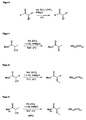
- amino acids first according to the in FIG. 4 represented and described in the foregoing method, the ⁇ -hydroxy acid. This can then, as for example, the L-lactic acid or the other acids FIG. 3 to be esterified. Subsequently, the hydroxyl group in ⁇ -position in converted a leaving group to obtain a compound of general formula II.
- Particularly preferred as starting compounds for the preparation of compounds of formula II are carbonyl compounds which are known as "chiral pool” and are naturally occurring compounds.
- Particularly preferred compounds for the preparation of compounds of the formula II are: amino acids, L-lactic acid, L-mandelic acid, L-malic acid, L-tartaric acid. These compounds are converted by esterification and introduction of a leaving group in the ⁇ -position of the carbonyl compound in the starting compounds of the general formula II ( ⁇ -Hydroxy Acids in Enantioselective Syntheses, 1997, Coppola GM, Schuster HF, VCH, Weinheim, p. 1 ).
- the compounds of general formula II have the radicals R 1 (with the radicals R 5 and R 6 ), R 2 , and R 3 .
- R 1 can supplement the carbonyl compound to give a carboxylate, an ester or an amide.
- R 1 is OM, OR 5 or NR 5 R 6 , where M is a metal ion, preferably sodium or potassium, and R 5 and R 6 are independently straight chain or branched alkyl, alkenyl, arylalkyl, aryl or heteroaryl.
- an alkyl radical here has 1-15 carbon atoms
- an alkenyl radical has 2-15 carbon atoms
- an arylalkyl radical has 5-15 carbon atoms
- an aryl radical has 5-10 carbon atoms
- a heteroaryl radical has 5-8 carbon atoms, and also 1-2 heteroatoms selected from O, N, P and S, up.
- an alkyl group has 1-10, more preferably 1-7 carbon atoms, an alkenyl group 2-10, more preferably 2-7 carbon atoms, an arylalkyl group 5-10, more preferably 5-8 carbon atoms, an aryl group 5-8, more preferably 5 -6 carbon atoms and a heteroaryl radical 5-7, more preferably 5-6 carbon atoms, and 1-2 heteroatoms selected from O, N, P and S, more preferably selected from O, N and S on.
- R 1 is OR 5 . Still more preferably in this case R 5 is methyl, ethyl, i-propyl, i-butyl, benzyl or tert butyl, more preferably tert butyl.
- R 2 represents a leaving group, preferably selected from the group consisting of: sulfonate groups, phosphate groups, carboxylate groups, carbamate groups, carbonate groups and halides.
- sulfonate groups refers to all groups derived from the sulfonic acid. Preference is given here to alkylsulfonic acid groups, more preferably halogenated alkylsulfonic acid groups having 1-9 halogen substituents, more preferably having 1-9 fluorine atoms. Even more preferred are perfluorinated alkylsulfonic acid groups, most preferred are trifluoromethanesulfonic acid group (triflate) and perfluorobutanesulfonic acid group (nonaflate).
- phosphate groups refers to all groups derived from the phosphoric acid. Preferred here are alkyl and aryl phosphate groups, more preferably halogenated alkyl and aryl phosphate groups having 1-14 halogen substituents, more preferably having 1-14 fluorine atoms. Even more preferred are perfluorinated alkyl and aryl phosphate groups.
- carboxylate group refers to all groups derived from the carboxylic acid. Preferred here are alkyl and aryl carboxylate groups, more preferably halogenated alkyl and aryl carboxylate groups having 1-10 halogen substituents, more preferably having 1-10 fluorine atoms.
- carboxylate groups Even more preferred are perfluorinated alkyl and aryl carboxylate groups.
- carbamate group refers to all groups derived from carbamic acid. Preference is given here to alkyl and aryl carbamate groups, more preferably halogenated alkyl and aryl carbamate groups having 1-14 halogen substituents, more preferably having 1-14 fluorine atoms. Even more preferred are perfluorinated alkyl and aryl carbamate groups.
- carbonate group refers to all groups derived from carbonic acid.
- alkyl and aryl carbonate groups Preference is given here to alkyl and aryl carbonate groups, more preferably halogenated alkyl and aryl carbonate groups having 1-10 halogen substituents, more preferably having 1-10 fluorine atoms. Even more preferred are perfluorinated alkyl and aryl carbonate groups.
- the preferred halide leaving group is chloride.
- R 3 represents a straight-chain or branched alkyl radical, alkenyl radical, arylalkyl radical, or aryl radical having 1-7, more preferably 1-5, even more preferably 1-3, heteroatoms selected from O, N and S, as substituents, or of the heteroatoms can be interrupted.
- an alkyl radical, alkenyl radical arylalkyl radical, or aryl radical can be "interrupted" by heteroatoms means that the heteroatoms between the carbon atoms can be in the alkyl chain as well as in the aryl ring. If heteroatoms are contained as substituents, these may preferably also carry protective groups, for example in the case of hydroxyl or amino groups, in order to avoid side reactions with the organometallic compound.
- an alkyl group has 1-15 carbon atoms
- an alkenyl group has 2-15 carbon atoms
- an arylalkyl group has 5-15 carbon atoms
- an aryl group has 5-10 carbon atoms
- a heteroaryl group has 5-8 carbon atoms, and 1-2 heteroatoms selected O, N, P and S, up.
- an alkyl group has 1-10, more preferably 1-7 carbon atom, an alkenyl group 2-10, more preferably 2-7 carbon atoms, an arylalkyl group 5-10, more preferably 5-8 carbon atoms, an aryl group 5-8, more preferably 5-6 carbon atoms and a heteroaryl group 5-7, more preferably 5-6 carbon atoms, and 1-2 heteroatoms selected from O, N, P and S, more preferably selected from O, N and S on.
- R 1 is OR 5 . Still more preferably in this case R 5 is methyl, ethyl, i-propyl, i-butyl, benzyl or tert butyl, more preferably tert butyl.
- a "nucleophilic alkyl group” can be prepared by using a magnesium Grignard reagent and ZnY 2 .
- the active species on a Trialkylzink (II) complex or at-a Trialkenylzink (II) ate-complex or a Triarylzink (II) ate complex R 4 3 based ZnMgX.
- R 4 3 ZnMgX arises from R 4 MgX and R 4 2 Zn, which is initially formed from ZnY 2 and R 4 MgX ( Ishihara et al., J. Am. Chem. Soc., 2006, 128, 9998 ).
- any magnesium Grignard reagents are suitable for the process according to the invention.
- Particularly preferred are magnesium Grignard reagents of the general formula R 4 MgX, wherein X is preferably a halogen; more preferably chlorine, bromine or iodine, even more preferably chlorine.
- Any zinc salts are suitable for the process according to the invention.
- Particular preference is given to zinc salts of the general formula ZnY 2 , in which Y is preferably a sulfonate, a sulfate, a carboxylate, an alcoholate, a nitrate, a chalcogen or a halogen, more preferably chlorine, bromine, iodine, still more preferably chlorine.
- ZnY 2 directly the zinc organyl ZnR 4 2 , as from ZnR 4 2 and R 4 MgX, as described above, the active species R 4 3 ZnMgX arises.
- R 4 preferably represents a straight-chain or branched alkyl radical, alkenyl radical, arylalkyl radical, aryl radical or heteroaryl radical.
- an alkyl radical has 1-15 carbon atoms
- an alkenyl radical has 2-15 carbon atoms
- an arylalkyl radical has 5-15 carbon atoms
- an aryl radical has 5-10 carbon atoms and Heteroaryl 5-8 carbon atoms, and 1-2 heteroatoms selected from O, N, P and S, on.
- an alkyl group has 1-10, more preferably 1-7 carbon atoms, an alkenyl group 2-10, more preferably 2-7 carbon atoms, an arylalkyl group 5-10, more preferably 5-8 carbon atoms, an aryl group 5-8, more preferably 5-6 carbon atoms and a heteroaryl 5-7 carbon atoms, and 1-2 heteroatoms selected from O, N, P and S on.
- R 4 particularly preferably represents a methyl, ethyl, i- propyl, n- butyl, i- butyl, s- butyl, cyclohexyl, octyl, lauryl, allyl, metallyl, vinyl, phenyl, benzyl , 3-Benzyloxypropyl and 3-benzyloxy-2-methylpropyl group.
- the magnesium Grignard reagent is preferably used in amounts between 1 and 2, more preferably 1.2-1.6 equivalents (eq.), Based on the molar amount of the starting compound of formula 11.
- ZnY 2 is used in dry form. In this case, preferably between 0.5 to 25 wt .-% ZnY 2 , based on the amount of starting material of formula II used.
- the ZnY 2 can in this case also be complexed by solvent molecules, for example TMEDA (tetramethylethylenediamine).
- TMEDA tetramethylethylenediamine
- suitable zinc catalysts also Zn (OA c ) 2 and ZnCl 2 TMEDA at 0 ° C and Zn (OTf) 2 at -20 ° C have been found.
- solvents which are suitable for Grignard reactions for the process according to the invention.
- These solvents are known to the person skilled in the art.
- tetrahydrofuran, 2-methyltetrahydrofuran, diethyl ether or mixtures of these two solvents are used. Due to the hydrolysis of organometallic compounds by water, an organic solvent as anhydrous as possible should be used.
- the inventive method is preferably at temperatures between -30 ° C and 30 ° C, more preferably between -15 ° C and 10 ° C, more preferably between -10 ° C and 10 ° C, even more preferably between -5 ° C and 5 ° C, and most preferably at 0 ° C.
- the reaction time is preferably between 10 minutes and 3 hours, more preferably between 1 hour and 2 hours. The exact end of the reaction may optionally be determined by conventional methods. Suitable methods here are measurement methods such as GC-MS (gas chromatography coupled with mass spectrometry) or NMR (nuclear magnetic resonance) spectroscopy.
- Carrying out the process of the invention is further described in the examples and comprises a first step in which the dry zinc (II) salt ZnY 2 is dissolved in dry solvent and then cooled (for example to 0 ° C.).
- the solvent may also be cooled prior to the addition of the zinc (II) salt ZnY 2 .
- the starting material of the formula II and subsequently the Grignard reagent or in the reverse order may be added.
- the purification of the reaction mixture can be carried out by conventional methods, for example by distillation.
- the characterization of the products can be carried out by conventional methods, for example using GC-MS or NMR spectroscopy.
- reaction mixture was diluted with 400 ml of petroleum ether, washed 4 times with 250 ml of a 3: 1 mixture of saturated aqueous sodium chloride solution and 1 N hydrochloric acid, dried over MgSO 4 and concentrated in vacuo.
- the residue was applied to a silica gel filter and washed down with a 1: 1 mixture of petroleum ether and dichloromethane. After removal of the solvent, the pure (S) -2-trifluoro-methanesulfonyloxypropion Acid- tert- butyl ester ( ee > 99%) in a yield of 90%.
- the trifluoromethanesulfonyloxypropionic acid tert-butyl ester was prepared as in Example 1. 7.0 mg of dry zinc chloride in 3.0 ml of absolute tetrahydrofuran were dissolved in a 10 ml Schlenk tube under argon and cooled to 0 ° C. Subsequently, 279 mg of ( S ) -2-trifluoromethanesulfonyloxypropionic acid tert-butyl ester ( ee > 99%) and 0.820 ml of iso- propylmagnesium chloride (1.70 M solution in THF) were added successively and the reaction was stirred at 0 ° C. for 3 h.
- reaction mixture was diluted with petroleum ether, first added water and then saturated ammonium chloride solution and the organic phase separated. This was applied directly to a silica gel filter and washed with petroleum ether. Subsequently, the products were washed down with a petroleum ether / diethyl ether mixture (10: 1) from the filter and freed from the solvent. This gave 98 mol% (2 S ) -2,3-Dimethylbutanchure- tert-butyl ester (entry 2 in Table 1) ( ee > 99%) and 2 mol% Propionchure- tert-butyl ester.
- the target compound was purified by Kugelrohr distillation.
- Example 2 Both in Example 2 and in Example 3, the products can be isolated directly in a synthesis on a larger scale easily by means of a fractional distillation.
- Table 1 shows that both straight-chain, branched and aromatic Grignard reagents are suitable for the synthesis of optically pure ⁇ -alkylcarbonyl compounds. Particularly advantageous here is the possibility of being able to represent enantiopure ⁇ -alkylcarbonyl compounds with secondary alkyl radicals in the ⁇ -position.
- the starting compounds shown in Table 2 are all readily synthesized from naturally occurring enantiomerically pure compounds (amino acids, entries 1-6, malic acid, entry 7). Even ⁇ -branched ⁇ -alkylcarbonyl compounds are useful as starting compounds, whereby the process of the invention provides access to an unlimited number of optically active ⁇ -alkylcarbonyl compounds.
- FIG. 9 shows the use of ⁇ -trifluoromethanesulfoxyamides as starting compounds prepared from the corresponding ⁇ -hydroxyamides according to the method described in Example 1.
- the synthesis of the chiral ⁇ -alkylamide was carried out using the procedure described in Example 2. At the in FIG. 9 As shown reaction, a yield of 88% could be achieved.
- Example 8a Preparation of optically active ( S ) -2- (nonafluorobutane-1-sulfonyloxy) -propionic acid tert-butyl ester
- Nonafluorbutansulfonyloxypropion Acid- tert-butyl ester was prepared with nonafluorobutanesulfonic anhydride as in Example 1 with a yield of 82% ( ee > 99%).
- the aqueous phase was acidified with a 2M aqueous HCl solution, saturated with NaCl and extracted 3 times with 10 ml of diethyl ether.
- the combined organic phases were dried over MgSO 4 and concentrated in vacuo. Pure ( S ) -2-methylhexanoic acid ( ee 99%) was obtained in 92% yield.
- Example 8 the products can also be isolated directly in Example 10 in a synthesis on a larger scale without any problems by means of a fractional distillation.
Landscapes
- Chemical & Material Sciences (AREA)
- Organic Chemistry (AREA)
- Chemical Kinetics & Catalysis (AREA)
- Engineering & Computer Science (AREA)
- Oil, Petroleum & Natural Gas (AREA)
- Organic Low-Molecular-Weight Compounds And Preparation Thereof (AREA)
Claims (12)
- Procédé de fabrication de composés de formule I :

un composé de formule I par inversion de la configuration stéréochimique sur l'atome de carbone du groupement α-carbonyle,
dans lequel R1 peut représenter un groupement OM, O-R5
ou NR5R6, où M représente un ion de métal et R5 et R6 peuvent représenter, indépendamment l'un de l'autre, un radical alkyle, un radical alcényle, un radical arylalkyle, un radical aryle ou un radical hétéroaryle, à chaîne linéaire ou ramifiée,
dans lequel R2 représente un groupement partant de sulfonate, un groupement partant de phosphate, un groupement partant de carboxylate, un groupement partant de carbamate, un groupement partant de carbonate ou un halogénure,
dans lequel R3 représente un radical alkyle, un radical alcényle, un radical arylalkyle, un radical aryle ou un radical hétéroaryle, à chaîne linéaire ou ramifiée, qui peut présenter 5 à 7 atomes de carbone, ainsi que 1 ou 2 hétéroatomes, choisis parmi les éléments O, N, P et S, comme substituants, ou qui peut être interrompu par les hétéroatomes,
dans lequel R4 représente un radical alkyle, un radical alcényle, un radical arylalkyle, un radical aryle ou un radical hétéroaryle, à chaîne linéaire ou ramifiée, dans lequel, dans les radicaux R1 à R6, un radical alkyle peut présenter 1 à 15 atomes de carbone, un radical alcényle peut présenter 2 à 15 atomes de carbone, un radical arylalkyle peut présenter 5 à 15 atomes de carbone, un radical aryle peut présenter 5 à 10 atomes de carbone et un radical hétéroaryle peut présenter 5 à 8 atomes de carbone, ainsi que 1 à 2 hétéroatomes choisi(s) parmi les éléments O, N, P et S,
dans lequel X représente un halogène, et
dans lequel Y peut représenter un sulfonate, un sulfate, un carboxylate, un alcoolate, un nitrate, un chalcogène ou un halogène. - Procédé selon la revendication 1, caractérisé en ce que le procédé est réalisé à des températures supérieures à -30 °C.
- Procédé selon l'une quelconque des revendications précédentes, caractérisé en ce que l'on utilise des composés de formule II présentant un excès d'énatiomère (ee) supérieur à 95 % et en ce que l'on fabrique des composés de formule I présentant un excès d'énantiomère supérieur à 95 %.
- Procédé selon l'une quelconque des revendications précédentes, caractérisé en ce que l'on utilise 0,5 à 25 % en poids de composé ZnY2 ou ZnR4 2 par rapport à la quantité de composé de formule II.
- Procédé selon l'une quelconque des revendications précédentes, caractérisé en ce que l'on utilise, comme solvant pour la réaction, du tétrahydrofuranne, du 2-méthyltétrahydrofuranne ou du diéthyléther ou un mélange de ces solvants.
- Procédé selon l'une quelconque des revendications précédentes, caractérisé en ce qu'un radical alkyle comprend 1 à 10 atomes de carbone, un radical alcényle comprend 2 à 10 atomes de carbone, un radical arylalkyle comprend 5 à 10 atomes de carbone, un radical aryle comprend 5 à 8 atomes de carbone et un radical hétéroaryle comprend 5 à 7 atomes de carbone, ainsi que 1 à 2 hétéroatomes choisis parmi les éléments O, N, P et S.
- Procédé selon l'une quelconque des revendications précédentes, caractérisé en ce que le radical R2 représente un groupement acide alkylsulfonique, un groupement phosphate, un groupement carboxylate, un groupement carbamate, un groupement carbonate ou un halogène.
- Procédé selon la revendication 7, caractérisé en ce que le radical R2 représente un groupement partant de triflate ou de nonaflate.
- Procédé selon l'une quelconque des revendications 1 à 5, caractérisé en ce que le radical R4 représente un groupement méthyle, éthyle, i-propyle, n-butyle, i-butyle, s-butyle, cyclohexyle, octyle, lauryle, allyle, méthallyle, vinyle, phényle, benzyle, 3-benzyloxypropyle et 3-benzyloxy-2-méthylpropyle.
- Procédé selon l'une quelconque des revendications précédentes, caractérisé en ce que l'on utilise 1 à 2 équivalents de réactif R4MgX par rapport à la quantité du composé de formule II.
- Procédé selon l'une quelconque des revendications précédentes, caractérisé en ce que les composés de formule II sont fabriqués en partant de composés chiraux naturels.
- Procédé selon l'une quelconque des revendications précédentes, caractérisé en ce que les composés de formule II sont fabriqués à partir de composés choisis dans le groupe constitué des acides aminés, de l'acide L-lactique, de l'acide L-malique, de l'acide L-tartrique et de l'acide L-mandélique.
Applications Claiming Priority (2)
| Application Number | Priority Date | Filing Date | Title |
|---|---|---|---|
| DE102007045624A DE102007045624B3 (de) | 2007-09-24 | 2007-09-24 | Verfahren zur Herstellung optisch aktiver α-Alkylcarbonylverbindungen |
| PCT/EP2008/007818 WO2009040054A1 (fr) | 2007-09-24 | 2008-09-18 | PROCÉDÉ POUR PRODUIRE DES COMPOSÉS α-ALKYLCARBONYLE OPTIQUEMENT ACTIFS |
Publications (2)
| Publication Number | Publication Date |
|---|---|
| EP2190809A1 EP2190809A1 (fr) | 2010-06-02 |
| EP2190809B1 true EP2190809B1 (fr) | 2011-06-08 |
Family
ID=40282231
Family Applications (1)
| Application Number | Title | Priority Date | Filing Date |
|---|---|---|---|
| EP08802340A Not-in-force EP2190809B1 (fr) | 2007-09-24 | 2008-09-18 | Procédé pour produire des composés -alkylcarbonyle optiquement actifs |
Country Status (5)
| Country | Link |
|---|---|
| US (1) | US8212065B2 (fr) |
| EP (1) | EP2190809B1 (fr) |
| AT (1) | ATE512127T1 (fr) |
| DE (1) | DE102007045624B3 (fr) |
| WO (1) | WO2009040054A1 (fr) |
Families Citing this family (1)
| Publication number | Priority date | Publication date | Assignee | Title |
|---|---|---|---|---|
| CN107698543A (zh) * | 2017-11-14 | 2018-02-16 | 安徽华胜医药科技有限公司 | 一种丁内酯衍生物的制备方法 |
Family Cites Families (2)
| Publication number | Priority date | Publication date | Assignee | Title |
|---|---|---|---|---|
| US4723033A (en) * | 1982-11-24 | 1988-02-02 | Syntex Pharmaceuticals International Ltd. | Manufacture of optically active α-arylalkanoic acids and precursors thereof |
| EP1908747B1 (fr) | 2005-07-28 | 2012-01-04 | Kowa Company, Ltd. | Procede de production d'ester 2-hydroxybutyrique optiquement actif |
-
2007
- 2007-09-24 DE DE102007045624A patent/DE102007045624B3/de not_active Expired - Fee Related
-
2008
- 2008-09-18 WO PCT/EP2008/007818 patent/WO2009040054A1/fr not_active Ceased
- 2008-09-18 AT AT08802340T patent/ATE512127T1/de active
- 2008-09-18 EP EP08802340A patent/EP2190809B1/fr not_active Not-in-force
- 2008-09-18 US US12/679,125 patent/US8212065B2/en not_active Expired - Fee Related
Also Published As
| Publication number | Publication date |
|---|---|
| DE102007045624B3 (de) | 2009-06-04 |
| WO2009040054A1 (fr) | 2009-04-02 |
| US8212065B2 (en) | 2012-07-03 |
| ATE512127T1 (de) | 2011-06-15 |
| EP2190809A1 (fr) | 2010-06-02 |
| US20100305352A1 (en) | 2010-12-02 |
Similar Documents
| Publication | Publication Date | Title |
|---|---|---|
| EP0812819B1 (fr) | Enantiomère enrichie d'un ester de l'acide malonique substitué par des restes d'hydrocarbures tertiaires et sa préparation | |
| DD258625A1 (de) | Verfahren zur auftrennung von racemischen gemischen von 2-halogenpropionsaeuren | |
| EP2387556A1 (fr) | Séparation d'un mélange d'énantiomères de (r)- et de (s)-3-amino-1-butanol | |
| EP0623577B1 (fr) | Préparation d'halogénures et de sels d'acides carboxyliques | |
| EP1801093B1 (fr) | Procédé pour la préparation de l'acide 2-alkoxy-3-phenylpropionique enrichi en enantiomère | |
| DE69505226T2 (de) | Verfahren zur herstellung von (+)-(1r)-cis-3-oxo-2-pentyl-1-cyclopentanessigsäure | |
| EP0063731B1 (fr) | Procédé pour la préparation d'acides carboxyliques optiquement actifs | |
| EP2190809B1 (fr) | Procédé pour produire des composés -alkylcarbonyle optiquement actifs | |
| DE112007003065B4 (de) | Verfahren zur Herstellung von Fluoralkanester | |
| EP0134392A1 (fr) | Procédé pour la préparation pratiquement stéréospécifique d'esters d'acides aminés optiquement actifs | |
| DE60107191T2 (de) | Herstellung von 2-Hydrocarbyl-2-Adamantylacrylaten | |
| DE69932269T2 (de) | Herstellung optisch aktiver Cyclohexylphenylglykolsäureester | |
| EP1481958B1 (fr) | Préparation de composés organiques à faible teneur en fluorure | |
| EP0676390B1 (fr) | Procédé pour la préparation d'hydrochlorure de l'acide 1-aminocyclopropane carboxylique | |
| DD202427A5 (de) | Verfahren zur herstellung von alpha-halogenalkylamiden | |
| DE69503956T2 (de) | Verfahren zur Herstellung von optisch aktiver alpha-(Hydroxyphenoxy)-alkancarbonsäure und ihren Derivaten | |
| DE1293141B (de) | Verfahren zur Herstellung von optisch aktiven Alkoholen | |
| EP1748975B1 (fr) | Procede pour produire des acides 3-alkylcarboxyliques optiquement actifs et leurs produits intermediaires | |
| DE60024540T2 (de) | Synthese von alpha-amino-alpha',alpha'-dihaloketonen und verfahren zur herstellung von beta)-aminosäurederivaten durch verwendung derselben | |
| DE19711826A1 (de) | Verbessertes Verfahren zur Herstellung von Trifluormethyloxiran | |
| AT410545B (de) | Verfahren zur herstellung von chiralen alpha-hydroxycarbonsäuren | |
| DE19530205A1 (de) | Verfahren zur Herstellung von optisch aktiven l-Aryl-alkylaminen | |
| EP1413565A2 (fr) | Procédé pour la résolution optique du 3-aminopentanonitrile | |
| EP0531700A2 (fr) | Produits intermédiaires diastéréomères purs et leur utilisation dans la fabrication du (R)- ou (S)-kétoprofen | |
| WO2006021420B1 (fr) | Procede de production de derives de diarylcycloalkyle |
Legal Events
| Date | Code | Title | Description |
|---|---|---|---|
| PUAI | Public reference made under article 153(3) epc to a published international application that has entered the european phase |
Free format text: ORIGINAL CODE: 0009012 |
|
| 17P | Request for examination filed |
Effective date: 20100223 |
|
| AK | Designated contracting states |
Kind code of ref document: A1 Designated state(s): AT BE BG CH CY CZ DE DK EE ES FI FR GB GR HR HU IE IS IT LI LT LU LV MC MT NL NO PL PT RO SE SI SK TR |
|
| AX | Request for extension of the european patent |
Extension state: AL BA MK RS |
|
| RIN1 | Information on inventor provided before grant (corrected) |
Inventor name: STUDTE, CHRISTOPHER Inventor name: BREIT, BERNHARD |
|
| GRAP | Despatch of communication of intention to grant a patent |
Free format text: ORIGINAL CODE: EPIDOSNIGR1 |
|
| DAX | Request for extension of the european patent (deleted) | ||
| GRAS | Grant fee paid |
Free format text: ORIGINAL CODE: EPIDOSNIGR3 |
|
| GRAA | (expected) grant |
Free format text: ORIGINAL CODE: 0009210 |
|
| AK | Designated contracting states |
Kind code of ref document: B1 Designated state(s): AT BE BG CH CY CZ DE DK EE ES FI FR GB GR HR HU IE IS IT LI LT LU LV MC MT NL NO PL PT RO SE SI SK TR |
|
| REG | Reference to a national code |
Ref country code: GB Ref legal event code: FG4D Free format text: NOT ENGLISH |
|
| REG | Reference to a national code |
Ref country code: CH Ref legal event code: EP |
|
| REG | Reference to a national code |
Ref country code: CH Ref legal event code: NV Representative=s name: PATENTANWAELTE SCHAAD, BALASS, MENZL & PARTNER AG |
|
| REG | Reference to a national code |
Ref country code: IE Ref legal event code: FG4D Free format text: LANGUAGE OF EP DOCUMENT: GERMAN |
|
| REG | Reference to a national code |
Ref country code: DE Ref legal event code: R096 Ref document number: 502008003808 Country of ref document: DE Effective date: 20110721 |
|
| REG | Reference to a national code |
Ref country code: NL Ref legal event code: T3 |
|
| PG25 | Lapsed in a contracting state [announced via postgrant information from national office to epo] |
Ref country code: SE Free format text: LAPSE BECAUSE OF FAILURE TO SUBMIT A TRANSLATION OF THE DESCRIPTION OR TO PAY THE FEE WITHIN THE PRESCRIBED TIME-LIMIT Effective date: 20110608 Ref country code: LT Free format text: LAPSE BECAUSE OF FAILURE TO SUBMIT A TRANSLATION OF THE DESCRIPTION OR TO PAY THE FEE WITHIN THE PRESCRIBED TIME-LIMIT Effective date: 20110608 Ref country code: HR Free format text: LAPSE BECAUSE OF FAILURE TO SUBMIT A TRANSLATION OF THE DESCRIPTION OR TO PAY THE FEE WITHIN THE PRESCRIBED TIME-LIMIT Effective date: 20110608 Ref country code: NO Free format text: LAPSE BECAUSE OF FAILURE TO SUBMIT A TRANSLATION OF THE DESCRIPTION OR TO PAY THE FEE WITHIN THE PRESCRIBED TIME-LIMIT Effective date: 20110908 |
|
| PG25 | Lapsed in a contracting state [announced via postgrant information from national office to epo] |
Ref country code: SI Free format text: LAPSE BECAUSE OF FAILURE TO SUBMIT A TRANSLATION OF THE DESCRIPTION OR TO PAY THE FEE WITHIN THE PRESCRIBED TIME-LIMIT Effective date: 20110608 Ref country code: GR Free format text: LAPSE BECAUSE OF FAILURE TO SUBMIT A TRANSLATION OF THE DESCRIPTION OR TO PAY THE FEE WITHIN THE PRESCRIBED TIME-LIMIT Effective date: 20110909 Ref country code: CY Free format text: LAPSE BECAUSE OF FAILURE TO SUBMIT A TRANSLATION OF THE DESCRIPTION OR TO PAY THE FEE WITHIN THE PRESCRIBED TIME-LIMIT Effective date: 20110608 Ref country code: LV Free format text: LAPSE BECAUSE OF FAILURE TO SUBMIT A TRANSLATION OF THE DESCRIPTION OR TO PAY THE FEE WITHIN THE PRESCRIBED TIME-LIMIT Effective date: 20110608 Ref country code: ES Free format text: LAPSE BECAUSE OF FAILURE TO SUBMIT A TRANSLATION OF THE DESCRIPTION OR TO PAY THE FEE WITHIN THE PRESCRIBED TIME-LIMIT Effective date: 20110919 Ref country code: FI Free format text: LAPSE BECAUSE OF FAILURE TO SUBMIT A TRANSLATION OF THE DESCRIPTION OR TO PAY THE FEE WITHIN THE PRESCRIBED TIME-LIMIT Effective date: 20110608 |
|
| REG | Reference to a national code |
Ref country code: IE Ref legal event code: FD4D |
|
| PG25 | Lapsed in a contracting state [announced via postgrant information from national office to epo] |
Ref country code: IS Free format text: LAPSE BECAUSE OF FAILURE TO SUBMIT A TRANSLATION OF THE DESCRIPTION OR TO PAY THE FEE WITHIN THE PRESCRIBED TIME-LIMIT Effective date: 20111008 Ref country code: PT Free format text: LAPSE BECAUSE OF FAILURE TO SUBMIT A TRANSLATION OF THE DESCRIPTION OR TO PAY THE FEE WITHIN THE PRESCRIBED TIME-LIMIT Effective date: 20111010 Ref country code: CZ Free format text: LAPSE BECAUSE OF FAILURE TO SUBMIT A TRANSLATION OF THE DESCRIPTION OR TO PAY THE FEE WITHIN THE PRESCRIBED TIME-LIMIT Effective date: 20110608 Ref country code: EE Free format text: LAPSE BECAUSE OF FAILURE TO SUBMIT A TRANSLATION OF THE DESCRIPTION OR TO PAY THE FEE WITHIN THE PRESCRIBED TIME-LIMIT Effective date: 20110608 Ref country code: IE Free format text: LAPSE BECAUSE OF FAILURE TO SUBMIT A TRANSLATION OF THE DESCRIPTION OR TO PAY THE FEE WITHIN THE PRESCRIBED TIME-LIMIT Effective date: 20110608 |
|
| PG25 | Lapsed in a contracting state [announced via postgrant information from national office to epo] |
Ref country code: SK Free format text: LAPSE BECAUSE OF FAILURE TO SUBMIT A TRANSLATION OF THE DESCRIPTION OR TO PAY THE FEE WITHIN THE PRESCRIBED TIME-LIMIT Effective date: 20110608 Ref country code: RO Free format text: LAPSE BECAUSE OF FAILURE TO SUBMIT A TRANSLATION OF THE DESCRIPTION OR TO PAY THE FEE WITHIN THE PRESCRIBED TIME-LIMIT Effective date: 20110608 Ref country code: PL Free format text: LAPSE BECAUSE OF FAILURE TO SUBMIT A TRANSLATION OF THE DESCRIPTION OR TO PAY THE FEE WITHIN THE PRESCRIBED TIME-LIMIT Effective date: 20110608 |
|
| BERE | Be: lapsed |
Owner name: ALBERT-LUDWIGS-UNIVERSITAT FREIBURG Effective date: 20110930 |
|
| PLBE | No opposition filed within time limit |
Free format text: ORIGINAL CODE: 0009261 |
|
| STAA | Information on the status of an ep patent application or granted ep patent |
Free format text: STATUS: NO OPPOSITION FILED WITHIN TIME LIMIT |
|
| PG25 | Lapsed in a contracting state [announced via postgrant information from national office to epo] |
Ref country code: MC Free format text: LAPSE BECAUSE OF NON-PAYMENT OF DUE FEES Effective date: 20110930 |
|
| 26N | No opposition filed |
Effective date: 20120309 |
|
| PG25 | Lapsed in a contracting state [announced via postgrant information from national office to epo] |
Ref country code: IT Free format text: LAPSE BECAUSE OF FAILURE TO SUBMIT A TRANSLATION OF THE DESCRIPTION OR TO PAY THE FEE WITHIN THE PRESCRIBED TIME-LIMIT Effective date: 20110608 |
|
| PG25 | Lapsed in a contracting state [announced via postgrant information from national office to epo] |
Ref country code: BE Free format text: LAPSE BECAUSE OF NON-PAYMENT OF DUE FEES Effective date: 20110930 Ref country code: DK Free format text: LAPSE BECAUSE OF FAILURE TO SUBMIT A TRANSLATION OF THE DESCRIPTION OR TO PAY THE FEE WITHIN THE PRESCRIBED TIME-LIMIT Effective date: 20110608 |
|
| REG | Reference to a national code |
Ref country code: DE Ref legal event code: R097 Ref document number: 502008003808 Country of ref document: DE Effective date: 20120309 |
|
| PGFP | Annual fee paid to national office [announced via postgrant information from national office to epo] |
Ref country code: GB Payment date: 20120920 Year of fee payment: 5 |
|
| PGFP | Annual fee paid to national office [announced via postgrant information from national office to epo] |
Ref country code: NL Payment date: 20120920 Year of fee payment: 5 Ref country code: FR Payment date: 20121008 Year of fee payment: 5 Ref country code: DE Payment date: 20121126 Year of fee payment: 5 |
|
| PG25 | Lapsed in a contracting state [announced via postgrant information from national office to epo] |
Ref country code: MT Free format text: LAPSE BECAUSE OF FAILURE TO SUBMIT A TRANSLATION OF THE DESCRIPTION OR TO PAY THE FEE WITHIN THE PRESCRIBED TIME-LIMIT Effective date: 20110608 |
|
| PG25 | Lapsed in a contracting state [announced via postgrant information from national office to epo] |
Ref country code: LU Free format text: LAPSE BECAUSE OF NON-PAYMENT OF DUE FEES Effective date: 20110918 |
|
| PG25 | Lapsed in a contracting state [announced via postgrant information from national office to epo] |
Ref country code: BG Free format text: LAPSE BECAUSE OF FAILURE TO SUBMIT A TRANSLATION OF THE DESCRIPTION OR TO PAY THE FEE WITHIN THE PRESCRIBED TIME-LIMIT Effective date: 20110908 |
|
| PG25 | Lapsed in a contracting state [announced via postgrant information from national office to epo] |
Ref country code: TR Free format text: LAPSE BECAUSE OF FAILURE TO SUBMIT A TRANSLATION OF THE DESCRIPTION OR TO PAY THE FEE WITHIN THE PRESCRIBED TIME-LIMIT Effective date: 20110608 |
|
| PG25 | Lapsed in a contracting state [announced via postgrant information from national office to epo] |
Ref country code: HU Free format text: LAPSE BECAUSE OF FAILURE TO SUBMIT A TRANSLATION OF THE DESCRIPTION OR TO PAY THE FEE WITHIN THE PRESCRIBED TIME-LIMIT Effective date: 20110608 |
|
| REG | Reference to a national code |
Ref country code: NL Ref legal event code: V1 Effective date: 20140401 |
|
| REG | Reference to a national code |
Ref country code: CH Ref legal event code: PL |
|
| GBPC | Gb: european patent ceased through non-payment of renewal fee |
Effective date: 20130918 |
|
| REG | Reference to a national code |
Ref country code: DE Ref legal event code: R119 Ref document number: 502008003808 Country of ref document: DE Effective date: 20140401 |
|
| REG | Reference to a national code |
Ref country code: FR Ref legal event code: ST Effective date: 20140530 |
|
| PG25 | Lapsed in a contracting state [announced via postgrant information from national office to epo] |
Ref country code: LI Free format text: LAPSE BECAUSE OF NON-PAYMENT OF DUE FEES Effective date: 20130930 Ref country code: CH Free format text: LAPSE BECAUSE OF NON-PAYMENT OF DUE FEES Effective date: 20130930 Ref country code: GB Free format text: LAPSE BECAUSE OF NON-PAYMENT OF DUE FEES Effective date: 20130918 |
|
| PG25 | Lapsed in a contracting state [announced via postgrant information from national office to epo] |
Ref country code: FR Free format text: LAPSE BECAUSE OF NON-PAYMENT OF DUE FEES Effective date: 20130930 Ref country code: DE Free format text: LAPSE BECAUSE OF NON-PAYMENT OF DUE FEES Effective date: 20140401 Ref country code: NL Free format text: LAPSE BECAUSE OF NON-PAYMENT OF DUE FEES Effective date: 20140401 |
|
| REG | Reference to a national code |
Ref country code: AT Ref legal event code: MM01 Ref document number: 512127 Country of ref document: AT Kind code of ref document: T Effective date: 20130918 |
|
| PG25 | Lapsed in a contracting state [announced via postgrant information from national office to epo] |
Ref country code: AT Free format text: LAPSE BECAUSE OF NON-PAYMENT OF DUE FEES Effective date: 20130918 |