EP2191293B1 - Procédé de classification d'objet, procédé d'aide au stationnement et système d'aide au stationnement - Google Patents
Procédé de classification d'objet, procédé d'aide au stationnement et système d'aide au stationnement Download PDFInfo
- Publication number
- EP2191293B1 EP2191293B1 EP08786265A EP08786265A EP2191293B1 EP 2191293 B1 EP2191293 B1 EP 2191293B1 EP 08786265 A EP08786265 A EP 08786265A EP 08786265 A EP08786265 A EP 08786265A EP 2191293 B1 EP2191293 B1 EP 2191293B1
- Authority
- EP
- European Patent Office
- Prior art keywords
- distance
- variable
- vehicle
- characteristic variable
- determined
- Prior art date
- Legal status (The legal status is an assumption and is not a legal conclusion. Google has not performed a legal analysis and makes no representation as to the accuracy of the status listed.)
- Active
Links
Images




Classifications
-
- G—PHYSICS
- G01—MEASURING; TESTING
- G01S—RADIO DIRECTION-FINDING; RADIO NAVIGATION; DETERMINING DISTANCE OR VELOCITY BY USE OF RADIO WAVES; LOCATING OR PRESENCE-DETECTING BY USE OF THE REFLECTION OR RERADIATION OF RADIO WAVES; ANALOGOUS ARRANGEMENTS USING OTHER WAVES
- G01S15/00—Systems using the reflection or reradiation of acoustic waves, e.g. sonar systems
- G01S15/88—Sonar systems specially adapted for specific applications
- G01S15/93—Sonar systems specially adapted for specific applications for anti-collision purposes
- G01S15/931—Sonar systems specially adapted for specific applications for anti-collision purposes of land vehicles
-
- G—PHYSICS
- G01—MEASURING; TESTING
- G01S—RADIO DIRECTION-FINDING; RADIO NAVIGATION; DETERMINING DISTANCE OR VELOCITY BY USE OF RADIO WAVES; LOCATING OR PRESENCE-DETECTING BY USE OF THE REFLECTION OR RERADIATION OF RADIO WAVES; ANALOGOUS ARRANGEMENTS USING OTHER WAVES
- G01S7/00—Details of systems according to groups G01S13/00, G01S15/00, G01S17/00
- G01S7/52—Details of systems according to groups G01S13/00, G01S15/00, G01S17/00 of systems according to group G01S15/00
- G01S7/523—Details of pulse systems
- G01S7/526—Receivers
- G01S7/527—Extracting wanted echo signals
-
- G—PHYSICS
- G01—MEASURING; TESTING
- G01S—RADIO DIRECTION-FINDING; RADIO NAVIGATION; DETERMINING DISTANCE OR VELOCITY BY USE OF RADIO WAVES; LOCATING OR PRESENCE-DETECTING BY USE OF THE REFLECTION OR RERADIATION OF RADIO WAVES; ANALOGOUS ARRANGEMENTS USING OTHER WAVES
- G01S13/00—Systems using the reflection or reradiation of radio waves, e.g. radar systems; Analogous systems using reflection or reradiation of waves whose nature or wavelength is irrelevant or unspecified
- G01S13/88—Radar or analogous systems specially adapted for specific applications
- G01S13/93—Radar or analogous systems specially adapted for specific applications for anti-collision purposes
- G01S13/931—Radar or analogous systems specially adapted for specific applications for anti-collision purposes of land vehicles
- G01S2013/9314—Parking operations
-
- G—PHYSICS
- G01—MEASURING; TESTING
- G01S—RADIO DIRECTION-FINDING; RADIO NAVIGATION; DETERMINING DISTANCE OR VELOCITY BY USE OF RADIO WAVES; LOCATING OR PRESENCE-DETECTING BY USE OF THE REFLECTION OR RERADIATION OF RADIO WAVES; ANALOGOUS ARRANGEMENTS USING OTHER WAVES
- G01S13/00—Systems using the reflection or reradiation of radio waves, e.g. radar systems; Analogous systems using reflection or reradiation of waves whose nature or wavelength is irrelevant or unspecified
- G01S13/88—Radar or analogous systems specially adapted for specific applications
- G01S13/93—Radar or analogous systems specially adapted for specific applications for anti-collision purposes
- G01S13/931—Radar or analogous systems specially adapted for specific applications for anti-collision purposes of land vehicles
- G01S2013/9317—Driving backwards
-
- G—PHYSICS
- G01—MEASURING; TESTING
- G01S—RADIO DIRECTION-FINDING; RADIO NAVIGATION; DETERMINING DISTANCE OR VELOCITY BY USE OF RADIO WAVES; LOCATING OR PRESENCE-DETECTING BY USE OF THE REFLECTION OR RERADIATION OF RADIO WAVES; ANALOGOUS ARRANGEMENTS USING OTHER WAVES
- G01S15/00—Systems using the reflection or reradiation of acoustic waves, e.g. sonar systems
- G01S15/88—Sonar systems specially adapted for specific applications
- G01S15/93—Sonar systems specially adapted for specific applications for anti-collision purposes
- G01S15/931—Sonar systems specially adapted for specific applications for anti-collision purposes of land vehicles
- G01S2015/932—Sonar systems specially adapted for specific applications for anti-collision purposes of land vehicles for parking operations
- G01S2015/933—Sonar systems specially adapted for specific applications for anti-collision purposes of land vehicles for parking operations for measuring the dimensions of the parking space when driving past
- G01S2015/934—Sonar systems specially adapted for specific applications for anti-collision purposes of land vehicles for parking operations for measuring the dimensions of the parking space when driving past for measuring the depth, i.e. width, not length, of the parking space
-
- G—PHYSICS
- G01—MEASURING; TESTING
- G01S—RADIO DIRECTION-FINDING; RADIO NAVIGATION; DETERMINING DISTANCE OR VELOCITY BY USE OF RADIO WAVES; LOCATING OR PRESENCE-DETECTING BY USE OF THE REFLECTION OR RERADIATION OF RADIO WAVES; ANALOGOUS ARRANGEMENTS USING OTHER WAVES
- G01S7/00—Details of systems according to groups G01S13/00, G01S15/00, G01S17/00
- G01S7/52—Details of systems according to groups G01S13/00, G01S15/00, G01S17/00 of systems according to group G01S15/00
- G01S7/539—Details of systems according to groups G01S13/00, G01S15/00, G01S17/00 of systems according to group G01S15/00 using analysis of echo signal for target characterisation; Target signature; Target cross-section
Definitions
- the present invention relates to an object classification method, a parking assistance method, and a parking assist system for outputting parking advice to a driver of a vehicle.
- the increasing traffic density and increased development of open space are narrowing the traffic area, especially in conurbations.
- the available parking space is getting tighter and the search for a suitable parking space puts additional pressure on the driver in addition to the increasing traffic. Therefore, parking space localization systems and semi-autonomous parking assistance systems have been developed to assist the driver in parking.
- the driver is thereby the decision whether an existing parking space sufficient for a parking operation, facilitated or removed.
- the parking aid system provides warning signals that assist the driver when parking in the parking space.
- a parking aid system it is desirable to classify the objects limiting the lane or parking space (e.g., curb, parked cars, etc.) into drive-over and non-drive-over objects.
- a classification allows, for example, the corresponding adaptation of the parking trajectory and the end position of the vehicle. For example, it would be possible to make the tail protrude over objects classified as passable during the parking process, or even to use the space occupied by objects classified as passable as parking space.
- the DE 103 23 639A1 a method according to which the received signals are considered as very low classified objects (eg, Rollsplitt or small pebbles) as spurious signals and the sensitivity parameters of the sensor device to prevent the detection of these spurious signals are changed.
- very low classified objects eg, Rollsplitt or small pebbles
- this procedure is only suitable for taking into account or filtering extremely low objects, but not for the general distinction between drive-over and non-drive-over objects.
- EP 1 643 271 It is known to reduce the sensor sensitivity as a function of the traveled distance of the vehicle.
- the height of an object changes certain parameters of the receive signal received by the parking aid system. For example, a higher object usually results in a higher signal amplitude and a wider echo pulse.
- a higher object usually results in a higher signal amplitude and a wider echo pulse.
- the idea underlying the invention is to use the local change of a parameter of the received signal as an indicator of a qualitative statement about the height of an object, in particular on its Kochfahrhus.
- the prediction variable may be determined from a mathematical link with a damping factor.
- the prediction variable may be determined substantially by multiplying the first characteristic determined in step (a) by a factor e kx , where k is the attenuation factor and x is the distance determined in step (c).
- e kx the attenuation factor
- x the distance determined in step (c).
- damping factor (k) is advantageous to adjust as a function of the climatic conditions. This allows a more accurate classification. Examples of climatic conditions are outside temperature, atmospheric pressure and precipitation.
- the parameter may indicate, for example, the amplitude of a local maximum in the received signal, in particular a local maximum of the first echo pulse.
- Another possible parameter is the pulse width of the first echo pulse.
- the distance-measuring sensor is advantageously provided at a rear area or at a front area of the vehicle.
- a computer program according to the invention comprises program code means for carrying out all the steps of a method according to one of the preceding claims, when the computer program is executed on a computer or a computing unit.
- Fig. 1 shows a schematic diagram of a vehicle with a parking aid system according to an embodiment of the present invention.
- distance sensors 3 are arranged.
- distance sensors 5 are also arranged.
- On a left side of the vehicle 6 also lateral distance sensors 8 and on a right side of the vehicle 7 lateral distance sensors 9 may be provided.
- the distance sensors are used to measure distances to obstacles in the vehicle environment.
- the distance sensors 3, 5, 8, 9 may be formed in the present embodiment, for example, as ultrasonic sensors.
- the distance sensors 3, 5, 8, 9 deliver their sensor signals via a data bus 10 to a program-controlled device 11 (for example a microprocessor, microcontroller or the like) with a memory 18 in the vehicle 1.
- a program-controlled device 11 for example a microprocessor, microcontroller or the like
- the program-controlled device 11 determines on the basis of the distance sensors 3, 5, 8, 9 supplied sensor signals distances to obstacles in the vehicle environment and the location of these obstacles in the vehicle environment. In order to accurately determine the position of the obstacles, the program-controlled device 11 can also make use of the principle of triangulation, whereby the distance values determined by the various sensors are compared with one another. The program-controlled device 11 further determines whether the objects in the vehicle environment are traversable or not traversable. This will be explained in more detail below.
- the program-controlled device 11 can also be designed to determine a suitable parking space and optionally to determine a driving trajectory and end position in this parking space. It also preferably determines expenses to the driver.
- the program-controlled device 11 is connected to a warning signal generator, which can be designed as a display 12 and / or as a loudspeaker 13.
- the display 12 may be implemented as a screen of a navigation display in the vehicle.
- instructions can also be issued via an indicator in a combination instrument, via a head-up display or via LED displays which are additionally to be mounted on the instrument panel. With the help of the display 12 or the speaker 13, for example, notes can be issued that tell the driver, for example, that the vehicle is moving towards a non-drivable obstacle.
- the program-controlled device 11 can furthermore be connected to a speed and steering angle sensor 14.
- Fig. 2 shows, by way of example, the signal curve E (t) of the envelope of a sensor signal output by one of the rear-mounted distance sensors 5 as a function of the time t, in the event that the vehicle, with its rearward parking, encounters a non-drivable obstacle (object). , such as a wall, too moved.
- object such as a wall
- the reflected signal from the wall is received by the distance sensor 5, and converted by a suitable transducer (eg an ultrasonic transducer) of the distance sensor into an electrical sensor signal.
- Fig. 2 shows a typical waveform of the envelope, with a so-called initial crosstalk 21.
- An echo pulse 22 reflected by an obstacle gives an indication that in the measuring lobe of the sensor 5 is an object.
- the time duration from the transmission of the signal to the occurrence of the echo pulse 22 corresponds to the distance of the object thus scanned from the transmitter (distance sensor).
- the time from the emission of the ultrasonic pulse to the occurrence of the echo pulse 22 thus corresponds (due to the round trip time) twice the time that a pulse takes to cover the path between the sensor and the obstacle.
- the shape of the pulse 22 is characterized by several characteristics, such as by the amplitude 25 of the pulse 22, its half width 23, or the width of the pulse based on a (possibly time-varying) threshold 24. These characteristics depend on the shape and Structure of the object, so in particular also of its height, and the distance between the Sensor 5 and the object off.
- the pulse amplitude 25 (parameter A) is used as the characteristic parameter, but it is also possible to use one or more other variables as characteristic quantities.
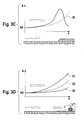
- FIGS. 3A to 3D illustrate the change in the measured from one of the sensors 5 characteristic A as a function of time in the event that the vehicle 1 moves at a constant speed to an obstacle.
- Fig. 3A shows in the upper part of a graph which schematically illustrates the course of the characteristic A on the location, in the event that the vehicle 1 moves to a non-overcoming obstacle (eg a wall or another vehicle) in the direction of the arrow, as schematically in lower part of Fig. 3A is indicated.
- the distance to the obstacle decreases with increasing time.
- the amplitude A increases, essentially exponentially, so that the following formula (1) holds:
- A0 is the characteristic at a certain distance d and x is the distance that the vehicle 1 has moved from the location x> 1 in the direction of the object.
- k is a damping factor, which may depend on the transmission medium and thus on the weather conditions (eg temperature, air pressure, precipitation).
- the characteristic parameter A increases exponentially with decreasing distance to the obstacle.
- the course of the parameter A corresponds to a reference curve 30 (see, eg Fig. 3B to 3D ).
- Fig. 3B shows in the upper part of a graph that schematically shows the course of the characteristic A on the location, in the event that the vehicle 1 moves to a drive-over obstacle (eg a curb), as shown schematically in the lower part of Fig. 3B indicated.
- a drive-over obstacle eg a curb
- the parameter A increases exponentially with decreasing distance from the vehicle to the obstacle, but not as strong as in Fig. 3A presented case.
- the characteristic A thus remains below the reference curve 30 shown by dashed lines. This is due to the shape of the obstacle, which reflects a large part of the transmitted signal from the sensor 5 in a direction in which it can no longer be detected by the sensor 5.
- the signal detected by the sensor 5 therefore corresponds only to the signal reflected from a relatively small area at the upper edge of the obstacle.
- the parameter A only increases up to a local maximum and then drops off.
- This decrease in characteristic A is due to the shape of the measuring lobe.
- the measuring cone spreads cone-shaped from the sensor 5. Consequently, the sensor 5 can be objects that are very close to the vehicle, only capture when they have a certain height. In other words, if the sensor 5 is too close to a low object, then the sensor "looks" over the object and can no longer detect it.
- Fig. 3C shows in the upper part of a graph that schematically shows the course of the characteristic A on the location, in the event that the vehicle 1 moves to a drive-over obstacle (eg a curb), as shown schematically in the lower part of Fig. 3C indicated.
- a drive-over obstacle eg a curb
- Fig. 3C is a local maximum to recognize, which from the for Fig. 3B stated reasons.
- the in Fig. 3C differs from that in Fig. 3B Graph shown by the fact that the parameter A at larger distances (ie smaller values for x) is above the dashed line reference curve 30. This in turn is due to the shape of the obstacle. Is that the obstacle, as in Fig. 3C shown, a tapered curb, then the obstacle has a relatively large area, which is almost perpendicular to the propagation direction of the emitted from the sensor 5 transmission signal. Consequently, the obstacle has a large backscatter cross section, which leads to larger reflection proportions.
- Fig. 3D Finally, in the upper part shows a graph that schematically shows the course of the characteristic A over the location, for the two cases that the vehicle 1 moves to a non-drivable inherent obstacle (eg another vehicle), as shown schematically in the lower part from Fig. 3D indicated.
- a non-drivable inherent obstacle eg another vehicle
- variable x does not necessarily depend on the actual distance d to the obstacle, but merely indicates the distance x which the vehicle 1 traveled from a certain starting position. Furthermore, also applies in Fig. 3D the assumption that the vehicle 1 is moving at a constant speed. Now, if the obstacle is self-moved and moves (in addition to the movement of the vehicle 1) to the vehicle 1, then the characteristic A behaves like the upper graph 31 and is above the reference curve 30th
- the characteristic A behaves like the lower graph 32 and lies below the reference curve 30.
- the lower graph 32 represents the case. that the vehicle 1 is still moving toward the obstacle, or in other words, the speed of the obstacle is lower than that of the vehicle 1. If the obstacle moves faster than the vehicle 1 and in the same direction, then the characteristic increases increasing x (not shown here).
- FIG. 4 shows a flowchart of a first embodiment of an object classification method in the context of a parking assistance method to assist a parking operation, which can be performed by the parking assistance system described above.
- step S1 at least one of the sensors 3 or 5 emits a transmission signal in the direction of travel during parking, that is to say one of the sensors 5 during reverse parking or one of the sensors 3 during forward parking.
- a transmission signal in the direction of travel during parking, that is to say one of the sensors 5 during reverse parking or one of the sensors 3 during forward parking.
- step S2 the sensor 5 receives the signal reflected from the object and forwards the received signal to the program-controlled device 11.
- step S3 the program-controlled device 11 subjects the received signal (more specifically, the envelope of the received signal) to signal processing, and obtains an (actual) characteristic A0 from the received signal.
- the parameter is the amplitude 25 of the first echo pulse 22.
- step S4 the sensor 5 again transmits a transmission signal, and in step S5, the sensor 5 receives the reception signal reflected from the object, whereupon, at step S6, a characteristic A is obtained from the reception signal.
- step S7 the program-controlled device 11 determines the distance x traveled by the vehicle 1 between steps S2 and S6. This can be done, for example, by integrating a speed signal output by the speed sensor 14 over time.
- step S9 the program-controlled device 11 compares this prediction variable Av with the actual characteristic A determined in step S6. If the prediction variable Av is smaller than the actual characteristic A, the method jumps to S 10. If, however, the predicted variable Av is greater than or equal to the actual one Characteristic A, then the process jumps to S 12.
- step S10 the program-controlled device 11 generates an object classification signal having a first state
- the program-controlled device 11 generates an object classification signal having a second state in step S12.
- the first and the second state differ, for example with regard to their signal level.
- the object classification signal can be further processed internally by the program-controlled device 11. In particular, it can be used to decide whether and which warnings are issued to the user.
- the program-controlled device 11 can be set up in such a way that it issues a warning signal during a reverse parking maneuver if the distance between the vehicle 1 and an object behind the vehicle detected by the sensors 5 is less than a specific warning distance.
- this warning distance may depend on whether the object is classified as passable (ie when an object classification signal of the first state is output) or not passable (ie when an object classification signal of the second state is output).
- the warning distance can be made longer for overrideable objects by a certain length, so as to take into account that at least the rear of the vehicle 1 can safely protrude over low objects.
- the procedure returns to the step S4 and the steps S4 to S10 / S12 are repeated.
- Fig. 5 shows a method according to a second embodiment, which represents a development of the first embodiment.
- the steps S1 to S9 of this embodiment correspond to the above-described steps S1 to S9 in this second embodiment, so that reference is made here only to the above explanations.
- step S11 the program-controlled device 11 determines whether there is a local maximum in the course of the parameter A (x), that is, the course of the parameter A (x) in the FIGS. 3B or 3C equivalent.
- the determination of a local maximum can be done, for example, by comparing the current parameter with the previous parameter or the characteristic previously determined at a certain distance. In this case, the presence of a local maximum can be affirmative if the difference between these two parameters exceeds a certain minimum difference.
- step S 10 The presence of a local maximum indicates that the object is traversable, so that the procedure jumps to step S 10 in the presence of a local maximum in which a corresponding object classification signal is output. If no local maximum is detected, then the procedure jumps to step 12 where a corresponding object classification signal is output.
- the distance sensors 3, 5, 8, 9 have been described as ultrasonic sensors. However, it is also possible to use other types of sensors (such as radar sensors, lidar sensors) as long as they are based on a distance-measuring method.
- the classification into drive-over and non-drive-over objects is carried out only on the basis of the evaluated parameter. It is also possible to use further information for the classification and, for example, to perform a plausibility check of the classification.
- the order of the steps of the above embodiments is merely exemplary and may be varied.
- the traveled distance x can also be determined before the transmission of the transmitted pulse.
Landscapes
- Engineering & Computer Science (AREA)
- Radar, Positioning & Navigation (AREA)
- Remote Sensing (AREA)
- Physics & Mathematics (AREA)
- Computer Networks & Wireless Communication (AREA)
- General Physics & Mathematics (AREA)
- Acoustics & Sound (AREA)
- Traffic Control Systems (AREA)
- Measurement Of Velocity Or Position Using Acoustic Or Ultrasonic Waves (AREA)
- Radar Systems Or Details Thereof (AREA)
- Transition And Organic Metals Composition Catalysts For Addition Polymerization (AREA)
- Thermistors And Varistors (AREA)
Claims (10)
- Procédé de classification d'objets pour classifier un objet dans un procédé d'aide au stationnement pour assister une opération de stationnement d'un véhicule (1), lors de laquelle le véhicule (1) se déplace vers l'objet, comprenant les étapes dans l'ordre suivant :(a) Détermination d'une première grandeur caractéristique (A0) à partir de la courbe d'un premier signal de réception reçu avec un détecteur de mesure de distance (3, 5, 8, 9) ;(b) Détermination d'une grandeur caractéristique supplémentaire (A) à partir de la courbe d'un deuxième signal de réception reçu avec un détecteur de mesure de distance (3, 5, 8, 9) ; caractérisé par les étapes supplémentaires :(c) Détermination d'un trajet (x) parcouru par le véhicule (1) entre l'étape (a) et l'étape (b) ;(d) Détermination d'une grandeur prévisionnelle (Av) à partir de la première grandeur caractéristique (A0) déterminée, la grandeur prévisionnelle étant associée au trajet (x) déterminé à l'étape (c) ;(e) Comparaison de la grandeur prévisionnelle (Av) avec la grandeur caractéristique supplémentaire (A) déterminée à l'étape (b) ;(f) Génération d'un signal de classification d'objets associé à l'objet, lequel présente un premier état dans le cas où la grandeur prévisionnelle (Av) est inférieure à la grandeur caractéristique supplémentaire et présente un deuxième état dans le cas où la grandeur prévisionnelle (Av) est égale ou supérieure à la grandeur caractéristique supplémentaire.
- Procédé selon la revendication 1, dans lequel les étapes (b) à (f) sont répétées périodiquement.
- Procédé selon l'une des revendications précédentes, dans lequel, à l'étape (d), la grandeur prévisionnelle (Av) est déterminée à partir d'une combinaison mathématique de la première grandeur caractéristique (A0) avec un facteur d'atténuation (k).
- Procédé selon la revendication 3, dans lequel, à l'étape (d), la grandeur prévisionnelle (Av(x)) est déterminée pour l'essentiel en multipliant la première grandeur caractéristique (A0) déterminée à l'étape (a) par un facteur ekx, k étant le facteur d'atténuation et x le trajet déterminé à l'étape (c).
- Procédé selon la revendication 3 ou 4, dans lequel le facteur d'atténuation (k) est réglé en fonction des conditions climatiques.
- Procédé selon l'une des revendications précédentes, dans lequel la première grandeur caractéristique et la grandeur caractéristique supplémentaire indiquent l'amplitude (25) d'un maximum local dans le signal de réception.
- Procédé selon l'une des revendications précédentes, dans lequel les étapes suivantes sont prévues en plus :(i) Détermination d'un écart momentané entre le véhicule (1) et l'objet ; et(j) Délivrance d'un signal d'alerte si l'écart momentané est inférieur à un écart minimum, l'écart minimum dépendant de l'état du signal de classification d'objets.
- Programme informatique, caractérisé par des moyens de code de programme pour accomplir toutes les étapes d'un procédé selon l'une des revendications précédentes lorsque le programme informatique est exécuté sur un ordinateur ou sur une unité de calcul.
- Système d'aide au stationnement pour assister une opération de stationnement d'un véhicule (1), lors de laquelle le véhicule (1) se déplace vers l'objet, le système d'aide au stationnement présentant un détecteur de mesure de distance (3, 5, 8, 9) qui émet périodiquement un signal d'émission du véhicule (1) en direction de l'objet et reçoit un signal de réception réfléchi par l'objet, caractérisé en ce qu'il est prévu en plus :- un dispositif programmable (11) qui, dans l'ordre suivant :détermine une première grandeur caractéristique (A0) à partir de la courbe d'un premier signal de réception reçu avec le détecteur de mesure de distance (3, 5, 8, 9) ;détermine une grandeur caractéristique supplémentaire (A) à partir de la courbe d'un deuxième signal de réception reçu avec le détecteur de mesure de distance (3, 5, 8, 9) ;détermine un trajet (x) parcouru par le véhicule (1) entre la détermination de la première grandeur caractéristique et la détermination de la deuxième grandeur caractéristique ;détermine une grandeur prévisionnelle à partir de la première grandeur caractéristique déterminée, la grandeur prévisionnelle étant associée à l'autre trajet (x) déterminé ;compare la grandeur prévisionnelle (Av) avec la grandeur caractéristique supplémentaire (A) ; etgénère un signal de classification d'objets associé à l'objet, lequel présente un premier état dans le cas où la grandeur prévisionnelle (Av) est inférieure à la grandeur caractéristique supplémentaire (A) et présente un deuxième état dans le cas où la grandeur prévisionnelle (Av) est égale ou supérieure à la grandeur caractéristique supplémentaire (A).
- Système d'aide au stationnement selon la revendication 9, dans lequel le détecteur de mesure de distance (3, 5, 8, 9) est prévu au niveau d'une région arrière ou d'une région avant du véhicule (1).
Applications Claiming Priority (2)
| Application Number | Priority Date | Filing Date | Title |
|---|---|---|---|
| DE102007042220A DE102007042220A1 (de) | 2007-09-05 | 2007-09-05 | Objektklassifizierungsverfahren, Einparkhilfeverfahren und Einparkhilfesystem |
| PCT/EP2008/059485 WO2009030554A1 (fr) | 2007-09-05 | 2008-07-18 | Procédé de classification d'objet, procédé d'aide au stationnement et système d'aide au stationnement |
Publications (2)
| Publication Number | Publication Date |
|---|---|
| EP2191293A1 EP2191293A1 (fr) | 2010-06-02 |
| EP2191293B1 true EP2191293B1 (fr) | 2011-05-04 |
Family
ID=39870119
Family Applications (1)
| Application Number | Title | Priority Date | Filing Date |
|---|---|---|---|
| EP08786265A Active EP2191293B1 (fr) | 2007-09-05 | 2008-07-18 | Procédé de classification d'objet, procédé d'aide au stationnement et système d'aide au stationnement |
Country Status (6)
| Country | Link |
|---|---|
| US (1) | US8310376B2 (fr) |
| EP (1) | EP2191293B1 (fr) |
| CN (1) | CN101796427B (fr) |
| AT (1) | ATE508377T1 (fr) |
| DE (2) | DE102007042220A1 (fr) |
| WO (1) | WO2009030554A1 (fr) |
Families Citing this family (27)
| Publication number | Priority date | Publication date | Assignee | Title |
|---|---|---|---|---|
| DE102009046158A1 (de) | 2009-10-29 | 2011-05-05 | Robert Bosch Gmbh | Verfahren zur Erkennung von Objekten mit geringer Höhe |
| DE102010025552B4 (de) | 2010-06-29 | 2022-03-17 | Volkswagen Ag | Verfahren und Vorrichtung zum Einparken eines Kraftfahrzeugs |
| DE102010045657A1 (de) | 2010-09-17 | 2012-03-22 | Wabco Gmbh | Umfeld-Überwachungssystem für ein Fahrzeug |
| EP2588881A1 (fr) * | 2011-06-11 | 2013-05-08 | Engimec S.r.l. | Améliorations de la détection d'obstacles pour véhicules |
| DE102011112149A1 (de) * | 2011-09-01 | 2013-03-07 | Valeo Schalter Und Sensoren Gmbh | Verfahren zum Durchführen eines Parkvorgangs eines Fahrzeugs sowie Fahrerassistenzeinrichtung |
| CN102849067B (zh) * | 2012-09-26 | 2016-05-18 | 浙江吉利汽车研究院有限公司杭州分公司 | 一种车辆泊车辅助系统及泊车方法 |
| US9224297B2 (en) * | 2013-04-23 | 2015-12-29 | Ford Global Technologies, Llc | Park assist object distance measurement clock control |
| US9096199B2 (en) * | 2013-10-09 | 2015-08-04 | Ford Global Technologies, Llc | Monitoring autonomous vehicle braking |
| US9725040B2 (en) | 2014-10-28 | 2017-08-08 | Nissan North America, Inc. | Vehicle object detection system |
| US9834141B2 (en) | 2014-10-28 | 2017-12-05 | Nissan North America, Inc. | Vehicle object detection system |
| US9880253B2 (en) | 2014-10-28 | 2018-01-30 | Nissan North America, Inc. | Vehicle object monitoring system |
| DE102015107389A1 (de) * | 2015-05-12 | 2016-11-17 | Valeo Schalter Und Sensoren Gmbh | Verfahren zum Betreiben eines Fahrerassistenzsystems eines Kraftfahrzeugs mit Objekterkennung im Nahbereich, Fahrerassistenzsystem sowie Kraftfahrzeug |
| US10871555B1 (en) * | 2015-12-02 | 2020-12-22 | Apple Inc. | Ultrasonic sensor |
| EP3299843A1 (fr) * | 2016-09-23 | 2018-03-28 | MediaTek Inc. | Procédé et appareil d'aide au stationnement pour automobile à l'aide de capteurs radar |
| JP6970936B2 (ja) * | 2016-12-20 | 2021-11-24 | パナソニックIpマネジメント株式会社 | 物体検出装置、物体検出プログラム、および記録媒体 |
| DE102017201219A1 (de) * | 2017-01-26 | 2018-07-26 | Robert Bosch Gmbh | Verfahren und System zum Erkennen von Objekten anhand von Ultraschallsignalen |
| US10223598B2 (en) | 2017-02-20 | 2019-03-05 | Volkswagen Aktiengesellschaft | Method of generating segmented vehicle image data, corresponding system, and vehicle |
| US10114375B1 (en) * | 2017-04-06 | 2018-10-30 | Delphi Technologies, Inc. | Motion-characteristic based object classification for automated vehicle |
| WO2020049650A1 (fr) * | 2018-09-05 | 2020-03-12 | 三菱電機株式会社 | Dispositif d'aide à la conduite |
| US10360714B1 (en) * | 2018-09-14 | 2019-07-23 | Lyft, Inc. | Systems and methods for displaying autonomous vehicle environmental awareness |
| DE102019215393A1 (de) * | 2019-10-08 | 2021-04-08 | Robert Bosch Gmbh | Verfahren und eine Vorrichtung zur Klassifizierung eines Objektes, insbesondere im Umfeld eines Kraftfahrzeugs |
| DE102020211461B4 (de) * | 2020-09-11 | 2022-03-24 | Volkswagen Aktiengesellschaft | Verfahren zum Betreiben eines Rückfahrassistenzsystems für ein Fahrzeug und Rückfahrassistenzsystem |
| DE102020212381A1 (de) | 2020-09-30 | 2022-03-31 | Continental Automotive Gmbh | Verfahren zur Charakterisierung eines Objekts in einer Umgebung eines Kraftfahrzeugs |
| JP7563317B2 (ja) * | 2021-07-09 | 2024-10-08 | 株式会社アイシン | 物体検出装置、物体検出方法、及びプログラム |
| TWI795006B (zh) * | 2021-09-30 | 2023-03-01 | 台灣立訊精密有限公司 | 圖形化超音波模組及駕駛輔助系統 |
| CN117382618A (zh) * | 2023-10-16 | 2024-01-12 | 深圳元戎启行科技有限公司 | 泊车距离控制方法、电子设备及存储介质 |
| DE102024203695A1 (de) * | 2024-04-22 | 2025-10-23 | Robert Bosch Gesellschaft mit beschränkter Haftung | Verfahren zum Ermitteln, ob ein Objekt mit einem Fahrzeug kollisionsfrei überfahrbar ist, und Fahrzeug |
Family Cites Families (9)
| Publication number | Priority date | Publication date | Assignee | Title |
|---|---|---|---|---|
| DE4208595A1 (de) * | 1991-11-11 | 1993-05-13 | Bosch Gmbh Robert | Einrichtung zur abstandsmessung mit ultraschall |
| US8152198B2 (en) * | 1992-05-05 | 2012-04-10 | Automotive Technologies International, Inc. | Vehicular occupant sensing techniques |
| DE10323639A1 (de) | 2003-05-26 | 2004-12-16 | Robert Bosch Gmbh | Verfahren und Vorrichtung zur Erfassung eines Objektes unter adaptiver Anpassung von Erfassungseigenschaften einer Erfassungseinrichtung |
| DE102004006015A1 (de) * | 2004-02-06 | 2005-08-25 | Robert Bosch Gmbh | Verfahren und Vorrichtung zur Anpassung eines Schwellwertes einer Detektionseinrichtung |
| DE102004047479A1 (de) | 2004-09-30 | 2006-04-13 | Robert Bosch Gmbh | Verfahren und Vorrichtung zum Klassifizieren von Seitenbegrenzungen einer Parklücke für ein Einparkassistenzsystem |
| DE102005044050A1 (de) | 2005-09-15 | 2007-03-22 | Hella Kgaa Hueck & Co. | Verfahren zur Parklückenbestimmung für Kraftfahrzeuge |
| TWI302879B (en) * | 2006-05-12 | 2008-11-11 | Univ Nat Chiao Tung | Real-time nighttime vehicle detection and recognition system based on computer vision |
| CN1996049A (zh) * | 2006-10-18 | 2007-07-11 | 何华科技股份有限公司 | 汽车及其车门防撞预警方法、预警系统 |
| US8494718B2 (en) * | 2007-06-04 | 2013-07-23 | Continental Teves Ag & Co. Ohg | Steering device for adjusting a wheel steering angle |
-
2007
- 2007-09-05 DE DE102007042220A patent/DE102007042220A1/de not_active Withdrawn
-
2008
- 2008-07-18 WO PCT/EP2008/059485 patent/WO2009030554A1/fr not_active Ceased
- 2008-07-18 EP EP08786265A patent/EP2191293B1/fr active Active
- 2008-07-18 US US12/733,458 patent/US8310376B2/en active Active
- 2008-07-18 DE DE502008003447T patent/DE502008003447D1/de active Active
- 2008-07-18 CN CN200880105522.0A patent/CN101796427B/zh active Active
- 2008-07-18 AT AT08786265T patent/ATE508377T1/de active
Also Published As
| Publication number | Publication date |
|---|---|
| US20100302069A1 (en) | 2010-12-02 |
| DE502008003447D1 (de) | 2011-06-16 |
| CN101796427A (zh) | 2010-08-04 |
| DE102007042220A1 (de) | 2009-03-12 |
| ATE508377T1 (de) | 2011-05-15 |
| CN101796427B (zh) | 2014-05-07 |
| US8310376B2 (en) | 2012-11-13 |
| WO2009030554A1 (fr) | 2009-03-12 |
| EP2191293A1 (fr) | 2010-06-02 |
Similar Documents
| Publication | Publication Date | Title |
|---|---|---|
| EP2191293A1 (fr) | Procédé de classification d'objet, procédé d'aide au stationnement et système d'aide au stationnement | |
| EP3183152B1 (fr) | Procédé pour avertir le conducteur d'un véhicule à moteur de la présence d'un objet dans son environnement proche, système d'aide à la conduite et véhicule à moteur | |
| EP1932016B1 (fr) | Procede et dispositif pour commander au moins un capteur de detection d'objet | |
| EP1643271B1 (fr) | Procédé et dispositif pour classifier des limites latéraux d'une place de stationnement pour un système d'assistance au stationnement d'un véhicule automobile | |
| EP3465264B1 (fr) | Procédé de détection d'au moins un emplacement de stationnement pour un véhicule | |
| WO2009013054A1 (fr) | Procédé de classification d'objet et système d'aide au parcage | |
| DE102010052304A1 (de) | Verfahren und Vorrichtung zum Unterstützen eines Fahrers eines Kraftfahrzeugs beim Ausparken aus einer Parklücke und Kraftfahrzeug | |
| WO2005023613A1 (fr) | Procede et dispositif pour saisir la distance momentanee separant un vehicule d'un obstacle | |
| DE102016118308B4 (de) | Verfahren zum Bestimmen eines Abstands zwischen einem Kraftfahrzeug und einem Objekt mit Anpassung einer berücksichtigten Anzahl von Abstandswerten, Steuergerät, Fahrerassistenzsystem sowie Kraftfahrzeug | |
| DE102009047066A1 (de) | Verfahren zur Warnung vor einem Objekt in der Umgebung eines Fahrzeugs sowie Fahrassistentensystem | |
| DE102009046158A1 (de) | Verfahren zur Erkennung von Objekten mit geringer Höhe | |
| EP1614585B1 (fr) | Méthode et dispositif de mesure d'un emplacement de stationnement pour un système d'assistance au stationnement d'un véhicule automobile | |
| EP1873737A1 (fr) | Procédé destiné à la détection d'une situation critique devant un véhicule | |
| WO2019038174A1 (fr) | Évitement d'avertissements d'angle mort dûs à des éclaboussures | |
| EP1158311A2 (fr) | Dispositif et procédé pour déterminer la distance et la vitesse | |
| DE102018209959A1 (de) | Verfahren und Fahrassistenzsystem zum Vermeiden einer Kollision eines Fahrzeugs mit einem Hindernis | |
| DE102015122413B4 (de) | Verfahren zum Betreiben eines Ultraschallsensors eines Kraftfahrzeugs, Ultraschallsensorvorrichtung, Fahrerassistenzsystem sowie Kraftfahrzeug | |
| EP1308751A2 (fr) | Méthode pour mise en opération d'un système pour récogniser des objets à courte distance et le système en soi | |
| DE102018103560A1 (de) | Verfahren zur Charakterisierung eines Objekts in einem Umgebungsbereich eines Kraftfahrzeugs durch Vergleich eines Empfangssignals eines Abstandssensors mit einer vorbestimmten Kurve, Sensorvorrichtung sowie Fahrerassistenzsystem | |
| DE102018103551A1 (de) | Verfahren zum Charakterisieren eines Objekts in einem Umgebungsbereich eines Kraftfahrzeugs anhand von zuvor gelernten Kurvenparametern, Sensorvorrichtung sowie Fahrerassistenzsystem | |
| EP2936200A1 (fr) | Procédé de détection d'une partie de signal parasite dans un signal de réception électrique d'un capteur à ultrasons, dispositif capteur à ultrasons et véhicule automobile | |
| EP1643270A2 (fr) | Système d'aide à la conduite | |
| WO2020108937A1 (fr) | Procédé pour pronostiquer un changement de voie de circulation prématuré, système d'aide à la conduite, véhicule à moteur et produit-programme d'ordinateur | |
| DE102018109645A1 (de) | Parkplatzgrößenkorrektur | |
| EP3093689A1 (fr) | Procede de fonctionnement d'un systeme d'assistance au conducteur d'un vehicule automobile comprenant une reconnaissance d'objet a proximite, systeme d'assistance au conducteur et vehicule automobile |
Legal Events
| Date | Code | Title | Description |
|---|---|---|---|
| PUAI | Public reference made under article 153(3) epc to a published international application that has entered the european phase |
Free format text: ORIGINAL CODE: 0009012 |
|
| 17P | Request for examination filed |
Effective date: 20100406 |
|
| AK | Designated contracting states |
Kind code of ref document: A1 Designated state(s): AT BE BG CH CY CZ DE DK EE ES FI FR GB GR HR HU IE IS IT LI LT LU LV MC MT NL NO PL PT RO SE SI SK TR |
|
| AX | Request for extension of the european patent |
Extension state: AL BA MK RS |
|
| 17Q | First examination report despatched |
Effective date: 20100805 |
|
| DAX | Request for extension of the european patent (deleted) | ||
| GRAP | Despatch of communication of intention to grant a patent |
Free format text: ORIGINAL CODE: EPIDOSNIGR1 |
|
| GRAS | Grant fee paid |
Free format text: ORIGINAL CODE: EPIDOSNIGR3 |
|
| GRAA | (expected) grant |
Free format text: ORIGINAL CODE: 0009210 |
|
| AK | Designated contracting states |
Kind code of ref document: B1 Designated state(s): AT BE BG CH CY CZ DE DK EE ES FI FR GB GR HR HU IE IS IT LI LT LU LV MC MT NL NO PL PT RO SE SI SK TR |
|
| REG | Reference to a national code |
Ref country code: GB Ref legal event code: FG4D Free format text: NOT ENGLISH |
|
| REG | Reference to a national code |
Ref country code: CH Ref legal event code: EP |
|
| REG | Reference to a national code |
Ref country code: IE Ref legal event code: FG4D Free format text: LANGUAGE OF EP DOCUMENT: GERMAN |
|
| REF | Corresponds to: |
Ref document number: 502008003447 Country of ref document: DE Date of ref document: 20110616 Kind code of ref document: P |
|
| REG | Reference to a national code |
Ref country code: DE Ref legal event code: R096 Ref document number: 502008003447 Country of ref document: DE Effective date: 20110616 |
|
| REG | Reference to a national code |
Ref country code: NL Ref legal event code: VDEP Effective date: 20110504 |
|
| PG25 | Lapsed in a contracting state [announced via postgrant information from national office to epo] |
Ref country code: NO Free format text: LAPSE BECAUSE OF FAILURE TO SUBMIT A TRANSLATION OF THE DESCRIPTION OR TO PAY THE FEE WITHIN THE PRESCRIBED TIME-LIMIT Effective date: 20110804 Ref country code: SE Free format text: LAPSE BECAUSE OF FAILURE TO SUBMIT A TRANSLATION OF THE DESCRIPTION OR TO PAY THE FEE WITHIN THE PRESCRIBED TIME-LIMIT Effective date: 20110504 Ref country code: LT Free format text: LAPSE BECAUSE OF FAILURE TO SUBMIT A TRANSLATION OF THE DESCRIPTION OR TO PAY THE FEE WITHIN THE PRESCRIBED TIME-LIMIT Effective date: 20110504 Ref country code: PT Free format text: LAPSE BECAUSE OF FAILURE TO SUBMIT A TRANSLATION OF THE DESCRIPTION OR TO PAY THE FEE WITHIN THE PRESCRIBED TIME-LIMIT Effective date: 20110905 |
|
| PG25 | Lapsed in a contracting state [announced via postgrant information from national office to epo] |
Ref country code: IS Free format text: LAPSE BECAUSE OF FAILURE TO SUBMIT A TRANSLATION OF THE DESCRIPTION OR TO PAY THE FEE WITHIN THE PRESCRIBED TIME-LIMIT Effective date: 20110904 Ref country code: CY Free format text: LAPSE BECAUSE OF FAILURE TO SUBMIT A TRANSLATION OF THE DESCRIPTION OR TO PAY THE FEE WITHIN THE PRESCRIBED TIME-LIMIT Effective date: 20110504 Ref country code: SI Free format text: LAPSE BECAUSE OF FAILURE TO SUBMIT A TRANSLATION OF THE DESCRIPTION OR TO PAY THE FEE WITHIN THE PRESCRIBED TIME-LIMIT Effective date: 20110504 Ref country code: ES Free format text: LAPSE BECAUSE OF FAILURE TO SUBMIT A TRANSLATION OF THE DESCRIPTION OR TO PAY THE FEE WITHIN THE PRESCRIBED TIME-LIMIT Effective date: 20110815 Ref country code: FI Free format text: LAPSE BECAUSE OF FAILURE TO SUBMIT A TRANSLATION OF THE DESCRIPTION OR TO PAY THE FEE WITHIN THE PRESCRIBED TIME-LIMIT Effective date: 20110504 Ref country code: GR Free format text: LAPSE BECAUSE OF FAILURE TO SUBMIT A TRANSLATION OF THE DESCRIPTION OR TO PAY THE FEE WITHIN THE PRESCRIBED TIME-LIMIT Effective date: 20110805 Ref country code: LV Free format text: LAPSE BECAUSE OF FAILURE TO SUBMIT A TRANSLATION OF THE DESCRIPTION OR TO PAY THE FEE WITHIN THE PRESCRIBED TIME-LIMIT Effective date: 20110504 |
|
| REG | Reference to a national code |
Ref country code: IE Ref legal event code: FD4D |
|
| PG25 | Lapsed in a contracting state [announced via postgrant information from national office to epo] |
Ref country code: NL Free format text: LAPSE BECAUSE OF FAILURE TO SUBMIT A TRANSLATION OF THE DESCRIPTION OR TO PAY THE FEE WITHIN THE PRESCRIBED TIME-LIMIT Effective date: 20110504 Ref country code: MT Free format text: LAPSE BECAUSE OF FAILURE TO SUBMIT A TRANSLATION OF THE DESCRIPTION OR TO PAY THE FEE WITHIN THE PRESCRIBED TIME-LIMIT Effective date: 20110504 |
|
| BERE | Be: lapsed |
Owner name: ROBERT BOSCH G.M.B.H. Effective date: 20110731 |
|
| PG25 | Lapsed in a contracting state [announced via postgrant information from national office to epo] |
Ref country code: IE Free format text: LAPSE BECAUSE OF FAILURE TO SUBMIT A TRANSLATION OF THE DESCRIPTION OR TO PAY THE FEE WITHIN THE PRESCRIBED TIME-LIMIT Effective date: 20110504 Ref country code: CZ Free format text: LAPSE BECAUSE OF FAILURE TO SUBMIT A TRANSLATION OF THE DESCRIPTION OR TO PAY THE FEE WITHIN THE PRESCRIBED TIME-LIMIT Effective date: 20110504 Ref country code: EE Free format text: LAPSE BECAUSE OF FAILURE TO SUBMIT A TRANSLATION OF THE DESCRIPTION OR TO PAY THE FEE WITHIN THE PRESCRIBED TIME-LIMIT Effective date: 20110504 |
|
| PG25 | Lapsed in a contracting state [announced via postgrant information from national office to epo] |
Ref country code: SK Free format text: LAPSE BECAUSE OF FAILURE TO SUBMIT A TRANSLATION OF THE DESCRIPTION OR TO PAY THE FEE WITHIN THE PRESCRIBED TIME-LIMIT Effective date: 20110504 Ref country code: MC Free format text: LAPSE BECAUSE OF NON-PAYMENT OF DUE FEES Effective date: 20110731 Ref country code: DK Free format text: LAPSE BECAUSE OF FAILURE TO SUBMIT A TRANSLATION OF THE DESCRIPTION OR TO PAY THE FEE WITHIN THE PRESCRIBED TIME-LIMIT Effective date: 20110504 Ref country code: PL Free format text: LAPSE BECAUSE OF FAILURE TO SUBMIT A TRANSLATION OF THE DESCRIPTION OR TO PAY THE FEE WITHIN THE PRESCRIBED TIME-LIMIT Effective date: 20110504 Ref country code: RO Free format text: LAPSE BECAUSE OF FAILURE TO SUBMIT A TRANSLATION OF THE DESCRIPTION OR TO PAY THE FEE WITHIN THE PRESCRIBED TIME-LIMIT Effective date: 20110504 |
|
| PLBE | No opposition filed within time limit |
Free format text: ORIGINAL CODE: 0009261 |
|
| STAA | Information on the status of an ep patent application or granted ep patent |
Free format text: STATUS: NO OPPOSITION FILED WITHIN TIME LIMIT |
|
| 26N | No opposition filed |
Effective date: 20120207 |
|
| PG25 | Lapsed in a contracting state [announced via postgrant information from national office to epo] |
Ref country code: BE Free format text: LAPSE BECAUSE OF NON-PAYMENT OF DUE FEES Effective date: 20110731 |
|
| PG25 | Lapsed in a contracting state [announced via postgrant information from national office to epo] |
Ref country code: IT Free format text: LAPSE BECAUSE OF FAILURE TO SUBMIT A TRANSLATION OF THE DESCRIPTION OR TO PAY THE FEE WITHIN THE PRESCRIBED TIME-LIMIT Effective date: 20110504 Ref country code: HR Free format text: LAPSE BECAUSE OF FAILURE TO SUBMIT A TRANSLATION OF THE DESCRIPTION OR TO PAY THE FEE WITHIN THE PRESCRIBED TIME-LIMIT Effective date: 20111123 |
|
| REG | Reference to a national code |
Ref country code: DE Ref legal event code: R097 Ref document number: 502008003447 Country of ref document: DE Effective date: 20120207 |
|
| REG | Reference to a national code |
Ref country code: CH Ref legal event code: PL |
|
| PG25 | Lapsed in a contracting state [announced via postgrant information from national office to epo] |
Ref country code: LI Free format text: LAPSE BECAUSE OF NON-PAYMENT OF DUE FEES Effective date: 20120731 Ref country code: CH Free format text: LAPSE BECAUSE OF NON-PAYMENT OF DUE FEES Effective date: 20120731 |
|
| PG25 | Lapsed in a contracting state [announced via postgrant information from national office to epo] |
Ref country code: LU Free format text: LAPSE BECAUSE OF NON-PAYMENT OF DUE FEES Effective date: 20110718 |
|
| PG25 | Lapsed in a contracting state [announced via postgrant information from national office to epo] |
Ref country code: BG Free format text: LAPSE BECAUSE OF FAILURE TO SUBMIT A TRANSLATION OF THE DESCRIPTION OR TO PAY THE FEE WITHIN THE PRESCRIBED TIME-LIMIT Effective date: 20110804 |
|
| PG25 | Lapsed in a contracting state [announced via postgrant information from national office to epo] |
Ref country code: TR Free format text: LAPSE BECAUSE OF FAILURE TO SUBMIT A TRANSLATION OF THE DESCRIPTION OR TO PAY THE FEE WITHIN THE PRESCRIBED TIME-LIMIT Effective date: 20110504 |
|
| PG25 | Lapsed in a contracting state [announced via postgrant information from national office to epo] |
Ref country code: HU Free format text: LAPSE BECAUSE OF FAILURE TO SUBMIT A TRANSLATION OF THE DESCRIPTION OR TO PAY THE FEE WITHIN THE PRESCRIBED TIME-LIMIT Effective date: 20110504 |
|
| PG25 | Lapsed in a contracting state [announced via postgrant information from national office to epo] |
Ref country code: HR Free format text: LAPSE BECAUSE OF FAILURE TO SUBMIT A TRANSLATION OF THE DESCRIPTION OR TO PAY THE FEE WITHIN THE PRESCRIBED TIME-LIMIT Effective date: 20110504 |
|
| REG | Reference to a national code |
Ref country code: AT Ref legal event code: MM01 Ref document number: 508377 Country of ref document: AT Kind code of ref document: T Effective date: 20130718 |
|
| PG25 | Lapsed in a contracting state [announced via postgrant information from national office to epo] |
Ref country code: AT Free format text: LAPSE BECAUSE OF NON-PAYMENT OF DUE FEES Effective date: 20130718 |
|
| REG | Reference to a national code |
Ref country code: FR Ref legal event code: PLFP Year of fee payment: 9 |
|
| REG | Reference to a national code |
Ref country code: FR Ref legal event code: PLFP Year of fee payment: 10 |
|
| REG | Reference to a national code |
Ref country code: FR Ref legal event code: PLFP Year of fee payment: 11 |
|
| PGFP | Annual fee paid to national office [announced via postgrant information from national office to epo] |
Ref country code: FR Payment date: 20200727 Year of fee payment: 13 Ref country code: GB Payment date: 20200724 Year of fee payment: 13 |
|
| GBPC | Gb: european patent ceased through non-payment of renewal fee |
Effective date: 20210718 |
|
| PG25 | Lapsed in a contracting state [announced via postgrant information from national office to epo] |
Ref country code: GB Free format text: LAPSE BECAUSE OF NON-PAYMENT OF DUE FEES Effective date: 20210718 |
|
| PG25 | Lapsed in a contracting state [announced via postgrant information from national office to epo] |
Ref country code: FR Free format text: LAPSE BECAUSE OF NON-PAYMENT OF DUE FEES Effective date: 20210731 |
|
| REG | Reference to a national code |
Ref country code: DE Ref legal event code: R084 Ref document number: 502008003447 Country of ref document: DE |
|
| PGFP | Annual fee paid to national office [announced via postgrant information from national office to epo] |
Ref country code: DE Payment date: 20250924 Year of fee payment: 18 |