EP2192164B1 - Tintenzusammensetzung für ein Schreibwerkzeug und Schreibwerkzeug - Google Patents
Tintenzusammensetzung für ein Schreibwerkzeug und Schreibwerkzeug Download PDFInfo
- Publication number
- EP2192164B1 EP2192164B1 EP20090177487 EP09177487A EP2192164B1 EP 2192164 B1 EP2192164 B1 EP 2192164B1 EP 20090177487 EP20090177487 EP 20090177487 EP 09177487 A EP09177487 A EP 09177487A EP 2192164 B1 EP2192164 B1 EP 2192164B1
- Authority
- EP
- European Patent Office
- Prior art keywords
- ink composition
- ball
- ink
- writing tool
- writing
- Prior art date
- Legal status (The legal status is an assumption and is not a legal conclusion. Google has not performed a legal analysis and makes no representation as to the accuracy of the status listed.)
- Not-in-force
Links
- 239000000203 mixture Substances 0.000 title claims description 113
- 229910052751 metal Inorganic materials 0.000 claims description 38
- 239000002184 metal Substances 0.000 claims description 38
- 239000000843 powder Substances 0.000 claims description 32
- 239000011347 resin Substances 0.000 claims description 27
- 229920005989 resin Polymers 0.000 claims description 27
- 239000002245 particle Substances 0.000 claims description 22
- 239000010419 fine particle Substances 0.000 claims description 20
- 239000003349 gelling agent Substances 0.000 claims description 15
- 239000000976 ink Substances 0.000 description 137
- -1 thiophosphorous acid triesters Chemical class 0.000 description 12
- 239000003795 chemical substances by application Substances 0.000 description 10
- 229910052782 aluminium Inorganic materials 0.000 description 9
- XAGFODPZIPBFFR-UHFFFAOYSA-N aluminium Chemical compound [Al] XAGFODPZIPBFFR-UHFFFAOYSA-N 0.000 description 9
- 230000000052 comparative effect Effects 0.000 description 9
- 239000002932 luster Substances 0.000 description 8
- 239000004599 antimicrobial Substances 0.000 description 6
- 239000003906 humectant Substances 0.000 description 6
- 239000000314 lubricant Substances 0.000 description 6
- 239000013528 metallic particle Substances 0.000 description 5
- 239000002562 thickening agent Substances 0.000 description 5
- PEDCQBHIVMGVHV-UHFFFAOYSA-N Glycerine Chemical compound OCC(O)CO PEDCQBHIVMGVHV-UHFFFAOYSA-N 0.000 description 4
- 239000013065 commercial product Substances 0.000 description 4
- 238000010276 construction Methods 0.000 description 4
- 150000002170 ethers Chemical class 0.000 description 4
- 229920000591 gum Polymers 0.000 description 4
- ORMNNUPLFAPCFD-DVLYDCSHSA-M phenethicillin potassium Chemical compound [K+].N([C@@H]1C(N2[C@H](C(C)(C)S[C@@H]21)C([O-])=O)=O)C(=O)C(C)OC1=CC=CC=C1 ORMNNUPLFAPCFD-DVLYDCSHSA-M 0.000 description 4
- XLYOFNOQVPJJNP-UHFFFAOYSA-N water Substances O XLYOFNOQVPJJNP-UHFFFAOYSA-N 0.000 description 4
- LYCAIKOWRPUZTN-UHFFFAOYSA-N Ethylene glycol Chemical compound OCCO LYCAIKOWRPUZTN-UHFFFAOYSA-N 0.000 description 3
- NBIIXXVUZAFLBC-UHFFFAOYSA-N Phosphoric acid Chemical compound OP(O)(O)=O NBIIXXVUZAFLBC-UHFFFAOYSA-N 0.000 description 3
- 239000004743 Polypropylene Substances 0.000 description 3
- DNIAPMSPPWPWGF-UHFFFAOYSA-N Propylene glycol Chemical compound CC(O)CO DNIAPMSPPWPWGF-UHFFFAOYSA-N 0.000 description 3
- HEMHJVSKTPXQMS-UHFFFAOYSA-M Sodium hydroxide Chemical compound [OH-].[Na+] HEMHJVSKTPXQMS-UHFFFAOYSA-M 0.000 description 3
- XSQUKJJJFZCRTK-UHFFFAOYSA-N Urea Chemical compound NC(N)=O XSQUKJJJFZCRTK-UHFFFAOYSA-N 0.000 description 3
- MTHSVFCYNBDYFN-UHFFFAOYSA-N diethylene glycol Chemical compound OCCOCCO MTHSVFCYNBDYFN-UHFFFAOYSA-N 0.000 description 3
- 230000001771 impaired effect Effects 0.000 description 3
- 239000000463 material Substances 0.000 description 3
- 238000005259 measurement Methods 0.000 description 3
- 229920001155 polypropylene Polymers 0.000 description 3
- 150000003839 salts Chemical class 0.000 description 3
- 239000007787 solid Substances 0.000 description 3
- 238000003756 stirring Methods 0.000 description 3
- 235000010493 xanthan gum Nutrition 0.000 description 3
- 239000000230 xanthan gum Substances 0.000 description 3
- 229920001285 xanthan gum Polymers 0.000 description 3
- 229940082509 xanthan gum Drugs 0.000 description 3
- 239000004677 Nylon Substances 0.000 description 2
- ISWSIDIOOBJBQZ-UHFFFAOYSA-N Phenol Chemical compound OC1=CC=CC=C1 ISWSIDIOOBJBQZ-UHFFFAOYSA-N 0.000 description 2
- 229930182556 Polyacetal Natural products 0.000 description 2
- 239000004698 Polyethylene Substances 0.000 description 2
- CDBYLPFSWZWCQE-UHFFFAOYSA-L Sodium Carbonate Chemical compound [Na+].[Na+].[O-]C([O-])=O CDBYLPFSWZWCQE-UHFFFAOYSA-L 0.000 description 2
- PPBRXRYQALVLMV-UHFFFAOYSA-N Styrene Chemical compound C=CC1=CC=CC=C1 PPBRXRYQALVLMV-UHFFFAOYSA-N 0.000 description 2
- 230000004075 alteration Effects 0.000 description 2
- 229910000147 aluminium phosphate Inorganic materials 0.000 description 2
- 239000002199 base oil Substances 0.000 description 2
- 239000003086 colorant Substances 0.000 description 2
- 150000001875 compounds Chemical class 0.000 description 2
- 239000000470 constituent Substances 0.000 description 2
- 235000014113 dietary fatty acids Nutrition 0.000 description 2
- 239000006185 dispersion Substances 0.000 description 2
- 238000009826 distribution Methods 0.000 description 2
- 230000000694 effects Effects 0.000 description 2
- 238000011156 evaluation Methods 0.000 description 2
- 239000000194 fatty acid Substances 0.000 description 2
- 229930195729 fatty acid Natural products 0.000 description 2
- 150000004665 fatty acids Chemical class 0.000 description 2
- 239000000499 gel Substances 0.000 description 2
- 235000011187 glycerol Nutrition 0.000 description 2
- 238000004519 manufacturing process Methods 0.000 description 2
- 230000007246 mechanism Effects 0.000 description 2
- 239000002736 nonionic surfactant Substances 0.000 description 2
- 229920001778 nylon Polymers 0.000 description 2
- WRKCIHRWQZQBOL-UHFFFAOYSA-N octyl dihydrogen phosphate Chemical compound CCCCCCCCOP(O)(O)=O WRKCIHRWQZQBOL-UHFFFAOYSA-N 0.000 description 2
- TYQTYRXEMJXFJG-UHFFFAOYSA-N phosphorothious acid Chemical compound OP(O)S TYQTYRXEMJXFJG-UHFFFAOYSA-N 0.000 description 2
- 229920003023 plastic Polymers 0.000 description 2
- 239000004033 plastic Substances 0.000 description 2
- 229920000515 polycarbonate Polymers 0.000 description 2
- 239000004417 polycarbonate Substances 0.000 description 2
- 229920000573 polyethylene Polymers 0.000 description 2
- 229920000139 polyethylene terephthalate Polymers 0.000 description 2
- 239000005020 polyethylene terephthalate Substances 0.000 description 2
- 229920006324 polyoxymethylene Polymers 0.000 description 2
- 238000000926 separation method Methods 0.000 description 2
- 239000002904 solvent Substances 0.000 description 2
- 239000007858 starting material Substances 0.000 description 2
- 238000003860 storage Methods 0.000 description 2
- UMGDCJDMYOKAJW-UHFFFAOYSA-N thiourea Chemical compound NC(N)=S UMGDCJDMYOKAJW-UHFFFAOYSA-N 0.000 description 2
- WRIDQFICGBMAFQ-UHFFFAOYSA-N (E)-8-Octadecenoic acid Natural products CCCCCCCCCC=CCCCCCCC(O)=O WRIDQFICGBMAFQ-UHFFFAOYSA-N 0.000 description 1
- FMSKPKSLSVKPIP-UHFFFAOYSA-N 1,2-benzothiazol-3-one;sodium Chemical compound [Na].C1=CC=C2C(=O)NSC2=C1 FMSKPKSLSVKPIP-UHFFFAOYSA-N 0.000 description 1
- IXPNQXFRVYWDDI-UHFFFAOYSA-N 1-methyl-2,4-dioxo-1,3-diazinane-5-carboximidamide Chemical compound CN1CC(C(N)=N)C(=O)NC1=O IXPNQXFRVYWDDI-UHFFFAOYSA-N 0.000 description 1
- HYZJCKYKOHLVJF-UHFFFAOYSA-N 1H-benzimidazole Chemical class C1=CC=C2NC=NC2=C1 HYZJCKYKOHLVJF-UHFFFAOYSA-N 0.000 description 1
- CHHHXKFHOYLYRE-UHFFFAOYSA-M 2,4-Hexadienoic acid, potassium salt (1:1), (2E,4E)- Chemical compound [K+].CC=CC=CC([O-])=O CHHHXKFHOYLYRE-UHFFFAOYSA-M 0.000 description 1
- XNWFRZJHXBZDAG-UHFFFAOYSA-N 2-METHOXYETHANOL Chemical compound COCCO XNWFRZJHXBZDAG-UHFFFAOYSA-N 0.000 description 1
- LQJBNNIYVWPHFW-UHFFFAOYSA-N 20:1omega9c fatty acid Natural products CCCCCCCCCCC=CCCCCCCCC(O)=O LQJBNNIYVWPHFW-UHFFFAOYSA-N 0.000 description 1
- CMGDVUCDZOBDNL-UHFFFAOYSA-N 4-methyl-2h-benzotriazole Chemical compound CC1=CC=CC2=NNN=C12 CMGDVUCDZOBDNL-UHFFFAOYSA-N 0.000 description 1
- QSBYPNXLFMSGKH-UHFFFAOYSA-N 9-Heptadecensaeure Natural products CCCCCCCC=CCCCCCCCC(O)=O QSBYPNXLFMSGKH-UHFFFAOYSA-N 0.000 description 1
- 244000215068 Acacia senegal Species 0.000 description 1
- 229920000178 Acrylic resin Polymers 0.000 description 1
- 239000004925 Acrylic resin Substances 0.000 description 1
- 229920001817 Agar Polymers 0.000 description 1
- 229920002134 Carboxymethyl cellulose Polymers 0.000 description 1
- RYGMFSIKBFXOCR-UHFFFAOYSA-N Copper Chemical compound [Cu] RYGMFSIKBFXOCR-UHFFFAOYSA-N 0.000 description 1
- FBPFZTCFMRRESA-FSIIMWSLSA-N D-Glucitol Natural products OC[C@H](O)[C@H](O)[C@@H](O)[C@H](O)CO FBPFZTCFMRRESA-FSIIMWSLSA-N 0.000 description 1
- FBPFZTCFMRRESA-KVTDHHQDSA-N D-Mannitol Chemical compound OC[C@@H](O)[C@@H](O)[C@H](O)[C@H](O)CO FBPFZTCFMRRESA-KVTDHHQDSA-N 0.000 description 1
- FBPFZTCFMRRESA-JGWLITMVSA-N D-glucitol Chemical compound OC[C@H](O)[C@@H](O)[C@H](O)[C@H](O)CO FBPFZTCFMRRESA-JGWLITMVSA-N 0.000 description 1
- KCXVZYZYPLLWCC-UHFFFAOYSA-N EDTA Chemical class OC(=O)CN(CC(O)=O)CCN(CC(O)=O)CC(O)=O KCXVZYZYPLLWCC-UHFFFAOYSA-N 0.000 description 1
- 239000001856 Ethyl cellulose Substances 0.000 description 1
- ZZSNKZQZMQGXPY-UHFFFAOYSA-N Ethyl cellulose Chemical compound CCOCC1OC(OC)C(OCC)C(OCC)C1OC1C(O)C(O)C(OC)C(CO)O1 ZZSNKZQZMQGXPY-UHFFFAOYSA-N 0.000 description 1
- YCKRFDGAMUMZLT-UHFFFAOYSA-N Fluorine atom Chemical compound [F] YCKRFDGAMUMZLT-UHFFFAOYSA-N 0.000 description 1
- 108010010803 Gelatin Proteins 0.000 description 1
- WQZGKKKJIJFFOK-GASJEMHNSA-N Glucose Natural products OC[C@H]1OC(O)[C@H](O)[C@@H](O)[C@@H]1O WQZGKKKJIJFFOK-GASJEMHNSA-N 0.000 description 1
- 229920002907 Guar gum Polymers 0.000 description 1
- 229920000084 Gum arabic Polymers 0.000 description 1
- 239000004354 Hydroxyethyl cellulose Substances 0.000 description 1
- 229920000663 Hydroxyethyl cellulose Polymers 0.000 description 1
- 229920000161 Locust bean gum Polymers 0.000 description 1
- 229930195725 Mannitol Natural products 0.000 description 1
- 239000005642 Oleic acid Substances 0.000 description 1
- ZQPPMHVWECSIRJ-UHFFFAOYSA-N Oleic acid Natural products CCCCCCCCC=CCCCCCCCC(O)=O ZQPPMHVWECSIRJ-UHFFFAOYSA-N 0.000 description 1
- 235000010451 Plantago psyllium Nutrition 0.000 description 1
- 244000090599 Plantago psyllium Species 0.000 description 1
- 239000002202 Polyethylene glycol Substances 0.000 description 1
- 239000004372 Polyvinyl alcohol Substances 0.000 description 1
- 108010009736 Protein Hydrolysates Proteins 0.000 description 1
- XUIMIQQOPSSXEZ-UHFFFAOYSA-N Silicon Chemical compound [Si] XUIMIQQOPSSXEZ-UHFFFAOYSA-N 0.000 description 1
- VMHLLURERBWHNL-UHFFFAOYSA-M Sodium acetate Chemical compound [Na+].CC([O-])=O VMHLLURERBWHNL-UHFFFAOYSA-M 0.000 description 1
- 239000004288 Sodium dehydroacetate Substances 0.000 description 1
- 229920002125 Sokalan® Polymers 0.000 description 1
- 229920002472 Starch Polymers 0.000 description 1
- 229930006000 Sucrose Natural products 0.000 description 1
- CZMRCDWAGMRECN-UGDNZRGBSA-N Sucrose Chemical compound O[C@H]1[C@H](O)[C@@H](CO)O[C@@]1(CO)O[C@@H]1[C@H](O)[C@@H](O)[C@H](O)[C@@H](CO)O1 CZMRCDWAGMRECN-UGDNZRGBSA-N 0.000 description 1
- 240000004584 Tamarindus indica Species 0.000 description 1
- 235000004298 Tamarindus indica Nutrition 0.000 description 1
- 229920001615 Tragacanth Polymers 0.000 description 1
- GSEJCLTVZPLZKY-UHFFFAOYSA-N Triethanolamine Chemical compound OCCN(CCO)CCO GSEJCLTVZPLZKY-UHFFFAOYSA-N 0.000 description 1
- 235000010489 acacia gum Nutrition 0.000 description 1
- 239000000205 acacia gum Substances 0.000 description 1
- DPXJVFZANSGRMM-UHFFFAOYSA-N acetic acid;2,3,4,5,6-pentahydroxyhexanal;sodium Chemical compound [Na].CC(O)=O.OCC(O)C(O)C(O)C(O)C=O DPXJVFZANSGRMM-UHFFFAOYSA-N 0.000 description 1
- 229920006243 acrylic copolymer Polymers 0.000 description 1
- 230000009471 action Effects 0.000 description 1
- 239000008272 agar Substances 0.000 description 1
- 235000010419 agar Nutrition 0.000 description 1
- 230000002776 aggregation Effects 0.000 description 1
- 238000004220 aggregation Methods 0.000 description 1
- 235000010443 alginic acid Nutrition 0.000 description 1
- 229920000615 alginic acid Polymers 0.000 description 1
- 239000000783 alginic acid Substances 0.000 description 1
- 229960001126 alginic acid Drugs 0.000 description 1
- 150000004781 alginic acids Chemical class 0.000 description 1
- 239000003513 alkali Substances 0.000 description 1
- 125000000217 alkyl group Chemical group 0.000 description 1
- 229910045601 alloy Inorganic materials 0.000 description 1
- 239000000956 alloy Substances 0.000 description 1
- 150000003863 ammonium salts Chemical class 0.000 description 1
- 239000003945 anionic surfactant Substances 0.000 description 1
- 239000002518 antifoaming agent Substances 0.000 description 1
- 239000000305 astragalus gummifer gum Substances 0.000 description 1
- 150000007514 bases Chemical class 0.000 description 1
- QRUDEWIWKLJBPS-UHFFFAOYSA-N benzotriazole Chemical compound C1=CC=C2N[N][N]C2=C1 QRUDEWIWKLJBPS-UHFFFAOYSA-N 0.000 description 1
- 239000012964 benzotriazole Substances 0.000 description 1
- WQZGKKKJIJFFOK-VFUOTHLCSA-N beta-D-glucose Chemical compound OC[C@H]1O[C@@H](O)[C@H](O)[C@@H](O)[C@@H]1O WQZGKKKJIJFFOK-VFUOTHLCSA-N 0.000 description 1
- 230000015572 biosynthetic process Effects 0.000 description 1
- 239000004202 carbamide Substances 0.000 description 1
- 239000001768 carboxy methyl cellulose Substances 0.000 description 1
- 235000010948 carboxy methyl cellulose Nutrition 0.000 description 1
- 229920003123 carboxymethyl cellulose sodium Polymers 0.000 description 1
- 239000008112 carboxymethyl-cellulose Substances 0.000 description 1
- 229940105329 carboxymethylcellulose Drugs 0.000 description 1
- 229940063834 carboxymethylcellulose sodium Drugs 0.000 description 1
- 235000010418 carrageenan Nutrition 0.000 description 1
- 239000000679 carrageenan Substances 0.000 description 1
- 229920001525 carrageenan Polymers 0.000 description 1
- 229940113118 carrageenan Drugs 0.000 description 1
- 239000005018 casein Substances 0.000 description 1
- BECPQYXYKAMYBN-UHFFFAOYSA-N casein, tech. Chemical compound NCCCCC(C(O)=O)N=C(O)C(CC(O)=O)N=C(O)C(CCC(O)=N)N=C(O)C(CC(C)C)N=C(O)C(CCC(O)=O)N=C(O)C(CC(O)=O)N=C(O)C(CCC(O)=O)N=C(O)C(C(C)O)N=C(O)C(CCC(O)=N)N=C(O)C(CCC(O)=N)N=C(O)C(CCC(O)=N)N=C(O)C(CCC(O)=O)N=C(O)C(CCC(O)=O)N=C(O)C(COP(O)(O)=O)N=C(O)C(CCC(O)=N)N=C(O)C(N)CC1=CC=CC=C1 BECPQYXYKAMYBN-UHFFFAOYSA-N 0.000 description 1
- 235000021240 caseins Nutrition 0.000 description 1
- 239000003093 cationic surfactant Substances 0.000 description 1
- 239000000919 ceramic Substances 0.000 description 1
- 239000003638 chemical reducing agent Substances 0.000 description 1
- NMCCNOZOBBWFMN-UHFFFAOYSA-N davicil Chemical compound CS(=O)(=O)C1=C(Cl)C(Cl)=NC(Cl)=C1Cl NMCCNOZOBBWFMN-UHFFFAOYSA-N 0.000 description 1
- 230000006735 deficit Effects 0.000 description 1
- ZFAKTZXUUNBLEB-UHFFFAOYSA-N dicyclohexylazanium;nitrite Chemical compound [O-]N=O.C1CCCCC1[NH2+]C1CCCCC1 ZFAKTZXUUNBLEB-UHFFFAOYSA-N 0.000 description 1
- ZBCBWPMODOFKDW-UHFFFAOYSA-N diethanolamine Chemical compound OCCNCCO ZBCBWPMODOFKDW-UHFFFAOYSA-N 0.000 description 1
- 239000004205 dimethyl polysiloxane Substances 0.000 description 1
- 235000013870 dimethyl polysiloxane Nutrition 0.000 description 1
- 238000001035 drying Methods 0.000 description 1
- 239000000975 dye Substances 0.000 description 1
- 150000002148 esters Chemical class 0.000 description 1
- 235000019325 ethyl cellulose Nutrition 0.000 description 1
- 229920001249 ethyl cellulose Polymers 0.000 description 1
- 229960004667 ethyl cellulose Drugs 0.000 description 1
- 229940093476 ethylene glycol Drugs 0.000 description 1
- 239000011737 fluorine Substances 0.000 description 1
- 229910052731 fluorine Inorganic materials 0.000 description 1
- 238000009472 formulation Methods 0.000 description 1
- 239000008273 gelatin Substances 0.000 description 1
- 229920000159 gelatin Polymers 0.000 description 1
- 235000019322 gelatine Nutrition 0.000 description 1
- 235000011852 gelatine desserts Nutrition 0.000 description 1
- 239000008103 glucose Substances 0.000 description 1
- 230000005484 gravity Effects 0.000 description 1
- 235000010417 guar gum Nutrition 0.000 description 1
- 239000000665 guar gum Substances 0.000 description 1
- 229960002154 guar gum Drugs 0.000 description 1
- 235000019447 hydroxyethyl cellulose Nutrition 0.000 description 1
- 229940071826 hydroxyethyl cellulose Drugs 0.000 description 1
- 150000002460 imidazoles Chemical class 0.000 description 1
- YAMHXTCMCPHKLN-UHFFFAOYSA-N imidazolidin-2-one Chemical compound O=C1NCCN1 YAMHXTCMCPHKLN-UHFFFAOYSA-N 0.000 description 1
- 238000002347 injection Methods 0.000 description 1
- 239000007924 injection Substances 0.000 description 1
- 230000002452 interceptive effect Effects 0.000 description 1
- 238000011835 investigation Methods 0.000 description 1
- 230000001788 irregular Effects 0.000 description 1
- QXJSBBXBKPUZAA-UHFFFAOYSA-N isooleic acid Natural products CCCCCCCC=CCCCCCCCCC(O)=O QXJSBBXBKPUZAA-UHFFFAOYSA-N 0.000 description 1
- 235000010420 locust bean gum Nutrition 0.000 description 1
- 239000000711 locust bean gum Substances 0.000 description 1
- 239000000594 mannitol Substances 0.000 description 1
- 235000010355 mannitol Nutrition 0.000 description 1
- 229920000609 methyl cellulose Polymers 0.000 description 1
- 239000001923 methylcellulose Substances 0.000 description 1
- 229960002900 methylcellulose Drugs 0.000 description 1
- 235000010981 methylcellulose Nutrition 0.000 description 1
- 239000002480 mineral oil Substances 0.000 description 1
- 238000002156 mixing Methods 0.000 description 1
- PDDANVVLWYOEPS-UHFFFAOYSA-N nitrous acid;n-propan-2-ylpropan-2-amine Chemical compound [O-]N=O.CC(C)[NH2+]C(C)C PDDANVVLWYOEPS-UHFFFAOYSA-N 0.000 description 1
- 239000003921 oil Substances 0.000 description 1
- ZQPPMHVWECSIRJ-KTKRTIGZSA-N oleic acid Chemical compound CCCCCCCC\C=C/CCCCCCCC(O)=O ZQPPMHVWECSIRJ-KTKRTIGZSA-N 0.000 description 1
- 229940053010 pen-aqueous Drugs 0.000 description 1
- 230000035699 permeability Effects 0.000 description 1
- 239000003208 petroleum Substances 0.000 description 1
- 239000000049 pigment Substances 0.000 description 1
- 229920000435 poly(dimethylsiloxane) Polymers 0.000 description 1
- 229920001495 poly(sodium acrylate) polymer Polymers 0.000 description 1
- 229920002432 poly(vinyl methyl ether) polymer Polymers 0.000 description 1
- 229920001515 polyalkylene glycol Polymers 0.000 description 1
- 229920001083 polybutene Polymers 0.000 description 1
- 229920001223 polyethylene glycol Polymers 0.000 description 1
- 229920002451 polyvinyl alcohol Polymers 0.000 description 1
- 235000019422 polyvinyl alcohol Nutrition 0.000 description 1
- 239000001267 polyvinylpyrrolidone Substances 0.000 description 1
- 229920000036 polyvinylpyrrolidone Polymers 0.000 description 1
- 235000013855 polyvinylpyrrolidone Nutrition 0.000 description 1
- 239000004302 potassium sorbate Substances 0.000 description 1
- 235000010241 potassium sorbate Nutrition 0.000 description 1
- 229940069338 potassium sorbate Drugs 0.000 description 1
- 238000003825 pressing Methods 0.000 description 1
- 239000000047 product Substances 0.000 description 1
- 125000001436 propyl group Chemical group [H]C([*])([H])C([H])([H])C([H])([H])[H] 0.000 description 1
- HNJBEVLQSNELDL-UHFFFAOYSA-N pyrrolidin-2-one Chemical compound O=C1CCCN1 HNJBEVLQSNELDL-UHFFFAOYSA-N 0.000 description 1
- 239000010979 ruby Substances 0.000 description 1
- 229910001750 ruby Inorganic materials 0.000 description 1
- 229930182490 saponin Natural products 0.000 description 1
- 150000007949 saponins Chemical class 0.000 description 1
- 235000017709 saponins Nutrition 0.000 description 1
- 238000007789 sealing Methods 0.000 description 1
- 238000004062 sedimentation Methods 0.000 description 1
- 229910052710 silicon Inorganic materials 0.000 description 1
- 239000010703 silicon Substances 0.000 description 1
- 229920002545 silicone oil Polymers 0.000 description 1
- 239000000344 soap Substances 0.000 description 1
- 239000001632 sodium acetate Substances 0.000 description 1
- 235000017281 sodium acetate Nutrition 0.000 description 1
- 235000010413 sodium alginate Nutrition 0.000 description 1
- 239000000661 sodium alginate Substances 0.000 description 1
- 229940005550 sodium alginate Drugs 0.000 description 1
- WXMKPNITSTVMEF-UHFFFAOYSA-M sodium benzoate Chemical compound [Na+].[O-]C(=O)C1=CC=CC=C1 WXMKPNITSTVMEF-UHFFFAOYSA-M 0.000 description 1
- 239000004299 sodium benzoate Substances 0.000 description 1
- 235000010234 sodium benzoate Nutrition 0.000 description 1
- 229960003885 sodium benzoate Drugs 0.000 description 1
- 229910000029 sodium carbonate Inorganic materials 0.000 description 1
- 229940079839 sodium dehydroacetate Drugs 0.000 description 1
- 235000019259 sodium dehydroacetate Nutrition 0.000 description 1
- FQENQNTWSFEDLI-UHFFFAOYSA-J sodium diphosphate Chemical compound [Na+].[Na+].[Na+].[Na+].[O-]P([O-])(=O)OP([O-])([O-])=O FQENQNTWSFEDLI-UHFFFAOYSA-J 0.000 description 1
- 239000001488 sodium phosphate Substances 0.000 description 1
- 229910000162 sodium phosphate Inorganic materials 0.000 description 1
- NNMHYFLPFNGQFZ-UHFFFAOYSA-M sodium polyacrylate Chemical compound [Na+].[O-]C(=O)C=C NNMHYFLPFNGQFZ-UHFFFAOYSA-M 0.000 description 1
- 229940048086 sodium pyrophosphate Drugs 0.000 description 1
- AKHNMLFCWUSKQB-UHFFFAOYSA-L sodium thiosulfate Chemical compound [Na+].[Na+].[O-]S([O-])(=O)=S AKHNMLFCWUSKQB-UHFFFAOYSA-L 0.000 description 1
- 235000019345 sodium thiosulphate Nutrition 0.000 description 1
- DSOWAKKSGYUMTF-GZOLSCHFSA-M sodium;(1e)-1-(6-methyl-2,4-dioxopyran-3-ylidene)ethanolate Chemical compound [Na+].C\C([O-])=C1/C(=O)OC(C)=CC1=O DSOWAKKSGYUMTF-GZOLSCHFSA-M 0.000 description 1
- 239000000600 sorbitol Substances 0.000 description 1
- 239000010935 stainless steel Substances 0.000 description 1
- 229910001220 stainless steel Inorganic materials 0.000 description 1
- 239000008107 starch Substances 0.000 description 1
- 235000019698 starch Nutrition 0.000 description 1
- 239000000126 substance Substances 0.000 description 1
- 239000005720 sucrose Substances 0.000 description 1
- 239000004094 surface-active agent Substances 0.000 description 1
- 235000019818 tetrasodium diphosphate Nutrition 0.000 description 1
- 239000001577 tetrasodium phosphonato phosphate Substances 0.000 description 1
- ZIBGPFATKBEMQZ-UHFFFAOYSA-N triethylene glycol Chemical compound OCCOCCOCCO ZIBGPFATKBEMQZ-UHFFFAOYSA-N 0.000 description 1
- RYFMWSXOAZQYPI-UHFFFAOYSA-K trisodium phosphate Chemical compound [Na+].[Na+].[Na+].[O-]P([O-])([O-])=O RYFMWSXOAZQYPI-UHFFFAOYSA-K 0.000 description 1
- 150000004670 unsaturated fatty acids Chemical class 0.000 description 1
- 235000021122 unsaturated fatty acids Nutrition 0.000 description 1
- UHVMMEOXYDMDKI-JKYCWFKZSA-L zinc;1-(5-cyanopyridin-2-yl)-3-[(1s,2s)-2-(6-fluoro-2-hydroxy-3-propanoylphenyl)cyclopropyl]urea;diacetate Chemical compound [Zn+2].CC([O-])=O.CC([O-])=O.CCC(=O)C1=CC=C(F)C([C@H]2[C@H](C2)NC(=O)NC=2N=CC(=CC=2)C#N)=C1O UHVMMEOXYDMDKI-JKYCWFKZSA-L 0.000 description 1
Images


Classifications
-
- C—CHEMISTRY; METALLURGY
- C09—DYES; PAINTS; POLISHES; NATURAL RESINS; ADHESIVES; COMPOSITIONS NOT OTHERWISE PROVIDED FOR; APPLICATIONS OF MATERIALS NOT OTHERWISE PROVIDED FOR
- C09D—COATING COMPOSITIONS, e.g. PAINTS, VARNISHES OR LACQUERS; FILLING PASTES; CHEMICAL PAINT OR INK REMOVERS; INKS; CORRECTING FLUIDS; WOODSTAINS; PASTES OR SOLIDS FOR COLOURING OR PRINTING; USE OF MATERIALS THEREFOR
- C09D11/00—Inks
- C09D11/16—Writing inks
- C09D11/18—Writing inks specially adapted for ball-point writing instruments
-
- C—CHEMISTRY; METALLURGY
- C09—DYES; PAINTS; POLISHES; NATURAL RESINS; ADHESIVES; COMPOSITIONS NOT OTHERWISE PROVIDED FOR; APPLICATIONS OF MATERIALS NOT OTHERWISE PROVIDED FOR
- C09D—COATING COMPOSITIONS, e.g. PAINTS, VARNISHES OR LACQUERS; FILLING PASTES; CHEMICAL PAINT OR INK REMOVERS; INKS; CORRECTING FLUIDS; WOODSTAINS; PASTES OR SOLIDS FOR COLOURING OR PRINTING; USE OF MATERIALS THEREFOR
- C09D11/00—Inks
- C09D11/16—Writing inks
- C09D11/17—Writing inks characterised by colouring agents
Definitions
- the present invention relates to an ink composition for a writing tool and to a writing tool.
- ink compositions for writing tools A variety of colors are realized in ink compositions for writing tools, by the use of various dyes and pigments.
- Ink compositions with metallic colors obtained by including metal powders, and writing tools comprising such ink compositions have been proposed in recent years in Japanese Patent Publication No. 3221846 (hereinafter referred to as "document 1"), Japanese Patent Publication No. 3789198 (hereinafter referred to as “document 2”), European Patent Application EP 0 987 304 A1 (hereinafter referred to as "document 3”) and US Patent Publication US 6,099,629 (hereinafter referred to as "document 4").
- European Patent Application EP 0 903 384 A shows the use of spherical polimer particles in ball point inks to impart pseudo-plasticity.
- ink compositions containing such metal powders contain solid metal powder, problems have been faced including writing problems such as ink bleed-out and writing thin spots, settling of the metal powder during storage or use causing separation of the ink composition, clogging of the pen point or alteration in color tone with passage of time.
- the metal powder in the ink composition tends to settle causing sedimentation and separation, as mentioned above, which results in clogging or alteration of the color tone over time.
- the present invention has been accomplished in light of these circumstances, and its object is to provide an ink composition for a writing tool that exhibits both an excellent discharge property and high stability over time, as well as a writing tool that produces no initial thin spots and allows drawing of stable, clear writing lines.
- an ink composition for a writing tool that comprises a metal powder, a gelling agent and spherical resin fine particles, wherein the viscosity (V1) at a shear rate of 1000 s -1 is no greater than 45 mPa ⁇ s and the viscosity (V2) at a shear rate of 0.01 s -1 is at least 100 Pa ⁇ s.
- the ink composition for a writing tool of the invention comprises a metal powder, but it also comprises a gelling agent and spherical resin fine particles, and has values within the specified ranges for the viscosity V1 and V2 measured under different shear rate conditions. Since the viscosity (V1) at a shear rate of 1000 s -1 is no greater than 45 mPa ⁇ s, the discharge property of the ink composition during writing is satisfactory, and writing can be accomplished with sufficient clarity without initial thin spots, for both thick writing lines and thin writing lines. Furthermore, since the viscosity (V2) at a shear rate of 0.01 s -1 is at least 100 Pa ⁇ s, it is possible to adequately inhibit settling of the metal powder during storage and writing, so that the stability over time is excellent.
- the ink composition of the invention has been accomplished based on particular knowledge of the present inventors that two viscosities at different shear rates may be specified to solve the problems characteristic of metallic inks, namely the obstruction and settling caused by adding the metal powder, and as a result it is possible to provide an ink composition having both an excellent discharge property and stability over time, compared to conventional ink compositions.
- the mean particle size of the metal powder in the ink composition of the invention is preferably 5-20 ⁇ m.
- the mean particle size of the spherical resin fine particles in the ink composition of the invention is preferably 0.05-1 ⁇ m. This will allow the spherical resin fine particles to adhere onto the surfaces of the metallic particles, thus helping to prevent the metallic particles from adhering to each other and helping to more reliably prevent aggregation of the metal powder. It is thus possible to produce an ink composition with an even more excellent discharge property and stability over time.
- a writing tool comprising the aforementioned ink composition for a writing tool. Since such a writing tool is filled with an ink composition with a sufficiently excellent discharge property and shelf life, formation of initial thin spots is adequately inhibited and it is possible to draw writing lines with a consistent metallic luster in a stable manner for prolonged periods.
- the writing tool of the invention comprises an ink holding tube and a ball-point pen tip provided at the end of the ink holding tube, and it preferably has the aforementioned ink composition for a writing tool in the ink holding tube. Adjustment of the clearance will thus be possible, to allow stable drawing of writing lines of various thicknesses while adequately preventing initial thin spots.
- an ink composition for a writing tool can be provided that exhibits both an excellent discharge property and high stability over time, and a writing tool can also be provided that produces no initial thin spots and allows drawing of stable, clear writing lines.
- Fig. 1 is a schematic cross-sectional view showing an embodiment of a ball-point pen according to the invention.
- Fig. 2 is a schematic view showing a cutout of part of a ball-point pen according to a different embodiment of the invention.
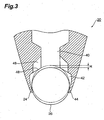
- Fig. 3 is a schematic cross-sectional view showing a magnified portion of the longitudinal section of the ball-point pen tip 20 shown in Fig. 1 and Fig. 2 .
- the ink composition for a writing tool of this embodiment is a gel ink comprising metal powder, a gelling agent, spherical resin fine particles and other optional components. Each of these components will now be explained in detail.
- the metal powder used may be one that has metallic luster and is ordinarily added to ink compositions for writing tools.
- aluminum powder, bronze powder or the like may be used.
- the mean particle size of the metal powder is preferably 3-20 ⁇ m and more preferably 3-12 ⁇ m. If the mean particle size of the metal powder exceeds 20 ⁇ m the ink composition will tend to clog at the pen tip, and if it is less than 3 ⁇ m the metallic luster of the writing lines will be impaired, tending to prevent the desired color shade from being obtained.
- the mean particle size referred to in the present specification is the value measured by laser diffraction scattering using a commercially available measuring apparatus, and it can be determined as D50, which is the 50% diameter in the volume-based particle size distribution.
- the form of the metal powder is preferably scaly. This will yield an ink composition with excellent metallic luster as well as superior dispersibility.
- the metal powder content is preferably 1-10 parts by mass and more preferably 2-7 parts by mass, with 100 parts by mass as the total of the ink composition. If the content is greater than 10 parts by mass, the solid concentration of the ink composition will become too high, thus tending to result in clogging at the pen tip. If the content is less than 1 part by mass, on the other hand, it will tend to be difficult to draw ink writing lines with sufficient metallic luster.
- the metal powder is preferably aluminum powder.
- a commercially available metal paste comprising metal powder, a petroleum-based solvent and a friction reducing agent such as a fatty acid may be used as the metal powder source for formulation of the ink composition.
- the spherical resin fine particles used may be colored, and they may be commercially available resin particles, for example. There are no particular restrictions on the material thereof, and for example, spherical resin fine particles comprising an acrylic resin, a styrene/acrylic copolymer or a polyolefm may be used.
- the spherical resin fine particles may be in the form of a powder or an aqueous dispersion.
- As commercially available spherical resin fme particles there may be used LUMIKOL (trade name of Nihon Keiko Kagaku), CHEMIPEARL (trade name of Mitsui Chemicals, Inc.), FINESPHERE (trade name of Nippon Paint Co., Ltd.), or the like.
- the mean particle size of the spherical resin fine particles is preferably 0.05-1 ⁇ m and more preferably 0.1-0.5 ⁇ m. If the mean particle size is greater than 1 ⁇ m the spherical resin fine particles themselves will tend to settle, thus interfering with satisfactory stability over time, and if it is less than 0.05 ⁇ m the metal powder-dispersing effect will be impeded, thus tending to create irregularities in writing lines.
- This mean particle size is the value measured by laser diffraction scattering using a commercially available measuring apparatus, and it can be determined as D50, which is the 50% diameter in the volume-based particle size distribution.
- the shapes of the spherical resin fme particles are spherical, they can infiltrate between the metallic particles of the metal powder and prevent adhesion between the metallic particles, thus lowering friction between the metallic particles and resulting in an ink composition with an excellent discharge property.
- the spherical resin fine particle content is preferably 2-40 parts by mass and more preferably 5-30 parts by mass, with 100 parts by mass as the total of the ink composition. If the content is greater than 40 parts by mass, the solid concentration of the ink composition will become too high, thus tending to result in clogging at the pen tip. A content of less than 2 parts by mass, on the other hand, will impede the metal powder-dispersing effect, thus tending to create irregularities in writing lines.
- the gelling agent is not particularly restricted so long as it is one ordinarily used in ball-point pen aqueous gel inks.
- gelling agents there may be mentioned natural agents such as xanthan gum, guar gum, locust bean gum, carrageenan, gum arabic, tragacanth gum, alginic acid, gelatin, agar, casein, psyllium seed gum and tamarind seed gum, and synthetic agents such as methylcellulose, ethylcellulose, hydroxyethylcellulose, carboxymethylcellulose, carboxymethylcellulose sodium, sodium alginate, polyvinylpyrrolidone, polyvinyl alcohol, polyvinyl methyl ether, sodium polyacrylate and carboxyvinyl polymer. These may be used as single compounds or as combinations of two or more compounds.
- the gelling agent content is preferably 0.1-3 parts by mass and more preferably 0.2-1 part by mass, with 100 parts by mass as the total of the ink composition. If the content is greater than 3 parts by mass, the viscosity of the ink composition will become too high, thus tending to result in clogging at the pen tip. A content of less than 0.1 part by mass, on the other hand, will excessively lower the viscosity of the ink composition, tending to interfere with sufficient dispersibility of the metal powder.
- the ink composition of this embodiment may also contain a rust-preventive agent, antiseptic agent (mildewproofing agent), lubricant, humectant, pH regulator or the like in addition to the components mentioned above.
- rust-preventive agents there may be used benzotriazole and its derivatives, tolyltriazole, dicyclohexylammonium nitrite, diisopropylammonium nitrite, sodium thiosulfate, ethylenediaminetetraacetic acid salts, octyl phosphate, imidazoles, benzoimidazoles, saponins, dialkylthioureas and the like.
- the rust-preventive agent content is preferably 0.3-5 parts by mass and more preferably 0.5-3 parts by mass, with 100 parts by mass as the total of the ink composition.
- antiseptic agents there may be used carbolic acid, 1,2-benzisothiazolin-3-one sodium salt, sodium benzoate, sodium dehydroacetate, potassium sorbate, propyl paraoxybenzoate, 2,3,5,6-tetrachloro-4-(methylsulfonyl)pyridine and the like.
- the antiseptic agent content is preferably 0.1-5 parts by mass and more preferably 0.1-1 part by mass, with 100 parts by mass as the total of the ink composition.
- lubricants there may be used higher fatty acids such as oleic acid, nonionic surfactants with long-chain alkyl groups, polyether-modified silicone oil, thiophosphorous acid triesters such as thiophosphorous acid tri(alkoxycarbonylmethyl ester) or thiophosphorous acid tri(alkoxycarbonylethyl ester), phosphoric acid monoesters of polyoxyethylenealkyl ethers or polyoxyethylenealkylaryl ethers, phosphoric acid diesters of polyoxyethylenealkyl ethers or polyoxyethylenealkylaryl ethers, or metal salts, ammonium salts, amine salts and alkanolamine salts of the foregoing.
- the lubricant content is preferably 0.3-5 parts by mass and more preferably 0.5-3 parts by mass, with 100 parts by mass as the total of the ink composition.
- humectants there may be used ethylene glycol, diethylene glycol, triethylene glycol, polyethylene glycol, propylene glycol, ethyleneglycol monomethyl ether, glycerin, pyrrolidone, urea, thiourea, ethyleneurea, sorbitol, mannitol, sucrose, glucose, reduced starch hydrolysate, sodium pyrophosphate and the like.
- the humectant content is preferably 1-30 parts by mass and more preferably 5-20 parts by mass, with 100 parts by mass as the total of the ink composition.
- the ink composition of this embodiment may further contain fluorine-based surfactants to improve the permeability of the solvent, or nonionic surfactants, anionic surfactants, cationic surfactants, antifoaming agents such as dimethylpolysiloxane, pH regulators or water.
- pH regulators there may be used inorganic salts such as sodium carbonate, sodium phosphate, sodium hydroxide and sodium acetate, or organic basic compounds including water-soluble amine compounds such as triethanolamine and diethanolamine.
- the water content is preferably 20-60 parts by mass and more preferably 40-60 parts by mass, with 100 parts by mass as the total of the ink composition.
- the ink composition of this embodiment has an excellent shear thinning property.
- the viscosity (measuring temperature: 20°C) of the ink composition the viscosity (V1) at a shear rate of 1000 s -1 is no greater than 45 mPa ⁇ s, preferably no greater than 35 mPa ⁇ s and more preferably no greater than 30 mPa ⁇ s. If V1 is no greater than 35 mPa ⁇ s it will be possible to obtain an ink composition with a more excellent discharge property, and if V1 is no greater than 30 mPa ⁇ s it will be possible to obtain an ink composition with an even more excellent discharge property.
- the viscosity (V2) at a shear rate of 0.01 s -1 is at least 100 Pa ⁇ s, preferably at least 120 Pa ⁇ s and more preferably at least 130 Pa ⁇ s. If V2 is at least 120 Pa ⁇ s it will be possible to obtain an ink composition with more excellent stability over time, and if V2 is at least 130 Pa ⁇ s it will be possible to obtain an ink composition with even more excellent stability over time.
- the ink composition of this embodiment preferably has a V1 of no greater than 35 mPa ⁇ s and a V2 of at least 120 Pa ⁇ s, and more preferably a V1 of no greater than 30 mPa ⁇ s and a V2 of at least 130 Pa ⁇ s.
- the viscosities V1, V2 of the ink composition of this embodiment can be measured using a commercially available viscometer, at a temperature of 20°C and after maintaining a prescribed shear rate for 2 minutes.
- the ink composition of this embodiment may be produced by mixing each of the aforementioned components using, for example, a stirrer such as a dissolver, Henschel mixer or homomixer.
- a stirrer such as a dissolver, Henschel mixer or homomixer.
- the stirring conditions for the stirrer are not particularly restricted, and for example, a dissolving agitator may be used for stirring for 30-180 minutes at a rotational speed of 100-1000 rpm, to obtain an ink composition having the metal powder dispersed in a sufficiently homogeneous manner.
- Fig. 1 is a schematic cross-sectional view showing the ball-point pen of this embodiment.
- an ink composition 12 is filled into an ink holding tube 14.
- a ball-point pen tip 20 is provided at one end of the ink holding tube 14.
- the ball-point pen tip 20 is composed of a ball holder 24 and a ball 26 held in a rotatable manner by the ball holder 24, and the ink holding tube 14 is anchored by a joint 25.
- a backflow preventer 16 is housed adjacent to the ink composition 12 in the ink holding tube 14, opposite the ball-point pen tip 20 end. The backflow preventer 16 is situated in such a manner that no gap is formed between it and the ink composition 12.
- a core 10 is formed by the ink holding tube 14, joint 25, ball-point pen tip 20, ink composition 12 and backflow preventer 16, and the core 10 is mounted on a main body axis 18, while a breech-block 28 with an open hole is attached to the back end of the main body axis 18 (the end opposite the ball-point pen tip 20).
- the constituent elements of the ball-point pen 100 will be described below, but except for the ink composition 12, common constituent elements ordinarily used in ball-point pens may be applied to this construction.
- An ink composition according to the embodiment described above is used for the ink composition 12.
- the ink holding tube 14 may be made of a resin such as polypropylene, polyethylene, polyethylene terephthalate, nylon, polyacetal, polycarbonate or the like, or it may be made of metal. There are no particular restrictions on the shape of the ink holding tube 14, and a cylindrical shape, for example, may be employed.
- the backflow preventer 16 has a function of preventing outflow of the ink composition (outflow preventing function) and a function of preventing dry-up of the ink composition (sealing function), and any known backflow preventer having such functions may be used without any particular restrictions.
- the backflow preventer 16 may comprise a base oil and a thickener, for example.
- base oils there may be mentioned mineral oils, polybutene, silicon oil, glycerin, polyalkylene glycol and the like.
- thickeners there may be mentioned metal soap-based thickeners, organic thickeners, inorganic thickeners and the like.
- the viscosity of the backflow preventer 16 and the difference in specific gravity of the ink composition 12 and backflow preventer 16 are adjusted so that the backflow preventer 16 does not accumulate in the ink composition 12 when the ball-point pen tip 20 is pointing downward.
- the backflow preventer 16 preferably has a composition that is immiscible with the ink composition 12.
- a member made of a plastic material such as polypropylene, for example, may be used for the main body axis 18 and breech-block 28.
- the joint 25 may be made of, for example, polypropylene, polyethylene, polyethylene terephthalate, nylon, polyacetal, polycarbonate or the like.
- the joint 25, and the ball holder 24 and ball 26 in the ball-point pen tip 20, may be ones that are commonly used in ball-point pens.
- the diameter of the ball 26 is preferably 0.3-1.2 mm.
- An ink composition 12 according to the invention is filled into the ink holding tube 14 of the ball-point pen 100. Since the ink composition 12 exhibits both an excellent discharge property and high stability over time, the ball-point pen 100 produces no initial thin spots and allows drawing of stable, clear writing lines with metallic luster.
- FIG. 2 is a schematic view showing a cutout of part of a ball-point pen according to a different embodiment of the invention. Except for the ink composition housed in the ink holding tube 14 of the ball-point pen 200, an common construction employed for ordinary knock-type ball-point pens may be applied to this construction, as explained hereunder.
- the ball-point pen 200 is a knock-type ball-point pen having a clip 32 at the back end of the main body axis 18 and having the core 10 housed in a pulled-back state by a spring 34 (coil spring) inside the main body axis 18.
- a spring 34 coil spring
- the core 10 comprises a ball-point pen tip 20 at its tip, having a ball 26 and a ball holder 24 that holds the ball 26 in a rotatable manner, a joint 25 at the front end of which the ball-point pen tip 20 is anchored, and an ink holding tube 14 at the end opening of which the joint 25 is anchored.
- the back end of the ink holding tube 14 and the hole (opening) of the tip member 22 are connected as an air stream passageway.
- a trigger member (not shown) that energizes the ball 26 forward.
- the inside of the ink holding tube 14 is filled with the ink composition and a backflow preventer that prevents backflow of the ink composition, similar to the ball-point pen 100.
- the trigger member may be a known type, such as one having a straight section (rod section) at one end of a metal small-gage wire spring, or a linear plastic piece.
- the ball 26 held in the ball holder 24 of the ball-point pen tip 20 may be one made of a material such as sintered hard alloy, stainless steel, ruby or ceramic.
- the outer diameter of the ball 26 may be, for example, 0.1-2.0 mm.
- An ink composition according to the invention is filled into the ink holding tube 14 of the ball-point pen 200. Since the ink composition exhibits both an excellent discharge property and high stability over time, the ball-point pen 200 produces no initial thin spots and allows drawing of stable, clear writing lines with metallic luster.
- Fig. 3 is a schematic cross-sectional view showing a magnified portion of the longitudinal section of the ball-point pen tip 20 shown in Fig. 1 and Fig. 2 .
- the ball 26 housed in the ball-holding chamber 42 of the ball-point pen tip 20 is situated at the position shown by the solid line in Fig. 3 and is pressed against the inner edge of the tip of the ball holder 24 by the trigger member, which is not shown.
- the ball 26 When the ball-point pen is used for writing, the ball 26 is pressed against the paper or other surface, and the ball 26 retreats to the position indicated by the long-dash-double-short-dash line in Fig. 3 . That is, the ball 26 moves by the prescribed distance H and is pressed against the ball striker 46. This creates a gap (clearance) of a prescribed size between the ball 26 and ball holder 24 tip inner edge, so that the ink composition supplied from the ink passageway hole 40 through radial furrows 48 to the ball-holding chamber 42 is discharged out of the ball-point pen tip 20. Since it is extremely difficult to measure the clearance between the ball 26 and ball holder 24, clearance sizes can usually be compared by the moving distance H of the ball.
- the moving distance H of the ball 26 in the ball-point pen tip 20 is preferably in the range of 20-100 ⁇ m. If the moving distance H of the ball 26 is less than 20 ⁇ m the clearance will be too small, tending to result in obstruction of the ink composition, and if the moving distance H of the ball 26 is greater than 100 ⁇ m the clearance will be too large, tending to result in drying of the ink composition inside the ball-point pen tip 20 and generation of more initial thin spots.
- the ball-point pens 100, 200 of these embodiments house ink compositions according to the embodiments that exhibit both an excellent discharge property and excellent stability over time, and that can therefore be used in ball-point pens with different clearance sizes.
- obstruction of the ink composition between the ball 26 and the ball holder 24 tip inner edge during writing can be adequately prevented even when the ball-point pen has a small clearance. Since the clearance size can therefore be smaller than when using conventional metallic color ink compositions, it is possible to draw distinct thin writing lines having metallic color. Furthermore, dry-up at the tip edge can be satisfactorily inhibited.
- the ink composition of this embodiment has an excellent shear thinning property, it is possible to satisfactorily prevent blotting and the like even with ball-point pens having large clearances. That is, the ink composition of this embodiment can be suitably used for writing tools with small clearance sizes and writing tools with large clearance sizes. Using such an ink composition, it is possible to obtain a writing tool that produces no initial thin spots or blotting, and allows writing to be accomplished with sufficient clarity for both thick writing lines and thin writing lines.
- the ball-point pens 100, 200 of the embodiments with the constructions described above may be produced by the same production processes for ordinary ball-point pens, except for the ink composition used.
- the ball-point pen of this embodiment may lack the main body axis 18, and the ink holding tube 14 itself may serve as the main body axis.
- the ball-point pen of this embodiment may have a pressing mechanism whereby the ink composition and backflow preventer in the ink holding tube 14 are pressed from the back end (the end opposite the ball-point pen tip 20).
- the ball-point pen of this embodiment may lack the backflow preventer 16.
- the ink composition of the invention is not limited to use in ball-point pens, and may instead by used in marking pens including brush pens, or in writing tools that employ valve mechanisms at the ink injection sections.
- the viscosities of the ink compositions of the examples and comparative examples prepared as described above were measured in the following manner. Using a commercially available viscometer (US200, trade name of Paar Physica Co., Ltd.), the viscosities at different shear rates (V1 and V2) were measured after maintaining prescribed shear rates (1000 s -1 and 0.01 s -1 ) for 2 minutes at a temperature of 20°C.
- Ball-point pen structures were prepared having the structure shown in Fig. 1 and having ball-point pen tips each with a different clearance (moving distance H of the ball 26 in Fig. 3 ).
- the ink compositions of the examples and comparative examples were filled into the ink holding tubes (inner diameter: 4.0 mm) of the prepared ball-point pen structures to complete the ball-point pens.
- the fabricated ball-point pens were used for writing on paper, and the discharge property of each ink composition was evaluated in the following manner. The results were as shown in Tables 1 and 2.
- the ink holding tube of each fabricated ball-point pen was placed in a centrifugal separator and centrifuged for 20 minutes at 400 G.
- the ink holding tube was then housed in the main body axis to complete the ball-point pen and used for writing on paper, and the stability over time of the ink composition was evaluated in the following manner. The results were as shown in Tables 1 and 2.
- an ink composition comprising metal powder, a gelling agent and spherical resin fine particles, and having a viscosity (V1) of no greater than 45 mPa ⁇ s at a shear rate of 1000 s -1 and a viscosity (V2) of at least 100 Pa ⁇ s at a shear rate of 0.01 s -1 , exhibits an excellent discharge property even with a small ball-point pen tip clearance, and also exhibits excellent stability over time.
- V1 viscosity of no greater than 45 mPa ⁇ s at a shear rate of 1000 s -1
- V2 viscosity
Landscapes
- Chemical & Material Sciences (AREA)
- Life Sciences & Earth Sciences (AREA)
- Engineering & Computer Science (AREA)
- Materials Engineering (AREA)
- Wood Science & Technology (AREA)
- Organic Chemistry (AREA)
- Pens And Brushes (AREA)
- Inks, Pencil-Leads, Or Crayons (AREA)
Claims (6)
- Tintenzusammensetzung (12) für ein Schreibwerkzeug, aufweisend:ein Metallpulver;ein Geliermittel; undfeine kugelförmige Harzpartikel;wobei die Viskosität (V1) bei einer Schergeschwindigkeit von 1000 s-1 nicht größer als 45 mPa · s ist und die Viskosität (V2) bei einer Schergeschwindigkeit von 0,01 s-1 mindestens 100 Pa · s beträgt, bei Messung nachdem diese Schergeschwindigkeiten zwei Minuten lang bei einer Temperatur von 20 °C beibehalten wurden, unter Verwendung eines Viskosimeter mit einem Kegel, wobei der Kegelradius 25 mm beträgt und wobei der Kegelwinkel 2° beträgt.
- Tintenzusammensetzung (12) für ein Schreibwerkzeug nach Anspruch 1, wobei die mittlere Partikelgröße des Metallpulvers 5 - 20 µm beträgt.
- Tintenzusammensetzung (12) für ein Schreibwerkzeug nach Anspruch 1 oder 2, wobei die mittlere Partikelgröße der feinen kugelförmigen Harzpartikel 0,05 - 1 µm beträgt.
- Schreibwerkzeug, das die Tintenzusammensetzung (12) nach einem der Ansprüche 1 bis 3 aufweist.
- Schreibwerkzeug nach Anspruch 4, das ein Tintenhalterohr (14) und eine Schreibkugel-Stiftspitze (20) aufweist, die am Ende des Tintenhalterohrs (14) vorgesehen ist, und das die Tintenzusammensetzung (12) im Tintenhalterohr (14) aufweist.
- Schreibwerkzeug nach Anspruch 4 oder 5, dadurch gekennzeichnet, dass das Schreibwerkzeug ein Kugelschreibstift (200) vom Drücktyp ist, wobei ein Kern (10) durch das Tintenhalterohr (14) ausgebildet ist, und der Kern (10) auf einer Hauptkörperachse (18) angebracht ist, und der Kern (10) in einem zurückgezogenen Zustand durch eine Feder (34) innerhalb der Hauptkörperachse (18) untergebracht wird.
Applications Claiming Priority (1)
| Application Number | Priority Date | Filing Date | Title |
|---|---|---|---|
| JP2008306578A JP2010126715A (ja) | 2008-12-01 | 2008-12-01 | 筆記具用インキ組成物及び筆記具 |
Publications (2)
| Publication Number | Publication Date |
|---|---|
| EP2192164A1 EP2192164A1 (de) | 2010-06-02 |
| EP2192164B1 true EP2192164B1 (de) | 2014-04-02 |
Family
ID=41624997
Family Applications (1)
| Application Number | Title | Priority Date | Filing Date |
|---|---|---|---|
| EP20090177487 Not-in-force EP2192164B1 (de) | 2008-12-01 | 2009-11-30 | Tintenzusammensetzung für ein Schreibwerkzeug und Schreibwerkzeug |
Country Status (3)
| Country | Link |
|---|---|
| US (1) | US8303206B2 (de) |
| EP (1) | EP2192164B1 (de) |
| JP (1) | JP2010126715A (de) |
Families Citing this family (6)
| Publication number | Priority date | Publication date | Assignee | Title |
|---|---|---|---|---|
| JP5808104B2 (ja) * | 2010-12-20 | 2015-11-10 | 株式会社サクラクレパス | ボールペン及びボールペン用ペン先チップ |
| US9290036B2 (en) | 2013-03-14 | 2016-03-22 | Crayola Llc | Roller ball pen for use with metallic inks |
| US10844233B2 (en) * | 2014-09-26 | 2020-11-24 | Hewlett-Packard Development Company, L.P. | Non-Newtonian photo-curable ink composition |
| JP6559480B2 (ja) * | 2015-06-26 | 2019-08-14 | 株式会社パイロットコーポレーション | 筆記具用水性インキ組成物、およびそれを用いた筆記具 |
| JP6971361B2 (ja) * | 2016-06-16 | 2021-11-24 | 株式会社パイロットコーポレーション | 水性ボールペン |
| JP2017122237A (ja) * | 2017-02-28 | 2017-07-13 | 株式会社パイロットコーポレーション | 水性ボールペン用インキ組成物およびそれを用いた水性ボールペン |
Family Cites Families (16)
| Publication number | Priority date | Publication date | Assignee | Title |
|---|---|---|---|---|
| JP3967383B2 (ja) | 1996-03-27 | 2007-08-29 | 三菱鉛筆株式会社 | 金属光沢色を有するボールペン用水性インキ及び水性顔料インキ |
| EP0987304A4 (de) | 1996-12-12 | 2000-10-25 | Mitsubishi Pencil Co | Kugelschreibertinte auf wasserbasis,die metallisch glänzende farbe hat |
| DE69814272T2 (de) | 1997-03-11 | 2004-04-01 | Kabushiki Kaisha Pilot | Wässrige tinte mit metallglanz zum direkten füllen von kugelschreiber |
| JP3789198B2 (ja) | 1997-04-30 | 2006-06-21 | 三菱鉛筆株式会社 | 水性ボールペン用金属光沢顔料インキ |
| JP3221846B2 (ja) * | 1997-07-09 | 2001-10-22 | 株式会社パイロット | ボールペン |
| JP3840318B2 (ja) * | 1997-08-07 | 2006-11-01 | パイロットインキ株式会社 | ボールペン |
| US6422776B1 (en) * | 1999-09-20 | 2002-07-23 | Sakura Color Products Corporation | Ball-point pen and a penpoint tip therein |
| JP2001088490A (ja) * | 1999-09-20 | 2001-04-03 | Sakura Color Prod Corp | ボールペン |
| TWI250194B (en) | 1999-12-20 | 2006-03-01 | Sakura Color Prod Corp | Aqueous glittering ink composition |
| JP2002097402A (ja) * | 2000-07-17 | 2002-04-02 | Sakura Color Prod Corp | 光輝性水性インキ組成物 |
| US7297730B2 (en) * | 2003-10-08 | 2007-11-20 | The Pilot Ink Co., Ltd. | Ballpoint-pen ink compositions |
| KR101159849B1 (ko) * | 2004-03-23 | 2012-06-26 | 파일롯트 잉크 가부시키가이샤 | 볼펜용 수성잉크 조성물 및 그것을 사용한 수성볼펜 |
| EP1637348B1 (de) * | 2004-09-17 | 2012-10-31 | The Pilot Ink Co., Ltd. | Tintenzusammensetzung auf Wasserbasis für Kugelschreiber und Kugelschreiber, die eine solche Tinte enthalten |
| JP4713372B2 (ja) * | 2006-03-03 | 2011-06-29 | 株式会社パイロットコーポレーション | 水性ボールペン用インキ組成物 |
| JP2008115206A (ja) * | 2006-10-31 | 2008-05-22 | Pentel Corp | ボールペン用水性インキ組成物 |
| JP5508671B2 (ja) * | 2007-11-16 | 2014-06-04 | ゼブラ株式会社 | 水性ゲルボールペン及びその製造方法 |
-
2008
- 2008-12-01 JP JP2008306578A patent/JP2010126715A/ja active Pending
-
2009
- 2009-11-25 US US12/625,873 patent/US8303206B2/en not_active Expired - Fee Related
- 2009-11-30 EP EP20090177487 patent/EP2192164B1/de not_active Not-in-force
Also Published As
| Publication number | Publication date |
|---|---|
| JP2010126715A (ja) | 2010-06-10 |
| US20100135711A1 (en) | 2010-06-03 |
| EP2192164A1 (de) | 2010-06-02 |
| US8303206B2 (en) | 2012-11-06 |
Similar Documents
| Publication | Publication Date | Title |
|---|---|---|
| EP2192164B1 (de) | Tintenzusammensetzung für ein Schreibwerkzeug und Schreibwerkzeug | |
| EP2540784B1 (de) | Tintenzusammensetzung mit wasser/öl-emulsion für ein schreibutensil und schreibutensil | |
| EP2940084B1 (de) | Wässrige tintenzusammensetzung und kugelschreiber auf wasserbasis | |
| CN1673287A (zh) | 圆珠笔用水性油墨组合物以及使用该组合物的水性圆珠笔 | |
| JP2010065086A (ja) | 筆記具用インキ組成物及びそれを内蔵した筆記具 | |
| JP2026020308A (ja) | 水性ボールペン | |
| JP5475943B2 (ja) | ボールペン用水性インキ組成物及びそれを収容したボールペン | |
| JP4093953B2 (ja) | ボールペン用水性インキ組成物及びそれを用いた水性ボールペン | |
| JP2010125841A (ja) | 筆記具 | |
| EP2159273B1 (de) | Tintenzusammensetzung für Schreibinstrument und Schreibinstrument | |
| JP4750487B2 (ja) | キャップレスボールペン用水性インキ組成物及びそれを収容したキャップレスボールペン | |
| JP5241167B2 (ja) | ボールペン用水性インキ組成物及びそれを収容したボールペン | |
| JP4771762B2 (ja) | ボールペン用水性インキ組成物及びそれを収容したボールペン | |
| JP5918816B2 (ja) | 筆記具用インキ組成物及び筆記具 | |
| JP2007297514A (ja) | ボールペン用水性インキ組成物及びそれを内蔵したボールペンレフィル、ボールペン | |
| JP5475944B2 (ja) | ボールペン用水性インキ組成物及びそれを収容したボールペン | |
| JP3997095B2 (ja) | ボールペン用水性インキ組成物 | |
| JP2009040823A (ja) | ボールペン用水性インキ組成物及びそれを収容したボールペン | |
| JP2004352909A (ja) | ボールペン用水性インキ組成物及びそれを用いた水性ボールペン | |
| JP2003113340A (ja) | ボールペン用水性インキ組成物及びそれを内蔵したボールペン | |
| JP2007297448A (ja) | ボールペン用水性インキ組成物及びそれを内蔵したボールペンレフィル、ボールペン | |
| JP2002121454A (ja) | 筆記具用水性インキ組成物及びそれを内蔵した筆記具 | |
| JP5216599B2 (ja) | ボールペン用水性インキ組成物 | |
| JP2024085220A (ja) | 水性ボールペン用インキ組成物 | |
| JP2007246825A (ja) | ボールペン用水性インキ組成物及びそれを収容したボールペン |
Legal Events
| Date | Code | Title | Description |
|---|---|---|---|
| PUAI | Public reference made under article 153(3) epc to a published international application that has entered the european phase |
Free format text: ORIGINAL CODE: 0009012 |
|
| AK | Designated contracting states |
Kind code of ref document: A1 Designated state(s): AT BE BG CH CY CZ DE DK EE ES FI FR GB GR HR HU IE IS IT LI LT LU LV MC MK MT NL NO PL PT RO SE SI SK SM TR |
|
| AX | Request for extension of the european patent |
Extension state: AL BA RS |
|
| 17P | Request for examination filed |
Effective date: 20101013 |
|
| 17Q | First examination report despatched |
Effective date: 20101117 |
|
| GRAP | Despatch of communication of intention to grant a patent |
Free format text: ORIGINAL CODE: EPIDOSNIGR1 |
|
| INTG | Intention to grant announced |
Effective date: 20131029 |
|
| GRAS | Grant fee paid |
Free format text: ORIGINAL CODE: EPIDOSNIGR3 |
|
| GRAA | (expected) grant |
Free format text: ORIGINAL CODE: 0009210 |
|
| AK | Designated contracting states |
Kind code of ref document: B1 Designated state(s): AT BE BG CH CY CZ DE DK EE ES FI FR GB GR HR HU IE IS IT LI LT LU LV MC MK MT NL NO PL PT RO SE SI SK SM TR |
|
| REG | Reference to a national code |
Ref country code: GB Ref legal event code: FG4D |
|
| REG | Reference to a national code |
Ref country code: AT Ref legal event code: REF Ref document number: 660134 Country of ref document: AT Kind code of ref document: T Effective date: 20140415 Ref country code: CH Ref legal event code: EP |
|
| REG | Reference to a national code |
Ref country code: IE Ref legal event code: FG4D |
|
| REG | Reference to a national code |
Ref country code: DE Ref legal event code: R096 Ref document number: 602009022910 Country of ref document: DE Effective date: 20140515 |
|
| REG | Reference to a national code |
Ref country code: AT Ref legal event code: MK05 Ref document number: 660134 Country of ref document: AT Kind code of ref document: T Effective date: 20140402 |
|
| REG | Reference to a national code |
Ref country code: NL Ref legal event code: VDEP Effective date: 20140402 |
|
| REG | Reference to a national code |
Ref country code: LT Ref legal event code: MG4D |
|
| PG25 | Lapsed in a contracting state [announced via postgrant information from national office to epo] |
Ref country code: IS Free format text: LAPSE BECAUSE OF FAILURE TO SUBMIT A TRANSLATION OF THE DESCRIPTION OR TO PAY THE FEE WITHIN THE PRESCRIBED TIME-LIMIT Effective date: 20140802 Ref country code: CY Free format text: LAPSE BECAUSE OF FAILURE TO SUBMIT A TRANSLATION OF THE DESCRIPTION OR TO PAY THE FEE WITHIN THE PRESCRIBED TIME-LIMIT Effective date: 20140402 Ref country code: NL Free format text: LAPSE BECAUSE OF FAILURE TO SUBMIT A TRANSLATION OF THE DESCRIPTION OR TO PAY THE FEE WITHIN THE PRESCRIBED TIME-LIMIT Effective date: 20140402 Ref country code: LT Free format text: LAPSE BECAUSE OF FAILURE TO SUBMIT A TRANSLATION OF THE DESCRIPTION OR TO PAY THE FEE WITHIN THE PRESCRIBED TIME-LIMIT Effective date: 20140402 Ref country code: NO Free format text: LAPSE BECAUSE OF FAILURE TO SUBMIT A TRANSLATION OF THE DESCRIPTION OR TO PAY THE FEE WITHIN THE PRESCRIBED TIME-LIMIT Effective date: 20140702 Ref country code: FI Free format text: LAPSE BECAUSE OF FAILURE TO SUBMIT A TRANSLATION OF THE DESCRIPTION OR TO PAY THE FEE WITHIN THE PRESCRIBED TIME-LIMIT Effective date: 20140402 Ref country code: CZ Free format text: LAPSE BECAUSE OF FAILURE TO SUBMIT A TRANSLATION OF THE DESCRIPTION OR TO PAY THE FEE WITHIN THE PRESCRIBED TIME-LIMIT Effective date: 20140402 Ref country code: GR Free format text: LAPSE BECAUSE OF FAILURE TO SUBMIT A TRANSLATION OF THE DESCRIPTION OR TO PAY THE FEE WITHIN THE PRESCRIBED TIME-LIMIT Effective date: 20140703 Ref country code: BG Free format text: LAPSE BECAUSE OF FAILURE TO SUBMIT A TRANSLATION OF THE DESCRIPTION OR TO PAY THE FEE WITHIN THE PRESCRIBED TIME-LIMIT Effective date: 20140702 |
|
| PG25 | Lapsed in a contracting state [announced via postgrant information from national office to epo] |
Ref country code: PL Free format text: LAPSE BECAUSE OF FAILURE TO SUBMIT A TRANSLATION OF THE DESCRIPTION OR TO PAY THE FEE WITHIN THE PRESCRIBED TIME-LIMIT Effective date: 20140402 Ref country code: SE Free format text: LAPSE BECAUSE OF FAILURE TO SUBMIT A TRANSLATION OF THE DESCRIPTION OR TO PAY THE FEE WITHIN THE PRESCRIBED TIME-LIMIT Effective date: 20140402 Ref country code: ES Free format text: LAPSE BECAUSE OF FAILURE TO SUBMIT A TRANSLATION OF THE DESCRIPTION OR TO PAY THE FEE WITHIN THE PRESCRIBED TIME-LIMIT Effective date: 20140402 Ref country code: LV Free format text: LAPSE BECAUSE OF FAILURE TO SUBMIT A TRANSLATION OF THE DESCRIPTION OR TO PAY THE FEE WITHIN THE PRESCRIBED TIME-LIMIT Effective date: 20140402 Ref country code: HR Free format text: LAPSE BECAUSE OF FAILURE TO SUBMIT A TRANSLATION OF THE DESCRIPTION OR TO PAY THE FEE WITHIN THE PRESCRIBED TIME-LIMIT Effective date: 20140402 Ref country code: AT Free format text: LAPSE BECAUSE OF FAILURE TO SUBMIT A TRANSLATION OF THE DESCRIPTION OR TO PAY THE FEE WITHIN THE PRESCRIBED TIME-LIMIT Effective date: 20140402 |
|
| PG25 | Lapsed in a contracting state [announced via postgrant information from national office to epo] |
Ref country code: PT Free format text: LAPSE BECAUSE OF FAILURE TO SUBMIT A TRANSLATION OF THE DESCRIPTION OR TO PAY THE FEE WITHIN THE PRESCRIBED TIME-LIMIT Effective date: 20140804 |
|
| REG | Reference to a national code |
Ref country code: DE Ref legal event code: R097 Ref document number: 602009022910 Country of ref document: DE |
|
| PG25 | Lapsed in a contracting state [announced via postgrant information from national office to epo] |
Ref country code: DK Free format text: LAPSE BECAUSE OF FAILURE TO SUBMIT A TRANSLATION OF THE DESCRIPTION OR TO PAY THE FEE WITHIN THE PRESCRIBED TIME-LIMIT Effective date: 20140402 Ref country code: RO Free format text: LAPSE BECAUSE OF FAILURE TO SUBMIT A TRANSLATION OF THE DESCRIPTION OR TO PAY THE FEE WITHIN THE PRESCRIBED TIME-LIMIT Effective date: 20140402 Ref country code: EE Free format text: LAPSE BECAUSE OF FAILURE TO SUBMIT A TRANSLATION OF THE DESCRIPTION OR TO PAY THE FEE WITHIN THE PRESCRIBED TIME-LIMIT Effective date: 20140402 Ref country code: SK Free format text: LAPSE BECAUSE OF FAILURE TO SUBMIT A TRANSLATION OF THE DESCRIPTION OR TO PAY THE FEE WITHIN THE PRESCRIBED TIME-LIMIT Effective date: 20140402 Ref country code: BE Free format text: LAPSE BECAUSE OF FAILURE TO SUBMIT A TRANSLATION OF THE DESCRIPTION OR TO PAY THE FEE WITHIN THE PRESCRIBED TIME-LIMIT Effective date: 20140402 |
|
| PLBE | No opposition filed within time limit |
Free format text: ORIGINAL CODE: 0009261 |
|
| STAA | Information on the status of an ep patent application or granted ep patent |
Free format text: STATUS: NO OPPOSITION FILED WITHIN TIME LIMIT |
|
| 26N | No opposition filed |
Effective date: 20150106 |
|
| PG25 | Lapsed in a contracting state [announced via postgrant information from national office to epo] |
Ref country code: IT Free format text: LAPSE BECAUSE OF FAILURE TO SUBMIT A TRANSLATION OF THE DESCRIPTION OR TO PAY THE FEE WITHIN THE PRESCRIBED TIME-LIMIT Effective date: 20140402 |
|
| REG | Reference to a national code |
Ref country code: DE Ref legal event code: R097 Ref document number: 602009022910 Country of ref document: DE Effective date: 20150106 |
|
| PG25 | Lapsed in a contracting state [announced via postgrant information from national office to epo] |
Ref country code: MC Free format text: LAPSE BECAUSE OF FAILURE TO SUBMIT A TRANSLATION OF THE DESCRIPTION OR TO PAY THE FEE WITHIN THE PRESCRIBED TIME-LIMIT Effective date: 20140402 Ref country code: LU Free format text: LAPSE BECAUSE OF FAILURE TO SUBMIT A TRANSLATION OF THE DESCRIPTION OR TO PAY THE FEE WITHIN THE PRESCRIBED TIME-LIMIT Effective date: 20141130 |
|
| REG | Reference to a national code |
Ref country code: CH Ref legal event code: PL |
|
| PG25 | Lapsed in a contracting state [announced via postgrant information from national office to epo] |
Ref country code: SI Free format text: LAPSE BECAUSE OF FAILURE TO SUBMIT A TRANSLATION OF THE DESCRIPTION OR TO PAY THE FEE WITHIN THE PRESCRIBED TIME-LIMIT Effective date: 20140402 Ref country code: CH Free format text: LAPSE BECAUSE OF NON-PAYMENT OF DUE FEES Effective date: 20141130 Ref country code: LI Free format text: LAPSE BECAUSE OF NON-PAYMENT OF DUE FEES Effective date: 20141130 |
|
| REG | Reference to a national code |
Ref country code: IE Ref legal event code: MM4A |
|
| REG | Reference to a national code |
Ref country code: FR Ref legal event code: ST Effective date: 20150731 |
|
| PG25 | Lapsed in a contracting state [announced via postgrant information from national office to epo] |
Ref country code: IE Free format text: LAPSE BECAUSE OF NON-PAYMENT OF DUE FEES Effective date: 20141130 |
|
| PG25 | Lapsed in a contracting state [announced via postgrant information from national office to epo] |
Ref country code: FR Free format text: LAPSE BECAUSE OF NON-PAYMENT OF DUE FEES Effective date: 20141201 |
|
| PG25 | Lapsed in a contracting state [announced via postgrant information from national office to epo] |
Ref country code: SM Free format text: LAPSE BECAUSE OF FAILURE TO SUBMIT A TRANSLATION OF THE DESCRIPTION OR TO PAY THE FEE WITHIN THE PRESCRIBED TIME-LIMIT Effective date: 20140402 |
|
| PG25 | Lapsed in a contracting state [announced via postgrant information from national office to epo] |
Ref country code: TR Free format text: LAPSE BECAUSE OF FAILURE TO SUBMIT A TRANSLATION OF THE DESCRIPTION OR TO PAY THE FEE WITHIN THE PRESCRIBED TIME-LIMIT Effective date: 20140402 Ref country code: MT Free format text: LAPSE BECAUSE OF FAILURE TO SUBMIT A TRANSLATION OF THE DESCRIPTION OR TO PAY THE FEE WITHIN THE PRESCRIBED TIME-LIMIT Effective date: 20140402 Ref country code: HU Free format text: LAPSE BECAUSE OF FAILURE TO SUBMIT A TRANSLATION OF THE DESCRIPTION OR TO PAY THE FEE WITHIN THE PRESCRIBED TIME-LIMIT; INVALID AB INITIO Effective date: 20091130 |
|
| PG25 | Lapsed in a contracting state [announced via postgrant information from national office to epo] |
Ref country code: MK Free format text: LAPSE BECAUSE OF FAILURE TO SUBMIT A TRANSLATION OF THE DESCRIPTION OR TO PAY THE FEE WITHIN THE PRESCRIBED TIME-LIMIT Effective date: 20140402 |
|
| PGFP | Annual fee paid to national office [announced via postgrant information from national office to epo] |
Ref country code: GB Payment date: 20221006 Year of fee payment: 14 Ref country code: DE Payment date: 20221004 Year of fee payment: 14 |
|
| REG | Reference to a national code |
Ref country code: DE Ref legal event code: R119 Ref document number: 602009022910 Country of ref document: DE |
|
| GBPC | Gb: european patent ceased through non-payment of renewal fee |
Effective date: 20231130 |
|
| PG25 | Lapsed in a contracting state [announced via postgrant information from national office to epo] |
Ref country code: DE Free format text: LAPSE BECAUSE OF NON-PAYMENT OF DUE FEES Effective date: 20240601 |
|
| PG25 | Lapsed in a contracting state [announced via postgrant information from national office to epo] |
Ref country code: GB Free format text: LAPSE BECAUSE OF NON-PAYMENT OF DUE FEES Effective date: 20231130 |
|
| PG25 | Lapsed in a contracting state [announced via postgrant information from national office to epo] |
Ref country code: GB Free format text: LAPSE BECAUSE OF NON-PAYMENT OF DUE FEES Effective date: 20231130 Ref country code: DE Free format text: LAPSE BECAUSE OF NON-PAYMENT OF DUE FEES Effective date: 20240601 |