EP2192229A2 - Ableitfähiges Overlay - Google Patents
Ableitfähiges Overlay Download PDFInfo
- Publication number
- EP2192229A2 EP2192229A2 EP10150990A EP10150990A EP2192229A2 EP 2192229 A2 EP2192229 A2 EP 2192229A2 EP 10150990 A EP10150990 A EP 10150990A EP 10150990 A EP10150990 A EP 10150990A EP 2192229 A2 EP2192229 A2 EP 2192229A2
- Authority
- EP
- European Patent Office
- Prior art keywords
- layer
- overlay
- coating
- synthetic resin
- particles
- Prior art date
- Legal status (The legal status is an assumption and is not a legal conclusion. Google has not performed a legal analysis and makes no representation as to the accuracy of the status listed.)
- Granted
Links
Images
Classifications
-
- B—PERFORMING OPERATIONS; TRANSPORTING
- B44—DECORATIVE ARTS
- B44C—PRODUCING DECORATIVE EFFECTS; MOSAICS; TARSIA WORK; PAPERHANGING
- B44C5/00—Processes for producing special ornamental bodies
- B44C5/04—Ornamental plaques, e.g. decorative panels, decorative veneers
- B44C5/043—Ornamental plaques, e.g. decorative panels, decorative veneers containing wooden elements
-
- B—PERFORMING OPERATIONS; TRANSPORTING
- B05—SPRAYING OR ATOMISING IN GENERAL; APPLYING FLUENT MATERIALS TO SURFACES, IN GENERAL
- B05D—PROCESSES FOR APPLYING FLUENT MATERIALS TO SURFACES, IN GENERAL
- B05D7/00—Processes, other than flocking, specially adapted for applying liquids or other fluent materials to particular surfaces or for applying particular liquids or other fluent materials
- B05D7/06—Processes, other than flocking, specially adapted for applying liquids or other fluent materials to particular surfaces or for applying particular liquids or other fluent materials to wood
-
- D—TEXTILES; PAPER
- D21—PAPER-MAKING; PRODUCTION OF CELLULOSE
- D21H—PULP COMPOSITIONS; PREPARATION THEREOF NOT COVERED BY SUBCLASSES D21C OR D21D; IMPREGNATING OR COATING OF PAPER; TREATMENT OF FINISHED PAPER NOT COVERED BY CLASS B31 OR SUBCLASS D21G; PAPER NOT OTHERWISE PROVIDED FOR
- D21H27/00—Special paper not otherwise provided for, e.g. made by multi-step processes
- D21H27/18—Paper- or board-based structures for surface covering
- D21H27/22—Structures being applied on the surface by special manufacturing processes, e.g. in presses
- D21H27/26—Structures being applied on the surface by special manufacturing processes, e.g. in presses characterised by the overlay sheet or the top layers of the structures
- D21H27/28—Structures being applied on the surface by special manufacturing processes, e.g. in presses characterised by the overlay sheet or the top layers of the structures treated to obtain specific resistance properties, e.g. against wear or weather
-
- E—FIXED CONSTRUCTIONS
- E04—BUILDING
- E04F—FINISHING WORK ON BUILDINGS, e.g. STAIRS, FLOORS
- E04F15/00—Flooring
- E04F15/02—Flooring or floor layers composed of a number of similar elements
-
- B—PERFORMING OPERATIONS; TRANSPORTING
- B05—SPRAYING OR ATOMISING IN GENERAL; APPLYING FLUENT MATERIALS TO SURFACES, IN GENERAL
- B05D—PROCESSES FOR APPLYING FLUENT MATERIALS TO SURFACES, IN GENERAL
- B05D2203/00—Other substrates
- B05D2203/22—Paper or cardboard
-
- B—PERFORMING OPERATIONS; TRANSPORTING
- B05—SPRAYING OR ATOMISING IN GENERAL; APPLYING FLUENT MATERIALS TO SURFACES, IN GENERAL
- B05D—PROCESSES FOR APPLYING FLUENT MATERIALS TO SURFACES, IN GENERAL
- B05D2601/00—Inorganic fillers
- B05D2601/20—Inorganic fillers used for non-pigmentation effect
-
- B—PERFORMING OPERATIONS; TRANSPORTING
- B05—SPRAYING OR ATOMISING IN GENERAL; APPLYING FLUENT MATERIALS TO SURFACES, IN GENERAL
- B05D—PROCESSES FOR APPLYING FLUENT MATERIALS TO SURFACES, IN GENERAL
- B05D5/00—Processes for applying liquids or other fluent materials to surfaces to obtain special surface effects, finishes or structures
- B05D5/12—Processes for applying liquids or other fluent materials to surfaces to obtain special surface effects, finishes or structures to obtain a coating with specific electrical properties
-
- B—PERFORMING OPERATIONS; TRANSPORTING
- B05—SPRAYING OR ATOMISING IN GENERAL; APPLYING FLUENT MATERIALS TO SURFACES, IN GENERAL
- B05D—PROCESSES FOR APPLYING FLUENT MATERIALS TO SURFACES, IN GENERAL
- B05D7/00—Processes, other than flocking, specially adapted for applying liquids or other fluent materials to particular surfaces or for applying particular liquids or other fluent materials
- B05D7/50—Multilayers
- B05D7/52—Two layers
-
- E—FIXED CONSTRUCTIONS
- E04—BUILDING
- E04F—FINISHING WORK ON BUILDINGS, e.g. STAIRS, FLOORS
- E04F2290/00—Specially adapted covering, lining or flooring elements not otherwise provided for
- E04F2290/04—Specially adapted covering, lining or flooring elements not otherwise provided for for insulation or surface protection, e.g. against noise, impact or fire
- E04F2290/048—Specially adapted covering, lining or flooring elements not otherwise provided for for insulation or surface protection, e.g. against noise, impact or fire against static electricity
Definitions
- the invention relates to an overlay which is coated with a synthetic resin.
- Overlays coated with synthetic resins, which are suitable for application to wood-based materials, are a common precursor in the production of coated wood-based materials. Due to the resistant surfaces resulting from the coating of the wood-based materials directly or through the application of resin-impregnated overlays, these wood-based materials used both in the living area (kitchens, offices, floors) and used for commercial purposes. In the context of this invention, all products made of wood or a mixture of wood and plastic are referred to as wood-based materials. Particularly typical wood-based materials are different types of fiberboard or chipboard.
- antistatic agents mostly surfactants
- these surfactants extract water from the ambient air.
- the forming in the vicinity of the surfactants, thin molecular water film is sufficient to ensure a minimum charge balance.
- This intrinsically simple and convincing active principle has in practice two decisive disadvantages:
- the water film forming around the surfactants only causes a reduction of the surface resistivity by about one order of magnitude, ie to about 1 ⁇ 10 10 ⁇ to 1 ⁇ 10 11 ⁇ ,
- the measured values, z. B. to EN 14 041 are required to classify surfaces as conductive, not achievable.
- Another disadvantage is that the ambient air must have sufficient moisture to form a film of water.
- the problem of static charge is just at low humidity. Antistatic agents do not work exactly when they are needed.
- the core of the invention is the incorporation of electrically conductive, transparent particles in synthetic resin, preferably in transparent synthetic resin. This mixed with transparent, electrically conductive particles resin is then applied to an overlay. According to the invention, it has been found that a single layer of synthetic resin, which is mixed with small amounts of said particles, is sufficient to achieve a significant improvement permanently and independently of other parameters, such as ambient humidity To ensure the Ableitein, for example, to create a surface for a dissipative floor according to DIN IEC 61 340.
- Transparent conductive particles are produced, for example, by applying metal oxides to carrier particles.
- a mica particle doped with tin and antimony oxide is suitable.
- Transparent particles may have a platy or spherical shape. Good conductivity and transparency as well as optimum conductivity is achieved with particles having a diameter of up to 25 .mu.m, preferably up to 15 .mu.m, preferably of up to 10 microns.
- the electrically conductive, transparent particle is contained in only one layer of a multilayer synthetic resin structure on an overlay.
- up to 15% by weight (% by weight) of electrically conductive, transparent particles are based on the solids content of the synthetic resin, preferably up to 10% by weight, more preferably up to 8% by weight of particles based on the Solid portion of the resin used.
- a dissipative surface on an overlay is built up if at least one layer, that is to say up to 40 g / m 2 of a synthetic resin mixed with transparent, conductive particles according to the invention, is applied.
- at least one layer that is to say up to 40 g / m 2 of a synthetic resin mixed with transparent, conductive particles according to the invention.
- up to 25 g / m 2 more preferably up to 15 g / m 2 , advantageously up to 10 g / m 2 are sufficient.
- the layer structure of the respective surface can easily exceed 100 g / m 2 in the case of a multilayer structure. Nevertheless, only one layer of the inventively particulate resin suffices to provide a surface having significantly improved conductivity.
- a layer thickness on the substrate is sufficient Wood material board of up to 40 microns, preferably up to 20 microns, more preferably of up to 10 microns, to achieve in the walk test to EN 1815 a classification according to EN 14041 as a static surface, which ensures a Wegetzladung of less than 2 kV.
- This value is achieved with the present invention on an applied, provided with particles of synthetic resin layer. It should be particularly pointed out that this is achieved largely independently of the ambient humidity, that is also at values of, for example, 25% relative humidity.
- a reduction of the surface resistance to values of 2 ⁇ 10 08 ⁇ was achieved with the overlay according to the invention when using melamine resin which has been mixed with transparent, electrically conductive particles.
- the electrically conductive, transparent particle is firmly anchored in the synthetic resin. It may therefore be contained in the outermost layer of a multi-layered surface. Surprisingly, however, the desired dissipation ability is also achieved if the layer containing the mentioned particle is used in a multi-layered surface structure, e.g. is covered by other resin layers.
- a transparent synthetic resin is used, in particular a melamine resin.
- a transparent synthetic resin is used, in particular a melamine resin.
- This achieves an expansion of the fields of use of the overlays coated according to the invention, so that these are e.g. also suitable for work surfaces in the electronic industry. Panels are also often used for the design of wall surfaces, so floors, ceilings or walls.
- the coating according to the invention proves to be advantageous, since the conductive surface is also suitable for at least partial shielding of electromagnetic fields. It thus helps to avoid interference from electrosmog.
- the term "overlay” is understood to mean that a carrier made of paper or a synthetic fiber scrim is coated at least with a synthetic resin layer which has transparent, electrically conductive particles. Overlays are usually used for coating board-shaped wooden materials.
- the at least single-layer surface coating of the overlay according to the invention has at least one synthetic resin into which the electrically conductive, transparent particles are mixed.
- the synthetic resin may also contain fibers to form a so-called "liquid overlay”. That is, when using a "liquid overlay” can be dispensed with the use of the usual paper-based overlay. The liquid overlay is applied directly in liquid form to the surface of a wood material.
- the multi-layered surface of plate-shaped wooden materials often also has a layer of coloring constituents, which is covered by transparent synthetic resin layers. Especially in the case of this surface structure, it becomes clear that the transparency of the electrically conductive particles abolishes restrictions on the use of the plate-shaped wood-based materials which hitherto existed.
- An overlay with a basis weight of 40 g is guided by rollers through a per se known impregnation plant with Quetwalzendostechnik.
- melamine resin with a solids content of 60% is introduced into the paper.
- the overlay is passed through a pair of rollers on which excess synthetic resin is stripped off.
- the paper thus impregnated, after intermediate drying, has a weight of 100 g / m 2 .
- an additional melamine resin layer of 20 g / m 2 is applied to the top and bottom of the paper in a raster application work.
- the top side applied melamine resin layer is associated with-related to the solids content of the melamine resin 8 wt .-% transparent, electrically conductive particles, namely with mica particles, which are doped with tin and antimony, and a diameter of approx 15 ⁇ m.
- the overlay is dried after application of the second melamine resin layer.
- the overlay is pressed on a high-density fiberboard on which decorative paper is already applied, under pressure and heat.
- the resulting surface of the fiberboard has a surface resistivity of 3.0 x 10 08 ⁇ when tested for electrostatic behavior according to IEC 60093 and EN 1081. If such a coated fiberboard is used as floor, it is classified as "Ableitschreiber complicatboden” according to DIN IEC 61340 -4-1: 1997 or as "electrostatic dissipative floor covering" according to EU 14041: 2004 -12-20. This classification was previously unattainable when using melamine resins for surface coating of floors.
- the test according to EN 1815 results in a so-called person voltage of 1.8 kV on an insulating pad for a person in rubber soles.
- the coated with the above overlay fiberboard is classified as a conductive floor, because the personal voltage of 2 kV is well below.
- a decorative paper 2 intended to be used for a table top is made by impregnating a backing paper with a melamine resin decorative print.
- a melamine resin layer 3 is added, which is based on the solids content of the melamine resin with 10% by weight of the particles 4 described in example 1, and that with 40 g / m 2 is applied to the preimpregnated paper 2.
- the decorative paper with a conductive top surface thus produced is pressed onto a chipboard.
- This chipboard 1 is suitable for use as a worktop, in particular in the electronic industry, since the surface resistance of the melamine resin coating thus produced is 10 07 ⁇ to 10 09 ⁇ . Sensitive electronic components that are damaged or destroyed by stronger electrical discharges can be stored or processed on these easily and inexpensively manufactured surfaces.
Landscapes
- Engineering & Computer Science (AREA)
- Life Sciences & Earth Sciences (AREA)
- Wood Science & Technology (AREA)
- Architecture (AREA)
- Civil Engineering (AREA)
- Structural Engineering (AREA)
- Laminated Bodies (AREA)
- Wrappers (AREA)
- Application Of Or Painting With Fluid Materials (AREA)
- Glass Compositions (AREA)
- Superconductors And Manufacturing Methods Therefor (AREA)
- Silicon Polymers (AREA)
- Table Devices Or Equipment (AREA)
- Paints Or Removers (AREA)
- Chemical And Physical Treatments For Wood And The Like (AREA)
- Dry Formation Of Fiberboard And The Like (AREA)
Abstract
Description
- Die Erfindung betrifft ein Overlay, das mit einem Kunstharz beschichtet ist.
- Mit Kunstharzen beschichtete Overlays, die zum Aufbringen auf Holzwerkstoffe geeignet sind stellen ein übliches Vorprodukt bei der Produktion beschichteter Holzwerkstoffe dar. Aufgrund der widerstandsfähigen Oberflächen, die sich durch die Beschichtung der Holzwerkstoffe unmittelbar oder durch das Aufbringen von kunstharz-imprägnierten Overlays ergeben, werden diese Holzwerkstoffe sowohl im Wohnbereich (Küchen, Arbeitszimmer, Fußböden) eingesetzt als auch für gewerbliche Zwecke verwendet. Im Zusammenhang mit dieser Erfindung werden sämtliche Produkte, die aus Holz oder aus einer Mischung von Holz und Kunststoff hergestellt sind, als Holzwerkstoffe bezeichnet. Besonders typische Holzwerkstoffe sind verschiedene Typen von Faserplatten oder Spanplatten.
- Dabei unterliegen einige kunstharzbeschichteten Holzwerkstoffe an sich nur einer gravierenden Einschränkung, der statischen Aufladung, die sich aus der als Isolator wirkenden Kunstharz-Oberfläche ergibt. Praktisch ist das besonders nachteilig bei Melaminharz-beschichteten Oberflächen. Im privaten Einsatz bedeutet dies lediglich eine unerwünschte oder unangenehme Eigenschaft, im gewerblichen Einsatz kann das Risiko der statischen Aufladung ein Ausschlusskriterium für verschiedene Verwendungen sein, insbesondere in Umgebungen, wo ein Funkenschlag aufgrund von Explosionsgefahr zu vermeiden ist.
- Bisher werden drei unterschiedliche Strategien verfolgt, um die statische Aufladung von Kunstharzoberflächen zu verringern: Zunächst wurden leitfähige Substanzen, z. B. Ruß, in das Kunstharz eingemischt, dass auf die Oberfläche von Holzwerkstoffen bzw. auf Overlays aufgetragen wird. Abgesehen von der schwierigen Verarbeitbarkeit und den Verschmutzungsproblemen, insbesondere bei der Verarbeitung von z. B. Ruß, hat die im wesentlichen auf "schwarz" beschränkte Farbgebung der Oberfläche den praktischen Einsatz im Markt faktisch ausgeschlossen.
- Alternativ werden sogenannte Antistatika, meistens Tenside, in die Kunstharze eingemischt oder auf deren Oberfläche aufgetragen. Beispiele für diesen Wirkmechanismus sind z. B. in der
DE 203 18 290 (Kaindl ) oder derWO 2004/050359 (Unilin ) beschrieben. Diese Tenside entziehen der Umgebungsluft Wasser. Der sich im Umfeld der Tenside bildende, dünne molekulare Wasserfilm genügt, um einen minimalen Ladungsausgleich zu gewährleisten. Dieses an sich einfache und überzeugende Wirkprinzip weist in der Praxis jedoch zwei entscheidende Nachteile auf: Der sich um die Tenside bildende Wasserfilm bewirkt nur eine Senkung des spezifischen Oberflächenwiderstands um etwa eine Zehnerpotenz, also auf etwa 1 x 10¹⁰ Ω bis 1 x 10¹¹ Ω. Damit sind die Messwerte, die z. B. nach EN 14 041 erforderlich sind um Oberflächen als ableitfähig zu klassifizieren, nicht erreichbar. Als weiterer Nachteil ist zu bemerken, dass die Umgebungsluft ausreichend Feuchtigkeit aufweisen muss, damit sich ein Wasserfilm bilden kann,. Das Problem der statischen Aufladung besteht jedoch gerade bei geringer Luftfeuchte. Damit wirken Antistatika genau dann nicht, wenn sie gebraucht würden. - Schließlich wird in der
DE 103 01 293 (Blomberger ) vorgeschlagen, leitfähige Gewebe in Streifenform in eine Kunstharz-Schicht auf der Oberfläche plattenförmiger Holzwerkstoffe einzubetten. Die optische Beeinträchtigung der Oberfläche schränkt die Einsetzbarkeit dieser leitfähigen Gewebe jedoch beträchtlich ein. - Es besteht daher der Bedarf, ein Overlay mit mindestens einer Kunstharz-Schicht so herzurichten, dass dauerhaft eine signifikante Verbesserung der Ableitfähigkeit gegeben ist.
- Diese Aufgabe wird gelöst mit einem Overlay nach Anspruch 1.
- Kern der Erfindung ist das Einmischen von elektrisch leitfähigen, transparenten Partikeln in Kunstharz, vorzugsweise in transparentes Kunstharz. Dieses mit transparenten, elektrisch leitfähigen Partikeln versetzte Kunstharz wird dann auf ein Overlay aufgetragen. Erfindungsgemäß hat sich herausgestellt, dass eine einzige, mit geringen Mengen der genannten Partikel versetzte Schicht von Kunstharz genügt, um dauerhaft und unabhängig von weiteren Parametern wie der Umgebungsfeuchte eine signifikante Verbesserung der Ableitfähigkeit zu gewährleisten, zum Beispiel eine Oberfläche für einen ableitfähigen Fußboden nach DIN IEC 61 340 zu schaffen.
- Transparente leitfähige Partikel werden beispielsweise durch Aufbringen von Metalloxiden auf Trägerpartikel erzeugt. Es eignet sich beispielsweise ein Glimmer-Partikel, der mit Zinn- und Antimonoxid dotiert ist. Transparente Partikel können plättchenförmige oder sphärische Gestalt aufweisen. Gute Leitfähigkeit und Transparenz sowie optimale Ableitfähigkeit wird mit Partikeln, die einen Durchmesser von bis zu 25 µm, vorzugsweise bis zu 15 µm, bevorzugt von bis zu 10 µm erreicht.
- Es war für den Fachmann überraschend, dauerhaft eine gewünschte Ableitfähigkeit bei sehr dünnem Schichtaufbau ohne Verzicht auf hohe mechanische und chemische Beanspruchbarkeit der erfindungsgemäß mit elektrisch leitfähigen, transparenten Partikeln versetzten Kunstharz-Schicht zu erreichen.
- Erfindungsgemäß ist es ausreichend, wenn in nur einer Schicht eines mehrschichtigen Kunstharz-Aufbaus auf einem Overlay das elektrisch leitfähige, transparente Partikel enthalten ist. Erfindungsgemäß genügen bis 15 Gewichts-% (Gew.-%) elektrisch leitfähiges, transparentes Partikel bezogen auf den Feststoff-Anteil des Kunstharzes, bevorzugt werden bis zu 10 Gew.-%, besonders bevorzugt bis zu 8 Gew.-% Partikel bezogen auf den Feststoff-Anteil des Kunstharzes eingesetzt.
- Eine ableitfähige Oberfläche auf einem Overlay wird aufgebaut, wenn mindestens eine Schicht, das heißt, bis zu 40 g/m2 eines erfindungsgemäß mit transparenten, leitfähigen Partikeln versetzten Kunstharzes aufgetragen werden. Nach einer bevorzugten Ausführungsform genügen bis zu 25 g/m2, besonders bevorzugt bis zu 15 g/m2, vorteilhaft bis zu 10 g/m2. Der Schichtaufbau der jeweiligen Oberfläche kann insgesamt ohne weiteres bei einem mehrschichtigen Aufbau über 100 g/m2 liegen. Trotzdem genügt nur eine Schicht des erfindungsgemäß mit Partikeln versetzten Kunstharzes, um eine Oberfläche zu erhalten, die eine signifikant verbesserte Ableitfähigkeit aufweist.
- Bei dem erfindungsgemäß mit elektrisch leitfähigem, transparenten Partikeln versetzten Kunstharz genügt nach einer vorteilhaften Ausführungsform eine Schichtdicke auf der Holzwerkstoffplatte von bis zu 40 µm, bevorzugt bis zu 20 µm, besonders bevorzugt von bis zu 10 µm, um im Begeh-Test nach EN 1815 eine Klassifizierung gemäß EN 14041 als statische Oberfläche zu erreichen, die eine Personenaufladung von weniger als 2 kV sicherstellt. Dieser Wert wird mit der erfindungsgemäß auf ein aufgebrachten, mit Partikeln versehenen Kunstharz-Schicht erreicht. Es ist besonders darauf zu verweisen, dass dies weitgehend unabhängig von der Umgebungs-Luftfeuchte erreicht wird, also auch bei Werten von beispielsweise 25 % relativer Luftfeuchte. Erstmalig wurde mit dem erfindungsgemäßen Overlay bei Verwendung von Melaminharz, das mit transparenten, elektrisch leitfähigen Partikeln versetzt ist, eine Absenkung des Oberflächenwiderstandes auf Werte von 2 x 1008 Ω erreicht.
- Das elektrisch leitfähige, transparente Partikel ist fest im Kunstharz verankert. Es kann daher in der äußersten Schicht einer mehrschichtigen Oberfläche enthalten sein. Überraschenderweise wird die gewünschte Ableitfähigkeit aber auch erreicht, wenn die das erwähnte Partikel enthaltende Schicht in einem mehrschichtigen Oberflächenaufbau z.B. von weiteren Kunstharz-Schichten überdeckt wird.
- Nach einer vorteilhaften Ausführungsform der Erfindung wird ein transparentes Kunstharz eingesetzt, insbesondere ein Melaminharz. Dadurch wird eine Ausweitung der Einsatzgebiete der erfindungsgemäß beschichteten Overlays bzw. erreicht, so dass diese z.B. auch für Arbeitsoberflächen in der elektronischen Industrie geeignet sind. Paneele werden häufig auch zur Gestaltung von Wandflächen, also Böden, Decken oder Wänden eingesetzt. Hier erweist sich die erfindungsgemäße Beschichtung als vorteilhaft, da die leitfähige Oberfläche auch zur mindestens teilweisen Abschirmung elektromagnetischer Felder geeignet ist. Sie trägt damit zur Vermeidung von Beeinträchtigungen durch Elektrosmog bei.
- Im Zusammenhang mit der Erfindung wird der Begriff "Overlay" so verstanden, dass ein Träger aus Papier oder einem Kunstfaser-Gelege mindestens mit einer Kunstharz-Schicht beschichtet ist, die transparente, elektrisch leitfähige Partikel aufweist. Overlays werden üblicherweise zur Beschichtung von plattenförmigen Holzwerkstoffen eingesetzt. Die erfindungsgemäß mindestens einlagige Oberflächenbeschichtung des Overlays weist mindestens ein Kunstharz auf, in das die elektrisch leitfähigen, transparenten Partikel eingemischt sind. Optional kann das Kunstharz auch Fasern zur Bildung eines sogenannten "liquid overlays" enthalten. Das heißt, bei Verwendung eines "liquid overlays" kann auf Einsatz des üblichen Overlays auf Papierbasis verzichtet werden. Das liquid overlay wird unmittelbar in flüssiger Form auf die Oberfläche eines Holzwerkstoffs aufgetragen.
- Sowohl bei der Herstellung von Overlays als auch beim Aufbau von Oberflächenbeschichtungen auf plattenförmigen Holzwerkstoffen werden in der Regel mehrere Kunstharz-Schichten übereinander aufgetragen. Zum einen vereinfacht dies das gleichmäßige Aushärten von Kunstharzen, zum anderen weisen die Schichten häufig einen voneinander abweichenden Aufbau auf. Beispielsweise ist einer der Kunstharz-Schichten oft Korund beigemischt, um die Verschleißfestigkeit der Oberfläche zu steigern. Typischerweise geschieht dies bei Fußboden-Oberflächen.
- Die mehrschichtige Oberfläche von plattenförmigen Holzwerkstoffen weist oft auch eine Schicht mit farbgebenden Bestandteilen auf, die von transparenten Kunstharz-Schichten überdeckt wird. Speziell bei diesem Oberflächen-Aufbau wird deutlich, dass die Transparenz der elektrisch leitfähigen Partikel Einschränkungen für den Einsatz der plattenförmigen Holzwerkstoffe aufhebt, die bisher gegeben waren.
- Details der Erfindung werden anhand der folgenden Ausführungsbeispiele näher erläutert.
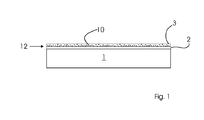
- Fig.1:
- Schematische Darstellung eines plattenförmigen Holzwerkstoffs mit leitfähigem Overlay als Oberflächenbeschichtung
- Ein Overlay mit einem Flächengewicht von 40 g wird von Walzen durch eine an sich bekannte Imprägnieranlage mit Quetschwalzendosierung geführt. In einem Bad, durch dass das Overlay gezogen wird, wird Melaminharz mit einem Festkörper von 60% in das Papier eingebracht. Das Overlay wird nach Verlassen des Bades durch ein Walzenpaar geführt, an dem überschüssiges Kunstharz abgestreift wird. Das so imprägnierte Papier weist nach Zwischentrocknung ein Gewicht von 100 g/m2 auf.
- Anschließend wird in einem Raster-Auftragswerk jeweils eine zusätzliche Melaminharz-Schicht von 20 g/m2 auf Ober- und Unterseite des Papiers aufgebracht. Die oberseitig aufgebrachte Melaminharz-Schicht ist mit -bezogen auf den Festkörper-Gehalt des Melaminharzes- 8 Gew.-% transparenten, elektrisch leitfähigen Partikeln versetzt, nämlich mit Glimmer-Partikeln, die mit Zinn und Antimon dotiert sind, und die einen Durchmesser von ca. 15 µm aufweisen. Das Overlay wird nach Auftragen der zweiten Melaminharz-Schicht getrocknet.
- Das Overlay wird auf einer hochdichten Faserplatte auf der bereits ein Dekorpapier aufgelegt ist, unter Einwirkung von Druck und Hitze verpresst. Die so entstandene Oberfläche der Faserplatte weist bei einer Prüfung des elektrostatischen Verhaltens nach IEC 60093 und EN 1081 einen spezifischen Oberflächenwiderstand von 3,0 x 1008 Ω auf. Wird eine derart beschichtete Faserplatte als Fußboden eingesetzt, wird sie gemäß DIN IEC 61340 -4-1:1997 als "Ableitfähiger Fußboden" oder gemäß EU 14041: 2004 -12-20 als "elektrostatisch ableitender Fußbodenbelag" eingestuft. Diese Einstufung war bisher bei Verwendung von Melaminharzen zur Oberflächenbeschichtung von Fußböden nicht zu erreichen.
- Der Begehtest nach EN 1815 ergibt auf einer isolierenden Unterlage bei einer Person in Gummisohlen eine sog. Personenspannung von 1,8 kV. Damit ist die mit dem vorbeschriebenen Overlay beschichtete Faserplatte als ableitfähiger Fußboden einzustufen, denn die Personenspannung von 2 kV wird deutlich unterschritten.
- Ein zur Verwendung für eine Tisch- bzw. Arbeitsplatte bestimmtes Dekorpapier 2 wird hergestellt, indem ein Trägerpapier mit einem Dekoraufdruck mit Melaminharz imprägniert wird. Auf dieses imprägnierte Papier 2 wird dann -wie im Beispiel 1 beschriebeneine Melaminharz-Schicht 3, die -bezogen auf den Festkörper-Gehalt des Melaminharzes- mit 10 Gew.-% der in Beispiel 1 beschriebenen Partikel 4 versetzt ist, und die mit 40 g/m2 auf das vorimprägnierte Papier 2 aufgebracht wird. Das so erzeugte Dekorpapier mit leitfähiger Oberseite wird auf eine Spanplatte aufgepresst.
- Diese Spanplatte 1 eignet sich zur Verwendung als Arbeitsplatte, insbesondere in der elektronischen Industrie, da der Oberflächenwiderstand der so hergestellten Melaminharz-Beschichtung 1007 Ω bis 1009 Ω beträgt. Sensible elektronische Bauteile, die durch stärkere elektrische Entladungen beschädigt oder zerstört werden, können auf diesen einfach und preiswert hergestellten Oberflächen gelagert oder bearbeitet werden.
Claims (9)
- Overlay, imprägniert mit mindestens einer Schicht Kunstharz, die mit elektrisch leitfähigen, transparenten Partikeln (10) versetzt ist.
- Overlay nach Anspruch 1, dadurch gekennzeichnet, dass der Anteil an Partikel (10) bis zu 15 Gew.-% bezogen auf den Festkörper-Anteil des eingesetzten Kunstharzes beträgt, bevorzugt bis zu 10 Gew.-%, besonders bevorzugt bis zu 8 Gew.-% bezogen auf den Festkörper-Anteil des eingesetzten Kunstharzes.
- Overlay nach Anspruch 1, dadurch gekennzeichnet, dass das mit Partikeln (10) versetzte Kunstharz in einer Auftragsmenge von bis zu 40 g/m2, bevorzugt von bis zu 25 g/m2, besonders bevorzugt bis zu 15 g/m2, vorteilhaft bis zu 10 g/m2 auf das Overlay aufgetragen ist.
- Overlay nach Anspruch 1, dadurch gekennzeichnet, dass das mit Partikeln (10) versetzte Kunstharz als Schicht (12) mit einer Dicke von bis zu 30 µm, vorzugsweise von bis zu 20 µm, besonders bevorzugt von bis zu 10 µm auf das Overlay aufgetragen ist.
- Overlay nach Anspruch 1, dadurch gekennzeichnet, dass das Kunstharz transparent ist.
- Overlay nach Anspruch 5, dadurch gekennzeichnet, dass Melaminharz als Kunstharz eingesetzt ist.
- Overlay nach Anspruch 1, dadurch gekennzeichnet, dass neben der mit einem elektrisch leitfähigen, transparenten Partikel (10) versetzten Kunstharz-Schicht (12) mindestens eine zweite Kunstharz-Schicht auf das Overlay aufgetragen ist.
- Overlay nach Anspruch 7, dadurch gekennzeichnet, dass die zweite Kunstharz-Schicht mit Korund versetzt ist.
- Overlay nach einem der Ansprüche 1 bis 8 dadurch gekennzeichnet, dass es zur Beschichtung auf einem plattenförmigen Holzwerkstoff 1 verwendet wird.
Priority Applications (1)
| Application Number | Priority Date | Filing Date | Title |
|---|---|---|---|
| PL10150990T PL2192229T3 (pl) | 2005-01-14 | 2006-01-13 | Powłoka przewodząca |
Applications Claiming Priority (2)
| Application Number | Priority Date | Filing Date | Title |
|---|---|---|---|
| DE102005002059A DE102005002059A1 (de) | 2005-01-14 | 2005-01-14 | Holzwerkstoff mit ableitfähiger Oberfläche |
| EP06000691A EP1681103B1 (de) | 2005-01-14 | 2006-01-13 | Holzwerkstoff mit ableitfähiger Oberfläche |
Related Parent Applications (1)
| Application Number | Title | Priority Date | Filing Date |
|---|---|---|---|
| EP06000691.3 Division | 2006-01-13 |
Publications (3)
| Publication Number | Publication Date |
|---|---|
| EP2192229A2 true EP2192229A2 (de) | 2010-06-02 |
| EP2192229A3 EP2192229A3 (de) | 2012-01-11 |
| EP2192229B1 EP2192229B1 (de) | 2013-07-24 |
Family
ID=36147631
Family Applications (2)
| Application Number | Title | Priority Date | Filing Date |
|---|---|---|---|
| EP06000691A Expired - Lifetime EP1681103B1 (de) | 2005-01-14 | 2006-01-13 | Holzwerkstoff mit ableitfähiger Oberfläche |
| EP10150990.9A Expired - Lifetime EP2192229B1 (de) | 2005-01-14 | 2006-01-13 | Ableitfähiges Overlay |
Family Applications Before (1)
| Application Number | Title | Priority Date | Filing Date |
|---|---|---|---|
| EP06000691A Expired - Lifetime EP1681103B1 (de) | 2005-01-14 | 2006-01-13 | Holzwerkstoff mit ableitfähiger Oberfläche |
Country Status (5)
| Country | Link |
|---|---|
| EP (2) | EP1681103B1 (de) |
| AT (1) | ATE485114T1 (de) |
| DE (2) | DE102005002059A1 (de) |
| ES (2) | ES2353895T3 (de) |
| PL (2) | PL1681103T3 (de) |
Families Citing this family (41)
| Publication number | Priority date | Publication date | Assignee | Title |
|---|---|---|---|---|
| PL2562004T3 (pl) * | 2007-05-27 | 2020-05-18 | Thomas Schneider | Element płaski i sposób jego wytwarzania |
| AU2008328030C1 (en) * | 2007-11-19 | 2015-02-26 | Valinge Innovation Ab | Fibre based panels with a wear resistance surface |
| US9783996B2 (en) * | 2007-11-19 | 2017-10-10 | Valinge Innovation Ab | Fibre based panels with a wear resistance surface |
| CN101868332A (zh) | 2007-11-19 | 2010-10-20 | 瓦林格创新比利时股份有限公司 | 层压地板的再生 |
| DE202008018477U1 (de) * | 2007-11-19 | 2014-03-27 | Välinge Innovation AB | Faserpaneele mit einer verschleißfesten Oberfläche |
| CN101260721B (zh) * | 2008-02-22 | 2010-06-02 | 中国林业科学研究院木材工业研究所 | 一种复合墙材及其制造方法 |
| US8419877B2 (en) | 2008-04-07 | 2013-04-16 | Ceraloc Innovation Belgium Bvba | Wood fibre based panels with a thin surface layer |
| US11235565B2 (en) | 2008-04-07 | 2022-02-01 | Valinge Innovation Ab | Wood fibre based panels with a thin surface layer |
| US8349234B2 (en) | 2010-01-15 | 2013-01-08 | Ceraloc Innovation Belgium Bvba | Fibre based panels with a decorative wear resistance surface |
| WO2011087424A1 (en) | 2010-01-15 | 2011-07-21 | Ceraloc Innovation Belgium Bvba | Heat and pressure generated design |
| JP5840624B2 (ja) | 2010-01-15 | 2016-01-06 | ベーリンゲ、イノベイション、アクチボラグVaelinge Innovation Ab | 明色表面層 |
| PL3351375T3 (pl) | 2010-01-15 | 2020-02-28 | Välinge Innovation AB | Oparte o włókno panele z dekoracyjną warstwą odporną na ścieranie |
| US10899166B2 (en) | 2010-04-13 | 2021-01-26 | Valinge Innovation Ab | Digitally injected designs in powder surfaces |
| US8480841B2 (en) | 2010-04-13 | 2013-07-09 | Ceralog Innovation Belgium BVBA | Powder overlay |
| US10315219B2 (en) | 2010-05-31 | 2019-06-11 | Valinge Innovation Ab | Method of manufacturing a panel |
| HRP20200960T1 (hr) | 2011-04-12 | 2020-10-02 | Välinge Innovation AB | Postupak proizvodnje građevinske ploče |
| MX352832B (es) | 2011-04-12 | 2017-12-08 | Vaelinge Innovation Ab | Una mezcla en polvo y un metodo para producir un panel de construccion. |
| US9352499B2 (en) | 2011-04-12 | 2016-05-31 | Valinge Innovation Ab | Method of manufacturing a layer |
| WO2012141647A1 (en) | 2011-04-12 | 2012-10-18 | Ceraloc Innovation Belgium Bvba | Powder based balancing layer |
| ES2602708T3 (es) | 2011-06-21 | 2017-02-22 | Flooring Technologies Ltd. | Tablero de material derivado de la madera y procedimiento de producción |
| EP3517297B1 (de) | 2011-08-26 | 2021-10-20 | Ceraloc Innovation AB | Verfahren zur herstellung eines mehrschichtigen produkts |
| US8920876B2 (en) | 2012-03-19 | 2014-12-30 | Valinge Innovation Ab | Method for producing a building panel |
| BR112015002622B1 (pt) | 2012-08-09 | 2021-12-21 | Ceraloc Innovation Ab | Método de formação de uma camada de superfície |
| US8993049B2 (en) | 2012-08-09 | 2015-03-31 | Valinge Flooring Technology Ab | Single layer scattering of powder surfaces |
| US9181698B2 (en) | 2013-01-11 | 2015-11-10 | Valinge Innovation Ab | Method of producing a building panel and a building panel |
| US9279058B2 (en) | 2013-01-11 | 2016-03-08 | Floor Iptech Ab | Digital embossing |
| UA118967C2 (uk) | 2013-07-02 | 2019-04-10 | Велінге Інновейшн Аб | Спосіб виготовлення будівельної панелі і будівельна панель |
| US10513094B2 (en) | 2013-10-18 | 2019-12-24 | Valinge Innovation Ab | Method of manufacturing a building panel |
| DE102013113109A1 (de) | 2013-11-27 | 2015-06-11 | Guido Schulte | Fußbodendiele |
| DE102013113130B4 (de) | 2013-11-27 | 2022-01-27 | Välinge Innovation AB | Verfahren zur Herstellung einer Fußbodendiele |
| DE102013113125A1 (de) | 2013-11-27 | 2015-05-28 | Guido Schulte | Fußboden-, Wand- oder Deckenpaneel und Verfahren zu dessen Herstellung |
| EP3092123B1 (de) | 2014-01-10 | 2023-08-02 | Välinge Innovation AB | Holzfaserplatten mit einer oberflächenschicht |
| EP4733513A2 (de) | 2014-03-31 | 2026-04-29 | Ceraloc Innovation AB | Verfahren zur herstellung von verbundplatten und -tafeln |
| EP3142857B1 (de) | 2014-05-12 | 2025-08-20 | Välinge Innovation AB | Verfahren zur herstellung eines furnierten elements |
| US11313123B2 (en) | 2015-06-16 | 2022-04-26 | Valinge Innovation Ab | Method of forming a building panel or surface element and such a building panel and surface element |
| CN109153236A (zh) | 2016-04-25 | 2019-01-04 | 瓦林格创新股份有限公司 | 具有饰面的元件和制造这种具有饰面的元件的方法 |
| BE1025875B1 (nl) | 2018-01-04 | 2019-08-06 | Unilin Bvba | Werkwijzen voor het vervaardigen van panelen |
| CA3085982A1 (en) | 2018-01-11 | 2019-07-18 | Valinge Innovation Ab | A method to produce a veneered element and a veneered element |
| CN111542432B (zh) | 2018-01-11 | 2023-01-10 | 瓦林格创新股份有限公司 | 饰面元件、用于生产饰面元件的方法 |
| WO2020145870A1 (en) | 2019-01-09 | 2020-07-16 | Välinge Innovation AB | A method to produce a veneer element and a veneer element |
| US12275218B2 (en) | 2019-01-10 | 2025-04-15 | Välinge Innovation AB | Method of manufacturing a building element and a building element |
Citations (3)
| Publication number | Priority date | Publication date | Assignee | Title |
|---|---|---|---|---|
| DE20318290U1 (de) | 2003-11-26 | 2004-04-01 | M. Kaindl | Antistatisches Papier nebst Paneel |
| WO2004050359A1 (en) | 2002-12-04 | 2004-06-17 | Flooring Industries Ltd. | Antistatic layered panel and methods of its manufacture |
| DE10301293A1 (de) | 2003-01-15 | 2004-07-29 | Blomberger Holzindustrie B. Hausmann Gmbh & Co Kg | Plattenförmiger Körper sowie Verfahren zu seiner Herstellung mit einer elektrostatisch ableitfähigen Oberfläche |
Family Cites Families (6)
| Publication number | Priority date | Publication date | Assignee | Title |
|---|---|---|---|---|
| DE3724804A1 (de) * | 1987-07-27 | 1989-02-09 | Kurt Gollin Holzbearbeitung Gm | Verfahren zum beschichten von holzwerkstuecken und vorrichtung hierfuer |
| US5498761A (en) * | 1988-10-11 | 1996-03-12 | Wessling; Bernhard | Process for producing thin layers of conductive polymers |
| DE19622921C3 (de) * | 1996-06-07 | 2003-09-18 | Basf Coatings Ag | Verfahren zur Herstellung eines Schichtstoffes und dessen Verwendung |
| CZ304627B6 (cs) * | 2000-12-19 | 2014-08-13 | Akzo Nobel N. V. | Způsob povrchové úpravy substrátu |
| US20020081393A1 (en) * | 2000-12-19 | 2002-06-27 | Kjellqvist Ann Kerstin Birgitta | Process for coating a substrate |
| ES2771455T3 (es) * | 2004-05-28 | 2020-07-06 | SWISS KRONO Tec AG | Panel de material de madera con revestimiento superficial |
-
2005
- 2005-01-14 DE DE102005002059A patent/DE102005002059A1/de not_active Ceased
-
2006
- 2006-01-13 DE DE502006008108T patent/DE502006008108D1/de not_active Expired - Lifetime
- 2006-01-13 AT AT06000691T patent/ATE485114T1/de active
- 2006-01-13 ES ES06000691T patent/ES2353895T3/es not_active Expired - Lifetime
- 2006-01-13 PL PL06000691T patent/PL1681103T3/pl unknown
- 2006-01-13 EP EP06000691A patent/EP1681103B1/de not_active Expired - Lifetime
- 2006-01-13 ES ES10150990T patent/ES2428416T3/es not_active Expired - Lifetime
- 2006-01-13 PL PL10150990T patent/PL2192229T3/pl unknown
- 2006-01-13 EP EP10150990.9A patent/EP2192229B1/de not_active Expired - Lifetime
Patent Citations (3)
| Publication number | Priority date | Publication date | Assignee | Title |
|---|---|---|---|---|
| WO2004050359A1 (en) | 2002-12-04 | 2004-06-17 | Flooring Industries Ltd. | Antistatic layered panel and methods of its manufacture |
| DE10301293A1 (de) | 2003-01-15 | 2004-07-29 | Blomberger Holzindustrie B. Hausmann Gmbh & Co Kg | Plattenförmiger Körper sowie Verfahren zu seiner Herstellung mit einer elektrostatisch ableitfähigen Oberfläche |
| DE20318290U1 (de) | 2003-11-26 | 2004-04-01 | M. Kaindl | Antistatisches Papier nebst Paneel |
Also Published As
| Publication number | Publication date |
|---|---|
| EP1681103A3 (de) | 2006-09-27 |
| EP2192229A3 (de) | 2012-01-11 |
| DE102005002059A1 (de) | 2006-07-27 |
| ES2428416T3 (es) | 2013-11-07 |
| PL2192229T3 (pl) | 2013-12-31 |
| EP2192229B1 (de) | 2013-07-24 |
| DE502006008108D1 (de) | 2010-12-02 |
| EP1681103A2 (de) | 2006-07-19 |
| PL1681103T3 (pl) | 2011-04-29 |
| ES2353895T3 (es) | 2011-03-08 |
| ATE485114T1 (de) | 2010-11-15 |
| EP1681103B1 (de) | 2010-10-20 |
Similar Documents
| Publication | Publication Date | Title |
|---|---|---|
| EP2192229B1 (de) | Ableitfähiges Overlay | |
| EP1756381B1 (de) | Paneel aus holzwerkstoff mit oberflächenbeschichtung | |
| DE3123827A1 (de) | Statische elektrizitaet ableitendes bahnmaterial | |
| EP0446228A1 (de) | Dekorative schichtpressstoffplatte und verfahren zur herstellung einer deckschicht hierfür. | |
| DE202004003061U1 (de) | Dekorpapier mit elektrisch geladenen Fasern | |
| EP1690603A1 (de) | Holzwerkstoffplatte mit einer mindestens abschnittsweise aufgetragenen Oberflächenbeschichtung | |
| WO2009015682A1 (de) | Fussbodenpaneel mit harzimprägnierten, insbesondere papiernen schichten | |
| DE2124432A1 (de) | Verfahren und Vorrichtung zur Her stellung von imprägniertem Papier | |
| DE1621983C3 (de) | Beschichteter Kunststoffgegenstand | |
| DE202009018018U1 (de) | Ein Substrat mit zumindest einem Dekorpapier oder Overlay | |
| EP3090812B1 (de) | Overlayfolie | |
| DE2460482C3 (de) | Verfahren zum Herstellen eines leitenden Überzugs | |
| EP0471936A1 (de) | Abdeckfolie für flexible Leiterplatten | |
| DE2345607C2 (de) | Beschichtungsmaterial zur radarsicheren Tarnung und/oder zur Sicherung der Radarortung und Verfahren zu dessen Herstellung | |
| DE69902516T2 (de) | Feuchtigkeitsabhängiger statische elektrizität zerstreuender schichtstoff | |
| DE8305544U1 (de) | Spanplatte | |
| DE102023107826A1 (de) | Flächenheizung | |
| WO2005042312A1 (de) | Schild | |
| DE3110754A1 (de) | Verfahren zur herstellung eines mit durch elektronenstrahlen gehaertetem lack beschichtetem flaechenfoermigen traegermaterials mit matter oberflaeche | |
| DE3043539A1 (de) | Elektrisch leitfaehiger schichtstoff und verfahren zu dessen herstellen | |
| EP0043063A1 (de) | Verfahren zur Herstellung einer mit durch Elektronenstrahlen gehärtetem Lack beschichteten Trägerfolie | |
| EP1727686B1 (de) | Kohlenstoffhaltiges dekorpapier nebst paneel | |
| DE102008017438A1 (de) | Beschichtung für Holzfußbodenbeläge und beschichtetes Holzfußbodenpaneel | |
| DE1494356A1 (de) | Verfahren zur Herstellung antistatischer Kunststofformlinge | |
| DE102004036922A1 (de) | Verfahren zur Herstellung einer Platte mit einer schmutzabweisenden Oberfläche sowie Platte mit einer schmutzabweisenden Oberfläche |
Legal Events
| Date | Code | Title | Description |
|---|---|---|---|
| PUAI | Public reference made under article 153(3) epc to a published international application that has entered the european phase |
Free format text: ORIGINAL CODE: 0009012 |
|
| AC | Divisional application: reference to earlier application |
Ref document number: 1681103 Country of ref document: EP Kind code of ref document: P |
|
| AK | Designated contracting states |
Kind code of ref document: A2 Designated state(s): AT BE BG CH CY CZ DE DK EE ES FI FR GB GR HU IE IS IT LI LT LU LV MC NL PL PT RO SE SI SK TR |
|
| PUAL | Search report despatched |
Free format text: ORIGINAL CODE: 0009013 |
|
| AK | Designated contracting states |
Kind code of ref document: A3 Designated state(s): AT BE BG CH CY CZ DE DK EE ES FI FR GB GR HU IE IS IT LI LT LU LV MC NL PL PT RO SE SI SK TR |
|
| RIC1 | Information provided on ipc code assigned before grant |
Ipc: E04F 15/00 20060101ALI20111208BHEP Ipc: D21H 27/28 20060101ALI20111208BHEP Ipc: D21H 21/14 20060101AFI20111208BHEP |
|
| 17P | Request for examination filed |
Effective date: 20120709 |
|
| GRAP | Despatch of communication of intention to grant a patent |
Free format text: ORIGINAL CODE: EPIDOSNIGR1 |
|
| GRAP | Despatch of communication of intention to grant a patent |
Free format text: ORIGINAL CODE: EPIDOSNIGR1 |
|
| GRAS | Grant fee paid |
Free format text: ORIGINAL CODE: EPIDOSNIGR3 |
|
| GRAA | (expected) grant |
Free format text: ORIGINAL CODE: 0009210 |
|
| INTG | Intention to grant announced |
Effective date: 20130604 |
|
| INTG | Intention to grant announced |
Effective date: 20130611 |
|
| AC | Divisional application: reference to earlier application |
Ref document number: 1681103 Country of ref document: EP Kind code of ref document: P |
|
| AK | Designated contracting states |
Kind code of ref document: B1 Designated state(s): AT BE BG CH CY CZ DE DK EE ES FI FR GB GR HU IE IS IT LI LT LU LV MC NL PL PT RO SE SI SK TR |
|
| REG | Reference to a national code |
Ref country code: GB Ref legal event code: FG4D Free format text: NOT ENGLISH |
|
| REG | Reference to a national code |
Ref country code: CH Ref legal event code: EP |
|
| REG | Reference to a national code |
Ref country code: CH Ref legal event code: NV Representative=s name: PATENTANWALT DIPL.-ING. (UNI.) WOLFGANG HEISEL, CH Ref country code: AT Ref legal event code: REF Ref document number: 623560 Country of ref document: AT Kind code of ref document: T Effective date: 20130815 |
|
| REG | Reference to a national code |
Ref country code: IE Ref legal event code: FG4D Free format text: LANGUAGE OF EP DOCUMENT: GERMAN |
|
| REG | Reference to a national code |
Ref country code: DE Ref legal event code: R096 Ref document number: 502006013064 Country of ref document: DE Effective date: 20130919 |
|
| REG | Reference to a national code |
Ref country code: ES Ref legal event code: FG2A Ref document number: 2428416 Country of ref document: ES Kind code of ref document: T3 Effective date: 20131107 |
|
| REG | Reference to a national code |
Ref country code: NL Ref legal event code: VDEP Effective date: 20130724 |
|
| REG | Reference to a national code |
Ref country code: LT Ref legal event code: MG4D |
|
| REG | Reference to a national code |
Ref country code: PL Ref legal event code: T3 |
|
| REG | Reference to a national code |
Ref country code: SK Ref legal event code: T3 Ref document number: E 15028 Country of ref document: SK |
|
| PG25 | Lapsed in a contracting state [announced via postgrant information from national office to epo] |
Ref country code: SE Free format text: LAPSE BECAUSE OF FAILURE TO SUBMIT A TRANSLATION OF THE DESCRIPTION OR TO PAY THE FEE WITHIN THE PRESCRIBED TIME-LIMIT Effective date: 20130724 Ref country code: CY Free format text: LAPSE BECAUSE OF FAILURE TO SUBMIT A TRANSLATION OF THE DESCRIPTION OR TO PAY THE FEE WITHIN THE PRESCRIBED TIME-LIMIT Effective date: 20130828 Ref country code: LT Free format text: LAPSE BECAUSE OF FAILURE TO SUBMIT A TRANSLATION OF THE DESCRIPTION OR TO PAY THE FEE WITHIN THE PRESCRIBED TIME-LIMIT Effective date: 20130724 Ref country code: PT Free format text: LAPSE BECAUSE OF FAILURE TO SUBMIT A TRANSLATION OF THE DESCRIPTION OR TO PAY THE FEE WITHIN THE PRESCRIBED TIME-LIMIT Effective date: 20131125 Ref country code: IS Free format text: LAPSE BECAUSE OF FAILURE TO SUBMIT A TRANSLATION OF THE DESCRIPTION OR TO PAY THE FEE WITHIN THE PRESCRIBED TIME-LIMIT Effective date: 20131124 |
|
| PG25 | Lapsed in a contracting state [announced via postgrant information from national office to epo] |
Ref country code: NL Free format text: LAPSE BECAUSE OF FAILURE TO SUBMIT A TRANSLATION OF THE DESCRIPTION OR TO PAY THE FEE WITHIN THE PRESCRIBED TIME-LIMIT Effective date: 20130724 Ref country code: FI Free format text: LAPSE BECAUSE OF FAILURE TO SUBMIT A TRANSLATION OF THE DESCRIPTION OR TO PAY THE FEE WITHIN THE PRESCRIBED TIME-LIMIT Effective date: 20130724 Ref country code: SI Free format text: LAPSE BECAUSE OF FAILURE TO SUBMIT A TRANSLATION OF THE DESCRIPTION OR TO PAY THE FEE WITHIN THE PRESCRIBED TIME-LIMIT Effective date: 20130724 Ref country code: LV Free format text: LAPSE BECAUSE OF FAILURE TO SUBMIT A TRANSLATION OF THE DESCRIPTION OR TO PAY THE FEE WITHIN THE PRESCRIBED TIME-LIMIT Effective date: 20130724 |
|
| PG25 | Lapsed in a contracting state [announced via postgrant information from national office to epo] |
Ref country code: CY Free format text: LAPSE BECAUSE OF FAILURE TO SUBMIT A TRANSLATION OF THE DESCRIPTION OR TO PAY THE FEE WITHIN THE PRESCRIBED TIME-LIMIT Effective date: 20130724 |
|
| PG25 | Lapsed in a contracting state [announced via postgrant information from national office to epo] |
Ref country code: CZ Free format text: LAPSE BECAUSE OF FAILURE TO SUBMIT A TRANSLATION OF THE DESCRIPTION OR TO PAY THE FEE WITHIN THE PRESCRIBED TIME-LIMIT Effective date: 20130724 Ref country code: DK Free format text: LAPSE BECAUSE OF FAILURE TO SUBMIT A TRANSLATION OF THE DESCRIPTION OR TO PAY THE FEE WITHIN THE PRESCRIBED TIME-LIMIT Effective date: 20130724 Ref country code: EE Free format text: LAPSE BECAUSE OF FAILURE TO SUBMIT A TRANSLATION OF THE DESCRIPTION OR TO PAY THE FEE WITHIN THE PRESCRIBED TIME-LIMIT Effective date: 20130724 Ref country code: RO Free format text: LAPSE BECAUSE OF FAILURE TO SUBMIT A TRANSLATION OF THE DESCRIPTION OR TO PAY THE FEE WITHIN THE PRESCRIBED TIME-LIMIT Effective date: 20130724 |
|
| PG25 | Lapsed in a contracting state [announced via postgrant information from national office to epo] |
Ref country code: IT Free format text: LAPSE BECAUSE OF FAILURE TO SUBMIT A TRANSLATION OF THE DESCRIPTION OR TO PAY THE FEE WITHIN THE PRESCRIBED TIME-LIMIT Effective date: 20130724 |
|
| PLBE | No opposition filed within time limit |
Free format text: ORIGINAL CODE: 0009261 |
|
| STAA | Information on the status of an ep patent application or granted ep patent |
Free format text: STATUS: NO OPPOSITION FILED WITHIN TIME LIMIT |
|
| 26N | No opposition filed |
Effective date: 20140425 |
|
| REG | Reference to a national code |
Ref country code: DE Ref legal event code: R097 Ref document number: 502006013064 Country of ref document: DE Effective date: 20140425 |
|
| PG25 | Lapsed in a contracting state [announced via postgrant information from national office to epo] |
Ref country code: MC Free format text: LAPSE BECAUSE OF FAILURE TO SUBMIT A TRANSLATION OF THE DESCRIPTION OR TO PAY THE FEE WITHIN THE PRESCRIBED TIME-LIMIT Effective date: 20130724 Ref country code: LU Free format text: LAPSE BECAUSE OF FAILURE TO SUBMIT A TRANSLATION OF THE DESCRIPTION OR TO PAY THE FEE WITHIN THE PRESCRIBED TIME-LIMIT Effective date: 20140113 |
|
| REG | Reference to a national code |
Ref country code: IE Ref legal event code: MM4A |
|
| PG25 | Lapsed in a contracting state [announced via postgrant information from national office to epo] |
Ref country code: IE Free format text: LAPSE BECAUSE OF NON-PAYMENT OF DUE FEES Effective date: 20140113 |
|
| REG | Reference to a national code |
Ref country code: FR Ref legal event code: PLFP Year of fee payment: 11 |
|
| PG25 | Lapsed in a contracting state [announced via postgrant information from national office to epo] |
Ref country code: BG Free format text: LAPSE BECAUSE OF FAILURE TO SUBMIT A TRANSLATION OF THE DESCRIPTION OR TO PAY THE FEE WITHIN THE PRESCRIBED TIME-LIMIT Effective date: 20130724 |
|
| PG25 | Lapsed in a contracting state [announced via postgrant information from national office to epo] |
Ref country code: GR Free format text: LAPSE BECAUSE OF FAILURE TO SUBMIT A TRANSLATION OF THE DESCRIPTION OR TO PAY THE FEE WITHIN THE PRESCRIBED TIME-LIMIT Effective date: 20130724 |
|
| PG25 | Lapsed in a contracting state [announced via postgrant information from national office to epo] |
Ref country code: HU Free format text: LAPSE BECAUSE OF FAILURE TO SUBMIT A TRANSLATION OF THE DESCRIPTION OR TO PAY THE FEE WITHIN THE PRESCRIBED TIME-LIMIT; INVALID AB INITIO Effective date: 20060113 |
|
| REG | Reference to a national code |
Ref country code: DE Ref legal event code: R082 Ref document number: 502006013064 Country of ref document: DE Representative=s name: KALKOFF & PARTNER PATENTANWAELTE MBB, DE Ref country code: DE Ref legal event code: R082 Ref document number: 502006013064 Country of ref document: DE Representative=s name: KALKOFF & PARTNER PATENTANWAELTE, DE Ref country code: DE Ref legal event code: R081 Ref document number: 502006013064 Country of ref document: DE Owner name: SWISS KRONO TEC AG, CH Free format text: FORMER OWNER: KRONOTEC AG, LUZERN, CH |
|
| REG | Reference to a national code |
Ref country code: FR Ref legal event code: PLFP Year of fee payment: 12 |
|
| REG | Reference to a national code |
Ref country code: CH Ref legal event code: PFA Owner name: SWISS KRONO TEC AG, CH Free format text: FORMER OWNER: KRONOTEC AG, CH |
|
| REG | Reference to a national code |
Ref country code: SK Ref legal event code: TC4A Ref document number: E 15028 Country of ref document: SK Owner name: SWISS KRONO TEC AG, LUZERN, CH Effective date: 20170524 |
|
| REG | Reference to a national code |
Ref country code: AT Ref legal event code: HC Ref document number: 623560 Country of ref document: AT Kind code of ref document: T Owner name: SWISS KRONO TEC AG, CH Effective date: 20170424 |
|
| REG | Reference to a national code |
Ref country code: FR Ref legal event code: CA Effective date: 20170616 Ref country code: FR Ref legal event code: CD Owner name: SWISS KRONO TEC AG, CH Effective date: 20170616 |
|
| REG | Reference to a national code |
Ref country code: ES Ref legal event code: PC2A Owner name: SWISS KRONO TEC AG Effective date: 20171005 |
|
| REG | Reference to a national code |
Ref country code: FR Ref legal event code: PLFP Year of fee payment: 13 |
|
| PGFP | Annual fee paid to national office [announced via postgrant information from national office to epo] |
Ref country code: AT Payment date: 20200121 Year of fee payment: 15 Ref country code: ES Payment date: 20200219 Year of fee payment: 15 |
|
| PGFP | Annual fee paid to national office [announced via postgrant information from national office to epo] |
Ref country code: SK Payment date: 20200107 Year of fee payment: 15 Ref country code: BE Payment date: 20200122 Year of fee payment: 15 |
|
| PGFP | Annual fee paid to national office [announced via postgrant information from national office to epo] |
Ref country code: TR Payment date: 20200109 Year of fee payment: 15 |
|
| REG | Reference to a national code |
Ref country code: AT Ref legal event code: MM01 Ref document number: 623560 Country of ref document: AT Kind code of ref document: T Effective date: 20210113 |
|
| REG | Reference to a national code |
Ref country code: SK Ref legal event code: MM4A Ref document number: E 15028 Country of ref document: SK Effective date: 20210113 |
|
| REG | Reference to a national code |
Ref country code: BE Ref legal event code: MM Effective date: 20210131 |
|
| PG25 | Lapsed in a contracting state [announced via postgrant information from national office to epo] |
Ref country code: AT Free format text: LAPSE BECAUSE OF NON-PAYMENT OF DUE FEES Effective date: 20210113 |
|
| PG25 | Lapsed in a contracting state [announced via postgrant information from national office to epo] |
Ref country code: SK Free format text: LAPSE BECAUSE OF NON-PAYMENT OF DUE FEES Effective date: 20210113 |
|
| PGFP | Annual fee paid to national office [announced via postgrant information from national office to epo] |
Ref country code: PL Payment date: 20211214 Year of fee payment: 17 |
|
| REG | Reference to a national code |
Ref country code: ES Ref legal event code: FD2A Effective date: 20220426 |
|
| PGFP | Annual fee paid to national office [announced via postgrant information from national office to epo] |
Ref country code: GB Payment date: 20220125 Year of fee payment: 17 Ref country code: DE Payment date: 20220126 Year of fee payment: 17 Ref country code: CH Payment date: 20220125 Year of fee payment: 17 |
|
| PGFP | Annual fee paid to national office [announced via postgrant information from national office to epo] |
Ref country code: FR Payment date: 20220120 Year of fee payment: 17 |
|
| PG25 | Lapsed in a contracting state [announced via postgrant information from national office to epo] |
Ref country code: ES Free format text: LAPSE BECAUSE OF NON-PAYMENT OF DUE FEES Effective date: 20210114 Ref country code: BE Free format text: LAPSE BECAUSE OF NON-PAYMENT OF DUE FEES Effective date: 20210131 |
|
| REG | Reference to a national code |
Ref country code: DE Ref legal event code: R119 Ref document number: 502006013064 Country of ref document: DE |
|
| REG | Reference to a national code |
Ref country code: CH Ref legal event code: PL |
|
| GBPC | Gb: european patent ceased through non-payment of renewal fee |
Effective date: 20230113 |
|
| PG25 | Lapsed in a contracting state [announced via postgrant information from national office to epo] |
Ref country code: LI Free format text: LAPSE BECAUSE OF NON-PAYMENT OF DUE FEES Effective date: 20230131 Ref country code: GB Free format text: LAPSE BECAUSE OF NON-PAYMENT OF DUE FEES Effective date: 20230113 Ref country code: DE Free format text: LAPSE BECAUSE OF NON-PAYMENT OF DUE FEES Effective date: 20230801 Ref country code: CH Free format text: LAPSE BECAUSE OF NON-PAYMENT OF DUE FEES Effective date: 20230131 |
|
| PG25 | Lapsed in a contracting state [announced via postgrant information from national office to epo] |
Ref country code: FR Free format text: LAPSE BECAUSE OF NON-PAYMENT OF DUE FEES Effective date: 20230131 |
|
| PG25 | Lapsed in a contracting state [announced via postgrant information from national office to epo] |
Ref country code: PL Free format text: LAPSE BECAUSE OF NON-PAYMENT OF DUE FEES Effective date: 20230113 |
|
| PG25 | Lapsed in a contracting state [announced via postgrant information from national office to epo] |
Ref country code: PL Free format text: LAPSE BECAUSE OF NON-PAYMENT OF DUE FEES Effective date: 20230113 |
|
| PG25 | Lapsed in a contracting state [announced via postgrant information from national office to epo] |
Ref country code: TR Free format text: LAPSE BECAUSE OF NON-PAYMENT OF DUE FEES Effective date: 20210113 |