EP2192662A2 - Ozonfreies Antistatikgerät - Google Patents
Ozonfreies Antistatikgerät Download PDFInfo
- Publication number
- EP2192662A2 EP2192662A2 EP09177129A EP09177129A EP2192662A2 EP 2192662 A2 EP2192662 A2 EP 2192662A2 EP 09177129 A EP09177129 A EP 09177129A EP 09177129 A EP09177129 A EP 09177129A EP 2192662 A2 EP2192662 A2 EP 2192662A2
- Authority
- EP
- European Patent Office
- Prior art keywords
- ozone
- discharge portion
- static eliminator
- ion
- ions
- Prior art date
- Legal status (The legal status is an assumption and is not a legal conclusion. Google has not performed a legal analysis and makes no representation as to the accuracy of the status listed.)
- Withdrawn
Links
Images


Classifications
-
- H—ELECTRICITY
- H01—ELECTRIC ELEMENTS
- H01T—SPARK GAPS; OVERVOLTAGE ARRESTERS USING SPARK GAPS; SPARKING PLUGS; CORONA DEVICES; GENERATING IONS TO BE INTRODUCED INTO NON-ENCLOSED GASES
- H01T23/00—Apparatus for generating ions to be introduced into non-enclosed gases, e.g. into the atmosphere
Definitions
- This invention relates to an ozone-less or ozone-free static eliminator, more particularly a static eliminator or ionizer for removing generated ozone (O 3 ) and the other flotage in it.
- a conventional static eliminator or ionizer generates ions by ionizing air by electric discharge such as corona discharge, glow discharge or plasma discharge.
- electric discharge such as corona discharge, glow discharge or plasma discharge.
- ozone is produced as by-product, ozone is emitted in addition to ions. Since the ozone is harmful to human body, the ozone causes materials such as rubber or the like to be hardened and deteriorated, or the ozone causes materials such as metals or the like to be oxidized and deteriorated, these become problems. Furthermore, environmental contamination due to the other flotage diverged or discharged from the case also become problems.
- the present invention intends to solve problems in that the ozone is harmful to human body, the ozone causes materials such as rubber or the like to be hardened and deteriorated, or the ozone causes materials such as metals or the like to be oxidized and deteriorated. Furthermore, the present invention intends to prevent environmental contamination due to the other flotage diverged or discharged from the case.
- a static eliminator which comprises an electric discharge portion, and a case in which said discharge portion for emitting ions in front thereof is disposed, said case including an ion emitting opening and an ozone, etc suction opening, said ozone, etc generated in said discharge portion being sucked through said ozone, etc suction opening resulting in sucking air from said ion emitting opening in a direction opposite to that of ion emission through said ion emitting opening.
- a static eliminator using wind to blow out generated ions which comprise an electric discharge portion, a first case which is provided with said discharge portion therein and has an ion emitting opening for emitting the ions in front of said discharge portion, and a second case disposed adjacent to said first case, said second case including air blower therein, said air blower blowing wind in a direction opposite to that of ion emission from said ion emitting opening of said first case to blow outside the ions through said ion emitting the opening of second case to recover it.
- FIG. 1 is a cross-sectional view showing a first embodiment of static eliminator according to the present invention, Fig. 1A showing a corona discharge case, and Fig. 1B showing a plasma discharge case.
- Fig. 1 there is shown an ion generating portion of no-wind type of static eliminator 10 in which ions 18 are flied away without a source of air sender or air blower.
- a discharge portion 14, discharge needle in the embodiment shown in Fig. 1A is accommodated in a case 12 which has a ion emitting opening 12a in the front of the discharge portion 14.
- the ozone and the other flotage generated by electric discharge are collected by sucking air in a direction opposite to ion emitting direction through the ion emitting opening 12a.
- the polarity of ions 18 generated by electric discharge corresponds to the polarity of discharge portion.
- plus ions are generated from the plus discharge portion.
- minus ions are generated from the minus discharge portion.
- the polarity is not changed.
- plus polarity and minus polarity are always conterchanged. Since the ions have same polarity as that of the discharge portion 14, ions 18 are flied away by coulomb repulsive force from the discharge portion 14.
- the generated ozone or the flotage is on the float near the discharge portion. If there is an airflow, they ride an air flow and then move.
- the negative pressure is generated in the case 12 for accommodating discharge portion 14 by suction from outside opposite to the ion emitting opening 12a from the outside, the floating ozone and the other flotage ride the airflow thus sucked and flow in an opposite direction to that of ions, and then are collected through ozone, etc suction opening 12b.
- the discharge portion 14 may be a plasma discharge type of discharge electrode, that is, a dielectric-barrier discharge type of discharge electrode in which an induction electrode 14c of electric conductor is disposed in an dielectric 14a and a discharge electrode 14b is provided on the surface of the dielectric 14a.
- high frequency voltage for example, the voltage amplitude or P-P value of about 10 KV and the frequency of about 10 KHz is applied to the induction electrode 14c, and high voltage for bias of about 1 to 3 KV is applied to the discharge electrode 14b to maintain positive or negative polarity.
- Such a plasma discharge electrode with positive or negative polarity can achieve the same effect as that of corona discharge needle with positive or negative polarity.
- the discharge portion may be a plasma discharge electrode as shown in Fig. 1B .
- Fig. 2 is a cross-sectional view showing a second embodiment of static eliminator according to the present invention, Fig. 2A showing a case in that an ion emitting opening is big, and Fig. 2B showing a case in that an ion emitting opening is small.
- the airflow flowing inward through ion emitting opening 12a should be weak since strong airflow sucks ions and thus ions cannot be emitted through ion emitting opening 12a. Furthermore, it is preferable that the ion emitting opening 12a is as small as possible.
- ion wind blows outward at the center to emit ions 18, and at the same time suction wind blows inward around the center. That is, outward wind and inward wind are generated.
- the some of ozone and flotage rides the ion wind and goes out.
- the other of ozone and flotage is collected by the suction wind. As a result, rate of collection becomes worse.
- the area of the ion emitting opening 12a is approximately equal to the ion emitting area at the position of the ion emitting opening 12a.
- Fig. 3 is a cross-sectional view showing a third embodiment of static eliminator according to the present invention.
- the static eliminator is of d.c. static eliminator or ionizer type without air blow.
- the static eliminator has discharge portions 14a and 14b for emitting plus and minus ions.
- the case 12 is provided with suction portion having ozone, etc suction opening 12b to generate negative pressure in the case 12.
- Plus and minus ions 18 are emitted through ion emitting openings 12a1 and 12a2 while the ozone, etc produced at the discharge portions 14a and 14b rides an airflow which is sucked by the negative pressure and is directed inward from the ion emitting openings 12a1 and 12a2, and then the ozone, etc is collected.
- the airflows which are sucked through the plus and minus ion emitting openings 12a1 and 12a2 are individually controlled.
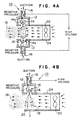
- Fig. 4 is a cross-sectional view showing a fourth embodiment of static eliminator according to the present invention.
- the static eliminator is of a wind type in which external force such as air blower or air fan 20 is used to transfer ions 18 to the object to be discharged. The wind is generated, and ions 18 are caused to ride the wind.
- Fig. 4A shows a case in that two discharging portions of different polarity are opposed to each other, and Fig. 4B shows a case in that one of opposed electrode is not a discharging electrode.
- the other opposed discharge portion having a polarity opposite to that of the one discharge portion or an opposed electrode is disposed to enhance ion emitting or to enhance transfer of the emitted ions in a direction to the front of the one discharge portion.
- two discharge portions 14a and 14b are disposed on the opposite sides of case 24 for defining airflow passage of air blower 20 to be opposed to each other.
- the polarities of their electrodes are opposite and the electrodes emit ions 18 of opposite polarities. Since the polarities of electrodes are opposite, ion emission is promoted and the ions thus emitted or generated are pulled out between the electrodes.
- the ions 18 flies out by repulsive force from discharge portions 14a and 14b while in the embodiment the ions are strongly pulled out by ion sucking force.
- ions receive push and pull effects and then flies out certainly, even if the ozone, etc 16 generated in the discharge portion are strongly sucked by negative pressure, the ions do not go back. That is, the collection of the ozone, etc can be carried out certainly.
- the ions 18 pulled out are transferred toward the object to be statically eliminated by the wind generated from air blower 20.
- one discharge portion 14 and an opposite electrode 22 opposed to the one discharge portion are provided in place of two discharge portions.
- the opposite electrode 22 enhances the emission of the ions 18 from the discharge portion 14 and pulls the ions thus emitted or generated out from the discharge portion.
- the ions 18 flies out by repulsive force from discharge portion 14 while in the embodiment the ions are strongly pulled out by ion attracting force. That is, since ions receive push and pull effects and then flies out certainly, even if the ozone, etc generated in the discharge portion are strongly sucked by negative pressure, the ions do not go back. That is, the collection of the ozone, etc can be carried out certainly.
- the ions 18 pulled out are transferred toward the object to be statically eliminated by the wind generated from air blower 20.
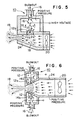
- Fig. 5 is a cross-sectional view showing a fifth embodiment of static eliminator according to the present invention.
- the ozone, etc are collected by suction due to negative pressure
- the ozone, etc are collected by blowout due to positive pressure.
- the static eliminator is of a wind type in which the wind generated by an air blower 20 is used to blow the ions out.
- the ion emitting opening 12a is provided in front of the discharge portion.
- the ozone, etc generated by electric discharge are collected by blowing the wind in a direction opposite to that of ion emission from the ion emitting opening 12a.
- Fig. 6 is a cross-sectional view showing a sixth embodiment of static eliminator according to the present invention.
- the static eliminator is of a wind type in which the wind generated by an air blower 20 is used to blow the ions out.
- the ion emitting opening 12a is provided in front of one discharge portion having the discharge electrode 14a.
- the other emitting opening 12a is provided in front of the other discharge portion having the discharge electrode 14b or an opposite electrode, not shown.
- the discharge portions or ion emitting openings are provided on the opposite sides of the case 24 for defining airflow passage from the air blower 20.
- the ozone, etc generated by electric discharge are collected by blowing the wind in a direction opposite to that of ion emission from the ion emitting opening 12a.
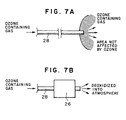
- Fig. 7 is a view showing ozone naturalizing modes of seventh embodiment of static eliminator according to the present invention, Fig. 7A showing a system in which ozone is blown out in the atmosphere and then naturalized. The ozone containing gas is transferred to the area where the environment is not seriously affected by the ozone, etc and released in the environment.
- Fig. 7B showing a system of resolving ozone through an ozone process and a filter process.
- the collected ozone, etc containing gas is detoxificated by ozone processing device and filter 26 and then released in the environment.
- the ozone processing includes ozone decomposition, ozone absorption and the like.
Landscapes
- Elimination Of Static Electricity (AREA)
- Cleaning And Drying Hair (AREA)
Applications Claiming Priority (2)
| Application Number | Priority Date | Filing Date | Title |
|---|---|---|---|
| JP2008302325 | 2008-11-27 | ||
| JP2009007151A JP5322666B2 (ja) | 2008-11-27 | 2009-01-16 | オゾンレス除電器 |
Publications (2)
| Publication Number | Publication Date |
|---|---|
| EP2192662A2 true EP2192662A2 (de) | 2010-06-02 |
| EP2192662A3 EP2192662A3 (de) | 2012-08-22 |
Family
ID=41666723
Family Applications (1)
| Application Number | Title | Priority Date | Filing Date |
|---|---|---|---|
| EP09177129A Withdrawn EP2192662A3 (de) | 2008-11-27 | 2009-11-26 | Ozonfreies Antistatikgerät |
Country Status (4)
| Country | Link |
|---|---|
| US (1) | US8325456B2 (de) |
| EP (1) | EP2192662A3 (de) |
| JP (1) | JP5322666B2 (de) |
| CN (1) | CN101754558B (de) |
Cited By (3)
| Publication number | Priority date | Publication date | Assignee | Title |
|---|---|---|---|---|
| CN102631052A (zh) * | 2012-03-31 | 2012-08-15 | 苏州卫鹏机电科技有限公司 | 一种鞋材表面低温等离子体放电处理设备及其处理方法 |
| EP2712039A3 (de) * | 2012-09-21 | 2016-12-14 | TRINC Corporation | Antistatikgerät für Teilezuführer |
| IL269021A (en) * | 2019-08-29 | 2021-03-01 | Riskin Yefim | A method for air disinfection and disinfector |
Families Citing this family (12)
| Publication number | Priority date | Publication date | Assignee | Title |
|---|---|---|---|---|
| US9380689B2 (en) * | 2008-06-18 | 2016-06-28 | Illinois Tool Works Inc. | Silicon based charge neutralization systems |
| US8038775B2 (en) * | 2009-04-24 | 2011-10-18 | Peter Gefter | Separating contaminants from gas ions in corona discharge ionizing bars |
| EP2422219B1 (de) * | 2009-04-24 | 2020-11-18 | Illinois Tool Works Inc. | Saubere koronagasionisierung zur neutralisierung statischer ladungen |
| US8416552B2 (en) * | 2009-10-23 | 2013-04-09 | Illinois Tool Works Inc. | Self-balancing ionized gas streams |
| US8143591B2 (en) | 2009-10-26 | 2012-03-27 | Peter Gefter | Covering wide areas with ionized gas streams |
| JP2012049055A (ja) * | 2010-08-30 | 2012-03-08 | Fujitsu General Ltd | 空気調和機 |
| CN102823997B (zh) * | 2011-06-13 | 2015-07-15 | 苏州卫鹏机电科技有限公司 | 一种鞋材表面低温等离子体放电处理设备及其处理方法 |
| CN102573256B (zh) * | 2012-01-18 | 2015-05-27 | 日氟荣高分子材料研发(上海)有限公司 | 一种静电去除系统及其去除薄膜表面静电的用途 |
| CN105223425B (zh) * | 2015-10-27 | 2018-05-18 | 上海斐讯数据通信技术有限公司 | 自动除静电系统 |
| WO2019236695A1 (en) | 2018-06-05 | 2019-12-12 | Illinois Tool Works Inc. | Air rinsing apparatus and systems for rinsing containers |
| CN110913547B (zh) * | 2019-12-22 | 2023-08-29 | 湖北双剑鼓风机股份有限公司 | 一种双风道离子风机 |
| DE102021117682B3 (de) * | 2021-07-08 | 2022-09-08 | Kist + Escherich GmbH | Vorrichtung und Verfahren sowie deren Verwendung zur Ionisation gasförmiger Medien |
Family Cites Families (18)
| Publication number | Priority date | Publication date | Assignee | Title |
|---|---|---|---|---|
| SE462703B (sv) * | 1986-04-21 | 1990-08-20 | Astra Vent Ab | Anordning foer alstring av en elektrisk koronaurladdning i luft |
| US5055963A (en) * | 1990-08-15 | 1991-10-08 | Ion Systems, Inc. | Self-balancing bipolar air ionizer |
| JP2904328B2 (ja) * | 1992-11-24 | 1999-06-14 | 三菱電機株式会社 | 微生物繁殖防止装置 |
| JPH09108313A (ja) * | 1995-10-24 | 1997-04-28 | Mitsubishi Electric Corp | 微生物繁殖防止方法およびその装置 |
| IL119613A (en) * | 1996-11-14 | 1998-12-06 | Riskin Yefim | Method and apparatus for the generation of ions |
| JP2001248852A (ja) * | 2000-03-06 | 2001-09-14 | Matsushita Electric Ind Co Ltd | 空調装置 |
| JP4412857B2 (ja) * | 2001-02-05 | 2010-02-10 | 新日本空調株式会社 | 空気イオン化装置 |
| US6785114B2 (en) * | 2001-03-29 | 2004-08-31 | Illinois Tool Works Inc. | Foraminous filter for use in air ionizer |
| JP4614569B2 (ja) * | 2001-04-06 | 2011-01-19 | 一雄 岡野 | 吸引型イオナイザ |
| JP4738636B2 (ja) * | 2001-05-29 | 2011-08-03 | 株式会社テクノ菱和 | 防爆型無発塵イオナイザー |
| US7054130B2 (en) * | 2004-06-03 | 2006-05-30 | Illinois Tool Works Inc | Apparatus and method for improving uniformity and charge decay time performance of an air ionizer blower |
| JP4594111B2 (ja) * | 2005-01-17 | 2010-12-08 | 株式会社コガネイ | 除電装置および放電モジュール |
| JP2007280701A (ja) * | 2006-04-05 | 2007-10-25 | Trinc:Kk | 除電装置 |
| JP4759430B2 (ja) * | 2006-04-13 | 2011-08-31 | 株式会社コガネイ | 除電装置および放電モジュール |
| JP2007305403A (ja) * | 2006-05-11 | 2007-11-22 | Omron Corp | コロナ放電型イオナイザ、ファンユニット、およびクリーンルームシステム |
| JP2008256868A (ja) * | 2007-04-03 | 2008-10-23 | Sharp Corp | 帯電装置及びそれを備える画像形成装置 |
| US8059383B2 (en) * | 2008-12-20 | 2011-11-15 | Hewlett-Packard Development Company, L.P. | Electrostatic blower systems |
| JP2011060537A (ja) * | 2009-09-09 | 2011-03-24 | Three M Innovative Properties Co | 除電装置 |
-
2009
- 2009-01-16 JP JP2009007151A patent/JP5322666B2/ja not_active Expired - Fee Related
- 2009-11-23 US US12/623,629 patent/US8325456B2/en not_active Expired - Fee Related
- 2009-11-26 EP EP09177129A patent/EP2192662A3/de not_active Withdrawn
- 2009-11-27 CN CN200910246374.0A patent/CN101754558B/zh not_active Expired - Fee Related
Cited By (7)
| Publication number | Priority date | Publication date | Assignee | Title |
|---|---|---|---|---|
| CN102631052A (zh) * | 2012-03-31 | 2012-08-15 | 苏州卫鹏机电科技有限公司 | 一种鞋材表面低温等离子体放电处理设备及其处理方法 |
| EP2712039A3 (de) * | 2012-09-21 | 2016-12-14 | TRINC Corporation | Antistatikgerät für Teilezuführer |
| IL269021A (en) * | 2019-08-29 | 2021-03-01 | Riskin Yefim | A method for air disinfection and disinfector |
| WO2021038551A1 (en) * | 2019-08-29 | 2021-03-04 | Tadiran Consumer And Technology Products Ltd. | Method of separation of components in the corona discharge zone and an ozone-free disinfector using said method |
| CN114450039A (zh) * | 2019-08-29 | 2022-05-06 | 塔迪朗消费技术产品有限公司 | 电晕放电区中的成分分离方法和使用所述方法的无臭氧消毒器 |
| IL269021B2 (en) * | 2019-08-29 | 2023-05-01 | Riskin Yefim | Air disinfection method and disinfection device |
| US12023685B2 (en) | 2019-08-29 | 2024-07-02 | Oxypro Ltd. | Method and device for ozone-free separation of components in the corona discharge zone |
Also Published As
| Publication number | Publication date |
|---|---|
| CN101754558A (zh) | 2010-06-23 |
| JP5322666B2 (ja) | 2013-10-23 |
| US8325456B2 (en) | 2012-12-04 |
| US20100128408A1 (en) | 2010-05-27 |
| JP2010153342A (ja) | 2010-07-08 |
| EP2192662A3 (de) | 2012-08-22 |
| CN101754558B (zh) | 2014-05-14 |
Similar Documents
| Publication | Publication Date | Title |
|---|---|---|
| US8325456B2 (en) | Ozone-less static eliminator | |
| JP2880427B2 (ja) | 空気イオン化装置及び空気イオン化方法 | |
| CN102844108B (zh) | 从电晕放电电离棒的气体离子中分离污染物 | |
| JPH04503422A (ja) | コロナ放電によって発生される有害な物質を除去するためのコロナ放電装置における改良 | |
| JP2010051957A (ja) | ガス状流動体をクリーニングするための方法及び装置 | |
| TWI397230B (zh) | 離子產生裝置 | |
| CN106999949B (zh) | 用于净化气流的静电过滤器 | |
| JP2018136335A5 (de) | ||
| US20120085234A1 (en) | Particle Guide Collector System and Associated Method | |
| CN114450039A (zh) | 电晕放电区中的成分分离方法和使用所述方法的无臭氧消毒器 | |
| CN107606692A (zh) | 等离子净化模块 | |
| JP2000311797A (ja) | 静電気除去装置および静電気除去方法 | |
| KR20200067388A (ko) | X선을 이용한 공기청정기 | |
| JP3001578B1 (ja) | 静電分離装置 | |
| KR100251901B1 (ko) | 공기청정장치 | |
| JP2002075688A (ja) | 層流管ノズル付きイオナイザ | |
| WO2009107350A1 (ja) | 空気処理装置 | |
| KR100934133B1 (ko) | 전기 집진 장치 및 이를 포함한 공기 청정기 | |
| KR101538945B1 (ko) | 차폐막 및 저전압 x선관을 구비한 이온 블로워 | |
| JP6000684B2 (ja) | 帯電粒子発生装置 | |
| JPH09139277A (ja) | 空気イオン発生装置 | |
| KR200185856Y1 (ko) | 이온아이저 정전기 제전장치를 구비한 진공청소기흡입기 | |
| JP2013165742A (ja) | 空気浄化装置 | |
| JP2006216453A (ja) | 帯電物の除電装置及びその方法 | |
| JP2835480B2 (ja) | 気体清浄装置 |
Legal Events
| Date | Code | Title | Description |
|---|---|---|---|
| PUAI | Public reference made under article 153(3) epc to a published international application that has entered the european phase |
Free format text: ORIGINAL CODE: 0009012 |
|
| 17P | Request for examination filed |
Effective date: 20091126 |
|
| AK | Designated contracting states |
Kind code of ref document: A2 Designated state(s): AT BE BG CH CY CZ DE DK EE ES FI FR GB GR HR HU IE IS IT LI LT LU LV MC MK MT NL NO PL PT RO SE SI SK SM TR |
|
| AX | Request for extension of the european patent |
Extension state: AL BA RS |
|
| PUAL | Search report despatched |
Free format text: ORIGINAL CODE: 0009013 |
|
| AK | Designated contracting states |
Kind code of ref document: A3 Designated state(s): AT BE BG CH CY CZ DE DK EE ES FI FR GB GR HR HU IE IS IT LI LT LU LV MC MK MT NL NO PL PT RO SE SI SK SM TR |
|
| AX | Request for extension of the european patent |
Extension state: AL BA RS |
|
| RIC1 | Information provided on ipc code assigned before grant |
Ipc: H01T 23/00 20060101AFI20120717BHEP Ipc: H05F 3/04 20060101ALI20120717BHEP |
|
| STAA | Information on the status of an ep patent application or granted ep patent |
Free format text: STATUS: THE APPLICATION IS DEEMED TO BE WITHDRAWN |
|
| 18D | Application deemed to be withdrawn |
Effective date: 20130223 |