EP2193239B1 - Système de connexion - Google Patents
Système de connexion Download PDFInfo
- Publication number
- EP2193239B1 EP2193239B1 EP08779014.3A EP08779014A EP2193239B1 EP 2193239 B1 EP2193239 B1 EP 2193239B1 EP 08779014 A EP08779014 A EP 08779014A EP 2193239 B1 EP2193239 B1 EP 2193239B1
- Authority
- EP
- European Patent Office
- Prior art keywords
- leg
- actuators
- jacking system
- jacking
- engagement parts
- Prior art date
- Legal status (The legal status is an assumption and is not a legal conclusion. Google has not performed a legal analysis and makes no representation as to the accuracy of the status listed.)
- Not-in-force
Links
Images


Classifications
-
- E—FIXED CONSTRUCTIONS
- E02—HYDRAULIC ENGINEERING; FOUNDATIONS; SOIL SHIFTING
- E02B—HYDRAULIC ENGINEERING
- E02B17/00—Artificial islands mounted on piles or like supports, e.g. platforms on raisable legs or offshore constructions; Construction methods therefor
- E02B17/04—Equipment specially adapted for raising, lowering, or immobilising the working platform relative to the supporting construction
- E02B17/08—Equipment specially adapted for raising, lowering, or immobilising the working platform relative to the supporting construction for raising or lowering
- E02B17/0836—Equipment specially adapted for raising, lowering, or immobilising the working platform relative to the supporting construction for raising or lowering with climbing jacks
- E02B17/0872—Equipment specially adapted for raising, lowering, or immobilising the working platform relative to the supporting construction for raising or lowering with climbing jacks with locking pins engaging holes or cam surfaces
-
- E—FIXED CONSTRUCTIONS
- E02—HYDRAULIC ENGINEERING; FOUNDATIONS; SOIL SHIFTING
- E02B—HYDRAULIC ENGINEERING
- E02B17/00—Artificial islands mounted on piles or like supports, e.g. platforms on raisable legs or offshore constructions; Construction methods therefor
- E02B17/04—Equipment specially adapted for raising, lowering, or immobilising the working platform relative to the supporting construction
- E02B17/08—Equipment specially adapted for raising, lowering, or immobilising the working platform relative to the supporting construction for raising or lowering
- E02B17/0809—Equipment specially adapted for raising, lowering, or immobilising the working platform relative to the supporting construction for raising or lowering the equipment being hydraulically actuated
-
- E—FIXED CONSTRUCTIONS
- E02—HYDRAULIC ENGINEERING; FOUNDATIONS; SOIL SHIFTING
- E02B—HYDRAULIC ENGINEERING
- E02B17/00—Artificial islands mounted on piles or like supports, e.g. platforms on raisable legs or offshore constructions; Construction methods therefor
- E02B2017/0091—Offshore structures for wind turbines
Definitions
- the present invention relates to a jacking system for jacking a structure, for instance offshore platforms or vessels, out of the water, and a method for jacking using this system.
- Such a jacking system is for instance disclosed in US-A-3.804.369 .
- This jacking system has pairs of hydraulic cylinders which are mutually coupled using wire cables.
- This jacking system has a leg which has several "chords" each having two hydraulic cylinders at opposite sides of a chord. Both ends of the hydraulic cylinders have a retractable pin which can be extended into passages in a chord. Both cylinders displace in a synchronised fashion.
- GB-2.004.246 discloses a jacking system with square legs with holes and a frame which is attached to a platform which may have two yokes at two opposite sides of a leg and which have pins which are insertable in the holes of the legs.
- the frame has locking pins at the same sides of the actuators. These limit the stroke of the yokes.
- GB-2.004.247 discloses a jacking system with square legs with holes and a frame which is attached to a platform which has two yokes at opposite sides of a leg and which have pins insertable in these holes.
- the yokes can pass one another and thus together provides a fast leg handling. Handling of high loads may be a problem, as well is simultaneously handling several legs on one platform.
- FR-A-2.235.602 discloses a platform provided with legs which can be lowered by filling the legs with ballast, and raised by removing ballast. When the legs rest on the bottom of the sea, the platform can he raised via a jacking system.
- the legs have reservoirs for storing oil, for instance, and are made of concrete.
- Each leg has four actuators. The actuators are positioned within the platform, thus limiting their stroke to the thickness of a platform. All four actuators have the same stroke, and can all only cover one pitch distance. Furthermore, it has locking pins at fixed positions.
- US-A-2.932.486 discloses a jacking system for jacking a platform. It has legs provided with rails with holed. Furthermore, it has double acting hydraulic cylinders with locking pins at one end of the cylinders and locking pins at the opposite end of the cylinders on a frame attached to the platform. It uses two or three actuators for each leg. Furthermore, the actuators have identical maximum working strokes.
- US-A-3.056.585 discloses a pontoon with legs which can be raised and lowered. Each leg is square and has at each corner a first hydraulic cylinder which can extend in a first direction and a second hydraulic cylinder which can extend in the opposite direction. The ends of two adjacent first cylinders are coupled via a beam, and the second cylinders that in line are also coupled via a beam. Those beams engage in recesses of rails provided at the four corners of a leg.
- there are in fact four actuators with two actuator at the same side of a leg, and in line. The two actuators move in opposite directions. The entire actuator system thus extend along a considerable length of a leg.
- An object of the current invention is to improve the jacking systems and/or to provide an alternative jacking system.
- At least one of these objectives is realized with a jacking system according to claim 1.
- a jacking system is provided which can operate almost continuously.
- the proposed system furthermore allows the jacking system to be build easily and cheap.
- the legs will be loaded symmetrically, It also allows more modes of operation, making it possible of more carefully designing the actuators.
- hydraulic cylinders When the jacking system uses hydraulic cylinders as actuators, these cylinders at various stages have to return to their retracted position. This process is called 'recycling'. This expression will be used in this description, but does not necessarily refer to hydraulic systems only. In most embodiments, the hydraulic cylinders will be double stroke cylinders.
- the jacking system of the current invention is also used in vessels which install offshore constructions like windmills in coastal waters or in open sea, and in other constructions which need to be raised and/or lowered. This requires operational speed, and also the capability of handling large loads and also loads which have large fluctuations.
- the jacking system of the current invention is able to jack an offshore platform out of the water by positioning one or more legs on the sea floor and lift the platform out of the water.
- leg handling the following phases can be distinguished which all have their specific requirements on the jacking system:
- the legs When a platform or vessel arrives at its operational position, the legs are lowered in the leg lowering phase. In this phase, the loads on the legs are minimal. The legs are lowered until they reach the sea floor. During this phase, lowering needs to be done in a controlled manner. At the end of this phase, usually the length of each of the legs below the vessel will be different due to variations is the seafloor.
- the jacking phase can start. At this stage, the vessel or platform will be lifted out of the water and will eventually completely rest on the legs. It may also be possible to lift the platform only partially and thus use the legs as a stabilising means. Thus, in this mode the platform only partially rests on the legs. In is evident that during this jacking phase, the vessel or platform should be kept as horizontal as possible.
- the actual work of the vessel can start.
- the vessel rests on the legs and provides a stable working platform.
- a platform holding phase can be identified.
- the platform lowering phase starts. During this phase, the vessel will be lowered until the does not rest on the legs any more and floats. Again, during lowering the vessel should remain as much as possible in a horizontal position. During this phase, the weight of the vessel should be controlled.
- the leg lifting phase starts. During this phase, the legs are lifted and fully retrieved, normally above the bottom of the platform of the vessel, in such a way that for instance the vessel is ready to sail away.
- first and third actuators and the second and fourth actuators are opposite actuators.
- loads can be balanced and pairs can operate independently.
- the actuators are positioned round the leg.
- first and third actuators and the second and fourth actuators are arranged at opposite sides of a leg.
- said actuators have a working stroke which is defined as the distance the second actuator part can travel along a leg, wherein the working stroke of one pair of actuators differs from the working stroke of another pair of actuators.
- the first engagement parts are provided at a pitch S along a leg, and the working stroke differs at least an amount S.
- said leg further comprises second engagement parts along said leg, and said second actuator parts are further coupled to second engagement parts engaging the respective second engagement parts of said leg for providing abutment in the transverse direction of said leg.
- said second engagement parts of said leg comprise at least one rail along said leg, and said second engagement parts of said actuators abut said rail in a direction having a radial component and in a direction having a tangential component and is slideable along said rail.
- said leg is provided with a rail for each of said actuators.
- each of said actuators comprises two hydraulic cylinders having one end coupled to said guiding frame and the other end coupled to said second actuator part and each of said first engagement parts comprise a retractable pin is moveable in a direction transverse to said leg from a first position in which it is free from said leg into a second position in which it engages one of said first engagement parts of said leg for providing abutment in the longitudinal direction.
- the first engagement parts of said leg are provided at a regular mutual distance along the leg, and said first and second actuator parts are displaceable along a minimum distance of the distance of the engagement parts.
- At least one actuator has first and second actuator parts which are displaceable along a minimum distance of at least two times the mutual distance of the engagement parts.
- the invention further relates to a method for jacking an offshore platform or vessel, out of the water, said structure comprising a platform and at least one jacking system described above, wherein said actuators are activated one after the other.
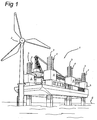
- a vessel 1 is shown for placing offshore constructions such as a windmill 2.
- the vessel is provided with a number of jacking systems 3 for jacking or lifting the vessel out of the water, i.e. above the surface of the water. To that end, the legs 4 rest on the bottom of the sea.
- the vessel 1 For installing for instance a windmill, the vessel 1 has the windmill 2 on board and sails to a location where the windmill has to be placed. At that location, the legs 4 of the vessel are lowered until they rest on the seafloor. This stage is called leg handling phase. Then, the vessel is lifted out of the water using the guiding frames 5 which engage the legs 4. This stage is called the jacking phase. After the vessel is lifted out of the water, the windmill is erected and placed on the seafloor. After installation of the windmill, the vessel is lowered again, and subsequently the legs 4 are raised from the seafloor using the guiding frames 5, and the vessel sails away.
- FIG. 2 shows a jacking system 3 of the current invention in perspective view.
- a vessel or other offshore construction may comprise one or several of such jacking systems 3.
- the jacking system 3 comprises a leg 4 and jacking device 5.
- Leg 4 has a foot 7 for resting on a seafloor.
- the leg 4 in this embodiment has a substantially square cross section with a rail 9 at each comer with through holes 10 at a regular mutual distance along the leg.
- the leg 4 can also be called octagonal in cross section having the rails as some of its sides.
- the leg 4 may also be triangular in cross section having for instance three rails, be round of elliptical in cross section, or may have another cross section.
- the leg can have a connecting bar, beam or plate substantially parallel to the normal of the rails 9, in order to provide rigidity and strength against forces working substantially normal to the rails 9.
- several plates are provided which connect all the rails 9 and in most cases also the plates 20 connecting the rails 9.
- Jacking device 5 has a frame 8 which is coupled to the vessel.
- Jacking device 5 further has actuators 11, 11', in this embodiment, each comprising two hydraulic cylinders.
- these hydraulic cylinders are double acting cylinders, which again allows an increase in operational speed.
- the actuators can also be of an electrically driven type, for instance comprising one or more servomotors. These types of actuators are not very common in the offshore field, however.
- Actuators 11, 11' have a first end 12, 12' attached to frame 8.
- the actuators extend along the leg 4 and have an opposite, second end 13, 13' which in operation displaces with respect to the first end 12, 12'.
- the second end 13, 13' has an engagement part 14, 15 which can engage and disengage the leg 4.
- the actuators 11, 11' have two hydraulic cylinders which at one end 12, 12' are attached to frame 8.
- the opposite ends 13, 13' of both hydraulic cylinders are attached to a guide 16 which can slide over rail 9.
- the guide has guide members 17 which slidably engage rail 9.
- the rail 9 has two opposite rims, and two opposite guide members 17 grab around said rims.
- the engagement part 14, 15 has a pin 15 which can slide in and out the holes 10 of rail 9. These holes are provided at a pitch S.
- the pin 15 is operated by an actuator 14, here a hydraulic cylinder 14. These pins provide a positive engagement to the rails 9.
- Fig. 3 shows a top view of the jacking system 3 of fig. 4.
- the hydraulic cylinders 11, 11' are attached at their upper ends 13, 13' to the guide 16 which can slide over rail 9.
- the attachment parts 18 of guide 16 are at a small angle and not at a straight line. In that way, the forces of the hydraulic cylinder put a minimal strain to the rail 9 and to the leg.
- the pitch of the holes 10 is S.
- the stroke of the short actuators 11 corresponds to this pitch S, and the stroke of the long actuators 11' corresponds to 2 ⁇ S.
- the actuators 11 and 11' can operate independently, thus allowing an even faster handling of the legs.
- the short actuators only serve as locking means via their pins 15.
- the lowering phase will usually start with all the actuators 11, 11' of all the legs fully retracted. During the lowering phase, the following cycle will be repeated:
- the jacking phase starts.
- all the legs may have a different length extending below the vessel due to the irregular surface of the seafloor.
- This difference in length between legs will usually not be an integer multitude of pitch S, but will often be a multitude of pitch S and a fraction of this pitch S.
- the short actuators 11 are set to such a length that they bridge the fraction of a pitch difference between legs. Then, the short actuators 11 are fixed at those lengths that the vessel is in horizontal position, and will remain at those lengths during jacking.
- the pins 15 of the short actuators will be inserted in corresponding holes 10 for locking the legs. In that way, the short actuators 11 thus become an adjustable locking system for the legs, while the long actuators 11' become a leg moving system.
- the two long actuators 11' of this embodiment will both be needed for jacking as this requires lifting large weight, and only one long actuator 11' will be needed during the other phases, thus allowing these other phases to proceed at a larger speed: one long actuator 11' can be extended while the other one can be recycled.
- the platform When the platform arrives at its jacked position, usually lifted out of the water, it can start its activities like positioning windmill poles or masts. During these operations, the legs may encounter high vertical loads, in some cases even higher than during jacking of the platform. To transfer these loads the pins 15 of all the actuators 11 and 11' will engage to the legs 4, resulting in a holding capacity that is double the jacking capacity of the system.
- the platform After completion of its work, the platform will be lowered into the water during the platform lowering phase.
- the short actuators will be extended to a length between 0-S, and their pins 15 will be inserted into corresponding holes 10. Again, just like the jacking phase, the platform should remain horizontal.
- the legs are fully lifted to enable the vessel to sail away.
- the following cycle can be used.
- the legs still extend below the vessel at different lengths, but the vessel already floats. All the legs will now be raised to such extend that a hole 10 corresponds to the full retracted position of the actuators 11, 11'.
- This phase will usually start with all the actuators 11, 11' in fully retracted position.
- the long actuators 11' can use their full extension length of 2S. The pins 15 of the short actuator 11 will unlock, and the long actuators 11' will fully extend, taking the legs up with them.
- the short actuators are at the same time fully retracted and when the long actuators 11' are fully extended, the pins 15 of the short actuators 11 which are now positioned at the location of a hole 10 are inserted into a hole to lock the leg. Subsequently, the pins 15 of the long actuators 11' are fully retracted from the holes 10, and the long actuators 11' will be fully retracted to their positions 0. The pins 15 of the long actuators 11' are now inserted in the holes 10. Thus, the following cycle is repeated:
- This cycle will end when the legs are fully retracted. Thus, for some legs this will need more cycles than for other legs. During each cycle, a leg will be lifted an amount 2S.
- the jacking system may also be designed in such a way that one actuator is powerful enough to lift a leg on its own. In that case, the leg lifting phase can proceed even faster when the two long actuators 11' of one leg are used one after the other in stead of simultaneously. In that case one long actuators 11' is lifting the leg while the other long actuators 11' is being recycled.
Landscapes
- Engineering & Computer Science (AREA)
- General Engineering & Computer Science (AREA)
- Mechanical Engineering (AREA)
- Civil Engineering (AREA)
- Structural Engineering (AREA)
- Earth Drilling (AREA)
- Wind Motors (AREA)
Claims (15)
- Système de levage (3) pour soulever une plateforme en mer ou un navire (1) hors de l'eau,
ledit système de levage comprenant un pied (4) ayant un axe longitudinal et comprenant des premières parties de mise en prise (10) le long dudit pied, et un bâti de guidage (8) déplaçable le long dudit pied, ledit bâti de guidage (8) comprenant au moins un premier, un deuxième, un troisième et un quatrième actionneur (11, 11'), lesdits actionneurs ayant chacun une première et une seconde partie d'actionneur (12, 12', 13, 13') qui, en fonctionnement, peuvent se déplacer l'une par rapport à l'autre le long dudit pied, ladite première partie d'actionneur (12, 12') desdits actionneurs (11, 11') étant couplée audit bâti de guidage (8), lesdites secondes parties d'actionneur (13, 13') desdits actionneurs (11, 11') étant chacune couplées aux premières parties de mise en prise (14, 15) pour mettre en prise et dégager lesdites premières parties de mise en prise (10) dudit pied (4) pour fournir une butée dans la direction longitudinale dudit pied (4), lesdites secondes parties d'actionneur (13, 13') desdits actionneurs (11, 11') étant déplaçables le long dudit pied (4) l'une après l'autre, lesdits actionneurs (11, 11') étant agencés en paires, opposés entre eux par rapport à un plan longitudinal dudit pied (4), caractérisé en ce que lesdits actionneurs (11, 11') ont une course de travail (5, 2.5) qui est définie comme étant la distance que la seconde partie d'actionneur (13, 13') peut parcourir le long d'un pied (4), dans lequel la course de travail (5) de chaque paire d'actionneurs diffère de la course de travail (2.5) d'une autre paire d'actionneurs. - Système de levage (3) selon la revendication 1, dans lequel les actionneurs (11, 11') sont positionnés autour du pied (4).
- Système de levage (3) selon la revendication 2, dans lequel les premier et troisième actionneurs (11) et les deuxième et quatrième actionneurs (11') sont agencés sur les côtés opposés d'un pied (4).
- Système de levage (3) selon l'une quelconque des revendications précédentes, dans lequel les premières parties de mise en prise (10) sont prévues à un pas S le long d'un pied, et la course de travail diffère d'au moins une quantité S.
- Système de levage (3) selon l'une quelconque des revendications précédentes, dans lequel ledit pied (4) comprend en outre des secondes parties de mise en prise (9) le long dudit pied (4), et lesdites secondes parties d'actionneur (13, 13') sont en outre couplées aux secondes parties de mise en prise (16, 17, 18) mettant en prise les secondes parties de mise en prise (9) respectives dudit pied pour fournir une butée dans la direction transversale dudit pied.
- Système de levage (3) selon l'une quelconque des revendications précédentes, dans lequel lesdites secondes parties de mise en prise (9) dudit pied comprennent au moins un rail (9) le long dudit pied (4), et lesdites secondes parties de mise en prise (16, 17, 18) desdits actionneurs viennent en butée contre ledit rail (9) dans une direction ayant une composante radiale et dans une direction ayant une composante tangentielle et peut coulisser le long dudit rail.
- Système de levage (3) selon la revendication 6, dans lequel ledit pied (4) est prévu avec un rail (9) pour chacun desdits actionneurs (11, 11').
- Système de levage (3) selon l'une quelconque des revendications précédentes, dans lequel chacun desdits actionneurs (11, 11') comprend deux vérins hydrauliques (11, 11') ayant une extrémité (12, 12') couplée audit bâti de guidage (5) et l'autre extrémité (13, 13') couplée à ladite seconde partie d'actionneur et chacune desdites premières parties de mise en prise (14, 15) qui comprennent une broche rétractable (15), est mobile dans une direction transversale audit pied (4), d'une première position dans laquelle elle est dépourvue dudit pied (4), à une seconde position dans laquelle elle met en prise l'une desdites premières parties de mise en prise dudit pied (4) pour fournir la butée dans la direction longitudinale.
- Système de levage (3) selon l'une quelconque des revendications précédentes, dans lequel les premières parties de mise en prise (10) dudit pied sont prévues à une distance mutuelle régulière le long du pied avec un pas S, et lesdites première et seconde parties d'actionneur sont déplaçables le long d'une distance minimum de la distance mutuelle ou pas S des parties de mise en prise.
- Système de levage (3) selon la revendication 9, dans lequel au moins une paire d'actionneurs (11') a des première et seconde parties d'actionneur qui sont déplaçables le long d'une distance minimum représentant au moins deux fois le pas S des parties de mise en prise.
- Système de levage (3) selon l'une quelconque des revendications précédentes, dans lequel ledit pied a une section transversale orthogonale avec des paires d'actionneurs sur les côtés opposés, en particulier avec des actionneurs dans chaque second côté, c'est-à-dire à chaque autre côté.
- Procédé pour lever une plateforme en mer ou un navire hors de l'eau, ladite plateforme en mer ou navire comprenant une plateforme et au moins quatre systèmes de levage (3) selon l'une quelconque des revendications 1 à 11, dans lequel lesdits actionneurs sont activés au moins en paires.
- Plateforme de travail (1), telle qu'une plateforme en mer ou un navire, comprenant au moins quatre systèmes de levage selon l'une quelconque des revendications 1 à 11.
- Pied (4) comprenant un système de levage (3) selon l'une quelconque des revendications 1 à 11.
- Bâti de guidage (5) comprenant un système de levage (3) selon l'une quelconque des revendications 1 à 11.
Priority Applications (1)
| Application Number | Priority Date | Filing Date | Title |
|---|---|---|---|
| EP08779014.3A EP2193239B1 (fr) | 2007-07-30 | 2008-07-10 | Système de connexion |
Applications Claiming Priority (3)
| Application Number | Priority Date | Filing Date | Title |
|---|---|---|---|
| EP07113425 | 2007-07-30 | ||
| EP08779014.3A EP2193239B1 (fr) | 2007-07-30 | 2008-07-10 | Système de connexion |
| PCT/NL2008/050466 WO2009017399A1 (fr) | 2007-07-30 | 2008-07-10 | Système de levage |
Publications (2)
| Publication Number | Publication Date |
|---|---|
| EP2193239A1 EP2193239A1 (fr) | 2010-06-09 |
| EP2193239B1 true EP2193239B1 (fr) | 2016-05-25 |
Family
ID=38694867
Family Applications (1)
| Application Number | Title | Priority Date | Filing Date |
|---|---|---|---|
| EP08779014.3A Not-in-force EP2193239B1 (fr) | 2007-07-30 | 2008-07-10 | Système de connexion |
Country Status (6)
| Country | Link |
|---|---|
| US (1) | US8459901B2 (fr) |
| EP (1) | EP2193239B1 (fr) |
| CN (1) | CN101827979B (fr) |
| CA (1) | CA2695182C (fr) |
| DK (1) | DK2193239T3 (fr) |
| WO (1) | WO2009017399A1 (fr) |
Families Citing this family (27)
| Publication number | Priority date | Publication date | Assignee | Title |
|---|---|---|---|---|
| NL2002549C2 (en) | 2009-02-20 | 2010-08-24 | Marine Structure Consul | Jacking system for a leg of a jack-up platform. |
| EP2501861B1 (fr) * | 2009-11-18 | 2017-04-12 | Robert Bosch GmbH | Procédé de commande d'une plate-forme en mer |
| NL2005785C2 (en) | 2010-11-30 | 2012-05-31 | Ihc Holland Ie Bv | Jacking system. |
| CN102162232A (zh) * | 2011-02-22 | 2011-08-24 | 武汉理工大学 | 多用途插销爬杆型连续升降装置 |
| CN102174806B (zh) * | 2011-03-02 | 2013-06-19 | 中国海洋石油总公司 | 一种可适应变桩径式液压升降装置及其使用方法 |
| CN102220754A (zh) * | 2011-03-21 | 2011-10-19 | 吴平平 | 一种用于船只的升降设备 |
| BE1019908A4 (nl) * | 2011-04-18 | 2013-02-05 | Geosea N V | Opvijzelbaar offshore platform en werkwijze voor het onderdrukken van laterale oscillerende bewegingen ervan. |
| KR101359519B1 (ko) * | 2012-02-15 | 2014-02-07 | 삼성중공업 주식회사 | 레그의 잭킹 장치 |
| US9718656B2 (en) | 2013-07-08 | 2017-08-01 | Bainter Construction Services, Llc | Jack with two masts |
| CN103397623B (zh) * | 2013-08-06 | 2015-11-04 | 捷胜海洋装备股份有限公司 | 一种海上平台 |
| KR102093844B1 (ko) * | 2013-12-26 | 2020-03-26 | 재단법인 포항산업과학연구원 | 잭업 리그와 잭업 리그의 승강 장치 |
| CN104746495A (zh) * | 2013-12-31 | 2015-07-01 | 中国石油化工集团公司 | 圆柱桩升降齿条插销定位装置 |
| CN104372780A (zh) * | 2014-11-03 | 2015-02-25 | 上海航盛船舶设计有限公司 | 自升式平台连续升降机构 |
| CN105780749B (zh) * | 2014-12-26 | 2018-07-03 | 财团法人船舶暨海洋产业研发中心 | 液压式举升系统及其运作方法 |
| SG11201608376QA (en) * | 2015-08-31 | 2017-04-27 | Keppel Offshore & Marine Technology Ct Pte Ltd | Fixation system for hydraulic jacking system |
| CN105862699B (zh) * | 2016-06-13 | 2017-05-10 | 广东精铟海洋工程股份有限公司 | 一种用于海上平台的插销式连续升降系统及其升降方法 |
| CN106854870B (zh) * | 2016-12-26 | 2019-02-12 | 浙江华蕴海洋工程技术服务有限公司 | 一种具有快速拔桩功能的海上风电平台 |
| CN106592555B (zh) * | 2016-12-26 | 2019-04-23 | 广东精铟海洋工程股份有限公司 | 一种具有高强度桩腿的海上风电平台 |
| CN106759205B (zh) * | 2017-01-13 | 2018-12-18 | 广东精铟海洋工程股份有限公司 | 一种自升式八边形桩腿节及使用其的海上作业平台 |
| CN106677149B (zh) * | 2017-01-13 | 2018-10-30 | 广东精铟海洋工程股份有限公司 | 一种具有八边形桩腿的液压连续升降系统 |
| CN106759317B (zh) * | 2017-02-16 | 2019-11-08 | 广东精铟海洋工程股份有限公司 | 一种海上平台桩靴 |
| CN106638589B (zh) * | 2017-02-16 | 2019-11-05 | 广东精铟海洋工程股份有限公司 | 一种高强度海上平台桩靴 |
| CN107386244B (zh) * | 2017-08-17 | 2019-03-19 | 西伯瀚(上海)海洋装备科技有限公司 | 桁架式液压插销升降装置 |
| US10415204B1 (en) * | 2018-04-30 | 2019-09-17 | Northern Offshore Ltd. | Multi-environment self-elevating drilling platform |
| EP3584369A1 (fr) | 2018-06-18 | 2019-12-25 | Vallourec Deutschland GmbH | Dispositif de nivellement d'une construction de fondation offshore |
| US10753080B1 (en) | 2019-03-29 | 2020-08-25 | Big Time Investment, Llc | Method of constructing a building, and a building construction system therefor |
| CN113969570A (zh) * | 2020-07-23 | 2022-01-25 | 四川宏华石油设备有限公司 | 一种升降装置 |
Family Cites Families (14)
| Publication number | Priority date | Publication date | Assignee | Title |
|---|---|---|---|---|
| US2932486A (en) | 1955-07-20 | 1960-04-12 | De Long Corp | Jacking mechanism and controls |
| US3056585A (en) * | 1959-01-29 | 1962-10-02 | Werf Gusto V H A F Smulders Fa | Apparatus for producing a relative linear displacement between a column and a movable body by means of hydraulic pressure |
| DE1180109B (de) * | 1963-02-23 | 1964-10-22 | Gutehoffnungshuette Sterkrade | Vorrichtung zum Heben und Senken einer Arbeitsbuehne, insbesondere einer schwimmendenPlattform |
| NL6509650A (fr) * | 1965-07-26 | 1967-01-27 | ||
| US3804369A (en) | 1972-04-14 | 1974-04-16 | J Sutton | Jacking mechanisms |
| FR2235602A5 (en) * | 1973-06-27 | 1975-01-24 | Metalliques Entrepr Cie Fse | Platform lifting system - for offshore drilling production |
| US4007914A (en) | 1975-06-17 | 1977-02-15 | Sutton John R | Jacking mechanism |
| DE2736938C2 (de) * | 1977-08-16 | 1979-03-15 | Howaldtswerke-Deutsche Werft Ag Hamburg Und Kiel, 2300 Kiel | Meeres-Hubinsel |
| NL180197C (nl) | 1977-09-14 | 1987-01-16 | Marine Structure Consul | Verplaatsingsinrichting voor het wijzigen van de stand van een werkplatform ten opzichte van zijn poten. |
| NL180198C (nl) | 1977-09-14 | 1987-01-16 | Marine Structure Consul | Samenstel van een plaatvormig deel en poten waarlangs het plaatvormige deel verplaatsbaar is door middel van hefinrichtingen, alsmede een poot bestemd om te worden toegepast bij het samenstel. |
| US4411408A (en) | 1980-10-27 | 1983-10-25 | The Offshore Company | Jack-up platform apparatus |
| US4657438A (en) * | 1986-01-10 | 1987-04-14 | Gillis Don A | Advancing mechanism and system utilizing same for raising and lowering a work platform |
| CN1186889A (zh) * | 1996-09-06 | 1998-07-08 | 胜利石油管理局钻井工艺研究院 | 一种带有可伸缩性桩靴的双液缸连续升降桩腿 |
| US6648554B1 (en) * | 2002-07-09 | 2003-11-18 | James Francis Sehl | Portable flotation platform for shallow bodies of water |
-
2008
- 2008-07-10 CN CN2008801055019A patent/CN101827979B/zh not_active Expired - Fee Related
- 2008-07-10 CA CA2695182A patent/CA2695182C/fr active Active
- 2008-07-10 DK DK08779014.3T patent/DK2193239T3/en active
- 2008-07-10 EP EP08779014.3A patent/EP2193239B1/fr not_active Not-in-force
- 2008-07-10 WO PCT/NL2008/050466 patent/WO2009017399A1/fr not_active Ceased
- 2008-07-10 US US12/671,533 patent/US8459901B2/en not_active Expired - Fee Related
Also Published As
| Publication number | Publication date |
|---|---|
| WO2009017399A1 (fr) | 2009-02-05 |
| CA2695182C (fr) | 2016-08-09 |
| DK2193239T3 (en) | 2016-07-25 |
| US20110211915A1 (en) | 2011-09-01 |
| US8459901B2 (en) | 2013-06-11 |
| CN101827979A (zh) | 2010-09-08 |
| CN101827979B (zh) | 2013-08-21 |
| EP2193239A1 (fr) | 2010-06-09 |
| CA2695182A1 (fr) | 2009-02-05 |
Similar Documents
| Publication | Publication Date | Title |
|---|---|---|
| EP2193239B1 (fr) | Système de connexion | |
| US5139366A (en) | Offshore jackup rig locking apparatus and method | |
| US8070388B2 (en) | Structure for transporting, commissioning and decommissioning the elements of a fixed oil platform and methods for implementing such a structure | |
| DK2681400T3 (en) | Extension system and method of application | |
| DK2628854T3 (en) | Cash System to a leg of a jack-up platform | |
| CN109121426B (zh) | 带有自升式钻台的钻机 | |
| EP2327874A2 (fr) | Système de support et de levage d'une éolienne et plateforme d'opérations mobile | |
| WO2003066427A1 (fr) | Navire destine a l'installation de structures dressees | |
| US4041711A (en) | Method and apparatus for quickly erecting off-shore platforms | |
| US8517637B2 (en) | Structure for the transport, installation and dismantling of an oil rig deck and method for using one such structure | |
| CN103964300A (zh) | 顶升式加高设备 | |
| KR20220054609A (ko) | 선박리프트 플랫폼의 승하강 | |
| EP3688232B1 (fr) | Obturation et abandon d'un ou de plusieurs puits de forage à plateforme en mer d'une plate-forme en mer à l'aide d'un navire marin à vérin | |
| GB2485678A (en) | Jack-up vessel system for offshore transport and handling of cargo | |
| NL2034761B1 (en) | Gripper assembly for foundation piles | |
| CN205475169U (zh) | 海洋平台桁架式重载快速升降系统 | |
| EP4377521B1 (fr) | Dispositif et procédé d'agencement en mer d'une éolienne ou de ses composants | |
| EP1795443A1 (fr) | Navire pour le transport et la manipulation offshore d'éléments, méthode et utilisations d'un tel navire | |
| KR101973083B1 (ko) | 해양구조물 | |
| KR101271195B1 (ko) | 해상작업용 선박 | |
| CN117985176A (zh) | 一种水流状态下的施工船舶定位系统及其定位方法 | |
| KR20130021033A (ko) | 잭업 리그의 육상 건조방법 | |
| HK1192600B (en) | A cantilever system and method of use | |
| HK1192600A (en) | A cantilever system and method of use | |
| MXPA99008027A (en) | Jack-up platform locking apparatus |
Legal Events
| Date | Code | Title | Description |
|---|---|---|---|
| PUAI | Public reference made under article 153(3) epc to a published international application that has entered the european phase |
Free format text: ORIGINAL CODE: 0009012 |
|
| 17P | Request for examination filed |
Effective date: 20100129 |
|
| AK | Designated contracting states |
Kind code of ref document: A1 Designated state(s): AT BE BG CH CY CZ DE DK EE ES FI FR GB GR HR HU IE IS IT LI LT LU LV MC MT NL NO PL PT RO SE SI SK TR |
|
| AX | Request for extension of the european patent |
Extension state: AL BA MK RS |
|
| DAX | Request for extension of the european patent (deleted) | ||
| RAP1 | Party data changed (applicant data changed or rights of an application transferred) |
Owner name: SBM SCHIEDAM B.V. |
|
| RAP1 | Party data changed (applicant data changed or rights of an application transferred) |
Owner name: GUSTOMSC RESOURCES B.V. |
|
| GRAP | Despatch of communication of intention to grant a patent |
Free format text: ORIGINAL CODE: EPIDOSNIGR1 |
|
| RIC1 | Information provided on ipc code assigned before grant |
Ipc: E02B 17/08 20060101AFI20151126BHEP Ipc: E02B 17/00 20060101ALI20151126BHEP |
|
| INTG | Intention to grant announced |
Effective date: 20151208 |
|
| GRAS | Grant fee paid |
Free format text: ORIGINAL CODE: EPIDOSNIGR3 |
|
| GRAA | (expected) grant |
Free format text: ORIGINAL CODE: 0009210 |
|
| RAP1 | Party data changed (applicant data changed or rights of an application transferred) |
Owner name: GUSTOMSC RESOURCES B.V. |
|
| AK | Designated contracting states |
Kind code of ref document: B1 Designated state(s): AT BE BG CH CY CZ DE DK EE ES FI FR GB GR HR HU IE IS IT LI LT LU LV MC MT NL NO PL PT RO SE SI SK TR |
|
| REG | Reference to a national code |
Ref country code: GB Ref legal event code: FG4D |
|
| REG | Reference to a national code |
Ref country code: CH Ref legal event code: EP |
|
| REG | Reference to a national code |
Ref country code: IE Ref legal event code: FG4D Ref country code: AT Ref legal event code: REF Ref document number: 802451 Country of ref document: AT Kind code of ref document: T Effective date: 20160615 |
|
| REG | Reference to a national code |
Ref country code: DE Ref legal event code: R096 Ref document number: 602008044425 Country of ref document: DE |
|
| REG | Reference to a national code |
Ref country code: DK Ref legal event code: T3 Effective date: 20160715 |
|
| REG | Reference to a national code |
Ref country code: NL Ref legal event code: FP |
|
| REG | Reference to a national code |
Ref country code: LT Ref legal event code: MG4D |
|
| PG25 | Lapsed in a contracting state [announced via postgrant information from national office to epo] |
Ref country code: FI Free format text: LAPSE BECAUSE OF FAILURE TO SUBMIT A TRANSLATION OF THE DESCRIPTION OR TO PAY THE FEE WITHIN THE PRESCRIBED TIME-LIMIT Effective date: 20160525 Ref country code: LT Free format text: LAPSE BECAUSE OF FAILURE TO SUBMIT A TRANSLATION OF THE DESCRIPTION OR TO PAY THE FEE WITHIN THE PRESCRIBED TIME-LIMIT Effective date: 20160525 Ref country code: NO Free format text: LAPSE BECAUSE OF FAILURE TO SUBMIT A TRANSLATION OF THE DESCRIPTION OR TO PAY THE FEE WITHIN THE PRESCRIBED TIME-LIMIT Effective date: 20160825 |
|
| REG | Reference to a national code |
Ref country code: AT Ref legal event code: MK05 Ref document number: 802451 Country of ref document: AT Kind code of ref document: T Effective date: 20160525 |
|
| PG25 | Lapsed in a contracting state [announced via postgrant information from national office to epo] |
Ref country code: GR Free format text: LAPSE BECAUSE OF FAILURE TO SUBMIT A TRANSLATION OF THE DESCRIPTION OR TO PAY THE FEE WITHIN THE PRESCRIBED TIME-LIMIT Effective date: 20160826 Ref country code: LV Free format text: LAPSE BECAUSE OF FAILURE TO SUBMIT A TRANSLATION OF THE DESCRIPTION OR TO PAY THE FEE WITHIN THE PRESCRIBED TIME-LIMIT Effective date: 20160525 Ref country code: ES Free format text: LAPSE BECAUSE OF FAILURE TO SUBMIT A TRANSLATION OF THE DESCRIPTION OR TO PAY THE FEE WITHIN THE PRESCRIBED TIME-LIMIT Effective date: 20160525 Ref country code: SE Free format text: LAPSE BECAUSE OF FAILURE TO SUBMIT A TRANSLATION OF THE DESCRIPTION OR TO PAY THE FEE WITHIN THE PRESCRIBED TIME-LIMIT Effective date: 20160525 Ref country code: PT Free format text: LAPSE BECAUSE OF FAILURE TO SUBMIT A TRANSLATION OF THE DESCRIPTION OR TO PAY THE FEE WITHIN THE PRESCRIBED TIME-LIMIT Effective date: 20160926 Ref country code: HR Free format text: LAPSE BECAUSE OF FAILURE TO SUBMIT A TRANSLATION OF THE DESCRIPTION OR TO PAY THE FEE WITHIN THE PRESCRIBED TIME-LIMIT Effective date: 20160525 |
|
| PG25 | Lapsed in a contracting state [announced via postgrant information from national office to epo] |
Ref country code: IT Free format text: LAPSE BECAUSE OF FAILURE TO SUBMIT A TRANSLATION OF THE DESCRIPTION OR TO PAY THE FEE WITHIN THE PRESCRIBED TIME-LIMIT Effective date: 20160525 Ref country code: BE Free format text: LAPSE BECAUSE OF NON-PAYMENT OF DUE FEES Effective date: 20160731 |
|
| PG25 | Lapsed in a contracting state [announced via postgrant information from national office to epo] |
Ref country code: CZ Free format text: LAPSE BECAUSE OF FAILURE TO SUBMIT A TRANSLATION OF THE DESCRIPTION OR TO PAY THE FEE WITHIN THE PRESCRIBED TIME-LIMIT Effective date: 20160525 Ref country code: RO Free format text: LAPSE BECAUSE OF FAILURE TO SUBMIT A TRANSLATION OF THE DESCRIPTION OR TO PAY THE FEE WITHIN THE PRESCRIBED TIME-LIMIT Effective date: 20160525 Ref country code: EE Free format text: LAPSE BECAUSE OF FAILURE TO SUBMIT A TRANSLATION OF THE DESCRIPTION OR TO PAY THE FEE WITHIN THE PRESCRIBED TIME-LIMIT Effective date: 20160525 Ref country code: SK Free format text: LAPSE BECAUSE OF FAILURE TO SUBMIT A TRANSLATION OF THE DESCRIPTION OR TO PAY THE FEE WITHIN THE PRESCRIBED TIME-LIMIT Effective date: 20160525 |
|
| PG25 | Lapsed in a contracting state [announced via postgrant information from national office to epo] |
Ref country code: AT Free format text: LAPSE BECAUSE OF FAILURE TO SUBMIT A TRANSLATION OF THE DESCRIPTION OR TO PAY THE FEE WITHIN THE PRESCRIBED TIME-LIMIT Effective date: 20160525 Ref country code: PL Free format text: LAPSE BECAUSE OF FAILURE TO SUBMIT A TRANSLATION OF THE DESCRIPTION OR TO PAY THE FEE WITHIN THE PRESCRIBED TIME-LIMIT Effective date: 20160525 Ref country code: BE Free format text: LAPSE BECAUSE OF FAILURE TO SUBMIT A TRANSLATION OF THE DESCRIPTION OR TO PAY THE FEE WITHIN THE PRESCRIBED TIME-LIMIT Effective date: 20160525 |
|
| REG | Reference to a national code |
Ref country code: DE Ref legal event code: R097 Ref document number: 602008044425 Country of ref document: DE Ref country code: CH Ref legal event code: PL |
|
| PG25 | Lapsed in a contracting state [announced via postgrant information from national office to epo] |
Ref country code: MC Free format text: LAPSE BECAUSE OF FAILURE TO SUBMIT A TRANSLATION OF THE DESCRIPTION OR TO PAY THE FEE WITHIN THE PRESCRIBED TIME-LIMIT Effective date: 20160525 |
|
| PLBE | No opposition filed within time limit |
Free format text: ORIGINAL CODE: 0009261 |
|
| STAA | Information on the status of an ep patent application or granted ep patent |
Free format text: STATUS: NO OPPOSITION FILED WITHIN TIME LIMIT |
|
| PG25 | Lapsed in a contracting state [announced via postgrant information from national office to epo] |
Ref country code: FR Free format text: LAPSE BECAUSE OF NON-PAYMENT OF DUE FEES Effective date: 20160801 Ref country code: CH Free format text: LAPSE BECAUSE OF NON-PAYMENT OF DUE FEES Effective date: 20160731 Ref country code: LI Free format text: LAPSE BECAUSE OF NON-PAYMENT OF DUE FEES Effective date: 20160731 |
|
| REG | Reference to a national code |
Ref country code: FR Ref legal event code: ST Effective date: 20170331 |
|
| 26N | No opposition filed |
Effective date: 20170228 |
|
| REG | Reference to a national code |
Ref country code: IE Ref legal event code: MM4A |
|
| PG25 | Lapsed in a contracting state [announced via postgrant information from national office to epo] |
Ref country code: SI Free format text: LAPSE BECAUSE OF FAILURE TO SUBMIT A TRANSLATION OF THE DESCRIPTION OR TO PAY THE FEE WITHIN THE PRESCRIBED TIME-LIMIT Effective date: 20160525 |
|
| PG25 | Lapsed in a contracting state [announced via postgrant information from national office to epo] |
Ref country code: IE Free format text: LAPSE BECAUSE OF NON-PAYMENT OF DUE FEES Effective date: 20160710 |
|
| PG25 | Lapsed in a contracting state [announced via postgrant information from national office to epo] |
Ref country code: LU Free format text: LAPSE BECAUSE OF NON-PAYMENT OF DUE FEES Effective date: 20160710 |
|
| PG25 | Lapsed in a contracting state [announced via postgrant information from national office to epo] |
Ref country code: HU Free format text: LAPSE BECAUSE OF FAILURE TO SUBMIT A TRANSLATION OF THE DESCRIPTION OR TO PAY THE FEE WITHIN THE PRESCRIBED TIME-LIMIT; INVALID AB INITIO Effective date: 20080710 Ref country code: CY Free format text: LAPSE BECAUSE OF FAILURE TO SUBMIT A TRANSLATION OF THE DESCRIPTION OR TO PAY THE FEE WITHIN THE PRESCRIBED TIME-LIMIT Effective date: 20160525 |
|
| PG25 | Lapsed in a contracting state [announced via postgrant information from national office to epo] |
Ref country code: IS Free format text: LAPSE BECAUSE OF FAILURE TO SUBMIT A TRANSLATION OF THE DESCRIPTION OR TO PAY THE FEE WITHIN THE PRESCRIBED TIME-LIMIT Effective date: 20160525 Ref country code: MT Free format text: LAPSE BECAUSE OF NON-PAYMENT OF DUE FEES Effective date: 20160731 Ref country code: TR Free format text: LAPSE BECAUSE OF FAILURE TO SUBMIT A TRANSLATION OF THE DESCRIPTION OR TO PAY THE FEE WITHIN THE PRESCRIBED TIME-LIMIT Effective date: 20160525 |
|
| PG25 | Lapsed in a contracting state [announced via postgrant information from national office to epo] |
Ref country code: BG Free format text: LAPSE BECAUSE OF FAILURE TO SUBMIT A TRANSLATION OF THE DESCRIPTION OR TO PAY THE FEE WITHIN THE PRESCRIBED TIME-LIMIT Effective date: 20160525 |
|
| REG | Reference to a national code |
Ref country code: NL Ref legal event code: PD Owner name: GUSTOMSC B.V.; NL Free format text: DETAILS ASSIGNMENT: CHANGE OF OWNER(S), MERGE; FORMER OWNER NAME: GUSTOMSC RESOURCES B.V. Effective date: 20200914 |
|
| PGFP | Annual fee paid to national office [announced via postgrant information from national office to epo] |
Ref country code: NL Payment date: 20230614 Year of fee payment: 16 Ref country code: DK Payment date: 20230627 Year of fee payment: 16 |
|
| PGFP | Annual fee paid to national office [announced via postgrant information from national office to epo] |
Ref country code: GB Payment date: 20230601 Year of fee payment: 16 |
|
| PGFP | Annual fee paid to national office [announced via postgrant information from national office to epo] |
Ref country code: DE Payment date: 20230531 Year of fee payment: 16 |
|
| REG | Reference to a national code |
Ref country code: DE Ref legal event code: R119 Ref document number: 602008044425 Country of ref document: DE |
|
| REG | Reference to a national code |
Ref country code: DK Ref legal event code: EBP Effective date: 20240731 |
|
| REG | Reference to a national code |
Ref country code: NL Ref legal event code: MM Effective date: 20240801 |
|
| GBPC | Gb: european patent ceased through non-payment of renewal fee |
Effective date: 20240710 |
|
| PG25 | Lapsed in a contracting state [announced via postgrant information from national office to epo] |
Ref country code: DE Free format text: LAPSE BECAUSE OF NON-PAYMENT OF DUE FEES Effective date: 20250201 |
|
| PG25 | Lapsed in a contracting state [announced via postgrant information from national office to epo] |
Ref country code: NL Free format text: LAPSE BECAUSE OF NON-PAYMENT OF DUE FEES Effective date: 20240801 |
|
| PG25 | Lapsed in a contracting state [announced via postgrant information from national office to epo] |
Ref country code: GB Free format text: LAPSE BECAUSE OF NON-PAYMENT OF DUE FEES Effective date: 20240710 |
|
| PG25 | Lapsed in a contracting state [announced via postgrant information from national office to epo] |
Ref country code: DK Free format text: LAPSE BECAUSE OF NON-PAYMENT OF DUE FEES Effective date: 20240731 |