EP2193568B1 - Pile à combustible redox - Google Patents
Pile à combustible redox Download PDFInfo
- Publication number
- EP2193568B1 EP2193568B1 EP08806673A EP08806673A EP2193568B1 EP 2193568 B1 EP2193568 B1 EP 2193568B1 EP 08806673 A EP08806673 A EP 08806673A EP 08806673 A EP08806673 A EP 08806673A EP 2193568 B1 EP2193568 B1 EP 2193568B1
- Authority
- EP
- European Patent Office
- Prior art keywords
- fuel cell
- redox
- polyoxometallate
- ions
- combinations
- Prior art date
- Legal status (The legal status is an assumption and is not a legal conclusion. Google has not performed a legal analysis and makes no representation as to the accuracy of the status listed.)
- Not-in-force
Links
Images

Classifications
-
- H—ELECTRICITY
- H01—ELECTRIC ELEMENTS
- H01M—PROCESSES OR MEANS, e.g. BATTERIES, FOR THE DIRECT CONVERSION OF CHEMICAL ENERGY INTO ELECTRICAL ENERGY
- H01M8/00—Fuel cells; Manufacture thereof
- H01M8/18—Regenerative fuel cells, e.g. redox flow batteries or secondary fuel cells
- H01M8/184—Regeneration by electrochemical means
- H01M8/188—Regeneration by electrochemical means by recharging of redox couples containing fluids; Redox flow type batteries
-
- Y—GENERAL TAGGING OF NEW TECHNOLOGICAL DEVELOPMENTS; GENERAL TAGGING OF CROSS-SECTIONAL TECHNOLOGIES SPANNING OVER SEVERAL SECTIONS OF THE IPC; TECHNICAL SUBJECTS COVERED BY FORMER USPC CROSS-REFERENCE ART COLLECTIONS [XRACs] AND DIGESTS
- Y02—TECHNOLOGIES OR APPLICATIONS FOR MITIGATION OR ADAPTATION AGAINST CLIMATE CHANGE
- Y02E—REDUCTION OF GREENHOUSE GAS [GHG] EMISSIONS, RELATED TO ENERGY GENERATION, TRANSMISSION OR DISTRIBUTION
- Y02E60/00—Enabling technologies; Technologies with a potential or indirect contribution to GHG emissions mitigation
- Y02E60/30—Hydrogen technology
- Y02E60/50—Fuel cells
Definitions
- the present invention relates to fuel cells, in particular to indirect or redox fuel cells which have applications in microfuel cells for electronic and portable electronic components, and also in larger fuel cells for the automotive industry and for stationary and other portable applications.
- the invention also relates to certain catholyte solutions for use in such fuel cells.
- Fuel cells have been known for portable applications such as automotive and portable electronics technology and stationary applications such as back-up and uninterruptible power for very many years, although it is only in recent years that fuel cells have become of serious practical consideration.
- a fuel cell is an electrochemical energy conversion device that converts fuel and oxidant into reaction product(s), producing electricity and heat in the process.
- hydrogen is used as fuel
- air or oxygen as oxidant
- the product of the reaction is water.
- the gases are fed respectively into catalysing, diffusion-type electrodes separated by a solid or liquid electrolyte which carries electrically charged particles between the two electrodes.
- the oxidant (and/or fuel in some cases) is not reacted directly at the electrode but instead reacts with the reduced form (oxidized form for fuel) of a redox couple to oxidise it, and this oxidised species is fed to the cathode.
- liquid electrolyte alkali electrolyte fuel cells have inherent disadvantages in that the electrolyte dissolves CO2 and needs to be replaced periodically.
- US-A-3152013 discloses a gaseous fuel cell comprising a cation-selective permeable membrane, a gas permeable catalytic electrode and a second electrode, with the membrane being positioned between the electrodes and in electrical contact only with the gas permeable electrode.
- An aqueous catholyte is provided in contact with the second electrode and the membrane, the catholyte including an oxidant couple therein.
- Means are provided for supplying a fuel gas to the permeable electrode, and for supplying a gaseous oxidant to the catholyte for oxidising reduced oxidant material.
- the preferred catholyte and redox couple is HBr/KBr/Br2. Nitrogen oxide is disclosed as a preferred catalyst for oxygen reduction, but with the consequence that pure oxygen was required as oxidant, the use of air as oxidant requiring the venting of noxious nitrogen oxide species.
- US 2006/0024539 discloses a reactor and corresponding method for producing electrical energy using a fuel cell by selectively oxidising CO at room temperature using polyoxometallate compounds.
- Polyoxometallate redox couples are also disclosed in WO 2007/110663 .
- a fuel cell which comprises regenerable anolyte and catholyte solutions.
- the anolyte solution is one which is reduced from an oxidised state to a reduced state by exposure of the anolyte solution to hydrogen.
- preferred anolyte solutions are tungstosilicic acid (H4SiW12O40) or tungstophosphoric acid (H3PW12O40) in the presence of a catalyst.
- the preferred catholyte solution of US 4396687 is one which is re-oxidised from a reduced state to an oxidized state by direct exposure of the catholyte solution to oxygen.
- the catholyte of US 4396687 includes a mediator component comprising a solution of VOSO4.
- the mediator functions as an electron sink which is reduced from an oxidation state of V(v) to V(IV).
- the catholyte also includes a catalyst for regenerating the mediator to its oxidised state, (VO2)2SO4.
- the catalyst present in the catholyte of US 4396687 is a polyoxometallate (POM) solution, namely H5PMo12V2O40.
- WO 96/31912 describes the use of embedded polyoxometallates in an electrical storage device.
- the redox nature of the polyoxometallate is employed in conjunction with carbon electrode material to temporarily store electrons.
- US 2005/0112055 discloses the use of polyoxometallates for catalysing the electrochemical generation of oxygen from water.
- GB 1176633 discloses a solid molybdenum oxide anode catalyst.
- US 2006/0024539 discloses a reactor and a corresponding method for producing electrical energy using a fuel cell by selectively oxidising CO at room temperature using polyoxometallate compounds and transition metal compounds over metal-containing catalysts.
- EP-A-0228168 discloses activated carbon electrodes which are said to have improved charge storage capacity due to the adsorption of polyoxometallate compounds onto the activated carbon.
- WO-A-2006/097438 discloses a redox fuel cell comprising an anode and a cathode separated by an ion selective polymer-electrolyte membrane, preferably a bi-membrane, the cathode comprising a cathodic material and a proton-conducting polymeric material.
- the power output of a fuel cell depends strongly on the resistance of the cell. Indeed the slope of the current/voltage curve is a measure of the resistance.
- the resistance of the membrane, electrode and contacts all can play a role.
- the conductivity of the solution can also be important.
- POM polyoxometallates
- a small ion salt can be added, such as sodium sulphate or sulphuric acid.
- increasing the conductivity of polyoxometallate systems in this way is problematic: increasing the sodium content will increase the relative sodium/proton content in solution which will increase the sodium content in the membrane, and thus membrane resistance. Increasing the proton content increases both solution and membrane conductivity.
- the decrease in pH leads to poorer regeneration of the POM.
- the balance of protons and other counterions present in solution needs to be shifted in favour of protons.
- the ion content of the membrane is dependent on the ion exchange with species in solution, thus the relative solution content of the ions present.
- the present invention provides a redox fuel cell comprising an anode and a cathode separated by an ion selective polymer electrolyte membrane; means for supplying a fuel to the anode region of the cell; means for supplying an oxidant to the cathode region of the cell; means for providing an electrical circuit between the anode and the cathode; a catholyte solution comprising at least one non-volatile catholyte component flowing in fluid communication with the cathode, the catholyte solution comprising a polyoxometallate redox couple being at least partially reduced at the cathode in operation of the cell, and at least partially re-generated by reaction with the oxidant after such reduction at the cathode, the catholyte solution comprising at least one counterion for the polyoxometallate redox couple wherein the at least one counterion comprises a divalent ion, and:
- the or each divalent ion is preferably selected from Ca, Mg, Mn, Fe, Co, Ni, Cu, Zn, Sr, Ba, Be, Cr, Cd, Hg, Sn and other suitable ions from the 2nd and 3rd transition series or from the lanthanides, or from combinations of two or more thereof; more preferably from Ca, Mg, Mn, Fe, Co, Ni, Cu, Zn, or from combinations of two or more thereof.
- a catholyte solution for use in such a redox fuel cell comprising a polyoxometallate and at least one counterion for the polyoxometallate wherein the at least one counterion comprises a divalent ion, and:
- the or each divalent ion is preferably selected from Ca, Mg, Mn, Fe, Co, Ni, Cu, Zn, Sr, Ba, Be, Cr, Cd, Hg, Sn and other suitable ions from the 2nd and 3rd transition series or from the lanthanides, or from combinations of two or more thereof; more preferably from Ca, Mg, Mn, Fe, Co, Ni, Cu, Zn, or from combinations of two or more thereof.
- the catholyte solution is over 0.075M polyoxometallate.
- the polyoxometallate and associated counterion may be represented by the formula: X a [Z b M c O d ] wherein:
- At least one X is preferably selected from Ca, Mg, Mn, Fe, Co, Ni, Cu, Zn, Sr, Ba, Be, Cr, Cd, Hg, Sn and other suitable ions from the 2nd and 3rd transition series or from the lanthanides, or from combinations of two or more thereof; more preferably from Ca, Mg, Mn, Fe, Co, Ni, Cu, Zn, or from combinations of two or more thereof.
- Preferred ranges for b are from 0 to 15, more preferably 0 to 10, still more preferably 0 to 5, even more preferably 0 to 3, and most preferably 0 to 2.
- Preferred ranges for c are from 5 to 20, more preferably from 10 to 18, most preferably 12.
- Preferred ranges for d are from 30 to 70, more preferably 34 to 62, most preferably 34 to 40.
- Vanadium and molybdenum, and combinations thereof, are particularly preferred for M.
- Phosphorus is particularly preferred for Z.
- a combination of hydrogen and an alkali metal and/or alkaline earth metal is particularly preferred for X, provided that at least one X is one or more divalent ions.
- One such preferred combination is hydrogen and sodium with one or more divalent ions.
- the or each divalent ion is preferably selected from Ca, Mg, Mn, Fe, Co, Ni, Cu, Zn, Sr, Ba, Be, Cr, Cd, Hg, Sn and other suitable ions from the 2nd and 3rd transition series or from the lanthanides, or from combinations of two or more thereof; more preferably from Ca, Mg, Mn, Fe, Co, Ni, Cu, Zn, or from combinations of two or more thereof.
- polyoxometallates include molybdophosphoric acid, H 3 PMo 12 O 40 and molybdovanadophosphosphoric acid, H 5 PMo 10 V 2 O 40 , wherein the protons are at least partially replaced by one or more divalent ions, preferably selected from Ca, Mg, Mn, Fe, Co, Ni, Cu, Zn, Sr, Ba, Be, Cr, Cd, Hg, Sn and other suitable ions from the 2nd and 3rd transition series or from the lanthanides, or from combinations of two or more thereof; more preferably from Ca, Mg, Mn, Fe, Co, Ni, Cu, Zn, or from combinations of two or more thereof.
- divalent ions preferably selected from Ca, Mg, Mn, Fe, Co, Ni, Cu, Zn, Sr, Ba, Be, Cr, Cd, Hg, Sn and other suitable ions from the 2nd and 3rd transition series or from the lanthanides, or from combinations of two or more thereof.
- the polyoxometallate comprises vanadium, more preferably vanadium and molybdenum.
- the polyoxometallate comprises from 2 to 4 vanadium centres.
- particularly preferred polyoxometallates include H 3 Na 2 PMo 10 V 2 O 40 , H 3 Na 3 PMo 9 V 3 O 40 , or H 3 Na 4 PMo 8 V 4 O 40 , wherein sodium ions are at least partially replaced by one or more divalent ions, and compounds of intermediate composition.
- a mixture of these or other polyoxometallate catalysts is also envisaged.
- at least one X is hydrogen. However, it is also preferred that not all X be hydrogen.
- At least two of X are not hydrogen.
- X comprising at least one hydrogen and at least one other material selected from alkali metals, alkaline earth metals, ammonium and combinations of two or more thereof is preferred, provided that at least one X is one or more divalent ions, preferably selected from Ca, Mg, Mn, Fe, Co, Ni, Cu, Zn, Sr, Ba, Be, Cr, Cd, Hg, Sn and other suitable ions from the 2nd and 3rd transition series or from the lanthanides, or from combinations of two or more thereof; more preferably from Ca, Mg, Mn, Fe, Co, Ni, Cu, Zn, or from combinations of two or more thereof.
- the concentration of the polyoxometallate in the catholyte solution is preferably at least about 0.08M, more preferably at least about 0.1M, still more preferably at least about 0.125M and most preferably at least about 0.15M.
- the ion selective PEM is a cation selective membrane which is selective in favour of protons versus other cations.
- the cation selective polymer electrolyte membrane may be formed from any suitable material, but preferably comprises a polymeric substrate having cation exchange capability. Suitable examples include fluororesin-type ion exchange resins and non-fluororesin-type ion exchange resins. Fluororesin-type ion exchange resins include perfluorocarboxylic acid resins, perfluorosulfonic acid resins, and the like. Perfluorocarboxylic acid resins are preferred, for example "Nafion” (Du Pont Inc.), "Flemion” (Asahi Gas Ltd), "Aciplex” (Asahi Kasei Inc), and the like.
- Non-fluororesin-type ion exchange resins include polyvinyl alcohols, polyalkylene oxides, styrene-divinylbenzene ion exchange resins, and the like, and metal salts thereof.
- Preferred non-fluororesin-type ion exchange resins include polyalkylene oxide-alkali metal salt complexes. These are obtainable by polymerizing an ethylene oxide oligomer in the presence of lithium chlorate or another alkali metal salt, for example.
- phenolsulphonic acid polystyrene sulphonic, polytriflurostyrene sulphonic, sulphonated trifluorostyrene, sulphonated copolymers based on ⁇ , ⁇ , ⁇ -triflurostyrene monomer, radiation-grafted membranes.
- Non-fluorinated membranes include sulphonated poly(phenylquinoxalines), poly (2,6 diphenyl-4-phenylene oxide), poly(arylether sulphone), poly(2,6-diphenylenol); acid-doped polybenzimidazole, sulphonated polyimides; styrene/ethylene-butadiene/styrene triblock copolymers; partially sulphonated polyarylene ether sulphone; partially sulphonated polyether ether ketone (PEEK); and polybenzyl suphonic acid siloxane (PBSS).
- PBSS polybenzyl suphonic acid siloxane
- the ion selective polymer electrolyte membrane may comprise a bi-membrane.
- the bimembrane if present will generally comprise a first cation selective membrane and a second anion selective membrane.
- the bimembrane may comprise an adjacent pairing of oppositely charge selective membranes.
- the bi-membrane may comprise at least two discreet membranes which may be placed side-by-side with an optional gap therebetween. Preferably the size of the gap, if any, is kept to a minimum in the redox cell of the invention.
- bi-membrane may be used in the redox fuel cell of the invention to maximise the potential of the cell, by maintaining the potential due to a pH drop between the anode and catholyte solution.
- protons must be the dominant charge transfer vehicle.
- a single cation-selective membrane may not achieve this to the same extent due to the free movement of other cations from the catholyte solution In the membrane.
- the cation selective membrane may be positioned on the cathode side of the bimembrane and the anion selective membrane may be positioned on the anode side of the bimembrane.
- the cation selective membrane is adapted to allow protons to pass through the membrane from the anode side to the cathode side thereof in operation of the cell.
- the anion selective membrane is adapted substantially to prevent cationic materials from passing therethrough from the cathode side to the anode side thereof, although in this case anionic materials may pass from the cathode side of the anionic-selective membrane to the anode side thereof, whereupon they may combine with protons passing through the membrane in the opposite direction.
- the anion selective membrane is selective for hydroxyl ions, and combination with protons therefore yields water as product.
- the cation selective membrane is positioned on the anode side of the bimembrane and the anion selective membrane is positioned on the cathode side of the bi-membrane.
- the cation selective membrane is adapted to allow protons to pass through the membrane from the anode side to the cathode side thereof in operation of the cell.
- anions can pass from the cathode side into the interstitial space of the bimembrane, and protons will pass from the anode side. It may be desirable in this case to provide means for flushing such protons and anionic materials from the interstitial space of the bimembrane.
- Such means may comprises one or more perforations in the cation selective membrane, allowing such flushing directly through the membrane.
- means may be provided for channelling flushed materials around the cation selective membrane from the interstitial space to the cathode side of the said membrane.
- the catholyte is supplied from a catholyte reservoir.
- the method of the above fourth aspect may additionally comprise the step of:
- the method of the above aspect comprises the step of:
- the cell is cyclic and the catalyst in the cathode can be repeatedly oxidised and reduced without having to be replaced.
- the fuel cell of the invention may comprise a reformer configured to convert available fuel precursor such as LPG, LNG, gasoline or low molecular weight alcohols into a fuel gas (e.g. hydrogen) through a steam reforming reaction.
- the cell may then comprise a fuel gas supply device configured to supply the reformed fuel gas to the anode chamber.
- the cell may then comprise a fuel supply device configured to supply the humidified fuel to the anode chamber.
- An electricity loading device configured to load an electric power may also be provided in association with the fuel cell of the invention.
- Preferred fuels include hydrogen; metal hydrides (for example borohydride which may act as a fuel itself or as a provider of hydrogen), ammonia, low molecular weight alcohols, aldehydes and carboxylic acids, sugars and biofuels as well as LPGLNG or gasoline.
- metal hydrides for example borohydride which may act as a fuel itself or as a provider of hydrogen
- ammonia low molecular weight alcohols
- aldehydes and carboxylic acids sugars and biofuels as well as LPGLNG or gasoline.
- Preferred oxidants include air, oxygen and peroxides
- the anode in the redox fuel cell of the invention may for example be a hydrogen gas anode or a direct methanol anode; other low molecular weight alcohols such as ethanol, propanol, dipropylene glycol; ethylene glycol; also aldehydes formed from these and acid species such as formic acid, ethanoic acid etc.
- the anode may be formed from a bio-fuel cell type system where a bacterial species consumes a fuel and either produces a mediator which is oxidized at the electrode, or the bacteria themselves are adsorbed at the electrode and directly donate electrons to the anode.
- the cathode in the redox fuel cell of the invention may comprise as cathodic material carbon, gold, platinum, nickel, metal oxide species. However, it is preferable that expensive cathodic materials are avoided, and therefore preferred cathodic materials include carbon, nickel and metal oxide.
- One preferable material for the cathodes is reticulated vitreous carbon or carbon fibre based electrodes such as carbon felt. Another is nickel foam.
- the cathodic material may be constructed from a fine dispersion of particulate cathodic material, the particulate dispersion being held together by a suitable adhesive, or by a proton conducting polymeric material. The cathode is designed to create maximum flow of catholyte solution to the cathode surface.
- the liquid flow may be managed in a flow-by arrangement where there is a liquid channel adjacent to the electrode, or in the case of the three dimensional electrode, where the liquid is forced to flow through the electrode.
- the surface of the electrode is also the electrocatalyst, but it may be beneficial to adhere the electrocatalyst in the form of deposited particles on the surface of the electrode.
- the redox couple flowing in solution in the cathode chamber in operation of the cell is used in the invention as a catalyst for the reduction of oxygen in the cathode chamber, in accordance with the following (wherein Sp is the redox couple species).
- Sp is the redox couple species.
- the polyoxometallate redox couple, and any other ancillary redox couple, utilised in the fuel cell of the invention should be non-volatile, and is preferably soluble in aqueous solvent.
- Preferred redox couples should react with the oxidant at a rate effective to generate a useful current in the electrical circuit of the fuel cell, and react with the oxidant such that water is the ultimate end product of the reaction.
- the fuel cell of the invention requires the presence of at least about 0.1 M of a polyoxometallate species in the catholyte solution.
- a polyoxometallate species in the catholyte solution.
- other redox couples in the catholyte solution in addition to the polyoxometallate species.
- ancillary redox couples including ligated transition metal complexes and other polyoxometallate species.
- transition metals ions which can form such complexes include manganese in oxidation states II - V, Iron I-IV, copper I-III, cobalt I-III, nickel I-III, chromium II-VII, titanium II-IV, tungsten IV-VI, vanadium II - V and molybdenum II-VI.
- Ligands can contain carbon, hydrogen, oxygen, nitrogen, sulphur, halides, phosphorus.
- Ligands may be chelating complexes include Fe/EDTA and Mn/EDTA, NTA, 2-hydroxyethylenediaminetriacetic acid, or non-chelating such as cyanide.
- the fuel cell of the invention may operate straightforwardly with a redox couple catalysing in operation of the fuel cell the reduction of oxidant in the cathode chamber.
- a redox couple catalysing in operation of the fuel cell the reduction of oxidant in the cathode chamber.
- FIG. 1 there is shown the cathode side of fuel cell 1 in accordance with the invention comprising a polymer electrolyte membrane 2 separating an anode (not shown) from cathode 3.
- Cathode 3 comprises in this diagram reticulated carbon and is therefore porous. However, other cathodic materials such as platinum may be used.
- Polymer electrolyte membrane 2 comprises cation selective Nafion 112 membrane through which protons generated by the (optionally catalytic) oxidation of fuel (in this case hydrogen) in the anode chamber pass in operation of the cell. Electrons generated at the anode by the oxidation of fuel gas flow in an electrical circuit (not shown) and are returned to cathode 3.
- Fuel gas in this case hydrogen
- the oxidant in this case air
- Cathode gas reaction chamber 5 the catalyst reoxidation zone
- exhaust 6 through which the by-products of the fuel cell reaction (e.g. water and heat) can be discharged.
- a catholyte solution comprising the oxidised form of the polyoxometallate redox catalyst is supplied in operation of the cell from catholyte reservoir 7 into the cathode inlet channel 8.
- the catholyte passes into reticulated carbon cathode 3, which is situated adjacent membrane 2.
- the polyoxometallate catalyst is reduced and is then returned to cathode gas reaction chamber 5 via cathode outlet channel 9.
- Table 1 Amount of Ca(OH) 2 added pH Measurement Conductivity Measurement Ca 2+ / mmoles OH - / mmoles pH T /°C Conductivity / mScm -1 T /°C 0 0 0.22 23.3 106.5 23.1 2.5 5.0 0.39 24.7 84.2 24.5 5.0 10.0 0.62 25.5 64.8 25.3 7.5 15.0 0.97 25.7 48.9 25.5 10.0 20.0 1.44 26.3 42.5 26.0
- Table 2 Amount of NaOH added pH Measurement Conductivity Measurement Na + / mmoles OH - / mmoles pH T /°C Conductivity / mScm -1 T /°C 0 0 0.23 24.9 108.1 24.5 5.0 5.0 0.44 26.5 86.8 26.1 10.0 10.0 0.69 27.6 67.1 27.0 15.0 15.0 1.12 28.1 52.8 27.8 20.0 20.0 1.54 28.4 48.7 28.0
- 0.3M CaH 4 PMo 9 V 3 O 40 polyoxometallate solution was prepared and installed in a fuel cell with flow-through cathode electrode.
- the cell had an active area of 48 x 48 mm, with a reticulated vitreous carbon electrode 2 mm deep.
- An ion-power NRE212 half-MEA was used, with an anode Pt loading of 0.3 mg cm -2 .
- An E-Tek 1400LT woven gas diffusion layer was used at the anode.
- the cell was operated with hydrogen at the anode and a cell operating temperature of 82°C.
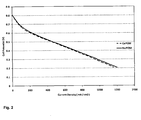
- Figure 2 compares the cell polarisation curve with that obtained for an identical cell using 0.3M Na 3 H 3 PMo 9 V 3 O 40 as a catholyte.
- the fuel cell performance of the two catholyte systems is very similar. This indicates that the Ca 2+ counter-ions are not adversely affecting the Nafion membrane, as would be expected if Ca 2+ ions were dissociated from the main POM 6- ion and free to enter the membrane structure. Surprisingly, it appears that the Ca 2+ must be preferentially bound to the negative POM ion.
Landscapes
- Life Sciences & Earth Sciences (AREA)
- Engineering & Computer Science (AREA)
- Manufacturing & Machinery (AREA)
- Sustainable Development (AREA)
- Sustainable Energy (AREA)
- Chemical & Material Sciences (AREA)
- Chemical Kinetics & Catalysis (AREA)
- Electrochemistry (AREA)
- General Chemical & Material Sciences (AREA)
- Fuel Cell (AREA)
- Inert Electrodes (AREA)
Claims (12)
- Pile à combustible à oxydoréduction comprenant une anode et une cathode séparées par une membrane électrolytique polymère sélective ; un moyen pour fournir un combustible à la région d'anode de la pile ; un moyen pour fournir un oxydant à la région de cathode de la pile ; un moyen pour établir un circuit électrique entre l'anode et la cathode ; une solution catholyte non volatile en communication fluidique avec la cathode, la solution catholyte comprenant un couple d'oxydoréduction de polyoxométallate au moins partiellement réduit au niveau de la cathode lors du fonctionnement de la pile, et au moins partiellement régénéré par réaction avec l'oxydant après cette réduction au niveau de la cathode, la solution catholyte comprenant au moins un contre-ion du couple d'oxydoréduction de polyoxométallate, l'au moins un contre-ion comprenant un ou plusieurs ions divalents, et :le polyoxométallate et le contre-ion associé sont représentés par la formule :
Xa[ZbMcOd]
où :X comprend une combinaison d'ions d'hydrogène et de métal alcalin et/ou de métal alcalino-terreux, à condition qu'au moins un X soit un ion divalent ;Z est sélectionné parmi B, P, S, As, Si, Ge, Ni, Rh, Sn, Al, Cu, I, Br, F, Fe, Co, Cr, Zn, H2, Te, Mn et Se et des combinaisons de deux ou plusieurs de ceux-ci ;M est un métal sélectionné parmi Mo, W, V, Nb, Ta, Mn, Fe, Co, Cr, Ni, Zn, Rh, Ru, Tl, Al, Ga, In et d'autres métaux sélectionnés parmi les 1ère, 2ème et 3ème séries de métaux de transition et la série des lanthanides et des combinaisons de deux ou plusieurs de ceux-ci ;a est un nombre de X nécessaire pour équilibrer la charge de l'anion [McOd] ;b est compris dans la plage de 0 à 20 ;c est compris dans la plage de 1 à 40 ; etd est compris dans la plage de 1 à 180 ;et/oul'ion ou chaque ion divalent est sélectionné parmi Ca, Mg, Mn, Fe, Co, Ni, Cu, Zn, Sr, Ba, Be, Cr, Cd, Hg, Sn et d'autres ions convenables parmi les 2ème et 3ème séries de transition ou parmi les lanthanides, ou parmi les combinaisons de deux ou plusieurs de ceux-ci. - Pile à combustible à oxydoréduction selon la revendication 1, dans laquelle :i. b est compris dans la plage de 0 à 2 ; et/ouii. c est compris dans la plage de 5 à 20 ; et/ouiii. d est compris dans la plage de 30 à 70.
- Pile à combustible à oxydoréduction selon la revendication 1 ou 2, dams laquelle M est sélectionné parmi le vanadium, le molybdène et des combinaisons de ceux-ci, et/ou dans laquelle Z est le phosphore.
- Pile à combustible à oxydoréduction selon l'une quelconque des revendications 1 à 3, dans laquelle au moins un X est l'hydrogène.
- Pile à combustible à oxydoréduction selon l'une quelconque des revendications 1 à 4, dans laquelle X comprend au moins un ion d'hydrogène et au moins un autre matériau sélectionné parmi les métaux alcalis, les métaux alcalino-terreux, l'ammonium et des combinaisons de deux ou plusieurs de ceux-ci, à condition qu'au moins un X soit un ion divalent.
- Pile à combustible à oxydoréduction selon la revendication 1, dans laquelle l'ion ou chaque ion divalent est sélectionné parmi Ca, Mg, Mn, Fe, Co, Ni, Cu, Zn ou à partir de combinaisons de deux ou plusieurs de ceux-ci.
- Pile à combustible à oxydoréduction selon l'une quelconque des revendications 1 à 6, contenant de 2 à 4 centres de vanadium dans le polyoxométallate.
- Pile à combustible à oxydoréduction selon la revendication 7, dans laquelle le polyoxométallate comprend :i. du H3Na2PMo10V2O40, où les protons et/ou ions de sodium sont au moins partiellement remplacés par un ou plusieurs ions divalents ;ii. du H3Na2PMo9V3O40, où les protons et/ou ions de sodium sont au moins partiellement remplacés par un ou plusieurs ions divalents ; ouiii. du H3Na4PMo8V4O40, où les protons et/ou ions de sodium sont au moins partiellement remplacés par un ou plusieurs ions divalents.
- Pile à combustible à oxydoréduction selon l'une quelconque des revendications 1 à 8, dans laquelle la solution catholyte comprend au moins une d'oxydoréduction auxiliaire, sélectionnée facultativement parmi des complexes de métaux de transition de ligation, sélectionnée facultativement parmi le manganèse dans les états d'oxydation II - V, le fer I-IV, le cuivre I-III, le cobalt I-III, le nickel I-III, le chrome II-VII, le titane II-IV, le tungstène IV-VI, le vanadium II-V et le molybdène II-VI, d'autres espèces de polyoxométallates et des combinaisons de ceux-ci.
- Pile à combustible à oxydoréduction selon l'une quelconque des revendications 1 à 9, dans laquelle la solution catholyte est sensiblement dépourvue de toute espèce d'oxydoréduction auxiliaire.
- Pile à combustible à oxydoréduction selon l'une quelconque des revendications 1 à 10, dans laquelle la concentration du polyoxométallate dans la solution catholyte est de plus de 0,075M.
- Solution cathalyte destinée à être utilisée dans une pile à combustible à oxydoréduction selon l'une quelconque des revendications 1 à 11, la solution comprenant un polyoxométallate et un contre-ion de celui-ci comprenant un ou plusieurs ions divalents, dans laquelle :le polyoxométallate et le contre-ion associé sont représentés par la formule :
Xa[ZbMcOd]
où :X comprend une combinaison d'ions d'hydrogène et de métal alcalin et/ou de métal alcalino-terreux, à condition qu'au moins un X soit un ion divalent ;Z est sélectionné parmi B, P, S, As, Si, Ge, Ni, Rh, Sn, Al, Cu, I, Br, F, Fe, Co, Cr, Zn, H2, Te, Mn et Se et des combinaisons de deux ou plusieurs de ceux-ci ;M est un métal sélectionné parmi Mo, W, V, Nb, Ta, Mn, Fe, Co, Cr, Ni, Zn, Rh, Ru, TI, Al, Ga, In et d'autres métaux sélectionnés parmi les 1ère, 2ème et 3ème séries de métaux de transition et la série des lanthanides et des combinaisons de deux ou plusieurs de ceux-ci ;a est un nombre de X nécessaire pour équilibrer la charge de l'anion [McOd] ;b est compris dans la plage de 0 à 20 ;c est compris dans la plage de 1 à 40 ; etd est compris dans la plage de 1 à 180 ;et/oul'ion ou chaque ion divalent est sélectionné parmi Ca, Mg, Mn, Fe, Co, Ni, Cu, Zn, Sr, Ba, Be, Cr, Cd, Hg, Sn et d'autres ions convenables parmi les 2ème et 3ème séries de transition ou parmi les lanthanides, ou parmi des combinaisons de deux ou plusieurs de ceux-ci.
Applications Claiming Priority (2)
| Application Number | Priority Date | Filing Date | Title |
|---|---|---|---|
| GBGB0718577.0A GB0718577D0 (en) | 2007-09-24 | 2007-09-24 | Fuel cells |
| PCT/GB2008/050857 WO2009040577A1 (fr) | 2007-09-24 | 2008-09-24 | Pile à combustible redox |
Publications (2)
| Publication Number | Publication Date |
|---|---|
| EP2193568A1 EP2193568A1 (fr) | 2010-06-09 |
| EP2193568B1 true EP2193568B1 (fr) | 2012-12-05 |
Family
ID=38670395
Family Applications (1)
| Application Number | Title | Priority Date | Filing Date |
|---|---|---|---|
| EP08806673A Not-in-force EP2193568B1 (fr) | 2007-09-24 | 2008-09-24 | Pile à combustible redox |
Country Status (8)
| Country | Link |
|---|---|
| US (1) | US9029042B2 (fr) |
| EP (1) | EP2193568B1 (fr) |
| JP (1) | JP5231558B2 (fr) |
| KR (1) | KR20100067678A (fr) |
| CN (1) | CN101821890B (fr) |
| BR (1) | BRPI0817239A2 (fr) |
| GB (1) | GB0718577D0 (fr) |
| WO (1) | WO2009040577A1 (fr) |
Families Citing this family (67)
| Publication number | Priority date | Publication date | Assignee | Title |
|---|---|---|---|---|
| GB0505087D0 (en) * | 2005-03-12 | 2005-04-20 | Acal Energy Ltd | Fuel cells |
| IN266777B (fr) | 2006-03-24 | 2015-06-01 | Acal Energy Ltd | |
| GB0608079D0 (en) | 2006-04-25 | 2006-05-31 | Acal Energy Ltd | Fuel cells |
| GB0614338D0 (en) | 2006-07-19 | 2006-08-30 | Acal Energy Ltd | Fuel cells |
| GB0614337D0 (en) * | 2006-07-19 | 2006-08-30 | Acal Energy Ltd | Fuel Cells |
| GB0718349D0 (en) * | 2007-09-20 | 2007-10-31 | Acal Energy Ltd | Fuel cells |
| GB0718577D0 (en) | 2007-09-24 | 2007-10-31 | Acal Energy Ltd | Fuel cells |
| GB0801199D0 (en) * | 2008-01-23 | 2008-02-27 | Acal Energy Ltd | Fuel cells |
| GB0801195D0 (en) * | 2008-01-23 | 2008-02-27 | Acal Energy Ltd | Fuel cells |
| GB0801198D0 (en) * | 2008-01-23 | 2008-02-27 | Acal Energy Ltd | Fuel cells |
| US20110014527A1 (en) * | 2009-07-17 | 2011-01-20 | Leroy James Ohlsen | Polyoxometalate flow-cell power system |
| US9324957B2 (en) | 2010-04-30 | 2016-04-26 | Arizona Board Of Regents On Behalf Of Arizona State University | Synthesis of four coordinated gold complexes and their applications in light emitting devices thereof |
| GB2486719B (en) * | 2010-12-23 | 2013-02-13 | Acal Energy Ltd | Fuel cells |
| WO2012162488A1 (fr) | 2011-05-26 | 2012-11-29 | Arizona Board Of Regents Acting For And On Behalf Of Arizona State University | Synthèse de complexes de platine et de palladium comme émetteurs phosphorescents à bande étroite pour dispositifs d'affichage pleine couleur |
| GB201200250D0 (en) * | 2012-01-09 | 2012-02-22 | Imp Innovations Ltd | Regenerative fuel cells |
| US20150031124A1 (en) | 2012-01-25 | 2015-01-29 | Acal Energy Limited | Separator |
| GB2500031B (en) * | 2012-03-07 | 2015-04-01 | Acal Energy Ltd | Fuel cells |
| WO2013191502A1 (fr) * | 2012-06-22 | 2013-12-27 | 한국과학기술원 | Pile à combustible à oxydo-réduction et procédé permettant d'isoler l'oxyde nitrique à l'aide de celle-ci |
| GB2503653A (en) * | 2012-06-26 | 2014-01-08 | Acal Energy Ltd | Redox Battery use for polyoxometallate |
| GB2503475A (en) * | 2012-06-27 | 2014-01-01 | Acal Energy Ltd | Fuel Cells for use at elevated temperatures and pressures |
| WO2014031977A1 (fr) | 2012-08-24 | 2014-02-27 | Arizona Board Of Regents For And On Behalf Of Arizona State University | Composés métalliques ainsi que procédés et utilisations de ces derniers |
| WO2014047616A1 (fr) | 2012-09-24 | 2014-03-27 | Arizona Board Of Regents For And On Behalf Of Arizona State University | Composés métalliques, procédés et utilisations |
| WO2014109814A2 (fr) | 2012-10-26 | 2014-07-17 | Arizona Board Of Regents Acting For And On Behalf Of Arizona State University | Complexes métalliques, procédés, et utilisations de ces derniers |
| GB2515725A (en) | 2013-05-01 | 2015-01-07 | Acal Energy Ltd | Fuel cells |
| GB201308178D0 (en) | 2013-05-07 | 2013-06-12 | Acal Energy Ltd | Redox systems |
| KR102349659B1 (ko) | 2013-06-10 | 2022-01-11 | 아리조나 보드 오브 리젠츠 온 비하프 오브 아리조나 스테이트 유니버시티 | 개질된 방출 스펙트럼을 갖는 인광성 네자리 금속 착물 |
| GB2515511A (en) * | 2013-06-25 | 2014-12-31 | Acal Energy Ltd | Polyoxometallates for use at elevated temperatures and pressures |
| DE102013217858A1 (de) * | 2013-09-06 | 2015-03-12 | Acal Energy Ltd. | Brennstoffzellensystem, Kraftfahrzeug enthaltend ein Brennstoffzellensystem und Verfahren zum Betreiben eines Brennstoffzellensystems |
| JP6804823B2 (ja) | 2013-10-14 | 2020-12-23 | アリゾナ・ボード・オブ・リージェンツ・オン・ビハーフ・オブ・アリゾナ・ステイト・ユニバーシティーArizona Board of Regents on behalf of Arizona State University | 白金錯体およびデバイス |
| JP2015085311A (ja) | 2013-11-01 | 2015-05-07 | 国立大学法人広島大学 | 水素酸化触媒 |
| US10020455B2 (en) | 2014-01-07 | 2018-07-10 | Arizona Board Of Regents On Behalf Of Arizona State University | Tetradentate platinum and palladium complex emitters containing phenyl-pyrazole and its analogues |
| US9711818B2 (en) | 2014-03-14 | 2017-07-18 | Wisconsin Alumni Research Foundation | Charge transfer mediator based systems for electrocatalytic oxygen reduction |
| JP6119661B2 (ja) * | 2014-04-22 | 2017-04-26 | トヨタ自動車株式会社 | 燃料電池システム及び燃料電池システムの制御方法 |
| US9941479B2 (en) | 2014-06-02 | 2018-04-10 | Arizona Board Of Regents On Behalf Of Arizona State University | Tetradentate cyclometalated platinum complexes containing 9,10-dihydroacridine and its analogues |
| JP5850094B2 (ja) | 2014-06-24 | 2016-02-03 | トヨタ自動車株式会社 | レドックス型燃料電池 |
| US9923155B2 (en) | 2014-07-24 | 2018-03-20 | Arizona Board Of Regents On Behalf Of Arizona State University | Tetradentate platinum (II) complexes cyclometalated with functionalized phenyl carbene ligands and their analogues |
| US10793546B2 (en) | 2014-08-15 | 2020-10-06 | Arizona Board Of Regents On Behalf Of Arizona State University | Non-platinum metal complexes for excimer based single dopant white organic light emitting diodes |
| US11329244B2 (en) | 2014-08-22 | 2022-05-10 | Arizona Board Of Regents On Behalf Of Arizona State University | Organic light-emitting diodes with fluorescent and phosphorescent emitters |
| US10424803B2 (en) | 2014-09-15 | 2019-09-24 | Arizona Board Of Regents On Behalf Of Arizona State University | Ionic liquid catholytes and electrochemical devices containing same |
| US10033003B2 (en) | 2014-11-10 | 2018-07-24 | Arizona Board Of Regents On Behalf Of Arizona State University | Tetradentate metal complexes with carbon group bridging ligands |
| JP6163509B2 (ja) * | 2015-03-13 | 2017-07-12 | ニッポン高度紙工業株式会社 | 燃料電池 |
| US9879039B2 (en) | 2015-06-03 | 2018-01-30 | Arizona Board Of Regents On Behalf Of Arizona State University | Tetradentate and octahedral metal complexes containing naphthyridinocarbazole and its analogues |
| JP6390582B2 (ja) * | 2015-10-21 | 2018-09-19 | トヨタ自動車株式会社 | フロー電池 |
| GB201522003D0 (en) * | 2015-12-14 | 2016-01-27 | Imp Innovations Ltd | Regenerative fuel cells |
| US11335865B2 (en) | 2016-04-15 | 2022-05-17 | Arizona Board Of Regents On Behalf Of Arizona State University | OLED with multi-emissive material layer |
| GB2549708B (en) * | 2016-04-21 | 2019-01-02 | Siemens Ag | A reduction-oxidation flow battery |
| KR102888327B1 (ko) | 2016-10-12 | 2025-11-18 | 아리조나 보드 오브 리젠츠 온 비하프 오브 아리조나 스테이트 유니버시티 | 협대역 적색 인광성 4좌 백금(ii) 착물 |
| US11183670B2 (en) | 2016-12-16 | 2021-11-23 | Arizona Board Of Regents On Behalf Of Arizona State University | Organic light emitting diode with split emissive layer |
| US11708385B2 (en) | 2017-01-27 | 2023-07-25 | Arizona Board Of Regents On Behalf Of Arizona State University | Metal-assisted delayed fluorescent emitters employing pyrido-pyrrolo-acridine and analogues |
| US10516117B2 (en) | 2017-05-19 | 2019-12-24 | Arizona Board Of Regents On Behalf Of Arizona State University | Metal-assisted delayed fluorescent emttters employing benzo-imidazo-phenanthridine and analogues |
| US11101435B2 (en) | 2017-05-19 | 2021-08-24 | Arizona Board Of Regents On Behalf Of Arizona State University | Tetradentate platinum and palladium complexes based on biscarbazole and analogues |
| US10727518B2 (en) | 2017-06-12 | 2020-07-28 | Wisconsin Alumni Research Foundation | Flow-based anode for the electrocatalytic oxidation of a fuel or other reductant |
| EP3435464A1 (fr) | 2017-07-28 | 2019-01-30 | Siemens Aktiengesellschaft | Batterie à flux redox et son procédé de fonctionnement |
| ES2781301T3 (es) * | 2017-08-04 | 2020-09-01 | Siemens Ag | Batería de flujo redox y procedimiento para el funcionamiento de una batería de flujo redox |
| US11647643B2 (en) | 2017-10-17 | 2023-05-09 | Arizona Board Of Regents On Behalf Of Arizona State University | Hole-blocking materials for organic light emitting diodes |
| US11594688B2 (en) | 2017-10-17 | 2023-02-28 | Arizona Board Of Regents On Behalf Of Arizona State University | Display and lighting devices comprising phosphorescent excimers with preferred molecular orientation as monochromatic emitters |
| JP6859963B2 (ja) * | 2018-01-17 | 2021-04-14 | トヨタ自動車株式会社 | レドックスフロー型燃料電池 |
| US12037348B2 (en) | 2018-03-09 | 2024-07-16 | Arizona Board Of Regents On Behalf Of Arizona State University | Blue and narrow band green and red emitting metal complexes |
| EP3561932A1 (fr) * | 2018-04-26 | 2019-10-30 | Siemens Aktiengesellschaft | Batterie à flux redox et procédé de fonctionnement d'une batterie à flux redox |
| US11145885B2 (en) * | 2018-07-23 | 2021-10-12 | Ut-Battelle, Llc | High capacity organic radical mediated phosphorous anode for redox flow batteries |
| US11878988B2 (en) | 2019-01-24 | 2024-01-23 | Arizona Board Of Regents On Behalf Of Arizona State University | Blue phosphorescent emitters employing functionalized imidazophenthridine and analogues |
| US11594691B2 (en) | 2019-01-25 | 2023-02-28 | Arizona Board Of Regents On Behalf Of Arizona State University | Light outcoupling efficiency of phosphorescent OLEDs by mixing horizontally aligned fluorescent emitters |
| US11785838B2 (en) | 2019-10-02 | 2023-10-10 | Arizona Board Of Regents On Behalf Of Arizona State University | Green and red organic light-emitting diodes employing excimer emitters |
| US11945985B2 (en) | 2020-05-19 | 2024-04-02 | Arizona Board Of Regents On Behalf Of Arizona State University | Metal assisted delayed fluorescent emitters for organic light-emitting diodes |
| CN113683625B (zh) | 2020-05-19 | 2025-06-10 | 亚利桑那州立大学董事会 | 用于有机发光二极管的金属辅助延迟荧光发射体 |
| CN115207427B (zh) * | 2022-07-20 | 2025-04-04 | 华中科技大学 | 一种基于氧化还原电对的新型热电-电化学电池及其制备 |
| CN115377471B (zh) * | 2022-08-29 | 2025-11-25 | 清华大学 | 5-羟甲基糠醛选择性氧化偶联电能生产的方法 |
Family Cites Families (79)
| Publication number | Priority date | Publication date | Assignee | Title |
|---|---|---|---|---|
| BE603874A (fr) | 1960-05-17 | |||
| US3279949A (en) | 1961-07-27 | 1966-10-18 | Union Carbide Corp | Fuel cell half-cell containing vanadium redox couple |
| US3294588A (en) | 1962-04-19 | 1966-12-27 | Exxon Research Engineering Co | Method of operating fuel cell with electrolyte containing quinones or dyes |
| US3297588A (en) * | 1964-10-01 | 1967-01-10 | Gulf Research Development Co | Catalyst comprising a metallic composnent supported on an alumina base |
| US3360401A (en) | 1965-09-29 | 1967-12-26 | Standard Oil Co | Process for converting chemical energy into electrical energy |
| US3492164A (en) | 1967-01-17 | 1970-01-27 | Du Pont | Fuel cell electrode |
| GB1176632A (en) | 1967-01-17 | 1970-01-07 | Du Pont | Fuel Cell. |
| US3540933A (en) | 1967-07-11 | 1970-11-17 | Jan Boeke | Redox fuel cell |
| US3607420A (en) | 1969-11-17 | 1971-09-21 | Du Pont | Process of operating fuel-cell half cell with cupric-cuprous redox couple |
| US4048383A (en) | 1976-02-09 | 1977-09-13 | Battelle Memorial Institute | Combination cell |
| JPS5834911B2 (ja) | 1979-09-14 | 1983-07-29 | 工業技術院長 | レドツクス電池 |
| US4312927A (en) | 1980-06-27 | 1982-01-26 | Minnesota Mining And Manufacturing Company | Energy conversion and storage process |
| US4396687A (en) * | 1980-12-08 | 1983-08-02 | Ford Motor Company | Chemically regenerable redox fuel cell and method of operating the same |
| JPS6154163A (ja) | 1984-08-22 | 1986-03-18 | Agency Of Ind Science & Technol | 酸水素系燃料電池 |
| JPS6215770A (ja) | 1985-07-11 | 1987-01-24 | Yamaguchi Univ | レドックス二次電池 |
| US4630176A (en) | 1985-11-22 | 1986-12-16 | The Standard Oil Company | Polyoxometalate-modified carbon electrodes and uses therefor |
| CA2077552A1 (fr) | 1990-03-05 | 1991-09-06 | John H. Grate | Systeme catalytique pour l'oxydation d'olefines en produits carbonyles |
| JPH04149965A (ja) | 1990-10-15 | 1992-05-22 | Agency Of Ind Science & Technol | バナジウム系電解液の製造方法 |
| US5318865A (en) | 1991-06-06 | 1994-06-07 | Director-General, Agency Of Industrial Science And Technology | Redox battery |
| JPH05295578A (ja) | 1992-04-17 | 1993-11-09 | Japan Energy Corp | 芳香族化合物の部分酸化物の製造方法 |
| US5298343A (en) | 1992-06-19 | 1994-03-29 | Ecole Polytechnique De Montreal | Electrocatalysts for H2 /O2 fuel cells cathode |
| US5304432A (en) | 1992-10-13 | 1994-04-19 | Hughes Aircraft Company | Membrane flow cell battery |
| US5310608A (en) | 1992-10-21 | 1994-05-10 | Nippon Telegraph And Telephone Corporation | Temperature difference storage battery |
| SE9304203L (sv) | 1993-12-20 | 1994-11-21 | Ragnar Larsson | Förfarande för produktion av elektrisk energi i en biobränsledriven bränslecell |
| US5501922A (en) | 1995-04-07 | 1996-03-26 | Motorola, Inc. | Polyoxometalate carbon electrodes and energy storage device made thereof |
| WO1996035239A1 (fr) | 1995-05-03 | 1996-11-07 | Unisearch Limited | Electrolyte au vanadium a haute densite d'energie, ses procedes de preparation, et cellules et batteries redox tout-vanadium contenant ledit electrolyte |
| US5683829A (en) | 1995-05-22 | 1997-11-04 | Sarangapani; Shantha | Redox promoters for methonol fuel cells |
| US6054580A (en) | 1996-07-22 | 2000-04-25 | Carnegie Mellon University | Long-lived homogenous amide containing macrocyclic compounds |
| JPH10322885A (ja) | 1997-05-14 | 1998-12-04 | Canon Inc | 太陽光発電装置 |
| US6121144A (en) * | 1997-12-29 | 2000-09-19 | Intel Corporation | Low temperature chemical mechanical polishing of dielectric materials |
| US5958616A (en) | 1998-02-06 | 1999-09-28 | Lynntech, Inc. | Membrane and electrode structure for methanol fuel cell |
| JP4023903B2 (ja) | 1998-04-02 | 2007-12-19 | 旭化成ケミカルズ株式会社 | 固体高分子型燃料電池用膜・電極接合体 |
| US6294281B1 (en) | 1998-06-17 | 2001-09-25 | Therasense, Inc. | Biological fuel cell and method |
| US6500571B2 (en) | 1998-08-19 | 2002-12-31 | Powerzyme, Inc. | Enzymatic fuel cell |
| PH11999002190B1 (en) | 1998-09-01 | 2007-08-06 | Unilever Nv | Composition and method for bleaching a substrate |
| WO2000029537A1 (fr) | 1998-11-13 | 2000-05-25 | The Procter & Gamble Company | Compositions de blanchiment |
| PT1143546E (pt) | 1999-09-27 | 2009-11-27 | Sumitomo Electric Industries | Bateria de fluxo redox |
| CN100431214C (zh) | 2000-03-24 | 2008-11-05 | Cmr燃料电池(英国)有限公司 | 具有溢流道的多孔电极的混合反应物燃料电池 |
| US7332241B2 (en) | 2000-10-27 | 2008-02-19 | Ab Volvo | Cathode layer structure for a solid polymer fuel cell and fuel cell incorporating such structure |
| US6647108B1 (en) | 2001-01-02 | 2003-11-11 | Verizon Services Corp. | Internet call manager |
| ITVA20010019A1 (it) | 2001-06-28 | 2002-12-28 | Chemieco S R L | Cella redox con separatore ionico non selettivo |
| GB0203508D0 (en) | 2002-02-14 | 2002-04-03 | Fuel Technology Ltd Rapid re-energising of electric power storage systems | |
| GB0207214D0 (en) | 2002-03-27 | 2002-05-08 | Univ Loughborough | A catalyst for lowering the reduction overpotential of polysulfide species |
| JP2003317737A (ja) * | 2002-04-19 | 2003-11-07 | Nec Corp | 燃料電池およびそれに用いる触媒電極、固体電解質膜 |
| AUPS192102A0 (en) | 2002-04-23 | 2002-05-30 | Unisearch Limited | Vanadium bromide redox flow battery |
| JP4025615B2 (ja) * | 2002-10-08 | 2007-12-26 | 勇 内田 | 燃料再生可能な燃料電池、発電方法及び燃料の再生方法 |
| US20040137297A1 (en) | 2002-12-26 | 2004-07-15 | Hitoshi Matsuoka | Ion exchange membrane and production process therefor |
| JP2004311301A (ja) * | 2003-04-09 | 2004-11-04 | Mitsui Chemicals Inc | プロトン伝導性材料、プロトン伝導性膜および架橋物 |
| JP4311070B2 (ja) | 2003-04-17 | 2009-08-12 | トヨタ自動車株式会社 | 燃料電池用カソード及びこれを備えた固体高分子型燃料電池 |
| US20050142438A1 (en) * | 2003-07-18 | 2005-06-30 | Johnson George H. | Hydrogen generating apparatus and methods |
| US7208244B2 (en) | 2003-10-15 | 2007-04-24 | Auburn University | Di-ruthenium-substituted polyoxometalate electrocatalyst and method of oxygen generation |
| US8034870B2 (en) * | 2003-12-17 | 2011-10-11 | Sabic Innovative Plastics Ip B.V. | Flame-retardant polyester composition |
| US20050242910A1 (en) | 2004-04-29 | 2005-11-03 | Balsells Peter J | Contact assembly |
| JP3991276B2 (ja) | 2004-07-16 | 2007-10-17 | 富士フイルム株式会社 | 画像形成装置 |
| US20060024539A1 (en) | 2004-07-29 | 2006-02-02 | Dumesic James A | Catalytic method to remove CO and utilize its energy content in CO-containing streams |
| RU2004129396A (ru) | 2004-10-05 | 2006-03-10 | Е.И.Дюпон де Немур энд Компани (US) | Каталитический материал, стойкий к действию метанола |
| US8187441B2 (en) | 2004-10-19 | 2012-05-29 | Evans Christine E | Electrochemical pump |
| JP4828112B2 (ja) | 2004-10-22 | 2011-11-30 | Necトーキン株式会社 | プロトン伝導性高分子材料並びにこれを用いた固体電解質膜、電気化学セル及び燃料電池 |
| WO2006057387A1 (fr) | 2004-11-26 | 2006-06-01 | The University Of Tokyo | Biocellule |
| JP4748410B2 (ja) | 2004-12-22 | 2011-08-17 | 独立行政法人 日本原子力研究開発機構 | 架橋構造を導入した高耐久性燃料電池用高分子電解質膜の製造方法 |
| GB0505087D0 (en) | 2005-03-12 | 2005-04-20 | Acal Energy Ltd | Fuel cells |
| JP4237156B2 (ja) | 2005-03-28 | 2009-03-11 | 富士通株式会社 | 電解質組成物、固体電解質膜、固体高分子型燃料電池および固体電解質膜の製造方法 |
| JP2006314871A (ja) | 2005-05-10 | 2006-11-24 | Toyota Motor Corp | ポルフィリン系電極触媒 |
| JP2006338997A (ja) * | 2005-06-01 | 2006-12-14 | Toshiba Corp | 燃料電池用メタノール酸化触媒、直接メタノール型燃料電池用電極、及び直接メタノール型燃料電池 |
| US20070099067A1 (en) * | 2005-09-23 | 2007-05-03 | Sanjiv Malhotra | Polymer catalyst composite as a membrane electrode assembly in Direct Methanol Fuel Cells |
| US7687186B2 (en) | 2005-09-30 | 2010-03-30 | Canon Kabushiki Kaisha | Enzyme electrode, and sensor and biofuel cell using the same |
| JP4946026B2 (ja) * | 2005-12-09 | 2012-06-06 | 旭硝子株式会社 | 固体高分子形燃料電池用電解質膜の製造方法及び固体高分子形燃料電池用膜電極接合体の製造方法 |
| JP2007163185A (ja) | 2005-12-09 | 2007-06-28 | Canon Inc | 酵素電極 |
| AT503315B1 (de) | 2006-03-06 | 2008-02-15 | Funktionswerkstoffe Forschungs | Redox-durchfluss-batterie, sowie elektrolyt-lösung für eine redox-durchfluss-batterie |
| IN266777B (fr) | 2006-03-24 | 2015-06-01 | Acal Energy Ltd | |
| GB0608079D0 (en) | 2006-04-25 | 2006-05-31 | Acal Energy Ltd | Fuel cells |
| GB0614337D0 (en) | 2006-07-19 | 2006-08-30 | Acal Energy Ltd | Fuel Cells |
| GB0614338D0 (en) | 2006-07-19 | 2006-08-30 | Acal Energy Ltd | Fuel cells |
| GB0718349D0 (en) | 2007-09-20 | 2007-10-31 | Acal Energy Ltd | Fuel cells |
| GB0718577D0 (en) | 2007-09-24 | 2007-10-31 | Acal Energy Ltd | Fuel cells |
| GB0801199D0 (en) | 2008-01-23 | 2008-02-27 | Acal Energy Ltd | Fuel cells |
| GB0801198D0 (en) | 2008-01-23 | 2008-02-27 | Acal Energy Ltd | Fuel cells |
| GB0801195D0 (en) | 2008-01-23 | 2008-02-27 | Acal Energy Ltd | Fuel cells |
| GB0907795D0 (en) | 2009-05-07 | 2009-06-17 | Acal Energy Ltd | Fuel cells |
-
2007
- 2007-09-24 GB GBGB0718577.0A patent/GB0718577D0/en not_active Ceased
-
2008
- 2008-09-24 CN CN2008801074838A patent/CN101821890B/zh not_active Expired - Fee Related
- 2008-09-24 EP EP08806673A patent/EP2193568B1/fr not_active Not-in-force
- 2008-09-24 KR KR1020107009035A patent/KR20100067678A/ko not_active Ceased
- 2008-09-24 BR BRPI0817239-0A patent/BRPI0817239A2/pt not_active IP Right Cessation
- 2008-09-24 JP JP2010525450A patent/JP5231558B2/ja not_active Expired - Fee Related
- 2008-09-24 WO PCT/GB2008/050857 patent/WO2009040577A1/fr not_active Ceased
- 2008-09-24 US US12/678,687 patent/US9029042B2/en not_active Expired - Fee Related
Also Published As
| Publication number | Publication date |
|---|---|
| CN101821890A (zh) | 2010-09-01 |
| WO2009040577A1 (fr) | 2009-04-02 |
| US20100297522A1 (en) | 2010-11-25 |
| EP2193568A1 (fr) | 2010-06-09 |
| JP5231558B2 (ja) | 2013-07-10 |
| US9029042B2 (en) | 2015-05-12 |
| KR20100067678A (ko) | 2010-06-21 |
| GB0718577D0 (en) | 2007-10-31 |
| CN101821890B (zh) | 2013-03-06 |
| BRPI0817239A2 (pt) | 2015-06-16 |
| JP2010541127A (ja) | 2010-12-24 |
Similar Documents
| Publication | Publication Date | Title |
|---|---|---|
| US9029042B2 (en) | Redox fuel cell | |
| US9005828B2 (en) | Redox fuel cells with a catholyte solution containing a polyoxometallate | |
| US9362584B2 (en) | Regenerative fuel cell with catholyte comprising a polyoxometalate and a vanadium (IV)-compound | |
| US20080274385A1 (en) | Fuel Cells | |
| US10326156B2 (en) | Fuel cells for use at elevated temperatures and pressures | |
| JP2018081918A (ja) | カソード液を含有するタングステンポリオキソメタレートを含む間接酸化還元燃料電池 | |
| EP3014688B1 (fr) | Polyoxymétallates pouvant être utilisés à des températures et des pressions élevées |
Legal Events
| Date | Code | Title | Description |
|---|---|---|---|
| PUAI | Public reference made under article 153(3) epc to a published international application that has entered the european phase |
Free format text: ORIGINAL CODE: 0009012 |
|
| 17P | Request for examination filed |
Effective date: 20100224 |
|
| AK | Designated contracting states |
Kind code of ref document: A1 Designated state(s): AT BE BG CH CY CZ DE DK EE ES FI FR GB GR HR HU IE IS IT LI LT LU LV MC MT NL NO PL PT RO SE SI SK TR |
|
| AX | Request for extension of the european patent |
Extension state: AL BA MK RS |
|
| DAX | Request for extension of the european patent (deleted) | ||
| 17Q | First examination report despatched |
Effective date: 20110223 |
|
| GRAP | Despatch of communication of intention to grant a patent |
Free format text: ORIGINAL CODE: EPIDOSNIGR1 |
|
| GRAS | Grant fee paid |
Free format text: ORIGINAL CODE: EPIDOSNIGR3 |
|
| GRAA | (expected) grant |
Free format text: ORIGINAL CODE: 0009210 |
|
| AK | Designated contracting states |
Kind code of ref document: B1 Designated state(s): AT BE BG CH CY CZ DE DK EE ES FI FR GB GR HR HU IE IS IT LI LT LU LV MC MT NL NO PL PT RO SE SI SK TR |
|
| REG | Reference to a national code |
Ref country code: GB Ref legal event code: FG4D |
|
| REG | Reference to a national code |
Ref country code: CH Ref legal event code: EP |
|
| REG | Reference to a national code |
Ref country code: AT Ref legal event code: REF Ref document number: 587696 Country of ref document: AT Kind code of ref document: T Effective date: 20121215 |
|
| REG | Reference to a national code |
Ref country code: IE Ref legal event code: FG4D |
|
| REG | Reference to a national code |
Ref country code: DE Ref legal event code: R096 Ref document number: 602008020654 Country of ref document: DE Effective date: 20130131 |
|
| REG | Reference to a national code |
Ref country code: AT Ref legal event code: MK05 Ref document number: 587696 Country of ref document: AT Kind code of ref document: T Effective date: 20121205 |
|
| PG25 | Lapsed in a contracting state [announced via postgrant information from national office to epo] |
Ref country code: ES Free format text: LAPSE BECAUSE OF FAILURE TO SUBMIT A TRANSLATION OF THE DESCRIPTION OR TO PAY THE FEE WITHIN THE PRESCRIBED TIME-LIMIT Effective date: 20130316 Ref country code: SE Free format text: LAPSE BECAUSE OF FAILURE TO SUBMIT A TRANSLATION OF THE DESCRIPTION OR TO PAY THE FEE WITHIN THE PRESCRIBED TIME-LIMIT Effective date: 20121205 Ref country code: FI Free format text: LAPSE BECAUSE OF FAILURE TO SUBMIT A TRANSLATION OF THE DESCRIPTION OR TO PAY THE FEE WITHIN THE PRESCRIBED TIME-LIMIT Effective date: 20121205 Ref country code: NO Free format text: LAPSE BECAUSE OF FAILURE TO SUBMIT A TRANSLATION OF THE DESCRIPTION OR TO PAY THE FEE WITHIN THE PRESCRIBED TIME-LIMIT Effective date: 20130305 Ref country code: LT Free format text: LAPSE BECAUSE OF FAILURE TO SUBMIT A TRANSLATION OF THE DESCRIPTION OR TO PAY THE FEE WITHIN THE PRESCRIBED TIME-LIMIT Effective date: 20121205 |
|
| REG | Reference to a national code |
Ref country code: NL Ref legal event code: VDEP Effective date: 20121205 |
|
| REG | Reference to a national code |
Ref country code: LT Ref legal event code: MG4D |
|
| PG25 | Lapsed in a contracting state [announced via postgrant information from national office to epo] |
Ref country code: SI Free format text: LAPSE BECAUSE OF FAILURE TO SUBMIT A TRANSLATION OF THE DESCRIPTION OR TO PAY THE FEE WITHIN THE PRESCRIBED TIME-LIMIT Effective date: 20121205 Ref country code: PL Free format text: LAPSE BECAUSE OF FAILURE TO SUBMIT A TRANSLATION OF THE DESCRIPTION OR TO PAY THE FEE WITHIN THE PRESCRIBED TIME-LIMIT Effective date: 20121205 Ref country code: LV Free format text: LAPSE BECAUSE OF FAILURE TO SUBMIT A TRANSLATION OF THE DESCRIPTION OR TO PAY THE FEE WITHIN THE PRESCRIBED TIME-LIMIT Effective date: 20121205 Ref country code: GR Free format text: LAPSE BECAUSE OF FAILURE TO SUBMIT A TRANSLATION OF THE DESCRIPTION OR TO PAY THE FEE WITHIN THE PRESCRIBED TIME-LIMIT Effective date: 20130306 |
|
| PG25 | Lapsed in a contracting state [announced via postgrant information from national office to epo] |
Ref country code: AT Free format text: LAPSE BECAUSE OF FAILURE TO SUBMIT A TRANSLATION OF THE DESCRIPTION OR TO PAY THE FEE WITHIN THE PRESCRIBED TIME-LIMIT Effective date: 20121205 |
|
| PG25 | Lapsed in a contracting state [announced via postgrant information from national office to epo] |
Ref country code: BG Free format text: LAPSE BECAUSE OF FAILURE TO SUBMIT A TRANSLATION OF THE DESCRIPTION OR TO PAY THE FEE WITHIN THE PRESCRIBED TIME-LIMIT Effective date: 20130305 Ref country code: BE Free format text: LAPSE BECAUSE OF FAILURE TO SUBMIT A TRANSLATION OF THE DESCRIPTION OR TO PAY THE FEE WITHIN THE PRESCRIBED TIME-LIMIT Effective date: 20121205 Ref country code: CZ Free format text: LAPSE BECAUSE OF FAILURE TO SUBMIT A TRANSLATION OF THE DESCRIPTION OR TO PAY THE FEE WITHIN THE PRESCRIBED TIME-LIMIT Effective date: 20121205 Ref country code: EE Free format text: LAPSE BECAUSE OF FAILURE TO SUBMIT A TRANSLATION OF THE DESCRIPTION OR TO PAY THE FEE WITHIN THE PRESCRIBED TIME-LIMIT Effective date: 20121205 Ref country code: IS Free format text: LAPSE BECAUSE OF FAILURE TO SUBMIT A TRANSLATION OF THE DESCRIPTION OR TO PAY THE FEE WITHIN THE PRESCRIBED TIME-LIMIT Effective date: 20130405 Ref country code: SK Free format text: LAPSE BECAUSE OF FAILURE TO SUBMIT A TRANSLATION OF THE DESCRIPTION OR TO PAY THE FEE WITHIN THE PRESCRIBED TIME-LIMIT Effective date: 20121205 |
|
| PG25 | Lapsed in a contracting state [announced via postgrant information from national office to epo] |
Ref country code: NL Free format text: LAPSE BECAUSE OF FAILURE TO SUBMIT A TRANSLATION OF THE DESCRIPTION OR TO PAY THE FEE WITHIN THE PRESCRIBED TIME-LIMIT Effective date: 20121205 Ref country code: PT Free format text: LAPSE BECAUSE OF FAILURE TO SUBMIT A TRANSLATION OF THE DESCRIPTION OR TO PAY THE FEE WITHIN THE PRESCRIBED TIME-LIMIT Effective date: 20130405 Ref country code: RO Free format text: LAPSE BECAUSE OF FAILURE TO SUBMIT A TRANSLATION OF THE DESCRIPTION OR TO PAY THE FEE WITHIN THE PRESCRIBED TIME-LIMIT Effective date: 20121205 |
|
| PLBE | No opposition filed within time limit |
Free format text: ORIGINAL CODE: 0009261 |
|
| STAA | Information on the status of an ep patent application or granted ep patent |
Free format text: STATUS: NO OPPOSITION FILED WITHIN TIME LIMIT |
|
| PG25 | Lapsed in a contracting state [announced via postgrant information from national office to epo] |
Ref country code: DK Free format text: LAPSE BECAUSE OF FAILURE TO SUBMIT A TRANSLATION OF THE DESCRIPTION OR TO PAY THE FEE WITHIN THE PRESCRIBED TIME-LIMIT Effective date: 20121205 |
|
| 26N | No opposition filed |
Effective date: 20130906 |
|
| PG25 | Lapsed in a contracting state [announced via postgrant information from national office to epo] |
Ref country code: CY Free format text: LAPSE BECAUSE OF FAILURE TO SUBMIT A TRANSLATION OF THE DESCRIPTION OR TO PAY THE FEE WITHIN THE PRESCRIBED TIME-LIMIT Effective date: 20121205 |
|
| PG25 | Lapsed in a contracting state [announced via postgrant information from national office to epo] |
Ref country code: IT Free format text: LAPSE BECAUSE OF FAILURE TO SUBMIT A TRANSLATION OF THE DESCRIPTION OR TO PAY THE FEE WITHIN THE PRESCRIBED TIME-LIMIT Effective date: 20121205 |
|
| REG | Reference to a national code |
Ref country code: DE Ref legal event code: R097 Ref document number: 602008020654 Country of ref document: DE Effective date: 20130906 |
|
| PG25 | Lapsed in a contracting state [announced via postgrant information from national office to epo] |
Ref country code: HR Free format text: LAPSE BECAUSE OF FAILURE TO SUBMIT A TRANSLATION OF THE DESCRIPTION OR TO PAY THE FEE WITHIN THE PRESCRIBED TIME-LIMIT Effective date: 20130731 |
|
| PG25 | Lapsed in a contracting state [announced via postgrant information from national office to epo] |
Ref country code: MC Free format text: LAPSE BECAUSE OF FAILURE TO SUBMIT A TRANSLATION OF THE DESCRIPTION OR TO PAY THE FEE WITHIN THE PRESCRIBED TIME-LIMIT Effective date: 20121205 |
|
| REG | Reference to a national code |
Ref country code: CH Ref legal event code: PL |
|
| REG | Reference to a national code |
Ref country code: IE Ref legal event code: MM4A |
|
| PG25 | Lapsed in a contracting state [announced via postgrant information from national office to epo] |
Ref country code: IE Free format text: LAPSE BECAUSE OF NON-PAYMENT OF DUE FEES Effective date: 20130924 Ref country code: LI Free format text: LAPSE BECAUSE OF NON-PAYMENT OF DUE FEES Effective date: 20130930 Ref country code: CH Free format text: LAPSE BECAUSE OF NON-PAYMENT OF DUE FEES Effective date: 20130930 |
|
| PGFP | Annual fee paid to national office [announced via postgrant information from national office to epo] |
Ref country code: DE Payment date: 20140917 Year of fee payment: 7 |
|
| PGFP | Annual fee paid to national office [announced via postgrant information from national office to epo] |
Ref country code: GB Payment date: 20140924 Year of fee payment: 7 |
|
| PGFP | Annual fee paid to national office [announced via postgrant information from national office to epo] |
Ref country code: FR Payment date: 20140906 Year of fee payment: 7 |
|
| PG25 | Lapsed in a contracting state [announced via postgrant information from national office to epo] |
Ref country code: MT Free format text: LAPSE BECAUSE OF FAILURE TO SUBMIT A TRANSLATION OF THE DESCRIPTION OR TO PAY THE FEE WITHIN THE PRESCRIBED TIME-LIMIT Effective date: 20121205 Ref country code: TR Free format text: LAPSE BECAUSE OF FAILURE TO SUBMIT A TRANSLATION OF THE DESCRIPTION OR TO PAY THE FEE WITHIN THE PRESCRIBED TIME-LIMIT Effective date: 20121205 |
|
| PG25 | Lapsed in a contracting state [announced via postgrant information from national office to epo] |
Ref country code: LU Free format text: LAPSE BECAUSE OF NON-PAYMENT OF DUE FEES Effective date: 20130924 Ref country code: HU Free format text: LAPSE BECAUSE OF FAILURE TO SUBMIT A TRANSLATION OF THE DESCRIPTION OR TO PAY THE FEE WITHIN THE PRESCRIBED TIME-LIMIT; INVALID AB INITIO Effective date: 20080924 |
|
| REG | Reference to a national code |
Ref country code: DE Ref legal event code: R119 Ref document number: 602008020654 Country of ref document: DE |
|
| GBPC | Gb: european patent ceased through non-payment of renewal fee |
Effective date: 20150924 |
|
| REG | Reference to a national code |
Ref country code: FR Ref legal event code: ST Effective date: 20160531 |
|
| PG25 | Lapsed in a contracting state [announced via postgrant information from national office to epo] |
Ref country code: GB Free format text: LAPSE BECAUSE OF NON-PAYMENT OF DUE FEES Effective date: 20150924 Ref country code: DE Free format text: LAPSE BECAUSE OF NON-PAYMENT OF DUE FEES Effective date: 20160401 |
|
| PG25 | Lapsed in a contracting state [announced via postgrant information from national office to epo] |
Ref country code: FR Free format text: LAPSE BECAUSE OF NON-PAYMENT OF DUE FEES Effective date: 20150930 |