EP2194683A2 - Procédé pour déterminer l'emplacement d'une fenêtre à transformer de Fourier rapide, et l'étalement de délai pour le dispositif d'estimation de canal de diffusion de platine - Google Patents
Procédé pour déterminer l'emplacement d'une fenêtre à transformer de Fourier rapide, et l'étalement de délai pour le dispositif d'estimation de canal de diffusion de platine Download PDFInfo
- Publication number
- EP2194683A2 EP2194683A2 EP10157852A EP10157852A EP2194683A2 EP 2194683 A2 EP2194683 A2 EP 2194683A2 EP 10157852 A EP10157852 A EP 10157852A EP 10157852 A EP10157852 A EP 10157852A EP 2194683 A2 EP2194683 A2 EP 2194683A2
- Authority
- EP
- European Patent Office
- Prior art keywords
- signal
- domain
- fft
- ofdm
- operative
- Prior art date
- Legal status (The legal status is an assumption and is not a legal conclusion. Google has not performed a legal analysis and makes no representation as to the accuracy of the status listed.)
- Withdrawn
Links
- 238000000034 method Methods 0.000 title claims abstract description 30
- BASFCYQUMIYNBI-UHFFFAOYSA-N platinum Chemical compound [Pt] BASFCYQUMIYNBI-UHFFFAOYSA-N 0.000 title description 4
- 229910052697 platinum Inorganic materials 0.000 title description 2
- 230000004044 response Effects 0.000 claims description 46
- 125000004122 cyclic group Chemical group 0.000 claims description 20
- 230000001131 transforming effect Effects 0.000 claims 4
- 238000012935 Averaging Methods 0.000 abstract description 2
- 238000007670 refining Methods 0.000 abstract description 2
- 239000000969 carrier Substances 0.000 description 7
- 238000010586 diagram Methods 0.000 description 4
- 238000007493 shaping process Methods 0.000 description 4
- 230000005540 biological transmission Effects 0.000 description 3
- 230000001364 causal effect Effects 0.000 description 3
- 238000005562 fading Methods 0.000 description 3
- 238000001228 spectrum Methods 0.000 description 3
- 238000013459 approach Methods 0.000 description 2
- 238000004891 communication Methods 0.000 description 2
- 230000001934 delay Effects 0.000 description 2
- 239000006185 dispersion Substances 0.000 description 2
- 230000000694 effects Effects 0.000 description 2
- 230000006870 function Effects 0.000 description 2
- 238000012986 modification Methods 0.000 description 2
- 230000004048 modification Effects 0.000 description 2
- 239000002245 particle Substances 0.000 description 2
- 239000002243 precursor Substances 0.000 description 2
- 230000003595 spectral effect Effects 0.000 description 2
- 230000001629 suppression Effects 0.000 description 2
- 230000003321 amplification Effects 0.000 description 1
- 238000006243 chemical reaction Methods 0.000 description 1
- 239000002131 composite material Substances 0.000 description 1
- 230000006735 deficit Effects 0.000 description 1
- 238000013461 design Methods 0.000 description 1
- 238000005516 engineering process Methods 0.000 description 1
- 238000003199 nucleic acid amplification method Methods 0.000 description 1
- 230000003287 optical effect Effects 0.000 description 1
- 230000000737 periodic effect Effects 0.000 description 1
- 238000012545 processing Methods 0.000 description 1
- 238000000926 separation method Methods 0.000 description 1
- 230000001360 synchronised effect Effects 0.000 description 1
- 238000012360 testing method Methods 0.000 description 1
Images




Classifications
-
- H—ELECTRICITY
- H04—ELECTRIC COMMUNICATION TECHNIQUE
- H04B—TRANSMISSION
- H04B1/00—Details of transmission systems, not covered by a single one of groups H04B3/00 - H04B13/00; Details of transmission systems not characterised by the medium used for transmission
- H04B1/69—Spread spectrum techniques
- H04B1/692—Hybrid techniques using combinations of two or more spread spectrum techniques
-
- H—ELECTRICITY
- H04—ELECTRIC COMMUNICATION TECHNIQUE
- H04L—TRANSMISSION OF DIGITAL INFORMATION, e.g. TELEGRAPHIC COMMUNICATION
- H04L27/00—Modulated-carrier systems
- H04L27/26—Systems using multi-frequency codes
- H04L27/2601—Multicarrier modulation systems
- H04L27/2647—Arrangements specific to the receiver only
- H04L27/2655—Synchronisation arrangements
- H04L27/2662—Symbol synchronisation
-
- H—ELECTRICITY
- H04—ELECTRIC COMMUNICATION TECHNIQUE
- H04B—TRANSMISSION
- H04B1/00—Details of transmission systems, not covered by a single one of groups H04B3/00 - H04B13/00; Details of transmission systems not characterised by the medium used for transmission
- H04B1/69—Spread spectrum techniques
- H04B1/707—Spread spectrum techniques using direct sequence modulation
- H04B1/7073—Synchronisation aspects
- H04B1/7075—Synchronisation aspects with code phase acquisition
- H04B1/7077—Multi-step acquisition, e.g. multi-dwell, coarse-fine or validation
-
- H—ELECTRICITY
- H04—ELECTRIC COMMUNICATION TECHNIQUE
- H04L—TRANSMISSION OF DIGITAL INFORMATION, e.g. TELEGRAPHIC COMMUNICATION
- H04L25/00—Baseband systems
- H04L25/02—Details ; arrangements for supplying electrical power along data transmission lines
- H04L25/0202—Channel estimation
- H04L25/022—Channel estimation of frequency response
-
- H—ELECTRICITY
- H04—ELECTRIC COMMUNICATION TECHNIQUE
- H04L—TRANSMISSION OF DIGITAL INFORMATION, e.g. TELEGRAPHIC COMMUNICATION
- H04L27/00—Modulated-carrier systems
- H04L27/26—Systems using multi-frequency codes
- H04L27/2601—Multicarrier modulation systems
- H04L27/2647—Arrangements specific to the receiver only
- H04L27/2655—Synchronisation arrangements
- H04L27/2662—Symbol synchronisation
- H04L27/2665—Fine synchronisation, e.g. by positioning the FFT window
Definitions
- the present invention relates generally to a method and apparatus for synchronizing a multiple access system. More specifically, the present invention relates to a novel and improved method and apparatus to synchronizing a Code Division Multiple Access (CDMA) system, an Orthogonal Frequency Division Multiplexing (OFDM) system or a hybrid of two such systems.
- CDMA Code Division Multiple Access
- OFDM Orthogonal Frequency Division Multiplexing
- CDMA searcher information or Orthogonal Frequency Division Multiplexing (OFDM) channel estimation information is used for synchronization.
- a CDMA searcher looks for sectors and paths. By identifying the arrival time of various paths from various sectors, the CDMA searcher correlates the received signal with the pilot signal. Paths can be differentiated based on the differences in chip delay. i.e., different paths have different delays.
- ODFM channel estimation all of the paths are represented by an impulse response, ⁇ h.
- Channel estimates may be used to combine the paths.
- the channel delay spread is the span or width of the impulse response which equals the difference between the maximum and minimum path delays.
- OFDM is a multicarrier transmission technique, which divides the available spectrum into many carriers.
- High-speed data signals are divided into tens or hundreds of lower speed signals. These lower speed signals are transmitted in parallel over respective frequencies within a Radio Frequency (RF) signal that are known as subcarrier frequencies ("sub-carriers").
- RF Radio Frequency
- subcarriers Each subcarrier is modulated by one of the low rate data streams.
- the ODFM signal is a sum of many signals with different subcarrier frequencies.
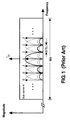
- each carrier has an integer number of cycles over a symbol period. Due to this, the spectrum of each carrier has a null at the center frequency of each of the other carriers in the system. See FIG. 1 . As a results, there is minimal interference between the carriers, allowing then to be spaced as close as theoretically possible.
- a discrete Fourier transform is used for baseband processing of the OFDM signal.
- the discrete Fourier transform is implemented as an Inverse Fast Fourier Transform (IFFT) and a Fast Fourier Transform (FFT) that modulates and demodulates parallel data blocks, respectively.
- IFFT Inverse Fast Fourier Transform
- FFT Fast Fourier Transform
- the set of subcarriers generated during one transform defines an OFDM symbol.
- the subcarriers are serially transmitted over the channel of the time samples generated by the IFFT.
- the duration of the OFDM symbol which is the same as that of the subcarrier symbol, is thus equal to the time window of the transform.
- Generating an OFDM signal in this manner ensures that the OFDM signal will retain its subcarrier orthogonality property when transmitted through a nondispersive channel.
- most channels are dispersive. Thus, significant time and/or frequency dispersion are introduced into the transmitted signal.
- ICI Intercarrier Interference
- ISI Intersymbol Interference
- a guard interval equal to the length of the channel impulse response is introduced between successive OFDM symbols.
- the cyclic extended OFDM symbol thus consists of a guard interval and a useful part in which information is transmitted.
- the guard interval is commonly implemented by cyclic extension of the IFFT output (i.e., cyclic retransmission of part of the periodic transform).
- system designers typically endeavor to limit the guard interval to less than one quarter of the useful OFDM symbol duration.
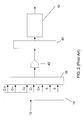
- FIG. 2 is a block diagram of a typical OFDM transmitter according to the prior art.
- An OFDM transmitter 10 receives a stream of baseband data bits 12 as its input. These input data bits 12 are immediately fed into an encoder 14.
- Encoder 14 typically uses a block and/or convolutional coding scheme to introduce error-correcting and/or error-detecting redundancy into the input bits 12.
- DSP Digital Signal Processor
- the digital time-domain OFDM symbols are converted to an analog signal in a digital-to-analog converter 20 and then converted to an Intermediate Frequency (IF) in IF transmitter 42.
- This composite IF OFDM signal is then passed into Radio Frequency (RF) transmitter 40 which then upconverts the IF OFDM signal to a desired selectable carrier frequency prior to final amplification and propagation across a transmission medium. Upconversion is typically achieved by mixing the IF signal with a variable frequency oscillator signal. The carrier frequency is varied by varying the oscillator frequency.
- FIG. 3 illustrates that an OFDM signal is transmitted as blocks of user data separated by guard intervals known as cyclic prefixes.
- a cyclic prefix is a copy of a portion of an adjacent block of user data and is used to reduce Inter-Symbol Interference (ISI) caused by multipath fading. More particularly, only cyclic prefixes, as opposed to user data, are affected by ISI, as is known by those skilled in the art. Thus the removal of cyclic prefixes by an OFDM receiver removes the effects of ISI from the received OFDM signal.
- ISI Inter-Symbol Interference
- CDMA systems have synchronized using CDMA searcher information, while ODFM systems have achieved synchronization using discrete frequency-domain channel estimator information.
- a CDMA searcher uses Pseudo Noise (PN) correlation to identify multipaths and multiple sectors.
- An OFDM channel estimator uses the frequency response at the pilot tone locations to identify the channel impulse response.
- PN Pseudo Noise
- OFDM channel estimator uses the frequency response at the pilot tone locations to identify the channel impulse response.
- OFDM channel estimation suffers from aliasing if the channel delay spread exceeds the number of pilot tones. This is the case even if the pilot tones of adjacent OFDM symbols are staggered, so as to admit channel estimation whose length is twice the number of pilot tones.
- the described features of the present invention generally relate to one or more improved systems, methods and/or apparatuses for communicating speech or data on multipath channels.
- the invention comprises a channel estimation method, comprising determining a FFT window position, and calculating a delay spread.
- the step of determining a FFT window position comprises setting an initial position of the FFT window, computing an energy for each tap, time averaging said energy for each tap, comparing an average energy of each tap with a first threshold multiplied by the average energy of all taps, comparing the average energy of each tap with a second threshold multiplied by a maximum average energy in alias components, updating the set of paths if the average energy of the tap is greater than said second threshold multiplied by the maximum average energy in alias components; and refining the FFT window position.
- the present invention comprises a receiver to estimate a channel, comprising an RF receiver having an input and an output, an IF receiver having an input and an output, wherein the input is operably connected to an output of the RF receiver, an analog-to-digital converter having an input and an output, wherein the input is operably connected to the output of the IF receiver, a decoder having an input and an output, and a processor having an input and an output, wherein the input is operably connected to the output of the analog-to-digital converter and the output is operably connected to said input of the decoder and the processor comprises memory, and software comprising instructions stored in the memory, wherein the receiver is adapted to execute the instructions stored in the memory comprising determining a FFT window position, and calculating a delay spread.
- the present invention comprises a processor to estimate a channel, comprising memory, and software comprising instructions stored in said memory, wherein the processor is adapted to execute the instructions stored in the memory comprising determining a FFT window position, and calculating a delay spread.
- FIG. 1 is an illustration of a typical OFDM signal within an OFDM channel bandwidth showing the frequency domain positioning of OFDM sub-carriers according to the prior art
- FIG. 2 is a block diagram of a typical OFDM transmitter according to the prior art
- FIG. 3 is an illustration of an OFDM signal according to the prior art
- FIG. 4 is a block diagram of the OFDM receiver of the present invention.
- FIG. 5 is a top level flowchart disclosing steps taken by the present method and apparatus
- FIG. 6 is a flowchart which discloses the steps taken when setting the initial position of the FFT window
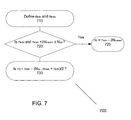
- FIG. 7 is a flowchart which discloses the steps taken to refine the FFT window position
- FIG. 8 is a flowchart which discloses the steps taken in an embodiment in which the average energy of each tap is compared with a first threshold multiplied by the minimum average energy of all the taps;
- FIG. 9 is a flowchart which discloses the steps taken in an embodiment in which the average energy of each tap is compared with a first threshold multiplied by the maximum average energy of all the taps;
- FIG. 10 is a flowchart which discloses the steps taken in an embodiment in which an energy window hypothesis called hyp( ⁇ ) is used to revise initial FFT window estimates Lmin' and Lmax' which are then used in conjunction with AveE(L) to determine the channel estimation and FFT window positions.
- hyp( ⁇ ) an energy window hypothesis used to revise initial FFT window estimates Lmin' and Lmax' which are then used in conjunction with AveE(L) to determine the channel estimation and FFT window positions.
- the present method and apparatus is applicable to a system where CDM and OFDM waveforms are time-division multiplexed in the same transmit signal.
- the present method and apparatus uses both CDMA searcher information and channel estimation to improve the synchronization performance in the presence of unconstrained delay spread by synchronizing the OFDM symbols and determines the channel spread delay for channel estimation. It combines both the CDMA searcher information from the CDMA pilot and the channel estimates from OFDM pilot tones. Furthermore, the present method and apparatus uses OFDM channel estimation to detect weak paths and a CDMA searcher for alias resolution.
- pilot tones are inserted into the signal. Pilot tones contain known data at certain known frequencies.
- An OFDM communication apparatus calculates a frequency response estimated value of the propagation path by performing time-frequency conversion on a reception signal through an FFT circuit. In addition, it performs a complex multiplication on the received signal with the pilot symbol whose value is known to the receiver. This provides an estimate of the channel frequency response at the frequency associated with the pilot tone. By measuring the channel at the known frequencies and performing an IFFT on the pilot signal, the timing can be inferred. With the above approach, an OFDM symbol with P pilot tones can be used to estimate up to P taps in the channel impulse response.
- the position of the pilot tones in adjacent tones are staggered with respect to (w.r.t.) to each other. If the pilot positions alternate between two configurations on even and odd pilot tones, then we may exploit the staggered structure to estimate a channel impulse response of length 2P taps. While this approach works well at low Doppler spread (slow fading channels), the estimation procedure may induce uncancelled alias taps with a separation of the P chips at high Doppler spread (fast fading channels). In either case, if the channel impulse response exceeds a length of P taps, then the OFDM channel estimator is unable to distinguish between causal and anti-causal channel taps in the channel impulse response.
- the present invention proposes methods to mitigate the uncancelled alias problem for channels with high Doppler, and solves the causal/anti-causal tap resolution problem for channels with large delay spread.
- FIG. 4 is a block diagram of an OFDM receiver 68 according to the present invention.
- an RF receiver 70 downconverts the RF OFDM-modulated carrier to obtain a received IF OFDM signal.
- the received IF OFDM signal is downconverted to IF from the carrier frequency in an IF receiver 72.
- the OFDM signal is then passed into an Analog-to-Digital Converter (ADC) 92, respectively, where it is digitized.
- ADC Analog-to-Digital Converter
- the cyclic prefix is removed and an FFT is applied to recover the original frequency domain symbols in the DSP/FFT processor 100.
- Decoder 102 recovers the transmitted data bits from the sequences of frequency-domain sub-symbols that are delivered to it from DSP 100.
- the decoder 102 decodes the frequency-domain sub-symbols to obtain a stream of data bits 104.
- the data bits 104 should match the stream of data bits 12 that were fed into the OFDM transmitter 10.
- the OFDM receiver 68 determines the exact timing of the beginning of each symbol within a data frame to properly receive the OFDM signal that has been transmitted across a channel and to demodulate the symbols from the received signal. If correct timing is not known, the receiver 68 may not be able to reliably remove the cyclic prefixes and correctly isolate individual symbols before computing the FFT of their samples. When this occurs, sequences of sub-symbols demodulated from the OFDM signal may be incorrect, and the transmitted data bits may not be accurately recovered.
- the DSP 100 of the present invention is shown as including memory 44.
- the steps discussed below and disclosed in the flowcharts of FIGs. 5 - 9 are stored as instructions located in software or firmware 42 located in memory 44.
- the memory 44 can be located in the processor 100 or separately.
- the first step of the present method and apparatus involves setting the initial position of the FFT window. Let d first be the timing of the earliest, or first path, identified by the searcher, and d last be that of the last path. Based on the searcher results, back off N cursor chips from the earliest arriving path 210. The back-off is used to account for the spreading effect of the pulse shaping filters, the transmit shaping filter and the receiver matched filter, which shape the spectrum of the waveform so that it is consistent with the spectral mask.
- N cursor is the assumed length of the precursor (or post-cursor) due to pulse shaping.
- N cursor (which can also be referred to as N backoff ) is 6 chips. This is the starting point of the FFT.
- Lmin Lmax - (2P-1).
- Lmin is the index of the first significant component in the estimated channel impulse response.
- the CDMA searcher is used to resolve the causal and anti-causal components of the channel impulse response.
- h(Lmin) represents the channel impulse response at the minimum or beginning point of the window.
- AveE Lmin : Lmax 1 - 1 / Tc * AveE Lmin : Lmax + 1 / Tc * E Lmin : Lmax .
- Tc is inversely proportional to the filter bandwidth BW.
- AveE(L) > ⁇ 2 x [1/(Lmax-Lmin+1) x Max (AveE(L+P), AveE(L-P))].
- This threshold test helps to eliminate ghost paths at L resulting from uncancelled alias components associated with the (L+P) th or (L-P) th channel tap in the actual channel impulse response.
- Uncancelled alias components may be induced by rapid channel variation between adjacent OFDM symbols in a high Doppler spread channel
- n 0 n min - N cursor 725
- n 0 n min - N cp - n max + n min / 2 730
- the delay spread for the channel estimation is calculated using the following formula:
- greater noise suppression can be achieved in the channel estimator by zeroing out the nonsignificant channel taps. This can be achieved by including the taps corresponding to only the precursors and postcursors around the taps in S.
- Step 500 in the above method can be replaced by step 500' in which the average energy each tap, L, is compared with a first threshold ⁇ 1 multiplied by the minimum average energy over all the taps, Lmin to Lmax, where min ⁇ AveE(i) ⁇ equals the minimum average energy over all the taps.
- AveE L > ⁇ 1 x min AveE i ⁇ for Lmin ⁇ i ⁇ Lmax .
- Step 500 in the above method can be replaced by step 500" in which the average energy each tap, L, is compared with a first threshold ⁇ 1 multiplied by the maximum average energy over all the taps, Lmin to Lmax, where max ⁇ AveE(i) ⁇ equals the maximum average energy over all the taps.
- AveE L > ⁇ 1 x max AveE i ⁇ for Lmin ⁇ i ⁇ Lmax .
- Block 500 and all the subsequent steps may be executed with these revised values of Lmin' and Lmax', in place of the original Lmin and Lmax.
- this block 450 is an optional block. See FIG. 10 .
- DSP Digital Signal Processor
- ASIC Application Specific Integrated Circuit
- FPGA Field Programmable Gate Array
- a general purpose processor may be a microprocessor, but in the alternative, the processor may be any conventional processor, controller, microcontroller, or state machine.
- a processor may also be implemented as a combination of computing devices, e.g., a combination of a DSP and a microprocessor, a plurality of microprocessors, one or more microprocessors in conjunction with a DSP core, or any other such configuration.
- a software module may reside in Random Access Memory (RAM), flash memory, Read Only Memory (ROM), Electrically Programmable ROM (EPROM), Electrically Erasable Programmable ROM (EEPROM), registers, hard disk, a removable disk, a CD-ROM, or any other form of storage medium known in the art.
- An illustrative storage medium is coupled to the processor such the processor can read information from, and write information to, the storage medium.
- the storage medium may be integral to the processor.
- the processor and the storage medium may reside in an ASIC.
- the ASIC may reside in a user terminal.
- the processor and the storage medium may reside as discrete components in a user terminal.
Landscapes
- Engineering & Computer Science (AREA)
- Computer Networks & Wireless Communication (AREA)
- Signal Processing (AREA)
- Power Engineering (AREA)
- Mobile Radio Communication Systems (AREA)
- Position Fixing By Use Of Radio Waves (AREA)
- Noise Elimination (AREA)
- Digital Transmission Methods That Use Modulated Carrier Waves (AREA)
Applications Claiming Priority (3)
| Application Number | Priority Date | Filing Date | Title |
|---|---|---|---|
| US67257305P | 2005-04-18 | 2005-04-18 | |
| US11/174,108 US7609773B2 (en) | 2005-04-18 | 2005-06-29 | Method of determining the location of the FFT window and the delay spread for the platinum broadcast channel estimator |
| EP06750152A EP1872546A1 (fr) | 2005-04-18 | 2006-04-14 | Procede pour determiner l'emplacement d'une fenetre a transformee de fourier rapide, et l'etalement de delai pour le dispositif d'estimation de canal de diffusion de platine |
Related Parent Applications (1)
| Application Number | Title | Priority Date | Filing Date |
|---|---|---|---|
| EP06750152.8 Division | 2006-04-14 |
Publications (2)
| Publication Number | Publication Date |
|---|---|
| EP2194683A2 true EP2194683A2 (fr) | 2010-06-09 |
| EP2194683A3 EP2194683A3 (fr) | 2013-05-01 |
Family
ID=36699248
Family Applications (2)
| Application Number | Title | Priority Date | Filing Date |
|---|---|---|---|
| EP06750152A Withdrawn EP1872546A1 (fr) | 2005-04-18 | 2006-04-14 | Procede pour determiner l'emplacement d'une fenetre a transformee de fourier rapide, et l'etalement de delai pour le dispositif d'estimation de canal de diffusion de platine |
| EP10157852.4A Withdrawn EP2194683A3 (fr) | 2005-04-18 | 2006-04-14 | Procédé pour déterminer l'emplacement d'une fenêtre à transformer de Fourier rapide, et l'étalement de délai pour le dispositif d'estimation de canal de diffusion de platine |
Family Applications Before (1)
| Application Number | Title | Priority Date | Filing Date |
|---|---|---|---|
| EP06750152A Withdrawn EP1872546A1 (fr) | 2005-04-18 | 2006-04-14 | Procede pour determiner l'emplacement d'une fenetre a transformee de fourier rapide, et l'etalement de delai pour le dispositif d'estimation de canal de diffusion de platine |
Country Status (8)
| Country | Link |
|---|---|
| US (2) | US7609773B2 (fr) |
| EP (2) | EP1872546A1 (fr) |
| JP (1) | JP4791531B2 (fr) |
| KR (1) | KR100925700B1 (fr) |
| CN (2) | CN101917379B (fr) |
| MY (1) | MY142442A (fr) |
| TW (1) | TWI344289B (fr) |
| WO (1) | WO2006113419A1 (fr) |
Families Citing this family (52)
| Publication number | Priority date | Publication date | Assignee | Title |
|---|---|---|---|---|
| AU2003238128A1 (en) * | 2003-06-30 | 2005-01-13 | Nokia Corporation | Faster fine timing operation in multi-carrier system |
| US8144824B2 (en) * | 2005-03-10 | 2012-03-27 | Qualcomm Incorporated | Trend influenced time tracking |
| US20100157833A1 (en) * | 2005-03-10 | 2010-06-24 | Qualcomm Incorporated | Methods and systems for improved timing acquisition for varying channel conditions |
| US8675631B2 (en) * | 2005-03-10 | 2014-03-18 | Qualcomm Incorporated | Method and system for achieving faster device operation by logical separation of control information |
| US7609773B2 (en) | 2005-04-18 | 2009-10-27 | Qualcomm Incorporated | Method of determining the location of the FFT window and the delay spread for the platinum broadcast channel estimator |
| US7623607B2 (en) * | 2005-10-31 | 2009-11-24 | Qualcomm Incorporated | Methods and apparatus for determining timing in a wireless communication system |
| US8107517B2 (en) * | 2005-12-09 | 2012-01-31 | Qualcomm Incorporated | Average-tap energy based thresholding for channel estimation in multi antenna systems |
| US8948329B2 (en) * | 2005-12-15 | 2015-02-03 | Qualcomm Incorporated | Apparatus and methods for timing recovery in a wireless transceiver |
| US7551679B2 (en) * | 2006-02-03 | 2009-06-23 | Ati Technologies, Inc. | Symmetrical data signal processing |
| US7933239B2 (en) * | 2006-07-20 | 2011-04-26 | Industrial Technology Research Institute | FFT-size detector and FFT-size detection method and cell search apparatus and cell search method in cellular system |
| JP5152325B2 (ja) * | 2007-08-17 | 2013-02-27 | 日本電気株式会社 | 直交周波数分割多重におけるチャネル推定の方法及びそのシステム |
| US20090083055A1 (en) * | 2007-09-20 | 2009-03-26 | Edwin Tan | Method and system for a scratchcard |
| JP5052280B2 (ja) * | 2007-10-01 | 2012-10-17 | 株式会社日立国際電気 | 受信機 |
| CN101843061B (zh) * | 2007-11-01 | 2012-12-19 | Nxp股份有限公司 | 区分实际回波峰与混叠回波峰的方法 |
| KR100896654B1 (ko) * | 2007-12-27 | 2009-05-11 | 삼성전기주식회사 | Ofdm 시스템의 다중경로 페이딩 채널의 지연 확산 추정장치 및 방법 |
| CN102113008A (zh) * | 2008-05-30 | 2011-06-29 | 兰迪帕特网络公司 | 用于提供在线服务和软件的方法和系统 |
| US20100106642A1 (en) | 2008-06-05 | 2010-04-29 | Namedepot.Com, Inc. | Method and system for delayed payment of prepaid cards |
| US8406392B2 (en) * | 2008-08-13 | 2013-03-26 | Sky Castle Global Limited | Method and system for automated user authentication |
| US8249203B2 (en) * | 2008-09-22 | 2012-08-21 | Qualcomm Incorporated | Truncation of noisy taps in channel estimation |
| EP2200245B1 (fr) * | 2008-12-19 | 2012-08-15 | Telefonaktiebolaget L M Ericsson (publ) | Récepteur et procédé pour communications mobiles |
| US8311159B2 (en) * | 2009-01-09 | 2012-11-13 | Qualcomm Incorporated | Methods and systems for time tracking in OFDM systems |
| CN101924723B (zh) * | 2009-06-09 | 2013-05-08 | 中兴通讯股份有限公司 | Ofdm信号解调方法和装置 |
| KR101148843B1 (ko) * | 2009-06-25 | 2012-07-09 | (주)에프씨아이 | 오에프디엠 수신기에 적용되는 최대 채널 딜레이를 추정하는 방법 및 시피에버리징 방법 |
| CN101662446B (zh) * | 2009-09-28 | 2013-01-16 | 中兴通讯股份有限公司 | 信道估计方法及装置 |
| US8606254B2 (en) * | 2009-10-30 | 2013-12-10 | Blackberry Limited | Method and system for receiver adaptation based on knowledge of wireless propagation environments |
| EP2317713A1 (fr) * | 2009-10-30 | 2011-05-04 | Research In Motion Limited | Procédé et système pour l'adaptation de récepteur en fonction de la connaissance des environnements de propagation sans fil |
| US8774294B2 (en) * | 2010-04-27 | 2014-07-08 | Qualcomm Incorporated | Compressed sensing channel estimation in OFDM communication systems |
| CN102480441B (zh) * | 2010-11-30 | 2014-07-09 | 澜起科技(上海)有限公司 | 信道估计方法及系统 |
| US20120144499A1 (en) | 2010-12-02 | 2012-06-07 | Sky Castle Global Limited | System to inform about trademarks similar to provided input |
| US8823806B2 (en) * | 2011-02-18 | 2014-09-02 | Wi-Lan, Inc. | Method and apparatus for television band pilot sensing |
| EP3063911B1 (fr) * | 2013-10-29 | 2020-10-14 | Samsung Electronics Co., Ltd. | Procédé et système utilisant des séquences ternaires pour une transmission simultanée à destination de récepteurs cohérents et non cohérents |
| US9313063B1 (en) | 2015-01-30 | 2016-04-12 | Huawei Technologies Co., Ltd. | Apparatus and method for transmitting data with conditional zero padding |
| GB2533180B (en) * | 2015-06-04 | 2018-05-30 | Imagination Tech Ltd | Minimising inter-symbol interference in OFDM signals |
| CN107276923B (zh) * | 2016-04-07 | 2020-07-28 | 富士通株式会社 | 抗混叠的信道估计装置、方法以及接收机 |
| CN111971906B (zh) * | 2018-04-13 | 2023-09-08 | 上海诺基亚贝尔股份有限公司 | 压缩抽头位置信息用于新无线电中时域显式信道状态信息反馈 |
| US10659112B1 (en) | 2018-11-05 | 2020-05-19 | XCOM Labs, Inc. | User equipment assisted multiple-input multiple-output downlink configuration |
| US10756860B2 (en) | 2018-11-05 | 2020-08-25 | XCOM Labs, Inc. | Distributed multiple-input multiple-output downlink configuration |
| US10432272B1 (en) | 2018-11-05 | 2019-10-01 | XCOM Labs, Inc. | Variable multiple-input multiple-output downlink user equipment |
| US10812216B2 (en) | 2018-11-05 | 2020-10-20 | XCOM Labs, Inc. | Cooperative multiple-input multiple-output downlink scheduling |
| KR20210087089A (ko) | 2018-11-27 | 2021-07-09 | 엑스콤 랩스 인코퍼레이티드 | 넌-코히어런트 협력 다중 입출력 통신 |
| US10756795B2 (en) | 2018-12-18 | 2020-08-25 | XCOM Labs, Inc. | User equipment with cellular link and peer-to-peer link |
| US11063645B2 (en) | 2018-12-18 | 2021-07-13 | XCOM Labs, Inc. | Methods of wirelessly communicating with a group of devices |
| US11330649B2 (en) | 2019-01-25 | 2022-05-10 | XCOM Labs, Inc. | Methods and systems of multi-link peer-to-peer communications |
| US10756767B1 (en) | 2019-02-05 | 2020-08-25 | XCOM Labs, Inc. | User equipment for wirelessly communicating cellular signal with another user equipment |
| US10686502B1 (en) | 2019-04-29 | 2020-06-16 | XCOM Labs, Inc. | Downlink user equipment selection |
| US10735057B1 (en) | 2019-04-29 | 2020-08-04 | XCOM Labs, Inc. | Uplink user equipment selection |
| US11411778B2 (en) | 2019-07-12 | 2022-08-09 | XCOM Labs, Inc. | Time-division duplex multiple input multiple output calibration |
| US11411779B2 (en) | 2020-03-31 | 2022-08-09 | XCOM Labs, Inc. | Reference signal channel estimation |
| US12088499B2 (en) | 2020-04-15 | 2024-09-10 | Virewirx, Inc. | System and method for reducing data packet processing false alarms |
| CN112910817B (zh) * | 2021-01-18 | 2022-01-11 | 西安电子科技大学 | 基于一维搜索和能量检测的ofdm时间同步方法 |
| CN115118634B (zh) * | 2021-03-19 | 2023-08-11 | 大唐移动通信设备有限公司 | 传输时延的测量方法、装置、设备及存储介质 |
| WO2022241436A1 (fr) | 2021-05-14 | 2022-11-17 | XCOM Labs, Inc. | Identifiants de brouillage pour systèmes de communication sans fil |
Family Cites Families (28)
| Publication number | Priority date | Publication date | Assignee | Title |
|---|---|---|---|---|
| US3821505A (en) * | 1972-05-18 | 1974-06-28 | English Electric Co Ltd | Vacuum type electric circuit interrupting devices |
| AU551979B2 (en) * | 1982-03-31 | 1986-05-15 | Shell Internationale Research Maatschappij B.V. | Epoxy polymerisation catalysts |
| US5158922A (en) * | 1992-02-04 | 1992-10-27 | Arco Chemical Technology, L.P. | Process for preparing metal cyanide complex catalyst |
| US5482908A (en) * | 1994-09-08 | 1996-01-09 | Arco Chemical Technology, L.P. | Highly active double metal cyanide catalysts |
| US5627122A (en) * | 1995-07-24 | 1997-05-06 | Arco Chemical Technology, L.P. | Highly active double metal cyanide complex catalysts |
| US5627120A (en) * | 1996-04-19 | 1997-05-06 | Arco Chemical Technology, L.P. | Highly active double metal cyanide catalysts |
| KR100234329B1 (ko) * | 1997-09-30 | 1999-12-15 | 윤종용 | Ofdm 시스템 수신기의 fft 윈도우 위치 복원장치 및 그 방법_ |
| EP0981207A1 (fr) * | 1998-06-30 | 2000-02-23 | Lucent Technologies Inc. | Symboles pilotes |
| EP1063824B1 (fr) * | 1999-06-22 | 2006-08-02 | Matsushita Electric Industrial Co., Ltd. | Synchronisation de symboles dans des récepteurs multiporteuses |
| US6650617B1 (en) * | 2000-02-22 | 2003-11-18 | Thomson Licensing S.A. | Reduced complexity FFT window synchronization for an orthogonal frequency division multiplexing system |
| US6795392B1 (en) | 2000-03-27 | 2004-09-21 | At&T Corp. | Clustered OFDM with channel estimation |
| US6771591B1 (en) | 2000-07-31 | 2004-08-03 | Thomson Licensing S.A. | Method and system for processing orthogonal frequency division multiplexed signals |
| US7233625B2 (en) * | 2000-09-01 | 2007-06-19 | Nortel Networks Limited | Preamble design for multiple input—multiple output (MIMO), orthogonal frequency division multiplexing (OFDM) system |
| JP3628977B2 (ja) * | 2001-05-16 | 2005-03-16 | 松下電器産業株式会社 | 無線基地局装置及び通信端末装置 |
| US6678792B2 (en) | 2001-06-22 | 2004-01-13 | Koninklijke Philips Electronics N.V. | Fast and accurate cache way selection |
| JP4171261B2 (ja) * | 2001-08-27 | 2008-10-22 | 松下電器産業株式会社 | 無線通信装置及び無線通信方法 |
| JP3924565B2 (ja) | 2001-08-30 | 2007-06-06 | 株式会社エヌ・ティ・ティ・ドコモ | 無線伝送システムおよび方法並びにその無線伝送システムで用いられる送信局装置および受信局装置 |
| SG111072A1 (en) * | 2002-07-03 | 2005-05-30 | Oki Techno Ct Singapore Pte | Receiver and method for wlan burst type signals |
| AU2003280673A1 (en) * | 2002-11-01 | 2004-05-25 | Matsushita Electric Industrial Co., Ltd. | Synchronous follow-up device and method |
| KR100488802B1 (ko) * | 2002-12-09 | 2005-05-12 | 한국전자통신연구원 | 직교 주파수 분할 다중화 무선 통신 시스템에서의 반송파주파수 오차와 샘플링 주파수 오차 추적 방법 및 그 장치 |
| AU2003269739A1 (en) * | 2003-03-28 | 2004-10-18 | Intel Corporation | Method and apparatus for ofdm symbol timing synchronization |
| AU2003238128A1 (en) * | 2003-06-30 | 2005-01-13 | Nokia Corporation | Faster fine timing operation in multi-carrier system |
| EP1507378B1 (fr) * | 2003-08-14 | 2012-10-24 | Sony Deutschland GmbH | Synchronization de trame et de fréquence pour OFDM |
| US20050063298A1 (en) | 2003-09-02 | 2005-03-24 | Qualcomm Incorporated | Synchronization in a broadcast OFDM system using time division multiplexed pilots |
| JP3795885B2 (ja) * | 2003-11-19 | 2006-07-12 | 株式会社東芝 | 受信装置および受信制御方法 |
| US7860193B2 (en) * | 2004-07-20 | 2010-12-28 | Qualcomm Incorporated | Coarse timing estimation system and methodology for wireless symbols |
| KR100770924B1 (ko) * | 2005-02-04 | 2007-10-26 | 삼성전자주식회사 | 무선 통신 시스템에서 주파수 오차 보상 장치 및 방법 |
| US7609773B2 (en) | 2005-04-18 | 2009-10-27 | Qualcomm Incorporated | Method of determining the location of the FFT window and the delay spread for the platinum broadcast channel estimator |
-
2005
- 2005-06-29 US US11/174,108 patent/US7609773B2/en not_active Expired - Fee Related
-
2006
- 2006-04-14 EP EP06750152A patent/EP1872546A1/fr not_active Withdrawn
- 2006-04-14 EP EP10157852.4A patent/EP2194683A3/fr not_active Withdrawn
- 2006-04-14 KR KR1020077026751A patent/KR100925700B1/ko not_active Expired - Fee Related
- 2006-04-14 WO PCT/US2006/014041 patent/WO2006113419A1/fr not_active Ceased
- 2006-04-14 CN CN201010257179.0A patent/CN101917379B/zh not_active Expired - Fee Related
- 2006-04-14 CN CN2006800126111A patent/CN101160889B/zh not_active Expired - Fee Related
- 2006-04-14 JP JP2008507738A patent/JP4791531B2/ja not_active Expired - Fee Related
- 2006-04-17 MY MYPI20061749A patent/MY142442A/en unknown
- 2006-04-18 TW TW095113829A patent/TWI344289B/zh not_active IP Right Cessation
-
2009
- 2009-10-26 US US12/606,009 patent/US8094740B2/en not_active Expired - Fee Related
Non-Patent Citations (1)
| Title |
|---|
| None |
Also Published As
| Publication number | Publication date |
|---|---|
| US20100039925A1 (en) | 2010-02-18 |
| TWI344289B (en) | 2011-06-21 |
| CN101917379B (zh) | 2014-10-22 |
| EP2194683A3 (fr) | 2013-05-01 |
| JP2008537446A (ja) | 2008-09-11 |
| KR20070122557A (ko) | 2007-12-31 |
| CN101160889A (zh) | 2008-04-09 |
| JP4791531B2 (ja) | 2011-10-12 |
| MY142442A (en) | 2010-11-30 |
| WO2006113419A1 (fr) | 2006-10-26 |
| TW200704050A (en) | 2007-01-16 |
| US8094740B2 (en) | 2012-01-10 |
| CN101160889B (zh) | 2011-04-27 |
| CN101917379A (zh) | 2010-12-15 |
| EP1872546A1 (fr) | 2008-01-02 |
| US7609773B2 (en) | 2009-10-27 |
| KR100925700B1 (ko) | 2009-11-10 |
| US20060233269A1 (en) | 2006-10-19 |
Similar Documents
| Publication | Publication Date | Title |
|---|---|---|
| US8094740B2 (en) | Method of determining the location of the FFT window and the delay spread for the platinum broadcast channel estimator | |
| JP5602773B2 (ja) | スペクトル推定を使用する通信システムのためのチャネル推定 | |
| EP1949636B1 (fr) | Synchronisation dans un recepteur a plusieurs porteuses correlee avec un intervalle de garde | |
| US20080198942A1 (en) | Long echo detection and channel estimation for ofdm systems | |
| US8498354B2 (en) | Digital communications receiver and method of estimating residual carrier frequency offset in a received signal | |
| US20070211827A1 (en) | Channel Estimation in an Ofdm System With High Doppler Shift | |
| CN102113286B (zh) | 用于多载波系统中的ici消除的迭代信道估计方法和设备 | |
| US7502311B2 (en) | Method and apparatus for detecting a cell in an orthogonal frequency division multiple access system | |
| JP5144687B2 (ja) | Ofdm符号タイミングリカバリの方法およびシステム | |
| CN101378310A (zh) | 检测基于频域特性的信号的方法及相关接收器 | |
| US8369428B2 (en) | Method of synchronizing multi-carrier systems and multi-carrier system | |
| US8385438B1 (en) | System and method for adaptive synchronization | |
| US20100074346A1 (en) | Channel estimation in ofdm receivers | |
| KR101009301B1 (ko) | 통신 채널 추정 | |
| US7729434B2 (en) | System and method for improved channel estimation for wireless OFDM systems | |
| CN101001232A (zh) | 一种同步信号的发射方法及系统 | |
| JP2004236266A (ja) | シンボルタイミング検出回路 | |
| CN101867538B (zh) | 具有时钟漂移估计和补偿的接收设备和方法 | |
| HK1116956A (en) | Method of determining the location of the fft window and the delay spread for the platinum broadcast channel estimator | |
| KR100977557B1 (ko) | 직교 주파수 분할 다중화 시스템의 시변 채널 추정 장치 및방법 | |
| CN121396723A (zh) | 信道估计方法、装置、存储介质以及程序产品 |
Legal Events
| Date | Code | Title | Description |
|---|---|---|---|
| PUAI | Public reference made under article 153(3) epc to a published international application that has entered the european phase |
Free format text: ORIGINAL CODE: 0009012 |
|
| 17P | Request for examination filed |
Effective date: 20100325 |
|
| AC | Divisional application: reference to earlier application |
Ref document number: 1872546 Country of ref document: EP Kind code of ref document: P |
|
| AK | Designated contracting states |
Kind code of ref document: A2 Designated state(s): AT BE BG CH CY CZ DE DK EE ES FI FR GB GR HU IE IS IT LI LT LU LV MC NL PL PT RO SE SI SK TR |
|
| PUAL | Search report despatched |
Free format text: ORIGINAL CODE: 0009013 |
|
| AK | Designated contracting states |
Kind code of ref document: A3 Designated state(s): AT BE BG CH CY CZ DE DK EE ES FI FR GB GR HU IE IS IT LI LT LU LV MC NL PL PT RO SE SI SK TR |
|
| RIC1 | Information provided on ipc code assigned before grant |
Ipc: H04L 25/02 20060101AFI20130327BHEP Ipc: H04L 27/26 20060101ALI20130327BHEP |
|
| 17Q | First examination report despatched |
Effective date: 20181221 |
|
| STAA | Information on the status of an ep patent application or granted ep patent |
Free format text: STATUS: THE APPLICATION IS DEEMED TO BE WITHDRAWN |
|
| 18D | Application deemed to be withdrawn |
Effective date: 20190501 |