EP2195456B1 - Verwendung von polymorphismen im tmem132d-gen bei der vorhersage und behandlung von angstzuständen - Google Patents
Verwendung von polymorphismen im tmem132d-gen bei der vorhersage und behandlung von angstzuständen Download PDFInfo
- Publication number
- EP2195456B1 EP2195456B1 EP08802770A EP08802770A EP2195456B1 EP 2195456 B1 EP2195456 B1 EP 2195456B1 EP 08802770 A EP08802770 A EP 08802770A EP 08802770 A EP08802770 A EP 08802770A EP 2195456 B1 EP2195456 B1 EP 2195456B1
- Authority
- EP
- European Patent Office
- Prior art keywords
- polymorphisms
- gene
- polymorphism
- tmem132d
- sample
- Prior art date
- Legal status (The legal status is an assumption and is not a legal conclusion. Google has not performed a legal analysis and makes no representation as to the accuracy of the status listed.)
- Not-in-force
Links
Images


Classifications
-
- C—CHEMISTRY; METALLURGY
- C12—BIOCHEMISTRY; BEER; SPIRITS; WINE; VINEGAR; MICROBIOLOGY; ENZYMOLOGY; MUTATION OR GENETIC ENGINEERING
- C12Q—MEASURING OR TESTING PROCESSES INVOLVING ENZYMES, NUCLEIC ACIDS OR MICROORGANISMS; COMPOSITIONS OR TEST PAPERS THEREFOR; PROCESSES OF PREPARING SUCH COMPOSITIONS; CONDITION-RESPONSIVE CONTROL IN MICROBIOLOGICAL OR ENZYMOLOGICAL PROCESSES
- C12Q1/00—Measuring or testing processes involving enzymes, nucleic acids or microorganisms; Compositions therefor; Processes of preparing such compositions
- C12Q1/68—Measuring or testing processes involving enzymes, nucleic acids or microorganisms; Compositions therefor; Processes of preparing such compositions involving nucleic acids
- C12Q1/6876—Nucleic acid products used in the analysis of nucleic acids, e.g. primers or probes
- C12Q1/6883—Nucleic acid products used in the analysis of nucleic acids, e.g. primers or probes for diseases caused by alterations of genetic material
-
- C—CHEMISTRY; METALLURGY
- C12—BIOCHEMISTRY; BEER; SPIRITS; WINE; VINEGAR; MICROBIOLOGY; ENZYMOLOGY; MUTATION OR GENETIC ENGINEERING
- C12Q—MEASURING OR TESTING PROCESSES INVOLVING ENZYMES, NUCLEIC ACIDS OR MICROORGANISMS; COMPOSITIONS OR TEST PAPERS THEREFOR; PROCESSES OF PREPARING SUCH COMPOSITIONS; CONDITION-RESPONSIVE CONTROL IN MICROBIOLOGICAL OR ENZYMOLOGICAL PROCESSES
- C12Q2600/00—Oligonucleotides characterized by their use
- C12Q2600/136—Screening for pharmacological compounds
-
- C—CHEMISTRY; METALLURGY
- C12—BIOCHEMISTRY; BEER; SPIRITS; WINE; VINEGAR; MICROBIOLOGY; ENZYMOLOGY; MUTATION OR GENETIC ENGINEERING
- C12Q—MEASURING OR TESTING PROCESSES INVOLVING ENZYMES, NUCLEIC ACIDS OR MICROORGANISMS; COMPOSITIONS OR TEST PAPERS THEREFOR; PROCESSES OF PREPARING SUCH COMPOSITIONS; CONDITION-RESPONSIVE CONTROL IN MICROBIOLOGICAL OR ENZYMOLOGICAL PROCESSES
- C12Q2600/00—Oligonucleotides characterized by their use
- C12Q2600/156—Polymorphic or mutational markers
-
- C—CHEMISTRY; METALLURGY
- C12—BIOCHEMISTRY; BEER; SPIRITS; WINE; VINEGAR; MICROBIOLOGY; ENZYMOLOGY; MUTATION OR GENETIC ENGINEERING
- C12Q—MEASURING OR TESTING PROCESSES INVOLVING ENZYMES, NUCLEIC ACIDS OR MICROORGANISMS; COMPOSITIONS OR TEST PAPERS THEREFOR; PROCESSES OF PREPARING SUCH COMPOSITIONS; CONDITION-RESPONSIVE CONTROL IN MICROBIOLOGICAL OR ENZYMOLOGICAL PROCESSES
- C12Q2600/00—Oligonucleotides characterized by their use
- C12Q2600/172—Haplotypes
-
- Y—GENERAL TAGGING OF NEW TECHNOLOGICAL DEVELOPMENTS; GENERAL TAGGING OF CROSS-SECTIONAL TECHNOLOGIES SPANNING OVER SEVERAL SECTIONS OF THE IPC; TECHNICAL SUBJECTS COVERED BY FORMER USPC CROSS-REFERENCE ART COLLECTIONS [XRACs] AND DIGESTS
- Y10—TECHNICAL SUBJECTS COVERED BY FORMER USPC
- Y10T—TECHNICAL SUBJECTS COVERED BY FORMER US CLASSIFICATION
- Y10T436/00—Chemistry: analytical and immunological testing
- Y10T436/14—Heterocyclic carbon compound [i.e., O, S, N, Se, Te, as only ring hetero atom]
- Y10T436/142222—Hetero-O [e.g., ascorbic acid, etc.]
- Y10T436/143333—Saccharide [e.g., DNA, etc.]
Definitions
- the present invention relates to methods, compositions, kits and reagents for the diagnosis and treatment of anxiety disorders.
- Panic disorder is characterized by sudden episodes of acute anxiety or intense fear that may occur without any apparent reason or stimulus. PD is often accompanied by agoraphobia, an avoidance of situations where a person may feel trapped and unable to escape. The life-time prevalence of PD is up to 4% worldwide and there is substantial evidence that genetic factors contribute to the development of panic disorder (Kessler et al., 2005). Twin, family, and segregation analysis studies indicate a definite but complex genetic basis in PD with a potential involvement of multiple genes, each of modest effect. The estimates for genetic heritability in PD ranges up to 30-40% and in agoraphobia up to 50% (Kendler 2001, Hettema et al., 2001).
- GWA Genome-wide association
- TMEM132D Polymorphisms in the TMEM132D, FHIT, KPNA4, CRIM1 and PLCB1 genes were found to be particularly relevant. More particular, polymorphisms in the TMEM132D gene were identified, which have a clear and statistically relevant association with anxiety disorders.
- a first aspect of the invention relates to a method for the diagnosis of an anxiety disorder or a predisposition therefor in a mammal, particularly in a human being, comprising determining the presence of at least one polymorphism in the TMEM123D gene, wherein said at least one polymorphism is associated with said anxiety disorder or predisposition therefor.
- Polymorphisms in the TMEM123D, FHIT, KPNA4, CRIM1 and PLCB1 genes have a statistically significant association is preferably p ⁇ 0.05, more preferably p ⁇ 0.01 and most preferably p ⁇ 0.001.
- the determination of significance may be carried out by a polymorphism/haplotype analysis of a sufficient number, e.g. of at least 40, preferably of at least 80, more preferably of at least 100 normal cases. More preferably the determination of significance may be carried out as described in the Example section.
- polymorphisms associated with anxiety disorders may particularly occur in introns of the TMEM132D, FHIT, KPNA4, CRIM1 and PLCB1 genes, in particular in the intron of the TMEM132D gene.
- Table 1 SNPs selected for stage 2 genotyping regarding the best p-value in stage 1.
- the method for the diagnosis of an anxiety disorder or a predisposition therefor comprises determining a single polymorphism in a chromosomal copy of at least one of the TMEM132D genes and/or in two chromosomal copies of at least one of said genes, a combination of polymorphisms in a chromosomal copy of at least one of said genes and/or in two chromosomal copies of at least one of said genes and/or a combination of polymorphisms in at least one chromosomal copy of a combination of the FHIT, KPNA4, CRIM1 and PLCB1 genes, wherein said polymorphism and/or combination of polymorphisms is associated with said anxiety disorder or predisposition therefor.
- the polymorphism of the TMEM132D gene is selected from the group consisting of
- the presence of at least one polymorphism associated with anxiety disorder is preferably determined by a genotyping analysis as indicated above.
- the determination may comprise the analysis of a single polymorphism or of a plurality of polymorphisms in one or two copies of a single gene or in one or two copies of different genes.
- the determination may comprise the use of polymorphism-specific primers capable of hybridising with the respective gene and allowing a discrimination between polymorphisms, particularly SNPs at a predetermined position.
- the genotyping analysis may comprise a primer extension reaction using polymorphism-specific primers as described in the Example.
- the determination of individual polymorphisms may be carried out as described in the Example.
- a further preferred embodiment comprises a microarray analysis which is particularly suitable for the parallel determination of several polymorphisms.
- Suitable microarray devices are commercially available.
- the subjects to be tested are mammals, preferably human beings, suspected to be suffering from anxiety disorder.
- anxiety disorder shall mean any pathologic anxiety condition and includes, but is not limited to, different forms of abnormal, pathological anxiety, fears, phobias and nervous conditions that are described as an irrational or illogical worry that is not based on fact.
- anxiety disorder as used herein covers a wide range of severities from general social anxieties to panic disorders, including for example generalized anxiety disorder, panic disorder, agoraphobia, depersonalisation or derealization, phobia, social anxiety disorder, and obsessive compulsive disorder.
- the diagnosis of a mental disorder in a human being can be made based on the results of polymorphism/haplotype determination.
- the patient to be tested may have one or a plurality of polymorphisms and/or at least one combination of polymorphisms of at least one genomic copy which are associated with a mental disorder, preferably schizophrenia. If such a diagnosis is given, the patient is at a higher risk of developing an anxiety disorder.
- a further aspect of the disclosure relates to a diagnostic composition or kit for the diagnosis of an anxiety disorder or a predisposition therefor in a mammal, particularly in a human being, comprising at least one primer or probe for determining the presence of at least one polymorphism in the TMEM132D, FHIT, KPNA4, CRIM1, and/or PLCB1 genes, wherein said at least one polymorphism is associated with an anxiety disorder or predisposition therefor.
- the primers and/or probes for determining a single polymorphism in a chromosomal copy of said TMEM132D, FHIT, KPNA4, CRIM1, and/or PLCB1 genes and/or in two chromosomal copies of said genes may be nucleic acid molecules such as DNA and RNA or nucleic acid analogues such as peptide nucleic acids (PNA) or locked nucleic acids (LNA).
- the primers and/or probes are selected such that they can discriminate between polymorphisms at the position to be analysed.
- the primers and/or probes have a length of at least 10, preferably at least 15 up to 50, preferably up to 30 nucleic acid building blocks, e.g. nucleotides.
- the composition or kit comprises at least one primer and/or probe and/or at least one combination of primers and/or probes which hybridise to the above-mentioned genes under predetermined conditions, e.g. of temperature, buffer, strength and/or concentration of organic solvent, and which allows a specific determination of the polymorphism to be tested.
- composition or kit preferably further comprises an enzyme for primer elongation such as a DNA polymerase, nucleotides, e.g. chain elongation nucleotides, such as desoxy nucleoside triphosphates (dNTPs) or chain termination nucleotides such as didesoxynucleoside triphosphates (ddNTPs) and/or labelling groups, e.g. fluorescent or chromogenic labelling groups.
- an enzyme for primer elongation such as a DNA polymerase
- nucleotides e.g. chain elongation nucleotides, such as desoxy nucleoside triphosphates (dNTPs) or chain termination nucleotides such as didesoxynucleoside triphosphates (ddNTPs)
- labelling groups e.g. fluorescent or chromogenic labelling groups.
- Still a further aspect of the disclosure relates to a microarray for the diagnosis of an anxiety disorder or a predisposition therefor in a mammal, particularly in a human being, comprising a carrier having immobilised thereto at least one probe for determining the presence of at least one polymorphism and/or of at least one combination of polymorphisms of at least one copy of the TMEM132D, FHIT, KPNA4, CRIM1, and/or PLCB1 genes, wherein said at least one polymorphism is associated with an anxiety disorder or a predisposition therefor.
- the microarray carrier e.g. a planar carrier or a microchannel device
- the microarray carrier has immobilised thereto a plurality of different probes located at different areas on the carrier, which are designed such that they can bind nucleic acid molecules, e.g. RNA molecules or DNA molecules, amplification products, primer elongation products, etc, containing the sequence in which the polymorphism to be tested is located.
- nucleic acid molecules e.g. RNA molecules or DNA molecules, amplification products, primer elongation products, etc.
- an identification of the polymorphism to be analysed by detection of a site-specific binding events of the nucleic acid sample molecule to the probe immobilised on the carrier may be accomplished.
- a yet further aspect of the present disclosure is a primer or probe and/or a combination of primers and/or probes for the diagnosis of an anxiety disorder or a predisposition therefor in a mammal, particularly in a human being for determining the presence of at least one polymorphism and/or of at least one combination of polymorphisms of at least one copy of the TMEM132D, FHIT, KPNA4, CRIM1, and/or PLCB1 genes, wherein said at least one polymorphism is associated with an anxiety disorder or a predisposition therefor.
- the primers may be nucleic acid molecules such as DNA and RNA or nucleic acid analogues such as peptide nucleic acids (PNA) or locked nucleic acids (LNA).
- the primer and/or probes are selected such that they can discriminate between polymorphisms at the position to be analysed.
- the primers and/or probes have a length of at least 10, preferably at least 15 up to 50, preferably up to 30 nucleic acid building blocks, e.g. nucleotides.
- the primer hybridises to the above-mentioned genes under predetermined conditions, e.g. of temperature, buffer, strength and/or concentration of organic solvent, and allows a specific determination of the polymorphism to be tested.
- a further aspect of the invention relates to a method of screening for a modulator of an anxiety disorder, comprising determining the effect of a test substance on the expression of at least one copy of the TMEM132D gene, wherein the at least one copy of a gene has at least one polymorphism and/or at least one combination of polymorphisms which is associated with said anxiety disorder or predisposition therefor.
- the at least one polymorphism, the at least one genotype, and/or the at least one combination of polymorphisms is defined as above.
- Such methods include cell-based and/or cell-free assays to identify compounds which are capable of interfering with the expression of the TMEM132D gene.
- such method comprises the steps (a) determining the level of expression of the TMEM132D gene in a sample of cells; (b) contacting the sample of cells with a test substance; (c) determining the level of expression of the at least one gene of step (a) for the sample of cells of step (b); and (d) comparing the levels of expression determined in step (a) and (c), wherein an alteration in the level of expression of the at least one gene indicates that the test substance is a modulator of the anxiety disorder.
- Panic sample stage1 Max-Planck Institute (MPI)
- Sample 1 MPI Sample 2 (Münster) cases controls p-value cases controls p-value N 216 222 240 241 sex male 33.2% male 32.9% 0.94 male 40.4% male 40.2% 0.97 female 66.8% female 67.1% female 49.6% female 49.8% age (SD) 38.9 (12.0) 38.8 (11.7) 0.58 35.8 (10.7) 38.6 (12.1) 0.44 diagnosis PDA 83.3% none PDA 67.5% none PD 16.7% PD 32.5% PDA: Panic disorder with agoraphobia; PD: Panic disorder without agoraphobia; SD: standard deviation.
- DSM-IV Diagnostic and Statistical Manual of Mental Disorders
- the Panic and Agoraphobia scale (Bandelow 1995) indicated a moderate severity of panic and agoraphobia (mean score (SD) rating assessed by clinicians: 29.8 (9.8)).
- Ethnicity was recorded using a self-report sheet for perceived nationality, mother language and ethnicity of the subject itself and all 4 grandparents. All included patients were Caucasian: 83.0% of German origin, 17.0% of European origin, excluding Vietnamese origin. The study was approved by the local ethics committee. Written informed consent was obtained from all subjects.
- M-CIDI Composite International Diagnostic-Screener
- the genotyping in the second stage was performed on a MALDI-TOF mass-spectrometer (MassArray® system) employing the AssayDesigner software (Sequenom Inc., San Diego, USA) for primer selection, multiplexing and assay design, and the homogeneous mass-extension (hMe) process for producing primer extension products.
- MALDI-TOF SNP genotyping was performed at the facilities of the Institute of Human Genetics, GSF - National Research Center for Environment and Health, Neuherberg, Germany. All oligonucleotide sequences used are available upon request.
- Genome-wide case-control analyses were conducted by applying the WG-Permer software (http://wg-permer.org) and R-2.5.0 (http://cran.r-project.org). SNPs deviating from Hardy-Weinberg-equilibrium as well as SNPs with a callrate below 98% (initial sample) respectively 90% (stage 2 sample). The difference being owed to the two different genotyping methods used. SNPs with a minor allele frequency below 2.5% were not taken into further analysis. SNPs were tested for association with panic disorders using the allelic X 2 -test. Results of the significant SNPs were also verified with the Armitage test for trend.
- the level of significance was set to 5% (family-wise error rate, FER), and p-values were corrected for multiple comparisons by Bonferroni method. Power calculations were performed using CaTS (http://www.sph.umich.edu/csg/abecasis/CaTS). Population stratification was tested with EIGENSTRAT implemented in EIGENSOFT (http://genepath.med.havard.edu/-reich/EIGENSTRAT.htm).
- Analyses for psychopathology-related phenotypes were performed using generalized linear method with SPSS for Windows (Releases 12, SPSS Inc., Chicago, Illinois 60606, USA) testing effects on the genotypic level. Age and gender were used as covariates for all analyses.
- haplotypes estimated by Haploview (http://www.broad.mit.edu/personal/jcbarret/haplo/). Blocks were defined using the confidence interval method described by Gabriel (Gabriel et al., 2002).
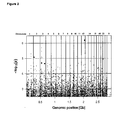
- COCAPHASE Figure 1 ).
- 56 SNPs passed the quality criteria in the second stage (call rate > 90%, HETEX > 10, MAF > 2.5%).
- 5 SNPs from the stage 2 showed a nominal case-control association either with panic disorder (4 SNPs) or with agoraphobia (1 SNP).
- the allele T was found as risk allele for panic disorder in both samples.
- the power to detect a true genome-wide significant association of the type found for rs7309727 was calculated.
- the power ranges to 75% with an attributable risk of 42.8.
- the power was 57% and the power in the joint sample was 62% with an attributable risk of 38.1%.
- TMEM132D gene spans over 830kb on Chromosome 12q24.32 - 12q24.33. All SNPs in the gene region ⁇ 20kb were included for the further analysis, this region was covered with 172 SNPs on 300k Illumina Chip, 170 SNPs turned to be polymorphic. All 170 polymorphic SNPs were tested for association with disease severity using "The Panic and Agoraphobia scale" total score for a rating reflecting the worst episode of panic symptoms (PA: obtained by clinicians), the psychopathology values were corrected for age and gender before the analysis. When the total score was significant or showed a trend for association, subscales were tested for significant effects to further specify the phenotypic effects.
- PA The Panic and Agoraphobia scale
Landscapes
- Chemical & Material Sciences (AREA)
- Life Sciences & Earth Sciences (AREA)
- Proteomics, Peptides & Aminoacids (AREA)
- Health & Medical Sciences (AREA)
- Organic Chemistry (AREA)
- Wood Science & Technology (AREA)
- Analytical Chemistry (AREA)
- Zoology (AREA)
- Genetics & Genomics (AREA)
- Engineering & Computer Science (AREA)
- Pathology (AREA)
- Immunology (AREA)
- Microbiology (AREA)
- Molecular Biology (AREA)
- Biotechnology (AREA)
- Biophysics (AREA)
- Physics & Mathematics (AREA)
- Biochemistry (AREA)
- Bioinformatics & Cheminformatics (AREA)
- General Engineering & Computer Science (AREA)
- General Health & Medical Sciences (AREA)
- Measuring Or Testing Involving Enzymes Or Micro-Organisms (AREA)
- Pharmaceuticals Containing Other Organic And Inorganic Compounds (AREA)
Claims (6)
- Verfahren zur Diagnose einer Angststörung oder einer Prädisposition dafür in einem Säugetier, insbesondere in einem Menschen, umfassend Bestimmen der Anwesenheit mindestens eines Polymporphismus des TMEM132D-Gens, wobei der Polymorphismus ausgewählt ist aus der Gruppe bestehend aus rs7309727, rs900256, rs879560, rs10847832, rs1871899, rs10773613, rs2398469 und rs7979367.
- Verfahren nach Anspruch 1 umfassend:(a) Bestimmen eines einzelnen Polymorphismus in einer Chromosomenkopie des Gens, wobei der Polymorphismus mit der Angststörung oder Prädisposition dafür assoziiert ist;(b) Bestimmen eines einzelnen Polymorphismus in zwei Chromosomenkopien des Gens, wobei der Polymorphismus mit der Angststörung oder Prädisposition dafür assoziiert ist;(c) Bestimmen einer Kombination an Polymorphismen in einer Chromosomenkopie des Gens, wobei die Kombination an Polymorphismen mit der Angststörung oder Prädisposition dafür assoziiert ist;(d) Bestimmen einer Kombination an Polymorphismen in zwei Chromosomenkopien des Gens, wobei die Kombination an Polymorphismen mit der psychischen Störung oder Prädisposition dafür assoziiert ist;(e) Bestimmen einer Kombination an Polymorphismen in mindestens einer Chromosomenkopie einer Kombination an Genen, wobei die Kombination an Polymorphismen mit der psychischen Störung oder Prädisposition dafür assoziiert ist.
- Verfahren nach Anspruch 1 oder 2, wobei eine Kombination an Polymorphismen in mindestens einer Chromosomenkopie des TMEM132D-Gens bestimmt wird.
- Verfahren nach einem der Ansprüche 1 bis 3, wobei der Polymorphismus durch eine Genotypisierungs-Analyse bestimmt wird.
- Verfahren nach Anspruch 4, wobei die Genotypisierungs-Analyse die Verwendung von Polymorphismus-spezifischen Primern, einer massenspektrometrischen Analyse und/oder einer Microarray-Analyse umfasst.
- In vitro Verfahren zum Screening eines Modulators einer Angststörung, umfassend Bestimmen des Effekts einer Testsubstanz auf das Expressionslevel mindestens einer Kopie des TMEM132D-Gens, wobei die mindestens eine Kopie eines Gens mindestens einen Polymorphismus und/oder mindestens eine Kombination an Polymorphismen aufweist, der/die mit der Angststörung oder Prädisposition dafür assoziiert ist, wobei der
mindestens eine Polymorphismus wie in Anspruch 1 definiert ist und/oder eine Kombination der Polymorphismen.
Applications Claiming Priority (2)
| Application Number | Priority Date | Filing Date | Title |
|---|---|---|---|
| US97778007P | 2007-10-05 | 2007-10-05 | |
| PCT/EP2008/008382 WO2009043584A2 (en) | 2007-10-05 | 2008-10-02 | Use of polymorphisms in the tmem132d gene in the prediction and treatment of anxiety disorders |
Publications (2)
| Publication Number | Publication Date |
|---|---|
| EP2195456A2 EP2195456A2 (de) | 2010-06-16 |
| EP2195456B1 true EP2195456B1 (de) | 2012-11-28 |
Family
ID=40252454
Family Applications (1)
| Application Number | Title | Priority Date | Filing Date |
|---|---|---|---|
| EP08802770A Not-in-force EP2195456B1 (de) | 2007-10-05 | 2008-10-02 | Verwendung von polymorphismen im tmem132d-gen bei der vorhersage und behandlung von angstzuständen |
Country Status (3)
| Country | Link |
|---|---|
| US (1) | US20100216653A1 (de) |
| EP (1) | EP2195456B1 (de) |
| WO (1) | WO2009043584A2 (de) |
Families Citing this family (2)
| Publication number | Priority date | Publication date | Assignee | Title |
|---|---|---|---|---|
| WO2020081543A1 (en) * | 2018-10-16 | 2020-04-23 | The Broad Institute, Inc. | Methods of scaling computational genomics with specialized architectures for highly parallelized computations and uses thereof |
| KR20260010739A (ko) * | 2023-05-11 | 2026-01-21 | 유니버시티 하스피탈즈 클리블랜드 메디컬 센터 | 항불안 치료 |
Family Cites Families (4)
| Publication number | Priority date | Publication date | Assignee | Title |
|---|---|---|---|---|
| US6225057B1 (en) * | 1998-07-23 | 2001-05-01 | Palleja, Zavier Estivell | Duplications of human chromosome 15q24-25 and anxiety disorders, diagnostic methods for their detection |
| JP2002171990A (ja) * | 2000-12-08 | 2002-06-18 | Inst Of Physical & Chemical Res | ヒトコレシストキニン遺伝子上流領域の多型、その同定方法及び試薬並びにこれに基づく不安性障害の診断方法 |
| WO2005040427A2 (en) * | 2003-09-19 | 2005-05-06 | Decode Genetics Ehf. | Inversion on chromosome 8p23 is a risk factor for anxiety disorders, depression and bipolar |
| US7361468B2 (en) * | 2004-07-02 | 2008-04-22 | Affymetrix, Inc. | Methods for genotyping polymorphisms in humans |
-
2008
- 2008-10-02 EP EP08802770A patent/EP2195456B1/de not_active Not-in-force
- 2008-10-02 US US12/681,455 patent/US20100216653A1/en not_active Abandoned
- 2008-10-02 WO PCT/EP2008/008382 patent/WO2009043584A2/en not_active Ceased
Also Published As
| Publication number | Publication date |
|---|---|
| EP2195456A2 (de) | 2010-06-16 |
| US20100216653A1 (en) | 2010-08-26 |
| WO2009043584A2 (en) | 2009-04-09 |
| WO2009043584A3 (en) | 2009-06-18 |
Similar Documents
| Publication | Publication Date | Title |
|---|---|---|
| Maestrini et al. | High-density SNP association study and copy number variation analysis of the AUTS1 and AUTS5 loci implicate the IMMP2L–DOCK4 gene region in autism susceptibility | |
| Erhardt et al. | TMEM132D, a new candidate for anxiety phenotypes: evidence from human and mouse studies | |
| US20210222245A1 (en) | Autism associated genetic markers | |
| US8835111B2 (en) | Genotyping tool for improving the prognostic and clinical management of MS patients | |
| US20130012401A1 (en) | Single nucleotide polymorphisms associated with dietary weight loss | |
| US8071299B2 (en) | Methods for predicting the response of multiple sclerosis patients to interferon therapy and diagnosing multiple sclerosis | |
| Ide et al. | Genetic and expression analyses of FZD3 in schizophrenia | |
| EP2195456B1 (de) | Verwendung von polymorphismen im tmem132d-gen bei der vorhersage und behandlung von angstzuständen | |
| JP2010508029A (ja) | 抗うつ薬による治療時に有害事象を発現する危険性のある患者の識別方法 | |
| WO2014067005A1 (en) | Novel marker for mental disorders | |
| US20110159489A1 (en) | Single nucleotide polymorphisms associated with dietary weight loss | |
| EP2855700B1 (de) | Ttc8 als prognostisches gen für progressive retinale atrophie bei hunden | |
| WO2009089273A1 (en) | Methods of identifying risk genes for diseases | |
| US8236497B2 (en) | Methods of diagnosing cardiovascular disease | |
| KR102650359B1 (ko) | 약물 과민반응 진단용 snp 및 이를 이용한 진단 방법 | |
| US20110135572A1 (en) | Compositions and methods for diagnosing late-onset alzheimer's disease | |
| US20100227324A1 (en) | Measurement of arylesterase enzymatic activity and assessment of genetic polymorphisms located in the pon1 gene as a diagnostic tool in autism-spectrum disorders | |
| KR20250118434A (ko) | 알츠하이머병 발병 위험도 예측을 위한 레이 복잡도 지연 회상 점수 저하와 관련이 있는 단일염기다형성 마커 및 이의 용도 | |
| Schosser et al. | NRG1 gene in recurrent major depression: No association in a large‐scale case–control association study | |
| WO2011120043A1 (en) | Methods and compositions for diagnosing and predicting risk of late-onset alzheimer's disease | |
| US20100304388A1 (en) | Biomarker For Successful Aging Without Cognitive Decline |
Legal Events
| Date | Code | Title | Description |
|---|---|---|---|
| PUAI | Public reference made under article 153(3) epc to a published international application that has entered the european phase |
Free format text: ORIGINAL CODE: 0009012 |
|
| 17P | Request for examination filed |
Effective date: 20100329 |
|
| AK | Designated contracting states |
Kind code of ref document: A2 Designated state(s): AT BE BG CH CY CZ DE DK EE ES FI FR GB GR HR HU IE IS IT LI LT LU LV MC MT NL NO PL PT RO SE SI SK TR |
|
| AX | Request for extension of the european patent |
Extension state: AL BA MK RS |
|
| RIN1 | Information on inventor provided before grant (corrected) |
Inventor name: BETTECKEN, THOMAS Inventor name: HOLSBOER, FLORIAN Inventor name: ERHARDT, ANGELIKA Inventor name: MUELLER-MYHSOK, BERTRAM Inventor name: UHR, MANFRED |
|
| 17Q | First examination report despatched |
Effective date: 20101117 |
|
| GRAP | Despatch of communication of intention to grant a patent |
Free format text: ORIGINAL CODE: EPIDOSNIGR1 |
|
| RIN1 | Information on inventor provided before grant (corrected) |
Inventor name: ERHARDT, ANGELIKA Inventor name: BETTECKEN, THOMAS Inventor name: MUELLER-MYHSOK, BERTRAM Inventor name: HOLSBOER, FLORIAN Inventor name: UHR, MANFRED |
|
| DAX | Request for extension of the european patent (deleted) | ||
| GRAS | Grant fee paid |
Free format text: ORIGINAL CODE: EPIDOSNIGR3 |
|
| GRAA | (expected) grant |
Free format text: ORIGINAL CODE: 0009210 |
|
| AK | Designated contracting states |
Kind code of ref document: B1 Designated state(s): AT BE BG CH CY CZ DE DK EE ES FI FR GB GR HR HU IE IS IT LI LT LU LV MC MT NL NO PL PT RO SE SI SK TR |
|
| REG | Reference to a national code |
Ref country code: GB Ref legal event code: FG4D |
|
| REG | Reference to a national code |
Ref country code: CH Ref legal event code: NV Representative=s name: E. BLUM AND CO. AG PATENT- UND MARKENANWAELTE , CH Ref country code: CH Ref legal event code: EP |
|
| REG | Reference to a national code |
Ref country code: AT Ref legal event code: REF Ref document number: 586223 Country of ref document: AT Kind code of ref document: T Effective date: 20121215 |
|
| REG | Reference to a national code |
Ref country code: IE Ref legal event code: FG4D |
|
| REG | Reference to a national code |
Ref country code: DE Ref legal event code: R096 Ref document number: 602008020480 Country of ref document: DE Effective date: 20130124 |
|
| REG | Reference to a national code |
Ref country code: NL Ref legal event code: T3 |
|
| REG | Reference to a national code |
Ref country code: AT Ref legal event code: MK05 Ref document number: 586223 Country of ref document: AT Kind code of ref document: T Effective date: 20121128 |
|
| REG | Reference to a national code |
Ref country code: LT Ref legal event code: MG4D |
|
| PG25 | Lapsed in a contracting state [announced via postgrant information from national office to epo] |
Ref country code: SE Free format text: LAPSE BECAUSE OF FAILURE TO SUBMIT A TRANSLATION OF THE DESCRIPTION OR TO PAY THE FEE WITHIN THE PRESCRIBED TIME-LIMIT Effective date: 20121128 Ref country code: LT Free format text: LAPSE BECAUSE OF FAILURE TO SUBMIT A TRANSLATION OF THE DESCRIPTION OR TO PAY THE FEE WITHIN THE PRESCRIBED TIME-LIMIT Effective date: 20121128 Ref country code: NO Free format text: LAPSE BECAUSE OF FAILURE TO SUBMIT A TRANSLATION OF THE DESCRIPTION OR TO PAY THE FEE WITHIN THE PRESCRIBED TIME-LIMIT Effective date: 20130228 Ref country code: ES Free format text: LAPSE BECAUSE OF FAILURE TO SUBMIT A TRANSLATION OF THE DESCRIPTION OR TO PAY THE FEE WITHIN THE PRESCRIBED TIME-LIMIT Effective date: 20130311 Ref country code: FI Free format text: LAPSE BECAUSE OF FAILURE TO SUBMIT A TRANSLATION OF THE DESCRIPTION OR TO PAY THE FEE WITHIN THE PRESCRIBED TIME-LIMIT Effective date: 20121128 |
|
| PG25 | Lapsed in a contracting state [announced via postgrant information from national office to epo] |
Ref country code: PL Free format text: LAPSE BECAUSE OF FAILURE TO SUBMIT A TRANSLATION OF THE DESCRIPTION OR TO PAY THE FEE WITHIN THE PRESCRIBED TIME-LIMIT Effective date: 20121128 Ref country code: BE Free format text: LAPSE BECAUSE OF FAILURE TO SUBMIT A TRANSLATION OF THE DESCRIPTION OR TO PAY THE FEE WITHIN THE PRESCRIBED TIME-LIMIT Effective date: 20121128 Ref country code: SI Free format text: LAPSE BECAUSE OF FAILURE TO SUBMIT A TRANSLATION OF THE DESCRIPTION OR TO PAY THE FEE WITHIN THE PRESCRIBED TIME-LIMIT Effective date: 20121128 Ref country code: PT Free format text: LAPSE BECAUSE OF FAILURE TO SUBMIT A TRANSLATION OF THE DESCRIPTION OR TO PAY THE FEE WITHIN THE PRESCRIBED TIME-LIMIT Effective date: 20130328 Ref country code: LV Free format text: LAPSE BECAUSE OF FAILURE TO SUBMIT A TRANSLATION OF THE DESCRIPTION OR TO PAY THE FEE WITHIN THE PRESCRIBED TIME-LIMIT Effective date: 20121128 Ref country code: GR Free format text: LAPSE BECAUSE OF FAILURE TO SUBMIT A TRANSLATION OF THE DESCRIPTION OR TO PAY THE FEE WITHIN THE PRESCRIBED TIME-LIMIT Effective date: 20130301 |
|
| PG25 | Lapsed in a contracting state [announced via postgrant information from national office to epo] |
Ref country code: AT Free format text: LAPSE BECAUSE OF FAILURE TO SUBMIT A TRANSLATION OF THE DESCRIPTION OR TO PAY THE FEE WITHIN THE PRESCRIBED TIME-LIMIT Effective date: 20121128 |
|
| PG25 | Lapsed in a contracting state [announced via postgrant information from national office to epo] |
Ref country code: EE Free format text: LAPSE BECAUSE OF FAILURE TO SUBMIT A TRANSLATION OF THE DESCRIPTION OR TO PAY THE FEE WITHIN THE PRESCRIBED TIME-LIMIT Effective date: 20121128 Ref country code: CZ Free format text: LAPSE BECAUSE OF FAILURE TO SUBMIT A TRANSLATION OF THE DESCRIPTION OR TO PAY THE FEE WITHIN THE PRESCRIBED TIME-LIMIT Effective date: 20121128 Ref country code: DK Free format text: LAPSE BECAUSE OF FAILURE TO SUBMIT A TRANSLATION OF THE DESCRIPTION OR TO PAY THE FEE WITHIN THE PRESCRIBED TIME-LIMIT Effective date: 20121128 Ref country code: SK Free format text: LAPSE BECAUSE OF FAILURE TO SUBMIT A TRANSLATION OF THE DESCRIPTION OR TO PAY THE FEE WITHIN THE PRESCRIBED TIME-LIMIT Effective date: 20121128 Ref country code: BG Free format text: LAPSE BECAUSE OF FAILURE TO SUBMIT A TRANSLATION OF THE DESCRIPTION OR TO PAY THE FEE WITHIN THE PRESCRIBED TIME-LIMIT Effective date: 20130228 |
|
| PG25 | Lapsed in a contracting state [announced via postgrant information from national office to epo] |
Ref country code: IT Free format text: LAPSE BECAUSE OF FAILURE TO SUBMIT A TRANSLATION OF THE DESCRIPTION OR TO PAY THE FEE WITHIN THE PRESCRIBED TIME-LIMIT Effective date: 20121128 Ref country code: RO Free format text: LAPSE BECAUSE OF FAILURE TO SUBMIT A TRANSLATION OF THE DESCRIPTION OR TO PAY THE FEE WITHIN THE PRESCRIBED TIME-LIMIT Effective date: 20121128 |
|
| PLBE | No opposition filed within time limit |
Free format text: ORIGINAL CODE: 0009261 |
|
| STAA | Information on the status of an ep patent application or granted ep patent |
Free format text: STATUS: NO OPPOSITION FILED WITHIN TIME LIMIT |
|
| 26N | No opposition filed |
Effective date: 20130829 |
|
| PG25 | Lapsed in a contracting state [announced via postgrant information from national office to epo] |
Ref country code: CY Free format text: LAPSE BECAUSE OF FAILURE TO SUBMIT A TRANSLATION OF THE DESCRIPTION OR TO PAY THE FEE WITHIN THE PRESCRIBED TIME-LIMIT Effective date: 20121128 |
|
| REG | Reference to a national code |
Ref country code: DE Ref legal event code: R097 Ref document number: 602008020480 Country of ref document: DE Effective date: 20130829 |
|
| PG25 | Lapsed in a contracting state [announced via postgrant information from national office to epo] |
Ref country code: HR Free format text: LAPSE BECAUSE OF FAILURE TO SUBMIT A TRANSLATION OF THE DESCRIPTION OR TO PAY THE FEE WITHIN THE PRESCRIBED TIME-LIMIT Effective date: 20130731 |
|
| PG25 | Lapsed in a contracting state [announced via postgrant information from national office to epo] |
Ref country code: MC Free format text: LAPSE BECAUSE OF FAILURE TO SUBMIT A TRANSLATION OF THE DESCRIPTION OR TO PAY THE FEE WITHIN THE PRESCRIBED TIME-LIMIT Effective date: 20121128 |
|
| REG | Reference to a national code |
Ref country code: IE Ref legal event code: MM4A |
|
| PG25 | Lapsed in a contracting state [announced via postgrant information from national office to epo] |
Ref country code: IE Free format text: LAPSE BECAUSE OF NON-PAYMENT OF DUE FEES Effective date: 20131002 |
|
| PG25 | Lapsed in a contracting state [announced via postgrant information from national office to epo] |
Ref country code: TR Free format text: LAPSE BECAUSE OF FAILURE TO SUBMIT A TRANSLATION OF THE DESCRIPTION OR TO PAY THE FEE WITHIN THE PRESCRIBED TIME-LIMIT Effective date: 20121128 |
|
| PG25 | Lapsed in a contracting state [announced via postgrant information from national office to epo] |
Ref country code: LU Free format text: LAPSE BECAUSE OF NON-PAYMENT OF DUE FEES Effective date: 20131002 Ref country code: HU Free format text: LAPSE BECAUSE OF FAILURE TO SUBMIT A TRANSLATION OF THE DESCRIPTION OR TO PAY THE FEE WITHIN THE PRESCRIBED TIME-LIMIT; INVALID AB INITIO Effective date: 20081002 |
|
| PG25 | Lapsed in a contracting state [announced via postgrant information from national office to epo] |
Ref country code: MT Free format text: LAPSE BECAUSE OF FAILURE TO SUBMIT A TRANSLATION OF THE DESCRIPTION OR TO PAY THE FEE WITHIN THE PRESCRIBED TIME-LIMIT Effective date: 20121128 |
|
| REG | Reference to a national code |
Ref country code: FR Ref legal event code: PLFP Year of fee payment: 8 |
|
| PGFP | Annual fee paid to national office [announced via postgrant information from national office to epo] |
Ref country code: CH Payment date: 20151021 Year of fee payment: 8 Ref country code: DE Payment date: 20150930 Year of fee payment: 8 Ref country code: GB Payment date: 20151021 Year of fee payment: 8 |
|
| PGFP | Annual fee paid to national office [announced via postgrant information from national office to epo] |
Ref country code: NL Payment date: 20151021 Year of fee payment: 8 Ref country code: FR Payment date: 20151023 Year of fee payment: 8 |
|
| PG25 | Lapsed in a contracting state [announced via postgrant information from national office to epo] |
Ref country code: IS Free format text: LAPSE BECAUSE OF FAILURE TO SUBMIT A TRANSLATION OF THE DESCRIPTION OR TO PAY THE FEE WITHIN THE PRESCRIBED TIME-LIMIT Effective date: 20121128 |
|
| REG | Reference to a national code |
Ref country code: DE Ref legal event code: R119 Ref document number: 602008020480 Country of ref document: DE |
|
| REG | Reference to a national code |
Ref country code: CH Ref legal event code: PL |
|
| REG | Reference to a national code |
Ref country code: NL Ref legal event code: MM Effective date: 20161101 |
|
| GBPC | Gb: european patent ceased through non-payment of renewal fee |
Effective date: 20161002 |
|
| REG | Reference to a national code |
Ref country code: FR Ref legal event code: ST Effective date: 20170630 |
|
| PG25 | Lapsed in a contracting state [announced via postgrant information from national office to epo] |
Ref country code: CH Free format text: LAPSE BECAUSE OF NON-PAYMENT OF DUE FEES Effective date: 20161031 Ref country code: FR Free format text: LAPSE BECAUSE OF NON-PAYMENT OF DUE FEES Effective date: 20161102 Ref country code: DE Free format text: LAPSE BECAUSE OF NON-PAYMENT OF DUE FEES Effective date: 20170503 Ref country code: LI Free format text: LAPSE BECAUSE OF NON-PAYMENT OF DUE FEES Effective date: 20161031 Ref country code: GB Free format text: LAPSE BECAUSE OF NON-PAYMENT OF DUE FEES Effective date: 20161002 |
|
| PG25 | Lapsed in a contracting state [announced via postgrant information from national office to epo] |
Ref country code: NL Free format text: LAPSE BECAUSE OF NON-PAYMENT OF DUE FEES Effective date: 20161101 |