EP2196134A1 - Appareil d'endoscope et son procédé de commande - Google Patents
Appareil d'endoscope et son procédé de commande Download PDFInfo
- Publication number
- EP2196134A1 EP2196134A1 EP09178186A EP09178186A EP2196134A1 EP 2196134 A1 EP2196134 A1 EP 2196134A1 EP 09178186 A EP09178186 A EP 09178186A EP 09178186 A EP09178186 A EP 09178186A EP 2196134 A1 EP2196134 A1 EP 2196134A1
- Authority
- EP
- European Patent Office
- Prior art keywords
- imaging
- image
- light
- narrow
- band
- Prior art date
- Legal status (The legal status is an assumption and is not a legal conclusion. Google has not performed a legal analysis and makes no representation as to the accuracy of the status listed.)
- Withdrawn
Links
- 238000000034 method Methods 0.000 title description 12
- 238000003384 imaging method Methods 0.000 abstract description 205
- 230000003595 spectral effect Effects 0.000 abstract description 77
- 239000011159 matrix material Substances 0.000 description 20
- 238000010586 diagram Methods 0.000 description 8
- 210000004204 blood vessel Anatomy 0.000 description 6
- 238000003745 diagnosis Methods 0.000 description 6
- 210000001519 tissue Anatomy 0.000 description 6
- 238000007781 pre-processing Methods 0.000 description 5
- 230000001276 controlling effect Effects 0.000 description 4
- 238000010521 absorption reaction Methods 0.000 description 3
- 238000006243 chemical reaction Methods 0.000 description 3
- 230000000875 corresponding effect Effects 0.000 description 3
- 238000003672 processing method Methods 0.000 description 3
- 238000005070 sampling Methods 0.000 description 3
- 108010054147 Hemoglobins Proteins 0.000 description 2
- 102000001554 Hemoglobins Human genes 0.000 description 2
- 210000004369 blood Anatomy 0.000 description 2
- 239000008280 blood Substances 0.000 description 2
- 230000002596 correlated effect Effects 0.000 description 2
- 238000005286 illumination Methods 0.000 description 2
- 210000002784 stomach Anatomy 0.000 description 2
- 239000002344 surface layer Substances 0.000 description 2
- INGWEZCOABYORO-UHFFFAOYSA-N 2-(furan-2-yl)-7-methyl-1h-1,8-naphthyridin-4-one Chemical compound N=1C2=NC(C)=CC=C2C(O)=CC=1C1=CC=CO1 INGWEZCOABYORO-UHFFFAOYSA-N 0.000 description 1
- UPYKUZBSLRQECL-UKMVMLAPSA-N Lycopene Natural products CC(=C/C=C/C=C(C)/C=C/C=C(C)/C=C/C1C(=C)CCCC1(C)C)C=CC=C(/C)C=CC2C(=C)CCCC2(C)C UPYKUZBSLRQECL-UKMVMLAPSA-N 0.000 description 1
- 108010064719 Oxyhemoglobins Proteins 0.000 description 1
- 230000000903 blocking effect Effects 0.000 description 1
- 150000001746 carotenes Chemical class 0.000 description 1
- 235000005473 carotenes Nutrition 0.000 description 1
- 238000000701 chemical imaging Methods 0.000 description 1
- 230000000295 complement effect Effects 0.000 description 1
- 238000007796 conventional method Methods 0.000 description 1
- 210000000805 cytoplasm Anatomy 0.000 description 1
- 230000007423 decrease Effects 0.000 description 1
- 108010002255 deoxyhemoglobin Proteins 0.000 description 1
- 238000001514 detection method Methods 0.000 description 1
- 210000001156 gastric mucosa Anatomy 0.000 description 1
- 210000002429 large intestine Anatomy 0.000 description 1
- 229910044991 metal oxide Inorganic materials 0.000 description 1
- 150000004706 metal oxides Chemical class 0.000 description 1
- 210000004877 mucosa Anatomy 0.000 description 1
- 230000003287 optical effect Effects 0.000 description 1
- 239000013307 optical fiber Substances 0.000 description 1
- 210000004798 organs belonging to the digestive system Anatomy 0.000 description 1
- 239000004065 semiconductor Substances 0.000 description 1
- 230000035945 sensitivity Effects 0.000 description 1
- 238000001228 spectrum Methods 0.000 description 1
- NCYCYZXNIZJOKI-UHFFFAOYSA-N vitamin A aldehyde Natural products O=CC=C(C)C=CC=C(C)C=CC1=C(C)CCCC1(C)C NCYCYZXNIZJOKI-UHFFFAOYSA-N 0.000 description 1
- 229910052724 xenon Inorganic materials 0.000 description 1
- FHNFHKCVQCLJFQ-UHFFFAOYSA-N xenon atom Chemical compound [Xe] FHNFHKCVQCLJFQ-UHFFFAOYSA-N 0.000 description 1
Images




Classifications
-
- A—HUMAN NECESSITIES
- A61—MEDICAL OR VETERINARY SCIENCE; HYGIENE
- A61B—DIAGNOSIS; SURGERY; IDENTIFICATION
- A61B1/00—Instruments for performing medical examinations of the interior of cavities or tubes of the body by visual or photographical inspection, e.g. endoscopes; Illuminating arrangements therefor
- A61B1/04—Instruments for performing medical examinations of the interior of cavities or tubes of the body by visual or photographical inspection, e.g. endoscopes; Illuminating arrangements therefor combined with photographic or television appliances
- A61B1/045—Control thereof
-
- A—HUMAN NECESSITIES
- A61—MEDICAL OR VETERINARY SCIENCE; HYGIENE
- A61B—DIAGNOSIS; SURGERY; IDENTIFICATION
- A61B1/00—Instruments for performing medical examinations of the interior of cavities or tubes of the body by visual or photographical inspection, e.g. endoscopes; Illuminating arrangements therefor
- A61B1/00002—Operational features of endoscopes
- A61B1/00004—Operational features of endoscopes characterised by electronic signal processing
- A61B1/00009—Operational features of endoscopes characterised by electronic signal processing of image signals during a use of endoscope
- A61B1/000094—Operational features of endoscopes characterised by electronic signal processing of image signals during a use of endoscope extracting biological structures
-
- A—HUMAN NECESSITIES
- A61—MEDICAL OR VETERINARY SCIENCE; HYGIENE
- A61B—DIAGNOSIS; SURGERY; IDENTIFICATION
- A61B1/00—Instruments for performing medical examinations of the interior of cavities or tubes of the body by visual or photographical inspection, e.g. endoscopes; Illuminating arrangements therefor
- A61B1/06—Instruments for performing medical examinations of the interior of cavities or tubes of the body by visual or photographical inspection, e.g. endoscopes; Illuminating arrangements therefor with illuminating arrangements
- A61B1/063—Instruments for performing medical examinations of the interior of cavities or tubes of the body by visual or photographical inspection, e.g. endoscopes; Illuminating arrangements therefor with illuminating arrangements for monochromatic or narrow-band illumination
-
- A—HUMAN NECESSITIES
- A61—MEDICAL OR VETERINARY SCIENCE; HYGIENE
- A61B—DIAGNOSIS; SURGERY; IDENTIFICATION
- A61B1/00—Instruments for performing medical examinations of the interior of cavities or tubes of the body by visual or photographical inspection, e.g. endoscopes; Illuminating arrangements therefor
- A61B1/06—Instruments for performing medical examinations of the interior of cavities or tubes of the body by visual or photographical inspection, e.g. endoscopes; Illuminating arrangements therefor with illuminating arrangements
- A61B1/0638—Instruments for performing medical examinations of the interior of cavities or tubes of the body by visual or photographical inspection, e.g. endoscopes; Illuminating arrangements therefor with illuminating arrangements providing two or more wavelengths
-
- A—HUMAN NECESSITIES
- A61—MEDICAL OR VETERINARY SCIENCE; HYGIENE
- A61B—DIAGNOSIS; SURGERY; IDENTIFICATION
- A61B1/00—Instruments for performing medical examinations of the interior of cavities or tubes of the body by visual or photographical inspection, e.g. endoscopes; Illuminating arrangements therefor
- A61B1/06—Instruments for performing medical examinations of the interior of cavities or tubes of the body by visual or photographical inspection, e.g. endoscopes; Illuminating arrangements therefor with illuminating arrangements
- A61B1/0655—Control therefor
-
- A—HUMAN NECESSITIES
- A61—MEDICAL OR VETERINARY SCIENCE; HYGIENE
- A61B—DIAGNOSIS; SURGERY; IDENTIFICATION
- A61B1/00—Instruments for performing medical examinations of the interior of cavities or tubes of the body by visual or photographical inspection, e.g. endoscopes; Illuminating arrangements therefor
- A61B1/06—Instruments for performing medical examinations of the interior of cavities or tubes of the body by visual or photographical inspection, e.g. endoscopes; Illuminating arrangements therefor with illuminating arrangements
- A61B1/0646—Instruments for performing medical examinations of the interior of cavities or tubes of the body by visual or photographical inspection, e.g. endoscopes; Illuminating arrangements therefor with illuminating arrangements with illumination filters
-
- A—HUMAN NECESSITIES
- A61—MEDICAL OR VETERINARY SCIENCE; HYGIENE
- A61B—DIAGNOSIS; SURGERY; IDENTIFICATION
- A61B5/00—Measuring for diagnostic purposes; Identification of persons
- A61B5/0059—Measuring for diagnostic purposes; Identification of persons using light, e.g. diagnosis by transillumination, diascopy, fluorescence
- A61B5/0082—Measuring for diagnostic purposes; Identification of persons using light, e.g. diagnosis by transillumination, diascopy, fluorescence adapted for particular medical purposes
- A61B5/0084—Measuring for diagnostic purposes; Identification of persons using light, e.g. diagnosis by transillumination, diascopy, fluorescence adapted for particular medical purposes for introduction into the body, e.g. by catheters
Definitions
- the present invention relates to an endoscope apparatus that controls various imaging modes and to a control method thereof.
- spectral imaging in other words, electronic endoscope apparatuses with built-in narrow-band filters (Narrow Band Imaging - NBI) received attention.
- the Narrow Band Imaging uses narrow-band-pass filters in combination based on spectral reflectance in digestive organs (gastric mucosa (mucosa of stomach), or the like).
- three band-pass filters that pass light of narrow (wavelength) bands are provided instead of plane-sequential rotary filters of R (red), G (green), and B (blue).
- illumination light is sequentially output through the narrow-band-pass filters to obtain three signals.
- the three signals obtained by using the illumination light that has passed through the narrow-band-pass filters are processed in a manner similar to the processing on R, G and B signals (RGB signals), while weighting on each of the three signals is changed. Accordingly, spectral images are generated. When such spectral images are used, very fine structures in gasters (stomachs), large vowels (large intestines), or the like, which could not be observed (extracted) in conventional methods, are extracted.
- a method of forming spectral images by performing operation processing has been proposed (for example, please refer to Japanese Unexamined Patent Publication No. 2003-093336 ).
- the operation processing is performed based on image signals obtained by white light.
- a relation between numerical value data representing the color sensitivity characteristic of each of R, G and B and numerical value data representing the spectral characteristic of specific narrow-band-pass filtered light is obtained as matrix data (coefficient sets).
- spectral image signals that estimate spectral images obtained by passing light through the narrow-band-pass filter are estimated by performing operation on the matrix data and the RGB signals.
- the spectral images are generated by performing such operations, it is not necessary to prepare a plurality of filters corresponding to wavelength bands that users need. Further, since it is not necessary to switchably arrange the filters, it is possible to prevent the size of the apparatuses (endoscope apparatuses or systems) from becoming large, and to reduce the cost of the apparatuses.
- the characteristic of the narrow-band observation images obtained by illuminating subjects with narrow-band light and that of the spectral estimation images obtained by matrix operations, as described above, are not exactly the same. Therefore, the narrow-band observation images are suitable to observe some kinds of subjects, but the spectral estimation images are more suitable to observe some other kinds of subjects. Hence, it is desirable that the narrow-band observation images and the spectral estimation images are automatically switched, based on the subject, so that optimum images are displayed to observe the subjects.
- an object of the present invention to provide an endoscope apparatus that can automatically switch, based on the type of a subject, a narrow-band observation image and a spectral estimation image. Further, it is another object of the present invention to provide a method for controlling the endoscope apparatus.
- An endoscope apparatus of the present invention is an endoscope apparatus comprising:
- a method for controlling an endoscope apparatus of the present invention is a method for controlling an endoscope apparatus that includes a light source unit that outputs white light and narrow-band light of a predetermined wavelength band to a subject, a scope that obtains an endoscopic image by imaging the subject to which the white light or the narrow-band light has been output from the light source unit, and a spectral image generation means that generates a spectral estimation image by performing a matrix operation on the endoscopic image obtained by the scope when the white light was output to the subject, the method comprising the steps of:
- the endoscopic image includes an ordinary observation image that is obtained when a subject is illuminated with white light and a narrow-band observation image that is obtained when the subject is illuminated with narrow-band light.
- the imaging state judgment means should judge whether the endoscopic image has been obtained by close-up imaging or by distant-view imaging, and the method for judgment is not limited.
- the light source unit may include a diaphragm (a mechanism for changing the amount of passing light) for adjusting the amount of light illuminating the subject.
- the imaging control means may have a function of automatically adjusting the diaphragm so that the brightness of the endoscopic image becomes a predetermined value.
- the imaging state judgment means may judge, based on the aperture of the diaphragm (the degree of light passed by the diaphragm), whether the endoscopic image was obtained by close-up imaging or by distant-view imaging.
- the light source unit may output light having a constant light amount (a fixed light amount) to the subject.
- the imaging state judgment means may judge, based on the brightness of the endoscopic image, whether the endoscopic image was obtained by close-up imaging or by distant-view imaging.
- the spectral image generation means may have a function of generating a spectral estimation image of the wavelength of 700 nm.
- the imaging state judgment means may judge, by using the spectral estimation image of the wavelength of 700 nm, whether the endoscopic image has been obtained by close-up imaging or by distant-view imaging.
- the endoscope apparatus includes a light source unit that outputs white light and narrow-band light of a predetermined wavelength band to a subject, a scope that obtains an endoscopic image by imaging the subject to which the white light or the narrow-band light has been output from the light source unit, and a spectral image generation means that generates a spectral estimation image by performing a matrix operation on the endoscopic image obtained by the scope when the white light was output to the subject.
- the method includes the steps of:
- the imaging control means has a function of automatically adjusting the diaphragm so that the brightness of the endoscopic image becomes a predetermined value
- the imaging state judgment means judges, based on the aperture of the diaphragm, whether the endoscopic image was obtained by close-up imaging or by distant-view imaging, it is possible to accurately judge whether imaging was performed by close-up imaging or by distant-view imaging.
- the imaging state judgment means judges, based on the brightness of the endoscopic image, whether the endoscopic image was obtained by close-up imaging or by distant-view imaging, it is possible to accurately judge whether imaging was performed by close-up imaging or by distant-view imaging.
- the imaging state judgment means judges, by using the spectral estimation image of the wavelength of 700 nm, whether the endoscopic image has been obtained by close-up imaging or by distant-view imaging, it is possible to accurately judge, based on a spectral estimation image of near infrared light, whether imaging was performed by close-up imaging or by distant-view imaging.
- the rate of absorption of near infrared light by the subject is low.
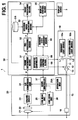
- FIG. 1 is a block diagram illustrating an example of an endoscope apparatus according to the present invention.
- An endoscope apparatus 1 includes a light source unit 10, a scope 20, and an image processing apparatus 30.
- the light source unit 10 outputs light to a subject to observe the subject by using an endoscope.
- the light source unit 10 includes an ordinary light source 10a, such as a xenon lamp, and a narrow-band light source 10b.
- the ordinary light source 10a outputs white light to perform ordinary observation, and the narrow-band light source 10b outputs narrow-band light.
- the narrow-band light source 10b has a function of outputting narrow-wavelength-band light of the wavelength of 400 to 430 nm, narrow-wavelength-band light of the wavelength of 530 to 560 nm, and narrow-wavelength-band light of the wavelength of 600 to 630 nm, as illustrated in Figure 2 .
- Each of the light sources 10a, 10b illustrated in Figure 1 is optically connected to a light guide 15 of the scope 20 through an optical fiber 11 and a condensing lens 13. Therefore, white light L1 output from the ordinary light source 10a and narrow-band light L2 output from the narrow-band light source 10b enter the light guide 15, and are output from an observation window 16 to the subject. Further, the light source unit 10 has a diaphragm (an aperture diaphragm, a mechanism for changing the amount of passing light, or the like) 12. The diaphragm 12 adjusts the amount of light output from the observation window 16 to the subject.
- a diaphragm an aperture diaphragm, a mechanism for changing the amount of passing light, or the like
- AEC Auto Exposure Control
- an imaging control means controller 60 so that the lightness (brightness) of endoscopic images P is maintained at a constant level.
- the light source unit 10 includes the ordinary light source 10a and the narrow-band light source 10b is illustrated.
- the ordinary light source 10a may be provided, and narrow band light L2 may be output to the subject by use of an optical filter.
- the scope 20 includes an imaging lens 21, an imaging means 22, a CDS/AGC (correlated double sampling / automatic gain control) circuit 23, an A/D (analog to digital) converter 24, a CCD (charge coupled device) drive unit 25, a lens drive unit 26, and the like. Further, each of these units is controlled by a scope controller 27.
- the imaging lens 21 includes a set of a plurality of lenses, and the magnification of the imaging lens 21 is changed by driving the imaging lens 21 by the lens drive unit 26.
- the imaging means 22 includes a CCD, a CMOS (complementary metal oxide semiconductor) or the like, for example. The imaging means 22 obtains an image by performing photoelectric conversion on an image of a subject formed by the imaging lens 21.
- the imaging means 22 a complementary-color type device or a primary-color type device may be used for example.
- the complementary-color type imaging means has color filters of Mg (magenta), Ye (yellow), Cy (cyan), and G (green) on the imaging surface.
- the primary-color type imaging means has color filters of RGB on the imaging surface.
- the operation of the imaging means 22 is controlled by the CCD drive unit 25.
- the CDS/AGC correlated double sampling/automatic gain control
- the A/D converter 24 performs A/D conversion on an endoscopic image output from the CDS/AGC circuit 23, and outputs digital signals to the image processing apparatus 30.
- the image processing apparatus 30 processes endoscopic images obtained by the scope 20.
- the image processing apparatus 30 is configured, for example, by DSP (digital signal processing) or the like.
- the image processing apparatus 30 includes an image obtainment means 31, a pre-processing means 32, a spectral image generation means 33, an image processing means 34, and a display control means 35.
- the image obtainment means 31 obtains endoscopic image P obtained by imaging by the imaging means 22 of the scope 20.
- the endoscopic image P obtained by the image obtainment means 31 includes ordinary observation image Pno, which is obtained when white light L1 is output to the subject, and narrow-band observation image Pnb, which is obtained when narrow-band light L2 is output to the subject.
- the pre-processing means 32 performs pre-processing on the endoscopic image P obtained by the image obtainment means 31.
- the pre-processing means 32 has a function of converting signals represented in a YCC color system to signals represented in an RGB color system when the endoscopic image P is represented by YCC color system.
- the pre-processing means 32 has a gamma conversion function, a gradation adjustment function, and the like.
- the spectral image generation means 33 generates spectral estimation image SP by performing matrix operation on the endoscopic image P by using matrix parameter M.
- An example of the operation by the spectral image generation means 33 is described, in detail, in Japanese Unexamined Patent Publication No. 2003-093336 .
- SP r , SP g , and SP b represent RGB components of the spectral estimation image SP, respectively.
- Pr, Pg, and Pb represent RGB components of the endoscopic image P, respectively.
- a matrix of 3x3 including M 00 to M 22 represents matrix parameters M for performing the matrix operation.
- the wavelength range of from 400 nm to 700 nm is divided into wavelength bands of 5nm, and the matrix parameter is stored for each wavelength band of 5 nm.
- the matrix operation is performed by using, as coefficients (M j0 , M j1 , M j2 ), coefficients of three parameters selected from 61 parameters in the table illustrated in Figure 3 .
- coefficients (-0.00119, 0.002346, 0.0016) of parameter p21, which corresponds to the center wavelength of 500 nm, coefficients (0.004022, 0.000068, -0.00097) of parameter p45, which corresponds to the center wavelength of 620 nm, and coefficients (0.005152, -0.00192, 0.000088) of parameter p51, which corresponds to the center wavelength of 650 nm, are used to perform the matrix operation.
- the combination of the parameters as described above is stored in the database DB for each region to be observed, such as blood vessels and tissue of a living body.
- the spectral estimation image SP is generated by using parameters that match each region of the body.
- eight wavelength sets for setting the matrix parameters M are stored in the database DB.
- the eight wavelength sets are, for example, standard set CH1, blood-vessel sets CH2, CH3 for drawing blood vessels, tissue sets CH4, CH5 for drawing specific tissue, hemoglobin set CH6 for drawing a difference between oxyhemoglobin and deoxyhemoglobin, blood-carotene set CH7 for drawing a difference between blood and carotene, and blood-cytoplasm set CH8 for drawing a difference between blood and cytoplasm.
- the image processing means 34 illustrated in Figure 1 performs enhancement processing or the like on the endoscopic image P and the spectral estimation images SP.
- the display control means 35 has a function of displaying the endoscopic image P and the spectral estimation image SP that have been processed by the image processing means 34 on the display device 3 together with character information or the like. Specifically, the display control means 35 has a function of displaying, as the endoscope images, the ordinary observation image obtained when the white light L1 is output and the narrow-band observation image obtained when the narrow-band light L2 is output.
- the imaging state judgment means 50 judges whether the endoscopic image P was obtained by close-up imaging or by distant-view imaging.
- close-up imaging means imaging performed in a state in which the subject and the leading end of the scope 20 or a hood (cover) attached to the leading end of the scope 20 are in contact with each other, or only slightly away from each other (they are not in contact with each other, but away from each other only by a small distance).
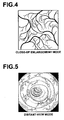
- close-up imaging for example, an uneven pattern on the surface of the subj ect and fine blood vessels, as illustrated in Figure 4 , appear on the obtained images.
- disant-view imaging means imaging performed when the leading end of the scope and the subject are away from each other.
- distant-view imaging for example, the shape of the entire area of the subject and relatively thick blood vessels, or the like, as illustrated in Figure 5 , appear on the obtained images.
- the imaging state judgment means 50 detects a distance from the scope 20 to the subject based on the aperture (the degree of passing or blocking light by the diaphragm) of the diaphragm 12 in the light source unit 10. Further, the imaging state judgment means 50 judges, based on the detection result, whether imaging was performed by close-up imaging or by distant-view imaging. Specifically, when the distance between the leading end of the scope 20 and the subject is long, the amount of light (reflection light) that is reflected from the subject and enters the imaging means 22 is small. Therefore, the degree of closing the aperture of the diaphragm 12 on which AEC control is performed to maintain the brightness at a constant level is small (the aperture of the diaphragm 12 is large).
- the degree of closing the aperture of the diaphragm 12 on which AEC control is performed to maintain the brightness at a constant level is large (the aperture of the diaphragm 12 is small) .
- the imaging state judgment means 50 judges that imaging has been performed by close-up imaging.
- the imaging state judgment means 50 judges that imaging has been performed by distant-view imaging.
- the imaging control means 60 illustrated in Figure 1 automatically switches the imaging condition based on the imaging state judged by the imaging state judgment means 50. Specifically, when the imaging state judgment means 50 judges that imaging has been performed by close-up imaging, the imaging control means 60 controls the light source unit 10 so that narrow-band light L2 is output to the subject. Further, the imaging control means 60 controls the display control means 35 so that narrow-band observation image Pnb obtained when the narrow-band light L2 was output is displayed. In contrast, when the imaging state judgment means 50 judges that imaging has been performed by distant-view imaging, the imaging control means 60 controls the light source unit 10 so that white light L1 is output to the subject. Further, the spectral image generation means 33 generates spectral estimation image SP by using a predetermined wavelength set, and the display control means 35 controls to display the spectral estimation image SP.
- the narrow-band observation image Pnb is obtained and displayed.
- the spectral estimation image SP is obtained and displayed. Therefore, it is possible to utilize the advantage of each observation mode and to perform efficient diagnosis by using images (image diagnosis). Specifically, in close-up imaging, it is desirable that the surface of the subject or a fine structure in a surface layer of the subject clearly appears in images. In close-up imaging, since the leading end of the scope 20 and the subject are close to each other, the amount of light is always sufficient. In contrast, in distant-view imaging, it is necessary to identify a region of the subject at which the color tone (hue) changes.
- the narrow-band observation image Pnb is output, and in distant-view imaging, the spectral estimation image SP is output.
- the narrow-band observation image Pnb it is impossible to increase the light amount, but a fine structure on the surface (surface layer) of the subject clearly appears.
- the spectral estimation image SP a change in the color tone (hue) is easily identified (observed), and the spectral estimation image SP can be obtained by illuminating the subject with a predetermined amount of light. Hence, it is possible to automatically display optimum images for each region to be observed.
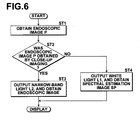
- FIG. 6 is a flow chart illustrating an embodiment of an endoscopic image processing method of the present invention.
- the endoscopic image processing method will be described.
- imaging is performed while the scope 20 is inserted into the body cavity of a patient. Accordingly, an endoscopic image P is obtained (step ST1).
- judgment is made, based on the aperture of the diaphragm of the light source unit 10, as to whether imaging has been performed by close-up imaging or by distant-view imaging (step ST2).
- the imaging control means 60 sets the imaging mode to close-up enlargement mode.
- narrow-band light L2 is output to the subject, and narrow-band observation image Pnb is obtained and displayed (step ST3).
- the imaging control means 60 sets the imaging mode to distant-view mode. Further, white light L1 is output to the subject, and spectral estimation image SP is obtained by the spectral estimation means 33, and displayed (step ST4) .
- the narrow-band observation image Pnb is obtained and displayed.
- the spectral estimation image SP is obtained and displayed. Therefore, it is possible to utilize the advantage of each observation mode, and to perform efficient diagnosis by using images.
- FIG. 7 is a block diagram illustrating a second embodiment of an endoscope apparatus of the present invention.
- an endoscope apparatus 100 will be described.
- the same reference numerals will be assigned to elements or units corresponding to those of the endoscope apparatus 1 illustrated in Figure 1 , and the explanation thereof will be omitted.
- the endoscope apparatus 100 illustrated in Figure 7 differs from the endoscope apparatus 1 illustrated in Figure 1 in that the endoscope apparatus 100 judges, based on the brightness of ordinary observation image Pno, whether imaging has been performed by close-up imaging or by distant-view imaging.
- the light source unit 10 is controlled to output white light L1 at a constant light amount. Therefore, the brightness of the ordinary observation image Pno increases as the scope 20 becomes closer to the subject. The brightness of the ordinary observation image Pno decreases as the scope 20 becomes away from the subject. Therefore, an imaging state judgment means 150 judges, based on the brightness of the ordinary observation image Pno, whether imaging has been performed by close-up imaging or by distant-view imaging. Specifically, when the brightness of the ordinary observation image Pno is greater than or equal to a threshold value, the imaging state judgment means 150 judges that imaging has been performed by close-up imaging. When the brightness of the ordinary observation image Pno is less than the threshold value, the imaging state judgment means 150 judges that imaging has been performed by distant-view imaging. Like the aforementioned embodiment, it is possible to accurately judge the imaging state and to perform efficient diagnosis by using images.
- FIG 8 is a block diagram illustrating a third embodiment of an endoscope apparatus of the present invention.
- an endoscope apparatus 200 will be described.
- the same reference numerals will be assigned to elements or units corresponding to those of the endoscope apparatus 1 illustrated in Figure 1 , and the explanation thereof will be omitted.
- the endoscope apparatus 200 illustrated in Figure 8 differs from the endoscope apparatus 1 illustrated in Figure 1 in that the endoscope apparatus 200 judges, by using spectral estimation image SP of the wavelength of 700 nm, whether imaging has been performed by close-up imaging or by distant-view imaging.
- the spectral image generation means 33 has a function of generating spectral estimation image SP for judging whether imaging has been performed by close-up imaging or by distant-view imaging. For example, the spectral image generation means 33 generates spectral estimation image SP of the wavelength of 700 nm. Further, an imaging state judgment means 250 judges, by using the spectral estimation image SP of the wavelength of 700 nm, whether imaging has been performed by close-up imaging or by distant-view imaging.
- the imaging state judgment means 250 judges that imaging has been performed by close-up imaging when an average value of pixel values (brightness values) of the spectral estimation image SP of the wavelength of 700 nm, or the number of pixels having values greater than or equal to a predetermined value, or the like is greater than or equal to a threshold value.
- the imaging state judgment means 250 judges that imaging has been performed by distant-view imaging.
- spectral estimation images of near-infrared light in which the rate of absorption by living tissue is low, are used. Therefore, the brightness values reflect the distance to the subject, and it is possible to accurately judge the imaging state.
- the endoscope apparatus includes the light source unit 10, the scope 20, and the spectral image generation means 33.
- the light source unit 10 outputs white light L1 and narrow-band light L2 of a predetermined wavelength band to a subject.
- the scope 20 obtains endoscopic image P by imaging the subject illuminated with light output from the light source unit 10.
- the spectral image generation means 33 generates spectral estimation image SP by performing a matrix operation on the endoscopic image obtained by the scope 20 when the subject was illuminated with white light L1. Further, judgment is made on the endoscopic image P obtained by the scope 20 as to whether the endoscopic image has been obtained by performing close-up imaging on the subject or by performing distant-view imaging on the subject.
- the light source unit 10 When it is judged that the endoscopic image has been obtained by distant-view imaging, the light source unit 10 outputs the white light L1, and the spectral image generation means 33 generates and outputs spectral estimation image SP.
- the light source unit 10 When it is judged that the endoscopic image has been obtained by close-up imaging, the light source unit 10 outputs narrow-band light L2, and operation is controlled so that narrow-band observation image Pnb obtained when the subject was illuminated with the narrow-band light L2 is output. Therefore, in close-up imaging, the narrow-band observation image Pnb, which can accurately display fine structures of the subject or the like, is automatically obtained.
- the spectral estimation image SP which can maintain the brightness of the image, and in which a change in the light tone (hue) of the subject is easily identified, is automatically obtained. Therefore, efficient diagnosis by using images is possible.
- the imaging control means 60 has a function of automatically adjusting the diaphragm (aperture) so that the brightness of the endoscopic image P becomes a predetermined value, and the imaging state judgment means 50 judges, based on the aperture of the diaphragm, whether imaging has been performed by close-up imaging or by distant-view imaging, it is possible to accurately judge whether imaging has been performed by close-up imaging or by distant-view imaging.
- the imaging state judgment means 50 judges, based on the brightness of the endoscopic image P, whether imaging has been performed by close-up imaging or by distant-view imaging, it is possible to accurately judge whether imaging has been performed by close-up imaging or by distant-view imaging.
- the imaging state judgment means 50 judges, by using the spectral estimation image of the wavelength of 700 nm, whether imaging has been performed by close-up imaging or by distant-view imaging, it is possible to accurately judge, based on the spectral estimation image SP of near-infrared light, whether imaging has been performed by close-up imaging or by distant-view imaging. In the near-infrared region, the ratio of absorption by living tissue is small.
Landscapes
- Life Sciences & Earth Sciences (AREA)
- Health & Medical Sciences (AREA)
- Surgery (AREA)
- Engineering & Computer Science (AREA)
- Biophysics (AREA)
- Biomedical Technology (AREA)
- Nuclear Medicine, Radiotherapy & Molecular Imaging (AREA)
- Optics & Photonics (AREA)
- Pathology (AREA)
- Radiology & Medical Imaging (AREA)
- Veterinary Medicine (AREA)
- Physics & Mathematics (AREA)
- Heart & Thoracic Surgery (AREA)
- Medical Informatics (AREA)
- Molecular Biology (AREA)
- Animal Behavior & Ethology (AREA)
- General Health & Medical Sciences (AREA)
- Public Health (AREA)
- Signal Processing (AREA)
- Endoscopes (AREA)
Applications Claiming Priority (1)
| Application Number | Priority Date | Filing Date | Title |
|---|---|---|---|
| JP2008313038A JP5271062B2 (ja) | 2008-12-09 | 2008-12-09 | 内視鏡装置およびその作動方法 |
Publications (1)
| Publication Number | Publication Date |
|---|---|
| EP2196134A1 true EP2196134A1 (fr) | 2010-06-16 |
Family
ID=41723045
Family Applications (1)
| Application Number | Title | Priority Date | Filing Date |
|---|---|---|---|
| EP09178186A Withdrawn EP2196134A1 (fr) | 2008-12-09 | 2009-12-07 | Appareil d'endoscope et son procédé de commande |
Country Status (3)
| Country | Link |
|---|---|
| US (1) | US8675046B2 (fr) |
| EP (1) | EP2196134A1 (fr) |
| JP (1) | JP5271062B2 (fr) |
Cited By (5)
| Publication number | Priority date | Publication date | Assignee | Title |
|---|---|---|---|---|
| CN102379675A (zh) * | 2010-08-30 | 2012-03-21 | 富士胶片株式会社 | 电子内窥镜系统及其摄像控制方法、以及处理器装置 |
| CN102429622A (zh) * | 2010-08-30 | 2012-05-02 | 富士胶片株式会社 | 电子内窥镜系统 |
| CN102429621A (zh) * | 2010-08-30 | 2012-05-02 | 富士胶片株式会社 | 电子内窥镜系统及其摄像控制方法、以及处理器装置 |
| CN102578991A (zh) * | 2011-01-07 | 2012-07-18 | 富士胶片株式会社 | 内窥镜系统 |
| EP2272417B1 (fr) * | 2009-07-10 | 2016-11-09 | GE Inspection Technologies, LP | Système de projection de frange pour sonde adapté à une analyse de commutation de phase |
Families Citing this family (19)
| Publication number | Priority date | Publication date | Assignee | Title |
|---|---|---|---|---|
| JP5767775B2 (ja) | 2009-07-06 | 2015-08-19 | 富士フイルム株式会社 | 内視鏡装置 |
| JP5383624B2 (ja) * | 2010-10-26 | 2014-01-08 | 株式会社牧野フライス製作所 | 撮像式工具測定装置および測定方法 |
| US9453716B2 (en) | 2010-10-22 | 2016-09-27 | Makino Milling Machine Co., Ltd. | Method of measurement and apparatus for measurement of tool dimensions |
| JP5220081B2 (ja) * | 2010-10-22 | 2013-06-26 | 株式会社牧野フライス製作所 | 撮像式工具測定装置および撮像式工具測定における刃先進入検出方法 |
| JP5371941B2 (ja) * | 2010-12-14 | 2013-12-18 | 富士フイルム株式会社 | 内視鏡システム |
| JP5637834B2 (ja) * | 2010-12-15 | 2014-12-10 | 富士フイルム株式会社 | 内視鏡装置 |
| JP5435746B2 (ja) * | 2011-01-24 | 2014-03-05 | 富士フイルム株式会社 | 内視鏡装置 |
| CN103443535A (zh) * | 2011-03-30 | 2013-12-11 | 奥林巴斯株式会社 | 光源单元、光变换单元、光源装置以及光源系统 |
| JP5450527B2 (ja) * | 2011-08-10 | 2014-03-26 | 富士フイルム株式会社 | 内視鏡装置 |
| WO2013101912A1 (fr) | 2011-12-29 | 2013-07-04 | Cook Medical Technoloies Llc | Cathéter de visualisation à espace optimisé ayant un dispositif de maintien de train de caméra |
| EP3150106B1 (fr) | 2011-12-29 | 2024-03-27 | Cook Medical Technologies LLC | Cathéter de visualisation d'espace optimisé avec un support de chariot de caméra dans un cathéter avec lumière désaxée |
| US9668643B2 (en) | 2011-12-29 | 2017-06-06 | Cook Medical Technologies Llc | Space-optimized visualization catheter with oblong shape |
| CN105407780B (zh) * | 2013-12-06 | 2017-08-25 | 奥林巴斯株式会社 | 摄像装置、摄像装置的工作方法 |
| CN103705201B (zh) * | 2014-01-16 | 2015-11-04 | 福建师范大学 | 一种适用于消化道病变检测的多模光谱分析系统 |
| JP5992936B2 (ja) * | 2014-02-27 | 2016-09-14 | 富士フイルム株式会社 | 内視鏡システム、内視鏡システム用プロセッサ装置、内視鏡システムの作動方法、内視鏡システム用プロセッサ装置の作動方法 |
| US9684370B2 (en) * | 2014-05-07 | 2017-06-20 | Microsoft Technology Licensing, Llc | Reducing camera interference using image analysis |
| JP6355527B2 (ja) * | 2014-10-31 | 2018-07-11 | 富士フイルム株式会社 | 内視鏡システム及びその作動方法 |
| JP6904727B2 (ja) * | 2017-02-24 | 2021-07-21 | ソニー・オリンパスメディカルソリューションズ株式会社 | 内視鏡装置 |
| TWI869079B (zh) * | 2023-11-29 | 2025-01-01 | 國立中正大學 | 內視鏡影像之窄頻影像轉換方法 |
Citations (6)
| Publication number | Priority date | Publication date | Assignee | Title |
|---|---|---|---|---|
| EP1177761A2 (fr) * | 2000-08-02 | 2002-02-06 | Fuji Photo Film Co., Ltd. | Procédé d'imagerie de la lumière fluorescente et appareil de mise en oeuvre |
| JP2003093336A (ja) | 2001-09-26 | 2003-04-02 | Toshiba Corp | 電子内視鏡装置 |
| EP1488731A1 (fr) * | 2003-06-18 | 2004-12-22 | Olympus Corporation | Endoscope |
| EP1757221A1 (fr) | 2004-05-14 | 2007-02-28 | Olympus Medical Systems Corp. | Endoscope électronique |
| EP1787577A1 (fr) * | 2004-08-30 | 2007-05-23 | Olympus Corporation | Endoscope |
| EP1992275A1 (fr) | 2006-03-03 | 2008-11-19 | Olympus Medical Systems Corp. | Dispositif d'endoscope |
Family Cites Families (16)
| Publication number | Priority date | Publication date | Assignee | Title |
|---|---|---|---|---|
| JPS6378915U (fr) * | 1986-11-10 | 1988-05-25 | ||
| JPH0413112A (ja) * | 1990-05-02 | 1992-01-17 | Olympus Optical Co Ltd | 内視鏡装置 |
| JP2000197604A (ja) * | 1998-10-28 | 2000-07-18 | Olympus Optical Co Ltd | 内視鏡装置 |
| JP4472130B2 (ja) * | 2000-07-14 | 2010-06-02 | オリンパス株式会社 | 内視鏡装置 |
| US7892169B2 (en) * | 2000-07-21 | 2011-02-22 | Olympus Corporation | Endoscope apparatus |
| JP2002065585A (ja) * | 2000-08-24 | 2002-03-05 | Fuji Photo Film Co Ltd | 内視鏡装置 |
| DE60228165D1 (de) * | 2001-05-16 | 2008-09-25 | Olympus Corp | Endoskop mit Bildverarbeitungseinrichtung |
| US7794394B2 (en) * | 2002-05-22 | 2010-09-14 | Beth Israel Deaconess Medical Center | Device for wavelength-selective imaging |
| JP5461753B2 (ja) * | 2004-07-30 | 2014-04-02 | オリンパス株式会社 | 内視鏡装置 |
| EP1698272B1 (fr) * | 2005-03-04 | 2012-12-05 | FUJIFILM Corporation | Endoscope et dispositif de traitement d'images |
| JP4794928B2 (ja) * | 2005-07-13 | 2011-10-19 | オリンパスメディカルシステムズ株式会社 | 画像処理装置 |
| JP4773217B2 (ja) * | 2006-01-31 | 2011-09-14 | 富士フイルム株式会社 | 電子内視鏡装置 |
| JP4728162B2 (ja) * | 2006-04-21 | 2011-07-20 | オリンパスメディカルシステムズ株式会社 | 内視鏡システム |
| JP5355846B2 (ja) * | 2006-05-08 | 2013-11-27 | オリンパスメディカルシステムズ株式会社 | 内視鏡用画像処理装置 |
| JP2007307282A (ja) * | 2006-05-22 | 2007-11-29 | Iwamoto:Kk | 温石浴装置 |
| US8305192B2 (en) * | 2008-11-21 | 2012-11-06 | Symbol Technologies, Inc. | RFID reader with automatic near/far field interrogation mode switching, and related operating methods |
-
2008
- 2008-12-09 JP JP2008313038A patent/JP5271062B2/ja not_active Expired - Fee Related
-
2009
- 2009-12-07 EP EP09178186A patent/EP2196134A1/fr not_active Withdrawn
- 2009-12-08 US US12/633,559 patent/US8675046B2/en not_active Expired - Fee Related
Patent Citations (6)
| Publication number | Priority date | Publication date | Assignee | Title |
|---|---|---|---|---|
| EP1177761A2 (fr) * | 2000-08-02 | 2002-02-06 | Fuji Photo Film Co., Ltd. | Procédé d'imagerie de la lumière fluorescente et appareil de mise en oeuvre |
| JP2003093336A (ja) | 2001-09-26 | 2003-04-02 | Toshiba Corp | 電子内視鏡装置 |
| EP1488731A1 (fr) * | 2003-06-18 | 2004-12-22 | Olympus Corporation | Endoscope |
| EP1757221A1 (fr) | 2004-05-14 | 2007-02-28 | Olympus Medical Systems Corp. | Endoscope électronique |
| EP1787577A1 (fr) * | 2004-08-30 | 2007-05-23 | Olympus Corporation | Endoscope |
| EP1992275A1 (fr) | 2006-03-03 | 2008-11-19 | Olympus Medical Systems Corp. | Dispositif d'endoscope |
Cited By (8)
| Publication number | Priority date | Publication date | Assignee | Title |
|---|---|---|---|---|
| EP2272417B1 (fr) * | 2009-07-10 | 2016-11-09 | GE Inspection Technologies, LP | Système de projection de frange pour sonde adapté à une analyse de commutation de phase |
| CN102379675A (zh) * | 2010-08-30 | 2012-03-21 | 富士胶片株式会社 | 电子内窥镜系统及其摄像控制方法、以及处理器装置 |
| CN102429622A (zh) * | 2010-08-30 | 2012-05-02 | 富士胶片株式会社 | 电子内窥镜系统 |
| CN102429621A (zh) * | 2010-08-30 | 2012-05-02 | 富士胶片株式会社 | 电子内窥镜系统及其摄像控制方法、以及处理器装置 |
| CN102429621B (zh) * | 2010-08-30 | 2015-06-24 | 富士胶片株式会社 | 电子内窥镜系统及其处理器装置 |
| CN102379675B (zh) * | 2010-08-30 | 2015-07-15 | 富士胶片株式会社 | 电子内窥镜系统及其摄像控制方法、以及处理器装置 |
| CN102429622B (zh) * | 2010-08-30 | 2015-10-28 | 富士胶片株式会社 | 电子内窥镜系统 |
| CN102578991A (zh) * | 2011-01-07 | 2012-07-18 | 富士胶片株式会社 | 内窥镜系统 |
Also Published As
| Publication number | Publication date |
|---|---|
| US20100141747A1 (en) | 2010-06-10 |
| JP5271062B2 (ja) | 2013-08-21 |
| JP2010136748A (ja) | 2010-06-24 |
| US8675046B2 (en) | 2014-03-18 |
Similar Documents
| Publication | Publication Date | Title |
|---|---|---|
| US8675046B2 (en) | Endoscope apparatus and control method thereof | |
| EP2005877B1 (fr) | Dispositif endoscopique | |
| EP2047792B1 (fr) | Dispositif endoscope | |
| JP6495539B2 (ja) | 画像処理装置、画像処理装置の作動方法、および画像処理プログラム | |
| JP4647346B2 (ja) | 内視鏡装置 | |
| JP4009626B2 (ja) | 内視鏡用映像信号処理装置 | |
| US9962070B2 (en) | Endoscope system, processor device, and method for operating endoscope system | |
| JP5431252B2 (ja) | 電子内視鏡システム、電子内視鏡用のプロセッサ装置、及び電子内視鏡システムの作動方法 | |
| CN101291615B (zh) | 生物体摄像装置和生物体观测系统 | |
| US20160089010A1 (en) | Endoscope system, processor device, and method for operating endoscope system | |
| JP2010069063A (ja) | 画像取得方法および装置 | |
| WO2017183339A1 (fr) | Système d'endoscope, dispositif de processeur, et procédé de fonctionnement de système d'endoscope | |
| US8439823B2 (en) | Endoscope apparatus and its control method | |
| EP1769724B1 (fr) | Endoscope électronique | |
| JP2010200883A (ja) | 内視鏡画像処理装置および方法ならびにプログラム | |
| EP2258252A1 (fr) | Appareil de traitement d'image endoscopique, procédé et programme | |
| JP2006061621A (ja) | 内視鏡用調光信号生成装置 | |
| EP2258253B1 (fr) | Appareil endoscopique et procédé d'obtention d'image endoscopique | |
| JP2010213745A (ja) | 内視鏡画像処理装置および方法ならびにプログラム |
Legal Events
| Date | Code | Title | Description |
|---|---|---|---|
| PUAI | Public reference made under article 153(3) epc to a published international application that has entered the european phase |
Free format text: ORIGINAL CODE: 0009012 |
|
| AK | Designated contracting states |
Kind code of ref document: A1 Designated state(s): AT BE BG CH CY CZ DE DK EE ES FI FR GB GR HR HU IE IS IT LI LT LU LV MC MK MT NL NO PL PT RO SE SI SK SM TR |
|
| AX | Request for extension of the european patent |
Extension state: AL BA RS |
|
| 17P | Request for examination filed |
Effective date: 20101110 |
|
| STAA | Information on the status of an ep patent application or granted ep patent |
Free format text: STATUS: THE APPLICATION HAS BEEN WITHDRAWN |
|
| 18W | Application withdrawn |
Effective date: 20141027 |